
BIO 1: Review: Evolution
|
|
|
- Darcy Hamilton
- 10 years ago
- Views:
Transcription
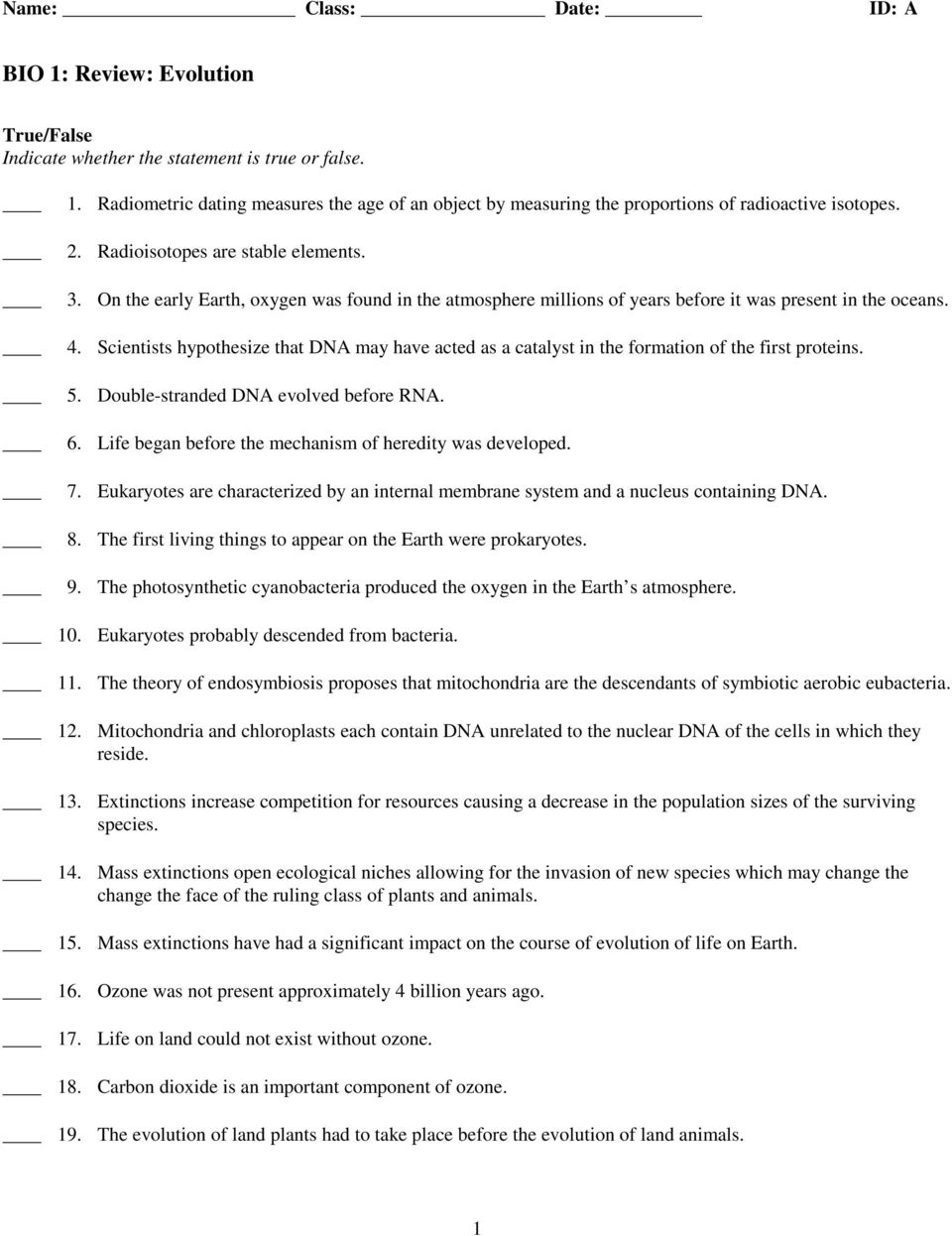
1 Name: Class: Date: ID: A BIO 1: Review: Evolution True/False Indicate whether the statement is true or false. 1. Radiometric dating measures the age of an object by measuring the proportions of radioactive isotopes. 2. Radioisotopes are stable elements. 3. On the early Earth, oxygen was found in the atmosphere millions of years before it was present in the oceans. 4. Scientists hypothesize that DNA may have acted as a catalyst in the formation of the first proteins. 5. Double-stranded DNA evolved before RNA. 6. Life began before the mechanism of heredity was developed. 7. Eukaryotes are characterized by an internal membrane system and a nucleus containing DNA. 8. The first living things to appear on the Earth were prokaryotes. 9. The photosynthetic cyanobacteria produced the oxygen in the Earth s atmosphere. 10. Eukaryotes probably descended from bacteria. 11. The theory of endosymbiosis proposes that mitochondria are the descendants of symbiotic aerobic eubacteria. 12. Mitochondria and chloroplasts each contain DNA unrelated to the nuclear DNA of the cells in which they reside. 13. Extinctions increase competition for resources causing a decrease in the population sizes of the surviving species. 14. Mass extinctions open ecological niches allowing for the invasion of new species which may change the change the face of the ruling class of plants and animals. 15. Mass extinctions have had a significant impact on the course of evolution of life on Earth. 16. Ozone was not present approximately 4 billion years ago. 17. Life on land could not exist without ozone. 18. Carbon dioxide is an important component of ozone. 19. The evolution of land plants had to take place before the evolution of land animals. 1
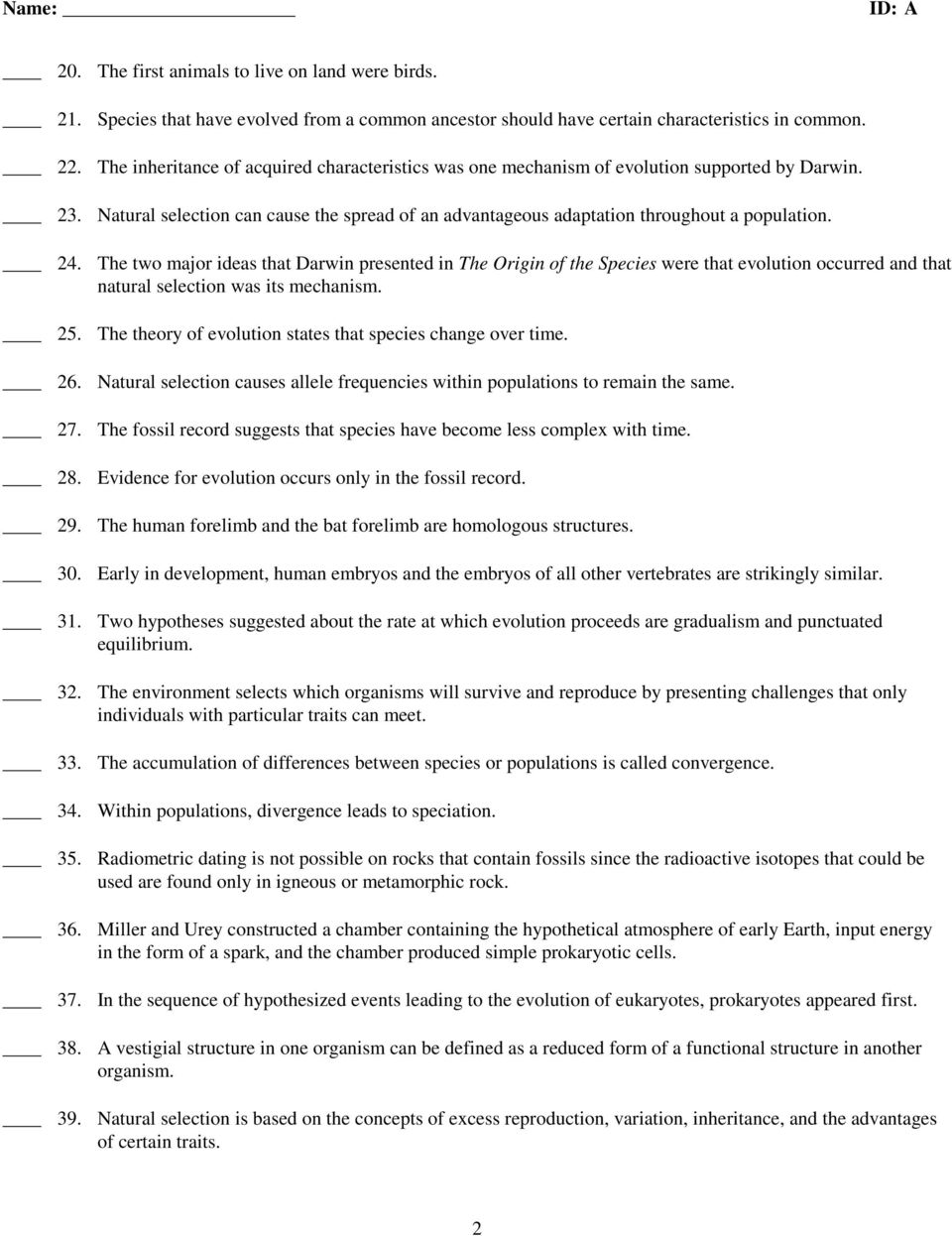
2 Name: ID: A 20. The first animals to live on land were birds. 21. Species that have evolved from a common ancestor should have certain characteristics in common. 22. The inheritance of acquired characteristics was one mechanism of evolution supported by Darwin. 23. Natural selection can cause the spread of an advantageous adaptation throughout a population. 24. The two major ideas that Darwin presented in The Origin of the Species were that evolution occurred and that natural selection was its mechanism. 25. The theory of evolution states that species change over time. 26. Natural selection causes allele frequencies within populations to remain the same. 27. The fossil record suggests that species have become less complex with time. 28. Evidence for evolution occurs only in the fossil record. 29. The human forelimb and the bat forelimb are homologous structures. 30. Early in development, human embryos and the embryos of all other vertebrates are strikingly similar. 31. Two hypotheses suggested about the rate at which evolution proceeds are gradualism and punctuated equilibrium. 32. The environment selects which organisms will survive and reproduce by presenting challenges that only individuals with particular traits can meet. 33. The accumulation of differences between species or populations is called convergence. 34. Within populations, divergence leads to speciation. 35. Radiometric dating is not possible on rocks that contain fossils since the radioactive isotopes that could be used are found only in igneous or metamorphic rock. 36. Miller and Urey constructed a chamber containing the hypothetical atmosphere of early Earth, input energy in the form of a spark, and the chamber produced simple prokaryotic cells. 37. In the sequence of hypothesized events leading to the evolution of eukaryotes, prokaryotes appeared first. 38. A vestigial structure in one organism can be defined as a reduced form of a functional structure in another organism. 39. Natural selection is based on the concepts of excess reproduction, variation, inheritance, and the advantages of certain traits. 2
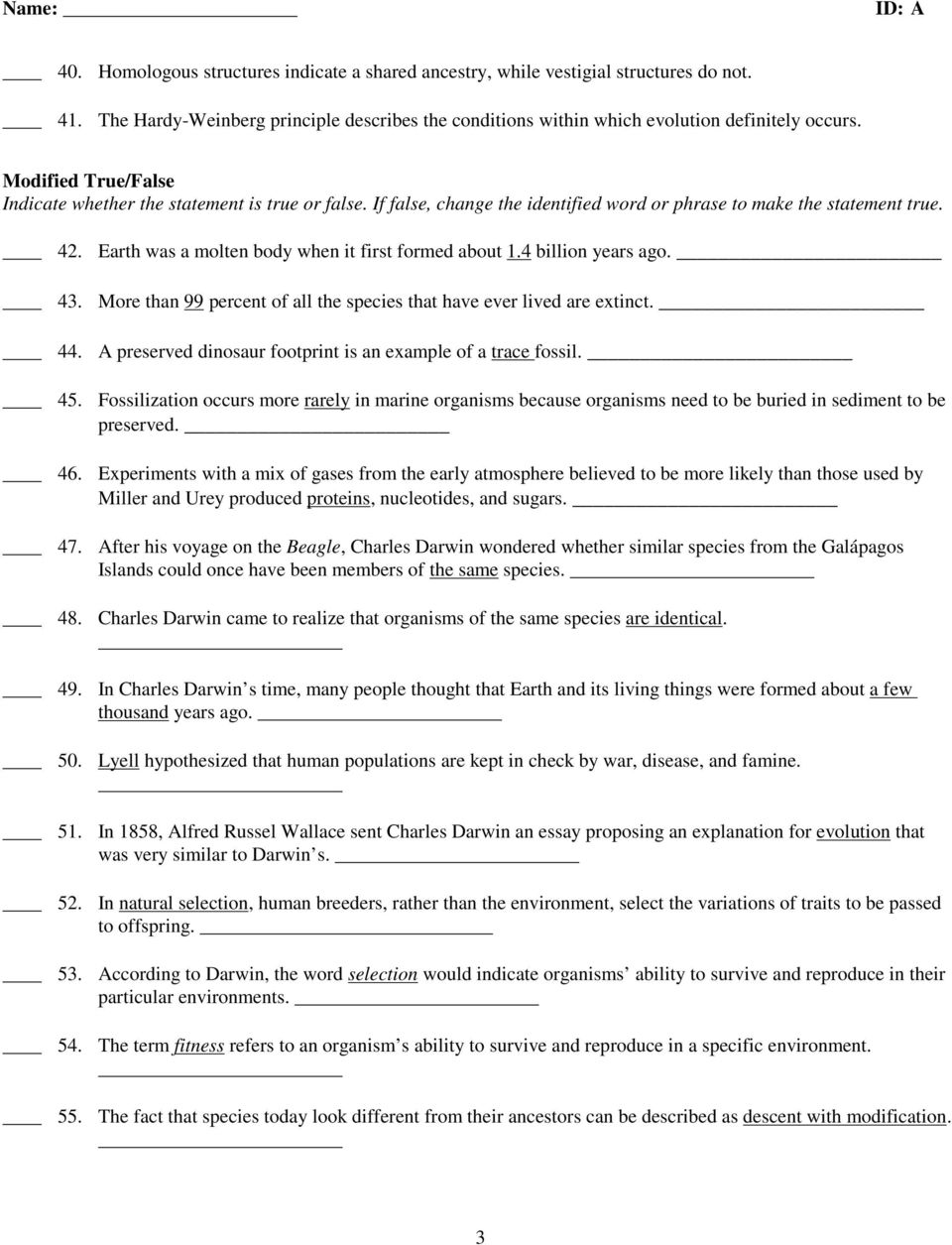
3 Name: ID: A 40. Homologous structures indicate a shared ancestry, while vestigial structures do not. 41. The Hardy-Weinberg principle describes the conditions within which evolution definitely occurs. Modified True/False Indicate whether the statement is true or false. If false, change the identified word or phrase to make the statement true. 42. Earth was a molten body when it first formed about 1.4 billion years ago. 43. More than 99 percent of all the species that have ever lived are extinct. 44. A preserved dinosaur footprint is an example of a trace fossil. 45. Fossilization occurs more rarely in marine organisms because organisms need to be buried in sediment to be preserved. 46. Experiments with a mix of gases from the early atmosphere believed to be more likely than those used by Miller and Urey produced proteins, nucleotides, and sugars. 47. After his voyage on the Beagle, Charles Darwin wondered whether similar species from the Galápagos Islands could once have been members of the same species. 48. Charles Darwin came to realize that organisms of the same species are identical. 49. In Charles Darwin s time, many people thought that Earth and its living things were formed about a few thousand years ago. 50. Lyell hypothesized that human populations are kept in check by war, disease, and famine. 51. In 1858, Alfred Russel Wallace sent Charles Darwin an essay proposing an explanation for evolution that was very similar to Darwin s. 52. In natural selection, human breeders, rather than the environment, select the variations of traits to be passed to offspring. 53. According to Darwin, the word selection would indicate organisms ability to survive and reproduce in their particular environments. 54. The term fitness refers to an organism s ability to survive and reproduce in a specific environment. 55. The fact that species today look different from their ancestors can be described as descent with modification. 3
4 Name: ID: A 56. According to Charles Darwin, individuals best suited to their environment survive and reproduce most successfully. 57. According to Charles Darwin, members of a species must share limited resources. 58. The theory of natural selection says that evolution will not occur in a population unless allelic frequencies are acted on by forces that cause change. 59. Any change in the allelic frequencies in a population that is due to chance is called founder effect. 60. A population of ants declines to a very low number. When the ants habitat is turned into a picnic area for humans, the additional food causes the population of ants to rebound. This is an example of natural selection. 61. A mutation is a random change in genetic material. 62. Humans born with either below-normal or above-normal birth weights have a lower chance of survival than those born with average birth weights. Consequently, birth weights vary little in human populations. This form of natural selection is called directional selection. 63. Punctuated equilibrium and gradualism are two models that describe the cause of speciation. 64. Gradualism and punctuated equilibrium are similar models of evolution. 65. Embryos of different organisms exhibit homologous structures during certain phases of development that become totally different structures in adult forms. This indicates that organisms evolved from different ancestors. 66. In a gene pool, as the relative frequency of one allele for a trait increases, the relative frequencies of other alleles for that trait decrease. 67. Most inheritable differences are due to gene shuffling that occurs during the production of gametes. 68. Mutations do not always affect an organism s phenotype its physical, behavioral, and biochemical characteristics. 69. In a population of snakes with a range of body lengths, if the longest individuals have the highest fitness, disruptive selection is likely to occur. 70. In small populations, an allele can become more or less common simply by chance. 4

5 Name: ID: A 71. Genetic drift may occur when a small group of individuals colonize a new habitat. 72. When mutations introduce new alleles into a population, genetic variation is disrupted. 73. In a population of birds, if females prefer males with long tails, the population violates the condition of directional selection described by the Hardy-Weinberg principle. 74. In the type of reproductive isolation called behavioral isolation, two populations are separated by barriers such as rivers or mountains. 75. Two populations that have overlapping ranges can remain reproductively isolated through behavioral isolation or temporal isolation from each other. 76. The first step of the speciation of the Galápagos finches likely was the arrival of founders from South America. 77. The fossil record, although incomplete, provides evidence about the history of life and illustrates that most species have remained unchanged over time. 78. Scientists use relative dating to determine the absolute age of a rock in years. 79. The vast majority of Earth s history about 88 percent is taken up by the Cenozoic Era. 80. The Cenozoic Era included the Cretaceous, Jurassic, and Triassic Period. 81. The molten elements of early Earth arranged themselves according to density, and the most dense elements formed Earth s surface. 82. The earliest sedimentary rocks were formed about the time that liquid water formed on Earth s surface. 83. Stanley Miller and Harold Urey assumed that the assembly of complex organic molecules from simpler compounds on early Earth would have required an energy source, which they hypothesized was radioactive decay. 84. Asexual reproduction increases genetic variation the raw material on which natural selection operates. 85. During the Mesozoic Era, animals began to invade the land. 86. The Galápagos finches underwent adaptive radiation, a process in which a small group evolves into several different forms that live in different ways. 5

6 Name: ID: A Completion Complete each statement. 87. The study of radioactive decay in rocks indicates that the Earth is about years old. 88. Forms of an element that differ in atomic mass are called. 89. are unstable elements that give off energy as they decay, forming stable elements. 90. A(n) is the amount of time required for one half the number of radioactive atoms in a sample to decay, forming stable elements. 91. By determining the number of half-lives that have passed since the formation of a rock containing radioisotopes and their stable daughter elements, scientists are able to determine the approximate of the rock. 92. The goal of each of the models that attempt to explain how life s basic chemicals were formed is to explain the development of building blocks. 93. Cyanobacteria produced the that is now present in our atmosphere. 94. The theory of is a widely accepted theory that explains the presence of mitochondria and chloroplasts in eukaryotic cells. 95. Both mitochondria and chloroplasts have their own. 96. were the first eukaryotes. 97. Multicellularity allows cells to. 98. Having more than one cell is known as. 99. All of the major phyla on the Earth today evolved during the period The death of all members of many different species is called At the end of the period 250 million years ago, about 96 percent of all species of animals became extinct The Earth s surface is protected from ultraviolet radiation by molecules The first animals to successfully invade the land from the sea were Reptiles evolved from. 6

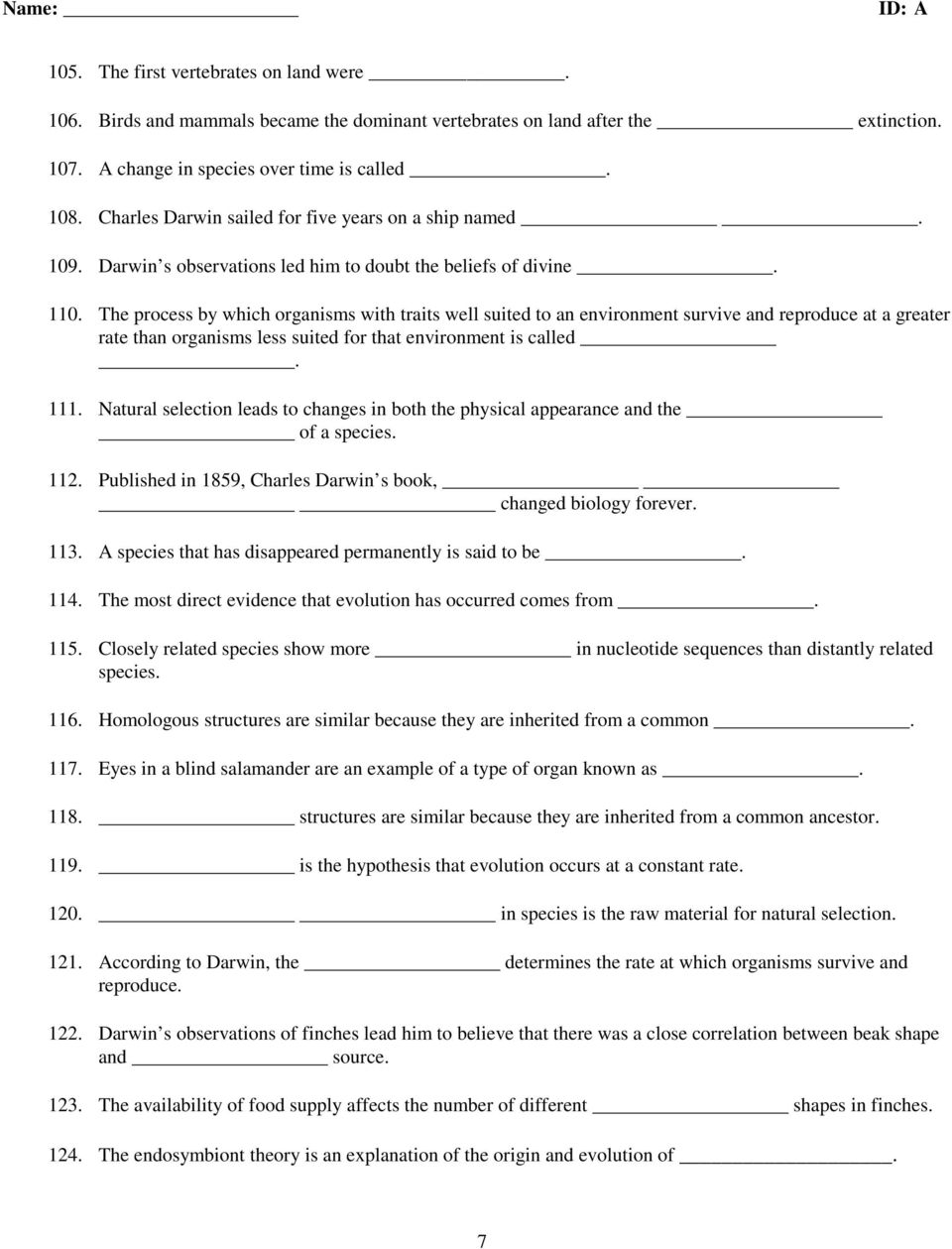
7 Name: ID: A 105. The first vertebrates on land were Birds and mammals became the dominant vertebrates on land after the extinction A change in species over time is called Charles Darwin sailed for five years on a ship named Darwin s observations led him to doubt the beliefs of divine The process by which organisms with traits well suited to an environment survive and reproduce at a greater rate than organisms less suited for that environment is called Natural selection leads to changes in both the physical appearance and the of a species Published in 1859, Charles Darwin s book, changed biology forever A species that has disappeared permanently is said to be The most direct evidence that evolution has occurred comes from Closely related species show more in nucleotide sequences than distantly related species Homologous structures are similar because they are inherited from a common Eyes in a blind salamander are an example of a type of organ known as structures are similar because they are inherited from a common ancestor is the hypothesis that evolution occurs at a constant rate in species is the raw material for natural selection According to Darwin, the determines the rate at which organisms survive and reproduce Darwin s observations of finches lead him to believe that there was a close correlation between beak shape and source The availability of food supply affects the number of different shapes in finches The endosymbiont theory is an explanation of the origin and evolution of. 7
8 Name: ID: A 125. Scientists hypothesize that RNA, not DNA, was the first molecule to carry heritable information because RNAs called ribozymes are capable of activity The transition from the Permian to the Triassic periods is marked by a James Hutton and Charles Lyell held similar views about Earth s age. Both thought that Earth was of years old The geologist proposed that past changes in Earth must be explained in terms of events and processes observable today According to Lamarck, evolution resulted from the inheritance of traits According to s theory of the inheritance of acquired traits, the long legs of certain shore birds could be acquired by frequent wading in water and then passed on to offspring Although his idea was incorrect, Jean-Baptiste Lamarck was one of the first people to propose a scientific explanation for Charles Darwin applied Thomas Malthus s thoughts about human population growth to all Charles Darwin observed that instead of being perfect and unchanging, individuals in a species show Charles Darwin concluded that, in similar environments around the world, could produce similar structures in unrelated species Certain animal structures that have different functions in different species and develop from the same embryonic tissues are called structures According to Darwin s theory of evolution, change over time According to Darwin s theory of evolution, all species on Earth are united by Darwin proposed that natural selection took place as individuals best suited to the survived and reproduced Charles Darwin realized that the measure of success for an organism was not only a long period of survival but also Natural selection is the only mechanism of evolution that will lead to Information on genetics and now provide compelling evidence of evolution that was not available to Darwin. 8

9 Name: ID: A 142. Not all fossils of organisms have modern counterparts Imagine that you are a paleontologist and you have found a dinosaur fossil that is intermediate in form between species. You would classify this fossil as a fossil Anatomically similar structures inherited from a common ancestor are called structures The snake pelvis is an example of a structure A(an) is all of the genes that are present in a particular population The number of possible phenotypes for a given trait depends on how many control the trait The pattern of natural selection that acts most strongly against gray individuals in a population that ranges from black through gray to white is selection According to the principle, allele frequencies in a population will remain constant unless one or more of five specific factors cause those frequencies to change When a population is NOT evolving, it is in a situation called For new species to evolve, populations must be isolated from each other If two populations have been reproductively isolated and can no longer breed and produce fertile offspring, the process of has occurred In a particular environment, populations that are very different from each other are less likely to with each other for resources The record provides evidence about the history of life on Earth A researcher could quickly date a new rock sample if it contained a(an) fossil After Precambrian Time, the main divisions of the geologic time scale are eras and In Stanley Miller and Harold Urey s experiment, several, which are the building blocks of proteins, began to accumulate It is possible that RNA was the first information-storing molecule, but over time, became the primary way in which genetic information is stored and transmitted is the process by which two species evolve in response to changes in each other over time. 9
10 Name: ID: A 160. The similar body structure but different ancestry of sharks and dolphins indicates that these groups have undergone, a process in which unrelated organisms come to resemble each other. 10

11 BIO 1: Review: Evolution Answer Section TRUE/FALSE 1. ANS: T PTS: 1 DIF: I OBJ: BPE ANS: F PTS: 1 DIF: I OBJ: BPE ANS: F PTS: 1 DIF: I OBJ: BPE ANS: F PTS: 1 DIF: I OBJ: BPE ANS: F PTS: 1 DIF: I OBJ: BPE ANS: F PTS: 1 DIF: I OBJ: BPE ANS: T PTS: 1 DIF: I OBJ: BPE ANS: T PTS: 1 DIF: I OBJ: BPE ANS: T PTS: 1 DIF: I OBJ: BPE ANS: T PTS: 1 DIF: I OBJ: BPE ANS: T PTS: 1 DIF: I OBJ: BPE ANS: T PTS: 1 DIF: I OBJ: BPE ANS: F PTS: 1 DIF: I OBJ: BPE ANS: T PTS: 1 DIF: I OBJ: BPE ANS: T PTS: 1 DIF: I OBJ: BPE ANS: T PTS: 1 DIF: I OBJ: BPE ANS: T PTS: 1 DIF: I OBJ: BPE ANS: F PTS: 1 DIF: I OBJ: BPE ANS: T PTS: 1 DIF: I OBJ: BPE ANS: F PTS: 1 DIF: I OBJ: BPE ANS: T PTS: 1 DIF: I OBJ: BPE ANS: F PTS: 1 DIF: I OBJ: BPE ANS: T PTS: 1 DIF: I OBJ: BPE ANS: T PTS: 1 DIF: I OBJ: BPE ANS: T PTS: 1 DIF: I OBJ: BPE ANS: F PTS: 1 DIF: I OBJ: BPE ANS: F PTS: 1 DIF: I OBJ: BPE ANS: F PTS: 1 DIF: I OBJ: BPE ANS: T PTS: 1 DIF: I OBJ: BPE ANS: T PTS: 1 DIF: I OBJ: BPE ANS: T PTS: 1 DIF: I OBJ: BPE ANS: T PTS: 1 DIF: I OBJ: BPE ANS: F PTS: 1 DIF: I OBJ: BPE ANS: T PTS: 1 DIF: I OBJ: BPE ANS: T The isotopes needed are not present in sedimentary layers likely to hold fossils. PTS: 1 DIF: Bloom's Level B REF: 396 TOP:

12 36. ANS: F Amino acids and other organic molecules were formed. PTS: 1 DIF: Bloom's Level B REF: 403 TOP: ANS: T Review the endosymbiotic theory to see how eukaryotes are thought to have developed from prokaryotes. PTS: 1 DIF: Bloom's Level D REF: 405 TOP: ANS: T PTS: 1 DIF: Bloom's Taxonomy B REF: 425 NAT: LS_3c TOP: ANS: T PTS: 1 DIF: Bloom's Taxonomy C REF: 420 NAT: LS_3a TOP: ANS: F Vestigial structures are homologous structures and both indicate a shared ancestry. PTS: 1 DIF: Bloom's Taxonomy C REF: NAT: LS_3c TOP: ANS: F The Hardy-Weinberg principle describes the conditions within which evolution does not occur. PTS: 1 DIF: Bloom's Taxonomy C REF: TOP: 15-7 MODIFIED TRUE/FALSE 42. ANS: F, 4.6 PTS: 1 DIF: Bloom's Level A REF: 392 TOP: ANS: T PTS: 1 DIF: Bloom's Level A REF: 393 NAT: LS_3b TOP: ANS: T PTS: 1 DIF: Bloom's Level B REF: 393 TOP: ANS: F, commonly PTS: 1 DIF: Bloom's Level B REF: 393 TOP: ANS: F, amino acids PTS: 1 DIF: Bloom's Level C REF: 403 TOP: ANS: T PTS: 1 DIF: L1 REF: p. 372 OBJ: NAT: C.3.b D.3 STA: BIO.8.e KEY: knowledge 2
13 48. ANS: F differ are different have natural variations PTS: 1 DIF: L2 REF: p. 379 OBJ: NAT: C.3.b D.3 STA: BIO.8.e KEY: comprehension 49. ANS: T PTS: 1 DIF: L2 REF: p. 373 OBJ: NAT: C.3.b D.3 STA: BIO.8.e KEY: comprehension 50. ANS: F, Malthus PTS: 1 DIF: L1 REF: p. 377 OBJ: NAT: C.3.b C.3.c STA: BIO.8.e KEY: knowledge 51. ANS: T PTS: 1 DIF: L2 REF: p. 378 OBJ: NAT: C.3.a C.3.c C.3.d STA: BIO.8.e KEY: comprehension 52. ANS: F, artificial selection PTS: 1 DIF: L2 REF: p. 379 OBJ: NAT: C.3.a C.3.d C.3.d STA: BIO.8.c KEY: analysis 53. ANS: F, fitness PTS: 1 DIF: L1 REF: p. 380 OBJ: NAT: C.3.a C.3.c C.6.c STA: BIO.8.c KEY: knowledge 54. ANS: T PTS: 1 DIF: L2 REF: p. 380 OBJ: NAT: C.3.a C.3.c C.6.c STA: BIO.8.c KEY: comprehension 55. ANS: T PTS: 1 DIF: L2 REF: p. 381 OBJ: NAT: C.3.a C.3.c C.6.c STA: BIO.8.c KEY: analysis 56. ANS: T PTS: 1 DIF: L2 REF: p. 380 OBJ: NAT: C.3.a C.3.a C.3.d C.6.c STA: BIO.8.e KEY: comprehension 57. ANS: F, compete for PTS: 1 DIF: L2 REF: p. 380 OBJ: NAT: C.3.a C.3.a C.3.d C.6.c STA: BIO.8.e KEY: comprehension 58. ANS: F, Hardy-Weinberg principle PTS: 1 DIF: Bloom's Taxonomy C REF: TOP: ANS: F, genetic drift PTS: 1 DIF: Bloom's Taxonomy C REF: 433 TOP:

14 60. ANS: F, a bottleneck PTS: 1 DIF: Bloom's Taxonomy D REF: 433 TOP: ANS: T PTS: 1 DIF: Bloom's Taxonomy B REF: 434 NAT: LS_2c TOP: ANS: F, stabilizing selection PTS: 1 DIF: Bloom's Taxonomy E REF: 434 NAT: LS_3a TOP: ANS: F, rate PTS: 1 DIF: Bloom's Taxonomy C REF: TOP: ANS: F, competing PTS: 1 DIF: Bloom's Taxonomy C REF: 441 TOP: ANS: F, common PTS: 1 DIF: Bloom's Taxonomy C REF: 426 NAT: LS_3d TOP: ANS: T PTS: 1 DIF: L2 REF: p. 394 OBJ: NAT: C.2.a C.3.a STA: BIO.8.e KEY: application 67. ANS: T PTS: 1 DIF: L1 REF: p. 395 OBJ: NAT: C.2.a C.3.a STA: BIO.8.e KEY: knowledge 68. ANS: T PTS: 1 DIF: L2 REF: p. 394 OBJ: NAT: C.2.a C.3.a STA: BIO.8.e KEY: analysis 69. ANS: F, directional PTS: 1 DIF: L3 REF: p. 398 OBJ: NAT: C.2.c C.3.b STA: BIO.8.c KEY: evaluation 70. ANS: T PTS: 1 DIF: L1 REF: p. 400 OBJ: NAT: C.2.c C.3.b STA: BIO.8.c KEY: knowledge 71. ANS: T PTS: 1 DIF: L2 REF: p. 400 OBJ: NAT: C.2.c C.3.b STA: BIO.8.c KEY: application 72. ANS: F, equilibrium PTS: 1 DIF: L2 REF: p. 402 OBJ: NAT: C.2.c C.3.d STA: BIO.8.c KEY: comprehension 4

15 73. ANS: F, random mating PTS: 1 DIF: L3 REF: p. 402 OBJ: NAT: C.2.c C.3.d STA: BIO.8.c KEY: evaluation 74. ANS: F, geographic PTS: 1 DIF: L2 REF: p. 405 OBJ: NAT: C.3.a C.3.d STA: BIO.8.c KEY: application 75. ANS: T PTS: 1 DIF: L2 REF: p. 404 OBJ: NAT: C.3.a C.3.d STA: BIO.8.c KEY: analysis 76. ANS: T PTS: 1 DIF: L1 REF: p. 408 OBJ: NAT: C.3.a C.3.c STA: BIO.8.c KEY: knowledge 77. ANS: F changed evolved PTS: 1 DIF: L2 REF: p. 417 OBJ: NAT: C.3.a C.3.c STA: BIO.7.b BIO.8.a KEY: comprehension 78. ANS: F, radioactive PTS: 1 DIF: L2 REF: p. 420 OBJ: NAT: C.3.a C.3.c STA: BIO.7.b BIO.8.a KEY: comprehension 79. ANS: F, Precambrian Time PTS: 1 DIF: L1 REF: p. 421 OBJ: NAT: C.3.a G.3 STA: BIO.7.b BIO.8.a KEY: knowledge 80. ANS: F, Mesozoic PTS: 1 DIF: L2 REF: p. 421 OBJ: NAT: C.3.a G.3 STA: BIO.7.b BIO.8.a KEY: knowledge 81. ANS: F, core PTS: 1 DIF: L2 REF: p. 423 OBJ: NAT: C.3.b G.3 STA: BIO.7.b BIO.8.a KEY: application 82. ANS: T PTS: 1 DIF: L3 REF: p. 424 OBJ: NAT: C.3.b G.3 STA: BIO.7.b BIO.8.a KEY: synthesis 83. ANS: F, lightning PTS: 1 DIF: L2 REF: p. 424 OBJ: NAT: C.3.b G.3 STA: BIO.7.b BIO.8.a KEY: analysis 84. ANS: F, Sexual PTS: 1 DIF: L2 REF: p. 428 OBJ: NAT: C.3.b C.3.c STA: BIO.7.b BIO.8.a KEY: analysis 5
16 85. ANS: F, Paleozoic PTS: 1 DIF: L1 REF: p. 430 OBJ: NAT: C.3.a C.3.d STA: BIO.7.b BIO.8.a KEY: knowledge 86. ANS: T PTS: 1 DIF: L2 REF: p. 436 OBJ: NAT: C.3.a G.3 STA: BIO.7.b BIO.8.a KEY: application COMPLETION 87. ANS: 4.5 billion PTS: 1 DIF: I OBJ: BPE ANS: isotopes PTS: 1 DIF: I OBJ: BPE ANS: Radioisotopes PTS: 1 DIF: I OBJ: BPE ANS: half-life PTS: 1 DIF: I OBJ: BPE ANS: age PTS: 1 DIF: I OBJ: BPE ANS: organic PTS: 1 DIF: I OBJ: BPE ANS: oxygen PTS: 1 DIF: I OBJ: BPE ANS: endosymbiosis PTS: 1 DIF: I OBJ: BPE ANS: DNA PTS: 1 DIF: I OBJ: BPE ANS: Protists PTS: 1 DIF: I OBJ: BPE ANS: specialize PTS: 1 DIF: I OBJ: BPE ANS: multicellularity PTS: 1 DIF: I OBJ: BPE
17 99. ANS: Cambrian PTS: 1 DIF: I OBJ: BPE ANS: mass extinction PTS: 1 DIF: I OBJ: BPE ANS: Permian PTS: 1 DIF: I OBJ: BPE ANS: ozone PTS: 1 DIF: I OBJ: BPE ANS: arthropods PTS: 1 DIF: I OBJ: BPE ANS: amphibians PTS: 1 DIF: I OBJ: BPE ANS: amphibians PTS: 1 DIF: I OBJ: BPE ANS: Cretaceous PTS: 1 DIF: I OBJ: BPE ANS: evolution PTS: 1 DIF: I OBJ: BPE ANS: H.M.S. Beagle PTS: 1 DIF: I OBJ: BPE ANS: creation PTS: 1 DIF: I OBJ: BPE ANS: natural selection PTS: 1 DIF: I OBJ: BPE ANS: genetic makeup PTS: 1 DIF: I OBJ: BPE ANS: The Origin of Species PTS: 1 DIF: I OBJ: BPE ANS: extinct PTS: 1 DIF: I OBJ: BPE ANS: fossils PTS: 1 DIF: I OBJ: BPE
18 115. ANS: similarities PTS: 1 DIF: I OBJ: BPE ANS: ancestor PTS: 1 DIF: I OBJ: BPE ANS: vestigial PTS: 1 DIF: I OBJ: BPE ANS: Homologous PTS: 1 DIF: I OBJ: BPE ANS: Gradualism PTS: 1 DIF: I OBJ: BPE ANS: Genetic variation PTS: 1 DIF: I OBJ: BPE ANS: environment PTS: 1 DIF: I OBJ: BPE ANS: food PTS: 1 DIF: I OBJ: BPE ANS: beak PTS: 1 DIF: I OBJ: BPE ANS: eukaryotes PTS: 1 DIF: Bloom's Level A REF: 406 TOP: ANS: enzymatic PTS: 1 DIF: Bloom's Level C REF: 404 TOP: ANS: mass extinction PTS: 1 DIF: Bloom's Level C REF: 399 TOP: ANS: many millions millions PTS: 1 DIF: L2 REF: p. 374 OBJ: NAT: C.3.b D.3 STA: BIO.8.e KEY: comprehension 8

19 128. ANS: Lyell PTS: 1 DIF: L1 REF: p. 375 OBJ: NAT: C.3.b D.3 STA: BIO.8.e KEY: knowledge 129. ANS: acquired PTS: 1 DIF: L1 REF: p. 376 OBJ: NAT: C.3.b D.3 STA: BIO.8.e KEY: knowledge 130. ANS: Lamarck PTS: 1 DIF: L1 REF: p. 376 OBJ: NAT: C.3.b D.3 STA: BIO.8.e KEY: knowledge 131. ANS: evolution PTS: 1 DIF: L2 REF: p. 376 OBJ: NAT: C.3.b D.3 STA: BIO.8.e KEY: comprehension 132. ANS: organisms living things PTS: 1 DIF: L2 REF: p. 377 OBJ: NAT: C.3.b C.3.c STA: BIO.8.e KEY: application 133. ANS: variation different traits PTS: 1 DIF: L2 REF: p. 379 OBJ: NAT: C.3.a C.3.c C.3.d STA: BIO.8.e KEY: comprehension 134. ANS: natural selection PTS: 1 DIF: L2 REF: p. 383 OBJ: NAT: C.3.a C.3.c C.3.d STA: BIO.8.e KEY: analysis 135. ANS: homologous PTS: 1 DIF: L3 REF: p. 384 OBJ: NAT: C.3.a C.3.c C.3.d STA: BIO.8.e KEY: evaluation 136. ANS: species PTS: 1 DIF: L1 REF: p. 381 OBJ: NAT: C.3.a C.3.a C.3.d C.6.c STA: BIO.8.e KEY: knowledge 137. ANS: common descent common ancestors PTS: 1 DIF: L3 REF: p. 382 OBJ: NAT: C.3.a C.3.a C.3.d C.6.c STA: BIO.8.e KEY: synthesis 9
20 138. ANS: environment PTS: 1 DIF: L2 REF: p. 381 OBJ: NAT: C.3.a C.3.a C.3.d C.6.c STA: BIO.8.e KEY: application 139. ANS: reproduction PTS: 1 DIF: L3 REF: p. 381 OBJ: NAT: C.3.a C.3.a C.3.d C.6.c STA: BIO.8.e KEY: synthesis 140. ANS: adaptation PTS: 1 DIF: Bloom's Taxonomy C REF: NAT: LS_3a TOP: ANS: biochemistry PTS: 1 DIF: Bloom's Taxonomy C REF: 427 NAT: LS_3c TOP: ANS: extinct PTS: 1 DIF: Bloom's Taxonomy C REF: 423 TOP: ANS: transitional PTS: 1 DIF: Bloom's Taxonomy E REF: 424 NAT: LS_3c TOP: ANS: homologous PTS: 1 DIF: Bloom's Taxonomy C REF: 424 NAT: LS_3d TOP: ANS: vestigial PTS: 1 DIF: Bloom's Taxonomy D REF: 425 TOP: ANS: gene pool PTS: 1 DIF: L1 REF: p. 394 OBJ: NAT: C.2.a C.3.a STA: BIO.8.e KEY: knowledge 147. ANS: genes PTS: 1 DIF: L1 REF: p. 395 OBJ: NAT: C.2.a C.3.b STA: BIO.8.e KEY: knowledge 148. ANS: disruptive PTS: 1 DIF: L3 REF: p. 399 OBJ: NAT: C.2.c C.3.b STA: BIO.8.c KEY: evaluation 149. ANS: Hardy-Weinberg PTS: 1 DIF: L1 REF: p. 401 OBJ: NAT: C.2.c C.3.d STA: BIO.8.c KEY: knowledge 10
21 150. ANS: genetic equilibrium PTS: 1 DIF: L2 REF: p. 401 OBJ: NAT: C.2.c C.3.d STA: BIO.8.c KEY: comprehension 151. ANS: reproductively PTS: 1 DIF: L1 REF: p. 404 OBJ: NAT: C.3.a C.3.d STA: BIO.8.c KEY: knowledge 152. ANS: speciation species formation PTS: 1 DIF: L3 REF: p. 404 OBJ: NAT: C.3.a C.3.d STA: BIO.8.c KEY: synthesis 153. ANS: compete PTS: 1 DIF: L2 REF: p. 409 OBJ: NAT: C.3.a C.3.c STA: BIO.8.c KEY: analysis 154. ANS: fossil PTS: 1 DIF: L1 REF: p. 417 OBJ: NAT: C.3.a C.3.c STA: BIO.7.b BIO.8.a KEY: knowledge 155. ANS: index PTS: 1 DIF: L2 REF: p. 419 OBJ: NAT: C.3.a C.3.c STA: BIO.7.b BIO.8.a KEY: application 156. ANS: periods PTS: 1 DIF: L1 REF: p. 421 OBJ: NAT: C.3.a G.3 STA: BIO.7.b BIO.8.a KEY: knowledge 157. ANS: amino acids PTS: 1 DIF: L1 REF: p. 424 OBJ: NAT: C.3.b G.3 STA: BIO.7.b BIO.8.a KEY: analysis 158. ANS: DNA PTS: 1 DIF: L2 REF: p. 425 OBJ: NAT: C.3.b G.3 STA: BIO.7.b BIO.8.a KEY: comprehension 159. ANS: Coevolution PTS: 1 DIF: L2 REF: p. 437 OBJ: NAT: C.3.a G.3 STA: BIO.7.b BIO.8.a KEY: application 160. ANS: convergent evolution PTS: 1 DIF: L3 REF: p. 437 OBJ: NAT: C.3.a G.3 STA: BIO.7.b BIO.8.a KEY: evaluation 11
Biology 1406 - Notes for exam 5 - Population genetics Ch 13, 14, 15
 Biology 1406 - Notes for exam 5 - Population genetics Ch 13, 14, 15 Species - group of individuals that are capable of interbreeding and producing fertile offspring; genetically similar 13.7, 14.2 Population
Summary. 16 1 Genes and Variation. 16 2 Evolution as Genetic Change. Name Class Date
 Chapter 16 Summary Evolution of Populations 16 1 Genes and Variation Darwin s original ideas can now be understood in genetic terms. Beginning with variation, we now know that traits are controlled by
Evolution (18%) 11 Items Sample Test Prep Questions
 Evolution (18%) 11 Items Sample Test Prep Questions Grade 7 (Evolution) 3.a Students know both genetic variation and environmental factors are causes of evolution and diversity of organisms. (pg. 109 Science
Name Class Date WHAT I KNOW. about how organisms have changed. grown in complexity over time.
 History of Life Evolution Q: How do fossils help biologists understand the history of life on Earth? 19.1 How do scientists use fossils to study Earth s history? WHAT I KNOW SAMPLE ANSWER: Fossils give
CCR Biology - Chapter 10 Practice Test - Summer 2012
 Name: Class: Date: CCR Biology - Chapter 10 Practice Test - Summer 2012 Multiple Choice Identify the choice that best completes the statement or answers the question. 1. What is the term for a feature
Theory of Evolution. A. the beginning of life B. the evolution of eukaryotes C. the evolution of archaebacteria D. the beginning of terrestrial life
 Theory of Evolution 1. In 1966, American biologist Lynn Margulis proposed the theory of endosymbiosis, or the idea that mitochondria are the descendents of symbiotic, aerobic eubacteria. What does the
1. Over the past century, several scientists around the world have made the following observations:
 Evolution Keystone Review 1. Over the past century, several scientists around the world have made the following observations: New mitochondria and plastids can only be generated by old mitochondria and
Evidence for evolution factsheet
 The theory of evolution by natural selection is supported by a great deal of evidence. Fossils Fossils are formed when organisms become buried in sediments, causing little decomposition of the organism.
Problem Set 5 BILD10 / Winter 2014 Chapters 8, 10-12
 Chapter 8: Evolution and Natural Selection 1) A population is: a) a group of species that shares the same habitat. b) a group of individuals of the same species that lives in the same general location
Chapter 25: The History of Life on Earth
 Overview Name Period 1. In the last chapter, you were asked about macroevolution. To begin this chapter, give some examples of macroevolution. Include at least one novel example not in your text. Concept
Name: DUE: May 2, 2013 Ms. Galaydick. Geologic Time Scale Era Period End date (in millions of years) Cenozoic Quaternary present
 Name: DUE: May 2, 2013 Ms. Galaydick Objective: Use the diagrams to answer the questions for each set: USING SCIENCE SKILLS PART #1 Geologic Time Scale Era Period End date (in millions of years) Cenozoic
Principles of Evolution - Origin of Species
 Theories of Organic Evolution X Multiple Centers of Creation (de Buffon) developed the concept of "centers of creation throughout the world organisms had arisen, which other species had evolved from X
The Fossil Record and Geologic Time Scale
 Two Conceptions of Earth History: Catastrophism Assumption: Great Effects Require Great Causes Earth History Dominated by Violent Events Uniformitarianism Assumption: We Can Use Cause And Effect to Determine
Unit 5: Formation of the Earth
 Unit 5: Formation of the Earth Objectives: E5.3B - Explain the process of radioactive decay and explain how radioactive elements are used to date the rocks that contain them. E5.3C - Relate major events
Characteristics of Life
 1 Life: Characteristics, Origin EVPP 110 Lecture Fall 2003 Dr. Largen 2 characteristics of life origin of life 3 Characteristics of Life 4 What qualifies something as "living"? 5 In-Class Activity #5:
Mechanisms of Evolution
 page 2 page 3 Teacher's Notes Mechanisms of Evolution Grades: 11-12 Duration: 28 mins Summary of Program Evolution is the gradual change that can be seen in a population s genetic composition, from one
AP Biology Essential Knowledge Student Diagnostic
 AP Biology Essential Knowledge Student Diagnostic Background The Essential Knowledge statements provided in the AP Biology Curriculum Framework are scientific claims describing phenomenon occurring in
Chapter 9: Earth s Past
 Chapter 9: Earth s Past Vocabulary 1. Geologic column 2. Era 3. Period 4. Epoch 5. Evolution 6. Precambrian time 7. Paleozoic era 8. Shield 9. Stromatolite 10. Invertebrate 11. Trilobite 12. Index fossil
Practice Questions 1: Evolution
 Practice Questions 1: Evolution 1. Which concept is best illustrated in the flowchart below? A. natural selection B. genetic manipulation C. dynamic equilibrium D. material cycles 2. The diagram below
A Hands-On Exercise To Demonstrate Evolution
 HOW-TO-DO-IT A Hands-On Exercise To Demonstrate Evolution by Natural Selection & Genetic Drift H ELEN J. YOUNG T RUMAN P. Y OUNG Although students learn (i.e., hear about) the components of evolution by
Name: Class: Date: Multiple Choice Identify the choice that best completes the statement or answers the question.
 Name: Class: Date: Chapter 17 Practice Multiple Choice Identify the choice that best completes the statement or answers the question. 1. The correct order for the levels of Linnaeus's classification system,
Evolution, Natural Selection, and Adaptation
 Evolution, Natural Selection, and Adaptation Nothing in biology makes sense except in the light of evolution. (Theodosius Dobzhansky) Charles Darwin (1809-1882) Voyage of HMS Beagle (1831-1836) Thinking
MCAS Biology. Review Packet
 MCAS Biology Review Packet 1 Name Class Date 1. Define organic. THE CHEMISTRY OF LIFE 2. All living things are made up of 6 essential elements: SPONCH. Name the six elements of life. S N P C O H 3. Elements
Unit 2 Lesson 4 The Geologic Time Scale. Copyright Houghton Mifflin Harcourt Publishing Company
 Once Upon a Time How have geologists described the rate of geologic change? Geology is the scientific study of the origin, history, and structure of Earth and the processes that shape it. Early geologists
Essentials of Human Anatomy & Physiology 11 th Edition, 2015 Marieb
 A Correlation of Essentials of Human Anatomy Marieb To the Next Generation Science Standards Life A Correlation of, HS-LS1 From Molecules to Organisms: Structures and Processes HS-LS1-1. Construct an explanation
Macroevolution: Change above the species level NABT 2006 Evolution Symposium
 Introduction Macroevolution: Change above the species level NABT 2006 Evolution Symposium The basic concept of evolution change over time can be examined in two different time frames. The first, which
Geologic Time Scale Notes
 Name: Date: Period: 1 2 3 4 5 6 7 Notes Essential Question: What is the geologic time scale? Vocabulary: Geology: the scientific study of the origin, history, and structure of Earth and the processes that
Scope and Sequence Interactive Science grades 6-8
 Science and Technology Chapter 1. What Is Science? 1. Science and the Natural World 2.Thinking Like a Scientist 3. Scientific Inquiry Scope and Sequence Interactive Science grades 6-8 Chapter 2. Science,
High School Science Course Correlations between Ohio s 2010 Course Syllabi and the First Draft of the High School NGSS
 High School Science Course Correlations between Ohio s 2010 Course Syllabi and the First Draft of the High School NGSS This document correlates the content in Ohio s course syllabi with the performance
The Origin of Life. The Origin of Life. Reconstructing the history of life: What features define living systems?
 The Origin of Life I. Introduction: What is life? II. The Primitive Earth III. Evidence of Life s Beginning on Earth A. Fossil Record: a point in time B. Requirements for Chemical and Cellular Evolution:
Campbell Biology in Focus Correlation for AP Biology Curriculum Framework
 Campbell Biology in Focus Correlation for AP Biology Curriculum Framework Chapters/ Graphical analysis of allele frequencies in a population 5 Application of the Hardy-Weinberg equilibrium equation 1,
Unit I: Introduction To Scientific Processes
 Unit I: Introduction To Scientific Processes This unit is an introduction to the scientific process. This unit consists of a laboratory exercise where students go through the QPOE2 process step by step
MS. Structure, Function, and Information Processing
 MIDDLE SCHOOL LIFE SCIENCE Alignment with National Science Standards Use the chart below to find Science A-Z units that best support the Next Generation Science Standards* for Middle School Life Science,
A Correlation of Pearson Miller & Levine Biology 2014 To the Utah Core State Standards for Biology Grades 9-12
 A Correlation of Pearson To the Utah Core State Standards Resource Title: Publisher: Pearson Education publishing as Prentice Hall ISBN (10 or 13 digit unique identifier is required): SE: 9780133242003
19.3 Earth s Early History
 19.3 arth s arly History Lesson bjectives dentify some of the hypotheses about early arth and the origin of life. xplain the endosymbiotic theory. xplain the significance of sexual reproduction in evolution.
Geologic History Review
 1. The climate that existed in an area during the early Paleozoic Era can best be determined by studying (1) the present climate of the area (2) recorded climate data of the area since 1700 (3) present
2. Fill in the blank. The of a cell is like a leader, directing and telling the different parts of the cell what to do.
 1. Plant and animal cells have some similarities as well as differences. What is one thing that plant and animal cells have in common? A. cell wall B. chlorophyll C. nucleus D. chloroplasts 2. Fill in
Given these characteristics of life, which of the following objects is considered a living organism? W. X. Y. Z.
 Cell Structure and Organization 1. All living things must possess certain characteristics. They are all composed of one or more cells. They can grow, reproduce, and pass their genes on to their offspring.
Geologic Time. Relative Dating. Principle of Original Horizontality. Relative Time. Absolute Time. Geologic Column
 Geologic Time Relative Time 5 Principles of Relative Dating Absolute Time Radiometric Dating Geologic Column Relative Dating principle of horizontality principle of superposition principle of cross-cutting
Okami Study Guide: Chapter 3 1
 Okami Study Guide: Chapter 3 1 Chapter in Review 1. Heredity is the tendency of offspring to resemble their parents in various ways. Genes are units of heredity. They are functional strands of DNA grouped
Genetics Test Biology I
 Genetics Test Biology I Multiple Choice Identify the choice that best completes the statement or answers the question. 1. Avery s experiments showed that bacteria are transformed by a. RNA. c. proteins.
Name Date Period. 2. When a molecule of double-stranded DNA undergoes replication, it results in
 DNA, RNA, Protein Synthesis Keystone 1. During the process shown above, the two strands of one DNA molecule are unwound. Then, DNA polymerases add complementary nucleotides to each strand which results
Name Class Date. binomial nomenclature. MAIN IDEA: Linnaeus developed the scientific naming system still used today.
 Section 1: The Linnaean System of Classification 17.1 Reading Guide KEY CONCEPT Organisms can be classified based on physical similarities. VOCABULARY taxonomy taxon binomial nomenclature genus MAIN IDEA:
PLANT AND ANIMAL CELL ORGANELLES
 reflect The heart is an example of an organ. Think for a minute about your body. It s organized into parts that perform specific functions. For example, your heart functions to help transport materials
Lecture 10 Friday, March 20, 2009
 Lecture 10 Friday, March 20, 2009 Reproductive isolating mechanisms Prezygotic barriers: Anything that prevents mating and fertilization is a prezygotic mechanism. Habitat isolation, behavioral isolation,
240Tutoring Life Science Study Material
 240Tutoring Life Science Study Material This information is a sample of the instructional content and practice questions found on the 240Tutoring GACE Early Childhood Education. This information is meant
(D) 181-183, 186-187, 190-193 TFYI 187 TPK 190
 NEVADA Life Science Content Standards for Grade 8 Life s Structure and Function A From Bacteria to Plants B Animal Diversity C Human Body Systems D OBJECTIVES Content Standard 6.0: Structure and Function
4. Why are common names not good to use when classifying organisms? Give an example.
 1. Define taxonomy. Classification of organisms 2. Who was first to classify organisms? Aristotle 3. Explain Aristotle s taxonomy of organisms. Patterns of nature: looked like 4. Why are common names not
Geologic Time Scale Newcomer Academy Visualization Three
 Geologic Time Newcomer Academy Visualization Three Chapter Subtopic/Media Key Points of Discussion Notes/Vocabulary Introduction Title NA NA Various Pictures of Geologic Time It s About Time Personal Timeline
CPO Science and the NGSS
 CPO Science and the NGSS It is no coincidence that the performance expectations in the Next Generation Science Standards (NGSS) are all action-based. The NGSS champion the idea that science content cannot
1 Mutation and Genetic Change
 CHAPTER 14 1 Mutation and Genetic Change SECTION Genes in Action KEY IDEAS As you read this section, keep these questions in mind: What is the origin of genetic differences among organisms? What kinds
Academic Standards for Science and Technology and Engineering Education
 Academic Standards for Science and Technology and Engineering Education January 29, 2010 -- FINAL DRAFT Secondary Standards (Biology, Chemistry, and Physics) Pennsylvania Department of Education These
Worksheet: The theory of natural selection
 Worksheet: The theory of natural selection Senior Phase Grade 7-9 Learning area: Natural Science Strand: Life and living Theme: Biodiversity, change and continuity Specific Aim 1: Acquiring knowledge of
BioBoot Camp Genetics
 BioBoot Camp Genetics BIO.B.1.2.1 Describe how the process of DNA replication results in the transmission and/or conservation of genetic information DNA Replication is the process of DNA being copied before
Chapter 3. Chapter Outline. Chapter Outline 9/11/10. Heredity and Evolu4on
 Chapter 3 Heredity and Evolu4on Chapter Outline The Cell DNA Structure and Function Cell Division: Mitosis and Meiosis The Genetic Principles Discovered by Mendel Mendelian Inheritance in Humans Misconceptions
Respiration occurs in the mitochondria in cells.
 B3 Question Which process occurs in the mitochondria in cells? Why do the liver and muscle cells have large number of mitochondria? What is the function of the ribosomes? Answer Respiration occurs in the
History of the Earth/Geologic Time 5E Unit
 History of the Earth/Geologic Time 5E Unit Description: Students will create a timeline of Earth history in the classroom and learn about major changes to the Earth and life through time. Standards Targeted:
Lecture Outlines PowerPoint. Chapter 11 Earth Science, 12e Tarbuck/Lutgens
 Lecture Outlines PowerPoint Chapter 11 Earth Science, 12e Tarbuck/Lutgens 2009 Pearson Prentice Hall This work is protected by United States copyright laws and is provided solely for the use of instructors
Bio EOC Topics for Cell Reproduction: Bio EOC Questions for Cell Reproduction:
 Bio EOC Topics for Cell Reproduction: Asexual vs. sexual reproduction Mitosis steps, diagrams, purpose o Interphase, Prophase, Metaphase, Anaphase, Telophase, Cytokinesis Meiosis steps, diagrams, purpose
Heredity - Patterns of Inheritance
 Heredity - Patterns of Inheritance Genes and Alleles A. Genes 1. A sequence of nucleotides that codes for a special functional product a. Transfer RNA b. Enzyme c. Structural protein d. Pigments 2. Genes
Multiple Choice Identify the choice that best completes the statement or answers the question.
 Test 2 f14 Multiple Choice Identify the choice that best completes the statement or answers the question. 1. Carbon cycles through the Earth system. During photosynthesis, carbon is a. released from wood
Visualizing Cell Processes
 Visualizing Cell Processes A Series of Five Programs produced by BioMEDIA ASSOCIATES Content Guide for Program 3 Photosynthesis and Cellular Respiration Copyright 2001, BioMEDIA ASSOCIATES www.ebiomedia.com
AP Biology 2008 Scoring Guidelines Form B
 AP Biology 2008 Scoring Guidelines Form B The College Board: Connecting Students to College Success The College Board is a not-for-profit membership association whose mission is to connect students to
AP Biology Unit I: Ecological Interactions
 AP Biology Unit I: Ecological Interactions Essential knowledge 1.C.1: Speciation and extinction have occurred throughout the Earth s history. Species extinction rates are rapid at times of ecological stress.
AP Biology Syllabus 2012-2013
 n AP Biology, an emphasis is on students making connections between the big ideas within the AP Biology Curriculum Framework. he two main goals of AP Biology are to help students develop a conceptual framework
Master Curriculum Topic Study: Human Body Systems
 Master Curriculum Topic Study: Human Body Systems Session C Section I: Culminating Ideas for Adult Literacy 1. The fundamental building block of organisms is cells. a. Cells combine to form tissues, which
Chapter 13: Meiosis and Sexual Life Cycles
 Name Period Chapter 13: Meiosis and Sexual Life Cycles Concept 13.1 Offspring acquire genes from parents by inheriting chromosomes 1. Let s begin with a review of several terms that you may already know.
Honors Biology Course Summary Department: Science
 Honors Biology Course Summary Department: Science Semester 1 Learning Objective #1 - Ecology Students will understand how organisms interact with each other and the environment. Target(s) to Meet Learning
Complete tests for CO 2 and H 2 Link observations of acid reactions to species
 Acids and Bases 1. Name common acids and bases found at home and at school 2. Use formulae for common acids and bases 3. Give examples of the uses of acids and bases 4. State that all solutions are acidic,
WEEK 6 EOC Review Evolution, Human Body, Biotechnology
 WEEK 6 EOC Review Evolution, Human Body, Biotechnology Benchmarks: SC.912.L.15.13 Describe the conditions required for natural selection, including: overproduction of offspring, inherited variation, and
State Performance Indicators
 Sequences of Seventh Grade Science 2012-2013 *Results must be reported to Principal GLE Imbedded Standards Checking for Understanding State Performance Indicators Resource / Required Lab Projected Dates
Continuous and discontinuous variation
 Continuous and discontinuous variation Variation, the small differences that exist between individuals, can be described as being either discontinuous or continuous. Discontinuous variation This is where
Genetic information (DNA) determines structure of proteins DNA RNA proteins cell structure 3.11 3.15 enzymes control cell chemistry ( metabolism )
 Biology 1406 Exam 3 Notes Structure of DNA Ch. 10 Genetic information (DNA) determines structure of proteins DNA RNA proteins cell structure 3.11 3.15 enzymes control cell chemistry ( metabolism ) Proteins
Name: Class: Date: ID: A
 Name: Class: _ Date: _ Meiosis Quiz 1. (1 point) A kidney cell is an example of which type of cell? a. sex cell b. germ cell c. somatic cell d. haploid cell 2. (1 point) How many chromosomes are in a human
Biology. EL indicates a goal that supports the Maryland Environmental Literacy Standards.
 Biology Students must pass the High School Assessment in Biology to earn a high school diploma in Maryland. The HCPSS curriculum in Biology is aligned to the Maryland State Curriculum in Biology. Special
the!sun!to!sugars.!this!is!called!! photosynthesis.!the!byproduct!of!those! Nucleus! sugars!is!our!oxygen.!
 Cytoplasm ANIMAL CELL Vacuoles Mitochondria Chromosomes GolgiApparatus Chloroplast+ TheChloroplastiswhatmakesthefood inthecell.they reonlyfoundinplant cellsandsomeprotists.everygreen plantyouseeisconvertingenergyfrom
This is a series of skulls and front leg fossils of organisms believed to be ancestors of the modern-day horse.
 Evidence of Evolution Background When Charles Darwin first proposed the idea that all new species descend from an ancestor, he performed an exhaustive amount of research to provide as much evidence as
Biological Science, 5e (Freeman) Chapter 1 Biology and the Tree of Life
 Biological Science, 5e (Freeman) Chapter 1 Biology and the Tree of Life 1) Pasteur s experiments proved that A) Cells cannot survive in swan necked flasks B) In order to grow, cells need to be supplied
Process 3.5. A Pour it down the sink. B Pour it back into its original container. C Dispose of it as directed by his teacher.
 Process 3.5 Biology EOI sample test questions Objective numbers correspond to the State Priority Academic Student Skills (PASS) standards and objectives. This number is also referenced with the local objective
Plant and Animal Cells
 Plant and Animal Cells a. Explain that cells take in nutrients in order to grow, divide and to make needed materials. S7L2a b. Relate cell structures (cell membrane, nucleus, cytoplasm, chloroplasts, and
Utah State Office of Education Elementary STEM Endorsement Course Framework Nature of Science and Engineering
 Course Description: Utah State Office of Education Elementary STEM Endorsement Course Framework Nature of Science and Engineering In this course participants will experience introductory explorations of
AP Biology. The four big ideas are:
 AP Biology Course Overview: This course is an intensive study in biological concepts that emphasizes inquiry based learning. It is structured around the four Big Ideas and the Enduring Understandings that
ATOMS AND BONDS. Bonds
 ATOMS AND BONDS Atoms of elements are the simplest units of organization in the natural world. Atoms consist of protons (positive charge), neutrons (neutral charge) and electrons (negative charge). The
APPENDIX E Progressions Within the Next Generation Science Standards
 APPENDIX E Progressions Within the Next Generation Science Standards Following the vision of A Framework for K-12 Science Education, the NGSS are intended to increase coherence in K-12 science education.
How To Understand The Human Body
 Introduction to Biology and Chemistry Outline I. Introduction to biology A. Definition of biology - Biology is the study of life. B. Characteristics of Life 1. Form and size are characteristic. e.g. A
B2 Revision. Subject Module Date Biology B2 13 TH May (am)
 B2 Revision Subject Module Date Biology B2 13 TH May (am) Useful websites www.aqa.org.uk This website contains the specifications that we follow and also has a large number of past papers and mark schemes
The Cell Teaching Notes and Answer Keys
 The Cell Teaching Notes and Answer Keys Subject area: Science / Biology Topic focus: The Cell: components, types of cells, organelles, levels of organization Learning Aims: describe similarities and differences
CCR Biology - Chapter 7 Practice Test - Summer 2012
 Name: Class: Date: CCR Biology - Chapter 7 Practice Test - Summer 2012 Multiple Choice Identify the choice that best completes the statement or answers the question. 1. A person who has a disorder caused
3 The Mesozoic and Cenozoic Eras
 CHAPTER 9 3 The Mesozoic and Cenozoic Eras SECTION A View of Earth s Past KEY IDEAS As you read this section, keep these questions in mind: What were the periods of the Mesozoic and Cenozoic Eras? What
Understanding by Design. Title: BIOLOGY/LAB. Established Goal(s) / Content Standard(s): Essential Question(s) Understanding(s):
 Understanding by Design Title: BIOLOGY/LAB Standard: EVOLUTION and BIODIVERSITY Grade(s):9/10/11/12 Established Goal(s) / Content Standard(s): 5. Evolution and Biodiversity Central Concepts: Evolution
Name: LAB SECTION: Circle your answer on the test sheet: completely erase or block out unwanted answers.
 Biology 100 Practice Final Exam Spring 2011 Name: LAB SECTION: Circle your answer on the test sheet: completely erase or block out unwanted answers. Once you have completed the exam, transfer your answers
Connected Experience: Evolution and the Galápagos Tortoise
 Connected Experience: Evolution and the Galápagos Tortoise GRADE LEVELS 6 th -8 th ; California Content Standards for 7 th and High School Biology Objectives SUBJECTS Life Sciences DURATION Pre-Visit:
Introduction to Animals
 Introduction to Animals Unity and Diversity of Life Q: What characteristics and traits define animals? 25.1 What is an animal? WHAT I KNOW SAMPLE ANSWER: Animals are different from other living things
GENETICS AND HEREDITY
 Page No.1 GENETICS Genetics is the science which deals with the mechanisms responsible for similarities and differences among closely related species. The term genetic was coined by W.Batesmanin 1905.
Prentice Hall Biology (Miller/Levine) 2008 Correlated to: Colorado Science Standards and Benchmarks (Grades 9-12)
 1. ask questions and state hypotheses using prior scientific knowledge to help design and guide their development and implementation of a scientific investigation STANDARD 1: Students apply the processes
A CONTENT STANDARD IS NOT MET UNLESS APPLICABLE CHARACTERISTICS OF SCIENCE ARE ALSO ADDRESSED AT THE SAME TIME.
 Biology Curriculum The Georgia Performance Standards are designed to provide students with the knowledge and skills for proficiency in science. The Project 2061 s Benchmarks for Science Literacy is used
Name: LAB: The Geologic Time Scale
 Name: LAB: The Geologic Time Scale INTRODUCTION: It is difficult to comprehend the age of the Earth and the time that various geologic events occurred in the past. A model drawn to scale is often useful
12.1 The Role of DNA in Heredity
 12.1 The Role of DNA in Heredity Only in the last 50 years have scientists understood the role of DNA in heredity. That understanding began with the discovery of DNA s structure. In 1952, Rosalind Franklin
Forensic DNA Testing Terminology
 Forensic DNA Testing Terminology ABI 310 Genetic Analyzer a capillary electrophoresis instrument used by forensic DNA laboratories to separate short tandem repeat (STR) loci on the basis of their size.