
MINIMUM STANDARDS FOR ACCEPTANCE OF AQUATIC RESOURCES DELINEATION REPORTS
|
|
|
- Maurice Allen
- 9 years ago
- Views:
Transcription
1 MINIMUM STANDARDS FOR ACCEPTANCE OF AQUATIC RESOURCES DELINEATION REPORTS U.S. ARMY CORPS OF ENGINEERS BUILDING STRONG January 2016 The U.S Army Corps of Engineers, through its Regulatory Program, regulates certain activities in waters of the United States. Waters of the U.S. are defined under 33 CFR Part 328. In order for the Corps to determine the amount and extent of waters of the United States at a site, aquatic resources must first be delineated in accordance with established regulatory standards, guidance and protocol, such as the 1987 Corps of Engineers Wetlands Delineation Manual and appropriate regional supplements. Before making any permit decision, the Corps is responsible for conducting or verifying the delineation and determining which of the aquatic resources have the potential to fall under federal jurisdiction. Due to limited staffing and resources, the Corps Sacramento District recommends permit applicants employ the services of individuals experienced in delineating aquatic resources. Permit applicants are further encouraged early in the project planning stages to submit the delineation, along with a request for a preliminary or approved jurisdictional determination, and engage in a pre-application consultation with their local District office. Early consultation may help identify potential concerns and result in a quicker permit decision. The District has established minimum standards for delineation reports to insure consistency and accuracy in the delineation of aquatic resources, which will minimize potential delays. The standards are based on years of experience conducting and verifying delineations, as well as the best practices of environmental consultants. Delineations submitted for verification must follow the standards, unless determined to not be practical on a case-bycase basis. Situations where adherence to the standards may not be practical include activities with small permanent or temporary impacts to aquatic resources (under 0.10 acre), applicants with limited financial resources, and emergencies. The District will notify the requestor for delineation submittals that do not contain sufficient information to accurately identify the limits of waters of the U.S. Aquatic resources delineation reports submitted to the District must include the following: A cover letter requesting a jurisdictional determination. The letter must specify whether a preliminary or approved jurisdiction determination is requested. A signed statement from the property owner(s) allowing Corps personnel to enter the property and to collect samples during normal business hours. If the property is land-locked, the owner or proponent must obtain permission from the adjacent property owner(s) to provide access for Corps personnel. A statement that the delineation has been conducted in accordance with the 1987 Corps of Engineers Wetlands Delineation Manual and appropriate regional supplement(s). The regional supplement(s) used must be identified. For ordinary high water mark (OHWM) delineations, a statement indentifying the use of the OHWM field guide must be included.
2 Page 2 of 4 Directions to the survey area. Contact information for the applicant(s), property owner(s), and agent(s). A narrative describing all aquatic resources at the site and an explanation for the mapped boundaries, especially for resources containing complex transition zones. If the site contains resources that meet one or two wetland criteria or do not exhibit a clear OHWM, describe the rationale for not delineating these features. Examples include erosional features, upland swales, and other upland areas that appear wet on satellite or aerial imagery. The total acreage of the survey area. Date(s) field work was completed. A table listing all aquatic resources. The table will include the name of each aquatic resource, its Cowardin type, acreage, and location (latitude/longitude). For linear features, the table must show both acreage and linear feet. A description of existing field conditions. The field condition description may include current land use, flood/drought conditions, irrigation practices, modifications to the site, and any characteristics considered atypical. A discussion of the hydrology at the site, including all known surface or subsurface sources, drainage gradients, surface water connections to the nearest traditional navigable waterway or interstate water, and any potential influence for manmade water sources, such as irrigation. The discussion should also identify the nearest blue-line waterway or other feature found on the most recent USGS map. If remote sensing was used in the delineation, provide an explanation of how it was used and include the name, date and source of the tools used and copies of applicable maps/photographs. A discussion of plant communities and habitat types present at the site and a list of the scientific name, common name, and wetland indicator status of all plants. Soil descriptions, soil map(s), and a discussion of hydric soils or soils with hydric inclusions at the site. Any observed or documented interstate or foreign commerce associated with aquatic resources found on the site, specifically recreation or other use by interstate or foreign travelers, sale of fish or shellfish in interstate or foreign commerce, and use by industries operating in interstate or foreign commerce. U.S. ARMY CORPS OF ENGINEERS, SACRAMENTO DISTRICT, 1325 J ST., SACRAMENTO, CA

3 Page 3 of 4 A site location map on a 7.5-minute USGS quadrangle. The map must provide the name of the USGS quadrangle, Section, Township, Range, the UTM or latitude and longitude. A completed copy of the Aquatic Resources Excel spreadsheet must be submitted. The current version of the spreadsheet can be found at the following website: A map of all delineated aquatic resources ( Aquatic Resouces Delineation Map ) in accordance with the Final Map and Drawing Standards for the South Pacific Division Regulatory Program (Mapping Standards) and showing the following: All aquatic resources delineated must be clearly shown on the map. Because only the Corps determines the regulatory status of each aquatic resource, the map must not include any labeling about jurisdiction. If the requestor believes one or more aquatic resources are not jurisdictional, the rationale should be included in the delineation report and the resource(s) should be identified on the map. At least one set of paired data points, documented in data forms, for each aquatic resource or complex. The paired data points must be located close to the delineated boundary. Additional data points may be necessary, and should be shown on the map, depending on various factors including the size and shape of the aquatic resource, changes in vegetation communities, and slope. A reference block that identifies the site or project name, individual(s) who conducted the delineation, date of the map, and date(s) of any revisions. Completed data forms including all essential information to make a decision. A description of the methods used to survey the aquatic resource boundaries. For most delineations, the Sacramento District requires GPS equipment for the collection of data. At a minimum the GPS equipment must have the capability of sub-meter (<=1 meter) level accuracy. If other methods are used, the report must contain a rationale for this deviation. Digital data for the site, aquatic resource boundaries, and data point locations must be provided in a geographic information system (GIS) format, with ESRI Shape-files being the preferred format. Each GIS data file must be accompanied by a metadata file containing the appropriate geographic coordinate system, projection, and datum. If GIS data is unavailable or otherwise cannot be produced and the Corps determines a site visit is necessary, the aquatic resource boundaries must be physically marked with numbered flags or stakes before the Sacramento District can complete a delineation verification. Often, additional information can expedite the verification of a delineation. Particularly helpful data includes site specific topographic maps, National Wetland Inventory (NWI), Light Detection and Ranging (LIDAR), satellite, aerial and ground photographs, floodplain maps, and related reports. U.S. ARMY CORPS OF ENGINEERS, SACRAMENTO DISTRICT, 1325 J ST., SACRAMENTO, CA
4 Page 4 of 4 The Corps Sacramento District developed a suggested format for aquatic resources delineation reports, which is attached to this document. This format is not required but rather is intended to assist requestors with the preparation of a delineation report in accordance with these minimum standards. More information regarding aquatic resource delineations, including reference materials, the Aquatic Resources Excel spreadsheet, and the suggested format for the aquatic resources delineation report can be found on our website at: U.S. ARMY CORPS OF ENGINEERS, SACRAMENTO DISTRICT, 1325 J ST., SACRAMENTO, CA
5 DRAFT/FINAL AQUATIC RESOURCE DELINEATION REPORT Survey Name Date Prepared By: Author s Name, Title Consulting Company /Region/Cooperating Agency Name Address Phone Number Prepared For: Name (Role) Company Address Phone Number
6 Provide the following information: Executive Summary A statement that the delineation has been conducted in accordance with the 1987 "Corps of Engineers Wetland Delineation Manual" and appropriate regional supplement(s), with the identification of what supplement was used. AND/OR A statement that the delineation has been conducted in accordance with the 2008 A Field Guide to the Identification of the Ordinary High Water Mark (OHWM) in the Arid West Region of the Western United States One paragraph summary of aquatic resource findings including: Number and total area of aquatic resources within project area. Total acreage of the survey area Dominant aquatic resource classifications and general condition of aquatic resources. Survey Name i Month Day, Year

7 Table of Contents Executive Summary... i Chapter 1. Introduction... Page Chapter 2. Location... Page Chapter 3. Methods... Page Chapter 4. Existing Conditions... Page 4.1 Landscape Setting... Page 4.2 Aquatic Resources... Page 4.3 Sensitive Plants, Fish, Wildlife, and Cultural/Historic Properties... Page Chapter 5. References... Page Tables Table 1. Aquatic Resources within the Survey Area... Page Appendices Appendix A - Aquatic Resource Delineation Map(s) Appendix B - Supporting Maps Appendix C - On-site Photographs Appendix D - Plant List Appendix E - Wetland Delineation Data Sheets Appendix F - OHWM Data Sheets Appendix G - Signed statement from property owner(s) allowing access Appendix H - Aquatic Resource Excel Sheet Appendix I - Functional Assessment Forms (if applicable) Survey Name ii Month Day, Year

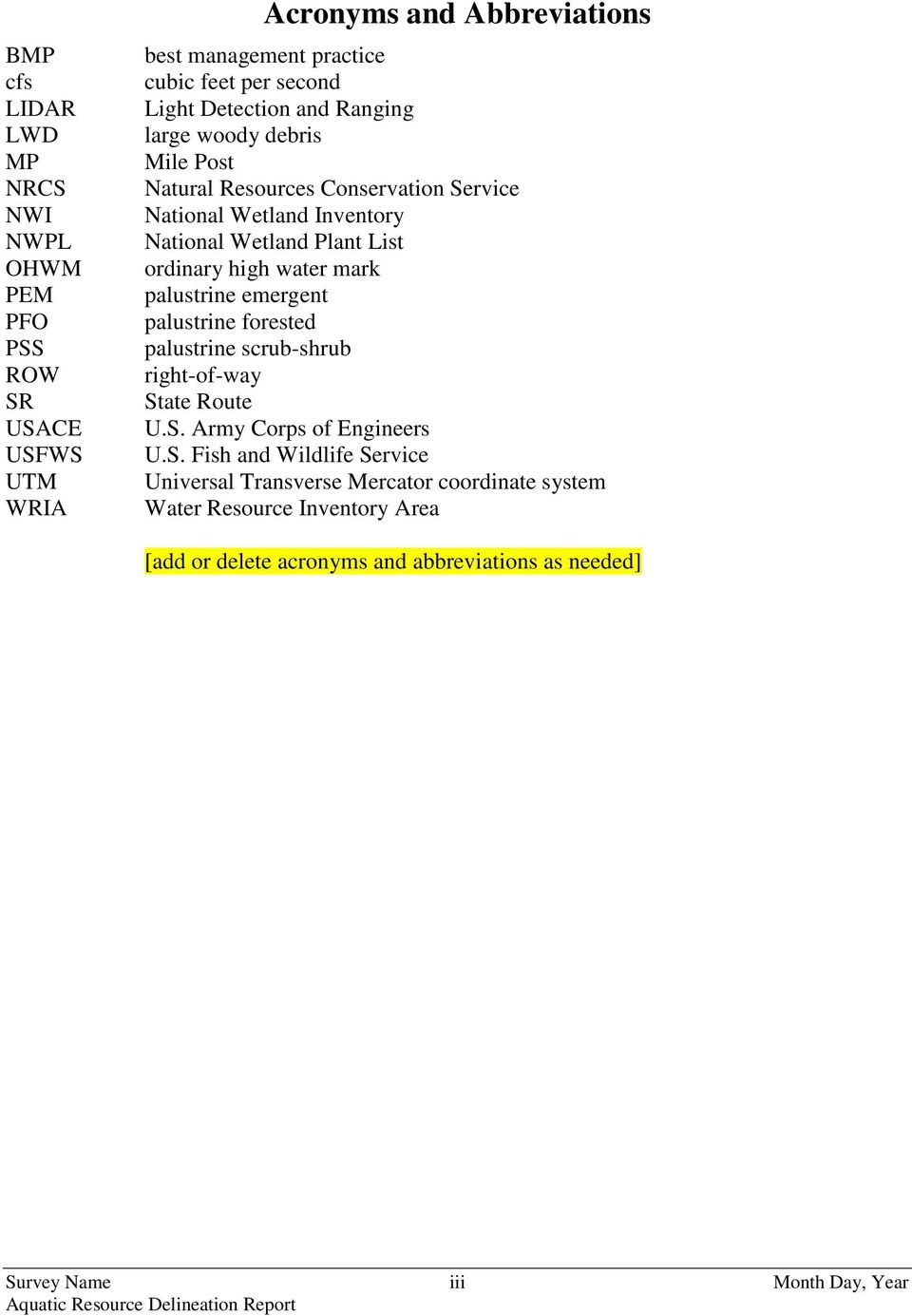
8 BMP cfs LIDAR LWD MP NRCS NWI NWPL OHWM PEM PFO PSS ROW SR USACE USFWS UTM WRIA Acronyms and Abbreviations best management practice cubic feet per second Light Detection and Ranging large woody debris Mile Post Natural Resources Conservation Service National Wetland Inventory National Wetland Plant List ordinary high water mark palustrine emergent palustrine forested palustrine scrub-shrub right-of-way State Route U.S. Army Corps of Engineers U.S. Fish and Wildlife Service Universal Transverse Mercator coordinate system Water Resource Inventory Area [add or delete acronyms and abbreviations as needed] Survey Name iii Month Day, Year
9 Chapter 1. Introduction Identify contact information for the applicant(s), property owner(s), and agent(s). Survey area description The purpose of this report is to identify and describe aquatic resources and, to identify known possible sensitive plant, fish, wildlife species, and cultural/historic properties in the survey area. This report facilitates efforts to: 1. Avoid or minimize impacts to aquatic resources during the design process. 2. Document aquatic resource boundary determinations for review by regulatory authorities. 3. Provide early indications of known sensitive species and historic/cultural properties within the survey area. 4. Provide background information. Chapter 2. Location Identify the county and state where the project is located. Also include nearest town, as well as the street address or nearest intersection, and the Section, Township and Range the UTM or latitude and longitude. Provide driving directions to the survey area. Chapter 3. Methods Describe all methods used to delineate and survey aquatic resources. Include any deviations from standard methods. Make sure methods comply with appropriate U.S. Army Corps of Engineers Guidelines. If remote sensing tools were used to aid in delineation, list what tools were used and provide a copy of the maps if possible. Chapter 4. Existing Conditions 4.1 Landscape Setting Describe in 1-2 paragraphs the topography, geological features, major water bodies, surface water flow, community types, existing vegetation, current land use, and major recent or historical disturbances such as logging, mining, and farming. Survey Name 4 Month Day, Year

10 Include: The total acreage of the survey area. A description of existing field conditions including current land use, time of season the site visit(s) were conducted, flood/drought conditions, irrigation practices, modifications to the site, and any characteristics considered atypical. A discussion of whether the entire survey area was field verified. If entire survey area was not visited, identify which areas were visited and a rationale for why the entire site was not visited. 4.2 Aquatic Resources Overview Provide brief overview of the existing aquatic resource conditions: Include the following information: Describe all aquatic resources depicted on the Aquatic Resources Delineation Map within the survey site (Appendix A). Provide an explanation for the mapped boundaries, especially for resources containing complex transition zones. If the site contains resources that meet one or two wetland criteria or do not exhibit a clear OHWM, describe the rationale for not delineating these features. Examples include erosional features, upland swales, and other upland areas that appear wet on satellite or aerial imagery. Provide a table listing all Aquatic Resources (Table 1). The table will include the name of each aquatic resource, its Cowardin type, acreage and location (latitude/longitude). For linear features, such as stream channels and ditches, the table must show both acreage and linear feet. Discuss site hydrology, including any surface or subsurface sources, drainage gradients, surface water connections to the nearest traditional navigable waterway or interstate water, and any potential influence for manmade water sources, such as irrigation. The discussion should also identify the nearest blue-line waterway or other feature found on the most recent USGS map. Describe soils including a discussion of hydric soils and soils with hydric inclusions (Appendix B). Provide a general discussion of plant communities and habitat types, including both scientific and common names, and the wetland indicator status of all plants (Appendix D). Describe any observed or documented interstate or foreign commerce associated with aquatic resources found on the site, specifically recreation or other use by Survey Name 5 Month Day, Year

11 interstate or foreign travelers, sale of fish or shellfish in interstate or foreign commerce, and use by industries operating in interstate or foreign commerce. Table 1. Aquatic Resources within the Survey Area Aquatic Resource Name Cowardin Aquatic Resources Classification Location (lat/long) Aquatic Resourc e Size (acre) Require d for all resourc es Aquatic Resource Size (linear feet) Required for only stream channels Total Chapter 5. References Books, Journal Articles, Reports: [Author(s). YEAR Title. Publisher/Source. Volume: Page begin-page end]. Correspondence: [Author(s). Date. Subject. Agency/Company. Pp. (pages)]. Phone: [Contact Name. Date. Subject. Agency/Company. Phone Number. Result/Action]. [Contact Name. Date. Subject. Agency/Company. address. Result/Action]. Survey Name 6 Month Day, Year
![Resource Size (linear feet) Required for only stream channels Total Chapter 5. References Books, Journal Articles, Reports: [Author(s). YEAR Title. Publisher/Source. Volume: Page begin-page end].](/docs-images/47/20992669/images/page_11.jpg "Correspondence: [Author(s). Date. Subject. Agency/Company. Pp. (pages)]. Phone: [Contact Name. Date. Subject. Agency/Company. Phone Number. Result/Action]. E-mail: [Contact Name. Date. Subject. Agency/Company. E-mail address.")
12 Appendix A - Aquatic Resource Delineation Maps A map of all delineated aquatic resources ( Aquatic Resources Delineation Map ) in accordance with the Final Map and Drawing Standards for the South Pacific Division Regulatory Program (Mapping Standards) and showing the following: All aquatic resources delineated must be clearly shown on the map. Because only the Corps determines the regulatory status of each aquatic resource, the map must not include any labeling about jurisdiction. If the requestor believes one or more aquatic resources are not jurisdictional, the rationale should be included in the delineation report and the resource(s) should be identified on the map. Location of all data and photo points. A reference block that identifies the site or project name, individual(s) who conducted the delineation, date of the map, and date(s) of any revisions. Project Name A-1 Month Day, Year Aquatic resources and Stream Assessment Report
13 Appendix B - Supporting Maps This appendix must include a 7.5 USGS quadrangle location map and a soil survey map. Other helpful data should be included, such as a NWI map, site specific topographic maps, LIDAR map, satellite/aerial/ground photographs, floodplain maps, and other related maps. The survey area should be identified on all maps. Survey Name B-1 Month Day, Year

14 Appendix C - Photographs All photographs should be referenced with the location and the direction the photograph was taken, along with identifying the resources present within the photograph. Survey Name C-1 Month Day, Year
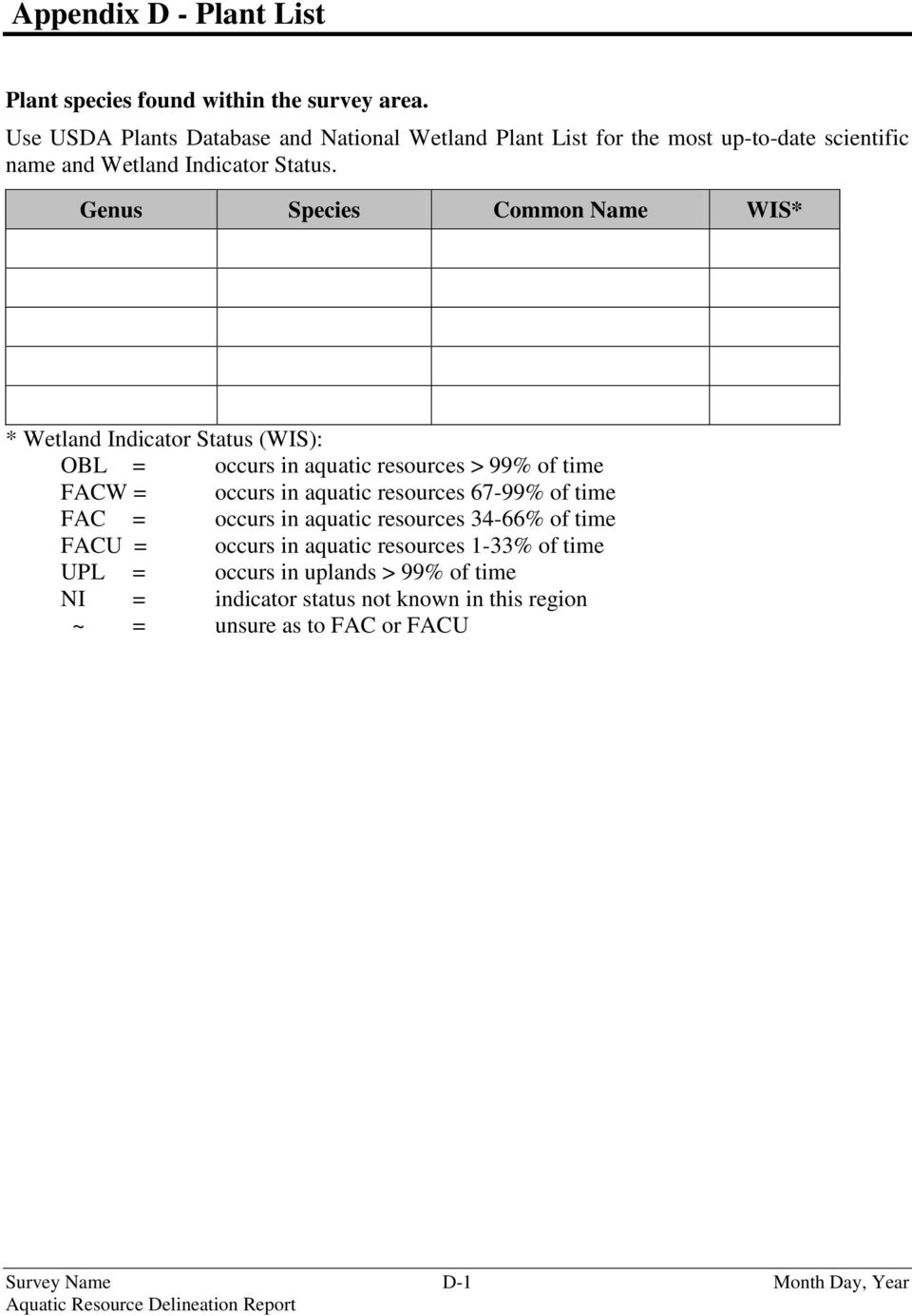
15 Appendix D - Plant List Plant species found within the survey area. Use USDA Plants Database and National Wetland Plant List for the most up-to-date scientific name and Wetland Indicator Status. Genus Species Common Name WIS* * Wetland Indicator Status (WIS): OBL = occurs in aquatic resources > 99% of time FACW = occurs in aquatic resources 67-99% of time FAC = occurs in aquatic resources 34-66% of time FACU = occurs in aquatic resources 1-33% of time UPL = occurs in uplands > 99% of time NI = indicator status not known in this region ~ = unsure as to FAC or FACU Survey Name D-1 Month Day, Year
16 Appendix E - Wetland Data Sheets This appendix must contain at least one set of paired data points, documented in data forms, for each aquatic resource or complex. The paired data points must be located close to the delineated boundary. Additional data points may be necessary, and should be shown on the map, depending on various factors including the size and shape of the aquatic resource, changes in vegetation communities, and slope. Data forms may be modified from the Corps standard form but must contain all essential information to make a decision. Survey Name E-1 Month Day, Year
17 Appendix F - OHWM Data Sheets This appendix includes the OHWM data sheets. Please insure to include a map identifying the location of the data points. Data forms may be modified from the Corps standard form but must contain all essential information to make a decision. Survey Name F-1 Month Day, Year

18 Appendix G - A signed statement from the property owner(s) allowing access This appendix must contain a signed statement from the property owner(s) allowing Corps personnel to enter the property and collect samples during normal business hours. If the property is land-locked, the owner or proponent must obtain permission from the adjacent property owner(s) in order to provide access. Survey Name G-1 Month Day, Year
19 Appendix H Aquatic Resource Excel Sheet The completion and submittal of the Aquatic Resources Excel spreadsheet is a required component to Sacramento District s Minimum Standards for Acceptance of Aquatic Resources Delineation Reports. This spreadsheet will assist the Corps in efficient and accurate data entry of the aquatic resources into the Corps database. The current version of the spreadsheet can be found at the following website: The Aquatic Resources Excel spreadsheet contains a validation tool to ensure accuracy of the data. To run the validation tool, first enter all data in the appropriate columns and tabs. Once you have completed entering the data and have saved the document in a.csv format, click the gold shield at the top of the workbook window. The tool has a tooltip showing "Validate Worksheets." After clicking this button, validation of data is performed and any possible errors are added to the Validation tab. This tab is opened after the process is complete to allow the user to see the output. The validation output includes the tab (data type), column, and cell for where the possible error was found and a brief explanation of the issue. Survey Name H-1 Month Day, Year

20 Appendix I Aquatic Resource Functional Assessment Forms (If Applicable) If a functional assessment was completed, this appendix includes the aquatic resources functional assessment form of each aquatic resource delineated along with a description of the results of the assessment. Survey Name F-2 Month Day, Year

https://orm.usace.army.mil/orm2/f?p=106:34:4198546103662037::no::
 Page 1 of 6 APPROVED JURISDICTIONAL DETERMINATION FORM U.S. Army Corps of Engineers JD Status: DRAFT SECTION I: BACKGROUND INFORMATION A. REPORT COMPLETION DATE FOR APPROVED JURISDICTIONAL DETERMINATION
3. The submittal shall include a proposed scope of work to confirm the provided project description;
 QIN Shoreline Master Program Project Summary The Shoreline Master Program (SMP) development process for the Quinault Indian Nation (QIN) includes the completion of inventory and analysis report with corresponding
REGULATORY GUIDANCE LETTER
 REGULATORY GUIDANCE LETTER No. 08-02 Date: 26 June 2008 SUBJECT: Jurisdictional Determinations 1. Purpose. Approved jurisdictional determinations (JDs) and preliminary JDs are tools used by the U.S. Army
MULTI-AGENCY COMPENSATORY MITIGATION PLAN CHECKLIST 1
 MULTI-AGENCY COMPENSATORY MITIGATION PLAN CHECKLIST 1 Mitigation Goals and Objectives o Describe functions lost at impact site o Describe functions to be gained at mitigation site o Describe overall watershed
Weed Survey and Mapping
 Weed Survey and Mapping The primary objective of weed surveying and mapping is to accurately identify and delineate land with populations of invasive plants or noxious weeds. These surveys allow land managers
1. INTRODUCTION 5. THE PERMIT PROCESS
 1. INTRODUCTION Laws of the United States and the State of Iowa have assigned the US Army Corps of Engineers and the Iowa Department of Natural Resources with specific and different regulatory roles designed
The West Virginia Stream and Wetland Valuation Metric
 The West Virginia Stream and Wetland Valuation Metric Background As indicated in the U.S. Army Corps of Engineer s (USACE) regulations [33 CFR 332.8(b)], the district engineer will establish an Interagency
Draft Environmental Impact Statement. PORT OF OSWEGO AUTHORITY Lead Agency, State Environmental Quality Review Act
 CENTERSTATE NY INLAND PORT DRAFT SCOPING DOCUMENT FOR THE Draft Environmental Impact Statement PORT OF OSWEGO AUTHORITY Lead Agency, State Environmental Quality Review Act SEPTEMBER 30, 2015 INTRODUCTION
TENNESSEE GAS PIPELINE COMPANY, L.L.C.
 TENNESSEE GAS PIPELINE COMPANY, L.L.C. HYDROLOGIC & HYDRAULIC CALCULATIONS FOR WATERBODIES CROSSED BY CONNECTICUT PIPELINE EXPANSION PROJECT CONNECTICUT LOOP Submitted by: Tennessee Gas Pipeline Company,
QUESTIONS AND ANSWERS WATERS OF THE U.S. PROPOSAL
 QUESTIONS AND ANSWERS WATERS OF THE U.S. PROPOSAL Key Background Congress enacted the modern Clean Water Act in 1972 to address pollution entering the nation s waters to complement statutes such as the
Chapter 3 SENSITIVE AREAS AND VEGETATED CORRIDORS
 Chapter 3 3.01 General Provisions 3.01.1 Introduction 3.01.2 Application and Interpretation of Chapter 3.01.3 Unbuildable Lots 3.01.4 Other Permits 3.01.5 Prohibited Activities 3.02 Service Provider Letter
Utah State General Records Retention Schedule SCHEDULE 1 GEOSPATIAL DATA SETS
 Utah State General Records Retention Schedule SCHEDULE 1 BIOTA RECORDS (Item 1-26) These are geospatial records that depict wildlife use areas in the state of Utah as determined by wildlife biologists
National Register of Historic Places: GIS Webinar Cultural Resource GIS Facility National Park Service June 2012
 National Register of Historic Places: GIS Webinar Cultural Resource GIS Facility National Park Service June 2012 In February and March 2012 the National Register of Historic Places held webinars in conjunction
PUBLIC NOTICE Application for Permit
 PUBLIC NOTICE Application for Permit 30-Day Notice Issue Date: June 20, 2016 Expiration Date: July 20, 2016 US Army Corps of Engineers No: NWP-2010-535 Oregon Department of State Lands No: 58311-RF Interested
Michigan Tech Research Institute Wetland Mitigation Site Suitability Tool
 Michigan Tech Research Institute Wetland Mitigation Site Suitability Tool Michigan Tech Research Institute s (MTRI) Wetland Mitigation Site Suitability Tool (WMSST) integrates data layers for eight biophysical
SITE DEVELOPMENT PLAN CHECKLIST. Project Name: Site Plan No.:
 SITE DEVELOPMENT PLAN CHECKLIST 5/12/05 Rev.3/14/06 Project Name: Site Plan No.: REVIEW CRITERIA Plans: A site development plan (signed and sealed) shall be on a 24 x 36 sheet at a scale that is no smaller
GIS MAPPING FOR IRRIGATION DISTRICT RAPID APPRAISALS Daniel J. Howes 1, Charles M. Burt 2, Stuart W. Styles 3 ABSTRACT
 GIS MAPPING FOR IRRIGATION DISTRICT RAPID APPRAISALS Daniel J. Howes 1, Charles M. Burt 2, Stuart W. Styles 3 ABSTRACT Geographic information system (GIS) mapping is slowly becoming commonplace in irrigation
401 Water Quality Certification and Isolated Wetlands Permitting in Ohio. Tom Harcarik Division of Surface Water
 401 Water Quality Certification and Isolated Wetlands Permitting in Ohio Tom Harcarik Division of Surface Water Session Overview Part I: Why this is Important Part II: Brief Overview of Laws and Rules
AERIAL PHOTOGRAPHS. For a map of this information, in paper or digital format, contact the Tompkins County Planning Department.
 AERIAL PHOTOGRAPHS What are Aerial Photographs? Aerial photographs are images of the land taken from an airplane and printed on 9 x9 photographic paper. Why are Aerial Photographs Important? Aerial photographs
Request for Proposals for Topographic Mapping. Issued by: Teton County GIS and Teton County Engineering Teton County, Wyoming
 Request for Proposals for Topographic Mapping Issued by: Teton County GIS and Teton County Engineering Teton County, Wyoming Proposals due: 2:00PM MDT July 1, 2015 Proposals may be delivered to: Teton
Under Section 404 of the Clean Water Act
 Preparing An Alternatives Analysis Under Section 404 of the Clean Water Act Fort Worth District Regulatory Division November 2014 In its evaluation of permit applications to discharge dredged or fill material
COASTAL MONITORING & OBSERVATIONS LESSON PLAN Do You Have Change?
 Coastal Change Analysis Lesson Plan COASTAL MONITORING & OBSERVATIONS LESSON PLAN Do You Have Change? NOS Topic Coastal Monitoring and Observations Theme Coastal Change Analysis Links to Overview Essays
Land Disturbance, Erosion Control and Stormwater Management Checklist. Walworth County Land Conservation Department
 Land Disturbance, Erosion Control and Stormwater Management Checklist Walworth County Land Conservation Department The following checklist is designed to assist the applicant in complying with the Walworth
3.4 DRAINAGE PLAN. 3.4.1 Characteristics of Existing Drainages. 3.4.2 Master Drainage System. Section 3: Development Plan BUTTERFIELD SPECIFIC PLAN
 3.4 DRAINAGE PLAN This section describes the existing onsite drainage characteristics and improvements proposed within this Specific Plan. Following this description, drainage plan development standards
Wildlife Habitat Conservation and Management Program
 Wildlife Habitat Conservation and Management Program Manual for Counties and Cities Oregon Department of Fish and Wildlife 2015 Table of Contents 1. Introduction Purpose of the habitat program Objective
Town of Elkton & Cecil Soil Conservation District Checklist for Joint Agency Review Stormwater Management / Erosion and Sediment Control
 Town of Elkton & Cecil Soil Conservation District Checklist for Joint Agency Review Stormwater Management / Erosion and Sediment Control Project Name: Tax Map Parcel: Acreage: Plat: ADC Map & Grid Engineering
Introduction to GIS (Basics, Data, Analysis) & Case Studies. 13 th May 2004. Content. What is GIS?
 Introduction to GIS (Basics, Data, Analysis) & Case Studies 13 th May 2004 Content Introduction to GIS Data concepts Data input Analysis Applications selected examples What is GIS? Geographic Information
Gunnison County Web Map
 Gunnison County Web Map Find Data - Find data - Navigate tools - Mouse over tooltip Make Maps - Layers - Legend - Drawing tools - Printing Analysis - Measurement - Selecting - Queries Spatial SQL - Basic
DECISION DOCUMENT NATIONWIDE PERMIT 27
 DECISION DOCUMENT NATIONWIDE PERMIT 27 This document discusses the factors considered by the Corps of Engineers (Corps) during the issuance process for this Nationwide Permit (NWP). This document contains:
Learning about GPS and GIS
 Learning about GPS and GIS Standards 4.4 Understand geographic information systems (G.I.S.). B12.1 Understand common surveying techniques used in agriculture (e.g., leveling, land measurement, building
33 CFR PART 332 COMPENSATORY MITIGATION FOR LOSSES OF AQUATIC RESOURCES. Authority: 33 U.S.C. 401 et seq. ; 33 U.S.C. 1344; and Pub. L. 108 136.
 33 CFR PART 332 COMPENSATORY MITIGATION FOR LOSSES OF AQUATIC RESOURCES Authority: 33 U.S.C. 401 et seq. ; 33 U.S.C. 1344; and Pub. L. 108 136. Source: 73 FR 19670, Apr. 10, 2008, unless otherwise noted.
Development of an Impervious-Surface Database for the Little Blackwater River Watershed, Dorchester County, Maryland
 Development of an Impervious-Surface Database for the Little Blackwater River Watershed, Dorchester County, Maryland By Lesley E. Milheim, John W. Jones, and Roger A. Barlow Open-File Report 2007 1308
REFERENCE. All National Grid personnel who plan and perform work involving protected water resources are responsible for:
 EG-30NY ENVIRONMENTAL GUIDANCE PAGE 1 of 9 DATE 10/1/10 EP 3 Natural Resource Protection 1.0 SCOPE AND RESPONSIBILITIES National Grid s New York service territory encompasses thousands of wetlands, lakes,
Remaining Wetland Acreage 1,500,000 915,960 584,040-39%
 NEW JERSEY Original Wetland Acreage Remaining Wetland Acreage Acreage Lost % Lost 1,500,000 915,960 584,040-39% New Jersey Wetlands: Nearly 99 percent of New Jersey s wetlands are palustrine or estuarine.
ADWR GIS Metadata Policy
 ADWR GIS Metadata Policy 1 PURPOSE OF POLICY.. 3 INTRODUCTION.... 4 What is metadata?... 4 Why is it important? 4 When to fill metadata...4 STANDARDS. 5 FGDC content standards for geospatial metadata...5
Natural Resource-Based Planning*
 Natural Resource-Based Planning* Planning, when done well, is among the most powerful tools available to communities. A solid plan, based on good natural resource information, guides rational land-use
A Cost Analysis of Stream Compensatory Mitigation Projects in the Southern Appalachian Region 1
 A Cost Analysis of Stream Compensatory Mitigation Projects in the Southern Appalachian Region 1 J. Bonham 2 and K. Stephenson Abstract Recently the US Army Corps of Engineers (the Corps) has increased
The Basics of Chapter 105 Waterways and Wetlands Permitting in PA
 The Basics of Chapter 105 Waterways and Wetlands Permitting in PA April 17, 2013 Goal To develop a basic understanding of PA Department of Environmental Protection (DEP) and US Army Corps of Engineers
A. General Information
 Important: When filling out forms on the computer, use only the tab key to move your cursor - do not use the return key. Massachusetts Department of Environmental Protection WPA Form 3 Notice of Intent
General Permit for Activities Promoting Waterway - Floodplain Connectivity [working title]
![General Permit for Activities Promoting Waterway - Floodplain Connectivity [working title]](/thumbs/39/18645965.jpg "General Permit for Activities Promoting Waterway - Floodplain Connectivity [working title]") General Permit for Activities Promoting Waterway - Floodplain Connectivity [working title] Purpose These rules set forth the conditions under which a person may, without an individual removal-fill permit
General Permit for Activities Promoting Waterway - Floodplain Connectivity [working title] Purpose These rules set forth the conditions under which a person may, without an individual removal-fill permit
REGIONAL SEDIMENT MANAGEMENT: A GIS APPROACH TO SPATIAL DATA ANALYSIS. Lynn Copeland Hardegree, Jennifer M. Wozencraft 1, Rose Dopsovic 2 INTRODUCTION
 REGIONAL SEDIMENT MANAGEMENT: A GIS APPROACH TO SPATIAL DATA ANALYSIS Lynn Copeland Hardegree, Jennifer M. Wozencraft 1, Rose Dopsovic 2 ABSTRACT: Regional sediment management (RSM) requires the capability
CITY UTILITIES DESIGN STANDARDS MANUAL
 CITY UTILITIES DESIGN STANDARDS MANUAL Book 2 (SW) SW9 June 2015 SW9.01 Purpose This Chapter provides information for the design of open channels for the conveyance of stormwater in the City of Fort Wayne.
Preliminary Plan Application and Checklist
 ALL APPLICATIONS ARE DUE AT 12:00 NOON ON THE FILING DATE Office Use Only PRELIMINARY / REVISED PRELIMINARY PLAN $300.00 Fee Paid: $ Date Paid: ALL FIELDS HIGHLIGHTED IN RED ARE REQUIRED FIELDS Case No.:
City of Edgewood REQUEST FOR QUALIFICATIONS 2016 ON-CALL CONSULTANT SERVICES
 City of Edgewood REQUEST FOR QUALIFICATIONS 2016 ON-CALL CONSULTANT SERVICES I. PURPOSE OF REQUEST. The City of Edgewood is requesting statements of qualifications from professional consulting firms licensed
Wildlife Habitat Conservation and Management Plan
 Wildlife Habitat Conservation and Management Plan For [Applicant Name] [Insert photo of property] Developed in Cooperation with Jane Doe Habitat Conservation Biologist Oregon Department of Fish and Wildlife
Floodplain Development Land Use Review
 COMMUNITY DEVELOPMENT DEPARTMENT Planning Division P.O. Box 490 333 Broadalbin Street SW Albany, OR 97321 Phone 541-917-7550 Fax 541-791-0150 www.cityofalbany.net Floodplain Development Land Use Review
Michigan Wetlands. Department of Environmental Quality
 Department of Environmental Quality Wetlands are a significant component of Michigan s landscape, covering roughly 5.5 million acres, or 15 percent of the land area of the state. This represents about
ELEMENT 4 - FUTURE LAND USE ELEMENT
 ELEMENT 4 - FUTURE LAND USE ELEMENT Goal 1 To create a long-range development pattern which directs growth into developable areas and away from environmentally sensitive areas, in a manner that is compatible
EXHIBIT A LOCATION MAP AND LAND USE INFORMATION
 EXHIBIT A LOCATION MAP AND LAND USE INFORMATION In accordance with Arizona Corporation Commission Rules of Practice and Procedure R14-3-219, Applicant provides the following location maps and land use
GPS Applications in Agriculture. Gary T. Roberson Agricultural Machinery Systems
 GPS Applications in Agriculture Gary T. Roberson Agricultural Machinery Systems What is a Positioning System? A position information system enables the user to determine absolute or relative location of
GROWER ADVISORY Agriculture Regulations of the Wetlands Protection Act
 Cape Cod Cranberry Growers Association GROWER ADVISORY Agriculture Regulations of the Wetlands Protection Act Cranberry Bogs and the Agricultural Exemption The Massachusetts Wetlands Protection Act (WPA)
WHAT IS GIS - AN INRODUCTION
 WHAT IS GIS - AN INRODUCTION GIS DEFINITION GIS is an acronym for: Geographic Information Systems Geographic This term is used because GIS tend to deal primarily with geographic or spatial features. Information
1.7.0 Floodplain Modification Criteria
 1.7.0 Floodplain Modification Criteria 1.7.1 Introduction These guidelines set out standards for evaluating and processing proposed modifications of the 100- year floodplain with the following objectives:
Vegetation Resources Inventory
 Vegetation Resources Inventory Guidelines for Preparing a Project Implementation Plan for Photo Interpretation Prepared by Ministry of Sustainable Resource Management Terrestrial Information Branch for
Welcome to the Inland Wetlands Commission Town of Barkhamsted, CT
 Welcome to the Inland Wetlands Commission Town of Barkhamsted, CT Introduction Purpose Barkhamsted is a residential community located in Litchfield County, 15 miles northwest of Hartford. Our population
GLOSSARY OF TERMS CHAPTER 11 WORD DEFINITION SOURCE. Leopold
 CHAPTER 11 GLOSSARY OF TERMS Active Channel The channel that contains the discharge Leopold where channel maintenance is most effective, sediment are actively transported and deposited, and that are capable
STORMWATER POLLUTION PREVENTION PLAN TEMPLATE. 1.0 SITE DESCRIPTION 1.1 Project Name and Location Date
 STORMWATER POLLUTION PREVENTION PLAN TEMPLATE Disclaimer: This template was developed for guidance purposes only in an effort to assist Construction Storm Water permit applicants in meeting state and local
HCP Team Meeting. November 18, 2015. icfi.com
 HCP Team Meeting November 18, 2015 icfi.com 1 Welcome and Introductions Where are we in the HCP process Hydrology modeling update Native fish survey Fish translocation Finalize covered activities Next
Subject: Using Google Earth, Google Earth Pro, and Google Maps for FWS activities
 Subject: Using Google Earth, Google Earth Pro, and Google Maps for FWS activities Page 1 of 5 As an FWS employee, can I use Google mapping software or applications to help me with my job? The short answer
New Waters of the United States Definition Released
 County Action Needed New Waters of the United States Definition Released Counties are strongly encouraged to submit written comments on potential impacts of the proposed regulation to the Federal Register
desert conservation program Data Management Guidelines
 desert conservation program Data Management Guidelines Introduction The Multiple Species Habitat Conservation Plan (MSHCP) and the U.S. Fish and Wildlife Service Biological and Conference Opinion on Clark
From GPS Data Collection to GIS Data Display A Walk-Through Example
 From GPS Data Collection to GIS Data Display A Walk-Through Example The Global Positioning System (GPS) is a satellite based navigation system consisting of 24 satellites, a worldwide network of tracking
4.2 Buena Vista Creek Watershed
 Buena Vista Creek Watershed 4.2 Buena Vista Creek Watershed Watershed Overview The Buena Vista Creek Watershed is the fourth-largest system within the Carlsbad Hydrologic Unit. The watershed extends approximately
GIS Spatial Data Standards
 GIS Spatial Data Standards Manatee County, FL GIS Section, Information Services Department TABLE OF CONTENTS I. Introduction 2 A. Purpose 2 B. Reference 2 II. Spatial Reference Information 2 A. Projection:
REGULATORY GUIDANCE LETTER
 REGULATORY GUIDANCE LETTER. 07-02 Date: July 4, 2007 SUBJECT: Exemptions for Construction or Maintenance of Irrigation Ditches and Maintenance of Drainage Ditches Under Section 404 of Clean Water Act 1.
CLARIFICATION OF WETLAND SOIL CRITERIA FOR HUMAN-ALTERED AND HUMAN-TRANSPORTED SOILS IN CONNECTICUT
 Natural Resources Conservation Service Connecticut Department of Energy and Environmental Protection CLARIFICATION OF WETLAND SOIL CRITERIA FOR HUMAN-ALTERED AND HUMAN-TRANSPORTED SOILS IN CONNECTICUT
Wetland Regulatory Assistance Program
 ERDC/CRREL TN-10-1 Wetland Regulatory Assistance Program Updated Datasheet for the Identification of the Ordinary High Water Mark (OHWM) in the Arid West Region of the Western United States Katherine E.
Remote Sensing and GIS Application In Change Detection Study In Urban Zone Using Multi Temporal Satellite
 Remote Sensing and GIS Application In Change Detection Study In Urban Zone Using Multi Temporal Satellite R.Manonmani, G.Mary Divya Suganya Institute of Remote Sensing, Anna University, Chennai 600 025
Monitoring Riparian Areas With a Camera
 Monitoring Riparian Areas With a Camera By Michael DeLasaux 1, Holly George 2, and Philip Mainwaring 3 Riparian areas are next to streams, springs, rivers, ponds and lakes. Physical characteristics that
Emergency Streambank Restoration/Stabilization. Kentucky Division of Water Water Quality Certification May 2010 Educational Assistance
 Emergency Streambank Restoration/Stabilization Kentucky Division of Water Water Quality Certification May 2010 Educational Assistance Due to the severity of the recent rains and flooding occurrences, the
CONSTRUCTION STORMWATER POLLUTION PREVENTION PLAN TEMPLATE
 CONSTRUCTION STORMWATER POLLUTION PREVENTION PLAN TEMPLATE The following template may be used as a general guide for development of a Stormwater Pollution Prevention Plan (SWPPP) for construction activities.
Metadata for Big River Watershed Geologic and Geomorphic Data
 Metadata for Big River Watershed Geologic and Geomorphic Data Metadata are descriptions and information regarding compiled data. This appendix contains the metadata that describes the compiled data used
LEAGUE NOTES ON APPROVED COMMUNITY WATER SUPPLY PLAN
 1 AUGUST 2011 LEAGUE NOTES ON APPROVED COMMUNITY WATER SUPPLY PLAN KEY ELEMENTS OF THE PLAN: 1. Replace the existing unsafe Ragged Mountain dam with a new dam and raise the reservoir pool level initially
DEPARTMENT OF ENVIRONMENTAL QUALITY Environmental Assessment
 DEPARTMENT OF ENVIRONMENTAL QUALITY Environmental Assessment Water Protection Bureau Name of Project: Applicant: Ueland Land Development LLC Type of Project: Proposed discharge of treated domestic wastewater