
Development of an Impervious-Surface Database for the Little Blackwater River Watershed, Dorchester County, Maryland
|
|
|
- Brittney Greer
- 10 years ago
- Views:
Transcription
1 Development of an Impervious-Surface Database for the Little Blackwater River Watershed, Dorchester County, Maryland By Lesley E. Milheim, John W. Jones, and Roger A. Barlow Open-File Report U.S. Department of the Interior U.S. Geological Survey

2 U.S. Department of the Interior DIRK KEMPTHORNE, Secretary U.S. Geological Survey Mark D. Myers, Director U.S. Geological Survey, Reston, Virginia 2007 For product and ordering information: World Wide Web: Telephone: ASK-USGS For more information on the USGS the Federal source for science about the Earth, its natural and living resources, natural hazards, and the environment: World Wide Web: Telephone: ASK-USGS Suggested citation: Milheim, L.E., Jones, J.W., and Barlow, R.A., 2007, Development of an impervious-surface database for the Little Blackwater River Watershed, Dorchester County, Maryland: U.S. Geological Survey Open-File Report , 11 p., available online at Any use of trade, product, or firm names is for descriptive purposes only and does not imply endorsement by the U.S. Government. Although this report is in the public domain, permission must be secured from the individual copyright owners to reproduce any copyrighted material contained within this report. ii
3 Contents Introduction...1 Classification Scheme...2 Input Data...2 National Agricultural Imagery Program Dataset for Dorchester County, Maryland...2 Digital Elevation Model...2 Study Area...2 Roads...2 Streams...2 Digital Orthophoto...3 Software...3 Processing Steps...3 Data Collection...3 Quality Assurance/Quality Control...3 Metadata...3 Results...4 iii

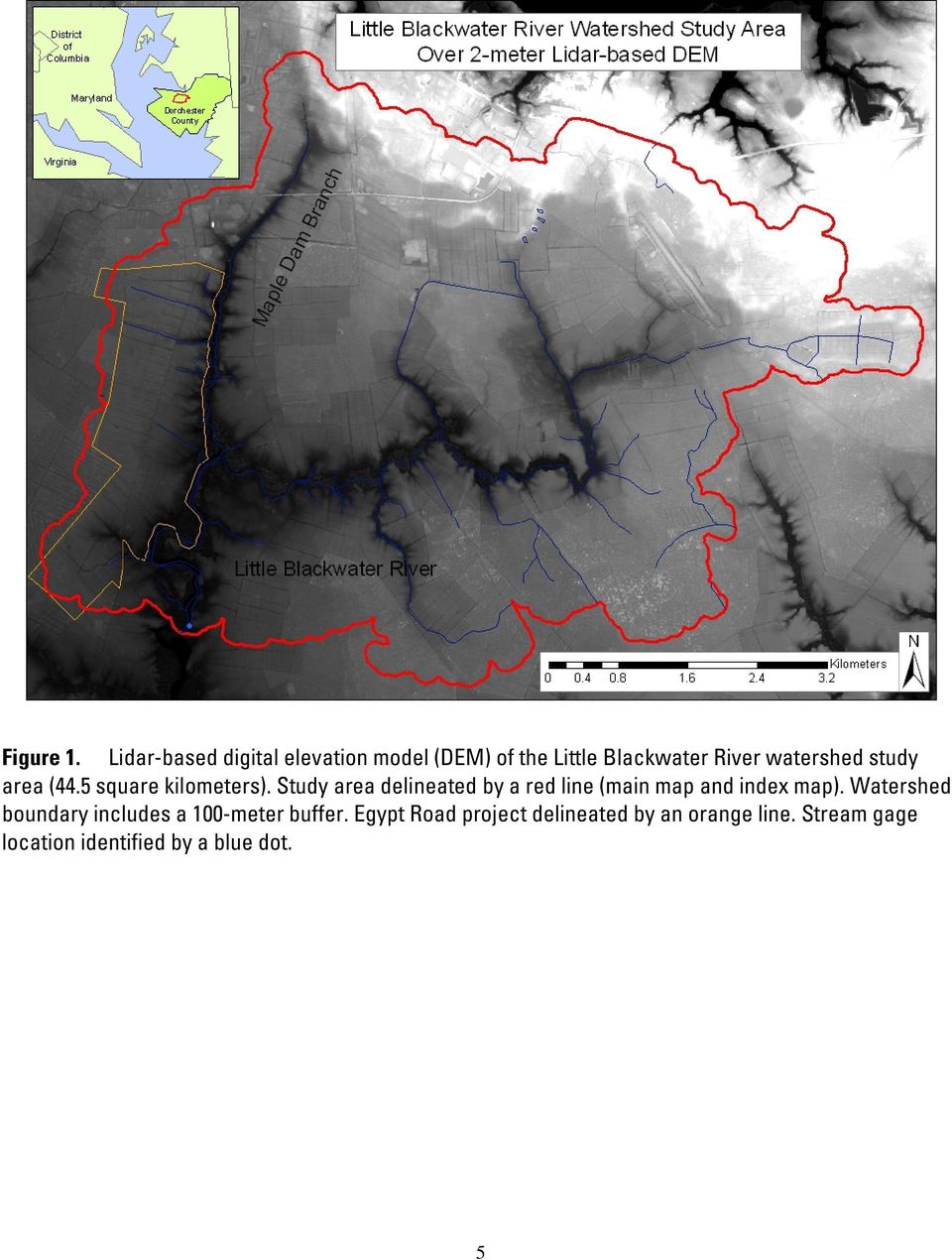
4 Figures Figure 1. Lidar-based digital elevation model (DEM) of the Little Blackwater River watershed study area (44.5 square kilometers). Study area delineated by red line (main map and index map). Watershed boundary includes a 100-meter buffer. Egypt Road project delineated by orange line. Stream gage location identified by blue dot...5 Figure 2. Impervious-surface boundaries within the Little Blackwater River watershed study area overlain on Nation Agricultural Imagery Program (NAIP) orthoimagery of June-July 2005., Study area is delineated by red line. Impervious-surface areas are depicted as green polygons and black lines....6 Tables Table 1. Summary impervious surface area June-July 2005 within the Little Blackwater River watershed...4 iv

5 Development of an Impervious-Surface Database for the Little Blackwater River Watershed, Dorchester County, Maryland By Lesley E. Milheim, John W. Jones, and Roger A. Barlow Introduction Many agricultural and forested areas in proximity to National Wildlife Refuges (NWR) are under increasing economic pressure for commercial or residential development. The upper portion of the Little Blackwater River watershed a 27 square mile area within largely low-lying Dorchester County, Maryland, on the eastern shore of the Chesapeake Bay is important to the U.S. Fish and Wildlife Service (USFWS) because it flows toward the Blackwater National Wildlife Refuge (BNWR), and developmental impacts of areas upstream from the BNWR are unknown. One of the primary concerns for the refuge is how storm-water runoff may affect living resources downstream. The Egypt Road project (fig. 1), for which approximately 600 residential units have been approved, has the potential to markedly change the land use and land cover on the west bank of the Little Blackwater River. In an effort to limit anticipated impacts, the Maryland Department of Natural Resources (Maryland DNR) recently decided to purchase some of the lands previously slated for development. Local topography, a high water table (typically 1 foot or less below the land surface), and hydric soils present a challenge for the best management of storm-water flow from developed surfaces. A spatial data coordination group was formed by the Dorchester County Soil and Conservation District to collect data to aid decisionmakers in watershed management and on the possible impacts of development on this watershed. Determination of streamflow combined with land cover and impervious-surface baselines will allow linking of hydrologic and geologic factors that influence the land surface. This baseline information will help planners, refuge managers, and developers discuss issues and formulate best management practices to mitigate development impacts on the refuge. In consultation with the Eastern Region Geospatial Information Office, the dataset selected to be that baseline land cover source was the June-July 2005 National Agricultural Imagery Program (NAIP) 1-meter resolution orthoimagery of Maryland. This publicly available, statewide dataset provided imagery corresponding to the closest in time to the installation of a U.S. Geological Survey (USGS) Water Resources Discipline gaging station on the Little Blackwater River. It also captures land cover status just before major residential development occurs. This document describes the process used to create a database of impervious surfaces for the Little Blackwater watershed. 1
6 Classification Scheme The USGS and Maryland DNR discussed impervious-surface identification requirements on August 10, 2006, at the Maryland Department of Natural Resources in Annapolis. After consultation with the Dorchester County Soil and Conservation Service, the group decided to delineate roads, both residential and nonresidential rooftops, residential and nonresidential driveways, including parking areas and other impervious surfaces greater than 50 square meters such as tennis courts. Input Data To map land use according to the classification scheme specified, the following input data were used. National Agricultural Imagery Program Dataset for Dorchester County, Maryland This June-July meter resolution agricultural (leaf-on) imagery (NAIP_Dorchester.sid) shown in figure 2 was used to visually identify land use and land cover within the Little Blackwater River watershed ( Digital Elevation Model An ArcGRID containing the 2-meter resolution Lidar digital elevation model (DEM) (abovebnwr) for a subset of Dorchester County, Maryland (fig. 1.) was used to identify the watershed boundary. This dataset is the mosaic of the Lidar DEM subsets available from the Maryland Department of Natural Resources. The Lidar DEM subsets used are: ab1331, ab1332, ab1333, ab1334, ab1335, ab1336, aa1331, aa1332, aa1333, aa1334,aa1335, aa1336, z1331, z1332, z1333, z1334, ab1341, ab1342, ab1343, ab1344, ab1345, ab1346, aa1341, aa1342, aa1343, aa1344, aa1345, aa1346, z1341, z1342, z1343, z1344, ab1351, ab1352, ab1353, ab1354, ab1355, ab1356, aa1351, aa1352, aa1353, aa1354, aa1355, aa1356, z1351, z1352, z1353, z1354, ab1361, ab1363, ab1365, aa1361, aa1363, aa1365, z1361, and z1363. Study Area These data (BufferedStudyArea.shp) identify the watershed boundary plus a 100-meter buffer (fig. 1.) for the Little Blackwater River. The file was generated from the digital elevation model above the USGS stream gage located approximately 1.5 miles downstream of the confluence of the Maple Dam Branch and the Little Blackwater River (lat '06" N, long '39" W) using the ArcMap 9.0 Spatial Analyst Hydrology toolkit. It resembles earlier watershed boundaries for this area except for the area east of the airport. Roads These data (SHA_cline_SA.shp) identify the centerlines for roads within the watershed. The original shapefile is available from the Maryland State Highway Administration website ( and was trimmed to the study area. Streams These data (SHA_streams_SA.shp) identify the streams within the watershed. The original shapefile is available from the Maryland State Highway Administration website ( and was trimmed to the study area. 2

7 Digital Orthophoto These 4-meter resolution digital orthophotos (Cambr215.tif, Cambr315.tif, 1998), available from the Maryland Department of Natural Resources website ( were used as ancillary data for interpretation. Software The following software packages were used to create the database. Platform: Windows XP Environmental Systems Research Institute (ESRI) ArcGIS Desktop 9.0 with Spatial Analyst Extension Habitat Digitizer Extension, Version 4 Created by Ken Buja ([email protected]) of the National Oceanographic and Atmospheric Administration ( Processing Steps Data Collection ArcMap 9.0 was used to collect the study area s impervious surfaces from the agricultural imagery (NAIP_Dorchester.sid). Compilation was performed using the ArcMap editor and the Habitat Digitizer Extension. Each area was visually identified by linear patterns, texture, and color and digitized along the perceived visual boundary. Visual interpretation was performed within ArcMap at a scale of 1:1,500 and at a screen resolution of 1280 x 1024 pixels. As each area was completed, it was classified with a unique numeric identifier (UNIQUE_ID) and a description. Additional comments were entered to clarify or question the assigned classification, as needed. Boundaries were dissolved and clipped to the study area to create the final impervious-surface shapefile. The polygon areas were calculated and added to the attribute table. Polygons smaller than 50 square meters were then deleted. Quality Assurance/Quality Control The final impervious-surface dataset was displayed over the original imagery to visually verify that all appropriate impervious surfaces were included. The area attribute was examined to ensure that all polygons smaller than the minimum mapping unit of 50 square meters were removed. Due to time and funding constraints, no formal statistical or sampling quality assurance/quality control measures were performed. Instead, the classified polygons were compared with the actual land use and land cover observed through an onsite visit in October 2006 to confirm the identified classes and evaluate questionable classifications. This comparison resulted in the updating of some polygon attributes to provide a greater consistency in the final set of classes. Recent development in the area precluded the confirmation of some sites interpreted as undeveloped land cover types, given the date of the source imagery. Metadata Metadata were generated using ArcCatalog and the Federal Geographic Data Committee (FGDC) ESRI template and are available as part of the shapefile contents. 3
8 Results The process resulted in a shapefile (LBRW_ImpSfc.shp) containing the impervious-surface areas for the Little Blackwater River watershed as depicted in the June-July 2005 agricultural imagery. The impervious-surface polygons are shown in figure 2 over the NAIP imagery. The impervious-surface area for the 50-square-meter minimum mapping unit was compared to the total area originally gathered. The summary of this comparison is shown in table 1. Table 1. Summary impervious surface area June-July 2005 within the Little Blackwater River watershed. 2 2 [Abbreviations: m, square meters; km, square kilometers] Impervious- Total Study Layer Surface Area Area (m 2 ) (m 2 ) O riginal digitized data Impervious Surface Area (km 2 ) Total Study Area (km 2 ) Percent Impervious Surface P olygons < 50 m removed

9 Figure 1. Lidar-based digital elevation model (DEM) of the Little Blackwater River watershed study area (44.5 square kilometers). Study area delineated by a red line (main map and index map). Watershed boundary includes a 100-meter buffer. Egypt Road project delineated by an orange line. Stream gage location identified by a blue dot. 5
10 Figure 2. Impervious-surface boundaries within the Little Blackwater River watershed study area overlain on Nation Agricultural Imagery Program (NAIP) orthoimagery of June-July Study area is delineated by red line. Impervious-surface areas are depicted as green polygons and black lines. 6

A Method Using ArcMap to Create a Hydrologically conditioned Digital Elevation Model
 A Method Using ArcMap to Create a Hydrologically conditioned Digital Elevation Model High resolution topography derived from LiDAR data is becoming more readily available. This new data source of topography
Earth Data Science in The Era of Big Data and Compute
 Earth Data Science in The Era of Big Data and Compute E. Lynn Usery U.S. Geological Survey [email protected] http://cegis.usgs.gov U.S. Department of the Interior U.S. Geological Survey Board on Earth Sciences
A HYDROLOGIC NETWORK SUPPORTING SPATIALLY REFERENCED REGRESSION MODELING IN THE CHESAPEAKE BAY WATERSHED
 A HYDROLOGIC NETWORK SUPPORTING SPATIALLY REFERENCED REGRESSION MODELING IN THE CHESAPEAKE BAY WATERSHED JOHN W. BRAKEBILL 1* AND STEPHEN D. PRESTON 2 1 U.S. Geological Survey, Baltimore, MD, USA; 2 U.S.
Natural Resource-Based Planning*
 Natural Resource-Based Planning* Planning, when done well, is among the most powerful tools available to communities. A solid plan, based on good natural resource information, guides rational land-use
Facilitating Adaptive Management in the Chesapeake Bay Watershed through the Use of Online Decision Support Tools
 Facilitating Adaptive Management in the Chesapeake Bay Watershed through the Use of Online Decision Support Tools Cassandra Mullinix, Scott Phillips, Kelly Shenk, Paul Hearn, Olivia Devereux Abstract The
Decision-Support Tools and Databases to Inform Regional Stormwater Utility Development in New England
 Decision-Support Tools and Databases to Inform Regional Stormwater Utility Development in New England Detenbeck, N.E. 1, A. Morrison 2, J. Morgan 2, V. Zoltay 3, R. Abele 4, J. LeClair 4, and T. Garrigan
1. Launch ArcCatalog, then navigate to the following location using the directory tree on the left side of the screen:
 Vector Data Analysis I: Buffering Today we will use ArcMap and ArcToolbox to manipulate vector-based geographic data. The results of these simple analyses will allow us to visualize complex spatial relationships.
Understanding Raster Data
 Introduction The following document is intended to provide a basic understanding of raster data. Raster data layers (commonly referred to as grids) are the essential data layers used in all tools developed
Fort Dodge Stormwater Master Planning. Prepared By: Ralph C. Stark, Jr., P.E., C.F.M. Joel N. Krause, P.E., C.F.M.
 Fort Dodge Stormwater Master Planning Prepared By: Ralph C. Stark, Jr., P.E., C.F.M. Joel N. Krause, P.E., C.F.M. Project Location Project Background Flooding History Localized flooding and storm sewer
Utah State General Records Retention Schedule SCHEDULE 1 GEOSPATIAL DATA SETS
 Utah State General Records Retention Schedule SCHEDULE 1 BIOTA RECORDS (Item 1-26) These are geospatial records that depict wildlife use areas in the state of Utah as determined by wildlife biologists
Michigan Tech Research Institute Wetland Mitigation Site Suitability Tool
 Michigan Tech Research Institute Wetland Mitigation Site Suitability Tool Michigan Tech Research Institute s (MTRI) Wetland Mitigation Site Suitability Tool (WMSST) integrates data layers for eight biophysical
USGS StreamStats Web Application for Kentucky
 USGS StreamStats Web Application for Kentucky Implementation of selected low- and mean-flow estimating equations Gary Martin, Hydrologist Project Chief U.S. Geological Survey, Kentucky Water Science Center
Business Plan for Orthoimagery in North Carolina
 Business Plan for Orthoimagery in North Carolina Statewide Mapping Advisory Committee Working Group for Orthophotography Planning October 2010 North Carolina Geographic Information Coordinating Council
What is GIS? Geographic Information Systems. Introduction to ArcGIS. GIS Maps Contain Layers. What Can You Do With GIS? Layers Can Contain Features
 What is GIS? Geographic Information Systems Introduction to ArcGIS A database system in which the organizing principle is explicitly SPATIAL For CPSC 178 Visualization: Data, Pixels, and Ideas. What Can
Risk Analysis, GIS and Arc Schematics: California Delta Levees
 Page 1 of 7 Author: David T. Hansen Risk Analysis, GIS and Arc Schematics: California Delta Levees Presented by David T. Hansen at the ESRI User Conference, 2008, San Diego California, August 6, 2008 Abstract
What is GIS. What is GIS? University of Tsukuba. What do you image of GIS? Copyright(C) ESRI Japan Corporation. All rights reserved.
 What is GIS University of Tsukuba Graduate School of Life and Environmental Science April 21 st, 2011 What is GIS? What do you image of GIS? Gas Insulated Switch Groupe Interventional Speciale Geographic
A GIS helps you answer questions and solve problems by looking at your data in a way that is quickly understood and easily shared.
 A Geographic Information System (GIS) integrates hardware, software, and data for capturing, managing, analyzing, and displaying all forms of geographically referenced information. GIS allows us to view,
North Dakota GIS Program Report To Governor Jack Dalrymple. July 1, 2011 June 30, 2012
 North Dakota GIS Program Report To Governor Jack Dalrymple July 1, 2011 June 30, 2012 Executive Order 2001-06: The committee shall issue a report to the Governor's office at the end of each fiscal year,
Data source, type, and file naming convention
 Exercise 1: Basic visualization of LiDAR Digital Elevation Models using ArcGIS Introduction This exercise covers activities associated with basic visualization of LiDAR Digital Elevation Models using ArcGIS.
Appendix J Online Questionnaire
 Appendix J Online Questionnaire In accordance with the Paperwork Reduction Act, this questionnaire was approved by the Office of Management and Budget (OMB). The OMB control number and expiration date
Remote Sensing, GPS and GIS Technique to Produce a Bathymetric Map
 Remote Sensing, GPS and GIS Technique to Produce a Bathymetric Map Mark Schnur EES 5053 Remote Sensing Fall 2007 University of Texas at San Antonio, Department of Earth and Environmental Science, San Antonio,
How To Write An Nccwsc/Csc Data Management Plan
 Guidance and Requirements for NCCWSC/CSC Plans (Required for NCCWSC and CSC Proposals and Funded Projects) Prepared by the CSC/NCCWSC Working Group Emily Fort, Data and IT Manager for the National Climate
Government 98dn Mapping Social and Environmental Space
 Government 98dn Mapping Social and Environmental Space LAB EXERCISE 5: The Analysis of Fields Objectives of this lab: Visualizing raster data Using Spatial Analyst functions to create new data Analysis
Conducting a Land Use Inventory
 Chapter 3 Conducting a Land Use Inventory Included in this chapter: Determining Current Land Use Conditions Preparing a Base Map Deciding on Land Use Categories Collecting Current Land Use Data Preparing
Introduction to GIS. http://libguides.mit.edu/gis
 Introduction to GIS http://libguides.mit.edu/gis 1 Overview What is GIS? Types of Data and Projections What can I do with GIS? Data Sources and Formats Software Data Management Tips 2 What is GIS? 3 Characteristics
TENNESSEE GAS PIPELINE COMPANY, L.L.C.
 TENNESSEE GAS PIPELINE COMPANY, L.L.C. HYDROLOGIC & HYDRAULIC CALCULATIONS FOR WATERBODIES CROSSED BY CONNECTICUT PIPELINE EXPANSION PROJECT CONNECTICUT LOOP Submitted by: Tennessee Gas Pipeline Company,
Finding GIS Data and Preparing it for Use
 Finding_Data_Tutorial.Doc Page 1 of 19 Getting Ready for the Tutorial Sign Up for the GIS-L Listserv Finding GIS Data and Preparing it for Use The Yale University GIS-L Listserv is an internal University
SWAMP DATA MANAGEMENT PLAN
 SWAMP DATA MANAGEMENT PLAN Station Template Surface Water Ambient Monitoring Program August 27, 2013 TABLE OF CONTENTS C. Data Entry...3 D. Field Data Entry...3 1. PROGRAMS NEEDED FOR SWAMP DATA ENTRY
Minnesota State Plan Review Level 2 Hazus-MH 2.1 County Model for Flooding Dakota County Evaluation
 Overview Minnesota State Plan Review Level 2 Hazus-MH 2.1 County Model for Flooding Dakota County Evaluation Minnesota Homeland Security and Emergency Management (HSEM) is responsible for supporting activities
Practical, Easy-to-Use, Free GIS and Remote Sensing Tools for Resource Management
 Practical, Easy-to-Use, Free GIS and Remote Sensing Tools for Resource Management Andrew Lister Research Forester 11 Campus Blvd, Ste. 200 Newtown Square, PA 19073 [email protected] Abstract: Geographic
LIDAR and Digital Elevation Data
 LIDAR and Digital Elevation Data Light Detection and Ranging (LIDAR) is being used by the North Carolina Floodplain Mapping Program to generate digital elevation data. These highly accurate topographic
CITY OF SUFFOLK, VIRGINIA GIS DATA DISTRIBUTION AND PRICING POLICY
 CITY OF SUFFOLK, VIRGINIA GIS DATA DISTRIBUTION AND PRICING POLICY 1 The City of Suffolk has invested a large amount of effort into the development of a Citywide Geographic Information System (GIS). The
MAPPING MINNEAPOLIS URBAN TREE CANOPY. Why is Tree Canopy Important? Project Background. Mapping Minneapolis Urban Tree Canopy.
 MAPPING MINNEAPOLIS URBAN TREE CANOPY Why is Tree Canopy Important? Trees are an important component of urban environments. In addition to their aesthetic value, trees have significant economic and environmental
ART Vulnerability and Risk Assessment Report September 2012 Appendix C. ART GIS Exposure Analysis
 Adapting to Rising Tides GIS Exposure Analysis The aim of this appendix is to familiarize the reader with the data and methodology that was used to conduct an analysis of shoreline and community asset
MD imap 2.0 THE NEXT GENERATION OF MARYLAND S ENTERPRISE GIS. Esri MUG Conference Baltimore, MD December 3, 2014 http://imap.maryland.
 THE NEXT GENERATION OF MARYLAND S ENTERPRISE GIS MD imap 2.0 Matt Sokol, GISP Senior GIS Analyst Maryland Department of Information Technology Geographic Information Office Julia Fischer, GISP Senior GIS
desert conservation program Data Management Guidelines
 desert conservation program Data Management Guidelines Introduction The Multiple Species Habitat Conservation Plan (MSHCP) and the U.S. Fish and Wildlife Service Biological and Conference Opinion on Clark
The UCC-21 cognitive skills that are listed above will be met via the following objectives.
 Master Syllabus Department of Geography GEOG 265: Introduction to Geographic Information Systems Course Description Fundamentals of geographic information systems (GIS). How to visualize geographic information
Technical Study and GIS Model for Migratory Deer Range Habitat. Butte County, California
 Technical Study and GIS Model for Migratory Deer Range Habitat, California Prepared for: Design, Community & Environment And Prepared by: Please Cite this Document as: Gallaway Consulting, Inc. Sevier,
Request for Proposals for Topographic Mapping. Issued by: Teton County GIS and Teton County Engineering Teton County, Wyoming
 Request for Proposals for Topographic Mapping Issued by: Teton County GIS and Teton County Engineering Teton County, Wyoming Proposals due: 2:00PM MDT July 1, 2015 Proposals may be delivered to: Teton
Lower Raritan Watershed Management Area Stormwater & Flooding Subcommittee Strategy Worksheet LRSW-S3C1
 Strategy Name: Reduce Existing Potential for Flood Damages LRSW-S3C1. Develop and implement a program to: Minimize flood damages through the use of structural measures. Minimize flood damages through the
Metadata for Big River Watershed Geologic and Geomorphic Data
 Metadata for Big River Watershed Geologic and Geomorphic Data Metadata are descriptions and information regarding compiled data. This appendix contains the metadata that describes the compiled data used
Digital Classification and Mapping of Urban Tree Cover: City of Minneapolis
 Digital Classification and Mapping of Urban Tree Cover: City of Minneapolis FINAL REPORT April 12, 2011 Marvin Bauer, Donald Kilberg, Molly Martin and Zecharya Tagar Remote Sensing and Geospatial Analysis
Introduction to GIS (Basics, Data, Analysis) & Case Studies. 13 th May 2004. Content. What is GIS?
 Introduction to GIS (Basics, Data, Analysis) & Case Studies 13 th May 2004 Content Introduction to GIS Data concepts Data input Analysis Applications selected examples What is GIS? Geographic Information
INTRODUCTION TO ARCGIS SOFTWARE
 INTRODUCTION TO ARCGIS SOFTWARE I. History of Software Development a. Developer ESRI - Environmental Systems Research Institute, Inc., in 1969 as a privately held consulting firm that specialized in landuse
TABLE OF CONTENTS. 7. shapefile..59. shapefile... 45. 4. shapefile
 ArcView 8.3. Johansson, T.,.,.: e-learning MINERVA GISAS, ) 2005. Mr. Tino Johansson University of Helsinki, Finland.. 2. (Print Screen shots) ArcCatalog ArcMap. copyright ESRI, Inc. GISAS, MINERVA 2003-2006.
San Francisco Bay Margin Conservation Decision Support System (DSS)
 San Francisco Bay Margin Conservation Decision Support System (DSS) Presented by Brian Fulfrost1, MS David Thomson2, MS 1 Brian Fulfrost and Associates 2 San Francisco Bay Bird Observatory Transitional
ADWR GIS Metadata Policy
 ADWR GIS Metadata Policy 1 PURPOSE OF POLICY.. 3 INTRODUCTION.... 4 What is metadata?... 4 Why is it important? 4 When to fill metadata...4 STANDARDS. 5 FGDC content standards for geospatial metadata...5
Guidance for Flood Risk Analysis and Mapping. Changes Since Last FIRM
 Guidance for Flood Risk Analysis and Mapping Changes Since Last FIRM May 2014 This guidance document supports effective and efficient implementation of flood risk analysis and mapping standards codified
Version 3.0, April 16, 2012, updated for ArcGIS 10.0 Produced by the Geographic Information Network of Alaska http://www.gina.alaska.
 Using the AlaskaMapped Web Services in ESRI ArcGIS Version 3.0, April 16, 2012, updated for ArcGIS 10.0 Produced by the Geographic Information Network of Alaska http://www.gina.alaska.edu AlaskaMapped
The following was presented at DMT 14 (June 1-4, 2014, Newark, DE).
 DMT 2014 The following was presented at DMT 14 (June 1-4, 2014, Newark, DE). The contents are provisional and will be superseded by a paper in the DMT 14 Proceedings. See also presentations and Proceedings
Effects of Florida Under a 10 Meter Sea Level Rise
 Effects of Florida Under a 10 Meter Sea Level Rise Chance B. Murray Dec. 7 2009 I. Goal Assess the effects a 10 meter sea level rise would have on Florida. Mission: Determine the length of Florida s coastline
DANIELS RUN STREAM RESTORATION, FAIRFAX, VIRGINIA: FLOODPLAIN ANALYSIS REPORT
 DANIELS RUN STREAM RESTORATION, FAIRFAX, VIRGINIA: FLOODPLAIN ANALYSIS REPORT By: Conor C. Shea Stream Habitat Assessment and Restoration Program U.S. Fish and Wildlife Service CBFO-S07-01 Prepared in
Advanced Image Management using the Mosaic Dataset
 Esri International User Conference San Diego, California Technical Workshops July 25, 2012 Advanced Image Management using the Mosaic Dataset Vinay Viswambharan, Mike Muller Agenda ArcGIS Image Management
ArcGIS Reference Document
 Migration of GIS Data to ArcSDE Page 1 of 10 Table of Contents A Brief Summary of DEP s GIS Data Storage o The Y Drive o ArcSDE (Spatial Database) Keeping Your GIS Project Data Current o Checking Your
DEVELOPING AN INUNDATION MAP STANDARD FOR THE U.S. ARMY CORPS OF ENGINEERS
 DEVELOPING AN INUNDATION MAP STANDARD FOR THE U.S. ARMY CORPS OF ENGINEERS Will Breitkreutz, Geographer, U.S. Army Corps of Engineers Kansas City District, Kansas City, Missouri, [email protected]
4. Environmental Impacts Assessment and Remediation Targets
 4. Environmental Impacts Assessment and Remediation Targets 4.1 Environmental Impacts Significant additional development in the Alder Creek watershed is not anticipated at this time; however, there are
Homeland Security Infrastructure Program HSIP Gold 2012 September 2012
 Homeland Security Infrastructure Program HSIP Gold 2012 September 2012 George Thomas, Chief, Content & Knowledge Management Division (PDC) IWG-Readiness, Response & Recovery (IWG-R3) [email protected],
Managing Lidar (and other point cloud) Data. Lindsay Weitz Cody Benkelman
 (and other point cloud) Data Lindsay Weitz Cody Benkelman Presentation Context What is lidar, and how does it work? Not this presentation! What can you do with lidar in ArcGIS? What does Esri recommend
A Flood Warning System for City of Findlay, Ohio
 A Flood Warning System for City of Findlay, Ohio Matt Whitehead US Geological Survey, Ohio Water Science Center 6480 Doubletree Avenue Columbus, Ohio 43229 Abstract The U.S. Geological Survey (USGS) and
Application of Google Earth for flood disaster monitoring in 3D-GIS
 Disaster Management and Human Health Risk II 271 Application of Google Earth for flood disaster monitoring in 3D-GIS M. Mori & Y. L. Chan Department of Information and Computer Science, Kinki University,
OBJECT BASED IMAGE CLASSIFICATION AND WEB-MAPPING TECHNIQUES FOR FLOOD DAMAGE ASSESSMENT
 OBJECT BASED IMAGE CLASSIFICATION AND WEB-MAPPING TECHNIQUES FOR FLOOD DAMAGE ASSESSMENT Ejaz Hussain, KyoHyouk Kim, Jie Shan {ehussain, kim458, jshan}@ecn.purdue.edu Geomatics Engineering, School of Civil
Innovative Approaches in Flood Damage Reduction
 Innovative Approaches in Flood Damage Reduction Solutions for the Stormwater Management High Level Results 3D geospatial model of storm water management pond (GRCA, 2013) Enhanced understanding of storm
University of Arkansas Libraries ArcGIS Desktop Tutorial. Section 4: Preparing Data for Analysis
 : Preparing Data for Analysis When a user acquires a particular data set of interest, it is rarely in the exact form that is needed during analysis. This tutorial describes how to change the data to make
Introduction to Imagery and Raster Data in ArcGIS
 Esri International User Conference San Diego, California Technical Workshops July 25, 2012 Introduction to Imagery and Raster Data in ArcGIS Simon Woo slides Cody Benkelman - demos Overview of Presentation
DEVELOPMENT OF WEB-BASED GIS INTERFACES FOR APPLICATION OF THE WEPP MODEL
 DEVELOPMENT OF WEB-BASED GIS INTERFACES FOR APPLICATION OF THE WEPP MODEL D.C. Flanagan A, J.R. Frankenberger A, C.S. Renschler B and B.A. Engel C A National Soil Erosion Research Laboratory, USDA-ARS,
VGIS HANDBOOK PART 2 - STANDARDS SECTION D METADATA STANDARD
 VGIS HANDBOOK PART 2 - STANDARDS SECTION D Vermont Geographic Information System Standard History November 15, 1989 version 1a - Section A: Digitizing Data adopted by Policy Advisory Board January, 1991
2002 URBAN FOREST CANOPY & LAND USE IN PORTLAND S HOLLYWOOD DISTRICT. Final Report. Michael Lackner, B.A. Geography, 2003
 2002 URBAN FOREST CANOPY & LAND USE IN PORTLAND S HOLLYWOOD DISTRICT Final Report by Michael Lackner, B.A. Geography, 2003 February 2004 - page 1 of 17 - TABLE OF CONTENTS Abstract 3 Introduction 4 Study
How To Hydrologically Condition A Digital Dam
 Program: Funding: Conservation Applications of LiDAR Data http://tsp.umn.edu/lidar Environment and Natural Resources Trust Fund Module: Instructor: Hydrologic Applications Sean Vaughn, DNR GIS Hydrologist
Getting Started with the ArcGIS Predictive Analysis Add-In
 Getting Started with the ArcGIS Predictive Analysis Add-In Table of Contents ArcGIS Predictive Analysis Add-In....................................... 3 Getting Started 4..............................................
GIS: Geographic Information Systems A short introduction
 GIS: Geographic Information Systems A short introduction Outline The Center for Digital Scholarship What is GIS? Data types GIS software and analysis Campus GIS resources Center for Digital Scholarship
Web-based GIS Application of the WEPP Model
 Web-based GIS Application of the WEPP Model Dennis C. Flanagan Research Agricultural Engineer USDA - Agricultural Research Service National Soil Erosion Research Laboratory West Lafayette, Indiana, USA
Real Time Flood Alert System (RTFAS) for Puerto Rico
 Prepared in cooperation with the Puerto Rico Emergency Management Agency (PREMA) Real Time Flood Alert System (RTFAS) for Puerto Rico Overview The Real Time Flood Alert System is a web-based computer program,
Appendix C: Geographic Information Systems (GIS) Sources, Technical Notes and Additional Maps
 Appendix C: Geographic Information Systems (GIS) Sources, Technical Notes and Additional Maps Geographic Information Systems (GIS) The maps and three-dimensional representations contained in this report
1800 Washington Boulevard, Baltimore, MD 21230-1718 www.mde.maryland.gov 410-537-3000 800-633-6101 TTY Users 800-735-2258 Larry Hogan, Governor Boyd
 ENVIRONMENTAL SITE DESIGN (ESD) REDEVELOPMENT EXAMPLES OCTOBER 2010 1800 Washington Boulevard, Baltimore, MD 21230-1718 www.mde.maryland.gov 410-537-3000 800-633-6101 TTY Users 800-735-2258 Larry Hogan,
Since early 1994, The Northern Sacramento Valley Sustainable Landscapes
 Using Population Distribution Forecasts and GIS Technology to Assess Potential Hardwood Loss in the Northern Sacramento Valley 1 Charles W. Nelson 2 Mark Radabaugh 3 Abstract: Since its inception, The
WHAT IS GIS - AN INRODUCTION
 WHAT IS GIS - AN INRODUCTION GIS DEFINITION GIS is an acronym for: Geographic Information Systems Geographic This term is used because GIS tend to deal primarily with geographic or spatial features. Information
Vector analysis - introduction Spatial data management operations - Assembling datasets for analysis. Data management operations
 Vector analysis - introduction Spatial data management operations - Assembling datasets for analysis Transform (reproject) Merge Append Clip Dissolve The role of topology in GIS analysis Data management
Geographic Information Systems (GIS) @ GIS at UCSD. Here to help you explore our world
 Geographic Information Systems (GIS) @ GIS at UCSD Here to help you explore our world GIS at UCSD what it is and what it means to you Tracey Hughes UCSD GIS Coordinator 2006 Image from Google Earth An
Development of Technical Data For Long Term Flood Solutions For the Red River Basin
 IDENTIFYING WHAT WE DIDN T KNOW Development of Technical Data For Long Term Flood Solutions For the Red River Basin LTFS Study Area U.S. Portion of Red River Basin (MN, ND & SD) Main Stem Red River Tributaries
LAR-IAC4 Status and User Group Meeting. October 8, 2015
 LAR-IAC4 Status and User Group Meeting October 8, 2015 Agenda LARIAC Imagery Update LARIAC Status Update LARIAC Update and Training Schedule LARIAC Data Access Methods Additional Derived Data User Presentations
REGIONAL SEDIMENT MANAGEMENT: A GIS APPROACH TO SPATIAL DATA ANALYSIS. Lynn Copeland Hardegree, Jennifer M. Wozencraft 1, Rose Dopsovic 2 INTRODUCTION
 REGIONAL SEDIMENT MANAGEMENT: A GIS APPROACH TO SPATIAL DATA ANALYSIS Lynn Copeland Hardegree, Jennifer M. Wozencraft 1, Rose Dopsovic 2 ABSTRACT: Regional sediment management (RSM) requires the capability
GEOGRAPHIC INFORMATION GATEWAY New York Department of State (NYDOS) data acceptance & metadata standards
 GEOGRAPHIC INFORMATION GATEWAY New York Department of State (NYDOS) data acceptance & metadata standards 1. DATA ACCEPTANCE STANDARDS The following describes the data acceptance standards for data included
Working with the Raster Calculator
 Working with the Raster Calculator The Raster Calculator provides you a powerful tool for performing multiple tasks. You can perform mathematical calculations using operators and functions, set up selection
LiDAR Data Management Lessons for Geospatial Data Managers
 LiDAR Data Management Lessons for Geospatial Data Managers By: Morris County Department of Planning, Development & Technology Background 2005 Morris County LiDAR Acquisition 5 year Orthophotography Plan
Urban Ecosystem Analysis Atlanta Metro Area Calculating the Value of Nature
 August 2001 Urban Ecosystem Analysis Atlanta Metro Area Calculating the Value of Nature Report Contents 2 Project Overview and Major Findings 3 Regional Analysis 4 Local Analysis 6 Using Regional Data
ROSE CREEK WATERSHED HYDROLOGIC, HYDRAULIC, SEDIMENT TRANSPORT, AND GEOMORPHIC ANALYSES TASK 1 EXISTING DATA AND INFORMATION SUMMARY REPORT BACKGROUND
 ROSE CREEK WATERSHED HYDROLOGIC, HYDRAULIC, SEDIMENT TRANSPORT, AND GEOMORPHIC ANALYSES TASK 1 EXISTING DATA AND INFORMATION SUMMARY REPORT BACKGROUND The Rose Creek Watershed (RCW) consists of three planning