
Factors that Shift the IS Curve
|
|
|
- Brian Jennings
- 9 years ago
- Views:
Transcription
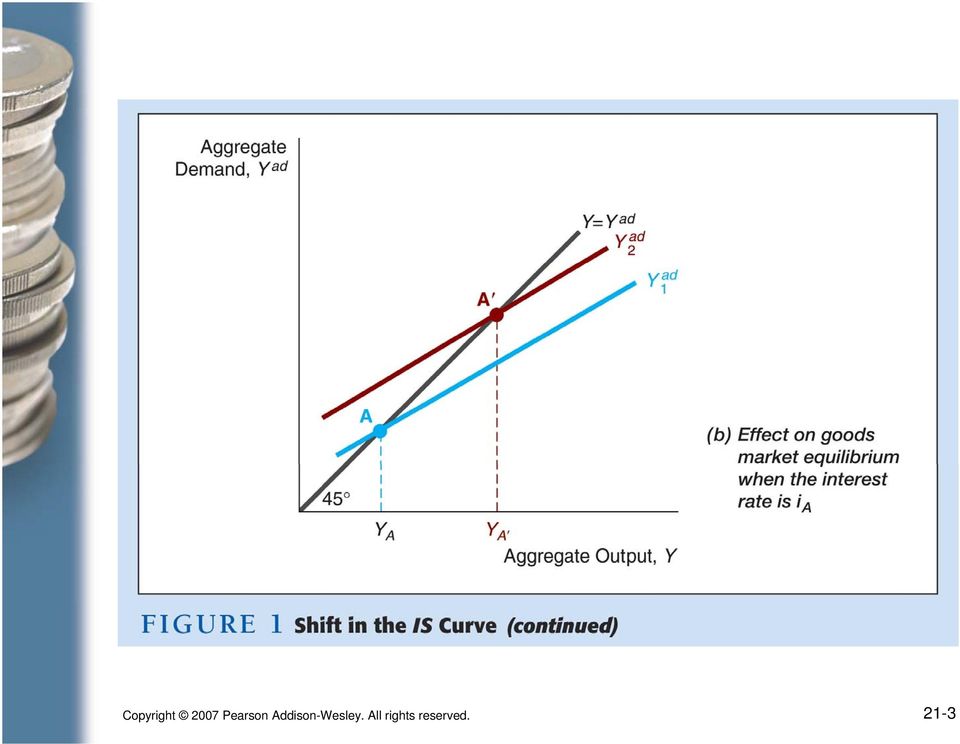
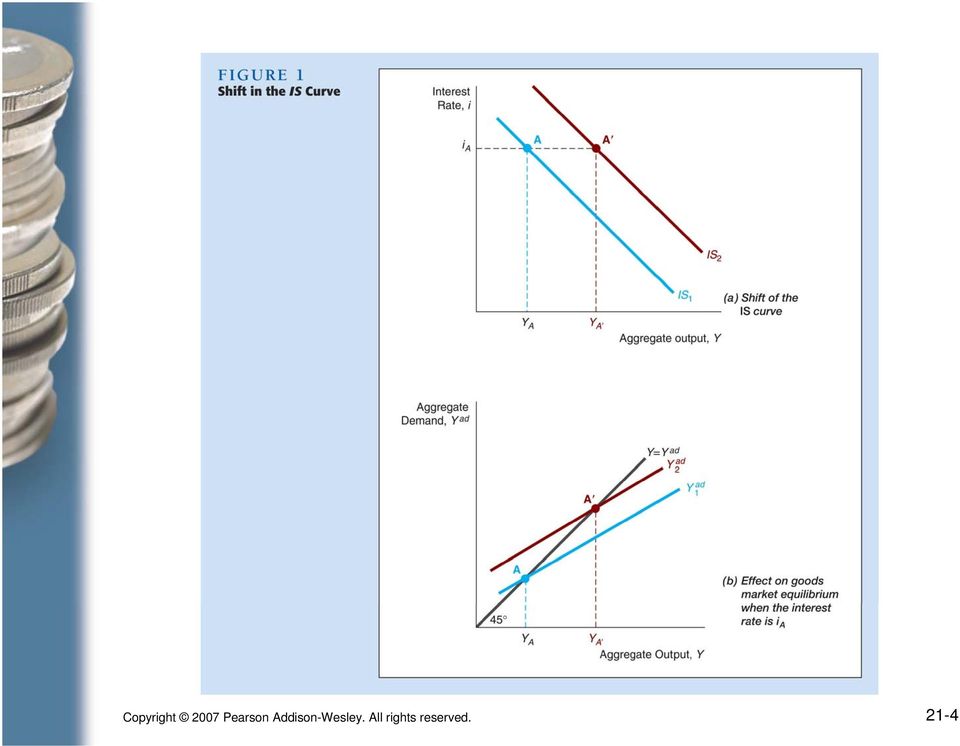
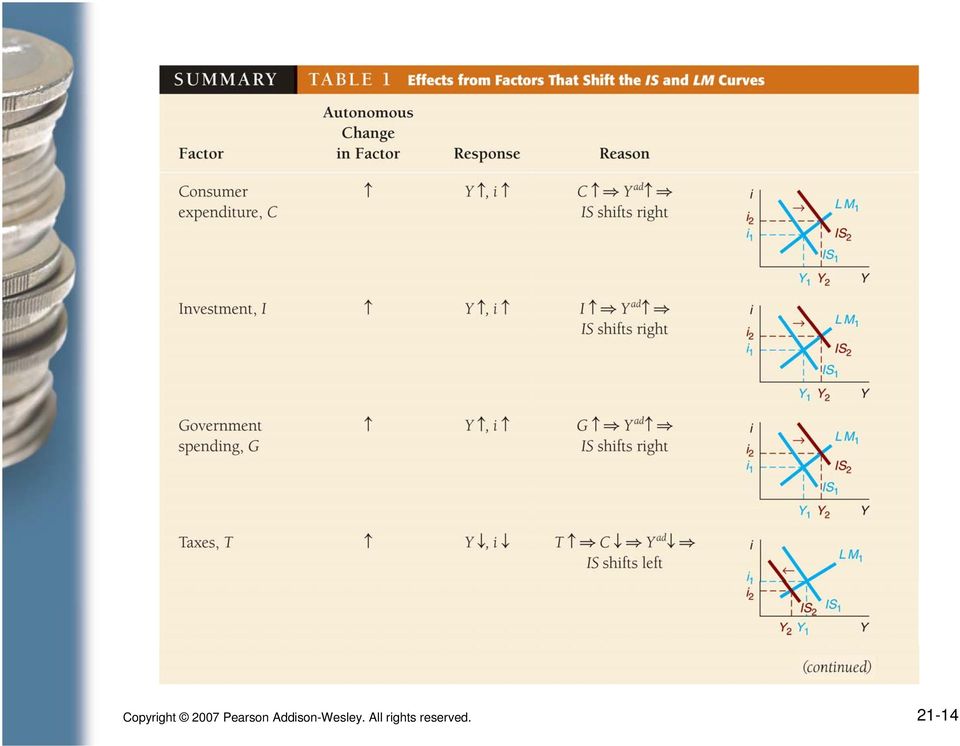
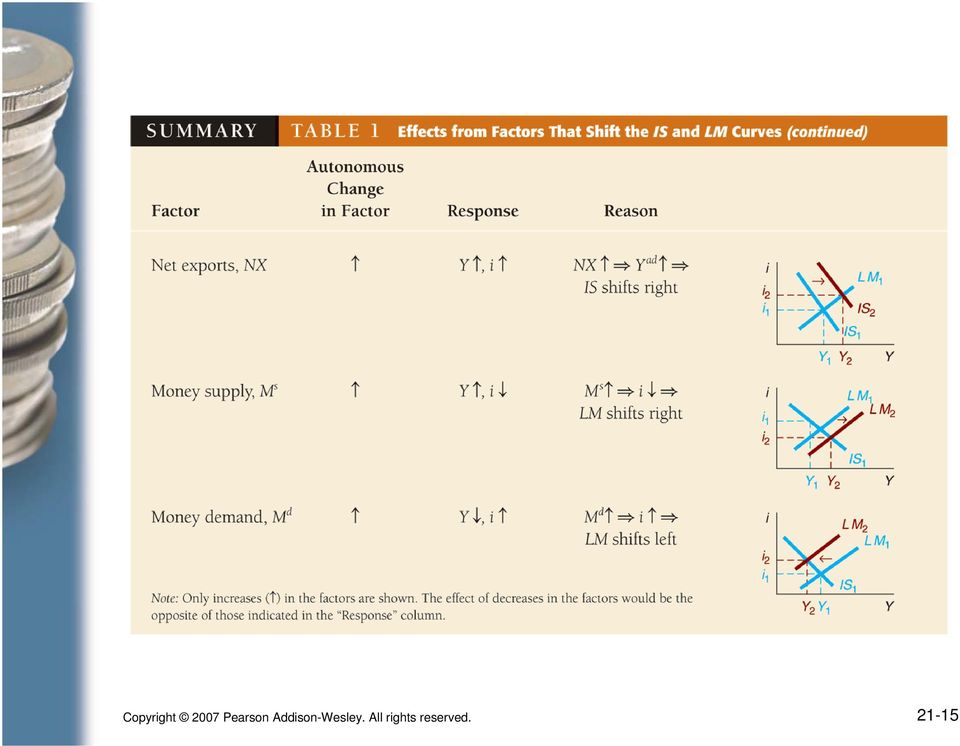
1 Factors that Shift the IS Curve A change in autonomous factors that is unrelated to the interest rate Changes in autonomous consumer expenditure Changes in planned investment spending unrelated to the interest rate Changes in government spending Changes in taxes Changes in net exports unrelated to the interest rate Copyright 2007 Pearson Addison-Wesley. All rights reserved. 21-1
2 Copyright 2007 Pearson Addison-Wesley. All rights reserved. 21-2

3 Copyright 2007 Pearson Addison-Wesley. All rights reserved. 21-3
4 Copyright 2007 Pearson Addison-Wesley. All rights reserved. 21-4
5 Factors that Shift the LM Curve Changes in the money supply Autonomous changes in money demand Copyright 2007 Pearson Addison-Wesley. All rights reserved. 21-5
6 Copyright 2007 Pearson Addison-Wesley. All rights reserved. 21-6

7 Copyright 2007 Pearson Addison-Wesley. All rights reserved. 21-7

8 Response to a Change in Monetary Policy An increase in the money supply creates an excess supply of money The interest rate declines Investment spending and net exports rise Aggregate demand rises Aggregate output rises The excess supply of money is eliminated Aggregate output is positively related to the money supply Copyright 2007 Pearson Addison-Wesley. All rights reserved. 21-8

9 Copyright 2007 Pearson Addison-Wesley. All rights reserved. 21-9

10 Response to a Change in Fiscal Policy An increase in government spending raises aggregate demand directly; a decrease in taxes makes more income available for spending The increase in aggregate demand cause aggregate output to rise A higher level of aggregate output increases the demand for money Copyright 2007 Pearson Addison-Wesley. All rights reserved
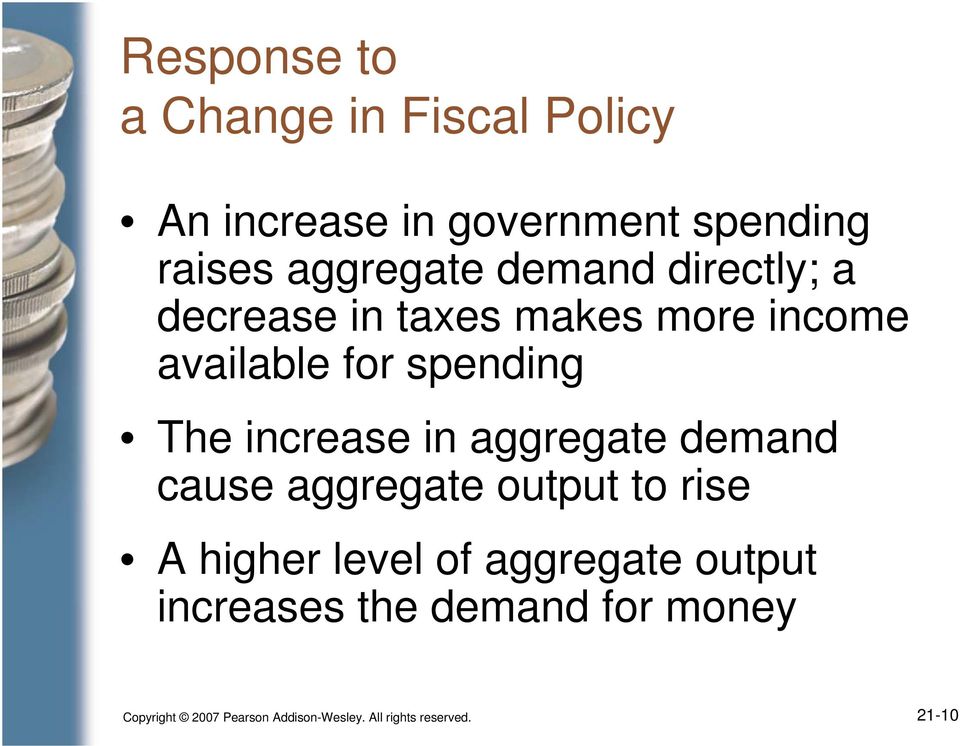
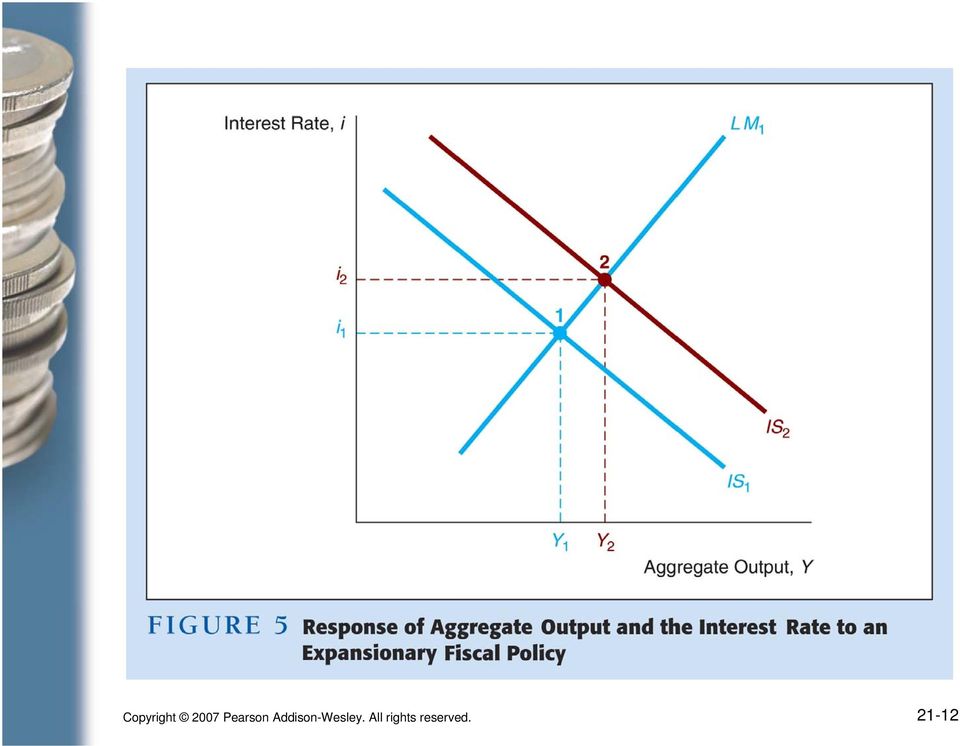
11 Response to a Change in Fiscal Policy (cont d) The excess demand for money pushes the interest rate higher The rise in the interest rate eliminates the excess demand for money Aggregate output and the interest rate are positively related to government spending and negatively related to taxes Copyright 2007 Pearson Addison-Wesley. All rights reserved

12 Copyright 2007 Pearson Addison-Wesley. All rights reserved
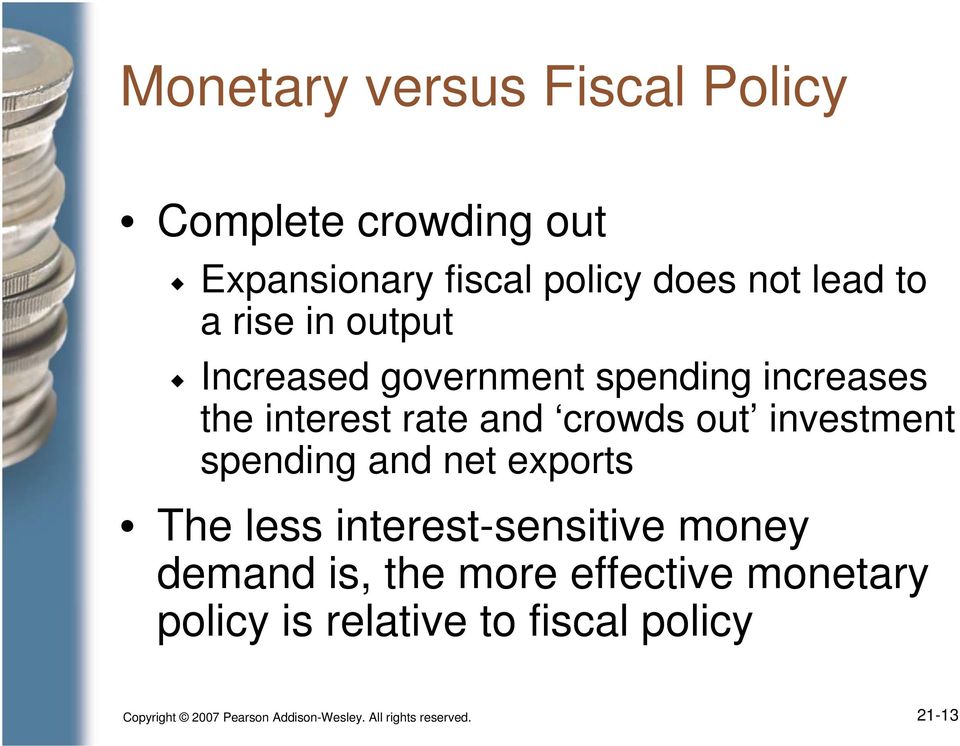
13 Monetary versus Fiscal Policy Complete crowding out Expansionary fiscal policy does not lead to a rise in output Increased government spending increases the interest rate and crowds out investment spending and net exports The less interest-sensitive money demand is, the more effective monetary policy is relative to fiscal policy Copyright 2007 Pearson Addison-Wesley. All rights reserved
14 Copyright 2007 Pearson Addison-Wesley. All rights reserved
15 Copyright 2007 Pearson Addison-Wesley. All rights reserved
16 Copyright 2007 Pearson Addison-Wesley. All rights reserved

17 Copyright 2007 Pearson Addison-Wesley. All rights reserved

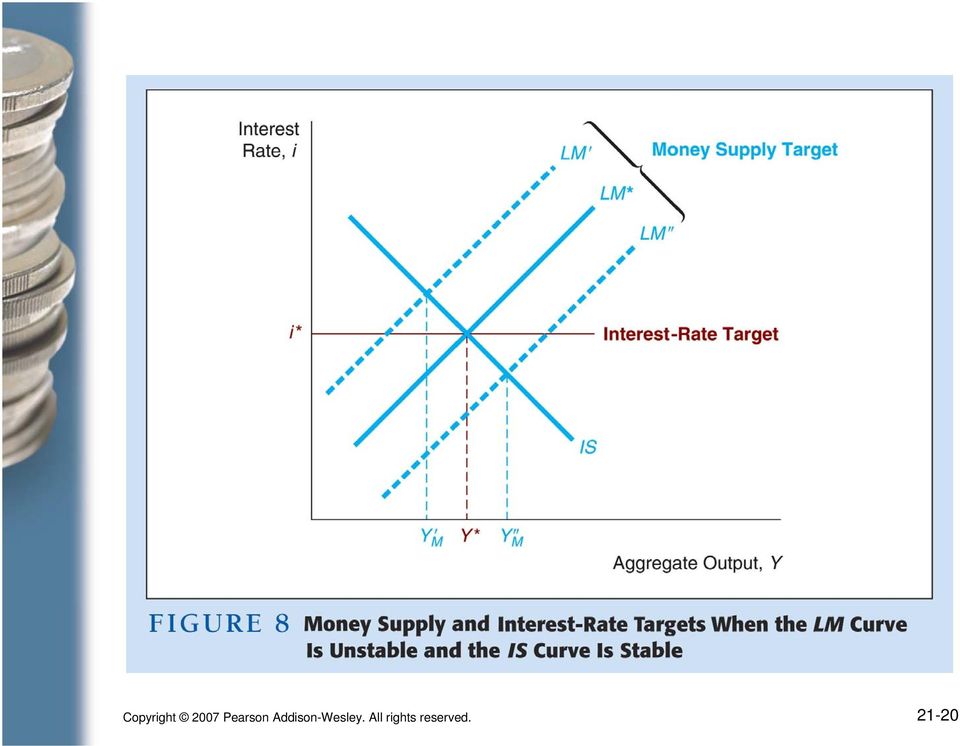
18 Targeting M s versus Interest Rates If the IS curve is more unstable (uncertain) than the LM curve, a M s target is preferable If the LM curve is more unstable than the IS curve, an interest-rate target is preferred Copyright 2007 Pearson Addison-Wesley. All rights reserved
19 Copyright 2007 Pearson Addison-Wesley. All rights reserved

20 Copyright 2007 Pearson Addison-Wesley. All rights reserved
21 ISLM Model in the Long Run Natural rate level of output (Y n ) Rate of output at which the price level has no tendency to change Using real values, so when the price level changes, the IS curve does not change The LM curve is affected by the price level As the price level rises, the quantity of money in real terms falls, and the LM curve shifts to the left until it reaches Y n (long-run monetary neutrality) Neither monetary or fiscal policy affects output in the long run Copyright 2007 Pearson Addison-Wesley. All rights reserved
22 Copyright 2007 Pearson Addison-Wesley. All rights reserved
23 Copyright 2007 Pearson Addison-Wesley. All rights reserved
24 Shifts in the Aggregate Demand Curve ISLM analysis shows how the equilibrium level of aggregate output changes for a given price level A change in any factor except the price level, that causes the IS or LM curve to shift, causes the aggregate demand curve to shift Copyright 2007 Pearson Addison-Wesley. All rights reserved
25 Copyright 2007 Pearson Addison-Wesley. All rights reserved
26 Copyright 2007 Pearson Addison-Wesley. All rights reserved
ECON 3312 Macroeconomics Exam 3 Fall 2014. Name MULTIPLE CHOICE. Choose the one alternative that best completes the statement or answers the question.
 ECON 3312 Macroeconomics Exam 3 Fall 2014 Name MULTIPLE CHOICE. Choose the one alternative that best completes the statement or answers the question. 1) Everything else held constant, an increase in net
1) Explain why each of the following statements is true. Discuss the impact of monetary and fiscal policy in each of these special cases:
 1) Explain why each of the following statements is true. Discuss the impact of monetary and fiscal policy in each of these special cases: a) If investment does not depend on the interest rate, the IS curve
Agenda. The IS-LM/AD-AS Model: A General Framework for Macroeconomic Analysis, Part 3. Disequilibrium in the AD-AS model
 Agenda The IS-LM/AD-AS Model: A General Framework for Macroeconomic Analysis, art 3 rice Adjustment and the Attainment of General Equilibrium 13-1 13-2 General equilibrium in the AD-AS model Disequilibrium
ECO209 MACROECONOMIC THEORY. Chapter 11
 Prof. Gustavo Indart Department of Economics University of Toronto ECO209 MACROECONOMIC THEORY Chapter 11 MONEY, INTEREST, AND INCOME Discussion Questions: 1. The model in Chapter 9 assumed that both the
Problem Set 5. a) In what sense is money neutral? Why is monetary policy useful if money is neutral?
 1 Problem Set 5 Question 2 a) In what sense is money neutral? Why is monetary policy useful if money is neutral? In Problem Set 4, Question 2-Part (e), we already analysed the effect of an expansionary
Problem Set #4: Aggregate Supply and Aggregate Demand Econ 100B: Intermediate Macroeconomics
 roblem Set #4: Aggregate Supply and Aggregate Demand Econ 100B: Intermediate Macroeconomics 1) Explain the differences between demand-pull inflation and cost-push inflation. Demand-pull inflation results
Extra Problems #3. ECON 410.502 Macroeconomic Theory Spring 2010 Instructor: Guangyi Ma. Notice:
 ECON 410.502 Macroeconomic Theory Spring 2010 Instructor: Guangyi Ma Extra Problems #3 Notice: (1) There are 25 multiple-choice problems covering Chapter 6, 9, 10, 11. These problems are not homework and
1. Explain what causes the liquidity preference money (LM) curve to shift and why.
 Chapter 22. IS-LM in Action C H A P T E R O B J E C T I V E S By the end of this chapter, students should be able to: 1. Explain what causes the liquidity preference money (LM) curve to shift and why.
Answer: C Learning Objective: Money supply Level of Learning: Knowledge Type: Word Problem Source: Unique
 1.The aggregate demand curve shows the relationship between inflation and: A) the nominal interest rate. D) the exchange rate. B) the real interest rate. E) short-run equilibrium output. C) the unemployment
In this chapter we learn the potential causes of fluctuations in national income. We focus on demand shocks other than supply shocks.
 Chapter 11: Applying IS-LM Model In this chapter we learn the potential causes of fluctuations in national income. We focus on demand shocks other than supply shocks. We also learn how the IS-LM model
Chapter 1. Why Study Money, Banking, and Financial Markets?
 Chapter 1 Why Study Money, Banking, and Financial Markets? Why Study Money, Banking, and Financial Markets To examine how financial markets such as bond, stock and foreign exchange markets work To examine
Problem Set for Chapter 20(Multiple choices)
 Problem Set for hapter 20(Multiple choices) 1. According to the theory of liquidity preference, a. if the interest rate is below the equilibrium level, then the quantity of money people want to hold is
Practiced Questions. Chapter 20
 Practiced Questions Chapter 20 1. The model of aggregate demand and aggregate supply a. is different from the model of supply and demand for a particular market, in that we cannot focus on the substitution
For a closed economy, the national income identity is written as Y = F (K; L)
 A CLOSED ECONOMY IN THE LONG (MEDIUM) RUN For a closed economy, the national income identity is written as Y = C(Y T ) + I(r) + G the left hand side of the equation is the total supply of goods and services
Economics 152 Solution to Sample Midterm 2
 Economics 152 Solution to Sample Midterm 2 N. Das PART 1 (84 POINTS): Answer the following 28 multiple choice questions on the scan sheet. Each question is worth 3 points. 1. If Congress passes legislation
BADM 527, Fall 2013. Midterm Exam 2. Multiple Choice: 3 points each. Answer the questions on the separate bubble sheet. NAME
 BADM 527, Fall 2013 Name: Midterm Exam 2 November 7, 2013 Multiple Choice: 3 points each. Answer the questions on the separate bubble sheet. NAME 1. According to classical theory, national income (Real
Aggregate Demand, Aggregate Supply, and the Self-Correcting Economy
 Aggregate Demand, Aggregate Supply, and the Self-Correcting Economy The Role of Aggregate Demand & Supply Endogenizing the Price Level Inflation Deflation Price Stability The Aggregate Demand Curve Relates
0 100 200 300 Real income (Y)
 Lecture 11-1 6.1 The open economy, the multiplier, and the IS curve Assume that the economy is either closed (no foreign trade) or open. Assume that the exchange rates are either fixed or flexible. Assume
AGGREGATE DEMAND AND AGGREGATE SUPPLY The Influence of Monetary and Fiscal Policy on Aggregate Demand
 AGGREGATE DEMAND AND AGGREGATE SUPPLY The Influence of Monetary and Fiscal Policy on Aggregate Demand Suppose that the economy is undergoing a recession because of a fall in aggregate demand. a. Using
Business Conditions Analysis Prof. Yamin Ahmad ECON 736
 Business Conditions Analysis Prof. Yamin Ahmad ECON 736 Sample Final Exam Name Id # Instructions: There are two parts to this midterm. Part A consists of multiple choice questions. Please mark the answers
Econ 303: Intermediate Macroeconomics I Dr. Sauer Sample Questions for Exam #3
 Econ 303: Intermediate Macroeconomics I Dr. Sauer Sample Questions for Exam #3 1. When firms experience unplanned inventory accumulation, they typically: A) build new plants. B) lay off workers and reduce
QUESTION 1: SHORT VERSUS MEDIUM RUN. 30 points
 QUESTION 1: SHORT VERSUS MEDIUM RUN. 30 points Consider an economy that fits the AS-AD model. The labor market equilibrium is given by the AS curve. The equilibrium in the goods market is given by the
Chapter 13. Aggregate Demand and Aggregate Supply Analysis
 Chapter 13. Aggregate Demand and Aggregate Supply Analysis Instructor: JINKOOK LEE Department of Economics / Texas A&M University ECON 203 502 Principles of Macroeconomics In the short run, real GDP and
Pre-Test Chapter 10 ed17
 Pre-Test Chapter 10 ed17 Multiple Choice Questions 1. Refer to the above diagrams. Assuming a constant price level, an increase in aggregate expenditures from AE 1 to AE 2 would: A. move the economy from
8. Simultaneous Equilibrium in the Commodity and Money Markets
 Lecture 8-1 8. Simultaneous Equilibrium in the Commodity and Money Markets We now combine the IS (commodity-market equilibrium) and LM (money-market equilibrium) schedules to establish a general equilibrium
Chapter 16 Output and the Exchange Rate in the Short Run
 Chapter 16 Output and the Exchange Rate in the Short Run Prepared by Iordanis Petsas To Accompany International Economics: Theory and Policy, Sixth Edition by Paul R. Krugman and Maurice Obstfeld Chapter
Chapter 9. The IS-LM/AD-AS Model: A General Framework for Macroeconomic Analysis. 2008 Pearson Addison-Wesley. All rights reserved
 Chapter 9 The IS-LM/AD-AS Model: A General Framework for Macroeconomic Analysis Chapter Outline The FE Line: Equilibrium in the Labor Market The IS Curve: Equilibrium in the Goods Market The LM Curve:
Chapter Outline. Chapter 13. Exchange Rates. Exchange Rates
 Chapter 13, Business Cycles, and Macroeconomic Policy in the Open Economy Chapter Outline How Are Determined: A Supply-and-Demand Analysis The IS-LM Model for an Open Economy Macroeconomic Policy in an
THE OPEN AGGREGATE DEMAND AGGREGATE SUPPLY MODEL.
 THE OPEN AGGREGATE DEMAND AGGREGATE SUPPLY MODEL. Introduction. This model represents the workings of the economy as the interaction between two curves: - The AD curve, showing the relationship between
4 Macroeconomics LESSON 6
 4 Macroeconomics LESSON 6 Interest Rates and Monetary Policy in the Short Run and the Long Run Introduction and Description This lesson explores the relationship between the nominal interest rate and the
The Aggregate Demand- Aggregate Supply (AD-AS) Model
 The AD-AS Model The Aggregate Demand- Aggregate Supply (AD-AS) Model Chapter 9 The AD-AS Model addresses two deficiencies of the AE Model: No explicit modeling of aggregate supply. Fixed price level. 2
The Circular Flow of Income and Expenditure
 The Circular Flow of Income and Expenditure Imports HOUSEHOLDS Savings Taxation Govt Exp OTHER ECONOMIES GOVERNMENT FINANCIAL INSTITUTIONS Factor Incomes Taxation Govt Exp Consumer Exp Exports FIRMS Capital
Econ 202 Final Exam. Douglas, Spring 2006 PLEDGE: I have neither given nor received unauthorized help on this exam.
 , Spring 2006 PLEDGE: I have neither given nor received unauthorized help on this exam. SIGNED: PRINT NAME: Econ 202 Final Exam 1. When the government spends more, the initial effect is that a. aggregate
The IS-LM Model Ing. Mansoor Maitah Ph.D.
 The IS-LM Model Ing. Mansoor Maitah Ph.D. Constructing the Keynesian Cross Equilibrium is at the point where Y = C + I + G. If firms were producing at Y 1 then Y > E Because actual expenditure exceeds
Solution. Solution. Monetary Policy. macroeconomics. economics
 KrugmanMacro_SM_Ch14.qxp 10/27/05 3:25 PM Page 165 Monetary Policy 1. Go to the FOMC page of the Federal Reserve Board s website (http://www. federalreserve.gov/fomc/) to find the statement issued after
Chapter Outline. Chapter 11. Real-Wage Rigidity. Real-Wage Rigidity
 Chapter 11 Keynesianism: The Macroeconomics of Wage and Price Rigidity Chapter Outline Real-Wage Rigidity Price Stickiness Monetary and Fiscal Policy in the Keynesian 2008 Pearson Addison-Wesley. All rights
The level of price and inflation Real GDP: the values of goods and services measured using a constant set of prices
 Chapter 2: Key Macroeconomics Variables ECON2 (Spring 20) 2 & 4.3.20 (Tutorial ) National income accounting Gross domestic product (GDP): The market value of all final goods and services produced within
ECON 4423: INTERNATIONAL FINANCE
 University of Colorado at Boulder Department of Economics ECON 4423: INTERNATIONAL FINANCE Final Examination Fall 2005 Name: Answer Key Student ID: Instructions: This test is 1 1/2 hours in length. You
14.02 PRINCIPLES OF MACROECONOMICS QUIZ 3
 14.02 PRINCIPLES OF MACROECONOMICS QUIZ 3 READ INSTRUCTIONS FIRST: Read all questions carefully and completely before beginning the quiz. Label all of your graphs, including axes, clearly; if we can t
Macroeconomics Instructor Miller Fiscal Policy Practice Problems
 Macroeconomics Instructor Miller Fiscal Policy Practice Problems 1. Fiscal policy refers to changes in A) state and local taxes and purchases that are intended to achieve macroeconomic policy objectives.
Chapter 12: Aggregate Supply and Phillips Curve
 Chapter 12: Aggregate Supply and Phillips Curve In this chapter we explain the position and slope of the short run aggregate supply (SRAS) curve. SRAS curve can also be relabeled as Phillips curve. A basic
Use the following to answer question 9: Exhibit: Keynesian Cross
 1. Leading economic indicators are: A) the most popular economic statistics. B) data that are used to construct the consumer price index and the unemployment rate. C) variables that tend to fluctuate in
Professor Christina Romer. LECTURE 17 MACROECONOMIC VARIABLES AND ISSUES March 17, 2016
 Economics 2 Spring 2016 Professor Christina Romer Professor David Romer LECTURE 17 MACROECONOMIC VARIABLES AND ISSUES March 17, 2016 I. MACROECONOMICS VERSUS MICROECONOMICS II. REAL GDP A. Definition B.
7 AGGREGATE SUPPLY AND AGGREGATE DEMAND* Chapter. Key Concepts
 Chapter 7 AGGREGATE SUPPLY AND AGGREGATE DEMAND* Key Concepts Aggregate Supply The aggregate production function shows that the quantity of real GDP (Y ) supplied depends on the quantity of labor (L ),
e) Permanent changes in monetary and fiscal policies (assume now long run price flexibility)
 Topic I.4 concluded: Goods and Assets Markets in the Short Run a) Aggregate demand and equilibrium b) Money and asset markets equilibrium c) Short run equilibrium of Y and E d) Temporary monetary and fiscal
FINAL EXAM: Macro 302 Winter 2013
 FINAL EXAM: Macro 302 Winter 2013 Surname: Name: Student Number: State clearly your assumptions when you derive a result. You must always show your thinking to get full credit. You have 3 hours to answer
SHORT-RUN FLUCTUATIONS. David Romer. University of California, Berkeley. First version: August 1999 This revision: January 2012
 SHORT-RUN FLUCTUATIONS David Romer University of California, Berkeley First version: August 1999 This revision: January 2012 Copyright 2012 by David Romer CONTENTS Preface vi I The IS-MP Model 1 I-1 Monetary
FISCAL POLICY* Chapter. Key Concepts
 Chapter 15 FISCAL POLICY* Key Concepts The Federal Budget The federal budget is an annual statement of the government s expenditures and tax revenues. Using the federal budget to achieve macroeconomic
CHAPTER 7: AGGREGATE DEMAND AND AGGREGATE SUPPLY
 CHAPTER 7: AGGREGATE DEMAND AND AGGREGATE SUPPLY Learning goals of this chapter: What forces bring persistent and rapid expansion of real GDP? What causes inflation? Why do we have business cycles? How
MULTIPLE CHOICE. Choose the one alternative that best completes the statement or answers the question.
 Suvey of Macroeconomics, MBA 641 Fall 2006, Final Exam Name MULTIPLE CHOICE. Choose the one alternative that best completes the statement or answers the question. 1) Modern macroeconomics emerged from
The Open Economy. Nominal Exchange Rates. Chapter 10. Exchange Rates, Business Cycles, and Macroeconomic Policy in the Open Economy
 Chapter 10 Exchange Rates, Business Cycles, and Macroeconomic Policy in the Open Economy Economics 282 University of Alberta The Open Economy Two aspects of the interdependence of the world economies:
How To Learn Economics In India
 B.A. PROGRAMME DISCIPLINE COURSE ECONOMICS COURSE CONTENTS (Effective from the Academic Year 2011-2012 onwards) DEPARTMENT OF ECONOMICS UNIVERSITY OF DELHI DELHI 1 Syllabus for B.A. Programme - Economics
International Economic Relations
 nswers to Problem Set #5 International conomic Relations Prof. Murphy Chapter 5 Krugman and Obstfeld. Relative PPP predicts that inflation differentials are matched by changes in the exchange rate. Under
EC2105, Professor Laury EXAM 2, FORM A (3/13/02)
 EC2105, Professor Laury EXAM 2, FORM A (3/13/02) Print Your Name: ID Number: Multiple Choice (32 questions, 2.5 points each; 80 points total). Clearly indicate (by circling) the ONE BEST response to each
Refer to Figure 17-1
 Chapter 17 1. Inflation can be measured by the a. change in the consumer price index. b. percentage change in the consumer price index. c. percentage change in the price of a specific commodity. d. change
a) Aggregate Demand (AD) and Aggregate Supply (AS) analysis
 a) Aggregate Demand (AD) and Aggregate Supply (AS) analysis Determinants of AD: Aggregate demand is the total demand in the economy. It measures spending on goods and services by consumers, firms, the
FISCAL POLICY* Chapter. Key Concepts
 Chapter 11 FISCAL POLICY* Key Concepts The Federal Budget The federal budget is an annual statement of the government s expenditures and tax revenues. Using the federal budget to achieve macroeconomic
CH 10 - REVIEW QUESTIONS
 CH 10 - REVIEW QUESTIONS 1. The short-run aggregate supply curve is horizontal at: A) a level of output determined by aggregate demand. B) the natural level of output. C) the level of output at which the
I d ( r; MPK f, τ) Y < C d +I d +G
 1. Use the IS-LM model to determine the effects of each of the following on the general equilibrium values of the real wage, employment, output, the real interest rate, consumption, investment, and the
2.If actual investment is greater than planned investment, inventories increase more than planned. TRUE.
 Macro final exam study guide True/False questions - Solutions Case, Fair, Oster Chapter 8 Aggregate Expenditure and Equilibrium Output 1.Firms react to unplanned inventory investment by reducing output.
Answers to Text Questions and Problems in Chapter 11
 Answers to Text Questions and Problems in Chapter 11 Answers to Review Questions 1. The aggregate demand curve relates aggregate demand (equal to short-run equilibrium output) to inflation. As inflation
AP Macroeconomics 2011 Scoring Guidelines
 AP Macroeconomics 2011 Scoring Guidelines The College Board The College Board is a not-for-profit membership association whose mission is to connect students to college success and opportunity. Founded
Macroeconomics Series 2: Money Demand, Money Supply and Quantity Theory of Money
 Macroeconomics Series 2: Money Demand, Money Supply and Quantity Theory of Money by Dr. Charles Kwong School of Arts and Social Sciences The Open University of Hong Kong 1 Lecture Outline 2. Determination
INTRODUCTION TO ADVANCED MACROECONOMICS Preliminary Exam with answers September 2014
 Duration: 120 min INTRODUCTION TO ADVANCED MACROECONOMICS Preliminary Exam with answers September 2014 Format of the mock examination Section A. Multiple Choice Questions (20 % of the total marks) Section
Homework #6 - Answers. Uses of Macro Policy Due April 20
 Page 1 of 8 Uses of Macro Policy ue April 20 Answer all questions on these sheets, adding extra sheets where necessary. 1. Suppose that the government were to increase its purchases of goods and services
Pre-Test Chapter 11 ed17
 Pre-Test Chapter 11 ed17 Multiple Choice Questions 1. Built-in stability means that: A. an annually balanced budget will offset the procyclical tendencies created by state and local finance and thereby
A decline in the stock market, which makes consumers poorer, would cause the aggregate demand curve to shift to the left.
 Economics 304 Final Exam Fall 2000 PART I: TRUE/FALSE. Write 'T' if the statement is true and 'F' if the statement is false. (1.5 pts. each) A decline in the stock market, which makes consumers poorer,
S.Y.B.COM. (SEM-III) ECONOMICS
 Fill in the Blanks. Module 1 S.Y.B.COM. (SEM-III) ECONOMICS 1. The continuous flow of money and goods and services between firms and households is called the Circular Flow. 2. Saving constitute a leakage
International Macroeconommics
 International Macroeconommics Chapter 7. The Open Economy IS-LM Model Department of Economics, UCDavis Outline 1 Building the IS-LM-FX Model 2 Monetary Policy Fiscal Policy Outline Building the IS-LM-FX
CHAPTER 3 THE LOANABLE FUNDS MODEL
 CHAPTER 3 THE LOANABLE FUNDS MODEL The next model in our series is called the Loanable Funds Model. This is a model of interest rate determination. It allows us to explore the causes of rising and falling
Topic 4: Introduction to Labour Market, Aggregate Supply and AD-AS model
 Topic 4: Introduction to Labour Market, Aggregate Supply and AD-AS model 1. In order to model the labour market at a microeconomic level, e simplify greatly by assuming that all jobs are the same in terms
MONETARY AND FISCAL POLICY IN THE VERY SHORT RUN
 C H A P T E R12 MONETARY AND FISCAL POLICY IN THE VERY SHORT RUN LEARNING OBJECTIVES After reading and studying this chapter, you should be able to: Understand that both fiscal and monetary policy can
Lecture 10: Open Economy & Crises
 Lecture 10: Open Economy & Crises Today Open Economy Macroeconomics Key Readings Mishkin, Cht 24, Leddin/Walsh Cht 18. Learning Outcomes Theory. Extend ISLM to account for Imports/Exports Practice. Show
Chapter 12 Unemployment and Inflation
 Chapter 12 Unemployment and Inflation Multiple Choice Questions 1. The origin of the idea of a trade-off between inflation and unemployment was a 1958 article by (a) A.W. Phillips. (b) Edmund Phelps. (c)
Econ 202 H01 Final Exam Spring 2005
 Econ202Final Spring 2005 1 Econ 202 H01 Final Exam Spring 2005 1. Which of the following tends to reduce the size of a shift in aggregate demand? a. the multiplier effect b. the crowding-out effect c.
Examination II. Fixed income valuation and analysis. Economics
 Examination II Fixed income valuation and analysis Economics Questions Foundation examination March 2008 FIRST PART: Multiple Choice Questions (48 points) Hereafter you must answer all 12 multiple choice
SRAS. is less than Y P
 KrugmanMacro_SM_Ch12.qxp 11/15/05 3:18 PM Page 141 Fiscal Policy 1. The accompanying diagram shows the current macroeconomic situation for the economy of Albernia. You have been hired as an economic consultant
Chapter 12. National Income Accounting and the Balance of Payments. Slides prepared by Thomas Bishop
 Chapter 12 National Income Accounting and the Balance of Payments Slides prepared by Thomas Bishop Preview National income accounts measures of national income measures of value of production measures
BUSINESS ECONOMICS CEC2 532-751 & 761
 BUSINESS ECONOMICS CEC2 532-751 & 761 PRACTICE MACROECONOMICS MULTIPLE CHOICE QUESTIONS Warning: These questions have been posted to give you an opportunity to practice with the multiple choice format
The Fiscal Policy and The Monetary Policy. Ing. Mansoor Maitah Ph.D.
 The Fiscal Policy and The Monetary Policy Ing. Mansoor Maitah Ph.D. Government in the Economy The Government and Fiscal Policy Fiscal Policy changes in taxes and spending that affect the level of GDP to
Each correct answer will score one mark. A mark will not be deducted for a wrong answer. Any rough working should be done in this booklet.
 *0299776260* ambridge International Examinations ambridge International dvanced Level ENMIS 9708/33 Paper 3 Multiple hoice (Supplement) May/June 2014 dditional Materials: Multiple hoice nswer Sheet Soft
1. a. Interest-bearing checking accounts make holding money more attractive. This increases the demand for money.
 Macroeconomics ECON 2204 Prof. Murphy Problem Set 4 Answers Chapter 10 #1, 2, and 3 (on pages 308-309) 1. a. Interest-bearing checking accounts make holding money more attractive. This increases the demand
MULTIPLE CHOICE. Choose the one alternative that best completes the statement or answers the question.
 Econ 111 Summer 2007 Final Exam Name MULTIPLE CHOICE. Choose the one alternative that best completes the statement or answers the question. 1) The classical dichotomy allows us to explore economic growth
THREE KEY FACTS ABOUT ECONOMIC FLUCTUATIONS
 15 In this chapter, look for the answers to these questions: What are economic fluctuations? What are their characteristics? How does the model of demand and explain economic fluctuations? Why does the
Lecture 2. Output, interest rates and exchange rates: the Mundell Fleming model.
 Lecture 2. Output, interest rates and exchange rates: the Mundell Fleming model. Carlos Llano (P) & Nuria Gallego (TA) References: these slides have been developed based on the ones provided by Beatriz
MONEY, INTEREST, REAL GDP, AND THE PRICE LEVEL*
 Chapter 11 MONEY, INTEREST, REAL GDP, AND THE PRICE LEVEL* The Demand for Topic: Influences on Holding 1) The quantity of money that people choose to hold depends on which of the following? I. The price
Session 12. Aggregate Supply: The Phillips curve. Credibility
 Session 12. Aggregate Supply: The Phillips curve. Credibility v Potential Output and v Okun s law v The Role of Expectations and the Phillips Curve v Oil Prices and v US Monetary Policy and World Real
Long run v.s. short run. Introduction. Aggregate Demand and Aggregate Supply. In this chapter, look for the answers to these questions:
 33 Aggregate Demand and Aggregate Supply R I N C I L E S O F ECONOMICS FOURTH EDITION N. GREGOR MANKIW Long run v.s. short run Long run growth: what determines long-run output (and the related employment
Income, Inflation, and Unemployment
 Income, Inflation, and Unemployment Builds on the course with the same name using the textbook of Blanchard. We use the same book. But with 3 differences: 1. Topics covered: focus on chapters not discussed
Lecture 10-1. The Twin Deficits
 Lecture 10-1 The Twin Deficits The IS-LM model of the previous lectures endogenised the interest rate while assuming that the portion (NX 0 ) of net exports not dependent on income was exogenously fixed.
Government Budget and Fiscal Policy CHAPTER
 Government Budget and Fiscal Policy 11 CHAPTER The National Budget The national budget is the annual statement of the government s expenditures and tax revenues. Fiscal policy is the use of the federal
Keynesian Macroeconomic Theory
 2 Keynesian Macroeconomic Theory 2.1. The Keynesian Consumption Function 2.2. The Complete Keynesian Model 2.3. The Keynesian-Cross Model 2.4. The IS-LM Model 2.5. The Keynesian AD-AS Model 2.6. Conclusion
Using Policy to Stabilize the Economy
 Using Policy to Stabilize the Economy Since the Employment ct of 1946, economic stabilization has been a goal of U.S. policy. Economists debate how active a role the govt should take to stabilize the economy.
D) surplus; negative. 9. The law of one price is enforced by: A) governments. B) producers. C) consumers. D) arbitrageurs.
 1. An open economy is one in which: A) the level of output is fixed. B) government spending exceeds revenues. C) the national interest rate equals the world interest rate. D) there is trade in goods and
Agenda. The IS LM Model, Part 2. The Demand for Money. The Demand for Money. The Demand for Money. Asset Market Equilibrium.
 Agenda The IS LM Model, Part 2 Asset Market Equilibrium The LM Curve 13-1 13-2 The demand for money is the quantity of money people want to hold in their portfolios. The demand for money depends on expected
Econ 336 - Spring 2007 Homework 5
 Econ 336 - Spring 2007 Homework 5 Name MULTIPLE CHOICE. Choose the one alternative that best completes the statement or answers the question. 1) The real exchange rate, q, is defined as A) E times P B)
Learning Objectives. Chapter 6. Market Structures. Market Structures (cont.) The Two Extremes: Perfect Competition and Pure Monopoly
 Chapter 6 The Two Extremes: Perfect Competition and Pure Monopoly Learning Objectives List the four characteristics of a perfectly competitive market. Describe how a perfect competitor makes the decision
M.A.PART - I ECONOMIC PAPER - I MACRO ECONOMICS
 1 M.A.PART - I ECONOMIC PAPER - I MACRO ECONOMICS 1. Basic Macroeconomics Income and spending The consumption function Savings and investment The Keynesian Multiplier The budget Balanced budget : theorem
Thinkwell s Homeschool Economics Course Lesson Plan: 36 weeks
 Thinkwell s Homeschool Economics Course Lesson Plan: 36 weeks Welcome to Thinkwell s Homeschool Economics! We re thrilled that you ve decided to make us part of your homeschool curriculum. This lesson