
Answers to Text Questions and Problems in Chapter 11
|
|
|
- Darcy Wright
- 9 years ago
- Views:
Transcription
1 Answers to Text Questions and Problems in Chapter 11 Answers to Review Questions 1. The aggregate demand curve relates aggregate demand (equal to short-run equilibrium output) to inflation. As inflation rises, the Bank of Canada tightens monetary policy by raising the real interest rate, which reduces aggregate demand and short-run equilibrium output. Thus the aggregate demand curve is downward sloping. 2a. For given levels of inflation and the real interest rate, an increase in government purchases raises aggregate demand and short-run equilibrium output. Thus an increase in government purchases shifts the ADI curve to the right. b. Because it leads consumers to spend more, a cut in taxes stimulates aggregate demand at each level of inflation, shifting the ADI curve to the right. c. A decline in planned investment spending by firms reduces aggregate demand at each level of inflation, shifting the ADI curve to the left. d. For each level of inflation, a lower real interest rate stimulates consumption and investment spending, raising aggregate demand and output. Thus, an easier policy by the Bank of Canada shifts the ADI curve to the right. 3. Prices of commodities are set continuously in auction markets and therefore can adjust quickly to changes in supply or demand. However, most prices are not determined in auction markets but are set only periodically. In setting prices or wages for a longer period, individuals expectations of future inflation are important; the higher is expected inflation, the higher the future wage or price must be set in order to maintain the desired level of purchasing power. But expectations of inflation in turn depend in part on recent experience with inflation. So we have a vicious (or virtuous) circle, as high inflation leads to high expectations of inflation, which in turn leads to high actual inflation (and the reverse if inflation is low). Together with long-term contracts that lock in prices and wages for a period of time, expectations of inflation contribute to inflation inertia, or stickiness. 4. Expansionary gaps tend to raise inflation, and recessionary gaps tend to reduce it. If an expansionary gap exists, for example, firms are producing above normal capacity. Eventually they will respond by attempting to raise their relative price (that is, raising their own price faster than the rate of inflation). As all firms try to do this, inflation will tend to speed up. Likewise, a recessionary gap implies that firms are producing below normal capacity. To stimulate demand for their products, firms will try to reduce their relative prices, leading to an overall slowdown in inflation. Graphically, the link between output gaps and inflation is captured by movements of the short-run aggregate supply (IA) line. If an expansionary gap exists at the current intersection of the IA line and the ADI curve (which determines short-run equilibrium output), inflation rises and the IA line moves upward. If a recessionary gap exists in short-run equilibrium, inflation falls and the IA line moves downward. Inflation and the IA line adjust until the economy reaches long-run equilibrium at the intersection of the ADI curve and the long-run aggregate supply (LRAS) line. 5. In the diagram below, short-run equilibrium (point A) occurs at the intersection of the ADI curve and the IA line. As drawn, short-run equilibrium output is greater than potential output (that is, A is to the right of the LRAS line), and so an expansionary gap exists. The expansionary gap leads inflation to rise over time; the IA line, which shows the current rate of inflation, therefore also rises over time. The IA line continues to rise until it intersects the LRAS line and ADI curve at point B. At point B, called the long-run equilibrium point, output equals potential output and the inflation rate is stable. LRAS B IA 2
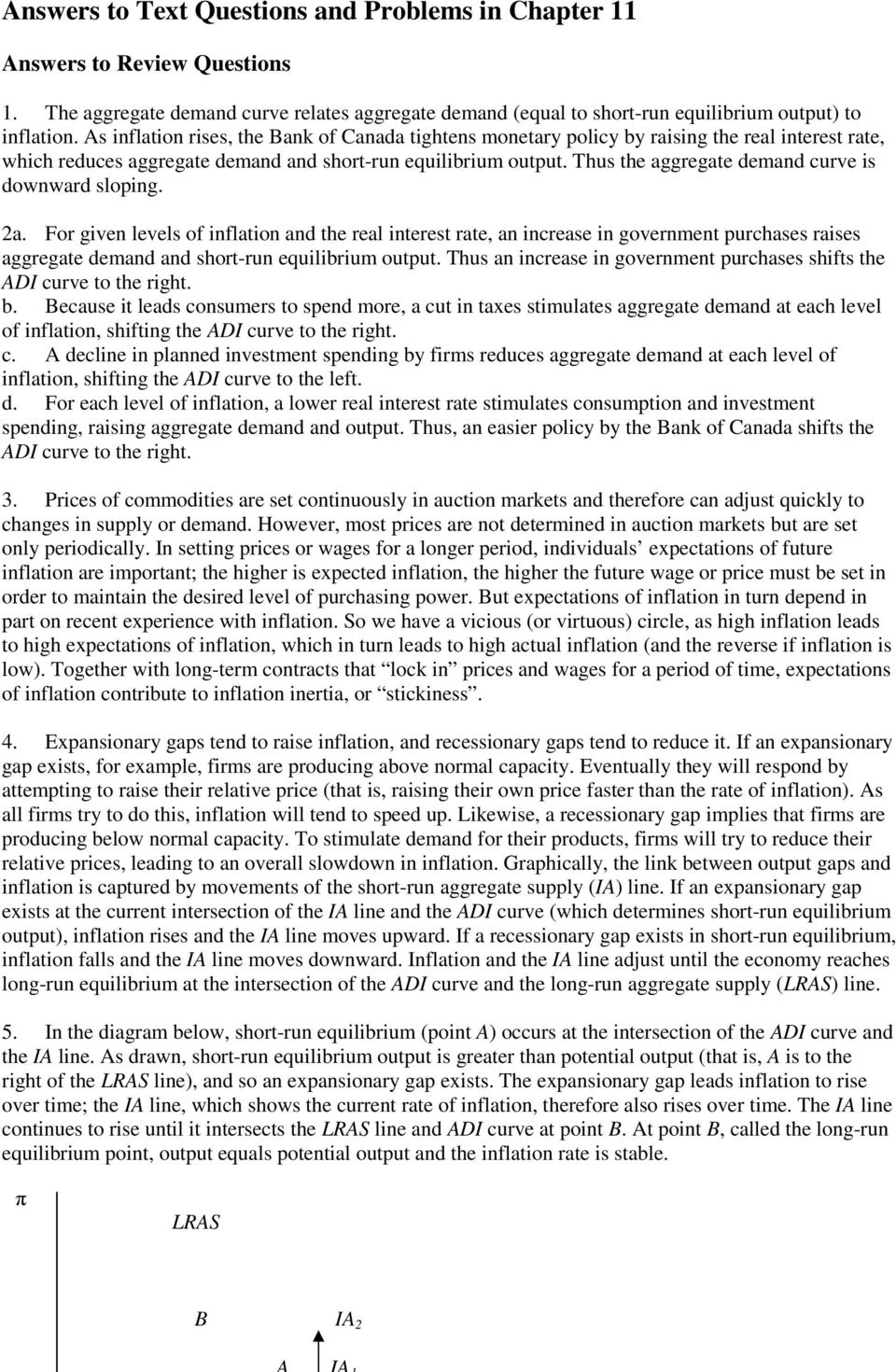
2 6. The answer is ambiguous, as whether stabilization policy is useful depends largely on the speed at which self-correction takes place. The more slowly the economy adjusts, the more likely it is that stabilization policy will be useful. Thus if the economy has many long-term contracts or other barriers to rapid adjustment, or if the economy is initially far from full employment, then stabilization policy is more likely to be useful. 7. Oil prices played the largest role in increasing inflation during both the and periods. In 1973, not only did oil prices quadruple, but agricultural prices also sharply rose. Later in the decade, the Iranian Revolution of 1979 caused oil prices to double, leading to high inflation in the early 1980s. 8. An adverse inflation shock (which shifts the IA line upwards) both raises inflation and creates a recessionary gap (with higher unemployment). Policymakers can respond only through monetary or fiscal policies that shift the ADI curve. If they expand aggregate demand, shifting the ADI curve to the right, they offset the recessionary impact but accept the higher rate of inflation permanently. If they do nothing, allowing the economy to self-correct, the surge in inflation will ultimately be eliminated but only at the cost of a potentially protracted recession and high unemployment. Thus an inflation shock creates a difficult dilemma for policymakers. 9. Assume for concreteness that the economy starts at full employment, but with an inflation rate higher than the Bank of Canada would like. To reduce inflation, the Bank of Canada tightens monetary policy, shifting the ADI curve leftward. In the short run, inflation is unchanged (the IA line has not shifted), output is lower (a recession), and the real interest rate is higher (tighter money means that the Bank of Canada raises the real interest rate at any given level of inflation). The recessionary gap implies that over time inflation will fall; graphically, the IA line shifts downward until long-run equilibrium is restored at the intersection of the ADI curve, the LRAS line, and the IA line. In the long run inflation is lower and output returns to full employment. The real interest rate declines as inflation falls; indeed, in the long run it returns to its original full-employment value, consistent with equilibrium in the market for saving and investment. 10. First, because potential output cannot be precisely estimated, it would be better to think of LRAS as being a thick band rather than a thin line. Second, potential output is not fixed, but continues to expand even during recessions. Third, net exports are not autonomous, but respond to changes in the exchange rate. Answers to Problems
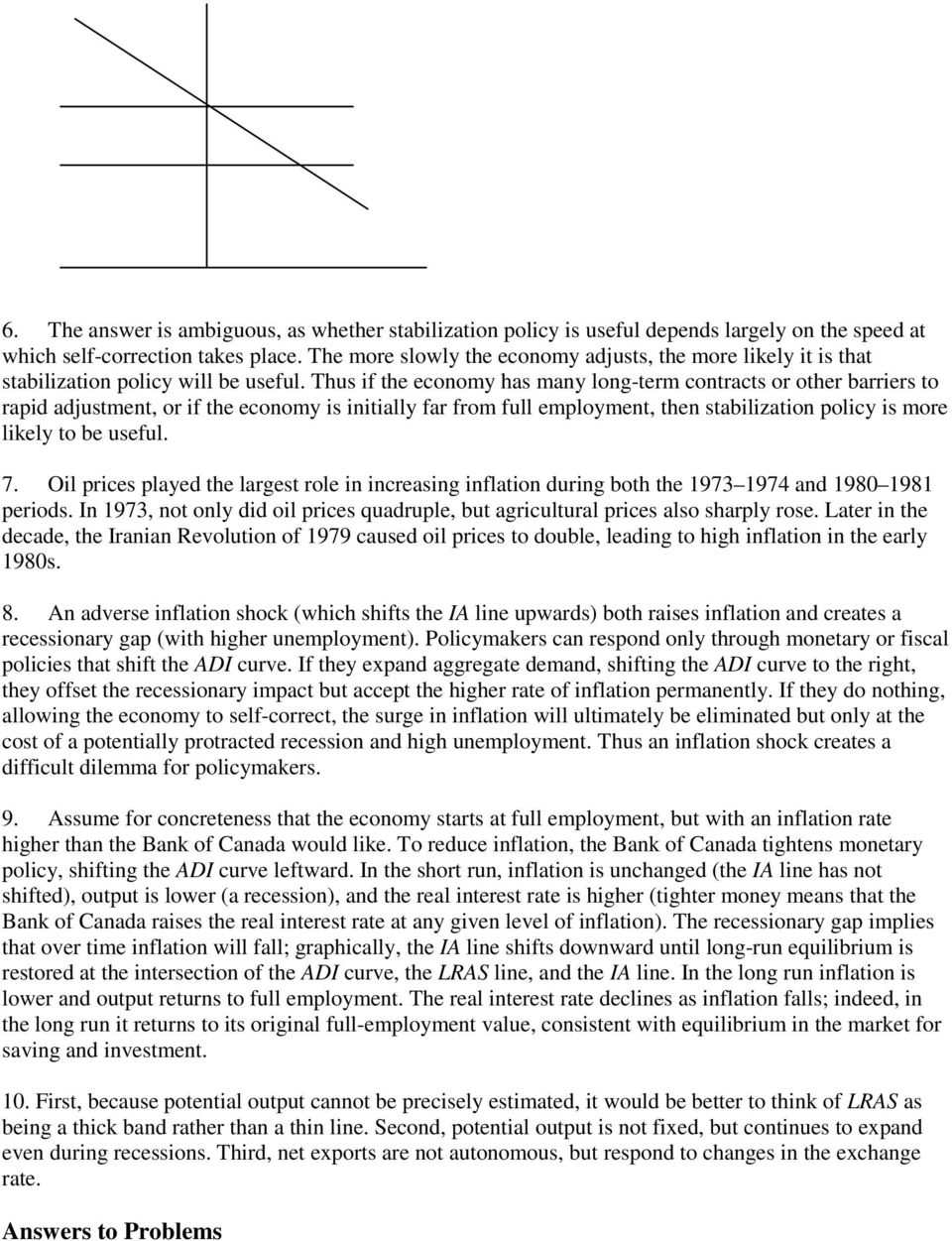
3 1. For each value of inflation, we need to find short-run equilibrium output. Suppose, for example, that inflation is 0.00, so that the real interest rate r = Then Y = (0.02) = = 980. So if the rate of inflation = 0.00, then short-run equilibrium output is 980. The same calculation can be repeated for each value of inflation to obtain: Inflation Real interest rate r Short-run equilibrium output The ADI curve, shown below, graphs the relationship above with the inflation rate on the vertical axis and short-run equilibrium output on the horizontal axis.
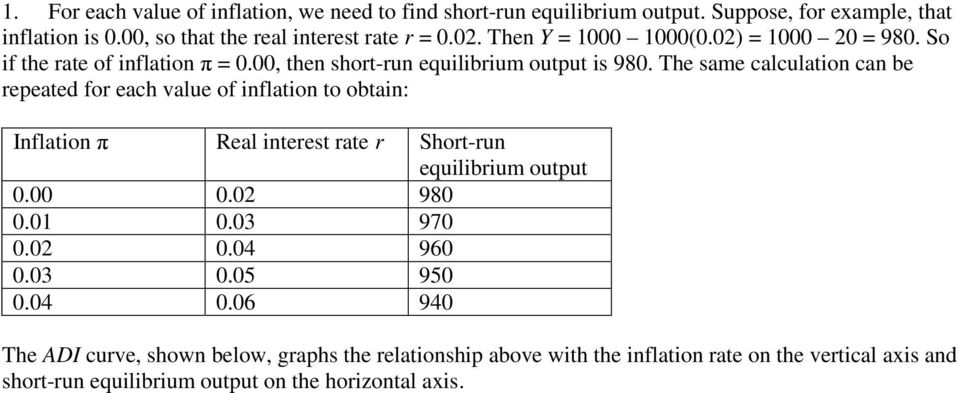
4 ADI Y 2. If potential output Y* is 960, then the Bank of Canada s long-term objective is for an inflation rate equal to 2%. We can find this either through the table or through solving for the interest rate that allows output to equal potential output: Y = r 960 = r 1000r = 40 r = 0.04 From the policy reaction function, the central bank will set a real interest rate of 4% when the inflation rate is 2%. 3a. We are told that the initial inflation rate is 4%. Putting this into the aggregate demand curve, shortrun equilibrium output is Y = 13,000 20,000(0.04) = 12,200. b. In the long run, output will equal potential output, or 12,000. At this level of output, the inflation rate can be found by substituting the level of potential output into the aggregate demand equation: Y = 13,000 20,000 12,000 = 13,000 20,000 20,000 = 1000 = 0.05 The long-run inflation rate is 5%. 4a. In short-run equilibrium, inflation just equals its initial value, 10%. To find short-run equilibrium output, substitute this value of inflation into the equation for the aggregate demand curve: Y = Y = (0.10) Y = 900 In the long run, inflation must adjust so that output equals potential output, which is 950. What value of inflation is consistent with Y = 950? To find out, substitute Y = 950 into the equation for the aggregate demand curve: 950 = = 0.05 So in the long run, output equals potential output of 950, and inflation is 5%.
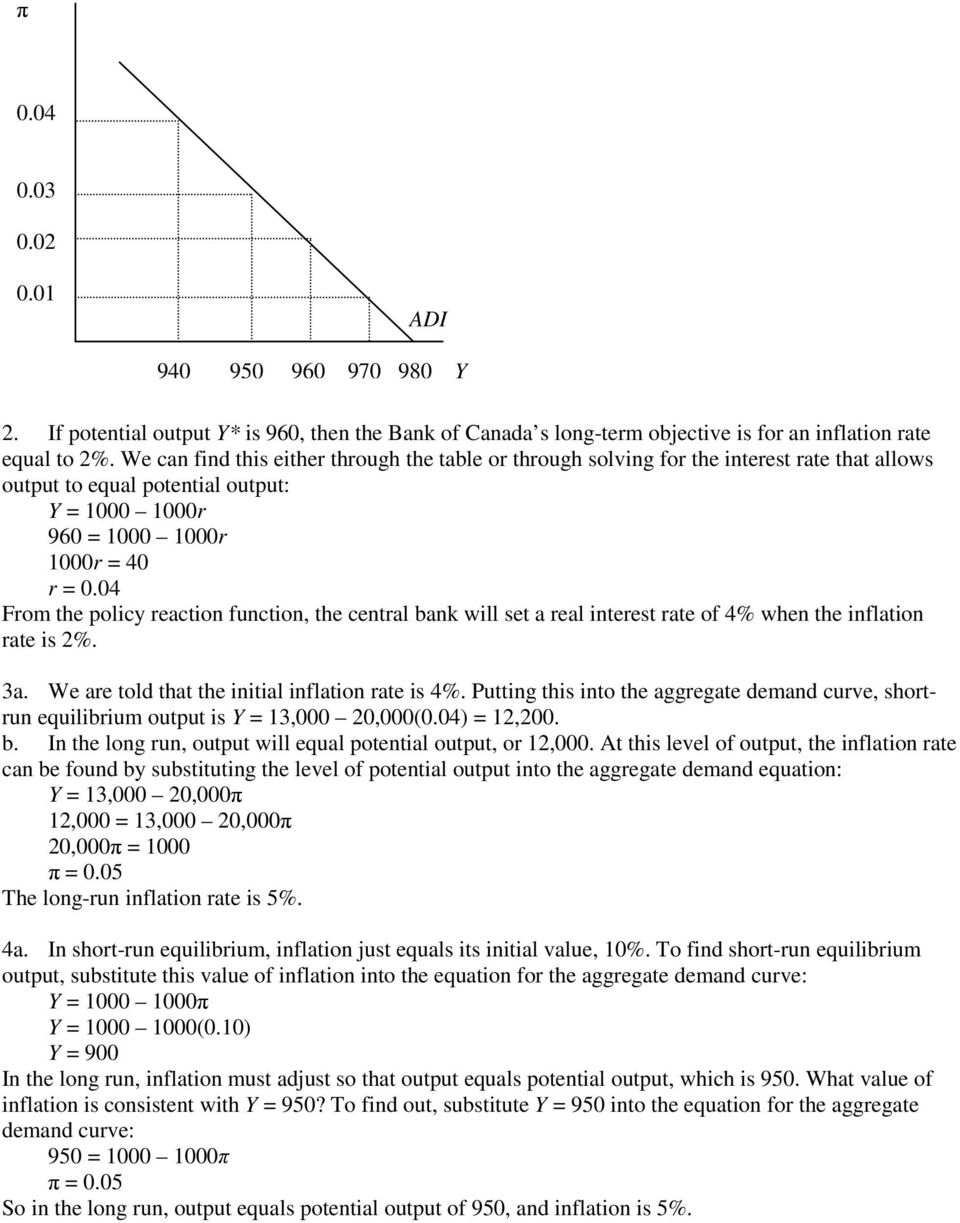
5 b. In the initial quarter, as we found in part a, inflation is 0.10 and output is 900. As potential output is 950, the output gap is 50. In the second quarter, applying the equation for the adjustment of inflation yields: This quarter s inflation = = = To find this quarter s output, plug the current value of inflation into the equation for the aggregate demand curve: Y = = 920 Finally, the output gap in the second quarter is = 30. Repeating this process, calculating first inflation (from the equation for inflation adjustment), then output (from the equation for the aggregate demand curve), then the output gap, we can find how these three variables change over time: Quarter Inflation Output Output gap You can see that inflation and output converge toward their long-run values (of 5% and 950, respectively) quickly at first, then more gradually. 5. In each part below, point A in the diagram corresponds to the initial situation, and point B shows the short-run effects of the change. From point B, the IA line adjusts up or down as needed to achieve longrun equilibrium (adjustment not shown). Long-run equilibrium in each figure is labeled point C. a. An increase in autonomous consumption shifts the ADI curve right, increasing output in the short run (point B). In the long run (point C), inflation rises to a higher level and output returns to potential. LRAS C B IAS A ADI 2 ADI 1 Y* Y b. A reduction in taxes increases consumer spending and hence aggregate demand. The graph and the results in the short run and the long run are the same as in part a. c. An easing of monetary policy lowers the real interest rate set by the Bank of Canada at each level of inflation. The aggregate demand curve shifts right. The graph and results are the same as in part a.

6 d. A sharp drop in oil prices is a favorable inflation shock. The IA line shifts downward, reducing inflation and raising output (point B). If potential output is unchanged, an expansionary gap exists at point B, and inflation will begin to rise. In the long run, the economy returns to point A, with output and inflation as originally. LRAS A IA 1 B IA 2 ADI Y* Y e. Increased government purchases raise aggregate demand and shift the ADI curve right. The graph and results are the same as in part a. 6. In the figure below, the economy is initially at point A when it is hit by both an inflation shock (shifting IA up to IA 2 ) and a shock to potential output (reducing Y* and shifting LRAS leftward to LRAS 2 ). The ADI curve is unchanged. The short-run equilibrium is at the intersection of ADI and IA 2, point B. Inflation has risen and output has declined. LRAS 2 LRAS 1 B C A IA 2 IA 1 ADI Y 2 * Y 1 * Y The figure shows point B to the left of LRAS 2, so that there is a recessionary gap even relative to the new, lower level of potential output. This need not be the case; if the inflation shock is smaller, the short-run equilibrium could be to the right of LRAS 2, though still to the left of LRAS. Either way, however, the short-run effect of the combination shock is a recession plus higher inflation. In the long run, inflation and the IA curve will adjust as needed to bring the economy to long-run equilibrium at point C. Note that at point C output is permanently lower than it was at point A, as potential output has dropped. With no change in aggregate demand, inflation is also permanently higher at point C than at point A. If the Bank of Canada responds to the oil price increase by tightening policy, the ADI curve will shift left (not shown in the graph), along with the leftward shift of LRAS and the upward shift of IA. Inflation will not increase as much, either in the short run or the long run, but the short-run decline in output will be even worse. Output in the long run will equal the new, lower level of potential output, whether the Bank of Canada responds or not (monetary policy cannot affect potential output and thus cannot affect output in the long run).

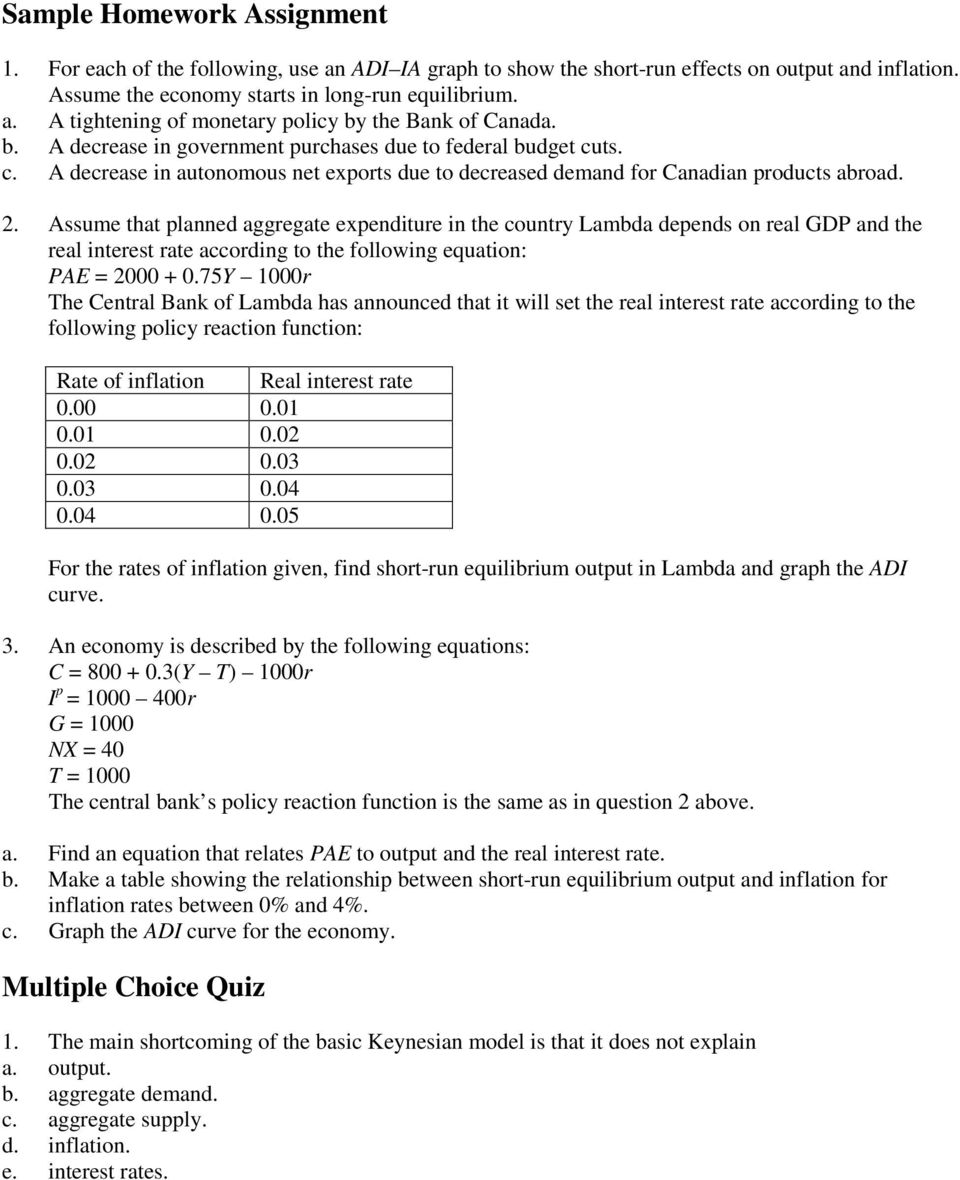
7 Sample Homework Assignment 1. For each of the following, use an ADI IA graph to show the short-run effects on output and inflation. Assume the economy starts in long-run equilibrium. a. A tightening of monetary policy by the Bank of Canada. b. A decrease in government purchases due to federal budget cuts. c. A decrease in autonomous net exports due to decreased demand for Canadian products abroad. 2. Assume that planned aggregate expenditure in the country Lambda depends on real GDP and the real interest rate according to the following equation: PAE = Y 1000r The Central Bank of Lambda has announced that it will set the real interest rate according to the following policy reaction function: Rate of inflation Real interest rate For the rates of inflation given, find short-run equilibrium output in Lambda and graph the ADI curve. 3. An economy is described by the following equations: C = (Y T) 1000r I p = r G = 1000 NX = 40 T = 1000 The central bank s policy reaction function is the same as in question 2 above. a. Find an equation that relates PAE to output and the real interest rate. b. Make a table showing the relationship between short-run equilibrium output and inflation for inflation rates between 0% and 4%. c. Graph the ADI curve for the economy. Multiple Choice Quiz 1. The main shortcoming of the basic Keynesian model is that it does not explain a. output. b. aggregate demand. c. aggregate supply. d. inflation. e. interest rates.
8 2. The slope of the aggregate demand curve is a. variable. b. negative. c. positive. d. zero. e. infinite. 3. Which of the following will not shift the aggregate demand curve? a. An increase in autonomous consumption. b. An increase in taxes. c. An increase in potential output. d. An increase in net exports. e. A change in the Bank of Canada s monetary policy. 4. The tendency for inflation to change relatively slowly is called a. inflation inertia. b. disinflation. c. inflation shock. d. equilibrium. e. inflation constancy. 5. The slope of the long-run aggregate supply curve is a. variable. b. negative. c. positive. d. zero. e. infinite. 6. The slope of the short-run aggregate supply curve is a. variable. b. negative. c. positive. d. zero. e. infinite. 7. Which of the following is not a potential source of inflation? a. Excessive aggregate demand. b. An inflation shock. c. An aggregate supply shock. d. A shock to potential output. e. A fall in net exports. 8. A war and associated military buildup will cause a. ADI to shift right. b. ADI to shift left. c. LRAS to shift right. d. LRAS to shift left. e. both ADI and LRAS to shift right.

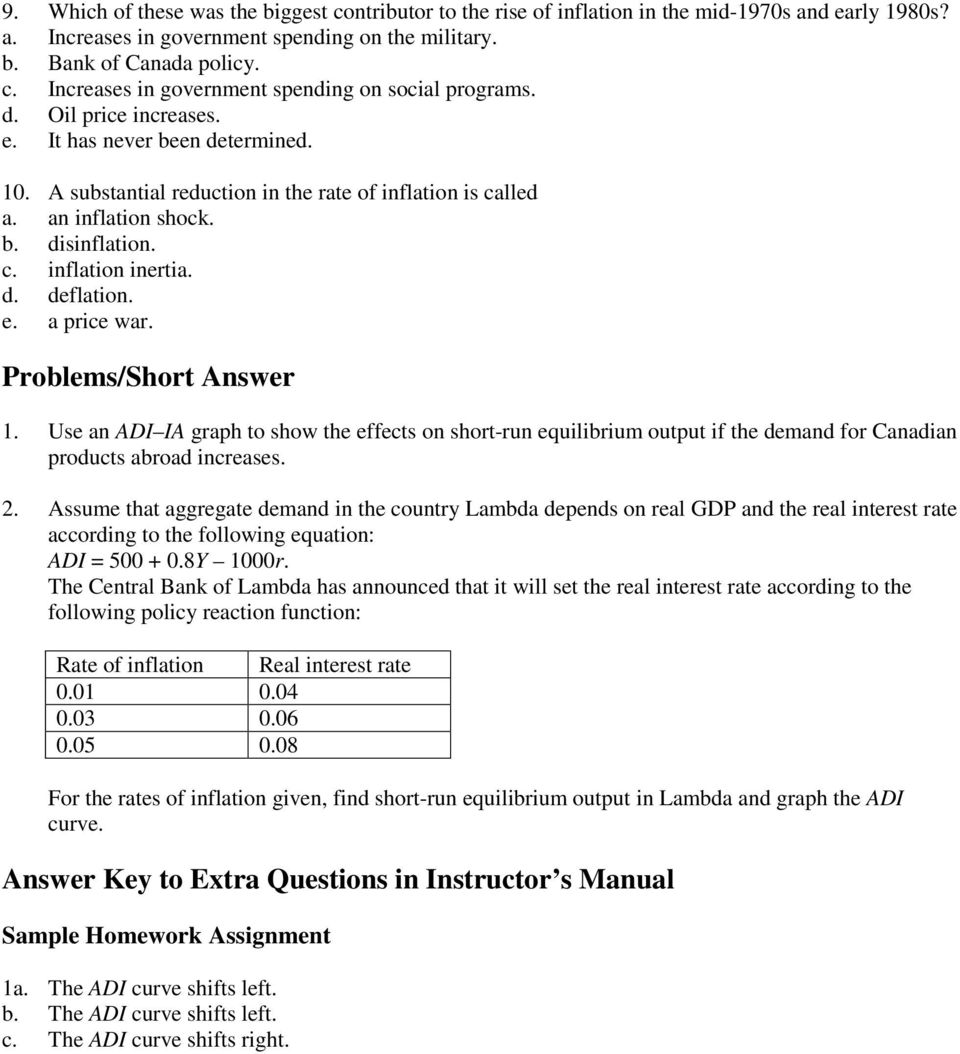
9 9. Which of these was the biggest contributor to the rise of inflation in the mid-1970s and early 1980s? a. Increases in government spending on the military. b. Bank of Canada policy. c. Increases in government spending on social programs. d. Oil price increases. e. It has never been determined. 10. A substantial reduction in the rate of inflation is called a. an inflation shock. b. disinflation. c. inflation inertia. d. deflation. e. a price war. Problems/Short Answer 1. Use an ADI IA graph to show the effects on short-run equilibrium output if the demand for Canadian products abroad increases. 2. Assume that aggregate demand in the country Lambda depends on real GDP and the real interest rate according to the following equation: ADI = Y 1000r. The Central Bank of Lambda has announced that it will set the real interest rate according to the following policy reaction function: Rate of inflation Real interest rate For the rates of inflation given, find short-run equilibrium output in Lambda and graph the ADI curve. Answer Key to Extra Questions in Instructor s Manual Sample Homework Assignment 1a. The ADI curve shifts left. b. The ADI curve shifts left. c. The ADI curve shifts right.
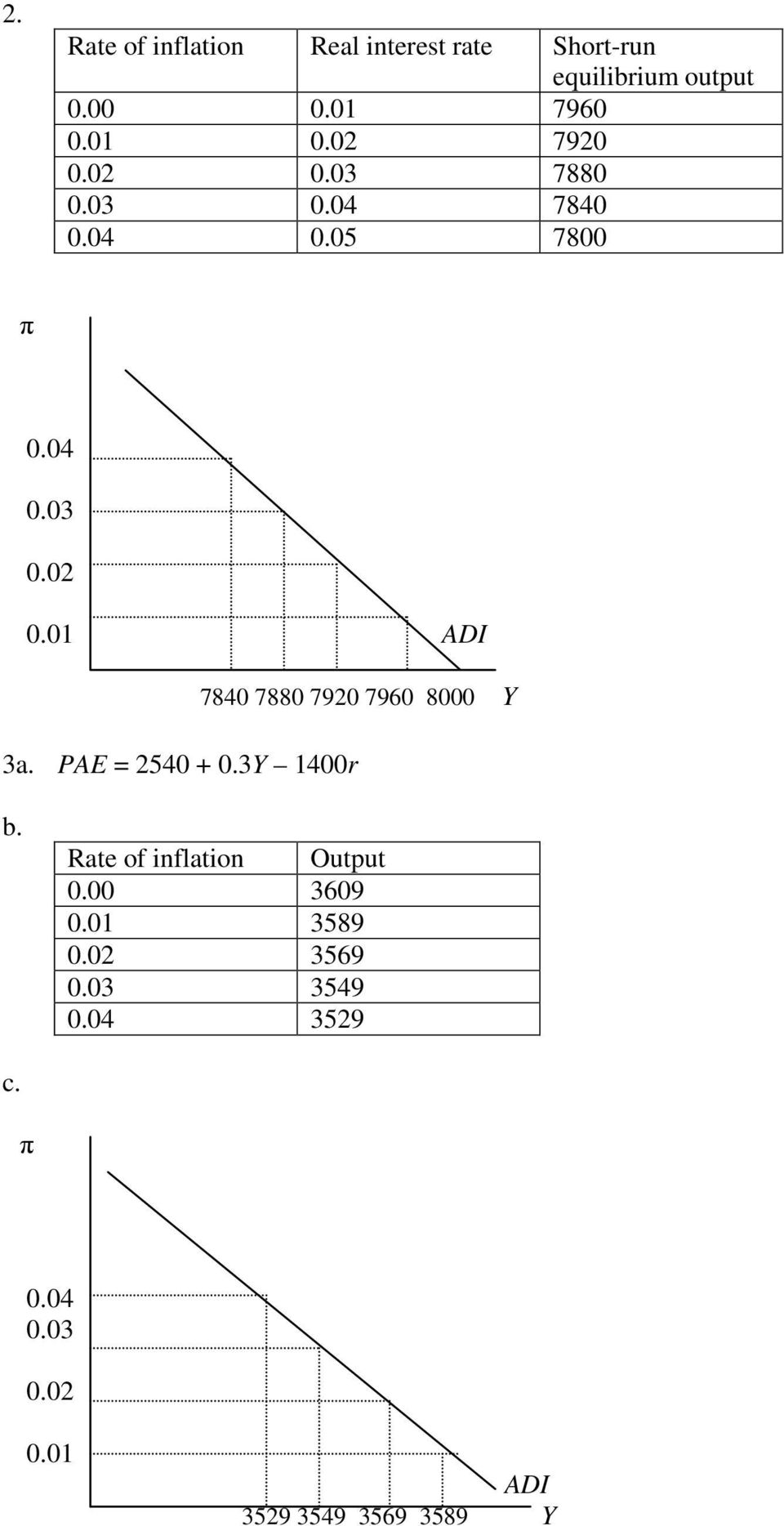
10 2. Rate of inflation Real interest rate Short-run equilibrium output ADI Y 3a. PAE = Y 1400r b. Rate of inflation Output c ADI Y
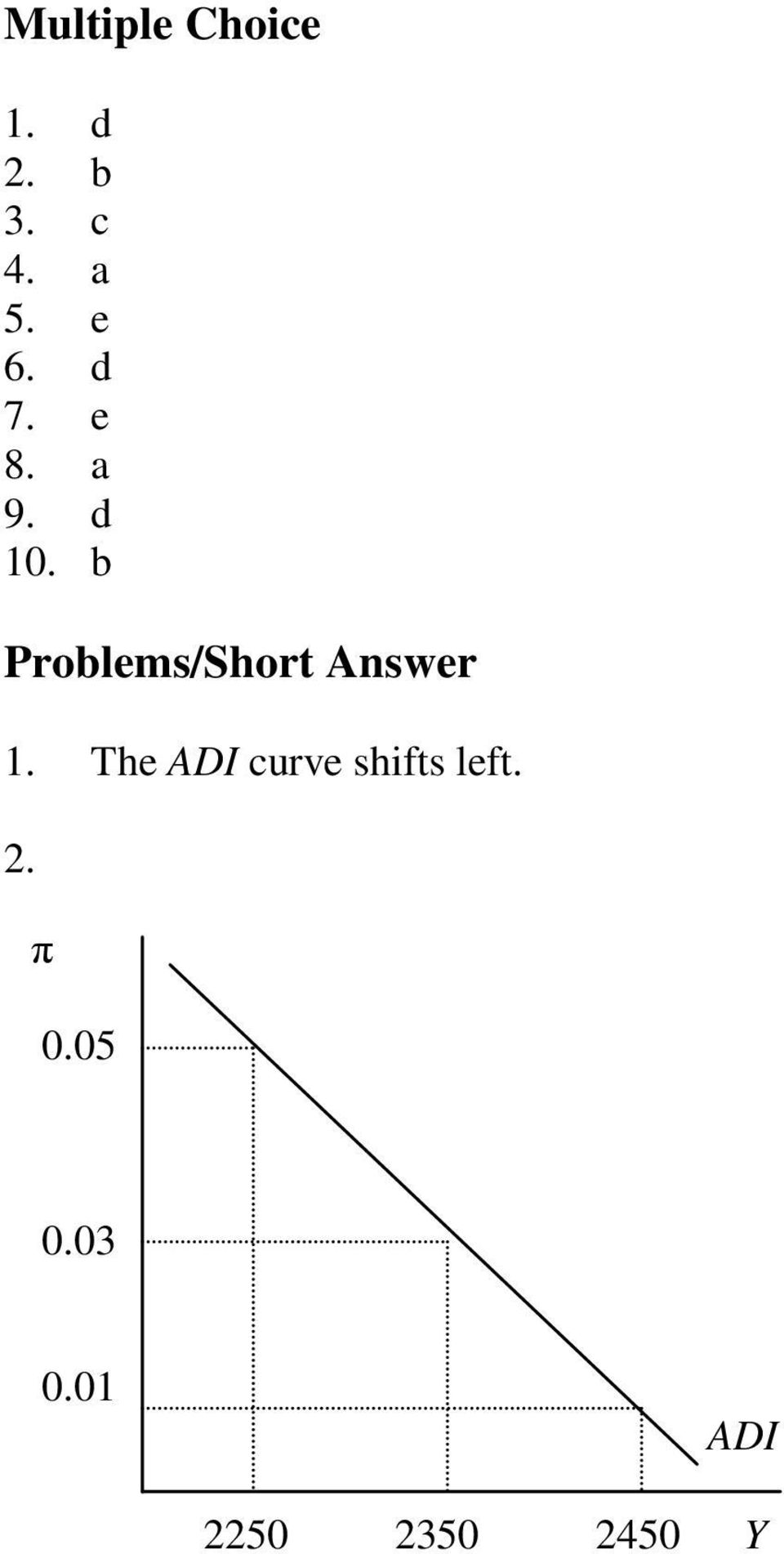
11 Multiple Choice 1. d 2. b 3. c 4. a 5. e 6. d 7. e 8. a 9. d 10. b Problems/Short Answer 1. The ADI curve shifts left ADI Y
Answer: C Learning Objective: Money supply Level of Learning: Knowledge Type: Word Problem Source: Unique
 1.The aggregate demand curve shows the relationship between inflation and: A) the nominal interest rate. D) the exchange rate. B) the real interest rate. E) short-run equilibrium output. C) the unemployment
Answers to Text Questions and Problems in Chapter 8
 Answers to Text Questions and Problems in Chapter 8 Answers to Review Questions 1. The key assumption is that, in the short run, firms meet demand at pre-set prices. The fact that firms produce to meet
Answers to Text Questions and Problems. Chapter 22. Answers to Review Questions
 Answers to Text Questions and Problems Chapter 22 Answers to Review Questions 3. In general, producers of durable goods are affected most by recessions while producers of nondurables (like food) and services
chapter: Aggregate Demand and Aggregate Supply Krugman/Wells 2009 Worth Publishers 1 of 58
 chapter: 12 >> Aggregate Demand and Aggregate Supply Krugman/Wells 2009 Worth Publishers 1 of 58 WHAT YOU WILL LEARN IN THIS CHAPTER How the aggregate demand curve illustrates the relationship between
CHAPTER 7: AGGREGATE DEMAND AND AGGREGATE SUPPLY
 CHAPTER 7: AGGREGATE DEMAND AND AGGREGATE SUPPLY Learning goals of this chapter: What forces bring persistent and rapid expansion of real GDP? What causes inflation? Why do we have business cycles? How
Econ 303: Intermediate Macroeconomics I Dr. Sauer Sample Questions for Exam #3
 Econ 303: Intermediate Macroeconomics I Dr. Sauer Sample Questions for Exam #3 1. When firms experience unplanned inventory accumulation, they typically: A) build new plants. B) lay off workers and reduce
CH 10 - REVIEW QUESTIONS
 CH 10 - REVIEW QUESTIONS 1. The short-run aggregate supply curve is horizontal at: A) a level of output determined by aggregate demand. B) the natural level of output. C) the level of output at which the
Pre-Test Chapter 15 ed17
 Pre-Test Chapter 15 ed17 Multiple Choice Questions 1. The extended AD-AS model: A. distinguishes between short-run and long-run aggregate demand. B. explains inflation but not recession. C. includes G
MONEY, INTEREST, REAL GDP, AND THE PRICE LEVEL*
 Chapter 11 MONEY, INTEREST, REAL GDP, AND THE PRICE LEVEL* The Demand for Topic: Influences on Holding 1) The quantity of money that people choose to hold depends on which of the following? I. The price
7 AGGREGATE SUPPLY AND AGGREGATE DEMAND* Chapter. Key Concepts
 Chapter 7 AGGREGATE SUPPLY AND AGGREGATE DEMAND* Key Concepts Aggregate Supply The aggregate production function shows that the quantity of real GDP (Y ) supplied depends on the quantity of labor (L ),
Aggregate Supply and Aggregate Demand
 26 Aggregate Supply and Aggregate Demand Learning Objectives Explain what determines aggregate supply Explain what determines aggregate demand Explain what determines real GDP and the price level and how
1) Explain why each of the following statements is true. Discuss the impact of monetary and fiscal policy in each of these special cases:
 1) Explain why each of the following statements is true. Discuss the impact of monetary and fiscal policy in each of these special cases: a) If investment does not depend on the interest rate, the IS curve
LECTURE NOTES ON MACROECONOMIC PRINCIPLES
 LECTURE NOTES ON MACROECONOMIC PRINCIPLES Peter Ireland Department of Economics Boston College [email protected] http://www2.bc.edu/peter-ireland/ec132.html Copyright (c) 2013 by Peter Ireland. Redistribution
Chapter 9. The IS-LM/AD-AS Model: A General Framework for Macroeconomic Analysis. 2008 Pearson Addison-Wesley. All rights reserved
 Chapter 9 The IS-LM/AD-AS Model: A General Framework for Macroeconomic Analysis Chapter Outline The FE Line: Equilibrium in the Labor Market The IS Curve: Equilibrium in the Goods Market The LM Curve:
Chapter 12 Unemployment and Inflation
 Chapter 12 Unemployment and Inflation Multiple Choice Questions 1. The origin of the idea of a trade-off between inflation and unemployment was a 1958 article by (a) A.W. Phillips. (b) Edmund Phelps. (c)
BADM 527, Fall 2013. Midterm Exam 2. Multiple Choice: 3 points each. Answer the questions on the separate bubble sheet. NAME
 BADM 527, Fall 2013 Name: Midterm Exam 2 November 7, 2013 Multiple Choice: 3 points each. Answer the questions on the separate bubble sheet. NAME 1. According to classical theory, national income (Real
13 EXPENDITURE MULTIPLIERS: THE KEYNESIAN MODEL* Chapter. Key Concepts
 Chapter 3 EXPENDITURE MULTIPLIERS: THE KEYNESIAN MODEL* Key Concepts Fixed Prices and Expenditure Plans In the very short run, firms do not change their prices and they sell the amount that is demanded.
Chapter 13. Aggregate Demand and Aggregate Supply Analysis
 Chapter 13. Aggregate Demand and Aggregate Supply Analysis Instructor: JINKOOK LEE Department of Economics / Texas A&M University ECON 203 502 Principles of Macroeconomics In the short run, real GDP and
Practiced Questions. Chapter 20
 Practiced Questions Chapter 20 1. The model of aggregate demand and aggregate supply a. is different from the model of supply and demand for a particular market, in that we cannot focus on the substitution
1. a. Interest-bearing checking accounts make holding money more attractive. This increases the demand for money.
 Macroeconomics ECON 2204 Prof. Murphy Problem Set 4 Answers Chapter 10 #1, 2, and 3 (on pages 308-309) 1. a. Interest-bearing checking accounts make holding money more attractive. This increases the demand
Agenda. The IS-LM/AD-AS Model: A General Framework for Macroeconomic Analysis, Part 3. Disequilibrium in the AD-AS model
 Agenda The IS-LM/AD-AS Model: A General Framework for Macroeconomic Analysis, art 3 rice Adjustment and the Attainment of General Equilibrium 13-1 13-2 General equilibrium in the AD-AS model Disequilibrium
Pre-Test Chapter 10 ed17
 Pre-Test Chapter 10 ed17 Multiple Choice Questions 1. Refer to the above diagrams. Assuming a constant price level, an increase in aggregate expenditures from AE 1 to AE 2 would: A. move the economy from
The Short-Run Macro Model. The Short-Run Macro Model. The Short-Run Macro Model
 The Short-Run Macro Model In the short run, spending depends on income, and income depends on spending. The Short-Run Macro Model Short-Run Macro Model A macroeconomic model that explains how changes in
I d ( r; MPK f, τ) Y < C d +I d +G
 1. Use the IS-LM model to determine the effects of each of the following on the general equilibrium values of the real wage, employment, output, the real interest rate, consumption, investment, and the
4 Macroeconomics LESSON 6
 4 Macroeconomics LESSON 6 Interest Rates and Monetary Policy in the Short Run and the Long Run Introduction and Description This lesson explores the relationship between the nominal interest rate and the
MULTIPLE CHOICE. Choose the one alternative that best completes the statement or answers the question.
 Suvey of Macroeconomics, MBA 641 Fall 2006, Final Exam Name MULTIPLE CHOICE. Choose the one alternative that best completes the statement or answers the question. 1) Modern macroeconomics emerged from
MONEY, INTEREST, REAL GDP, AND THE PRICE LEVEL*
 Chapter 11 MONEY, INTEREST, REAL GDP, AND THE PRICE LEVEL* Key Concepts The Demand for Money Four factors influence the demand for money: The price level An increase in the price level increases the nominal
FISCAL POLICY* Chapter. Key Concepts
 Chapter 11 FISCAL POLICY* Key Concepts The Federal Budget The federal budget is an annual statement of the government s expenditures and tax revenues. Using the federal budget to achieve macroeconomic
Problem Set #4: Aggregate Supply and Aggregate Demand Econ 100B: Intermediate Macroeconomics
 roblem Set #4: Aggregate Supply and Aggregate Demand Econ 100B: Intermediate Macroeconomics 1) Explain the differences between demand-pull inflation and cost-push inflation. Demand-pull inflation results
Chapter 11. Keynesianism: The Macroeconomics of Wage and Price Rigidity. 2008 Pearson Addison-Wesley. All rights reserved
 Chapter 11 Keynesianism: The Macroeconomics of Wage and Price Rigidity Chapter Outline Real-Wage Rigidity Price Stickiness Monetary and Fiscal Policy in the Keynesian Model The Keynesian Theory of Business
12.1 Introduction. 12.2 The MP Curve: Monetary Policy and the Interest Rates 1/24/2013. Monetary Policy and the Phillips Curve
 Chapter 12 Monetary Policy and the Phillips Curve By Charles I. Jones Media Slides Created By Dave Brown Penn State University The short-run model summary: Through the MP curve the nominal interest rate
Use the following to answer question 9: Exhibit: Keynesian Cross
 1. Leading economic indicators are: A) the most popular economic statistics. B) data that are used to construct the consumer price index and the unemployment rate. C) variables that tend to fluctuate in
The Aggregate Demand- Aggregate Supply (AD-AS) Model
 The AD-AS Model The Aggregate Demand- Aggregate Supply (AD-AS) Model Chapter 9 The AD-AS Model addresses two deficiencies of the AE Model: No explicit modeling of aggregate supply. Fixed price level. 2
ECON 3312 Macroeconomics Exam 3 Fall 2014. Name MULTIPLE CHOICE. Choose the one alternative that best completes the statement or answers the question.
 ECON 3312 Macroeconomics Exam 3 Fall 2014 Name MULTIPLE CHOICE. Choose the one alternative that best completes the statement or answers the question. 1) Everything else held constant, an increase in net
EC2105, Professor Laury EXAM 2, FORM A (3/13/02)
 EC2105, Professor Laury EXAM 2, FORM A (3/13/02) Print Your Name: ID Number: Multiple Choice (32 questions, 2.5 points each; 80 points total). Clearly indicate (by circling) the ONE BEST response to each
3 Macroeconomics LESSON 8
 3 Macroeconomics LESSON 8 Fiscal Policy Introduction and Description Fiscal policy is one of the two demand management policies available to policy makers. Government expenditures and the level and type
In this chapter we learn the potential causes of fluctuations in national income. We focus on demand shocks other than supply shocks.
 Chapter 11: Applying IS-LM Model In this chapter we learn the potential causes of fluctuations in national income. We focus on demand shocks other than supply shocks. We also learn how the IS-LM model
0 100 200 300 Real income (Y)
 Lecture 11-1 6.1 The open economy, the multiplier, and the IS curve Assume that the economy is either closed (no foreign trade) or open. Assume that the exchange rates are either fixed or flexible. Assume
For a closed economy, the national income identity is written as Y = F (K; L)
 A CLOSED ECONOMY IN THE LONG (MEDIUM) RUN For a closed economy, the national income identity is written as Y = C(Y T ) + I(r) + G the left hand side of the equation is the total supply of goods and services
Aggregate Demand and Aggregate Supply Ing. Mansoor Maitah Ph.D. et Ph.D.
 Aggregate Demand and Aggregate Supply Ing. Mansoor Maitah Ph.D. et Ph.D. Aggregate Demand and Aggregate Supply Economic fluctuations, also called business cycles, are movements of GDP away from potential
10/7/2013. Chapter 9: Introduction to Economic Fluctuations. Facts about the business cycle. Unemployment. Okun s Law Y Y
 Facts about the business cycle Chapter 9: GD growth averages 3 3.5 percent per year over the long run with large fluctuations in the short run. Consumption and investment fluctuate with GD, but consumption
Answers. Event: a tax cut 1. affects C, AD curve 2. shifts AD right 3. SR eq m at point B. P and Y higher, unemp lower 4.
 A C T I V E L E A R N I N G 2: Answers Event: a tax cut 1. affects C, AD curve 2. shifts AD right 3. SR eq m at point B. P and Y higher, unemp lower 4. Over time, P E rises, SRAS shifts left, until LR
Chapter 6 Economic Growth
 Chapter 6 Economic Growth 1 The Basics of Economic Growth 1) The best definition for economic growth is A) a sustained expansion of production possibilities measured as the increase in real GDP over a
Inflation and Unemployment CHAPTER 22 THE SHORT-RUN TRADE-OFF 0
 22 The Short-Run Trade-off Between Inflation and Unemployment CHAPTER 22 THE SHORT-RUN TRADE-OFF 0 In this chapter, look for the answers to these questions: How are inflation and unemployment related in
THE OPEN AGGREGATE DEMAND AGGREGATE SUPPLY MODEL.
 THE OPEN AGGREGATE DEMAND AGGREGATE SUPPLY MODEL. Introduction. This model represents the workings of the economy as the interaction between two curves: - The AD curve, showing the relationship between
7 AGGREGATE SUPPLY AND AGGREGATE DEMAND* * Chapter Key Ideas. Outline
 C h a p t e r 7 AGGREGATE SUPPLY AND AGGREGATE DEMAND* * Chapter Key Ideas Outline Production and Prices A. What forces bring persistent and rapid expansion of real GDP? B. What leads to inflation? C.
Chapter 12. Aggregate Expenditure and Output in the Short Run
 Chapter 12. Aggregate Expenditure and Output in the Short Run Instructor: JINKOOK LEE Department of Economics / Texas A&M University ECON 203 502 Principles of Macroeconomics Aggregate Expenditure (AE)
Extra Problems #3. ECON 410.502 Macroeconomic Theory Spring 2010 Instructor: Guangyi Ma. Notice:
 ECON 410.502 Macroeconomic Theory Spring 2010 Instructor: Guangyi Ma Extra Problems #3 Notice: (1) There are 25 multiple-choice problems covering Chapter 6, 9, 10, 11. These problems are not homework and
AGGREGATE DEMAND AND AGGREGATE SUPPLY The Influence of Monetary and Fiscal Policy on Aggregate Demand
 AGGREGATE DEMAND AND AGGREGATE SUPPLY The Influence of Monetary and Fiscal Policy on Aggregate Demand Suppose that the economy is undergoing a recession because of a fall in aggregate demand. a. Using
Agenda. Business Cycles. What Is a Business Cycle? What Is a Business Cycle? What is a Business Cycle? Business Cycle Facts.
 Agenda What is a Business Cycle? Business Cycles.. 11-1 11-2 Business cycles are the short-run fluctuations in aggregate economic activity around its long-run growth path. Y Time 11-3 11-4 1 Components
Homework #6 - Answers. Uses of Macro Policy Due April 20
 Page 1 of 8 Uses of Macro Policy ue April 20 Answer all questions on these sheets, adding extra sheets where necessary. 1. Suppose that the government were to increase its purchases of goods and services
2.If actual investment is greater than planned investment, inventories increase more than planned. TRUE.
 Macro final exam study guide True/False questions - Solutions Case, Fair, Oster Chapter 8 Aggregate Expenditure and Equilibrium Output 1.Firms react to unplanned inventory investment by reducing output.
Econ 102 Aggregate Supply and Demand
 Econ 102 ggregate Supply and Demand 1. s on previous homework assignments, turn in a news article together with your summary and explanation of why it is relevant to this week s topic, ggregate Supply
ANSWERS TO END-OF-CHAPTER QUESTIONS
 ANSWERS TO END-OF-CHAPTER QUESTIONS 9-1 Explain what relationships are shown by (a) the consumption schedule, (b) the saving schedule, (c) the investment-demand curve, and (d) the investment schedule.
chapter: Solution Fiscal Policy
 Fiscal Policy chapter: 28 13 ECONOMICS MACROECONOMICS 1. The accompanying diagram shows the current macroeconomic situation for the economy of Albernia. You have been hired as an economic consultant to
ECO209 MACROECONOMIC THEORY. Chapter 11
 Prof. Gustavo Indart Department of Economics University of Toronto ECO209 MACROECONOMIC THEORY Chapter 11 MONEY, INTEREST, AND INCOME Discussion Questions: 1. The model in Chapter 9 assumed that both the
Pre-Test Chapter 8 ed17
 Pre-Test Chapter 8 ed17 Multiple Choice Questions 1. The APC can be defined as the fraction of a: A. change in income that is not spent. B. change in income that is spent. C. specific level of total income
INTRODUCTION AGGREGATE DEMAND MACRO EQUILIBRIUM MACRO EQUILIBRIUM THE DESIRED ADJUSTMENT THE DESIRED ADJUSTMENT
 Chapter 9 AGGREGATE DEMAND INTRODUCTION The Great Depression was a springboard for the Keynesian approach to economic policy. Keynes asked: What are the components of aggregate demand? What determines
THREE KEY FACTS ABOUT ECONOMIC FLUCTUATIONS
 15 In this chapter, look for the answers to these questions: What are economic fluctuations? What are their characteristics? How does the model of demand and explain economic fluctuations? Why does the
Instructions: Please answer all of the following questions. You are encouraged to work with one another (at your discretion).
 Instructions: Please answer all of the following questions. You are encouraged to work with one another (at your discretion). 1. What are the similarities and differences between the characteristics of
Equilibrium in the Aggregate Economy. Equilibrium in Aggregate Economy. Short-Run Equilibrium. Short-Run Equilibrium
 quilibrium in Aggregate conomy quilibrium in the Aggregate conomy Changes in the SAS, AD, and curves affect short-run and long-run equilibrium. Short-Run quilibrium Short-run equilibrium is where the AS
1. Explain what causes the liquidity preference money (LM) curve to shift and why.
 Chapter 22. IS-LM in Action C H A P T E R O B J E C T I V E S By the end of this chapter, students should be able to: 1. Explain what causes the liquidity preference money (LM) curve to shift and why.
University of Lethbridge Department of Economics ECON 1012 Introduction to Microeconomics Instructor: Michael G. Lanyi. Chapter 29 Fiscal Policy
 University of Lethbridge Department of Economics ECON 1012 Introduction to Microeconomics Instructor: Michael G. Lanyi Chapter 29 Fiscal Policy 1) If revenues exceed outlays, the government's budget balance
Ch.6 Aggregate Supply, Wages, Prices, and Unemployment
 1 Econ 302 Intermediate Macroeconomics Chul-Woo Kwon Ch.6 Aggregate Supply, Wages, rices, and Unemployment I. Introduction A. The dynamic changes of and the price adjustment B. Link between the price change
Introduction to Macroeconomics 1012 Final Exam Spring 2013 Instructor: Elsie Sawatzky
 Introduction to Macroeconomics 1012 Final Exam Spring 2013 Instructor: Elsie Sawatzky Name Time: 2 hours Marks: 80 Multiple choice questions 1 mark each and a choice of 2 out of 3 short answer question
Objectives for Chapter 9 Aggregate Demand and Aggregate Supply
 1 Objectives for Chapter 9 Aggregate Demand and Aggregate Supply At the end of Chapter 9, you will be able to answer the following: 1. Explain what is meant by aggregate demand? 2. Name the four categories
SHORT-RUN FLUCTUATIONS. David Romer. University of California, Berkeley. First version: August 1999 This revision: January 2012
 SHORT-RUN FLUCTUATIONS David Romer University of California, Berkeley First version: August 1999 This revision: January 2012 Copyright 2012 by David Romer CONTENTS Preface vi I The IS-MP Model 1 I-1 Monetary
Assignment #3. ECON 410.502 Macroeconomic Theory Spring 2010 Instructor: Guangyi Ma. Notice:
 ECON 410.502 Macroeconomic Theory Spring 2010 Instructor: Guangyi Ma Assignment #3 Notice: (1) There are 25 multiple-choice problems and 2 analytic (short-answer) problems. This assignment is due on March
Chapter 12: Aggregate Supply and Phillips Curve
 Chapter 12: Aggregate Supply and Phillips Curve In this chapter we explain the position and slope of the short run aggregate supply (SRAS) curve. SRAS curve can also be relabeled as Phillips curve. A basic
Using an appropriately labeled money market graph, show the effects of an open market purchase of government securities by the FED on :
 Using an appropriately labeled money market graph, show the effects of an open market purchase of government securities by the FED on : The money supply Interest rates Nominal Interest rates i1 i2 Sm1
MULTIPLE CHOICE. Choose the one alternative that best completes the statement or answers the question.
 Econ 111 Summer 2007 Final Exam Name MULTIPLE CHOICE. Choose the one alternative that best completes the statement or answers the question. 1) The classical dichotomy allows us to explore economic growth
Pre-Test Chapter 11 ed17
 Pre-Test Chapter 11 ed17 Multiple Choice Questions 1. Built-in stability means that: A. an annually balanced budget will offset the procyclical tendencies created by state and local finance and thereby
Econ 202 Final Exam. Table 3-1 Labor Hours Needed to Make 1 Pound of: Meat Potatoes Farmer 8 2 Rancher 4 5
 Econ 202 Final Exam 1. If inflation expectations rise, the short-run Phillips curve shifts a. right, so that at any inflation rate unemployment is higher. b. left, so that at any inflation rate unemployment
Economics 101 Multiple Choice Questions for Final Examination Miller
 Economics 101 Multiple Choice Questions for Final Examination Miller PLEASE DO NOT WRITE ON THIS EXAMINATION FORM. 1. Which of the following statements is correct? a. Real GDP is the total market value
Chapter Outline. Chapter 11. Real-Wage Rigidity. Real-Wage Rigidity
 Chapter 11 Keynesianism: The Macroeconomics of Wage and Price Rigidity Chapter Outline Real-Wage Rigidity Price Stickiness Monetary and Fiscal Policy in the Keynesian 2008 Pearson Addison-Wesley. All rights
Economics 152 Solution to Sample Midterm 2
 Economics 152 Solution to Sample Midterm 2 N. Das PART 1 (84 POINTS): Answer the following 28 multiple choice questions on the scan sheet. Each question is worth 3 points. 1. If Congress passes legislation
Aggregate Demand, Aggregate Supply, and the Self-Correcting Economy
 Aggregate Demand, Aggregate Supply, and the Self-Correcting Economy The Role of Aggregate Demand & Supply Endogenizing the Price Level Inflation Deflation Price Stability The Aggregate Demand Curve Relates
4. Answer c. The index of nominal wages for 1996 is the nominal wage in 1996 expressed as a percentage of the nominal wage in the base year.
 Answers To Chapter 2 Review Questions 1. Answer a. To be classified as in the labor force, an individual must be employed, actively seeking work, or waiting to be recalled from a layoff. However, those
MONETARY AND FISCAL POLICY IN THE VERY SHORT RUN
 C H A P T E R12 MONETARY AND FISCAL POLICY IN THE VERY SHORT RUN LEARNING OBJECTIVES After reading and studying this chapter, you should be able to: Understand that both fiscal and monetary policy can
Solution. Solution. Monetary Policy. macroeconomics. economics
 KrugmanMacro_SM_Ch14.qxp 10/27/05 3:25 PM Page 165 Monetary Policy 1. Go to the FOMC page of the Federal Reserve Board s website (http://www. federalreserve.gov/fomc/) to find the statement issued after
The level of price and inflation Real GDP: the values of goods and services measured using a constant set of prices
 Chapter 2: Key Macroeconomics Variables ECON2 (Spring 20) 2 & 4.3.20 (Tutorial ) National income accounting Gross domestic product (GDP): The market value of all final goods and services produced within
Session 12. Aggregate Supply: The Phillips curve. Credibility
 Session 12. Aggregate Supply: The Phillips curve. Credibility v Potential Output and v Okun s law v The Role of Expectations and the Phillips Curve v Oil Prices and v US Monetary Policy and World Real
Study Questions for Chapter 9 (Answer Sheet)
 DEREE COLLEGE DEPARTMENT OF ECONOMICS EC 1101 PRINCIPLES OF ECONOMICS II FALL SEMESTER 2002 M-W-F 13:00-13:50 Dr. Andreas Kontoleon Office hours: Contact: [email protected] Wednesdays 15:00-17:00 Study
Long run v.s. short run. Introduction. Aggregate Demand and Aggregate Supply. In this chapter, look for the answers to these questions:
 33 Aggregate Demand and Aggregate Supply R I N C I L E S O F ECONOMICS FOURTH EDITION N. GREGOR MANKIW Long run v.s. short run Long run growth: what determines long-run output (and the related employment
1 Multiple Choice - 50 Points
 Econ 201 Final Winter 2008 SOLUTIONS 1 Multiple Choice - 50 Points (In this section each question is worth 1 point) 1. Suppose a waiter deposits his cash tips into his savings account. As a result of only
University of Lethbridge Department of Economics ECON 1012 Introduction to Macroeconomics Instructor: Michael G. Lanyi
 University of Lethbridge Department of Economics ECON 1012 Introduction to Macroeconomics Instructor: Michael G. Lanyi CH 27 Expenditure Multipliers 1) Disposable income is A) aggregate income minus transfer
Using Policy to Stabilize the Economy
 Using Policy to Stabilize the Economy Since the Employment ct of 1946, economic stabilization has been a goal of U.S. policy. Economists debate how active a role the govt should take to stabilize the economy.
2.5 Monetary policy: Interest rates
 2.5 Monetary policy: Interest rates Learning Outcomes Describe the role of central banks as regulators of commercial banks and bankers to governments. Explain that central banks are usually made responsible
I. Introduction to Aggregate Demand/Aggregate Supply Model
 University of California-Davis Economics 1B-Intro to Macro Handout 8 TA: Jason Lee Email: [email protected] I. Introduction to Aggregate Demand/Aggregate Supply Model In this chapter we develop a model
Study Questions 8 (Keynesian Model) MULTIPLE CHOICE. Choose the one alternative that best completes the statement or answers the question.
 Study Questions 8 (Keynesian Model) MULTIPLE CHOICE. Choose the one alternative that best completes the statement or answers the question. 1) In the Keynesian model of aggregate expenditure, real GDP is
The labour market, I: real wages, productivity and unemployment 7.1 INTRODUCTION
 7 The labour market, I: real wages, productivity and unemployment 7.1 INTRODUCTION Since the 1970s one of the major issues in macroeconomics has been the extent to which low output and high unemployment
Problem Set for Chapter 20(Multiple choices)
 Problem Set for hapter 20(Multiple choices) 1. According to the theory of liquidity preference, a. if the interest rate is below the equilibrium level, then the quantity of money people want to hold is
Government Budget and Fiscal Policy CHAPTER
 Government Budget and Fiscal Policy 11 CHAPTER The National Budget The national budget is the annual statement of the government s expenditures and tax revenues. Fiscal policy is the use of the federal
CHAPTER 9 Building the Aggregate Expenditures Model
 CHAPTER 9 Building the Aggregate Expenditures Model Topic Question numbers 1. Consumption function/apc/mpc 1-42 2. Saving function/aps/mps 43-56 3. Shifts in consumption and saving functions 57-72 4 Graphs/tables:
Business Conditions Analysis Prof. Yamin Ahmad ECON 736
 Business Conditions Analysis Prof. Yamin Ahmad ECON 736 Sample Final Exam Name Id # Instructions: There are two parts to this midterm. Part A consists of multiple choice questions. Please mark the answers
Macroeconomics, Fall 2007 Exam 3, TTh classes, various versions
 Name: _ Days/Times Class Meets: Today s Date: Macroeconomics, Fall 2007 Exam 3, TTh classes, various versions Read these Instructions carefully! You must follow them exactly! I) On your Scantron card you
Lecture 12-1. Interest Rates. 1. RBA Objectives and Instruments
 Lecture 12-1 Interest Rates 1. RBA Objectives and Instruments The Reserve Bank of Australia has several objectives, including the stability of the currency, the maintenance of full employment. These two
Practice Problems on the Capital Market
 Practice Problems on the Capital Market 1- Define marginal product of capital (i.e., MPK). How can the MPK be shown graphically? The marginal product of capital (MPK) is the output produced per unit of