
Business Conditions Analysis Prof. Yamin Ahmad ECON 736
|
|
|
- Adelia Hutchinson
- 9 years ago
- Views:
Transcription
1 Business Conditions Analysis Prof. Yamin Ahmad ECON 736 Sample Final Exam Name Id # Instructions: There are two parts to this midterm. Part A consists of multiple choice questions. Please mark the answers to the multiple choice questions on the exam paper Part A has 35 questions for you to practice and is worth 60%. Part B is worth 40% and consists of short answer questions. Please answer any two of the three questions in the space provided. Answering more than two questions in part B will not gain you more than 40%. Part A: MULTIPLE CHOICE. Choose the one alternative that best completes the statement or answers the question. 1) Which of the following components of GDP is the largest for the United States? A) imports B) investment C) exports D) government spending E) consumption Answer: E 2) In the model of the goods market presented in lecture 4, which of the following variables is exogenous? A) saving (S) B) demand (Z) C) consumption (C) D) disposable income (YD) Answer: E 3) The marginal propensity to consume represents: A) the change in consumption caused by a one-unit change in disposable income. B) the level of consumption that occurs if disposable income is zero. C) the ratio of total consumption to disposable income. D) the change in output caused by a one-unit change in autonomous demand. E) total income minus total taxes. 1
2 4) Suppose the consumption equation is represented by the following: C = YD. The multiplier in this economy is: A).2. B).8. C) 1. D) 4. E) 5. Answer: E 5) Equilibrium in the goods market requires that: A) consumption equals income. B) production equals demand. C) government spending equals taxes minus transfers. D) production equals income. E) consumption equals saving. Use the information below to answer questions (6) - (7): C = YD I = 850 G = 2500 T = ) The equilibrium level of GDP for the above economy equals: A) B) C) D) Use the information below to answer the following questions: C = YD I = 850 G = 2500 T = ) The multiplier for the above economy equals: A) 2. B) 3. C) 4. D) 5. 2
3 8) Based on our understanding of consumption and saving, we know that the marginal propensity to consume and the marginal propensity to save must: A) sum to exactly one. B) be equal to the multiplier. C) sum to less than one. D) sum to more than one. E) be equal to each other. 9) Which of the following equals demand in a closed economy? A) C + I + G + X - IM B) C + I + G + IM - X C) C + I + G + X D) none of the above 10) Which of the following will cause a leftward shift in the money demand curve? A) an increase in the interest rate B) a reduction in income C) an open market sale of bonds by the central bank D) a reduction in the interest rate 11) For this question, recall that Y is real GDP, $Y is nominal GDP, and M is the money supply. Which of the following ratios represents the velocity of money? A) the ratio of M to high powered money (M/H) B) $Y/M C) M/Y D) M/$Y E) Y/M 12) Which of the following generally occurs when a central bank pursues expansionary monetary policy? A) the central bank sells bonds and the interest rate increases B) the central bank sells bonds and the interest rate decreases C) the central bank purchases bonds and the interest rate increases D) the central bank purchases bonds and the interest rate decreases 3

4 13) Which of the following is the correct definition of the IS curve? A) The IS curve represents the combinations of output and the interest rate where the goods market is in equilibrium. B) The IS curve represents the single level of output where financial markets are in equilibrium. C) The IS curve represents the combinations of output and the interest rate where the money market is in equilibrium. D) The IS curve represents the single level of output where the goods market is in equilibrium. 14) Which of the following will cause a shift in the LM curve? A) an increase in output B) a reduction in taxes C) an open market purchase of bonds D) an increase in consumer confidence E) all of the above 15) Suppose the economy is operating on the LM curve but not on the IS curve. Given this information, we know that: A) the money market and bond markets are in equilibrium and the goods market is not in equilibrium. B) the goods market is in equilibrium and the money market is not in equilibrium. C) the money market and goods market are in equilibrium and the bond market is not in equilibrium. D) neither the money, bond, nor goods markets are in equilibrium. E) the money, bond and goods markets are all in equilibrium. 16) Which of the following will occur if there is an increase in taxes? A) The IS curve shifts and the economy moves along the LM curve. B) The LM curve shifts and the economy moves along the IS curve. C) Both the IS and LM curves shift. D) Output will change causing a change in money demand and a shift of the LM curve. E) Neither the IS nor the LM curve shifts. 17) Suppose investment spending is NOT very sensitive to the interest rate. In our model we examined, this is equivalent to setting b=0. Given this information, we know that: A) the LM curve should be relatively flat. B) the IS curve should be relatively flat. C) neither the IS nor the LM curve will be affected. D) the IS curve should be relatively steep. E) the LM curve should be relatively steep. 4

5 18) Suppose there is a simultaneous tax cut and open market purchase of bonds. Which of the following must occur as a result of this? A) output decreases B) the interest rate increases C) both output and the interest rate increase D) output increases E) the interest rate decreases 19) Based on our understanding of the IS-LM model that takes into account dynamics, we know that a reduction in the money supply will cause: A) an immediate drop in Y and immediate increase in i. B) a gradual increase in i and gradual reduction in Y. C) an immediate increase in i and no initial change in Y. D) none of the above 20) The natural level of output is the level of output that occurs when: A) the economy is operating at the unemployment rate consistent with achieving full employment. B) the goods market and financial markets are in equilibrium. C) the unemployment rate is zero. D) the markup (m) is zero. E) there are no discouraged workers in the economy. 21) In the aggregate supply relation, the current price level depends upon: A) fiscal policy. B) consumer confidence. C) monetary policy. D) expected price level. E) all of the above 22) Suppose that the current price level is equal to the expected price level. Given this information, we know with certainty that: A) the goods market and financial markets are in equilibrium. B) the unemployment rate is equal to the natural rate of unemployment. C) both the price level and the expected price level are equal to one. D) the unemployment rate is zero. 5
6 23) Which of the following will cause the aggregate demand curve will shift to the left? A) a decrease in the price level B) an increase in the money supply C) a rise in the price level D) an increase in taxes E) an increase in consumer confidence 24) Which of the following events will NOT cause an increase in the aggregate price level? A) an increase in Pe B) a reduction in output C) an increase in the markup D) an increase in unemployment benefits 25) An increase in the aggregate price level will cause: A) a reduction in the interest rate and a rightward shift in the IS curve. B) an ambiguous effect on investment. C) an increase in investment and an increase in output. D) an upward shift in the LM curve and an increase in the interest rate. 26) For this question, assume that the Phillips curve equation is represented by the following equation: πt - πt-1 = (μ + z) - αut. An increase in the unemployment rate will cause: A) a reduction in the markup over labor costs (i.e., a reduction in m). B) an increase in the markup over labor costs. C) a decrease in the inflation rate over time. D) an increase in the inflation rate over time. 27) Suppose the Phillips curve is represented by the following equation: πt - πt-1 = 20-2ut. Given this information, we know that the natural rate of unemployment in this economy is: A) 10%. B) 6.5%. C) 20%. D) 5%. 6
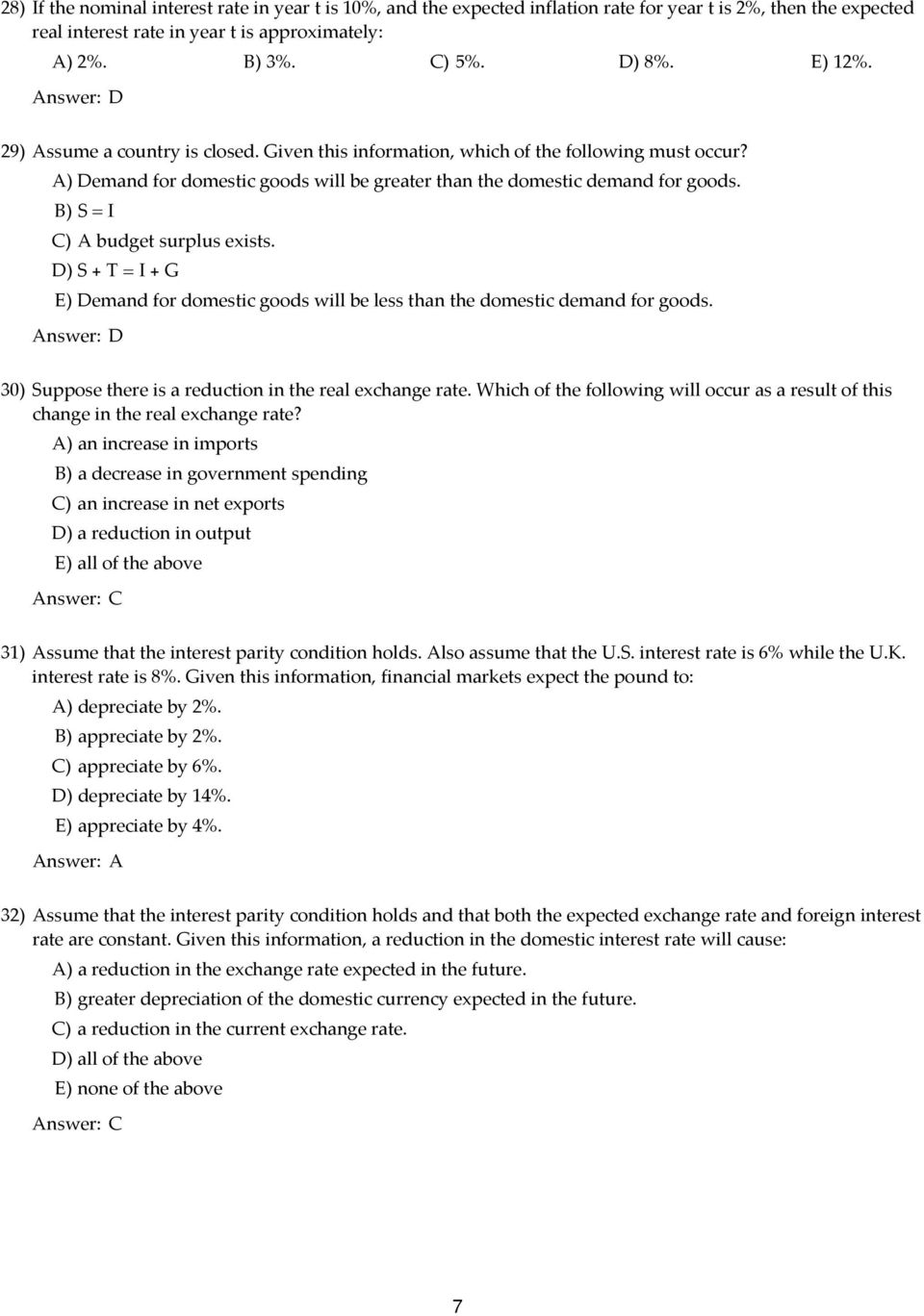
7 28) If the nominal interest rate in year t is 10%, and the expected inflation rate for year t is 2%, then the expected real interest rate in year t is approximately: A) 2%. B) 3%. C) 5%. D) 8%. E) 12%. 29) Assume a country is closed. Given this information, which of the following must occur? A) Demand for domestic goods will be greater than the domestic demand for goods. B) S = I C) A budget surplus exists. D) S + T = I + G E) Demand for domestic goods will be less than the domestic demand for goods. 30) Suppose there is a reduction in the real exchange rate. Which of the following will occur as a result of this change in the real exchange rate? A) an increase in imports B) a decrease in government spending C) an increase in net exports D) a reduction in output E) all of the above 31) Assume that the interest parity condition holds. Also assume that the U.S. interest rate is 6% while the U.K. interest rate is 8%. Given this information, financial markets expect the pound to: A) depreciate by 2%. B) appreciate by 2%. C) appreciate by 6%. D) depreciate by 14%. E) appreciate by 4%. 32) Assume that the interest parity condition holds and that both the expected exchange rate and foreign interest rate are constant. Given this information, a reduction in the domestic interest rate will cause: A) a reduction in the exchange rate expected in the future. B) greater depreciation of the domestic currency expected in the future. C) a reduction in the current exchange rate. D) all of the above 7
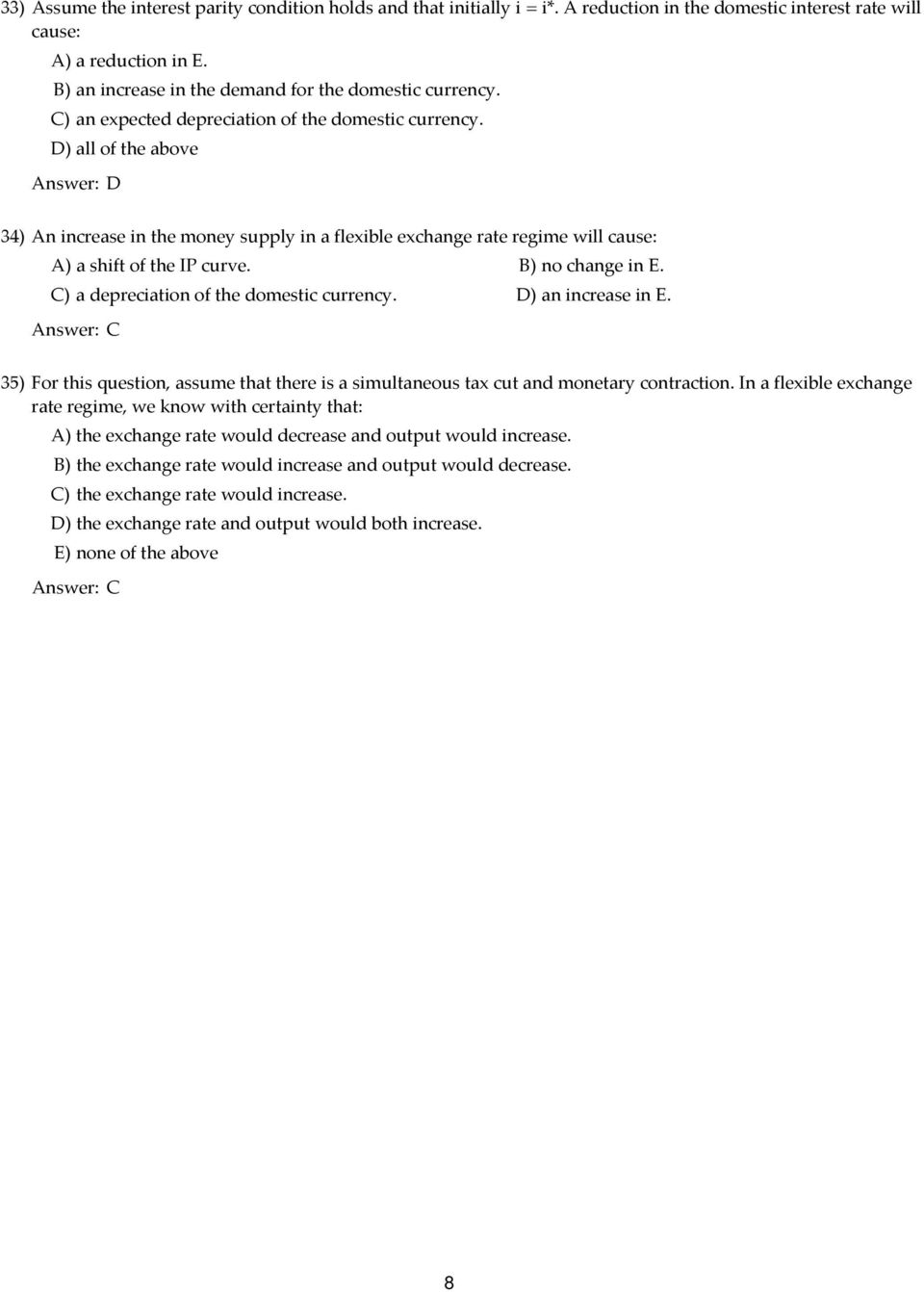
8 33) Assume the interest parity condition holds and that initially i = i*. A reduction in the domestic interest rate will cause: A) a reduction in E. B) an increase in the demand for the domestic currency. C) an expected depreciation of the domestic currency. D) all of the above 34) An increase in the money supply in a flexible exchange rate regime will cause: A) a shift of the IP curve. B) no change in E. C) a depreciation of the domestic currency. D) an increase in E. 35) For this question, assume that there is a simultaneous tax cut and monetary contraction. In a flexible exchange rate regime, we know with certainty that: A) the exchange rate would decrease and output would increase. B) the exchange rate would increase and output would decrease. C) the exchange rate would increase. D) the exchange rate and output would both increase. 8
9 Part B: SHORT ANSWER QUESTIONS (40%) Here are some short answer practice questions. Answer any two of the following three questions. Provide brief, clear answers along with your reasoning. Make sure your arguments are logical. Use the models we have examined as a framework for answering the questions posed here. You will not get points for verbosity here. Rather, points will be awarded for the clarity, consistency and conciseness of your answer. Please Note: The answers given here are not intended to be model answers. Rather, they are just a quick summary of the main points in the argument. 36. (20%) Suppose the US government cuts taxes in the budget later this year. Assuming that the money supply is left unchanged, what effect might this have on the exchange rate and output? (You should assume that international capital mobility is perfectly mobile). Answer: Using the Twin Deficits identity: S - I = G - T + NX. A cut in taxes would increase the budget deficit. However, without a change in the money supply, there is pressure for the real interest rates to fall. This is pinned down by international capital mobility. Instead the real exchange rate appreciates. So even though we would normally expect output to increase from an increase in the budget deficit, the appreciation of the real exchange rate offsets this and output remains unchanged. 37. (20%) Can the expectation of lower inflation lead to a recession? Answer: The answer is yes. Suppose that the government announces a future cut in the growth rate of money. Since velocity depends on expected inflation, V(i)=V(r+π e ). The announcement of a fall in money growth will thus lower velocity. Thus from the Cambridge equation, (M/P)=(1/V)Y without a change in real money balances, (1/V) increases and so output falls to equate the demand for money to the supply of money. So a fall in expected inflation leads to a recession. 38. (20%) What is meant by the term "Classical Dichotomy"? Illustrate your answer using one of the models you have studied. Answer: The term "Classical Dichotomy" refers to the separation between nominal and real variables in the long run. Thus a real shock (originating in the goods market) has an impact on real variables in the long run. A nominal shock (originating in the money market) can only affect prices in the long run and not real variables like real interest rates:- see lecture notes for examples. 9

ECON 3312 Macroeconomics Exam 3 Fall 2014. Name MULTIPLE CHOICE. Choose the one alternative that best completes the statement or answers the question.
 ECON 3312 Macroeconomics Exam 3 Fall 2014 Name MULTIPLE CHOICE. Choose the one alternative that best completes the statement or answers the question. 1) Everything else held constant, an increase in net
Econ 303: Intermediate Macroeconomics I Dr. Sauer Sample Questions for Exam #3
 Econ 303: Intermediate Macroeconomics I Dr. Sauer Sample Questions for Exam #3 1. When firms experience unplanned inventory accumulation, they typically: A) build new plants. B) lay off workers and reduce
The level of price and inflation Real GDP: the values of goods and services measured using a constant set of prices
 Chapter 2: Key Macroeconomics Variables ECON2 (Spring 20) 2 & 4.3.20 (Tutorial ) National income accounting Gross domestic product (GDP): The market value of all final goods and services produced within
Econ 202 Final Exam. Table 3-1 Labor Hours Needed to Make 1 Pound of: Meat Potatoes Farmer 8 2 Rancher 4 5
 Econ 202 Final Exam 1. If inflation expectations rise, the short-run Phillips curve shifts a. right, so that at any inflation rate unemployment is higher. b. left, so that at any inflation rate unemployment
1. a. Interest-bearing checking accounts make holding money more attractive. This increases the demand for money.
 Macroeconomics ECON 2204 Prof. Murphy Problem Set 4 Answers Chapter 10 #1, 2, and 3 (on pages 308-309) 1. a. Interest-bearing checking accounts make holding money more attractive. This increases the demand
Economics 152 Solution to Sample Midterm 2
 Economics 152 Solution to Sample Midterm 2 N. Das PART 1 (84 POINTS): Answer the following 28 multiple choice questions on the scan sheet. Each question is worth 3 points. 1. If Congress passes legislation
MULTIPLE CHOICE. Choose the one alternative that best completes the statement or answers the question.
 Econ 111 Summer 2007 Final Exam Name MULTIPLE CHOICE. Choose the one alternative that best completes the statement or answers the question. 1) The classical dichotomy allows us to explore economic growth
QUESTION 1: SHORT VERSUS MEDIUM RUN. 30 points
 QUESTION 1: SHORT VERSUS MEDIUM RUN. 30 points Consider an economy that fits the AS-AD model. The labor market equilibrium is given by the AS curve. The equilibrium in the goods market is given by the
ECON 4423: INTERNATIONAL FINANCE
 University of Colorado at Boulder Department of Economics ECON 4423: INTERNATIONAL FINANCE Final Examination Fall 2005 Name: Answer Key Student ID: Instructions: This test is 1 1/2 hours in length. You
= C + I + G + NX ECON 302. Lecture 4: Aggregate Expenditures/Keynesian Model: Equilibrium in the Goods Market/Loanable Funds Market
 Intermediate Macroeconomics Lecture 4: Introduction to the Goods Market Review of the Aggregate Expenditures model and the Keynesian Cross ECON 302 Professor Yamin Ahmad Components of Aggregate Demand
1) Explain why each of the following statements is true. Discuss the impact of monetary and fiscal policy in each of these special cases:
 1) Explain why each of the following statements is true. Discuss the impact of monetary and fiscal policy in each of these special cases: a) If investment does not depend on the interest rate, the IS curve
Problem Set 5. a) In what sense is money neutral? Why is monetary policy useful if money is neutral?
 1 Problem Set 5 Question 2 a) In what sense is money neutral? Why is monetary policy useful if money is neutral? In Problem Set 4, Question 2-Part (e), we already analysed the effect of an expansionary
Pre-Test Chapter 11 ed17
 Pre-Test Chapter 11 ed17 Multiple Choice Questions 1. Built-in stability means that: A. an annually balanced budget will offset the procyclical tendencies created by state and local finance and thereby
BUSINESS ECONOMICS CEC2 532-751 & 761
 BUSINESS ECONOMICS CEC2 532-751 & 761 PRACTICE MACROECONOMICS MULTIPLE CHOICE QUESTIONS Warning: These questions have been posted to give you an opportunity to practice with the multiple choice format
Econ 102 Aggregate Supply and Demand
 Econ 102 ggregate Supply and Demand 1. s on previous homework assignments, turn in a news article together with your summary and explanation of why it is relevant to this week s topic, ggregate Supply
D) surplus; negative. 9. The law of one price is enforced by: A) governments. B) producers. C) consumers. D) arbitrageurs.
 1. An open economy is one in which: A) the level of output is fixed. B) government spending exceeds revenues. C) the national interest rate equals the world interest rate. D) there is trade in goods and
MULTIPLE CHOICE. Choose the one alternative that best completes the statement or answers the question.
 Suvey of Macroeconomics, MBA 641 Fall 2006, Final Exam Name MULTIPLE CHOICE. Choose the one alternative that best completes the statement or answers the question. 1) Modern macroeconomics emerged from
BADM 527, Fall 2013. Midterm Exam 2. Multiple Choice: 3 points each. Answer the questions on the separate bubble sheet. NAME
 BADM 527, Fall 2013 Name: Midterm Exam 2 November 7, 2013 Multiple Choice: 3 points each. Answer the questions on the separate bubble sheet. NAME 1. According to classical theory, national income (Real
FISCAL POLICY* Chapter. Key Concepts
 Chapter 11 FISCAL POLICY* Key Concepts The Federal Budget The federal budget is an annual statement of the government s expenditures and tax revenues. Using the federal budget to achieve macroeconomic
These are some practice questions for CHAPTER 23. Each question should have a single answer. But be careful. There may be errors in the answer key!
 These are some practice questions for CHAPTER 23. Each question should have a single answer. But be careful. There may be errors in the answer key! 67. Public saving is equal to a. net tax revenues minus
Chapter 16 Output and the Exchange Rate in the Short Run
 Chapter 16 Output and the Exchange Rate in the Short Run Prepared by Iordanis Petsas To Accompany International Economics: Theory and Policy, Sixth Edition by Paul R. Krugman and Maurice Obstfeld Chapter
Lecture 10: Open Economy & Crises
 Lecture 10: Open Economy & Crises Today Open Economy Macroeconomics Key Readings Mishkin, Cht 24, Leddin/Walsh Cht 18. Learning Outcomes Theory. Extend ISLM to account for Imports/Exports Practice. Show
Study Questions 8 (Keynesian Model) MULTIPLE CHOICE. Choose the one alternative that best completes the statement or answers the question.
 Study Questions 8 (Keynesian Model) MULTIPLE CHOICE. Choose the one alternative that best completes the statement or answers the question. 1) In the Keynesian model of aggregate expenditure, real GDP is
QUIZ 3 14.02 Principles of Macroeconomics May 19, 2005. I. True/False (30 points)
 QUIZ 3 14.02 Principles of Macroeconomics May 19, 2005 I. True/False (30 points) 1. A decrease in government spending and a real depreciation is the right policy mix to improve the trade balance without
Econ 202 H01 Final Exam Spring 2005
 Econ202Final Spring 2005 1 Econ 202 H01 Final Exam Spring 2005 1. Which of the following tends to reduce the size of a shift in aggregate demand? a. the multiplier effect b. the crowding-out effect c.
1. Firms react to unplanned inventory investment by increasing output.
 Macro Exam 2 Self Test -- T/F questions Dr. McGahagan Fill in your answer (T/F) in the blank in front of the question. If false, provide a brief explanation of why it is false, and state what is true.
Econ 336 - Spring 2007 Homework 5
 Econ 336 - Spring 2007 Homework 5 Name MULTIPLE CHOICE. Choose the one alternative that best completes the statement or answers the question. 1) The real exchange rate, q, is defined as A) E times P B)
MONEY, INTEREST, REAL GDP, AND THE PRICE LEVEL*
 Chapter 11 MONEY, INTEREST, REAL GDP, AND THE PRICE LEVEL* The Demand for Topic: Influences on Holding 1) The quantity of money that people choose to hold depends on which of the following? I. The price
Answers to Text Questions and Problems. Chapter 22. Answers to Review Questions
 Answers to Text Questions and Problems Chapter 22 Answers to Review Questions 3. In general, producers of durable goods are affected most by recessions while producers of nondurables (like food) and services
a) Aggregate Demand (AD) and Aggregate Supply (AS) analysis
 a) Aggregate Demand (AD) and Aggregate Supply (AS) analysis Determinants of AD: Aggregate demand is the total demand in the economy. It measures spending on goods and services by consumers, firms, the
3. a. If all money is held as currency, then the money supply is equal to the monetary base. The money supply will be $1,000.
 Macroeconomics ECON 2204 Prof. Murphy Problem Set 2 Answers Chapter 4 #2, 3, 4, 5, 6, 7, and 9 (on pages 102-103) 2. a. When the Fed buys bonds, the dollars that it pays to the public for the bonds increase
Econ 202 Section 2 Final Exam
 Douglas, Fall 2009 December 17, 2009 A: Special Code 0000 PLEDGE: I have neither given nor received unauthorized help on this exam. SIGNED: PRINT NAME: Econ 202 Section 2 Final Exam 1. The present value
EC2105, Professor Laury EXAM 2, FORM A (3/13/02)
 EC2105, Professor Laury EXAM 2, FORM A (3/13/02) Print Your Name: ID Number: Multiple Choice (32 questions, 2.5 points each; 80 points total). Clearly indicate (by circling) the ONE BEST response to each
0 100 200 300 Real income (Y)
 Lecture 11-1 6.1 The open economy, the multiplier, and the IS curve Assume that the economy is either closed (no foreign trade) or open. Assume that the exchange rates are either fixed or flexible. Assume
Introduction to Macroeconomics TOPIC 2: The Goods Market
 TOPIC 2: The Goods Market Annaïg Morin CBS - Department of Economics August 2013 Goods market Road map: 1. Demand for goods 1.1. Components 1.1.1. Consumption 1.1.2. Investment 1.1.3. Government spending
Econ 202 Section 4 Final Exam
 Douglas, Fall 2009 December 15, 2009 A: Special Code 00004 PLEDGE: I have neither given nor received unauthorized help on this exam. SIGNED: PRINT NAME: Econ 202 Section 4 Final Exam 1. Oceania buys $40
The Aggregate Demand- Aggregate Supply (AD-AS) Model
 The AD-AS Model The Aggregate Demand- Aggregate Supply (AD-AS) Model Chapter 9 The AD-AS Model addresses two deficiencies of the AE Model: No explicit modeling of aggregate supply. Fixed price level. 2
14.02 PRINCIPLES OF MACROECONOMICS QUIZ 3
 14.02 PRINCIPLES OF MACROECONOMICS QUIZ 3 READ INSTRUCTIONS FIRST: Read all questions carefully and completely before beginning the quiz. Label all of your graphs, including axes, clearly; if we can t
In this chapter we learn the potential causes of fluctuations in national income. We focus on demand shocks other than supply shocks.
 Chapter 11: Applying IS-LM Model In this chapter we learn the potential causes of fluctuations in national income. We focus on demand shocks other than supply shocks. We also learn how the IS-LM model
2 0 0 0 E D I T I O N CLEP O F F I C I A L S T U D Y G U I D E. The College Board. College Level Examination Program
 2 0 0 0 E D I T I O N CLEP O F F I C I A L S T U D Y G U I D E College Level Examination Program The College Board Principles of Macroeconomics Description of the Examination The Subject Examination in
(1) A reduction in the lump sum tax (2) A rise in the marginal propensity to import (3) A decrease in the marginal propensity to consume
 S.7 Economics On 3 & 4-Sector Simple Keynesian Models S.7 Economics/3 & 4-sector Keynesian Models/p.1 95 #4 Which of the following would reduce the multiplier effect of investment on national income? (1)
Homework #6 - Answers. Uses of Macro Policy Due April 20
 Page 1 of 8 Uses of Macro Policy ue April 20 Answer all questions on these sheets, adding extra sheets where necessary. 1. Suppose that the government were to increase its purchases of goods and services
CHAPTER 7: AGGREGATE DEMAND AND AGGREGATE SUPPLY
 CHAPTER 7: AGGREGATE DEMAND AND AGGREGATE SUPPLY Learning goals of this chapter: What forces bring persistent and rapid expansion of real GDP? What causes inflation? Why do we have business cycles? How
Introduction to Macroeconomics 1012 Final Exam Spring 2013 Instructor: Elsie Sawatzky
 Introduction to Macroeconomics 1012 Final Exam Spring 2013 Instructor: Elsie Sawatzky Name Time: 2 hours Marks: 80 Multiple choice questions 1 mark each and a choice of 2 out of 3 short answer question
Econ 202 Final Exam. Douglas, Spring 2006 PLEDGE: I have neither given nor received unauthorized help on this exam.
 , Spring 2006 PLEDGE: I have neither given nor received unauthorized help on this exam. SIGNED: PRINT NAME: Econ 202 Final Exam 1. When the government spends more, the initial effect is that a. aggregate
e) Permanent changes in monetary and fiscal policies (assume now long run price flexibility)
 Topic I.4 concluded: Goods and Assets Markets in the Short Run a) Aggregate demand and equilibrium b) Money and asset markets equilibrium c) Short run equilibrium of Y and E d) Temporary monetary and fiscal
Practiced Questions. Chapter 20
 Practiced Questions Chapter 20 1. The model of aggregate demand and aggregate supply a. is different from the model of supply and demand for a particular market, in that we cannot focus on the substitution
I d ( r; MPK f, τ) Y < C d +I d +G
 1. Use the IS-LM model to determine the effects of each of the following on the general equilibrium values of the real wage, employment, output, the real interest rate, consumption, investment, and the
University of Lethbridge Department of Economics ECON 1012 Introduction to Macroeconomics Instructor: Michael G. Lanyi
 University of Lethbridge Department of Economics ECON 1012 Introduction to Macroeconomics Instructor: Michael G. Lanyi CH 27 Expenditure Multipliers 1) Disposable income is A) aggregate income minus transfer
This paper is not to be removed from the Examination Halls
 This paper is not to be removed from the Examination Halls UNIVERSITY OF LONDON EC2065 ZA BSc degrees and Diplomas for Graduates in Economics, Management, Finance and the Social Sciences, the Diplomas
Chapter 13. Aggregate Demand and Aggregate Supply Analysis
 Chapter 13. Aggregate Demand and Aggregate Supply Analysis Instructor: JINKOOK LEE Department of Economics / Texas A&M University ECON 203 502 Principles of Macroeconomics In the short run, real GDP and
Lecture 10-1. The Twin Deficits
 Lecture 10-1 The Twin Deficits The IS-LM model of the previous lectures endogenised the interest rate while assuming that the portion (NX 0 ) of net exports not dependent on income was exogenously fixed.
Pre-Test Chapter 10 ed17
 Pre-Test Chapter 10 ed17 Multiple Choice Questions 1. Refer to the above diagrams. Assuming a constant price level, an increase in aggregate expenditures from AE 1 to AE 2 would: A. move the economy from
Professor Christina Romer. LECTURE 17 MACROECONOMIC VARIABLES AND ISSUES March 17, 2016
 Economics 2 Spring 2016 Professor Christina Romer Professor David Romer LECTURE 17 MACROECONOMIC VARIABLES AND ISSUES March 17, 2016 I. MACROECONOMICS VERSUS MICROECONOMICS II. REAL GDP A. Definition B.
S.Y.B.COM. (SEM-III) ECONOMICS
 Fill in the Blanks. Module 1 S.Y.B.COM. (SEM-III) ECONOMICS 1. The continuous flow of money and goods and services between firms and households is called the Circular Flow. 2. Saving constitute a leakage
1 Multiple Choice - 50 Points
 Econ 201 Final Winter 2008 SOLUTIONS 1 Multiple Choice - 50 Points (In this section each question is worth 1 point) 1. Suppose a waiter deposits his cash tips into his savings account. As a result of only
13 EXPENDITURE MULTIPLIERS: THE KEYNESIAN MODEL* Chapter. Key Concepts
 Chapter 3 EXPENDITURE MULTIPLIERS: THE KEYNESIAN MODEL* Key Concepts Fixed Prices and Expenditure Plans In the very short run, firms do not change their prices and they sell the amount that is demanded.
Econ 202 Final Exam. Douglas, Fall 2007 Version A Special Codes 00000. PLEDGE: I have neither given nor received unauthorized help on this exam.
 , Fall 2007 Version A Special Codes 00000 PLEDGE: I have neither given nor received unauthorized help on this exam. SIGNED: PRINT NAME: Econ 202 Final Exam 1. On average over the past 50 years, the U.S.
Problem Set #4: Aggregate Supply and Aggregate Demand Econ 100B: Intermediate Macroeconomics
 roblem Set #4: Aggregate Supply and Aggregate Demand Econ 100B: Intermediate Macroeconomics 1) Explain the differences between demand-pull inflation and cost-push inflation. Demand-pull inflation results
Lecture 2. Output, interest rates and exchange rates: the Mundell Fleming model.
 Lecture 2. Output, interest rates and exchange rates: the Mundell Fleming model. Carlos Llano (P) & Nuria Gallego (TA) References: these slides have been developed based on the ones provided by Beatriz
Chapter 12. Aggregate Expenditure and Output in the Short Run
 Chapter 12. Aggregate Expenditure and Output in the Short Run Instructor: JINKOOK LEE Department of Economics / Texas A&M University ECON 203 502 Principles of Macroeconomics Aggregate Expenditure (AE)
SHORT-RUN FLUCTUATIONS. David Romer. University of California, Berkeley. First version: August 1999 This revision: January 2012
 SHORT-RUN FLUCTUATIONS David Romer University of California, Berkeley First version: August 1999 This revision: January 2012 Copyright 2012 by David Romer CONTENTS Preface vi I The IS-MP Model 1 I-1 Monetary
8. Simultaneous Equilibrium in the Commodity and Money Markets
 Lecture 8-1 8. Simultaneous Equilibrium in the Commodity and Money Markets We now combine the IS (commodity-market equilibrium) and LM (money-market equilibrium) schedules to establish a general equilibrium
Answer: C Learning Objective: Money supply Level of Learning: Knowledge Type: Word Problem Source: Unique
 1.The aggregate demand curve shows the relationship between inflation and: A) the nominal interest rate. D) the exchange rate. B) the real interest rate. E) short-run equilibrium output. C) the unemployment
INTRODUCTION TO ADVANCED MACROECONOMICS Preliminary Exam with answers September 2014
 Duration: 120 min INTRODUCTION TO ADVANCED MACROECONOMICS Preliminary Exam with answers September 2014 Format of the mock examination Section A. Multiple Choice Questions (20 % of the total marks) Section
Use the following to answer question 9: Exhibit: Keynesian Cross
 1. Leading economic indicators are: A) the most popular economic statistics. B) data that are used to construct the consumer price index and the unemployment rate. C) variables that tend to fluctuate in
Refer to Figure 17-1
 Chapter 17 1. Inflation can be measured by the a. change in the consumer price index. b. percentage change in the consumer price index. c. percentage change in the price of a specific commodity. d. change
Big Concepts. Balance of Payments Accounts. Financing International Trade. Economics 202 Principles Of Macroeconomics. Lecture 12
 Economics 202 Principles Of Macroeconomics Professor Yamin Ahmad Big Concepts Balance of Payments Equilibrium The relationship between the current account, capital account and official settlements balance
Factors that Shift the IS Curve
 Factors that Shift the IS Curve A change in autonomous factors that is unrelated to the interest rate Changes in autonomous consumer expenditure Changes in planned investment spending unrelated to the
Macroeconomics, Fall 2007 Exam 3, TTh classes, various versions
 Name: _ Days/Times Class Meets: Today s Date: Macroeconomics, Fall 2007 Exam 3, TTh classes, various versions Read these Instructions carefully! You must follow them exactly! I) On your Scantron card you
University of Lethbridge Department of Economics ECON 1012 Introduction to Microeconomics Instructor: Michael G. Lanyi. Chapter 29 Fiscal Policy
 University of Lethbridge Department of Economics ECON 1012 Introduction to Microeconomics Instructor: Michael G. Lanyi Chapter 29 Fiscal Policy 1) If revenues exceed outlays, the government's budget balance
MULTIPLE CHOICE. Choose the one alternative that best completes the statement or answers the question.
 Chatper 34 International Finance - Test Bank MULTIPLE CHOICE. Choose the one alternative that best completes the statement or answers the question. 1) The currency used to buy imported goods is A) the
THE OPEN AGGREGATE DEMAND AGGREGATE SUPPLY MODEL.
 THE OPEN AGGREGATE DEMAND AGGREGATE SUPPLY MODEL. Introduction. This model represents the workings of the economy as the interaction between two curves: - The AD curve, showing the relationship between
GOVERNMENT ECONOMIC OBJECTIVES AND POLICIES. Textbook, Chapter 26 [pg 317-328]
![GOVERNMENT ECONOMIC OBJECTIVES AND POLICIES. Textbook, Chapter 26 [pg 317-328]](/thumbs/27/11652136.jpg "GOVERNMENT ECONOMIC OBJECTIVES AND POLICIES. Textbook, Chapter 26 [pg 317-328]") GOVERNMENT ECONOMIC OBJECTIVES AND POLICIES Textbook, Chapter 26 [pg 317-328] Name: Class: Learning outcomes: Identify government economic objectives. Explain the main stages of the business cycle. Explain
GOVERNMENT ECONOMIC OBJECTIVES AND POLICIES Textbook, Chapter 26 [pg 317-328] Name: Class: Learning outcomes: Identify government economic objectives. Explain the main stages of the business cycle. Explain
7 AGGREGATE SUPPLY AND AGGREGATE DEMAND* Chapter. Key Concepts
 Chapter 7 AGGREGATE SUPPLY AND AGGREGATE DEMAND* Key Concepts Aggregate Supply The aggregate production function shows that the quantity of real GDP (Y ) supplied depends on the quantity of labor (L ),
AGGREGATE DEMAND AND AGGREGATE SUPPLY The Influence of Monetary and Fiscal Policy on Aggregate Demand
 AGGREGATE DEMAND AND AGGREGATE SUPPLY The Influence of Monetary and Fiscal Policy on Aggregate Demand Suppose that the economy is undergoing a recession because of a fall in aggregate demand. a. Using
Government Budget and Fiscal Policy CHAPTER
 Government Budget and Fiscal Policy 11 CHAPTER The National Budget The national budget is the annual statement of the government s expenditures and tax revenues. Fiscal policy is the use of the federal
Exam 1 Review. 3. A severe recession is called a(n): A) depression. B) deflation. C) exogenous event. D) market-clearing assumption.
 Exam 1 Review 1. Macroeconomics does not try to answer the question of: A) why do some countries experience rapid growth. B) what is the rate of return on education. C) why do some countries have high
International Macroeconommics
 International Macroeconommics Chapter 7. The Open Economy IS-LM Model Department of Economics, UCDavis Outline 1 Building the IS-LM-FX Model 2 Monetary Policy Fiscal Policy Outline Building the IS-LM-FX
MULTIPLE CHOICE. Choose the one alternative that best completes the statement or answers the question.
 Study Questions 5 (Money) MULTIPLE CHOICE. Choose the one alternative that best completes the statement or answers the question. 1) The functions of money are 1) A) medium of exchange, unit of account,
The Short-Run Macro Model. The Short-Run Macro Model. The Short-Run Macro Model
 The Short-Run Macro Model In the short run, spending depends on income, and income depends on spending. The Short-Run Macro Model Short-Run Macro Model A macroeconomic model that explains how changes in
Advanced International Economics Prof. Yamin Ahmad ECON 758
 Advanced International Economics Prof. Yamin Ahmad ECON 758 Sample Midterm Exam Name Id # Instructions: There are two parts to this midterm. Part A consists of multiple choice questions. Please mark the
Chapter 20. Output, the Interest Rate, and the Exchange Rate
 Chapter 20. Output, the Interest Rate, and the Exchange Rate In Chapter 19, we treated the exchange rate as one of the policy instruments available to the government. But the exchange rate is not a policy
_FALSE 1. Firms react to unplanned inventory investment by increasing output.
 Macro Exam 2 Self Test -- ANSWERS Dr. McGahagan WARNING -- Be sure to take the self-test before peeking at the answers. Chapter 8 -- Aggregate Expenditure and Equilibrium Output _FALSE 1. Firms react to
Chapter 11: Activity
 Economics for Managers by Paul Farnham Chapter 11: Measuring Macroeconomic Activity 11.1 Measuring Gross Domestic Product (GDP) GDP: the market value of all currently yproduced final goods and services
Homework Assignment #3: Answer Sheet
 Econ 434 Professor Ickes Homework Assignment #3: Answer Sheet Fall 2009 This assignment is due on Thursday, December 10, 2009, at the beginning of class (or sooner). 1. Consider the graphical model of
Chapter 4 Consumption, Saving, and Investment
 Chapter 4 Consumption, Saving, and Investment Multiple Choice Questions 1. Desired national saving equals (a) Y C d G. (b) C d + I d + G. (c) I d + G. (d) Y I d G. 2. With no inflation and a nominal interest
Cosumnes River College Principles of Macroeconomics Problem Set 11 Will Not Be Collected
 Name: Solutions Cosumnes River College Principles of Macroeconomics Problem Set 11 Will Not Be Collected Fall 2015 Prof. Dowell Instructions: This problem set will not be collected. You should still work
Extra Problems #3. ECON 410.502 Macroeconomic Theory Spring 2010 Instructor: Guangyi Ma. Notice:
 ECON 410.502 Macroeconomic Theory Spring 2010 Instructor: Guangyi Ma Extra Problems #3 Notice: (1) There are 25 multiple-choice problems covering Chapter 6, 9, 10, 11. These problems are not homework and
FISCAL POLICY* Chapter. Key Concepts
 Chapter 15 FISCAL POLICY* Key Concepts The Federal Budget The federal budget is an annual statement of the government s expenditures and tax revenues. Using the federal budget to achieve macroeconomic
dr Bartłomiej Rokicki Chair of Macroeconomics and International Trade Theory Faculty of Economic Sciences, University of Warsaw
 Chair of Macroeconomics and International Trade Theory Faculty of Economic Sciences, University of Warsaw The small open economy The small open economy is an economy that is small enough compared to the
Monetary Policy Bank of Canada
 Bank of Canada The objective of monetary policy may be gleaned from to preamble to the Bank of Canada Act of 1935 which says, regulate credit and currency in the best interests of the economic life of
Name: Date: 3. Variables that a model tries to explain are called: A. endogenous. B. exogenous. C. market clearing. D. fixed.
 Name: Date: 1 A measure of how fast prices are rising is called the: A growth rate of real GDP B inflation rate C unemployment rate D market-clearing rate 2 Compared with a recession, real GDP during a
Problem Set for Chapter 20(Multiple choices)
 Problem Set for hapter 20(Multiple choices) 1. According to the theory of liquidity preference, a. if the interest rate is below the equilibrium level, then the quantity of money people want to hold is
14.02 Principles of Macroeconomics Problem Set 1 Fall 2005 ***Solution***
 Part I. True/False/Uncertain Justify your answer with a short argument. 14.02 Principles of Macroeconomics Problem Set 1 Fall 2005 ***Solution*** Posted: Monday, September 12, 2005 Due: Wednesday, September
Using an appropriately labeled money market graph, show the effects of an open market purchase of government securities by the FED on :
 Using an appropriately labeled money market graph, show the effects of an open market purchase of government securities by the FED on : The money supply Interest rates Nominal Interest rates i1 i2 Sm1
Answers to Text Questions and Problems in Chapter 8
 Answers to Text Questions and Problems in Chapter 8 Answers to Review Questions 1. The key assumption is that, in the short run, firms meet demand at pre-set prices. The fact that firms produce to meet
2. With an MPS of.4, the MPC will be: A) 1.0 minus.4. B).4 minus 1.0. C) the reciprocal of the MPS. D).4. Answer: A
 1. If Carol's disposable income increases from $1,200 to $1,700 and her level of saving increases from minus $100 to a plus $100, her marginal propensity to: A) save is three-fifths. B) consume is one-half.
MONEY, INTEREST, REAL GDP, AND THE PRICE LEVEL*
 Chapter 11 MONEY, INTEREST, REAL GDP, AND THE PRICE LEVEL* Key Concepts The Demand for Money Four factors influence the demand for money: The price level An increase in the price level increases the nominal