
PHYS 101-4M, Fall 2005 Exam #3. MULTIPLE CHOICE. Choose the one alternative that best completes the statement or answers the question.
|
|
|
- Christopher Dawson
- 9 years ago
- Views:
Transcription
1 PHYS 101-4M, Fall 2005 Exam #3 Name MULTIPLE CHOICE. Choose the one alternative that best completes the statement or answers the question. 1) A bicycle wheel rotates uniformly through 2.0 revolutions in 4.0 s. What is the frequency of the wheel's rotation? A) 1.0 Hz B) 0.50 Hz C) 2.0 Hz D) 4.0 Hz 2) A mass on a spring undergoes SHM. When the mass passes through the equilibrium position, its instantaneous velocity A) is less than maximum, but not zero. B) is maximum. C) is zero. D) cannot be determined from the information given. 3) A 500-N weight sits on the small piston of a hydraulic machine. The small piston has area 2.0 cm2. If the large piston has area 40 cm2, how much weight can the large piston support? A) N B) 500 N C) N D) 25 N 4) A wheel accelerates with a constant angular acceleration of 4.5 rad/s2. If the initial angular velocity is 1.0 rad/s, what is the angle the wheel rotates through in 2.0 s? A) 11 rad B) 4.5 rad C) 7.0 rad D) 9.0 rad 5) For vibrational motion, the maximum displacement from the equilibrium point is called the A) amplitude. B) period. C) wavelength. D) frequency. 6) A wheel of radius 1.0 m is rotating with a constant angular speed of 2.0 rad/s. What is the linear speed of a point on the wheel's rim? A) 1.0 m/s B) 0.50 m/s C) 4.0 m/s D) 2.0 m/s 7) A boy and a girl are riding on a merry-go-round which is turning at a constant rate. The boy is near the outer edge, and the girl is closer to the center. Who has the greater angular velocity? C) Both have the same non-zero angular velocity. D) Both have zero angular velocity. 8) A mass on a spring undergoes SHM. It goes through 10 complete oscillations in 5.0 s. What is the period? A) 0.50 s B) s C) 50 s D) 2.0 s 9) The time for one cycle of a periodic process is called the A) frequency. B) amplitude. C) wavelength. D) period. 10) The bolts on a car wheel require tightening to a torque of 90 Nœm. If a 30 cm long wrench is used, what is the magnitude of the force required when the force is perpendicular to the wrench? A) 30 N B) 300 N C) 150 N D) 15 N 1) 2) 3) 4) 5) 6) 7) 8) 9) 10) 1
2 11) A block of metal weighs 40 N in air and 30 N in water. What is the buoyant force of the water? A) 40 N B) 70 N C) 10 N D) 30 N 11) 12) A circular window of 30 cm diameter in a submarine can withstand a maximum force of N. What is the maximum depth in a lake to which the submarine can go without damaging the window? (The density of water is 1000 kg/m3.) A) 1327 m B) 1200 m C) 750 m D) 680 m 12) 13) A boy and a girl are riding on a merry-go-round which is turning at a constant rate. The boy is near the outer edge, and the girl is closer to the center. Who has the greater angular displacement? 13) C) Both have the same non-zero angular displacement. D) Both have zero angular displacement. 14) If a constant net torque is applied to an object, that object will A) having a decreasing moment of inertia. B) having an increasing moment of inertia. C) rotate with constant angular velocity. D) rotate with constant angular acceleration. 14) 15) A wheel of radius 1.0 m is rotating with a constant angular speed of 2.0 rad/s. What is the centripetal acceleration of a point on the wheel's rim? A) 2.0 m/s2 B) 1.0 m/s2 C) 4.0 m/s2 D) 0.50 m/s2 15) 16) What is the velocity of a wave that has a wavelength of 3.0 m and a frequency of 12 Hz? A) 9.0 m/s B) 15 m/s C) 4.0 m/s D) 36 m/s 16) 17) What is the pressure at a location 15.0 m below the surface of sea? (The density of seawater is kg/m3.) A) N/m2 B) N/m2 C) N/m2 D) N/m2 17) 18) Consider three drinking glasses. All three have the same area base, and all three are filled to the same depth with water. Glass A is cylindrical. Glass B is wider at the top than at the bottom, and so holds more water than A. Glass C is narrower at the top than at the bottom, and so holds less water than A. Which glass has the greatest liquid pressure at the bottom? 18) A) Glass A B) Glass B C) Glass C D) All three have equal pressure. 19) A wheel accelerates with a constant angular acceleration of 4.5 rad/s2. If the initial angular velocity is 1.0 rad/s, what is the angular velocity at t = 2.0 s? 19) A) 1.0 rad/s B) 7.0 rad/s C) 10 rad/s D) 9.0 rad/s 20) Angular velocity is expressed in units of A) omegas per second. B) meters per second. C) arcs per second. D) radians per second. 20) 2
3 21) A mass is attached to a vertical spring and bobs up and down between points A and B. Where is the mass located when its potential energy is a maximum? A) midway between A and B B) at either A or B C) one-fourth of the way between A and B D) none of the above 21) 22) The distance between successive crests on a wave is called the wave's A) amplitude. B) speed. C) wavelength. D) frequency. 22) 23) A boy and a girl are riding on a merry-go-round which is turning at a constant rate. The boy is near the outer edge, and the girl is closer to the center. Who has the greater linear speed? C) Both have the same non-zero translational velocity. D) Both have zero translational velocity. 23) 24) A wheel with moment of inertia 3.00 kgœm2 has a net torque of 3.50 Nœm applied to it. What angular acceleration does it experience? A) rad/s2 B) 3.00 rad/s2 C) 1.17 rad/s2 D) 3.50 rad/s2 24) 25) How many rad/s is 25 revolutions per minute equivalent to? A) 0.42 rad/s B) 240 rad/s C) 160 rad/s D) 2.6 rad/s 25) 26) Two forces produce the same torque. Does it follow that the forces have the same magnitude? A) Yes B) No 26) 27) A 0.50-kg mass is attached to a spring of spring constant 20 N/m along a horizontal, frictionless surface. The object oscillates in simple harmonic motion and has a speed of 1.5 m/s at the equilibrium position. What is the total energy of the system? A) 0.65 J B) 1.1 J C) 0.56 J D) 0.27 J 27) 28) Two spheres have the same radius and equal masses. One is made of solid aluminum, and the other is made from a hollow shell of gold. Which one has the bigger moment of inertia about an axis through its center? A) Solid aluminum B) Hollow gold C) same 28) 3
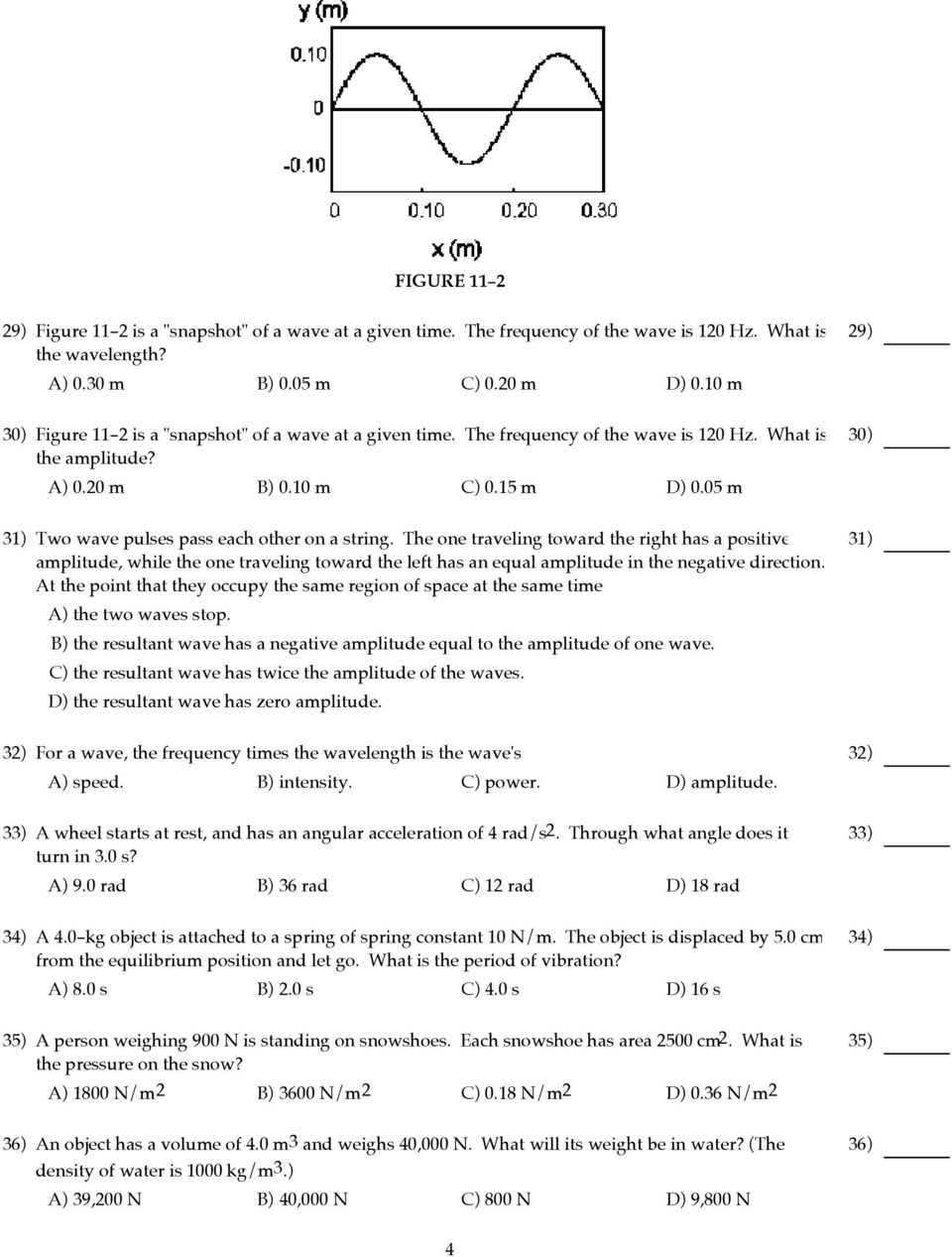
4 FIGURE ) Figure 11-2 is a "snapshot" of a wave at a given time. The frequency of the wave is 120 Hz. What is the wavelength? 29) A) 0.30 m B) 0.05 m C) 0.20 m D) 0.10 m 30) Figure 11-2 is a "snapshot" of a wave at a given time. The frequency of the wave is 120 Hz. What is the amplitude? 30) A) 0.20 m B) 0.10 m C) 0.15 m D) 0.05 m 31) Two wave pulses pass each other on a string. The one traveling toward the right has a positive amplitude, while the one traveling toward the left has an equal amplitude in the negative direction. At the point that they occupy the same region of space at the same time 31) A) the two waves stop. B) the resultant wave has a negative amplitude equal to the amplitude of one wave. C) the resultant wave has twice the amplitude of the waves. D) the resultant wave has zero amplitude. 32) For a wave, the frequency times the wavelength is the wave's A) speed. B) intensity. C) power. D) amplitude. 32) 33) A wheel starts at rest, and has an angular acceleration of 4 rad/s2. Through what angle does it turn in 3.0 s? 33) A) 9.0 rad B) 36 rad C) 12 rad D) 18 rad 34) A 4.0-kg object is attached to a spring of spring constant 10 N/m. The object is displaced by 5.0 cm from the equilibrium position and let go. What is the period of vibration? 34) A) 8.0 s B) 2.0 s C) 4.0 s D) 16 s 35) A person weighing 900 N is standing on snowshoes. Each snowshoe has area 2500 cm2. What is the pressure on the snow? A) 1800 N/m2 B) 3600 N/m2 C) 0.18 N/m2 D) 0.36 N/m2 35) 36) An object has a volume of 4.0 m3 and weighs 40,000 N. What will its weight be in water? (The density of water is 1000 kg/m3.) A) 39,200 N B) 40,000 N C) 800 N D) 9,800 N 36) 4
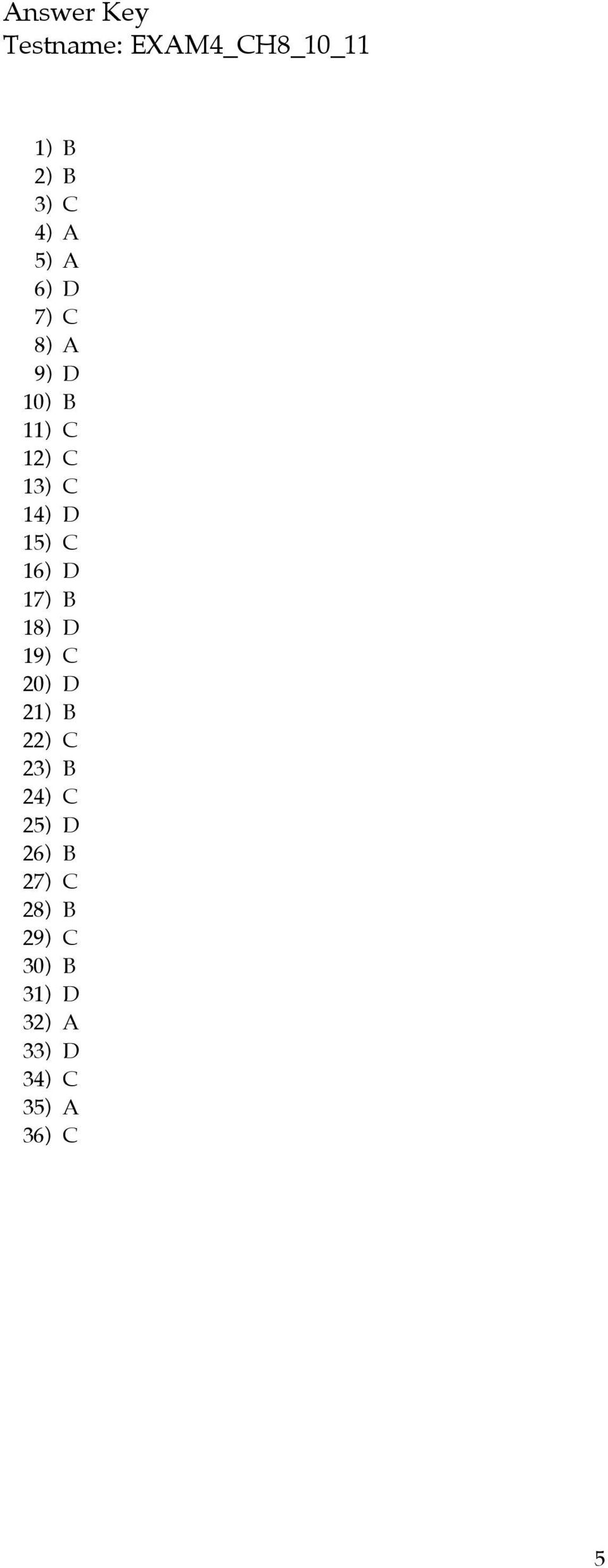
5 Answer Key Testname: EXAM4_CH8_10_11 1) B 2) B 3) C 4) A 5) A 6) D 7) C 8) A 9) D 10) B 11) C 12) C 13) C 14) D 15) C 16) D 17) B 18) D 19) C 20) D 21) B 22) C 23) B 24) C 25) D 26) B 27) C 28) B 29) C 30) B 31) D 32) A 33) D 34) C 35) A 36) C 5
1) The time for one cycle of a periodic process is called the A) wavelength. B) period. C) frequency. D) amplitude.
 practice wave test.. Name Use the text to make use of any equations you might need (e.g., to determine the velocity of waves in a given material) MULTIPLE CHOICE. Choose the one alternative that best completes
226 Chapter 15: OSCILLATIONS
 Chapter 15: OSCILLATIONS 1. In simple harmonic motion, the restoring force must be proportional to the: A. amplitude B. frequency C. velocity D. displacement E. displacement squared 2. An oscillatory motion
PHYS 211 FINAL FALL 2004 Form A
 1. Two boys with masses of 40 kg and 60 kg are holding onto either end of a 10 m long massless pole which is initially at rest and floating in still water. They pull themselves along the pole toward each
Unit 4 Practice Test: Rotational Motion
 Unit 4 Practice Test: Rotational Motion Multiple Guess Identify the letter of the choice that best completes the statement or answers the question. 1. How would an angle in radians be converted to an angle
Tennessee State University
 Tennessee State University Dept. of Physics & Mathematics PHYS 2010 CF SU 2009 Name 30% Time is 2 hours. Cheating will give you an F-grade. Other instructions will be given in the Hall. MULTIPLE CHOICE.
Chapter 10 Rotational Motion. Copyright 2009 Pearson Education, Inc.
 Chapter 10 Rotational Motion Angular Quantities Units of Chapter 10 Vector Nature of Angular Quantities Constant Angular Acceleration Torque Rotational Dynamics; Torque and Rotational Inertia Solving Problems
Practice Test SHM with Answers
 Practice Test SHM with Answers MPC 1) If we double the frequency of a system undergoing simple harmonic motion, which of the following statements about that system are true? (There could be more than one
Center of Gravity. We touched on this briefly in chapter 7! x 2
 Center of Gravity We touched on this briefly in chapter 7! x 1 x 2 cm m 1 m 2 This was for what is known as discrete objects. Discrete refers to the fact that the two objects separated and individual.
Linear Motion vs. Rotational Motion
 Linear Motion vs. Rotational Motion Linear motion involves an object moving from one point to another in a straight line. Rotational motion involves an object rotating about an axis. Examples include a
Physics 2A, Sec B00: Mechanics -- Winter 2011 Instructor: B. Grinstein Final Exam
 Physics 2A, Sec B00: Mechanics -- Winter 2011 Instructor: B. Grinstein Final Exam INSTRUCTIONS: Use a pencil #2 to fill your scantron. Write your code number and bubble it in under "EXAM NUMBER;" an entry
3600 s 1 h. 24 h 1 day. 1 day
 Week 7 homework IMPORTANT NOTE ABOUT WEBASSIGN: In the WebAssign versions of these problems, various details have been changed, so that the answers will come out differently. The method to find the solution
Physics 41 HW Set 1 Chapter 15
 Physics 4 HW Set Chapter 5 Serway 8 th OC:, 4, 7 CQ: 4, 8 P: 4, 5, 8, 8, 0, 9,, 4, 9, 4, 5, 5 Discussion Problems:, 57, 59, 67, 74 OC CQ P: 4, 5, 8, 8, 0, 9,, 4, 9, 4, 5, 5 Discussion Problems:, 57, 59,
Physics 1120: Simple Harmonic Motion Solutions
 Questions: 1 2 3 4 5 6 7 8 9 10 11 12 13 14 15 16 Physics 1120: Simple Harmonic Motion Solutions 1. A 1.75 kg particle moves as function of time as follows: x = 4cos(1.33t+π/5) where distance is measured
PHY231 Section 2, Form A March 22, 2012. 1. Which one of the following statements concerning kinetic energy is true?
 1. Which one of the following statements concerning kinetic energy is true? A) Kinetic energy can be measured in watts. B) Kinetic energy is always equal to the potential energy. C) Kinetic energy is always
PHY231 Section 1, Form B March 22, 2012
 1. A car enters a horizontal, curved roadbed of radius 50 m. The coefficient of static friction between the tires and the roadbed is 0.20. What is the maximum speed with which the car can safely negotiate
Physics 201 Homework 8
 Physics 201 Homework 8 Feb 27, 2013 1. A ceiling fan is turned on and a net torque of 1.8 N-m is applied to the blades. 8.2 rad/s 2 The blades have a total moment of inertia of 0.22 kg-m 2. What is the
TIME OF COMPLETION NAME SOLUTION DEPARTMENT OF NATURAL SCIENCES. PHYS 1111, Exam 3 Section 1 Version 1 December 6, 2005 Total Weight: 100 points
 TIME OF COMPLETION NAME SOLUTION DEPARTMENT OF NATURAL SCIENCES PHYS 1111, Exam 3 Section 1 Version 1 December 6, 2005 Total Weight: 100 points 1. Check your examination for completeness prior to starting.
Torque and Rotation. Physics
 Torque and Rotation Physics Torque Force is the action that creates changes in linear motion. For rotational motion, the same force can cause very different results. A torque is an action that causes objects
State Newton's second law of motion for a particle, defining carefully each term used.
 5 Question 1. [Marks 20] An unmarked police car P is, travelling at the legal speed limit, v P, on a straight section of highway. At time t = 0, the police car is overtaken by a car C, which is speeding
AP Physics C. Oscillations/SHM Review Packet
 AP Physics C Oscillations/SHM Review Packet 1. A 0.5 kg mass on a spring has a displacement as a function of time given by the equation x(t) = 0.8Cos(πt). Find the following: a. The time for one complete
PHY121 #8 Midterm I 3.06.2013
 PHY11 #8 Midterm I 3.06.013 AP Physics- Newton s Laws AP Exam Multiple Choice Questions #1 #4 1. When the frictionless system shown above is accelerated by an applied force of magnitude F, the tension
Chapter 8: Rotational Motion of Solid Objects
 Chapter 8: Rotational Motion of Solid Objects 1. An isolated object is initially spinning at a constant speed. Then, although no external forces act upon it, its rotational speed increases. This must be
C B A T 3 T 2 T 1. 1. What is the magnitude of the force T 1? A) 37.5 N B) 75.0 N C) 113 N D) 157 N E) 192 N
 Three boxes are connected by massless strings and are resting on a frictionless table. Each box has a mass of 15 kg, and the tension T 1 in the right string is accelerating the boxes to the right at a
Sample Questions for the AP Physics 1 Exam
 Sample Questions for the AP Physics 1 Exam Sample Questions for the AP Physics 1 Exam Multiple-choice Questions Note: To simplify calculations, you may use g 5 10 m/s 2 in all problems. Directions: Each
PHYSICS 111 HOMEWORK SOLUTION #9. April 5, 2013
 PHYSICS 111 HOMEWORK SOLUTION #9 April 5, 2013 0.1 A potter s wheel moves uniformly from rest to an angular speed of 0.16 rev/s in 33 s. Find its angular acceleration in radians per second per second.
Lecture Presentation Chapter 7 Rotational Motion
 Lecture Presentation Chapter 7 Rotational Motion Suggested Videos for Chapter 7 Prelecture Videos Describing Rotational Motion Moment of Inertia and Center of Gravity Newton s Second Law for Rotation Class
explain your reasoning
 I. A mechanical device shakes a ball-spring system vertically at its natural frequency. The ball is attached to a string, sending a harmonic wave in the positive x-direction. +x a) The ball, of mass M,
PHYSICS 111 HOMEWORK SOLUTION #10. April 8, 2013
 PHYSICS HOMEWORK SOLUTION #0 April 8, 203 0. Find the net torque on the wheel in the figure below about the axle through O, taking a = 6.0 cm and b = 30.0 cm. A torque that s produced by a force can be
State Newton's second law of motion for a particle, defining carefully each term used.
 5 Question 1. [Marks 28] An unmarked police car P is, travelling at the legal speed limit, v P, on a straight section of highway. At time t = 0, the police car is overtaken by a car C, which is speeding
CHAPTER 15 FORCE, MASS AND ACCELERATION
 CHAPTER 5 FORCE, MASS AND ACCELERATION EXERCISE 83, Page 9. A car initially at rest accelerates uniformly to a speed of 55 km/h in 4 s. Determine the accelerating force required if the mass of the car
F N A) 330 N 0.31 B) 310 N 0.33 C) 250 N 0.27 D) 290 N 0.30 E) 370 N 0.26
 Physics 23 Exam 2 Spring 2010 Dr. Alward Page 1 1. A 250-N force is directed horizontally as shown to push a 29-kg box up an inclined plane at a constant speed. Determine the magnitude of the normal force,
Chapter 11. h = 5m. = mgh + 1 2 mv 2 + 1 2 Iω 2. E f. = E i. v = 4 3 g(h h) = 4 3 9.8m / s2 (8m 5m) = 6.26m / s. ω = v r = 6.
 Chapter 11 11.7 A solid cylinder of radius 10cm and mass 1kg starts from rest and rolls without slipping a distance of 6m down a house roof that is inclined at 30 degrees (a) What is the angular speed
Simple Harmonic Motion
 Simple Harmonic Motion 1 Object To determine the period of motion of objects that are executing simple harmonic motion and to check the theoretical prediction of such periods. 2 Apparatus Assorted weights
Physics 125 Practice Exam #3 Chapters 6-7 Professor Siegel
 Physics 125 Practice Exam #3 Chapters 6-7 Professor Siegel Name: Lab Day: 1. A concrete block is pulled 7.0 m across a frictionless surface by means of a rope. The tension in the rope is 40 N; and the
AP Physics Circular Motion Practice Test B,B,B,A,D,D,C,B,D,B,E,E,E, 14. 6.6m/s, 0.4 N, 1.5 m, 6.3m/s, 15. 12.9 m/s, 22.9 m/s
 AP Physics Circular Motion Practice Test B,B,B,A,D,D,C,B,D,B,E,E,E, 14. 6.6m/s, 0.4 N, 1.5 m, 6.3m/s, 15. 12.9 m/s, 22.9 m/s Answer the multiple choice questions (2 Points Each) on this sheet with capital
Simple Harmonic Motion(SHM) Period and Frequency. Period and Frequency. Cosines and Sines
 Simple Harmonic Motion(SHM) Vibration (oscillation) Equilibrium position position of the natural length of a spring Amplitude maximum displacement Period and Frequency Period (T) Time for one complete
physics 1/12/2016 Chapter 20 Lecture Chapter 20 Traveling Waves
 Chapter 20 Lecture physics FOR SCIENTISTS AND ENGINEERS a strategic approach THIRD EDITION randall d. knight Chapter 20 Traveling Waves Chapter Goal: To learn the basic properties of traveling waves. Slide
Chapter 3.8 & 6 Solutions
 Chapter 3.8 & 6 Solutions P3.37. Prepare: We are asked to find period, speed and acceleration. Period and frequency are inverses according to Equation 3.26. To find speed we need to know the distance traveled
Physics 9e/Cutnell. correlated to the. College Board AP Physics 1 Course Objectives
 Physics 9e/Cutnell correlated to the College Board AP Physics 1 Course Objectives Big Idea 1: Objects and systems have properties such as mass and charge. Systems may have internal structure. Enduring
So if ω 0 increases 3-fold, the stopping angle increases 3 2 = 9-fold.
 Name: MULTIPLE CHOICE: Questions 1-11 are 5 points each. 1. A safety device brings the blade of a power mower from an angular speed of ω 1 to rest in 1.00 revolution. At the same constant angular acceleration,
SOLID MECHANICS TUTORIAL MECHANISMS KINEMATICS - VELOCITY AND ACCELERATION DIAGRAMS
 SOLID MECHANICS TUTORIAL MECHANISMS KINEMATICS - VELOCITY AND ACCELERATION DIAGRAMS This work covers elements of the syllabus for the Engineering Council exams C105 Mechanical and Structural Engineering
104 Practice Exam 2-3/21/02
 104 Practice Exam 2-3/21/02 1. Two electrons are located in a region of space where the magnetic field is zero. Electron A is at rest; and electron B is moving westward with a constant velocity. A non-zero
AP Physics - Chapter 8 Practice Test
 AP Physics - Chapter 8 Practice Test Multiple Choice Identify the choice that best completes the statement or answers the question. 1. A single conservative force F x = (6.0x 12) N (x is in m) acts on
AP1 Oscillations. 1. Which of the following statements about a spring-block oscillator in simple harmonic motion about its equilibrium point is false?
 1. Which of the following statements about a spring-block oscillator in simple harmonic motion about its equilibrium point is false? (A) The displacement is directly related to the acceleration. (B) The
Practice Exam Three Solutions
 MASSACHUSETTS INSTITUTE OF TECHNOLOGY Department of Physics Physics 8.01T Fall Term 2004 Practice Exam Three Solutions Problem 1a) (5 points) Collisions and Center of Mass Reference Frame In the lab frame,
11. Rotation Translational Motion: Rotational Motion:
 11. Rotation Translational Motion: Motion of the center of mass of an object from one position to another. All the motion discussed so far belongs to this category, except uniform circular motion. Rotational
Candidate Number. General Certificate of Education Advanced Level Examination June 2014
 entre Number andidate Number Surname Other Names andidate Signature General ertificate of Education dvanced Level Examination June 214 Physics PHY4/1 Unit 4 Fields and Further Mechanics Section Wednesday
Centripetal Force. This result is independent of the size of r. A full circle has 2π rad, and 360 deg = 2π rad.
 Centripetal Force 1 Introduction In classical mechanics, the dynamics of a point particle are described by Newton s 2nd law, F = m a, where F is the net force, m is the mass, and a is the acceleration.
Physics 121 Sample Common Exam 3 NOTE: ANSWERS ARE ON PAGE 6. Instructions: 1. In the formula F = qvxb:
 Physics 121 Sample Common Exam 3 NOTE: ANSWERS ARE ON PAGE 6 Signature Name (Print): 4 Digit ID: Section: Instructions: Answer all questions 24 multiple choice questions. You may need to do some calculation.
Torque and Rotary Motion
 Torque and Rotary Motion Name Partner Introduction Motion in a circle is a straight-forward extension of linear motion. According to the textbook, all you have to do is replace displacement, velocity,
SHORT ANSWER. Write the word or phrase that best completes each statement or answers the question.
 Exam Name SHORT ANSWER. Write the word or phrase that best completes each statement or answers the question. 1) A person on a sled coasts down a hill and then goes over a slight rise with speed 2.7 m/s.
Magnetism. d. gives the direction of the force on a charge moving in a magnetic field. b. results in negative charges moving. clockwise.
 Magnetism 1. An electron which moves with a speed of 3.0 10 4 m/s parallel to a uniform magnetic field of 0.40 T experiences a force of what magnitude? (e = 1.6 10 19 C) a. 4.8 10 14 N c. 2.2 10 24 N b.
Midterm Solutions. mvr = ω f (I wheel + I bullet ) = ω f 2 MR2 + mr 2 ) ω f = v R. 1 + M 2m
 Midterm Solutions I) A bullet of mass m moving at horizontal velocity v strikes and sticks to the rim of a wheel a solid disc) of mass M, radius R, anchored at its center but free to rotate i) Which of
Rotation: Moment of Inertia and Torque
 Rotation: Moment of Inertia and Torque Every time we push a door open or tighten a bolt using a wrench, we apply a force that results in a rotational motion about a fixed axis. Through experience we learn
Lecture 17. Last time we saw that the rotational analog of Newton s 2nd Law is
 Lecture 17 Rotational Dynamics Rotational Kinetic Energy Stress and Strain and Springs Cutnell+Johnson: 9.4-9.6, 10.1-10.2 Rotational Dynamics (some more) Last time we saw that the rotational analog of
Lesson 11. Luis Anchordoqui. Physics 168. Tuesday, December 8, 15
 Lesson 11 Physics 168 1 Oscillations and Waves 2 Simple harmonic motion If an object vibrates or oscillates back and forth over same path each cycle taking same amount of time motion is called periodic
Chapter 5 Using Newton s Laws: Friction, Circular Motion, Drag Forces. Copyright 2009 Pearson Education, Inc.
 Chapter 5 Using Newton s Laws: Friction, Circular Motion, Drag Forces Units of Chapter 5 Applications of Newton s Laws Involving Friction Uniform Circular Motion Kinematics Dynamics of Uniform Circular
HW Set VI page 1 of 9 PHYSICS 1401 (1) homework solutions
 HW Set VI page 1 of 9 10-30 A 10 g bullet moving directly upward at 1000 m/s strikes and passes through the center of mass of a 5.0 kg block initially at rest (Fig. 10-33 ). The bullet emerges from the
Angular acceleration α
 Angular Acceleration Angular acceleration α measures how rapidly the angular velocity is changing: Slide 7-0 Linear and Circular Motion Compared Slide 7- Linear and Circular Kinematics Compared Slide 7-
16.2 Periodic Waves Example:
 16.2 Periodic Waves Example: A wave traveling in the positive x direction has a frequency of 25.0 Hz, as in the figure. Find the (a) amplitude, (b) wavelength, (c) period, and (d) speed of the wave. 1
AP Physics C Fall Final Web Review
 Name: Class: _ Date: _ AP Physics C Fall Final Web Review Multiple Choice Identify the choice that best completes the statement or answers the question. 1. On a position versus time graph, the slope of
ANALYTICAL METHODS FOR ENGINEERS
 UNIT 1: Unit code: QCF Level: 4 Credit value: 15 ANALYTICAL METHODS FOR ENGINEERS A/601/1401 OUTCOME - TRIGONOMETRIC METHODS TUTORIAL 1 SINUSOIDAL FUNCTION Be able to analyse and model engineering situations
18 Q0 a speed of 45.0 m/s away from a moving car. If the car is 8 Q0 moving towards the ambulance with a speed of 15.0 m/s, what Q0 frequency does a
 First Major T-042 1 A transverse sinusoidal wave is traveling on a string with a 17 speed of 300 m/s. If the wave has a frequency of 100 Hz, what 9 is the phase difference between two particles on the
www.mathsbox.org.uk Displacement (x) Velocity (v) Acceleration (a) x = f(t) differentiate v = dx Acceleration Velocity (v) Displacement x
 Mechanics 2 : Revision Notes 1. Kinematics and variable acceleration Displacement (x) Velocity (v) Acceleration (a) x = f(t) differentiate v = dx differentiate a = dv = d2 x dt dt dt 2 Acceleration Velocity
Physics 231 Lecture 15
 Physics 31 ecture 15 Main points of today s lecture: Simple harmonic motion Mass and Spring Pendulum Circular motion T 1/f; f 1/ T; ω πf for mass and spring ω x Acos( ωt) v ωasin( ωt) x ax ω Acos( ωt)
both double. A. T and v max B. T remains the same and v max doubles. both remain the same. C. T and v max
 Q13.1 An object on the end of a spring is oscillating in simple harmonic motion. If the amplitude of oscillation is doubled, how does this affect the oscillation period T and the object s maximum speed
Solution Derivations for Capa #11
 Solution Derivations for Capa #11 1) A horizontal circular platform (M = 128.1 kg, r = 3.11 m) rotates about a frictionless vertical axle. A student (m = 68.3 kg) walks slowly from the rim of the platform
Spring Simple Harmonic Oscillator. Spring constant. Potential Energy stored in a Spring. Understanding oscillations. Understanding oscillations
 Spring Simple Harmonic Oscillator Simple Harmonic Oscillations and Resonance We have an object attached to a spring. The object is on a horizontal frictionless surface. We move the object so the spring
9. The kinetic energy of the moving object is (1) 5 J (3) 15 J (2) 10 J (4) 50 J
 1. If the kinetic energy of an object is 16 joules when its speed is 4.0 meters per second, then the mass of the objects is (1) 0.5 kg (3) 8.0 kg (2) 2.0 kg (4) 19.6 kg Base your answers to questions 9
Work, Energy and Power Practice Test 1
 Name: ate: 1. How much work is required to lift a 2-kilogram mass to a height of 10 meters?. 5 joules. 20 joules. 100 joules. 200 joules 5. ar and car of equal mass travel up a hill. ar moves up the hill
Physics 1401 - Exam 2 Chapter 5N-New
 Physics 1401 - Exam 2 Chapter 5N-New 2. The second hand on a watch has a length of 4.50 mm and makes one revolution in 60.00 s. What is the speed of the end of the second hand as it moves in uniform circular
Lecture 16. Newton s Second Law for Rotation. Moment of Inertia. Angular momentum. Cutnell+Johnson: 9.4, 9.6
 Lecture 16 Newton s Second Law for Rotation Moment of Inertia Angular momentum Cutnell+Johnson: 9.4, 9.6 Newton s Second Law for Rotation Newton s second law says how a net force causes an acceleration.
Chapter 15, example problems:
 Chapter, example problems: (.0) Ultrasound imaging. (Frequenc > 0,000 Hz) v = 00 m/s. λ 00 m/s /.0 mm =.0 0 6 Hz. (Smaller wave length implies larger frequenc, since their product,
Physics 1A Lecture 10C
 Physics 1A Lecture 10C "If you neglect to recharge a battery, it dies. And if you run full speed ahead without stopping for water, you lose momentum to finish the race. --Oprah Winfrey Static Equilibrium
Curso2012-2013 Física Básica Experimental I Cuestiones Tema IV. Trabajo y energía.
 1. A body of mass m slides a distance d along a horizontal surface. How much work is done by gravity? A) mgd B) zero C) mgd D) One cannot tell from the given information. E) None of these is correct. 2.
The University of the State of New York REGENTS HIGH SCHOOL EXAMINATION PHYSICAL SETTING PHYSICS. Friday, June 20, 2014 1:15 to 4:15 p.m.
 P.S./PHYSICS The University of the State of New York REGENTS HIGH SCHOOL EXAMINATION PHYSICAL SETTING PHYSICS Friday, June 20, 2014 1:15 to 4:15 p.m., only The possession or use of any communications device
Physics 101 Hour Exam 3 December 1, 2014
 Physics 101 Hour Exam 3 December 1, 2014 Last Name: First Name ID Discussion Section: Discussion TA Name: Instructions Turn off your cell phone and put it away. Calculators cannot be shared. Please keep
The University of the State of New York REGENTS HIGH SCHOOL EXAMINATION PHYSICAL SETTING PHYSICS. Wednesday, June 17, 2015 1:15 to 4:15 p.m.
 P.S./PHYSICS The University of the State of New York REGENTS HIGH SCHOOL EXAMINATION PHYSICAL SETTING PHYSICS Wednesday, June 17, 2015 1:15 to 4:15 p.m., only The possession or use of any communications
Solution: F = kx is Hooke s law for a mass and spring system. Angular frequency of this system is: k m therefore, k
 Physics 1C Midterm 1 Summer Session II, 2011 Solutions 1. If F = kx, then k m is (a) A (b) ω (c) ω 2 (d) Aω (e) A 2 ω Solution: F = kx is Hooke s law for a mass and spring system. Angular frequency of
Lab 7: Rotational Motion
 Lab 7: Rotational Motion Equipment: DataStudio, rotary motion sensor mounted on 80 cm rod and heavy duty bench clamp (PASCO ME-9472), string with loop at one end and small white bead at the other end (125
If all three collisions below are totally inelastic, which one(s) will bring the car on the left to a complete halt?
 ConcepTest 8.1 Crash Cars I If all three collisions below are totally inelastic, which one(s) will bring the car on the left to a complete halt? 1) I 2) II 3) I and II 4) II and III 5) all three ConcepTest
Dynamics of Rotational Motion
 Chapter 10 Dynamics of Rotational Motion PowerPoint Lectures for University Physics, Twelfth Edition Hugh D. Young and Roger A. Freedman Lectures by James Pazun Modified by P. Lam 5_31_2012 Goals for Chapter
Rotational Inertia Demonstrator
 WWW.ARBORSCI.COM Rotational Inertia Demonstrator P3-3545 BACKGROUND: The Rotational Inertia Demonstrator provides an engaging way to investigate many of the principles of angular motion and is intended
Sound and stringed instruments
 Sound and stringed instruments Lecture 14: Sound and strings Reminders/Updates: HW 6 due Monday, 10pm. Exam 2, a week today! 1 Sound so far: Sound is a pressure or density fluctuation carried (usually)
Exam 4 Review Questions PHY 2425 - Exam 4
 Exam 4 Review Questions PHY 2425 - Exam 4 Section: 12 2 Topic: The Center of Gravity Type: Conceptual 8. After a shell explodes at the top of its trajectory, the center of gravity of the fragments has
SOLUTIONS TO CONCEPTS CHAPTER 15
 SOLUTIONS TO CONCEPTS CHAPTER 15 1. v = 40 cm/sec As velocity of a wave is constant location of maximum after 5 sec = 40 5 = 00 cm along negative x-axis. [(x / a) (t / T)]. Given y = Ae a) [A] = [M 0 L
Columbia University Department of Physics QUALIFYING EXAMINATION
 Columbia University Department of Physics QUALIFYING EXAMINATION Monday, January 13, 2014 1:00PM to 3:00PM Classical Physics Section 1. Classical Mechanics Two hours are permitted for the completion of
Ph\sics 2210 Fall 2012 - Novcmbcr 21 David Ailion
 Ph\sics 2210 Fall 2012 - Novcmbcr 21 David Ailion Unid: Discussion T A: Bryant Justin Will Yuan 1 Place answers in box provided for each question. Specify units for each answer. Circle correct answer(s)
EXPERIMENT: MOMENT OF INERTIA
 OBJECTIVES EXPERIMENT: MOMENT OF INERTIA to familiarize yourself with the concept of moment of inertia, I, which plays the same role in the description of the rotation of a rigid body as mass plays in
SOLID MECHANICS DYNAMICS TUTORIAL MOMENT OF INERTIA. This work covers elements of the following syllabi.
 SOLID MECHANICS DYNAMICS TUTOIAL MOMENT OF INETIA This work covers elements of the following syllabi. Parts of the Engineering Council Graduate Diploma Exam D5 Dynamics of Mechanical Systems Parts of the
Review Questions PHYS 2426 Exam 2
 Review Questions PHYS 2426 Exam 2 1. If 4.7 x 10 16 electrons pass a particular point in a wire every second, what is the current in the wire? A) 4.7 ma B) 7.5 A C) 2.9 A D) 7.5 ma E) 0.29 A Ans: D 2.
Candidate Number. General Certificate of Education Advanced Level Examination June 2012
 entre Number andidate Number Surname Other Names andidate Signature General ertificate of Education dvanced Level Examination June 212 Physics PHY4/1 Unit 4 Fields and Further Mechanics Section Monday
Candidate Number. General Certificate of Education Advanced Level Examination June 2010
 entre Number andidate Number Surname Other Names andidate Signature General ertificate of Education dvanced Level Examination June 1 Physics PHY4/1 Unit 4 Fields and Further Mechanics Section Friday 18
PHYS 117- Exam I. Multiple Choice Identify the letter of the choice that best completes the statement or answers the question.
 PHYS 117- Exam I Multiple Choice Identify the letter of the choice that best completes the statement or answers the question. 1. Car A travels from milepost 343 to milepost 349 in 5 minutes. Car B travels
Acceleration due to Gravity
 Acceleration due to Gravity 1 Object To determine the acceleration due to gravity by different methods. 2 Apparatus Balance, ball bearing, clamps, electric timers, meter stick, paper strips, precision
HOOKE S LAW AND SIMPLE HARMONIC MOTION
 HOOKE S LAW AND SIMPLE HARMONIC MOTION Alexander Sapozhnikov, Brooklyn College CUNY, New York, [email protected] Objectives Study Hooke s Law and measure the spring constant. Study Simple Harmonic
STUDY PACKAGE. Available Online : www.mathsbysuhag.com
 fo/u fopkjr Hkh# tu] ugha vkjehks dke] foifr ns[k NksM+s rqjar e/;e eu dj ';kea iq#"k flag ladyi dj] lgrs foifr vusd] ^cuk^ u NksM+s /;s; dks] j?kqcj jk[ks VsdAA jfpr% ekuo /kez iz.ksrk ln~xq# Jh j.knksm+nklth
SOLID MECHANICS DYNAMICS TUTORIAL NATURAL VIBRATIONS ONE DEGREE OF FREEDOM
 SOLID MECHANICS DYNAMICS TUTORIAL NATURAL VIBRATIONS ONE DEGREE OF FREEDOM This work covers elements of the syllabus for the Engineering Council Exam D5 Dynamics of Mechanical Systems, C05 Mechanical and
E X P E R I M E N T 8
 E X P E R I M E N T 8 Torque, Equilibrium & Center of Gravity Produced by the Physics Staff at Collin College Copyright Collin College Physics Department. All Rights Reserved. University Physics, Exp 8:
SOLID MECHANICS BALANCING TUTORIAL BALANCING OF ROTATING BODIES
 SOLID MECHANICS BALANCING TUTORIAL BALANCING OF ROTATING BODIES This work covers elements of the syllabus for the Edexcel module 21722P HNC/D Mechanical Principles OUTCOME 4. On completion of this tutorial