
Knee Arthroscopy Post-operative Instructions
|
|
|
- Regina Ryan
- 10 years ago
- Views:
Transcription
1 Amon T. Ferry, MD Orthopedic Surgery Sports Medicine Knee Arthroscopy Post-operative Instructions PLEASE READ ALL OF THESE INSTRUCTIONS CAREFULLY. THEY WILL ANSWER MOST OF YOUR QUESTIONS. 1. You may walk on the leg as tolerated, but avoid doing too much for the first day or two. You may use crutches to minimize discomfort, if needed. 2. Keep the postoperative dressing clean and dry. REMOVE YOUR BANDAGES THREE DAYS AFTER SURGERY. Leave any steri-strips in place and let them fall-off naturally. Keep your incisions covered with a small sterile dressing until your first follow-up visit with Dr. Ferry. Sometimes band-aids work well for smaller incisions. You may shower beginning three-days postoperatively. Remove the dressing. Do not allow your knee to be submerged in water (swimming or baths) until after your first post-operative visit with Dr. Ferry. 3. It is normal to have swelling and discomfort in the knee for several days to weeks after arthroscopy, depending on what procedure was done. 4. Plan to take today and tomorrow off work. You may resume work when the pain and swelling subsides. This can be a week or more, depending on the type of work you do and the procedure that was done for your knee. 5. Take your pain medication as directed to help relieve the pain. 6. You should also take an Aspirin a day for two weeks following your surgery. The compression stockings should be worn until your follow-up appointment. This is to help with blood flow and prevent a blood clot. If needed, for your comfort, they can be removed for a few hours a day. 7. Use the cold packs or cooling unit given to you in the hospital. This should be used for minutes at a time to the knee for the first week after surgery. This will help to reduce the pain and swelling. After the first week the cold therapy can be used as needed (at the end of the day or after Physical Therapy). 8. Avoid athletics for several weeks after arthroscopy (until you have fall motion and no pain). Dr. Ferry will let you know when it is safe to begin exercising. You may begin spinning (no resistance) on a stationary bike to help regain your range of motion, as soon as it is comfortable for you to do so, unless instructed differently by Dr. Ferry. 9. Please call Dr. Ferry s office after your surgery to make an appointment for a follow-up visit in 10 to 14 days after surgery. 10. Sometimes your knee remains painful and swollen for several weeks, depending on the problem you have and the amount of surgery that was done. This is usually nothing to worry about. However, severe and worsening pain, redness, drainage, or fever could indicate infection (after the first day or two) and you should contact Dr. Ferry. If you have any concerns, please call Dr. Ferry at N 3 rd St., Suite 2030, Phoenix, AZ Tel: Fax:

2 Amon T. Ferry, MD Orthopedic Surgery Sports Medicine Rehabilitation After Arthroscopic Knee Surgery Phase 1: The First Week Following Surgery This protocol is a guideline for your rehabilitation after arthroscopic knee surgery. You may vary in your ability to do these exercises and to progress to full resumption of your previous activity. Please call the doctor if you are having a problem with your knee or if you need clarification of these instructions. Goals 1. Control pain and swelling 2. Maintain knee motion 3. Activate the quadriceps muscles Guidelines and Activities 1. The numbing medicine that is put in your knee at the time of surgery lasts six to eight hours. Begin taking the pain medication as soon as you start feeling pain. The knee will be painful for several days after the arthroscopy. 2. You can bear full weight and walk on the leg unless otherwise instructed by Dr. Ferry. In some instances, crutches can be used for a period of time if walking is uncomfortable. 3. Remove your bandage on the second morning after surgery but leave the small pieces of white tape (steri strips) across the incision. 4. Gently move the knee (flexion and extension) as much as you can to prevent stiffness. 5. Apply cold to reduce pain and swelling. Use ice on the knee 20 minutes on and 20 minutes off for the first day when awake. Then apply cold as often as needed for 15 to 20 minutes at a time for the next several days. Place a towel or cloth between the skin and the ice to prevent skin injury. 6. Wrap an elastic bandage (ace) around the knee at other times to control swelling. Wrapping too tight though, though, can make your foot swell. 7. You may shower and get your incision wet after the second day from surgery. Do not soak the incision in a bathtub, hot tub or pool until 4 weeks after surgery. 8. Take an aspirin each morning. If you have been previously told to avoid aspirin or have an easily upset stomach, you do not need to take an aspirin N 3 rd St., Suite 2030, Phoenix, AZ Tel: Fax:

3 9. Wear an elastic stocking (TED) below the knee, and do at least 10 ankle motion exercises each hour to control swelling and to help prevent phlebitis (blood clots in the veins). Exercise Program QUADRICEPS SETTING - to maintain muscle tone in the thigh muscles (quadriceps) and straighten the knee. Lie on your back with your knee extended fully straight as in figure. Tighten and hold the front thigh muscles making the knee flat and straight. If done correctly, the kneecap will slide slightly upward toward the thigh muscles as the muscles contract. The tightening action of the quadriceps should make your knee straighten and be pushed flat against the bed or floor. Hold for five seconds for each contraction. Do 20 repetitions whenever you think about it (many times a day). HEEL SLIDES - to regain the bend (flexion) of the knee. While lying on your back, actively slide your heel backward to bend the knee. Keep bending the knee until you feel a stretch in the front of the knee. Hold this bent position for five seconds and then slowly relieve the stretch and straighten the knee. While the knee is straight, you may repeat the quadriceps setting exercise. Repeat exercise 20 times, three times a day. SITTING HEEL SLIDES - to regain the bend (flexion of the knee). While sitting in a chair, slide the heel backward as if trying to get the foot underneath the chair. Hold five seconds and slowly relieve the stretch by sliding the foot forward. You can help with the opposite foot if necessary. Repeat exercise 20 times, three times a day. ANKLE PUMPS - move the foot up and down to stimulate circulation in the leg. Do at least 10 ankle pump exercises each hour. OFFICE VISIT Please return to see the doctor approximately ten days to two weeks after your surgery. At this time, your sutures will be removed and your progress will be checked. Developed by Alex Petruska, DPT and the Massachusetts General Hospital Sports Medicine Service

4 Amon T. Ferry, MD Orthopedic Surgery Sports Medicine Rehabilitation After Arthroscopic Knee Surgery Phase 2: 2 to 6 Weeks Following Surgery Goals 1. Walk normally 2. Regain full motion 3. Regain full muscle strength Activities 1. Try to bear full weight and walk on the leg. Try to avoid limping and walk slowly but normally. Avoid walking for long distances until four to six weeks after surgery. 2. Continue to ice the knee three or four times a day to reduce pain and swelling. Place a towel or cloth between the skin and the ice to prevent skin injury. 3. Leave the small strips of tape (steri-strips) in place. They will gradually loosen and fall off as you move the knee and shower. Wrap an elastic bandage (ace) around the knee or use an elastic or neoprene sleeve to control swelling. Use elastic stockings if your ankle or lower leg swells. Exercise Program The following exercise program will help you regain knee motion and strength. If the exercises can be performed easily after the first week, then an ankle weight may be used to increase the resistance of the exercise and to build strength. Start with one pound and add one pound per week until you reach five pounds. Do the exercises daily for the first week, then decrease to every other day when using ankle weights. You may ride the stationary bicycle daily for 10 to 20 minutes. Avoid using stair-stepper machines, doing deep knee bends and squats or any exercise that causes crunching, clicking or pain at the kneecap. At six weeks after surgery, you may gradually resume your previous activities if you have full range-of motion, full strength and no swelling N 3 rd St., Suite 2030, Phoenix, AZ Tel: Fax:

5 STATIONARY BICYCLE Utilize a stationary bicycle to move the knee joint and increase knee flexion. If you cannot pedal all the way around, then keep the foot of your operated leg on the pedal, and pedal back and forth until your knee will bend far enough to allow a full cycle. Most people are able to achieve a full cycle revolution backwards first, followed by forward. You may ride the cycle with no resistance for 10 to 20 minutes a day. Set the seat height so that when you are sitting on the bicycle seat., your knee is fully extended with the heel resting on the pedal in the fully bottom position. You should then ride the bicycle with your forefoot resting on the pedal. OUADRICEPS SETTING - to maintain muscle tone in the thigh (quadriceps)muscles and straighten the knee. Lie on your back with the knee extended fully straight as in the figure. Contract and hold the front thigh muscles (quadriceps) making the knee flat and straight. If done correctly, the kneecap will slide slightly upward toward the thigh muscles. The tightening action of the quadriceps muscles should make your knee straighten and be pushed flat against the bed or floor. Hold five seconds for each contraction. Do at least 20 repetitions three or four times a day until you can fully straighten your knee equal to the unoperated side. times three times a day. HEEL SLIDES - to regain the bend (flexion) of the knee. Mile lying on your back(figure), actively slide your heel backward to bend the knee. Keep bending the knee until you feel a stretch in the front of the knee. Hold this bent position for five seconds and then slowly relieve the stretch and straighten the knee. While the knee is straight, you may repeat the quadriceps setting exercise. Continue this exercise until you can fully bend your knee equal to the unoperated side. Repeat 20 STRAIGHT LEG LIFT Tighten the quadriceps muscles so that the knee is flat, straight and fully extended. Try to raise the entire operated limb up off of the floor or bed. If you are able to keep the knee straight raise the limb to about 45 degrees, pause one second and then lower slowly to the bed. Relax and repeat. If the knee bends when you attempt to lift the limb off of the bed, do not do this exercise. Keep trying to do the quadriceps setting exercise until you can lift the limb without letting the knee bend. Repeat 20 times. Developed by Alex Petruska, DPT and the Massachusetts General Hospital Sports Medicine Service

6 SHORT ARC LIFT With the knee bent over a rolled up towel or blanket, lift the foot so that the knee fully straightens. Hold the knee locked in extension for five seconds, then slowly lower. Repeat 20 times. STANDING HAMSTRING CURL Stand facing a table, using the table for balance and support. While standing on the unoperated limb bend the knee of the operated side and raise the heel toward the buttock. This flexed position for one second. Slowly lower the foot back to the floor. Keep the thighs aligned as illustrated. Repeat 20 times. STANDING TOE RAISE Stand facing a table, hands on the table for support and balance. Keep the knees extended fully. Tighten the quadriceps to hold the knee fully straight. Raise up on 'tip-toes' while maintaining the knees in full extension. Hold for one second, then lower slowly to the starting position. Repeat 20 times. HIP ABDUCTION Lie on your unoperated side. Keep knees fully extended. Raise the limb upward to a 45 degree angle as Hold one second, then lower slowly. Repeat 20 times. the operated illustrated. Developed by Alex Petruska, DPT and the Massachusetts General Hospital Sports Medicine Service

Rehabilitation After Knee Meniscus Repair
 Amon T. Ferry, MD Orthopedic Surgery Sports Medicine Rehabilitation After Knee Meniscus Repair Phase One: The first week after surgery Goals: 1. Control pain and swelling 2. Initiate knee motion 3. Activate
Achilles Tendon Repair Surgery Post-operative Instructions Phase One: The First Week After Surgery
 Amon T. Ferry, MD Orthopedic Surgery Sports Medicine Achilles Tendon Repair Surgery Post-operative Instructions Phase One: The First Week After Surgery Amon T. Ferry, MD Orthopedic Surgery / Sports Medicine
REHABILITATION AFTER REPAIR OF THE PATELLAR AND QUADRICEPS TENDON
 175 Cambridge Street, 4 th floor Boston, MA 02114 617-726-7500 REHABILITATION AFTER REPAIR OF THE PATELLAR AND QUADRICEPS TENDON The patellar tendon attaches to the tibial tubercle on the front of the
Anterior Cruciate Ligament Reconstruction Rehabilitation Protocol
 The First Two Weeks After Surgery You will go home with crutches and be advised to use ice. Goals 1. Protect reconstruction 2. Ensure wound healing 3. Maintain full knee extension 4. Gain knee flexion
TIPS and EXERCISES for your knee stiffness. and pain
 TIPS and EXERCISES for your knee stiffness and pain KNEE EXERCISES Range of motion exercise 3 Knee bending exercises 3 Knee straightening exercises 5 STRENGTHENING EXERCISES 6 AEROBIC EXERCISE 10 ADDITIONAL
Knee Arthroscopy Exercise Programme
 Chester Knee Clinic & Cartilage Repair Centre Nuffield Health, The Grosvenor Hospital Chester Wrexham Road Chester CH4 7QP Hospital Telephone: 01244 680 444 CKC Website: www.kneeclinic.info Email: [email protected]
Physical & Occupational Therapy
 In this section you will find our recommendations for exercises and everyday activities around your home. We hope that by following our guidelines your healing process will go faster and there will be
TOTAL KNEE REPLACEMENT
 PENN ORTHOPAEDICS TOTAL KNEE REPLACEMENT Home Exercise Program PENN ORTHOPAEDICS TOTAL KNEE REPLACEMENT HOME EXERCISE PROGRAM To get the best results from your surgery, it is important that you do your
Knee arthroscopy advice sheet
 Knee arthroscopy advice sheet During an arthroscopy, a camera is inserted into the knee through two or three small puncture wounds. It allows the surgeon to look at the joint surfaces, cartilage and the
Rehabilitation. Rehabilitation. Walking after Total Knee Replacement. Continuous Passive Motion Device
 Walking after Total Knee Replacement After your TKR, continue using your walker or crutches until your surgeons tells you it is okay to stop using them. When turning with a walker or crutches DO NOT PIVOT
ACL RECONSTRUCTION POST-OPERATIVE REHABILITATION PROGRAMME
 ACL RECONSTRUCTION POST-OPERATIVE REHABILITATION PROGRAMME ABOUT THE OPERATION The aim of your operation is to reconstruct the Anterior Cruciate Ligament (ACL) to restore knee joint stability. A graft,
ACL Reconstruction Rehabilitation Program
 ACL Reconstruction Rehabilitation Program 1. Introduction to Rehabilitation 2. The Keys to Successful Rehabilitation 3. Stage 1 (to the end of week 1) 4. Stage 2 (to the end of week 2) 5. Stage 3 (to the
Rehabilitation. Rehabilitation. Walkers, Crutches, Canes
 Walkers, Crutches, Canes These devices provide support through your arms to limit the amount of weight on your operated hip. Initially, after a total hip replacement you will use a walker to get around.
Knee Conditioning Program. Purpose of Program
 Prepared for: Prepared by: OrthoInfo Purpose of Program After an injury or surgery, an exercise conditioning program will help you return to daily activities and enjoy a more active, healthy lifestyle.
PREOPERATIVE: POSTOPERATIVE:
 PREOPERATIVE: ACL RECONSTRUCTION RECOVERY & REHABILITATION PROTOCOL If you have suffered an acute ACL injury and surgery is planned, the time between injury and surgery should be used to regain knee motion,
Post-Operative Exercise Program
 785 E. Holland Spokane, WA 99218 (877) 464-1829 (509) 466-6393 Fax (509) 466-3072 Knee Joint Replacement Surgery Weeks 1 through 6 The goal of knee replacement surgery is to return you to normal functional
Self Management Program. Ankle Sprains. Improving Care. Improving Business.
 Ankle Sprains Improving Care. Improving Business. What is an ankle sprain? Ligaments attach to the ankle bones and allow for normal movement and help prevent too much motion within the joint. Ankle sprains
Total Hip Replacement Surgery Home Care Instructions
 Total Hip Replacement Surgery Home Care Instructions Surgery: Date: Doctor: This handout will review the care you need to follow once you are home. If you have any questions or concerns, please ask your
Meniscus Tear: Exercises
 Meniscus Tear: Exercises Your Kaiser Permanente Care Instructions Here are some examples of typical rehabilitation exercises for your condition. Start each exercise slowly. Ease off the exercise if you
KNEE ARTHROSCOPY POST-OPERATIVE REHABILITATION PROGRAMME
 KNEE ARTHROSCOPY POST-OPERATIVE REHABILITATION PROGRAMME ABOUT THE OPERATION The arthroscope is a fibre-optic telescope that can be inserted into a joint. A camera is attached to the arthroscope and the
PHASE I ANKLE REHABILITATION EXERCISES
 PHASE I ANKLE REHABILITATION EXERCISES SWELLING CONTROL S REST: Keep your standing and walking activities to a minimum while swelling is a problem. ICE: Use an ice pack in a moist towel for 10-15 minutes
total hip replacement
 total hip replacement EXCERCISE BOOKLET patient s name: date of surgery: physical therapist: www.jointpain.md Get Up and Go Joint Program Philosophy: With the development of newer and more sophisticated
Bankart Repair For Shoulder Instability Rehabilitation Guidelines
 Bankart Repair For Shoulder Instability Rehabilitation Guidelines Phase I: The first week after surgery. Goals:!! 1. Control pain and swelling! 2. Protect the repair! 3. Begin early shoulder motion Activities:
Knee Microfracture Surgery Patient Information Leaflet
 ORTHOPAEDIC UNIT: 01-293 8687 /01-293 6602 BEACON CENTRE FOR ORTHOPAEDICS: 01-2937575 PHYSIOTHERAPY DEPARTMENT: 01-2936692 Knee Microfracture Surgery Patient Information Leaflet Table of Contents 1. Introduction
Arthritis of the hip. Normal hip In an x-ray of a normal hip, the articular cartilage (the area labeled normal joint space ) is clearly visible.
 Arthritis of the hip Arthritis of the hip is a condition in which the smooth gliding surfaces of your hip joint (articular cartilage) have become damaged. This usually results in pain, stiffness, and reduced
ACL Reconstruction Rehabilitation Protocol
 Peter J. Millett, MD, MSc The Steadman Clinic Vail, CO www.drmillett.com Table of Contents Preoperative Rehabilitation Phase...3 Understanding Surgery...7 Postoperative Days 1-7...8 Postoperative Days
Cast removal what to expect #3 Patient Information Leaflet
 Cast removal what to expect #3 Patient Information Leaflet SM466 Now your cast is off, self help is the key! Follow the advice given to you by your doctor and the staff in the clinic. Your skin will be
Medial Collateral Ligament Sprain: Exercises
 Medial Collateral Ligament Sprain: Exercises Your Kaiser Permanente Care Instructions Here are some examples of typical rehabilitation exercises for your condition. Start each exercise slowly. Ease off
TOTAL HIP REPLACEMENT
 PENN ORTHOPAEDICS TOTAL HIP REPLACEMENT Home Exercise Program Maintain Your 3 HIP PRECAUTIONS! The purpose of your hip precautions is to allow for the best healing and the most successful outcomes from
General Guidelines. Neck Stretch: Side. Neck Stretch: Forward. Shoulder Rolls. Side Stretch
 Stretching Exercises General Guidelines Perform stretching exercises at least 2 3 days per week and preferably more Hold each stretch for 15 20 seconds Relax and breathe normally Stretching is most effective
Range of Motion. A guide for you after spinal cord injury. Spinal Cord Injury Rehabilitation Program
 Range of Motion A guide for you after spinal cord injury Spinal Cord Injury Rehabilitation Program This booklet has been written by the health care providers who provide care to people who have a spinal
Fact sheet Exercises for older adults undergoing rehabilitation
 Fact sheet Exercises for older adults undergoing rehabilitation Flexibility refers to the amount of movement possible around a joint and is necessary for normal activities of daily living such as stretching,
ACL Reconstruction Post Operative Rehabilitation Protocol
 ACL Reconstruction Post Operative Rehabilitation Protocol The following is a generalized outline for rehabilitation following ACL reconstruction. The protocol may be modified if additional procedures,
ILIOTIBIAL BAND SYNDROME
 ILIOTIBIAL BAND SYNDROME Description The iliotibial band is the tendon attachment of hip muscles into the upper leg (tibia) just below the knee to the outer side of the front of the leg. Where the tendon
Hip Conditioning Program. Purpose of Program
 Prepared for: Prepared by: OrthoInfo Purpose of Program After an injury or surgery, an exercise conditioning program will help you return to daily activities and enjoy a more active, healthy lifestyle.
Strength Training for the Knee
 Strength Training for the Knee This handout is to help you rebuild the strength of the muscles surrounding the knee after injury. It is intended as a guideline to help you organize a structured approach
Cardiac Rehab Program: Stretching Exercises
 Cardiac Rehab Program: Stretching Exercises Walk around the room, step side to side, ride a bike or walk on a treadmill for at least 5 minutes to warm up before doing these stretches. Stretch warm muscles
Pre - Operative Rehabilitation Program for Anterior Cruciate Ligament Reconstruction
 Pre - Operative Rehabilitation Program for Anterior Cruciate Ligament Reconstruction This protocol is designed to assist you with your preparation for surgery and should be followed under the direction
KNEE ARTHROSCOPY HANDBOOK
 KNEE ARTHROSCOPY HANDBOOK 1450 Ellis Street Suite 201 Bozeman, Montana 59715 (406) 587-0122 FAX (406) 587-5548 www.bridgerorthopedic.com Your Arthroscopy Handbook Contemplating surgery of any kind leads
POSTERIOR CRUCIATE LIGAMENT RECONSTRUCTION POSTOPERATIVE REHABILITATION PROTOCOL
 Corey A. Wulf, MD POSTERIOR CRUCIATE LIGAMENT RECONSTRUCTION POSTOPERATIVE REHABILITATION PROTOCOL The range of motion allowed after posterior cruciate ligament reconstructive surgery is dependent upon
EXCESSIVE LATERAL PATELLAR COMPRESSION SYNDROME (Chondromalacia Patella)
 EXCESSIVE LATERAL PATELLAR COMPRESSION SYNDROME (Chondromalacia Patella) Description Maintain appropriate conditioning: Excessive lateral patellar compression syndrome is characterized by pain in the knee
Exercises for older people
 Exercise for older people Exercises for older people Sitting Getting started If you ve not done much physical activity for a while, you may want to get the all-clear from a GP before starting. For the
Pre-operative Instructions for MIS Total Knee Stephen J Kelly, M.D.
 Pre-operative Instructions for MIS Total Knee Stephen J Kelly, M.D. 33 Sewall Street Portland, ME 04102 207.828.2100 800.439.0274 www.orthoassociates.com Pre-operative Pain Protocol Two days before surgery:
Spine Conditioning Program Purpose of Program
 Prepared for: Prepared by: OrthoInfo Purpose of Program After an injury or surgery, an exercise conditioning program will help you return to daily activities and enjoy a more active, healthy lifestyle.
AFTER TOTAL KNEE REPLACEMENT. Living with Your New Knee
 AFTER TOTAL KNEE REPLACEMENT Living with Your New Knee Stepping into Recovery Before knee replacement surgery, your painful knee may have limited your activity. Movements that you once took for granted
Ankle Sprain. Information and Rehabilitation. Grade II. Grade I. Grade III
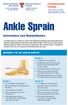 514-412-4400, ext. 23310 2300 Tupper street, C-831, Montreal (Quebec) H3H 1P3 Ankle Sprain Information and Rehabilitation An ankle sprain is a stretch or a tear of the ligaments (bands of tissue that hold
Rehabilitation Program for Achilles Tendon Rupture/Repair
 Rehabilitation Program for Achilles Tendon Rupture/Repair This protocol is designed to assist you with your rehabilitation after surgery and should be followed under the direction of a physiotherapist
Premier Orthopaedic Pathway. Physiotherapy after dynamic hip screw (DHS)
 Premier Orthopaedic Pathway Physiotherapy after dynamic hip screw (DHS) The surgery After a fractured hip a dynamic hip screw (DHS) is used to hold the bones in place while the fracture heals. It allows
ACL Reconstruction Physiotherapy advice for patients
 Oxford University Hospitals NHS Trust ACL Reconstruction Physiotherapy advice for patients Introduction This booklet is designed to provide you with advice and guidance on your rehabilitation after reconstruction
PHYSIOTHERAPY OF HIP AND KNEE AFTER SURGERY AND INJURY BY RACHEL GEVELL PHYSIOTHERAPIST
 PHYSIOTHERAPY OF HIP AND KNEE AFTER SURGERY AND INJURY BY RACHEL GEVELL PHYSIOTHERAPIST AIMS AND OBJECTIVES To demonstrate the use of physiotherapy assessment and treatment following: Hip Arthroplasty
ANTERIOR CRUCIATE LIGAMENT RECONSTRUCTION
 Daniel P. Duggan, D.O. The Sports Clinic 23961 Calle de la Magdalena, Suite 229 Laguna Hills, CA 92653 Phone: (949) 581-7001 Fax: (949) 581-8410 http://orthodoc.aaos.org/danielduggando ANTERIOR CRUCIATE
UK HealthCare Sports Medicine Patient Education December 09
 Meniscus tear Description The meniscus is a C-shaped cartilage structure in the knee that sits on top of the lower leg bone (tibia). Each knee has two menisci, an inner and outer meniscus. The meniscus
Post Surgery Rehabilitation Program for Knee Arthroscopy
 Post Surgery Rehabilitation Program for Knee Arthroscopy This protocol is designed to assist you with your rehabilitation after surgery and should be followed under the direction of a physiotherapist May
Foot and Ankle Conditioning Program. Purpose of Program
 Prepared for: Prepared by: OrthoInfo Purpose of Program After an injury or surgery, an exercise conditioning program will help you return to daily activities and enjoy a more active, healthy lifestyle.
Patella Realignment Tibial Tuberosity Transfer with Lateral Release
 Patella Realignment Tibial Tuberosity Transfer with Lateral Release Alan M. Reznik, M.D. The Orthopaedic Group, LLC The knee is made of three bones, the kneecap (patella), the shin bone (tibia) and thigh
GALLAND/KIRBY ACL RECONSTRUCTION WITH MENISCUS REPAIR POST-SURGICAL REHABILITATION PROTOCOL
 GALLAND/KIRBY ACL RECONSTRUCTION WITH MENISCUS REPAIR POST-SURGICAL REHABILITATION PROTOCOL POST-OP DAYS 1 14 Dressing: POD 1: Debulk dressing, TED Hose in place POD 2: Change dressing, keep wound covered,
Physical and Occupational Therapy Exercises
 UW MEDICINE PATIENT EDUCATION Physical and Occupational Therapy Exercises For weight loss surgery patients This section of the Guide to Your Weight Loss Surgery explains exercises that are recommended
ACL Rehabilitation Protocol
 ACL Rehabilitation Protocol Mark Clatworthy, Orthopaedic Surgeon, Knee Specialist This guideline has been prepared to help guide you through your recovery following your anterior cruciate ligament reconstruction.
POSTOPERATIVE INSTRUCTION FOR ANTERIOR/POSTERIOR LUMBAR SPINE FUSION
 www.southerarizonaspine.com POSTOPERATIVE INSTRUCTION FOR ANTERIOR/POSTERIOR LUMBAR SPINE FUSION This handout will review the care you need to follow once you are home. If you have any questions or concerns,
UK HealthCare Sports Medicine Patient Education December 09
 LCL injury Description Lateral collateral knee ligament sprain is a sprain (stretch or tear) of one of the four major ligaments of the knee. The lateral collateral ligament (LCL) is a structure that helps
Above Knee Amputee Exercise Program
 Above Knee Amputee Exercise Program It is important that you take an active role in your rehabilitation. The following exercises must be done every day to prevent any complications. After an above the
Exercises for the Hip
 Exercises for the Hip Gluteal Sets: Lie on your back, tighten buttocks and hold for 3-5 seconds. Repeat 20 times. Supine Hip ER/IR: Lie on your back with legs straight. Gently rotate knees out and in limited
Information and exercises following dynamic hip screw
 Physiotherapy Department Information and exercises following dynamic hip screw Introduction A dynamic hip screw is performed where the neck of femur has been fractured and where there is a good chance
Passive Range of Motion Exercises
 Exercise and ALS The physical or occupational therapist will make recommendations for exercise based upon each patient s specific needs and abilities. Strengthening exercises are not generally recommended
ANTERIOR CRUCIATE LIGAMENT INJURY
 ANTERIOR CRUCIATE LIGAMENT INJURY WHAT IS THE ANTERIOR CRUCIATE LIGAMENT? The anterior cruciate ligament (ACL) is one of four major ligaments that stabilizes the knee joint. A ligament is a tough band
INTRODUCTION TO POSITIONING. MODULE 3: Positioning and Carrying
 MODULE 3: Positioning and Carrying Blankets, pillows and towels, sandbags, carpet on the floor, a doll with floppy limbs that can be positioned i.e. not a hard plastic doll, display materials. Icebreaker
Ira K. Evans, M.D. Sports Medicine North Orthopedic Specialty Center One Orthopedics Drive Peabody, MA 01960. www.sportsmednorth.
 ACL Reconstruction Rehabilitation Protocol Ira K. Evans, M.D. Sports Medicine North Orthopedic Specialty Center One Orthopedics Drive Peabody, MA 01960 [email protected] Tel: (978) 818-6350 Fax: (978)
ANTERIOR HIP REPLACEMENT WWW.ORTHOWISCONSIN.COM
 ANTERIOR HIP REPLACEMENT WWW.ORTHOWISCONSIN.COM The Orthopaedic Surgery Center Welcome Thank you for choosing The Orthopaedic Surgery Center for your medical and surgical needs. It is our goal and privilege
KNEE ARTHROSCOPY. Dr C.S. Waller. Orthopaedic Surgeon
 KNEE ARTHROSCOPY Dr C.S. Waller Orthopaedic Surgeon Specializing in surgery of the hip and knee 83826199 What is Arthroscopy? Arthroscopy involves the inspection of the inside of the knee joint with a
Low Back Pain: Exercises
 Low Back Pain: Exercises Your Kaiser Permanente Care Instructions Here are some examples of typical rehabilitation exercises for your condition. Start each exercise slowly. Ease off the exercise if you
ACL Reconstruction Rehabilitation
 ACL Reconstruction Rehabilitation The following exercises are commonly used for rehabilitation following ACL reconstruction surgery. However, each knee surgery is unique and each person s condition is
Rehabilitation Programme following Hip Arthroscopy
 Rehabilitation Programme following Hip Arthroscopy Updated May 2010 Hip Arthroscopy Patient information and rehabilitation programme: The Hip Joint The hip is a ball-and-socket joint and is the largest
Rehabilitation After Your Total Knee Replacement
 1809 E. 13 th Street Suite 200 Tulsa, OK 74104-4243 (918) 582-6800 www.toctulsa.com Rehabilitation After Your Total Knee Replacement If your knee is severely damaged by arthritis or injury, it may be hard
Physical & Occupational Therapy
 In this section you will find our recommendations for exercises and everyday activities around your home. We hope that by following our guidelines your healing process will go faster and there will be
Rehabilitation After Arthroscopic Bankart Repair And Anterior Stabilization Procedures Phase 0: 0 to 2 weeks after Surgery
 Rehabilitation After Arthroscopic Bankart Repair And Anterior Stabilization Procedures Phase 0: 0 to 2 weeks after Surgery POSTOPERATIVE INSTRUCTIONS Brett Sanders, MD Center For Sports Medicine and Orthopaedic
Physical Therapy after Hip Arthroscopy Therapy Phases 1 and 2
 Physical Therapy after Hip Arthroscopy Therapy Phases 1 and 2 patienteducation.osumc.edu Table of Contents Physical Therapy after Hip Surgery... 3 OSU Sports Medicine Locations... 4 Hip Therapy Goals...
Physical Capability Strength Test: One Component of the Selection Process
 Physical Capability Strength Test: One Component of the Selection Process One aspect of the Power Systems Institute selection process is to successfully complete and achieve a passing score on a physical
Steps to Success: A Guide to Knee Rehabilitation
 Steps to Success: A Guide to Knee Rehabilitation Indications Carticel (autologous cultured chondrocytes) is indicated for the repair of symptomatic, cartilaginous defects of the femoral condyle (medial,
Knee sprains. What is a knee strain? How do knee strains occur? what you ll find in this brochure
 what you ll find in this brochure What is a knee strain? How do knee strains occur? What you should do if a knee strain occurs. What rehabilitation you should do. Example of a return to play strategy.
How To Stretch Your Body
 Exercise Module A New Leaf Choices for Healthy Living University of North Carolina at Chapel Hill 2007 Center for Health Promotion and Disease Prevention Physical Activity Exercises for Keeping Active
Lower Body Strength/Balance Exercises
 Compliments of (Medical Group Name & Phone # to be inserted here) Lower Body Strength/Balance Exercises Hip Flexion Strengthens thigh and hip muscles. Use ankle weights, if you are ready to. Stand to the
Exercise 1: Knee to Chest. Exercise 2: Pelvic Tilt. Exercise 3: Hip Rolling. Starting Position: Lie on your back on a table or firm surface.
 Exercise 1: Knee to Chest Starting Position: Lie on your back on a table or firm surface. Action: Clasp your hands behind the thigh and pull it towards your chest. Keep the opposite leg flat on the surface
Rehabilitation after shoulder dislocation
 Physiotherapy Department Rehabilitation after shoulder dislocation Information for patients This information leaflet gives you advice on rehabilitation after your shoulder dislocation. It is not a substitute
How To Recover From A Surgical Wound From A Cast
 Care of Your Wounds After Amputation Surgery by Paddy Rossbach, RN Depending on the reason for your amputation and the state of your limb at the time of surgery, definitive closure of the wound may take
Rehabilitation guidelines for patients undergoing knee arthroscopy
 Rehabilitation guidelines for patients undergoing knee arthroscopy At the RNOH, our emphasis is patient specific, which encourages recognition of those who may progress slower then others. We also want
Before Surgery You will likely be asked to see your family physician or an internal medicine doctor for a thorough medical evaluation.
 Anterior Hip Replacement - Before and After Surgery Your Hip Evaluation An orthopaedic surgeon specializes in problems affecting bones and joints. The surgeon will ask you many questions about your hip
Total Knee Replacement
 Total Knee Replacement The Knee Joint A total knee replacement, also called total knee arthroplasty, is a surgery performed to remove and replace your knee joint. The knee joint, comprised of the femur
The Insall Scott Kelly Center for Orthopaedics and Sports Medicine 210 East 64th Street, 4 th Floor, New York, NY 10065
 ANTERIOR CRUCIATE LIGAMENT RECONSTRUCTION POST-OPERATIVE REHABILITATION PROTOCOL 2003 AUTOGRAFT BONE-PATELLA TENDON-BONE and ALLOGRAFT PROTOCOL PHASE I-EARLY FUNCTIONAL (WEEKS 1-2) Goals: 1. Educate re:
Orthopaedic Surgery Center of Joint Preservation and Replacement After Total Knee Replacement Discharge Instructions
 Congratulations! You are going home after a successful total knee replacement. Although there is still much work to do, we have already achieved a lot. So, when you get home, take a deep breath and relax.
KNEE EXERCISE PROGRAM
 KNEE PROGRAM INTRODUCT ION Welcome to your knee exercise program. The exercises in the program are designed to improve your knee stability and strength of the muscles around your knee and hip. The strength
Brian P. McKeon MD Jason D. Rand, PA-C, PT Patient Information Sheet: Anterior Cruciate Ligament
 Brian P. McKeon MD Jason D. Rand, PA-C, PT Patient Information Sheet: Anterior Cruciate Ligament The anterior cruciate ligament or ACL is one of the major ligaments located in the knee joint. This ligament
Orthopaedic Surgery Center of Joint Preservation and Replacement After Total Hip Replacement Discharge Instructions
 Congratulations on your new hip! You are going home after a successful total hip replacement. Although there is still much work to do, we have already achieved a lot. So, when you get home, take a deep
Range of Motion Exercises
 Range of Motion Exercises Range of motion (ROM) exercises are done to preserve flexibility and mobility of the joints on which they are performed. These exercises reduce stiffness and will prevent or at
Understand nurse aide skills needed to promote skin integrity.
 Unit B Resident Care Skills Essential Standard NA5.00 Understand nurse aide s role in providing residents hygiene, grooming, and skin care. Indicator Understand nurse aide skills needed to promote skin
ACCELERATED REHABILITATION PROTOCOL FOR POST OPERATIVE POSTERIOR CRUCIATE LIGAMENT RECONSTRUCTION DR LEO PINCZEWSKI DR JUSTIN ROE
 ACCELERATED REHABILITATION PROTOCOL FOR POST OPERATIVE POSTERIOR CRUCIATE LIGAMENT RECONSTRUCTION DR LEO PINCZEWSKI DR JUSTIN ROE January 2005 Rationale of Accelerated Rehabilitation Rehabilitation after
ISOMETRIC EXERCISE HELPS REVERSE JOINT STIFFNESS, BUILDS MUSCLE, AND BOOSTS OVERALL FITNESS.
 ISOMETRIC EXERCISE HELPS REVERSE JOINT STIFFNESS, BUILDS MUSCLE, AND BOOSTS OVERALL FITNESS. By Askari A. Kazmi KazmisBioscienceLabs exercise helps reverse joint stiffness, builds muscle, and boosts overall
COMMON OVERUSE INJURIES ATTRIBUTED TO CYCLING, AND WAYS TO MINIMIZE THESE INJURIES
 COMMON OVERUSE INJURIES ATTRIBUTED TO CYCLING, AND WAYS TO MINIMIZE THESE INJURIES Listed are a few of the most common overuse injuries associated with cycling long distances. 1. Cervical and upper back
ACL Reconstruction: Patellar Tendon Graft/Hamstring Tendon Graft
 ACL Reconstruction: Patellar Tendon Graft/Hamstring Tendon Graft Patellar Tendon Graft/Hamstring Tendon Graft General Information: The intent of these guidelines is to provide the therapist with direction
A Patient s Guide to Post-Operative Physiotherapy. Following Anterior Cruciate Ligament Reconstruction of the Knee
 A Patient s Guide to Post-Operative Physiotherapy Following Anterior Cruciate Ligament Reconstruction of the Knee Introduction The anterior cruciate ligament (ACL) is one of the main supporting ligaments