
Physics 1104 Midterm 2 Review: Solutions
|
|
|
- Gervase Gordon
- 9 years ago
- Views:
Transcription
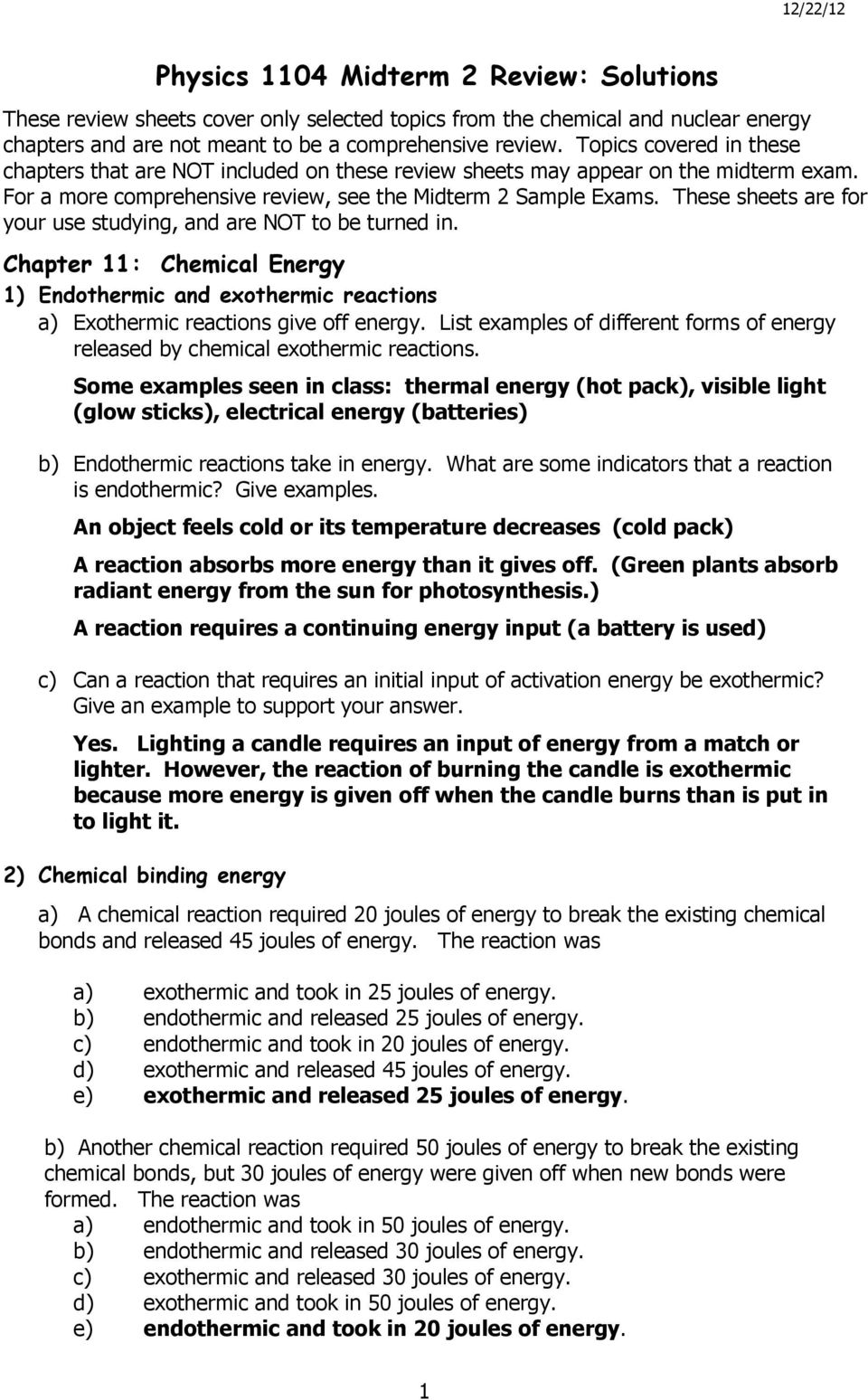
1 Physics 114 Midterm 2 Review: Solutions These review sheets cover only selected topics from the chemical and nuclear energy chapters and are not meant to be a comprehensive review. Topics covered in these chapters that are NOT included on these review sheets may appear on the midterm exam. For a more comprehensive review, see the Midterm 2 Sample Exams. These sheets are for your use studying, and are NOT to be turned in. Chapter 11: Chemical Energy 1) Endothermic and exothermic reactions a) Exothermic reactions give off energy. List examples of different forms of energy released by chemical exothermic reactions. Some examples seen in class: thermal energy (hot pack), visible light (glow sticks), electrical energy (batteries) b) Endothermic reactions take in energy. What are some indicators that a reaction is endothermic? Give examples. An object feels cold or its temperature decreases (cold pack) A reaction absorbs more energy than it gives off. (Green plants absorb radiant energy from the sun for photosynthesis.) A reaction requires a continuing energy input (a battery is used) c) Can a reaction that requires an initial input of activation energy be exothermic? Give an example to support your answer. Yes. Lighting a candle requires an input of energy from a match or lighter. However, the reaction of burning the candle is exothermic because more energy is given off when the candle burns than is put in to light it. 2) Chemical binding energy a) A chemical reaction required 2 joules of energy to break the existing chemical bonds and released 45 joules of energy. The reaction was a) exothermic and took in 25 joules of energy. b) endothermic and released 25 joules of energy. c) endothermic and took in 2 joules of energy. d) exothermic and released 45 joules of energy. e) exothermic and released 25 joules of energy. b) Another chemical reaction required 5 joules of energy to break the existing chemical bonds, but 3 joules of energy were given off when new bonds were formed. The reaction was a) endothermic and took in 5 joules of energy. b) endothermic and released 3 joules of energy. c) exothermic and released 3 joules of energy. d) exothermic and took in 5 joules of energy. e) endothermic and took in 2 joules of energy. 1
2 Chapter 15: Mass and Energy 3) Binding energy calculations When protons and neutrons bind into a nucleus, the mass of the nucleus is slightly less than the mass of the protons and neutrons that make up that nucleus. This difference is the mass that has been converted into energy: E = mc 2. This is the binding energy of the nucleus. 56 a) An iron nucleus ( 26 Fe ) has a mass of x 1 27 kg. Find the binding energy of this nucleus. 1. Find the mass of the protons that make up this nucleus. proton mass = M p = x 1 27 kg 26 ( x 1 27 kg) = x 1 27 kg Find the mass of the neutrons that make up this nucleus. neutron mass = M n = x 1 27 kg 3 ( x 1 27 kg) = x 1 27 kg 2. Find the total mass of the nucleons that make up the nucleus x 1 27 kg x 1 27 kg x 1 27 kg 3. Subtract the known mass, x 1 27 kg, from the total mass of the nucleons you calculated. This difference in mass is the amount of mass that was converted into energy when the nucleus formed x 1 27 kg x 1 27 kg.875 x 1 27 kg 4. Find the binding energy, using E = Mc 2. The variable M is the difference in mass calculated in step #3. E = (.875 x 1 27 kg) x (3 x 1 8 m/s) 2 E = (.875 x 1 27 kg) x (9 x 1 16 m 2 /s 2 ) = x 1 11 J 2

3 Chapter 16: Ionizing Radiation 4) Nuclear Reactions a) How can an atom of one element change into an atom of a different element? Protons can be added to or removed from atomic nuclei. A neutron in the nucleus can be changed into a proton, or a proton can be changed into a neutron. b) Write the equation for the nuclear reaction that occurs when a neutron emits an electron and becomes a proton. 1 1 n 1p 1e, where denotes an antineutrino c) Write the equation for the nuclear reaction that occurs when a proton emits an antielectron and becomes a neutron p n 1e 56 d) A nucleus of iron-56 ( 26 Fe ) has how many protons? 26 How many neutrons does this nucleus have? _56-26 = 3 How many nucleons does the nucleus have? 56 5) Graph of Stable Nuclei a) According to the graph, would a nucleus with 7 protons and 7 neutrons be stable? Why or why not? Unstable. Large stable nuclei have more neutrons than protons. b) Would a nucleus with 8 neutrons and 4 protons be stable? If not, what change could make this nucleus stable? Unstable. To make the nucleus stable, neutrons must decay into protons. c) Would a nucleus with 7 neutrons and 5 protons be stable? If not, what change could make this nucleus stable? Stable. (You can tell this nucleus is stable because it lies within the shaded region of the graph.) 3

4 6) Summary of ionizing radiation Fill in the table below, which summarizes the properties of the types of ionizing radiation. Radiation alpha () Particle emitted A = # of nucleons Z = # of protons Electric Charge 4 helium nuclei ( 2 He ) beta ( ) electron (e ) -1 beta ( ) antielectron (e + ) +1 gamma () high energy photon 7) Decay of unstable isotopes 4 a) Potassium-4 ( K ) is unstable. Why is this nucleus unstable? 19 It is a small nucleus with more neutrons (21) than protons (19). What change in nucleons could make this nucleus stable? Beta-minus decay would change one neutron into a proton. Write the nuclear reaction that shows this nucleus decaying to a stable nucleus K 2Ca e b) Thorium-232 ( 9 Th ) is unstable. Why is this nucleus unstable? It is a large nucleus with more than 83 protons. What change could make this nucleus more stable? Alpha decay would reduce the number of protons. Write an equation that describes this nuclear reaction Th Ra He 14 c) Oxygen-14 ( 8 O ) is unstable. Why is this nucleus unstable? It is a small nucleus with more protons (8) than neutrons (6). What change in nucleons could make this nucleus more stable? Beta-plus decay would change one proton into a neutron. Write the nuclear reaction that shows this nucleus decaying to a stable nucleus. 14 8O 7N 1e 14 4

5 Chapter 19: Beta Decay and Its Applications 8) Formation of nucleons a) Nucleons consist of quark trios. The electric charge of an up quark = + 2/3, and the charge of a down quark = 1/3. Which 3 quarks could combine to form a proton? 2 up quarks + 1 down quark give a total electric charge of 2 ( +2/3) 1/3 = +1 Which 3 quarks could combine to form a neutron? 1 up quark + 2 down quarks give a total electric charge of +2/3 + 2( 1/3) = b) The intrinsic spin of each quark = ½. The spins of two quarks of the same type must point in opposite directions. Draw a diagram showing the quarks that make up a proton and their spins. d u u OR d u u Draw a diagram showing the quarks that make up a neutron and their spins. OR u d d u d d 5

6 Ionizing Radiation Counts 12/22/12 9) Graph of radioactive decay of an unstable isotope Time (in seconds) a) How large is the background radiation illustrated by the graph? 1 counts/second b) What is the half life of this unstable isotope? 1) Pick a point on the graph: 1 cts/sec 2) Subtract the background counts: 1 cts/sec 1 cts/sec = 9 cts/sec 3) Divide the result by 2: 9 cts/sec /2 = 45 cts/sec 4) Add the background counts: 45 cts/sec + 1 cts/sec = 55 cts/sec 5) Find this point on the graph and read off the time elapsed. approximately 2.1 seconds 1) Carbon Dating The carbon-14 level in a sample of charcoal found at an archeological site is 1/8 of what it was when the wood that formed the charcoal was living. How old is this site? (The half life of carbon-14 is 5,73 years.) 1/8 = 1/2 3, so 3 half-lives have passed. (3 half lives) x (5,73 yrs/ half life) = 17,19 yrs 6

Main properties of atoms and nucleus
 Main properties of atoms and nucleus. Atom Structure.... Structure of Nuclei... 3. Definition of Isotopes... 4. Energy Characteristics of Nuclei... 5. Laws of Radioactive Nuclei Transformation... 3. Atom
Basics of Nuclear Physics and Fission
 Basics of Nuclear Physics and Fission A basic background in nuclear physics for those who want to start at the beginning. Some of the terms used in this factsheet can be found in IEER s on-line glossary.
Objectives 404 CHAPTER 9 RADIATION
 Objectives Explain the difference between isotopes of the same element. Describe the force that holds nucleons together. Explain the relationship between mass and energy according to Einstein s theory
............... [2] At the time of purchase of a Strontium-90 source, the activity is 3.7 10 6 Bq.
![............... [2] At the time of purchase of a Strontium-90 source, the activity is 3.7 10 6 Bq.](/thumbs/40/21837699.jpg "............... [2] At the time of purchase of a Strontium-90 source, the activity is 3.7 10 6 Bq.") 1 Strontium-90 decays with the emission of a β-particle to form Yttrium-90. The reaction is represented by the equation 90 38 The decay constant is 0.025 year 1. 90 39 0 1 Sr Y + e + 0.55 MeV. (a) Suggest,
1 Strontium-90 decays with the emission of a β-particle to form Yttrium-90. The reaction is represented by the equation 90 38 The decay constant is 0.025 year 1. 90 39 0 1 Sr Y + e + 0.55 MeV. (a) Suggest,
Unit 1 Practice Test. Matching
 Unit 1 Practice Test Matching Match each item with the correct statement below. a. proton d. electron b. nucleus e. neutron c. atom 1. the smallest particle of an element that retains the properties of
Lesson 43: Alpha, Beta, & Gamma Decay
 Lesson 43: Alpha, Beta, & Gamma Decay The late 18s and early 19s were a period of intense research into the new nuclear realm of physics. In 1896 Henri Becquerel found that a sample of uranium he was doing
Masses in Atomic Units
 Nuclear Composition - the forces binding protons and neutrons in the nucleus are much stronger (binding energy of MeV) than the forces binding electrons to the atom (binding energy of ev) - the constituents
Chemistry 1000 Lecture 2: Nuclear reactions and radiation. Marc R. Roussel
 Chemistry 1000 Lecture 2: Nuclear reactions and radiation Marc R. Roussel Nuclear reactions Ordinary chemical reactions do not involve the nuclei, so we can balance these reactions by making sure that
1. In the general symbol cleus, which of the three letters. 2. What is the mass number of an alpha particle?
 1. In the general symbol cleus, which of the three letters Z A X for a nu represents the atomic number? 2. What is the mass number of an alpha particle? 3. What is the mass number of a beta particle? 4.
Nuclear Physics. Nuclear Physics comprises the study of:
 Nuclear Physics Nuclear Physics comprises the study of: The general properties of nuclei The particles contained in the nucleus The interaction between these particles Radioactivity and nuclear reactions
Atomic Structure: Chapter Problems
 Atomic Structure: Chapter Problems Bohr Model Class Work 1. Describe the nuclear model of the atom. 2. Explain the problems with the nuclear model of the atom. 3. According to Niels Bohr, what does n stand
Solar Energy Production
 Solar Energy Production We re now ready to address the very important question: What makes the Sun shine? Why is this such an important topic in astronomy? As humans, we see in the visible part of the
Introduction to Nuclear Physics
 Introduction to Nuclear Physics 1. Atomic Structure and the Periodic Table According to the Bohr-Rutherford model of the atom, also called the solar system model, the atom consists of a central nucleus
Objectives. PAM1014 Introduction to Radiation Physics. Constituents of Atoms. Atoms. Atoms. Atoms. Basic Atomic Theory
 PAM1014 Introduction to Radiation Physics Basic Atomic Theory Objectives Introduce and Molecules The periodic Table Electronic Energy Levels Atomic excitation & de-excitation Ionisation Molecules Constituents
NOTES ON The Structure of the Atom
 NOTES ON The Structure of the Atom Chemistry is the study of matter and its properties. Those properties can be explained by examining the atoms that compose the matter. An atom is the smallest particle
3 Atomic Structure 15
 3 Atomic Structure 15 3.1 Atoms You need to be familiar with the terms in italics The diameter of the nucleus is approximately 10-15 m and an atom 10-10 m. All matter consists of atoms. An atom can be
PHYA5/1. General Certificate of Education Advanced Level Examination June 2011. Unit 5 Nuclear and Thermal Physics Section A
 Centre Number Surname Candidate Number For Examinerʼs Use Other Names Candidate Signature Examinerʼs Initials General Certificate of Education Advanced Level Examination June 2011 Question 1 2 Mark Physics
Radioactivity & Particles
 Radioactivity & Particles Introduction... 2 Atomic structure... 2 How are these particles arranged?... 2 Atomic notation... 4 Isotopes... 4 What is radioactivity?... 5 Types of Radiation: alpha, beta and
A n = 2 to n = 1. B n = 3 to n = 1. C n = 4 to n = 2. D n = 5 to n = 2
 North arolina Testing Program EO hemistry Sample Items Goal 4 1. onsider the spectrum for the hydrogen atom. In which situation will light be produced? 3. Which color of light would a hydrogen atom emit
Structure and Properties of Atoms
 PS-2.1 Compare the subatomic particles (protons, neutrons, electrons) of an atom with regard to mass, location, and charge, and explain how these particles affect the properties of an atom (including identity,
CHEMISTRY STANDARDS BASED RUBRIC ATOMIC STRUCTURE AND BONDING
 CHEMISTRY STANDARDS BASED RUBRIC ATOMIC STRUCTURE AND BONDING Essential Standard: STUDENTS WILL UNDERSTAND THAT THE PROPERTIES OF MATTER AND THEIR INTERACTIONS ARE A CONSEQUENCE OF THE STRUCTURE OF MATTER,
Particle Soup: Big Bang Nucleosynthesis
 Name: Partner(s): Lab #7 Particle Soup: Big Bang Nucleosynthesis Purpose The student explores how helium was made in the Big Bang. Introduction Very little helium is made in stars. Yet the universe is
22.1 Nuclear Reactions
 In the Middle Ages, individuals called alchemists spent a lot of time trying to make gold. Often, they fooled people into believing that they had made gold. Although alchemists never succeeded in making
Nuclear Physics and Radioactivity
 Nuclear Physics and Radioactivity 1. The number of electrons in an atom of atomic number Z and mass number A is 1) A 2) Z 3) A+Z 4) A-Z 2. The repulsive force between the positively charged protons does
For convenience, we may consider an atom in two parts: the nucleus and the electrons.
 Atomic structure A. Introduction: In 1808, an English scientist called John Dalton proposed an atomic theory based on experimental findings. (1) Elements are made of extremely small particles called atoms.
Basic Nuclear Concepts
 Section 7: In this section, we present a basic description of atomic nuclei, the stored energy contained within them, their occurrence and stability Basic Nuclear Concepts EARLY DISCOVERIES [see also Section
 Energy What is Energy? Energy is the ability to do work. Any object that has energy has the ability to create force. Energy is one of the fundamental building blocks of our universe. Energy appears in
PHYA5/1. General Certificate of Education Advanced Level Examination June 2012. Unit 5 Nuclear and Thermal Physics Section A
 Centre Number Surname Candidate Number For Examinerʼs Use Other Names Candidate Signature Examinerʼs Initials General Certificate of Education Advanced Level Examination June 2012 Question 1 2 Mark Physics
2 ATOMIC SYSTEMATICS AND NUCLEAR STRUCTURE
 2 ATOMIC SYSTEMATICS AND NUCLEAR STRUCTURE In this chapter the principles and systematics of atomic and nuclear physics are summarised briefly, in order to introduce the existence and characteristics of
Homework #10 (749508)
 Homework #10 (749508) Current Score: 0 out of 100 Description Homework on quantum physics and radioactivity Instructions Answer all the questions as best you can. 1. Hewitt10 32.E.001. [481697] 0/5 points
MASS DEFECT AND BINDING ENERGY
 MASS DEFECT AND BINDING ENERGY The separate laws of Conservation of Mass and Conservation of Energy are not applied strictly on the nuclear level. It is possible to convert between mass and energy. Instead
( + and - ) ( - and - ) ( + and + ) Atoms are mostly empty space. = the # of protons in the nucleus. = the # of protons in the nucleus
 Atoms are mostly empty space Atomic Structure Two regions of every atom: Nucleus - is made of protons and neutrons - is small and dense Electron cloud -is a region where you might find an electron -is
2 The Structure of Atoms
 CHAPTER 4 2 The Structure of Atoms SECTION Atoms KEY IDEAS As you read this section, keep these questions in mind: What do atoms of the same element have in common? What are isotopes? How is an element
Radiation and the Universe Higher Exam revision questions and answers
 Radiation and the Universe Higher Exam revision questions and answers Madeley High School Q.The names of three different processes are given in List A. Where these processes happen is given in List B.
The content is based on the National Science Teachers Association (NSTA) standards and is aligned with state standards.
 Literacy Advantage Physical Science Physical Science Literacy Advantage offers a tightly focused curriculum designed to address fundamental concepts such as the nature and structure of matter, the characteristics
Chapter 2: The Chemical Context of Life
 Chapter 2: The Chemical Context of Life Name Period This chapter covers the basics that you may have learned in your chemistry class. Whether your teacher goes over this chapter, or assigns it for you
SAM Teachers Guide Heat and Temperature
 SAM Teachers Guide Heat and Temperature Overview Students learn that temperature measures average kinetic energy, and heat is the transfer of energy from hot systems to cold systems. They consider what
Noble Gases. Outline Nobel Gas Elements Radon and Health Chemistry Homework
 Radon and Other Noble Gases The elements in the last column of the periodic table are all very stable, mono-atomic gases. Until 1962, they were called inert gases because they did not react with other
Instructors Guide: Atoms and Their Isotopes
 Instructors Guide: Atoms and Their Isotopes Standards Connections Connections to NSTA Standards for Science Teacher Preparation C.3.a.1 Fundamental structures of atoms and molecules. C.3.b.27 Applications
Radioactivity III: Measurement of Half Life.
 PHY 192 Half Life 1 Radioactivity III: Measurement of Half Life. Introduction This experiment will once again use the apparatus of the first experiment, this time to measure radiation intensity as a function
Chapter NP-5. Nuclear Physics. Nuclear Reactions TABLE OF CONTENTS INTRODUCTION OBJECTIVES 1.0 NUCLEAR REACTIONS 2.0 NEUTRON INTERACTIONS
 Chapter NP-5 Nuclear Physics Nuclear Reactions TABLE OF CONTENTS INTRODUCTION OBJECTIVES 1.0 2.0 NEUTRON INTERACTIONS 2.1 ELASTIC SCATTERING 2.2 INELASTIC SCATTERING 2.3 RADIATIVE CAPTURE 2.4 PARTICLE
Science Tutorial TEK 6.9C: Energy Forms & Conversions
 Name: Teacher: Pd. Date: Science Tutorial TEK 6.9C: Energy Forms & Conversions TEK 6.9C: Demonstrate energy transformations such as energy in a flashlight battery changes from chemical energy to electrical
Chapter 18: The Structure of the Atom
 Chapter 18: The Structure of the Atom 1. For most elements, an atom has A. no neutrons in the nucleus. B. more protons than electrons. C. less neutrons than electrons. D. just as many electrons as protons.
Chapter NP-1. Nuclear Physics. Atomic Nature of Matter TABLE OF CONTENTS INTRODUCTION OBJECTIVES 1.0 PROPERTIES OF SUBSTANCES
 Chapter NP-1 Nuclear Physics Atomic Nature of Matter TABLE OF CONTENTS INTRODUCTION OBJECTIVES 1.0 PROPERTIES OF SUBSTANCES 1.1 CHEMICAL AND PHYSICAL PROPERTIES 2.0 COMPOSITION OF ATOMS 2.1 ATOMIC STRUCTURE
Test Bank - Chapter 4 Multiple Choice
 Test Bank - Chapter 4 The questions in the test bank cover the concepts from the lessons in Chapter 4. Select questions from any of the categories that match the content you covered with students. The
SCH 3UI Unit 2 Outline Up to Quiz #1 Atomic Theory and the Periodic Table
 Lesson Topics Covered SCH 3UI Unit 2 Outline Up to Quiz #1 Atomic Theory and the Periodic Table 1 Note: History of Atomic Theory progression of understanding of composition of matter; ancient Greeks and
WHERE DID ALL THE ELEMENTS COME FROM??
 WHERE DID ALL THE ELEMENTS COME FROM?? In the very beginning, both space and time were created in the Big Bang. It happened 13.7 billion years ago. Afterwards, the universe was a very hot, expanding soup
History of the Atom & Atomic Theory
 Chapter 5 History of the Atom & Atomic Theory You re invited to a Thinking Inside the Box Conference Each group should nominate a: o Leader o Writer o Presenter You have 5 minutes to come up with observations
The Structure of the Atom
 The Structure of the Atom Copyright Glencoe/McGraw-Hill, a division of the McGraw-Hill Companies, Inc. Section 4. Early Ideas About Matter pages 02 05 Section 4. Assessment page 05. Contrast the methods
Indiana's Academic Standards 2010 ICP Indiana's Academic Standards 2016 ICP. map) that describe the relationship acceleration, velocity and distance.
 .1.1 Measure the motion of objects to understand.1.1 Develop graphical, the relationships among distance, velocity and mathematical, and pictorial acceleration. Develop deeper understanding through representations
CHEM 1411 Chapter 5 Homework Answers
 1 CHEM 1411 Chapter 5 Homework Answers 1. Which statement regarding the gold foil experiment is false? (a) It was performed by Rutherford and his research group early in the 20 th century. (b) Most of
Chemical Formulas, Equations, and Reactions Test Pre-AP Write all answers on your answer document.
 Name: Period: Chemical Formulas, Equations, and Reactions Test Pre-AP Write all answers on your answer document. 1. Which of the following is a NOT a physical property of hydrogen? A. It is gas C. It is
Chem 1A Exam 2 Review Problems
 Chem 1A Exam 2 Review Problems 1. At 0.967 atm, the height of mercury in a barometer is 0.735 m. If the mercury were replaced with water, what height of water (in meters) would be supported at this pressure?
Chapter 7. Electron Structure of the Atom. Chapter 7 Topics
 Chapter 7 Electron Structure of the Atom Copyright The McGraw-Hill Companies, Inc. Permission required for reproduction or display. 1 Chapter 7 Topics 1. Electromagnetic radiation 2. The Bohr model of
Chapter 5 TEST: The Periodic Table name
 Chapter 5 TEST: The Periodic Table name HPS # date: Multiple Choice Identify the choice that best completes the statement or answers the question. 1. The order of elements in the periodic table is based
List the 3 main types of subatomic particles and indicate the mass and electrical charge of each.
 Basic Chemistry Why do we study chemistry in a biology course? All living organisms are composed of chemicals. To understand life, we must understand the structure, function, and properties of the chemicals
Unit 3 Study Guide: Electron Configuration & The Periodic Table
 Name: Teacher s Name: Class: Block: Date: Unit 3 Study Guide: Electron Configuration & The Periodic Table 1. For each of the following elements, state whether the element is radioactive, synthetic or both.
Electrons In Atoms Mr. O Brien (SFHS) Chapter 5 Standard 1D
 Electrons In Atoms Mr. O Brien (SFHS) Chapter 5 Standard 1D Electrons in Atoms (std.1d) What are Bohr Models? planetary model in which the negatively-charged electrons orbit a small, positively-charged
STATE UNIVERSITY OF NEW YORK COLLEGE OF TECHNOLOGY CANTON, NEW YORK COURSE OUTLINE CHEM 150 - COLLEGE CHEMISTRY I
 STATE UNIVERSITY OF NEW YORK COLLEGE OF TECHNOLOGY CANTON, NEW YORK COURSE OUTLINE CHEM 150 - COLLEGE CHEMISTRY I PREPARED BY: NICOLE HELDT SCHOOL OF SCIENCE, HEALTH, AND PROFESSIONAL STUDIES SCIENCE DEPARTMENT
Nuclear ZPE Tapping. Horace Heffner May 2007
 ENERGY FROM UNCERTAINTY The uncertainty of momentum for a particle constrained by distance Δx is given, according to Heisenberg, by: Δmv = h/(2 π Δx) but since KE = (1/2) m v 2 = (1/(2 m) ) (Δmv) 2 ΔKE
Nuclear Science Merit Badge Workbook
 Merit Badge Workbook This workbook can help you but you still need to read the merit badge pamphlet. The work space provided for each requirement should be used by the Scout to make notes for discussing
Review for Test 3. Polarized light. Action of a Polarizer. Polarized light. Light Intensity after a Polarizer. Review for Test 3.
 Review for Test 3 Polarized light No equation provided! Polarized light In linearly polarized light, the electric field vectors all lie in one single direction. Action of a Polarizer Transmission axis
Atomic Calculations. 2.1 Composition of the Atom. number of protons + number of neutrons = mass number
 2.1 Composition of the Atom Atomic Calculations number of protons + number of neutrons = mass number number of neutrons = mass number - number of protons number of protons = number of electrons IF positive
AZ State Standards. Concept 3: Conservation of Energy and Increase in Disorder Understand ways that energy is conserved, stored, and transferred.
 Forms of Energy AZ State Standards Concept 3: Conservation of Energy and Increase in Disorder Understand ways that energy is conserved, stored, and transferred. PO 1. Describe the following ways in which
Atomic and Nuclear Physics Laboratory (Physics 4780)
 Gamma Ray Spectroscopy Week of September 27, 2010 Atomic and Nuclear Physics Laboratory (Physics 4780) The University of Toledo Instructor: Randy Ellingson Gamma Ray Production: Co 60 60 60 27Co28Ni *
Chapter 7: Chemical Energy
 Chapter 7: Chemical Energy Goals of Period 7 Section 7.1: To describe atoms, chemical elements and compounds Section 7.2: To discuss the electromagnetic force and physical changes Section 7.3: To illustrate
Chemical Reactions Practice Test
 Chemical Reactions Practice Test Chapter 2 Name Date Hour _ Multiple Choice Identify the choice that best completes the statement or answers the question. 1. The only sure evidence for a chemical reaction
Chapter Five: Atomic Theory and Structure
 Chapter Five: Atomic Theory and Structure Evolution of Atomic Theory The ancient Greek scientist Democritus is often credited with developing the idea of the atom Democritus proposed that matter was, on
Preview of Period 2: Forms of Energy
 Preview of Period 2: Forms of Energy 2.1 Forms of Energy How are forms of energy defined? 2.2 Energy Conversions What happens when energy is converted from one form into another form? 2.3 Efficiency of
Semester Exam Practice Questions
 Name: Class: _ Date: _ Semester Exam Practice Questions Multiple Choice Identify the choice that best completes the statement or answers the question. 1. Which of the following is not a material? a. air
Chemistry. The student will be able to identify and apply basic safety procedures and identify basic equipment.
 Chemistry UNIT I: Introduction to Chemistry The student will be able to describe what chemistry is and its scope. a. Define chemistry. b. Explain that chemistry overlaps many other areas of science. The
Atomic Theory Part 1
 Atomic Theory Part 1 Reading: Ch 2 sections 1 6, 8 Homework: Chapter 2: 39, 47, 43, 49, 51*, 53, 55, 57, 71, 73, 77, 99, 103 (optional) * = important homework question The Atomic Theory (John Dalton, 1803)
KE A = PE MAX 1/2M v 2 = k q1 q2 /R
 CHAPTER 13 NUCLEAR STRUCTURE NUCLEAR FORCE The nucleus is help firmly together by the nuclear or strong force, We can estimate the nuclear force by observing that protons residing about 1fm = 10-15m apart
6.7: Explaining the Periodic Table pg. 234
 Unit C: Atoms, elements, and Compounds 6.7: Explaining the Periodic Table pg. 234 Key Concepts: 3. Elements are organized according to their atomic number and electron arrangement on the periodic table.
Multiple Choice Identify the choice that best completes the statement or answers the question.
 Test 2 f14 Multiple Choice Identify the choice that best completes the statement or answers the question. 1. Carbon cycles through the Earth system. During photosynthesis, carbon is a. released from wood
The Hydrogen Atom Is a Magnet. http://www.seed.slb.com/en/scictr/watch/gashydrates/detecting.htm
 The Hydrogen Atom Is a Magnet Nuclear Magnetic Resonance Spectroscopy (NMR) Proton NMR A hydrogen nucleus can be viewed as a proton, which can be viewed as a spinning charge. As with any spinning charge,
Chapter 2: Forms of Energy
 Chapter 2: Forms of Energy Goals of Period 2 Section 2.1: To describe the forms of energy Section 2.2: To illustrate conversions from one form of energy to another Section 2.3: To define the efficiency
Chemical Building Blocks: Chapter 3: Elements and Periodic Table
 Name: Class: Date: Chemical Building Blocks: Chapter 3: Elements and Periodic Table Study Guide Multiple Choice Identify the letter of the choice that best completes the statement or answers the question.
Energy and Energy Transformations Test Review
 Energy and Energy Transformations Test Review Completion: 1. Mass 13. Kinetic 2. Four 14. thermal 3. Kinetic 15. Thermal energy (heat) 4. Electromagnetic/Radiant 16. Thermal energy (heat) 5. Thermal 17.
Nuclear Fusion and Radiation
 Nuclear Fusion and Radiation Lecture 8 (Meetings 19, 20, 21 & 22) Eugenio Schuster [email protected] Mechanical Engineering and Mechanics Lehigh University Nuclear Fusion and Radiation p. 1/66 The discovery
Light as a Wave. The Nature of Light. EM Radiation Spectrum. EM Radiation Spectrum. Electromagnetic Radiation
 The Nature of Light Light and other forms of radiation carry information to us from distance astronomical objects Visible light is a subset of a huge spectrum of electromagnetic radiation Maxwell pioneered
Environmental Health and Safety Radiation Safety. Module 1. Radiation Safety Fundamentals
 Environmental Health and Safety Radiation Safety Module 1 Radiation Safety Fundamentals Atomic Structure Atoms are composed of a variety of subatomic particles. The three of interest to Health Physics
MCQ - ENERGY and CLIMATE
 1 MCQ - ENERGY and CLIMATE 1. The volume of a given mass of water at a temperature of T 1 is V 1. The volume increases to V 2 at temperature T 2. The coefficient of volume expansion of water may be calculated
Matter. Atomic weight, Molecular weight and Mole
 Matter Atomic weight, Molecular weight and Mole Atomic Mass Unit Chemists of the nineteenth century realized that, in order to measure the mass of an atomic particle, it was useless to use the standard
CST Practice Test. Multiple Choice Questions
 CST Practice Test Young NAME CST Practice Test Multiple Choice Questions 1) At 1 atm and 298 K, which of the K a values listed below represents the strongest acid? 5) Which electron-dot symbol represents
GCSE COMBINED SCIENCE: TRILOGY
 GCSE COMBINED SCIENCE: TRILOGY Higher Tier Paper 5: Physics 1H H Specimen 2018 Time allowed: 1 hour 15 minutes Materials For this paper you must have: a ruler a calculator the Physics Equation Sheet (enclosed).
Radiant Energy Definition
 Radiant Energy Definition: the energy of electromagnetic waves; this includes radio, microwave, infrared, visible, ultraviolet, x-ray, and gamma waves Solar panels Radiant Energy Examples of energy transformations:
Antoine Henri Becquerel was born in Paris on December 15, 1852
 Discovery Antoine Henri Becquerel was born in Paris on December 15, 1852 Summit Environmental Technologies, Inc. Analytical Laboratories 3310 Win Street Cuyahoga Falls, Ohio 44223 Fax: 1-330-253-4489 Call
2. John Dalton did his research work in which of the following countries? a. France b. Greece c. Russia d. England
 CHAPTER 3 1. Which combination of individual and contribution is not correct? a. Antoine Lavoisier - clarified confusion over cause of burning b. John Dalton - proposed atomic theory c. Marie Curie - discovered
The Models of the Atom
 The Models of the Atom All life, whether in the form of trees, whales, mushrooms, bacteria or amoebas, consists of cells. Similarly, all matter, whether in the form of aspirin, gold, vitamins, air or minerals,
Nuclear fusion in stars. Collapse of primordial density fluctuations into galaxies and stars, nucleosynthesis in stars
 Nuclear fusion in stars Collapse of primordial density fluctuations into galaxies and stars, nucleosynthesis in stars The origin of structure in the Universe Until the time of formation of protogalaxies,
The rate of change of velocity with respect to time. The average rate of change of distance/displacement with respect to time.
 H2 PHYSICS DEFINITIONS LIST Scalar Vector Term Displacement, s Speed Velocity, v Acceleration, a Average speed/velocity Instantaneous Velocity Newton s First Law Newton s Second Law Newton s Third Law
SUPPLEMENTARY TOPIC 3 ENERGY AND CHEMICAL REACTIONS
 SUPPLEMENTARY TOPIC 3 ENERGY AND CHEMICAL REACTIONS Rearranging atoms. In a chemical reaction, bonds between atoms in one or more molecules (reactants) break and new bonds are formed with other atoms to
Chapter 17: Radioactivity and Nuclear Chemistry
 Chapter 7: Radioactivity and Nuclear Chemistry Problems: -20, 24-30, 32-46, 49-70, 74-88, 99-0 7.2 THE DISCOVERY OF RADIOACTIVITY In 896, a French physicist named Henri Becquerel discovered that uranium-containing
TIME OF COMPLETION NAME SOLUTION DEPARTMENT OF NATURAL SCIENCES. PHYS 3650, Exam 2 Section 1 Version 1 October 31, 2005 Total Weight: 100 points
 TIME OF COMPLETION NAME SOLUTION DEPARTMENT OF NATURAL SCIENCES PHYS 3650, Exam 2 Section 1 Version 1 October 31, 2005 Total Weight: 100 points 1. Check your examination for completeness prior to starting.
Electrons in Atoms & Periodic Table Chapter 13 & 14 Assignment & Problem Set
 Electrons in Atoms & Periodic Table Name Warm-Ups (Show your work for credit) Date 1. Date 2. Date 3. Date 4. Date 5. Date 6. Date 7. Date 8. Electrons in Atoms & Periodic Table 2 Study Guide: Things You
Time allowed: 1 hour 45 minutes
 GCSE PHYSICS Foundation Tier Paper 1F F Specimen 2018 Time allowed: 1 hour 45 minutes Materials For this paper you must have: a ruler a calculator the Physics Equation Sheet (enclosed). Instructions Answer
PS-6.2 Explain the factors that determine potential and kinetic energy and the transformation of one to the other.
 PS-6.1 Explain how the law of conservation of energy applies to the transformation of various forms of energy (including mechanical energy, electrical energy, chemical energy, light energy, sound energy,