
This extract from the CATIA V5 Introduction User Guide
|
|
|
- Evelyn Davis
- 9 years ago
- Views:
Transcription
1 CCARDS Sample - Nov 04 CCARD Ltd is an independent consultancy offering CAE hardware and software installation and customisation services, specialising in CATIA and I-DEAS systems. CCARD also specialises in Electronic Data Interchange (EDI), and supplies, installs and supports OFTP/Odette based ISDN or TCP/IP solutions. In order to continue to provide its customers with the best products and support, CCARD has negotiated exclusive access to a CATIA V5 Introduction User Guide, of unique quality and effectiveness, which is ideal as a cost-effective self-study tutorial. CCARD can be contacted either by telephone on by ing [email protected] or via our website at This extract from the CATIA V5 Introduction User Guide Includes the contents and index pages, together with the full initial worked example, overviews and summary of all examples, of the complete 134 page spirally bound manual. Provides an illustration of the style and content of this and other CATIA V5 User Guides compiled and published by The CAD/CAM Partnership - the leading independent CATIA specialist in the UK. Assumes the availability of a CATIA V5 workstation with a configuration license (such as MD2 ) and also familiarity with the CATIA V5 interface, such as use of the mouse buttons and command icons, in order to follow the initial worked example provided as an isolated sample. CATIA is a registered trademark of Dassault Systèmes The CAD/CAM Partnership, 2004 i

2 Table of Contents Overview Page Welcome to i Table of Contents... ii 1. Getting Started Starting CATIA for the first time The Mouse Buttons Setting Useful Options File Locations The Workbench Toolbars Help with the Command Icons Overview Example Engine Mechanism Conrod (Part) Block (Part) Piston (Part) Crankshaft (Part) Engine Assembly (Product) Drawing Generation Simple Modifications Questions and Answers Sketcher Profiles Plate Profile Questions and Answers Handbrake Profiles ii The CAD/CAM Partnership, 2004

3 Table of Contents 4. Prismatic Parts Page 1. Planar Support Bracket Suspension Bracket Handbrake Plate Questions and Answers Patterns of Objects Sports Car Wheel Draughting and Plotting Draughting Basics Sheet Frame and Title Block Creating a Section View Draw Details Questions and Answers Plotting External References Overview Designing in Context Inserting Parts in a Part Duplicating Parts within a Product Modifying a Referenced Part Questions and Answers The CAD/CAM Partnership, 2004 iii

4 Table of Contents 7. Miscellaneous Page 1. On-line Help Exchanging V5 Documents Using a V4 Model as a V5 Component Migrating Multiple V4 Models Messages Explained Questions and Answers Just Testing The CATIA V5 Advanced User Guide The CATIA V5 Digital Mockup User Guide The CATIA V5 Administration User Guide Summary 1. Basic Points to Remember A Review of Examples Modified Options Settings Index... Index-1 iv The CAD/CAM Partnership, 2004

5 2. Overview Example Engine Mechanism CCARDS Sample - Nov 04 Engine Block Conrod Piston New Crankshaft Assembly Objective: To introduce the Part Design, Assembly Design and Drafting modules. To model 3 simplified engine components, plus part of the engine block, so that the components can then be intelligently assembled, and animated. A drawing will be produced with views of the Crankshaft and the assembly, and the Crankshaft component subsequently modified to illustrate how the assembly model and the drawing reflect these changes. Approach: A new Part document (file) will be created for each component. The defining profiles will be created and dimensionally/geometrically constrained, typically in the yz 2D plane. The assembly is a Product document which will reference the Part documents. Comments: In this example, each component is created independently, i.e. no reference is made to geometry in the other Part documents. Changes to one Part document will therefore not affect the other Parts. (It is possible for changes in one Part to automatically be reflected in all related Parts). The CAD/CAM Partnership,

6 Overview Example 1. Conrod (Part) 1. Activate Part Design 2. Choose working 2D plane 3. Create top hole Part1 xy plane yz plane zx plane PartBody V H V H 1. Start CATIA If the Welcome to CATIA V5 window is displayed, then... Use MB1 to activate Do not show this dialog at start up Select Close to remove this window Close the proposed Assembly Design workbench window... Select File + Close to close the Product1 window Select Start + Part Design to activate the Part Design workbench A specification tree displays: Part1 - the default new Part document name 3 datum planes - which are also displayed as geometry An empty Body in which Part geometry can be created 2. Select Sketcher: and then the yz reference plane (or vice-versa) Note: The yz reference plane can be selected as geometry, or via the specification tree The Sketch plane, by default, rotates to display normal to the screen, as shown 3. Double-click (so as to use more than once) Circle: First create the top hole for the gudgeon pin... Select the origin point (a temporary blue circular icon must be displayed) as the centre Indicate (using MB1) any point at the approximate location of the circle circumference 2-2 The CAD/CAM Partnership, 2001

7 Chapter 2 1. Conrod (Part) (continued) 4. Create other circles 5. Fillet left then right 6. Correct the radius values V V V H H H R R R 140 R Similarly, create a concentric circle by first selecting the existing centre point (Hold MB2 and click MB1, and then move the mouse vertically to zoom out as required) Create a third circle by first selecting a centre point vertically below the origin (a temporary blue vertical line must be displayed below the V axis) Note: The Coincidence of this lower centre point with an extension of the vertical axis is automatically created as a geometrical constraint (the green circle symbol), but only if the Geometrical Constraints icon: is active (the default setting) Create another concentric circle by first selecting the second centre point 5. Double-click Corner: Select each outer circle and indicate a point to approximately define the left fillet curve Similarly define the right-hand fillet curve Note: Should the radii Constraint values be displayed with a ± tolerance symbol, then select the Tools + Options... + Parameters and Measure Parameters Tolerance tab, and deactivate Default tolerance (for future Constraints) 6. Double-click a fillet curve dimension value Enter the required value (140mm) in the Constraint Definition window Similarly correct the other fillet curve dimension value NOTE: As geometry is fully constrained it turns from white to green. White geometry therefore indicates that additional geometrical or dimensional constraints are required to completely specify the profile... The CAD/CAM Partnership,

8 Overview Example 1. Conrod (Part) (continued) 7. Constrain the profile 8. Correct the dimensions 9. Create the solid Pad V R V R 25 D 25 D H H R 140 R 140 R 140 R D D 50 R R Double-click Constraint: Select each circular curve and indicate to create radius and hole diameter dimensions Note: These dimensional constraint values will be arbitrary, for example as shown Select the horizontal axis and the lower centre point to create the vertical dimension 8. Double-click each dimension value, and enter the required value (as shown) (Top: radius 25mm and Ø25mm, vertical offset 150mm, lower: radius 40mm and Ø50mm) Select Exit: to leave the Sketcher and to enable 3D geometry creation Select Pad: and in the Pad Definition window... Specify a Length of 16mm (in the positive X direction) To define the material of the part... Select the Part and then select Apply Material: (or vice versa) Select Metal + Steel from the material Library window and select OK Use MB3 to select Select Properties Part1 from the specification tree Select the Mass tab to review the Mass Properties Select the Product tab, and change the Part Number to Conrod Select OK 10. Select File + Save As... to display the Save As window Save the Part as Conrod in the default location (e.g. E:\Catdata\My_work) Select File + Close to close the Conrod document 2-4 The CAD/CAM Partnership, 2001

9 Chapter 2 2. Block (Part) 1. Create block profile 2. Create cylinder shaft 3. Create crankshaft hole V 15 H 40 Part of an engine block will be required to support the intelligent assembly of the engine parts Select Start + Sketcher and select the yz reference plane Note: Starting the Sketcher workbench creates a new Part document Select Profile: and create orthogonal line segments, ending at the first point Double-click Constraint: to create dimensional constraints for the profile Double-click each dimension value, and enter the correct/required value (as shown) 2. Select Exit: and then select Pad: Create a prism with a ( -X direction) depth of 70mm For a new Sketch (you can select the command icon and then a plane, or vice-versa)... Select Sketcher: and then the xy plane (or an existing face parallel to the xy plane) Select Circle: to define a Ø100mm circle centred at the origin (and then Exit: ) Select Pocket: with Limit Type set as Up to last (Reverse Direction if required) 3. Create a new Sketch containing a Ø50mm circle centred at the origin on the zx plane Use Pocket: with Limit Type set as Up to last (Reverse Direction if required) 4. Optionally, to define the material of the part... Select the Part and then select Apply Material: Select Metal + Aluminium from the Library window (or vice-versa) Use MB3 to select Part1 via the specification tree, and select Properties Change the Product Part Number to Block Select OK Select File + Save As... to save the Part as Block Select File + Close to close the Block document The CAD/CAM Partnership,

10 Overview Example 3. Piston (Part) 1. dimension cylinder profile with axis 2. Create 360º solid of revolution 50 V 50 H Select New: and Part and then select OK (This is yet another way of starting a new Part) Select the yz reference plane and then Sketcher: (or vice-versa) Select Profile: and create line segments with endpoints inline with the vertical axis Note: Select Axis: To end the definition of a Profile (which does not finish at its start point), reselect (to deactivate) the Profile: command icon. (Press MB1 to deselect the line) Double-click Constraint: and define a line joining the endpoints and create the 3 distance dimensions from the axis Double-click each dimension value, and enter the required value (as shown) (Vertical offsets 50mm and 35mm, and horizontal offset 50mm) Note: The Axis line is not fixed (it could be dragged away from the vertical axis) 2. To create a solid of revolution from the Sketch profile... Select (Exit: and) Shaft: Note: If the Sketch did not contain an Axis type line, then it would be necessary to select an axis of revolution, for example the vertical (V) axis. Verify that the proposed First angle limit is 360º, and select OK 2-6 The CAD/CAM Partnership, 2001

11 Chapter 2 3. Piston (Part) (continued) 3. Define shell thickness operation 4. Create gudgeon pin hole and 2mm chamfer 3. Select Shell: Select the bottom face (for removal) Enter an Inside thickness of 10mm 4. Select the yz reference plane and then Sketcher: (or vice-versa) Select Circle Using Coordinates: Define a 12.5mm radius circle at coordinates 0,0 Note: This circle centre point is fixed - but independent of the origin point. The location of the circle centre can be moved by modifying the offset dimensions. Although the circle has been created efficiently, the circle is unlikely to be moved from the origin in this example, and therefore would have been more appropriately created as a Circle: using the origin as its centre point. Select Exit: and then select Pocket: Select More>> to set both Limit Types to Up to last Select OK Select Chamfer: Define a 2mm chamfer at 45º and the top face or edge (or vice versa) 5. Use MB3 and Properties to change the Product Part Number to Piston Select File + Save As... to save the Part as Piston Select File + Close to close the Piston document The CAD/CAM Partnership,

12 Overview Example 4. Crankshaft (Part) 1. Define the 35mm oblong profile 2. Create Pad and define an R25mm circle V 35 V H H 35 R Select Start + Sketcher and then select the yz reference plane (This is the most efficient way to start a Sketch for a new Part) NOTE: Rather than literally sketch geometry, and then return to constrain and correct the arbitrary dimension values, it is possible to enter specific values via the Sketch tools toolbar menu (which is the one including the Grid icon ). (To ensure that all of the numerical value entry fields of this menu are visible, then it should be dragged into the main window to create a separate window) Change the type of profile (i.e. from or etc.) to Oblong: First select the origin point Enter a length L: of 35mm and then select a point horizontally to the right Enter a radius R: of 35mm 2. Select Exit: and then Pad: Enter a Length (i.e. a thickness, in the -X direction) of 16mm Select Sketcher: and then the front face of the pad (or vice-versa) Select Circle: Select a centre point (anywhere!) and enter a radius R: of 25mm 2-8 The CAD/CAM Partnership, 2001

13 Chapter 2 4. Crankshaft (Part) (continued) 4. Create concentric R25 x 20mm cylinder 5. Create an R25 x 60mm cylinder 4. The circular profile can be defined to be always concentric with an edge of the Pad... With the circle still highlighted as the current element... Select Constraint: Select the semi-circular right-hand edge of the Pad Select the proposed dimension value, using MB3, to replace it with a Concentricity Select Exit:, select Pad:, and then enter a Length (thickness) of 20mm 5. NOTE: Whenever a working plane for a Sketch is defined, it may be rotated to be parallel to the screen so as to be viewed orthogonally. On leaving the Sketch, the previous (typically isometric) viewpoint will be reinstated. This automatic presentation of an orthogonal viewpoint does not help to clarify the location of the Sketch, and is therefore optional... Select Tools + Options... + Mechanical Design + Sketcher, and in the Sketcher tab... Deactivate Sketch Plane Position sketch plane parallel to screen Select OK to close the Options window (Normal View: and Isometric View: can obtain the same effect when required) Select Sketcher: and then the rear face of the 16mm pad (or vice-versa) Create a 25mm radius circle centred at the origin Select Exit:, select Pad:, and then enter a Length (thickness) of 60mm 6. Use MB3 and Properties to change the Product Part Number to Crank Select File + Save As... to save the Part as Crankshaft Select File + Close to close the Crankshaft document The CAD/CAM Partnership,

14 Overview Example 5. Engine Assembly (Product) 1. Assemble existing components 2. The display mode can be changed The origin/datum of each Part component is initially superimposed Select Start + Assembly Design to create a new Product (assembly) Document Select Product1 using MB3 and select Properties Select the Product tab and change the Part Number to Engine_assy To assemble the required components... Select Existing Component: (to be inserted into the current Engine_assy Product...) Note: Alternatively, Existing Component with Positioning: will additionally both place and constrain a component. However, the more flexible approach is to create the relationships between components later, particularly in this example, where the position/orientation of the components are interrelated... Ctrl-select the Piston, Crankshaft, Conrod and Block Part documents Select Open 2. Note that at any time the Display Mode can be changed... Select the current setting, for example, Shading with Edges: and... Select Shading (SHD): for shading without edges Similarly change the Display Mode to Shading with Edges and Hidden edges: Note: To obtain the Hidden Line Removal type display used to illustrate this manual: Select Customize View Parameters: for the Custom View Modes window Activate Dynamic hidden line removal and then select OK Select Shading with Edges:, or, Shading with Edges without Smooth Edges: Note: Customize View Parameters: also provides an option for another similar display, but with Half visible smooth edges, for a less prominent display of internal edges at tangential boundaries Caution: Engine_assy must remain as the current object in the Specification Tree, otherwise, if instead a Part is current, then the Constraints Toolbar will be dimmed/unavailable The CAD/CAM Partnership, 2001

15 Chapter 2 5. Engine Assembly (Product) (continued) 3. Fix Block and link Piston/Conrod 4. Move Piston/Conrod 5. Link Parts and rotate Shading with Edges Display mode: 3. Select Fix Component: and then the Block Part (or vice-versa) Note: By default the component will be fixed absolutely - as indicated by a lock symbol on the fix icon in the specification tree. (MB3 + Properties and the Constraint tab and deactivating Fix in space would instead define the Fix to be only relative to other referenced components) Select Coincidence Constraint: (the geometry may have to be rotated first...) Select the Piston hole (horizontal proposed axis) and the Conrod top hole (proposed axis) NOTE: The Piston (first selected Part) would have moved to share axis with the Conrod (second selected Part) if required unless the first Part had been previously fixed 4. Select Manipulation: (or, use the Compass and Shift to drag both components) Select Drag along Z axis and set With respect to constraints Select either the Conrod or Piston Part, and drag the pair vertically upwards 5. Select Coincidence Constraint: Select the Piston (proposed axis) and then the Block shaft (proposed axis) Note: The Crankshaft, Conrod and Piston must be rotated together through 90º clockwise before the Crankshaft can be linked to the Block... Select Contact Constraint: Select the Conrod (rear face) and then the Crankshaft (front face), or vice-versa Select Manipulation: Select Drag around Z axis and set With respect to constraints Select the Crankshaft and drag so as to rotate the 60mm cylinder towards the hole Note that this is very approximate so that part of the hole remains for selection! The CAD/CAM Partnership,

16 Overview Example 5. Engine Assembly (Product) (continued) 6. Define Crank rotation 7. Link Conrod/Crankshaft 8. Centre the Conrod Double-click Coincidence Constraint: To align the Crankshaft with the Block... Select the Crankshaft (60mm Cylinder) and then the Block (horizontal hole) 7. To connect the Conrod and Crankshaft... Select the Crankshaft (20mm Cylinder) and then the Conrod (lower hole) 8. The Conrod/Crankshaft are not correctly centred with respect to the Piston... Select Offset Constraint: Select the Conrod (face) and then the Block (outer face) Enter an Offset of 62mm 9. Select File + Save As... (or Save), or select the equivalent Save: command icon If a Save Management window is presented, then select Save As... for the Engine_assy A Save As window is always presented the first time a document is saved... Select OK to confirm that the Product document is to be saved as Engine_assy Optionally temporarily change the Display Mode to Shading with Material: Select Manipulation: Select Drag around any axis and activate With respect to constraints Select (the proposed axis of) the Crankshaft (60mm Cylinder) Select the Crankshaft and drag so as animate the piston mechanism Select File + Close to close (without saving) the Engine_assy window 2-12 The CAD/CAM Partnership, 2001

17 Chapter 2 6. Drawing Generation 1. New sheet with front view 2. Define plan view Top view Front view Front view 1. Open: the Crankshaft Part Select Start + Drafting (+ Empty sheet) and Modify... Verify that the Standard is ISO and set the Format to A2 ISO (594x420mm) Also verify that Orientation is Landscape and Scale of sheets is 1 (Select OK in the New Drawing window and OK in the Create New Drawing window) To determine the Projection Method, select Sheet.1 using MB3 + Properties Verify that the Create projection views using third angle standard option is current Select OK Deactivate the Sketcher grid: and Snap to point: options Select Window + Tile Horizontally to display both Crankshaft.CATPart and Drawing1 windows - (the currently active window always displays above the other window) Select Tools + Options... + Mechanical Design + Drafting and the Layout tab Deactivate View Creation Scaling factor (the display of the View Scale) Select the View tab Verify that the Generate axis and Generate center lines options are active Select OK Select Front View: and then the front face of the Crankshaft Optionally select the view frame (using MB1) and drag to a more appropriate location Select the proposed view geometry to generate the Front view 2. Select Projection View: (available in same the group of icons as Front View) Position the cursor above the Front View Select the proposed view to generate the Top view Note that the Front view is still the current view (with the red frame)... The CAD/CAM Partnership,

18 Overview Example 6. Drawing Generation (continued) 3. Define side view 4. Define isometric view 3. Select Projection View: Position the cursor to the right of the Front View Select the proposed view to generate the Right view 4. Note: An isometric view is created with the same orientation as the selected Part, i.e. a standard isometric is not necessarily created. If a standard isometric view is required, then the Part orientation must first be defined by selecting Isometric View: (from within the Part window/workbench) Select Isometric View: (from within the Drawing window/workbench) Select any face of the Crankshaft Part Optionally modify the default isometric orientation via the compass Select the proposed view (or the centre of the compass) to generate the Isometric view Select the Drawing window maximise icon: to display only the Drawing window Select and drag the Isometric view frame to relocate the Isometric view as required Select (using MB3) the frame of the Front View and select Within the View tab, activate the display of Dressup Hidden Lines Select OK (The circle representing the rear cylinder is displayed dashed) Properties Select Tools + Options... + Mechanical Design + Drafting and the General tab Deactivate View axis Display in the current view (... which may only become effective when you next change the current view) 2-14 The CAD/CAM Partnership, 2001

19 Chapter 2 6. Drawing Generation (continued) 5. Automatically generated dimensions 6. Redefine the dimensions in the front view 5. Select Generating Dimensions: The Generated Dimensions Analysis window displays the number of constraints found (e.g. 7), and how many dimensions were created (e.g. 6) from these constraints. Select OK 6. In the Top view: Select the 60mm dimension (value) and then drag the dimension line to the left Ctrl-select the 16 and 20mm dimensions Use MB3 to select Line-Up and select the 60mm dimension as the reference Verify that Offset to reference is 0 (in the Line Up window) and select OK In the Front view: Select and Delete the vertical 35mm dimension To be able to indicate the initial location of a dimension as it is created... Select Tools + Options... + Mechanical Design + Drafting and the Dimension tab Activate the Dimension following the mouse (ctrl toggles) and select OK Note that small symbols will indicate the geometry (line, arc or circle) being detected... Select Dimension: and select the left-hand semicircle Indicate a point to locate the radius dimension Change the Dimension Line format from to (via the Dimension Properties toolbar - displayed at the top of the screen) Select Dimension: to create the 35mm dimension between the 2 vertical centrelines Select and relocate both of the 25mm radius dimensions and their values, and... Change their Dimension Line format to The CAD/CAM Partnership,

20 Overview Example 6. Drawing Generation (continued) 7. Modify view texts, and switch off frames 8. Define tolerance and associated text Top view Isometric view 35 R 35 R25 R 25 Front view Right view Top view 7. Ctrl-select the 4 View title texts Set the Font Size to 5 mm and select Bold: and Underline: To switch off the boundary frames... Ctrl-select the 4 View frames (or the 4 Views listed under Sheet.1) Use MB3 to select Properties Within the View tab, deactivate Visualisation and Behavior Display View Frame Note: In fact, the View Frames do not plot, and can optionally remain displayed - since they are the most efficient means of repositioning a View. 8. In the Top view: Select (using MB3) the 60mm dimension, and select Properties Within the Value tab... Set the Format Precision (Main value) to Select the Tolerance tab and... Set the Main Value to the TOL_NUM2 format Set the tolerances Upper value: 0.003, Lower value: , Select OK To enable movement of the dimension value only along the dimension line... Select Tools + Options... + Mechanical Design + Drafting and the Manipulators tab Activate Move value: during Modification and select OK Select the dimension and then the arrows symbol to move the value vertically upwards Select (using MB3) the 20mm dimension, and select Properties Select the Dimension Texts tab and enter (Varies) below the Main Value Select OK 2-16 The CAD/CAM Partnership, 2001

21 Chapter 2 6. Drawing Generation (continued) 9. Add annotation 10. Save the Crankshaft drawing A See Note 5 on Sheet A A A See Note 5 on Sheet A A (Varies) Top view Isometric view R 25 R 35 R (Varies) Front view Right view Top view 9. Double-click the Top View (in the specification tree) to underline this view as the current/active view to receive new geometry Select Text: and select a location Enter 2 lines of text in the Text Editor window Select OK Optionally relocate the text, and select and relocate the 60mm dimension Note: The extent of Dimension Leader Lines can be individually adjusted by first selecting the dimension, and then Ctrl-selecting and dragging the square symbol at the end of the leader line to be modified. Alternatively, double-click the square symbol to enable a numeric value for the Blanking to be specified. Select Geometrical Tolerance: (located with the Datum Feature: icon) Select the vertical line as reference geometry Note: Optionally hold the Ctrl key to create vertical text... Select a location Change the Tolerance Feature modifier symbol to Enter a Tolerance Value of.01 Optionally insert a Tolerance Value symbol Enter A as the Datum Element Reference character, and then select OK Select Datum Feature:, select the reference line, the location, and select OK 10. Select File + Save As... to save the CATDrawing as Crankshaft_dwg The CAD/CAM Partnership,
22 Overview Example 7. Simple Modifications 1. Edit existing geometry 2. Create new geometry 3. Add fillets and dimensions R 15 5 R R 35 V V R 35 V R 35 H H H R 90 R 15 R Select Window + 1. Crankshaft.CATPart (which activates the Part Design workbench) Select Sketch.1 (from the specification tree) and then Sketcher: (or vice-versa) Select and Delete the left-hand semicircle and the vertical dimension Double-click Constraint: and create the dimension for the right-hand semicircle Select each horizontal line and use MB3 to swap the dimension for Horizontal 2. Select Circle: to create a circle concentric with the right-hand semicircle Select Line: to create a line above the common centre point at approximately 45º Select Symmetry: and the line (of symmetry) at the axis to mirror the angled line 3. Double-click Corner: to define the 4 fillet curves approximately as shown Double-click each radius dimension value, and enter the required value of 15mm Double-click Constraint: to dimension the circle centre point to the angled line Create an angle dimension from the horizontal line at the axis to the angled line Create a radius dimension to the left-hand circular arc Double-click each dimension value, and enter the required values, as shown (Left hand arc radius 90mm, line to be at 45º and offset by 5mm from semicircle centre) Select Exit: and note that the solid is updated to take account of the new profile Select File + Close and Yes to save the changes made to the Crankshaft Part (The Crankshaft Drawing becomes the current document, and the workbench is automatically activated) Drafting 2-18 The CAD/CAM Partnership, 2001
23 Chapter 2 7. Simple Modifications (continued) 4. Update and add to existing drawing 5. Add isometric view displaying Part in assembly.01 A.01 A See Note 5 on Sheet A A See Note 5 on Sheet A A R 15 Top view Isometric view R Top view Isometric view 35 R2 5 R2 5 R 25 R 25 R9 0 Front view Right view R 90 Front view Right view Isometric view 4. Note that, following a modification, the affected icons in the specification tree in the Drawing will indicate that an update is required... Select Update: which updates the view geometry Select and relocate the existing annotation (and delete any invalid dimensions) Optionally select Dimension: to define additional annotation... For example, when creating a 45º angle dimension between 2 selected lines... MB3 can change a proposed type of dimension to be created (from Distance to Angle) Similarly MB3 can change the Angle sector to generate 45º (rather than 135º) Note: Holding Shift-Ctrl can also be used to switch the proposed angle between 45 and 135º as the cursor is moved between quadrants 5. Select Open: and Engine_assy Note that the modifications to the Crankshaft Part are automatically reflected Select Window + Tile Horizontally to display both Engine_assy and Crankshaft windows Select the Crankshaft_dwg Document window Select Isometric View:, the Block Part, and then the proposed view Remove the view frame, and change the view title text to match the existing view texts Select the window icon to close the Engine_assy and Crankshaft_dwg documents, selecting Yes in response to the Close - Do you want to save the changes you made to Crankshaft_dwg? warning message The CAD/CAM Partnership,
24 Overview Example (Review...) This example has introduced the Part Design, Assembly Design and Drafting modules with 3 simplified engine components, which were assembled, animated and then modified to show how a drawing sheet of views reflects changes to the master 3D geometry. You will have noticed that procedures are explained from first principles, illustrating both good methodology and also the assumptions made by the modeling process. If you have previously encountered official explanations, such as... The resulting geometry is backward the generative one This method realize a breakout view on the view given as parameter or It is welcome to catch an entity very precisely then you should already appreciate the clear concise English of a CAD/CAM Partnership User Guide, which uniquely compliments and clarifies the on-line documentation provided as standard. Meanwhile some overview pages which follow (extracted from the CATIA Introduction User Guide), give you some idea of the additonal examples... V5 A suspension bracket example introduces Bodies, the Specification tree and the use of Boolean and fillet operations to define complex topology. A handbrake model is constructed to illustrate parameterised sketching and the use of variable fillets and the shell operation in the definition of thin plate parts. The original engine assembly is extended to illustrate the duplication of Parts within a master Part and of components within an assembly, the effects of modifications, and the concept and management of External references. Other examples introduce Patterns, using Catalogs and working with Version 4 data. The complete CATIA V5 Introduction User Guide forms the basis for a proven and effective 5-day course. In fact, instead of merely providing nominal course material, the illustrated worked examples format of CAD/CAM Partnership User Guides is specifically intended to be a useful source for future reference, which is vital considering the vast range of functions and options provided by CATIA V5, and that not everybody will use CATIA on a daily basis. If you are interested in learning more about CATIA V5, then an overview of some of the other CAD/CAM Partnership CATIA User Guides is also included The CAD/CAM Partnership, 2001
25 3. Sketcher Profiles Plate Profile CCARDS Sample - Nov 04 R R 10 R 10 A R 10 R 10 B C R 10 R 10 Notes: Lines A and B are perpendicular Lines A and C, and the sides of the 20mm slot, are parallel The 10mm diameter holes are concentric with the outer profile fillet curves The centre of the lower left hole is to be the datum, i.e. a fixed point Approach: Use the Profile: option to create the basic shape out of line segments. Although the Profile option can also create integral fillet curves, it is much easier and more efficient to add fillets later and thereby also implicitly have defined all the required relimitation, tangency and dimensional constraints. The Profile option is also more efficient than the Line option in creating a contiguous sequence of lines. Both the slot and hole features will be created as inner profiles, since their definition must include reference to the outer profile, and they are all through holes. Comments: The Sketch with dimensional and geometric constraints approach adopted by CATIA Version 5 may sometimes appear more involved than simple (isolated) trimmed lines and curves. However, any subsequent modifications can be infinitely more simple and powerful. The CAD/CAM Partnership,
26 Sketcher Profiles Handbrake Profiles CCARDS Sample - Nov mm depth R 12 TYP 48 R R R mm plate 16 R 6 R 100 R 60 4 Notes: All radii are 12mm unless shown otherwise. The 75 and 40mm distance dimensions are perpendicular. There are two profiles which share some common geometry. Should the main (10mm depth) profile subsequently be modified, then it is expected that the secondary (2mm plate) profile should adjust accordingly. Approach: The Profile: option will again be used to create the basic shape out of line segments, but will also incorporate the Tangent Arc: Three Point Arc: options as required. and the (non-tangent) In this example, as many of the known dimensions as possible will be specified as the profile is constructed. Note that the creation of a new Body : is required to logically separate the solid geometry of the 2mm plate - to facilitate subsequent additions to the main (10mm thick) solid Body, including a Shell operation which must not include (or be affected by) the 2mm plate solid. Comments: The ability to specify known values, such as coordinates, a length, a radius and/or an angle, during the creation of a profile in the Sketcher is very powerful. 3-7 The CAD/CAM Partnership, 2001
27 4. Prismatic Parts 1. Planar Support Bracket CCARDS Sample - Nov 04 Front view Right view Isometric view Notes: The specified dimensions will be used, where possible, to constrain and dimension the geometry. These same dimensions should then be generated by the Generative Drafting module if automatic dimensioning of the views from the part is requested. The 24x20mm cutout is assumed to be centred within the face in the front view. Approach: The Part is largely defined by its side elevation, which can define a Pad: The top cutouts will be defined in the rear 45º face plane, using Project 3D elements: to create reference geometry from existing edges. Comments: Prismatic parts are particularly suited for modeling in solids. In this simple example, it is unnecessary to consider logically grouping the features in the specification tree. Powerful Part modification options are available due to the implicitly intelligent model resulting from the use of reference elements and the specification of Pocket: limits. The CAD/CAM Partnership,
28 Prismatic Parts 2. Suspension Bracket CCARDS Sample - Nov 04 R 12 R 6 R 60 (TYP) R12 (TYP) R5 (TYP) Front view Isometric view R 12 R 6 40 R Bottom view Objective: To illustrate how quite complex topology can be simply created by using the Boolean operations - particularly the intersection of two solids. Since many sketch profile dimensions are provided, the opportunity is also taken to further evaluate the effectiveness of automatically generating dimensions. Approach: Here again the creation of a new Body is required to logically separate the solid geometry as it is created - only then is it possible to specify each of both solids (to be added, subtracted, or intersected), otherwise, by default, the selected solid will be Booleaned only with the solid of the PartBody. A cut and paste methodology is introduced to as an alternative method of defining (initially) identical dimensional constraint parameter values. Comments: As with all solid modeling software, careful consideration has to be given to the sequence in which the geometry is generated and how it is combined. The Fillet function copes well where the geometry extends to the edges of the base plate, although a warning message may be displayed. It is still more productive to manually define individual annotation dimensions, of the required format, in the appropriate view, and at the most aesthetic and clear location, rather than use the options which automatically generate dimensions. 4-7 The CAD/CAM Partnership, 2001
29 3. Handbrake Plate CCARDS Sample - Nov 04 A R mm fillet radius transition B C B C Plan View A 65 Section view B-B R 5 R 4 Section cut C-C R 4 R 4 Section cut A-A R6 Objective: Primarily to illustrate the use of the Shell: operation in the modeling of thin plate parts, which typically incorporate features such as swages, as shown by the sections above. Approach: The complete outer form of the plate is modeled - leaving the Shell operation to the last possible moment. This approach can generate quite complex thin plate sections, especially if the incorporated features are filleted. A Variable Radius Fillet: will be used to fillet the 10mm plate profile, starting and ending with R10, and blending with R6 to accommodate the 2mm thick plate profile. The Union Trim operation is also introduced to illustrate how a more advanced Boolean can both add and subtract solid at the same time, thereby producing, for example, a boss and a through hole as a single feature. (Note that a Union Trim may not be available within a P1 software configuration) Comments: Formed plates might not immediately be considered as prismatic parts, but planned use of the powerful Shell operation can efficiently generate quite complex geometry. The CAD/CAM Partnership,
30 Prismatic Parts 4. Patterns of Objects CCARDS Sample - Nov 04 Objective: To generate a tread pattern on a plate to illustrate the use of Rectangular Pattern: and User Pattern: to generate regular and varying repetitions of specified geometry. Approach: Advantage is taken of the symmetry within the tread geometry to illustrate how a profile can be almost completely defined by geometrical Constraints. Rectangular Pattern: is used to define a regular 30x50mm grid of the tread geometry, referencing the orthogonal sides of the plate to define the directions. The plate with the pattern of treads is shelled with a thickness of 2mm. The Rectangular Pattern is then replaced by a User Pattern:, which requires a Sketch of Points to define the instances of the thread geometry. Comments: Should the Pattern command icon be activated before the selection of geometry, (typically the methodolgy elsewhere), then options may be restricted. It is important to consider the anchor point of the geometry to be duplicated, since the default may not be appropriate. For a User Pattern:, then care must also be taken not to superimpose a copy of the geometry being patterned at its original location. Note that a select Circular Pattern: option is also available The CAD/CAM Partnership, 2001
31 Chapter 4 5. Sports Car Wheel Objective: To create simple models of sports car wheels to illustrate the further the application of Patterns and the retrieval of standard Parts from the sample Catalogs, and to provide an example of Sub-assemblies of Parts in turn used as components within a main assembly document. Comments: The datum/origin of a Hole based on a non-planar face may not obviously relate to that of the Part, and the orientation of the axis of a hole defaults to be normal to the supporting face, (which is not appropriate in this example and will need to be modified). Use of the standard Catalogs requires that the document search order settings include the search of all sub-directories, in addition to the specific search of Catalog & startup documents option. Care needs to be taken when a Component is mirrored. In this example, an opposing instance of a wheel is of identical Part geometry, and not handed geometry (which would have to be manufactured separately). Therefore the wheel geometry is instead rotated about a vertical line of symmetry. This clarification would also be apparent in a bill of materials/list of components used. Both Snap: and the parameters window of the Compass provide alternative methods to accurately reposition Components within an assembly, and are particularly efficient where a permanent record of Constraints is not required. The CAD/CAM Partnership,
32 Draughting Prismatic and Parts Plotting Draughting Basics CCARDS Sample - Nov 04 Sheet.1 See Note 5 on Sheet A A A (Varies) 50 Top view Isometric view R 15 (TYP) 35 R 35 R 90 Front view Right view Isometric view The CAD/CAM Partnership Crankshaft (New Version) and Assembly Drawing Objective: To introduce the Background and Working Views modes which are used to keep the Sheet frame/title block geometry separate from that of generated views. To insert a company logo image into the title block, and to create a new sheet, within the same CATDrawing document, using the same frame/title block. To define a Section View. To introduce Draw Details, which are first created in a Detail Sheet, and can then be repeated as a Dittos on a Drawing Sheet. To provide an overview of plotting concepts. Comment: Draw Dittos can not be referenced as geometry, by a dimension for example, and are therefore of limited use. Sample automatic sheet frame and title block programs are provided by default, as specified by the Tools + Options... + Mechanical Design + Drafting Layout tab, e.g. the E:\CatiaV5\intel_a\VBScript\frameTitleBlock directory. 5-1 The CAD/CAM Partnership, 2001
33 9 7. Miscellaneous 8. The CATIA V5 Advanced User Guide CCARDS Sample - Nov 04 R 4 R 8 20 R 5 27 R Elevation Walls 10mm thick Top Boss 5 2 R5 lateral fillets (typ) R 2 20mm pockets 4deg draft 2mm fillets Section view A-A mm x 15mm radii ellipse R7mm R 12 A A R35mm both sides R 6 Isometric view Bottom view 50 Following on from this CATIA V5 Introduction, the CATIA V5 Advanced User Guide provides additional genuine independent insight and easy to follow step-by-step illustrated worked examples, and also forms the basis for a 5-day course. Describes more advanced Sketch, Part Design, and Drafting concepts, and introduces new topics, such as Assembly Analysis, Interference and Sectioning, Bills of Materials, Surfaces, Layers, Formulas and Design Tables, and PowerCopies. The main examples include the generation and modification of a Pressure Chest Casing assembly, a complex Engine Bearing Arm which includes twisting and drafted pockets, and the surfacing and modification of a simplified concept car body, as illustrated above. The CAD/CAM Partnership CATIA V5 Advanced User Guide answers, for example... What happens when the Sketch Support Plane is modified? How are Drawing Number texts created (for example, both in the title block and also top left of the sheet) so that they remain identical? How can I create an exploded view of an assembly which will automatically reflect changes to the constituent Components? What are the procedures to create relationships between dimension values? How can I place an Excel spreadsheet on a drawing to redefine multiple dimensions and other values, according to a specified member of a family of parts? What are DLNames and what is the purpose of file Search Orders? How do I dynamically review a designated cross-sectional area of a Part, while reducing the pocket wall thickness to meet a specified weight limit? What are Catalog Text Templates, and how can they be used to annotate drawings? The CAD/CAM Partnership,
34 7. Miscellaneous 9. The CATIA V5 Digital Mockup User Guide This User Guide forms the basis for a 2-day course and assumes no prior knowledge. Standard sample data is used to illustrate the definition and display of existing components within a product structure, and the different modes of navigation. The DMU Optimizer can further improve the display response, and so examples are provided of the Silhouette:, Wrapping: and Simplification: options. The DMU Navigator is used to add 2D and 3D annotation, and to create Scenes of an alternative configuration, such as an exploded presentation. Examples are also provided of Spatial Queries and Measurements, the comparison of drawings within the 2D Workshop, and also the generation of animated presentations ( Replays and video files) via Camera Tracks. DMU Space Analysis is used to illustrate the Distance and Band (proximity) Analysis of components, the combination of Sectioning and Interference Analysis, and the visual comparison of different versions of (3D) components. The chapter explaining the DMU Fitting Simulator provides examples of creating and modifying the assembly paths ( Tracks ) of components, creating a Shuttle, and how to edit and subsequently annotate a Sequence. Other examples illustrate Clash Detection during the simulation of an assembly, displaying a Gantt chart, and how to define an Experiment. The principles of the DMU Kinematics Simulator are explained, together with a table of Joint types and their Degrees of Freedom. Examples illustrate the creation of Joints via Constraints, and the definition of Command Laws and kinematic Analysis The CAD/CAM Partnership, 2001
35 8. Summary 2. A Review of the Examples CCARDS Sample - Nov 04 At this stage, your working directory, (for example, E:\Catadata\My_work), should contain at least 2 CATDrawing documents, and the following CATPart and CATProduct documents... Block.CATPart Crankshaft.CATPart Piston.CATPart Conrod.CATPart Engine_assy.CATProduct Plate.CATPart Planar_Bracket.CATPart Suspension_Bracket.C Handbrake.CATPart Plate2.CATPart Car_wheel_assy and Car_wheels CATProducts Crankbay/Crankshaft4.CATPart Block4.CATPart Engine_assy4.CATProduct The CAD/CAM Partnership,
36 Summary 2. A Review of Examples (continued) Page Example Introduces/illustrates Block, Crankshaft, Simple Sketches and Part creation Piston and Conrod Modifying a Part 2.10 Engine_assy Assembly of Components and defining Constraints 6.5 Creating and managing External References 2.13 Crankshaft_dwg Creating a new drawing sheet and defining views Defining dimensions and adding annotation 5.2 Creating a sheet frame and title block with a company logo 3.1 Plate Defining geometrical constraints within a Sketch 4.1 Planar_Bracket Creating a prismatic solid with non-orthogonal faces 4.7 Suspension_Bracket Creating a NewBody and managing the Specification tree Boolean operations, particularly the use of Intersect Defining fillets, and automatic dimensioning of draw views 3.7 Handbrake Defining known dimensions as the Sketch is constructed Variable radius Fillets, and the Union Trim operation 4.15 Using the Shell operation to define thin plate parts The concept of the In Work Object 4.24 Plate2 Rectangular and user defined Patterns of objects 4.30 Car_wheel Circular Patterns, and Holes in non-planar faces 4.33 Car_wheel_assy Retrieving a standard Part from a Catalog Positioning a Part in an assembly with respect to mating Parts 4.34 Car_wheels Moving a (sub-assembly) component within an assembly Creating symmetrical instances of components within an assembly 6.10 Crankshaft4 Duplicating Parts within a master Part 6.12 Engine_assy4 Duplicating Components within an assembly Changing referenced Parts 8-3 The CAD/CAM Partnership, 2001
37 Index CCARDS Sample - Nov 04 A Add or Assemble, 4-22 Align View, 5-11 Apply Material, 2-4 Arc, 6-4 Arc Starting With Limits, 6-4 Area Fill, 5-8 Assemble or Union Trim, 4-22 Automatic Recovery, 1-2, 8-4 B Background (Mode/View), 5-2, 5-6 Bitmap Image, 5-4 Blend Curves, 7-10 Body, 3-7, 3-10 C Catalogs, 4-32 CATSettings, 8-1 CATV4ToV5Migration, 7-6 Center Line, 5-9 Change Control, 6-1 Change Sketch Support, 4-31, 6-9 Circle Using Coordinates, 2-7 Circular Pattern, 4-31 Coincidence Constraint, 2-11 Compass, 4-34, 6-14, 6-16, 7-13 Compass Reset, 7-10 Concentric Holes, 4-23 Connect Curves, 7-10 Constraints Defined in Dialog Box, 5-3 Copy Object Format, 5-5 Copy Radius, 4-8 Create Symmetry on Component, 4-34 Ctrl Key, 8-1 Current Element, 2-20, 8-1 Cut Part by Sketch Plane, 6-2 Cylindrical Elongated Hole, 4-16 D Datum Feature, 2-17 Define Multi Instantiation, 4-34, 6-12 Detail Sheet, 5-8 Dimensions Analysis, 4-14 Dimension Colour, 5-10 Dimension Creation, 2-19, 4-14, 8-5 Dimension Generation, 2-15, 4-14 Dimension Leader Lines, 2-17 Dimension Line-Up, 2-15 Dimension Manipulators, 2-16, 8-5 Dimensions in Isometric Views, 5-10 Directory Search, 1-3, 8-6 Display mode, 2-10 Ditto Elements, 5-9 Document Management, 7-11 Document Properties, 7-10 Document Relationships, 5-10, 7-8 Documentation Location, 1-2, 7-2, 8-4 Drafting Modules, 5-11 E Edge Fillet, 4-13 Edit + Paste Special, 6-10 Edit + Search, 4-27, 7-7 The CAD/CAM Partnership, 2001 Index-1
38 Index Element Positioning, 5-9 Equivalent Dimensions, 3-11 Existing Component, 2-10 Existing Component with Positioning, 2-10 External References, 6-6, 7-3 H Hatching Patterns, 5-8 Hidden Lines, 2-14 Holes or Pockets, 4-23 F Fast Multi Instantiation, 4-34, 6-13 Feature Definition Errors, 7-9, 4-31 Features not Displayed, 4-21 File + Desk, 5-12, 7-8 File + New From, 7-11 File Management, 7-11 Fillet (Edge), 4-13 I Incremental Backup, 8-4 In Work Object, 4-21 Insert Body, 4-10, 4-20 Instantiate Detail, 5-9 Interactive Drafting, 5-10 Intersect, 4-12 Isometric View, 2-14 Fillet (Curves) of Same Radius, 7-11 Filter Generated Elements, 5-11 Find an Icon, 8-1 Fix Component, 2-11, 4-33 Fix Together, 6-13 J, K, L Line-Up of Dimensions, 2-15 Linked Documents Localization, 1-3 Frame Creation, 5-2 Front View, 2-13 M, N Manipulation, 2-11 G Generating Dimensions, 2-15, 4-14 Generating Numbers, 7-2 Generative Drafting, 5-10 Geometrical Constraints, 2-3 Geometrical Set, 4-21 Geometrical Tolerance, 2-17 Geometry Dimmed/Unselectable, 7-11 Grids, 8-5 Manual Additions, 5-11 Manual Part Number Input, 8-6 Mass Properties, 2-4 Measure Inertia, 7-5 MigrationV4ToV5, 7-6 Mirror, Moving Components, 8-4 Moving Geometry, 6-16 Multi-Pad, 2-20 Index-2 The CAD/CAM Partnership, 2001
39 Index O Oblong, 2-8 Offset, 5-3, 5-5 Offset Section View, 5-7 On-line Help, 7-1 Open Message, 7-4 Open Profile, 3-10 Open the Pointed Document, 6-15 P Page Setup, 5-2, 5-14 Parameter Tolerance ± Display, 2-3 Part Number Specification, 8-6 Paste Special, 6-10 Plane, 4-21 Print settings, 5-13 Project 3D elements, 3-10 Projection Method, 4-14 S Save As Warning Message, 7-9 Save Management, 4-33 Save Warning Message, 7-8 Scanning a Solid, 4-21 Searching Documentation, 7-7 Searching for Elements, 4-27 Search, 4-27, 7-7 Search Order, 1-3, 4-32 Selection Trap, 4-27 Send To, 7-4 Set Relative (View) Position, 5-11 Shading Display Mode, 2-10, 8-5 Shift key, 8-1 Sketch Analysis, 6-5 Sketch Errors, 7-9 Sketch Plane Definition, 4-21, 4-31 Sketch Plane Rotation, 2-9, 8-5 Sketcher Grid, 1-2, 8-5 Sketch Solving Status, 6-5, 7-9 Sketch Support Plane, 6-9, 4-31 Q Quick Detail Views, 5-11 Quick Trim, 3-6, 5-5 Snap, 4-33 Solid Combine, 4-13 Specification Checker, 7-6 Specification Tree Icons, 7-12 Spline, 6-2, 7-10 R Reconnecting Constraints, 6-6 Rectangular Pattern, 4-26 Reference Dimensions, 4-3 Replace Component, 6-12 Reuse Pattern, 4-33, 6-12 Roll File, 1-2 Spline Tangency, 6-2 Startup Options, 8-1 Stiffener, 7-13 Style, 5-4 Symmetry Constraint, 4-6 Symmetry (Copy by Mirroring), 2-18 Synchronizing References, 6-7 The CAD/CAM Partnership, 2001 Index-3
40 Index T Texts in Wrong View, 5-12 Thin Solids, 7-13 Toolbar Customisation, 8-6 Tools Menu, 2-8, 5-3, 8-6 Translation, 6-16 Tree Zoom, 7-11 Tritangent Fillet, 6-5 V Variable Radius Fillet, 4-17 Vertical Rotation, 7-13 View Axis, 2-14, 8-5 View Frame, 2-16 View Copying, 5-11 View Location, 5-6, 5-12 View Scale, 2-13, 8-5 View Selection, 5-12 U Union Trim, 4-20, 4-22 Units, 1-2 Update Cycle Error, 4-28, 6-8 W, X, Y, Z Workbench Selection, 1-2 Update Diagnosis, 6-5, 7-9 Update Options, 6-2 User Pattern, 4-28 Feedback As part of our commitment to the quality and effectiveness of our CATIA V5 User Guides, we welcome any queries or comments that you may wish to to... [email protected] Index-4 The CAD/CAM Partnership, 2001
Introduction to CATIA V5
 Introduction to CATIA V5 Release 16 (A Hands-On Tutorial Approach) Kirstie Plantenberg University of Detroit Mercy SDC PUBLICATIONS Schroff Development Corporation www.schroff.com www.schroff-europe.com
Generative Drafting. Page 1 1997 2001 DASSAULT SYSTEMES. IBM Product Lifecycle Management Solutions / Dassault Systemes
 Generative Drafting Page 1 Tutorial Objectives Description This Tutorial is an introduction to Generative Drafting. Message To show how CATIA V5 allows the user to automatically generate associative drafting
CATIA Drafting TABLE OF CONTENTS
 TABLE OF CONTENTS Introduction...1 Drafting...2 Drawing Screen...3 Pull-down Menus...4 File...4 Edit...5 View...6 Insert...7 Tools...8 Drafting Workbench...9 Views and Sheets...9 Dimensions and Annotations...10
Part Design. Page 1 1997 2001 DASSAULT SYSTEMES. IBM Product Lifecycle Management Solutions / Dassault Systemes
 Part Design Page 1 Tutorial Objectives Description This tutorial is an introduction to Part Design. Message This tutorial illustrates how CATIA can Design precise 3D mechanical parts with an intuitive
Understand the Sketcher workbench of CATIA V5.
 Chapter 1 Drawing Sketches in Learning Objectives the Sketcher Workbench-I After completing this chapter you will be able to: Understand the Sketcher workbench of CATIA V5. Start a new file in the Part
Sketcher. Preface What's New? Getting Started Basic Tasks Customizing Workbench Description Glossary Index
 Sketcher Preface What's New? Getting Started Basic Tasks Customizing Workbench Description Glossary Index Dassault Systèmes 1994-99. All rights reserved. Preface CATIA Version 5 Sketcher application makes
SpaceClaim Introduction Training Session. A SpaceClaim Support Document
 SpaceClaim Introduction Training Session A SpaceClaim Support Document In this class we will walk through the basic tools used to create and modify models in SpaceClaim. Introduction We will focus on:
Introduction to Autodesk Inventor for F1 in Schools
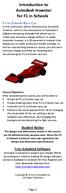 Introduction to Autodesk Inventor for F1 in Schools F1 in Schools Race Car In this course you will be introduced to Autodesk Inventor, which is the centerpiece of Autodesk s digital prototyping strategy
Interactive Drafting
 Interactive Drafting Preface What's New Getting Started Basic Tasks Advanced Tasks Workbench Description Customizing Glossary Index Dassault Systèmes 1994-99. All rights reserved. Preface CATIA Version
Part Design. Preface What's New? Getting Started Basic Tasks Advanced Tasks Workbench Description Customizing Glossary Index
 Part Design Preface What's New? Getting Started Basic Tasks Advanced Tasks Workbench Description Customizing Glossary Index Dassault Systèmes 1994-99. All rights reserved. Preface The CATIA Version 5 Part
Chapter 1. Creating Sketches in. the Sketch Mode-I. Evaluation chapter. Logon to www.cadcim.com for more details. Learning Objectives
 Chapter 1 Creating Sketches in Learning Objectives the Sketch Mode-I After completing this chapter you will be able to: Use various tools to create a geometry. Dimension a sketch. Apply constraints to
Introduction to Autodesk Inventor for F1 in Schools
 F1 in Schools race car Introduction to Autodesk Inventor for F1 in Schools In this course you will be introduced to Autodesk Inventor, which is the centerpiece of Autodesk s Digital Prototyping strategy
Pro/ENGINEER Wildfire 4.0 Basic Design
 Introduction Datum features are non-solid features used during the construction of other features. The most common datum features include planes, axes, coordinate systems, and curves. Datum features do
CATIA Wireframe & Surfaces TABLE OF CONTENTS
 TABLE OF CONTENTS Introduction... 1 Wireframe & Surfaces... 2 Pull Down Menus... 3 Edit... 3 Insert... 4 Tools... 6 Generative Shape Design Workbench... 7 Bottom Toolbar... 9 Tools... 9 Analysis... 10
CATIA Functional Tolerancing & Annotation TABLE OF CONTENTS
 TABLE OF CONTENTS Introduction...1 Functional Tolerancing and Annotation...2 Pull-down Menus...3 Insert...3 Functional Tolerancing and Annotation Workbench...4 Bottom Toolbar Changes...5 3D Grid Toolbar...5
Speaker Drafting. Page 1 1997 2001 DASSAULT SYSTEMES
 Speaker Drafting Page 1 Tutorial Objectives Description This Tutorial is an introduction to Assembly Drafting. Message To show how CATIA V5 allows the user to automatically generate associative drafting
Getting Started with CATIA Version 5
 WB Getting Started with CATIA Version 5 Page 1 CATIA User Interface Let s review the following key features: Multi-document support Standard and specific menus & toolbars (File, Edit, Insert, ) Standard
Sheet Metal Design. Preface What's New? Getting Started Basic Tasks Workbench Description Customizing Glossary Index
 Sheet Metal Design Preface What's New? Getting Started Basic Tasks Workbench Description Customizing Glossary Index Dassault Systèmes 1994-99. All rights reserved. Preface The V5 CATIA - Sheet Metal Design
WORKBOOK MODELING OF MULTI- MEMBER MACHINES
 WORKBOOK MODELING OF MULTI- MEMBER MACHINES LUBLIN 2014 0 Author: Mirosław Ferdynus Desktop publishing: Mirosław Ferdynus Technical editor: Mirosław Ferdynus Figures: Mirosław Ferdynus Cover and graphic
Structure Design. Preface What's New? Getting Started Basic Tasks Advanced Tasks Workbench Description Customizing Glossary Index
 Structure Design Preface What's New? Getting Started Basic Tasks Advanced Tasks Workbench Description Customizing Glossary Index Dassault Systèmes 1994-2000. All rights reserved. Preface CATIA Version
TABLE OF CONTENTS. INTRODUCTION... 5 Advance Concrete... 5 Where to find information?... 6 INSTALLATION... 7 STARTING ADVANCE CONCRETE...
 Starting Guide TABLE OF CONTENTS INTRODUCTION... 5 Advance Concrete... 5 Where to find information?... 6 INSTALLATION... 7 STARTING ADVANCE CONCRETE... 7 ADVANCE CONCRETE USER INTERFACE... 7 Other important
CATIA for Design and Engineering. Version 5 Releases 14 & 15. David S. Kelley. Central Michigan University SDC
 CATIA for Design and Engineering ersion 5 Releases 4 & 5 David S. Kelley Central Michigan University SDC PUBLICATIONS Schroff Development Corporation www.schroff.com www.schroff-europe.com TUTORIAL Extruded
CATIA V5 Tutorials. Mechanism Design & Animation. Release 18. Nader G. Zamani. University of Windsor. Jonathan M. Weaver. University of Detroit Mercy
 CATIA V5 Tutorials Mechanism Design & Animation Release 18 Nader G. Zamani University of Windsor Jonathan M. Weaver University of Detroit Mercy SDC PUBLICATIONS Schroff Development Corporation www.schroff.com
CATIA Basic Concepts TABLE OF CONTENTS
 TABLE OF CONTENTS Introduction...1 Manual Format...2 Log on/off procedures for Windows...3 To log on...3 To logoff...7 Assembly Design Screen...8 Part Design Screen...9 Pull-down Menus...10 Start...10
2013 Getting Started Guide
 2013 Getting Started Guide The contents of this guide and accompanying exercises were originally created by Nemetschek Vectorworks, Inc. Vectorworks Fundamentals Getting Started Guide Created using: Vectorworks
Weld Design. CATIA V5 Training Foils. Weld Design. Copyright DASSAULT SYSTEMES 1. Instructor Notes:
 CATIA V5 Training Foils Weld Design Version 5 Release 19 January 2009 EDU_CAT_EN_WD1_FI_V5R19 1 About this course Objectives of the course Upon completion of this course you will be able to: - Weld parts,
2D Layout for 3D Design
 CATIA V5 Training Exercises 2D Layout for 3D Design Version 5 Release 19 August 2008 EDU_CAT_EN_LO1_FX_V5R19 1 Table of Contents Recap Exercise: Front Fork 2D Design 3 Do It Yourself 4 Recap Exercise:
An introduction to 3D draughting & solid modelling using AutoCAD
 An introduction to 3D draughting & solid modelling using AutoCAD Faculty of Technology University of Plymouth Drake Circus Plymouth PL4 8AA These notes are to be used in conjunction with the AutoCAD software
Chapter 9. Editing Features. Learning Objectives
 Chapter 9 Editing Features Learning Objectives After completing this chapter, you will be able to: Edit features. Edit sketches of the sketch based features. Edit the sketch plane of the sketch based features.
Autodesk Fusion 360: Assemblies. Overview
 Overview In this module you will learn how different components can be put together to create an assembly. We will use several tools in Fusion 360 to make sure that these assemblies are constrained appropriately
CATIA Electrical Harness Design TABLE OF CONTENTS
 TABLE OF CONTENTS Introduction...1 Electrical Harness Design...2 Electrical Harness Assembly Workbench...4 Bottom Toolbar...5 Measure...5 Electrical Harness Design...7 Defining Geometric Bundles...7 Installing
Wireframe and Surface
 Wireframe and Surface Preface What's New Getting Started Basic Tasks Workbench Description Glossary Index Dassault Systèmes 1994-99. All rights reserved. Preface CATIA Version 5 Wireframe and Surface allows
SolidWorks Implementation Guides. Sketching Concepts
 SolidWorks Implementation Guides Sketching Concepts Sketching in SolidWorks is the basis for creating features. Features are the basis for creating parts, which can be put together into assemblies. Sketch
CATIA: Navigating the CATIA V5 environment. D. CHABLAT / S. CARO [email protected]
 CATIA: Navigating the CATIA V5 environment D. CHABLAT / S. CARO [email protected] Standard Screen Layout 5 4 6 7 1 2 3 8 9 10 11 12 13 14 15 D. Chablat / S. Caro -- Institut de Recherche
Datum > Curve KIM,ME,NIU
 Datum > Curve Intersect First create at least one quilt on the surface of the model. Feature > Surface (> New) > Copy (do not use offset that creates a surface off the solid surface even with zero offset)
Creating Drawings in Pro/ENGINEER
 6 Creating Drawings in Pro/ENGINEER This chapter shows you how to bring the cell phone models and the assembly you ve created into the Pro/ENGINEER Drawing mode to create a drawing. A mechanical drawing
CATIA V5 Surface-modeling
 CATIA V5 Surface-modeling (Tutorial 2-Mouse) GSD (Surface-modeling) Part Design (Solid-modeling) Assembly Design A- 1 CATIA Surface-modeling Tutorial 2A Import 2D outline drawing into Catia Build 3D curves
Proprietary and restricted rights notice
 Proprietary and restricted rights notice This software and related documentation are proprietary to Siemens Product Lifecycle Management Software Inc. 2012 Siemens Product Lifecycle Management Software
Basic AutoSketch Manual
 Basic AutoSketch Manual Instruction for students Skf-Manual.doc of 3 Contents BASIC AUTOSKETCH MANUAL... INSTRUCTION FOR STUDENTS... BASIC AUTOSKETCH INSTRUCTION... 3 SCREEN LAYOUT... 3 MENU BAR... 3 FILE
MET 306. Activity 8a. Mechanism Design Creo 2.0 Level 7 POINT A GROUND LINK LINK 1 LINK 2 LINK 3 POINT B 10/15/2010 1
 Mechanism Design Creo 2.0 Level 7 POINT A LINK 1 GROUND LINK LINK 2 LINK 3 POINT B 10/15/2010 1 Download parts ground, key, link_1, link_2, link_3 and pulley from the V:/MET_306/Activity_8_Creo drive.
Pro/ENGINEER Wildfire 5.0 Introduction to Surface Modeling
 Introduction Several advanced surface types are available as listed below. Variable Section Sweep Boundary Blend Section to Surfaces Blend Surface to Surface Blend A surface is created by sweeping a single
Mastercam X6 Basic 3D Design
 Basic 3D Design mastercam x getting started tutorials Mastercam X6 Basic 3D Design December 2011 Be sure you have the latest information! Information might have been changed or added since this document
SolidWorks: Mirror, Revolve, and. Introduction to Robotics
 SolidWorks: Mirror, Revolve, and Circular Pattern Introduction to Robotics Let s Review At this point we have learned the following: Extrude Boss/Base Extruded Cut Adding Relations and Dimensions Linear
Part Number: PMT1080-ENG Rev. 1
 2010 Dassault Systèmes, All Rights Reserved DraftSight and the DraftSight logos are trademarks of Dassault Systèmes or its subsidiaries in the US and/or other countries. Other brand or product names are
Basic 2D Design Be sure you have the latest information!
 Basic 2D Design mastercam x getting started tutorials Basic 2D Design December 2011 Be sure you have the latest information! Information might have been changed or added since this document was published.
SolidWorks Tutorial 3 MAGNETIC BLOCK
 SolidWorks Tutorial 3 MAGNETIC BLOCK Magnetic Block In this exercise you will make a magnetic block. To do so, you will create a few parts, which you will assemble. You will learn the following new applications
CATIA V5 Surface-modeling (Tutorial 8- Rebuild Audi R8)
 CATIA V5 Surface-modeling (Tutorial 8- Rebuild Audi R8) Not For Commercial Use Surface-modeling Design with a Master Model A- 1 Design in Context Hard fillet Hard fillet Design Intent PictureSource: www.audi.com/r8
digital project V1,R4 Quick Start
 digital project V1,R4 Quick Start Quick Starting Your Knowledge in Digital Project V1,R4 Nuri Miller May 2009 Copyright 2009 Gehry Technologies, Inc. Table of Contents Introduction...vi Creating a Part...2
AutoCAD 2009. New Icon Quick Reference
 AutoCAD 2009 New Quick Reference Contents Chapter 1 New Quick Reference..................... 1 Toolbars................................... 1 3D Navigation Toolbar........................ 1 CAD Standards
Learning Autodesk. Modeling, Analysis and Animation SDC. Randy H. Shih. Better Textbooks. Lower Prices. PUBLICATIONS www.sdcpublications.
 Learning Autodesk Inventor 2012 Modeling, Analysis and Animation Randy H. Shih SDC Better Textbooks. Lower Prices. PUBLICATIONS www.sdcpublications.com Schroff Development Corporation Visit the following
Getting Started With DraftSight A Guide For AEC Users
 Getting Started With DraftSight A Guide For AEC Users DraftSight.com Facebook.com/DraftSight Welcome to DraftSight a valuable tool for any AEC professional! DraftSight is more than a free, professional-grade
Real Time Rendering. Preface What's New Getting Started Basic Tasks Advanced Tasks Workbench Description Index
 Real Time Rendering Preface What's New Getting Started Basic Tasks Advanced Tasks Workbench Description Index Dassault Systèmes 1994-99. All rights reserved. Preface CATIA Version 5 Real Time Rendering
Intro to Excel spreadsheets
 Intro to Excel spreadsheets What are the objectives of this document? The objectives of document are: 1. Familiarize you with what a spreadsheet is, how it works, and what its capabilities are; 2. Using
What s New V 11. Preferences: Parameters: Layout/ Modifications: Reverse mouse scroll wheel zoom direction
 What s New V 11 Preferences: Reverse mouse scroll wheel zoom direction Assign mouse scroll wheel Middle Button as Fine tune Pricing Method (Manufacturing/Design) Display- Display Long Name Parameters:
Linkage 3.2. User s Guide
 Linkage 3.2 User s Guide David Rector Wednesday, April 06, 2016 Table of Contents Table of Contents... 2 Installation... 3 Running the Linkage Program... 3 Simple Mechanism Tutorial... 5 Mouse Operations...
SDC. Schroff Development Corporation WWW.SDCACAD.COM PUBLICATIONS. MultiMedia CD by Jack Zecher
 MultiMedia CD by Jack Zecher An audioi/visual presentation of the tutorial exercises SDC PUBLICATIONS Schroff Development Corporation WWW.SDCACAD.COM AutoCAD 2002 Tutorial 2-1 Lesson 2 Geometric Construction
Technical Drawing Specifications Resource A guide to support VCE Visual Communication Design study design 2013-17
 A guide to support VCE Visual Communication Design study design 2013-17 1 Contents INTRODUCTION The Australian Standards (AS) Key knowledge and skills THREE-DIMENSIONAL DRAWING PARALINE DRAWING Isometric
FluidDraw 5 User s Guide
 FluidDraw 5 User s Guide 04/08 FluidDraw is an application for creating pneumatic circuit diagrams. Not only the standard circuit symbols are available but also all of the components contained in the Festo
SketchUp Instructions
 SketchUp Instructions Every architect needs to know how to use SketchUp! SketchUp is free from Google just Google it and download to your computer. You can do just about anything with it, but it is especially
Getting Started with ANSYS ANSYS Workbench Environment
 Getting Started with ANSYS ANSYS Workbench Environment Overview The purpose of this tutorial is to get you started with the ANSYS Workbench environment. We will use a simple, static analysis of a single
Product Structure Preface What's New? User Tasks
 Product Structure Preface Conventions What's New? User Tasks Entering the Product Structure Workbench Selecting Products only Selecting Modes Inserting a New Component Inserting a New Part Inserting a
Introduction to the TI-Nspire CX
 Introduction to the TI-Nspire CX Activity Overview: In this activity, you will become familiar with the layout of the TI-Nspire CX. Step 1: Locate the Touchpad. The Touchpad is used to navigate the cursor
SolidWorks. SolidWorks Teacher Guide. and Student Courseware
 SolidWorks SolidWorks Teacher Guide and Student Courseware SolidWorks Corporation Outside the U.S.: +1-978-371-5011 300 Baker Avenue Fax: +1-978-371-7303 Concord, Massachusetts 01742 USA Email: [email protected]
Excel 2007 Basic knowledge
 Ribbon menu The Ribbon menu system with tabs for various Excel commands. This Ribbon system replaces the traditional menus used with Excel 2003. Above the Ribbon in the upper-left corner is the Microsoft
Chapter 23: Drafting in Worksheet View
 Chapter 23: Drafting in Worksheet View Worksheet View is a powerful, 2D production drafting module. Here you can find all of the drawing and editing tools needed to create fast, accurate, detailed working
Tutorial - First Level: 2D Fundamentals
 AutoCAD 2013 Prepares you for the Autodesk Certified Associate Exam Tutorial - First Level: 2D Fundamentals Randy H. Shih Multimedia DVD SDC PUBLICATIONS Schroff Development Corporation Better Textbooks.
Quick Start Tutorial Metric version
 Quick Start Tutorial Metric version 1996-2009 Cadsoft Corporation. No part of this guide or the accompanying software may be reproduced or transmitted, electronically or mechanically, without written permission
Autodesk Fusion 360 Badge Guide: Design an F1 in Schools Trophy
 Autodesk Fusion 360 Badge Guide: Design an F1 in Schools Trophy Abstract: Gain basic understanding of creating 3D models in Fusion 360 by designing an F1 in Schools trophy. This badge may be claimed by
Tutorial: 3D Pipe Junction Using Hexa Meshing
 Tutorial: 3D Pipe Junction Using Hexa Meshing Introduction In this tutorial, you will generate a mesh for a three-dimensional pipe junction. After checking the quality of the first mesh, you will create
House Design Tutorial
 Chapter 2: House Design Tutorial This House Design Tutorial shows you how to get started on a design project. The tutorials that follow continue with the same plan. When we are finished, we will have created
Creating Smart Models From Scan Data
 Rapidform Tech Tip Creating Smart Models From Scan Data Related Product Version Rapidform XOR3 Goal To create a smart model from scan data. A smart model is a parametric model that uses parameters intelligently
Creating 2D Isometric Drawings
 1-(800) 877-2745 www.ashlar-vellum.com Creating 2D Isometric Drawings Using Graphite TM Copyright 2008 Ashlar Incorporated. All rights reserved. C62DISO0806. Ashlar-Vellum Graphite No matter how many Top,
Create a Poster Using Publisher
 Contents 1. Introduction 1. Starting Publisher 2. Create a Poster Template 5. Aligning your images and text 7. Apply a background 12. Add text to your poster 14. Add pictures to your poster 17. Add graphs
Creating 2D Drawings from 3D AutoCAD Models
 Creating 2D Drawings from 3D AutoCAD Models David Piggott CrWare, LP GD205-2P This class explores the various techniques in creating 2D part and assembly drawings from 3D AutoCAD models. As part of the
Figure 1 - Delta Theta Input Selection
 Creating Cams in Pro/Engineer Wildfire Using DYNACAM Mechanical Engineering Mechanical Design Created by: David E. Yamartino M.S. Mechanical Engineering May 2004 April 12, 2004 Objective: The objective
Cabri Geometry Application User Guide
 Cabri Geometry Application User Guide Preview of Geometry... 2 Learning the Basics... 3 Managing File Operations... 12 Setting Application Preferences... 14 Selecting and Moving Objects... 17 Deleting
TurboCAD Architectural
 TurboCAD Architectural Version 15 Getting Started Guide IMSI/Design LLC, US 100 Rowland Blvd. Novato. CA 94945, USA Tel: +1-415-878-4000 Fax: +1-415-897-2544 Web Site www.imsisoft.com www.turbocad.com
Generative Shape Design
 Generative Shape Design Preface What's New Getting Started Basic Tasks Advanced Tasks Workbench Description Glossary Index Dassault Systèmes 1994-99. All rights reserved. Preface CATIA Version 5 Generative
Microsoft Excel 2010 Charts and Graphs
 Microsoft Excel 2010 Charts and Graphs Email: [email protected] Web Page: http://training.health.ufl.edu Microsoft Excel 2010: Charts and Graphs 2.0 hours Topics include data groupings; creating
Generative Shape Optimizer
 CATIA V5 Training Foils Generative Shape Optimizer Version 5 Release 19 January 2009 EDU_CAT_EN_GSO_FI_V5R19 1 About this course Objectives of the course Upon completion of the course you will learn to:
Guide To Creating Academic Posters Using Microsoft PowerPoint 2010
 Guide To Creating Academic Posters Using Microsoft PowerPoint 2010 INFORMATION SERVICES Version 3.0 July 2011 Table of Contents Section 1 - Introduction... 1 Section 2 - Initial Preparation... 2 2.1 Overall
4 Manipulating Elements
 4 Manipulating Elements In the context of this course, Manipulation of elements means moving, copying, rotating, scaling and some other similar operations. We will find that manipulations are always a
 Edinburgh COLLEGE of ART ARCHITECTURE 3D Modelling in AutoCAD - tutorial exercise The screen The graphics area This is the part of the screen in which the drawing will be created. The command prompt area
511 - Creating Structural Frame Designs
 4 th Generation VLC courtesy of Edison2 511 - Creating Structural Frame Designs Rahul Kulkarni, Manager, Product Design, Pune Center, Siemens PLM Software #SEU13 Agenda: 511 - Creating Structural Frame
This is a preview of the book "QCAD - An Introduction to Computer-Aided Design (CAD)" QCAD. An Introduction to ComputerAided Design (CAD)
 QCAD An Introduction to ComputerAided Design (CAD) Andrew Mustun Table of Contents Introduction Part I: First Steps with QCAD Introducing the QCAD Application 8 15 16 The First Start 16 The Application
PARAMETRIC MODELING. David Rosen. December 1997. By carefully laying-out datums and geometry, then constraining them with dimensions and constraints,
 1 of 5 11/18/2004 6:24 PM PARAMETRIC MODELING David Rosen December 1997 The term parametric modeling denotes the use of parameters to control the dimensions and shape of CAD models. Think of a rubber CAD
ABERLINK 3D MKIII MEASUREMENT SOFTWARE
 ABERLINK 3D MKIII MEASUREMENT SOFTWARE PART 1 (MANUAL VERSION) COURSE TRAINING NOTES ABERLINK LTD. EASTCOMBE GLOS. GL6 7DY UK INDEX 1.0 Introduction to CMM measurement...4 2.0 Preparation and general hints
ME 24-688 Week 11 Introduction to Dynamic Simulation
 The purpose of this introduction to dynamic simulation project is to explorer the dynamic simulation environment of Autodesk Inventor Professional. This environment allows you to perform rigid body dynamic
PowerPoint 2007: Basics Learning Guide
 PowerPoint 2007: Basics Learning Guide What s a PowerPoint Slide? PowerPoint presentations are composed of slides, just like conventional presentations. Like a 35mm film-based slide, each PowerPoint slide
Plotting: Customizing the Graph
 Plotting: Customizing the Graph Data Plots: General Tips Making a Data Plot Active Within a graph layer, only one data plot can be active. A data plot must be set active before you can use the Data Selector
DESIGN AND ASSEMBLY OF A CELL-PHONE USING CATIA V5-R17 AMER MOUSTAPHA EL SANKARI. Under supervision of Professor Dr. Chevy Zezhong Chen
 Department of Mechanical & Industrial Engineering Faculty of Engineering & Computer Science Concordia University DESIGN AND ASSEMBLY OF A CELL-PHONE USING CATIA V5-R17 By AMER MOUSTAPHA EL SANKARI Under
Using Microsoft Word. Working With Objects
 Using Microsoft Word Many Word documents will require elements that were created in programs other than Word, such as the picture to the right. Nontext elements in a document are referred to as Objects
AutoCAD Civil 3D 2010 ESSENTIALS
 AutoCAD Civil 3D 2010 ESSENTIALS SDC PUBLICATIONS Schroff Development Corporation www.schroff.com Better Textbooks. Lower Prices. Visit our website to learn more about this and other books: AutoCAD Civil
Selecting the Best Approach to Teach 3D Modeling to Technical College Engineering
 Paper ID #12358 Selecting the Best Approach to Teach 3D Modeling to Technical College Engineering Students Dr. Farzin Heidari, Texas A&M University, Kingsville c American Society for Engineering Education,
Adobe Illustrator CS5 Part 1: Introduction to Illustrator
 CALIFORNIA STATE UNIVERSITY, LOS ANGELES INFORMATION TECHNOLOGY SERVICES Adobe Illustrator CS5 Part 1: Introduction to Illustrator Summer 2011, Version 1.0 Table of Contents Introduction...2 Downloading
Design document Goal Technology Description
 Design document Goal OpenOrienteering Mapper is a program to draw orienteering maps. It helps both in the surveying and the following final drawing task. Support for course setting is not a priority because
Applying a circular load. Immediate and consolidation settlement. Deformed contours. Query points and query lines. Graph query.
 Quick Start Tutorial 1-1 Quick Start Tutorial This quick start tutorial will cover some of the basic features of Settle3D. A circular load is applied to a single soil layer and settlements are examined.
Layout Tutorial. Getting Started
 Getting Started Layout Tutorial This tutorial will explain how create a layout template, send views to a layout page, then save the document in PDF format. In this tutorial you will learn about: Creating
Embroidery Fonts Plus ( EFP ) Tutorial Guide Version 1.0505
 Embroidery Fonts Plus ( EFP ) Tutorial Guide Version 1.0505 1 Contents Chapter 1 System Requirements.................. 3 Chapter 2 Quick Start Installation.................. 4 System Requirements................