
Sheet Metal Design. Preface What's New? Getting Started Basic Tasks Workbench Description Customizing Glossary Index
|
|
|
- Letitia Malone
- 9 years ago
- Views:
Transcription
1 Sheet Metal Design Preface What's New? Getting Started Basic Tasks Workbench Description Customizing Glossary Index Dassault Systèmes All rights reserved.

2 Preface The V5 CATIA - Sheet Metal Design is a new generation product offering an intuitive and flexible user interface. It provides an associative feature-based modeling making it possible to design sheet metal parts in concurrent engineering between the unfolded or folded part representation. As a scalable product, CATIA Version 5 Sheet Metal Design can be used in cooperation with other current or future companion products in the next CATIA generation such as CATIA Version 5 Assembly Design and CATIA Version 5 Generative Drafting. The widest application portfolio in the industry is also accessible through interoperability with CATIA Solutions Version 4 to enable support of the full product development process from initial concept to product in operation.

3 Highlights V5R3 CATIA - Sheet Metal Design offers the following main functions: Associative and dedicated Sheet Metal feature based modeling Concurrent engineering between the unfolded or folded part representation Access to company defined standards tables Dedicated drawing capability including unfolded view and specific settings. All sheetmetal specifications can be re-used by the CATIA - Knowledge Advisor to capture corporate knowledge and increase the quality of designs. Natively integrated, CATIA - Sheet Metal Design offers the same ease of use and user interface consistency as all CATIA V5 applications.

4 Using This Product This guide is intended for the user who needs to become quickly familiar with the CATIA - Sheet Metal Design Version 5 product. The user should be familiar with basic CATIA Version 5 concepts such as document windows, standard and view toolbars. To get the most out of this guide, we suggest you start reading and performing the step-by-step tutorial "Getting Started". The next sections deal with the handling of more detailed capabilities of the product.

5 Where to Find More Information Prior to reading this book, we recommend that you read the CATIA - Infrastructure User's Guide. The CATIA - Part Design User's Guide Version 5, the CATIA - Assembly Design User's Guide Version 5 and the CATIA - Generative Drafting User's Guide Version 5 may prove useful.

6 What's New? Enhanced New New Enhanced New Defining the Sheet Metal Parameters Creating Swept Walls Creating Various Stamps Recognize/Extrude Bend Allowance from External Files

7 Getting Started Before getting into the detailed instructions for using Version 5 CATIA - Sheet Metal Design, the following tutorial provides a step-by-step scenario demonstrating how to use key functionalities. The main tasks proposed in this section are: Tasks All together, these tasks should take about 15 minutes to complete.

8 Accessing the Sheet Metal Workbench The Sheet Metal Design functions are available when you are in the Part environment. Several functions are integrated from Part Design workbench. This task shows how to enter the workbench. Choose the Sheet Metal Design item from the Start menu. The Sheet Metal toolbar is displayed and ready to use. You may add the Sheet Metal Design workbench to your Favorites, using the Tools -> Customize item. For more information, refer to CATIA V5 - Infrastructure User's Guide.

9

10 Defining the Sheet Metal Parameters This task shows you how to configure the sheet metal parameters. 1. Click the Parameters icon. The Sheet Metal Parameters dialog box is displayed. 2. Enter 1mm in the Thickness field. 3. Enter 5mm in the Bend Radius field. 4. Select the Bend Extremities tab. 5. Select Tangent in the Bend Extremities combo list.

11 An alternative is to select the bend type in the graphical combo list. 6. Click OK to validate the parameters and close the dialog box. The Sheet Metal Parameters feature is added in the specification tree.

12 Creating the First Wall This task shows how to create the first wall of the Sheet Metal Part. 1. Click the Sketcher icon then select the xy plane. 2. Select the Profile icon. 3. Sketch the contour as shown below: 4. Click the Exit Sketcher icon to return to the 3D world. 5. Click the Wall icon. The Wall Definition dialog box opens. By default, the Material Side is set to the top. 6. Click OK. The Wall.1 feature is added in the specification tree.

13 The first wall of the Sheet Metal Part is known as the Reference wall.

14 Creating the Side Walls This task shows you how to add other walls to the Sheet Metal part. 1. Select the Wall on Edge icon. 2. Select the left edge. The Wall Definition dialog box opens. 3. Enter 50mm in the Length field. The application previews the wall. By default, the Material Side is set to the outside and the Sketch Profile to the top. 4. Reverse the Sketch Profile. 5. Click OK. The wall is created.

15 CATIA displays this creation in the specification tree: 6. Select the Wall on Edge icon again. 7. Select the right edge. The Wall Definition dialog box opens with the parameters previously selected. 8. Press OK to validate.

16 9. Select the Wall on Edge icon again. 10. Select the front edge. The Wall Definition dialog box opens with the parameters previously selected. 11. Enter 30 mm in the Length field. 12. Press OK to validate. 13. Relimit the last wall: Select Sketch.4 Place the cursor and right-click on the top edge: the contextual menu is displayed. Select Mark.1 object -> Isolate Click the top edge left extremity and drag it 10 mm to the right Click the top edge right extremity and drag it 10 mm to the left 14. Click the Exit Sketcher icon to return to the 3D world.

17 Eventually, the final part looks like this:

18 Creating a Cutout In this task, you will learn how to: open a sketch on an existing face define a contour in order to create a cutout. 1. Select the wall on the right (Wall.3) to define the working plane. 2. Click the Sketcher icon. 3. Click the Oblong Profile icon to create the contour. To access to the oblong profile, click the black triangle on the Rectangle icon. It displays a secondary toolbar. 4. Click to create the first point and drag the cursor. 5. Click to create the second point. The first semi-axis of the profile is created. 6. Drag the cursor and click to create the third point. The second semi-axis is created and CATIA displays the oblong profile. 7. Click the Exit Sketcher icon to return to the 3D world.

19 8. Select the Cutout icon. The Pocket Definition dialog box is displayed and CATIA previews a cutout with default parameters. 9. Set the Type to Up to last option to define the limit of your cutout. This means that the application will limit the cutout onto the last possible face, that is the opposite wall. 10. Click OK. This is your cutout:

20

21 Creating the Bends Automatically This task shows how to create the bends automatically. Click the Automatic Bends icon. The bends are created. CATIA displays the bends creation in the specification tree: Automatic Bends.1 The Sheet Metal part looks like this:
22
23 Unfolding the Sheet Metal Part This task shows how to unfold the part. 1. Click the Unfold icon. The part is unfolded according to the reference wall plane, as shown below. 2. Click this icon again to refold the part for the next task.
24 Extracting Drawings from the Sheet Metal Part This task shows how to create the Sheet Metal Part views in the Drafting workbench. The Sheet Metal part is displayed. 1. Click or select File -> New Select the Drawing type and click OK. The Drafting workbench is launched. The New Drawing dialog box opens. 3. Keep the default parameters and click OK. For more information about this workbench, refer to CATIA - Generative Drafting User's Guide. 4. The drawing sheet appears. 5. Tile the windows horizontally. 6. Select the Unfolded View icon in the Drafting toolbar. This icon is added to the Drafting toolbar providing the Sheet Metal workbench is present. 7. Choose the xy plane in the Sheet Metal specification tree. The unfolded view is displayed with the bends axes. Eventually, the Drafting sheet looks like this:
25
26 Basic Tasks The Basic Tasks section explains how to create and modify various kinds of features. The table below lists the information you will find. Theme
27 Managing the Default Parameters This section explains and illustrates how to use or modify various kinds of features. The table below lists the information you will find. Using Sheet Metal Design assumes that you are in a CATPart document.
28 Editing the Sheet and Tool Parameters This section explains how to change the different sheet metal parameters. 1. Click the Parameters icon. The Sheet Metal Parameters dialog box is displayed. 2. Change the Thickness if need be. 3. Change the Bend Radius if need be. Convention dictates that the inner angle between the two walls is used to define the bend. It can vary from 0 to 180 exclusive. This angle is constant and the bend axis is rectilinear. 4. Press the Sheet Standards Files... button to access to the company defined standards, if need be. For more information, refer to the Customizing section. 5. Click OK to validate the Sheet Metal Parameters.
29
30 Modifying the Bend Extremities This section explains how to change the bend extremities. Click the Parameters icon. The Sheet Metal Parameters dialog box is displayed. The second tab concerns the bend extremities. A combo box displays the six possible axial relimitations for the straight bend: Minimum with no relief: the bend corresponds to the common area of the supporting walls along the bend axis. Square relief: a square relief is added to the bend extremity. The L1 and L2 parameters can be modified if need be. Round relief: a round relief is added to the bend extremity. The L1 and L2 parameters can be modified if need be. Linear: the unfolded bend is split by two planes going through the corresponding limit points (obtained by projection of the bend axis onto the edges of the supporting walls). Tangent: the edges of the bend are tangent to the edges of the supporting walls. Maximum: the bend is calculated between the furthest opposite edges of the supporting walls. These options can also be accessed through the pop-up button:
31
32 Defining the Bend Allowance This section explains the calculations related to folding/unfolding operations. When a bend is unfolded, the sheet metal deformation is represented by the bend allowance V defined by the formula: L = A + B + V where: L is the total unfolded length A and B the dimensioning lengths as defined on the figures below: bend < 90 bend > 90
33 Another way to compute the sheet metal deformation is the neutral fiber definition (K Factor): W = α * (R + k * T) where: W is the flat bend width R the inner bend radius T the sheet metal thickness α the inner bend angle in radians. If β is the opening bend angle in degrees: α = π * (180 - β) / 180 Physically, the neutral fiber represents the limit between the material compressed area inside the bend and the extended area outside the bend. Ideally, it is represented by an arc located inside the thickness and centered on the bend axis. Therefore the K Factor always has a value between 0 and 0.5. When you define the sheet metal parameters, a literal feature defines the default K Factor, according to the DIN standard: K = ( log(r / T) / 2) / 2 This formula can be deactivated or modified using Knowledge Advisor workbench. When a bend is created, the bend K Factor and the bend allowance literals are created. Two cases may then occur: If the Sheet Metal K Factor has an activated formula and uses the default bend radius as input parameter, the same formula is activated on the bend K Factor with the bend radius as input. Else the bend K Factor is a formula equal to the Sheet Metal K Factor.
34 The bend allowance literal is equal to a formula representing the use of the bend K Factor. This formula is fairly complex and it is strongly recommended not to delete it. V = α * (R + k * T) 2 * (R + T) * tan ( min(π/2,α) / 2) Though it is possible to deactivate the formula to enter a fixed value. Finally, the bend flat width is computed from the bend allowance value.
35 Creating a Sheet Metal Part from an Existing Solide This section explains and illustrates how to create and use various kinds of features. The table below lists the information you will find. Using Sheet Metal Design assumes that you are in a CATPart document.
36 Recognizing Thin Part Shapes This task illustrates how to create a Sheet Metal part using an existing solide. Open the Scenario1.CATPart document from the \online\samples\sheetmetal directory. The document contains a solide created in the Part Design workbench and it looks like this: 1. Click the Walls Recognition icon.
37 2. Indicate a face to be the reference wall. The walls are generated from the Part Design geometry. The Walls Recognition.1 feature is added in the tree view. At the same time, the Sheet Metal parameters are created, deduced from the Part geometry. 3. Select the icon to edit the Parameters: the Thickness is equal to 1 mm the Bend radius is twice the thicknessvalue the Bend Extremities field is set to Square relief. The solide is now a Sheet Metal part. All the features are displayed in the specification tree. You can modify the parameters and add new features from the Sheet Metal workbench to complete the design.
38
39 Generating Bends from Walls This task explains two ways to generate the bends in the Sheet Metal part. The Scenario1.CATPart document is still open from the previous task. If not, open the Scenario1_2.CATPart document from the \online\samples\sheetmetal directory. 1. Select the Bend icon. The Bend Definition dialog box opens. Note that the Radius field is in gray because it is driven by a formula: at that time, you cannot modify the value. 2. Select Wall.1 and Wall.2 in the specification tree. The Bend Definition dialog box is updated. 3. Right-click the Radius field: the contextual menu appears. 4. Deactivate the formula: you can now change the value. 5. Enter 4mm for the Radius and click OK.
40 The Bend is created. 6. Select now the Automatic Bends icon. The bends are created and the part looks like this: It is also possible to create first all the bends, using Automatic Bends, then modify the parameters for one or more bends.
41 1. Select the Automatic Bends icon. The bends are created. 2. Select the bend of interest: Bend.3 The Bend Definition dialog box opens. 3. Right-click the Radius field: the contextual menu appears. 4. Deactivate the formula: you can now change the value. 5. Enter 4mm for the Radius and click OK. Bend.3 is modified.
42 Adding a Sheet Metal Feature This task shows you how to complete the design by adding an oblong wall-cut across the bend area on the unfolded view. The Scenario1.CATPart document is still open from the previous task. If not, open the Scenario1_3.CATPart document from the \online\samples\sheetmetal directory. 1. Unfold the part using this icon. 2. Select the Sketcher icon and choose the xy plane. 3. Select the Oblong icon. 4. Sketch the following profile and quit the Sketcher using the Exit icon. 5. Select the Cutout icon. The Pocket Definition dialog box opens. 6. Enter 1mm in the Length field and click OK. 7. Fold the part again using this icon Eventually, the part looks like this:
43
44 Designing in Context This section explains and illustrates how to create and use various kinds of features. The table below lists the information you will find.
45 Designing... This tasks explains how to create a Sheet Metal part in an Assembly context. Open the Scenario2.CATProduct document from the \online\samples\sheetmetal directory. You are in Assembly Design workbench. The document contains two parts. 1. Right-click Product1 in the file tree and select New Part... A dialog box is displayed: 2. Enter Part3 in the New part Number field and click OK. A New Part dialog box proposes two locations to define the origin point. For more information, refer to Inserting a New Part. 3. Click No to locate the part origin according to the Product1 origin point. Make sure you are in Design Mode: Select Product1 Choose Edit -> Design Mode
46 4. Switch to Sheet Metal Design workbench. 5. Activate Part3. 6. Select the Parameters icon to create the Sheet Metal characteristics for the part: 1mm for the Thickness, 3mm for the Bend radius, Linear for the Bend extremities, and click OK. 7. Click the Sketcher icon and select the zx plane. 8. Select the Profile icon. 9. Sketch the contour and set the contraints as shown below: 5mm between the Sheet Metal vertical walls and each pad 0mm between the Sheet Metal horizontal walls and each pad top 0mm between the last point of the Sheet Metal sketch and the right pad side. 10. Click the Exit icon to return to the 3D world. 11. Select the Extrusion icon. 12. Select the Sheet Metal profile. The Extrusion Definition dialog box appears. 13. Enter 50mm for Length1 then click OK.
47 The Material Side should be set to the outside. 14. Select the Automatic Bends icon. The bends are created. The new features are shown in the specification tree: Extrusion.1 with five walls Automatic Bends.1 with four bends. Eventually, the Sheet Metal part looks like this:
48 Modifying the Design In this task, you are going to modify the height and the sketch of Pad.1. The Scenario2.CATProduct document is open from the previous task. if not, open the Scenario2_2.CATProduct document from the \online\samples\sheetmetal directory. 1. Double-click Part1\Pad.1 in the specification tree. The dialog box is displayed. 2. Enter 40mm for the Length and click OK. The pad is updated. 3. Select the Product and Update the Sheet Metal part. 4. Select Part1\Pad.1\Sketch Modify the sketch: 6. Click the Exit icon to return to the 3D world.
49 The constraints are respected. After the Product update, the document looks like this:
50 Creating Swept Walls This section explains and illustrates how to create and use various kinds of features. The table below lists the information you will find.
51 Creating a Flange This task explains how to generate a flange from a spine and a profile. Open the SweptWall01.CATPart document from the \online\samples\sheetmetal directory. 1. Select the Flange icon. The Flange Definition dialog box opens. 2.Select the edge as shown in red.
52 3. Enter 2 mm in the Radius field, 10 mm in the Length field and 120 for the Angle. 4. Click OK to create the flange. The feature is added to the specification tree.
53 Creating a Hem This task explains how to generate a hem from a spine and a profile. The SweptWall01.CATPart document is still open from the previous task. If not, open the SweptWall02.CATPart document from the \online\samples\sheetmetal directory. 1. Select the Hem icon. The Hem Definition dialog box opens. 2.Select the edges as shown in red. 3. Enter 2 mm in the Radius field, and 3 mm in the Length field. 4. Click OK to create the hem.
54 The feature is added to the specification tree.
55 Creating a Tear Drop This task explains how to generate a tear drop from a spine and a profile. The SweptWall01.CATPart document is still open from the previous task. If not, open the SweptWall03.CATPart document from the \online\samples\sheetmetal directory. 1. Select the Tear Drop icon. The Tear Drop Definition dialog box opens. 2.Select the edge as shown in red. 3. Enter 3 mm in the Radius field, and 8 mm in the Length field. 4. Click OK to create the tear drop.
56 The feature is added to the specification tree.
57 Creating a Swept Flange This task explains how to generate a swept from a spine and a user-defined profile. The SweptWall01.CATPart document is still open from the previous task. If not, open the SweptWall04.CATPart document from the \online\samples\sheetmetal directory. 1. Using the Sketcher, define a profile as shown below: Then quit the Sketcher, using the Exit icon 2. Select the Swept Flange icon. The User Defined Flange Definition dialog box opens. 3. Select the edge and the profile, as shown in red. The dialog box looks like this: 4. Click OK to create the swept flange.
58 The feature is added in the specification tree.
59 Stamping This section explains and illustrates how to create and use various kinds of stamps. The table below lists the information you will find.
60 Creating a Point Stamp This task shows you how to create a point stamp by specifying the punch geometrical parameters. Open the Stamping.CATPart document from the \online\samples\sheetmetal directory. 1. Click the Point Stamp icon. 2. Select a point on the top face. The Point Stamp Definition dialog box opens, providing default values. 3. Change the value in the different fields, if need be: Height H, Radius R1, Radius R2, Angle A, Diameter D. 4. Click OK to validate. The specification tree indicates the point stamp has been created.
61
62 Extruded Hole This task shows you how to create an extruded hole by specifying the punch geometrical parameters. The Stamping.CATPart document is still open from the previous task. If not, open the Stamping2.CATPart document from the \online\samples\sheetmetal directory. 1. Click the Extruded Hole icon. 2. Select a point on the top face where you want to place the hole. The Extruded Hole Definition dialog box opens, providing default values. 3. Change the value in the different fields, if need be: Height H, Radius R, Angle A, Diameter D. 4. Click OK to validate. The specification tree indicates that the extruded hole has been created.
63
64 Curve Stamp This task shows you how to create a curve stamp by specifying the punch geometrical parameters. The Stamping.CATPart document is still open from the previous task. If not, open the Stamping3.CATPart document from the \online\samples\sheetmetal directory. 1. Click the Curve Stamp icon. 2. Select Sketch.4, the curve previously defined. The Curve Stamp Definition dialog box opens, providing default values. 3. Change the value in the different fields, if need be: Height H, Radius R1, Radius R2, Angle A, Length L. 4. Click OK to validate.
65 The specification tree indicates that the curve stamp has been created.
66 Surface Stamp This task shows you how to create a surface stamp by specifying the punch geometrical parameters. The Stamping.CATPart document is still open from the previous task. If not, open the Stamping4.CATPart document from the \online\samples\sheetmetal directory. 1. Click the Surface Stamp icon. 2. Select Sketch.5, the profile previously defined. The Surface Stamp Definition dialog box opens, providing default values. 3. Change the value in the different fields, if need be: Height H, Radius R1, Radius R2, Angle A. 4. Click OK to validate. The specification tree indicates that the surface stamp has been created.
67
68 Bridge This task shows you how to create a bridge by specifying the punch geometrical parameters. The Stamping.CATPart document is still open from the previous task. If not, open the Stamping5.CATPart document from the \online\samples\sheetmetal directory. 1. Click the Bridge icon. The Bridge Definition dialog box opens, providing default values. 2. Change the value in the different fields, if need be: Height H, Radius R1, Radius R2, Angle A, Length L1, Length L2. 3. Select a point on the top face where you want to place the bridge. 4. Select an edge to give the direction of the bridge. 5. Click OK to validate.
69 The specification tree indicates that the bridge has been created.
70 Creating a Louver This task shows you how to create a louver by specifying the punch geometrical parameters. The Stamping.CATPart document is still open from the previous task. If not, open the Stamping6.CATPart document from the \online\samples\sheetmetal directory. 1. Click the Louver icon. 2. Select Sketch.8, the profile previously defined on Wall.2. The Louver Definition dialog box opens, providing default values. 3. Change the value in the different fields, if need be: Height H, Radius R1, Radius R2, Angle A1, Angle A2. 4. Click OK to validate.
71 The specification tree indicates that the louver has been created.
72 Stiffening Rib This task shows you how to create a stiffness rib by specifying the punch geometrical parameters. The Stamping.CATPart document is still open from the previous task. If not, open the Stamping7.CATPart document from the \online\samples\sheetmetal directory. 1. Click the Stiffness Rib icon. 2. Select Bend.1, where you want to place a stiffener. Note that the stiffener will always be centered on the bend radius, wherever the point may be along the curve. The Stiffening Rib Definition dialog box opens, providing default values. 3. Change the value in the different fields, if need be: Radius R1, Radius R2, Angle A, Length L. 4. Click OK to validate.
73 The specification tree indicates the stiffness rib has been created.
74 Patterning In this task, you are going to create cutouts according to a pattern. CATIA allows you to define two types of patterns: rectangular and circular patterns. These features make the creation process easier. Open the Scenario3.CATPart document from the Samples/sheet metal directory. The Sheet Metal part looks like this: 1. Select the cutout you want to duplicate, that is the rectangular one. 2. Click the Rectangular Pattern icon. The Rectangular Pattern Definition dialog box is displayed. Each tab is dedicated to a direction to define the location of the duplicated feature. Set the specification for the First Direction: 3. Select the Edge.1, as shown, to specify the first direction of creation. An arrow is displayed on the wall. 4. Click the Reverse button or select the arrow to modify the direction.
75 5. Keep the Instances & Spacing options to define the parameters. Choosing these parameters types dims the Length field because the application no longer needs this specification to space the instances. 6. Enter 2 as the number of instances you wish to obtain in the first direction. 7. Define the spacing along the grid: enter 30mm. Defining the spacing along the grid and the length of your choice, would make the application compute the number of possible instances and space them at equal distances. 8. Now, click the Second Direction tab to define the other parameters. Note that defining a second direction is not compulsory. Creating a rectangular pattern defining only one direction is possible. 9. Select the Edge.2, as shown, to define the second direction. 10. Keep the Instances & Spacing option: enter 8 and 10 mm in the appropriate fields. Additional cutouts have been aligned along this second direction.
76 12. Click OK to repeat the cutouts. After the update, the Sheet Metal part looks like this: 13. Select this icon to unfold the part: The pattern is updated on the unfolded view. Using a similar scenario, you can define a circular pattern. To know more about patterns, refer to CATIA - Part Design User's Guide.
77
78 Interoperability In a CATPart document, you may have Part Design features and Sheet Metal features according to the following rules: Part Design features can be created before Sheet Metal features. a Part Design feature can also be created after Sheet Metal features as long as the part is in folded view. in the unfolded view, the Part Design feature will not be displayed. it is no longer possible to create Sheet Metal features after this last Part Design feature in folded view. 1. Create two walls with an Automatic Bend. 2.Switch to Part Design workbench. 3. Launch the Sketcher and draw an oblique line in the yz plane. 4. Click the icon to create a Stiffener. 5. Switch to the Sheet Metal workbench. 6. Click the Unfold icon.
79 The stiffener is not displayed on the unfolded view. To add a new Sheet Metal feature, select the Bend for example and right-click the Define In Work Object item.
80 The new Sheet Metal feature will be added after the Bend but before the Stiffener.
81 Workbench Description The CATIA - Sheet Metal Design Version 5 application window looks like this: Click the hotspots to display the related documentation. Menu Bar Toolbars
82 Menu Bar The Menu Bar and items which are available in CATIA - Sheet Metal Design workbench are the standard ones. The tools and commands are described in the V5 CATIA - Infrastructure User's Guide. Refer to the CATIA Menu Bar section.
83 Toolbars This section describes the various icons available in the Sheet Metal Design workbench. The toolbars are located in the application window border. The last icon is available whenever you are in the Drafting workbench. See Managing Default Parameters See Sketching... See Creating the First Wall See Creating Side Walls See Designing in Context See Creating Swept Walls See Generating Bends from Walls See Recognizing Thin Part Shapes See Creating Automatic Bends See Unfolding the Part See Creating a Cutout See Stamping See Patterning See Setting Constraints
84 See Setting Constraints Sheet Metal in Drafting See Extracting Drawings...
85 Customizing This section describes how to customize settings. The task described here deals with permanent setting customizing. Using Sheet Metal Standards Files This task explains how to access company standards files. Open a new document. 1. Click the Sheet Metal Parameters icon. The Sheet Metal Parameters dialog box opens. 2. Select the Sheet Standards Files... button. The Sheet Metal Part Samples window is displayed. 3. Indicate the path to the Sheet Metal tables. These files are available under.xls or.txt format.
86 4. Click Open. In the Sheet Metal Parameters dialog box, the Design Table icon appears opposite the Thickness and Bend radius fields. The parameters are now in gray, indicating that you can no longer modify the values. 5. Click the Thickness Design Table icon and select line Click OK. The parameter values are updated in the Sheet Metal Parameters dialog box.
87 7. Click the Bend Radius Design Table icon. 8. Select line 2 and click OK. The parameter values are updated in the Sheet Metal Parameters dialog box. 9. Create a bend. The Bend Definition dialog box displays a design table for the Bend Radius. The default mode, it's to say the formula: Bend Radius = Part Radius is deactivated. Let's see the Bend Radius Table, using this icon It shows the Bend Radius and the corresponding Bend Table.
88 10. Click OK. If the Angle value is contained in the Bend Table, the Bend Allowance uses the corresponding value. If not, the Bend Allowance is computed according to the KFactor. An alternative if you use the V5R2 Sheet Metal Tables: for example BNDTABL2. the steps 1 to 4 are identical. 5. Click the Design Table icon and select a line. 6. Click OK. The parameter values are updated in the Sheet Metal Parameters dialog box. At that time, the parameters Thickness and Bend radius are driven by the design table. They are now in gray, indicating that you can no longer modify the values. Note that if you create a bend, there is no design table: it's the formula which is used. To disable the access to design tables: Select the Tools -> Options -> Part -> Display items and check Relations: the Design Table icon is displayed in the specification tree. Right-click this icon: the contextual menu appears.
89 Select BNDTABL2.txt object -> Deactivate The relation is no longer used but still exists. It can be activated at any time.
90 bend bend extremity cutout extrusion flange pattern profile reference wall stamp wall Glossary B a feature joining two walls axial relimitation for a straight bend C a feature corresponding to an opening through a feature the shape of the opening corresponds to the extrusion of a profile. E a feature created by extruding a profile and adding thickness F a feature created by sweeping a profile along a spine the different flanges available are: simple and swept flange, hem and tear drop P a set of similar features repeated in the same feature or part an opened or closed shape including arcs and lines created by the profile command in the Sketcher workbench R the first created wall; when unfolding the part, it is the fixed wall. S a feature created by embossing sheet metal the different stamps available are: point, extruded hole, curve, surface, bridge, louver and stiffening rib. W a feature created by adding thickness to a profile
Part Design. Preface What's New? Getting Started Basic Tasks Advanced Tasks Workbench Description Customizing Glossary Index
 Part Design Preface What's New? Getting Started Basic Tasks Advanced Tasks Workbench Description Customizing Glossary Index Dassault Systèmes 1994-99. All rights reserved. Preface The CATIA Version 5 Part
Wireframe and Surface
 Wireframe and Surface Preface What's New Getting Started Basic Tasks Workbench Description Glossary Index Dassault Systèmes 1994-99. All rights reserved. Preface CATIA Version 5 Wireframe and Surface allows
Introduction to CATIA V5
 Introduction to CATIA V5 Release 16 (A Hands-On Tutorial Approach) Kirstie Plantenberg University of Detroit Mercy SDC PUBLICATIONS Schroff Development Corporation www.schroff.com www.schroff-europe.com
Structure Design. Preface What's New? Getting Started Basic Tasks Advanced Tasks Workbench Description Customizing Glossary Index
 Structure Design Preface What's New? Getting Started Basic Tasks Advanced Tasks Workbench Description Customizing Glossary Index Dassault Systèmes 1994-2000. All rights reserved. Preface CATIA Version
Part Design. Page 1 1997 2001 DASSAULT SYSTEMES. IBM Product Lifecycle Management Solutions / Dassault Systemes
 Part Design Page 1 Tutorial Objectives Description This tutorial is an introduction to Part Design. Message This tutorial illustrates how CATIA can Design precise 3D mechanical parts with an intuitive
Understand the Sketcher workbench of CATIA V5.
 Chapter 1 Drawing Sketches in Learning Objectives the Sketcher Workbench-I After completing this chapter you will be able to: Understand the Sketcher workbench of CATIA V5. Start a new file in the Part
Sketcher. Preface What's New? Getting Started Basic Tasks Customizing Workbench Description Glossary Index
 Sketcher Preface What's New? Getting Started Basic Tasks Customizing Workbench Description Glossary Index Dassault Systèmes 1994-99. All rights reserved. Preface CATIA Version 5 Sketcher application makes
Generative Shape Design
 Generative Shape Design Preface What's New Getting Started Basic Tasks Advanced Tasks Workbench Description Glossary Index Dassault Systèmes 1994-99. All rights reserved. Preface CATIA Version 5 Generative
Interactive Drafting
 Interactive Drafting Preface What's New Getting Started Basic Tasks Advanced Tasks Workbench Description Customizing Glossary Index Dassault Systèmes 1994-99. All rights reserved. Preface CATIA Version
CATIA Drafting TABLE OF CONTENTS
 TABLE OF CONTENTS Introduction...1 Drafting...2 Drawing Screen...3 Pull-down Menus...4 File...4 Edit...5 View...6 Insert...7 Tools...8 Drafting Workbench...9 Views and Sheets...9 Dimensions and Annotations...10
CATIA for Design and Engineering. Version 5 Releases 14 & 15. David S. Kelley. Central Michigan University SDC
 CATIA for Design and Engineering ersion 5 Releases 4 & 5 David S. Kelley Central Michigan University SDC PUBLICATIONS Schroff Development Corporation www.schroff.com www.schroff-europe.com TUTORIAL Extruded
CATIA Wireframe & Surfaces TABLE OF CONTENTS
 TABLE OF CONTENTS Introduction... 1 Wireframe & Surfaces... 2 Pull Down Menus... 3 Edit... 3 Insert... 4 Tools... 6 Generative Shape Design Workbench... 7 Bottom Toolbar... 9 Tools... 9 Analysis... 10
SolidWorks Implementation Guides. Sketching Concepts
 SolidWorks Implementation Guides Sketching Concepts Sketching in SolidWorks is the basis for creating features. Features are the basis for creating parts, which can be put together into assemblies. Sketch
Generative Drafting. Page 1 1997 2001 DASSAULT SYSTEMES. IBM Product Lifecycle Management Solutions / Dassault Systemes
 Generative Drafting Page 1 Tutorial Objectives Description This Tutorial is an introduction to Generative Drafting. Message To show how CATIA V5 allows the user to automatically generate associative drafting
Weld Design. CATIA V5 Training Foils. Weld Design. Copyright DASSAULT SYSTEMES 1. Instructor Notes:
 CATIA V5 Training Foils Weld Design Version 5 Release 19 January 2009 EDU_CAT_EN_WD1_FI_V5R19 1 About this course Objectives of the course Upon completion of this course you will be able to: - Weld parts,
Chapter 1. Creating Sketches in. the Sketch Mode-I. Evaluation chapter. Logon to www.cadcim.com for more details. Learning Objectives
 Chapter 1 Creating Sketches in Learning Objectives the Sketch Mode-I After completing this chapter you will be able to: Use various tools to create a geometry. Dimension a sketch. Apply constraints to
Introduction to Autodesk Inventor for F1 in Schools
 F1 in Schools race car Introduction to Autodesk Inventor for F1 in Schools In this course you will be introduced to Autodesk Inventor, which is the centerpiece of Autodesk s Digital Prototyping strategy
Getting Started with CATIA Version 5
 WB Getting Started with CATIA Version 5 Page 1 CATIA User Interface Let s review the following key features: Multi-document support Standard and specific menus & toolbars (File, Edit, Insert, ) Standard
Introduction to Autodesk Inventor for F1 in Schools
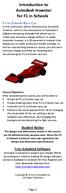 Introduction to Autodesk Inventor for F1 in Schools F1 in Schools Race Car In this course you will be introduced to Autodesk Inventor, which is the centerpiece of Autodesk s digital prototyping strategy
Real Time Rendering. Preface What's New Getting Started Basic Tasks Advanced Tasks Workbench Description Index
 Real Time Rendering Preface What's New Getting Started Basic Tasks Advanced Tasks Workbench Description Index Dassault Systèmes 1994-99. All rights reserved. Preface CATIA Version 5 Real Time Rendering
Pro/ENGINEER Wildfire 5.0 Introduction to Surface Modeling
 Introduction Several advanced surface types are available as listed below. Variable Section Sweep Boundary Blend Section to Surfaces Blend Surface to Surface Blend A surface is created by sweeping a single
CATIA Functional Tolerancing & Annotation TABLE OF CONTENTS
 TABLE OF CONTENTS Introduction...1 Functional Tolerancing and Annotation...2 Pull-down Menus...3 Insert...3 Functional Tolerancing and Annotation Workbench...4 Bottom Toolbar Changes...5 3D Grid Toolbar...5
Chapter 9. Editing Features. Learning Objectives
 Chapter 9 Editing Features Learning Objectives After completing this chapter, you will be able to: Edit features. Edit sketches of the sketch based features. Edit the sketch plane of the sketch based features.
Sheet Metal Design: Beyond Bends and Flanges
 11/30/2005-8:00 am - 9:30 am Room:Pelican 1 (Swan) Walt Disney World Swan and Dolphin Resort Orlando, Florida Sheet Metal Design: Beyond Bends and Flanges Anthony B. Rodriguez - KETIV Technologies MA31-2
SpaceClaim Introduction Training Session. A SpaceClaim Support Document
 SpaceClaim Introduction Training Session A SpaceClaim Support Document In this class we will walk through the basic tools used to create and modify models in SpaceClaim. Introduction We will focus on:
Pro/ENGINEER Wildfire 4.0 Basic Design
 Introduction Datum features are non-solid features used during the construction of other features. The most common datum features include planes, axes, coordinate systems, and curves. Datum features do
Convert 2D to 3D in AutoPOL Bend Simulator
 Convert 2D to 3D in AutoPOL Bend Simulator This document gives an introduction of how to convert 2D DXF/DWG files into 3D models in AutoPOL Bend simulator. The AutoPOL 3D concept A 3D model with correct
Product Structure Preface What's New? User Tasks
 Product Structure Preface Conventions What's New? User Tasks Entering the Product Structure Workbench Selecting Products only Selecting Modes Inserting a New Component Inserting a New Part Inserting a
TABLE OF CONTENTS. INTRODUCTION... 5 Advance Concrete... 5 Where to find information?... 6 INSTALLATION... 7 STARTING ADVANCE CONCRETE...
 Starting Guide TABLE OF CONTENTS INTRODUCTION... 5 Advance Concrete... 5 Where to find information?... 6 INSTALLATION... 7 STARTING ADVANCE CONCRETE... 7 ADVANCE CONCRETE USER INTERFACE... 7 Other important
SolidWorks Tutorial 4 CANDLESTICK
 SolidWorks Tutorial 4 CANDLESTICK Candlestick In this tutorial you will make a simple container and a candlestick out of sheetmetal. You will learn about working with sheet metal in SolidWorks. We will
SolidWorks Tutorial 3 MAGNETIC BLOCK
 SolidWorks Tutorial 3 MAGNETIC BLOCK Magnetic Block In this exercise you will make a magnetic block. To do so, you will create a few parts, which you will assemble. You will learn the following new applications
CATIA V5 Surface-modeling
 CATIA V5 Surface-modeling (Tutorial 2-Mouse) GSD (Surface-modeling) Part Design (Solid-modeling) Assembly Design A- 1 CATIA Surface-modeling Tutorial 2A Import 2D outline drawing into Catia Build 3D curves
Creating Smart Models From Scan Data
 Rapidform Tech Tip Creating Smart Models From Scan Data Related Product Version Rapidform XOR3 Goal To create a smart model from scan data. A smart model is a parametric model that uses parameters intelligently
Sample Table. Columns. Column 1 Column 2 Column 3 Row 1 Cell 1 Cell 2 Cell 3 Row 2 Cell 4 Cell 5 Cell 6 Row 3 Cell 7 Cell 8 Cell 9.
 Working with Tables in Microsoft Word The purpose of this document is to lead you through the steps of creating, editing and deleting tables and parts of tables. This document follows a tutorial format
WORKBOOK MODELING OF MULTI- MEMBER MACHINES
 WORKBOOK MODELING OF MULTI- MEMBER MACHINES LUBLIN 2014 0 Author: Mirosław Ferdynus Desktop publishing: Mirosław Ferdynus Technical editor: Mirosław Ferdynus Figures: Mirosław Ferdynus Cover and graphic
Modeling Tools Objectives. Sweeps and Lofts. Loft Feature
 Modeling Tools Objectives When you complete this module, you will be able to recognize the more advanced modeling tools in Solid Edge as well as the tools that require more input than typical Solid Edge
Introduction to Measurement Tools
 Introduction to Measurement Tools Revu's built-in measurement tools make it easy to take length, area, perimeter, diameter, volume and radius measurements, count from PDFs and perform area cutouts. Compatibility
Creating Drawings in Pro/ENGINEER
 6 Creating Drawings in Pro/ENGINEER This chapter shows you how to bring the cell phone models and the assembly you ve created into the Pro/ENGINEER Drawing mode to create a drawing. A mechanical drawing
Learning Autodesk. Modeling, Analysis and Animation SDC. Randy H. Shih. Better Textbooks. Lower Prices. PUBLICATIONS www.sdcpublications.
 Learning Autodesk Inventor 2012 Modeling, Analysis and Animation Randy H. Shih SDC Better Textbooks. Lower Prices. PUBLICATIONS www.sdcpublications.com Schroff Development Corporation Visit the following
Essay 5 Tutorial for a Three-Dimensional Heat Conduction Problem Using ANSYS Workbench
 Essay 5 Tutorial for a Three-Dimensional Heat Conduction Problem Using ANSYS Workbench 5.1 Introduction The problem selected to illustrate the use of ANSYS software for a three-dimensional steadystate
CATIA Basic Concepts TABLE OF CONTENTS
 TABLE OF CONTENTS Introduction...1 Manual Format...2 Log on/off procedures for Windows...3 To log on...3 To logoff...7 Assembly Design Screen...8 Part Design Screen...9 Pull-down Menus...10 Start...10
Datum > Curve KIM,ME,NIU
 Datum > Curve Intersect First create at least one quilt on the surface of the model. Feature > Surface (> New) > Copy (do not use offset that creates a surface off the solid surface even with zero offset)
Using Parametric Equations in SolidWorks, Example 1
 Using Parametric Equations in SolidWorks, Example 1 (Draft 4, 10/25/2006, SW 2006) Introduction In this example the goal is to place a solid roller on a solid wedge. Their relationship will be governed
This Skill Builder demonstrates how to define and place sketched symbols in drawings.
 Sketched Symbols This Skill Builder demonstrates how to define and place sketched symbols in drawings. A sketched symbol is a user-defined symbol. You create sketched symbols in the sketch environment
2013 Getting Started Guide
 2013 Getting Started Guide The contents of this guide and accompanying exercises were originally created by Nemetschek Vectorworks, Inc. Vectorworks Fundamentals Getting Started Guide Created using: Vectorworks
SolidWorks. SolidWorks Teacher Guide. and Student Courseware
 SolidWorks SolidWorks Teacher Guide and Student Courseware SolidWorks Corporation Outside the U.S.: +1-978-371-5011 300 Baker Avenue Fax: +1-978-371-7303 Concord, Massachusetts 01742 USA Email: [email protected]
Speaker Drafting. Page 1 1997 2001 DASSAULT SYSTEMES
 Speaker Drafting Page 1 Tutorial Objectives Description This Tutorial is an introduction to Assembly Drafting. Message To show how CATIA V5 allows the user to automatically generate associative drafting
CATIA V5 Surface-modeling (Tutorial 8- Rebuild Audi R8)
 CATIA V5 Surface-modeling (Tutorial 8- Rebuild Audi R8) Not For Commercial Use Surface-modeling Design with a Master Model A- 1 Design in Context Hard fillet Hard fillet Design Intent PictureSource: www.audi.com/r8
SDC. Schroff Development Corporation WWW.SDCACAD.COM PUBLICATIONS. MultiMedia CD by Jack Zecher
 MultiMedia CD by Jack Zecher An audioi/visual presentation of the tutorial exercises SDC PUBLICATIONS Schroff Development Corporation WWW.SDCACAD.COM AutoCAD 2002 Tutorial 2-1 Lesson 2 Geometric Construction
Sheet Metal Bending. By- Prem Mahendranathan
 Sheet Metal Bending By- BENDING n Bending is a manufacturing process by which a metal can be deformed by plastically deforming the material and changing its shape n Deformation about one axis PROFILES
Autodesk Fusion 360 Badge Guide: Design an F1 in Schools Trophy
 Autodesk Fusion 360 Badge Guide: Design an F1 in Schools Trophy Abstract: Gain basic understanding of creating 3D models in Fusion 360 by designing an F1 in Schools trophy. This badge may be claimed by
Basic 2D Design Be sure you have the latest information!
 Basic 2D Design mastercam x getting started tutorials Basic 2D Design December 2011 Be sure you have the latest information! Information might have been changed or added since this document was published.
MATHEMATICS FOR ENGINEERING BASIC ALGEBRA
 MATHEMATICS FOR ENGINEERING BASIC ALGEBRA TUTORIAL 4 AREAS AND VOLUMES This is the one of a series of basic tutorials in mathematics aimed at beginners or anyone wanting to refresh themselves on fundamentals.
PowerPoint 2013: Basic Skills
 PowerPoint 2013: Basic Skills Information Technology September 1, 2014 1 P a g e Getting Started There are a variety of ways to start using PowerPoint software. You can click on a shortcut on your desktop
CATIA Tubing and Piping TABLE OF CONTENTS
 TABLE OF CONTENTS Introduction...1 Manual Format...2 Tubing and Piping design...3 Log on/off procedures for Windows...4 To log on...4 To logoff...8 Pull-down Menus...9 Edit...9 Insert...12 Tools...13 Analyze...16
Basic AutoSketch Manual
 Basic AutoSketch Manual Instruction for students Skf-Manual.doc of 3 Contents BASIC AUTOSKETCH MANUAL... INSTRUCTION FOR STUDENTS... BASIC AUTOSKETCH INSTRUCTION... 3 SCREEN LAYOUT... 3 MENU BAR... 3 FILE
CATIA Electrical Harness Design TABLE OF CONTENTS
 TABLE OF CONTENTS Introduction...1 Electrical Harness Design...2 Electrical Harness Assembly Workbench...4 Bottom Toolbar...5 Measure...5 Electrical Harness Design...7 Defining Geometric Bundles...7 Installing
SolidWorks: Mirror, Revolve, and. Introduction to Robotics
 SolidWorks: Mirror, Revolve, and Circular Pattern Introduction to Robotics Let s Review At this point we have learned the following: Extrude Boss/Base Extruded Cut Adding Relations and Dimensions Linear
Cabri Geometry Application User Guide
 Cabri Geometry Application User Guide Preview of Geometry... 2 Learning the Basics... 3 Managing File Operations... 12 Setting Application Preferences... 14 Selecting and Moving Objects... 17 Deleting
CATIA V5 Tutorials. Mechanism Design & Animation. Release 18. Nader G. Zamani. University of Windsor. Jonathan M. Weaver. University of Detroit Mercy
 CATIA V5 Tutorials Mechanism Design & Animation Release 18 Nader G. Zamani University of Windsor Jonathan M. Weaver University of Detroit Mercy SDC PUBLICATIONS Schroff Development Corporation www.schroff.com
Create a Poster Using Publisher
 Contents 1. Introduction 1. Starting Publisher 2. Create a Poster Template 5. Aligning your images and text 7. Apply a background 12. Add text to your poster 14. Add pictures to your poster 17. Add graphs
LESSON 7: IMPORTING AND VECTORIZING A BITMAP IMAGE
 LESSON 7: IMPORTING AND VECTORIZING A BITMAP IMAGE In this lesson we ll learn how to import a bitmap logo, transform it into a vector and perform some editing on the vector to clean it up. The concepts
Getting Started with ANSYS ANSYS Workbench Environment
 Getting Started with ANSYS ANSYS Workbench Environment Overview The purpose of this tutorial is to get you started with the ANSYS Workbench environment. We will use a simple, static analysis of a single
Surface Machining. NATIONAL INSTITUTE FOR AVIATION RESEARCH Wichita State University. Revision 5.13 Copyright 2004. All rights reserved.
 Surface Machining NATIONAL INSTITUTE FOR AVIATION RESEARCH Wichita State University Revision 5.13 Copyright 2004. All rights reserved. www.cadcamlab.org None of this material may be reproduced, used or
Steady Flow: Laminar and Turbulent in an S-Bend
 STAR-CCM+ User Guide 6663 Steady Flow: Laminar and Turbulent in an S-Bend This tutorial demonstrates the flow of an incompressible gas through an s-bend of constant diameter (2 cm), for both laminar and
Excel -- Creating Charts
 Excel -- Creating Charts The saying goes, A picture is worth a thousand words, and so true. Professional looking charts give visual enhancement to your statistics, fiscal reports or presentation. Excel
Plotting: Customizing the Graph
 Plotting: Customizing the Graph Data Plots: General Tips Making a Data Plot Active Within a graph layer, only one data plot can be active. A data plot must be set active before you can use the Data Selector
Introduction to the TI-Nspire CX
 Introduction to the TI-Nspire CX Activity Overview: In this activity, you will become familiar with the layout of the TI-Nspire CX. Step 1: Locate the Touchpad. The Touchpad is used to navigate the cursor
The number of parameters required for authoring an ipart depends on the type of the part you are publishing.
 Publishing and Styles In This Exercise This Skill Builder demonstrates how to create a tube and pipe ipart, publish it into a custom Tube & Pipe Library, create a style using published parts, and then
Figure 1 - Delta Theta Input Selection
 Creating Cams in Pro/Engineer Wildfire Using DYNACAM Mechanical Engineering Mechanical Design Created by: David E. Yamartino M.S. Mechanical Engineering May 2004 April 12, 2004 Objective: The objective
Mastercam X6 Basic 3D Design
 Basic 3D Design mastercam x getting started tutorials Mastercam X6 Basic 3D Design December 2011 Be sure you have the latest information! Information might have been changed or added since this document
IES <Virtual Environment> Tutorial. ModelIT (Version 6.0)
 IES Tutorial ModelIT (Version 6.0) 1 Introduction: ModelIT Tutorial This document shows you how to use ModelIT, IES s 3D building geometry modelling tool. The tutorial is intended
Excel 2007 Basic knowledge
 Ribbon menu The Ribbon menu system with tabs for various Excel commands. This Ribbon system replaces the traditional menus used with Excel 2003. Above the Ribbon in the upper-left corner is the Microsoft
Creating detailed drawings
 Creating detailed drawings Publication Number spse01545 Creating detailed drawings Publication Number spse01545 Proprietary and restricted rights notice This software and related documentation are proprietary
Excel Tutorial. Bio 150B Excel Tutorial 1
 Bio 15B Excel Tutorial 1 Excel Tutorial As part of your laboratory write-ups and reports during this semester you will be required to collect and present data in an appropriate format. To organize and
Microsoft Excel 2010 Charts and Graphs
 Microsoft Excel 2010 Charts and Graphs Email: [email protected] Web Page: http://training.health.ufl.edu Microsoft Excel 2010: Charts and Graphs 2.0 hours Topics include data groupings; creating
CATIA: Navigating the CATIA V5 environment. D. CHABLAT / S. CARO [email protected]
 CATIA: Navigating the CATIA V5 environment D. CHABLAT / S. CARO [email protected] Standard Screen Layout 5 4 6 7 1 2 3 8 9 10 11 12 13 14 15 D. Chablat / S. Caro -- Institut de Recherche
Introduction to Word 2007
 Introduction to Word 2007 You will notice some obvious changes immediately after starting Word 2007. For starters, the top bar has a completely new look, consisting of new features, buttons and naming
Generative Part Stress Analysis
 Generative Part Stress Analysis Preface What's new? Getting Started Basic Tasks Workbench Description Glossary Index Dassault Systèmes 1994-99. All rights reserved. Preface CATIA - Generative Part Structural
3D Modeling in Vectorworks 2009 by Jonathan Pickup. mple
 3D Modeling in Vectorworks 2009 by Jonathan Pickup mple 3D Modeling in Vectorworks 2009 by Jonathan Pickup 3D Modeling Vectorworks 2009 Published by Nemetschek North America 2008 Jonathan Pickup Vectorworks
Suggested Application Options Settings for Autodesk Inventor
 Suggested Application Options Settings for Autodesk Inventor TEL: 0165 666 24 14 [email protected] PLEASE NOTE, THIS IS ONLY A GUIDE ANY QUESTIONS AT ALL PLEASE RING The following are suggested application
Drawing Basic Shapes:
 : Title: : Version: 1.0 First edition: November 2004 Contents Overview...ii Copyright and trademark information...ii Feedback... ii Acknowledgments...ii Modifications and updates... ii... iii Drawing
Tutorial Creating Vector Graphics
 Tutorial Creating Vector Graphics This tutorial will guide you through the creation of your own vector graphic and show you how best to meet the specific criteria for our print process. We recommend designing
YouthQuest Quick Key FOB Project
 YouthQuest Quick Key FOB Project This project is designed to demonstrate how to use the 3D design application, Moment of inspiration, to create a custom key fob for printing on the Cube3 3D printer. Downloading
PowerPoint 2007 Basics Website: http://etc.usf.edu/te/
 Website: http://etc.usf.edu/te/ PowerPoint is the presentation program included in the Microsoft Office suite. With PowerPoint, you can create engaging presentations that can be presented in person, online,
USING STUFFIT DELUXE THE STUFFIT START PAGE CREATING ARCHIVES (COMPRESSED FILES)
 USING STUFFIT DELUXE StuffIt Deluxe provides many ways for you to create zipped file or archives. The benefit of using the New Archive Wizard is that it provides a way to access some of the more powerful
First Level: 2D Fundamentals. by Randy H. Shih Oregon Institute of Technology
 AutoCAD 2008 Tutorial First Level: 2D Fundamentals by Randy H. Shih Oregon Institute of Technology MultiMedia CD by Jack Zecher Indiana University Purdue University Indianapolis SDC PUBLICATIONS Schroff
Tutorial: 3D Pipe Junction Using Hexa Meshing
 Tutorial: 3D Pipe Junction Using Hexa Meshing Introduction In this tutorial, you will generate a mesh for a three-dimensional pipe junction. After checking the quality of the first mesh, you will create
ACS Version 10.6 - Check Layout Design
 ACS Version 10.6 - Check Layout Design Table Of Contents 1. Check Designer... 1 About the Check Design Feature... 1 Selecting a Check Template... 2 Adding a Check Template... 2 Modify a Check Template...
ART 269 3D Animation Fundamental Animation Principles and Procedures in Cinema 4D
 ART 269 3D Animation Fundamental Animation Principles and Procedures in Cinema 4D Components Tracks An animation track is a recording of a particular type of animation; for example, rotation. Some tracks
Merging Labels, Letters, and Envelopes Word 2013
 Merging Labels, Letters, and Envelopes Word 2013 Merging... 1 Types of Merges... 1 The Merging Process... 2 Labels - A Page of the Same... 2 Labels - A Blank Page... 3 Creating Custom Labels... 3 Merged
Generative Shape Optimizer
 CATIA V5 Training Foils Generative Shape Optimizer Version 5 Release 19 January 2009 EDU_CAT_EN_GSO_FI_V5R19 1 About this course Objectives of the course Upon completion of the course you will learn to:
Creating a 2D Geometry Model
 Creating a 2D Geometry Model This section describes how to build a 2D cross section of a heat sink and introduces 2D geometry operations in COMSOL. At this time, you do not model the physics that describe
Snap to It with CorelDRAW 12! By Steve Bain
 Snap to It with CorelDRAW 12! By Steve Bain If you've ever fumbled around trying to align your cursor to something, you can bid this frustrating task farewell. CorelDRAW 12 object snapping has been re-designed
Using Microsoft Word. Working With Objects
 Using Microsoft Word Many Word documents will require elements that were created in programs other than Word, such as the picture to the right. Nontext elements in a document are referred to as Objects
Smart Board Notebook Software A guide for new Smart Board users
 Smart Board Notebook Software A guide for new Smart Board users This guide will address the following tasks in Notebook: 1. Adding shapes, text, and pictures. 2. Searching the Gallery. 3. Arranging objects
Excel 2003 A Beginners Guide
 Excel 2003 A Beginners Guide Beginner Introduction The aim of this document is to introduce some basic techniques for using Excel to enter data, perform calculations and produce simple charts based on
Scientific Graphing in Excel 2010
 Scientific Graphing in Excel 2010 When you start Excel, you will see the screen below. Various parts of the display are labelled in red, with arrows, to define the terms used in the remainder of this overview.
Tutorial - First Level: 2D Fundamentals
 AutoCAD 2013 Prepares you for the Autodesk Certified Associate Exam Tutorial - First Level: 2D Fundamentals Randy H. Shih Multimedia DVD SDC PUBLICATIONS Schroff Development Corporation Better Textbooks.