
ABERLINK 3D MKIII MEASUREMENT SOFTWARE
|
|
|
- Agatha Walker
- 10 years ago
- Views:
Transcription
1 ABERLINK 3D MKIII MEASUREMENT SOFTWARE PART 1 (MANUAL VERSION) COURSE TRAINING NOTES ABERLINK LTD. EASTCOMBE GLOS. GL6 7DY UK

2 INDEX 1.0 Introduction to CMM measurement Preparation and general hints for solving measurement problems Starting up your machine Referencing the machine To reference the machine Probe Calibration Background Aligning your Parts Example of traditional part alignment using a surface table, straight edge and pins Aligning parts using a CMM Alignment examples Basic 3-2-1(2) Alignment Plane and two circles Alignment Aligning components using a cylinder Drive shaft (aligning along shaft s centre line) How accurate is your CMM? Step by step guide for measuring a circle Step by step guide for construction of an intersection point Step by step guide for construction of an P.C.D Bring up Dimensions on the Screen Selecting Features Using the Feature Select Buttons Aligned Dimensions D Dimensional D Dimensional Horizontal and Vertical Dimensions Angular Dimensions D Dimensional Angles D Dimensional Angles Dimensioning Circles Displaying the form of a Line or a Plane Displaying a Feature as a Datum Displaying the position of a Circle, Point or Sphere Dimensioning between two Lines or Planes Dimensioning to a Cone Setting Nominal Values and Tolerances for Dimensions Geometrical Tolerances Recalling a measured Unit Printing the Results Graphic Print outs Tabulated Units Tabulated Dimensions Geometrical Tolerances Summary Introduction to Geometric Dimensioning and Tolerancing Geometric Tolerancing in Aberlink Geometric Characteristic Symbols Flatness Roundness or Circularity Cylindricity II -

3 32.6 Parallelism Angularity Squareness Concentricity Total Runout True Position True Position relative to specified datum(s) Maximum Material Condition Symmetry Profiles Change History Contact Details III -

4 1.0 Introduction to CMM measurement The goal of this training document is to show you, by use of easy-tounderstand examples, how to set up the cmm and measure parts. This training manual also helps you to get familiarized with Aberlink 3D general rules, definitions and terms and shows you how to apply these to your specific measurement problems. These training notes contain some of the most important points to help support you during this training course, it does not replace the use of the Aberlink user manual. In fact we highly recommend you read the user manual in spite of successful training, as not all measurement capabilities of this software can be covered in this training course. It is important that you take your own notes throughout. If you have any questions about training, always ask questions immediately to help contribute to the success of your training. 2.0 Preparation and general hints for solving measurement problems Before you start measuring with your cmm you must go through some preparation functions. Those function include: Give some thought to how you are going to position and hold the part. Reason: - Probe accessibility Decide which stylii and extensions, if any, you may need, and if you are using an indexible head, which probe angles you are going to need to measure the part, before you start. Reason: - Save time while programming - Saves you having to move the part It s good working practice to write the feature numbers on the drawing. Reason: - Easy verification of the inspection report - Useful guidance when running a part inspection program - 4 -

5 3.0 Starting up your machine Air supply:- Check your CMM has a minimum air supply of 3.9 bar (55 psi) and the filters (pots) are free of oil and water contamination (oil and water must never get through to air bearings as this could damage your machine). Air on and axes locking switches:- on the top of the right hand column is a set of four switches. These are used to switch on the main air supply and to individually lock the cmm axes. X axis lock Y axis lock Z axis lock Main air supply On / Off switch Taking points:- It is perfectly acceptable to roughly position the probe head by hand but you must always take points with the fine adjust knobs. 3.1 Referencing the machine Each time the computer is switched on, before you can start to measure with your CMM, the machine has to be referenced. If the computer is left switched on, you do not have to re-reference the machine each time you start the software. 3.2 To reference the machine Gently move all three axes in a positive direction, until they reach their physical stops. (top right-hand corner). This corresponds to pushing the X axis to the right, the Y axis to the back and the Z axis to the top of the machine


6 Click the OK button on the reference window. The machine is now referenced. To re-reference the machine at any time press the Machine Reference button and repeat the above process. Notes - 6 -


7 4.0 Probe Calibration 4.1 Background When using the Aberlink 3D software to inspect a component, the software must know the relative position and diameter of the stylus ball being used. This is achieved by using the probe stylus ball to measure the reference ball, which is mounted on the granite table. As the size and position of the reference ball are known, this measurement is used to determine the size and relative position of the stylus ball. This information is stored as three position offsets X,Y and Z, and a diameter. Obtaining this information is known as calibrating the probe. The probe must be calibrated every time you change a stylus or, if you have an indexible probe, each time you move the probe head to a position that has not previously been calibrated. If you are using a Renishaw indexible probe, it is advisable to datum the probe head at all relevant positions prior to commencing your inspection. To calibrate the probe left click with the mouse on the green area in the Probe Head icon to call up the Probe Status window. Calibrated probe / stylus data window. Probe to be datumed window

8 1. To datum a probe position select the A (incline) and B (rotation) angles you require, by using the drop down menus located at the bottom left hand side. 2. Press the Add button in the right corner of the Probe Status window, you should then see a line in the Datumed Positions window showing the probe position you want to calibrate. 3. Move the probe head to match the selected A and B probe positions. With the probe in correct position take a minimum of five points around the reference ball, which is attached to the granite surface. The first point should be on the pole (TDC) of the ball, with the remainder of points being spread evenly around the equator. (Note with whichever probe position you are datuming, you will only ever be able to access one half of the reference ball. Try to spread the points taken evenly around this area). 4. If successful, the calibrated probe position will appear as a line in the stylus data window and the indicator button will turn green in colour. If the probe position does not turn green, or you are not happy with any point that you have taken, you can erase the last point taken by left clicking on the Retake button or erase all of the points taken by left clicking on the lowest Clear button. To repeat this process press Clear in the Datumed Positions window and select the new A and B angles you require. Repeat this process until all the required probe positions have been datumed, and then click OK. This brings back the Main Screen. To change to another datumed probe position Left click on the Probe Head window and then left click on the datum probe position you want in the Calibrated Probe window. The red dot will turn green (this shows the probe position has been selected) click on OK. A window will appear telling you to manually change the A and B Angles on the probe head. (The A and B angles shown in the software and the A and B angles of the probe must be the same before measuring anything). Notes - 8 -

9 5.0 Aligning your Parts 5.1 Example of traditional part alignment using a surface table, straight edge and pins. When you place a part on a surface table you are aligning the bottom face of that part true to the top of the surface table, you can still move the part about in the X-Y plane and rotate it about the Z axis but you cannot move it up and down in the Z axis or rotate it around the X or Y axis, this is called a primary alignment. Push the part up to a straight edge fixed to the surface table this will stop any rotation about the Z axis as well as any movement along the Y axis, now you can only slide the part along the X axis. This is called a secondary alignment. Now slide the part along the X axis up to a pin in the surface table. The part is now fixed in all six degrees of freedom it cannot move or rotate in X Y or Z. 6.0 Aligning parts using a CMM When using the CMM to inspect a component, it is not necessary to physically align the component to the axes of the machine. By measuring specific features on the component and setting them as references, you will be able to use the computer to define the orientation of the axes and position of the component. This is important when measuring 2 dimensional shapes ie. lines and circles, or points, as the software will project the measurement points into a plane which must be fully defined. Also the alignment of the component must be properly defined in order to produce meaningful horizontal and vertical dimensions on the screen

10 7.0 Alignment examples When you place the component on the table of the machine it has six degrees of freedom which will need to be defined, in order to fully define the alignment and position of the component. Namely these are translation along, and rotation about, each of the three axes. Depending on what measurements you wish to perform, not all of these degrees of freedom will necessarily have to be defined. Take for example a cube with a hole in it s top and front faces: Z Y X Measure a plane on the top face of the cube and set it as a reference. This defines the XY plane for the cube and also a Z zero position. In effect it defines three of the degrees of freedom, which are rotations about X and Y, and also translation in Z. Next measure a line along the front edge of the cube and set it as a reference. This now defines the XZ plane for the cube and also a Y zero position. In effect this line defines a further two of the degrees of freedom, which are rotation about the Z axis and also translation in Y. Note that this line will now be used to define the plane if the hole in the front face is now measured as a circle. Now measure the hole in the top face of the cube as a circle and set this as a reference. The software will automatically determine that the hole is in an XY plane by looking at the direction of motion of the probe. Setting this circle as a reference will set the centre of the circle to X=0, Y=0 and define the last outstanding degree of freedom ie. translation in X. The position and alignment of the block will now be fully defined. Note that a plane, a line and a circle are the most common features used to fully define a component. Only one reference of each type can be set, it is also recommended that when creating a program references are not altered. If the component being measured does not include these features other common features that can be used as references are as follows:

11 1. No straight edge for alignment 1. Measure circle Set Ref 2. Measure circle OK 3. Construct Line Set Ref. 2. No Suitable Hole 2. Measure line OK 3. Construct Point Set Ref 1. Measure line Set Ref In summary, the six degrees of freedom for a component are usually fully defined by referencing a plane, a line and a circle (or point). Different features when referenced will define various degrees of freedom, and this is more fully discussed in appendix 1. It is worth noting before finishing this chapter, that cylinders and cones when referenced will define four degrees of freedom. Take a cylinder that has been referenced to define the X axis of the component. Y Z X

12 The axis of the cylinder defines both the rotations about, and the translations along the Y and Z axes. This can be a useful technique for defining the orientation and position for turned components. 8.0 Basic 3-2-1(2) Alignment To measure a block type component like the Aberlink testpiece Y Z 1.) Measure at least four points on top face Primary Alignment X 1. Measure a plane on the top of the block, by clicking on the Plane Measure button. When the Plane Measure window opens take four points on the top face (Plane 1). Press the Set Ref button (this will align the Z axis 90 to the measured plane - this is our Primary alignment), then click OK. 2. Next measure a line along the side of the block, by clicking on the Line measure button. When the Line Measure window opens take three points along the side of the part (Line 2). Press the Set Ref button (this will rotate the axes system to align the Y axis to the side of the part this is our secondary alignment), then click OK. 3. The last thing we need to do is to measure a line along the back face of the part, by clicking on the Line Measure button when the Line Measure window opens take three points along the back face of the part (Line 3). Press the Set Ref button (this will create an origin (zero point) in the corner where the two lines intersect each other on the top face) then click OK. Notes

13 9.0 Plane and Two Circles Alignment Measure a circle (2) in one of the small bores in the top face. Press Set Ref button this now your origin (zero point) Measure a plane (1) on the top face press Set Ref button this is now your Primary alignment Construct a line (4) joining the centres of the two circles (2 and 3). Press the Set Ref button - this is now your secondary alignment. Measure a circle (3) in the opposite small bore in the top face. Do not press the Set Ref button. 1. Measure a plane on the top of the block, by clicking on the Plane Measure button when the Plane Measure window opens take four points on the top face (Plane 1). Press the Set Ref button (this will align the Z axis 90 to the measured plane - this is our Primary alignment), then click OK. 2. Measure a circle, one of the small bores, by clicking on the Circle Measure button. When the Circle Measure window opens take four points in one of the small bores (circle 1). Press the Set Ref button, this now is your origin (zero point). 3. Measure the small bore opposite the one you just measured, by clicking on the Circles Measure button when the Circle Measure window opens take four points (circle 2). Do not press the Set Ref button as we are going to use this circle to construct a line. 4. The last thing we are going to do is to align the Y axis of the cmm to a constructed line between the two circles by clicking on the Line measure button when the Line Measure window opens. Click on the Construct button then select circle 1 by left clicking on it in the graphic window, you will now see a window which asks you if you want to construct a line between two points click YES select the other circle in

14 Notes the same way by left clicking on it in the graphic window, you now have a constructed line, press the Set Ref, button and then click OK, this will align the Y axis along the constructed line, this our secondary alignment Aligning components using a cylinder To measure a flange type component mm Dia 2 10 mm Dia Z Axis Y Axis 1. Place the part on the table with the 100mm diameter facing up and two of the 10.0 mm holes aligned along the Y axis of the cmm. 2. Measure the 100 mm O/D as a cylinder by clicking on the Cylinder Measure icon with the left mouse click, when the Cylinder Measure window opens take four points at the top of the cylinder in a circle and four points around the bottom of the cylinder. Press the Set Ref, and then click OK. The Z axis is now aligned to the centre line of the cylinder. 3. Measure a plane on the end of the 100 mm cylinder, by clicking on the Plane Measure button when the Plane Measure window opens take

15 four points on the top of the 100mm cylinder do not press the Set Ref button (this will be used as the working plane to project the point into) and click OK. 5 Y Axis 4 X Axis 1. Next we are going to construct a datum at the point where the cylinder meets the plane (X,Y datum centre of cylinder, Z datum on top plane). Click on the measure Point Button when the measure point window opens click on the Construct Button then select the plane by left clicking on it in the graphic window, you will now see a window asking you if you want to construct a intersection point click YES, select the cylinder by left clicking it in the graphic window, you have now constructed a point, press the Set Ref, and then click OK this zeros X,Y and Z axes. 2. The last thing we need to do is to align the Y axis through one of the 10mm holes. Click on the measure Circle Button when the measure circle window opens take 4 points in the 10mm hole at the 12 o clock position then click OK you now have a 10mm circle in our working plane. We are now going to align the Y axis of the cmm via a constructed line between the datum point and the 10mm hole. Click on the measure Line Button when the measure line window opens, click on the Construct Button then select the datum point by left clicking on it in the graphic window, you will now see a window which asks you if you want to construct a line between two points click YES. Select the circle in the same way by left clicking on it in the graphic window, you now have a constructed line, press the Set Ref, button and then click OK to align the Y axis along the constructed line. The component is now aligned true to the centre line of the 100mm cylinder (Primary Alignment) with the Y axis going through the 10mm hole (Secondary Alignment) with the X, Y, Z axes zeroed where the cylinder meets the top face

16 11.0 Drive shaft (aligning along shaft s centre line) Place the shaft on the cmm table with the shaft facing down the table (along the Y axis) X Axis Y Axis CMM Table As main datum is the centre line of the shaft we need to align the Y axis of the cmm to the centre line to do this:- 1. Click on the measure Plane Button when the Measure Plane window opens take four points on one end of the shaft click OK, this is plane Click on the measure Circle Button when the measure circle window opens take four points around the end of the shaft by plane one, circle (2) is automatically projected into plane 1. Press the Set Ref button this sets the XYZ datum on this end of the shaft (Zero point) click OK. 3. Repeat this process for the other end of the shaft but do not press the Set Ref, button this time you now have one plane and one circle at each end of the shaft, we can make a centre line by joining these two circles together (constructed) and by pressing Set Ref this is our (Primary alignment). 4. To do this click on the measure Line Button when the measure line window opens, click on the Construct Button then select one of the circles by left clicking on it in the graphic window, you will now see a window which asks you if you want to construct a line between two points, click YES select the other circle in the same way by left hand clicking on it in the graphic window, you now have a constructed line. Press the Set Ref, button and then click OK this will align the Y axis along constructed line

17 If the shaft has any cross holes, keyways or flats these can be aligned to one of the other axes (Secondary Alignment, Timing) To do a Secondary Alignment using a cross hole measure the cross hole as a cylinder press the Set Ref button, click OK this will align either the Z or X axis to the centre of the cylinder X Axis Y Axis To do a secondary alignment using a keyway or flat measure the bottom of the keyway or flat as plane press the Set Ref button click OK this will align either Z or X axis to a line 90 deg to the plane. If you use a plane as an alignment feature to a axis, this is aligned at 90 deg to the plane X Y The component is now aligned true to the centre line of the shaft (Primary Alignment) with the Z or X axis going through the cross hole or at 90 deg to the flats (Secondary Alignment) with the X, Y, Z axes zeroed in the centre of the shaft at the front end. Notes


18 12.0 How accurate is your CMM? Your CMM is a very accurate instrument and in the right circumstances a cmm is capable of measuring to within a few microns, this is a very small value. So how small is a Micron? Well, here is the answer: A micron, short for micrometre, is a unit of measurement equal to one millionth of a metre. A micron is actually (1 millionth) of a meter or of an inch. To give you some idea, a human hair is 40 to 120 microns in diameter. Because we are measuring to such a high accuracy, the machine location and it s environment is very important and has an influential effect on the measured result. If the temperature is too high the parts will expand or if the temperature low the parts will shrink by different amounts depending on the material they are made from. Aberlink 3D can compensate for this within the software, by clicking on the User Definable Parameters Button (top of the screen) then clicking on the General Tab. Automatic temperature compensation is available as an upgrade. Please enquire to Aberlink for further information


19 Temperature (deg C) If you wish to compensate for temperature, then measurement results are recalculated to what they would be at 20 o C (industry standard). Enter the mean ambient temperature here. However, you must now enter the material (and thermal expansion coefficient) for the component being measured Material As the cmm structure is made from a single material (Aluminium), it will expand and contract uniformly with temperature. It is therefore possible to compensate for the ambient temperature of the machine in the software providing that the material (and thermal expansion co-efficient for the material) is also known. Select the material of the measured component from this list. Thermal Expansion Coefficient (ppm) If you have selected other from the material list above then you must enter the thermal expansion coefficient in ppm for the material here. Notes


20 13.0 Step by step guide for measuring a circle In this chapter we ll go though measuring a circle step by step, because the measurement windows for measuring circles have a similar layout to the windows used for measuring other features like planes, lines, points, cylinders and spheres. You can apply the same method shown below to measure other features. Click on the Measure Circle button this will open the Circle Measurement window The Retake button removes the last point taken The Clear button removes all the points so you can start again The Delete button deletes the measured feature from the computer When you have finished your measurement click the OK button This is the Set Ref button. If you press it the feature you just measured will be used as part of an alignment system. (You normally only use the Set Ref three times at the beginning of the measurement to set the part alignment up). The Plane button If you wish, you can project the circle into a plane other than that chosen by the software. If you press the button you can choose which of orthogonal planes to project the circle into. By clicking on the appropriate XY,XZ or YZ button that defines the plane you want, you can also project the circle in to any other relevant plane that has previously been measured

21 Take four points evenly spaced around the circumference of the central bore. The depth of the measurement points does not matter, as long as at least half the ball is below the surface of the workpiece so that the measurements are taken using the full circumference of the ball. These measurement points inside the hole will be projected on to the reference plane (Top Face) to produce a 2 dimensional circle. If you take a bad point use the re-take button to delete the last point taken. A pictorial representation of the circle will appear in the window after three points and be updated after the fourth. The X, Y and Z values tabulated next to the graphic represent the X, Y and Z positions of the centre of the circle. As no feature on the workpiece has yet been datumed the X and Y co-ordinates for the circle will be referenced to the machine zero. The D value given represents the circle diameter. If you are happy with your circle click on the OK button, you can now see your circle in the main graphic window. You can add points to the circle at any time by right clicking on the circle in the graphic window (this will re-open the measurement window) Step by step guide for construction of an intersection point Because the measurement windows have similar layouts you can use the same method to construct other features like centre lines and mid points. Points of intersection can be constructed not only at the intersection of features which touch, but can also be used to produce the closest point to both features, when they do not touch

22 To construct such a point, click on the Point Measure button, from the main screen. This will bring up the Point Measure window. Now click on the Construct box and the Point Measure window will now shrink to a small box at the bottom of the screen. Now simply select the features, whose intersections create the desired point, by clicking on them. After you have selected the first feature a prompt will appear, to confirm what is happening: Click on OK, and then click on the second feature. Now the Point Measure window will automatically reappear. The graphics part of the window and the Points Fit box will of course be blank, but the X, Y and Z co-ordinates of the constructed point will be displayed in red

23 You may now click on OK or Set Ref as appropriate, as for any point. The screen will now return to the Main Screen, and the point will form a part of the graphical representation. Notes

24 15.0 Step by step guide for construction of an P.C.D We are now going to show you how to construct a P.C.D made up of six circles. Click on the Circle Measure button from the main window. This brings up the Circle Measure window: This time rather than taking points using the your CMM, click on Construct button. The Circle Measure window will shrink down to a small box at the bottom of the screen. Now click on one of the circles in the array. The circle will turn pink and a prompt will appear on the screen: Click on PCD then click on OK and the prompt will disappear. Now click on all the other circles in the array. We now need to bring the circle measure window back onto the screen. Click on the right hand end of the shrunken box to do this

25 Click on the right hand end of the shrunken box to open window The window will reappear with a circle now constructed through the array. Click on OK. To close the window and return to the main screen. Notes

26 16.0 Bring up Dimensions on the Screen One of the nice features of the Aberlink 3D software is that the dimensions for the measured component can be brought up on it s graphical representation, in the same way as they are shown on the component s engineering drawing. To bring up the dimensions onto the screen all you have to do is select the features that you wish to measure between, by left mouse clicking on their graphical representation. If the software doesn t default to the type of measurement that you want (horizontal, aligned etc.), then you will also have to select the correct dimension type. In most cases the order in which you select the features will make no difference. The instances in which the order of selection does make a difference are highlighted later in this chapter. It is important to grasp the following principles when bringing up dimensions: 1. Circles and spheres are treated as single points in space, with all dimensions being to their centre. (You can use the Max or Min options in the Dimension Details window to measure to the outside or inside of a circle). 2. Cylinders are treated as a 3 dimensional line along their axes. When dimensioning between two lines (or cylinders etc.) the order of their selection is important. 3. Cones may be treated either as a line along it s axes, or as a point at it s apex, depending on whether the cone is selected as the first or second feature. 4. When linearly dimensioning a feature to a plane or a line, the dimension will be perpendicular to the plane or line. When dimensioning between two planes or lines the order of their selection is important

27 17.0 Selecting Features When bringing up dimensions on the screen, it is necessary to select the features that you wish to dimension in the graphical representation. To select a feature, left click on the dark blue outline of the feature. Make sure that at the point that you click on the feature there are no other overlapping features within the selection box. SELECT NOT HER Note You cannot select a 3 dimensional feature by clicking on the grey lines that represent it s depth. If you are dimensioning in the side view of a reference plane, which has had 2 dimensional features projected into the plane, then a single line on the graphics will represent both the plane and the other features. In this instance clicking on the line may select any one of the features. To define the specific feature required you must use the feature select buttons. Notes
28 If you have trouble selecting a feature there are various courses of action. You can use the feature select buttons to assist selection of the feature Using the Feature Select Buttons In some instances it will be difficult to select a feature by clicking on it directly. For instance, the same line will represent both the side view of a circle, and also the plane into which it is projected. If you have difficulty in selecting a feature, the Feature Select buttons will provide the solution. The red number (initially zero) refers to the feature number in the order that it was measured. For instance if you measured a plane first, followed by a circle and then a line, the plane would be feature number 1, the circle number 2 and the line number 3. The right and left arrows are used to increment and decrement the feature number, to obtain the feature desired. If you know the number of the feature that you require to select, simply type it in over the existing number and then click on it. So that you don t have to memorise the order that the features are taken in, when the feature number is selected, the graphical representation of that feature will become red
29 Left click on any part of the view that you are dimensioning in (even the white background or on top of another feature), and the highlighted feature will be selected. The Feature Select button will only work to select a feature once. If you need to select the same feature twice (for instance to display the diameter of a circle), simply click on the red number again to re-highlight that feature. (This removes the necessity to use the right and left arrows to move off, and return to the desired feature). Now left click in the view again to re-select the feature Aligned Dimensions D Dimensional An aligned dimension can be described as either the shortest distance between two points in space, or as the perpendicular distance between a line (or cylinder or plane) and a point. If the 2 features being dimensioned are not in the same plane this will produce a 3 dimensional aligned dimension. views. When selecting any two features, the software will automatically default to producing a 3 dimensional aligned dimension. Care must therefore be taken if the features are in different planes as the dimension produced may look like a 2 dimensional distance when shown in one of the 2 dimensional
30 These leader lines can be positioned at any length on either side of the features by moving the cursor on the screen. When they are at a convenient position click for a third time. The aligned dimension will now appear. Note that as the 2 circles being dimensioned are in different planes, the aligned dimension is 3 dimensional. This is best shown by bringing up the same dimension in the other two views

31 19.2 2D Dimensional Select the two circle features as before, but this time before placing the dimension on the screen. Right click with the mouse, this will reveal Dimension Type drop down menu. Scroll down the menu and select 2D Alignment. Then left click to place the dimension on the screen. Note that the 2D and 3D aligned dimensions will appear identically in the 2 dimensional views, although having different values. Care should therefore be taken when dimensioning between features that are not in the same plane Horizontal and Vertical Dimensions A horizontal or vertical dimension can be described either between two points in space, or between a line or plane and a point, in which case the dimension will be attached to the mid-point of the line or plane. Instead of being aligned between the features, these measurements will be perpendicular to the alignment of the component (which is defined by setting references). If no reference has been set, then the axes of the machine will be used
32 Note If the alignment of the component has not been defined, and the horizontal and vertical dimensions are perpendicular to the axes of the machine, these measurements will have little or no significance. A horizontal or vertical dimension can also be described between two lines, or two planes, but in this case the dimension will attach to the mid point of the first line or plane selected only, and gives their separation in the direction perpendicular to this line or plane. When selecting two points (or circles or spheres) to dimension between, or a line and a point (or equivalent) the software will automatically default to producing a 3D aligned dimension. A horizontal or vertical dimension must be defined as follows: Select the features between which you wish to dimension, as for aligned dimensions. The features will turn pink and the outline of some aligned dimension leader lines will appear. Before positioning the dimension, right click to bring up the Dimension Type menu. Select horizontal or vertical as required. When the software returns to the main screen the outline of the dimension leader lines will show the horizontal or vertical dimension, as selected. These leader lines can be positioned at any length on either side of the features, as for aligned dimensions, by moving the cursor on the screen. When they are at a convenient position click the mouse for a third time and the dimension will appear on the screen Angular Dimensions D Dimensional Angles Angular dimensions may be created between two lines or two planes, or between a line and a plane. Any combination of these features will create an included angle, which may be dimensioned irrespective of the alignment of the component. As with aligned dimensions, if the features are not in the same plane, the angle created will be 3 dimensional. Select the features between which you wish to dimension; the features will again turn pink if correctly selected. The software may now default either to an angular dimension or an aligned dimension, depending on what the angle between the features is and the outline of the appropriate dimension leader
33 lines will appear on the screen. If the software has correctly selected an angle dimension, the leader lines can be positioned at any length in any quadrant of the angle, by moving the cursor on the screen. When they are at a convenient position click the mouse and the dimension will appear on the screen. If however, the software selected an aligned linear dimension, you must use right mouse button to bring up the Dimension Type menu, prior to positioning the dimension. Select 3D Angular Dimension. When the software returns to the main screen the outline of the angular dimension leader lines will now be showing a 3D angle. You can now position the dimension as previously described D Dimensional Angles It is possible to split angles into the 2 dimensional components of the view in which it is called up. For instance perhaps you are interested only in the X,Y component of the angle between the two planes dimensioned above. Once again repeat as described above but this time select a 2D angle dimension. Note that the 2D and 3D angle dimensions will appear identically in the 2 dimensional views, although having different values. Care should therefore be taken when dimensioning between features that are not in the same plane
34 To display on the screen all geometric tolerance values relevant to the inspection simply click on the Geometric Tolerance button. The geometric tolerance values that are relevant to the measurements on the screen will now be displayed. Now to display the geometric tolerances that are relevant to any particular feature, (for instance flatness of a plane, straightness of a line) left click twice on that feature and the outline of a leader line will appear. Move the cursor to a convenient position on the screen, where you would like to site the dimension, and click for a third time. The geometric tolerance will now appear on the screen. Also true position and maximum material condition of circles can be displayed and datum symbols attached to features as described above. Note that the Geometric Tolerance button will switch on and off all geometric tolerances. If you wish to turn off selected tolerances only this can be done in the Dimension Details window for that tolerance

35 22.0 Dimensioning Circles The diameter of a circle, sphere or a cylinder may be brought up on the screen as follows Select the circle, sphere or cylinder as previously described. If correctly selected the feature will turn pink. Note You cannot select a cylinder by clicking on the grey lines that indicate it s depth Displaying the form of a Line or a Plane Now select the same feature again. The outline of a single dimension leader line will appear on the screen, and this can be positioned anywhere on the screen by moving the cursor. When it is at a convenient position, left click the mouse and the diameter will now appear on the screen. If you wish to display the straightness of a line or the flatness of a plane on the main screen simply click on the feature twice (like calling up the diameter of a circle), then move the cursor to a convenient position on the screen before clicking, to place the geometric tolerance. Geometric Tolerance button must be switched on. Note that the
36 23.0 Displaying a Feature as a Datum If a feature has previously been set as a datum it can be shown on the main screen by attaching a datum symbol to that feature. To do this simply click on the feature twice (like calling up the diameter of a circle), then move the cursor to white space on the screen and right click. This will bring up a menu on the screen as follows Note that if the feature has not been set as a datum then the Datum option will be greyed out. Assuming that the feature has previously set as a datum select the Datum option and the outline of a datum symbol will appear. Now move the cursor to a convenient position before clicking again to display the datum symbol on the screen. Note that if the cursor is over a previously measured feature when you right click (instead of over white space) then that unit will also be recalled and you will have to OK that unit again before continuing. Note also that the Datum symbols can only be displayed if the Geometric Tolerance button is switched on
37 24.0 Displaying the position of a Circle, Point or Sphere The position of a circle, (point or sphere) can be displayed either as it s Cartesian or it s polar co-ordinates, together with it s geometrical tolerance for true position. Select the circle twice as though displaying it s diameter as described above. Now right click in white space to bring up the following menu: You can now select the option that you desire. Note that the position of the circle will be relative to the datum position selected on the component being measured
38 25.0 Dimensioning between two Lines or Planes A linear dimension may be produced between two lines or planes by attaching the dimension to the first line or plane selected, and extending it either perpendicularly (for an aligned dimension), or horizontally or vertically (for horizontal and vertical dimensions), until it reaches the mid-point of the second one. If the lines or planes are not parallel, different dimensions will be achieved depending on which line or plane is selected first. The value for run out is calculated by projecting perpendicular construction lines from the first selected line, to meet the ends of the second line. The run out will be the difference between these two values. A) Selecting the long line first: L RUN OUT B) Selecting the short line first: L RUN OUT The first line selected, in effect, becomes the reference line for the measurement. If you are measuring the distance between a long line and a short line it will be better to select the long line first Dimensioning to a Cone A cone is a special case, as when measuring to it, it may be treated either as a line along it s axis, or alternatively as a point at it s apex. Similarly, its measured diameter has little meaning (as all the measured points will be below the surface). Therefore selecting the cone twice will not display its diameter, as for circles, spheres and cylinders, but it s included angle. To measure the diameter of a cone at its end requires the construction of circle at the intersection of the cone with the plane

39 When bringing up dimensions to a cone, the cone is treated either as a line or a point, depending on whether it is selected as the first or second feature. If selected first, the software will treat the cone as a line along its axis, and produce a relevant dimension accordingly. If however, the cone is selected as the second feature, the software will treat it as a point at it s apex, and again produce a relevant dimension accordingly. Notes 27.0 Setting Nominal Values and Tolerances for Dimensions

40 When printing out inspection reports using Tabulated Dimensions, it is possible to print out nominal values (and hence measured error) and tolerance bands (and hence pass/fail statements). If no nominal value has been set for a dimension, then the software will use the measured value rounded to the parameter defined in the Machine Set up. Here it is also possible to set the default tolerance. If however you wish to set a nominal value or tolerance band other than that defaulted to, this can be done by right clicking on the relevant dimension. This will bring up the Dimension Details window, as follows Now the nominal dimension and tolerances can be set by simply typing over the default values that the software has selected. C Note that if the measured dimension falls outside of the tolerance band set, the background of the measured dimension value will become red. When you OK this window and return to the main screen, the dimension leader lines will also appear red on the graphical representation. Printing out a tabulated dimensions report, it will be possible to show the nominal value, the error, the upper and lower tolerances and also a pass/fail statement

41 28.0 Geometrical Tolerances Where relevant, the geometric tolerance applicable to each measurement unit (e.g. roundness of circles, straightness of lines) will be displayed underneath the graphical representation of that unit. Additionally the True Position and Maximum Material Condition for circles may be obtained as described above Recalling a measured Unit When you OK a measurement unit and the software returns to the main screen displaying this measured unit, it is not too late to modify the unit by adding or deleting measurement points, or changing its reference status. Each measured unit can be recalled by right clicking on the graphical representation of the feature in the main screen

42 30.0 Printing the Results Whenever you wish to produce a hard copy of inspection results the print function is used. This will bring up the following window All inspection reports will be printed with a border around them, which can contain information about the part being inspected. This information can be entered in the border details frame. Note that you are able to modify the information titles at this screen. The date is entered by default. Your company name and address (as entered in the Software Set Up) will also be printed on each page. There are six different types of inspection report that you can select. Graphic Details- prints results in the same form as the graphic display, i.e. an XY, XZ, YZ or isometric view of the component and dimensions. Tabulated Units- prints the details of the each feature, similar to the information in the measure window of that feature. Tabulated Dimensions- prints all dimensions that are added to the report from the current or previous inspections
43 Point Positions- prints the co-ordinates of points and the co-ordinates and size of circles. Feature Profile- prints the graphical representation of how well the individual points taken fit the theoretical shape i.e. the form of a feature such as profile of a surface or the roundness of a circle. Multiple Components- prints the measured values for a batch of components in a single report Select the type of report that is required by clicking on the relevant option button. Printouts can be in either black and white or colour. Again to select which, you simply click on the relevant option button. Printing in colour can help highlight dimensions that are out of tolerance. The Excel button will automatically open Excel (provided that it has been loaded on the PC) and export the report selected. On clicking on the Print button a preview of the output will be shown on the screen. Only the first three sheets are shown in the print preview. To bring one of the back sheets to the front simply click on it. If the text or result becomes too long for the resolution of the screen then a box containing a diagonal cross will replace it
44 30.1 Graphic Print outs This is the most commonly used print routine as it closely mimics the output that the software produces during use. When this option is selected the user can then select one or more of the four possible views XY, XZ, YZ and ISO for printing. If more than one view is selected the individual views are printed on separated sheets. The extent of the area that is printed is based on the current software view, but as the aspect ratio of the page and screen are different it is advisable to observe the print preview before continuing with the print. This will confirm exactly what will be printed, especially useful if key dimensions are close to the edge of the view. If all necessary dimensions are not on the print preview then re-zoom the view in the software and recheck the print preview Tabulated Units This routine will print the properties of the units that have been inspected e.g. for a circle unit it s centre co-ordinates and diameter will be printed or for a line unit the start and end co-ordinates will be printed, as well as it s directional vector. In order for these co-ordinates to have any real meaning the part origin must have been defined, by referencing the appropriate features

45 30.3 Tabulated Dimensions The dimensions that have been added to a part inspection can be printed in tabulated form. This is often more useful than printing Tabulated Units as these dimensions should be the same as on the original component drawing. When printing Tabulated Dimension reports, it is possible to select what information is printed in the report using the check boxes in the Print window. Note: Unless you have typed in the value of the nominal and tolerance for each dimension, the nominal values shown will be the measured values rounded to the rounding tolerance given in the Machine Set Up, and all tolerances applied will be the default

46 Note that both dimensions and geometric tolerances can be toleranced and hence both have separate pass/fail statements where applicable. It is possible to add the dimensions from more than one inspection to a Tabulated Dimensions report, which is why the Clear Report and Add to Report buttons appear on the Print window. Every time you click on the Add to Report button, the dimensions that are displayed on the main screen will be added to the report. This will continue until the Clear Report button is clicked Point Positions This is a specialised report for printing the position and size of circles or any other feature that can be likened to a point. For instance, when measuring 2000 holes on a PCB this report allows the size and position of the holes to be printed out without the requirement to call up dimensions to them all

47 30.5 Feature Profile As a feature is inspected, the fit of the individual points to the theoretical shape is shown in the picture box on the right side of the measurement window. If enough points are taken then a useful representation of the true surface is built up. This picture can be printed using the feature profile routine. When you click on Print or Print Preview buttons, the software asks to click on the feature you wish to print

48 When you click on OK, the feature profile will be displayed as above 30.6 Multiple Components If when measuring a batch of components using the Play function with SPC All Components ticked on, the Aberlink 3D software will collect all the measured data for the entire batch. These values can be printed out in a single report using this option Note that any dimensions out of tolerance will be shown in red
49 31.0 Geometrical Tolerances Summary 31.1 Introduction to Geometric Dimensioning and Tolerancing Geometric Dimensioning and Tolerancing (GD&T) is a universal language of symbols. GD&T symbols allow a Design Engineer to precisely and logically describe part features in a way they can be accurately manufactured and inspected. GD&T is expressed in the feature control frame (Figure 1). The feature control frame is like a basic sentence that can be read from left to right. For example, the feature control frame illustrated would read: The 5 mm square shape (1) is controlled with an all-around (2) profile tolerance (3) of 0.05 mm (4), in relationship to primary datum A (5) and secondary datum B (6). The shape and tolerance determine the limits of production variability. -A- 5.0 (1) (2) (3) (4) (6) 0.05 A B 5.0 (5) 2.0 -B- Fig 1 Above There are seven shapes, called geometric elements, used to define a part and it s features. The shapes are: point, line, plane, circle, cylinder, cone and sphere. There are also certain geometric characteristics that determine the condition of parts and the relationship of features. The purpose of these symbols is to form a common language that everyone can understand
50 31.2 Geometric Tolerancing in Aberlink Where relevant, the geometric tolerance applicable to each measurement unit (eg. roundness of circles, straightness of lines) will be displayed underneath the graphical representation of that unit. None of these geometric tolerance values will by default be displayed on the graphical representation of the component that is built up during the inspection. To display on the screen all geometric tolerance values relevant to the inspection simply click on the Geometric Tolerance button. The geometric tolerance values that are relevant to the measurements on the screen will now be displayed. To display the geometric tolerances that are relevant to any particular feature, (for instance flatness of a plane, straightness of a line) click twice on that feature and the outline of a leader line will appear. Move the cursor to a convenient position on the screen, where you would like to site the dimension, and click. The geometric tolerance will now appear on the screen
51 true position and maximum material condition of circles can be displayed and datum symbols attached to features. Note that the Geometric Tolerance button will switch on and off all geometric tolerances. If you wish to turn off selected tolerances only this can be done in the Dimension Details window for that tolerance Geometric Characteristic Symbols 32.1 Straightness A condition where all points are in a straight line, the tolerance specified by a zone formed by two parallel lines. To display the straightness of a line click twice on the line and the outline of a leader line will appear. Move the cursor to a convenient position on the screen, where you would like to site the dimension, and click. The geometric tolerance will now appear on the screen
52 32.2 Flatness All the points on a surface are in one plane, the tolerance specified by a zone formed by two parallel planes. To display the flatness of a plane click twice on the plane and the outline of a leader line will appear. Move the cursor to a convenient position on the screen, where you would like to site the dimension, and click. The geometric tolerance will now appear on the screen Roundness or Circularity All the points on a surface are in a circle. The tolerance is specified by a zone bounded by two concentric circles. If the geometric tolerance button is switched on, the roundness of a circle will be displayed automatically underneath the diameter in the graphic window Cylindricity All the points of a surface of revolution are equidistant from a common axis. A cylindricity tolerance specifies a tolerance zone bounded by two concentric cylinders within which the surface must lie
53 If the geometric tolerance button is switched on, the cylindricity of a cylinder will be displayed automatically underneath the diameter in the graphic window Parallelism The condition of a surface or axis equidistant at all points from a datum plane or axis. Parallelism tolerance specifies one of the following: a zone defined by two planes or lines parallel to a datum plane or axis, or a cylindrical tolerance zone whose axis is parallel to a datum axis. If the geometric tolerance button is switched on, the parallelism between two lines or planes will be displayed automatically underneath the dimension in the graphic window Angularity The condition of a surface or axis at a specified angle (other than 90 ) from a datum plane or axis. The tolerance zone is defined by two parallel planes at the specified basic angle from a datum plane or axis. If the geometric tolerance button is switched on, the angularity between two lines or planes will be displayed automatically underneath the angle in the graphic window
54 32.8 Squareness The condition of a surface or axis at a right angle to a datum plane or axis. Perpendicularity tolerance specifies one of the following: a zone defined by two planes perpendicular to a datum plane or axis, or a zone defined by two parallel planes perpendicular to the datum axis. If the angle is between and the Geometric Tolerance button is switched on, the perpendicular (squareness) between two lines or planes will be displayed automatically underneath the angle in the graphic window Concentricity The axes of all cross sectional elements of a surface of revolution are common to the axis of the datum feature. Concentricity tolerance specifies a cylindrical tolerance zone whose axis coincides with the datum axis. To display the concentricity of two circles click on the first and then on the second circle, an outline of a leader line will appear. Move the cursor to a convenient position on the screen, where you would like to site the dimension, and click. The geometric tolerance will appear on the screen Total Run out Provides composite control of all surface elements. The tolerance applied simultaneously to circular and longitudinal elements as the part is rotated 360 degrees. Total Run out controls cumulative variation of circularity, cylindricity, straightness, coaxiality, angularity, taper and profile when it is applied to surfaces constructed around a datum axis. When it is applied to surfaces constructed at right angles to a datum axis, it controls cumulative variations of perpendicularity and flatness
55 In Aberlink 3D it s possible to display the Total Runout between two cylinders / lines or between a cylinder / line and a plane perpendicular to the cylinder. The cylinder s surface must lie within the specified runout tolerance zone (0.001 full indicator movement) when the part is rotated 360 about the datum axis anywhere along the cylinder s length. The top of the cylinder must lie within the specified runout tolerance zone (0.001 full indicator movement) when the part is rotated 360 about the datum axis anywhere along the top of the cylinder
56 32.11 True Position A positional tolerance defines a zone in which the centre axis or centre plane is permitted to vary from true (theoretically exact) position. Basic dimensions establish the true position from datum features and between interrelated features. A positional tolerance is total permissible variation in location of a feature about it s exact location. For cylindrical features such as holes and outside diameters, the positional tolerance is generally the diameter of the tolerance zone in which the axis of the feature must lie. For features that are not round, such as slots and tabs, the positional tolerance is the total width of the tolerance zone in which the centre plane of the feature must lie. To display the True Position of a point or circle left click twice on that point or circle then right click, this produces a drop down menu, select the Cartesian / Polar Position option and the outline of a leader line will appear. Move the cursor to a convenient position on the screen, where you would like to site the dimension and left click. The geometric tolerance will now appear on the screen. It is possible to allocate datum letters to the features after you have measured them. This is useful if you wish to match the datum letters marked on the drawing to the feature you have measured. Datum Letter displayed for specific features
57 To allocate a datum letter to a feature right click on that feature this will open the Measurement Window you can now use the drop menu next to the word Datum to select the letter you wish to assign to that feature. It is possible to display the datum letters in the graphic windows by left clicking on a feature twice then right click to get a drop down menu, select the Datum Option from the menu then left click on the screen to display the datum letter True Position relative to specified datum(s) If the true position that you are measuring is relative to some other point on the component other than that which has been set as 0,0,0 then it is possible to show it relative to other specified datums. For instance if you have chosen a large hole as the reference (because it is an easy feature to measure automatically) but need to show the true position of a hole relative to a smaller hole specified as datum B, then this can also be done in the dimension details window. Note:- to display the True Position of a circle or a point from features other than the origin, the datum letters mst be assigned. Select the datums by using the drop down menu. After you have selected the new datum the nominal will change to show the position from the new datum. Select datum B and click on the Add button. Make sure that the nominal position of the hole is now relative to this datum. When you now return to the main screen the true position will be displayed relative to datum B
58 True position of circle from datum B It is possible to select up to three datums relative to a true position. True position of circle from datum C,A & B The software will not automatically know the correct position for the circle and will have rounded the measured values to achieve a guess at it s position. You must therefore check that the correct position values have been entered. Right click on the green dimension line attached to the position information to bring up the dimension details window

59 Fig True position of circle from datum B The position of the circle is at the bottom of the details section. If you change these nominal values the true position value will change accordingly. Note that these values are relative to the datum position on the component being measured Maximum Material Condition The maximum material condition for a hole can also be displayed if required. Again in the dimension details window tick the MMC box. This will make two further boxes appear. In the top box type the minimum allowable diameter for the hole. The lower box will then be automatically filled in with the bonus tolerance due to the MMC
60 Enter the bottom limit for the diameter here. MMC bonus tolerance is show here, the bigger the hole, the bigger the positional tolerance. Click to get the two MMC boxes to appear. True position of circle from datum B with MMC When you return to the main screen the MMC symbol will be present and the true position value will be adjusted by the bonus tolerance Symmetry - The condition where the median points of all opposed elements of two or more feature surfaces are congruent with the axis or centre plane of a datum feature
61 If the geometric tolerance button is switched on, the symmetry between two features and a centre line will be displayed automatically underneath each dimension in the graphic window. In Aberlink 3D the symmetry result is calculated from three features - the centre line feature (A), and the mid point (B) between two other features, the difference between the mid point and the centre line feature is displayed as symmetry under both dimensions in the graphic window B A
62 32.13 Profiles A tolerancing method of controlling irregular surfaces, lines, arcs, or normal planes. Profiles can be applied to individual line elements or the entire surface of a part. The profile tolerance specifies a uniform boundary along the true profile within which the elements of the surface must lie. If you best-fit a DXF file to a measured curve it is possible to display the profile tolerance by left clicking twice on the curve, if you then right click you will see a drop down menu pick Profile option and the outline of a leader line will appear. Move the cursor to a convenient position on the screen, where you would like to site the dimension, and left click for a third time. The geometric tolerance will now appear on the screen
63 33.0 Change History Date of Change Description of Change Changed by 22/10/07 Geometrical tolerances chapter added CJH 12/11/07 Index updated CJH 29/10/08 Content review (Chris W) CJW 21/01/09 Print review CJH 17/02/09 Document review AC 19/02/09 Document review changes implemented CJW 34.0 Contact Details Aberlink Ltd. Eastcombe Gloucestershire GL6 7DY, UK Tel +44(0) Fax +44(0) Website
Renishaw 2008. apply innovation TM. Calibrating 5-axis machines to improve part accuracy. 5Align
 Calibrating 5-axis machines to improve part accuracy 5Align Productive Process Pyramid TM Understanding and tracking machine behaviour Process verification Thermal compensation In-cycle process control
CATIA Functional Tolerancing & Annotation TABLE OF CONTENTS
 TABLE OF CONTENTS Introduction...1 Functional Tolerancing and Annotation...2 Pull-down Menus...3 Insert...3 Functional Tolerancing and Annotation Workbench...4 Bottom Toolbar Changes...5 3D Grid Toolbar...5
Generative Drafting. Page 1 1997 2001 DASSAULT SYSTEMES. IBM Product Lifecycle Management Solutions / Dassault Systemes
 Generative Drafting Page 1 Tutorial Objectives Description This Tutorial is an introduction to Generative Drafting. Message To show how CATIA V5 allows the user to automatically generate associative drafting
Introduction to CATIA V5
 Introduction to CATIA V5 Release 16 (A Hands-On Tutorial Approach) Kirstie Plantenberg University of Detroit Mercy SDC PUBLICATIONS Schroff Development Corporation www.schroff.com www.schroff-europe.com
Section. Tolerances. Aluminum Extrusion Manual. 4th Edition
 Section 8 Tolerances Aluminum Extrusion Manual 4th Edition Section 8 How straight is straight enough? How flat is flat enough? How uniform must a wall thickness be in order to be acceptable? These are
Plotting: Customizing the Graph
 Plotting: Customizing the Graph Data Plots: General Tips Making a Data Plot Active Within a graph layer, only one data plot can be active. A data plot must be set active before you can use the Data Selector
CATIA Drafting TABLE OF CONTENTS
 TABLE OF CONTENTS Introduction...1 Drafting...2 Drawing Screen...3 Pull-down Menus...4 File...4 Edit...5 View...6 Insert...7 Tools...8 Drafting Workbench...9 Views and Sheets...9 Dimensions and Annotations...10
TABLE OF CONTENTS. INTRODUCTION... 5 Advance Concrete... 5 Where to find information?... 6 INSTALLATION... 7 STARTING ADVANCE CONCRETE...
 Starting Guide TABLE OF CONTENTS INTRODUCTION... 5 Advance Concrete... 5 Where to find information?... 6 INSTALLATION... 7 STARTING ADVANCE CONCRETE... 7 ADVANCE CONCRETE USER INTERFACE... 7 Other important
Getting Started in Tinkercad
 Getting Started in Tinkercad By Bonnie Roskes, 3DVinci Tinkercad is a fun, easy to use, web-based 3D design application. You don t need any design experience - Tinkercad can be used by anyone. In fact,
SpaceClaim Introduction Training Session. A SpaceClaim Support Document
 SpaceClaim Introduction Training Session A SpaceClaim Support Document In this class we will walk through the basic tools used to create and modify models in SpaceClaim. Introduction We will focus on:
Introduction to Autodesk Inventor for F1 in Schools
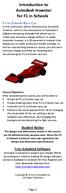 Introduction to Autodesk Inventor for F1 in Schools F1 in Schools Race Car In this course you will be introduced to Autodesk Inventor, which is the centerpiece of Autodesk s digital prototyping strategy
Chapter 1. Creating Sketches in. the Sketch Mode-I. Evaluation chapter. Logon to www.cadcim.com for more details. Learning Objectives
 Chapter 1 Creating Sketches in Learning Objectives the Sketch Mode-I After completing this chapter you will be able to: Use various tools to create a geometry. Dimension a sketch. Apply constraints to
SketchUp Instructions
 SketchUp Instructions Every architect needs to know how to use SketchUp! SketchUp is free from Google just Google it and download to your computer. You can do just about anything with it, but it is especially
Creating Drawings in Pro/ENGINEER
 6 Creating Drawings in Pro/ENGINEER This chapter shows you how to bring the cell phone models and the assembly you ve created into the Pro/ENGINEER Drawing mode to create a drawing. A mechanical drawing
Introduction to ANSYS ICEM CFD
 Workshop 8.2 3D Pipe Junction 14.5 Release Introduction to ANSYS ICEM CFD 2012 ANSYS, Inc. April 1, 2013 1 Release 14.5 3D Pipe Junction 3D Pipe Junction This is a simple 4-way pipe intersection with two
Pro/ENGINEER Wildfire 4.0 Basic Design
 Introduction Datum features are non-solid features used during the construction of other features. The most common datum features include planes, axes, coordinate systems, and curves. Datum features do
CATIA V5 Tutorials. Mechanism Design & Animation. Release 18. Nader G. Zamani. University of Windsor. Jonathan M. Weaver. University of Detroit Mercy
 CATIA V5 Tutorials Mechanism Design & Animation Release 18 Nader G. Zamani University of Windsor Jonathan M. Weaver University of Detroit Mercy SDC PUBLICATIONS Schroff Development Corporation www.schroff.com
Creating Your Own 3D Models
 14 Creating Your Own 3D Models DAZ 3D has an extensive growing library of 3D models, but there are times that you may not find what you want or you may just want to create your own model. In either case
 Edinburgh COLLEGE of ART ARCHITECTURE 3D Modelling in AutoCAD - tutorial exercise The screen The graphics area This is the part of the screen in which the drawing will be created. The command prompt area
Figure 1 - Delta Theta Input Selection
 Creating Cams in Pro/Engineer Wildfire Using DYNACAM Mechanical Engineering Mechanical Design Created by: David E. Yamartino M.S. Mechanical Engineering May 2004 April 12, 2004 Objective: The objective
Introduction to Measurement Tools
 Introduction to Measurement Tools Revu's built-in measurement tools make it easy to take length, area, perimeter, diameter, volume and radius measurements, count from PDFs and perform area cutouts. Compatibility
Introduction to Autodesk Inventor for F1 in Schools
 F1 in Schools race car Introduction to Autodesk Inventor for F1 in Schools In this course you will be introduced to Autodesk Inventor, which is the centerpiece of Autodesk s Digital Prototyping strategy
Intro to Excel spreadsheets
 Intro to Excel spreadsheets What are the objectives of this document? The objectives of document are: 1. Familiarize you with what a spreadsheet is, how it works, and what its capabilities are; 2. Using
Chapter 9. Editing Features. Learning Objectives
 Chapter 9 Editing Features Learning Objectives After completing this chapter, you will be able to: Edit features. Edit sketches of the sketch based features. Edit the sketch plane of the sketch based features.
Understand the Sketcher workbench of CATIA V5.
 Chapter 1 Drawing Sketches in Learning Objectives the Sketcher Workbench-I After completing this chapter you will be able to: Understand the Sketcher workbench of CATIA V5. Start a new file in the Part
2013 Getting Started Guide
 2013 Getting Started Guide The contents of this guide and accompanying exercises were originally created by Nemetschek Vectorworks, Inc. Vectorworks Fundamentals Getting Started Guide Created using: Vectorworks
Linkage 3.2. User s Guide
 Linkage 3.2 User s Guide David Rector Wednesday, April 06, 2016 Table of Contents Table of Contents... 2 Installation... 3 Running the Linkage Program... 3 Simple Mechanism Tutorial... 5 Mouse Operations...
11.1. Objectives. Component Form of a Vector. Component Form of a Vector. Component Form of a Vector. Vectors and the Geometry of Space
 11 Vectors and the Geometry of Space 11.1 Vectors in the Plane Copyright Cengage Learning. All rights reserved. Copyright Cengage Learning. All rights reserved. 2 Objectives! Write the component form of
MET 306. Activity 8a. Mechanism Design Creo 2.0 Level 7 POINT A GROUND LINK LINK 1 LINK 2 LINK 3 POINT B 10/15/2010 1
 Mechanism Design Creo 2.0 Level 7 POINT A LINK 1 GROUND LINK LINK 2 LINK 3 POINT B 10/15/2010 1 Download parts ground, key, link_1, link_2, link_3 and pulley from the V:/MET_306/Activity_8_Creo drive.
Create a Poster Using Publisher
 Contents 1. Introduction 1. Starting Publisher 2. Create a Poster Template 5. Aligning your images and text 7. Apply a background 12. Add text to your poster 14. Add pictures to your poster 17. Add graphs
XCal-View user manual
 XCal-View user manual XCal-View user manual M-9925-0107-04 1 Introduction to XCal-View About XCal-View Renishaw XCal-View software has been written as a direct replacement for the previous analysis package
3D Drawing. Single Point Perspective with Diminishing Spaces
 3D Drawing Single Point Perspective with Diminishing Spaces The following document helps describe the basic process for generating a 3D representation of a simple 2D plan. For this exercise we will be
SECTION 2-1: OVERVIEW SECTION 2-2: FREQUENCY DISTRIBUTIONS
 SECTION 2-1: OVERVIEW Chapter 2 Describing, Exploring and Comparing Data 19 In this chapter, we will use the capabilities of Excel to help us look more carefully at sets of data. We can do this by re-organizing
SE05: Getting Started with Cognex DataMan Bar Code Readers - Hands On Lab Werner Solution Expo April 8 & 9
 SE05: Getting Started with Cognex DataMan Bar Code Readers - Hands On Lab Werner Solution Expo April 8 & 9 Learning Goals: At the end of this lab, the student should have basic familiarity with the DataMan
Introduction to the TI-Nspire CX
 Introduction to the TI-Nspire CX Activity Overview: In this activity, you will become familiar with the layout of the TI-Nspire CX. Step 1: Locate the Touchpad. The Touchpad is used to navigate the cursor
ISO 1101 Geometrical product specifications (GPS) Geometrical tolerancing Tolerances of form, orientation, location and run-out
 INTERNATIONAL STANDARD ISO 1101 Third edition 2012-04-15 Geometrical product specifications (GPS) Geometrical tolerancing Tolerances of form, orientation, location and run-out Spécification géométrique
SolidWorks: Mirror, Revolve, and. Introduction to Robotics
 SolidWorks: Mirror, Revolve, and Circular Pattern Introduction to Robotics Let s Review At this point we have learned the following: Extrude Boss/Base Extruded Cut Adding Relations and Dimensions Linear
Engineering & Design: Geometric Dimensioning
 Section Contents NADCA No. Format Page 1 Introduction -2 S E C T I O N 2 What is GD&T? -2 3 Why Should GD&T be Used? -3 4 Datum Reference Frame -4 4.1 Primary, Secondary, Tertiary Features & Datums -4
Solving Simultaneous Equations and Matrices
 Solving Simultaneous Equations and Matrices The following represents a systematic investigation for the steps used to solve two simultaneous linear equations in two unknowns. The motivation for considering
Animations in Creo 3.0
 Animations in Creo 3.0 ME170 Part I. Introduction & Outline Animations provide useful demonstrations and analyses of a mechanism's motion. This document will present two ways to create a motion animation
Autodesk Fusion 360: Assemblies. Overview
 Overview In this module you will learn how different components can be put together to create an assembly. We will use several tools in Fusion 360 to make sure that these assemblies are constrained appropriately
Proprietary and restricted rights notice
 Proprietary and restricted rights notice This software and related documentation are proprietary to Siemens Product Lifecycle Management Software Inc. 2012 Siemens Product Lifecycle Management Software
Scientific Graphing in Excel 2010
 Scientific Graphing in Excel 2010 When you start Excel, you will see the screen below. Various parts of the display are labelled in red, with arrows, to define the terms used in the remainder of this overview.
Getting Started With DraftSight A Guide For AEC Users
 Getting Started With DraftSight A Guide For AEC Users DraftSight.com Facebook.com/DraftSight Welcome to DraftSight a valuable tool for any AEC professional! DraftSight is more than a free, professional-grade
CATIA: Navigating the CATIA V5 environment. D. CHABLAT / S. CARO [email protected]
 CATIA: Navigating the CATIA V5 environment D. CHABLAT / S. CARO [email protected] Standard Screen Layout 5 4 6 7 1 2 3 8 9 10 11 12 13 14 15 D. Chablat / S. Caro -- Institut de Recherche
Technical Drawing Specifications Resource A guide to support VCE Visual Communication Design study design 2013-17
 A guide to support VCE Visual Communication Design study design 2013-17 1 Contents INTRODUCTION The Australian Standards (AS) Key knowledge and skills THREE-DIMENSIONAL DRAWING PARALINE DRAWING Isometric
Basic 2D Design Be sure you have the latest information!
 Basic 2D Design mastercam x getting started tutorials Basic 2D Design December 2011 Be sure you have the latest information! Information might have been changed or added since this document was published.
ENGINEERING METROLOGY
 ENGINEERING METROLOGY ACADEMIC YEAR 92-93, SEMESTER ONE COORDINATE MEASURING MACHINES OPTICAL MEASUREMENT SYSTEMS; DEPARTMENT OF MECHANICAL ENGINEERING ISFAHAN UNIVERSITY OF TECHNOLOGY Coordinate Measuring
Communicate: In Print
 Communicate: In Print A simple guide Work areas Communicate: In Print has two different modes in which to edit your documents: Create and Adjust modes. These are easily interchangeable and the toolbars
CATIA Wireframe & Surfaces TABLE OF CONTENTS
 TABLE OF CONTENTS Introduction... 1 Wireframe & Surfaces... 2 Pull Down Menus... 3 Edit... 3 Insert... 4 Tools... 6 Generative Shape Design Workbench... 7 Bottom Toolbar... 9 Tools... 9 Analysis... 10
MET 306 Activity 6. Using Pro/MFG Milling Operations Creo 2.0. Machining a Mast Step
 Using Pro/MFG Milling Operations Creo 2.0 Machining a Mast Step If the Trim option is grayed out when trimming the mill volume, Save (making sure the.asm file is going to the correct subdirectory), Exit
Lesson Four 3D Modeling
 Lesson Four 3D Modeling In this lesson you will learn how to: Easily Rotate the UCS to model in different planes Model lines in a method similar to drawing isometrics Create 3D Router Lines Automatically
Roof Tutorial. Chapter 3:
 Chapter 3: Roof Tutorial The majority of Roof Tutorial describes some common roof styles that can be created using settings in the Wall Specification dialog and can be completed independent of the other
Sketcher. Preface What's New? Getting Started Basic Tasks Customizing Workbench Description Glossary Index
 Sketcher Preface What's New? Getting Started Basic Tasks Customizing Workbench Description Glossary Index Dassault Systèmes 1994-99. All rights reserved. Preface CATIA Version 5 Sketcher application makes
Glass coloured glass may pick up on scan. Top right of screen tabs: these tabs will relocate lost windows.
 Artec 3D scanner Instructions for Medium Handheld (MH) Scanner Scanning Conditions: Objects/surfaces that don t scan well: Black or shiny objects and objects with sharp edges or points, hair, glass, transparent
4 Manipulating Elements
 4 Manipulating Elements In the context of this course, Manipulation of elements means moving, copying, rotating, scaling and some other similar operations. We will find that manipulations are always a
Experiment 5: Magnetic Fields of a Bar Magnet and of the Earth
 MASSACHUSETTS INSTITUTE OF TECHNOLOGY Department of Physics 8.02 Spring 2005 Experiment 5: Magnetic Fields of a Bar Magnet and of the Earth OBJECTIVES 1. To examine the magnetic field associated with a
Tutorial: 3D Pipe Junction Using Hexa Meshing
 Tutorial: 3D Pipe Junction Using Hexa Meshing Introduction In this tutorial, you will generate a mesh for a three-dimensional pipe junction. After checking the quality of the first mesh, you will create
An introduction to 3D draughting & solid modelling using AutoCAD
 An introduction to 3D draughting & solid modelling using AutoCAD Faculty of Technology University of Plymouth Drake Circus Plymouth PL4 8AA These notes are to be used in conjunction with the AutoCAD software
5. Tutorial. Starting FlashCut CNC
 FlashCut CNC Section 5 Tutorial 259 5. Tutorial Starting FlashCut CNC To start FlashCut CNC, click on the Start button, select Programs, select FlashCut CNC 4, then select the FlashCut CNC 4 icon. A dialog
Part Design. Page 1 1997 2001 DASSAULT SYSTEMES. IBM Product Lifecycle Management Solutions / Dassault Systemes
 Part Design Page 1 Tutorial Objectives Description This tutorial is an introduction to Part Design. Message This tutorial illustrates how CATIA can Design precise 3D mechanical parts with an intuitive
RapidScan3D Ultrasonic Instrumentation Quick Start Guide
 RapidScan3D Ultrasonic Instrumentation Quick Start Guide Part Number: 147363 Setting up the RapidScan3D System Terminology used in this document includes: instrument the black Peli-case and its contents;
Using Microsoft Word. Working With Objects
 Using Microsoft Word Many Word documents will require elements that were created in programs other than Word, such as the picture to the right. Nontext elements in a document are referred to as Objects
5-Axis Test-Piece Influence of Machining Position
 5-Axis Test-Piece Influence of Machining Position Michael Gebhardt, Wolfgang Knapp, Konrad Wegener Institute of Machine Tools and Manufacturing (IWF), Swiss Federal Institute of Technology (ETH), Zurich,
GoodReader User Guide. Version 1.0 GoodReader version 3.16.0
 GoodReader User Guide Version 1.0 GoodReader version 3.16.0 Contents Operating GoodReader 1 Send PDF files to Your ipad 2 Copy Files with itunes 2 Copy Files to a Cloud Service 5 Download Files from the
Machine Tool Control. Besides these TNCs, HEIDENHAIN also supplies controls for other areas of application, such as lathes.
 Machine Tool Control Contouring controls for milling, drilling, boring machines and machining centers TNC contouring controls from HEIDENHAIN for milling, drilling, boring machines and machining centers
Making Better Medical Devices with Multisensor Metrology
 Making Better Medical Devices with Multisensor Metrology by Nate J. Rose, Chief Applications Engineer, Optical Gaging Products (OGP) Multisensor metrology is becoming a preferred quality control technology
Guide To Creating Academic Posters Using Microsoft PowerPoint 2010
 Guide To Creating Academic Posters Using Microsoft PowerPoint 2010 INFORMATION SERVICES Version 3.0 July 2011 Table of Contents Section 1 - Introduction... 1 Section 2 - Initial Preparation... 2 2.1 Overall
Basic controls of Rhinoceros 3D software
 lecture 2 Basic controls of Rhinoceros 3D software After the start Rhinoceros 3D software shows basic working area compound by four viewports (show model in other positions), popup menu over, palette menu
Angle - a figure formed by two rays or two line segments with a common endpoint called the vertex of the angle; angles are measured in degrees
 Angle - a figure formed by two rays or two line segments with a common endpoint called the vertex of the angle; angles are measured in degrees Apex in a pyramid or cone, the vertex opposite the base; in
How to make a line graph using Excel 2007
 How to make a line graph using Excel 2007 Format your data sheet Make sure you have a title and each column of data has a title. If you are entering data by hand, use time or the independent variable in
Autodesk Fusion 360 Badge Guide: Design an F1 in Schools Trophy
 Autodesk Fusion 360 Badge Guide: Design an F1 in Schools Trophy Abstract: Gain basic understanding of creating 3D models in Fusion 360 by designing an F1 in Schools trophy. This badge may be claimed by
If you know exactly how you want your business forms to look and don t mind detail
 Advanced Form Customization APPENDIX E If you know exactly how you want your business forms to look and don t mind detail work, you can customize QuickBooks forms however you want. With QuickBooks Layout
Petrel TIPS&TRICKS from SCM
 Petrel TIPS&TRICKS from SCM Knowledge Worth Sharing Building Montages in Petrel Most Petrel projects require display maps to be made for presentations; either for partners or peers. This TIPS&TRICKS provides
Basic AutoSketch Manual
 Basic AutoSketch Manual Instruction for students Skf-Manual.doc of 3 Contents BASIC AUTOSKETCH MANUAL... INSTRUCTION FOR STUDENTS... BASIC AUTOSKETCH INSTRUCTION... 3 SCREEN LAYOUT... 3 MENU BAR... 3 FILE
0 Introduction to Data Analysis Using an Excel Spreadsheet
 Experiment 0 Introduction to Data Analysis Using an Excel Spreadsheet I. Purpose The purpose of this introductory lab is to teach you a few basic things about how to use an EXCEL 2010 spreadsheet to do
DRAFTING MANUAL. Gears (Bevel and Hypoid) Drafting Practice
 Page 1 1.0 General This section provides the basis for uniformity in engineering gears drawings and their technical data for gears with intersecting axes (bevel gears), and nonparallel, nonintersecting
Graphic Design. Background: The part of an artwork that appears to be farthest from the viewer, or in the distance of the scene.
 Graphic Design Active Layer- When you create multi layers for your images the active layer, or the only one that will be affected by your actions, is the one with a blue background in your layers palette.
Avery DesignPro 2000 User Guide
 Avery DesignPro 2000 User Guide Creating labels and cards for your personal needs is easy with Avery DesignPro 2000 Avery DesignPro 2000 User Guide First edition of the condensed user manual for Avery
Tutorial: 2D Pipe Junction Using Hexa Meshing
 Tutorial: 2D Pipe Junction Using Hexa Meshing Introduction In this tutorial, you will generate a mesh for a two-dimensional pipe junction, composed of two inlets and one outlet. After generating an initial
SPINDLE ERROR MOVEMENTS MEASUREMENT ALGORITHM AND A NEW METHOD OF RESULTS ANALYSIS 1. INTRODUCTION
 Journal of Machine Engineering, Vol. 15, No.1, 2015 machine tool accuracy, metrology, spindle error motions Krzysztof JEMIELNIAK 1* Jaroslaw CHRZANOWSKI 1 SPINDLE ERROR MOVEMENTS MEASUREMENT ALGORITHM
Microsoft Excel 2010 Charts and Graphs
 Microsoft Excel 2010 Charts and Graphs Email: [email protected] Web Page: http://training.health.ufl.edu Microsoft Excel 2010: Charts and Graphs 2.0 hours Topics include data groupings; creating
Excel -- Creating Charts
 Excel -- Creating Charts The saying goes, A picture is worth a thousand words, and so true. Professional looking charts give visual enhancement to your statistics, fiscal reports or presentation. Excel
How To Create A View Frame In 3D
 12/4/2008-10:00 am - 11:30 am Room:Palazzo O-P (5th) The Secrets of Cutting Plan and Profile Sheets in AutoCAD Civil 3D Michelle Rasmussen - Application Engineer, IMAGINiT Technologies CV304-1P In this
Adding vectors We can do arithmetic with vectors. We ll start with vector addition and related operations. Suppose you have two vectors
 1 Chapter 13. VECTORS IN THREE DIMENSIONAL SPACE Let s begin with some names and notation for things: R is the set (collection) of real numbers. We write x R to mean that x is a real number. A real number
How to Install Microsoft Windows Server 2008 R2 in VMware ESXi
 How to Install Microsoft Windows Server 2008 R2 in VMware ESXi I am not responsible for your actions or their outcomes, in any way, while reading and/or implementing this tutorial. I will not provide support
Technical Regulations 2015-2016
 F1 in Schools - 2014 World Finals Technical Regulations Technical Regulations 2015-2016 2013 - F1 in Schools Ltd. Page 1 of 27 3 September 2015 CONTENTS PREFACE SUMMARY OF MAIN REVISIONS FROM 2013 REGULATIONS...
Geometry and Measurement
 The student will be able to: Geometry and Measurement 1. Demonstrate an understanding of the principles of geometry and measurement and operations using measurements Use the US system of measurement for
Making Visio Diagrams Come Alive with Data
 Making Visio Diagrams Come Alive with Data An Information Commons Workshop Making Visio Diagrams Come Alive with Data Page Workshop Why Add Data to A Diagram? Here are comparisons of a flow chart with
Enhanced Formatting and Document Management. Word 2010. Unit 3 Module 3. Diocese of St. Petersburg Office of Training Training@dosp.
 Enhanced Formatting and Document Management Word 2010 Unit 3 Module 3 Diocese of St. Petersburg Office of Training [email protected] This Page Left Intentionally Blank Diocese of St. Petersburg 9/5/2014
ME 111: Engineering Drawing
 ME 111: Engineering Drawing Lecture # 14 (10/10/2011) Development of Surfaces http://www.iitg.ernet.in/arindam.dey/me111.htm http://www.iitg.ernet.in/rkbc/me111.htm http://shilloi.iitg.ernet.in/~psr/ Indian
SAMPLE TEST PAPER - I
 SCHEME E SAMPLE TEST PAPER - I Course Name : Mechanical Engineering Group Course Code : AE/PG/PT/ME/MH/FE Semester : Third Subject : Mechanical Engineering Drawing 12042 Time : 90 Minutes Marks: 25 Instruction:
House Design Tutorial
 Chapter 2: House Design Tutorial This House Design Tutorial shows you how to get started on a design project. The tutorials that follow continue with the same plan. When we are finished, we will have created
12-1 Representations of Three-Dimensional Figures
 Connect the dots on the isometric dot paper to represent the edges of the solid. Shade the tops of 12-1 Representations of Three-Dimensional Figures Use isometric dot paper to sketch each prism. 1. triangular
F1 in Schools - 2014 World Finals Technical Regulations. 2014 WORLD FINALS Technical Regulations
 2014 WORLD FINALS Technical Regulations Refer also to the 2014 World Finals Competition Regulations. For World Finals use only. 2013 - F1 in Schools Ltd. Page 1 of 23 13 August 2014 Front Cover A1 Racing
SDC. Schroff Development Corporation WWW.SDCACAD.COM PUBLICATIONS. MultiMedia CD by Jack Zecher
 MultiMedia CD by Jack Zecher An audioi/visual presentation of the tutorial exercises SDC PUBLICATIONS Schroff Development Corporation WWW.SDCACAD.COM AutoCAD 2002 Tutorial 2-1 Lesson 2 Geometric Construction
Using Excel as a Management Reporting Tool with your Minotaur Data. Exercise 1 Customer Item Profitability Reporting Tool for Management
 Using Excel as a Management Reporting Tool with your Minotaur Data with Judith Kirkness These instruction sheets will help you learn: 1. How to export reports from Minotaur to Excel (these instructions
Atomic Force Microscope and Magnetic Force Microscope Background Information
 Atomic Force Microscope and Magnetic Force Microscope Background Information Lego Building Instructions There are several places to find the building instructions for building the Lego models of atomic
Getting Started with Excel 2008. Table of Contents
 Table of Contents Elements of An Excel Document... 2 Resizing and Hiding Columns and Rows... 3 Using Panes to Create Spreadsheet Headers... 3 Using the AutoFill Command... 4 Using AutoFill for Sequences...
Creating a Perpendicular Plane, in Google SketchUp
 Creating a Perpendicular Plane, in Google SketchUp A teacher recently asked for instructions to create a plane perpendicular to a line. It s actually quite easy when you use the Follow Me tool. And SketchUp