
Lecture 22 The Acid-Base Character of Oxides and Hydroxides in Aqueous Solution
|
|
|
- Estella Jackson
- 9 years ago
- Views:
Transcription
1 2P32 Principles of Inorganic Chemistry Dr. M. Pilkington Lecture 22 The Acid-Base Character of Oxides and Hydroxides in Aqueous Solution Oxides; acidic, basic, amphoteric Classification of oxides - oxide acidity and basicity Hydrolysis of oxo anions Periodicity of oxide acid-base character Reactions of acid and basic oxides 1. Oxides Oxygen forms compounds with all elements except He, Ne, Ar, and Kr. It reacts directly with all elements except the halogens, a few noble metals e.g. Ag and Au and the noble gases. As encountered for the hydrides, there is variability in the types of bonding encountered. Metal oxides are ionic solids, nonmetal oxides are discrete molecular covalent gases and liquids. The oxides of heavier nonmetals and the semimetals tend to be covalent polymeric solids. Transition metal oxides are occasionally nonstiochiometric. 1

2 The variation of acid-base properties of the oxides in aqueous solution, is strongly correlated with the position of the metal-nonmetal line. Oxides in aqueous solution (Acidic and Basic Anhydrides) One of the most important aspects of the properties of oxides is their acid-base properties. Many oxides are basic or acidic anhydrides; that is they are compounds that are formed by the removal of water from a corresponding base or acid. Ionic oxides are usually basic anhydrides, whereas covalent oxides are usually acidic anhydrides. Oxides of the semimetals are amphoteric anhydrides, capable of acting as either an acid or base, depending on the circumstances. If we list the oxides of a given period, e.g. 3 rd, we find an orderly progression of their acid-base character. The acid strength increases with the acidity of the cation involved Na + Cl +7 Na 2 O, MgO, Al 2 O 3, SiO 2, P 4 O 10, SO 3, Cl 2 O 7 Na(OH) Mg(OH) 2 Al(OH) 3 Si(OH) 4 H 3 PO 4 H 2 SO 4 HClO 4 (sol) (insol) amphoteric weak acid very strong acid. BASIC OXIDE ACIDIC OXIDE AMPHOTERIC OXIDE strong base Amphoteric species Strong Acid 2

3 The ionic oxides are characterized by the presence of the oxide ion, O 2-, that like the H + ion, cannot exist alone in aqueous solution. The reaction between the oxide and a water molecule is shown below: O 2- + H O 2 O H - H The 2- charged oxide attacks and forms a bond with a partially positive hydrogen atom of the water molecule. The subsequent breaking of the O-H bond produced two hydroxide d ions. The equilibrium constant for this reaction is greater than 10 22, so this reaction lies far to the right. For example sodium oxide: Na 2 O (s) + H 2 O(l) 2NaOH (aq) 2Na + + 2OH - (aq) The process is a sequence from the metal oxide, to the metal hydroxide that dissociates into the aqueous hydroxide and metal ions. Sodium oxide is therefore a basic anhydride; it produces the base sodium hydroxide in aqueous solution. Note the greater degree of ionic character of the oxide, the more basic it is. Nonmetal oxides react with water to produce what are known as oxo-acids or oxyacids, i.e. acids containing NM-O-H unit, where NM = nonmetal. A non metal oxide is usually characterized by polar covalent bonds rather than the ionic bonds of a metal oxide. 3

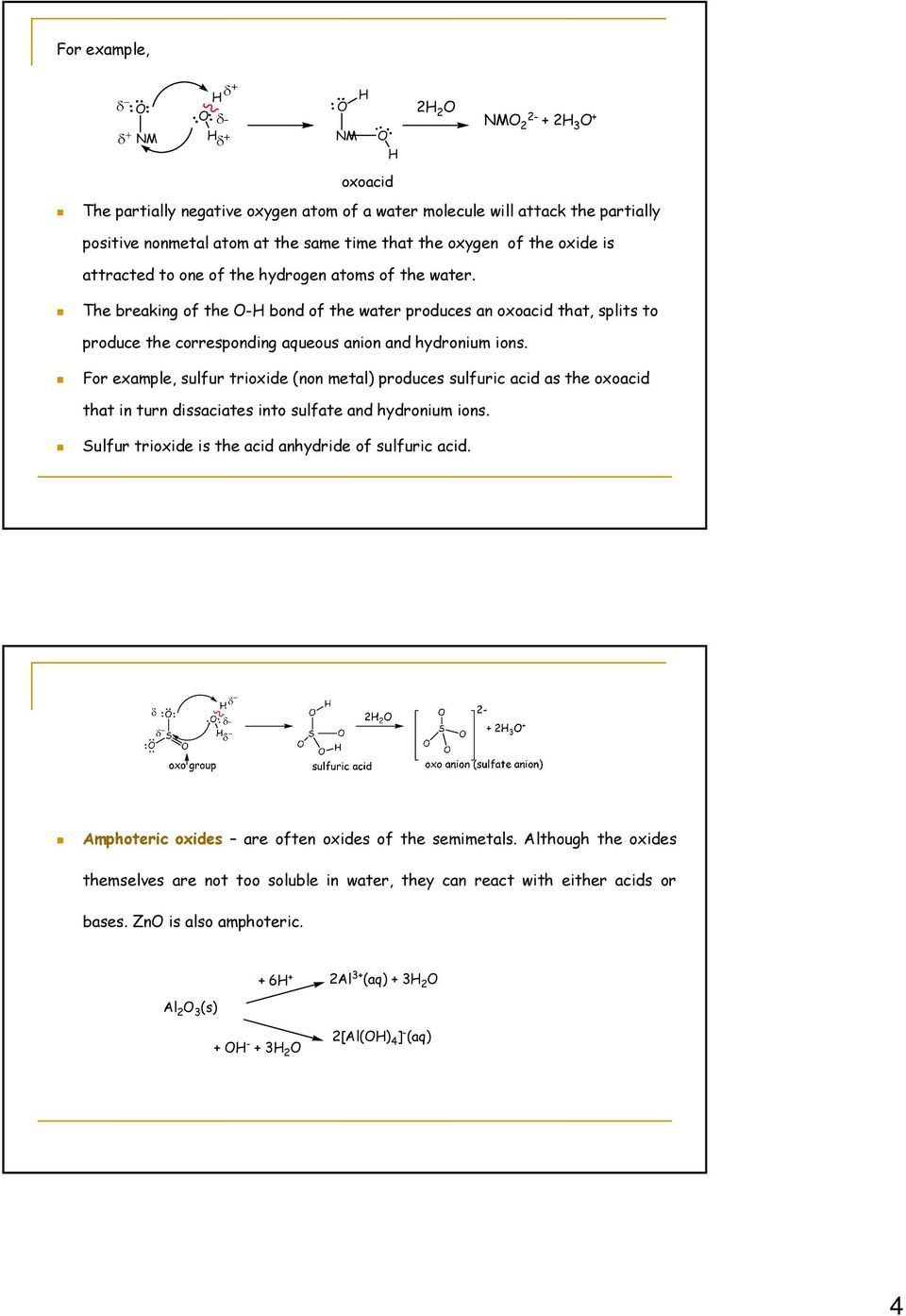
4 For example, H + H O O 2H O 2 O - NMO H 3 O + NM H + NM O H oxoacid The partially negative oxygen atom of a water molecule will attack the partially positive nonmetal atom at the same time that the oxygen of the oxide is attracted to one of the hydrogen atoms of the water. The breaking of the O-H bond of the water produces an oxoacid that, splits to produce the corresponding aqueous anion and hydronium ions. For example, sulfur trioxide (non metal) produces sulfuric acid as the oxoacid that in turn dissaciates into sulfate and hydronium ions. Sulfur trioxide is the acid anhydride of sulfuric acid. Amphoteric oxides are often oxides of the semimetals. Although the oxides themselves are not too soluble in water, they can react with either acids or bases. ZnO is also amphoteric. + 6H + 2Al 3+ (aq) + 3H 2 O Al 2 O 3 (s) + OH - + 3H 2 O 2[Al(OH) 4 ] - (aq) 4
5 Hydrolysis of Oxo anions Non metals exist in aqueous solution as oxo acids that ionize to form oxoanions in solution. Oxo anions (combinations of oxygen and a NM) are hydrated in aqueous solution. In this case the electrostatic attraction is between the electron pairs on the oxo anion oxygen atoms and the partially positive H-atoms of the water molecules. The hydration is an exothermic process. Hydration energies increase with increasing charge and decreasing size. If the interaction between the anion and the H-atom of the water is sufficiently strong, the H can be removed from water generating a hydroxide ion resulting in a basic solution. MO y- x + H 2 O [MO (x-1) OH] (y-1) + OH - When determining the basicity of an oxo anion we have to take into consideration, charge, number of oxo groups and electronegativity. Oxoanions can be placed into categories that describe the extent to which they hydrolyze. Effect of charge on basicity Increasing charge on an anion increases its tendency to hydrolyze and form basic solutions. The pk b values of an oxoanion decrease by 4-5 units for each additional negative charge on the anion. Effect of number of oxo groups Since most nonmetals exhibit more than one oxidation state, they can form oxo anions that differ in the number of oxo groups (oxygen s bound directly to the metal). For example chlorine forms four different oxo anions: ClO -, ClO 2-, ClO 3-, ClO 4-. Adding additional oxygen s decreases the bascity of the oxoanion. Effect of electronegativity As the electronegativity of the nonmetal atom decreases the basicity of the oxo anion increases. 5

6 The classification of oxo anions is summarized below Classification Resulting Formula Nonbasic contains oxo groups & no charge Feebly basic no charge & no oxo groups Moderately basic no oogro oxo groups & a charge of -1/2 or -1 Very strongly basic no oxo groups & a charge more negative an -1 Example 1. Consider an oxo anion of formula MO 4-. For this formula, the effect of one unit of negative charge will cancel out the effect of two oxo groups. If we remove the negative charge and two oxo groups the resulting formula is MO 2. This anion falls into the category of nonbasic. 2. Consider an oxo anion of formula MO 4-3. The three oxo groups cancel 1.5 unit of negative charge. The resulting formula becomes M-2.5. This oxo anion will be very strongly basic. A table on the next slide lists calculated pkb s for the important simple oxo anions of the elements. 6

7 Summary of Trends in Numbers of Oxo Groups in Oxo Anions TheoxoanionshavingthesmallestcentralatomsarethoseofthePeriod2pblock. These can have a maximum coordination of 3 and will accommodate either 3 oxo groups or two oxo groups plus one unshared p electrons. 7

8 Central atoms of the p-block of Periods 3 and 4 and those of the 3 block 4 and those of the d-block of Periods 4 and 5 have larger radii and can have a maximum coordination number of 4. If the valence orbitals are 3p, 4p or 4d, the central atom can accommodate 4 oxo groups and unshared p electrons. Central atoms of the p-block and d-block of Period 6, have a maximum coordination number of 6. If the valence orbitals on the central atom are 5p, 5d, 5f, 6p or 6d, the central atom can accommodate 4-6 oxo groups and unshared p- orbital pairs. 8

9 2. To Summarize - classification of oxides Acidic Oxide produces an acid when it reacts with H 2 O e.g. SO 3 + H 2 O H 2 SO 4 SO 2 + H 2 O H 2 SO 3 CO 2 + H 2 O H 2 CO 3 Basic Oxide produces a base when reacts with H 2 O e.g. Na 2 O + H2O 2NaOH CaO + H 2 O Ca(OH) 2 Amphoteric Oxides react with H 2 O to produce a hydroxide that reacts further with either acids or bases. For Example ZnO, BeO -, Al 2 O 3-, Ga 2 O 3-, Sn 2 O 2-, PbO - 2 The E-OH Unit in Aqueous solution; (where E = an element) We know both metal and monmetal oxides react with water to produce compounds with an E-O-H unit. If E is a metal, the unit acts as a base releasing hydroxide ions in solution. If E is a nonmetal, hydronium ions are released. Why the difference? How does the nature of E determine whether the unit will be an acid or a base or amphoteric? To answer this we look closely at the relative electronegativities of the atoms within the unit. 9

10 hydroxide = OH - = base X O H hydronium = H 3 O + = acid where does the bond break? For a metal (ENs ) X O H X + + OH - Producing a base in solution. The greater difference in electronegativity is between the metal and the oxygen, making the M-O bond the more polar. The more polar M-O bond is susceptible to attack by polar water molecules. This results in breaking the M-O bond to afford the aqueous metal cation and the hydroxide anion in solution. For a Non Metal (ENs ) In this case the O-H bond is the more polar and susceptible to attack by water molecules, and this results in the oxoanion and hydronium ions in solution. X O H XO - + H + Producing an acidic solution. For a semimetal The two bonds of the E-O-H unit are approximately of the same polarity, and either can be broken, depending on the circumstances. In this case the unit is amphoteric. 10

11 3. Periodicity of oxide acid-base character We have just seen that for a non metal, how the X-O-H unit is split between the oxygen and the hydrogen atoms by the attack of polar water. Two additional factors are also important in determining the relative acid strengths: 1. The electronegativity ti it of the central atom 2. The number of nonhydroxyl oxygens bound to the central atom. As the electronegativity of the central atom increases, so does its ability to withdraw electron density from its neighboring atoms. The surrounding oxygen atoms have high electronegativity, so the central atom cannot withdraw electron density from these. The electron density comes from the O-H bonds. The H atom has low electronegativity. Electron density is withdrawn from the O-H bond, the H becomes more partially positive and therefore the O-H bond is more polar and susceptible to attack by water molecules. The acid strength of an oxoacid increases as the electronegativity of the central atom increases. For example, sulfuric acid is a stronger acid than selenic acid, phosphoric acid is stronger than arsenic acid and perchloric acid is stronger than perbromic acid. As the number of nonhydroxyl oxygens increases, they withdraw more electron density from the central atom, making it partially positive. In turn the central atom now withdraws more electron density from the only source available, i.e the O-H bond. Again the H atom becomes partially positive, and the O-H bond becomes more polar and therefore more susceptible to attack by water. The result is that as the number of nonhydroxyl oxygens increases so does the strength of the oxoacid. For example, acid strength increases from nitrous acid to nitric acid and from sulfurous to sulfuric acid. 11

12 What about Transition Metals? Cr II O is basic and dissolves in acids. Cr III 2O 3 is amphoteric it dissolves in acids (Cr 3+ ) and bases [Cr(OH) 3 ] - Cr VI O 3 is an acidic oxide it dissolves in water to produce H 3 CrO 4 (chromic acid). Acidity of the oxide increases s as the charge on the cation increases s (so with increasing oxidation number of the central atom). Acidity of the oxide also increases as the size decreases ( as the ionic radius decreases the X-OH bond strength increases and the H + ion dissociates). CrO 3 is analogous to SO 3 H 2 CrO 4 H 2 SO 4 Chromic acid Sulfuric acid 4. Reactions of acidic and basic oxides 1. With H 2 O to produce acid or bases CaO + H 2 O Ca(OH) 2 basic oxide N 2 O 5 + H 2 O 2HNO 3 acidic oxide 2. React with each other to afford salts. Na 2 O(s) + SO 3 (g) Na 2 SO 4 (s) basic acidic salt oxide oxide 12

13 CaO + Cl 2 O Ca(OCl) 2 basic acid salt oxide oxide 3. Acid oxide + base salt or salt + H 2 O CO 2 + NaOH NaHCO 3 CO 2 + 2NaOH Na 2 CO 3 + H 2 O (CO 2 is the anhydride of H 2 CO 3 ) 3. Basic oxide + acid salt + H 2 O MgO + 2HCl MgCl 2 + H 2 O 13

Chapter 14 - Acids and Bases
 Chapter 14 - Acids and Bases 14.1 The Nature of Acids and Bases A. Arrhenius Model 1. Acids produce hydrogen ions in aqueous solutions 2. Bases produce hydroxide ions in aqueous solutions B. Bronsted-Lowry
Chapter 16 Acid-Base Equilibria
 Chapter 16 Acid-Base Equilibria Learning goals and key skills: Understand the nature of the hydrated proton, represented as either H + (aq) or H 3 O + (aq) Define and identify Arrhenuis acids and bases.
Chemical Reactions in Water Ron Robertson
 Chemical Reactions in Water Ron Robertson r2 f:\files\courses\1110-20\2010 possible slides for web\waterchemtrans.doc Properties of Compounds in Water Electrolytes and nonelectrolytes Water soluble compounds
Chem101: General Chemistry Lecture 9 Acids and Bases
 : General Chemistry Lecture 9 Acids and Bases I. Introduction A. In chemistry, and particularly biochemistry, water is the most common solvent 1. In studying acids and bases we are going to see that water
Acids and Bases: A Brief Review
 Acids and : A Brief Review Acids: taste sour and cause dyes to change color. : taste bitter and feel soapy. Arrhenius: acids increase [H ] bases increase [OH ] in solution. Arrhenius: acid base salt water.
Chapter 17. How are acids different from bases? Acid Physical properties. Base. Explaining the difference in properties of acids and bases
 Chapter 17 Acids and Bases How are acids different from bases? Acid Physical properties Base Physical properties Tastes sour Tastes bitter Feels slippery or slimy Chemical properties Chemical properties
Since we will be dealing with aqueous acid and base solution, first we must examine the behavior of water.
 Acids and Bases Know the definition of Arrhenius, Bronsted-Lowry, and Lewis acid and base. Autoionization of Water Since we will be dealing with aqueous acid and base solution, first we must examine the
Which substance contains positive ions immersed in a sea of mobile electrons? A) O2(s) B) Cu(s) C) CuO(s) D) SiO2(s)
 BONDING MIDTERM REVIEW 7546-1 - Page 1 1) Which substance contains positive ions immersed in a sea of mobile electrons? A) O2(s) B) Cu(s) C) CuO(s) D) SiO2(s) 2) The bond between hydrogen and oxygen in
Chapter 16: Acid-Base and Solubility Equilibria: Reactions in Soil and Water
 Chapter 16: Acid-Base and Solubility Equilibria: Reactions in Soil and Water Problems: 16.2-16.86 16.1 ACIDS AND BASES: THE BRØNSTED-LOWRY MODEL PROPERTIES OF ACIDS & BASES Acids produce hydrogen ions,
Stoichiometry and Aqueous Reactions (Chapter 4)
 Stoichiometry and Aqueous Reactions (Chapter 4) Chemical Equations 1. Balancing Chemical Equations (from Chapter 3) Adjust coefficients to get equal numbers of each kind of element on both sides of arrow.
Bonding Practice Problems
 NAME 1. When compared to H 2 S, H 2 O has a higher 8. Given the Lewis electron-dot diagram: boiling point because H 2 O contains stronger metallic bonds covalent bonds ionic bonds hydrogen bonds 2. Which
Acid/base Definitions. Acid/Base Definitions. Acid / Base Chemistry. Acid/Base Definitions. Identifying Acids and Bases
 Acids Identifying Acids and Bases Acid (anhydrides) contains H+ ions as the cation, with and other element as the anion Non-metal oxide H2SO4 HI P2O5 Bases Base (anhydrides) Contains OH- as the anion Combined
CHEMISTRY 101 EXAM 3 (FORM B) DR. SIMON NORTH
 1. Is H 3 O + polar or non-polar? (1 point) a) Polar b) Non-polar CHEMISTRY 101 EXAM 3 (FORM B) DR. SIMON NORTH 2. The bond strength is considerably greater in HF than in the other three hydrogen halides
NET IONIC EQUATIONS. A balanced chemical equation can describe all chemical reactions, an example of such an equation is:
 NET IONIC EQUATIONS A balanced chemical equation can describe all chemical reactions, an example of such an equation is: NaCl + AgNO 3 AgCl + NaNO 3 In this case, the simple formulas of the various reactants
Periodic Table Questions
 Periodic Table Questions 1. The elements characterized as nonmetals are located in the periodic table at the (1) far left; (2) bottom; (3) center; (4) top right. 2. An element that is a liquid at STP is
Chapter 14: Acids and Bases
 Ch 14 Page 1 Chapter 14: Acids and Bases Properties of Acids Sour taste React with some metals Turns blue litmus paper red React with bases Some Common Acids HCl, hydrochloric acid H 2 SO 4, sulfuric acid
B) atomic number C) both the solid and the liquid phase D) Au C) Sn, Si, C A) metal C) O, S, Se C) In D) tin D) methane D) bismuth B) Group 2 metal
 1. The elements on the Periodic Table are arranged in order of increasing A) atomic mass B) atomic number C) molar mass D) oxidation number 2. Which list of elements consists of a metal, a metalloid, and
Acid-Base Chemistry. Brønsted-Lowry Acids & Bases
 Acid-Base Chemistry ν There are a couple of ways to define acids and bases ν Brønsted-Lowry acids and bases ν Acid: H + ion donor ν Base: H + ion acceptor ν Lewis acids and bases ν Acid: electron pair
100% ionic compounds do not exist but predominantly ionic compounds are formed when metals combine with non-metals.
 2.21 Ionic Bonding 100% ionic compounds do not exist but predominantly ionic compounds are formed when metals combine with non-metals. Forming ions Metal atoms lose electrons to form +ve ions. Non-metal
Chapter 15 Acids and Bases. Fu-Yin Hsu
 Chapter 15 Acids and Bases Fu-Yin Hsu Stomach Acid and Heartburn The cells that line your stomach produce hydrochloric acid. To kill unwanted bacteria To help break down food To activate enzymes that break
Required Reading Material.
 JF Chemistry 1101 2014-2015 Introduction to Physical Chemistry: Acid Base and Solution Equilibria. Professor Mike Lyons School of Chemistry [email protected] Required Reading Material. Kotz, Treichel and
Write the acid-base equilibria connecting all components in the aqueous solution. Now list all of the species present.
 Chapter 16 Acids and Bases Concept Check 16.1 Chemists in the seventeenth century discovered that the substance that gives red ants their irritating bite is an acid with the formula HCHO 2. They called
6 Reactions in Aqueous Solutions
 6 Reactions in Aqueous Solutions Water is by far the most common medium in which chemical reactions occur naturally. It is not hard to see this: 70% of our body mass is water and about 70% of the surface
The Periodic Table: Periodic trends
 Unit 1 The Periodic Table: Periodic trends There are over one hundred different chemical elements. Some of these elements are familiar to you such as hydrogen, oxygen, nitrogen and carbon. Each one has
Aqueous Solutions. Water is the dissolving medium, or solvent. Some Properties of Water. A Solute. Types of Chemical Reactions.
 Aqueous Solutions and Solution Stoichiometry Water is the dissolving medium, or solvent. Some Properties of Water Water is bent or V-shaped. The O-H bonds are covalent. Water is a polar molecule. Hydration
Chapter 8: Chemical Equations and Reactions
 Chapter 8: Chemical Equations and Reactions I. Describing Chemical Reactions A. A chemical reaction is the process by which one or more substances are changed into one or more different substances. A chemical
Acid-Base Equilibrium
 AcidBaseEquil 1 Acid-Base Equilibrium See AqueousIons in Chemistry 1110 online notes for review of acid-base fundamentals! Acid- Base Reaction in Aqueous Salt Solutions Recall that use [ ] to mean concentration
Chapter 4: Nonionic Compounds and Their Nomenclature
 50 Chapter 4: Nonionic Compounds and Their Nomenclature A nonionic compound is a substance composed of atoms held together by chemical bonding forces, called covalent bonds. Covalent bonds are formed by
stoichiometry = the numerical relationships between chemical amounts in a reaction.
 1 REACTIONS AND YIELD ANSWERS stoichiometry = the numerical relationships between chemical amounts in a reaction. 2C 8 H 18 (l) + 25O 2 16CO 2 (g) + 18H 2 O(g) From the equation, 16 moles of CO 2 (a greenhouse
6.5 Periodic Variations in Element Properties
 324 Chapter 6 Electronic Structure and Periodic Properties of Elements 6.5 Periodic Variations in Element Properties By the end of this section, you will be able to: Describe and explain the observed trends
CHEMISTRY BONDING REVIEW
 Answer the following questions. CHEMISTRY BONDING REVIEW 1. What are the three kinds of bonds which can form between atoms? The three types of Bonds are Covalent, Ionic and Metallic. Name Date Block 2.
Aqueous Ions and Reactions
 Aqueous Ions and Reactions (ions, acids, and bases) Demo NaCl(aq) + AgNO 3 (aq) AgCl (s) Two clear and colorless solutions turn to a cloudy white when mixed Demo Special Light bulb in water can test for
Chapter 19: Acids and Bases Homework Packet (50 pts) Name: Score: / 50
 Chapter 19: Acids and Bases Homework Packet (50 pts) Topic pg Section 19.1 1-3 Section 19.2 3-6 Section 19.3 6-7 Section 19.4 8 Naming Acids 9 Properties of Acids/Bases 10-11 Conjugate Acid/Base Pairs
Arrhenius Definition. Chapter 15 Acids and Bases. Brønsted-Lowry Concept. Brønsted-Lowry Concept. Conjugate Acid-Base Pairs
 John W. Moore Conrad L. Stanitski Peter C. Jurs http://academic.cengage.com/chemistry/moore Chapter 15 Acids and Bases Arrhenius Definition Arrhenius: any substance which ionizes in water to produce: Protons
Chapter 13 & 14 Practice Exam
 Name: Class: Date: Chapter 13 & 14 Practice Exam Multiple Choice Identify the choice that best completes the statement or answers the question. 1. Acids generally release H 2 gas when they react with a.
In the box below, draw the Lewis electron-dot structure for the compound formed from magnesium and oxygen. [Include any charges or partial charges.
 Name: 1) Which molecule is nonpolar and has a symmetrical shape? A) NH3 B) H2O C) HCl D) CH4 7222-1 - Page 1 2) When ammonium chloride crystals are dissolved in water, the temperature of the water decreases.
CHEMICAL NOMENCLATURE
 CHEMICAL NOMENCLATURE Chemical nomenclature The process of giving unambiguous chemical formulas or chemical names to elements and compounds Introduction Chemistry is the study of matter (elements and compounds)
Chemical Equations and Chemical Reactions. Chapter 8.1
 Chemical Equations and Chemical Reactions Chapter 8.1 Objectives List observations that suggest that a chemical reaction has taken place List the requirements for a correctly written chemical equation.
Candidate Style Answer
 Candidate Style Answer Chemistry A Unit F321 Atoms, Bonds and Groups High banded response This Support Material booklet is designed to accompany the OCR GCE Chemistry A Specimen Paper F321 for teaching
3. What would you predict for the intensity and binding energy for the 3p orbital for that of sulfur?
 PSI AP Chemistry Periodic Trends MC Review Name Periodic Law and the Quantum Model Use the PES spectrum of Phosphorus below to answer questions 1-3. 1. Which peak corresponds to the 1s orbital? (A) 1.06
I N V E S T I C E D O R O Z V O J E V Z D Ě L Á V Á N Í CHEMICAL REACTIONS
 Chemical reaction = process during which original substances change to new substances, reactants turn to... The bonds of reactants... and new bonds are... The classification of reactions: 1. Classification
Theme 3: Bonding and Molecular Structure. (Chapter 8)
 Theme 3: Bonding and Molecular Structure. (Chapter 8) End of Chapter questions: 5, 7, 9, 12, 15, 18, 23, 27, 28, 32, 33, 39, 43, 46, 67, 77 Chemical reaction valence electrons of atoms rearranged (lost,
6) Which compound is manufactured in larger quantities in the U.S. than any other industrial chemical?
 MULTIPLE CHOICE. Choose the one alternative that best completes the statement or answers the question. 1) Which statement concerning Arrhenius acid-base theory is not correct? A) Acid-base reactions must
Nomenclature of Ionic Compounds
 Nomenclature of Ionic Compounds Ionic compounds are composed of ions. An ion is an atom or molecule with an electrical charge. Monatomic ions are formed from single atoms that have gained or lost electrons.
Oxidation States of Nitrogen
 Oxidation States of Nitrogen HNO 3 NH 3 HNO 2 NO N 2 O N 2 HN 3 N 2 H 5 + +3 +2 +1 0-1/3-2 Oxidation +5-3 Reduction Oxidation States of Chlorine HClO 4 HClO 3 ClO 2 HClO 2 HClO Cl 2 HCl +5 +4 +3 +1 0 Oxidation
Exam 2 Chemistry 65 Summer 2015. Score:
 Name: Exam 2 Chemistry 65 Summer 2015 Score: Instructions: Clearly circle the one best answer 1. Valence electrons are electrons located A) in the outermost energy level of an atom. B) in the nucleus of
Name period AP chemistry Unit 2 worksheet Practice problems
 Name period AP chemistry Unit 2 worksheet Practice problems 1. What are the SI units for a. Wavelength of light b. frequency of light c. speed of light Meter hertz (s -1 ) m s -1 (m/s) 2. T/F (correct
Chapter 8 - Chemical Equations and Reactions
 Chapter 8 - Chemical Equations and Reactions 8-1 Describing Chemical Reactions I. Introduction A. Reactants 1. Original substances entering into a chemical rxn B. Products 1. The resulting substances from
Chapter 11. Electrochemistry Oxidation and Reduction Reactions. Oxidation-Reduction Reactions. Oxidation-Reduction Reactions
 Oxidation-Reduction Reactions Chapter 11 Electrochemistry Oxidation and Reduction Reactions An oxidation and reduction reaction occurs in both aqueous solutions and in reactions where substances are burned
GROUP II ELEMENTS. Beryllium to Barium
 1 GROUP II ELEMENTS Beryllium to Barium Introduction Elements in Group I (alkali metals) and Group II (alkaline earths) are known as s-block elements because their valence (bonding) electrons are in s
Chemical Equations. Chemical Equations. Chemical reactions describe processes involving chemical change
 Chemical Reactions Chemical Equations Chemical reactions describe processes involving chemical change The chemical change involves rearranging matter Converting one or more pure substances into new pure
Bonds. Bond Length. Forces that hold groups of atoms together and make them function as a unit. Bond Energy. Chapter 8. Bonding: General Concepts
 Bonds hapter 8 Bonding: General oncepts Forces that hold groups of atoms together and make them function as a unit. Bond Energy Bond Length It is the energy required to break a bond. The distance where
Brønsted-Lowry Acids and Bases
 Brønsted-Lowry Acids and Bases 1 According to Brønsted and Lowry, an acid-base reaction is defined in terms of a proton transfer. By this definition, the reaction of Cl in water is: Cl(aq) + Cl (aq) +
H 2O gas: molecules are very far apart
 Non-Covalent Molecular Forces 2/27/06 3/1/06 How does this reaction occur: H 2 O (liquid) H 2 O (gas)? Add energy H 2O gas: molecules are very far apart H 2O liquid: bonding between molecules Use heat
CHEMISTRY II FINAL EXAM REVIEW
 Name Period CHEMISTRY II FINAL EXAM REVIEW Final Exam: approximately 75 multiple choice questions Ch 12: Stoichiometry Ch 5 & 6: Electron Configurations & Periodic Properties Ch 7 & 8: Bonding Ch 14: Gas
Chapter 7 Periodic Properties of the Elements
 Chapter 7 Periodic Properties of the Elements 1. Elements in the modern version of the periodic table are arranged in order of increasing. (a). oxidation number (b). atomic mass (c). average atomic mass
CHM1 Review for Exam 12
 Topics Solutions 1. Arrhenius Acids and bases a. An acid increases the H + concentration in b. A base increases the OH - concentration in 2. Strong acids and bases completely dissociate 3. Weak acids and
Chemistry 3202. Unit 2 Acids and Bases
 Chemistry 3202 Unit 2 Acids and Bases Definitions of Acids and Bases An operational definition is one that is based on the observable properties, behaviours or uses of an entity. The earliest definitions
Department of Chemical Engineering Review Sheet Chemical Reactions Prepared by Dr. Timothy D. Placek from various sources
 Department of Chemical Engineering Review Sheet Chemical Reactions Prepared by Dr. Timothy D. Placek from various sources Introduction This document is intended to help you review the basics of writing
CHAPTER 12: CHEMICAL BONDING
 CHAPTER 12: CHEMICAL BONDING Active Learning Questions: 3-9, 11-19, 21-22 End-of-Chapter Problems: 1-36, 41-59, 60(a,b), 61(b,d), 62(a,b), 64-77, 79-89, 92-101, 106-109, 112, 115-119 An American chemist
Chapter 17. The best buffer choice for ph 7 is NaH 2 PO 4 /Na 2 HPO 4. 19)
 Chapter 17 2) a) HCl and CH 3 COOH are both acids. A buffer must have an acid/base conjugate pair. b) NaH 2 PO 4 and Na 2 HPO 4 are an acid/base conjugate pair. They will make an excellent buffer. c) H
AP Chemistry A. Allan Chapter 8 Notes - Bonding: General Concepts
 AP Chemistry A. Allan Chapter 8 Notes - Bonding: General Concepts 8.1 Types of Chemical Bonds A. Ionic Bonding 1. Electrons are transferred 2. Metals react with nonmetals 3. Ions paired have lower energy
Chapter 4 Chemical Reactions
 Chapter 4 Chemical Reactions I) Ions in Aqueous Solution many reactions take place in water form ions in solution aq solution = solute + solvent solute: substance being dissolved and present in lesser
Molecular Models in Biology
 Molecular Models in Biology Objectives: After this lab a student will be able to: 1) Understand the properties of atoms that give rise to bonds. 2) Understand how and why atoms form ions. 3) Model covalent,
Sample Exercise 8.1 Magnitudes of Lattice Energies
 Sample Exercise 8.1 Magnitudes of Lattice Energies Without consulting Table 8.2, arrange the ionic compounds NaF, CsI, and CaO in order of increasing lattice energy. Analyze From the formulas for three
CHAPTER 5: MOLECULES AND COMPOUNDS
 CHAPTER 5: MOLECULES AND COMPOUNDS Problems: 1-6, 9-13, 16, 20, 31-40, 43-64, 65 (a,b,c,e), 66(a-d,f), 69(a-d,f), 70(a-e), 71-78, 81-82, 87-96 A compound will display the same properties (e.g. melting
Topic 8 Acids and bases 6 hours
 Topic 8 Acids and bases 6 hours Hydronium ion (H3O + ) = more stable form of hydrogen ion (H + ) H + + H2O H3O + 8.1 Theories of acids and bases 2 hours 1. Arrhenius H-X / M-OH ACID a substance that dissociates
Chapter 8 Concepts of Chemical Bonding
 Chapter 8 Concepts of Chemical Bonding Chemical Bonds Three types: Ionic Electrostatic attraction between ions Covalent Sharing of electrons Metallic Metal atoms bonded to several other atoms Ionic Bonding
Suggested Problems: p. 625-627 #58, 59, 65, 69, 74, 80, 85, 86, 90, 92, 93, 98, 99
 Chemistry I Accelerated Study Guideline - Chapter 19 Acids, Bases and Salts ------------------------------------------------------------------------------ By the end of this unit, the skills you should
We will not be doing these type of calculations however, if interested then can read on your own
 Chemical Bond Lattice Energies and Types of Ions Na (s) + 1/2Cl 2 (g) NaCl (s) ΔH= -411 kj/mol Energetically favored: lower energy Like a car rolling down a hill We will not be doing these type of calculations
Find a pair of elements in the periodic table with atomic numbers less than 20 that are an exception to the original periodic law.
 Example Exercise 6.1 Periodic Law Find the two elements in the fifth row of the periodic table that violate the original periodic law proposed by Mendeleev. Mendeleev proposed that elements be arranged
General Chemistry II Chapter 20
 1 General Chemistry II Chapter 0 Ionic Equilibria: Principle There are many compounds that appear to be insoluble in aqueous solution (nonelectrolytes). That is, when we add a certain compound to water
MULTIPLE CHOICE. Choose the one alternative that best completes the statement or answers the question.
 CHE 1400 - Spring 2015 - Chapter 7 Homework 7 MULTIPLE CHOICE. Choose the one alternative that best completes the statement or answers the question. 1)According to Arrhenius, an acid and a base will react
Chemistry 51 Chapter 8 TYPES OF SOLUTIONS. A solution is a homogeneous mixture of two substances: a solute and a solvent.
 TYPES OF SOLUTIONS A solution is a homogeneous mixture of two substances: a solute and a solvent. Solute: substance being dissolved; present in lesser amount. Solvent: substance doing the dissolving; present
UNIT (6) ACIDS AND BASES
 UNIT (6) ACIDS AND BASES 6.1 Arrhenius Definition of Acids and Bases Definitions for acids and bases were proposed by the Swedish chemist Savante Arrhenius in 1884. Acids were defined as compounds that
Topic 5. Acid and Bases
 Topic 5 5-1 Acid and Bases Acid and Bases 5-2 There are a number definitions for aicd and bases, depending on what is convenient to use in a particular situation: Arrhenius and Ostwald: Theory of electrolyte
Properties of Aqueous Solutions of Acids and Bases. CHAPTER 10 Acids, Bases and Salts. Properties of Aqueous Solutions of Acids and Bases
 CAPTER Acids, Bases and Salts Properties of Aqueous Solutions of Acids and Bases Strong and Weak Acids Acids are substances that generate in aqueous solutions. Strong acids ionize 0% in water. That is,
Name: Class: Date: 2 4 (aq)
 Name: Class: Date: Unit 4 Practice Test Multiple Choice Identify the choice that best completes the statement or answers the question. 1) The balanced molecular equation for complete neutralization of
Nomenclature and Formulas of Ionic Compounds. Section I: Writing the Name from the Formula
 Purpose: Theory: Nomenclature and Formulas of Ionic Compounds 1. To become familiar with the rules of chemical nomenclature, based on the classification of compounds. 2. To write the proper name of the
Chapter 2 Polar Covalent Bonds: Acids and Bases
 John E. McMurry www.cengage.com/chemistry/mcmurry Chapter 2 Polar Covalent Bonds: Acids and Bases Modified by Dr. Daniela R. Radu Why This Chapter? Description of basic ways chemists account for chemical
p3 Recognizing Acid/Base Properties when p11 Recognizing Basic versus Nonbasic
 General Chemistry II Jasperse Acid-Base Chemistry. Extra Practice Problems 1 General Types/Groups of problems: Conceptual Questions. Acids, Bases, and p1 K b and pk b, Base Strength, and using K b or p7-10
10. Calculate the mass percent nitrogen in (NH 4 ) 2 CO 3 (molar mass = 96.09 g/mol). a. 29.1 % c. 17.9 % e. 14.6 % b. 35.9 % d. 0.292 % f. 96.
 Chem 171-2-3: Final Exam Review Multiple Choice Problems 1. What is the molar mass of barium perchlorate, Ba(ClO 4 ) 2? a. 189.90 g/mol c. 272.24 g/mol e. 336.20 g/mol b. 240.24 g/mol d. 304.24 g/mol f.
Experiment 8 - Double Displacement Reactions
 Experiment 8 - Double Displacement Reactions A double displacement reaction involves two ionic compounds that are dissolved in water. In a double displacement reaction, it appears as though the ions are
TOPIC 11: Acids and Bases
 TOPIC 11: Acids and Bases ELECTROLYTES are substances that when dissolves in water conduct electricity. They conduct electricity because they will break apart into Ex. NaCl(s)! Na + (aq) + Cl - (aq), and
SCPS Chemistry Worksheet Periodicity A. Periodic table 1. Which are metals? Circle your answers: C, Na, F, Cs, Ba, Ni
 SCPS Chemistry Worksheet Periodicity A. Periodic table 1. Which are metals? Circle your answers: C, Na, F, Cs, Ba, Ni Which metal in the list above has the most metallic character? Explain. Cesium as the
3/6/2014. Chapter 15. Acids and Bases. Stomach Acid and Heartburn GERD. Curing Heartburn. Common Acids. Properties of Acids. Lecture Presentation
 Lecture Presentation Chapter 15 Acids and Bases Sherril Soman Grand Valley State University Stomach Acid and Heartburn The cells that line your stomach produce hydrochloric acid. To kill unwanted bacteria
Electrons in Atoms & Periodic Table Chapter 13 & 14 Assignment & Problem Set
 Electrons in Atoms & Periodic Table Name Warm-Ups (Show your work for credit) Date 1. Date 2. Date 3. Date 4. Date 5. Date 6. Date 7. Date 8. Electrons in Atoms & Periodic Table 2 Study Guide: Things You
Acids and Bases. An Introduction. David A Katz Department of Chemistry Pima Community College, Tucson, AZ, USA
 Acids and Bases An Introduction David A Katz Department of Chemistry Pima Community College, Tucson, AZ, USA Properties of Acids 1. Sour taste (examples: vinegar, citric acid, lemon juice) 2. Turns litmus
Experiment 1 Chemical Reactions and Net Ionic Equations
 Experiment 1 Chemical Reactions and Net Ionic Equations I. Objective: To predict the products of some displacement reactions and write net ionic equations. II. Chemical Principles: A. Reaction Types. Chemical
AP*Chemistry The Chemistry of Acids and Bases
 AP*Chemistry The Chemistry of Acids and Bases "ACID"--Latin word acidus, meaning sour. (lemon) "ALKALI"--Arabic word for the ashes that come from burning certain plants; water solutions feel slippery and
Questions on Chapter 8 Basic Concepts of Chemical Bonding
 Questions on Chapter 8 Basic Concepts of Chemical Bonding Circle the Correct Answer: 1) Which ion below has a noble gas electron configuration? A) Li 2+ B) Be 2+ C) B2+ D) C2+ E) N 2-2) Of the ions below,
Trends of the Periodic Table Diary
 Trends of the Periodic Table Diary Trends are patterns of behaviors that atoms on the periodic table of elements follow. Trends hold true most of the time, but there are exceptions, or blips, where the
Balancing Chemical Equations Worksheet
 Balancing Chemical Equations Worksheet Student Instructions 1. Identify the reactants and products and write a word equation. 2. Write the correct chemical formula for each of the reactants and the products.
Note: (H 3 O + = hydronium ion = H + = proton) Example: HS - + H 2 O H 3 O + + S 2-
 AcidBase Chemistry Arrhenius acid: Substance that dissolves in water and provides H + ions Arrhenius base: Substance that dissolves in water and provides OH ions Examples: HCl H + and Cl Acid NaOH Na +
Sample Exercise 8.1 Magnitudes of Lattice Energies
 Sample Exercise 8.1 Magnitudes of Lattice Energies Without consulting Table 8.2, arrange the following ionic compounds in order of increasing lattice energy: NaF, CsI, and CaO. Analyze: From the formulas
Writing, Balancing and Predicting Products of Chemical Reactions.
 Writing, Balancing and Predicting Products of Chemical Reactions. A chemical equation is a concise shorthand expression which represents the relative amount of reactants and products involved in a chemical
Chapter 6 Notes Science 10 Name:
 6.1 Types of Chemical Reactions a) Synthesis (A + B AB) Synthesis reactions are also known as reactions. When this occurs two or more reactants (usually elements) join to form a. A + B AB, where A and
CHAPTER 16: ACIDS AND BASES
 CHAPTER 16: ACIDS AND BASES Active Learning: 4, 6, 14; End-of-Chapter Problems: 2-25, 27-58, 66-68, 70, 75-77, 83, 90-91, 93-104 Chapter 15 End-of-Chapter Problems: 69-74, 125, 129, 133 16.1 ACIDS AND
CHAPTERS 15 FAKE TEST QUESTIONS. 1. According to the Brønsted Lowry definition, which species can function both as an acid and as a base?
 You might need to know the following K values: CHAPTERS 15 FAKE TEST QUESTIONS CH 3 COOH K a = 1.8 x 10 5 Benzoic Acid K a = 6.5 x 10 5 HNO 2 K a = 4.5 x 10 4 NH 3 K b = 1.8 x 10 5 HF K a = 7.2 x 10 4
WRITING CHEMICAL FORMULA
 WRITING CHEMICAL FORMULA For ionic compounds, the chemical formula must be worked out. You will no longer have the list of ions in the exam (like at GCSE). Instead you must learn some and work out others.