
Human Body Vocabulary Words Week 1
|
|
|
- Olivia Chandler
- 9 years ago
- Views:
Transcription
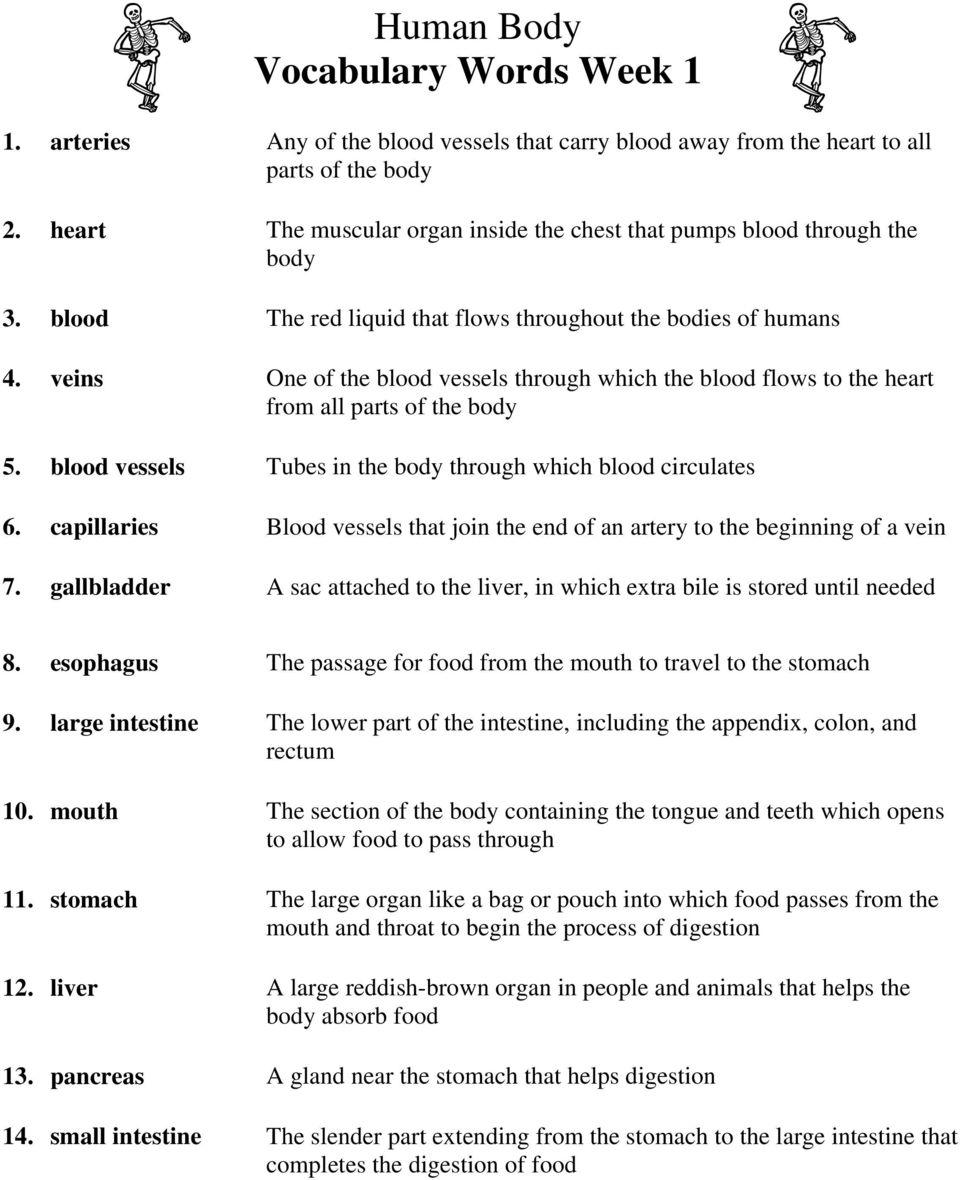
1 Vocabulary Words Week 1 1. arteries Any of the blood vessels that carry blood away from the heart to all parts of the body 2. heart The muscular organ inside the chest that pumps blood through the body 3. blood The red liquid that flows throughout the bodies of humans 4. veins One of the blood vessels through which the blood flows to the heart from all parts of the body 5. blood vessels Tubes in the body through which blood circulates 6. capillaries Blood vessels that join the end of an artery to the beginning of a vein 7. gallbladder A sac attached to the liver, in which extra bile is stored until needed 8. esophagus The passage for food from the mouth to travel to the stomach 9. large intestine The lower part of the intestine, including the appendix, colon, and rectum 10. mouth The section of the body containing the tongue and teeth which opens to allow food to pass through 11. stomach The large organ like a bag or pouch into which food passes from the mouth and throat to begin the process of digestion 12. liver A large reddish-brown organ in people and animals that helps the body absorb food 13. pancreas A gland near the stomach that helps digestion 14. small intestine The slender part extending from the stomach to the large intestine that completes the digestion of food
2 Vocabulary Words Week 2 1. skull The bones of the head that surround and protect the brain 2. ribs Narrow bones that curve around the body from the spine in back to the breastbone in front. Ribs protect the organs inside 3. humerus The long bone of the upper arm that extends from shoulder to elbow 4. vertebrae Bones that form the backbone 5. pelvis A basin-shaped structure in the skeleton 6. ulna The bone on the little finger side of the forearm 7. radius The bone on the thumb side of the forearm 8. carpals The bones of the wrist 9. metacarpals The bones in the hand 10. phalanges Any bone in the fingers or toes 11. femur The long bone of the leg extending from the hip to the knee and supporting the thigh 12. patella the kneecap 13. tibia The inner and usually larger of the two bones of the vertebrate hind leg between the knee and the ankle also called the shinbone 14. fibula The outer and usually smaller of the two bones of the hind limb below the knee 15. tarsals The small bones in the foot between the metatarsus and the leg ankle 16. metatarsals The bones in the foot

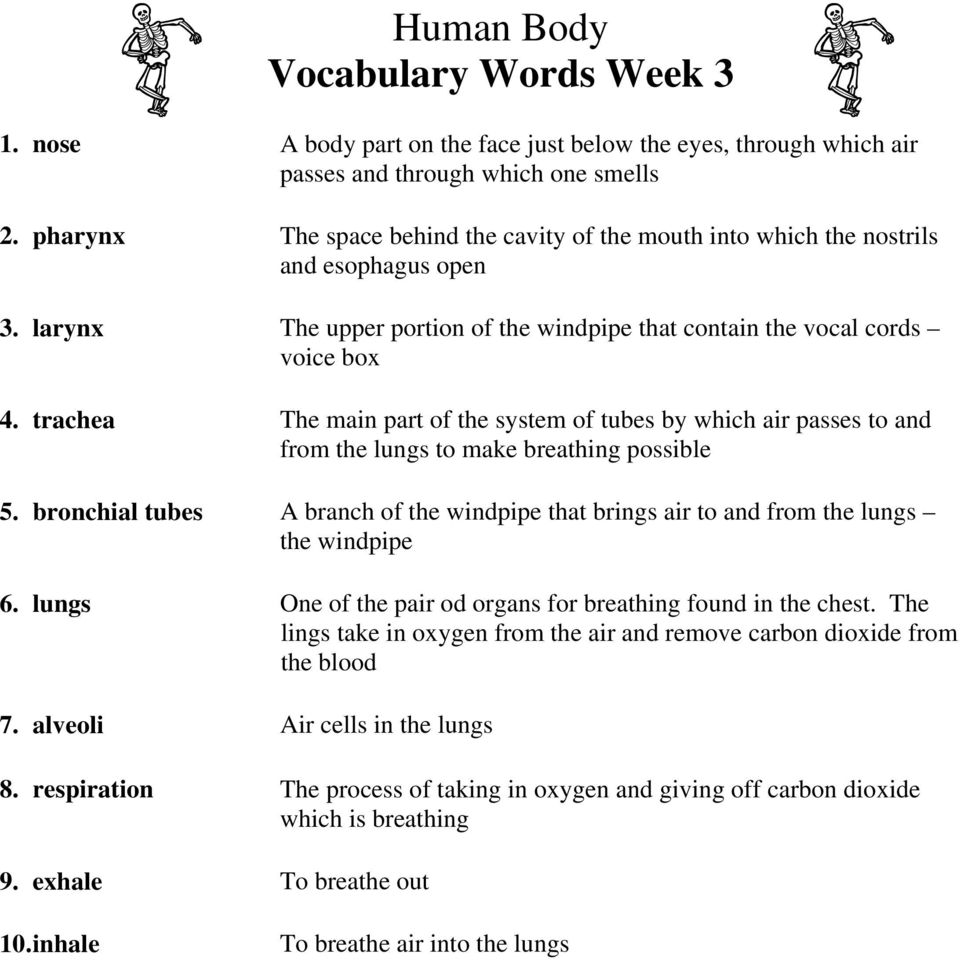
3 Vocabulary Words Week 3 1. nose A body part on the face just below the eyes, through which air passes and through which one smells 2. pharynx The space behind the cavity of the mouth into which the nostrils and esophagus open 3. larynx The upper portion of the windpipe that contain the vocal cords voice box 4. trachea The main part of the system of tubes by which air passes to and from the lungs to make breathing possible 5. bronchial tubes A branch of the windpipe that brings air to and from the lungs the windpipe 6. lungs One of the pair od organs for breathing found in the chest. The lings take in oxygen from the air and remove carbon dioxide from the blood 7. alveoli Air cells in the lungs 8. respiration The process of taking in oxygen and giving off carbon dioxide which is breathing 9. exhale To breathe out 10. inhale To breathe air into the lungs
4 Vocabulary Words Week 4 1. involuntary muscle A muscle that works or moves on its own 2. voluntary muscle A muscle that can be controlled 3. joint A place in the body where bones come together and movement can occur 4. ligament A tough, flexible connecting tissue that attaches one bone to another bone at a joint 5. nerve Cells along which messages are carried to and from the brain 6. organ Groups of tissues working together 7. reflex An involuntary response not controlled by the brain 8. medulla The smallest part of the brain that controls many involuntary movements 9. cell The smallest unit of an organism that carries out all activities of life 10. cerebellum The part of the brain that smoothes and coordinates movement 11. cerebrum The part of the brain that controls the ability to think, learn, and talk 12. sensory nerve A nerve that receives messages from inside or outside the body and sends them to the brain by way of the spinal cord 13. skeleton A hard structure that supports and protects and animal or human s body 14. spinal cord A thick, cordlike bundle of nerves along which messages ftravel to and from the brain 15. tendon A tough, white band of connecting tissue that attaches skeletal muscle to bone 16. tissue Different cells working together to do the same job 17. oxygen A gas having no color, smell, or taste that humans need to live 18. carbon dioxide A gas made of carbon and oxygen having no color or smell. When we breathe out, we put carbon dioxide into the air 19. ventricle Either of the two lower chambers of the heart that receive blood from the auricles and forces it into the artieries 20. atrium The chambers of the heart that receives the blood from the veins

5 Vocabulary Words Week 4

67 The Human Skeleton
 67 The Human Skeleton Skull SCIENCE EXPLORER Focus on Life Science Prentice-Hall, Inc. Clavicle (collarbone) Scapula (shoulder blade) Carpals Metacarpals Phalanges Femur Tibia Humerus Ulna Sternum (breastbone)
THE SKELETAL SYSTEM FUNCTIONS OF THE SKELETAL SYSTEM
 THE SKELETAL SYSTEM The skeleton is the body s bony framework which consists of 206 bones. The bones are made up of water(45%), calcium and phosphorous(35%) and other organic materials(20%). The calcium
Systems of the Human Body
 . s^^-^^. 0^^- B «*-^.^^^--"'- s»'"-^w.^*"' Systems of the Human Body The body is made up of an amazing group of systems. The systems of the body all work together and need each other to keep the body
Fourth Grade The Human Body: The Respiratory System Assessment
 Fourth Grade The Human Body: The Respiratory System Assessment 1a. The brings air in and out of the body. a. respiratory system b. circulatory system 1b. The system is the part of the body responsible
By Casey Schmidt and Wendy Ford
 By Casey Schmidt and Wendy Ford Body systems Digestive System Circulatory System Respiratory System Excretory System Immune System Reproductive System Nervous System Muscular System Skeletal System Endocrine
Human Bones BROWARD COUNTY ELEMENTARY SCIENCE BENCHMARK PLAN ACTIVITY ASSESSMENT OPPORTUNITIES. Grade 4 Quarter 3 Activity 21
 activity 21 Human Bones BROWARD COUNTY ELEMENTARY SCIENCE BENCHMARK PLAN Grade 4 Quarter 3 Activity 21 SC.F.1.2.1 The student knows that the human body is made of systems with structures and functions
7 TH GRADE FINAL EXAM PRACTICE TEST. Part I: Cells. 1. The cell grows to its mature size during. a. mitosis b. prophase c. telophase d.
 7 TH GRADE FINAL EXAM PRACTICE TEST Part I: Cells 1. The cell grows to its mature size during a. mitosis b. prophase c. telophase d. interphase 2. The final stage of the cell cycle is called a. interphase
Part 1: Introduction Tell the name of your organ system and describe the major functions.
 Team Members: System: Your team s job is prepare a presentation to educate your classmates about one of the body systems that makes up the human body. Your presentation must include the following requirements:
Animal Systems: The Musculoskeletal System
 Animal Systems: The Musculoskeletal System Tissues, Organs, and Systems of Living Things Cells, Cell Division, and Animal Systems and Plant Systems Cell Specialization Human Systems The Digestive The Circulatory
Medical Terminology, Anatompy & Physiology
 1. Which of the following BEST describes the anatomical position? a. Supine with arms crossed over the chest and knees slightly bent b. Standing, facing forward, with arms raised above the head c. Standing,
Our Human Body On-site student activities Years 5 6
 Our Human Body On-site student activities Years 5 6 Our Human Body On-site student activities: Years 5-6 Student activity (and record) sheets have been developed with alternative themes for students to
BONE BINGO. Blood Production Red and white blood cells are produced in the bone marrow, a substance found inside the larger bones of the body.
 BONE BINGO Background: The human skeleton is a framework of bones that is held together by ligaments and joints. Our skeleton has four major functions: Support The main job of the skeleton is to provide
The Take-Apart Human Body
 The Take-Apart Human Body As any teacher knows, children are naturally curious about their bodies. Their questions are endless, and present a tremendous educational opportunity: How do my ears work? Where
Frog Dissection. Procedure
 Name Class Date Skills Practice Lab Frog Dissection Amphibians, such as frogs, are examples of animals that have structural adaptations for living in or near water and for living on land. As tadpoles,
ORGAN SYSTEMS OF THE BODY
 ORGAN SYSTEMS OF THE BODY DEFINITIONS AND CONCEPTS A. Organ a structure made up of two or more kinds of tissues organized in such a way that they can together perform a more complex function that can any
Anatomy and Physiology: Understanding the Importance of CPR
 Anatomy and Physiology: Understanding the Importance of CPR Overview This document gives you more information about the body s structure (anatomy) and function (physiology). This information will help
THIRD GRADE HUMAN BIOLOGY
 THIRD GRADE HUMAN BIOLOGY 2 WEEKS LESSON PLANS AND ACTIVITIES LIFE CYCLE OVERVIEW OF THIRD GRADE ORGANISMS WEEK 1. PRE: Comparing and contrasting invertebrates and vertebrates. LAB: Learning about different
UNIT 5: FITNESS BASIC ANATOMY & PROPER STRETCHING TECHNIQUE BASIC ANATOMY MAJOR MUSCLE GROUPS & BONES PROPER STRETCHING TECHNIQUE
 UNIT 5: FITNESS BASIC ANATOMY & PROPER STRETCHING TECHNIQUE TOPIC 1: TOPIC 2: BASIC ANATOMY MAJOR MUSCLE GROUPS & BONES PROPER STRETCHING TECHNIQUE GRADES 6-7 UNIT 5 FITNESS BASIC ANATOMY & GRADES PROPER
Essentials of Human Anatomy & Physiology. 7 th edition Marieb, Elaine, 2003. Chapters 10-11. Lab Manual, 2 nd edition and coloring book, 7 th edition
 Topic/Unit: Anatomy & Physiology Circulatory System Curricular Goals/ Learning Outcomes: Students will be able to identify the composition of blood and its function. Students will be able to differentiate
Year 2 Science: The Human Body Resource Pack
 Year 2 Science: The Human Body Resource Pack Body Systems II Body Systems Digestion our bodies break down food and use Skeletal system the skeleton is made up of bones that support our the nutrients to
CPI Links Content Guide & Five Items Resource
 CPI Links Content Guide & Five Items Resource Introduction The following information should be used as a companion to the CPI Links. It provides clarifications concerning the content and skills contained
Divisions of the Skeletal System
 OpenStax-CNX module: m46344 1 Divisions of the Skeletal System OpenStax College This work is produced by OpenStax-CNX and licensed under the Creative Commons Attribution License 3.0 By the end of this
CHAPTER 1: THE LUNGS AND RESPIRATORY SYSTEM
 CHAPTER 1: THE LUNGS AND RESPIRATORY SYSTEM INTRODUCTION Lung cancer affects a life-sustaining system of the body, the respiratory system. The respiratory system is responsible for one of the essential
REVIEW for BIOLOGY UNIT TEST
 REVIEW for BIOLOGY UNIT TEST NOTE: The Unit Test will cover everything we have learned in the Biology Unit, starting from cell structures, cell division, various organ systems, disorders, organ donation,
Unit 3L.4: Body Parts and Functions
 Unit 3L.4: Organs in the Human body Keeping Healthy The Skeleton Science skills: Classification Observing Making models Data collection By the end of this unit you should: Compare the structure of humans
LOCOMOTION AND MOVEMENT
 UNIT - HUMAN PHYSIOLOGY Chapter 18 LOCOMOTION AND MOVEMENT Movement is an important feature of living organism. Both the microbes and macrobes show wide range of movements. The movements results in change
BIO 137: CHAPTER 1 OBJECTIVES
 BIO 137: CHAPTER 1 OBJECTIVES 1. Define the terms anatomy and physiology, and explain their relationship using an example of a human structure with its corresponding function. A. ANATOMY = the study of
CHAPTER 9 BODY ORGANIZATION
 CHAPTER 9 BODY ORGANIZATION Objectives Identify the meaning of 10 or more terms relating to the organization of the body Describe the properties of life Describe the function for the structures of the
Name Class Date Laboratory Investigation 24A Chapter 24A: Human Skin
 Name Class Date Laboratory Investigation 24A Chapter 24A: Human Skin Human Anatomy & Physiology: Integumentary System You may refer to pages 386-394 in your textbook for a general discussion of the integumentary
Investigating the Human Body On-site student activities: Years 7-8 Investigating the Human Body On-site student activities Years 7 8
 Investigating the Human Body On-site student activities Years 7 8 Student activity (and record) sheets have been developed with alternative themes for students to use as guides and focus material during
Nerve Tissue. Muscle Tissue. Connective Tissue
 Human Body Tissues Levels of Organization 1. Cells 2. = groups of similar cells that perform a 3. Organ = 4. = group of organs Four Major Tissues 1. 2. 3. 4. Epithelial Tissue Nerve Tissue Muscle Tissue
Student WORKSHEET. September, 2013 WORKSHEETS
 September, 2013 STUDENT WORKSHEETS 1 INSTRUCTIONS The following worksheets are mostly grouped according to the major systems of the body, just as the BODY WORLDS exhibition is. Complete these questions
2161-1 - Page 1. Name: 1) Choose the disease that is most closely related to the given phrase. Questions 10 and 11 refer to the following:
 Name: 2161-1 - Page 1 1) Choose the disease that is most closely related to the given phrase. a disease of the bone marrow characterized by uncontrolled production of white blood cells A) meningitis B)
North Bergen School District Benchmarks
 Grade: 10,11, and 12 Subject: Anatomy and Physiology First Marking Period Define anatomy and physiology, and describe various subspecialties of each discipline. Describe the five basic functions of living
Level 2 Certificate in Fitness Instructing Unit 1: Anatomy and Physiology
 Level 2 Certificate in Fitness Instructing Unit 1: Anatomy and Physiology These questions have been compiled based on the information available for the above qualification and unit. This mock should be
Reader s Theater. I AM the Most Important. (A Script about the human body systems. By Amy Bowden) Characters
 Reader s Theater I AM the Most Important (A Script about the human body systems By Amy Bowden) Characters Judge (narrator) Digestive System Circulatory System Muscular System Respiratory System Nervous
Learning Objectives for Anatomy & Physiology
 Learning Objectives for Anatomy & Physiology Anatomy & Physiology by Visible Body contains 12 units. Below is a listing of each unit, the chapters within it, and the unit s associated learning objectives.
THE HUMAN BODY SYSTEMS
 Name Period Date THE HUMAN BODY SYSTEMS System Function Diagram Major Organs Digestive 1. take in food (ingestion) 2. digest food into smaller molecules and absorb nutrients 3. remove undigestable food
Glossary (continued)
 1. Maxillary bone 2. Maxillary teeth 3. Mandibular arch 4. Vomerine teeth 5. Lining of buccal (mouth) cavity 6. Inferior aspect of eyeball (floor of eye socket) 7. Tongue (with right half cut away) 8.
Human Body Systems Project By Eva McLanahan
 Human Body Systems Project By Eva McLanahan Students will work in groups to research one of the eleven body systems as found in Holt, Rinehart, and Winston Modern Biology (2002). Research will focus on
CHINESE QI GONG EXERCISES TAUGHT BY JAKE PAUL FRATKIN, OMD
 1 CHINESE QI GONG EXERCISES TAUGHT BY JAKE PAUL FRATKIN, OMD Doctor of Oriental Medicine MORNING ROUTINE SUMMATION 1. Joint Opening Exercises 2. Meridian Stretching Exercises 3. Qi Circulation Exercises
Session 1. Body Systems and Structures. Teacher Notes. Body Systems and Organs: Descriptions and Functions. Intermediate ENGLISH FOR YOUR HEALTH
 Session 1 Body Systems and Structures Teacher Notes Body Systems and Organs: Descriptions and Functions Heart The heart is a muscle that pumps blood to all parts of the body by contracting and releasing
Observing Vertebrate Skeletons
 Name Class Date Chapter 33 Comparing Chordates Observing Vertebrate Skeletons Introduction One characteristic common to all vertebrates is the presence of a skeleton. The endoskeleton provides support,
SAMPLE ASSESSMENT TASKS PHYSICAL EDUCATION STUDIES GENERAL YEAR 11
 SAMPLE ASSESSMENT TASKS PHYSICAL EDUCATION STUDIES GENERAL YEAR 11 Copyright School Curriculum and Standards Authority, 2014 This document apart from any third party copyright material contained in it
Human Anatomy and Physiology The Respiratory System
 Human Anatomy and Physiology The Respiratory System Basic functions of the respiratory system: as a Gas exchange supply oxygen to aerobic tissues in the body and remove carbon dioxide waste product. in-
Section B: Epithelial Tissue 1. Where are epithelial tissues found within the body? 2. What are the functions of the epithelial tissues?
 Tissue worksheet Name Section A: Intro to Histology Cells are the smallest units of life. In complex organisms, cells group together with one another based on similar structure and function to form tissues.
Teacher Assessment Guide Human Body
 Teacher Assessment Guide Human Body Investigation 1: Bones Observe the movement of the body in the act of jumping Locate some of the major bones in their bodies Compare their own skeletons to posters and
BIOL 1108 Vertebrate Anatomy Lab
 BIOL 1108 Vertebrate Anatomy Lab This lab explores major organs associated with the circulatory, excretory, and nervous systems of mammals. Circulatory System Vertebrates are among the organisms that have
LESSON PLANS : The Body Curriculum Unit (Early Childhood)
 LESSON PLANS : The Body Curriculum Unit (Early Childhood) Learning Outcomes: Students will be able to identify body differences. Students will discover that the body is unique by exploring movement and
A Patient s Guide to Diffuse Idiopathic Skeletal Hyperostosis (DISH)
 A Patient s Guide to Diffuse Idiopathic Skeletal Hyperostosis (DISH) Introduction Diffuse Idiopathic Skeletal Hyperostosis (DISH) is a phenomenon that more commonly affects older males. It is associated
Chapter 2 - Anatomy & Physiology of the Respiratory System
 Chapter 2 - Anatomy & Physiology of the Respiratory System Written by - AH Kendrick & C Newall 2.1 Introduction 2.2 Gross Anatomy of the Lungs, 2.3 Anatomy of the Thorax, 2.4 Anatomy and Histology of the
II. 2003 Core Knowledge National Conference, Amazing Body System, Grade 1 1
 Amazing Body Systems Grade Level or Special Area: First grade Technology, Science, Reading, and Writing Written by: Debbie DeFrancesco and Ivette Orama Length of Unit: 5 lessons + 12 days of Culminating
SKELETAL SYSTEM GRADE 3-6 BACKGROUND
 SKELETAL SYSTEM GRADE 3-6 BACKGROUND The Skeletal System is made up of the bones of the body and the joints between the bones, as well as certain connective tissue (cartilage and ligaments.) This lesson
THE SKELETAL AND MUSCULAR SYSTEMS
 i A Wealth of Information. A World of Ideas. Instructor s Guide The Human Body: How It Works Introduction This program is part of the nine-part series The Human Body: How It Works. The series uses physiologic
The Body Systems Lesson Plan
 The Body Systems Lesson Plan Science Standards Addressed (From the Colorado Department of Education) http://www2.cde.state.co.us/scripts/allstandards/costandards.asp?stid=7&stid2=0&glid2=0 Standard 2-Life
How to dismiss your attorney
 Information & Assistance Unit guide 15 How to dismiss your attorney Complete this form if you no longer want to be represented by your attorney. Complete the form. Follow the attached sample. Be sure to
Human Growth and Reproduction
 Human Growth and Reproduction Sperm reach ovum and cluster around it Only one sperm is allowed to penetrate egg When the sperm penetrates the egg, the egg immediately releases a chemical creating a hard
GRADE 5 GROWTH AND DEVELOPMENT
 GRADE 5 GROWTH AND DEVELOPMENT GROWTH AND DEVELOPMENT GRADE: 5 LESSON: 1 THEME: BODY SYSTEMS CONCEPT: THE RESPIRATORY SYSTEM IS ESSENTIAL FOR GETTING OXYGEN INTO AND CARBON DIOXIDE OUT OF THE BODY PREPARATION:
The Respiratory System
 Human Anatomy III: Respiratory, Urinary & Digestive Systems The Respiratory System Major functions include: Obtaining oxygen Removing carbon dioxide Maintenance of ph balance Respiration may be accomplished
III. BACKGROUND KNOWLEDGE
 Top Five Body Shop Grade Level: Grade 1 Presented by: Linda Bruestle, Valleyview Elementary, Lakeland, FL Length of Unit: Eight days I. ABSTRACT This unit will take first graders on a journey through the
Classification of bones Any bone may be classified into one of the following groups:
 Skeletal system This system is made up of hard tissues like bone and cartilages. This system gives form and shape to animal body The skeleton of a living animal is made up living structures of bones. The
II. Third Grade, Human Body 2004 Colorado Summer Writing Institute 1
 HUMAN BODY Grade Level or Special Area: Third Grade Written by: Vicki Menefee, Louisville Elementary School, Louisville, CO Length of Unit: Seven lessons (seven days, one day = 45 minutes) not including
Introduction to Animal Systems
 Human Body Systems Introduction to Animal Systems Recurring Themes in Biology 1. Correlation between structure and function( seen at many levels) 2. Life is organized at many levels from Smallest ----
ANATOMY & PHYSIOLOGY ONLINE COURSE - SESSION 2 ORGANIZATION OF THE BODY
 ANATOMY & PHYSIOLOGY ONLINE COURSE - SESSION 2 ORGANIZATION OF THE BODY Human beings are arguably the most complex organisms on this planet. Imagine billions of microscopic parts, each with its own identity,
First Grade The Human Body Assessment
 First Grade The Human Body Assessment 1a. When we talk about the skeletal system we are talking about what part of our body? a. stomach b. bones 1b. How many bones in your skeleton? a. more than two hundred
SPORT AND PHYSICAL ACTIVITY
 2016 Suite Cambridge TECHNICALS LEVEL 3 SPORT AND PHYSICAL ACTIVITY Unit 1 Body systems and the effects of physical activity K/507/4452 Guided learning hours: 90 Version 2 - Revised content - March 2016
ANATOMY 1 LEARNING TARGETS
 ANATOMY 1 LEARNING TARGETS ORGANIZATION OF THE BODY 1. Define "anatomy" and "physiology." 2. Describe homeostasis. 3. Identify examples of homeostasis 4. Describe the organization of the body according
Mini Medical School Lesson
 Mini Medical School Lesson The American Osteopathic Association s (AOA) Mini Medical School Lesson is designed to help educators teach children about health and fitness. This lesson is aimed towards elementary
Contact your Doctor or Nurse for more information.
 A spinal cord injury is damage to your spinal cord that affects your movement, feeling, or the way your organs work. The injury can happen by cutting, stretching, or swelling of the spinal cord. Injury
Unit 4: Skeletal System Test Review Test Review
 Name: Period: Unit 4: Skeletal System Test Review Test Review 1. List four functions of the skeletal system: a. b. c. d. 2. Define ossification and identify the roles of the osteoblasts, osteocytes, and
Human Digestive System Anatomy
 Human Digestive System Anatomy Biology 104 Objectives: 1. Learn the anatomy of the digestive system. You should be able to find all terms in bold on the human torso models. 2. Relate structure of the system
What is Acupuncture? 1 Summary of Acupoint Indications. 1.1 Head
 What is Acupuncture? Acupuncture dates back over three thousand years, but only recently has it gained recognition as a valid treatment for chronic or long-standing pain. Using the PAIN GONE on acupoints
Parts of the Brain. Chapter 1
 Chapter 1 Parts of the Brain Living creatures are made up of cells. Groups of cells, similar in appearance and with the same function, form tissue. The brain is a soft mass of supportive tissues and nerve
ACUPUNCTURE POINTS STIMULATION WITH PAINGONE A GENERAL GUIDE TO PAIN RELIEF
 ACUPUNCTURE POINTS STIMULATION WITH PAINGONE A GENERAL GUIDE TO PAIN RELIEF Tower Health - Unit 1 Holly Court Business Park, Landmere Lane, Edwalton, Nottingham NG12 4DG Tel. 0115 9651780 www.tower-health.co.uk
Magic School Bus Digestive System Brainpop Digestive System
 The Digestive System Magic School Bus Digestive System Brainpop Digestive System 1 Functions of the Digestive System: 1. Break up food into smaller pieces 2. Absorbing nutrients into the blood 3. Excreting
Blood vessels. transport blood throughout the body
 Circulatory System Parts and Organs Blood vessels transport blood throughout the body Arteries blood vessels that carry blood AWAY from the heart Pulmonary arteries carry the deoxygenated blood from heart
Animal Tissues. I. Epithelial Tissue
 Animal Tissues There are four types of tissues found in animals: epithelial tissue, connective tissue, muscle tissue, and nervous tissue. In this lab you will learn the major characteristics of each tissue
ANATOMY AND PHYSIOLOGY
 ANATOMY AND PHYSIOLOGY Placement: First Year Theory - Anatomy: 60 Physiology: 60 Course Description -The course is designed to assist students to acquire the knowledge of the normal Structure of human
Skeletal, Muscular, and Integumentary Systems
 Chapter 36 Skeletal, Muscular, and Integumentary Systems Section 36 1 The Skeletal System (pages 921 925) This section describes the skeletal system and its functions. Introduction (page 921) 1. What forms
Chapter 5 The Skeletal System
 Essentials of Human Anatomy & Physiology Elaine N. Marieb Seventh Edition Chapter 5 The Skeletal System The Skeletal System Parts of the skeletal system Bones (skeleton) Joints Cartilages Ligaments (bone
Lumbar Spine Anatomy. eorthopod.com 228 West Main St., Suite D Missoula, MT 59802-4345 Phone: 406-721-3072 Fax: 406-721-2619 info@eorthopod.
 A Patient s Guide to Lumbar Spine Anatomy 228 West Main St., Suite D Missoula, MT 59802-4345 Phone: 406-721-3072 Fax: 406-721-2619 [email protected] DISCLAIMER: The information in this booklet is compiled
In 2009, Canadian astronaut Robert Thirsk began a six-month stay
 Topic 1.4 How do systems work together in the human body? Key Concepts The respiratory system carries oxygen to and removes carbon dioxide from the blood. The circulatory system transports dissolved gases
33.1 The Circulatory System
 33.1 The Circulatory System Lesson Objectives Identify the functions of the human circulatory system. Describe the structure of the heart and explain how it pumps blood through the body. Name three types
THE SKELETAL SYSTEM - THE AXIAL SKELETON
 THE SKELETAL SYSTEM - THE AXIAL SKELETON Chapter 7 Anatomy and Physiology Lecture 1 THE SKELETAL SYSTEM THE AXIAL SKELETON Skeletal System forms the framework of the body. TYPES OF BONES: FOUR PRINCIPAL
Nervous System: PNS and CNS
 Nervous System: PNS and CNS Biology 105 Lecture 10 Chapter 8 Outline I. Central Nervous System vs Peripheral Nervous System II. Peripheral Nervous System A. Somatic Nervous System B. Autonomic Nervous
THE RESPIRATORY SYSTEM
 ANIMAL SCIENCE 8646-B THE RESPIRATORY SYSTEM INTRODUCTION Respiration* is a physical process by which living organisms inhale oxygen from the surrounding atmosphere and then exhale carbon dioxide. The
Functions of Blood System. Blood Cells
 Functions of Blood System Transport: to and from tissue cells Nutrients to cells: amino acids, glucose, vitamins, minerals, lipids (as lipoproteins). Oxygen: by red blood corpuscles (oxyhaemoglobin - 4
Anatomy and Physiology
 Learning Activities It is important that you do not lecture all of the time. If you employ a variety of teaching styles, your students will stay focused better and they will find it easier to process the
Respiratory System. Chapter 21
 Respiratory System Chapter 21 Structural Anatomy Upper respiratory system Lower respiratory system throat windpipe voice box Function of Respiratory System Gas exchange Contains receptors for sense of
www.ghadialisurgery.com
 P R E S E N T S Dr. Mufa T. Ghadiali is skilled in all aspects of General Surgery. His General Surgery Services include: General Surgery Advanced Laparoscopic Surgery Surgical Oncology Gastrointestinal
Muscular System Grades 3-5 BACKGROUND
 Muscular System Grades 3-5 BACKGROUND The Muscular System Muscle makes up most of everything underneath the skin. This is the tissue that makes up the heart, body organs, and skeletal muscles. Muscle accounts
The Digestive System. Chapter 15
 The Digestive System Chapter 15 Introduction Digestion refers to the mechanical and chemical breakdown of food so the nutrients can be absorbed by cells Carried out by the digestive system Consists of
Eating, pooping, and peeing THE DIGESTIVE SYSTEM
 THE DIGESTIVE SYSTEM Ingested food is not technically in the body until it is absorbed so it needs to be: Mechanically and chemically reduced Transported by the blood to the cells Large portions are not
Biology 141 Anatomy and Physiology I
 Fall 2016 Biology 141 Anatomy and Physiology I COURSE OUTLINE Faculty Name: Enter Faculty Name Here Program Head: Enter Program Head Here Dean s Review: Dean s Signature: Date Reviewed: / / Revised: Fall
Body systems and energy for physical activity
 Body systems and energy for physical activity Chapter 1 Chapter 1 Body systems and energy for physical activity Introduction The body consists of complex structures that are made up of many parts, and
Digestive System. Gross Anatomy and Physiology
 Digestive System Gross Anatomy and Physiology I. Introduction A. Base Function: Working with the circulatory system the digestive system provides the body with fuel. B. Main players: 1. Digestive tract:
Thoracic Spine Anatomy
 A Patient s Guide to Thoracic Spine Anatomy 228 West Main, Suite C Missoula, MT 59802 Phone: [email protected] DISCLAIMER: The information in this booklet is compiled from a variety of sources.
A Stretch-Break Program for Your Workplace! www.healthyworkplaceweek.ca
 www.healthyworkplaceweek.ca A Stretch-Break Program for Your Workplace! Why is stretching at work important? Sitting at a desk or computer; or standing at your work station for extended periods of time
Laboratory 1 Anatomical Planes and Regions
 Laboratory 1 Anatomical Planes and Regions Goals: Define the anatomical position, including the application of the terms right and left. List and correctly use the major directional terms used in anatomy.
The Circulatory System. Chapter 17 Lesson 1
 The Circulatory System Chapter 17 Lesson 1 Functions of the Circulatory System Your circulatory system maintains an internal environment in which all the cells in your body are nourished. As your heart