
DESIGN, FABRICATION AND TESTING OF A LABORATORY SIZE HAMMER MILL
|
|
|
- Ella Marsh
- 9 years ago
- Views:
Transcription
1 DESIGN, FABRICATION AND TESTING OF A LABORATORY SIZE HAMMER MILL AJAKA E.O. and ADESINA A. Department of Mining Engineering School of Engineering and Engineering Technology The Federal University of Technology, Akure, Nigeria ABSTRACT: The laboratory size hammer mill was fabricated from locally available materials for crushing of minerals such as calcite, dolomite, limestone, granite and other materials of medium hardness. The crushing process is achieved by the use of a set of hammers in a crushing chamber which beats the mineral feeds into smaller particles small enough to pass through the aperture of the replaceable sieve positioned beneath the crushing chamber. The size aimed depends on the aperture of the replaceable screen. Based on the theoretical design, it was found that the main shaft speed of rpm transmitted by a belt drive from a three horse power electric motor is suitable to crush effectively. A comparison of the products of the newly fabricated machine with those of a standard Denver laboratory jaw crusher shows that the crushing rate of the new machine is higher, though the standard machine produces coarse products. The results however indicated that the new machine can perform better in terms of products with improved design. The machine is portable, design to be power operated. KEYWORDS: Design, Fabrication, Laboratory Size Hammer Mill INTRODUCTION Crushing is an integral part of the comminution flow sheet for mineral processing operations and is critical for the preparation of ore for downstream processing. The selection of the right crushing equipment for a specific purpose is influenced by many factors some of which are downstream of the crushing plant. Mineral processing is a complex operation. The principal procedure is crushing, that is the size reduction in the size of the fragmented rocks so that it can be rendered to another stage for further processing. In ancient time, the mineral were crushed between two stones or the use of metals with stones, but the invention of modern systems employing steel materials such as hammers mill has revolutionize the processing of minerals in a small scale and large scale capacity. There are various types of machines generally used for size reduction of materials. These are Gyratory crusher. Jaw crusher, Ball mill, Burr mill and many others. Thus, of all the crushing machines available, the Gyratory crusher, jaw crushers and the hammer mill are the most widely used in mineral processing industries because of its desirable characteristics which include 11
2 ability to handle a wide variety of raw materials, ability to handle hard stray objects and its robustness. In the big mining industry, four processes are adopted for continuous size reduction; these are the primary, secondary, tertiary and the quaternary crushing operations (Dance 2001). There are four basic ways of reducing the size of materials in the mineral processing industry, these are impact, attrition, shear or compression and most crushers employs a combination of these crushing methods (Brennal et al., 1969). Crushing operation is becoming very popular in the Nigerian mineral industry, because of the growing awareness of the minerals deposits that abound in the country and the importance of these mineral resources in the economic development of the country. The mining industry has been unable to meet up with the demand of this manufacturing and construction companies due to low supply of their demand as a result of no small scale mining firm to supplement the existing large scale mining firm. MATERIALS AND METHODS The general design was based on the process of allowing a strong and durable metallic object inform of hammers to beat any material that obstruct its way during operation, thereby resulting into breakage of the material which can also be referred to as size reduction in comminution operation. This usually occurs in an enclosed chamber called the crushing chamber. The physical and mechanical properties of the mineral to be crushed were studied as this would help immensely in the design of various components of the rotor. The engineering properties and some other parameters are the main factors considered before design of the machine. Theoretical Design Consideration The design was carried out on the basics of the safety of the operator. Some other major hazards which may arise in the course of crushing were properly put into consideration. The deflection of the hammers while in operation was also considered in the design. Swinging instead of stiff hammers was used to avoid the rotor or the hammers from getting stocked in case a hammer comes in contact with a material it cannot break at first impact. Design theories and Calculations Determination of Shaft Speed To calculate the shaft speed the following parameters are used. D1 N 2 Spolt, 1988 (1) D N Where 2 1 N1 = revolution of the smaller pulley, rpm N2 = revolution of the larger pulley rpm D1 = diameter of smaller pulley, mm D2 = diameter of larger pulley, mm 12
3 This shaft speed is only obtained when there is no slip condition of the belt over the pulley. When slip and creep condition is present, the value (913.5rpm) is reduced by 4% (Spolt, 1988). Determination of Nominal Length of the Belt Patton 1980 (2) Where, L = Length of the belt, mm C = Centre distance between larger pulley and the smaller one, mm Centre distance minimum, Cmin was calculated using: And Centre distance maximum: Patton, 1980 (3) Patton, 1980 (4) T = Nominal belt thickness D1 = Larger pulley diameter D2 = Smaller pulley diameter Determination of Belt Contact angle The belt contact angle is given by equation R r Sin 1 C Hall et al.,1980 (5) Where, R = radius of the large pulley, mm r = radius of the smaller pulley, mm Determination of the Belt Tension T 1 MV2 T2 Hall et. al.,1980 (6) exp 1 Sin 2 T1 = SA Where S = the maximum permissible belt stress, MN/m 2 A = Area of belt Determination of the Torque and Power Transmitted for the Shaft Power = T 1 T2 V, T r T 1 T 2 R, N Where, 13
4 Tr = Resultant Torque T1 & T2 = Tension in the belt, N R = Radius of bigger pulley, mm Determination of Hammer Wh = mng Patton 1980 (7) Material = Mild Steel Density = 7.85g/cm 3 (Patton 1980) Mass Density Volume, kg/m 3 Patton 1980 (8) of each hammer = 0.24 kg Number of hammers = 12 Determination of the Centrifugal Force exerted by the Hammer F = ω r m s Flavel, 1981 (9) Where ω = the rotational speed of the rotor, radians/seconds m = mass of the ore, kg r = radius of the rotor, m s = the ore stiffness to breakage, N/m Determination of Hammer Shaft Diameter M bymax σs allowable I I M Z Y b s max Z Spolt, 1988 (10) Where Ymax = Distance from neutral axis to outer fibers I = Moment of inertia Z = Section modulus For solid round bar 4 d I 64 Spolt, 1988 (11) 3 d Z 32 Spolt, 1988 (12) Twisting of the shaft is neglible from the torsion rigidly calculation Determination of the Shaft Diameter The ASME code equation for solid shaft having little or no axial loading is 14
5 K M 2 K M 2 16 d 3 Hall et al. (13) s b b t t Figure 1: Shear force and bending moment Diagrams Testing Procedures The materials used for testing of the machine can be divided into two, which are the minerals and the testing apparatus. The minerals are dolomite and granite, while the testing apparatus are stop watch, weighing balance and sets of sieves. 2kg of dolomite sample was fed into the crushing chamber of the machine through the feed hopper. The time taken to crush the sample i.e. the sample to fully discharge was noted. The weight of the crushed sample was taken after which the crushed sample was taken for a sieve analysis to separate the finely crushed materials from the coarsely crushed sample. The weight of both the fine samples and that of the coarse samples were recorded according to the sieve sizes. The process was repeated for samples of weight 4kg and 6kg respectively. The process of crushing the weights 2kg, 4kg and 6kg were taken as the trials and one sieve analysis is presented here from all the trials. This procedure was used for both minerals used as presented in the results. 15
6 The same testing procedure used for the fabricated machine was also used for a standard crushing machine, since it is part of the objective to fabricate a hammer mill and compare the efficiency with a standard machine available. RESULTS AND DISCUSSION According to the sieve analysis table, it was observed that the fabricated hammer mill takes lesser time to crush a particular quantity of material than the standard machine and produced finer particles compared to that of standard machine. There are so many factors that could be responsible for this which include the gape of the machine which determines the feed rate, the set which determines the size of the output materials, the speed of the electric motor installed and the age of the machine. In the graph of percent cumulative weight passed/percent cumulative retained against nominal aperture as presented in Figure 3 and Figure 4, it was confirmed that the percent cumulative passed graph did not intercept the percent cumulative retained when granite was crushed with standard machines. This is as a result of more coarse particles gotten from the standard machines compared to more fine particles gotten from the fabricated machine. Also, the graph of percent cumulative weight passed/percent cumulative retained against nominal aperture when the granite and dolomite were crushed with the fabricated machine as presented in Figure 1 and Figure 2 indicated that at about 1350 µm aperture size, fifty percent cumulative weight of the crushed samples have passed, while fifty percent cumulative weight of the crushed samples are still retained. From the energy consumption analysis using Bonds equation, it was confirmed that higher energy was consumed by the fabricated hammer mill while crushing granite and dolomite. After all this general deductions, it was confirmed that the standard machine will be good for a specific operation, mostly when a high percentage of coarse particles is desired from a quantity of a ore, while the fabricated machine would be a better one when different sizes is highly desired for a particular crushing operation of the same ore. All these now gives the final difference between the standard machine and the fabricated one, which are, the standard machine is a suitable one when accuracy is needed in terms of sizes of crushed material of a particular ore, but with low crushing rate, while the fabricated machine has higher crushing rate with different sizes of the same ore. 16
7 Table 1: Sieve Analysis of First Trial Test with Granite RETAINED PASSED Nominal Aperture (µm) (g) (g) (g) Figure 2: Sieve analysis graph of % cumulative weight retained and passed of Granite against the Nominal Aperture from the fabricated machine 17
8 Table 2: Sieve Analysis of First Trial Test with Dolomite RETAINED Nominal Aperture (µm) (g) (g) PASSED (g) Figure 3: Sieve analysis graph of % cumulative weight retained and passed of Dolomite against the Nominal Aperture from the fabricated machine 18
9 Table 3: Sieve Analysis of Crushed Granite with Standard Machine RETAINED PASSED Nominal Aperture (µm) (g) (g) (g) Figure 4: Sieve analysis graph of % cumulative weight retained and passed of Granite against the Nominal Aperture from the Standard machine 19
10 Table 4: Sieve Analysis of Crushed Dolomite with Standard Machine RETAINED PASSED Nominal Aperture (µm) (g) (g) (g) Figure 5: Sieve analysis graph of % cumulative weight retained and passed of Dolomite against the Nominal Aperture from the Standard machine CONCLUSION A laboratory size and easy to maintain hammer mill machine which could be well adopted by research institutions with local materials was designed and fabricated. The machine was subjected to test using two available minerals such as dolomite and granite with masses 2kg, 4kg and 6kg for each mineral. The output of the machine was satisfactory. Also, the sieve analysis to ascertain the crushability and predict the energy consumption rate of the machine was 20
11 satisfactory. Sequel to this fact, the machine appears to be capable of crushing other minerals such as limestone and talc with a meaningful crushing capacity and reasonable energy consumption. REFERENCES Brennan J.G; Butter J.R; Cowell N.O and Lilly A.E (1969): Food Engineering Operations. Applied Science Publisher Ltd London. Dance. A. (2001): The importance of Primary Crushing in Mill Feed Size Optimization. Proceedings International Autogenous and Semi-Autogenous Grinding Technology 2001, eds. D.J Barrat. M.J Allan and A.I Muller(Unpublished) Flavel. M.D and Rimmer H.W. 1981: Particle Breakage in an impact Crushing Environment. pp.20 Gope. P.C: Strenght of Materials Prentice Hall of India Private Ltd. Hall A.S; Holowenko A.R; Laughlin H.G (1980): Theory and Problems of Machine Design, Schaum s Series. McGraw. Hill Book Co; New York, U.S.A Patton E.S (1980): Mechanism Design Analysis. Prentice Hall of India Private Ltd. Spolt, M.F. 1988: Design of Machines Element, 6 th ed. Prentice Hall, New Delhi, India. Figure 6: Showing the aerial view of the Hammer mill 21
TECHNICAL NOTES 5 CRUSHERS
 TECHNICAL NOTES CRUSHERS Copyright R P King 2000 .1 Jaw and Gyratory Crushers. Jaw and gyratory crushers are used mostly for primary crushing. They are characterized by wide gape and narrow discharge and
MCE380: Measurements and Instrumentation Lab. Chapter 9: Force, Torque and Strain Measurements
 MCE380: Measurements and Instrumentation Lab Chapter 9: Force, Torque and Strain Measurements Topics: Elastic Elements for Force Measurement Dynamometers and Brakes Resistance Strain Gages Holman, Ch.
B.TECH. (AEROSPACE ENGINEERING) PROGRAMME (BTAE) Term-End Examination December, 2011 BAS-010 : MACHINE DESIGN
 No. of Printed Pages : 7 BAS-01.0 B.TECH. (AEROSPACE ENGINEERING) PROGRAMME (BTAE) CV CA CV C:) O Term-End Examination December, 2011 BAS-010 : MACHINE DESIGN Time : 3 hours Maximum Marks : 70 Note : (1)
Torque and Rotary Motion
 Torque and Rotary Motion Name Partner Introduction Motion in a circle is a straight-forward extension of linear motion. According to the textbook, all you have to do is replace displacement, velocity,
Acceleration due to Gravity
 Acceleration due to Gravity 1 Object To determine the acceleration due to gravity by different methods. 2 Apparatus Balance, ball bearing, clamps, electric timers, meter stick, paper strips, precision
SAMPLE FORMAL LABORATORY REPORT. Fatigue Failure through Bending Experiment Adapted from a report submitted by Sarah Thomas
 SAMPLE FORMAL LABORATORY REPORT Fatigue Failure through Bending Experiment Adapted from a report submitted by Sarah Thomas Lab Partners: David Henry and James Johnson ME 498 November 10, 2004 Professor
Highly flexible couplings
 Construction and operation 8.03.00 Instructions for installation 8.03.00 Types of stress 8.04.00 Diagrams for static deformation of the coupling ring 8.05.00 Coupling size 8.07.00 Examples of combinations
ENGINEERING COUNCIL CERTIFICATE LEVEL ENGINEERING SCIENCE C103 TUTORIAL 3 - TORSION
 ENGINEEING COUNCI CETIFICATE EVE ENGINEEING SCIENCE C10 TUTOIA - TOSION You should judge your progress by completing the self assessment exercises. These may be sent for marking or you may request copies
Practice Exam Three Solutions
 MASSACHUSETTS INSTITUTE OF TECHNOLOGY Department of Physics Physics 8.01T Fall Term 2004 Practice Exam Three Solutions Problem 1a) (5 points) Collisions and Center of Mass Reference Frame In the lab frame,
DESIGN OF THE KUBAKA GRINDING CIRCUIT USING SPI AND BOND
 DESIGN OF THE KUBAKA GRINDING CIRCUIT USING SPI AND BOND By John Starkey, President, Starkey & Associates Grinding Design and Process Engineering, and Graham Holmes, Manager of Mineral Processing, Kvaerner
BENEFITS OF USING MOBILE CRUSHING AND SCREENING PLANTS IN QUARRYING CRUSHED STONE. 1. Introduction. Mario Klanfar*, Darko Vrkljan*
 AGH Journal of Mining and Geoengineering vol. 36 No. 3 2012 Mario Klanfar*, Darko Vrkljan* BENEFITS OF USING MOBILE CRUSHING AND SCREENING PLANTS IN QUARRYING CRUSHED STONE 1. Introduction Mobile crushers
Outotec HIGmills; A Fine Grinding Technology
 23 rd International Mining Congress & Exhibition of Turkey 16-19 April 2013 ANTALYA Outotec HIGmills; A Fine Grinding Technology H. Lehto Outotec Finland Oy A. Paz Outotec Pty Ltd, Perth, Australia I.
Technical Notes 3B - Brick Masonry Section Properties May 1993
 Technical Notes 3B - Brick Masonry Section Properties May 1993 Abstract: This Technical Notes is a design aid for the Building Code Requirements for Masonry Structures (ACI 530/ASCE 5/TMS 402-92) and Specifications
EDEXCEL NATIONAL CERTIFICATE/DIPLOMA MECHANICAL PRINCIPLES AND APPLICATIONS NQF LEVEL 3 OUTCOME 1 - LOADING SYSTEMS TUTORIAL 3 LOADED COMPONENTS
 EDEXCEL NATIONAL CERTIICATE/DIPLOMA MECHANICAL PRINCIPLES AND APPLICATIONS NQ LEVEL 3 OUTCOME 1 - LOADING SYSTEMS TUTORIAL 3 LOADED COMPONENTS 1. Be able to determine the effects of loading in static engineering
MATERIALS AND MECHANICS OF BENDING
 HAPTER Reinforced oncrete Design Fifth Edition MATERIALS AND MEHANIS OF BENDING A. J. lark School of Engineering Department of ivil and Environmental Engineering Part I oncrete Design and Analysis b FALL
MECHANICAL PRINCIPLES HNC/D PRELIMINARY LEVEL TUTORIAL 1 BASIC STUDIES OF STRESS AND STRAIN
 MECHANICAL PRINCIPLES HNC/D PRELIMINARY LEVEL TUTORIAL 1 BASIC STUDIES O STRESS AND STRAIN This tutorial is essential for anyone studying the group of tutorials on beams. Essential pre-requisite knowledge
Terex Minerals Processing Systems Canica VSI VERTICAL SHAFT IMPACT CRUSHERS
 Terex Minerals Processing Systems Canica VSI VERTICAL SHAFT IMPACT CRUSHERS SERVING THE INDUSTRY SINCE 1974 Vertical Shaft Impactor Benefits Very cubicle product Benificiation of material (elimination
Sieve Analysis of Aggregates
 Revised 2007, WKS Datasheet No. 30 MOHAWK COLLEGE OF APPLIED ARTS AND TECHNOLOGY BUILDING AND CONSTRUCTION SCIENCES DEPARTMENT Sieve Analysis of Aggregates INTRODUCTION The evaluation of the distribution
Tips For Selecting DC Motors For Your Mobile Robot
 Tips For Selecting DC Motors For Your Mobile Robot By AJ Neal When building a mobile robot, selecting the drive motors is one of the most important decisions you will make. It is a perfect example of an
Mechanical Principles
 Unit 4: Mechanical Principles Unit code: F/60/450 QCF level: 5 Credit value: 5 OUTCOME 3 POWER TRANSMISSION TUTORIAL BELT DRIVES 3 Power Transmission Belt drives: flat and v-section belts; limiting coefficient
MINEX -S. Magnetic coupling. You will find continuously updated data in our online catalogue at www.ktr.com
 MINEX - 171 Table of contents NEW MINEX - 171 Coupling description 173 Technical description 174 s A 22/4 to B 60/8 with containment shroud made of stainless steel 175 s A 75/10 to F 250/38 with containment
Design Analysis and Review of Stresses at a Point
 Design Analysis and Review of Stresses at a Point Need for Design Analysis: To verify the design for safety of the structure and the users. To understand the results obtained in FEA, it is necessary to
ENGINEERING COUNCIL CERTIFICATE LEVEL
 ENGINEERING COUNCIL CERTIICATE LEVEL ENGINEERING SCIENCE C103 TUTORIAL - BASIC STUDIES O STRESS AND STRAIN You should judge your progress by completing the self assessment exercises. These may be sent
CHAPTER 15 FORCE, MASS AND ACCELERATION
 CHAPTER 5 FORCE, MASS AND ACCELERATION EXERCISE 83, Page 9. A car initially at rest accelerates uniformly to a speed of 55 km/h in 4 s. Determine the accelerating force required if the mass of the car
Mounting Instructions. Torque Transducer. A0329 3.2 en
 Mounting Instructions Torque Transducer T5 T5 Contents 3 Page Safety instructions.............................................. 4 1 Measuring characteristics..................................... 7 2 Mounting.....................................................
DryLin ZLW Belt Drive
 Belt Drive +50º 0º DryLin toothed belt drives have been developed for the fast positioning of small loads. The linear units with toothed belt drive are corrosion resistant, light and compact, besides having
Performance of the Boiler and To Improving the Boiler Efficiency Using Cfd Modeling
 IOSR Journal of Mechanical and Civil Engineering (IOSR-JMCE) e-issn: 2278-1684,p-ISSN: 2320-334X, Volume 8, Issue 6 (Sep. - Oct. 2013), PP 25-29 Performance of the Boiler and To Improving the Boiler Efficiency
Design of a Universal Robot End-effector for Straight-line Pick-up Motion
 Session Design of a Universal Robot End-effector for Straight-line Pick-up Motion Gene Y. Liao Gregory J. Koshurba Wayne State University Abstract This paper describes a capstone design project in developing
Selection Procedure B-24 ORIENTAL MOTOR GENERAL CATALOGUE
 STEPPING MOTORS to This section describes certain items that must be calculated to find the optimum stepping motor for a particular application. This section shows the selection procedure and gives examples.
Design of a Cantilever - Type Rotating Bending Fatigue Testing Machine
 Journal of Minerals & Materials Characterization & Engineering, Vol. 10, No.11, pp.1027-1039, 2011 jmmce.org Printed in the USA. All rights reserved Design of a Cantilever - Type Rotating Bending Fatigue
Understanding Plastics Engineering Calculations
 Natti S. Rao Nick R. Schott Understanding Plastics Engineering Calculations Hands-on Examples and Case Studies Sample Pages from Chapters 4 and 6 ISBNs 978--56990-509-8-56990-509-6 HANSER Hanser Publishers,
Design and Fabrication of a Wear Testing Machine
 Leonardo Electronic Journal of Practices and Technologies ISSN 1583-1078 Issue 19, July-December 2011 p. 39-48 Design and Fabrication of a Wear Testing Machine Amal Ebrahim NASSAR * and Eman Ebrahim NASSAR
ME 343: Mechanical Design-3
 ME 343: Mechanical Design-3 Design of Shaft (continue) Dr. Aly Mousaad Aly Department of Mechanical Engineering Faculty of Engineering, Alexandria University Objectives At the end of this lesson, we should
EXPERIMENT NO.1. : Vicat s apparatus, plunger
 EXPERIMENT NO.1 Name of experiment:to determine the percentage of water for normal consistency for a given sample of cement Apparatus : Vicat s apparatus with plunger of 10mm dia, measuring cylinder, weighing
Solution for Homework #1
 Solution for Homework #1 Chapter 2: Multiple Choice Questions (2.5, 2.6, 2.8, 2.11) 2.5 Which of the following bond types are classified as primary bonds (more than one)? (a) covalent bonding, (b) hydrogen
POLYCOM high-pressure grinding roll for the minerals industry.
 POLYCOM high-pressure grinding roll for the minerals industry. A company of ThyssenKrupp Technologies Polysius tk POLYCOM high-pressure grinding roll. The economic and gentle processing solution. The high-pressure
AGREGADOS RECICLADOS MITOS Y REALIDADES
 The Production and Use of Recycled Concrete in the USA Thomas Van Dam, Ph.D., P.E., FACI Principal Engineer CTL Group Introduction In the United States, concrete is the most commonly used recycled material
International Journal of Engineering Research-Online A Peer Reviewed International Journal Articles available online http://www.ijoer.
 RESEARCH ARTICLE ISSN: 2321-7758 DESIGN AND DEVELOPMENT OF A DYNAMOMETER FOR MEASURING THRUST AND TORQUE IN DRILLING APPLICATION SREEJITH C 1,MANU RAJ K R 2 1 PG Scholar, M.Tech Machine Design, Nehru College
MECHANICS OF SOLIDS - BEAMS TUTORIAL 1 STRESSES IN BEAMS DUE TO BENDING. On completion of this tutorial you should be able to do the following.
 MECHANICS OF SOLIDS - BEAMS TUTOIAL 1 STESSES IN BEAMS DUE TO BENDING This is the first tutorial on bending of beams designed for anyone wishing to study it at a fairly advanced level. You should judge
Rotational Motion: Moment of Inertia
 Experiment 8 Rotational Motion: Moment of Inertia 8.1 Objectives Familiarize yourself with the concept of moment of inertia, I, which plays the same role in the description of the rotation of a rigid body
Design of a Rope Brake Dynamometer
 Middle-East Journal of Scientific Research 0 (5): 650-655, 014 ISSN 1990-933 IDOSI Publications, 014 DOI: 10.589/idosi.mejsr.014.0.05.11356 Design of a Rope Brake Dynamometer R. Gopinath Department of
Lab for Deflection and Moment of Inertia
 Deflection and Moment of Inertia Subject Area(s) Associated Unit Lesson Title Physics Wind Effects on Model Building Lab for Deflection and Moment of Inertia Grade Level (11-12) Part # 2 of 3 Lesson #
Rotational Inertia Demonstrator
 WWW.ARBORSCI.COM Rotational Inertia Demonstrator P3-3545 BACKGROUND: The Rotational Inertia Demonstrator provides an engaging way to investigate many of the principles of angular motion and is intended
MECHANICS OF SOLIDS - BEAMS TUTORIAL 2 SHEAR FORCE AND BENDING MOMENTS IN BEAMS
 MECHANICS OF SOLIDS - BEAMS TUTORIAL 2 SHEAR FORCE AND BENDING MOMENTS IN BEAMS This is the second tutorial on bending of beams. You should judge your progress by completing the self assessment exercises.
Series 6000 Torque measured metal bellow coupling
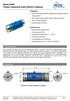 Properties Free of float metal bellow coupling with integrated torque measurement Non-contact measurement system, high robustness High torsional stiffness Limited torque of inertia Performance Measurement
Torsion Tests. Subjects of interest
 Chapter 10 Torsion Tests Subjects of interest Introduction/Objectives Mechanical properties in torsion Torsional stresses for large plastic strains Type of torsion failures Torsion test vs.tension test
Lecture 17. Last time we saw that the rotational analog of Newton s 2nd Law is
 Lecture 17 Rotational Dynamics Rotational Kinetic Energy Stress and Strain and Springs Cutnell+Johnson: 9.4-9.6, 10.1-10.2 Rotational Dynamics (some more) Last time we saw that the rotational analog of
EDEXCEL NATIONAL CERTIFICATE/DIPLOMA MECHANICAL PRINCIPLES OUTCOME 2 ENGINEERING COMPONENTS TUTORIAL 1 STRUCTURAL MEMBERS
 ENGINEERING COMPONENTS EDEXCEL NATIONAL CERTIFICATE/DIPLOMA MECHANICAL PRINCIPLES OUTCOME ENGINEERING COMPONENTS TUTORIAL 1 STRUCTURAL MEMBERS Structural members: struts and ties; direct stress and strain,
Impact testing ACTIVITY BRIEF
 ACTIVITY BRIEF Impact testing The science at work Impact testing is of enormous importance. A collision between two objects can often result in damage to one or both of them. The damage might be a scratch,
Lecture 12: Exercise on mineral processing. Contents. Problems 1 to 7
 Lecture 12: Exercise on mineral processing Contents Problems 1 to 7 A floatation plant treats feed whose grade is 0.8 % Cu. The plant produces concentrate and tailings. The copper grade of concentrate
COMPLEX STRESS TUTORIAL 3 COMPLEX STRESS AND STRAIN
 COMPLX STRSS TUTORIAL COMPLX STRSS AND STRAIN This tutorial is not part of the decel unit mechanical Principles but covers elements of the following sllabi. o Parts of the ngineering Council eam subject
Belt Drives and Chain Drives. Power Train. Power Train
 Belt Drives and Chain Drives Material comes for Mott, 2002 and Kurtz, 1999 Power Train A power train transmits power from an engine or motor to the load. Some of the most common power trains include: Flexible
GRADATION OF AGGREGATE FOR CONCRETE BLOCK
 GRADATION OF AGGREGATE FOR CONCRETE BLOCK Although numerous papers have been written concerning the proper gradation for concrete mixes, they have generally dealt with plastic mixes, and very little published
SOLUTIONS TO CONCEPTS CHAPTER 15
 SOLUTIONS TO CONCEPTS CHAPTER 15 1. v = 40 cm/sec As velocity of a wave is constant location of maximum after 5 sec = 40 5 = 00 cm along negative x-axis. [(x / a) (t / T)]. Given y = Ae a) [A] = [M 0 L
The Use of Optimization Software TOSCA in a Standard Flexplate Design Process
 The Use of Optimization Software TOSCA in a Standard Flexplate Design Process Diwakar Krishnaiah 1, Sreedhar Patil 2, and Matthias Friedrich 3 1 GM Powertrain, Pontiac, Michigan, USA, 2 TCS, Bangalore,
NOTE: FOR PROJECTS REQUIRING CONTRACTOR MIX DESIGN, THE DESIGN PROCEDURES ARE SPECIFIED IN THE SPECIAL PROVISIONS OF THE CONTRACT.
 September 1, 2003 CONCRETE MANUAL 5-694.300 MIX DESIGN 5-694.300 NOTE: FOR PROJECTS REQUIRING CONTRACTOR MIX DESIGN, THE DESIGN PROCEDURES ARE SPECIFIED IN THE SPECIAL PROVISIONS OF THE CONTRACT. 5-694.301
MECHANICAL PRINCIPLES OUTCOME 4 MECHANICAL POWER TRANSMISSION TUTORIAL 1 SIMPLE MACHINES
 MECHANICAL PRINCIPLES OUTCOME 4 MECHANICAL POWER TRANSMISSION TUTORIAL 1 SIMPLE MACHINES Simple machines: lifting devices e.g. lever systems, inclined plane, screw jack, pulley blocks, Weston differential
Introduction to Mechanical Behavior of Biological Materials
 Introduction to Mechanical Behavior of Biological Materials Ozkaya and Nordin Chapter 7, pages 127-151 Chapter 8, pages 173-194 Outline Modes of loading Internal forces and moments Stiffness of a structure
Lapping and Polishing Basics
 Lapping and Polishing Basics Applications Laboratory Report 54 Lapping and Polishing 1.0: Introduction Lapping and polishing is a process by which material is precisely removed from a workpiece (or specimen)
Sheet Metal Shearing & Bending
 Training Objective After watching the program and reviewing this printed material, the viewer will gain a knowledge and understanding of the principles and machine methods of shearing and bending sheetmetal
EXPERIMENT: MOMENT OF INERTIA
 OBJECTIVES EXPERIMENT: MOMENT OF INERTIA to familiarize yourself with the concept of moment of inertia, I, which plays the same role in the description of the rotation of a rigid body as mass plays in
Determination of Thermal Conductivity of Coarse and Fine Sand Soils
 Proceedings World Geothermal Congress Bali, Indonesia, - April Determination of Thermal Conductivity of Coarse and Fine Sand Soils Indra Noer Hamdhan 1 and Barry G. Clarke 2 1 Bandung National of Institute
THE COMPOSITE DISC - A NEW JOINT FOR HIGH POWER DRIVESHAFTS
 THE COMPOSITE DISC - A NEW JOINT FOR HIGH POWER DRIVESHAFTS Dr Andrew Pollard Principal Engineer GKN Technology UK INTRODUCTION There is a wide choice of flexible couplings for power transmission applications,
Mechanical Properties of Metals Mechanical Properties refers to the behavior of material when external forces are applied
 Mechanical Properties of Metals Mechanical Properties refers to the behavior of material when external forces are applied Stress and strain fracture or engineering point of view: allows to predict the
Design and Stress Analysis of Watt and Porter Governor
 International Journal of Scientific and Research Publications, Volume 2, Issue 6, June 2012 1 Design and Stress Analysis of Watt and Porter Governor *Ravindra Singh Rana, **Rajesh Purohit, *Alok Singh
Material Optimization and Weight Reduction of Drive Shaft Using Composite Material
 IOSR Journal of Mechanical and Civil Engineering (IOSR-JMCE) e-issn: 2278-1684,p-ISSN: 2320-334X, Volume 10, Issue 1 (Nov. - Dec. 2013), PP 39-46 Material Optimization and Weight Reduction of Drive Shaft
Center of Gravity. We touched on this briefly in chapter 7! x 2
 Center of Gravity We touched on this briefly in chapter 7! x 1 x 2 cm m 1 m 2 This was for what is known as discrete objects. Discrete refers to the fact that the two objects separated and individual.
PLQE. The base of the economy gearboxes with square output flange. Economy Line. Formerly PLE
 20 ormerly PL The base of the economy gearboxes with square output flange The PL series with square output flange. A powerful alternative for additional higher radial and axial loads. Low backlash High
SIEVE ANALYSIS OF FINE AND COARSE AGGREGATES FOP FOR AASHTO T 27 (11)
 SIEVE ANALYSIS OF FINE AND COARSE AGGREGATES FOP FOR AASHTO T 27 (11) MATERIALS FINER THAN 75 µm (No. 200) SIEVE IN MINERAL AGGREGATE BY WASHING FOP FOR AASHTO T 11 (11) Scope Sieve analysis determines
Synchronous motor. Type. Non-excited motors
 Synchronous motor A synchronous electric motor is an AC motor in which the rotation rate of the shaft is synchronized with the frequency of the AC supply current; the rotation period is exactly equal to
PHYS 101-4M, Fall 2005 Exam #3. MULTIPLE CHOICE. Choose the one alternative that best completes the statement or answers the question.
 PHYS 101-4M, Fall 2005 Exam #3 Name MULTIPLE CHOICE. Choose the one alternative that best completes the statement or answers the question. 1) A bicycle wheel rotates uniformly through 2.0 revolutions in
SOLID MECHANICS DYNAMICS TUTORIAL PULLEY DRIVE SYSTEMS. This work covers elements of the syllabus for the Edexcel module HNC/D Mechanical Principles.
 SOLID MECHANICS DYNAMICS TUTORIAL PULLEY DRIVE SYSTEMS This work covers elements of the syllabus for the Edexcel module HNC/D Mechanical Principles. On completion of this tutorial you should be able to
So if ω 0 increases 3-fold, the stopping angle increases 3 2 = 9-fold.
 Name: MULTIPLE CHOICE: Questions 1-11 are 5 points each. 1. A safety device brings the blade of a power mower from an angular speed of ω 1 to rest in 1.00 revolution. At the same constant angular acceleration,
Problem Set 1. Ans: a = 1.74 m/s 2, t = 4.80 s
 Problem Set 1 1.1 A bicyclist starts from rest and after traveling along a straight path a distance of 20 m reaches a speed of 30 km/h. Determine her constant acceleration. How long does it take her to
3 Work, Power and Energy
 3 Work, Power and Energy At the end of this section you should be able to: a. describe potential energy as energy due to position and derive potential energy as mgh b. describe kinetic energy as energy
DESIGN OF SLABS. 3) Based on support or boundary condition: Simply supported, Cantilever slab,
 DESIGN OF SLABS Dr. G. P. Chandradhara Professor of Civil Engineering S. J. College of Engineering Mysore 1. GENERAL A slab is a flat two dimensional planar structural element having thickness small compared
Raptor high-performance cone crushers
 Raptor high-performance cone crushers Raptor high-performance cone crushers Key value statements Largest cone crusher in the world (Raptor 000) Most diverse product line on the market Continual focus on
Unit 24: Applications of Pneumatics and Hydraulics
 Unit 24: Applications of Pneumatics and Hydraulics Unit code: J/601/1496 QCF level: 4 Credit value: 15 OUTCOME 2 TUTORIAL 3 HYDRAULIC AND PNEUMATIC MOTORS The material needed for outcome 2 is very extensive
Chapter 8 Design of Concrete Mixes
 Chapter 8 Design of Concrete Mixes 1 The basic procedure for mix design is applicable to concrete for most purposes including pavements. Concrete mixes should meet; Workability (slump/vebe) Compressive
Chapter 10 Rotational Motion. Copyright 2009 Pearson Education, Inc.
 Chapter 10 Rotational Motion Angular Quantities Units of Chapter 10 Vector Nature of Angular Quantities Constant Angular Acceleration Torque Rotational Dynamics; Torque and Rotational Inertia Solving Problems
Methods for the preparation of the test sample from the laboratory sample (Part 1 Material & Methods) Work Package 6 Task 6.4
 Methods for the preparation of the test sample from the laboratory sample (Part 1 Material & Methods) Work Package 6 Task 6.4 Validation of prcen/ts 15413 (WI 343027) Paolo de Zorzi APAT - Italian Environmental
SOLID MECHANICS TUTORIAL MECHANISMS KINEMATICS - VELOCITY AND ACCELERATION DIAGRAMS
 SOLID MECHANICS TUTORIAL MECHANISMS KINEMATICS - VELOCITY AND ACCELERATION DIAGRAMS This work covers elements of the syllabus for the Engineering Council exams C105 Mechanical and Structural Engineering
ENGINEERING SCIENCE H1 OUTCOME 1 - TUTORIAL 3 BENDING MOMENTS EDEXCEL HNC/D ENGINEERING SCIENCE LEVEL 4 H1 FORMERLY UNIT 21718P
 ENGINEERING SCIENCE H1 OUTCOME 1 - TUTORIAL 3 BENDING MOMENTS EDEXCEL HNC/D ENGINEERING SCIENCE LEVEL 4 H1 FORMERLY UNIT 21718P This material is duplicated in the Mechanical Principles module H2 and those
Figure 2.31. CPT Equipment
 Soil tests (1) In-situ test In order to sound the strength of the soils in Las Colinas Mountain, portable cone penetration tests (Japan Geotechnical Society, 1995) were performed at three points C1-C3
1.5 Concrete (Part I)
 1.5 Concrete (Part I) This section covers the following topics. Constituents of Concrete Properties of Hardened Concrete (Part I) 1.5.1 Constituents of Concrete Introduction Concrete is a composite material
Module 7 (Lecture 24 to 28) RETAINING WALLS
 Module 7 (Lecture 24 to 28) RETAINING WALLS Topics 24.1 INTRODUCTION 24.2 GRAVITY AND CANTILEVER WALLS 24.3 PROPORTIONING RETAINING WALLS 24.4 APPLICATION OF LATERAL EARTH PRESSURE THEORIES TO DESIGN 24.5
GUIDELINE FOR HAND HELD SHEAR VANE TEST
 GUIDELINE FOR HAND HELD SHEAR VANE TEST NZ GEOTECHNICAL SOCIETY INC August 2001 CONTENTS Page 1.0 Introduction 2 2.0 Background 2 3.0 Recommended Practice 3 4.0 Undrained Shear Strength 3 5.0 Particular
T U R B I N E G A S M E T E R
 TURBINE GAS METER TURBINE GAS METER CGT 1 2 3 4 5 6 7 Design and function page 2 General technical data page 3 Measurement outputs page 4 Dimensions and weights page 5 Performance page 7 Pressure loss
FLSmidth ball mill for cement grinding
 FLSmidth ball mill for cement grinding 2 Versatile system based on standard modules Main features - Shell supported ball mill of well-proven design - Side or central drive - Grinds all types of cement
PHYSICS 111 HOMEWORK SOLUTION #9. April 5, 2013
 PHYSICS 111 HOMEWORK SOLUTION #9 April 5, 2013 0.1 A potter s wheel moves uniformly from rest to an angular speed of 0.16 rev/s in 33 s. Find its angular acceleration in radians per second per second.
8.2 Elastic Strain Energy
 Section 8. 8. Elastic Strain Energy The strain energy stored in an elastic material upon deformation is calculated below for a number of different geometries and loading conditions. These expressions for
Technical Data. 7. Bearing Fits. 7.1 Interference. 7.2 Calculation of interference F B LLLLLLLLL( A-54
 Technical Data 7. Bearing Fits 7.1 Interference For rolling s the rings are fixed on the or in the housing so that slip or movement does not occur between the mated surface during operation or under. This
STRENGTH of MATERIALS. P.A.Hilton Ltd. Two Year Warranty UNIVERSAL MATERIAL TESTER HARDNESS TESTERS DEFLECTION/FATIGUE IMPACT TESTERS POLARISCOPE
 P.A.Hilton Ltd STRENGTH of MATERIALS P.A.Hilton Ltd is a market leader in the manufacture and provision of teaching equipment for Universities and Technical Colleges worldwide for both degree and vocational
RAMMER PUTTING SAFETY FIRST
 BREAKER BOOMS 1 RAMMER PUTTING SAFETY FIRST Rammer, the world s best known and most-respected brand of hydraulic hammers, offers a comprehensive range of breaker booms to enhance the safety, productivity
Flash Butt Welding Machines
 Flash Butt Welding Machines Types AS 15 - AS 320 Flash butt welding current brake current (ka) current time flattening reversal preheating welding time flash butting forging A reliable and economic process
WINDER SYSTEMS GE Industrial Control Systems
 WINDER SYSTEMS Systems Concepts Terminology GE Industrial Control Systems APPLICATION TECHNIQUES With a smooth metal surface material, a paper liner is sometimes wound with a coil. The paper is lightweight