
1.5 Concrete (Part I)
|
|
|
- Randall Barnett
- 9 years ago
- Views:
Transcription
1 1.5 Concrete (Part I) This section covers the following topics. Constituents of Concrete Properties of Hardened Concrete (Part I) Constituents of Concrete Introduction Concrete is a composite material composed of gravels or crushed stones (coarse aggregate), sand (fine aggregate) and hydrated cement (binder). It is expected that the student of this course is familiar with the basics of concrete technology. Only the information pertinent to prestressed concrete design is presented here. The following figure shows a petrographic section of concrete. Note the scattered coarse aggregates and the matrix surrounding them. The matrix consists of sand, hydrated cement and tiny voids. Figure Petrographic section of hardened concrete (Reference: Portland Cement Association, Design and Control of Concrete Mixtures) Aggregate The coarse aggregate are granular materials obtained from rocks and crushed stones. They may be also obtained from synthetic material like slag, shale, fly ash and clay for use in light-weight concrete.

2 The sand obtained from river beds or quarries is used as fine aggregate. The fine aggregate along with the hydrated cement paste fill the space between the coarse aggregate. The important properties of aggregate are as follows. 1) Shape and texture 2) Size gradation 3) Moisture content 4) Specific gravity 5) Unit weight 6) Durability and absence of deleterious materials. The requirements of aggregate is covered in Section 4.2 of IS: The nominal maximum coarse aggregate size is limited by the lowest of the following quantities. 1) 1/4 times the minimum thickness of the member 2) Spacing between the tendons/strands minus 5 mm 3) 40 mm. The deleterious substances that should be limited in aggregate are clay lumps, wood, coal, chert, silt, rock dust (material finer than 75 microns), organic material, unsound and friable particles. Cement In present day concrete, cement is a mixture of lime stone and clay heated in a kiln to ºC. The types of cement permitted by IS: (Clause 4.1) for prestressed applications are the following. The information is revised as per IS: , Plain and Reinforced Concrete Code of Practice. 1) Ordinary Portland cement confirming to IS: , Ordinary Portland Cement, 33 Grade Specification. 2) Portland slag cement confirming to IS: , Portland Slag Cement Specification, but with not more than 50% slag content. 3) Rapid-hardening Portland cement confirming to IS: , Rapid Hardening Portland Cement Specification.

3 Water The water should satisfy the requirements of Section 5.4 of IS: Water used for mixing and curing shall be clean and free from injurious amounts of oils, acids, alkalis, salts, sugar, organic materials or other substances that may be deleterious to concrete and steel. Admixtures IS: allows to use admixtures that conform to IS: , Concrete Admixtures Specification. The admixtures can be broadly divided into two types: chemical admixtures and mineral admixtures. The common chemical admixtures are as follows. 1) Air-entraining admixtures 2) Water reducing admixtures 3) Set retarding admixtures 4) Set accelerating admixtures 5) Water reducing and set retarding admixtures 6) Water reducing and set accelerating admixtures. The common mineral admixtures are as follows. 1) Fly ash 2) Ground granulated blast-furnace slag 3) Silica fumes 4) Rice husk ash 5) Metakoline These are cementitious and pozzolanic materials Properties of Hardened Concrete (Part I) The concrete in prestressed applications has to be of good quality. It requires the following attributes. 1) High strength with low water-to-cement ratio 2) Durability with low permeability, minimum cement content and proper mixing, compaction and curing
4 3) Minimum shrinkage and creep by limiting the cement content. The following topics are discussed. 1) Strength of concrete 2) Stiffness of concrete 3) Durability of concrete 4) High performance concrete 5) Allowable stresses in concrete. Strength of Concrete The following sections describe the properties with reference to IS: The strength of concrete is required to calculate the strength of the members. For prestressed concrete applications, high strength concrete is required for the following reasons. 1) To sustain the high stresses at anchorage regions. 2) To have higher resistance in compression, tension, shear and bond. 3) To have higher stiffness for reduced deflection. 4) To have reduced shrinkage cracks. Compressive Strength The compressive strength of concrete is given in terms of the characteristic compressive strength of 150 mm size cubes tested at 28 days (f ck ). The characteristic strength is defined as the strength of the concrete below which not more than 5% of the test results are expected to fall. This concept assumes a normal distribution of the strengths of the samples of concrete. The following sketch shows an idealised distribution of the values of compressive strength for a sizeable number of test cubes. The horizontal axis represents the values of compressive strength. The vertical axis represents the number of test samples for a particular compressive strength. This is also termed as frequency. The average of the values of compressive strength (mean strength) is represented as f cm. The characteristic strength (f ck ) is the value in the x-axis below which 5% of the total area under the curve falls. The value of f ck is lower than f cm by 1.65σ, where σ is the standard deviation of the normal distribution.
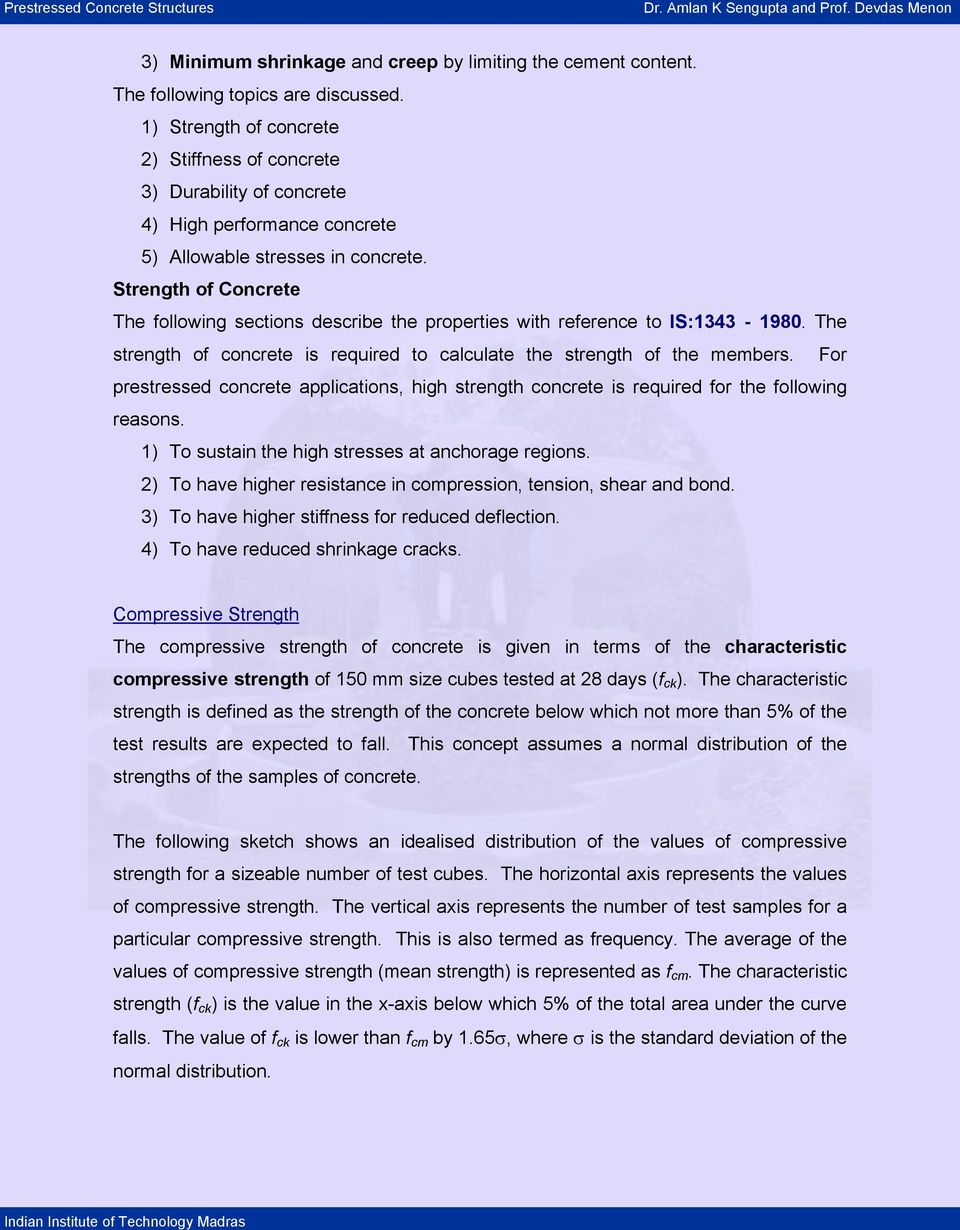
5 Frequency 1.65σ f ck f cm 5% area f ck f cm 28 day cube compressive strength Figure Idealised normal distribution of concrete strength (Reference: Pillai, S. U., and Menon, D., Reinforced Concrete Design) The sampling and strength test of concrete are as per Section 15 of IS: The grades of concrete are explained in Table 1 of the Code. The minimum grades of concrete for prestressed applications are as follows. 30 MPa for post-tensioned members 40 MPa for pre-tensioned members. The maximum grade of concrete is 60 MPa. Since at the time of publication of IS:1343 in 1980, the properties of higher strength concrete were not adequately documented, a limit was imposed on the maximum strength. It is expected that higher strength concrete may be used after proper testing. The increase in strength with age as given in IS: , is not observed in present day concrete that gains substantial strength in 28 days. Hence, the age factor given in Clause should not be used. It has been removed from IS: Tensile Strength The tensile strength of concrete can be expressed as follows. 1) Flexural tensile strength: It is measured by testing beams under 2 point loading (also called 4 point loading including the reactions). 2) Splitting tensile strength: It is measured by testing cylinders under diametral compression.

6 3) Direct tensile strength: It is measured by testing rectangular specimens under direct tension. In absence of test results, the Code recommends to use an estimate of the flexural tensile strength from the compressive strength by the following equation. f = 0.7 f (1-5.1) Here, f cr = flexural tensile strength in N/mm 2 f ck = characteristic compressive strength of cubes in N/mm 2. cr ck Stiffness of Concrete The stiffness of concrete is required to estimate the deflection of members. The stiffness is given by the modulus of elasticity. For a non-linear stress (f c ) versus strain (ε c ) behaviour of concrete the modulus can be initial, tangential or secant modulus. IS: recommends a secant modulus at a stress level of about 0.3f ck. The modulus is expressed in terms of the characteristic compressive strength and not the design compressive strength. The following figure shows the secant modulus in the compressive stress-strain curve for concrete. f c f c f ck E c ε c Figure a) Concrete cube under compression, b) Compressive stress-strain curve for concrete The modulus of elasticity for short term loading (neglecting the effect of creep) is given by the following equation. E = c 5000 fck Here, E c = short-term static modulus of elasticity in N/mm 2 f ck = characteristic compressive strength of cubes in N/mm 2. (1-5.2)

7 The above expression is updated as per IS: Durability of Concrete The durability of concrete is of vital importance regarding the life cycle cost of a structure. The life cycle cost includes not only the initial cost of the materials and labour, but also the cost of maintenance and repair. In recent years emphasis has been laid on the durability issues of concrete. This is reflected in the enhanced section on durability (Section 8) in IS: It is expected that the revised version of IS:1343 will also have similar importance on durability. The durability of concrete is defined as its ability to resist weathering action, chemical attack, abrasion, or any other process of deterioration. The common durability problems in concrete are as follows. 1) Sulphate and other chemical attacks of concrete. 2) Alkali-aggregate reaction. 3) Freezing and thawing damage in cold regions. 4) Corrosion of steel bars or tendons. The durability of concrete is intrinsically related to its water tightness or permeability. Hence, the concrete should have low permeability and there should be adequate cover to reinforcing bars. The selection of proper materials and good quality control are essential for durability of concrete. The durability is addressed in IS: in Section 7. In Appendix A there are guidelines on durability. Table 9 specifies the maximum water-to-cement (w-c) ratio and the minimum cement content for different exposure conditions. The values for moderate exposure condition are reproduced below. Table Maximum water-to-cement (w-c) ratio and the minimum cement content for moderate exposure conditions (IS: ). Min. cement content : 300 kg per m 3 of concrete Max w-c ratio* : 0.50 (*The value is updated as per Table 5 of IS: )

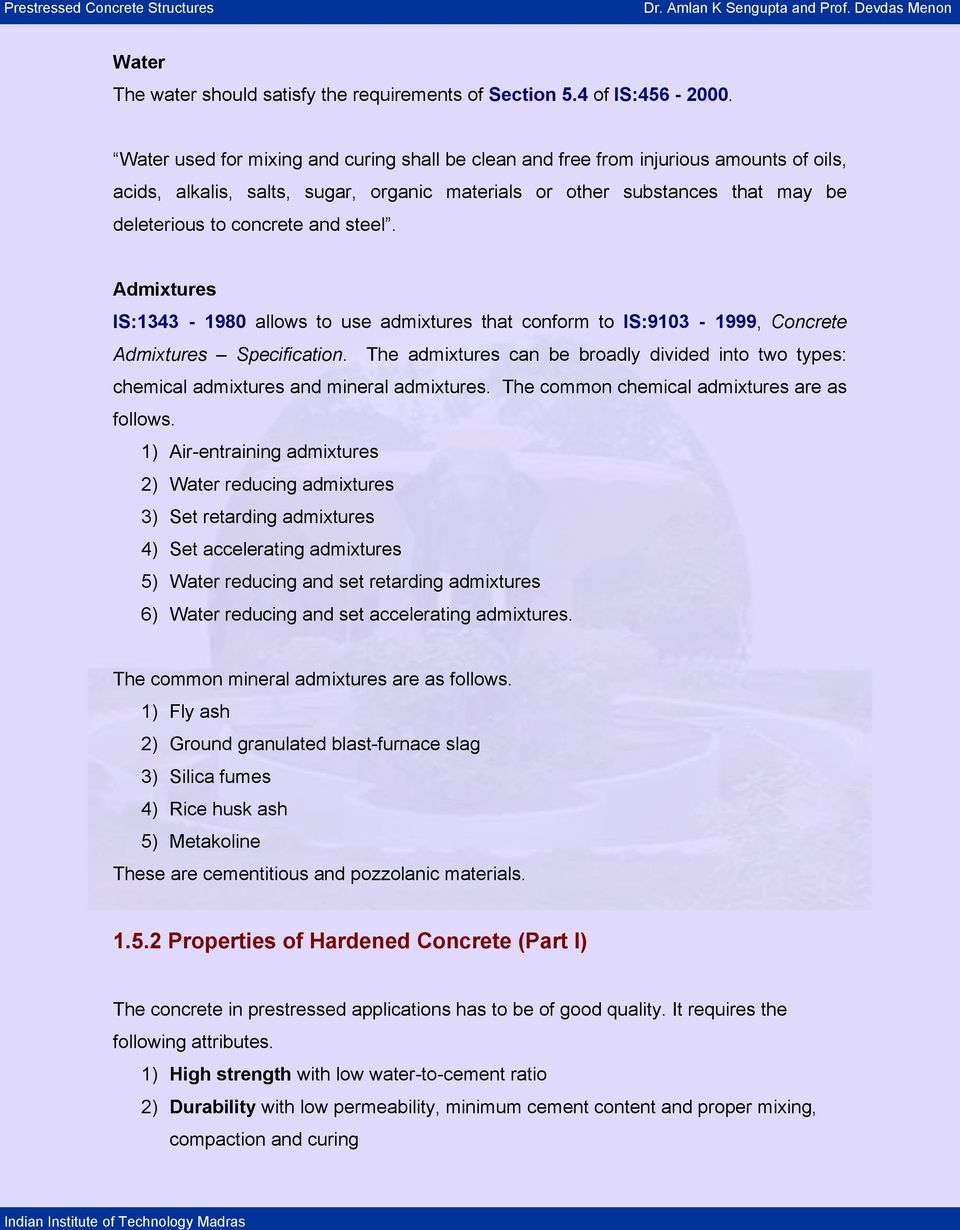
8 Table 10 provides the values for the above quantities for concrete exposed to sulphate attack. To limit the creep and shrinkage, IS: specifies a maximum cement content of 530 kg per m 3 of concrete (Clause 8.1.1). High Performance Concrete With the advancement of concrete technology, high performance concrete is getting popular in prestressed applications. The attributes of high performance concrete are as follows. 1) High strength 2) Minimum shrinkage and creep 3) High durability 4) Easy to cast 5) Cost effective. Traditionally high performance concrete implied high strength concrete with higher cement content and low water-to-cement ratio. But higher cement content leads to autogenous and plastic shrinkage cracking and thermal cracking. At present durability is also given importance along with strength. Some special types of high performance concrete are as follows. 1) High strength concrete 2) High workability concrete 3) Self-compacting concrete 4) Reactive powder concrete 5) High volume fly ash concrete 6) Fibre reinforced concrete In a post-tensioned member, the concrete next to the anchorage blocks (referred to as end block) is subjected to high stress concentration. The type of concrete at the end blocks may be different from that at the rest of the member. Fibre reinforced concrete is used to check the cracking due to the bursting forces. The following photo shows that the end blocks were cast separately with high strength concrete.

9 Figure End-blocks in a bridge deck (Courtesy: Cochin Port Trust, Kerala) Allowable Stresses in Concrete The allowable stresses are used to analyse and design members under service loads. IS: specifies the maximum allowable compressive stresses for different grades of concrete under different loading conditions in Section Allowable Compressive Stresses under Flexure The following sketch shows the variation of allowable compressive stresses for different grades of concrete at transfer. The cube strength at transfer is denoted as f ci. 0.54f ci 0.51f ci 0.37f ci 0.44f ci M30 M60 M40 M60 Post-tension Pre-tension Figure Variation of allowable compressive stresses at transfer The following sketch shows the variation of allowable compressive stresses for different grades of concrete at service loads.
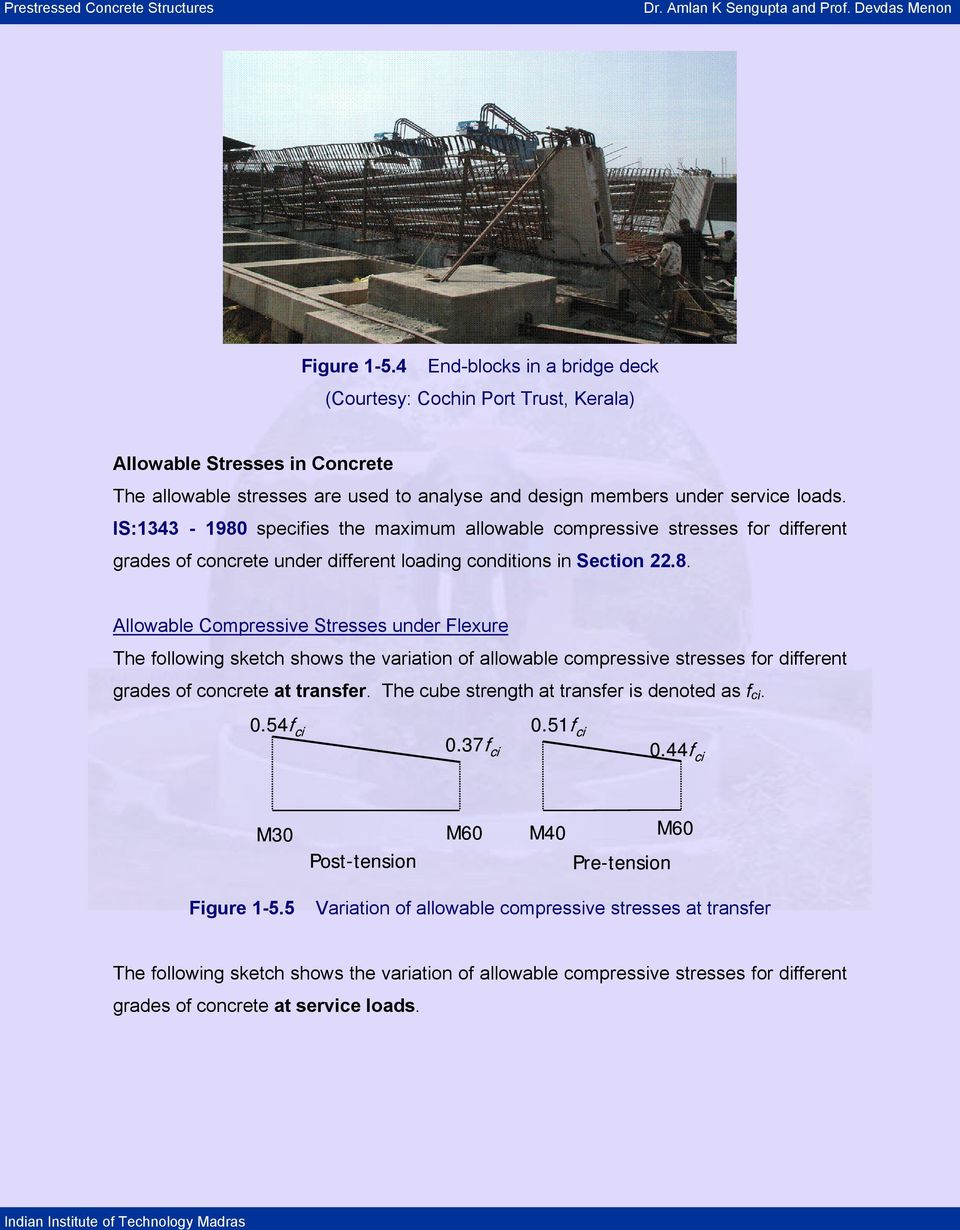
10 0.41f ck 0.34f ck Zone I Zone II 0.35f ck 0.27f ck M 30 M 60 Figure Variation of allowable compressive stresses at service loads Here, Zone I represents the locations where the compressive stresses are not likely to increase. Zone II represents the locations where the compressive stresses are likely to increase, such as due to transient loads from vehicles in bridge decks. Allowable Compressive Stresses under Direct Compression For direct compression, except in the parts immediately behind the anchorage, the maximum stress is equal to 0.8 times the maximum compressive stress under flexure. Allowable Tensile Stresses under Flexure The prestressed members are classified into three different types based on the allowable tensile stresses. The amount of prestressing varies in the three types. The allowable tensile stresses for the three types of members are specified in Section The values are reproduced below. Table Allowable tensile stresses (IS: ) Type 1 No tensile stress 3 N/mm 2. Type 2 This value can be increased to 4.5 N/mm 2 for temporary loads. Type 3 Table 8 provides hypothetical values of allowable tensile stresses. The purpose of providing hypothetical values is to use the elastic analysis method for Type 3 members even after cracking of concrete.
PROPERTIES AND MIX DESIGNATIONS 5-694.200
 September 1, 2003 CONCRETE MANUAL 5-694.200 5-694.210 PROPERTIES OF CONCRETE PROPERTIES AND MIX DESIGNATIONS 5-694.200 Inspectors should familiarize themselves with the most important properties of concrete:
Shotcrete Quality Control and Testing for an Underground Mine in Canada
 Shotcrete Quality Control and Testing for an Underground Mine in Canada By Dudley R. (Rusty) Morgan and Mazin Ezzet AMEC Earth & Environmental, a division of AMEC Americas Limited SHOTCRETE FOR AFRICA
Chapter Two Types of Cement The properties of cement during hydration vary according to:
 Chapter Two Types of Cement The properties of cement during hydration vary according to: Chemical composition Degree of fineness It is possible to manufacture different types of cement by changing the
Analysis of M35 and M40 grades of concrete by ACI and USBR methods of mix design on replacing fine aggregates with stone dust
 Analysis of M35 and M40 s of concrete by and methods of mix design on replacing fine aggregates with stone dust Satwinder Singh 1, Dr. Hemant Sood 2 1 M. E. Scholar, Civil Engineering, NITTTR, Chandigarh,
Strength and Workability Characteristics of Concrete by Using Different Super Plasticizers
 International Journal of Materials Engineering 12, 2(1): 7-11 DOI: 1.923/j.ijme.11.2 Strength and Workability Characteristics of Concrete by Using Different Super Plasticizers Venu Malagavelli *, Neelakanteswara
1.054/1.541 Mechanics and Design of Concrete Structures (3-0-9) Outline 1 Introduction / Design Criteria for Reinforced Concrete Structures
 Prof. Oral Buyukozturk Massachusetts Institute of Technology Outline 1 1.054/1.541 Mechanics and Design of Concrete Structures (3-0-9) Outline 1 Introduction / Design Criteria for Reinforced Concrete Structures
Strength of Concrete
 Strength of Concrete In concrete design and quality control, strength is the property generally specified. This is because, compared to most other properties, testing strength is relatively easy. Furthermore,
Hardened Concrete. Lecture No. 14
 Hardened Concrete Lecture No. 14 Strength of Concrete Strength of concrete is commonly considered its most valuable property, although in many practical cases, other characteristics, such as durability
Chapter 8 Design of Concrete Mixes
 Chapter 8 Design of Concrete Mixes 1 The basic procedure for mix design is applicable to concrete for most purposes including pavements. Concrete mixes should meet; Workability (slump/vebe) Compressive
Overview of Topics. Stress-Strain Behavior in Concrete. Elastic Behavior. Non-Linear Inelastic Behavior. Stress Distribution.
 Stress-Strain Behavior in Concrete Overview of Topics EARLY AGE CONCRETE Plastic shrinkage shrinkage strain associated with early moisture loss Thermal shrinkage shrinkage strain associated with cooling
Example Specification for Concrete using Current Building Code Requirements
 Example Specification for Concrete using Current Building Code Requirements DISCLAIMER: This specification is an example that accompanies a seminar titled The P2P Initiative: Performance-based Specs for
Cementitious Materials Update The effect of ggbs, fly ash, silica fume. concrete.
 Cementitious Materials Update The effect of ggbs, fly ash, silica fume and limestone on the properties of concrete. Richard Barnes Concrete Society Technical Report: Cementitious Materials - The effect
E-learning tools for understanding and testing of a range of concrete properties
 E-learning tools for understanding and testing of a range of concrete properties Prof. C.S.Poon Department of Civil and Structural Engineering, The Hong Kong Polytechnic University Team members Dr. Wallace
Fire-Damage or Freeze-Thaw of Strengthening Concrete Using Ultra High Performance Concrete
 Fire-Damage or Freeze-Thaw of Strengthening Concrete Using Ultra High Performance Concrete Ming-Gin Lee 1,a, Yi-Shuo Huang 1,b 1 Department of Construction Engineering, Chaoyang University of Technology,Taichung
Pavement Thickness. esign and RCC-Pave Software. Roller-Compacted Concrete Pavement: Design and Construction. October 24, 2006 Atlanta, Georgia
 Roller-Compacted Concrete Pavement: Design and Construction Pavement Thickness esign and RCC-Pave Software Gregory E. Halsted, P.E. Pavements Engineer Portland Cement Association October 24, 2006 Atlanta,
TABLE OF CONTENTS CHAPTER NO. TITLE PAGE NO. ABSTRACT
 vii TABLE OF CONTENTS CHAPTER NO. TITLE PAGE NO. ABSTRACT LIST OF TABLES LIST OF FIGURES LIST OF SYMBOLS AND ABBREVIATIONS iii xvii xix xxvii 1 INTRODUCTION 1 1.1 GENERAL 1 1.2 OBJECTIVES AND SCOPE OF
Properties of Concrete with Blast-Furnace Slag Cement Made from Clinker with Adjusted Mineral Composition
 Properties of Concrete with Blast-Furnace Slag Cement Made from Clinker with Adjusted Mineral Composition Atsushi YATAGAI 1, Nobukazu NITO 1, Kiyoshi KOIBUCHI 1, Shingo MIYAZAWA 2,Takashi YOKOMURO 3 and
SECTION 18 - CAST IN PLACE HIGH PERFORMANCE CONCRETE (HPC)
 SECTION 18 - CAST IN PLACE HIGH PERFORMANCE CONCRETE (HPC) 1.0 DESCRIPTION This section details the requirements for materials and methods in the proportioning, mixing, transporting, placing, finishing
GRADATION OF AGGREGATE FOR CONCRETE BLOCK
 GRADATION OF AGGREGATE FOR CONCRETE BLOCK Although numerous papers have been written concerning the proper gradation for concrete mixes, they have generally dealt with plastic mixes, and very little published
Ultra-High Strength Concrete Mixtures Using Local Materials
 UltraHigh Strength Concrete Mixtures Using Local Materials Srinivas Allena 1 and Craig M. Newtson 2 1 New Mexico State University, Civil Engineering Department, P.O. Box 30001, MSC 3CE, Las Cruces, NM
Effect of basalt aggregates and plasticizer on the compressive strength of concrete
 International Journal of Engineering & Technology, 4 (4) (2015) 520-525 www.sciencepubco.com/index.php/ijet Science Publishing Corporation doi: 10.14419/ijet.v4i4.4932 Research Paper Effect of basalt aggregates
Optimum Curing Cycles for Precast Concrete
 Optimum Curing Cycles for Precast Concrete Dr Norwood Harrison, Technical Support Manager, Humes Mr Tom Howie, Manager Engineered Structures, Humes Prepared for the Concrete Pipe Association of Australasia,
Draft Table of Contents. Building Code Requirements for Structural Concrete and Commentary ACI 318-14
 Draft Table of Contents Building Code Requirements for Structural Concrete and Commentary ACI 318-14 BUILDING CODE REQUIREMENTS FOR STRUCTURAL CONCRETE (ACI 318 14) Chapter 1 General 1.1 Scope of ACI 318
Lab 1 Concrete Proportioning, Mixing, and Testing
 Lab 1 Concrete Proportioning, Mixing, and Testing Supplemental Lab manual Objectives Concepts Background Experimental Procedure Report Requirements Discussion Prepared By Mutlu Ozer Objectives Students
CGA Standard Practices Series. Article 600 Standard for Pozzolan Enhanced Grouts Used in Annular Seals & Well Destruction
 California Groundwater Association An NGWA Affiliate State PO Box 14369 Santa Rosa CA 95402 707-578-4408 fax: 707-546-4906 email: [email protected] website: www.groundh2o.org CGA Standard Practices Series
:: ARTIFICIAL SAND :: Zone One Sand : Zone Two Sand :
 :: ARTIFICIAL SAND :: Natural sand are weathered and worn out particles of rocks and are of various grades or size depending on the accounting of wearing. The main natural and cheapest resource of sand
Saint Gobain Gyproc India Ltd. (Formerly India Gypsum Ltd.)
 Saint Gobain Gyproc India Ltd. (Formerly India Gypsum Ltd.) Gyproc Plasters The cracks in cement sand plaster are an inherent feature which cannot be completely prevented but can only be controlled and
Chapter 2 Basis of design and materials
 Chapter 2 Basis of design and materials 2.1 Structural action It is necessary to start a design by deciding on the type and layout of structure to be used. Tentative sizes must be allocated to each structural
MeltonStone Cast Stone Product Specifications
 MeltonStone Cast Stone Product Specifications Section 04-72-00-04 Architectural Cast Stone This specification encompasses basic requirements for Cast Stone, a refined architectural concrete building unit
Shrinkage and Creep Properties of High-Strength Concrete Up To 120 MPa
 Seventh International Congress on Advances in Civil Engineering, October11-13, 26 Yildiz TechnicalUniversity, Istanbul, Turkey Shrinkage and Creep Properties of High-Strength Concrete Up To 12 MPa H. C.
To go into depth on fly ash would be beyond the scope of this paper. Nevertheless, believe us ASH IS CASH.
 COAL (FLY) ASH To go into depth on fly ash would be beyond the scope of this paper. Nevertheless, believe us ASH IS CASH. During the course of the research on my blended cement, I realized that the research
2. PREPARATION OF TEST SPECIMENS
 Leaching of Cement Lining in Newly-Laid Water Mains (Part II) Ong Tuan Chin and Dr. Wong Sook Fun School of Civil and Environmental Engineering, Nanyang Technological University, 5 Nanyang Avenue, Singapore
Recycled Concrete Pavement and Other Recycled Materials in Concrete Pavements
 Recycled Concrete Pavement and Other Recycled Materials in Concrete Pavements Infrastructure Applications Utilizing Recycled Materials in South Carolina What/Who is NRMCA? National Ready-Mixed Concrete
PCI BIG BEAM COMPETITION
 PCI BIG BEAM COMPETITION Official Rules for the PCI Engineering Design Competition Academic Year 2015-16 PROGRAM The PCI Student Education Committee is inviting entries from students to participate in
Stone crusher dust as a fine aggregate in Concrete for paving blocks
 Stone crusher dust as a fine aggregate in Concrete for paving blocks Radhikesh P. Nanda 1, Amiya K. Das 2, Moharana.N.C 3 1 Associate Professor, Department of Civil Engineering, NIT Durgapur, Durgapur
FACT SHEET: HYDRATED LIME FOR MASONRY PURPOSES
 FACT SHEET: HYDRATED LIME FOR MASONRY PURPOSES Hydrated Masons Lime Characteristics Type S (Special) hydrated lime is a fine, white, high purity product which has been specially hydrated for convenient,
Sustainable Concrete: The Role of Performance-based Specifications
 Sustainable Concrete: The Role of Performance-based Specifications Lionel Lemay 1, Colin Lobo 2 and Karthik Obla 3 1 National Ready Mixed Concrete Association, 1244 Crane Blvd., Libertyville, IL, 60048;
The following sketches show the plans of the two cases of one-way slabs. The spanning direction in each case is shown by the double headed arrow.
 9.2 One-way Slabs This section covers the following topics. Introduction Analysis and Design 9.2.1 Introduction Slabs are an important structural component where prestressing is applied. With increase
Evaluation of M35 and M40 grades of concrete by ACI, DOE, USBR and BIS methods of mix design
 Evaluation of M35 and M40 grades of concrete by ACI, DOE, USBR and BIS methods of mix design Sharandeep Singh 1, Dr.Hemant Sood 2 1 M. E. Scholar, CIVIL Engineering, NITTTR, Chandigarh, India 2Professor
CAUSES, EVALUATION AND REPAIR OF CRACKS IN CONCRETE
 3.0 Causes and control of cracking: 3.1 Plastic Shrinkage Cracking: It occurs within 1 to 8 hours after placing, when subjected to a very rapid loss of moisture caused by a combination of factors, which
EXPERIMENTAL INVESTIGATION ON STRENGTH AND DURABILITY PROPERTIES OF HYBRID FIBER REINFORCED CONCRETE
 EXPERIMENTAL INVESTIGATION ON STRENGTH AND DURABILITY PROPERTIES OF HYBRID FIBER REINFORCED CONCRETE SUDHEER JIROBE 1, BRIJBHUSHAN.S 2, MANEETH P D 3 1 M.Tech. Student, Department of Construction technology,
A Study on the Flexural and Split Tensile Strengths of Steel Fibre Reinforced Concrete at High Temperatures
 A Study on the Flexural and Split Tensile Strengths of Steel Fibre Reinforced Concrete at High Temperatures 1 P. Jyotsna Devi, 2 Dr. K. Srinivasa Rao 1,2 Dept. of Civil Engg, Andhra University, Visakhapatnam,
HIGH-PERFORMANCE CONCRETE IN A BRIDGE IN RICHLANDS, VIRGINIA. Celik Ozyildirim, Ph.D. Principal Research Scientist
 HIGH-PERFORMANCE CONCRETE IN A BRIDGE IN RICHLANDS, VIRGINIA Celik Ozyildirim, Ph.D. Principal Research Scientist José P. Gomez, Ph.D., P.E. Senior Research Scientist (The opinions, findings, and conclusions
Testing and appraisal of Lucobit polymer effect as an additive on asphalt mixture performance
 Abstract Testing and appraisal of polymer effect as an additive on asphalt mixture performance Hamid Sabbagh mollahosseini*,golazin Yadollahi**, Ershad Amoosoltani*** *, ***Executive of Engineering and
The Concrete Life Cycle: Maintain to Sustain. Fred Goodwin BASF Construction Chemicals (EB-N) Beachwood OH
 The Concrete Life Cycle: Maintain to Sustain Fred Goodwin BASF Construction Chemicals (EB-N) Beachwood OH What is Concrete? Concrete: Instant rock -just add water to make a hard wet sponge. A composite
NOTE: FOR PROJECTS REQUIRING CONTRACTOR MIX DESIGN, THE DESIGN PROCEDURES ARE SPECIFIED IN THE SPECIAL PROVISIONS OF THE CONTRACT.
 September 1, 2003 CONCRETE MANUAL 5-694.300 MIX DESIGN 5-694.300 NOTE: FOR PROJECTS REQUIRING CONTRACTOR MIX DESIGN, THE DESIGN PROCEDURES ARE SPECIFIED IN THE SPECIAL PROVISIONS OF THE CONTRACT. 5-694.301
EFFECT OF SUPERPLASTICIZERS ON WORKABILITY AND STRENGTH OF CONCRETE
 EFFECT OF SUPERPLASTICIZERS ON WORKABILITY AND STRENGTH OF CONCRETE Saeed Ahmad*, University of Engineering & Technology,Taxila, Pakistan Muhammad Nawaz, University of Engineering & Technology, Taxila,
Construction. 3-part thixotropic epoxy patching mortar. Product Description. Tests
 Product Data Sheet Edition 05/12/2014 Identification no: 020204030010000044 Sikadur -41 CF Rapid 3-part thixotropic epoxy patching mortar Construction Product Description Uses Characteristics / Advantages
FLEXURAL AND TENSILE STRENGTH PROPERTIES OF CONCRETE USING LATERITIC SAND AND QUARRY DUST AS FINE AGGREGATE
 FLEXURAL AND TENSILE STRENGTH PROPERTIES OF CONCRETE USING LATERITIC SAND AND QUARRY DUST AS FINE AGGREGATE Joseph. O. Ukpata 1 and Maurice. E. Ephraim 2 1 Department of Civil Engineering, Cross River
AGREGADOS RECICLADOS MITOS Y REALIDADES
 The Production and Use of Recycled Concrete in the USA Thomas Van Dam, Ph.D., P.E., FACI Principal Engineer CTL Group Introduction In the United States, concrete is the most commonly used recycled material
CEMENT CHEMISTRY & TYPES OF CEMENT
 CEMENT CHEMISTRY & TYPES OF CEMENT Cement is a hydraulic binder, i.e., an inorganic, non-metallic, finely ground substance which, after mixing with water, sets and hardens independently as a result of
SafetyBuletin. Concrete101 Aguidetounderstandingthequalitiesofconcrete andhowtheyaffectpumping
 SafetyBuletin Concrete101 Aguidetounderstandingthequalitiesofconcrete andhowtheyaffectpumping Copyright 2008 v1.01 ACPA All rights reserved Manufacturer s recommendations supersede any and all information
MASONRY INFORMATION. Selecting and Specifying Mortar and Grout for Unit Masonry. Introduction. Desirable Mortar Properties. Selection of Mortar
 Portland Cement Association MASONRY INFORMATION Selecting and Specifying Mortar and Grout for Unit Masonry Introduction Masonry mortar and masonry grout are key materials in unit masonry construction.
Choosing the Right Mortar for the Job
 Choosing the Right Mortar for the Job by Michael Schuller, P.E. President, Atkinson-Noland & Associates 2619 Spruce St. Boulder, CO 80302 www.ana-usa.com Modern material technology has given us strong
The Strength of Concrete
 Chapter The Strength of Concrete.1 The Importance of Strength.2 Strength Level Required KINDS OF STRENGTH. Compressive Strength.4 Flexural Strength.5 Tensile Strength.6 Shear, Torsion and Combined Stresses.7
High Strength Concrete to Singapore Standard CP 65
 BC 2: 2008 Design Guide of High Strength Concrete to Singapore Standard CP 65 BCA Sustainable Construction Series 3 The education and research arm of the Building and Construction Authority 200 Braddell
CHAPTER 1 INTRODUCTION
 Page 1 CHAPTER 1 INTRODUCTION 1.1 REINFORCED CONCRETE STRUCTURES Concrete is arguably the most important building material, playing a part in all building structures. Its virtue is its versatility, i.e.
CEMENT AND CONCRETE IN AFRICA PRESENTATION OF UNIVERSITY OF THE WITWATERSRAND SOUTH AFRICA AKINDAHUNSI A. A
 CEMENT AND CONCRETE IN AFRICA PRESENTATION OF UNIVERSITY OF THE WITWATERSRAND SOUTH AFRICA BY AKINDAHUNSI A. A INTRODUCTION Concrete: Most widely used material About a ton of concrete produced per person
Division 4 Section 047200 Concrete Masonry Specifications
 Cast Stone Specification This specification encompasses basic requirements for Cast Stone, as manufactured by Building Products Corp, 494 North 33 rd Street East St. Louis, Il 618-874-6282, 800-427-6282,
Irish Concrete Society Platin, Drogheda, Co. Louth. Tel: 041 987 6000 Fax: 041 987 6400 www.concrete.ie
 Irish Concrete Society Platin, Drogheda, Co. Louth. Tel: 041 987 6000 Fax: 041 987 6400 www.concrete.ie Irish Concrete Federation Unit 8, Newlands Business Park, Newlands Cross, Clondalkin, Dublin 24.
Construction Materials Testing. Classes of Test
 Construction Materials Testing Classes of Test February 2014 Copyright National Association of Testing Authorities, Australia 2014 This publication is protected by copyright under the Commonwealth of Australia
Manufacturing Quality Concrete Products
 CEMEX USA - Technical Bulletin 8.0 Manufacturing Quality Concrete Products Establishing or Upgrading a Quality Program Overview The following guidelines were developed for MCP (manufactured concrete products)
SPECIAL COMPOUND FOR RHEOPLASTIC AND ANTI-CORROSION SUPERCONCRETE WITH VERY HIGH DURABILITY
 BS 40 M6 MuCis mono SPECIAL COMPOUND FOR RHEOPLASTIC AND ANTI-CORROSION SUPERCONCRETE WITH VERY HIGH DURABILITY LE CE LE type: "expansive binder which allows the production of extremely fluid concrete
Study of durability of sprayed concrete
 Study of durability of sprayed concrete ADAM HUBÁČEK, RUDOLF HELA Department of Technology of Building Materials and Components Brno University of Technology, Faculty of Civil Engineering Veveří 95, 602
7. Verification of Durability
 59 7. Verification of Durability The performance verification performe thus far has shown that the structural performance is higher than the performance requirements. That performance must not be lost
Vikrant S. Vairagade, Kavita S. Kene, Dr. N. V. Deshpande / International Journal of Engineering Research and Applications (IJERA)
 Investigation on Compressive and Tensile Behavior of Fibrillated Fibers Reinforced Concrete Vikrant S. Vairagade*, Kavita S. Kene*, Dr. N. V. Deshpande** * (Research Scholar, Department of Civil Engineering,
Construction Specifications for Keyhole Pavement Coring and Reinstatement
 F I N A L Construction Specifications for Keyhole Pavement Coring and Reinstatement Gas Technology Institute 1700 S. Mount Prospect Rd. Des Plaines, Illinois 60018 www.gastechnology.org Version 13 October
(T indicates a Tropicalised version with extended workability. No change has been made to the formulation)
 928 T (T indicates a Tropicalised version with extended workability. No change has been made to the formulation) High strength, non-shrink cementitious grout Description 928 T is a ready to use product
MODEL CLAUSES FOR CIVIL ENGINEERING WORKS
 MODEL CLAUSES FOR CIVIL ENGINEERING WORKS SECTION 80 STRUCTURAL CONCRETE Contents Page 80.001 Application of standards and codes of practice 3 80.002 Classification of concrete mixes generally 3 80.003
STRENGTH OF CONCRETE INCORPORATING AGGREGATES RECYCLED FROM DEMOLITION WASTE
 STRENGTH OF CONCRETE INCORPORATING AGGREGATES RECYCLED FROM DEMOLITION WASTE R. Kumutha and K. Vijai Department of Civil Engineering, Sethu Institute of Technology, Pulloor, Kariapatti, India E-Mail: [email protected],
SULPHATE ATTACK AND CHLORIDE ION PENETRATION: THEIR ROLE IN CONCRETE DURABILITY
 SULPHATE ATTACK AND CHLORIDE ION PENETRATION: THEIR ROLE IN CONCRETE DURABILITY Concrete durability continues to be a subject of controversy among design professionals, specifiers, Government instrumentalities,
Concrete for industrial floors
 Published October 2000 Reprinted October 2004 One of a series of publications produced in conjunction with the following organizations, and part-funded by DETR. Association of Concrete Industrial Flooring
Mass Concrete. Robert Moser CEE8813A Material Science of Concrete. Definitions & Standards, Thermal Cracking, and Temperature Rise
 Mass Concrete Robert Moser CEE8813A Material Science of Concrete Lecture Overview General Overview Definitions & Standards, Thermal Cracking, and Temperature Rise Temperature & Stress Prediction Factors
1.2 Advantages and Types of Prestressing
 1.2 Advantages and Types of Prestressing This section covers the following topics. Definitions Advantages of Prestressing Limitations of Prestressing Types of Prestressing 1.2.1 Definitions The terms commonly
Department of Civil Engineering B.TECH 5 TH SEM Lecture Notes on STRUCTURAL DESIGN BCE301
 Department of Civil Engineering B.TECH 5 TH SEM Lecture Notes on STRUCTURAL DESIGN BCE301 Disclaimer This document does not claim any originality and cannot be used as a substitute for prescribed textbooks.
Structural use of concrete
 BRITISH STANDARD Incorporating Amendments Nos. 1, 2 and 3 Structural use of concrete Part 1: Code of practice for design and construction ICS 91.080.40 This British Standard, having been prepared under
MILMAN & ASSOCIATES STRUCTURAL CONSULTING ENGINEERS/ PROJECT MANAGERS
 MILMAN & ASSOCIATES STRUCTURAL CONSULTING ENGINEERS/ PROJECT MANAGERS May 29, 2013 Revision B Structural Guideline for Design and Installation Holes in Composite Floor Slab Terminal 3, Departure Level
Deflection Calculation of RC Beams: Finite Element Software Versus Design Code Methods
 Deflection Calculation of RC Beams: Finite Element Software Versus Design Code Methods G. Kaklauskas, Vilnius Gediminas Technical University, 1223 Vilnius, Lithuania ([email protected]) V.
DURABILITY OF MORTAR LININGS IN DUCTILE IRON PIPES Durability of mortar linings
 DURABILITY OF MORTAR LININGS IN DUCTILE IRON PIPES Durability of mortar linings I. S. MELAND SINTEF Civil and Environmental Engineering, Cement and Concrete, Trondheim, Norway Durability of Building Materials
cement Masonry Cement Engineered for quality and reliability, Lafarge cements for masonry deliver consistent performance. page 2 Lafarge Cement
 cement Masonry Cement Engineered for quality and reliability, Lafarge cements for masonry deliver consistent performance. page 2 Lafarge Cement Lafarge in North America The Lafarge Group is the world leader
Rapid Chloride Permeability Testing
 Rapid Chloride Permeability Testing A test that can be used for a wide range of applications and quality control purposes if the inherent limitations are understood By Prakash Joshi and Cesar Chan C orrosion
PVC PIPE PERFORMANCE FACTORS
 PVC PIPE PERFORMANCE FACTORS PVC pipe, like all flexible pipe products, is very dependent on the surrounding soil for its structural capacity, in addition, the pipe material must have sufficient inherent
STATE OF OHIO DEPARTMENT OF TRANSPORTATION SUPPLEMENTAL SPECIFICATION 888 PORTLAND CEMENT CONCRETE PAVEMENT USING QC/QA.
 STATE OF OHIO DEPARTMENT OF TRANSPORTATION SUPPLEMENTAL SPECIFICATION 888 PORTLAND CEMENT CONCRETE PAVEMENT USING QC/QA October 21, 2011 888.01 General 888.02 Materials 888.03 Concrete Proportioning 888.04
The First Commandment for floor slabs:
 The First Commandment for floor slabs: P for the Practitioner Thou Shalt Not Curl Nor Crack...(hopefully) by Wayne W. Walker and Jerry A. Holland LL FLOOR SLABS CURL, except Aunder unusual conditions or
SPECIFICATIONS FOR PRECAST MODULAR BLOCK RETAINING WALL SYSTEM (revised 11/5/13)
 Page 1 of 7 STONE STRONG SYSTEMS SPECIFICATIONS FOR PRECAST MODULAR BLOCK RETAINING WALL SYSTEM (revised ) PART 1: GENERAL 1.01 Description A. Work includes furnishing and installing precast modular blocks
High Volume Pozzolan Concrete:
 feature High Volume Pozzolan Concrete: Three years of Industrial Experience in Texas with CemPozz By Clinton W. Pike (1), Vladimir Ronin (1,2) and Lennart Elfgren (2) Abstract AHigh Volume Pozzolan Concrete
SPECIAL NOTE FOR ASPHALT WATERPROOFING MIX FOR BRIDGE-DECK OVERLAYS AND ADJACENT APPROACHES
 SPECIAL NOTE FOR ASPHALT WATERPROOFING MIX FOR BRIDGE-DECK OVERLAYS AND ADJACENT APPROACHES 1. DESCRIPTION. Asphalt Waterproofing Mix (AWM) is a highly elastomeric, polymermodified, impermeable asphalt
Influence of Nano-SiO 2 and Microsilica on Concrete Performance
 Influence of Nano-SiO 2 and Microsilica on Concrete Performance M. Nili *a, A. Ehsani a, and K. Shabani b a Civil Eng., Dept., Bu-Ali Sina University, Hamedan, I.R. Iran b Eng., Research Institute of Jahad-Agriculture
Quality control: Annex-A.
 Quality control: Quality of the constructed work has been checked by our staff as per frequency and provision mentioned section 900 in MoRT&H and as per provision mentioned in Concession Agreement. The