
Design of a Cantilever - Type Rotating Bending Fatigue Testing Machine
|
|
|
- Kathryn Sanders
- 9 years ago
- Views:
Transcription
1 Journal of Minerals & Materials Characterization & Engineering, Vol. 10, No.11, pp , 2011 jmmce.org Printed in the USA. All rights reserved Design of a Cantilever - Type Rotating Bending Fatigue Testing Machine K. K. Alaneme Department of Metallurgical and Materials Engineering Federal University of Technology, Akure, PMB 704, Nigeria [email protected] ABSTRACT This research is centered on the design of a low cost cantilever loading rotating bending fatigue testing machine using locally sourced materials. The design principle was based on the adaptation of the technical theory of bending of elastic beams. Design drawings were produced and components/materials selections were based on functionality, durability, cost and local availability. The major parts of the machine: the machine main frame, the rotating shaft, the bearing and the bearing housing, the specimen clamping system, pulleys, speed counter, electric motor, and dead weights; were fabricated and then assembled following the design specifications. The machine performance was evaluated using test specimens which were machined in conformity with standard procedures. It was observed that the machine has the potentials of generating reliable bending stress number of cycles data; and the cost of design (171,000 Naira) was lower in comparison to that of rotating bending machines from abroad. Also the machine has the advantages of ease of operation and maintenance, and is safe for use. Keywords: Fatigue; failure analysis; machine; design 1. INTRODUCTION Structural materials, machine components, and materials utilized in many industrial and specialized fields such as aerospace, defense, power generation among others; are often subjected to varied stress cycles or dynamic loading conditions during the course of their use. It is thus not surprising that most of these materials fail primarily by fatigue while in service. Fatigue failures are reported to account for more than 75% of documented materials failures of which a great percent occur catastrophically [1-2]. Fatigue cracks once initiated often grow in an insidious manner resulting in failures with serious implications. The technical problems, economic and potential human losses which accompany fatigue failures make its consideration during materials design of utmost importance if the challenges associated with its occurrence are to be mitigated [3]. 1027

2 1028 K. K. Alaneme Vol.10, No.11 A lot of research interest has been devoted to studying the fatigue behavior of engineering materials with a view to arriving at ways to effectively design against the failure mode [4-5]. The success of these research efforts is hinged on having a reliable means of evaluating the fatigue properties of materials. Over the years, there have been varied testing equipments and methods developed for fatigue evaluation [6-7]. The servo hydraulic machines are currently the fastest and most versatile with features that allow for a wide range of test variations to be performed on it. The high cost of these machines is a drawback to its use especially in most African countries where investment in research and development is still low. Also most manufacturing companies and medium scale establishments involved in materials development using indigenous processing equipment and techniques would find it unaffordable. The electromechanical systems like the rotating bending fatigue machines which are relatively cheaper are still not readily available as they would have to be imported from abroad. This research work thus aims at addressing this problem by venturing into the design of a low cost rotating bending fatigue testing machine using locally sourced materials. It is expected that on completion the machine would be found reliable and affordable by research institutes, universities, and companies that are involved in materials development and durability analysis. 1.1 Design Theory The theory governing the design of the fatigue machine is the cantilever loading elastic beam bending principle often referred to as the technical theory of bending [8]. A beam is a relatively long member that can support loads perpendicular to its axis. It can also support applied moments that tend to bend it resulting in the compression of the lower layers of the beam and the extension of the upper layers of the beam. The stress on the beam as a result of the bending is referred to as bending stresses [9]. The adaptation of this theory is applied in the workings of the cantilever loading type of rotating bending fatigue test which consists in the application of a known constant bending stress (due to a bending moment) to a round specimen on one end which is not hinged while the other extreme end of the specimen is fixed, combined with the rotation of the sample around the bending stress axis until failure occurs (Figure 1). The rotation and simultaneous bending on which the fatigue machine operates ensures that the bending stresses which leads to stretch the upper layers of the specimen and compress the bottom layers as is applicable in stationary beams; is evenly distributed around the entire circumference of the specimen. For round specimens, the moment of resistance for circular sections is applicable [8], and is given by: and M I = E R d I = π 64 4 σ = y mm 4 ( 1) ( 2)

3 Vol.10, No.11 Design of a Cantilever 1029 Where E = Young s Modulus; R = radius of curvature of the bent beam; M = bending moment; σ = bending stress; y = distance from the neutral layer to a generic point; I = the second moment of area of the section about the neutral axis; d = diameter of specimen in mm. Figure 1: Cantilever loading type of rotating-beam fatigue testing machines 2. MATERIALS AND METHODS 2.1 Materials The various materials used are: Chucks, Bolts and Nuts, Ball Bearings, Flat Metal Plate, Angle Bar, Electric Motor, Speed Counter, Pulleys, Speed Belt, Rotating Shaft, Automatic Switch, Wire and Plug, Switch, Dead Weight, Flat Wood Plate, Plastic Clips. 2.2 Machine Design and Considerations The main parts of the fatigue machine are: the electric motor, which gives the rotation; three main bearings, which create the two supports; one load bearing, where the load is applied; proximity sensor, which detects the rotation motion of the shaft and sends the signals to the counter; digital counter, which takes data from the sensor and records the number of rotation to failure of the specimen. The various parts/components of the fatigue machine were systematically coupled together through the preparation of design drawings based on the application of the theoretical principles of bending which had been thoroughly studied. The design drawings for the fatigue machine are presented in Figure Materials Selection and Application Shaft A medium carbon low alloy steel material sourced locally was selected for the design of the shafts of the machine. The fatigue resistance of the steel was taken into consideration before selection. The machine design requires the use of two shafts the first is connected to the electric motor and links the motor to the second shaft that contains the specimen clamping system through the pulleys as shown in Figure 2. The function of the shaft attached to the electric motor is to transmit torque from the motor to the second shaft that anchors the bearings and bearing housing, clamping system, and the specimen. The principal function of the second shaft is to rotate the specimen while it is under the action of bending moments from the dead weights applied at the left arm of the clamping system. The shaft is threaded to allow for screwing of the specimen chucks.

4 1030 K. K. Alaneme Vol.10, No.11 Figure 2: Fatigue Testing Machine without Casing Figure 3: First Angle Projection of the Fatigue Testing Machine without Covering

5 Vol.10, No.11 Design of a Cantilever Bearings and Bearing Housing The bearings selected for the design were self sealed spherical roller bearings which have high load carrying capacity and it can accommodate misalignment and shaft deflections maximum of 0.5. Bearings of 22mm bore diameter were selected for the design; it was ensured that the bearings would allow for the mounting of all components onto the shaft physically and that the mass of all components including the bearings was minimized. The bearing housing is a cylindrical hollow shaped steel material possessing good strength and toughness. The housing design was implemented by selecting dimensions that will result in smaller minimum bending moment which is desirable or realistic shaft geometry in order to produce the required bending moment. The housing was bored to the size of the external diameter of the chuck which is 25mm. Two bearings were then forcefully inserted into the housing at both ends. The housing support was fabricated and then welded to the side of the housing so that it provides rigidity and support. The housing support on the right arm of the clamping system was firmly held by bolts on the frame with the intension of making it fixed so that it can only allow for rotating motion. The second housing on the left arm of the clamping system had supports which allows for flexible movement of the housing. The housing is held to the supports by the use of bolts and nuts in order to accommodate the flexibility required. Figure 4 shows the manner the shaft is inserted into the bearings. Figure 4: tightly fitted bearing in the bearing housing and the shaft connection to the bearings Clamps and clamping mechanism A three jaw drill chuck with threaded fittings was selected as the specimen clamp for the fatigue machine (Figure 5). The drill chuck was selected because it is durable and cheap to procure. The specimen clamp is expected to firmly grip the specimens without allowing for extraneous bending moments during operation of the machine. Also, the specimen must not rotate from the grip or be displaced vertically or horizontally. The clamping mechanism allows for the specimen and chuck connection at the right arm of the shaft and bearing system to be fixed allowing for only rotating motion while the specimen and chuck connection at the left arm of the shaft and bearing system allows for both rotating and bending forces to act on the specimen by making the connection flexible as shown in Figure 3.

6 1032 K. K. Alaneme Vol.10, No.11 Figure 5: Drill chuck Proximity sensor The proximity sensor utilized in the design is presented in Figure 6. The sensor is utilized to detect the oscillation of nearby objects without having any physical contact with the object; so far the objects are not more than a distance of 15mm from it. A proximity sensor often emits an electromagnetic or electrostatic field, or a beam of electromagnetic radiation (infrared, for instance), and looks for changes in the field or return signal. It has been found suitable for detecting the number of revolutions of rotating materials hence it was selected to detect the number of revolutions of the shaft under the applied bending moments leading to fatigue failure. The sensor was placed on the end of the shaft at the left arm of the main frame of the machine to detect every cycle the shaft rotates. The rotating motion of the shaft and sends signal to the counter. Figure 6: Proximity Sensor Digital counter A 6 digit digital counter was selected for recording the number of stress cycles a specimen undergoes during testing. It was ensured that the digital counter was compatible with the proximity sensor selected, that is, it should be able to translate the signals from the sensor to a numerical output. The digital counter utilized can relay digital outputs, but can be programmed to run for a specified number of cyclic revolutions utilizing an analog input bottom incorporated into the counter (Figure 7). It can also be programmed to evaluate rate in

7 Vol.10, No.11 Design of a Cantilever 1033 a given time. Conventionally, an 8 digit counter is utilized for the design of rotating bending fatigue machines. The unavailability of the 8 digit counter led to the use of the 6 digit counter which was readily available within the country. Figure 7: 6 digit Digital Counter Electric motor An electric motor uses electrical energy to produce mechanical energy, very typically through the interaction of magnetic fields and current-carrying conductors. The electric motor used is a 0.75kW 1 horse power motor that is designed to rotate at 2920 revolutions per minute and 50Hz (Figure 8). Figure 8: Electric motor Frame and seat of motor The frames were cut from angle bar of dimension 2 inch by 2 inch alloy steel of good strength and toughness and welded together to serve as support for the whole set up. A flat flexible metallic plate was cut and attached to a part of the frame to serve as seat for the electric motor. The flexibility is to accommodate ease of adjustment of the electric motor and belt transmitting motion from the electric motor to the shaft.

8 1034 K. K. Alaneme Vol.10, No Electrical connections and circuit diagrams The electrical connection is done in such a way that when the whole machine is put on, the counter comes on and is indicated by the lighting of a bulb but the whole machine doesn t come on not until the second switch is put on, this is to ensure safety and to be able to control the whole machine. The electrical connection diagram is presented in Figure 9. No Component 1 Bulb Indicator for Electric Motor 2 Electric Motor 3 Bulb Indicator for Speed Counter 4 Speed Counter Figure 9: Electrical connection diagram 2.4 Assembly The different fabricated and purchased part are then assembled together to form the required setup as shown in the design. This starts by passing the turned shaft through the bearing in the housing forcefully and the shaft is allowed to extend beyond the bearing housing. A pulley is fixed to the electric motor and another to the extended shaft of the fixed bearing housing. The electric motor is then securely fastened to its seat and properly aligned with the upper pulley. The chuck is then screwed to the threaded mouth of the shaft and the two bearing housing are tightly screwed to the wooden base and properly aligned with each other. Finishing operation involves the addition of body fillers and grinding of all the parts of the machine using emery papers to make sure the parts are smooth. Thereafter, spraying of the machine was performed and the wooden coverings attached. The resulting work at different stages of finishing is presented in Figures

9 Vol.10, No.11 Design of a Cantilever 1035 Figure 10: The fatigue testing machine after coupling before finishing Figure 11: The fatigue testing machine after coupling and finishing Figure 12: Fatigue Testing Machine Showing Dead Weight

10 1036 K. K. Alaneme Vol.10, No Control of the Machine The machine is controlled by two switches; one switch turns on the whole system while the other puts on the electric motor which eventually starts the whole experiment. The magnitude of the load used for testing is predetermined and is applied through the loading arm of the fatigue machine. The bending moment on the specimen and the bending stress are calculated using the relevant relations as discussed in section 1.1. The number of cycles to achieve failure is recorded on the digital counter. The electric motor operates at a constant speed of 2920 rev/min and a frequency of 50Hz. The revolution counting can be achieved with precision by ensuring that the distance between the proximity sensor and the rotating shaft does not exceed 15mm. This will imply regular check after each operation of the machine. 2.6 Testing Mild steel of predetermined chemical composition was utilized to prepare specimens for the fatigue test. The reason for selection of mild steel is that there are well documented stress life fatigue data on mild steel available in literatures. The specimens were machined having a total length of 80mm with 15mm at both ends of the specimen to be held in the chuck so that the length experiencing tension-compression (gauge length) is 50mm. The diameter of the specimen is 12mm while the neck diameter is 8mm. The typical fatigue specimen configuration with dimensions is presented in Figure 13. Figure 13: representative specimen dimensions The machined samples were mounted on the chucks of the machine. The distance from the neck to the specimen s contact surface with the bearing was measured. The concrete weight was then applied. The revolution counter was set to zero and the electric motor switch turned on. The test terminates once the specimen fractures; after which the electric motor is witched off.

11 Vol.10, No.11 Design of a Cantilever RESULTS AND DISCUSSION 3.1 Machine Performance The machine enables the evaluation of the stress life fatigue behavior of the tested material through the plotting of bending stress against number of cycles from which the fatigue limit/fatigue strength of the test material can be determined. The working principle of the fatigue machine is easy to learn hence the operation of the machine does not require any specialized training. Following a few simple instructions on the instruction manual and placing the sample in between clamps/chucks, then turning on the switches, gets the machine running. The duration of testing is comparable to that of conventional rotating bending fatigue machines which have an electric motor that operates at 2920 rev/min and 50Hz.Similar machines take approximately 56 hours to achieve 10 7 cycles. The machine during testing was observed to be safe to operate as the whole set up was tightly secured to the base. When testing is to be performed thorough care is taken to ensure that the specimens are tightly clamped in the chuck to safeguard against removal of specimen when the machine is in operation. This ensures that when fracture occurs, the specimen will still be firmly held by the chucks of the machine. The machine was also properly earthed to prevent shock in case of a short circuit. The maintenance strategy to ensure that the machine performs at high efficiency is quite simple. The wires of the machine are properly protected against mutilation by domestic rodents. The proximity sensor is regularly checked to ensure that the maximum distance for reliable sensing of the shaft rotation is not exceeded; also regular cleaning of the sensor particularly if the machine has been unused for some time. In the case of machine malfunction, all parts are easily detachable and to be repaired. 3.2 Cost Analysis The entire materials and equipment used for the design of the fatigue machine are presented in Table 1. The materials and equipment used in the design are locally sourced, and the overall cost of designing the machine is approximately 171,000 Naira ($ ). The machine is cheap in comparison to similar designs from abroad.

12 1038 K. K. Alaneme Vol.10, No.11 Table 1: Bill for Engineering Management and Evaluation S/N Description (materials) Quantity Unit Rate Amount( ) Pieces Naira MATERIALS ACQUISITION 1 Electric motor 2 Nr 15,000 30,000 2 Proximity 1 Nr 17,200 3 Speed counter 1 Nr 17,200 24,500 4 Chucks/clamps 2 Nr 4,000 5 Bolt & nut 24,500 6 Ball bearings 4 Nr 2,400 7 Flat metal plate 20 M 2 2,000 6,000 8 Angle bar 3 IN 2 15,000 9 Pulley 2 Nr 600 2, Speed belt 2 Nr 300 1, Rotating shaft 5 M 5,000 2, Control switch 2 Nr 1,000 1, Wire & plug 500 2, Dead weight (concrete) 400 4, Wooden covering & polishing 700 7, Electrical clips 1 Nr 200 FABRICATION 17 Fabrication of various components & ,000 assembly 18 ELECTRICAL Electrical connection 5, PAINTING AND POLISHING Auto-base spray 6,500 Miscellaneous 10, Sub total 171, CONCLUSIONS This research was centered on the design of a low cost cantilever type rotating bending fatigue testing machine. The design principle is based on the adaptation of the technical theory of beam bending. On completion and testing, it was observed that the machine has the potentials of generating reliable bending stress-number of cycles data. It was also observed that the machine has the advantages of ease of operation and maintenance, and is safe for use.

13 Vol.10, No.11 Design of a Cantilever 1039 ACKNOWLEDGEMENT The author appreciates the support of the Association of Commonwealth Universities (ACU) for the award of its Wington Titular Fellowship in Engineering which he utilized at the Materials Engineering Department Indian Institute of Science, Bangalore. The support received from Prof U Ramamurty at whose laboratory the author worked with various types of fatigue machines is immensely appreciated. The author equally recognizes the assistance of Adesheyoju P. A., Afolabi B. M., Oguntimehin J. O and Oke S.R.; in materials sourcing and the fabrication process. REFERENCES [1] J. Rosler, H. Harders, M. Baker, Mechanical Behaviour of Engineering Materials Metals, Ceramics, Polymers, and Composites, Springer, Germany, 2007, pp [2] W. Soboyejo, Mechanical Property of Materials, Princeton University, USA, 2002, pp [3] K. K. Alaneme, S. M. Hong, Indrani Sen, E. Fleury, and U. Ramamurty, Effect of Copper Addition on the Fracture and Fatigue Crack Growth Behaviour of Solution Heat-Treated SUS 304H Austenitic Steel, Materials Science and Engineering: A 2010, 527: [4] M. Topic, R. B. Tait, C. Allen, The Fatigue Behaviour of metastable (AISI 304) Austenitic Stainless Steel Wires, International Journal of Fatigue, 2007, 29: [5] Y. Akiniwa, S. Stanzl Tschegg, H. Mayer, M. Wakita, and K. Tanaka, Fatigue Strength of Spring Steel under Axial and Torsional Loading in the very High Cycle Regime, International Journal of Fatigue, 2008, 30: [6] D. Brandolisio, G. Poelman, G. De Corte, J. Symynck, M. Juwet, and F. De Bal, Rotating Bending Machine for High Cycle Fatigue Testing, Department of Mechanical Engineering, KaHo Technological University Sint-Lieven Ghent, Belgium, [7] ASTM E Manual on fatigue testing. In : Annual Book of ASTM Standards, ASTM International, [8] J. Hannah, and M. J. Hillier, Applied Mechanics, Third Edition, Longman, England, 1999, pp [9] N. H. Cook, Mechanics and Materials for Design, Mc Graw Hill International Edition, Singapore, 1987, pp

Objectives. Experimentally determine the yield strength, tensile strength, and modules of elasticity and ductility of given materials.
 Lab 3 Tension Test Objectives Concepts Background Experimental Procedure Report Requirements Discussion Objectives Experimentally determine the yield strength, tensile strength, and modules of elasticity
Pump Skid Fabrication for Magnetic Coupling. Rick Soltis Chief Mechanic City of Bedford
 Pump Skid Fabrication for Magnetic Coupling Rick Soltis Chief Mechanic City of Bedford Contents Magnetic Couplings What They Are, How They Work, Where They re Used Fabrication and Manufacturing of Pump
Force measurement. Forces VECTORIAL ISSUES ACTION ET RÉACTION ISOSTATISM
 Force measurement Forces VECTORIAL ISSUES In classical mechanics, a force is defined as "an action capable of modifying the quantity of movement of a material point". Therefore, a force has the attributes
Precision Miniature Load Cell. Models 8431, 8432 with Overload Protection
 w Technical Product Information Precision Miniature Load Cell with Overload Protection 1. Introduction The load cells in the model 8431 and 8432 series are primarily designed for the measurement of force
OHIO University Mechanical Engineering Summary Report: Human Power System for Small Appliances and Machinery
 OHIO University Mechanical Engineering Summary Report: Human Power System for Small Appliances and Machinery Appalachian Human Power Brad Bundy Ben Chovan Zach Fetchu Ed Passarrelli Ryan Tedford Will Zaylor
THE COMPOSITE DISC - A NEW JOINT FOR HIGH POWER DRIVESHAFTS
 THE COMPOSITE DISC - A NEW JOINT FOR HIGH POWER DRIVESHAFTS Dr Andrew Pollard Principal Engineer GKN Technology UK INTRODUCTION There is a wide choice of flexible couplings for power transmission applications,
METU DEPARTMENT OF METALLURGICAL AND MATERIALS ENGINEERING
 METU DEPARTMENT OF METALLURGICAL AND MATERIALS ENGINEERING Met E 206 MATERIALS LABORATORY EXPERIMENT 1 Prof. Dr. Rıza GÜRBÜZ Res. Assist. Gül ÇEVİK (Room: B-306) INTRODUCTION TENSION TEST Mechanical testing
1. Lay out 2 pieces of 7/8" tubing and mark for bending as shown. Remember that the bend is in the shaded area as shown below in Figure 1.
 MINI BIKE PLANS Page 1 INTRODUCTION Before starting to build your Mini-Bike, be sure that you have all the parts shown on the material list. You will note that tubing has been used in the construction.
EDEXCEL NATIONAL CERTIFICATE/DIPLOMA MECHANICAL PRINCIPLES OUTCOME 2 ENGINEERING COMPONENTS TUTORIAL 1 STRUCTURAL MEMBERS
 ENGINEERING COMPONENTS EDEXCEL NATIONAL CERTIFICATE/DIPLOMA MECHANICAL PRINCIPLES OUTCOME ENGINEERING COMPONENTS TUTORIAL 1 STRUCTURAL MEMBERS Structural members: struts and ties; direct stress and strain,
SAMPLE GUIDE SPECIFICATIONS FOR OSTERBERG CELL LOAD TESTING OF DEEP FOUNDATIONS
 Page 1 of 9 SAMPLE GUIDE SPECIFICATIONS FOR OSTERBERG CELL LOAD TESTING OF DEEP FOUNDATIONS 1. GENERAL REQUIREMENTS 1. Description of Work: This work consists of furnishing all materials, equipment and
Objective To conduct Charpy V-notch impact test and determine the ductile-brittle transition temperature of steels.
 IMPACT TESTING Objective To conduct Charpy V-notch impact test and determine the ductile-brittle transition temperature of steels. Equipment Coolants Standard Charpy V-Notched Test specimens Impact tester
Selecting and Sizing Ball Screw Drives
 Selecting and Sizing Ball Screw Drives Jeff G. Johnson, Product Engineer Thomson Industries, Inc. Wood Dale, IL 540-633-3549 www.thomsonlinear.com [email protected] Fig 1: Ball screw drive is a
CH 6: Fatigue Failure Resulting from Variable Loading
 CH 6: Fatigue Failure Resulting from Variable Loading Some machine elements are subjected to static loads and for such elements static failure theories are used to predict failure (yielding or fracture).
FAG Hydraulic nuts. Technical Product Information
 FAG Hydraulic nuts Technical Product Information Contents Application 2 Design 2 Design variants 3 Pressure generators, connectors 4 Dimension tables for FAG hydraulic nuts (metric) 6 Dimension tables
4" SUBMERSIBLE PUMPS
 4" SUBMERSIBLE PUMPS 4" SUBMERSIBLE PUMPS 50/60 HZ Multi-stage centrifugal submersible pumps for clean water in 4" wells. The 4" VSP pump series is carefully designed and manufactured for maximum resistant
LEGACY REPORT ER-5110. www.icc-es.org. ICC Evaluation Service, Inc. Reissued November 1, 2003. Legacy report on the 1997 Uniform Building Code
 LEGACY REPORT Reissued November 1, 2003 ICC Evaluation Service, Inc. www.icc-es.org Business/Regional Office # 5360 Workman Mill Road, Whittier, California 90601 # (562) 699-0543 Regional Office # 900
Design and Fabrication of a Wear Testing Machine
 Leonardo Electronic Journal of Practices and Technologies ISSN 1583-1078 Issue 19, July-December 2011 p. 39-48 Design and Fabrication of a Wear Testing Machine Amal Ebrahim NASSAR * and Eman Ebrahim NASSAR
Common Mechanical Engineering Terms
 Common Mechanical Engineering Terms Ball and Detent (n) A simple mechanical arrangement used to hold a moving part in a temporarily fixed position relative to another part. The ball slides within a bored
Shaft- Mounted Speed Reducers
 Torque Arm Design Considerations for Todd R. Bobak has worked in the gear industry for 15 years. He has held positions in technical service, design and development, and quality assurance. He is a product
There are as many reasons to test metals as there are metals:
 Testing Their Mettle Metals testing procedures ensure quality in raw materials and finished products BY BILL O NEIL, ADRIAN RIDDICK, FRANK LIO, PAUL KING, CHRIS WILSON, AND PATTY HARTZELL There are as
Model RC Armature-Slot- Insulation Folder
 Model RC Armature-Slot- Insulation Folder 21 Model RC will handle insulation material up to 8 wide between its guides. Creasing rollers are adjustable sideways to make troughs up to 6 wide. A fixed ruler-guide
SUPPLEMENTAL TECHNICAL SPECIFICATIONS BI-DIRECTIONAL STATIC LOAD TESTING OF DRILLED SHAFTS
 July 14, 2015 1.0 GENERAL BI-DIRECTIONAL STATIC LOAD TESTING OF DRILLED SHAFTS This work shall consist of furnishing all materials, equipment, labor, and incidentals necessary for conducting bi-directional
Sense it! Connect it! Bus it! Solve it! EncoderS
 Sense it! Connect it! Bus it! Solve it! EncoderS Incremental encoders Incremental encoders use electrical pulses to measure rotation speed or position. The dual-channel incremental encoders of the Ri series,
ENGINEERING COUNCIL CERTIFICATE LEVEL ENGINEERING SCIENCE C103 TUTORIAL 3 - TORSION
 ENGINEEING COUNCI CETIFICATE EVE ENGINEEING SCIENCE C10 TUTOIA - TOSION You should judge your progress by completing the self assessment exercises. These may be sent for marking or you may request copies
METHOD OF STATEMENT FOR STATIC LOADING TEST
 Compression Test, METHOD OF STATEMENT FOR STATIC LOADING TEST Tension Test and Lateral Test According to the American Standards ASTM D1143 07, ASTM D3689 07, ASTM D3966 07 and Euro Codes EC7 Table of Contents
Unit 24: Applications of Pneumatics and Hydraulics
 Unit 24: Applications of Pneumatics and Hydraulics Unit code: J/601/1496 QCF level: 4 Credit value: 15 OUTCOME 2 TUTORIAL 4 DIRECTIONAL CONTROL VALVES The material needed for outcome 2 is very extensive
I BEAM TRACK INSTALLATION
 PDQ 0/700 FESTOON SYSTEM INSTALLATION AND MAINTENANCE INSTRUCTIONS INTRODUCTION The PDQ Festoon System was designed to run on one of three sizes of I-beams: S x., S8 x 8. and S x.. System trolleys must
LCWM Glossary. Mettler Toledo LCWM Glossary
 Mettler Toledo LCWM Glossary LCWM Glossary Accuracy A measure of a Scale s ability to provide a weight reading equal to the actual weight placed on the Scale. A Scale s accuracy is usually measured against
Experiment: Fatigue Testing
 Experiment: Fatigue Testing Objectives - To demonstrate the use of the Instron servohydraulic testing machine for testing specimens subjected to cyclic (fatigue) loadings. - To analytically approximate
Address for Correspondence
 International Journal of Advanced Engineering Technology E-ISSN 0976-3945 Research Paper DEVELOPMENT OF LOW COST SHAKE TABLES AND INSTRUMENTATION SETUP FOR EARTHQUAKE ENGINEERING LABORATORY C. S. Sanghvi
MIME 3330 Mechanics Laboratory LAB 5: ROTATING BENDING FATIGUE
 MIME 3330 Mechanics Laboratory LAB 5: ROTATING BENDING FATIGUE Introduction In this experiment, the finite life fatigue behavior of a smooth cylindrical specimen as shown in Figure 1 will be studied in
Two most common lock nut groups: 1-Prevailing Torque Type Lock Nuts:
 Two most common lock nut groups: 1. PREVAILING TORQUE a design feature of the lock nut produces friction between threads of mated components thereby increasing the force needed to tighten as well as loosen
ROUNDO 3-Roll Plate Bending Machines Type PS
 ROUNDO 3-Roll Plate Bending Machines Type PS Universal Machine used for all Plate Bending Double Pinch Design 1. Align the plate using the alignment grooves in the lower rolls or against the rear roll.
Lymon C. Reese & Associates LCR&A Consulting Services Tests of Piles Under Axial Load
 Lymon C. Reese & Associates LCR&A Consulting Services Tests of Piles Under Axial Load Nature of Services The company has a long history of performance of tests of piles and pile groups under a variety
SECTION G2: CABLE PROCESSOR MODULE MAINTENANCE
 SECTION G2: CABLE PROCESSOR MODULE MAINTENANCE Cable Processor Module overview WARNING! When tipping the Cable Processor Module back, (after removing the toggle arm pin), use extreme caution not to drop
MECHANICAL PRINCIPLES OUTCOME 4 MECHANICAL POWER TRANSMISSION TUTORIAL 1 SIMPLE MACHINES
 MECHANICAL PRINCIPLES OUTCOME 4 MECHANICAL POWER TRANSMISSION TUTORIAL 1 SIMPLE MACHINES Simple machines: lifting devices e.g. lever systems, inclined plane, screw jack, pulley blocks, Weston differential
DESIGN, FABRICATION AND TESTING OF A LABORATORY SIZE HAMMER MILL
 DESIGN, FABRICATION AND TESTING OF A LABORATORY SIZE HAMMER MILL AJAKA E.O. and ADESINA A. Department of Mining Engineering School of Engineering and Engineering Technology The Federal University of Technology,
Structural Axial, Shear and Bending Moments
 Structural Axial, Shear and Bending Moments Positive Internal Forces Acting Recall from mechanics of materials that the internal forces P (generic axial), V (shear) and M (moment) represent resultants
RAILWAY CATENARY SYSTEMS. Components and Systems for the Electrification of Railway Lines. ibemo
 Connectors, Clamps, Compensating Devices, Insulators and Safety Equipment for Overhead Catenary Lines RAILWAY CATENARY SYSTEMS Components and Systems for the Electrification of Railway Lines. Welcome to
Makes bends greater than 90 in a single operation
 TurnPro Tools TurnPro Indexing Tube Bender TurnPro HTB Indexing Handle Tube Bender Makes bends greater than 90 in a single operation Eliminates crossed handles Noassembly andreassembly ofbenderhandles
SAMPLE FORMAL LABORATORY REPORT. Fatigue Failure through Bending Experiment Adapted from a report submitted by Sarah Thomas
 SAMPLE FORMAL LABORATORY REPORT Fatigue Failure through Bending Experiment Adapted from a report submitted by Sarah Thomas Lab Partners: David Henry and James Johnson ME 498 November 10, 2004 Professor
Series 6000 Torque measured metal bellow coupling
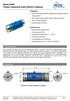 Properties Free of float metal bellow coupling with integrated torque measurement Non-contact measurement system, high robustness High torsional stiffness Limited torque of inertia Performance Measurement
MONDOATHENS BASKETBALL SET (Reference PK110)
 MONDOATHENS BASKETBALL SET (Reference PK110) DESCRIPTION The MONDOATHENS backstop unit is mainly designed for multi-sports pavilions and installations where the highest-level basketball competitions are
Sheet metal operations - Bending and related processes
 Sheet metal operations - Bending and related processes R. Chandramouli Associate Dean-Research SASTRA University, Thanjavur-613 401 Table of Contents 1.Quiz-Key... Error! Bookmark not defined. 1.Bending
LEVEL GAUGES WITH MAGNETIC JOINT L 14 - L 22 - L 34
 LEVEL GAUGES WITH MAGNETIC JOINT L 14 - L 22 - L 34 2 LEVEL GAUGES WITH MAGNETIC JOINT SIZE Ø 140/220/340 58 58 TYPE LA TYPE LA 14 30 S 22 33 TYPE LA 22-34 NO. HOLES Ø D2 76 O-RING CENTRE OF THE CONSERVATOR
Sheet Metal Shearing & Bending
 Training Objective After watching the program and reviewing this printed material, the viewer will gain a knowledge and understanding of the principles and machine methods of shearing and bending sheetmetal
OUTDOOR DISCONNECTORS A division of ACTOM (Pty) Ltd
 OUTDOOR DISCONNECTORS A division of ACTOM (Pty) Ltd ACTOM OUTDOOR DISCONNECTORS Single Side Break (SSB) Disconnector 22-132 kv, 800-1 A, 25 ka - 3s Typical bearing assembly. Voltage range 11 kv to 132
B.TECH. (AEROSPACE ENGINEERING) PROGRAMME (BTAE) Term-End Examination December, 2011 BAS-010 : MACHINE DESIGN
 No. of Printed Pages : 7 BAS-01.0 B.TECH. (AEROSPACE ENGINEERING) PROGRAMME (BTAE) CV CA CV C:) O Term-End Examination December, 2011 BAS-010 : MACHINE DESIGN Time : 3 hours Maximum Marks : 70 Note : (1)
Maxi-Stamper. 200 to 1,000 Tons STAMPING OUT DOWNTIME
 TM Maxi-Stamper 200 to 1,000 Tons STAMPING OUT DOWNTIME Standard Features Steel Fabricated Construction Drive Capacity Rated 1/2 Above Bottom of Stroke Self-Diagnostic Solid State Controller Moveable Operator
ITEM #0702770 OSTERBERG CELL LOAD TESTING OF DRILLED SHAFT
 ITEM #0702770 OSTERBERG CELL LOAD TESTING OF DRILLED SHAFT Description: This work shall consist of furnishing all materials, equipment and labor necessary for conducting an Osterberg Cell (O-Cell) Load
Welding of Plastics. Amit Mukund Joshi. (B.E Mechanical, A.M.I.Prod.E)
 Welding of Plastics Amit Mukund Joshi (B.E Mechanical, A.M.I.Prod.E) Introduction Mechanical fasteners, adhesives, and welding processes can all be employed to form joints between engineering plastics.
Build Your Own Solar Car Teach build learn renewable Energy! Page 1 of 1
 Solar Car Teach build learn renewable Energy! Page 1 of 1 Background Not only is the sun a source of heat and light, it s a source of electricity too! Solar cells, also called photovoltaic cells, are used
Technical Data. 7. Bearing Fits. 7.1 Interference. 7.2 Calculation of interference F B LLLLLLLLL( A-54
 Technical Data 7. Bearing Fits 7.1 Interference For rolling s the rings are fixed on the or in the housing so that slip or movement does not occur between the mated surface during operation or under. This
Interference. Physics 102 Workshop #3. General Instructions
 Interference Physics 102 Workshop #3 Name: Lab Partner(s): Instructor: Time of Workshop: General Instructions Workshop exercises are to be carried out in groups of three. One report per group is due by
3. Standards: Comply with ISO, BS, ASTM, JIS standard and so on.
 INFORMATION Computerized Electronic Universal Testing Machin 1. Functions and Features: is high level computer controlled electronic UTM, dual space structure, tensile test executed at upper side of crosshead,
OPERATING INSTRUCTIONS FOR
 OPERATING INSTRUCTIONS FOR MEDECO KEY MACHINES FOR MEDECO ORIGINAL, BIAXIAL, MEDECO 3, KEYMARK CLASSIC & KEYMARK X4 PRODUCTS MEDECO HIGH SECURITY LOCKS ASSUMES NO RESPONSIBILITY FOR INJURY OR PROPERTY
ELEVATOR TRAVELING CABLE - DESIGN EVOLUTION
 ELEVATOR TRAVELING CABLE - DESIGN EVOLUTION by Richard Laney Introduction Elevator traveling cable is a vital link between the elevator car and controller. In conventional elevators, all power and signal
Subminiature Load Cell Model 8417
 w Technical Product Information Subminiature Load Cell 1. Introduction... 2 2. Preparing for use... 2 2.1 Unpacking... 2 2.2 Using the instrument for the first time... 2 2.3 Grounding and potential connection...
Lapping and Polishing Basics
 Lapping and Polishing Basics Applications Laboratory Report 54 Lapping and Polishing 1.0: Introduction Lapping and polishing is a process by which material is precisely removed from a workpiece (or specimen)
Module 5 Couplings. Version 2 ME, IIT Kharagpur
 Module 5 Couplings Lesson 1 Introduction, types and uses Instructional Objectives At the end of this lesson, the students should have the knowledge of The function of couplings in machinery. Different
Mounting Instructions. Torque Transducer. A0329 3.2 en
 Mounting Instructions Torque Transducer T5 T5 Contents 3 Page Safety instructions.............................................. 4 1 Measuring characteristics..................................... 7 2 Mounting.....................................................
7.3 Fit selection. Inner ring: Rotating. Outer ring: Stationary. Inner ring: Stationary. Outer ring: Rotating. Inner ring: Stationary
 7. Bearing Fits 7. Fitting For rolling s, inner and outer rings are fixed on the or in the housing so that relative movement does not occur between fitting surfaces during operation or under. This relative
Introduction to JIGS AND FIXTURES
 Introduction to JIGS AND FIXTURES Introduction The successful running of any mass production depends upon the interchangeability to facilitate easy assembly and reduction of unit cost. Mass production
Use of Strain Gauge Rosette to Investigate Stress concentration in Isotropic and Orthotropic Plate with Circular Hole
 Use of Strain Gauge Rosette to Investigate Stress concentration in Isotropic and Orthotropic Plate with Circular Hole Mr.V.G.Aradhye 1, Prof.S.S.Kulkarni 2 1 PG Scholar, Mechanical department, SKN Sinhgad
THE STRAIN GAGE PRESSURE TRANSDUCER
 THE STRAIN GAGE PRESSURE TRANSDUCER Pressure transducers use a variety of sensing devices to provide an electrical output proportional to applied pressure. The sensing device employed in the transducers
Physics 41, Winter 1998 Lab 1 - The Current Balance. Theory
 Physics 41, Winter 1998 Lab 1 - The Current Balance Theory Consider a point at a perpendicular distance d from a long straight wire carrying a current I as shown in figure 1. If the wire is very long compared
PPS-PPQ-BT-PIAS RESIN INSULATORS FOR OIL INSULATED ELECTRICAL MACHINES
 PPS-PPQ-BT-PIAS RESIN INSULATORS FOR OIL INSULATED ELECTRICAL MACHINES BUSHING WITH PLUG CONNECTION WITH OUTER CONE PPS CHARACTERISTICS The PPS bushing can be used as a fixed section for the entry of medium
Configured Linear Motion Assemblies Reduce Engineering and Assembly Costs and Leadtime
 Configured Linear Motion Assemblies Reduce Engineering and Assembly Costs and Leadtime Kyle Thompson, Associate Product Line Manager Thomson Industries, Inc. www.thomsonlinear.com www.linearmotioneering.com
1000-LB. TRAILER JACK OWNER S MANUAL
 1000-LB. TRAILER JACK OWNER S MANUAL WARNING: Read carefully and understand all INSTRUCTIONS before operating. Failure to follow the safety rules and other basic safety precautions may result in serious
Design of Impact Load Testing Machine for COT
 Design of Impact Load Testing Machine for COT Sandesh G.Ughade 1, Dr. A.V.Vanalkar 2, Prof P.G.Mehar 2 1 Research Scholar (P.G), Dept of Mechanical Engg, KDK College of Engg, Nagpur, R.T.M, Nagpur university,
OWNER S/OPERATOR S - PARTS MANUAL CEMENT MIXER MODEL MX-80
 OWNER S/OPERATOR S - PARTS MANUAL CEMENT MIXER MODEL MX-80 Read the Operator s Manual entirely. When you see this symbol, be aware that the subsequent instructions and warnings are serious - follow without
MCE380: Measurements and Instrumentation Lab. Chapter 9: Force, Torque and Strain Measurements
 MCE380: Measurements and Instrumentation Lab Chapter 9: Force, Torque and Strain Measurements Topics: Elastic Elements for Force Measurement Dynamometers and Brakes Resistance Strain Gages Holman, Ch.
Candidate Number. General Certificate of Education Advanced Level Examination June 2012
 entre Number andidate Number Surname Other Names andidate Signature General ertificate of Education dvanced Level Examination June 212 Physics PHY4/1 Unit 4 Fields and Further Mechanics Section Monday
Loewe GK Installation and operating manual
 SCHMIDT-KUPPLUNG GmbH Loewe GK Installation and operating manual Loewe GK Loewe GK: angular and radial displacement compensation combined with axial stiffness. The compact coupling combines angular and
Guidelines for Earthquake Bracing Residential Water Heaters
 Guidelines for Earthquake Bracing Residential Water Heaters Department of General Services Division of the State Architect In accordance with the Health and Safety Code Section 19215, the Division of the
Installation Guide. WSD-100 Wind Speed and Direction Sensor For XR5 Data Loggers. February, 2011
 WSD-100 Wind Speed and Direction Sensor For XR5 Data Loggers Installation Guide February, 2011 Pace Scientific Inc www.pace-sci.com Tel: 704-799-0688 [email protected] 1 Disclaimer The following warranty
MECHANICS OF SOLIDS - BEAMS TUTORIAL 2 SHEAR FORCE AND BENDING MOMENTS IN BEAMS
 MECHANICS OF SOLIDS - BEAMS TUTORIAL 2 SHEAR FORCE AND BENDING MOMENTS IN BEAMS This is the second tutorial on bending of beams. You should judge your progress by completing the self assessment exercises.
Properties of Materials
 CHAPTER 1 Properties of Materials INTRODUCTION Materials are the driving force behind the technological revolutions and are the key ingredients for manufacturing. Materials are everywhere around us, and
Rotary actuators Rotary wing drives Series RAK. Brochure
 Brochure 2 Rotary wing drives, angle of rotation: 30-270 Rotary wing drive, double-acting axis geometry: single 4 Rotary wing drives, angle of rotation: 90-270 Rotary wing drive, double-acting axis geometry:
Trillium 40 Axis Spring Tensioner Wire Replacement Instructions
 Trillium 40 Axis Spring Tensioner Wire Replacement Instructions 1 Overview The objective is to replace the broken axis spring tensioner wire. This requires the following tasks: 1. Remove the seismometer
Load Frames. www.humboldtmfg.com 1.800.544.7220 708.468.6300
 Lab Equipment Soil Lab Consolidation Load Frames 80 52 ConMatic IPC, Automated Consolidation System, 120/220V 50/60Hz HM-2470A.3F The ConMatic IPC is a fully-automated, incremental pressure controller
Field Application Note
 Field Application Note Reverse Dial Indicator Alignment RDIA Mis-alignment can be the most usual cause for unacceptable operation and high vibration levels. New facilities or new equipment installations
COMBINATION SLAB & TRIM SAW INSTRUCTIONS 12, 14, & 16 MODELS
 COMBINATION SLAB & TRIM SAW INSTRUCTIONS 12, 14, & 16 MODELS DESCRIPTION Covington s Combination Trim & Slab Saws are similar in design with different blade and pulley sizes. Sawing operations remain the
9. TIME DEPENDENT BEHAVIOUR: CYCLIC FATIGUE
 9. TIME DEPENDENT BEHAVIOUR: CYCLIC FATIGUE A machine part or structure will, if improperly designed and subjected to a repeated reversal or removal of an applied load, fail at a stress much lower than
INSTRUCTION. Industrial Sewing Machines. No. 010012. First published : June 1997 Second edition : March 2001
 INSTRUCTION Industrial Sewing Machines First published : June 1997 Second edition : March 2001 No. 010012 INTRODUCTION Thank you for your purchasing Kansai Special's DLR Series. Read and study this instruction
Impact testing ACTIVITY BRIEF
 ACTIVITY BRIEF Impact testing The science at work Impact testing is of enormous importance. A collision between two objects can often result in damage to one or both of them. The damage might be a scratch,
EXTeRUS. EXTeRUS - With patented design, able to join technology. and quality of materials with a charming shape. Unique
 EXTeR US G L A S S - With patented design, able to join technology and quality of materials with a charming shape. Unique thanks to its outstanding loading capability with 150 kg maximum weight and height
Advantages of Auto-tuning for Servo-motors
 Advantages of for Servo-motors Executive summary The same way that 2 years ago computer science introduced plug and play, where devices would selfadjust to existing system hardware, industrial motion control
STRENGTH of MATERIALS. P.A.Hilton Ltd. Two Year Warranty UNIVERSAL MATERIAL TESTER HARDNESS TESTERS DEFLECTION/FATIGUE IMPACT TESTERS POLARISCOPE
 P.A.Hilton Ltd STRENGTH of MATERIALS P.A.Hilton Ltd is a market leader in the manufacture and provision of teaching equipment for Universities and Technical Colleges worldwide for both degree and vocational
RoHS. Shock / vibration resistant. Magnetic field proof. Many variants
 Sendix 5000 / 500 (Shaft / Hollow shaft) Push-Pull / RS4 ue to their sturdy bearing construction in Safety-ock esign, the Sendix 5000 and 500 offer high resistance against vibration and installation errors.
DryLin ZLW Belt Drive
 Belt Drive +50º 0º DryLin toothed belt drives have been developed for the fast positioning of small loads. The linear units with toothed belt drive are corrosion resistant, light and compact, besides having
Plastic Injection Molding
 Training Objective After watching this video and reviewing the printed material, the student/trainee will understand the principles and physical operations of the plastic injection molding process. An
UNIT II Robots Drive Systems and End Effectors Part-A Questions
 UNIT II Robots Drive Systems and End Effectors Part-A Questions 1. Define End effector. End effector is a device that is attached to the end of the wrist arm to perform specific task. 2. Give some examples
C O N V E Y O R C O M P O N E N T S C H A I N S B E L T S B E A R I N G S
 C O N V E Y O R C O M P O N E N T S C H A I N S B E L T S B E A R I N G S January 2009 Issue 6 Valu Guide Brackets The Ultimate in Adjustability and Cost Savings Valu Guide brackets are part of a family
Equipment Manual. for. Operation of Automatic Polishing Plate Control on the PM5 Precision Lapping & Polishing Machine.
 Equipment Manual for Operation of Automatic Polishing Plate Control on the PM5 Precision Lapping & Polishing Machine Ref: BE-01-53-5 PREFACE: PM5 auto-lap/pol MACHINES The PM5 auto-lap/pol features two
High Strain Dynamic Load Testing of Drilled Shafts
 Supplemental Technical Specification for High Strain Dynamic Load Testing of Drilled Shafts SCDOT Designation: SC-M-712 (9/15) September 3, 2015 1.0 GENERAL This work shall consist of performing high-strain
Recall R136 Front Lower Ball Joints Check Torque or Replace
 SERVICE DATE /00 Amended /00 TECHNICAL BULLETIN Recall R6 Front Lower Ball Joints Check Torque or Replace MODEL VIN Remove and destroy Bulletin S04-R6, dated /00. Replace with this Bulletin. Revisions
P4 Stress and Strain Dr. A.B. Zavatsky MT07 Lecture 3 Statically Indeterminate Structures
 4 Stress and Strain Dr... Zavatsky MT07 ecture 3 Statically Indeterminate Structures Statically determinate structures. Statically indeterminate structures (equations of equilibrium, compatibility, and
Single-Phase AC Synchronous Generator
 ST Series Single-Phase AC Synchronous Generator Instructions for Operation and Maintenance English to English translation by R.G. Keen, May 2004. ST Series of Single-Phase AC Synchronous Generators Description