
National 5 Health Sector: Skills for Work Course Specification
|
|
|
- Dennis Bryant
- 9 years ago
- Views:
Transcription

1 National 5 Health Sector: Skills for Work Course Specification Valid from August 2013 This edition: August 2013, version 2.0 This specification may be reproduced in whole or in part for educational purposes provided that no profit is derived from reproduction and that, if reproduced in part, the source is acknowledged. Additional copies of this Course Specification can be downloaded from SQA s website: Please refer to the note of changes at the end of this Course Specification for details of changes from previous version (where applicable). Scottish Qualifications Authority 2013
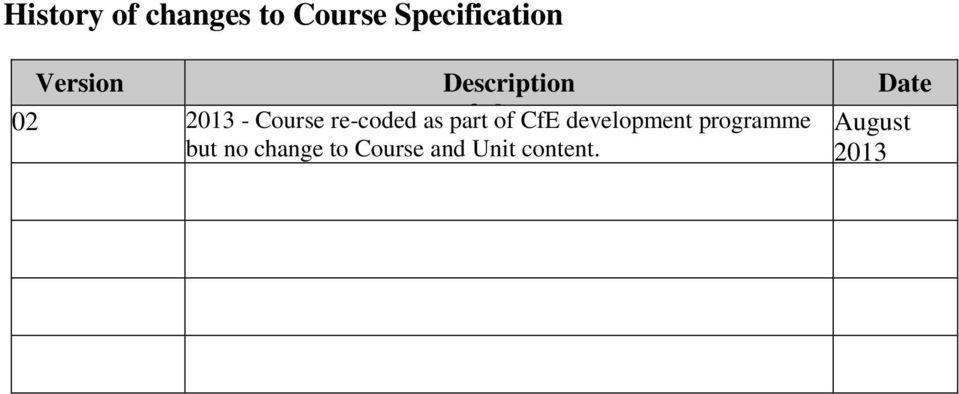
2 History of changes to Course Specification Version Description Course re-coded as part of change of CfE development programme but no change to Course and Unit content. Date August 2013
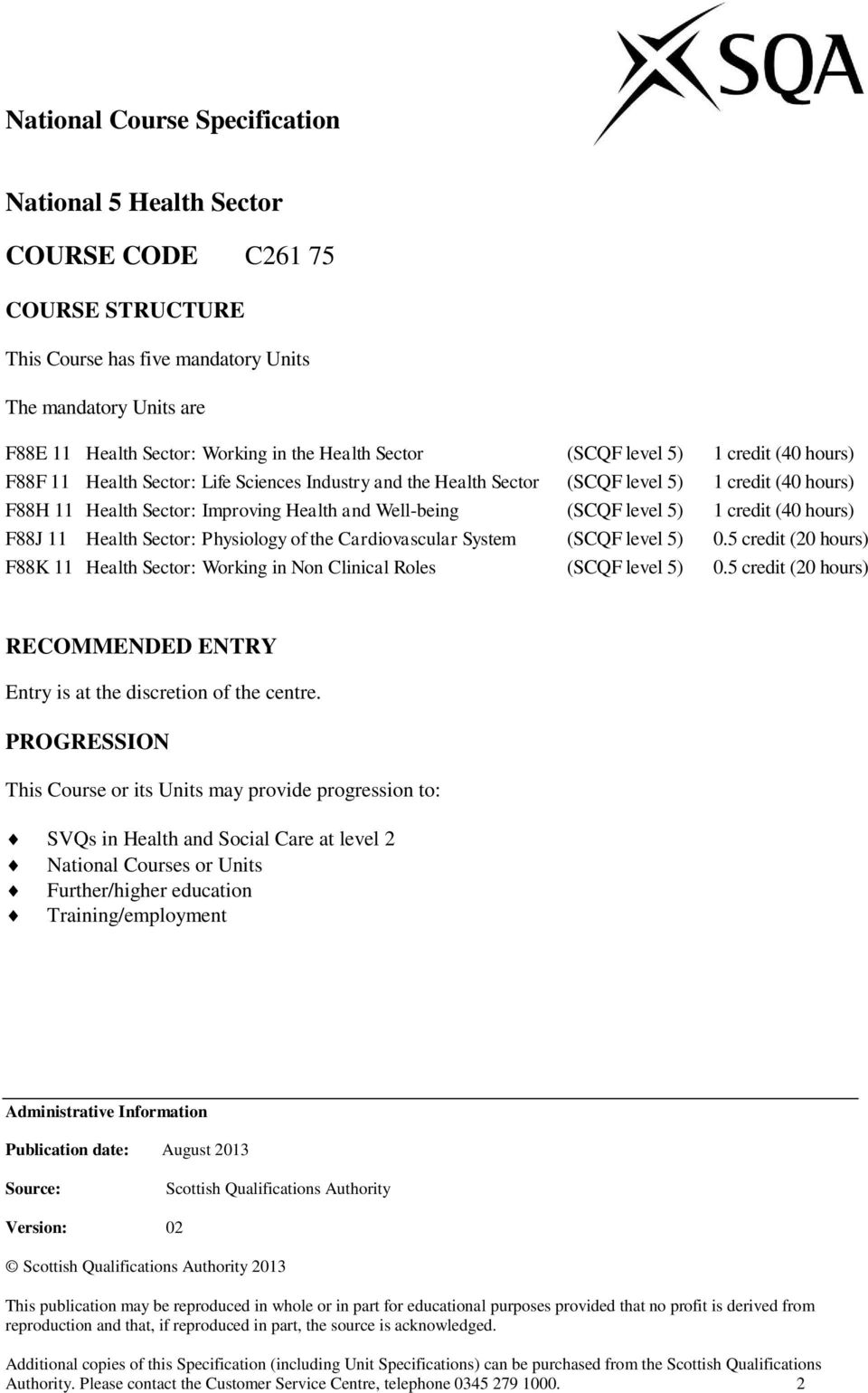
3 National Course Specification National 5 Health Sector COURSE CODE C COURSE STRUCTURE This Course has five mandatory Units The mandatory Units are F88E 11 Health Sector: Working in the Health Sector (SCQF level 5) 1 credit (40 hours) F88F 11 Health Sector: Life Sciences Industry and the Health Sector (SCQF level 5) 1 credit (40 hours) F88H 11 Health Sector: Improving Health and Well-being (SCQF level 5) 1 credit (40 hours) F88J 11 Health Sector: Physiology of the Cardiovascular System (SCQF level 5) 0.5 credit (20 hours) F88K 11 Health Sector: Working in Non Clinical Roles (SCQF level 5) 0.5 credit (20 hours) RECOMMENDED ENTRY Entry is at the discretion of the centre. PROGRESSION This Course or its Units may provide progression to: SVQs in Health and Social Care at level 2 National Courses or Units Further/higher education Training/employment Administrative Information Publication date: August 2013 Source: Scottish Qualifications Authority Version: 02 Scottish Qualifications Authority 2013 This publication may be reproduced in whole or in part for educational purposes provided that no profit is derived from reproduction and that, if reproduced in part, the source is acknowledged. Additional copies of this Specification (including Unit Specifications) can be purchased from the Scottish Qualifications Authority. Please contact the Customer Service Centre, telephone
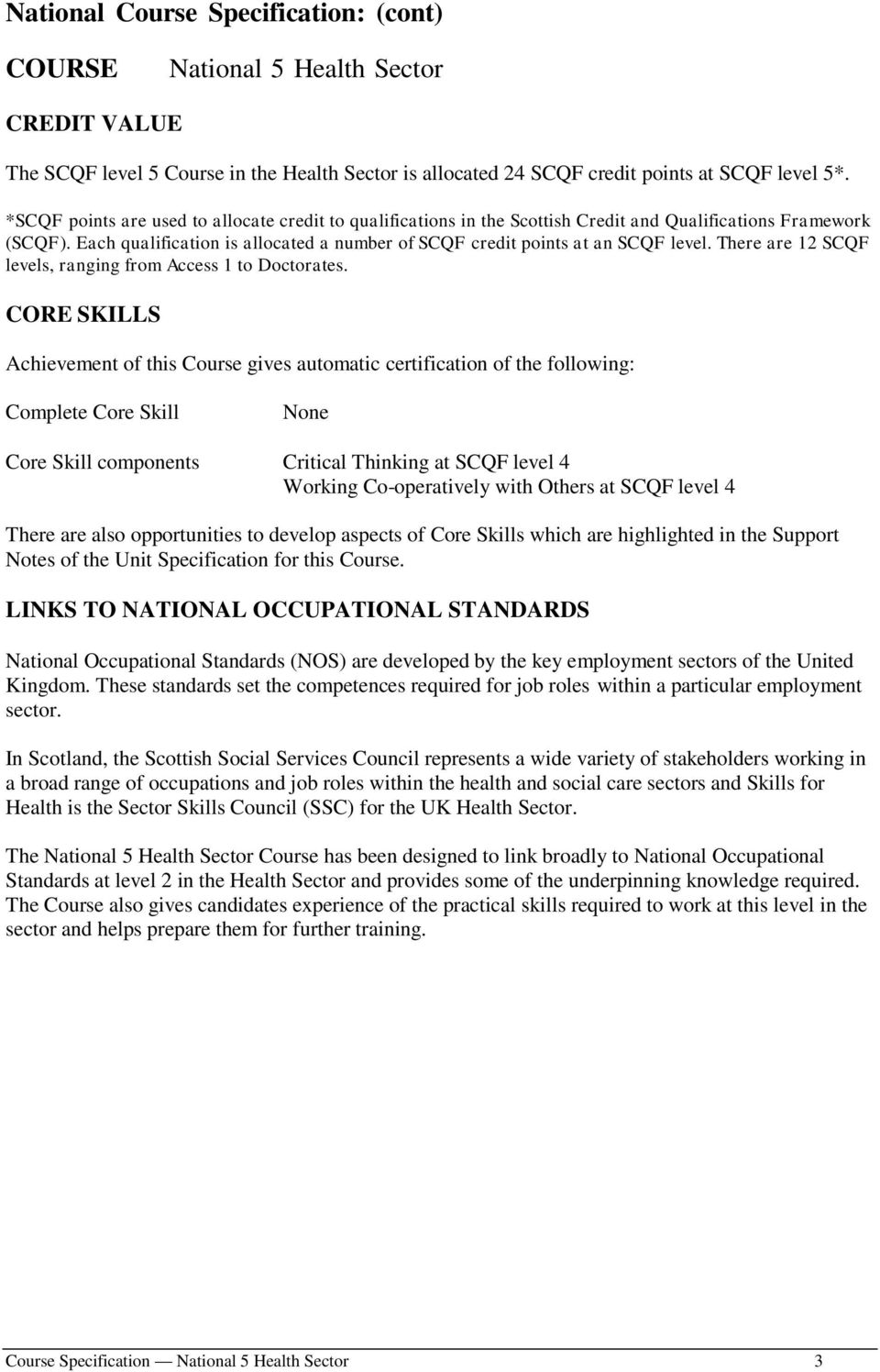
4 National Course Specification: (cont) COURSE National 5 Health Sector CREDIT VALUE The SCQF level 5 Course in the Health Sector is allocated 24 SCQF credit points at SCQF level 5*. *SCQF points are used to allocate credit to qualifications in the Scottish Credit and Qualifications Framework (SCQF). Each qualification is allocated a number of SCQF credit points at an SCQF level. There are 12 SCQF levels, ranging from Access 1 to Doctorates. CORE SKILLS Achievement of this Course gives automatic certification of the following: Complete Core Skill None Core Skill components Critical Thinking at SCQF level 4 Working Co-operatively with Others at SCQF level 4 There are also opportunities to develop aspects of Core Skills which are highlighted in the Support Notes of the Unit Specification for this Course. LINKS TO NATIONAL OCCUPATIONAL STANDARDS National Occupational Standards (NOS) are developed by the key employment sectors of the United Kingdom. These standards set the competences required for job roles within a particular employment sector. In Scotland, the Scottish Social Services Council represents a wide variety of stakeholders working in a broad range of occupations and job roles within the health and social care sectors and Skills for Health is the Sector Skills Council (SSC) for the UK Health Sector. The National 5 Health Sector Course has been designed to link broadly to National Occupational Standards at level 2 in the Health Sector and provides some of the underpinning knowledge required. The Course also gives candidates experience of the practical skills required to work at this level in the sector and helps prepare them for further training. Course Specification National 5 Health Sector 3
5 National Course Specification: Course details (cont) COURSE National 5 Health Sector RATIONALE FOR SKILLS FOR WORK COURSES Skills for Work Courses are designed to help candidates to develop: skills and knowledge in a broad vocational area Core Skills an understanding of the workplace positive attitudes to learning skills and attitudes for employability A key feature of these Courses is the emphasis on experiential learning. This means learning through practical experience and learning by reflecting on experience. Learning through practical experience Teaching/learning programmes should include some or all of the following: learning in real or simulated workplace settings learning through role play activities in vocational contexts carrying out case study work planning and carrying out practical tasks and assignments Learning through reflecting at all stages of the experience Teaching/learning programmes should include some or all of the following: preparing and planning for the experience taking stock throughout the experience reviewing and adapting as necessary reflecting after the activity has been completed evaluating and identifying learning points Course Specification National 5 Health Sector 4

6 National Course Specification: Course details (cont) COURSE National 5 Health Sector The Skills for Work Courses are also designed to provide candidates with opportunities for developing Core Skills and enhancing skills and attitudes for employability. Core Skills The five Core Skills are: Communication Numeracy Information and Communication Technology Problem Solving Working with Others Employability The skills and attitudes for employability, including self-employment, are outlined below: generic skills/attitudes valued by employers understanding of the workplace and the employee s responsibilities, for example timekeeping, appearance, customer care self-evaluation skills positive attitude to learning flexible approaches to solving problems adaptability and positive attitude to change confidence to set goals, reflect and learn from experience specific vocational skills/knowledge Course Specifications highlight the links to National Occupational Standards in the vocational area and identify progression opportunities Opportunities for developing these skills and attitudes are highlighted in each of the Course and Unit Specifications. These opportunities include giving young people direct access to workplace experiences or, through partnership arrangements, providing different learning environments and experiences which simulate aspects of the workplace. These experiences might include visits, visiting speakers, role play and other practical activities. A Curriculum for Excellence (Scottish Executive 2004) identifies aspirations for every young person. These are that they should become: successful learners confident individuals responsible citizens effective contributors The learning environments, the focus on experiential learning and the opportunities to develop employability and Core Skills in these Courses contribute to meeting these aspirations. Course Specification National 5 Health Sector 5

7 National Course Specification: Course details (cont) COURSE National 5 Health Sector RATIONALE FOR SCQF LEVEL 5 HEALTH SECTOR COURSE The Health Sector includes the National Health Service (NHS) (primary and secondary care), Independent Healthcare, Complementary Therapies, the Life Sciences and Retail Pharmaceutical Industries and the Community and Voluntary Sector. The Health Sector is seen as a growth industry across Scotland offering a wide range of employment opportunities at a variety of levels. The National Health Service (NHS) is a major employer in Scotland and currently employs over 160,000 people. The demands placed upon the NHS are increasing, through changes in demographics combined with an ageing workforce. Scotland has one of the largest life sciences industries in Europe, with a worldwide reputation particularly in research and development and manufacturing. The growing life sciences industry currently employs over 30,000 people in a wide variety of job roles. The National 5 Health Sector Course has been designed to provide candidates with opportunities to develop generic employability skills in the context of the Health Sector. This Course could provide progression opportunities for candidates by building on the skills and knowledge developed in the National 4 Health Sector Course. The National 5 Course will introduce candidates to a range of more advanced knowledge and skills. The Course may assist progression into further and higher education and training/employment. The general aims of the Course are to: assist candidates to develop employability skills allow candidates to experience vocationally related learning encourage candidates to develop a good work ethic provide opportunities to develop a range of Core Skills through practical experiences in a vocational environment encourage candidates to take responsibility for their own learning and development facilitate progression to further/higher education, training and/or employment In particular, the specific aims of the Course are to: encourage candidates to consider a career in the Health Sector develop candidate's understanding of health and safety responsibilities relevant to a range of activities in the Health Sector develop candidate's abilities to benefit from further learning opportunities, study and training opportunities for careers in the Health Sector develop candidate s awareness of the opportunities there may be within the Health Sector in terms of the type and range of career opportunities develop candidate's awareness of the impact of the Health Sector in society develop candidate's awareness of the responsibilities of the Health Sector in society allow candidates to apply investigative skills using a variety of research methods develop candidate's self-evaluation skills and confidence to seek feedback from others increase candidate's awareness of the factors that impact on the health of individuals allow candidates to develop the skills values and attitudes required for employment in the Health Sector Course Specification National 5 Health Sector 6

8 National Course Specification: Course details (cont) COURSE National 5 Health Sector COURSE CONTENT Summary of Course content The Units of the Course have been designed to be delivered in an integrated way and guidance on a suggested teaching pattern is given in this Course Specification. The specific employability skills assessed in this Course are: positive attitude to learning and the workplace self respect and respect and consideration for others willingness to listen to others and respond constructively to feedback awareness of equality and diversity understanding of roles and responsibilities in the workplace contribute to team work awareness and understanding of the importance of maintaining confidentiality reflecting on own abilities awareness and understanding of health and safety understand and seek clarification of instructions implementation of infection control procedures demonstrate an awareness of organisational standards for appearance and behaviour understanding of organisational principles and values in the Health Sector Summary of Unit content Health Sector: Working in the Health Sector (1 credit) This Unit introduces candidates to the range of provision and the services provided by the Health Sector in their local area. Candidates will participate in an interview for a specific job role which will help to develop knowledge and understanding of the world of work. The Unit also focuses on the employability skills and attitudes identified as being those most valued by employers in the Health Sector. Candidates will be given the opportunity to reflect on and evaluate their own employability skills and record their progress throughout the Unit. Health Sector: Life Sciences Industry and the Health Sector(1 credit) This Unit is designed to introduce candidates to the contribution of the life sciences industry in the diagnosis and treatment of illness. Candidates will investigate the safety of pharmaceutical products made by the life sciences industry and the health and safety responsibilities of employers and employees in the life sciences industry. Candidates will also undertake a risk assessment in relation to production, storage or use of products made by the life sciences industry. Health Sector: Improving Health and Well-being (SCQF level 5) (1 credit) This Unit is designed to introduce candidates to the wide range of options available in the Health Sector that help tackle current health and lifestyle issues. It introduces candidates to the health and safety risks to workers in the Health Sector and the importance of a healthy lifestyle. Also, through team working, candidates will give advice in relation to the promotion of health. Course Specification National 5 Health Sector 7

9 National Course Specification: Course details (cont) COURSE National 5 Health Sector Health Sector: Physiology of the Cardiovascular System (SCQF level 5) (0.5 credit) This Unit will provide candidates with an introduction to the structure and function of the cardiovascular system. Candidates will apply this knowledge to investigate the effect of a specific disorder on the structure and function of the cardiovascular system. Candidates will participate in a practical activity which will help to develop knowledge and skills in taking physiological measurements at different activity levels. Candidates will also participate in a practical activity to demonstrate current first aid procedures to provide emergency life support. Health Sector: Working in Non Clinical Roles (SCQF level 5) (0.5 credit) This Unit introduces candidates to the range and diversity of careers in non clinical roles in the Health Sector. Candidates will undertake an investigation into the roles and responsibilities of non clinical roles and the diversity of career opportunities available. Candidates will also participate in a practical activity which will enable them to demonstrate customer care skills in a non clinical role. Course Specification National 5 Health Sector 8

10 National Course Specification: Course details (cont) COURSE National 5 Health Sector ASSESSMENT To achieve the Course award the candidate must successfully achieve all the Units which make up the Course. Assessment objectives Assessment across the Units of this Course will allow candidates to demonstrate, in the context of the Health Sector: generic employability skills valued by employers in the Health Sector knowledge and skills in relation to working in the Health Sector practical vocational skills skills in communication and working with others investigation skills presentation skills evaluation skills Unit assessment Health Sector: Working in the Health Sector (1 credit) Written and/or recorded oral and performance evidence is required for this Unit. Assessment will be in the form of: an investigation into the range of local provision and services in the Health Sector performance evidence generated by preparation for, and participation in, a job interview in a real or simulated Health Sector environment candidate reviews, completed on three occasions, detailing progress in relation to the development of specific employability skills valued by the Health Sector Health Sector: Life Sciences Industry and the Health Sector (1 credit) Written and/or recorded oral and performance evidence is required for this Unit. Assessment will be in the form of: an investigation into a patient journey and the contribution of the products made by life sciences industry at each stage of the journey written and/or oral recorded evidence which demonstrates an understanding of the safety of pharmaceutical products made by the life sciences industry written and/or oral recorded evidence which demonstrates an understanding of health and safety responsibilities of employers and employees in the life sciences industry a completed risk assessment Course Specification National 5 Health Sector 9

11 National Course Specification: Course details (cont) COURSE National 5 Health Sector Health Sector: Improving Health and Well-being (SCQF level 5) (1 credit) Written and/or recorded oral and performance evidence is required for this Unit. Assessment will be in the form of: an investigation into a health and lifestyle issue and the range of options available from the Health Sector to address the issue written and/or recorded oral evidence which demonstrates an understanding of the risks of working in the Health Sector and the importance of a healthy lifestyle for Health Sector workers participation in a group activity to give health promotion advice Health Sector: Physiology of the Cardiovascular System (SCQF level 5) (0.5 credit) Written and/or recorded oral and performance evidence is required for this Unit. Assessment will be in the form of: written and/or recorded oral evidence which demonstrates knowledge and understanding of the structure and functions of the cardiovascular system and a disorder which affects the cardiovascular system participation in a practical activity by taking a physiological measurement at different activity levels participation in a practical activity to demonstrate skills in providing emergency life support in a Health Sector environment Health Sector: Working in Non Clinical Roles (SCQF level 5) (0.5 credit) Written and/or recorded oral and performance evidence is required for this Unit. Assessment will be in the form of: an investigation into non clinical job roles in the Health Sector performance evidence generated by participation in a role play carried out under supervision in a real or simulated Health Sector environment Further details about Unit assessment for this Course can be found in the Unit Specifications and the National Assessment Bank (NAB) materials. Course Specification National 5 Health Sector 10
12 National Course Specification: Course details (cont) COURSE National 5 Health Sector QUALITY ASSURANCE The Units of all National Courses are subject to internal verification and may also be chosen for external verification by SQA. This is to ensure that national standards are being applied across all subjects. To assist centres, Senior Verifier reports are published on SQA s website GUIDANCE ON LEARNING/TEACHING AND ASSESSMENT APPROACHES FOR THIS COURSE The primary target group for this Course is school candidates in S3 and above. The SCQF level 5 Course provides a progression route for candidates who have successfully completed the Skills for Work: Health Sector SCQF level 4 Course. The SCQF level 5 Course will build on the skills and knowledge developed in the SCQF level 4 Course and will introduce candidates to a range of more advanced skills. The table below shows the progression from the Units of the SCQF level 4 Course. Skills for Work: Health Sector (SCQF level 4) Skills for Work: National 5 Health Sector Health Sector: An Introduction Health Sector: Life Sciences Industry Health Sector: Working Safely Health Sector: Roles and Responsibilities Health Sector: Health Awareness Health Sector: Health Awareness Health Sector: Working in the Health Sector Health Sector: Life Sciences Industry and the Health Sector Health Sector: Working in Non Clinical Roles Health Sector: Improving Health and Well-Being Health Sector: Physiology of the Cardiovascular System The National 5 Course has also been designed to allow suitable candidates to enter directly at this level. The Course may also be suitable for adult returners in a further education environment who are seeking to enhance their employability and vocational skills in the Health Sector. In this Course it is important that candidates have access to real or simulated Health Sector environments and visiting industry speakers or visits to people working in the Health Sector. It is anticipated that the Course will rely upon and build on partnerships between schools, further education colleges, higher education institutions, employers and other training organisations. These partnerships will enable the Course to be delivered in a variety of appropriate learning environments with access to relevant teaching expertise. Course Specification National 5 Health Sector 11

13 National Course Specification: Course details (cont) COURSE National 5 Health Sector Suggested order/sequence of delivery Centres should ensure that an induction to the Course is given, which will enable candidates to understand fully what is required of them and the approaches to assessment to be adopted. It is important that the concept of employability skills, both generic and specific to the Health Sector is stressed at this time. While the sequence of delivery of the Units is for individual centres to decide, a suggested approach would be to begin the Unit Health Sector: Working in the Health Sector. This Unit has three Outcomes and it is suggested that Outcome 1 would be delivered early in the Course. This will provide candidates with an introduction to the sector and skills in investigation and presentation of information which will be further developed throughout the Course. Outcome 3 of this Unit should be integrated with the other four Units of the Health Sector SCQF level 5 Course in order that these skills are built upon during the delivery of the remaining Units and so that candidates can gather evidence over the duration of the Course. Opportunities to integrate learning, teaching and assessment of the employability skills in Outcome 3 of the Unit Health Sector: Working in the Health Sector with other Units in the Course can be found in the activities undertaken when: Contributing to a group presentation and taking part in a practical activity in Health Sector: Improving Health and Well-being (SCQF level 5), Contributing to an investigation and taking part in a practical activity in Health Sector: Life Sciences Industry and the Health Sector. Contributing to an investigation and participating in a role play in Health Sector: Working in Non Clinical Roles(SCQF level 5), Taking part in practical activities in Health Sector: Physiology of the Cardiovascular System (SCQF level 5) Further opportunities for integration across Units can be undertaken when: Investigating job roles and participation in a job interview in Health Sector: Working in the Health Sector and investigating job roles in Health Sector: Working in Non Clinical Roles. Investigating a specific disorder of the cardiovascular system in Health Sector: Physiology of the Cardiovascular System and investigating a patient journey in Health Sector: Life Sciences Industry and the Health Sector. Learning and Teaching The types of provision within the Health Sector include the National Health Service (NHS) (primary and secondary care), Independent Healthcare, Complementary Therapies, the Life Sciences and Retail Pharmaceutical Industries and the Community and Voluntary Sector. The main approaches to learning in this Course should be experiential, practical and candidate centred. Candidates should have the opportunity to learn and develop practical skills in the context of real or simulated settings where they will experience workplace conditions, learn how to work with others in a team and develop good working practices. There are opportunities in this Course for teachers/lecturers to be creative in their teaching and learning approaches. Investigations, role plays, debates, presentations, discussions and simulation exercises could be employed to give candidates a stimulating and interesting learning experience. Course Specification National 5 Health Sector 12

14 National Course Specification: Course details (cont) COURSE National 5 Health Sector Teachers/lecturers should act as role models in the demonstration of care values including the promotion of equality and diversity. Sensitivity and non-judgemental attitudes should be displayed and encouraged in candidates. Candidates should develop culturally sensitive language. Materials used by lecturers and candidates to present information should promote positive images of disability and avoid cultural stereotypes. Centres should ensure that an induction to each Unit within the Course is given, which will enable candidates to fully understand what is required of them and the assessment approaches to be adopted. A variety of approaches will be used for gathering evidence, reflecting the variety of learning experiences offered throughout the Course which includes: individual investigations practical activities: carrying out a risk assessment, participating in a role play, carrying out physiological measurements, demonstrating emergency life support, participating as part of a team to give health promotion advice candidate performance in an interview candidate reviews of specific employability skills written and/or recorded oral evidence produced by candidates throughout all the Units The National Assessment Bank (NAB) provided for each Unit within the National 5 Health Sector Course illustrates the standard that should be applied. If a centre wishes to design its own assessments, they should be of a comparable standard. Visiting speakers/visits to health settings Centres are encouraged to establish links with organisations in the Health Sector that may be willing to offer support in the form of visits to the workplace or presentations from members of staff. This will give candidates a realistic view of work in the Health Sector and will help them to make decisions about future employment and study. Health and Safety Candidates will be exploring the responsibilities of workers in the Health Sector in relation to health and safety. They will also be participating in practical activities to demonstrate emergency life support. Teachers/lecturers must be appropriately trained in emergency life support. A risk assessment should be carried out by a teacher/lecturer prior to any practical activity taking place. Candidates should be informed that workers in the Health Sector are not allowed to move or handle people or equipment without having successfully completed a relevant moving and handling course. DISABLED CANDIDATES AND/OR THOSE WITH ADDITIONAL SUPPORT NEEDS The additional support needs of individual candidates should be taken into account when planning learning experiences, selecting assessment instruments, or considering whether any reasonable adjustments may be required. Further advice can be found on our website Course Specification National 5 Health Sector 13
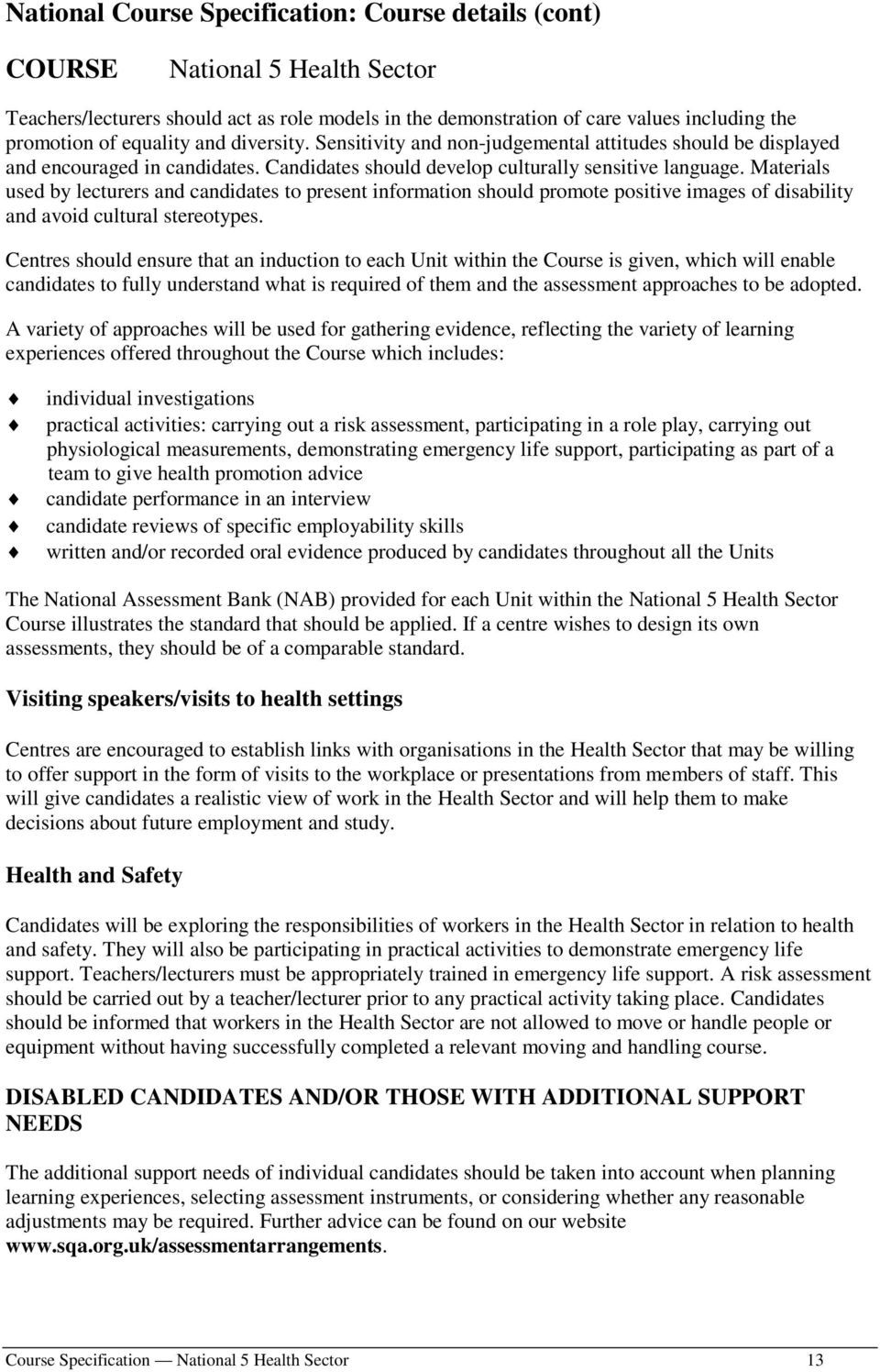
15 National Course Specification: Course details COURSE: National 5 Health Sector Appendix: Employability Skills Profile In addition to the specific, vocational skills developed and assessed in this Course, employability skills are addressed as detailed in the table below. For the purposes of the table, the Units are referred to as A, B, C, D and E as indicated. Health Sector: Working in the Health Sector = A ealth Sector: Life Sciences Industry and the Health Sector = B Health Sector: Improving Health and Well-being (SCQF level 5) = C = Health Sector: Physiology of the Cardiovascular System (SCQF level 5) = D Health Sector: Working in Non Clinical Roles (SCQF level 5) = E C Employability skill/attitude Positive attitude to learning and the workplace Self respect and respect and consideration for others Willingness to listen to others and respond constructively to feedback Awareness of equality and diversity Understanding of roles and responsibilities in the workplace Contribute to team work Understanding of the importance of maintaining confidentiality Reflecting on own abilities Understanding of health and safety Understand and seek clarification of instructions Implementation of infection control procedures Demonstrate an awareness of organisational standards for appearance and behaviour Understanding of organisational principles and values in the Health Sector Evidence A B C D E A B C D E A D E A E A B C D E A C A E A C D E A B C D A B C D A D A B C D E A B E Assessment evidence in all Units: A = B = C = D = E = An investigation which demonstrates knowledge and understanding of types of provision in the Health Sector and performance evidence generated by participation in practical activities. Candidate reviews completed on three occasions detailing progress in relation to the development of specific employability skills valued by the Health Sector. An investigation which provides knowledge and understanding of the contribution of the life sciences industry to a specified patient journey and a completed risk assessment. An investigation into a health and lifestyle issue and performance evidence generated by participation in a group activity. Performance evidence generated by participation in practical activities An investigation which demonstrates knowledge and understanding of roles, responsibilities and career pathways in non clinical job roles and performance evidence generated by participation in role play Course Specification National 5 Health Sector 14
16 National Unit Specification: general information Health Sector: Working in the Health Sector CODE F88E 11 SUMMARY This Unit has been designed as a mandatory Unit of the National 5 Health Sector Course and has been designed to be taken as part of that Course. It can also be taken as a freestanding Unit. It is suitable for candidates who have no previous experience of the Health Sector. The Unit introduces candidates to the range of provision and the services provided by the Health Sector in their local area. Candidates will participate in an interview for a specific job role which will help to develop knowledge and understanding of the world of work. The Unit also focuses on the employability skills and attitudes identified as being those most valued by employers in the Health Sector. Candidates will be given the opportunity to reflect on and evaluate their own employability skills and record their progress throughout the Unit. The Health Sector includes the National Health Service (NHS) (primary and secondary care), Independent Healthcare, Complementary Therapies, the Life Sciences and Retail Pharmaceutical Industries and the Community and Voluntary Sector. OUTCOMES 1 Investigate a range of local provision and services within the Health Sector. 2 Prepare for and participate in an interview for a specific job role in the Health Sector. 3 Review and evaluate own employability skills in specified practical activities. RECOMMENDED ENTRY Entry is at the discretion of the centre. Administrative Information Superclass: PA Publication date: August 2013 Source: Scottish Qualifications Authority Version: 02 Scottish Qualifications Authority 2013 This publication may be reproduced in whole or in part for educational purposes provided that no profit is derived from reproduction and that, if reproduced in part, the source is acknowledged. Additional copies of this Unit Specification can be purchased from the Scottish Qualifications Authority. Please contact the Customer Service Centre, telephone

17 National Unit Specification: general information (cont) Health Sector: Working in the Health Sector CREDIT VALUE 1 credit at SCQF level 5 (6 SCQF credit points at SCQF level 5*). *SCQF credit points are used to allocate credit to qualifications in the Scottish Credit and Qualifications Framework (SCQF). Each qualification in the Framework is allocated a number of SCQF credit points at an SCQF level. There are 12 SCQF levels, ranging from Access 1 to Doctorates. CORE SKILLS Opportunities to develop aspects of Core Skills are highlighted in the Support Notes of this Unit Specification. There is no automatic certification of Core Skills or Core Skill components in his Unit. Unit Specification Health Sector: Working in the Health Sector (SCQF level 5) 16

18 National Unit Specification: statement of standards Health Sector: Working in the Health Sector Acceptable performance in this Unit will be the satisfactory achievement of the standards set out in this part of the Unit Specification. All sections of the statement of standards are mandatory and cannot be altered without reference to SQA. OUTCOME 1 Investigate a range of local provision and services within the Health Sector. Performance Criteria (a) (b) (c) (d) (e) Identify and describe a range of local provision within the Health Sector. Identify and describe a range of services offered by each identified provision. Identify and describe the job roles of staff working in each identified provision. Identify the skills and attitudes relevant to one of these job roles. Organise and present findings in an appropriate format. OUTCOME 2 Prepare for and participate in an interview for a specific job role in the Health Sector. Performance Criteria (a) (b) (c) (d) (e) Identify the skills and attitudes required for a specific job role in the Health Sector. List relevant questions to ask at the interview. Arrive on time and appropriately dressed for the interview. Answer the questions asked by the interviewer using appropriate communication skills. Ask relevant questions during the interview using appropriate communication skills. OUTCOME 3 Review and evaluate own employability skills in specified practical activities. Performance Criteria (a) (b) (c) (d) Identify own strengths and weaknesses in specified employability skills. Seek advice and take account of feedback from others on specified employability skills. Identify areas for improvement in specified employability skills and set relevant goals. Evaluate progress in achieving these goals over a set period of time. Unit Specification Health Sector: Working in the Health Sector (SCQF level 5) 17
19 National Unit Specification: statement of standards (cont) Health Sector: Working in the Health Sector EVIDENCE REQUIREMENTS FOR THIS Written and/or recorded oral evidence and performance evidence which covers all Outcomes and Performance Criteria is required for this Unit. Outcome 1 Written and/or oral evidence Evidence for Outcome 1 will be gathered in open-book conditions at appropriate points throughout the Unit. Evidence will be gathered in a candidate folio. Progress will be discussed with the teacher/lecturer at an appropriate point during the investigation to ensure that the folio is the candidates own work. A record of the discussion must be retained. Candidates will investigate a range of local provision and services in the Health Sector. Candidates will be given a brief for the investigation. Candidates are required to: identify and describe three types of provision available in the local area identify and describe two services offered by each identified local provision identify and describe two job roles from each identified local provision identify the skills and attitudes relevant to one of these job roles Candidates must organise and present findings in an appropriate format. A template for the investigation will be provided. The provision will be selected from the range below: National Health Service Primary Care National Health Service Secondary Care independent healthcare complementary therapies life sciences industry retail pharmaceutical industry community and voluntary sector The services will be selected from the range below: research and development scientific and technical screening diagnosis care and treatment prevention of ill health and health promotion maintenance of health management, administrative and support services Unit Specification Health Sector: Working in the Health Sector (SCQF level 5) 18

20 National Unit Specification: statement of standards (cont) Health Sector: Working in the Health Sector The job roles will be selected from the range below: medical and dental pharmacists nursing and midwifery allied health professions ancillary, support and estates staff facilities, management, administrative and clerical scientific and technical community and voluntary Outcome 2 Written and/or oral evidence and performance evidence Candidates will produce written and/or oral evidence for an interview and are required to: identify the skills and attitudes required for one job role in the Health Sector list two relevant questions to ask at the interview The candidate will be interviewed by one other person who may be the assessor or a representative from the Health Sector. The interview may be simulated/role play. Assessor observation checklists must be used to support the performance evidence. The observation checklist must show that the candidate: arrived on time and dressed appropriately answered questions using appropriate communication skills asked relevant questions using appropriate communication skills The assessor observation checklist must be retained to provide evidence of performance in one interview. Outcome 3 Candidate reviews Evidence Requirements for Outcome 3 must take the form of three completed candidate review records which will give the candidate the opportunity to record their progress in developing employability skills. Candidates will be provided with a review template. Each review will include the following: 1 A record of the candidate s analysis of own strengths and weaknesses in relation to the following employability skills: positive attitude to learning and the workplace self respect and respect and consideration for others willingness to listen to others and respond constructively to feedback awareness of equality and diversity understanding of roles and responsibilities in the workplace Unit Specification Health Sector: Working in the Health Sector (SCQF level 5) 19

21 National Unit Specification: statement of standards (cont) Health Sector: Working in the Health Sector contribute to team work understanding of the importance of maintaining confidentiality reflecting on own abilities understanding of health and safety understand and seek clarification of instructions implementation of infection control procedures demonstrate an awareness of organisational standards for appearance and behaviour understanding of organisational principles and values in the Health Sector 2 A record of feedback gathered from others in relation to employability skills. Candidates must seek advice and take account of feedback from the teacher/lecturer on two occasions and another person on one occasion. The other person could be, for example, other candidates, a health worker or placement supervisor who has observed the candidate. 3 A record of the candidate's identified areas for improvement and goals set in relation to employability skills. 4 An evaluation of the candidate's progress towards achievement of these goals over a set period of time. The first review should take place at an early stage of the Unit, the second should be completed at an appropriate point during delivery of the Unit and the third should be carried out towards the end of the Unit. Candidates must take responsibility for completing each review based on their experiences and learning to date. The National Assessment Bank (NAB) pack provided for this Unit illustrates the standard that should be applied. It contains an investigation pro forma, candidate brief, candidate review and an assessor observation checklist. If a centre wishes to design its own assessments for this Unit, they should be of a comparable standard. Unit Specification Health Sector: Working in the Health Sector (SCQF level 5) 20
22 National Unit Specification: support notes Health Sector: Working in the Health Sector This part of the Unit Specification is offered as guidance. The support notes are not mandatory. While the exact time allocated to this Unit is at the discretion of the centre, the notional design length is 40 hours. GUIDANCE ON THE CONTENT AND CONTEXT FOR THIS This Unit has been designed as a mandatory Unit of the National 5 Health Sector Course and has been designed to be taken as part of that Course. It can also be taken as a freestanding Unit. It is suitable for candidates who have no previous experience of the Health Sector. The Unit introduces candidates to the range of provision and the services provided by the Health Sector in their local area. Candidates will participate in an interview for a specific job role which will help to develop knowledge and understanding of the world of work. The Unit also focuses on the employability skills and attitudes identified as being those most valued by employers in the Health Sector. Candidates will be given the opportunity to reflect on and evaluate their own employability skills and record their progress throughout the Unit. The Health Sector includes the National Health Service (NHS) (primary and secondary care), Independent Healthcare, Complementary Therapies, the Life Sciences and Retail Pharmaceutical Industries and the Community and Voluntary Sector. Outcome 1 This Outcome is intended to introduce candidates to the range of types of provision and services available in their local area. The investigation will be recorded in a candidate folio and include all Performance Criteria specified. It is important that candidates learn to organise and present their findings as these skills can be transferred to other contexts. The folio could be produced in a variety of formats, eg a presentation, display, poster or leaflet. Candidates should be encouraged to identify ways in which their folio or presentation of information reflects and promotes equality and diversity. This could include the use of signs, symbols, pictures etc. The types of provision, range of services and job roles is provided within the Evidence Requirements. Outcome 2 This Outcome is intended to provide candidates with opportunities to prepare for an interview for a specific job role in the Health Sector. Candidates could visit Health Sector settings or visiting speakers could come from the Health Sector. This will provide candidates with opportunities to ask questions of people who are involved in interviewing prospective employees and will also provide information that will help to prepare for the interview. Unit Specification Health Sector: Working in the Health Sector (SCQF level 5) 21
23 National Unit Specification: support notes (cont) Health Sector: Working in the Health Sector Candidates should identify and research one job role in order to find out the skills and attitudes that would be expected for that job role. Candidates should be encouraged to research job roles from career and employer recruitment websites. When preparing for their interview candidates should look at current job and person specifications. Candidates should be made aware of the requirements of attending an interview including the importance of arriving on time and being appropriately dressed. Each candidate should prepare questions that they could ask of the interviewer. The importance of verbal and non-verbal communication should be explained. Once the candidate has completed their preparations, the simulated role play should be undertaken. Each candidate should be interviewed individually. Opportunities will arise for the teacher/lecturer to observe and provide constructive feedback to candidates on how they conduct themselves and perform in relation to the interview. Candidates should demonstrate a willingness to listen to and respond constructively to the feedback given. Candidates should develop an awareness of appropriate language and attitudes in relation to equality and diversity. This includes body language and non-verbal communication. Outcome 3 This Outcome is intended to give candidates the opportunity to review and evaluate their performance in specified employability skills. They will be expected to take responsibility for improving their performance by identifying areas for improvement through self-evaluation and taking feedback from others. This should include setting goals and evaluation of achieving these goals over a set period of time. These skills and attitudes will help to improve candidate s employability as they are transferable to other vocational areas. When delivering this Unit as part of the SCQF level 5 Health Sector Course opportunities will occur throughout the Course to identify, develop and practise the relevant skills which are the basis of the reviews. Employability Skills Candidates will be required to review and evaluate the following employability skills: positive attitude to learning and the workplace self respect and respect and consideration for others willingness to listen to others and respond constructively to feedback awareness of equality and diversity understanding of roles and responsibilities in the workplace contribute to team work understanding of the importance of maintaining confidentiality reflecting on own abilities understanding of health and safety understand and seek clarification of instructions implementation of infection control procedures Unit Specification Health Sector: Working in the Health Sector (SCQF level 5) 22
24 National Unit Specification: support notes (cont) Health Sector: Working in the Health Sector demonstrate an awareness of organisational standards for appearance and behaviour understanding of organisational principles and values in the Health Sector These skills can be practised, reviewed and evaluated in real or simulated workplace environments, role play and individual or group classroom activities. Candidates must be given opportunities to exhibit the employability skills in practical contexts. When this Unit is being taken as part of the SCQF level 5 Health Sector Course, opportunities will arise to practise, review and evaluate employability skills in the following Units: Health Sector: Improving Health and Well-being, Health Sector: Physiology of the Cardiovascular System, Health Sector: Working in Non Clinical Roles and Health Sector: Life Sciences Industry and the Health Sector. GUIDANCE ON LEARNING AND TEACHING APPROACHES FOR THIS Outcome 1 Candidates must identify a range of provision and services available in their local area. This will be in the form of an investigation. The investigation will require candidates to gather information from a variety of sources which could include: visiting speakers internet research library health boards GP surgery local clinics interviews with workers in the Health Sector workplace visits It may be beneficial for candidates to work in groups and share information although the final investigation must be the candidate s own work. Candidates should discuss and agree with the teacher/lecturer a suitable format for presenting the information. Initial discussions can be carried out in groups and whole class expositions. There is the opportunity for candidates to practise and develop skills of verbal and non-verbal communication, planning and respect and consideration for others. The language and materials used throughout should promote equality and diversity and avoid cultural stereotypes. Outcome 2 This Outcome provides the opportunity for candidates to prepare for an interview for a specific job role in the Health Sector. This could be a current job as advertised in newspapers or recruitment websites. Candidates should research the questions that would be appropriate to ask the interviewer(s). Teachers/lecturers could help candidates to develop their communication skills for the interview through demonstration and selecting appropriate activities to give candidates as much practise as possible before their assessment takes place. Unit Specification Health Sector: Working in the Health Sector (SCQF level 5) 23
25 National Unit Specification: support notes (cont) Health Sector: Working in the Health Sector It would also be good practice to enlist the help of representatives from the Health Sector who have experience of conducting interviews for new recruits. The interview should be as realistic as possible, giving the candidate relevant information such as time and place of interview. The interview should last approximately 5 to 10 minutes. It should be conducted as if there was a position in the Health Sector as this would allow feedback to be of more relevance to the candidate. There are opportunities for integration of assessment in Outcome 1 and 2. Outcome 3 Candidates should be encouraged to use the SMART model when setting personal goals Specific, Measurable, Attainable, Realistic, Time-bound. Opportunities to practise employability skills should occur naturally throughout the Course. Delivery of this Unit could incorporate a variety of teaching and learning methods including: teacher/lecturer presentations group work and discussions handouts visiting speakers workplace visits practical activities individual and group research internet searches reflection OPPORTIES FOR CORE SKILL DEVELOPMENT In this Unit, candidates will be involved in an investigation and self-evaluation and review of employability skills. There may be opportunities in the role play of an interview for a job role to develop effective communication and interpersonal skills. Candidates will have opportunities to develop communication skills in seeking and responding to feedback from others in the review and evaluation of their employability skills. Candidates have to take responsibility for their own performance in the investigation and in the review and evaluation of their employability skills. This may allow them to develop the three components activities of Problem Solving Critical Thinking, Planning and Organising and Reviewing and Evaluating. If the candidate uses a computer while undertaking any part of this Unit, they will have the opportunity to develop Information and Communication Technology skills. Unit Specification Health Sector: Working in the Health Sector (SCQF level 5) 24
26 National Unit Specification: support notes (cont) Health Sector: Working in the Health Sector GUIDANCE ON APPROACHES TO ASSESSMENT FOR THIS When this Unit is being delivered as part of the SCQF level 5 Health Sector Course, it would be appropriate for Outcome 2 Performance Criterion (d) to be integrated with Outcome 1. Outcome 3 can be assessed throughout the Course so that candidates have the opportunity to practise and develop the relevant employability skills. The candidate reviews should be carried out at appropriate points during the Course so that candidates can practise the relevant skills and set personal goals. Outcome 1 The folio should be discussed by the candidate and the teacher/lecturer at an appropriate point to authenticate that it is the candidate s own work. A record of this discussion must be retained. Outcome 2 Written and/or oral evidence will be produced for Performance Criteria (a) and (b). Performance evidence for Performance Criteria (c), (d) and (e) will be based on an interview, which must be recorded using an assessor observation checklist. Candidates should be given the opportunity to practise the interview before being assessed. Outcome 3 Feedback from others will be from the teacher/lecturer on two occasions and another person on one occasion. The other person could be a candidate, health worker or placement supervisor, who has observed the candidate. The National Assessment Bank (NAB) pack provided for this Unit illustrates the standard that should be applied. It contains an investigation pro forma, candidate brief, candidate review and an assessor observation checklist. If a centre wishes to design its own assessments for this Unit, they should be of a comparable standard. Opportunities for the use of e-assessment E-assessment may be appropriate for some assessments in this Unit. By e-assessment we mean assessment which is supported by Information and Communication Technology (ICT), such as e-testing or the use of e-portfolios or e-checklists. Centres which wish to use e-assessment must ensure that the national standard is applied to all candidate evidence and that conditions of assessment as specified in the Evidence Requirements are met, regardless of the mode of gathering evidence. Further advice is available in SQA Guidelines on Online Assessment for Further Education (AA1641, March 2003), SQA Guidelines on e-assessment for Schools (BD2625, June 2005). Unit Specification Health Sector: Working in the Health Sector (SCQF level 5) 25
27 National Unit Specification: support notes (cont) Health Sector: Working in the Health Sector DISABLED CANDIDATES AND/OR THOSE WITH ADDITIONAL SUPPORT NEEDS The additional support needs of individual candidates should be taken into account when planning learning experiences, selecting assessment instruments, or considering whether any reasonable adjustments may be required. Further advice can be found on our website Unit Specification Health Sector: Working in the Health Sector (SCQF level 5) 26
28 National Unit Specification: general information Health Sector: Life Sciences Industry and the Health Sector (SCQF level 5) CODE F88F 11 SUMMARY This Unit has been designed as a mandatory Unit of the National 5 Health Sector Course, but can also be taken as a freestanding Unit. It is suitable for candidates who have no previous experience of the Health Sector. This Unit is designed to introduce candidates to the contribution of the life sciences industry in the diagnosis and treatment of illness. Candidates will investigate the safety of pharmaceutical products made by the life sciences industry and the health and safety responsibilities of employers and employees in the life sciences industry. Candidates will also undertake a risk assessment in relation to production, storage or use of products made by the life sciences industry. The Health Sector includes the National Health Service (NHS) (primary and secondary care), Independent Healthcare, Complementary Therapies, the Life Sciences and Retail Pharmaceutical Industries and the Community and Voluntary Sector. OUTCOMES 1 Investigate the contribution of the life sciences industry to a specified patient journey. 2 Investigate the safety of pharmaceutical products made by the life sciences industry. 3 Explain health and safety responsibilities in the life sciences industry. 4 Carry out a risk assessment to a given brief. RECOMMENDED ENTRY Entry is at the discretion of the centre. Administrative Information Superclass: RH Publication date: August 2013 Source: Scottish Qualifications Authority Version: 02 Scottish Qualifications Authority 2013 This publication may be reproduced in whole or in part for educational purposes provided that no profit is derived from reproduction and that, if reproduced in part, the source is acknowledged. Additional copies of this Unit Specification can be purchased from the Scottish Qualifications Authority. Please contact the Customer Service Centre, telephone
29 National Unit Specification: general information (cont) Health Sector: Life Sciences Industry and the Health Sector (SCQF level 5) CREDIT VALUE 1 credit at SCQF level 5 (6 SCQF credit points at SCQF level 5*). *SCQF credit points are used to allocate credit to qualifications in the Scottish Credit and Qualifications Framework (SCQF). Each qualification in the Framework is allocated a number of SCQF credit points at an SCQF level. There are 12 SCQF levels, ranging from Access 1 to Doctorates. CORE SKILLS Achievement of this Unit gives automatic certification of the following: Complete Core Skill None Core Skill component Critical Thinking at SCQF level 4 There are also opportunities to develop aspects of Core Skills which are highlighted in the Support Notes of this Unit Specification. Unit Specification Health Sector: Life Sciences Industry and the Health Sector (SCQF level 5) 28
30 National Unit Specification: statement of standards Health Sector: Life Sciences Industry and the Health Sector (SCQF level 5) Acceptable performance in this Unit will be the satisfactory achievement of the standards set out in this part of the Unit Specification. All sections of the statement of standards are mandatory and cannot be altered without reference to SQA. OUTCOME 1 Investigate the contribution of the life sciences industry to a specified patient journey. Performance Criteria (a) (b) Identify the main stages of a specified patient journey. Explain the contribution of a product made by the life sciences industry at each appropriate stage of a specified patient journey. OUTCOME 2 Investigate the safety of pharmaceutical products made by the life sciences industry. Performance Criteria (a) (b) (c) Identify the essential features of pharmaceutical products. Describe the phases of testing a new pharmaceutical product. Describe the responsibilities of consumers when using pharmaceutical products. OUTCOME 3 Explain health and safety responsibilities in the life sciences industry. (a) (b) Explain the health and safety responsibilities of employees in the life sciences industry. Explain the health and safety responsibilities of employers in the life sciences industry. OUTCOME 4 Carry out a risk assessment to a given brief. (a) (b) (c) Identify the main hazards present. Explain the associated risks. Identify a control measure for each risk. Unit Specification Health Sector: Life Sciences Industry and the Health Sector (SCQF level 5) 29
31 National Unit Specification: statement of standards (cont) Health Sector: Life Sciences Industry and the Health Sector (SCQF level 5) EVIDENCE REQUIREMENTS FOR THIS Written and /or recorded oral evidence and performance evidence which covers all Outcomes and Performance Criteria is required for this Unit. Outcome 1 Written and/or oral evidence Evidence for Outcome 1 will be gathered in open-book conditions at appropriate points throughout the Unit. Candidates will investigate a patient journey for a specified medical condition and the contribution of a product made by life sciences industry at each stage of the journey. The patient journey to be investigated will be negotiated and agreed with the teacher/lecturer. Evidence will be gathered in a candidate folio. Candidates will be given a brief for the investigation. Candidates are required to: identify four stages of one patient journey explain the contribution of one product made by the life sciences industry at each appropriate stage of the specified patient journey The stages of the patient journey will be selected from the range below: prevention screening investigation diagnosis treatment follow up maintenance of health Outcome 2 Written and/or oral evidence Evidence for Outcome 2 will be gathered at appropriate points throughout the Unit. Evidence will be gathered under supervision in open-book conditions with the candidates having access to notes. Candidates are required to: identify four essential features of pharmaceutical products describe three phases of testing of a new pharmaceutical product describe three responsibilities of consumers when using pharmaceutical products Examples of essentials features of pharmaceutical products made by the life sciences industry and the responsibilities of consumers when using pharmaceutical products are given in the Support Notes. Unit Specification Health Sector: Life Sciences Industry and the Health Sector (SCQF level 5) 30
32 National Unit Specification: statement of standards (cont) Health Sector: Life Sciences Industry and the Health Sector (SCQF level 5) Outcome 3 Written and/or oral evidence Evidence for Outcome 3 will be gathered at an appropriate point in the Unit. Evidence will be gathered under supervision in open-book conditions with candidates having access to notes. Candidates are required to: explain two health and safety responsibilities of employees in the life sciences industry explain four health and safety responsibilities of employers in the life sciences industry Outcome 4 Written and/or oral evidence Evidence for Outcome 4 will be gathered under supervision in open-book conditions at appropriate points in the Unit. Candidates will be provided with a brief specifying the context within which the risk assessment will be carried out. The context must be in relation to production, storage or use of products made by the life sciences industry. Candidates are required to: identify three hazards explain one risk associated with each hazard identify one control measure for each risk The evidence for Outcome 4 must be presented in the form of a completed risk assessment. The risk assessment will be carried out in a real or simulated setting under supervision at an appropriate point in the Unit. Guidance on appropriate settings is provided in the support notes. Candidates must organise and present findings in an appropriate format. A template for the risk assessment will be provided. The National Assessment Bank (NAB) pack provided for this Unit illustrates the standard that should be applied. It contains an investigation pro forma, candidate brief, series of structured questions and a risk assessment template. If a centre wishes to design its own assessments for this Unit, they should be of a comparable standard. Unit Specification Health Sector: Life Sciences Industry and the Health Sector (SCQF level 5) 31
33 National Unit Specification: support notes Health Sector: Life Sciences Industry and the Health Sector (SCQF level 5) This part of the Unit Specification is offered as guidance. The support notes are not mandatory. While the exact time allocated to this Unit is at the discretion of the centre, the notional design length is 40 hours. GUIDANCE ON THE CONTENT AND CONTEXT FOR THIS This Unit has been designed as a mandatory Unit of the SCQF level 5 Health Sector Course, but can also be taken as a freestanding Unit. It is suitable for candidates who have no previous experience of the Health Sector. This Unit is designed to introduce candidates to the contribution of the life sciences industry in the diagnosis and treatment of illness. Candidates will investigate the safety of pharmaceutical products made by the life sciences industry and the health and safety responsibilities of employers and employees in the life sciences industry. Candidates will also undertake a risk assessment in relation to production, storage and use of products made by the life sciences industry. The Health Sector includes the National Health Service (NHS) (primary and secondary care), Independent Healthcare, Complementary Therapies, the Life Sciences and Retail Pharmaceutical Industries and the Community and Voluntary Sector. The Unit will involve candidate research which will encourage the development of time management, information retrieval and research skills. Outcome 1 A patient journey describes the route taken by a patient from screening or initial symptoms through a variety of tests to confirm the presence of a specific disease or condition to treatment, discharge and follow up and monitoring of the condition. Candidates will investigate a typical patient journey for a specified medical condition and outline the contribution of the life sciences industry to that journey. The stages of the patient journey are specified within the Evidence Requirements. Examples of patient journeys are provided in the Guidance on Learning and Teaching Approaches section of this Unit Specification. The folio could be produced in a variety of formats, eg a presentation, display, poster or leaflet. The language and materials used throughout should promote equality and diversity and avoid cultural stereotypes. Candidates should be encouraged to identify ways in which their folio or presentation of information reflects and promotes equality and diversity. This could include the use of signs, symbols, pictures etc. Unit Specification Health Sector: Life Sciences Industry and the Health Sector (SCQF level 5) 32
34 National Unit Specification: support notes (cont) Health Sector: Life Sciences Industry and the Health Sector (SCQF level 5) Outcome 2 Drug discovery is the discovery, development and approval of new chemical compounds or biological products that can be used to treat human disease. The life sciences industry develops and produces pharmaceutical products including drugs. The essential features of pharmaceutical products include the requirements that they should be: safe to use for patients and staff effective reliable acceptable to use for patients and staff cost effective have minimal side effects be comfortable to use have no adverse effects ethically produced and tested Drug trials refer to the process by which medicines are developed. Before a drug is tested on humans, it would have been through laboratory and/or animal testing. Medicines are also tested for toxicity before being given to people. There are then three stages of drug testing on humans and any such trials have to be approved by the ethics committee. Phase one this stage tests for safety. A small number of people, sometimes healthy, and sometimes with a medical condition, are given a tiny dose of the drug under careful supervision, not to test if the drug works, but in order to check for any side effects. Phase two the drug is given to people who have the condition to see if it does indeed help them. Phase three large scale studies usually involving tens or thousands of people. Participants are often randomly allocated to either get the drug or a dummy version. In most cases neither the scientists nor the patients know who has got the real drug so that the results cannot be skewed by expectations. Candidates should be encouraged to discuss and debate issues around the development of new drugs and vaccines to treat and prevent illness and disease. They should research current stories in the news and media about trials of new drugs and vaccines and issues around animal testing. Consumers of pharmaceutical products are responsible for ensuring that pharmaceutical products are used and stored correctly. Unit Specification Health Sector: Life Sciences Industry and the Health Sector (SCQF level 5) 33
35 National Unit Specification: support notes (cont) Health Sector: Life Sciences Industry and the Health Sector (SCQF level 5) The responsibilities of consumers when using pharmaceutical products include: take medicines only as prescribed by a doctor or pharmacist keep all medicines in their original containers store medicines and biomedical devices according to instructions use biomedical devices as instructed discard of used medicines as instructed do not take medication or use biomedical devices prescribed for another person keep out of the reach of children report any adverse effects to a doctor do not take medication during pregnancy unless approved by a doctor ensure biomedical devices are stored, cleaned and maintained according to instructions Outcome 3 The health and safety of employees in the life sciences industry is ensured by risk assessment Teachers/lecturers should ensure that candidates are informed that the Health and Safety at Work Act is the main piece of legislation covering health and safety in the workplace. Both employers and employees have responsibilities in relation to health and safety. The responsibilities of employees in relation to health and safety include: to co-operate with the employer, attend relevant training and follow the company's health and safety policies to take care of own health and safety and the safety of others to report any injuries to tell your employer if anything happens that might affect your ability to do the job The responsibilities of employers in relation to health and safety include: to make the workplace safe to prevent risks to health to ensure machinery is safe to use and safe working practices are set up and followed ensure materials are handled, stored and used safely to tell employees about any potential hazards from the work they do, chemicals and other substances used by the firm, and give information, instructions, training and supervision as needed to provide protective clothing or equipment free of charge if risks can't be removed or adequately controlled by any other means to ensure that the right warning signs are provided Unit Specification Health Sector: Life Sciences Industry and the Health Sector (SCQF level 5) 34
36 National Unit Specification: support notes (cont) Health Sector: Life Sciences Industry and the Health Sector (SCQF level 5) Outcome 4 Candidates should be made aware of the difference between a hazard and a risk. A definition is provided below: a hazard is something with the potential to cause harm a risk is the likelihood of harm from that hazard Candidates should learn about risk assessments and how these are carried out using current health and safety guidelines. The five steps in a risk assessment are: identify the hazards decide who might be harmed and how evaluate the risks and decide on precautions record your findings and implement them review your assessment and update if necessary Candidates will learn how to carry out a risk assessment in relation to production, storage or use of products made by the life sciences industry for use in the Health Sector. The risk assessment could be in relation to: the storage of biomedical devices in a practical room or Health Sector environment a visit by the class to a life sciences facility a medicine cabinet and contents the use of products made by the life sciences industry in the Health Sector Candidates will be given a brief specifying the risk assessment to be carried out. The risk assessment will be carried out in a real or simulated environment. Employability Skills In this Unit candidates will generate evidence for the following employability skills: positive attitude to learning and the workplace self respect and respect and consideration for others understanding of roles and responsibilities in the workplace understanding of health and safety understand and seek clarification of instructions demonstrate an awareness of organisational standards for appearance and behaviour understanding of organisational principles and values in the Health Sector Unit Specification Health Sector: Life Sciences Industry and the Health Sector (SCQF level 5) 35
37 National Unit Specification: support notes (cont) Health Sector: Life Sciences Industry and the Health Sector (SCQF level 5) Although not directly assessed in this Unit, there may be opportunities to develop the following employability skills: awareness of equality and diversity reflecting on own abilities contribute to team work implementation of infection control procedures These skills can be practised in real or simulated workplace environments and individual or group classroom activities. GUIDANCE ON LEARNING AND TEACHING APPROACHES FOR THIS Outcome 1 Candidates must identify the stages of the patient journey they are investigating. Evidence could be presented in the form of a diagram illustrating the involvement of the life sciences industry throughout the patient journey. The following are examples of the beginning of patient journeys: a woman being called for a routine mammogram as part of the breast cancer screening programme a woman who thinks she may be pregnant a young man in an accident resulting in a broken leg a man being told he may have diabetes a man complaining of toothache an elderly person needing a hip replacement an elderly person being investigated for Alzheimer s Disease a young person having a test for HIV The needs of patients and their health problems differ as they move through their journey from diagnosis through care and treatment to recovery. Visiting speakers and workplace visits can provide valuable insight into the contribution of the life sciences industry to the treatment of patients. Candidates should be encouraged to work in groups and share information. Outcome 2 Visiting speakers and workplace visits can provide valuable insights into the ways that the life sciences industry ensures the safety of its products. Candidates should be encouraged to discuss topical issues in relation to the testing of new drugs such as vaccines for the H1N1 virus, Human Papilloma virus or new cancer treatments. Outcome 3 Teachers/lecturers should ensure that candidates understand that the health and safety responsibilities of employers and employees in the life science industry are the same as in any other industry. Unit Specification Health Sector: Life Sciences Industry and the Health Sector (SCQF level 5) 36
38 National Unit Specification: support notes (cont) Health Sector: Life Sciences Industry and the Health Sector (SCQF level 5) Outcome 4 As part of learning and teaching a range of scenarios could be devised demonstrating the hazards and risks associated with the manufacture, storage and use of products made by the life sciences industry for use in the Health Sector. The scenarios could be presented to candidates in the form of written descriptions, multimedia presentations, illustrations, computer simulations, real work environments and classroom mock ups. It is essential that candidates experience health and safety as an interactive process and delivery should be based on practical scenarios wherever possible. Delivery of this Unit could incorporate a variety of teaching and learning methods including: teacher/lecturer presentations and demonstrations group work and discussions handouts visiting speakers workplace visits practical activities individual and group research Internet searches DVD presentations interviews with health professionals/patients/relatives/workers OPPORTIES FOR CORE SKILL DEVELOPMENT In this Unit candidates will be involved in an investigation. There may be opportunities for candidates to work with others which would enable them to develop effective communication and interpersonal skills. If the candidate uses a computer while undertaking any part of this Unit, they will have the opportunity to develop Information and Communication Technology skills. GUIDANCE ON APPROACHES TO ASSESSMENT FOR THIS Outcome 1 The evidence will be gathered in a candidate folio which will include information on a patient journey. The information will include: identification of four stages of the identified patient journey explanation of the contribution of one product made by the life sciences industry at each appropriate stage of the specified patient journey The evidence will be gathered in open-book conditions at appropriate points throughout the Unit. Unit Specification Health Sector: Life Sciences Industry and the Health Sector (SCQF level 5) 37
39 National Unit Specification: support notes (cont) Health Sector: Life Sciences Industry and the Health Sector (SCQF level 5) Outcome 2 The evidence will be produced in supervised open-book conditions. The evidence will be produced by the candidate on their own at an appropriate point during the Unit. Evidence could be gathered in response to a series of structured questions, within the time limit of one hour. Outcome 3 The evidence will be produced in supervised open-book conditions. The evidence will be produced by the candidate on their own at an appropriate point during the Unit. Evidence could be gathered in response to a series of structured questions, within the time limit of one hour. Outcome 4 Candidates will be supplied with a brief. The brief will specify the setting within which the risk assessment will be carried out. Candidates are required to: identify three hazards explain one risk associated with each hazard identify one control measure for each risk The risk assessment will be carried out in a real or simulated setting under supervision at an appropriate point in the Unit. Candidates should be supplied with an appropriate template to record the risk assessment. The National Assessment Bank (NAB) pack provided for this Unit illustrates the standard that should be applied. It contains an investigation pro forma, candidate brief, series of structured questions and a risk assessment template. If a centre wishes to design its own assessments for this Unit, they should be of a comparable standard. Opportunities for the use of e-assessment E-assessment may be appropriate for some assessments in this Unit. By e-assessment we mean assessment which is supported by Information and Communication Technology (ICT), such as e-testing or the use of e-portfolios or e-checklists. Centres which wish to use e-assessment must ensure that the national standard is applied to all candidate evidence and that conditions of assessment as specified in the Evidence Requirements are met, regardless of the mode of gathering evidence. Further advice is available in SQA Guidelines on Online Assessment for Further Education (AA1641, March 2003), SQA Guidelines on e-assessment for Schools (BD2625, June 2005). Unit Specification Health Sector: Life Sciences Industry and the Health Sector (SCQF level 5) 38
40 National Unit Specification: support notes (cont) Health Sector: Life Sciences Industry and the Health Sector (SCQF level 5) DISABLED CANDIDATES AND/OR THOSE WITH ADDITIONAL SUPPORT NEEDS The additional support needs of individual candidates should be taken into account when planning learning experiences, selecting assessment instruments, or considering whether any reasonable adjustments may be required. Further advice can be found on our website Unit Specification Health Sector: Life Sciences Industry and the Health Sector (SCQF level 5) 39
41 National Unit Specification: general information Health Sector: Improving Health and Well-being (SCQF level 5) CODE F88H 11 SUMMARY This Unit has been designed as a mandatory Unit of the National 5 Health Sector Course, but can also be taken as a freestanding Unit. It is suitable for candidates who have no previous experience of the Health Sector. The Unit is designed to introduce candidates to the wide range of options available in the Health Sector that help tackle current health and lifestyle issues. It introduces candidates to the health and safety risks to workers in the Health Sector and the importance of a healthy lifestyle. Also, through team working, candidates will give advice in relation to the promotion of health. The Health Sector includes the National Health Service (NHS) (primary and secondary care), Independent Healthcare, Complementary Therapies, the Life Sciences and Retail Pharmaceutical Industries and the Community and Voluntary Sector. OUTCOMES 1 Investigate a current health and lifestyle issue and the range of options available from the Health Sector to help address the issue. 2 Describe the risks of working in the Health Sector and explain the importance of a healthy lifestyle for Health Sector workers. 3 Participate as part of a team to give health promotion advice on a current health and lifestyle issue. RECOMMENDED ENTRY Entry is at the discretion of the centre. Administrative Information Superclass: PA Publication date: August 2013 Source: Scottish Qualifications Authority Version: 02 Scottish Qualifications Authority 2013 This publication may be reproduced in whole or in part for educational purposes provided that no profit is derived from reproduction and that, if reproduced in part, the source is acknowledged. Additional copies of this Unit Specification can be purchased from the Scottish Qualifications Authority. Please contact the Customer Service Centre, telephone
42 National Unit Specification: general information Health Sector: Improving Health and Well-being (SCQF level 5) CREDIT VALUE 1 credit at SCQF level 5 (6 SCQF credit points at SCQF level 5*). *SCQF credit points are used to allocate credit to qualifications in the Scottish Credit and Qualifications Framework (SCQF). Each qualification in the Framework is allocated a number of SCQF credit points at an SCQF level. There are 12 SCQF levels, ranging from Access 1 to Doctorates. CORE SKILLS Achievement of this Unit gives automatic certification of the following: Component Core Skill None Core Skill component Working co-operatively with others at SCQF level 4 There are also opportunities to develop aspects of Core Skills which are highlighted in the Support Notes of this Unit Specification. Unit Specification Health Sector: Improving Health and Well-being (SCQF level 5) 41
43 National Unit Specification: statement of standards Health Sector: Improving Health and Well-being (SCQF level 5) Acceptable performance in this Unit will be the satisfactory achievement of the standards set out in this part of the Unit Specification. All sections of the statement of standards are mandatory and cannot be altered without reference to SQA. OUTCOME 1 Investigate a current health and lifestyle issue and the range of options available from the Health Sector to help address the issue. Performance Criteria (a) (b) (c) Identify a current health and lifestyle issue and describe the effects on health. Identify and describe a range of options available from the Health Sector provision to address the health and lifestyle issue. Explain the advantages and disadvantages of each option. OUTCOME 2 Describe the risks of working in the Health Sector and explain the importance of a healthy lifestyle for Health Sector workers. Performance Criteria (a) (b) (c) Describe the main health and safety risks for Health Sector workers. Explain the benefits of a healthy lifestyle for Health Sector workers. Explain why psychological wellbeing is important for Health Sector workers. OUTCOME 3 Participate as part of a team to give health promotion advice on a current health and lifestyle issue. Performance Criteria (a) (b) (c) (d) Contribute constructively to the group planning discussions. Agree roles and responsibilities for each member of the team. Contribute constructively to giving the health promotion advice in an agreed role. Review and evaluate own contribution, taking account of feedback from others. Unit Specification Health Sector: Improving Health and Well-being (SCQF level 5) 42
44 National Unit Specification: statement of standards (cont) Health Sector: Improving Health and Well-being (SCQF level 5) EVIDENCE REQUIREMENTS FOR THIS Outcome 1 Written and/or oral evidence Evidence for Outcome 1 will be gathered in open-book conditions at appropriate points throughout the Unit. Evidence will be gathered in a candidate folio. Candidates will investigate a health and lifestyle issue and the wide range of options available from the Health Sector to help address the issue. Candidates will be given a brief for the investigation. Candidates are required to: identify a current health and lifestyle issues and describe the effects on health identify and describe three options available from the Health Sector provision to address the health and lifestyle issue explain one advantage and one disadvantage of each option Candidates must organise and present findings in an appropriate format. A template for the investigation will be provided. The health and lifestyle issue will be chosen from the range below: diet physical fitness stress smoking heart disease substance misuse The provision will be chosen from the range below: National Health Service primary care National Health Service secondary care independent healthcare complementary therapies life sciences industry retail pharmaceutical industry community and voluntary sector Outcome 2 Written and/or oral evidence Evidence for Outcome 2 will be gathered at an appropriate point in the Unit. Evidence will be gathered under supervision in open-book conditions with candidates having access to notes. Candidates will describe the risks of working in the Health Sector and the importance of a healthy lifestyle for Health Sector workers. Unit Specification Health Sector: Improving Health and Well-being (SCQF level 5) 43
45 National Unit Specification: statement of standards (cont) Health Sector: Improving Health and Well-being (SCQF level 5) Candidates are required to: describe three health and safety risks for Health Sector workers explain three benefits of a healthy lifestyle for Health Sector workers explain two reasons why psychological well-being is important for Health Sector workers Examples of health and safety risks and the benefits of a healthy lifestyle are provided in the Support Notes. Outcome 3 Performance and written and/or oral evidence Candidates will be required to participate as part of a team to give health promotion advice on a current health and lifestyle issue to a given brief. Candidates are required to contribute constructively to the group planning discussions agree roles and responsibilities for each member of the team contribute constructively to giving the health promotion advice in an agreed role An assessor observation checklist must be used to support the performance evidence for Performance Criteria (a), (b) and (c). For Performance Criterion (d) candidates are required to produce written and/or oral evidence to: review and evaluate own contribution, taking account of feedback from others Evidence will be gathered under supervision in open-book conditions. The National Assessment Bank (NAB) pack provided for this Unit illustrates the standard that should be applied. It contains an investigation pro forma, candidate brief, a series of structured questions and an assessor observation checklist. If a centre wishes to design its own assessments for this Unit, they should be of a comparable standard. Unit Specification Health Sector: Improving Health and Well-being (SCQF level 5) 44
46 National Unit Specification: support notes Health Sector: Improving Health and Well-being (SCQF level 5) This part of the Unit Specification is offered as guidance. The support notes are not mandatory. While the exact time allocated to this Unit is at the discretion of the centre, the notional design length is 40 hours. GUIDANCE ON THE CONTENT AND CONTEXT FOR THIS This Unit has been designed as a mandatory Unit of the SCQF level 5 Health Sector Course, but can also be taken as a freestanding Unit. It is suitable for candidates who have no previous experience of the Health Sector. The Unit is designed to introduce candidates to the wide range of options available in the Health Sector that help tackle current health and lifestyle issues. It introduces candidates to the health and safety risks to workers in the Health Sector and the importance of a healthy lifestyle. Also, through team working, candidates will give advice in relation to the promotion of health. The Health Sector includes the National Health Service (NHS) (primary and secondary care), Independent Healthcare, Complementary Therapies, the Life Sciences and Retail Pharmaceutical Industries and the Community and Voluntary Sector. Outcome 1 This Outcome is intended to introduce candidates to current health and lifestyle issues affecting health and the wide range of options available within the Health Sector to address specific lifestyle issues such as body weight or stress. Candidates should be made aware that prevention is always the best policy. Varied options to tackle lifestyle issues are offered by different types of provision within the Health Sector. For example, around 58% of all adults in the UK are overweight or obese and the main cause of obesity is an inappropriate combination of food choices and/or exercise levels. The options available to treat obesity from the range of Health Sector provision include increased exercise, drug therapy, surgery, special diets, slimming clubs, slimming foods, alternative therapies such as acupuncture or hypnotherapy and lifestyle changes. Candidates are asked to identify advantages and disadvantages of different options available to individuals in relation to a specific lifestyle issue. For example, the options available to tackle stress from the range of Health Sector provision include drug therapy, counselling and psychotherapy, health education and lifestyle changes and alternative therapies such as aromatherapy massage. The investigation will be recorded in a candidate portfolio and include all Performance Criteria specified. The folio could be presented in a variety of formats eg a presentation, display, poster or leaflet. Candidates should be encouraged to identify ways in which their folio or presentation of information reflects and promotes equality and diversity. This could include the use of signs, symbols, pictures etc. The types of provision and range lifestyle issues are provided within the Evidence Requirements. Unit Specification Health Sector: Improving Health and Well-being (SCQF level 5) 45
47 National Unit Specification: support notes (cont) Health Sector: Improving Health and Well-being (SCQF level 5) Outcome 2 This Outcome is intended to provide an introduction to health and safety risks faced by workers in the Health Sector and the importance of workers maintaining a healthy lifestyle in order to minimise the risks to their personal health. It should be stressed to candidates that the purpose of the Health Sector is not simply to treat illness but to promote and encourage healthy lifestyles to prevent disease. The main health and safety risks to workers in the Health Sector are: infection and cross infection needlestick injuries moving and handling hazardous substances slips, trips and falls violence stress The major causes of absence from work are musculo-skeletal disorders, eg back injuries and mental health problems, eg stress and depression. Candidates should be encouraged to consider their own lifestyle and the demands and requirements of working in the Health Sector. The benefits of a healthy lifestyle include: decreased likelihood of developing heart disease, diabetes and certain cancers longer life expectancy fewer episodes of illness fewer accidents and back injuries at work physical, emotional and psychological wellbeing Outcome 3 This Outcome is intended to provide candidates with an opportunity to work in a group to give health promotion advice in a real or simulated health setting. The advice produced could relate to one of the topics studied in Outcome 1 or 2. The health promotion advice could be produced in a variety of formats such as a talk, slide show, presentation, leaflet, poster, display etc. The candidates could present the health promotion advice to other members of the class. Unit Specification Health Sector: Improving Health and Well-being (SCQF level 5) 46
48 National Unit Specification: support notes (cont) Health Sector: Improving Health and Well-being (SCQF level 5) Employability Skills In this Unit candidates will generate evidence for the following employability skills: positive attitude to learning and the workplace self respect and respect and consideration for others understanding of roles and responsibilities in the workplace contribute to team work understanding of health and safety understand and seek clarification of instructions demonstrate an awareness of organisational standards for appearance and behaviour reflecting on own abilities Although not directly assessed in this Unit, there are also opportunities to develop the following employability skills: awareness of equality and diversity implementation of infection control procedures understanding of organisational principles and values in the Health Sector These skills can be practised in real or simulated workplace environments. GUIDANCE ON LEARNING AND TEACHING APPROACHES FOR THIS Outcome 1 Candidates should be given a brief from the teacher/lecturer to facilitate their research to ensure they gather the correct information required. The information should be gathered from a variety of sources including: health promotion websites health promotion leaflets newspaper and magazine articles and advertisements interviews with community health practitioners visiting speakers It may be beneficial for candidates to work in groups and share information although the final investigation must be the candidate s own work. Candidates should discuss and agree with the teacher/lecturer a suitable format for presenting the information. Initial discussions can be carried out in groups and whole class expositions. Outcome 2 The importance of working safely to minimise risks to health and safety should be stressed. Unit Specification Health Sector: Improving Health and Well-being (SCQF level 5) 47
49 National Unit Specification: support notes (cont) Health Sector: Improving Health and Well-being (SCQF level 5) Outcome 3 Candidates may need some guidance on what it means to work co-operatively as part of a team. Participating as part of a team to present the information may be an opportunity for candidates to increase their self-confidence. There is the opportunity for candidates to practise and develop skills of verbal and non-verbal communication, planning and respect and consideration for others. The language and materials used throughout should promote equality and diversity and avoid cultural stereotypes. Delivery of this Unit could incorporate a variety of teaching and learning methods including: teacher/lecturer presentations and demonstrations group work and discussions handouts visiting speakers workplace visits practical activities individual and group research internet searches interviews with health professionals/patients/relatives OPPORTIES FOR CORE SKILL DEVELOPMENT In this Unit candidates will be involved in an investigation and a group activity. There will be opportunities for candidates to work with others which could enable them to develop effective communication and interpersonal skills. If the candidate used a computer while undertaking any part of this Unit, they will have the opportunity to develop Information and Communication Technology skills. GUIDANCE ON APPROACHES TO ASSESSMENT FOR THIS Outcome 1 The evidence will be gathered in an individual folio of evidence which will include information on current health and lifestyle issues. The information will include: identification of two health and lifestyle issues and description of the effects on health identification and description of three options to address one current health and lifestyle issue explanation of one advantage and one disadvantage of each option The evidence will be gathered in open-book conditions at appropriate points in the Unit. Outcome 2 The evidence will be produced in supervised open-book conditions. The evidence will be produced by the candidate on their own at an appropriate point in the Unit. Evidence could be gathered in response to a series of structured questions, within a time limit of one hour. Unit Specification Health Sector: Improving Health and Well-being (SCQF level 5) 48
50 National Unit Specification: support notes (cont) Health Sector: Improving Health and Well-being (SCQF level 5) Outcome 3 Candidates will be working co-operatively to investigate and collate their findings. Candidates could present their information as a presentation. The process by which the advice is produced is the important part of this Outcome the final product is not assessed. Each group will decide the format of the finished product and each candidate must review and evaluate their own contribution taking into account feedback of others. Performance evidence for Outcome 3 Performance Criteria (a), (b) and (c) will be based on observation of each team member's ability to work co-operatively. An assessor observation checklist must be used to support the performance evidence. For Performance Criterion (d) candidates are required to produce written and/or oral evidence The National Assessment Bank (NAB) pack provided for this Unit illustrates the standard that should be applied. It contains an investigation pro forma, candidate brief, series of structured questions and an assessor observation checklist. If a centre wishes to design its own assessments for this Unit, they should be of a comparable standard. Opportunities for the use of e-assessment E-assessment may be appropriate for some assessments in this Unit. By e-assessment we mean assessment which is supported by Information and Communication Technology (ICT), such as e-testing or the use of e-portfolios or e-checklists. Centres which wish to use e-assessment must ensure that the national standard is applied to all candidate evidence and that conditions of assessment as specified in the Evidence Requirements are met, regardless of the mode of gathering evidence. Further advice is available in SQA Guidelines on Online Assessment for Further Education (AA1641, March 2003), SQA Guidelines on e-assessment for Schools (BD2625, June 2005). DISABLED CANDIDATES AND/OR THOSE WITH ADDITIONAL SUPPORT NEEDS The additional support needs of individual candidates should be taken into account when planning learning experiences, selecting assessment instruments, or considering whether any reasonable adjustments may be required. Further advice can be found on our website Unit Specification Health Sector: Improving Health and Well-being (SCQF level 5) 49
51 National Unit Specification: general information Health Sector: Physiology of the Cardiovascular System (SCQF level 5) CODE F88J 11 SUMMARY This Unit has been designed as a mandatory Unit of the National 5 Health Sector Course, but can also be taken as a freestanding Unit. It is suitable for candidates who have no previous experience of the Health Sector. This Unit will provide candidates with an introduction to the structure and function of the cardiovascular system. Candidates will apply this knowledge to investigate the effect of a disorder on the structure and function of the cardiovascular system. Candidates will participate in a practical activity which will help to develop knowledge and skills in taking physiological measurements at different activity levels. Candidates will also participate in a practical activity to demonstrate current first aid procedures to provide emergency life support. The Health Sector includes the National Health Service (NHS) (primary and secondary care), Independent Healthcare, Complementary Therapies, the Life Sciences and Retail Pharmaceutical Industries and the Community and Voluntary Sector. OUTCOMES 1 Investigate the effects of a specific disorder on the structure and function of the cardiovascular system. 2 Participate in a practical activity which involves taking a physiological measurement at different activity levels. 3 Demonstrate skills in providing emergency life support in a Health Sector environment. Administrative Information Superclass: PB Publication date: August 2013 Source: Scottish Qualifications Authority Version: 02 Scottish Qualifications Authority 2013 This publication may be reproduced in whole or in part for educational purposes provided that no profit is derived from reproduction and that, if reproduced in part, the source is acknowledged. Additional copies of this Unit Specification can be purchased from the Scottish Qualifications Authority. Please contact the Customer Service Centre, telephone
52 National Unit Specification: general information (cont) Health Sector: Physiology of the Cardiovascular System (SCQF level 5) RECOMMENDED ENTRY Entry is at the discretion of the centre. CREDIT VALUE 0.5 credit at SCQF level 5 (3 SCQF credit points at SCQF level 5*). *SCQF credit points are used to allocate credit to qualifications in the Scottish Credit and Qualifications Framework (SCQF). Each qualification in the Framework is allocated a number of SCQF credit points at an SCQF level. There are 12 SCQF levels, ranging from Access 1 to Doctorates CORE SKILLS Opportunities to develop aspects of Core Skills are highlighted in the Support Notes of this Unit Specification. There is no automatic certification of Core Skills or Core Skill components in this Unit.. Unit Specification Health Sector: Physiology of the Cardiovascular System (SCQF level 5) 51
53 National Unit Specification: statement of standards Health Sector: Physiology of the Cardiovascular System (SCQF level 5) Acceptable performance in this Unit will be the satisfactory achievement of the standards set out in this part of the Unit Specification. All sections of the statement of standards are mandatory and cannot be altered without reference to SQA. OUTCOME 1 Investigate the effects of a specific disorder on the structure and function of the cardiovascular system. Performance Criteria (a) (b) (c) Describe the structure of the cardiovascular system. Describe the functions of the cardiovascular system. Explain how a specific disorder affects the cardiovascular system. OUTCOME 2 Participate in a practical activity which involves taking a physiological measurement at different activity levels. Performance Criteria (a) (b) (c) (d) (e) (f) Arrive on time and dressed appropriately. Select the appropriate equipment for the activity. Follow standard operating procedures for the equipment at different activity levels. Comply with health and safety procedures throughout the activity. Record measurements in the appropriate format. Draw valid conclusions from recorded results. OUTCOME 3 Demonstrate skills in providing emergency life support in a Health Sector environment. Performance Criteria (a) (b) (c) (d) (e) (f) Assess a casualty in need of emergency life support. Open the casualty s airway. Give effective rescue breaths. Perform chest compressions. Place the casualty in the recovery position. Follow correct procedures throughout, in line with health and safety guidelines. Unit Specification Health Sector: Physiology of the Cardiovascular System (SCQF level 5) 52
54 National Unit Specification: statement of standards (cont) Health Sector: Physiology of the Cardiovascular System (SCQF level 5) EVIDENCE REQUIREMENTS FOR THIS Written and/or oral evidence and performance evidence which covers all Performance Criteria is required for this Unit. Outcome 1 Written and/or oral evidence Evidence for Outcome 1 will be gathered in open-book conditions at an appropriate point during the Unit. Candidates will investigate the effects of a specific disorder on the cardiovascular system. Evidence will be gathered in an individual folio of evidence. Candidates will be given a brief for the investigation. Candidates are required to: describe the structure of the cardiovascular system describe two functions of the cardiovascular system explain how a specific disorder affects the cardiovascular system Outcome 2 Performance and written and/or oral evidence Performance evidence is required for Performance Criteria (a) to (e). An assessor observation checklist must be used to support the performance evidence. Candidates are required to demonstrate that they can: arrive on time and dressed appropriately select the appropriate equipment for the activity follow standard operating procedures at two activity levels comply with health and safety procedures throughout the activity record measurements in the appropriate format For Performance Criterion (f) candidates are required to produce written and/or oral evidence to: draw valid conclusions from the recorded results Further guidance on an appropriate practical activity can be found in the support notes. Unit Specification Health Sector: Physiology of the Cardiovascular System (SCQF level 5) 53
55 National Unit Specification: statement of standards (cont) Health Sector: Physiology of the Cardiovascular System (SCQF level 5) Outcome 3 Performance and written and/or oral evidence Written and/or oral evidence is required for this Outcome 3. Evidence will be gathered under supervision in a real or simulated Health Sector environment. Candidates are required to demonstrate skills in providing emergency life support by: correctly assessing the casualty opening the airway giving effective rescue breaths performing chest compressions demonstrating the recovery position following correct procedures throughout An assessor observation checklist must be used to support the performance evidence. The National Assessment Bank (NAB) pack provided for this Unit illustrates the standard that should be applied. It contains an investigation pro forma, candidate brief and assessor observation checklists. If a centre wishes to design its own assessments for this Unit, they should be of a comparable standard. Unit Specification Health Sector: Physiology of the Cardiovascular System (SCQF level 5) 54
56 National Unit Specification: support notes Health Sector: Physiology of the Cardiovascular System (SCQF level 5) This part of the Unit Specification is offered as guidance. The support notes are not mandatory. While the exact time allocated to this Unit is at the discretion of the centre, the notional design length is 20 hours. GUIDANCE ON THE CONTENT AND CONTEXT FOR THIS This Unit has been designed as a mandatory Unit of the SCQF level 5 Health Sector Course, but can also be taken as a freestanding Unit. It is suitable for candidates who have no previous experience of the Health Sector. This Unit will provide candidates with an introduction to the structure and function of the cardiovascular system. Candidates will apply this knowledge to investigate the effect of a disorder on the structure and function of the cardiovascular system. Candidates will participate in a practical activity which will help to develop knowledge and skills in taking physiological measurements at different activity levels. Candidates will also participate in a practical activity to demonstrate current first aid procedures to provide emergency life support. The Health Sector includes the National Health Service (NHS) (primary and secondary care), Independent Healthcare, Complementary Therapies, the Life Sciences and Retail Pharmaceutical Industries and the Community and Voluntary Sector. Outcome 1 This Outcome is intended to provide candidates with a broad understanding of the structure and functions of the cardiovascular system and the effects of a specific disorder. Candidates should be made aware that the cardiovascular system pumps and circulates blood, transports nutrients, gas and waste in and out of the lungs with heart and blood vessels. Suggested common disorders relevant to the cardiovascular system include: Angina, Heart Failure, Myocardial Infarction, Arthero-sclerosis, Coronary Artery Disease, Hypertension, Sudden Adult Death Syndrome The investigation will be recorded in a candidate folio and include all Performance Criteria specified. The folio could be produced in a variety of formats, eg a presentation which could be electronic, display, poster or leaflet. The language used throughout should promote equality and diversity and avoid cultural stereotypes. Outcome 2 This Outcome is intended to provide candidates with opportunities to demonstrate specified employability skills within a practical activity. The physiological measurements could relate to the cardiovascular system studied in Outcome 1. Teachers/lecturers must ensure that the dignity and privacy of all individuals are respected when candidates are carrying out practical activities. Unit Specification Health Sector: Physiology of the Cardiovascular System (SCQF level 5) 55
57 National Unit Specification: support notes (cont) Health Sector: Physiology of the Cardiovascular System (SCQF level 5) The practical activity will have to be risk assessed by a teacher/lecturer to ensure that all health and safety requirements are complied with. Teachers/lecturers must also ensure that candidates comply with infection control guidelines and protocols. Examples of relevant practical activities could include: measurement of temperature, pulse, respiration and the effects of exercise measurement of blood pressure and the effects of changing position, eg lying, sitting, standing Outcome 3 This Outcome provides candidates with knowledge and skills required to carry out emergency life support. It is important that candidates learn both the correct action to take and the reasons why these actions are important. Candidates should be taught and assessed by an appropriately trained teacher/lecturer on how to assess the casualty, how to place an unconscious person in the recovery position, how to open the airway, give effective rescue breaths and perform chest compressions. Candidates should be given the opportunity to practise their skills on a resuscitation manikin. A risk assessment should be carried out by a competent person prior to the practical activity taking place. This includes ensuring the safety of equipment. Employability Skills In this Unit candidates will generate evidence for the following employability skills: positive attitude to learning and the workplace self respect and respect and consideration for others willingness to listen to others and respond constructively to feedback understanding of roles and responsibilities in the workplace reflecting on own abilities understanding of health and safety understand and seek clarification of instructions implementation of infection control procedures demonstrate an awareness of organisational standards for appearance and behaviour Although not directly assessed in this Unit, there are also opportunities to develop the following employability skills: awareness of equality and diversity contribute to team work awareness and understanding of the importance of maintaining confidentiality understanding of organisational principles and values in the Health Sector Unit Specification Health Sector: Physiology of the Cardiovascular System (SCQF level 5) 56
58 National Unit Specification: support notes (cont) Health Sector: Physiology of the Cardiovascular System (SCQF level 5) GUIDANCE ON LEARNING AND TEACHING APPROACHES FOR THIS Outcome 1 Candidates should be introduced to the function of the cardiovascular system using a variety of teaching materials including anatomical models, illustrations, computer simulations and multimedia presentations. The investigation for Outcome 1 will require candidates to gather information from a variety of sources which could include: visiting speakers DVD presentations Internet library health boards GP surgery local clinics interviews with health practitioners workplace visits It may be beneficial for candidates to work in groups and share information although the final investigation must be the candidate s own work. Candidates should discuss and agree with the teacher/lecturer a suitable disorder affecting the cardiovascular system to investigate. Where this Unit is being taken as part of the SCQF level 5 Health Sector Course there are opportunities for integration of this Outcome with Outcome 1 of the Unit Health Sector: Life Sciences Industry and the Health Sector. Outcome 2 Experiential learning is the main approach recommended for this Outcome. This involves learning through practical experiences and activities. The activities should be undertaken in a real or simulated work environment. The teacher/lecturer should provide a demonstration on the safe and correct method of using equipment prior to candidates undertaking any practical activity. Candidates should use accepted methods of recording measurements in relation to physiology. Outcome 3 Experiential learning is the main approach recommended for this Outcome. This involves learning through practical experiences and activities. The activities should be undertaken in a real or simulated work environment. The teacher/lecturer should provide a demonstration on the safe and correct method of carrying out emergency life support. Unit Specification Health Sector: Physiology of the Cardiovascular System (SCQF level 5) 57
59 National Unit Specification: support notes (cont) Health Sector: Physiology of the Cardiovascular System (SCQF level 5) Delivery of this Unit could incorporate a variety of teaching and learning methods including: teacher/lecturer presentations and demonstrations DVD presentations group work and discussions handouts visiting speakers workplace visits practical activities individual and group research internet searches interviews with health professionals/patients /relatives OPPORTIES FOR CORE SKILL DEVELOPMENT In this Unit candidates will be involved in an investigation and practical activities. There may be opportunities for candidates to work with others which would enable them to develop effective communication and interpersonal skills. If the candidate uses a computer while undertaking any part of this Unit, they will have the opportunity to develop Information and Communication Technology skills. GUIDANCE ON APPROACHES TO ASSESSMENT FOR THIS Outcome 1 The evidence will be gathered in a candidate folio which will include identification of a specific disorder and an explanation of how this might affect the cardiovascular system. The information will include: description of the structure of the cardiovascular system description of two functions of the cardiovascular system explanation of how specific disorder affects the cardiovascular system Outcome 2 Performance evidence for Outcome 2 should be based on a practical activity, specified by the teacher/lecturer, which must be observed using an observation checklist. Candidates should be given the opportunity to practise the skills before being assessed. Unit Specification Health Sector: Physiology of the Cardiovascular System (SCQF level 5) 58
60 National Unit Specification: support notes (cont) Health Sector: Physiology of the Cardiovascular System (SCQF level 5) Outcome 3 For Outcome 3, candidates should be given the opportunity to practise the skills before being assessed. An assessor observation checklist should be used when gathering evidence. Performance evidence for this assessment should be generated by participation in a practical activity under supervision in a real or Simulated Health Sector environment. Assessor observation checklists must be retained. Candidates are required to: correctly assess the casualty open the airway give effective rescue breaths perform chest compressions demonstrate the recovery position follow correct procedures throughout An assessor observation checklist must be used to support the performance evidence. The National Assessment Bank (NAB) pack provided for this Unit illustrates the standard that should be applied. It contains an investigation pro forma, candidate brief and assessor observation checklists. If a centre wishes to design its own assessments for this Unit, they should be of a comparable standard. Opportunities for the use of e-assessment E-assessment may be appropriate for some assessments in this Unit. By e-assessment we mean assessment which is supported by Information and Communication Technology (ICT), such as e-testing or the use of e-portfolios or e-checklists. Centres which wish to use e-assessment must ensure that the national standard is applied to all candidate evidence and that conditions of assessment as specified in the Evidence Requirements are met, regardless of the mode of gathering evidence. Further advice is available in SQA Guidelines on Online Assessment for Further Education (AA1641, March 2003), SQA Guidelines on e-assessment for Schools (BD2625, June 2005). DISABLED CANDIDATES AND/OR THOSE WITH ADDITIONAL SUPPORT NEEDS The additional support needs of individual candidates should be taken into account when planning learning experiences, selecting assessment instruments, or considering whether any reasonable adjustments may be required. Further advice can be found on our website Unit Specification Health Sector: Physiology of the Cardiovascular System (SCQF level 5) 59
61 National Unit Specification: general information Health Sector: Working in Non Clinical Roles (SCQF level 5) CODE F88K 11 SUMMARY This Unit has been designed as a mandatory Unit of the National 5 Health Sector Course, but can also be taken as a freestanding Unit. It is suitable for candidates who have no previous experience of the Health Sector. The Unit introduces candidates to the range and diversity of careers in non clinical roles in the Health Sector. Candidates will undertake an investigation into the roles and responsibilities of non clinical roles and the diversity of career opportunities available. Candidates will also participate in a practical activity which will enable them to demonstrate customer care skills in a non clinical role. The Health Sector includes the National Health Service (NHS) (primary and secondary care), Independent Healthcare, Complementary Therapies, the Life Sciences and Retail Pharmaceutical Industries and the Community and Voluntary Sector. OUTCOMES 1 Investigate non clinical job roles in the Health Sector. 2 Demonstrate customer care skills in an interaction in a non clinical role. RECOMMENDED ENTRY Entry is at the discretion of the centre. CREDIT VALUE 0.5 credit at SQA level 5 (3 SCQF credit points at SCQF level 5). *SCQF credit points are used to allocate credit to qualifications in the Scottish Credit and Qualifications Framework (SCQF). Each qualification in the Framework is allocated a number of SCQF credit points at an SCQF level. There are 12 SCQF levels, ranging from Access 1 to Doctorates. Administrative Information Superclass: PA Publication date: August 2013 Source: Scottish Qualifications Authority Version: 02 Scottish Qualifications Authority 2013 This publication may be reproduced in whole or in part for educational purposes provided that no profit is derived from reproduction and that, if reproduced in part, the source is acknowledged. Additional copies of this Unit Specification can be purchased from the Scottish Qualifications Authority. Please contact the Customer Service Centre, telephone
62 National Unit Specification: general information (cont) Health Sector: Working in Non Clinical Roles (SCQF level 5) CORE SKILLS Opportunities to develop aspects of Core Skills are highlighted in the Support Notes of this Unit Specification. There is no automatic certification of Core Skills or Core Skill components in this Unit. Unit Specification Health Sector: Working in Non Clinical Roles (SCQF level 5) 61
63 National Unit Specification: statement of standards Health Sector: Working in Non Clinical Roles (SCQF level 5) Acceptable performance in this Unit will be the satisfactory achievement of the standards set out in this part of the Unit Specification. All sections of the statement of standards are mandatory and cannot be altered without reference to SQA. OUTCOME 1 Investigate non clinical job roles in the Health Sector. Performance Criteria (a) (b) (c) (d) Identify non clinical job roles in the Health Sector. Describe the main responsibilities of identified job roles. Describe a possible career pathway for identified job roles. Describe the training, qualifications and experience required for identified job roles. OUTCOME 2 Demonstrate customer care skills in an interaction in a non clinical role. Performance Criteria (a) (b) (c) (d) (e) Open the interaction in a positive and helpful manner while adhering to organisational guidelines. Establish customer needs using open and closed questioning techniques and active listening. Provide information relevant to customer needs. Maintain a positive attitude, tone and confidentiality throughout the interaction. Conclude the interaction while adhering to organisational guidelines. Unit Specification Health Sector: Working in Non Clinical Roles (SCQF level 5) 62
64 National Unit Specification: statement of standards (cont) Health Sector: Working in Non Clinical Roles (SCQF level 5) EVIDENCE REQUIREMENTS FOR THIS Written and /or recorded oral evidence and performance evidence which covers all Outcomes and Performance Criteria is required for this Unit. Outcome 1 Written and/or Oral Evidence Evidence for Outcome 1 will be gathered in open-book conditions at appropriate points throughout the Unit. Evidence will be gathered in a candidate folio. Candidates will investigate a range of non clinical job roles in the Health Sector. Candidates will be given a brief for the investigation. Candidates are required to: identify three non clinical job roles describe three main responsibilities, one of which must be in relation to confidentiality, for each identified job role describe one possible career pathway for each identified job role describe the training, qualifications and experience required for each identified job role Outcome 2 Performance Evidence Candidates will demonstrate the achievement of all Performance Criteria during a practical activity. Candidates will be provided with a scenario in which they can: open the interaction in a positive and helpful manner while adhering to organisational guidelines establish customer needs using open and closed questioning techniques and active listening provide information relevant to customer needs maintain a positive attitude, tone and confidentiality throughout the interaction conclude the interaction while adhering to organisational guidelines Throughout the interaction candidates must use appropriate language in relation to equality and diversity. This includes body language and non-verbal communication. An assessor observation checklist must be used to support the performance evidence. The practical activity will be carried out either in a real or simulated Health Sector environment. Further guidance on an appropriate practical activity can be found in the support notes. The National Assessment Bank (NAB) pack provided for this Unit illustrates the standard that should be applied. It contains an investigation pro forma, candidate brief and an assessor observation checklist. If a centre wishes to design its own assessments for this Unit, they should be of a comparable standard. Unit Specification Health Sector: Working in Non Clinical Roles (SCQF level 5) 63
65 National Unit Specification: support notes Health Sector: Working in Non Clinical Roles (SCQF level 5) This part of the Unit Specification is offered as guidance. The support notes are not mandatory. While the exact time allocated to this Unit is at the discretion of the centre, the notional design length is 20 hours. GUIDANCE ON THE CONTENT AND CONTEXT FOR THIS This Unit has been designed as a mandatory Unit of the SCQF level 5 Health Sector Course, but can also be taken as a freestanding Unit. It is suitable for candidates who have no previous experience of the Health Sector. The Unit introduces candidates to the range and diversity of careers in non clinical roles in the Health Sector. Candidates will undertake an investigation into the roles and responsibilities of non clinical roles and the diversity of career opportunities available. Candidates will also participate in a practical activity which will enable them to demonstrate customer care skills in a non clinical role. The Health Sector includes the National Health Service (NHS) (primary and secondary care), Independent Healthcare, Complementary Therapies, the Life Sciences and Retail Pharmaceutical Industries and the Community and Voluntary Sector. Outcome 1 This Unit is designed to introduce candidates to the range of non clinical roles in the Health Sector such as management, administrative and support service posts. Administrative and clerical staff provide the services and back up support necessary for the smooth running of the Health Sector and support staff maintain the buildings, equipment and provide services such as laundry and catering. There are a wide variety of job roles such as department managers, receptionists, and medical secretaries, clerks, IT Technicians, porters, domestics and cleaning staff. Candidates will develop an awareness of the employment opportunities and career pathways available and develop a broad understanding of job roles. Candidates should explore the range of contexts for a job role, which reflect the diversity of the Health Sector eg an administrator could work in a hospital, a GP practice, a community provision or a private practice. The investigation will be recorded in a candidate folio and include all Performance Criteria specified. It is important that candidates learn to organise and present their findings as these can be transferred to other contexts. The folio could be produced in a variety of formats eg a presentation, display, poster or leaflet. Candidates should be encouraged to identify ways in which their folio or presentation of information reflects and promotes equality and diversity. This could include the use of signs, symbols, pictures etc. Outcome 2 This Outcome is intended to provide candidates with opportunities to demonstrate specified employability skills within a practical activity. Opportunities will arise for the teacher/lecturer to observe and provide constructive feedback to candidates on how they conduct themselves and perform in relation to the interaction. Candidates should demonstrate a willingness to listen to and respond constructively to feedback. Candidates should develop an awareness of appropriate language and attitudes in relation to equality and diversity. This includes body language and non-verbal communication. Throughout the activity candidates are required to use appropriate language and attitudes in relation to equality and diversity. Unit Specification Health Sector: Working in Non Clinical Roles (SCQF level 5) 64
66 National Unit Specification: support notes Health Sector: Working in Non Clinical Roles (SCQF level 5) Examples of relevant practical activities could include: explaining to a patient that a planned operation has been cancelled contacting a GP surgery to make arrangements for a patient being discharged collecting information on a patient's admission arranging an urgent appointment for a patient at the request of a GP responding to an enquiry on an NHS helpline responding to a complaint about a breach of confidentiality Employability Skills In this Unit candidates will generate evidence for the following employability skills: positive attitude to learning and the workplace self respect and respect and consideration for others willingness to listen to others and respond constructively to feedback awareness of equality and diversity understanding of roles and responsibilities in the workplace understanding of the importance of maintaining confidentiality reflecting on own abilities understand and seek clarification of instructions demonstrate an awareness of organisational standards for appearance and behaviour understanding of organisational principles and values in the Health Sector Although not directly assessed in this Unit, there may be opportunities to develop the following employability skill: contribute to team work These skills can be practised in real or simulated workplace environments, role play and individual or group classroom activities. GUIDANCE ON LEARNING AND TEACHING APPROACHES FOR THIS Outcome 1 Candidates must identify a range of job roles and career pathways in non clinical roles in the Health Sector. This will be in the form of an investigation. The investigation will require candidates to gather information from a variety of sources which could include: visiting speakers Internet library interviews with workers in the Health Sector workplace visits Unit Specification Health Sector: Working in Non Clinical Roles (SCQF level 5) 65
67 National Unit Specification: support notes (cont) Health Sector: Working in Non Clinical Roles (SCQF level 5) It may be beneficial for candidates to work in groups and share information although the final investigation must be the candidate s own work. Candidates should discuss and agree with the teacher/lecturer a suitable format for presenting the information. Initial discussions can be carried out in groups and whole class expositions. There is the opportunity for candidates to practise and develop skills of communication, planning and respect and consideration for others. Outcome 2 The use of role play and scenarios will help candidates develop an understanding of how to respond to patients in a simulated context. Multimedia footage or feedback from teacher/lecturer or other candidates could be used as a review tool to assess their response and decide on the appropriateness of their actions. Use of role play will also help candidates to gain simulated experience of a range of health needs, job roles and responsibilities in relation to health. Consideration should be given to the emotional climate in interactions with patients and the effects of illness, stress and anxiety. The importance of confidentiality and non-judgemental attitudes should be stressed. Delivery of this Unit could incorporate a variety of teaching and learning methods including: teacher/lecturer presentations group work and discussions handouts visiting speakers workplace visits practical activities individual and group research internet searches OPPORTIES FOR CORE SKILL DEVELOPMENT In this Unit candidates will be involved in an investigation and an interaction. There are opportunities within this Unit for candidates to work with others, which would enable them to develop effective communication and interpersonal skills. Candidates will have opportunities to develop communication skills during the interaction. If the candidate uses a computer while undertaking any part of this Unit they will have the opportunity to develop Information and Communication Technology skills. Unit Specification Health Sector: Working in Non Clinical Roles (SCQF level 5) 66
68 National Unit Specification: support notes (cont) Health Sector: Working in Non Clinical Roles (SCQF level 5) GUIDANCE ON APPROACHES TO ASSESSMENT FOR THIS Outcome 1 should be delivered before Outcome 2, so that candidates can gain knowledge before carrying out the practical activity. Outcome 1 The evidence will be gathered in an individual folio of evidence which will include the following information: identification of three non clinical job roles in Health Sector description of three main responsibilities, one of which must be in relation to confidentiality, for each identified job role description of one possible career pathway for each identified job role description of the training, qualifications and experience required for each identified job role The evidence will be gathered in open-book conditions at appropriate points throughout the Unit. Outcome 2 Performance evidence for Outcome 2 could be based on a role play, which should be observed by the assessor using an observation checklist. Observation should be based on a role play exercise designed to allow candidates to demonstrate confidentiality and respectful attitudes. Role play scenarios should cover a range of roles, responsibilities and functions within the management, administrative and support services in the Health Sector. The National Assessment Bank (NAB) pack provided for this Unit illustrates the standard that should be applied. It contains an investigation pro forma, candidate brief and an assessor observation checklist. If a centre wishes to design its own assessments for this Unit, they should be of a comparable standard. Opportunities for the use of e-assessment E-assessment may be appropriate for some assessments in this Unit. By e-assessment we mean assessment which is supported by Information and Communication Technology (ICT), such as e-testing or the use of e-portfolios or e-checklists. Centres which wish to use e-assessment must ensure that the national standard is applied to all candidate evidence and that conditions of assessment as specified in the Evidence Requirements are met, regardless of the mode of gathering evidence. Further advice is available in SQA Guidelines on Online Assessment for Further Education (AA1641, March 2003), SQA Guidelines on e-assessment for Schools (BD2625, June 2005). DISABLED CANDIDATES AND/OR THOSE WITH ADDITIONAL SUPPORT NEEDS The additional support needs of individual candidates should be taken into account when planning learning experiences, selecting assessment instruments, or considering whether any reasonable adjustments may be required. Further advice can be found on our website Unit Specification Health Sector: Working in Non Clinical Roles (SCQF level 5) 67
National 4 Automotive Skills: Skills for Work Course Specification
 National 4 Automotive Skills: Skills for Work Course Specification Valid from August 2013 This edition: August 2013, version 2.0 This specification may be reproduced in whole or in part for educational
Art and Design: 3D: Basic Construction Skills (SCQF level 5)
 National Unit Specification: general information Unit title: Art and Design: 3D: Basic Construction Skills (SCQF level 5) Unit code: F9VF 11 Superclass: JC Publication date: September 2010 Source: Scottish
National 5 Early Education and Childcare: Skills for Work Course Specification
 National 5 Early Education and Childcare: Skills for Work Course Specification Valid from August 2013 This edition: August 2013, version 2.0 This specification may be reproduced in whole or in part for
Unit title: Computing: Applications Development (SCQF level 5)
 National Unit specification General information Unit code: H6S9 45 Superclass: CB Publication date: June 2014 Source: Scottish Qualifications Authority Version: 02 Unit purpose This Unit is designed to
Higher Beauty: Skills for Work Specification (Code C262 76)
 Higher Beauty: Skills for Work Specification (Code C262 76) Valid from August 2014 This edition, August 2014 version 1.0 This specification may be reproduced in whole or in part for educational purposes
Unit Support Notes Employment Skills: Preparing for Employment (National 2)
 Unit Support Notes Employment Skills: Preparing for Employment (National 2) Valid from August 2015 This edition: July 2015 (version 1.0) This document may be reproduced in whole or in part for educational
National 5 Engineering Skills: Skills for Work Course Specification
 National 5 Engineering Skills: Skills for Work Course Specification Valid from August 2013 This edition: October 2013, version 2.0 This specification may be reproduced in whole or in part for educational
Unit Support Notes Employment Skills: Marketing and Events (National 2)
 Unit Support Notes Employment Skills: Marketing and Events (National 2) Valid from August 2015 This edition: July 2015 (version 1.0) This document may be reproduced in whole or in part for educational
Applying Marketing Principles in Travel and Tourism (SCQF level 7)
 Higher National Unit specification General information Unit code: DK0E 34 Superclass: BA Publication date: July 2015 Source: Scottish Qualifications Authority Version: 02 Unit purpose This Unit is designed
Unit title: Curriculum and Assessment in an Early Years and Childcare Setting
 Higher National Unit specification General information for centres Unit code: F3S3 34 Unit purpose: The Unit is intended for candidates who are employed in an early years and childcare setting or have
Media: An Introduction to Film and the Film Industry (SCQF level 5)
 National Unit Specification: general information Media: An Introduction to Film and the Film Industry (SCQF level CODE F57T 11 SUMMARY This Unit provides an introduction to film and the film industry.
National 5 Construction Crafts: Skills for Work Course Specification
 National 5 Construction Crafts: Skills for Work Course Specification Valid from August 2013 This edition: August 2013, version 2.0 This specification may be reproduced in whole or in part for educational
Digital Photography: Workflow and Creative Manipulation
 National Unit specification: general information Unit code: FR2H 12 Superclass: CB Publication date: September 2011 Source: Scottish Qualifications Authority Version: 02 Summary The purpose of this Unit
Unit title: Computer Games: Programming (SCQF level 6)
 National Unit specification: general information Unit code: H2CD 12 Superclass: CB Publication date: September 2012 Source: Scottish Qualifications Authority Version: 01 Summary The purpose of this Unit
Managing Information Systems to Develop a Small Business (SCQF level 8)
 Higher National Unit specification General information Unit code: H544 35 Superclass: AE Publication date: September 2013 Source: Scottish Qualifications Authority Version: 01 Unit purpose This Unit will
UNIT Painting and Decorating: Colour Schemes (SCQF level 6)
 National Unit Specification: general information CODE F79R 12 SUMMARY This Unit is suitable for candidates working towards a Modern Apprenticeship in Painting and Decorating and will develop the candidate
UNIT Shorthand: An Introduction (SCQF level 5)
 National Unit Specification: general information CODE F5AA 11 SUMMARY This is a free-standing Unit, which is part of a group of three shorthand units. This Unit is designed to enable candidates to adopt
Higher National Unit Specification. General information for centres. Occupational Therapy Support: Audit. Unit code: F3NE 34
 Higher National Unit Specification General information for centres Unit code: F3NE 34 Unit purpose: This Unit is designed to enable candidates to develop the competences required to audit an aspect of
2 HN Credits at SCQF level 8: (16 SCQF credit points at SCQF level 8)
 Higher National Unit specification General information Unit code: H91M 35 Superclass: BA Publication date: April 2015 Source: Scottish Qualifications Authority Version: 02 Unit purpose This Unit is designed
Unit Support Notes Independent Living Skills: Taking Part in Outdoor Activities (National 2)
 Unit Support Notes Independent Living Skills: Taking Part in Outdoor Activities (National 2) Valid from August 2015 This edition: July 2015 (version 1.0) This document may be reproduced in whole or in
Computing: Website Design and Development (SCQF level 5)
 National Unit specification General information Unit code: F182 11 Superclass: CB Publication date: November 2013 Source: Scottish Qualifications Authority Version: 02 Unit purpose This Unit is designed
Construction Crafts: Plumbing of Sanitary Appliances (Intermediate 2)
 National Unit Specification: general information CODE DX0T 11 COURSE Construction Crafts SUMMARY This Unit is an optional Unit within the Intermediate 2 Construction Crafts Course and has been designed
Higher National Unit specification. General information. Software Development: Analysis and Design (SCQF level 7) Unit code: HA4C 34.
 Higher National Unit specification General information Unit code: HA4C 34 Superclass: CB Publication date: January 2016 Source: Scottish Qualifications Authority Version: 02 Unit purpose The purpose of
Unit title: Criminology: Nature and Extent of Crime (SCQF level 6)
 National Unit specification: general information Unit code: H1WM 12 Superclass: EE Publication date: July 2012 Source: Scottish Qualifications Authority Version: 01 Summary This Unit is designed to introduce
Unit title: Marketing: Brand Management (SCQF level 8)
 Higher National Unit specification General information Unit code: HC4A 35 Superclass: BA Publication date: March 2016 Source: Scottish Qualifications Authority Version: 02 Unit purpose This Unit is aimed
Scottish Qualifications Authority
 National Unit specification: general information Unit code: FH2G 12 Superclass: RH Publication date: March 2011 Source: Scottish Qualifications Authority Version: 01 Summary This Unit is a mandatory Unit
Unit title: Computing: Applications Development (SCQF level 6)
 National Unit specification General information Unit code: H6S9 46 Superclass: Publication date: Source: CB February Scottish Qualifications Authority Version: 01 Unit purpose The purpose of this Unit
Advanced Higher Business Management Course Specification (C710 77)
 Advanced Higher Business Management Course Specification (C710 77) Valid from August 2015 This edition: April 2015, version 2.0 This specification may be reproduced in whole or in part for educational
Skills for Work: Early Education and Childcare Intermediate 2. First Aid. Support Material. July 2005. Scottish Further Education Unit
 Skills for Work: Early Education and Childcare Intermediate 2 First Aid Support Material July 2005 Scottish Further Education Unit Acknowledgements SFEU is grateful to the subject specialists in Scotland
Higher National Unit specification. General information. Unit title: Data Science (SCQF level 8) Unit code: H8W9 35. Unit purpose.
 Higher National Unit specification General information Unit code: H8W9 35 Superclass: CB Publication date: February 2015 Source: Scottish Qualifications Authority Version: 01 Unit purpose The purpose of
Bring Your Own Device (BYOD): Introduction (SCQF level 7)
 Higher National Unit specification General information Unit code: H6D0 34 Superclass: CC Publication date: January 2014 Source: Scottish Qualifications Authority Version: 01 Unit purpose The content of
1 Investigate a real-world engineering project 2 Develop a design proposal and plan to solve a challenging engineering problem
 Engineering Project Management (Advanced Higher) Unit SCQF: level 7 (8 SCQF credit points) Unit code: H805 77 Unit outline The general aim of this Unit is to develop knowledge and skills of project management
Unit title: Web Apps: Word Processing (SCQF level 4)
 National Unit specification General information Unit code: HA6M 44 Superclass: CD Publication date: May 2016 Source: Scottish Qualifications Authority Version: 02 Unit purpose This Unit is designed for
Unit title: Carpentry and Joinery: Second Fixing (SCQF level 6)
 National Unit specification: general information Unit code: H0RP 12 Superclass: TG Publication date: March 2012 Source: Scottish Qualifications Authority Version: 01 Summary This Unit is suitable for candidates
Unit title: Software Development: Project (SCQF level 7)
 Higher National Unit specification General information Unit code: HA4J 34 Superclass: CB Publication date: January 2016 Source: Scottish Qualifications Authority Version: 01 Unit purpose The purpose of
The purpose of this Unit is to develop an awareness of the knowledge and skills used by ethical and malicious hackers.
 National Unit specification General information Unit code: H9HY 45 Superclass: CC Publication date: September 2015 Source: Scottish Qualifications Authority Version: 02 Unit purpose The purpose of this
Higher National Unit specification. General information. Unit title: Big Data (SCQF level 7) Unit code: H8W8 34. Unit purpose.
 Higher National Unit specification General information Unit code: H8W8 34 Superclass: CB Publication date: February 2015 Source: Scottish Qualifications Authority Version: 01 Unit purpose The purpose of
Higher National Unit specification: general information. Occupational Therapy: Core Concepts and Processes
 Higher National Unit specification: general information Unit code: H18H 35 Superclass: PJ Publication date: March 2012 Source: Scottish Qualifications Authority Version: 02 Unit purpose: This Unit is designed
Higher National Unit specification: general information. Developing Mobile Web Based Applications: An Introduction
 Higher National Unit specification: general information Unit code: H17J 34 Superclass: CB Publication date: March 2012 Source: Scottish Qualifications Authority Version: 01 Unit purpose This Unit is designed
Management of Marketing and Operations (National 5) level 5 (6 SCQF credit points)
 Management of Marketing and Operations (National 5) SCQF: level 5 (6 SCQF credit points) Unit code: H20V 75 Unit outline The general aim of this Unit is to develop learners understanding of the management
Higher National Unit Specification. General information for centres. Unit code: F19T 35
 Higher National Unit Specification General information for centres Unit title: Company Law Unit code: F19T 35 Unit purpose: This Unit is designed to provide candidates with a broad understanding of the
A Foundation Apprenticeship in Social Services and Healthcare at SCQF level 6
 A Foundation Apprenticeship in Social Services and Healthcare at SCQF level 6 This document provides you with information you will require to deliver a Foundation Apprenticeship in Social Services and
Higher National Unit Specification. General information for centres. Database Design Fundamentals. Unit code: DV6E 34
 Higher National Unit Specification General information for centres Unit title: Database Design Fundamentals Unit code: DV6E 34 Unit purpose: This Unit is designed to provide the candidate with the skills
-SQA- SCOTTISH QUALIFICATIONS AUTHORITY HIGHER NATIONAL UNIT SPECIFICATION GENERAL INFORMATION -----------------------------------------
 -SQA- SCOTTISH QUALIFICATIONS AUTHORITY HIGHER NATIONAL UNIT SPECIFICATION GENERAL INFORMATION -Unit Number- 6650036 -Superclass- -Title- AF FREELANCE WORKING SKILLS -----------------------------------------
Electronic Fire and Security Systems Installation: Commissioning (SCQF level 6)
 Higher National Unit specification General information Unit code: H6X2 33 Superclass: XM Publication date: March 2014 Source: Scottish Qualifications Authority Version: 01 Unit purpose The Unit is aimed
Arrangements Document
 Arrangements Document HNC Pharmacy Services Development and Management (G801 15) Validation date: June 2005 Date of original publication: February 2006 Version: 02 (March 2013) Acknowledgement SQA acknowledges
Arrangements for: NC Pharmacy Services. at SCQF level 6. Group Award Code: GA6P 46. Validation date: May 2010
 Arrangements for: NC Pharmacy Services at SCQF level 6 Group Award Code: GA6P 46 Validation date: May 2010 Date of original publication: August 2011 Version: 03 Acknowledgement SQA acknowledges the valuable
Higher National Unit specification: general information
 Higher National Unit specification: general information Unit code: H16X 35 Superclass: CD Publication date: March 2012 Source: Scottish Qualifications Authority Version: 01 Unit purpose This Unit is designed
Religion, Belief and Values: Values in Action (SCQF level 4) Unit
 Religion, Belief and Values: Values in Action (SCQF level 4) Unit SCQF: level 4 (6 SCQF credit points) Unit code: H196 44 Unit outline The general aim of this Unit is for leaners to put their faith or
Animal and Plant Cell Culture: An Introduction (SCQF level 7)
 Higher National Unit specification General information Unit code: H920 34 Superclass: RH Publication date: May 2015 Source: Scottish Qualifications Authority Version: 01 Unit purpose This Unit is designed
Arrangements for: Professional Development Award in Assessment and Supply of Individual Patients Medicines. at SCQF level 7. Group Award Code: GE7D 47
 Arrangements for: Professional Development Award in Assessment and Supply of Individual Patients Medicines at SCQF level Group Award Code: GED 4 Validation date: 01 August 2011 Date of original publication:
Assessment Strategy for. Audit Practice, Tax Practice, Management Consulting Practice and Business Accounting Practice.
 Assessment Strategy for Audit Practice, Tax Practice, Management Consulting Practice and Business Accounting Practice December 2013 Introduction This Assessment Strategy has been designed to apply to qualifications
Higher National Unit specification. General information for centres. Unit title: Economic Issues: An Introduction. Unit code: F7J8 34
 Higher National Unit specification General information for centres Unit code: F7J8 34 Unit purpose: This Unit introduces candidates to fundamental issues in economics with a particular emphasis on the
How To Become A Forensic Psychologist
 National Unit specification: general information Unit code: H1WP 12 Superclass: EE Publication date: July 2012 Source: Scottish Qualifications Authority Version: 01 Summary The purpose of this Unit is
Personal and Professional Development in Health and Social Care
 Unit 6: Personal and Professional Development in Health and Social Care Unit code: QCF Level 3: Credit value: 20 Guided learning hours: 120 Aim and purpose D/600/8958 BTEC Nationals This unit aims to enable
Higher National Unit Specification. General information for centres. Unit code: DV6C 35
 Higher National Unit Specification General information for centres Unit title: Web Design Unit code: DV6C 35 Unit purpose: This Unit is designed to enable candidates to design and implement a website,
1 Higher National Unit credit at SCQF level 8: (8 SCQF credit points at SCQF level 8)
 Higher National Unit specification General information Unit code: H8N5 35 Superclass: CB Publication date: July 2015 Source: Scottish Qualifications Authority Version: 02 Unit purpose This Unit is intended
IQ Level 3 NVQ Diploma in Management (QCF) Specification
 IQ Level 3 NVQ Diploma in Management (QCF) Specification Regulation No: 600/6699/4 Page 1 of 94 IQB/0.2/115 Version 1.0 10/10/2012 Author CZ Contents Page Introduction... 4 About this Qualification (Description,
National Unit specification. General information. Unit title: Web Apps: Presentations (SCQF level 6) Unit code: HA6J 46. Unit purpose.
 National Unit specification General information Unit code: HA6J 46 Superclass: CE Publication date: May 2016 Source: Scottish Qualifications Authority Version: 02 Unit purpose This Unit is designed to
Unit title: Cyber Security Fundamentals (SCQF level 4)
 National Unit specification General information Unit code: H9T5 44 Superclass: CC Publication date: October 2015 Source: Scottish Qualifications Authority Version: 01 Unit purpose The purpose of this Unit
A candidate is encouraged to use the internet in any research, etc. However, the evidence produced must be the candidate s own written words.
 Higher National Unit Specification General information for centres Unit code: DV6G 34 Unit purpose: The Unit will introduce the candidate to the steps necessary to undertake secure commercial transactions
Higher Psychology Course Support Notes
 Higher Psychology Course Support Notes This document may be reproduced in whole or in part for educational purposes provided that no profit is derived from reproduction and that, if reproduced in part,
Volunteer Managers National Occupational Standards
 Volunteer Managers National Occupational Standards Contents 00 Forward 00 Section 1 Introduction 00 Who are these standards for? 00 Why should you use them? 00 How can you use them? 00 What s in a Standard?
QUALITY ASSURANCE IN INITIAL TEACHER EDUCATION
 QUALITY ASSURANCE IN INITIAL TEACHER EDUCATION BENCHMARK INFORMATION ON THE STANDARD for INITIAL TEACHER EDUCATION IN SCOTLAND CONSULTATION DOCUMENT April 2000 This document has been produced under the
Preparing Financial Accounting Information (Higher) Unit. level 6 (6 SCQF credit points)
 Preparing Financial Accounting Information (Higher) Unit SCQF: level 6 (6 SCQF credit points) Unit code: H1YP 76 Unit outline The general aim of this Unit is to allow learners to develop skills, knowledge
Higher National Unit specification: general information
 Higher National Unit specification: general information Unit code: DV74 35 Superclass: BA Publication date: November 2014 Source: Scottish Qualifications Authority Version: 03 Unit purpose This Unit is
Arrangements for: Professional Development Award (PDA) in. Health and Social Care: Administration of Medication at SCQF level 7
 Arrangements for: Professional Development Award (PDA) in Health and Social Care: Administration of Medication at SCQF level 7 Group Award Code:G9V5 47 Validation date: May 2010 Date of original publication:
Higher Photography Course Specification (C755 76)
 Higher Photography Course Specification (C755 76) Valid from August 2014 This edition: April 2014, version 1.1 This specification may be reproduced in whole or in part for educational purposes provided
English: Analysis and Evaluation of Literary Texts. level 7 (16 SCQF credit points)
 English: Analysis and Evaluation of Literary Texts SCQF: level 7 (16 SCQF credit points) Unit code: to be advised Unit outline The general aim of this Unit is to provide learners with opportunities to
Design for Print: Automated Digital Workflows for Pre-Press
 Higher National Unit specification General information for centres Unit title: Design for Print: Automated Digital Workflows for Pre-Press Unit code: F1V2 35 Unit purpose: This Unit will enable candidates
Higher National Unit specification. General information for centres. IT in Business: Advanced Spreadsheets. Unit code: F849 35
 Higher National Unit specification General information for centres Unit title: IT in Business: Advanced Spreadsheets Unit code: F849 35 Unit purpose: This Unit is designed to develop in-depth technical
Lead a team to improve customer service
 Lead a team to improve customer service H/601/1568 Learner name: Learner number: VTCT is the specialist awarding body for the Hairdressing, Beauty Therapy, Complementary Therapy, Hospitality and Catering
Response required Direct Line: 0845 213 5521 Note and pass on E mail: [email protected] None - update/information only
 29 May 2010 To: cc: SQA Co-ordinators Secondary Schools and FE Colleges HMIe LEA Contacts SQA Business Development Managers Action by Recipient Contact Name: Emma Bratchell Response required Direct Line:
-SQA-SCOTTISH QUALIFICATIONS AUTHORITY HIGHER NATIONAL UNIT SPECIFICATION GENERAL INFORMATION MARKETING FURTHER EDUCATION AUGUST 2000
 -SQA-SCOTTISH QUALIFICATIONS AUTHORITY HIGHER NATIONAL UNIT SPECIFICATION GENERAL INFORMATION -Unit number- D3AF 04 -Unit title- -Superclass category- -Date of publication- (month and year) -Originating
National Approach to Mentor Preparation for Nurses and Midwives
 National Approach to Mentor Preparation for Nurses and Midwives Core Curriculum Framework (Second Edition) Incorporating Guidance for: identification and selection of mentors supervising mentor role continuing
-SQA-SCOTTISH QUALIFICATIONS AUTHORITY HIGHER NATIONAL UNIT SPECIFICATION GENERAL INFORMATION -----------------------------------------
 -SQA-SCOTTISH QUALIFICATIONS AUTHORITY HIGHER NATIONAL UNIT SPECIFICATION GENERAL INFORMATION -Unit Number- 6620147 -Superclass- -Title- AJ PERFORMANCE MANAGEMENT -----------------------------------------
Higher National Unit specification. General information for centres. Unit title: Legal and Ethical Issues. Unit code: F50D 35
 Higher National Unit specification General information for centres Unit code: F50D 35 Unit purpose: This Unit is designed to provide candidates with an understanding of the sources, composition and the
Higher National Unit specification: general information
 Higher National Unit specification: general information Unit code: H16T 35 Superclass: CB Publication date: April 2012 Source: Scottish Qualifications Authority Version: 01 Unit purpose This Unit is designed
Higher National Unit specification: general information
 Higher National Unit specification: general information Unit code: H16S 35 Superclass: CB Publication date: March 2012 Source: Scottish Qualifications Authority Version: 01 Unit purpose This Unit is intended
National Unit Specification: general information. UNIT Computing: Computer Networking Fundamentals (SCQF level 5) CODE F1KH 11 SUMMARY OUTCOMES
 National Unit Specification: general information CODE F1KH 11 SUMMARY The overall aim of this Unit is to enable candidates to set-up a small computer network. Candidates will also be required to apply
Foundation Apprenticeship in Social Services and Healthcare
 FOUNDATION APPRENTICESHIPS IN SOCIAL SERVICES AND HEALTHCARE Foundation Apprenticeship in Social Services and Healthcare at: Glasgow Clyde College Information Pack APPRENTICESHIPS.SCOT/FOUNDATION Foundation