
Georgia Standards of Excellence Curriculum Frameworks. Mathematics. GSE Grade 7 Unit 6: Probability
|
|
|
- Buck Lucas
- 9 years ago
- Views:
Transcription
1 Georgia Standards of Excellence Curriculum Frameworks Mathematics GSE Grade 7 Unit 6: Probability These materials are for nonprofit educational purposes only. Any other use may constitute copyright infringement.

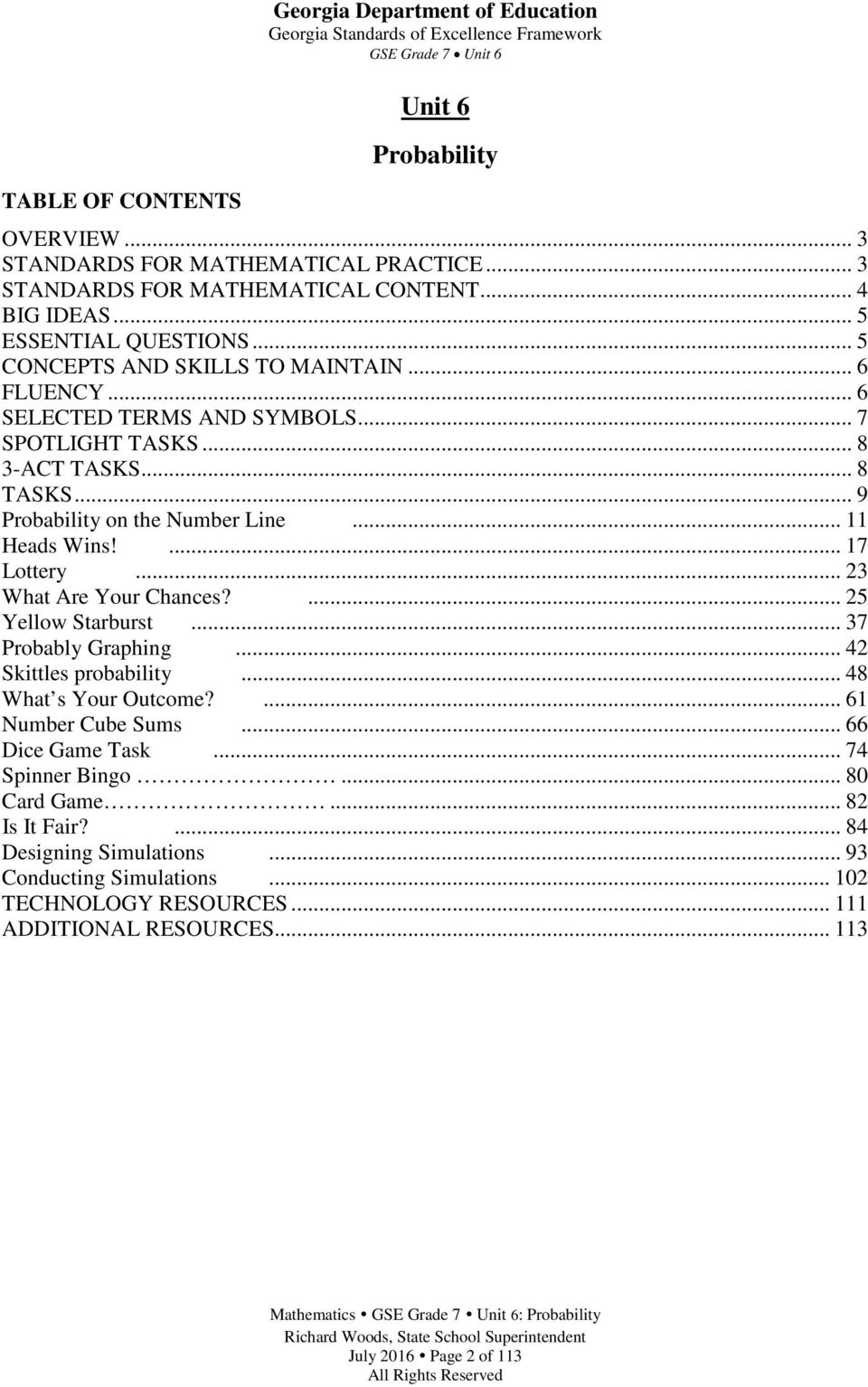
2 TABLE OF CONTENTS Georgia Department of Education Unit 6 Probability OVERVIEW... 3 STANDARDS FOR MATHEMATICAL PRACTICE... 3 STANDARDS FOR MATHEMATICAL CONTENT... 4 BIG IDEAS... 5 ESSENTIAL QUESTIONS... 5 CONCEPTS AND SKILLS TO MAINTAIN... 6 FLUENCY... 6 SELECTED TERMS AND SYMBOLS... 7 SPOTLIGHT TASKS ACT TASKS... 8 TASKS... 9 Probability on the Number Line Heads Wins! Lottery What Are Your Chances? Yellow Starburst Probably Graphing Skittles probability What s Your Outcome? Number Cube Sums Dice Game Task Spinner Bingo Card Game Is It Fair? Designing Simulations Conducting Simulations TECHNOLOGY RESOURCES ADDITIONAL RESOURCES Mathematics : Probability July 2016 Page 2 of 113
3 OVERVIEW The units in this instructional framework emphasize key standards that assist students to develop a deeper understanding of numbers. They learn to express different representations of rational numbers (e.g., fractions, decimals, and percent s), and also discover the concept of probability. They begin to expand their knowledge of simple probabilities and are introduced to the concept of compound probability. The Big Ideas that are expressed in this unit are integrated with such routine topics as estimation, mental and basic computation. All of these concepts need to be reviewed throughout the year. Take what you need from the tasks and modify as required. These tasks are suggestions, something that you can use as a resource for your classroom. STANDARDS ADDRESSED IN THIS UNIT Mathematical standards are interwoven and should be addressed throughout the year in as many different units and activities as possible in order to emphasize the natural connections that exist among mathematical topics. STANDARDS FOR MATHEMATICAL PRACTICE 1. Make sense of problems and persevere in solving them. Students make sense of probability situations by creating visual, tabular and symbolic models to represent the situations. They persevere through approximating probabilities and refining approximations based upon data. 2. Reason abstractly and quantitatively. Students reason about the numerical values used to represent probabilities as values between 0 and Construct viable arguments and critique the reasoning of others. Students approximate probabilities and create probability models and explain reasoning for their approximations. They also question each other about the representations they create to represent probabilities. 4. Model with mathematics. Students model real world populations using mathematical probability representations that are algebraic, tabular or graphic. 5. Use appropriate tools strategically. Students select and use technological, graphic or realworld contexts to model and simulate probabilities. 6. Attend to precision. Students use precise language and calculations to represent probabilities in mathematical and real-world contexts. 7. Look for and make use of structure. Students recognize that probability can be represented in tables, visual models, or as a rational number. Mathematics : Probability July 2016 Page 3 of 113

4 8. Look for express regularity in repeated reasoning. Students use repeated reasoning when approximating probabilities. They refine their approximations based upon experiences with data. STANDARDS FOR MATHEMATICAL CONTENT MGSE7.SP.5 Understand that the probability of a chance event is a number between 0 and 1 that expresses the likelihood of the event occurring. Larger numbers indicate greater likelihood. A probability near 0 indicates an unlikely event, a probability around 1/2 indicates an event that is neither unlikely nor likely, and a probability near 1 indicates a likely event. MGSE7.SP.6 Approximate the probability of a chance event by collecting data on the chance process that produces it and observing its long-run relative frequency. Predict the approximate relative frequency given the probability. For example, when rolling a number cube 600 times, predict that a 3 or 6 would be rolled roughly 200 times, but probably not exactly 200 times. MGSE7.SP.7 Develop a probability model and use it to find probabilities of events. Compare experimental and theoretical probabilities of events. If the probabilities are not close, explain possible sources of the discrepancy. MGSE7.SP.7a Develop a uniform probability model by assigning equal probability to all outcomes, and use the model to determine probabilities of events. For example, if a student is selected at random from a class, find the probability that Jane will be selected and the probability that a girl will be selected. MGSE7.SP.7b Develop a probability model (which may not be uniform) by observing frequencies in data generated from a chance process. For example, find the approximate probability that a spinning penny will land heads up or that a tossed paper cup will land open end down. Do the outcomes for the spinning penny appear to be equally likely based on the observed frequencies? MGSE7.SP.8 Find probabilities of compound events using organized lists, tables, tree diagrams, and simulation. MGSE7.SP.8a Understand that, just as with simple events, the probability of a compound event is the fraction of outcomes in the sample space for which the compound event occurs. MGSE7.SP.8b Represent sample spaces for compound events using methods such as organized lists, tables and tree diagrams. For an event described in everyday language (e.g., rolling double sixes ), identify the outcomes in the sample space which compose the event. MGSE7.SP.8c Explain ways to set up a simulation and use the simulation to generate frequencies for compound events. For example, if 40% of donors have type A blood, create a simulation to predict the probability that it will take at least 4 donors to find one with type A blood? Mathematics : Probability July 2016 Page 4 of 113

5 BIG IDEAS Probabilities are fractions derived from modeling real world experiments and simulations of chance. Modeling real world experiments through trials and simulations are used to predict the probability of a given event. Chance has no memory. For repeated trials of a simple experiment, the outcome of prior trials has no impact on the next. The probability of a given event can be represented as a fraction between 0 and 1. Probabilities are similar to percents. They are all between 0 and 1, where a probability of 0 means an outcome has 0% chance of happening and a probability of 1 means that the outcome will happen 100% of the time. A probability of 50% means an even chance of the outcome occurring. The sum of the probabilities of every outcome in a sample space should always equal 1. The experimental probability or relative frequency of outcomes of an event can be used to estimate the exact probability of an event. Experimental probability approaches theoretical probability when the number of trials is large. Sometimes the outcome of one event does not affect the outcome of another event. (This is when the outcomes are called independent.) Tree diagrams and arrays are useful for describing relatively small sample spaces and computing probabilities, as well as for visualizing why the number of outcomes can be extremely large. Simulations can be used to collect data and estimate probabilities for real situations that are sufficiently complex that the theoretical probabilities are not obvious. ESSENTIAL QUESTIONS Why must the numeric probability of an event be between 0 and 1? What is the likeliness of an event occurring based on the probability near 0, ½, or 1? How can you determine the likelihood that an event will occur? How are the outcomes of given events distinguished as possible? What is the difference between theoretical and experimental probability? What is the significance of a large number of trials? How do I determine a sample space? How can you represent the likelihood of an event occurring? Mathematics : Probability July 2016 Page 5 of 113

6 How are theoretical probabilities used to make predictions or decisions? How can you represent the probability of compound events by constructing models? How can I use probability to determine if a game is worth playing or to figure my chances of winning the lottery? What is the process to design and use a simulation to generate frequencies for compound events? CONCEPTS AND SKILLS TO MAINTAIN It is expected that students will have prior knowledge/experience related to the concepts and skills identified below. It may be necessary to pre-assess in order to determine if time needs to be spent on conceptual activities that help students develop a deeper understanding of these ideas. number sense computation with whole numbers and decimals, including application of order of operations addition and subtraction of common fractions with like denominators measuring length and finding perimeter and area of rectangles and squares characteristics of 2-D and 3-D shapes data usage and representations FLUENCY It is expected that students will continue to develop and practice strategies to build their capacity to become fluent in mathematics and mathematics computation. The eventual goal is automaticity with math facts. This automaticity is built within each student through strategy development and practice. The following section is presented in order to develop a common understanding of the ideas and terminology regarding fluency and automaticity in mathematics: Fluency: Procedural fluency is defined as skill in carrying out procedures flexibly, accurately, efficiently, and appropriately. Fluent problem solving does not necessarily mean solving problems within a certain time limit, though there are reasonable limits on how long computation should take. Fluency is based on a deep understanding of quantity and number. Deep Understanding: Teachers teach more than simply how to get the answer and instead support students ability to access concepts from a number of perspectives. Therefore students are able to see math as more than a set of mnemonics or discrete procedures. Students demonstrate deep conceptual understanding of foundational mathematics concepts by applying them to new situations, as well as writing and speaking about their understanding. Memorization: The rapid recall of arithmetic facts or mathematical procedures. Memorization is often confused with fluency. Fluency implies a much richer kind of mathematical knowledge and experience. Mathematics : Probability July 2016 Page 6 of 113
7 Number Sense: Students consider the context of a problem, look at the numbers in a problem, make a decision about which strategy would be most efficient in each particular problem. Number sense is not a deep understanding of a single strategy, but rather the ability to think flexibly between a variety of strategies in context. Fluent students: flexibly use a combination of deep understanding, number sense, and memorization. are fluent in the necessary baseline functions in mathematics so that they are able to spend their thinking and processing time unpacking problems and making meaning from them. are able to articulate their reasoning. find solutions through a number of different paths. For more about fluency, see: and: SELECTED TERMS AND SYMBOLS The following terms and symbols are often misunderstood. These concepts are not an inclusive list and should not be taught in isolation. However, due to evidence of frequent difficulty and misunderstanding associated with these concepts, instructors should pay particular attention to them and how their students are able to explain and apply them. Students should explore these concepts using models and real life examples. Students should understand the concepts involved and be able to recognize and/or demonstrate them with words, models, pictures, or numbers. Definitions and activities for these and other terms can be found on the Intermath website, and the Learning Progression for 6-8 Statistics and Probability at Chance Process Compound Event Empirical Event Experimental Probability Independent events Probability Probability Model Relative Frequency of Outcomes Sample space Mathematics : Probability July 2016 Page 7 of 113

8 Simple Event Simulation Theoretical Probability Tree diagram Georgia Department of Education SPOTLIGHT TASKS A Spotlight Task has been added to each CCGPS mathematics unit in the Georgia resources for middle and high school. The Spotlight Tasks serve as exemplars for the use of the Standards for Mathematical Practice, appropriate unit-level Mathematics Georgia Standards of Excellence, and research-based pedagogical strategies for instruction and engagement. Each task includes teacher commentary and support for classroom implementation. Some of the Spotlight Tasks are revisions of existing Georgia tasks and some are newly created. Additionally, some of the Spotlight Tasks are 3-Act Tasks based on 3-Act Problems from Dan Meyer and Problem-Based Learning from Robert Kaplinsky. 3-ACT TASKS A Three-Act Task is a whole group mathematics task consisting of 3 distinct parts: an engaging and perplexing Act One, an information and solution seeking Act Two, and a solution discussion and solution revealing Act Three. More information along with guidelines for 3-Act Tasks may be found in the Comprehensive Course Guide. Mathematics : Probability July 2016 Page 8 of 113

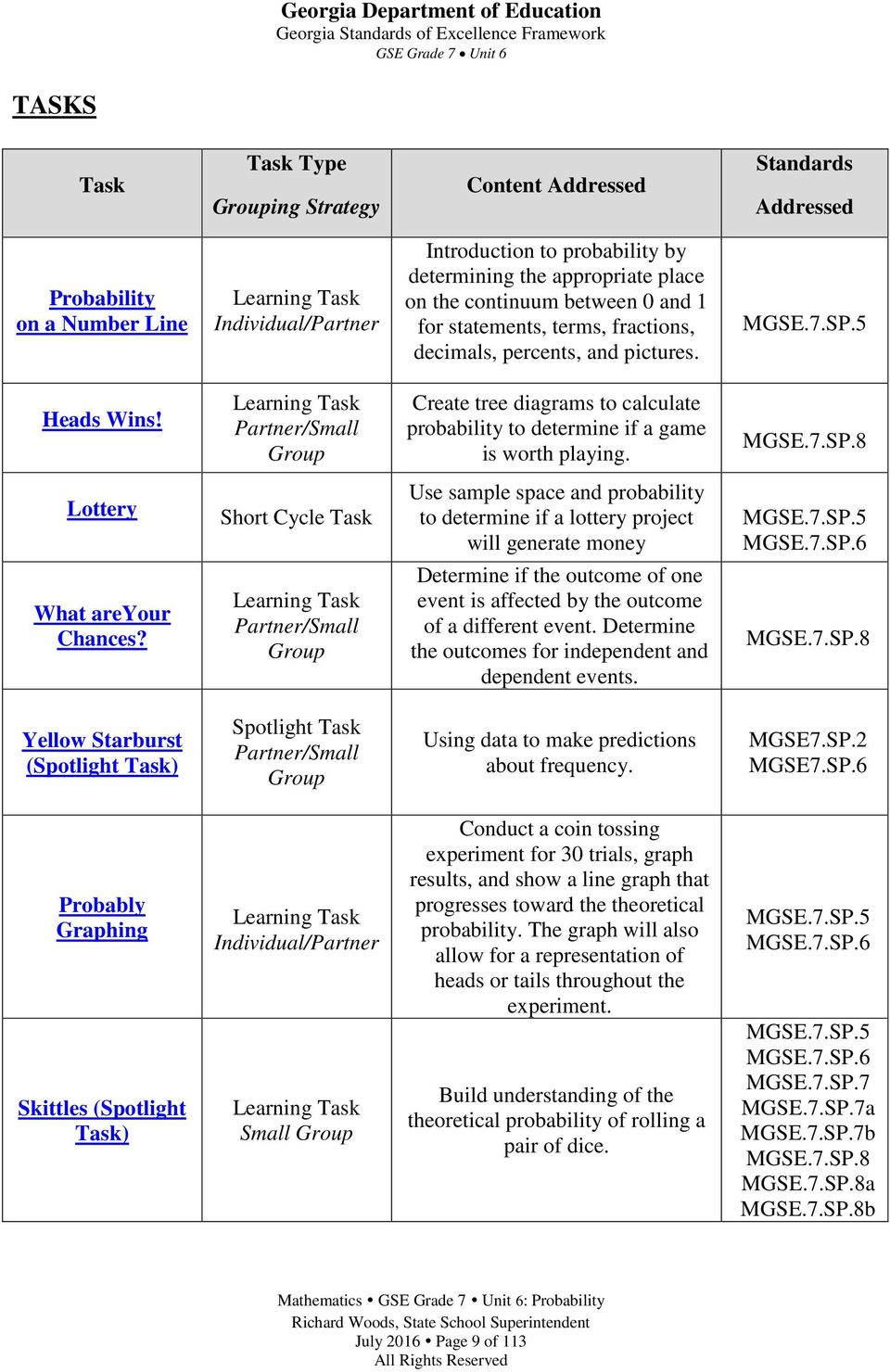
9 TASKS Task Task Type Grouping Strategy Content Addressed Standards Addressed Probability on a Number Line Learning Task Individual/Partner Introduction to probability by determining the appropriate place on the continuum between 0 and 1 for statements, terms, fractions, decimals, percents, and pictures. MGSE.7.SP.5 Heads Wins! Learning Task Partner/Small Group Create tree diagrams to calculate probability to determine if a game is worth playing. MGSE.7.SP.8 Lottery Short Cycle Task Use sample space and probability to determine if a lottery project will generate money MGSE.7.SP.5 MGSE.7.SP.6 What areyour Chances? Learning Task Partner/Small Group Determine if the outcome of one event is affected by the outcome of a different event. Determine the outcomes for independent and dependent events. MGSE.7.SP.8 Yellow Starburst (Spotlight Task) Spotlight Task Partner/Small Group Using data to make predictions about frequency. MGSE7.SP.2 MGSE7.SP.6 Probably Graphing Skittles (Spotlight Task) Learning Task Individual/Partner Learning Task Small Group Conduct a coin tossing experiment for 30 trials, graph results, and show a line graph that progresses toward the theoretical probability. The graph will also allow for a representation of heads or tails throughout the experiment. Build understanding of the theoretical probability of rolling a pair of dice. MGSE.7.SP.5 MGSE.7.SP.6 MGSE.7.SP.5 MGSE.7.SP.6 MGSE.7.SP.7 MGSE.7.SP.7a MGSE.7.SP.7b MGSE.7.SP.8 MGSE.7.SP.8a MGSE.7.SP.8b Mathematics : Probability July 2016 Page 9 of 113
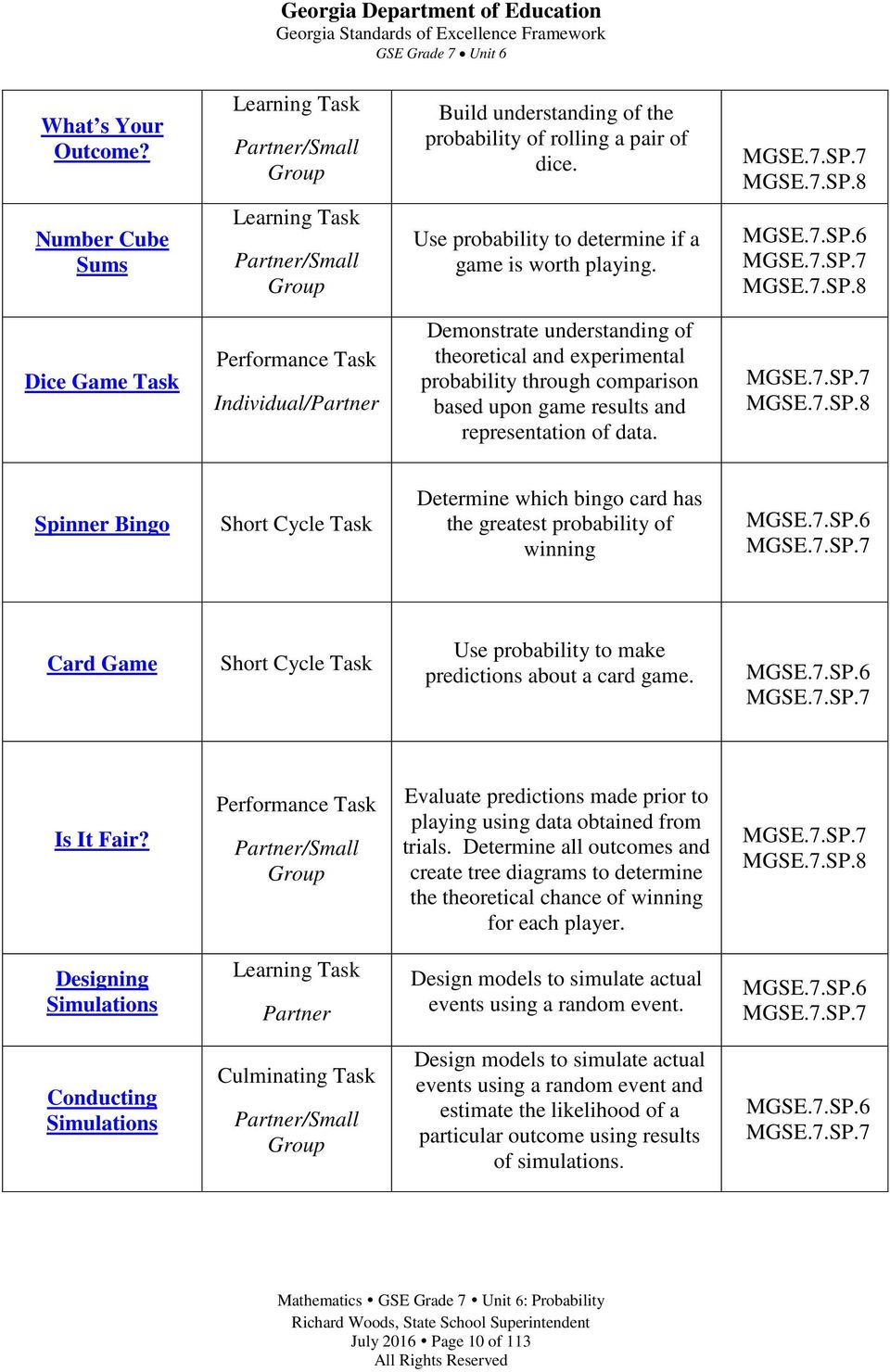
10 What s Your Outcome? Learning Task Partner/Small Group Build understanding of the probability of rolling a pair of dice. MGSE.7.SP.7 MGSE.7.SP.8 Number Cube Sums Learning Task Partner/Small Group Use probability to determine if a game is worth playing. MGSE.7.SP.6 MGSE.7.SP.7 MGSE.7.SP.8 Dice Game Task Performance Task Individual/Partner Demonstrate understanding of theoretical and experimental probability through comparison based upon game results and representation of data. MGSE.7.SP.7 MGSE.7.SP.8 Spinner Bingo Short Cycle Task Determine which bingo card has the greatest probability of winning MGSE.7.SP.6 MGSE.7.SP.7 Card Game Short Cycle Task Use probability to make predictions about a card game. MGSE.7.SP.6 MGSE.7.SP.7 Is It Fair? Performance Task Partner/Small Group Evaluate predictions made prior to playing using data obtained from trials. Determine all outcomes and create tree diagrams to determine the theoretical chance of winning for each player. MGSE.7.SP.7 MGSE.7.SP.8 Designing Simulations Learning Task Partner Design models to simulate actual events using a random event. MGSE.7.SP.6 MGSE.7.SP.7 Conducting Simulations Culminating Task Partner/Small Group Design models to simulate actual events using a random event and estimate the likelihood of a particular outcome using results of simulations. MGSE.7.SP.6 MGSE.7.SP.7 Mathematics : Probability July 2016 Page 10 of 113
11 Probability on the Number Line Back to task table Students are introduced to the idea of probability by discussing the likelihood of events occurring while making connections to past experiences in life while creating a graphic organizer. Students classify the probability statements, terms, fractions, decimals, percents, and pictures according to the appropriate place on the continuum between 0 and 1. STANDARDS FOR MATHEMATICAL CONTENT MGSE7.SP.5 Understand that the probability of a chance event is a number between 0 and 1 that expresses the likelihood of the event occurring. Larger numbers indicate greater likelihood. A probability near 0 indicates an unlikely event, a probability around 1/2 indicates an event that is neither unlikely nor likely, and a probability near 1 indicates a likely event. STANDARDS FOR MATHEMATICAL PRACTICE 1. Make sense of problems and persevere in solving them. 3. Construct viable arguments and critique the reasoning of others. 5. Use appropriate tools strategically. 6. Attend to precision. BACKGROUND KNOWLEDGE In order for students to be successful, the following skills and concepts need to be maintained: The probability of a given event can be represented as a decimal or fraction between 0 and 1. Probabilities are similar to percents. They are all between 0 and 1, where a probability of 0 means an outcome has 0% chance of happening and a probability of 1 means that the outcome will happen 100% of the time. A probability of 50% means an even chance of the outcome occurring. Mathematics : Probability July 2016 Page 11 of 113

12 ORDERING RATIONAL NUMBERS COMMON MISCONCEPTIONS Georgia Department of Education Students have trouble grasping the concept that the probability of an event is a number that lies strictly between 0 and 1 and that all probabilities of events will add to 1. Students may struggle deciphering where some of these events will be placed on the number line, like it will snow this week. Make sure to emphasize that some of these events are subjective and can be placed on multiple points on the number line ESSENTIAL QUESTIONS What is the likeliness of an event occurring based on the probability near 0, ½, or 1? How can events be described using probability? MATERIALS Large sheet of paper to construct number line(s) Copy of handout with cards Scissors Glue Markers String and clothes pins *if creating large number line Masking tape for the floor *if creating large number line. GROUPING Individual, partner, small group, or whole class TASK DESCRIPTION Students should construct a number line starting at 0 and ending at 1. Divide the line into fourths. The cards should be cut apart and place at the appropriate point on the number line. Students pair with partner or group to share and defend their results. Discuss the similarities and differences among the results with students. A large scale probability line can be created for the classroom using a clothes line or masking tape on the floor. Students are introduced to the idea of probability by discussing the likelihood of events occurring while making connections to past experiences in life while creating a graphic organizer. Students classify the probability statements, terms, fractions, decimals, percents, and pictures according to the appropriate place on the continuum between 0 and 1. Mathematics : Probability July 2016 Page 12 of 113

13 PROBABILITY ON THE NUMBER LINE Georgia Department of Education Construct a number line starting at 0 and ending at 1. Divide the line into fourths. The cards should be cut apart and placed (glued) at the appropriate point on the number line. Students pair with partner or group to share and defend results. Discuss the similarities and differences among the results. Mathematics : Probability July 2016 Page 13 of 113
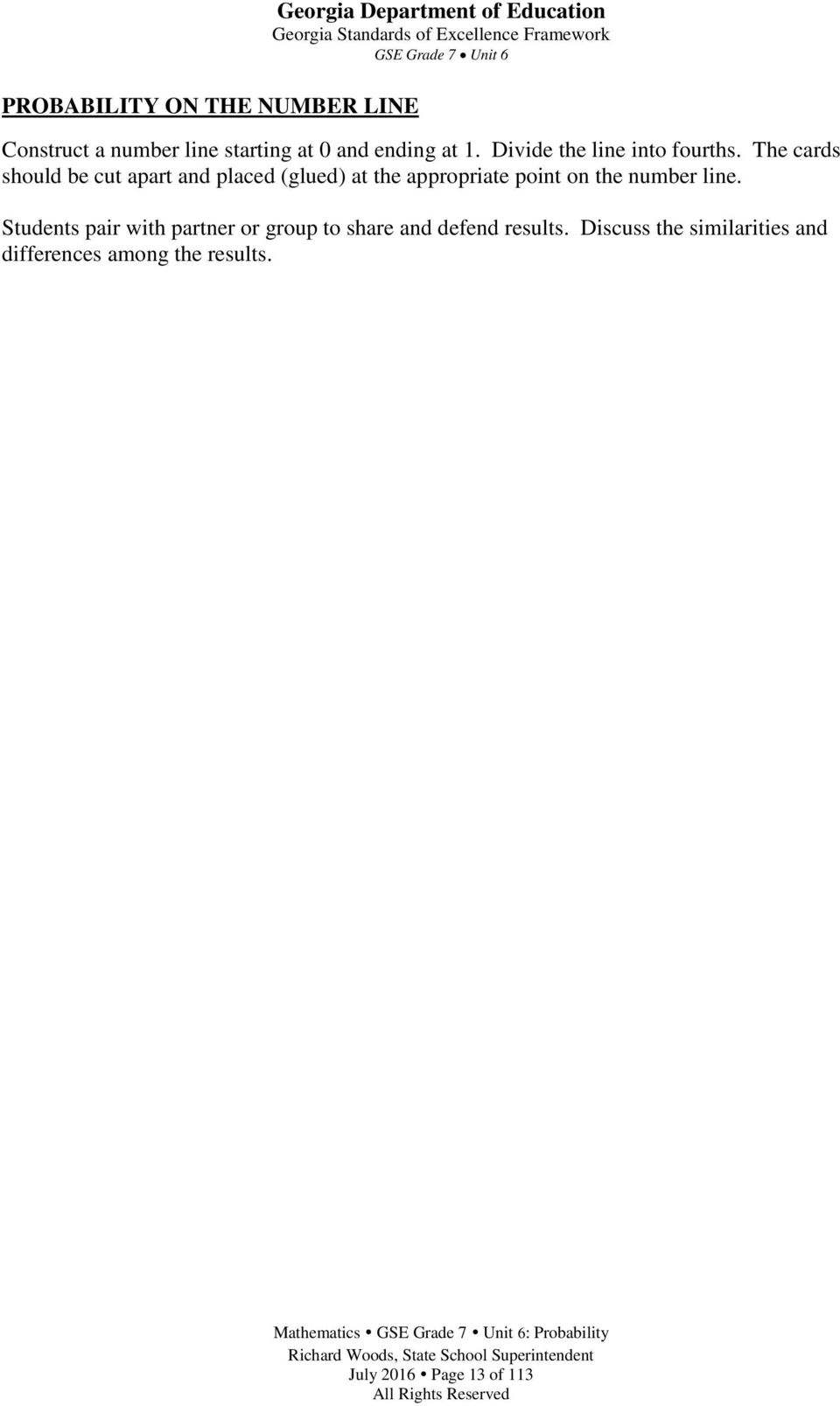
14 Impossible Maybe Certain Good Chance Unlikely Likely Probable Small Chance Even Chance 0% 100% 10% 25% 50% 75% 90% % The Braves will win the World Series. You will have two birthdays this year. If today is Friday, tomorrow will be Saturday. You will meet President George Washington on the way home from school today. The sun will rise tomorrow morning. You will go to the beach sometime. At least one student will be absent tomorrow at your school. You will be in the 8 th grade next year. If you drop a rock in water, it will sink. It will snow this week. You will watch TV sometime today. It will rain tomorrow. 5/8.88 6/16 7/8 Mathematics : Probability July 2016 Page 14 of 113
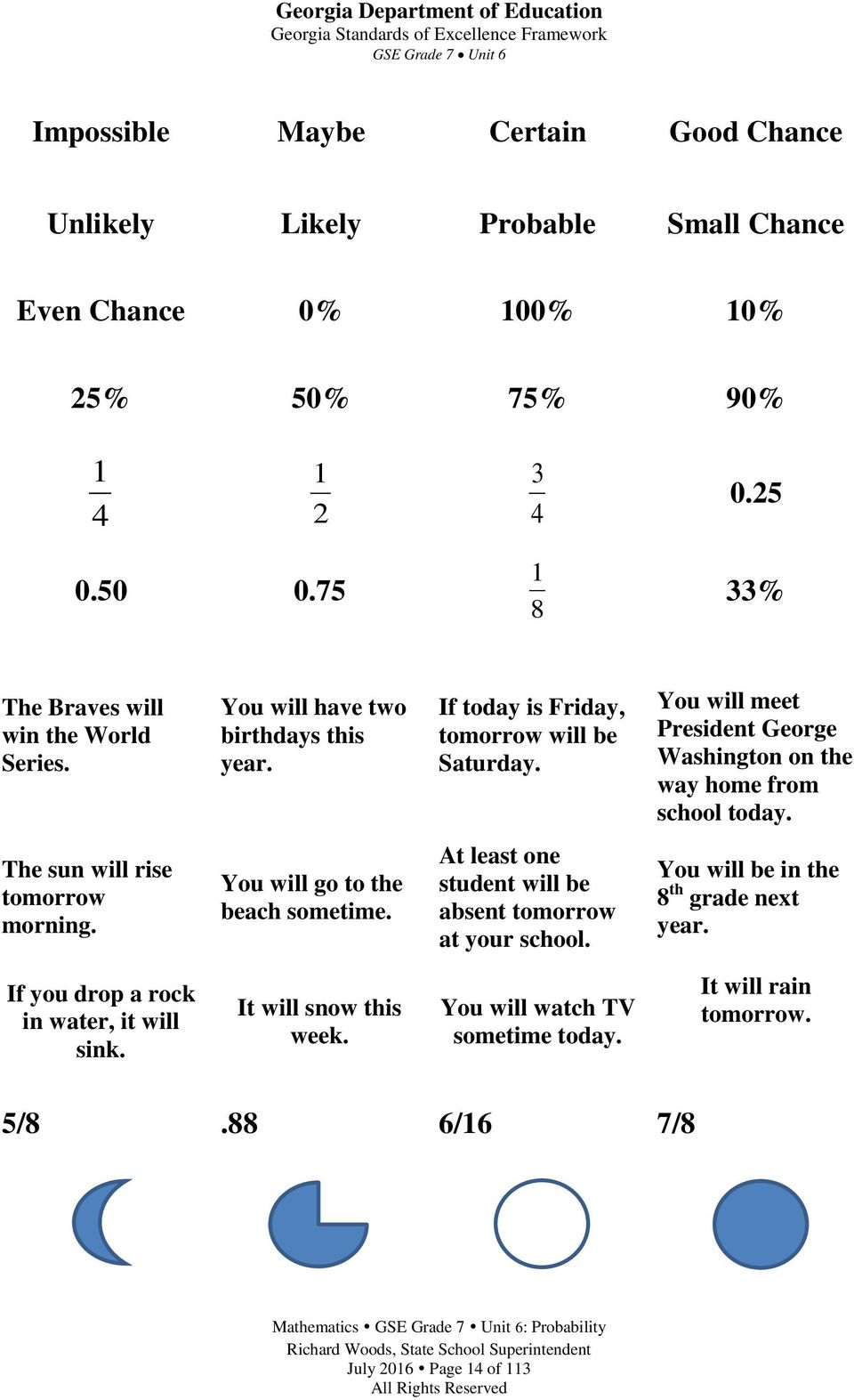
15 Solutions: (assuming horizontal number line) Georgia Department of Education L-R Percents:0%, 10%, 25%, 33%, 50%, 75%, 90%, 100% L-R fractions: 1/8, ¼, 6/16, ½, 5/8, ¾, 7/8 L-R decimals:.25,.50,.75,.88 L-R subjective statements:*teacher should note that these statements will be in different locations based upon the students individual experiences. Sample order: unlikely, small chance, maybe, Braves will win world series, it will snow, rock will sink (pumice will float), go to beach, student absent tomorrow, it will rain, likely, good chance, probable, likely, sun will rise, go to 8 th grade next year, watch TV L-R non-subjective statements: Zero-You will meet G. Washington on the way home from school today, 2 birthdays in one year, and impossible, even chance, certain L-R pictures: DIFFERENTIATION Extension Have students create at least 4 extra cards with a decimal, fraction, probability statement, and word of their choice. Ask students to take the subjective statements and discuss/write out 3 different circumstances for each in which the statement would be placed in 3 different locations on the number line. Intervention After students set up their number line and cut out their cards, lead them through the process of deciding the location of each card by talking through the kind of thinking that allows for a position on the number line to be chosen. Assign each student one of the cards to choose a location for and ask each to talk through his/her thinking to the rest of the class. Create the number line together as a class as students share their assigned card. Mathematics : Probability July 2016 Page 15 of 113
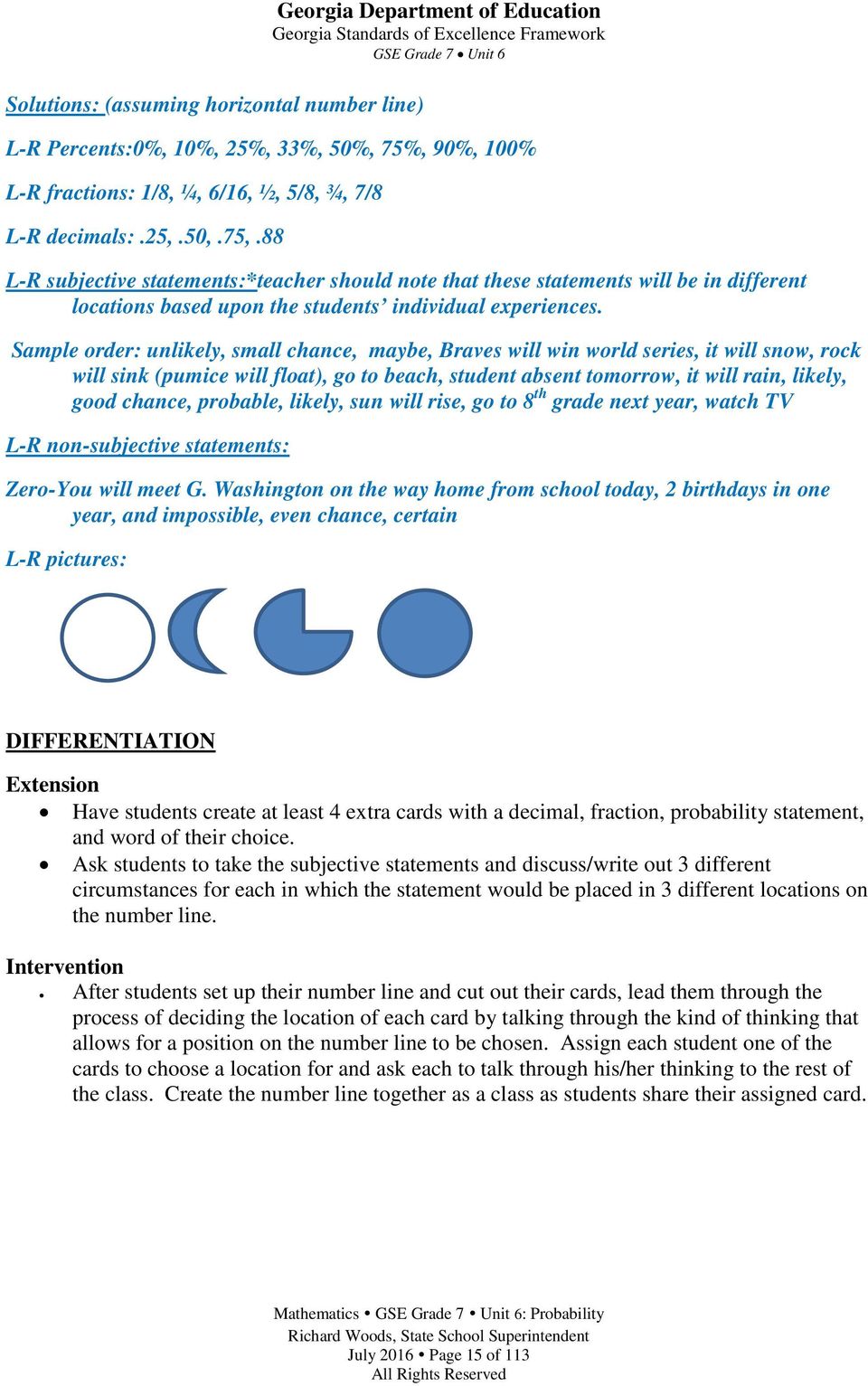
16 Probability on the Number Line Georgia Department of Education 1. Construct a number line on a separate piece of paper starting at 0 and ending at Divide the line into fourths. 3. Place or glue each card at the appropriate spot on the number line. 4. Share and defend results. Discuss the similarities and differences among the results. Impossible Maybe Certain Good Chance Unlikely Likely Probable Small Chance Even Chance 0% 100% 10% 25% 50% 75% 90% % The Braves will win the World Series. You will have two birthdays this year. If today is Friday, tomorrow will be Saturday. You will meet Pres. Washington outside of school today. The sun will rise tomorrow morning. You will go to the beach sometime. At least one student will be absent tomorrow at your school. You will be in the 8 th grade next year. If you drop a rock in water, it will sink. It will snow this week. You will watch TV sometime today. It will rain tomorrow. 5/ /16 7/8 Mathematics : Probability July 2016 Page 16 of 113
17 Heads Wins! Georgia Department of Education Back to task table Adapted from 8 th Grade GPS Unit 1 Originally from Learner.org and can be done interactively at the following website: In this task, students will use probability to determine if a game is worth playing. STANDARDS FOR MATHEMATICAL CONTENT: MGSE7.SP.8 Find probabilities of compound events using organized lists, tables, tree diagrams, and simulation. MGSE7.SP.8a Understand that, just as with simple events, the probability of a compound event is the fraction of outcomes in the sample space for which the compound event occurs. MGSE7.SP.8b Represent sample spaces for compound events using methods such as organized lists, tables and tree diagrams. For an event described in everyday language (e.g., rolling double sixes ), identify the outcomes in the sample space which compose the event. STANDARDS FOR MATHEMATICAL PRACTICE 1. Make sense of problems and persevere in solving them. 2. Reason abstractly and quantitatively. 3. Construct viable arguments and critique the reasoning of others. 4. Model with mathematics. 6. Attend to precision. ESSENTIAL QUESTION: How can I use probability to determine if a game is worth playing or to figure my chances of winning the lottery? MATERIALS: coins, colored tiles, or counters TASK DIRECTIONS: a) Suppose you are approached by a classmate who invites you to play a game with the following rules: Each of you takes a turn flipping a coin. You toss your coin first, and he tosses his coin second. He gives you $1 each time one of the coins lands on tails. You give him $1 each time one of the coins lands on heads. a. Create a tree diagram for the four possible outcomes and probabilities for the two tosses. Mathematics : Probability July 2016 Page 17 of 113
18 Comments: Georgia Department of Education b. What are the possible outcomes? c. What are your winnings for each outcome? The following notes are for your own review of the concept of compound probability. Students do not need to use this algorithm until later in the unit. Encourage students to determine the outcomes using their tree diagram. Problem 1: Applying the tree diagram to Heads Wins! Task shows the possible outcomes, resulting winnings for Student 1, and the probability of each. Note that the probability of getting Heads or Tails on any flip is ½. The probability of getting Heads on the first flip AND Heads on the second flip is (½) (½) = ¼. The same is true for each of the other outcomes. The outcome for each flip of a coin is independent of the outcome of any other flip; that is, one outcome is not influenced by another outcome. The Probability Rule for finding the probability that two independent events A and B both happen is P(A and B) = P(A) P(B). This rule is commonly referred to as the Multiplication Rule of Probability. In this setting, (A and B) refers to the single event of flipping two coins. The sample space for (A and B) is the set {HH, HT, TH, TT}. Mathematics : Probability July 2016 Page 18 of 113

19 Solutions: 1a. 1b. sample space = {heads and heads, heads and tails, tails and heads, tails and tails} sample space = {HH, HT, TH, TT} 1c. HH = - $2.00 HT = $0.00 TH = $0.00 TT = $ Suppose your classmate suggests a change to the rules of the game. He suggests the following rules after you flip a coin. Mathematics : Probability July 2016 Page 19 of 113

20 Comments: Georgia Department of Education If you get heads, you give him $2. If you get tails, then he flips his coin. If he gets heads, you give him $1. If he gets tails, he gives you $2. Who is most likely to win? Justify your reasoning. Encourage students to justify their reasoning in an organized manner (i.e. tree diagram). Students might need prompting to create a tree diagram, writing out the probabilities as fractions or decimals and percent. Flipping one coin is a simple event; the probability of flipping one coin and getting Heads is ½. Flipping one coin and getting Tails is also a simple event with probability ½; however in this situation, the coin must be flipped again, resulting in compound independent events. Applying the Multiplication Rule to each compound event, we find that P(T and H) = (½) (½) = ¼ and that P(T and T) = (½) (½) = ¼. To calculate probability of their net winnings, we introduce the Addition Rule of Probability for independent events: P(A or B)=P(A) + P(B). In this case, we expand the rule to cover 3 possible outcomes: P(H or TH or TT) = P(H) + P(TH) + P(TT) = ½ + ¼ + ¼ = 1. Note: The sum of the probabilities of all possible outcomes for a given event should always equal 1. Note: Each probability, p, should be between 0 and 1, inclusive; i.e., 0 p 1. To calculate the average winnings (i.e., the overall winnings if the game were played many times), students should multiply the possible winnings for each outcome by its probability and add the products. For this problem, the average winnings would be -$2(1/2) + -$1(1/4) + $2(1/4) = -$1 + -$ $0.50 = -$0.75. So in the long run, students would lose an average of 75 cents playing Game 2. Applying the formula to their Game 1 winnings, students should find that they would break even in the long run. Mathematics : Probability July 2016 Page 20 of 113

21 Solutions: Possible solutions Follow-up Activities The ProbSim application on TI-83 calculators can also be used to simulate results for this activity. Extension Construct a similar game in which you are most likely to be the winner and use a tree diagram to illustrate the outcomes, winnings, and probabilities. Mathematics : Probability July 2016 Page 21 of 113
22 Heads Wins! 1. Suppose you are approached by a classmate who invites you to play a game with the following rules: Each of you takes a turn flipping a coin. You toss your coin first, and he tosses his coin second. He gives you $1 each time one of the coins lands on tails. You give him $1 each time one of the coins land on heads. a. Create a tree diagram for the four possible outcomes and probabilities for the two tosses. b. What are the possible outcomes? c. What are your winnings for each outcome? 2. Suppose your classmate suggests a change to the rules of the game. He suggests the following rules after you flip a coin. If you get heads, you give him $2. If you get tails, then he flips his coin. If he gets heads, you give him $1. If he gets tails, he gives you $2. Who is most likely to win? Justify your reasoning. Mathematics : Probability July 2016 Page 22 of 113
23 Lottery Back to task table In this task, students use sample space and probability to determine if a lottery project will generate money. Source: Balanced Assessment Materials from Mathematics Assessment Project STANDARDS FOR MATHEMATICAL CONTENT MGSE7.SP.5 Understand that the probability of a chance event is a number between 0 and 1 that expresses the likelihood of the event occurring. Larger numbers indicate greater likelihood. A probability near 0 indicates an unlikely event, a probability around 1/2 indicates an event that is neither unlikely nor likely, and a probability near 1 indicates a likely event. MGSE7.SP.6 Approximate the probability of a chance event by collecting data on the chance process that produces it and observing its long-run relative frequency. Predict the approximate relative frequency given the probability. For example, when rolling a number cube 600 times, predict that a 3 or 6 would be rolled roughly 200 times, but probably not exactly 200 times. STANDARDS FOR MATHEMATICAL PRACTICE 1. Make sense of problems and persevere in solving them 2. Reason abstractly and quantitatively. 3. Construct viable arguments and critique the reasoning of others. 4. Model with mathematics. 5. Use appropriate tools strategically 6. Attend to precision. 7. Look for and make use of structure. 8. Look for and express regularity in repeated reasoning. ESSENTIAL QUESTION How do I apply the principles of sample space and probability to determine if a lottery is profitable? TASK COMMENTS Tasks and lessons from the Mathematics Assessment Project are specifically designed to help teachers effectively formatively assess their students. The way the tasks and lessons are designed gives the teacher a clear understanding of what the students are able to do and not do. Within the lesson, teachers will find suggestions and question prompts that will help guide students towards understanding. For more information access the MAP website: The task, Lottery, is a Mathematics Assessment Project Assessment Task that can be found at the website: Mathematics : Probability July 2016 Page 23 of 113
24 The PDF version of the task can be found at the link below: The scoring rubric can be found at the following link: Mathematics : Probability July 2016 Page 24 of 113
25 What Are Your Chances? Georgia Department of Education Back to task table In this task, students will determine if the outcome of one event is affected by the outcome of a different event. Students will also determine the outcomes for independent events and calculate the probabilities. STANDARDS FOR MATHEMATICAL CONTENT: MGSE7.SP.8 Find probabilities of compound events using organized lists, tables, tree diagrams, and simulation. MGSE7.SP.8a Understand that, just as with simple events, the probability of a compound event is the fraction of outcomes in the sample space for which the compound event occurs. MGSE7.SP.8b Represent sample spaces for compound events using methods such as organized lists, tables and tree diagrams. For an event described in everyday language (e.g., rolling double sixes ), identify the outcomes in the sample space which compose the event. MGSE7.SP.8c Explain ways to set up a simulation and use the simulation to generate frequencies for compound events. For example, if 40% of donors have type A blood, create a simulation to predict the probability that it will take at least 4 donors to find one with type A blood? STANDARDS FOR MATHEMATICAL PRACTICE 1. Make sense of problems and persevere in solving them. 2. Reason abstractly and quantitatively. 3. Construct viable arguments and critique the reasoning of others. 4. Model with mathematics 6. Attend to precision. 7. Look for and make use of structure. 8. Look for and express regularity in repeated reasoning. COMMON MISCONCEPTIONS Students struggle with the overall organization of tree diagrams, especially creating the individual levels Students misunderstand how to read a tree diagram, sometimes relying on columns rather than the branches Students initially struggle with developing, creating, and interpretation of arrays ESSENTIAL QUESTIONS: How are the outcomes of given events distinguished as possible? How can you represent the likelihood of an event occurring? How are theoretical probabilities used to make predictions or decisions? Mathematics : Probability July 2016 Page 25 of 113
26 MATERIALS: spinner and cube templates scissors colored pencils brads or paper clips tape GROUPING Partner/Small Group TASK DESCRIPTION PART I - INDEPENDENT EVENTS Provide students with two circles. Students are to create two four section spinners. The spinners can consist of four different colors, numbers, letters, or pictures. After students have completed creating their spinners, have students select one. Using the selected spinner, have students list the possible outcomes (sample space). Next, provide students with two nets of a cube. Students are to create two number cubes labeled 1-6. After students have completed creating their number cubes, have students select one. Using the selected number cube, have students list the possible outcomes (sample space). What are your Chances? 1. List the possible outcomes or sample space for the spinner you created. 2. List the possible outcomes or sample space for the number cube you created. Comments: Sample space for spinner (answers may vary) {red, blue, green, yellow} Sample space for dice {1, 2, 3, 4, 5, 6} Tip: Spinners can be quickly made using a pencil and paper clip. Make a spinner by placing a pencil on the center of the circle and inside a paper clip. Spin the paper clip around the pencil tip. Solutions: Part 1a. and 1b. Solutions may vary. Mathematics : Probability July 2016 Page 26 of 113
27 Part Students are to select one spinner and one number cube. Ask students to find the sample space (possible outcomes) for spinning a spinner and tossing a number cube. Students may use a table or a tree diagram to help them organize the possible outcomes. Possible Solution using examples for part I {red 1, red 2, red 3, red 4, red 5, red 6, blue1 etc }(use set notation) 4. Does spinning a four section spinner affect the number a six sided number cube will land upon when tossed? Explain. Comments: Discuss independent events. Students should understand that independent events result when the occurrence or nonoccurrence of one event has no effect or depends on the other. Mathematics : Probability July 2016 Page 27 of 113
28 5. Represent the two events in a two-way table. Comment: Two-way tables are limited to a two-event experiment. Solution: Select two spinners and answer the following questions: 6. Explain if this is an independent or dependent event. Comment: It is important for students to distinguish between the two events, spinner 1 and spinner 2. For example, red on spinner 1 is a different event from red on spinner 2. Solution: These are independent events because one spinner s outcome does not affect the other. 7. What is the sample space (possible outcomes) for spinning both spinners? Answers may vary. It will depend on how students created their spinners. Make sure students write their sample space as a set. 8. How can the events be represented in a two-way table or tree diagram? Comment: At this time, students should create a table or tree diagram to help them organize the possible outcomes. Students may also use the counting principle to determine the possible outcomes. Mathematics : Probability July 2016 Page 28 of 113
29 Sample Solution: Select two number cubes and answer the following questions: 9. Explain if these events are independent or dependent. Independent because tossing one number cube does not affect the result when tossing a second number cube 10. Create a two-way table to represent the sample space. Mathematics : Probability July 2016 Page 29 of 113
30 11. Give an example of a situation involving two independent events. Solution: Answers may vary but students should choose two things that are unrelated to one another. You may also want to talk about with replacement and without. One possible example would be if students flip a coin and draw a card. PART II DEPENDENT EVENTS 1. Based on your understanding of independent events, what would be a definition for dependent events? Dependent events mean the occurrence of the first event affects the second event. 2. Why would the example of drawing a card from a deck keeping it out and drawing again be an example of a dependent event? Since you are not replacing the card, the total number of outcomes in the second event has been affected by the first. 3. For each situation below, tell whether it is independent or dependent. i. There are 5 marbles in a bag. Four are blue and one is red. A marble is selected and not replaced back in the bag. _dependent ii. You are going to draw a card from a deck, replace it, and then draw a second card. You are trying to find the probability of both cards being an ace. independent iii. You flip a coin two times and find the probability of getting heads both times. independent Mathematics : Probability July 2016 Page 30 of 113
31 iv. There are 3 red candies left in a bag of multicolored candies with 20 left. You are finding the chances of getting a red candy, eating it, and then getting another red candy. dependent v. You are getting dressed in the dark. The drawer has 6 blue socks, 8 black socks, and 10 white. You draw out a sock, hold on to it, and draw a second sock. You are finding the probability of getting two black socks. dependent DIFFERENTIATION Extension Find probabilities using the Fundamental Counting Principle Find numerical probabilities of dependent and independent events and explain the difference between the two types of events Intervention Find simple probability with one, independent event like a spinner prior to finish the task May need additional scaffolding to create the tables and tree diagrams Mathematics : Probability July 2016 Page 31 of 113
32 What Are Your Chances? PART I - INDEPENDENT EVENTS Georgia Department of Education 1. List the possible outcomes or sample space for one of the spinner you created. 2. List the possible outcomes or sample space for the number cube you created. 3. Find the sample space (possible outcomes) for spinning a spinner and tossing a number cube. Use a table or a tree diagram to help them organize the possible outcomes. 4. Does spinning a four section spinner affect the number a six sided number cube will land upon when tossed? Explain. 5. Represent the two events in a two-way table. Mathematics : Probability July 2016 Page 32 of 113
33 Select two spinners and answer the following questions: 6. Explain if this is an independent or dependent event? 7. What is the sample space (possible outcomes) for spinning both spinners? 8. How can the events be represented in a two-way table or tree diagram? Select two number cubes and answer the following questions: 9. Explain if these events are independent or dependent. 10. Create a two-way table to represent the sample space. 11. Give an example of a situation involving two independent events. Mathematics : Probability July 2016 Page 33 of 113
34 PART II DEPENDENT EVENTS Georgia Department of Education 1. Based on your understanding of independent events, what would be a definition for dependent events? 2. Why would the example of drawing a card from a deck keeping it out and drawing again be an example of a dependent event? 3. For each situation below, tell whether it is independent or dependent. i. There are 5 marbles in a bag. Four are blue and one is red. A marble is selected and not replaced back in the bag. ii. You are going to draw a card from a deck, replace it, and then draw a second card. You are trying to find the probability of both cards being an ace. iii. You flip a coin two times and find the probability of getting heads both times. iv. There are 3 red candies left in a bag of multicolored candies with 20 left. You are finding the chances of getting a red candy, eating it, and then getting another red candy. v. You are getting dressed in the dark. The drawer has 6 blue socks, 8 black socks, and 10 white. You draw out a sock, hold on to it, and draw a second sock. You are finding the probability of getting two black socks. Mathematics : Probability July 2016 Page 34 of 113
35 Template for Spinner Instructions: a) Create two spinners. Each spinner needs to have four equal sections. b) Make each spinner using colors, numbers, letters, or pictures. c) Using a paper clip & your pencil, you can spin the spinner by holding the paper clip in the center of the circle with your pencil point and thumping the spinner. Mathematics : Probability July 2016 Page 35 of 113
36 Template for Number Cube Instructions: a) Create number cubes. b) Use numbers 1-6 to create each number cube. c) Cut out each number cube, fold on the lines, and tape together. Mathematics : Probability July 2016 Page 36 of 113
37 Yellow Starburst Georgia Department of Education Back to task table Task adapted from authored by Dan Meyer. STANDARDS FOR MATHEMATICAL CONTENT MGSE7.SP.2 Use data from a random sample to draw inferences about a population with an unknown characteristic of interest. Generate multiple samples (or simulated samples) of the same size to gauge the variation in estimates or predictions. MGSE7.SP.6 Approximate the probability of a chance event by collecting data on the chance process that produces it and observing its long-run relative frequency. Predict the approximate relative frequency given the probability. For example, when rolling a number cube 600 times, predict that a 3 or 6 would be rolled roughly 200 times, but probably not exactly 200 times. STANDARDS FOR MATHEMATICAL PRACTICE 1. Make sense of problems and persevere in solving them. 2. Reason abstractly and quantitatively. 4. Model with mathematics. 5. Use appropriate tools strategically. 6. Attend to precision. ESSENTIAL QUESTIONS How can data be used to make predictions? MATERIALS NEEDED Video links Bag of Starbursts (optional) TEACHER NOTES In this task, students will watch the video, then tell what they noticed. They will then be asked to discuss what they wonder or are curious about. These questions will be recorded on a class chart or on the board. Students will then use mathematics to answer their own questions. Students will be given information to solve the problem based on need. When they realize they don t have the information they need, and ask for it, it will be given to them. Mathematics : Probability July 2016 Page 37 of 113
38 TASK DESCRIPTION The following 3-Act Task can be found at: More information along with guidelines for 3-Act Tasks may be found in the Comprehensive Course Guide. ACT 1: Watch the video, Starburst Mountain (link: ) Ask students what questions they have about the video. Suggestions: 1. Guess how many of those packs will have exactly one yellow Starburst, Two yellow Starbursts. 2. For each guess, write down answers you know are too high. Too low. ACT 2: 3. What information will you need to get an answer? Image 1: The possible Starburst colors, Image 2: The exact number of Starburst packs, Mathematics : Probability July 2016 Page 38 of 113
39 4. What assumptions about Starbursts are built into your answer? 5. How would knowing the frequency of Starburst colors in this sample change your answer? Image: The frequency of Starburst colors, ACT 3 Video: The answer, Image: The frequency of every possible pair, 6. How close was your guess to the actual answer? How close was your math? Calculate the percent error for each. Mathematics : Probability July 2016 Page 39 of 113
40 Yellow Starbursts ACT 1 What did/do you notice? Name: Adapted from Andrew Stadel What questions come to your mind? Main Question: Estimate the result of the main question? Explain? Place an estimate that is too high and too low on the number line Low estimate Place an x where your estimate belongs High estimate ACT 2 What information would you like to know or do you need to solve the MAIN question? Record the given information (measurements, materials, etc ) If possible, give a better estimate using this information: Mathematics : Probability July 2016 Page 40 of 113
41 Act 2 (con t) Use this area for your work, tables, calculations, sketches, and final solution. ACT 3 What was the result? Which Standards for Mathematical Practice did you use? Make sense of problems & persevere in solving them Reason abstractly & quantitatively Construct viable arguments & critique the reasoning of others. Model with mathematics. Use appropriate tools strategically. Attend to precision. Look for and make use of structure. Look for and express regularity in repeated reasoning. Mathematics : Probability July 2016 Page 41 of 113
42 Probably Graphing Georgia Department of Education Back to task table Source: NCTM: Illuminations Student will conduct a coin tossing experiment for 30 trials. Their results will be graphed and shows a line graph which progresses toward the theoretical probability. The graph will also allow for a representation of heads or tails throughout the experiment. STANDARDS FOR MATHEMATICAL CONTENT MGSE7.SP.5 Understand that the probability of a chance event is a number between 0 and 1 that expresses the likelihood of the event occurring. Larger numbers indicate greater likelihood. A probability near 0 indicates an unlikely event, a probability around 1/2 indicates an event that is neither unlikely nor likely, and a probability near 1 indicates a likely event. MGSE7.SP.6 Approximate the probability of a chance event by collecting data on the chance process that produces it and observing its long-run relative frequency. Predict the approximate relative frequency given the probability. For example, when rolling a number cube 600 times, predict that a 3 or 6 would be rolled roughly 200 times, but probably not exactly 200 times. STANDARDS FOR MATHEMATICAL PRACTICE 1. Make sense of problems and persevere in solving them. 2. Reason abstractly and quantitatively 3. Construct viable arguments and critique the reasoning of others. 6. Attend to precision. 7. Look for an make use of structure 8. Look for and express regularity in repeating reasoning COMMON MISCONCEPTIONS Whether doing simulations, experiments, or theoretical probability, it is important for students to use many models (lists, area models, tree diagrams) and to explicitly discuss developing conceptions and misconceptions. In addition to being more interesting, teaching probability in this way allows students to understand important concepts that have many real-world implications. ESSENTIAL QUESTIONS What factors determine the likelihood that an event will occur? How can the likelihood that an event will occur be represented? Why does experimental probability approach theoretical probability? What is the difference between theoretical and experimental probability? What is the significance of a large number of trials? Mathematics : Probability July 2016 Page 42 of 113
43 MATERIALS Pennies or other coins Calculators Probably Graphing Activity Sheet GROUPING Individual/Partner TASK DESCRIPTION Georgia Department of Education Opening: Begin this activity by asking all students to stand up. Tell them you are going to flip a coin. If they think it is going to be heads, they are to put their hands on their head. If they think the coin is going to be tails, they are to put their hands behind their back. If they are correct, they remain standing, if they are incorrect, they sit down. Repeat the process until there is only one person left. During this introduction, discuss any patterns in the results of the coin toss and the number of students who sit down each time. Relate this to previous work by asking students what the theoretical probability is of getting the correct answer. Students should agree that the answer is 50%. Also, keep count of how many heads and tails were tossed during the game to find the one winner. Ask students to find the experimental probability and compare it to the theoretical. Ask students: a. What chance did you have of being correct on the very first flip of the coin? b. What chance do you have of being correct the second time? c. Does a previous flip have an effect on upcoming events? Solutions: Expect the following responses. a. 1 / 2 or 50% b. 50%, you have to choose between heads and tails each time. Each time your chances will be 1 / 2, regardless of previous flips. c. No. Each flip is independent of previous flips. You may wish to introduce the term independent events. Inform students that this lesson will continue to investigate the probabilities involved in a coin toss. Distribute the Probably Graphing activity sheet and a penny to each student. Read through the introduction together. Students may need help in understanding that if they get a tails, they carry over the previous number in the Heads row. As you read through activity sheet and before students begin the experiment, draw the coordinate plane on the board, consider a graph with x and y axes labeled below. Ask students to discuss what they feel the graph will look like. Have a few students come up and draw their best guesses Mathematics : Probability July 2016 Page 43 of 113
44 on the board. Some students may draw a graph similar to the ones below. Don t confirm or deny any responses. Instead ask students if they agree or disagree with the predictions. Inform students that when they create their own graphs, they should plots the points representing their data, then connect the points with line segments. Explain that the lines are there to help determine the trend, but do not represent possible points on the graph like a graphed line normally does. It is not possible to flip a coin 1.5 times. When all questions have been addressed, allow students time to conduct their experiments and graph their results. Note: The chart asks for a cumulative total of heads. Please emphasize to students that this is a running total of how many times they have landed on heads. Because students are circling heads and tails, you can present it to students as how many heads that they have circled in total each time in order to clarify instructions. Closing: Once completed, ask students to compare and contrast their results with students in their group or around them. Find out if there is anyone who had an extremely large number of heads, or low numbers of heads occur. Have students hold up stand up and walk around holding their graphs in front of them and comparing to others as they walk by. Most of the graphs will probably resemble the pattern below. If some students have graphs that do not approach 50%, discuss their graphs with the class. Does this mean their graphs are wrong? From the graphs, it should be apparent that with low trial numbers the graph fluctuates greatly. One trial may move the line 20 30%, while with nearly all trials completed the graph may only move 1 4%. This again re-emphasizes that a small number of trials will not be a good predictor of the theoretical probability. As the number of trials increases we begin to see a graphical Mathematics : Probability July 2016 Page 44 of 113
45 representation of the Law of Large Numbers. The experimental probability will approach the theoretical probability of the event. In this case, it approached a probability of 50%. As this experiment progresses it would take several heads in a row to create a noticeable spike. This can lead to a discussion of whether several heads in a row is likely, even though randomly possible. You can look at the data from your students and see what student had the most repetitive results of heads. For example, one student may have had 6, 7 or 8 in a row. Even if they didn t, you can discuss how results like this would affect the graphs. They would create a spike, until a tail occurs. Even if there was an instance of 7 in a row, the graph will still begin to draw closer to the theoretical probability of 50% with more added trials. This can be a fun discussion because you can never actually say it s impossible; it is just highly unlikely or not probable! Solution for Task: Answers will vary, as students will have various trial data. The graph would most likely spike up and down at the beginning and eventually even out around 50% (See closing above for an example graph) FORMATIVE ASSESSMENT QUESTIONS 1. How are theoretical and experimental probabilities similar and different? 2. What happens to experimental probability as the number of trials increases? DIFFERENTIATION Extension Ask students to sketch what a graph of what the experimental probability graph would look like for spinning a 1 on a spinner we three equally-sized sections labeled 1, 2, and 3. Solution: The graph would most likely spike up and down and eventually even out around 33% Have students design their own experiment, perform a number of trials, and graph their results. Intervention Reduce the number of trials. Give students an already completed data chart to graph on the coordinate plane. Mathematics : Probability July 2016 Page 45 of 113
46 Probably Graphing (Adapted from To explore the probability of getting heads in a coin toss, run an experiment of 30 trials. Count how many heads you get in 30 trials to investigate how the experimental probability changes with each trial. In your table, record how many heads have come up in your experiment, the number of trials completed, and the experimental probability (as a percentage) after each trial. For example, if your first six trials resulted in Tails, Heads, Tails, Heads, and Heads your table would look something like this: Trial Outcomes Cumulative Frequency Probability (Circle H or T) of Heads (Write as a Percent) 1 H or T 0 0% 2 H or T 1 ½=50% 3 H or T 1 1/3= 33% 4 H or T 2 2/4=50% 5 H or T 3 3/5=60% Record the result of your experiment below. Trial Outcomes Cumulative Probability Frequency of Heads (Circle H or T) 1 H or T 2 H or T 3 H or T 4 H or T 5 H or T 6 H or T 7 H or T 8 H or T 9 H or T 10 H or T CCCCCCCCCC FFFFFFFFF TTTTT NNNNNN Mathematics : Probability July 2016 Page 46 of 113
47 11 H or T 12 H or T 13 H or T 14 H or T 15 H or T 16 H or T 17 H or T 18 H or T 19 H or T - 20 H or T 21 H or T 22 H or T 23 H or T 24 H or T 25 H or T 26 H or T 27 H or T 28 H or T 29 H or T 30 H or T Mathematics : Probability July 2016 Page 47 of 113
48 Skittles probability Georgia Department of Education Back to task table In this task students will explore the probability of outcomes when rolling two standard dice. Skittles, or counters, are used to make predictions about outcomes. STANDARDS FOR MATHEMATICAL CONTENT: MGSE7.SP.5 Understand that the probability of a chance event is a number between 0 and 1 that expresses the likelihood of the event occurring. Larger numbers indicate greater likelihood. A probability near 0 indicates an unlikely event, a probability around 1/2 indicates an event that is neither unlikely nor likely, and a probability near 1 indicates a likely event. MGSE7.SP.6 Approximate the probability of a chance event by collecting data on the chance process that produces it and observing its long-run relative frequency. Predict the approximate relative frequency given the probability. For example, when rolling a number cube 600 times, predict that a 3 or 6 would be rolled roughly 200 times, but probably not exactly 200 times. MGSE7.SP.7 Develop a probability model and use it to find probabilities of events. Compare probabilities from a model to observed frequencies; if the agreement is not good, explain possible sources of the discrepancy. MGSE7.SP.7a Develop a uniform probability model by assigning equal probability to all outcomes, and use the model to determine probabilities of events. For example, if a student is selected at random from a class, find the probability that Jane will be selected and the probability that a girl will be selected. MGSE7.SP.7b Develop a probability model (which may not be uniform) by observing frequencies in data generated from a chance process. For example, find the approximate probability that a spinning penny will land heads up or that a tossed paper cup will land open end down. Do the outcomes for the spinning penny appear to be equally likely based on the observed frequencies? MGSE7.SP.8 Find probabilities of compound events using organized lists, tables, tree diagrams, and simulation. MGSE7.SP.8a Understand that, just as with simple events, the probability of a compound event is the fraction of outcomes in the sample space for which the compound event occurs. MGSE7.SP.8b Represent sample spaces for compound events using methods such as organized lists, tables and tree diagrams. For an event described in everyday language (e.g., rolling double sixes ), identify the outcomes in the sample space which compose the event. Mathematics : Probability July 2016 Page 48 of 113
49 STANDARDS FOR MATHEMATICAL PRACTICE 1. Make sense of problems and persevere in solving them. 2. Reason abstractly and quantitatively. 3. Construct viable arguments and critique the reasoning of others. 4. Model with mathematics. 6. Attend to precision. 7. Look for and make use of structure. COMMON MISCONCEPTIONS Students often misinterpret the meaning of a fair game. A fair game is one in which all possible outcomes have the same likelihood of occurring, such as rolling a standard die. The outcomes (1, 2, 3, 4, 5, 6) are all equally likely. However, when rolling two dice the different sums have different probabilities. Students should explore activities with dice, such as this task, to discover that certain sums are more likely than others. ESSENTIAL QUESTIONS What is the probability of outcomes when rolling a pair of dice? How can probability be used to determine if a game is fair? MATERIALS Skittles Probability: Part 1: Play the Game! Task Directions- one per group Skittles Probability: Questions and Observations- one per student Play board number line- one per group Skittles candies or cutouts, sorted by color, two sets of 12 for each student (one set for each round of play). Remind students that the Skittles are a tool for learning and can be enjoyed after the task is completed. M&M s can be used in place of Skittles however, be mindful of possible peanut allergies. It is advisable to only pass out one set of candies at a time; one set at the beginning of each new round. Dice- one pair per group Suggested items: bathroom cups for students to store their candies during play GROUPING: Groups of 3-4 students are appropriate. Students will need space to roll dice and record data. Mathematics : Probability July 2016 Page 49 of 113
50 TASK COMMENTS: The purpose of this activity is for students to explore the possible outcomes of rolling two dice and to develop a concrete understanding of the meaning of an event with 0 probability. Allow students to make these discoveries on their own. If, by the end of Round 2, students have yet to realize that rolling a sum of 0, 1, or 13 is impossible, and therefore the probability is 0, guided questions such as What are all the ways to roll a sum of 5? 4? 3? 2? 1? should lead them towards this discovery. Explicitly discussing the probability of rolling a 0, 1, or 13 prior to students engaging in the task greatly undermines the purpose of this activity. During game play: When the dice are rolled, ALL students are eligible to remove a counter from the board. It doesn t really matter who is rolling the dice. Students should be reminded to only take one counter away at a time. For example, if a pair of 5 s are rolled each student who placed a bet on 10 should remove only one counter. Students often mistakenly think they should take all of the counters they placed on 10. TASK DESCRIPTION: In groups of 3-5, students will make predictions about the outcomes of rolling a pair of dice. Each time the dice rolled, the sum is recorded and each player can remove 1 counter from that spot on the number line. The goal of the game is to be the first student to remove all counters from the number line. Students will roll a pair of dice, remove counters, and record the frequency of the sums as they play. There are two rounds of play, each with a set of follow-up questions. A number line, similar to the play board, should be created to record class data (i.e. on a whiteboard, poster paper, etc.). If you plan to use this activity with multiple classes throughout the day, be sure to keep track of each class data. DIFFERENTIATION: Extension- Follow-up with Skittles Probability Part 2: Theoretical vs. Experimental Mathematics : Probability July 2016 Page 50 of 113
51 Skittles probability- Part 1: Play the Game! TASK DIRECTIONS 1. Gather materials. Each group needs a playboard number line, a pair of dice, and Skittles counters. Each player gets 12 Skittles counters. Make sure each player has a different color. 2. Place your predications. Each player places all 12 counters along the number line. You may place them anywhere you from from 0 to Choose a recorder. The recorder will keep track of the frequency of the rolls. Every time your team rolls the dice and a sum is found, record a tally mark. 4. Play Round 1. Player 1 rolls the dice. Together, determine the sum of the numbers that appear on the face of the dice. Record the sum on the frequency table. If a player has a counter on that number, s/he takes one counter off the board. If there are no counters on that number, record the sum on the frequency table and then Player 2 rolls the dice. Continue rolling the dice, recording the sum, and removing counters until a player has no remaining counters on the board. Whoever removes all of their counters from the board first is the winner of round Individually answer Round 1 Questions. 6. Play Round 2. The rules and procedures are the same as for Round 1. Remember to keep track of your tally marks. 7. Determine the total frequency for each sum from rounds 1 and Individually answer Round 2 Questions. 9. Record your frequencies on the class number line. 10. Record observations of the class data. Sum Frequency Round 1 Frequency Round 2 Total Frequency (Round 1 + Round 2) Mathematics : Probability July 2016 Page 51 of 113
52 Skittles probability- Questions and Observations I. Questions after Round 1: 1. Is the game fair? Explain your answer. The game is NOT fair because not all outcomes have the same probability of occurring. See Common Misconceptions for further explanation. 2. How did you decide where you would place the counters? 3. In round 2, will you place your counters differently? Most students will realize that they shouldn t place any counters on 0, 1, or 13. However, do not explicitly point it out if students have yet to make the connection between the possibility of rolling a 0, 1, or 13 and its probability of occurring. II. Questions, after Round 2: 1. Did the changes in the distribution of the counters change your outcome? 2. Examine the frequency table from rounds 1 and 2. Do you see a pattern? 3. How is probability used in this game? 4. If you only rolled one die, would your outcome be the same? III. Observations of Class Data. 1. Which sum was rolled the most? 2. Which sum was rolled the least? Mathematics : Probability July 2016 Page 52 of 113
53 Extension: skittles probability: Theoretical vs. Experimental Use the following chart to answer questions about the theoretical probability of rolling each sum with two dice. Have students create a list of all possible outcomes when rolling a pair of dice. 1. Which sum has the greatest probability of occurring? _7 2. Which sum(s) has the lowest probability of occurring? _0, 1, anything greater than What is the probability of rolling a sum of 7? _6/36_ 4. Make a list of all the possible combinations that would create a sum of 7. (1, 6), (2, 5), (3, 4), (4, 3), (5, 2), (6, 1) Sum 2 1/36 3 2/36 4 3/36 5 4/36 6 5/36 7 6/36 8 5/36 9 4/ / / /36 5. What is the relationship between your answer to #3 and the list you created in #4? There are 6 combinations that result in a sum of 7. 6 is the numerator in the theoretical probability. Theoretical Probability Use the class data to complete the following chart. 6. Copy the class frequency information from the chart on the board. 7. How many total rolls did the class perform? Record this at the bottom of the 2 nd column. 8. Based on this information, calculate the experimental probability of rolling each sum. Record this on your chart. 9. According to the experimental probability, which sum has the greatest chance of occurring? Sum TOTAL: Class Frequency Experimental Probability 10. Is your answer to #9 different from your answer to #1? If so, why do you think this happened? Mathematics : Probability July 2016 Page 53 of 113
54 11. According to the experimental probability, which sum has the lowest chance of occurring? 12. Is your answer to #11 different than your answer to #2? If so, why do you think this happened? Based on what you learned during this activity, answer the following questions. 13. How would you define theoretical probability? 14. How would you define experimental probability? 15. What is the difference between theoretical probability and experimental probability? Mathematics : Probability July 2016 Page 54 of 113
55 SKITTLES CUTOUTS Mathematics : Probability July 2016 Page 55 of 113
56 SKITTLES PLAYBOARD Mathematics : Probability July 2016 Page 56 of 113
57 SKITTLES PROBABILITY- Part 1: Play the Game! TASK DIRECTIONS 1. Gather materials. Each group needs a playboard number line, a pair of dice, and Skittles counters. Each player gets 12 Skittles counters. Make sure each player has a different color. 2. Place your predications. Each player places all 12 counters along the number line. You may place them anywhere you from 0 to Choose a recorder. The recorder will keep track of the frequency of the rolls. Every time your team rolls the dice and a sum is found, record a tally mark. 4. Play Round 1. Player 1 rolls the dice. Together, determine the sum of the numbers that appear on the face of the dice. Record the sum on the frequency table. If a player has a counter on that number, s/he takes one counter off the board. If there are no counters on that number, record the sum on the frequency table and then Player 2 rolls the dice. Continue rolling the dice, recording the sum, and removing counters until a player has no remaining counters on the board. Whoever removes all of their counters from the board first is the winner of round Individually answer Round 1 Questions. 6. Play Round 2. The rules and procedures are the same as for Round 1. Remember to keep track of your tally marks. 7. Determine the total frequency for each sum from rounds 1 and Individually answer Round 2 Questions. 9. Record your frequencies on the class number line. 10. Record observations of the class data. Sum Frequency Round 1 Frequency Round 2 Total Frequency (Round 1 + Round 2) Mathematics : Probability July 2016 Page 57 of 113
58 Skittles probability- Questions and Observations I. Questions after Round 1: 1. Is the game fair? Explain your answer. 2. How did you decide where you would place the counters? 3. In round 2, will you place your counters differently? II. Questions, after Round 2: 1. Did the changes in the distribution of the counters change your outcome? 2. Examine the frequency table from rounds 1 and 2. Do you see a pattern? 3. How is probability used in this game? 4. If you only rolled one die, would your outcome be the same? III. Observations of Class Data. 3. Which sum was rolled the most? 4. Which sum was rolled the least? Mathematics : Probability July 2016 Page 58 of 113
59 Skittles probability: Theoretical vs. Experimental Use the following chart to answer questions about the theoretical probability of rolling each sum with two dice. 1. Which sum has the greatest probability of occurring? 2. Which sum(s) has the lowest probability of occurring? 3. What is the probability of rolling a sum of 7? 4. Make a list of all the possible combinations that would create a sum of What is the relationship between your answer to #3 and the list you created in #4? Use the class data to complete the following chart. 6. Copy the class frequency information from the chart on the board. 7. How many total rolls did the class perform? Record this at the bottom of the 2 nd column. 8. Based on this information, calculate the experimental probability of rolling each sum. Record this on your chart. 9. According to the experimental probability, which sum has the greatest chance of occurring? Sum TOTAL: Class Frequency Sum 2 1/36 3 2/36 4 3/36 5 4/36 6 5/36 7 6/36 8 5/36 9 4/ / / / Is your answer to #9 different from your answer to #1? If so, why do you think this happened? Theoretical Probability Experimental Probability 11. According to the experimental probability, which sum has the lowest chance of occurring? Mathematics : Probability July 2016 Page 59 of 113
60 12. Is your answer to #11 different than your answer to #2? If so, why do you think this happened? Based on what you learned during this activity, answer the following questions. 13. How would you define theoretical probability? 14. How would you define experimental probability? 15. What is the difference between theoretical probability and experimental probability? Mathematics : Probability July 2016 Page 60 of 113
61 What s Your Outcome? Georgia Department of Education Source: 6 th Grade Framework Unit 10. Originally from Mathematics Achievement Partnership: Achieve, Inc. In this task, students will compare probabilities using arrays. STANDARDS FOR MATHEMATICAL CONTENT: Back to table MGSE7.SP.7 Develop a probability model and use it to find probabilities of events. Compare experimental and theoretical probabilities of events. If the probabilities are not close, explain possible sources of the discrepancy. MGSE7.SP.7a Develop a uniform probability model by assigning equal probability to all outcomes, and use the model to determine probabilities of events. For example, if a student is selected at random from a class, find the probability that Jane will be selected and the probability that a girl will be selected. MGSE7.SP.8 Find probabilities of compound events using organized lists, tables, tree diagrams, and simulation. MGSE7.SP.8a Understand that, just as with simple events, the probability of a compound event is the fraction of outcomes in the sample space for which the compound event occurs. MGSE7.SP.8b Represent sample spaces for compound events using methods such as organized lists, tables and tree diagrams. For an event described in everyday language (e.g., rolling double sixes ), identify the outcomes in the sample space which compose the event. STANDARDS FOR MATHEMATICAL PRACTICE 3. Reason abstractly and quantitatively 7. Look for and make use of structure COMMON MISCONCEPTIONS Students often expect the theoretical and experimental probabilities of the same data to match. By providing multiple opportunities for students to experience simulations of situations in order to find and compare the experimental probability to the theoretical probability, students discover that rarely are those probabilities the same. Students often expect that simulations will result in all of the possibilities. All possibilities may occur in a simulation, but not necessarily. Theoretical probability does use all possibilities. Note examples in simulations when some possibilities are not shown. Suggestions: Whether doing simulations, experiments, or theoretical probability, it is important for students to use many models (lists, area models, tree diagrams) and to explicitly discuss developing conceptions and misconceptions. Mathematics : Probability July 2016 Page 61 of 113
62 Suggestions: In addition to being more interesting, teaching probability in this way allows students to understand important concepts that have many real-world implications. ESSENTIAL QUESTIONS: What factors determine the likelihood that an event will occur? How can the likelihood that an event will occur be represented? How are the outcomes of given events distinguished as possible? What methods can be used for listing all possible outcomes of an event? MATERIALS: What s Your Outcome Task Sheet GROUPING Partner/Small Group TASK COMMENTS: This task can be used to develop prior knowledge of the results of rolling a pair of dice prior to the Number Cube Sums task. Also, it can be used to provide additional support for students who struggled with the Number Cube Sums task. Students may want to create and use a two-way table to organize their work and findings. TASK DESCRIPTION: Task Directions: You roll a pair of fair six-sided dice. a) What is the probability that the sum of the numbers on the uppermost faces of the dice will be 6? Solutions: To find the probability of getting a sum of 6 when rolling two dice, we need to first identify the total number of possible outcomes. Since both die are six-sided, the total number of possible outcomes is 6 6 = 33. Now we need to identify which of the 36 outcomes have a sum of 6. Listing the outcomes as ordered pairs, they are (1, 5), (2, 4), (3, 3), (4, 2) and (5, 1). Therefore, there are five combinations with a sum of 6. Mathematics : Probability July 2016 Page 62 of 113
63 Note: A two-way table may help students visualize the outcomes for tossing two dice. Cube 1 Cube When calculating the probability of an event, the numerator is the number of favorable outcomes and the denominator is the total number of possible outcomes. Thus, P(sss oo 6) = nnnnnn oo oooooooo wwww a sss oo 6 ttttt nnnnnn oo oooooooo wwww rrrrrrr ttt dddd = 5 33 b) What is the probability that you will roll doubles? Solution: From part (a) we know that there are 36 possible outcomes. There are six combinations in which doubles are rolled: (1, 1), (2, 2), (3, 3), (4, 4), (5, 5) and (6, 6) Mathematics : Probability July 2016 Page 63 of 113
64 Cube 1 Cube 2 1,1 1,2 1,3 1,4 1,5 1,6 2,1 2,2 2,3 2,4 2,5 2,6 3,1 3,2 3,3 3,4 3,5 3,6 4,1 4,2 4,3 4,4 4,5 4,6 5,1 5,2 5,3 5,4 5,5 5,6 6,1 6,2 6,3 6,4 6,5 6,6 Hence, P(rrrrrrr ddddddd) = nnnnnn oo cccccccccccc iiiiiiiii ddddddd ttttt nnnnnn oo oooooooo wwww rrrrrrr ttt dddd = 6 33 = 1 6 c) Are rolling a sum of 6 and rolling doubles equally likely events? Solution: Rolling a sum of 6 and rolling doubles are not equally likely events because DIFFERENTIATION Extension Give students different events like spinning a spinner and rolling a number cube and determine the similarities and difference of arrays Intervention Rather than rolling two number cubes, use a spinner with four different sections and 16 outcomes Fill in parts of the array Mathematics : Probability July 2016 Page 64 of 113
65 What s Your Outcome? Georgia Department of Education This task is from Mathematics Achievement Partnership: Achieve, Inc. Part 1 You roll a pair of fair six-sided number cube and find the sum of the uppermost faces. 1. What are all of the possible outcomes? Fill in the chart below. Cube 1 Cube 2 2. How many total outcomes are possible? 3. What is the probability of rolling a sum of 6? 4. What sums have the smallest probability? Part Two Suppose you roll two number cubes. 5. Make a table to show all of the possible outcomes (use an another piece of paper) 6. What is the probability that you will roll doubles? 7. Are rolling a sum of 6 and rolling doubles equally likely events? Justify your answer. Mathematics : Probability July 2016 Page 65 of 113
66 Number Cube Sums Georgia Department of Education Source: 8 th Grade GPS Unit 1 In this task, students will use probability to determine if a game is worth playing. STANDARDS FOR MATHEMATICAL CONTENT: Back to task table MGSE7.SP.6 Approximate the probability of a chance event by collecting data on the chance process that produces it and observing its long-run relative frequency. Predict the approximate relative frequency given the probability. For example, when rolling a number cube 600 times, predict that a 3 or 6 would be rolled roughly 200 times, but probably not exactly 200 times. MGSE7.SP.7 Develop a probability model and use it to find probabilities of events. Compare experimental and theoretical probabilities of events. If the probabilities are not close, explain possible sources of the discrepancy. MGSE7.SP.7b Develop a probability model (which may not be uniform) by observing frequencies in data generated from a chance process. For example, find the approximate probability that a spinning penny will land heads up or that a tossed paper cup will land open end down. Do the outcomes for the spinning penny appear to be equally likely based on the observed frequencies? MGSE7.SP.8 Find probabilities of compound events using organized lists, tables, tree diagrams, and simulation. MGSE7.SP.8a Understand that, just as with simple events, the probability of a compound event is the fraction of outcomes in the sample space for which the compound event occurs. MGSE7.SP.8b Represent sample spaces for compound events using methods such as organized lists, tables and tree diagrams. For an event described in everyday language (e.g., rolling double sixes ), identify the outcomes in the sample space which compose the event. MGSE7.SP.8c Explain ways to set up a simulation and use the simulation to generate frequencies for compound events. For example, if 40% of donors have type A blood, create a simulation to predict the probability that it will take at least 4 donors to find one with type A blood? STANDARDS FOR MATHEMATICAL PRACTICE 1. Make sense of problems and persevere in solving them. 2. Reason abstractly and quantitatively 6. Attend to precision. 7. Look for and make use of structure 8. Look for an express regularity in repeated reasoning Mathematics : Probability July 2016 Page 66 of 113
67 COMMON MISCONCEPTIONS Students commonly think that a probability should play out in the short term (Law of small numbers) without realizing that the larger the number of trials, the more confident you can be that the data reflect the larger population. (Law of large numbers). Students often expect the theoretical and experimental probabilities of the same data to match. By providing multiple opportunities for students to experience simulations of situations in order to find and compare the experimental probability to the theoretical probability, students discover that rarely are those probabilities the same. Students often expect that simulations will result in all of the possibilities. All possibilities may occur in a simulation, but not necessarily. Theoretical probability does use all possibilities. Note examples in simulations when some possibilities are not shown. Suggestions: Whether doing simulations, experiments, or theoretical probability, it is important for students to use many models (lists, area models, tree diagrams) and to explicitly discuss developing conceptions and misconceptions. Suggestions: In addition to being more interesting, teaching probability in this way allows students to understand important concepts that have many real-world implications. ESSENTIAL QUESTIONS: How are theoretical probabilities used to make predictions or decisions? How is the relationship between the probability of an event and its complement event useful in solving problems? How can I use probability to determine if a game is worth playing or to figure my chances of winning the lottery? MATERIALS: number cubes (optional) TI-83 or TI-84 graphing calculators or computer GROUPING Individual/Partners TASK DESCRIPTION Students may use dice or other technology to complete the activity. When using the TI-83 or TI- 84 graphing calculator, students can use the app Probability Simulator. Students may also use computer sites such as or Once the task is introduced to the students, encourage students to express their opinions about if they would want to play this game. Should they need prompting, you may question them to Mathematics : Probability July 2016 Page 67 of 113
68 discover that forming a list of the information they need would be helpful in order to determine for sure whether the game is one they would prefer to play. It is probably a good idea to have students work in pairs to find the necessary information. Stress to the students that information needs to be recorded in an organized way. Students will need to know the possible sums and the probability of getting each sum. A suggestion for this task may be to give a pair of different colored dice or number cubes. Note that there are 36 possible outcomes and that getting 1 on Cube 1 and 2 on Cube 2 is different from getting 2 on Cube 1 and 1 on Cube 2. DISCUSSION SUGGESTION: Lead a class discussion regarding whether the outcome of Cube 1 has an impact on the outcome of Cube 2. Students should realize that the outcome of one event does not affect the outcome of the other event; therefore, the events are independent. Students should determine and record the frequencies (i.e., the number of times/ways each occurs) and probabilities after they have found the possible sums. POSSIBLE GUIDING QUESTIONS: What is the smallest possible sum? Could we get a sum of 1? What is the largest possible sum? How many ways can the sum occur? DISCUSSION QUESTIONS: Would you want to play the game that your friend suggested? Who is more likely to win? How would you create a game that you would want to play? TASK DIRECTIONS: Suppose that a friend wants to play a game with you. She says, Let s roll two number cubes 10 times and find the sum of each roll. If the sum is 1, 2, 3, 4, 10, 11, or 12, you win. If the sum is 5, 6, 7, 8, or 9, I win. A. Would you want to play this game? Why or why not? B. Roll the number cubes 10 times and record the sums. What did you find? C. Repeat the game 5 more times (roll 5 more times). Were the results the same each time? D. If you were to create a bar chart of the number of times each sum occurred, what would that bar chart look like? Mathematics : Probability July 2016 Page 68 of 113
69 E. What do you think it would look like if you repeated the game 100 times? F. Who would win most often? Explain why. G. Show all possible sums. How many are there? H. Would you change the rules of the game in some way that makes it equally likely for Player A or Player B to win? Comments: The table below represents one way to organize the sums from rolling 2 dice. Solutions: A. Students should observe that the sums are not equally likely to occur and be able to articulate why that is the case. (There are more combinations that result in a sum of 6 than in a sum of 2, etc.) Mathematics : Probability July 2016 Page 69 of 113
70 B and C. One way of organizing the results is given below. The table represents 50 rolls. Possible Sum Frequency Total Possible Sum Frequency Total 1 Not possible D. Bar charts to display the data may look similar to the one below. E. The results might be similar. As the dice are rolled more times, the sums of 6, 7, and 8 should be rolled more. F. Probably the sum of 7- my friend would win more. G. Refer to tables above. H. Yes, I would change the rules. My sums: 2, 3, 4, 5, 6 My friend: 12, 11, 10, 9, 8. The sum of 7 would be considered a tie. Mathematics : Probability July 2016 Page 70 of 113
71 DIFFERENTIATION Extension: Have students actually create a game they feel that they would want to play. Also, have students explain why their friends would want to play the game. Intervention Give students arrays with possible outcomes prior to completing the task and discuss any patterns that exist within the array Mathematics : Probability July 2016 Page 71 of 113
72 Number Cube Sums Suppose that a friend, Kia, wants to play a game with you. She says, Let s roll two number cubes 10 times and find the sum of each roll. If the sum is 1, 2, 3, 4, 10, 11, or 12, you win. If the sum is 5, 6, 7, 8, or 9, I win. A. Would you want to play this game? Why or why not? B. Roll the number cubes 10 times and record the sums. What are the results of rolling the number cubes 10 times? Record the frequency below: Possible Possible Frequency Total Frequency Total Sum Sum C. Based upon your results, what did you find? D. Repeat the game 5 more times (roll 5 more times) and record your results in a frequency table. Were the results the same each time? E. Create a bar chart for the number of times each sum occurred. Are there any patterns? Mathematics : Probability July 2016 Page 72 of 113
73 Possible Sums F. What do you think it would look like if you repeated the game 100 times? G. Who would win most often, you or Kia? Explain why. H. Show all possible sums. How many are there? I. Would you change the rules of the game in some way that makes it equally likely for Player A or Player B to win? Mathematics : Probability July 2016 Page 73 of 113
74 Dice Game Task Back to task table In this task, students will demonstrate their understanding of theoretical and experimental probability. STANDARDS FOR MATHEMATICAL CONTENT: MGSE7.SP.7 Develop a probability model and use it to find probabilities of events. Compare experimental and theoretical probabilities of events. If the probabilities are not close, explain possible sources of the discrepancy. MGSE7.SP.7b Develop a probability model (which may not be uniform) by observing frequencies in data generated from a chance process. For example, find the approximate probability that a spinning penny will land heads up or that a tossed paper cup will land open end down. Do the outcomes for the spinning penny appear to be equally likely based on the observed frequencies? MGSE7.SP.8 Find probabilities of compound events using organized lists, tables, tree diagrams, and simulation. MGSE7.SP.8a Understand that, just as with simple events, the probability of a compound event is the fraction of outcomes in the sample space for which the compound event occurs. MGSE7.SP.8b Represent sample spaces for compound events using methods such as organized lists, tables and tree diagrams. For an event described in everyday language (e.g., rolling double sixes ), identify the outcomes in the sample space which compose the event. MGSE7.SP.8c Explain ways to set up a simulation and use the simulation to generate frequencies for compound events. For example, if 40% of donors have type A blood, create a simulation to predict the probability that it will take at least 4 donors to find one with type A blood? STANDARDS FOR MATHEMATICAL PRACTICE 1. Make sense of problems and persevere in solving them 3. Construct viable arguments and critique the reasoning of others 4. Model with mathematics 5. Use appropriate tools strategically COMMON MISCONCEPTIONS Students often expect the theoretical and experimental probabilities of the same data to match. By providing multiple opportunities for students to experience simulations of situations in order to find and compare the experimental probability to the theoretical probability, students discover that rarely are those probabilities the same. Students often expect that simulations will result in Mathematics : Probability July 2016 Page 74 of 113
75 all of the possibilities. All possibilities may occur in a simulation, but not necessarily. Theoretical probability does use all possibilities. Note examples in simulations when some possibilities are not shown. Suggestions: Whether doing simulations, experiments, or theoretical probability, it is important for students to use many models (lists, area models, tree diagrams) and to explicitly discuss developing conceptions and misconceptions. Suggestions: In addition to being more interesting, teaching probability in this way allows students to understand important concepts that have many real-world implications. ESSENTIAL QUESTIONS: How can you determine the likelihood that an event will occur? How can you represent the likelihood of an event occurring? How are the outcomes of given events distinguished as possible? What is the difference between theoretical and experimental probability? What is the significance of a large number of trials? TASK DESCRIPTION Students may use dice or other technology to complete the activity. When using the TI-83 or TI- 84 graphing calculator, students can use the app Probability Simulator. Students may also use computer sites such as or or download a Random Generator app The students should have a good understanding of experimental and theoretical probability before beginning this task. Technology could be used again in allowing the students to prepare their displays. The following spreadsheet function may be used to simulate rolling dice (six equally likely outcomes): =INT(RAND()*6)+1 Formula Description (result) =RAND()*6 Returns a number between 0 and 6 =INT(RAND()*6) Returns an integer from the set 0, 1, 2, 3, 4, 5 =INT(RAND()*6)+1 Returns values of 1, 2, 3, 4, 5, 6 Mathematics : Probability July 2016 Page 75 of 113
76 Dice Game Task Michael, Janet, Kareta, and Chan are playing a game. Each person has chosen two special numbers between 2 and 12. Here are the numbers they chose: Michael: 7 and 8 Janet: 5 and 10 Kareta: 11 and 12 Chan: 4 and 9 They each take turns rolling a pair of dice. Each person receives 8 points whenever the total number of dots on the two dice is equal to one of their special numbers. The winner is the first person to get more than 100 points. 1. Who do you think will win and why? 2. Play the game. Roll a pair of dice over and over again. Every time you roll, record the total of the dice and the number of points scored for each of the 4 people. Stop rolling when someone wins (makes more than 100 points). Who wins? Who would you expect to win if you played the game again? Why? 3. Make a graph or some display showing the experimental probabilities of rolling each total from 2 to 12. Using this information, for each person, Michael, Janet, Kareta, and Chan, calculate the experimental probability of rolling one of their special numbers. 4. Make another display, like the one you did in part 3, showing the theoretical probabilities of rolling each total from 2 to 12. Using this information, for each person, Michael, Janet, Kareta, and Chan, calculate the theoretical probability of rolling one of their special numbers. 5. Using the displays you made in part 3 and 4, compare theoretical probabilities with experimental probabilities. Are they different? How? Can you explain the reason for these differences? 6. What would you expect if you played the game again? Why? Solutions: A table can be created to determine the theoretical probabilities of the sum of the die: Mathematics : Probability July 2016 Page 76 of 113
77 Roll 1 Roll Theoretical Probabilities of having a sum from 2-12: Sum Probability 1 33 or 1 11 or 1 11 or Therefore, of each roll of the dice Michael has a 11 chance of gaining points; Janet has a chance of gaining points, Kareta has a 3 chance of gaining points; and Chan has a 7 chance of gaining points. Thus, Michael has the best chance of winning the game. For questions 2 through 6, the students can simulate rolling the dice using a spreadsheet program or a graphing calculator and then graph their data. The graphs will depend upon their simulations. or or 1 9 or 1 11 or Mathematics : Probability July 2016 Page 77 of 113
78 Dice Game Michael, Janet, Kareta, and Chan are playing a game. Each person has chosen two special numbers between 2 and 12. Here are the numbers they chose: Michael: 7 and 8 Janet: 5 and 10 Kareta: 11 and 12 Chan: 4 and 9 They each take turns rolling a pair of dice. Each person receives 8 points whenever the total number of dots on the two dice is equal to one of their special numbers. The winner is the first person to get more than 100 points. 1. Play the game. Roll a pair of dice over and over again. Every time you roll, record the total of the dice and the number of points scored for each of the 4 people. Stop rolling when someone wins (makes more than 100 points). Who wins? Who would you expect to win if you played the game again? Why? 2. Make a graph or some display showing the experimental probabilities of rolling each total from 2 to 12. Using this information, for each person, Michael, Janet, Kareta, and Chan, calculate the experimental probability of rolling one of their special numbers. Mathematics : Probability July 2016 Page 78 of 113
79 3. Make another display, like the one you did in part 3, showing the theoretical probabilities of rolling each total from 2 to 12. Using this information, for each person, Michael, Janet, Kareta, and Chan, calculate the theoretical probability of rolling one of their special numbers. 4. Using the displays you made in part 3 and 4, compare theoretical probabilities with experimental probabilities. Are they different? How? Can you explain the reason for these differences? 5. What would you expect if you played the game again? Why? Mathematics : Probability July 2016 Page 79 of 113
80 Spinner Bingo (Short Cycle Task) Georgia Department of Education Back to task table In this task, students will determine which bingo card has the greatest probability of winning. Source: Balanced Assessment Materials from Mathematics Assessment Project STANDARDS FOR MATHEMATICAL CONTENT: MGSE7.SP.6 Approximate the probability of a chance event by collecting data on the chance process that produces it and observing its long-run relative frequency. Predict the approximate relative frequency given the probability. For example, when rolling a number cube 600 times, predict that a 3 or 6 would be rolled roughly 200 times, but probably not exactly 200 times. MGSE7.SP.7 Develop a probability model and use it to find probabilities of events. Compare experimental and theoretical probabilities of events. If the probabilities are not close, explain possible sources of the discrepancy. MGSE7.SP.7a Develop a uniform probability model by assigning equal probability to all outcomes, and use the model to determine probabilities of events. For example, if a student is selected at random from a class, find the probability that Jane will be selected and the probability that a girl will be selected. MGSE7.SP.7b Develop a probability model (which may not be uniform) by observing frequencies in data generated from a chance process. For example, find the approximate probability that a spinning penny will and heads up or that a tossed paper cup will land openend down. Do the outcomes for the spinning penny appear to be equally likely based on the observed frequencies? STANDARDS FOR MATHEMATICAL PRACTICE 1. Make sense of problems and persevere in solving them 2. Reason abstractly and quantitatively. 3. Construct viable arguments and critique the reasoning of others. 4. Model with mathematics. 5. Use appropriate tools strategically 6. Attend to precision. 7. Look for and make use of structure. 8. Look for and express regularity in repeated reasoning. ESSENTIAL QUESTION How do I determine the probability of a given event using two spinners? Mathematics : Probability July 2016 Page 80 of 113
81 TASK COMMENTS: Tasks and lessons from the Mathematics Assessment Project are specifically designed to help teachers effectively formatively assess their students. The way the tasks and lessons are designed gives the teacher a clear understanding of what the students are able to do and not do. Within the lesson, teachers will find suggestions and question prompts that will help guide students towards understanding. For more information access the MAP website: The task, Spinner Bingo, is a Mathematics Assessment Project Assessment Task that can be found at the website: The PDF version of the task can be found at the link below: The scoring rubric can be found at the following link: Mathematics : Probability July 2016 Page 81 of 113
82 Card Game (Short Cycle Task) Georgia Department of Education In this task, students will use probability to make predictions about a card game. Source: Balanced Assessment Materials from Mathematics Assessment Project STANDARDS FOR MATHEMATICAL CONTENT: Back to task table MGSE7.SP.6 Approximate the probability of a chance event by collecting data on the chance process that produces it and observing its long-run relative frequency. Predict the approximate relative frequency given the probability. For example, when rolling a number cube 600 times, predict that a 3 or 6 would be rolled roughly 200 times, but probably not exactly 200 times. MGSE7.SP.7 Develop a probability model and use it to find probabilities of events. Compare experimental and theoretical probabilities of events. If the probabilities are not close, explain possible sources of the discrepancy. MGSE7.SP.7a Develop a uniform probability model by assigning equal probability to all outcomes, and use the model to determine probabilities of events. For example, if a student is selected at random from a class, find the probability that Jane will be selected and the probability that a girl will be selected. MGSE7.SP.7b Develop a probability model (which may not be uniform) by observing frequencies in data generated from a chance process. For example, find the approximate probability that a spinning penny will land heads up or that a tossed paper cup will land open end down. Do the outcomes for the spinning penny appear to be equally likely based on the observed frequencies? STANDARDS FOR MATHEMATICAL PRACTICE 1. Make sense of problems and persevere in solving them. 3. Construct viable arguments and critique the reasoning of others. 4. Model with mathematics. 5. Use appropriate tools strategically. 6. Attend to precision. 7. Look for and make use of structure. ESSENTIAL QUESTIONS How do I determine the probability of a given event? How do I make predictions based on the laws of probability? Mathematics : Probability July 2016 Page 82 of 113
83 TASK COMMENTS Tasks and lessons from the Mathematics Assessment Project are specifically designed to help teachers effectively formatively assess their students. The way the tasks and lessons are designed gives the teacher a clear understanding of what the students are able to do and not do. Within the lesson, teachers will find suggestions and question prompts that will help guide students towards understanding. For more information access the MAP website: The task, Card Game, is a Mathematics Assessment Project Assessment Task that can be found at the website: The PDF version of the task can be found at the link below: The scoring rubric can be found at the following link: Mathematics : Probability July 2016 Page 83 of 113
84 Is It Fair? Back to task table Adapted from 8 th Grade GPS Unit 1 Culminating Task: Explorations with Chance In this lesson, students analyze the fairness of certain games by examining the probabilities of the outcomes. The explorations provide opportunities to predict results, play the games, and calculate probabilities. STANDARDS FOR MATHEMATICAL CONTENT MGSE7.SP.7 Develop a probability model and use it to find probabilities of events. Compare experimental and theoretical probabilities of events. If the probabilities are not close, explain possible sources of the discrepancy. MGSE7.SP.7b Develop a probability model (which may not be uniform) by observing frequencies in data generated from a chance process. For example, find the approximate probability that a spinning penny will land heads up or that a tossed paper cup will land open end down. Do the outcomes for the spinning penny appear to be equally likely based on the observed frequencies? MGSE7.SP.8 Find probabilities of compound events using organized lists, tables, tree diagrams, and simulation. MGSE7.SP.8a Understand that, just as with simple events, the probability of a compound event is the fraction of outcomes in the sample space for which the compound event occurs. MGSE7.SP.8b Represent sample spaces for compound events using methods such as organized lists, tables and tree diagrams. For an event described in everyday language (e.g., rolling double sixes ), identify the outcomes in the sample space which compose the event. MGSE7.SP.8c Explain ways to set up a simulation and use the simulation to generate frequencies for compound events. For example, if 40% of donors have type A blood, create a simulation to predict the probability that it will take at least 4 donors to find one with type A blood? STANDARDS FOR MATHEMATICAL PRACTICE 1. Make sense of problems and persevere in solving them. 2. Reason abstractly and quantitatively 3. Construct viable arguments and critique the reasoning of others. 4. Model with mathematics. 5. Use appropriate tools strategically. 6. Attend to precision. Mathematics : Probability July 2016 Page 84 of 113
85 COMMON MISCONCEPTIONS Students often expect the theoretical and experimental probabilities of the same data to match. By providing multiple opportunities for students to experience simulations of situations in order to find and compare the experimental probability to the theoretical probability, students discover that rarely are those probabilities the same. Students often expect that simulations will result in all of the possibilities. All possibilities may occur in a simulation, but not necessarily. Theoretical probability does use all possibilities. Note examples in simulations when some possibilities are not shown. Suggestions: Whether doing simulations, experiments, or theoretical probability, it is important for students to use many models (lists, area models, tree diagrams) and to explicitly discuss developing conceptions and misconceptions. Suggestions: In addition to being more interesting, teaching probability in this way allows students to understand important concepts that have many real-world implications. ESSENTIAL QUESTIONS: How do I determine a sample space? How can you represent the likelihood of an event occurring? How are theoretical probabilities used to make predictions or decisions? How can I use probability to determine if a game is worth playing or to figure my chances of winning a lottery? MATERIALS colored tiles or counters o Red on both sides o Red on one side and yellow on the other *Note: Construction paper is an alternative material that can be used small cups Is It Fair Student Task Sheet GROUPING Partner/Small Group TASK COMMENTS: Students should have had prior experiences with simple probability investigations, including flipping coins, drawing items from a set, and making tree diagrams. They should understand that the probability of an event is the ratio of the number of successful outcomes to the number of possible outcomes. Mathematics : Probability July 2016 Page 85 of 113
86 This lesson was adapted from Activities: Explorations with Chance [by Dr. Larry Hatfield], which appeared in the April 1992 issue of the Mathematics Teacher [published by NCTM, Reston, VA]. (This excerpt is from page 1 of with bracketed information added. This website provides an instructional plan for teachers, as well as selected solutions to the activities.) A classroom video and additional resources for this task are available at featuring Cherie Long, 8 th grade teacher at Ola Middle School in Henry County. TASK DESCRIPTION Prior to beginning the task, you may want to discuss with students fair and unfair games. An example to show the students might be a spinner that is not equally divided or refer back to the Number Cube Sums Learning Task in this unit. Remind students of the importance of recording a sample space by creating a table or tree diagram to determine outcomes. Guiding or Discussion Questions: 1. What does it mean for something to be fair? Equal, same for everyone. 2. What are some situations in real life that we try to make things fair for all? Weight classes in wrestling, trial by a jury of peers, handicap parking spaces, laws for equal pay, scholarships, etc 3. What are some situations in school that you think are fair or not fair? Grades in school, rules at school, etc Does anyone have a way to make the unfair situations fair? Even the playing field- have students give examples. 5. What does adding another chip do the outcome of the game? Compare adding the same color and opposite color chip. Game one and Game two: the game remains the same. The outcome shifts in game three and four. Possible Suggestions to Change Results: One possibility is to award player A three points each time all the colors are different while still allowing player B one point for tossing two identical colors. Another possibility is to let stand player A's method of scoring and award player B a point only when two of one color land face up. Mathematics : Probability July 2016 Page 86 of 113
87 TASK DIRECTIONS: [This task was created from the activity sheet found at GAME 1 Directions: Put a red-red and a red-yellow chip in a cup. Two players will take turns shaking and tossing the chips. The first player (Player A) will score a point if BOTH chips land with the red side up. The second player (Player B) will score a point if ONE OF EACH color lands up. The first player with 10 points wins the game. Answer the following questions regarding this game: a) Which player do you predict will win (before you play the game?) b) Is this game fair? Justify your response. c) List all possible outcomes or drawing a tree diagram. d) What is the theoretical chance of winning for each player? e) Get materials and complete 5 games, recording your results each time. f) Calculate the relative frequency (OR experimental probability) of each player s winning. g) Were your outcomes the same as those listed in c? Why do you think this happened? h) Rethink your original question based on these trials. Is this game fair? Solution: Game 1: Assume that the chips are r1-r2 and r1-y2. The outcomes are r1-r1, r1-y2, r2-r1, and r2-y2 (see figure 1). Thus, each player has the same chance (1/2) of scoring. y 2 y 2 Mathematics : Probability July 2016 Page 87 of 113
88 GAME 2 Directions: Now add another red-red chip to the cup. In this game, if all three chips show red, Player A scores a point; otherwise, Player B scores a point. Answer the following questions regarding this game: How is this game similar to and different from game 1? Is this game fair? Justify your response. Is this game fairer than game 1? Explain your reasoning. Which player do you predict will win (before you play the game?) Get materials and complete 5 games, recording your results each time. Calculate the relative frequency of each player s winning. Rethink your original question based on these trials. Is this game fair? Analyze the game by listing all possible outcomes or drawing a tree diagram. What is the theoretical chance of winning for each player? Were your outcomes the same? Why do you think this happened? Solution: Game 2: By adding a third chip, eight outcomes result: r1-r1-r1, r1-r1-r2, r1-y2-r1, r1-y2-r2, r2-r1-r1, r2-r1-r2, r2-y2-r1, and r2-y2-r2. Four outcomes are all red, so again each player could score half the time. GAME 3 Directions: Suppose that a red-red chip is replaced by a second red-yellow chip. Again, if all three chips show red, Player A scores a point; otherwise, Player B scores a point. Answer the following questions regarding this game: How does replacing one of the red-red chips with a second red-yellow chip change the outcomes? Is Game 3 fair? Justify your response. Mathematics : Probability July 2016 Page 88 of 113
89 Solution: Game 3. The eight outcomes are r1-r1-r1, r1-r1-y2, r1-y2-r1, r1-y2-y2, r2-r1-r1, r2-r1-y2, r2- y2-r1, and r2-y2-y2. The probability that player A will score is 2/8, so the game is unfair. GAME 4 Directions: Try this game with three chips red-blue, red-yellow, and blue-yellow. Player A scores if all three chips are different colors; Player B scores a point if two chips match. Predict the fairness of this game. Discuss your reasons before playing. Play and record at least five games. Find the relative frequency of each player s winning to decide if the game appears to be fair. How many outcomes are possible for this game? Make a tree diagram to help find the theoretical probability for each player. If this game is not fair, how would you change the scoring to make it fair? Solution Game 4. Only two outcomes show three different colors, so player A has only a 2/8 chance of scoring; player B has a 6/8 chance of scoring. DIFFERENTIATION Extension Allow students to create their own game and evaluate its fairness Intervention Use game one and two only; see game changes in Task Description Mathematics : Probability July 2016 Page 89 of 113
90 Is It Fair? [This task was created from the activity sheet found at GAME 1 Directions: Put a red-red and a red-yellow chip in a cup. Two players will take turns shaking and tossing the chips. The first player (Player A) will score a point if BOTH chips land with the red side up. The second player (Player B) will score a point if ONE OF EACH color lands up. The first player with 10 points wins the game. Answer the following questions regarding this game: a) Which player do you predict will win (before you play the game?) b) Is this game fair? Justify your response. c) List all possible outcomes or drawing a tree diagram. d) What is the theoretical chance of winning for each player? e) Get materials and complete 5 games, recording your results each time. f) Calculate the relative frequency (OR experimental probability) of each player s winning. Mathematics : Probability July 2016 Page 90 of 113
91 g) Were your outcomes the same as those listed in c? Why do you think this happened? h) Rethink your original question based on these trials. Is this game fair? GAME 2 Directions: Now add another red-red chip to the cup. In this game, if all three chips show red, Player A scores a point; otherwise, Player B scores a point. Answer the following questions regarding this game: How is this game similar to and different from game 1? Is this game fair? Justify your response. Is this game fairer than game 1? Explain your reasoning. Which player do you predict will win (before you play the game?) Get materials and complete 5 games, recording your results each time. Calculate the relative frequency of each player s winning. Rethink your original question based on these trials. Is this game fair? Analyze the game by listing all possible outcomes or drawing a tree diagram. What is the theoretical chance of winning for each player? Mathematics : Probability July 2016 Page 91 of 113
92 Were your outcomes the same? Why do you think this happened? GAME 3 Directions: Suppose that a red-red chip is replaced by a second red-yellow chip. Again, if all three chips show red, Player A scores a point; otherwise, Player B scores a point. Answer the following questions regarding this game: How does replacing one of the red-red chips with a second red-yellow chip change the outcomes? Is Game 3 fair? Justify your response. GAME 4 Directions: Try this game with three chips red-blue, red-yellow, and blue-yellow. Player A scores if all three chips are different colors; Player B scores a point if two chips match. Predict the fairness of this game. Discuss your reasons before playing. Play and record at least five games. Find the relative frequency of each player s winning to decide if the game appears to be fair. How many outcomes are possible for this game? Make a tree diagram to help find the theoretical probability for each player. If this game is not fair, how would you change the scoring to make it fair? Mathematics : Probability July 2016 Page 92 of 113
93 Designing Simulations Back to task table Source: Adapted from resources from Maryland Department of Education Students will use random number generators to simulate and model probability situations. STANDARDS FOR MATHEMATICAL CONTENT: MGSE7.SP.6 Approximate the probability of a chance event by collecting data on the chance process that produces it and observing its long-run relative frequency. Predict the approximate relative frequency given the probability. For example, when rolling a number cube 600 times, predict that a 3 or 6 would be rolled roughly 200 times, but probably not exactly 200 times. MGSE7.SP.7 Develop a probability model and use it to find probabilities of events. Compare experimental and theoretical probabilities of events. If the probabilities are not close, explain possible sources of the discrepancy. MGSE7.SP.7a Develop a uniform probability model by assigning equal probability to all outcomes, and use the model to determine probabilities of events. For example, if a student is selected at random from a class, find the probability that Jane will be selected and the probability that a girl will be selected. STANDARDS FOR MATHEMATICAL PRACTICE 1. Make sense of problems and persevere in solving them 2. Reason abstractly and quantitatively 3. Construct viable arguments and critique the reasoning of others. 4. Model with mathematics. 5. Use appropriate tools strategically. 6. Attend to precision. COMMON MISCONCEPTIONS Students commonly think that a probability should play out in the short term (Law of small numbers) without realizing that the larger the number of trials, the more confident you can be that the data reflect the larger population. (Law of large numbers). Students often expect the theoretical and experimental probabilities of the same data to match. By providing multiple opportunities for students to experience simulations of situations in order to find and compare the experimental probability to the theoretical probability, students discover that rarely are those probabilities the same. Students often expect that simulations will result in all of the possibilities. All possibilities may occur in a simulation, but not necessarily. Theoretical probability does use all possibilities. Note examples in simulations when some possibilities are not shown. Mathematics : Probability July 2016 Page 93 of 113
94 ESSENTIAL QUESTIONS: Georgia Department of Education How do I determine a sample space? How can you represent the likelihood of an event occurring? How can probability be used to make predictions or decisions? How can you design a simulation to generate frequencies for compound events? MATERIALS: Designing Simulations Student Task Sheet Calculator with random number generator or probability simulator or a computer TASK COMMENTS: Simulations are often conducted in real-world applications because it is too dangerous, complex, or expensive to manipulate the real situation. To see what is likely to happen in the real event, a model must be designed that has the same probabilities as the real situation. Guide to Conducting a Simulation 1. Identify key components and assumptions of the problem. 2. Select a random device for the key components. 3. Define a trial. 4. Conduct a large number of trials and record the information. 5. Use the data to draw conclusions Possible random devices: spinners, coins, two-colored chips, dice, set of cards, random number generators on simple and graphing calculators, tables of random digits, or computer programs. Simulations information referenced from: Van de Walle, J.A., Karp, K.S., Bay-Williams, J.M. (2010). Elementary and middle school mathematics: Teaching developmentally,7 th ed. (pp ). Boston: MA: Allyn & Bacon. TASK DESCRIPTION Prior to completing the task, students will need a mini-lesson about how to conduct a simulation and the purpose for conducting simulations. Other resources for simulations may be found at: The following is an example of a lesson that could be used to introduce the concept. Opening: On average, a basketball player makes half of the foul shots attempted in each game. Suppose there were twelve foul shots in a game. Describe how you would conduct on trial of a simulation that models the results of the foul shots. How could we create a way to simulate a basketball game? Here are some ways that we can simulate the basketball game and the players 12 foul shots. Have a variety of material for students to choose from and as a group, ask students to Mathematics : Probability July 2016 Page 94 of 113
95 create a way to simulate the foul shots. Using your simulation run 12 trials and record your results. Below are listed some possible ideas for how to simulate the experiment. Flip a coin 12 times; let heads represent making the shot and tails represent missing the shot. Create a spinner with 2 equal spaces with one side representing making the shot and the other represent missing the shot. Put the numbers 1 and 2 on a slip of paper. Draw a slip of paper 12 times and record your results. Creating a simulation using a random number generator: What is the probability of making a foul shot? 1 2 If you had the numbers 00-99, how many of those would represent making the shot? would be making a shot and would be missing the shot. Using the random number generator below, run through 12 trials and record your results. In order to use the random number generator, you need to find two digit numbers and record them. You need a total of 12 trials. The first 12 pairs are: Looking at this list how many of these numbers fall between 00 and 49? 5 How many numbers fall between 50 and 99? 7 Based on this simulation, the probability of making the shot is Use the graphing calculator to simulate shooting 12 shots. On the TI-83 and TI-84, select the Math button. Next, select the PRB menu and choose randint. On the home screen, randint(, should appear. Type in the following: randint(1,2,12). This will generate 12 random numbers between 1 and 2 inclusive. To roll again, just press enter, and 12 new random numbers between 1 and 2 will appear. Use a random number generator app Let s try another scenario: Suppose the basketball player makes 2/3 of the foul shots. Describe how you would conduct one trial of a simulation that models the results of the twelve foul shots. Mathematics : Probability July 2016 Page 95 of 113
96 Solution: Possible Simulations: Create a spinner where two thirds is one color and one third is another color. Put three slips of paper in a cup. One slip needs to have a one on it and the other two can have a two. Simulation using a random number generator: would represent missing the shot would represent making the shot Use the same random number generator for the simulation. We can use a different line. If you use line 3 the first 12 numbers would be: Based on your 12 trials, how many numbers are between 00 and 32? 4 How many are between 33 and 99? 8 The probability of making the shot within the 12 trials would be 8 11 = 2 3 With practice the basketball player now makes 75% of her foul shot attempts. Suppose she attempts 20 foul shots in a game. Ask students the following problems. Use mathematics to justify your answers to the questions below. a) Could you use a coin to simulate the attempted foul shots? Solution: No. A coin has only 2 equally outcomes. b) Could you use a six-sided number cube? Solution: Yes. Let ¾ of the numbers (1, 2, 3, & 4) represent making the shot and the other numbers (5 & 6) represent missing. Toss 20 times and record results. c) Could you use a spinner? If so, what would it look like? Solution: Yes. The spinner could be divided into 4 sections with sections 1, 2, & 3 representing making the shot and section 4 missing the shot. Spin the spinner 20 times. d) Could you use a standard deck of 52 cards? Solution: Yes. Let ¾ of the suits (hearts, diamonds, & clubs) represent making the shot & the other suit (spade) represent missing the shot. Draw 20 cards (one at a time with replacement) to observer the outcome of each attempt. Mathematics : Probability July 2016 Page 96 of 113
97 e) How many trials should be conducted to obtain reasonable results? Solution: Use mathematics to justify your answer. (One hundred trials should be reasonable for this situation. In practice, the more critical the situation, the more trials are preformed. For instance, more trials would need to be performed for medical research than for a taste test on soda preference.) TASK DIRECTIONS: Describe how you would conduct one trial of a simulation model for each of the following situations. 1. Based on his history, Stetson has an 80% chance of making a foul shot in a basketball game. Suppose Stetson attempts 18 foul shots in a game. Use the random number generator in order to determine the probability of making a shot in the 18 trials. 80% so would be making the shot and would mean missing the shot. Use any line of the random number generator and figure out results for 18 trials. Based on your results, write the number of favorable outcomes out of 18. Discuss why different groups may have different results. You can take an average of the favorable outcomes in order to come up with a class probability. 2. Based on her history, Mindy scores on 3/5 of her shots on goal in a field hockey game. Suppose she attempts 8 shots on goal in a game. Describe how you could use drawing numbers or cards to create a simulation and find the probability of scoring a goal in 8 attempts. Solution: You will need 5 digits, three of which will represent making a shot and the remaining two digits will represent missing the shot. Draw 8 times and record the results. Create a probability out of The Bumble Bees chance of winning a football game is 20%. Suppose they play 15 football games in a season. How could you use a spinner to create a simulation for this situation. What would the probability of winning the game during the 15 game season be based on your simulation? Solution: You will need a spinner that has one fifth colored one color and 4/5 colored a different color. Spin the spinner 15 times and record your results. Write the probability out of 15. Mathematics : Probability July 2016 Page 97 of 113
98 4. Based on his history, Anthony has a 77% chance of making a foul shot in a basketball game. Suppose he makes 16 shots in a game. Create a simulation using the random number generator in order to find the probability of making a foul shot out of the 16 shots. Solution: The numbers would represent making the shot. The numbers would represent missing the shot. Record 16 pairs and count how many of those pairs fall between 00 and 76. This will be the number of favorable outcomes out of 16. Mathematics : Probability July 2016 Page 98 of 113
99 Designing Simulations On average, a basketball player makes half of the foul shots attempted in each game. Suppose there were twelve foul shots in a game. Describe how you would conduct on trial of a simulation that models the results of the foul shots. How could we create a way to simulate a basketball game? Creating a simulation using a random number generator: What is the probability of making a foul shot? If you had the numbers 00-99, how many of those would represent making the shot? Using the random number generator below, run through 12 trials and record your results. Let s try another scenario: Suppose the basketball player makes 2/3 of the foul shots. Describe how you would conduct one trial of a simulation that models the results of the twelve foul shots. Mathematics : Probability July 2016 Page 99 of 113
100 Use the same random number generator for the simulation. We can use a different line. If you use line 3 the first 12 numbers would be: With practice the basketball player now makes 75% of her foul shot attempts. Suppose she attempts 20 foul shots in a game. Ask students the following problems. Use mathematics to justify your answers to the questions below. Could you use a coin to simulate the attempted foul shots? Could you use a six-sided number cube? Could you use a spinner? If so, what would it look like? Could you use a standard deck of 52 cards? How many trials should be conducted to obtain reasonable results? Mathematics : Probability July 2016 Page 100 of 113
101 Describe how you would conduct one trial of a simulation model for each of the following situations. 1. Based on his history, Stetson has an 80% chance of making a foul shot in a basketball game. Suppose Stetson attempts 18 foul shots in a game. Use the random number generator in order to determine the probability of making a shot in the 18 trials. 2. Based on her history, Mindy scores on 3/5 of her shots on goal in a field hockey game. Suppose she attempts 8 shots on goal in a game. Describe how you could use drawing numbers or cards to create a simulation and find the probability of scoring a goal in 8 attempts. 3. The Bumble Bees chance of winning a football game is 20%. Suppose they play 15 football games in a season. How could you use a spinner to create a simulation for this situation. What would the probability of winning the game during the 15 game season be based on your simulation? 4. Based on his history, Anthony has a 77% chance of making a foul shot in a basketball game. Suppose he makes 16 shots in a game. Create a simulation using the random number generator in order to find the probability of making a foul shot out of the 16 shots. Mathematics : Probability July 2016 Page 101 of 113
102 Conducting Simulations Back to task table Note: Pre-requisite Task: Designing Simulations STANDARDS FOR MATHEMATICAL CONTENT MGSE7.SP.6 Approximate the probability of a chance event by collecting data on the chance process that produces it and observing its long-run relative frequency. Predict the approximate relative frequency given the probability. For example, when rolling a number cube 600 times, predict that a 3 or 6 would be rolled roughly 200 times, but probably not exactly 200 times. MGSE7.SP.7 Develop a probability model and use it to find probabilities of events. Compare experimental and theoretical probabilities of events. If the probabilities are not close, explain possible sources of the discrepancy. MGSE7.SP.7a Develop a uniform probability model by assigning equal probability to all outcomes, and use the model to determine probabilities of events. For example, if a student is selected at random from a class, find the probability that Jane will be selected and the probability that a girl will be selected. MGSE7.SP.7b Develop a probability model (which may not be uniform) by observing frequencies in data generated from a chance process. For example, find the approximate probability that a spinning penny will land heads up or that a tossed paper cup will land open end down. Do the outcomes for the spinning penny appear to be equally likely based on the observed frequencies? STANDARDS FOR MATHEMATICAL PRACTICE 1. Make sense of problems and persevere in solving them 2. Reason abstractly and quantitatively 3. Construct viable arguments and critique the reasoning of others. 4. Model with mathematics. 5. Use appropriate tools strategically. 6. Attend to precision. COMMON MISCONCEPTIONS Students commonly think that a probability should play out in the short term (law of small numbers) without realizing that the larger the number of trials, the more confident you can be that the data reflect the larger population. (law of large numbers). Students often expect the theoretical and experimental probabilities of the same data to match. By providing multiple opportunities for students to experience simulations of situations in order to find and compare the experimental probability to the theoretical probability, students discover that rarely are those probabilities the same. Students often expect that simulations will result in all of the possibilities. All possibilities may occur in a simulation, but not necessarily. Mathematics : Probability July 2016 Page 102 of 113
103 Theoretical probability does use all possibilities. Note examples in simulations when some possibilities are not shown. ESSENTIAL QUESTIONS How do I determine a sample space? How can you represent the likelihood of an event occurring? How can probability be used to make predictions or decisions? How can you design and use a simulation to generate frequencies for compound events? MATERIALS Conducting Simulations Student Task sheet Materials for students to conduct simulations such as spinners, coins, two-colored chips, dice, set of cards, random number generators on simple and graphing calculators, tables of random digits, or computer programs. TASK COMMENTS Simulations are often conducted in real-world applications because it is too dangerous, complex, or expensive to manipulate the real situation. To see what is likely to happen in the real event, a model must be designed that has the same probabilities as the real situation. Guide to Conducting a Simulation 1. Identify key components and assumptions of the problem. 2. Select a random device for the key components. 3. Define a trial. 4. Conduct a large number of trials and record the information. 5. Use the data to draw conclusions Possible random devices: spinners, coins, two-colored chips, dice, set of cards, random number generators on simple and graphing calculators, tables of random digits, or computer programs. Simulations information referenced from: Van de Walle, J.A., Karp, K.S., Bay-Williams, J.M. (2010). Elementary and middle school mathematics: Teaching developmentally,7 th ed. (pp ). Boston: MA: Allyn & Bacon. INTRODUCTION As an introduction to this culminating task, make sure that students have had experiences designing simulations to represent real-life situations or scenarios. Keep in mind the guidelines to conducting simulations that are mentioned in the Task Comments section of this task. If possible, post these guidelines as reminders for students as they work through the task. Remember, there may be more than one random device that students could use to conduct a simulation. Keep in mind the following guiding questions as you observe students completing the task: Mathematics : Probability July 2016 Page 103 of 113
104 What key component is identified in this problem? How can the key component be represented by a random device? What random devices have you used in probability prior to this task? What represents a trial in this scenario? What does the data collected tell you about the scenario? What happens if we conduct several trials? How does this relate to theoretical probability? Possible Options for Task: Design the simulation for all of the situations and only conduct a portion of the simulations to find the probability. Students select a certain number of the problems to complete, for example they may select 4 out of the 8 problems to complete. Assign specific problems to different students, partners or small groups. Allow them to present the random device used to simulate the situation, the results, and their final conclusions. TASK DIRECTIONS: Design and conduct a simulation for the following situations. Solutions: Possible designs to conduct each simulation are included below. Each problem consists of many choices for the design. Students should follow the steps outlined in beginning of the task to complete the task. 1. Cole s batting average is.350. What is the chance he will go hitless in a complete nineinning game? Key component: getting a hit Assumption: Probability of a hit for each at bat is 35%. Cole will get to bat four times in the average game. Simulation results & solution: Solution: Using a random number generator, you will need 100 digits, thirty-five of these numbers will represent getting a hit, and the remaining will represent not getting a hit. Record your results in groups of four. Out of those four outcomes how many represent getting a hit? Continue for 10 trials (10 groups of 4) and record the information. Use the data to draw conclusions. 2. Krunch-a-Munch cereal packs one of five games in each box. About how many boxes should you expect to buy before you get a complete set? What is the chance of getting a set in eight or fewer boxes? Mathematics : Probability July 2016 Page 104 of 113
105 Key component: getting one game. Assumption: Each game has a 1/5 chance. Georgia Department of Education Trial: Use a 1/5 random device repeatedly until all five outcomes appear; the average length of a trial answers the question. Simulation results & solution: Solution: Use spinner divided into five equal sections with different the numbers on each section. Repeatedly spin the spinner recording the results until all five numbers have been spun. How many spins did it take before you saw all five numbers? This represents one trial. Continues spinning and recording how long it takes to see all five. Complete at least five trials. Average the lengths of the trials to answer the question. Use experimental probability to determine the chance of getting a set in eight or fewer boxes. 3. In a true-or-false test, what is the probability of getting 8 out of 10 questions correct if you randomly guess the answer? What if the test were multiple-choice with 4 choices? Key component: getting the answer correct Simulation results & solution: Solution: True-or-False: Use a coin, let heads represent a correct answer and tails represents an incorrect answer. A trial consists of flipping a coin 10 times and counting how many times you got heads. Do this at least 5 times to simulate taking the test five times. Out of those five sets of results, how many times did you get 8 out of 10 heads? Multiple-Choice with 4 Choices: Use a spinner divided into four equal sections. Let one section represent a correct answer and the other three represent incorrect answers. A trial would consist of spinning the spinner 10 times. Record how many times you got a correct answer out of the 10. Run the 10 question trial at least 5 times. How many of those sets had 8 out of 10 correct? 4. In a group of five people, what is the chance that two were born in the same month? Assumption: All 12 months are equally likely. Mathematics : Probability July 2016 Page 105 of 113
106 Simulation results & solution: Georgia Department of Education Solution: Use a 12 sided die or have slips of paper numbered 1-12 and draw. Let each number represent one of the twelve months. A trial would consist of rolling the die 5 times to represent the five people and noting if two were born in the same month. Conduct at least 5 trials and record the data in groups of five. Use the data to draw conclusions to answer the question using experimental probability. 5. Suppose over many years of records, a river generates a spring flood about 40% of the time. Based on the records, what is the chance that it will flood for at least three years in a row sometime during the next five years? Key component: flooding occurs 40% of the time Simulation results & solution: Solution: Use 10 cards of a deck of cards, designate 4 cards to represent a flood and 6 cards to represent a flood not occurring. A trial would consist of drawing 5 cards. Observe if at least three cards in a row represent a flood. Record the results. Conduct at least 10 trials. Use the data to draw conclusions to answer the question using experimental probability. The Problems Below Can Be Used As An Extension Or If Students Need More Examples. 6. What is my chance of getting the correct answer to the next multiple choice question if I make a guess among the five choices? Key component: getting the correct answer out of five choices Simulation results & solution: Solution: Use 10 cards out of a deck of cards, designate 4 cards to represent a flood and 6 cards to represent a flood not occurring. A trial would consist of drawing 5 cards. Observe if at least three cards in a row represent a flood or not. Record the results. Conduct a large number of trials. Use the data to draw conclusions to answer the question using experimental probability. Mathematics : Probability July 2016 Page 106 of 113
107 7. If 40% of donors have type A blood, what is the probability that it will take at least 4 donors to find one with type A blood? Tip: Use random digits as a simulation tool to approximate the answer to the question. Simulation results & solution: Solution: Use a 10 sided die. Let the numbers 1, 2, 3, and 4 represent donors with type A blood. The other numbers represent donors with other blood types. A trial would consist of rolling the die until the numbers for type A occur. Record the results of each roll for each trial together. Conduct a large number of trials. Use the data to draw conclusions then answer the question using experimental probability. 8. Write your own probability problem based upon the events in your life and determine the answer based using a simulation. Solution: Answers will vary. Keep in mind the steps to conducting simulations and that they are applicable to the situation or scenario in the problem. Mathematics : Probability July 2016 Page 107 of 113
108 Conducting Simulations (Problems selected from Van de Walle and Common Core Progressions) Design and conduct a simulation for the following situations. 1. Cole s batting average is.350. What is the chance he will go hitless in a complete nineinning game assuming he goes to bat 4 times during the game? Simulation type: Results from trial: P(going hitless in a 9 inning game) 2. Krunch-a-Munch cereal packs one of five games in each box. About how many boxes should you expect to buy before you get a complete set? What is the chance of getting a set in eight boxes? Simulation type: Results from trial: P(getting a set in 8 or fewer boxes) Mathematics : Probability July 2016 Page 108 of 113
109 3. In a true-or-false test, what is the probability of getting 8 out of 10 questions correct if you randomly guess the answer? What if the test were multiple-choice with 4 choices? Simulation Type for true/false: Results from simulation: Probability of getting 8 out of 10 correct: Simulation type for 4 choices: Results from simulation: Probability of getting 8 out of 10 correct: Mathematics : Probability July 2016 Page 109 of 113
110 4. In a group of five people, what is the chance that two were born in the same month? Simulation type: Results from simulation: P(two being born in the same month) 5. Suppose over many years of records, a river generates a spring flood about 40% of the time. Based on the records, what is the chance that it will flood for at least three years in a row sometime during the next five years? Simulation type: Results from simulation: P(flooding for at least three years in a row) Mathematics : Probability July 2016 Page 110 of 113
111 Technology Resources MGSE7.SP.5 Understand that the probability of a chance event is a number between 0 and 1 that expresses the likelihood of the event occurring. Larger numbers indicate greater likelihood. A probability near 0 indicates an unlikely event, a probability around 1/2 indicates an event that is neither unlikely nor likely, and a probability near 1 indicates a likely event MGSE7.SP.6 Approximate the probability of a chance event by collecting data on the chance process that produces it and observing its long-run relative frequency. Predict the approximate relative frequency given the probability. For example, when rolling a number cube 600 times, predict that a 3 or 6 would be rolled roughly 200 times, but probably not exactly 200 times MGSE7.SP.7 Develop a probability model and use it to find probabilities of events. Compare experimental and theoretical probabilities of events. If the probabilities are not close, explain possible sources of the discrepancy MGSE7.SP.7a Develop a uniform probability model by assigning equal probability to all outcomes, and use the model to determine probabilities of events. For example, if a student is selected at random from a class, find the probability that Jane will be selected and the probability that a girl will be selected Mathematics : Probability July 2016 Page 111 of 113
112 MGSE7.SP.7b Develop a probability model (which may not be uniform) by observing frequencies in data generated from a chance process. For example, find the approximate probability that a spinning penny will land heads up or that a tossed paper cup will land open end down. Do the outcomes for the spinning penny appear to be equally likely based on the observed frequencies? MGSE7.SP.8 Find probabilities of compound events using organized lists, tables, tree diagrams, and simulation MGSE7.SP.8a Understand that, just as with simple events, the probability of a compound event is the fraction of outcomes in the sample space for which the compound event occurs MGSE7.SP.8b Represent sample spaces for compound events using methods such as organized lists, tables and tree diagrams. For an event described in everyday language (e.g., rolling double sixes ), identify the outcomes in the sample space which compose the event. MGSE7.SP.8c Explain ways to set up a simulation and use the simulation to generate frequencies for compound events. For example, if 40% of donors have type A blood, create a simulation to predict the probability that it will take at least 4 donors to find one with type A blood? Mathematics : Probability July 2016 Page 112 of 113
113 ADDITIONAL RESOURCES Fair or Unfair? This site offers an interactive task for tossing coins. [It is the source of the Heads Wins! task.] Outcomes: This site uses an addition table to record sums of rolling 2 dice. The table can be filled in interactively at this site Finding the Winner: This site gives the addition table with the sums to allow students to count the ways Players A and B can win (given the conditions in the Heads Wins! task). Extension: Change the rules of the game in some way that makes it equally likely for Player A or Player B to win Making a Probability Table: Uses the addition table from Finding the Winner to construct a probability table of the outcomes and incorporates the complement rule for probability. Extension problems: Use the probability table to determine the probability that Player A will win (given the conditions in the Heads Wins! task). If you know the probability that Player A wins, how could you use it to determine the probability that Player B wins without adding the remaining values in the table? Probability Computer Games Mathematics : Probability July 2016 Page 113 of 113
Problem of the Month: Fair Games
 Problem of the Month: The Problems of the Month (POM) are used in a variety of ways to promote problem solving and to foster the first standard of mathematical practice from the Common Core State Standards:
Georgia Standards of Excellence Frameworks. Mathematics. GSE Grade 7 Unit 2: Expressions and Equations
 Georgia Standards of Excellence Frameworks Mathematics GSE Grade 7 Unit 2: Expressions and Equations These materials are for nonprofit educational purposes only. Any other use may constitute copyright
Mathematics. Accelerated GSE Analytic Geometry B/Advanced Algebra Unit 7: Rational and Radical Relationships
 Georgia Standards of Excellence Frameworks Mathematics Accelerated GSE Analytic Geometry B/Advanced Algebra Unit 7: Rational and Radical Relationships These materials are for nonprofit educational purposes
Curriculum Design for Mathematic Lesson Probability
 Curriculum Design for Mathematic Lesson Probability This curriculum design is for the 8th grade students who are going to learn Probability and trying to show the easiest way for them to go into this class.
Commutative Property Grade One
 Ohio Standards Connection Patterns, Functions and Algebra Benchmark E Solve open sentences and explain strategies. Indicator 4 Solve open sentences by representing an expression in more than one way using
Grade 5 Math Content 1
 Grade 5 Math Content 1 Number and Operations: Whole Numbers Multiplication and Division In Grade 5, students consolidate their understanding of the computational strategies they use for multiplication.
Session 8 Probability
 Key Terms for This Session Session 8 Probability Previously Introduced frequency New in This Session binomial experiment binomial probability model experimental probability mathematical probability outcome
Glencoe. correlated to SOUTH CAROLINA MATH CURRICULUM STANDARDS GRADE 6 3-3, 5-8 8-4, 8-7 1-6, 4-9
 Glencoe correlated to SOUTH CAROLINA MATH CURRICULUM STANDARDS GRADE 6 STANDARDS 6-8 Number and Operations (NO) Standard I. Understand numbers, ways of representing numbers, relationships among numbers,
My Math Chapter 8 Lesson 3. Use the two pictures below to answer the questions. Engage NY Lessons 5.4 (Appendix C)
 7 Flex Day (Instruction Based on Data) Recommended Resources: Decomposing Fractions Pizza Share Give Em Chocolate 8 Use cuisinaire rods and tape diagrams to model equivalent fraction values. Determine
7.S.8 Interpret data to provide the basis for predictions and to establish
 7 th Grade Probability Unit 7.S.8 Interpret data to provide the basis for predictions and to establish experimental probabilities. 7.S.10 Predict the outcome of experiment 7.S.11 Design and conduct an
First Grade Exploring Two-Digit Numbers
 First Grade Exploring Two-Digit Numbers http://focusonmath.files.wordpress.com/2011/02/screen-shot-2011-02-17-at-3-10-19-pm.png North Carolina Department of Public Instruction www.ncdpi.wikispaces.net
Mathematics Assessment Collaborative Tool Kits for Teachers Looking and Learning from Student Work 2009 Grade Eight
 Mathematics Assessment Collaborative Tool Kits for Teachers Looking and Learning from Student Work 2009 Grade Eight Contents by Grade Level: Overview of Exam Grade Level Results Cut Score and Grade History
This lesson introduces students to decimals.
 NATIONAL MATH + SCIENCE INITIATIVE Elementary Math Introduction to Decimals LEVEL Grade Five OBJECTIVES Students will compare fractions to decimals. explore and build decimal models. MATERIALS AND RESOURCES
Common Core State Standards for Mathematics Accelerated 7th Grade
 A Correlation of 2013 To the to the Introduction This document demonstrates how Mathematics Accelerated Grade 7, 2013, meets the. Correlation references are to the pages within the Student Edition. Meeting
Using games to support. Win-Win Math Games. by Marilyn Burns
 4 Win-Win Math Games by Marilyn Burns photos: bob adler Games can motivate students, capture their interest, and are a great way to get in that paperand-pencil practice. Using games to support students
COMMON CORE STATE STANDARDS FOR
 COMMON CORE STATE STANDARDS FOR Mathematics (CCSSM) High School Statistics and Probability Mathematics High School Statistics and Probability Decisions or predictions are often based on data numbers in
Georgia Standards of Excellence Curriculum Frameworks
 Georgia Standards of Excellence Curriculum Frameworks GSE Fourth Grade Unit 1: Whole Numbers, Place Value, and Rounding These materials are for nonprofit educational purposes only. Any other use may constitute
What is the Probability of Pigging Out
 What is the Probability of Pigging Out Mary Richardson Susan Haller Grand Valley State University St. Cloud State University [email protected] [email protected] Published: April 2012 Overview of
Current Standard: Mathematical Concepts and Applications Shape, Space, and Measurement- Primary
 Shape, Space, and Measurement- Primary A student shall apply concepts of shape, space, and measurement to solve problems involving two- and three-dimensional shapes by demonstrating an understanding of:
Open-Ended Problem-Solving Projections
 MATHEMATICS Open-Ended Problem-Solving Projections Organized by TEKS Categories TEKSING TOWARD STAAR 2014 GRADE 7 PROJECTION MASTERS for PROBLEM-SOLVING OVERVIEW The Projection Masters for Problem-Solving
Scaffolding Task: Angle Tangle
 Fourth Grade Mathematics Unit Scaffolding Task: Angle Tangle STANDARDS FOR MATHEMATICAL CONTENT MCC4.MD.5. Recognize angles as geometric shapes that are formed wherever two rays share a common endpoint,
Math Games For Skills and Concepts
 Math Games p.1 Math Games For Skills and Concepts Original material 2001-2006, John Golden, GVSU permission granted for educational use Other material copyright: Investigations in Number, Data and Space,
Algebra Unit Plans. Grade 7. April 2012. Created By: Danielle Brown; Rosanna Gaudio; Lori Marano; Melissa Pino; Beth Orlando & Sherri Viotto
 Algebra Unit Plans Grade 7 April 2012 Created By: Danielle Brown; Rosanna Gaudio; Lori Marano; Melissa Pino; Beth Orlando & Sherri Viotto Unit Planning Sheet for Algebra Big Ideas for Algebra (Dr. Small)
Mathematics. GSE Third Grade Unit 5: Representing and Comparing Fractions
 Georgia Standards of Excellence Curriculum Frameworks Mathematics GSE Third Grade Unit 5: Representing and Comparing Fractions These materials are for nonprofit educational purposes only. Any other use
Mathematics Instructional Cycle Guide
 Mathematics Instructional Cycle Guide Fractions on the number line 3NF2a Created by Kelly Palaia, 2014 Connecticut Dream Team teacher 1 CT CORE STANDARDS This Instructional Cycle Guide relates to the following
Counting Money and Making Change Grade Two
 Ohio Standards Connection Number, Number Sense and Operations Benchmark D Determine the value of a collection of coins and dollar bills. Indicator 4 Represent and write the value of money using the sign
Section 6.2 Definition of Probability
 Section 6.2 Definition of Probability Probability is a measure of the likelihood that an event occurs. For example, if there is a 20% chance of rain tomorrow, that means that the probability that it will
Statistics and Probability
 Statistics and Probability TABLE OF CONTENTS 1 Posing Questions and Gathering Data. 2 2 Representing Data. 7 3 Interpreting and Evaluating Data 13 4 Exploring Probability..17 5 Games of Chance 20 6 Ideas
Problem of the Month: Perfect Pair
 Problem of the Month: The Problems of the Month (POM) are used in a variety of ways to promote problem solving and to foster the first standard of mathematical practice from the Common Core State Standards:
Fractions as Numbers INTENSIVE INTERVENTION. National Center on. at American Institutes for Research
 National Center on INTENSIVE INTERVENTION at American Institutes for Research Fractions as Numbers 000 Thomas Jefferson Street, NW Washington, DC 0007 E-mail: [email protected] While permission to reprint this
Probability Using Dice
 Using Dice One Page Overview By Robert B. Brown, The Ohio State University Topics: Levels:, Statistics Grades 5 8 Problem: What are the probabilities of rolling various sums with two dice? How can you
Decimals and Percentages
 Decimals and Percentages Specimen Worksheets for Selected Aspects Paul Harling b recognise the number relationship between coordinates in the first quadrant of related points Key Stage 2 (AT2) on a line
Understanding Ratios Grade Five
 Ohio Standards Connection: Number, Number Sense and Operations Standard Benchmark B Use models and pictures to relate concepts of ratio, proportion and percent. Indicator 1 Use models and visual representation
That s Not Fair! ASSESSMENT #HSMA20. Benchmark Grades: 9-12
 That s Not Fair! ASSESSMENT # Benchmark Grades: 9-12 Summary: Students consider the difference between fair and unfair games, using probability to analyze games. The probability will be used to find ways
Performance Level Descriptors Grade 6 Mathematics
 Performance Level Descriptors Grade 6 Mathematics Multiplying and Dividing with Fractions 6.NS.1-2 Grade 6 Math : Sub-Claim A The student solves problems involving the Major Content for grade/course with
Assessment Management
 Facts Using Doubles Objective To provide opportunities for children to explore and practice doubles-plus-1 and doubles-plus-2 facts, as well as review strategies for solving other addition facts. www.everydaymathonline.com
Current California Math Standards Balanced Equations
 Balanced Equations Current California Math Standards Balanced Equations Grade Three Number Sense 1.0 Students understand the place value of whole numbers: 1.1 Count, read, and write whole numbers to 10,000.
Project Maths. Mathematics Resources for Students. Junior Certificate Strand 1. Statistics and Probability
 Project Maths Mathematics Resources for Students Junior Certificate Strand 1 Statistics and Probability NCCA 2009 PROJECT MATHS - Mathematics Resources for Students Introduction This material is designed
Activities/ Resources for Unit V: Proportions, Ratios, Probability, Mean and Median
 Activities/ Resources for Unit V: Proportions, Ratios, Probability, Mean and Median 58 What is a Ratio? A ratio is a comparison of two numbers. We generally separate the two numbers in the ratio with a
5 th Grade Common Core State Standards. Flip Book
 5 th Grade Common Core State Standards Flip Book This document is intended to show the connections to the Standards of Mathematical Practices for the content standards and to get detailed information at
Section 6-5 Sample Spaces and Probability
 492 6 SEQUENCES, SERIES, AND PROBABILITY 52. How many committees of 4 people are possible from a group of 9 people if (A) There are no restrictions? (B) Both Juan and Mary must be on the committee? (C)
GRADE 6 MATH: RATIOS AND PROPORTIONAL RELATIONSHIPS
 GRADE 6 MATH: RATIOS AND PROPORTIONAL RELATIONSHIPS UNIT OVERVIEW This 4-5 week unit focuses on developing an understanding of ratio concepts and using ratio reasoning to solve problems. TASK DETAILS Task
PROBABILITY. SIMPLE PROBABILITY is the likelihood that a specific event will occur, represented by a number between 0 and 1.
 PROBABILITY SIMPLE PROBABILITY SIMPLE PROBABILITY is the likelihood that a specific event will occur, represented by a number between 0 and. There are two categories of simple probabilities. THEORETICAL
NEW MEXICO Grade 6 MATHEMATICS STANDARDS
 PROCESS STANDARDS To help New Mexico students achieve the Content Standards enumerated below, teachers are encouraged to base instruction on the following Process Standards: Problem Solving Build new mathematical
Mathematics. Accelerated GSE Analytic Geometry B/Advanced Algebra Unit 1: Quadratic Functions
 Georgia Standards of Excellence Frameworks Mathematics Accelerated GSE Analytic Geometry B/Advanced Algebra Unit 1: Quadratic Functions These materials are for nonprofit educational purposes only. Any
36 Odds, Expected Value, and Conditional Probability
 36 Odds, Expected Value, and Conditional Probability What s the difference between probabilities and odds? To answer this question, let s consider a game that involves rolling a die. If one gets the face
Georgia Standards of Excellence Curriculum Map. Mathematics. GSE 8 th Grade
 Georgia Standards of Excellence Curriculum Map Mathematics GSE 8 th Grade These materials are for nonprofit educational purposes only. Any other use may constitute copyright infringement. GSE Eighth Grade
Third Grade Math Games
 Third Grade Math Games Unit 1 Lesson Less than You! 1.3 Addition Top-It 1.4 Name That Number 1.6 Beat the Calculator (Addition) 1.8 Buyer & Vendor Game 1.9 Tic-Tac-Toe Addition 1.11 Unit 2 What s My Rule?
0.75 75% ! 3 40% 0.65 65% Percent Cards. This problem gives you the chance to: relate fractions, decimals and percents
 Percent Cards This problem gives you the chance to: relate fractions, decimals and percents Mrs. Lopez makes sets of cards for her math class. All the cards in a set have the same value. Set A 3 4 0.75
Lesson 1. Basics of Probability. Principles of Mathematics 12: Explained! www.math12.com 314
 Lesson 1 Basics of Probability www.math12.com 314 Sample Spaces: Probability Lesson 1 Part I: Basic Elements of Probability Consider the following situation: A six sided die is rolled The sample space
Fraction Models Grade Three
 Ohio Standards Connection Number, Number Sense and Operations Benchmark C Represent commonly used fractions and mixed numbers using words and physical models. Indicator 5 Represent fractions and mixed
6th Grade Lesson Plan: Probably Probability
 6th Grade Lesson Plan: Probably Probability Overview This series of lessons was designed to meet the needs of gifted children for extension beyond the standard curriculum with the greatest ease of use
Curriculum Alignment Project
 Curriculum Alignment Project Math Unit Date: Unit Details Title: Solving Linear Equations Level: Developmental Algebra Team Members: Michael Guy Mathematics, Queensborough Community College, CUNY Jonathan
Probabilistic Strategies: Solutions
 Probability Victor Xu Probabilistic Strategies: Solutions Western PA ARML Practice April 3, 2016 1 Problems 1. You roll two 6-sided dice. What s the probability of rolling at least one 6? There is a 1
Mathematical goals. Starting points. Materials required. Time needed
 Level S2 of challenge: B/C S2 Mathematical goals Starting points Materials required Time needed Evaluating probability statements To help learners to: discuss and clarify some common misconceptions about
Math Journal HMH Mega Math. itools Number
 Lesson 1.1 Algebra Number Patterns CC.3.OA.9 Identify arithmetic patterns (including patterns in the addition table or multiplication table), and explain them using properties of operations. Identify and
Planning Guide. Grade 6 Factors and Multiples. Number Specific Outcome 3
 Mathematics Planning Guide Grade 6 Factors and Multiples Number Specific Outcome 3 This Planning Guide can be accessed online at: http://www.learnalberta.ca/content/mepg6/html/pg6_factorsmultiples/index.html
PROBABILITY SECOND EDITION
 PROBABILITY SECOND EDITION Table of Contents How to Use This Series........................................... v Foreword..................................................... vi Basics 1. Probability All
Are You Game? Explorations in Probability. Math
 Are You Game? Explorations in Probability Supplemental Math Materials for Grades 3 6 Math Academy A Thank You to Our Corporate Sponsors The Actuarial Foundation would like to thank the following sponsors
Integer Operations. Overview. Grade 7 Mathematics, Quarter 1, Unit 1.1. Number of Instructional Days: 15 (1 day = 45 minutes) Essential Questions
 Grade 7 Mathematics, Quarter 1, Unit 1.1 Integer Operations Overview Number of Instructional Days: 15 (1 day = 45 minutes) Content to Be Learned Describe situations in which opposites combine to make zero.
Teaching & Learning Plans. Plan 1: Introduction to Probability. Junior Certificate Syllabus Leaving Certificate Syllabus
 Teaching & Learning Plans Plan 1: Introduction to Probability Junior Certificate Syllabus Leaving Certificate Syllabus The Teaching & Learning Plans are structured as follows: Aims outline what the lesson,
Volume of Pyramids and Cones
 Volume of Pyramids and Cones Objective To provide experiences with investigating the relationships between the volumes of geometric solids. www.everydaymathonline.com epresentations etoolkit Algorithms
Pocantico Hills School District Grade 1 Math Curriculum Draft
 Pocantico Hills School District Grade 1 Math Curriculum Draft Patterns /Number Sense/Statistics Content Strands: Performance Indicators 1.A.1 Determine and discuss patterns in arithmetic (what comes next
Fourth Grade Fractions
 Fourth Grade Fractions http://upload.wikimedia.org/wikibooks/en/9/92/fractions_of_a_square.jpg North Carolina Department of Public Instruction www.ncdpi.wikispaces.net Overview The implementation of the
Discovering Math: Prediction and Probability Teacher s Guide
 Teacher s Guide Grade Level: K 2 Curriculum Focus: Mathematics Lesson Duration: Two class periods Program Description Discovering Math: Prediction and Probability From likelihood to frequency to prediction,
Accessibility Strategies for Mathematics
 Accessibility Strategies for Mathematics "Equity does not mean that every student should receive identical instruction; instead, it demands that reasonable and appropriate accommodations be made as needed
Year 6 Mathematics - Student Portfolio Summary
 Year 6 - Student Portfolio Summary WORK SAMPLE PORTFOLIOS These work sample portfolios have been designed to illustrate satisfactory achievement in the relevant aspects of the achievement standard. The
Georgia Standards of Excellence Curriculum Frameworks. Mathematics. GSE Algebra II/Advanced Algebra Unit 1: Quadratics Revisited
 Georgia Standards of Excellence Curriculum Frameworks Mathematics GSE Algebra II/Advanced Algebra Unit 1: Quadratics Revisited These materials are for nonprofit educational purposes only. Any other use
Hooray for the Hundreds Chart!!
 Hooray for the Hundreds Chart!! The hundreds chart consists of a grid of numbers from 1 to 100, with each row containing a group of 10 numbers. As a result, children using this chart can count across rows
ADVENTURES IN COINS RATIONALE FOR ADVENTURE TAKEAWAYS FOR CUB SCOUTS ADVENTURE REQUIREMENTS. Wolf Handbook, page 124
 CHARACTER CHARACTER CHARACTER CHARACTER ADVENTURES IN COINS RATIONALE FOR ADVENTURE Coins are more than just money. In this adventure, Wolves will learn how to spot the various markings on a coin and identify
Measurement with Ratios
 Grade 6 Mathematics, Quarter 2, Unit 2.1 Measurement with Ratios Overview Number of instructional days: 15 (1 day = 45 minutes) Content to be learned Use ratio reasoning to solve real-world and mathematical
Problem of the Month Through the Grapevine
 The Problems of the Month (POM) are used in a variety of ways to promote problem solving and to foster the first standard of mathematical practice from the Common Core State Standards: Make sense of problems
Decomposing Numbers (Operations and Algebraic Thinking)
 Decomposing Numbers (Operations and Algebraic Thinking) Kindergarten Formative Assessment Lesson Designed and revised by Kentucky Department of Education Mathematics Specialists Field-tested by Kentucky
Minnesota Academic Standards
 A Correlation of to the Minnesota Academic Standards Grades K-6 G/M-204 Introduction This document demonstrates the high degree of success students will achieve when using Scott Foresman Addison Wesley
Objective To guide the development and use of a rule for generating equivalent fractions. Family Letters. Assessment Management
 Equivalent Fractions Objective To guide the development and use of a rule for generating equivalent fractions. www.everydaymathonline.com epresentations etoolkit Algorithms Practice EM Facts Workshop Game
Georgia Standards of Excellence Curriculum Frameworks
 Georgia Standards of Excellence Curriculum Frameworks Mathematics GSE Fifth Grade Unit 1: Order of Operations & Whole Numbers These materials are Mathematics for nonprofit GSE educational Fifth Grade purposes
Probability. Sample space: all the possible outcomes of a probability experiment, i.e., the population of outcomes
 Probability Basic Concepts: Probability experiment: process that leads to welldefined results, called outcomes Outcome: result of a single trial of a probability experiment (a datum) Sample space: all
Hands-On Math Data Analysis and Probability
 Hands-On Math Data Analysis and Probability by Robert H. Jenkins illustrated by Lois Leonard Stock Contents To the Teacher... v 1. Spinnering... 1 Activities focus on students ability to construct sample
Probability and Statistics is one of the strands tested on the California Standards Test.
 Grades 3-4 Probability and Statistics is one of the strands tested on the California Standards Test. Probability is introduced in 3 rd grade. Many students do not work on probability concepts in 5 th grade.
Review: Comparing Fractions Objectives To review the use of equivalent fractions
 Review: Comparing Fractions Objectives To review the use of equivalent fractions in comparisons. www.everydaymathonline.com epresentations etoolkit Algorithms Practice EM Facts Workshop Game Family Letters
Unit 6 Number and Operations in Base Ten: Decimals
 Unit 6 Number and Operations in Base Ten: Decimals Introduction Students will extend the place value system to decimals. They will apply their understanding of models for decimals and decimal notation,
What Is Singapore Math?
 What Is Singapore Math? You may be wondering what Singapore Math is all about, and with good reason. This is a totally new kind of math for you and your child. What you may not know is that Singapore has
Foundation 2 Games Booklet
 MCS Family Maths Night 27 th August 2014 Foundation 2 Games Booklet Stage Focus: Trusting the Count Place Value How are games used in a classroom context? Strategically selected games have become a fantastic
Review of Basic Fraction Concepts
 Review of asic Fraction Concepts Objective To review fractions as parts of a whole (ONE), fractions on number lines, and uses of fractions. www.everydaymathonline.com epresentations etoolkit lgorithms
RUTHERFORD HIGH SCHOOL Rutherford, New Jersey COURSE OUTLINE STATISTICS AND PROBABILITY
 RUTHERFORD HIGH SCHOOL Rutherford, New Jersey COURSE OUTLINE STATISTICS AND PROBABILITY I. INTRODUCTION According to the Common Core Standards (2010), Decisions or predictions are often based on data numbers
Exploring Geometric Probabilities with Buffon s Coin Problem
 Exploring Geometric Probabilities with Buffon s Coin Problem Kady Schneiter Utah State University [email protected] Published: October 2012 Overview of Lesson Investigate Buffon s coin problem using
Standards for Mathematical Practice: Commentary and Elaborations for 6 8
 Standards for Mathematical Practice: Commentary and Elaborations for 6 8 c Illustrative Mathematics 6 May 2014 Suggested citation: Illustrative Mathematics. (2014, May 6). Standards for Mathematical Practice:
Fun with Fractions: A Unit on Developing the Set Model: Unit Overview www.illuminations.nctm.org
 Fun with Fractions: A Unit on Developing the Set Model: Unit Overview www.illuminations.nctm.org Number of Lessons: 7 Grades: 3-5 Number & Operations In this unit plan, students explore relationships among
Comparing Fractions Objective To provide practice ordering sets of fractions.
 Comparing Fractions Objective To provide practice ordering sets of fractions. www.everydaymathonline.com epresentations etoolkit Algorithms Practice EM Facts Workshop Game Family Letters Assessment Management
Lab 11. Simulations. The Concept
 Lab 11 Simulations In this lab you ll learn how to create simulations to provide approximate answers to probability questions. We ll make use of a particular kind of structure, called a box model, that
Fractions in Grade 1
 Fractions in Grade 1 Understanding of fractions and fractional fluency has been a major concern and hindrance to our students conceptual knowledge of fractions and the relationships among them. This unit
The Elementary School Math Project. Money Counts. Students will count and compare amounts of money less than or equal to one dollar.
 The Elementary School Math Project Money Counts Math Grows Up (Number Sense/Computation) Objective Students will count and compare amounts of money less than or equal to one dollar. Overview of the Lesson
1. I have 4 sides. My opposite sides are equal. I have 4 right angles. Which shape am I?
 Which Shape? This problem gives you the chance to: identify and describe shapes use clues to solve riddles Use shapes A, B, or C to solve the riddles. A B C 1. I have 4 sides. My opposite sides are equal.
Tennessee Department of Education
 Tennessee Department of Education Task: Pool Patio Problem Algebra I A hotel is remodeling their grounds and plans to improve the area around a 20 foot by 40 foot rectangular pool. The owner wants to use
Formula for Theoretical Probability
 Notes Name: Date: Period: Probability I. Probability A. Vocabulary is the chance/ likelihood of some event occurring. Ex) The probability of rolling a for a six-faced die is 6. It is read as in 6 or out
Problem of the Month: Cutting a Cube
 Problem of the Month: The Problems of the Month (POM) are used in a variety of ways to promote problem solving and to foster the first standard of mathematical practice from the Common Core State Standards:
Algebra 2 C Chapter 12 Probability and Statistics
 Algebra 2 C Chapter 12 Probability and Statistics Section 3 Probability fraction Probability is the ratio that measures the chances of the event occurring For example a coin toss only has 2 equally likely
A Few Basics of Probability
 A Few Basics of Probability Philosophy 57 Spring, 2004 1 Introduction This handout distinguishes between inductive and deductive logic, and then introduces probability, a concept essential to the study
Grade 4 Unit 3: Multiplication and Division; Number Sentences and Algebra
 Grade 4 Unit 3: Multiplication and Division; Number Sentences and Algebra Activity Lesson 3-1 What s My Rule? page 159) Everyday Mathematics Goal for Mathematical Practice GMP 2.2 Explain the meanings
Fundamentals of Probability
 Fundamentals of Probability Introduction Probability is the likelihood that an event will occur under a set of given conditions. The probability of an event occurring has a value between 0 and 1. An impossible