
Georgia Standards of Excellence Frameworks. Mathematics. GSE Grade 7 Unit 2: Expressions and Equations
|
|
|
- Charity Chandler
- 10 years ago
- Views:
Transcription
1 Georgia Standards of Excellence Frameworks Mathematics GSE Grade 7 Unit 2: Expressions and Equations These materials are for nonprofit educational purposes only. Any other use may constitute copyright infringement.

2 UNIT 2 Expressions and Equations TABLE OF CONTENTS OVERVIEW...3 STANDARDS ADDRESSED IN THIS UNIT...3 STANDARDS FOR MATHEMATICAL PRACTICE...3 STANDARDS FOR MATHEMATICAL CONTENT...4 BIG IDEAS...5 ESSENTIAL QUESTIONS...5 CONCEPTS & SKILLS TO MAINTAIN...5 *FLUENCY SELECTED TERMS AND SYMBOLS...6 FORMATIVE ASSESSMENT LESSONS (FAL)...7 SPOTLIGHT TASKS...7 TASKS...8 3TDistributing and Factoring Using Area3T...9 3Triangles and Quadrilaterals3T TArea & Algebra3T TGuess My Number (Spotlight Task)3T TAlgebra Magic3T TGeology Rocks Equations3T TDeconstructing Word Problems3T TSolving Linear Equations (FAL) 3T T.V. Time and Video Games3T TCulminating Task: Population Equations3T...68 *Technology Resources * Revised standards, tasks, and other resources indicated in bold red font ** Existing task modified in the July 2015 edition July 2015 Page 2 of 75

3 OVERVIEW Georgia Department of Education The units in this instructional framework emphasize key standards that assist students to develop a deeper understanding of numbers. They learn how to solve multi- step equations and discuss the difference between equations and expressions. The Big Ideas that are expressed in this unit are integrated with such routine topics as estimation, mental and basic computation. All of these concepts need to be reviewed throughout the year. Take what you need from the tasks and modify as required. These tasks are suggestions, something that you can use as a resource for your classroom. STANDARDS ADDRESSED IN THIS UNIT THE STANDARDS FOR MATHEMATICAL PRACTICE 1. Make sense of problems and persevere in solving them. Students solve real world problems through the application of algebraic concepts. Students seek the meaning of a problem and look for efficient ways to represent and solve it. They may check their thinking by asking themselves, What is the most efficient way to solve the problem?, Does this make sense?, and Can I solve the problem in a different way?. 2. Reason abstractly and quantitatively. Students demonstrate quantitative reasoning by representing and solving real world situations using visuals, equations, inequalities and linear relationships into real world situations. 3. Construct viable arguments and critique the reasoning of others. Students will discuss the differences among expressions, equations and inequalities using appropriate terminology and tools/visuals. Students will apply their knowledge of equations and inequalities to support their arguments and critique the reasoning of others while supporting their own position. 4. Model with mathematics. Students will model an understanding of expressions, equations, inequalities, and graphs using tools such as algebra tiles/blocks, counters, protractors, compasses, and visuals to represent real world situations. 5. Use appropriate tools strategically. Students demonstrate their ability to select and use the most appropriate tool (pencil/paper, manipulatives, calculators, protractors, etc.) while rewriting/evaluating/analyzing expressions, solving and representing and analyzing linear relationships. 6. Attend to precision. Students demonstrate precision by correctly using numbers, variables and symbols to represent expressions, equations and linear relationships, and correctly label units. Students use precision in calculation by checking the reasonableness of their answers and making adjustments accordingly. Students will use appropriate algebraic language to describe the steps in rewriting expressions and solving equations. 7. Look for and make use of structure. Students routinely seek patterns or structures to model and solve problems. Students apply properties to generate equivalent expressions July 2015 Page 3 of 75

4 (i.e x = 2 (3 + x) by distributive property) and solve equations (i.e. 2c + 3 = 15, 2c = 12 by subtraction property of equality; c=6 by division property of equality). 8. Look for and express regularity in repeated reasoning. In grade 7, students use repeated reasoning to understand algorithms and make generalizations about patterns. During multiple opportunities to solve and model problems, they may notice that a/b c/d = ad/bc and construct other examples and models that confirm their generalization. They extend their thinking to include complex fractions and rational numbers. CONTENT STANDARDS Use properties of operations to generate equivalent expressions. MGSE7.EE.1 Apply properties of operations as strategies to add, subtract, factor, and expand linear expressions with rational coefficients. MGSE7.EE.2 Understand that rewriting an expression in different forms in a problem context can clarify the problem and how the quantities in it are related. For example a a = 1.05a means that adding a 5% tax to a total is the same as multiplying the total by Solve real life and mathematical problems using numerical and algebraic expressions and equations MGSE7.EE.3 Solve multistep real-life and mathematical problems posed with positive and negative rational numbers in any form (whole numbers, fractions, and decimals) by applying properties of operations as strategies to calculate with numbers, converting between forms as appropriate, and assessing the reasonableness of answers using mental computation and estimation strategies. For example: If a woman making $25 an hour gets a 10% raise, she will make an additional 1/10 of her salary an hour, or $2.50, for a new salary of $ If you want to place a towel bar 9 3/4 inches long in the center of a door that is 27 1/2 inches wide, you will need to place the bar about 9 inches from each edge; this estimate can be used as a check on the exact computation. MGSE7.EE.4 Use variables to represent quantities in a real world or mathematical problem, and construct simple equations and inequalities to solve problems by reasoning about the quantities. MGSE7.EE.4a Solve word problems leading to equations of the form px + q = r and p(x + q) = r, where p, q, and r are specific rational numbers. Solve equations of these forms fluently. Compare an algebraic solution to an arithmetic solution, identifying the sequence of the operations used in each approach. For example, the perimeter of a rectangle is 54 cm. Its length is 6 cm. What is its width? MGSE7.EE.4b Solve word problems leading to inequalities of the form px + q > r or px + q < r, where p, q, and r are specific rational numbers. Graph the solution set of the inequality and interpret it in the context of the problem. For example, as a salesperson, you are paid July 2015 Page 4 of 75
5 $50 per week plus $3 per sale. This week you want your pay to be at least $100. Write an inequality for the number of sales you need to make, and describe the solutions. MGSE7.EE.4c Solve real-world and mathematical problems by writing and solving equations of the form x+p = q and px = q in which p and q are rational numbers. BIG IDEAS Variables can be used to represent numbers in any type mathematical problem. Understand the difference in an expression and an equation. Write and solve multi-step equations including all rational numbers. Some equations may have more than one solution There are differences and similarities between equations and inequalities. ESSENTIAL QUESTIONS How is the distributive property applied when rewriting and evaluating algebraic expressions? How can we represent value using variables? What properties are required in order to rewrite and evaluate algebraic expressions and solve equations? How are verbal expressions translated to algebraic expression? Is there more than one way to represent a linear equation? How can information from a word problem be translated to create an equation? What are the similarities and differences between equations and inequalities? What strategies can be used to solve and graph inequalities? How are the rules of order of operations used when rewriting expressions? How can rewriting an expression in different forms show how the quantities in it are related? CONCEPTS AND SKILLS TO MAINTAIN It is expected that students will have prior knowledge/experience related to the concepts and skills identified below. It may be necessary to pre-assess in order to determine if time needs to be spent on conceptual activities that help students develop a deeper understanding of these ideas. number sense computation with whole numbers and decimals, including application of order of operations addition and subtraction of common fractions with like denominators computation with all positive and negative rational numbers data usage and representations July 2015 Page 5 of 75
6 *FLUENCY Georgia Department of Education It is expected that students will continue to develop and practice strategies to build their capacity to become fluent in mathematics and mathematics computation. The eventual goal is automaticity with math facts. This automaticity is built within each student through strategy development and practice. The following section is presented in order to develop a common understanding of the ideas and terminology regarding fluency and automaticity in mathematics: Fluency: Procedural fluency is defined as skill in carrying out procedures flexibly, accurately, efficiently, and appropriately. Fluent problem solving does not necessarily mean solving problems within a certain time limit, though there are reasonable limits on how long computation should take. Fluency is based on a deep understanding of quantity and number. Deep Understanding: Teachers teach more than simply how to get the answer and instead support students ability to access concepts from a number of perspectives. Therefore students are able to see math as more than a set of mnemonics or discrete procedures. Students demonstrate deep conceptual understanding of foundational mathematics concepts by applying them to new situations, as well as writing and speaking about their understanding. Memorization: The rapid recall of arithmetic facts or mathematical procedures. Memorization is often confused with fluency. Fluency implies a much richer kind of mathematical knowledge and experience. Number Sense: Students consider the context of a problem, look at the numbers in a problem, make a decision about which strategy would be most efficient in each particular problem. Number sense is not a deep understanding of a single strategy, but rather the ability to think flexibly between a variety of strategies in context. Fluent students: flexibly use a combination of deep understanding, number sense, and memorization. are fluent in the necessary baseline functions in mathematics so that they are able to spend their thinking and processing time unpacking problems and making meaning from them. are able to articulate their reasoning. find solutions through a number of different paths. For more about fluency, see: and: SELECTED TERMS AND SYMBOLS The following terms and symbols are often misunderstood. These concepts are not an inclusive list and should not be taught in isolation. However, due to evidence of frequent difficulty and misunderstanding associated with these concepts, instructors should pay particular attention to them and how their students are able to explain and apply them. July 2015 Page 6 of 75
7 Students should explore these concepts using models and real life examples. Students should understand the concepts involved and be able to recognize and/or demonstrate them with words, models, pictures, or numbers. The websites below are interactive and include a math glossary suitable for middle school students. Note Different sources use different definitions. Please preview any website for alignment to the definitions given in the frameworks. The definitions below are from the CCSS glossary 3Thttp:// when applicable. Visit 3Thttp://intermath.coe.uga.edu3T or 3Thttp://mathworld.wolfram.com3T to see additional definitions and specific examples of many terms and symbols used in grade 7 mathematics. Algebraic expression Coefficient Constant Equation Inequality Term Numerical expression Variable FORMATIVE ASSESSMENT LESSONS (FAL) Formative Assessment Lessons are intended to support teachers in formative assessment. They reveal and develop students understanding of key mathematical ideas and applications. These lessons enable teachers and students to monitor in more detail their progress towards the targets of the standards. They assess students understanding of important concepts and problem solving performance, and help teachers and their students to work effectively together to move each student s mathematical reasoning forward. More information on Formative Assessment Lessons may be found in the Comprehensive Course Guide. SPOTLIGHT TASKS A Spotlight Task has been added to each CCGPS mathematics unit in the Georgia resources for middle and high school. The Spotlight Tasks serve as exemplars for the use of the Standards for Mathematical Practice, appropriate unit-level Common Core Georgia Performance Standards, and research-based pedagogical strategies for instruction and engagement. Each task includes teacher commentary and support for classroom implementation. Some of the Spotlight Tasks are revisions of existing Georgia tasks and some are newly created. Additionally, some of the Spotlight Tasks are 3-Act Tasks based on 3-Act Problems from Dan Meyer and Problem-Based Learning from Robert Kaplinsky. July 2015 Page 7 of 75
8 Task Name 3TDistributing and Factoring Using Area3T 3Triangles and Quadrilaterals3T Task Type Grouping Strategy Scaffolding Task Individual/Partner Task Learning Task Partner Task Content Addressed Students will rewrite/evaluate algebraic expressions related to area and perimeter. Students write expressions and equations based on properties of triangles and quadrilaterals. Standards Addressed MGSE7.EE.1 MGSE7.EE.2 MGSE7.EE.1 MGSE7.EE.2 3TArea and Algebra3T Learning Task Individual/Partner Task Students will rewrite/evaluate algebraic expressions related to area and perimeter. MGSE7.EE.1 MGSE7.EE.2 3TGuess My Number3T Spotlight Task Partner Task Students will model and write expressions and equations MGSE7.EE.3 MGSE7.EE.4 3TAlgebra Magic3T Performance Task Individual Task Students model and write expressions and equations. MGSE7.EE.1 MGSE7.EE.2 MGSE7.EE.3 MGSE7.EE.4a 3TGeology Rocks Equations3T 3TDeconstructing Word Problems3T 3TSolving Linear Equations (FAL)3T Learning Task Individual / Partner Task Learning Task Individual / Partner Task Formative Assessment Lesson Partner/Small Group Students will model and solve one and two step equations. Students will represent and solve real-world mathematical problems Students will use variables to represent quantities in the realworld and solve word problems using equations. MGSE7.EE.2 MGSE7.EE.3 MGSE7.EE.1-2 MGSE7.EE.4a MGSE7.EE.1-3 MGSE7.EE.4a 3T.V. Time and Video Games3T Learning Task Partner/Small Group Students will write inequality statements to describe members of a group. MGSE7.EE.4b 3TPopulation Equations3T Culminating Task Individual/Partner Task Students will compute using a formula and write and solve equations to problem solve. MGSE7.EE.1-3 MGSE7.EE.4 July 2015 Page 8 of 75

9 Distributing And Factoring Using Area 3TBack to task table3t Adapted from NCTM Illumination s 3Thttp://illuminations.nctm.org/Lesson.aspx?id=26823T In this task, students will use area models to represent and discover the distributive property as well as factor monomials. Students will be using rectangles whose sides may be variables in order to further their understanding of the distributive property. STANDARDS FOR MATHEMATICAL CONTENT MGSE7.EE.1 Apply properties of operations as strategies to add, subtract, factor, and expand linear expressions with rational coefficients. MGSE7.EE.2 Understand that rewriting an expression in different forms in a problem context can clarify the problem and how the quantities in it are related. For example a a = 1.05a means that adding a 5% tax to a total is the same as multiplying the total by STANDARDS FOR MATHEMATICAL PRACTICE 1. Solve problems and persevere. 2. Reason abstractly and quantitatively. 3. Construct viable arguments and critique the reasoning of others. 4. Model with mathematics. 6. Attend to precision. 7. Look for and make use of structure. BACKGROUND KNOWLEDGE In order for students to be successful, the following skills and concepts need to be maintained: positive and negative numbers are used together to describe quantities having opposite directions, use positive and negative numbers to represent quantities in real-world contexts apply properties of operations as strategies to multiply and divide rational numbers understand how to rewrite numerical and algebraic expressions COMMON MISCONCEPTIONS EE1. As students begin to build and work with expressions containing more than two operations, students tend to set aside the order of operations. For example having a student rewrite an expression like 8 + 4(2x - 5) + 3x can bring to light several misconceptions. Do the students immediately add the 8 and 4 before distributing the 4? Do they only multiply the 4 and the 2x and not distribute the 4 to both terms in the parenthesis? Do they collect all like terms , and 2x + 3x? Each of these shows gaps in students understanding of how to rewrite numerical expressions with multiple operations. July 2015 Page 9 of 75

10 EE2. Students have difficulties understanding equivalent forms of numbers, their various uses and relationships, and how they apply to a problem. Make sure to expose students to multiple examples and in various contexts Students usually have trouble remembering to distribute to both parts of the parenthesis. They also try to multiply the two terms created after distributing instead of adding them. Students also want to add the two final terms together whether they are like terms or not since they are used to a solution being a single term. Finally, students need to be careful to make sure negative signs are distributed properly. ESSENTIAL QUESTIONS How is the distributive property applied when rewriting and evaluating algebraic expressions? MATERIALS Activity Sheet *Optional: Colored Sheets of paper cut into rectangles. These can be used to introduce the concepts found in this lesson. GROUPING Individual/Partner TASK DESCRIPTION This task is designed to help students understand the distributive property using area models. It is important to allow students time to develop their own solutions for how the distributive property can be used to solve problems. Area Representation of the Distributive Property The first part of this activity can be used to help students recall information regarding area as a precursor for the distributive property. The first section introduces students to the idea of writing the area of a rectangle as an expression of the length width, even when one or more dimensions may be represented by a variable. The next section demonstrates how two measurements of a segment can be added together to represent the sum of the entire length of the segment. July 2015 Page 10 of 75

11 The key section is next, having students represent the area of each rectangle two ways to distribute the common factor among all parts of the expression in parentheses. Area Representation to Find a Common Factor When students are presented with a figure such as the one below, they can be asked to determine the dimensions that yield the area expressed. The second page helps students recognize and factor out an integer common factor. Note: Help students who pause when the common factor is a negative number. Be sure that they change the sign of the second term. (Example: -2a + 10 = -2(a 5) ) Students should recognize that when they find a common factor, it may not be the greatest common factor. If students do not reach this conclusion, teachers need to ensure that students do come to this conclusion. July 2015 Page 11 of 75

12 Distributing And Factoring Area Georgia Department of Education 4 Solutions Area is found by multiplying the length and width of a figure together. 1. 5(4)=20units 2. 7(m)=7m units 3. 3(a)=3a units 4. x(4)=44 units 3 Solutions Area is found by multiplying the length and width of a figure together. This section allows students to begin to piece together some of the fundamental concepts for the distributive property. We suggest that students write the areas of each of the figures within the corresponding boxes. 5. Area of first box: 4(x)=4x units Area of second box: 4(3)=12 units *Note: Students will need to recognize that the width of both figures is the same. 6. Area of first box: 7(a)=7a units Area of second box: 7(9)=63 units *Note: Students will need to recognize that the width of both figures is the same. 7. Area of first box: 3(x)=33 units Area of second box: (3)(2)=6 units July 2015 Page 12 of 75

13 Solution: 8. The total length of this segment can be written as an expression: x+9 units 9. The total length of this segment can be written as an expression: x+4 units 10. The total length of this segment can be written as an expression: a+9 units *Teachers can scaffold this section and demonstrate the ways in which to measure the total length of a segment. Other representations of these types of segments can be added in order to help students think about the same concept in multiple ways 3 5 Solution: An example has already been provided in this section of the task, but this section demonstrates the multiple ways to represent area, which leads to the fundamental concepts of the distributive property. The area as a product section requires students to think about how to represent the area of the entire rectangle without using about the area of each of the individual rectangles. Area of a rectangle can be found by multiplying the length and width of a figure. The area as a sum section requires students to think about how to represent the area of the rectangle while using the area of each individual rectangle and taking the sum of the areas to find the area of the whole rectangle. 11. Area as a Product The length of the figure can be written as an expression x+7 (this has been referenced in 8-10 and teachers can use the previous questions to help students come to this realization). The width of this figure is 5 units. July 2015 Page 13 of 75

14 The area is found by multiplying (x + 7)5 = 5(x + 7)by the commutative property Area as a Sum The area of the first left rectangle can be found by multiplying the length, x, and the width, 5, together. Thus, the area of the first rectangle is x(5)=5x by the commutative property The area of the second rectangle can be found by multiplying the length, 7, by the width, 5. Thus the area of the first rectangle is 7(5)=35. In order to find the total combined area, students must add together the areas of both figures. Therefore, the total combined area is found as the expression 5x Area as a Product The length of the figure can be written as an expression x+12 (this has been referenced in 8-10 and teachers can use the previous questions to help students come to this realization). The width of this figure is x units. The area is found by multiplying (x + 11)3 = 3(x + 11)by the commutative property Area as a Sum The area of the first left rectangle can be found by multiplying the length, x, and the width, x, together. Thus, the area of the first rectangle is 3(x) = 33 The area of the second rectangle can be found by multiplying the length, 12, by the width, x. Thus the area of the first rectangle is11(xx) = 33. In order to find the total combined area, students must add together the areas of both figures. Therefore, the total combined area is found as the expression Area as a Product The length of the figure can be written as an expression a+8 (this has been referenced in 8-10 and teachers can use the previous questions to help students come to this realization). The width of this figure is a units. The area is found by multiplying (a + 8)5 = 5(a + 8)by the commutative property Area as a Sum The area of the first left rectangle can be found by multiplying the length, a, and the width, a, together. Thus, the area of the first rectangle is 5(a) = 55 The area of the second rectangle can be found by multiplying the length, 8, by the width, a. Thus the area of the first rectangle is 8(5) = 44 In order to find the total combined area, students must add together the areas of both figures. Therefore, the total combined area is found as the expression July 2015 Page 14 of 75

15 After finishing these questions, teachers need to help students come to the realization that the two expressions that they generated from these questions are equivalent and represent the same information in different ways. Use the distributive property to find sums that are equivalent to the following expressions. (You may want to use a rectangle to help you) 14. 4(x + 7) = 15. 7(x 3) = 16. 2(x + 4) = 17. 3(x + 9) = 18. 4(a 1) = 19. 3(m + 2) = 20. 4(a 4) = (a 12) = 2 For 14-21, teachers can ask students to use rectangles to solve the problems. This helps students recognize how to solve the problems while using the area model generated from questions Solutions * m * a 6 2 **Note: This section also give students negative numbers. Students may struggle with the idea of a negative area. Please see below for Illumination s description for how to simplify for the total area, especially taking note of their suggestion for handling the subtraction problems or the negative signs. Taken from NCTM: Illuminations 3Thttp://illuminations.nctm.org/LessonDetail.aspx?id=L7443T When students are presented with a figure such as the one below, they can be asked to determine the dimensions that yield the area expressed. Help students who pause when the common factor is a negative number. Be sure that they change the sign of the second term. (Example: -2a + 10 = -2(a 5) ) July 2015 Page 15 of 75

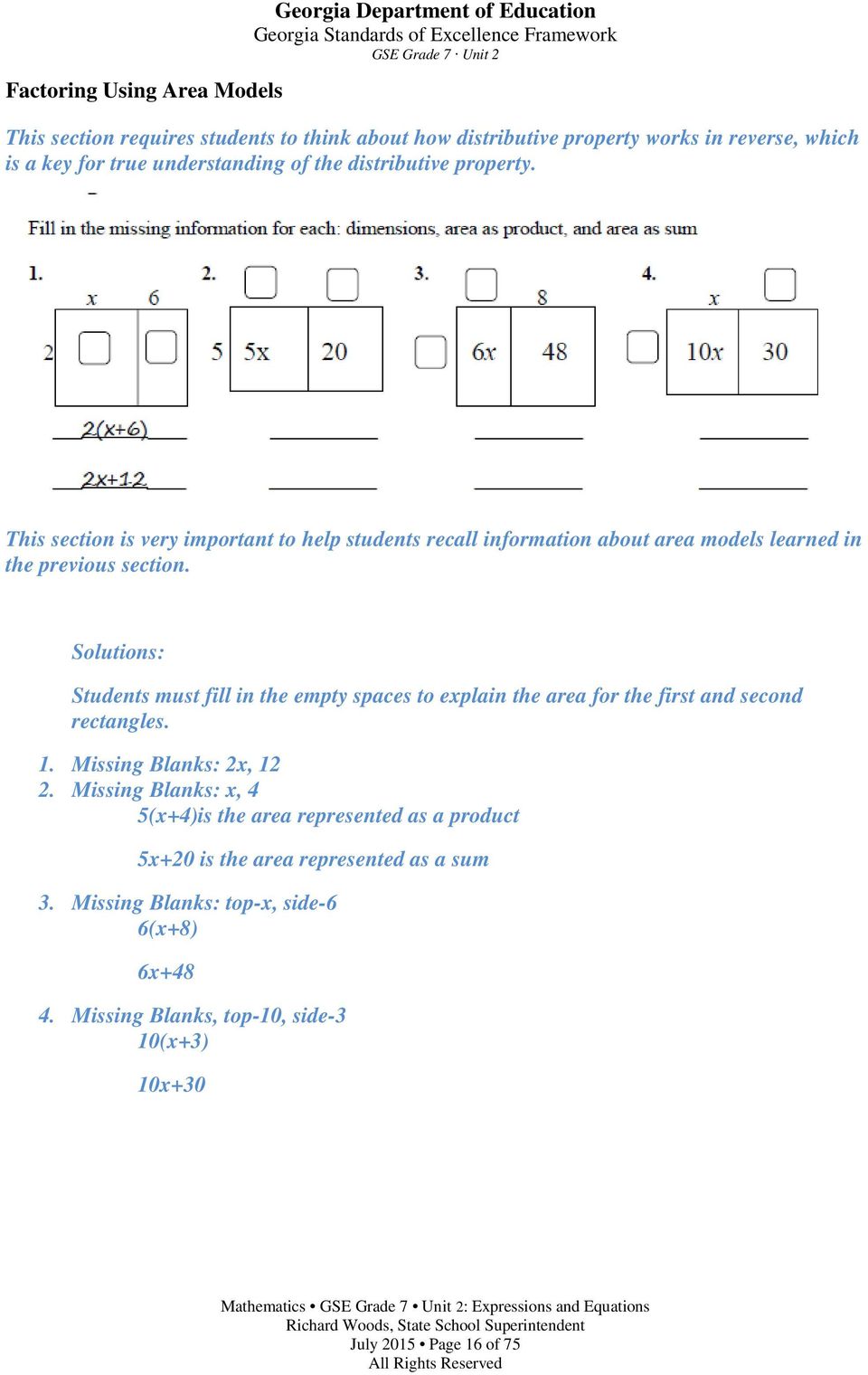
16 Factoring Using Area Models Georgia Department of Education This section requires students to think about how distributive property works in reverse, which is a key for true understanding of the distributive property. This section is very important to help students recall information about area models learned in the previous section. Solutions: Students must fill in the empty spaces to explain the area for the first and second rectangles. 1. Missing Blanks: 2x, Missing Blanks: x, 4 5(x+4)is the area represented as a product 5x+20 is the area represented as a sum 3. Missing Blanks: top-x, side-6 6(x+8) 6x Missing Blanks, top-10, side-3 10(x+3) 10x+30 July 2015 Page 16 of 75
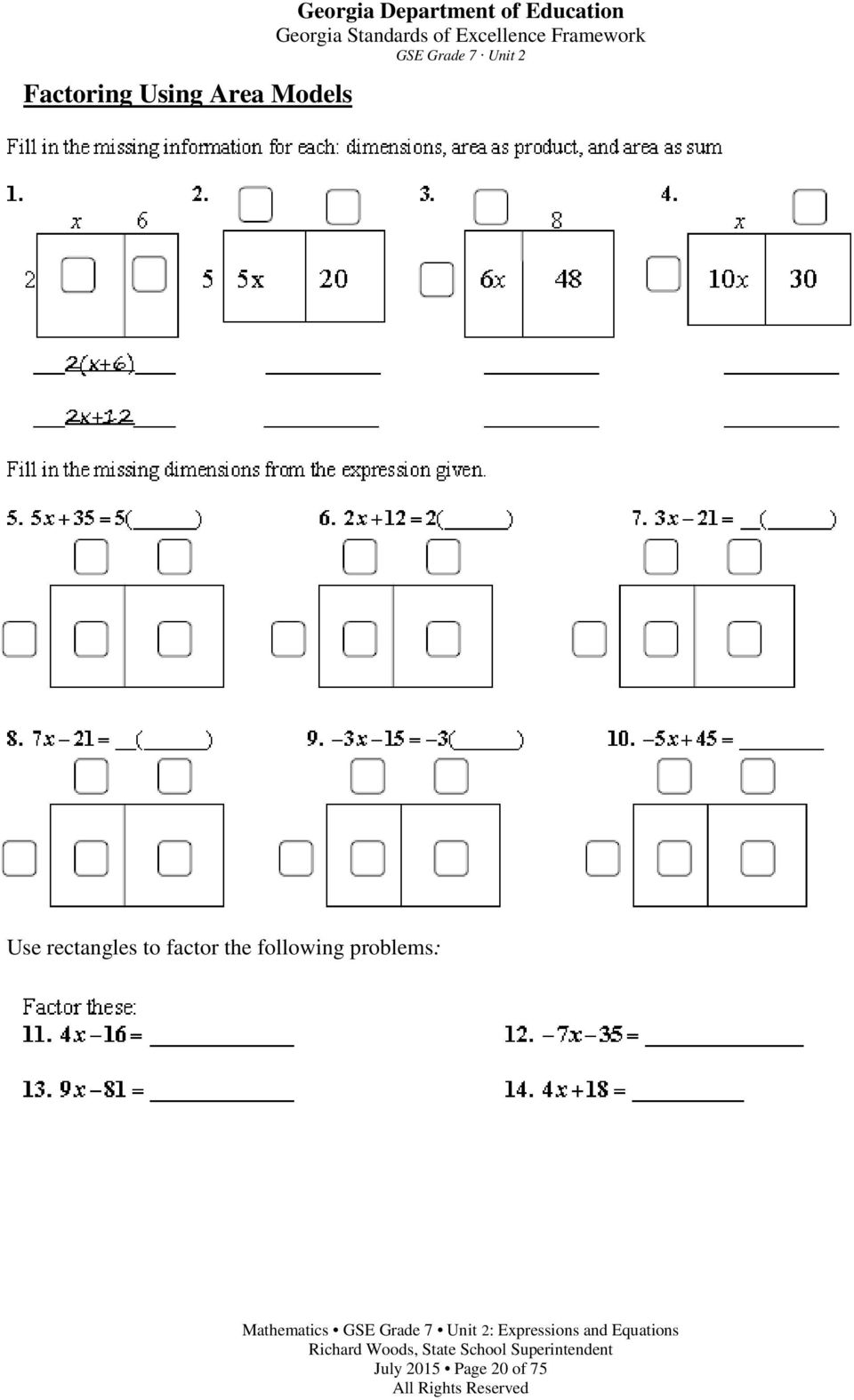
17 Solutions: Students will work to decompose the distributive property into components. Students can use rectangles to decompose the following problems: 5.(x+7)L-R(top): x;7 L-R(bottom): 5, 5x, 35 6.(x+6)L-R(top): x;6 L-R(bottom): 2, 2x, (x-7)L-R(top): x;-7 L-R(bottom): 3, 3x, (x-7)L-R(top): x;-3 L-R(bottom): 7, 7x, (x+5)L-R(top): x;5 L-R(bottom): -3, -3x, (x-9)L-R(top): x;-9 L-R(bottom): -5,- 5x, 45 Solutions: 11. 4(x-4) (x+5) 13. 9(x-9) 14. 2(2x+9) or 4(x+9/2) *this solution can be useful for discussing factoring out the greatest common factor versus a common factor. It will be important to emphasize that these expressions are equivalent July 2015 Page 17 of 75

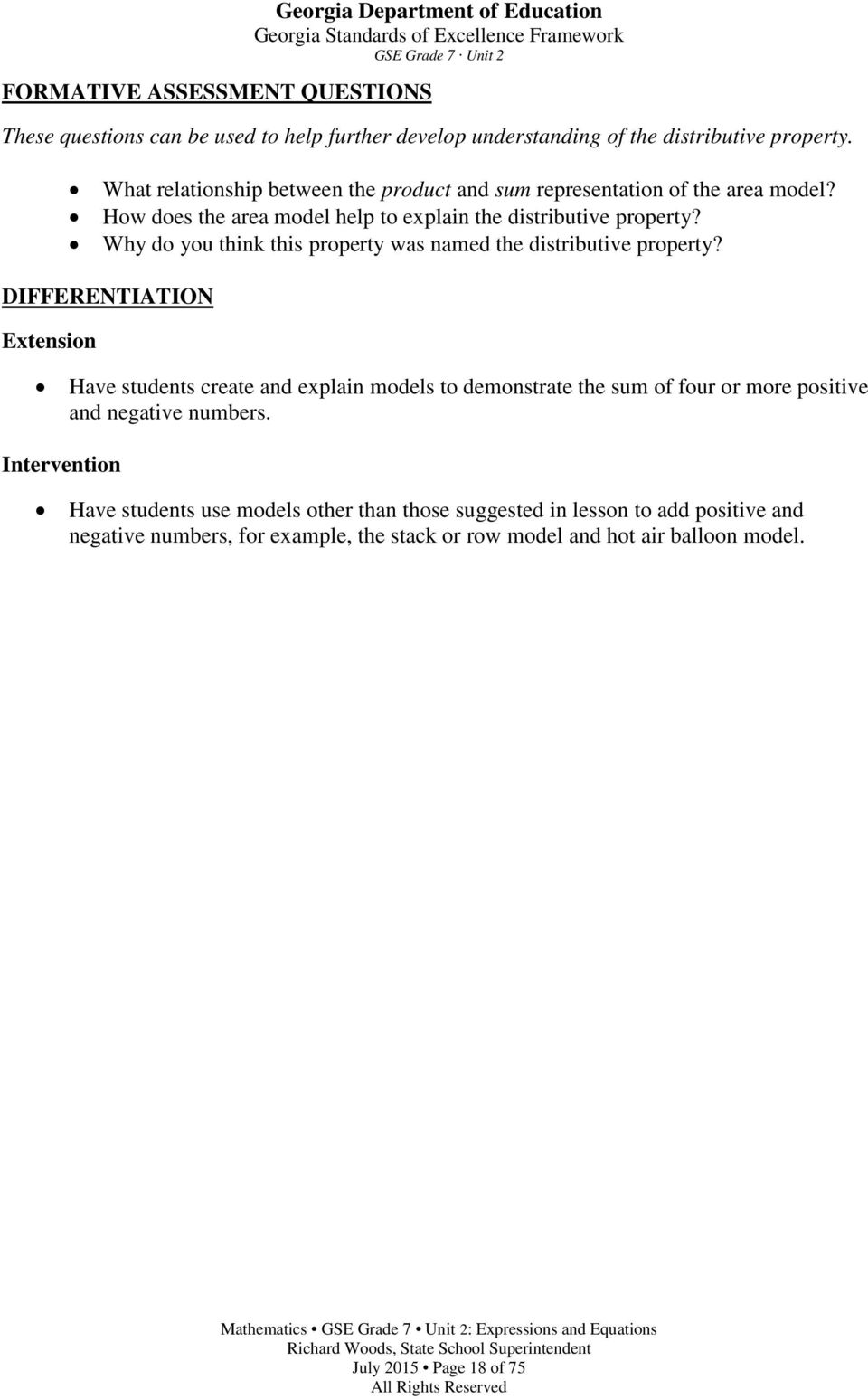
18 FORMATIVE ASSESSMENT QUESTIONS Georgia Department of Education These questions can be used to help further develop understanding of the distributive property. What relationship between the product and sum representation of the area model? How does the area model help to explain the distributive property? Why do you think this property was named the distributive property? DIFFERENTIATION Extension Have students create and explain models to demonstrate the sum of four or more positive and negative numbers. Intervention Have students use models other than those suggested in lesson to add positive and negative numbers, for example, the stack or row model and hot air balloon model. July 2015 Page 18 of 75
19 Distributing And Factoring Area Georgia Department of Education Use the distributive property to find sums that are equivalent to the following expressions. (You may want to use a rectangle to help you) 14. 4(x + 7) = 15. 7(x 3) = 16. 2(x + 4) = 17. 3(x + 9) = 18. 4(a 1) = 19. 3(m + 2) = 20. 4(a 4) = (a 12) = 2 July 2015 Page 19 of 75

20 Factoring Using Area Models Georgia Department of Education Use rectangles to factor the following problems: July 2015 Page 20 of 75
21 Triangles And Quadrilaterals Adapted from EngageNY Georgia Department of Education 3TBack to task table STANDARDS FOR MATHEMATICAL CONTENT MGSE7.EE.1 Apply properties of operations as strategies to add, subtract, factor, and expand linear expressions with rational coefficients. MGSE7.EE.2 Understand that rewriting an expression in different forms in a problem context can clarify the problem and how the quantities in it are related. For example a a = 1.05a means that adding a 5% tax to a total is the same as multiplying the total by STANDARDS FOR MATHEMATICAL PRACTICE 1. Solve problems and persevere. 2. Reason abstractly and quantitatively. 4. Model with mathematics. 6. Attend to precision. 7. Look for and make use of structure. ESSENTIAL QUESTIONS How can we represent value using variables? MATERIALS REQUIRED Envelopes containing triangles and quadrilaterals. TIME NEEDED 1 class period TASK DESCRIPTION PART I Each student is given an envelope containing triangles and quadrilaterals. How might expressions be generated based on the contents of your envelope? What expressions could you write? Individually. Compare with a partner. Share as a whole class. July 2015 Page 21 of 75
22 PART II Georgia Department of Education Each envelope contains a number of triangles and a number of quadrilaterals. For this exercise, let t represent the number of triangles, and let q represent the number of quadrilaterals. a. Write an expression, using t and q, that represents the total number of sides in your envelope. Explain what the terms in your expression represent. 3t+4q. Triangles have 3 sides, so there will be 3 sides for each triangle in the envelope. This is represented by 3t. Quadrilaterals have 4 sides, so there will be 4 sides for each quadrilateral in the envelope. This is represented by 4q. The total number of sides will be the number of triangle sides and the number of quadrilateral sides together. b. You and your partner have the same number of triangles and quadrilaterals in your envelopes. Write an expression that represents the total number of sides that you and your partner have. If possible, write more than one expression to represent this total. 3t+4q+3t+4q; 2(3t+4q); 6t+8q Discuss the variations of the expression in part (b) and whether those variations are equivalent. This discussion helps students understand what it means to combine like terms; some students have added their number of triangles together and number of quadrilaterals together, while others simply doubled their own number of triangles and quadrilaterals since the envelopes contain the same number. This discussion further shows how these different forms of the same expression relate to each other. Students then complete part (c). c. Each envelope in the class contains the same number of triangles and quadrilaterals. Write an expression that represents the total number of sides in the room. Answer depends on the seat size of the classroom. For example, if there are 12 students in the class, the expression would be 12(3t+4q), or an equivalent expression. Next, discuss any variations (or possible variations) of the expression in part (c), and discuss whether those variations are equivalent. Are there as many variations in part (c), or did students use multiplication to consolidate the terms in their expressions? If the latter occurred, discuss the students reasoning. Choose one student to open his/her envelope and count the numbers of triangles and quadrilaterals. Record the values of t and q as reported by that student for all students to see. Next, students complete parts (d), (e), and (f). July 2015 Page 22 of 75
23 d. Use the given values of t and q, and your expression from part (a), to determine the number of sides that should be found in your envelope. e. Use the same values for t and q, and your expression from part (b), to determine the number of sides that should be contained in your envelope and your partner s envelope combined. f. Use the same values for t and q, and your expression from part (c), to determine the number of sides that should be contained in all of the envelopes combined Have all students open their envelopes and confirm that the number of triangles and quadrilaterals matches the values of t and q recorded after part (c). Then, have students count the number of sides contained on the triangles and quadrilaterals from their own envelope and confirm with their answer to part (d). Next, have partners count how many sides they have combined and confirm that number with their answer to part (e). Finally, total the number of sides reported by each student in the classroom and confirm this number with the answer to part (f). July 2015 Page 23 of 75
24 g. What do you notice about the various expressions in parts (e) and (f)? The expressions in part (e) are all equivalent because they evaluate to the same number: 40. The expressions in part (f) are all equivalent because they evaluate to the same number: 240. The expressions themselves all involve the expression 3t+4q in different ways. In part (e), 3t+3t is equivalent to 6t, and 4q+4q is equivalent to 8q. There appear to be several relationships among the representations involving the commutative, associative, and distributive properties. When finished, have students return their triangles and quadrilaterals to their envelopes for use by other classes. Extension: Numbers of triangles and quadrilaterals can vary among students. Students can set up equivalent expressions (equations) using their available triangles and quadrilaterals. Intervention: Envelopes can have adjusted numbers of triangles and quadrilaterals to make computation less cumbersome for students who need support with the concept of writing expressions using variables, and combining them. PART III: Using shapes other than triangles and quadrilaterals, generate and model expressions and have a partner recreate your expressions given clues and instructions (from their partner). July 2015 Page 24 of 75
25 Triangles And Quadrilaterals Adapted from EngageNY Georgia Department of Education Name PART I Each student is given an envelope containing triangles and quadrilaterals. How might expressions be generated based on the contents of your envelope? What expressions could you write? PART II Each envelope contains a number of triangles and a number of quadrilaterals. For this exercise, let t represent the number of triangles, and let q represent the number of quadrilaterals. a. Write an expression, using t and q, that represents the total number of sides in your envelope. Explain what the terms in your expression represent. b. You and your partner have the same number of triangles and quadrilaterals in your envelopes. Write an expression that represents the total number of sides that you and your partner have. If possible, write more than one expression to represent this total. c. Each envelope in the class contains the same number of triangles and quadrilaterals. Write an expression that represents the total number of sides in the room. July 2015 Page 25 of 75
26 d. Use the given values of t and q, and your expression from part (a), to determine the number of sides that should be found in your envelope. e. Use the same values for t and q, and your expression from part (b), to determine the number of sides that should be contained in your envelope and your partner s envelope combined. f. Use the same values for t and q, and your expression from part (c), to determine the number of sides that should be contained in all of the envelopes combined g. What do you notice about the various expressions in parts (e) and (f)? PART III: Using shapes other than triangles and quadrilaterals, generate and model expressions and have a partner recreate your expressions given clues and instructions (from their partner). July 2015 Page 26 of 75
27 Area And Algebra Georgia Department of Education 3TBack to task table Adapted from: 3Thttp://mdk12.org/instruction/clg/public_release/algebra_data_analysis/G1_E1_I3.html3T 3Thttp:// To complete the task, students will revisit area and perimeter of composite figures. In conjunction with this knowledge, students will solve the task by rewriting and evaluating algebraic expressions, applying the properties of real numbers (particularly the distributive property), and reasoning and problem solving. STANDARDS FOR MATHEMATICAL CONTENT MGSE7.EE.1 Apply properties of operations as strategies to add, subtract, factor, and expand linear expressions with rational coefficients. MGSE7.EE.2 Understand that rewriting an expression in different forms in a problem context can clarify the problem and how the quantities in it are related. For example a a = 1.05a means that adding a 5% tax to a total is the same as multiplying the total by STANDARDS FOR MATHEMATICAL PRACTICE 1. Make sense of problems and persevere in solving them. 2. Reason abstractly and quantitatively. 5. Use appropriate tools strategically. 6. Attend to precision. 7. Look for and make use of structure. BACKGROUND KNOWLEDGE In order for students to be successful, the following skills and concepts need to be maintained: Knowledge that perimeter is used to measure the outside length of a figure Knowledge that area is used to measure the space inside of a figure Adding and subtracting positive and negative rational numbers in a real-world context COMMON MISCONCEPTIONS Students have difficulties understanding equivalent forms of numbers, their various uses and relationships, and how they apply to a problem. Make sure to expose students to multiple examples and in various contexts. ESSENTIAL QUESTIONS What properties are required in order to rewrite and evaluate algebraic expressions and solve equations? MATERIALS Area and Algebra Student Task sheet Graph paper (optional) July 2015 Page 27 of 75
28 GROUPING Individual/Partner Georgia Department of Education TASK DESCRIPTION As an introduction to the task, problems involving area and perimeter with plane and composite figures may need to be reviewed. Problems will need to include plane and composite figures with missing side lengths so that students may reacquaint themselves with the area and perimeter concepts learned prior to 7 th grade. I. Perimeter and Area of Figures Find the perimeter and area of the following figures. Explain in words how you found the perimeter and area of each figure. (unit: inches) 1. Perimeter: =27 inches Explanation: Area: 10(3.5)=35.0 inches Example: The perimeter of a figure is found by adding all sides. You must split this figure into two rectangles in order to find the total area. Students should be able to demonstrate the difference between perimeter and area as well as write their computations out step-by-step. 2. Explanation: Perimeter: =114 inches Area: 27(24)+9(6)=648+54=702 inches Example: The perimeter of a figure is found by adding all sides. You must split this figure into two rectangles in order to find the total area. Students should be able to demonstrate the difference between perimeter and area as well as write their computations out step-by-step. It is crucial that students be able to solve for the missing side lengths and their measurements July 2015 Page 28 of 75
29 II. Perimeter of Algebraic Figures Find the perimeter of each of the following figures. 1. What is the perimeter of this figure? (x + 1) + (x 1) + (x + 3) + (x 2) + x x + x + x + x bb ccccccccccc pppppppp 5x 2 by associative property and combining like terms 2. What is the perimeter of the figure if x=3in.? Show your calculations step-by-step. 5x 2 = 5(3) 2 = 15 2 = 13 Students must use the expression generated in Part 2 #1 in order to solve this for this equation. 3. What is the perimeter of this figure? a + a a a = 4a + 20 *See #1 for similar explanation 4. What is the perimeter of the figure if a=1/2 in.? Show your calculations step-by-step. 4a + 20 = = = 22 inches 2 3Thttp://mdk12.org/instruction/clg/public_release/algebra_data_analysis/G1_E1_I3.html3T 3Thttp:// III. Perimeter and Area of Algebraic Figures Task Directions: A corner has been removed from this rectangle. 1. Find an expression for the perimeter of the rectangle. Solution: The perimeter of the rectangle is found by adding all of the sides. The sum of the sides is 4 + 3a a (3a+ 4-2a). 3a +2a + a subtraction and commutative property of addition (3a +2a + a) + ( ) associative property of addition 6a + 20 July 2015 Page 29 of 75
30 2. What is the perimeter of the rectangle if a = ¾ inch? Show your calculations step-by-step. Solution: If a = ¾, then 6(¾) + 20 = = = 99 4 or 24.5 inches. 3. Find an expression for the area of the rectangle. Solution: There are two ways to find this area. One is to treat the shape as the composition of two rectangles. The area of the smaller rectangle is 2(2a) or 4a. The area of the larger rectangle is 4(3a + 4). Thus the area is: 4a + 4(3a + 4) 4a + 12a + 16 distributive property 16a + 16 A second method is to compose one rectangle and subtract away the area of the corner that has been removed. The area of the composed rectangle is 6(3a + 4) or 18a The area of the corner rectangle that has been removed is 2(3a + 4-2a) or 2a + 8. Thus the area is: (18a + 24) (2a + 8) 16a What is the area of the rectangle if a = 1.8 feet? Show your calculations step-by-step. Solution: If a = 1.8 feet, then the area is 16 x = = 44.8 square feet. DIFFERENTIATION Extension Create different problems similar to the one in this task involving irregular shapes. Intervention Have students complete problems that do not involve fractional units (fractions or decimals). Make sure that all polygons used for this lesson are regular; do not use irregular un-closed shapes. July 2015 Page 30 of 75
31 Area And Algebra Georgia Department of Education I. Perimeter and Area of Figures Find the perimeter and area of the following figures. Explain in words how you found the perimeter and area of each figure. (unit: inches) 1. Perimeter: Area: Explanation: 2. Perimeter: Area: Explanation: July 2015 Page 31 of 75
32 II. Georgia Department of Education Perimeter of Algebraic Figures Find the perimeter of each of the following figures. 1. What is the perimeter of this figure? 2. What is the perimeter of the figure if x=3in.? Show your calculations step-by-step. 3. What is the perimeter of this figure? 4. What is the perimeter of the figure if a=1/2 in.? Show your calculations step-bystep. July 2015 Page 32 of 75
33 III. Georgia Department of Education Perimeter and Area of Algebraic Figures A corner has been removed from this rectangle. Answer the following questions related to figure below. 1. Find an expression for the perimeter of the rectangle. 2. What is the perimeter of the rectangle if a = ¾ inch? Show your calculations step-by-step. 3. Find an expression for the area of the rectangle. 4. What is the area of the rectangle if a = 1.8 feet? Show your calculations step-by-step. July 2015 Page 33 of 75
34 Guess My Number! (Spotlight Task) Georgia Department of Education July 2015 Page 34 of 75 3TBack to task table Adapted from Illustrative Mathematics STANDARDS FOR MATHEMATICAL CONTENT MGSE7.EE.2 Understand that rewriting an expression in different forms in a problem context can clarify the problem and how the quantities in it are related. For example a a = 1.05a means that adding a 5% tax to a total is the same as multiplying the total by Solve real life and mathematical problems using numerical and algebraic expressions and equations MGSE7.EE.3 Solve multistep real-life and mathematical problems posed with positive and negative rational numbers in any form (whole numbers, fractions, and decimals) by applying properties of operations as strategies to calculate with numbers, converting between forms as appropriate, and assessing the reasonableness of answers using mental computation and estimation strategies. For example: If a woman making $25 an hour gets a 10% raise, she will make an additional 1/10 of her salary an hour, or $2.50, for a new salary of $ If you want to place a towel bar 9 3/4 inches long in the center of a door that is 27 1/2 inches wide, you will need to place the bar about 9 inches from each edge; this estimate can be used as a check on the exact computation. STANDARDS FOR MATHEMATICAL PRACTICE 1. Make sense of problems and persevere in solving them. 2. Reason abstractly and quantitatively. 3. Construct viable arguments and critique the reasoning of others. 5. Use appropriate tools strategically. 6. Attend to precision. 7. Look for and make use of structure. BACKGROUND KNOWLEDGE This problem asks the students to represent a sequence of operations using an expression and then to write and solve simple equations. The problem is posed as a game and allows the students to visualize mathematical operations. It would make sense to actually play a similar game in pairs first and then ask the students to record the operations to figure out each other's numbers. Some students will write (x+4) 5 7 Many students translate word problems literally and place numbers in the problem as they appear in the sentences/paragraph. This provides a good opportunity to talk about the properties of operations and how they can be used to write the same expression in different ways. The last part of the task in particular is meant to generate classroom discussion, and isn't meant for e.g. high-stakes assessment situations.
35 ESSENTIAL QUESTIONS What strategies can be used for understanding and representing real situations using algebraic expressions and equations? MATERIALS Area and Algebra Student Task sheet Graph paper (optional) GROUPING Individual/Partner TASK DESCRIPTION Laila tells Julius to pick a number between one and ten. Add three to your number and multiply the sum by five, she tells him. Next she says, Now take that number and subtract seven from it and tell me the new number. Twenty-three, Julius exclaims. Can you figure out what Julius number was? Write down a guess that is too low. Write down a guess that is too high. How did you know? Working with a partner, record your operations that Julius used. What was his number? In the next round, Leila is supposed to pick a number between 1 and 10 and follow the same instructions. She gives her final result as 108. Julius immediately replies: Hey, you cheated! What might he mean? This problem asks the students to represent a sequence of operations using an expression and then to write and solve simple equations. The problem is posed as a game and allows the students to visualize mathematical operations. It would make sense to actually play a similar game in pairs first and then ask the students to record the operations to figure out each other's numbers. Solutions The unknown variable here is Julius original number. Let n be Julius original number. We know from Laila s directions that first, Julius added three to his number: n+3 She then told him to multiply this sum by five: 5(n+3) Finally, she told him to subtract seven from this number: July 2015 Page 35 of 75
36 5(n+3) 7 This is the expression that records the operations that Julius used. 1. Julius exclaims that his new number after performing Laila s instructions is twenty-three. So we set our expression from part (a) equal to 23 and solve for n, Julius original number. Thus, Julius original number was three. 2. To find Laila s number we solve 5(n+3) 7=23 5n+15=30 5n=15 n=3 5(n+3) 7=108. We find n=20. So Laila did not follow the instructions of using a number between 1 and 10. July 2015 Page 36 of 75
37 Guess My Number! (Spotlight Task) Georgia Department of Education Name Date Laila tells Julius to pick a number between one and ten. Add three to your number and multiply the sum by five, she tells him. Next she says, Now take that number and subtract seven from it and tell me the new number. Twenty-three, Julius exclaims. Can you figure out what Julius number was? Write down a guess that is too low. Write down a guess that is too high. How did you know? Working with a partner, record your operations that Julius used. What was his number? In the next round, Leila is supposed to pick a number between 1 and 10 and follow the same instructions. She gives her final result as 108. Julius immediately replies: Hey, you cheated! What might he mean? July 2015 Page 37 of 75
38 Algebra Magic Georgia Department of Education 3TBack to task table Is this magic trick based on telepathy, or algebra? To find out, students model a sequence of algebraic steps. (Adapted from The Future s Channel website) * This task is similar to the FAL Building and Solving Equations 1 that comes after it. The outline provided is useful and suggested to be used for this task. It can be accessed through the link below. The activity includes a mini-lesson that introduces students to writing expressions. The lesson will guide students through the process of modeling the expression. The original task can be found at: 3Thttp:// STANDARDS FOR MATHEMATICAL CONTENT MGSE7.EE.1 Apply properties of operations as strategies to add, subtract, factor, and expand linear expressions with rational coefficients. MGSE7.EE.2 Understand that rewriting an expression in different forms in a problem context can clarify the problem and how the quantities in it are related. For example a a = 1.05a means that adding a 5% tax to a total is the same as multiplying the total by MGSE7.EE.3 Solve multistep real-life and mathematical problems posed with positive and negative rational numbers in any form (whole numbers, fractions, and decimals) by applying properties of operations as strategies to calculate with numbers, converting between forms as appropriate, and assessing the reasonableness of answers using mental computation and estimation strategies. For example: If a woman making $25 an hour gets a 10% raise, she will make an additional 1/10 of her salary an hour, or $2.50, for a new salary of $ If you want to place a towel bar 9 3/4 inches long in the center of a door that is 27 1/2 inches wide, you will need to place the bar about 9 inches from each edge; this estimate can be used as a check on the exact computation. MGSE7.EE.4 Use variables to represent quantities in a real world or mathematical problem, and construct simple equations and inequalities to solve problems by reasoning about the quantities. STANDARDS FOR MATHEMATICAL PRACTICE 1. Make sense of problems and persevere in solving them. 2. Reason abstractly and quantitatively. 4. Model with mathematics. 6. Attend to precision. 7. Look for and make use of structure. 8. Look for and express regularity in repeated reasoning. July 2015 Page 38 of 75
39 COMMON MISCONCEPTIONS Georgia Department of Education 7.EE.3 Provide concrete examples for students to use and understand the properties of operations. These include: the commutative, associative, identity, and inverse properties of addition and of multiplication, and the zero property of multiplication. Another method students can use to become convinced that expressions are equivalent is to justify each step of rewriting of an expression with an operation property. 7.EE.4 Provide multiple opportunities for students to work with multi-step problem situations that have multiple solutions and therefore can be represented by an inequality. Students need to be aware that values can satisfy an inequality but not be appropriate for the situation, therefore limiting the solutions for that particular problem. Write an equation or inequality to model the situation. Explain how you determined whether to write an equation or inequality and the properties of the real number system that you used to find a solution ESSENTIAL QUESTIONS How can mathematical relationships be represented as expressions, equations, or inequalities? MATERIALS 1 plastic re-sealable bag containing 10 small discs (roughly 1 in diameter) 2 other objects which are identical to each other but different from and somewhat larger than the discs (these objects could be wooden blocks, plastic construction bricks, or geometric shapes cut from construction paper or cardboard) 1 calculator (optional but recommended) GROUPING Individual/partner TASK DESCRIPTION This task is designed to help students develop their understanding of how to translate words into algebraic expressions. Students will also need to implement properties (commutative, associative, distributive, etc.) in order to rewrite the expressions and prove how the trick works. Teacher Notes: Introduction to Algebra Magic Tricks Ask students to pick a number and write it on their paper. Then read through the following steps and have students follow along performing the given operations on their paper. Make sure to pause while reading to allow students time to complete the operation. July 2015 Page 39 of 75
40 Start with a number. Add seven. Double the result. Subtract four. Half the result. Subtract five Georgia Department of Education Solution: Example: = 9(2) = 18 4=14(1/2) = 7 5 = 2 All students should get the same number. Upon completion, discuss what result each student got as a result. Why do you think this occurred? Think about the date of your birthday. Multiply the number of the month of your birthday by 5. Add 7. Multiply by 4. Add 13. Multiply by 5. Add the day of your birthday. Subtract 205. Write your answer. Your answer should show the month and day of your birth. USING MATH TO PROVE ALGEBRA MAGIC TRICKS For each magic trick below, work through the trick with numbers. Then, write an expression and rewrite it to demonstrate the operation being performed in the trick. Trick #1 Steps to Trick Numerical Expression Equivalent Expression Start with an even number i.e. 4 x X Double the number 4(2) = 8 2x 2x Add = 12 2x + 4 2x + 4 Subtract = 6 (2x + 4) 6 *opportunity to review associative property Half the number 6/2 = 3 (2x 2) / 2 2x 2 X 1 July 2015 Page 40 of 75
41 Trick #2 Steps to Trick Numerical Expression Equivalent Expression Start with a number i.e. 2 X X Add six = 8 X + 6 Double the Result 8(2) = 16 2(X + 6) Subtract = -4 (2x + 12) 20 *associative property Subtract your original number -4 2 = -6 (2x + -8) x *associative and commutative property Add = 2 (X + -8) + 8 *associative property X + 6 2x x + -8 X + -8 X Trick #3 Steps to Trick Numerical Expression Equivalent Expression Start with a number. i.e 1 x X It must be a fraction. 2 3x Triple the number 1 3x 2 2 3x + 8 Add = 5 4 3x 1 4 3x 1 4 Subtract twice the 5 x 1 number 4 (2) 1 2 = 1 3x 1 2x Add = 11 (x 1 ) + 3 = x x Subtract the original 11 7 number = 7 X x What properties did you have to apply in order to rewrite the algebraic expressions? Solution: distributive property, commutative property, combining like terms 2. Create a trick with four steps that will have a result of 5. Write the algebraic expression(s) that prove it works. Solution: Answers May vary 3. Create a new trick with the distributive property that will result in starting and ending with the same value. Write the algebraic expression(s) that prove that it works. Solution: Answers May vary July 2015 Page 41 of 75
42 4. Create a trick where you start with the day of your birth and end with the month of your birth. Write a numerical expression to show each of your steps. Solution: Answers may vary DIFFERENTIATON Extension: Have students create more complex number tricks using decimals or fractions within their steps. Can students create number tricks that begin or end with a fraction or decimal? Intervention: Tricks can be simplified by having fewer steps. Questions can be changed to create tricks that are less complex or have fewer steps. Students may also find more success by working with a partner and talking through what happens in each trick. Modeling with manipulatives may be a way to provide a concrete explanation of what is taking place in a problem. July 2015 Page 42 of 75
43 Algebra Magic - Using Math To Prove Algebra Magic Tricks In the space provided, follow your teacher s instructions for the first math trick. What did you get as a result? How does this compare to your classmates answers? For each magic trick below, work through the trick with numbers. Then, write an expression and rewrite it to demonstrate the operation being performed in the trick. Trick #1 Steps to Trick Numerical Expression Equivalent Expression Start with a number Double the number Add 4 Subtract 5 Half the number Trick #2 Steps to Trick Numerical Expression Equivalent Expression Start with a number Add six Double the Result Subtract 20 Subtract your original number Add 8 July 2015 Page 43 of 75
44 Trick #3 Steps to Trick Numerical Expression Equivalent Expression Start with a number. It must be a fraction. Triple the number Add 1 4 Subtract twice the number Add 3 5 Subtract the original number 1. What properties did you have to apply in order to rewrite the algebraic expressions? 2. Create a trick with four steps that will have a result of 5. Write the algebraic expression(s) that prove it works. 3. Create a new trick with the distributive property that will result in starting and ending with the same value. Write the algebraic expression(s) to prove it works. 4. Create a trick where you start with the day of your birth and end with the month of your birth. Write a numerical expression to show each of your steps. July 2015 Page 44 of 75
45 Geology Rocks Equations 3TBack to task table3t Task Adapted from: 3Thttp://illuminations.nctm.org/LessonDetail.aspx?id=L786 In this lesson, students explore linear equations with manipulatives and discover various steps used in solving equation problems. Students use blocks and counters as tactile representations to help them solve for unknown values of0t 0Tx. Students should work in groups or pairs. This will encourage discussion during the lesson, which will help with understanding the manipulative representation. Try to match students who are likely to understand the manipulatives with students who may have trouble initially. STANDARDS FOR MATHEMATICAL CONTENT MGSE7.EE.2 Understand that rewriting an expression in different forms in a problem context can clarify the problem and how the quantities in it are related. For example a a = 1.05a means that adding a 5% tax to a total is the same as multiplying the total by MGSE7.EE.3 Solve multistep real-life and mathematical problems posed with positive and negative rational numbers in any form (whole numbers, fractions, and decimals) by applying properties of operations as strategies to calculate with numbers, converting between forms as appropriate, and assessing the reasonableness of answers using mental computation and estimation strategies. For example: If a woman making $25 an hour gets a 10% raise, she will make an additional 1/10 of her salary an hour, or $2.50, for a new salary of $ If you want to place a towel bar 9 3/4 inches long in the center of a door that is 27 1/2 inches wide, you will need to place the bar about 9 inches from each edge; this estimate can be used as a check on the exact computation. STANDARDS FOR MATHEMATICAL PRACTICE 1. Make sense of problems and persevere in solving them. 2. Reason abstractly and quantitatively. 3. Construct viable arguments and critique the reasoning of others. 4. Model with mathematics. 6. Attend to precision. COMMON MISCONCEPTIONS Students will just want to take pieces off the scale instead of attempting to keep it balanced. Many students have not ever seen a balance scale and therefore will need an explanation of what they look like, how they work, and how they are used in everyday life (science) or historically (in the past). July 2015 Page 45 of 75
46 ESSENTIAL QUESTIONS Georgia Department of Education What strategies can be used to represent real situations using algebraic expressions and equations? MATERIALS Manipulative blocks (or similar manipulatives) Counter chips (or similar manipulatives) 3TGeology Rocks Equations Activity Sheet3T GROUPING Individual / Partner TASK DESCRIPTION The teacher should present a scale with objects on both sides. Use a real scale and objects if possible. If not, use clip art or another picture of a scale as a visual, as shown here: Students should then be allowed to build and balance equations using technology or hands-on manipulatives. The teacher should use discretion as to which type of modeling will be best for their own students for the introduction portion of this task. Interactive balance scales: 1. Hands-On Equations for IPADS 3Thttp:// (most schools have Hands-On Equations kits, Algebra Lab Gear, or some other hands-on manipulatives that would work for modeling equations) 2. Algebra Balance Scales: This virtual manipulative allows you to solve simple linear equations through the use of a balance. July 2015 Page 46 of 75
47 Above is a sample written assessment to use while students are interacting with Algebra Balance Scales. On a chart draw a picture of the balance beam for every step, write a description for every step, and write down the algebraic representation and show work algebraically for every step. Adapted from : 3Thttp://nlvm.usu.edu/en/nav/frames_asid_324_g_3_t_2.html?open=instructions&from=category _g_3_t_2.html Teacher Notes:Geology Rocks Task 1. Begin the lesson by distributing the0t 0T3TGeology Rocks Equations0T3T 0Tactivity sheet and the manipulatives. Have students read the opening paragraph and Question 1 on their own. Use the first question as a demonstration of what they will be doing with the questions that follow. 2. Tell students that the blocks represent the crates, and each chip counter represents a 1- pound rock. Ask students to create a representation of the problem on their desks using the manipulatives. Then, ask them to discuss in their groups ways to figure out how many rocks are in the crates using only this information. 3. You may want to allow students time to explore and share their thoughts within their groups about how they are using the manipulatives to help them solve the problem. After you have given students time to explore, ask the groups to share their answers with the class. 4. The correct answer to Question 1 is that there are 2 rocks in each crate. Have students who found the correct solution share their strategy with the class. July 2015 Page 47 of 75
48 5. Some students may have used a guess-and-check strategy until they found out the weight of the crate, while others may have rewrote the equation. As an introduction to the problem, this is fine. As students begin to think-pair-share their strategies to balance the equation, encourage those who are using guess-and-check to collaborate with those using algebra. Guess and check is a valid strategy when beginning with these equations; it requires solving the problem mathematically using a step-by-step process. Students are performing the operations multiple times and finding solutions that do not work, but at the same time they are gaining practice until they find the solution that does work. 6. Allow students to work on their own to complete Questions 2 to 5. As you move through the class, ask students to explain to you how the equation they are building using the manipulatives represents the problem on the paper. Encourage students to use multiple approaches to solve each problem this will help them build the connections between representations. 7. After students have finished Questions 2 to 5, have them share within their group how many rocks they think are in each crate. For each solution, ask the class if they agree. If all groups agree, move on to the next problem. If someone disagrees have the class recreate the problem using the manipulatives and walk through the solution steps together to agree on the solution. Use student volunteers where possible as you go through the answers. Activity Sheet Answers 2. x = 4 3. x = x = 4 5. x = 7 8. Once the class has agreed on all the solutions, inform students that the solutions they created are actually linear equations and can be represented mathematically with equations, similar to the equations you showed earlier using boxes. 9. Ask students to look over each problem and write an equation they think mathematically represents the initial picture Mr. Anderson made. Some students may not immediately make the connection that the boxes stand for unknown values of x and the rocks represent constants. You should stress this connection as students are working. To help them with the connection, you can have students use x's or boxes or both. Some students may have an easier time making the connection using the instead of x. Equations 2. 4x + 2 = 18 or = x + 12 = 3x or = x + 8 = x + 12 or = x + 3 = 2x + 24 or = As soon as students have created the equations, discuss them as a class so they are agreed upon. When students have finished writing their equations, allow them to complete Questions 6 to 9 on the activity sheet. Allow students to solve these equations with or without manipulatives, depending on their own preference. Answers (continued) 6. x = 3 7. x = 6 8. x = 4 9. x = 3 July 2015 Page 48 of 75
49 11. To summarize the lesson, have students share with the class any strategies they came up with that make it quicker to solve the problems without creating a manipulative representation each time. Students may have realized that you are subtracting or adding a constant, and then dividing by the coefficient of x. Discuss with students the steps involved in solving these equations. You are isolating the numbers on one side of the equation and the unknown on the other. You are grouping like terms and solving. Use an example not on the activity sheet, such as the one below in your discussion: 3x + 8 = 1x x = 1x + 4 1x 1x 2x = 4 2 = 2 x = Ask students to write down on their activity sheet a list of steps to solve the problems and compare their lists with one another. Most solutions will require at least 2 steps to solve. As students begin to more fully grasp the process of 2-step equations, ask them to solve the equation 5x 8 = 1x + 2. In solving this equation, students will be faced with using negative integers and accepting a solution that is not a whole number (x = 2.5). Students may find it tough to create manipulative representations of these harder equations. Allow them to explore and work it out on their own. This is truly an exploration for students. DIFFERENTIATION Extension The teacher could allow students to create their own representation of the situation with the chips, which will help ensure that each student understands the problem. After 30 seconds or so, they can pair-share to correct any problems with their representations and discuss their solutions. Present an altered form of Mr. Anderson's lab problems, in which he uses balloons that have exactly one pound of lift ( 1). If a balloon is tied to a rock, together they weigh 0 pounds because they balance each other out. Each crate still represents x, the unknown number of rocks inside. Create similar pictures and equations for students, and have them find the number of rocks in each crate. Extend this activity to include equations involving negative and non-integral unknowns. For example, 4x 4 = x + 3 or 4x + 12 = x 3. Present this problem to students: A 40-pound rock is dropped on the ground, and it breaks into 4 pieces, each piece weighing an integral number of pounds. Using a balance scale, these 4 pieces can be used to measure any integer weight from 1 to 40 pounds. How much does each piece of the rock weigh? July 2015 Page 49 of 75
50 Intervention Georgia Department of Education If students do not find the answer to question 1, lead the class through the process: Mr. Anderson realizes that he can remove 2 rocks from each side of the scale and still have a balanced scale. This leaves him with the following: Then, Mr. Anderson realizes that he can remove a crate from each side of the scale and still remain balanced. This leaves him with the following: Students can represent these situations algebraically. Use boxes instead of x's: This could then be rewritten to: = = + 4 Students can remove boxes and numbers just as they did on the scale. Teachers often give students manipulatives and expect them to complete the analogy on their own. However, quite often, students are not able to make the connection. The teaching is much more effective if you make the analogy explicit for students. That is, explain explicitly how the boxes and rocks represent variables and numbers. July 2015 Page 50 of 75
51 Geology Rocks Equations Georgia Department of Education Name Mr. Anderson is a geologist and has a laboratory full of rocks. He knows that each rock weighs exactly one pound (+1), and he would like to figure out how many rocks are in each crate. To figure that out without opening the crates, Mr. Anderson places crates and rocks on a scale until they are balanced. Using his math skills, he is able to reason how many rocks are in each crate without having to look inside. 1. The following picture represents the first set of crates and rocks Mr. Anderson put on the balance. How many rocks are inside each crate? Mr. Anderson has made several picture representations on his clipboard of other combinations of crates and rocks that balanced. Can you figure out how many rocks are in each set of crates? July 2015 Page 51 of 75
52 5. Mr. Anderson wrote down the following equations, but did not draw any pictures. Can you find the value of x in each? (Hint: Think of each x as a crate of rocks.) 6. 7x = 6 + 5x = 4x (x + 4) = x = 3x + 13 July 2015 Page 52 of 75
53 Deconstructing Word Problems Georgia Department of Education 3TBack to task table (Adapted from Deciphering Word Problems which can be found at 3Thttp:// orld_problems.pdf3t ) The goal of this lesson is for students to build expressions and equations when presented with a real life problem. STANDARDS FOR MATHEMATICAL CONTENT: MGSE7.EE.1 Apply properties of operations as strategies to add, subtract, factor, and expand linear expressions with rational coefficients. MGSE7.EE.2 Understand that rewriting an expression in different forms in a problem context can clarify the problem and how the quantities in it are related. For example a a = 1.05a means that adding a 5% tax to a total is the same as multiplying the total by MGSE7.EE.4a Solve word problems leading to equations of the form px + q = r and p(x + q) = r, where p, q, and r are specific rational numbers. Solve equations of these forms fluently. Compare an algebraic solution to an arithmetic solution, identifying the sequence of the operations used in each approach. For example, the perimeter of a rectangle is 54 cm. Its length is 6 cm. What is its width? STANDARDS FOR MATHEMATICAL PRACTICE 1. Make sense of problems and persevere in solving them. 2. Reason abstractly and quantitatively. 3. Construct viable arguments and critique the reasoning of others. 4. Model with mathematics. 6. Attend to precision. 7. Look for and make use of structure. 8. Look for and express regularity in repeated reasoning. BACKGROUND KNOWLEDGE In sixth grade, students were taught to solve and show work for one step equations involving whole numbers. COMMON MISCONCEPTIONS Students might struggle with setting up the charts and will need whole group instruction on how to set them up. There may also be confusion about what part of the word problem leads to the expressions and which part is for the writing of the equation. July 2015 Page 53 of 75
54 ESSENTIAL QUESTIONS Georgia Department of Education How can information from a word problem be translated to create an equation? MATERIALS: Pencil and Paper Student Sheet with Charts GROUPING Individual/partner TASK DESCRIPTION In this task, student will work through creating tables in order to build expressions and equations in order to solve a word problem. Introduction: Have the students work through the translating verbal expression warm-up questions in order to address misconceptions about what words represent each operation. (Keep an eye out for less than and how it differs in its placement in an expression. Anything that says than or from changes the order of how the expression is written.) Warm-Up Expressions For each expression below, translate the verbal expression to an algebraic expression. 1) Ann has the 5 newest music CD s which is 3 less than twice the amount that Bob has. 2x- 3 = 5 2) Mike, who has 6 video games, has half as many games as Paul. x/2 = 6 3) Nan rode the roller coaster 8 times, which was twice as many times as she rode the Ferris wheel. 2x = 8 4) Janine, who bought $15 worth of make-up, spent $6 less than Leah spent. x - 6 = 15 5) Rob, who has all 13 girls phone numbers that are in his homeroom, has 3 more than half the number of girls phone numbers that Jay has. x/2 + 3 = 13 6) Kate s 85 on her English test was 37 points less than twice the grade on her Science test. 2x 37 = 85 7) At the Middle School Graduation Dance, the DJ played 12 slow dances, which was equal to the quotient of the number of fast dances and 2. x/2 = 12 Creating Equations from Word Problems Use the chart provided to create expressions for the situation described in the word problem. Then, use these expressions and the word problem to create and solve an equation. Make sure you not only solve for the variable, but also answer the question being presented. Students sometimes struggle with deciding which person or item is the variable. One suggestion is to tell them it is the person or item on which everything else is based. July 2015 Page 54 of 75
55 1. Sean sold 4 more boxes of candy for the school fundraiser than Marta. The sum of the boxes they sold was 22. How many boxes did each sell? WHO NUMBER OF BOXES Sean 4 + M Marta M 4 + M + M = = = 11 M = 9 Marta sold 9 boxes of candy and Sean sold Ned weights 1 1/2 times as much as Jill and Tom weighs 15 kilograms more than Jill. If their combined weight is 190 kilograms, how much does each person weigh? WHO Ned Jill Tom WEIGHT 1 1/2 J J 15 + J 1 1 (J) + J J = (J) + 11 = (J) = J = 55 Jill weights 50 kilograms, Tom weighs 65 kg. Ned weights 75 kg. 3. The side lengths of a triangular birdcage are consecutive integers. If the perimeter is 114 centimeters, what is the length of each side? Label each side with an expression that represents its length. X+1 X X + X x + 2 = = 111 X+2 33 = 111 X = 37 The lengths of the sides are 37, 38, and Caitlyn did 6/7 of the problems on her math quiz correctly and four incorrectly. She did all the problems. How many were there? TYPE OF FRACTIONAL PART OF NUMBER PROBLEM WHOLE Correct 6/7 x - 4 Incorrect 1/7 4 Total on Quiz 7/7 x 1 x = 4 7 x = 22 There were 28 problems on the quiz. July 2015 Page 55 of 75
56 5. Geri spent Friday, Saturday, and Sunday selling a total of 24 magazine orders for her school fundraiser. The amounts she sold respectively, on the three days were consecutive even integers. How many did she sell on each day? DAY OF WEEK AMOUNT SOLD Friday n Saturday n + 2 Sunday n + 4 n + n n + 4 = = = 11 n = 6 Geri sold 6 orders on Friday, 8 orders on Saturday, and 10 orders on Sunday. **There are many more equations on the referenced website as well as a quiz for the end of the section if needed. (3Thttp:// rld_problems.pdf3t ) DIFFERENTIATION Extension: Some of the problems from the website involve more complex equations including multistep equations. Allowing students the opportunity to work in their groups or with a partner to work through the equations rather than working individually with guided teacher instruction would be more challenging. Intervention: Use highlighters and active reading strategies in order to help students locate important information within the word problem July 2015 Page 56 of 75
57 Deconstructing Word Problems Georgia Department of Education Part I: Warm-Up Expressions For each expression below, translate the verbal expression to an algebraic expression 1) Ann has the 5 newest music CD s which is 3 less than twice the amount that Bob has. 2) Mike, who has 6 video games, has half as many games as Paul. 3) Nan rode the roller coaster 8 times, which was twice as many times as she rode the Ferris wheel. 4) Janine, who bought $15 worth of make-up, spent $6 less than Leah spent. 5) Rob, who has all 13 girls phone numbers that are in his homeroom, has 3 more than half the number of girls phone numbers that Jay has. 6) Kate s 85 on her English test was 37 points less than twice the grade on her Science test. 7) At the Middle School Graduation Dance, the DJ played 12 slow dances, which was equal to the quotient of the number of fast dances and 2. Part II: Creating Equations from Word Problems Use the chart provided in order to create expressions for the situation described in the word problem. Then, use these expressions and the word problem in order to create and solve an equation. Make sure you not only solve for the variable, but also answer the question being presented. Show all your work when solving the equations. 1. Sean sold 4 more boxes of candy for the school fundraiser than Marta. The sum of the boxes they sold was 22. How many boxes did each sell? WHO NUMBER OF BOXES 2. Ned weighs 1½ times as much as Jill and Tom weighs 15 kilograms more than Jill. If their combined weight is 190 kilograms, how much does each person weigh? WHO WEIGHT July 2015 Page 57 of 75
58 3. The sides of a triangular birdcage are consecutive integers. If the perimeter is 114 centimeters, what is the length of each side? Label each side with an expression that represents its length. 4. Caitlyn did 6/7 of the problems on her math quiz correctly and four incorrectly. She did all the problems. How many were there? TYPE OF PROBLEM FRACTIONAL PART OF WHOLE NUMBER 5. Geri spent Friday, Saturday and Sunday selling a total of 24 magazine orders for her school fundraiser. The amounts she sold, respectively, on the three days were consecutive even integers. How many did she sell on each day? DAY OF WEEK AMOUNT SOLD July 2015 Page 58 of 75
59 Solving Linear Equations (FAL) 3TBack to task table3t (Concept Development) This lesson is intended to assess how well students are able to: form and solve linear equations using factoring and the distributive property use variables to represent equations in real-world problems represent word problems in equivalent equations. Source: Formative Assessment Lesson Materials from Mathematics Assessment Project 3Thttp://map.mathshell.org/lessons.php?unit=7220&collection=83T STANDARDS FOR MATHEMATICAL CONTENT MGSE7.EE.1 Apply properties of operations as strategies to add, subtract, factor, and expand linear expressions with rational coefficients. MGSE7.EE.2 Understand that rewriting an expression in different forms in a problem context can clarify the problem and how the quantities in it are related. For example a a = 1.05a means that adding a 5% tax to a total is the same as multiplying the total by Solve real life and mathematical problems using numerical and algebraic expressions and equations MGSE7.EE.3 Solve multistep real-life and mathematical problems posed with positive and negative rational numbers in any form (whole numbers, fractions, and decimals) by applying properties of operations as strategies to calculate with numbers, converting between forms as appropriate, and assessing the reasonableness of answers using mental computation and estimation strategies. For example: If a woman making $25 an hour gets a 10% raise, she will make an additional 1/10 of her salary an hour, or $2.50, for a new salary of $ If you want to place a towel bar 9 3/4 inches long in the center of a door that is 27 1/2 inches wide, you will need to place the bar about 9 inches from each edge; this estimate can be used as a check on the exact computation. MGSE7.EE.4 Use variables to represent quantities in a real world or mathematical problem, and construct simple equations and inequalities to solve problems by reasoning about the quantities. MGSE7.EE.4a Solve word problems leading to equations of the form px + q = r and p(x + q) = r, where p, q, and r are specific rational numbers. Solve equations of these forms fluently. Compare an algebraic solution to an arithmetic solution, identifying the sequence of the operations used in each approach. For example, the perimeter of a rectangle is 54 cm. Its length is 6 cm. What is its width? MGSE7.EE.4b Solve word problems leading to inequalities of the form px + q > r or px + q < r, where p, q, and r are specific rational numbers. Graph the solution set of the inequality and interpret it in the context of the problem. For example, as a salesperson, you are paid $50 per week plus $3 per sale. This week you want your pay to be at least $100. Write an inequality for the number of sales you need to make, and describe the solutions. July 2015 Page 59 of 75
60 MGSE7.EE.4c Solve real-world and mathematical problems by writing and solving equations of the form x+p = q and px = q in which p and q are rational numbers. STANDARDS FOR MATHEMATICAL PRACTICE 1. Make sense of problems and persevere in solving them. 2. Reason abstractly and quantitatively. 3. Construct viable arguments and critique the reasoning of others. 4. Model with mathematics. 5. Use appropriate tools strategically. 6. Attend to precision. ESSENTIAL QUESTIONS What are some strategies for solving real life mathematical problems involving numerical and algebraic equations and expressions? TASK COMMENTS Tasks and lessons from the Mathematics Assessment Project are specifically designed to help teachers effectively formatively assess their students. The way the tasks and lessons are designed gives the teacher a clear understanding of what the students are able to do and not do. Within the lesson, teachers will find suggestions and question prompts that will help guide students towards understanding. For more information access the MAP website: 3Thttp:// The PDF version of the task can be found at the link below: 3Thttp://map.mathshell.org/lessons.php?unit=7220&collection=83T July 2015 Page 60 of 75
61 T.V. Time And Video Games Georgia Department of Education 3TBack to task table In this task, students will create inequalities to represent a situation. They will solve these inequalities and graph in order to provide a visual representation of the real-life situation. (Adapted from Connected Mathematics 3Thttp://connectedmath.msu.edu/pdf_news_links/cmp2_gr7_transition_kit1.pdf3T) STANDARDS FOR MATHEMATICAL CONTENT MGSE7.EE.4b Solve word problems leading to inequalities of the form px + q > r or px + q < r, where p, q, and r are specific rational numbers. Graph the solution set of the inequality and interpret it in the context of the problem. For example, as a salesperson, you are paid $50 per week plus $3 per sale. This week you want your pay to be at least $100. Write an inequality for the number of sales you need to make, and describe the solutions. STANDARDS FOR MATHEMATICAL PRACTICE 1. Make sense of problems and persevere in solving them. 2. Reason abstractly and quantitatively. 3. Construct viable arguments and critique the reasoning of others. 4. Model with mathematics. 5. Use appropriate tools strategically 6. Attend to precision. BACKGROUND KNOWLEDGE In order for students to be successful, the following skills and concepts need to be maintained: Creating inequality statements in order to compare two values How to solve one and two step equations in order to transition the same process to inequalities An inequality shows a range of possible values not just a single value COMMON MISCONCEPTIONS When working with inequalities, students struggle with the idea that the solution is a range of numbers not just a single value. The first few problems may require a discussion about what the graph is truly telling you and how you can choose possible values from the given solution. ESSENTIAL QUESTIONS How can inequalities be used in order to demonstrate all possible values that are solutions to a given real life situation? How inequalities be displayed on a number line to provide a visual representation of a given situation? July 2015 Page 61 of 75
62 MATERIALS Georgia Department of Education T.V. Time and Video Game Student Sheet TASK DESCRIPTION Inequalities are used to show a range of possible values that meet a given criteria. In the following task, students will be creating a visual and algebraic solution to a given situation. An inequality is a math sentence that compares two quantities. Often one of the quantities represented is a variable. Use the following symbols and descriptions to represent each type of inequality. < means is less than. means is less than or equal to. > means is greater than. means is greater than or equal to. means is not equal to. How could you represent each inequality below using a variable and a constant? 1. Nima will spend less than $25 L<25 2. Derrick ran at least 30 miles last week R> Emily needs at least $200 to buy the TV she wants A >200 Kia volunteers with some friends at a community center. While shopping online for a new television she decides she wants one with at least a 26 in. screen. Using the chart below, write an inequality to show how much money the center will have to spend. 4. Graph the inequality on the number line. Inequality x > Kia wants to have money left over. How can the graph be changed to show they need to have more than $330? Don t color in the point at $330. The inequality would change to x > The center has a stand for the television that will hold up to 30 lb of weight. Draw a graph to show how much the television she buys can weigh. July 2015 Page 62 of 75
63 Kia plans to use money from the community center s savings account to buy a gaming system. There must be $129 left in the savings account after she withdraws what she needs. 7. Write and solve an inequality to represent the situation, where x represents the amount of money the center has in its savings account. What does your solution mean in terms of the problem? A 129 > 250 ; a > 379 The center needs at least $379 in the account to start in order to take out $250 for the gaming system and still leave $129 in the account. If they just have $379 in savings, they will not be able to afford any games. 8. Graph the possible values from the solution found in number seven. The community center rents rooms for an hourly rate, plus a set-up fee. 9. A school group has $140 to spend. Write and solve an inequality that represents the cost to rent the main hall, where h represents the number of hours the group can rent the room. 15h + 40 < 140; x < (6 hrs and 40 min.) The group can rent the room for a total of 6 full hours. 10. The same group is also considering renting the dining room. Write and solve an inequality to represent this situation. 12x +80 < 140; x< 5 They can rent the dining room for a total of 5 hours at most. 11. Use your solutions from 9 and 10 to justify your selection of which room the group should rent. They should rent the main hall since they get 6 total hours rather than the five they would get from the dining room. The community center has $175 to spend on video games for its new gaming system. Games are on sale for $35 each. July 2015 Page 63 of 75
64 12. Write and solve an inequality to represent the number of games the center could buy. Explain your solution in reference to the problem. 35x < 175; x< 5 or x > 0 ; x < 5 In order to stay in budget the center has to buy 5 or less video games. 13. Graph the solution on a number line. The center is considering signing up for an online game-rental service rather than buying the games. The table shows equipment cost and monthly fees for two services. 14. Write and solve an inequality that represents the number of months the center could rent games from NetGames with its $175. Explain the solution in terms of the problem. 8m + 99 < 175; x<9.5 The center would be able to rent movies for nine and a half months. They could rent for a total of 9 full months. 15. Write and solve an inequality to represent the number of months the center could rent games from Anytime Games..Explain the solution in terms of the problem. 19m + 19 < 175; m< 8.2 The center would be able to rent for 8.2 months or 8 full months and still stay within budget. 16. Use your answers from 14 and 15 to justify which service the community center should purchase. NetGames is the more affordable choice. The community center would get an extra month of service by choosing this service. DIFFERENTIATION Extension: Give the students a budget and have them research t.v. sets and gaming systems that they would be able to purchase and still remain within their budget. What would be the cheapest t.v./gaming combination? What would be the most expensive? Intervention: Incorporate more examples of how to solve inequalities before beginning the task. July 2015 Page 64 of 75
65 T.V. TIME AND VIDEO Games Georgia Department of Education An inequality is a math sentence that compares two quantities. Often one of the quantities is a variable. Use the following symbols and descriptions to represent each type of inequality. < means is less than. means is less than or equal to. > means is greater than. means is greater than or equal to. means is not equal to. How could you represent each inequality below? 1. Nima will spend less than $25 2. Derrick ran at least 30 miles last week 3. Kia needs at least $200 to buy the TV she wants Kia volunteers with some friends at a community center. While shopping online for a new television she decides she wants one with at least a 26 in. screen. Using the chart below, write an inequality to show how much money the center will have to spend. 4. Graph the inequality on the number line. Inequality 5. Kia wants to have money left over. How can the graph be changed to show they need to have more than $330? 6. The center has a stand for the television that will hold up to 30 lb of weight. Draw a graph to show how much the television she buys can weigh. July 2015 Page 65 of 75
66 Kia plans to use money from the community center s savings account to buy a gaming system. There must be $129 left in the savings account after she withdraws what she needs. 7. Write and solve an inequality to represent the situation, where x represents the amount of money the center has in its savings account. 8. Graph the possible values from the solution found in number seven. The community center rents rooms for an hourly rate, plus a set-up fee. 9. A school group has $140 to spend. Write and solve an inequality that represents the cost to rent the main hall, where h represents the number of hours the group can rent the room. 10. The same group is also considering renting the dining room. Write and solve an inequality to represent this situation. 11. Use your solutions from 9 and 10 to justify your selection of which room the group should rent. The community center has $175 to spend on video games for its new gaming system. Games are on sale for $35 each. July 2015 Page 66 of 75
67 12. Write and solve an inequality to represent the number of games the center could buy. Explain your solution in reference to the problem. 13. Graph the solution on a number line. The center is considering signing up for an online game-rental service rather than buying the games. The table shows equipment cost and monthly fees for two services. 14. Write and solve an inequality that represents the number of months the center could rent games from NetGames with its $175. Explain the solution in terms of the problem. 15. Write and solve an inequality to represent the number of months the center could rent games from Anytime Games..Explain the solution in terms of the problem. 16. Use your answers from 14 and 15 to justify which service the community center should purchase. July 2015 Page 67 of 75
68 Culminating Task: Population Equations July 2015 Page 68 of 75 3TBack to task table Students will use principals of algebra to rearrange and solve one-variable equations. STANDARDS FOR MATHEMATICAL CONTENT MGSE7.EE.1 Apply properties of operations as strategies to add, subtract, factor, and expand linear expressions with rational coefficients. MGSE7.EE.2 Understand that rewriting an expression in different forms in a problem context can clarify the problem and how the quantities in it are related. For example a a = 1.05a means that adding a 5% tax to a total is the same as multiplying the total by Solve real life and mathematical problems using numerical and algebraic expressions and equations MGSE7.EE.3 Solve multistep real-life and mathematical problems posed with positive and negative rational numbers in any form (whole numbers, fractions, and decimals) by applying properties of operations as strategies to calculate with numbers, converting between forms as appropriate, and assessing the reasonableness of answers using mental computation and estimation strategies. For example: If a woman making $25 an hour gets a 10% raise, she will make an additional 1/10 of her salary an hour, or $2.50, for a new salary of $ If you want to place a towel bar 9 3/4 inches long in the center of a door that is 27 1/2 inches wide, you will need to place the bar about 9 inches from each edge; this estimate can be used as a check on the exact computation. MGSE7.EE.4 Use variables to represent quantities in a real world or mathematical problem, and construct simple equations and inequalities to solve problems by reasoning about the quantities. MGSE7.EE.4a Solve word problems leading to equations of the form px + q = r and p(x + q) = r, where p, q, and r are specific rational numbers. Solve equations of these forms fluently. Compare an algebraic solution to an arithmetic solution, identifying the sequence of the operations used in each approach. For example, the perimeter of a rectangle is 54 cm. Its length is 6 cm. What is its width? MGSE7.EE.4b Solve word problems leading to inequalities of the form px + q > r or px + q < r, where p, q, and r are specific rational numbers. Graph the solution set of the inequality and interpret it in the context of the problem. For example, as a salesperson, you are paid $50 per week plus $3 per sale. This week you want your pay to be at least $100. Write an inequality for the number of sales you need to make, and describe the solutions. MGSE7.EE.4c Solve real-world and mathematical problems by writing and solving equations of the form x+p = q and px = q in which p and q are rational numbers. STANDARDS FOR MATHEMATICAL PRACTICE 1. Make sense of problems and persevere in solving them. 7. Look for and make use of structure.
69 COMMON MISCONCEPTIONS As students begin to build and work with expressions containing more than two operations, students tend to set aside the order of operations. For example having a student rewrite an expression like 8 + 4(2x - 5) + 3x can bring to light several misconceptions. Do the students immediately add the 8 and 4 before distributing the 4? Do they only multiply the 4 and the 2x and not distribute the 4 to both terms in the parenthesis? Do they collect all like terms , and 2x + 3x? Each of these show gaps in students understanding of how to rewrite numerical expressions with multiple operations. Most students will not be familiar with the term attrition. It might take some extra emphasis on what this term means through using synonyms like decline, or death (in this context, but not all contexts). ESSENTIAL QUESTIONS How are the rules of order of operations used when rewriting expressions? How can rewriting an expression in different forms show how the quantities in it are related? MATERIALS Population Equations Student Task sheet GROUPING Individually/partners TASK DESCRIPTION Distribute the handout and ensure that students understand the task. This task can also be found at: 3Thttp:// Download Student Activity: 3Thttp:// For any further information, go to the following site:3thttp:// If you are managing a wildlife population, three variables that you want to watch closely are the population (P), the rate of reproduction (R), and the rate of attrition, (A). Rate of reproduction simply means how many new animals are born as a percentage of the total population. For example, if the population starts out at 60, and the rate of reproduction is 20%, then in one year there will be 20% of 60=12 young animals born. July 2015 Page 69 of 75
70 Rate of attrition is the number of animals that die each year, as a percentage of the total population. For example, if the population starts out at 60, and the rate of attrition is 10%, then in that year there would be 10% of 60=6 animal deaths. 1. Make up 3 more examples that show the meaning of rate of reproduction, and 3 examples that show the meaning of rate of attrition. If no animals arrive from the outside of the region being studied, and no animals leave to the outside, then the population at the beginning of one year (say, 1996) is related to the population at the beginning of the next year (say, 1997), but this equation. P 1111 = P P 1111 (R A) Teachers should show this equation broken down into two equivalent expressions because students will be utilizing the right side of the equation when solving for the value P Solutions will vary-population Examples: If the population of ducks starts out at 50, and the rate of reproduction is 10%, then in one year there will be 10% of 50= 5 ducklings born. If the population of rabbits starts out at 80, and the rate of reproduction is 30%, then in one year there will be 30% of 80=24 baby rabbits born. If the population of trout starts out at 100, and the rate of reproduction is 40%, then in one year there will be 40% of 100=40 baby trout. Attrition examples will be similar to population examples, but students will acknowledge that animals are dying instead of being born. 2. Compute the population for 1997 for each set of values given below: Possible misconception: Using row a) as an example, students might substitute(25-22) for (R-A) and leave out the % signs (25%-22%). The % signs are crucial because without them, students would be multiple 500x3, not 500x(.03). You may want to lead students through row a) to ensure that they do not make this error repeatedly in the table. P 1111 R A P 1111 a) % 22% 515 b) % 40% 220 c) % 20% 950 d) 15 30% 25% 16 e) % 40% Look at your answers to (c), (d), and (e) above, and, for each one, explain why it s a reasonable answer. Solutions:c)population decreases because A R d) answer rounded to the nearest whole since you cannot have a part of an animal e)population doesn t change when A=R 4. Solve the equation given above to find the missing values in each case: July 2015 Page 70 of 75
71 P 1111 R A P 1111 a) % 18% 714 b) % 20% 2750 c) % 30% 7200 d) % 60% 450 e) 20 60% 20% 28 f) % 15% Georgia Department of Education DIFFERENTIATION Extension Collaborative project incorporating life science: The teacher could allow students to create their own representation of the situation with animal populations. This could be in the form of an actual 3-d model of a nature reserve, state park, zoo, aquarium, or biome using plastic, paper, or clay animals with a key showing how many animals each model animal represents. Students could research specific animals of their choosing to use in this project and use actual quantitative data to estimate real rates of reproduction and attrition. Intervention If students cannot take the population equation and substitutethe data from the chart accurately, lead the class through the process for the first one or two letters: White boards could be used with struggling students to write the population equation, erase each term individually and replace it with the specific data from each data piece found in the given table. This process could be repeated for all of the missing data in the table for #2 and #4. July 2015 Page 71 of 75
72 Culminating Task: Population Equations If you are managing a wildlife population, three variables that you want to watch closely are the population (P), the rate of reproduction (R), and the rate of attrition, (A). Rate of reproduction simply means how many new animals are born as a percentage of the total population. For example, if the population starts out at 60, and the rate of reproduction is 20%, then in one year there will be 20% of 60=12 young animals born. Rate of attrition is the number of animals that die each year, as a percentage of the total population. For example, if the population starts out at 60, and the rate of attrition is 10%, then in that year there would be 10% of 60=6 animal deaths. 1. Make up 3 more examples that show the meaning of rate of reproduction, and 3 examples that show the meaning of rate of attrition. If no animals arrive from the outside of the region being studied, and no animals leave to the outside, then the population at the beginning of one year (say, 1996) is related to the population at the beginning of the next year (say, 1997), but this equation. P 1111 = P P 1111 (R A) 2. Compute the population for 1997 for each set of values given below: P 1111 R A P 1111 a) % 22% b) % 40% c) % 20% d) 15 30% 25% e) % 40% July 2015 Page 72 of 75
73 3. Look at your answers to (c), (d), and (e) above, and, for each one, explain why it s a reasonable answer. c) d) e) 4. Solve the equation given above to find the missing values in each case: P 1111 R A P 1111 a) 20% 18% 714 b) % 2750 c) % 7200 d) 50% 60% 450 e) 20 20% 28 f) % July 2015 Page 73 of 75
74 T3T3T3T3T3T3T3T3T3T3T3T3T3T3T3T3T3T3T3T3T3T3T3T3T3T3T3T3T3T3T3T3T3T3T3T3T3T3T3T3T3T3T3T3T3T3T3T3T3T3T3T3T3T3T3T3T3T3T3T3T3T3T 3T3T3T3T3T3T3T3T3T3T3T3T3T3T3T3T3T3T3T3T3T3T3T3T3T3T3T3T3T3T3T3T3T3T3T3T3T3T3T3T3T3T3T3T3T3T3T3T3T3T3T3T3T3T3T3T3T3T3T3T3T3T3 *Technology Resources Georgia Department of Education Back to task table MGSE7.EE.1 Apply properties of operations as strategies to add, subtract, factor, and expand linear expressions with rational coefficients. AlgebraicThinking.pdf MGSE7.EE.2 Understand that rewriting an expression in different forms in a problem context can clarify the problem and how the quantities in it are related. For example a a = 1.05a means that adding a 5% tax to a total is the same as multiplying the total by MGSE7.EE.3 Solve multistep real-life and mathematical problems posed with positive and negative rational numbers in any form (whole numbers, fractions, and decimals) by applying properties of operations as strategies to calculate with numbers, converting between forms as appropriate, and assessing the reasonableness of answers using mental computation and estimation strategies. For example: If a woman making $25 an hour gets a 10% raise, she will make an additional 1/10 of her salary an hour, or $2.50, for a new salary of $ If you want to place a towel bar 9 3/4 inches long in the center of a door that is 27 1/2 inches wide, you will need to place the bar about 9 inches from each edge; this estimate can be used as a check on the exact computation. AlgebraicThinking.pdf MGSE7.EE.4 Use variables to represent quantities in a real world or mathematical problem, and construct simple equations and inequalities to solve problems by reasoning about the quantities. AlgebraicThinking.pdf July 2015 Page 74 of 75
75 MGSE7.EE.4a Solve word problems leading to equations of the form px + q = r and p(x + q) = r, where p, q, and r are specific rational numbers. Solve equations of these forms fluently. Compare an algebraic solution to an arithmetic solution, identifying the sequence of the operations used in each approach. For example, the perimeter of a rectangle is 54 cm. Its length is 6 cm. What is its width? AlgebraicThinking.pdf MGSE7.EE.4b Solve word problems leading to inequalities of the form px + q > r or px + q < r, where p, q, and r are specific rational numbers. Graph the solution set of the inequality and interpret it in the context of the problem. For example, as a salesperson, you are paid $50 per week plus $3 per sale. This week you want your pay to be at least $100. Write an inequality for the number of sales you need to make, and describe the solutions. MGSE7.EE.4c Solve real-world and mathematical problems by writing and solving equations of the form x+p = q and px = q in which p and q are rational numbers. AlgebraicThinking.pdf July 2015 Page 75 of 75
Solve addition and subtraction word problems, and add and subtract within 10, e.g., by using objects or drawings to represent the problem.
 Solve addition and subtraction word problems, and add and subtract within 10, e.g., by using objects or drawings to represent the problem. Solve word problems that call for addition of three whole numbers
Mathematics. Accelerated GSE Analytic Geometry B/Advanced Algebra Unit 7: Rational and Radical Relationships
 Georgia Standards of Excellence Frameworks Mathematics Accelerated GSE Analytic Geometry B/Advanced Algebra Unit 7: Rational and Radical Relationships These materials are for nonprofit educational purposes
CORE Assessment Module Module Overview
 CORE Assessment Module Module Overview Content Area Mathematics Title Speedy Texting Grade Level Grade 7 Problem Type Performance Task Learning Goal Students will solve real-life and mathematical problems
NEW MEXICO Grade 6 MATHEMATICS STANDARDS
 PROCESS STANDARDS To help New Mexico students achieve the Content Standards enumerated below, teachers are encouraged to base instruction on the following Process Standards: Problem Solving Build new mathematical
Mathematics. Mathematical Practices
 Mathematical Practices 1. Make sense of problems and persevere in solving them. 2. Reason abstractly and quantitatively. 3. Construct viable arguments and critique the reasoning of others. 4. Model with
A Concrete Introduction. to the Abstract Concepts. of Integers and Algebra using Algebra Tiles
 A Concrete Introduction to the Abstract Concepts of Integers and Algebra using Algebra Tiles Table of Contents Introduction... 1 page Integers 1: Introduction to Integers... 3 2: Working with Algebra Tiles...
Common Core State Standards for Mathematics Accelerated 7th Grade
 A Correlation of 2013 To the to the Introduction This document demonstrates how Mathematics Accelerated Grade 7, 2013, meets the. Correlation references are to the pages within the Student Edition. Meeting
Common Core Unit Summary Grades 6 to 8
 Common Core Unit Summary Grades 6 to 8 Grade 8: Unit 1: Congruence and Similarity- 8G1-8G5 rotations reflections and translations,( RRT=congruence) understand congruence of 2 d figures after RRT Dilations
Geometry Solve real life and mathematical problems involving angle measure, area, surface area and volume.
 Performance Assessment Task Pizza Crusts Grade 7 This task challenges a student to calculate area and perimeters of squares and rectangles and find circumference and area of a circle. Students must find
Performance Level Descriptors Grade 6 Mathematics
 Performance Level Descriptors Grade 6 Mathematics Multiplying and Dividing with Fractions 6.NS.1-2 Grade 6 Math : Sub-Claim A The student solves problems involving the Major Content for grade/course with
Integer Operations. Overview. Grade 7 Mathematics, Quarter 1, Unit 1.1. Number of Instructional Days: 15 (1 day = 45 minutes) Essential Questions
 Grade 7 Mathematics, Quarter 1, Unit 1.1 Integer Operations Overview Number of Instructional Days: 15 (1 day = 45 minutes) Content to Be Learned Describe situations in which opposites combine to make zero.
Grade 5 Math Content 1
 Grade 5 Math Content 1 Number and Operations: Whole Numbers Multiplication and Division In Grade 5, students consolidate their understanding of the computational strategies they use for multiplication.
Grade 6 Mathematics Assessment. Eligible Texas Essential Knowledge and Skills
 Grade 6 Mathematics Assessment Eligible Texas Essential Knowledge and Skills STAAR Grade 6 Mathematics Assessment Mathematical Process Standards These student expectations will not be listed under a separate
First Grade Exploring Two-Digit Numbers
 First Grade Exploring Two-Digit Numbers http://focusonmath.files.wordpress.com/2011/02/screen-shot-2011-02-17-at-3-10-19-pm.png North Carolina Department of Public Instruction www.ncdpi.wikispaces.net
Tennessee Department of Education
 Tennessee Department of Education Task: Pool Patio Problem Algebra I A hotel is remodeling their grounds and plans to improve the area around a 20 foot by 40 foot rectangular pool. The owner wants to use
GRADE 8 MATH: TALK AND TEXT PLANS
 GRADE 8 MATH: TALK AND TEXT PLANS UNIT OVERVIEW This packet contains a curriculum-embedded Common Core standards aligned task and instructional supports. The task is embedded in a three week unit on systems
Assessment Anchors and Eligible Content
 M07.A-N The Number System M07.A-N.1 M07.A-N.1.1 DESCRIPTOR Assessment Anchors and Eligible Content Aligned to the Grade 7 Pennsylvania Core Standards Reporting Category Apply and extend previous understandings
Problem of the Month: Perfect Pair
 Problem of the Month: The Problems of the Month (POM) are used in a variety of ways to promote problem solving and to foster the first standard of mathematical practice from the Common Core State Standards:
Grade 6 Mathematics Performance Level Descriptors
 Limited Grade 6 Mathematics Performance Level Descriptors A student performing at the Limited Level demonstrates a minimal command of Ohio s Learning Standards for Grade 6 Mathematics. A student at this
Balanced Assessment Test Algebra 2008
 Balanced Assessment Test Algebra 2008 Core Idea Task Score Representations Expressions This task asks students find algebraic expressions for area and perimeter of parallelograms and trapezoids. Successful
Mathematics. Accelerated GSE Analytic Geometry B/Advanced Algebra Unit 1: Quadratic Functions
 Georgia Standards of Excellence Frameworks Mathematics Accelerated GSE Analytic Geometry B/Advanced Algebra Unit 1: Quadratic Functions These materials are for nonprofit educational purposes only. Any
Curriculum Alignment Project
 Curriculum Alignment Project Math Unit Date: Unit Details Title: Solving Linear Equations Level: Developmental Algebra Team Members: Michael Guy Mathematics, Queensborough Community College, CUNY Jonathan
Answers Teacher Copy. Systems of Linear Equations Monetary Systems Overload. Activity 3. Solving Systems of Two Equations in Two Variables
 of 26 8/20/2014 2:00 PM Answers Teacher Copy Activity 3 Lesson 3-1 Systems of Linear Equations Monetary Systems Overload Solving Systems of Two Equations in Two Variables Plan Pacing: 1 class period Chunking
Tennessee Mathematics Standards 2009-2010 Implementation. Grade Six Mathematics. Standard 1 Mathematical Processes
 Tennessee Mathematics Standards 2009-2010 Implementation Grade Six Mathematics Standard 1 Mathematical Processes GLE 0606.1.1 Use mathematical language, symbols, and definitions while developing mathematical
Using the Area Model to Teach Multiplying, Factoring and Division of Polynomials
 visit us at www.cpm.org Using the Area Model to Teach Multiplying, Factoring and Division of Polynomials For more information about the materials presented, contact Chris Mikles [email protected] From CCA
DRAFT. New York State Testing Program Grade 8 Common Core Mathematics Test. Released Questions with Annotations
 DRAFT New York State Testing Program Grade 8 Common Core Mathematics Test Released Questions with Annotations August 2014 Developed and published under contract with the New York State Education Department
Such As Statements, Kindergarten Grade 8
 Such As Statements, Kindergarten Grade 8 This document contains the such as statements that were included in the review committees final recommendations for revisions to the mathematics Texas Essential
Math Review. for the Quantitative Reasoning Measure of the GRE revised General Test
 Math Review for the Quantitative Reasoning Measure of the GRE revised General Test www.ets.org Overview This Math Review will familiarize you with the mathematical skills and concepts that are important
Arizona s College and Career Ready Standards Mathematics
 Arizona s College and Career Ready Mathematics Mathematical Practices Explanations and Examples Third Grade ARIZONA DEPARTMENT OF EDUCATION HIGH ACADEMIC STANDARDS FOR STUDENTS State Board Approved June
COMMON CORE STATE STANDARDS FOR MATHEMATICS 3-5 DOMAIN PROGRESSIONS
 COMMON CORE STATE STANDARDS FOR MATHEMATICS 3-5 DOMAIN PROGRESSIONS Compiled by Dewey Gottlieb, Hawaii Department of Education June 2010 Operations and Algebraic Thinking Represent and solve problems involving
Polynomial Operations and Factoring
 Algebra 1, Quarter 4, Unit 4.1 Polynomial Operations and Factoring Overview Number of instructional days: 15 (1 day = 45 60 minutes) Content to be learned Identify terms, coefficients, and degree of polynomials.
CAMI Education linked to CAPS: Mathematics
 - 1 - TOPIC 1.1 Whole numbers _CAPS curriculum TERM 1 CONTENT Mental calculations Revise: Multiplication of whole numbers to at least 12 12 Ordering and comparing whole numbers Revise prime numbers to
Georgia Standards of Excellence Curriculum Frameworks. Mathematics. GSE Algebra II/Advanced Algebra Unit 1: Quadratics Revisited
 Georgia Standards of Excellence Curriculum Frameworks Mathematics GSE Algebra II/Advanced Algebra Unit 1: Quadratics Revisited These materials are for nonprofit educational purposes only. Any other use
CCSS Mathematics Implementation Guide Grade 5 2012 2013. First Nine Weeks
 First Nine Weeks s The value of a digit is based on its place value. What changes the value of a digit? 5.NBT.1 RECOGNIZE that in a multi-digit number, a digit in one place represents 10 times as much
BPS Math Year at a Glance (Adapted from A Story Of Units Curriculum Maps in Mathematics K-5) 1
 Grade 4 Key Areas of Focus for Grades 3-5: Multiplication and division of whole numbers and fractions-concepts, skills and problem solving Expected Fluency: Add and subtract within 1,000,000 Module M1:
Voyager Sopris Learning Vmath, Levels C-I, correlated to the South Carolina College- and Career-Ready Standards for Mathematics, Grades 2-8
 Page 1 of 35 VMath, Level C Grade 2 Mathematical Process Standards 1. Make sense of problems and persevere in solving them. Module 3: Lesson 4: 156-159 Module 4: Lesson 7: 220-223 2. Reason both contextually
Georgia Standards of Excellence Curriculum Frameworks. Mathematics. GSE Grade 7 Unit 6: Probability
 Georgia Standards of Excellence Curriculum Frameworks Mathematics GSE Grade 7 Unit 6: Probability These materials are for nonprofit educational purposes only. Any other use may constitute copyright infringement.
MATH 0110 Developmental Math Skills Review, 1 Credit, 3 hours lab
 MATH 0110 Developmental Math Skills Review, 1 Credit, 3 hours lab MATH 0110 is established to accommodate students desiring non-course based remediation in developmental mathematics. This structure will
DRAFT. New York State Testing Program Grade 7 Common Core Mathematics Test. Released Questions with Annotations
 DRAFT New York State Testing Program Grade 7 Common Core Mathematics Test Released Questions with Annotations August 2014 Developed and published under contract with the New York State Education Department
Algebra I Teacher Notes Expressions, Equations, and Formulas Review
 Big Ideas Write and evaluate algebraic expressions Use expressions to write equations and inequalities Solve equations Represent functions as verbal rules, equations, tables and graphs Review these concepts
Mathematics Common Core Sample Questions
 New York State Testing Program Mathematics Common Core Sample Questions Grade6 The materials contained herein are intended for use by New York State teachers. Permission is hereby granted to teachers and
Glencoe. correlated to SOUTH CAROLINA MATH CURRICULUM STANDARDS GRADE 6 3-3, 5-8 8-4, 8-7 1-6, 4-9
 Glencoe correlated to SOUTH CAROLINA MATH CURRICULUM STANDARDS GRADE 6 STANDARDS 6-8 Number and Operations (NO) Standard I. Understand numbers, ways of representing numbers, relationships among numbers,
2.3. Finding polynomial functions. An Introduction:
 2.3. Finding polynomial functions. An Introduction: As is usually the case when learning a new concept in mathematics, the new concept is the reverse of the previous one. Remember how you first learned
Charlesworth School Year Group Maths Targets
 Charlesworth School Year Group Maths Targets Year One Maths Target Sheet Key Statement KS1 Maths Targets (Expected) These skills must be secure to move beyond expected. I can compare, describe and solve
Current Standard: Mathematical Concepts and Applications Shape, Space, and Measurement- Primary
 Shape, Space, and Measurement- Primary A student shall apply concepts of shape, space, and measurement to solve problems involving two- and three-dimensional shapes by demonstrating an understanding of:
Measurement with Ratios
 Grade 6 Mathematics, Quarter 2, Unit 2.1 Measurement with Ratios Overview Number of instructional days: 15 (1 day = 45 minutes) Content to be learned Use ratio reasoning to solve real-world and mathematical
Big Ideas in Mathematics
 Big Ideas in Mathematics which are important to all mathematics learning. (Adapted from the NCTM Curriculum Focal Points, 2006) The Mathematics Big Ideas are organized using the PA Mathematics Standards
Problem of the Month The Wheel Shop
 Problem of the Month The Wheel Shop The Problems of the Month (POM) are used in a variety of ways to promote problem solving and to foster the first standard of mathematical practice from the Common Core
Grade 6 Mathematics Common Core State Standards
 Grade 6 Mathematics Common Core State Standards Standards for Mathematical Practice HOW make sense of problems, persevere in solving them, and check the reasonableness of answers. reason with and flexibly
Performance Assessment Task Which Shape? Grade 3. Common Core State Standards Math - Content Standards
 Performance Assessment Task Which Shape? Grade 3 This task challenges a student to use knowledge of geometrical attributes (such as angle size, number of angles, number of sides, and parallel sides) to
Learning Objectives 8.2. Media Run Times 8.3. Instructor Overview 8.8 Tutor Simulation: Roman Numerals and Polynomials
 Unit 8 Table of Contents Unit 8: Polynomials Video Overview Learning Objectives 8.2 Media Run Times 8.3 Instructor Notes 8.4 The Mathematics of Monomials and Polynomials Teaching Tips: Conceptual Challenges
Learning Objectives 9.2. Media Run Times 9.3
 Unit 9 Table of Contents Unit 9: Factoring Video Overview Learning Objectives 9.2 Media Run Times 9.3 Instructor Notes 9.4 The Mathematics of Factoring Polynomials Teaching Tips: Conceptual Challenges
LESSON 4 Missing Numbers in Multiplication Missing Numbers in Division LESSON 5 Order of Operations, Part 1 LESSON 6 Fractional Parts LESSON 7 Lines,
 Saxon Math 7/6 Class Description: Saxon mathematics is based on the principle of developing math skills incrementally and reviewing past skills daily. It also incorporates regular and cumulative assessments.
High School Algebra Reasoning with Equations and Inequalities Solve equations and inequalities in one variable.
 Performance Assessment Task Quadratic (2009) Grade 9 The task challenges a student to demonstrate an understanding of quadratic functions in various forms. A student must make sense of the meaning of relations
The Distributive Property
 The Distributive Property Objectives To recognize the general patterns used to write the distributive property; and to mentally compute products using distributive strategies. www.everydaymathonline.com
Problem of the Month: Digging Dinosaurs
 : The Problems of the Month (POM) are used in a variety of ways to promote problem solving and to foster the first standard of mathematical practice from the Common Core State Standards: Make sense of
South Carolina College- and Career-Ready (SCCCR) Algebra 1
 South Carolina College- and Career-Ready (SCCCR) Algebra 1 South Carolina College- and Career-Ready Mathematical Process Standards The South Carolina College- and Career-Ready (SCCCR) Mathematical Process
Students are able to represent and solve problems involving multiplication and division.
 Grade 3 Learning Targets and I Can Statements Operations and Algebraic Thinking Students are able to represent and solve problems involving multiplication and division. o I understand the product of multiplication
For example, estimate the population of the United States as 3 times 10⁸ and the
 CCSS: Mathematics The Number System CCSS: Grade 8 8.NS.A. Know that there are numbers that are not rational, and approximate them by rational numbers. 8.NS.A.1. Understand informally that every number
Tennessee Department of Education. Task: Sally s Car Loan
 Tennessee Department of Education Task: Sally s Car Loan Sally bought a new car. Her total cost including all fees and taxes was $15,. She made a down payment of $43. She financed the remaining amount
POLYNOMIAL FUNCTIONS
 POLYNOMIAL FUNCTIONS Polynomial Division.. 314 The Rational Zero Test.....317 Descarte s Rule of Signs... 319 The Remainder Theorem.....31 Finding all Zeros of a Polynomial Function.......33 Writing a
Georgia Standards of Excellence Frameworks. Mathematics. GSE Pre-Calculus Unit 7: Vectors
 Georgia Standards of Excellence Frameworks Mathematics GSE Pre-Calculus Unit 7: Vectors These materials are for nonprofit educational purposes only. Any other use may constitute copyright infringement.
This lesson introduces students to decimals.
 NATIONAL MATH + SCIENCE INITIATIVE Elementary Math Introduction to Decimals LEVEL Grade Five OBJECTIVES Students will compare fractions to decimals. explore and build decimal models. MATERIALS AND RESOURCES
VISUAL ALGEBRA FOR COLLEGE STUDENTS. Laurie J. Burton Western Oregon University
 VISUAL ALGEBRA FOR COLLEGE STUDENTS Laurie J. Burton Western Oregon University VISUAL ALGEBRA FOR COLLEGE STUDENTS TABLE OF CONTENTS Welcome and Introduction 1 Chapter 1: INTEGERS AND INTEGER OPERATIONS
The program also provides supplemental modules on topics in geometry and probability and statistics.
 Algebra 1 Course Overview Students develop algebraic fluency by learning the skills needed to solve equations and perform important manipulations with numbers, variables, equations, and inequalities. Students
Free Pre-Algebra Lesson 55! page 1
 Free Pre-Algebra Lesson 55! page 1 Lesson 55 Perimeter Problems with Related Variables Take your skill at word problems to a new level in this section. All the problems are the same type, so that you can
Task: Representing the National Debt 7 th grade
 Tennessee Department of Education Task: Representing the National Debt 7 th grade Rachel s economics class has been studying the national debt. The day her class discussed it, the national debt was $16,743,576,637,802.93.
LESSON TITLE: Math in Fashion (by Deborah L. Ives, Ed.D.) GRADE LEVEL: 7-10. SUBJECT MATTER: Algebra. TIME ALLOTMENT: Two 45-minute class periods
 LESSON TITLE: Math in Fashion (by Deborah L. Ives, Ed.D.) GRADE LEVEL: 7-10 SUBJECT MATTER: Algebra TIME ALLOTMENT: Two 45-minute class periods OVERVIEW Using video segments and web interactives from Get
Georgia Standards of Excellence Curriculum Frameworks
 Georgia Standards of Excellence Curriculum Frameworks Mathematics GSE Fifth Grade Unit 1: Order of Operations & Whole Numbers These materials are Mathematics for nonprofit GSE educational Fifth Grade purposes
Using Algebra Tiles from Polynomials to Factoring
 Using Algebra Tiles from Polynomials to Factoring For more information about the materials you find in this packet, contact: Chris Mikles (888) 808-4276 [email protected] CPM Educational Program 203, all
Wentzville School District Algebra 1: Unit 8 Stage 1 Desired Results
 Wentzville School District Algebra 1: Unit 8 Stage 1 Desired Results Unit Title: Quadratic Expressions & Equations Course: Algebra I Unit 8 - Quadratic Expressions & Equations Brief Summary of Unit: At
Overview. Essential Questions. Grade 8 Mathematics, Quarter 4, Unit 4.3 Finding Volume of Cones, Cylinders, and Spheres
 Cylinders, and Spheres Number of instruction days: 6 8 Overview Content to Be Learned Evaluate the cube root of small perfect cubes. Simplify problems using the formulas for the volumes of cones, cylinders,
Academic Standards for Mathematics
 Academic Standards for Grades Pre K High School Pennsylvania Department of Education INTRODUCTION The Pennsylvania Core Standards in in grades PreK 5 lay a solid foundation in whole numbers, addition,
NCTM Curriculum Focal Points for Grade 5. Everyday Mathematics, Grade 5
 NCTM Curriculum Focal Points and, Grade 5 NCTM Curriculum Focal Points for Grade 5 Number and Operations and Algebra: Developing an understanding of and fluency with division of whole numbers Students
INDIANA ACADEMIC STANDARDS. Mathematics: Grade 6 Draft for release: May 1, 2014
 INDIANA ACADEMIC STANDARDS Mathematics: Grade 6 Draft for release: May 1, 2014 I. Introduction The Indiana Academic Standards for Mathematics are the result of a process designed to identify, evaluate,
CORRELATED TO THE SOUTH CAROLINA COLLEGE AND CAREER-READY FOUNDATIONS IN ALGEBRA
 We Can Early Learning Curriculum PreK Grades 8 12 INSIDE ALGEBRA, GRADES 8 12 CORRELATED TO THE SOUTH CAROLINA COLLEGE AND CAREER-READY FOUNDATIONS IN ALGEBRA April 2016 www.voyagersopris.com Mathematical
Clifton High School Mathematics Summer Workbook Algebra 1
 1 Clifton High School Mathematics Summer Workbook Algebra 1 Completion of this summer work is required on the first day of the school year. Date Received: Date Completed: Student Signature: Parent Signature:
CPM Educational Program
 CPM Educational Program A California, Non-Profit Corporation Chris Mikles, National Director (888) 808-4276 e-mail: mikles @cpm.org CPM Courses and Their Core Threads Each course is built around a few
MATH 60 NOTEBOOK CERTIFICATIONS
 MATH 60 NOTEBOOK CERTIFICATIONS Chapter #1: Integers and Real Numbers 1.1a 1.1b 1.2 1.3 1.4 1.8 Chapter #2: Algebraic Expressions, Linear Equations, and Applications 2.1a 2.1b 2.1c 2.2 2.3a 2.3b 2.4 2.5
Florida Department of Education/Office of Assessment January 2012. Grade 6 FCAT 2.0 Mathematics Achievement Level Descriptions
 Florida Department of Education/Office of Assessment January 2012 Grade 6 FCAT 2.0 Mathematics Achievement Level Descriptions Grade 6 FCAT 2.0 Mathematics Reporting Category Fractions, Ratios, Proportional
STRAND: Number and Operations Algebra Geometry Measurement Data Analysis and Probability STANDARD:
 how August/September Demonstrate an understanding of the place-value structure of the base-ten number system by; (a) counting with understanding and recognizing how many in sets of objects up to 50, (b)
How To Factor By Gcf In Algebra 1.5
 7-2 Factoring by GCF Warm Up Lesson Presentation Lesson Quiz Algebra 1 Warm Up Simplify. 1. 2(w + 1) 2. 3x(x 2 4) 2w + 2 3x 3 12x Find the GCF of each pair of monomials. 3. 4h 2 and 6h 2h 4. 13p and 26p
1 BPS Math Year at a Glance (Adapted from A Story of Units Curriculum Maps in Mathematics P-5)
 Grade 5 Key Areas of Focus for Grades 3-5: Multiplication and division of whole numbers and fractions-concepts, skills and problem solving Expected Fluency: Multi-digit multiplication Module M1: Whole
Open-Ended Problem-Solving Projections
 MATHEMATICS Open-Ended Problem-Solving Projections Organized by TEKS Categories TEKSING TOWARD STAAR 2014 GRADE 7 PROJECTION MASTERS for PROBLEM-SOLVING OVERVIEW The Projection Masters for Problem-Solving
Algebraic expressions are a combination of numbers and variables. Here are examples of some basic algebraic expressions.
 Page 1 of 13 Review of Linear Expressions and Equations Skills involving linear equations can be divided into the following groups: Simplifying algebraic expressions. Linear expressions. Solving linear
Math 0980 Chapter Objectives. Chapter 1: Introduction to Algebra: The Integers.
 Math 0980 Chapter Objectives Chapter 1: Introduction to Algebra: The Integers. 1. Identify the place value of a digit. 2. Write a number in words or digits. 3. Write positive and negative numbers used
Prentice Hall Mathematics Courses 1-3 Common Core Edition 2013
 A Correlation of Prentice Hall Mathematics Courses 1-3 Common Core Edition 2013 to the Topics & Lessons of Pearson A Correlation of Courses 1, 2 and 3, Common Core Introduction This document demonstrates
History of Development of CCSS
 Implications of the Common Core State Standards for Mathematics Jere Confrey Joseph D. Moore University Distinguished Professor of Mathematics Education Friday Institute for Educational Innovation, College
Mathematics Curriculum
 Common Core Mathematics Curriculum Table of Contents 1 Polynomial and Quadratic Expressions, Equations, and Functions MODULE 4 Module Overview... 3 Topic A: Quadratic Expressions, Equations, Functions,
Problem of the Month: Double Down
 Problem of the Month: Double Down The Problems of the Month (POM) are used in a variety of ways to promote problem solving and to foster the first standard of mathematical practice from the Common Core
Mathematics Curriculum Guide Precalculus 2015-16. Page 1 of 12
 Mathematics Curriculum Guide Precalculus 2015-16 Page 1 of 12 Paramount Unified School District High School Math Curriculum Guides 2015 16 In 2015 16, PUSD will continue to implement the Standards by providing
Scope and Sequence KA KB 1A 1B 2A 2B 3A 3B 4A 4B 5A 5B 6A 6B
 Scope and Sequence Earlybird Kindergarten, Standards Edition Primary Mathematics, Standards Edition Copyright 2008 [SingaporeMath.com Inc.] The check mark indicates where the topic is first introduced
Investigating Area Under a Curve
 Mathematics Investigating Area Under a Curve About this Lesson This lesson is an introduction to areas bounded by functions and the x-axis on a given interval. Since the functions in the beginning of the
Algebra 1 2008. Academic Content Standards Grade Eight and Grade Nine Ohio. Grade Eight. Number, Number Sense and Operations Standard
 Academic Content Standards Grade Eight and Grade Nine Ohio Algebra 1 2008 Grade Eight STANDARDS Number, Number Sense and Operations Standard Number and Number Systems 1. Use scientific notation to express
Florida Math 0018. Correlation of the ALEKS course Florida Math 0018 to the Florida Mathematics Competencies - Lower
 Florida Math 0018 Correlation of the ALEKS course Florida Math 0018 to the Florida Mathematics Competencies - Lower Whole Numbers MDECL1: Perform operations on whole numbers (with applications, including
Quick Reference ebook
 This file is distributed FREE OF CHARGE by the publisher Quick Reference Handbooks and the author. Quick Reference ebook Click on Contents or Index in the left panel to locate a topic. The math facts listed
Problem of the Month Through the Grapevine
 The Problems of the Month (POM) are used in a variety of ways to promote problem solving and to foster the first standard of mathematical practice from the Common Core State Standards: Make sense of problems
Florida Math 0028. Correlation of the ALEKS course Florida Math 0028 to the Florida Mathematics Competencies - Upper
 Florida Math 0028 Correlation of the ALEKS course Florida Math 0028 to the Florida Mathematics Competencies - Upper Exponents & Polynomials MDECU1: Applies the order of operations to evaluate algebraic
EVERY DAY COUNTS CALENDAR MATH 2005 correlated to
 EVERY DAY COUNTS CALENDAR MATH 2005 correlated to Illinois Mathematics Assessment Framework Grades 3-5 E D U C A T I O N G R O U P A Houghton Mifflin Company YOUR ILLINOIS GREAT SOURCE REPRESENTATIVES: