
Photorealistic Rendering Techniques in AutoCAD 3D
|
|
|
- Darren Ward
- 9 years ago
- Views:
Transcription
1 Photorealistic Rendering Techniques in AutoCAD 3D David Cohn AU214-2 Do you want to create professional-looking renderings? Learn how to convert 3D AutoCAD drawings into finished, photorealistic renderings using tools already built into AutoCAD. In this class, you ll learn how to use AutoCAD s lighting, materials, and rendering tools to place lights, add and adjust materials and textures, control the surrounding model environment, and then produce eye-catching images. See how easy it is to take several real-world models and create finished, photorealistic images entirely inside AutoCAD. About the Speaker: David has more than 25 years of hands-on experience with AutoCAD as a user, developer, author, and consultant. He is an independent CAD consultant, a contributing editor to Desktop Engineering magazine, the former publisher and editor-in-chief of CADCAMNet and Engineering Automation Report, the former senior editor of CADalyst magazine, and the author of more than a dozen books about AutoCAD. A licensed architect, David was also one of the earliest AutoCAD third-party software developers, creating numerous AutoCAD add-on programs. As an industry consultant, David has worked with many companies including Autodesk. He teaches college-level AutoCAD courses and is always a popular presenter at both Autodesk University and AUGI CAD Camps. [email protected]

2 Rendering creates a 2D image based on your 3D scene. It shades the scene s geometry using the lighting you ve set up, the materials you ve applied, and environmental settings such as background and fog. There have been rendering tools in AutoCAD for many years, enabling users to create realistic images incorporating materials, multiple light sources, and entourage objects such as trees and people, but those tools remained relatively unchanged since Release 12. In response to user feedback, Autodesk completely revised AutoCAD s rendering tools as part of the new visualization capabilities introduced in AutoCAD Those capabilities were further enhanced by the addition of several other new capabilities in AutoCAD 2008, including the addition of photometric lights, more realistic sun and sky backgrounds, and procedural material maps. AutoCAD 2009 and 2010 make further changes through the use of the ribbon bar. AutoCAD now uses mental ray, the same rendering engine as 3dsmax. The new tools make it easier than ever before to add materials and lights to your AutoCAD models so that you can create realistic renderings. If you ve used the older rendering tools in the past, the new tools may at first seem to be much different. But in reality, many of the new tools work in a similar fashion to those in previous versions of AutoCAD. And for those who have never rendered before, the good news is that the new rendering tools are much more accessible and easier to use. Many of the options that users had to contend with in past releases are now either unnecessary, or can be ignored initially. Users can simply select one of AutoCAD s new rendering presets to quickly create finished renderings. There are also new commands that make it easy to walk or fly through your models, something that was not possible at all in previous releases. AutoCAD can now display models with realistic materials, lighting, and shadows. The ability to see these aspects of the model depends on which visual style is currently active. A visual style is a collection of settings that control the display of edges and shading in the viewport. Instead of using commands and setting system variables, you change the properties of the visual style. As soon as you apply a visual style or change its settings, you can see the effect in the viewport. AutoCAD comes with five pre-defined visual styles 2D wireframe, 3D wireframe, 3D hidden, conceptual, and realistic and you can create and add your own custom visual styles. When you select the realistic visual style, AutoCAD displays your model with materials and shadows. Rendering adds more realism to those materials as well as showing reflection, refraction, and the true effects of lighting. If you ve worked with rendering in previous versions of AutoCAD, you will also notice other changes, most of them for the better (such as being able to adjust lights using properties and grips). But some of the changes may prove a bit daunting at first. Lights and materials are considerably different from versions prior to AutoCAD If you re working with older drawings that contain lights and materials, you can convert them to the new type: CONVERTOLDLIGHTS converts older lights to AutoCAD 2007 format CONVERTOLDMATERIALS converts older materials to AutoCAD 2007 format Note that procedural materials and material mapping settings do not migrate. Also, some material features are no longer supported, such as material by ACI (AutoCAD color index) association. In addition, the commands for creating and inserting landscape objects LSNEW, LSLIB, and LSEDIT are no longer included in AutoCAD. 2

3 Rendering Basics Rendering can be a very time-consuming aspect of a project. Because of the subtleties involved, you can spend a lot of time adjusting camera positions, lighting, and materials. In the past, you might spend more time creating a rendering than you spent actually building the 3D model. In addition, when you work with multiple light sources, each of which casts shadows, the computer calculations require a considerable amount of horsepower. Again, the good news is that the new tools in AutoCAD can help shorten this process, because you can now preview many aspects of your final image before actually creating a rendering. And as in previous versions, you can do initial renderings at lower quality settings or render just a portion of the final image, to test your changes before creating a final high-resolution rendering. The process of creating a computerized rendering involves four steps: Create the actual model Place lights Attach materials to objects in the model Render the image Other than creating the model, these procedures are conceptual rather than discrete sequential steps, and often are performed in an iterative process. For example, you may place some lights and create a test rendering. Then, after viewing the results of your test, you may change some of the lights and render the image again. There is one last change to be addressed before we proceed. AutoCAD now uses a ribbon bar, collecting tools into task-based panels, eliminating multiple toolbars and reducing screen clutter. The Render Panel The Render panel appears on the Render ribbon bar and initially displays in its collapsed state. In this state, you can render an entire view, render a cropped portion of a view, select a render present, and render to a file. A rendering progress meter, also found in the Render window, displays how far rendering has progressed. You can also open the Render Presets Manager where you can create or alter custom 3

4 render presets and display the Advanced Render Settings palette to adjust more advanced settings. By expanding the Render panel, you gain access to tools to adjust the render quality, control the resolution of the rendering, adjust the exposure, display the Render Environment dialog box where you can set fog and depth of field effects, and display the Render window. Working with Lights Placing lights in your model quickly adds a new level of realism. The combination of carefully placed lights and realistic materials turns a flat, shaded image into a close approximation of reality. When you work in a viewport with a 3D shaded view, the default lighting comes from two distant sources that follow the viewpoint as you move around the model. All faces in the model are illuminated so that they can be seen. You can control the brightness and contrast, but you do not need to create or place lights yourself. The default lighting must be turned off in order to display lighting from user-created lights or the sun. You place lights using the tools in the Lights panel, found on the Render ribbon bar. User-Created Lights For more control over lighting, you can create point lights, spotlights, web lights, and distant lights to achieve the effects you want. Note that when you place your first light into a drawing, AutoCAD displays a warning dialog to let you know that the effects of lights cannot be displayed in a viewport until you toggle the lighting mode from Default lighting to User light/sunlight. After placing lights, you can move or rotate them with grip tools, turn them on and off, and change properties such as color. The effects of the changes you make are immediately visible in the viewport. The ability to modify lights using grips and the Properties palette is new beginning in AutoCAD In previous versions, you could only adjust lights using a special Lights dialog box. Spotlights, point lights, and web lights are each represented by a different light glyph. Distant lights and the sun are not represented by glyphs in the drawing because they do not have a discrete position and affect the entire scene. You can turn the display of light glyphs on and off while you work. By default, light glyphs are not plotted. The appearance of light glyphs is controlled from the Light Glyph Appearance dialog box, accessed by clicking the Light Glyph Settings button on the Drafting tab of the Options dialog box. 4

5 For more precise control over lighting, you can use photometric lights to illuminate your model. Photometric lights use photometric (light energy) values that enable you to more accurately define lights as they would be in the real world. For example, you can specify that a light uses a 75W bulb and adjust the lamp intensity of the bulb in Cadela, Lumen, or Lux units. Photometric lights are new beginning in AutoCAD Previous versions of AutoCAD used just one type of lighting. Starting with AutoCAD 2008, however, you can select International, American, or Generic lighting units (generic being the default type of lights used in AutoCAD 2007). The type of lighting used is controlled using the dropdown at the bottom of the expanded Lights panel. When placing standard lights, you can specify that the intensity of light diminish over a distance, with the attenuation specified as the inverse of the linear distance from the light or the inverse square of the linear distance from the light, or that the intensity not diminish at all. The intensity of light from photometric lights always diminishes over a distance according to the inverse square of the distance. Lights created in AutoCAD 2008 and newer are now photometric by default. Point Light A point light radiates light in all directions from its location and does not target an object. Use point lights for general lighting effects. You can create point lights using the POINTLIGHT command or by selecting a point light from the Lights panel. You can also create a target point light, either by using the TARGETPOINT command or by changing the Targeted property of the point light from No to Yes. The difference between the target point light and a point light is the additional target properties that are available. Spot Light A spot light emits a directional cone of light. The light in the central portion of the cone is brighter than the light around the edges of the cone. You can control the direction of the light and also adjust the angle that defines the size of the central portion of the cone, or hotspot, and the angle that defines the outer extents of the cone, or falloff. The greater the difference between the hotspot and falloff angles, the softer the edge of the light beam. If both values are nearly equal, the edge of the light beam is sharp. Values can range from 0 to 160 degrees. Spotlights are useful for highlighting specific features in areas of your model. You can create spotlights using the SPOTLIGHT command or by selecting the spot light from the Lights panel. 5

6 You can also create a free spotlight, by using the FREESPOT command. A free spotlight is similar to a spotlight, but without a specified target. Weblight A web light is a 3D representation of the light intensity distribution of a light source. Weblights can only be created when LIGHTINGUNITS is set to SI or American units. Photometric weblights can be used to represent non-uniform (anisotropic) light distributions derived from data provided by manufacturers of real-world lights. This gives a far more precise representation of the rendered light than either spot or point lights are capable of. This directional light distribution information is stored in a photometric data file in the IES format using the IES LM standard for photometric data. You can load photometric data files provided by various manufacturers under the Photometric Web panel in the Properties palette for the light. Light that uses a photometric web can be added to a drawing by using the WEBLIGHT or FREEWEB commands. A weblight targets an object whereas a freeweb light does not. Commonly used lamps for defining photometric lights including fluorescent, low pressure sodium, incandescent, and high intensity discharge are available on the Photometric Lights tool palette. Distant Light A distant light emits light that travels in parallel rays in one direction and does not diminish over distance; it is as bright on each face it strikes as it is at the source. You specify a FROM point and TO point anywhere in the viewport. There is no glyph to represent a distant light in your drawing. Distant lights are useful for uniformly lighting objects or a backdrop. You can create distance lights using the DISTANTLIGHT command or by selecting the distant light from the Lights panel. Distant lights are not physically accurate, however. For that reason, if you try to insert a distant light when the lighting is set to American or International lighting units, or switch from Generic lighting units to one of these photometric light units after a distant light has been placed in the drawing, AutoCAD displays a warning. 6

7 Sunlight The sun is a light that simulates the effect of sunlight and can be used to show how the shadows cast by a structure affect the surrounding area. The rays of the sun are parallel and have the same intensity over any distance. The sun and location properties are controlled using tools in the Sun & Location panel on the Render ribbon bar. When you click the Location button, you can choose the method you want to use to define the location for the drawing: Select Enter the Location Values to specify the geographic location within AutoCAD. You can then specify latitude and longitude, or click the Use Map button to select the location using a map. Once selected, the sun properties can be changed in the Sun Properties palette. 7

8 Sun and sky are the primary sources of natural illumination in AutoCAD. Whereas the rays of the sun are parallel and of a yellowish hue, the light cast from the atmosphere comes from all directions and is distinctly bluish in color. When using photometric lighting, more sun properties are available. The option to choose the sky background is only available when the using photometric lighting. When available, you can have a sky background or a sky background and illumination. The sun and sky background can be interactively adjusted in the Adjust Sun & Sky Background dialog box, which can be activated by clicking the button on the Sky Properties title bar in the Sun Properties palette. This dialog box enables you to control general sky properties, the appearance and location of the ground plane (horizon), haze, the scale and appearance of a sun disk, and other sky and background settings. Note that you can also access this dialog box from the View Manager dialog box. Including sky illumination adds extra light to a scene, simulating the effect of light scattered by the atmosphere throughout the scene. Using Luminaire Objects AutoCAD enables you to embed photometric lights in blocks that also contain geometry, thus creating light fixtures that model both the physical and photometric properties of actual lighting fixtures. After modeling the 3D representation of the light, select the photometric lights from the Photometric Lights tool palette, position them within the model of the physical light, and then create a block of the light objects and 3D representation of the lights to create the light fixture with photometric properties. 8

9 Controlling the Location and Properties of Lights With the exception of the sun and lights in blocks and xrefs, each light you add to the drawing is listed by name and type in the Lights in Model palette. When a light is selected in the list, it is selected in the drawing and vice versa. Once selected, all of the properties of the light can be changed in the Properties palette. You can also use grip tools to move or rotate the light and change some other properties, such as the hotspot and falloff cone in spotlights. You can see the effect on the model as you change the properties of a light. You can control any of the following properties individually for each light in the drawing: Type Specifies the type of light: point light, spotlight, web light, or distance light. Status Controls whether the light emits light when the default lighting is turned off. Shadows Controls whether the light casts shadows. To be displayed, shadows must be turned on in the visual style applied to the current viewport. Intensity Sets a multiplier that controls the brightness. Intensity is not related to attenuation. Color Sets the color of the light emitted. In addition to these settings available for all lights, some lights provide additional settings. For example, for standard lights you can control the attenuation for point lights and spot lights (which controls how light diminishes over distance; the farther away an object is from a light, the darker the object appears) and use limits to control the start point and end point of light. Limits work like clipping planes to control where light is first emitted and where it stops. The use of limits can increase performance by removing the need for AutoCAD to calculate light levels where the light is already practically invisible. For photometric lights, you can control the lamp intensity and lamp color. AutoCAD additionally calculates and reports the resulting lamp intensity (the product of lamp intensity and intensity factor) and resulting color (the product of the lamp color and filter color). After a light has been placed in a scene, the position and target can be modified. The light, which is represented by a light glyph, can be repositioned after it is placed in the drawing. The light can be moved and rotated, and the target can be modified. When the light glyph is selected, grips are displayed. By selecting the light with a right-click, a shortcut menu is displayed that provides the following options for adjusting the placement of the light: Move Activates the MOVE command. Used to change the position of the light. Rotate Activates the ROTATE command. Used to change the orientation of the light. In addition, you can use the ROTATE, 3DROTATE, and ROTATE3D commands. Flip Rotates the target of the light in the opposite direction. 9

10 Working with Materials Attaching realistic materials to objects in your model truly brings those objects to life. By attaching materials and adjusting the way that they appear on those objects, you make the flat surfaces appear to be made out of real brick and mortar. You attach materials using the tools on the Materials panel located on the Visualize ribbon bar. AutoCAD comes with a library of more than 400 predefined materials. Note that in order to utilize all of those materials, however, you must install the material library (by selecting a check box on the same screen in which you specify that you want to install the Express Tools during installation of the AutoCAD software). If you don t install the materials library, you will have a smaller subset (less than 100) of materials available. You can install the materials library by using Add/Remove Programs to install additional AutoCAD components. The materials available in the current drawing appear in a Materials window. The GLOBAL material is always in the drawing and is the default material for all objects that have not yet been assigned a material. The materials in AutoCAD s material library are available on tool palettes. In order to use a material in a model, you must first add that material to your drawing, which you can do by either dragging the material from the tool palette directly onto an object, into the Materials window, or simply into the drawing. Once a material is added to the drawing, it is also displayed as a swatch in the Materials window. Applying Materials to Objects and Faces You can attach a material to an object, individual faces, or to all objects on a particular layer. To attach a material to an object, simply drag the material onto the object. To attach a material to an individual face, press the CTRL key while dragging the material onto the face of an object. To attach materials to objects by layer, use the Material Attachment Options dialog box (displayed by clicking the Attach By Layer tool in the Materials panel of the Render ribbon bar. 10

11 The left side of the dialog box shows the materials available in the current drawing. The list on the right shows the layers in the drawing. To attach a material to a layer, simply drag it from the list on the left and drop it onto the layer in the list on the right. The material is attached to all objects on the layer whose Material property is set to BYLAYER (the default). To remove a material from a layer, click the adjacent Detach button. Creating and Modifying Materials Each material is defined by a number of qualities. The available options depend on the template used: Realistic and Realistic Metal templates: materials based on physical qualities Advanced and Advanced Metal templates: materials with more options, including properties that you can use to create special effects, such as simulated reflections You can create and modify materials in either the Material tool palettes or the Materials window. Note, however, that changes you make within the Materials window affect only the current drawing, while changes you make within the Materials tool palettes affect the materials stored in AutoCAD s materials library. Rather than modify materials in the tool palettes, you should first make a copy of an existing material and then modify the copy. You can also create a new material first within the Materials window and then add that material to the tool palette so that it will be available for use in other drawings. To create a new material in the Materials window, click the Create New Material button, assign a name and description for the new material, and then define its material qualities. To modify a material in the Materials window, simply select the material you want to change and adjust its qualities. To modify a material in a tool palette, right-click the material and select Properties from the shortcut menu to display the Tool Properties dialog box. The controls in the Material Editor section of the Materials window (or Tool Properties dialog box) let you adjust the qualities of the material. Template Color By Object specifies the type of material displays the Select Color dialog box, where you specify the color of the material sets the color of the material based on the color of the object it is attached to 11

12 Diffuse Ambient Specular Shininess Opacity Reflection sets the main color of the material (Advanced and Advanced metal templates only) sets the color that appears on faces lighted by ambient light only (Advanced and Advanced metal templates only) determines the color of a highlight on a shiny material (Advanced template only) controls the reflective quality of the material controls how much light passes through the surface of the object (not available for metal material types) controls how reflective the material is (Advanced templates only) Refraction index controls the bending of light rays as they pass through a translucent material. At a value of 1.0, objects behind the material do not distort, while at 1.5 they would be greatly distorted (Not available for metal templates) Translucency controls the percentage of light scattered within the object (Not available for metal material types) Self-Illumination controls the appearance that light is being emitted by an object. For example, to simulate neon light, set a value greater than zero. No light is cast on other objects. (Not available for metal templates) Luminance Two-sided Using Texture Maps causes a material to simulate being lit by a photometric light source; how much light is emitted is a selected value in photometric units. No light is cast on other objects. sets the property of the material as two sided so that both sides are rendered in the scene Texture maps add additional realism to a material. Maps assign a pattern or texture to a material s color. The colors of the map replace the material s diffuse color. For example, if you want a wall to be made out of brick, you can choose a map with an image of bricks. This is the most common kind of mapping. You can use most common raster image formats to create texture maps, including BMP, GIF, JPEG, PCX, PNG, TGA, and TIF. You can also use a procedural map, such as checker, marble, noise, speckle, tiles, waves, and wood. The procedural maps have properties that you can adjust, such as the size and spacing of grain in a wood material, to achieve the desired effect. Maps can also be used to achieve other effects, and you can use more than one map for the same material: Diffuse map provides a pattern of colors for the material. You can select an image file as a texture map or a procedural map to assign a pattern or texture to a material s diffuse color. The colors of the map replace or partially replace the material s diffuse color component. Mapping the diffuse color is like painting an image on the surface of the object, and is the most common kind of mapping. Reflection map simulates a scene reflected on the surface of a shiny object. For reflection maps to render well, the material should be shiny, and the reflection bitmap itself should have a resolution of at least 512x480 pixels. (Not available for Realistic and Realistic Metal templates.) 12

13 Opacity map creates the illusion of opacity and transparency. Black areas are transparent while white areas are opaque. If the bitmap image is in color, the gray-scale value of each color is used. Bump map simulates a bumpy or irregular surface. Dark areas are interpreted as low and light areas are interpreted as raised. Bump mapping increases rendering time but adds to the realism of the scene. For example, you can use a combination of a texture map and an opacity map to create a material that is partially transparent, such as a sign with individual letters, or a tree in which only the leaves and branches obscure objects behind it. Note that AutoCAD 2006 and earlier versions included a library of landscape objects, such as trees and people, and commands for creating and modifying landscape objects. These commands are no longer available in AutoCAD. If you are working with a drawing that contains these older objects, they will not render properly in AutoCAD 2007 or new versions. Landscape objects in those earlier versions of AutoCAD were created by combining a diffuse map and an opacity map, applied to a special type of object. You can still achieve similar results by creating new materials that utilize similar texture maps and opacity maps, and then attaching those materials onto objects in your drawing. Note that in order to see through the transparent portions of the opacity map, you must map the material onto the entire object, not just onto a face. Black represents areas that are transparent while white areas are opaque. Procedural Maps Procedural maps add further realism to a material. AutoCAD includes a number of procedural maps, including checker, marble, noise, speckle, tiles, waves, and wood Unlike texture maps, which use bitmap images, a procedural map is generated by a mathematical algorithm. As a result, the types of controls vary depending on the capabilities of the particular procedural map. Procedural maps can be generated in two or three dimensions and you can nest additional texture or procedural maps within a procedural map to add depth and complexity to the material. 13

14 Modifying Map Properties Map properties can be modified to create complex patterns by changing the map settings. Map properties are now controlled within the Materials palette in the Scaling & Tiling area. The controls in this area are only available for texture maps and checker and tile procedural maps. Each map has its own scaling and tiling factors. You can synchronize the scaling and tiling between all maps by selecting the synchronize icon. When enabled (default, indicated by a connected icon), the settings and value changes you make affect all map channels. When disabled (indicated by a separated icon), changes you make apply only to the current map channel. When you select a scale from the Scale Units drop-down, the map is scaled to the face or object using a fixed or real-world scale. When you select Fit to Gizmo, the map is scaled to fit the face or object. You can also use the other controls to adjust the scaling and tiling of a material. You can specify Tile, Mirror, or None for the U and V tile values to adjust the repetition of the pattern. When you select None, the pattern is not repeated. Tile repeats the pattern as a series of tiles while Mirror doubles the map, flips the doubled copy, and then repeats the doubled pattern as a series of tiles. The controls in the Offset & Preview area of the Materials palette let you adjust the position of the starting point of the map and its rotation angle. Again, the small button on the title bar of this area controls whether the changes you make are synchronized to all map channels or only apply to the current map channel. Preparing Your Own Bitmaps Most common raster image formats BMP, GIF, JPEG, PCX, PNG, TGA, and TIF can be used as maps. You can capture images for use in creating new materials by scanning them or using a digital photo. Adjusting Material Mapping After you attach a material with a texture, you can adjust the orientation of the texture map on the objects or faces. Material mapping adjusts the material to fit the shape of the object. Applying the appropriate type of material mapping to an object improves the fit: 14

15 Planar maps the image onto the object as if it was projected from a slide projector onto a flat plane. The image is not distorted, but the image is scaled to fit the object. This mapping is most commonly used for faces. Box maps an image onto a boxlike solid. The image is repeated on each side of the box. Spherical warps the image both horizontally and vertically. The top and bottom edges of the bitmap are compressed to points at the north and south poles of the sphere. Cylindrical maps the image onto a cylindrical object so that the bitmap s horizontal edges are wrapped around the object. The height of the image is scaled along the cylinder s axis. If you need to make further adjustments, you can use the material mapping grip tool that is displayed on the object to move or rotate the map on the object. 15

Thea Omni Light. Thea Spot Light. Light setup & Optimization
 Light setup In this tutorial we will learn how to setup lights inside Thea Studio and how to create mesh lights and optimize them for faster rendering with less noise. Let us have a look at the different
Producing 2D Documentation from 3D Models in AutoCAD
 Producing 2D Documentation from 3D Models in AutoCAD David Cohn 4D Technologies AC4689 Modeling in 3D is fine, but eventually you need to produce 2D drawings. In this class, you will learn about tools
The Lighting Effects Filter
 Appendix appendix E The Lighting Effects Filter The Lighting Effects filter is like a little program in itself. With this filter, you can create a wealth of different lighting effects, from making a particular
Pro/ENGINEER Wildfire 4.0 Basic Design
 Introduction Datum features are non-solid features used during the construction of other features. The most common datum features include planes, axes, coordinate systems, and curves. Datum features do
Lighting & Rendering in Maya: Lights and Shadows
 Lighting & Rendering in Maya: Lights and Shadows with Jeremy Birn 3dRender.com 1. Introduction: Light and Color 12:09 Keywords: Maya Spot Lights, hardware preview of lights, High Quality Rendering, real-time
Materials in NX Render
 Materials in NX Render Overview Where materials are stored in NX Render Internal material definition and the NX interface Material types and their characteristics Material components Colour Pattern Reflectance
Raising the Roof Creating Roofs in Revit David Cohn
 David Cohn AB322-1 Roofs are one of the most complex architectural elements to model, but with Revit you can create just about any type of roof. This class will explore the best methods for creating various
Instructions for Creating a Poster for Arts and Humanities Research Day Using PowerPoint
 Instructions for Creating a Poster for Arts and Humanities Research Day Using PowerPoint While it is, of course, possible to create a Research Day poster using a graphics editing programme such as Adobe
So, you want to make a photo-realistic rendering of the Earth from orbit, eh? And you want it to look just like what astronauts see from the shuttle
 So, you want to make a photo-realistic rendering of the Earth from orbit, eh? And you want it to look just like what astronauts see from the shuttle or ISS (International Space Station). No problem. Just
Real Time Rendering. Preface What's New Getting Started Basic Tasks Advanced Tasks Workbench Description Index
 Real Time Rendering Preface What's New Getting Started Basic Tasks Advanced Tasks Workbench Description Index Dassault Systèmes 1994-99. All rights reserved. Preface CATIA Version 5 Real Time Rendering
Collaborating Across Disciplines with Revit Architecture, MEP, and Structure
 Collaborating Across Disciplines with Revit Architecture, MEP, and Structure David Cohn AB104-3 Are you ready to take the next step and use building information modeling to share data across the entire
Chapter 23: Drafting in Worksheet View
 Chapter 23: Drafting in Worksheet View Worksheet View is a powerful, 2D production drafting module. Here you can find all of the drawing and editing tools needed to create fast, accurate, detailed working
TABLE OF CONTENTS. INTRODUCTION... 5 Advance Concrete... 5 Where to find information?... 6 INSTALLATION... 7 STARTING ADVANCE CONCRETE...
 Starting Guide TABLE OF CONTENTS INTRODUCTION... 5 Advance Concrete... 5 Where to find information?... 6 INSTALLATION... 7 STARTING ADVANCE CONCRETE... 7 ADVANCE CONCRETE USER INTERFACE... 7 Other important
Maya 2014 Still Life Part 1 Texturing & Lighting
 Maya 2014 Still Life Part 1 Texturing & Lighting Realistic lighting and texturing is the key to photorealism in your 3D renders. Objects and scenes with relatively simple geometry can look amazing with
Microsoft Picture Manager. Picture Manager
 Picture Manager Picture Manager allows you to easily edit and organize the pictures on your computer. Picture Manager is an application that was included with Microsoft Office suite for Windows 2003 and
Creating 2D Drawings from 3D AutoCAD Models
 Creating 2D Drawings from 3D AutoCAD Models David Piggott CrWare, LP GD205-2P This class explores the various techniques in creating 2D part and assembly drawings from 3D AutoCAD models. As part of the
AutoCAD 2009. New Icon Quick Reference
 AutoCAD 2009 New Quick Reference Contents Chapter 1 New Quick Reference..................... 1 Toolbars................................... 1 3D Navigation Toolbar........................ 1 CAD Standards
NavisWorks Presenter. User Manual
 NavisWorks Presenter User Manual NavisWorks Presenter: User Manual Table of Contents 1. Overview of Presenter... 2. Rendering Scenes... 3. Presenter Materials... 3.1. Materials Tab...5 3.2. Applying Presenter
Quick Start Tutorial Imperial version
 Quick Start Tutorial Imperial version 1996-2006 Cadsoft Corporation. No part of this guide or the accompanying software may be reproduced or transmitted, electronically or mechanically, without written
SkillsUSA 2014 Contest Projects 3-D Visualization and Animation
 SkillsUSA Contest Projects 3-D Visualization and Animation Click the Print this Section button above to automatically print the specifications for this contest. Make sure your printer is turned on before
Welcome to CorelDRAW, a comprehensive vector-based drawing and graphic-design program for the graphics professional.
 Workspace tour Welcome to CorelDRAW, a comprehensive vector-based drawing and graphic-design program for the graphics professional. In this tutorial, you will become familiar with the terminology and workspace
Autodesk Fusion 360 Badge Guide: Design an F1 in Schools Trophy
 Autodesk Fusion 360 Badge Guide: Design an F1 in Schools Trophy Abstract: Gain basic understanding of creating 3D models in Fusion 360 by designing an F1 in Schools trophy. This badge may be claimed by
An introduction to 3D draughting & solid modelling using AutoCAD
 An introduction to 3D draughting & solid modelling using AutoCAD Faculty of Technology University of Plymouth Drake Circus Plymouth PL4 8AA These notes are to be used in conjunction with the AutoCAD software
Illuminating With HDRI
 Illuminating With HDRI H DRI (High Dynamic Range Image) rendering is a method of illuminating a CG scene with a special type of bitmapped image that allows a far greater dynamic range of exposures (i.e.
Photo Studio. Site Map Preface What`s New? Getting Started Basic Tasks Advanced Tasks Workbench Description Customizing Glossary Index
 Photo Studio Site Map Preface What`s New? Getting Started Basic Tasks Advanced Tasks Workbench Description Customizing Glossary Index Dassault Systèmes 1994-2001. All rights reserved. Preface Welcome to
Getting Started with iray in 3ds Max 2014
 Getting Started with iray in 3ds Max 2014 Iray is an intuitive, interactive, physically based, progressive, path tracing 3D renderer Iray balances ease of use and interactivity with high quality photorealistic
INTRODUCTION TO RENDERING TECHNIQUES
 INTRODUCTION TO RENDERING TECHNIQUES 22 Mar. 212 Yanir Kleiman What is 3D Graphics? Why 3D? Draw one frame at a time Model only once X 24 frames per second Color / texture only once 15, frames for a feature
Creating a Poster Presentation using PowerPoint
 Creating a Poster Presentation using PowerPoint Course Description: This course is designed to assist you in creating eye-catching effective posters for presentation of research findings at scientific
Computer Animation: Art, Science and Criticism
 Computer Animation: Art, Science and Criticism Tom Ellman Harry Roseman Lecture 12 Ambient Light Emits two types of light: Directional light, coming from a single point Contributes to diffuse shading.
Quick Start Tutorial Metric version
 Quick Start Tutorial Metric version 1996-2009 Cadsoft Corporation. No part of this guide or the accompanying software may be reproduced or transmitted, electronically or mechanically, without written permission
MicroStation V8i Training Manual 3D Level 3
 You are viewing sample pages from our textbook: MicroStation V8i Training Manual 3D Level 3 The sample subject matter includes pages from Modules 15 and 17, and range from material assignments and attachment,
How To Create A View Frame In 3D
 12/4/2008-10:00 am - 11:30 am Room:Palazzo O-P (5th) The Secrets of Cutting Plan and Profile Sheets in AutoCAD Civil 3D Michelle Rasmussen - Application Engineer, IMAGINiT Technologies CV304-1P In this
SketchUp Instructions
 SketchUp Instructions Every architect needs to know how to use SketchUp! SketchUp is free from Google just Google it and download to your computer. You can do just about anything with it, but it is especially
Create A Collage Of Warped Photos
 Create A Collage Of Warped Photos In this Adobe Photoshop tutorial, we re going to learn how to create a collage of warped photos. Now, don t go letting your imagination run wild here. When I say warped,
Maxwell Render 1.5 complete list of new and enhanced features
 Maxwell Render 1.5 complete list of new and enhanced features Multiprocessor Maxwell Render can exploit all of the processors available on your system and can make them work simultaneously on the same
Understand the Sketcher workbench of CATIA V5.
 Chapter 1 Drawing Sketches in Learning Objectives the Sketcher Workbench-I After completing this chapter you will be able to: Understand the Sketcher workbench of CATIA V5. Start a new file in the Part
Microsoft Excel 2010 Charts and Graphs
 Microsoft Excel 2010 Charts and Graphs Email: [email protected] Web Page: http://training.health.ufl.edu Microsoft Excel 2010: Charts and Graphs 2.0 hours Topics include data groupings; creating
Creating Your Own 3D Models
 14 Creating Your Own 3D Models DAZ 3D has an extensive growing library of 3D models, but there are times that you may not find what you want or you may just want to create your own model. In either case
ACADEMIC TECHNOLOGY SUPPORT
 ACADEMIC TECHNOLOGY SUPPORT Adobe Photoshop Introduction Part 1 (Basics- Image Manipulation) [email protected] 439-8611 www.etsu.edu/ats Table of Contents: Overview... 1 Objectives... 1 Basic Graphic Terminology...
Quick Tutorial. Overview. The NVIDIA Software Improvement Program. Creating an Effect
 Quick Tutorial Overview This chapter presents a very short FX Composer 2.5 tutorial to quickly introduce you to several convenient and powerful new features. We highly recommend this tutorial, particularly
Graphic Design. Background: The part of an artwork that appears to be farthest from the viewer, or in the distance of the scene.
 Graphic Design Active Layer- When you create multi layers for your images the active layer, or the only one that will be affected by your actions, is the one with a blue background in your layers palette.
AR-media TUTORIALS OCCLUDERS. (May, 2011)
 AR-media TUTORIALS OCCLUDERS (May, 2011) Copyright Copyright 2008/2011 Inglobe Technologies S.r.l. All rights reserved. No part of this publication may be reproduced, transmitted, transcribed, stored in
2013 Getting Started Guide
 2013 Getting Started Guide The contents of this guide and accompanying exercises were originally created by Nemetschek Vectorworks, Inc. Vectorworks Fundamentals Getting Started Guide Created using: Vectorworks
Lights, Cameras, and Assemblies! Animating using Autodesk Inventor Studio
 Lights, Cameras, and Assemblies! Animating using Autodesk Inventor Studio Mark Allen Flayler : ASCENT Center for Technical Knowledge ML311-3 Autodesk Inventor Studio bridges the gap between engineering
Using Microsoft Word. Working With Objects
 Using Microsoft Word Many Word documents will require elements that were created in programs other than Word, such as the picture to the right. Nontext elements in a document are referred to as Objects
ABS 731 Lighting Design & Technology. Spring 2006
 ABS 731 Lighting Design & Technology Spring 2006 AGI32 is used to predict the photometric performance of selected luminaires or daylight penetration in a simulated environment. The environments that can
3D-GIS in the Cloud USER MANUAL. August, 2014
 3D-GIS in the Cloud USER MANUAL August, 2014 3D GIS in the Cloud User Manual August, 2014 Table of Contents 1. Quick Reference: Navigating and Exploring in the 3D GIS in the Cloud... 2 1.1 Using the Mouse...
PowerPoint 2007 Basics Website: http://etc.usf.edu/te/
 Website: http://etc.usf.edu/te/ PowerPoint is the presentation program included in the Microsoft Office suite. With PowerPoint, you can create engaging presentations that can be presented in person, online,
MASKS & CHANNELS WORKING WITH MASKS AND CHANNELS
 MASKS & CHANNELS WORKING WITH MASKS AND CHANNELS Masks let you isolate and protect parts of an image. When you create a mask from a selection, the area not selected is masked or protected from editing.
Scanning in Windows XP: Basics Learning guide
 Scanning in Windows XP: Basics Learning guide If you have ever wanted to scan documents and images on different scanners in your department, you've probably faced the difficulties that arise from needing
CATIA Functional Tolerancing & Annotation TABLE OF CONTENTS
 TABLE OF CONTENTS Introduction...1 Functional Tolerancing and Annotation...2 Pull-down Menus...3 Insert...3 Functional Tolerancing and Annotation Workbench...4 Bottom Toolbar Changes...5 3D Grid Toolbar...5
Contents. Launching FrontPage... 3. Working with the FrontPage Interface... 3 View Options... 4 The Folders List... 5 The Page View Frame...
 Using Microsoft Office 2003 Introduction to FrontPage Handout INFORMATION TECHNOLOGY SERVICES California State University, Los Angeles Version 1.0 Fall 2005 Contents Launching FrontPage... 3 Working with
Microsoft Office Excel 2007 Key Features. Office of Enterprise Development and Support Applications Support Group
 Microsoft Office Excel 2007 Key Features Office of Enterprise Development and Support Applications Support Group 2011 TABLE OF CONTENTS Office of Enterprise Development & Support Acknowledgment. 3 Introduction.
There are two distinct working environments, or spaces, in which you can create objects in a drawing.
 That CAD Girl J ennifer dib ona Website: www.thatcadgirl.com Email: [email protected] Phone: (919) 417-8351 Fax: (919) 573-0351 Autocad Model Space and Paper Space Model Space vs. Paper Space Initial
Embroidery Fonts Plus ( EFP ) Tutorial Guide Version 1.0505
 Embroidery Fonts Plus ( EFP ) Tutorial Guide Version 1.0505 1 Contents Chapter 1 System Requirements.................. 3 Chapter 2 Quick Start Installation.................. 4 System Requirements................
Microsoft Publisher 2010 What s New!
 Microsoft Publisher 2010 What s New! INTRODUCTION Microsoft Publisher 2010 is a desktop publishing program used to create professional looking publications and communication materials for print. A new
About the Render Gallery
 About the Render Gallery All of your completed rendered images are available online from the Render Gallery page. Images in the gallery are grouped in collections according to the source document (RVT
Working with the BCC Clouds Generator
 Working with the BCC Clouds Generator Clouds is a realistic clouds generator. The clouds can act as a Þlter on a layer or generate a sky with clouds and a horizon color. Three different types of clouds
PowerPoint: Design Themes and Slide Layouts Contents
 PowerPoint: Design Themes and Slide Layouts Contents Design Themes... 1 Apply a theme to your presentation... 1 Theme colors... 1 Theme fonts... 3 Theme effects... 3 Quick Styles... 4 Customize a theme...
Introduction to Autodesk Inventor for F1 in Schools
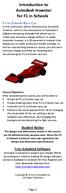 Introduction to Autodesk Inventor for F1 in Schools F1 in Schools Race Car In this course you will be introduced to Autodesk Inventor, which is the centerpiece of Autodesk s digital prototyping strategy
Copyright 2006 TechSmith Corporation. All Rights Reserved.
 TechSmith Corporation provides this manual as is, makes no representations or warranties with respect to its contents or use, and specifically disclaims any expressed or implied warranties or merchantability
Any source of light can be described in terms of four unique and independently respective properties:
 LIGHTING Effective lighting is the essence of cinematography. Often referred to as painting with light, the art requires technical knowledge of film stocks, lighting instruments, color, and diffusion filters,
Windows XP Pro: Basics 1
 NORTHWEST MISSOURI STATE UNIVERSITY ONLINE USER S GUIDE 2004 Windows XP Pro: Basics 1 Getting on the Northwest Network Getting on the Northwest network is easy with a university-provided PC, which has
Handout: Word 2010 Tips and Shortcuts
 Word 2010: Tips and Shortcuts Table of Contents EXPORT A CUSTOMIZED QUICK ACCESS TOOLBAR... 2 IMPORT A CUSTOMIZED QUICK ACCESS TOOLBAR... 2 USE THE FORMAT PAINTER... 3 REPEAT THE LAST ACTION... 3 SHOW
Creating Web Pages with Microsoft FrontPage
 Creating Web Pages with Microsoft FrontPage 1. Page Properties 1.1 Basic page information Choose File Properties. Type the name of the Title of the page, for example Template. And then click OK. Short
Excel 2007 Basic knowledge
 Ribbon menu The Ribbon menu system with tabs for various Excel commands. This Ribbon system replaces the traditional menus used with Excel 2003. Above the Ribbon in the upper-left corner is the Microsoft
Done. Click Done to close the Capture Preview window.
 The Capture Preview window allows you to preview, edit, and customize a screen capture before it is saved to a file, inserted into your document, attached to an e-mail, or sent to a variety of other Output
MassArt Studio Foundation: Visual Language Digital Media Cookbook, Fall 2013
 INPUT OUTPUT 08 / IMAGE QUALITY & VIEWING In this section we will cover common image file formats you are likely to come across and examine image quality in terms of resolution and bit depth. We will cover
VRayPattern also allows to curve geometry on any surface
 Introduction VrayPattern is a plug-in for 3dsmax and V-Ray VRayPattern allows to multiply geometry periodically without extra memory consumption. As a sample you can use any tiled geometry (or those with
Sweet Home 3D user's guide
 1 de 14 08/01/2013 13:08 Features Download Online Gallery Blog Documentation FAQ User's guide Video tutorial Developer's guides History Reviews Support 3D models Textures Translations Forum Report a bug
Excel -- Creating Charts
 Excel -- Creating Charts The saying goes, A picture is worth a thousand words, and so true. Professional looking charts give visual enhancement to your statistics, fiscal reports or presentation. Excel
Introduction to Autodesk Inventor for F1 in Schools
 F1 in Schools race car Introduction to Autodesk Inventor for F1 in Schools In this course you will be introduced to Autodesk Inventor, which is the centerpiece of Autodesk s Digital Prototyping strategy
PowerPoint: Graphics and SmartArt
 PowerPoint: Graphics and SmartArt Contents Inserting Objects... 2 Picture from File... 2 Clip Art... 2 Shapes... 3 SmartArt... 3 WordArt... 3 Formatting Objects... 4 Move a picture, shape, text box, or
How to resize, rotate, and crop images
 How to resize, rotate, and crop images You will frequently want to resize and crop an image after opening it in Photoshop from a digital camera or scanner. Cropping means cutting some parts of the image
WHAT S NEW IN WORD 2010 & HOW TO CUSTOMIZE IT
 WHAT S NEW IN WORD 2010 & HOW TO CUSTOMIZE IT The Ribbon... 2 Default Tabs... 2 Contextual Tabs... 2 Minimizing and Restoring the Ribbon... 3 Customizing the Ribbon... 3 A New Graphic Interface... 5 Live
PowerPoint Interface Menu Bars Work Area Slide and Outline View TASK PANE Drawing Tools
 Microsoft PowerPoint is used for creating slide presentations to be used on a PC or even printed out as overheads and handouts. You can combine text, graphics, even audio and video to create exciting and
1 CHORD LENGTH OR UNIFORM PARAMETERIZATION
 1 CHORD LENGTH OR UNIFORM PARAMETERIZATION All of the better high end packages that implement Nurbs Modeling tools will offer the choice of constructing curves using either Uniform or Chord Length parameterization.
House Design Tutorial
 Chapter 2: House Design Tutorial This House Design Tutorial shows you how to get started on a design project. The tutorials that follow continue with the same plan. When we are finished, we will have created
AR-media Plugin v2.3. for Autodesk 3ds Max. QUICK START GUIDE (September, 2013)
 QUICK START GUIDE (September, 2013) Inglobe Technologies 2008/2013 Copyright Copyright 2008/2013 Inglobe Technologies S.r.l. All rights reserved. No part of this publication may be reproduced, transmitted,
Migrating to Excel 2010 from Excel 2003 - Excel - Microsoft Office 1 of 1
 Migrating to Excel 2010 - Excel - Microsoft Office 1 of 1 In This Guide Microsoft Excel 2010 looks very different, so we created this guide to help you minimize the learning curve. Read on to learn key
BIGPOND ONLINE STORAGE USER GUIDE Issue 1.1.0-18 August 2005
 BIGPOND ONLINE STORAGE USER GUIDE Issue 1.1.0-18 August 2005 PLEASE NOTE: The contents of this publication, and any associated documentation provided to you, must not be disclosed to any third party without
NDSU Technology Learning & Media Center
 1 NDSU Technology Learning & Media Center QBB 150C 231-5130 www.ndsu.edu/its/tlmc Creating a Large Format Poster (Plot) Using PowerPoint 2013 Posters should be designed and created in a manner that best
Tutorial for Tracker and Supporting Software By David Chandler
 Tutorial for Tracker and Supporting Software By David Chandler I use a number of free, open source programs to do video analysis. 1. Avidemux, to exerpt the video clip, read the video properties, and save
SpaceClaim Introduction Training Session. A SpaceClaim Support Document
 SpaceClaim Introduction Training Session A SpaceClaim Support Document In this class we will walk through the basic tools used to create and modify models in SpaceClaim. Introduction We will focus on:
GUIDELINES FOR PREPARING POSTERS USING POWERPOINT PRESENTATION SOFTWARE
 Society for the Teaching of Psychology (APA Division 2) OFFICE OF TEACHING RESOURCES IN PSYCHOLOGY (OTRP) Department of Psychology, Georgia Southern University, P. O. Box 8041, Statesboro, GA 30460-8041
Micro Cam Software. User Manual V1.3
 Micro Cam Software User Manual V1.3 CONTENT CHAPTER 1: MICRO CAM SOFTWARE INSTALLATION AND CONNECTION... - 1-1.1 SOFTWARE MICRO CAM INSTALLATION... - 1-1.2 WIRED DEVICE CONNECTION... - 4-1.3 SOFTWARE OPERATION
CTvox for Android. Version 1.5
 CTvox for Android Version 1.5 Contents Introduction... 1 Background... 1 Volume rendering... 1 Multi-volume rendering... 2 Transfer function... 2 Installing CTvox... 3 Creating and transferring volume
ADVANCED THEORIES FOR CG LIGHTING
 ADVANCED THEORIES FOR CG LIGHTING 0.1 INTRODUCTION To become skilled at 3D lighting, one must have an understanding of how light works. CG lighting has been established based on rules from cinematography,
Microsoft PowerPoint 2010 Handout
 Microsoft PowerPoint 2010 Handout PowerPoint is a presentation software program that is part of the Microsoft Office package. This program helps you to enhance your oral presentation and keep the audience
Computer Applications in Textile Engineering. Computer Applications in Textile Engineering
 3. Computer Graphics Sungmin Kim http://latam.jnu.ac.kr Computer Graphics Definition Introduction Research field related to the activities that includes graphics as input and output Importance Interactive
My Materials. In this tutorial, we ll examine the material settings for some simple common materials used in modeling.
 Course: 3D Design Title: My Materials Blender: Version 2.6X Level: Beginning Author; Neal Hirsig ([email protected]) (May 2012) My Materials In this tutorial, we ll examine the material settings for some
Course: 3D Design Title: Deciduous Trees Blender: Version 2.6X Level: Beginning Author; Neal Hirsig ([email protected]) (June 2012) Deciduous Trees
 Course: 3D Design Title: Deciduous Trees Blender: Version 2.6X Level: Beginning Author; Neal Hirsig ([email protected]) (June 2012) Deciduous Trees In general, modeling trees is a long and somewhat tedious
Autodesk Revit Rendering Tips You Can Use Daniel John Stine LHB
 Daniel John Stine LHB AB4025 This class will cover a multitude of topics related to creating renderings in Revit. Class highlights include using Design Options to manage props for rendering, using a future
SimLab 3D PDF. Settings
 SimLab 3D PDF Settings 3D PDF Settings PDF Settings dialog enables the user to control the exported 3D PDF file(s), from SimLab Composer and other 3D SimLab plugins. In SimLab Composer the dialog can be
TurboCAD Architectural
 TurboCAD Architectural Version 15 Getting Started Guide IMSI/Design LLC, US 100 Rowland Blvd. Novato. CA 94945, USA Tel: +1-415-878-4000 Fax: +1-415-897-2544 Web Site www.imsisoft.com www.turbocad.com
IT 386: 3D Modeling and Animation. Review Sheet. Notes from Professor Nersesian s IT 386: 3D Modeling and Animation course
 IT 386: 3D Modeling and Animation Review Sheet Sources: Notes from Professor Nersesian s IT 386: 3D Modeling and Animation course Notes from CannedMushrooms on YouTube Notes from Digital Tutors tutorial
Adding Animation With Cinema 4D XL
 Step-by-Step Adding Animation With Cinema 4D XL This Step-by-Step Card covers the basics of using the animation features of Cinema 4D XL. Note: Before you start this Step-by-Step Card, you need to have
Epson Brightlink Interactive Board and Pen Training. Step One: Install the Brightlink Easy Interactive Driver
 California State University, Fullerton Campus Information Technology Division Documentation and Training Services Handout Epson Brightlink Interactive Board and Pen Training Downloading Brightlink Drivers