
Lights, Cameras, and Assemblies! Animating using Autodesk Inventor Studio
|
|
|
- Moris Marshall
- 10 years ago
- Views:
Transcription
1 Lights, Cameras, and Assemblies! Animating using Autodesk Inventor Studio Mark Allen Flayler : ASCENT Center for Technical Knowledge ML311-3 Autodesk Inventor Studio bridges the gap between engineering and marketing. This class presents methods to create an animation of an assembly using moving cameras and lights. Learn how to animate components in your assembly, animate lights, and animate cameras. Finally, you ll see how to combine animations using the new Video Producer feature. At the end of the class, you ll have an understanding of how to render a complete animation of your assembly. This class is intended for Inventor users interested in animating their assemblies using Inventor Studio. About the Speaker: Mark is an Application Engineer with the Ascent and IMAGINiT Division of Rand Worldwide, specializing in the Autodesk manufacturing products. He has implemented the Autodesk Manufacturing products with many industries including the blow and injection molding, automotive, and custom machinery markets. Inventor has been a profound augmentation in his abilities allowing him to bring 3D digital prototyping to the forefront of the industries with which he has interacted. He has extensive experience and a comprehensive understanding of the technical, practical, business, and human dimensions of implementation. He is an effective and skillful communicator, consulting with his clients to help achieve their business objectives. Mark is an ATC certified instructor and has been instrumental in the training of hundreds of users. Mark is certified in AutoCAD, AutoCAD Mechanical, AutoCAD Electrical, Autodesk Data Management, and Autodesk Inventor. [email protected] BLOG site:

2

3 Introduction Engineering and marketing have a lot in common. Engineers need to leverage marketing in designs, and marketing needs to leverage designs from engineers. This is the essence of collaborative engineering. What most companies don t realize is that the engineer s data holds more power than it ever did before with Autodesk Inventor. The Studio package that comes with all versions of Inventor utilizes the engineer s data to make high impact presentations, marketing collateral, manual/catalog documentation, and more. If this capability is not understood or realized, companies can end up spending a hefty sum of money in third party contracting, additional software, and longer lead time to market. Inevitably, smaller companies get left behind because their budgets cannot afford this luxury. With Studio companies can leverage all of these tasks within a single software; Autodesk Inventor. Access to Studio Studio can be accessed in any Part (.ipt) or Assembly file (.iam), as well as, Sheet Metal and Weldment files. Presentation and Drawing files have no access to Studio. To access, select Applications > Inventor Studio from the main menu. Styling your Studio,, Surface, Scene, and Lighting Styles all combine for the overall quality of the animation. These need to be set up prior to an animation for a rich Studio output. These styles can be set up in your templates, Styles Library, or created on the fly. Here is a brief recap of these styles: Surface Styles correspond to color styles found in the Styles Library. Material properties are assigned a color in the iproperties, and more properties for these colors are available in Surface Styles. Here we have the controls for various aspects of colors, reflections of the surface, opacity, diffusion, and bump map settings. Use to get and assign different styles to faces (in part mode) or components (in assembly mode) to change their effects. The applied color and bump map may not appear correctly on the Inventor model, but the rendered image will show the correct color. Scene Styles are essentially how the background or environment is set up. It controls background for single and gradient colors, reflective planes, images, and spherical images. Consider using real life image backgrounds for your backdrop in your renderings. 3

4 Lighting Styles contain one or more light objects that define the overall lighting for a model. Blue Hue Lighting, as shown, is an example of a lighting style that contains four lighting objects. A lighting object is a source of light that can be one of three types: Directional, Point, or Spot which all have their own setting tabs for General, Illumination, Shadows, and a light specific tab. Unlike Scene and Surface styles, Lighting styles are not inherently active on a new Studio Animation so you must set one active (right click on it) to work with it in the animation. To create a new light within a selected lighting style, click above the listed Lighting styles. Type Description Symbol Directional Point Simulates distant light sources, such as the sun. It has a direction, but no position. Simulates a point source. It has a position and it radiates light in every direction. Spot Simulates a spot light. It has a position and direction. A Spot light emits light in the shape of a cone with two degrees of intensity. The most intense area is located within the inner area of the cone of light and the less intense area is located within the outer area of the cone of light. Wrapper Assemblies When you have a typical piece of equipment or product, it is beneficial to create a standard room/scene to render these objects. For example, if you make staplers you may want a scene with other office supplies for all your marketing or presentations. To work efficiently, create an assembly that contains all the props and set up their lighting, scene, and surface styles so that the only work that needs to be done is the work on the new product. The props can be used over and over again, as needed Wrapper Assemblies can be as simple as a floor and two walls, or as elaborate as an entire furnished room or industrial backdrop, as shown below. 4

5 Local Lights Local lights differ from lighting styles in that they are discrete lights (Point and Spot only) that exist in the scene but not in a predefined lighting style. Local lights have the same controls as discrete lights. They are great to show LEDs, panel lights, illuminations, switches, and much more. They also have the unique advantage of traveling with their components if moved in an animation. Local lights can only be altered through an animation when the light is at the top level assembly. Camera Creation Use the camera command to create user cameras for different viewing control options. With the dialog box open, select a Target for the Camera and a preview displays for the camera direction. This positioning is normal to the Target. For the Position, choose a point on the normal vector. Clicking on the Position or Camera graphic elements brings up 3D Move/Rotate tools to more precisely place them. Zoom is controlled by the extents of the camera shot or using the slider or input section. Roll angle is the tilt of the camera in its position. You must also choose either the Orthographic or Perspective (converging lines) Projection types. Depth of Field is used to control focus limits on the camera in the form of f-stops and Focus Limits. This is only available on Perspective projections. Zoom Box Position Depth of Field Markers Depth of Field Options Focus Limits f-stop Description Near specifies the distance at which objects are clear (green plane) Far specifies the distance at which objects are out of focus (blue plane) f-stop value for depth of field; lower the number the narrower the depth Focus Plane pick a known planar surface to set the f-stop Link Focus Plane to camera target When linked, moving the camera target also modifies the focal plane location. 5

6 Understanding the Animation Environment Inventor Studio is designed to use intelligence from the assembly to grant movement within your animation. The biggest key factors here are constraints, position, and the assembly state before entering Studio. Consider using Design Views and Representations to control your assembly s positioning and component visibilities. Many users use the Master views as the start point. Because Studio animates constraints, you work with existing constraints in the environment based on the degrees of freedom in the components. Animation commands are directly related to components and their constraints. If they are constrained together then they will move together, if they are not they will move individually. Studio also gives you the power to control suppression of constraints to grant movement and not affect the Assembly environment s constraints. In general, large assemblies do not respond well to all or most of their constraints being turned off so use suppression sparingly. Consider, grounding all or some of the components to essentially eliminate the intelligence of the constraints. In this case the components work like the Presentation files. This can mean more or less work depending on your design intent and how well you know your assembly. Storyboards are helpful to set up a plan for the animation before beginning work in Studio. Take some time to create either paper or electronic storyboards. StoryBoardPro screenshot ( Consider camera movement, component movement, component opacity and fades, lighting elements, animation length, production effects such as gradient wipes and shot fades. Begin thinking about your Studio animation during the engineering design process. Use the command to save a JPG or a BMP as a visual reference for storyboarding. 6

7 Animation Timeline When working with any animation dialog box, the Animation Timeline dialog box appears. Icon Description,, Sets the current time to the beginning (0 seconds) or end of the animation Plays the animation in forward or reverse Toggles between repeating and not repeating the animation Opens the Render Animation dialog box Creates a camera action that ends at the current time Opens the Animation Options dialog box and allows you to specify the duration of the animation in minutes and seconds. Click to equate the total duration to the sum of the durations of all the specified actions. You can also change the default Velocity Profile for Animation commands Specify the Velocity in Percentage or Time and their default values. Smallest increment for time is 1/10 of a second. Expands the actions editor. Actions are listed on the left side, while their start, duration, and end times are represented on the right side. Use this dialog box to view, edit, and delete existing actions. Modify an action by right-clicking on the desired action duration bar and selecting Edit, Delete, Mirror, or Copy Action. You can also adjust the durations of actions directly by dragging the duration bars. 7

8 When the Studio environment is activated, the state at which activation occurs is Frame 0 in the animation timeline. Studio can have more than one animation. For instance Block A is Mated to Block B in animation1, but in animation2 Block A is Mated and animated away 5 units to Block B. Animation1 is not affected by this since they are two different animations. Now if Block A and Block B are modified in the Assembly itself and not Studio, they would both change. Common Animation Command Controls Each animation command dialog box varies, but here are the common icons and their uses. Option Description Starts the action at the time the previous action ended Specifies the time to begin the action Performs the action instantaneously (in one frame) Start time of action Duration of action End time of action Ends the current action definition, advances the timeline by the New Action Increment value, and begins a new action of the same type. The Acceleration tab, as shown below, is common among all animation command dialog boxes. This tab controls the speed of an action as it reaches its target. You can define the percentage of time or actual time for an action to reach its speed and wind down. (Not available with the option.) 8

9 Animation Commands There are a number of animation commands that can be used in Studio to create animations. These enable you to animate components, constraints, fading, parameters, positional representations, cameras, and lights. To access these animation commands, use the commands in the Inventor Studio Panel or right-click on an object in the browser bar and select its corresponding animation option. The animation commands will differ depending on the type of object you are right-clicking on. For example, a component provides the Animate Components and Animate Fade options, while a constraint provides Animate Constraint, and an animation favorite provides Animate Parameters, as shown below. Animate Constraints With (Select) toggled on, select one or more constraints from the browser bar to animate. Essentially Animate Constraints is used to drive offset values for constraints from start to end values. This relies on the intelligence of your assembly and how that intelligence is applied to the mechanical movement. When a Constraint is selected a start value is automatically populated and an end value is required to drive the animation. Use the Suppress and Enable options as instantaneous actions to turn on and off constraints throughout the animation. Option Description Animates a change in a linear or angular constraint value. Enter a value. The initial value for the constraint is shown by default. Suppresses a constraint that may prevent movement for an action. Enables a constraint 9

10 Animate Components With the (Components) option toggled on, select one or more components to move or rotate. Some newer users to Studio confuse Animate Constraints with Animate Components. Essentially it is the opposite of Animate Constraints. With Animate Components you use unconstrained degrees of freedom to move components, while Animate Constraints uses existing constraints to drive constraint values. Click (Position) to access the 3D Move/Rotate dialog box. This dialog box allows you to move or rotate the selected component(s) in any direction of an unconstrained degree of freedom (or any direction if it is grounded). Enter Distance and Rotation values, as necessary. Click on the head of an arrow to change the linear movement and click on the shaft to change the rotation around the selected piece of the triad. Use Revolution as an alternative to Rotation angle. (Note: If you compound your movements such as rotating two or three times, or moving in different linear directions, the input fields in the command dialog box will combine the movements), as shown below. 10 in Z and 60 around Z 10 in Z and Y and 60 around Z and 90 around Y Finally, specify a smooth or straight path of motion. Smooth creates a continuous motion curve between the beginning, duration and end; Sharp generates more distinct movements. 10

11 Animate Fade As its name might suggest, Animate Fade does not relate to the visibility of components, rather it corresponds to the opacity (opposite of transparency) of a component. 0% opacity is completely non-visible and 100% is completely visible to the viewer. This command can be used for the following: Removing components from view completely and bringing them in later Showing interior movement with exterior components being less opaque Removing components completely from view amidst the duration of the animation Combining with Animate Constraint or Animate Components actions to Fade and move To fade a component at Frame 0, create an Instantaneous ( ) Fade at the beginning of the animation with an initial start opacity value of 100% and an end value of 0%. To display a component that initially does not appear at beginning of the animation, create another Fade with an initial start opacity value of 0% and an end value of 100%. Animate Parameters This animation command has endless possibilities for driving parameters in you models (assemblies and parts). For example, you can show dynamic section cuts, mimic fluid movement, show swelling and shrinking, emphasize a design variable, control a spring movement, and a host of other fantastic design intents. To animate a parameter it must be either a modeling or a user parameter. In addition, the parameter must be nominated as an Animation Favorite for it to be available in the Inventor Studio browser bar. To nominate a parameter as an animation favorite, select and enable the Favorite option for the required parameters. Tip: Dynamic Simulation has a command to bring over Simulations into Studio. The command is used after a Simulation is run but before you leave the run mode. It launches Studio and creates a Dynamic_Simulation animation and a parameter favorite called Simulation_timeline. This is indicative of the time steps in the Simulation and your end value here should match the time in Dynamic Simulation. 11

12 Animate Positional Representations Animating Positional Representations (PosReps) in an assembly is one of the easiest ways to animate components because the design intent is already established in the assembly. All that is required is to have two valid representations and to know the time at which the assembly changes from one to the other. The nuances of Positional Representations are extensive (and would exceed allotted time). The following are a few highlights: PosReps control constraint suppression and offset modification; rectangular and circular pattern row and column offsets; component offsetting, grounding, PosReps and Flexibility. PosReps can be deep. Meaning the Top Level Assembly can control which PosRep is active in lower subassemblies. PosReps that are deeper than the assembly being animated need to be set with a Flexible status, to allow subassemblies to flex with the movement of the larger assembly. Editing the PosRep after it is in the animation timeline allows individual control of the overrides that reside in the representation. Initially all members occupy the full span. 12

13 Animate Camera The majority of work in animating a camera is in the camera s initial setup. Once you have one established and in position this command creates some really fantastic visual movements. Use the Definition command to specify the target and positioning of the camera movement, as shown below. An animated camera definition is shown below that involves a reference part created on a 2D path. If Reverse is selected for the position, the red square and green triangle are reversed on the ends of the path. Option Target Position Roll Angle Zoom Description Specifies the target of the camera. Fixed - The target does not change positions Floating - The target maintains position to the camera (target and camera move together) Path - The target follows a path made of a single continuous 2D or 3D sketch. Specifies the position of the camera. Fixed - The camera does not change positions Floating - The camera maintains position to the camera (target and camera move together) Path - The target follows a path made of a single continuous 2D or 3D sketch. You can edit the Path location with the green triangle (start) or red square (end). Controls roll of camera for definition. Adjusts the Zoom of the camera with the slider or graphically with an on screen target box. 13

14 The following are some notes on Path animation: The 2D/3D sketches can be contained in a single file. You can turn on visibility of sketches from Part files for use as a Path as well. To exclude the path from the BOM make it a reference component. The 2D/3D sketch path must be one complete segment to use as a path. Even if multiple segments are contiguous you will have to create separate Camera Animations for each segment. The Turntable tab is unique to camera animation and as its name implies it enables you spin the camera around the model using a specified Axis (X,Y,Z, Camera-H, Camera-V), Direction (clockwise or counterclockwise), and Revolution, as shown below. The +/- option is a literal revolution. So a revolution value of 1 will turn once around. The /min and /sec options use the Revolutions value/per unit of time in the animation. Loop, exclusive to this dialog box for Time, enables you to continuously loop the turntable if it is the only camera action assigned for that camera. It can be adjusted to fit between other actions and will adjust automatically if it must fill the entire animation. This image shows a camera positioned to perform a turntable action around the model s Z-axis in a clockwise rotation. 14

15 Animate Lights Lights can be animated in a similar way to other animation commands. The key item to remember whenever you are animating an existing object is that you are choosing how you want to change the existing object. So if your light is on, you can animate it to be off, a different position, intensity, color, and light specific options. Studio allows animating of Lighting Styles, individual lights within styles, and local lights. Tab General Illumination Light Specific Options/Description On/Off - what state the light will be in at the end of the action Placement - what placement the light will be in at the end of the animation Intensity - How much color in the light Color - What type of color used Directional - Adjust longitude and latitude Spot - Adjust hotspot and falloff, numerical adjustment of target and position Point - Numerical position adjustment Tip: In the Illumination tab, you can turn on a brighter light such as white and turn it to another color (i.e., blue) through the animation which will give the animation the appearance that the light is off, but stills provides light to the scene. 15

16 Video Producer The Video Producer tool ( ) creates Productions from one or more animations. The production is populated with cameras (animated or not) and transitions between those cameras. Ideally a user will have at least one animation and multiple cameras set up to take full advantage of the Video Producer. The Shots tab in the Video Producer represents your cameras. When Video Producer is active it automatically collects all the cameras and attaches their image representations. To see the camera image, pause your mouse over the camera in the Shots tab. Access the Shots dialog box by right clicking on a placed shot in the timeline. Specify from which animation the shot is taken. Specify the starting point in the footage. Specify which camera to get footage from. Specify the timeframe in which to use the Camera. The Transitions tab lists the affected movements from one shot to the next. They are not spliced between the shots but rather overlap the shots in one or both directions. Color, type and duration can be edited. From Shot/To Shot is determined by the transition s placement on the timeline. Access the Effects dialog box by right clicking on a placed transition in the timeline. Fade: From color to shot, shot to shot, shot to color Gradient Wipe: From left to right Swipe Left: Moves from left to right Swipe Right: Moves from right to left 16

17 To populate the timeline of the Production, you can drag and drop shots and transitions into the timeline or right click on the shot or transition in the appropriate tab and select Add to timeline, as shown below. Select a Shot or Transition and dynamically pull on the left or right side of the extents to manipulate the timeline duration. Use the <Shift> or <Control> keys to grab two items at once and dynamically update their extents at the same time. This is more beneficial than grabbing one at a time. 17

18 Rendering the Animation/Production The Render Animation tool ( ) is similar to Render Image; however, has a few extra options on the Output tab. If you want to take advantage of your Production, make sure it is active before the animation is rendered. Option Output File Time Range Antialiasing Format Preview:No Render Frame Rate Description Specifies the file location and type: WMV or AVI Sets for the entire animation or specified interval with optional Reverse playback. Controls edge smoothness and affects rendering time. High suits most users, use Highest for Soft Shadow use. Sets video or image sequencing. Creates quick render previews to check for any final adjustments. Sets the frame rate. A value of is typical for TV, 15 still creates good quality output. Significant time may be required to generate more realistic rendering. The following contribute to increased yet more realistic renderings: Higher frame rates Advanced Lighting settings such as Skylight, bounced light, Inverse and Inversed Squared Decays Shadow selections (Soft Shadows, etc) Higher antialiasing for edge smoothness Using True Reflection to show reflection of objects The length of time required for rendering ultimately depends on your computer s specifications. Rendering in Inventor Studio uses multi-core processors; however, having a strong graphics card and increased RAM is also a benefit. Class Summary: Inventor Studio provides users the tools to create high power presentations and animations for distribution within the company or to customers. By relying on predefined intelligence in your Inventor models, the required commands can be easily executed. The power to document and simulate the design remains with the design engineer who already intimately knows the model s design intent. Using Inventor Studio, companies save on outsourcing and reduce lead times to produce high quality productions. Consider using Inventor Studio in your company s concurrent engineering environment for everything from brainstorming to marketing and documenting the final product. 18

Introduction to Autodesk Inventor for F1 in Schools
 F1 in Schools race car Introduction to Autodesk Inventor for F1 in Schools In this course you will be introduced to Autodesk Inventor, which is the centerpiece of Autodesk s Digital Prototyping strategy
Introduction to Autodesk Inventor for F1 in Schools
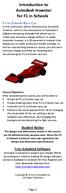 Introduction to Autodesk Inventor for F1 in Schools F1 in Schools Race Car In this course you will be introduced to Autodesk Inventor, which is the centerpiece of Autodesk s digital prototyping strategy
Animating in Inventor Studio the basics
 Animating in Inventor Studio the basics This tutorial is provided at no cost to Autodesk Inventor users by B2 Design. Anyone downloading or viewing the tutorial does not have permission to copy any part
ME 24-688 Week 11 Introduction to Dynamic Simulation
 The purpose of this introduction to dynamic simulation project is to explorer the dynamic simulation environment of Autodesk Inventor Professional. This environment allows you to perform rigid body dynamic
Maya 2014 Basic Animation & The Graph Editor
 Maya 2014 Basic Animation & The Graph Editor When you set a Keyframe (or Key), you assign a value to an object s attribute (for example, translate, rotate, scale, color) at a specific time. Most animation
Animations in Creo 3.0
 Animations in Creo 3.0 ME170 Part I. Introduction & Outline Animations provide useful demonstrations and analyses of a mechanism's motion. This document will present two ways to create a motion animation
Chapter 9. Editing Features. Learning Objectives
 Chapter 9 Editing Features Learning Objectives After completing this chapter, you will be able to: Edit features. Edit sketches of the sketch based features. Edit the sketch plane of the sketch based features.
Autodesk Fusion 360: Assemblies. Overview
 Overview In this module you will learn how different components can be put together to create an assembly. We will use several tools in Fusion 360 to make sure that these assemblies are constrained appropriately
CATIA V5 Tutorials. Mechanism Design & Animation. Release 18. Nader G. Zamani. University of Windsor. Jonathan M. Weaver. University of Detroit Mercy
 CATIA V5 Tutorials Mechanism Design & Animation Release 18 Nader G. Zamani University of Windsor Jonathan M. Weaver University of Detroit Mercy SDC PUBLICATIONS Schroff Development Corporation www.schroff.com
The main imovie window is divided into six major parts.
 The main imovie window is divided into six major parts. 1. Project Drag clips to the project area to create a timeline 2. Preview Window Displays a preview of your video 3. Toolbar Contains a variety of
How To Run A Factory I/O On A Microsoft Gpu 2.5 (Sdk) On A Computer Or Microsoft Powerbook 2.3 (Powerpoint) On An Android Computer Or Macbook 2 (Powerstation) On
 User Guide November 19, 2014 Contents 3 Welcome 3 What Is FACTORY I/O 3 How Does It Work 4 I/O Drivers: Connecting To External Technologies 5 System Requirements 6 Run Mode And Edit Mode 7 Controls 8 Cameras
TABLE OF CONTENTS. INTRODUCTION... 5 Advance Concrete... 5 Where to find information?... 6 INSTALLATION... 7 STARTING ADVANCE CONCRETE...
 Starting Guide TABLE OF CONTENTS INTRODUCTION... 5 Advance Concrete... 5 Where to find information?... 6 INSTALLATION... 7 STARTING ADVANCE CONCRETE... 7 ADVANCE CONCRETE USER INTERFACE... 7 Other important
Graphic Design. Background: The part of an artwork that appears to be farthest from the viewer, or in the distance of the scene.
 Graphic Design Active Layer- When you create multi layers for your images the active layer, or the only one that will be affected by your actions, is the one with a blue background in your layers palette.
Thea Omni Light. Thea Spot Light. Light setup & Optimization
 Light setup In this tutorial we will learn how to setup lights inside Thea Studio and how to create mesh lights and optimize them for faster rendering with less noise. Let us have a look at the different
Blender Notes. Introduction to Digital Modelling and Animation in Design Blender Tutorial - week 9 The Game Engine
 Blender Notes Introduction to Digital Modelling and Animation in Design Blender Tutorial - week 9 The Game Engine The Blender Game Engine This week we will have an introduction to the Game Engine build
Excel -- Creating Charts
 Excel -- Creating Charts The saying goes, A picture is worth a thousand words, and so true. Professional looking charts give visual enhancement to your statistics, fiscal reports or presentation. Excel
Creating 2D Drawings from 3D AutoCAD Models
 Creating 2D Drawings from 3D AutoCAD Models David Piggott CrWare, LP GD205-2P This class explores the various techniques in creating 2D part and assembly drawings from 3D AutoCAD models. As part of the
SpaceClaim Introduction Training Session. A SpaceClaim Support Document
 SpaceClaim Introduction Training Session A SpaceClaim Support Document In this class we will walk through the basic tools used to create and modify models in SpaceClaim. Introduction We will focus on:
3D-GIS in the Cloud USER MANUAL. August, 2014
 3D-GIS in the Cloud USER MANUAL August, 2014 3D GIS in the Cloud User Manual August, 2014 Table of Contents 1. Quick Reference: Navigating and Exploring in the 3D GIS in the Cloud... 2 1.1 Using the Mouse...
Help. Contents Back >>
 Contents Back >> Customizing Opening the Control Panel Control Panel Features Tabs Control Panel Lists Control Panel Buttons Customizing Your Tools Pen and Airbrush Tabs 2D Mouse and 4D Mouse Tabs Customizing
Autodesk Fusion 360 Badge Guide: Design an F1 in Schools Trophy
 Autodesk Fusion 360 Badge Guide: Design an F1 in Schools Trophy Abstract: Gain basic understanding of creating 3D models in Fusion 360 by designing an F1 in Schools trophy. This badge may be claimed by
2013 Getting Started Guide
 2013 Getting Started Guide The contents of this guide and accompanying exercises were originally created by Nemetschek Vectorworks, Inc. Vectorworks Fundamentals Getting Started Guide Created using: Vectorworks
Overview of the Adobe Flash Professional CS6 workspace
 Overview of the Adobe Flash Professional CS6 workspace In this guide, you learn how to do the following: Identify the elements of the Adobe Flash Professional CS6 workspace Customize the layout of the
Parametric Technology Corporation. Pro/ENGINEER Wildfire 4.0 Design Animation Concepts Guide
 Parametric Technology Corporation Pro/ENGINEER Wildfire 4.0 Design Animation Concepts Guide Copyright 2007 Parametric Technology Corporation. All Rights Reserved. User and training guides and related documentation
Lession: 2 Animation Tool: Synfig Card or Page based Icon and Event based Time based Pencil: Synfig Studio: Getting Started: Toolbox Canvas Panels
 Lession: 2 Animation Tool: Synfig In previous chapter we learn Multimedia and basic building block of multimedia. To create a multimedia presentation using these building blocks we need application programs
Creating Drawings in Pro/ENGINEER
 6 Creating Drawings in Pro/ENGINEER This chapter shows you how to bring the cell phone models and the assembly you ve created into the Pro/ENGINEER Drawing mode to create a drawing. A mechanical drawing
Tutorial: Biped Character in 3D Studio Max 7, Easy Animation
 Tutorial: Biped Character in 3D Studio Max 7, Easy Animation Written by: Ricardo Tangali 1. Introduction:... 3 2. Basic control in 3D Studio Max... 3 2.1. Navigating a scene:... 3 2.2. Hide and Unhide
SketchUp Instructions
 SketchUp Instructions Every architect needs to know how to use SketchUp! SketchUp is free from Google just Google it and download to your computer. You can do just about anything with it, but it is especially
House Design Tutorial
 Chapter 2: House Design Tutorial This House Design Tutorial shows you how to get started on a design project. The tutorials that follow continue with the same plan. When we are finished, we will have created
4D Interactive Model Animations
 Animation Using 4D Interactive Models MVSand EVS-PRO have two distinctly different animation concepts. Our traditional animations consist of a sequence of bitmap images that have been encoded into an animation
Camtasia: Importing, cutting, and captioning your Video Express movie Camtasia Studio: Windows
 Camtasia: Importing, cutting, and captioning your Video Express movie Camtasia Studio: Windows Activity 1: Adding your Video Express output into Camtasia Studio Step 1: the footage you shot in the Video
Geomagic Design. Release Notes. Get to Market Faster with Better Products at a Lower Cost V17
 Geomagic Design Get to Market Faster with Better Products at a Lower Cost Release Notes V17 TABLE OF CONTENTS 1 INTRODUCTION 1 COPYRIGHT 1 2 INSTALLATION 2 SOFTWARE IDENTIFICATION 2 UPGRADING TO GEOMAGIC
Creating Your Own 3D Models
 14 Creating Your Own 3D Models DAZ 3D has an extensive growing library of 3D models, but there are times that you may not find what you want or you may just want to create your own model. In either case
Inventor. Keyboard Shortcuts
 Keyboard Shortcuts Inventor shortcut keys, or keyboard shortcuts, allow you to access certain tools by pressing a single key or a key combination. Many shortcut keys correspond to command aliases. keys
Advanced Presentation Features and Animation
 There are three features that you should remember as you work within PowerPoint 2007: the Microsoft Office Button, the Quick Access Toolbar, and the Ribbon. The function of these features will be more
Intro to 3D Animation Using Blender
 Intro to 3D Animation Using Blender Class Instructor: Anthony Weathersby Class Objectives A primer in the areas of 3D modeling and materials An introduction to Blender and Blender s toolset Course Introduction
Adding Animation With Cinema 4D XL
 Step-by-Step Adding Animation With Cinema 4D XL This Step-by-Step Card covers the basics of using the animation features of Cinema 4D XL. Note: Before you start this Step-by-Step Card, you need to have
Glass coloured glass may pick up on scan. Top right of screen tabs: these tabs will relocate lost windows.
 Artec 3D scanner Instructions for Medium Handheld (MH) Scanner Scanning Conditions: Objects/surfaces that don t scan well: Black or shiny objects and objects with sharp edges or points, hair, glass, transparent
This Skill Builder demonstrates how to define and place sketched symbols in drawings.
 Sketched Symbols This Skill Builder demonstrates how to define and place sketched symbols in drawings. A sketched symbol is a user-defined symbol. You create sketched symbols in the sketch environment
Plotting: Customizing the Graph
 Plotting: Customizing the Graph Data Plots: General Tips Making a Data Plot Active Within a graph layer, only one data plot can be active. A data plot must be set active before you can use the Data Selector
Sweet Home 3D user's guide
 1 de 14 08/01/2013 13:08 Features Download Online Gallery Blog Documentation FAQ User's guide Video tutorial Developer's guides History Reviews Support 3D models Textures Translations Forum Report a bug
How to create a Flash banner advert in DrawPlus X2
 How to create a Flash banner advert in DrawPlus X2 Open DrawPlus X2 and choose Start New: Keyframe Animation Select WebPlus 10 Flash Banner and click on Open The work area should look like the screenshot.
Solid Edge motion simulation, explode render animate
 Siemens PLM Software Solid Edge motion simulation, explode render animate White Paper Integrated explode, render and animation capabilities, combined with motion simulation, allow you to create dynamic
DWFTM. Tips &Tricks. Publish View & Print Review & Mark Up
 DWFTM Tips &Tricks Publish View & Print Review & Mark Up Sharing complex design information has never been easy. Since design files are large, sending sheet sets and 3D models to printers or sharing work
The Lighting Effects Filter
 Appendix appendix E The Lighting Effects Filter The Lighting Effects filter is like a little program in itself. With this filter, you can create a wealth of different lighting effects, from making a particular
What s New V 11. Preferences: Parameters: Layout/ Modifications: Reverse mouse scroll wheel zoom direction
 What s New V 11 Preferences: Reverse mouse scroll wheel zoom direction Assign mouse scroll wheel Middle Button as Fine tune Pricing Method (Manufacturing/Design) Display- Display Long Name Parameters:
Instructions for Creating a Poster for Arts and Humanities Research Day Using PowerPoint
 Instructions for Creating a Poster for Arts and Humanities Research Day Using PowerPoint While it is, of course, possible to create a Research Day poster using a graphics editing programme such as Adobe
Working With Animation: Introduction to Flash
 Working With Animation: Introduction to Flash With Adobe Flash, you can create artwork and animations that add motion and visual interest to your Web pages. Flash movies can be interactive users can click
Figure 3.5: Exporting SWF Files
 Li kewhatyou see? Buyt hebookat t hefocalbookst or e Fl ash + Af t eref f ect s Chr i sjackson ISBN 9780240810317 Flash Video (FLV) contains only rasterized images, not vector art. FLV files can be output
Adobe Illustrator CS5 Part 1: Introduction to Illustrator
 CALIFORNIA STATE UNIVERSITY, LOS ANGELES INFORMATION TECHNOLOGY SERVICES Adobe Illustrator CS5 Part 1: Introduction to Illustrator Summer 2011, Version 1.0 Table of Contents Introduction...2 Downloading
Understand the Sketcher workbench of CATIA V5.
 Chapter 1 Drawing Sketches in Learning Objectives the Sketcher Workbench-I After completing this chapter you will be able to: Understand the Sketcher workbench of CATIA V5. Start a new file in the Part
Linkage 3.2. User s Guide
 Linkage 3.2 User s Guide David Rector Wednesday, April 06, 2016 Table of Contents Table of Contents... 2 Installation... 3 Running the Linkage Program... 3 Simple Mechanism Tutorial... 5 Mouse Operations...
Working with SQL Server Integration Services
 SQL Server Integration Services (SSIS) is a set of tools that let you transfer data to and from SQL Server 2005. In this lab, you ll work with the SQL Server Business Intelligence Development Studio to
MovieClip, Button, Graphic, Motion Tween, Classic Motion Tween, Shape Tween, Motion Guide, Masking, Bone Tool, 3D Tool
 1 CEIT 323 Lab Worksheet 1 MovieClip, Button, Graphic, Motion Tween, Classic Motion Tween, Shape Tween, Motion Guide, Masking, Bone Tool, 3D Tool Classic Motion Tween Classic tweens are an older way of
511 - Creating Structural Frame Designs
 4 th Generation VLC courtesy of Edison2 511 - Creating Structural Frame Designs Rahul Kulkarni, Manager, Product Design, Pune Center, Siemens PLM Software #SEU13 Agenda: 511 - Creating Structural Frame
Solid Edge structural frames and weldments
 Solid Edge structural frames and weldments White Paper Intelligent, process-specific applications that speed time to manufacturing. White Paper Solid Edge structural frames and weldments 2 Contents Solid
MET 306. Activity 8a. Mechanism Design Creo 2.0 Level 7 POINT A GROUND LINK LINK 1 LINK 2 LINK 3 POINT B 10/15/2010 1
 Mechanism Design Creo 2.0 Level 7 POINT A LINK 1 GROUND LINK LINK 2 LINK 3 POINT B 10/15/2010 1 Download parts ground, key, link_1, link_2, link_3 and pulley from the V:/MET_306/Activity_8_Creo drive.
Pro/ENGINEER Wildfire 4.0 Basic Design
 Introduction Datum features are non-solid features used during the construction of other features. The most common datum features include planes, axes, coordinate systems, and curves. Datum features do
Maya 2014 Still Life Part 1 Texturing & Lighting
 Maya 2014 Still Life Part 1 Texturing & Lighting Realistic lighting and texturing is the key to photorealism in your 3D renders. Objects and scenes with relatively simple geometry can look amazing with
ACE: After Effects CC
 Adobe Training Services Exam Guide ACE: After Effects CC Adobe Training Services provides this exam guide to help prepare partners, customers, and consultants who are actively seeking accreditation as
Introduction to Google SketchUp (Mac Version)
 Introduction to Google SketchUp (Mac Version) This guide is handy to read if you need some basic knowledge to get started using SketchUp. You will see how to download and install Sketchup, and learn how
Digital Video Capture and Edit with imovie HD 6.0.2
 RESEARCH AND INSTRUCTIONAL SUPPORT REVISED: AUGUST 2006 Project Management Digital Video Capture and Edit with imovie HD 6.0.2 Plan out your time and process before beginning the capture and edit. A few
Laser cutter setup instructions:
 Laser cutter setup instructions: 1. Cut your material to 18 x 24 or smaller. 2. Turn on the laser cutter by flipping the wall switch on the right behind Station B. You will hear the cooling fan and air
Kitchen and Bath Design Tutorial
 Chapter 5: Kitchen and Bath Design Tutorial This tutorial continues where the Materials Tutorial left off. You should save this tutorial using a new name to archive your previous work. The tools and techniques
Laminar Flow in a Baffled Stirred Mixer
 Laminar Flow in a Baffled Stirred Mixer Introduction This exercise exemplifies the use of the rotating machinery feature in the CFD Module. The Rotating Machinery interface allows you to model moving rotating
Learning Autodesk. Modeling, Analysis and Animation SDC. Randy H. Shih. Better Textbooks. Lower Prices. PUBLICATIONS www.sdcpublications.
 Learning Autodesk Inventor 2012 Modeling, Analysis and Animation Randy H. Shih SDC Better Textbooks. Lower Prices. PUBLICATIONS www.sdcpublications.com Schroff Development Corporation Learning Autodesk
Kitchen and Bath Design Tutorial
 Adding Cabinets Chapter 5: Kitchen and Bath Design Tutorial This tutorial continues where the Materials Tutorial left off. You should save this tutorial using a new name to archive your previous work.
MicroStation V8i Training Manual 3D Level 3
 You are viewing sample pages from our textbook: MicroStation V8i Training Manual 3D Level 3 The sample subject matter includes pages from Modules 15 and 17, and range from material assignments and attachment,
HOW TO LINK AND PRESENT A 4D MODEL USING NAVISWORKS. Timo Hartmann [email protected]
 Technical Paper #1 HOW TO LINK AND PRESENT A 4D MODEL USING NAVISWORKS Timo Hartmann [email protected] COPYRIGHT 2009 VISICO Center, University of Twente [email protected] How to link and present
Information Literacy Program
 Information Literacy Program Excel (2013) Advanced Charts 2015 ANU Library anulib.anu.edu.au/training [email protected] Table of Contents Excel (2013) Advanced Charts Overview of charts... 1 Create a chart...
Cork Education and Training Board. Programme Module for. 3 Dimensional Computer Graphics. Leading to. Level 5 FETAC
 Cork Education and Training Board Programme Module for 3 Dimensional Computer Graphics Leading to Level 5 FETAC 3 Dimensional Computer Graphics 5N5029 3 Dimensional Computer Graphics 5N5029 1 Version 3
3D Viewer. user's manual 10017352_2
 EN 3D Viewer user's manual 10017352_2 TABLE OF CONTENTS 1 SYSTEM REQUIREMENTS...1 2 STARTING PLANMECA 3D VIEWER...2 3 PLANMECA 3D VIEWER INTRODUCTION...3 3.1 Menu Toolbar... 4 4 EXPLORER...6 4.1 3D Volume
AR-media TUTORIALS OCCLUDERS. (May, 2011)
 AR-media TUTORIALS OCCLUDERS (May, 2011) Copyright Copyright 2008/2011 Inglobe Technologies S.r.l. All rights reserved. No part of this publication may be reproduced, transmitted, transcribed, stored in
Photo Studio. Site Map Preface What`s New? Getting Started Basic Tasks Advanced Tasks Workbench Description Customizing Glossary Index
 Photo Studio Site Map Preface What`s New? Getting Started Basic Tasks Advanced Tasks Workbench Description Customizing Glossary Index Dassault Systèmes 1994-2001. All rights reserved. Preface Welcome to
Suggested Application Options Settings for Autodesk Inventor
 Suggested Application Options Settings for Autodesk Inventor TEL: 0165 666 24 14 [email protected] PLEASE NOTE, THIS IS ONLY A GUIDE ANY QUESTIONS AT ALL PLEASE RING The following are suggested application
Roof Tutorial. Chapter 3:
 Chapter 3: Roof Tutorial The majority of Roof Tutorial describes some common roof styles that can be created using settings in the Wall Specification dialog and can be completed independent of the other
Design document Goal Technology Description
 Design document Goal OpenOrienteering Mapper is a program to draw orienteering maps. It helps both in the surveying and the following final drawing task. Support for course setting is not a priority because
An introduction to 3D draughting & solid modelling using AutoCAD
 An introduction to 3D draughting & solid modelling using AutoCAD Faculty of Technology University of Plymouth Drake Circus Plymouth PL4 8AA These notes are to be used in conjunction with the AutoCAD software
Triggers & Actions 10
 Triggers & Actions 10 CHAPTER Introduction Triggers and actions are the building blocks that you can use to create interactivity and custom features. Once you understand how these building blocks work,
MET 306 Activity 6. Using Pro/MFG Milling Operations Creo 2.0. Machining a Mast Step
 Using Pro/MFG Milling Operations Creo 2.0 Machining a Mast Step If the Trim option is grayed out when trimming the mill volume, Save (making sure the.asm file is going to the correct subdirectory), Exit
LEGO Digital Designer 4.3 User Manual
 LEGO Digital Designer 4.3 User Manual The Readme file contains system requirements and the latest information about this software release. Please refer to it first if you encounter any problems. Contents
Solid Edge motion simulation, explode render animate. White Paper
 Solid Edge motion simulation, explode render animate White Paper Integrated explode, render and animation capabilities, combined with motion simulation, allow you to create dynamic photorealistic animations
Layout Tutorial. Getting Started
 Getting Started Layout Tutorial This tutorial will explain how create a layout template, send views to a layout page, then save the document in PDF format. In this tutorial you will learn about: Creating
Quick Start Tutorial Imperial version
 Quick Start Tutorial Imperial version 1996-2006 Cadsoft Corporation. No part of this guide or the accompanying software may be reproduced or transmitted, electronically or mechanically, without written
Chapter 9 Slide Shows
 Impress Guide Chapter 9 Slide Shows Transitions, animations, and more Copyright This document is Copyright 2007 2013 by its contributors as listed below. You may distribute it and/or modify it under the
Anime Studio Debut vs. Pro
 vs. Animation Length 2 minutes (3000 frames) Unlimited Motion Tracking 3 Points Unlimited Audio Tracks 2 Tracks Unlimited Video Tracks 1 Track Unlimited Physics No Yes Poser scene import No Yes 3D layer
Twelve. Figure 12.1: 3D Curved MPR Viewer Window
 Twelve The 3D Curved MPR Viewer This Chapter describes how to visualize and reformat a 3D dataset in a Curved MPR plane: Curved Planar Reformation (CPR). The 3D Curved MPR Viewer is a window opened from
Ten Easy Steps to Intersections in AutoCAD Civil 3D
 in AutoCAD Civil 3D Robert Gadbaw Team Blue22 Ltd. CV110-2L This class takes students step by step through creating an intersection using Civil 3D 2009. Students will learn about alignments, profiles,
ART 269 3D Animation Fundamental Animation Principles and Procedures in Cinema 4D
 ART 269 3D Animation Fundamental Animation Principles and Procedures in Cinema 4D Components Tracks An animation track is a recording of a particular type of animation; for example, rotation. Some tracks
Real Time Rendering. Preface What's New Getting Started Basic Tasks Advanced Tasks Workbench Description Index
 Real Time Rendering Preface What's New Getting Started Basic Tasks Advanced Tasks Workbench Description Index Dassault Systèmes 1994-99. All rights reserved. Preface CATIA Version 5 Real Time Rendering
Generative Drafting. Page 1 1997 2001 DASSAULT SYSTEMES. IBM Product Lifecycle Management Solutions / Dassault Systemes
 Generative Drafting Page 1 Tutorial Objectives Description This Tutorial is an introduction to Generative Drafting. Message To show how CATIA V5 allows the user to automatically generate associative drafting
Kitchen and Bath Design Tutorial
 Adding Cabinets Kitchen and Bath Design Tutorial This tutorial continues where the Interior Design Tutorial left off. You should save this tutorial using a new name to archive your previous work. The tools
Gephi Tutorial Visualization
 Gephi Tutorial Welcome to this Gephi tutorial. It will guide you to the basic and advanced visualization settings in Gephi. The selection and interaction with tools will also be introduced. Follow the
Project Management within ManagePro
 Project Management within ManagePro This document describes how to do the following common project management functions with ManagePro: set-up projects, define scope/requirements, assign resources, estimate
Avigilon Control Center Web Client User Guide
 Avigilon Control Center Web Client User Guide Version: 4.12 Enterprise OLH-WEBCLIENT-E-E-Rev2 Copyright 2013 Avigilon. All rights reserved. The information presented is subject to change without notice.
User Manual V1.0. Remote Software
 User Manual V1.0 Notice: The information in this manual was current when published. The manufacturer reserves the right to revise and improve its products. All specifications are therefore subject to change
Metes and Bounds Help
 Metes and Bounds Help Topics: Drawing Wizard Data Entry o Entering Metes and Bounds Data o Entering Section Call Data Layers o Layer Options o Analyze Layer Closing Error Tabs Drawing Options o Drawing