
90 EQ # EQ # EQ-MD # EQ-MD
|
|
|
- Douglas Lawson
- 9 years ago
- Views:
Transcription
1 ENGLISH AstroMaster Series Telescopes INSTRUCTION MANUAL AstroMaster 90 EQ # AstroMaster 130 EQ # AstroMaster 90 EQ-MD # AstroMaster 130 EQ-MD # 31051

2 Table of Contents INTRODUCTION...3 ASSEMBLY...6 Setting up the Tripod...6 Attaching the Equatorial Mount...7 Installing the Counterweight Bar & Counterweights...7 Attaching the Slow Motion Cables...8 Attaching the Telescope Tube to the Mount...8 Installing the Diagonal & Eyepieces (refractor)...9 Installing the Eyepieces on the Newtonians...9 Moving the Telescope Manually...10 Balancing the Mount in R.A...10 Balancing the Mount in Dec...10 Adjusting the Equatorial Mount...11 Adjusting the Mount in Altitude...11 TELESCOPE BASICS...12 Image Orientation...13 Focusing...13 Aligning the Finderscope...13 Calculating Magnification...14 Determining Field of View...15 General Observing Hints...15 ASTRONOMY BASICS...16 The Celestial Coordinate System...16 Motion of the Stars...16 Polar Alignment with Latitude Scale...17 Pointing at Polaris...18 Finding the North Celestial Pole...18 Polar Alignment in the Southern Hemisphere...19 Finding the South Celestial Pole (SCP)...20 Declination Drift Method of Polar Alignment...21 Aligning the Setting Circles...22 Motor Drive...23 CELESTIAL OBSERVING...24 Observing the Moon...24 Observing the Planets...24 Observing the Sun...24 Observing Deep-Sky Objects...25 Seeing Conditions...25 ASTROPHOTOGRAPHY...26 Short Exposure Prime Focus Photography...26 Piggyback Photography...26 Planetary & Lunar Photography with Special Imagers...26 CCD Imaging for Deep Sky Objects...26 Terrestrial Photography...26 TELESCOPE MAINTENANCE...27 Care and Cleaning of the Optics...27 Collimation of a Newtonian...27 OPTIONAL ACCESSORIES...30 AstroMaster Specifications

3 Congratulations on your purchase of an AstroMaster Series telescope. The AstroMaster Series of telescopes come in several different models and this manual covers four models mounted on the CG-3 German Equatorial Mount mm refractor and 130mm Newtonian and then both of these sizes with a motor drive. The AstroMaster Series is made of the highest quality materials to ensure stability and durability. All this adds up to a telescope that gives you a lifetime of pleasure with a minimal amount of maintenance. These telescopes were designed for the First Time Buyer offering exceptional value. The AstroMaster series features a compact and portable design with ample optical performance to excite any newcomer to the world of amateur astronomy. AstroMaster telescopes carry a two year limited warranty. For details see our website at Some of the many standard features of the AstroMaster include: All coated glass optical elements for clear, crisp images. Smooth functioning, rigid equatorial mount with setting circles in both axes. Preassembled steel leg tripod with 1.25 legs ensures stable platform. Quick and easy no-tool set up. CD-ROM The Sky Level astronomy software which provides education about the sky and printable sky maps. All models can be used terrestrially as well as astronomically with the standard accessories included. Take time to read through this manual before embarking on your journey through the Universe. It may take a few observing sessions to become familiar with your telescope, so you should keep this manual handy until you have fully mastered your telescope s operation. The manual gives detailed information regarding each step as well as needed reference material and helpful hints guaranteed to make your observing experience as simple and pleasurable as possible. Your telescope is designed to give you years of fun and rewarding observations. However, there are a few things to consider before using your telescope that will ensure your safety and protect your equipment. Warning Never look directly at the sun with the naked eye or with a telescope (unless you have the proper solar filter). Permanent and irreversible eye damage may result. Never use your telescope to project an image of the sun onto any surface. Internal heat build-up can damage the telescope and any accessories attached to it. Never use an eyepiece solar filter or a Herschel wedge. Internal heat build-up inside the telescope can cause these devices to crack or break, allowing unfiltered sunlight to pass through to the eye. Do not leave the telescope unsupervised, either when children are present or adults who may not be familiar with the correct operating procedures of your telescope. 3

4 Figure 1-1 AstroMaster 90 EQ Refractor Telescope Optical Tube Dovetail Mounting Bracket RA. Setting Circle Star Pointer Finderscope Eyepiece Diagonal Focus Knob R.A. Slow Motion Cable Latitude Adjustment Screw Accessory Tray Tripod Counterweight Bar Counterweights Equatorial Mount Dec. Slow Motion Cable Objective Lens

5 Figure 1-2 AstroMaster 130 EQ Newtonian Eyepiece Tube Ring Telescope Optical Tube Primary Mirror Dec. Slow Motion Cable R.A. Slow Motion Cable Latitude Adjustment Screw Accessory Tray Tripod Counterweights Dec. Setting Circle Star Pointer Finderscope R.A. Setting Circle Focus Knob

6 This section covers the assembly instructions for your AstroMaster telescope. Your telescope should be set up indoor the first time so that it is easy to identify the various parts and familiarize yourself with the correct assembly procedure before attempting it outdoor. Each AstroMaster comes in one box. The pieces in the box are optical tube with attached sky pointer and tube rings (130 EQ only), CG-3 equatorial mount, counterweight bar, two 4.8 lbs. (2.2kg) counterweights, R.A. & Dec. slow-motion cables, 10mm eyepiece 1.25, 20mm eyepiece 1.25 (erect image for 130 EQ), erect image diagonal 1.25 (for 90 EQ), The Sky Level 1 CD-ROM. Setting up the Tripod 1. Remove the tripod from the box (Figure 2-1). The tripod comes preassembled so that the set up is very easy. 2. Stand the tripod upright and pull the tripod legs apart until each leg is fully extended and then push down slightly on the tripod leg brace (Figure 2-2). The very top of the tripod is called the tripod head. 3. Next, we will install the tripod accessory tray (Figure 2-3) onto the tripod leg brace (center of Figure 2-2). 4. Insert the cut-out in the center of the tray (flat side of the tray facing down) to match the center of the tripod leg brace and push down slightly (Figure 2-4). The ears of the tray should appear as in Figure 2-4. Figure 2-1 Figure 2-2 Figure 2-3 Figure Rotate the tray until the ears are under the leg brace support of each leg and push slightly and they will lock in place (Figure 2-5). The tripod is now completely assembled (Figure 2-6). 6. You can extend the tripod legs to the height you desire. At the lowest level the height is 24 (61cm) and extends to 41 (104cm). You unlock the tripod leg lock knob at the bottom of each leg (Figure 2-7) and pull the legs out to the height you want & then lock the knob securely. A fully extended the tripod looks like the image in Figure The tripod will be the most rigid and stable at the lowest height. Figure 2-5 Figure 2-6 Figure 2-7 Figure 2-8

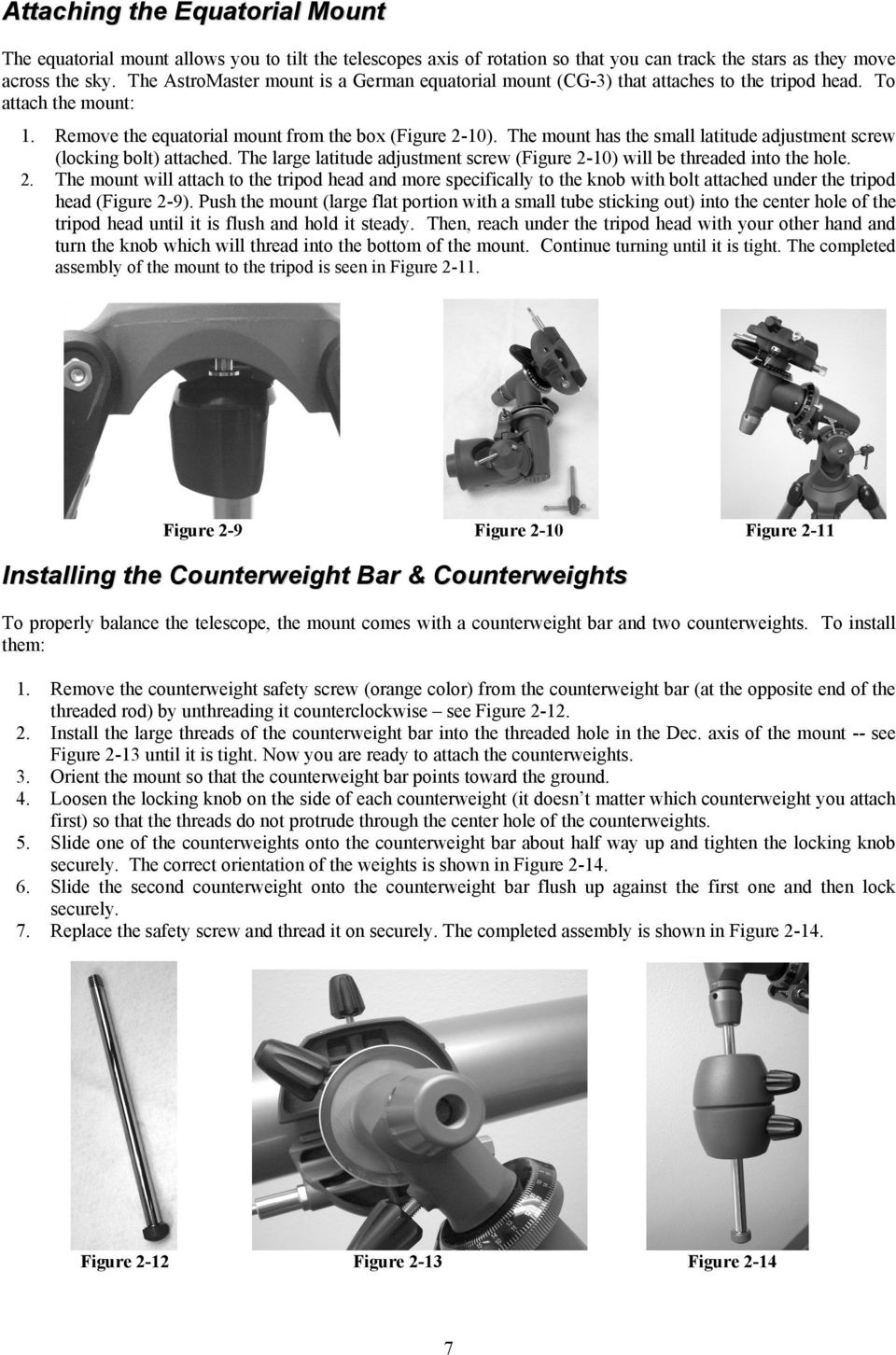
7 Attaching the Equatorial Mount The equatorial mount allows you to tilt the telescopes axis of rotation so that you can track the stars as they move across the sky. The AstroMaster mount is a German equatorial mount (CG-3) that attaches to the tripod head. To attach the mount: Remove the equatorial mount from the box (Figure 2-10). The mount has the small latitude adjustment screw (locking bolt) attached. The large latitude adjustment screw (Figure 2-10) will be threaded into the hole. The mount will attach to the tripod head and more specifically to the knob with bolt attached under the tripod head (Figure 2-9). Push the mount (large flat portion with a small tube sticking out) into the center hole of the tripod head until it is flush and hold it steady. Then, reach under the tripod head with your other hand and turn the knob which will thread into the bottom of the mount. Continue turning until it is tight. The completed assembly of the mount to the tripod is seen in Figure Figure 2-9 Figure 2-10 Figure 2-11 Installing the Counterweight Bar & Counterweights To properly balance the telescope, the mount comes with a counterweight bar and two counterweights. To install them: Remove the counterweight safety screw (orange color) from the counterweight bar (at the opposite end of the threaded rod) by unthreading it counterclockwise see Figure Install the large threads of the counterweight bar into the threaded hole in the Dec. axis of the mount -- see Figure 2-13 until it is tight. Now you are ready to attach the counterweights. Orient the mount so that the counterweight bar points toward the ground. Loosen the locking knob on the side of each counterweight (it doesn t matter which counterweight you attach first) so that the threads do not protrude through the center hole of the counterweights. Slide one of the counterweights onto the counterweight bar about half way up and tighten the locking knob securely. The correct orientation of the weights is shown in Figure Slide the second counterweight onto the counterweight bar flush up against the first one and then lock securely. Replace the safety screw and thread it on securely. The completed assembly is shown in Figure Figure 2-12 Figure 2-13 Figure
8 Attaching the Slow Motion Cables The AstroMaster mount comes with two slow motion control cables that allow you to make fine pointing adjustments to the telescope in both R.A. and Declination. To install the cables: 1. Locate the two cables with knobs on them (both are identical is size and length) and make sure the screw on each cable end does not protrude through the opening. 2. Slide the cable onto the R.A. shaft as far as it will go. There are two R.A. shafts, one on either side of the mount. It makes no difference which shaft you use since both work the same. Use whichever one you find more convenient. 3. Tighten the screw on the R.A. cable to hold it securely in place. 4. The DEC slow motion cable attaches in the same manner as the R.A. cable. The shaft that the DEC slow motion knob fits over is toward the top of the mount, just below the telescope mounting platform. Figure 2-15 Figure 2-16 R.A. Shaft on bottom and Dec. Shaft on top R.A. & Dec. Cables with knobs attached Attaching the Telescope Tube to the Mount The telescope optical tube attaches to the mount via a dovetail slide bar mounting bracket at the top of the mount (Figure 2-16). For the 130 EQ Newtonian, the mounting bar is the bracket which is attached to the tube rings. For the 90 EQ refractor the mounting bar is attached along the bottom of the telescope tube. Before you attach the optical tube, make sure that the declination and right ascension locking knobs are tight (Figure 2-17). Then, make sure that the latitude adjustment screws (Figures 1-1 & 1-2) are tight. This will ensure that the mount does not move suddenly while attaching the telescope optical tube. Also, remove the objective lens cap (refractor) or the front opening cap (Newtonian). To mount the telescope tube: 1. Remove the protective paper covering the optical tube. You will have to remove the tube rings on the 114 EQ Newtonian before removing the paper. 2. Loosen the mounting knob and the mounting safety screw on the side of the dovetail mounting platform so they do not protrude into the mounting platform see Figure Slide the dovetail mounting bar into the recess on the top of the mounting platform (figure 2-17). 4. Tighten the mounting knob on the dovetail mounting platform to hold the telescope in place. 5. Hand tighten the mounting platform safety screw until the tip touches the side of the mounting bracket. NOTE: Hint: Never loosen any of the knobs on the telescope tube or mount other than the R.A. and DEC. knobs. For maximum rigidity of the telescope and mount, make sure the knobs/screws holding the tripod legs to the tripod head are tight. 8

9 Figure 2-17 Figure 2-18 Dec. Lock Knob on top of Dec. circle & R.A. Lock Knob on top of R.A. circle Mounting Knob & Safety Screw in the dovetail bracket Shown is the 114 EQ telescope tube Installing the Diagonal & Eyepieces (refractor) The diagonal is a prism that diverts the light at a right angle to the light path of the refractor. This allows you to observe in a position that is more comfortable than if you looked straight through. This diagonal is an erect image model that corrects the image to be right side up and oriented correctly left-to-right which is much easier to use for terrestrial observing. Also, the diagonal can be rotated to any position which is most favorable for you. To install the diagonal and eyepieces: 1. Insert the small barrel of the diagonal into the 1.25 eyepiece adapter of the focus tube on the refractor Figure Make sure the two thumbscrews on the eyepiece adapter do not protrude into the focuser tube before installation and the plug up cap is removed from the eyepiece adapter. 2. Put the chrome barrel end of one of the eyepieces into the diagonal and tighten the thumb screw. Again, when doing this make sure the thumb screw is not protruding into the diagonal before inserting the eyepiece. 3. The eyepieces can be changed to other focal lengths by reversing the procedure in step 2 above. Figure 2-19 Installing the Eyepieces on the Newtonians The eyepiece (or ocular) is an optical element that magnifies the image focused by the telescope. Without the eyepiece it would be impossible to use the telescope visually. Eyepieces are commonly referred to by focal length and barrel diameter. The longer focal length (i.e., the larger the number) the lower the eyepiece magnification (i.e., power). Generally, you will use low-to-moderate power when viewing. For more information on how to determine power, see the section on Calculating Magnification. The eyepiece fits directly into the focuser of the Newtonians. To attach the eyepieces: 1. Make sure the thumbscrews are not protruding into the focuser tube. Then, insert the chrome barrel of the eyepieces into the focus tube (remove the plug up cap of the focuser first) and tighten the thumbscrews see Figure The 20mm eyepiece is called an erecting eyepiece since it corrects the image so it is right side up and corrected left to right. This makes the telescope useful for terrestrial viewing. 3. The eyepieces can be changed by reversing the procedure as described above. Figure

10 Moving the Telescope Manually In order to properly balance your telescope, you will need to move your telescope manually at various portions of the sky to observe different objects. To make rough adjustments, loosen the R.A. and Dec. locking knobs slightly and move the telescope in the desired direction. To make fine adjustments, when the knobs are locked you turn the slow motion cables. Both the R.A. and Dec. axis have locking knobs to clutch down each axis of the telescope. To loosen the clutches on the telescope, unlock the locking knobs. Figure 2-21 Dec. Lock Knob on top of Dec.circle & R.A. Lock Knob on top of R.A. circle Balancing the Mount in R.A. To eliminate undue stress on the mount, the telescope should be properly balanced around the polar axis. In addition, proper balancing is crucial for accurate tracking if using an optional motor drive. To balance the mount: 1. Release the R.A. lock knob (see figure 2-21) and position the telescope off to one side of the mount (make sure that the dovetail mounting bracket knob is tight). The counterweight bar will extend horizontally on the opposite side of the mount (see figure 2-22). 2. Release the telescope GRADUALLY to see which way the telescope rolls or falls. 3. Loosen the counterweight locking knob on the counterweights (one at a time). 4. Move the counterweights to a point where they balance the telescope (i.e., it remains stationary when the R.A. lock knob is released). 5. Tighten the locking knobs to hold the counterweights in place. Balancing the Mount in Dec. The telescope should also be balanced on the declination axis to prevent any sudden motions when the Dec. lock knob (Fig 2-21) is released. To balance the telescope in Dec.: 1. Release the R.A. locking knob and rotate the telescope so that it is on one side of the mount (i.e., as described in the previous section on balancing the telescope in R.A.). 2. Lock the R.A. locking knob to hold the telescope in place. 3. Release the Dec. locking knob and rotate the telescope until the tube is parallel to the ground (figure 2-23). 4. Release the tube GRADUALLY to see which way it rotates around the declination axis. DO NOT LET GO OF THE TELESCOPE TUBE COMPLETELY! 5. For the 130 EQ Newtonian, loosen the screws that hold the telescope tube inside the tube rings and slide the telescope either forwards or backwards until it remains stationary when the Dec. lock knob is released. For the 90 EQ refractor, loosen the mounting knob and safety screw on the dovetail mounting bracket (Figure 2-18) and slide the telescope tube slightly in either direction until it remains stationary when the Dec. lock knob is released. 6. Tighten the tube ring screws firmly to hold the telescope in place on the 130 EQ. For the 90 EQ, tighten the mounting knob and then the safety screw on the dovetail mounting bracket. 10

11 Figure 2-22 Figure 2-23 Adjusting the Equatorial Mount In order for a motor drive to track accurately, the telescope s axis of rotation must be parallel to the Earth s axis of rotation, a process known as polar alignment. Polar alignment is achieved NOT by moving the telescope in R.A. or Dec., but by adjusting the mount vertically, which is called altitude. This section simply covers the correct movement of the telescope during the polar alignment process. The actual process of polar alignment, that is making the telescope s axis of rotation parallel to the Earth s, is described later in this manual in the section on Polar Alignment. Adjusting the Mount in Altitude To adjust the latitude of the polar axis, loosen the front latitude adjustment screw (locking bolt) slightly see Figure To increase or decrease the latitude of the polar axis, tighten or loosen the front latitude adjustment screw to select the desired latitude. Then, tighten securely the front latitude adjustment screw. The latitude adjustment on the AstroMaster mount has a range from approximately 20 to 60. It is best to always make final adjustments in altitude by moving the mount against gravity (i.e. using the rear latitude adjustment screw to raise the mount). To do this you should loosen both latitude adjustment screws and manually push the front of the mount down as far as it will go. Then tighten the rear adjustment screw to raise the mount to the desired latitude. Latitude Adjustment Screw (Locking Bolt) Latitude Adjustment Screw (Rear) Figure

12 A telescope is an instrument that collects and focuses light. The nature of the optical design determines how the light is focused. Some telescopes, known as refractors, use lenses,.and other telescopes, known as reflectors (Newtonians), use mirrors. Developed in the early 1600s, the refractor is the oldest telescope design. It derives its name from the method it uses to focus incoming light rays. The refractor uses a lens to bend or refract incoming light rays, hence the name (see Figure 3-1). Early designs used single element lenses. However, the single lens acts like a prism and breaks light down into the colors of the rainbow, a phenomenon known as chromatic aberration. To get around this problem, a two-element lens, known as an achromat, was introduced. Each element has a different index of refraction allowing two different wavelengths of light to be focused at the same point. Most two-element lenses, usually made of crown and flint glasses, are corrected for red and green light. Blue light may still be focused at a slightly different point. Figure 3-1 A cutaway view of the light path of the Refractor optical design A Newtonian reflector uses a single concave mirror as its primary. Light enters the tube traveling to the mirror at the back end. There light is bent forward in the tube to a single point, its focal point. Since putting your head in front of the telescope to look at the image with an eyepiece would keep the reflector from working, a flat mirror called a diagonal intercepts the light and points it out the side of the tube at right angles to the tube. The eyepiece is placed there for easy viewing. Figure 3-2 Cutaway view of the light path of the Newtonian optical design Newtonian Reflector telescopes replace heavy lenses with mirrors to collect and focus the light, providing much more light-gathering power for the money spent. Because the light path is intercepted and reflected out to the side, you can have focal lengths up to 1000mm and still enjoy a telescope that is relatively compact and portable. A Newtonian Reflector telescope offers such impressive light-gathering characteristics you can take a serious interest in deep space astronomy even on a modest budget. Newtonian Reflector telescopes do require more care and maintenance because the primary mirror is exposed to air and dust. However, this small drawback does not hamper this type of telescope s popularity with those who want an economical telescope that can still resolve faint, distant objects.

13 Image Orientation The image orientation changes depending on how the eyepiece is inserted into the telescope. When using a star diagonal with refractors, the image is right-side-up, but reversed from left-to-right (i.e., mirror image). If inserting the eyepiece directly into the focuser of a refractor (i.e., without the diagonal), the image is upside-down and reversed from left-to-right (i.e., inverted). However, when using the AstroMaster refractor and the standard erect image diagonal, the image is correctly oriented in every aspect. Newtonian reflectors produce a right-side-up image but the image will appear rotated based on the location of the eyepiece holder in relation to the ground. However, by using the erect image eyepiece supplied with the AstroMaster Newtonians, the image is correctly oriented. Image orientation as seen with the unaided eye & using erecting devices on refractors & Newtonians Reversed from left to right, as viewed using a Star Diagonal on a refractor Figure 3-3 Inverted image, normal with Newtonians & as viewed with eyepiece directly in a refractor Focusing To focus your refractor or Newtonian telescope, simply turn the focus knob located directly below the eyepiece holder (see Figures 1-1 and 1-2). Turning the knob clockwise allows you to focus on an object that is farther than the one you are currently observing. Turning the knob counterclockwise from you allows you to focus on an object closer than the one you are currently observing. Note: If you wear corrective lenses (specifically glasses), you may want to remove them when observing with an eyepiece attached to the telescope. However, when using a camera you should always wear corrective lenses to ensure the sharpest possible focus. If you have astigmatism, corrective lenses must be worn at all times. Aligning the Finderscope The Star Pointer is the quickest and easiest way to point your telescope exactly at a desired object in the sky. It's like having a laser pointer that you can shine directly onto the night sky. The Star Pointer is a zero magnification pointing tool that uses a coated glass window to superimpose the image of a small red dot onto the night sky. While keeping both eyes open when looking through the Star Pointer, simply move your telescope until the red dot, seen through the Star Pointer, merges with the object as seen with your unaided eye. The red dot is produced by a lightemitting diode (LED); it is not a laser beam and will not damage the glass window or your eye. The star pointer is powered by a long life 3-volt lithium battery (#CR1620) see Figure 3-4. Like all finderscopes, the Star Pointer must be properly aligned with the main telescope before it can be used. The alignment procedure is best done at night since the LED dot will be difficult to see during the day. 13

14 Battery Compartment On/Off Switch Figure 3-4 Figure 3-5 To align the Star Pointer finderscope: 1. To turn on the Star Pointer, turn the switch to the on position see Figure Locate a bright star or planet and center it in a low power eyepiece in the main telescope. 3. With both eyes open, look through the glass window at the alignment star. If the Star Pointer is perfectly aligned, you will see the red LED dot overlap the alignment star. If the Star Pointer is not aligned, take notice of where the red dot is relative to the bright star. 4. Without moving the main telescope, turn the Star Pointer's two adjustment screws until the red dot is directly over the alignment star. Experiment as to which way each screw moves the red dot. 5. The Star Pointer is now ready for use. Always turn the power off after you have found an object. This will extend the life of both the battery and the LED. Note: Your battery may be installed already. If not, open the battery compartment see Figure 3-4 with a thin coin or screwdriver. Put the battery in with the + sign facing out. Then put the battery compartment back on. If you ever need to replace the battery, it is a 3-volt lithium type # CR Comment: The LED brightness does not have a brightness adjustment. It was designed to work in all locations where it can have enough brightness for urban areas and yet not be too bright for use in rural areas. Calculating Magnification You can change the power of your telescope just by changing the eyepiece (ocular). To determine the magnification of your telescope, simply divide the focal length of the telescope by the focal length of the eyepiece used. In equation format, the formula looks like this: Magnification = Focal Length of Telescope (mm) Focal Length of Eyepiece (mm) Let s say, for example, you are using the 20mm eyepiece that came with your telescope. To determine the magnification you simply divide the focal length of your telescope (the AstroMaster 90 EQ for this example has a focal length of 1000mm) by the focal length of the eyepiece, 20mm. Dividing 1000 by 20 yields a magnification of 50 power. Although the power is variable, each instrument under average skies has a limit to the highest useful magnification. The general rule is that 60 power can be used for every inch of aperture. For example, the AstroMaster 90 EQ is 3.5 inches in diameter. Multiplying 3.5 by 60 gives a maximum useful magnification of 210 power. Although this is the maximum useful magnification, most observing is done in the range of 20 to 35 power for every inch of aperture which is 70 to 123 times for the AstroMaster 90 EQ telescope. You can determine the magnification for your telescope the same way. 14

15 Determining Field of View Determining the field of view is important if you want to get an idea of the angular size of the object you are observing. To calculate the actual field of view, divide the apparent field of the eyepiece (supplied by the eyepiece manufacturer) by the magnification. In equation format, the formula looks like this: True Field = Apparent Field of Eyepiece Magnification As you can see, before determining the field of view, you must calculate the magnification. Using the example in the previous section, we can determine the field of view using the same 20mm eyepiece that is supplied standard with the AstroMaster 90 EQ telescope. The 20mm eyepiece has an apparent field of view of 50. Divide the 50 by the magnification, which is 50 power. This yields an actual field of 1.0. To convert degrees to feet at 1,000 yards, which is more useful for terrestrial observing, simply multiply by Continuing with our example, multiply the angular field of 1.0 by This produces a linear field width of 53 feet at a distance of one thousand yards. General Observing Hints When working with any optical instrument, there are a few things to remember to ensure you get the best possible image. Never look through window glass. Glass found in household windows is optically imperfect, and as a result, may vary in thickness from one part of a window to the next. This inconsistency can and will affect the ability to focus your telescope. In most cases you will not be able to achieve a truly sharp image, while in some cases, you may actually see a double image. Never look across or over objects that are producing heat waves. This includes asphalt parking lots on hot summer days or building rooftops. Hazy skies, fog, and mist can also make it difficult to focus when viewing terrestrially. The amount of detail seen under these conditions is greatly reduced. If you wear corrective lenses (specifically glasses), you may want to remove them when observing with an eyepiece attached to the telescope. When using a camera, however, you should always wear corrective lenses to ensure the sharpest possible focus. If you have astigmatism, corrective lenses must be worn at all times. 15

16 Up to this point, this manual covered the assembly and basic operation of your telescope. However, to understand your telescope more thoroughly, you need to know a little about the night sky. This section deals with observational astronomy in general and includes information on the night sky and polar alignment. The Celestial Coordinate System To help find objects in the sky, astronomers use a celestial coordinate system that is similar to our geographical coordinate system here on Earth. The celestial coordinate system has poles, lines of longitude and latitude, and an equator. For the most part, these remain fixed against the background stars. The celestial equator runs 360 degrees around the Earth and separates the northern celestial hemisphere from the southern. Like the Earth's equator, it bears a reading of zero degrees. On Earth this would be latitude. However, in the sky this is referred to as declination, or DEC for short. Lines of declination are named for their angular distance above and below the celestial equator. The lines are broken down into degrees, minutes of arc, and seconds of arc. Declination readings south of the equator carry a minus sign (-) in front of the coordinate and those north of the celestial equator are either blank (i.e., no designation) or preceded by a plus sign (+). The celestial equivalent of longitude is called Right Ascension, or R.A. for short. Like the Earth's lines of longitude, they run from pole to pole and are evenly spaced 15 degrees apart. Although the longitude lines are separated by an angular distance, they are also a measure of time. Each line of longitude is one hour apart from the next. Since the Earth rotates once every 24 hours, there are 24 lines total. As a result, the R.A. coordinates are marked off in units of time. It begins with an arbitrary point in the constellation of Pisces designated as 0 hours, 0 minutes, 0 seconds. All other points are designated by how far (i.e., how long) they lag behind this coordinate after it passes overhead moving toward the west. Figure 4-1 The celestial sphere seen from the outside showing R.A. and DEC. Motion of the Stars The daily motion of the Sun across the sky is familiar to even the most casual observer. This daily trek is not the Sun moving as early astronomers thought, but the result of the Earth's rotation. The Earth's rotation also causes the stars to do the same, scribing out a large circle as the Earth completes one rotation. The size of the circular path a star follows depends on where it is in the sky. Stars near the celestial equator form the largest circles rising in the east and setting in the west. Moving toward the north celestial pole, the point around which the stars in the northern hemisphere appear to rotate, these circles become smaller. Stars in the mid-celestial latitudes rise in the northeast and set in the northwest. Stars at high celestial latitudes are always above the horizon, and are said to be circumpolar because they never rise and never set. You will never see the stars complete one circle because the sunlight during the day washes out the starlight. However, part of this circular motion of stars in this region of the sky can be seen by setting up a camera on a tripod and opening the shutter for a couple hours. The timed exposure will reveal semicircles that revolve around the pole. (This description of stellar motions also applies to the southern hemisphere except all stars south of the celestial equator move around the south celestial pole.)

17 Figure 4-2 All stars appear to rotate around the celestial poles. However, the appearance of this motion varies depending on where you are looking in the sky. Near the north celestial pole the stars scribe out recognizable circles centered on the pole (1). Stars near the celestial equator also follow circular paths around the pole. But, the complete path is interrupted by the horizon. These appear to rise in the east and set in the west (2). Looking toward the opposite pole, stars curve or arc in the opposite direction scribing a circle around the opposite pole (3). Figure 4-3 Polar Alignment with Latitude Scale The easiest way to polar align a telescope is with a latitude scale. Unlike other methods that require you to find the celestial pole by identifying certain stars near it, this method works off of a known constant to determine how high the polar axis should be pointed. The AstroMaster CG-3 mount can be adjusted from about 20 to 60 degrees (see figure 4-3). The constant, mentioned above, is a relationship between your latitude and the angular distance the celestial pole is above the northern (or southern) horizon. The angular distance from the northern horizon to the north celestial pole is always equal to your latitude. To illustrate this, imagine that you are standing on the north pole, latitude +90. The north celestial pole, which has a declination of +90, would be directly overhead (i.e., 90 above the horizon). Now, let s say that you move one degree south your latitude is now +89 and the celestial pole is no longer directly overhead. It has moved one degree closer toward the northern horizon. This means the pole is now 89 above the northern horizon. If you move one degree further south, the same thing happens again. You would have to travel 70 miles north or south to change your latitude by one degree. As you can see from this example, the distance from the northern horizon to the celestial pole is always equal to your latitude. If you are observing from Los Angeles, which has a latitude of 34, then the celestial pole is 34 above the northern horizon. All a latitude scale does then is to point the polar axis of the telescope at the right elevation above the northern (or southern) horizon. To align your telescope: 1. Make sure the polar axis of the mount is pointing due north. Use a landmark that you know faces north. 2. Level the tripod. Leveling the tripod is only necessary if using this method of polar alignment. 3. Adjust the mount in altitude until the latitude indicator points to your latitude. Moving the mount affects the angle the polar axis is pointing. For specific information on adjusting the equatorial mount, please see the section Adjusting the Mount. This method can be done in daylight, thus eliminating the need to fumble around in the dark. Although this method does NOT put you directly on the pole, it will limit the number of corrections you will make when tracking an object. 17

18 Pointing at Polaris This method utilizes Polaris as a guidepost to the celestial pole. Since Polaris is less than a degree from the celestial pole, you can simply point the polar axis of your telescope at Polaris. Although this is by no means perfect alignment, it does get you within one degree. Unlike the previous method, this must be done in the dark when Polaris is visible. 1. Set the telescope up so that the polar axis is pointing north see Figure Loosen the Dec. clutch knob and move the telescope so that the tube is parallel to the polar axis. When this is done, the declination setting circle will read +90. If the declination setting circle is not aligned, move the telescope so that the tube is parallel to the polar axis. 3. Adjust the mount in altitude and/or azimuth until Polaris is in the field of view of the finder. Remember, while Polar aligning, do NOT move the telescope in R.A. or DEC. You do not want to move the telescope itself, but the polar axis. The telescope is used simply to see where the polar axis is pointing. Like the previous method, this gets you close to the pole but not directly on it. The following method helps improve your accuracy for more serious observations and photography. Finding the North Celestial Pole In each hemisphere, there is a point in the sky around which all the other stars appear to rotate. These points are called the celestial poles and are named for the hemisphere in which they reside. For example, in the northern hemisphere all stars move around the north celestial pole. When the telescope's polar axis is pointed at the celestial pole, it is parallel to the Earth's rotational axis. Many methods of polar alignment require that you know how to find the celestial pole by identifying stars in the area. For those in the northern hemisphere, finding the celestial pole is not too difficult. Fortunately, we have a naked eye star less than a degree away. This star, Polaris, is the end star in the handle of the Little Dipper. Since the Little Dipper (technically called Ursa Minor) is not one of the brightest constellations in the sky, it may be difficult to locate from urban areas. If this is the case, use the two end stars in the bowl of the Big Dipper (the pointer stars). Draw an imaginary line through them toward the Little Dipper. They point to Polaris (see Figure 4-5). The position of the Big Dipper (Ursa Major) changes during the year and throughout the course of the night (see Figure 4-4). When the Big Dipper is low in the sky (i.e., near the horizon), it may be difficult to locate. During these times, look for Cassiopeia (see Figure 4-5). Observers in the southern hemisphere are not as fortunate as those in the northern hemisphere. The stars around the south celestial pole are not nearly as bright as those around the north. The closest star that is relatively bright is Sigma Octantis. This star is just within naked eye limit (magnitude 5.5) and lies about 59 arc minutes from the pole. Definition: The north celestial pole is the point in the northern hemisphere around which all stars appear to rotate. The counterpart in the southern hemisphere is referred to as the south celestial pole. Figure 4-5 The two stars in the front of the bowl of the Big Dipper point to Polaris which is less than one degree from the true (north) celestial pole. Cassiopeia, the W shaped constellation, is on the opposite side of the pole from the Big Dipper. The North Celestial Pole (N.C.P.) is marked by the + sign. Figure 4-4 The position of the Big Dipper changes throughout the year and the night. 18

19 Figure 4-6 Aligning the equatorial mount to the polar axis of the Earth Polar Alignment in the Southern Hemisphere Polar alignment to the South Celestial Pole (SCP) is a little more challenging due to the fact that there is no very bright star close to it like Polaris is in the NCP. There are various ways to polar align your telescope and for casual observing the methods below are adequate and will get you reasonably close to the SCP. Polar Alignment with the Latitude Scale The easiest way to polar align a telescope is with a latitude scale. Unlike other methods that require you to find the celestial pole by identifying certain stars near it, this method works off of a known constant to determine how high the polar axis should be pointed. Figure 4-7 The constant, mentioned above, is a relationship between your latitude and the angular distance the celestial pole is above the southern horizon. The angular distance from the southern horizon to the south celestial pole is always equal to your latitude. To illustrate this, imagine that you are standing on the south pole, latitude -90. The south celestial pole, which has a declination of -90, would be directly overhead (i.e., 90 above the horizon). Now, let s say that you move one degree north your latitude is now -89 and the celestial pole is no longer directly overhead. It has moved one degree closer toward the southern horizon. This means the pole is now 89 above the southern horizon. If you move one degree further north, the same thing happens again. You would have to travel 70 miles north or south to change your latitude by one degree. As you can see from this example, the distance from the southern horizon to the celestial pole is always equal to your latitude. If you are observing from Sydney, which has a latitude of -34, then the celestial pole is 34 above the southern horizon. All a latitude scale does then is to point the polar axis of the telescope at the right elevation above the southern horizon. To align your telescope: 1. Make sure the polar axis of the mount is pointing due south. Use a landmark that you know faces south. 2. Level the tripod. Leveling the tripod is only necessary if using this method of polar alignment. 3. Adjust the mount in altitude until the latitude indicator points to your latitude. Moving the mount affects the angle the polar axis is pointing. For specific information on adjusting the equatorial mount, please see the section Adjusting the Mount in your telescope manual. 4. If the above is done correctly, you should be able to observe near the pole through the finderscope and a low power eyepiece. This method can be done in daylight, thus eliminating the need to fumble around in the dark. Although this method does NOT put you directly on the pole, it will limit the number of corrections you will make when tracking an object. 19

20 Pointing at Sigma Octantis This method utilizes Sigma Octantis as a guidepost to the celestial pole. Since Sigma Octantis is about 1 degree from the south celestial pole, you can simply point the polar axis of your telescope at Sigma Octantis. Although this is by no means perfect alignment, it does get you within one degree. Unlike the previous method, this must be done in the dark when Sigma Octantis is visible. Sigma Octantis has a magnitude of 5.5 and may be difficult to see and a binocular may be helpful as well as the finderscope. 1. Set the telescope up so that the polar axis is pointing south. 2. Loosen the DEC clutch knob and move the telescope so that the tube is parallel to the polar axis. When this is done, the declination setting circle will read 90. If the declination setting circle is not aligned, move the telescope so that the tube is parallel to the polar axis. 3. Adjust the mount in altitude and/or azimuth until Sigma Octantis is in the field of view of the finder. 4. If the above is done correctly, you should be able to observe near the pole through the finderscope and a low power eyepiece. Remember, while Polar aligning, do NOT move the telescope in R.A. or DEC. You do not want to move the telescope itself, but the polar axis. The telescope is used simply to see where the polar axis is pointing. Figure 4-8 Like the previous method, this gets you close to the pole but not directly on it. Finding the South Celestial Pole (SCP) This method helps improve your polar alignment and gets you closer to the pole that the above methods. This will improve your accuracy for more serious observations and photography. In each hemisphere, there is a point in the sky around which all the other stars appear to rotate. These points are called the celestial poles and are named for the hemisphere in which they reside. For example, in the southern hemisphere all stars move around the south celestial pole. When the telescope's polar axis is pointed at the celestial pole, it is parallel to the Earth's rotational axis. Many methods of polar alignment require that you know how to find the celestial pole by identifying stars in the area. Observers in the southern hemisphere are not as fortunate as those in the northern hemisphere. The stars around the south celestial pole are not nearly as bright as those around the north celestial pole. The closest star that is relatively bright is Sigma Octantis. This star is just within naked eye limit (magnitude 5.5) and lies about 1 from the south celestial pole but can be difficult to locate. Figure 4-9 Therefore, with this method, you will use star patterns to find the south celestial pole. Draw an imaginary line toward the SCP through Alpha Crucis and Beta Crucis (which are in the Southern Cross). Draw another imaginary line toward the SCP at a right angle to a line connecting Alpha Centauri and Beta Centauri. The intersecting of these two imaginary lines will point you close to the south celestial pole. 20

21 Declination Drift Method of Polar Alignment This method of polar alignment allows you to get the most accurate alignment on the celestial pole and is required if you want to do long exposure deep-sky astrophotography through the telescope. To be able to do this type of astrophotography you will also need to have an optional motor drive and other astrophotography accessories. The declination drift method requires that you monitor the drift of selected stars. The drift of each star tells you how far away the polar axis is pointing from the true celestial pole and in what direction. Although declination drift is simple and straight-forward, it requires a great deal of time and patience to complete when first attempted. The declination drift method should be done after any one of the previously mentioned methods has been completed. For using this polar alignment method in the southern hemisphere, the direction of the drift described below is reversed for both R.A. and DEC. To perform the declination drift method you need to choose two bright stars. One should be near the eastern horizon and one due south near the meridian. Both stars should be near the celestial equator (i.e., 0 declination). You will monitor the drift of each star one at a time and in declination only. While monitoring a star on the meridian, any misalignment in the east-west direction is revealed. While monitoring a star near the east/west horizon, any misalignment in the northsouth direction is revealed. It is helpful to have an illuminated reticle eyepiece to help you recognize any drift. For very close alignment, a Barlow lens is also recommended since it increases the magnification and reveals any drift faster. When looking due south, insert the diagonal so the eyepiece points straight up. Insert the cross hair eyepiece and align the cross hairs so that one is parallel to the declination axis and the other is parallel to the right ascension axis. Move your telescope manually in R.A. and DEC to check parallelism. First, choose your star near where the celestial equator and the meridian meet. The star should be approximately within 1/2 an hour of the meridian and within five degrees of the celestial equator. Center the star in the field of your telescope and monitor the drift in declination. If the star drifts south, the polar axis is too far east. If the star drifts north, the polar axis is too far west. Make the appropriate adjustments to the polar axis to eliminate any drift. Once you have eliminated all the drift, move to the star near the eastern horizon. The star should be 20 degrees above the horizon and within five degrees of the celestial equator. If the star drifts south, the polar axis is too low. If the star drifts north, the polar axis is too high. Again, make the appropriate adjustments to the polar axis to eliminate any drift. Unfortunately, the latter adjustments interact with the prior adjustments ever so slightly. So, repeat the process again to improve the accuracy checking both axes for minimal drift. Once the drift has been eliminated, the telescope is very accurately aligned. You can now do prime focus deep-sky astrophotography for long periods. NOTE: If the eastern horizon is blocked, you may choose a star near the western horizon, but you must reverse the polar high/low error direction. 21
22 Aligning the Setting Circles Before you can use the setting circles to find objects in the sky you need to align the R.A. setting circle which is incremented in minutes. The declination setting circle is scaled in degrees and it is factory set and should not need any adjustments. On the R.A. setting circle there are two sets of numbers on the dial one for the northern hemisphere (top) and one for the southern hemisphere (bottom). In order to align the R.A. setting circle, you will need to know the names of a few of the brightest stars in the sky. If you don t, they can be learned by using the Celestron Sky Maps (#93722) or consulting a current astronomy magazine. To align the R.A. setting circle: 1. Locate a bright star near the celestial equator. The farther you are from the celestial pole the better your reading on the R.A. setting circle will be. The star you choose to align the setting circle with should be a bright one whose coordinates are known and easy to look up. 2. Center the star in the finderscope. 3. Look through the main telescope and see if the star is in the field. If not, find it and center it. 4. Look up the coordinates of the star. Figure 4-10 Dec. circle at top R.A. circle at bottom 5. Rotate the circle until the proper coordinate lines up with the R.A. indicator. The R.A. setting circle should rotate freely. NOTE: Because the R.A. setting circle does NOT move as the telescope moves in R.A., the setting circle must be aligned each time you want to use it to find an object. However, you do not need to use a star each time. Instead, you can use the coordinates of the object you are currently observing. Once the circles are aligned you can use them to find any objects with known coordinates. The accuracy of your setting circles is directly related to the accuracy of your polar alignment. 1. Select an object to observe. Use a seasonal star chart to make sure the object you chose is above the horizon. As you become more familiar with the night sky, this will no longer be necessary. 2. Look up the coordinates in a star atlas or reference book. 3. Hold the telescope and release the Dec. lock knob. 4. Move the telescope in declination until the indicator is pointing at the correct declination coordinate. 5. Lock the Dec. lock knob to prevent the telescope from moving. 6. Hold the telescope and release the R.A. lock knob. 7. Move the telescope in R.A. until the indicator points to the correct coordinate. 8. Lock the R.A. lock knob to prevent the telescope from slipping in R.A. 9. Look through the finderscope to see if you have located the object and center the object in the finderscope. 10. Look in the main optics and the object should be there. For some of the fainter objects, you may not be able to see them in the finderscope. When this happens, it is a good idea to have a star chart of the area so that you can star hop through the field to your target. 11. This process can be repeated for each object throughout any given night. 22
23 Motor Drive To allow tracking of celestial objects, Celestron offers a single axis DC motor drive for the AstroMaster equatorial mount. Once polar aligned, the motor drive will accurately track objects in Right Ascension as they move across the sky. Only minor adjustments in Declination will be necessary to keep celestial objects centered in the eyepiece for long periods of time. Models # and # come standard with this motor drive and it is attached to the mount but you will have to remove it to install the battery (remove the motor drive by doing the reverse of the installation instructions and install the battery per information below and then reinstall the motor drive). The motor drive is sold as an optional accessory (Model # 93514) for other models. Installation of the Motor Drive for those purchasing it as an optional accessory. The motor drive attaches to the AstroMaster equatorial mount via a flexible coupler that mounts to the R.A. slow motion shaft and a motor bracket that holds the motor in place. To install the motor drive see the description and photos below: 1. Make sure the R.A. slow motion cable is attached to the R.A. shaft opposite of the latitude scale. 2. Remove the Allen head bolt located on the side of the polar shaft. 3. Slide the open end of the flexible motor coupler over the R.A. shaft. Make sure that the screw on the flexible motor coupler is positioned over the flat portion of the R.A. shaft. 4. Tighten the motor coupler screw with a flathead screwdriver. 5. Rotate the motor on the shaft until the slotted cutout on the motor bracket aligns with the threaded hole in the center of the mount s latitude pivot axis. 6. Place the Allen head bolt through the motor bracket and thread it into the hole on the side of the pivot axis. Then, tighten the bolt with an Allen wrench. Mounting Screws Motor Bracket and Allen Bolt Behind motor Motor Coupler Figure 4-11 Figure 4-12 Operating the Motor Drive The motor drive is powered by one 9-volt alkaline battery. This can power the drive for up to 40 hours, depending on motor speed setting and ambient temperature. To install the battery, unscrew the two mounting screws Figure Remove the control panel plate from the motor assembly and then remove the motor bracket from the motor. Then, you will be able to get to the battery connected to cables for installing or replacing. Finally, reverse all steps to remount the motor drive to the mount. The motor drive is equipped with a speed rate regulator (in Figure 4-11 it is above the mounting screw) that allows the motor drive to track at a faster or slower speed. This is useful when observing non-stellar objects like the moon or Sun which travel at a slightly different rate than the stars. To change the speed of the motor, slide the On/Off switch to the ON position and the red power indicator light will illuminate. Then, turn the speed rate regulator knob clockwise to increase the speed of the motor and counterclockwise to decrease the speed. To determine the proper rate of speed, the telescope should be roughly polar aligned. Find a star on the celestial equator (approx. 0 declination) and center it in a low power eyepiece. Turn the drive on and let the telescope track for 1 or 2 minutes. If after a few minutes, the star drifts to the West, the motor is tracking too slowly and you should increase the motor speed. If the star is drifting to the East, then decrease the motor speed. Repeat this process until the star remains centered in the eyepiece for several minutes. Remember to ignore any star drift in declination. The drive also has a N/S switch to be set if operating in the Northern or Southern Hemisphere. 23
24 With your telescope set up, you are ready to use it for observing. This section covers visual observing hints for both solar system and deep-sky objects as well as general observing conditions which will affect your ability to observe. Observing the Moon Often, it is tempting to look at the Moon when it is full. At this time, the face we see is fully illuminated and its light can be overpowering. In addition, little or no contrast can be seen during this phase. One of the best times to observe the Moon is during its partial phases (around the time of first or third quarter). Long shadows reveal a great amount of detail on the lunar surface. At low power you will be able to see most of the lunar disk at one time. Change to optional eyepieces for higher power (magnification) to focus in on a smaller area. Lunar Observing Hints To increase contrast and bring out detail on the lunar surface, use optional filters. A yellow filter works well at improving contrast while a neutral density or polarizing filter will reduce overall surface brightness and glare. Observing the Planets Other fascinating targets include the five naked eye planets. You can see Venus go through its lunar-like phases. Mars can reveal a host of surface detail and one, if not both, of its polar caps. You will be able to see the cloud belts of Jupiter and the great Red Spot (if it is visible at the time you are observing). In addition, you will also be able to see the moons of Jupiter as they orbit the giant planet. Saturn, with its beautiful rings, is easily visible at moderate power. Planetary Observing Hints Remember that atmospheric conditions are usually the limiting factor on how much planetary detail will be visible. So, avoid observing the planets when they are low on the horizon or when they are directly over a source of radiating heat, such as a rooftop or chimney. See the "Seeing Conditions" section later in this section. To increase contrast and bring out detail on the planetary surface, try using Celestron eyepiece filters. Observing the Sun Although overlooked by many amateur astronomers, solar observation is both rewarding and fun. However, because the Sun is so bright, special precautions must be taken when observing our star so as not to damage your eyes or your telescope. For safe solar viewing, use a solar filter that reduces the intensity of the Sun's light, making it safe to view. With a filter you can see sunspots as they move across the solar disk and faculae, which are bright patches seen near the Sun's edge. The best time to observe the Sun is in the early morning or late afternoon when the air is cooler. To center the Sun without looking into the eyepiece, watch the shadow of the telescope tube until it forms a circular shadow. 24
25 Observing Deep-Sky Objects Deep-sky objects are simply those objects outside the boundaries of our solar system. They include star clusters, planetary nebulae, diffuse nebulae, double stars and other galaxies outside our own Milky Way. Most deep-sky objects have a large angular size. Therefore, low-to-moderate power is all you need to see them. Visually, they are too faint to reveal any of the color seen in long exposure photographs. Instead, they appear black and white. And, because of their low surface brightness, they should be observed from a dark-sky location. Light pollution around large urban areas washes out most nebulae making them difficult, if not impossible, to observe. Light Pollution Reduction filters help reduce the background sky brightness, thus increasing contrast. Seeing Conditions Viewing conditions affect what you can see through your telescope during an observing session. Conditions include transparency, sky illumination, and seeing. Understanding viewing conditions and the effect they have on observing will help you get the most out of your telescope. Transparency Transparency is the clarity of the atmosphere which is affected by clouds, moisture, and other airborne particles. Thick cumulus clouds are completely opaque while cirrus can be thin, allowing the light from the brightest stars through. Hazy skies absorb more light than clear skies making fainter objects harder to see and reducing contrast on brighter objects. Aerosols ejected into the upper atmosphere from volcanic eruptions also affect transparency. Ideal conditions are when the night sky is inky black. Sky Illumination General sky brightening caused by the Moon, aurorae, natural airglow, and light pollution greatly affect transparency. While not a problem for the brighter stars and planets, bright skies reduce the contrast of extended nebulae making them difficult, if not impossible to see. To maximize your observing, limit deep sky viewing to moonless nights far from the light polluted skies found around major urban areas. LPR filters enhance deep sky viewing from light polluted areas by blocking unwanted light while transmitting light from certain deep sky objects. You can, on the other hand, observe planets and stars from light polluted areas or when the Moon is out. Seeing Seeing conditions refers to the stability of the atmosphere and directly affects the amount of fine detail seen in extended objects. The air in our atmosphere acts as a lens which bends and distorts incoming light rays. The amount of bending depends on air density. Varying temperature layers have different densities and, therefore, bend light differently. Light rays from the same object arrive slightly displaced creating an imperfect or smeared image. These atmospheric disturbances vary from time-to-time and place-to-place. The size of the air parcels compared to your aperture determines the "seeing" quality. Under good seeing conditions, fine detail is visible on the brighter planets like Jupiter and Mars, and stars are pinpoint images. Under poor seeing conditions, images are blurred and stars appear as blobs. The conditions described here apply to both visual and photographic observations. Figure 5-1 Seeing conditions directly affect image quality. These drawings represent a point source (i.e., star) under bad seeing conditions (left) to excellent conditions (right). Most often, seeing conditions produce images that lie somewhere between these two extremes. 25
26 The AstroMaster series of telescopes was designed for visual observing. After looking at the night sky for a while you may want to try your hand at photography of it. There are several forms of photography possible with your telescope for celestial as well as terrestrial pursuits. Below is just a very brief discussion of some of the methods of photography available and suggest you search out various books for detailed information on the subject matter. As a minimum you will need a digital camera or a 35mm SLR camera. Attach your camera to the telescope with: Digital camera you will need the Universal Digital Camera Adapter (# 93626). The adapter allows the camera to be mounted rigidly for terrestrial as well as prime focus astrophotography. 35mm SLR camera you will need to remove your lens from the camera and attach a T-Ring for your specific camera brand. Then, you will need a T-Adapter (# 93625) to attach on one end to the T-Ring and the other end to the telescope focus tube. Your telescope is now the camera lens. You can also adapt the 90 EQ by using the T-threads of the eyepiece adapter (Figure 2-19) where the T-ring will thread on instead of using the T-Adapter (# 93625). Short Exposure Prime Focus Photography Short exposure prime focus photography is the best way to begin imaging celestial objects. It is done by attaching your camera to the telescope as described in the paragraph above. A couple of points to keep in mind: Polar align the telescope and start the optional motor drive for tracking. You can image the Moon as well as the brighter planets. You will have to experiment with various settings and exposure times. Much information can be obtained from your camera instruction manual which can supplement what you can find in detailed books on the subject matter. Do your photography from a dark sky observing site if possible. Piggyback Photography Figure 6-1 Only for the 130 EQ Newtonian telescope, piggyback photography is done with a camera and its normal lens riding on top of the telescope. Through this method you can capture entire constellations and record large scale nebulae. You attach your camera to the piggyback adapter screw (Figure 6-1) located on the top of the tube mounting ring (your camera will have a threaded hole on the bottom to fit this screw). You will need to polar align the telescope and start the optional motor drive for tracking. Planetary & Lunar Photography with Special Imagers During the last few years a new technology has evolved which makes taking superb images of the planets and moon relatively easy and the results are truly amazing. Celestron offers the NexImage (# 93712) which is a special camera and included is software for image processing. You can capture planetary images your first night out which rivals what professionals were doing with large telescopes just a few short years ago. CCD Imaging for Deep Sky Objects Special cameras have been developed for taking images of deep sky images. These have evolved over the last several years to become much more economical and amateurs can take fantastic images. Several books have been written on how to get the best images possible. The technology continues to evolve with better and easier to use products on the market. Terrestrial Photography Your telescope makes an excellent telephoto lens for terrestrial (land) photography. You can take images of various scenic views, wildlife, nature, and just about anything. You will have to experiment with focusing, speeds, etc. to get the best image desired. You can adapt your camera per the instructions at the top of this page.
27 While your telescope requires little maintenance, there are a few things to remember that will ensure your telescope performs at its best. Care and Cleaning of the Optics Occasionally, dust and/or moisture may build up on the objective lens or primary mirror depending on which type of telescope you have. Special care should be taken when cleaning any instrument so as not to damage the optics. If dust has built up on the optics, remove it with a brush (made of camel s hair) or a can of pressurized air. Spray at an angle to the glass surface for approximately two to four seconds. Then, use an optical cleaning solution and white tissue paper to remove any remaining debris. Apply the solution to the tissue and then apply the tissue paper to the optics. Low pressure strokes should go from the center of the lens (or mirror) to the outer portion. Do NOT rub in circles! You can use a commercially made lens cleaner or mix your own. A good cleaning solution is isopropyl alcohol mixed with distilled water. The solution should be 60% isopropyl alcohol and 40% distilled water. Or, liquid dish soap diluted with water (a couple of drops per one quart of water) can be used. Occasionally, you may experience dew build-up on the optics of your telescope during an observing session. If you want to continue observing, the dew must be removed, either with a hair dryer (on low setting) or by pointing the telescope at the ground until the dew has evaporated. If moisture condenses on the inside of the optics, remove the accessories from the telescope. Place the telescope in a dustfree environment and point it down. This will remove the moisture from the telescope tube. To minimize the need to clean your telescope, replace all lens covers once you have finished using it. Since the cells are NOT sealed, the covers should be placed over the openings when not in use. This will prevent contaminants from entering the optical tube. Internal adjustments and cleaning should be done only by the Celestron repair department. If your telescope is in need of internal cleaning, please call the factory for a return authorization number and price quote. Collimation of a Newtonian The optical performance of most Newtonian reflecting telescopes can be optimized by re-collimating (aligning) the telescope's optics, as needed. To collimate the telescope simply means to bring its optical elements into balance. Poor collimation will result in optical aberrations and distortions. Before collimating your telescope, take time to familiarize yourself with all its components. The primary mirror is the large mirror at the back end of the telescope tube. This mirror is adjusted by loosening and tightening the three screws, placed 120 degrees apart, at the end of the telescope tube. The secondary mirror (the small, elliptical mirror under the focuser, in the front of the tube) also has three adjustment screws; you will need optional tools (described below) to perform collimation. To determine if your telescope needs collimation first point your telescope toward a bright wall or blue sky outside. Aligning the Secondary Mirror The following describes the procedure for daytime collimation of your telescope using the optional Newtonian Collimation Tool (#94183) offered by Celestron. To collimate the telescope without the Collimation Tool, read the following section on night time star collimation. For very precise collimation, the optional Collimation Eyepiece 1 ¼ (# 94182) is offered. If you have an eyepiece in the focuser, remove it. Rack the focuser tube in completely, using the focusing knobs, until its silver tube is no longer visible. You will be looking through the focuser at a reflection of the secondary mirror, projected from the primary mirror. During this step, ignore the silhouetted reflection from the primary mirror. Insert the collimating cap into the focuser and look through it. With the focus pulled in all the way, you should be able to see the entire primary mirror reflected in the secondary mirror. If the primary mirror is not centered in the secondary mirror, adjust the secondary mirror screws by alternately tightening and loosening them until the periphery of the primary mirror is centered in your view. DO NOT loosen or tighten the center screw in the secondary mirror support, because it maintains proper mirror position. 27
28 Aligning the Primary Mirror Now adjust the primary mirror screws to re-center the reflection of the small secondary mirror, so it s silhouetted against the view of the primary. As you look into the focuser, silhouettes of the mirrors should look concentric. Repeat steps one and two until you have achieved this. Remove the collimating cap and look into the focuser, where you should see the reflection of your eye in the secondary mirror. Newtonian collimation views as seen through the focuser using the collimation cap Secondary mirror needs adjustment. Primary mirror needs adjustment. Secondary Mirror Primary Mirror Mirror Clip Both mirrors aligned with the collimating cap in the focuser. Both mirrors aligned with your eye looking into the focuser. Figure 7-1 Night Time Star Collimating After successfully completing daytime collimation, night time star collimation can be done by closely adjusting the primary mirror while the telescope tube is on its mount and pointing at a bright star. The telescope should be set up at night and a star's image should be studied at medium to high power (30-60 power per inch of aperture). If a non-symmetrical focus pattern is present, then it may be possible to correct this by re-collimating only the primary mirror. Procedure (Please read this section completely before beginning): To star collimate in the Northern Hemisphere, point at a stationary star like the North Star (Polaris). It can be found in the north sky, at a distance above the horizon equal to your latitude. It s also the end star in the handle of the Little Dipper. Polaris is not the brightest star in the sky and may even appear dim, depending upon your sky conditions. Prior to re-collimating the primary mirror, locate the collimation screws on the rear of the telescope tube. The rear cell (shown in Figure 7-1) has three large thumbscrews which are used for collimation and three small thumbscrews which are used to lock the mirror in place. The collimation screws tilt the primary mirror. You will start by loosening the small locking screws a few turns each. Normally, motions on the order of an 1 / 8 turn will make a difference, with approximately a 1 / 2 to 3 / 4 turn being the maximum required for the large collimation screws. Turn one collimation screw at a time and with a collimation tool or eyepiece see how the collimation is affected (see the following paragraph below). It will take some experimenting but you will eventually get the centering you desire. 28
29 It is best to use the optional collimation tool or collimating eyepiece. Look into the focuser and notice if the secondary reflection has moved closer to the center of the primary mirror. With Polaris or a bright star centered within the field of view, focus with either the standard ocular or your highest power ocular, i.e. the shortest focal length in mm, such as a 6mm or 4mm. Another option is to use a longer focal length ocular with a Barlow lens. When a star is in focus it should look like a sharp pinpoint of light. If, when focusing on the star, it is irregular in shape or appears to have a flare of light at its edge, this means your mirrors aren t in alignment. If you notice the appearance of a flare of light from the star that remains stable in location, just as you go in and out of exact focus, then re-collimation will help sharpen the image. When satisfied with the collimation, tighten the small locking screws. Figure 7-2 Even though the star pattern appears the same on both sides of focus, they are asymmetric. The dark obstruction is skewed off to the left side of the diffraction pattern indicating poor collimation. Take note of the direction the light appears to flare. For example, if it appears to flare toward the three o'clock position in the field of view, then you must move whichever screw or combination of collimation screws necessary to move the star s image toward the direction of the flaring. In this example, you would want to move the image of the star in your eyepiece, by adjusting the collimation screws, toward the three o'clock position in the field of view. It may only be necessary to adjust a screw enough to move the star s image from the center of the field of view to about halfway, or less, toward the field's edge (when using a high power ocular). Collimation adjustments are best made while viewing the star's position in the field of view and turning the adjustment screws simultaneously. This way, you can see exactly which way the movement occurs. It may be helpful to have two people working together: one viewing and instructing which screws to turn and by how much, and the other performing the adjustments. IMPORTANT: After making the first, or each adjustment, it is necessary to re-aim the telescope tube to re-center the star again in the center of the field of view. The star image can then be judged for symmetry by going just inside and outside of exact focus and noting the star's pattern. Improvement should be seen if the proper adjustments are made. Since three screws are present, it may be necessary to move at least two to achieve the necessary mirror movement. Figure 7-3 A collimated telescope should appear as a symmetrical ring pattern similar to the diffraction disk seen here. 29
30 You will find that additional accessories for your AstroMaster telescope will enhance your viewing pleasure and expand the usefulness of your telescope. This is just a short listing of various accessories with a brief description. Visit the Celestron website or the Celestron Accessory Catalog for complete descriptions and all accessories available. Sky Maps (# 93722) Celestron Sky Maps are the ideal teaching guide for learning the night sky. Even if you already know your way around the major constellations, these maps can help you locate all kinds of fascinating objects. Omni Plossl Eyepieces These eyepieces are economically priced and offer razor sharp views across the entire field. They use a 4-element lens design and have the following focal lengths: 4mm, 6mm, 9mm, 12.5mm, 15mm, 20mm, 25mm, 32mm, and 40mm all in 1.25 barrels. Omni Barlow Lens (# 93326) Used with any eyepiece, it doubles the magnification of that eyepiece. A Barlow lens is a negative lens that increases the focal length of a telescope. The 2x Omni is a 1.25 barrel, is under 3 (76mm) long, and weights only 4oz. (113gr.). Moon Filter (# A) This is an economical 1.25 eyepiece filter for reducing the brightness of the moon and improving contrast, so greater detail can be observed on the lunar surface. UHC/LPR Filter 1.25 (# 94123) This filter is designed to enhance your views of deep sky astronomical objects when viewed from urban areas. It selectively reduces the transmission of certain wavelengths of light, specifically those produced by artificial lights. Flashlight, Night Vision (# 93588) The Celestron flashlight uses two red LED s to preserve night vision better than red filters or other devices. Brightness is adjustable. Operates on a single 9-volt included battery. Collimation Tool (# 94183) Collimating your Newtonian telescope is easily accomplished with this handy accessory which includes detailed instructions. Collimation Eyepiece 1.25 (# 94182) The collimation eyepiece is ideal for precise collimation of Newtonian telescopes. Digital Camera Adapter Universal (# 93626) A universal mounting platform that allows you to do afocal photography (photography through the eyepiece of a telescope) using 1.25 eyepieces with your digital camera. T-Adapter Universal 1.25 (# 93625) This adapter fits the 1.25 focuser of your telescope. It allows you to attach your 35mm SLR camera for terrestrial as well as lunar and planetary photography. Motor Drive (# 93514) A single axis (R.A.) motor drive for the AstroMaster telescopes compensates for the earth s rotation keeping an object in the eyepiece field of view. This makes observing much more enjoyable and eliminates the constant use of the manual slow motion controls. 30
31 AstroMaster Specifications & & AM 90 EQ AM 130 EQ Optical Design Refractor Newtonian Aperture 90mm (3.5") 130mm (5") Focal Length 1000mm 650mm Focal Ratio f/11 f/5 Secondary Mirror Obstruction -- Dia. - Area n/a 31% - 10% Optical Coatings Multi-Coated Fully Coated Finderscope Star Pointer Star Pointer Diagonal 1.25" Erect Image n/a Eyepieces 1.25" 20mm (50x) 20mm Erect Apparent FOV -- 20mm at 50 Image (33x) -- 10mm at 40 10mm (100x) 10mm (65x) Angular Field of View w/20mm eyepiece Linear FOV w/20mm eyepiece -ft/1000yds Mount Equatorial CG3 Equatorial CG3 RA & DEC Setting Circles yes yes RA & DEC Slow-Motion Cables yes yes Tripod Leg diameter 1.25" yes yes CD-ROM "The Sky" Level 1 yes yes Highest Useful Magnification 213x 306x Limiting Stellar Magnitude Resolution -- Raleigh (arc seconds) Resolution -- Dawes Limit " " Light Gathering Power 165x 345x Optical Tube Length 36" (91cm) 24" (61cm) Telescope Weight 27 lbs. (12.2kg) 28 lbs. (12.7kg) Note: Specifications are subject to change without notice or obligation Note: # & # include a Motor Drive 31
32 Celestron 2835 Columbia Street Torrance, CA U.S.A. Tel. (310) Fax. (310) Website Copyright 2008 Celestron All rights reserved. (Products or instructions may change without notice or obligation.) Item # INST Printed in China $
ENGLISH Omni XLT Series Telescopes INSTRUCTION MANUAL Omni XLT 102 Omni XLT 102ED Omni XLT 120 Omni XLT127 Omni XLT 150 Omni XLT 150R
 ENGLISH Omni XLT Series Telescopes INSTRUCTION MANUAL Omni XLT 102 Omni XLT 102ED Omni XLT 120 Omni XLT127 Omni XLT 150 Omni XLT 150R Table of Contents INTRODUCTION... 4 Warning... 4 ASSEMBLY... 8 Setting
PROFESSIONAL REFRACTOR MODEL 78-0040 25
 30 0 30 60 90 1 2 3 4 PROFESSIONAL REFRACTOR MODEL 78-0040 25 24 22 21 20 19 5 9060 18 6 7 17 16 15 8 14 13 9 11 12 10 Figure 1 1. Objective Lens 2. Mounting Screws (2) 3. Declination Axis 4. Equatorial
Orion Atlas. EQ Mount INSTRUCTION MANUAL #9830. Customer Support (800) 676-1343 E-mail: [email protected]. IN 177 Rev. A 11/02
 INSTRUCTION MANUAL Orion Atlas EQ Mount #9830 Providing Exceptional Consumer Optical Products Since 1975 Customer Support (800) 676-1343 E-mail: [email protected] Corporate Offices (831) 763-7000 P.O.
FirstView 3 Reflector Telescope Owner s Manual
 FirstView 3 Reflector Telescope Owner s Manual 1. Horizontal Locking Auxiliary Screw 2. Main Mount 3. Pitching Auxiliary Knob 4. Pitching Shaft Screw 5. Rack and Pinion Focusing Knob 6. Thumb Nut for Finder
Orion EQ-1 Equatorial Mount
 INSTRUCTION MANUAL Orion EQ-1 Equatorial Mount #9011 Providing Exceptional Consumer Optical Products Since 1975 Customer Support (800) 676-1343 E-mail: [email protected] Corporate Offices (831) 763-7000
TELESCOPE 102A Z. INSTRUCTION MANUAL 22065 AstroMaster 102AZ ENGLISH 102 MM REFRACTOR
 102A Z 102 MM REFRACTOR TELESCOPE ENGLISH INSTRUCTION MANUAL 22065 AstroMaster 102AZ 2 ENGLISH TABLE OF CONTENTS INTRODUCTION 4 ASSEMBLY 6 Setting up the Tripod 6 Moving the Telescope Manually 7 Installing
E q u a t o r i a l M o d e l Figure 1
 Model # 31032 FIRSTSCOPE 76 3" NEWTONIAN EQUATORIAL TELESCOPE Model # 31044 FIRSTSCOPE 114 EQ 4.5" NEWTONIAN TELESCOPE Model # 31041 FIRSTSCOPE 114 SHORT 4.5" NEWTONIAN EQUATORIAL TELESCOPE INSTRUCTION
Instruction Manual Genesis 200 EQ
 Instruction Manual Genesis 200 EQ English version 8.2014 Rev A 1 The Zoomion Genesis 200 EQ Congratulations on the purchase of the new Zoomion Genesis 200 EQ. This advanced telescope will give you hours
Your first. Buying a scope for the first time can be daunting. We reveal what you shoud look for and how to get up and running.
 telescope Your first Buying a scope for the first time can be daunting. We reveal what you shoud look for and how to get up and running. By Will ater what type of telescope should I buy? A good all-round
CAUTION: READ THIS SECTION BEFORE USING YOUR TELESCOPE
 PowerSeeker 60 INSTRUCTION MANUAL #21041 INTRODUCTION Congratulations on your purchase and welcome to the Celestron world of amateur astronomy. Some of the terms and parts described in these instructions
IDENTIFYING PARTS OF YOUR FIRSTSCOPE
 POWERSEEKER 80 EQ TELESCOPE INSTRUCTION MANUAL #21048 1 15 16 17 14 13 2 12 3 11 4 10 5 9 6 8 7 PowerSeeker 80EQ Refractor 2 IDENTIFYING PARTS OF YOUR FIRSTSCOPE PowerSeeker 80EQ 1. Objective Lens 10 Right
ASTRO-PHYSICS MODEL 400 GERMAN EQUATORIAL MOUNT WITH DUAL AXIS QUARTZ DRIVE AND MANUAL CONTROL KNOB (400HDA)
 MODEL 400 PARTS LIST ASTRO-PHYSICS MODEL 400 GERMAN EQUATORIAL MOUNT WITH DUAL AXIS QUARTZ DRIVE AND MANUAL CONTROL KNOB (400HDA) 1 400 Equatorial Head with stepper motors on right ascension and declination
INTRODUCTION... 4 Warning... 4 ASSEMBLY... 7 Assembling the NexStar... 7 Attaching the Hand Control Holder... 8 Attaching the Fork Arm to the
 INSTRUCTION MANUAL NexStar 60. NexStar 80. NexStar 102. NexStar 114. NexStar 130 T A B L E O F C O N T E N T S INTRODUCTION... 4 Warning... 4 ASSEMBLY... 7 Assembling the NexStar... 7 Attaching the Hand
HOW TO EQUATORIALLY MOUNT AND POLAR ALIGN YOUR NEXSTAR 8i TELESCOPE
 HOW TO EQUATORIALLY MOUNT AND POLAR ALIGN YOUR NEXSTAR 8i TELESCOPE Anjal C. Sharma Disclaimer I have no vested interest in any of the manufacturers or products identified in this article. All equipment
Advanced Series Advanced Series GT INSTRUCTION MANUAL C5-S C8-S C9.25-S
 Advanced Series Advanced Series GT INSTRUCTION MANUAL C5-S C8-S C9.25-S INTRODUCTION...4 Warning...4 ASSEMBLY...7 Setting up the Tripod...7 Attaching the Equatorial Mount...8 Attaching the Center Leg Brace...8
Choosing a Telescope
 Where Astronomy is looking up Choosing a Telescope There is no best telescope for everyone. The one that s right for you will depend on your lifestyle and your astronomy goals. The best telescope is the
CGEM Series INSTRUCTION MANUAL CGEM 800 CGEM 925 CGEM 1100
 CGEM Series INSTRUCTION MANUAL CGEM 800 CGEM 925 CGEM 1100 INTRODUCTION...4 Warning... 4 ASSEMBLY...6 Setting up the Tripod... 6 Attaching the Equatorial Mount... 7 Attaching the Accessory Tray... 8 Installing
Telescope Types. 2009 by Keith Beadman
 Telescope Types 2009 by Keith Beadman Table of Contents Introduction...2 Telescope Types...2 Refractor...3 How it works...3 Advantages...3 Disadvantages...3 Best Uses...4 Dobsonian...5 How it works...5
DSV-2 ALTITUDE-AZIMUTH TELESCOPE MOUNT User Manual
 DSV-2 ALTITUDE-AZIMUTH TELESCOPE MOUNT User Manual Your New Mount Thanks for choosing the Desert Sky Astro Products DSV-2 mount. Take some time to familiarize yourself with its features (Figure 1). Please
Instruction Manual Meade 50AZ-P 50mm (2 ) Altazimuth Refracting Telescope
 Instruction Manual Meade 50AZ-P 50mm (2 ) Altazimuth Refracting Telescope 27 Hubble, Irvine, California 92618 (800) 626-3233 www.meade.com Looking at or near the Sun will cause irreversable damage to your
THE LOSMANDY GM-8 EQUATORIAL MOUNT. User's Manual
 CHECKING THE PARTS THE LOSMANDY GM-8 EQUATORIAL MOUNT User's Manual Depending on which accessories you ordered, your GM-8 mount was shipped in two to four boxes. The contents of each box are as follows:
900X70 Refractor Telescope Instruction Manual
 900X70 Refractor Telescope Instruction Manual For products #6001 & #6002 www.ioptron.com Table of Contents Table of Contents... 2 1. Telescope Assembly... 3 1.1. 900X70 Assembly Terms... 3 1.2. Telescope
Buying Your First Telescope By Mike Usher
 Buying Your First Telescope By Mike Usher The first thing to understand is that a telescope is a high quality optical device and high quality optical devices are not inexpensive. Second mortgages are not
In this project, you will be observing at least three objects with a telescope or binoculars, and drawing what you see.
 Telescopic Observations Materials: Paper, pencil, camera, Telescope or Binoculars In this project, you will be observing at least three objects with a telescope or binoculars, and drawing what you see.
Equatorial Mount. instruction Manual #9996. Customer Support (800) 676-1343 E-mail: [email protected]. IN 279 Rev. C 01/09
 instruction Manual Orion Atlas EQ-G Equatorial Mount #9996 Providing Exceptional Consumer Optical Products Since 1975 Customer Support (800) 676-1343 E-mail: [email protected] Corporate Offices (831)
Meade Instruments Corporation 6001 OAK CANYON, IRVINE, CALIFORNIA 92618-5200 U.S.A. (949) 451-1450 FAX: (949) 451-1460 www.meade.
 Instruction Manual Polaris 60AZ-D: 60mm (2.4 ) Altazimuth Refracting Telescope Meade Instruments Corporation 6001 OAK CANYON, IRVINE, CALIFORNIA 92618-5200 U.S.A. (949) 451-1450 FAX: (949) 451-1460 www.meade.com
PlaneWave CDK Telescope Instructions CDK12.5, 17, 20 and 24
 PlaneWave CDK Telescope Instructions CDK12.5, 17, 20 and 24 V112712 1 Collimation and Secondary Spacing Procedure The CDK optical design has four optical elements shown in Figure 1. The primary mirror
Series Telescopes. For Models: 91519 32054 32062 22020 12079 12026 12046 12067 12031
 Series Telescopes Instruction Manual For Models: 91519 32054 32062 22020 12079 12026 12046 12067 12031 Table of Contents Introduction 5 Advanced VX Mount 6 Assembly 7 Computerized Hand Control 12 Object
VISM Evolution Scope Series
 1 VISM Evolution Scope Series Congratulations on the purchase of your New VISM Evolution (EVO) Series Scope! The EVO Series of Scopes give you many great high end features and various magnification ranges
Figure 2.1 Advanced Series (Advanced C8-S Shown)
 A Advanced Series CG-5 & CG-5 GT INSTRUCTION MANUAL 91517 91518 Figure 2.1 Advanced Series (Advanced C8-S Shown) 1 12 2 3 11 10 4 9 5 8 6 7 1 Optical Tube 7 Tripod 2 Finderscope 8 Counterweight(s) 3 Finderscope
Features: Mounting the Optic
 MICRO GREEN DOT with INTEGRATED RED LASER The Patented Micro Green Dot with Integrated Red Laser is a compact optical system packed with many features. The Green Dot is designed as the primary targeting
VISM CQB Scope Series
 1 VISM CQB Scope Series Congratulations on the purchase of your new VISM CQB Scope! The CQB Series of Scopes give you many great options so you can choose the scope that best fits your needs. Backed by
GOTOSTAR HAND CONTROLLER AND DUAL-AXIS DC SERVO-MOTOR DRIVER
 GOTOSTAR HAND CONTROLLER AND DUAL-AXIS DC SERVO-MOTOR DRIVER The new GOTOSTAR hand controller and our specially designed dual-axis DC servomotor driver is our new patent product. The controlling accuracy
GETTING STARTED IN STAR GAZING. The fact you are here in this introductory session says you have an interest in the hobby of
 GETTING STARTED IN STAR GAZING by Nelson Tilden Sun City Oro Valley Astronomy Club The fact you are here in this introductory session says you have an interest in the hobby of astronomy, but please note
INSTRUCTION MANUAL. Telescopes with EQ1 & EQ2 Mount 060103V1
 INSTRUCTION MANUAL Telescopes with EQ1 & EQ2 Mount 060103V1 EQ1 REFRACTOR C B A. K B. C. D. E. F. G. H. L I. J. K. L. M. J I M H 1 a b EQ1 G 2 F 3 Dust Cap/Mask (Remove before Viewing) Dew Cap/Sun Shade
The Celestial Sphere. Questions for Today. The Celestial Sphere 1/18/10
 Lecture 3: Constellations and the Distances to the Stars Astro 2010 Prof. Tom Megeath Questions for Today How do the stars move in the sky? What causes the phases of the moon? What causes the seasons?
Celestial Observations
 Celestial Observations Earth experiences two basic motions: Rotation West-to-East spinning of Earth on its axis (v rot = 1770 km/hr) (v rot Revolution orbit of Earth around the Sun (v orb = 108,000 km/hr)
Coordinate Systems. Orbits and Rotation
 Coordinate Systems Orbits and Rotation Earth orbit. The earth s orbit around the sun is nearly circular but not quite. It s actually an ellipse whose average distance from the sun is one AU (150 million
CELESTIAL CLOCK - THE SUN, THE MOON, AND THE STARS
 INTRODUCTION CELESTIAL CLOCK - THE SUN, THE MOON, AND THE STARS This is a scientific presentation to provide you with knowledge you can use to understand the sky above in relation to the earth. Before
Chapter 17: Light and Image Formation
 Chapter 17: Light and Image Formation 1. When light enters a medium with a higher index of refraction it is A. absorbed. B. bent away from the normal. C. bent towards from the normal. D. continues in the
Polar Aligning Your Equatorial Telescope
 A P P E N D I X C Polar Aligning Your Equatorial Telescope When a first-time purchaser of it takes to plunk the telescope an equatorially mounted tele- mount down with its polar axis scope reports that
9/16 Optics 1 /11 GEOMETRIC OPTICS
 9/6 Optics / GEOMETRIC OPTICS PURPOSE: To review the basics of geometric optics and to observe the function of some simple and compound optical devices. APPARATUS: Optical bench, lenses, mirror, target
Basic Coordinates & Seasons Student Guide
 Name: Basic Coordinates & Seasons Student Guide There are three main sections to this module: terrestrial coordinates, celestial equatorial coordinates, and understanding how the ecliptic is related to
Tips when buying a telescope
 Tips when buying a telescope You have gotten the Astronomy bug and decided that you must buy your first telescope. Well hopefully you have come to the right place. Have a word with our observations officers
WAVELENGTH OF LIGHT - DIFFRACTION GRATING
 PURPOSE In this experiment we will use the diffraction grating and the spectrometer to measure wavelengths in the mercury spectrum. THEORY A diffraction grating is essentially a series of parallel equidistant
SkyTracker Camera Mount Instruction Manual
 SkyTracker Camera Mount Instruction Manual Product #3300B, #3300W and #3301 Table of Content Table of Content... 2 1. SkyTracker TM Camera Mount Overview... 3 2. SkyTracker TM Camera Mount Assembly...
Chapter 1 Parts C. Robert Bagnell, Jr., Ph.D., 2012
 Chapter 1 Parts C. Robert Bagnell, Jr., Ph.D., 2012 Figure 1.1 illustrates the parts of an upright compound microscope and indicates the terminology that I use in these notes. Figure 1.1. Parts of a Compound
Geometric Optics Converging Lenses and Mirrors Physics Lab IV
 Objective Geometric Optics Converging Lenses and Mirrors Physics Lab IV In this set of lab exercises, the basic properties geometric optics concerning converging lenses and mirrors will be explored. The
Celestial Sphere. Celestial Coordinates. Lecture 3: Motions of the Sun and Moon. ecliptic (path of Sun) ecliptic (path of Sun)
 Lecture 3: Motions of the and Moon ecliptic (path of ) ecliptic (path of ) The 23.5 degree tilt of Earth s spin axis relative to its orbital axis around the causes the seasons Celestial Sphere Celestial
TEC APO140. This telescope is closer to optical perfection more than any instrument I have ever used before. R.Renzi, Italy.
 140 manuals 2013_110 manuals 1/13/2013 10:40 PM Page 1 TEC APO140 This telescope is closer to optical perfection more than any instrument I have ever used before. R.Renzi, Italy. OWNER S MANUAL 2013 140
Orientation to the Sky: Apparent Motions
 Chapter 2 Orientation to the Sky: Apparent Motions 2.1 Purpose The main goal of this lab is for you to gain an understanding of how the sky changes during the night and over the course of a year. We will
A Telescope Operating Manual
 A Telescope Operating Manual for Celestron 8-inch Schmidt Cassegran Telescopes I. Introduction This booklet is a handbook for the use of the lab telescopes. In it you should find all the information necessary
Tips for Selecting Your First Telescope
 Tips for Selecting Your First Telescope Selecting your first telescope can be a daunting task. There are so many to choose from. This guide will give you some important facts that you will find useful
Model 4500: 4.5" Equatorial Reflecting Telescope
 60 90 60 90 Instruction Manual Model 4500: 4.5" Equatorial Reflecting Telescope MEADE 30 0 30 ADVANCED PRODUCTS DIVISION Meade Instruments Corporation World s Leading Manufacturer of Astronomical Telescopes
EXPERIMENT O-6. Michelson Interferometer. Abstract. References. Pre-Lab
 EXPERIMENT O-6 Michelson Interferometer Abstract A Michelson interferometer, constructed by the student, is used to measure the wavelength of He-Ne laser light and the index of refraction of a flat transparent
Lenses and Telescopes
 A. Using single lenses to form images Lenses and Telescopes The simplest variety of telescope uses a single lens. The image is formed at the focus of the telescope, which is simply the focal plane of the
THE COMPOUND MICROSCOPE
 THE COMPOUND MICROSCOPE In microbiology, the microscope plays an important role in allowing us to see tiny objects that are normally invisible to the naked eye. It is essential for students to learn how
LIGHT SECTION 6-REFRACTION-BENDING LIGHT From Hands on Science by Linda Poore, 2003.
 LIGHT SECTION 6-REFRACTION-BENDING LIGHT From Hands on Science by Linda Poore, 2003. STANDARDS: Students know an object is seen when light traveling from an object enters our eye. Students will differentiate
Physics 41, Winter 1998 Lab 1 - The Current Balance. Theory
 Physics 41, Winter 1998 Lab 1 - The Current Balance Theory Consider a point at a perpendicular distance d from a long straight wire carrying a current I as shown in figure 1. If the wire is very long compared
CELESTIAL MOTIONS. In Charlottesville we see Polaris 38 0 above the Northern horizon. Earth. Starry Vault
 CELESTIAL MOTIONS Stars appear to move counterclockwise on the surface of a huge sphere the Starry Vault, in their daily motions about Earth Polaris remains stationary. In Charlottesville we see Polaris
Which month has larger and smaller day time?
 ACTIVITY-1 Which month has larger and smaller day time? Problem: Which month has larger and smaller day time? Aim: Finding out which month has larger and smaller duration of day in the Year 2006. Format
Parts List. The HyperStar Lens Assembly includes three pieces: HyperStar Lens Secondary Mirror Holder Counterweight
 The HyperStar Lens allows CCD imaging at f/2.3 with compatible Celestron 9.25 Schmidt-Cassegrain telescopes and compatible CCD cameras. These instructions show the proper methods for installing the HyperStar
Stellarium a valuable resource for teaching astronomy in the classroom and beyond
 Stellarium 1 Stellarium a valuable resource for teaching astronomy in the classroom and beyond Stephen Hughes Department of Physical and Chemical Sciences, Queensland University of Technology, Gardens
Pre and post-visit activities - Navigating by the stars
 Pre and post-visit activities - Navigating by the stars Vocabulary List Adult Education at Scienceworks Pre-visit Activity 1: What is longitude and latitude? Activity 2: Using the Southern Cross to find
- Time-lapse panorama - TWAN (The World At Night) - Astro-Panoramic Photography
 User manual for PHOTOROBOT Photo Robot is a simple, small, lightweight (only 900g), but very reliable panoramic and astro photo head. It is motorised and allows quick and easy entry to all three "exotic"
Alpy guiding User Guide. Olivier Thizy ([email protected]) François Cochard ([email protected])
 Alpy guiding User Guide Olivier Thizy ([email protected]) François Cochard ([email protected]) DC0017A : april 2013 Alpy guiding module User Guide Olivier Thizy ([email protected])
30 mm Diameter Main Tube 1-4x24 Models
 CrossFire RIFLESCOPE RIFLESCOPE MANUAL 30 mm Diameter Main Tube 1-4x24 Models The Vortex Crossfire Riflescopes Specifically designed for discriminating hunters and shooters, the Crossfire series of riflescopes
Installation and use of Millett Tactical TRS-1 and TRS-2 scopes TRS-1 TRS-2. Before starting, make sure firearm is UNLOADED!!
 I N S T R U C T I O N a n d O P E R A T I O N TRS-1 TRS-2 Tactical Rifle scope Installation and use of Millett Tactical TRS-1 and TRS-2 scopes TRS-1 TRS-2 Before starting, make sure firearm is UNLOADED!!
2) A convex lens is known as a diverging lens and a concave lens is known as a converging lens. Answer: FALSE Diff: 1 Var: 1 Page Ref: Sec.
 Physics for Scientists and Engineers, 4e (Giancoli) Chapter 33 Lenses and Optical Instruments 33.1 Conceptual Questions 1) State how to draw the three rays for finding the image position due to a thin
The Vortex Spitfire 1x Prism Scope
 REPLACE image The Vortex Spitfire 1x Prism Scope Perfect for the AR platform, the Vortex Spitfire 1x prism scope combines a compact, prism-based design with the intuitive, glass-etched DRT (Dual Ring Tactical)
Name Class Date Laboratory Investigation 4B Chapter 4: Cell Structure
 Name Class Date Laboratory Investigation 4B Chapter 4: Cell Structure The Microscope: A Tool of the Scientist You may refer to pages 66-67, 72-73 in your textbook for a general discussion of microscopes.
Care and Use of the Compound Microscope
 Revised Fall 2011 Care and Use of the Compound Microscope Objectives After completing this lab students should be able to 1. properly clean and carry a compound and dissecting microscope. 2. focus a specimen
M A R C O. CP-670 AUTOMATIC CHART PROJECTOR Instruction Manual
 M A R C O CP-670 AUTOMATIC CHART PROJECTOR Instruction Manual CONTENTS GENERAL DESCRIPTION............... 1 INSTALLATION...................... 2 Mounting the Projector Positioning the Projector Positioning
CrossFireII. 1-Inch Diameter Main Tube RIFLESCOPE MANUAL RIFLESCOPE RIFLESCOPE
 CrossFireII MANUAL 1-Inch Diameter Main Tube The Vortex Crossfire II Riflescopes Specifically designed for discriminating hunters and shooters, the Crossfire II series of riflescopes offer the highest
SP AF 300mm F/2.8 LD [IF] for Canon (Model 360EE)
![SP AF 300mm F/2.8 LD [IF] for Canon (Model 360EE)](/thumbs/40/21493790.jpg "SP AF 300mm F/2.8 LD [IF] for Canon (Model 360EE)") SP AF 300mm F/2.8 LD [IF] for Canon (Model 360EE) We greatly appreciate your purchase of this Tamron lens. The Tamron SP AF 300mm F/2.8 LD [IF] is a fast telephoto lens developed for Canon AF single-reflex
SP AF 300mm F/2.8 LD [IF] for Canon (Model 360EE) We greatly appreciate your purchase of this Tamron lens. The Tamron SP AF 300mm F/2.8 LD [IF] is a fast telephoto lens developed for Canon AF single-reflex
Operator s Maintenance Manual STEINER BINOCULARS. Military ruggedness and precision 07/03
 Operator s Maintenance Manual STEINER BINOCULARS Military ruggedness and precision 07/03 W arning! When using the binocular, never point it directly at the sun. The heat generated by the focused rays of
National Optical & Scientific Instruments Inc. 11113 Landmark 35 Drive San Antonio, Texas 78233 Phone (210) 590-9010 Fax (210) 590-1104
 National Optical & Scientific Instruments Inc. 11113 Landmark 35 Drive San Antonio, Texas 78233 Phone (210) 590-9010 Fax (210) 590-1104 INSTRUCTIONS FOR MODELS 106, 106-L 107, 107-L 108, 108-L 109-L ELEMENTARY
Determining Polar Axis Alignment Accuracy
 Determining Polar Axis Alignment Accuracy by Frank Barrett 7/6/008 Abstract: In order to photograph dim celestial objects, long exposures on the order of minutes or hours are required. To perform this
Light and its effects
 Light and its effects Light and the speed of light Shadows Shadow films Pinhole camera (1) Pinhole camera (2) Reflection of light Image in a plane mirror An image in a plane mirror is: (i) the same size
The MiniTower GOTO AltAz Mount with GPS and dual Mount set-up #8300
 The MiniTower GOTO AltAz Mount with GPS and dual Mount set-up #8300 FEATURES 25 lb Payload 8 lbs of additional payload on the balancing side All metal (aluminum alloy and stainless steel) heavy duty tripod
Single-Axis Tracking Mount. Instruction Manual. * Camera, ball-head and tripod are sold separately.
 Single-Axis Tracking Mount Instruction Manual * Camera, ball-head and tripod are sold separately. Test photographing Check if the Skymemo RS works normally by taking a test shot in advance.
CALIBRATION FOR LAL20X & LAL24X
 CALIBRATION AND FAULT FINDING FOR LAL20X & LAL24X DUMPY LEVELS MEASURING EXPERTS SINCE 1869 How The LAL20X & LAL24X Works The Automatic level is called Automatic because it requires only a simple basic
Douglas Adams The Hitchhikers Guide to the Galaxy
 There is a theory which states that if ever anybody discovers exactly what the Universe is for and why it is here, it will instantly disappear and be replaced by something even more bizarre and inexplicable.
ORANGE COUNTY ASTRONOMERS BEGINNERS CLASS NOTES TELESCOPE BASICS TELESCOPE MOUNTS
 ORANGE COUNTY ASTRONOMERS BEGINNERS CLASS NOTES TELESCOPE BASICS TELESCOPE MOUNTS 1. INTRODUCTION The optical system of a telescope is only a part of the overall system. The system must be installed in
The following words and their definitions should be addressed before completion of the reading:
 Seasons Vocabulary: The following words and their definitions should be addressed before completion of the reading: sphere any round object that has a surface that is the same distance from its center
Handy Pinhole Camera (Latin Camera Obscura) to observe the transit of Venus, eclipses and other phenomena occurring on the Sun
 Lech Mankiewicz Centre for Theoretical Physics, Polish Academy of Sciences, Warsaw, Global Intelligent Robotic Telescopes Network GLORIA http://www.gloria-project.eu/ Paweł Rudawy Astronomical Institute,
An Introduction to Astronomy and Cosmology. 1) Astronomy - an Observational Science
 An Introduction to Astronomy and Cosmology 1) Astronomy - an Observational Science Why study Astronomy 1 A fascinating subject in its own right. The origin and Evolution of the universe The Big Bang formation
Astronomy 1140 Quiz 1 Review
 Astronomy 1140 Quiz 1 Review Prof. Pradhan September 15, 2015 What is Science? 1. Explain the difference between astronomy and astrology. (a) Astrology: nonscience using zodiac sign to predict the future/personality
TS-E24mm f/3.5l TS-E45mm f/2.8 TS-E90mm f/2.8 Instructions
 TS-E24mm f/3.5l TS-E45mm f/2.8 TS-E90mm f/2.8 ENG Instructions Thank you for purchasing a Canon product. Canon s TS-E lenses are tilt-shift lenses designed for EOS cameras. The tilt-shift mechanism enables
INDEPENDENT PROJECT: The Spring Night Sky
 INDEPENDENT PROJECT: The Spring Night Sky Your Name: What is the difference between observing and looking? As John Rummel said to the Madison Astronomical Society, January 11, 2002: Looking implies a passive
How to make a Galileian Telescope
 How to make a Galileian Telescope I. THE BASICS THE PRINCIPLES OF OPTICS A Galileian telescope uses just two lenses. The objective lens is convergent (plano-convex), the ocular lens is divergent (plano-concave).
How to Buy an Astronomical Telescope
 How to Buy an Astronomical Telescope Advice for the Beginner Presented by The York County Astronomical Society New Telescope Clinic Henry Hoffman & Mike Wenz, Co-Chairs 1 Introduction This presentation
EDMONDS COMMUNITY COLLEGE ASTRONOMY 100 Winter Quarter 2007 Sample Test # 1
 Instructor: L. M. Khandro EDMONDS COMMUNITY COLLEGE ASTRONOMY 100 Winter Quarter 2007 Sample Test # 1 1. An arc second is a measure of a. time interval between oscillations of a standard clock b. time
RIFLESCOPE RIFLESCOPE MANUAL
 MANUAL The Vortex Diamondback Riflescopes The perfect match for hunters. Solid construction from a rugged singlepiece tube of aircraft-grade aluminum is the foundation for highly reliable performance features
Instruction Manual. ETX-90EC Astro Telescope ETX-105EC Astro Telescope ETX-125EC Astro Telescope. Meade Instruments Corporation
 Instruction Manual ETX-90EC Astro Telescope ETX-105EC Astro Telescope ETX-125EC Astro Telescope Meade Instruments Corporation CONTENTS WARNING! Never use a Meade ETX Astro Telescope to look at the Sun!
User s Guide MARK 15 #026 MARK 25 #025 INDEX SHADES INDEX MIRROR. HORIZON MIRROR (Beam Converger on Mark 25 only) ADJUSTMENT SCREW HORIZON SHADES
 User s Guide INDEX SHADES INDEX MIRROR HORIZON MIRROR (Beam Converger on Mark 25 only) ADJUSTMENT SCREW HORIZON SHADES TELESCOPE MICROMETER DRUM QUICK RELEASE LEVERS LED ILLUMINATION (Mark 25 only) INDEX
Orion SkyQuest IntelliScope XT6, XT8, XT10
 INSTRUCTION MANUAL Orion SkyQuest IntelliScope XT6, XT8, XT10 #9985, #9986, #9987 Providing Exceptional Consumer Optical Products Since 1975 Customer Support (800) 676-1343 E-mail: [email protected]
RL HW / RL HW+ / RL HGW / RL HV / RL HVPW/RL HVPW-G
 Auto-Levelling Rotary Laser Level RL HW / RL HW+ / RL HGW / RL HV / RL HVPW/RL HVPW-G 77-496 / 77-429 / 77-439 / 77-497 / 77-427/ 77-441 Please read these instructions before operating the product Auto-Levelling
Making a reflector telescope
 Making a reflector telescope telescope built by Sir Isaac Newton Replica of the first reflector Nowadays, professional astronomers use another type of telescope that is different to the first telescope
Guide to buying & using your first telescope. By www.nztelescopes.co.nz
 Let's start with some basic rules: Guide to buying & using your first telescope By www.nztelescopes.co.nz Never buy a telescope in a department store. I used to qualify this rule, but I've decided to make