
MINISTRY OF AGRICULTURE AND ANIMAL RESOURCES
|
|
|
- Norman Green
- 9 years ago
- Views:
Transcription
1 MINISTRY OF AGRICULTURE AND ANIMAL RESOURCES REPUBLIC OF RWANDA October 2011

2 ACKNOWLEDGEMENTS The authors would like to gratefully acknowledge the constructive guidance by the Rwandan staples value chain stakeholders during the process of developing this strategy document. Particular gratitude is due the USAID-PHHS Project team and the MINAGRI Post-Harvest and Storage Task Force for their time, support, contextual conversations, and reviews.

3 CONTENTS MINISTRY OF AGRICULTURE AND ANIMAL RESOURCES CONTENTS... 2 ACRONYMS & ABBREVIATIONS... i Executive Summary... 1 Objectives: Issue Context... 4 Staple Crops Market Context... 8 Consumers and End Markets... 9 Trade and Industry Producers and Farm Gate The National Context Implementing Institutions Supporting Institutions Regional and International Context Vision and Objectives Vision Objectives Guiding Principles Strategic Axes of Intervention Analysis Information available for public and private sector decision making Efficient and equitable transport systems across staple crop producing areas Reduce Staple Crop post-harvest losses at producer and first aggregator level Strengthen private enterprise in staple crop value chains Increased private sector post-harvest investment... 32
4 Enhance structured staple trade Transparent strategic grain reserve supporting food emergency needs and liberalized markets Preferred Option Stakeholder Views Implementation Plan Monitoring and Evaluation Financial Implications Legal Implications Consumers and End Markets Trade and Industry Producers and Farm Gate Impact on Business Impact on Equality, Unity, and Reconciliation Handling Plan Annex 1: Rwanda Strategic Grain Reserve (RSGR) Annex 2: Logical Framework of the National Post-Harvest Strategy Annex 3: Budget Financial Costs and Assumptions... 97

5 ACRONYMS & ABBREVIATIONS MINISTRY OF AGRICULTURE AND ANIMAL RESOURCES ACGF ACTESA BAS BDF BRD BNR CAADP CEPGL CIP COMESA DFID DRC EAC EAGC EDPRS GOR ILO ISAR MDG MIDIMAR MINAGRI MINALOC MINEAC MINICOM MININFRA MINSANTE NEPAD NISR NPHS OPM PMP Agriculture Credit Guarantee Fund Alliance for Commodity Trade in Eastern and Southern Africa Business Advisory Services Business Development Fund Rwanda Development Bank National Bank of Rwanda NEPAD s Comprehensive Africa Agriculture Development Program Economic Community of the Great Lake Countries Crop Intensification Program Common Market of East and Southern Africa Department for International Development [UK] Democratic Republic of Congo East African Community East African Grains Council Economic Development and Poverty Reduction Strategy Government of Rwanda International Labor Organization Rwanda Agriculture Research Institute Millennium Development Goals Ministry of Disaster Management and Refugee Affairs Ministry of Agriculture and Animal Resources Ministry of Local Government Ministry of East African Community Ministry of Trade and Industry Ministry of Infrastructure Ministry of Health New Partnership for Africa s Development National Institute of Statistics National Post-Harvest Strategy Operations Procedures Manual Performance Monitoring Plan i
6 PSF PSTA II RADA RARDA RBS RCA RDB RIF II RRA RSGR RWF SACCOS SGR UOB WFP Private Sector Federation Strategic Plan for the Transformation of Agriculture in Rwanda Phase II Rwanda Agricultural Development Authority Rwanda Animal Resources Development Authority Rwanda Bureau of Standards Rwanda Cooperative Agency Rwanda Development Board Rural Investment Facility Phase II Rwanda Revenue Authority Rwanda Strategic Grain Reserve Rwanda Francs Savings and Credit Cooperatives Strategic Grain Reserve University of Butare World Food Program ii

7 Executive Summary The is a policy framework that will assist with strengthening the harvesting, post-harvest handling, trade, storage, and marketing within staple crop value chains in Rwanda, in an effort to improve markets and linkages for farmers, and reduce post-harvest losses. The Strategy s fundamental vision, to reduce food insecurity through an efficient post-harvest private sector system delivering staple foods to the people of Rwanda, has been guided by the Government of Rwanda s Vision 2020, EDPRS, and PSTA II. The Government of Rwanda (GOR) has clearly prioritized the development of the agriculture sector as a means of reducing poverty, which is predominantly focused in the rural areas, and of driving economic growth. Staple foods are critical because rural populations are disproportionately affected by food insecurity, and farmers retain a portion of their production for household consumption. Staple crops are a useful rotation crop in a farmer s production system, and can contribute to household income. These crops are also what the farmers best know how to grow and sell, and therefore provide familiarity as they gradually move to newer, higher potential (and higher risk) crops. It is important to note that commodity markets are inherently risky, difficult, and competitive. To capture income potential from increased productivity and production competitiveness, which are fundamental drivers to sustainability of farmer technology adoption, market linkages and supply chain efficiency must also receive investment and prioritization. The National Post-Harvest Strategy will support farmers capture income potential from increased productivity and competitiveness resulting from complimentary investments, including CIP. This requires engagement across ministries, institutions, agencies and stakeholders along the supply chain resulting in a win-win for producers, trade, industry and processing, and consumers. Commercial perspectives and market facilitation are critical for regionally competitive staples value chains. The private sector, which includes all value chain actors (from farmers to retailers), is best positioned to be the driver of improved efficiencies, increased investment, and economic growth. The government should provide the enabling environment and soft infrastructure for private sector development and operation, supportive of competition and market efficiency; investment in public infrastructure including roads to reduce costs in reaching markets; and provide a predictable and transparent policy and regulatory framework. Objectives: By focusing on post-harvest development, the aims to: Strengthen food security among rural staple crop producers; Improve consumer access to safe and affordable food; Support the private sector to invest in strengthening the competitiveness of the staple crop 1

8 value and supply chain; Improve efficiency and decrease marketing costs along the staple crop value chain; and Enhance producers access to, and linkages with, markets. An indicative budget suggests that the 5-year costs to implement the National Post-Harvest Strategy will be billion RwF. Breakdown of estimated costs by axis and sub-objective can be found in Annex 4. Guiding Principles The fundamental guiding principal of this strategy is to align with, leverage, and build upon the SWAp mechanism (sector-wide approach) for inter-ministerial coordination with relation to funding and actions for the agriculture sector. Strategic Axes of Intervention 1. Information available for public and private sector decision making Strengthen basic data system Private sector generating market intelligence 2. Efficient and equitable transport systems across staple crop producing areas Investigate transport component of staple crop marketing costs Reduce road transport costs between production and secondary aggregation points in high potential areas Address prioritized soft constraints 3. Reduce staple crop post-harvest losses at producer and first aggregator level Build RAB Post-Harvest Team capacity Identify and prioritize economically relevant post-harvest technology Disseminate and promote the uptake of technology Reduce post-harvest losses 4. Strengthen private enterprise in staple crop value chains Empower the private sector to support the delivery of staple foods to the market Transfer skills to all enterprises involved in moving staple grains into markets Sufficient storage available throughout the supply chain for harvested staple grains 5. Increase private sector post-harvest investment 2

9 Private sector accessing financial services 6. Enhance structured staple trade Expand staple crop grades and standards Extend awareness of staple crop grades and standards Improve staple crop market trade infrastructure MINISTRY OF AGRICULTURE AND ANIMAL RESOURCES 7. Transparent strategic grain reserve supporting food emergency needs and liberalized markets RSGR functioning under sound principles and transparent management Leverage RSGR buying power to support disadvantaged viable markets which will be benefited by prioritized road improvements 3

10 1. Issue MINISTRY OF AGRICULTURE AND ANIMAL RESOURCES With the success of the Crop Intensification Program (CIP) that was implemented in 2007, increases in crop yields resulted in unanticipated surpluses in key staple grains and cereals. To better address the issues of post-harvest loss resulting from the lack of capacity in post-harvest handling and storage, the Ministry of Agriculture (MINAGRI) formed the Post-Harvest Task Force in The Post-Harvest Task Force aims to maximize net profits for smallholder farmers and reduce food insecurity by strengthening staple crop value chains and reducing post-harvest losses. As reduction in post-harvest losses can only be addressed through cross-ministerial coordination, the Common Performance Assessment Framework (CPAF) Indicator listed Development and Validation of a National Post-Harvest Strategy as a Public Policy Action. In early 2011, the MINAGRI Post-Harvest Task Force, in conjunction with all relevant stakeholders, created a national strategy and 5-year action plan to address sector-wide post-harvest loss issues. In March 2011, the Agriculture Sector Working Group approved the National Post-Harvest Staple Crop Strategy and Action Plan to more effectively address issues of post-harvest staple crop loss via coordination of efforts by several GOR Ministries and Agencies. 2. Context Agriculture employs over 80% of the population, contributes 34% to the GDP, and is the main earner of foreign exchange in Rwanda. Because of this important economic role, the agriculture sector holds a strategic position within the Government of Rwanda s (GOR) medium and long-term goals as outlined in the Vision 2020 and the Economic Development and Poverty Reduction Strategy (EDPRS.) 1 The fundamental objective of becoming a middle-income country by 2020 is founded on critical pillars including a private sector-led economy, a productive and market oriented agriculture sector, and regional economic integration with a liberal trade regime. 2 These pillars are particularly important grounding in the development of sub-sector development strategies and implementation plans. EDPRS, the near term national implementation plan, focuses particularly on macro-economic stabilization and poverty reduction as first steps toward the long-term vision. The overarching agriculture development strategy is outlined in the Strategic Plan for the Transformation of Agriculture in Rwanda Phase II (PSTA II.) The PSTA II highlights the need to develop non-traditional crops and horticulture as an important opportunity to increase rural employment and reduce rural poverty, as these crops typically generate several times more employment 1 EDPRS covers the years Vision 2020 has 6 pillars and 3 cross-cutting areas. The pillars are: 1) Good Governance and a Stable State; 2) Human Resource Development and a Knowledge-based economy; 3) Private Sector-led Economy; 4) Infrastructure Development; 5) Productive and Market-oriented Agriculture Sector; and 6) Regional and International Economic Integration. The cross-cutting areas are: a) Gender Equality, b) Environmental Protection and Natural Resource Management, and c) Science and Technology development, including ICT. 4

11 and income per hectare than cereals, legumes and root crops do. 3 This said, food security of smallholder farmer households remains a critical priority and competitive production of staple food crops can offer some income opportunities for the producers. The Crop Intensification Program (CIP) was launched in September 2007 with the objective of increasing productivity in selected food crops while improving food security and self-sufficiency. CIP has been investing heavily to increase hectares under consolidated production and productivity of staple food crops, including maize, rice, Irish potato, wheat, cassava, beans, soybeans, and peas. Production volumes have increased substantially over the past few years. For example, maize production has reportedly increased from approximately 100,000MT in 2007 to over 430,000MT in 2010, an increase of more than 400%. National Post-Harvest Strategy This National Post-Harvest Strategy is a policy framework to assist with strengthening the harvesting, post-harvest handling, trade, storage, and marketing within staple crop value chains; strengthening markets and linkages for farmers, and reducing post-harvest losses. The Strategy s fundamental objective, guided by Vision 2020, EDPRS, and PSTA II, is to reduce food insecurity through an efficient post-harvest private sector system delivering staple foods to the people of Rwanda. Staple foods are critical in food security, the availability of and access to safe, nutritious, and affordable food. With staple crops, farmers retain a portion of their production for household consumption, they provide a useful rotation crop for a farmer s production system, and they may contribute to the household income. Staple crops are also what farmers know best how to grow and sell, and therefore provide familiarity as they gradually move to newer, higher potential and higher risk crops. To capture income potential from increased productivity and production competitiveness which are fundamental drivers to sustainability of farmer technology adoption, market linkages and supply chain efficiency must also receive investment and prioritization. This Strategy has been developed via a consultative process with critical stakeholders including individual interviews and group fora. The current relevant macro and micro context is presented, followed by an overview of existing policies and legislation, and regulations affecting post-harvest handling, storage and marketing, from the regional level down to the levels of districts. Section 5 presents the strategic axes of intervention of the. Commodity Markets and Post-Harvest Commodity markets are inherently risky, difficult, and competitive. These markets are linked with surpluses and shortages in international markets, as noted during the sharp rise in global food prices in Characterized along the entire value chain by tight margins, profits are made by proficient handling (or processing) of large volumes, and adept risk management. Inefficient and weak value chains impede market signals between end markets and producers. Strong market signals, principally price, can stimulate supply and investment in improving quality or expanded capacity. 3 PSTA II, page 70. 5

12 Post-Harvest Activities and Post-Harvest Loss MINISTRY OF AGRICULTURE AND ANIMAL RESOURCES Many post-harvest activities occur after harvest prior to consumption by formal or informal markets; these include primary handling (drying, threshing, shelling, winnowing, sorting), aggregation and transport, storage and speculation, marketing, and processing. The harvest process itself can also be considered a post-harvest activity because it significantly impacts the stabilization and perishability of the product, and takes place after production has finished. While cereals and legumes are not considered particularly perishable products, losses can occur at many points after harvest. Reducing post-harvest losses can increase the volume and value of staple crops within the market and available for consumption and sale. Post-harvest losses are quantitative or qualitative loss resulting in a measurable decrease in monetary value. However, post-harvest loss does not include crop conditioning or shrink. For example, in the case of cereals and legumes, grain is often harvested at a moisture level that must be brought down to stabilize or condition the grain for storage or sale. Grain harvested (with yield recorded) at 23% moisture, subsequently dried and sold at 13% moisture, has a 10% reduction of weight, but this is not a 10% post-harvest loss. This change in weight resulting from primary handling and conditioning is shrink. Thus, yield at harvest should not be used as a proxy for volumes available or entering the market. Shrink should be accounted for and reported in national supply and demand analyses. Figure 1 illustrates types and occurrences of quantitative and qualitative post-harvest losses in the maize supply chain. It is important to not only understand what losses occur, but also to analyze the value and point of occurrence to determine the economics of reduction. Figure 1: The Postharvest Pipeline for Maize UNDP/OPS, 1991 Of particular relevance to Rwanda are the challenges of field drying, pre-harvest, and the moisture related quality issues (including molds and microtoxins) during handling, subsequent storage, and 6

13 processing when suitable moisture levels are not reached immediately post-harvest. In addition to postharvest losses, other supply chain inefficiencies result from high costs associated with transport and logistics, as well as the lack of progressive intermediaries. Multiple Seasons and Rolling Harvests Over the past 10 years, there have been significant shifts in staple crop production areas, as shown in Figure 2. Beans, which have the largest area under production, are the only staple crop that has remained relatively stable at around 330,000 hectares. In comparison, sorghum area has decreased by more than 20%. Maize area is the most significant with a more than 300% increase in area under production (as noted in the above section, the increase in maize production (MT) was over 400%.) Wheat area has increased significantly, almost 600%, but the relative areas remain appropriately modest given production potential and markets. The largest shifts have occurred since the CIP program s inception in 2007, and have been mostly driven by that activity and not as a response to any particular new or emerging market development. Figure 2: Area under Staple Crop Production in Rwanda, Area under Staple Crop Production (Hectares) 250, ,000 Hectares 150, ,000 Sorghum Maize Wheat Peas Irish Potatoes Cassava 50, Years ( ) While overall production numbers (area, yields, production) are useful, the more interesting postharvest view within the Rwanda context is the production over the course of any one year. Rwanda is relatively unique in that there are at least two main staples seasons (Season A and Season B, with a third season, C, available in the marshlands.) Some crops have significant or equal second harvests, as shown in Figure 3 below. With approximately 6 months before a substantial new harvest, and particularly rolling harvest 4, the market relies on the trade moving from one area of harvest to the next; with the 4 Rolling harvest describes where a particular crop harvest season occurs over the course of many weeks or even months as the crop matures and is harvested at slightly different times between sub-regions or districts. This 7
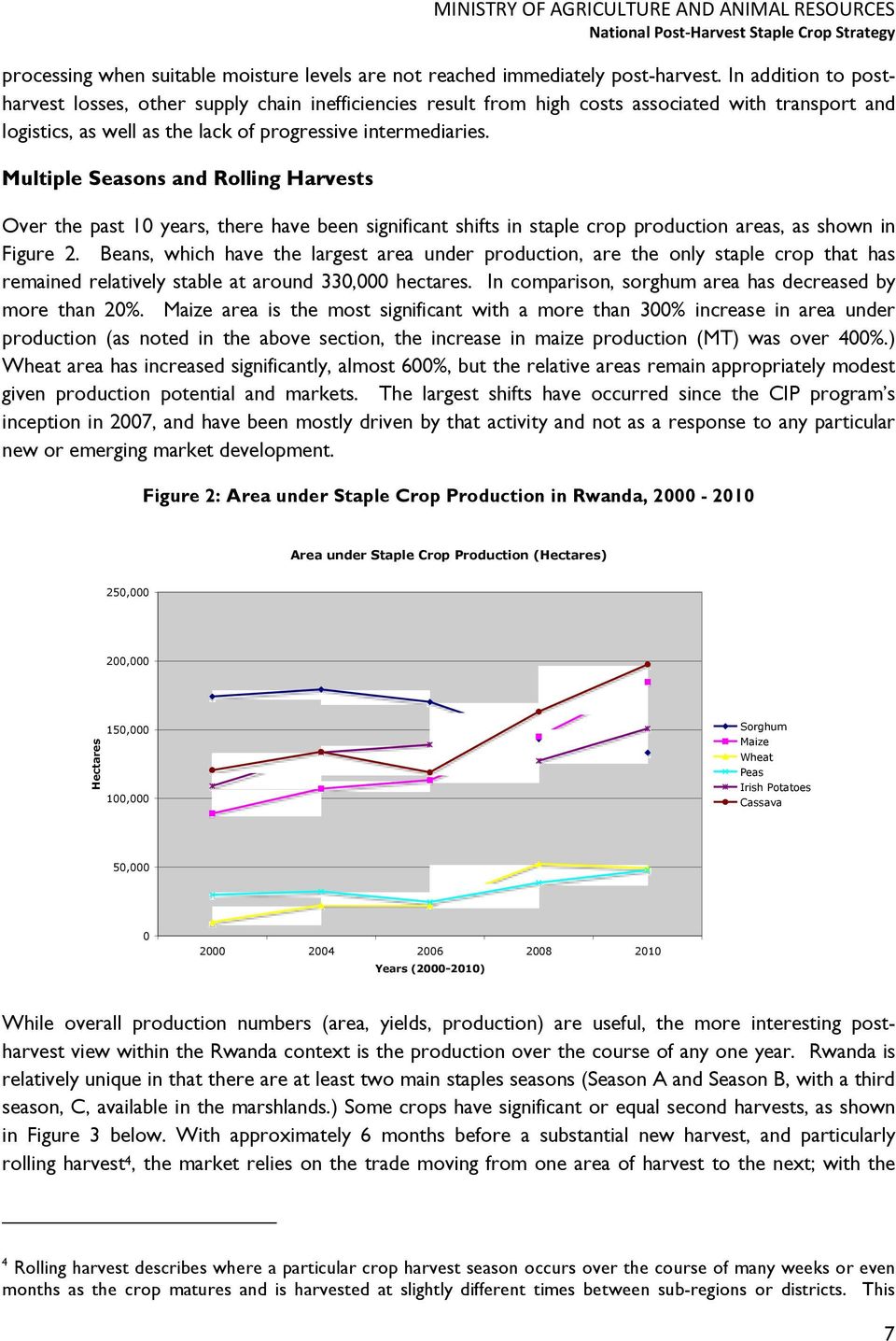
14 priority on handling, with relatively small storage capacity rather than large purchases at harvest and storage for significant periods of time. Where this makes agronomic sense, the impact on the market of promoting production of any particular crop in both main seasons would be positive. Regional trade further enhances this leveling of temporal supply available within the market, where staple crop seasons within the region add to the rolling of harvests. Figure 3: Staple Crop Production in Rwanda by Season, Staple Crops Market Context The post-harvest supply chain can be divided into three key categories of stakeholders and objectives: 1) consumers and end markets; 2) trade and industry (bulking, secondary handling, traders, and processing); and 3) producers, farm gate, and cooperatives (primary handling and processing.) The market (end markets, trade, and industry) can be segmented between the informal (petty traders, small unregistered mills or artisanal processing) and the formal actors. The formal staples markets can be further segmented into two main groups: the formal private sector including larger traders that may have established relationships with commercial credit, as well as medium and larger registered mills and processing enterprises, and results in a steadier entrance of product into the market without the severe supply dumps or shortages in the market. 8

15 structured demand involving large-scale, relatively predictable institutional buyers, including relief organizations, schools, prisons, military, etc. Cooperatives conventionally would be considered a part of the formal private sector as they are typically registered marketing service and aggregator businesses that happen to be cooperatively owned. However, cooperatives are presently quite varied in their strength and business execution; thus, the majority of their post-harvest activities and services should be included within the informal market. Consumers and End Markets Two principal objectives drive the National Post-Harvest Strategy with relation to consumers. Food crops are specifically targeted due to their potential to positively impact 1) food security and 2) selfsufficiency. In Rwanda, food security disproportionately affects rural producers themselves. Urban consumers and those that principally purchase their staple foods must have sustained access to safe and affordable food. Food Security Household level food security is principally an issue for the rural population. Anecdotally, producers retain between 20-40% of their staple food production on-farm for household consumption. The range varies; for example among cereal farmers, individual households have between 0.2 and 2 hectares of grain under production at any one time. Cash from the sale of the remaining 60-80% of the volume produced must cover the entire investment in inputs, improved production practices, and household cash requirements. As noted in a number of sources, including FAO GIEWS Country Briefs and the CIP evaluation report (March 2010), the CIP program and its input subsidies (currently 50% for fertilizer and an effective 100% for seeds) have had a positive impact on rural food security. The economics of sustained farmer adoption of improved inputs and practices must include an analysis of the household s ability to retain staple production for household consumption as subsidies decline. Productivity improvements must reach a level where, especially in the case of cereals and legumes, sufficient cash can be generated by partial sales to cover the total cost of production, including household consumption. Primary processing and handling, which includes shelling and threshing, drying, and initial aggregation, can occur both at the household and community levels (cooperative or first aggregation point.) There is a risk that if only larger volume aggregation and sales are prioritized and promoted by public or private extension services, this may inhibit the producer households abilities to retain any for consumption. It is currently unclear whether any of the crops would be returned to the household for the purpose of household consumption if all primary processing occurs at the cooperative or aggregation point. Safe and Affordable Food Per capita and total consumption of staple foods, including irish potatoes, beans, sorghum, maize, and cassava, in Rwanda has not been well quantified or documented. For example, while there is a generally held perception that per capita maize consumption is significant, consumption of maize flour is actually a relatively new phenomenon in Rwanda. The only maize consumption estimates identified came from a 2002 report which, while clearly dated, did indicate a trend of increased maize (as flour) consumption 9

16 within the country. 5 This report used household surveys to estimate that 50% of maize produced (at that time 62,000MT) was kept for consumption within the producer household for food security. An additional 55,000MT were consumed via maize or maize flour purchases. Of this 55,000MT market demand, 50,000 represented demand from rural purchasers. At the time of the report publication, 2010 demand (purchases, excluding production retained within the producing households) was projected to be 72,000MT. There is a clear need to update this information. MINAGRI and others have been backing into demand numbers via the food balance sheet system of watching production, imports, exports, and stocks. Although household consumption volumes and patterns are not well known, they are critical for both public and private sector decision-making. The majority of the staples processing occurs within the informal sector through petty traders, small unregistered mills or artisanal processing. The formal processing sector medium and larger registered mills and processing enterprises is relatively small, and functioning dramatically below installed capacity. In the case of maize flour, roller milled flour has a longer shelf life than that which is processed at the smaller, informal hammer mills, which has a shorter shelf life and is consumed within days. Shelf life is clearly not a consumer priority at this time. Hammer mills either mill a customer s own maize at a fee (toll milling), and/or purchase small amounts of maize from the market and sell flour to passing customers. Producers and other household consumers bring their product to be milled and take it home to consume. Small traders (mainly female) also bring in small quantities of maize purchased within the markets, have it milled and then retail it in the same markets. While there are currently no significant food quality or safety issues within the market, the Rwanda Bureau of Standards (RBS) has been starting to work more with informal staples processors on food safety and quality, as discussed further in the implementing institutions section below. Animal protein consumption is also relevant to cereals and legumes market demand, as staples byproducts are sold into the animal feed industry. Non-ruminant production, principally poultry and pigs, has an important role to play in the development of a concentrated livestock feed industry that can expand staple grain markets. In Rwanda the poultry industry has practically collapsed since the ban on the import of day old chicks and fertilized eggs as a result of the global spread of avian influenza. This import ban has recently been lifted and the National Hatchery reopened, and importers of day old chicks from Uganda and even Brussels have already re-launched operations. During the period of the poultry import ban, the price of chicken paid by the consumer in Kigali rose from 900RWF/kg to 2200RWF/kg. This high price reduced poultry meat consumption significantly. 6 There is potential to increase the per capita consumption of poultry meat by competitively producing chicken locally. About 70-85% of the consumer price for chicken and eggs typically reflects the cost of feed. In the case of Rwanda, we expect slightly more of today s production cost than usual to come from the cost of day old chicks, but RARDA s intentions to prioritize the expansion of the domestic poultry industry will need competitive feed prices therefore reducing the cost of chicken products and increasing consumption. This in turn will benefit cereals and legumes producers with additional markets. 5 CIAT-ATDT/ISAR/IITA-FOODNET and PEARL Project Rwanda, Maize sub-sector survey, November Anecdotally, urban Kigali consumers eat chicken only once or twice a month in their homes, if that, principally due to price. 10
17 It is also interesting to note that some farmers are able to capture additional value within narrower marketing windows by offering their staple crops as immature, almost horticultural products. These markets need to be better quantified and farmers given support to understand and take advantage of these income opportunities, including green maize and fresh shelled beans. In some areas, prices may be as much as 300% above what the producer would get after the crop reaches full maturity, especially considering the additional investment required for proper drying and handling to reach the more typically traded state. The consumption of maize flour within Rwanda is a relatively new phenomenon while green maize has a longer though not quantified consumption history. 7 Trade and Industry Commercial perspectives and market facilitation are critical for regionally competitive staples value chains. The private sector, which includes all value chain actors from farmers to retailers, should be the driver of improved efficiencies through increased investment and economic growth. This strategy intends to support the private sector in their role as the engine of economic growth in staples value chains, and improve efficiency and decrease marketing costs along the staples value chains for overall gains in Rwanda s competitiveness in the target staple crops. The key GOR development strategies including Vision 2020 and EDPRS clearly reflect the general consensus that liberal and open trade regimes are in the long-term best interest of Rwanda. Rwanda s entry in regional economic communities, including the East African Community (EAC) and the Economic Community of the Great Lake Countries, reaffirm this view. The private sector must increase their capacity to compete within the region. Regional Trade Rwanda runs a large net trade deficit (all trade, not just staples), as noted in 7 Farmers and cooperatives understand in the past season and this season that the sale of green maize is prohibited, though it is unclear that it is a formal policy and how, if at all, this is being enforced. 11

18 Table 1 below, adapted from the recently published Informal Cross Border Trade Survey Report (May 2009 April 2010) by BNR in collaboration with MINICOM, RRA, and NISR. While informal trade only represents 5% of total trade, informal regional exports to EAC and CEPGL countries represent 20% of total exports. 12

19 Table 1: Rwanda s Formal and Informal Trade Flows, May April A comparison of formal and informal trade flows (RWF) to/from Rwanda, May 2009 April 2010 Formal Trade Informal Trade Total Trade % share of formal trade % share of informal trade Import 610,221,947,805 12,378,008, ,599,956,322 98% 2% Export 109,670,916,532 27,680,139, ,351,055,681 80% 20% (485,248,900,641) Total Trade surplus (deficit) Further analysis by trading partners indicates that the DRC is the largest informal export market (all trade, not just staples) for Rwanda, representing 80% of informal exports as seen in Table 2. Table 2: Rwanda's Total Informal Trade Value with Neighboring Countries, May April 2010 Rwanda s total informal trade value with neighboring countries from May April 2010 Country Informal Imports 000RWF % share of total imports Informal Exports 000RWF % share of total exports Total Informal Trade 000RWF % share of total trade transactions Informal Trade surplus (deficit) 000RWF Burundi 3,721,998 30% 3,841,690 14% 7,563,687 19% 119,692 DRC 3,305,014 27% 22,039,231 80% 25,344,245 63% 18,734,218 Tanzania 113,446 1% 17,011 0% 130,458 0% (96,435) Uganda 5,237,551 42% 1,782,207 6% 7,019,758 18% (3,455,344) Total 12,378, % 27,680, % 40,058, % 15,302,131 The study also quantified the value of informal trade in some staple foods, as shown in Table 3. Table 3: Rwanda's Informal Trade in Staple Crops, May 2009 April 2010 Rwanda s Informal Trade in Staple Crops Import Value (RWF) Export Value (RWF) Balance of Informal Trade Sorghum 725,763,140 28,180,706 (697,582,434) Dried Beans 604,475,007 1,352,501, ,026,622 Maize Flour 494,476,340 1,219,526, ,049,959 Maize 407,380, ,886,147 (282,494,047) Husked Rice 453,825,409 - (453,825,409) Irish Potatoes 236,647,863 1,111,648, ,000,330 Cassava Flour 65,004, ,888, ,883,842 Wheat Flour 319,702,648 - (319,702,648) 1,011,356,215 8 Due to difficulties in obtaining the formal trade data behind the number summarized here, a more detailed discussion of the relative share of different commodities and destinations/origins was not possible. 13

20 Those staples that have notable informal two-way trade, specifically beans, maize flour, and Irish potatoes, may indicate seasonality where regional comparative advantage does not warrant longer term storage within a specific country; the commodities move between the regional production areas to areas of consumption based on harvest cycles, moving across borders as demanded. While this trade is interesting (particularly since informal exports represent 20% of total exports) and shows positive informal trade balances in Irish potatoes and beans, with a specific opportunity in sorghum; these values represent relatively small volumes of commodities (roughly: 3,000MT sorghum imported; and 9,000MT Irish potatoes and 4,500MT dry beans exported.) National Markets Staples in Rwanda are largely traded through informal channels and transformed/processed by smaller informal processors. The general push among the public and private sector stakeholders is to strengthen commercial links between producers and their producer cooperatives with the formal markets, which remain limited in relative size, and as noted in the above consumer focused section, operate significantly below capacity. The formal markets include both formal private sector trade and transformation, and structured demand 9. WFP has a modest, but growing, structured demand purchase portfolio within Rwanda through an expanding Purchase for Progress (P4P) program. The GOR has large buying positions within the staples markets, including some structured demand; prisons, hospitals; but also by the Rwanda Agriculture Board (RAB) who purchases relatively large volumes of locally produced seed (not certified) and some grain to be redistributed through their seed support programs. Using maize as an example, the formal maize processors in Rwanda purchased approximately 60,000 MTs in 2010, while the structured demand markets bought about 20,000 MTs. Considering the reported 430,000 MTs of 2010 maize production, the formal markets purchased less than 20% of total production. This percentage is even smaller when one considers that the 60,000 MTs of maize purchased and processed most likely included maize originating in neighboring countries. 10 The relevance of the animal feed industry to the staple grains markets has also been discussed in the previous section. They are considered part of the formal market, with quality and cost requirements that may be even higher. Continued expansion of the livestock industry, especially broiler (chicken meat) and layer (table egg) operations, will assist the animal feed processors to leverage their unused capacity and should assist in expanding the formal demand for quality improvements along the chain. It must be noted at this point that small-scale dairy expansion will not have a significant effect on the feed industry development, but should also benefit from the development of a concentrated feed industry focused on non-ruminant livestock production. 9 Structured demand involves large-scale, relatively predictable institutional buyers. These can include relief agencies including various UN Agencies and NGOs, as well as public sector institutions including food reserves, hospitals and health programs, schools, militaries, and prisons. 10 The 2010 maize market estimates were generated by the consultant drawing on documents from MINICOM, the PHHS inception report, and stakeholder interviews. 14

21 Many staples stakeholders, both public and private, view maize as the priority staple crop for investment and intervention. It is a relatively new crop, having seen significant expansion in production over the very recent past as a result of substantial productivity and promotion investments by MINAGRI. The competitiveness and market capacity for commercializing maize are still evolving, while other crops, including beans and Irish potatoes have strong markets and producers with stronger historical linkages to trade. The market strength in these other staples provides financial incentives for the value chain participants to focus on minimizing post-harvest losses and improve handling to increase the quantity and quality of product that reaches the market. There is a perception across the staple crop value chains that post-harvest losses are significant, but there is little available data. An ongoing effort from the GOR and its partners is necessary to quantify this issue at all levels of the value chain. Currently with maize, the limited size of the formal market demanding quality (and present constraints in production competitiveness) does not automatically equate to farmers being compensated for the investment required to minimize losses and improve quality through primary processing and handling. Drying is most critical, both technically and economically, for cereals and legumes crops. Achieving a proper moisture level can stabilize the grain for further handling and storage, and can improve the milling quality. Field drying is the most economical, allowing the crop to naturally reduce moisture content upon maturation and prior to harvest. Rwanda is limited in this regard due to harvests during the rainy season. Use of the sun and air remain the most economical, particularly for very high moisture grain, which make technologies such as drying sheds and concrete drying grounds a natural next choice for producer and first aggregator level investment, although the grain remains exposed to pests, weather, and thieves. Since margins for the producers (and everyone along the value chain) remain thin, the economics of technological solutions for staples in relation to market price response must be calculated. In the rice sector there is installed mechanical drying capacity. Producers are found to prefer to expose their crop to some risk of loss in order to dry themselves, rather than take the price differential paid to compensate for the processor drying mechanically. The trade currently has little reason to discourage the sale of wet commodities, and maize in particular. The main markets, the informal millers, simply are not demanding it. The traders do not take significant market positions, turning their stocks over relatively quickly. And the informal millers (and those utilizing the toll milling services) are also entering the market on a regular basis to purchase maize and sell the maize flour immediately. Most consumers accept the resulting quality and do not want to pay the premium for improved quality; an especially important consideration in staple foods, where a fundamental objective is consumer access to affordable food. There is a perception among decision makers and even the formal private sector market that additional storage is the key. But investment in handling technologies and facilities that are economically relevant (instead of storage) given the current trade norms should result in a return on their investment. A variety of bag sizes are used in the region; 50 kg for WFP (who follows ILO), 90 kg in Kenya, 100 kg in Tanzania and 100kg+ in Uganda and Rwanda. The practice of over stuffing bags is commonplace where a bag with a tare weight suitable for 100 kg has significantly more grain inside this over stuffing leads to the poly propylene strands pulling apart along seams. Grain falling out onto the floor attracts rodents and provides an easily accessible breeding ground for insects, which further increases the post-harvest 15
22 losses. The reason bags are overstuffed is partly limited use of scales at the rural aggregating level, and the rationale that if the bag is full to bursting, then it is the right weight. Another side effect of over stuffing bags is the increase in broken grains. This is particularly prevalent in paddy rice, which if dried down to a suitable storage moisture level (under 13.5%) becomes more fragile. When a bag over 100 kg is hefted in and out of trucks, and stacks, the force as it falls, or other bags fall on it, is significant, breaking the grains inside and reducing the quality of the milled rice. Standardizing the use of 50 kg bags would lower this. Finally, bags of 90kg+ weigh more than the person carrying the bag this can cause significant long-term injuries. This position is supported by the ILO and the EAC and is reflected in the EAC maize standard but not enforced. Industry players in the region agree with the policy but will not implement it until government regulates it, since they cannot bear the corresponding cost in the highly competitive staple trade where margins per unit are small. Transport costs are a significant portion of total marketing costs. 11 A recent study quantified the marketing costs along the maize value chains in Tanzania, Uganda, and Kenya. 12 This study found that transportation costs accounted for 76% of the marketing costs. Of that, 44% of average transport charges occur during the first 28% of the distance between farmers and urban wholesalers. While Rwanda was not included in the study, transport costs may be assumed to be similar to elsewhere in the region. Market information, while an important aspect of structured trade systems, does not automatically provide market access. Improved access to market information does not in and of itself provide incremental income improvements to any player in the value chain; rather, it helps stakeholders understand what their best options are for buying and selling and increases transparency and fair pricing, thus enhancing market efficiency. Market information relates to primary information (crop forecasts, production, consumption, price data) and processed information market trends, predictions etc. Primary data provision is a justifiable public good where the government uses its resources to provide accurate, timely, and relevant information both to its own departments and the private sector. Market price information across the country, region, and world tracks certain markets. The South African maize market closely reflects the movement in prices on the trading floor of the Chicago Board of Trade; Ugandan prices track movements in the Kenyan Nairobi market. Prices across different markets in Rwanda will closely track for the most part the price in Kigali. Therefore since prices are only indicative, and can change every minute and every day prices for markets outside of Kigali can be derived by knowing the transport cost per km (adjusted for fuel price changes). This means the number of price collection points can be limited to one or two markets (and occasionally checked to see if there are significant differences beyond what would be expected for transport costs). 11 Marketing costs are all transaction costs between the farm gate and the final processor or retailer. Costs for significantly transformed products between the purchase by the processor and the consumer after processing may include inefficiencies within the processing itself and thus is not included as a marketing cost. It is useful to analyze the marketing costs between segments within the supply chain to identify where opportunities for improvement offer significant increases in efficiency. 12 Eastern Africa: A Study of the Regional Maize Market and Marketing Costs, Agriculture and Rural Development Unit, World Bank, December
23 In well-developed markets the private sector provides a number of services, which either provides processed information to paying subscribers, or uses the provision of processed information as a way of attracting customers to other services. Government can stimulate the development of processed information providers by commissioning private sector service providers to produce such information (potentially through the private sector cereals and legumes alliance) with the government reducing its contribution to the costs over time until it pays a subscription for the services along the same lines as other private sector players. Producers and Farm Gate The profitability of some staple crops remains hampered by low productivity. The CIP program continues to focus on reaching the target productivity levels needed for competitiveness and producer profitability. This intends to enhance producers access to and linkages with markets to complement the gains expected from complementary productivity and competitiveness investments. Rural producers are largely organized into product specific cooperatives, at the sector or cell level. These product specific cooperatives are aggregated into commodity unions, mostly at a district level. The unions are eventually represented in commodity federations at the national level. This is reflective of the cooperative development strategy, which is discussed further in the legal and regulatory framework and implementing institution sections following. At present there are only two functioning national producers federations, FUCORIRWA (rice) and the Irish Potato Federation. The Rwanda Cooperative Agency (RCA) and the active cooperative unions are also developing a maize federation. Producers have uneven access to formal structured markets and marketing services. Maize is seen as a priority crop for investment and intervention in part because producers do not have many marketing options. Other staple crops, including beans, Irish potatoes, rice, and cassava, tend to have traders who penetrate production areas for purchase. Cooperatives are uneven in their capacity to serve their members with relevant services. Some areas have strong NGO capacity building programs assisting cooperatives in developing and implementing aggregation and market linkage activities. Irish potatoes and paddy farmers have some of the strongest cooperatives and unions. Some of the aggregation and handling models that the cooperatives are being strongly encouraged to adopt include significant off-farm handling investments, where all cereals and legumes produced by cooperative members jointly move through primary processing, including shelling, threshing, drying, and aggregating even shorter-term storage for volume marketing. If and when these models are adopted by cooperatives, food security implications need to be assessed; specifically the effect this may have on producer households abilities to retain some staple food production for home consumption. Storage for anticipated increases in market prices is speculation, though it extends farmers choices of when to sell their crop. Producers and cooperatives need capacity building in understanding and managing the additional risk assumed through storage and speculation with credit. While there are some nascent programs in lending for cooperative speculation activities, the microfinance institutions involved expressed a capacity constraint, particularly in understanding, quantifying, and managing their associated commodity risk. 17
24 The National Context Implementing Institutions The decentralization strategy, outlined above, provides the framework through which the implementing institutions operate. The Districts and Sectors play critical leading roles in strategy and policy implementation with the federal institutions transitioning to service provider and technical advisory structures. Consumers and End Markets There are social safety nets for especially vulnerable populations in the rural areas that are managed by the district and sector administrations. These programs provide cash support payments that are most likely used for critical purchases, including staple foods. 1. Rwanda Bureau of Standards The Rwanda Bureau of Standards (RBS) is responsible for ensuring that all products on the market are safe to protect the health of the consumer; and secondly to promote grades and standards which facilitate trade. RBS has the mandate to set relevant standards, and provide training and sensitization for key stakeholders. Although they have some resource limitations to reach the full value chain with these services, they are starting to reach segments of the cereals and legumes informal sector, in a limited fashion. RBS has established a positive working relationship with the formal private sector, including both processing and trading. They have provided limited capacity building and sensitization directly to cooperatives and through extension agents. These linkages and RBS capacity to leverage key intermediate stakeholders, both public and private, for enhanced training, sensitization and compliance with grades and standards, could be significantly enhanced. Until the Quality Policy is fully implemented, RBS continues some enforcement role. In mid-2010, RBS visited some Kigali based informal small maize mills. Twenty were found to have serious enough food safety and contamination issues to have operations suspended. Clear guidance was provided by RBS at the time about the standards infractions and steps that would need to be taken to meet minimum standards. Within a few months of suspension, half of the maize mills had made the necessary investments and modifications to process to reopen. In the future the National Inspectorate Board will assume this role, while RBS will provide the training and capacity building to the businesses around meeting the standards. Trade and Industry 2. Ministry of Local Government The Ministry of Local Government (MINALOC) is responsible under the decentralization policy for transferring powers, authority, functions, responsibilities and the requisite resources from central government to local governments or administrative divisions. MINALOC is a critical partner in supporting the District and Sector leadership in executing their roles in prioritizing economic development strategies and activities for their constituents and coordinating program implementation and service provision of other Ministries. As agriculture remains the main economic activity in most of 18
25 the sectors and districts, MINALOC is an important implementing institution for staples value chain prioritization and development, as are the district and sector leaders themselves. 3. Ministry of Trade and Industry Ministry of Trade and Industry (MINICOM) has a strong relationship with the formal trade, logistics and transport, and processing sectors. The relationship is viewed as collaborative and supportive by the private sector, and MINICOM has facilitated additional finance and dialog opportunities where identified as critical for the formal staples processors. They have a key role to play in continuing to move the informal sector into the formal sector. The formal staples private sector remains limited in size, but once the industry defines their shared industry vision MINICOM is a natural partner, for collaborative promotion of expanded investment and increased competitiveness. MINICOM appears to have sufficient capacity to expand their engagement in supporting the objectives and implementation of a coordinated National Post-Harvest Strategy. 4. Rwanda Development Bank (BRD) The BRD s mission is to finance Rwanda s development objectives, in priority sectors, including agriculture. Among Rwanda s banks, the BRD is the largest user of the RIF II financing facility and played a critical role in the expansion of investment in the coffee sector. The previous legal and regulatory framework section discussed their subsidiary, the BDF, in more detail. In addition, the BRD provides business consulting and technical assistance through the BAS, Business Advisory Services. They lack specific agribusiness and commodity trading expertise that could be useful to both cooperatives and other private sector seeking consulting services. 5. Rwanda Development Board The Rwanda Development Board (RDB) is an independent agency. It reports directly to the President and is guided by a Board that includes all of the key Ministers, including finance, commerce, infrastructure, and agriculture. The RDB is a one-stop shop that brings together all the government agencies responsible for the entire investor experience under one roof. This includes key agencies responsible for investment promotion, privatization and specialist agencies, which support SMEs and human capacity development in the private sector. The RDB has the capacity to assist in the development of business plans and conduct feasibility studies to encourage additional investment and industry expansion. They are currently working with the Districts to conduct feasibility studies for investment promotion in priority agriculture value chains, as identified by the Districts. Other critical Ministries and Agencies relevant to the enhancement of competitiveness and expansion of the staples value chain are the Ministry of Finance and Economic Planning (MINECOFIN), the Rwanda Revenue Authority (RRA), the Ministry of East African Community Affairs (MINEAC), and the Ministry of Infrastructure (MININFRA.) Producers and Farm Gate As noted in the previous sections, the Sector and District Governments play a critical role in leading and coordinating activities and programs. 19
26 6. Ministry of Agriculture and Livestock Resources (MINAGRI) MINAGRI is composed of two autonomous agencies, including Rwanda Agriculture Board (RAB), National Agriculture Export Board (NAEB). The MINAGRI Post-Harvest Task Force sits outside of these units and reports directly into the overarching MINAGRI administration. They are led by the CIP manager and initiated the first experience with a strategic grain reserve (as outlined in the above market context section) as well as initiating investment in primary staples processing infrastructure in maize (drying grounds planned for the coming 2011A Season.) 7. Rwanda Agriculture Board Rwanda Agriculture Board (RAB) is designed to support entire agricultural value chains within Rwanda, except horticulture, coffee, and tea, which have their own institution-naeb. RAB coordinates the local production, purchase, and distribution of seeds. As a result RAB is an important buyer of staples production. Many of the strongest cooperatives in maize and wheat, for example, produce seed (or grain to be used as seed) for RAB purchase. In addition to seed and post-harvest units, RAB has soil and water management (focused on erosion control and hillside agriculture), crop production (including fertilizer programs), crop protection, a separate rice production unit and an animal resources development directorate. Implementation of Research and the Extension Strategy described in the above legal and regulatory framework is also led by RAB. In the past, ISAR (Institut des Sciences Agronomiques du Rwanda) led the research in agronomy, animal and environmental sciences. It had a unit dedicated to post-harvest activities, principally focused on producer, cooperative, or small-scale entrepreneur processing technologies. The ISAR Post-Harvest (PH) unit had a staff of five food scientists, with three currently out of the country pursuing advanced degrees. It was engaged in staples research and capacity building as related to specific food applications, including cassava and Irish potato products. The PH unit did not have any agriculture engineering expertise that can prioritize the evaluation and adaptation of primary handling technologies, such as threshing, shelling, winnowing, and drying of cereals and legumes. The PH unit also lacked any expertise in human-centered adaptive design or economic analysis capacity that could be useful in developing sustainable commercialization strategies for identified appropriate technologies for scalable adoption by value chains. Their capacity to engage directly with many cooperatives is also constrained by staff capacity. The Rwanda Agricultural Board (RAB) has now assumed the responsibilities of the former ISAR. 8. Rwanda Cooperative Agency The RCA (Cooperative Agency) has been discussed in some depth in the previous legal and regulatory framework. The RCA is a critical partner in their role of providing capacity building to the producer cooperatives. They do not have the technical capacity to fully understand the commodity marketing models being pursued by the cooperatives and partnerships should be strengthened so that the 20
27 cooperative administration and transparency are properly understanding and reporting their risk exposure and recommending risk management approaches, for example professional liability insurance. Supporting Institutions Consumers and End Markets Consumers purchase their staple foods from organized retail, more traditional markets, and at times directly from producers or small processors. The formal processing private sector, as noted earlier, is limited and operating under capacity. They have limited brand development and are often selling bulk to wholesalers who will most likely break down the volumes into smaller retail quantities. Sosoma is one example of a formal processor that does have brand recognition and has been investing in product development and consumer targeted brand development. Trade and Industry 9. Formal processing The formal processing of staple crops is limited to a handful of companies (and most are in maize, paddy rice.) Their infrastructure sophistication varies, but the industry is operating significantly below capacity. No formal maize processor has functional mechanical drying capacity installed (though there are now plans for investment as a result of the previously mentioned USAID funded MLI matching grants program.) The maize investments mostly occurred to meet local maize flour demand by relying on the processing of imported maize, which arrives in a stable state. This lack of drying infrastructure is one issue that needs to be further overcome for the local processors to continue to shift to local production. There is one bean processor. Cassava has a slightly higher number of processors, but they are all small. Drying is also critical in the cassava processing industry. Cereal processors typically buy the majority (even 70-80%) of their raw commodity needs at harvest. This allows the processor to lock in their cost of goods sold, but requires large amounts of affordable working capital as well as inventory warehouse space. In Rwanda the requirements are somewhat lower given multiple rolling harvests and regional trade, but working capital constraints are still a concern for the formal and informal maize (and other cereals) processors. Given the availability of financial incentive mechanisms, it is clear that underlying business constraints exist that are inhibiting their ability to capitalize on the mechanisms (for example, the business is overleveraged and not able to assume additional debt load for working capital.) Within Rwanda, the small formal processing sector also lacks access to agribusiness consulting services with relevant commodity trade and processing expertise. Capacity to manage the associated commodity risks is uneven across the enterprises. As noted above, the animal feed industry is not fully developed due to an absence of a developed nonruminant livestock production industry. There is significant installed capacity, some of which is occasionally utilized for processing maize to meet structured demand contracts for human food (sold to WFP tender.) The capacity utilization should improve as the livestock industry develops. The animal feed sector must be considered a part of the staples food value chain, which is not the case in Rwanda today. 21
28 10. Informal Processing MINISTRY OF AGRICULTURE AND ANIMAL RESOURCES The informal processing sector appears to have penetrated most regions of Rwanda, with hammer milling businesses. These businesses do some of their own purchase, processing, and retail of staples flours (maize, bean, cassava) but often run their businesses based on toll milling services both for small traders (mostly women), as well as consumers and producers directly. 11. Traders Traders play critical roles of aggregation, finance, and arbitrage (moving commodities between areas of supply and demand.) Smaller traders provide market linkage services as they penetrate into production areas. There is a nascent traders association in Kigali that has secured land for a new commodity trading and warehousing facility, and has already secured commercial finance. Most of the member traders already have good relationships with commercial lenders and backward linkages with smaller traders sourcing from producers. These traders also facilitate the regional import and export of commodities. RBS works with them for input into grades and standards process and enforces health and safety regulations. 12. Financial Institutions There is a strong banking sector within Rwanda. One bank in particular, BPR (Banque Populaire), has a good reach into the rural areas and a specific interest in agriculture. With Rabobank (a Dutch cooperative bank with strong agricultural lending expertise) a significant shareholder, BPR has an agriculture lending department. BPR leverages about 19 different credit facilities from NGOs or the public sector on behalf of their clients, mostly in agriculture. RIF II loans make up about 17% of this specific credit facility portfolio (this figure includes all agriculture sectors and does not represent staples specific lending.) This agriculture lending expertise, though, does not extend equally through all of the banks. The banks typically report a lack of bankable projects, not a lack of capital or access to appropriate concessionary financial mechanisms. The financial sector also suffers from the lack of agribusiness and specific agroprocessing expertise in the consulting and advisory services sector. Business planning services are lacking at the local level little understanding of strategic planning, analysis of strengths and weaknesses, and constrained capacity to play out different operational scenarios. The microfinance institutions are the other main players in the staples value chains and are starting to enter the provision of inventory credit, through cooperatives. The MFIs consulted expressed concern at their own capacity to understand the associated commodity and market risk that they were assuming. The MFIs are aware that inventory credit is offered in other markets, but reported little to no exposure to those experiences or best practices to learn from. 13. PSF (Private Sector Federation) PSF is an overarching organization representing a federation of 12 sector Chambers. They have a strong calendar of advocacy opportunities with many relevant ministries and agencies of the GOR, but reportedly the agriculture chamber is relatively weak. The formal staples processors are reasonably active within the Chamber of Industry, including holding leadership positions. PSF and RRA hold a 22
29 quarterly Tax Issues Forum, which is part of the PSF s public dialog and advocacy calendar. PSF also has a quarterly working dinner with MINICOM. An annual meeting between PSF and the President is also convened. There are apparently no scheduled meetings with any part of MINAGRI. While cooperatives are theoretically viewed as private sector entities, and are subject to the same corporate income tax structure (should they develop strong business models generating revenue and profit), they do not have representation within PSF. This means that a critical piece of the agriculture value chains are not participating in what is meant to be a comprehensive private sector representative body. PSF lacks linkages with cooperatives, in part due to their lack of representation and the relatively weak agriculture chamber generally. A confederation of federations is expected have a membership seat within the PSF, but strong cooperatives, unions, and federations should also participate within the appropriate Chambers to strengthen the relevance to the staples industry. PSF has a BDS operation, with external (including public) funding support. This BDS operation is intended to provide capacity and consulting services to both SMEs and cooperatives, as well as assist with linkages to finance. The agriculture industry appears to only gather when convened by GOR, and typically across single value chains (and the livestock feed industry is not typically invited to cereals meetings.) Producers and Farm Gate A number of staples cooperatives are gaining capacity and experience, having been organized a number of years ago and received some technical assistance and capacity building from donor programs, NGOs, or GOR. But cooperative capacity remains varied and many lack strong market service models. Most commodity cooperatives enable input acquisition and delivery for their members and partner with extension services; they are largely production-focused activities. There are a few cooperatives now being trained and linked with formal processing and structured demand markets, including WFP. But no examples of linkages between cooperatives and traders were identified. Traders continue to purchase directly from individual producers, particularly in the cereals and legumes markets. Building cooperative capacity requires a long-term investment and should be founded on an economically viable market service (or trading) business model. The union level may be the most appropriate level at which to launch trading enterprises. One with some prospect of success has started in Gitarama where a number of cooperatives united to form an input supply retail operation to service the market (most of the sales are not to cooperative members, but the general public.) The profits and cash flow will be utilized to launch a commodity trading operation, focusing on cooperative production. The staff have trading backgrounds and existing trading contacts both within Rwanda and in regional markets like DRC and Burundi. Lessons from this experience, that is commercially focused with specific hired trading expertise but happens to be cooperatively owned, may provide models for other cooperatives to replicate. 14. NGOs There are many international and local NGOs operating within Rwanda. Some NGOs are contracted by GOR as service providers to producers and cooperatives, including in production extension and post-harvest (including marketing) support. NGO activities are coordinated at the District level. Postharvest capacity, technologies, and processes are found within the NGO operations. The access to these technologies and these capacities is limited to the NGO s reach and mandate/budget. NGOs also 23
30 often do not have sufficiently commercial motives to fully commercialize useful technologies that have significant scale potential. Mining these capacities, technologies, and processes, as related to primary processing and handling activities, could yield significant material for commercialization for the benefit of a larger number of Rwandan producers. Regional and International Context The grain trade in Eastern Africa mostly follows the central and northern transit corridors with the bulk of the grain trade moving along the northern corridor towards Kenya which has a significant deficit in beans and rice and a small deficit in maize. The economic growth in Kenya has generated the buying power to cover the expense of moving commodities large distances for instance beans from Southern Tanzania to Nairobi. The higher level of purchasing power has also allowed the Kenyans to develop preferences for instance for different single variety beans. So Rwandan mixed beans move into the Ugandan market, and Uganda produces single beans, which move into the Kenyan market. Distance from the consuming market is a significant factor in the competitiveness of any staple moving along these supply chains. While Rwanda has an advantage to access the markets in DRC, it is at a disadvantage to Uganda for moving maize into the Kenyan market. Other factors that affect competitiveness are the productivity level at the farm, the cost of the inputs that are used (which in the case of fertilizer have had to be imported through Mombasa and so already have a high transport cost component), and the efficiency of the aggregation of commodities into tradable volumes. Key Institutions and Frameworks EAGC was established by the private sector to represent grain farmers, traders and processors and their related service industry players. It has offices in Kenya, Uganda and Tanzania and is interested in working with the Rwandan players to establish a Rwandan chapter which would have its own strategy and objectives but linked to improving structured trade in country and regionally. As noted previously, Rwanda joined the East African Community in The EAC is working to liberalize and promote regional trade. There is a specific EAC interest in developing and enhancing regional commodity trade for food security across the countries. An external tariff structure on cereals has been adopted to promote production. The Economic Community of the Great Lakes Countries includes Rwanda, Burundi, and DRC. While it was started in 1976, it was only recently revived in As noted in the trade data in the previous section, DRC is a major export market for Rwanda, particularly in staple commodities. Alliance for Commodity Trade in Eastern and Southern Africa (ACTESA; a COMESA affiliated agency) intends to document these on one of its information sharing platforms. 24
31 Vision 3. Vision and Objectives The is a policy framework that will assist with strengthening the harvesting, post-harvest handling, trade, storage, and marketing within staple crop value chains in Rwanda, in an effort to improve markets and linkages for farmers, and reduce post-harvest losses. The Strategy s fundamental vision, to reduce food insecurity through an efficient post-harvest private sector system delivering staple foods to the people of Rwanda, has been guided by the Government of Rwanda s Vision 2020, EDPRS, and PSTA II. The will support farmers capture income potential from increased productivity and competitiveness resulting from complimentary investments, including CIP. This requires engagement across ministries, institutions, agencies and stakeholders along the supply chain resulting in a win-win for producers, trade, industry and processing, and consumers. Objectives By focusing on post-harvest development, the policy recommended here aims to: Strengthen food security among rural staple crop producers Improve consumer access to safe and affordable food Support the private sector to invest in strengthening the competitiveness of the staple crop value and supply chain Improve the efficiency and decrease the marketing costs along the staple crop value chain Enhance producers access to markets Guiding Principles The guiding principal of this Strategy is to leverage, build and align with the SWAp mechanism for increased inter-ministerial coordination with respect to funding and actions that benefit the agriculture sector. This strategy identifies seven Strategic Axes of Interventions detailed below. Each of the seven Strategic Axes of Intervention are further divided into sub-objectives and activities over a five-year period, clearly detailed in the Action Plan. 13 Strategic Axes of Intervention 1. Information available for public and private sector decision making 2. Efficient and equitable transport systems across staple crop producing areas 13 See Annex 3 for the detailed five-year Action Plan. 25
32 3. Reduce staple crop post-harvest losses at producer and first aggregator level 4. Strengthen private enterprise in staple crop value chains 5. Increase private sector post-harvest investment 6. Enhance structured staple trade 7. Transparent strategic grain reserve supporting food emergency needs and liberalized markets 4. Analysis As shown below, the costs to not adopting the National Post-Harvest Strategy include less financial security for farmers, a less developed agricultural system, reduced food security, less informed decisions by government, and a weaker market. In contrast, the benefits include market-based prices for farmers, greater food security, increased private sector investment, and improved efficiencies throughout entire value chains. Following this comparison chart is a detailed analysis of the seven Axes of Intervention and their subobjectives for further clarification. 26
33 Axis 1: Improved Information Axis 2: Improved Transport Axis 3: Reduce Post- Harvest Losses Axis 4: Improved Private Sector Participation Axis 5: Improved Access to Finance Axis 6: Improved Structured Trade Axis 7: Transparent Strategic Grain Reserve Benefits to Adopting National Post-Harvest Strategy Market-Based Prices for Farmers More Robust Private Sector Investment More Informed Government Decisions Higher Margins for Farmers Lower Transaction Costs throughout Value Chains Lower Consumer Costs More Developed Market Higher Margins for Farmers More Robust Private Sector Investment Increased Food Security Market-Based Prices for Farmers More Robust Private Sector Investment More Developed Market Increased Efficiency throughout Value Chains Income-Smoothing for Farmers More Robust Private Sector Investment More Developed Market Higher Quality throughout Value Chains More Robust Private Sector Investment More Developed Market Increased Food Security in the Event of Crisis Costs to not Adopting National Post-Harvest Strategy Less Fair Prices for Farmers Less Involvement by Private Sector Less Informed Decisions by Government Lower Margins for Farmers Higher Transaction costs throughout Value Chains Higher Consumer Costs Less Developed Market Lower Margins for Farmers Less Robust Agricultural Sector Reduced Food Security Less Incentive for Private Sector Involvement Increased Cost to Government from Agricultural Interventions Less Efficiency throughout Value Chains Lower Prices for Farmers Increased Volatility throughout Value Chains Less Private Sector Investment Less Developed Market Lower Quality throughout Value Chains Inability to Compete Regionally Less Developed Market Decreased Food Security in the Event of Crisis 27
34 Axis 1 Sub Obj 1.1 Sub Obj 1.2 Axis 2 Sub Obj 2.1 Sub Obj 2.2 Sub Obj 2.3 Axis 3 Sub Obj 3.1 Sub Obj 3.2 Sub Obj 3.3 Sub Obj 3.4 Axis 4 Sub Obj 4.1 Sub Obj 4.2 Sub Obj 4.3 Axis 5 Sub Obj 5.1 Axis 6 Sub Obj 6.1 Sub Obj 6.2 Sub Obj 6.3 Information available for public and private sector decision-making Strengthen basic data system Private sector generating market intelligence Efficient and equitable transport systems across staple crop producing areas Investigate transport component of staple marketing costs Reduce road transport costs between production and secondary aggregation points in high potential areas Address prioritized soft constraints Reduce staple crop post-harvest losses at producer and first aggregator level Build RAB Post-Harvest Team capacity Identify and prioritize list of economically relevant post-harvest technology Disseminate and promote the uptake of technology Reduce post-harvest losses Strengthen private enterprise in staple crop value chains Empower the private sector to support the delivery of staple foods to the market Transfer skills to all enterprises involved in moving staple grains into markets Sufficient storage available throughout the supply chain for harvested staple grains Increase private sector post-harvest investment Private sector accessing financial services Enhance structured staple trade Expand staple crop grades and standards Extend awareness of staple crop grades and standards Improve staple crop market trade infrastructure 28
35 Axis 7 Sub Obj 7.1 Sub Obj 7.2 Transparent strategic grain reserve supporting food emergency needs and liberalized markets RSGR functioning under sound principles and transparent management Leverage RSGR buying power to support disadvantaged viable markets which will be benefited by prioritized road improvements Information available for public and private sector decision making The overall target outcome for this axis is increased investment in staple crop business and increased turnover. In order to achieve the goal of this axis, the following sub objectives will be pursued: 1. Strengthen basic data system 2. Private sector generating market intelligence The delivery of this component of the Strategy will be led by NISR with support from MINECOFIN, MINAGRI and MINICOM. Accurate and timely staple crop production data, consumption data and market price information is critical for informed decision-making both by private and public sector decision-makers. Data should capture as an absolute minimum the following: staple crop production, volumes retained at the household level for family consumption, household consumption patterns and income/price elasticity s, volumes sold through cooperative marketing, and quantities sold through market channels (informal traders and formal buyers.) Consumption preferences range within a diverse basket of staple foods and substitution between different staple crops due to seasonality, price, and/or availability need to be better understood. Animal protein consumption across the population is also of relevance to the cereals and legumes value chains, particularly as livestock production can be a key stabilizing factor in these markets. To improve the basis on which to understand the sector and therefore make better decisions, the public and private sector capabilities will need to be strengthened. The development of a regular mechanism to quantify data and address the gaps identified is essential. The National Institute of Statistics (NISR) best undertakes this with support from MINAGRI, MINICOM and private sector industry alliance. Systems such as e-soko (sms market price system) within MINAGRI could play a role in price data capture and analysis. While an important aspect of a structured trade system, market information does not automatically create market access; reliable market information can make a real contribution in terms of increasing transparency and fair pricing determination. Market information relates to both primary information (crop forecasts, production, consumption, price data) and processed information (market trends, predictions etc.) Primary information provision is a justifiable public good where government uses its resources to provide relevant information (accurate and timely) both to its own departments and also the private sector. 29
36 Tasks will therefore include the identification of relevant data, information sources and gaps in knowledge, the establishment of methodologies and mechanisms for data collection as well as analysis and the development of an information library. Data collection, gaps in knowledge will require ongoing review. An important component of the Strategy will be to support the private sector to analyze and offer market intelligence services. Efficient and equitable transport systems across staple crop producing areas The overall target outcome for this axis is reduced transport costs. 14 In order to achieve the goal of this axis, the following sub objectives will be pursued: 1. Investigate transport component of staple crop marketing costs 2. Reduce road transport costs between production and secondary aggregation points in high potential areas 3. Address prioritized soft constraints The delivery of this component of the Strategy will be led by MININFRA with support from MINICOM, MINALOC, MINAGRI and MINECOFIN. The value of ongoing government investment in rural feeder roads, and national feeder roads in terms of staples competitiveness is vital and even more relevant than electricity for less perishable and low margin commodities. Marketing costs for cereals and legumes are dominated by the cost of transport; with the first few kilometers off farm being the most critical, and developing efficient and equitable transport systems across staple food producing areas will greatly contribute to competitiveness, economic growth and improved resource use. With this in mind reducing road transport costs between production and secondary aggregation points in high potential areas will impact positively on food security objectives. By quantifying the cost of transport and its percentage contribution to marketing costs along the staple crops value chain, the total costs along the different parts of the supply chain from producer origin regions can be compared on a cost per kilometer basis and identify prioritized opportunities for road and infrastructure investments needed. At the same time soft costs (such as delays on the road) can be identified and addressed. This can lead to an improvement in transport efficiency and reduce transport costs between production and secondary aggregation points in high potential areas. This information would be reviewed annually with cost data collected and disseminated via the data information system. The data can also be used to evaluate the effectiveness of the infrastructure investment. The delivery of this component of the Strategy will be led by MININFRA with support from MINALOC, MINAGRI, MINECOFIN and MINICOM. Activities will include the quantification of marketing costs and the proportion of this that are transport costs from multiple districts and production areas so as to help assess the cost-benefit of infrastructure projects. Annual or biannual updates of transport cost collection and analysis can be feed into the data information collection system to assist in the prioritization of rural 14 The establishment of some critical targets will occur within first 8 months of implementation, based on outputs from related sub objectives collecting and analyzing critical data; in this case sub-objective
37 access road rehabilitation and construction, and addressing non-road building constraints, that can increase staple crop competitiveness. Reduce Staple Crop post-harvest losses at producer and first aggregator level The overall target outcome for this axis is a reduction of post-harvest losses at producer and first aggregation level. In order to achieve the goal of this axis, the following sub objectives will be pursued: 1. Build MINAGRI s Post-Harvest Team capacity 2. Identify and prioritize list of economically relevant post-harvest technology 3. Disseminate and promote the uptake of technology 4. Reduce post-harvest losses The delivery of this component of the Strategy will be led by MINAGRI with support from MINICOM and other development partners. Improved producer and first aggregator post-harvest handling requires strengthened research capacity to develop new as well as leverage and adapt existing economically relevant technology and process solutions. A research and evaluation agenda is relevant when training and dissemination for solution adoption is linked with solution market development and commercialization. PSTA II outlines a sub-program (II.2.3) related to the alignment of research with farmers priorities, strengthening RAB s capacity to respond, and linking research and extension to deliver services to farmers. RAB currently lacks the capacity to respond, most critically in the staples primary handling activities, which occur at the producer or first aggregator level. RAB is currently staffed by food scientists and has no agriculture engineering or human-centered innovation expertise. In addition to agriculture engineering capacity, the research team must be enhanced with economics expertise to assist not only in the evaluation of potential technologies, but also to build commercialization strategies. NGOs operating within Rwanda (and the regional) are utilizing some potentially interesting technologies and processes, for example household sized maize drying sheds and the small-scale crank sheller. At the regional level, ACTESA intends to document these on one of its information sharing platforms. The Post-Harvest Team within RAB, with support from the extension teams, should be actively identifying and evaluating the relevant technologies, and developing strategies to scale farmer and industry knowledge to drive adoption and access beyond the technologies current limited scope. A technical steering committee will guide and mentor the RAB Post-Harvest team in developing, implementing, and evaluating their research and commercialization plans. As noted in the PSTA II, extension agents should be key partners with research as facilitators for in-field trials and training in identified technologies. The extension teams would receive training and be deployed as farmer trainers and market development agents once identification of technologies and processes has occurred and commercialization strategies have been developed. GOR purchase and installation of technologies (ie. drying grounds, shellers, warehousing) would be for technology evaluation and validation, demonstration, training, and market development purposes only. 31
38 When a farmer learns of a new process or technology, the technology must be easily accessible for purchase by the producers, cooperatives, first aggregators, and potentially even post-harvest labor. Commercialization strategies will be developed for identified technologies that include market development, private sector partner identification and technology transfer, and appropriate financial models, partnerships, and linkages. Where relevant, a review of existing GOR policies that may hinder commercialization should be assessed and changes recommended where appropriate (ie. use of plastic in packaging or storage.) Development of these commercialization strategies may require short-term external expertise on an as needed basis. Field days (and other extension models) can be leveraged to introduce, market, and train producers and primary aggregators on identified tested technologies and processes. Distributors, retailers, and credit providers would also participate in the field days to facilitate acquisition and provide further relevant information, according to the commercialization strategy outlined for each technology. Strengthen private enterprise in staple crop value chains The overall target outcome for this axis is increased investment in staple crop businesses and increased turnover. In order to achieve the goal of this axis, the following sub objectives will be pursued: 1. Empower the private sector to support the delivery of staple foods to the market 2. Transfer skills to all enterprises involved in moving staple grains into markets 3. Sufficient storage available throughout the supply chain for harvested staple grains The delivery of this component of the Strategy will be led by PSF with support from MINICOM, MINAGRI and RDB. In a liberal market improved market access will result from increased industrial use of staple foods and transparent links through the supply chain from the farmer to the processors and on to the consumers. Private sector industry needs to lead the expansion of the staple value chains, which includes investment in production, trade, handling and logistics, processing, information, and markets. A platform (which is most likely to be a member based association) is needed for the cereals and legumes players, and the tuber players with membership made up of farmers and farmer cooperatives, traders, processors including animal feed covering both formal and informal players as well as grain service providers (such as banks, transporters, etc.). The platforms would gather on a regular basis to develop a shared industry vision; advocate, both domestically and regionally; and drive value chain efficiency and expansion. A calendar of public-private dialog developed on a quarterly basis should include all of the relevant ministries including but not limited to MINAGRI, MINICOM, MINALOC, and MINEAC. PSF and EAGC are natural convening forces that may be leveraged and engaged. RDB has a mandate to assist with investment promotion and industry expansion, thus a natural partner for the alliance once a shared industry vision has been established. The platform should be represented in the Agriculture Sector Working Group and the National Post-Harvest Inter-Ministerial Advisory Committee and can assist with and benefit from production, consumption and market information work. 32
39 The Government should not provide the direct support needed to establish this platform, but facilitate and encourage a third party agency probably through a development project to provide needed assistance. To strengthen the staple supply chains it is essential to support capacity building across the staples private sector, both the informal and formal players but also providing additional agribusiness expertise to the support agribusiness services (for example BDS providers, finance providers etc.) as well as within capacity building initiatives, including BRD s BAS. As the capacity of the private sector agribusinesses increases, their business models will require the upgrading of their facilities, which will include additional storage capacity 15 and investment in additional milling, processing and other value added activities. Under this axis the Government would not provide the direct support needed to achieve the objective and the sub objectives, but facilitate and encourage third party agency/s probably through development projects to provide needed assistance. Increased private sector post-harvest investment The overall target outcome for this axis is increased investment in post-harvest staple crop activities. In order to achieve the goal of this axis, the following sub objective will be pursued: 1. Private sector accessing financial services This component of the Strategy will be delivered by RDB with support from MINICOM, MINECOFIN and MINAGRI. There are two principal components to increasing the performance of the financial services for the postharvest private sector under this axis; increasing the utilization by post-harvest actors of existing financial incentive mechanisms available, and enhancing the capacity of the financial services sector to evaluate agricultural risk, expand available financial mechanisms and lend to the sector. Both of these activities should increase investment in viable post-harvest handling, storage, and processing capacity. Financial incentive mechanisms for expanded private sector investment and operations do exist within Rwanda. The private sector undertaking post-harvest activities, including handling and processing capacity, are not leveraging these instruments. An assessment is needed to first understand the underlying issues affecting the mechanism utilization and relevant capacity limitations within the financial institutions. Modifications to the existing incentives, such as RIF II and ACGF, may be needed. If utilization is not improved, then these resources will expire and Rwanda will lose access to these investment funds. Financial service institutions need strengthened capacity to evaluate agricultural risk and develop lending products that recognize inventory and most specifically commodities as collateral. This is necessary at 15 Increased investment in storage already being demonstrated by three private sector companies under the USAID Market Linkage Initiative Project. 33
40 all levels of financial service provision. While there are some nascent experiences with inventory credit at relatively small volumes at the cooperative and producer levels, the financial institutions lack the capacity to fully understand their own risk profile assumed through this lending. Strengthening the capacity of the financial service sector to develop products, evaluate risk, and lend to the staple crop value chains should assist in easing cash flow across the market, from the producers through processors and marketers. Enhance structured staple trade The overall target outcome for this axis is businesses surveyed purchasing staple crops based on RBS grades and standards. In order to achieve this goal of this axis, the following sub objectives will be pursued: 1. Expand staple crop grades and standards 2. Extend awareness of staple crop grades and standards 3. Improve staple crop market trade infrastructure The delivery of this component of the Strategy will be led by MINICOM with support from MINAGRI and RDB. The Rwanda Bureau of Standards (RBS) is advancing an effort to extend staple crop standards and harmonize Rwanda s standards with the EAC. This should be expanded to ensure all staple crops are addressed with grades that meet EAC requirements but also have grades which address internal Rwanda trade requirements. To develop key viable grades and standards a dialog framework developed with private sector for ongoing review, consideration. A discussion of standardizing the use of 50 kg bags in the cereals and legumes trade could lead the agenda. The consultation should ensure that private sector participants represent the full value chain, from producers through retailers (and include relevant services, like transport.) Improved quality that is not reflective of market norms can mean increased prices to consumers or reduced prices to farmers. The dialog framework should prioritize grades that reflect actual quality levels traded in the market and accepted by the consumers. RBS also provides grades and standards awareness and capacity building to key stakeholders. In the case of agricultural commodities, RBS partnerships with the extension services and Rwanda Cooperative Agency (RCA) can enhance the reach of grade and standards sensitization producers and cooperatives. Grades and standards messaging should be developed with strong economic consideration including sorting, grading, handling; also emphasizing the varied market options (formal market and institutional markets remain relatively small.) Traders (both formal and informal) should play critical role and partner in evaluating economic relevance of grades and standards recommendations delivered to producers and cooperatives. Physical marketplaces can provide a transparent meeting place of buyers and sellers that can ease the trade of commodities. Increased urbanization necessitates a specific plan for addressing the delivery challenges that come from growing consumer demand for staple foods. These growth oriented marketplace infrastructure investments, planned to meet the logistics requirements of future increasing volumes, can assist in formalizing the existing spot markets. Physical marketplace investments are not 34
41 relevant at every aggregation and trade point, or even every district, but would be located at identified strategic trade points supported by feasibility studies. By investing to assist in spot market formalization, communication of price signals along the chain will increase. A Rwanda Commodity Exchange and other internal or regional trade systems will be established to create a competitive structured staple crop-trading environment in Rwanda. Transparent strategic grain reserve supporting food emergency needs and liberalized markets The overall target outcome for this axis is that RSGR operations have minimal effect on the grains markets. In order to achieve the goal of this axis, the following sub objectives will be pursued: 1. RSGR functioning under sound principles and transparent management 2. Leverage RSGR buying power to support disadvantaged viable markets which will be benefited by prioritized road improvements The delivery of this component of the Strategy will be led by MINAGRI. The principal objective of the Rwandan Strategic Grain Reserve (RSGR) is to cope with food emergencies. It is a tool for emergency response and GOR humanitarian obligations, reporting directly into the Ministry of Agriculture. The Government is responsible for the cost of maintaining the RSGR. The RSGR is not commercial and will incur ongoing financial operational costs. The RSGR operations manual will outline a set of clear operational guidelines that prioritize transparency, coordination between the public and private sectors, rules that are stable and predictable, and are implemented without influence of conflicting priorities. A combination of physical stocks along with a cash reserve would make up the RSGR. The cash reserve may be a combination of actual cash set aside and a Government commitment to meet a cash requirement if triggered by a scenario laid out in the operations manual. A minimum physical reserve amount should be determined in relation to domestic consumption (the data to be collected in the above axis 1.) The tonnage within the reserve mechanism will correlate to a time window necessary to arrange alternative supplies (regional and international) to be transported in to meet crisis. Estimates for strategic reserve stocks presented in the budget are based on FAO and WFP national standards calculations of daily maize and bean consumption that fulfill the 2,100 kilocalorie nutritional recommendation. Household size is measured at 5 persons, and volumes are based on feeding approximately twenty-five percent (25%) of the Rwanda population for a six-month period, or until the next growing season. An underlying management and operations objective would be cost effective implementation; the responsible use of GoR resources. Purchases to meet the reserve volume requirements would need to acquire grain via direct purchasing from farmers cooperatives in addition to being the most cost effective; this would also minimize market distortions. The RSGR can also reduce operational costs by contracting for private sector services instead of maintaining physical warehouse space itself. 35
42 Tender mechanisms would be used for both purchase and sale (recycling or release) of the grain as well as for storage and stock maintenance services. This would also provide additional incentive to the private sector to invest in private warehousing. A secondary short-term objective of the RSGR may be to leverage RSGR buying power to build disadvantaged viable markets, which will be supported by prioritized road improvements. This use of the RSGR buying power would target identified areas where it is not currently commercially profitable for the private sector to buy grain. By pursuing this objective there is an incremental price, as the Government would be paying for an additional social benefit. It would be important that this secondary objective not interfere with the principal objective of a stock to cope with food emergencies, and must work to avoid distortion to the normal functioning of the market and the resulting negative implications for private sector activity. This would also be pursued only as a short-term strategy alongside complimentary investments to address the underlying market failure, such as market access roads for targeted areas. If complimentary investments are not being made, then leveraging the buying power of the RSGR in this way would not make sense and would not be pursued Preferred Option The Preferred Option is that the Cabinet adopts the National Post-Harvest Strategy in its entirety, as the strategy is holistic and complementary. The exclusion of any Axis of Intervention would weaken the entire sector. 6. Stakeholder Views Numerous stakeholders were consulted for input on the National Post-Harvest Strategy via a series of workshops, formal meetings, and informal communication. Of 123 total documented contacts, 38% were either national or local government representatives; 33% represented the private sector; and 29% were involved with international donor partners or non-governmental organizations. This well-balanced representation is indicative of the importance of this strategy to stakeholders in the public and private sectors, as well as various development partners. Within the private sector, farmers, traders, processors, cooperatives, market managers, market information specialists, finance specialists, and business specialists represented the forty documented contacts. The public sector was broadly consulted, and more substantial collaborative time was spent in consultation with those Ministries whose implementation role in the strategy is more involved. 16 Further discussion of RSGR is located in Annex 1. 36
43 All stakeholders consulted support both the concept and cross-ministerial implementation of a National Post-Harvest Strategy, as they are all keenly aware that the success of the agricultural sector is paramount to the economy and development of Rwanda. 7. Implementation Plan A strategy by its nature is holistic with activities in many different areas required to achieve the overall goal. The is no different and has activities, which need to be supported and implemented across a number of ministries and agencies. Coordinated implementation across ministries and agencies is essential for the strategy to achieve its overall goal. If one or more ministries and agencies fail to align activities and allocate budget resources to the National Post-Harvest Strategy, the overall goal of the strategy will fail. Principles of Implementation Comparative advantage: National Post-Harvest Strategy activities will be implemented by the institution or agency with strong comparative advantage in a specific area whether government, private sector, NGO or development partner. Mainstreaming: Implementation will be directed through existing government and private sector structures where possible. Capacity of such structures will be strengthened where necessary and new structures or task forces should be created only if there is no other alternative. Consolidation/Simplification: Existing implementation structures (for example in on-going projects) should be consolidated within the National Post-Harvest Strategy objectives and activities to minimize duplication, unclear responsibility, and mixed messages. Clarity of roles and responsibilities: Implementation structures will make it clear who is responsible for carrying out each activity and how they will be coordinated by the Post-Harvest Inter-Ministerial Steering Committee, how funding will be provided, and how progress will be monitored, and impact and outcomes evaluated. Implementation Structure The strategy consists of axes of intervention with each axis composed of a number of sub-objectives. The instruments implementing the sub-objectives are: projects, regulator or policy decisions, institutional changes, and the voluntary cooperation of the private sector. The responsibility for overseeing the implementation and coordination process will need to be established first at the Integrated Development Programs (IDP) Steering Committee, then at the Post-Harvest Inter-Ministerial Steering Committee level by axis. 37
44 Each axis has a nominated lead institution that is responsible for overall coordination and implementation of that particular axis. The lead institution will coordinate any activities other institutions and agencies may be responsible for carrying out in order to achieve the overall objective. The lead institution will be responsible for reporting progress on activities as well as against the Performance Monitoring Plan. Implementing institutions and agencies will be expected to implement National Post-Harvest Strategy activities as part of their core work activities. 38
45 Table 4: Implementing Institution by Axis Strategic Axis Lead Implementing Institution Draft Budget (RwF) Information available for public and private decision making NISR / MINECOFIN 632,610,000 Efficient and equitable transport systems across staple crop producing areas Reduce staple crop post-harvest losses at producer and first aggregator level MININFRA 93,234,240,000 MINAGRI 10,906,884,000 Strengthen private enterprise in staple crop value chains PSF / MINICOM 1,140,480,000 Increase private sector post-harvest investment RDB / MINICOM 582,120,000 Enhance structured staple trade MINICOM 3,937,198,320 Transparent strategic grain reserve supporting food emergency needs and liberalized markets MINAGRI 78,352,290,000 Total 188,785,822,320 Integrated Development Programs (IDP) Steering Committee The implementation of the National Post-Harvest Strategy will be coordinated, monitored and directed by the IDP which meets at least once a quarter. The Ministry of Agriculture is the overarching coordinating Ministry for the strategy. The IDP s specific role will be to discuss implementation and coordination of the Strategy, and then report to the Cabinet on progress made, and any constraints. Post-Harvest Inter-Ministerial Steering Committee The implementation of the National Post-Harvest Strategy will be mainstreamed in the work of the Government of Rwandan s Ministries and Agencies. The Ministry of Agriculture is the overarching coordinating ministry for the strategy, and the overall coordinator will be positioned within MINAGRI. Additional coordinators should be selected from MINICOM, MINECOFIN, RDB, and MINALOC with the possibility of others being selected to represent various stakeholders as needed. The core responsibilities of the Post-Harvest Inter-Ministerial Steering Committee will be to: ensure all implementing agencies are aware of their implementation roles and responsibilities under the National Post-Harvest Strategy implementation plan identify capacity building support needed to implement agents, draft TORs, identify service providers to build required capacity to meet their responsibilities under the Implementation Plan 39
46 develop work plans at the objective, sub-objective and activity levels MINISTRY OF AGRICULTURE AND ANIMAL RESOURCES establish the system for monitoring the performance of strategy (using other systems where applicable) and using resources allocated GoR to recruit an M&E specialist to be positioned in the MINAGRI provide consolidated progress and financial reports to the IDP facilitate effective communication and cooperation between National Post-Harvest Strategy implementers and wider stakeholders and brief on progress towards other sectors and overall economic development provide technical advice and support for National Post-Harvest Strategy implementing agencies develop with implementing agencies and the Advisory Committee updates to the National Post- Harvest Strategy implementation plan Monitoring and Evaluation As with all activities planned, measuring the delivery of impact, outcome and its sustainability are critical. Monitoring involves various key steps and which are to observe the changes that indicators experience over time, analyze the collected data, develop conclusions and formulate opinion based on observations of those changes. Reporting comments, conclusions and recommendations back to the managers and decision-makers represents the final step. The approach nominated to monitor, and ultimately evaluate, the impact and outcome of the National Post-Harvest Strategy will be as lightweight as possible yet retaining the need for it to be thorough and rigorous. The concern is to put in place a system that places the least burden on the workload of existing officers and staff in Government and by contracting in additional resources as needed. The system has been designed in such a way that findings, opinion and recommendations are in a form that is succinct, clear and easy to deliver. Accompanying this Strategy is a separate Performance Monitoring Plan (PMP) that will be used as the basis for reviewing progress of implementation. The core elements of the PMP are: Institutional Framework: The implementation of the National Post-Harvest Strategy is neither straightforward nor free from institutional complications. This applies to the area of monitoring and evaluation as well. Of concern is the need to ensure the Monitor and Evaluator (of which there will be several) function as independently as possible yet have authority to go about their work collecting data, interviewing and meeting with a wide range of stakeholders as possible. As a result of the involvement of several Ministries, agencies and bodies and supporting donor partners, the institutional home for this activity has complications. Given that several different Ministries have responsibilities for the implementation of different Axis in the Strategy sufficient buy-in from them will be critical. Given that the overall responsibility for implementation of the Strategy rests with MINAGRI, the PMP Monitor functions should be located within this overall Responsible Agency and for them to report to the Post-Harvest Inter-Ministerial Steering Committee and IDP. 40
47 Indicator System: The National Post-Harvest Strategy is governed by a set of Objectively Verifiable Indicators OVIs) which act as a mantra for each activity of each Sub-Objective and in turn of each Axis. These indicators attempt to capture measurable data and results from the activity in its widest and deepest form. This is to say, indicators have been developed to be as Specific, Measurable, Appropriate, Realistic and Time Bound (SMART) as possible and for them to last the duration of the Strategy. While indicators measure the number of outputs as well as the timing of those outputs they are also intended to capture intended outcomes, which will have longer term and hopefully sustainable impact from all the interventions planned. The accompanying logframe to the National Post-Harvest Strategy provides a clear framework for this system. There exist already a number of monitoring systems in Government at national, sub-national and sectoral levels which have indicator lists but which are not necessarily prioritized. The intention of this National Post-Harvest Strategy monitoring system is to compliment these existing systems by keeping the indicators short, measurable and result oriented and possibly found in existing systems already. This will keep costs down and help provide a succinct set of results. Linking Inputs, Outputs and Outcomes: The approach adopted links inputs in terms of financial resources, people and institutions to required outputs by keeping all important outcomes, impact and sustainability issues firmly in mind. Linking Data to Policy Making: The analysis of data collected through the monitoring and evaluation exercises will be delivered in the form of short but structured (max. 10 pages) reports. These reports will be organized along the lines of the Organization for Economic Cooperation and Development Development Assistance Committee (OECD-DAC) criteria of relevance, efficiency, effectiveness, impact and sustainability. In addition they will include recommendations and lessons learnt and will be geared towards providing evidence for decision-makers and funders as they implement the Strategy on which to make decisions. Joint Reviews: In addition to the regular monitoring, the monitoring functions will be complimented by occasional Joint Reviews between Ministries and key stakeholders. These Joint Reviews will focus on particular elements of Strategy implementation, which will help build greater understanding of some of the more complex elements of the Axes. Three or four of these over this five-year period are foreseen. These Joint Reviews are in addition and separate from surveys and other studies built into the National Post-Harvest Strategy plan of activities. Evaluation of National Post-Harvest Strategy: The Strategy will be subject to a Mid-Term Evaluation (MTE) (to be undertaken at the end of year three) and a Final Evaluation (to be undertaken in the latter half of year five but still within the lifetime of the Strategy). These will be undertaken by independent evaluators recruited by the Post-Harvest Inter-Ministerial Steering Committee. Reporting: Once a baseline has been established in the first few months of the first year of Strategy implementation the monitoring program will be put in place. This will involve regular, routine reports to the National Post-Harvest Inter-Ministerial Steering Committee by the monitoring services every quarter by each Coordinator. The Chair of the Post-Harvest Inter-Ministerial Steering Committee, Ministry of agriculture will in addition be required to submit six monthly reports to the Advisory 41
48 Committee on all elements of the National Post-Harvest Strategy implementation using the reports from the Coordinators. An independent Monitoring Service Provider will be required to undertake short missions, lasting 10 to 15 days once every six months to complement the reporting by the Coordinators. In all cases the logframe and indicators therein, will be used as the basis for review. In totality, these reports will form the historical record of performance and degree of progress towards the objectives of developing a strengthened post-harvest and storage system. 8. Financial Implications There is no need for increased budgetary allocation to address any aspects of this Strategy, save for the National Strategic Reserves and related transaction costs. All other activities are covered by existing programs in the agriculture sector or by various development partners that have expressed interest in specific Strategy activities. The funds necessary for the National Strategic Reserves will be used to buy stocks and will be mobilized as a revolving fund to purchase and re-sell targeted stocks. Funding Notes Axis 1 Information available for public and private sector decision-making RwF (Over 5 Years) Funding Notes Sub Obj 1.1 Sub Obj 1.2 Strengthen basic data system Private sector generating market intelligence 424,710, ,900,000 Sub-Total 632,610,000 USAID and EU have expressed interest Axis 2 Sub Obj 2.1 Sub Obj 2.2 Sub Obj 2.3 Efficient and equitable transport systems across staple crop producing areas Investigate transport component of staple crop marketing costs 368,280,000 Reduce road transport costs between production and secondary aggregation points in high potential areas 92,664,000,000 Address prioritized soft constraints 201,960,000 Sub-Total 93,234,240,000 USAID, EU, IFAD, ADB, CDF, and Netherlands Corporation have upcoming projects or have expressed interest Axis 3 Reduce staple crop post-harvest losses at producer and first aggregator level Sub Obj 3.1 Build ISAR Post-Harvest Team capacity Sub Obj 3.2 Identify and prioritize economically relevant post- 1,021,680,000 42
49 Sub Obj 3.3 Sub Obj 3.4 Axis 4 harvest technology 3,079,890,000 Disseminate and promote the uptake of technology 294,624,000 Reduce post-harvest losses 6,510,690,000 Sub-Total Strengthen private enterprise in staple crop value chains 10,906,884,000 MINAGRI will fund 3 billion; JICA, USAID, IFAD, ADB, World Bank, Netherlands Corporation, and Other Development Partners have expressed interest in funding the remainder Sub Obj 4.1 Sub Obj 4.2 Sub Obj 4.3 Empower the private sector to support the delivery of staple foods to the market Transfer skills to all enterprises involved in moving staple grains into markets Sufficient storage available throughout the supply chain for harvested staple grains 310,068, ,212,000 Existing USAID project already working to develop platforms; further funding needed USAID but further Development Partner funding needed 178,200,000 Private sector funding needed Sub-Total 1,140,480,000 Axis 5 Increase private sector post-harvest investment Sub Obj 5.1 Private sector accessing financial services 582,120,000 Netherlands Corporation is planning to fund Sub-Total 582,120,000 Axis 6 Sub Obj 6.1 Sub Obj 6.2 Sub Obj 6.3 Enhance structured staple trade Expand staple crop grades and standards 142,560,000 Extend awareness of staple crop grades and standards 206,878,320 Improve staple crop market trade infrastructure 3,587,760,000 Sub-Total 3,937,198,320 Netherlands Corporation is planning to fund Netherlands Corporation is planning to fund Netherlands Corporation is planning to fund Axis 7 Transparent strategic grain reserve supporting food emergency needs and liberalized markets Sub Obj 7.1 Sub Obj 7.2 RSGR functioning under sound principles and transparent management 745,470,000 USAID has expressed interest RSGR stocks 66,600,000,000 RSGR transaction costs 10,989,000,000 Leverage RSGR buying power to support disadvantaged viable markets which will be benefited by prioritized road improvements 17,820,000 GoR GoR GoR Sub-Total 78,352,290,000 Overall Totals (Over 5 Years) 188,785,822,320 43
50 Legal Implications MINISTRY OF AGRICULTURE AND ANIMAL RESOURCES Rwanda is actively building the legal and regulatory framework for all sectors, including those relevant to staple foods, and the harmonization with the East African Community (EAC) since joining in Consumers and End Markets In 2007 and 2008, the prices of many staple commodities experienced a sharp increase, which surprised consumers and governments. While commodity prices have come down from the highs of that period, commodity prices are inherently volatile and governments globally are engaged domestically, regionally, and on the international level in dialogue regarding implications and strategies to assure consumers and vulnerable populations can continue to access grain at more stable prices. Strategic grain reserves have played a central role in these discussions. Globally there has been varied experience with the utilization of government commodity stocks. They have been used in an attempt to mitigate local price volatility (both for the benefit of producers and consumers through the use of price bands), to prepare for quick responses to regional emergencies and crises, and to ensure that the local market has a minimum stock level of critical commodities. The use of strategic grain reserves should be predictable and transparent, allowing for private sector and market confidence. Government interventions should not replace or negatively impact the profitability of the private sector, which may result in a contraction of investment. With the recently renewed interest in the use of reserves, donors have commissioned useful analysis of previous experiences and best practices that can be leveraged by new reserve activities. 17 In 2010, Rwanda initiated strategic reserve activities. The first year was modest and a learning experience. MINAGRI purchased approximately 7,000 MT of maize and 3,000 MT of beans from Season A production. The Post-Harvest Taskforce within MINAGRI had oversight and responsibility for the reserve activities and entered into agreements with private entities for storage and quality management services. The 2011 Post-Harvest Taskforce implementation plan has indicated an intention to purchase 60,000 MT of maize and beans as a strategic food reserve for the coming season. The PH Task Force currently intends to continue to grow a strategic food reserve (based on maize and beans), potentially reaching 250,000 MT. Rwanda s Bureau of Standards (RBS) is leading an effort to harmonize Rwanda s standards, which includes staple foods and commodities, with the EAC. This is being done with input from a technical committee that includes producers, cooperatives, traders, processors, and MINAGRI. They have completed the harmonization of 1,100 agriculture product and food standards with EAC. They use diverse technical committees in setting grades and standards, in an attempt to reflect actual quality levels 17 DFID and FAO have a strong collection of analytical and best practice documents: 44
51 traded in the market and accepted by the consumers. Improved quality that is not reflective of market norms can mean increased prices to consumers or reduced prices to farmers. RBS has had to assume some enforcement role historically, though this is not in line with international best practice, which separates out the functions of setting and enforcing standards. To this end a Quality Policy was recently passed establishing a National Inspectorate Board for quality and safety oversight. RBS will continue to set the standards and to provide capacity building to key stakeholders on the standards, while the new National Inspectorate Board will have a mandate of oversight and enforcement. This is one example of the GOR s active moves to implement best practices and the evolving nature of the legal and regulatory framework. Trade and Industry The PSTA II, the overarching agriculture development strategy for GOR, outlines its implementation within a SWAp framework: a sector-wide approach. A SWAp is defined as an approach for coordinating expenditures in a functional sector where multiple Ministries, Agencies, and International Partners play funding as well as planning and implementation roles. While MINAGRI leads the coordination of agricultural development, there are many policies, as well as implementing and supporting institutions that contribute. This is especially true in the post-harvest activities of the staples value chain that start with on-farm handling as a product completes production and moves through the handling and transformation portions of various marketing channels to consumption. This National Post-Harvest Staple Crop Strategy intends to use this SWAp framework to coordinate and leverage the contributions of multiple policies and stakeholders within the public sector, private sector, and civil society. Rwanda has taken many critical steps towards building the soft infrastructure, the enabling environment and regulatory framework, necessary for private sector activity. Initiated through a business law reforms task force, a Companies Act, Business Registration law, Law on Insolvency and Law on Secured Transactions (both movable and immovable) have been passed by Parliament as relevant to a robust private sector in staples value chains as in any other sector. Other relevant soft infrastructure includes: the SME Policy, the development of the RDB as a one-stop shop for investor and entrepreneur services, a robust public-private dialogue calendar between relevant ministries and agencies and the Private Sector Federation (PSF), a varied financial incentive portfolio, and a focus on donor coordination, prioritizing economic growth and leverage of interventions. Financial Incentive Mechanisms There are many publicly funded financial incentive products available to the agriculture sector. For example, the SME development policy recommended that scattered funds be brought together under a subsidiary of the Rwanda Development Bank (BRD), called the Business Development Fund (BDF.) As of November 1, 2010, the National Bank, which had been managing both Phase Two of the Rural Investment Facility (RIF II) and the Agriculture Guarantee Facility (AGF) (as well as other funds not specific to agriculture), transferred their funds to BRD s BDF. 45
52 The Agriculture Credit Guarantee Fund (ACGF) is for both short-term and long-term activities, including micro-finance. The ACGF offers 30% guarantee for short-term loans and 50% guarantee for longer-term loans. The objective of the fund is to cover a portion of the lender s (partner banks) risk to lower the collateral requirements for commercial finance. The ACGF was initiated to support the coffee sector. It expanded to all of agriculture in The Fund has funding from the Government of Rwanda and the Dutch Government. The ACGF has over 13 billion RWF in committed lending. They are leveraging their funds (almost 3 billion RWF) 4 times. Coffee remains the majority of ACGF lending, at almost 50%. Transformation (which includes all agriculture transformation, not just staples) is only 4.27%, 570,000,000 in lending committed. Of the banks utilizing the ACGF, BRD represents 75%. The Business Development Fund (BDF) is a Rwanda Development Bank (BRD) subsidiary, but has separate and private management. The BRD has put in 3 billion RWF of its own funds (from its profits.) These resources are being leveraged as a separate guarantee facility. A promoter must put up 30% of a project with a maximum size of 300 million RWF. The BDF will cover up to 50% of the required collateral coverage, up to 150 million RWF. The BDF is working to secure additional resources to continue to expand the size of this program. A donor supported post-harvest staples investment mechanism, the regional USAID-funded Market Linkage Initiative Project (MLI), has offered a 50% matching grant facility for private sector investment in staples post-harvest infrastructure. The response has been quite positive, with a number of applications from the Rwandan private sector (including processors, traders, and cooperatives.) This matching grant mechanism offers upfront financing, as opposed to RIF II which is triggered at the end of the project s lifecycle. This may indicate either a greater risk profile for handling, storage, and processing investments, as calculated by the private sector, or some borrower capacity issue, such as already being significantly over-leveraged and thus further constrained in their ability to assume additional debt. Taxation Policy All agriculture processing is required to pay 18% VAT tax except milk processing. The corporate income tax rate is 30% and is applied to all businesses, including cooperatives. Agricultural activities generating less than 12 million RWF are exempt from the corporate income tax. The tax code states that any company engaging in microfinance activities may be exempt from corporate income tax, but there is no anecdotal evidence of that being applied to in-kind input credit provision by the private sector via forward contracts. Local taxes have been used in the past to tax staples and some disruption of commodity movements occurred in the rural areas. It is believed that specific taxes have now been centralized at the federal level in response to this issue. While the districts do still have the authority to collect tax it does not appear they are doing so in a way relevant to staple crops at this time. Taxes should be straightforward, simple to understand, and evenly applied. Some agricultural commodity imports are subject to duties, though no import duty stands out as particularly high. A Policy Specific to Post-Harvest National Rice Development Strategy A specific policy to further develop the rice value chain was adopted earlier in There are a number of components with specific post-harvest and market implications. 46
53 The rice policy provides for sensitization and capacity building of farmers around quality and meeting certain minimum quality standards. It also identified a need to facilitate labor access at critical production (and harvest) points as well as incentives and capacity to decrease labor needs through mechanization. In an attempt to facilitate market transparency, the policy intends that specific accessible coops with storage capacity will be identified as formal collection centers and RBS will monitor and enforce quality standards. The policy also includes a provision for the establishment of a minimum paddy price each year, set at to the collection center level. Paddy traders will be registered. Additional investment in market access roads is also planned. The rice policy also regulates milling by banning specific inefficient rice mills, with RBS monitoring and enforcing minimum milling grades. Distributors and retailers would also be registered. Additional investment promotion incentives are to be offered (specifics have not been identified within the policy documents) to encourage additional milling capacity investment. Finally the policy identifies the importance of advocacy at the regional market level via EAC forums to oppose hidden competition in the policies and frameworks of neighboring countries and the monitoring of regional trade policies and macro-economic conditions on behalf of Rwandan producers and consumers. Decentralization In 2007, a strategy was developed to guide the implementation of the National Decentralization Policy, which was adopted in 2000 as one of the most critical overarching strategies for local staples value chain development. One strategic objective is to develop sustainable economic planning and management capacity at local levels that will serve as the driving motor for planning, mobilization and implementation of social, political, and economic development to alleviate poverty. This framework places the District and Sector leadership in critical leading roles with regards to prioritization and implementation of economic development related activities in partnership with local producers, cooperatives, and the private sector. Producers and Farm Gate Crop Intensification Program The Crop Intensification Program (CIP) is a cornerstone program for staples food activities within MINAGRI and the GOR. Launched in 2007, CIP was a pilot program with the goal of increasing agricultural productivity in high-potential food crops and ensuring food security and self-sufficiency. CIP activities include bulk buying of inputs by GOR, training of district and sector extension agents who provide farmer interface as a result of decentralization policy in improved production practices and the use of improved inputs, and the subsidized provision of inputs (with subsidy rates reduced in a stair step manner each year) and credit for input purchase. CIP post-harvest activities include promotion and provision of hermetic storage at the community level, organization of markets, collection and dissemination of market information, and credit facilitation. 47
54 By mid 2010, a Post-Harvest Task Force was created within MINAGRI (led by the CIP manager) to push forward the post-harvest activities; principally making investments in construction of sector drying grounds and storage structures coupled with procurement of various types of equipment such as cleaners, winnowers, graders etc. for farmers within the districts. Land Use Consolidation The Land Use Consolidation policy intends to consolidate agricultural land use in order to improve land management and productivity. Land use consolidation has been defined as the process whereby agricultural production efforts of individual landholdings and smallholder farmers are integrated, facilitated to achieve a unified production process characterized by collaboration in types of crops grown, inputs supply and distribution, processing of agricultural products, and/or distribution and marketing of agricultural products. There are three models identified for implementation (with the key stakeholders participating in the choice of model): facilitated contract farming, cooperative farming, and joint corporate farming. The policy framework leaves open the possibility that other land use models may be developed and implemented. The policy includes a commitment to remain market oriented and that MINAGRI will provide appropriate incentives and subsidies to encourage voluntary participation and retention of support throughout the consolidation process. The land use consolidation policy is the basis for MINAGRI s crop production plans, where MINAGRI identifies consolidated production areas and preplan the year s production of key CIP crops and advising the farmers of the production plans for their lands and providing complimentary support (CIP incentives, extension support, etc.). Agriculture Extension The Agriculture Extension Strategy was elaborated in early The Extension objectives are: to promote farmer organizations and to encourage their participation in agricultural sector stakeholders concertation platforms to strengthen technical capacities of producers to improve services delivery to producers in the perspective of gradual disengagement of the public sector from extension service delivery to promote a system of participatory research adapted to the needs of producers The delivery of extension is managed and coordinated at the level of local government administrations, according to their pivotal role laid out in the decentralization strategy. The extension team, now reporting locally and not federally, will continue to form the link with the farmer for delivery of information, capacity building, and research services. The extension strategy reaffirms the critical role of producer organizations, NGOs and civil society, and the private sector in facilitating and delivering producer required extension services; which are all coordinated by the Districts. 48
55 Rwanda Cooperative Agency (RCA) MINISTRY OF AGRICULTURE AND ANIMAL RESOURCES The Rwanda Cooperative Agency, a part of MINICOM, began operations in 2009 and promotes, registers and regulates cooperatives as outlined in the Cooperative Policy. The law governing cooperatives was passed in Cooperatives are seen as a means of people taking responsibility for their own development. In the agriculture sector, commodity specific cooperatives are typically organized at the sector level, with cooperative unions formed at the district and regional level, culminating in representation in a National Federation. A separate structure of grassroots savings and credit unions (SACCOs) are being developed, again starting with the sector level and confederated into unions at the district and regional levels. A number of SACCOs are being linked to commodity specific cooperatives as a means of leveraging the finance within the SACCOs for inventory credit. The RCA provides assistance in initial organization and set-up (including registration), administration, capacity building, and audit services to cooperatives. These services are coordinated at the sector and district level. 9. Impact on Business The National Post-Harvest Strategy emphasizes growth led by the private sector. Transparency, accountability, and efficiency are imperative to economic growth in the agricultural sector; without strong private sector participation, sustainable growth cannot occur. To this end, the National Post-Harvest Strategy encourages private sector participation in each Axis of Intervention but specifically addresses the positive impact it will have on the private sector in the following axes: Axis 1: Information available for public and private decision-making Axis 4: Strengthen private enterprise in staple crop value chains Axis 5: Increase private sector post-harvest investment Axis 6: Enhance structured staple trade 10. Impact on Equality, Unity, and Reconciliation The implementation of the National Post-Harvest Strategy supports the Vision of the Rwanda National Unity and Reconciliation Commission, stated as: striving for a peaceful, united and prosperous nation. With 90% of Rwanda s labor force involved in agriculture, the National Post-Harvest Strategy will directly improve the lives of all Rwandans, including women who comprise roughly half of the 49
56 agricultural labor force. Food security, increased incomes to farmers, and agribusiness development all contribute to a stable, equal, peaceful economy. 11. Handling Plan The National Post-Harvest Strategy will affect the lives and livelihoods of every Rwandan and is, therefore, critical to achieving continued success within the economy. With such heightened importance on this policy and its implementation, the following actions are proposed to create national awareness of the provisions and opportunities it provides: Organize a cross-ministerial function to formally announce the policy. Produce and disseminate press releases for national media. Publish the National Post-Harvest Strategy online. 50
57 Annex 1: Rwanda Strategic Grain Reserve (RSGR) Strategic grain reserves in Rwanda are intended as a safeguard against food emergencies. Within the context of using a strategic grain reserve there are two main types of food emergencies: acute food emergencies resulting from when a certain proportion of the population is exposed to an external event displacing or destroying their food supplies (such as an earthquake destroying household stocks, or a flood washing out a bridge and preventing food to move to a market), or a significant shortfall in production causing rampant inflation in staple food prices. These different scenarios need different management; for instance in the case of a shortfall in production there is generally a long lead-time of at least 4 6 months when the market is aware of the problem and the prices are climbing in response to the anticipated harvest shortfall. These prices will generally rise until they reach import parity, which is generally made up of the cost of a commodity located in another country and the cost of the transport to a point in Rwanda. This price may be higher than a proportion of the population can afford. The SGR can then be used to release food onto the markets to lower the market price, or to provide food to those who cannot afford to buy. As the government releases stocks it purchases imported stocks (otherwise it will add to food inflation) and continue to release stocks until the crisis is over. The management of food reserves should have both the public and private sectors playing active roles. The RSGR will develop a set of standard operation guidelines that prioritize sound principles, transparency, coordination between the public and private sectors, and rules that are consistent, and are implemented without influence of conflicting priorities. Based on storability, availability, and consumption needs the RSGR will stock maize (representing general carbohydrate needs) and beans. Critical information gaps have been identified that must be clarified prior to taking operational decisions in regards to the RSGR. Addressing these gaps will be prioritized in the subsequent National Post- Harvest Strategy Action Plan. It is anticipated that the detailed objectives, structure, management, decision-making triggers, and operations of the RSGR will be detailed in an Operations Procedures Manual (OPM) to be developed early on in implementation of the National Post-Harvest Strategy. The OPM will be published and readily available to the public (and specifically to the staples private sector) and will guide the implementation of the RSGR. Purchase, Recycling, and Release Purchase of grain for the RSGR should be via public tender. As the primary objective is to enable Rwanda to cope with food emergencies, no origin requirement would be required in the purchase of the maize or beans therefore the winning bids would be based on the best price and performance record. Implementation of the potential secondary objective of the RSGR, to leverage RSGR buying power to build disadvantaged viable markets which will be supported by prioritized road improvements, comes at an additional price, as the Government would be paying for a social benefit. Transparent and predictable operational procedures and analysis to decide what constitutes such a disadvantaged area must be defined and published. There is a risk of political maneuvering to become classified as such an area. This must be avoided with analytical transparent decision-making. This intervention within an area must also be time-bound and correlated with complimentary investments to address the underlying market access issues, such as access roads for targeted areas. The grain to be purchased by RSGR 51
58 through this secondary mechanism would also be bought by tender procedures, but with conditions outlining the targeted production cooperatives or geography and methods to monitor both the purchases and the impact of the purchases. The total quantity purchased in anyone season cannot exceed the overall size of the RSGR. To ensure the overall good condition of the stocks each year a percentage of the held stocks must be sold and repurchased. While grain can be stored longer than a year, quality does incur some deterioration. The OPM will outline conditions that would warrant carrying the physical reserve longer than two seasons (1 year in Rwanda). Recycling would most likely be achieved by selling into the market prior to the beginning of a new marketing year. The rotation of stock may be sold into institutional demand needs such as prisons, schools, relief agency programs or through open sales into the market. Sales to rotate stocks should be competitive to ensure the best possible price is achieved, while sales to address food inaccessibility by those who are food insecure maybe at subsidized prices potentially through voucher systems. Releases may occur via emergency distributions as well as sales into the market during periods of food shortages. The OPM would outline the decision-making triggers and processes. The ongoing operation of the strategic grain reserve will result in a cost to Government, especially in the case of a relief distribution due to acute disaster or humanitarian emergency. Management and Finance The function of the RSGR is not commercial and will incur financial losses. It is a tool for emergency response and GOR humanitarian obligations. The Government is responsible for the cost of maintaining the RSGR. The RSGR will most likely be a separate activity under the Ministry of Agriculture and Animal Resources. Direct allocation of funding is anticipated for the establishment of the reserve, though access to soft loans could also be used. The reserve will require annual cash injections to cover its operation costs as recycling of grain may not completely cover the cost of storage and maintenance. Sale of recycled stocks would provide the cash flow for the purchase of replacement stocks. When the stocks are handed out as emergency relief the government will have to provide additional funds to replace the stocks. 52
59 Annex 2: Logical Framework of the National Post-Harvest Strategy Overall Objective Indicator Means of Verification Risks and Assumptions Reduced food insecurity through an efficient post-harvest private sector system delivering staple foods to the people of Rwanda Rwanda handling costs are similar or better for the same commodities in other countries in the EAC (benchmarked) Regional Benchmarking Studies, Government and Donors Reports Continue to move towards competitive productivity Primary Objectives Axis 1 Information available for public and private sector decision making Increased investment in staple crop business and increased turnover Government decisions not made based on facts. Informal sector will freely participate. Government decisions not made based on facts. Informal sector will freely participate. Sub Obj 1.1 Strengthen basic data system Relevant information being generated and used by public and private sector Sub Obj 1.2 Private sector generating market intelligence Report on output of activities in sub obj 1.1 Relevant information being generated Report on output of activities in sub obj 1.2 Information is freely available Information is freely available Axis 2 Efficient and equitable transport systems across staple crop producing areas Sub Obj 2.1 Investigate transport component of staple crop marketing costs Reduced transport costs Assessment reports on the comparison of 2.1.3, Transport cost reports are referenced in trend analysis in axis 1.2 and used to prioritize infrastructure development No unforeseen delays Trend Analysis Reports No unforeseen issues with data collection or road construction Sub Obj
60 Reduce road transport costs between production and secondary aggregation points in high potential areas Reduction in transport costs on targeted roads Annual action plan progress reports Not all constraints can be necessarily removed Sub Obj 2.3 Address prioritized soft constraints Reduction in soft constraints Annual action plan progress reports Not all constraints can be necessarily removed Axis 3 Reduce staple crop post-harvest losses at producer and first aggregator level Sub Obj 3.1 Reduction of post-harvest losses at producer and first aggregation level Build RAB Post-Harvest Team capacity RAB promoting commercially viable technology Sub Obj 3.2 Identify and prioritize economically relevant post-harvest technology Uptake by the manufacturing sector of commercially viable technologies Biannual Post-harvest Loss Surveys RAB records on technology transfer to manufacturing companies Assumption significant losses at producer and first aggregator level Assumption that RAB ready to take on a commercializing role and carry out relevant research Survey of sale records No unforeseen issues with technology uptake and that degree of risk aversion changes Sub Obj 3.3 Disseminate and promote the uptake of technology Sub Obj 3.4 Uptake of technology by farmers and first aggregators Reduce post-harvest losses Reduction of post-harvest losses at producer and first aggregation level Survey No unforeseen issues with technology uptake Practice adoption survey Financing for new technology can be secured and appropriately customized Axis 4 Strengthen private enterprise in staple crop value chains Increased investment in staple crop business and increased turnover Banks, private sector, donor disbursement records Other factors not identified do not threaten uptake Sub Obj
61 Empower the private sector to support the delivery of staple foods to the market Sub Obj 4.2 Transfer skills to all enterprises involved in moving staple grains into markets Annual increase in membership and continued renewal of membership in the private sector platform Businesses adopt and use new practices Sub Obj 4.3 Sufficient storage available throughout the supply chain for harvested staple grains Increased storage capacity built by the private sector Axis 5 Increase private sector post-harvest investment Increased investment in post-harvest staple crop activities Sub Obj 5.1 Private sector accessing financial services Increased investment in post-harvest staple crop activities Axis 6 Enhance structured staple trade Businesses surveyed purchasing staple crops based on RBS grades and standards Sub Obj 6.1 Expand staple crop grades and standards Formal industry using RBS grades and standards as a basis for purchases Sub Obj 6.2 MINISTRY OF AGRICULTURE AND ANIMAL RESOURCES Fully paid up membership list Private sector players keen to continue in PS Platform Survey business practices against practice baseline Other factors not identified do not threaten uptake Banks, private sector, donor disbursement records There is significant need to increase in storage facilities Reports from MINECOFIN, banks, private sector, donor disbursement records Free access to documentation which contain sensitive information of businesses Reports from MINECOFIN, banks, private sector, donor disbursement records Free access to documentation which contain sensitive information of businesses Surveys International prices do not fluctuate unexpectedly Analytical report shared with RBS Risk is that the grades and standards do not include representation from the whole value chain 55
62 Extend awareness of staple crop grades and standards Sub Obj 6.3 Improve staple crop market trade infrastructure Axis 7 Transparent strategic grain reserve supporting food emergency needs and liberalized markets Sub Obj 7.1 RSGR functioning under sound principles and transparent management Sub Obj 7.2 Leverage RSGR buying power to support disadvantaged viable markets which will be benefited by prioritized road improvements MINISTRY OF AGRICULTURE AND ANIMAL RESOURCES Increased awareness of grades and standards along the supply chain Sample Survey Report Assumes that there is capacity to fully capture sufficient numbers along the value chain Modern marketplaces developed GIS map and report Newly identified sites for markets and their subsequent construction become economic centers within 5 years RSGR operations have minimal effect on the grains markets Annual Assessment Report RSGR will be implemented according to its guiding principles detailed in the operational manual RSGR functioning according to its operations manual External Annual Performance Assessment RSGR will be implemented according to its guiding principles according to the operational manual RSGR purchases only from identified target markets and, upon completion of road construction, the RSGR stops targeted buying within those markets External Annual Performance Assessment Complementary investments may not be made 56
63 Annex 3: Budget Financial Costs and Assumptions The costs of implementing the National Post-Harvest Strategy have been calculated using a process of interviews with Ministries, institutions of research and staff of projects in Rwanda. In other cases the costs are estimated but designed to be consistent with costs for similar activities. Detailed specifications of quantities and unit rates have been made where possible to avoid applying the principle of lump sum amounts. Calculations have been made through a process of constructing scenarios that would match the activities detailed in the accompanying Logframe of the Strategy. The budget details are broken down into quarters for the first year of the strategy and thereafter presented for year 2 to 5 inclusive. The budget follows the suggested workplan of activities for implementation. The major assumptions used in construction of the Budget include: Unit rates where these have been identified have been based on a combination of documentation review and interview with staff members in MINAGRI, RAB, NISR, MINIFRA, and RDB and a number of consultants during the strategy preparation. The budget has been constructed in USD although the summary table presents Rwanda Franc equivalent at the prevailing exchange rate of RwF 590 to 1 USD based on Bank Of Rwanda rate of 27 January, 2011 The Strategy will be implemented over a period of 5 years starting in Costs for some components of the project have been undertaken on a value basis rather than a quantity basis due to limited detailed development of activities in some sector reports No account has been taken of which institution will cover the expenses or whether they will be covered by development partners. The Project will be implemented with seven Axes of Intervention and managed by an Implementation Unit. Each Axis has at least one sub-objective with itemized activities, broad work plan and indicators of performance. These are illustrated below in Table 1. Table 1: Summary Strategy Axes Axis 1 Sub Obj 1.1 Sub Obj 1.2 Axis 2 Sub Obj 2.1 Information available for public and private sector decision-making Strengthen basic data system Private sector generating market intelligence Efficient and equitable transport systems across staple crop producing areas Investigate transport component of staple marketing costs 56
64 Sub Obj 2.2 Sub Obj 2.3 Axis 3 Sub Obj 3.1 Sub Obj 3.2 Sub Obj 3.3 Sub Obj 3.4 Axis 4 Sub Obj 4.1 Sub Obj 4.2 Sub Obj 4.3 Axis 5 Sub Obj 5.1 Axis 6 Sub Obj 6.1 Sub Obj 6.2 Sub Obj 6.3 Axis 7 Sub Obj 7.1 Sub Obj 7.2 Reduce road transport costs between production and secondary aggregation points in high potential areas Address prioritized soft constraints Reduce staple crop post-harvest losses at producer and first aggregator level Build RAB Post-Harvest Team capacity Identify and prioritize list of economically relevant post-harvest technology Disseminate and promote the uptake of technology Reduce post-harvest losses Strengthen private enterprise in staple crop value chains Empower the private sector to support the delivery of staple foods to the market Transfer skills to all enterprises involved in moving staple grains into markets Sufficient storage available throughout the supply chain for harvested staple grains Increase private sector post-harvest investment Private sector accessing financial services Enhance structured staple trade Expand staple crop grades and standards Extend awareness of staple crop grades and standards Improve staple crop market trade infrastructure Transparent strategic grain reserve supporting food emergency needs and liberalized markets RSGR functioning under sound principles and transparent management Leverage RSGR buying power to support disadvantaged viable markets which will be benefited by prioritized road improvements Strategy Cost 56
65 Implementing the Strategy will cost an estimated RwF billion (US$ million) with have an initial duration of five years. Costs are on based current prices and do not take account of inflation. Breakdown of Budget by Axis and Sub-Objective The Summary Indicative Budget below provides a summary of the Budget by Axis and Sub-objective. Estimates for strategic reserve stocks presented in the budget are based on FAO and WFP international standards calculations of daily maize and bean consumption that fulfill the 2,100 kilocalorie nutritional recommendation. Household size is measured at 5 persons, and volumes are based on feeding approximately twenty-five percent (25%) of the Rwanda population for a six-month period, or until the next growing season. Figures are presented below for Rwanda Strategic Grain Reserves: Maize 2 kg/hh/day 180 days 360 kg/hh 500,000 HH 180,000,000 kg Beans.75kg/HH/day 180 days 135 kg/hh 500,000 HH 67,500,000 kg Maize 180,000,000 kg 250 RwF/kg 45,000,000,000 RwF Beans 67,500,000 kg 320 RwF/kg 21,600,000,000 RwF TOTAL COST OF STOCK 66,600,000,000 RwF Additional Costs Description Estimated Percentage of Total Cost of Stock Cost of Stock Total Cost On-Site Management Infestation Management, Hygiene, Maintenance 10% 66,600,000,000 RwF 6,600,000,000 RwF Post-Harvest Losses On-Site Losses 2-5% 66,600,000,000 RwF 2,331,000,000 RwF Market Rate Risk Assumption of Sales Loss 3% 66,600,000,000 RwF 1,998,000,000 RwF TOTAL ADDITIONAL COSTS 10,989,000,000 RwF 56
66 Cost of Stock Additional Costs RSGR Administerial Costs TOTAL RSGR COSTS 66,600,000,000 RwF 10,989,000,000 RwF 763,290,000 RwF 78,352,290,000 RwF 56
67 Axis 1 Information available for public and private sector decision-making Year 1 Years 2-5 1q 2q 3q 4q Sub Obj 1.1 Strengthen basic data system 30,750 50,750 50,750 50, , , , , ,710, ,000 Sub Obj 1.2 Private sector generating market intelligence - 10,000 10,000 60,000 70,000 70,000 70,000 60, ,900, ,000 Sub-Total 30,750 60,750 60, , , , , , ,610,000 1,065,000 Axis 2 Efficient and equitable transport systems across staple crop producing areas RwF USD Sub Obj 2.1 Investigate transport component of staple crop marketing costs 40,000 40,000 15,000 35, , ,000 90,000 90, ,280, ,000 Sub Obj 2.2 Reduce road transport costs between production and secondary aggregation points in high potential areas ,000 8,948,441 8,958,441 8,888,441 8,888,441 92,664,000, ,000,000 Sub Obj 2.3 Address prioritized soft constraints ,000 80,000 80,000 80,000 80, ,960, ,000 Axis 3 Reduce staple crop post-harvest losses at producer and first aggregator level Sub-Total 40,000 40,000 15, ,000 9,178,441 9,198,441 9,058,441 9,058,441 93,234,240, ,960,000 Sub Obj 3.1 Build ISAR Post-Harvest Team capacity 20,000 60,000 60, , , , , ,000 1,021,680,000 1,720,000 Sub Obj 3.2 Identify and prioritize economically relevant post-harvest 20,000 20,000 20, ,000 1,190,000 1,225,000 1,225,000 1,225,000 3,079,890,000 5,185,000 technology Sub Obj 3.3 Disseminate and promote the uptake of technology , , , , ,624, ,000 Sub Obj 3.4 Reduce post-harvest losses - 25,000 20,000 90,000 1,739,394 3,178,788 2,968,788 2,938,788 6,510,690,000 10,960,758 Sub-Total 40, , , ,000 3,493,394 4,967,788 4,807,788 4,387,788 10,906,884,000 18,361,758 Axis 4 Strengthen private enterprise in staple crop value chains Sub Obj 4.1 Empower the private sector to support the delivery of staple foods to the market Sub Obj 4.2 Transfer skills to all enterprises involved in moving staple grains into markets 5,000 20,000 15,000 40,000 90, , , , ,068, ,000-10,000 10, , , , , , ,212,000 1,098,000 Sub Obj 4.3 Sufficient storage available throughout the supply chain for - 40,000 40,000-90,000 90,000 20,000 20, ,200, ,000 Sub-Total 5,000 70,000 65, , , , , ,600 1,140,480,000 1,920,000 Axis 5 Increase private sector post-harvest investment Sub Obj 5.1 Private sector accessing financial services 150,000 20,000 40,000 60, , , , , ,120, ,000 Sub-Total 150,000 20,000 40,000 60, , , , , ,120, ,000 Axis 6 Enhance structured staple trade Sub Obj 6.1 Expand staple crop grades and standards 10,000 10,000 10,000 10,000 50,000 50,000 50,000 50, ,560, ,000 Sub Obj 6.2 Extend awareness of staple crop grades and standards ,000 30,000 66,660 70,000 79,980 91, ,878, ,280 Sub Obj 6.3 Improve staple crop market trade infrastructure ,000 20, , ,000 1,900,000 3,800,000 3,587,760,000 6,040,000 Sub-Total 10,000 10,000 40,000 60, , ,000 2,029,980 3,941,640 3,937,198,320 6,628,280 Axis 7 Transparent strategic grain reserve supporting food emergency needs and liberalized markets Sub Obj 7.1 RSGR functioning under sound principles and transparent management 15,000 10, , , , , , , ,470,000 1,255,000 RSGR stocks costs 66,600,000, ,121,212 RSGR transaction costs 10,989,000,000 18,500,000 Sub Obj 7.2 Leverage RSGR buying power to support disadvantaged viable , ,820,000 30,000 markets which will be benefited by prioritized road improvements Sub-Total 15,000 10, , , , , , ,000 78,352,290, ,906,212 Overall Totals 290, , ,750 1,294,350 13,945,095 15,542,829 16,822,809 18,296, ,785,822, ,821,250 Exr: USD:Rwf 1 USD =
68 56
Eastern Africa, bordering the Indian Ocean between Kenya and Mozambique
 THE COUNTRY IN BRIEF COUNTRY: LOCATION: HUMAN POPULATION: Tanzania Eastern Africa, bordering the Indian Ocean between Kenya and Mozambique 50 Million PER CAPITA INCOME: USD 912 LIVESTOCK CONTRIBUTION TO
Rwanda Agricultural Sector and its Impact on Food Security and Economy
 Rwanda Agricultural Sector and its Impact on Food Security and Economy Workshop on Asian Lessons and Agriculture Transformation in Rwanda J.J. Mbonigaba Muhinda Rwanda Agriculture Board [email protected]
SCALING UP AGRICULTURAL FINANCE
 SCALING UP AGRICULTURAL FINANCE Can Small Scale farmers be financed on commercial basis by a Financial Institution? The Case of KCB BANK RWANDA LTD Presentation profile 1. Rwanda s Agricultural scene 2.
Grain Trading Systems and Market Information
 Grain Trading Systems and Market Information FAO/University of Pretoria workshop Presented by Stephen Kiuri Njukia RATES Program March 23 rd 24 th, 2006 RATES is commodity focused with an emphasis on regional
The role of Agricultural cooperatives in accessing input and output markets An overview of experiences of SRFCF, SNNPR, Ethiopia
 The role of Agricultural cooperatives in accessing input and output markets An overview of experiences of SRFCF, SNNPR, Ethiopia By Yehulashet A.Argaw Managing director, Southern Region Farmers Cooperative
EAT Enabling. Rwanda Cross-Border. Agricultural Trade. february 2013
 EAT Enabling Agricultural Trade Rwanda Cross-Border Agricultural Trade Analysis february 213 This publication was produced for the United States Agency for International Development by the USAID Enabling
Introduction To Structured Trading Systems
 STRUCTURED GRAIN TRADING SYSTEMS IN AFRICA TRAINING MODULE - I Introduction To Structured Trading Systems Module One INTRODUCTION TO STRUCTURED TRADING SYSTEMS Introduction to the Module These series of
The Case & Action for Regional Structured Trading Systems
 The Case & Action for Regional Structured Trading Systems A presentation by Trade Policy Team EAGC/EQUITY BANK/COMPETE 29 th September 2009 Lusaka, Zambia About EAGC Established (2006) as an USAID-funded
THE MASTERCARD FOUNDATION: RURAL AND AGRICULTURAL FINANCE STRATEGY
 THE MASTERCARD FOUNDATION: RURAL AND AGRICULTURAL FINANCE STRATEGY SEPTEMBER 2015 The MasterCard Foundation works with visionary organizations to provide greater access to education, skills training and
China s experiences in domestic agricultural support. Tian Weiming China Agricultural University
 China s experiences in domestic agricultural support Tian Weiming China Agricultural University Contents Background The policy system Major measures and their implementation Empirical assessment of the
Farmer field school networks in Western Kenya
 Chain empowerment Farmer field school networks in Western Kenya Small-scale farmers in Western Kenya produce mainly for their own use, and tend to sell any surplus quite close to home often less than 30
Total Income from Farming in the United Kingdom. First estimate for 2015
 28 April 2016 Total Income from Farming in the United Kingdom First estimate for 2015 This release presents the first estimate of Total Income from Farming for the United Kingdom for 2015. Total Income
Financing Smallholder Farmers. to Increase Incomes and Transform Lives in Rural Communities
 Financing Smallholder Farmers to Increase Incomes and Transform Lives in Rural Communities EXECUTIVE SUMMARY Africa is home to a quarter of the world s farmland, yet it generates only 10 percent of all
Growth promotion through industrial strategies in Zambia
 Growth promotion through industrial strategies in Zambia 1. Introduction and summary This brief provides a summary of the findings of a study investigating the current and potential opportunities for growth
Transforming and Improving livelihoods through Market Development and Smallholder Commercialization in Sub- Saharan Africa
 Transforming and Improving livelihoods through Market Development and Smallholder Commercialization in Sub- Saharan Africa Janet Wanjiru Magoiya Mission To build Pro-poor market development initiatives
Food & Farming. Focus on Market Safety Nets. December 2015. Agriculture and Rural Development
 Food & Farming Focus on Market Safety Nets December 215 Agriculture and Rural Development 1 AGRICULTURAL MARKETS AS A DRIVER FOR EUROPEAN AGRICULTURE The agricultural markets and their prices have evolved
The impacts of post-harvest crop research on poverty alleviation: Two case studies from Northern Ghana. Helen J. Altshul
 The impacts of post-harvest crop research on poverty alleviation: Two case studies from Northern Ghana Helen J. Altshul University of Greenwich Research Fellow Natural Resources International Limited Central
Agricultural Productivity in Zambia: Has there been any Progress?
 Agricultural Productivity in Zambia: Has there been any Progress? Presented by Antony Chapoto ACF/FSRP Research Presented to the Zambia National Farmers Union Congress Mulungushi Conference Centre, Lusaka
How To Finance A Value Chain
 Using the Value Chain in Financing Agriculture Rural and Agricultural Finance Conference Marrakech, Morocco Calvin Miller FAO Agribusiness and Finance Senior Officer Rome, Italy Presentation Applying Agri
THE COMMODITY RISK MANAGEMENT GROUP WORLD BANK
 THE COMMODITY RISK MANAGEMENT GROUP WORLD BANK Agricultural Insurance: Scope and Limitations for Rural Risk Management 5 March 2009 Agenda The global market Products Organisation of agricultural insurance
The Business Case for Investing in the Import and Distribution of. Fertilizer in Rwanda May 2012
 The Business Case for Investing in the Import and Distribution of Fertilizer in Rwanda May 2012 Disclaimer This document was prepared by Monitor Group for the Rwanda Ministry of Agriculture and Livestock
Seventh Multi-year Expert Meeting on Commodities and Development 15-16 April 2015 Geneva
 Seventh Multi-year Expert Meeting on Commodities and Development 15-16 April 2015 Geneva Improving Smallholder Farmers Access to Finance in SSA: Challenges and Opportunities By Matieyedou Konlambigue Program
Contents. Introduction EAGC, EAGC Key Programs & Activities EAG Partnerships & Support Policy Dialogue & Risk Management Approaches Recommedations
 Contents Introduction EAGC, EAGC Key Programs & Activities EAG Partnerships & Support Policy Dialogue & Risk Management Approaches Recommedations EAGC -Who we are Regional Organization for Grain Value
SNV s value chain development approach
 SNV s value chain development approach Introduction In order to identify the best entry points for capacity development, SNV has under the BOAM 1 program adopted the value chain approach. A value chain
Speech at the High-Level Conference on World Food Security
 Speech at the High-Level Conference on World Food Security SUN Zhengcai Minister of Agriculture People s Republic of China Rome, June 2008 Distinguished Chairperson, Excellencies, Ladies and Gentlemen,
Food Commodity Trade The Need for a Regional Approach to Stimulate Agricultural Growth and Enhance Food Security
 Food Commodity Trade The Need for a Regional Approach to Stimulate Agricultural Growth and Enhance Food Security Introduction Economic growth and poverty reduction can only be achieved by developing the
10 Preconditions for a Successful Commodity Exchange a Comparison between ACE and ZAMACE
 East Africa Trade Hub 10 Preconditions for a Successful Commodity Exchange a Comparison between ACE and ZAMACE Preconditions for a Successful Commodity Exchange outlines the necessary prerequisites for
Small Farm Modernization & the Quiet Revolution in Asia s Food Supply Chains. Thomas Reardon
 Small Farm Modernization & the Quiet Revolution in Asia s Food Supply Chains Thomas Reardon Part 1 of Talk: Introduction to research issues and method 1. Introduction to Research Issues 1. Research past
Agricultural Policies and Food Security Challenges in Zambia
 Agricultural Policies and Food Security Challenges in Zambia Auckland Kuteya Presentation at the Africa Lead Champions for Change Leadership Training, Protea Hotel, Chisamba, Zambia 16-20 th April, 2012
Monthly Report PERFORMANCE OF THE ECONOMY. April 2016 MACROECONOMIC POLICY DEPARTMENT MINISTRY OF FINANCE, PLANNING AND ECONOMIC DEVELOPMENT
 Monthly Report PERFORMANCE OF THE ECONOMY April 2016 MACROECONOMIC POLICY DEPARTMENT MINISTRY OF FINANCE, PLANNING AND ECONOMIC DEVELOPMENT www.finance.go.ug Contents ACRONYMS... 2 HIGHLIGHTS... 3 REAL
Mitigation of Investment Risk
 1of 37 F A O P o l i c y L e a r n i n g P r o g r a m m e Module 3: Investment and Resource Mobilization Mitigation of Investment Risk 2of 38 Mitigation of Investment Risk By Calvin Miller, Senior Officer,
Linking Producers to Markets: Lessons Learned from USAID s Experience Agriculture Value Chain Development. Thomas Hobgood USAID
 Linking Producers to Markets: Lessons Learned from USAID s Experience Agriculture Value Chain Development Thomas Hobgood USAID Bilateral Example - UGANDA Agricultural Productivity Enhancement Program
Role of Food Processing and Post-harvest Management in Improving Food and Nutrition Security in Cities
 Role of Food Processing and Post-harvest Management in Improving Food and Nutrition Security in Cities Senior Agro-Industries and Post- Harvest Officer FAO RAP Overview Urbanization and its impacts on
SECTOR ASSESSMENT (SUMMARY): AGRICULTURE AND NATURAL RESOURCES 1
 Country Operations Business Plan: Philippines, 2013 2015 SECTOR ASSESSMENT (SUMMARY): AGRICULTURE AND NATURAL RESOURCES 1 A. Sector Performance, Problems, and Opportunities 1. Sector importance and growth
How to Design and Update School Feeding Programs
 CHAPTER 7 How to Design and Update School Feeding Programs Previous chapters highlight the need to improve the design of new school feeding programs and to revisit existing programs with a view toward
ASEAN INTEGRATED FOOD SECURITY (AIFS) FRAMEWORK AND STRATEGIC PLAN OF ACTION ON FOOD SECURITY IN THE ASEAN REGION (SPA-FS) 2009-2013
 ASEAN INTEGRATED FOOD SECURITY (AIFS) FRAMEWORK AND STRATEGIC PLAN OF ACTION ON FOOD SECURITY IN THE ASEAN REGION (SPA-FS) 2009-2013 BACKGROUND The sharp increase in international food prices in 2007/2008
Indaba Agricultural Policy Research Institute POLICY BRIEF Number 67 Lusaka, Zambia May, 2014 (Downloadable at http://www.iapri.org.
 Gabr Indaba Agricultural Policy Research Institute POLICY BRIEF Number 67 Lusaka, Zambia May, 2014 (Downloadable at http://www.iapri.org.zm) CREATING SCARCITY FROM ABUNDANCE: BUMPER HARVESTS, HIGH PRICES,
Agriculture Sector Investment Plan
 GOVERNMENT OF RWANDA Agriculture Sector Investment Plan 2009 2012 Ministry of Agriculture and Animal Resources Table of Contents TABLE OF CONTENTS... 2 EXECUTIVE SUMMARY... 3 CURRENT SITUATION AND SUCCESSES...
Dietary Sources of Iron in Uganda
 Dietary Sources of Iron in Uganda Data from the 2009/2010 Uganda National Panel Survey Jack Fiedler, Leanne Dougherty, Celeste Sununtnasuk Uganda National Panel Survey 2009/10 UNPS A national survey representative
How To Help The World Coffee Sector
 ICC 105 19 Rev. 1 16 October 2012 Original: English E International Coffee Council 109 th Session 24 28 September 2012 London, United Kingdom Strategic action plan for the International Coffee Organization
INCORPORATING SMALL PRODUCERS INTO FORMAL RETAIL SUPPLY CHAINS SOURCING READINESS CHECKLIST 2016
 INCORPORATING SMALL PRODUCERS INTO FORMAL RETAIL SUPPLY CHAINS SOURCING READINESS CHECKLIST 2016 LSteinfield/Bentley University Authors: Ted London Linda Scott Colm Fay This report was produced with the
National Accounting Systems, Agricultural Statistics for Policy Analysis
 National Accounting Systems, Agricultural Statistics for Policy Analysis Workshop on Measuring Sustainable Agriculture, Food Security and Poverty Alleviation for enhancing Accountability in the Post 2015
MARKET INFORMATION SYSTEMS AND PARTNERSHIPS IN MOZAMBIQUE. Lara Carrilho WFP Mozambique António Paulo SIMA/MINAG. Background
 MARKET INFORMATION SYSTEMS AND PARTNERSHIPS IN MOZAMBIQUE Lara Carrilho WFP Mozambique António Paulo SIMA/MINAG Presentation at the Workshop on Partnerships in Market Analysis for Food Security 11 13 December
ACCESS TO FINANCE FOR AGRICULTURAL ENTERPRISES. Presented by Farouk Kurawa Agricultural Finance Specialist, USAID MARKETS II
 ACCESS TO FINANCE FOR AGRICULTURAL ENTERPRISES Presented by Farouk Kurawa Agricultural Finance Specialist, USAID MARKETS II AGRICULTURE IN NIGERIA It is a wide spread activity practiced across all regions
PROJECT PREPARATION GRANT (PPG) APPLICATION FORM-3
 PROJECT PREPARATION GRANT (PPG) APPLICATION FORM-3 1. PPG title To Harmonize the Legal, Regulatory and Institutional Framework for Sanitary and Phytosanitary (SPS) control Management System 2. Theme 1,
NATIONAL UNIVERSITY OF LIFE AND ENVIRONMENTAL SCIENCES OF UKRAINE
 NATIONAL UNIVERSITY OF LIFE AND ENVIRONMENTAL SCIENCES OF UKRAINE Ukrainian agricultural products competitiveness on European market in time of financial challenges Sergey Grygoryev Contents: Part 1. Trade
UNCTAD Expert Meeting. "Enabling small commodity producers in developing countries to reach global markets"
 UNITED NATIONS CONFERENCE ON TRADE AND DEVELOPMENT UNCTAD Expert Meeting "Enabling small commodity producers in developing countries to reach global markets" Organized by UNCTAD Commodities Branch Email:
LOAN ANALYSIS. 1 This is drawn from the FAO-GTZ Aglend Toolkits 1 5 for the training purpose.
 LOAN ANALYSIS AGLEND1 is a financial institution that was founded in the early nineties as a microcredit NGO. In the beginning, its target clientele were micro- and small entrepreneurs in the urban area.
FEED THE FUTURE LEARNING AGENDA
 FEED THE FUTURE LEARNING AGENDA OBJECTIVE OF THE LEARNING AGENDA USAID s Bureau of Food Security will develop Feed the Future s (FTF) Learning Agenda, which includes key evaluation questions related to
Emmanuel Tumusiime-Mutebile: The challenge of modernising smallholder agriculture in East Africa
 Emmanuel Tumusiime-Mutebile: The challenge of modernising smallholder agriculture in East Africa Keynote address by Mr Emmanuel Tumusiime-Mutebile, Governor of the Bank of Uganda, at the International
Inclusive Model for Agribusiness Development. October 2011
 Inclusive Model for Agribusiness Development October 2011 Prevailing Agribusiness Environment Weak economic governance Absence of a coherent agricultural development strategy Lack of investment in agriculture
The Information Manager Vol.6 (1 & 2) 2006
 MARKETING OF AGRICULTURAL FOOD GRAINS IN SELECTED MARKETS IN ZARIA AREA By FOIN, DAVID NCHOUJI Department of geography A.B.U. Zaria. ABSTRACT This study describes the organizational structure and marketing
Ebola Virus Disease (EVD) Outbreak and Price Dynamics in Guinea, Liberia and Sierra Leone
 Vol. 1, No. 4, 9 November 2014 Ebola Virus Disease (EVD) Outbreak and Price Dynamics in Guinea, Liberia and Sierra Leone Ebola, through its impact on prices, is reducing people s purchasing power and is
DRYLAND SYSTEMS Science for better food security and livelihoods in the dry areas
 DRYLAND SYSTEMS Science for better food security and livelihoods in the dry areas CGIAR Research Program on Dryland Agricultural Production Systems The global research partnership to improve agricultural
Maize is a major cereal grown and consumed in Uganda and in the countries of Kenya, Sudan, Democratic Republic of Congo and Rwanda
 Maize Production in Uganda Farmers have improved maize yields from 1,000Kg/ha to 3,000-5,000 Kg/ha using the recommended technologies Maize is a major cereal grown and consumed in Uganda and in the countries
SMALLHOLDER MAIZE PRODUCTION EFFICIENCY IN KENYA
 EGERTON UNIVERSITY TEGEMEO INSTITUTE OF AGRICULTURAL POLICY AND DEVELOPMENT SMALLHOLDER MAIZE PRODUCTION EFFICIENCY IN KENYA John Olwande Regional Workshop on an Integrated Policy Approach to Commercializing
Importance of Data to give access to agriculture insurance to smallscale farmers, 2 nd African Continental Briefing Nairobi, 14 July, 2014
 Importance of Data to give access to agriculture insurance to smallscale farmers, 2 nd African Continental Briefing Nairobi, 14 July, 2014 Agrotosh Mookerjee FIA, Principal Actuary, MicroEnsure AGENDA
FACT SHEET. Production Risk
 ALABAMA AGRICULTURAL & MECHANICAL UNIVERSITY SMALL FARMERS RESEARCH CENTER FACT SHEET Production Risk Any production related activity or event that is uncertain is a production risk. Agricultural production
Bridging funding for the Agricultural Commodity Exchange for Africa Trust Quarterly Progress report
 Bridging funding for the Agricultural Commodity Exchange for Africa Trust Quarterly Progress report 15 th April 15 th July Prepared By Daniel Chilima Name of Organization: Mailing Address: Agricultural
Role of Media in Agricultural and Rural Development
 Role of Media in Agricultural and Rural Development (Presented at IFA workshop on Last Mile Delivery) 10 th Feb, 2010, New Dehli 1. WRENmedia we are a multi media communication company based in the UK
2012 Japan Broiler Market Situation Update and 2013 Outlook
 THIS REPORT CONTAINS ASSESSMENTS OF COMMODITY AND TRADE ISSUES MADE BY USDA STAFF AND NOT NECESSARILY STATEMENTS OF OFFICIAL U.S. GOVERNMENT POLICY Required Report - public distribution Date: GAIN Report
WFP SOUTH SUDAN MARKET PRICE MONITORING BULLETIN
 September 15 HIGHLIGHTS The exchange rate of SSP against the US dollar has reached an all-time low of.3 SSP to 1 US Dollar during the month of September driven by acute shortage of hard currency. This
Fiji Domestic Market Study: Opportunities and challenges for vegetable import substitution
 Fiji Domestic Market Study: Opportunities and challenges for vegetable import substitution Tim Martyn September 2011 Fiji Fresh Produce Market Fiji Domestic Market Study: Opportunities and challenges for
AGRICULTURAL PROBLEMS OF JAPAN
 AGRICULTURAL PROBLEMS OF JAPAN Takeshi Kimura, Agricultural Counselor Embassy of Japan, Washington, D. C. I would like, first, to sketch the Japanese agricultural situation and, second, to review Japan's
Risk Management for Greenhouse and Nursery Growers in the United States
 Risk Management for Greenhouse and Nursery Growers in the United States Dr. Robin G. Brumfield, Specialist in Farm Management Dr. Edouard K. Mafoua, Research Associate in Agricultural Economics Rutgers,
SHANGHAI: TRENDS TOWARDS SPECIALISED AND CAPITAL-INTENSIVE URBAN AGRICULTURE
 SHANGHAI: TRENDS TOWARDS SPECIALISED AND CAPITAL-INTENSIVE URBAN AGRICULTURE Cai Yi-Zhong and Zhang Zhangen 1. Introduction The Chinese are famous for their highly intensive urban cropping systems and
Presentation Outline. Introduction. Declining trend is largely due to: 11/15/08
 State of the Cotton Industry and Prospects for the Future in Ghana Presented By Mr. Kwaku Amoo-Baffoe November, 2008 Presentation Outline Introduction Institutional Arrangement for Cotton Production in
Humidtropics Kiboga/Kyankwanzi Soybean production training
 Humidtropics Kiboga/Kyankwanzi Soybean production training Makerere University and Humidtropics collaboration Soybean Seed production Training of Kiboga-Kyankwanzi platform members in Soybean Seed Production
2013 World Grain Outlook
 2013 World Grain Outlook Presented by: John Roach February 18, 2013 Disclaimer: Futures/options trading involves substantial risk of loss and trading may not be suitable for all investors. You should fully
Poultry Production and Marketing Project. Kitui County. Terms of Reference. For. An End of Project Evaluation
 Poultry Production and Marketing Project Kitui County Terms of Reference For An End of Project Evaluation Funded by: Implemented by: About Farm Africa Farm Africa is an international NGO whose goal is
MALAWI Food Security Outlook July to December 2015. High prices, declining incomes, and poor winter production cause Crisis food insecurity
 MALAWI Food Security Outlook July to December 2015 High prices, declining incomes, and poor winter production cause Crisis food insecurity KEY MESSAGES Current acute food security outcomes, July 2015.
Indian Agrochemical Industry
 Indian Agrochemical Industry Introduction. India is the fourth largest producer of agrochemicals globally, after United States, Japan and China. The agrochemicals industry is a significant industry for
AG R I C U LT U R E GREEN ECONOMY
 THIS IS THE STORY OF AG R I C U LT U R E GREEN ECONOMY We need to make the global economy green. provides significant opportunities for growth, investment and jobs to help make this happen. $ Everyone
IFC and Agri-Finance. Creating Opportunity Where It s Needed Most
 IFC and Creating Opportunity Where It s Needed Most Agriculture remains an important activity in emerging markets IMPORTANCE OF AGRICULTURE as major source of livelihood 75% of poor people in developing
PJ 22/12. 7 February 2012 English only. Projects Committee/ International Coffee Council 5 8 March 2012 London, United Kingdom
 PJ 22/12 7 February 2012 English only E Projects Committee/ International Coffee Council 5 8 March 2012 London, United Kingdom Sustainable input credit for financing the production end of the coffee value
EVOLUTION OF THE MARKET A ZAMBIAN CASE STUDY
 EVOLUTION OF THE MARKET A ZAMBIAN CASE STUDY 1 AGENDA 1)USAID/PROFIT: The History of Market Based Interventions in Zambia 2)ZAMACE: Progress made so far and Glimpses of the Future 3)World Food Programme:
ACCESS TO FINANCIAL SERVICES IN MALAWI: POLICIES AND CHALLENGES
 UNITED NATIONS CONFERENCE ON TRADE AND DEVELOPMENT Expert Meeting on THE IMPACT OF ACCESS TO FINANCIAL SERVICES, INCLUDING BY HIGHLIGHTING THE IMPACT ON REMITTANCES ON DEVELOPMENT: ECONOMIC EMPOWERMENT
SMEs Development in the Devolved Governance System
 Policy Brief SMEs Development in the Devolved Governance System Policy Options for Institutional and Regulatory Reforms in Kenya No. 1/2013 David Ong olo & Samson Odhiambo Small and Medium Enterprises
The challenge of financing Africa s food trade. Dr Edward George Head of Soft Commodities Research, Ecobank 4 June 2014, Geneva
 The challenge of financing Africa s food trade Dr Edward George Head of Soft Commodities Research, Ecobank 4 June 2014, Geneva Section 1 Drivers of Africa s food demand Sub-Saharan Africa is heavily dependent
A Global Outlook on Sustainability in the Dairy Production
 A Global Outlook on Sustainability in the Dairy Production VII CONGRESO COOPERATIVAS AGRO-ALIMENTARIAS Hans Jöhr Head Corporate Operations Agriculture Valencia, 27 February 2015 Content Part I: The challenge
Food Security in a Volatile World
 Issues in Brief Food Security in a Volatile World Developments in agriculture over the last fifty years have increased yields sufficiently to provide on average more than enough food for every person on
Post Conflict Agricultural Development in Ethiopia: General Overview. Jemal Yousuf, Haramaya University, Ethiopia
 Post Conflict Agricultural Development in Ethiopia: General Overview Jemal Yousuf, Haramaya University, Ethiopia Context of conflict Ethiopia was engulfed with conflict all through the 1980s The conflict
ACCESS TO FINANCE RWANDA (AFR)
 ACCESS TO FINANCE RWANDA (AFR) RECRUITMENT OF A TECHNICAL DIRECTOR - (Re- Advertised) 1. BACKGROUND Over the past ten years the UK s Department for International Development (DFID) has worked with other
CHAPTER 2 AGRICULTURAL INSURANCE: A BACKGROUND 9
 CHAPTER 2 AGRICULTURAL INSURANCE: A BACKGROUND 9 Chapter 2: AGRICULTURAL INSURANCE: A BACKGROUND In Chapter 1 we saw that insurance is one of the tools that farmers and other stakeholders can use to manage
THIS REPORT CONTAINS ASSESSMENTS OF COMMODITY AND TRADE ISSUES MADE BY USDA STAFF AND NOT NECESSARILY STATEMENTS OF OFFICIAL U.S.
 THIS REPORT CONTAINS ASSESSMENTS OF COMMODITY AND TRADE ISSUES MADE BY USDA STAFF AND NOT NECESSARILY STATEMENTS OF OFFICIAL U.S. GOVERNMENT POLICY Voluntary - Public Date: 1/29/2013 GAIN Report Number:
Global water resources under increasing pressure from rapidly growing demands and climate change, according to new UN World Water Development Report
 WWDR4 Background Information Brief Global water resources under increasing pressure from rapidly growing demands and climate change, according to new UN World Water Development Report As demand for water
AGP-AMDe- Ethiopia Warehouse Receipt. System and Regulation: A Case for Expansion
 AGP-AMDe- Ethiopia Warehouse Receipt System and Regulation: A Case for Expansion 1 ABBREVIATIONS ATA - Agricultural Transformation Agency AGP-MADe - Agriculture Growth Program-Agribusiness and Market Development
Beyond biological nitrogen fixation: Legumes and the Sustainable Intensification of smallholder farming systems
 Beyond biological nitrogen fixation: Legumes and the Sustainable Intensification of smallholder farming systems B Vanlauwe, International Institute of Tropical Agriculture (IITA), Nairobi, Kenya [with
GLOBAL ALLIANCE FOR CLIMATE-SMART AGRICULTURE (GACSA)
 GLOBAL ALLIANCE FOR CLIMATE-SMART AGRICULTURE (GACSA) FRAMEWORK DOCUMENT Version 01 :: 1 September 2014 I Vision 1. In today s world there is enough food produced for all to be well-fed, but one person
Benin. GAIN Report Number: Lagos
 THIS REPORT CONTAINS ASSESSMENTS OF COMMODITY AND TRADE ISSUES MADE BY USDA STAFF AND NOT NECESSARILY STATEMENTS OF OFFICIAL U.S. GOVERNMENT POLICY Voluntary - Public Date: 1/29/2013 GAIN Report Number:
EAST AFRICA DAIRY DEVELOPMENT EADD II PROGRAM, TANZANIA Terms of Reference for Tanzania Dairy Consumer Study
 EAST AFRICA DAIRY DEVELOPMENT EADD II PROGRAM, TANZANIA Terms of Reference for Tanzania Dairy Consumer Study 1. BACKGROUND The East Africa Dairy Development Project (EADD) is a regional industry development
Farmer to Farmer East Africa Volunteer Assignment Scope of Work
 Farmer to Farmer East Africa Volunteer Assignment Scope of Work Summary Information Assignment Code UG 20 Country Uganda Country Project Flexible assignment- Coffee Value Chain Host Organization Various
Global Pulse Production and Consumption Trends: The Potential of Pulses to Achieve Feed the Future Food and Nutritional Security Goals
 Global Pulse Production and Consumption Trends: The Potential of Pulses to Achieve Feed the Future Food and Nutritional Security Goals Mywish Maredia Department of Agricultural, Food and Resource Economics,
SCARDA, breaking away from business as usual to accompany agricultural research and extension reforms in Rwanda
 SCARDA, breaking away from business as usual to accompany agricultural research and extension reforms in Rwanda by Laurent NDIRAMIYE (MBA) Head Planning, Institut des Sciences Agronomiques du Rwanda Kigali,
RURAL AND AGRICULTURE FINANCE Prof. Puneetha Palakurthi School of Community Economic Development Sothern New Hampshire University
 RURAL AND AGRICULTURE FINANCE Prof. Puneetha Palakurthi School of Community Economic Development Sothern New Hampshire University DRIVERS OF RURAL DEVELOPMENT High overall economic growth Effective land
Methods of Supporting Farm Prices and Income
 Methods of Supporting Farm Prices and Income By Arthur Mauch When the level of support has been decided, the cost of the program has pretty well been determined. The second major decision involves how
Guidelines for stakeholders in bio-coal supply chain: Hypothesis based on market study in Finland and Latvia
 Baltic Bioenergy and Industrial Charcoal Guidelines for stakeholders in bio-coal supply chain: Hypothesis based on market study in Finland and Latvia Lei Wang, Jukka Hyytiäinen, Esko Mikkonen The Development