
Agriculture Sector Investment Plan
|
|
|
- Blaise Burke
- 9 years ago
- Views:
Transcription
1 GOVERNMENT OF RWANDA Agriculture Sector Investment Plan Ministry of Agriculture and Animal Resources
2 Table of Contents TABLE OF CONTENTS... 2 EXECUTIVE SUMMARY... 3 CURRENT SITUATION AND SUCCESSES... ERROR! BOOKMARK NOT DEFINED. THE VISION... ERROR! BOOKMARK NOT DEFINED. ACHIEVING THE VISION... ERROR! BOOKMARK NOT DEFINED. THE INVESTMENT PLAN AND THE FUNDING GAP... ERROR! BOOKMARK NOT DEFINED. EFFECTS OF THE INVESTMENT GAP... ERROR! BOOKMARK NOT DEFINED. ABSOLUTE PRIORITIES... ERROR! BOOKMARK NOT DEFINED. RWANDAN AGRICULTURE TODAY... 6 THE PROGRESS SO FAR... 7 THE VISION... 8 ACHIEVING THE VISION... 9 STRUCTURE OF THE INVESTMENT PLAN PROGRAM 1 INTENSIFICATION OF SUSTAINABLE PRODUCTION SYSTEMS THE INVESTMENT GAP PROGRAM 2 THE PROFESSIONALIZATION OF PRODUCERS AND OTHER ECONOMIC AGENTS The Investment Gap PROGRAM 3 COMMODITY CHAINS, HORTICULTURE AND AGRIBUSINESS DEVELOPMENT THE INVESTMENT GAP PROGRAM 4 INSTITUTIONAL DEVELOPMENT THE INVESTMENT GAP THE OVERALL INVESTMENT GAP FOR AGRICULTURE AND ITS EFFECTS PRIORITIES IN A RESOURCE CONSTRAINED SETTING ANNEXE 1: FUNDING THE AGRICULTURE SECTOR S INVESTMENT PLAN ANNEXE 2: MONITORING AND EVALUATION OF THE SECTOR INVESTMENT PLAN ANNEXE 3: AVAILABLE FUNDS / COMMITMENTS (2009/2010 TO 2011/2012)... ERROR! BOOKMARK NOT DEFINED. ANNEXE 4: FINANCING GAPS (2009/2010 TO 2011/2012)... ERROR! BOOKMARK NOT DEFINED. 2

3 Executive Summary More than 60% of Rwanda s population continues to live on less than one US Dollar per day. The agricultural sector remains the economic backbone employing about 80% of the working population. Agriculture contributes over 30% of the national GDP and generates about 80% of total export revenues. Rwanda s vision is to achieve food security for her people and to attain a per capita income of US$900 by the year Rwanda s vision is well articulated in the strategic Vision 2020 document. Agricultural transformation has been identified as one of the major pillars for achieving the Vision 2020 goals. Rwanda s Vision 2020 targets a 9% sustained growth rate in the agricultural sector until 2015 so that Rwanda will achieve MDG1 of halving poverty by The Investment Plan and the Funding Gap The purpose of the agricultural investment plan is to contribute to sustainable food and nutritional security, to increase the incomes of rural households, and to secure national economic growth. The plan aims to transform agriculture into a modern, professionally managed and market oriented economic undertaking. This will be achieved through targeted investments that create an environment conducive to increased production; especially investing in the infrastructure required for agricultural intensification, promotion of professionalism, agricultural technological innovations and public private sector partnerships. The Strategic Plan for Agricultural Transformation has the following four strategic programs: Intensification and Development of Sustainable Production Systems Support to the Professionalization of Producers Promotion of Commodity Chains and Agribusiness Development Institutional Development Relieve the physical and economic constraints to food and nutrition security, erosion control, water capture and management and input use. This program is the absolute priority. Make Rwanda s farmers the knowledge intensive sector it needs to be in order to see the private sector flourish and for farmers to begin to see this sector as a business. Create the environment, infrastructure and knowledge necessary for a strong inputs and processing sector. Strengthen the institutional environment, particularly at MINAGRI, to improve its capacity to implement the sector s strategy. The Agriculture Sector Investment Plan lays out the investment requirements of the Ministry of Agriculture s medium term strategic plan. The Investment Plan presented here is structured according to the Second Strategic Plan for the Transformation of Agriculture, the PSTA II. It outlines the vision and the overall program goals; it also shows the most important specific outputs under each sub program followed by a brief explanation on how some of the most important activities in the different subprogram are expected to affect poverty reduction, growth and agricultural development. 3

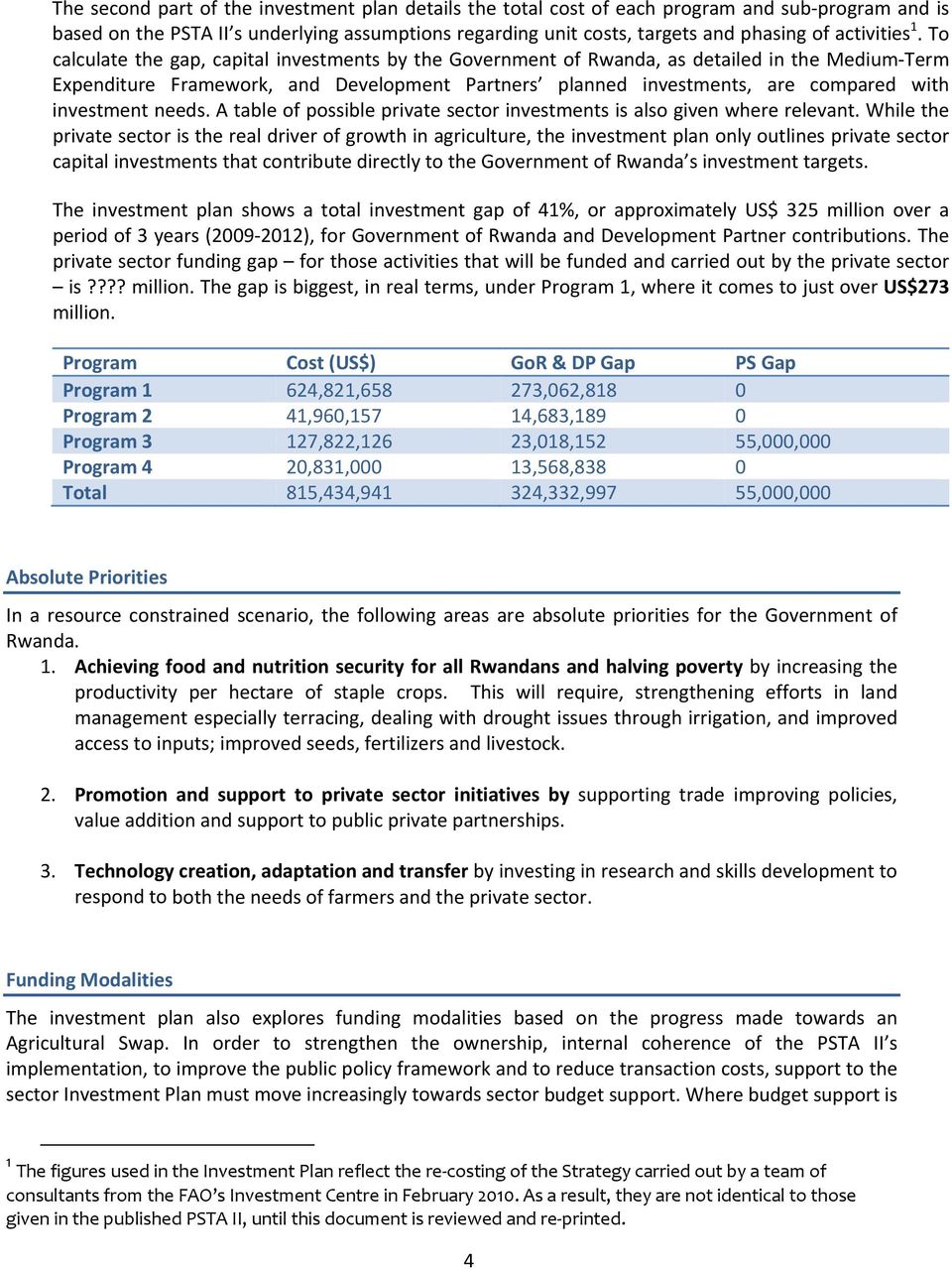
4 The second part of the investment plan details the total cost of each program and sub program and is based on the PSTA II s underlying assumptions regarding unit costs, targets and phasing of activities 1. To calculate the gap, capital investments by the Government of Rwanda, as detailed in the Medium Term Expenditure Framework, and Development Partners planned investments, are compared with investment needs. A table of possible private sector investments is also given where relevant. While the private sector is the real driver of growth in agriculture, the investment plan only outlines private sector capital investments that contribute directly to the Government of Rwanda s investment targets. The investment plan shows a total investment gap of 41%, or approximately US$ 325 million over a period of 3 years ( ), for Government of Rwanda and Development Partner contributions. The private sector funding gap for those activities that will be funded and carried out by the private sector is???? million. The gap is biggest, in real terms, under Program 1, where it comes to just over US$273 million. Program Cost (US$) GoR & DP Gap PS Gap Program 1 624,821, ,062,818 0 Program 2 41,960,157 14,683,189 0 Program 3 127,822,126 23,018,152 55,000,000 Program 4 20,831,000 13,568,838 0 Total 815,434, ,332,997 55,000,000 Absolute Priorities In a resource constrained scenario, the following areas are absolute priorities for the Government of Rwanda. 1. Achieving food and nutrition security for all Rwandans and halving poverty by increasing the productivity per hectare of staple crops. This will require, strengthening efforts in land management especially terracing, dealing with drought issues through irrigation, and improved access to inputs; improved seeds, fertilizers and livestock. 2. Promotion and support to private sector initiatives by supporting trade improving policies, value addition and support to public private partnerships. 3. Technology creation, adaptation and transfer by investing in research and skills development to respond to both the needs of farmers and the private sector. Funding Modalities The investment plan also explores funding modalities based on the progress made towards an Agricultural Swap. In order to strengthen the ownership, internal coherence of the PSTA II s implementation, to improve the public policy framework and to reduce transaction costs, support to the sector Investment Plan must move increasingly towards sector budget support. Where budget support is 1 The figures used in the Investment Plan reflect the re costing of the Strategy carried out by a team of consultants from the FAO s Investment Centre in February As a result, they are not identical to those given in the published PSTA II, until this document is reviewed and re printed. 4
5 not a feasible option for donors, a joint financing agreement, such as a basket fund would be the second best option that significantly reduces transaction costs. If properly structured and sufficiently wide in its coverage, a basket fund can also promote increased sector coherence in planning and budgeting and facilitate government ownership. 5

6 The Investment Plan Rwandan Agriculture Today Rwanda s agricultural sector faces a set of truly unique challenges As one of the world s most densely populated, landlocked countries Rwanda faces a situation of land scarcity in which 87% of the population is dependent on agriculture. As a result, soil fertility has deteriorated dramatically over time, while fertilizer use, both organic and inorganic, remains low even by regional standards. Fertility loss is compounded by the fact that 80% of arable land is on slopes of between 5 and 55%. While livestock ownership has the potential to ease pressures on land, by increasing incomes, improving nutrition and providing organic fertilizer, many households still do not own livestock. Agricultural exports continue to represent only a small percentage of total production. Traditional export crops, such as coffee and tea are exported to growing international markets, but as much of them are unprocessed, exports remain dependent on heavily fluctuating world market prices. Poverty in Rwanda is still largely a rural phenomenon and one determined by the country s scarcest resource land. The average household owns less than 0.7 ha, while the FAO recommended minimum per household is 0.9ha. Of those with less than 1 ha of land, 85% fall below the national poverty line, compared to 66% of rural households as a whole. While Rwanda has made quite some progress towards ensuring adequate production at the national level (2,150kcal per person per day were produced in 2009), the majority of households are not food self sufficient and often unable to make up for this with purchases. This is demonstrated by the fact that although average rural household incomes have increased by almost 40% between the first household survey (EICV ) and the second (EICV ) the percentage of that income spent on food only decreased from 77% to 68%. Rwanda (like many other countries) suffered from longstanding underinvestment in food and nutrition security and agriculture until the late 1990s. This has been reversed in recent years, and raising agricultural productivity per hectare, as a means for achieving MDG1 as well as economic and human development, and weathering the current food and economic crises, are absolute priorities of the Government of Rwanda. 6
7 The Progress So Far Considerable progress has been made but there is a long way to go if MDG1 is to be achieved Despite the current relatively low levels of public investment in the agricultural sector, a number of important successes have been registered, particularly since Improved Food and Nutrition Status Crop assessment data shows that productivity has increased substantially since 2007, allowing Rwanda to greatly improve its food and nutrition security. Prior to 2008 average calorie availability hovered around 1,800kcal/person/day, while in 2008 and 2009 this increased to 2,300 kcal/person/day; exceeding the WHO standard of 2,150kcal/person/day for the first time since Similarly, the production of proteins has increased from 37g to 46g per person per day between 2004 and 2009, while lipid production increased from 7g to 21 g per person per day (compared to the WHO target of 59g of protein and 40g of lipids per person per day). Similarly, livestock numbers, as well as their productivity, have increased significantly in the last few years. Milk production, for example, increased from 190,000 to 250,000MT between 2007 and 2008, and this has been complemented by an improved milk marketing chain, to ensure that increases in production result in higher incomes for producers. Export Production Despite the global downturn, Rwanda has seen the prices achieved by its agricultural export crops increase, due to efforts to stimulate value addition activities in the processing of goods and speciality teas and coffees. Diversification into the production of horticultural produce is also ongoing and in 2009 Rwanda on average exported 1MT of French beans per week to the EU. Improved Sustainability Substantial efforts at soil erosion control have begun to pay off and Rwanda was able to protect an additional 10% of its arable land against the loss of soil nutrients between January 2008 and June Knowledge Creation and Dissemination Improving the capacity of Rwanda s Agricultural Research Institute (ISAR) has resulted in the release of new mosaic resistant cassava varieties into the extension system, which has contributed to food and nutrition security. Similarly, the extension service has been rendered more responsive through the establishment of district platforms which allow farmers organisations to control the services provided by the Ministry of Agriculture and Animal Resources (MINAGRI). Market Development Since the inception of the program in 2008 the private sector has played an important role in the distribution of subsidised fertilizer. With only small transport subsidies the sector has established an effective distribution network that ensures the timely delivery of modern inputs to Rwanda s producers. 7
8 The Vision A sustainable agricultural sector that can protect Rwanda from food and nutrition insecurity, by increasing productivity per hectare, and generating additional income through export crop production and well developed national markets and value chains. Rwanda has committed itself to achieving the targets set out in Millennium Development Goal 1 (MDG 1), to eradicate hunger and malnutrition by 2015, by ensuring both an increase and a diversification of production that will allow all Rwandans adequate access to proteins and lipids, as well as calories. This will be achieved by creating a viable inputs distribution network that will make quality inputs for the production of a wide range of crops, both seeds and fertilizer, available at affordable prices. Furthermore, all Rwandan households will own livestock to increase the consumption of proteins and lipids. In addressing these needs, particular emphasis will be placed upon addressing the cross cutting issues as defined in Rwanda s EDPRS, namely gender, the HIV/AIDS epidemic and the needs of young people. The agriculture sector will be developed sustainably, so that the ability of future generations to earn their livelihoods in the sector are not compromised. This means, protecting arable land against erosion through terracing and agro forestry techniques, as well as ensuring that genetic resources and diversity are maintained, despite the need to provide farmers with improved varities. While the majority of the sector remains dependent on rainfed agriculture, climate change is likely to have a substantial and negative effect on its farmers. Therefore, a further emphasis will be on counteracting these effects, through schemes such as irrigation and crop insurance. A twin track approach to agricultural development will ensure that any direct action to tackle hunger is supported by a medium and long term strategy of agricultural transformation. This will see the sector transformed into one where farming is seen as a business, rather than subsistence, activity. This will create a sector that uses its comparative advantage, for example in labour intensive, high value crops, to compete in open regional and international markets. The focus will also be on developing an agribusiness sector that not only supplies inputs, but also adds value through processing for export as well as domestic consumption. It is only through such a transformation of the agricultural sector, that begins with a focus on food and nutrition security followed by private sector and processing capacity development, that broad based economic growth can be achieved. Rwanda s strategic Vision 2020 document targets a 9% sustained growth rate in the agricultural sector until 2015 and 8% until This is slightly above the CAADP target of 6%, but due to the depth of poverty in Rwanda 6% would not be quite sufficient to achieve MDG1. The aim is to allocate 10% of national government expenditures to agriculture, as well as to mobilise donor funding for the sector strategic plan to stimulate these essential levels of growth. 8

9 Achieving the Vision Four strategic programs, which together seek to bring about wholesale transformation, significant agricultural sector growth and poverty reduction if the investment gap is closed The steps for achieving Rwanda s vision are detailed in its second Strategic Plan for Agricultural Transformation (PSTA II). It is a nationally articulated and designed plan, led by the Ministry of Agriculture and Animal Resources that is built on wide consultation and consensus building with all groups of stakeholders in the sector. It seeks to optimise the allocation of scarce resources and direct them towards those areas deemed most effective at achieving Rwanda s vision. Research conducted on Rwanda s agricultural sector shows that public investments in the sector need to roughly double from current levels in order to achieve the CAADP target of sustained 6% agricultural growth. If coupled with comparative growth levels in non agricultural sectors, this would raise total GDP growth to 7.4% per annum and halve the national poverty rate, to approximately 30%, by 2020 as well as securing physical, social and economic access to sufficient, safe and nutritious food for all Rwandans. In order to maximise the impact of agricultural growth, it should be staple led, as this contributes to increased incomes for all income levels, but especially the poorest. Growth in this sub sector can also be expected to trigger multiplier effects, in agro processing and non farm activities such as transport, retailing and storage. Rwanda s PSTA II is a comprehensive medium term strategic plan, which outlines and costs the activities necessary in order for Rwanda to achieve at least 8% growth in the sector. The PSTA II has four strategic programs: 1. Intensification and Development of Sustainable Production Systems This program s focus is on relieving the physical and economic constraints to the sector s development in the areas of food and nutrition security, erosion control, water capture and management and input use. This program will see production per hectare expand sufficiently to achieve our production targets for food and nutrition security and stimulate broad based economic growth. Due to the depth of poverty in Rwanda, this program is the absolute and urgent priority, to which more than half the sector s public resources will be allocated. 2. Support to the Professionalization of Producers This program will make Rwanda s agriculture the knowledge intensive sector it needs to be in order to see the private sector flourish and for farmers to begin to see this sector as a business. 3. Promotion of Commodity Chains and Agribusiness Development Here the focus is on creating the environment, infrastructure and knowledge necessary for a strong inputs and processing sector. 4. Institutional Development This program seeks to strengthen the institutional environment, particularly the Ministry of Agriculture and Animal Resources, to improve capacity to implement the sector s strategy. 9
10 Structure of the Investment Plan The Investment Plan is structured according to the PSTA II s four programs and begins by outlining the overall program aim and the most important specific outputs under each of its sub programs. This is followed by a brief explanation of the strategy adopted for the given program, so as to explain how some of the most important activities are expected to affect poverty reduction, growth and agricultural development. The second section then details the total cost of each program and sub program, as detailed in the PSTA II, and then compares these to planned expenditure by the Government of Rwanda and its Development Partners. Investments by the Government of Rwanda are taken from its development budget as detailed in the Medium Term Expenditure Framework, while Development Partners investments are taken from project plans and pledges. A table of possible private sector investments is also given where these contribute directly to PSTA II targets. It should be noted that only those private sector investments that contribute directly to activities outlined in the PSTA II are included in this Investment Plan. Naturally other private sector investments will also be important to economic development although as they do not address the funding gap faced by the Government of Rwanda they are not detailed here. The final table in each section gives the overall funding gap, once both Private Sector, Government of Rwanda and Development Partner planned expenditures are accounted for. From this, the investment gap is calculated and the final section outlines the effects of the expenditure gap namely which outcomes will remain unrealized due to investment shortfalls 2. Process for calculating the investment gap : Review and analysis of the 22 development projects in the agriculture sector, financed both by Government and Development Partners. These projects are apportioned to their PSTA II programmes and sub programmes, according to project components and activities and by fiscal year and compared with the total investment required to achieve the PSTA II. For projects funded by Development Partners, the commitments made to these projects were used to estimate future donor contributions to the investment plan. For the Government of Rwanda s contribution, the investment plan follows the guidance of the Ministry of Economic Planning and Finance, which is to base estimates of GoR contributions on the growth rate of the agricultural budget over the last three years (since 2007). The size of the agricultural budget has increased from US$32.5million in 2007 to US$98million in 2009/10, which represents an average 45% growth per annum over the last three years thus this rate of increase has been applied to Government of Rwanda expenditure over the PSTA II period. The ordinary budget needs over the period of this investment plan are estimated at US$56 million, which have been budgeted for in the MTEF for the same period. They are, therefore, not further considered in this document, which concentrates on the development budget needs. 2 All figures are given in US dollars. 10
11 Program 1 Physical Resources and Food Production: Intensification of Sustainable Production Systems Program 1 is aimed at relieving the physical constraints to the sector s development, in the areas of erosion control, water capture and management structures, input use and food and nutrition security. It also incorporates the training activities that need to accompany the provision of physical infrastructure and inputs. In order to realise Rwanda s agricultural potential, soil erosion must be brought under control and fertility restored to large areas of arable land. The food security of future generations will depend on actions taken now by villages and rural communities themselves, as current rates of nutrient mining are not sustainable. The Government of Rwanda supports local communities in implementing erosion control and fertility restoration as well as helping to raise awareness of the seriousness of the problem. In the near and medium term, the Government and its partners will have to bear most of the costs of these efforts but, as rural communities will be encouraged to participate and will be trained in the processes involved, over time farmers will be able to take on a large share of this work by following appropriate soil and water husbandry practices. Due to the small average farm size in Rwanda, of less than 0.7 ha, it is essential to raise the economic productivity of existing farmland. This means increasing physical productivity through better technologies and input usage that generate higher yields and moving to a higher value mix of outputs (including livestock as well as crops). It is paramount, though, that these changes take place without compromising future productivity and the incomes of future generations. Further issues to be addressed include maximising the output of intensified farming systems, including the problem of low livestock productivity, which is caused by a number of factors, including a high disease burden, deficiencies in animal feed, poorly performing local breeds, and limited veterinary services. These problems are further compounded by low levels of market integration and difficulties in accessing finance, which constrain farmers choices (these are addressed under Program 3). Based on the issues identified above, the objectives of Program 1 are four fold: 1. Create soil and water management structures, including building radical and progressive terraces and water harvesting structures, coupled with fertility restoration measures. Agro forestry measures will be integral to all erosion control efforts made. 2. Ensure that erosion control measures are owned and led by local communities, which means demonstrating the benefits of maintaining structures and good agricultural practices as well as providing necessary training. All training must be adapted to local conditions. 3. Increase ownership of livestock and intensification of animal husbandry practices so that they provide increases in income even to land constrained households, as well as contributing to soil fertility. 11
12 4. Improve cultivation practices and develop sustainable production systems to optimize the productivity of available land and to reduce the need to cultivate marginal and vulnerable land. In the pursuit of these objectives, interventions will be designed in accordance with the principles of community participation and promotion of gender equality. The challenges and objectives under Program 1 are addressed in the context of 6 separate subprograms: Sub Program 1.1 Sustainable management of natural resources, water and soil husbandry The objectives here are to decrease the rate of soil erosion sharply, to provide irrigation to hillside farms and to increase the water retention capacity of watersheds. The largest part of this program will consist of investing in infrastructure, particularly for water capture and conveyance, as well as erosion control structures. The maintenance of these structures will be the responsibility of local communities so emphasis will also be placed on training them in erosion and water control mechanisms. Training will be adapted to local needs, particularly where communities live in areas that require special attention, such as very mountainous regions or in buffer zones around national parks. Sub Program 1.2 Integrated development and intensification of crops and livestock Activities under this program seek to integrate and diversify crop and livestock development. It is divided into two components, the first of which focuses on replicating lessons learnt from integrated livestock and cropping systems, while the other specifically supports the livestock sector. Sub Program Crop diversification and intensification This sub program will help place agricultural activities on a more environmentally sustainable basis, in addition to implementing the soil conservation measures referred to earlier. This will be done by assisting producers to diversify their production base with additional income sources and therefore provide increased livelihood security, by introducing activities and technologies for significantly increasing yields and incomes on small plots and by integrating livestock and cropping activities. These activities will also assist in providing rural non farm income and in generating employment opportunities for households with too little land to produce enough to sustain the household. Sub Program Livestock development Here, the objective is to increase the productivity of all livestock in all regions of Rwanda. This will be done by training farmers on appropriate methods of livestock husbandry, improving animal health conditions nationally and by increasing the output and value addition in the fish and apiculture subsectors. Pillars of these activities will be firstly, to expand the ownership of livestock, of both cattle and other species more suited to households with very small landholding; secondly, to promote zerograzing, instead of relying on growing fodder; thirdly, genetic improvement; and fourthly focusing efforts on disease control through vaccination and border post controls. Sub Program 1.3: Marshland development The aim of this sub program is to increase the amount of marshland that has been properly developed and is under effective irrigation, so as to reduce weather related shocks and improve yields. Additionally, this will increase the area of arable land available nationally. As with many of the PSTA II s sub programs, training farmers and creating appropriate local institutional mechanisms will be integral to the success of this program. Environmental impact assessments will be carried out and all activities will strive to minimize the environmental impact of marshland development. 12

13 Sub Program 1.4: Irrigation development The development of successful and sustainable irrigation in Rwanda is the central tenet of this subprogram and will revolve around three main activities. These are establishing an appropriate legal framework for water user rights and the ownership of irrigation systems, developing modern irrigation, particularly pressurized irrigation, systems and finally developing farmers capacities to manage these through their associations. Sub Program 1.5: Supply and use of agricultural inputs This sub program is divided up into two components: one for fertilizers and agrochemicals and the other for seeds and inputs. Sub Program 1.5.1: Fertilizer and agrochemical supply and use The objective here is to increase usage rates of fertilizer and other modern inputs, which are supplied through a sustainable private distribution system that delivers inputs in a timely fashion. The largest challenge here is developing effective demand for agrochemical inputs. Currently, the farming population does not appreciate the value of modern inputs in the productive process, particularly for the production of staple crops and creating demand. Therefore, as well as ensuring that inputs are available at reasonable prices, sensitization and training will be provided by, for example, creating demonstration plots. Sub Program 1.5.2: Certified seeds and other inputs Similarly, adoption rates of certified seeds need to be improved. However, as the private sector becomes more involved in seed production, it will be equally important to strengthen controls over seed development and multiplication to provide a guarantee for the quality of seeds supplied to producers. The need for quality seeds and planting materials was aptly demonstrated by the Cassava Mosaic Epidemic that reduced production dramatically beginning in Production levels only recovered once clean cuttings were distributed to farmers. Sub Program 1.6: Food and nutrition security and vulnerability management The activities implemented under Program 1 seek to increase the productivity of Rwandan farming systems. However, despite recent production increases, the population remains vulnerable to weatherrelated and external shocks as well as chronic malnutrition. Thus, efforts will continue at diversifying food sources and increasing consumption of high protein animal products, as well as establishing a national food security and nutrition monitoring system and in country storage systems for such an eventuality. The Nutrition security of school age children will be targeted through home grown school feeding initiatives, which link school feeding programs with local small scale farmers to improve child nutrition as well as creating reliable markets for local products. Specific Outputs under program 1 are SP 1.1 a) 852,000ha of additional land protected against soil erosion, using radical and progressive terracing b) 70 new valley dams and reservoirs constructed 13

14 SP 1.2 SP 1.3 SP 1.4 SP 1.5 SP 1.6 a) 270,000 households reached through the One Cow Program b) Incidence of key livestock diseases reduced to zero a) 9,000ha (additional) of marshlands developed a) 13,000ha of hillside area irrigated (increased from 130ha) b) Legal provision for water user associations and tenure for irrigation systems created a) 56,000 MT national fertilizer usage (increased from 14 MT) b) 15,000 MT production of foundation seeds (increased from 3MT) c) Crop Intensification Program expanded a) Average availability per day increased from 1,734kcal (2007) to 2,150kcal, 49g to 55g of protein and 8.8g to 23g of lipids b) Food and nutrition security monitoring system expanded c) 1,000 hermetic storage cocoons operational The PSTA II and Government of Rwanda priorities are reflected in the following initiatives to be implemented under Program 1: 1. The Crop Intensification Program (CIP) activity under Sub Program 1.5 CIP seeks to remove import bottlenecks by importing fertilizer in bulk and providing transport subsidies to ensure inputs reach rural areas. The private sector is involved in fertilizer distribution through an auction system. Such market based subsidies render fertilizers affordable to smallholders and provide them with an initial boost. Fertilizer subsidies will be gradually withdrawn, beginning in 2012, once the private sector and smallholder producers are sufficiently strengthened. Beyond improving access to fertilizer, CIP provides improved seeds and extension services to producers, as well as assisting farmers to consolidate their land use. The program has been in place since 2007 and has seen significant successes, with fertilizer use increasing substantially in target areas, which in turn has led to notable yield improvements and large increases in production. 2. Investing in Irrigation Structures activity under Sub Program 1.4 MINAGRI s strategy is to create the infrastructure necessary for irrigation, rainwater, harvesting and effective marshland usage, as well as the institutional context to allow farmers organizations to subsequently manage these structures. This includes farmers contributing financially as well as contributing land and labour to their upkeep. 3. Soil Erosion Control activity under Sub Program 1.1 Soil erosion control involves a number of activities, depending on the severity of the erosion problem, the slope of the land under cultivation and the nature of land usage. The most important techniques used are radical and progressive terracing, as well as agro forestry techniques. Erosion control initiatives are implemented in a similar fashion to irrigation projects; the government makes the initial investments needed, but producers and land owners themselves take on the responsibility for their 14

15 upkeep and ensuring that they are well used and managed. To facilitate this, producers are trained in land husbandry and water management techniques. 4. The One Cow per Poor Household Program activity under Sub Program 1.2 The One Cow per Poor Household initiative will distribute 270,000 cattle over its lifespan, to restock Rwanda s livestock holdings and to ensure that every household with sufficient land can own at least one cow. The program is expected to help address the malnutrition often experienced by households which do not have access to animal proteins. Furthermore, it also promotes reconciliation, as it includes a pass on element, whereby a household that has received an impregnated heifer will pass its first calf on to a neighbour. Where households do not have adequate land to sustain a cow, small ruminants or poultry are distributed instead. Table 1a: Planned expenditure, by Government and Development Partners, and total costs for Program 1 P1: Intensification and development of sustainable production systems SP1.1: Sustainable management of natural resources and water and soil preservation SP1.2: Integrated systems of crops and livestock SP1.3: Marshland development SP1.4: Irrigation development SP1.5: Supply and use of agricultural inputs SP1.6: Food security and vulnerability management Total Cost Source Available Funds Total Investment Gap 2009/ / /12 624,821,658 GoR 49,595,153 55,899,862 67,058, ,553,458 DPs 47,222,235 59,548,026 54,135, ,905,382 Total 96,817, ,447, ,193, ,458, ,362, % 158,571,429 GoR 1,673,478 1,680,243 2,226,807 5,580,528 DPs 7,789,152 8,062,338 9,511,622 25,363,112 Total 9,462,630 9,742,581 11,738,429 30,943, ,627, % 60,481,118 GoR 3,244,454 5,072,306 5,127,190 13,443,950 DPs 3,700,908 7,121,881 2,837,404 13,660,193 Total 6,945,362 12,194,187 7,964,594 27,104,143 33,376, % 41,188,900 GoR 877, ,093 1,032,309 2,717,461 DPs 5,049,069 7,946,245 9,514,721 22,510,035 Total 5,926,128 8,754,338 10,547,030 25,227,496 15,961, % 131,190,000 GoR 5,558,240 7,536,370 7,134,173 20,228,783 DPs 14,924,020 22,348,957 21,220,809 58,493,786 Total 20,482,260 29,885,327 28,354,982 78,722,569 52,467, % 215,690,211 GoR 37,291,514 40,341,919 51,105, ,739,395 DPs 15,759,086 14,068,605 11,050,565 40,878,256 Total 53,050,600 54,410,524 62,156, ,617,651 46,072, % 17,700,000 GoR 950, , ,003 1,843,342 DPs Total 950, , ,003 1,843,342 15,856, % Gap (%) 15

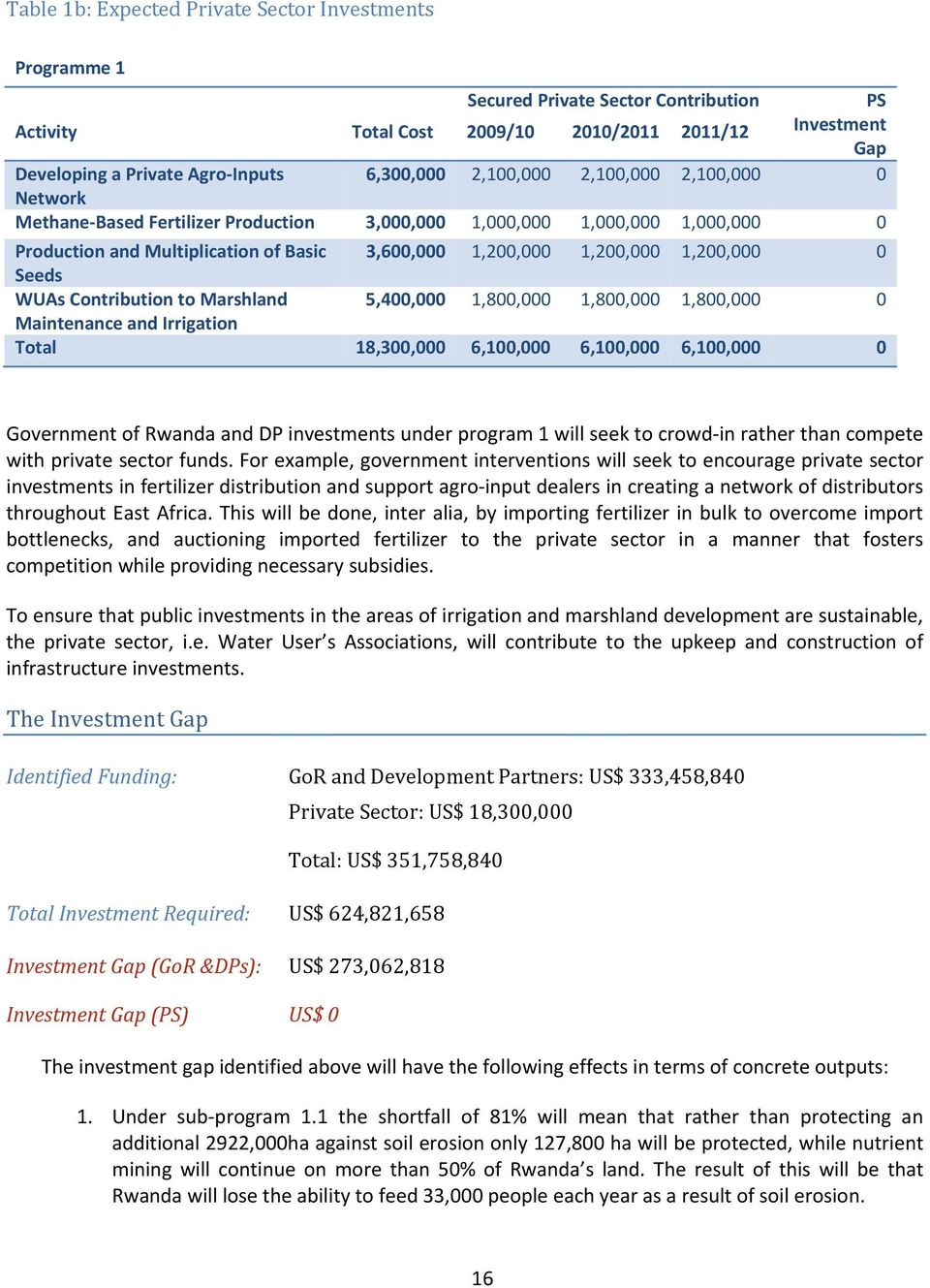
16 Table 1b: Expected Private Sector Investments Programme 1 Secured Private Sector Contribution PS Activity Total Cost 2009/ / /12 Investment Gap Developing a Private Agro Inputs 6,300,000 2,100,000 2,100,000 2,100,000 0 Network Methane Based Fertilizer Production 3,000,000 1,000,000 1,000,000 1,000,000 0 Production and Multiplication of Basic 3,600,000 1,200,000 1,200,000 1,200,000 0 Seeds WUAs Contribution to Marshland 5,400,000 1,800,000 1,800,000 1,800,000 0 Maintenance and Irrigation Total 18,300,000 6,100,000 6,100,000 6,100,000 0 Government of Rwanda and DP investments under program 1 will seek to crowd in rather than compete with private sector funds. For example, government interventions will seek to encourage private sector investments in fertilizer distribution and support agro input dealers in creating a network of distributors throughout East Africa. This will be done, inter alia, by importing fertilizer in bulk to overcome import bottlenecks, and auctioning imported fertilizer to the private sector in a manner that fosters competition while providing necessary subsidies. To ensure that public investments in the areas of irrigation and marshland development are sustainable, the private sector, i.e. Water User s Associations, will contribute to the upkeep and construction of infrastructure investments. The Investment Gap Identified Funding: GoR and Development Partners: US$ 333,458,840 Private Sector: US$ 18,300,000 Total: US$ 351,758,840 Total Investment Required: US$ 624,821,658 Investment Gap (GoR &DPs): US$ 273,062,818 Investment Gap (PS) US$ 0 The investment gap identified above will have the following effects in terms of concrete outputs: 1. Under sub program 1.1 the shortfall of 81% will mean that rather than protecting an additional 2922,000ha against soil erosion only 127,800 ha will be protected, while nutrient mining will continue on more than 50% of Rwanda s land. The result of this will be that Rwanda will lose the ability to feed 33,000 people each year as a result of soil erosion. 16
17 2. SP 1.2: with only 44% of this sub program funded, the target of ensuring that 270,000 households will receive livestock through government programs cannot be met. It is likely that an additional 140,000 households would continue to suffer from malnutrition, particularly protein and lipid deficiencies, as well as continuing to live in a situation of income poverty. 3. SP 1.3: the additional land made available by marshland development is required to feed a growing population. Under current funding levels only an additional 53,600ha of marshlands can be developed meaning approx 5,420 ha are not this is enough land for approximately 54,000 households or 20,000 people to make a living. 4. SP 1.4: 80% of Rwanda s arable land is on hillsides and less than 1% of this land is irrigated. If only 7,820 additional hectares are irrigated due to resources constraints, this means that 6,200 households in the most drought prone areas of the country would continue to depend on rainfall for their production. 5. SP 1.6: while Rwanda has achieved food self sufficiency, in terms of kcal per person per day in 2009, it is imperative that food and nutrition security monitoring systems and grain reserves are put in place as Rwanda remains entirely dependent upon rainfall. Current funding levels would not allow for the construction of hermetic cocoons, meaning that the country would have no modern storage capacity that would allow for crops to be kept for longer than one season. 17
18 Program 2 Producer Organisation and Knowledge Systems: The Professionalization of Producers and Other Economic Agents Program 2 is aimed directly at making the sector more knowledge intensive through professionalization and capacity building for producer organizations and through improvements in the systems for technology generation and dissemination. More specifically, program 2 aims to strengthen the sector s social capital base by providing producers with organizational frameworks through which they can develop commercial linkages and function in a more entrepreneurial manner. The program includes interventions to strengthen the entities in the sector that are charged with the development of productive technologies and other forms of applied knowledge and with imparting this knowledge to farmers. Social capital, in the form of associative efforts, can assist farmers to access markets and services. However, farmers organizations will need to be strengthened, as envisioned under this program, if they are to fulfil this role. By the same token, the organizations charged with developing agricultural techniques and practices need to be more effective, so that information is relevant and easily accessible to farmers. This will require involving farmers directly in processes of knowledge generation and dissemination. It also requires institutional changes to make the knowledge systems more responsive to farmers needs and priorities. Thus, the overall objective of Program 2 is to empower farmers, in the sense of giving them greater ability to develop solutions on their own initiative and to access the specialized forms of technical assistance that they need on particular issues. The challenges and objectives under Program 2 are addressed in the context of 3 separate subprograms, which are outlined below: Sub Program 2.1: Promotion of farmers organizations and capacity building for producers As there is only a short history of cooperatives and associations in Rwanda, they often lack the capacity to effectively represent their members needs. MINAGRI therefore aims to develop the management and entrepreneurial capacities of these organisations to create required social capital. This will allow farmers associations to become involved in higher value activities, both at the farm level and in agroprocessing activities, as well as improving their access to inputs. This also provides an important opportunity to support rural women s organizations. In order for these cooperatives to thrive, long term and participatory capacity building relationships will need to be built. Sub Program 2.2: Restructuring proximity services Here, the objective is to develop an extension system that is accountable to farmers as clients and, crucially, creating the necessary incentive structures for this purpose. Again, the promotion of participatory learning systems will be integral to this at all levels and the training of extension agents will emphasize this. Furthermore, a multi tiered system will be developed that will ensure that different levels of training, necessary for specialised service provision, are available to extension agents. 18
19 Sub Program 2.3: Research for transforming agriculture Research needs to be better at responding to farmers priorities and needs and doing so will require a number of activities. These will include using participatory research techniques where farmers organizations are involved in setting research agendas, as well as strengthening the scientific and technical capacity of the Institute for Agricultural Research (ISAR). As much scientific knowledge has already been created for the production of basic crops, priority will be given to adaptive research and ensuring that existing techniques are adapted to the social, economic and environmental needs of Rwanda s producers and address the outstanding challenges in post harvest handling. In line with the fourth pillar of CAADP, the aim here is to adopt a holistic approach to research and extension. The need to align the research agenda more with farmers priorities cannot be emphasized too strongly. Many of MINAGRI s partners feel that this is the area where Government s performance needs to be strengthened the most in order to allow the private sector to develop, to improve commercial opportunities for farmers and to prevent opportunities from being missed. Specific Outputs under program 2 are SP 2.1 a) 100 additional cooperatives successfully marketing products b) 20 additional community innovation centres SP 2.2 a) 200 cooperatives hiring private sector cooperatives b) 500 extension agents receiving specialized training SP 2.3 a) 6 participatory research projects established b) 7 research stations restructured to be driven by farmers needs The PSTA II and Government of Rwanda priorities are reflected in the following initiatives implemented under Program 2: 1. Development of Market Oriented Cooperatives activity under Sub Program 2.1 MINAGRI is establishing the long term, capacity building relationships required in order to create effective, market oriented cooperatives. The intention is to maintain these for a period of 8 to 10 years, as suggested by good practice principles, during which time cooperatives will be trained and strengthened to respond to market opportunities and to drive the marketization of Rwandan agriculture, both in terms of export production and creating more sophisticated value chains and agroprocessing systems for locally consumed produce. 2. District Extension Platforms activity under Sub Program 2.2 The national extension service is being restructured, in order to create a responsive and private sectordriven extension service. It has created district platforms that cooperate with local farmers organizations to determine the extension needs of producers and to respond to these accordingly. These platforms will be strengthened over the PSTA II period and extended geographically to cover all areas of Rwanda. 3. Promote Client Oriented Research activity under Sub Program 2.3 The focus of research carried out under the auspices of MINAGRI will be adaptive research, much of it on staple crops breeding improved varieties and ensuring disease control particularly of roots and 19
20 tubers, as these have the largest impacts on poverty reduction and economic growth. Simultaneously, new varieties needed to move into higher value production chains will not be neglected. The exact focus of research will be determined by farmers through participatory research projects and research stations that will be established throughout Rwanda, and which will be held accountable by farmers boards. Table 2a: Planned expenditure, by Government and Development Partners, and total costs for Program 2 Total Cost Available Funds Total Investment Gap P2: Support to the Professionalisation of Producers SP2.1: Promotion of farmers' organisations and capacitybuilding for producers SP2.2: Restructuring proximity services for producers SP2.3: Research for transforming agriculture Sourc e 2009/ / /12 Total Gap (%) 41,960,157 GoR 3,259,531 2,667,498 1,902,654 6,306,240 DPs 9,549,273 9,187,001 1,634,454 20,370,728 Total 12,808,804 11,854,499 3,537,108 26,676,968 15,283, % 12,600,000 GoR 108, , , ,454 DPs 5,334,758 5,166, ,572 10,653,916 Total 5,443,345 5,532, ,634 11,629, , % 15,900,000 GoR 258, , ,806 DPs 1,152,027 1,293, ,445,559 Total 1,410,140 1,595, ,005,365 12,894, % 13,460,157 GoR 2,892,831 2,000,000 1,401,592 6,294,423 DPs 2,962,488 2,626, ,669 1,698,032 Total 5,855,319 4,626,874 1,510,261 7,992,455 5,467, % Table 2b: Expected Private Sector Investments Secured Private Sector Contribution Activity Total Cost 2009/ / /12 PS Investment Gap Hire of Private Extension Agents 600, , , ,000 0 Government will continue to provide extension services to smallholder farmers. However, it will also work with producers and extension agents to develop and promote a system through which farmers contract their own advisors but are able to utilize an appropriate mechanism, such as vouchers supplied by the government, to pay most of the cost of the service. The system will first be applied on a pilot basis to the more commercial product chains such as potatoes, rice and fruits and vegetables. The aim of the system is for farmers' groups to be able to choose their own advisors, and to change them if they are not satisfied with the assistance provided. Gradually, therefore, the private sector will be mobilized to contribute to the provision of extension services. 20

21 The Investment Gap Identified Funding: GoR and Development Partners: US$ 26,676,968 Private Sector: US$ 600,000 Total: US $ 27,276,968 Total Investment Required: US$ 41,960,157 Investment Gap (GoR & DPs): US$ 14,683,189 Investment Gap (PS) US$ 0 The investment gap identified above will have the following effects in terms of concrete outputs: 1. Under sub program 2.2 the shortfall of approximately 80% makes it unlikely that Rwanda s extension system can be transformed into one that is responsive to farmers needs and eventually one that would become increasingly privatized. While the results of this are difficult to quantify, it means that the extension service will not have the necessary flexibility, nor will it be privatized. Both of these will result in follow on costs that result from continued government extension service provision as well as lost development opportunities, particularly in the area of market based production. 2. SP 2.3: current investment levels mean that only 2 further participatory research projects and 2 additional research stations could be constructed, again reducing the flexibility and responsiveness of extension services. 21
22 Program 3 Creating an Environment Conducive to Entrepreneurship: A Framework for Commodity Chains, Horticulture and Agribusiness Development Program 3 is designed to enhance producer knowledge in the areas of quality control, post harvest management and marketing, including the production of fortified food products, and to provide associated technical expertise and infrastructure, including in agro processing. It also aims to promote agribusiness development. Program 3 aims to create the environment and framework necessary for private sector entrepreneurs and smallholder producers to take advantage of market opportunities available to them. Program 3 seeks to increase production and market opportunities for smallholder farmers and private sector entrepreneurs. This program will be driven by an expansion in high value export crops, both traditional exports such as pyrethrum, coffee and tea, and non traditional crops such as horticulture, as well as developing processing of staple crops. On the export side, the emphasis lies on the production of niche and fairly traded products and increasing the value of traded products. The program will also include initiatives to harness and augment the expected profitability of staple crops (their production having been stimulated under Program 1) through value addition and increased market opportunities. Improving access to finance both for producers and agricultural entrepreneurs and infrastructure developments in terms of post harvest facilities, rural roads, markets and agro processing plants will underpin these initiatives. The success of this program, more even than the others, hinges on private sector participation, as many of the activities will require the private sector to take the initiative after initial government involvement. Program 3 is broken down into six sub programs, which are outlined below: Sub Program 3.1: Creating an environment conducive to business and entrepreneurship development and market access The main two initiatives under this sub program are a training program aimed at increasing entrepreneurship in agriculture, targeting young people s and female led farmers organisations, and increasing market access by developing a sanitary and phytosanitary system, infrastructure and legal framework. Sub Program 3.2: Promotion and development of traditional exports The aims of this program are to improve the quality of post harvest handling so that farmers receive higher returns for their harvests and to promote closer links between farmers and processors; so that farmers can deliver high quality products and share in the additional returns gained from this; as well as to promote the expansion of the agro processing sector for traditional export products and encouraging private sector participation in it. Sub Program 3.3: Development of non traditional high value export products The main activities under this subprogram are geared towards supporting increased horticulture production and sericulture development. This would include postharvest handling and processing for 22
23 export, as well as marketing and research. Crops identified for promotion include: avocados, French beans, courgettes, organic pineapple, organic dessert bananas, macadamia, passion fruit, silk, cut flowers and foliage, and organic honey. Particular markets include expanding middle class consumers across the continent but especially within the East African community as markets are integrated and tariff barriers removed. Sub Program 3.4: Production and value addition for domestic staple products The purpose of this subprogram is to create synergies with the crop intensification efforts that are being pursued under Program 1. With augmented production of domestic staples, prices may fall if they are not processed into products for the rapidly growing urban and peri urban market, examples of which include flour, starch, and animal feeds. Furthermore there is a plan to develop the fish commodity chain in Lake Kivu. Sub Program 3.5: Market oriented rural infrastructure Rural infrastructure is one of the key public investments that will drive the development of Rwanda s agriculture sector. The strategy for this subprogram is to increase postharvest handling facilities, agroprocessing units, and improve transport services within Rwanda and internationally, thus making transport costs more affordable, reducing post harvest losses, and adding value to Rwanda s exports. Sub Program 3.6: Strengthening rural financial systems This subprogram takes a three pronged approach in order to handle one of the weakest links in the agricultural sector. First is the strengthening of financial institutions to provide and manage financial services; secondly it aims to provide a wider range of financial products since the products that are currently available are not designed with agriculture in mind, and lastly; increasing investment finance especially for processors, exporters and other entrepreneurs within the sector. Specific Outputs under program 3 are SP 3.1 SP 3.2 SP 3.3 SP 3.4 a) Weekly cargo capacity out of Kigali airport tripled b) Sanitary, phytosanitary and food safety system strengthened including construction of one laboratory and organization of certification process for fresh produce a) 20,000 MT of (green) speciality coffee produced (increased from 4,000 MT) b) 5 new tea factories constructed with private sector participation c) 90,000 MT of pyrethrum exported (increased from 46,000 MT) a) 25,600 MT of horticulture exports (increased from 1,992 MT) b) 6,400 MT of hides and skins exported (increased from 3,000 MT) a) Maize, rice and cassava value chains developed, including the production of fortified food products b) Fish value chain developed SP 3.5 a) 20 cold chain storage facilities (increased from 1) b) 1,000 km of new all weather roads c) 3 new export agro processing facilities constructed with private sector investment 23
24 SP 3.6 a) US$ 15,000,000 lent through second storey credit line b) US$ 1,000,000 available for agro enterprises through venture capital window c) Rural savings deposit increased by 200% between 2008 and the end of 2012 The PSTA II and Government of Rwanda priorities are reflected in the following initiatives implemented under Program 3: 1. Focusing on the production and marketing of high value speciality and niche export products and staple food value chains activity under Sub Program 3.2 and 3.3 The development of export (traditional and non traditional) crops and staple crop value chains is extremely important. The focus here is both on aspects of production as well as marketing. As stated in the PSTA II, the aim is to maximize the profitability of the limited land available nationally with the crops that will have the highest impact for poverty reduction and economic development primarily staple crops, closely followed by the export crop sub sector. Already the private sector has taken an interest in these opportunities, for example a tea blending and packaging facility has been set up in Kigali; Rwandan horticultural products, such as French beans, are finding markets in Europe and the Middle East; and small scale cassava and maize flour processing facilities are slowly picking up in rural areas. 2. Improving Financial Services to the Agricultural Sector activity under Sub Program 3.6 The private sector in Rwanda is frequently held back by financing bottlenecks, particularly difficulties in obtaining credit. To alleviate these bottlenecks and to encourage investment in the sector a subsidized credit line was made available to Rwanda s banks. Furthermore, collaboration with banks has seen the establishment of agricultural finance units within a number of commercial banks, to ensure that the necessary expertise exists within them. Finally, on a smaller scale, an index based weather insurance pilot was launched to reduce the risk of debt for producers, so as to increase the demand for financial services. 3. Creating opportunities for Private Sector (including Public Private Partnerships) Opportunities for the private sector abound in agriculture, and Public Private Partnerships have been integral to creating an environment conducive to private sector investment, as well as to priming private investments. These partnerships take various forms, including the construction of a flower park, a milk processing plant and a tea packaging and blending venture. The Government of Rwanda will also make infrastructural investments so as to reduce the initial investment outlays for private sector investors. 24
25 Table 3a: Planned expenditure, by Government and Development Partners, and total costs for Program 3 P3: Promotion of Commodity Chains and Agribusiness Development SP3.1: Creating an environment conducive to business and entrepreneurship development and market access SP3.2: Promotion and development of traditional export crops SP3.3: Development of nontraditional, high value export crops SP3.4: Production and value addition for domestic staple products SP3.5: Market oriented rural infrastructure SP3.6: Strengthening rural financial systems Total Cost Source Available Funds Total Investment Gap 2009/ / /12 127,822,126 GoR 3,934,545 4,057,736 4,687,945 12,680,226 79,753, % DPs 18,923,576 11,622,990 4,842,182 35,388,748 Total 22,858,121 15,680,726 9,530,127 48,068,974 13,248,000 GoR 112,017 29,912 28, ,364 10,254, % DPs 994,905 1,329, ,516 2,823,050 Total 1,106,922 1,359, ,951 2,993,414 42,235,471 GoR 669, , ,721 2,052,815 37,144, % DPs 1,234, , ,673 3,037,740 Total 1,904,254 1,553,907 1,632,394 5,090,555 10,085,000 GoR 127,486 86,146 67, ,495 5,894, % DPs 1,445,619 1,551, ,805 3,908,721 Total 1,573,105 1,637, ,668 4,190,216 14,522,417 GoR 383, , ,833 1,348,579 12,548, % DPs 19, , , ,274 Total 403, , ,013 1,973,853 26,653,638 GoR 1,268,754 1,789,731 2,493,349 5,551,834 2,545, % DPs 12,646,979 5,658, ,000 18,555,894 Total 13,915,733 7,448,646 2,743,349 24,107,728 21,077,600 GoR 1,372, , ,743 3,275,139 11,364, % DPs 2,582,054 1,928,007 1,928,007 6,438,069 Total 3,954,572 2,849,885 2,908,750 9,713,208 Gap (%) 3b: Private Sector Investments Secured Private Sector Contribution Activity Total Cost 2009/ / /12 Private Sector Investment Gap Flower Park Development 14,000, ,000,000 Fresh Wholesale Food Market 32,000, ,000,000 PPP for Juice Concentrate Production 4,500, ,500,000 Mukamira Milk Processing Plant 4,500, ,500,000 Creation of Coffee Roasting and 535, , , ,000 0 Packaging Units Tea packaging and Blending Plant 900, , Warehouse receipt systems 300, , , ,000 0 Total 56,735,000 1,235, , ,000 55,000,000 25
26 The above private sector investments are all expected to be realized in the context of a Public Private Partnership, where the Government of Rwanda will take on some of the investment risk and provide some of the infrastructure required for the projects. The aim is to attract private sector investments to projects that might otherwise not be as profitable for the private sector. In large part as a result of the global financial crisis, the above private sector investments have not yet been secured, with the exception of the construction of the warehouse receipt system. The Investment Gap Identified Funding: GoR and Development Partners: US$ 48,068,974 Private Sector Investments (certain): US$ 1,735,000 Total: US$ 49,803,974 Total Investment Required: US$ 127,822,126 Investment Gap (GoR & DPs): US$ 23,018,152 Investment Gap (PS): US$55 million. The investment gap identified above will have the following effects in terms of concrete outputs: 1. SP 3.1: the cargo capacity of Kigali airport could at best be doubled, but export volumes would suffer as a result of the necessary sanitary, phytosanitary and food safety system not being adequately strengthened to allow for exports to many parts of the world, and placing existing Rwandan exports at high risk of exclusion from international markets. 2. SP 3.2: without the construction of new tea factories Rwanda would remain dependent on selling unprocessed tea at the Mombasa auction, missing out on value addition and speciality markets, and tea producers would remain subject to world market price fluctuations. 3. SP 3.3: expansion into high value, non traditional exports will be stymied by the large gap in funding under this program, meaning that Rwanda is not able to maximize the value reaped from each hectare of land necessary for development in a land constrained economy. Without the construction of high quality processing, packaging and cold chain facilities, Rwanda would miss out on value addition and will not achieve fresh product market standards on traceability, quality management and competitiveness. 4. SP 3.4: most of Rwanda s producers will continue to rely on food crop production in the long run. Without the development of maize, rice and cassava value chains, it is likely that increases in production will lead to reduced prices for producers, meaning their incomes will not increase in line with productivity gains. 5. SP 3.5: with only an additional 10 cold storage chains and fewer agro processing facilities, value chain development activities under other sub programs will be less effective, as fewer producers will be able to effectively market their produce. 26
27 6. SP 3.6: one of the biggest constraints in Rwanda s rural sector is the lack of access to finance. The large shortfall of 81% under this program will mean fewer farmers are able to invest in increasing their productivity and their processing capacity, which is likely to aggravate the spending gaps under the other sub programs. 27
28 Program 4 Institutional Development: Strengthening the Public Sector and Regulatory Framework for Agriculture Program 4 is directed at strengthening the public sector s capacity to support sectoral development and at improving the policies that guide actions by producers and entrepreneurs. Program 4 will strengthen the institutional framework through which the public sector supports agricultural development. The different aspects under consideration under this program include the policy framework, the overall coordination of the sector, monitoring and evaluation and/or management information systems, statistics and the decentralization process, which will enable the full grassroots participation in programme planning/preparation and implementation. Program 4 is broken down into five sub programs, which are outlined below: Sub Program 4.1: Institutional strengthening and capacity building The main aims of this subprogram is to define the most effective roles and structures for public bodies in the agriculture sector; to restructure those entities if needed and to strengthen their capacity to carry out their responsibilities. A key aspect to this is the development and retention of professional capacity within the Ministry, the consolidation and implementation of a newly designed management information system, and the creation of suitable partnerships with private sector entities, as well as the development of sanitary and phytosanitary systems and seed certification services. Sub Program 4.2: The policy and regulatory framework for the sector Chief among these is to complete the articulation of the sector s policy framework, as a guide to projects and other activities and the development of the necessary legislative basis and regulations to underpin and facilitate private sector activity. Highlighted for particular attention within the PSTA II period, are the legal and policy frameworks for the management of irrigation water and soils, agro export development, a decree and law on land consolidation and agrochemical use respectively. Sub Program 4.3: Agricultural statistics and ICT This particular subprogram will strengthen the quality, reliability, relevance and timeliness of statistical information available about the sector. The information generated will assist policymakers with decision making. Partnerships will also be created with the private sector in research and development, including the sharing of statistics and information on the sector. Sub Program 4.4: M&E systems and coordination fo the agricultural sector The Ministry, together with several partners has signed a Sector Wide Approach Memorandum of Understanding at the end of 2008, determining the implementation modalities for the PSTA II period. This subprogram's goals are, therefore, to establish the necessary coordination mechanisms for defining sector policies and funding sources and the establishment of systems for monitoring implementation of projects and programs and obtaining feedback on them from stakeholders. The private sector will provide qualitative and quantitative information from small scale farmers involved in their supply chains for local, regional and international markets. Sub Program 4.5: The decentralization program in agriculture This subprogram aims to establish functional procedures for effective fiscal decentralization in agriculture and to establish mechanisms of coordination between the Central and District Administrations in the allocation of funds and monitoring and reporting on their use. 28
29 Specific Outputs under program 4 are SP 4.1 SP 4.2 SP 4.3 SP 4.4 SP 4.5 a) New, fully functional M&E and MIS system b) Gender strategy designed and implemented c) Capacity building plan designed and implemented a) Policy framework for irrigation, soil management and land use developed b) Policy framework for agro export development drafted a) Reliable, real time production and market information system b) Sector wide ICT system in place a) SWAp signed and implemented b) Feedback procedures developed, including through Citizens Report Cards a) Capacity of sectors sufficiently developed to manage decentralized implementation The PSTA II and Government of Rwanda priorities are reflected in the following initiatives implemented under Program 3: 1. Capacity Building activity under Sub Program 4.1 and 4.2 Technical capacity, while increasing and impressive in some areas, is still not at the desired level in all areas. Strong efforts are required not only to create this capacity but equally to provide incentives to recruit and train highly qualified specialists. Of particular importance is staff training, for example through specialized technical masters degrees, as well as in service training opportunities. The investment plan includes the budget for the establishment of a capacity building fund for the sector. 2. Agricultural statistics activity under Sub Program 4.3 While considerable efforts have been made to improve agricultural statistics, significant gaps remain that need to be filled. Chief among these are the livestock epidemiological surveys, agricultural trade data, and surveys/evaluations of the impacts of the programs that the Ministry is implementing. 3. Improving Management and Information Systems activity under SP 4.1 New monitoring and evaluation systems are being put in place to ensure that systematic lessons are drawn from project experiences, particularly where these are forerunners of commercial activities. Improving these information systems will also create greater certainty for actors within the sector, thus stimulating private sector investment. 29
30 Table 4a: Planned expenditure, by Government and Development Partners, and total costs for Program 4 P4: Institutional Development SP4.1: Institutional strengthening and capacitybuilding SP4.2: The policy and regulatory framework in the agricultural sector SP4.3: Agricultural statistics and ICT SP4.4: M&E systems and coordination of the agricultural sector SP4.5: The decentralization programme in agriculture Total Cost Source Available Funds Total Investment Gap 2009/ / /12 20,831,000 GoR 327, , ,119 1,149,178 13,568, % DPs 3,511,329 1,779, ,480 6,112,984 Total 3,838,823 2,261,739 1,161,599 7,262,162 11,750,000 GoR 222, , , ,159 10,478, % DPs 386, , ,429 Total 609, , ,007 1,271,588 1,341,000 GoR 80, ,133 94, , % DPs 336, , ,148 1,098,522 Total 416, , ,753 1,393,013 5,190,000 GoR 0 66,879 69, ,483 3,416, % DPs 1,563,134 73,406 43,538 1,636,540 Total 1,563, , ,142 1,773,023 1,050,000 GoR 12,155 12,415 14,133 38, % DPs 700, , ,011,298 Total 712, ,231 14,133 1,050,000 1,500,000 GoR 11,627 9,946 7,771 29, % DPs 524, , ,794 1,470,657 Total 536, , ,565 1,500,000 Gap (%) Private Sector Investments As this program focuses on increasing the institutional capacity of the sector, particularly that of the Ministry of Agriculture and Animal Resources and its Boards, no private sector investments are expected under this program. The Investment Gap Identified Funding: US$ 7,262,161 Total Investment Required: US$ 20,831,000 Investment Gap (GoR &DPs): US$ 13,568,838 The effect of reduced investment under Program 4 is much harder to gauge than for the other programs. However, it is quite clear from the above investment gap analysis that the lack of funding for this program will reduce the capacity of the Ministry of Agriculture and Animal Resources to govern the sector effectively and to ensure that the complementary legal framework for other investments, be they public or private, is in place. Furthermore, the Ministry will continue to lack the technical skills to be able 30
31 to direct development effectively as well as to monitor the sector. Decentralisation, and therefore implementation capacity at the grassroots level, is also likely to suffer. 31
32 The Overall Investment Gap for Agriculture and Its Effects The total investment gap is just over 40%, meaning that just over one third of the planned investments will be realized The gap is biggest, in real terms, under Program 1, where it comes to over US$250 million. However, the most neglected program in terms of the percentage size of the investment gap, is program 3, which remains 59% short of its target. Table 5a: Total gap including for private sector contribution 3 Program Cost (US$) GoR & DP Gap PS Gap Program 1 624,821, ,062,818 0 Program 2 41,960,157 14,683,189 0 Program 3 127,822,126 23,018,152 55,000,000 Program 4 20,831,000 13,568,838 0 Total 815,434, ,332,997 55,000,000 Due to the complementary nature of investments in the agricultural sector, the most cost effective investment choices for stimulating shared growth and poverty reduction are necessary. Investment needs to be increased and maintained to ensure that gains achieved are continued and up scaled. Current low levels of investment in the agricultural sector can be expected to dampen growth quite substantially. Under a business as usual scenario, where yield growth rates could be expected to reach only 2% per annum, coupled with growth rates of 4% per annum in other sectors, the poverty rate will fall only modestly to 54% from 66%, of the total Rwandan population 4. Furthermore, a modest growth rate in yields, of between 1 and 2%, which is to be expected in the absence of adequate investments, means Rwanda would require an additional 700,000 ha of land by 2015 in order to feed its growing population. If one adds to this the additional loss of the capacity to feed 33,000 people per annum as a result of neglected erosion control, it becomes clear that food security, not to mention nutrition security, would be not be guaranteed. It is also likely that such a scenario would see income inequalities in rural areas increase, with those households without adequate access to land seeing their incomes decline and their food and nutritional security status deteriorate. Insufficient investments in irrigation and marshland development would mean a continued dependence on rainfed agriculture, which is likely to become increasingly detrimental with climate change. However, the fact that program 1.5 is well funded might help to counteract some of the low levels of yield growth, by increasing the amount of fertilizer used per hectare in Rwanda. In the absence of other fertility enhancing measures, this can only be a temporary stop gap. 3 N.B. This includes only guaranteed private sector expenditure. Therefore it does not include the investments not yet secured under Program 3. 4 Xinshen Diao, Shenggen Fan, Sam Kanyarukiga, Bingxin Yu, IFPRI Discussion Paper 00689, January 2007, Agricultural Growth and Investment Options for Poverty Reduction in Rwanda. 32
33 A poorly executed program 2, would not provide sufficient knowledge to the sector to counteract some of the negative effects of under investment under program 2. In fact, the lack of knowledge, in terms of erosion control and other yield improving techniques, may compound the lack of investments in erosion control, irrigation and other efforts to increase the usage of inputs. Program 3 seeks to cement the investments made under the first 2 programs in staple crop production, food and nutrition security and poverty reduction, by ensuring that necessary markets, value chains and rural infrastructure are developed and so that production increases can be translated into income increases, as well as by promoting increases in export revenues. Beyond restricting market and valuechain developments, nationally and internationally, the investment gap is likely to prevent the development of sophisticated sanitary, phytosanitary and food safety systems needed for international exports. If Rwanda remains trapped in exporting unprocessed traditional exports, such as tea and coffee, it will miss out on the substantial premiums generated by niche products and processing. Finally, the inability to access finance would prevent able and creative entrepreneurs from taking up opportunities available to Rwanda and its producers. Naturally, a strong institutional environment in the agricultural sector could go some of the way towards mitigating the investment gaps and their outcomes, as outlined above. However, the institutional environment remains underdeveloped and would be unlikely to develop at the necessary rate without additional funding. 33
34 Priorities in a Resource Constrained Setting The Investment Plan, as it has been presented above, follows very closely the priority setting that has been necessary under the current resource constrained scenario. The majority of investments made will be under Program 1, so as to maximize poverty reduction. Program 2 is also comparatively well funded, so that farmers are given the tools to adapt to a changing market and biological environment. Program 3, receives the least funding as a percentage of its total investment budget, as many of these programs rely on the production increases stimulated by Program 1 and 2. Nonetheless, it plays an important role in the move towards marketized production. Program 4 has the smallest percentage deficit, as a strong institutional environment can counteract some of the other investment gaps. Going forward, the absolute priorities for the Ministry of Agriculture and Animal Resources are the following: 1. Achieving food and nutrition security for all Rwandans and halving poverty by increasing the productivity per hectare of staple crops. This will require, strengthening efforts in land management especially terracing, dealing with drought issues through irrigation, and improved access to inputs; improved seeds, fertilizers and livestock. 2. Promotion and support to private sector initiatives by supporting trade improving policies, value addition and support to public private partnerships. 3. Technology creation, adaptation and transfer by investing in research and skills development to respond to both the needs of farmers and the private sector. 34
35 Annexe 1: Funding the Agriculture Sector s Investment Plan Sector Budget Support or Joint Financing The Ministry of Agriculture and Animal Resources signed a Sector Wide Approach Memorandum of Understanding (SWAp MoU) with its partners in 2008, in order to improve collaboration and define reporting, management and co ordination systems, as well as to clarify the role of the different partners. Within this SWAp, the aim is to gradually delegate all managerial responsibilities, including authority and responsibility for financial management, to MINAGRI s departments and units in accordance with agreed upon work plans and budgets. The entities to which resources are delegated through this mechanism will be responsible for results oriented planning, implementation and monitoring. Day to day management and decision making, within the work plans and budgets that have been approved at PSTA level, will be undertaken by the responsible department at central and district level. It is envisioned that the PSTA II, guided by the SWAp MoU will be funded through one of two funding modalities, either a basket fund or sector budget support. These funding modalities should be guided by the principle of not appointing component specific managers, but making use of the normal management structures and allocation of responsibilities within MINAGRI and the sector. The administration and financial management systems will be anchored in MINAGRI, with the Permanent Secretary being the Accounting Officer. With this decision making structure, the focus would be on working through and strengthening formal financial arrangements adjusted for specific PSTA II purposes. The responsibility for implementation and the prudent handling of financial resources should lie with the Minister of Agriculture and Animal Resources. Quality assurance and control of the adherence to standardised accounting procedures shall rest with a small professional secretariat, which may be supported by externally hired audit expertise. Such funding modalities would strengthen the ownership and internal coherence of the PSTA II s implementation and improve the current framework for public policy and public expenditure, by integrating donor support into the national budget and thus bringing on budget work that is currently still off budget and, therefore, much harder to monitor. In addition, this increases the potential for achieving a coherent mix between (sub) sectors and different types of expenditures (capital versus recurrent, wages versus non wages etc.). Finally, only if donor funds pass through national budgets will they be accorded the same scrutiny as domestic resources. The suggested financial management arrangements and corresponding responsibilities for a) a basket fund and b) sector budget support are summarized in the table below. 35
36 Financial Management Arrangements Issue Basket Fund Sector Budget Support 1. Planning and budgeting GoR Procedures GoR Procedures 2. Flow of funds To BF Account BF Procedures To BNR/MINECOFIN GoR Procedures 3. Disbursement BF Procedures GoR Procedures authorization 4. Bookkeeping & accounting BF Procedures with greatest possible alignment to GoR GoR Procedures procedures 5. Reporting BF procedures SWAp report to the Agriculture Sector Working Group GoR Procedures SWAp report to the Agriculture Sector Working Group 6. Procurement BF Procedures GoR Procedures 7. Auditing Office of the Auditor General External Office of the Auditor General External auditor performing quarterly audits RPPA Procurement audits 36
37 Annexe 2: Monitoring and Evaluation of the Sector Investment Plan All public investments made in the agriculture sector are tracked through the Ministry of Agriculture and Animal Resource s computerised M&E system. The M&E system was designed to suit MINAGRI s complex needs, including the need to monitor and track the expenditures, outputs and outcomes of numerous projects, agencies and programs. Extensive training of staff responsible for monitoring, evaluation and planning at MINAGRI Central, its agencies and projects was undertaken throughout the first half of This means that the period January to June 2009 (which coincided with a 6 month financial year as Rwanda adapted to the East African Community financial year, which runs from 1 July to 30 June) could be used to trial the system and any outstanding issues, software problems and training deficits were ironed out during this period. An M&E Specialist was recruited to oversee the process of training and implementation. Thus, the system is now fully operational and all projects and agencies are reporting through this system for the first time in 2009/10. Not only does this allow MINAGRI Central to track all expenditures, outputs and outcomes, it has also considerably reduced the staff time that has to be dedicated to reporting and progress tracking, meaning that staff can focus on planning and implementation. Impact Assessment Importantly, the new M&E system also permits the Ministry and its partners to better evaluate the extent to which its programs are contributing to poverty reduction among its beneficiaries. While the Ministry s beneficiaries includes all actors in the agricultural sector, the new M&E system will allow for the impact of its policies on certain priority groups, such as the poorest and most vulnerable households or those headed by women to be monitored more precisely. The Ministry of Agriculture and Animal Resources is also a pilot ministry for the Government of Rwanda s new Gender Responsive Budgeting initiative, meaning that its budget will be disaggregated to determine the extent to which it addresses the needs of both men and women farmers and private sector operator 37
Rwanda Agricultural Sector and its Impact on Food Security and Economy
 Rwanda Agricultural Sector and its Impact on Food Security and Economy Workshop on Asian Lessons and Agriculture Transformation in Rwanda J.J. Mbonigaba Muhinda Rwanda Agriculture Board [email protected]
Research to improve the use and conservation of agricultural biodiversity for smallholder farmers
 Research to improve the use and conservation of agricultural biodiversity for smallholder farmers Agricultural biodiversity the variability of crops and their wild relatives, trees, animals, arthropods,
ASEAN INTEGRATED FOOD SECURITY (AIFS) FRAMEWORK AND STRATEGIC PLAN OF ACTION ON FOOD SECURITY IN THE ASEAN REGION (SPA-FS) 2009-2013
 ASEAN INTEGRATED FOOD SECURITY (AIFS) FRAMEWORK AND STRATEGIC PLAN OF ACTION ON FOOD SECURITY IN THE ASEAN REGION (SPA-FS) 2009-2013 BACKGROUND The sharp increase in international food prices in 2007/2008
A diversified approach to fighting food insecurity and rural poverty in Malawi
 case study A diversified approach to fighting food insecurity and rural poverty in Malawi Map of Malawi Malawi: Facts and Figures Ø Population: 13.1 million Ø Human development index ranking: 164 out of
Agricultural Growth Is the Key to Poverty Alleviation in Low-Income Developing Countries
 International Food Policy Research Institute 2020 Brief 15, April 1995 Agricultural Growth Is the Key to Poverty Alleviation in Low-Income Developing Countries by Per Pinstrup-Andersen and Rajul Pandya-Lorch
Global water resources under increasing pressure from rapidly growing demands and climate change, according to new UN World Water Development Report
 WWDR4 Background Information Brief Global water resources under increasing pressure from rapidly growing demands and climate change, according to new UN World Water Development Report As demand for water
AGRICULTURAL PROBLEMS OF JAPAN
 AGRICULTURAL PROBLEMS OF JAPAN Takeshi Kimura, Agricultural Counselor Embassy of Japan, Washington, D. C. I would like, first, to sketch the Japanese agricultural situation and, second, to review Japan's
Global Environment Facility GEF OPERATIONAL PROGRAM #13 ON CONSERVATION AND SUSTAINABLE USE OF BIOLOGICAL DIVERSITY IMPORTANT TO AGRICULTURE
 Global Environment Facility GEF OPERATIONAL PROGRAM #13 ON CONSERVATION AND SUSTAINABLE USE OF BIOLOGICAL DIVERSITY IMPORTANT TO AGRICULTURE CONTENTS Introduction..1 Convention Guidance... 2 Agricultural
How To Help Poor People In Malawi
 IFAD/D.Magada Enabling poor rural people to overcome poverty in Malawi Rural poverty in Malawi Malawi is one of the world s poorest countries, ranking 160th out of 182 countries on the Human Development
GLOBAL ALLIANCE FOR CLIMATE-SMART AGRICULTURE (GACSA)
 GLOBAL ALLIANCE FOR CLIMATE-SMART AGRICULTURE (GACSA) FRAMEWORK DOCUMENT Version 01 :: 1 September 2014 I Vision 1. In today s world there is enough food produced for all to be well-fed, but one person
Emmanuel Tumusiime-Mutebile: The challenge of modernising smallholder agriculture in East Africa
 Emmanuel Tumusiime-Mutebile: The challenge of modernising smallholder agriculture in East Africa Keynote address by Mr Emmanuel Tumusiime-Mutebile, Governor of the Bank of Uganda, at the International
18.01.2014 Final Communiqué of the GFFA 2014
 18.01.2014 Final Communiqué of the GFFA 2014 "Empowering Agriculture: Fostering Resilience Securing Food and Nutrition" We, the Agriculture Ministers of 65 states of the world, assembled here in Berlin
THE ROLE OF VET IN FACILITATING DEVELOPMENT OF AGRICULTURAL SECTOR IN TANZANIA
 THE ROLE OF VET IN FACILITATING DEVELOPMENT OF AGRICULTURAL SECTOR IN TANZANIA Abstract Agriculture industry is the foundation of Tanzanian economy. It accounts for about half of the national income, three
SCALING UP AGRICULTURAL FINANCE
 SCALING UP AGRICULTURAL FINANCE Can Small Scale farmers be financed on commercial basis by a Financial Institution? The Case of KCB BANK RWANDA LTD Presentation profile 1. Rwanda s Agricultural scene 2.
OUTCOME AND IMPACT LEVEL INDICATORS AGRICULTURE & RURAL DEVELOPMENT WORKING PAPER: OCTOBER 2009
 EC EXTERNAL SERVICES EVALUATION UNIT OUTCOME AND IMPACT LEVEL INDICATORS AGRICULTURE & RURAL DEVELOPMENT WORKING PAPER: OCTOBER 2009 This working paper outlines a set of indicators at the outcome and impact
DEPARTMENT OF FORESTRY DRAFT REVISED NATIONAL FOREST POLICY OF MALAWI
 DEPARTMENT OF FORESTRY DRAFT REVISED NATIONAL FOREST POLICY OF MALAWI July, 2013 1. Foreword 2. Preface 3. Introduction 4. Policy linkages 5. Broad Policy Direction 6. Policy Priority Areas Provides the
BENCHMARKING THE BUSINESS OF SUSTAINABLE SMALLHOLDER FARMING
 BENCHMARKING THE BUSINESS OF SUSTAINABLE SMALLHOLDER FARMING Introduction This is an updated advocacy briefing from the African Smallholder Farmers Group on the Benchmarking the Business of Agriculture
FAO and the 17 Sustainable Development Goals
 FAO and the 17 Sustainable Development Goals FAO/Asselin Key FAO messages: The Sustainable Development Goals offer a vision of a fairer, more prosperous, peaceful and sustainable world in which no one
FEED THE FUTURE LEARNING AGENDA
 FEED THE FUTURE LEARNING AGENDA OBJECTIVE OF THE LEARNING AGENDA USAID s Bureau of Food Security will develop Feed the Future s (FTF) Learning Agenda, which includes key evaluation questions related to
HLPE report on Nutrition and Food Systems
 HLPE report on Nutrition and Food Systems e-consultation on an Issues Note proposed by the HLPE Steering Committee From 9 December 2015 to 15 February 2016 Short Summary by the HLPE Secretariat 1 There
2.0 AGRICULTURE 2.1 Concrete actions taken and specific progress made in implementation
 2.0 AGRICULTURE Agriculture remains the key priority sector in the growth and poverty reduction agenda of Zambia. Over 60 percent of the population derives its livelihood from agriculture. Despite Zambia
DRYLAND SYSTEMS Science for better food security and livelihoods in the dry areas
 DRYLAND SYSTEMS Science for better food security and livelihoods in the dry areas CGIAR Research Program on Dryland Agricultural Production Systems The global research partnership to improve agricultural
How To Help The World Coffee Sector
 ICC 105 19 Rev. 1 16 October 2012 Original: English E International Coffee Council 109 th Session 24 28 September 2012 London, United Kingdom Strategic action plan for the International Coffee Organization
Post Conflict Agricultural Development in Ethiopia: General Overview. Jemal Yousuf, Haramaya University, Ethiopia
 Post Conflict Agricultural Development in Ethiopia: General Overview Jemal Yousuf, Haramaya University, Ethiopia Context of conflict Ethiopia was engulfed with conflict all through the 1980s The conflict
Social protection, agriculture and the PtoP project
 Social protection, agriculture and the PtoP project Benjamin Davis Workshop on the Protection to Production project September 24-25, 2013 Rome What do we mean by social protection and agriculture? Small
Draft Programme Document
 Draft Programme Document CHANGE MANAGEMENT, PUBLIC SECTOR DEVELOPMENT AND PROGRAMME SUPPORT A Programme under the National Agriculture Development Framework APRIL 2009 1 Table of Contents I. Executive
Agricultural Policies and Food Security Challenges in Zambia
 Agricultural Policies and Food Security Challenges in Zambia Auckland Kuteya Presentation at the Africa Lead Champions for Change Leadership Training, Protea Hotel, Chisamba, Zambia 16-20 th April, 2012
DRAFT PROPOSAL on Science and Technology for Development. Matters calling for action by the Economic and Social Council or brought to its attention
 DRAFT PROPOSAL on Science and Technology for Development Matters calling for action by the Economic and Social Council or brought to its attention A. Draft resolution for adoption by the Council 1. The
National Accounting Systems, Agricultural Statistics for Policy Analysis
 National Accounting Systems, Agricultural Statistics for Policy Analysis Workshop on Measuring Sustainable Agriculture, Food Security and Poverty Alleviation for enhancing Accountability in the Post 2015
Web Annex 6: Output indicators and targets 2016-17
 CL 153/3 Web Annex 6 1 Web Annex 6: Output indicators and targets 2016-17 SO1: Contribute to the eradication of hunger, food insecurity and malnutrition 1.1 Member countries and their 1.1.1 Improving capacities
Inclusive Model for Agribusiness Development. October 2011
 Inclusive Model for Agribusiness Development October 2011 Prevailing Agribusiness Environment Weak economic governance Absence of a coherent agricultural development strategy Lack of investment in agriculture
Transforming and Improving livelihoods through Market Development and Smallholder Commercialization in Sub- Saharan Africa
 Transforming and Improving livelihoods through Market Development and Smallholder Commercialization in Sub- Saharan Africa Janet Wanjiru Magoiya Mission To build Pro-poor market development initiatives
Climate-Smart Agriculture - Science for Action 24-26 October 2011 - Ede / Wageningen - The Netherlands
 The Wageningen Statement: Climate-Smart Agriculture - Science for Action 24-26 October 2011 - Ede / Wageningen - The Netherlands The Wageningen Statement: Climate-Smart Agriculture Science for Action The
AG R I C U LT U R E GREEN ECONOMY
 THIS IS THE STORY OF AG R I C U LT U R E GREEN ECONOMY We need to make the global economy green. provides significant opportunities for growth, investment and jobs to help make this happen. $ Everyone
Rwanda GAFSP Proposal: LWH Scale-Up
 Rwanda GAFSP Proposal: LWH Scale-Up Ministry of Agriculture and Animal Resources MINAGRI June 2010 Abbreviations/Acronyms AMIR ASWG CAS CBO CCPIG CFE CIDA DA DFID DPs EDPRS EFA EIA EMP ESMF FAO FM FMM
Speech at the High-Level Conference on World Food Security
 Speech at the High-Level Conference on World Food Security SUN Zhengcai Minister of Agriculture People s Republic of China Rome, June 2008 Distinguished Chairperson, Excellencies, Ladies and Gentlemen,
INTRODUCTION. The 3-year upper primary syllabus development was guided by the RNPE, 1994, which called for the review of the Primary curriculum.
 INTRODUCTION The 3-year upper primary syllabus development was guided by the RNPE, 1994, which called for the review of the Primary curriculum. It followed the introduction of lower primary Environmental
Globalization and Global Food Crises: The Role of Official Statistics in African Context
 Globalization and Global Food Crises: The Role of Official Statistics in African Context Abstract The globalization of world economy is increasing the need for basic statistics on supply and demand for
Food Security in a Volatile World
 Issues in Brief Food Security in a Volatile World Developments in agriculture over the last fifty years have increased yields sufficiently to provide on average more than enough food for every person on
Recognizing that women smallholder farmers constitute the majority of food producers, but remain vulnerable and require targeted support;
 DECLARATION OF THE HIGH-LEVEL MEETING Toward African Renaissance: Renewed Partnership for a Unified Approach to End Hunger in Africa by 2025 under the Framework the Comprehensive Africa Agriculture Development
PROJECT PREPARATION GRANT (PPG) APPLICATION FORM-3
 PROJECT PREPARATION GRANT (PPG) APPLICATION FORM-3 1. PPG title To Harmonize the Legal, Regulatory and Institutional Framework for Sanitary and Phytosanitary (SPS) control Management System 2. Theme 1,
DESIGN CONSIDERATIONS OF SSI SCHEMES FOR THEIR SUSTAINABILITY AND FARMERS MANAGEMENT SIMPLICITY
 DESIGN CONSIDERATIONS OF SSI SCHEMES FOR THEIR SUSTAINABILITY AND FARMERS MANAGEMENT SIMPLICITY YUSUF KEDIR (Irrigation Engineer, M. Sc.): EARO TENA ALAMIREW (Ph. D): Alemaya University INTRODUCTION The
The role of Agricultural cooperatives in accessing input and output markets An overview of experiences of SRFCF, SNNPR, Ethiopia
 The role of Agricultural cooperatives in accessing input and output markets An overview of experiences of SRFCF, SNNPR, Ethiopia By Yehulashet A.Argaw Managing director, Southern Region Farmers Cooperative
THE MASTERCARD FOUNDATION: RURAL AND AGRICULTURAL FINANCE STRATEGY
 THE MASTERCARD FOUNDATION: RURAL AND AGRICULTURAL FINANCE STRATEGY SEPTEMBER 2015 The MasterCard Foundation works with visionary organizations to provide greater access to education, skills training and
Corporate Social Responsibility (CSR) for Responsible Agricultural Investments (RAI)
 Corporate Social Responsibility (CSR) for Responsible Agricultural Investments (RAI) Background note for consultation meeting - Dar es Salaam, Tanzania, 9 10 October 2012 Francesca Dalla Valle For info
Agricultural Productivity in Zambia: Has there been any Progress?
 Agricultural Productivity in Zambia: Has there been any Progress? Presented by Antony Chapoto ACF/FSRP Research Presented to the Zambia National Farmers Union Congress Mulungushi Conference Centre, Lusaka
Agricultural and Rural Development / Fisheries
 Agricultural and Rural Development / Fisheries Addressing Global Food Security and Poverty Of the eight Millennium Development Goals (MDGs), relevant goals are shown in color. Since rising sharply in 2008,
Enabling poor rural people to overcome poverty in Honduras
 IFAD/F. Mattioli Enabling poor rural people to overcome poverty in Honduras Rural poverty in Honduras The Republic of Honduras is the second-poorest country in Central America. It is a lower middle-income
Role of Media in Agricultural and Rural Development
 Role of Media in Agricultural and Rural Development (Presented at IFA workshop on Last Mile Delivery) 10 th Feb, 2010, New Dehli 1. WRENmedia we are a multi media communication company based in the UK
EU Milk Margin Estimate up to 2014
 Ref. Ares(215)2882499-9/7/215 EU Agricultural and Farm Economics Briefs No 7 June 215 EU Milk Margin Estimate up to 214 An overview of estimates of of production and gross margins of milk production in
Brief report on the Happy Strategies Game
 Brief report on the Happy Strategies Game Nile Basin Development Challenge Program Stakeholder Forum and Project Meetings October 5-7 2011 Held at Amhara Region Agricultural Research Institute (ARARI),
China s experiences in domestic agricultural support. Tian Weiming China Agricultural University
 China s experiences in domestic agricultural support Tian Weiming China Agricultural University Contents Background The policy system Major measures and their implementation Empirical assessment of the
World Summit on Food Security. Rome, 16-18 November 2009 DECLARATION OF THE WORLD SUMMIT ON FOOD SECURITY
 November 2009 E World Summit on Food Security Rome, 16-18 November 2009 DECLARATION OF THE WORLD SUMMIT ON FOOD SECURITY We, the Heads of State and Government, or our Representatives and the Representative
Speaker Summary Note
 2020 CONFERENCE MAY 2014 Session: Speaker: Speaker Summary Note Building Resilience by Innovating and Investing in Agricultural Systems Mark Rosegrant Director, Environment and Production Technology Division
G20 Agriculture Ministers Meeting Communiqué
 G20 Agriculture Ministers Meeting Communiqué Xi an, 3 June 2016 1. We, the G20 Agriculture Ministers, met today in Xi an to discuss how G20 members can promote food security, nutrition, sustainable agricultural
Investing in rural people in Indonesia
 IFAD/Roger Arnold Investing in rural people in Indonesia Rural poverty in Indonesia Indonesia is the largest economy in South-East Asia and has progressed rapidly over the past decade into a dynamic, highly
Organic farming : key advantages to be encouraged
 Stéphane Le Foll Minister of Agriculture, Agrifood and Forestry. Organic farming : key advantages to be encouraged «Organic farming and its products represent a dynamic and buoyant sector of the economy,
G20 FOOD SECURITY AND NUTRITION FRAMEWORK
 G20 FOOD SECURITY AND NUTRITION FRAMEWORK G20 Food Security a nd Nutrition Framework 2 G20 Food Security and Nutrition Framework INTRODUCTION Food security and nutrition requires an inclusive economic
PJ 24/12. 13 February 2012 English only. Projects Committee/ International Coffee Council 5 8 March 2012 London, United Kingdom
 PJ 24/12 13 February 2012 English only E Projects Committee/ International Coffee Council 5 8 March 2012 London, United Kingdom Enhancing competitiveness of African coffees through value chain strengthening
Rural Development in South Africa: The role of Agriculture
 The Presidency Department of Performance Monitoring and Evaluation Rural Development in South Africa: The role of Agriculture Tsakani Ngomane, PhD AGRISETA ANNUAL SEMINAR Kempton Park, South Africa 21
FACT SHEET. Production Risk
 ALABAMA AGRICULTURAL & MECHANICAL UNIVERSITY SMALL FARMERS RESEARCH CENTER FACT SHEET Production Risk Any production related activity or event that is uncertain is a production risk. Agricultural production
Training Materials for Scaling-up Climate Change Adaptation and Modified Procedures
 Coastal Adaptation and Resilience Planning Component Training Materials for Scaling-up Climate Change Adaptation and Modified Procedures December 2013 ii Training Materials for Scaling-up Climate Change
SOCIAL PROTECTION LANDSCAPE IN GHANA. Lawrence Ofori-Addo Deputy Director, Department of Social Welfare LEAP Coordinator Ghana
 SOCIAL PROTECTION LANDSCAPE IN GHANA Lawrence Ofori-Addo Deputy Director, Department of Social Welfare LEAP Coordinator Ghana OUTLINE OF PRESENTATION BACKGROUND Poverty Trends in Ghana SOCIAL PROTECTION
SCHOOL GARDEN IN RWANDA
 SCHOOL GARDEN IN RWANDA Prepared by André Ndahiro, National Project Coordinator : Appui à la promotion des jardins, fermes et éducation nutritionnelle dans les écoles au Rwanda In collaboration with Georges
Highlights of Organic Issues within National Agric Policy (20013)
 Highlights of Organic Issues within National Agric Policy (20013) (Ministry of Agriculture Food Security and Cooperatives Tanzania By. Mibavu, G. M. 1 Outline i. Introduction ii. Opportunities on Organic
SUSTAINABLE LIVELIHOODS AND FOOD SECURITY UNDER CHANGING CLIMATE IN DRY AREAS
 Expert Group Meeting on Promoting Best Practices On sustainable Rural Livelihoods in the ESCWA Region Beirut, 24-25 November 2010 SUSTAINABLE LIVELIHOODS AND FOOD SECURITY UNDER CHANGING CLIMATE IN DRY
Population Growth and Land Scarcity in Rwanda: The other side of the Coin
 Population Growth and Land Scarcity in Rwanda: The other side of the Coin Alfred R. BIZOZA (PhD) Agricultural Economist,University of Rwanda 2014 Conference on Land Policy in Africa, Addis Ababa, Ethiopia
Water Resource. 1 Initiating and Sustaining Water Sector Reforms : A Synthesis World Bank in collaboration with the Government of India, Ministry of
 WATER RESOURCES OF INDIA by Kalipada Chatterjee Climate Change Centre Development Alternatives Introduction Water is essential for human civilisation, living organisms, and natural habitat. It is used
MINISTRY OF TRADE AND INDUSTRY STATEMENT BY HON. CALLE SCHLETTWEIN, MINISTER OF TRADE AND INDUSTRY,
 MINISTRY OF TRADE AND INDUSTRY STATEMENT BY HON. CALLE SCHLETTWEIN, MINISTER OF TRADE AND INDUSTRY, ON THE GROWTH AT HOME STRATEGY, NAMIBIA S EXECUTION STRATEGY FOR INDUSTRIALISATION IN THE NATIONAL ASSEMBLY,
FAO-Adapt. Framework Programme on Climate Change Adaptation
 FAO-Adapt Framework Programme on Climate Change Adaptation Food security and climate change FAO s vision for the future is a world free of hunger and malnutrition where food and agriculture contribute
Presentation Outline. Introduction. Declining trend is largely due to: 11/15/08
 State of the Cotton Industry and Prospects for the Future in Ghana Presented By Mr. Kwaku Amoo-Baffoe November, 2008 Presentation Outline Introduction Institutional Arrangement for Cotton Production in
FOOD AVAILABILITY AND NATURAL RESOURCE USE
 FOOD AVAILABILITY AND NATURAL RESOURCE USE Nadia El-Hage Scialabba Natural Resources Management and Environment Department, FAO FAO/OECD Expert Meeting on Greening the Economy with Agriculture Paris, 5
Poverty in Central America and Mexico
 Courtney Taglauer, Student Participant Fairfield High School, Iowa Poverty in Central America and Mexico According to the World Food Bank, Food security exists when all people, at all times, have physical
SUSTAINABLE CONTRACT FARMING FOR INCREASED COMPETITIVENESS: CASE STUDY ON POULTRY SECTOR IN SARAWAK, MALAYSIA
 SUSTAINABLE CONTRACT FARMING FOR INCREASED COMPETITIVENESS: CASE STUDY ON POULTRY SECTOR IN SARAWAK, MALAYSIA BY Sugumar Saminathan National Productivity Corporation The agriculture sector contributed
Development Dialogue Forum Towards a Food Secure Nation within the context of the National Development Plan NDP 4
 Development Dialogue Forum Towards a Food Secure Nation within the context of the National Development Plan NDP 4 T H E R O L E O F C R O S S - B O R D E R T R A D E I N A C H I E V I N G F O O D S E C
Weather Index Crop Insurance. White Paper. Implementation, Product Design, Challenges And Successes Lessons Learned In The Field
 White Paper Weather Index Crop Insurance Implementation, Product Design, Challenges And Successes Lessons Learned In The Field By Shadreck Mapfumo, Vice President, Agriculture, MicroEnsure November 2008
5. Industrial and sector strategies
 5. Industrial and sector strategies 5.1 Issues identified by the Accelerated and Shared Growth Initiative for South Africa (AsgiSA) Industrial policy has three core aims, namely: creation and smaller enterprises.
Liquid Biofuels for Transport
 page 1/11 Scientific Facts on Liquid Biofuels for Transport Prospects, risks and opportunities Source document: FAO (2008) Summary & Details: GreenFacts Context - Serious questions are being raised about
Indian Agrochemical Industry
 Indian Agrochemical Industry Introduction. India is the fourth largest producer of agrochemicals globally, after United States, Japan and China. The agrochemicals industry is a significant industry for
Overview of food security projects funded by EKN Addis Ababa in 2016
 Overview of food security projects funded by EKN Addis Ababa in 2016 Each project is described under one of the three pillars in the Multi-Annuals Strategic Plan 2014-2017 to which it contributes most.
NREGA for Water Management
 National Rural Employment Guarantee Act NREGA for Water Management 30 th October, 2009 Dr. Rita Sharma Secretary to Government of India Ministry of Rural Development NREGA objective supplement wage-employment
Food & Farming. Focus on Market Safety Nets. December 2015. Agriculture and Rural Development
 Food & Farming Focus on Market Safety Nets December 215 Agriculture and Rural Development 1 AGRICULTURAL MARKETS AS A DRIVER FOR EUROPEAN AGRICULTURE The agricultural markets and their prices have evolved
Agricultural Mechanization Strategies in India
 050 India Agricultural Mechanization Strategies in India Dr. Champat Raj Mehta Project Coordinator, All India Co-ordinated Research Project (AICRP) on Farm Implements and Machinery (FIM), Central Institute
FOOD AND AGRICULTURE ORGANIZATION OF THE UNITED NATIONS
 FOOD AND AGRICULTURE ORGANIZATION OF THE UNITED NATIONS Contribution to the 2014 United Nations Economic and Social Council (ECOSOC) Integration Segment Food security for sustainable development and urbanization:
Cameroon CFSVA April/May 2011. Cameroon Comprehensive Food Security and Vulnerability Analysis. April/May 2011. Page 1
 Cameroon CFSVA April/May 2011 Cameroon Comprehensive Food Security and Vulnerability Analysis April/May 2011 Page 1 Cameroon CFSVA April/May 2011 Photo: Jane Howard Food insecurity high despite great agricultural
About 870 million people are estimated to have
 Undernourishment around the world in 212 Undernourishment around the world Key messages The State of Food Insecurity in the World 212 presents new estimates of the number and proportion of undernourished
Brief Historical Background of Anglican Church of Rwanda
 ANGLICANE CHURCH OF RWANDA The Rwanda Context Rwanda is located in Central and East Africa with a population of approximately 11 million. It is a country dominated by hills known as the Country of thousand
Mahmood Ahmad, EXPERT GROUP MEETING ON ACHIEVING FOOD SECURITY IN MEMBER COUNTRIES IN A POST CRISIS WORLD
 Mahmood Ahmad, Agriculture and Water Policy Expert EXPERT GROUP MEETING ON ACHIEVING FOOD SECURITY IN MEMBER COUNTRIES IN A POST CRISIS WORLD Story Line PPP Concepts PPP in Agriculture Context t Five Case
TANZANIA. The land area of Tanzania is about 1 million square kilometres. This includes the offshore islands of Zanzibar, Pemba and Mafia.
 TANZANIA 1. INTRODUCTION 1.1 THE COUNTRY Tanzania lies on the East Coast of Africa between 1 O and 11 O S latitude and between 29o and 40 o E Longitude. It is bordered by Kenya in the North and shares
SOCIAL PROTECTION BRIEFING NOTE SERIES NUMBER 4. Social protection and economic growth in poor countries
 A DFID practice paper Briefing SOCIAL PROTECTION BRIEFING NOTE SERIES NUMBER 4 Social protection and economic growth in poor countries Summary Introduction DFID s framework for pro-poor growth sets out
THE XVI GLOBAL CHILD NUTRITION FORUM ON SCHOOL FEEDING COMMUNIQUÉ
 THE XVI GLOBAL CHILD NUTRITION FORUM ON SCHOOL FEEDING COMMUNIQUÉ Post 2015 Agenda: Role of Nutrition in Sustainable School Feeding Programmes linked to Local Agriculture South Africa from 29 September
Farming. In the Standard Grade Geography exam there are three types of farming you need to know about arable, livestock and mixed.
 Types of Farming In the Standard Grade Geography exam there are three types of farming you need to know about arable, livestock and mixed. Arable farms are ones where the main way of making money is by
Financing Smallholder Farmers. to Increase Incomes and Transform Lives in Rural Communities
 Financing Smallholder Farmers to Increase Incomes and Transform Lives in Rural Communities EXECUTIVE SUMMARY Africa is home to a quarter of the world s farmland, yet it generates only 10 percent of all
CHAPTER 2 AGRICULTURAL INSURANCE: A BACKGROUND 9
 CHAPTER 2 AGRICULTURAL INSURANCE: A BACKGROUND 9 Chapter 2: AGRICULTURAL INSURANCE: A BACKGROUND In Chapter 1 we saw that insurance is one of the tools that farmers and other stakeholders can use to manage
SECTOR ASSESSMENT (SUMMARY): AGRICULTURE AND NATURAL RESOURCES 1
 Country Operations Business Plan: Philippines, 2013 2015 SECTOR ASSESSMENT (SUMMARY): AGRICULTURE AND NATURAL RESOURCES 1 A. Sector Performance, Problems, and Opportunities 1. Sector importance and growth
SIERRA LEONE UPDATES FROM THE INSTANBUL PRIORITY AREAS OF ACTION
 SIERRA LEONE UPDATES FROM THE INSTANBUL PRIORITY AREAS OF ACTION 1 OUTLINE OF PRESENTATION Recent Developments Istanbul Priority Areas of Action Poverty Levels Agenda for Prosperity Challenges Conclusion
Madagascar: Makira REDD+
 project focus Madagascar: Makira REDD+ Madagascar is considered to be one of the top five biodiversity hotspots in the world due to more than 75% of all animal and plant species being endemic while less
Eliminating child labour in agriculture
 Eliminating child labour in agriculture Gender, Equity and Rural Employment Division Economic and Social Development Department Food and Agriculture Organization of the United Nations May 2010 The following