
TSC 800 TRANSFER SWITCH CONTROLLER INSTALLATION, OPERATING & SERVICE MANUAL
|
|
|
- Karin Paul
- 9 years ago
- Views:
Transcription
1 TSC 800 TRANSFER SWITCH CONTROLLER INSTALLATION, OPERATING & SERVICE MANUAL Software Version 2.2 PM049 REV 11 14/01/ A 198 th Street, Langley, BC Canada V1M 3B1 Telephone (604) Telefax (604)

2 9087A 198 th Street, Langley, BC Canada V1M 3B1 Telephone (604) Telefax (604)

3 TABLE OF CONTENTS 1. INTRODUCTION PRODUCT REVISION HISTORY GENERAL DESCRIPTION 2 2. INSTALLATION GENERAL INFORMATION NOTES TO INSTALLER AC VOLTAGE SENSING INPUT AC CONTROL POWER INPUT OUTPUTS SYSTEM PHASING-HIGH LEG DELTA SYSTEMS EXTERNAL PANEL CONTROL WIRING REMOTE START CONTACT FIELD WIRING COMMMUNICATION CABLE DIELECTRIC TESTING DESCRIPTION LEXAN FACEPLATE PRINTED CIRCUIT BOARD POWER SUPPLY INPUT VOLTAGE SELECTION TERMINAL BLOCKS DIAGNOSTIC LEDs COMMUNICATION PORT CONTRAST ADJUSTMENT REMOTE COMMUNICATION TSC 800 DISPLAY MENUS SYSTEM TIME MENU ATS MODE MENU TSC 800 PROGRAM MENU SYSTEM OPERATION MENU TIMER COUNTDOWN MENUS UTILITY SUPPLY MENU 25 PM 049 REV 12 14/01/23

4 5.7. GENERATOR SUPPLY MENU STATS MENU OPERATING INSTRUCTIONS AUTOMATIC SEQUENCE OF OPERATION NORMAL SEQUENCE OF OPERATION (OPEN TRANSITION TRANSFER) NORMAL SEQUENCE OF OPERATION (CLOSED TRANSITION TRANSFER) TEST MODE SEQUENCE OF OPERATION ABNORMAL SEQUENCE OF OPERATION LCD DISPLAY OPERATION OPERATOR INITIATED UTILITY POWER FAIL SIMULATION (LOAD TEST) AUTOMATIC PLANT EXERCISE TEST FOUR FUNCTION REMOTE TEST (FTS4 OPTION) TRANSFER FAIL FAULT RESET LAMP TEST TIMER BYPASS MANUAL UTILITY RE-TRANSFER SERVICE ENTRANCE ATS MODE PHASE BALANCE PROTECTION ALARM PROGRAMMING INSTRUCTIONS PASSWORDS READ ONLY MODE READ / WRITE MODE MASTER READ / WRITE MODE EXERCISE TIMER SYSTEM TIME ROLLOVER AUTO TEST START DAY/WEEK NUMBER AUTO TEST START HOUR AUTO TEST START MINUTE AUTO TEST STOP DAY/WEEK NUMBER AUTO TEST STOP HOUR AUTO TEST STOP MINUTE AUTO TEST MODE SYSTEM CONFIGURATION FIRMWARE VERSION ATS MODE MENU PASSWORD (PW) UTILITY FAIL CALLOUT LOAD ON GENERATOR CALLOUT TRANSFER FAIL CALLOUT AUTO TEST CALLOUT MAN TEST CALLOUT SWITCH NOT IN AUTO CALLOUT NODE ADDRESS SYSTEM VOLTAGE VOLTAGE SENSING RATIO 45 PM 049 REV 12 14/01/23

5 SYSTEM FREQUENCY SYSTEM PHASES LOAD SENSING PHASES PHASE BALANCE PHASE BALANCE DELAY PHASE BALANCE RETRANSFER VOLTAGE SENSING UTILITY UNDER VOLTAGE SENSOR PICKUP UTILITY UNDER VOLTAGE SENSOR DROPOUT UTILITY UNDER VOLTAGE SENSOR TIME DELAY (DROPOUT) UTILITY OVER VOLTAGE SENSOR PICKUP UTILITY OVER VOLTAGE SENSOR DROPOUT UTILITY OVER VOLTAGE SENSOR TIME DELAY (PICKUP) UTILITY UNDER FREQUENCY SENSOR UTILITY UNDER FREQUENCY SENSOR TIME DELAY (DROPOUT) UTILITY OVER FREQUENCY SENSOR UTILITY OVER FREQUENCY SENSOR TIME DELAY (PICKUP) GENERATOR UNDER VOLTAGE SENSOR PICKUP GENERATOR UNDER VOLTAGE SENSOR DROPOUT GENERATOR UNDER VOLTAGE SENSOR TIME DELAY (DROPOUT) GENERATOR OVER VOLTAGE SENSOR PICKUP GENERATOR OVER VOLTAGE SENSOR DROPOUT GENERATOR OVER VOLTAGE SENSOR TIME DELAY (PICKUP) GENERATOR UNDER FREQUENCY SENSOR GENERATOR UNDER FREQUENCY SENSOR TIME DELAY (DROPOUT) GENERATOR OVER FREQUENCY SENSOR GENERATOR OVER FREQUENCY SENSOR TIME DELAY (PICKUP) GENERATOR CONTROL LOGIC COMMIT TO TRANSFER LOGIC GENERATOR START DELAY GENERATOR WARMUP DELAY GENERATOR COOLDOWN DELAY PRE-TRANSFER DELAY (LDC) POST-TRANSFER DELAY (LDC) TRANSFER LOGIC LOAD ON UTILITY PROGRAMMABLE OUTPUT LOAD ON GENERATOR PROGRAMMABLE OUTPUT MAXIMUM FIND NEUTRAL DELAY NEUTRAL DELAY TIMER (NDT) NEUTRAL DELAY BYPASS MAXIMUM TRANSFER TIME TRANSFER FAIL MANUAL UTILITY TRANSFER RETURN UTILITY RETURN DELAY MAX SYNC TIME MAX POWER SWITCHING DEVICE OPEN TIME PROGRAMMABLE OUTPUT VOLTAGE SENSING CALIBRATION GENERAL UTILITY VOLTAGE CALIBRATION GENERATOR VOLTAGE CALIBRATION LOAD VOLTAGE CALIBRATION TSC 800 PROGRAMMING DATA SHEETS 70 PM 049 REV 12 14/01/23

6 9. TSC 800 TYPICAL CONNECTION DIAGRAM TSC 800 SPECIFICATIONS TROUBLESHOOTING REPLACEMENT PARTS PRODUCT RETURN POLICY NOTES 83 PM 049 REV 12 14/01/23

7 1. INTRODUCTION 1.1. PRODUCT REVISION HISTORY The following information provides an historical summary of changes made to this product since the original release. Software Version /08/01 Enabled Clock Time Save Feature /03/27 Enhanced Phase Balance Features /12/14 New Features (Refer to Section 1.2) /04/01 Revised Transfer Fail Features and functionality /12/15 Added Remote Communication 1.5 N/A Unreleased version /06/15 Updated Transfer Fail operation /01/19 Updated default under/over frequency setpoints, transfer fail programmability, minor logic revisions /10/10 Changed Transfer Switch fail timer to 30 seconds /01/30 Upgraded Frequency setting range /06/30 Original version Operating & Service Manual Version Rev 10 08/09/25 Changes for Version 2.2 TSC 800 Software. Added Information for ICS ATS Neutral delay time Rev 9 06/04/24 Minor manual revisions for Version 2.1 TSC 800 Software Production Release Rev 8 06/03/27 Enhanced phase balance features Rev 7 04/12/16 New Features (Refer to Section 1.2) Rev 6 02/04/15 Changes for Version 1.7 TSC 800 Software Rev 5 00/07/31 Rev 4 00/03/01 Rev 3 99/02/12 Added Four Position Test Switch Information General revisions Added Multi-tap information. Rev 2 98/12/01 Added Remote Communication features per version 1.6 TSC 800 Software Rev 1 98/01/21 Rev 0 97/06/04 General Revisions for upgraded TSC 800 software Original release Contact, to obtain applicable instruction manuals. Soft copy of most current version is available at 1

8 1.2. GENERAL DESCRIPTION The TSC 800 controller utilizes microprocessor-based design technology, which provides high accuracy for all voltage sensing and timing functions. The TSC 800 is factory configured to control all the operational functions and display features of the automatic transfer switch. All features of the TSC 800 are fully programmable from the front panel LCD display and are security password protected. The LCD display screen prompts are in plain English, providing a user-friendly operator interface with many display options available. The microprocessor design provides many standard features, which were previously only available as add-on optional features. 2. INSTALLATION CAUTION contents subject to damage by STATIC ELECTRICITY This equipment contains static-sensitive parts. Please observe the following anti-static precautions at all times when handling this equipment. Failure to observe these precautions may cause equipment failure and/or damage. Discharge body static charge before handling the equipment (maintain exposed body contact with a properly grounded surface while handling the equipment, a grounding wrist strap can/should also be utilized). Do not touch any components on the printed circuit board with your hands or any other conductive equipment. Do not place the equipment on or near materials such as Styrofoam, plastic and vinyl. Place the equipment on properly grounded surfaces and only use an anti-static bag for transporting the equipment GENERAL INFORMATION NOTE: Installations should be done in accordance with all applicable electrical regulation codes as required. 2

9 The following installation guidelines are provided for general information only pertaining to typical site installations. For specific site installation information, consult Thomson Power Systems as required. NOTE: Factory installations of THOMSON POWER SYSTEMS supplied transfer switches that have been tested and proven may deviate from these recommendations NOTES TO INSTALLER If the transfer switch has programmable/multi-tap system voltage capability (refer to electrical schematic), confirm the transfer switch has been configured for the system voltage. WARNING Failure to confirm and match transfer switch voltage with the system voltage could cause serious equipment damage. If the transfer switch requires reconfiguring, the TSC 800 controller will also require reprogramming. CAUTION!!! Qualified personnel must complete all installation and/or service work performed only. Failure to do so may cause personal injury or death AC VOLTAGE SENSING INPUT The TSC 800 can accept direct AC voltage sensing inputs on the generator and utility supplies from VAC (nominal). NOTE: Direct input voltage sensing can only be used when the system utilizes a 3 phase, 4 wire distribution system which has the neutral conductor solidly grounded. For 3 phase, 3 wire systems (i.e. no neutral) or high voltage systems, potential transformers must be used (this is also the case where only 1 of the 2 supplies are 3 ph 3 w). Refer to FIGURES 1-4 for voltage sensing connections AC CONTROL POWER INPUT The TSC 800 is factory supplied for either 115VAC or 230VAC (nominal) control power input voltage. Independent AC control power is required from both utility and generator supplies. AC control power is utilized for internal TSC 800 control circuits and external control device loads. The TSC 800 requires approximately 12VA AC power for internal control circuits. The maximum external load is limited by output contact ratings (i.e. 10A resistive, 120/250VAC). 3

10 Total AC control power requirements for each supply must be determined by adding both internal and external load requirements. 4

11 2.5. OUTPUTS The TSC 800 provides the following types of output circuits: Engine Start Contact Programmable Output Contact Transfer to Utility Output Transfer to Generator output Pre/post-transfer to utility Pre/post-transfer to generator Load on utility Load on generator Isolated Form C contact (10A, 250VAC Resistive) Isolated Form C contact (10A, 250VAC Resistive) 250VAC 1, 10A (Resistive) powered output contact 250VAC 1, 10A (Resistive) powered output contact 250VAC 1, 3A (Resistive) powered output contact 250VAC 1, 3A (Resistive) powered output contact 250VAC 1, 3A (Resistive) powered output contact 250VAC 1, 3A (Resistive) powered output contact 1 NOTE: Output voltage is dependent upon AC control power input voltage (i.e. 120VAC or 230VAC nominal). Interposing relays are required between the TSC 800 outputs and the end device if loads exceed the output current rating. Transient suppression devices are required for all inductive devices sharing wiring or if physically located near the transfer switch controller. For AC operated relays or solenoids, use a suitably rated metal oxide varistor (MOV) or capacitor/resistor suppressor. MOV selection should typically be equal to or slightly greater than 1.3 times the nominal RMS voltage being applied to the inductive device. NOTE: Selecting an MOV of too low a value can/will result in a sustained short circuit and ultimately result in equipment failure SYSTEM PHASING-HIGH LEG DELTA SYSTEMS When the transfer switch is connected to 3 phase 4 wire delta systems and no multi tap power supply transformers supplied with the ATS, the High leg, must be connected to Phase B of the Utility and/or Generator supply inputs to the ATS (Phase B, colored Orange per NEC 384-3(e) identified as the leg with highest potential with reference to ground). This will ensure the ATS control power that is internally connected between phase A and neutral is maintained at 120VAC. Refer to figure below for further details. WARNING Failure to match correct system phasing will result in serious damage to the TSC 800 controller. 5

12 Automatic Transfer Switch (Utility Supply) PH A (UA) PH B (UB) PH C (UC) Neural (N) B (Orange) (High Leg) 240V 208V 240V A (Red) 120V N (White) 120V C (Yellow) 6

13 TSC 800 A B C N TSC 800 L1 L2 N GRD GRD TB1-1 TB1-1 TB1-2 TB1-2 TB1-3 TB3-1 1 TB1-3 TB1-10 NO CONNECTION TB3-5 TB GRD TB3-1 TB3-5 GRD TB2-18 GRD VOLTAGE INPUTS 600VAC L-L, 347VAC L-N 480VAC L-L, 277VAC L-N 380VAC L-L, 220VAC L-N 208VAC L-L, 120VAC L-N VOLTAGE INPUTS 240VAC L-L, 120VAC L-N 1 PT REQUIRED FOR TRANSFER SWITCH MECHANISM POWER (MUST BE SIZED TO SUIT POWER REQUIREMENTS). FIG:1 3Ø, 4W 208/380/480/600VAC DIRECT SENSING NOTE: UTILITY VOLTAGE SENSING AND CONTROL POWER SHOWN ONLY. FIG:2 1Ø, 3W 120/240VAC DIRECT SENSING NOTE: UTILITY VOLTAGE SENSING SHOWN ONLY. TSC 800 A B C N TSC 800 A B C TB1-1 TB GRD TB1-1 TB TB TB GRD TB3-1 TB GRD 120 TB3-1 TB TB2-18 GRD 1 TB2-18 GRD GRD GRD SECONDARY PT VOLTAGE 208VAC L-L, 120VAC L-N 120VAC L-L, 69VAC L-N 1 PT REQUIRED FOR TRANSFER SWITCH MECHANISM POWER (MUST BE SIZED TO SUIT POWER REQUIREMENTS). FIG:3 3Ø, 4W WYE PT's NOTE: UTILITY VOLTAGE SENSING SHOWN ONLY. SECONDARY PT VOLTAGE 120VAC L-L [NO NEUTRAL] NOTE: ØB IS GROUNDED 1 PT REQUIRED FOR TRANSFER SWITCH MECHANISM POWER (MUST BE SIZED TO SUIT POWER REQUIREMENTS). FIG:4 3Ø, 3W DELTA PT's NOTE: UTILITY VOLTAGE SENSING SHOWN ONLY. G:\ENGINEER\PRODUCTS\TSC800\ VSD REVISED 97/06/27 09:12 AM 7
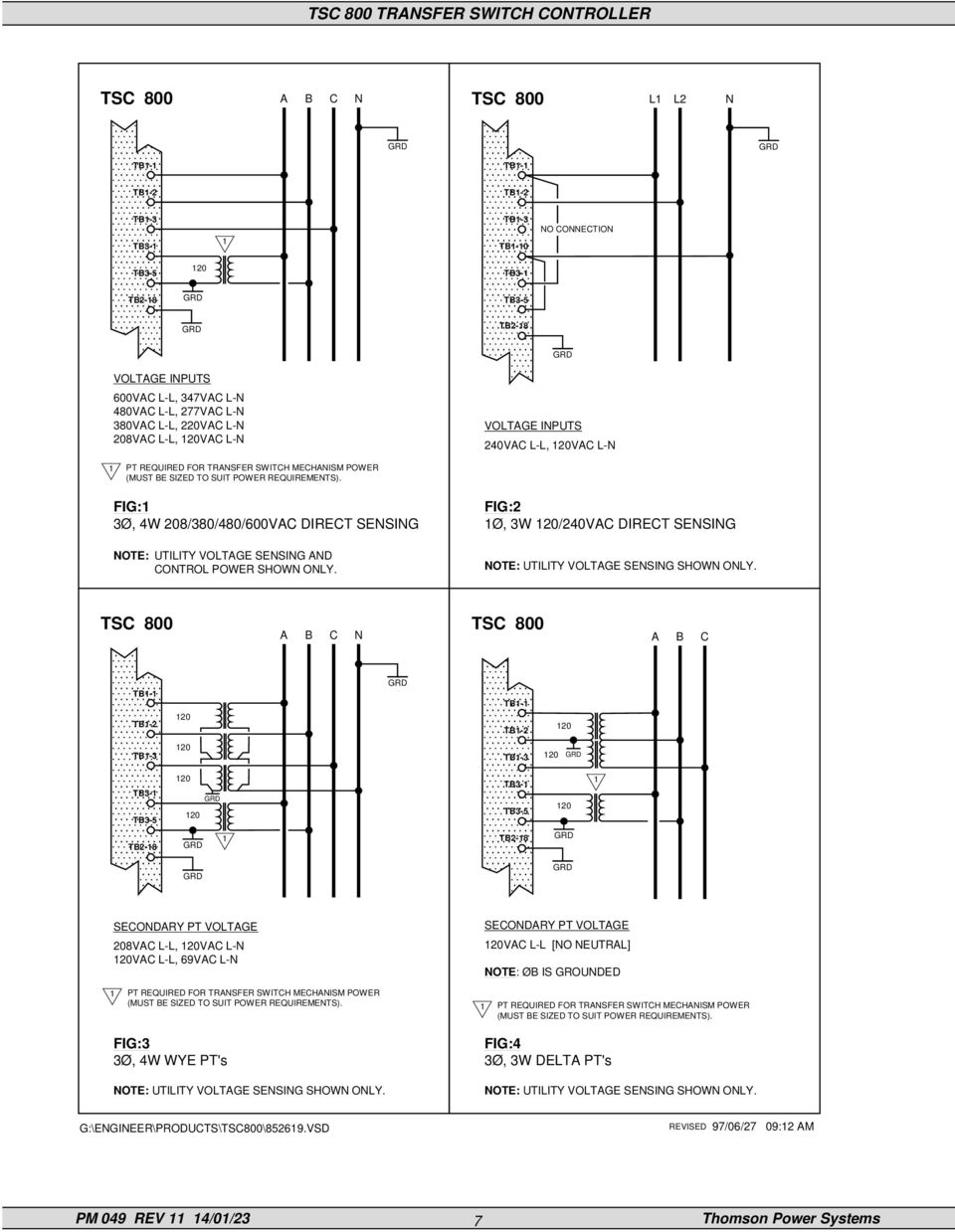
14 2.7. EXTERNAL PANEL CONTROL WIRING As a minimum, all control wiring shall conform to the local regulatory authority on electrical installations. Specific wire sizes listed below are for typical circuits of distances up to 500ft (150m) 1, are as follows: Utility or Generator Voltage Sensing #14 AWG (2.5mm 2 ) Transfer output signals #14 AWG (2.5mm 2 ) Remote Start Contact for Engine Controls #14 AWG (2.5mm 2 ) NOTE: For long control wire runs or noisy electrical environments the control wires should be twisted & shielded with a suitable drain wire. The shielded cable drain wire must be grounded at one end only. The drain wire grounding location may vary as micro-processor controllers generally exist at both ends (engine generator set & transfer switch) and one may be more susceptible depending on the level of induced noise. The most susceptible controller will requiring the shield ground point as close as possible to the controller. Wire runs from 500ft to 1000ft should be twisted and shielded and increased to #12 AWG where total loop resistance is greater than 5 ohms. 1 For distances exceeding 1000ft. (300m) consult 2.8. REMOTE START CONTACT FIELD WIRING Field wiring of a remote start contact from a transfer switch to a control panel should conform to the following guidelines to avoid possible controller malfunction and/or damage Remote start contact wires (2 #14 AWG (2.5mm 2 )) should be run in a separate conduit (ferromagnetic type) and in all cases separated from any AC wiring Avoid wiring near AC power cables to prevent pick-up of induced voltages An interposing relay may be required if field-wiring distance is excessively long (i.e. greater than 1000 feet (300m)) and/or if a remote contact has a resistance of greater than 5.0 ohms. In extremely noisy environments, the wire run lengths indicated may not provide reliable operation and can only be corrected by the use of an interposing relay. The interposing relay is generally installed at the engine controls and utilizes DC power. It is strongly suggested that the ground return wire of the interposing relay be used for the interface to the TSC 800 remote start contact, this will ensure integrity of the DC power supply to the engine generator set controls in the event of a shorted or grounded wire remote start interface wire. 8

15 The remote start contact provided is voltage free (i.e. dry contact). Exposing the remote start contact to voltage or current levels in excess of its rating will damage the transfer controller COMMMUNICATION CABLE Communication cable wiring from the controller s communication port must be suitably routed to protect it from sources of electrical interference. Guidelines for protection against possible electrical interference are as follows: Use high quality, 8 conductor shielded cable only with drain wire grounded at the controller end only. Route the communication cable at least 3 M (10 ) away from sources of electrical noise such as variable speed motor drives, high voltage power conductors, UPS systems, transformers, rectifiers etc. Use separate, dedicated conduit runs for all communication cables. Do not tightly bundle communication cables together in the conduit. Conduit should be ferromagnetic type near sources of possible electrical interference. The entire length of conduit should be grounded to building earth ground. When communication cables must cross over low or high voltage AC power conductors, the communication cables must cross at right angles and not in parallel with the conductors. For additional information on protection against electrical interference, contact THOMSON POWER SYSTEMS factory. 9

16 2.10. DIELECTRIC TESTING Do not perform any high voltage dielectric testing on the transfer switch with the TSC 800 controller connected into the circuit, as serious damage will occur to the controller. All AC control fuses or control circuit isolation plugs connected to the TSC 800 must be removed/disconnected if high voltage dielectric testing is performed on the transfer switch. 3. DESCRIPTION The TSC 800 controller consists of two parts; a Lexan faceplate, which is mounted externally on the transfer switch door, and a printed circuit board (PCB), which is mounted inside the transfer switch door LEXAN FACEPLATE The Lexan faceplate is shown as in FIGURE 7. The Lexan pushbuttons are connected to the main PCB via plug-in ribbon cable. The main features of the Lexan faceplate are described as follows with reference to FIGURE 7. FIGURE# 7 10

17 LCD viewing window. The LCD display is mounted on the main PCB which is visible from the lexan faceplate. EXIT pushbutton. The EXIT function is used to scroll backwards through the status menus or programming prompts to the previous item. The EXIT function is used to exit the programming menu by holding this button down for approximately 2 seconds while in the programming mode. DECREMENT pushbutton. The DECREMENT function is used to change a programming value while in the programming mode. When this pushbutton is held down, the displayed value will be decremented to a lower value as desired. NOTE: The longer the pushbutton is held down, the faster the value will be decremented. INCREMENT pushbutton. The INCREMENT function is used to change a programming value while in the programming mode. When this pushbutton is held down, the displayed value will be incremented to a higher value as desired. NOTE: The longer the pushbutton is held down, the faster the value will be incremented. ENTER pushbutton. The ENTER function is used to scroll forwards through the status menus or programming prompts to the next item. The ENTER function is used to enter and accept new programming or operating mode changes after a new value has been selected (NOTE: Pressing the Exit button instead of the Enter button will reject the newly selected value and retain the original value). NOTE: In the programming mode, the longer the ENTER pushbutton is held down, the faster the next menu prompt will appear. Load on Utility supply LED light viewing window Load on Generator supply LED light viewing window NOTE: A lamp test feature is provided to test all LED lights as well as the LCD display. To activate the lamp test feature, simultaneously push the INCREMENT and DECREMENT pushbuttons. All LEDs and LCD display pixels should illuminate for approximately 2 seconds then return to their original status. The Lamp Test feature is also used to clear active fault conditions and return the controller to normal operation. NOTE: An active Timer Bypass feature is provided to allow a manual initiated bypass. To activate the feature, simultaneously push the DECREMENT and ENTER pushbuttons. The previously bypassed timer will operate normally during its next cycle. Refer to Timer Bypass section for related timers. 11

18 HD2 UTILIT Y SUPPLY TRANSFORMER GENERATOR SUPPLY TRANSFORMER HD TB3 WATCHDOG 1 ENGINE START TRANSFER TO UTILITY TRANSFER TO GENERATOR 12 CONTRAST TB2 1 1 J7 COMM RJ45 Connector 18 TB G;\ENGINEER\PRODUCTS\TSC800\852613b.VSD FIGURE # PRINTED CIRCUIT BOARD The printed circuit board (PCB) is shown in FIGURE 8. The PCB contains the following user interface items: POWER SUPPLY INPUT VOLTAGE SELECTION The controller power supply input voltage level selection is made via two connector plugs, which are located on the PCB and are identified as HD1 and HD2. Voltage selection plug assemblies are unique for each power supply input level voltage 12

19 arrangement and must match the intended voltage level. Controller failure may result if incorrectly configured. The TSC 800 is factory configured for a specific power supply voltage input as designated by voltage header plugs labeled as follows: 115V - designates a 115V power supply input voltage 230V - designates a 230V power supply input voltage TERMINAL BLOCKS Three terminal blocks are located on the PCB as follows: TB1 High voltage sensing terminal block ( VAC) WARNING Voltage sensing circuits are capable of lethal voltages while energized. Standard safety procedures should be followed and be performed by qualified personnel only. Failure to do so may cause personnel injury and/or death. TB2 TB3 Transfer control terminal block for output contacts and low voltage inputs Transfer control terminal block for 115/230v input and output circuits DIAGNOSTIC LEDs The TSC 800 controller provides four diagnostic LED lights that are mounted on the rear of the printed circuit board as per FIGURE 8. Their functions are described as follows: WATCHDOG ENGINE START This LED flashes on and off at irregular intervals that indicate that the microprocessor is functioning normally. This LED is illuminated whenever the TSC 800 is initiating an Engine Start (except when there is no power to the TSC 800 controller). TRANSFER TO UTILITY This LED is illuminated whenever the TSC 800 is initiating a Transfer to Utility signal. TRANSFER TO GEN This LED is illuminated whenever the TSC 800 is initiating a Transfer to Generator signal. NOTE: All LEDs will be illuminated whenever a lamp test function is performed. 13

20 COMMUNICATION PORT A communication port is provided to interconnect to a remote communication system for remote monitoring and control of the transfer switch. Refer to Section 4 for additional information CONTRAST ADJUSTMENT A contrast adjustment potentiometer is located on the PCB and is factory set for ambient temperatures of 15 to 30 Celsius. For different ambient temperatures, consult the factory for adjustment procedures. 4. REMOTE COMMUNICATION The TSC 800 transfer switch controller is available with a remote communication feature. The remote communication feature allows a TSC 800 controller to be monitored and controlled from a remote location via serial communication link to a personal computer (PC). PC s may be connected locally via serial communication cable to the TSC 800 or remotely via modem and telephone systems. Remote communication can be via customer-supplied equipment or with an external communication interface module (CIM) as manufactured by. NOTE: The CIM module may be located in the engine control panel provided the maximum distance between the CIM and TSC 800 controller is not exceeded as per the following information. Refer to the installation section of this manual for further information. The CIM module utilizes an internal modem and contains Modbus TM protocol to interface with different remote monitoring software programs. Refer to separate literature for detailed information on the CIM module. The TSC 800 communication port utilizes a RS422 data transmission signal that is directly interconnected to the CIM module via an 8 conductor, shielded cable with plug-in RJ45 connectors. Refer to FIGURES 9 & 10 for detailed information on direct connected or remote connected PC applications with CIM module. TM Trademarks belong to their respective parties. NOTE: Both phone and serial communications ports cannot be connected at the same time. Doing so will result in no communication and/or possible CIM failure. 14

21 CIM Communication Interface Module no connection Phone Port 2A +- G GRD Port 3B TSC 800 Transfer Controller GRD RS 232 Signal 15M (50ft)** maximum cable length DC Power 8-35Vdc 8 conductor Shielded Cable c/w RJ45 connectors 305M (1000ft)** maximum cable length null modem connector Personal Computer **Communication cable wiring must be suitably routed to protect it from sources of electrical interference. Refer to installation section for further information. G:\ENGINEER\PRODUCTS\TSC800\ VSD FIGURE #9 TSC 800 WITH CIM MODULE & DIRECT CONNECTED PC (RS232) CIM Communication Interface Module Phone Port 2A +- G GRD Port 3B TSC 800 Transfer Controller no connection DC Power 8-35Vdc GRD 8 conductor Shielded Cable c/w RJ45 connectors 305M (1000ft)** maximum cable length Modem Personal Computer **Communication cable wiring must be suitably routed to protect it from sources of electrical interference. Refer to installation section for further information. G:\ENGINEER\PRODUCTS\TSC800\ VSD FIGURE #10 TSC 800 WITH CIM MODULE & REMOTE CONNECTED PC 15
22 The TSC 800 RS422 communication port allows multiple TSC 800 controllers to be directly interconnected together to form a single network system. Up to 10 TSC 800 controllers may be interconnected to a single CIM module. NOTE: TSC 800 controllers and MEC 20 engine-generator controllers may be interconnected together via the same communication network provided the maximum number of controllers and interconnection distances are not exceeded. For additional information, refer to associated product instruction manuals. Each TSC 800 controller is programmed with a unique communication node address number for the remote communication system to reference. The network system may be connected to a local PC or to a remote PC via telephone system and CIM module. Refer to FIGURE #11 for a typical TSC 800 network system with CIM module. CIM Communication Interface Module Phone Port 2A no connection +- G GRD Port 3B 8 conductor Shielded Cable c/w RJ45 connectors GRD TSC 800 Transfer Controller #1 THS DC Power 8-35Vdc 305M (1000ft)** maximum cable length GRD TSC 800 Transfer Controller #2 Modem Personal Computer **Communication cable wiring must be suitably routed to protect it from sources of electrical interference. Refer to installation section for further information. GRD TSC 800 Transfer Controller #3 To additional TSC 800 controllers (maximum 10 total per network) G:\ENGINEER\PRODUCTS\TSC800\ VSD FIGURE #11 NETWORKED TSC 800 INTERCONNECTION DIAGRAM 16
23 5. TSC 800 DISPLAY MENUS The TSC 800 contains a Liquid Crystal Display (LCD) that is visible on the front faceplate. The LCD has pre-programmed display menus which are automatically displayed in an auto-scrolling mode or they may be selected manually by pressing the ENTER or EXIT pushbuttons in succession until the desired menu is displayed. The display menu types and order in which they are programmed are as follows: NOTE: The following display menus are provided in TSC 800 Software version 2.0 (or higher). SYSTEM TIME STATS MENU ATS MODE MENU PROGRAM MENU SYSTEM STATUS TIMER COUNTDOWN UTILITY SUPPLY MENU GEN SUPPLY MENU NOTE: ATS MODE MENU access may be inhibited. Refer to programming instruction for further details. 17
24 5.1. SYSTEM TIME MENU The system time menu is used to show current system time and week number. The TSC 800 controller uses its internal time clock to reference when an automatic exercising operation (if pre-programmed) is to occur. To change the system time, refer to the time clock adjustment section of this manual. Should control power be lost to the TSC 800 controller for longer than 1-5 minutes, the time clock setting will be saved at the last time value. When the controller is re-energized, the time setting will indicate the approximate time when the controller lost power and then will resume keeping system Time. To re-adjust the system time clock, refer to section 6.3. NOTE: The following system Time menu is provided in TSC 800 Software version 2.0 (or higher). LCD DISPLAY System Time Mon 1 12:24:31 Displays the day of the week (e.g. Monday) Displays the week number (e.g. 1-4) Displays the current time in hours (24-hour clock): hour: min: seconds 5.2. ATS MODE MENU The ATS Mode Menu provides manually selectable operating modes which includes On/Offload testing features (comparable features also available via external inputs utilizing an optional FTS4 selector switch). The Internal and External ATS Mode inputs operate in a parallel fashion; the Mode of Operation will be determined by the highest priority selected by either format. The priority levels are as follows (highest to lowest priority): 1) Off (Controller out of Service, no control logic applied) 2) Onload Test 3) Offload Test 4) Auto A utility power failure will over ride all but Off. In the event of a generator failure and the utility supply is available and considered normal, the ATS will return to the utility supply except when Off selected. NOTE: 18
25 The following test menu is provided in TSC 800 Software version 2.0 (or higher). The ATS Mode sub-menus are organized as follows: ATS Mode Menu No Yes Auto (Automatic Operation & Programmed Test Mode) Offload Test Continuous Test Onload Test Off (Controller Disabled) Timed Test: Selectable Min. Automatic Return to Auto Mode LCD DISPLAY ATS Mode Menu No Displays two messages that may be toggled between YES or NO by pressing the INCREMENT or DECREMENT pushbuttons. Their functions are described as follows: No Yes Status message only, a change is required to gain access. The required variable to be entered to gain access and proceed. If the password protect feature is enabled a prompt will appear requiring a level 2 or greater security code be entered to allow a read-write access. Entering a level 1 password will only permit a read only access. The following ATS Mode Menu options are provided: Auto This is the Default Selection and is required to enable all automatic features of the controller. In this mode the TSC 800 Controller will automatically transfer the load to the appropriate source based on availability (the Utility supply is considered the preferred source). The TSC 800 will provide automatic timed testing if enabled in programming. Manual testing is disabled when the Auto ATS mode is selected (NOTE: the external mode inputs input will over ride ATS Mode Menu selected Auto mode). 19
26 Offload Test When the Offload Test prompt is selected and entered, the generator will immediately start and operate offload and will not permit a load transfer. The test menu will display Continuous Test, to select a timed test use the INCREMENT or DECREMENT pushbutton to scroll and select a test duration time, press enter to accept the time (selectable in 15 minutes increments from min.). The generator will remain running until a different mode is selected and entered or the timed test duration expires (selecting Auto will immediately terminate the test). On expiry of the timed test the operating mode automatically reverts to Auto. NOTE: If the Utility supply fails during this test mode, the load will automatically transfer to the generator if within acceptable limits. Onload Test When the Onload Test prompt is selected and entered, the generator will immediately start and transfer on load. The test menu will display Continuous Test, to select a timed test use the INCREMENT or DECREMENT pushbutton to scroll and select a test duration time, press enter to accept the time (selectable in 15 minutes increments from min.). The generator will remain running until a different mode is selected and entered or the timed test duration expires (selecting Auto will terminate the test after the Utility Return Timer has expired). On expiry of the timed test the operating mode automatically reverts to Auto. NOTE: Should the Generator fail during the onload test and the Utility supply is available and within acceptable limits the load will be transferred on expiry of the generator under voltage delays. Off The TSC 800 Controller is considered out of Service. The transfer mechanism logic outputs are dropped out and disabled. The transfer switch will remain in its last position and the remote start removed if previously enabled. Manual and auto test features are disabled. This selection takes precedence over all other modes. NOTE: When this mode is selected the local generator controls should also be placed in OFF. Failing to do can result in cyclical engine starting. On loss of Utility supply in this state (loss of control power to the TSC 800) the engine start contact will drop out after approximately 4 20
27 minutes resulting in generator starting and stopping (the cycle will repeat approximately every 4 minutes after the control power is removed). NOTE: On return to normal service the Engine Start output is inhibited (held up) for approximately 8 10 seconds. Requesting another mode of operation during this time, which requires the engine start contact to close, will be ignored. 21
28 5.3. TSC 800 PROGRAM MENU The programming menu is used to access the TSC 800 s programmable functions such as time delays, voltage/frequency setpoints, calibration and time clock adjustments. Access to the programming sub-menus can only be obtained with a security password number. The sub menus are organized as follows: Programming Menu No Yes Password LCD DISPLAY Program Menu No Displays two messages that may be toggled between YES or NO by pressing the INCREMENT or DECREMENT pushbuttons. Their functions are described as follows: NO Status message only, a change is required to gain access. YES The required variable to be entered to gain access and proceed. The password protection prompt will appear requiring a level 2 or greater security code be entered to provide a read-write access. Entering a level 1 password will permit a read only access SYSTEM OPERATION MENU The system operation menu provides the operator with information as to current status of both the utility and generator supplies. NOTE: The system operation menu screen may be momentarily replaced with a time delay countdown screen when a transfer sequence is initiated. The display will automatically return to the previous menu following expiry of the timing sequence. 22
29 The system operation sub-menus are organized as follows: Utility Normal Failed Return Delay LCD DISPLAY Gen Util Normal Gen Onload Test ATS In OFF In Auto Starting Failed Running Normal Cooling Auto Offload Test Manual Offload Test Auto Onload Test Manual Onload Test Commit To Transfer Displays utility supply status conditions. There are three status conditions: Normal Failed Return Delay Load is on the utility supply and the utility s voltage and frequency is normal. Utility supply voltage and/or frequency are outside the nominal programmed limits (e.g. failed condition). Load is on the generator supply and the utility supply is ready to transfer. This is a temporary condition due to either a test mode being selected or during a utility return time delay. Displays generator supply status conditions. There are twelve status conditions as follows: ATS In Off In Auto The ATS Mode has been set to OFF via the Internal or External switch input. The Controller will display the message Controller Out of Service. The ATS Mode via the Internal ATS Mode Menu has been set to Auto. Starting Engine start signal has been initiated, and the TSC 800 sensors are waiting for generator voltage to build up. 23
30 Failed Running Normal Cooling Auto Offload Test Generator is signaled to operate; however its voltage and/or frequency is outside the nominal programmed limits (e.g. failed condition). The generator is running (within programmed limits) but not requested to transfer on load by the controller. The generator is running due to a failed utility supply. The generator is running (within programmed limits) during the programmed cooldown delay. The generator is running off load due to a programmed exercise timer mode. Manual Offload Test Auto Onload Test Manual Onload Test Commit To Transfer The generator is running off load due to manually initiated off load test mode via the front-panel pushbuttons or external inputs. The generator is running on load due to a programmed exercise timer mode. The generator is running on load due to manually initiated on load test mode via the front-panel pushbuttons or external inputs. When enabled, the generator will be committed to transferring onload if the loss of utility is detected and the engine start issued. The generator will remain onload for the duration of the power failure and the transfer return time. If the generator fails to start within 5 minutes the commit to transfer request is cancelled TIMER COUNTDOWN MENUS Timer countdown menus are automatically displayed when a specific time delay function occurs during a transfer sequence. When a time delay begins, the LCD display will indicate the time delay function name (e.g. Gen Start Delay) and the current time remaining in the countdown sequence. When the timing function is complete, the LCD display will automatically change to either the next timing sequence countdown display or return to auto scrolling the system status screens. 24
31 LCD DISPLAY Gen Start Delay 45 Sec Displays specific time delay function currently in operation Displays current time in seconds that are left in the specific timing sequence. NOTE: During a timer countdown sequence, scrolling to a different display screen is possible by pressing either the ENTER or EXIT pushbuttons. The following timer countdown screens are provided and displayed in seconds of time remaining: Gen Start Delay Gen Warm up Delay Gen Cooling Delay Utility Return Delay PreTransfer Delay PostTransfer Delay Finding Neutral Neutral Delay PSD Max Open Time Transferring Syncing (Close Transition Feature Only) 5.6. UTILITY SUPPLY MENU The utility supply menu allows the operator to view the utility supply voltage and frequency values. LCD DISPLAY Util 60.0Hz Displays utility supply frequency in hertz (Hz). The frequency is displayed with a resolution of 1/10 of a hertz. Displays utility supply voltage as follows: 3-phase system: LINE TO LINE VOLTAGE--Phases A to B 1-phase system: LINE TO LINE VOLTAGE--Phases L1 to L2 Displays utility supply voltage as follows: 3-phase system: LINE TO LINE VOLTAGE--Phases B to C 1-phase system: LINE TO NEUTRAL VOLTAGE--Phases L1 to N 25
32 Displays utility supply voltage as follows: 3-phase system: LINE TO LINE VOLTAGE--Phases C to A 1-phase system: LINE TO NEUTRAL VOLTAGE--Phases L2 to N 5.7. GENERATOR SUPPLY MENU The generator supply menu allows the operator to view the generator supply voltage and frequency values. LCD DISPLAY Gen 60.0Hz Displays generator supply frequency in hertz (Hz). The frequency is displayed with a resolution of 1/10 of a hertz. Displays generator supply voltage as follows: 3-phase system: LINE TO LINE VOLTAGE--Phases A to B 1-phase system: LINE TO LINE VOLTAGE--Phases L1 to L2 Displays generator supply voltage as follows: 3-phase system: LINE TO LINE VOLTAGE--Phases B to C 1-phase system: LINE TO NEUTRAL VOLTAGE--Phases L1 to N Displays generator supply voltage as follows: 3-phase system: LINE TO LINE VOLTAGE--Phases C to A 1-phase system: LINE TO NEUTRAL VOLTAGE--Phases L2 to N NOTE: The load bus voltages are viewable only in the Programming Menu. When selected as 3-phase load sensing it will be displayed as listed above for 3-phase systems. When selected as 1-phase, only the L1 to L2 voltage will be displayed as a line-to-line value. 3-phase load sensing can only be selected if all 3 phases of the load bus are wired to the TSC 800 controller. Most transfer switches manufactured prior to December 2004 will not have the C phase load bus wiring installed and must be set for 1-phase load sensing. 26
33 5.8. STATS MENU The STATS menu displays the recorded data logging for the following events: NOTE: The following stats menu is provided in TSC 800 Software version 2.0 (or higher). o o o o o Total Number of Transfers Total Number of Transfers due to source failure Number of Hours Controller is energized Number of Hours Load is on Utility Number of Hours Load is on Generator The TSC 800 data logging has the maximum number of events memory as follows: o The limit for the Total Transfers and SRC Fail Transfers is 10,000. o The limit for the Total Hours, Load On SRC1 Hours, and Load On SRC2 Hours is 160,000 hours. LCD DISPLAY Total Transfers 20 Displays the recorded data NOTE: Zeroing of the Statistic Records can be accessed by entering the Program Menu with a master password number. Consult THOMSON POWER SYSTEMS factory for master password number if required. 27
34 6. OPERATING INSTRUCTIONS To operate the TSC 800 controller and associated transfer switch using the front faceplate pushbuttons, refer to the following detailed operating instruction sub-section descriptions AUTOMATIC SEQUENCE OF OPERATION NORMAL SEQUENCE OF OPERATION (OPEN TRANSITION TRANSFER) Under normal operating conditions, the transfer switch operates automatically during a failure and restoration of utility power and does not require operator intervention. NOTE: Refer to sections 6.5 & 6.10 which may require operator intervention When utility supply voltage drops below a preset nominal value (70 99% of rated adjustable) on any phase, an engine start delay circuit will be initiated. Following expiry of the engine start delay period (0-60 sec. adjustable) an engine start signal (contact closure) will be given. Once the engine starts, the transfer switch controller will monitor the generators voltage and frequency levels. Once the generator voltage and frequency rises above preset values (70 99% nominal adjustable) a warm up time delay will be initiated. Once the warm up timer ( Sec adjustable) expires the transfer to utility supply signal will be removed (i.e. contact opening) and the transfer to generator supply signal (contact closure) will be given to the transfer switch mechanism. The load will then transfer from the utility supply (i.e. opening the utility power switching device) to the generator supply (closing the generator power switching device) to complete a breakbefore-make open transition transfer sequence. The generator will continue to supply the load until the utility supply has returned and the retransfer sequence is completed as follows: When the utility supply voltage is restored to above the present values (70-99% of rated adjustable) on all phases, a utility return delay circuit will be initiated. Following expiry of the utility return timer ( min. adjustable), the transfer to generator supply signal will be removed (contact opening), the transfer to utility supply signal (contact closure) will be given to the transfer switch mechanism. The load will then be transferred from the generator supply back to the utility supply. During the utility re-transfer sequence a neutral 28
35 position delay circuit can be employed which will cause the transfer mechanism to pause in the neutral position (i.e. with both transfer power switching devices open) for the duration of the neutral delay timer (0-120 seconds adjustable) setting, once the time delay expires, the re-transfer sequence will be completed. The Neutral Delay Bypass feature can also be enabled to detect when all load phases voltages have dropped below 20% of the nominal system voltage, which will cancel any remaining Neutral Delay time and complete the transfer. An engine cooldown timer circuit will be initiated once the load is transferred from the generator supply and determined to have made position by ensuring the load bus is energized and the Utility position indication confirmed. Following expiry of the cooldown delay period ( min. adjustable) the engine start signal will be removed (remote start contact opened) to initiate stopping of the generator set NORMAL SEQUENCE OF OPERATION (CLOSED TRANSITION TRANSFER) For transfer switches equipped with the closed transition transfer option, the TSC 800 is configured to provide additional logic for this application. When the TSC 800 controller receives an input signal for Closed Transition Transfer Mode (contact closing on TB2-12) the TSC 800 is configured to operate as follows: Under normal closed transition operating conditions, the transfer switch operates automatically during a failure and restoration of utility power and does not require operator intervention. When utility supply voltage drops below a preset nominal value (70-99% of nominal, adjustable) on any phase, an engine start delay circuit will be initiated. Following expiry of the engine start delay period (0-60 sec. adjustable) an engine start signal (contact closure) will be given. Once the engine starts, the transfer switch controller will monitor the generator voltage and frequency levels. When the generator voltage and frequency rises above preset values (70-99% of nominal, adjustable) a warm up time delay will be initiated. When the warm up timer ( Sec. adjustable) expires the transfer to utility supply signal will be removed (logic contact(s) opening) and the transfer to generator supply signal (logic contact(s) closure) will be given to the transfer switch Power Switching Devices. The load will then transfer from the utility supply (i.e. opening the utility power switching 29
36 device) to the generator supply (closing the generator power switching device) to complete a break-before-make open transition transfer sequence. The generator will continue to supply the load until the utility supply has returned and the retransfer sequence is completed as follows: When the utility supply voltage is restored to above the present values (70-99% of rated adjustable) on all phases, a retransfer sequence will be initiated once the Utility Return timer expires. The utility will close its power-switching device when it is in synchronism with the generator supply via external logic device. If the transfer switch is supplied with a Momentary Closed Transition transfer control option, the generator power switching device will immediately trip open approximately milliseconds after the utility power switching device closes to complete the make-before-break re-transfer sequence. If the transfer switch is supplied with a Soft-Load Closed Transition transfer control option, the generator power switching device will remain closed for approximately 5-10 seconds to allow a soft-load power transfer sequence to be completed as controlled by an external device. The generator power switching device will then trip open to complete the make-before-break re-transfer sequence. An engine cooldown timer circuit will be initiated once the load is transferred from the generator supply and determined to have made position by ensuring the load bus is energized and the utility position indication confirmed. Following expiry of the cooldown delay period ( min. adjustable) the engine start signal will be removed (remote start contact opened) to initiate stopping of the generator set TEST MODE SEQUENCE OF OPERATION TEST CONDITION (OPEN TRANSITION TRANSFER) When an operator selects a test mode it shall signal a simulated utility power fail signal to the transfer switch controller. The transfer switch shall operate as per a normal utility power fail condition. The neutral delay circuit logic will be active during transfer to and from the generator supply (i.e. when both sources of power are available). (For definitions and added features refer to Section ) The transfer switch shall remain on generator supply until the test mode is terminated. It will then re-transfer back to the utility supply and continue to operate the generator set for its cooldown period then stop. 30
37 TEST CONDITION (CLOSED TRANSITION TRANSFER) When a load test is initiated in the closed transition transfer mode, the generator will start and following its warm up delay, the generator will close its power-switching device when it is in synchronism with the utility supply via external logic device. If the transfer switch is supplied with a Momentary Closed Transition transfer control option, the utility power switching device will immediately trip open approximately milliseconds after the generator power switching device closes to complete the makebefore-break transfer sequence. If the transfer switch is supplied with a Soft-Load Closed Transition transfer control option, the utility power switching device will remain closed for approximately 5-10 seconds to allow a soft-load power transfer sequence to be completed as controlled by an external device. The utility power switching device will then trip open to complete the make-before-break transfer sequence.. The generator will continue to supply the load until the test mode has been removed and the re-transfer sequence is completed as follows: The utility power-switching device will close when it is in synchronism with the generator supply via external logic device.. If the transfer switch is supplied with a Momentary Closed Transition transfer control option, the generator power switching device will immediately trip open approximately milliseconds after the utility power switching device closes to complete the make-before-break re-transfer sequence. If the transfer switch is supplied with a Soft-Load Closed Transition transfer control option, the generator power switching device will remain closed for approximately 5-10 seconds to allow a soft-load power transfer sequence to be completed as controlled by an external device. The generator power switching device will then trip open to complete the make-beforebreak re-transfer sequence ABNORMAL SEQUENCE OF OPERATION GENERATOR FAILURE ON LOAD Should the generator set fail while on load, the transfer switch shall re-transfer the load back to the utility supply if within nominal limits. The utility return timer will be bypassed in this condition. NOTE: This operating condition applies to a normal utility failure as well as any test condition. 31
38 TRANSFER SWITCH FAIL ALARM LOGIC The TSC 800 controller contains logic to detect a transfer mechanism failure. Should a failure be detected, a forced transfer to the alternate supply will be initiated if the TSC 800 is programmed for force transfer. Refer to the programming Section for further information in Force Transfer operation SERVICE ENTRANCE ATS For Service Entrance Rated transfer switch applications, the transfer switch control logic will include external wiring to signal the transfer switch mechanism to move to the Service Disconnected position when Service Disconnect Operation is required. In this mode the TSC 800 s transfer control outputs and Transfer Fail feature is disabled. On return to Service the TCS 800 will display Resuming Normal Operation and the Power-Switching Device will be closed to the utility supply. Should the utility supply be out of limits the generator will be issued a start command and the load transfer to the generator supply once its warm-up time has expired. The ATS returns to Auto control and will return to the utility supply as previously describe for the appropriate ATS design type. NOTE: On return to Normal Service the Engine Start output is inhibited (held up) for approximately 8 10 seconds. Requesting another mode of operation requiring the engine start contact to close will be ignored until this timer expires LCD DISPLAY OPERATION The TSC 800 LCD display will operate in the following modes: 32
39 NOTE: The following LCD operation is provided in TSC 800 Software version 2.0 (or higher). SLEEP Mode: The LCD display will automatically turn off and go in to a sleep mode to preserve operating life time. The sleep mode will be activated if a faceplate key press is not activated within a 16 minute time period. Pressing any faceplate key will automatically reactivate the LCD display. AUTO SCROLLING Mode: The LCD will automatically scroll through a series of display menu screens at a rate of 1 screen every 3 seconds. Pressing any faceplate key while the display is on the desired menu screen will automatically stop the scrolling feature. The auto-scrolling feature will be re-activated 120 seconds later if no key presses are made. To view other menus once the auto scrolling has been deactivated, press the ENTER or EXIT pushbuttons to scroll to the next available menu. NOTE that the menu list will automatically loop back to the first menu item when the end of the list is reached. BACK LIGHT Mode: The LCD incorporates a back light feature. When any keypad is pressed the back light will illuminate for 120 seconds. AUTO EXIT PROGRAMMING Mode: The LCD display will automatically exit the programming menu and return to auto scrolling mode if no keypad is depressed within 5 minutes. 6.3 TIME CLOCK ADJUSTMENT To adjust the TSC 800 controller s internal time clock, follow the detailed procedure below. NOTE: Normal utility or generator control power to the controller must be available to permit adjustment. Using the ENTER or EXIT pushbutton, scroll to the Program Menu. Using the INCREMENT pushbutton, select the Yes message and press the ENTER pushbutton. Press the ENTER pushbutton when the Password message is displayed. Using the INCREMENT pushbutton, select the current Day of the week message and week number (1-4) and press the ENTER pushbutton. 33
40 NOTE: Week Number is programmable only if the System Time Clock Rollover period is set longer than 7 days. Refer to Programming section for further details. Using the INCREMENT pushbutton, select the current Hour of the day (e.g. 24 hour clock) and press the ENTER pushbutton. Using the INCREMENT pushbutton, select the current Minute of the day (e.g. 60 minute) and press the ENTER pushbutton. Press the EXIT pushbutton and hold for 2 seconds to exit the time clock adjustment mode (Automatic exit if no keypad depressed within 5 minutes). 6.4 TEST MODES OPERATOR INITIATED UTILITY POWER FAIL SIMULATION (LOAD TEST) To perform a testing operation on the transfer switch using the front faceplate pushbuttons, follow the procedure listed below. To Initiate the Load Test Mode: Using the ENTER pushbutton, scroll to the ATS Mode Menu. Using the INCREMENT pushbutton, select the Yes message and press the ENTER pushbutton. Using the INCREMENT pushbutton, select the Onload or Offload test option as required. Press the ENTER pushbutton. Continuous Test will be displayed (no time out). Using the INCREMENT pushbutton, a timed test can be selected if the desired, duration of Test Mode Time Out is selectable in 15-minute increments from minutes. Press the ENTER pushbutton. 34
41 To Exit the Test Mode: Using the ENTER pushbutton, scroll to the ATS Mode Menu. Using the INCREMENT pushbutton, select the Yes message and press the ENTER pushbutton. Using the INCREMENT pushbutton, select Auto. Press the ENTER pushbutton. After the Utility Return Timer has expired the transfer of the load from the generator to the utility supply will be initiated AUTOMATIC PLANT EXERCISE TEST To initiate an automatic plant exercise test mode, the TSC 800 must be preprogrammed for the desired start/stop times, frequency of the test and type of test (i.e. Onload, Offload). Refer to the Programming section for details on programming. Once the plant exercise timer is programmed, the engine will immediately start at the selected time and transfer on load (if Onload is selected) once nominal voltage and frequency levels have been obtained. The engine will remain operating until the stop time is reached, then the load will re-transfer back to the utility supply after the utility return timer has expired. The generator will repeat the test sequence as programmed FOUR FUNCTION REMOTE TEST (FTS4 OPTION) The function of the Four Position Test Switch Input is to allow operators to select various operating scenarios for test or maintenance purposes, in addition to the use of the faceplate mounted pushbuttons. NOTE: When an external FTS4 switch is used, the TSC 800 operation will be based on the highest priority of either the internal ATS Mode or the external FTS4 inputs to the controller. Mode Priority: 1 Off, 2 Onload Test, 3 Offload Test & 4 Auto Off: Disables the engine start output from the transfer switch (FTS4 only). TSC 800 will display Controller Out of Service. All transfer logic outputs are dropped out (disabled). The transfer switch will not provide automatic control in the event of a power failure. Engine start output on the controller is dropped out. (Place generator controls in OFF if continuous running of the generator is not desired.) 35
42 NOTE: Moving FTS4 out of OFF will display Resuming Normal Operation and the ATS will source the appropriate supply. NOTE: On return to Normal Service the Engine Start output is inhibited (held up) for approximately 8 10 seconds. Requesting another mode of operation during this time, which requires the engine start contact to close, will be ignored. Auto: Engine Start: Test: All automatic functions are enabled. (Offload Test) An engine start signal will be initiated and will remain on until the FTS4 is placed in another position. The engine will start if the engine s auto start controller is in the Auto mode. If the primary source fails in this mode, and the secondary source is within parameters, the TSC 800 will initiate a transfer to the secondary source. (Onload Test) A primary source failure is simulated and an engine start signal will be initiated. When the secondary source is within normal limits, the TSC 800 will initiate a transfer to the secondary source. The system will remain in this state until the FTS4 is placed in another position or the secondary supply fails. Upon a secondary supply failure, if the primary supply is available, the TSC 800 will initiate a transfer to the primary supply. The Utility Return time sequence will be initiated when the Onload Test mode is terminated. Once transfer is complete to the primary source the engine cooldown time sequence will be initiated, on expiry, the generator set will stop if no cooldown is included in its design/programming. 36
43 6.5 TRANSFER FAIL FAULT RESET To reset a Transfer Fail condition (i.e. When the LCD Display indicates the applicable fault condition and the Press Lamp Test alarm message), press and hold the DECREMENT & INCREMENT keys simultaneously. Once the alarm condition is reset, the load will automatically retransfer back to the original source if within normal limits. NOTE: Refer to section for further details. 6.6 LAMP TEST To initiate a Lamp Test, press and hold the DECREMENT & INCREMENT keys simultaneously until all LEDs & LCD segments illuminate. 6.7 TIMER BYPASS The following automatic sequencing time delays can be temporarily bypassed when the time function is active as shown on the TSC 800 LCD display: NOTE: Timer Bypass feature is provided in TSC 800 Software version 2.0 (or higher). Utility Return Timer Cooldown Timer Warm up Timer This feature is typically used when testing to avoid waiting for the complete duration of the time period. To activate the bypass function, simultaneously press the DECREMENT and the ENTER keys during the timer operation. NOTE: The Time delay functions will return to the normal time settings on the subsequent automatic operating sequence. 6.8 MANUAL UTILITY RE-TRANSFER If the TSC 800 is programmed to provide a Manual Utility Re-transfer Sequence, an operator must initiate the re-transfer sequence when the utility supply has returned to normal following a utility power failure and TSC 800 LCD message Util Return Press Lamp Test. NOTE: 37
44 Manual Re-transfer feature is provided in TSC 800 Software version 2.0 (or higher). Programmed Utility Return Delay Time is not included to ensure stable utility supply prior to retransfer. 6.9 SERVICE ENTRANCE ATS MODE For transfer switches equipped with the Service Entrance Mode option, the TSC 800 is configured to provide additional logic for the application. When the TSC 800 controller receives an input signal for Service Entrance Mode (contact closing on TB2-15) the TSC 800 will post an alarm message on the LCD display Service Disconnecting when sourcing neutral position and when both Load on Generator and Utility inputs are de-energized and the load bus is de-energized will display Service Disconnected. The control logic required to move the ATS mechanism to the neutral position is controlled by external logic and not by the TSC 800. When in Service Disconnect mode all transfer logic outputs are de-energized. When Service Disconnect mode is removed the controller will display Returning to Service and move to the appropriate source depending on availability within programmed limits. NOTE: On return to Normal Service the Engine Start output is inhibited (held up) for approximately 8 10 seconds. Requesting another mode of operation during this time, which requires the engine start contact to close, will be ignored. NOTE: Service entrance feature is provided in TSC 800 Software version 2.0 (or higher) PHASE BALANCE PROTECTION ALARM When the TSC 800 is programmed with Phase Balance protection enabled, should a transfer occur due to an out of limit phase balance condition, an alarm message will be shown on the TSC 800 LCD display UTIL (or GEN) UNBALANCED. The Phase Balance feature may be user programmed to provide two different re-transfer operating sequences (i.e. AUTO or MANUAL RETRANSFER). When the AUTO retransfer mode is selected, the load will be automatically re-transferred back to the original source and does not require operator intervention. When the MANUAL retransfer mode is selected, a re-transfer back to the original source will not occur until the LAMP TEST function is activated and alarm is reset by operator intervention. For further details on Phase Balance programming refer to section
45 NOTE: When in the MANUAL RETRANSFER mode, if the alternate source fails, the alarm lockout will not be bypassed inhibiting the load to re-transfer back to the original source even if within limits. The reason the re-transfer is inhibited is phase unbalance is generally only detected when load is applied to the source and the condition will appear to clear when the load is removed, as such allowing a re-transfer to the failed source previously determined to have a phase balance fault will only result in multiple unnecessary transfers of the load between sources. Retransfer is set to lockout and requires operator intervention. NOTE: Phase balance feature is provided in TSC 800 Software version 2.0 (or higher). 7. PROGRAMMING INSTRUCTIONS 7.1. PASSWORDS Access to the programmable parameters of the TSC 800 Transfer Controller is via a security password number. Three levels of security passwords are provided as described below: READ ONLY MODE User can view the programmable parameters only and cannot change any values. The Factory default number for the read-only mode is one (1) READ / WRITE MODE User can view and modify any programming parameter as required. The Factory default number for the read/write mode is two (2) MASTER READ / WRITE MODE User can view/modify any programming parameter as well as view/modify the security password level numbers. Consult THOMSON POWER SYSTEMS factory for master password number if required. To enter the programming mode, follow the procedure as shown: Program Menu Yes Select the Program Menu by scrolling through the display screens using the ENTER or EXIT pushbuttons. When displayed, use the INCREMENT pushbutton to select the YES prompt and push the ENTER button. 39
46 Password 0 Use the INCREMENT or DECREMENT pushbuttons to ramp the displayed number up or down to the desired password access number. Press the ENTER pushbutton when the correct number is displayed. NOTE: If an invalid number is entered, programming access will be limited to time clock adjustment only. To exit the programming mode, press the EXIT pushbutton and hold for two seconds until the display scrolls rapidly. When the programming mode is accessed, the programming parameters will be displayed in the same order as the Programming Data Sheet provided with the transfer switch. To skip over parameters that do not require changes, push and hold the ENTER pushbutton until the desired function is displayed. The EXIT pushbutton may be used to scroll backwards through the programming parameter loop, but only one keystroke at a time, maintaining it longer than 2 seconds will exit the program menu. To change a programmed parameter, use the INCREMENT or DECREMENT pushbuttons to scroll through the available options or to adjust a value up or down to the desired number. When the desired option or number is displayed, press the ENTER pushbutton to accept the new value. Pressing the EXIT pushbutton after a new value is applied will result in the new value being overwritten with the original value. NOTE: If the programming mode is terminated before the last change had been entered, the programming parameter will remain unchanged. To exit the programming mode, press the EXIT pushbutton and hold for two seconds until the display scrolls rapidly EXERCISE TIMER NOTE: 40
47 The following exercise timer feature is provided in TSC 800 Software version 2.0 (or higher). The TSC 800 controller has a built-in programmable exercise timer, which allows up to a 4 week (28 day), exercise time period. The timer is fully programmable for, day of week, time of day, duration of the test and type of test mode (i.e. On Load or Off Load). The exercise timer utilizes the TSC 800 s internal time clock for referencing all timing functions. The time clock has a 10-minute power reserve feature to retain correct time settings during short duration utility power failures. When AC power is removed from the controller, the last time clock setting will be maintained and will not revert to default setting when the power reserve supply is fully drained. On re- power-up, the last time setting will be displayed. NOTE: During any On Load exercise test mode, the transfer switch will automatically re-transfer back to the utility supply if the generator set fails. To program the exercise timer prompts refer to the following descriptions: SYSTEM TIME ROLLOVER Select the number of days (7, 14, 21, 28) in which the system time clock will rollover for desired operation of the exercise timer. (Example - If a weekly test schedule is required at the same time; a 7-day period may be selected, this will have the test repeat each week at the same time and interval. If the generator set is to be exercised once a month, a 28-day system rollover should be selected.) The week and day of week can be selected from any one of the 4 weeks in the list, the test will then repeat at this selected time and interval AUTO TEST START DAY/WEEK NUMBER Select the day of the week (e.g. Monday, Tuesday, etc.) and week number (e.g. 1-4) that the generator set is to be started to begin its exercise period. NOTE: Week Number is programmable only if the System Time Clock Rollover period is set longer than 7 days AUTO TEST START HOUR Select the hour of the day (e.g hour) that the generator set is to be started to begin its exercise period. 41
48 AUTO TEST START MINUTE Select the minute of the day (e.g minutes) that the generator set is to be started to begin its exercise period AUTO TEST STOP DAY/WEEK NUMBER Select the day of the week (e.g. Monday, Tuesday, etc.) and week number (e.g. 1-4) that the generator set is to be stopped following its exercise period. NOTE: Week Number is programmable only if the System Time Clock Rollover period is set longer than 7 days. Ensure Auto Test Stop Day/Week/Timer occurs after the Auto Test Start Day/Week/Timer setting (Generally of the same day/week) otherwise the generator may operate for an extended period of time AUTO TEST STOP HOUR Select the hour of the day (e.g hour) that the generator set is to be stopped following its exercise period AUTO TEST STOP MINUTE Select the minute of the day (e.g. 0 to 59 minutes) that the generator set is to be stopped following its exercise period AUTO TEST MODE Select type of test mode desired. Three test modes are available as follows: Auto: The exercise test mode is de-activated Off Load: The generator set will be started during the exercise period but no transfer will occur. NOTE: The generator will transfer on load if the utility supply fails during the test period. On Load: The generator will be started and will transfer on load. NOTE: During the On-Load exercise test mode, the transfer switch will automatically re-transfer back to the utility supply if the generator set fails. 42
49 7.3. SYSTEM CONFIGURATION The TSC 800 controller provides a flexible control system to allow specific operation for a wide range of power distribution types. To program the system configuration, refer to the following descriptions: FIRMWARE VERSION Display Only - The Controller s current firmware version number and date of release ATS MODE MENU PASSWORD (PW) NOTE: The following features is provided in TSC 800 Software version 2.0 (or higher). Viewable only in Master Read / Write Mode. Allows setting of Password Protection restricting access to the ATS Mode Menu as follows: ENABLED: Access to initiating/changing any test or operation mode requires a userentered password. The password required will be the same as a level 2 (e.g. read/write password level or higher). DISABLED: The ATS Mode Menu may be entered and changes made/initiated without the use of a security password UTILITY FAIL CALLOUT NOTE: The following features are viewable only in Master Read / Write Mode in TSC 800 Software version 2.0 (or higher). When the remote communication option is enabled, this programming prompt will appear. This feature may be enabled or disabled by programming selection. ENABLED: The controller will initiate a callout signal via the communication port to a remote connected device when a Utility (Source 1) power failure is detected. The callout signal will be reset when the Utility (Source 1) power returns to normal condition. DISABLED: The controller will not initiate a callout when a Utility (Source 1) power failure is detected LOAD ON GENERATOR CALLOUT When the remote communication option is enabled, this programming prompt will appear. This feature may be enabled or disabled by programming selection. 43
50 ENABLED: The controller will initiate a callout signal via the communication port to a remote connected device when the load is connected to the generator supply. The callout signal will be reset when the load transfers back to the utility supply. DISABLED: The controller will not initiate a callout when the load transfers to the generator supply TRANSFER FAIL CALLOUT When the remote communication option is enabled, this programming prompt will appear. This feature may be enabled or disabled by programming selection. ENABLED: The controller will initiate a callout signal via the communication port to a remote connected device when the transfer switch fails to operate. The callout signal will only reset when the Fail to Transfer alarm is manually reset via local pushbuttons or with the remote communication software. DISABLED: The controller will not initiate a callout when a Fail to Transfer alarm condition occurs AUTO TEST CALLOUT When the remote communication option is enabled, this programming prompt will appear. This feature may be enabled or disabled by programming selection. ENABLED: The controller will initiate a callout signal via the communication port to a remote connected device when a automated test is initiated at the controller via the TSC 800 exercise time clock. The callout signal will reset when the Auto Test condition is terminated. DISABLED: The controller will not initiate a callout an Auto Test condition is initiated MAN TEST CALLOUT When the remote communication option is enabled, this programming prompt will appear. This feature may be enabled or disabled by programming selection. ENABLED: The controller will initiate a callout signal via the communication port to a remote connected device when a manual test is initiated at the controller via the TSC 800 pushbuttons or external control switch. The callout signal will reset when the Manual Test condition is terminated. DISABLED: The controller will not initiate a callout a Manual Test condition is initiated SWITCH NOT IN AUTO CALLOUT When the remote communication option is enabled, this programming prompt will appear. This feature may be enabled or disabled by programming selection. 44
51 ENABLED: The controller will initiate a callout signal via the communication port to a remote connected device when the TSC 800 controllers operating mode is Not In Auto as locally selected via the four position external control switch. The callout signal will reset when the control switch is returned to the Auto position. DISABLED: The controller will not initiate a callout if the TSC 800 controller is not in the Auto mode of operation NODE ADDRESS Set to unique controller address (1-255) for use with network connected TSC 800 controllers. NOTE: This programming feature is only active when the remote communication option is enabled. Default setting for single TSC 800 applications is SYSTEM VOLTAGE Set to nominal system voltage as expressed in phase to phase voltage. (e.g. A 347/600 volt system would be entered as 600.) The programmable range of values is 120V-15,000V VOLTAGE SENSING RATIO For direct voltage sensing wiring connections from 208 to 600 volts, enter a ratio of 1.0:1. When potential transformers are utilized for voltage sensing, enter the transformer ratio. (e.g. When using a 600:120 transformer, enter a ratio of 5.0:1 ). The ratio is programmable in tenths to allow minor correction factors to be used for nonstandard potential transformer ratios SYSTEM FREQUENCY Set to nominal system frequency of either 50Hz or 60Hz SYSTEM PHASES Set to match the power distribution system used on the automatic transfer switch (i.e. either single phase or 3 phase system) LOAD SENSING PHASES NOTE: The following feature is provided in TSC 800 Software version 2.0 (or higher). 45
52 Set to match the desired method of load bus voltage sensing required for the application (i.e. either single (1) phase or 3 phase system) PHASE BALANCE NOTE: The following feature is provided in TSC 800 Software version 2.0 (or higher). Set to the desired phase balance protection for the utility and generator supply on 3 phase systems. The setting is entered on a percentage basis with a range of 3-30%. If the monitored supply voltage exceeds the programmed setpoint on any one phase, a transfer to the alternate source will be initiated following the phase balance time delay setting. To disable this feature set the percentage to 30%. NOTE: The Phase Balance feature and program setting is only enabled when 3 phase sensing is selected PHASE BALANCE DELAY Set to the desired time delay for the phase balance protection feature. The range of settings is 0 to 30 seconds. NOTE: THE PHASE BALANCE FEATURE AND PROGRAM SETTING IS ONLY ENABLED WHEN 3 PHASE SENSING IS SELECTED PHASE BALANCE RETRANSFER NOTE: The following feature is provided in TSC 800 Software version 2.1 (or higher). 46
53 When the phase balance feature is enabled, this programming prompt will affect operation of the retransfer sequence following an abnormal phase balance condition. Two retransfer modes of operation are selectable as follows: AUTO: The controller will automatically initiate a retransfer sequence once the original sources phase balance condition returns within nominal limits as programmed. NOTE: The AUTO mode is the factory default setting for this feature. MAN: The controller will not automatically initiate a retransfer sequence following a phase balance alarm condition. To initiate a re-transfer sequence, an operator must manually reset the phase balance alarm condition by pressing the LAMP TEST function on the controller faceplate (i.e. press and hold the DECREMENT & INCREMENT keys simultaneously until the condition is reset VOLTAGE SENSING The TSC 800 controller provides 3-phase over voltage and under voltage sensing on both utility and generator supplies. Each sensor is individually programmable for pickup and dropout voltage setpoints (i.e. adjustable hysteresis) in addition to transient time delay settings. The TSC 800 controller also provides under and over frequency sensing on both utility and generator supplies. Each sensor is individually programmable for pickup and dropout frequency setpoints (i.e. adjustable hysteresis) in addition to transient time delay settings. To program the frequency sensing features, refer to the following descriptions: To program the voltage and frequency sensing features, refer to the following descriptions: UTILITY UNDER VOLTAGE SENSOR PICKUP Set to the desired utility under voltage setpoint at which the internal voltage sensor picks up (i.e. the sensor energizes to a normal state when all phases of the utility phase voltages are above the setpoint). The setting is entered based on a phase-tophase voltage value within a range of 70% to 99% of nominal system voltage. NOTE: The difference between the pickup and dropout setting is considered the dead band or hysteresis value UTILITY UNDER VOLTAGE SENSOR DROPOUT Set to the desired utility under voltage setpoint at which the internal voltage sensor drops out (i.e. the sensor de-energizes to an abnormal state when any one of the utility phase voltages is below the setpoint). The setting is entered based on a phase-tophase voltage value within a range of 70% to 99% of nominal system voltage. NOTE: 47
54 The difference between the pickup and dropout setting is considered the dead band or hysteresis value UTILITY UNDER VOLTAGE SENSOR TIME DELAY (DROPOUT) Select the desired utility under voltage time delay setting. The setting is entered in seconds within a range of 0 to 10 seconds. If no delay is required, set this time delay to zero. Note: The utility Under Voltage time delay function is enabled if utility voltage drops below the setpoint on one or more phases and the voltage remains between the setpoint and 50% of nominal voltage. Should the utility voltage drop below 50% of nominal value on all phases, the programmed time delay will automatically be reduced to zero seconds. If a time delay feature is required under any condition, the utility Under Voltage time delay should be set to zero and Generator Start Delay function should be set to the desired time period.. Refer to section for further details UTILITY OVER VOLTAGE SENSOR PICKUP Set to the desired utility over voltage setpoint at which the internal voltage sensor picks up (i.e. the sensor energizes to an abnormal state when any one phase of the utility voltage is above the setpoint). The setting is entered based on a phase-to-phase voltage value within a range of 101% to 200% of nominal system voltage. NOTE: The difference between the pickup and dropout setting is considered the dead band or hysteresis value UTILITY OVER VOLTAGE SENSOR DROPOUT Set to the desired utility over voltage setpoint at which the internal voltage sensor drops out (i.e. the sensor de-energizes to a normal state when all phases of the utility voltage are below the setpoint). The setting is entered based on a phase-to-phase voltage value within a range of 101% to 200% of nominal system voltage. NOTE: The difference between the pickup and dropout setting is considered the dead band or hysteresis value UTILITY OVER VOLTAGE SENSOR TIME DELAY (PICKUP) Select the desired utility over voltage time delay setting. The setting is entered in seconds within a range of 0 to 5 seconds. If no delay is required, set this time delay to zero UTILITY UNDER FREQUENCY SENSOR Set to the desired utility under frequency setpoint at which the internal frequency sensor drops out (i.e. the sensor de-energizes to an abnormal state when the utility 48
55 frequency is below the setpoint). The setting is entered in a frequency value within a range of 25.0 to 49.9Hz (for 50 Hz Systems) and 30.0 to 59.9Hz (for 60Hz Systems) UTILITY UNDER FREQUENCY SENSOR TIME DELAY (DROPOUT) Select the desired utility under frequency time delay setting. The setting is entered in seconds within a range of 0 to 10 seconds. If no delay is required, set this feature to zero UTILITY OVER FREQUENCY SENSOR Set to the desired utility over frequency setpoint at which the internal frequency sensor picks up (i.e. the sensor energizes to an abnormal state when the utility frequency is above the setpoint). The setting is entered in a frequency value within a range of 50.1 to 100.0Hz (for 50 Hz Systems) and 60.1 to 120.0Hz (for 60Hz Systems) UTILITY OVER FREQUENCY SENSOR TIME DELAY (PICKUP) Select the desired utility over frequency time delay setting. The setting is entered in seconds within a range of 0 to 5 seconds. If no delay is required, set this time delay to zero GENERATOR UNDER VOLTAGE SENSOR PICKUP Set to the desired generator under voltage setpoint at which the internal voltage sensor picks up (i.e. the sensor energizes to a normal state when all phases of the generator voltage are above the setpoint). The setting is entered based on a phase-to-phase voltage value within a range of 70% to 99% of nominal system voltage. NOTE: The difference between the pickup and dropout setting is considered the dead band or hysteresis value. Note: The generator Under Voltage time delay function is enabled if generator voltage drops below the setpoint on one or more phases and the voltage remains between the setpoint and 50% of nominal voltage. Should the generator voltage drop below 50% of nominal value on all phases, the programmed time delay will automatically be reduced to zero seconds. This feature reduces total transfer time back to the utility supply should the generator set shutdown or loose total voltage output for any reason GENERATOR UNDER VOLTAGE SENSOR DROPOUT Set to the desired generator under voltage setpoint at which the internal voltage sensor drops out (i.e. the sensor de-energizes to an abnormal state when any one phase of the generator voltage is below the setpoint). The setting is entered based on a phaseto-phase voltage value within a range of 70% to 99% of nominal system voltage. NOTE: The difference between the pickup and dropout setting is considered the dead band or hysteresis value. 49
56 GENERATOR UNDER VOLTAGE SENSOR TIME DELAY (DROPOUT) Select the desired generator under voltage time delay setting. The setting is entered in seconds within a range of 0 to 10 seconds. If no delay is required, set this time delay to zero GENERATOR OVER VOLTAGE SENSOR PICKUP Set to the desired generator over voltage setpoint at which the internal voltage sensor picks up (i.e. the sensor energizes to an abnormal state when any one phase of the generator voltage is above the setpoint). The setting is entered based on a phase-tophase voltage value within a range of 101% to 200% of nominal system voltage. NOTE: The difference between the pick up and drop out setting is considered the dead band or hysteresis value GENERATOR OVER VOLTAGE SENSOR DROPOUT Set to the desired generator over voltage setpoint at which the internal voltage sensor drops out (i.e. the sensor de-energizes to a normal state when all phases of the generator voltage are below the setpoint). The setting is entered based on a phase-tophase voltage value within a range of 101% to 200% of nominal system voltage. NOTE: The difference between the pickup and dropout setting is considered the dead band or hysteresis value GENERATOR OVER VOLTAGE SENSOR TIME DELAY (PICKUP) Select the desired generator over voltage time delay setting. The setting is entered in seconds within a range of 0 to 5 seconds. If no delay is required, set this time delay to zero GENERATOR UNDER FREQUENCY SENSOR Set to the desired generator under frequency setpoint at which the internal frequency sensor drops out (i.e. the sensor de-energizes to an abnormal state when the generator frequency is below the setpoint). The setting is entered in a frequency value within a range of 25.0 to 49.9Hz (for 50 Hz Systems) and 30.0 to 59.9Hz (for 60Hz Systems) GENERATOR UNDER FREQUENCY SENSOR TIME DELAY (DROPOUT) Select the desired generator under frequency time delay setting. The setting is entered in seconds within a range of 0 to 10 seconds. If no delay is required, set this time delay to zero. 50
57 GENERATOR OVER FREQUENCY SENSOR Set to the desired generator over frequency setpoint at which the internal frequency sensor picks up (i.e. the sensor energizes to an abnormal state when the generator frequency is above the setpoint). The setting is entered in a frequency value within a range of 50.1 to 100.0Hz (for 50 Hz Systems) and 60.1 to 120.0Hz (for 60Hz Systems) GENERATOR OVER FREQUENCY SENSOR TIME DELAY (PICKUP) Select the desired generator over frequency time delay setting. The setting is entered in seconds within a range of 0 to 5 seconds. If no delay is required, set this time delay to zero GENERATOR CONTROL LOGIC The TSC 800 provides control and delay logic specific to the operation of the generator, these are: COMMIT TO TRANSFER LOGIC The TSC 800 transfer switch controller contains a COMMIT TO TRANSFER logic selection feature. This feature is user programmable and allows 2 different functional settings which are described below: DISABLED: The transfer switch will not commit to transfer after the engine start delay has expired. ENABLED: The transfer switch will commit to transfer after the engine start delay has expired. Selecting the ENABLED mode will prevent numerous engine starting and stopping sequences if the utility supply is continuously fluctuating beyond the pre-set limits. The feature is automatically cancelled after 5 minutes should the generator fails to start or can be manually cancelled by placing the ATS Menu Mode in OFF and then back to Auto GENERATOR START DELAY The generator (i.e. engine) start signal will be initiated following expiry of the start delay timer. Select desired generator start delay time in seconds. The range of setting is 0 to 60 seconds. If no delay is required, set this time delay to zero. NOTE: The output relay is normally energized when the utility power is within limits and de-energizes to start the generator GENERATOR WARMUP DELAY A transfer to the generator supply will be initiated when the voltage and frequency are within limits and upon expiry of the warm-up delay timer. Select desired generator 51
58 warm-up delay time in seconds. The range of settings is 0 to 3000 seconds. If no delay is required, set this time delay to zero GENERATOR COOLDOWN DELAY The generator (i.e. engine) cooldown period will be initiated once the load has transferred from the generator supply. The engine start signal will be maintained until expiry of the cooldown delay timer. Select desired generator cooldown delay time in minutes. The range of settings is 0.0 to 50.0 minutes. If no delay is required, set this time delay to zero. Cooldown time is posted in 1-second decrements when active PRE-TRANSFER DELAY (LDC) The pre-transfer delay period will be initiated upon an impending transfer in either direction from a powered-to-powered source. The pre-transfer output relay will momentarily energize (as per the pre-transfer time setting) prior to a load transfer and will stay energized until the post-transfer delay time commences. Select desired predelay time in seconds. The range of settings is 0 to 300 seconds. If no delay is required, set this time delay to zero POST-TRANSFER DELAY (LDC) The post-transfer delay period will be initiated expiry of the pre-transfer delay (overlapping) in either direction. The post-transfer output relays will energize (as per the post-transfer time setting) after the load transfer and will stay energized until the post-transfer delay time period expires. Select desired post-delay time in seconds. The range of settings is 0 to 300 seconds. If no delay is required, set this time delay to zero TRANSFER LOGIC NOTE: This feature is user selectable in TSC 800 software version 1.3 (or greater). The TSC 800 transfer controller software contains a user selectable function for type of transfer logic required for specific applications. This feature will be factory set for specific type of application and transfer mechanism used and therefore should not require resetting. Selectable operating logic is as follows: MAINTAINED: The TSC 800 transfer output signals will stay in the MAINTAINED energized state upon a source failure and will only de-energize when the alternate source becomes available. NOTE: the transfer output signal will de-energize upon a total loss of source voltage. DROPOUT: The TSC 800 transfer output signals will DROPOUT (or de- 52
59 energize) when the connected source goes out of normal voltage or frequency limits. The transfer output signal will only re-energize when the connected source returns to normal limits. 53
60 LOAD ON UTILITY PROGRAMMABLE OUTPUT NOTE: The following Programmable output features are provided in TSC 800 Software version 2.0 (or higher). The TSC 800 transfer controller output on terminal TB3-2 may be programmed for different control functions. The powered output is supplied from the Utility supply and must be used accordingly. The following programmable functions are available: NOTE: Only one function may be programmed. LOAD ON UTILITY Output energizes when the utility transfer power-switching device is closed. UTILITY NORMAL DELAYED TRANSFER Output energizes when the utility supply is energized and is within nominal voltage and frequency limits. Output will energize X seconds following a Transfer to Utility logic signal. The time period is programmable 0-30 seconds. NOTE: The delayed transfer output time delay function will be bypassed should the original connected source loose voltage. 54
61 LOAD ON GENERATOR PROGRAMMABLE OUTPUT NOTE: The following Programmable output features are provided in TSC 800 Software version 2.0 (or higher). The TSC 800 transfer controller output on terminal TB3-7 may be programmed for different control functions. The powered output is supplied from the Generator supply and must be used accordingly. The following programmable functions are available: NOTE: Only one function may be programmed. LOAD ON GENERATOR GENERATOR NORMAL DELAYED TRANSFER Output energizes when the generator transfer power-switching device is closed. Output energizes when the generator supply is energized and is within nominal voltage and frequency limits. Output will energize X seconds following a Transfer to generator logic signal. The time period is programmable 0-30 seconds. NOTE: The delayed transfer output time delay function will be bypassed should the original connected source loose voltage MAXIMUM FIND NEUTRAL DELAY The TSC 800 transfer control logic includes an adjustable time delay feature to compensate for the maximum time that a transfer switch mechanism takes to operate when load-sensing voltage is used to detect the neutral position. This time delay is set to a time value, which is greater than the typical time that the transfer mechanism typically takes to operate from one supply position to the neutral position. When the TSC 800 controller is supplied from the factory with a transfer mechanism the Maximum Find Neutral Delay will be factory set for correct operation. NOTE: When the TSC 800 controller is supplied loose without a transfer mechanism, the Maximum Find Neutral Delay function must be user set for correct operation with the applicable transfer mechanism. For applications using ICS type 55
62 transfer switches or electrically held contactors, the Maximum Find Neutral Delay function must be set for 0.0 seconds for correct operation. WARNING For ICS Type transfer switches, the Maximum Find Neutral Delay setting will be factory defaulted to 0.0 Seconds and must not be changed. Changing the Maximum Find Neutral Delay setting to another value will cause equipment malfunction NEUTRAL DELAY TIMER (NDT) This neutral delay timer setting is used for MCS style transfer switch models only. For ICS type transfer switches, neutral delay is set in Programming Menus Load on Gen and Load on Utility Programmable Outputs -DELAYED TRANSFER. Refer to sections and for programming information. The neutral delay time period will be initiated once both of the supply power-switching devices are open during a transfer sequence. Select desired neutral delay time in seconds. The range of settings is 0 to 60 seconds. If no delay is required, set this time delay to zero. WARNING ICS Type transfer switches do not utilize this Neutral Delay Timer Function. The NDT setting will be factory defaulted to 0.0 Seconds and must not be changed. Changing the NDT setting to another value will cause equipment malfunction. For changing neutral time settings on ICS type transfer switches, refer to section & section NOTES: 1. The NDT time delay period may be reduced if the neutral delay bypass is enabled. Refer to section for further information. 56
63 2. The neutral delay may be bypassed should the operating power fail for longer than the timer setting NEUTRAL DELAY BYPASS The TSC 800 transfer switch controller contains a NEUTRAL DELAY BYPASS logic, which allows a shorter neutral delay period during transfer if the load bus voltage falls to safe levels before the transfer sequence is completed. This feature is user programmable and allows 2 different functional settings which are described below: DISABLED: The transfer switch neutral delay period will operate as per the Neutral Delay Timer setting. ENABLED: The transfer switch neutral delay period will be bypassed if the load bus voltage falls to safe levels before the transfer sequence is completed MAXIMUM TRANSFER TIME The TSC 800 transfer control logic includes an adjustable time delay feature to detect when a transfer switch mechanism fails to operate. This time delay is set to a time value which is greater than the typical time that the transfer mechanism typically takes to operate from one supply position to the opposite supply position. This feature is factory set to match the specific transfer switch mechanism as supplied with the unit TRANSFER FAIL The TSC 800 transfer switch controller contains a TRANSFER SWITCH FAIL detection feature. This feature is user programmable and allows 3 different functional settings which are described below: DISABLED: The TRANSFER SWITCH FAIL feature is disabled in this mode. The TSC 800 controller will not verify that the transfer mechanism has operated correctly. HALT TRANSFER: The TSC 800 controller will verify that the transfer switch mechanism has correctly transferred or is in the correct position. If the TSC 800 controller senses an abnormal condition (i.e. load voltage and transfer switch position contacts are not at the normal levels or states) the controller will activate an alarm message to the LCD display. Note: The transferring output signals from the controller will be de-activated and the engine start contact will remain in its last state (before the alarm was activated). The controller has an internal 30-second timer to provide an alarm bypass to enable correct operating 57
64 sequences. To reset the alarm condition, the lamp test function must be activated. FORCE TRANSFER: The TSC 800 controller will verify that the transfer switch mechanism has correctly transferred or is in the correct position. If the TSC 800 controller senses an abnormal condition (i.e. fail to transfer when initiated, load voltage failure due to a tripped transfer power-switching device or transfer switch limit switch failure) the controller will activate an alarm message to the LCD display. The transferring output signals from the controller will be enabled and will force a transfer to the alternate source if available and within nominal limits. Note: The transfer switch will remain on the alternate source indefinitely until the Transfer Fail alarm condition is manually reset on the TSC 800 controller. The controller has an internal 30-second timer to provide an alarm bypass to enable correct operating sequences. To reset the alarm condition, the lamp test function must be activated. NOTE: The factory default setting for the TSC 800 Transfer Switch Fail function is FORCE TRANSFER MANUAL UTILITY TRANSFER RETURN The TSC 800 transfer switch controller contains a MANUAL UTILITY TRANSFER RETURN feature, which allows an operator initiated re-transfer sequence to occur when utility power has returned following a power failure. This feature is user programmable and allows 2 different functional settings which are described below: DISABLED: The transfer switch will automatically re-transfer back to the utility supply if within nominal pre-programmed limits and following expiry of the Utility Return Timer. ENABLED: The transfer switch will remain on the generator supply until system operators manually initiate the re-transfer sequence. Press Lamp Test to initiate the transfer sequence. NOTE: The transfer switch will automatically re-transfer back to the utility supply if the generator supply fails UTILITY RETURN DELAY The utility return delay period will be initiated once the utility supply has returned within limits following a utility power failure condition. Select desired utility return delay time in minutes. The range of settings is 0.0 to 50.0 minutes. If no delay is required, set this time delay to zero. NOTE: The utility return delay will be bypassed should the generator fail during the time delay period. 58
65 MAX SYNC TIME The TSC 800 transfer control logic includes an adjustable time delay for maximum synchronizing time for Closed Transition type automatic transfer Switches. If the selected time expires before the transfer switch sources are synchronized, the Transfer Fail logic will be initiated. Select desired time in minutes. The range of settings is 1 to 10 minutes (displays in 1 second decrements when timer active). This feature is only operative when the TSC 800 Closed Transition Input (TB2-12) is activated MAX POWER SWITCHING DEVICE OPEN TIME The TSC 800 transfer control logic includes an adjustable time delay for maximum allowable time both source power-switching devices can remain closed (in parallel) before opening on a Closed Transition type automatic transfer Switch (detects for a fail to separate condition). If the selected time expires before the transfer switch power-switching device opens (sources being separated from), the Transfer Fail logic will be initiated. Select desired time in seconds. The range of settings is 1 to 999 seconds. This feature is only active when the TSC 800 Closed Transition Input (TB2-12) is activated PROGRAMMABLE OUTPUT The TSC 800 transfer controller includes a standard programmable output relay signal. The output relay energizes when one of the following conditions occurs. NOTE: Only one function may be programmed. LOAD ON UTIL LOAD ON GEN LOAD SHED FAIL TO TRANSFER Output energizes when the utility transfer power-switching device is closed and load voltage is present. Output energizes when the generator transfer power-switching device is closed and load voltage is present. Output energizes when generator is on load and frequency drops below under frequency setpoint for longer than the time delay setting. Output relay energizes when the transfer switch mechanism fails to operate for the given time delay period. NOTE: This output feature is only activated when the TRANSFER SWITCH FAIL feature is set to either Halt or Force transfer settings. 59
66 NOTE: The following Programmable output features are provided in TSC 800 Software version 2.0 (or higher). UTIL NORMAL GEN NORMAL Output relay energizes when the utility supply is energized and is within programmed voltage, frequency and phase balance limits on all phases. Output relay energizes when the generator supply is energized and is within programmed voltage, frequency and phase balance limits on all phases. ATS NOT IN AUTO Output relay energizes when the TSC 800 operating mode is not in the AUTO operating mode. This condition will occur when the external switch (e.g. FTS4) or internal Test Modes is programmed in any other mode other than Auto. 2 nd ENGINE START Output relay de-energizes when the TSC 800 signal an engine start operation due to a failed Utility supply or activated Test mode. UTIL and GEN NORMAL Output relay energizes when the generator supply and utility supply are both energized and are within programmed voltage, frequency and phase balance limits on all phases VOLTAGE SENSING CALIBRATION The TSC 800 software program provides voltage-sensing calibration for the utility, generator and load sensors. All voltage-sensing circuits are factory calibrated to specific voltage levels prior to shipment of the transfer switch. Recalibration in the field is rare and in most cases only the Span Calibration needs minor adjustment. Zero calibration should only be undertaken by qualified personnel due to the nature of the requirements to achieve proper zeroing, factory zero calibration should provide accurate readings with no adjustments required. Zero calibration is only required on first time setup of new software where zero correction factors 60
67 are unknown. Using the original correction factors determined at the factory as noted on the supplied Program Data Sheets can be reapplied as these values are associated to sensing resistor error factors of the TSC 800 circuit board (not a software offset). Should field calibration of any voltage-sensing circuitry be required, the following procedure may be used. WARNING Voltage sensing circuits are capable of lethal voltages while energized. Standard safety procedures should be followed and be performed by qualified personnel only. Failure to do so may cause personnel injury and/or death GENERAL To access the TSC 800 s software programming loop for programming, the program menu must be selected, the Yes prompt entered and the Read/Write Security Mode password number (or higher) must be entered Once the programming loop has been accessed, scroll to the voltage calibration screens as shown below. UTIL AB ZERO V Displays the selected supply s phase voltages to be calibrated. Displays the type of calibration function, either ZERO or SPAN. Displays the calibration correction factor number (0-255) used to obtain the correct voltage reading. NOTE: To correctly calibrate any of the voltage sensors, the ZERO function must be calibrated before the SPAN function. A calibration correction factor number of 127 is typical of no correction offset being applied, decreasing this value will apply a negative offset and increasing this value will apply a positive offset. Displays the actual voltage measurement, which will be the same value as shown on the TSC 800 display menus for generator or utility supplies. This voltage reading may be calibrated higher or lower by changing the correction 61
68 factor number and compared to a meter of known calibration to be within 0.5% or better and adjusted to match. NOTE: To accurately calibrate the TSC 800 s voltage sensors, an external test voltage meter is required, with an accuracy of 0.5% or better UTILITY VOLTAGE CALIBRATION To adjust the utility supply voltage sensors, perform the following procedure: ZERO CALIBRATION Energize the generator supply to power up the controller and de-energize the utility supply Scroll to the desired utility supply voltage phases with the ZERO function selected. NOTE: The phases being calibrated for zero must have a true zero reference to ground to allow proper calibration. A zero voltage reference should be achieved as a result of a near 0 ohms resistance through the source supply windings through to the neutral star point connection which in turn is solidly bonded to the building ground at one point in the system (where both the step down sensing and power supply transformers are supplied with the transfer switch the ground reference is provided by the these transformers and no further actions are required). Where this ground reference path does not exist a true zero voltage reference may not be achievable (upstream breaker ahead of the TSC 800 open in respect to the building utility supply transformer) as this leaves the sensing inputs to the TSC 800 floating. In cases such as this the TSC 800 sensing inputs for the Utility supply must temporarily be grounded to provide this true zero reference. It is imperative, should this work be undertaken, it only is preformed by qualified personnel and that the shorting leads be removed before reenergizing the circuit. Failure to do so will result in catastrophic equipment failure and possible personnel injury and/or death Use the INCREMENT or DECREMENT pushbuttons to adjust the correction factor number while observing the displayed 62
69 voltage level. Adjust the correction factor number to obtain 0VAC on the display With the correct voltage displayed, press the ENTER pushbutton to accept the correction factor number. Record the correction factor number on the TSC 800 programming sheet for future reference if required Repeat the above procedure for Zero Calibration for all remaining phases of the utility supply as required. Remove any shorting leads for zeroing purposes before proceeding. 63
70 SPAN CALIBRATION Energize the utility supply voltage to the controller at nominal level. The generator supply may be de-energized In the programming mode, scroll to the desired utility supply voltage phases with the SPAN function selected (do not adjust the Zero calibration function with voltage applied as this will result in non-linear voltage readings) Connect an external AC voltmeter of adequate voltage range and accuracy to the TSC 800 controller terminal associated with the voltage phases to be calibrated. WARNING Voltage sensing circuits are capable of lethal voltages while energized. Standard safety procedures should be followed and be performed by qualified personnel only. Failure to do so may cause personal injury and/or death Use the INCREMENT or DECREMENT pushbuttons to adjust the correction factor number while observing the displayed voltage level on the TSC 800. Adjust the correction factor number to obtain an identical voltage reading as measured with the external AC voltmeter. To attain the highest degree of calibration accuracy for the Span, adjust the correction factor to attain a TSC 800 voltage value of 1 volt above and 1 volt below the actual value, in each case note the correction factor number required to attain these values, select the correction number mid point between these two values and apply this value With the correct voltage displayed, press the ENTER pushbutton to accept the correction factor number. Record the correction factor number on the TSC 800 programming sheet for future reference if required. 64
71 Repeat the above procedures for all remaining phases of the utility supply as required. NOTE: Once the span calibration setting has been done, do not readjust any zero calibration points as this will cause incorrect voltage readings GENERATOR VOLTAGE CALIBRATION To adjust the generator supply voltage sensors, perform the following procedure: ZERO CALIBRATION Energize the utility supply to power up the controller and de-energize the generator supply Scroll to the desired generator supply voltage phases with the ZERO function selected. NOTE: The phases being calibrated for zero must have a true zero reference to ground to allow proper calibration. A zero voltage reference should be achieved as a result of a near 0 ohms resistance through the source supply windings through to the neutral star point connection which in turn is solidly bonded to the building ground at one point in the system (where both the step down sensing and power supply transformers are supplied with the transfer switch the ground reference is provided by the these transformers and no further actions are required). Where this ground reference path does not exist a true zero voltage reference may not be achievable (upstream breaker ahead of the TSC 800 is open with respect to the generator set alternator windings), as this leaves the sensing inputs to the TSC 800 floating. Simply closing the local generator breaker will generally provide the zero voltage reference required. If this is not possible the TSC 800 sensing inputs for the generator must be temporarily grounded to provide this true zero reference. It is imperative, should this work be undertaken, it only is preformed by qualified personnel and that the shorting leads be removed before re-energizing the circuit. Failure to do so will result in catastrophic equipment failure and possible personnel injury and/or death Use the INCREMENT or DECREMENT pushbuttons to adjust the correction factor number while observing the displayed 65
72 voltage level. Adjust the correction factor number to obtain 0VAC on the display With the correct voltage displayed, press the ENTER pushbutton to accept the correction factor number. Record the correction factor number on the TSC 800 programming sheet for future reference if required Repeat the above procedure for all remaining phases of the generator supply as required SPAN CALIBRATION Energize the utility supply voltage to the controller at nominal level. The generator supply may be de-energized In the programming mode, scroll to the desired generator supply voltage phases with the SPAN function selected Connect an external AC voltmeter of adequate voltage range and accuracy to the TSC 800 controller terminal associated with the voltage phases to be calibrated. WARNING Voltage sensing circuits are capable of lethal voltages while energized. Standard safety procedures should be followed and be performed by qualified personnel only. Failure to do so may cause personal injury and/or death Use the INCREMENT or DECREMENT pushbuttons to adjust the correction factor number while observing the displayed voltage level on the TSC 800. Adjust the correction factor number to obtain an identical voltage reading as measured with the external AC voltmeter. To attain the highest degree of calibration accuracy for the Span, adjust the correction factor to attain a TSC 800 voltage value of 1 volt above and 1 volt below the actual value, in each case note the correction factor number required to attain these values, select the correction number mid point between these two values and apply this value With the correct voltage displayed, press the ENTER pushbutton to accept the correction factor number. Record the 66
73 correction factor number on the TSC 800 programming sheet for future reference if required Repeat the above procedures for all remaining phases of the generator supply as required. NOTE: Once the span calibration setting has been done, do not readjust any zero calibration points as this will cause incorrect voltage readings LOAD VOLTAGE CALIBRATION To adjust the load voltage sensors, perform the following procedure: ZERO CALIBRATION Energize the utility supply but keep the transfer mechanism in the neutral position (i.e. Load Bus De-energized.) Scroll to the desired load supply voltage phases with the ZERO function selected. NOTE: The phases being calibrated for zero must have a true zero reference to ground to allow proper calibration. A zero voltage reference will not likely be available if there are no connected loads which result of a near 0 ohms resistance through to ground (where step down sensing transformers are supplied with the transfer switch the ground reference is provided by the these transformers and no further actions are required). Where this ground reference path does not exist a true zero may not be achievable, as the load sensing inputs to the TSC 800 will be floating. If this ground path does not exist the TSC 800 sensing inputs for the load bus must be temporarily grounded to provide this true zero reference. It is imperative, should this work be undertaken, it is only preformed by qualified personnel and that the shorting leads be removed before reenergizing the circuit. Failure to do so will result in catastrophic equipment failure and possible personnel injury and/or death Use the INCREMENT or DECREMENT pushbuttons to adjust the correction factor number while observing the displayed voltage level. Adjust the correction factor number to obtain 0VAC on the display. 67
74 With the correct voltage displayed, press the ENTER pushbutton to accept the correction factor number. Record the correction factor number on the TSC 800 programming sheet for future reference if required Repeat the above procedure for all remaining phases of the generator supply as required SPAN CALIBRATION SPAN CALIBRATION Energize the utility supply voltage to the controller at nominal level. The generator supply may be de-energized In the programming mode, scroll to the desired generator supply voltage phases with the SPAN function selected Connect an external AC voltmeter of adequate voltage range and accuracy to the TSC 800 controller terminal associated with the voltage phases to be calibrated. WARNING Voltage sensing circuits are capable of lethal voltages while energized. Standard safety procedures should be followed and be performed by qualified personnel only. Failure to do so may cause personal injury and/or death Use the INCREMENT or DECREMENT pushbuttons to adjust the correction factor number while observing the displayed voltage level on the TSC 800. Adjust the correction factor number to obtain an identical voltage reading as measured with the external AC voltmeter. To attain the highest degree of calibration accuracy for the Span, adjust the correction factor to attain a TSC 800 voltage value of 1 volt above and 1 volt below the actual value, in each case note the correction factor number required to attain these values, select the correction number mid point between these two values and apply this value With the correct voltage displayed, press the ENTER pushbutton to accept the correction factor number. Record the 68
75 correction factor number on the TSC 800 programming sheet for future reference if required Repeat the above procedures for all remaining phases of the generator supply as required NOTE: Once the span calibration setting has been done, do not readjust any zero calibration points as this will cause incorrect voltage readings. 69
76 8. TSC 800 PROGRAMMING DATA SHEETS 70
77 71
78 72
79 73
80 74
81 9. TSC 800 TYPICAL CONNECTION DIAGRAM CONNECTION DIAGRAM AUTOMATIC TRANSFER CONTROLLER MODEL TSC x 16 CHARACTER DISPLAY NOTE: 3 PHASE STANDARD ATS CONNECTIONS SHOWN ONLY. SEE MANUAL FOR ALTERNATE CONNECTION DIAGRAMS EXIT DECREMENT INCREMENT ENTER TEST TB2-17 LAMP TEST ENGINE START TB2-16 TB3-5 V REF N SERVICE ENTRANCE TB2-15 TB3-1 L UTILITY CONTROL POWER 115 or 230VAC 2 EXTERNAL 4 POSITION TEST SWITCH (OPTIONAL) OFF TB2-14 TB3-11 TB3-4 LOAD ON UTILITY SUPPLY TRANSFER TO UTILITY RATED 10A, 250VAC RES. MAX. TB2-13 TB3-6 PRE-TRANSFER TO UTILITY RATED 3A, 250VAC RES. MAX. CLOSED TRANSITION TB2-12 TB3-2 UTILITY NORMAL PROGRAMMABLE OUTPUT RATED 3A, 250VAC RES. MAX. UTILITY SUPPLY SENSING VAC 50/60Hz 3 PHASE A B TB1-1 TB1-2 TB3-3 TB3-10 TB3-9 L GENERATOR CONTROL POWER 115 or 230VAC LOAD ON GENERATOR SUPPLY TRANSFER TO GENERATOR RATED 10A, 250VAC RES. MAX. 2 1 C TB1-3 TB3-8 PRE-TRANSFER TO GENERATOR RATED 3A, 250VAC RES. MAX. A TB1-4 TB3-7 GENERATOR NORMAL PROGRAMMABLE OUTPUT RATED 3A, 250VAC RES. MAX. GENERATOR SUPPLY SENSING VAC 50/60Hz 3 PHASE B TB1-5 TB2-3 1 C TB1-6 TB2-2 ENGINE START CONTACT A TB1-7 TB2-1 RATED 10A, 250VAC RES. MAX. LOAD SENSING VAC 50/60Hz 1 or 3 PHASE B TB1-8 TB2-4 C TB1-9 TB2-5 PROGRAMMABLE OUTPUT NOTE: Programmable output not available for customer use on Insulated Case ATS SYSTEM GROUND TB2-18 TB2-6 RATED 10A, 250VAC RES. MAX. DIMENSIONS GRD 1 UTILITY AND GENERATOR SUPPLIES MUST UTILIZE A SOLIDLY GROUNDED NEUTRAL SYSTEM. REFER TO INSTRUCTION MANUAL FOR ALTERNATE CONNECTIONS FACEPLATE: 5.5" x 5.5" [140mm x 140mm] PRINTED CIRCUIT BOARD: 6.30"W x 12.00"H [160mmW x 305mmH] 2 CONTROL POWER INPUT VOLTAGE MUST MATCH TSC 800 MODEL TYPE FULL FILENAME DRAWING1 REVISED :00 AM 75
82 10. TSC 800 SPECIFICATIONS POWER SUPPLY: or 230VAC nominal (+10% -30%) - 50/60Hz - 100ma nominal (no external load connected) SOURCE VOLTAGE SENSING: - Direct VAC nominal, single or three phase - 50/60Hz - +/- 0.5% accuracy of 25 C OPERATING TEMPERATURE: - 15 C to +50 C OUTPUT CONTACTS (Form C, 10A,120/250VAC resistive) - Engine start - Programmable function (not available with dual source system logic or insulated case transfer switches) OUTPUT SIGNALS (120/250VAC resistive load) - Transfer to utility 10A - Transfer to generator 10A - Pre/post-transfer to utility 3A - Pre/post-transfer to generator 3A - Load on utility 3A - Load on generator 3A 76
83 11. TROUBLESHOOTING A number of problems can cause the TSC 800 controller not to function properly. Refer to the following list of typical problems. Consult the factory for any detailed information or for any problems not listed. CAUTION!!! Before opening the enclosure to perform any service task, it is imperative to isolate the transfer switch from any possible source of power. Failure to do so may result in serious personal injury or death due to electrical shock. Service procedures must be undertaken by qualified personnel only! Symptom * Will not re-transfer to utility source upon restoration - Will not transfer to generator source upon failure of utility source Possible Causes - A test mode has been activated (check TSC 800 status LCD display) - Utility voltage or frequency is outside the pre-programmed limits (check utility source for adequate voltage & frequency) - A loose control connection - Faulty contactor auxiliary contact - Defective utility contactor coil - Defective TSC 800 controller (verify output signals with circuit board mounted diagnostic LED s) - TSC 800 has Transfer Fail alarm activated (if programmed as Force Transfer). Determine cause of alarm and rectify before TSC 800 is reset - Bad limit or auxiliary switch N/C contact or loose wire termination between the controller and the limit switch - TSC 800 programmed for manual retransfer. Press Lamp test to initiate retransfer to Utility Source. - A phase unbalance condition was detected on the Utility supply while on load. The condition may not be readily noticeable with no load on the source. Confirm voltage unbalance condition by viewing alarm state on TSC 800 LCD. In this state the load is locked to the generator until the TSC 800 is reset. - Generator set not producing enough voltage/frequency or local generator output circuit breaker open (outside programmed limits of TSC 800) - Warm up time delay function has not timed out yet (verify TSC 800 timer setting, seconds programmable) - A loose control wire connection - Faulty contactor auxiliary contact - Defective generator contactor coil - Defective TSC 800 controller (verify output signals with circuit board mounted diagnostic LED s) and AC voltage at appropriate TSC 800 controller terminal - TSC 800 has Transfer Fail alarm activated (if programmed as Force Transfer). Determine cause of alarm and rectify before TSC 800 is reset - Bad limit or auxiliary switch N/C contact or loose wire termination between the controller and the limit switch - A phase unbalance condition was detected on the Generator supply prior to or while on load. The condition 77
84 Symptom Will not transfer to generator source upon failure of utility source (cont d) - Transfer to generator source without a power failure in the utility source Possible Causes may not be readily noticeable with no load on the source.. Confirm voltage unbalance condition by viewing alarm state on TSC 800 LCD. In this state the load is locked to the utility source until the TSC 800 is reset - Transfer switch motor brake assembly will not release. Possible interference with field installed wiring. Only possible on 100 through 250 Amp ATS s with exposed mechanical brake. - A test mode has been activated (check TSC 800 status LCD display, can be via internal or external test inputs) - Defective TSC 800 controller (verify output signals with circuit board mounted diagnostic LED s) - Loose or broken wire to the utility voltage sensing terminals on the TSC 800 controller - Failed voltage sensing circuit on TSC 800, repair or replace controller. - Utility supply voltage is slightly above or below voltage sensing set points. Compare TSC 800 program voltage set points with actual utility voltage displayed on the controller - Incorrect voltage calibration providing incorrect readings for Utility Sensing and being interpreted as being out of limit. - A transfer fail condition on the Utility PSD or limit switch has occurred, review LCD for alarm condition, press lamp test to reset. - A phase unbalance condition was detected on the Utility supply while on load. The condition may not be readily noticeable with no load on the source. Confirm voltage unbalance condition by viewing alarm state on TSC 800 LCD. Press lamp test to reset. * Generator does not start up or stop when it should * No time delay when there should be - Power is not available at the ATS load terminals but the utility or generator power switching device appears to be closed to a live source - Verify remote engine control panel is set for automatic mode and no shutdown faults present. - Verify remote engine start interconnect wiring properly terminated (not open circuit). - Engine Start relay on TSC 800 has failed or been damaged due to excessive current. - TSC 800 non-functional. Confirm the Watch Dog LED on rear of circuit board to be flashing (processor healthy) and the Engine Start LED is on confirming the start request. - Verify time delay function in the TSC 800 program setting as per programming sheets as supplied with the transfer switch - The power switching device's trip unit (service entrance style only) has tripped on a fault on the system and TSC 800 Transfer Fail is programmed as Disabled or Halt Transfer. Correct the fault, and manually reset the powerswitching device in the transfer switch by moving it off and then on again with the manual operating handle. * TSC 800 Display is Blank - Display in Sleep Mode. Press any keypad to re-energize the display. - There is no power to the controller. Confirm power to the 78
85 Symptom TSC 800 Display is Blank (cont d) * Transfer Switch Cycles between sources * Transfer Switch controller indicates the mechanism has made position but does not conduct to the load bus and the PSD is not tripped * Less than programmed Neutral Delay Time (NDT) or none at all administered during transfer between powered sources. * Engine runs for no apparent reason * Oscillating/unstable voltage readings displayed for one or more sources when measured voltage with an independent meter confirms stable voltage Possible Causes controller from available supplies. Possible external controller Power Transformer failed (PT1 & 2 )or controller mounted transformer or internal power supply failed (one or both sources). - Isolation Plug is pulled. Confirm correct voltage configuration and/or levels prior to installing the Isolation Plug. - Utility power is failed and generator running but its local breaker is open. - Limit Switch is not being fully actuated to break the motor circuit during transfer. Limit switch adjustment incorrect (Limit Switch Struck Late or not at all on 100A-1200A molded case switch style ATS). - TSC 800 generator under voltage and/or under frequency time delays set to short. Time delays are exceeded on load application causing recycling to Utility supply (happens only during an on load test and utility available). - Limit switch adjusted to close to yoke arm causing the ATS mechanism to stop before PSD closes (Limit Switch Struck Early on 100A-1200A molded case switch style ATS). - Neutral Delay Bypass feature enabled. Effectively cancels NDT if not required (canceled if load bus voltage for all phases drops below 20% of nominal system voltage). Normal Operation. - Transfer Switch incorporates a Bypass configuration (currently is bypassing the ATS mechanism) and the test cable connected. No neutral positioning will be detected and no NDT applied as a result (normal condition). - High residual voltage from the connected loads (neutral position can not be determined). Contact Thomson Power Systems for possible corrective solutions. - Verify the TSC 800 has not been set for a manual or auto off load test operation. If yes, select Auto ( None in firmware versions 1.7 and earlier). - Verify the TSC 800 engine start LED is lit on the rear of the controller. If not lit isolate one of the remote start wires to confirm the start is from the TSC 800 (contact closes to start, open wire should cause generator to stop). Engine start relay coil on TSC 800 failed (drops to issue start, energized to inhibit start). - Local Generator Engine controller has built in cool down function or test features separate from the TSC Local generator controls are in Manual Run. - System neutral conductor has not been solidly bonded to ground for one or more of the sources or a 3-phase 3-wire system has been applied to an ATS designed for a 3-phase 4-wire configuration. Isolation transformers will need to be added to create the ground reference to correct the problem. Contact for corrective 79
86 Symptom Possible Causes solutions. Oscillating/unstable voltage readings displayed for one or more sources when measured voltage with an independent meter confirms stable voltage (cont d) - Defective TSC 800 controller. Contact Thomson Power Systems for replacement. * TSC 800 Displays voltage values well in excess of actual - The wrong voltage sensing ratio has been programmed - Secondary power transformers used for sensing are installed improperly. Polarities of PT s were not observed during installation/replacement. Contact the factory for assistance. - Defective TSC 800 controller. Contact Thomson Power Systems for replacement. TSC 800 Transfer Fail Displayed Limit switch or auxiliary contact not closed to signal TSC 800 of ATS in correct position Load bus voltage not sensed at the TSC 800 controller to confirm load bus is energised Max Transfer Fail Time or Max Find Neutral Time or set too low - Max Transfer Fail Time: Set for 15 seconds or greater on MCS style ATS, or 3 seconds on ICS style ATS - Max Find Neutral Time: Set for 6.0 seconds for MCS style ATS or 0.0 seconds for ICS style ATS. On ICS style ATS both NDT & Delayed Transfer Output Timers have time applied. -NDT: set to 0 seconds - Delayed Transfer Output: set to required neutral delay time On ICS style ATS both NDT & Delayed Transfer Outputs timers set to 0 seconds. - Delayed Transfer Output: must be set for minimum of 0.2 seconds 80
87 12. REPLACEMENT PARTS Replacement parts are available for the TSC 800 controller as follows: TSC 800 Controller Board P/N TSC V Selector Plug TSC V Selector Plug TSC 800 Lexan Faceplate TSC 800 Rear Cover P/N TSC 800 LCD P/N TSC 800 LCD connector P/N TSC 800 LCD Gasket P/N P/N (2 required) P/N (2 required) P/N (Standard 5.5 X5.5 Lexan) When ordering replacement parts please provide the following information: 1. Transfer Switch Model code (e.g. TS 873AA0200AS) 2. Transfer Switch Serial Number (e.g. W ) The above information can be found on the transfer switch rating plate located on the outside of the ATS door. For other parts not listed, please contact. NOTE There are no user serviceable/replaceable components located on the TSC 800 printed circuit board. If the TSC 800 controller is deemed to be defective it must be returned to the Thomson Power Systems Factory for repair or replacement. Please refer to Section 13 for further detailed on product return procedures required. 13. PRODUCT RETURN POLICY uses a Return Material Authorization (RMA) process. Please complete the Return Authorization Request Form (available on our web page) for return of goods, warranty replacement/repair of defective parts, or credit consideration and fax to the appropriate department. Returns only: Sales Fax (604) Warranty replacement/warranty Repair: Service Fax (604)
88 Upon receipt of your request, will confirm with a copy of our Order Acknowledgement via fax advising the RMA number which should be used to tag the defective controller prior to shipment. 82
89 14. NOTES 83
AUTOMATIC TRANSFER SWITCH CONTROL UNIT OPERATOR S MANUAL
 ATS-220 AUTOMATIC TRANSFER SWITCH CONTROL UNIT OPERATOR S MANUAL For Use in 208 to 240 Volts Single and 3 Phase ATS Systems With 110Volt AC or DC Control Motors and selenoids 4501 NW 27 ave Miami FL 33142
How To Power A Power Control On An Ip40 (Ipl) With A Power Supply (Iplug) With An Ip20 Controller (Iphones) With Power Control (Power Control) With No Antenna) With The Ip20 (Power)
 MODEL NUMBER: ISC910-1-0-GB-XX ISC911-5-0-GB-XX IXP20 CONTROLLER SPECIFICATIONS Working Environment Plastic Housing... Power ImproX IXP20 Controller INSTALLATION MANUAL Designed to work in an indoor (dry)
AMFA-27 AMFA-29. Operator s Manual & Installation Instructions. Rev. 2.5
 AMFA-27 AMFA-29 Operator s Manual & Installation Instructions Rev. 2.5 Date: 17 July, 2010 Permanently-connected, utility Interactive, single-phase, inverters Model AMFA-27 WIND TURBINE INVERTER (240 VAC
PowerLogic Sub Meter Display (SMD and SMDOPN)
 Instruction Bulletin Z203742-0B PowerLogic Sub Display (SMD and SMDOPN) CONTENTS Introduction... 2 Parts of the Sub Display... 3 Dimensional Drawing... 4 Installation... 5 Mounting the SMD... 5 Mounting
MTS Power Products MIAMI FL 33142 ATS-22AG. Automatic Transfer Switch And Control PLC Operator s Manual
 MTS Power Products MIAMI FL 33142 ATS-22AG Automatic Transfer Switch And Control PLC Operator s Manual Dedicated Single Phase Transfer Switch With Touch Screen Controls Normal Power Connections Emergency
NC-12 Modbus Application
 NC-12 Modbus Application NC-12 1 Table of Contents 1 Table of Contents... 2 2 Glossary... 3 SCADA...3 3 NC-12 Modbus in general... 3 4 Entire system... 4 4.1 PFC to PC connection alternatives...4 4.1.1
Zenith Controls ISO 9001 50R-1000C 5/99
 OPERATION AND MAINTENANCE MANUAL TRANSFER SWITCH CONTROL PANEL MX100 MICROPROCESSOR CONTROLLER g GE Zenith Controls ISO 9001 50R-1000C 5/99 Table of Contents Page Safety... 1 Final Equipment Inspection...
SUGGESTED SPECIFICATION for Series 185 Service Entrance Rated Automatic Transfer Switches
 SUGGESTED SPECIFICATION for Series 185 Service Entrance Rated Automatic Transfer Switches PART 1 GENERAL 1.01 Scope Optional Standby Power Generator Systems A. Furnish and install automatic transfer switches
Product Description Primary Resistance Starting Electric Fire Pump Controllers FTA1500
 Product Description Primary Resistance Starting Electric Fire Pump Controllers FTA1500 Description Firetrol FTA1500 Primary Resistance Fire Pump Controllers use resistors in the line to reduce line voltage
Automatic Transfer Switch Controller
 Automatic Transfer Switch Controller Decision-Makerr MPAC 1500 Model KBS with Decision-Makerr MPAC 1500 Controller Applicable Models Model Description KCS Standard-Transition Any Breaker ATS ] KCP Programmed-Transition
Application Note - Connecting an Electricity Meter to SolarEdge Devices (Europe and APAC)
 February 2015 February 2015 Application Note - Connecting an Electricity Meter to SolarEdge Devices (Europe and APAC) This document describes how to connect an electricity meter to a SolarEdge device (inverters,
Operational Overview and Controls Guide. Two or Three Pump IronHeart Lite with Variable Frequency Drives
 DOCUMENT: ECSEQ6-0 EFFECTIVE: 09/23/10 SUPERSEDES: Operational Overview and Controls Guide Two or Three Pump IronHeart Lite with Variable Frequency Drives 6700 Best Friend Road. Norcross, GA 30071. (770)
Applied Electronics. Commercial Dimming System UPDATE NOTICE
 REV. A Applied Electronics Commercial Dimming System UPDATE NOTICE This notice is to inform the end user of an additional feature added to this DP12/2400 dimming unit. This unit has been outfitted with
Troubleshooting and Diagnostics
 Troubleshooting and Diagnostics The troubleshooting and diagnostics guide provides instructions to assist in tracking down the source of many basic controller installation problems. If there is a problem
ATC-300 Automatic Transfer Switch Controller
 ATC-300 Technical Data New Information Technical Data Page 2 Effective: May 2004 ATC-300 Introduction The Cutler-Hammer ATC-300 from Eaton s Electrical business is a comprehensive, multi-function, microprocessor-based
Vroom Hardware manual ver. 1.00 Code 114VROOHWE00. Vroom CANBUS USER INTERFACE WITH LCD GRAPHIC DISPLAY AND WITH TEMPERATURE AND HUMIDITY SENSOR
 Vroom CANBUS USER INTERFACE WITH LCD GRAPHIC DISPLAY AND WITH TEMPERATURE AND HUMIDITY SENSOR ENGLISH HARDWARE MANUAL ver. 1.00 CODE 114VROOHWE00 page 1 of 22 Important Important Read these instructions
GTEC transfer switch open transition
 GTEC transfer switch open transition 40-1250 Amp Description The GTEC automatic transfer switch combines reliability and flexibility in a small, economical package for transferring loads between a utility
Daker DK 1, 2, 3 kva. Manuel d installation Installation manual. Part. LE05334AC-07/13-01 GF
 Daker DK 1, 2, 3 kva Manuel d installation Installation manual Part. LE05334AC-07/13-01 GF Daker DK 1, 2, 3 kva Index 1 Introduction 24 2 Conditions of use 24 3 LCD Panel 25 4 Installation 28 5 UPS communicator
Automatic Transfer Switch FT-10 Network Control Communications Module (CCM-T) Kit 541 0811
 Instruction Sheet 1-2003 Automatic Transfer Switch FT-10 Network Control Communications Module (CCM-T) Kit 541 0811 PURPOSE OF KIT A CCM-T is used to monitor and control an automatic transfer switch. The
Operation and Installation Manual
 Operation and Installation Manual RCM-10 Remote Control Monitor and RSM-10 Remote Status Monitor for the CNA-100 & CNA-200 Automations Revision 1.1 9/98 WARRANTY INFORMATION The RCM-10 Remote Control
Model 5511 Filler Controller User s Manual Version 1.1 October 2011
 Thompson Scale Company WEIGHING SYSTEMS & PACKAGING MACHINERY CONTROLS 2758 Bingle Road Houston, Texas 77055 Phone: 713/932-9071 Fax: 713/932-9379 www.thompsonscale.com Model 5511 Filler Controller User
TSn SERIES Surge Protective Device
 Page: 1 of 8 TSn SERIES Surge Protective Installation & Operation Manual 3621 Saunders Avenue www.systems.us Ph 804.355.1100 Richmond, VA 23227 4354 [email protected] Fax 804.355.8900 Page: 2 of 8 Quick
TC-9102 Series Surface Mount Temperature Controllers
 TC-9102 Series Surface Mount Temperature Controllers General Description & Applications The TC-9102 Series Temperature Controller offers a versatile solution for a wide variety of applications that may
Product Description Full Voltage Starting Electric Fire Pump Controllers FTA1000
 Product Description Full Voltage Starting Electric Fire Pump Controllers FTA1000 Description Firetrol FTA1000 Full Voltage Fire Pump Controllers are intended for use with electric motor driven fi re pumps
Data sheet GIOD.1 Input/output module with CAN bus. ERP no.: 5204183. www.guentner.de. Data sheet GIOD.1 V_3.0
 Data sheet GIOD.1 Input/output module with CAN bus ERP no.: 5204183 www.guentner.de Page 2 / 10 Contents 1 GIOD.1... 3 1.1 Functional description...3 1.2 Connections... 5 1.3 Electrical properties of...
Programmable Room Thermostat 7 Day (5-2 Day) Models: 22083 / 22087 Power Supply: Battery / Mains
 Drayton Programmable Room Thermostat 7 Day (5-2 Day) Models: 22083 / 22087 Power Supply: Battery / Mains Invensys Controls Europe Technical Helpline: +44 (0) 845 130 7722 www.draytoncontrols.co.uk Installation
Short Range Wireless Switch System Handheld 8 Installation and Operations Guide
 Phone: (866) 701-1146 Fax: (425) 216-7558 www.remotecontroltech.com Short Range Wireless Switch System Handheld 8 Installation and Operations Guide Introduction... 2 Before Installation... 2 Receiver Installation...
BARDIC. 4 & 8 Zone Fire Panels Zircon range. Data, installation, operation and maintenance. by Honeywell
 Data, installation, operation and maintenance 4 & 8 Zone Fire Panels Zircon range BARDIC by Honeywell LED flashing LED Continuous FAULT DISABLE/TEST Power General Fault Sounder Fault/ Disable System Fault
Master Time Clock MTC-200 MTC-400 MTC-600. Users Manual
 Master Time Clock MTC-200 MTC-400 MTC-600 Users Manual Toll Free (888)713-0373 Phone (972)987-4408 FAX (877)720-9291 www.midwest-time.com [email protected] TABLE OF CONTENTS TOPIC PAGE GENERAL DESCRIPTION
LG Air Conditioning Multi F(DX) Fault Codes Sheet. Multi Split Units
 Multi Split Units If there is a fault on any LG Multi unit, an Error mark is indicated on the display window of the indoor unit, wired-remote controller, and LED s of outdoor unit control board. A two
Technical Manual. FAN COIL CONTROLLER COOLING or HEATING ANALOG or PWM Art. 119914 631001A
 COOLING or HEATING ANALOG or PWM Art. 119914 631001A TOTAL AUTOMATION GENERAL TRADING CO. LLC SUITE NO.506, LE SOLARIUM OFFICE TOWER, SILICON OASIS, DUBAI. UAE. Tel. +971 4 392 6860, Fax. +971 4 392 6850
Operational Overview and Controls Guide
 DOCUMENT: ECSEQ2-1 EFFECTIVE: 02/14/07 SUPERSEDES: 02/26/03 Operational Overview and Controls Guide Standard Two or Three Pump Type VFD Booster Controls 6700 Best Friend Road. Norcross, GA 30071. (770)
Drayton Digistat +2RF/+3RF
 /+3RF Programmable Room Thermostat Wireless Model: RF700/22090 Model: RF701/22092 Power Supply: Battery - Thermostat Mains - Digistat SCR Invensys Controls Europe Customer Service Tel: 0845 130 5522 Customer
SNMP Web Management. User s Manual For SNMP Web Card/Box
 SNMP Web Management User s Manual For SNMP Web Card/Box Management Software for Off-Grid Inverter Version: 1.2 Table of Contents 1. Overview... 1 1.1 Introduction... 1 1.2 Features... 1 1.3 Overlook...
Stop Alert Flasher with G-Force sensor
 Stop Alert Flasher with G-Force sensor Stop Alert module creates brake light flashing effect to catch attention of the drivers behind to avoid dangerous rear end collision. The flasher module is a state
Transfer Equipment Controls
 Control Types Manual Transfer Switches Nonautomatic Transfer Switches Automatic Transfer Switches The type of control system for the transfer switch will vary depending on the type of switching equipment
DIGITAL ALARM II FOR HOSPITALS AND LABORATORIES INSTALLATION AND OPERATING INSTRUCTIONS 52 635.0
 Form No. 74-00-4001 S168-195-001 Revision E DIGITAL ALARM II FOR HOSPITALS AND LABORATORIES INSTALLATION AND OPERATING INSTRUCTIONS 52 635.0 INTRODUCTION Allied Healthcare Products, Inc. s Digital Alarm
Workshop 7 PC Software - Tracker
 Workshop 7 PC Software - Tracker Goal: You will startup and perform advanced setup functions using Tracker PC software. You will also setup equations to control MP503 binary outputs. The Binary Output
HMI display Installation Guide
 HMI display Installation Guide Product Description Specifications Important Information o Package Contents o Related Documents o Accessories Cautions and Warnings Mounting and Dimensions o BAC-DIS-ENC
NELSON VOLTAGE MONITOR INSTALLATION & PROGRAMMING MANUAL
 NELSON VOLTAGE MONITOR INSTALLATION & PROGRAMMING MANUAL CONTENTS GENERAL INFORMATION...3 INSTALLATION...3 FIELD WIRING...4 PROGRAMMING...4 Circuit Monitor Options...5 Power Frequency...5 Alarm Silence
DTSC-50 ATS Controller
 37441C DTSC-50 ATS Controller Manual Software Version: 1.00xx or higher Manual 37441C WARNING Read this entire manual and all other publications pertaining to the work to be performed before installing,
Product Description Digital Solid State Starting Electric Fire Pump Controllers FTA1930
 Product Description Digital Solid State Starting Electric Fire Pump Controllers FTA1930 Description Firetrol FTA1930 Digital Solid State Starting Fire Pump Controllers feature soft start, soft stop and
Lighting Controls ! WARNING RISK OF ELECTRIC SHOCK. Installation Instructions DESCRIPTION
 GE Lighting Installation Instructions Lighting Controls Centralized Lighting Control Panel Interior Catalog Number CLCINTxx DESCRIPTION The Centralized Lighting Control System is a small network of relay
Ground Resistance Clamp On Tester
 USER MANUAL Ground Resistance Clamp On Tester MODEL 382357 Introduction Congratulations on your purchase of Extech s 382357 Ground Resistance Tester. This Clamp on device allows the user to measure ground
TC 1818a. Operating Guide. Control Module SWM-015.5
 TC 1818a Control Module Operating Guide SWM-015.5 This guide is intended solely for use by owners of Thermon HeatChek TM heat tracing control and monitoring units. This manual describes operation for TC
T7560A,B,C Digital Wall Module
 T7560A,B,C Digital Wall Module HONEYWELL EXCEL 5000 OPEN SYSTEM BEFORE INSTALLATION All wiring must comply with local electrical codes and ordinances or as specified on installation wiring diagrams. Digital
Telefon (+45) 43 43 82 00 Telefax (+45) 43 43 74 75 [email protected] www.uni-valve.com. Installation and operating manual
 Uni-Valve A /S VENTILER & INSTRUMENTER Telefon (+45) 43 43 82 00 Telefax (+45) 43 43 74 75 [email protected] www.uni-valve.com UNI-EL Electric actuator Installation and operating manual Remote position
Digi-Motor Installation Guide
 Digi-Motor Installation Guide Installation Video...located at marsdelivers.com Digi-Motor Installation Guide Digi-Motor For technical assistance with your Azure Digi-Motor, call the MARS technical support
Automation System TROVIS 6400 TROVIS 6493 Compact Controller
 Automation System TROVIS 6400 TROVIS 6493 Compact Controller For panel mounting (front frame 48 x 96 mm/1.89 x 3.78 inch) Application Digital controller to automate industrial and process plants for general
SECTION 26 09 26 LOW VOLTAGE LIGHTING CONTROLS
 SECTION 26 09 26 LOW VOLTAGE LIGHTING CONTROLS PART 1 - GENERAL 1.01 RELATED DOCUMENTS: A. The Conditions of the Contract and applicable requirements of Division 1, "General Requirements", and Section
Programmable Thermostat MODEL 3312026.XXX With Dehumidify 3312024.XXX With Out Dehumidify
 Comfort Control Center 2 Thermostat Operating Instructions Programmable Thermostat MODEL 3312026.XXX With Dehumidify 3312024.XXX With Out Dehumidify TABLE OF CONTENTS About your new thermostat Features...2
INSTALLATION INSTRUCTIONS
 LIGHTING CONTROL PANELS 4 AND 8 RELAYS INSTALLATION INSTRUCTIONS INSTALLATION OVERVIEW The installation instructions contained in this document are provided as a guide for proper and reliable installation.
EGCP-3 LS 8406-113 Revision L. Explanation of Software Changes Made for the EGCP-3 LS Control. Application Note 51294
 EGCP-3 LS 8406-113 Revision L Explanation of Software Changes Made for the EGCP-3 LS Control Application Note 51294 WARNING DANGER OF DEATH OR PERSONAL INJURY WARNING FOLLOW INSTRUCTIONS Read this entire
PT-6000 Power Tower INSTALLATION MANUAL SPECIFICATIONS
 PT-6000 Power Tower INSTALLATION MANUAL 10.5 9.75 12 22.75 10.75 MAXIMUM SOIL HEIGHT: DO NOT ALLOW FILL TO EXCEED THIS LEVEL! 11.5 4 4 13 Optional PT-BASE for new installations or when previous 2000/6000
DWYER INSTRUMENTS, INC. Phone: 219/879-8000 P.O. BOX 373 MICHIGAN CITY, INDIANA 46361, U.S.A. Fax: 219/872-9057 e-mail: info@dwyer-inst.
 Series DCT1000 Dust Collector Timer Controller Specifications Installation and Operating Instructions Bulletin E-97 Thank you for purchasing the DCT1000 Dust Collector Timer Controller. You have selected
Generator Differential Relay Electrical Apparatus
 Generator Differential Relay Electrical Apparatus MD3G Rotating Machine Differential Relay 150-3 The MD3G Rotating Machine Differential Relay is a member of Cooper Power Systems Edison line of microprocessor
*.ppt 11/2/2009 12:48 PM 1
 Digital Compressor Controller *.ppt 11/2/2009 12:48 PM 1 Copeland Scroll Digital Controller Simple Controller That Enables OEM s To Use Digital Scrolls Relieves OEM From Developing Special Controllers
Table of Contents. TransformerIQ FAQs 1
 [12/12] FAQs Table of Contents FAQ 1. What size transformer will TransformerIQ monitor?... 2 FAQ 2. Are there different TransformerIQ versions?... 2 FAQ 3. How are the units powered?... 2 FAQ 4. What is
SECTION 26 29 23 VARIABLE FREQUENCY DRIVES
 SECTION 26 29 23 VARIABLE FREQUENCY DRIVES PART 1 GENERAL 1.01 SCOPE A. Furnish and install individual freestanding variable frequency AC drives (VFD) as shown on the Drawings and specified herein. 1.02
AUTOMATIC TRANSFER SWITCH. Changeover Type from 250A to 2500A
 AUTOMATIC TRANSFER SWITCH Changeover Type from 250A to 2500A Table of Contents Preamble 1.1 Theoretical base 1.2 Selection the size of automatic transfer switch 1.3 Automatic transfer switch components
Series 427. 1/16 DIN Multi-Mode Bar Graph Display Timer TIMERS PRODUCT HIGHLIGHTS
 Series 427 1/16 DIN Multi-Mode Bar Graph Display Timer PRODUCT HIGHLIGHTS Digital Setting with 0.1% Accuracy Unique LED Bargraph Indicates Time Cycle in 20% Increments 8 Field Selectable Modes of Operation
TCP/IP MODULE CA-ETHR-A INSTALLATION MANUAL
 TCP/IP MODULE CA-ETHR-A INSTALLATION MANUAL w w w. c d v g r o u p. c o m CA-ETHR-A: TCP/IP Module Installation Manual Page Table of Contents Introduction...5 Hardware Components... 6 Technical Specifications...
ETC TWO STAGE ELECTRONIC TEMPERATURE CONTROL
 RANCO INSTALLATION INSTRUCTIONS ETC TWO STAGE ELECTRONIC TEMPERATURE CONTROL Relay Electrical Ratings PRODUCT DESCRIPTION The Ranco ETC is a microprocessor-based family of electronic temperature controls,
Temperature & Humidity SMS Alert Controller
 Temperature & Humidity Alert Controller METERS 3 simple steps starting the unit: Insert the SIM card Plug in the sensors connectors Connect the AC power cord. Specifications: AC 90~260V Auto Select Internal
Electronic Control Devices The European Product Catalogue 2007
 FX07 Field Controller (1/4) FX07 Field Controller Display Model Dimensions in mm (inches) The FX07 is a terminal unit controller in the Facility Explorer range of products. The controller is designed specifically
Duct Humidity Transmitter
 SDC-H Duct Humidity Transmitter Features Replaceable sensor element Humidity measurement for air ducts Minimum and maximum value memory 0 0V, 0 0mA or 0V, 4 0mA measuring signals selectable with jumpers
GENERATOR START CONTROL MODULE - MINI (2 Wire to 3 Wire)
 FEATURES & APPLICATIONS Inexpensive 2 wire to 3 wire start controller for electric start high speed gas generators. Optimized for use with Outback Invertors. Supports three types of 3 wire generator control
User Manual. Humidity-Temperature Chart Recorder. Model RH520
 User Manual Humidity-Temperature Chart Recorder Model RH520 Introduction Congratulations on your purchase of the Extech RH520 Temperature + Humidity Chart Recorder. The RH520 measures and displays Temperature,
26 3213.13 Diesel Engine Driven Generators Page 1 of 6
 Last Update: December 8, 2014 A. Description of System Consultant s Handbook Page 1 of 6 1. Provide a diesel engine driven electric generating unit, factory assembled, tested and certified to operate at
BlueSolar Pro Remote Panel For BlueSolar PWM-Pro charge controllers 12/24V 5, 10, 20, 30A Article number SCC900300000
 Manual EN BlueSolar Pro Remote Panel For BlueSolar PWM-Pro charge controllers 12/24V 5, 10, 20, 30A Article number SCC900300000 Contents EN 1.Important safety instructions... 2 2. Installation... 2 3.Product
FAQ s on Siemens Magmeters
 FAQ s on Siemens Magmeters 1. The cables for the coils and electrodes for the magmeters look the same. Does it matter which cable is used for coils and which one is used for the electrodes? Both cables
Conventional Fire Detection and Extinguishant Control System Specification
 Conventional Fire Detection and Extinguishant Control System Specification Page 1 of 9 Scope Furnish a complete 24VDC Conventional, electrically supervised, combined fire detection and extinguishant release
Polyphase kwh Electricity Meter
 Polyphase kwh Electricity Meter Model Type: 5192B USER MANUAL Issue 1.0 E & O E AMPY Automation Ltd. July 2003 doc. ref. CSD 093 Contents 1 Introduction 2 1.1 Purpose 2 2 Definitions 2 2.1 References 2
EDI Distributor Control Interface Wiring and Setup Instructions
 Universal I/O EDI Distributor Control Interface Wiring and Setup Instructions EDI UNIVERSAL I/O INTERFACE MODULE The only interface needed for EDI-V5 controls Network compatible with all older EDI controls
Process modules Digital input PMI for 24 V DC inputs for 120 V AC inputs
 E031026 000823 Process modules Digital input PMI for inputs for 120 V AC inputs PMI Input E4, E5, GND L- PMI 120 V AC Input E4, E5, Common C E6, E7, GND L- E6, E7, Common C LEDs for the inputs operation
MechoNet TM Network Interface (MNI) Specification Submittal
 MechoNet TM Network Interface (MNI) Specification Submittal Models MechoNet Network Interface: MNI RJ (RJ45 Motor Ports): Stock No.: IMNI 0001 TP AS (US version) Stock No.: IMNI 0004 TP AS (UK version)
PD 100A. Printing data system
 PD 100A Printing data system Operating instructions ENGLISH IMPORTANT: Read these instructions carefully before installing and using the device; do not forget following all additional information. Keep
Modular I/O System Analog and Digital Interface Modules
 OPERATING INSTRUCTIONS Modular I/O System Analog and Digital Interface Modules Installation Operation Maintenance Document Information Document ID Title: Operating Instructions Modular I/O System Part
OZW30. Central Unit SYNERGYR
 2 841 SYNERGYR Central Unit OZW30 Collects billing data from the apartments. Generates an image of each apartment's heat consumption and makes it available for readout. Acts on room temperature control
Inductive Sensors Single or Dual Loop Detectors Type LD with teach-in
 Inductive Sensors Single or Dual Loop Detectors Type LD with teach-in Single or Dual loop detector Automatically adjustment of detection level Manual sensitivity for compensations of variations Easy installation
Firmware version: 1.10 Issue: 7 AUTODIALER GD30.2. Instruction Manual
 Firmware version: 1.10 Issue: 7 AUTODIALER GD30.2 Instruction Manual Firmware version: 2.0.1 Issue: 0.6 Version of the GPRS transmitters configurator: 1.3.6.3 Date of issue: 07.03.2012 TABLE OF CONTENTS
Ethernet. Customer Provided Equipment Configuring the Ethernet port.
 Installing the RDSP-3000A-NIST Master Clock. Ethernet Connect the RJ-45 connector to a TCP/IP network. Equipment The following equipment comes with the clock system: RDSP-3000A-NIST Master Clock Module.
Controller Automation, Model II+
 Controller Automation Page 2 of 2 Automation with the RADAK II+ power controller II+ I/O Points: Inputs 5 Programmable Digital inputs 2 Dedicated digital inputs (Channel select and External SCR control
VARIO PROX CARD READER INSTALLATION MANUAL
 VARIO PROX CARD READER INSTALLATION MANUAL TABLE OF CONTENTS 1.0 INTRODUCTION...2 1.1 Legend...3 1.2 Terminology...4 2.0 MOUNTING...5 3.0 WIEGAND CONNECTION...6 4.0 AUX BUTTON INPUT...7 5.0 INSTALLER PROGRAMMING...8
WD-AMX Water Detection Controllers
 Page 1 of 5 WD-AMX Water Detection Controllers Features: Benefit: LED Status of leak status VFC output Audible alarm Auto or manual reset alarm output Uses an isolated AC signal which prevents oxidation
SMART SENSOR COLLECTION
 TEMPERATURE SENSOR This sensor measures temperature in degrees Celsius or Fahrenheit. It works with all SensorHawk base units (SensorHawk-2, SensorHawk-8 and SensorHawk8/20) as well as the SecurityHawk-8
P R O D U C T S P E C I F I C A T I O N MSA Ultima X Series Sensor/Transmitter Specification
 P R O D U C T S P E C I F I C A T I O N MSA Ultima X Series Sensor/Transmitter Specification 1.0 This specification details the attributes and operating characteristics of the MSA Ultima X Series sensors/transmitters.
PART 1 PRODUCT (GENERAL)...1.
 TABLE OF CONTENTS PART 1 PRODUCT (GENERAL)...1. 1.1--PRODUCT INTRODUCTION...1. 1.2--PRODUCT FEATURES...1. 1.3--TECHNICAL SPECIFICATIONS...2. 1.4--PHOTOMETRIC DATA...3. 1.5--SAFETY WARNING...4. PART 2 INSTALLATION...5.
Owner s Guide Guide du propriétaire Guía para el usuario TH115-AF-GB-10. Programmable thermostat Thermostat programmable Termostato programable
 Owner s Guide Guide du propriétaire Guía para el usuario TH115-AF-GB-10 Programmable thermostat Thermostat programmable Termostato programable Read and save these instructions. Veuillez lire le mode d
TEMON 8-C. Doc. N MO-0370-ING TEMPERATURE MONITOR DEVICE TYPE TEMON 8-C OPERATION MANUAL. Microener - Copyright 2010 FW 2.2 Date 01.12.2008 Rev.
 TEMPERATURE MONITOR DEVICE TYPE TEMON 8-C OPERATION MANUAL Microener - Copyright 2010 FW 2.2 Date 01.12.2008 Rev. 0 1. Generality 3 2. Introduction 3 3. Accessories and Options 3 4. Installation 3 5. Connection
HI/ICMI UVR-1 Universal Voltage Regulator Control
 HI Document No. 2.4.32, Revision 1 ICMI Revision August 25, 2005 Specifications HI/ICMI UVR-1 Universal Voltage Regulator Control Howard Industries Utility Products Division Howard Industries, Inc. 3225
MAKING MODERN LIVING POSSIBLE. AK-SC255 On-Site Installation Guide DANFOSS ELECTRONIC CONTROLS & SENSORS
 MAKING MODERN LIVING POSSIBLE AK-SC255 On-Site Installation Guide DANFOSS ELECTRONIC CONTROLS & SENSORS How to Use This Guide Read this Guide completely as you install and start up your new AK-SC 255 controller.
HCS-3300/3302/3304 USB Remote Programmable Laboratory Grade Switching Mode Power Supply
 1. INTRODUCTION HCS-3300/3302/3304 USB Remote Programmable Laboratory Grade Switching Mode Power Supply User Manual This family of efficient, upgraded SMPS with small form factor, auto cross over CV CC,
HVAC-32A. Operation Manual. Specifications. Digital Multistage Air Conditioning Controller with inbuilt Outside Air Economy function
 Specifications Supply Voltage 240VAC @ 0.07Amps or 24VAC @ 0.380Amps Relays 240V @ 12A max (resistive) / Comp1,2,3, Aux Ht, Rv O/B) Fuses (Equipment) 15 Amps Maximum 3AG Control Range Minus 10 to 50C Control
Model SETR-50 and SETR-51 Trim Tab Control
 Model SETR-50 and SETR-51 Trim Tab Control Pictured above is the SETR-50 with black switches on a gray background. The SETR-51 is identical except for the color, wherein it has black switches on a black
CM705B - Universal Expander Module CM707B - Plug On Zone Expander Security Systems
 CM705B - Universal Expander Module CM707B - Plug On Zone Expander Security Systems EN Security System CM705B CM705B - Universal Expander Module The CM705B universal expander provides a cost effective way
Series TS 870 100-1200 Amp. Automatic Transfer Switches
 Series TS 870 100-1200 Amp Automatic Transfer Switches A Regal Brand TS 870 AUTOMATIC TRANSFER SWITCHES THOMSON POWER SYSTEMS TS 870 AUTOMATIC TRANSFER SWITCHES OFFER THE FOLLOWING OUTSTANDING FEATURES:
Limited Service Fire Pump Controllers Features
 Must Be Installed Per Applicable Code and Manufacturers Recommendations Limited Service Fire Pump Controllers Features 1-1 FD20 Full Voltage - Limited Service with Plus Microprocessor Power I/O Board Transformers
R22. K Control. Indoor Unit. Nomenclature. Compatibility PL H 3 G K H B. Unit style Heat Pump Horse Power
 R22. K Control. Indoor Unit. Nomenclature. PL H 3 G K H B Compatibility Unit style Heat Pump Horse Power Control Boost Heaters R22. K Control. Outdoor Unit. Nomenclature. PU H 3 Y K A Compatibility Outdoor
DRTS 33. The new generation of advanced test equipments for Relays, Energy meters, Transducers and Power quality meters
 The new generation of advanced test equipments for Relays, Energy meters, Transducers and Power quality meters Testing all relay technologies: electromechanical, solid state, numerical and IEC61850 Manual