
Young Learners. Handbook for teachers. Young Learners English Tests (YLE) Starters Movers Flyers
|
|
|
- Dustin Clarke
- 9 years ago
- Views:
Transcription
1 Young Learners Young Learners English Tests (YLE) Handbook for teachers Starters Movers Flyers
2 Giving children a head start in English Find a wide range of support, including official Cambridge English preparation materials
3 CONTENTS Preface This handbook contains the specifications for all three levels of Cambridge English: Young Learners Starters, Movers and Flyers. It is designed for use by teachers who are preparing candidates for the tests, or who are considering doing so. For further information on any of the Cambridge English examinations and teaching qualifications, or if you need further copies of this handbook, please Contents About Cambridge English Language Assessment 2 The world s most valuable range of English qualifications 2 Key features of Cambridge English exams 2 Proven quality 2 Cambridge English: Young Learners an overview 3 Who is Cambridge English: Young Learners for? 3 What level are the tests? 3 Marks and results 3 Cambridge English Placement Test for Young Learners 3 Special circumstances 3 Exam support 4 Support for teachers 4 Support for candidates 4 Exam sessions 4 Further information 4 The three syllabuses 4 The three levels 5 Can Do summary 6 Starters 7 Listening 7 Reading & Writing 9 Speaking 11 Topics 12 Grammar and structures list 13 Alphabetic vocabulary list 15 Movers 19 Listening 19 Reading & Writing 21 Speaking 23 Topics 24 Grammar and structures list 25 Alphabetic vocabulary list 27 Flyers 31 Listening 31 Reading & Writing 33 Speaking 35 Topics 36 Grammar and structures list 37 Alphabetic vocabulary list 39 Combined lists 43 Starters and Movers combined alphabetic vocabulary list 43 Starters, Movers and Flyers combined alphabetic vocabulary list 48 Starters, Movers and Flyers combined thematic vocabulary list 55 Starters, Movers and Flyers combined grammatical vocabulary list 61 CAMBRIDGE ENGLISH: YOUNG LEARNERS HANDBOOK FOR TEACHERS 1
4 ABOUT CAMBRIDGE ENGLISH LANGUAGE ASSESSMENT About Cambridge English Language Assessment Cambridge English: Young Learners, also known as Cambridge Young Learners English (YLE), is developed by Cambridge English Language Assessment, a not-for-profit department of the University of Cambridge. Cambridge English Language Assessment is one of three major exam boards which form the Cambridge Assessment Group (Cambridge Assessment). More than 8 million Cambridge Assessment exams are taken in over 160 countries around the world every year. The world s most valuable range of English qualifications Cambridge English Language Assessment offers the world s leading range of qualifications for learners and teachers of English. Over 5 million Cambridge English exams are taken each year in more than 130 countries. We offer assessments across the full spectrum of language ability. We provide examinations for schoolchildren, for general communication, for professional and academic purposes and also specialist legal and financial English qualifications. All of our exams are aligned to the principles and approach of the Common European Framework of Reference for Languages (CEFR). To find out more about Cambridge English exams and the CEFR, go to One of the oldest universities in the world and one of the largest in the United Kingdom Departments of the University In addition to our own programmes of world-leading research, we work closely with professional bodies, industry professionals and governments to ensure that our exams remain fair and relevant to candidates of all backgrounds and to a wide range of stakeholders. Key features of Cambridge English exams Cambridge English exams: Cambridge Assessment: the trading name for the University of Cambridge Local Examinations Syndicate (UCLES) Departments (exam boards) are based on realistic tasks and situations so that preparing for their exam gives learners real-life language skills accurately and consistently test all four language skills reading, writing, listening and speaking as well as knowledge of language structure and its use encourage positive learning experiences, and seek to achieve a positive impact on teaching wherever possible are as fair as possible to all candidates, whatever their national, ethnic and linguistic background, gender or disability. Oxford Cambridge and RSA Cambridge English Language Assessment Provider of the world s most valuable range of qualifications for learners and teachers of English Cambridge International Examinations The world s largest provider of international education programmes and qualifications for 5 to 19 year olds OCR: Oxford Cambridge and RSA Examinations One of the UK s leading providers of qualifications Proven quality Our commitment to providing exams of the highest possible quality is underpinned by an extensive programme of research and evaluation, and by continuous monitoring of the marking and grading of all Cambridge English exams. Of particular importance is the rigorous set of procedures which are used in the production of question papers. All systems and processes for designing, developing and delivering exams and assessment services are certified as meeting the internationally recognised ISO 9001:2008 standard for quality management and are designed around five essential principles: Validity are our exams an authentic test of real-life English? Reliability do our exams behave consistently and fairly? Impact does our assessment have a positive effect on teaching and learning? Practicality does our assessment meet learners needs within available resources? Quality how we plan, deliver and check that we provide excellence in all of these fields. How these qualities are brought together is outlined in our publication Principles of Good Practice, which can be downloaded free from 2 CAMBRIDGE ENGLISH: YOUNG LEARNERS HANDBOOK FOR TEACHERS
5 ABOUT CAMBRIDGE ENGLISH LANGUAGE ASSESSMENT Cambridge English: Young Learners an overview Cambridge English: Young Learners gives a reliable and consistent measure of how well a child is doing in learning English. Cambridge English: Young Learners encourages younger children to work towards three certificates: Starters, Movers and Flyers. Tests are designed to make learning fun and children are motivated by working towards certificates and earning the shields that record their progress. Cambridge English: Young Learners leads on to other Cambridge English examinations designed for young people, e.g. Cambridge English: Key for Schools, Cambridge English: Preliminary for Schools and Cambridge English: First for Schools. The tests take account of relevant research in a number of areas and the specific needs of prospective test users (children, parents and teachers). In producing the tests, particular attention is paid to the educational consequences of using a language test with young learners, and the following areas are carefully considered: current approaches to curriculum design and pedagogy for young learners, including recent coursebooks and other resource materials children s cognitive and first language development the potential influence of test methods, including the familiarity and appropriacy of different task types, question formats, typography and layout probable variation between different first language groups and cultures. Above all, it is essential for the testing experience to have a positive impact on the children s future language learning. Who is Cambridge English: Young Learners for? Cambridge English: Young Learners is designed to offer a comprehensive approach to testing the English of learners in primary and lower secondary education. What level are the tests? The Cambridge English: Young Learners tests are aligned with the CEFR at pre-a1, A1 and A2 levels. The Flyers test is roughly equivalent to Cambridge English: Key for Schools in terms of difficulty, but the words and contexts covered are suitable for younger children. Marks and results In the Reading and Writing paper in Starters, Movers and Flyers correct spelling is required. In Part 2 of the Listening paper some misspellings are allowed. Candidates must follow the instructions carefully and keep within the word limits. The completed question papers are returned to Cambridge to be marked. The results are then issued as soon as possible (normally within about two weeks of receipt of the scripts by Cambridge English Language Assessment). Results are reported in a way designed to provide positive encouragement to the learners. All candidates who complete their test receive a certificate, which focuses on what they can do (rather than what they can t do) and gives the children credit for having taken part in the test. The Cambridge English: Young Learners tests are high-facility tests. This means that most candidates do very well. In order to equate different test versions, the shield score boundaries are set so that all candidates results relate to the same scale of achievement. This means, for example, that the shield 4 boundary may be set at a slightly different raw score across versions. Cambridge English Placement Test for Young Learners The Cambridge English Placement Test for Young Learners is a fast and affordable way to place students in the right English classes, giving them the best possible chance of success in their English language learning. To find out more, download the guide for teachers at Special circumstances Cambridge English exams are designed to be fair to all test takers. This commitment to fairness covers: Special arrangements These are available for candidates with a permanent or long-term disability. Consult the Centre Exams Manager (CEM) in your area for more details as soon as you become aware of a candidate who may need special arrangements. Special consideration We will give special consideration to candidates affected by adverse circumstances such as illness or bereavement immediately before or during an exam. Applications for special consideration must be made through the centre no later than 10 working days after the exam date. Malpractice We will investigate all cases where candidates are suspected of copying, collusion or breaking the exam regulations in some other way. Results may be withheld while they are being investigated, or because we have found an infringement of regulations. Centres are notified if a candidate s results have been investigated. For more information about Special Circumstances go to CAMBRIDGE ENGLISH: YOUNG LEARNERS HANDBOOK FOR TEACHERS 3
6 ABOUT CAMBRIDGE ENGLISH LANGUAGE ASSESSMENT Exam support Official Cambridge English exam preparation materials To support teachers and help learners prepare for their exams, Cambridge English Language Assessment and Cambridge University Press have developed a range of official support materials including coursebooks and practice tests. These official materials are available in both print and digital formats. Support for candidates We provide learners, and parents whose children are taking Cambridge English: Young Learners, with a wealth of exam resources and preparation materials throughout our main website, including exam advice, sample papers and a guide for candidates. Support for teachers Our website provides an invaluable, user-friendly, free resource for all teachers preparing for our exams. It includes: General information handbooks for teachers and sample papers Detailed information format, timing, number of questions, task types, mark scheme of each paper Advice for teachers developing students skills and preparing them for the exam Downloadable lessons a lesson for every part of every paper Teaching qualifications the whole range of Cambridge English Teaching Qualifications Seminars and webinars a wide range of exam-specific seminars and live and recorded webinars for new and experienced teachers. Exam sessions The Cambridge English: Young Learners tests are available on paper (on demand), on computer and on supported tablets (fixed exam dates). We are launching our computer-based tests on a country-by-country basis. Talk to your centre to find out more. Candidates must be entered through an authorised Cambridge English Language Assessment examination centre. Find your nearest centre at Further information Contact your local authorised exam centre, or our helpdesk ( for: copies of the regulations details of the entry procedure exam dates current fees more information about Cambridge English: Young Learners and other Cambridge English exams. The three syllabuses Cambridge English Teacher Cambridge English Teacher is the professional membership that supports teaching excellence. It offers teachers continuous professional development that is both reliable and convenient. It includes online courses, access to ELT experts and other professionals, sharing best practice and networking. Everything is online, so is available anytime, anywhere. Cambridge English Teacher is provided by Cambridge University Press and Cambridge English Language Assessment, world leaders in English language teaching and assessment. Join as a teacher, or find out about Institutional Membership at The syllabuses for the three levels follow. They describe the topics, the grammar and structures, the lexis and the tasks on which the tests are based. These are test syllabuses. Considerable care has been taken to reflect the language covered in a wide range of Primary English courses and materials. A guiding principle for the tests is a desire to close the distance between the children s experiences of learning and of testing. Tasks are intended to test the meaningful use of language in clear, relevant, accessible contexts. Children must know what to expect when they sit down to take the tests. For this reason, we publish the full vocabulary and grammar and structures lists. Teachers should familiarise the children with the test format whilst continuing their normal teaching programmes and concentrate on teaching through a focus on meaning and context. In general, the language input to the tests is likely to be of a standard British English variety, although care is taken to avoid terms which might cause confusion for learners of American English. Some 4 CAMBRIDGE ENGLISH: YOUNG LEARNERS HANDBOOK FOR TEACHERS
7 ABOUT CAMBRIDGE ENGLISH LANGUAGE ASSESSMENT American English terms are included in the vocabulary lists. Versions of the Listening test contain both British and American accents. In terms of a candidate s output, both standard British English and standard American English are equally acceptable. The three levels Cambridge English: Young Learners consists of three key levels of assessment: Starters, Movers and Flyers. The aims of the tests are to: sample relevant and meaningful language use measure accurately and fairly present a positive first impression of international tests promote effective learning and teaching encourage future learning and teaching. The three tests together form a bridge to take children learning English as a second language from beginner to basic user level (A2). A wide range of textbooks and teaching materials which are used in classrooms with young learners throughout the world are reviewed as part of the ongoing test development process. The tests and their presentation reflect the main content areas which frequently occur in these materials (topic, vocabulary, etc.). Both text and pictures are presented in a clear and attractive way, taking into account the age and background of the intended candidates. The table below indicates the common characteristics and variations in the different levels of the tests. Overall length Number of tasks/parts Number of items Starters Listening approx 20 mins 4 20 Reading & Writing 20 mins 5 25 Speaking 3 5 mins 5 Total total approx 45 mins Movers Listening approx 25 mins 5 25 Reading & Writing 30 mins 6 40 Speaking 5 7 mins 4 Total total approx 65 mins Flyers Listening approx 25 mins 5 25 Reading & Writing 40 mins 7 50 Speaking 7 9 mins 4 Total total approx 75 mins CAMBRIDGE ENGLISH: YOUNG LEARNERS HANDBOOK FOR TEACHERS 5
8 ABOUT CAMBRIDGE ENGLISH LANGUAGE ASSESSMENT Can Do summary The tables below give some examples at each Cambridge English: Young Learners level of typical general ability, plus ability in each of the skill areas and in a range of contexts (Social & Leisure and School). These statements are linked to the CEFR. Starters Typical abilities Listening & Speaking Reading & Writing Overall general ability Social & Leisure School Movers CAN understand simple sentences about things around them, like This is a chair, I like my school, That s my pen. CAN respond to personal questions on topics such as age, family and their home. CAN understand simple expressions of communication, such as Hello, How are you?, Thank you. CAN respond to simple expressions of communication with Yes, please, Sorry, I don t understand. CAN understand and follow simple classroom instructions given by the teacher, such as Open your book, Read the question, Listen to me. CAN listen to and repeat words and phrases appropriate to the level after their teacher. Typical abilities Listening & Speaking Reading & Writing Overall general ability Social & Leisure School Flyers CAN agree or disagree with someone, using phrases such as I think so, You are right, I don t think so. CAN ask questions and use fixed expressions, such as How much is/are?, What s the matter?, I m good at. CAN understand when somebody talks about their family or friends in simple sentences. CAN ask somebody about how they are and what they like doing and answer similar questions. CAN understand instructions given by the teacher in the classroom, such as You must do this, Take off your coats. CAN ask questions about school activities, for example classroom tasks, homework, holidays. Typical abilities Listening & Speaking Reading & Writing Overall general ability Social & Leisure School CAN say that they do not understand something or cannot do something, and ask for help, using expressions such as Could you say it again, please?. CAN talk about a problem in simple terms. CAN arrange with friends to do something or play together. CAN make and respond to invitations, suggestions, apologies and requests. CAN understand audio and video clips used in the English lesson. CAN talk briefly about things they have done, for example about their favourite holiday. CAN recognise the letters of the English alphabet. CAN write the letters of the English alphabet and spell their name and simple words. CAN read short, simple words and the names of some objects, such as animals, toys, clothes. CAN write simple sentences about themselves and their family. CAN understand simple written instructions, for example how they should do an exercise in their coursebook. CAN recognise and copy words, phrases and short sentences from a text, a book, or the board in the classroom. CAN understand simple sentences if they read them slowly and several times. CAN write simple sentences, using words given to them. CAN understand simple stories and shorter texts with the help of pictures and drawings. CAN write about what they like doing in their free time, using words given to them. CAN understand signs and simple notices. CAN continue a story or text that has been started in English or add words that are missing. CAN understand longer texts about everyday topics, even if they do not know all the words. CAN use a dictionary to help them understand a word they do not know. CAN write a short message on a postcard or in an . CAN write about how they feel and give reasons why, in simple sentences. CAN write short dialogues, for example in speech bubbles, picture stories, comics. CAN make up a story in English using ideas, pictures or words that the teacher gives them. 6 CAMBRIDGE ENGLISH: YOUNG LEARNERS HANDBOOK FOR TEACHERS
9 STARTERS LISTENING Starters Listening Approximately 20 minutes/20 items There are four parts. Each part begins with one or two examples. All tasks are heard twice. Part 1 This is a test of five different lexical items normally taken from two or three semantic fields. The context is provided by a picture, within which the objects are placed by the candidate, who has to draw a line from the named object to a location within the picture. The information is conveyed by a dialogue between male and female adult speakers. Part 2 This is a simple note-taking exercise, in which candidates hear a conversation between a child and an adult. There is one picture to set the context, and a comprehension question for each item. Each answer is either a name or a number. The numbers dictated can be written as digits or words. All names are spelled out letter by letter, and must be spelled correctly for the mark to be awarded. Part 3 This task consists of five questions, each a three-option multiplechoice with pictures. Candidates listen to the information conveyed in five separate dialogues in which the speakers are clearly differentiated by age or gender. Candidates listen and tick the correct picture. Part 4 This is a test of lexis, particularly names of colours, and prepositions of place. There is one large picture, and in it there are a number of examples of the same object. The candidate has to identify a certain object by listening to details of its position, and then colour it in correctly. The information is given in a dialogue between an adult and a child. Summary of Starters Listening test Parts Main skill focus Input Expected response 1 Listening for words and prepositions Picture and dialogue Carry out instructions and position things correctly on a picture Number of questions 5 2 Listening for numbers and spelling Illustrated comprehension questions and dialogue 3 Listening for specific information of various kinds 4 Listening for words, colours and prepositions 3-option multiple-choice pictures and dialogues Picture and dialogue Write numbers and names 5 Tick correct box under picture 5 Carry out instructions, locate objects, and colour correctly (Range of colours is: black, blue, brown, green, grey, orange, pink, purple, red, yellow) 5 CAMBRIDGE ENGLISH: YOUNG LEARNERS HANDBOOK FOR TEACHERS 7
10 STARTERS LISTENING Recommendations for candidate preparation Part 1 Practise with pictures to ensure that candidates can recognise all of the nouns on the Starters vocabulary list. Reinforce candidates knowledge of any less familiar words with puzzles and vocabulary games. Encourage candidates to draw straight lines from each object to its location this will be much less confusing for them when they are checking their work during the second hearing of the recording. Give plenty of practice in understanding and using prepositional phrases so that candidates realise they must listen carefully for prepositions as well as nouns. In doing this, focus particularly on the prepositions in the Starters vocabulary list and make sure that they are clear about the difference between in and on, and on and under. Part 2 Make sure that candidates know what is expected of them in this task. They should appreciate that they only need to write a name or a number in answer to each question. Anything candidates have to write will be clearly heard twice. Names which candidates are required to write will be spelled out for them. All the names come from the Starters vocabulary list. Candidates therefore need plenty of practice in the letters of the alphabet, paying particular attention to the vowels and the difficult consonants, such as G and J. Where a number is required, candidates should be encouraged to write numbers as digits rather than words to avoid spelling mistakes. Candidates will only hear numbers 1 20 so they need plenty of practice in hearing, and recognising, each of those numbers. Part 3 Candidates are allowed time to look at the pictures before they hear the dialogues. Encourage them to look carefully at the pictures and to think about what they are illustrating. Train candidates to listen to the whole of each dialogue as the answer may well be provided in several parts of the dialogue rather than just one turn. Part 4 Ensure that candidates know they should bring coloured pencils to the test. Make sure candidates understand what is expected of them in this part of the test. They have to identify which one of the seven similar objects in the picture is being described and colour that object in the right way. Reassure them that this is an English test and not a test of their colouring skills. They should focus on what they hear rather than worrying about how well they are colouring. Make sure that candidates are familiar with the names of the colours that they are expected to know at this level. 8 CAMBRIDGE ENGLISH: YOUNG LEARNERS HANDBOOK FOR TEACHERS
11 STARTERS READING & WRITING Starters Reading & Writing 20 minutes/25 items There are five parts. Each part begins with one or two examples. Correct spelling is required in all parts of the Reading & Writing test. Part 1 In this task the candidate reads sentences. There are five statements, each accompanied by a picture, and the candidate has to place a tick in a box if the statement matches the picture, and a cross if it does not. Part 2 Candidates look at a picture and five statements, some of which correctly describe the picture and some which do not. Candidates write yes or no as appropriate. Part 3 This is a test of knowledge of words and spelling. There are five pictures of objects, each accompanied by the word for the object given as jumbled letters. The candidate must write the word for each object. Dashes indicate the number of letters in the answer. Part 4 Candidates read a text and look at the words with pictures in a box below the text. They then copy the correct words in each of the five gaps. All missing words are singular or plural nouns. There are two extra words which candidates should not use. Part 5 A story is told through three pictures, with five questions, each of which requires a one-word answer. The correct word may be a noun, verb or number. Summary of Starters Reading & Writing test Parts Main skill focus Input Expected response 1 Reading short sentences and recognising words 2 Reading sentences about a picture Writing one-word answers Words, pictures and sentences Tick or cross to show if sentence is 5 true or false Picture and sentences Write yes / no 5 3 Spelling of single words Pictures and sets of jumbled letters Write words 5 4 Reading a text Cloze text, words and pictures Choose and copy missing words 5 Copying words 5 Reading questions about a picture story Writing one-word answers Story presented through three pictures and questions Write one-word answers to questions 5 Number of questions CAMBRIDGE ENGLISH: YOUNG LEARNERS HANDBOOK FOR TEACHERS 9
12 STARTERS READING & WRITING Recommendations for candidate preparation General comment Many marks are lost because letters and/or words are not clearly written. Remind candidates to check that what they have written is clear enough to be read by someone who is not familiar with their handwriting. It is often better not to use joined-up writing, as letters can become confused and unclear. Candidates should be reminded to write only as much as they need to, as marks are often lost attempting unnecessarily long answers which provide more opportunities for making mistakes. Because young candidates are unlikely to have had much experience managing their time in an examination, it can be helpful when doing classroom tasks to give them a time limit both to improve concentration and prevent them being distracted by other things. Make sure candidates are familiar with the vocabulary, grammar and structures in the Starters syllabus. Part 1 Encourage candidates to read the sentences and look at the pictures very carefully (at least twice), and make sure they know that the mark they put in the box must be an unambiguous tick or a cross if it looks as if it could be either, they will lose the mark. When introducing new words to candidates, make sure they can distinguish between related words that are commonly confused (e.g. sock/shoe). Give candidates practice in marking sentences with ticks or crosses to indicate whether they are true or false. Remind candidates that they must only use the letters provided when doing this part. Practise doing anagrams. Part 4 Candidates should be encouraged to read holistically for a sense of the text before trying to answer questions. Practice in guessing which word could go into each gap would be extremely useful. Candidates can then confirm their guesses by seeing, and choosing from, the options underneath the text. Remind candidates that each answer is only one word, and must make sense in the story. It must also fit grammatically. Therefore, give candidates plenty of practice matching pictures and words and mixing up plurals and singulars to encourage them to be alert to these distinctions. Also, help them to identify words or grammatical forms that will indicate whether an answer should be plural or not, e.g. if a gap is preceded by a. Part 5 Train candidates to learn the correct spelling of Starters words. Do exercises which encourage careful reading. Key question words like Where and When are often misinterpreted or confused in Part 5, so do exercises which encourage quick, accurate reading so that key question words are correctly identified and understood. Candidates should practise answering questions with single words, with the emphasis on selecting key information. Part 2 Give candidates plenty of practice in matching sentences to pictures. Ask them to read texts which describe scenes and to draw the picture according to the information in the text. Do plenty of exercises comparing and contrasting different structures and vocabulary related to pictures, for example, prepositions such as in and on, the present continuous tense, different sports, etc. Concentrate on words which are likely to be confused, e.g. photo/ camera, or which have false friends in the candidates first language. Make sure that candidates are very familiar with action verbs that they are likely to come across in this section (run, ride, walk, play, throw, sing, etc.). Make sure they realise that if any element of the sentence is false, then they must write no, even if there is an element which is true, for example, The woman is throwing the ball to the girl. The woman must be both throwing the ball and throwing it to the girl for a yes answer. Part 3 Candidates should have practice in writing all the words in the Starters vocabulary list. For this part, give candidates plenty of spelling exercises, using words from the list. Write difficult or less common words up on the classroom walls so that candidates become very familiar with them. Reinforce candidates knowledge of common letter patterns in English ea, ck, ight, ou, er, etc. 10 CAMBRIDGE ENGLISH: YOUNG LEARNERS HANDBOOK FOR TEACHERS
13 STARTERS SPEAKING Starters Speaking 3 5 minutes/5 parts The Speaking test is a face-to-face test with one examiner and one candidate. It lasts approximately 4 minutes. The examiner s language is scripted to ensure fairness to all candidates. The script gives examiners scope to offer help and encouragement. Each child is taken into the test by an usher. This is someone who speaks the candidate s first language and may be known to the child. The usher explains the test format in the child s first language, before taking the child into the exam room and introducing them to the examiner. The mark for the Speaking test is based on ratings for interactive listening ability, production of words and phrases, and pronunciation. Part 1 The examiner greets the candidate and checks the candidate s name. This part is unassessed. The examiner starts the test by demonstrating what is required and then asks the child to point to objects on the scene picture. Part 2 The examiner asks the candidate to point to three object cards and gives instructions to place them in different locations on the scene picture. Part 3 The examiner asks the candidate some questions about the scene picture. Part 4 The examiner asks the candidate questions about three of the object cards. Part 5 The examiner asks the candidate some personal questions on topics such as age, family, school and friends. Summary of Starters Speaking test Parts Main skill focus Input Expected response 1 Understanding and following spoken instructions 2 Understanding and following spoken instructions Scene picture Scene picture and eight small object cards Point to correct part of the picture Place object cards on the scene picture as directed 3 Understanding and answering spoken questions 4 Understanding and answering spoken questions 5 Understanding and responding to personal questions Scene picture Three object cards No visual prompt Answer questions with short answers Answer questions with short answers Answer questions with short answers CAMBRIDGE ENGLISH: YOUNG LEARNERS HANDBOOK FOR TEACHERS 11
14 STARTERS SPEAKING Recommendations for candidate preparation General comment Candidates in the Starters Speaking test are required to follow simple instructions, answer simple questions about a picture and about themselves. These are standard tasks in most English classes for young learners. Cambridge Young Learners English Tests Sample Papers give examples of the kind of pictures, instructions and questions candidates will be asked to respond to. Part 1 Candidates should practise identifying people, animals and things in different pictures by pointing in response to questions such as: Where s the snake? Where are the fish? Part 2 Candidates should also practise placing smaller pictures in different positions on a larger picture in response to instructions such as: Starters topics animals the body and the face clothes colours family and friends food and drink the home numbers 1 20 places and directions school sports and leisure time toys transport weather work the world around us Put the bike under the tree. Put the cake in the boat. Candidates should not worry if the required position (of, for example, the cake) does not seem to be a very appropriate one! Part 3 Candidates should also practise answering simple questions about a picture (with one-word answers). For example: What s this? (elephant) What colour is it? (grey) How many elephants are there? (two) What s the boy doing? (drinking) Parts 4 and 5 In Parts 4 and 5, candidates need to feel confident that they can give basic information about themselves and can answer questions such as: How old are you? What s your friend s name? Is your house/flat/apartment big or small? Can you play table tennis? What s your favourite colour/animal/sport/food? Use English to give everyday classroom instructions so that children become very familiar with instructions like Look at, Listen to, Give, Put, Find. Candidates create a good impression when they can handle greetings and other social formulae confidently. Make sure they are happy using Hello, Goodbye and Thank you, and that they have plenty of practice at using Sorry, or I don t understand whenever this is appropriate. 12 CAMBRIDGE ENGLISH: YOUNG LEARNERS HANDBOOK FOR TEACHERS
15 STARTERS GRAMMAR & STRUCTURES LIST Starters grammar and structures list See vocabulary lists for a comprehensive list of words in each category Nouns Singular and plural including irregular plural forms, countable and uncountable and names Adjectives Including possessive adjectives Determiners Pronouns Including demonstrative, personal, and possessive interrogative pronouns and one Verbs (Positive, negative, question, imperative and short answer forms, including contractions) Present simple Present continuous (not with future reference) Can for ability Can for requests/permission Have (got) for possession Adverbs Conjunctions Prepositions of place and time Question words Impersonal you Have + obj + inf ing forms as nouns Let s Like + v + ing There is/there are Examples Would you like an orange? Lemons are yellow. Pat has six mice. I eat rice for lunch. Anna is my friend. He s a small boy. His name is Bill. It s a banana. This is an apple. Put the hat on the boy s head. I want some milk. These books are blue. This is my car. Can you see me? Which is Anna? Yes, please. I d like one. This is mine! Is that yours? Nick is happy. I don t like eggs. Eat your lunch! Is that your sister? Yes, it is. What are you doing? The cat s sleeping. The baby can wave. Can I have some birthday cake? Have you got a pen? She hasn t got a dog. I m colouring it now. My grandma lives here. She lives here too. I ve got a pen and a pencil. Put the clock next to the picture. We go to school in the morning. Who is that man? Where is Alex? How do you spell that? Lucy has a book to read. Swimming is good. Let s go to the zoo! I like swimming. There is a monkey in the tree. There are some books on the table. CAMBRIDGE ENGLISH: YOUNG LEARNERS HANDBOOK FOR TEACHERS 13
16 STARTERS GRAMMAR & STRUCTURES LIST Would like + n or v Happy Birthday Here you are Me too So do I story about + ing What (a/an) + adj + n What now? Examples I would like some grapes. Would you like to colour that ball? You re eight today! Happy Birthday! Would you like an apple? Yes, please. Here you are. I like football. Me too. I love hippos. So do I. This is a story about playing football. What a good dog! What beautiful fish! Put the egg in the box. OK! The egg is in the box. What now? 14 CAMBRIDGE ENGLISH: YOUNG LEARNERS HANDBOOK FOR TEACHERS
17 STARTERS ALPHABETIC VOCABULARY LIST Starters alphabetic vocabulary list Grammatical Key adj adjective adv adverb int n interrogative noun conj conjunction poss possessive det determiner prep preposition dis discourse marker pron pronoun excl exclamation v verb A a det about prep add v afternoon n again adv Alex n alien n alphabet n an det and conj angry adj animal n Ann n Anna n answer n + v apartment n (UK flat) apple n arm n armchair n ask v at prep of place B baby n badminton n bag n ball n balloon n banana n baseball n basketball n bath n bathroom n be v beach n bean n beautiful adj bed n bedroom n behind prep Ben n between prep big adj bike n Bill n bird n birthday n black adj blue adj board n boat n body n book n bookcase n bookshop n bounce v box n boy n bread n breakfast n brother n brown adj burger n bus n but conj bye (-bye) excl C cake n camera n can v candy n (UK sweet(s)) car n carrot n cat n catch (e.g. a ball) v chair n chicken n child/children n chips n (US fries) chocolate n choose v class n classroom n clean adj + v clock n close v closed adj clothes n coconut n colour n + v come v complete v computer n correct adj cousin n cow n crocodile n cross n + v cupboard n D dad(dy) n Dan n day n desk n dining room n dinner n dirty adj do v dog n doll n don t worry excl door n double adj draw v drawing n dress n drink n + v drive v duck n E ear n eat v egg n elephant n end n English adj + n enjoy v eraser n (UK rubber) evening n example n eye n F face n family n father n favourite adj find v fish (s + pl) n fishing n flat n (US apartment) floor n flower n fly v food n foot/feet n football n (US soccer) for prep friend n fries n (UK chips) frog n from prep fruit n funny adj CAMBRIDGE ENGLISH: YOUNG LEARNERS HANDBOOK FOR TEACHERS 15
18 STARTERS ALPHABETIC VOCABULARY LIST G game n garden n get v giraffe n girl n give v glasses n go v goat n good adj goodbye excl Grace n grandfather n grandma n grandmother n grandpa n grape n gray adj (UK grey) great adj + excl green adj grey adj (US gray) guitar n H hair n hall n hand n handbag n happy adj hat n have v have got v he pron head n helicopter n hello excl her poss adj + pron here adv hers pron him pron hippo n his poss adj + pron hit v hobby n hockey n hold v home n + adv horse n house n how int how many int how old int I I pron ice cream n in prep of place + time in front of prep it pron its poss adj + pron J jacket n jeans n Jill n juice n jump v K keyboard n (computer) kick v Kim n kitchen n kite n know v L lamp n learn v leg n lemon n lemonade n lesson n let s v letter n (as in alphabet) like prep + v lime n line n listen v live v living room n lizard n long adj look v look at v lorry n (US truck) a lot adv + pron a lot of det lots adv + pron lots of det love v Lucy n lunch n M make v man/men n mango n many det mat n May (as in girl s name) n me pron me too dis meat n milk n mine pron mirror n Miss title monkey n monster n morning n mother n motorbike n mouse/mice n mouse n (computer) mouth n Mr title Mrs title mum(my) n music n my poss adj N name n new adj next to prep nice adj Nick n night n no adv + det nose n not adv now adv number n O of prep oh dis oh dear excl OK adj + dis old adj on prep of place one det + pron onion n open adj + v or conj orange adj + n our poss adj ours pron 16 CAMBRIDGE ENGLISH: YOUNG LEARNERS HANDBOOK FOR TEACHERS
19 STARTERS ALPHABETIC VOCABULARY LIST P Q R S T U V W X Y page n paint n + v painting n pardon int park n part n Pat n question n radio n read v really adv red adj sad adj Sam n sand n sausage n say v school n sea n see v See you! excl sentence n she pron sheep (s + pl) n table n table tennis n tail n take a photo/picture v talk v teacher n television/tv n tell v tennis n test n + v pea n pear n pen n pencil n person/people n phone n + v photo n rice n ride v right adj (as in correct) right dis shell n shirt n shoe n shop n (US store) short adj show v sing v sister n sit v skirt n sleep v small adj thank you dis thanks dis that det + pron the det their poss adj theirs pron them pron then dis there adv these det + pron piano n pick up v picture n pineapple n pink adj plane n play v robot n room n rubber n (US eraser) ruler n smile n + v snake n so dis soccer n (UK football) sock n sofa n some det song n sorry adj + int spell v spider n sport n they pron this det + pron those det + pron throw v tick n + v tiger n to prep today adv + n Tom n tomato n playground n please dis point v potato n purple adj put v ugly adj under prep understand v us pron very adv walk v wall n want v watch n + v water n watermelon n (No words at this level) year n yellow adj wave v we pron wear v well dis well done dis what int yes adv you pron where int which int white adj who int whose int window n young adj your poss adj run v stand v start v stop v store n (UK shop) story n street n Sue n sun n supper n sweet(s) n (US candy) swim v Tony n too adv toy n train n tree n trousers n truck n (UK lorry) try n + v T-shirt n TV/television n with prep woman/women n word n would like v wow! excl write v yours pron CAMBRIDGE ENGLISH: YOUNG LEARNERS HANDBOOK FOR TEACHERS 17
20 STARTERS ALPHABETIC VOCABULARY LIST Z zoo n Letters & Numbers Names Candidates will be expected to understand and write the letters of the alphabet and numbers Candidates will be expected to recognise and write the following names: Alex Ann Anna Ben Bill Dan Grace Jill Kim Lucy May Nick Pat Sam Sue Tom Tony 18 CAMBRIDGE ENGLISH: YOUNG LEARNERS HANDBOOK FOR TEACHERS
21 MOVERS LISTENING Movers Listening Approximately 25 minutes/25 items There are five parts. Each part begins with one example. All tasks are heard twice. Part 1 In this task, candidates look at a picture which shows people doing different things. Above and below are people s names. Candidates listen to a dialogue between an adult and a child and draw lines from the names to the correct person in the picture. Part 2 This is a note-taking exercise in which candidates listen to a conversation between two speakers and write a word or a number next to five short prompts on a form or page of a notepad. Some misspellings will be allowed for words which are not spelled out on the recording. Part 3 In this task candidates listen to a dialogue in which a child describes to an adult what he/she did during the past week. Candidates listen and draw lines from the days of the week to the correct pictures. Part 4 This task consists of five questions, each a 3-option multiple-choice with pictures. Candidates listen to five dialogues in which the speakers are clearly differentiated by age or gender. Candidates listen and tick the correct picture. Part 5 This task consists of a dialogue in which an adult asks a child to colour different things in a picture, and write a simple word or draw an object. Candidates listen to the dialogue and follow the instructions. Summary of Movers Listening test Parts Main skill focus Input Expected response 1 Listening for names and descriptions Picture, names and dialogue Draw lines to match names to people in a picture Number of questions 5 2 Listening for names, spellings and other information 3 Listening for specific information (past tense) 4 Listening for specific information of various kinds Form or page of notepad with missing words and dialogue Pictures, days of the week and dialogue 3-option multiple-choice pictures and dialogues Write words or numbers in gaps 5 Draw lines from days of week to 5 correct pictures Tick boxes under correct pictures 5 5 Listening for words, colours and specific information Picture and dialogue Carry out instructions to colour and draw or write (Range of colours is: black, blue, brown, green, grey, orange, pink, purple, red, yellow) 5 CAMBRIDGE ENGLISH: YOUNG LEARNERS HANDBOOK FOR TEACHERS 19
22 MOVERS LISTENING Recommendations for candidate preparation Part 1 Ensure that candidates realise that there is one extra name at the top of the page which will not be mentioned. They should not aim to connect all seven names to a person in the picture. Make sure that candidates know which first names on the vocabulary lists are male and which are female. Note that Alex, Kim, Pat and Sam may be used to refer either to a boy or to a girl. Train candidates to listen for all the information that they are given about a particular person. They should not jump to conclusions after hearing one piece of information, as usually some further information will be required in order to identify the correct person. Part 2 Candidates often find this part of the Movers Listening test difficult. Practise by doing similar productive tasks in the classroom. Encourage candidates to be as accurate as possible in their spelling of the words on the Starters and Movers vocabulary lists. Ensure that candidates realise that they have to write responses which make sense, given the prompts on the question paper. They should look at these prompts carefully and think about what they mean before listening to the recording. Part 3 Train candidates to draw a line to the appropriate picture in the most direct way possible, rather than across two or three other pictures which may well lead to confusion. Make sure candidates realise they will be expected to use any one day of the week once only, and that one day of the week will not be used at all. Encourage candidates not to leave any questions unanswered. When they have used all the days that they are sure about, they should try to make an intelligent guess as to which days the remaining pictures represent. Part 4 Make sure that candidates realise that they must listen to the whole dialogue, before deciding on their answer. Often quite a wide range of vocabulary is covered in this part of the test. Candidates must be familiar with all the words in the Starters and Movers vocabulary lists, in order to be sure of achieving full marks. Part 5 Ensure that candidates appreciate that they will either have to draw or write something for one of the questions in this part of the Movers test. If they have to write something, it will not be a difficult word and there will probably be something in the picture that makes it a logical word to write. Train candidates to listen carefully for prepositional phrases which describe exactly where something is (e.g. the bag behind the chair or the towel on the floor under the desk). 20 CAMBRIDGE ENGLISH: YOUNG LEARNERS HANDBOOK FOR TEACHERS
23 MOVERS READING & WRITING Movers Reading & Writing 30 minutes/40 items There are six parts. Each part begins with one or two examples. Correct spelling is required in all parts of the Reading & Writing test. Part 1 In this task, candidates match words and definitions. There are eight pictures, each with the words that they illustrate written under them, and six definitions. Candidates copy the correct words next to the definitions. Part 2 Candidates look at a picture and six statements, some of which correctly describe the picture and some which do not. Candidates write yes or no as appropriate. Part 3 In this task, candidates read a short written dialogue, for which three different responses are given for what the second speaker says in his/ her turn. Candidates choose the correct response by circling letters. Part 4 Candidates read a text and look at the words and pictures in a box next to the text. They then copy the correct words in each of the six gaps. The missing words are nouns, adjectives or verbs (present and past tense). There are two extra words which candidates should not use. Candidates choose the best title for the story from a choice of three. Part 5 Candidates read a story and complete sentences using one, two or three words. The story is divided into three sections, each with an illustration. The pictures do not provide answers to the questions. Part 6 In this task, candidates read a factual text which contains five gaps. They choose the correct word from a choice of three and copy the correct words in the gaps. This task has a grammatical focus. Summary of Movers Reading & Writing test Parts Main skill focus Input Expected response 1 Reading short definitions and matching to words Writing words 2 Reading sentences about a picture Writing one-word answers 3 Reading a dialogue Choosing the correct responses 4 Reading for specific information and gist Copying words 5 Reading a story Completing sentences Labelled pictures and definitions Copy correct words next to definitions Picture and sentences Write yes / no 6 Short dialogue with multiple-choice responses Cloze text, words and pictures Story, pictures and gapped sentences Choose correct response by circling a letter Choose and copy missing words correctly. Tick a box to choose the best title for the story Complete sentences about story by writing one, two or three words Number of questions Reading and understanding a factual text Copying words Gapped text and 3-option multiplechoice (grammatical words) Complete text by selecting the correct words and copying them in the corresponding gaps 5 CAMBRIDGE ENGLISH: YOUNG LEARNERS HANDBOOK FOR TEACHERS 21
24 MOVERS READING & WRITING Recommendations for candidate preparation General comment Many marks are lost because letters and/or words are not clearly written. Remind candidates to check what they have written is clear enough to be read by someone who is not familiar with their handwriting. It is often better not to use joined-up writing, as letters can become confused and unclear. Candidates should be reminded to write only as much as they need to, as marks are often lost attempting unnecessarily long answers which provide more opportunity for making mistakes. Because young candidates are unlikely to have had much experience managing their time in exams, it can be helpful when doing classroom tasks to give a time limit, both to improve concentration and prevent candidates being distracted by other things. Make sure candidates are familiar with the structures and vocabulary in the Starters and Movers syllabuses. Part 1 Give candidates practice in reading and writing definitions of items from the Movers vocabulary list. Ensure candidates are familiar with the structures and vocabulary commonly used in defining things, such as you with general reference (e.g. You can find books or do your homework in this place), relative pronouns and infinitives used to express purpose. Candidates should practise accurate copying, but remind them to copy the whole option and not to add anything extra. This means including the article if there is one, and not adding one if it is not needed. Once they have written the answer, they should check that they have spelled the word correctly. Part 2 Give candidates plenty of practice matching pictures and sentences, drawing their attention to elements such as prepositions and verb forms (especially the present continuous tense) and using pictures which make these distinctions clear. Give more pictures than sentences, so that they really have to think about the distinction between, for example, is riding a bike and has got a bike. Remind candidates that the sentence must be completely true according to the picture for a yes answer, for example, The floor is wet and there s a toothbrush on it. Part 4 Candidates should be encouraged to read the whole text to get a general idea of what it is about before trying to complete the first gap. Make sure candidates realise that they need to read the text surrounding the question to be able to correctly fill the gap. Practice in guessing which word could go into each gap would be extremely useful. Candidates can then confirm their guesses by seeing, and choosing from, the options on the facing page. Also, practise choosing the right form of words (plural/singular nouns, adjectives, verbs) within sentences and texts. Help candidates to identify words or structures that will indicate what form of word the answer should be. Part 5 Remind candidates that the pictures are there to support the story, although they do not provide the answers to the questions. Useful practice can be gained from predicting an outline of the story from the three pictures and the title. However, it must be remembered that the answers should always be found in the texts. Practice in reading for gist is useful, as are tasks aimed at understanding whole texts, for example, selecting titles for paragraphs or complete stories. Give candidates practice in finding synonyms/alternatives for nouns, identifying what is being referred to in a text, how nouns can be replaced with pronouns, and how sentences can be turned around whilst retaining their meaning (e.g. On Friday the family ate breakfast in the garden can become The family had breakfast in the garden on Friday). Candidates are not expected to produce vocabulary or grammatical structures that are not in the text, but must ensure that the words they choose to complete the sentence frames are grammatically correct. Part 6 As with Part 4 above, candidates should practise choosing and forming the correct type of word (nouns, adjectives, verbs) to fit into sentences and texts. Remind candidates that they must choose from the three options given. It is not necessary for them to think of a word to fit each space. Remind candidates to be careful to check that they have chosen a word from the correct set of options. As in Part 5, practise reading skills such as understanding how pronouns can refer back to names or items. Part 3 Remind candidates to read all the options before choosing the best and most appropriate one. Practise appropriate responses, not just to questions, but also to statements. Give plenty of practice with the use of set (formulaic) expressions and with short Yes/No answers. Give plenty of practice, too, with multiple-choice questions to encourage candidates to understand the differences between the options in meaning, grammar, sense and appropriacy. 22 CAMBRIDGE ENGLISH: YOUNG LEARNERS HANDBOOK FOR TEACHERS
25 MOVERS SPEAKING Movers Speaking 5 7 minutes/4 parts The Speaking test is a face-to-face test with one candidate and one examiner. It lasts approximately 6 minutes. The examiner s language is scripted to ensure fairness to all candidates. The script gives examiners scope to offer help and encouragement. Each child is taken into the test by an usher. This is someone who speaks the candidate s first language and may be known to the child. The usher explains the test format in the child s first language, before taking the child into the exam room and introducing them to the examiner. The mark for the Speaking test is based on ratings for interactive listening ability, production of appropriate and extended responses, and pronunciation. Part 1 The examiner greets the candidate and checks the candidate s name. This part is unassessed. The examiner starts the test by demonstrating what is required and by showing the candidate two pictures which look similar, but have some differences. The examiner then asks the candidate to describe four differences. Part 2 The examiner shows the candidate a sequence of four pictures which show a story. The examiner tells the candidate the name of the story and describes the first picture in the story. He/she then asks the candidate to describe the other three pictures. Part 3 The examiner shows the candidate four sets of four pictures where one picture in each set is the odd one out. The candidate has to identify which picture is the odd one out in the remaining three sets and say why. Part 4 The examiner asks the candidate some personal questions on topics such as school, weekends, friends and hobbies. Summary of Movers Speaking test Parts Main skill focus Input Expected response 1 Describing two pictures by using short responses 2 Understanding the beginning of a story and then continuing it based on a series of pictures 3 Suggesting a picture which is different and explaining why 4 Understanding and responding to personal questions Two similar pictures Picture sequence Picture sets Open-ended questions about candidate Identify four differences between pictures Describe each picture in turn Identify odd one out and give reason Answer personal questions CAMBRIDGE ENGLISH: YOUNG LEARNERS HANDBOOK FOR TEACHERS 23
26 MOVERS SPEAKING Recommendations for candidate preparation General comment Candidates in the Movers Speaking test are required to follow instructions and talk in a very simple way about different pictures, and to answer simple questions about themselves. These are standard tasks in most English classes for young learners. Cambridge Young Learners English Tests Sample Papers give examples of the kind of pictures, instructions and questions candidates will be asked to respond to. Part 1 For Part 1, candidates should practise describing differences between two similar pictures. The differences may be related to colour, size, number, position, appearance, activity, etc. For example: This coat is red, but this one s yellow. Here there s a bird, but here there s a cat. Here the boy s eating a burger, but here he s eating chips. It s cloudy in this picture, but it s sunny in this one. Although the above represent examples of ideal responses, something much simpler is perfectly acceptable. For example, Here red and here yellow, etc. Part 2 Part 2 in the Movers Speaking test requires candidates to tell a simple story based on four pictures. Candidates will benefit from practice in telling simple picture stories. Note that examiners are not looking for evidence of storytelling skills. Candidates are only expected to say a few words about each picture in the sequence without necessarily developing these comments into a narrative. Before asking candidates to tell the story, the examiner says, Look at the pictures first. Advise candidates to look at each picture in turn to get a general idea of the story before they start to speak. However, they should not worry if they cannot follow the narrative of the picture story. It is perfectly acceptable just to say a few words about each picture in the sequence without developing these comments into a story. The examiner will prompt by asking a question if a candidate needs help. The structures candidates will need most frequently in this task are There is/are, the present tense of the verbs be and have (got), the modals can/can t and must/mustn t and the present continuous tense of some action verbs (for example, play, read, look at, write, laugh, go). They should be able to say things like The woman s talking, The boy s in the park. Candidates should also be able to describe simple feelings, for example, The boy is/isn t happy. The examiner will prompt by asking a question if a candidate needs help. Part 3 For Part 3, candidates should practise identifying the different one in a set of four pictures for example, a picture of a book among three pictures of different fruits, a picture of some children sitting among three pictures of children dancing, a picture of a sweater among three pictures of animals and a picture of something on a bed among three pictures of something under a bed. Candidates are only expected to give simple reasons for choosing a picture as the different one. For example: These are fruit, this isn t. These children are sitting, but these children are dancing. These are animals and this isn t. This is on a bed, but these are under it. There may be many different ways of expressing the same difference. Candidates may also find an alternative difference to the one intended. This is perfectly acceptable provided they give a reason for their choice. Part 4 Finally, for Part 4, make sure candidates feel confident answering questions about themselves, their families and friends, their homes, their school and free time activities, their likes and dislikes. They should be able to answer questions such as: Who do you play with at school? What games do you play at school? What do you have for lunch? Only simple answers of between one to four words are expected. Questions will normally be in the present tense, but candidates should also be prepared to use the past tense and answer questions about, for example, what they did last weekend. Use English to give everyday classroom instructions so that candidates become very familiar with the English of classroom exercises and activities. Candidates create a good impression when they can handle greetings and other social formulae confidently. Make sure they are happy using Hello, Goodbye and Thank you. Encourage them to use Sorry or I don t understand when this is appropriate. Movers topics animals the body and the face clothes colours family and friends food and drink health the home numbers places and directions school sports and leisure time toys transport weather work the world around us 24 CAMBRIDGE ENGLISH: YOUNG LEARNERS HANDBOOK FOR TEACHERS
27 MOVERS GRAMMAR & STRUCTURES LIST Movers grammar and structures list The list below details what is new at Movers level. Movers candidates will be expected to know everything on this list in addition to the list at Starters level. See vocabulary lists for a comprehensive list of words in each category. Indirect objects Comparative and superlative adjectives Verbs Examples Give it to the teacher! Your house is bigger than mine. Anna is my best friend. (Positive, negative, question, imperative and short answer forms, including contractions) Past simple regular and irregular forms Verb + infinitive Verb + ing Infinitive of purpose Want/ask someone to do something Must for obligation Have (got) to/had to Shall for offers Could (past form of can) Adverbs Comparative and superlative adverbs Conjunctions We went to the park yesterday. Her father cooked lunch on Friday. Did you go to the cinema? Yes, I did. We didn t see the pirate at the party. I want to go home. He started to laugh. I went riding on Saturday. She went to town to buy a toothbrush. He wants the teacher to tell a story. He must do his homework. You mustn t give the rabbit cheese. Must I get up now? I ve got to go. Do I have to go to bed now? He had to draw a whale for homework. Shall I help you wash the car, Mum? I could see some birds in the tree. She never eats meat. He sang loudly. My mother talks a lot. My brother reads more quickly than my sister. I like ice cream best. I went home because I was tired. Prepositions of time Question words Relative clauses She plays with her friends after school. He plays badminton on Saturdays. Why is he talking to her? When does school start? Vicky is the girl who is riding a bike. That is the DVD which my friend gave me. This is the house where my friend lives. CAMBRIDGE ENGLISH: YOUNG LEARNERS HANDBOOK FOR TEACHERS 25
28 MOVERS GRAMMAR & STRUCTURES LIST What is/was the weather like? What s the matter? How/what about + n or ing When clauses (not with future meaning) Go for a + n Be called + n Be good at + n I think/know Examples What was the weather like last weekend? What s the matter, Daisy? Have you got a stomach-ache? How about going to the cinema on Wednesday afternoon? When he got home, he had his dinner. Yesterday we went for a drive in my brother s new car. A baby cat is called a kitten. She s very good at basketball. I think he s very nice. 26 CAMBRIDGE ENGLISH: YOUNG LEARNERS HANDBOOK FOR TEACHERS
29 MOVERS ALPHABETIC VOCABULARY LIST Movers alphabetic vocabulary list Grammatical Key adj adjective adv adverb int n interrogative noun The following words appear for the first time at Movers level. conj det conjunction determiner poss prep possessive preposition dis discourse marker pron pronoun excl exclamation v verb A above prep address n afraid adj after prep age n all adj +adv + det + pron all right adj + adv always adv another det + pron any det + pron at prep of time aunt n awake adj B back adj + adv + n bad adj badly adv balcony n band (music) n bank n basement n bat n be called v bear n beard n because conj before prep below prep best adj + adv better adj + adv blanket n blond(e) adj boring adj both det + pron bottle n bottom adj + n bowl n break n bring v bus station n bus stop n busy adj buy v by prep C café n cage n call v careful adj carefully adv carry v catch v (e.g. a bus) CD n CD player n centre n change v Charlie n cheese n cinema n circle n city n city/town centre n clever adj climb v cloud n cloudy adj clown n coat n coffee n cold adj + n come on! excl comic n comic book n cook v cough n could v (as in past of can for ability) country n countryside n cry v cup n curly adj D Daisy n dance v daughter n difference n different adj difficult adj doctor n dolphin n down adv + prep downstairs adv + n dream n + v dress up v drive n driver n drop v dry adj + v DVD n DVD player n E earache n easy adj elevator n (UK lift) n + v every det everyone pron everything pron exciting adj excuse me dis F fair adj fall v famous adj fan n farm n farmer n fat adj field n film n + v (US movie) fine adj + excl first adj + adv fish v floor n (e.g. ground, 1st, etc.) fly n forest n Fred n Friday n frightened adj G get dressed v get off v get on v get undressed v get up v glass n go shopping v grandchild(ren) n granddaughter n grandparent n grandson n grass n ground n grown-up n CAMBRIDGE ENGLISH: YOUNG LEARNERS HANDBOOK FOR TEACHERS 27
30 MOVERS ALPHABETIC VOCABULARY LIST H I J K L M N O P Q R S have (got) to v headache n help v hide v idea n inside adv + n + prep Jack n Jane n holiday n homework n hop v hospital n internet n into prep Jim n John n hot adj how adv how much adv + int how often adv + int invite v island n jungle n hundred n hungry adj hurt v kangaroo n kick n kind n kitten n lake n last adj + adv laugh n + v map n market n Mary n matter n naughty adj near adv + prep off adv + prep often adv pair n panda n parent n parrot n party n leaf/leaves n library n lift n (US elevator) mean v message n mistake n Monday n neck n need v on adv + prep of time only adv pasta n Paul n pet n Peter n picnic n Lily n lion n look for v moon n more adv + det + pron most adv + det + pron mountain n never adv noise n opposite prep out adv pirate n place n plant n + v plate n pool n lose v loud adj loudly adv moustache n move v movie n (UK film) must v nothing pron nurse n out of prep outside adv + n + prep present n pretty adj puppy n put on v quick adj quickly adv quiet adj quietly adv rabbit n rain n + v rainbow n safe adj sail n + v salad n Sally n sandwich n Saturday n scarf n seat n second adj + adv shall v shark n shop v shopping n ride n river n road n shopping centre n shoulder n shout v shower n skate n + v skip v slow adj slowly adv snow n + v someone pron something pron sometimes adv son n rock n roof n round adj + adv + prep soup n sports centre n square adj + n stair(s) n star n station n stomach n stomach-ache n straight adj strong adj Sunday n sunny adj supermarket n surprised adj sweater n sweet adj swim n swimming pool n 28 CAMBRIDGE ENGLISH: YOUNG LEARNERS HANDBOOK FOR TEACHERS
31 MOVERS ALPHABETIC VOCABULARY LIST T U V W X Y Z take v take off v (i.e. get undressed) tall adj tea n temperature n terrible adj text n + v than conj + prep then adv thin adj thing n think v third adj + adv thirsty adj Thursday n ticket n tired adj tooth/teeth n toothache n toothbrush n top adj + n towel n town n uncle n up adv + prep upstairs adv + n vegetable n Vicky n video n + v village n wait v wake (up) v walk n wash n + v waterfall n weak adj weather n (No words at this level) yesterday adv + n (No words at this level) Numbers Names website n Wednesday n week n weekend n well adj + adv wet adj whale n when adv + conj + int which pron who pron why int wind n windy adj work n + v Candidates will be expected to understand and write numbers and ordinals 1st 20th. Candidates will be expected to recognise and write the following names: town/city centre n travel v treasure n trip n Tuesday n world n worse adj + adv worst adj + adv would v wrong adj Charlie Daisy Fred Jack Jane Jim John Lily Mary Paul Peter Sally Vicky CAMBRIDGE ENGLISH: YOUNG LEARNERS HANDBOOK FOR TEACHERS 29
32 MOVERS ALPHABETIC VOCABULARY LIST 30 CAMBRIDGE ENGLISH: YOUNG LEARNERS HANDBOOK FOR TEACHERS
33 FLYERS LISTENING Flyers Listening Approximately 25 minutes/25 items There are five parts. Each part begins with one example. All tasks are heard twice. Part 1 In this task, candidates look at a picture which shows people doing different things. Above and below are people s names. Candidates listen to a dialogue between an adult and a child and draw lines from the names to the correct person in the picture. Part 2 This is a note-taking exercise in which candidates listen to a conversation between two speakers and write a word or a number next to five short prompts on a form or page of a notepad. Some misspellings will be allowed for words which are not spelled out on the recording. Part 3 Candidates listen to a conversation which is mainly led by one speaker. They match a list of illustrated words or names with a set of pictures by writing the letter of the correct picture in a box. Part 4 This task consists of five questions, each a 3-option multiple-choice with pictures. Candidates listen to five separate dialogues in which the speakers are clearly differentiated by age or gender. Candidates listen and tick the correct picture. Part 5 This task consists of a dialogue in which an adult asks a child to colour different things in a picture, write a simple word and draw and colour an object. Candidates listen to the dialogue and follow the instructions. Summary of Flyers Listening test Parts Main skill focus Input Expected response 1 Listening for names and descriptions Picture, names and dialogue Draw lines to match names to people in a picture Number of questions 5 2 Listening for names, spellings and other information 3 Listening for words, names and detailed information 4 Listening for specific information of various kinds 5 Listening for words, colours and specific information Form or page of a notepad with missing words and dialogue Picture sets and list of illustrated words or names and dialogue 3-option multiple-choice pictures and dialogues Picture and dialogue Write words or numbers in gaps 5 Match pictures with illustrated word 5 or name by writing letter in box Tick boxes under correct pictures 5 Carry out instructions to colour, draw and write (Range of colours is: black, blue, brown, green, grey, orange, pink, purple, red, yellow) 5 CAMBRIDGE ENGLISH: YOUNG LEARNERS HANDBOOK FOR TEACHERS 31
34 FLYERS LISTENING Recommendations for candidate preparation Part 1 Encourage candidates to spend the time they are given to look at the picture before the questions start by thinking about how each of the characters might be described. They should be aware that they will have to focus on language that points to the differences between two similar people in the picture. two people or things look different. Practice in handling these types of language will therefore stand candidates in good stead for dealing with this part of the test. Candidates should be aware that this task is perhaps more challenging than it appears and should ensure that they listen to the instructions very carefully. The language that candidates will need for this task is that which is used not only for describing people s clothes and physical appearance but also for commenting on what they are doing. Practice in describing a range of pictures and photos containing people is, therefore, likely to help candidates do well in this part of the test. Part 2 Give candidates as much practice as possible with this kind of productive task, as candidates sometimes find this task difficult. Make sure that candidates understand the meanings of, and are also able to spell correctly, the words in the Starters, Movers and Flyers vocabulary lists. Even at Flyers level, candidates often seem uncertain about the names of some letters of the alphabet in English. Clearly the more practice that can be given here the better. Part 3 Make sure candidates read the introductory question at the head of the task, which sets the context, and gives the instructions. Both should help them to understand what they are being asked to do. Encourage candidates to listen carefully to the dialogue and understand exactly what is said. They should remember that speakers will talk about the two pictures which are not correct, as well as those that are. Candidates should therefore not assume that the first word they hear is the right answer. Part 4 Part 4 covers a wide range of the grammar and vocabulary appropriate to this level. Teachers should make sure that the structures and vocabulary listed in the syllabus have been well covered in class. It is also very important that candidates listen to the whole of the dialogue before choosing their answer. They should be aware that the correct answer to each individual question may come at any point in the dialogue and is not necessarily the last thing mentioned. Part 5 As with all parts of this test, make sure that candidates know exactly what is expected of them. In Part 5, for example, they are required to write something and also to draw and colour one object. They will not be expected to write or draw anything difficult. Nor will they be expected to draw or colour particularly well. They simply have to show that they have understood the instructions correctly. For this task, candidates will need to show that they can understand language which distinguishes between two similar but slightly different objects or people. This may be a matter of understanding language which explains precisely where someone or something is, or it may be a matter of understanding language which focuses on how 32 CAMBRIDGE ENGLISH: YOUNG LEARNERS HANDBOOK FOR TEACHERS
35 FLYERS READING & WRITING Flyers Reading & Writing 40 minutes/50 items There are seven parts. Each part begins with one or two examples. Correct spelling is required in all parts of the Reading & Writing test. Part 1 In this task there are 15 words and 10 definitions. The words are not illustrated. Candidates match words to the corresponding definition by writing the correct words. Part 2 Candidates look at a picture and seven statements, some of which correctly describe the picture and some which do not. Candidates write yes or no as appropriate. Part 3 Candidates read a dialogue in which the second speaker s responses are missing. There is a list of possible responses for the second speaker, lettered A G. Candidates select the appropriate response in each case and write the letter in the gap. There is one response which does not fit the dialogue. Part 4 Candidates read a gapped text and look at words in a box beside the text. They then copy the correct word in each of the five gaps. The missing words are nouns, adjectives, verbs (present and past tense) and adverbs. Correct spelling is required. There are four extra words which candidates should not use. Candidates choose the best title for the story from a choice of three. Part 5 Candidates read a story and complete sentences using one, two, three or four words. There is one continuous text and one picture. The picture provides a context for the story but does not provide answers to the questions. Part 6 In this task candidates read a factual text which contains 10 gaps. They choose the correct word from a choice of three and copy the correct words in the gaps. This task has a grammatical focus. Part 7 Candidates read a gapped text often in the form of a diary or a letter. Candidates write one word in each of the five gaps. There is no list of words for candidates to choose from. Both lexis and grammar are tested in this task. Summary of Flyers Reading & Writing test Parts Main skill focus Input Expected response 1 Reading definitions and matching to words Copying words 2 Reading sentences about a picture Writing one-word answers 3 Reading and completing a continuous dialogue Writing letters 4 Reading for specific information and gist Copying words 5 Reading a story Completing sentences 6 Reading and understanding a factual text Copying words 7 Reading and understanding a short text (e.g. page from diary or letter) Providing words Nouns and definitions Copy the correct words next to the definitions Picture and sentences Write yes / no 7 Half a dialogue with responses in a box Cloze text with words in a box Story, picture and gapped sentences Gapped text and 3-option multiplechoice (grammatical words) Gapped text Select correct response and write A H in gap Choose and copy missing words correctly. Tick a box to choose the best title for the story Complete sentences about story by writing one, two, three or four words Complete text by selecting the correct words and copying them in the corresponding gaps Write words in gaps No answer options given Number of questions CAMBRIDGE ENGLISH: YOUNG LEARNERS HANDBOOK FOR TEACHERS 33
36 FLYERS READING & WRITING Recommendations for candidate preparation General comment Many marks are lost because letters and/or words are not clearly written. Remind candidates to check that their handwriting is clear enough to be read by someone who is not familiar with it. It is often better not to use joined-up writing, as letters can become confused and unclear. Candidates should be reminded to write only as much as they need to, as marks are often lost attempting unnecessarily long answers, which provide more opportunities for making mistakes. Because young candidates are unlikely to have had much experience managing their time in exams, it can be helpful when doing classroom tasks to give a time limit, both to improve concentration and prevent candidates being distracted by other things. Make sure candidates are familiar with the structures and words in the Starters, Movers and Flyers syllabuses. Part 1 Help candidates become familiar with vocabulary in a particular area of lexis (see thematic vocabulary lists at the back of this handbook) and practise distinguishing between words on the vocabulary list that are similar, or commonly confused. Encourage candidates to read all the options before they answer the questions, so that they become aware of all the different related words. Tell candidates to make sure they read the whole sentence carefully before answering. Remind them to be careful when copying their answers; many candidates lose marks by leaving out articles, adding unnecessary articles, forgetting to make words plural, or by misspelling them. Part 2 Remind candidates that the whole sentence must be completely true to warrant a yes answer. Make sure they read the whole sentence carefully before answering. Give candidates plenty of practice matching pictures and sentences, drawing their attention to key elements of vocabulary or grammar in the sentences and using pictures which make these distinctions clear. Give more pictures than sentences, so that they really have to pay attention to the distinctions between, for example, spots and stripes. Part 3 Remind candidates to read all the alternatives before choosing the correct one. There may initially appear to be more than one correct alternative, but an understanding of discourse features and referencing will provide the correct answer. Practise appropriate responses, not just to questions, but also to statements. Give candidates plenty of practice in using the set (formulaic) expressions in the vocabulary lists, and with short yes/no answers. Give candidates practice in choosing appropriate responses, by giving them prompts or questions of the kind found in this part and asking them to predict responses, before giving them the options. Spend plenty of time establishing which words in the response refer back to the first speaker s words and therefore indicate a correct answer. Part 4 Candidates should be encouraged to read the whole text to get a general idea of what it is about before trying to complete the first gap. Lexical and grammatical competence is being tested, so make sure candidates realise that they need to read the text surrounding the question to be able to correctly fill the gap. Practice in guessing which word, and which kind of word, could go into each gap would be extremely useful. Candidates can then confirm their guesses by seeing, and choosing from, the options on the facing page. Give candidates practice in choosing the right form of words (plural/ singular nouns, adjectives, verbs) within sentences and texts. Help them to identify words or structures that will indicate what kind of word the answer is likely to be, e.g. if the gap is preceded by some, the answer cannot be a countable singular noun. Part 5 Useful practice for candidates can be gained from identifying lexis in, and establishing what is happening in, a picture. Candidates can then be given longer texts to read based around the picture. In order to understand the story, give candidates practice in identifying different ways of referring to people or objects (e.g. John, he, him, Paul s brother), and how sentences can be turned around whilst retaining their meaning (e.g. Last Sunday, our family went to the park to have a picnic can become The family had a picnic in the park on Sunday). Also, practice in identifying what is being referred to in a text, especially the meaning of pronouns and adverbs such as here and there will be useful. Remind candidates to copy the spelling correctly when taking words from the text. Part 6 As with Part 4 above, candidates should practise forming and choosing the correct type of word (nouns, adjectives, verbs, etc.) to fit into sentences or texts. Remind candidates that the options are given, so it is not necessary to think of a word to fit the space. Make sure candidates are familiar with past forms of regular and irregular verbs in the Flyers vocabulary list. Part 7 Give candidates plenty of practice in using common collocations such as ask a question, do some homework, etc. Remind candidates to look for Part 7 on the back page of the test booklet. Some candidates have left all the answer spaces blank and may not have realised that there was one more part to complete. As with all gap-fill tasks, candidates should practise choosing words which fit the surrounding text lexically and grammatically and which help the text make sense. Make sure they do not just consider the text immediately before and/or after the gap. Their choice of a correct answer may depend on something said further back or further ahead in the text. Encourage candidates to self-edit, making sure they re-read the whole text through before they decide their final answers. 34 CAMBRIDGE ENGLISH: YOUNG LEARNERS HANDBOOK FOR TEACHERS
37 FLYERS SPEAKING Flyers Speaking 7 9 minutes/4 parts The Speaking test is a face-to-face test with one candidate and one examiner. It lasts approximately 8 minutes. The examiner s language is scripted to ensure fairness to all candidates. The script gives examiners scope to offer help and encouragement. Each child is taken into the test by an usher. This is someone who speaks the candidate s first language and may be known to the child. The usher explains the test format in the child s first language, before taking the child into the exam room and introducing them to the examiner. The mark for the Speaking test is based on a rating for interactive listening ability, pronunciation, production of appropriate and extended responses, and grammar and vocabulary. Part 1 The examiner greets the candidate and checks the candidate s name. This part is unassessed. The examiner starts the test by demonstrating what is required and showing the candidate two pictures which are similar but have some differences. The examiner reads statements about the examiner s picture. The candidate must look at the candidate s picture, identify six differences and say how the picture is different. Part 2 Part 3 The examiner shows the candidate a sequence of five pictures which show a story. The examiner tells the candidate the name of the story and describes the first picture in the story. He/she then asks the candidate to describe the other four pictures. Part 4 The examiner asks the candidate some personal questions on topics such as school, holidays, birthdays, family and hobbies. The examiner asks the candidate questions about a person, place or object, based on a set of question cues. The candidate responds, using a set of information cues. The candidate then asks the examiner questions based on a set of different question cues. Summary of Flyers Speaking test Parts Main skill focus Input Expected response 1 Understanding statements and responding with differences 2 Responding to questions with short answers Forming questions to elicit information 3 Understanding the beginning of a story and then continuing it based on a series of pictures 4 Understanding and responding to personal questions Two similar pictures (one is the examiner s) Oral statements about examiner s picture One set of facts and one set of question cues Picture sequence Open-ended questions about candidate Identify six differences in candidate s picture from statements about examiner s picture Answer and ask questions about two people, objects or situations Describe each picture in turn Answer personal questions CAMBRIDGE ENGLISH: YOUNG LEARNERS HANDBOOK FOR TEACHERS 35
38 FLYERS SPEAKING Recommendations for candidate preparation Candidates in the Flyers Speaking test are required to follow instructions and talk in a simple way about different visual prompts, and to answer simple questions about themselves. These are standard tasks in most English classes for young learners. The Cambridge Young Learners English Tests Sample Papers give examples of the kind of pictures, instructions and questions candidates will be asked to respond to. Part 1 For Part 1, candidates should practise listening to the teacher make a statement about a picture (for example, In my picture, the clock is black), relating that to a picture in front of them, and commenting on the difference: In my picture, the clock is red. In the test, differences between the examiner s statements and the candidate s picture will relate to things like number, colour, position, appearance, activity, shape, and relative size, etc. For example: In my picture there are two/three drinks on the table. In my picture, there s a helicopter in the sky/on the ground. Part 2 As well as having practice in answering questions, candidates should also practise asking them. For example, in Part 2, they should be able to form simple questions to ask for information about people, things and situations. This will include information about time, place, age, appearance, etc. Candidates should be able to ask question-word questions using Who, What, When, Where, How old, How many, etc. For example: What are the children studying? They should also be able to ask Yes/No questions, for example: Has Harry s teacher got a car? Additionally, they need to be comfortable asking questions with two options. For example: Is the lesson interesting or boring? Part 3 The Part 3 task involves candidates telling a simple story based on five pictures, and candidates will benefit from practice in telling similar simple picture stories. However, examiners are not looking for evidence of storytelling skills. Candidates are only expected to say a few words about each picture in the sequence, without necessarily developing these comments into a narrative. There is a big present for David. He s playing the drums very loudly. Candidates should also be able to describe simple feelings, for example: David s excited. Part 4 Make sure candidates feel confident answering questions about themselves, their families and friends, their homes, their school and free time activities, their likes and dislikes and other topics related to their everyday lives. They should be able to answer questions such as: What time do you get up on Saturday? What do you do on Saturday afternoon? Simple answers of a phrase or one or two short sentences are all that is required. Questions will normally be in the present tense but candidates should also be prepared to use the past and present perfect tenses and going to, and to answer questions about, for example, what they did yesterday or are going to do at the weekend. Flyers topics animals the body and the face clothes colours family and friends food and drink health the home materials numbers 1 1,000 places and directions school sports and leisure time toys transport weather work the world around us Before asking candidates to tell the story, the examiner says, Just look at the pictures first. Advise candidates to look at each picture in turn to get a general idea of the story before they start to speak. However, they should not worry if they cannot follow the narrative of the picture story. It is perfectly acceptable just to say a few words about each picture in the sequence without developing these comments into a story. The examiner will prompt by asking a question if a candidate needs help. The structures candidates will need most frequently are there is/are, the present tense of the verbs be and have (got), the modals can/can t and must/mustn t and the present continuous tense of some action verbs (for example, come, go, buy, put on, carry, open, laugh). They may also need to use the present perfect tense or going to. They should be able to say things like: 36 CAMBRIDGE ENGLISH: YOUNG LEARNERS HANDBOOK FOR TEACHERS
39 FLYERS GRAMMAR & STRUCTURES LIST Flyers grammar and structures list The list below details what is new at Flyers level. Flyers candidates will be expected to know everything on this list in addition to the lists at Starters and Movers levels. See vocabulary lists for a comprehensive list of words in each category. Verbs Examples (Positive, negative, question, imperative and short answer forms, including contractions) Past continuous (for interrupted actions and background setting) Present perfect Be going to Will Might May Shall for suggestions Could Should I was walking down the road when I saw her. It was a very cold day and snow was falling. Have you ever been to the circus? He s just eaten his dinner. It isn t going to rain today. Will you do your homework this evening? I won t buy her a CD because she doesn t like music. Vicky might come to the party. The bus may not come today because there is a lot of snow. Shall we have a picnic in the park? You could invite Robert to the football game. Should we take a towel to the swimming pool? Tag questions That s John s book, isn t it? Adverbs I haven t bought my brother s birthday present yet. Conjunctions I didn t want to walk home so I went on the bus. If clauses (in zero conditionals) If it s sunny, we go swimming. Where clauses My grandmother has forgotten where she put her glasses. Before/after clauses (not with future reference) I finished my homework before I played football. Be/look/sound/feel/taste/smell like Make somebody/something + adj What s your new teacher like? That sounds like the baby upstairs. I think he s crying. That smell makes me hungry! What time? What time does the film start? What else/next? What else shall I draw? CAMBRIDGE ENGLISH: YOUNG LEARNERS HANDBOOK FOR TEACHERS 37
40 FLYERS GRAMMAR & STRUCTURES LIST See you soon/later/tomorrow etc. Examples See you next week, Mrs Ball! Be made of The toy is made of wood. 38 CAMBRIDGE ENGLISH: YOUNG LEARNERS HANDBOOK FOR TEACHERS
41 FLYERS ALPHABETIC VOCABULARY LIST Flyers alphabetic vocabulary list Grammatical Key adj adjective adv adverb int n interrogative noun The following words appear for the first time at Flyers level. conj det conjunction determiner poss prep possessive preposition dis discourse marker pron pronoun excl exclamation v verb A a.m. (for time) across prep actor n actually adv adventure n advice n after adv + conj ago adv agree v air n airport n alone adj already adv also adv ambulance n anyone pron anything pron anywhere adv April n arrive v art n artist n astronaut n August n autumn n (US fall) away adv B backpack n (UK rucksack) before adv + conj begin v believe v belt n Betty n bicycle n bin n biscuit n (US cookie) bit n bored adj brave adj break v bridge n bright adj (of colour) broken adj brush n + v building n burn v business n businessman/woman n butter n butterfly n C calendar n camel n camp v card n cartoon n castle n cave n centimetre n century n channel n cheap adj chemist( s) n chess n chopsticks n Christmas n circus n club n collect v college n comb n + v competition n concert n conversation n cook n cooker n cookie n (UK biscuit) corner n could v (for possibility) crown n cut v D dangerous adj dark adj date n (as in time) David n dear adj (as in Dear Harry) December n decide v dentist n describe v desert n diary n dictionary n dinosaur n drum n during prep E each det + pron early adj + adv east n else adv Emma n empty adj end v engineer n enough adj + pron entrance n envelope n environment n ever adv everywhere adv exam n excellent adj + excl excited adj exit n expensive adj explain v extinct adj F fact n factory n fall over v far adj + adv fast adj + adv February n feel v fetch v a few det find out v finger n finish v fire n fire engine n (US fire truck) fire station n fireman/woman n flag n flashlight n (UK torch) flour n fog n foggy adj follow v footballer n for prep of time forget v fork n fridge n friendly adj front adj + n full adj fun adj + n fur n future n CAMBRIDGE ENGLISH: YOUNG LEARNERS HANDBOOK FOR TEACHERS 39
42 FLYERS ALPHABETIC VOCABULARY LIST G gate n geography n George n get married v get to v glass adj glove n glue n + v go out v goal n gold adj + n golf n group n grow v guess n + v H half adj + n happen v hard adj + adv Harry n hate v headteacher n hear v heavy adj Helen n herself pron high adj hill n himself pron history n Holly n honey n hope v horrible adj hotel n hour n How long adv + int hurry v husband n I ice n if conj ill adj important adj improve v information n insect n instrument n interesting adj itself pron J jam n January n job n join v (a club) journalist n journey n July n June n just adv K Katy n keep v key n kilometre n (US kilometer) kind adj king n knife n L language n large adj late adj + adv later adv lazy adj leave v left adj + n (as in direction) let v letter n (as in mail) lie v (as in lie down) lift v lift n (ride) light adj + n little adj a little adv + det London n look after v look like v lovely adj low adj lucky adj M magazine n make sure v March n married adj match n (football) maths n (US math) May n (as in month) may v meal n mechanic n medicine n meet v meeting n member n metal adj + n metre n (US meter) Michael n midday n middle n+ adj midnight n might v million n mind v minute n missing adj mix v money n month n much adv + det + pron museum n myself pron N necklace n news n newspaper n next adj + adv noisy adj no-one pron normal adj north n November n nowhere adv O o clock adv October n octopus n of course adv office n once adv online adj other det + pron over adv + prep P p.m. (for time) painter n paper adj + n partner n passenger n past noun + prep path n pepper n perhaps adv photographer n piece n pilot n pizza n planet n plastic adj + n player n pocket n police station n policeman/woman n poor adj popular adj post v post office n postcard n prefer v prepare v prize n problem n 40 CAMBRIDGE ENGLISH: YOUNG LEARNERS HANDBOOK FOR TEACHERS
43 FLYERS ALPHABETIC VOCABULARY LIST Q R S T U V W X Y Z programme n (US program) pull v push v pyramid n quarter n queen n quite adv race n + v railway n ready adj remember v salt n same adj Sarah n save v science n scissors n score n + v screen n secret n secretary n sell v send v September n several adj shelf n shorts n should v take v (as in time e.g. it takes 20 minutes) tape recorder n taste n + v taxi n teach v team n telephone n umbrella n unfriendly adj unhappy adj repair v repeat v restaurant n rich adj silver adj + n since prep singer n single adj ski n + v sky n sledge n + v smell n + v snack n snowball n snowboarding n snowman n so adv + conj soap n soft adj somewhere adv soon adv tent n thank v theatre n thousand n through prep tidy adj + v tights n time n uniform n university n untidy adj Richard n right adj + n (as in direction) ring n sound n + v south n space n speak v special adj spend v spoon n spot n spotted adj spring n stage n (theatre) stamp n stay v steal v still adv storm n straight on adv timetable n toe n together adv toilet n tomorrow adv + n tonight adv + n torch n (US flashlight) tour n until prep unusual adj use v Robert n rocket n rucksack n (US backpack) strange adj stripe n striped adj student n study v subject n such det suddenly adv sugar n suitcase n summer n sunglasses n sure adj surname n swan n swing n + v traffic n turn v turn off v turn on v twice adv usually adv view n violin n visit v volleyball n waiter n warm adj way n west n wheel n where pron (No words at this level) whisper v whistle v wife n wild adj will v William n win v wing n winner n winter n wish n + v without prep yet adv you re welcome excl yourself pron zero n wonderful adj wood n wool n worried adj CAMBRIDGE ENGLISH: YOUNG LEARNERS HANDBOOK FOR TEACHERS 41
44 FLYERS ALPHABETIC VOCABULARY LIST Numbers Names Candidates will be expected to understand and write numbers 101 1,000 and ordinals 21st 31st. Candidates will be expected to recognise and write the following names: Betty David Emma George Harry Helen Holly Katy Michael Richard Robert Sarah William 42 CAMBRIDGE ENGLISH: YOUNG LEARNERS HANDBOOK FOR TEACHERS
45 STARTERS & MOVERS COMBINED ALPHABETIC Starters and Movers combined alphabetic vocabulary list Grammatical Key adj adjective adv adverb conj conjunction det determiner dis discourse marker excl exclamation int n poss prep pron v interrogative noun possessive preposition pronoun verb S First appears at Starters level First appears at Movers level M A a det S about prep S above prep M add v S address n M afraid adj M after prep M afternoon n S again adv S age n M Alex n S alien n S all adj + adv + det + pron M all right adj + adv M alphabet n S always adv M an det S and conj S angry adj S animal n S Ann n S Anna n S another det + pron M answer n + v S any det + pron M apartment n (UK flat) S apple n S arm n S armchair n S ask v S at prep of place S at prep of time M aunt n M awake adj M B baby n S back adj + adv + n M bad adj M badly adv M badminton n S bag n S balcony n M ball n S balloon n S banana n S band (music) n M bank n M baseball n S basement n M basketball n S bat n M bath n S bathroom n S be v S be called v M beach n S bean n S bear n M beard n M beautiful adj S because conj M bed n S bedroom n S before prep M behind prep S below prep M Ben n S best adj + adv M better adj + adv M between prep S big adj S bike n S Bill n S bird n S birthday n S black adj S blanket n M blond(e) adj M blue adj S board n S boat n S body n S book n S bookcase n S bookshop n S boring adj M both det + pron M bottle n M bottom adj + n M bounce v S bowl n M box n S boy n S bread n S break n M breakfast n S bring v M brother n S brown adj S burger n S bus n S bus station n M bus stop n M busy adj M but conj S buy v M by prep M bye (-bye) excl S C café n M cage n M cake n S call v M camera n S can v S candy n (UK sweet(s)) S car n S careful adj M carefully adv M carrot n S carry v M cat n S catch v (e.g. a ball) S catch v (e.g. a bus) M CD n M CD player n M centre n M chair n S change v M Charlie n M cheese n M chicken n S child/children n S chips n (US fries) S chocolate n S choose v S cinema n M circle n M city n M city/town centre n M class n S classroom n S clean adj + v S clever adj M climb v M clock n S close v S closed adj S clothes n S cloud n M cloudy adj M clown n M coat n M coconut n S coffee n M cold adj + n M colour n + v S come v S come on! excl M comic n M comic book n M complete v S computer n S cook v M correct adj S cough n M could v (as in past of can for ability) M country n M countryside n M cousin n S cow n S crocodile n S cross n + v S cry v M cup n M cupboard n S curly adj M CAMBRIDGE ENGLISH: YOUNG LEARNERS HANDBOOK FOR TEACHERS 43
46 STARTERS & MOVERS COMBINED ALPHABETIC D dad(dy) n S Daisy n M Dan n S dance v M daughter n M day n S desk n S difference n M different adj M difficult adj M dining room n S dinner n S dirty adj S do v S doctor n M dog n S doll n S dolphin n M don t worry excl S door n S double adj S down adv + prep M downstairs adv + n M draw v S drawing n S dream n + v M dress n S dress up v M drink n + v S drive v S drive n M driver n M drop v M dry adj + v M duck n S DVD n M DVD player n M E ear n S earache n M easy adj M eat v S egg n S elephant n S elevator n (UK lift) M n + v M end n S English adj + n S enjoy v S eraser n (UK rubber) S evening n S every det M everyone pron M everything pron M example n S exciting adj M excuse me dis M eye n S F face n S fair adj M fall v M family n S famous adj M fan n M farm n M farmer n M fat adj M father n S favourite adj S field n M film n + v (US movie) M find v S fine adj + excl M first adj + adv M fish (s + pl) n S fish v M fishing n S flat n (US apartment) S floor n S floor n (e.g. ground, 1st, etc.) M flower n S fly v S fly n M food n S foot/feet n S football n (US soccer) S for prep S forest n M Fred n M Friday n M friend n S fries n (UK chips) S frightened adj M frog n S from prep S fruit n S funny adj S G game n S garden n S get v S get dressed v M get off v M get on v M get undressed v M get up v M giraffe n S girl n S give v S glass n M glasses n S go v S go shopping v M goat n S good adj S goodbye excl S Grace n S grandchild(ren) n M granddaughter n M grandfather n S grandma n S grandmother n S grandpa n S grandparent n M grandson n M grape n S grass n M gray adj (UK grey) S great adj + excl S green adj S grey adj (US gray) S ground n M grown-up n M guitar n S H hair n S hall n S hand n S handbag n S happy adj S hat n S have v S have got v S have (got) to v M he pron S head n S headache n M helicopter n S hello excl S help v M her poss adj + pron S here adv S hers pron S hide v M him pron S hippo n S his poss adj + pron S hit v S hobby n S hockey n S hold v S holiday n M home n + adv S homework n M hop v M horse n S hospital n M hot adj M house n S how int S how adv M how many int S how much adv + int M how often adv + int M how old int S hundred n M hungry adj M hurt v M I I pron S ice cream n S idea n M in prep of place + time S in front of prep S inside adv + n + prep M internet n M into prep M invite v M island n M it pron S its poss adj + pron S J Jack n M jacket n S Jane n M jeans n S Jill n S Jim n M John n M juice n S jump v S jungle n M 44 CAMBRIDGE ENGLISH: YOUNG LEARNERS HANDBOOK FOR TEACHERS
47 STARTERS & MOVERS COMBINED ALPHABETIC K kangaroo n M keyboard n (computer) S kick v S kick n M Kim n S kind n M kitchen n S kite n S kitten n M know v S L lake n M lamp n S last adj + adv M laugh n + v M leaf/leaves n M learn v S leg n S lemon n S lemonade n S lesson n S let s v S letter n (as in alphabet) S library n M lift n (US elevator) M like prep + v S Lily n M lime n S line n S lion n M listen v S live v S living room n S lizard n S long adj S look v S look at v S look for v M lorry n (US truck) S lose v M a lot adv + pron S a lot of det S lots adv + pron S lots of det S loud adj M loudly adv M love v S Lucy n S lunch n S M make v S man/men n S mango n S many det S map n M market n M Mary n M mat n S matter n M May n (girl s name) S me pron S me too dis S mean v M meat n S message n M milk n S mine pron S mirror n S Miss title S mistake n M Monday n M monkey n S monster n S moon n M more adv + det + pron M morning n S most adv + det + pron M mother n S motorbike n S mountain n M mouse/mice n S mouse n (computer) S moustache n M mouth n S move v M movie n (UK film) M Mr title S Mrs title S mum(my) n S music n S must v M my poss adj S N name n S naughty adj M near adv + prep M neck n M need v M never adv M new adj S next to prep S nice adj S Nick n S night n S no adv + det S noise n M nose n S not adv S nothing pron M now adv S number n S nurse n M O of prep S off adv + prep M often adv M oh dis S oh dear excl S OK adj + dis S old adj S on prep of place S on adv + prep of time M one det + pron S onion n S only adv M open adj + v S opposite prep M or conj S orange adj + n S our poss adj S ours pron S out adv M out of prep M outside adv + n + prep M P page n S paint n + v S painting n S pair n M panda n M pardon int S parent n M park n S parrot n M part n S party n M pasta n M Pat n S Paul n M pea n S pear n S pen n S pencil n S person/people n S pet n M Peter n M phone n + v S photo n S piano n S pick up v S picnic n M picture n S pineapple n S pink adj S pirate n M place n M plane n S plant n + v M plate n M play v S playground n S please dis S point v S pool n M potato n S present n M pretty adj M puppy n M purple adj S put v S put on v M CAMBRIDGE ENGLISH: YOUNG LEARNERS HANDBOOK FOR TEACHERS 45
48 STARTERS & MOVERS COMBINED ALPHABETIC Q question n S quick adj M quickly adv M quiet adj M quietly adv M R rabbit n M radio n S rain n + v M rainbow n M read v S really adv S red adj S rice n S ride v S ride n M right dis S right adj (as in correct) S river n M road n M robot n S rock n M roof n M room n S round adj + adv + prep M rubber n (US eraser) S ruler n S run v S S sad adj S safe adj M sail n + v M salad n M Sally n M Sam n S sand n S sandwich n M Saturday n M sausage n S say v S scarf n M school n S sea n S seat n M second adj + adv M see v S See you! excl S sentence n S shall v M shark n M she pron S sheep (s + pl) n S shell n S shirt n S shoe n S shop n (US store) S shop v M shopping n M shopping centre n M short adj S shoulder n M shout v M show v S shower n M sing v S sister n S sit v S skate n + v M skip v M skirt n S sleep v S slow adj M slowly adv M small adj S smile n + v S snake n S snow n + v M so dis S soccer n (UK football) S sock n S sofa n S some det S someone pron M something pron M sometimes adv M son n M song n S sorry adj + int S soup n M spell v S spider n S sport n S sports centre n M square adj + n M stair(s) n M stand v S star n M start v S station n M stomach n M stomach-ache n M stop v S store n (UK shop) S story n S straight adj M street n S strong adj M Sue n S sun n S Sunday n M sunny adj M supermarket n M supper n S surprised adj M sweater n M sweet(s) n (US candy) S sweet adj M swim v S swim n M swimming pool n M T table n S table tennis n S tail n S take v M take a photo/picture v S take off v (i.e. get undressed) M talk v S tall adj M tea n M teacher n S television/tv n S tell v S temperature n M tennis n S terrible adj M test n + v S text n + v M than conj + prep M thank you dis S thanks dis S that det + pron S the det S their poss adj S theirs pron S them pron S then dis S then adv M there adv S these det + pron S they pron S thin adj M thing n M think v M third adj + adv M thirsty adj M this det + pron S those det + pron S throw v S Thursday n M tick n + v S ticket n M tiger n S tired adj M to prep S today adv + n S Tom n S tomato n S Tony n S too adv S tooth/teeth n M toothache n M toothbrush n M top adj + n M towel n M town n M town/city centre n M toy n S train n S travel v M treasure n M tree n S trip n M trousers n S truck n (UK lorry) S try n + v S T-shirt n S Tuesday n M TV/television n S U ugly adj S uncle n M under prep S understand v S up adv + prep M upstairs adv + n M us pron S 46 CAMBRIDGE ENGLISH: YOUNG LEARNERS HANDBOOK FOR TEACHERS
49 STARTERS & MOVERS COMBINED ALPHABETIC V vegetable n M very adv S Vicky n M video n + v M village n M W wait v M wake (up) v M walk v S walk n M wall n S want v S wash n + v M watch n + v S water n S waterfall n M watermelon n S wave v S we pron S weak adj M wear v S weather n M website n M Wednesday n M week n M weekend n M well dis S well adj + adv M well done dis S wet adj M whale n M what int S when adv + conj + int M where int S which int S which pron M white adj S who int S who pron M whose int S why int M wind n M window n S windy adj M with prep S woman/women n S word n S work n + v M world n M worse adj + adv M worst adj + adv M would v M would like v S wow! excl S write v S wrong adj M X (No words at these levels) Y year n S yellow adj S yes adv S yesterday adv + n M you pron S young adj S your poss adj S yours pron S Z zoo n S CAMBRIDGE ENGLISH: YOUNG LEARNERS HANDBOOK FOR TEACHERS 47
50 STARTERS, MOVERS & FLYERS COMBINED ALPHABETIC Starters, Movers and Flyers combined alphabetic vocabulary list Grammatical Key adj adjective adv adverb conj conjunction det determiner dis discourse marker excl exclamation int n poss prep pron v interrogative noun possessive preposition pronoun verb S First appears at Starters level M F First appears at Movers level First appears at Flyers level A a det S a.m. (for time) F about prep S above prep M across prep F actor n F actually adv F add v S address n M adventure n F advice n F afraid adj M after prep M after adv + conj F afternoon n S again adv S age n M ago adv F agree v F air n F airport n F Alex n S alien n S all adj + adv + det + pron M all right adj + adv M alone adj F alphabet n S already adv F also adv F always adv M ambulance n F an det S and conj S angry adj S animal n S Ann n S Anna n S another det + pron M answer n + v S any det + pron M anyone pron F anything pron F anywhere adv F apartment n (UK flat) S apple n S April n F arm n S armchair n S arrive v F art n F artist n F ask v S astronaut n F at prep of place S at prep of time M August n F aunt n M autumn n (US fall) F awake adj M away adv F B baby n S back adj + adv + n M backpack n (UK rucksack) F bad adj M badly adv M badminton n S bag n S balcony n M ball n S balloon n S banana n S band (music) n M bank n M baseball n S basement n M basketball n S bat n M bath n S bathroom n S be v S be called v M beach n S bean n S bear n M beard n M beautiful adj S because conj M bed n S bedroom n S before prep M before adv + conj F begin v F behind prep S believe v F below prep M belt n F Ben n S best adj + adv M better adj + adv M Betty n F between prep S bicycle n F big adj S bike n S Bill n S bin n F bird n S birthday n S biscuit n (US cookie) F bit n F black adj S blanket n M blond(e) adj M blue adj S board n S boat n S body n S book n S bookcase n S bookshop n S bored adj F boring adj M both det + pron M bottle n M bottom adj + n M bounce v S bowl n M box n S boy n S brave adj F bread n S break n M break v F breakfast n S bridge n F bright adj (of colour) F bring v M broken adj F brother n S brown adj S brush n + v F building n F burger n S burn v F bus n S bus station n M bus stop n M business n F businessman/woman n F busy adj M but conj S butter n F butterfly n F buy v M by prep M bye (-bye) excl S C café n M cage n M cake n S calendar n F call v M camel n F camera n S camp v F can v S candy n (UK sweet(s)) S car n S card n F careful adj M carefully adv M carrot n S carry v M cartoon n F castle n F cat n S catch v (e.g. a ball) S catch v (e.g. a bus) M cave n F CD n M CD player n M centimetre n (US centimeter) F centre n M century n F 48 CAMBRIDGE ENGLISH: YOUNG LEARNERS HANDBOOK FOR TEACHERS
51 STARTERS, MOVERS & FLYERS COMBINED ALPHABETIC chair n S change v M channel n F Charlie n M cheap adj F cheese n M chemist( s) n F chess n F chicken n S child/children n S chips n (US fries) S chocolate n S choose v S chopsticks n F Christmas n F cinema n M circle n M circus n F city n M city/town centre n M class n S classroom n S clean adj + v S clever adj M climb v M clock n S close v S closed adj S clothes n S cloud n M cloudy adj M clown n M club n F coat n M coconut n S coffee n M cold adj + n M collect v F college n F colour n + v S comb n + v F come v S come on! excl M comic n M comic book n M competition n F complete v S computer n S concert n F conversation n F cook v M cook n F cooker n F cookie n (UK biscuit) F corner n F correct adj S cough n M could v (as in past of can for ability) M could v (for possibility) F country n M countryside n M cousin n S cow n S crocodile n S cross n + v S crown n F cry v M cup n M cupboard n S curly adj M cut v F D dad(dy) n S Daisy n M Dan n S dance v M dangerous adj F dark adj F date n (as in time) F daughter n M David n F day n S dear adj (as in Dear Harry) F December n F decide v F dentist n F describe v F desert n F desk n S diary n F dictionary n F difference n M different adj M difficult adj M dining room n S dinner n S dinosaur n F dirty adj S do v S doctor n M dog n S doll n S dolphin n M don t worry excl S door n S double adj S down adv + prep M downstairs adv + n M draw v S drawing n S dream n + v M dress n S dress up v M drink n + v S drive v S drive n M driver n M drop v M drum n F dry adj + v M duck n S during prep F DVD n M DVD player n M E each det + pron F ear n S earache n M early adj + adv F east n F easy adj M eat v S egg n S elephant n S elevator n (UK lift) M else adv F n + v M Emma n F empty adj F end n S end v F engineer n F English adj + n S enjoy v S enough adj + pron F entrance n F envelope n F environment n F eraser n (UK rubber) S evening n S ever adv F every det M everyone pron M everything pron M everywhere adv F exam n F example n S excellent adj + excl F excited adj F exciting adj M excuse me dis M exit n F expensive adj F explain v F extinct adj F eye n S F face n S fact n F factory n F fair adj M fall v M fall n (UK autumn) F fall over v F family n S famous adj M fan n M far adj + adv F farm n M farmer n M fast adj + adv F fat adj M father n S favourite adj S February n F feel v F fetch v F a few det F field n M film n + v (US movie) M find v S find out v F fine adj + excl M finger n F finish v F fire n F fire engine n (US fire truck) F fire station n F fireman/woman n F first adj + adv M fish (s + pl) n S fish v M fishing n S flag n F flashlight n (UK torch) F flat n (US apartment) S floor n S floor n (e.g. ground, 1st, etc.) M flour n F flower n S fly v S fly n M fog n F foggy adj F follow v F food n S foot/feet n S CAMBRIDGE ENGLISH: YOUNG LEARNERS HANDBOOK FOR TEACHERS 49
52 STARTERS, MOVERS & FLYERS COMBINED ALPHABETIC football n (US soccer) S footballer n F for prep S for prep of time F forest n M forget v F fork n F Fred n M Friday n M fridge n F friend n S friendly adj F fries n (UK chips) S frightened adj M frog n S from prep S front adj + n F fruit n S full adj F fun adj + n F funny adj S fur n F future n F G game n S garden n S gate n F geography n F George n F get v S get dressed v M get married v F get off v M get on v M get to v F get undressed v M get up v M giraffe n S girl n S give v S glass adj F glass n M glasses n S glove n F glue n + v F go v S go out v F go shopping v M goal n F goat n S gold adj + n F golf n F good adj S goodbye excl S Grace n S grandchild(ren) n M granddaughter n M grandfather n S grandma n S grandmother n S grandpa n S grandparent n M grandson n M grape n S grass n M gray adj (UK grey) S great adj + excl S green adj S grey adj (US gray) S ground n M group n F grow v F grown-up n M guess n + v F guitar n S H hair n S half adj + n F hall n S hand n S handbag n S happen v F happy adj S hard adj + adv F Harry n F hat n S hate v F have v S have got v S have (got) to v M he pron S head n S headache n M headteacher n F hear v F heavy adj F Helen n F helicopter n S hello excl S help v M her poss adj + pron S here adv S hers pron S herself pron F hide v M high adj F hill n F him pron S himself pron F hippo n S his poss adj + pron S history n F hit v S hobby n S hockey n S hold v S holiday n M Holly n F home n+adv S homework n M honey n F hop v M hope v F horrible adj F horse n S hospital n M hot adj M hotel n F hour n F house n S how int S how adv M how long adv + int F how many int S how much adv + int M how often adv + int M how old int S hundred n M hungry adj M hurry v F hurt v M husband n F I I pron S ice n F ice cream n S idea n M if conj F ill adj F important adj F improve v F in prep of place + time S in front of prep S information n F insect n F inside adv + n + prep M instrument n F interesting adj F internet n M into prep M invite v M island n M it pron S its poss adj + pron S itself pron F J Jack n M jacket n S jam n F Jane n M January n F jeans n S Jill n S Jim n M job n F John n M join v (a club) F journalist n F journey n F juice n S July n F jump v S June n F jungle n M just adv F K kangaroo n M Katy n F keep v F key n F keyboard n (computer) S kick v S kick n M kilometre n (US kilometer) F Kim n S kind n M kind adj F king n F kitchen n S kite n S kitten n M knife n F know v S 50 CAMBRIDGE ENGLISH: YOUNG LEARNERS HANDBOOK FOR TEACHERS
53 STARTERS, MOVERS & FLYERS COMBINED ALPHABETIC L lake n M lamp n S language n F large adj F last adj + adv M late adj + adv F later adv F laugh n + v M lazy adj F leaf/leaves n M learn v S leave v F left adj + n (as in direction) F leg n S lemon n S lemonade n S lesson n S let v F let s v S letter n (as in alphabet) S letter n (as in mail) F library n M lie v (as in lie down) F lift n (US elevator) M lift n (ride) F lift v F light adj + n F like prep + v S Lily n M lime n S line n S lion n M listen v S little adj F a little adv + det F live v S living room n S lizard n S London n F long adj S look v S look after v F look at v S look for v M look like v F lorry n (US truck) S lose v M a lot adv + pron S a lot of det S lots adv + pron S lots of det S loud adj M loudly adv M love v S lovely adj F low adj F lucky adj F Lucy n S lunch n S M magazine n F make v S make sure v F man/men n S mango n S many det S map n M March n F market n M married adj F Mary n M mat n S match n (football) F maths n (US math) F matter n M May n (as in girl s name) S May n F may v F me pron S me too dis S meal n F mean v M meat n S mechanic n F medicine n F meet v F meeting n F member n F message n M metal adj + n F metre n (US meter) F Michael n F midday n F middle n + adj F midnight n F might v F milk n S million n F mind v F mine pron S minute n F mirror n S Miss title S missing adj F mistake n M mix v F Monday n M money n F monkey n S monster n S month n F moon n M more adv + det + pron M morning n S most adv + det + pron M mother n S motorbike n S mountain n M mouse/mice n S mouse n (computer) S moustache n M mouth n S move v M movie n (UK film) M Mr title S Mrs title S much adv + det + pron F mum(my) n S museum n F music n S must v M my poss adj S myself pron F N name n S naughty adj M near adv + prep M neck n M necklace n F need v M never adv M new adj S news n F newspaper n F next adj + adv F next to prep S nice adj S Nick n S night n S no adv + det S noise n M noisy adj F no-one pron F normal adj F north n F nose n S not adv S nothing pron M November n F now adv S nowhere adv F number n S nurse n M O o clock adv F October n F octopus n F of prep S of course adv F off adv + prep M office n F often adv M oh dis S oh dear excl S OK adj + dis S old adj S on prep of place S on adv + prep of time M once adv F one det + pron S onion n S online adj F only adv M open adj + v S opposite prep M or conj S orange adj + n S other det + pron F our poss adj S ours pron S out adv M out of prep M outside adv + n + prep M over adv + prep F P p.m. (for time) F page n S paint n + v S painter n F painting n S pair n M panda n M paper adj + n F pardon int S parent n M park n S parrot n M CAMBRIDGE ENGLISH: YOUNG LEARNERS HANDBOOK FOR TEACHERS 51
54 STARTERS, MOVERS & FLYERS COMBINED ALPHABETIC part n S partner n F party n M passenger n F past n + prep F pasta n M Pat n S path n F Paul n M pea n S pear n S pen n S pencil n S pepper n F perhaps adv F person/people n S pet n M Peter n M phone n + v S photo n S photographer n F piano n S pick up v S picnic n M picture n S piece n F pilot n F pineapple n S pink adj S pirate n M pizza n F place n M plane n S planet n F plant n + v M plastic adj + n F plate n M play v S player n F playground n S please dis S pocket n F point v S police station n F policeman/woman n F pool n M poor adj F popular adj F post v F post office n F postcard n F potato n S prefer v F prepare v F present n M pretty adj M prize n F problem n F programme n (US program) F pull v F puppy n M purple adj S push v F put v S put on v M pyramid n F Q quarter n F queen n F question n S quick adj M quickly adv M quiet adj M quietly adv M quite adv F R rabbit n M race n + v F radio n S railway n F rain n + v M rainbow n M read v S ready adj F really adv S red adj S remember v F repair v F repeat v F restaurant n F rice n S rich adj F Richard n F ride v S ride n M right dis S right adj + n (as in direction) F right adj (as in correct) S ring n F river n M road n M Robert n F robot n S rock n M rocket n F roof n M room n S round adj + adv + prep M rubber n (US eraser) S rucksack n (US backpack) F ruler n S run v S S sad adj S safe adj M sail n + v M salad n M Sally n M salt n F Sam n S same adj F sand n S sandwich n M Sarah n F Saturday n M sausage n S save v F say v S scarf n M school n S science n F scissors n F score n + v F screen n F sea n S seat n M second adj + adv M secret n F secretary n F see v S See you! excl S sell v F send v F sentence n S September n F several adj F shall v M shark n M she pron S sheep (s + pl) n S shelf n F shell n S shirt n S shoe n S shop n (US store) S shop v M shopping n M shopping centre n M short adj S shorts n F should v F shoulder n M shout v M show v S shower n M silver adj + n F since prep F sing v S singer n F single adj F sister n S sit v S skate n + v M ski n + v F skip v M skirt n S sky n F sledge n + v F sleep v S slow adj M slowly adv M small adj S smell n + v F smile n + v S snack n F snake n S snow n + v M snowball n F snowboarding n F snowman n F so dis S so adv + conj F soap n F soccer n (UK football) S sock n S sofa n S soft adj F some det S someone pron M something pron M sometimes adv M somewhere adv F son n M song n S soon adv F sorry adj + int S sound n + v F soup n M south n F space n F speak v F special adj F spell v S spend v F spider n S spoon n F sport n S sports centre n M spot n F spotted adj F spring n F 52 CAMBRIDGE ENGLISH: YOUNG LEARNERS HANDBOOK FOR TEACHERS
55 STARTERS, MOVERS & FLYERS COMBINED ALPHABETIC square adj + n M stage n (theatre) F stair(s) n M stamp n F stand v S star n M start v S station n M stay v F steal v F still adv F stomach n M stomach-ache n M stop v S store n (UK shop) S storm n F story n S straight adj M straight on adv F strange adj F street n S stripe n F striped adj F strong adj M student n F study v F subject n F such det F suddenly adv F Sue n S sugar n F suitcase n F summer n F sun n S Sunday n M sunglasses n F sunny adj M supermarket n M supper n S sure adj F surname n F surprised adj M swan n F sweater n M sweet(s) n (US candy) S sweet adj M swim v S swim n M swimming pool n M swing n + v F T table n S table tennis n S tail n S take v M take v (as in time e.g. it takes 20 minutes) F take a photo/picture v S take off v (i.e. get undressed) M talk v S tall adj M tape recorder n F taste n + v F taxi n F tea n M teach v F teacher n S team n F telephone n F television/tv n S tell v S temperature n M tennis n S tent n F terrible adj M test n + v S text n + v M than conj + prep M thank v F thank you dis S thanks dis S that det + pron S the det S theatre n F their poss adj S theirs pron S them pron S then dis S then adv M there adv S these det + pron S they pron S thin adj M thing n M think v M third adj + adv M thirsty adj M this det + pron S those det + pron S thousand n F through prep F throw v S Thursday n M tick n + v S ticket n M tidy adj + v F tiger n S tights n F time n F timetable n F tired adj M to prep S today adv + n S toe n F together adv F toilet n F Tom n S tomato n S tomorrow adv + n F tonight adv + n F Tony n S too adv S tooth/teeth n M toothache n M toothbrush n M top adj + n M torch n (US flashlight) F tour n F towel n M town n M town/city centre n M toy n S traffic n F train n S travel v M treasure n M tree n S trip n M trousers n S truck n (UK lorry) S try n + v S T-shirt n S Tuesday n M turn v F turn off v F turn on v F TV/television n S twice adv F U ugly adj S umbrella n F uncle n M under prep S understand v S unfriendly adj F unhappy adj F uniform n F university n F untidy adj F until prep F unusual adj F up adv + prep M upstairs adv + n M us pron S use v F usually adv F V vegetable n M very adv S Vicky n M video n + v M view n F village n M violin n F visit v F volleyball n F W wait v M waiter n F wake (up) v M walk v S walk n M wall n S want v S warm adj F wash n + v M watch n + v S water n S waterfall n M watermelon n S wave v S way n F we pron S weak adj M wear v S weather n M website n M Wednesday n M week n M weekend n M well dis S well adj + adv M well done dis S west n F wet adj M whale n M what int S wheel n F when adv + conj + int M CAMBRIDGE ENGLISH: YOUNG LEARNERS HANDBOOK FOR TEACHERS 53
56 STARTERS, MOVERS & FLYERS COMBINED ALPHABETIC where int S where pron F which int S which pron M whisper v F whistle v F white adj S who int S who pron M whose int S why int M wife n F wild adj F will v F William n F win v F wind n M window n S windy adj M wing n F winner n F winter n F wish n + v F with prep S without prep F woman/women n S wonderful adj F wood n F wool n F word n S work n + v M world n M worried adj F worse adj + adv M worst adj + adv M would v M would like v S wow! excl S write v S wrong adj M X (No words at these levels) Y year n S yellow adj S yes adv S yesterday adv + n M yet adv F you pron S you re welcome excl F young adj S your poss adj S yours pron S yourself pron F Z zero n F zoo n S 54 CAMBRIDGE ENGLISH: YOUNG LEARNERS HANDBOOK FOR TEACHERS
57 STARTERS, MOVERS & FLYERS COMBINED THEMATIC Starters, Movers and Flyers combined thematic vocabulary list N.B. For a comprehensive vocabulary list, see the alphabetic combined list on p48. Animals Starters Movers Flyers animal bird cat chicken cow crocodile dog duck elephant fish (s + pl) frog giraffe goat hippo horse lizard monkey mouse/mice sheep (s + pl) snake spider tail tiger zoo bat bear cage dolphin fly jungle kangaroo kitten lion panda parrot pet puppy rabbit shark whale butterfly camel dinosaur extinct fur insect octopus swan wild wing The body and the face arm body ear eye face foot/feet hair hand head leg mouth nose smile back beard blond(e) curly fair fat moustache neck shoulder stomach straight thin tooth/teeth finger toe Clothes bag clothes dress glasses handbag hat jacket jeans shirt shoe skirt sock trousers T-shirt watch wear coat scarf sweater belt crown glove necklace pocket ring shorts spot spotted stripe striped sunglasses tights umbrella uniform Colours black blue brown colour green grey (US gray) orange pink purple red white yellow bright (of colour) gold silver spot spotted stripe striped CAMBRIDGE ENGLISH: YOUNG LEARNERS HANDBOOK FOR TEACHERS 55
58 STARTERS, MOVERS & FLYERS COMBINED THEMATIC Starters Movers Flyers Family & Friends baby boy brother child/children cousin dad(dy) family father friend girl grandfather grandma grandmother grandpa live man/men mother mum(my) old person/people sister woman/women young aunt daughter grandchild(ren) granddaughter grandparent grandson grown-up parent son uncle get married husband married partner surname wife Food & drink apple banana bean bread breakfast burger cake candy (UK / sweet(s)) carrot chicken chips (US fries) chocolate coconut dinner drink eat egg fish food fries (UK chips) fruit grape ice cream juice lemon lemonade lime lunch mango meat milk onion orange pea pear pineapple potato rice sausage supper sweet(s) (US candy) tomato water watermelon bottle bowl cheese coffee cup glass hungry pasta picnic plate salad sandwich soup tea thirsty vegetable biscuit (US cookie) butter chopsticks cookie (UK biscuit) flour fork honey jam knife meal pepper piece pizza salt smell snack spoon sugar taste Health cold cough cry doctor earache fall fine headache hospital hurt matter (what s the matter?) nurse stomach-ache temperature tired toothache chemist ( s) cut dentist fall over ill medicine 56 CAMBRIDGE ENGLISH: YOUNG LEARNERS HANDBOOK FOR TEACHERS
59 STARTERS, MOVERS & FLYERS COMBINED THEMATIC Starters Movers Flyers The home apartment (UK flat) armchair bath bathroom bed bedroom bookcase box camera chair clock computer cupboard desk dining room doll door flat (US apartment) flower garden hall home house kitchen lamp living room mat mirror painting phone picture radio room sleep sofa table television/tv toy tree wall watch window address balcony basement blanket CD player downstairs dream DVD player elevator (UK lift) fan floor (e.g. ground, 1st, etc.) internet lift (UK elevator) message roof seat shower stair(s) toothbrush towel upstairs wash brush comb cooker diary entrance envelope fridge gate key letter screen shelf soap stamp swing telephone toilet Materials card glass gold metal paper plastic silver wood wool Names Alex Ann Anna Ben Bill Dan Grace Jill Kim Lucy May Nick Pat Sam Sue Tom Tony Charlie Daisy Fred Jack Jane Jim John Lily Mary Paul Peter Sally Vicky Betty David Emma George Harry Helen Holly Katy Michael Richard Robert Sarah William Numbers hundred pair 1st 20th 101 1,000 21st 31st million several thousand CAMBRIDGE ENGLISH: YOUNG LEARNERS HANDBOOK FOR TEACHERS 57
60 STARTERS, MOVERS & FLYERS COMBINED THEMATIC Starters Movers Flyers Places & directions behind between bookshop here in in front of next to on park playground shop (US store) store (UK shop) street there under zoo above bank below bus station bus stop café centre cinema circle city/town centre farm hospital library map market near opposite place road shopping centre sports centre square station straight supermarket swimming pool town/city centre airport bridge building bus stop castle centimetre (US centimeter) chemist( s) circus club college corner east end factory fire station front get to hotel kilometre (US kilometer) left London metre (US meter) middle museum north over path police station post office restaurant right south straight on theatre university way west School alphabet answer ask board book bookcase class classroom close colour computer correct cross cupboard desk door draw English eraser (UK rubber) example find floor keyboard (computer) know learn lesson letter (as in alphabet) line listen look mouse (computer) music number open page part pen pencil picture playground question read right (as in correct) rubber (US eraser) ruler school sentence sit spell stand story teacher tell test tick understand wall window word write break homework internet mistake text website art backpack (UK rucksack) bin club college competition dictionary exam fact flag geography glue group headteacher history language maths (US math) online rucksack (US backpack) science scissors screen shelf student study subject teach timetable university 58 CAMBRIDGE ENGLISH: YOUNG LEARNERS HANDBOOK FOR TEACHERS
61 STARTERS, MOVERS & FLYERS COMBINED THEMATIC Starters Movers Flyers Sports & leisure badminton ball baseball basketball beach bike boat book bounce camera catch doll draw(ing) drive (v) enjoy favourite fishing fly football (US soccer) game guitar hit hobby hockey jump kick (v) kite listen music paint(ing) photo piano picture play radio read ride (v) run sing soccer (UK football) song sport story swim (v) table tennis take a photo/ picture television/tv tennis throw toy walk (v) watch bat band (music) cinema CD CD player comic/comic book dance drive (n) DVD DVD player film (US movie) fish go shopping holiday hop kick (n) movie (UK film) party pool present ride (n) sail skate skip sports centre swim (n) swimming pool text towel video walk (n) backpack (UK rucksack) cartoon channel chess collect concert diary drum flashlight (UK torch) goal golf hotel instrument join (a club) magazine match (football) meet member online player prize programme (US program) pyramid race rucksack (US backpack) score ski (n + v) sledge snowball snowboarding snowman stage (theatre) suitcase swing tape recorder team tent torch (US flashlight) umbrella violin volleyball winner Time afternoon birthday clock day end evening in morning night today watch year after always before every never sometimes week weekend yesterday The days of the week: Sunday Monday Tuesday Wednesday Thursday Friday Saturday a.m. ago autumn (US fall) calendar century Christmas date early fall (UK autumn) future half hour How long late later midday midnight minute month o clock p.m. past quarter spring summer time tomorrow tonight winter The months of the year: January February March April May June July August September October November December CAMBRIDGE ENGLISH: YOUNG LEARNERS HANDBOOK FOR TEACHERS 59
62 STARTERS, MOVERS & FLYERS COMBINED THEMATIC Starters Movers Flyers Toys alien ball balloon baseball basketball bike boat car doll football (US soccer) game helicopter kite lorry (US truck) monster plane robot soccer (UK football) toy train truck (UK lorry) crown Transport bike boat bus car drive (v) fly go helicopter lorry (US truck) motorbike plane ride (v) run swim train truck (UK lorry) bus station bus stop drive (n) driver ride (n) station ticket trip airport ambulance bicycle fire engine (US fire truck) journey lift (ride) passenger railway rocket taxi timetable tour traffic wheel Weather sun cloud cloudy rain rainbow snow sunny weather wind windy fog foggy ice sky storm Work teacher clown doctor driver farmer hospital nurse pirate work actor airport ambulance artist astronaut business businessman/ woman circus cook dentist engineer factory fire engine (US fire truck) fireman/woman footballer job journalist mechanic meeting news newspaper office painter photographer pilot police station policeman/ woman queen rocket secretary singer taxi waiter The world around us beach sand sea shell street sun tree water city country(side) field forest grass ground island jungle lake leaf/leaves moon mountain plant river road rock star town village waterfall world air bridge building castle cave desert entrance environment exit fire future gate hill planet pyramid sky space view wood 60 CAMBRIDGE ENGLISH: YOUNG LEARNERS HANDBOOK FOR TEACHERS
63 STARTERS, MOVERS & FLYERS COMBINED GRAMATICAL Starters, Movers and Flyers combined grammatical vocabulary list Starters Movers Flyers Nouns afternoon Alex alien alphabet animal Ann Anna answer apartment (UK flat) apple arm armchair baby badminton bag ball balloon banana baseball basketball bath bathroom beach bean bed bedroom Ben bike Bill bird birthday board boat body book bookcase bookshop box boy bread breakfast brother burger bus cake camera candy (UK sweet(s)) car carrot cat chair chicken child/children chips (US fries) chocolate class classroom clock clothes coconut colour computer cousin cow crocodile cross cupboard dad(dy) Dan day desk dining room dinner dog doll door drawing dress drink duck ear egg elephant end English eraser (UK rubber) evening example eye face family father fish (s + pl) fishing flat (US apartment) floor flower food foot/feet football (US soccer) friend address age aunt back balcony band (music) bank basement bat bear beard blanket bottle bottom bowl break bus station bus stop café cage CD CD player centre Charlie cheese cinema circle city city/town centre cloud clown coat coffee cold comic/comic book cough country(side) cup Daisy daughter difference doctor dolphin downstairs dream drive driver DVD DVD player earache elevator (UK lift) fan farm farmer field film (US movie) floor (e.g. ground, 1st etc.) fly forest Fred Friday glass grandchild(ren) granddaughter grandparent grandson grass ground grown-up headache holiday homework hospital hundred idea inside internet island Jack Jane Jim John jungle kangaroo kick kind kitten lake laugh leaf/leaves library lift (US elevator) Lily lion map market Mary matter message mistake Monday moon mountain actor adventure advice air airport ambulance April art artist astronaut August autumn (US fall) backback (UK rucksack) belt Betty bicycle bin biscuit (US cookie) bit bridge brush building business businessman/ woman butter butterfly calendar camel card cartoon castle cave centimetre (US centimeter) century channel chemist( s) chess chopsticks Christmas circus club college comb competition concert conversation cook cooker cookie (UK biscuit) corner crown date David December dentist desert diary dictionary dinosaur drum east Emma engineer entrance envelope environment exam exit fact factory February fall (UK autumn) finger fire fire engine (US fire truck) fire station fireman/woman flag flashlight (UK torch) flour fog footballer fork fridge front fun fur future gate geography George glove glue goal gold golf group guess half CAMBRIDGE ENGLISH: YOUNG LEARNERS HANDBOOK FOR TEACHERS 61
64 STARTERS, MOVERS & FLYERS COMBINED GRAMATICAL Starters Movers Flyers Nouns cont. fries (UK chips) frog fruit game garden giraffe girl glasses goat Grace grandfather grandma grandmother grandpa grape guitar hair hall hand handbag hat head helicopter hippo hobby hockey home horse house ice cream jacket jeans Jill juice keyboard (computer) Kim kitchen kite lamp leg lemon lemonade lesson letter (as in alphabet) lime line living room lizard lorry (US truck) Lucy lunch man/men mango mat May (as in girl s name) meat milk mirror monkey monster morning mother motorbike mouse/mice mouse (computer) mouth mum(my) music name Nick night nose number onion orange page paint painting park part Pat pea pear pen pencil person/people phone photo piano picture pineapple plane playground potato question radio rice robot room rubber (US eraser) ruler Sam sand sausage school sea sentence sheep (s + pl) shell shirt shoe moustache movie (UK film) neck noise nurse outside pair panda parent parrot party pasta Paul pet Peter picnic pirate place plant plate pool present puppy rabbit rain rainbow ride river road rock roof sail salad Sally sandwich Saturday scarf seat shark shopping shopping centre shoulder shower skate snow son soup sports centre square stair(s) star station stomach stomach-ache Sunday supermarket sweater swim swimming pool tea temperature text thing Thursday ticket tooth/teeth toothache toothbrush top towel town town/city centre treasure trip Tuesday uncle upstairs vegetable Vicky video village walk wash waterfall weather website Wednesday week weekend whale wind work world yesterday Harry headteacher Helen hill history Holly honey hotel hour husband ice information insect instrument jam January job journalist journey July June Katy key kilometre (US kilometer) king knife language letter (as in mail) lift (ride) light London magazine March match (football) maths (US math) May (as in month) meal mechanic medicine meeting member metal metre (US meter) Michael midday middle midnight million minute money month museum necklace news newspaper north November October octopus office painter paper partner passenger past path pepper photographer piece pilot pizza planet plastic player pocket police station policeman/ woman post office postcard prize problem programme (US program) pyramid quarter queen race railway restaurant Richard ring Robert rocket rucksack (US backpack) salt Sarah science scissors score screen secret secretary September shelf shorts silver singer ski sky sledge smell snack snowball 62 CAMBRIDGE ENGLISH: YOUNG LEARNERS HANDBOOK FOR TEACHERS
65 STARTERS, MOVERS & FLYERS COMBINED GRAMATICAL Starters Movers Flyers Nouns cont. shop (US store) sister skirt smile snake soccer (UK football) sock sofa song spider sport store (UK shop) story street Sue sun supper sweet(s) (US candy) table table tennis tail teacher television/tv tennis test tick tiger today Tom tomato Tony toy train tree trousers truck (UK lorry) try T-shirt tv/television wall watch water watermelon window woman/women word year zoo snowboarding snowman soap sound south space spoon spot spring stage stamp storm stripe student subject sugar suitcase summer sunglasses surname swan swing tape recorder taste taxi team telephone tent theatre thousand tights time timetable toe toilet tomorrow tonight torch (US flashlight) tour traffic umbrella uniform university view violin volleyball waiter way west wheel wife William wing winner winter wish wood wool zero Adjectives angry beautiful big black blue brown clean closed correct dirty double English favourite funny good gray (UK grey) great green grey (US gray) happy her his its long my new nice OK old open orange our pink purple red right (as in correct) sad short small sorry their ugly white yellow young your afraid all all right awake back bad best better blond(e) boring bottom busy careful clever cloudy cold curly different difficult dry easy exciting famous fair fat fine first frightened hot hungry last loud naughty pretty quick quiet round safe second slow square straight strong sunny surprised sweet tall terrible thin third thirsty tired top weak alone bored brave bright (of colour) broken cheap dangerous dark dear early empty enough excellent excited expensive extinct far fast foggy friendly front full fun glass gold half hard heavy high horrible ill important interesting kind large late lazy left (as in direction) light little lovely low lucky married metal middle missing next noisy normal online paper plastic CAMBRIDGE ENGLISH: YOUNG LEARNERS HANDBOOK FOR TEACHERS 63
66 STARTERS, MOVERS & FLYERS COMBINED GRAMATICAL Starters Movers Flyers Adjectives cont. well wet windy worse worst wrong poor popular ready rich right (as in direction) same several silver single soft special spotted strange striped sure tidy unfriendly unhappy untidy unusual warm wild wonderful worried Determiners a/an a lot of lots of many no one some that the these this those all another any both every more most each a few a little much other such Adverbs again here home a lot lots no not now really there today too very yes all all right always back badly best better carefully down downstairs first how how much how often inside last loudly more most near never off often on only out outside quickly quietly round second slowly sometimes then third up upstairs well when worse worst yesterday actually after ago already also anywhere away before early else ever everywhere far fast hard how long just late later a little much next nowhere o clock of course once over perhaps quite so somewhere soon still straight on suddenly together tomorrow tonight twice usually yet Prepositions about at (prep of place) behind between for from in (prep of place and time) in front of like next to of on (prep of place) to under with above after at (prep of time) before below by down inside into near off on (prep of time) opposite out of outside round than up across during for (prep of time) over past since through until without Conjunctions and but or because than when after before if so 64 CAMBRIDGE ENGLISH: YOUNG LEARNERS HANDBOOK FOR TEACHERS
67 STARTERS, MOVERS & FLYERS COMBINED GRAMATICAL Starters Movers Flyers Pronouns he her hers him his I it its a lot lots me mine one ours she that theirs them these they this those us we you yours all another any both everyone everything more most nothing someone something which who anyone anything each enough herself himself itself much myself no-one other where yourself Verbs irregular be can catch (e.g. a ball) choose come do draw drink drive eat find fly get give go have have got hit hold know learn let s make put read ride run say see sing sit sleep spell stand swim take a photo/ picture tell throw understand wear write be called bring buy catch (e.g. a bus) dry fall get (un)dressed get (up/on/off) go shopping have (got) to hide hurt lose mean must put on take take off think wake up be going to begin break cut fall over feel find out forget get married get to go out grow hear keep leave let lie (as in lie down) make sure meet send sell send should smell speak spend steal swing take (as in time) teach win Verbs regular add answer ask bounce clean close colour complete cross enjoy jump kick like listen live look look (at) love open paint phone pick up play point show smile start stop talk test tick try walk want watch wave call carry change climb cook cry dance dream dress up drop film fish help hop invite laugh look for move need plant rain sail shop shout skate skip snow text travel video wait wash work agree arrive believe brush burn camp collect comb decide describe end explain fetch finish follow glue guess happen hate hope hurry improve join (a club) lift look after look (like) mind mix post prefer prepare pull push race remember repair CAMBRIDGE ENGLISH: YOUNG LEARNERS HANDBOOK FOR TEACHERS 65
68 STARTERS, MOVERS & FLYERS COMBINED GRAMATICAL Starters Movers Flyers Verbs regular cont. repeat save score ski sledge sound sound like stay study taste taste like thank tidy turn turn (off/on) use visit whisper whistle wish Modals can/cannot/can t could (as in past of can for ability) must shall would could (for possibility) may might should will Question words how how many how old what where which who whose how much how often when why how long 66 CAMBRIDGE ENGLISH: YOUNG LEARNERS HANDBOOK FOR TEACHERS
69 Improve your students English one step at a time Proficiency First for Schools Advanced Preliminary for Schools CEFR Level C2 C1 B2 B1 See how your students can improve their English and build up confidence step by step Young Learners Flyers Key for Schools A2 Young Learners Movers A1 Young Learners Starters
70 Cambridge English: Young Learners is at pre-a1, A1 and A2 levels of the Common European Framework of Reference for Languages (CEFR) published by the Council of Europe. Cambridge English Young Learners Handbook for teachers Cambridge English Language Assessment 1 Hills Road Cambridge CB1 2EU United Kingdom facebook.com/cambridgeenglish twitter.com/cambridgeeng youtube.com/cambridgeenglishtv Cambridge English Language Assessment is part of the University of Cambridge. We develop and produce the most valuable range of qualifications for learners and teachers of English in the world. Over 5 million Cambridge English exams are taken each year in more than 130 countries. Around the world over 20,000 universities, employers, government ministries and other organisations rely on our exams and qualifications as proof of English language ability. Cambridge English exams are backed by the work of the largest dedicated research team of any English language test provider. Cambridge English Language Assessment a not-for-profit organisation. All details are correct at the time of going to print in March UCLES 2015 CE/2091/5Y03 * *
Starters A Z Word List
 Starters A Z Word List Grammatical key adj adjective adv adverb conj conjunction det determiner dis discourse marker excl exclamation int interrogative n noun poss possessive prep preposition oun v verb
Young Learners. Handbook for Teachers. Young Learners English Tests (YLE) Starters Movers Flyers
 Young Learners Young Learners English Tests (YLE) Handbook for Teachers Starters Movers Flyers The three levels Cambridge English: Young Learners consists of three key levels of assessment: Starters, Movers
Young Learners English
 University of Cambridge ESOL Examinations Young Learners English Starters Information for Candidates Information for candidates YLE Starters Dear Parent Thank you for encouraging your child to learn English
English for Exams. Cambridge English. Starters. Three Practice Tests. for Cambridge English: Starters (YLE Starters) Parent s Guide
 English for Exams Cambridge English Starters Three Practice Tests for Cambridge English: Starters (YLE Starters) Parent s Guide HarperCollins Publishers 77 85 Fulham Palace Road Hammersmith London W6 8JB
Tapescript. B Listen and write the words. C Help the baby spider. Draw a red line. D Help the baby frog. Listen and draw a green line.
 Unit 1 Hello! Topics animals, colours, numbers Functions following instructions, spelling and writing Grammar questions (What s? What are? What colour?), demonstratives (this/these), imperatives Vocabulary
English for Spanish Speakers. Second Edition. Caroline Nixon & Michael Tomlinson
 English for Spanish Speakers Second Edition s 2 Caroline Nixon & Michael Tomlinson 1 2 There are pencils in the classroom, yes there are. There s a cupboard on the pencils, yes there is. There s a ruler
English for Spanish Speakers. Second Edition. Caroline Nixon & Michael Tomlinson
 English for Spanish Speakers Second Edition s 1 Caroline Nixon & Michael Tomlinson 1 Red and yellow and pink and green, Orange and purple and blue. I can sing a rainbow, Sing a rainbow, Sing a rainbow
Young Learners English
 University of Cambridge ESOL Examinations Young Learners English Movers Information for Candidates Information for candidates YLE Movers Dear Parent Thank you for encouraging your child to learn English
GESE Initial steps. Guide for teachers, Grades 1 3. GESE Grade 1 Introduction
 GESE Initial steps Guide for teachers, Grades 1 3 GESE Grade 1 Introduction cover photos: left and right Martin Dalton, middle Speak! Learning Centre Contents Contents What is Trinity College London?...3
Pearson Curriculum Solution 2011-12
 Pearson Curriculum Solution 2011-12 Correlation between & CYLET Comparisons Starters Movers Flyers Learner Age Course Study Hours CYLET 7-8 8-11 9-12 6-8 8-10 10-12 CYLET N/A N/A N/A 1-3 4-5 6 CYLET 100-120
Young Learners English
 University of Cambridge ESOL Examinations Young Learners English Flyers Information for Candidates Information for candidates YLE Flyers Dear Parent Thank you for encouraging your child to learn English
LTTC English Grammar Proficiency Test Grade 1
 LTTC English Grammar Proficiency Test Grade 1 A. Short Comprehension The candidate is expected to demonstrate the ability to understand the passage (around 30 words) and answer questions. B. Usage The
ESL 3 8 8 + 1 62 QUESTION 62 ANSWER 8 LUCKY CARDS
 Speaking Cards ESL Card Game For 3 8 players Age: 8 + Level of English: High Beginners or False Beginners (at least 1 year of learning English) 62 QUESTION cards, 62 ANSWER cards, 8 LUCKY CARDS (together:
A Note to Parents. 1. As you study the list, vary the order of the words.
 A Note to Parents This Wordbook contains all the sight words we will be studying throughout the year plus some additional enrichment words. Your child should spend some time each week studying this Wordbook
Fry Phrases Set 1. TeacherHelpForParents.com help for all areas of your child s education
 Set 1 The people Write it down By the water Who will make it? You and I What will they do? He called me. We had their dog. What did they say? When would you go? No way A number of people One or two How
English for Exams. Cambridge English. Movers. Three Practice Tests. for Cambridge English: Movers (YLE Movers) Teacher s Guide
 English for Exams Cambridge English Movers Three Practice Tests for Cambridge English: Movers (YLE Movers) Teacher s Guide HarperCollins Publishers 77 85 Fulham Palace Road Hammersmith London W6 8JB First
A Guide to Cambridge English: Preliminary
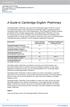 Cambridge English: Preliminary, also known as the Preliminary English Test (PET), is part of a comprehensive range of exams developed by Cambridge English Language Assessment. Cambridge English exams have
FAMILY. MUM, DAD Mum, mum, dad, dad, sister, sister, brother, brother, Shhh, shhh, baby, baby.
 FAMILY MUM, DAD Mum, mum, dad, dad, sister, sister, brother, brother, Shhh, shhh, baby, baby. FATHER, MOTHER Father, mother, father, mother, what about me? Sisters, brothers, sisters, brothers, I can t
Cambridge English: Preliminary (PET) Frequently Asked Questions (FAQs)
 Cambridge English: Preliminary (PET) Frequently Asked Questions (FAQs) Is there a wordlist for Cambridge English: Preliminary exams? Yes. There is a Cambridge English: Preliminary (PET) vocabulary list
POZIOM 2 TEKSTY PIOSENEK I RYMOWANEK
 POZIOM 2 TEKSTY PIOSENEK I RYMOWANEK Welcome Piosenka Hello Hello. I m Lindy. Hello. I m Lindy. What s your name? Hello. I m Joe. Hello. I m Joe. It s time to play! Hello. I m Emily. Hello. I m Emily.
Movers Reading & Writing
 Page 28 Movers Cambridge Young Learners English Tests Part 1 6 questions Look and read. Choose the correct words and write them on the lines. a whale coffee a shoulder an elephant soup a stomach milk a
Fry s Sight Word Phrases
 The people Write it down By the water Who will make it? You and I What will they do? He called me. We had their dog. What did they say? When would you go? No way A number of people One or two How long
EXTRA ACTIVITy pages
 EXTRA FUN ACTIVITIES This booklet contains extra activity pages for the student as well as the tests. See the next page for information about the activity pages. Go to page 7 to find the Alpha tests. EXTRA
Useful classroom language for Elementary students. (Fluorescent) light
 Useful classroom language for Elementary students Classroom objects it is useful to know the words for Stationery Board pens (= board markers) Rubber (= eraser) Automatic pencil Lever arch file Sellotape
Fast Phrases. - Timed - PHRASES WITH FRY INSTANT WORDS
 Fast Phrases - Timed - PHRASES WITH FRY INSTANT WORDS Fry Instant Words are high-frequency words that occur in reading. By practicing reading these phrases containing these words, students can improve
NIT 5: Food I like. Debbie: Do you want some chocolate, Leo?
 NIT 5: Food I like UNIT L e s s o n 1 1.vv vvlisten and read Debbie: Do you want some chocolate, Leo? Leo: No, thank you. I love chocolate but I can t eat it. I want to be a football player and sport men
A Beginner s Guide To English Grammar
 A Beginner s Guide To English Grammar Noncredit ESL Glendale Community College Concept by: Deborah Robiglio Created by: Edwin Fallahi, Rocio Fernandez, Glenda Gartman, Robert Mott, and Deborah Robiglio
Kangourou Italia - British Institutes Gara del 2 marzo 2010 Categoria Joey Per studenti della classe quinta della Scuola Primaria
 Testi_Kang_10ENG.qxp 8-01-2010 22:38 Pagina 5 Kangourou Italia - British Institutes Gara del 2 marzo 2010 Categoria Per studenti della classe quinta della Scuola Primaria Choose the correct alternative
Just Married. PART 1 - Meet Neil and Julia. PART 2 - A tour around the kitchen
 Just Married Level: 1º E.S.O. Grammar: Demonstratives: this, that, these, those. Use of the definite and indefinite article "a", "the". Some and any, countable uncountable nouns. Irregular plurals Functions:
Get Ready for IELTS Writing. About Get Ready for IELTS Writing. Part 1: Language development. Part 2: Skills development. Part 3: Exam practice
 About Collins Get Ready for IELTS series has been designed to help learners at a pre-intermediate level (equivalent to band 3 or 4) to acquire the skills they need to achieve a higher score. It is easy
Homework Activities for Kindergarten
 Homework Activities for Kindergarten Listed below are several learning activities for your child to complete at home to reinforce skills being taught in school. The sight words are on the last page. Reading
CEFR Level A1 Level A1 Global Listening Reading Spoken Interaction Spoken Production Writing
 CEFR Level A1 Level A1 is the lowest level of generative language use - the point at which the learner can interact in a simple way, ask and answer simple questions about themselves, where they live, people
Handbook for teachers
 Handbook for teachers Key English Test (KET) for Schools CEFR Level A2 Content and overview Paper/timing Content Test Focus 1 READING & WRITING 1 hour 10 minutes 2 LISTENING Approx. 30 minutes (including
FIRST TERM ENGLISH WORKSHEET 2016-2017
 FIRST TERM ENGLISH WORKSHEET 2016-2017 Class -1 1& 11 GIRLS SECTION 1.Make sentences. Flower - Mother - Water - Butterfly - Lovely - Big - 1 2. Circle the correct word. a. It is [Mother s / Father s] birthday.
Female Child s date of birth: Last name: State/ Province: Home telephone number:
 60 Ages & Stages Questionnaires 57 months 0 days through 66 months 0 days Month Questionnaire Please provide the following information. Use black or blue ink only and print legibly when completing this
Types of meaning. KNOWLEDGE: the different types of meaning that items of lexis can have and the terms used to describe these
 Part 1 Lexis What is lexis? Lexis (or vocabulary) refers to single words, or sets of words, that have a specific meaning, for example: car, pick up, in the end. Unit 1 Types of meaning LEARNING OUTCOME
Expressive Objective: Realize the importance of using polite expressions in showing respect when communicating with others
 QUARTER 4 - WEEK 1 Theme: My School and Friends TARGET SKILLS : At the end of the lesson the students should be able to: Expressive Objective: Realize the importance of using polite expressions in showing
2013-2014 EĞİTİM-ÖĞRETİM YILI ÖZEL BAHÇELİEVLER İHLAS ANAOKULU İNGİLİZCE DERSİ ÜNİTELENDİRİLMİŞ YILLIK DERS PLANI
 EKİM EYLÜL AND STUDY SKILLS/ METHODS and STRUCTURES 1 Ss. like English lesson. -identify greetings -identify leave-taking expressions Greetings 1. Act out with puppets 2.. Hello! Hi! Good morning Bye,
School clubs are fun!
 UNIT School clubs Reading School clubs are fun! to: Anna from: Candy subject: Choir Hi Anna, I went to Choir after school today. It was really good. We sang some very funny songs. Mrs Hall helps us and
GMAT.cz www.gmat.cz [email protected]. GMAT.cz KET (Key English Test) Preparating Course Syllabus
 Lesson Overview of Lesson Plan Numbers 1&2 Introduction to Cambridge KET Handing Over of GMAT.cz KET General Preparation Package Introduce Methodology for Vocabulary Log Introduce Methodology for Grammar
Year 7. Grammar booklet 3 and tasks Sentences, phrases and clauses
 Year 7 Grammar booklet 3 and tasks Sentences, phrases and clauses Types of Sentence There are 4 main types of sentences. A question asks something and needs a question mark. What s the matter? A statement
PUSD High Frequency Word List
 PUSD High Frequency Word List For Reading and Spelling Grades K-5 High Frequency or instant words are important because: 1. You can t read a sentence or a paragraph without knowing at least the most common.
Chapter 3 - Growing with Verbs. A verb that helps another verb is called a helping verb. It comes before the main verb to tell about the action.
 120 Chapter 3 - Growing with Verbs 3.12 Helping Verbs A verb that helps another verb is called a helping verb. It comes before the main verb to tell about the action. John will ride his scooter. She has
Songs and Chants. Starter
 Songs and Chants Starter Contents Welcome... 3 Hello song... 3 1, 2, 3, 4, 5 chant... 3 Quest song... 3 1 My birthday... 4 1, 2, 3, 4, 5, 6, 7, 8, 9, 10 chant... 4 Quest song... 4 Happy Birthday... 4 2
Last name: State/ Province: Home telephone number:
 60 Ages & Stages Questionnaires 57 months 0 days through 66 months 0 days Month Questionnaire Please provide the following information. Use black or blue ink only and print legibly when completing this
Simple Present Tense. Simple Present Tense in the Negative. Grammar Practice Worksheets
 Simple Present Tense Choose the correct verb from the list below to complete the following sentences. Use the correct form of the simple present tense. fix stand speak drink eat do wear have wash make
Preliminary Speaking Part 3 teacher s notes
 Preliminary Speaking Part 3 teacher s notes Description Students use some sample materials to think about the content and language required in the part, before performing a practise task. They then consider
Contents: 2008 www.perfect-english-grammar.com May be freely copied for personal or classroom use.
 2 Contents: Grammar of phrasal verbs 2 Deal with 3 Come across 5 Get on with 7 Look after 9 Pick up 11 Review 1 13 Put on 14 Take off 16 Look into 18 Turn down 20 Look forward to 22 Review 2 23 Answers
English lesson plans for Grade 1
 English lesson plans for Grade 1 Lessons in this section 1.1 Vocabulary, listening and speaking: parts of the body and can 26 1.2 Vocabulary, listening and speaking: colours and parts of the body 29 1.3
First Grade Spelling 3-1. First Grade Spelling. 1. an 2. at 3. can 4. cat 5. had 6. man 7. I 8. and 9. the 10. a. Dictation Sentences:
 First Grade Spelling Dear Parents, Beginning this week, the first graders will be starting their spelling program. Each Monday, or the beginning of the week, they will be given a pre-test on 10 words that
Cambridge English. Proficiency. Handbook for teachers for exams from 2015
 230 C2 220 210 200 Cambridge English Proficiency 190 180 170 160 150 140 130 120 110 100 Handbook for teachers for exams from 2015 90 80 Content and overview Paper/timing Content Test focus Part 1 Part
English lesson plans for Grade 3
 English lesson plans for Grade 3 Lessons in this section 3.1 Vocabulary and speaking: How do you say in English? 76 3.2 Reading: We re going to take a holiday 80 3.3 Listening and writing: holiday plans
How many monkeys?: How many monkeys? One, one! How many monkeys? One monkey! Hello song: Hello, hello, hello *3
 Hello song: Hello, hello, hello *3 I am Sue Hello, hello, hello *3 I am Jack Goodbye song: Goodbye Jack and Sue. Goodbye Jack. Goodbye Sue. Goodbye Jack and Sue. Elephants and fishes: How many elephants/fishes?
Year 3 Grammar Guide. For Children and Parents MARCHWOOD JUNIOR SCHOOL
 MARCHWOOD JUNIOR SCHOOL Year 3 Grammar Guide For Children and Parents A guide to the key grammar skills and understanding that your child will be learning this year with examples and practice questions
Last name: State/ Province: Home telephone number:
 54 Ages & Stages Questionnaires 51 months 0 days through 56 months 30 days Month Questionnaire Please provide the following information. Use black or blue ink only and print legibly when completing this
Teaching Qualifications. TKTModules 1 3. Teaching Knowledge Test. Handbook for Teachers
 Teaching Qualifications TKTModules 1 3 Teaching Knowledge Test Handbook for Teachers CONTENTS Preface This handbook provides information for teachers interested in taking TKT (Teaching Knowledge Test)
DIAGNOSTIC EVALUATION
 Servicio de Inspección Educativa Hezkuntzako Ikuskapen Zerbitzua 2 0 1 1 / 1 2 DIAGNOSTIC EVALUATION 4th YEAR of PRIMARY EDUCATION ENGLISH LITERACY Name / surname(s):... School:... Group:... City / Town:.
Cambridge English: First (FCE) Frequently Asked Questions (FAQs)
 Cambridge English: First (FCE) Frequently Asked Questions (FAQs) Is there a wordlist for Cambridge English: First exams? No. Examinations that are at CEFR Level B2 (independent user), or above such as
[elo'quia. S 1 / 6. Please mark the correct answer with a X. Example: I must my homework this evening. X. Duration: 45 minutes.
 [elo'quia. English test ] Duration: 45 minutes Family name First name Date Please mark the correct answer with a X. Example: I must my homework this evening. X do to make to do make 1] What do you do?
Cambridge English: Advanced Speaking Sample test with examiner s comments
 Speaking Sample test with examiner s comments This document will help you familiarise yourself with the Speaking test for Cambridge English: Advanced, also known as Certificate in Advanced English (CAE).
Working towards TKT Module 1
 Working towards TKT Module 1 EMC/7032c/0Y09 *4682841505* TKT quiz 1) How many Modules are there? 2) What is the minimum language level for TKT? 3) How many questions are there in each Module? 4) How long
openmind 1 Practice Online
 Macmillan Practice Online is the easy way to get all the benefits of online learning and with over 100 courses to choose from, covering all competence levels and ranging from business English to exam practice
Activity type Activities Materials 1 Distinguishing special letters in words. Alphabet race Farm animals / Means of transp.
 Writing activities Activity type Activities Materials 1 Distinguishing special letters in words 2 Word competitions word games 3 Crosswords Completing words Alphabet race Farm animals / Means of transp.
EKOLA Junior High School Bilingual Programme Entrance Test (1h15) Sample Paper. Result:
 EKOLA Junior High School Bilingual Programme Entrance Test (1h15) Sample Paper Name: Result: Task 1 Which notice says what? For questions 1 5, match the correct letter A H. 1. You do not have to pay extra
Nombre: Today is Monday. Yesterday was. Tomorrow will be. Today is Friday. Yesterday was. Tomorrow will be. Today is Wednesday.
 Nombre: Days of the week. Read and write. Today is Monday. Yesterday was Tomorrow will be. Today is Friday. Yesterday was Tomorrow will be. Today is Wednesday. Yesterday was Tomorrow will be. Today is
Eat & Drink. It s time to eat, eat, eat What a treat Eat, eat, EAT I m all done now I wash it down with my favorite drink DRINK!
 Eat & Drink It s time to eat, eat, eat What a treat Eat, eat, EAT I m all done now I wash it down with my favorite drink DRINK! It s time to eat, eat, eat What a treat Eat, eat CRACKERS I m all done now
You are going to listen to Jay talking about a special sign language for babies that her son Benen used when he was little.
 Task 1 Lead-in Discuss the questions below: 1. Does your country have a sign language? 2. If so, who uses it? 3. Have you seen anyone using it a. in real life b. on television or on the internet? 4. Did
Sample only Oxford University Press ANZ
 Word level: the parts of speech Nouns A noun is the name of a person, place, thing or idea. Australia is a noun. Fun is a noun. There are many kinds of nouns. The four main ones are: common nouns, proper
Today, it is spoken in some offices. He's going to study English hard. and talk with a lot of people in the future.
 Good. How are you? You re welcome. How are you? Oh, no. You mustn t help him. OK. I ll ask him. Why did you finish the report? You can t buy a dictionary. No, thank you. How are you? It s cloudy. How are
Nombre: RED GREEN BLUE YELLOW PINK ORANGE. Color according to the instructions. Count and write the number. Celia Rodríguez Ruiz
 Color according to the instructions. RED BLUE ORANGE GREEN YELLOW PINK Count and write the number Read the sentences and color the picture The car is red. The cloud is blue. The dog is brown. The bird
California Treasures High-Frequency Words Scope and Sequence K-3
 California Treasures High-Frequency Words Scope and Sequence K-3 Words were selected using the following established frequency lists: (1) Dolch 220 (2) Fry 100 (3) American Heritage Top 150 Words in English
Nombre: I am not playing. You are not (you aren t) eating. He is not (He isn t) reading. She is not (She isn t) sleeping.
 PRESENT CONTINUOUS Affirmative Negative Interrogative I am (I m) playing. You are (you re) eating He is (He s) reading. She is (She s) sleeping. It is (It s) running. We are (we re) speaking. You are (you
THE WASHING MACHINE. Written by. Lorena Padilla
 THE WASHING MACHINE Written by Lorena Padilla [email protected] INT. DINING ROOM - DAY A very messy dining room. There are empty beer bottles and ashtrays with cigarettes on the table. (12) cleans
What is the Common European Framework of Reference for language?
 What is the Common European Framework of Reference for language? The Common European Framework of Reference for Language was created by the Council of Europe as the main part of the project "Language Learning
School. Lesson plan. Topic. Aims. Age group. Level. Time. Materials. School, school objects, rules, subjects, rooms and uniforms
 School Lesson plan Topic School, school objects, rules, subjects, rooms and uniforms Aims To practise (depending on stages chosen): vocabulary: words connected to school, school objects, rules, subjects,
7.5 Emphatic Verb Tense
 Chapter 7 Verb Usage 211 7.5 Emphatic Verb Tense The emphatic tenses of a verb are used to add emphasis. In addition, the emphatic tense can be used with the word not in negative sentences and to form
A) Complete the sentences with SIMPLE PRESENT or PRESENT CONTINUOUS.
 ŠESTI RAZRED A) Complete the sentences with SIMPLE PRESENT or PRESENT CONTINUOUS. 1. Susan usually. (go) to school by bus, but now she.. (go) to school by train. 2. Mary often.. (read) in bed, but today
New language test requirements for UK visas and immigration. Visit www.cambridgeenglish.org for more information.
 New language test requirements for UK visas and immigration. Visit www.cambridgeenglish.org for more information. International Legal English Certificate (ILEC) CEFR Levels B2 C1 Handbook for Teachers
Learning English with Bobby 1 Agricola-kustannus
 An Apple Story A red apple is for the mouse. A green apple is for the bird. l like green apples. Thank you Hedgehog! A yellow and green apple is for the cat. l like yellow and green apples. Thank you Hedgehog!
Tom had 5 toy cars. His dad gave him 3 more toy cars. How many toy cars did Tom have in all?
 How many and in all? How many more than? How many are left? Tom had 5 toy cars. His dad gave him 3 more toy cars. How many toy cars did Tom have in all? 7 birds were in a tree. 2 more birds flew to the
Female Child s date of birth: Last name: State/ Province: Home telephone number:
 27 Ages & Stages Questionnaires 25 months 16 days through 28 months 15 days Month Questionnaire Please provide the following information. Use black or blue ink only and print legibly when completing this
KET for Schools Reading and Writing Part 9 teacher s notes
 KET for Schools Reading and Writing Part 9 teacher s notes Description This is a guided discovery activity to find out what candidates need to do in KET for Schools Reading and Writing Part 9. Students
Topic Task: Music, Travel & Descriptions
 At a glance Topic Task: Music, Travel & Descriptions Level: ISE Foundation Focus: Topic task Aims: To provide students with a model of a good topic form/topic discussion, to familiarise students with the
LTTC English Grammar Proficiency Test Grade 2
 LTTC English Grammar Proficiency Test Grade 2 A. Short Comprehension The candidate is expected to demonstrate the ability to understand the passage (around 50 words) and answer the questions. B. Usage
REPORTED SPEECH. Reported speech is used to retell or report what other person has actually said. It is a very usual function in everyday language.
 REPORTED SPEECH USE Reported speech is used to retell or report what other person has actually said. It is a very usual function in everyday language. STRUCTURE Formal aspects We can find different ways
3a Order the words to make questions. b Check your answers. c Practise saying the questions.
 3 Home sweet home Language focus there is / there are Jane is looking for a new flat. Look at her list of things in the area and complete the sentences with there s, there isn t, there are or there aren
GED Language Arts, Writing Lesson 1: Noun Overview Worksheet
 CLN Televised Courses Nina Beegle, Instructor Lesson 1: Noun Overview Worksheet NOUNS: DEFINITION A NOUN can be a person, a place, a thing, or an idea. EXAMPLES: man, children, store, a dream There are
Phonics. High Frequency Words P.008. Objective The student will read high frequency words.
 P.008 Jumping Words Objective The student will read high frequency words. Materials High frequency words (P.HFW.005 - P.HFW.064) Choose target words. Checkerboard and checkers (Activity Master P.008.AM1a
Contents. Appendix 1: Pairs Of Text For Spot The Difference 28. Appendix 2: Activity Glossary 32
 Contents Introduction 3 1. Loop Games Lesson: English / Big Writing 4 2. Spot The Difference Lesson: English / Big Writing 6 3. Sea Monsters Lesson: English / Big Writing / Science / Fiction / Geography
Getting together. Present simple 1. New Year in Vietnam. Reading: Everybody s birthday. Word focus: Special occasions
 2 A Present simple 1 B Present simple: questions C Communication strategies Showing interest D Interaction Are you a people person? Getting together Present simple 1 Word focus: Special occasions 1 Work
New language test requirements for UK visas and immigration. Visit www.cambridgeenglish.org for more information.
 New language test requirements for UK visas and immigration. Visit www.cambridgeenglish.org for more information. Cambridge English First for Schools Handbook for Teachers UCLES 2014 CE/2387/5Y01 CONTENTS
Keep your English up to date 4. Teacher s pack Lesson plan and student worksheets with answers. Facebook
 Keep your English up to date 4 Teacher s pack Lesson plan and student worksheets with answers British Broadcasting Corporation 2008 Lesson Plan: Teacher's notes CONTENTS 1. Level, topic, language, aims,
A. Short Comprehension The candidate is expected to demonstrate the ability to understand the passage (around 70 words) and answer the questions.
 LTTC - English Grammar Proficiency Test Grade 3 A. Short Comprehension The candidate is expected to demonstrate the ability to understand the passage (around 70 words) and answer the questions. B. Usage
Assessing Speaking Performance Level B2
 Examiners and speaking assessment in the FCE exam Speaking tests are conducted by trained examiners. The quality assurance of Speaking Examiners (SEs) is managed by Team Leaders (TLs) who are in turn responsible
Most Common Words Transfer Card: List 1
 Most Common Words Transfer Card: List 1 the to a and in you that of it not for I is an Meg is in the bed. That is not for you. It is in a bag. I am not mad. Most Common Words Transfer Card: List 2 on with
Grammar and Mechanics Test 3
 Grammar and Mechanics 3 Name: Instructions: Copyright 2000-2002 Measured Progress, All Rights Reserved : Grammar and Mechanics 3 1. Which sentence is missing punctuation? A. My best friend was born on
Grade. Testing and Evaluation Book. Carol Barrett. Unit 6 test 16. Introduction 2. Summative test 2 17. Evaluation sheet 3.
 Grade Testing and Evaluation Book Introduction Evaluation sheet Starter test 6 Unit test 7 Unit test 8 Unit test 9 Summative test 0 Skills test Unit test Unit 6 test 6 Summative test 7 Skills test 9 Unit
Chapter 3 Growing with Verbs 77
 Chapter 3 Growing with Verbs 77 3.2 Direct Objects A direct object is the noun or pronoun that receives the direct action of a verb. The verb used with a direct object is always an action verb and is called
Curriculum Text. Texto del curso Texte du cours Kursinhalt Testo del corso. Inglés english UK Level 1. Inglese Britannico.
 English Curriculum Text Level 1 English UK Inglés english UK Level 1 UK Anglais Britannique Englisch UK Inglese Britannico Curriculum Text Texto del curso Texte du cours Kursinhalt Testo del corso RosettaStone.com
Fiction: Poetry. Classic Poems. Contemporary Poems. Example. Key Point. Example
 Reading - Comprehension Fiction: Poetry Read classic and contemporary poems Recognise riddles and rhymes Recognise tongue twisters Classic Poems A poem expresses an emotion or an idea. Rhyme is when words