
Last name: State/ Province: Home telephone number:
|
|
|
- Emma Fletcher
- 9 years ago
- Views:
Transcription
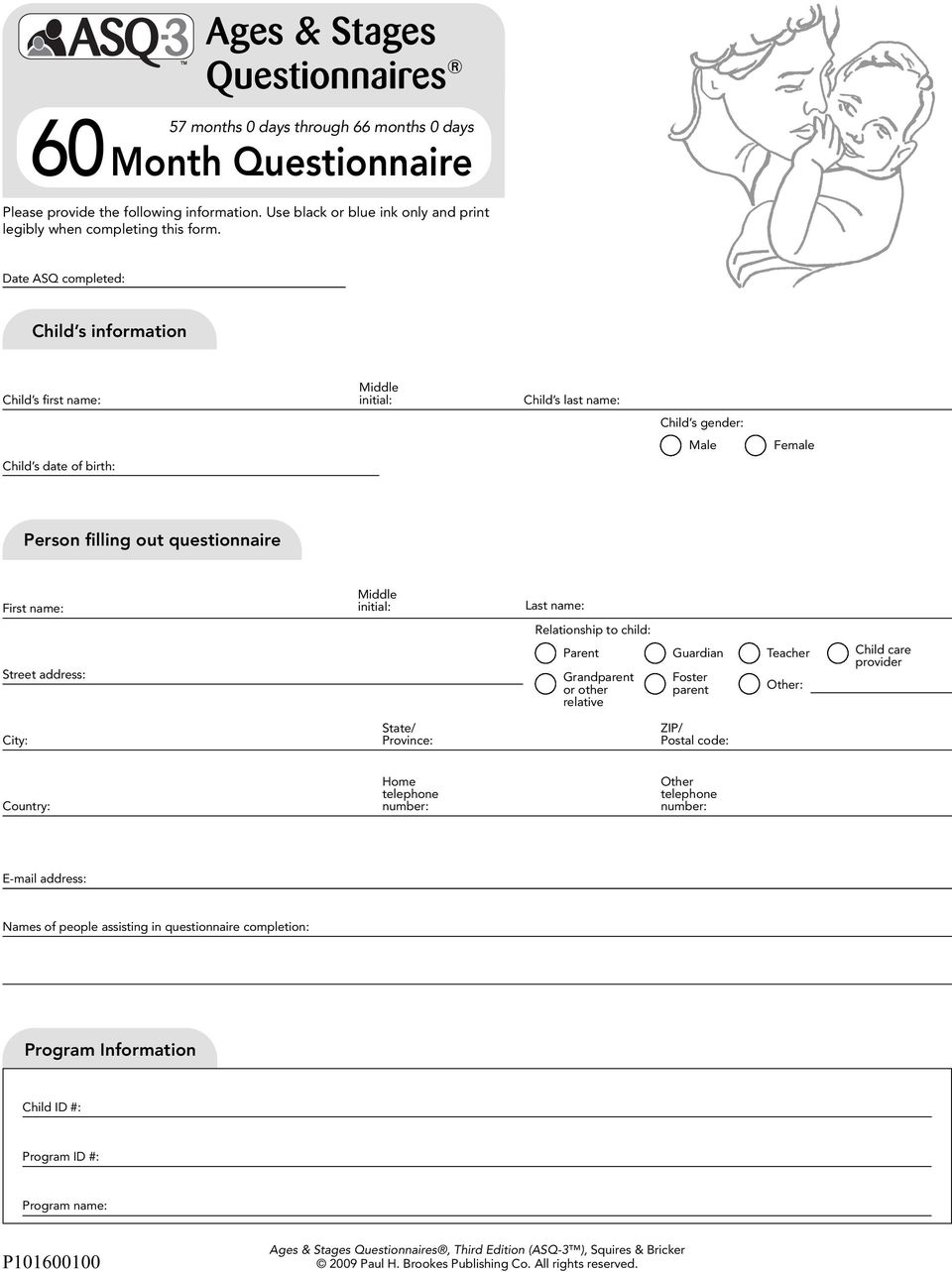
1 60 Ages & Stages Questionnaires 57 months 0 days through 66 months 0 days Month Questionnaire Please provide the following information. Use black or blue ink only and print legibly when completing this form. Date ASQ completed: Child s information Child s first name: Middle initial: Child s last name: Child s gender: Male Female Child s date of birth: Person filling out questionnaire First name: Middle initial: Last name: Relationship to child: Street address: Parent Grandparent or other relative Guardian Foster parent Teacher Other: Child care provider City: State/ Province: ZIP/ Postal code: Country: Home telephone number: Other telephone number: address: Names of people assisting in questionnaire completion: Program Information Child ID #: Program ID #: Program name: P
2 60 Month Questionnaire 57 months 0 days through 66 months 0 days On the following pages are questions about activities babies may do. Your baby may have already done some of the activities described here, and there may be some your baby has not begun doing yet. For each item, please fill in the circle that indicates whether your baby is doing the activity regularly, sometimes, or not yet. Important Points to Remember: Try each activity with your baby before marking a response. Make completing this questionnaire a game that is fun for you and your child. Make sure your child is rested and fed. Please return this questionnaire by. Notes: COMMUNICATION SOMETIMES T YET 1. Without your giving help by pointing or repeating directions, does your child follow three directions that are unrelated to one another? Give all three directions before your child starts. For example, you may ask your child, Clap your hands, walk to the door, and sit down, or Give me the pen, open the book, and stand up. 2. Does your child use four- and five-word sentences? For example, does your child say, I want the car? Please write an example: 3. When talking about something that already happened, does your child use words that end in -ed, such as walked, jumped, or played? Ask your child questions, such as How did you get to the store? ( We walked. ) What did you do at your friend s house? ( We played. ) Please write an example: 4. Does your child use comparison words, such as heavier, stronger, or shorter? Ask your child questions, such as A car is big, but a bus is (bigger); A cat is heavy, but a man is (heavier); A TV is small, but a book is (smaller). Please write an example: E page 2 of 8

3 COMMUNICATION 60 Month Questionnaire page 3 of 8 SOMETIMES T YET 5. Does your child answer the following questions? (Mark sometimes if your child answers only one question.) What do you do when you are hungry? (Acceptable answers include get food, eat, ask for something to eat, and have a snack. ) Please write your child s response: What do you do when you are tired? (Acceptable answers include: take a nap, rest, go to sleep, go to bed, lie down, and sit down. ) Please write your child s response: 6. Does your child repeat the sentences shown below back to you, without any mistakes? (Read the sentences one at a time. You may repeat each sentence one time. Mark yes if your child repeats both sentences without mistakes or sometimes if your child repeats one sentence without mistakes.) Jane hides her shoes for Maria to find. Al read the blue book under his bed. COMMUNICATION TOTAL GROSS MOTOR SOMETIMES T YET 1. While standing, does your child throw a ball overhand in the direction of a person standing at least 6 feet away? To throw overhand, your child must raise his arm to shoulder height and throw the ball forward. (Dropping the ball or throwing the ball underhand should be scored as not yet. ) 2. Does your child catch a large ball with both hands? (You should stand about 5 feet away and give your child two or three tries before you mark the answer.) 3. Without holding onto anything, does your child stand on one foot for at least 5 seconds without losing her balance and putting her foot down? (You may give your child two or three tries before you mark the answer.) E

4 GROSS MOTOR 60 Month Questionnaire page 4 of 8 SOMETIMES T YET 4. Does your child walk on his tiptoes for 15 feet (about the length of a large car)? (You may show him how to do this.) 5. Does your child hop forward on one foot for a distance of 4 6 feet without putting down the other foot? (You may give him two tries on each foot. Mark sometimes if she can hop on one foot only.) 6. Does your child skip using alternating feet? (You may show him how to do this.) GROSS MOTOR TOTAL FINE MOTOR SOMETIMES T YET 1. Ask your child to trace on the line below with a pencil. Does your child trace on the line without going off the line more than two times? (Mark sometimes if your child goes off the line three times.) 2. Ask your child to draw a picture of a person on a blank sheet of paper. You may ask your child, Draw a picture of a girl or a boy. If your child draws a person with head, body, arms, and legs, mark yes. If your child draws a person with only three parts (head, body, arms, or legs), mark sometimes. If your child draws a person with two or fewer parts (head, body, arms, or legs), mark not yet. Be sure to include the sheet of paper with your child s drawing with this questionnaire. 3. Draw a line across a piece of paper. Using child-safe scissors, does your child cut the paper in half on a more or less straight line, making the blades go up and down? (Carefully watch your child s use of scissors for safety reasons.) 4. Using the shapes below to look at, does your child copy the shapes in the space below without tracing? (Your child s drawings should look similar to the design of the shapes below, but they may be different in size. Mark yes if she copies all three shapes; mark sometimes if your child copies two shapes.) (Space for child s shapes) E

5 FINE MOTOR 60 Month Questionnaire page 5 of 8 SOMETIMES T YET 5. Using the letters below to look at, does your child copy the letters without tracing? Cover up all of the letters except the letter being copied. (Mark yes if your child copies four of the letters and you can read them. Mark sometimes if your child copies two or three letters and you can read them.) V H T C A (Space for child s letters) 6. Print your child s first name. Can your child copy the letters? The letters may be large, backward, or reversed. (Mark sometimes if your child copies about half of the letters.) (Space for adult s printing) (Space for child s printing) FINE MOTOR TOTAL PROBLEM SOLVING SOMETIMES T YET 1. When asked, Which circle is smallest? does your child point to the smallest circle? (Ask this question without providing help by pointing, gesturing, or looking at the smallest circle.) 2. When shown objects and asked, What color is this? does your child name five different colors like red, blue, yellow, orange, black, white, or pink? (Mark yes only if your child answers the question correctly using five colors.) E

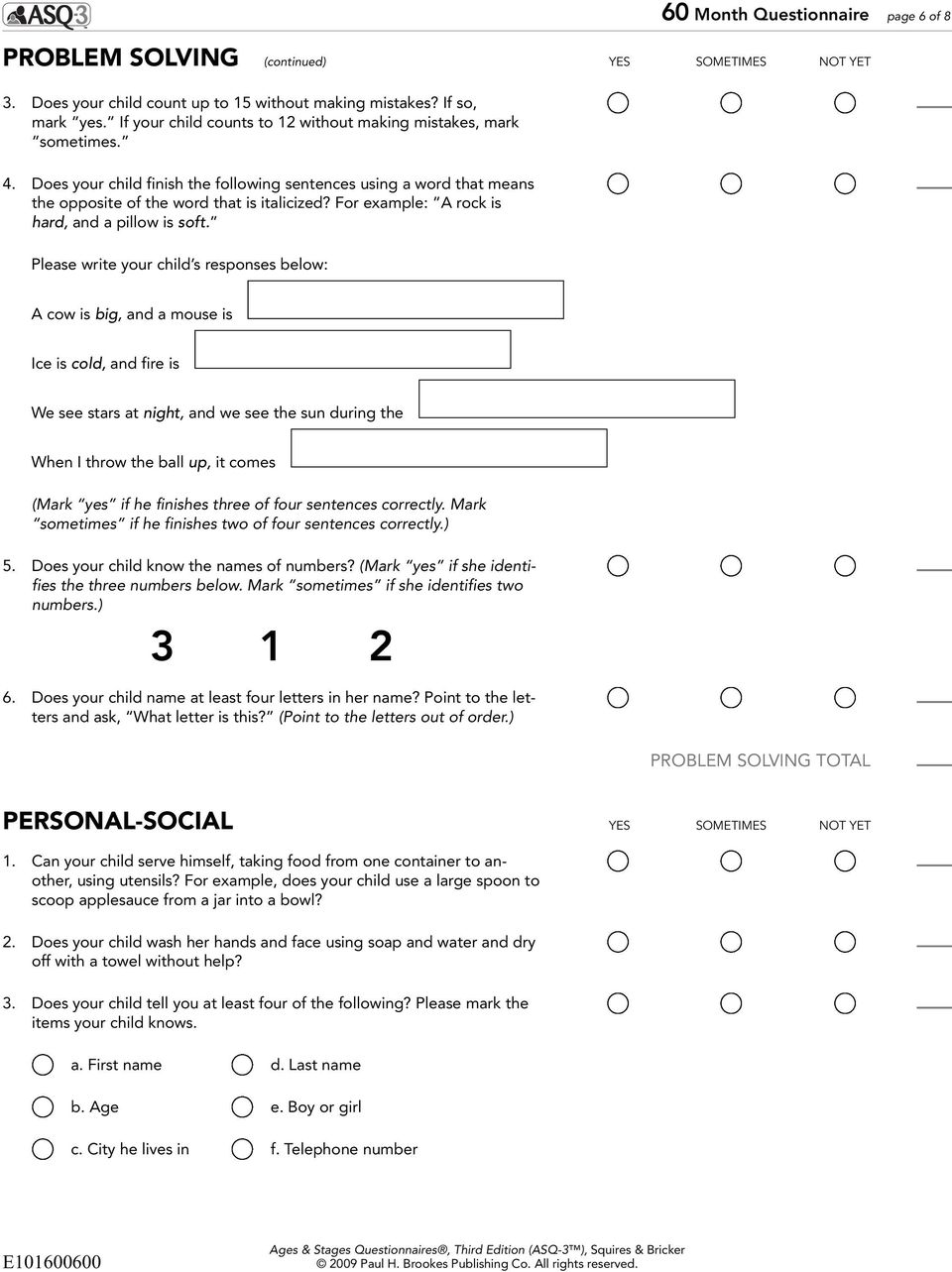
6 PROBLEM SOLVING 60 Month Questionnaire page 6 of 8 SOMETIMES T YET 3. Does your child count up to 15 without making mistakes? If so, mark yes. If your child counts to 12 without making mistakes, mark sometimes. 4. Does your child finish the following sentences using a word that means the opposite of the word that is italicized? For example: A rock is hard, and a pillow is soft. Please write your child s responses below: A cow is big, and a mouse is Ice is cold, and fire is We see stars at night, and we see the sun during the When I throw the ball up, it comes (Mark yes if he finishes three of four sentences correctly. Mark sometimes if he finishes two of four sentences correctly.) 5. Does your child know the names of numbers? (Mark yes if she identifies the three numbers below. Mark sometimes if she identifies two numbers.) Does your child name at least four letters in her name? Point to the letters and ask, What letter is this? (Point to the letters out of order.) PROBLEM SOLVING TOTAL PERSONAL-SOCIAL SOMETIMES T YET 1. Can your child serve himself, taking food from one container to another, using utensils? For example, does your child use a large spoon to scoop applesauce from a jar into a bowl? 2. Does your child wash her hands and face using soap and water and dry off with a towel without help? 3. Does your child tell you at least four of the following? Please mark the items your child knows. a. First name d. Last name b. Age e. Boy or girl c. City he lives in f. Telephone number E
7 PERSONAL-SOCIAL 60 Month Questionnaire page 7 of 8 SOMETIMES T YET 4. Does your child dress and undress himself, including buttoning medium-size buttons and zipping front zippers? 5. Does your child use the toilet by herself? (She goes to the bathroom, sits on the toilet, wipes, and flushes.) Mark yes even if she does this after you remind her. 6. Does your child usually take turns and share with other children? PERSONAL-SOCIAL TOTAL OVERALL Parents and providers may use the space below for additional comments. 1. Do you think your child hears well? If no, explain: 2. Do you think your child talks like other children her age? If no, explain: 3. Can you understand most of what your child says? If no, explain: 4. Can other people understand most of what your child says? If no, explain: E

8 60 Month Questionnaire page 8 of 8 OVERALL 5. Do you think your child walks, runs, and climbs like other children his age? If no, explain: 6. Does either parent have a family history of childhood deafness or hearing impairment? If yes, explain: 7. Do you have any concerns about your child s vision? If yes, explain: 8. Has your child had any medical problems in the last several months? If yes, explain: 9. Do you have any concerns about your child s behavior? If yes, explain: 10. Does anything about your child worry you? If yes, explain: E

9 60 Month ASQ-3 Information Summary 57 months 0 days through 66 months 0 days Child s name: Child s ID #: Date ASQ completed: Date of birth: Administering program/provider: 1. SCORE AND TRANSFER TOTALS TO CHART BELOW: See ASQ-3 User s Guide for details, including how to adjust scores if item responses are missing. Score each item ( = 10, SOMETIMES = 5, T YET = 0). Add item scores, and record each area total. In the chart below, transfer the total scores, and fill in the circles corresponding with the total scores. Total Area Cutoff Score Communication Gross Motor Fine Motor Problem Solving Personal-Social TRANSFER OVERALL RESPONSES: Bolded uppercase responses require follow-up. See ASQ-3 User s Guide, Chapter Hears well? Yes 2. Talks like other children his age? Yes 3. Understand most of what your child says? Yes 4. Others understand most of what your child says? Yes 5. Walks, runs, and climbs like other children? Yes 6. Family history of hearing impairment? No 7. Concerns about vision? No 8. Any medical problems? No 9. Concerns about behavior? No 10. Other concerns? No 3. ASQ SCORE INTERPRETATION AND RECOMMENDATION FOR FOLLOW-UP: You must consider total area scores, overall responses, and other considerations, such as opportunities to practice skills, to determine appropriate follow-up. If the child s total score is in the If the child s total score is in the If the child s total score is in the area, it is above the cutoff, and the child s development appears to be on schedule. area, it is close to the cutoff. Provide learning activities and monitor. area, it is below the cutoff. Further assessment with a professional may be needed. 4. FOLLOW-UP ACTION TAKEN: Check all that apply. Provide activities and rescreen in months. Share results with primary health care provider. Refer for (circle all that apply) hearing, vision, and/or behavioral screening. Refer to primary health care provider or other community agency (specify reason):. Refer to early intervention/early childhood special education. No further action taken at this time Other (specify): 5. OPTIONAL: Transfer item responses (Y =, S = SOMETIMES, N = T YET, X = response missing). Communication Gross Motor Fine Motor Problem Solving Personal-Social P

Female Child s date of birth: Last name: State/ Province: Home telephone number:
 60 Ages & Stages Questionnaires 57 months 0 days through 66 months 0 days Month Questionnaire Please provide the following information. Use black or blue ink only and print legibly when completing this
Last name: State/ Province: Home telephone number:
 54 Ages & Stages Questionnaires 51 months 0 days through 56 months 30 days Month Questionnaire Please provide the following information. Use black or blue ink only and print legibly when completing this
Female Child s date of birth: Last name: State/ Province: Home telephone number:
 27 Ages & Stages Questionnaires 25 months 16 days through 28 months 15 days Month Questionnaire Please provide the following information. Use black or blue ink only and print legibly when completing this
If child was born 3 or more weeks prematurely, # of weeks premature: Last name: State/ Province: Home telephone number:
 16 Ages & Stages Questionnaires 15 months 0 days through 16 months 30 days Month Questionnaire Please provide the following information. Use black or blue ink only and print legibly when completing this
If baby was born 3 or more weeks prematurely, # of weeks premature: Last name: State/ Province: Home telephone number:
 Ages & Stages Questionnaires 12 11 months 0 days through 12 months 30 days Month Questionnaire Please provide the following information. Use black or blue ink only and print legibly when completing this
If baby was born 3 or more weeks prematurely, # of weeks premature: Last name: State/ Province: Home telephone number:
 Ages & Stages Questionnaires 4 3 months 0 days through 4 months 30 days Month Questionnaire Please provide the following information. Use black or blue ink only and print legibly when completing this form.
If baby was born 3 or more weeks prematurely, # of weeks premature: Last name: State/ Province: Home telephone number:
 Ages & Stages Questionnaires 2 1 month 0 days through 2 months 30 days Month Questionnaire Please provide the following information. Use black or blue ink only and print legibly when completing this form.
If child was born 3 or more weeks prematurely, # of weeks premature: Last name: State/ Province: Home telephone number:
 Ages & Stages Questionnaires 18 17 months 0 days through 18 months 30 days Month Questionnaire Please provide the following information. Use black or blue ink only and print legibly when completing this
If baby was born 3 or more weeks prematurely, # of weeks premature: Last name: State/ Province: Home telephone number:
 Ages & Stages Questionnaires 10 9 months 0 days through 10 months 30 days Month Questionnaire Please provide the following information. Use black or blue ink only and print legibly when completing this
If baby was born 3 or more weeks prematurely, # of weeks premature: Last name: State/ Province: Home telephone number:
 Ages & Stages Questionnaires 8 7 months 0 days through 8 months 30 days Month Questionnaire Please provide the following information. Use black or blue ink only and print legibly when completing this form.
If baby was born 3 or more weeks prematurely, # of weeks premature: Last name: State/ Province: Home telephone number:
 Ages & Stages Questionnaires 6 5 months 0 days through 6 months 30 days Month Questionnaire Please provide the following information. Use black or blue ink only and print legibly when completing this form.
Copyright 1999 by Paul H. Brookes Publishing Co.
 Ages & Stages Questionnaires : A Parent-Completed, Child-Monitoring System Second Edition By Diane Bricker and Jane Squires with assistance from Linda Mounts, LaWanda Potter, Robert Nickel, Elizabeth Twombly,
Homework Activities for Kindergarten
 Homework Activities for Kindergarten Listed below are several learning activities for your child to complete at home to reinforce skills being taught in school. The sight words are on the last page. Reading
.18 Month. Questionnaire III III III III III III. Important Points to Remember:
 Ages 8t Stages Questionnaires': A Parent-Completed, Child-Monitoring System Second Edition By Diane Bricker and Jane Squires with assistance from Linda Mounts, LaWanda Potter, Robert Nickel, Elizabeth
California Treasures High-Frequency Words Scope and Sequence K-3
 California Treasures High-Frequency Words Scope and Sequence K-3 Words were selected using the following established frequency lists: (1) Dolch 220 (2) Fry 100 (3) American Heritage Top 150 Words in English
A Note to Parents. 1. As you study the list, vary the order of the words.
 A Note to Parents This Wordbook contains all the sight words we will be studying throughout the year plus some additional enrichment words. Your child should spend some time each week studying this Wordbook
AGES & STAGES QUESTIONNAIRES : SOCIAL-EMOTIONAL
 Version 1.1 AGES & STAGES QUESTIONNAIRES : SOCIAL-EMOTIONAL A PARENT-COMPLETED, CHILD-MONITORING SYSTEM FOR SOCIAL-EMOTIONAL BEHAVIORS by Jane Squires, Ph.D. Diane Bricker, Ph.D. and Elizabeth Twombly,
Phonics. High Frequency Words P.008. Objective The student will read high frequency words.
 P.008 Jumping Words Objective The student will read high frequency words. Materials High frequency words (P.HFW.005 - P.HFW.064) Choose target words. Checkerboard and checkers (Activity Master P.008.AM1a
Fry Phrases Set 1. TeacherHelpForParents.com help for all areas of your child s education
 Set 1 The people Write it down By the water Who will make it? You and I What will they do? He called me. We had their dog. What did they say? When would you go? No way A number of people One or two How
PRINT AWARENESS ASSESSMENT. Instructions and Teacher Recording Form
 PRINT AWARENESS ASSESSMENT Instructions and Teacher Recording Form Instructions: This form includes instructions for each section and allows room for the teacher or assessor to write comments while the
Parent Handouts: Language Intervention Activities
 Parent Handouts: Language Intervention Activities 12 Preverbal-Preintentional General Language Strategies Learning to Talk Children learn to talk by hearing others talk to them. You can help your child
Case Study Child Development Kelsey Heisler May 6, 2009
 Case Study Child Development Kelsey Heisler May 6, 2009 This case study is on a young girl named Hannah. She was observed in a classroom at the Early Learning Center. She is 4 years old. She is the only
Ages and Stages 48-60 Months
 The Busy World of Your Preschooler: An Overview of Your Preschooler s Development Your preschooler is a pretty capable person by now. Four year olds are more even-tempered and cooperative with parents
EXTRA ACTIVITy pages
 EXTRA FUN ACTIVITIES This booklet contains extra activity pages for the student as well as the tests. See the next page for information about the activity pages. Go to page 7 to find the Alpha tests. EXTRA
PUSD High Frequency Word List
 PUSD High Frequency Word List For Reading and Spelling Grades K-5 High Frequency or instant words are important because: 1. You can t read a sentence or a paragraph without knowing at least the most common.
Class 3. Early Reading Assessment
 Class 3. Early Reading Assessment 1. Phonemic Awareness: Initial Sound Segmentation Assess child s phonemic awareness: the knowledge that words are made of sounds put together. Assess ability to identify
Purpose: To develop physical and motor skills and promote health and well-being
 Purpose: To develop physical and motor skills and promote health and well-being The physical and motor development domain includes the physical and motor skills and abilities that emerge during the infant
Lesson Plan #2. Performance Objective(s): Given a worksheet of 12 sentences, the 2 nd grade students will identify the action verb 9 out of 12 times.
 Lesson Plan #2 Lesson: Action Verb Lesson with Book, Game, and Video Length: 45 minutes Age or Grade Level Intended: 2 nd Grade Source: Taken from www.lessonsnips.com and Emily Gallmeyer Academic Standard(s):
Using sentence fragments
 Lesson 8 Descriptive Essays Description is not a distinct mode of writing, like expository, narrative, and persuasive, but the ability to write descriptively is essential to a host of writing genres. Many
Phonics. P.041 High Frequency Words. Objective The student will read high frequency words.
 2005 The Florida Center for Reading Research (Revised, 2008) Objective The student will read high frequency words. Phonics P.041 High Frequency Words Sandpaper Words Materials Tactile word patterns (Activity
Building Blocks: Effective Practices for Including Young Children with Disabilities in Community Based Programs
 Building Blocks: Effective Practices for Including Young Children with Disabilities in Community Based Programs Cassandra Cerros Jaime Martin Gail Joseph Head Start Center for Inclusion University of Washington
Abraham s Call. Genesis 12:1 Leave your country and go to the land I will show you.
 Abraham s Call Teacher Pep Talk: God called a man named Abraham to leave his homeland and to go to the land He would show him. God promised Abraham that He would make him into a great nation; that He would
Wise Men. Lesson At-A-Glance. Gather (10 minutes) Center Time Kids stamp stars, make play clay stars, and color Bible story pictures.
 Wise Men Lesson At-A-Glance Scripture Reference Matthew 2:2-12 Lesson Focus Follow the star. Gather (10 minutes) Center Time Kids stamp stars, make play clay stars, and color Bible story pictures. Circle
Word Meaning Helping Your Child Determine the Meaning of Words
 Grades 4-5 Word Meaning Helping Your Child Determine the Meaning of Words As children begin to read more difficult stories and passages, they can come across words they don t understand. Sometimes they
The Dance Lesson. A good dance lesson should contain some or all of the following:-
 The Dance Lesson The Primary School Curriculum says:- Dance in education involves the child in creating, performing and appreciating movement as a means of expression and communication. Dance differs from
Storing Your Medicines Safely
 A H E A L T H Y H O U S E Why is it important to store medicines correctly? When you store your medicines correctly they work well when you need them. If you do not store your medicine in the right place
Week 4 Lesson Plan. Pre-K. Our Neighborhood. Macmillan /McGraw-Hill. Extend. the Unit
 Lesson Plan Extend Unit the Unit Pre-K Our Neighborhood Alphabet Time.....................2-3 Book Time.........................-5 Retelling Puppets..................6-7 Content Area......................8-9
First Grade Spelling Words
 First Grade Spelling Words The Hat 1. at 2. hat 3. cat 4. can 5. cap 6. tap 7. map 8. mad 9. a 10. the I tap the can. Sam and the Bag 1. am 2. ham 3. had 4. bad 5. bag 6. rag 7. cap 8. mad 9. up 10. go
A Child s Developmental Milestones
 A Child s Developmental Listens attentively to sounds and voices (by 1 month) Makes some sounds other than crying (by 2 Cries deliberately for assistance (by 1 month) Begins cooing one syllable (by 3 Coordinates
Creative Curriculum Developmental Continuum Checklist
 Social/Emotional Development: Prosocial Behavior Curriculum Objective: 13 Uses thinking skills to resolve conflicts Accepts adult solution to resolve a conflict Seeks adult assistance to resolve a conflict
Balls, Hoops and Odds & Ends
 KIWIDEX RUNNING / WALKING 181 Balls, Hoops and Odds & Ends On 1 Feb 2012, SPARC changed its name to Sport NZ. www.sportnz.org.nz 182 Section Contents Suggestions 183 Cats and Pigeons 184 Geared Up Relays
Statistics. 268 2016 The College Board. Visit the College Board on the Web: www.collegeboard.org.
 Statistics AP Statistics Exam Regularly Scheduled Exam Date: Thursday afternoon, May 12, 2016 Late-Testing Exam Date: Wednesday morning, May 18, 2016 Section I Total Time: 1 hr. 30 min. Section II Total
Module 2: Conflict Management
 Module 2: Conflict Management Conflict management, like effective communication skills, is another important element of social competency. This module promotes the use of several forms of conflict management
Summary Information: The Carolina Curriculum for Infants and Toddlers with Special Needs, Third Edition (CCITSN; 2004)
 Publisher Website for information Cost Age range Purpose Summary Information: The Carolina Curriculum for Infants and Toddlers with Special Needs, Third Edition (CCITSN; 2004) Brookes Publishing www.brookespublishing.com
Tapescript. B Listen and write the words. C Help the baby spider. Draw a red line. D Help the baby frog. Listen and draw a green line.
 Unit 1 Hello! Topics animals, colours, numbers Functions following instructions, spelling and writing Grammar questions (What s? What are? What colour?), demonstratives (this/these), imperatives Vocabulary
Movers Reading & Writing
 Page 28 Movers Cambridge Young Learners English Tests Part 1 6 questions Look and read. Choose the correct words and write them on the lines. a whale coffee a shoulder an elephant soup a stomach milk a
Portage Guide Birth to Six Preschool Indicator 7 Child Outcomes Crosswalk. Outcome 2 Acquisition & Use of Knowledge & Skills
 Portage Guide Birth to Six Preschool Indicator 7 Child Outcomes Crosswalk NPG Domains Outcome 1 Positive Social Emotional Skills Outcome 2 Acquisition & Use of Knowledge & Skills Outcome 3 Appropriate
SENIOR/LTC ASSESSMENT TRAINING MODULE
 Welcome to the Superior Mobile Medics Senior/LTC Assessment Training i Module Learning Objectives Gain familiarity with the Senior/LTC Assessment process, including company-specific requirements. Know
MATHEMATICS TEST. Paper 1 calculator not allowed LEVEL 6 TESTS ANSWER BOOKLET. First name. Middle name. Last name. Date of birth Day Month Year
 LEVEL 6 TESTS ANSWER BOOKLET Ma MATHEMATICS TEST LEVEL 6 TESTS Paper 1 calculator not allowed First name Middle name Last name Date of birth Day Month Year Please circle one Boy Girl Year group School
Allison Gallahan s Early Childhood Lesson Plan
 Allison Gallahan s Early Childhood Lesson Plan Lesson: Big Book: Reading Maps Length: 20-30 minutes Age or Grade Level Intended: 2 nd Grade Academic Standard(s): Social Studies 2.3.2: The World in Spatial
Preschool March Lessons. Dr. Seuss Day. One Day Free Sample
 Preschool March Lessons Dr. Seuss Day One Day Free Sample Kids R Learning Preschool Lesson Plans Letter R - Number 9 Dr. Seuss Day Circle Time: Left & Right Feet Read the story the Foot Book Explain to
Positive Behaviour Support Plan for Jane. Brief Summary of the Critical System Strengths and Concerns (for school):
 Brief Summary of Focus Person: Positive Behaviour Support Plan for Jane Jane is a 6 year old girl with ADHD, oppositional defiant disorder, prenatal exposure to cocaine and possible fetal alcohol spectrum
Self Help and Functional Skills Checklist
 Self Help and Functional Skills Checklist Please check the box that most appropriately describes your child s ability to perform the following Functional skills. When selecting skills to teach, start with
Ohio s Assessment System
 hio Department of Education Student Name: Ohio s Assessment System Grade 2 Reading Student Booklet Form A Diagnostic Measure 3rd Edition Office of Curriculum and Assessment Copyright 2012 by the Ohio Department
family games Taking the kids swimming is a great way of making sure they re moving around and having fun. And to help you get them into
 swim family games Taking the kids swimming is a great way of making sure they re moving around and having fun. And to help you get them into the pool, we ve come up with loads of great swimming games to
Parable of The Prodigal Son
 Parable of The Prodigal Son Teacher Pep Talk: Children need to know that they are loved unconditionally. In fact, we all need to know it! In the Parable of the Prodigal Son, Jesus assures us that God will
Kindergarten Respect Unit Lesson Seven Respect The Environment
 Kindergarten Respect Unit Lesson Seven Respect The Environment PURPOSE/OBJECTIVE Students will learn that respect must also be shown to the environment. Students will identify specific ways care and concern
Step 1: Come Together
 THE STORY FOR LITTLE ONES: Preschool LESSON GUIDE: Lesson 2 5 ABRAHAM FOLLOWS GOD Bible Basis: Genesis 12:1 9, 17; 21:1 7 Bible Verse: Abram believed the Lord. The Lord accepted Abram because he believed.
Make maths fun!! Give your child lots of praise and encouragement!
 Make maths fun!! Give your child lots of praise and encouragement! Talk to your child about how you work things out. CALCULATION The maths work your child is doing at school may look very different to
Activities to Help Your Baby Grow and Learn
 Communication Your baby now has many different sounds and a lot to say. She likes to play with sounds such as ba ba ba and is learning that some sounds mean special people, such as dada. She understands
Songs and Chants. Starter
 Songs and Chants Starter Contents Welcome... 3 Hello song... 3 1, 2, 3, 4, 5 chant... 3 Quest song... 3 1 My birthday... 4 1, 2, 3, 4, 5, 6, 7, 8, 9, 10 chant... 4 Quest song... 4 Happy Birthday... 4 2
All About Me. Babies (0-1) Meal times. Has your baby been weaned? Yes No
 All About Me To make the transition from home to Early Learners Nursery School as smooth as possible, could you give us the information about the following areas: Babies (0-1) Meal times Has your baby
AR State PIRC/ Center for Effective Parenting
 Helping Young Children Learn to Read What Parents Can Do Reading is one of the basic building blocks for your child s learning and school success. It is a skill on which most other learning is built. Children
Christmas Theme: The Greatest Gift
 Christmas Theme: The Greatest Gift OVERVIEW Key Point: Jesus is the greatest gift of all. Bible Story: The wise men brought gifts Bible Reference: Matthew 2:1-2 Challenge Verse: And we have seen and testify
James is a five year old boy and spends his days at the. spends time with each individually. One of activities James loves is to sit down on the
 Sarah Neuhalfen Case Study Child Development May 12, 2006 James is a five year old boy and spends his days at the Manchester Early Learning Center. He is the average size for his age and has blond hair
EARLY CHILDHOOD LITERACY AND NUMERACY BUILDING GOOD PRACTICE MARILYN FLEER AND BRIDIE RABAN
 EARLY CHILDHOOD LITERACY AND NUMERACY BUILDING GOOD PRACTICE MARILYN FLEER AND BRIDIE RABAN EARLY CHILDHOOD LITERACY AND NUMERACY CARDS This set of cards has been developed to help you support young children
Summer Math Reinforcement Packet Students Entering into 2 nd Grade
 1 Summer Math Reinforcement Packet Students Entering into 2 nd Grade Our first graders had a busy year learning new math skills. Mastery of all these skills is extremely important in order to develop a
AGES AND STAGES: BREASTFEEDING DURING YOUR BABY S FIRST YEAR
 AGES AND STAGES: BREASTFEEDING DURING YOUR BABY S FIRST YEAR Adapted from Ages and Stages: What to Expect During Breastfeeding by Vicki Schmidt, RN, IBCLC BREASTFEEDING YOUR 1-2 MONTH OLD 2» Turn his head
ACTIVITY LEFT ARM RIGHT ARM
 SHOULDER ASSESSMENT FORM AMERICAN SHOULDER AND ELBOW SURGEONS Side: R L Device: RSP TSA Hemi DOS: Side: R L Device: RSP TSA Hemi DOS: Circle the number in the box that indicates your ability to do the
1. Listen to your teacher read the vocabulary words.
 Lesson 6 Literature Link 1. Listen to your teacher read the vocabulary words. Vocabulary Tilda Tennessee troublemaker chicken visitors special invited outwit enough bridle saddle reins different comfortable
Jacob Marries Rachel
 Jacob Marries Rachel Teacher Pep Talk: Jacob, escaping from the wrath of his older brother, Esau, traveled to the home of his mother s relatives. There Jacob, the trickster, who had gotten both Esau s
GROUP GAMES Keeper of the keys: Duck duck goose: Shoe bomb:
 GROUP GAMES This booklet is designed to help you play games in your settings. It has a list of games that can be played in large and small groups and games that can be played indoors and outdoors. GROUP
Social Emotional Tips
 Social Emotional Tips FOR Families with Toddlers Introduction The quality of each toddler s relationships with familiar adults especially their parents sets the foundation for social and emotional health.
Spring Term Year 1. Covering activity badges : Communicator Badge
 Spring Term Year 1 Covering activity badges : Communicator Badge 1. Get someone to give you directions or instructions to do something. Check that you have understood. Then follow the directions or instructions.
Fast Phrases. - Timed - PHRASES WITH FRY INSTANT WORDS
 Fast Phrases - Timed - PHRASES WITH FRY INSTANT WORDS Fry Instant Words are high-frequency words that occur in reading. By practicing reading these phrases containing these words, students can improve
Teaching Children to Praise
 Teaching Children to Praise Thinking About Praise Discuss one or two of the following questions with a partner. When did you last praise God in a heartfelt way? What were you doing at the time? What effect
Tips and Ideas for Making Visuals to Support Young Children with Challenging Behavior
 Tips and Ideas for Making Visuals to Support Young Children with Challenging Behavior Why Use Visual Strategies 1. Visual strategies can be used to prevent challenging behavior. 2. Visual strategies are
Team Building by Jay Varady
 Team Building by Jay Varady CREATE A LEARNING ENVIRONMENT 1. Teach 2. Practice 3. Hold Accountable 4. Give Feedback TEAM BUILDING 1. Championship Teams are Close Knit 2. How Do Teams Become Close 3. Conduct
GRADE 4 English Language Arts Proofreading: Lesson 5
 GRADE 4 English Language Arts Proofreading: Lesson 5 Read aloud to the students the material that is printed in boldface type inside the boxes. Information in regular type inside the boxes and all information
The Roman s Road. 1 By Tamarie Tigh copyright 2011 http://biblelessons.weebly.com. Lesson Legend Prepare Say Do o Note
 WELCOME STATION Student Arrival (5-10 minutes) Put on name tag. Say any verses memorized. Get one sticker for each verse quoted; five verses possible for the week. Get one sticker for attendance; five
GUIDELINES FOR WRITING FAMILY-CENTERED OUTCOMES
 GUIDELINES FOR WRITING FAMILY-CENTERED OUTCOMES There has been much confusion regarding the writing of outcomes and goals following our previous EI trainings. In Virginia, outcomes and goals must be family-centered
A a B b C c D d. E e. F f G g H h. I i. J j K k L l. M m. N n O o P p. Q q. R r S s T t. U u. V v W w X x. Y y. Z z. abcd efg hijk lmnop qrs tuv wx yz
 A a B b C c D d E e F f G g H h I i J j K k L l M m N n O o P p Q q R r S s T t U u V v W w X x Y y Z z abcd efg hijk lmnop qrs tuv wx yz 25 Ways to Use Magnetic Letters at Home 1. LETTER PLAY Encourage
Para-educator/Parent Training Package on Toilet Training (Short Term)
 Para-educator/Parent Training Package on Toilet Training (Short Term) CONTENTS page INTRODUCTION 1 BEGINNING TOILET TRAINING 2 TOILET TRAINING 7 Step 1 Tell/Help 7 2 Dry Pants Check 10 3 Tell/Touch 11
Stroke Impact Scale VERSION 3.0
 Stroke Impact Scale VERSION 3.0 The purpose of this questionnaire is to evaluate how stroke has impacted your health and life. We want to know from YOUR POINT OF VIEW how stroke has affected you. We will
Language Arts Core, First Grade, Standard 8 Writing-Students write daily to communicate effectively for a variety of purposes and audiences.
 Genre Unit Reading and Writing Fables by Amy Kinney Language Arts Core, First Grade, Standard 7 Comprehension-Students understand, interpret, and analyze narrative and informational grade level text. Objective
A Chair for My Mother written and illustrated by Vera B. Williams
 A Chair for My Mother written and illustrated by Vera B. Williams My mother works as a waitress in the Blue Tile Diner. After school sometimes I go to meet her there. Then her boss Josephine gives me a
Become Independent with Daily Routines
 Teaching Your Child to: Become Independent with Daily Routines Does this Sound Familiar? Nadine is a single mom with two young children ages 3 and 5. Her children attend preschool while she is working.
WWW.MRSCARRION.WEBS.COM. First Grade High Frequency /Spelling Words
 WWW.MRSCARRION.WEBS.COM Name: First Grade High Frequency /Spelling Words Indicate Words that become decodable and are included in blending lines and word work for that week. 1. can 2. I 3. we 4. like 5.
Potty Training. When are children ready to potty train?
 Potty Training It can be messy! There will be accidents! Potty training is an important milestone for your child, but learning to gain control of the bowel and bladder can be a complicated process and
Maths Targets for pupils in Year 2
 Maths Targets for pupils in Year 2 A booklet for parents Help your child with mathematics For additional information on the agreed calculation methods, please see the school website. ABOUT THE TARGETS
Lacrosse Terminology
 Lacrosse Terminology Lacrosse is a great game to watch, but with all sports there are rules and terms that, once understood, bring you to a whole new level of understanding. These terms open the door to
Fry s Sight Word Phrases
 The people Write it down By the water Who will make it? You and I What will they do? He called me. We had their dog. What did they say? When would you go? No way A number of people One or two How long
Cambridge English: Preliminary (PET) Frequently Asked Questions (FAQs)
 Cambridge English: Preliminary (PET) Frequently Asked Questions (FAQs) Is there a wordlist for Cambridge English: Preliminary exams? Yes. There is a Cambridge English: Preliminary (PET) vocabulary list
Building Strong Families
 Building Strong Families How to Discipline by Mary Gosche Adapted January 2000 Further adapted and simplified by Gail Rice, Literacy Specialist, December 2002 equal opportunity/ada institution Table of
Child s Communication Book
 Written by: Nadia Mia What is a Communication Book? A communication book can mean different things to different people. In some schools, parents and teachers use a communication book to share information
An Introduction to Ages & Stages Questionnaires (ASQ-3)
 An Introduction to Ages & Stages Questionnaires (ASQ-3) Ages & Stages Questionnaires is a registered trademark of Paul H. Brookes Publishing Co., Inc. WHY DO WE SCREEN CHILDREN? Participants will learn...
Jump Around: Motor Development for Babies and Toddlers
 Jump Around: Motor Development for Babies and Toddlers Danielle King: Branch Manager Lauren Mathur: Branch Librarian Debra Winslow: Youth Program Specialist Overview The Orange County Library System created
Activities for Grieving Children Memory-Making Activities
 Activities for Grieving Children Memory-Making Activities 1. MAKE A MEMORY BOX Purpose: The child will make a box in which to keep special things that remind him/her of the person who died and the relationship
UPPER QUADRANT PAC. Do only those exercises that I have checked off for you to do independently. THINGS TO AVOID
 UPPER QUADRANT PAC Most common pain / disfunction syndromes occur as a result of a combination of poor posture habit and imbalanced muscle groups. The following exercise protocols will address the most
Providing Support for Special Needs Children By The U.S. Department of Education, Office of Educational Research and Improvement. Posted June 1998.
 Providing Support for Special Needs Children By The U.S. Department of Education, Office of Educational Research and Improvement. Posted June 1998. All children can succeed with the right support. Being