
The Algebraic Degree of Semidefinite Programming
|
|
|
- Domenic Baker
- 9 years ago
- Views:
Transcription
1 Mathematical Programming manuscript No. (will be inserted by the editor) Jiawang Nie Kristian Ranestad Bernd Sturmfels The Algebraic Degree of Semidefinite Programming the date of receipt and acceptance should be inserted later Abstract. Given a generic semidefinite program, specified by matrices with rational entries, each coordinate of its optimal solution is an algebraic number. We study the degree of the minimal polynomials of these algebraic numbers. Geometrically, this degree counts the critical points attained by a linear functional on a fixed rank locus in a linear space of symmetric matrices. We determine this degree using methods from complex algebraic geometry, such as projective duality, determinantal varieties, and their Chern classes. Key words. Semidefinite programming, algebraic degree, genericity, determinantal variety, dual variety, multidegree, Euler-Poincaré characteristic, Chern class 1. Introduction A fundamental question about any optimization problem is how the output depends on the input. The set of optimal solutions and the optimal value of the problem are functions of the parameters, and it is important to understand the nature of these functions. For instance, for a linear programming problem, maximize c x subject to A x = b and x 0, (1.1) the optimal value is convex and piecewise linear in the cost vector c and the right hand side b, and it is a piecewise rational function of the entries of the matrix A. The area of mathematics which studies these functions is geometric combinatorics, specifically the theory of matroids for the dependence on A, and the theory of polyhedral subdivisions [5] for the dependence on b and c. For a second example, consider the following basic question in game theory: Given a game, compute its Nash equilibria. (1.2) If there are only two players and one is interested in fully mixed Nash equilibria then this is a linear problem, and in fact closely related to linear programming. On the other hand, if the number of players is more than two then the problem (1.2) is universal in the sense of real algebraic geometry: Datta [4] showed that every real algebraic variety is isomorphic to the set of Nash equilibria of some three-person game. A corollary of her construction is that, if the Nash equilibria are discrete, then their coordinates can be arbitrary algebraic functions of the given input data (the payoff values which specify the game). Jiawang Nie: Department of Mathematics, UC San Diego, La Jolla, CA 92093, USA. [email protected] Kristian Ranestad: Department of Mathematics, University of Oslo, PB 1053 Blindern, 0316 Oslo, Norway. [email protected] Bernd Sturmfels: Department of Mathematics, UC Berkeley, Berkeley, CA 94720, USA. [email protected]

2 2 Jiawang Nie et al. Our third example concerns maximum likelihood estimation in statistical models for discrete data. Here the optimization problem is as follows: Maximize p 1 (θ) u1 p 2 (θ) u2 p n (θ) un subject to θ Θ, (1.3) where Θ is an open subset of R m, the p i (θ) are polynomial functions that sum to one, and the u i are positive integers (these are the data). The optimal solution ˆθ, which is the maximum likelihood estimator, depends on the data: (u 1,..., u n ) ˆθ(u 1,..., u n ). (1.4) This is an algebraic function, and recent work in algebraic statistics [3,12] has led to a formula for the degree of this algebraic function, under certain hypothesis on the polynomials p i (θ) which specify the statistical model. The aim of the present paper is to conduct a similar algebraic analysis for the optimal value function in semidefinite programming. This function shares some key features with each of the previous examples. To begin with, it is a convex function which is piecewise algebraic. However, unlike for (1.1), the pieces are non-linear, so there is a notion of algebraic degree as for Nash equilibria (1.2) and maximum likelihood estimation (1.3). However, semidefinite programming does not exhibit universality as in [4] because the structure of real symmetric matrices imposes some serious constraints on the underlying algebraic geometry. It is these constraints we wish to explore and characterize. We consider the semidefinite programming (SDP) problem in the form maximize trace(b Y ) subject to Y U and Y 0. (1.5) where B is a real symmetric n n-matrix, U is a m-dimensional affine subspace in the ( ) n dimensional space of real n n-symmetric matrices, and Y 0 means that Y is positive semidefinite (all n eigenvalues of Y are non-negative). The problem (1.5) is feasible if and only if the subspace U intersects the cone of positive semidefinite matrices. In the range where it exists and is unique, the optimal solution Ŷ of this problem is a piecewise algebraic function of the matrix B and the subspace U. Our aim is to understand the geometry of this function. Note if U consists of diagonal matrices only, then we are in the linear programming case (1.1), and the algebraic degree of the pieces of Ŷ is just one. What we are interested in is the increase in algebraic complexity which arises from the passage from diagonal matrices to non-diagonal symmetric matrices. Example 1 (Elliptic Vinnikov curves) Let n = 3 and m = 2, so Y runs over a twodimensional affine space of symmetric 3 3-matrices. Then Y 0 specifies a closed convex semi-algebraic region in this plane, whose boundary is the central connected component of a cubic curve as depicted in Figure 1. This curve is a Vinnikov curve, which means that it satisfies the following constraint in real algebraic geometry: any line which meets the interior of the convex region intersects this cubic curve in three real points. See [11,15,20,24] for details. However, there are no constraints on Vinnikov curves in the setting of complex algebraic geometry. The Vinnikov constraints involve inequalities and no equations. This explains why the curve in Figure 1 is smooth. Our problem (1.5) is to maximize a linear function over the convex component. Algebraically, the restriction of a linear function to the cubic curve has six critical points, two of which are complex. They correspond to the intersection points of the dual curve with a line in the dual projective plane. The degree six curve dual to the elliptic Vinnikov curve is depicted in Figure 2.

3 The Algebraic Degree of Semidefinite Programming 3 Fig. 1. The convex component in the center of this elliptic Vinnikov curve is the feasible region for SDP with m = 2, n = 3. Fig. 2. The dual to the elliptic Vinnikov curve in Figure 1 is a plane curve of degree six with three real singular points. Our analysis shows that the algebraic degree of SDP equals six when m = 2 and n = 3. If the matrix B and the plane U are defined over Q then the coordinates of the optimal solution Y are algebraic numbers of degree six. By Galois theory, the solution Y cannot in general be expressed in terms of radicals. For any specific numerical instance we can use the command galois in maple to compute the Galois group, which is then typically found to be the symmetric group S6. u t

4 4 Jiawang Nie et al. Fig. 3. The convex component in the center of this Cayley cubic surface is the feasible region for SDP with m = n = 3. Example 2 (The Cayley Cubic) Now, suppose that m = n = 3. Then det(y ) = 0 is a cubic surface, but this surface is constrained in the context of complex algebraic geometry because it cannot be smooth. The cubic surface det(y ) = 0 has four isolated nodal singularities, namely, the points where X has rank one. This cubic surface is known to geometers as the Cayley cubic. In the optimization literature, it occurs under the names elliptope or symmetroid. Optimization experts are familiar with (the convex component of) the Cayley cubic surface from (the upper left hand picture in) Christoph Helmberg s SDP web page helmberg/semidef.html. The surface dual to the Cayley cubic is a surface of degree four, which is known as the Steiner surface. There are now two possibilities for the optimal solution Ŷ of (1.5). Either Ŷ has rank one, in which case it is one of the four singular points of the cubic surface in Figure 3, or Ŷ has rank two and is gotten by intersecting the Steiner surface by a line specified by B. In either of these two cases, the optimal solution Ŷ is an algebraic function of degree four in the data specifying B and U. In particular, using Girolamo Cardano s Ars Magna, we can express the coordinates of Ŷ in terms of radicals in (B, U). The objective of this paper is to study the geometric figures shown in Figures 1, 2 and 3 for arbitrary values of n and m. The targeted audience includes both algebraic geometers and scholars in optimization. Our presentation is organized as follows. In Section 2 we review SDP duality, we give an elementary introduction to the notion of algebraic degree, and we explain what it means for the data U and B to be generic. In Section 3 we derive Pataki s inequalities which characterize the possible ranks of the optimal matrix Ŷ, and, in Theorem 7, we present a precise characterization of the algebraic degree. The resulting geometric formulation of semidefinite programming is our point of departure in Section 4. Theorem 10 expresses the algebraic degree of SDP as a certain bidegree. This is a notion of degree for subvarieties of products of projective spaces, and is an instance of the general definition of multidegree in Section 8.5 of the text book [17]. Theorem 11 gives explicit formulas for the

5 The Algebraic Degree of Semidefinite Programming 5 algebraic degree, organized according to the rows of Table 2. In Section 5 we present results involving projective duality and determinantal varieties. in Section 6 this is combined with results of Pragacz [19] to prove Theorem 11, and to derive the general formula stated in Theorem 19 and Conjecture 21. Two decades ago, the concept of algebraic degree of an optimization problem had been explored in the computational geometry literature, notably in the work of Bajaj [2]. However, that line of research had only few applications, possibly because of the dearth of precise results for geometric problems of interest. Our paper fills this gap, at least for problems with semidefinite representation, and it can be read as an invitation to experts in complexity theory to take a fresh look at Bajaj s conclusion that... the domain of relations between the algebraic degree... and the complexity of obtaining the solution point of optimization problems is an exciting area to explore. [2, page 190]. The algebraic degree of semidefinite programming addresses the computational complexity at a fundamental level. To solve the semidefinite programming exactly essentially reduces to solve a class of univariate polynomial equations whose degrees are the algebraic degree. As we will see later in this paper, the algebraic degree is usually very big, even for some small problems. An explicit general formula for the algebraic degree was given by von Bothmer and Ranestad in the paper [25] which was written subsequently to this article. 2. Semidefinite programming: duality and symbolic solutions In this section we review the duality theory of semidefinite programming, and we give an elementary introduction to the notion of algebraic degree. Let R be the field of real numbers and Q the subfield of rational numbers. We write S n for the ( ) n+1 2 -dimensional vector space of symmetric n n-matrices over R, and QS n when we only allow entries in Q. A matrix X S n is positive definite, denoted X 0, if u T Xu > 0 for all u R n \{0}, and it is positive semidefinite, denoted X 0, if u T Xu 0 for all u R n. We consider the semidefinite programming (SDP) problem min C X (2.1) X S n s.t. A i X = b i for i = 1,..., m (2.2) and X 0 (2.3) where b Q m, C, A 1,..., A m QS n. The inner product C X is defined as C X := trace(c X) = C ij X ij for C, X S n. This is a linear function in X for fixed C, and that is our objective function. The primal SDP problem (2.2)-(2.3) is called strictly feasible, or the feasible region has an interior point, if there exists some X 0 such that (2.2) is met. Throughout this paper, the words generic and genericity appear frequently. These notions have a precise meaning in algebraic geometry: the data C, b, A 1,..., A m are generic if their coordinates satisfy no non-zero polynomial equation with coefficients in Q. Any statement that is proved under such a genericity hypothesis will be valid for all data that lie in a dense, open subset of the space of data, and hence it will hold except on a set of Lebesgue measure zero. For a simple illustration consider the quadratic equation αt 2 + βt + γ = 0 where t is the variable and α, β, γ are certain parameters. This equation has two distinct roots if and only if the discriminant α(β 2 4αγ) is non-zero. The equation α(β 2 4αγ) = 0 defines a surface, which has measure zero in 3-space. The general point (α, β, γ) does not lie
![in Section 6 this is combined with results of Pragacz [19] to prove Theorem 11, and to derive the general formula stated in Theorem 19 and Conjecture 21.](/docs-images/48/18867038/images/page_5.jpg "Two decades ago, the concept of algebraic degree of an optimization problem had been explored in the computational geometry literature, notably in the work of Bajaj [2].")
6 6 Jiawang Nie et al. on this surface. So we can say that αt 2 + βt + γ = 0 has two distinct roots when α, β, γ are generic. The convex optimization problem dual to (2.1)-(2.2) is as follows: max bt y (2.4) y R m m s.t. A(y) := C y i A i 0. (2.5) Here the decision variables y 1,..., y m are real unknown. The condition (2.5) is also called a linear matrix inequality (LMI). We say that (2.5) is strictly feasible or has an interior point if there exists some y R m such that A(y) 0. Our formulation of semidefinite programming in (1.5) is equivalent to (2.4) (2.5) under the following identifications. Take U to be the affine space consisting of all matrices C m i=1 y ia i where y R m, write Y = A(y) for an unknown matrix in this space, and fix a matrix B such that B A i = b i for i = 1,..., m. Such a choice is possible provided the matrices A i are chosen to be linearly independent, and it implies B Y B C = b T y. We refer to [23,26] for the theory, algorithms and applications of SDP. The known results concerning SDP duality can be summarized as follows. Suppose that X S n is feasible for (2.2)-(2.3) and y R m is feasible for (2.5). Then C X b T y = A(y) X 0, because the inner product of any two semidefinite matrices is non-negative. Hence the following weak duality always holds: sup A(y) 0 i=1 b T y inf X 0 i : A i X=b i C X. When equality holds in this inequality, then we say that strong duality holds. The cone of positive semidefinite matrices is a self-dual cone. This has the following important consequence for any positive semidefinite matrices A(y) and X which represent feasible solutions for (2.2)-(2.3) and (2.5). The inner product A(y) X is zero if and only if the matrix product A(y) X is the zero matrix. The optimality conditions are summarized in the following theorem: Theorem 3 (Section 3 in [23] or Chapter 4 in [26]). Suppose that both the primal problem (2.1)-(2.3) and the dual problem (2.4)-(2.5) are strictly feasible. Then strong duality holds, there exists a pair of optimal solutions, and the following optimality conditions characterize the pair of optimal solutions: A i ˆX = b i for i = 1, 2,..., m, (2.6) A(ŷ) ˆX = 0, (2.7) A(ŷ) 0 and ˆX 0. (2.8) The matrix equation (2.7) is the complementarity condition. It implies that the sum of the ranks of the matrices A(ŷ) and ˆX is at most n. We say that strict complementarity holds if the sum of the ranks of A(ŷ) and ˆX equals n. Suppose now that the given data C, A 1,..., A m and b are generic over the rational numbers Q. In practice, we may choose the entries of these matrices to be random integers, and we compute the optimal solutions ŷ and ˆX from these data, using a numerical interior point method. Our objective is to learn by means of algebra how ŷ and ˆX depend on the input C, A 1,..., A m, b. Our approach rests on the optimality conditions in Theorem 3. These take the form of a system of polynomial equations. If we could solve these equations using symbolic computation, then this would furnish an exact representation of the optimal solution ( ˆX, ŷ). We illustrate this approach for a small example.

7 The Algebraic Degree of Semidefinite Programming 7 Example 4 Consider the following semidefinite programming problem: Maximize y 1 + y 2 + y 3 y y 1 + y 2 y 2 y 2 + y 3 subject to A(y) := y 1 + y 2 y y 2 y 3 y 2 y 2 y 2 y 3 y y 1 + y 3 0. y 2 + y 3 y 2 y 1 + y 3 y This is an instance of the LMI formulation (2.4)-(2.5) with m = 3 and n = 4. Using the numerical software SeDuMi [21], we easily find the optimal solution: (ŷ 1, ŷ 2, ŷ 3 ) = ( , , ). What we are interested in is to understand the nature of these three numbers. To examine this using symbolic computation, we also consider the primal formulation (2.1) (2.3). Here the decision variable is a symmetric 4 4-matrix X = (x ij ) whose ten entries x ij satisfy the three linear constraints (2.6): A 1 X = 2x 12 + x 22 2x 34 = 1 A 2 X = 2x 12 2x 13 2x 14 2x 23 2x 24 x 33 = 1 A 3 X = x 11 2x x 23 2x 34 + x 44 = 1 In addition, there are sixteen quadratic constraints coming from the complementarity condition (2.7), namely we equate each entry of the matrix product A(y) X with zero. Thus (2.6) (2.7) translates into a system of 19 linear and quadratic polynomial equations in the 13 unknowns y 1, y 2, y 3, x 11, x 12,..., x 44. Using symbolic computation methods (namely, Gröbner bases in Macaulay 2 [8]), we find that these equations have finitely many complex solutions. The number of solutions is 26. Indeed, by eliminating variables, we discover that each coordinate y i or x jk satisfies a univariate equation of degree 26. Interestingly, these univariate polynomials are not irreducible but they factor. For instance, the optimal first coordinate ŷ 1 satisfies the univariate polynomial f(y 1 ) which factors into a polynomial g(y 1 ) of degree 16 and a polynomial of degree h(y 1 ) of degree 10. Namely, we have f(y 1 ) = g(y 1 ) h(y 1 ), where g(y 1 ) = y y y y y y and h(y 1 ) = 2018 y y y y Both of these polynomials are irreducible in Q[y 1 ]. By plugging in, we see that the optimal first coordinate ŷ 1 = satisfies g(ŷ 1 ) = 0. Hence ŷ 1 is an algebraic number of degree 16 over Q. Indeed, each of the other twelve optimal coordinates ŷ 2, ŷ 3, ˆx 11, ˆx 12,..., ˆx 44 also has degree 16 over Q. We conclude that the algebraic degree of this particular SDP problem is 16. Note that the optimal matrix A(ŷ) has rank 3 and the matrix ˆX has rank 1. We are now in a position to vary the input data and perform a parametric analysis. For instance, if the objective function is changed to y 1 y 2 then the algebraic degree is 10 and the ranks of the optimal matrices are both 2.
![Using the numerical software SeDuMi [21], we easily find the optimal solution: (ŷ 1, ŷ 2, ŷ 3 ) = ( 0.3377..., 0.5724..., 0.3254... ). What we are interested in is to understand the nature of these three numbers.](/docs-images/48/18867038/images/page_7.jpg "To examine this using symbolic computation, we also consider the primal formulation (2.1) (2.3).")
8 8 Jiawang Nie et al. The above example is not special. The entries for m = 3, n = 4 in Table 2 below inform us that, for generic data (C, b, A i ), the algebraic degree is 16 when the optimal matrix Ŷ = A(ŷ) has rank three, the algebraic degree is 10 when the optimal matrix Ŷ = A(ŷ) has rank two, and rank one or four optimal solutions do not exist. These former two cases can be understood geometrically by drawing a picture as in Figure 3 and Example 2. The surface det(y ) = 0 has degree four and it has 10 isolated singular points (these are the matrices Y of rank two). The surface dual to the quartic det(y ) = 0 has degree 16. Our optimal solution in Example 4 is one of the 16 intersection points of this dual surface with the line specified by the linear objective function B Y = b y T. The concept of duality in algebraic geometry will be reviewed in Section 5. For larger semidefinite programming problems it is impossible (and hardly desirable) to solve the polynomial equations (2.6) (2.7) symbolically. However, we know that the coordinates ŷ i and ˆx jk of the optimal solution are the roots of some univariate polynomials which are irreducible over Q. If the data are generic, then the degree of these univariate polynomials depends only on the rank of the optimal solution. This is what we call the algebraic degree of the semidefinite programming problem (2.1)-(2.3) and its dual (2.4)-(2.5). The objective of this paper is to find a formula for this algebraic degree. 3. From Pataki s inequalities to algebraic geometry Example 4 raises the question which ranks are to be expected for the optimal matrices. This question is answered by the following result from the SDP literature [1,18]. We refer to the semidefinite program specified in (2.1) (2.3), (2.4) (2.5) and (2.6) (2.8). Furthermore, we always assume that the problem instance (C, b, A 1,..., A m ) is generic, in the sense discussed above. Proposition 5 (Pataki s Inequalities [18, Corollary 3.3.4], see also [1]) Let r and n r be the ranks of the optimal matrices Ŷ = A(ŷ) and ˆX. Then ( ) ( ) ( ) n r + 1 r + 1 n + 1 m and m. (3.1) A proof will be furnished later in this section. First we illustrate Proposition 5 by describing a numerical experiment which is easily performed for a range of values (m, n). We generated m-tuples of n n-matrices (A 1, A 2,..., A m ), where each entry was independently drawn from the standard Gaussian distribution. Then, for a random positive semidefinite matrix X 0, let b i = A i X 0, which makes the feasible set (2.2)-(2.3) is nonempty. For each such choice, we generated random symmetric matrices C. Using SeDuMi [21] we then solved the program (2.1)-(2.3) and we determined the numerical rank of its optimal solution Ŷ. This was done by computing the Singular Value Decomposition of Ŷ in Matlab. The result is the rank distribution in Table 1. Table 1 verifies that, with probability one, the rank r of the optimal matrix Ŷ lies in the interval specified by Pataki s Inequalities. The case m = 2, which concerns Vinnikov curves as in Example 1, is not listed in Table 1 because here the optimal rank is always n 1. The first interesting case is m = n = 3, which concerns Cayley s cubic surface as in Example 2. When optimizing a linear function over the convex surface in Figure 3, it is three times less likely for a smooth point to be optimal than one of the four vertices. For m = 3, n = 4, as in Example 4, the odds are slightly more balanced. In only 35.34% of the instances the algebraic degree of the optimal solution was 16, while in 64.66% of the instances the algebraic degree was found to be 10.

9 The Algebraic Degree of Semidefinite Programming 9 n m rank percent rank percent rank percent rank percent % % % % % % % % % % % % % % % % % % % % % % % % % % % % % % % % % % % % % % % % % % % % Table 1. Distribution of the rank of the optimal matrix Ŷ. This experiment highlights again the genericity hypothesis made throughout this paper. We shall always assume that the m-tuple (A 1,..., A m ), the cost matrix C and vector b are generic. All results in this paper are only valid under this genericity hypothesis. Naturally, special phenomena will happen for special problem instances. For instance, the rank of the optimal matrix can be outside the Pataki interval. While such special instances are important for applications of SDP, we shall not address them in this present study. In what follows we introduce our algebraic setting. We fix the assumptions b 1 = 1 and b 2 = b 3 = = b m = 0. (3.2) These assumptions appear to violate our genericity hypothesis. However, this is not the case since any generic instance can be transformed, by a linear change of coordinates, into an instance of (2.6) (2.8) that satisfies (3.2). Our approach is based on two linear spaces of symmetric matrices, U = C, A 1, A 2,..., A m S n, V = A 2,..., A m U. Thus, U is a generic linear subspace of dimension m + 1 in S n, and V is a generic subspace of codimension 2 in U. This specifies a dual pair of flags: V U S n and U V (S n ). (3.3) In the definition of U and V, note that C is included to define U and A 1 is excluded to define V, this is because we want to discuss the problem in the projective spaces PS n and PU whose elements are invariant under scaling. So we ignored the constraint A 1 X = 1. With these flags the optimality condition (2.6)-(2.7) can be rewritten as X V and Y U and X Y = 0. (3.4) Our objective is to count the solutions of this system of polynomial equations. Notice that if (X, Y ) is a solution and λ, µ are non-zero scalars then the pair (λx, µy ) is also a solution. What we are counting are equivalence classes of solutions (3.4) where (X, Y ) and (λx, µy ) are regarded as the same point.

10 10 Jiawang Nie et al. Indeed, from now on, for the rest of this paper, we pass to the usual setting of algebraic geometry: we complexify each of our linear spaces and we consider PV PU PS n and PU PV P(S n ). (3.5) Each of these six spaces is a complex projective space. Note that ( ) n + 1 dim(pu) = m and dim(pv ) = m. (3.6) 2 If W is any of the six linear spaces in (3.3) then we write DW r for the determinantal variety of all matrices of rank r in the corresponding projective space PW in (3.5). Assuming that DW r is non-empty, the codimension of this variety is independent of the choice of the ambient space PW. By [10], we have ( ) n r + 1 codim(dw) r =. (3.7) 2 We write {XY = 0} for the subvariety of the product of projective spaces P(S n ) PS n which consists of all pairs (X, Y ) of symmetric n n-matrices whose matrix product is zero. If we fix the ranks of the matrices X and Y to be at most n r and r respectively, then we obtain a subvariety {XY = 0} r := {XY = 0} ( D n r (S n ) D r S n ). (3.8) Lemma 6 The subvariety {XY = 0} r is irreducible. Proof. Our argument is borrowed from Kempf [14]. For a fixed pair of dual bases in C n and (C n ), the symmetric matrices X and Y define linear maps X : C n (C n ) and Y : (C n ) C n. Symmetry implies that ker(x) = Im(X) and ker(y ) = Im(Y ). Therefore, XY = 0 holds if and only if ker(x) Im(Y ), i.e. ker(y ) ker(x). For fixed rank r and a fixed subspace K C n, the set of pairs (X, Y ) such that kerx K) and ker(y () K 1 and r+1 forms a product of projective linear subspaces of dimension ( ) respectively. Over the Grassmannian G(r, n) of dimension r subspaces in C n, these triples (X, Y, K) P(S n ) PS n G(r, n) form a fiber bundle that is an irreducible variety. The variety {XY = 0} r is the image under the projection of that variety onto the first two factors. It is therefore irreducible. Thus, purely set-theoretically, our variety has the irreducible decomposition n 1 {XY = 0} = {XY = 0} r. (3.9) Solving the polynomial equations (3.4) means intersecting these subvarieties of P(S n ) PS n with the product of subspaces PV PU. In other words, what is specified by the optimality conditions (2.6) (2.7) is a point in the variety {XY = 0} r ( PV PU ) r=1 = {XY = 0} ( D n r V which satisfies (2.8). Here r is the rank of the optimal matrix A(ŷ). ) DU r (3.10)

11 The Algebraic Degree of Semidefinite Programming 11 In the special case of linear programming, the matrices X and Y in (3.10) are diagonal, and hence {XY = 0} r is a finite union of linear spaces. Therefore the optimal pair ( ˆX, Ŷ ) satisfies some system of linear equations, in accordance with the fact that the algebraic degree of linear programming is equal to one. The following is our main result in this section. Theorem 7. For generic U and V, the variety (3.10) is empty unless Pataki s inequalities (3.1) hold. In that case the variety (3.10) is reduced, non-empty, zero-dimensional, and at each point the rank of X and Y is n r and r respectively. The cardinality of this variety depends only on m, n and r. The rank condition in Theorem 7 is equivalent to the strict complementarity condition stated after Theorem 3. Theorem 7 therefore implies: Corollary 8 The strict complementarity condition holds generically. We can now also give an easy proof of Pataki s inequalities: Proof of Proposition 5 The inequalities (3.1) are implied by the first sentence of Theorem 7, since the variety (3.10) is not empty. Proof of Theorem 7 Using (3.6) and (3.7), we can rewrite (3.1) as follows: codim(ds r n) dim(pu) and codim(dn r (S n ) ) dim(pv ). Pataki s inequalities are obviously necessary for the intersection (3.10) to be non-empty. Suppose now that these inequalities are satisfied. We claim that the dimension of the variety {XY = 0} r equals ( ) n In particular, this dimension is independent of r. To verify this claim, we first note that there are ( ) n ( ) 2 degrees of freedom in choosing the matrix Y D r S n. For any fixed matrix Y of rank r, consider the linear system X Y = 0 of equations for the entries of X. Replacing Y by a diagonal matrix of rank r, we see that the solution space of this linear system has dimension ( ) ( 2 1. The sum of these dimensions equals n+1 ) 2 2 as required. Hence dim ( {XY = 0} r) + dim ( PV PU ) = dim(p(s n ) PS n ). By Bertini s theorem [9, Theorem 17.16] for generic choices of the linear spaces U and V, the intersection of {XY = 0} r with PV PU is transversal, i.e., in this case finite, each point of intersection is smooth on both varieties, and the tangent spaces intersect transversally. Thus the rank conditions are satisfied at any intersection point. Furthermore, when the intersection is transversal, the number of intersection points is independent of the choice of U and V. We therefore exhibit a non-empty transversal intersection. Fix any smooth point (X 0, Y 0 ) D n r (S n ) D r S with X n 0 Y 0 = 0. This means that X 0 has rank n r and Y 0 has rank r. After a change of bases, we may assume that X 0 is a diagonal matrix with r zeros and n r ones while Y 0 has r ones and n r zeros. For a generic choice of a subspace V containing X 0 and a subspace U containing Y 0, the intersection {XY = 0} r (PV PU) is transversal away from the point (X 0, Y 0 ). We must show that the intersection is transversal also at (X 0, Y 0 ). We describe the affine tangent

12 12 Jiawang Nie et al. space to {XY = 0} r at (X 0, Y 0 ) in an affine neighborhood of (X 0, Y 0 ) P(S n ) PS n. The affine neighborhood is the direct sum of the affine spaces parameterized by X 1,1 X 1,r X 1,n X 1,r X r,r X r,r+1 X r,n X 1,r+1 X r,r X r+1,r+1 X r+1,n and (3.11)..... X 1,n X n 1,n 1 X n 1,n X 1,n X n 1,n 1 1 Y 1,2 Y 1,n Y 1,2 1 + Y 2,2 Y 2,n Y 1,r 1 + Y r,r Y r,r+1 Y r,n. (3.12) Y 1,r+1 Y r,r+1 Y r+1,r+1 Y r+1,n..... Y 1,n Y r+1,n Y n,n In the coordinates of the matrix equation XY = 0, the linear terms are X i,j for i j r, Y i,j for r + 1 i j and X i,j + Y i,j for i r < j n These linear forms are independent, and their number equals the codimension of {XY = 0} r in P(S n ) PS n. Hence their vanishing defines the affine tangent space at the smooth point (X 0, Y 0 ). For a generic choice these linear terms are independent also of V and U, which assures the transversality at (X 0, Y 0 ). From Theorem 7 we know that the cardinality of the finite variety (3.10) is independent of the choice of generic U and V, and it is positive if and only if Pataki s inequalities (3.1) hold. We denote this cardinality by δ(m, n, r). Our discussion shows that the number δ(m, n, r) coincides with the algebraic degree of SDP, which was defined (at the end of Section 2) as the highest degree of the minimal polynomials of the optimal solution coordinates ŷ i and ˆx jk. 4. A table and some formulas The general problem of semidefinite programming can be formulated in the following primaldual form which was derived in Section 3. An instance of SDP is specified by a flag of linear subspaces V U S n where dim(v) = m 1 and dim(u) = m + 1, and the goal is to find matrices X, Y S n such that X V and Y U and X Y = 0 and X, Y 0. (4.1) Ignoring the inequality constraints X, Y 0 and fixing the rank of X to be n r, the task amounts to computing the finite variety (3.10). The algebraic degree of SDP, denoted δ(m, n, r), is the cardinality of this projective variety over C. A first result about algebraic degree is the following duality relation. Proposition 9 The algebraic degree of SDP satisfies the duality relation δ ( m, n, r ) = δ (( ) ) n+1 2 m, n, n r. (4.2)

13 The Algebraic Degree of Semidefinite Programming 13 n = 2 n = 3 n = 4 n = 5 n = 6 m r degree r degree r degree r degree r degree Table 2. The algebraic degree δ(m, n, r) of semidefinite programming Proof. For generic C, A i, b, by Corollary 8, the strict complementarity condition holds. So in (2.6)-(2.8), if rank(x ) = r, then rank(a(y )) = n r. But the dual problem (2.4)-(2.5) can be written equivalently as some particular primal SDP (2.1)-(2.3) with m = ( ) n+1 2 m constraints. The roles of X and A(y) are reversed. Therefore the duality relation stated in (4.2) holds. A census of all values of the algebraic degree of semidefinite programming for m 9 and n 6 is given in Table 2. Later, we shall propose a formula for arbitrary m and n. First, let us explain how Table 2 can be constructed. Consider the polynomial ring Q[X, Y ] in the n(n + 1) unknowns x ij and y ij, and let XY be the ideal generated by the entries of the matrix product XY. The quotient R = Q[X, Y ]/ XY is the homogeneous coordinate ring of the variety {XY = 0}. For fixed rank r we also consider the prime ideal XY {r} and the coordinate ring R {r} = Q[X, Y ]/ XY {r} of the irreducible component {XY = 0} r in (3.9). The rings R and R {r} are naturally graded by the group Z 2. The degrees of the generators are deg(x ij ) = (1, 0) and deg(y ij ) = (0, 1). A convenient tool for computing and understanding the columns of Table 2 is the notion of the multidegree in combinatorial commutative algebra [17]. Recall from [17, Section 8.5] that the multidegree of a Z d -graded affine algebra is a homogeneous polynomial in d unknowns. Its total degree is the height of the multihomogeneous presentation ideal. If d = 2 then we use the term bidegree for the multidegree. Let C(R; s, t) and C(R {r} ; s, t) be the bidegree of the Z 2 -graded rings R and R {r} respectively. Since the decomposition (3.9) is equidimensional, additivity of the multidegree [17, Theorem 8.53] implies n C(R; s, t) = C(R {r} ; s, t). The following result establishes the connection to semidefinite programming: Theorem 10. The bidegree of the variety {XY = 0} r is the generating function for the algebraic degree of semidefinite programming. More precisely, C(R {r} ; s, t) = ( n+1 2 ) m=0 r=0 δ(m, n, r) s (n+1 2 ) m t m. (4.3)

14 14 Jiawang Nie et al. Proof. Fix the ideal I = XY {r}, and let in(i) be its initial monomial ideal with respect to some term order. The bidegree C(R {r} ; s, t) remains unchanged if we replace I by in(i) in the definition of R {r}. The same holds for the right hand side of (4.3) because we can also define δ(m, n, r) by using the initial equations in(i) in the place of {XY = 0} {r} in (3.10). By additivity of the multidegree, it suffices to consider minimal prime ideals of ( in(i). These are generated by subsets of the unknowns x ij and y ij. If such a prime contains n+1 ) 2 m unknowns xij and m unknowns y ij then its variety intersects PV PU only if dim(pu) = m. In this case the intersection consists of one point. Hence the contribution to the bidegree equals s (n+1 2 ) m t m as claimed. This formula (4.3) is useful for practical computations because, in light of the degeneration property [17, Corollary 8.47], the bidegree can be read off from any Gröbner basis for the ideal XY {r}. Such a Gröbner basis can be computed for small values of n but no general combinatorial construction of a Gröbner basis is known. Note that if we set s = t = 1 in C(R {r} ; s, t) then we recover the ordinary Z-graded degree of the ideal XY {r}. Example 1. We examine our varieties {XY = 0} for n = 4 in Macaulay 2: R = QQ[x11,x12,x13,x14,x22,x23,x24,x33,x34,x44, y11,y12,y13,y14,y22,y23,y24,y33,y34,y44]; X = matrix {{x11, x12, x13, x14}, {x12, x22, x23, x24}, {x13, x23, x33, x34}, {x14, x24, x34, x44}}; Y = matrix {{y11, y12, y13, y14}, {y12, y22, y23, y24}, {y13, y23, y33, y34}, {y14, y24, y34, y44}}; minors(1,x*y) + minors(2,x) + minors(4,y); codim oo, degree oo minors(1,x*y) + minors(3,x) + minors(3,y); codim oo, degree oo minors(1,x*y) + minors(4,x) + minors(2,y); codim oo, degree oo This Macaulay 2 code verifies that three of the five irreducible components {XY = 0} {r} in (3.9) all have codimension 10, and it computes their Z-graded degree: C(R {3} ; 1, 1) = C(R {2} ; 1, 1) = 4 δ(m, 4, 3) = = 40, m=1 7 δ(m, 4, 2) = = 122. m=3 The summands are the entries in the n = 4 column in Table 2. We compute them by modifying the degree command so that it outputs the bidegree. We now come to our main result, which is a collection of explicit formulas for many of the entries in Table 2, organized by rows rather than columns. Theorem 11. The algebraic degree of semidefinite programming, δ(m, n, r), is determined by the following formulas for various special values of m, n, r: 1. If the optimal rank r equals n 1 then we have ( ) n δ(m, n, n 1) = 2 m 1. m

15 The Algebraic Degree of Semidefinite Programming If the optimal rank r equals n 2 and 3 m 5 then we have ( ) n + 1 δ(3, n, n 2) =, 3 ( ) n + 1 δ(4, n, n 2) = 6, 4 ( ) ( ) n + 1 n + 1 δ(5, n, n 2) = If the optimal rank r equals n 3 and 6 m 9 then we have ( ) ( ) n + 2 n + 2 δ(6, n, n 3) = 2 +, 6 5 ( ) ( ) n + 3 n + 2 δ(7, n, n 3) = 28 12, 7 6 ( ) ( ) ( ) n + 4 n + 3 n + 2 δ(8, n, n 3) = , ( ) ( ) ( ) ( ) n+5 n+4 n+3 n+2 δ(9, n, n 3) = Theorem 11 combined with Proposition 9 explains all data in Table 2, except for four special values which were first found using computer algebra: δ(6, 6, 4) = 1400, δ(7, 6, 4) = 2040, δ(8, 6, 4) = 2100, δ(9, 6, 4) = (4.4) An independent verification of these numbers will be presented in Example 20. This will illustrate our general formula which is conjectured to hold arbitrary values of m, n and r. That formula is stated in Theorem 19 and Conjecture 21. We note that an explicit and completely general formula for the algebraic degree δ(m, n, r) was recently found by von Bothmer and Ranestad [25]. 5. Determinantal varieties and their projective duals In Theorem 10, the algebraic degree of SDP was expressed in terms of the irreducible components defined by the symmetric matrix equation XY = 0. In this section we relate this equation to the notion of projective duality, and we interpret δ(m, n, r) as the degree of the hypersurface dual to the variety DU r. Every (complex) projective space P has an associated dual projective space P whose points w correspond to hyperplanes {w = 0} in P, and vice versa. Given any (irreducible) variety V P, one defines the conormal variety CV of V to be the (Zariski) closure in P P of the set of pairs (w, v) where {w = 0} P is a hyperplane tangent to V at a smooth point v V. The projection of CV in P is the dual variety V to V. The fundamental Biduality Theorem states that CV is also the conormal variety of V, and therefore V is the dual variety to V. For proofs and details see [7, I.1.3] and [22, 1.3]. In our SDP setting, we write P(S n ) for the projective space dual to PS n. The conormal variety of the determinantal variety DS r is well understood: n Proposition 12 [7, Proposition I.4.11] The irreducible variety {XY = 0} r in P(S n ) PS n coincides with the conormal variety of the determinantal variety DS r n and likewise of D n r (S n ). In particular D n r (S n ) is the dual variety to D r S n.

16 16 Jiawang Nie et al. Proof. Consider a symmetric n n-matrices Y of rank r. We may assume that Y is diagonal, with the first r entries in the diagonal equal to 1, and the remaining equal to 0. In the affine neighborhood of Y, given by Y 1,1 0, the matrices have the form (3.12). The determinantal subvariety DS r intersects this neighborhood in the locus where the size r + 1 minors vanish. n The linear parts of these minors specify the matrices X that define the hyperplanes tangent to DS r at Y. The only such minors with a linear part are those that contain the upper left n r r submatrix. Furthermore, their linear part is generated by the entries of the lower right (n r) (n r) matrix. But the matrices whose only nonzero entries are in this lower right submatrix are precisely those that satisfy our matrix equation X Y = 0. Theorem 13. Let U be a generic (m + 1)-dimensional linear subspace of S n, and consider the determinantal variety DU r of symmetric matrices of rank at most r in PU. Then its dual variety (DU r ) is a hypersurface if and only if Pataki s inequalities (3.1) hold, and, in this case, the algebraic degree of semidefinite programming coincides with the degree of the dual hypersurface: δ(m, n, r) = deg (DU) r. Proof. Recall the codimension 2 inclusions V U in S n and U V in S n. The space of linear forms U is naturally identified with the quotient space S n /U, and hence P(S n /U ) = PU. The image of the induced rational map PV PU is the projective line P 1 := P(V /U ). The points on the line P 1 correspond to the hyperplanes in PU that contain the codimension 2 subspace PV. The map PV PU induces a map in the first factor π : PV PU P 1 PU PU PU. Note that the rational map π is only defined outside PU PU. We already know that δ(m, n, r) is the cardinality of the finite variety Z := {XY = 0} r ( PV PU ) = {XY = 0} ( D n r V D r U). Since U is generic inside V, none of the points of Z lies in PU PU, so we can apply π to Z, and the image π(z) is a finite subset of P 1 PU PU PU. We next prove that Z and π(z) have the same cardinality. By Proposition 12, a point on {XY = 0} r is a pair (X, Y ) where the hyperplane {X = 0} is tangent to the determinantal variety DS r at the point Y. Thus, if (X 0, Y n 0 ) and (X 1, Y 0 ) are distinct points in Z that have the same image under π, then both {X 0 = 0} and {X 1 = 0} contain the tangent space to DS r at Y 0. The same holds for {sx n 0 + tx 1 = 0} for any s, t C. Hence Z contains the entire line {(sx 0 + tx 1, Y 0 ) : s, t C}, which is a contradiction to Z being finite. Therefore π restricted to Z is one to one, and we conclude #π(z) = δ(m, n, r). A point (X, Y ) in Z represents a hyperplane {X = 0} in PS n that contains the subspace PV and is tangent to DS r at a point Y in PU, i.e. it is tangent to the determinantal variety n DU r at this point. Consider the map {X = 0} {X = 0} PU which takes hyperplanes in PS n to hyperplanes in PU. This map is precisely the rational map PV PU defined above. The image of (X, Y ) Z under π thus represents a hyperplane {X = 0} PU that contains the codimension 2 subspace PV and is tangent to DU r at a point Y. The hyperplanes in PU that contains PV form the projective line P 1 := P(V /U ) in PU, so π(z) is simply the set of all hyperplanes in that P 1 which are tangent to DU r. Equivalently, π(z) is the intersection of the dual variety (DU r ) with a general line in PU. Hence π(z) is nonempty if and only if (DU r ) is a hypersurface, in which case its cardinality δ(m, n, r) is the degree of that hypersurface. The first sentence in Theorem 7 says that Z if and only if Pataki s inequalities hold.

17 The Algebraic Degree of Semidefinite Programming 17 The examples in the Introduction serve as an illustration for Theorem 13. In Example 1, the variety DU 1 is a cubic Vinnikov curve and its dual curve (D1 U ) has degree δ(2, 3, 1) = 6. Geometrically, a general line meets the (singular) curve in Figure 2 in six points, at least two of which are complex. A pencil of parallel lines in Figure 1 contains six that are tangent to the cubic. In Example 2, the variety DU 2 is the Cayley cubic in Figure 3, and the variety D1 U consists of its four singular points. The dual surface (DU 2 ) is a Steiner surface of degree 4, and the dual surface (DU 1 ) consists of four planes in PU P 3. Thinking of DU 2 as a limit of smooth cubic surfaces, we see that each of the planes in (DU 1 ) should be counted with multiplicity two, as the degree of the surface dual to a smooth cubic surface is 12 = In general, the degree of the hypersurface (DU r ) depends crucially on the topology and singularities of the primal variety DU r. In what follows, we examine these features of determinantal varieties, starting with the case U = S n. Proposition 14 The determinantal variety DS r of symmetric matrices of rank at most r n has codimension ( ) 2 and is singular precisely along the subvariety D r 1 S of matrices of n rank at most r 1. The degree of DS r equals n n r 1 deg(ds r n) = j=0 ( n+j n r j ( 2j+1 j ) ). Proof. The codimension, and the facts that DS r is singular along n Dr 1 Sn, appears in [9, Example 14.16]. The formula for the degree is [10, Proposition 12]. When D r U is finite, then the above formula suffices to determine our degree. Corollary 15 The algebraic degree of semidefinite programming satisfies δ(m, n, r) = n r 1 j=0 ( n+j n r j ( 2j+1 j ) ) provided m = ( ). Proof. If U S n is a generic subspace of dimension ( ) 2 + 1, then PU and D r S n have complementary dimension in PS n, so DU r = PU Dr Sn is finite and reduced, with cardinality equal to the degree of DS r n. The dual variety of a finite set in PU is a finite union of hyperplanes in PU, one for each point. For m = n = 3 and r = 1 this formula gives us δ(3, 3, 1) = 4. This is the number of singular points on the Cayley cubic surface in Example 2. More generally, whenever DU r is smooth (i.e. when Dr 1 U = ), the degree of the dual hypersurface may be computed by the following Class Formula. For any smooth variety X P m we write χ(x) for its Euler number, which is its topological Euler-Poincaré characteristic. Likewise, we write χ(x H) and χ(x H H ) for the Euler number of the intersection of X with one or two general hyperplanes H and H in P m respectively. Proposition 16 (Class Formula, [22, Theorem 10.1]) If X is any smooth subvariety of P m whose projective dual variety X is a hypersurface, then deg X = ( 1) dim(x) ( χ(x) 2 χ(x H) + χ(x H H ) ) 2

18 18 Jiawang Nie et al. This formula is best explained in the case when X is a curve, so that X H is a finite set of points. The Euler number of X H is its cardinality, i.e. the degree of X. Furthermore X H H =, so the Class Formula reduces to deg X = χ(x) + 2 deg X. (5.1) To see this, we compute the Euler number χ(x) using a general pencil of hyperplanes, namely those containing the codimension 2 subspace H H P m. Precisely ˆd = deg X of the hyperplanes in this pencil are tangent to X, and each of these hyperplanes will be tangent at one point and intersect X in deg X 2 further points. So the Euler number is deg X 1 for each of these hyperplane sections. The other hyperplane sections all have Euler number deg X and are parameterized by the complement of ˆd points in a P 1. By the multiplicative property of the Euler number, the union of the smooth hyperplane sections has Euler number (χ(p 1 ) ˆd) (deg X). By additivity of the Euler number on a disjoint union, we get the Class Formula (5.1) for curves: χ(x) = (χ(p 1 ) ˆd ) (deg X) + ˆd (deg X 1) = 2 deg X ˆd. The number χ(du r ) depends only on m, n and r, when U is general, so we set χ(m, n, r) := χ(du r ). When H and H are general, the varieties DU r H and Dr U H H are again general determinantal varieties, consisting of matrices of rank r in a codimension 1 (resp. codimension 2) subspace of U. The Class Formula therefore implies the following result. Corollary 17 Suppose that ( 2 ) ( m < n r+2 ). Then we have δ(m, n, r) = ( 1) m ( 2 ) ( χ(m, n, r) 2 χ(m 1, n, r) + χ(m 2, n, r) ). Proof. The determinantal variety DU r PU = Pm for a generic U S n is nonempty if and only if m codimdu r = ( ) 2, and it is smooth as soon as D r 1 U is empty, i.e. when m < ( ) n r+2 2. Therefore the Class Formula applies and gives the expression for the degree of the dual hypersurface (DU r ). The duality in Proposition 9 states δ ( m, n, r ) = δ (( ) ) n+1 2 m, n, n r. So, as long as one of the two satisfies the inequalities of the Corollary 17, the Class Formula computes the dual degree. In Table 2 this covers all cases except δ(6, 6, 4), and it covers all the cases of Theorem 11. So, for the proof of Theorem 11, it remains to compute the Euler number for a smooth DU r. We close with the remark that the Class Formula fails when Dr U is singular Proofs and a conjecture The proof of Theorem 11 has been reduced, by Corollary 17, to computing the Euler number for a smooth degeneracy locus of symmetric matrices. We begin by explaining the idea of the proof in the case of the first formula. Proof of Theorem 11 (1) Since δ ( m, n, n 1 ) = δ (( ) ) n+1 2 m, n, 1, by Proposition 9, we may consider the variety of symmetric rank 1 matrices, which is smooth and coincides with the second Veronese embedding of P n 1. The determinantal variety DU 1 is thus a linear section of this Veronese embedding of P n 1. Equivalently, DU 1 is the Veronese image of a complete intersection of m 1 quadrics in P n 1. Our goal is to compute the Euler number of DU 1. By the Gauss-Bonnet formula, the Euler number of a smooth variety is the degree of the top Chern class of its tangent bundle. Let h be the class of a hyperplane in P n 1. The tangent bundle of DU 1 is the quotient of the tangent bundle of Pn 1 restricted to DU 1 and

19 The Algebraic Degree of Semidefinite Programming 19 the normal bundle of DU 1 in Pn 1. The total Chern class of our determinantal manifold DU 1 is therefore the quotient c(du) 1 (1 + h) n = (1 + 2h) m 1, and the top Chern class c n m (DU 1 ) is the degree n m term in c(d1 U ). Similarly the top Chern class of DU 1 H and D1 U H H is the degree n m terms of (1 + h) n (1 + 2h) m 2h and (1 + h) n (1 + 2h) m+1 4h2, where the last factor indicates that we evaluate these classes on DU 1 and use the fact that H = 2h. By Proposition 16, the dual degree deg(du 1 ) is obtained by evaluating ( 1) n m times the degree n m term in the expression (1 + h) n (1 + h)n (1 + h)n 2 2h + (1 + 2h) m 1 (1 + 2h) m (1 + 2h) m+1 4h2 = (1 + h) n (1 + 2h) m+1. That term equals ( n m) h n m. Since the degree of our determinantal variety equals deg DU 1 = h n m = 2 m 1, we conclude deg (D 1 DU 1 U ) = ( n m) 2 n m. In the general case we rely on a formula of Piotr Pragacz [19]. He uses Schur Q-functions to define an intersection number on P m with support on the degeneracy locus of a symmetric morphism of vector bundles. Our symmetric determinantal varieties are special cases of this. Pragacz intersection number does not depend on the smoothness of the degeneracy locus, but only in the smooth case he shows that the intersection number equals the Euler number. By Corollary 17 we then obtain a formula for δ(m, n, r) in the smooth range. To present Pragacz formula, we first need to fix our notation for partitions. A partition λ is a finite weakly decreasing sequence of nonnegative integers λ 1 λ 2 λ k 0. In contrast to the usual conventions [16], we distinguish between partitions that differ only by a string of zeros in the end. For instance, we consider (2, 1) and (2, 1, 0) to be distinct partitions. The length of a partition λ is the number k of its parts, while the weight λ = λ λ k is the sum of its parts. The sum of two partitions is the partition obtained by adding the corresponding λ i. A partition is strict if λ i 1 > λ i for all i = 1,..., k 1. The special partitions (k, k 1, k 2,..., 1) and (k, k 1, k 2,..., 1, 0) are denoted by ρ(k) and ρ 0 (k) respectively. Now, let E be a rank n vector bundle on P m with Chern roots x 1,..., x n, and let φ : E E be a symmetric morphism. Consider the degeneracy locus D r (φ) of points in P m where the rank of φ is at most r. For any strict partition λ let Q λ (E) be the Schur Q-function in the Chern roots (see [6,16,19] for definitions). Thus Q λ (E) is a symmetric polynomial in x 1,..., x n of degree equal to the weight of λ. Pragacz defines the intersection number e(d r (φ)) = ( 1) λ ((λ + ρ 0 (n r 1))) Q (λ+ρ(n r)) (E) c(p m ), (6.1) P m λ where the sum is over all partitions λ of length n r and weight λ m ( ) 2. Let us carefully describe the ingredients of the formula. The factor c(p m ) is the total Chern class (1 + h) m+1 of P m. For any strict partition λ := (λ 1 > λ 2 > > λ k 0), the factor ((λ)) is an integer which is defined as follows. It depends on k whether or not λ k = 0. If the number k is 1 or 2 then we set ((i)) := 2 i and ( ) ( ) ( ) i + j i + j i + j ((i, j)) := i i 1 j + 1

20 20 Jiawang Nie et al. In general, when k is even, we set ((λ 1,..., λ k )) := Pfaff ( ((λ s, λ t )) ) s<t. Here Pfaff denotes the Pfaffian (i.e. the square root of the determinant) of a skewsymmetric matrix of even size. Finally, when k is odd, we set ((λ 1,..., λ k )) := k ( 1) j 1 2 λj ((λ 1,..., λ j,..., λ k )). j=1 Proposition 18 (Pragacz, [19, Prop. 7.13]) If the degeneracy locus D r (φ) is smooth and of maximal codimension ( ) 2 then χ(d r (φ)) = e(d r (φ)). In our situation, the morphism φ arises from the space U and is given by a symmetric matrix whose entries are linear forms on P m. We thus apply the trick, used in [10] and also in [6, Section 6.4], of formally writing E = O P m( h 2 ) O P m(h 2 ) = n O P m(h 2 ). Here φ is a map no P m( h 2 ) no P m( h 2 ) and the determinantal variety Dr U is the locus of points where this map has rank at most r. The n Chern roots of the split vector bundle E are all equal to h/2. Thus, in applying Pragacz formula (6.1), we restrict the Schur Q-functions to the diagonal x 1 =... = x n = h/2. The result of this specialization of the Schur Q-function is an expression Q λ (E) = b λ (n) h λ, (6.2) where b λ (n) is a polynomial in n with b(z) Z[1/2]. We multiply (6.2) with the complementary Chern class of P m, which is the expression ( ) c λ (P m m + 1 ) = m ( ) h m λ 2 λ Pragacz intersection number (6.1) now evaluates to ( ( 1) λ m + 1 ((λ + ρ 0 (n r 1))) b (λ+ρ(n r)) (n) m ( ) ). (6.3) 2 λ λ We abbreviate the expression (6.3) by e(m, n, r). Note that e(m, n, r) is a polynomial in n for fixed m and r. In the smooth range we can now apply Corollary 17 to obtain a formula for the degree of the dual variety (D r U ) : δ(m, n, r) = ( 1) (m (r+1 2 )) (e(m, n, r) 2 e(m 1, n, r) + e(m 2, n, r) ). This yields a formula for the algebraic degree of semidefinite programming: Theorem 19. If ( ) ( 2 m < n r+2 ) 2 then δ(m, n, r) = ( 1) d ( ) m 1 ( 1) λ ((λ + ρ 0 (n r 1))) b (λ+ρ(n r)) (n), d λ λ where d = m ( ) 2 is the dimension of the variety D r U and the sum is over all partitions λ of length n r and weight λ m ( ) 2.
![13]) If the degeneracy locus D r (φ) is smooth and of maximal codimension ( ) 2 then χ(d r (φ)) = e(d r (φ)).](/docs-images/48/18867038/images/page_20.jpg "In our situation, the morphism φ arises from the space U and is given by a symmetric matrix whose entries are linear forms on P m. We thus apply the trick, used in [10] and also in [6, Section 6.")
21 The Algebraic Degree of Semidefinite Programming 21 Proof. It remains only to apply Corollary 17. Comparing the formulas for e(m, n, r), e(m 1, n, r) and e(m 2, n, r), the difference is in the number of summands and in the binomial coefficient in the last factor. But the relation ( ) ( ) ( ) ( ) m + 1 m m 1 m = k k 1 k 2 holds whenever k > 1, while ( ) ( m m ) ( 0 = m 1 ) ( 1 and m+1 0 δ(m, n, r) reduces to the one claimed in the theorem. k ) ( = m 1 0 ). So the formula for The formula for δ(m, n, r) in Theorem 19 is explicit but quite impractical. To make it more useful, we present a rule for computing the polynomials b (i1,...,i k )(n) for any i 1 >... > i k 0. First, let b i (n) be the coefficient of h i in (1 + h/2) n (1 h/2) n = b 0(n) + b 1 (n) h + + b k (n) h k + The coefficient b i = b i (n) is a polynomial of degree i in the unknown n, namely, b 0 = 1, b 1 = n, b 2 = 1 2 n2, b 3 = 1 6 n n, b 4 = 1 24 n n2, (6.4) b 5 = n n n, b 6 = n n n2,... (6.5) We next set b (i,0) (n) = b i (n) and b (i,j) (n) = b i (n) b j (n) 2 j ( 1) k 1 b i+k (n) b j k (n). k=1 The general formula is now given by distinguishing three cases: b (i1,...,i k )(n) = Pfaff(b (is,i t)) s<t if k is even, b (i1,...,i k )(n) = b (i1,...,i k,0)(n) if k is odd and i k > 0, b (i1,...,i k 1,0)(n) = b (i1,...,i k 1 )(n) if k is odd and i k = 0. Proof of Theorem 11 (2),(3) All seven formulas are gotten by specializing the formula in Theorem 19. Let us begin with the first one where m = 3 and r = n 2. Here D n 2 U is 0-dimensional and both the Euler number and the dual degree computes the number of points in D n 2 U. The formula says δ(3, n, n 2) = ( ) 2 ( 1) λ ((λ 1 + 1, λ 2 )) b (λ1+2,λ 1+1)(n). 0 λ λ The only partition (λ 1, λ 2 ) in the sum is (0, 0). Hence δ(3, n, n 2) equals ( ) ((1, 0)) b (2,1) (n) = b 2 (n)b 1 (n) 2b 3 (n) = n n2 2 + n n n3 = 12 3 Next consider the case m = 4 and r = n 2. Here D n 2 U has dimension d = 1, and the sum in our formula is over the two partitions λ = (0, 0) and λ = (1, 0): δ(4, n, n 2) = 3 ((1, 0)) b (2,1) (n) + ((2, 0)) b (3,1) (n) = 3 (b 2 (n)b 1 (n) 2b 3 (n) ) + 3 (b 3 (n)b 1 (n) 2b 4 (n) )
22 22 Jiawang Nie et al. If we substitute (6.4) into this expression, then we obtain 6 ( ) n+1 4 as desired. The other five cases are similar. We derive only one more: for m = 8 and r = n 3, the sum is over four partitions (0, 0, 0), (1, 0, 0), (2, 0, 0) and (1, 1, 0): δ(8, n, n 3) = 21 ((2, 1, 0)) b 321 (n) 7 ((3, 1, 0)) b 421 (n) After applying the Pfaffian formulas + 1 ((4, 1, 0)) b 521 (n) + 1 ((3, 2, 0)) b 431 (n). b ijk = b ij b k0 b ik b j0 + b jk b i0 and ((i, j, k)) = 2 i ((j, k)) 2 j ((i, k)) + 2 k ((i, j)), we substitute (6.4) (6.5) into this expression and obtain the desired result. Example 20 Consider the four special entries of Table 2 which are listed in (4.4). Using the duality (4.2) of Proposition 9, we rewrite these values as δ(m, 6, 2) = δ(21 m, 6, 4) for m = 15, 14, 13, 12. The last three cases satisfy our hypothesis 10 = ( ) ( m < ) 2 = 15, so Theorem 19 applies and furnishes an independent proof of the correctness of these values in (4.4). The only remaining entry in Table 2 is δ(6, 6, 4) = The formula in Theorem 19 correctly predicts that value, too. We conjecture that the formula of Theorem 19 holds in the general singular case. The formula does indeed make sense without the smoothness assumption, and it does give the correct number in all cases that we have checked. Experts in symmetric function theory might find it an interesting challenge to verify that the conjectured formula actually satisfies the duality relation (4.2). Conjecture 21 The formula for the algebraic degree of semidefinite programming in Theorem 19 holds without the restriction in the range of m. Acknowledgements. We thank Oliver Labs for preparing Figures 1, 2 and 3 for us, and Hans-Christian Graf von Bothmer for helpful suggestions on varieties of complexes. We are grateful to the IMA in Minneapolis for hosting us during our collaboration on this project. Bernd Sturmfels was partially supported by the U.S. National Science Foundation (DMS ). References 1. F. Alizadeh, J. Haeberly and M. Overton: Complementarity and nondegeneracy in semidefinite programming, Mathematical Programming 77 (1997) C. Bajaj: The algebraic degree of geometric optimization problems. Discrete Comput. Geom. 3 (1988) F. Catanese, S. Hoşten, A. Khetan and B. Sturmfels: The maximum likelihood degree, American Journal of Mathematics, 128 (2006) R. Datta: Universality of Nash equilibria, Math. Oper. Res. 28 (2003) J. De Loera, J. Rambau and F. Santos, Triangulations: Applications, Structures, and Algorithms. Algorithms and Computation in Mathematics. Springer, to appear. 6. W. Fulton and P. Pragacz: Schubert Varieties and Degeneracy loci, Lecture Notes in Mathematics 1689 Springer, New York, I. Gelfand, M. Kapranov and A. Zelevinsky: Discriminants, Resultants and Multidimensional Determinants, Birkhäuser, Boston, D. Grayson and M. Stillman: Macaulay 2, a software system for research in algebraic geometry, Available at
23 The Algebraic Degree of Semidefinite Programming J. Harris: Algebraic Geometry: A First Course, Graduate Texts in Mathematics 113, Springer, New York, J. Harris and L. Tu: On symmetric and skew-symmetric determinantal varieties, Topology 23 (1984) W. Helton and V. Vinnikov: Linear matrix inequality representation of sets, Comm. Pure Appl. Math 60 (2007) S. Hoşten, A. Khetan and B. Sturmfels: Solving the likelihood equations, Foundations of Computational Mathematics 5 (2005) T. Jzefiak, A. Lascoux, P. Pragacz: Classes of determinantal varieties associated with symmetric and skew-symmetric matrices. (Russian) Izv. Akad. Nauk SSSR Ser. Mat. 45 (1981) G. Kempf: Images of homogeneous vector bundles and varieties of complexes, Bulletin of the American Math. Society 81 (1975) A. Lewis, P. Parrilo and M. Ramana: The Lax conjecture is true, Proceedings of the American Math. Society 133 (2005) I.G. Macdonald: Symmetric functions and Hall polynomials -2nd ed., Clarendon Press, Oxford, E. Miller and B. Sturmfels: Combinatorial Commutative Algebra, Springer Graduate Texts, New York, G. Pataki: The geometry of cone-lp s, in [26]. 19. P. Pragacz: Enumerative geometry of degeneracy loci, Ann. Scient. Ec. Norm. Sup (1988) D. Speyer: Horn s problem, Vinnikov curves, and the hive cone, Duke Mathematical Journal 127 (2005) J.F. Sturm: SeDuMi 1.02, a MATLAB toolbox for optimization over symmetric cones, Optimization Methods and Software 11&12 (1999) E. Tevelev: Projective Duality and Homogeneous Spaces, Encyclopaedia of Mathematical Sciences, Springer Verlag, Berlin, L. Vandenberghe and S. Boyd: Semidefinite programming, SIAM Review 38 (1996) V. Vinnikov: Self-adjoint determinantal representation of real plane curves, Mathematische Annalen 296 (1993) H.C. von Bothmer and K. Ranestad: A general formula for the algebraic degree in semidefinite programming H. Wolkowicz, R. Saigal and L. Vandenberghe: Handbook of Semidefinite Programming, Kluwer, 2000.
Row Ideals and Fibers of Morphisms
 Michigan Math. J. 57 (2008) Row Ideals and Fibers of Morphisms David Eisenbud & Bernd Ulrich Affectionately dedicated to Mel Hochster, who has been an inspiration to us for many years, on the occasion
Introduction to Algebraic Geometry. Bézout s Theorem and Inflection Points
 Introduction to Algebraic Geometry Bézout s Theorem and Inflection Points 1. The resultant. Let K be a field. Then the polynomial ring K[x] is a unique factorisation domain (UFD). Another example of a
FOUNDATIONS OF ALGEBRAIC GEOMETRY CLASS 22
 FOUNDATIONS OF ALGEBRAIC GEOMETRY CLASS 22 RAVI VAKIL CONTENTS 1. Discrete valuation rings: Dimension 1 Noetherian regular local rings 1 Last day, we discussed the Zariski tangent space, and saw that it
Mathematics Course 111: Algebra I Part IV: Vector Spaces
 Mathematics Course 111: Algebra I Part IV: Vector Spaces D. R. Wilkins Academic Year 1996-7 9 Vector Spaces A vector space over some field K is an algebraic structure consisting of a set V on which are
2.3 Convex Constrained Optimization Problems
 42 CHAPTER 2. FUNDAMENTAL CONCEPTS IN CONVEX OPTIMIZATION Theorem 15 Let f : R n R and h : R R. Consider g(x) = h(f(x)) for all x R n. The function g is convex if either of the following two conditions
Duality of linear conic problems
 Duality of linear conic problems Alexander Shapiro and Arkadi Nemirovski Abstract It is well known that the optimal values of a linear programming problem and its dual are equal to each other if at least
1 VECTOR SPACES AND SUBSPACES
 1 VECTOR SPACES AND SUBSPACES What is a vector? Many are familiar with the concept of a vector as: Something which has magnitude and direction. an ordered pair or triple. a description for quantities such
How To Prove The Dirichlet Unit Theorem
 Chapter 6 The Dirichlet Unit Theorem As usual, we will be working in the ring B of algebraic integers of a number field L. Two factorizations of an element of B are regarded as essentially the same if
Quotient Rings and Field Extensions
 Chapter 5 Quotient Rings and Field Extensions In this chapter we describe a method for producing field extension of a given field. If F is a field, then a field extension is a field K that contains F.
Similarity and Diagonalization. Similar Matrices
 MATH022 Linear Algebra Brief lecture notes 48 Similarity and Diagonalization Similar Matrices Let A and B be n n matrices. We say that A is similar to B if there is an invertible n n matrix P such that
CURVES WHOSE SECANT DEGREE IS ONE IN POSITIVE CHARACTERISTIC. 1. Introduction
 Acta Math. Univ. Comenianae Vol. LXXXI, 1 (2012), pp. 71 77 71 CURVES WHOSE SECANT DEGREE IS ONE IN POSITIVE CHARACTERISTIC E. BALLICO Abstract. Here we study (in positive characteristic) integral curves
Continued Fractions and the Euclidean Algorithm
 Continued Fractions and the Euclidean Algorithm Lecture notes prepared for MATH 326, Spring 997 Department of Mathematics and Statistics University at Albany William F Hammond Table of Contents Introduction
Classification of Cartan matrices
 Chapter 7 Classification of Cartan matrices In this chapter we describe a classification of generalised Cartan matrices This classification can be compared as the rough classification of varieties in terms
Max-Min Representation of Piecewise Linear Functions
 Beiträge zur Algebra und Geometrie Contributions to Algebra and Geometry Volume 43 (2002), No. 1, 297-302. Max-Min Representation of Piecewise Linear Functions Sergei Ovchinnikov Mathematics Department,
Linear Algebra I. Ronald van Luijk, 2012
 Linear Algebra I Ronald van Luijk, 2012 With many parts from Linear Algebra I by Michael Stoll, 2007 Contents 1. Vector spaces 3 1.1. Examples 3 1.2. Fields 4 1.3. The field of complex numbers. 6 1.4.
PYTHAGOREAN TRIPLES KEITH CONRAD
 PYTHAGOREAN TRIPLES KEITH CONRAD 1. Introduction A Pythagorean triple is a triple of positive integers (a, b, c) where a + b = c. Examples include (3, 4, 5), (5, 1, 13), and (8, 15, 17). Below is an ancient
Numerical Analysis Lecture Notes
 Numerical Analysis Lecture Notes Peter J. Olver 5. Inner Products and Norms The norm of a vector is a measure of its size. Besides the familiar Euclidean norm based on the dot product, there are a number
1 if 1 x 0 1 if 0 x 1
 Chapter 3 Continuity In this chapter we begin by defining the fundamental notion of continuity for real valued functions of a single real variable. When trying to decide whether a given function is or
1 Sets and Set Notation.
 LINEAR ALGEBRA MATH 27.6 SPRING 23 (COHEN) LECTURE NOTES Sets and Set Notation. Definition (Naive Definition of a Set). A set is any collection of objects, called the elements of that set. We will most
Notes on Determinant
 ENGG2012B Advanced Engineering Mathematics Notes on Determinant Lecturer: Kenneth Shum Lecture 9-18/02/2013 The determinant of a system of linear equations determines whether the solution is unique, without
THE FUNDAMENTAL THEOREM OF ALGEBRA VIA PROPER MAPS
 THE FUNDAMENTAL THEOREM OF ALGEBRA VIA PROPER MAPS KEITH CONRAD 1. Introduction The Fundamental Theorem of Algebra says every nonconstant polynomial with complex coefficients can be factored into linear
Inner Product Spaces
 Math 571 Inner Product Spaces 1. Preliminaries An inner product space is a vector space V along with a function, called an inner product which associates each pair of vectors u, v with a scalar u, v, and
Separation Properties for Locally Convex Cones
 Journal of Convex Analysis Volume 9 (2002), No. 1, 301 307 Separation Properties for Locally Convex Cones Walter Roth Department of Mathematics, Universiti Brunei Darussalam, Gadong BE1410, Brunei Darussalam
December 4, 2013 MATH 171 BASIC LINEAR ALGEBRA B. KITCHENS
 December 4, 2013 MATH 171 BASIC LINEAR ALGEBRA B KITCHENS The equation 1 Lines in two-dimensional space (1) 2x y = 3 describes a line in two-dimensional space The coefficients of x and y in the equation
Metric Spaces. Chapter 7. 7.1. Metrics
 Chapter 7 Metric Spaces A metric space is a set X that has a notion of the distance d(x, y) between every pair of points x, y X. The purpose of this chapter is to introduce metric spaces and give some
by the matrix A results in a vector which is a reflection of the given
 Eigenvalues & Eigenvectors Example Suppose Then So, geometrically, multiplying a vector in by the matrix A results in a vector which is a reflection of the given vector about the y-axis We observe that
No: 10 04. Bilkent University. Monotonic Extension. Farhad Husseinov. Discussion Papers. Department of Economics
 No: 10 04 Bilkent University Monotonic Extension Farhad Husseinov Discussion Papers Department of Economics The Discussion Papers of the Department of Economics are intended to make the initial results
LEARNING OBJECTIVES FOR THIS CHAPTER
 CHAPTER 2 American mathematician Paul Halmos (1916 2006), who in 1942 published the first modern linear algebra book. The title of Halmos s book was the same as the title of this chapter. Finite-Dimensional
Ideal Class Group and Units
 Chapter 4 Ideal Class Group and Units We are now interested in understanding two aspects of ring of integers of number fields: how principal they are (that is, what is the proportion of principal ideals
Recall that two vectors in are perpendicular or orthogonal provided that their dot
 Orthogonal Complements and Projections Recall that two vectors in are perpendicular or orthogonal provided that their dot product vanishes That is, if and only if Example 1 The vectors in are orthogonal
The Australian Journal of Mathematical Analysis and Applications
 The Australian Journal of Mathematical Analysis and Applications Volume 7, Issue, Article 11, pp. 1-14, 011 SOME HOMOGENEOUS CYCLIC INEQUALITIES OF THREE VARIABLES OF DEGREE THREE AND FOUR TETSUYA ANDO
On the representability of the bi-uniform matroid
 On the representability of the bi-uniform matroid Simeon Ball, Carles Padró, Zsuzsa Weiner and Chaoping Xing August 3, 2012 Abstract Every bi-uniform matroid is representable over all sufficiently large
7. Some irreducible polynomials
 7. Some irreducible polynomials 7.1 Irreducibles over a finite field 7.2 Worked examples Linear factors x α of a polynomial P (x) with coefficients in a field k correspond precisely to roots α k [1] of
Minimally Infeasible Set Partitioning Problems with Balanced Constraints
 Minimally Infeasible Set Partitioning Problems with alanced Constraints Michele Conforti, Marco Di Summa, Giacomo Zambelli January, 2005 Revised February, 2006 Abstract We study properties of systems of
SOLUTIONS TO EXERCISES FOR. MATHEMATICS 205A Part 3. Spaces with special properties
 SOLUTIONS TO EXERCISES FOR MATHEMATICS 205A Part 3 Fall 2008 III. Spaces with special properties III.1 : Compact spaces I Problems from Munkres, 26, pp. 170 172 3. Show that a finite union of compact subspaces
it is easy to see that α = a
 21. Polynomial rings Let us now turn out attention to determining the prime elements of a polynomial ring, where the coefficient ring is a field. We already know that such a polynomial ring is a UF. Therefore
NOTES ON LINEAR TRANSFORMATIONS
 NOTES ON LINEAR TRANSFORMATIONS Definition 1. Let V and W be vector spaces. A function T : V W is a linear transformation from V to W if the following two properties hold. i T v + v = T v + T v for all
Chapter 3. Cartesian Products and Relations. 3.1 Cartesian Products
 Chapter 3 Cartesian Products and Relations The material in this chapter is the first real encounter with abstraction. Relations are very general thing they are a special type of subset. After introducing
Section 6.1 - Inner Products and Norms
 Section 6.1 - Inner Products and Norms Definition. Let V be a vector space over F {R, C}. An inner product on V is a function that assigns, to every ordered pair of vectors x and y in V, a scalar in F,
PROJECTIVE GEOMETRY. b3 course 2003. Nigel Hitchin
 PROJECTIVE GEOMETRY b3 course 2003 Nigel Hitchin [email protected] 1 1 Introduction This is a course on projective geometry. Probably your idea of geometry in the past has been based on triangles
FUNCTIONAL ANALYSIS LECTURE NOTES: QUOTIENT SPACES
 FUNCTIONAL ANALYSIS LECTURE NOTES: QUOTIENT SPACES CHRISTOPHER HEIL 1. Cosets and the Quotient Space Any vector space is an abelian group under the operation of vector addition. So, if you are have studied
(Basic definitions and properties; Separation theorems; Characterizations) 1.1 Definition, examples, inner description, algebraic properties
 Lecture 1 Convex Sets (Basic definitions and properties; Separation theorems; Characterizations) 1.1 Definition, examples, inner description, algebraic properties 1.1.1 A convex set In the school geometry
Largest Fixed-Aspect, Axis-Aligned Rectangle
 Largest Fixed-Aspect, Axis-Aligned Rectangle David Eberly Geometric Tools, LLC http://www.geometrictools.com/ Copyright c 1998-2016. All Rights Reserved. Created: February 21, 2004 Last Modified: February
Linear Codes. Chapter 3. 3.1 Basics
 Chapter 3 Linear Codes In order to define codes that we can encode and decode efficiently, we add more structure to the codespace. We shall be mainly interested in linear codes. A linear code of length
Math 4310 Handout - Quotient Vector Spaces
 Math 4310 Handout - Quotient Vector Spaces Dan Collins The textbook defines a subspace of a vector space in Chapter 4, but it avoids ever discussing the notion of a quotient space. This is understandable
3. Linear Programming and Polyhedral Combinatorics
 Massachusetts Institute of Technology Handout 6 18.433: Combinatorial Optimization February 20th, 2009 Michel X. Goemans 3. Linear Programming and Polyhedral Combinatorics Summary of what was seen in the
Solving Systems of Linear Equations
 LECTURE 5 Solving Systems of Linear Equations Recall that we introduced the notion of matrices as a way of standardizing the expression of systems of linear equations In today s lecture I shall show how
Practical Guide to the Simplex Method of Linear Programming
 Practical Guide to the Simplex Method of Linear Programming Marcel Oliver Revised: April, 0 The basic steps of the simplex algorithm Step : Write the linear programming problem in standard form Linear
1 Homework 1. [p 0 q i+j +... + p i 1 q j+1 ] + [p i q j ] + [p i+1 q j 1 +... + p i+j q 0 ]
![1 Homework 1. [p 0 q i+j +... + p i 1 q j+1 ] + [p i q j ] + [p i+1 q j 1 +... + p i+j q 0 ]](/thumbs/40/21231772.jpg "1 Homework 1. [p 0 q i+j +... + p i 1 q j+1 ] + [p i q j ] + [p i+1 q j 1 +... + p i+j q 0 ]") 1 Homework 1 (1) Prove the ideal (3,x) is a maximal ideal in Z[x]. SOLUTION: Suppose we expand this ideal by including another generator polynomial, P / (3, x). Write P = n + x Q with n an integer not
1 Homework 1 (1) Prove the ideal (3,x) is a maximal ideal in Z[x]. SOLUTION: Suppose we expand this ideal by including another generator polynomial, P / (3, x). Write P = n + x Q with n an integer not
The Euclidean Distance Degree of an Algebraic Variety
 The Euclidean Distance Degree of an Algebraic Variety arxiv:1309.0049v2 [math.ag] 5 Oct 2013 Jan Draisma, Emil Horobeţ, Giorgio Ottaviani, Bernd Sturmfels and Rekha R. Thomas Abstract The nearest point
Vector and Matrix Norms
 Chapter 1 Vector and Matrix Norms 11 Vector Spaces Let F be a field (such as the real numbers, R, or complex numbers, C) with elements called scalars A Vector Space, V, over the field F is a non-empty
Orthogonal Diagonalization of Symmetric Matrices
 MATH10212 Linear Algebra Brief lecture notes 57 Gram Schmidt Process enables us to find an orthogonal basis of a subspace. Let u 1,..., u k be a basis of a subspace V of R n. We begin the process of finding
THREE DIMENSIONAL GEOMETRY
 Chapter 8 THREE DIMENSIONAL GEOMETRY 8.1 Introduction In this chapter we present a vector algebra approach to three dimensional geometry. The aim is to present standard properties of lines and planes,
MA651 Topology. Lecture 6. Separation Axioms.
 MA651 Topology. Lecture 6. Separation Axioms. This text is based on the following books: Fundamental concepts of topology by Peter O Neil Elements of Mathematics: General Topology by Nicolas Bourbaki Counterexamples
POLYNOMIAL RINGS AND UNIQUE FACTORIZATION DOMAINS
 POLYNOMIAL RINGS AND UNIQUE FACTORIZATION DOMAINS RUSS WOODROOFE 1. Unique Factorization Domains Throughout the following, we think of R as sitting inside R[x] as the constant polynomials (of degree 0).
Inner Product Spaces and Orthogonality
 Inner Product Spaces and Orthogonality week 3-4 Fall 2006 Dot product of R n The inner product or dot product of R n is a function, defined by u, v a b + a 2 b 2 + + a n b n for u a, a 2,, a n T, v b,
A NEW LOOK AT CONVEX ANALYSIS AND OPTIMIZATION
 1 A NEW LOOK AT CONVEX ANALYSIS AND OPTIMIZATION Dimitri Bertsekas M.I.T. FEBRUARY 2003 2 OUTLINE Convexity issues in optimization Historical remarks Our treatment of the subject Three unifying lines of
Walrasian Demand. u(x) where B(p, w) = {x R n + : p x w}.
 Walrasian Demand Econ 2100 Fall 2015 Lecture 5, September 16 Outline 1 Walrasian Demand 2 Properties of Walrasian Demand 3 An Optimization Recipe 4 First and Second Order Conditions Definition Walrasian
PUTNAM TRAINING POLYNOMIALS. Exercises 1. Find a polynomial with integral coefficients whose zeros include 2 + 5.
 PUTNAM TRAINING POLYNOMIALS (Last updated: November 17, 2015) Remark. This is a list of exercises on polynomials. Miguel A. Lerma Exercises 1. Find a polynomial with integral coefficients whose zeros include
1. Prove that the empty set is a subset of every set.
 1. Prove that the empty set is a subset of every set. Basic Topology Written by Men-Gen Tsai email: [email protected] Proof: For any element x of the empty set, x is also an element of every set since
FIBER PRODUCTS AND ZARISKI SHEAVES
 FIBER PRODUCTS AND ZARISKI SHEAVES BRIAN OSSERMAN 1. Fiber products and Zariski sheaves We recall the definition of a fiber product: Definition 1.1. Let C be a category, and X, Y, Z objects of C. Fix also
The Ideal Class Group
 Chapter 5 The Ideal Class Group We will use Minkowski theory, which belongs to the general area of geometry of numbers, to gain insight into the ideal class group of a number field. We have already mentioned
CHAPTER SIX IRREDUCIBILITY AND FACTORIZATION 1. BASIC DIVISIBILITY THEORY
 January 10, 2010 CHAPTER SIX IRREDUCIBILITY AND FACTORIZATION 1. BASIC DIVISIBILITY THEORY The set of polynomials over a field F is a ring, whose structure shares with the ring of integers many characteristics.
Systems of Linear Equations
 Systems of Linear Equations Beifang Chen Systems of linear equations Linear systems A linear equation in variables x, x,, x n is an equation of the form a x + a x + + a n x n = b, where a, a,, a n and
On The Existence Of Flips
 On The Existence Of Flips Hacon and McKernan s paper, arxiv alg-geom/0507597 Brian Lehmann, February 2007 1 Introduction References: Hacon and McKernan s paper, as above. Kollár and Mori, Birational Geometry
ON THE NUMBER OF REAL HYPERSURFACES HYPERTANGENT TO A GIVEN REAL SPACE CURVE
 Illinois Journal of Mathematics Volume 46, Number 1, Spring 2002, Pages 145 153 S 0019-2082 ON THE NUMBER OF REAL HYPERSURFACES HYPERTANGENT TO A GIVEN REAL SPACE CURVE J. HUISMAN Abstract. Let C be a
INDISTINGUISHABILITY OF ABSOLUTELY CONTINUOUS AND SINGULAR DISTRIBUTIONS
 INDISTINGUISHABILITY OF ABSOLUTELY CONTINUOUS AND SINGULAR DISTRIBUTIONS STEVEN P. LALLEY AND ANDREW NOBEL Abstract. It is shown that there are no consistent decision rules for the hypothesis testing problem
Linear Maps. Isaiah Lankham, Bruno Nachtergaele, Anne Schilling (February 5, 2007)
 MAT067 University of California, Davis Winter 2007 Linear Maps Isaiah Lankham, Bruno Nachtergaele, Anne Schilling (February 5, 2007) As we have discussed in the lecture on What is Linear Algebra? one of
MCS 563 Spring 2014 Analytic Symbolic Computation Wednesday 9 April. Hilbert Polynomials
 Hilbert Polynomials For a monomial ideal, we derive the dimension counting the monomials in the complement, arriving at the notion of the Hilbert polynomial. The first half of the note is derived from
Chapter 17. Orthogonal Matrices and Symmetries of Space
 Chapter 17. Orthogonal Matrices and Symmetries of Space Take a random matrix, say 1 3 A = 4 5 6, 7 8 9 and compare the lengths of e 1 and Ae 1. The vector e 1 has length 1, while Ae 1 = (1, 4, 7) has length
BANACH AND HILBERT SPACE REVIEW
 BANACH AND HILBET SPACE EVIEW CHISTOPHE HEIL These notes will briefly review some basic concepts related to the theory of Banach and Hilbert spaces. We are not trying to give a complete development, but
Au = = = 3u. Aw = = = 2w. so the action of A on u and w is very easy to picture: it simply amounts to a stretching by 3 and 2, respectively.
 Chapter 7 Eigenvalues and Eigenvectors In this last chapter of our exploration of Linear Algebra we will revisit eigenvalues and eigenvectors of matrices, concepts that were already introduced in Geometry
THE DIMENSION OF A VECTOR SPACE
 THE DIMENSION OF A VECTOR SPACE KEITH CONRAD This handout is a supplementary discussion leading up to the definition of dimension and some of its basic properties. Let V be a vector space over a field
Gröbner Bases and their Applications
 Gröbner Bases and their Applications Kaitlyn Moran July 30, 2008 1 Introduction We know from the Hilbert Basis Theorem that any ideal in a polynomial ring over a field is finitely generated [3]. However,
ON GALOIS REALIZATIONS OF THE 2-COVERABLE SYMMETRIC AND ALTERNATING GROUPS
 ON GALOIS REALIZATIONS OF THE 2-COVERABLE SYMMETRIC AND ALTERNATING GROUPS DANIEL RABAYEV AND JACK SONN Abstract. Let f(x) be a monic polynomial in Z[x] with no rational roots but with roots in Q p for
MA106 Linear Algebra lecture notes
 MA106 Linear Algebra lecture notes Lecturers: Martin Bright and Daan Krammer Warwick, January 2011 Contents 1 Number systems and fields 3 1.1 Axioms for number systems......................... 3 2 Vector
4.5 Linear Dependence and Linear Independence
 4.5 Linear Dependence and Linear Independence 267 32. {v 1, v 2 }, where v 1, v 2 are collinear vectors in R 3. 33. Prove that if S and S are subsets of a vector space V such that S is a subset of S, then
RESEARCH STATEMENT AMANDA KNECHT
 RESEARCH STATEMENT AMANDA KNECHT 1. Introduction A variety X over a field K is the vanishing set of a finite number of polynomials whose coefficients are elements of K: X := {(x 1,..., x n ) K n : f i
1 Solving LPs: The Simplex Algorithm of George Dantzig
 Solving LPs: The Simplex Algorithm of George Dantzig. Simplex Pivoting: Dictionary Format We illustrate a general solution procedure, called the simplex algorithm, by implementing it on a very simple example.
4: SINGLE-PERIOD MARKET MODELS
 4: SINGLE-PERIOD MARKET MODELS Ben Goldys and Marek Rutkowski School of Mathematics and Statistics University of Sydney Semester 2, 2015 B. Goldys and M. Rutkowski (USydney) Slides 4: Single-Period Market
Date: April 12, 2001. Contents
 2 Lagrange Multipliers Date: April 12, 2001 Contents 2.1. Introduction to Lagrange Multipliers......... p. 2 2.2. Enhanced Fritz John Optimality Conditions...... p. 12 2.3. Informative Lagrange Multipliers...........
Solutions to Math 51 First Exam January 29, 2015
 Solutions to Math 5 First Exam January 29, 25. ( points) (a) Complete the following sentence: A set of vectors {v,..., v k } is defined to be linearly dependent if (2 points) there exist c,... c k R, not
α = u v. In other words, Orthogonal Projection
 Orthogonal Projection Given any nonzero vector v, it is possible to decompose an arbitrary vector u into a component that points in the direction of v and one that points in a direction orthogonal to v
SOLUTIONS TO ASSIGNMENT 1 MATH 576
 SOLUTIONS TO ASSIGNMENT 1 MATH 576 SOLUTIONS BY OLIVIER MARTIN 13 #5. Let T be the topology generated by A on X. We want to show T = J B J where B is the set of all topologies J on X with A J. This amounts
THE CENTRAL CURVE IN LINEAR PROGRAMMING
 THE CENTRAL CURVE IN LINEAR PROGRAMMING Abstract. The central curve of a linear program is an algebraic curve specified by linear and quadratic constraints arising from complementary slackness. It is the
POLYNOMIAL HISTOPOLATION, SUPERCONVERGENT DEGREES OF FREEDOM, AND PSEUDOSPECTRAL DISCRETE HODGE OPERATORS
 POLYNOMIAL HISTOPOLATION, SUPERCONVERGENT DEGREES OF FREEDOM, AND PSEUDOSPECTRAL DISCRETE HODGE OPERATORS N. ROBIDOUX Abstract. We show that, given a histogram with n bins possibly non-contiguous or consisting
Galois Theory III. 3.1. Splitting fields.
 Galois Theory III. 3.1. Splitting fields. We know how to construct a field extension L of a given field K where a given irreducible polynomial P (X) K[X] has a root. We need a field extension of K where
1 Introduction. Linear Programming. Questions. A general optimization problem is of the form: choose x to. max f(x) subject to x S. where.
 Introduction Linear Programming Neil Laws TT 00 A general optimization problem is of the form: choose x to maximise f(x) subject to x S where x = (x,..., x n ) T, f : R n R is the objective function, S
MATH 304 Linear Algebra Lecture 18: Rank and nullity of a matrix.
 MATH 304 Linear Algebra Lecture 18: Rank and nullity of a matrix. Nullspace Let A = (a ij ) be an m n matrix. Definition. The nullspace of the matrix A, denoted N(A), is the set of all n-dimensional column
More than you wanted to know about quadratic forms
 CALIFORNIA INSTITUTE OF TECHNOLOGY Division of the Humanities and Social Sciences More than you wanted to know about quadratic forms KC Border Contents 1 Quadratic forms 1 1.1 Quadratic forms on the unit
INCIDENCE-BETWEENNESS GEOMETRY
 INCIDENCE-BETWEENNESS GEOMETRY MATH 410, CSUSM. SPRING 2008. PROFESSOR AITKEN This document covers the geometry that can be developed with just the axioms related to incidence and betweenness. The full
3. Prime and maximal ideals. 3.1. Definitions and Examples.
 COMMUTATIVE ALGEBRA 5 3.1. Definitions and Examples. 3. Prime and maximal ideals Definition. An ideal P in a ring A is called prime if P A and if for every pair x, y of elements in A\P we have xy P. Equivalently,
ON TORI TRIANGULATIONS ASSOCIATED WITH TWO-DIMENSIONAL CONTINUED FRACTIONS OF CUBIC IRRATIONALITIES.
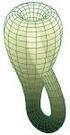 ON TORI TRIANGULATIONS ASSOCIATED WITH TWO-DIMENSIONAL CONTINUED FRACTIONS OF CUBIC IRRATIONALITIES. O. N. KARPENKOV Introduction. A series of properties for ordinary continued fractions possesses multidimensional
24. The Branch and Bound Method
 24. The Branch and Bound Method It has serious practical consequences if it is known that a combinatorial problem is NP-complete. Then one can conclude according to the present state of science that no
Notes on Orthogonal and Symmetric Matrices MENU, Winter 2013
 Notes on Orthogonal and Symmetric Matrices MENU, Winter 201 These notes summarize the main properties and uses of orthogonal and symmetric matrices. We covered quite a bit of material regarding these topics,
GROUP ALGEBRAS. ANDREI YAFAEV
 GROUP ALGEBRAS. ANDREI YAFAEV We will associate a certain algebra to a finite group and prove that it is semisimple. Then we will apply Wedderburn s theory to its study. Definition 0.1. Let G be a finite