
Factorization in Polynomial Rings
|
|
|
- Anna Wilcox
- 9 years ago
- Views:
Transcription
1 Factorization in Polynomial Rings These notes are a summary of some of the important points on divisibility in polynomial rings from 17 and 18 of Gallian s Contemporary Abstract Algebra. Most of the important results about the structure of F [X] follow in one way oranother from one key fact. Theorem 1 (Division Algorithm) If F is a field, f, g F [X] and f 0, there are q, r F [X] such that g = qf + r and either r = 0 or degr < degf. PIDs Definition 2 A principal ideal domain (PID) is an integral domain D in which every ideal has the form a = {ra : r D} for some a D. For example, Z is a PID, since every ideal is of the form nz. Theorem 3 If F is a field, then F [X] is a PID. Proof We know that F [X] is an integral domain. Let I be an ideal. If I = {0}, then I = 0. Suppose I {0}. Let g I be a nonzero polynomial of minimal degree. We claim that I = g. Suppose f I. By the division algorithm, there are nonzero polynomials q and r such that f = qg + r and either r = 0 or deg(r) < degg. Since f, g I, r = f qg I. Since g is of minimal degree in I, we must have r = 0. Thus f = qg g. If I {0} and f I is of minimal degree, then f is a minimal polynomial of I and I = f. Definition 4 Let D be an integral domain. If a D is nonzero and not a unit, we say that a is irreducible if whenever b, c D and a = bc then b is a unit or c is a unit. 1
![Theorem 1 (Division Algorithm) If F is a field, f, g F [X] and f 0, there are q, r F [X] such that g = qf + r and either r = 0 or degr < degf.](/docs-images/48/18744876/images/page_1.jpg "PIDs Definition 2 A principal ideal domain (PID) is an integral domain D in which every ideal has the form a = {ra : r D} for some a D. For example, Z is a PID, since every ideal is of the form nz.")
2 Otherwise we say that a is reducible. For example, in Z, n is irreducible if and only if n is prime. Suppose F is a field and f F [X]. If f has degree 1, then f is irreducible. If f has degree 2 or 3, then f is irreducible if f has no zero in F. [If f = gh where neither g nor h is a unit, then one of g or h has degree 1 and has a root.] Here are some examples X 2 2 is irreducible in Q[X] but reducible in R[X] since X 2 2 = (X 2)(X + 2). X is irreducible in R[X], but reducible in C[X] since X = (X + i)(x i). 2X + 2 is irreducible in R[X], but reducible in Z[X] since (2X + 2) = 2(X + 2) and 2 is a unit in R, but a nonunit in Z. This example shows we have to be more careful in D[X] when D is not a field. We recall some basic definitions from 14. Definition 5 Let R be a commutative ring and let I R be an ideal of R. I is a prime ideal if whenever a, b R and ab I, then a I or b I. I is a maximal ideal if whenever J is an ideal and I J R, then J = I or J = R. If R is a commutative ring with unity, then every maximal ideal is prime, but prime ideals need not be maximal. For example, in R[X, Y ]. The ideal X is prime (since R[X, Y ]/ X = R[Y ] an integral domain), but not maximal since X X, Y R[X, Y ]. We remind you of one key fact about prime and maximal ideals. Theorem 6 If R is a commutative ring with unity and I is an ideal then: i) I is prime if and only if R/I is an integral domain; ii) I is maximal if and only if R/I is a field. Proposition 7 If D is an integral domain, and a is prime, then a is irredcuible. Proof Suppose a = bc. We must show that either b or c is a unit. Since bc a and a is a prime ideal, either b a or c a. Suppose b a. Then b = ad for some d D. Thus a = bc = adc. Since D is an integral domain, 1 = dc. Thus c is a unit. A similar argument shows that if c a, then b is a unit. Thus a is irreducible. 2
![] Here are some examples X 2 2 is irreducible in Q[X] but reducible in R[X] since X 2 2 = (X 2)(X + 2). X 2 + 1 is irreducible in R[X], but reducible in C[X] since X 2 + 1 = (X + i)(x i).](/docs-images/48/18744876/images/page_2.jpg "2X + 2 is irreducible in R[X], but reducible in Z[X] since (2X + 2) = 2(X + 2) and 2 is a unit in R, but a nonunit in Z. This example shows we have to be more careful in D[X] when D is not a field.")
3 The converse is true in F [X] for F a field. Indeed, if a is irreducible, then a is maximal. The proof works just as well for all PIDs. Theorem 8 Let D be a PID and a D. The following are equivalent: i) a is irreducible; ii) a is maximal; iii) a is prime. Proof ii) iii) In any commuative ring with unity, every maximal ideal is prime. iii) i) This is Proposition 7 i) ii) Suppose a is irreducible. Since a is not a unit a D. Let J be an ideal such that a J D. We must show that J = I or J = D. Since D is a PID, there is b D such that J = b. Since a J, a = bc for some c D. Since a is irreducible, either b or c is a unit. case 1: b is a unit. Then b has an inverse b 1 D. If d D, then d = db 1 b J. Thus J = D. case 2: c is a unit. Since a = bc, b = c 1 a a. Since b a, J = a. Corollary 9 If F is a field and p F [X] is irreducible, then F [X]/ p is a field. Proof Since p is irreducible, p is maximal and F [X]/ p > is a field. UFDs Suppose F is a field and f F [X] is reducible. Then we can factor f = gh where f and g both have lower degree. If either g or h is reducible, then we can factor again. For example if f = 2X 4 7X 3 + 8X 2 3X we see that f = X(2X 3 7X 2 + 8X 3) = X(X 1)(2X 2 5X + 3) = X(X 1)(X 1)(2X 3) 3
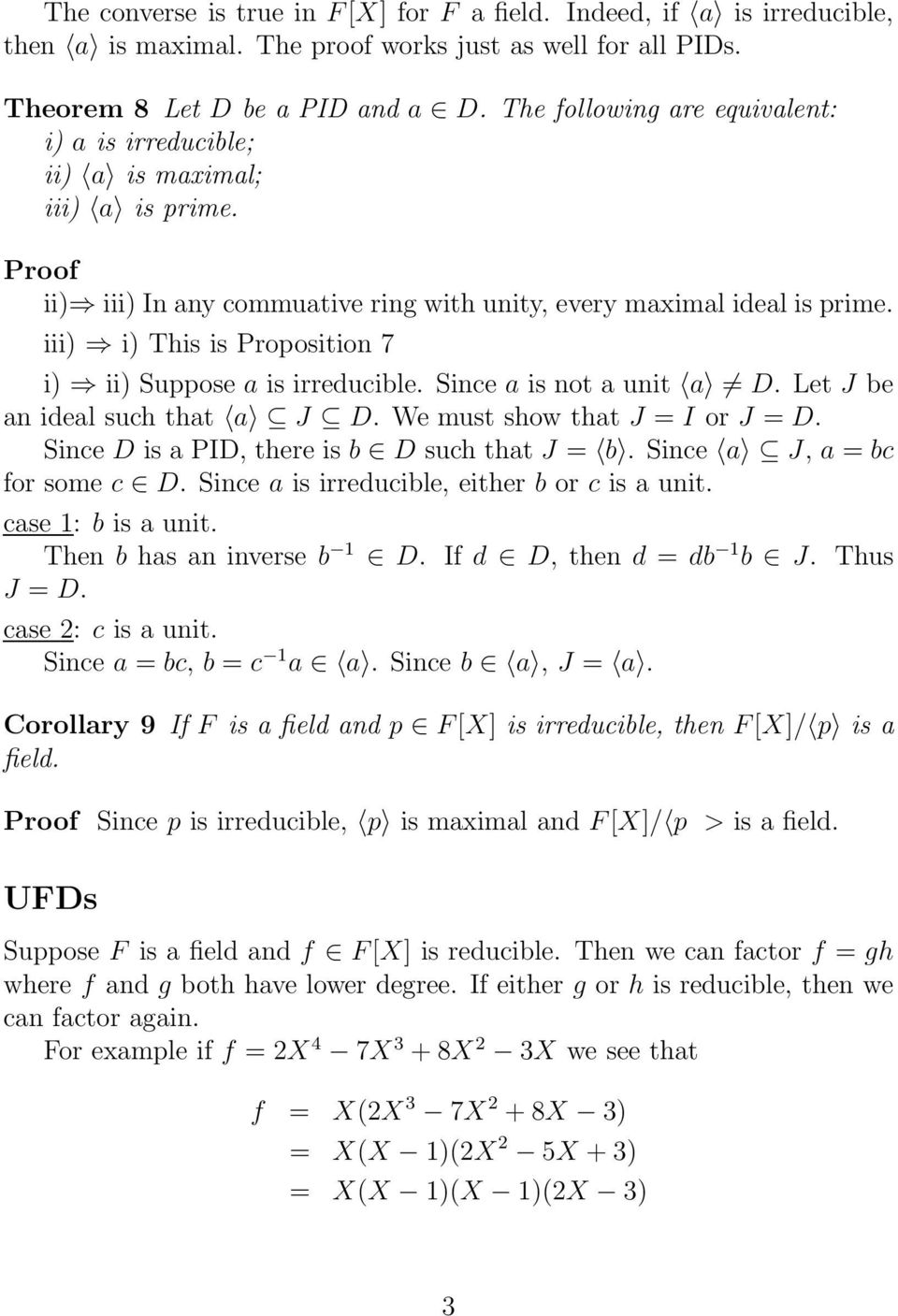
4 Proposition 10 If F is a field and f F [X] is nonzero and not a unit, then for some n there are irreducible polynomials g 1,..., g n F [X] such that f = g 1 g 2 g n. This is similar to the fact that in the natural numbers N we can factor every element as a product of primes. In N the prime factorization is unique. Is this true in F [X]? Not quite. For example (X 2 1) = (X 1)(X + 1) = Of course even in Z we have ( X = 2(3) = ( 2)( 3). ) (2X + 2). Indeed if we have one irreducible factorization, then by multiplying by suitable units we can always get another. The next definition gives us the right way to state uniqueness of factorization. Definition 11 If D is a domain, we say that a and b are associates if there is a unit u D such that a = ub. Note that if u is a unit and a = ub, then b = u 1 a. Thus being associates is a symmetric relation. Definition 12 If D is a domain, we say that D is a Unique Factorization Domain (or UFD) if: i) if f D is nonzero and not a unit, then there are irreducible elements g 1,..., g n D such that f = g 1 g 2 g n, and ii) if p 1,..., p n, q 1,..., q m D are irreducible, and p 1 p n = q 1 q m, then n = m and there is σ S n such that p i is an associate of q σ(i) for i = 1,..., n. In other words if f = p 1 p n = q 1 q m are two factorizations of f into irreducible factors, then n = m and we can renumber the q s so that p i and q i are associates for all i. Suppose F is a field and f = p 1 p n = q 1 q m are irreducible factorizations of f in F [X]. Since p 1 is irreducible, p 1 is a prime ideal. We need one easy lemma. 4

5 Lemma 13 If D is an integral domain, I D is a prime ideal, a 1,..., a n D and a 1 a 2 a n I, then some a i I. Proof We prove this by induction. If n = 2 this is the definition of a prime ideal. If n > 2 and a 1 (a 2 a n ) I, then either a 1 I and we are done, or (a 2 a n ) I. In the later case, by induction a j I for some j = 2,..., n. Since q 1 q m = p 1 (p 2 p n ), there is an i such that q i p 1. Thus q i = up 1 for some i, since q i is irreducible, u must be a unit. Thus p 1 p n = q 1 q m = q 1 q i 1 (up 1 )q i+1 q m. Since D is an integral domain, p 2 p n = uq 1 q i 1 q i+1 q m. We have gotten rid of one irreducible from each side, but at the cost of introducing a unit. This leads us to the following lemma which gives the right induction. Lemma 14 Suppose F is a field, p 1,..., p n, q 1,..., q m F [X] are irreducible, u is a unit, and p 1 p n = uq 1 q m. Then n = m and we can renumber the q s so that p i and q i are associates for all i. Proof We prove this by induction on n. Suppose n = 1. Then p, q 1,..., q m are irreducible, u is a unit and p = uq 1 q m. Since uq 1... q m p and p is a prime ideal, there is q i such that q i p. Then there is w p such that q i = wp. Since q i is irreducible and p is not a unit, w is a unit. Thus p = uq 1 q i 1 (wp)q i+1 q m and, since F [X] is an integral domain. 1 = uwq 1 q i 1 q i+1 q m. Since no q i is a unit, we must have m = 1 and p = uq 1. Thus p and q are associates. Suppose n > 1. The begining of the argument is similar. Since uq 1 q m p 1, there is a unit w and a q i such that q i = wp 1. Then p 1 p n = uq 1 q i 1 (wp)q i+1 q m 5
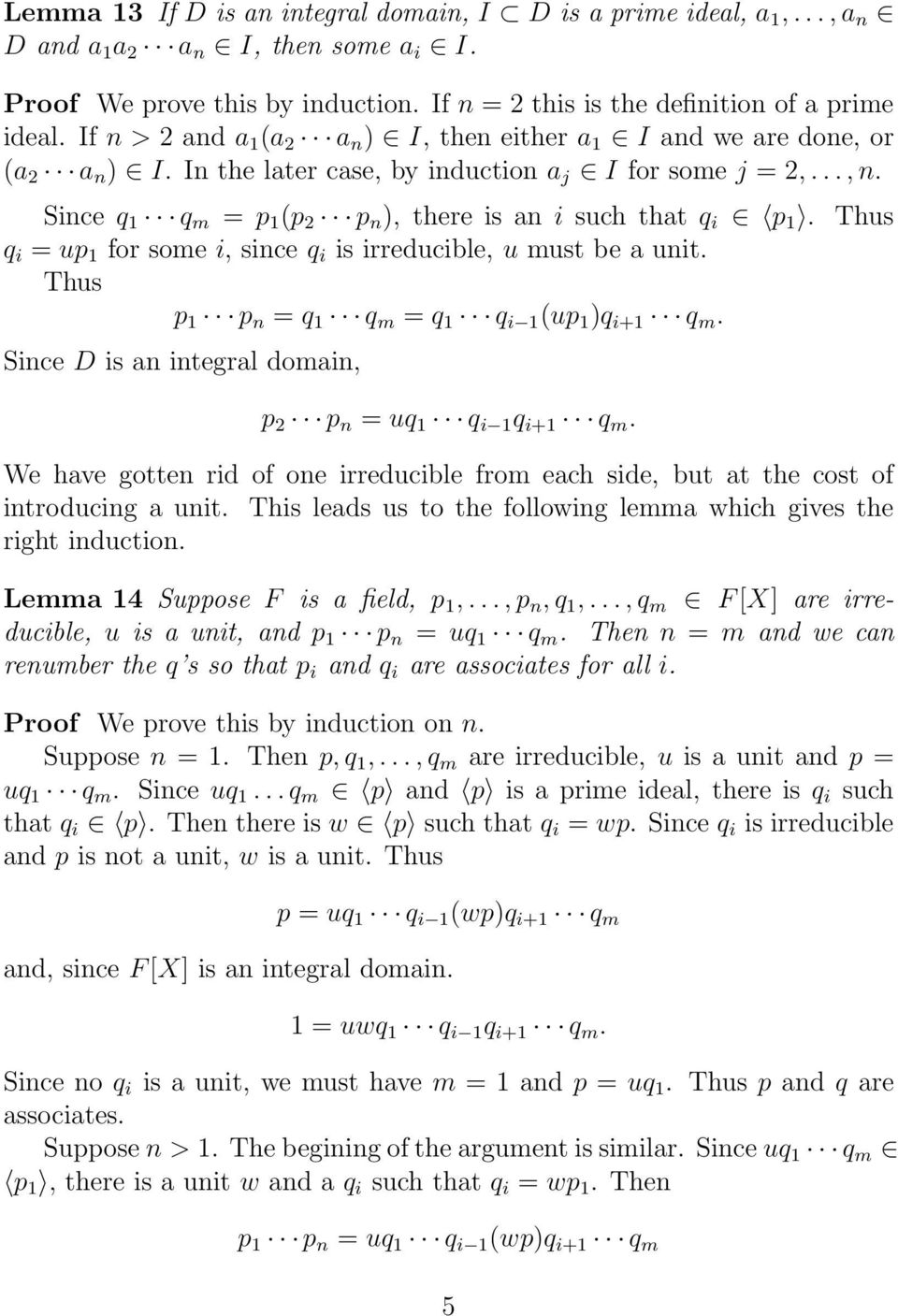
6 and, since F [X] is an integral domain. p 2 p n = uwq 1 q i 1 q i+1 q m. By induction, n 1 = m 1 and we can renumber the q s as so that p i and q i are associates. Putting together Lemma 10 Lemma 14 we prove that polynomial rings are UFDs. Theorem 15 If F is a field, then F [X] is a unique factorization domain. Two Important Theorems We won t give the proofs of these results in this course, but here are two very important theorems about PIDs and UFDs that you should know. The first is a generalization of Theorem 15. It says that every PID is a UFD. Theorem 16 If D is a principle ideal domain, then D is a unique factorization domain. Theorem 17 If D is a unique factorization domain, then the polynomial ring D[X] is also a unique factorization domain. Suppose D is a domain. We claim that D[X, Y ] = D[X][Y ]. Suppose f(x, Y ) = n m a i,j X i Y j D[X, Y ]. i=0 j=0 For j = 0,..., m let g j (X) D[X] be the polynomial Then f(x, Y ) = g j (X) = n a i,j X i. i=0 m g j (X)Y j D[X][Y ]. j=1 Similarly if f D[X][Y ], by multiplying out we get a polynomial in D[X, Y ]. Similarly we can identify D[X 1,..., X n ] = D[X 1 ]... [X n ]. This allows us to inductively apply Theorem 17. 6
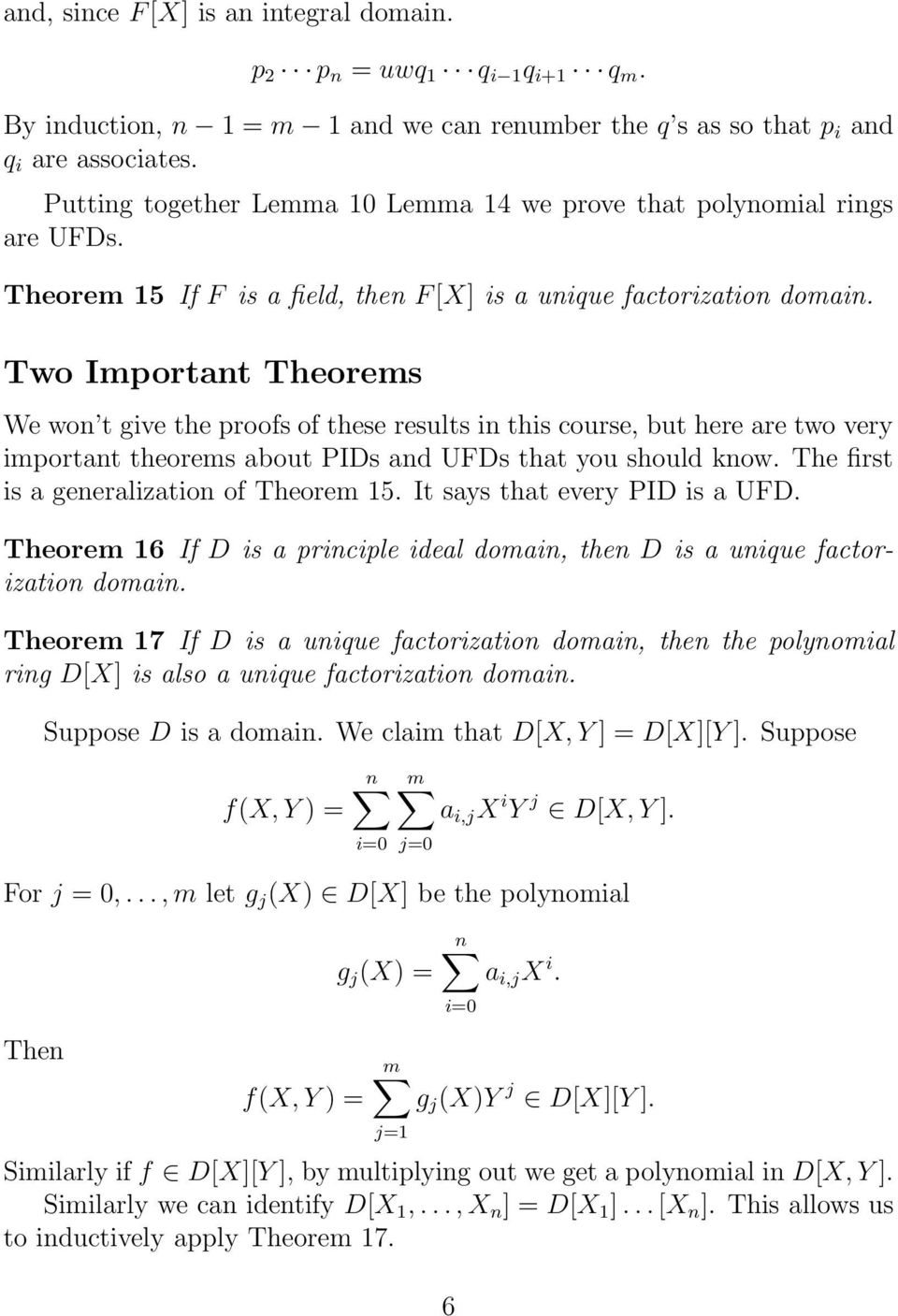
7 Corollary 18 i) The polynomial ring Z[X 1,..., X n ] is a unique factorization domain. ii) If F is a field, then the polynomial ring F [X 1,..., X n ] is a unique factorization domain. Proof Since Z and F [X 1 ] are unique factorization domains, Theorem 17 and induction tell us that Z[X 1,..., X n ] and F [X 1,..., X n ]. 7

POLYNOMIAL RINGS AND UNIQUE FACTORIZATION DOMAINS
 POLYNOMIAL RINGS AND UNIQUE FACTORIZATION DOMAINS RUSS WOODROOFE 1. Unique Factorization Domains Throughout the following, we think of R as sitting inside R[x] as the constant polynomials (of degree 0).
Quotient Rings and Field Extensions
 Chapter 5 Quotient Rings and Field Extensions In this chapter we describe a method for producing field extension of a given field. If F is a field, then a field extension is a field K that contains F.
Unique Factorization
 Unique Factorization Waffle Mathcamp 2010 Throughout these notes, all rings will be assumed to be commutative. 1 Factorization in domains: definitions and examples In this class, we will study the phenomenon
Chapter 4, Arithmetic in F [x] Polynomial arithmetic and the division algorithm.
![Chapter 4, Arithmetic in F [x] Polynomial arithmetic and the division algorithm.](/thumbs/26/8276997.jpg "Chapter 4, Arithmetic in F [x] Polynomial arithmetic and the division algorithm.") Chapter 4, Arithmetic in F [x] Polynomial arithmetic and the division algorithm. We begin by defining the ring of polynomials with coefficients in a ring R. After some preliminary results, we specialize
Chapter 4, Arithmetic in F [x] Polynomial arithmetic and the division algorithm. We begin by defining the ring of polynomials with coefficients in a ring R. After some preliminary results, we specialize
Math 345-60 Abstract Algebra I Questions for Section 23: Factoring Polynomials over a Field
 Math 345-60 Abstract Algebra I Questions for Section 23: Factoring Polynomials over a Field 1. Throughout this section, F is a field and F [x] is the ring of polynomials with coefficients in F. We will
3 Factorisation into irreducibles
 3 Factorisation into irreducibles Consider the factorisation of a non-zero, non-invertible integer n as a product of primes: n = p 1 p t. If you insist that primes should be positive then, since n could
1 Homework 1. [p 0 q i+j +... + p i 1 q j+1 ] + [p i q j ] + [p i+1 q j 1 +... + p i+j q 0 ]
![1 Homework 1. [p 0 q i+j +... + p i 1 q j+1 ] + [p i q j ] + [p i+1 q j 1 +... + p i+j q 0 ]](/thumbs/40/21231772.jpg "1 Homework 1. [p 0 q i+j +... + p i 1 q j+1 ] + [p i q j ] + [p i+1 q j 1 +... + p i+j q 0 ]") 1 Homework 1 (1) Prove the ideal (3,x) is a maximal ideal in Z[x]. SOLUTION: Suppose we expand this ideal by including another generator polynomial, P / (3, x). Write P = n + x Q with n an integer not
1 Homework 1 (1) Prove the ideal (3,x) is a maximal ideal in Z[x]. SOLUTION: Suppose we expand this ideal by including another generator polynomial, P / (3, x). Write P = n + x Q with n an integer not
it is easy to see that α = a
 21. Polynomial rings Let us now turn out attention to determining the prime elements of a polynomial ring, where the coefficient ring is a field. We already know that such a polynomial ring is a UF. Therefore
Factoring Polynomials
 Factoring Polynomials Sue Geller June 19, 2006 Factoring polynomials over the rational numbers, real numbers, and complex numbers has long been a standard topic of high school algebra. With the advent
Algebraic Structures II
 MAS 305 Algebraic Structures II Notes 12 Autumn 2006 Factorization in integral domains Lemma If a, b, c are elements of an integral domain R and ab = ac then either a = 0 R or b = c. Proof ab = ac a(b
H/wk 13, Solutions to selected problems
 H/wk 13, Solutions to selected problems Ch. 4.1, Problem 5 (a) Find the number of roots of x x in Z 4, Z Z, any integral domain, Z 6. (b) Find a commutative ring in which x x has infinitely many roots.
Modern Algebra Lecture Notes: Rings and fields set 4 (Revision 2)
 Modern Algebra Lecture Notes: Rings and fields set 4 (Revision 2) Kevin Broughan University of Waikato, Hamilton, New Zealand May 13, 2010 Remainder and Factor Theorem 15 Definition of factor If f (x)
Chapter 13: Basic ring theory
 Chapter 3: Basic ring theory Matthew Macauley Department of Mathematical Sciences Clemson University http://www.math.clemson.edu/~macaule/ Math 42, Spring 24 M. Macauley (Clemson) Chapter 3: Basic ring
(a) Write each of p and q as a polynomial in x with coefficients in Z[y, z]. deg(p) = 7 deg(q) = 9
![(a) Write each of p and q as a polynomial in x with coefficients in Z[y, z]. deg(p) = 7 deg(q) = 9](/thumbs/40/21231804.jpg "(a) Write each of p and q as a polynomial in x with coefficients in Z[y, z]. deg(p) = 7 deg(q) = 9") Homework #01, due 1/20/10 = 9.1.2, 9.1.4, 9.1.6, 9.1.8, 9.2.3 Additional problems for study: 9.1.1, 9.1.3, 9.1.5, 9.1.13, 9.2.1, 9.2.2, 9.2.4, 9.2.5, 9.2.6, 9.3.2, 9.3.3 9.1.1 (This problem was not assigned
Homework #01, due 1/20/10 = 9.1.2, 9.1.4, 9.1.6, 9.1.8, 9.2.3 Additional problems for study: 9.1.1, 9.1.3, 9.1.5, 9.1.13, 9.2.1, 9.2.2, 9.2.4, 9.2.5, 9.2.6, 9.3.2, 9.3.3 9.1.1 (This problem was not assigned
Introduction to Algebraic Geometry. Bézout s Theorem and Inflection Points
 Introduction to Algebraic Geometry Bézout s Theorem and Inflection Points 1. The resultant. Let K be a field. Then the polynomial ring K[x] is a unique factorisation domain (UFD). Another example of a
7. Some irreducible polynomials
 7. Some irreducible polynomials 7.1 Irreducibles over a finite field 7.2 Worked examples Linear factors x α of a polynomial P (x) with coefficients in a field k correspond precisely to roots α k [1] of
The Division Algorithm for Polynomials Handout Monday March 5, 2012
 The Division Algorithm for Polynomials Handout Monday March 5, 0 Let F be a field (such as R, Q, C, or F p for some prime p. This will allow us to divide by any nonzero scalar. (For some of the following,
COMMUTATIVE RINGS. Definition: A domain is a commutative ring R that satisfies the cancellation law for multiplication:
 COMMUTATIVE RINGS Definition: A commutative ring R is a set with two operations, addition and multiplication, such that: (i) R is an abelian group under addition; (ii) ab = ba for all a, b R (commutative
11 Ideals. 11.1 Revisiting Z
 11 Ideals The presentation here is somewhat different than the text. In particular, the sections do not match up. We have seen issues with the failure of unique factorization already, e.g., Z[ 5] = O Q(
PROBLEM SET 6: POLYNOMIALS
 PROBLEM SET 6: POLYNOMIALS 1. introduction In this problem set we will consider polynomials with coefficients in K, where K is the real numbers R, the complex numbers C, the rational numbers Q or any other
calculating the result modulo 3, as follows: p(0) = 0 3 + 0 + 1 = 1 0,
 Homework #02, due 1/27/10 = 9.4.1, 9.4.2, 9.4.5, 9.4.6, 9.4.7. Additional problems recommended for study: (9.4.3), 9.4.4, 9.4.9, 9.4.11, 9.4.13, (9.4.14), 9.4.17 9.4.1 Determine whether the following polynomials
26 Ideals and Quotient Rings
 Arkansas Tech University MATH 4033: Elementary Modern Algebra Dr. Marcel B. Finan 26 Ideals and Quotient Rings In this section we develop some theory of rings that parallels the theory of groups discussed
A number field is a field of finite degree over Q. By the Primitive Element Theorem, any number
 Number Fields Introduction A number field is a field of finite degree over Q. By the Primitive Element Theorem, any number field K = Q(α) for some α K. The minimal polynomial Let K be a number field and
3 1. Note that all cubes solve it; therefore, there are no more
 Math 13 Problem set 5 Artin 11.4.7 Factor the following polynomials into irreducible factors in Q[x]: (a) x 3 3x (b) x 3 3x + (c) x 9 6x 6 + 9x 3 3 Solution: The first two polynomials are cubics, so if
RESULTANT AND DISCRIMINANT OF POLYNOMIALS
 RESULTANT AND DISCRIMINANT OF POLYNOMIALS SVANTE JANSON Abstract. This is a collection of classical results about resultants and discriminants for polynomials, compiled mainly for my own use. All results
Module MA3411: Abstract Algebra Galois Theory Appendix Michaelmas Term 2013
 Module MA3411: Abstract Algebra Galois Theory Appendix Michaelmas Term 2013 D. R. Wilkins Copyright c David R. Wilkins 1997 2013 Contents A Cyclotomic Polynomials 79 A.1 Minimum Polynomials of Roots of
MOP 2007 Black Group Integer Polynomials Yufei Zhao. Integer Polynomials. June 29, 2007 Yufei Zhao [email protected]
 Integer Polynomials June 9, 007 Yufei Zhao [email protected] We will use Z[x] to denote the ring of polynomials with integer coefficients. We begin by summarizing some of the common approaches used in dealing
FACTORING POLYNOMIALS IN THE RING OF FORMAL POWER SERIES OVER Z
 FACTORING POLYNOMIALS IN THE RING OF FORMAL POWER SERIES OVER Z DANIEL BIRMAJER, JUAN B GIL, AND MICHAEL WEINER Abstract We consider polynomials with integer coefficients and discuss their factorization
I. GROUPS: BASIC DEFINITIONS AND EXAMPLES
 I GROUPS: BASIC DEFINITIONS AND EXAMPLES Definition 1: An operation on a set G is a function : G G G Definition 2: A group is a set G which is equipped with an operation and a special element e G, called
1 = (a 0 + b 0 α) 2 + + (a m 1 + b m 1 α) 2. for certain elements a 0,..., a m 1, b 0,..., b m 1 of F. Multiplying out, we obtain
 Notes on real-closed fields These notes develop the algebraic background needed to understand the model theory of real-closed fields. To understand these notes, a standard graduate course in algebra is
2. Let H and K be subgroups of a group G. Show that H K G if and only if H K or K H.
 Math 307 Abstract Algebra Sample final examination questions with solutions 1. Suppose that H is a proper subgroup of Z under addition and H contains 18, 30 and 40, Determine H. Solution. Since gcd(18,
FACTORING IN QUADRATIC FIELDS. 1. Introduction. This is called a quadratic field and it has degree 2 over Q. Similarly, set
 FACTORING IN QUADRATIC FIELDS KEITH CONRAD For a squarefree integer d other than 1, let 1. Introduction K = Q[ d] = {x + y d : x, y Q}. This is called a quadratic field and it has degree 2 over Q. Similarly,
minimal polyonomial Example
 Minimal Polynomials Definition Let α be an element in GF(p e ). We call the monic polynomial of smallest degree which has coefficients in GF(p) and α as a root, the minimal polyonomial of α. Example: We
Introduction to Finite Fields (cont.)
 Chapter 6 Introduction to Finite Fields (cont.) 6.1 Recall Theorem. Z m is a field m is a prime number. Theorem (Subfield Isomorphic to Z p ). Every finite field has the order of a power of a prime number
3. Prime and maximal ideals. 3.1. Definitions and Examples.
 COMMUTATIVE ALGEBRA 5 3.1. Definitions and Examples. 3. Prime and maximal ideals Definition. An ideal P in a ring A is called prime if P A and if for every pair x, y of elements in A\P we have xy P. Equivalently,
SOLVING POLYNOMIAL EQUATIONS
 C SOLVING POLYNOMIAL EQUATIONS We will assume in this appendix that you know how to divide polynomials using long division and synthetic division. If you need to review those techniques, refer to an algebra
Galois Theory III. 3.1. Splitting fields.
 Galois Theory III. 3.1. Splitting fields. We know how to construct a field extension L of a given field K where a given irreducible polynomial P (X) K[X] has a root. We need a field extension of K where
ON GALOIS REALIZATIONS OF THE 2-COVERABLE SYMMETRIC AND ALTERNATING GROUPS
 ON GALOIS REALIZATIONS OF THE 2-COVERABLE SYMMETRIC AND ALTERNATING GROUPS DANIEL RABAYEV AND JACK SONN Abstract. Let f(x) be a monic polynomial in Z[x] with no rational roots but with roots in Q p for
Factoring of Prime Ideals in Extensions
 Chapter 4 Factoring of Prime Ideals in Extensions 4. Lifting of Prime Ideals Recall the basic AKLB setup: A is a Dedekind domain with fraction field K, L is a finite, separable extension of K of degree
PUTNAM TRAINING POLYNOMIALS. Exercises 1. Find a polynomial with integral coefficients whose zeros include 2 + 5.
 PUTNAM TRAINING POLYNOMIALS (Last updated: November 17, 2015) Remark. This is a list of exercises on polynomials. Miguel A. Lerma Exercises 1. Find a polynomial with integral coefficients whose zeros include
On the representability of the bi-uniform matroid
 On the representability of the bi-uniform matroid Simeon Ball, Carles Padró, Zsuzsa Weiner and Chaoping Xing August 3, 2012 Abstract Every bi-uniform matroid is representable over all sufficiently large
How To Know If A Domain Is Unique In An Octempo (Euclidean) Or Not (Ecl)
 Subsets of Euclidean domains possessing a unique division algorithm Andrew D. Lewis 2009/03/16 Abstract Subsets of a Euclidean domain are characterised with the following objectives: (1) ensuring uniqueness
Non-unique factorization of polynomials over residue class rings of the integers
 Comm. Algebra 39(4) 2011, pp 1482 1490 Non-unique factorization of polynomials over residue class rings of the integers Christopher Frei and Sophie Frisch Abstract. We investigate non-unique factorization
FOUNDATIONS OF ALGEBRAIC GEOMETRY CLASS 22
 FOUNDATIONS OF ALGEBRAIC GEOMETRY CLASS 22 RAVI VAKIL CONTENTS 1. Discrete valuation rings: Dimension 1 Noetherian regular local rings 1 Last day, we discussed the Zariski tangent space, and saw that it
DIVISORS IN A DEDEKIND DOMAIN. Javier Cilleruelo and Jorge Jiménez-Urroz. 1 Introduction
 DIVISORS IN A DEDEKIND DOMAIN Javier Cilleruelo and Jorge Jiménez-Urroz 1 Introduction Let A be a Dedekind domain in which we can define a notion of distance. We are interested in the number of divisors
1 Lecture: Integration of rational functions by decomposition
 Lecture: Integration of rational functions by decomposition into partial fractions Recognize and integrate basic rational functions, except when the denominator is a power of an irreducible quadratic.
CHAPTER SIX IRREDUCIBILITY AND FACTORIZATION 1. BASIC DIVISIBILITY THEORY
 January 10, 2010 CHAPTER SIX IRREDUCIBILITY AND FACTORIZATION 1. BASIC DIVISIBILITY THEORY The set of polynomials over a field F is a ring, whose structure shares with the ring of integers many characteristics.
Factorization Algorithms for Polynomials over Finite Fields
 Degree Project Factorization Algorithms for Polynomials over Finite Fields Sajid Hanif, Muhammad Imran 2011-05-03 Subject: Mathematics Level: Master Course code: 4MA11E Abstract Integer factorization is
a 1 x + a 0 =0. (3) ax 2 + bx + c =0. (4)
 ROOTS OF POLYNOMIAL EQUATIONS In this unit we discuss polynomial equations. A polynomial in x of degree n, where n 0 is an integer, is an expression of the form P n (x) =a n x n + a n 1 x n 1 + + a 1 x
The last three chapters introduced three major proof techniques: direct,
 CHAPTER 7 Proving Non-Conditional Statements The last three chapters introduced three major proof techniques: direct, contrapositive and contradiction. These three techniques are used to prove statements
ON UNIQUE FACTORIZATION DOMAINS
 ON UNIQUE FACTORIZATION DOMAINS JIM COYKENDALL AND WILLIAM W. SMITH Abstract. In this paper we attempt to generalize the notion of unique factorization domain in the spirit of half-factorial domain. It
Lagrange Interpolation is a method of fitting an equation to a set of points that functions well when there are few points given.
 Polynomials (Ch.1) Study Guide by BS, JL, AZ, CC, SH, HL Lagrange Interpolation is a method of fitting an equation to a set of points that functions well when there are few points given. Sasha s method
Die ganzen zahlen hat Gott gemacht
 Die ganzen zahlen hat Gott gemacht Polynomials with integer values B.Sury A quote attributed to the famous mathematician L.Kronecker is Die Ganzen Zahlen hat Gott gemacht, alles andere ist Menschenwerk.
GREATEST COMMON DIVISOR
 DEFINITION: GREATEST COMMON DIVISOR The greatest common divisor (gcd) of a and b, denoted by (a, b), is the largest common divisor of integers a and b. THEOREM: If a and b are nonzero integers, then their
3.2 The Factor Theorem and The Remainder Theorem
 3. The Factor Theorem and The Remainder Theorem 57 3. The Factor Theorem and The Remainder Theorem Suppose we wish to find the zeros of f(x) = x 3 + 4x 5x 4. Setting f(x) = 0 results in the polynomial
15. Symmetric polynomials
 15. Symmetric polynomials 15.1 The theorem 15.2 First examples 15.3 A variant: discriminants 1. The theorem Let S n be the group of permutations of {1,, n}, also called the symmetric group on n things.
Kevin James. MTHSC 412 Section 2.4 Prime Factors and Greatest Comm
 MTHSC 412 Section 2.4 Prime Factors and Greatest Common Divisor Greatest Common Divisor Definition Suppose that a, b Z. Then we say that d Z is a greatest common divisor (gcd) of a and b if the following
Notes 11: List Decoding Folded Reed-Solomon Codes
 Introduction to Coding Theory CMU: Spring 2010 Notes 11: List Decoding Folded Reed-Solomon Codes April 2010 Lecturer: Venkatesan Guruswami Scribe: Venkatesan Guruswami At the end of the previous notes,
Copy in your notebook: Add an example of each term with the symbols used in algebra 2 if there are any.
 Algebra 2 - Chapter Prerequisites Vocabulary Copy in your notebook: Add an example of each term with the symbols used in algebra 2 if there are any. P1 p. 1 1. counting(natural) numbers - {1,2,3,4,...}
THE FUNDAMENTAL THEOREM OF ALGEBRA VIA PROPER MAPS
 THE FUNDAMENTAL THEOREM OF ALGEBRA VIA PROPER MAPS KEITH CONRAD 1. Introduction The Fundamental Theorem of Algebra says every nonconstant polynomial with complex coefficients can be factored into linear
Galois theory for dummies
 Galois theory for dummies Ruben Spaans May 21, 2009 1 Notes on notation To help avoid vertical figures, I use the notation E/F if E is an extension to the field F. This is the same notation as Wikipedia
6. Fields I. 1. Adjoining things
 6. Fields I 6.1 Adjoining things 6.2 Fields of fractions, fields of rational functions 6.3 Characteristics, finite fields 6.4 Algebraic field extensions 6.5 Algebraic closures 1. Adjoining things The general
Cyclotomic Extensions
 Chapter 7 Cyclotomic Extensions A cyclotomic extension Q(ζ n ) of the rationals is formed by adjoining a primitive n th root of unity ζ n. In this chapter, we will find an integral basis and calculate
EXERCISES FOR THE COURSE MATH 570, FALL 2010
 EXERCISES FOR THE COURSE MATH 570, FALL 2010 EYAL Z. GOREN (1) Let G be a group and H Z(G) a subgroup such that G/H is cyclic. Prove that G is abelian. Conclude that every group of order p 2 (p a prime
ALGEBRAIC NUMBER THEORY AND QUADRATIC RECIPROCITY
 ALGEBRAIC NUMBER THEORY AND QUADRATIC RECIPROCITY HENRY COHN, JOSHUA GREENE, JONATHAN HANKE 1. Introduction These notes are from a series of lectures given by Henry Cohn during MIT s Independent Activities
Winter Camp 2011 Polynomials Alexander Remorov. Polynomials. Alexander Remorov [email protected]
 Polynomials Alexander Remorov [email protected] Warm-up Problem 1: Let f(x) be a quadratic polynomial. Prove that there exist quadratic polynomials g(x) and h(x) such that f(x)f(x + 1) = g(h(x)).
Irreducibility criteria for compositions and multiplicative convolutions of polynomials with integer coefficients
 DOI: 10.2478/auom-2014-0007 An. Şt. Univ. Ovidius Constanţa Vol. 221),2014, 73 84 Irreducibility criteria for compositions and multiplicative convolutions of polynomials with integer coefficients Anca
26. Determinants I. 1. Prehistory
 26. Determinants I 26.1 Prehistory 26.2 Definitions 26.3 Uniqueness and other properties 26.4 Existence Both as a careful review of a more pedestrian viewpoint, and as a transition to a coordinate-independent
College Algebra - MAT 161 Page: 1 Copyright 2009 Killoran
 College Algebra - MAT 6 Page: Copyright 2009 Killoran Zeros and Roots of Polynomial Functions Finding a Root (zero or x-intercept) of a polynomial is identical to the process of factoring a polynomial.
Introduction to Modern Algebra
 Introduction to Modern Algebra David Joyce Clark University Version 0.0.6, 3 Oct 2008 1 1 Copyright (C) 2008. ii I dedicate this book to my friend and colleague Arthur Chou. Arthur encouraged me to write
3-17 15-25 5 15-10 25 3-2 5 0. 1b) since the remainder is 0 I need to factor the numerator. Synthetic division tells me this is true
 Section 5.2 solutions #1-10: a) Perform the division using synthetic division. b) if the remainder is 0 use the result to completely factor the dividend (this is the numerator or the polynomial to the
How To Prove The Dirichlet Unit Theorem
 Chapter 6 The Dirichlet Unit Theorem As usual, we will be working in the ring B of algebraic integers of a number field L. Two factorizations of an element of B are regarded as essentially the same if
Math 115A HW4 Solutions University of California, Los Angeles. 5 2i 6 + 4i. (5 2i)7i (6 + 4i)( 3 + i) = 35i + 14 ( 22 6i) = 36 + 41i.
 Math 5A HW4 Solutions September 5, 202 University of California, Los Angeles Problem 4..3b Calculate the determinant, 5 2i 6 + 4i 3 + i 7i Solution: The textbook s instructions give us, (5 2i)7i (6 + 4i)(
1.3 Algebraic Expressions
 1.3 Algebraic Expressions A polynomial is an expression of the form: a n x n + a n 1 x n 1 +... + a 2 x 2 + a 1 x + a 0 The numbers a 1, a 2,..., a n are called coefficients. Each of the separate parts,
The Greatest Common Factor; Factoring by Grouping
 296 CHAPTER 5 Factoring and Applications 5.1 The Greatest Common Factor; Factoring by Grouping OBJECTIVES 1 Find the greatest common factor of a list of terms. 2 Factor out the greatest common factor.
4: EIGENVALUES, EIGENVECTORS, DIAGONALIZATION
 4: EIGENVALUES, EIGENVECTORS, DIAGONALIZATION STEVEN HEILMAN Contents 1. Review 1 2. Diagonal Matrices 1 3. Eigenvectors and Eigenvalues 2 4. Characteristic Polynomial 4 5. Diagonalizability 6 6. Appendix:
Properties of Real Numbers
 16 Chapter P Prerequisites P.2 Properties of Real Numbers What you should learn: Identify and use the basic properties of real numbers Develop and use additional properties of real numbers Why you should
ALGEBRA HW 5 CLAY SHONKWILER
 ALGEBRA HW 5 CLAY SHONKWILER 510.5 Let F = Q(i). Prove that x 3 and x 3 3 are irreducible over F. Proof. If x 3 is reducible over F then, since it is a polynomial of degree 3, it must reduce into a product
fg = f g. 3.1.1. Ideals. An ideal of R is a nonempty k-subspace I R closed under multiplication by elements of R:
 30 3. RINGS, IDEALS, AND GRÖBNER BASES 3.1. Polynomial rings and ideals The main object of study in this section is a polynomial ring in a finite number of variables R = k[x 1,..., x n ], where k is an
10 Splitting Fields. 2. The splitting field for x 3 2 over Q is Q( 3 2,ω), where ω is a primitive third root of 1 in C. Thus, since ω = 1+ 3
 10 Splitting Fields We have seen how to construct a field K F such that K contains a root α of a given (irreducible) polynomial p(x) F [x], namely K = F [x]/(p(x)). We can extendthe procedure to build
Section 2.7 One-to-One Functions and Their Inverses
 Section. One-to-One Functions and Their Inverses One-to-One Functions HORIZONTAL LINE TEST: A function is one-to-one if and only if no horizontal line intersects its graph more than once. EXAMPLES: 1.
Mathematics Course 111: Algebra I Part IV: Vector Spaces
 Mathematics Course 111: Algebra I Part IV: Vector Spaces D. R. Wilkins Academic Year 1996-7 9 Vector Spaces A vector space over some field K is an algebraic structure consisting of a set V on which are
How To Understand The Theory Of Algebraic Functions
 Homework 4 3.4,. Show that x x cos x x holds for x 0. Solution: Since cos x, multiply all three parts by x > 0, we get: x x cos x x, and since x 0 x x 0 ( x ) = 0, then by Sandwich theorem, we get: x 0
Introduction to Algebraic Coding Theory
 Introduction to Algebraic Coding Theory Supplementary material for Math 336 Cornell University Sarah A. Spence Contents 1 Introduction 1 2 Basics 2 2.1 Important code parameters..................... 4
The Mean Value Theorem
 The Mean Value Theorem THEOREM (The Extreme Value Theorem): If f is continuous on a closed interval [a, b], then f attains an absolute maximum value f(c) and an absolute minimum value f(d) at some numbers
Finite dimensional C -algebras
 Finite dimensional C -algebras S. Sundar September 14, 2012 Throughout H, K stand for finite dimensional Hilbert spaces. 1 Spectral theorem for self-adjoint opertors Let A B(H) and let {ξ 1, ξ 2,, ξ n
Some Polynomial Theorems. John Kennedy Mathematics Department Santa Monica College 1900 Pico Blvd. Santa Monica, CA 90405 [email protected].
 Some Polynomial Theorems by John Kennedy Mathematics Department Santa Monica College 1900 Pico Blvd. Santa Monica, CA 90405 [email protected] This paper contains a collection of 31 theorems, lemmas,
FACTORIZATION IN INTEGRAL DOMAINS
 FACTORIZATION IN INTEGRAL DOMAINS PETE L. CLARK Contents Introduction 2 1. Norm functions 3 1.1. Weak multiplicative norms and multiplicative norms 3 1.2. Abstract number rings 3 1.3. Dirichlet rings 5
IRREDUCIBLE OPERATOR SEMIGROUPS SUCH THAT AB AND BA ARE PROPORTIONAL. 1. Introduction
 IRREDUCIBLE OPERATOR SEMIGROUPS SUCH THAT AB AND BA ARE PROPORTIONAL R. DRNOVŠEK, T. KOŠIR Dedicated to Prof. Heydar Radjavi on the occasion of his seventieth birthday. Abstract. Let S be an irreducible
Lecture Notes on Polynomials
 Lecture Notes on Polynomials Arne Jensen Department of Mathematical Sciences Aalborg University c 008 Introduction These lecture notes give a very short introduction to polynomials with real and complex
Continued Fractions and the Euclidean Algorithm
 Continued Fractions and the Euclidean Algorithm Lecture notes prepared for MATH 326, Spring 997 Department of Mathematics and Statistics University at Albany William F Hammond Table of Contents Introduction
How To Understand The Theory Of Hyperreals
 Ultraproducts and Applications I Brent Cody Virginia Commonwealth University September 2, 2013 Outline Background of the Hyperreals Filters and Ultrafilters Construction of the Hyperreals The Transfer
Algebra 3: algorithms in algebra
 Algebra 3: algorithms in algebra Hans Sterk 2003-2004 ii Contents 1 Polynomials, Gröbner bases and Buchberger s algorithm 1 1.1 Introduction............................ 1 1.2 Polynomial rings and systems
PYTHAGOREAN TRIPLES KEITH CONRAD
 PYTHAGOREAN TRIPLES KEITH CONRAD 1. Introduction A Pythagorean triple is a triple of positive integers (a, b, c) where a + b = c. Examples include (3, 4, 5), (5, 1, 13), and (8, 15, 17). Below is an ancient
Galois Theory. Richard Koch
 Galois Theory Richard Koch April 2, 2015 Contents 1 Preliminaries 4 1.1 The Extension Problem; Simple Groups.................... 4 1.2 An Isomorphism Lemma............................. 5 1.3 Jordan Holder...................................
9. POLYNOMIALS. Example 1: The expression a(x) = x 3 4x 2 + 7x 11 is a polynomial in x. The coefficients of a(x) are the numbers 1, 4, 7, 11.
 9. POLYNOMIALS 9.1. Definition of a Polynomial A polynomial is an expression of the form: a(x) = a n x n + a n-1 x n-1 +... + a 1 x + a 0. The symbol x is called an indeterminate and simply plays the role
The Prime Numbers. Definition. A prime number is a positive integer with exactly two positive divisors.
 The Prime Numbers Before starting our study of primes, we record the following important lemma. Recall that integers a, b are said to be relatively prime if gcd(a, b) = 1. Lemma (Euclid s Lemma). If gcd(a,