
Manual on Elective I Meetings, Incentives, Conventions and Exhibitions (MICE)
|
|
|
- Nathaniel Rich
- 9 years ago
- Views:
Transcription
1
2 Manual on Elective I Meetings, Incentives, Conventions and Exhibitions (MICE)

3 By Ms Chloe Lau School of Hotel & Tourism Management The Hong Kong Polytechnic University Project Co-ordinator Mr. Tony Tse School of Hotel & Tourism Management The Hong Kong Polytechnic University

4
5

6 Copyright The Government of the Hong Kong Special Administrative Region All rights reserved. The copyright of this manual belongs to the Government of the Hong Kong Special Administrative Region. Commercial use is strictly prohibited. Offenders will be liable to legal responsibility. Schools need not apply for permission to copy this manual in whole or in part for non-profit making educational or research purposes. All other uses should gain prior permission in writing from the Government of the Hong Kong Special Administrative Region. Requests should be directed to the: Education Bureau 13/F, Room 1319, Wu Chung House 213 Queen s Road East, Wan Chai Hong Kong i
7 Acknowledgements We would like to express our gratitude to the following organizations for giving us the permission to reprint some of the pictures and /or providing us with information for completing the curriculum support package: The Association of National Tourist Office Representatives in Hong Kong, ANTOR (HK) Centre for Food Safety, Food and Environmental Hygiene Department ii

8 Introduction A set of curriculum support package of tourism and hospitality learning and teaching materials is being developed by the Personal, Social and Humanities Education Section of Curriculum Development Institute, Education Bureau for the implementation of the senior secondary Tourism and Hospitality Studies curriculum in schools. The curriculum support package is comprised of eight manuals, and they are developed to broaden students knowledge of the eight different units of the Tourism and Hospitality Studies curriculum. The content of this manual Meetings, Incentives, Conventions and Exhibitions (MICE), should enhance students understanding of the dynamic nature of the tourism and hospitality industry. In addition, the manual includes activities to deepen students understanding and help them to apply theories and concepts. Furthermore, students should be able to develop enquiry, problem-solving and decision-making skills through these activities. All comments and suggestions related to this curriculum support package may be sent to: Chief Curriculum Development Officer (PSHE) Personal, Social and Humanities Education Section Education Bureau Room 1319, Wu Chung House 213 Queen s Road East, Wan Chai Hong Kong April 2009 iii

9 Contents 1. EVENT TOURISM...1 Learning Objectives: What are Events? Types of Event...1 Activity Activity THE MICE BUSINESS...3 Learning Objectives:...3 Activity Reasons for MICE Key Players of the Sector Clients Suppliers Other Players...6 Activity HISTORICAL PERSPECTIVE...9 Learning Objectives:...9 Activity History Development over the Past Century The MICE Industry Today Fast-Growing Segment SECTOR OVERVIEW MEETINGS...11 Learning Objectives: Meetings...11 Activity SECTOR OVERVIEW INCENTIVES...13 Learning Objectives: Factors Behind Incentive Travel Decisions...13 Activity SECTOR OVERVIEW CONVENTIONS...14 Learning Objectives:...14 Activity SECTOR OVERVIEW EXHIBITIONS...17 Learning Objectives:...17 Activity INDUSTRY BENEFITS...19 Learning Objectives: Value of MICE...19 Activity Activity INDUSTRY SECTORS INVOLVED HOTEL...23 Learning Objectives: Roles of Hotels Facilities...24 Activity Accommodation Types of Hotel...26 iv

10 Large Properties vs. Small Properties...27 Activity Food and Beverage Hotel Contribution INDUSTRY SECTOR INVOLVED TRANSPORTATION...30 Learning Objectives: International Local...31 Activity INDUSTRY SECTOR INVOLVED ATTRACTIONS AND SUPPORTING INFRASTRUCTURE...33 Learning Objectives: Attractions...33 Activity 11.1: Supporting Infrastructures Technology Infrastructure ROLES OF THE PUBLIC SECTOR MICE INFRASTRUCTURE...36 Learning Objectives: Public Investment in Venues Nature of Public Funded Premises...37 Activity 12.1: ROLES OF PUBLIC SECTOR DMO...40 Learning Objectives: Event Strategies The Creation of Event Tourism Organizational Structure Major event agencies:...41 Activity 13.1: Government tourism organizations Specialist event agencies DMO (Destination Marketing Organization) CVB or NTO = DMO Role & Services Advantages of Meeting Professionals/Trade Show Managers...44 Activity 13.2: CLIENTS...45 Learning Objectives: Characteristics of Different Markets Corporate Association Government Social, Military, Educational, Religious and Fraternal (SMERF)...46 Activity 14.1: Professionals Event Planners Professional Conference Organizer (PCO) Destination Management Companies (DMCs) General Service Contractor (GSC) MICE PLANNING...49 Learning Objectives: ORGANIZATIONS GOALS Organization Structure...50 v
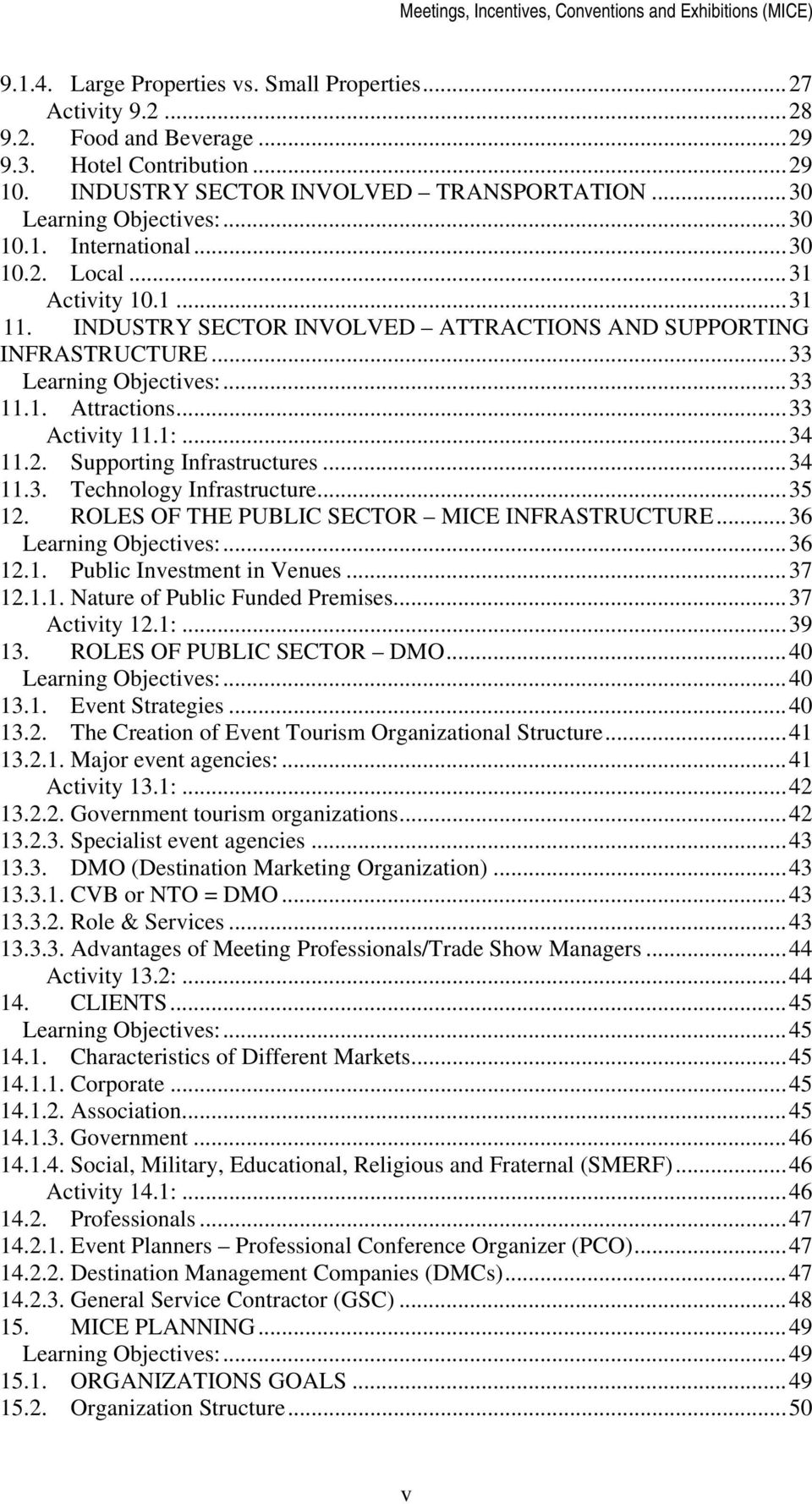
11 15.3. How to Start a Project Preparation Stage Program subcommittee...54 Activity 15.1: Social Subcommittee...55 Activity 15.2: Registration and Hotel & Tour Booking...56 Activity 15.3: Publicity Subcommittee...57 Activity 15.4: Sponsorship Subcommittee...58 Activity 15.5: Printing and Production...59 Activity 15.6: On-site preparation Wrap Up SITE SELECTION...62 Learning Objectives: THE SITE SELECTION PROCESS Identify Objectives Gather Historical Data Determine Physical Requirements Consideration of Attendee Interests and Expectations Select Destination and Facility Types Prepare Specifications and RFP Review and Evaluate Sites Site Selection Criteria...65 Activity 16.1:...68 Activity 16.2:...68 Activity 16.3: BUDGETING...69 Learning Objectives: WHAT IS A BUDGET? Constructing the budget Budgeting Process Reasons for Budgeting Budgetary Goals Budgeting at a Loss Use of Information...71 Activity 17.1: Income Expense...72 Activity 17.2: Budget Viewpoint Associations Government Corporation SPONSORSHIP & FINANCIAL ANALYSIS...76 Learning Objectives: Sponsorship Framework...76 vi

12 Activity 18.2: Continual Financial Analysis Post-Event Financial Analysis NEGOTIATION...81 Learning Objectives: Guestrooms - ITEMS TO NEGOTIATE Meeting Space - ITEMS TO NEGOTIATE Other Services ITEMS TO NEGOTIATE What is NOT negotiable? ITEMS TO NEGOTIATE...82 Activity 19.1: PROGRAMMING PLANNING AND DESIGN...84 Learning Objectives: What is a Programme? Programme Planning and Design Factors Affecting Programme Design Session Structure General Programme Outline...86 Activity 20.1: Good Programme Design Session Format Instructional Style Room Set-up...91 Activity 20.2: Session Timing Accompanying Persons (AP) Programme Working with a Programme Committee Speaker arrangement...95 Activity 20.3: REGISTRATION...97 Learning Objectives: Advance Registration Registration Types Confirmation Registration Information On-Site Registration Activity 21.1: Advantages of On-line Registration: Payment Collection Registrant Packets/Satchels ON-SITE LOGISTICS Learning Objectives: On-Site Management Pre-Event Meeting Daily Logistics Meeting Post-Event Meeting Wrap-Up Activity 22.1: Communication! Communication! Communication! RISK MANAGEMENT Learning Objectives: vii

13 23.1. Nine Steps to Risk Management Main Areas of Risk Types of Common Emergencies: Set up an Emergency Plan Activity 23.1: MARKETING Learning Objectives: Event Information Sources PROMOTIONAL TOOLS Direct Mailing Number of Direct Mailings Advertising Advertisements E-Marketing Publicity Activity 24.1: EVALUATION Learning Objectives: What is an Evaluation? Why Evaluate? Evaluation Planning Needs Assessment for Evaluation (10 steps) Six Level of Objectives and Measurements When to Evaluate? Types of Research Activity 25.1: Data Source Data collection methods Activity 25.2: Reporting the Results TRENDS Learning Objectives: Where MICE Event Management is Heading Statistics Number of international convention per continent Number of international conventions per country Seasonality Convention venue used The Industry in Hong Kong Activity 26.1: Activity 26.2: Trends Changing Demographics Trends Greener Meetings Trends Technology Activity 26.3: Trends Special-Purpose Event Venues Other Factors: Cultural Diversity Make business events memorable, relaxing and family friendly Activity 26.4: REFERENCES: viii
14 1. EVENT TOURISM Learning Objectives: Understand the relationship between events and tourism Define different types of events Event tourism is the systematic planning, development and marketing of events as: Tourist attractions Catalysts for other developments Image builders Event tourism strategies should also focus on a market segment consisting of those who travel to events, or who can be motivated to attend events while away from home What are Events? Events are: Organized occasions such as meetings, conventions, exhibitions, special events, gala dinners etc. Often composed of several different-yet-related functions A unique blend of management, programming, setting and people Types of Event There are many different types of events. We can group them into three different categories, based on their form or content: Cultural events are activities that contribute to social and cultural life Sporting events are tests of sporting skill through competition for the purpose of spectator entertainment and enjoyment. Business events are meetings, incentive travel, conferences and exhibitions 1
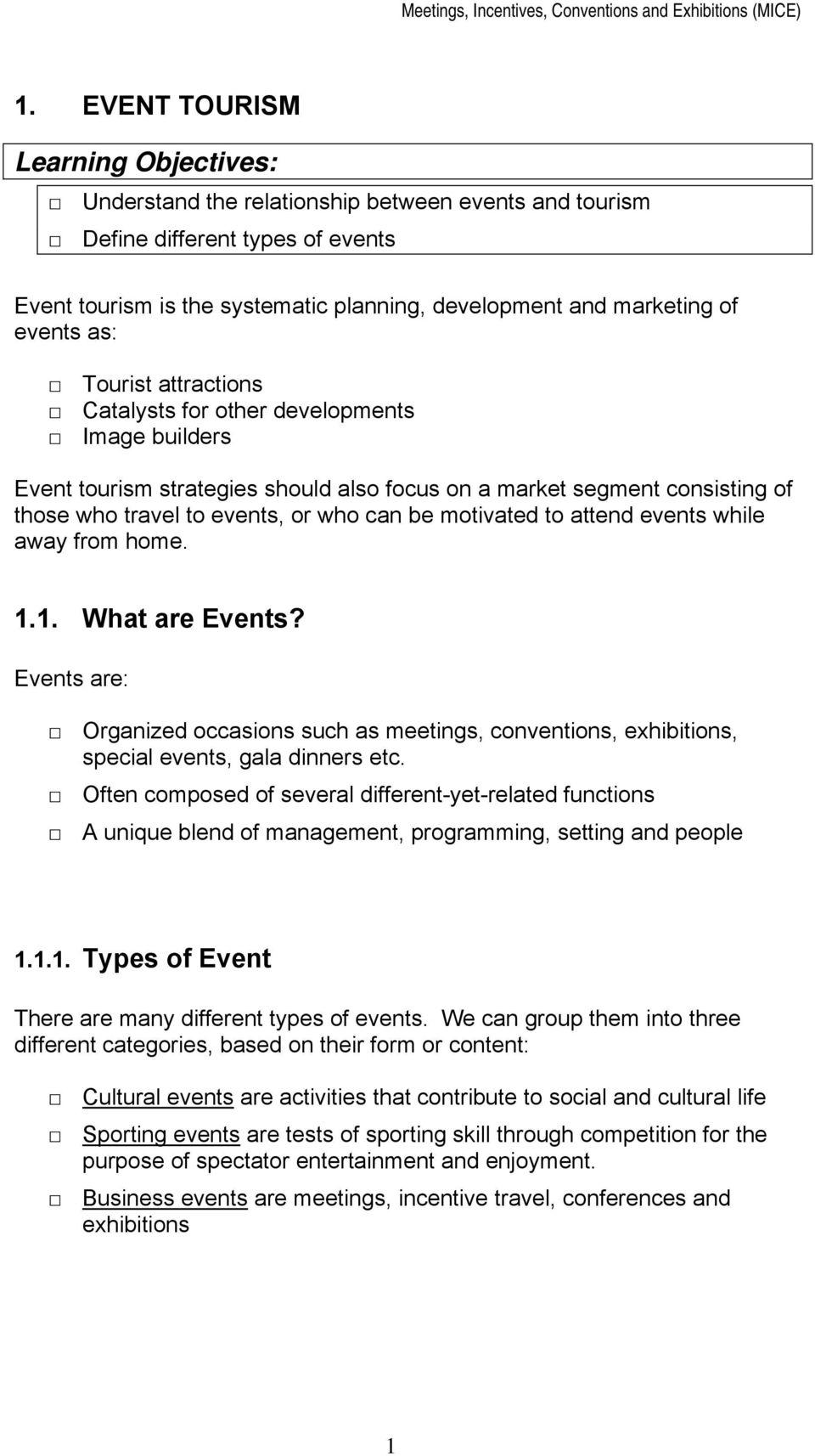
15 Activity 1.1 Fill in the form with three Hong Kong-specific examples. You also have to back up your answer by supplying detailed information on the content of each event. Event Examples: Content Cultural Sports BUSINESS Activity 1.2 Visit the sixth WTO ministerial conference website at and learn more about one big business event. (See also Photo 1) Photo 1 A typical large MICE event -- the WTO 6th Conference (Source: 2
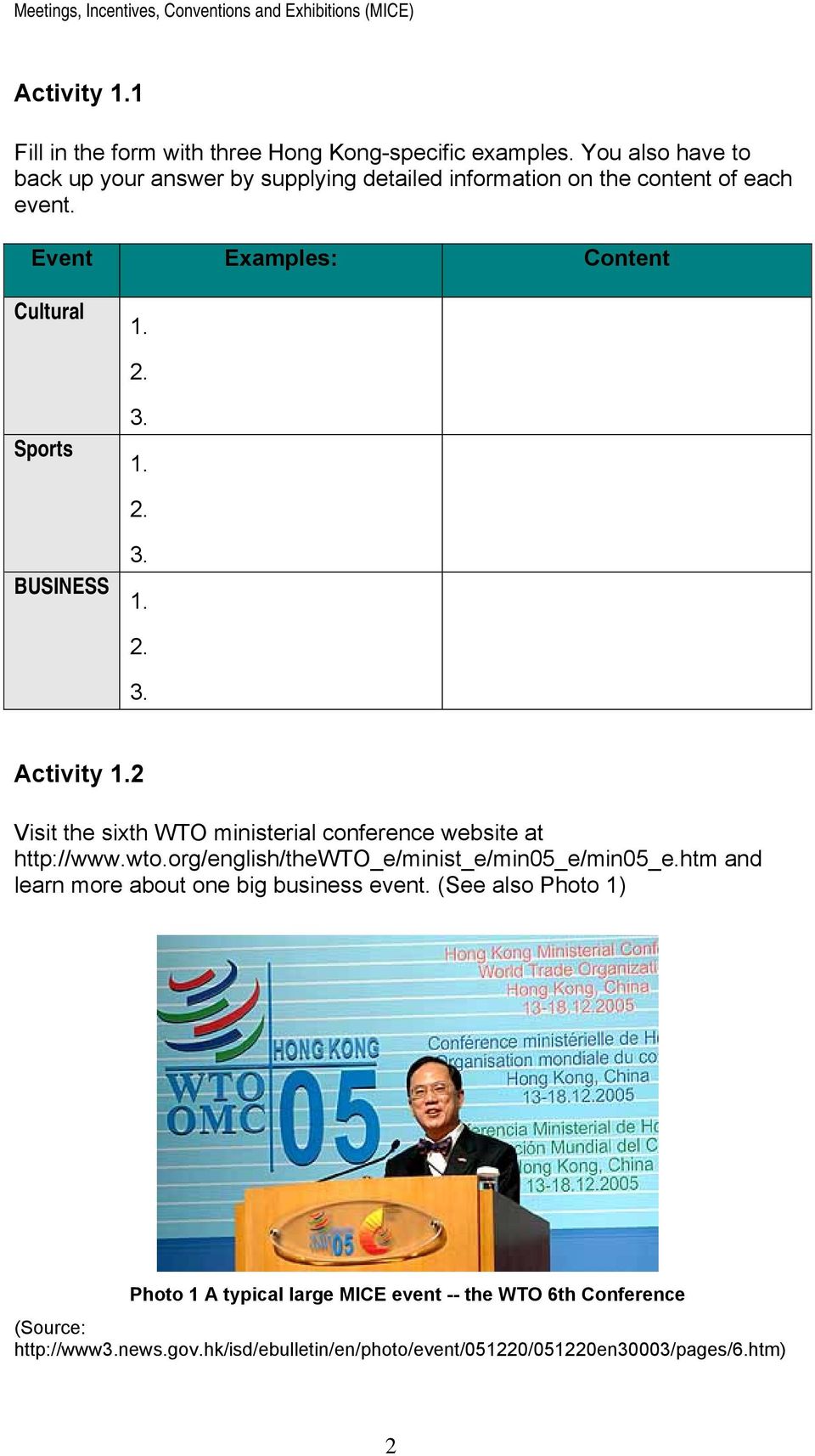
16 2. THE MICE BUSINESS Learning Objectives: understand the type of business MICE represents understand the need for MICE understand how MICE relates to the tourism and hospitality industry find out about the players within the MICE sector The term MICE (Meetings, Incentives, Conventions and Exhibitions) represents a sector of tourism which includes business events and activities. Travellers attending MICE activities have a purpose beyond leisure tourism, and are in fact business travellers. These business travellers are connected to different sectors of the tourism and hospitality industry through their MICE activities. (See Figure 1.) Think of business travellers who travel to a city to attend an exhibition. They will need food, drinks, shopping, entertainment, transport, accommodation and more. Attendee BUSINESS TRAVEL Meetings Incentives Conferences Conventions & Conventions Exhibitions ACTIVITY Tourism Hospitality INDUSTRY Figure 1 Nature of MICE 3
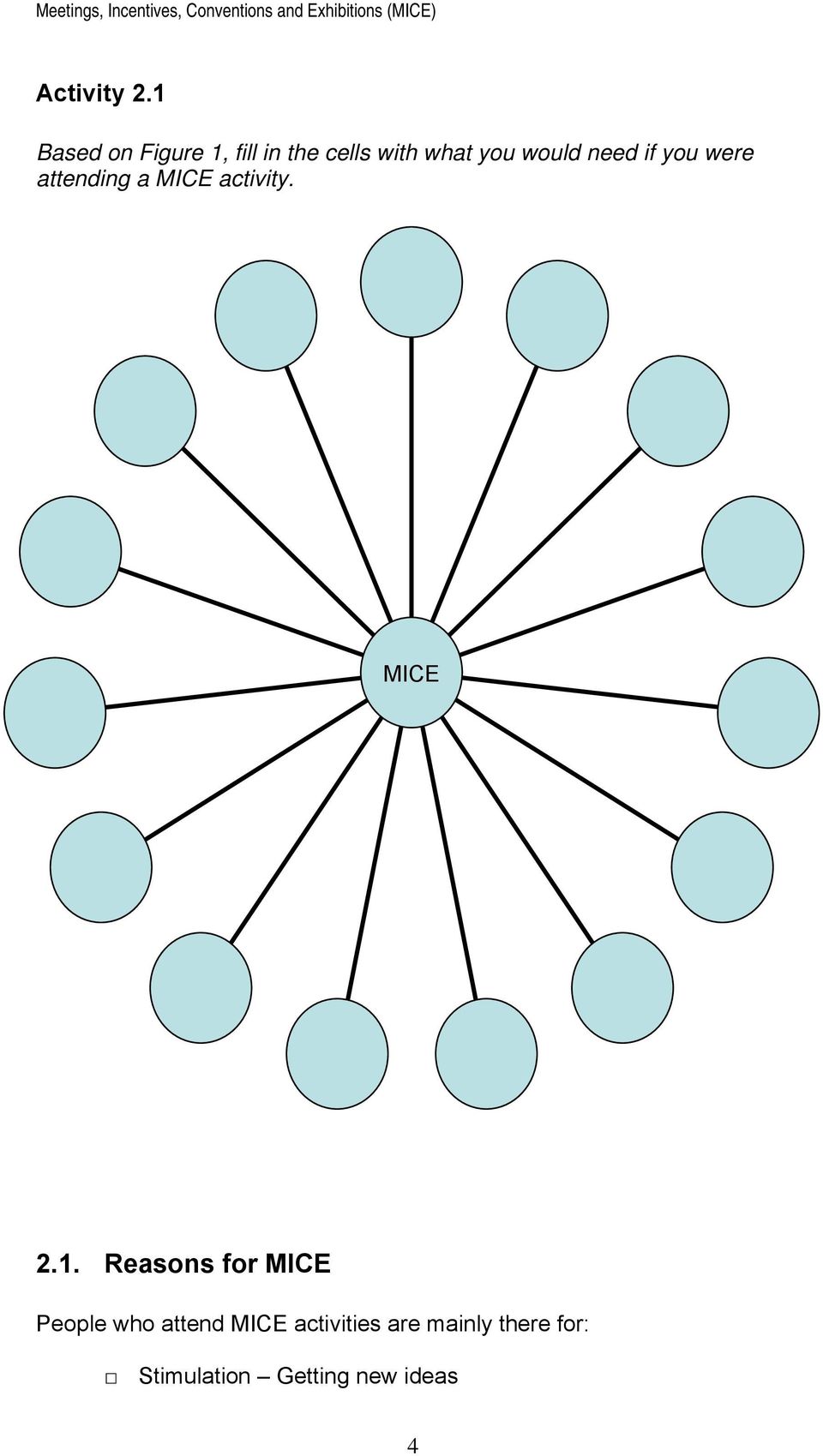
17 Activity 2.1 Based on Figure 1, fill in the cells with what you would need if you were attending a MICE activity. MICE 2.1. Reasons for MICE People who attend MICE activities are mainly there for: Stimulation Getting new ideas 4
18 Networking Meeting with others: colleagues, customers, buyers and people who share the same interests Continuing their education Learning new skills and furthering their education Product update Finding out about new products that are available Spread new information Transmitting new concepts and ideas Strategic planning Collective brainstorming for the future The heart of MICE is communication! 2.2. Key Players of the Sector Clients These are the decision makers who hold these activities. Clients are mainly: Associations Non-profit professional, trade or industry organizations formed by their members Corporations Companies, entrepreneurial or business organizations Event planners Professional agents hired by organizations to plan their business activities Suppliers These are the organizations and enterprises which provide services to MICE activities. Major suppliers include: National Trade Organization The organization that promotes trade for the country. e.g. Hong Kong Trade Development Council Convention and Visitors Bureau (CVB) The organization or government department that promotes MICE activities to attendees and clients while regulating and supporting MICE clients and other suppliers. Some countries, such as the United States, not only have CVBs at a national level but on provincial and municipal (city) levels. Some states only have tourism boards to handle CVB responsibilities. Hong Kong is one example. Airlines Provides transportation services for attendees of MICE activities, such as Cathay Pacific Cruise lines Provides transportation services, accommodation and venues for attendees of MICE activities 5
19 Photo 2 Cruise lines Venues Provides spaces where MICE activities can be held, such as: o Convention and Exhibition Centres, built specifically for MICE activities o Hotel Ballrooms, Conference Rooms or Meeting Rooms o Alternatives venues include universities, castles and heritage homes Restaurants Provides food and beverage for MICE activities and at times can even be used as venues Accommodations Hotels, motels and hostels where housing is provided for attendees during MICE activities Professional Convention Organizers (PCO), also known as Professional Congress or Conference Organizers in some countries, help international conventions clients take care of the professional planning, organizing and management of conventions, including bank account set-up, delivery and site selection Destination Management Companies Takes care of MICE clients when they reach their destination cities Entertainment Includes performers, venues and performance, which can be part of the programme of MICE activities Technical specialists Supports MICE activities by providing professional technology or equipment set-up and operating services, e.g. audio/visual or lighting Intermediaries Agencies working as middlemen to book various services, e.g. tour or travel agencies Other Players Government organizations Public organizations, agencies and departments at different levels that provide funding and ideas for various MICE activities: 6

20 o Federal (national) o State (provincial) o Local (municipal) Convention industry associations Organizations whose members are from the industry, including clients and suppliers, for example: o ICCA International Convention and Congress Association o PCMA Professional Conference Management Association o MPI Meeting Professional Institute Commercial sponsors Companies who provide funding or resources for the MICE activities in return for promoting their brand and products 7
21 Activity 2.2 Using the case of the Hong Kong Book Fair ( list the key players in each sector. Sectors Who are they? What are they doing? Client Supplier Other Player
22 3. HISTORICAL PERSPECTIVE Learning Objectives: Understand the history of MICE Look at the development of MICE in different countries Take a preview of today s industry Activity 3.1 Before the class, search dictionaries, encyclopaedias or the Internet with the keywords conference, or meeting, incentive, exhibition and convention. Find out about their backgrounds, stories, definitions and histories. TIP: If you are using the Internet, besides the search engines Yahoo! or Google, you can also try Wikipedia History Meetings in ancient times were discussions of communal interests. Cities acted as focal points. Rome, for example, had its Roman Forum and Comitium. In Latin, conferentia means to bring together while auditorius means a place to listen Development over the Past Century The industrialization of the late 19 th to early 20 th century increased the need for business meetings. There were also meetings on political, religious and recreational issues. Associations also began to include annual meetings. In Europe, the history of conventions began with the Congress of Vienna in There was very little convention activity in the 20 th century until the 1950s due to the influence of the two World Wars. The conventions industry began in the 1950s because of: An expansion in government organizations A growth in multinational corporations and agencies Developments in association interests, professional and pressure groups 9
23 Changes in sales techniques, including the use of product launches and sales promotion meetings Need for in-company management training, continuing professional development and attendance at ad hoc or scheduled meetings; Development of subject specialization, with conferences enabling an expert to pass on information to a large number of peripherally involved colleagues In 1902, the first formal incentive travel programme was set up by the National Cash Register (NCR), a U.S. company. By the 1960s, long-distance incentive trips overseas came into view. Nowadays, incentives evolved into events, commonly held overseas, specially designed to attract people to achieve a specific goal. Sometimes, training activities would also be included. Because of the expense involved, incentive activity is tied to economic cycles. Companies who generate a lot of revenue during good times can organize longer trips at more expensive resort hotels with higher-priced meals The MICE Industry Today Countries and cities (municipalities) emphasize heavy investment in infrastructure development to support industry development. National and local convention bureaus were set up to actively promote their countries and cities as travel destinations. There are also improved industry representation and co-ordination with the set-up of organizations such as the Professional Conference Management Association (PCMA), Meeting Professionals International (MPI) and more. In the United States, Detroit established the first convention bureau, a government authority to promote and manage conventions, in This was followed by many other cities in the early 1900s after witnessing the benefits convention brought to the city. The International Association of Convention Bureau (IACB) was established in IACB was then reformed to become the International Association of Convention and Visitor Bureau (IACVB) in From 2004, the IACVB turned into the Destination Marketing Association International. The number of convention bureaus in 1920 was 28. Today, there are almost 600 convention and visitor bureaus in 25 countries Fast-Growing Segment Europe and North America still play the leading role in the world convention and exhibition market in terms of number of events, but the convention and exhibition industry in Asia has shown stronger-than-average growth since the 1960s. The number of conventions in Asia-Pacific increased 124% from 1980 to The industry accounts for more than 39% of business trips and takes in 48% of business travellers. 10
24 4. SECTOR OVERVIEW MEETINGS Learning Objectives: Understand the meaning of each sector of MICE Explain what meetings are Identify the types of meetings In general, MICE events are events and activities that involve attendees who share a common interest and gather in a place. The place for the gathering needs to be a venue arranged before hand. The venue will provide space and facilities necessary to satisfy the needs of those who attend the gathering. We can further explain the gatherings by their different formats: M = Meetings (Corporate) I = Incentives C = Conventions (Association) E = Exhibitions 4.1. Meetings Meetings bring people together in one place for the purposes of sharing information and discussing and solving problems. Meeting attendance can range from ten to thousands of people. During a meeting, there will usually be food and beverage served. Meeting times vary depending on the meeting type. Most of the time, meetings refer to corporate meetings which are held by companies in the following ways: Board meetings Meetings of the board of the directors of a corporation, usually held annually Management Meetings The managers from different regions of a corporation meet when Photo 3 A meeting necessary to make decisions for the corporation Shareholder Meetings Investors who own a share in a company meet quarterly Training Seminars A company conducts these to train employees when needed Meetings with partners, suppliers and clients A gathering to discuss business deals, usually held with little prior notice 11
25 Product launches Usually a meeting with clients, the public, and journalists and reporters when new products are announced on the market Strategic planning Managers meeting with employees to discuss the future of the company Retreats The entire company staff spends a day or two together to participate in team-building activities, training seminars and strategic planning sessions Activity 4.1 Visit Hong Kong Tourism Board website ( and find out from the MICE event calendar about what meetings have been scheduled to be held in Hong Kong for the coming year. 12
26 5. SECTOR OVERVIEW INCENTIVES Learning Objectives: Explain what incentives are Get an overview of incentives development Understand the factors behind incentive travel decisions Incentive travel is a management tool for rewarding and motivating sales representatives, dealers, distributors, production workers, support staff, and in some cases, customers. The company rewards sales representatives who reach sales targets by sending them on trips. Usually, the incentive trip will last three days, with hotel stays, tour packages and planned activities such as dinners, parties and games. The incentive travel market is mature in the U.S. and Europe, and is developing in Asia; especially in Singapore and Japan Factors Behind Incentive Travel Decisions Incentive budget economy How strong is the economy in the country in which the sponsoring group is headquartered? Buying power Strength of the exchange rate in the countries being considered as the destination for the trip Political climate Terrorist alert levels after the 911 incident Value - How do facilities and services compare with other choices of destination Uniqueness of experience Takes into consideration whether these participants have experienced this type of trip before Activity 5.1 Check out the Hong Kong Tourism Board (HKTB) website ( to find out what activities can be included in an incentive trip to Hong Kong. TIP 1: Click on the Incentive Inspired Team-Building Activities to look for different activities and services in Hong Kong TIP 2: Click on the Unique Theme Parties page to see some sample activities. 13
27 6. SECTOR OVERVIEW CONVENTIONS Learning Objectives: Explain what conventions are Observe an example of a convention Understand the difference between meetings and conventions Similar to meetings, conventions are gatherings of people with common objectives, organized to exchange ideas, views and information of common interest to the group. An organization, usually an association, will organize a convention each year with a theme related to the organization s topic. Those interested in registering for the convention can pay the association a fee for all the sessions, discussions, food and beverage, dinners, and site visits. The major differences between a meetings and conventions is that a convention: Is a large event often lasting for several days and involving a social programme Is organized by associations: o Professional and trade associations, e.g. the Dentist Association o Voluntary associations and societies o Charities o Political parties Usually conducted once a year Generates income for the association A long time is spent on selecting the site of the convention Photo 4 A general session of a convention (Courtesy of WFMH & NLPRA) 14
28 Conventions are also known as conferences or congresses. Because conventions are usually held by an association, they can be organized into different levels: international, national, regional, etc. See Table 1 for an example of a programme. Table 1 Programme for the 2007 WHMH Congress (Courtesy of WFMH & NLPRA) 15
29 Activity 6.1 Fill in the following table to compare the difference between meetings and conventions: Conventions Meetings 1. Can you find out the background information or history about the event? 2. Who will be the contact person? 3. How long does it take to plan this event? 4. How often does this event occur? 5. Who decides where to have this event? 6. Do attendees choose to attend this event? 7. Who is paying the fee for the event? 8. Are there any restrictions on site location? 9. How many people attend this event usually? 10. How many of this event will a city hold in a year? 11. How long does this event usually last for? 12. What kind of hotels do the attendees tend to stay in? 13. What kind of venues or facilities does this event need? 16
30 7. SECTOR OVERVIEW EXHIBITIONS Learning Objectives: Explain what exhibitions are Identify the purpose of exhibitions Exhibitions are activities organized to show new products, services and information to people who have an interest in them, such as potential customers or buyers. The company showing their new products, the exhibitor, typically rents an area from the organizer and sets up a booth to meet with potential buyers. The buyers or the public need an invitation or a ticket to be allowed into the exhibition. Figure 2 A sample floor plan for a fair Purpose: o Get sales leads o Build a network for influential contacts o Gather new information on the competition o Build the company s image Industry Associations: o International Association for Exhibition Management (IAEM) o Centre for Exhibition Industry Research (CEIR) o Hong Kong, HKECIA - Depending on the size and type, exhibitions may also be called: 17
31 For the public: o Show e.g. Aerospace Show 2008 o Fair e.g. Comic Fair o Exposition or expo e.g. Food Expo, World Expo 2010 at Shanghai Open only to business buyers: o Trade show o Trade fair o Trade expo Activity 7.1 Recount the experience a show or fair you attended recently by answering the following questions. 1. What was the show? 2. When was it? 3. Where was it? Photo 5 Exhibition booths 4. How much was the ticket? 5. How many days did the show last for? 6. How many people did the show attract? 7. How many exhibitors were there? 8. Why were you participating? 9. Did you buy anything? 10. Will you join the same show next year? 11. Were there any activities besides booths? 18
32 8. INDUSTRY BENEFITS Learning Objectives: Explain why meetings, incentives, conventions and exhibitions are an important part of the tourism and hospitality industry Understand what impacts MICE can bring to a destination Look at the importance of MICE to Hong Kong 8.1. Value of MICE Many cities would like to develop MICE because of the benefits MICE bring to a city. Higher expenditures A business traveller usually spends on more than the average tourist, as they stay in better hotels and dine at fine restaurants since they are meeting with business clients. Demand period occurs on low seasons Many destinations have different travel seasons. Because the business traveller travels to a destination with the main purpose of attending a MICE event, the MICE event does not have to be scheduled during the peak season when most tourists tend to travel. The business traveller can help the city by taking up some of the empty hotel rooms available during off seasons. Stable arrangement well in advance Usually the planning of a MICE event takes one to two years in advance, and even three to five years for international events due to the number of participants at the event. The event planners also need to book well before the event in order to select their preferred rooms and venues. Repeat events also require a stable method of booking. If the book fair goes well this year, the planner will book similar halls and rooms the year after. Large scale Most MICE events may have a large number of attendees. An international convention usually requires 500 hotel rooms per night and big conference rooms in the day. An exhibition, either local or international, expects to have over thousands of attendees and requires several large exhibition halls. Standardized services All attendees for the same MICE event will have very similar requirements as to service standards while similar MICE events would usually have similar programmes and thus standardized services are required Enhance secondary businesses Many suppliers are needed for MICE events. Booth set-up companies and decoration experts are necessary for the exhibition. Entertainment agencies are needed for incentive travel parties. 19
33 Improve host city image The city which holds the international MICE event can give travellers a professional image Indifference to lack of tourism attractions Business travellers travel primarily for the purpose of attending a MICE event, not for the attractions of a destination. Even if a city does not have unique attractions, it can still be chosen to hold an event due to other reasons, such as ease of access With no particular fixed destination, there is a free field for competition Many MICE events are not fixed on a host city or country. As long as a city has adequate MICE venues and facilities, it is possible for the city to be selected to hold the event Using facilities for other purposes Other than traditional venues such as exhibition centres or conference halls, MICE events can make use of existing facilities that may originally have other purposes, e.g. universities. Importance of MICE to Hong Kong From 1999 to 2002, the number of convention and exhibition attendees jumped by 211% Business/Meetings as the major purpose of visit - 25% in 2004 Number of Overseas visitors o Conventions & Exhibitions 779,000 o Corporate Meetings & Incentives 829,000 Number of Events in 2006 o Conventions o Exhibitions - 78 Intended Per Capita Spending - HK$10,349 Average Length of Stay days Economic Impact 1. Expenditure: HK$26.4 billion to Hong Kong s economy in 2006 Direct expenditure (expenditure specifically by exhibition organizers, exhibitors and visitors) o HK$13.2 billion 62% from visitor spending 38% from spending by event organizers & exhibitors International visitors were responsible for HK$8.2 billion Most visitor spent cash on food, accommodation and shopping (HK$7 billion). Indirect expenditures (when exhibition suppliers purchase goods and services from elsewhere) o HK$7.9 billion Induced expenditures (spending in the local economy by those employed in and supplying the industry) o HK$5.3 billion 20
34 2. Fiscal impact: HK$970 million Tax This tax estimate is based on HK$26.4 billion Profits tax of HK$510 million Salaries tax of HK$280 million Hotel tax of HK$130 million Airport tax of HK$50 million The industry accounts for 1.8% of Hong Kong s GDP 3. Employment: Equivalent to 58,500 full-time jobs across related industries Only 2,100 full-time jobs were directly provided by event organizers and venue providers 56,400 full-time jobs in support sectors Services provided to events and visitors, included retail, transport, food and beverage, hotel, exhibition stand design and construction, freight forwarding, and advertising The sectors benefiting most were food and beverage, hotel and retail (76% of the jobs). 24% were spread across other sectors: Stand construction, advertising and logistics / freight services (Source: HKECIA 2007) Figure 3 Quick Facts Activity 8.1 Visit the Hong Kong Tourism Board PartnerNet ( ent=//jsp/doc/docmain.jsp&cat_id=5264&menu_cat_id=2) to find information on the average spending and length of stay of leisure tourists to Hong Kong, compare the statistics with the Quick Facts above to discuss the value of MICE to Hong Kong. Activity 8.2 Brainstorm the possible benefits that MICE can bring to Hong Kong. Then draw a mind map to link them together. The mind map may start with the arrival of the tourist. Add to it and keep expanding to further levels. You may end up with a map with many levels, allowing you to see the complex effects and interrelationships. 21
35 Taxi Stay Transport Traveler arrive HK Eat MTR Flights 22
36 9. INDUSTRY SECTORS INVOLVED HOTEL Learning Objectives: Describe how the different sectors of the tourism industry are involved in hosting MICE Identify the roles of different types of hotels Look at the contribution of MICE to hotels Where attendees spend money? Other Restaurants Retail StoresLocal Transportation Entertainment Hotel Restaurants Hospitality Suites Other Items Hotel Rooms Figure 4 Where attendees spend money? Hotels are the main suppliers of MICE and are the main beneficiaries as well. Business travellers who attend MICE events spend over 65% of their money on hotels for rooms and hotel dining while 15% is spent on other restaurants outside the hotel. Around 10% is spent on shopping and another 10% on local transportation. 23
37 9.1. Roles of Hotels One of the most common sites for a MICE event is a hotel. Hotels can provide facilities, space and function rooms for MICE activities; accommodations, the housing of the business travellers who attend the MICE event; and food and beverage services at the event, as well as meals for travellers who stay in the hotel. Typical hotels have accommodation rooms, restaurants, ballrooms, meeting rooms, swimming pools, a business centre and more. In relation to MICE activities, a hotel plays different roles depending on its facilities and the size of the MICE event: 1. Accommodation and meals When all the activities of the convention are held elsewhere 2. Accommodation, meals, seminar rooms for supplementary sessions When the major convention is held elsewhere 3. Facilities for associated receptions, banquets and support events When some of the convention activities are held elsewhere and delegates stay in other hotels 4. Inclusive residential conferences and meetings All the activities related to the convention are held and delegates stay at the same hotel Photo 6 Accommodation (SHTM Hotel of PolyU) Photo 7 Food and Beverage (SHTM Hotel of PolyU) Facilities The facilities in a hotel vary in size and set-up, ranging from a small meeting room for 10 people to a large theatre for thousands. Different types of facilities can be suitable for the different functions of a MICE event. 24
38 Photo 8 A theatre (SHTM Hotel of PolyU) Photo 9 A Ballroom (SHTM Hotel of PolyU) Activity 9.1 Match the activities on the left with the suitable facilities on the right. Activity Facility of a hotel meeting room Meeting Incentive Convention ballroom exhibition hall conference room theatre Exhibition accommodation reception area Can a hotel provide all of the above facilities? Accommodation When providing housing for business travellers to stay during the MICE event, the hotel will have the following services for the delegates, the business travellers who attend the MICE event; and entourage, persons who travel with the delegates, usually the spouse, children, personal assistants, secretaries etc. 1. When delegates and their entourages stay in the same hotel where the convention activities are held: Large hotels can take advantage by housing all related activities (in the case of a convention), including all accommodation and food and beverage services 25
39 2. When delegates and their entourages stay in other hotels where the convention activities are held, the hotel which holds the main activity should: Provide a range of choices Keep in close contact with other hotels and the main convention venue 3. When delegates and their entourages stay in the hotel while all the convention-related activities are held in other venues such as a convention and exhibition centre: The hotel and main event venue must keep in close contact Types of Hotel Certainly, different types of hotel are suitable for different types of MICE activities. In general, hotels can be grouped into five types, based on the hotel facilities: Types of hotel Large city business hotels ( rooms) Medium-sized suburban/ motor hotels ( rooms) Location Distinctive features Example Central location Commercial business districts nearby Good access with public transport Parking Near major junctions Access to highway routes and downtown High standard of business services Large ballroom Spacious lobby Room service Leisure/fitness centre Meeting rooms for max Work stations in guest rooms Easy access and parking Small gym The Grand Hyatt Hong Kong The Royal Park Hotel Large resort hotels and integrated resorts (300-1,200 rooms) Nearby attractions Spacious Large ballroom(s) Extensive meeting and function rooms Pools and recreation facilities Golf course The Gold Coast Resort Airport hotel ( rooms) Country hotels, Boutique resorts ( rooms) Linked to or near an airport terminal Easy access to city and regional transport and highways Signposted Remote locations Spacious grounds May have purpose-built theatre Usually provides a range of medium-sized and small function rooms Health and fitness suite Extensive glazing and soundproofing Small meeting rooms and suites High-quality service Health and fitness suite Golf course The Regal Airport Hotel Lan Kwai Fong Hotel 26
40 Table 2 Types of hotels Quick Fact: Hong Kong had 134 hotels with 51,500 rooms in Large Properties vs. Small Properties Hotels of different sizes are suitable for different types of MICE activities. Large properties o can cater to a wider range of MICE activities, from small corporate meetings of 30 to international association conventions of 1,000 o tend to host international MICE activities Smaller properties o can take advantage of nearby convention and exhibition centres by hosting all food and beverage functions such as banquets and housing supplementary sessions such as small talks o tend to hold local MICE activities such as local corporate meetings and small local shows 27
41 Activity 9.2: Complete the table below to specify which type of hotel is suitable for what kind of MICE events. Types of hotel Large city business hotels Medium-sized suburban/ motor hotels Large resort hotels and integrated resorts Airport hotel Country hotels, Boutique resorts M I C E M I C E M I C E M I C E M I C E Suitable for this MICE activity because: 28
42 9.2. Food and Beverage Other than supplying meals such as breakfasts, lunches, afternoon teas and dinner banquets for different sessions included in a MICE event programme, a hotel can also provide delegates and entourages with food and beverages through its restaurants, cafes and coffee shops, as well as through room service. Photo 10 Lunch in buffet style 9.3. Hotel Contribution MICE activities contribute the following to the hotel sector: MICE accounts for up to 65% of total sales in major hotels MICE attendees tend to use other hotels services, such as restaurants Spouses and entourages bring in additional business MICE events allow a hotel to forecast advance bookings and can help fill gaps during low seasons MICE customers have an excellent chance of becoming repeat guests The cost of the hotel will in turn affect the attendance of a MICE event. Particularly for incentive trips, many activities take place in a hotel or resort and the company is responsible for the cost of a few nights accommodation. For international conventions and exhibitions, the cost of staying a few nights is part of the total travel cost. 29
43 10. INDUSTRY SECTOR INVOLVED TRANSPORTATION Learning Objectives: Describe transportation management in relation to MICE Outline the roles of different types of transportation Transportation management covers routing, vehicle use, staff requirements, maps, signage and preparation. The cost of transportation will also have an impact on the number of attendees. For incentive trips, transportation management is crucial, as most trips will involve large group travel. Group air tickets and ground coach bus tickets are also frequently used International Major international transportation methods include flights, cruise ships and trains. For MICE events that involve international attendees, transportation plays a major role in determining the success of an event. Cities located near major air or land transport hubs have the advantage of being able to draw in more attendees. While travellers can fly directly from New York to Hong Kong on a direct flight using Cathay Pacific, they will need to tack on a ferry trip to reach Macau. In such cases, Hong Kong is more convenient due to its sophisticated and well-developed transportation network. 30
44 Quick Fact: Hong Kong is * Easily accessible worldwide with almost 1,900 flights a week connecting with the rest of the world. * Allows visa-free entry from citizens of over 170 nations * The gateway to Asia and China Local Once the travellers arrive at the airport, they can be connected via the local transport system. This includes transportation: from the airport to the hotel from the hotel to MICE event venues from venues to various site visit spots from the hotel to the different attractions from the hotel to the client s office from the hotel to the central business district from the hotel to the airport Cities offering different vehicles of Photo 11 Travelling in a coach bus public transportation enhance the travel experience and increase traveller expense. Local public transports include: Water cruise ships, ferries Land limousines, taxis, buses, shuttle buses, trains, trams, cable cars Map 1 is a local transportation map that shows you the different ways to reach the airport from any location in Hong Kong. Activity 10.1 List the ways in which you can travel to the airport from the Hong Kong Convention and Exhibition Centre in Wanchai. Map 1 will give you ideas. 31
45 Map 1 Public transport to HK international airport (Source: 32
46 11. INDUSTRY SECTOR INVOLVED ATTRACTIONS AND SUPPORTING INFRASTRUCTURE Learning Objectives: Illustrate how attractions can be linked to MICE events Obtain an overview of the various attractions in Hong Kong Explain the importance of supporting infrastructure to planners and attendees Attractions Although the main purpose for business travellers is to attend a MICE event, they would usually prefer to visit some of the local attractions. Most of the time, a post-conference tour is organized after the convention for international attendees to visit the attractions in and near the host city. For incentive travels, visiting local attractions might even be the objective of the trip. The MICE attendees are also good potential future visitors to these attractions. Therefore, when deciding whether or not to attend the MICE event, business travellers may also keep local attractions in mind. An official travel agent will usually be contracted to organize the post-event tour. This travel agent also takes care of the travel arrangements of the attendees, if necessary, by providing a local guide. 33
47 Map 2 Attractions in Hong Kong (Source: Activity 11.1: Based on the map of attractions above, plan a one-day post-conference tour for the attendees to experience Hong Kong. You can: 1. Draw the route on the map by linking different attractions 2. List out the number that represents the different attractions 3. Plan out the time required for each point of interest Supporting Infrastructures Advances in technology have made trade show and exhibition management easier and more productive. Providing infrastructure for information and 34
48 communication technologies (ICTs) depends on the development and planning of the city Technology Infrastructure Bandwidth is the amount of information that can pass through a communications line. As it relates to the Web, bandwidth typically comes in two options: dial-up and broadband. Dial-up is insufficient for handling on-line needs at MICE events. High-speed broadband is therefore required to meet the on-site needs of: registration networking to support the on-line registration system attendee kiosks a centre for attendees to access their attendee messaging centre office and press room communications centres speaker Internet access for presentations live Web conferencing for sessions streaming audio and video via the Web 35
49 12. ROLES OF THE PUBLIC SECTOR MICE INFRASTRUCTURE Learning Objectives: outline the role of the public sector in developing MICE infrastructure look at how and why the public sector invests in and develops infrastructure observe a Hong Kong sample case Usually, venues for MICE events can be grouped into three types: 1. Purpose built Built specifically for the purpose of holding MICE events Convention centres, conference hotels and exhibition halls 2. Multi-purpose premises Hotels, motels, lodges, function centres and resorts 3. Others Function halls in stadiums, arenas, show grounds or even museums Figure 5 Relationship between the size of a city and the types of venues it invests in The larger the city, the greater the need for purpose-built facilities. Smaller cities often have multi-purpose facilities to cater to different types of MICE events. Because of the economic impact of MICE meetings, the public sector plays an important role, investing significant public funding in the set-up and development of facilities and infrastructure. Countries in Asia, including 36
50 Singapore, Indonesia, Thailand, Philippines and Japan, have recently developed venues with public funds Public Investment in Venues Various positive impacts are considered when investing public money on building new venues, which can: Provide a catalyst for the regeneration of a run-down city Revitalize traditional resorts Support the area s role as a focus for business, trade, technology and research Allow the city to emphasize its independence and maturity as a MICE destination Nature of Public Funded Premises Vast amounts of capital required World-class convention and exhibition centres involve high design fees, high-quality construction materials and high-tech specifications for the set-up of a large building Long process required It may take over 10 years of public and private consultation, planning and construction Funded by local, provincial or even national governments Considered as drivers of economic growth and development Not a must ; a non-traditional government enterprise Controversial Arguments can be made for funding other programs due to the large capital investment involved Political liabilities The political party who supports the development of this venue must take responsibility in the event of public opposition to the idea or construction delays Lose money In most cases, these venues do not generate a profit Direct revenues may not meet operating costs Supporters are usually concert and large event promoters and hotel managers 37
51 Hong Kong case study: How the government supported the development of a convention venue to enhance MICE development, in line with its goal of turning the city into the Event Capital of Asia and the Asia Trade-Fair Capital. Photo 12 HKCEC with expansion in progress Action Details Goal A 7.7-acre plot on Victoria Harbour 1985 The Hong Kong government assigns the Hong Kong Trade Development Council to develop a new convention centre 1988 The Hong Kong government awards the contract to Polytown Company Ltd HKCEC exceeds expectations 1997 Development moves quickly A subsidiary of New World Development Company Ltd. Business trends indicate the need for such a centre 15 acres of land reclaimed A new, world-class convention and exhibition centre to be named The Hong Kong Convention and Exhibition Centre (HKCEC) To design, build, market and eventually operate the HKCEC Complete phase II expansion Enhanced growth as an Asian trade-fair capital 38
52 2001 Unmet needs discovered, HKCEC to reach saturation in Hong Kong government endorses the Trade Development Council s proposal in September, 2004 The Legislative Council endorses a new proposal followed a consultancy study commissioned by Economic services Bureau in 1998 To rebuild and expand the atrium link of HKCEC and create an additional 19,400 square metres of space Build a new exhibition centre (Asia-World Expo) and an expansion at the HKCEC Boost the total dedicated exhibition space of 42% and total rentable space of 30% Table 3 Development Timetable of Convention and Exhibition Venues in Hong Kong Photo 13 HKCEC s expansion construction Activity 12.1: Find an example of a MICE venue Tell the class: o What functions/mice activities can be held at this venue? o Why did you choose this venue? Find some background material about this venue and show it to the class 39
53 13. ROLES OF PUBLIC SECTOR DMO Learning Objectives: outline the role of the public sector in developing the MICE industry identify the roles of different levels of public agencies in promoting, coordinating and managing different MICE events understand the difference between CVB and DMO Event Strategies Sometimes, the government requires the tourism board or tourism commission to develop event tourism and MICE tourism. ROLES AND STRATEGIC CHOICES PRODUCE EVENT OWN THE EVENTS SPONSOR EVENTS ASSIST THE SECTOR FORMS OF ASSISTANCE Assist what and whom? Under what conditions? How much, how often? The process FINANCIAL SUPPORT Grants Subsidies Loans Credit In-kind MATERIAL SUPPORT Facilities Equipment Staff time MARKETING SUPPORT Promotions Fam. tours Sales MORAL SUPPORT Lobbying Coordination ADVICE As needed Permanent advisory role Figure 6 Roles and Strategic Choices of the public sector for event and MICE tourism Government support at all levels has been vital to the expansion of event tourism. Sometimes, governments not only invest in forming specialist bodies to manage event tourism development, but also fund, subsidize or support the building of infrastructure, such as convention and exhibition centres. Many governments also support event tourism through policy and legislation, such as by setting up a special counter at the immigration port to process MICE attendees. 40
54 Event tourism promotional efforts depend on the size of the destination. Administrative involvement at smaller destinations (towns and regions) may be limited to tourism promotional bodies, local government and local chambers of commerce. Larger destinations (cities, regions, countries) may have an expanded range of organizations, such as: convention and visitor bureaus tourism commissions/agencies government departments involved in event-organizing companies The Creation of Event Tourism Organizational Structure Major event agencies Government tourism organizations Specialist event agencies Figure 7 Event tourism organizational structure Usually, the government has three different levels of organizations to take care of the various duties Major event agencies: Are typically regionally or nationally based Have roles that vary depending on charter Seek to attract large-scale events through the bidding process (for example, the WTO conference in 2005 or the ITU in 2006) Are responsible for creating new events and developing existing events Facilitate development of event tourism at the target destination. Event Bidding Event bidding is the process of attracting mobile events, which move regularly between different destinations. Some sporting events and many business 41
55 events (for example, association/corporate conferences) fall into this category. Event tourism organizations (national or region-based major event agencies and CVB) were specifically established for the purpose of attracting new events to a travel destination via the bidding process. Bodies of this nature need to be able to identify events of this type - a task CVB undertakes by sending representatives to other regions and overseas, and by directly communicating with MICE planners. Organizers of these mobile events will set up a formal invitation for bids. Cities interested in hosting the mobile event will submit a formal bid through the event organization. A formal bid is a persuasive case for why an event should be conducted at the candidate destination. The following are two recent events that were successfully moved to Hong Kong through the bidding process: The World Trade Organization (WTO) 6 th Ministerial Conference in December The Asian Aerospace International Expo and Congress in September 2007 Activity 13.1: Browse the Trade Development Council Website ( and Then research the role that the TDC, as an event tourism organization, played in helping Hong Kong successfully bid for four recent events. Roles Events Government tourism organizations exist at the local, regional and national level are responsible for developing and implementing a comprehensive destination event tourism strategy. 42
56 provide a range of services designed to support and develop the sector, such as promotional assistance, grants, the maintenance of event calendars, and advice and assistance in a variety of areas Specialist event agencies government-sponsored bodies acting to develop and support specific events within a destination for example, the Convention and Visitor Bureau acts to promote the development of destinations as locations for meetings, incentives, exhibitions, conventions and special events DMO (Destination Marketing Organization) CVB or NTO = DMO Definition: Convention and visitor bureaus are not-for-profit organizations charged with representing a specific destination and helping the long-term development of communities through a travel and tourism strategy. Convention and visitor bureaus are usually member organizations that bring together businesses relying on tourism and business meetings for revenue Role & Services Provide unbiased representation of destination facilities Are government or quasi-government organizations o Funded by governments, taxes and membership dues Have sales and marketing representatives for o Hotels o Attractions o Convention centres Offer unbiased information about a destination s services and facilities Save visitors time and energy, as they are one-stop shops for local tourism interests Can provide the full range of information about a destination Most services provided by CVBs are free. 43
57 Advantages of Meeting Professionals/Trade Show Managers Assist planners in all areas of meeting preparation Provide planners with detailed reference material Arrange block bookings at local hotels Market the destination to potential attendees via promotional material; thereby encouraging attendance Act as a liaison between the planner and community officials, thus clearing the way for special permits, street closures etc. Secure special letters of welcome from high-ranking government officials, and in some cases, can bring officials to speak at a meeting Offer suggestions about ways meeting participants can maximize their free time and help develop activity programs for spouses, pre- and post-convention tours Activity 13.2: True of False. Decide which of the following services are true of a CVB. Tick () the correct answer. Services They can assist in the creation of collateral material They can assist with on-site logistics and registration They can provide housing bureau services They can develop pre- and post-conference activities, spouse tours, and special events They can assist with site inspection and familiarization tours, as well as site selection They can provide speakers and local educational opportunities They can help secure special venues They can assist in the co-ordination of local transportation True False 44
58 14. CLIENTS Learning Objectives: outline the characteristics of different markets understand the difference between the various professional planners and clients Characteristics of Different Markets Clients who organize different MICE activities have differing characteristics. The four major types of clients can be grouped into the Corporate, Association, Government and SMERF categories Corporate The process of deciding where to hold events is relatively straightforward The actual corporate meeting buyers within the organization may be difficult to identify: o Secretaries, personal assistants, marketing executives, directors of training and many others may book corporate meetings Company employees are usually required to attend the MICE activity Lead times and decision-making times can be very short Events typically last one to two days A higher budget per delegate is common Venues used include hotels, management training centres and unusual venues Spouses are rarely invited, except in the case of incentive trips Association The process of choosing a destination can be long and drawn out A committee is usually involved in the selection of the destination; and the organizers may be volunteers from within the association's membership Attendance is voluntary The annual convention may be booked many years in advance 45
59 Events typically last two to four days A lower budget per delegate; some attendees may be paying their own way, and price can be a sensitive issue Venues used include conference centres, civic and academic venues Spouses frequently attend Government A large variety of events and budgets are available Budgets are usually examined very carefully, since public money is being used High security measures are necessary: these meetings are frequently accompanied by demonstrations and disruption Social, Military, Educational, Religious and Fraternal (SMERF) Price sensitive in regard to accommodation rates and venue rates Held by volunteer-run organizations; therefore, the task of identifying them can be challenging Frequently held over weekends and during off-peak periods Often held in second-tier cities with simple accommodation and modest facilities Attended by delegates who bring their spouses and families and are likely to extend their trips for leisure purposes Activity 14.1: Outline the differences between the various types of clients. Frequency Corporate Association Government SMERF Length Budget Decision Process Attendees 46
60 Corporate Association Government SMERF Site Selection Professionals The clients can either organize their own MICE activities or hire a professional team to help them. Typical professionals include event planners, PCOs and DMCs Event Planners Professional Conference Organizer (PCO) PCOs are the equivalent of meeting planners or managers in the United States. Meeting co-ordinators, conference managers or event managers are other frequently used terms. Types of meeting planners include corporate meeting planners, association meeting planners and independent meeting planners. They will be in charge of organizing the details of a meeting or convention. Their services include: basic logistics such as site selection, negotiations and contract interpretation can explain and speed up international paperwork such as freight forwarding, banking and customs provide valued guidance on finding reputable suppliers Compensation: PCOs normally receive a service fee from the client They may also charge a commission to the venue (usually 8-10% of the value of the conference to the venue) Destination Management Companies (DMCs) Primarily found in North America, DMCs are similar to PCOs in that they provide services to in-bound MICE professionals. They differ in their types of services by their more social-oriented services -- they enable meeting attendees to experience the unique attributes of a particular city or region. Most MICE events require the help of DMCs, particularly for incentive trips. One Hong Kong-specifc example of a DMC is Kuoni Ltd. 47
61 General Service Contractor (GSC) GSCs, also called official show contractors or exposition services contractors, are hired by the show manager to handle the general duties necessary to produce a show on site. They are organizations that provide event management and exhibitors with a wide range of services, including: installing and dismantling creating and hanging signage and banners laying carpet providing booth equipment and furniture setting up and tearing down displays and booths 48
62 15. MICE PLANNING Learning Objectives: Understand the planning process components Introduce the aims and objectives of a MICE event Explore the basic tasks involved in planning The planning process component: 1. What to achieve? Mission and objectives 2. What works? Feasibility study 3. Who to ask? Stakeholders/organizational structure 4. Deciding factors? External/internal analysis 5. Risk/challenges? Opportunities and threats 6. Moving forward? Select strategy and operational plan 7. Who is in charge? Roles and responsibilities 8. Doing the right thing? Control system 9. How to do it better next time Evaluation and feedback The planning starts with setting objectives. Objectives must be SMART: Specific focused on goal and purposes Measurable expressed in a way that is quantifiable Agreeable agreed to by all stakeholders Realistic the needed resources must be available to achieve them (human, financial and other ) Time specific can be completed within a particular time frame ORGANIZATIONS GOALS Different types of organization have different goals when producing events. 49
63 PRIVATE, FOR PROFIT Companies producing events on their own or under contract Corporations creating events for marketing reasons Hotels, resorts, facilities using events as attractions and image makers GOVERNMENT AGENCIES OR PUBLIC-PRIVATE GROUPS Leisure and social agencies, to foster sport, arts, or community integration Arts / cultural groups to foster appreciation and participation Economic development and tourism, to create jobs and income NOT-FOR-PROFIT Charities and causes, to attract revenue and support Community-based societies and informal groups, for multiple community benefits Figure 8 Organizational goals for producing events Organization Structure Planning a MICE event or any event involves different teams working on different functions. Depending on the type of organization, these teams can be entire departments or committees. Regardless of organizational background, each team must perform its specific function. 50
64 FINANCE Fund raising Sponsorships Budget Controls PLANNING Strategy Research Policies Evaluation MARKETING Market plan Research Theming Ticketing CONCESSIONS Food and beverages Merchandise BOARD OF DIRECTORS ADMINISTRA- TION Secretarial Reports Supplies OPERATIONS Venues Equipment Security Parking Hospitality PERSONNEL Volunteers Employees Committee assignments Records PROGRAMME Entertainment Activities Awards/prizes Figure 9 Organizational structure Functional-Based (Not for Profit) Sometimes, the organizational structure can be monitored by a governing committee; especially when the event is organized by a membership association. BOARD OF DIRECTORS BOARD COMMITTEES Personnel Finance Policy Nominating Constitution SPONSORSHIP MARKETING VOLUNTEERS TALENT VENUES RESEARCH Figure 10 Functional-based Organization Structure with Governing Committee 51
65 However, it may not be easy for a corporation to identify the structure of an event planning group. This is because the planner can be the secretary, personal assistant or an executive whose main duties do not involve event organization. If the corporation does not have a dedicated team of individuals to organize events, the structure will be similar to an ad hoc and functional-based one as displayed in Figure How to Start a Project Confirm members of the organizing committee Confirm date and venue (submit requests for proposals (RFP)) Decide on conference theme and logo Appoint Professional Congress Organizer (PCO) or event planner Invite and confirm members of the various subcommittees Set up a work plan e.g. Critical Path Method (CPM) or Flow Chart Set up a budget (confirm registration fees) Set up a bank account Set up a conference website and account Produce conference stationeries -- letterhead and envelopes RFP is a Request for Proposal. The event planner needs to send out a RFP to ask hotels, restaurants, convention and exhibition centres, and other venues to draft a proposal based on the organization s requirements. By comparing different RFPs, the planner and organization representatives can then decide on their choice of suppliers. Therefore, the key of the RFP is to clearly state to suppliers the event planner s expectations. Case study: The 2007 World Federation Mental Health Congress Theme and Logo The World Federation of Mental Health s (WFMH) 2007 World Congress was held in Hong Kong. When the organizers started to plan the congress, they focused on a theme related to the location, Hong Kong. Since Hong Kong is a metropolitan city where East meets West, this cultural concept set the theme for the whole congress. The logo and the congress track were also derived from this theme. See the following explanation of the congress logo and the different tracks of the congress. 52
66 The Congress Logo Tai originates and synthesis the two fundamental Chinese concepts, namely Yin-Yang and Tai. To the Chinese, Yin-Yang, the circular symbol, means the dynamic balance and interdependence between the two forces within the individual, between the individual and the universe as well as between the east and west cultures; while Tai, the state of wellbeing, denotes the law of nature where heaven and earth forces meet in harmony, calmness, peacefulness and prosperity from within. Congress Theme Impact of Culture on Mental Health: East meets West Congress Tracks Importance of environment on mental health Cultural issues on mental health Advancement in care and treatment Trends in promotion and prevention Consumers and Family Caregivers Figure 11 Logo of WFMH 2007 World Congress (Courtesy of WFMH and NLPRA) Preparation Stage A typical MICE event will have the following subcommittees to perform different functions: 1. Program subcommittee 2. Social subcommittee 3. Registration and hotel and tour bookings 4. Publicity subcommittee 5. Sponsorship subcommittee 6. Printing and production 53
67 Program subcommittee An Example of a Setup Programme Structure: Opening ceremony Keynote presentation Plenary session Committee programs Breakout sessions Closing ceremony, if any Nominate guest of honour and speakers / call for paper Follow-up speakers with bios, photos and/or abstracts Fix the program rundown Protocol Security Invitation to VIPs Confirm venue setup, decoration and A/V requirements (on stage/off stage) Usually, it takes around 12 months or more to plan for a MICE event. (For large international events, the planning time can be up to 24 months or even up to 36 months.) 54
68 Activity 15.1: Plan the above tasks. Think about which task should be done first and the best time to complete the tasks that are not as important. 12 Months 11 Months 10 Months 9 Months 8 Months 7 Months 6 Months 5 Months 4 Months 3 Months 2 Months 1 Month Social Subcommittee Set up the type/nature/quantity of social programs Confirm date/time/venue Decide on the program rundown Guest of honour o protocol o entertainment o transportation o security Confirm venue set-up, decoration and A/V requirements (on stage/off stage) 55
69 Confirm food and beverage plan Menu (Chinese or Western) Drink package (wine, beer, juice, soft drinks) o Special meal requirements (no beef/pork, vegetarian etc.) Activity 15.2: Plan the above tasks. Think about which tasks should be completed first and the best time to complete the tasks that are not as important. 12 Months 11 Months 10 Months 9 Months 8 Months 7 Months 6 Months 5 Months 4 Months 3 Months 2 Months 1 Month Registration and Hotel & Tour Booking Prepare registration forms (on-line/hard copy) Set up registration database Identify and reserve hotels Set up optional tour program for: Accompanying persons during the conference Pre/post-congress tour 56
70 Send confirmations to delegates as registrations arrive Activity 15.3: Plan the above tasks. Think about which tasks should be completed first and the best time to complete the tasks that are not as important. 12 Months 11 Months 10 Months 9 Months 8 Months 7 Months 6 Months 5 Months 4 Months 3 Months 2 Months 1 Month Publicity Subcommittee Individual connections and past conference delegates Direct mail - send registration brochures by mail Group s - organize regular e-newsletters Professional associations Regular publications Event calendars Group s Event Marketing Attend similar events to promote own event 57
71 Media Ad/Inserts in publications Press releases Sales Promotions Complimentary/discounted registrations Activity 15.4: Plan the above tasks. Think about which tasks should be completed first and the best time to complete the tasks that are not as important. 12 Months 11 Months 10 Months 9 Months 8 Months 7 Months 6 Months 5 Months 4 Months 3 Months 2 Months 1 Month Sponsorship Subcommittee Prepare a sponsorship and exhibition prospectus Appoint official contractors for exhibition floor plan and booth set-up Identify and recruit potential sponsors and exhibitors Send technical and instruction manuals to confirmed exhibitors Monitor all terms and conditions stated in the sponsorship contract 58
72 Activity 15.5: Plan the above tasks. Think about which tasks should be completed first and the best time to complete the tasks that are not as important. 12 Months 11 Months 10 Months 9 Months 8 Months 7 Months 6 Months 5 Months 4 Months 3 Months 2 Months 1 Month Printing and Production Registration brochures Invitation cards Conference proceedings a book or CD that contains all written articles for presentation Conference program Delegates' list Badge Name plates Conference satchels Pens and pads Souvenirs - guests of honour, speakers, delegates Tickets Photo 14 Proceedings: books and CD 59
73 Photo 15 Pen, Pad & Souvenir Photo 16 Name Badge & tickets Activity 15.6: Plan the above tasks. Think about which tasks should be completed first and the best time to complete the tasks that are not as important. 12 Months 11 Months 10 Months 9 Months 8 Months 7 Months 6 Months 5 Months 4 Months 3 Months 2 Months 1 Month 60
74 15.5. On-site preparation Set up an on-site work and manpower plan Prepare the venue operation order and food and beverage plan Buy insurance Arrange photographer/videographer Arrange transportation for on-site equipment On-site staff briefing Timeline: Six to eight weeks before conference start Wrap Up Send relevant thank you letters with photos Settle all payments Prepare an income and expenditure report Prepare a final report with statistics and recommendations Finalize all matters Timeline: Within two months after conference end 61
75 16. SITE SELECTION Learning Objectives: Describe the site selection process Identify site selection criteria Understand the importance of site selection Selecting a site is the most important step in planning a MICE event. This process usually takes place several years prior to the event because it plays a deciding factor in whether the MICE event is successful. The process also takes a few months or even up to a year because it involves travelling to the candidate cities, sites, venues and hotels before a final choice is made. Before selecting the site, the planner needs to understand the target market. Let s take a look at the three major markets: Association Corporate Government Flexible Site Selection Committee Decision Participants pay Voluntary attendance Restricted Site Selection Individual Decision Employers pay Compulsory attendance Sites with highsecurity priorities Tendering process Costs shared between departments Attendance depends on need Table 4 Differences between the three major markets THE SITE SELECTION PROCESS 1. Identify objectives 2. Gather historical data 3. Determine the physical requirements for the meeting 4. Consider attendee interests and expectations 5. Select a destination and type of facility 6. Prepare meeting specifications and a request for proposal (RFP) 7. Review and evaluate sites 62
76 8. Select the site Identify Objectives The purpose or expected outcome of the meeting must be clearly understood before the RFP is prepared A few events, however, serve a single purpose: o to educate o to discuss business o to attend a trade show o to provide a social setting for personal relaxation or professional growth The needs assessment or organization s culture may determine: o What is to be accomplished as a result of this meeting o The meeting objectives, which will indicate the appropriate setting Gather Historical Data Hotels and facilities typically require three years of history (documented within the RFP) When preparing an RFP, provide as much historical background as possible For a first-time event, gather historical data from previous similar events conducted by the group. The current demographics can provide a profile of the potential audience, including: o the location of most of the attendees, o their purchasing habits o an educational needs assessment and related remarks Determine Physical Requirements Preferred Dates Attendance Sleeping Rooms Meeting Space Food and Beverage Events Exhibits Registration 63
77 Ancillary Space Needs Other Logistical Considerations Site Inspection Requirements External Factors Consideration of Attendee Interests and Expectations Usually the following questions will be considered at this stage: What is the average age of the meeting participants and how do their ages affect on-site expectations? What is the male/female ratio of the participants? Would attendees be bringing family members? Are programmes for spouses, guests or children needed? How relevant are local attractions and cultural events to the attendees? Are recreational activities such as golf, tennis or skiing important? Should a golf tournament be included as part of the conference? Are spa services and fitness facilities expected? Should the site have easy access to shopping and dining options? Do the international attendees have special needs? Select Destination and Facility Types Metropolitan Area Suburban Area Airport Area Resorts Conference Centres Convention Centres Prepare Specifications and RFP the event specifications document prepared for facilities assists them in evaluating their suitability for the potential client presents the event objectives, historical data, physical requirements, and attendee interests and expectations, and identifies the general area and type of facility needed 64
78 preparing the RFP requires careful deliberation and communication of the group s needs professionally prepared documents facilitate consistent communication with suppliers Review and Evaluate Sites Local CVB/DMO assist in obtaining information Initial contact with the facility representative Assess adequacy of space Site inspection Site inspection checklist Site Selection Criteria Upon understanding the process for selecting a site, the site suitability for the MICE event may be measured using certain criteria. Usually, criteria from the following eight categories are considered: 65
79 Category Accessibility Local support Extraconference opportunities Accommodation facilities Cost Time Frequency Convenience Barriers Local chapter CVB/convention centre Subsidies Entertainment Shopping Sightseeing Recreation Professional opportunities Capacity Cost Service Security Availability Dimensions What is the transportation cost? How long is the travel time to this city? How many flights a day are there to this city? How convenient is scheduling for the different connecting flights and other transportation? Do travellers need a visa to travel to this city? Does the association have a local chapter to offer support and resources? Will the tourism board or the convention centre offer help? Is there any funding from the local government for this type of activity? Are there a lot of restaurants, bars, theatres and night clubs in the city? Are there a lot of malls, department stores and markets to shop at? Are there many architectural landmarks, museums, monuments, attractions, parks, historical sites and local tours? Are there sports competitions, games and activities? Are there opportunities to get in touch with clients or local agents for talks, visits and business transactions? How many rooms are there in a single hotel? Are more than one hotel needed to accommodate all the guests? What is the rate per room? What is the standard of service? Can the hotel provide a safe environment? Will the hotel be available at the time of the event? 66
80 Category Meeting and exhibition facilities Information Site environment Other criteria Capacity Layout Cost Ambiance Service Security Availability Experience Reputation Marketing Climate Setting Infrastructure Hospitality Risks Profitability Association promotion Novelty Dimensions Does the convention and exhibition centre have enough space for this event? Is the floor plan flexible and suitable for the event? How much is rent? Is the lighting suitable for this event? What is the standard of the service? Will the convention and exhibition centre provide a safe environment? Will the convention and exhibition centre be available? Has the convention and exhibition centre held a similar event before? Did they perform satisfactorily? What do other event planners think about the city? Is the promotion activity by the tourism board effective? Is the climate of the city severe? Is the surrounding environment attractive? Does the city have enough infrastructures to support the event? Does the local community welcome tourists and/or this event? What is the possibility of the city being affected by labour strikes, natural disasters, boycotts or terrorist attacks etc.? Will the city help the event make money? Will the city add status to the association or organization? Is the city unique? 67
81 Activity 16.1: If you are planning an international convention for 500 people next October, is Hong Kong a suitable site for this event? First, pick a hotel and/or a convention venue. Based on the above criteria, answer all the questions. Activity 16.2: Based on Activity 16.1, choose another nearby city such as Macau or Shenzhen, and repeat the process. Find out if the city can also be a suitable site for this convention. Activity 16.3: If we are planning an exhibition with 500 exhibitors, will this make a difference? TIP: Consider only the applicable criteria. 68
82 17. BUDGETING Learning Objectives: Explain the budget process Understand the reasons for budgeting Know how to set budgetary goals Identify different budgetary viewpoints WHAT IS A BUDGET? A quantified statement of plan o The plan is expressed in numerical terms The process includes o Costing o Estimating income Allocation of financial resources o To be used to compare costs and revenues with projected costs and revenues o Maximum possible expenditure for each area of the event is estimated Can take many forms 69
83 17.2. Constructing the budget Budgeting Process Establish what is the economic environment Establish budget guidelines to fit objectives, including sub-budgets Identify and estimate cost areas and revenue Prepare a draft budget for committee and approval Evaluate draft budget and prepare final budgets and control ratios Instructive phase: committee will instruct the event planner on the content of the budget Consultative phase: event planner would ask the advice of other event specialist and the subcontractors Reasons for Budgeting To monitor the financial situation as it relates to the goals and objectives of the meeting To understand where the income is coming from and where it is going To identify the percentage of income and expenses from individual areas To analyze and control expenditures To determine areas that allow for an increase ( ) in revenues and a decrease ( ) in expenses to avoid losses and determine program options 70
84 17.4. Budgetary Goals There are three types of goals when setting a budget : To break even: when income = expense To generate profit: when income > expense To minimize loss and subsidize if necessary: when income < expense Budgeting at a Loss While it may sound strange, many meetings are budgeted, technically, to lose money. This loss may be the result of meetings that have no income (registration fees, exhibitors, sponsorship) to cover expenses. Typical meetings that are budgeted at a loss include: board meetings committee meetings training meetings product launches Typically, these situations are viewed as investments and subsidizing the event is acceptable because of its benefit to attendees Use of Information When setting the budget, the first questions involve how much is to be spent. The planner often examines the history of previous event budgets. Prices may increase because of the date and location of the event. Differences in programming, attendance and other aspects of the event will also dictate an increase or decrease in income and expenses. Demographics of the participants will also impact on budgeting as the financial status of the attendees may affect the amount they are willing to pay for registration. For first-time events, usually zero-based budgeting will be used. Planners can also research other MICE events of similar size and scope and identify all possible expenses to determine a realistic budget. Activity 17.1: Discuss the potential budgetary goals for: an incentive trip a shareholders meeting a retreat What do they have in common? 71
85 17.5. Income Income is the money gained as revenue from the MICE event. Sources of funding include: Allocation of funds from an organization s budget Revenue generated from: o Registration fees o Exhibition fees o Advertising fees Sponsorships In-kind donations (goods, services and function space) Expense Expenses are moneys that need to be spent in order to hold the MICE event. Typical expenses originate from fixed, variable and indirect costs. Fixed Costs are costs that have to be met. These expenses remain the same regardless of the number of delegates. Venue/room rent Speakers Marketing Office supplies and expenses Multimedia Variable Costs are costs that vary with the number of delegates. These expenses are based on a per-person basis. Food and beverage (F&B) On-site materials Ground transportation Entertainment Indirect Costs are listed as overhead or administrative items on a programme budget and are organizational expenses not directly related to the event. Staff salaries 72
86 Overhead Equipment repair Activity 17.2: Below is a list of expense items. Discuss what categories these costs fall into. the appropriate column. TIP: Think of which group of examples discussed above that these costs belong to. Expenses Fixed? Variable? Indirect? Administrative overhead Car rental Complimentary registration Decoration Flowers Food and Beverage functions Gratuities and gifts Insurance Labour charges Multimedia equipment Office furniture and equipment Photography and video taping Postage and delivery costs Printing and photocopying Promotion Registration materials Room rental Security guards Shipping and freights Signs, posters, banners Shuttle bus services Speakers Staff travel expenses Stationeries Taxes Telecommunications Temporary Staffing Translators and interpreters Website design and maintenance 73
87 17.7. Budget Viewpoint Different organizations will have different views on whether or not their MICE events should make money. There are two ways to achieve their budgetary goals increase income or cut costs Associations Budget Viewpoint Income Cost For non-profit organizations, profits cannot be excessive and must be used to operate or grow the association Charitable organizations must distribute all excess income over expenses Increase the level of advertising on on-site programming and on the website; Consider marketing to related groups, competing organizations and/or students; Creatively packaged sponsorship opportunities. Create guidelines for staff and speaker travel and expenses; Use member speakers at no fees where possible; Review banquet and event orders and audio-visual equipment orders to make sure there are no hidden costs; Print programme materials at a discount printer at the meeting destination; Use volunteers, host committees, students in place of CVB or temp company staff for registration staffing Government Budget Viewpoint Breaking even is the main objective Registration fees must be kept within reasonable ranges and expenses must be tightly controlled. Attendees must stay within per diem guidelines. Income Increasing registration fees is rarely an option and sponsorships are not typically allowed; Increasing attendance by including other departments or entities; Some vendor exhibits may be allowed, but strict guidelines must be followed. 74
88 Cost Shorten the schedule by a day; Use non-traditional venues such as university campuses Reduce portion sizes for food or gang up menus with another larger group; Negotiate food outlet pricing to allow purchases within individual meal per diems; Use students in place of additional staff for registration and other duties Corporation Budget Viewpoint Income Cost Meetings typically do not generate income Companies are under pressure to limit expenditures in all areas, including meetings Budgeted loss or subsidies must be kept within reasonable limits Not applicable. Consider shortening the meeting by a day; Hold meetings in smaller cities and/or during shoulder or off-peak period in order to negotiate better rates and other items at the facility; Control travel costs by dictating preferred vendors for airline and ground transportation; Negotiate multi-meeting contracts with vendors to secure better prices; Hold creative and fun activities during receptions to allow for the reduction in high-end food offerings and quantity of food needed. 75
89 18. SPONSORSHIP & FINANCIAL ANALYSIS Learning Objectives: Understand the importance of sponsorships Identify different sponsorship frameworks Explain the function of continual and post-event analyses One of the common ways to increase income is to seek sponsorship. Sponsorship can be in cash or in-kind (goods or services donated). The sponsor, a company who would offer cash or in-kind fees at an event, will gain in return commercial potential by associating with the event. Most of the time, such affiliation or association between the event and company are mutually beneficial. For a convention to be a financial success, it is critical to secure adequate sponsorship. The key is to provide sponsorship packages that detail the required contribution and list the benefits to the sponsor. Organizers must also fulfil all the sponsor benefits as set out in the package in order to attract repeat sponsorship Sponsorship Framework Two typical approaches are commonly used: 1. A simple-to-develop hierarchical approach based on a differentiation of fees and benefits. For example: Title sponsor (one only) There may not be a title sponsor for some conventions, due to the topic and nature of the event. A title sponsor refers to a sponsor who can name the event. They: o receive free tickets o receive prominent signage at all venues o are allowed a hospitality tent; o cost $100,000 Gold sponsor ($50,000) (no limit on numbers). Receives fewer benefits than the title sponsor Silver ($25,000) Bronze ($5,000 to $10,000) 2. Tangible approach based on the goods and services needed. For example: 76
90 Title sponsor (one only; sum to be negotiated) 7 presenting sponsors 5 product-exclusivity sponsors 3 exclusive media sponsors Donor: any number There is no universal framework for a sponsorship hierarchy. In other words, there is no set contribution amount required for each level of sponsorship, as long as the higher-level sponsors are contributing more than the lower-level sponsors and receive more benefits. You can also name the sponsorship levels in any way you see fit. 77
91 Activity 18.2: Look at the poster below. Identify the sponsors listed in the poster for this international congress. Fit these sponsors into the above sponsorship framework and discuss how these sponsors are helping the congress. 78
92 Sponsor Level How can they help? Continual Financial Analysis On-going financial analysis during planning and implementation of the event can help the organization: identify potential problems; make required changes or corrections; and 79
93 better inform facilities and vendors on the status of the event well in advance Post-Event Financial Analysis After the event, it is important to review and analyze financial performance. By comparing actual income and expenses with the budget once the event is over and after income and expenses have been reconciled, organizers can analyze budget item variances and determine the reasons behind them. The post-event financial analysis also allows improved understanding as to why actual financial performance differed from anticipated performance. As a result, the organization may formulate new policies, from site selection and contract negotiation to speaker guidelines and future pricing. The emphasis here is an analysis of the overall financial records to confirm or change the financial viewpoint, based on actual performance. 80
94 19. NEGOTIATION Learning Objectives: Identify negotiable items Understand how negotiation relates to cost One key responsibility that affects planning and budgeting is negotiation. This process helps to control costs and communicate needs to the suppliers. The major negotiation items at MICE events include hotel guestrooms, meeting spaces and other services Guestrooms - ITEMS TO NEGOTIATE Rates (discount off published prices) Increased complimentary room ratio (ensure a cumulative rather than a per-night basis) Complimentary guestrooms for move-in Complimentary presidential or executive suites during the event for the host Complimentary rooms for event professionals during the scheduled event VIP room upgrades at the group rate Speaker and staff rooms discounted during the event Room blocks a guaranteed minimum number of rooms to be paid by the client. Reservation cut-off closer to the meeting date than the typical 30 days and rooms sold after cut-off date sold at the group rate Ability to reduce room blocks without penalty Optional or reduced service charges for bell service and housekeeping VIP amenities Satellite check-in with extra bell staff available Free or reduced parking fees or valet service Complimentary rundown service Complementary daily newspapers Pre- and post-conference guestroom rates at the conference rate Toll-free access, free local calls 81
95 19.2. Meeting Space - ITEMS TO NEGOTIATE A waiver or reduction in meeting rentals in return for guaranteed food and beverage expenses A waiver or reduction in exhibit space rental fees in return for an adequate guest room block House telephone at registration within a secured meeting office Pads, pencils, candies, easels, corkboards, chalkboards, whiteboards Complimentary or discounted on-site services 24-hour meeting space rates Additional utility charges (electrical, cleaning) Other Services ITEMS TO NEGOTIATE Children s programming and child care services House limousine or shuttle service to nearby attractions Guaranteed service levels for all food outlets and functions Free self-mail registration and pre-printed promotional brochures Reduced or complimentary corkage charges Clear access to fire exits, fire hose cabinets, fire extinguishers and pull stations Exit pathways from large sessions and activities Informational displays and registration equipment in lobbies What is considered exit pathways and not function space Types and concentration of exhibits in the exhibit hall Potential obstructions caused by A/V requirements Drapery or cabling across entrance or exit doorways, pyrotechnics, mobile microphone and camera cables What is not negotiable? What is NOT negotiable? ITEMS TO NEGOTIATE Not all items are negotiable, including: o Items that are related to safety o Items that are illegal o Items that may cause harm to the host and attendees 82
96 Activity 19.1: Discuss what is not negotiable. Brainstorm all non-negotiable items and list them out. TIP: Think of items related to safety that may cause harm and are against the law. 83
97 20. PROGRAMMING PLANNING AND DESIGN Learning Objectives: Explain programme planning and design Understand the programme outline Identify different formats and timing of the programme elements What is a Programme? Programme: Includes the flow of the performers, speakers, catering and the other elements of the event Includes the schedule for all the elements. Depends on: o The expectations of the audience o The constraints of the venue and infrastructure o The culture of the client and main sponsors o The availability of elements for staging, and their mutual relationships o Logistics Programme Planning and Design Programming for events is both a technical and creative process. Programme planning starts with the concept and leads to considerations on how to manage and market it. Ideally, programming ideas and decisions form part of the ongoing planning strategy. Programme design involves planning and co-ordinating every aspect of a MICE event. The planning starts with the set-up of the programme committee. The key issues are programme schedule and inclusion. The design and planning process also concern the speakers and accompanying persons (AP) programme, for those who travel with the MICE event attendees. 84
98 Factors Affecting Programme Design The type of MICE event To instruct To share information or knowledge To market a particular product Objectives To earn money To enhance the organizer s image To serve its membership Implications for Attendee profile Length of the convention Convention location/venue 85
99 Session Structure Breaks and Social Events 25% Product Viewing/ Exhibits 20% Structured Sessions 55% Figure 12 Percentage of different programme items General Programme Outline Categorizes the meeting into its various activities Combines the appropriate number of professional development hours with social and recreational activities Should include the time for registration, opening ceremonies or general session, exhibition hours, meal and social functions, breaks, and a formal closing session, if appropriate for the type of MICE event. To start with, always have an outline in mind. (See Table 5 for an example) The planner can then fill in the different elements to the programme. All other details can then fit into the schedule. 86
100 Day 1 Day 2 Days 3-5 Morning: Afternoon: Morning: Afternoon: Evening: Morning: Afternoon: Evening: Office and press room set-up begins Registration set-up begins Exhibition set-up begins Meeting room set-up begins Governance and/or committee meetings Registration opens Office and press room open Exhibition and meeting room set-up continue Pre-meeting workshops Opening reception General session Exhibition opens Registration, office, press room open Concurrent sessions Annual business meeting (Day 4 only) Annual reception and banquet (Day 4 only) Day 6 Morning: Afternoon: Exhibition move-out begins Closing general session Move-out of registration area, office, press room Table 5 An example of a general programme outline for a combined conference and exhibition Activity 20.1: Draft a programme outline for a three-day combined conference and exhibition programme. Reminder: Pay attention to items that have to be kept. 87
101 20.3. Good Programme Design You can achieve structure, balance and pacing for the programme by combining major topics and sub-topics, passive and active sessions, formal and informal times to provide professional and personal growth and networking among practitioners. (Price, 1989) Session Format Breakout Small group sessions within a meeting, organized to discuss specific subjects Concurrent sessions Multiple simultaneous topics covering a wide range of interests Exhibit / trade show Event at which products and services are displayed General / Plenary General assembly for all persons actively involved in a meeting 88
102 Labs A replicated working environment with equipment to practice or to learn new skills Tour / Site visit Workshops Trips to related sites or industry venues Seminars emphasizing free discussion, exchange of ideas, demonstration of methods and practical application of skills and principles. They also involve meeting in small groups for intensive discussions Symposium Keynote A meeting of a number of experts in a particular field, at which papers are presented and discussed by specialists on particular subjects with a view to making recommendations concerning the topic under discussion. Opening remarks or presentation at a meeting that sets the tone or theme of the event and motivates the attendees Keynote address A session that opens or highlights the show, meeting or event 89
103 Instructional Style Case study Lecture / Paper An intensive analysis of an individual unit or situation An informative and instructional speech Panel Several speakers (e.g. four is a manageable number) with different perspectives on the same topic; may include a moderator Poster session Display boards placed around the room with visual informational presentations; often scientific and accompanied by an author Demonstration One or more persons showing how a particular product functions Roundtable discussion Approximately eight to 10 attendees with a group leader; involving an informal discussion of issues or an exchange of ideas Talk show Moderator interview with two to three experts, often with varying perspectives 90
104 Time May 21(WED) May 22(THU) May23(FRI) 09:00 10:30 Paper Session II 10:30 11:00 Refreshment Break & Poster Session II 11:00 12:30 Registration Paper Session III (Breakout Session including Panel Session) 12:30 14:00 Luncheon (with keynote speaker) 14:00 15:30 15:30 16:00 16:00 17:30 17:30 18:00 18:00 19:30 Inaugural Plenary Session Refreshment Break & Poster Session I Paper Session I (Breakout Session) Welcome Reception Paper Session IV (Breakout Session including Panel Session) Refreshment Break & Poster Session III Paper Session V (Breakout Session) Concluding Plenary Session Cultural Night with Dinner (19:00 ~ 21:30) Optional Technical Visit (Tours) Table 6 A sample conference programme with different session format and instructional style Room Set-up Roundtable Banquet Classroom U-shape Boardroom Hollow / open square Theatre Banquet Modified-Chevron/ Herringbone Cocktail 91
105 Activity 20.2: Label each of the items below with A and B. A: Match the diagrams below with the different room set-up B: Match the setting with the session format or instruction style A: B: A: B: A: B: A: B: 92
106 A: B: A: B: A: B: A: B: 93
107 Session Timing Lecture Panel Lunch with speakers Breaks minutes including 15 minutes of Q&A minutes (10-15 minutes for each panellist) including 15 minutes of Q&A minutes 20 minutes for around 50 guests 30 minutes for 50+ guests Dinner 30 minutes per course Reception Reception style dinner (prior to dinner) minutes minutes Moving attendees > 100 guests = 5 minutes ; guests = 10 minutes ; 500-1,000 guests = 15 minutes 94
108 Accompanying Persons (AP) Programme Focuses on combining business and leisure Spouse programmes Kids programme, venue facilities Working with a Programme Committee Adhere closely to the programme-planning timeline and deadlines Report to the committee chair and staff liaison immediately if a deadline cannot be met When contacting speakers, follow the guidelines set forth by the committee with respect to content and format expectations, fees, manuscripts and handouts Report immediately to the staff liaison and chairperson if the committee assignments are inappropriate or cannot be completed within the time frame allotted Speaker arrangement Most of the sessions at a MICE event require speakers to give a speech, from a paper presentation to a keynote address. To arrange speakers, event planners can work with the programme committee or work with other stakeholders to find suitable speakers. (See Figure 13.) Speaker bureaus are organizations that list a range of speakers, from professors to past presidents such as Bill Clinton, and their speaking fees. Moderator arrangement Program Committee Event planner Association members Or their referrals Speakers bureau Local CVB or university Call for paper. Paid speaker. Paid speaker. Paid speaker. Volunteer speaker. Volunteer speaker. Volunteer speaker Figure 13 Speaker arrangement flowchart 95
109 Activity 20.3: Think of the information and specific credentials you will need from your guest speakers and the relevant details and background information that the speakers will need to be briefed on. Photo 17 A sample call for paper poster 96
110 21. REGISTRATION Learning Objectives: Outline the registration process Discuss the important issues of registration implementation Look at examples of practical ways to smooth out the process The registration process gives attendees a first impression of the event. It therefore needs to be quick and easy. In order to achieve this, the registration data needs to be accurate, comprehensive and relevant to the needs of the organizer, sponsors and exhibitors. The whole process concerns logistics more than design. Photo 18 Registration of a corporate banquet The registration process involves registration fees. Such fees can be all-inclusive or allow a minimum fee with optional add-ons (e.g., conference dinner, tours etc.). As a result, the planner needs to take payment collection and tracking into consideration Advance Registration Most of the MICE event can be registered in advance. The advantages of advance registration include: Simplifying on-site traffic Generating cash flow prior to the event An early indication of marketing strengths and weaknesses A guaranteed number of reserved tickets for special functions Allowing all materials to be ready for immediate and convenient pick-up at the event When processing advance registration, the following has to be clear: Who can register in advance 97
111 Fee for each category (full member, student etc.) Materials and function attendance rights included in the fee Deadline for receipt of registration Policy for cheques, credit cards and other forms of payment Cancellation and refund policies On-site registration fees and location Registration Types There are many methods of registration: mail, phone, fax and Internet (online). Registration methods and payment methods are interlinked. For mail registration, payment has to be settled by cheque. For fax/internet registration, payment has to be settled by credit card. However, both cheque and credit card payments carry the risk of being rejected due to insufficient funds. Cheques take longer to clear but there is no risk of charge back. Both have processing charges that need to be considered. For instance, Visa cards may have a transaction fee of up to 3% Confirmation Once the registration forms and fees are received, the attendees need to be confirmed. Initial confirmation should be immediate, with detailed follow-up within 48 hours. The confirmation should indicate event dates and times, fees paid, registration ID, on-site registration location and time, refund policies, as well as other useful information. Registration forms: Can be either part of the brochure or a separate insert Include such details as: o Personal information o Registration fees and dates o Payment options o Cancellation and refund policies o Contact information The use of bold and italics should be reserved for important information only AVOID THE USE OF CAPITAL LETTERS Fill in blank spaces and offer alternatives Avoid applying a glossy finish they are difficult to write on 98
112 Figure 14 A sample registration form 99
113 21.3. Registration Information When processing a registration, the registrant will process the personal information of the attendees as well. Therefore, please bear in mind that: Data security and privacy protection are critical in conference registration Privacy laws in effect in many countries make organizers liable to legal action if attendee privacy is violated Registrants have to be aware of the use of their personal information and give consent to it Measures must be taken to ensure the safety of personal information The sale of registration lists to third parties is prohibited On-Site Registration In general, 40% to 70% of attendees register early, with the remainder registering on site. On-site registration has to be as fast as possible to avoid long waits and queues. Each staff member with computer access needs to register 25 to 30 attendees on average per hour. In order to keep a smooth flow of traffic, the organizer needs to brief registration staff and plan a workable set-up for the registration site. The common set-ups include: Registration with a straight queue Each desk handles a separate group of attendees. For example, one group might include attendees with surnames starting from A to E. This simple set-up is clear for attendees. However, each registration desk may not have an equal workload. Some lines may be crowded with too many people during peak periods. Media representatives, VIPs and people with special needs also need to stand in the same queue to register. 100
114 Figure 15 Registration with a Straight Queue Registration with a Serpentine Queue All registration desks can handle any attendee on a first-come-first-serve basis. All attendees, including media representatives, VIPs and people with special needs, stand in one single queue in a serpentine format to save space. Each desk will share the same workload. Therefore, all registrant information will be distributed to and collected by all registration staff members with desks. However, the setting may not be convenient to everyone, particularly for those with special needs. Figure 16 Registration with a Serpentine Queue 101
115 Registration System with Both Straight and Serpentine Queue This involves a mix of two queues: A straight queue for media representatives, VIPs and people with special needs; and a serpentine queue for regular attendees. In this way, attendees will be registered on a first-come-first-serve basis and occupy less space even during peak periods. VIPs and media representatives do not need to wait for too long a period. It is also more convenient for those with special needs. Attendees Media Representatives People with special needs VIPs Figure 17 Registration with straight and serpentine queues TIP: Processing of attendees with special needs must provide for trained staff available for language and interpretation and a fully accessible area on site. 102
116 Activity 21.1: Discuss the advantages and disadvantages of the different on-site registration set-ups Advantages of On-line Registration: Reduces the time required to register each attendee Allow for quick analysis of attendee trends Eliminates repetitive errors Cost involve are small through the use of software or website Payment Collection Separate accounts for registration fees and event fees (e.g., dinners, receptions) Confirmation forms should double as receipts Arrangements must be made for the deposit of funds at the end of each day Need for proper control measures, since the registration process can be hectic period there is a need to ensure funds are secure and the process is smooth, which would reflect well on organization Registrant Packets/Satchels Can be picked up on site by attendees Contain documentation such as: o Conference proceedings o Sponsor material o Destination material o Pens and paper Photo 19 Attendees pick up materials at the registration counter Name badges and payment receipts are typically placed on separate tables 103
117 Name badge: o Safety pin/clip/stick on/plastic pin/magnetic o Lanyard DEVELOP A FLOOR PLAN THAT INCLUDES: Hospitality area Information Lost and found Messages On-site registration desk(s) Advance/ pre-registration desk(s) Publications for display/sale Registration material storage/distribution Session/ event tickets Transportation Photo 20 Name badges and lanyard First Aid C Lost & Found Registration Centre Information Desk Information Desk Figure 18 A sample floor plan Items that need to be included Signage 104
118 Tables Stanchions Kiosks Chairs Easels Telephones/Internet connection Computers and printers Entrance and exit paths 105
119 22. ON-SITE LOGISTICS Learning Objectives: Examine the operation and understand importance of the pre-con, daily logistic meeting and the post-con Understand the key to on-site management On-Site Management Precise communication is critical. Therefore, three types of staff meetings need to be held in order to keep the communication flowing: Prior This conveys precise expectations to all site facilities During These are daily meetings to review logistics After These are feedback forums from the various parties Pre-Event Meeting Prior to the event, all staff members need to be fully briefed on all activities at the event, their requirements and staff expectations. The pre-con is a meeting between the event staff and venue staff, along with the key staff of outside contractors. These include GM (for large conventions), event manager and staff, food and beverage department (banquets/catering), and AV either in-house or contracted. Depending on the specifics of the meeting, other staff may need to be present for part of the meeting. The pre-con reconfirms all written and verbal details, discusses arrangements, addresses any questions and resolves outstanding issues. It is typically held 24 hours before the event starts Daily Logistics Meeting Each day, there will be a meeting for staff to confirm the event s daily logistics. This is especially important for conventions incorporating multiple facilities. These meetings are attended by convention service, F&B and AV personnel from each hotel and venue. The purpose of these meetings is to inform everyone about the events of the day, cancellations or additions to the program, changes to F&B and A/V orders, and provide a review of previous activities while identifying areas of improvement. 106
120 Post-Event Meeting Following a meeting with the event staff, a post-con is an arrangement for the event staff to meet with the venue staff and key staff of outside contractors. The purpose of this meeting is to solicit feedback in order to plan for future events with the venue and meeting team. This meeting will also detail services that were delivered well and then move on to discussing problem areas Wrap-Up To conclude the event, the following tasks need to be completed after the event: Return rented equipment Store reusable signs and other supplies Settle bill payments (including the decision on tips and gratuities) Prepare financial reports Prepare thank you letters Analyze attendee and supplier feedback Activity 22.1: Brainstorm what needs to be prepared for a post-con Communication! Communication! Communication! To smoothly manage the on-site operation, communication between event staff, the supply staff and the attendees is important. Below are a few reminders: On-site Office Operation There should be an office for event staff to congregate, access private phones, and store and retrieve event materials. Staff identification is required to gain access to this office. Large conventions or exhibitions may require an additional: On-site office Offices for the event manager and staff A speaker-ready room A press/pr office 107
121 Information Kiosk and Message Centre This can be combined with the lost and found area to save on space and for added convenience. It should be a physical location central to attendee traffic flow (for example, near the registration area). It should also be equipped with: Telephone and Fax Computer with on-line service Message pads and pens Local maps Restaurant guides General tourist info General event info Signage (Temporary, Permanent and Electronic): Office and service areas Directional assistance Identification of function rooms Ground transportation vehicle and stops Sponsor related General event information Photo 21 Computer at the information kiosk Communication Systems Business equipment can be rented if not owned, or a one-stop shopping service contract can be negotiated. Equipment used may include: Telephones Fax machines On-line services Wireless communication o Pagers for staff o Walkie-talkies o Cell phones o Personal digital assistants (PDAs) Photo 22 Big banner as signage to direct attendees 108
122 23. RISK MANAGEMENT Learning Objectives: Understand the steps to risk management Identify the main areas of risks Work out an emergency plan Risk management is the process of foreseeing, preventing or minimizing potential costs, losses or problems for the event, organization, partners and attendees Nine Steps to Risk Management 1. UNDERSTAND CONTEXT: Consider event type, management, stakeholders and general environment 2. IDENTIFYING RISKS: Look for the hazards 3. DECISION: Decide who might be harmed and how 4. EVALUATING THE RISK: Evaluate the risks and decide whether the existing precautions are adequate or whether more should be done 5. CONTROL: Control problems that may arise 6. MITIGATING ACTIONS: Consider action that can minimize impacts 7. SPECIFIC EVENT RISKS: Consider risk details 8. RECORDING: Record your findings 9. REVIEW: Review your assessment and revise it if necessary Main Areas of Risk Administrative Organizational structure and office layout should minimize risk to employee Marketing and public relations The promotion and image of the event Health and safety Risks associated with food hygiene and sanitation. Accidents, health problems, fire, social disturbances and anticipated emergencies Crowd Management Crowd flow, alcohol sales and noise control 109
123 Security Crime and terrorism Transport Deliveries, parking and public transport carry many potential hazards Financial Loss of revenue sources, theft and loss of assets; costs that exceed projections; litigation and unanticipated costs Management -- Goal displacement, takeovers or management failure Environmental -- Causing a negative impact on the environment, community and economy; natural hazards (earthquakes, floods etc) Types of Common Emergencies: Medical emergencies Demonstrations and confrontations Severe weather Strikes Fire Bomb threats or terrorist activity Mechanical problems Speaker cancellation Meeting supplies delayed in transit System failure Transportation breakdowns Photo 23 Heavey Rain during site tour (courtesy of WFHM & NLPRA) Set up an Emergency Plan To draw up an emergency plan, the planner can start by completing a vulnerary assessment form (see Table 6 for an example). By looking at each type of emergency and its possible impact on the event (the lower the score the better), the planner can consider the probability of the emergency and plan countermeasures for each of them accordingly. The planner will then use that item to draft an emergency plan in order to work out the details. (See Table 7.) 110
124 Vulnerary assessment form Human Impact Property Impact Business Impact Internal Resources External Resources Probability Type of Emergency High 5<->1 Low High Impact 5 <--->1 Low Impact Week 5<->1 Strong Resources TOTAL Mechanical problems Guest speaker cancellation Fire The lower the score the better Table 7 Sample Vulnerary Assessment (Source: Adapted from PCMA 2006) Emergency Plan Type of Emergency Mechanical problems Guest speaker cancellation Fire What can happen Breakdown of on-site equipment Speaker is absent Evacuation and event cancellation Procedure to be followed Prior detailed inspection, back-up equipment Show video tape or arrange for back up speaker with schedule Wait for fire fighters, aid in rescue efforts, inform participants Who is Responsible On-site programme co-ordinator Programme co-ordinator On-site programme co-ordinator, first-aid team Outside Contact Venue duty manager Speaker s agent or representative Police and fire department, venue security department and duty manager Insurance Insurance policy set up with venue Not applicable Insurance policy set up with venue and with individual organization Public Relations Response (Media) Public relations team to follow up with press release Public relations team to follow up with press release Public relations team to answer questions from reporters and media Table 8 Sample Emergency Plan 111
125 The outside contact, such as police or firemen, does not work for the organization but works with the MICE event Insurance options should be arranged and the contact of an insurance agent should be listed A contact person to handle the media should be listed Activity 23.1: Use the below case of WTO MC6 Hong Kong Ministerial Conference to set up an emergency plan. First, fill in the vulnerary assessment form above and calculate the risk to the event. Then, copy the column, Type of Emergency, to your emergency plan and work through each column. 112
126 113 Meetings, Incentives, Conventions and Exhibitions (MICE)
127 114
128 Source: Vulnerary assessment form Human Property Business Internal External Type of Probability Impact Impact Impact Resources Resources Emergency High 5<->1 Low High Impact 5 <--->1 Low Impact Week 5<->1 Strong Resources TOTAL The lower the score the better 115
129 Emergency Plan Type of Emergency What can happen Procedure to be followed Who is Responsible Outside Contact Insurance Public Relations Response (Media) 116
130 24. MARKETING Learning Objectives: Understand event information sources Identify popular promotional tools for MICE events Work out how to increase publicity for a MICE event When promoting an event, the planner may want to consider what resources are available. The planner can then identify and capitalize on the existing strengths of the event. Typically, it will be easier to promote the event when there is a: Strong event history A good geographical cluster of members Loyal membership An energetic event committee Strong government support Financial reserves Good communication tools Event Information Sources Usually, attendees may learn about the event from: Event Publicity Friends and colleagues Prior events Professional trade journals Posters PROMOTIONAL TOOLS Typical promotional tools include: Photo 24 Big outdoor poster (Courtesy of WFHM & NLPRA) Direct Mail Advertising E-Marketing 117
131 Publicity Sales Promotion Promotional trips /convention attendance building Others -- Posters, Stickers and Banners Direct Mailing Direct mail includes postcards, brochures, exhibitor prospectus, event invitations, promotional flyers and personalized letters posted directly to potential attendees. However, the success ratio is often quite low. The percentage of returned mail to lost mail depends on the accuracy and size of the mailing lists. The organizer needs to monitor the return and success rate in order to understand how many people they are actually reaching. Bulk mail is cheaper but more time consuming as addresses need to be sorted Number of Direct Mailings Preliminary, first, second and third announcements are required to inform, attract and remind attendees. The mailing lists are often sourced from international associations, in-house lists or purchased lists. Three or more notices may need to be sent out, depending on the: Importance of the event The number of prospects Status of the recipients Mail screening process Worthwhile additional information The program s complexity Price/profit per attendee Competition Advertising Advertising is designed to inform, persuade, remind, add value and otherwise attract potential attendees who fit into the event s target market. It is not used a lot in the promotion of meetings because of the costs involved. Options include: Print (magazines, newspapers, trade journals) Broadcast (network TV, cable, radio) 118
132 Electronic (Website banner ads, blogs and sponsored messages) Outdoor signage (billboards, bus boards, building banners) Advertisements Mass media advertising costs more and may not guarantee dollar-for-dollar returns compared with direct mailing. It is useful in gaining exposure or prestige for the event. However, it is not justified unless the event is public. Crucial success factors depend on: The size and impact of the advertisement Visual effects Copy Media considerations cost, prime-time, premium coverage, readership/viewer profile, circulation/audience size E-Marketing E-marketing has become increasingly popular due to its cost-effectiveness. However, planners need to consider the target audience s access to fax/ /internet. The key is to reach the right people with the right message. Keep in mind that s can be forwarded to others. They can also be expanded to include on-line questionnaires and surveys. 119
133 Figure 19 A sample website of an international conference Publicity Publicity is a marketing tool that involves the public relations arm of marketing. It includes press releases/coverage/editorial/advertorial. Press releases should be newsworthy and sent to all major press, trade journals and associations. A press kit, which includes letters, media release, fact sheet, brochures, graphic standards, tickets and posters (if applicable), should be prepared and distributed to journalists and reporters. Public relations is the organization s ongoing interaction with the media before, during and after the meeting event. Activity 24.1: Think of how you can stir up news for an event and when. Try creative methods. Press Room Typically at larger events, a press room, set up on site, will include work areas with phone lines, fax machines, copiers and Internet connection, as well as refreshments. A separate area within the press room can be used for interviews and press conferences. Usually, the room is large enough to accommodate an area for public speaking. Press kits containing newsworthy material on the various sessions, speakers, products or services should be made available in advance and in the press room. 120
134 25. EVALUATION Learning Objectives: Explain the evaluation methods Identify evaluation planning issues Understand the suitable tools and timing for evaluation What is an Evaluation? An evaluation is the systematic process of placing a value on an event. It often employs quantitative measures and techniques. It is a process of critically observing, measuring and monitoring the implementation of an event to accurately assess its outcome. Feedback on an event, its application and its results come from a variety of sources and are gathered through numerous data collection methods. It is essential to report the evaluation results to key stakeholders Why Evaluate? You evaluate in order to: Identify and solve problems Find ways to improve event management Determine the value of the event and its programs Measure successes or failures Identify costs and benefits Identify and measure impact Satisfy the sponsors and authorities Gain acceptance/credibility/support for future events Determine the meeting s success in accomplishing its objectives Identify the strengths and weakness in event management and its design process Compare the meeting costs with their benefits Decide on who should participate in future meetings Identify which participants most appreciated and gained the most from the meeting content 121
135 Reinforce the major points made to the participants Gather data to assist in marketing future meetings Determine if the meeting was the appropriate solution for that specific need Evaluation Planning When planning for an evaluation, the following questions should be asked: What is the purpose of the evaluation? What data will be collected? What are the levels of evaluation? (Data can be collected at one or more levels of evaluation) When will the data be collected? How will the data be collected? Who will collect the data? Who will analyze the data? Who will use the data? Needs Assessment for Evaluation (10 steps) Figure 20 Flow chart of Assessing Needs 122
136 High-profile and costly meetings may require a thorough assessment of needs, while for other types of meetings, a needs assessment every two to three years might be sufficient. The ten steps to follow in conducting a needs assessment are: 1. Deciding to complete a needs assessment; 2. Developing a focus and outlining specific objectives of the needs assessment; 3. Identifying the meeting stakeholders and specific individuals to be involved; 4. Determining the time frame, budget and staffing required in conducting the needs assessment; 5. Selecting the data collection methods; 6. Collecting the data; 7. Analyzing the data; 8. Prioritizing the findings; 9. Reporting the results; 10. Using the results to create meeting objectives, attendee outcomes and aid in programme design Six Level of Objectives and Measurements It is always necessary to set up objectives at the beginning so that they can be evaluated. As mentioned earlier, objectives have to be SMART. If we cannot measure the objectives, we cannot determine whether or not they have been achieved. 123
137 Figure 21 Six levels of objectives and how often they are used (Adapted from PCMA 2006) Level 0 Statistics, Scope, and Volume Measures meeting statistics as well as the scope and volume of meeting attendance, press coverage, budgetary measures and so on. This level of objectives can be measured before, during and after the event. Example objectives: Attain 500 paid attendees at $795 per attendee Generate $200,000 in net profit from the annual conference Sell 200 trade show booths at $2,000 each by Nov. 1 Level 1 Reaction, Satisfaction and Planned Action Measures participant satisfaction with the meeting and records the participant s planned actions. Monitoring and post-event evaluation can help measure objectives at this level. Example objectives: Over 80% of attendees would recommend the conference to others 124
138 Attendees would rate the hotel experience and food and beverage at an average of 4.3 or above out of 5.0 Over 80% of attendees will indicate an intention to use new the sales strategies within two months after corporate training Level 2 Learning Measures changes in knowledge, skills, attitudes and professional contacts that resulted from the meeting. Monitoring and post-event evaluations can measure the objectives at this level. Example objectives: Participants successfully demonstrate negotiation techniques when role playing at training workshops Score of over 75 out of 100 on new sales strategy quiz administered at the end of the sales meeting Level 3 Application Measures changes in behaviour following the meeting. Monitoring and postevent evaluation can measure objectives at this level. Example objectives: Participants use new customer interaction skills in 90% of relevant situations within three months of training 75% of the action plan (developed during the meeting) was achieved within three months after the retreat Level 4 Business Results Measures changes in business impact. Post-event evaluation can measure objectives at this level. Example objectives: Increase sales from existing customers by 5% within nine months of the managerial meeting Save one or more hours a week on routine administrative tasks within three months of the training seminar Attain 20 new association members within nine months of the strategic meeting 125
139 Level 5 Return on Investment (ROI) Compares benefits with meeting costs. This level of objectives needs to be measured before, during and after the event. Example objectives: Achieve a 25% return on investment within 12 months of the meeting. Attain a 2:1 BCR on the meeting within 12 months (that is, for each dollar spent on the meeting or event, $2 was generated) When to Evaluate? Prree--eevveennt t Asssseessssmeennt t Moonni iit toorri iinngg thhee t eevveennt t Poosst t--eevveennt t eevvaal lluuaat ti iioonn Pre-event assessment before the event: Formative undertaken during feasibility studies; include needs assessments, learning about tourist and resident markets, creating the product Monitoring the event during the event: Process evaluation evaluates whether the plan has been implemented as planned Post-event evaluation after the event: Outcome evaluations are conducted after the event to evaluate its impact and overall value Types of Research Secondary research Research reports from previous events Research bureaus Web searches Journal databases Primary research Data collection 126
140 Staff observations Stakeholder observations Debriefing meetings Questionnaires and surveys Other evaluation methods o Group evaluation o Chairman s overview o Reports by functional managers o A SWOT analysis conducted by the group o Identification of implications and priorities o Formulation of action plans Activity 25.1: Matching Exercise Which research methods can be used at each stage o Pre-event o Event-monitoring o Post-event Data Source Internal Stakeholder Organizational Performance Records External Stakeholders Supervisors Team Members Attendees Subordinates Peers Figure 22 Data Source 127
141 Since most MICE events have an educational purpose, there are different methods of collecting data for the event Data collection methods Audience response equipment Action plans Developed at the meeting and implemented afterward. It reflects the benefits gained by attendees from the meeting, including a report on attendee successes. Assignments Focus groups Are small group interviews with a facilitator. Follow-up sessions Are sessions after the event to discuss additional information about the event. Interviews Observations on the job Evaluates whether attendees are applying what they learned from the event Performance contracts Developed before the event after the attendees and their supervisors agree on certain outcomes. Performance records monitoring Examines the attendee operational data and performance Questionnaires A set of questions given to attendees via Internet, telephone or in survey format. Tests 128
142 Activity 25.2: Decide which data collection method would be suitable for measuring which objective level. Then indicate the time in which such research should be conducted with the following symbols: Before the meeting During the meeting After the meeting Audience response equipment Action plans Level 0: Meeting statistics Level 1: Reaction Level 2: Learning Level 3: Application Level 4: Business Impacts Assignments Focus groups Follow-up sessions Interviews Observations on the job Performance contracting Performance records monitoring Questionnaires Tests 129
143 An Evaluation Example: 2007 XXX Congress FEEDBACK QUESTIONNAIRE Thank you for participating at the 2007 XXX Congress. To assist us in making future conferences more useful to you, we would appreciate it if you would complete this evaluation form and return it at the registration counter. Is this your first XXX Congress? Yes No How did you learn about this conference? XXX website Colleague / Friend Journals / Magazine University Association Others (Page 1 of the example) 130
144 (page 2 of the example) Reporting the Results Key issues to be considered: Determine the most effective format to reach different stakeholders/readers in order to increase the likelihood that they will be read 131
145 Results can be shared face to face, through memos, newsletters, company Intranet, blasts or articles Negative or average results? o Use them as an opportunity to recommend changes for future meetings Use the results as a chance to demonstrate critical thinking Target Audience for Results Evaluation Top executives and organizational leadership Attendee supervisors Participants All employees or association members Prospective meeting attendees and association members Reasons for Sharing Results Secure approval for the meeting, build credibility for the meeting staff and stimulate interest in the meetings Gain support for the meeting and enhance reinforcement of the meeting s content Increase the effectiveness of future meetings Demonstrate accountability for expenditures Use as a marketing tool for future meetings Table 9 Reasons for sharing results evaluation 132
146 26. TRENDS Learning Objectives: Look at the latest statistics for global MICE Identify trends in MICE Work out an emergency plan Where MICE Event Management is Heading Understand the specific purpose behind every meeting and event Design every aspect of a meeting or event to reflect and respect the participants varying learning styles and requirements Maximize participants pre-event and on-site experience to stimulate their interest in learning Organize venues and deliver services in ways that better meet the strategic and educational objectives behind an event Statistics Number of international convention per continent Meetings in Europe dropped from 61% in 2003 to 59% in 2004, to 58% in 2005, and to 57% in 2006 Asia s market share remained stable at 18% North America s market share also remained stable at 11% Latin America s market share again grew 1% to 8%. Figure 23 Percentage of international conventions Source: ICCA
147 Figure 24 Number of international conventions per continent ( ) (Source: ICCA 2007) Number of international conventions per country In 2004 and 2005, the United States and Germany ranked first and second, respectively, in 2006 U.K. now ranks third, with France following at fourth. The U.K. and France both climbed one place compared with their 2005 rankings at the cost of Spain For the first time, a Latin American country is represented in the top 10, with Brazil taking seventh place in Austria and Australia have swapped places and are ranked eighth and ninth, respectively Seasonality Figure 25 International Conventions held in different months 134
148 (Source: ICCA 2007) September remains the most popular month for international meetings, followed by June, May and October. More than half of all international association meetings in 2005 were annual meetings and more than 20% were biennial, taking place every two years. The trend over the last 15 years for shorter international meetings continues into 2005; the average length of meetings in 2003 was 4.27 days, decreasing to 4.2 days in 2004 and decreasing again to 4.08 days in Figure 26 Average length of stay for international conventions Source: ICCA Convention venue used Figure 27 Percentage of venue used Source: ICCA 2006 In 2005 and 2006, hotel meeting facilities have taken over from conferences and exhibition centres as the most popular type of venue to organize an event. The use of conference and exhibition centres dropped further in 2006 by 2% and the use of hotel facilities rose by 0.8% to a record 40.9%. The use of universities as congress venues has also risen (1.5%). Other venues include castles, boats etc. 135
149 26.3. The Industry in Hong Kong According to the HKECIA, direct expenditures by event organizers reached HK$1.4 billion in 2006 (see Figure 29 for percentage of the expenditures) and direct expenditure by convention and exhibition visitors climbed to HK$8.2 billion (also see Figure 30 for percentage of expenditures). Advertising 29% Venue 43% Others 14% Stand 14% Figure 28 Direct expenditure by event organizers 2006 Retail 28% F&B 31% Accommodation 26% Registration Fee 4% Local Transport Others 2% 4% Int'l Transport 5% Figure 29 Direct expenditure by convention and exhibition visitors
150 Trade fair markets in Asia by estimated revenue also reported an increase (see Table 10). Hong Kong remains at the top of the Asia trade fair market, although it does not have the largest convention and exhibition centre in Asia (see Table 11 and 12). No. of Exhibitions Estimated Annualised Revenues (US$) China ,715, ,823,000 Japan ,264, ,069,250 Hong Kong ,900, ,444,000 Australia N/A 151 N/A 154,600,250 Korea ,250, ,792,500 India ,887, ,437,750 Thailand ,889, ,721,750 Taiwan ,201,750 85,874,750 Malaysia ,680,250 70,907,750 Singapore ,076,250 64,023,750 Vietnam ,874,750 28,260,500 Indonesia ,755,500 25,502,000 Philippines ,572,500 18,631,000 Pakistan ,401,000 17,311,500 Total 1,759 2,039 2,009,468,750 2,567,399,750 Table 10 Trade fair markets in Asia by estimated revenue (Source: HKCEC) Average Revenue per Fair (US$) Hong Kong 3,689,095 3,944,439 2 Thailand 1,194,460 1,604,663 3 Taiwan 1,244,858 1,431,246 4 Japan 1,269,058 1,364,356 5 China 1,182,919 1,294,417 Table 11 Top 5 Trade Fair Markets in Asia by Estimated Net Square Metre Sold (Source: HKCEC 2007) 137
151 Number of Centres Total Gross Indoor Size in m China ,313,506 2,423,984 Japan , ,834 India , ,353 Thailand , ,122 Korea , ,493 Hong Kong , ,440 Singapore , ,000 Australia N/A 7 N/A 107,913 Taiwan ,710 95,868 Macau N/A 2 N/A 76,714 Malaysia ,244 58,954 Pakistan 1 2 6,690 30,690 Indonesia ,610 29,712 Vietnam 1 2 7,134 15,904 Philippines 1 1 8,300 8,300 Total ,643,015 4,110,981 Table 12 Number and size of international conventions and exhibition centres in Asia Activity 26.1: Describe HK s ranking within the international exhibition market, based on the above statistics. 138
152 Activity 26.2: Based on the following figures, find out the following about Hong Kong s MICE sector: Number of exhibitions Number of convention Number of arrivals per convention and exhibition Percentage of attendees from China Number of Conventions & Exhibitions Exhibitions Conventions Exhibitions Conventions Figure 30 Number of conventions and exhibitions ( ) (Source: HKTB) 139
153 250,000 Convention & Exhibition Arrivals 200, , ,000 50,000 0 The Americas Europe, Africa and the Middle East Australia, North Asia N.Z. and S. Pacific South & Southeast Asia Major Markets Taiwan All Others Mainland China Figure 31 Number of convention and exhibition arrivals ( ) (Source: HKTB) % of Total C & E Arrivals 100% 90% 80% 70% 60% 50% 40% 30% 20% 10% 0% 28% 1% 8% 16% 12% 4% 21% 11% 26% 7% 17% 11% 4% 22% 13% 31% 7% 15% 11% 4% 21% 12% 31% 8% 14% 10% 4% 22% 12% Mainland China All Others Taiw an South & Southeast Asia North Asia Australia, N.Z. and S. Pacific Europe, Africa and the Middle East The Americas Figure 32 Total convention and exhibition arrivals ( ) (Source: HKTB) 140
154 Corperate Event Arrivals 300, , , , ,000 50,000 0 The Americas Europe, Africa and the M iddle East Australia, North Asia N.Z. and S. Pacific South & Southeast Asia Major Markets Taiwan M acau M ainland China Figure 33 Number of Corporate event Arrivals ( ) Figure Figure 19 Total 18 Corporate event Arrivals arrivals ( ) Source: HKTB Source: Source: HKTB HKTB 100% % of Corperate Event Arrivals 90% 80% 70% 60% 50% 40% 30% 20% 10% 0% 36% 1% 6% 15% 14% 3% 13% 12% 24.2% 0.3% 5.7% 17.2% 20.4% 3.8% 14.1% 14.3% 34.6% 0.5% 5.6% 14.7% 15.4% 3.2% 12.8% 13.2% 34.4% 0.4% 6.2% 15.3% 15.1% 3.3% 12.8% 12.5% 2, Mainland China Macau Taiwan South & Southeast Asia North Asia Australia, N.Z. and S. Pacific Europe, Africa and the Middle East The Americas Figure 34 Total Corporate event Arrivals ( ) Source: HKTB 141
155 26.4. Trends Changing Demographics Oldest Millennial (born ) members are now new business owners and managers Women make 65% of group meetings and 80% of leisure travel decisions 92% of consumers do not feel it is necessary to pay full price Single adults outnumber married adults Trends Greener Meetings Environmental considerations are now incorporated into all stages of a MICE event. By 2020, Green Meeting Industry Council s (GMIC) ( envisions meetings that will: Have zero net environmental effect Achieve full integration of environmental responsibility into ROI analysis for the global meetings industry Ensure it is an accepted and standard industry practice, with brown meetings a thing of the past Achieve economic and strategic business goals while minimizing and eliminating environmental impacts and positively contributing to the environment and host communities Meet minimum green meeting practices as set out by the GMIC The National Recycling Coalition ( also provides comprehensive guidelines for green meetings in all hospitality areas such as: Criteria for site selection Printed and promotional materials Recycling minimum guidelines Exhibits and trade shows Food and beverage Sleeping rooms Trends Technology Event managers now need to have expertise in computers. Consumers demand high-tech communications, ticketing and services for events. The Internet has become a necessary tool in marketing, and its full potential in the events sector is yet to be realized. Technology can overwhelm other aspects 142
156 of the event and affect its appeal. There are ethical issues involved in database marketing, particularly with respect to corporate sponsors. Face-to-face meetings will still be the preferred method for training and events. Webinars, webcasts/podcasts and virtual meetings are gaining in popularity because they: Reduce travel costs Do not require additional software Allow for less time away from the office 47% of respondents from MPI s FutureWatch 2007 indicated that they expect an increase in virtual meetings Activity 26.3: Discuss the following two questions. Will communication advances replace the need for meetings and exhibitions? Will virtual events increase or decrease consumer demand for real events? Trends Special-Purpose Event Venues Cities want major convention centres, arts and cultural complexes, and sports facilities all of which lead to an emphasis on event programming and marketing. Venues are becoming larger and more expensive. Special venues for festivals are being created. Facility managers are also required to be event managers or co-ordinators. Name Opening year Location Conference area (m²) Facilities Capacity (Largest) Conference room (# of) Exhibition area (m²) COEX May 2005 Seoul 11,113 9, ,307 EXCO April 2001 Daegu 5,959 6, ,616 BEXCO Sept 2001 Busan 5,004 4, ,731 ICC Jeju March 2003 Jeju 11,237 11, ,
157 KINTEX April 2005 Goyang 2,815 3, ,541 KDJ Centre Sept 2005 Gwangju 2,208 2, ,858 CECO Sept 2005 Chang Won 8,957 7, ,100 Daejeon CC Songdo Int'l CC Scheduled 2007/2008 Daejeon 5,162 5, ,166 Scheduled 2007/2008 Incheon 4,020 4, ,416 KLCC Jun-05 Malaysia 20,059 2, ,710 IMPACT 2006 Thailand 30,000 42, ,000 BITECH 1999 Thailand 2,000 20, ,000 Table 13 A list of new venues in Asia Other Factors: Cultural Diversity Meetings are becoming increasingly multicultural. Future challenges will involve: o Marketing to different ethnic or racial groups o Taking into account cultural sensitivities Make business events memorable, relaxing and family friendly There is a growing desire to bring the family along on business trips. Meetings at sea are growing in popularity Spa, golf, tours, festivals all should be available within reach Culinary, ecotourism and heritage themes should be available at selected destinations Unique destinations and locations include: o Academic venues o Museums o Cruise Ships o Cultural venues o Entertainment venues 144
158 Activity 26.4: Examine each trend and think about 1. How will it affect the industry? 2. Is there a deeper meaning behind these trends? 3. What do the results imply? 4. Do you have any suggestions? 145
159 27. REFERENCES: Astroff, M. & Abbey, J. (1998). Convention Sales and Services (5th Ed.). N. J., Waterbury Press. Berridge, Graham (2007). Event Design and Experience, Oxford: Butterworth- Heinemann Bowdin, G. et al (2006). Events Management 2 nd Ed., Oxford: Butterworth- Heinemann Crouch, G. I. and Ritchie, J. R. B. (1998). Convention site selection research: A review of conceptual model, and propositional framework. Journal of Convention and Exhibition Management, 1(1), Davidson, R. (2003). Business Travel, Pearson Education, London. Davidson, R. and Rogers, T. (2006) Marketing Destinations and Venues for Conferences, Conventions and Business Events, Oxford: Butterworth- Heinemann Dotson, Penny C. (1995). Introduction to Meeting Management, 2nd Ed., Birmingham, AL: PCMA. Fenich, George G. (1992). Convention centre development: Pros, cons and unanswered questions, International Journal of Hospitality Management 11 (3): Fenich, George G. (2008). Meetings, Expositions, Events, Conventions: An Introduction to the Industry 2 nd Ed., New Jersey: Pearson International Education Getz, D. (2006). Event Management and Event Tourism 2 nd Ed., New York: Cognizant Communication Corp. Goldblatt, J. (1997). Special Events: Best Practices in Modern Event Management, New York: Van Nostrand Reinhold. Graham, S., Goldblatt, J., and Delpy, L. (1995). The Ultimate Guide to Sport Event Management and Marketing, Chicago: Irwin. Hildreth, R.A. (1990). The Essentials of Meeting Management, Englewood Cliffs, NJ: Prentice Hall. Lau, Chloe (2007). Hong Kong s position in MICE market challenged, The Voice of TIC, 3 (September): 2-6. Lawson, F. (2000). Congress, convention and exhibition facilities: Planning, design and management, London: Architectural Press. 146
160 McCabe, V. et al. (2000). The business and management of conventions, Milton, Queensland: Wiley & Sons. McDonnell, I., Allen, J., and O Toole, W., (1999). Festival and Special Event Management, Milton, Queensland: Jacaranda Wiley Ltd. MPI (2006). MPI's Planning Guide: A Source for Meetings and Conventions, Texas: MPI Foundation. Nelson, R. (2004) (Ed.) Current Issues in Convention and Exhibition Facility Development, New York: Haworth Hospitality Press Nelson, R. (2006) (Ed.) Developing a Successful Infrastructure for Convention & Event Tourism, New York: Haworth Hospitality Press Nelson, R. R. (1998). How a more competitive market is influencing public investments in convention centers, Journal of Convention & Exhibition Management, 1(2/3), Oppermann, Martin (1996a). Convention cities - Images and changing fortunes, Journal of Tourism Studies 7 (1): Oppermann, Martin (1996b). Convention destination images: Analysis of association meeting planners' perceptions. Tourism Management 17 (3): Oppermann, Martin, and Kye-Sung Chon (1997). Convention participation decision-making process, Annals of Tourism Research, 24 (1): PCMA (2006). Professional Meeting Management: Comprehensive Strategies for Meetings, Conventions and Events 5 th Ed., Iowa: Kendall/Hunt Petersen, D.C. (2001). Developing Sports, Convention and Performing Arts Centers. 3 rd Ed., Washington, DC: Urban Land Institute. Price, C. H The Complete Guide to Professional Meeting and Event Coordination. Washington, D.C.: George Washington University Rogers, T. (1998). Conferences: A twenty-first century industry, Harlow, Essex: Addison Wesley Longman Rogers, Tony (2008). Conferences and Conventions: A Global Industry 2 nd Ed., Oxford: Elsevier Ltd. Tum, J., Norton, P., and Wright, J. N. (2006). Management of Event Operations, Oxford: Butterworth-Heinemann 147
161 Upchurch, Randall S., Gang-hoan Jeong, Christine Clements, and Inhoan Jung.(1999). Meeting planners' perceptions of site selection characteristics: The case of Seoul, Korea. Journal of Convention & Exhibition Management, 2 (1):15-35 Weber, K. & Chon, K. (2002). Convention Tourism: International Research and Industry Perspectives (Ed.), New York: Haworth Hospitality Press 148
162 149 Meetings, Incentives, Conventions and Exhibitions (MICE)
163
M I C E w w w. h i l l m i c e. c o m
 M I C E w w w. h i l l m i c e. c o m M I C E Tel: +966 11 4503638 Tel: +966 11 4942976 Fax: +966 11 2692097 Riyadh - KSA Email: [email protected] www.hillmi ce.com Meetings Incentives Conferences Exhibitions
Glossary of Hospitality/Tourism Terms
 Glossary of Hospitality/Tourism Terms ABA - American Bus Association; comprised of bus companies, operators and owners Attendance Building - Marketing and promotional programs designed to increase attendance
Hong Kong Convention and Exhibition Centre FAST FACTS
 Company Background Hong Kong Convention and Exhibition Centre FAST FACTS Hong Kong Convention and Exhibition Centre (Management) Limited (HML) is the professional private management and operating company
PMS 295 PMS 348. Event Planning and Management
 PMS 295 PMS 348 Event Planning and Management Successful Events Create Lasting Impressions New Signature provides full-service event and destination management knowledge and expertise that draw on the
Key Issues Facing Hotel And Tourism Development In Hong Kong
 Key Issues Facing Hotel And Tourism Development In Hong Kong By The Federation of Hong Kong Hotel Owners October 2012 1 The Federation of Hong Kong Hotel Owners At A Glance The Federation of Hong Kong
LONG ISLAND CONVENTION AND VISITORS BUREAU AND SPORTS COMMISSION OVERVIEW
 1 LONG ISLAND CONVENTION AND VISITORS BUREAU AND SPORTS COMMISSION OVERVIEW The Long Island Convention & Visitors Bureau and Sports Commission (LICVB&SC) was formed in 1978 as a non-profit membership corporation
Economic Impact of MICE in Thailand
 Economic Impact of MICE in Thailand Summary Presentation Date: 22 Oct. 2015 What is MICE industry? MICE stands for Meetings, Incentives, Conventions and Exhibitions M MEETING A meeting of a number of people
CDC/OER/Meetings and Conference Management OUTLINE
 CDC/OER/Meetings and Conference Management OUTLINE 1. STRATEGIC EVENT PLANNING PROCESS a. Determining the purpose of the meeting (event) i. Goals and objectives of the host organization ii. Goals and objectives
SPONSORSHIP BROCHURE BC S EVERYTHING HOSPITALITY EXPO NOVEMBER 3 & 4, 2014 VANCOUVER CONVENTION CENTRE WEST HALL C VANCOUVER, BC
 SPONSORSHIP BROCHURE BC S EVERYTHING HOSPITALITY EXPO NOVEMBER 3 & 4, 2014 VANCOUVER CONVENTION CENTRE WEST HALL C VANCOUVER, BC WHY SPONSOR? CONNECT will bring together thousands of restaurant, bar, nightclub,
B312 Hospitality and Tourism Management. Module Synopsis
 B312 Hospitality and Tourism Management Module Synopsis According to United Nation World Tourism Organization (UNWTO) report, Tourism Highlights (2008), tourism has been experiencing positive growth over
HELPING YOU CREATE SUCCESSFUL EVENTS. THAT S OUR PROMISE TO YOU.
 HELPING YOU CREATE SUCCESSFUL EVENTS. THAT S OUR PROMISE TO YOU. At Crowne Plaza Hotels & Resorts, we partner with you to plan and create a uniquely tailored event. Our services and expertise are designed
2014 EXHIBITOR PROSPECTUS ASIAN ATTRACTIONS EXPO 2014 BEIJING, CHINA
 2014 EXHIBITOR PROSPECTUS POWERFUL partnerships PROVEN solutions ASIAN ATTRACTIONS EXPO 2014 BEIJING, CHINA CONFERENCE: 17 20 JUNE 2014 TRADE SHOW: 18 20 JUNE 2014 China National Convention Center www.iaapa.org/asianattractionsexpo
Hyatt Regency San Francisco Airport-Burlingame 1333 Bayshore Highway Burlingame, California 94010
 Winner - 2012 TripAdvisor Certificate of Excellence: Guests have named us as one of the Top Rated hotels in the entire region. Hyatt Regency San Francisco Airport-Burlingame 1333 Bayshore Highway Burlingame,
EXHIBITOR PACKAGE. 2014 MISA Ontario Annual Conference and Trade Show. June 8 11, 2014
 EXHIBITOR PACKAGE 2014 MISA Ontario Annual Conference and Trade Show June 8 11, 2014 The Ottawa Convention Centre 55 Colonel By Drive Ottawa, Ontario K1N 9J2 GREETINGS The City of Ottawa is honoured to
Hosting an International Conference. Orla Canavan International Conferences Officer - Fáilte Ireland
 Hosting an International Conference Orla Canavan International Conferences Officer - Fáilte Ireland Meet in Ireland Meet in Ireland is the official business Tourism brand and website for the island of
The Salvation Army. 2016 Conference Sponsorship & Exhibitor Prospectus
 The Salvation Army 2016 Conference Sponsorship & Exhibitor Prospectus National Community Relations and Development Conference (NCRD/EDS) April 19-21, 2016 Phoenix Convention Center National Advisory Organizations
"CULTURAL TOURISM AND BUSINESS OPPORTUNITIES FOR MUSEUMS AND HERITAGE SITES"
 "CULTURAL TOURISM AND BUSINESS OPPORTUNITIES FOR MUSEUMS AND HERITAGE SITES" Presentation of Paper to Conference of School of Business, University of Victoria, "Quality Management in Urban Tourism: Balancing
International Symposium on Fireworks Society
 International Symposium on Fireworks Society February 2014 REQUEST FOR HOSTING THE INTERNATIONAL SYMPOSIUM ON FIREWORKS (ISF) Introduction The selection criteria for ISF sites has evolved over the years
Marina Bay Sands. George Tanasijevich President and CEO of Marina Bay Sands
 Marina Bay Sands George Tanasijevich President and CEO of Marina Bay Sands MBS Starts Strong and Continues to Ramp Marina Bay Sands Starts Strong and Continues to Ramp Adjusted Property EBITDA and Adjusted
How To Run An Lb Distribution Conference
 PRESENT ATTENDEE PROFILE COMPANY TYPE Other 10% The LBM business is coming back strong. Housing market statistics show increases in new starts and remodeling expenditures, with positive growth forecast
Updating the International Standard Classification of Occupations (ISCO) Draft ISCO-08 Group Definitions: Occupations in Tourism and Hospitality
 International Labour Organization Organisation internationale du Travail Organización Internacional del Trabajo Updating the International Standard Classification of Occupations (ISCO) Draft ISCO-08 Group
IFEAT 2013 SAN FRANCISCO CONFERENCE PRESENTATION IN SINGAPORE
 Paper presented at the IFEAT International Conference in Singapore, 4-8 November 2012 Essential Asia Pages 301-305 in the printed Conference Proceedings IFEAT 2013 SAN FRANCISCO CONFERENCE PRESENTATION
WTM Why exhibit? 9,000 ** 50,000 ** Promote your business to the world. 2.5 billion * Find out more wtmlondon.com. More than.
 2-5 November 2015 WTM Why exhibit? Promote your business to the world More than 50,000 ** attendees from 186 countries More than 9,000 ** buyers attend WTM 2.5 billion * of new business generated at World
There s simply no better way to plan an event in New Zealand!
 There s simply no better way to plan an event in New Zealand! Come along as our guest to CINZ MEETINGS 2015 and meet the experts you need to know to ensure your next event is a memorable success. For 18
Ocean Park Launches First Phase of Wi-Fi Service Covering 12 Attractions and Facilities to Enhance Guest Experience and Conservation Messages
 Press For Immediate Release Ocean Park Launches First Phase of Wi-Fi Service Covering 12 Attractions and Facilities to Enhance Guest Experience and Conservation Messages (Hong Kong 29 October 2015) Ocean
An Event Services Checklist
 CIPS Guide An Event Services Checklist It is useful to have a checklist to use an aidememoire, both for producing a comprehensive, clear and accurate brief for an agency and for running an event. Please
Hong Kong: The Gateway to China InvestHK; Strengthening Hong Kong s Leading Position in Asia Cambridge, Thursday May 3 rd 2012
 Welcome to Hong Kong Hong Kong: The Gateway to China InvestHK; Strengthening Hong Kong s Leading Position in Asia Cambridge, Thursday May 3 rd 2012 David Parker, Head of Investment Promotion About InvestHK
MICE - A New Paradigm for Tourism 8 th UNWTO Asia/Pacific Executive Training Program on Tourism Policy and Strategy Bali 28 April to 1 May 2014
 MICE - A New Paradigm for Tourism 8 th UNWTO Asia/Pacific Executive Training Program on Tourism Policy and Strategy Bali 28 April to 1 May 2014 Introduction of MICE Industry in Thailand TCEB, the Thailand
City of Holdfast Bay Draft Tourism Plan 2010 14
 City of Holdfast Bay Draft Tourism Plan 2010 14 Our Vision Adelaide s premier seaside destination. Council believes that a thriving tourism industry opens our City to the world, and benefits our local
Travel market. Briefing notes and sales support for newspaper media sales teams
 Travel market Briefing notes and sales support for newspaper media sales teams What s in this deck? This deck is split into two sections: Section 1 An overview of the Australian travel market The 2015
Sponsor, Exhibitor and Advertiser Opportunities
 2015 alpha Annual Conference Rethinking Public Health June 7, 8 & 9 Ottawa Marriott Hotel, 100 Kent Street, Ottawa, Ontario Partial Draft Sponsor, Exhibitor and Advertiser Opportunities For our 2015 annual
Community Content Collaboration
 2015 Community Content Collaboration Conferences Meetings Training Marketing Trade Shows Government Fund-Raising Business Entertaining Destination Management Incentive Entrepreneurs Wedding & Social Corporate
Macau: Asia s Las Vegas. The "City with Most Economic Potential in 2006 according to Foreign Direct Investment
 Macau: Asia s Las Vegas The "City with Most Economic Potential in 2006 according to Foreign Direct Investment Introduction to MACAU Strategically located near Hong Kong and Shenzhen, in the fast growing
Where Business Goes to Grow
 Where Business Goes to Grow Investment Opportunities in Hong Kong for European Tourism Companies Jimmy Chiang Head of Tourism & Hospitality Presentation Outline I. Introduction of InvestHK II. Overview
2016 Sponsorship and Marketing Opportunities
 JOIN US IN SAN DIEGO FOR SAN DIEGO CONVENTION CENTER FEBRUARY 6-11, 2016 2016 Sponsorship and Marketing Opportunities PRESENTING PARTNERS PARTICIPATING PARTNERS Lobby Banners Starting at $5,000 Impact
CIRCULAR 4800. 3 November 2015. IFG Asia Seminar in Hong Kong
 CIRCULAR 4800 3 November 2015 IFG Asia Seminar in Hong Kong As we announced last week, FCI will enter into a Union with IFG and all of their members will become members under FCI s legal structure effective
best practice paper: guidelines for organising design conferences
 best practice paper: guidelines for organising design conferences ico-d. Leading creatively. ico-d is the world body for professional design. It is a non-profit, non-partisan, member-based network of independent
International Conference On Factoring And Other Receivables Finance Products
 WITH THE KIND SPONSORING OF: IFG REGIONAL CONFERENCE: Regional Conference on Factoring in Asia International Conference On Factoring And Other Receivables Finance Products Hong Kong / Tuesday, 24 November
Be our guests on a journey of discovery at IMEX
 Frankfurt 19 21 April 2016 Be our guests on a journey of discovery at IMEX @IMEX Let s meet! INSPIRATION ON EVERY CORNER The worldwide exhibition for incentive travel, meetings and events. Why come to
Economic Impact of Trade & Consumer Shows
 Economic Impact of Trade & Consumer Shows R ESEARCH C ONDUCTED BY M ARION J OPPE, P H.D. HS CHRIS C HOI, P H.D. D ONGKOO YUN, P H.D. ON BEHALF OF TOURISM TORONTO IN PARTNERSHIP WITH INTERNATIONAL CENTRE,
EVENTS CAN FOR BRITAIN WIN. A Manifesto. for Meetings and Events in Britain
 EVENTS CAN WIN FOR BRITAIN A Manifesto for Meetings and Events in Britain WINNING FOR BRITAIN The meetings and events industry contributes to exports, inward investment, infrastructure development, cultural
Engine size Up to 1400 Up to 1600 1401-2000 1601-2000 Over 2000
 Summary of the Expenses Policy for Senior Managers Please note that this summary does not apply to BBC Studios and Post Production, BBC Worldwide or BBC Performing Groups. Important principles and how
WELCOME TO RADISSON BLU
 MEETING PLANNER WELCOME TO RADISSON BLU HOTEL, EAST MIDLANDS AIRPORT WELCOME Welcome to the new Radisson Blu Hotel East Midlands Airport! This sleek and modern hotel is conveniently located at East Midlands
ROYAL MALAYSIAN CUSTOMS GOODS AND SERVICES TAX GUIDE ON TRAVEL INDUSTRY
 ROYAL MALAYSIAN CUSTOMS GOODS AND SERVICES TAX GUIDE ON TRAVEL INDUSTRY CONTENTS INTRODUCTION... 1 Overview of Goods and Services Tax (GST)... 1 OVERVIEW OF THE TRAVEL INDUSTRY... 1 Supply of Goods and
Tourism Product Development and Marketing Strategies in the COMCEC Region
 Standing Committee for Economic and Commercial Cooperation of the Organization of Islamic Cooperation (COMCEC) Tourism Product Development and Marketing Strategies in the COMCEC Region COMCEC COORDINATION
TISCH CENTER B.S. IN HOTEL AND TOURISM MANAGEMENT COURSE DESCRIPTIONS 2011
 AS OF THE FALL SEMESTER UPDATED APRIL 15, MAJOR CORE Tourism Impacts and Issues TCHT1-DC 1000 A survey of the dimensions, operations, and issues of the global tourism industry. Topics covered include:
Tourism and Hospitality Studies
 Tourism and Studies Introduction 1. Tourism and Studies (THS) is an elective subject of PSHE. This subject focuses on tourism and hospitality education with the primary aim of broadening students knowledge
ORGANIZING A REGIONAL MEETING
 ORGANIZING A REGIONAL MEETING The steering committee of each region selects and approves future meetings based upon requests from local sections to host a meeting. These requests are usually submitted
Forum for innovation World stage for the successes of today and tomorrow
 since 1924 Forum for innovation World stage for the successes of today and tomorrow www.koelnmesse.com Try the undiscovered, it holds the greatest potentials. It s about the genuine, personal, direct experience
Offline Travel Sales
 18 Managing Sales Channels for International Growth Fáilte Ireland Leisure Sales Appendix 1: Offline Travel Sales Introduction The global travel trade sector plays a significant role in distributing the
TRAVEL AND EXPENSE REIMBURSEMENT POLICY
 TRAVEL AND EXPENSE REIMBURSEMENT POLICY POLICY The Santa Margarita Water District ( District ) takes its stewardship over the use of the District s limited public resources seriously. The District s public
[name of organization] TRAVEL AND OTHER EXPENSE REIMBURSEMENT POLICY. When incurring business expenses, expects Personnel to:
![[name of organization] TRAVEL AND OTHER EXPENSE REIMBURSEMENT POLICY. When incurring business expenses, expects Personnel to:](/thumbs/33/15837205.jpg "[name of organization] TRAVEL AND OTHER EXPENSE REIMBURSEMENT POLICY. When incurring business expenses, expects Personnel to:") [name of organization] TRAVEL AND OTHER EXPENSE REIMBURSEMENT POLICY 1. Purpose. The Board of Directors of (name of organization) recognizes that board members, officers, and employees ( Personnel ) of
[name of organization] TRAVEL AND OTHER EXPENSE REIMBURSEMENT POLICY 1. Purpose. The Board of Directors of (name of organization) recognizes that board members, officers, and employees ( Personnel ) of
The Economic Impact of San Francisco Hotels. an analysis prepared by the
 The Economic Impact of San Francisco Hotels an analysis prepared by the 2013 The Economic Impact of San Francisco Hotels an analysis prepared for the 323 Geary Street, Suite 405, San Francisco, CA 94102
CONVENE. Exhibitor Prospectus. Tuesday APRIL 12 2016
 CONVENE For your next outstanding event 2016 Exhibitor Prospectus ANZ Viaduct Events Centre Tuesday APRIL 12 2016 Welcome to Convene 2016 By Stu Freeman Convene 2016 is the annual kick-start for the business
LED TWO GREAT SHOWS UNDER ONE ROOF THE WWW.THELEDSHOW.COM WWW.STRATEGIESINLIGHT.COM SANTA CLARA CONVENTION CENTER, SANTA CLARA, CA.
 THE CO-LOCATED WITH: LED SANTA CLARA CONVENTION CENTER, SANTA CLARA, CA. MARCH 1 3, 2016 2016 EXHIBITOR PROSPECTUS TWO GREAT SHOWS UNDER ONE ROOF WWW.STRATEGIESINLIGHT.COM WWW.THELEDSHOW.COM OWNED AND
The APEX Post-Event Report Template
 The Approved by the Convention Industry Council on October 30, 2003 Updated August 10, 2005 Report Section Page Number Instructions for Use 2 Event Information 4 Contact Information 6 Hotel Room Information
www.questevents.com.au
 and the implications for Australian gas exports and project viability Sponsorship and Exhibition Opportunities Organised by: EXAMINING THE IMPLICATIONS OF GLOBAL ENERGY MARKET MOVEMENTS FOR AUSTRALIAN
Corporate Travel Policy. Proposed January 30, 2010
 Corporate Travel Policy Proposed January 30, 2010 TABLE OF CONTENTS Statement of Purpose... 1 JRC-DMS Travel Policies... 1 Responsibilities and Enforcement... 1 Travel Arrangements... 2 Air Travel... 2
GOVERNANCE POLICY. Expense Guidelines Policy and Procedure
 GOVERNANCE POLICY POLICY TITLE: Expense Policy and Procedure Section Governance Category Financial Services Number 3421-V1 Expense Guidelines Policy and Procedure Guiding Principles: Staff will be reimbursed
Sponsorship Opportunities
 One Event, Unlimited Destinations Dubai International Convention and Exhibition Centre Business Beyond Imagination Sponsorship Opportunities Promote your brand to over 20,000 travel industry professionals
Convention Center & Event Industry Outlook
 Convention Center & Event Industry Outlook Board of Directors Retreat Meeting March 2014 Michael Hughes Managing Director, Research & Consulting Objectives Industry Size & Growth Competitive Industry Event
SPONSORSHIP OPPORTUNITIES
 ASIA PACIFIC S LARGEST INTERNATIONAL INTERNET CONFERENCE SPONSORSHIP OPPORTUNITIES 39 39 FUKUOKA, JAPAN 24 February 6 March APRICOT jointly held with APAN 39 will take place over the 11-day period from
Taoyuan Aerotropolis Infrastructure Project and. Taoyuan International Airport Terminal 3 Project TAIWAN
 Taoyuan Aerotropolis Infrastructure Project and Taoyuan International Airport Terminal 3 Project TAIWAN The Taoyuan Aerotropolis Infrastructure Project, seen as a prime driver of Taiwan s future economic
When incurring business expenses, the Seminary expects Personnel to:
 SHMS Business Policies and Procedures Manual Travel and Expense Reimbursement Overview Employees and independent contractors ( Personnel ) of Sacred Heart Major Seminary ( the Seminary ) may be required
Enjoy your travel the Express way. Corporate Travel MICE. Meetings Incentives Conferences Events
 Enjoy your travel the Express way Corporate Travel & MICE Meetings Incentives Conferences Events Corporates today want experienced travel consultants who are able to assist them with every aspect of their
GoHome Serviced Apartment Awards 2015 Winners Announcement
 GoHome Serviced Apartment Awards 2015 Winners Announcement Mobile Residents increased by 11% in the past four years Savills: 5% rise in rent this year Hong Kong, 24 March 2014 GoHome.com.hk, Hong Kong
BUSINESS TRAVEL POLICY
 BUSINESS TRAVEL POLICY POLICY STATEMENT Medica pays for travel-related costs when there is a clear business need for such travel. Travel outside of Medica s service area or involving overnight stays must
EMPLOYEE REIMBURSEMENT, BUSINESS AND TRAVEL EXPENSES AND CONFERENCE EXPENSES ADMINISTRATIVE GUIDELINES
 A ADRIAN PUBLIC SCHOOLS Policies and Regulations School Board Governance and Operations NEPN Code: DCC-R Fiscal Management EMPLOYEE REIMBURSEMENT, BUSINESS AND TRAVEL EXPENSES AND CONFERENCE EXPENSES ADMINISTRATIVE
A world of Hospitality is a world of opportunities. 13-15 October 2015 Doha Exhibition Centre. www.hqshow.com. Food and Beverage
 www.hqshow.com 13-15 October 2015 Doha Exhibition Centre Food and Beverage HORECA supply and design Hotel and Franchise investment A world of Hospitality is a world of opportunities in Qatar Licensed by:
Asia Pacific Regional Internet Governance Forum & Youth IGF Camp. Request For Proposals of Local Host
 Asia Pacific Regional Internet Governance Forum & Youth IGF Camp Request For Proposals of Local Host This document is intended to give interested parties planning to host the APrIGF and yigf the background
Executive Director. Hays Convention & Visitors Bureau
 Shortly after the Civil War, railroad builders and settlers began pushing into western Kansas with ever-increasing intensity, provoking resistance from the Indian inhabitants of the area. To provide protection
SPONSORSHIP PROGRAM. The Port of Montreal will have the pleasure of welcoming key decision makers from Canada s port
 SPONSORSHIP PROGRAM The Port of Montreal will have the pleasure of welcoming key decision makers from Canada s port industry to the 57th ACPA Annual General Meeting and Conference. With PUSHING THE LIMITS
WELLESLEY COLLEGE TRAVEL POLICIES AND PROCEDURES
 WELLESLEY COLLEGE TRAVEL POLICIES AND PROCEDURES The purpose of this document is to establish and communicate equitable standards and effective procedures for reducing travel costs while complying with
Expand Your Horizons At
 Expand Your Horizons At Charlotte Marriott City Center Experience travel in warm and sophisticated style at the Charlotte Marriott City Center. Located in the heart of Uptown, the Charlotte Marriott City
GLOBAL POLICY. LVSC Global Policy. 1. Travel Requests. Policy Title: 2015 Contractor Expense Reimbursement Policy
 LVSC Global Policy Policy Title: 2015 Contractor Expense Reimbursement Policy Division: Department: Date Created: Created by: Date Approved: July 31, 2015 Approved by: Next Review Date: David Pitney, Vice
Inspire with a conference to remember. mooloolaba beach
 Inspire with a conference to remember Conferences at Mantra Mooloolaba Beach Mantra Mooloolaba Beach on the Sunshine Coast offers stylish oceanfront accommodation which is ideal for your business event
Preparing for a Trade Show: How to Market your Company Effectively. Piers Bocock
 Preparing for a Trade Show: How to Market your Company Effectively Piers Bocock Workshop Agenda Introductions and expectations Purpose of this seminar The importance of marketing Trade shows as a marketing
GENERAL CO-OP PROGRAM GUIDELINES
 GENERAL CO-OP PROGRAM GUIDELINES Program Year The Promotional Fund Program runs from January 1 st thru December 31 st All claims and support documents for the program year must be submitted to NORDYNE
15-18 September 2013 Riyadh International Convention and
 The 20 th International Trade Show for Food Products, Processing & Packaging Technologies 15-18 September 2013 Riyadh International Convention and Exhibition Center (RICEC) Held concurrently with: The
VRCA SPONSORSHIP OPPORTUNITIES
 VRCA SPONSORSHIP OPPORTUNITIES Annual General Meeting Event details: Review of VRCA s activities for the previous year; members are encouraged to attend to ensure that their voice is heard. Following the
transforming our industry, together
 transforming our industry, together 37th Annual Conference & Expo July 24-27 San Antonio, TX La Cantera Hill Country Resort The industry event for loss prevention, safety, security and risk management
SPONSORSHIP PROSPECTUS mpower YOUR BRAND SPONSOR OR EXHIBIT
 by innovation SPONSORSHIP PROSPECTUS mpower YOUR BRAND SPONSOR OR EXHIBIT PCMA.ORG/CIC 2014 SPONSORSHIP, LEARNING LOUNGE TECHNOLOGY DEMONSTRATION BOOTHS & COMMERCIAL SESSION PROSPECTUS The PCMA Canada
NFPA Conference & Expo Marketing Opportunities
 NFPA Conference & Expo Marketing Opportunities Cit yo fc hic ag o CONFERENCE Expo June 22-24, 2015 Conference June 22-25, 2015 McCormick Place Chicago, IL NFPA Conference & Expo Marketing Opportunities
Asia Emergency Management Expo. Asia Emergency Management Conference. 10-12/5/2016 The Venetian Macao
 Asia Emergency Management Expo Asia Emergency Management Conference 10-12/5/2016 The Venetian Macao Asia Emergency Management Expo For International Business: It is a platform for international trade that
Guidance Document Questions & Answers (Q&As) on the MedTech Europe Code of Ethical Business Practice
 Guidance Document Questions & Answers (Q&As) on the MedTech Europe Code of Ethical Business Practice INTRODUCTION Aims and Principles of the Code 2 December 2015 Q1: Does the definition of Healthcare Professional
PRESS RELEASE. A new website for MICE tourism www.visitluxembourg.com/meetings
 PRESS RELEASE A new website for MICE tourism www.visitluxembourg.com/meetings 24 nd SEPTEMBER 2015 Launch of a new website for the promotion of business and congress tourism in Luxembourg On September
CIH South East Conference & Exhibition 2016 8-10 March The Brighton Centre. Exhibition, Sponsorship and Advertising Packages
 CIH South East Conference & Exhibition 2016 8-10 March The Brighton Centre Exhibition, Sponsorship and Advertising Packages Exhibition Rates Space only 330 +VAT per square metre Shell Scheme 399 +VAT per
in Winchester Helping Tourism Businesses Succeed Media Awards GROUP SHOWS Your Partnership Benefits COURSES Discounts Winchester TRAINING Trade
 Helping Tourism Businesses Succeed B2B Networking Trade in Winchester Your Partnership Benefits Discounts Media & PRESS TRIPS Visit Winchester Accredited Schemes Awards FOR EXCELLENCE Digital Marketing
Practical Information for Participants
 Union for the Mediterranean High Level Conference on the financing of the future Trans-Mediterranean Transport Network (TMN-T) 'Porto di Roma' (Civitavecchia), 9 & 10 December 2014 Practical Information
SUNDAY OCTOBER 18 & MONDAY OCTOBER 19, 2015 SPONSORSHIP PROSPECTUS
 SUNDAY OCTOBER 18 & MONDAY OCTOBER 19, 2015 SPONSORSHIP PROSPECTUS ABOUT THE SHOW The Restaurants Canada, ABLE BC and the BC Hotel Association are pleased to present the 2015 CONNECT Food + Drink + Lodging