
Installation Instructions for Version 8 (TS M1) of the SAS System for Microsoft Windows
|
|
|
- Kevin Mitchell
- 9 years ago
- Views:
Transcription
1 Installation Instructions for Version 8 (TS M1) of the SAS System for Microsoft Windows Table of Contents Chapter 1, Introduction...1 Terminology and Symbols Used in this Document...1 SASROOT Directory...1 Types of Installation Configurations...1 Pre-installation Checklist...2 Proper Handling of Your Media...3 SAS Setup Help for Installing the SAS System...3 Online Help for Using the SAS System...3 The Help System...4 HTML Viewer...4 Exiting SAS Setup...4 Additional Documentation...4 Chapter 2, Installing the SAS System...5 Before Starting SAS Setup...6 Starting the SAS System Installation Process...8 Installation Scenario Examples...9 Performing a Complete Personal Installation...9 Performing a Custom Personal Installation...10 Performing a Client Installation...11 Performing a Complete File Server Installation...12 Performing a Custom File Server Installation...13 Chapter 3, Applying Updates to the SAS System V Before Starting SAS Setup...17 Starting the SAS System Update Process...18 Example Update Scenarios...19 Updating a Local SAS Version 8 Installation...19 Updating a SAS Version 8 Server and Subsequent Clients...19 Chapter 4, Invoking the SAS System...23 Chapter 5, Technical Support Services...25 TSNEWS-L Mail and File List...25 Anonymous FTP...25 Electronic Fax Service...26 i

2 Appendix A, Installing SAS/ACCESS Interface to ODBC Software SAS/ACCESS ODBC Conversion Utilities AS/400 Users Microsoft SQL Server Users Appendix B, Installing SAS/ACCESS Interface to ORACLE Software Client-Server Architecture Installing SQL*Net (or Net8) Assigning the Default Path for the ORACLE Server Windows NT Windows 95 and Windows Appendix C, Installing SAS/ACCESS Interface to R/3 Software SAS/ACCESS Interface to R/3 Software Appendix D, Post-Installation Setup for SAS/ASSIST Software Adding a Master Profile Appendix E, Post-Installation Setup for SAS/CONNECT Software Storing and Locating SAS/CONNECT Script Files System Configuration for Access Methods Supported under Windows 95 and Windows EHLLAPI DECNET NETBIOS TCP/IP APPC System Configuration for Access Methods Supported under Windows NT EHLLAPI DECNET Network Drive Restrictions Security Considerations NETBIOS TCP/IP APPC Configuring the SAS Windows Spawner Program Using Encryption with the Spawner Appendix F, Post-Installation Setup for SAS/EIS Software Specifying the System Repository Manager Location Setting Up the System Repository Manager Files Setting Up the SASHELP Repository Converting Existing SAS/EIS Metabases ii

3 Appendix G, Post-Installation Setup for SAS/GRAPH Software...47 ContourApplet (ctrapp.jar)...47 GraphApplet (graphapp.jar)...47 MapApplet (mapapp.jar and related map data jar files)...47 MetaViewApplet (metafile.zip)...47 RangeViewApplet (rvapplet.jar)...47 SAS/GRAPH Control for ActiveX...48 Client Components...48 Appendix H, Installing SAS Integration Technologies...49 Client Components...49 Integration Technologies Documentation...49 Java Client Development and Runtime Component...49 Windows Client Development and Runtime Component...49 Integration Technologies Administrator...49 SAS Package Reader...49 Subscription Manager...49 Client Component Delivery...50 Appendix I, Installing SAS/IntrNet Software...51 Introduction...51 Installing SAS/IntrNet Web Server or Client Components...51 Configuring SAS/IntrNet Components...51 Updates to Components and Documentation...51 Appendix J, Post-Installation Setup for SAS/MDDB Server Software...53 Appendix K, Setting Up the SAS ODBC Driver...55 Installing the SAS ODBC Driver...55 Technical Support...56 Appendix L, Post-Installation Setup for SAS OLAP Server Software...57 Setting up Access Control without SAS/EIS Software on Your Server...57 Starting the Access Control Setup Dialog Window...57 Setting Your Access Control Key and Environment Programmatically...57 Doing Your Access Control Definitions (Users, Groups, ACL) Programmatically.60 Write Access to SASHELP.AC and SASHELP.MB...69 Specifying OLAP Classes...69 Appendix M, Installing SAS/SECURE Software...71 SAS/SECURE Client for Windows...71 SAS/SECURE Client for Java...71 Client-Side Components CD...71 iii

4 Appendix N, Updating Your SAS System SETINIT Using the Update SAS V8 Product Authorization Icon Updating Your SAS SETINIT during Installation of the SAS System Executing From the Command Line Expired Product Authorization Appendix O, Post-Installation Setup for SAS/SHARE Software Selecting a Communications Access Method System Configuration for the NETBIOS Access Method System Configuration for the APPC Access Method System Configuration for the TCP/IP Access Method Software Requirements Define server names in the TCP/IP SERVICES file System Configuration for the DECNET Access Method Client-Side Components SAS/SHARE Data Provider SAS ODBC Driver SAS/SHARE Driver for JDBC SAS/SHARE SQL Library for C Appendix P, Using Silent Setup Recording an Installation Record Mode Options Playing Back an Installation Troubleshooting Recording External Setups Appendix Q, System Management Server Options for Silent Setup when Installing via SMS Using Package Definition Files (PDF) PDF for the SAS System Federal Government Rights Notice Glossary iv
5 Chapter 1, Introduction This document provides the instructions for installing Version 8 (TS M1) of the SAS System under Windows, Windows NT, and Windows NT Server. Please read these instructions before you attempt to install any Version 8 SAS software component in the Windows environment. Terminology and Symbols Used in this Document As you use these installation instructions, you will encounter terminology with which you may not be familiar. The following terms are specific to your SAS System installation and are provided here to facilitate the installation process. Please look for other unfamiliar terms in the glossary at the end of this document. SASROOT Directory This directory is also referred to as destination. It is the directory where you install the SAS System. The CORE directory and several predefined subdirectories are created under the SASROOT directory. For most installations, you may choose any directory as the SASROOT directory for the SAS System, but for a server installation, you must not specify the root level of a drive or a subdir that will be used as a network share. The following are examples of valid SASROOT directories: C:\SAS D:\SAS_WIN E:\SAS\APPS For the examples in this manual, the SASROOT directory always appears as SASROOT. Types of Installation Configurations The SAS System Setup is targeted at two different types of users. First and most common are individuals who wish to install the SAS System for their own personal use. The Setups related to this type of installation are referred to as Personal and Client installs. The second targeted user type is usually network administrators who want to install the SAS System to a centralized server. Other users are expected to perform their respective installations using the server s shared image. This type of installation on a centralized server is referred to in this documentation as a Server install. 1

6 Page 2 Installation Instructions for the SAS System for Microsoft Windows Installing the SAS System for Personal Use Most users will choose to perform a Personal installation for their individual use. This type of installation was designed to copy the SAS System program files onto the user s local hard drive. A Personal install renders a fully operational SAS System and provides optimal performance. Installing the SAS System as a Client The Client type of installation is used to run the SAS System on a PC from SAS System files that are present on a network file server. All of the user s data is maintained on their local PC, and the CPU in the user s PC runs the program, but it relies on an external file source. This configuration preserves drive space on the local PC by minimizing the number of files required for program execution. However, performance may be reduced due to access time issues when an operation calls upon external file sources. Installing SAS onto a File Server A network administrator may install the SAS System onto a file server. From that location, the SAS System can be installed onto a PC using either the Personal or Client installations described above. The SAS System created using a Server install may be directly executed if the administrator of the file server chooses to install the SAS System as an Application Server. This option is available at the time of installation. The destination chosen on the network server must not be at the root level of a drive or a subdir that will be used as a network share. The following icon is used throughout this document to identify a particular type of information: The CHECKMARK symbol indicates a set of items that should be verified before proceeding with the installation. Pre-installation Checklist Before you begin installing the SAS System, make sure you review the following checklist and perform the tasks requested. Once you have completed the checklist, turn to the section appropriate for your installation. Review all the items in your product package. Make sure your hardware meets the specifications indicated on the System Requirements sheet contained in your installation package. Verify the release of Windows you are running. Version 8 of the SAS System requires Windows NT, Version 4.0 or later, or Windows 95 or later. Refer to the System Requirements document for a detailed description of operating system requirements.
7 Installation Instructions for the SAS System for Microsoft Windows Page 3 Read the FEDGOVT.TXT file (U.S. Federal Government employees only). This file is located on the CD-ROM in the \sas directory. Unless otherwise noted, your product package from SAS Institute contains all the items listed in the Transmittal Letter. The product package is shipped to the SAS Installation Representative at your site. If you think any items are missing from your package, contact your SAS Installation Representative, who in turn may need to contact SAS Institute. Proper Handling of Your Media Before you begin your installation, review the following tips for proper handling of your SAS System CD-ROM. Clean the CD and the CD drives regularly with head cleaning kits Return your CD to its protective packaging when not in use. SAS Setup Help for Installing the SAS System The online help should be considered the primary source of installation instructions and should be consulted for assistance prior to and during the installation process. It contains a number of helpful installation examples. The online help also contains useful information for administrators, such as how the SAS System handles the Windows registry, operating Silent Setup, Silent Setup support for System Management Server, and other topics. The installation program provides online help for you to use at any point during the installation. The help is provided in a native Windows environment. To access the online help, select the Help button or F1 at any time while the SAS Setup program is running. The Help button is available in the lower right corner of your screen in the SAS Setup program. Online Help for Using the SAS System To take advantage of the latest features in Version 8 (TS MO)of the SAS System, it is strongly recommended that you install Internet Explorer 5,. This version of Internet Explorer is included on the SAS System media. You can elect to have SAS Setup install Internet Explorer 5 if it is not already on your PC. This installation does not modify your desktop and will not change your default Web browser. You will have the option of removing this release of Internet Explorer and returning to your previous release (if one was previously installed) by means of the Add/Remove Programs menu option in the Windows Control Panel. The new SAS System features described below make use of features in this release of Internet Explorer.

8 Page 4 Installation Instructions for the SAS System for Microsoft Windows The Help System The recommended and highest quality Help System takes advantage of Microsoft s HTMLHelp technology. This new technology provides advanced search capabilities, easier indexing and compressed files that consume less disk space. (Should you choose not to take advantage of Microsoft s HTMLHelp technology, simple HTML help is installable and is viewable through any Web browser.) HTML Viewer When generating HTML output using the SAS System, you will have the ability to view output in the format of HTML from within a SAS System window. Without Internet Explorer, you will still be able to create output in HTML format, but you will have to use an external browser to view the results. Exiting SAS Setup At any time while SAS Setup is running, you can select Cancel or press the F3 key to terminate the installation. SAS Setup will terminate after removing any files that have been installed. If you are installing SAS over an existing SAS System and you exit SAS Setup prematurely, you may jeopardize the integrity of the existing SAS System. Additional Documentation For additional information, refer to the SAS OnlineDoc CD in your package for a complete library of SAS software documentation.
9 Chapter 2, Installing the SAS System Chapter 2 provides an introduction to installing the SAS System for Windows, TS M1, on a machine where the SAS System, TS M0, is not currently installed. Once the installation process described in this chapter is finished, the process described in Chapter 3 should be used to apply the TS M1 update. If the TS M0 system is already installed, you should skip to Chapter 3 to apply the update. Information in this chapter will assist you in making some decisions prior to starting the installation process, and installation scenario examples are included. A more complete set of installation scenario examples is provided in the online help provided in the SAS System Setup program (referred to as SAS Setup in these instructions). To access the online help, press F1 or click the Help icon once SAS Setup is running. SAS Setup should be run during an initial SAS System installation and when you are adding additional components to an existing SAS System installation. If you have an existing installation of a previous version of the SAS System, SAS Setup will allow you to continue to have that version of the SAS System registered, or it will allow you to register Version 8 of the SAS System. If a previous version of the SAS System is found and SAS Setup determines that file extensions are registered to that release, a dialog will be presented to allow you to select to which release you want to register file extensions. If you select a previous release, existing SAS registry entries will not be changed. You can use SAS Setup to perform three types of installation configurations: Complete Client Custom A Complete installation provides a SAS System containing all components your site has registered. Within the Complete category, you may perform either a Setup to your local machine or to a fileserver that other users may use as a source of either Personal or Client installs. The option of installing the SAS System on a file server is intended for network administrators who wish to install the SAS System at a central location so it can be shared with others via the network. The most common installation method is for personal use and will provide optimal performance. The Client installation allows the SAS System to be run from a network location with a minimum of space required on the local machine. A Custom installation provides a SAS System containing only SAS components that you have selected and that your site has registered. Within the Custom category, you may perform either a Setup to your local machine or to a fileserver that other 5

10 Page 6 Installation Instructions for the SAS System for Microsoft Windows users may use as a source of either Personal or Client installs. The option of installing the SAS System on a file server is intended for network administrators who wish to install the SAS System at a central location so it can be shared with others via the network. Before Starting SAS Setup Before you start SAS Setup, ensure that you have sufficient disk space on the installation target. Refer to the System Requirements document for descriptions of the amount of space needed to install each component of the SAS System. Keep in mind that the disk-blocking factor and drive compression settings may affect the actual amount of required space. If sufficient space is available, a Complete Personal installation will provide the best performance. Complete the following steps: 1. Decide where the user files should be stored during execution of the SAS System. The default for the SASUSER library is the following location: On Windows NT <Windows NT operating system folder>\profiles\<userid>\personal \My SAS Files\V8 On Windows 95 and Windows 98 <My Documents folder>\my SAS Files\V8 SAS Setup will allow you to change the location of the SASUSER library. Please note that the default provides a unique SASUSER library for each user on a Windows NT system. 2. Choose a location for the SAS System temporary work file. The default for the work files is the following location: %TEMP\SAS Temporary Files 3. If you want to use an alternative location for the work files, SAS Setup will allow you to do so. 4. If you are installing to a Windows NT, Version 4.0 system, SAS Setup will determine whether you have the required Windows NT, Version 4.0, Service Pack installed. Make sure you install it before running SAS Setup. Without this Service Pack, SAS Setup will not present the option of installing Internet Explorer. See the System Requirements to determine the Service Pack requirement. 5. SAS Setup will determine whether Microsoft Internet Explorer Version 5 is installed. If it is not installed, SAS Setup will give you the option of installing it. It is strongly recommended that you do so. On Windows NT, systems administrative privileges are required to install Internet Explorer. If you do not install Internet Explorer, you must have a Web browser installed. The Web

11 Installation Instructions for the SAS System for Microsoft Windows Page 7 browser should be installed prior to running SAS Setup. Refer to the System Requirements to determine acceptable Web browser requirements.

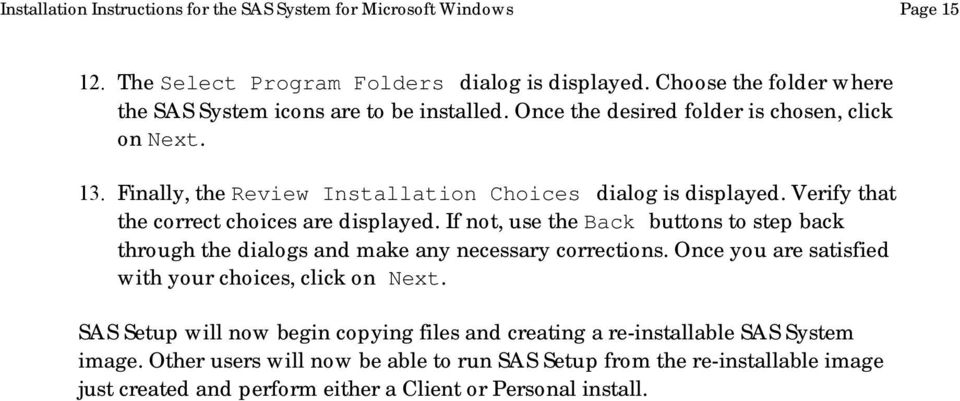
12 Page 8 Installation Instructions for the SAS System for Microsoft Windows Starting the SAS System Installation Process The SAS System is dependent on the presence of several Microsoft components for proper operation. At the beginning of the setup process, Setup will examine your system and determine which updates are necessary. Setup will then assist you with upgrading these components by installing them. Many of the components may require a reboot. If a reboot is required, Setup will automatically continue after your system has restarted and you have logged in. While rebooting is necessary to ensure the stability of your system, you can minimize the number of reboots required by closing all non-essential Windows applications before starting Setup. To start the SAS System installation process, complete the following steps: 1. Insert the CD-ROM labeled Disk 1 into the source drive. The SAS System AutoPlay should appear if AutoPlay is enabled on your computer. If this does not happen, select the Run menu option from the Start menu and type: <source_drive>:\setup where <source_drive> is the drive containing the SAS System installation media. 2. At this point, there are a number of choices: The SAS System may be installed by selecting the SAS System Setup option on this startup screen. The installation instructions may be viewed on your screen in Portable Document Format (.PDF) using Adobe Acrobat Reader. If this software is not installed on your computer, you will be prompted to install it. SAS Viewer can be installed by selecting SAS Viewer Setup. SAS ODBC Driver can be installed by selecting SAS ODBC Driver Setup. Selecting Browse the CD will launch a Microsoft Explorer window. The default display shows the root directory of the CD or other source media if the image has been copied.

13 Installation Instructions for the SAS System for Microsoft Windows Page 9 Installation Scenario Examples This section describes the typical steps for each of the following types of installations: Complete Personal Installation Custom Personal Installation Client Installation Complete File Server Installation Custom File Server Installation Please choose the section that is appropriate for the type of installation you are performing. The Back buttons on any screen can be used to return to the previous screen to alter any choices. Performing a Complete Personal Installation The following steps are typically followed when performing a Complete Personal installation: 1. Carefully read the Welcome screen and then click on Next. To minimize required reboots during SAS Setup, it is highly recommended that you exit all other applications while installing the SAS System. 2. Verify that the default setting of Complete setup type is selected and then click on Next. 3. This dialog is used to decide between a Personal Complete install and a File Server Complete install. Make sure that No is selected on the Server Options dialog. When you are certain the selection is correct, click Next. 4. If this is the first product from SAS Institute you have installed on your system, you will be presented with the SAS Institute Shared Files dialog. It is recommended that you use the default destination. Once this selection has been made, all Shared Files related to the SAS System will be stored in that location. Once you have selected the desired location, click on Next. 5. The Choose Destination Location dialog is now displayed. Carefully select the destination for the SAS System. Be sure the destination has sufficient disk space since you will be installing a complete SAS System. Once you have selected the location, click on Next. 6. The Select Data Files Folder dialog is now displayed. Either accept the default location, or enter the desired location for the user Data Files Folder. Then, click on Next. 7. The Select Temporary Files Folder dialog is displayed next. Once the desired location for the SAS work area is displayed, click on Next. For some
14 Page 10 Installation Instructions for the SAS System for Microsoft Windows types of SAS processing, large files may be used in this location so ensure that you have adequate space in the selected location. 8. The SAS Help Options dialog is displayed next. Here you may select whether you wish to have Internet Explorer style help or simple HTML help. Setup will suggest a suitable option for your system. When you are pleased with the selection, click on Next. 9. If necessary, an Additional Installation Options dialog may be displayed. Make the desired choices. Online help is available for assistance by pressing F1. When finished, click on Next. 10. The Review Installation Choices dialog is now displayed. Verify that the correct choices are displayed. If not, use the Back buttons to step back through the dialogs to make any necessary corrections. Once you are satisfied with your choices, click on Next. SAS Setup will now begin copying files and creating the SAS System installation. Performing a Custom Personal Installation The following steps are typically followed when performing a Custom Personal installation: 1. Carefully read the Welcome screen and then click on Next. To minimize required reboots during SAS Setup, it is highly recommended that you exit all other applications while installing the SAS System. 2. After SAS Setup finishes initializing, verify that the Custom installation is selected and then click on Next. 3. This dialog is used to decide between a Personal Custom install and a File Server Custom install. Make sure that No is selected on the Server Options dialog. When you are certain the selection is correct, click Next. 4. If this is the first product from SAS Institute you have installed on your system, you will be presented with the SAS Institute Shared Files dialog. It is recommended that you use the default destination. Once this selection has been made, all Shared Files related to the SAS System will be stored in that location. Once you have selected the desired location, click on Next. 5. The Choose Destination Location dialog is now displayed. Carefully select the destination for the SAS System. Be sure that the destination has sufficient disk space to install all of the SAS System components. Once the location is selected, click on Next. 6. The Select Data Files Folder dialog is now displayed. Either accept the default location, or enter the desired location for the user Data Files Folder. Then, click on Next.
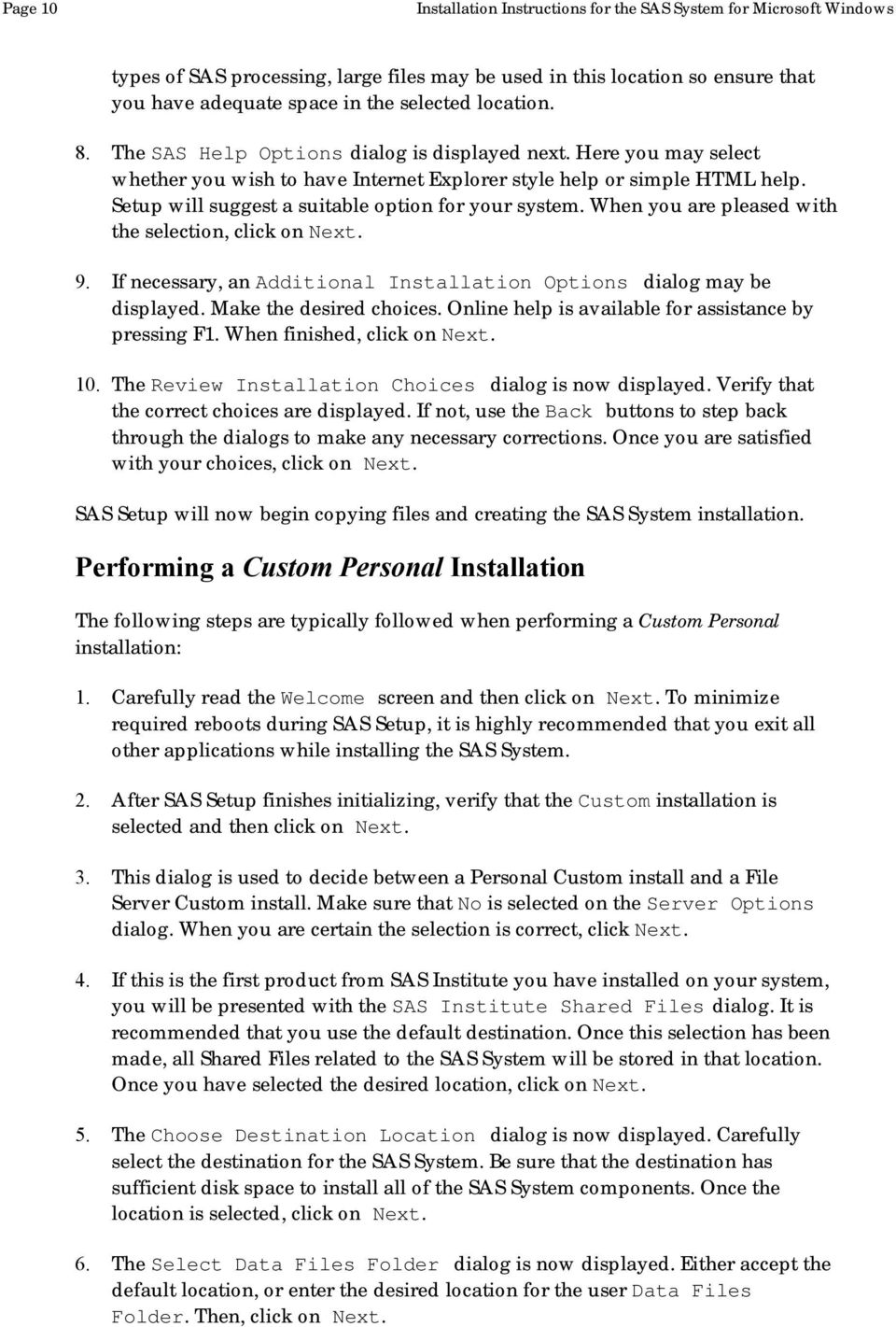
15 Installation Instructions for the SAS System for Microsoft Windows Page The Select Temporary Files Folder dialog is displayed next. Once the desired location for the SAS work area is displayed, click on Next. For some types of SAS System processing, large files may be used in this location, so ensure that you have adequate space in the selected location. 8. The Custom installation component listbox is displayed next. By default, all components are selected. Either deselect the components that are not desired, or click on the Unselect All button and then individually select the desired components. SAS Setup will recompute the estimated disk space requirement as you select or deselect components. When you are finished, click on Next. 9. The SAS Help Options dialog is displayed next. Here you may select whether you wish to have Internet Explorer style help or simple HTML help. Setup will suggest a suitable option for your system. When you are satisfied with the selection, click on Next. 10. If necessary, an Additional Installation Options dialog may be displayed. Make the desired choices. Online help is available for assistance by pressing F1. When finished, click on Next. 11. The Select Program Folder dialog is displayed. Choose the folder where the SAS System icons are to be installed. Once the desired folder is chosen, click on Next. 12. Finally, the Review Installation Choices dialog is displayed. Verify that the correct choices are displayed. If not, use the Back buttons to step back through the dialogs and make any necessary corrections. Once you are satisfied with your choices, click on Next. SAS Setup will now begin copying files and creating the SAS System installation. Performing a Client Installation The following steps are typically followed when performing a Client installation: 1. Carefully read the Welcome screen and then click on Next. To minimize required reboots during SAS Setup, it is highly recommended that you exit all other applications while installing the SAS System. 2. After SAS Setup finishes initializing, select the Client installation and then click on Next. 3. If this is the first product from SAS Institute you have installed on your system, you will be presented with the SAS Institute Shared Files dialog. It is recommended that you use the default destination. Once this selection has been made, all Shared Files related to the SAS System will be stored in that location. Once you have selected the desired location, click on Next.

16 Page 12 Installation Instructions for the SAS System for Microsoft Windows 4. The Choose Destination Location dialog is now displayed. This location will be used for configuration files. Carefully select the desired location and click on Next. 5. The Select Data Files Folder dialog is now displayed. Either accept the default location, or enter the desired location for the user Data Files Folder. Then, click on Next. 6. The Select Temporary Files Folder dialog is displayed next. Once the desired location for the SAS work area is displayed, click on Next. For some types of SAS processing, large files may be used in this location so ensure that you have adequate space in the selected location. 7. If necessary, an Additional Installation Options dialog may be displayed. Make the desired choices. Online help is available for assistance by pressing F1. When finished, click on Next. 8. The Select Program Folders dialog is displayed. Choose the folder where the SAS System icons are to be installed. Once the desired folder is chosen, click on Next. 9. Finally, the Review Installation Choices dialog is displayed. Verify that the choices displayed are correct. If not, use the Back buttons to step back through the dialogs to make any necessary corrections. Once you are satisfied with your choices, click on Next. SAS Setup will now begin copying files and creating the SAS System installation. Performing a Complete File Server Installation The following steps are typically followed when performing a Complete File Server installation: 1. Carefully read the Welcome screen and then click on Next. To minimize required reboots during SAS Setup, it is highly recommended that you exit all other applications while installing the SAS System. 2. After SAS Setup finishes initializing, select the Complete installation and click Next. 3. This dialog is used to decide between a Personal Complete install and a File Server Complete install. Make sure that Yes is selected on the Server Options dialog. When you are certain the selection is correct, click Next. 4. Next, you will be presented with the Enterprise Options dialog, which allows you to indicate if this machine will be an Application Server. If you do not have an NT Enterprise SETINIT, select No on this dialog. If you select No, only steps 6 and 11 will be displayed.
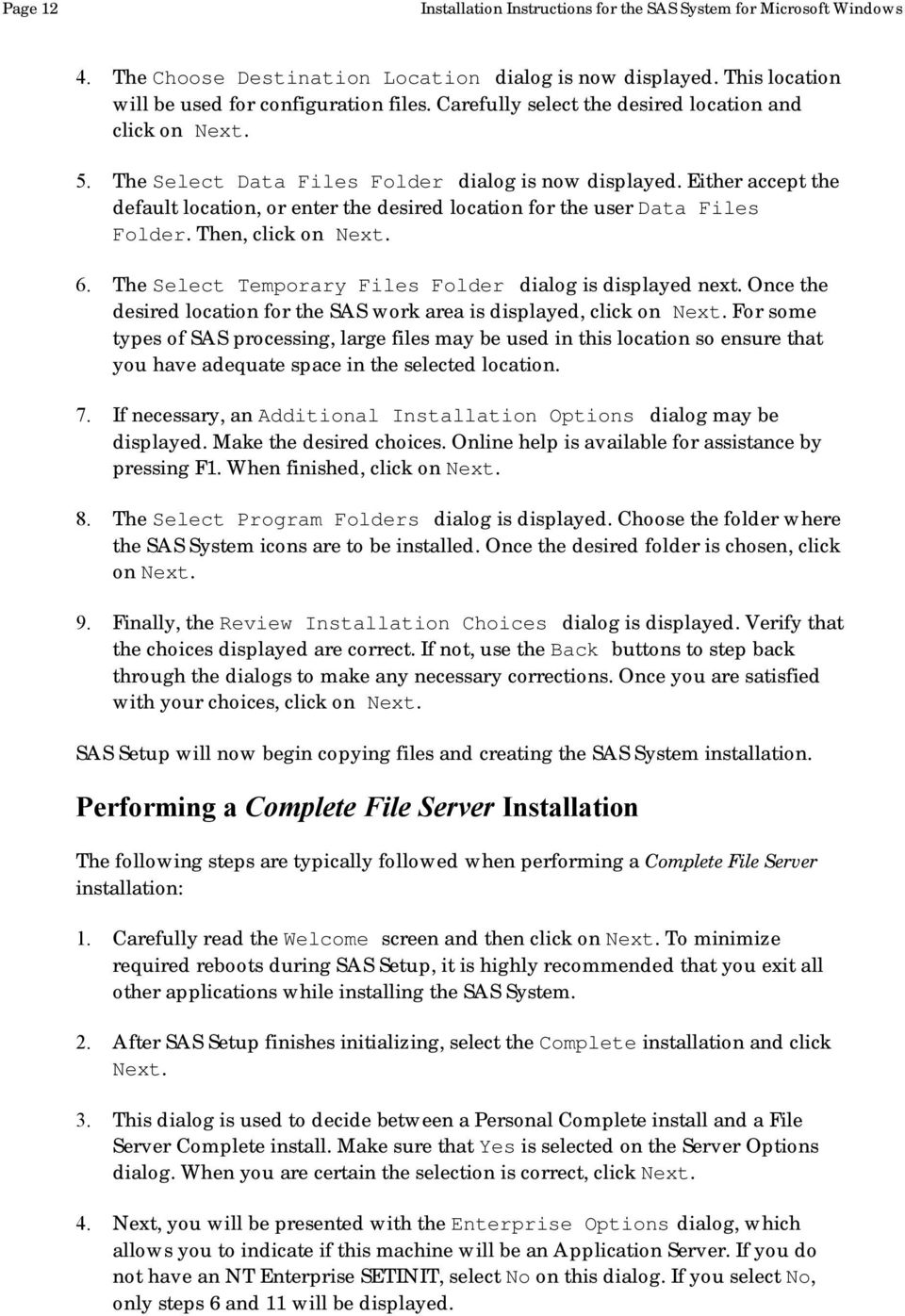
17 Installation Instructions for the SAS System for Microsoft Windows Page If this is the first product from SAS Institute you have installed on your system, you will be presented with the SAS Institute Shared Files dialog. It is recommended that you use the default destination. Once this selection has been made, all Shared Files related to the SAS System will be stored in that location. Once you have selected the desired location, click on Next. 6. The Choose Destination Location dialog is now displayed. Carefully select the destination for the SAS System. Be sure that the destination has sufficient disk space to install all of the SAS System components, and that it is not at the root level of a drive or of a subdir to be used as a network share. Remember that both help systems will be installed. Once the location is selected, click on Next. 7. The Select Data Files Folder dialog is now displayed. Either accept the default location, or enter the desired location for the user Data Files Folder. Then, click on Next. 8. The Select Temporary Files Folder dialog is displayed next. Once the desired location for the SAS work area is displayed, click on Next. For some types of SAS processing, large files may be used in this location so ensure that you have adequate space in the selected location. 9. The SAS Help Options dialog is displayed next. Here you may select whether you wish to have Internet Explorer style help or simple HTML help. Setup will suggest a suitable option for your system. When you are pleased with the selection, click on Next. 10. If necessary, an Additional Installation Options dialog may be displayed. Make the desired choices. Online help is available for assistance by pressing F1. When finished, click on Next. 11. Finally, the Review Installation Choices dialog is displayed. Verify that the correct choices are displayed. If not, use the Back buttons to step back through the dialogs and make any necessary corrections. Once you are satisfied with your choices, click on the Next button. SAS Setup will now begin copying files and creating a re-installable SAS System image. Other users will now be able to run SAS Setup from the re-installable image just created and perform either a Client or Personal install. Performing a Custom File Server Installation The following steps are typically followed when performing a Custom File Server installation: 1. Carefully read the Welcome screen and then click on Next. To minimize required reboots during SAS Setup, it is highly recommended that you exit all other applications while installing the SAS System.
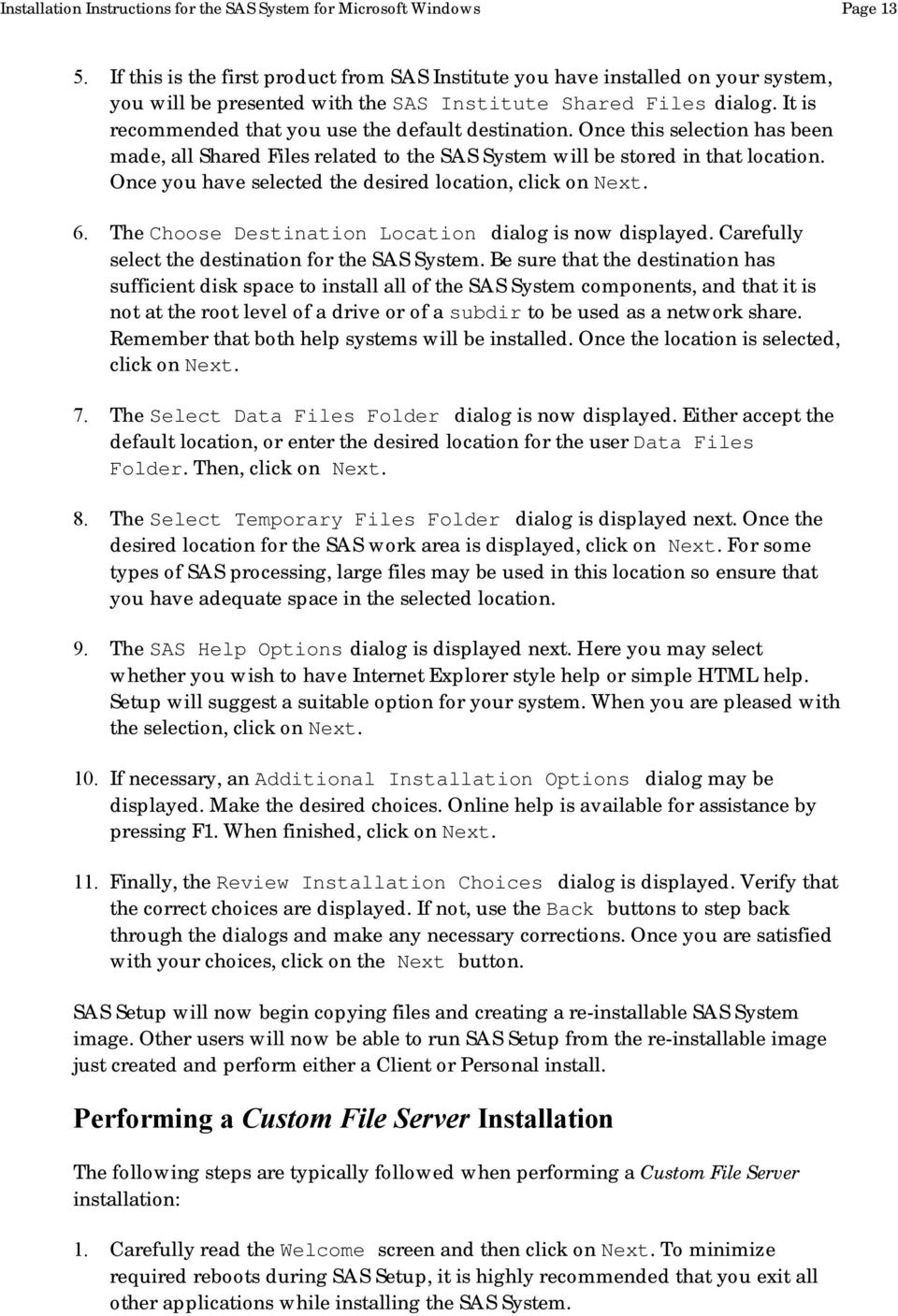
18 Page 14 Installation Instructions for the SAS System for Microsoft Windows 2. After SAS Setup finishes initializing, select the Custom installation and click Next. 3. This dialog is used to decide between a Personal Custom install and a File Server Custom install. Make sure that Yes is selected on the Server Options dialog. When you are certain the selection is correct, click Next. 4. Next, you will be presented with the Enterprise Options dialog, which allows you to indicate if this machine will be an Application Server. If you do not have an NT Enterprise SETINIT, select No in this dialog. If you select No, only steps 6 and 14 will be displayed. 5. If this is the first product from SAS Institute you have installed on your system, you will be presented with the SAS Institute Shared Files dialog. It is recommended that you use the default destination. Once this selection has been made, all Shared Files related to the SAS System will be stored in that location. Once you have selected the desired location, click on Next. 6. The Choose Destination Location dialog is now displayed. Carefully select the destination for the SAS System. Be sure that the destination has sufficient disk space to install all of the SAS System components, and that it is not at the root level of a drive or of a subdir to be used as a network share. Once the location is selected, click on Next. 7. The Select Data Files Folder dialog is now displayed. Either accept the default location, or enter the desired location for the user Data Files Folder. Then, click on Next. 8. The Select Temporary Files Folder dialog is displayed next. Once the desired location for the SAS work area is displayed, click on Next. For some types of SAS processing, large files may be used in this location so ensure that you have adequate space in the selected location. 9. The Custom installation component listbox is displayed next. By default, all components are selected. Either deselect the components that are not desired, or click on the Unselect All button and then individually select the desired components. SAS Setup will recompute the estimated disk space requirement as you select or deselect components. When you are finished, click on Next. 10. The SAS Help Options dialog is displayed next. Here you may select whether you wish to have Internet Explorer style help or simple HTML help. Setup will suggest a suitable option for your system. When you are satisfied with the selection, click on Next. 11. If necessary, an Additional Installation Options dialog may be displayed. Make the desired choices. Online help is available for assistance by pressing F1. When finished, click on Next.
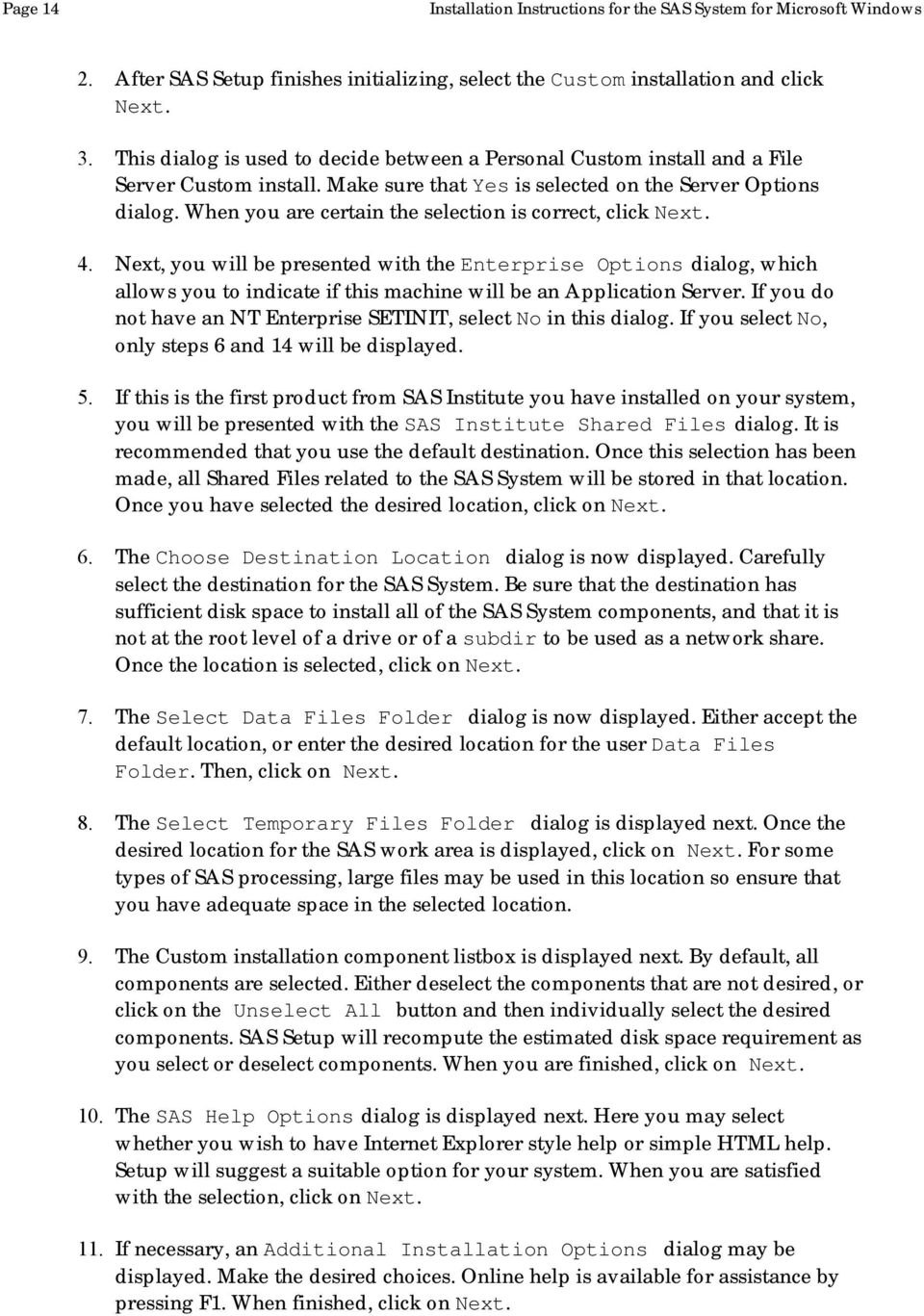
19 Installation Instructions for the SAS System for Microsoft Windows Page The Select Program Folders dialog is displayed. Choose the folder where the SAS System icons are to be installed. Once the desired folder is chosen, click on Next. 13. Finally, the Review Installation Choices dialog is displayed. Verify that the correct choices are displayed. If not, use the Back buttons to step back through the dialogs and make any necessary corrections. Once you are satisfied with your choices, click on Next. SAS Setup will now begin copying files and creating a re-installable SAS System image. Other users will now be able to run SAS Setup from the re-installable image just created and perform either a Client or Personal install.
20

21 Chapter 3, Applying Updates to the SAS System V8 This chapter provides an introduction to applying updates to the SAS System V8 for Windows. In addition, information is provided to assist you in making some decisions prior to starting the installation process and various installation scenario examples are included. The SAS V8 (update-level) Setup (referred to as SAS Setup in these instructions) must only be run if SAS System V8 is installed on your system. If you intend to add additional Version 8 components to your SAS System, you must first add these components by installing them from the SAS System V8 media (see Chapter 2, Installing the SAS System ). Once you are satisfied with the installed components, you may then install the SAS System V8 Update to have them all updated. Before Starting SAS Setup Before you start SAS Setup, ensure that you have sufficient disk space on the installation target. SAS Setup will provide you the opportunity to backup the original versions of the files to be updated. This backup will require, at most, 170 megabytes of disk space. Keep in mind that the disk-blocking factor and drive compression settings may affect the actual amount of required space. You will not be required to backup your files if you do not wish to have the ability to revert to the original SAS System V8. Complete the following steps: 1. If you are installing to a Windows NT, Version 4.0 system, SAS Setup will determine whether you have the required Windows NT, Version 4.0, Service Pack installed. Make sure you install it before running SAS Setup. Without this Service Pack, SAS Setup will not present the option of installing Internet Explorer. See the System Requirements to determine the Service Pack requirement. 2. SAS Setup will determine whether Microsoft Internet Explorer Version 5 is installed. If it is not installed, SAS Setup will give you the option of installing it. It is strongly recommended that you do so. On Windows NT, systems administrative privileges are required to install Internet Explorer. If you do not install Internet Explorer, you must have a Web browser installed. The Web browser should be installed prior to running SAS Setup. Refer to the System Requirements to determine acceptable Web browser requirements. 17
22 Page 18 Installation Instructions for the SAS System for Microsoft Windows Starting the SAS System Update Process The SAS System is dependent on the presence of several Microsoft components for proper operation. At the beginning of the setup process, Setup will examine your system and determine which updates are necessary. Setup will then assist you with upgrading these components by installing them. Many of the components may require a reboot. If a reboot is required, Setup will automatically continue after your system has restarted and you have logged in. While rebooting is necessary to ensure the stability of your system, you can minimize the number of reboots required by closing all non-essential Windows applications before starting Setup. To start the SAS System update process, complete the following steps: 1. Insert the CD-ROM labeled Disk 3 into the source drive. The SAS System AutoPlay should appear if AutoPlay is enabled on your computer. If this does not happen, select the Run menu option from the Start menu and type: <source_drive>:\setup where <source_drive> is the drive containing the SAS System installation media. Note: If you are an administrator and you are updating a file server copy of the SAS System Version 8 from a machine other than the one where you originally installed the SAS System Version 8, you must provide the forcemaint option on the setup command-line as follows: <source_drive>:\sas\setup forcemaint Please see Updating a SAS Version 8 Server and Subsequent Clients on page 19 for more information. 2. At this point, there are a number of choices: The SAS System Update may be installed by selecting the SAS System Setup option on this startup screen. The installation instructions may be viewed on your screen in Portable Document Format (.PDF) using Adobe Acrobat Reader. If this software is not installed on your computer, you will be prompted to install it. SAS Viewer can be installed by selecting SAS Viewer Setup. Selecting SAS Version 8 will launch the existing SAS Version 8.
23 Installation Instructions for the SAS System for Microsoft Windows Page 19 Selecting Browse the CD will launch a Microsoft Explorer window. The default display shows the root directory of the CD or other source media if the image has been copied. Example Update Scenarios This section describes the typical steps for each of the following types of installations: Updating a Local SAS Version 8 Installation Updating a SAS Version 8 Server and Subsequent Clients Please choose the section that is appropriate for the type of update you are performing. The Back buttons on any screen can be used to return to the previous screen to alter any choices. Updating a Local SAS Version 8 Installation The following steps are typically followed when performing an update to a local SAS System V8 Installation: 1. Carefully read the Welcome screen and then click on Next. To minimize required reboots during SAS Setup, it is highly recommended that you exit all other applications while installing the SAS System. 2. At this point, you will be presented with a list containing all the components installed on your system. Review this listing to ensure that all of the products you wish to update are installed. Once you have reviewed this information, click on Next. 3. Now you are provided with the opportunity to backup the files that are to be updated. Backing up these files will provide you the ability to revert back to SAS System V8 by means of the Add/Remove Programs Control Panel. Select Yes if you would like to have the ability to remove this update at a later time. If you do not wish to have this ability, and wish to preserve hard drive space, select No. When you are satisfied with your selection, click on Next. 4. If you selected to perform a backup of the SAS System V8 files to be updated, you will be prompted to enter the location to which these files should be copied. Once you have indicated the desired destination, click Next. If you chose not to backup your SAS System V8 files, this dialog will not be displayed. SAS Setup will now begin copying files required to update your SAS System installation. Updating a SAS Version 8 Server and Subsequent Clients This section is intended for network administrators who wish to update a SAS System V8 Server and subsequent clients. Use the forcemaint command-line option to update the Server only when updating from a machine other than the one
24 Page 20 Installation Instructions for the SAS System for Microsoft Windows originally used to install the Server image. If the update is being performed from the same machine used to install the original Server image, follow the instructions in Updating a Local SAS Version 8 Installation on page 19. Updating the Server 1. Before beginning the update process, make certain that all clients of the server being updated are disconnected. This is necessary to ensure that all updated files can be copied to the SAS System Server. The update process should be performed from a PC that does not have the SAS System V8 currently installed. If the SAS System V8 is installed, it should be uninstalled by highlighting it from the Add/Remove item list in Control Panel, and clicking the Add/Remove button before performing the update process. When updating the server, SAS Setup should be started with the forcemaint command-line option as follows: <source_drive>:\sas\setup forcemaint where <source_drive> is the drive containing the SAS System installation media. The forcemaint option tells SAS Setup to prompt you for your server s config file location. 2. Carefully read the Welcome screen and then click on Next. To minimize required reboots during SAS Setup, it is highly recommended that you exit all other applications while installing the SAS System. 3. When prompted to supply the directory containing the SASV8.CFG file for the installation you are updating, enter the SASROOT folder for the Server installation. 4. At this point, you will be presented with a list containing all the components installed on your system. Review this listing to ensure that all of the products you wish to update are installed. Once you have reviewed this information, click on Next. 5. You are then provided with the opportunity to backup the files that are to be updated. Backing up these files will provide you the ability to revert to SAS System V8 by means of the Add/Remove Programs Control Panel. Select Yes if you would like to have the ability to remove this update at a later time. If you do not wish to have this ability, and wish to preserve hard drive space, select No. When you are satisfied with your selection, click on Next. 6. If you selected to perform a backup of the SAS System V8 files to be updated, you will be prompted to enter the location where these files should be copied.
25 Installation Instructions for the SAS System for Microsoft Windows Page 21 Once you have indicated the desired destination, click Next. If you chose not to backup your SAS System V8 files, this dialog will not be displayed. SAS Setup will now begin copying files required to update your SAS System installation. Updating Subsequent Clients 1. Once the Server has been updated, each Client system must be updated. Uninstalling the current SAS System V8 on each Client is recommended before performing the update. To uninstall the current installation, highlight the SAS System V8 entry in the Add/Remove item list in Control Panel and click the Add/Remove button. 2. Run Setup from the SASROOT folder on the server. This initiates the installation process for the SAS System V8 TS M1. Please see Installation Scenario Examples starting on page 9 for instructions about each type of installation. 3. Repeat this process on every Client system.
26
27 Chapter 4, Invoking the SAS System After it is properly installed, Version 8 (TS0M1) of the SAS System under Windows can be invoked in the following ways: Click on Start, select Programs, and choose The SAS System. Then, click on the icon labeled The SAS System for Windows Version 8 (TS M1). Select the Run command from the Start button menu. Supply the full path to both the SAS.EXE and the SASV8.CFG files for the SAS System installation you want to execute as shown in the following example: C:\Program Files\SAS\SAS.EXE When you invoke the SAS System, it searches for a SASV8.CFG file in the current directory. For more information on running the SAS System under Windows, refer to SAS Companion for the Windows Environment, Version 8, Second Edition, and Windows Environment: Changes and Enhancements to the SAS System, Version 8. 23
28
29 Chapter 5, Technical Support Services Direct technical support is provided by SAS Institute to the designated SAS Installation Representative and SAS Support Consultant at your site. These individuals should be the initial contacts for any user who needs technical assistance. Many programming problems result from a misunderstanding of how the software works, or a failure to use correct syntax. An experienced SAS Support Consultant can spot these errors quickly. These individuals can also search the SAS Notes database to see if a solution for your problem is provided. If the SAS Installation Representative or SAS Support Consultant cannot solve your problem, they can contact the Institute for further assistance. SAS Institute provides technical support via the World Wide Web, by phone, mail, electronic mail, or dial-up computer access. For technical support via the World Wide Web, use the following URL: For technical support by phone, call (919) between the hours of 9 a.m. and 8 p.m., Eastern Standard Time, weekdays. For technical support by mail, send all correspondence to this address: SAS Institute Technical Support Division SAS Campus Drive Cary, NC Electronic mail access is available to SAS Installation Representatives and SAS Support Consultants through the Electronic Mail Interface to Technical Support (EMITS). This facility allows you to track a technical support problem or add information to a previously reported problem. The following lists additional electronic support that the Technical Support Division provides: TSNEWS-L Mail and File List allows you to receive the latest information from SAS Institute s Technical Support Division. Anonymous FTP allows you to send or receive information from SAS Institute Technical Support using FTP. 25
30 Page 26 Installation Instructions for the SAS System for Microsoft Windows Electronic Fax Service allows you send and receive faxes more quickly.
31 Appendix A, Installing SAS/ACCESS Interface to ODBC Software Before you can use SAS/ACCESS Interface to ODBC software, the following products are required: Base SAS Software SAS/ACCESS Interface to ODBC Software A 32-bit ODBC driver for the source from which you want to access data The ODBC solution allows different technologies to be used by defining a standard interface. SAS/ACCESS Interface to ODBC software with ODBC drivers provides you with access to different databases. An ODBC driver processes ODBC function calls from and returns results to SAS/ACCESS software. You can get drivers from Microsoft, your database vendor, or other third party software vendors. To run SAS/ACCESS software on 32-bit Windows, you need 32-bit drivers. The application calls the 32-bit Driver Manager (ODBC32.DLL), which in turn calls the 32-bit drivers. The following figure illustrates the architecture: SAS/ACCESS 32-Bit Driver Manager (ODBC32.DLL) 32-Bit Driver 32-Bit Driver 32-Bit Driver Data Source Data Source Data Source The ODBC Driver Manager and Administrator are Microsoft products that are included with all ODBC drivers. When you install an ODBC driver, the ODBC Driver Manager and Administrator are also installed. The ODBC Administrator should appear as an icon in the control panel. However, it can also appear as an icon in the Start menu instead. After you install the ODBC driver, you can use the ODBC Administrator to define and manage the data sources. A data source associates a particular ODBC driver with the data you want to access through that driver. It can consist of information about the data you want to access and its associated operating system, DBMS, and network platform (if any) used to access the DBMS. For information about how to 27
32 Page 28 Installation Instructions for the SAS System for Microsoft Windows configure your data sources, refer to the documentation provided with your ODBC drivers. For more information about SAS/ACCESS to ODBC, refer to the ODBC chapter in SAS/ACCESS Software for Relational Databases: Reference, Version 8, First Edition. For more information about ODBC, refer to Microsoft ODBC 3.0 Programmer s Reference and SDK Guide. SAS/ACCESS ODBC Conversion Utilities The SAS/ACCESS ODBC Conversion Utilities are included in the SAS/ACCESS Interface to ODBC software. It helps users of Version 6 SAS/ACCESS Interface to AS/400 and SAS/ACCESS Interface to Microsoft SQL Server move from a native DBMS interface connection to an ODBC interface connection on Version 8 of the SAS System. AS/400 Users Before you can use the ODBC Conversion Utilities for AS/400 Interface, you need to install IBM s Client Access ODBC Driver (32-bit) V or above. If your AS/400 Client Access installation loaded a Client Access ODBC Driver prior to this version, you can download Program Temporary Fix (PTF) SF59504 or later from ftp.software.ibm.com for an update. This service pack for the Client Access product can be found in the /as400/products/clientaccess/win32/v3rlm2/servicepack/ directory. When this update is applied, Version or later of the ODBC driver should be installed. You are also required to create a data source name. You can use the ODBC administrator to add it. The data source name AS400 is recommended. If you want to use another data source name, set the SAS environment variable AS400DSN, located in your sasv8.cfg, to the data source name you assigned. Quotes are required if blanks or special characters are included. You may want to create it as a system DSN instead of a user DSN if you have more than one user who may want to use the same workstation to access the AS/400 database. Complete the following steps to create a data source for AS/400 database access: 1. Run ODBC Administrator from the Control Panel or Start menu. 2. Click the User DSN or System DSN tab, depending on the number of users.. 3. Click the Add button and then choose Client Access ODBC driver (32-bit) from the pop-up windows. 4. Click Finish. This brings up the Setup dialog. 5. Click the General tab and enter AS400 (or another name) in the Data Source Name field. This name needs to match the value you set for the SAS environment variable AS400DSN.
33 Installation Instructions for the SAS System for Microsoft Windows Page From the pull-down menu, choose an AS/400 system that you want to connect to using this data source. 7. Click on Connection Options. Next, under Signon Information, choose Enter ID. Click OK. 8. Click the Server tab. Leave blanks or enter your default libraries for search. 9. Click the Format tab. Choose Naming Convention. 10. Click the Package(s) tab. Uncheck the box for Enable Extended Dynamic Support. 11. Click OK to close the Setup window. Microsoft SQL Server Users An OBDC Conversion Utility is provided that will allow you to read SAS System Version 6 views to access data in Microsoft SQL Server which were created with SAS/ACCESS Interface to Sybase and SQL Server software on Windows. The Conversion Utility helps users migrate to SAS/ACCESS Interface to ODBC software on Windows. Note: The Conversion Utility applies only to views that access data in Microsoft SQL Server. It does not apply to SYBASE SQL Server. The ODBC Conversion Utility requires the Microsoft SQL Server ODBC driver (32- bit) from Microsoft. This driver is installed as part of Microsoft Data Access Components (MDAC). It is recommended, but not required to create a data source name. You can use ODBC administrator to add it. You must set the SAS environment variable MSSQLDSN, located in the sasv8.dfg, as the data source name you assigned. Quotes are required if blanks or special characters are included. You can create it as a system DSN instead of a user DSN if you have more than one user who may use the same workstation to access the Microsoft SQL Server database. Complete the following steps to create a data source for Microsoft SQL Server database access: 1. Run ODBC Administrator from the Control Panel or Start menu. 2. Click the User DSN or System DSN tab, depending on the number of users, as stated above. 3. Click the Add button and choose SQL Server from the pop-up window. 4. Enter any name in the Name field. This name needs to match the value you set for the SAS environment variable MSSQLDSN.
34 Page 30 Installation Instructions for the SAS System for Microsoft Windows 5. Choose or enter the Server field which you defined using SQL Client Configuration Utility. 6. Click Next. Select the radio button that describes your login method. If necessary, enter a login ID and password. 7. Click Next. A connection will be initiated. If the connection succeeds, please refer to Step 8 below. If the connection fails, an error message will provide a reason for the failure. 8. After a connection succeeds, your default databases may be changed. Click Next to leave this screen. 9. After changing your default databases, other options may be selected. Click Finish when this screen is correct. 10. Click Test Data Source. After a message appears indicating that the test was successful, click Okay. Click Okay on the following message as well. Note: The SAS System will automatically install Microsoft Data Access Components (MDAC) when you install SAS/ACCESS Interface to ODBC software.
35 Appendix B, Installing SAS/ACCESS Interface to ORACLE Software Before you can use SAS/ACCESS Interface to ORACLE software, the following products are required: Base SAS software SAS/ACCESS Interface to ORACLE software The appropriate ORACLE Client: Oracle8i Client, Version or later Oracle8 Client, Version or later Oracle7 Client, Version or later Before using SAS/ACCESS Interface to ORACLE software, you must install the ORACLE SQL*Net Client, Version or above on the same PC where SAS/ACCESS Interface to ORACLE software will be used. Note: In order to use the Bulk Load feature of this SAS product, you must have Oracle s SQL*Loader data-loading utility installed on your PC. This can be obtained by running the Oracle Installer and selecting the Oracle Utilities product. Please refer to your Oracle documentation for information on SQL*Loader. If you are using ORACLE, Version client, you need: ORACLE SQL*Net Client, Version 2.3 for Windows NT and Windows 95 ORACLE Protocol Adapter(s), Version 2.3 for Windows NT and Windows 95 If you are using ORACLE Net8 Client, you will need to use Version or later, with: ORACLE Net8 Client, Version 8.x for Windows NT and Windows 95/98 ORACLE Protocol Adapter(s), Version 8.x for Windows NT and Windows 95/98 Client-Server Architecture SAS/ACCESS Interface to ORACLE software runs on the client machine (Windows). It accepts user input and sends requests to ORACLE SQL*Net (or Net8) client to be transported across the network to the server. The ORACLE database and ORACLE SQL*Net (or Net8) listener are running on the server machine (Windows NT, UNIX, or others). The listener accepts the connection from the client on the network. It then delivers SAS/ACCESS requests to the ORACLE database. 31
36 Page 32 Installation Instructions for the SAS System for Microsoft Windows SAS/ACCESS Interface to ORACLE software only supports ORACLE client V7.3.4 or above. However, it can interface to any version of ORACLE databases running on the server. Client Side SAS/ACCESS Software SQL*Net or Net8 ORACLE Protocol Adapter Network Server Side ORACLE DBMS SQL*Net or Net8 ORACLE Protocol Adapter Installing SQL*Net (or Net8) Run the ORACLE Installer and select SQL*Net Client (or Net8 Client) and one or more ORACLE protocol adapters. It is strongly recommended that you install/use ORACLE TCP/IP Adapter for your database connection. If you are using Version or Version Client for database connection, you may have to set the ORACLE system variable ORAOCI as the name for an ORACLE client DLL. For example, if you are using ORACLE, Version for Windows NT, you can create and set the value of ORAOCI as C:\ORANT\BIN\ORA805.DLL in the Windows Registry Editor s (REGEDIT or REGEDT32) HKEY_LOCAL_ MACHINE\SOFTWARE\ORACLE Key. Assigning the Default Path for the ORACLE Server After you install ORACLE SQL*Net Client software, you may want to specify the default connect string by defining the default path for ORACLE Server. When you use SAS/ACCESS interface software without specifying any PATH statement/field, SAS/ACCESS software uses the defined default path. Windows NT Complete the following steps: 1. Run Windows registry editor (REGEDT32) 2. Select HKEY_LOCAL_MACHINE...SOFTWARE...Oracle 3. Select Edit...Add Value 4. Enter LOCAL as the Value Name and then select OK 5. Enter your connect-string for the String field in the pop-up dialog box 6. Select OK.
37 Installation Instructions for the SAS System for Microsoft Windows Page 33 Windows 95 and Windows 98 Complete the following steps: 1. Run Windows registry editor (REGEDIT). 2. Select HKEY_LOCAL_MACHINE...SOFTWARE...Oracle. Note: If you are using the ORACLE8i client, the sequence in Step 2 above ends with an additional selection HOME0 3. Select Edit...New...String Value. 4. Enter LOCAL as the Value Name and then select Edit...Modify. 5. The Value Name field now says Local. 6. Enter your connect-string for the Value Data field in the pop-up dialog box. 7. Select OK. For more information about SAS/ACCESS Interface to ORACLE, refer to the ORACLE chapter in SAS/ACCESS Software for Relational Databases: Reference, Version 8, First Edition.
38
39 Appendix C, Installing SAS/ACCESS Interface to R/3 Software SAS/ACCESS Interface to R/3 software requires extensive installation setup before the product can be used. You can view or download the detailed setup instructions from the SAS Institute web site: Select the SAS/ACCESS link under the Products heading. From this page, you can locate information regarding configurations, system & machine requirements, and upgrades. SAS/ACCESS Interface to R/3 Software The following products are required: Base SAS software SAS/ACCESS Interface to R/3 software Additional functionality is obtained if the following products are installed: SAS/Warehouse Administrator SAS/CONNECT software SAS/SHARE software SAS/ACCESS Interface to R/3 Software requires the use of communication protocols such as TCP/IP to function properly. The following SAP R/3 products are required: SAP R/3 Release 2.2 or higher SAP R/3 Remote Function Call Software Development Kit (RFCSDK) 35
40
41 Appendix D, Post-Installation Setup for SAS/ASSIST Software This appendix describes how to add an optional master profile to SAS/ASSIST software. You can use a master profile to override the default settings as sent by SAS Institute. This allows you to provide a customized setup for SAS/ASSIST software. With the master profile, you can control the profile options of all SAS/ASSIST users from one central place. For information on the profile options, refer to SAS/ASSIST Software Administrator s Guide. Adding a Master Profile Complete the following steps to add a master profile to SAS/ASSIST software: 1. Specify the location of the master profile by creating a new directory that all users of SAS/ASSIST software will have read access to. All users with write access to this directory will automatically also have write access to the master profile in SAS/ASSIST software. Select a name that conforms to the naming conventions at your installation. The name of this new directory must be stored in an entry in the SASHELP library. This requires that you have write access to the SASHELP library. On line 1 of the Program Editor window of the SAS Display Manager System, type the physical pathname of the master profile directory. Execute the Save command to store this in the SASHELP.QASSIST catalog. For example: SAVE SASHELP.QASSIST.PARMS.SOURCE S:\SAS\ASSIST\PARMS The location of the master profile is now known by SAS/ASSIST software. 2. Create the master profile. The first time SAS/ASSIST software is started, a master profile is created if SASHELP.QASSIST.PARMS.SOURCE contains the name of an existing physical pathname, and the person who starts SAS/ASSIST software has write access to this physical pathname. 3. Customize the master profile by starting SAS/ASSIST software and selecting Setup Profiles... Master/group... 37
42 Page 38 Installation Instructions for the SAS System for Microsoft Windows If you have write access to the SAS library containing the master profile, you can specify default values for your installation. New users will use these values as they start SAS/ASSIST software. Note: If you restrict values by typing R in Status, users will not be allowed to change the values you define. You can run SAS/ASSIST software in two different styles - workplace or block menu. The block menu can be new style or old style. You can control this using the profile options below. Run workplace: SAS/Assist style: Run block menu new style: Workplace SAS/Assist style: Block Menu Save selections on end: Yes Menu Style: New Run old style: SAS/Assist style: Block Menu Save selections on end: Yes Menu Style: Old By setting the default values in the master profile, you can control if users should use the new or old style of SAS/ASSIST software. In addition, there are many other profile options. For more information on these options, refer to SAS/ASSIST Software Administrator s Guide. 4. Create group profiles. From the master profile, it is possible to create group profiles to allow groups of users to have different setups. The master profile controls group profiles and user profiles when a user is not a member of any group. All users are indirectly controlled by the master profile when option values are set to a restricted (R) status. From Setup...Master/Group..., select Locals...Create Group Profile. To add users to a group profile, select Locals...Update User Group. By default, the userid is found in the macro variable &SYSJOBID. This value is set in the option Userid in the master profile (option type System Administration). Change the value if your site uses another variable to keep the userid. If the value name starts with &, it is a macro variable; otherwise, it is an environment variable, which is set before the start of the SAS System.
43 Appendix E, Post-Installation Setup for SAS/CONNECT Software The first section in this appendix, Storing and Locating SAS/CONNECT Script Files, describes the use of the sample script files shipped with SAS/CONNECT software. The next sections in this appendix list supported software for access methods available on Windows and Windows NT respectively, and outline configuration procedures for those access methods requiring additional configuration. The final section documents installing and configuring the Windows Spawner program. The access methods supported for the SAS System on both Windows and Windows NT are EHLLAPI, DECNET, NETBIOS, TCP/IP, and APPC. These methods are described below in the order listed here. For information about the requirements of a particular access method, please refer to the section that addresses the method. Refer to Communications Access Methods for SAS/CONNECT and SAS/SHARE Software for information on the access methods supported by other systems. Storing and Locating SAS/CONNECT Script Files Several sample script files are shipped with SAS/CONNECT software. SAS/CONNECT software uses these script files to establish a connection to a remote SAS session. The SASSCRIPT configuration option points to the location of the SAS/CONNECT script files. The SASSCRIPT option is used by SAS/ASSIST software and can be used by user-written SCL applications. Under Windows, the script files are installed into the!sasroot\connect\saslink directory by default. The following line is added to the SASV8.CFG file when SAS/CONNECT software is installed: -SASSCRIPT!SASROOT\CONNECT\SASLINK If you want to move the script files to another directory, you must edit the SASV8.CFG file and update the SASSCRIPT option with the new directory location. This option can also be specified from the Tools/Options/System/Communications/Networking and encryption selection in DMSEXP mode. 39
44 Page 40 Installation Instructions for the SAS System for Microsoft Windows System Configuration for Access Methods Supported under Windows 95 and Windows 98 The access methods supported for the SAS System on Windows are described below in this order: EHLLAPI, DECNET, NETBIOS, TCP/IP, and APPC. EHLLAPI For the EHLLAPI access method, a supported emulation package must be installed on the Windows node. The following emulation products are supported: Attachmate s EXTRA Personal Client, Version 6.1+ Exceed, Version 6.1+ IBM s PCOMM (Personal Communications) Version 4.1+ Wall Data s Rumba 2000, Version 6+ Any Windows 32-bit emulation program that supports the EHLLAPI or WinHLLAPI standards. The EHLLAPI access method requires that the supported emulation package be listed in the Autoexec Path statement as shown in the following example: path=c:\ehllapi_package;%path% DECNET Use of the DECnet access method requires Digital Equipment Corporation s Pathworks 32 with Microsoft s Winsock Version 2.0. NETBIOS For the NETBIOS access method, SAS/CONNECT software supports the NETBIOS protocol that is included with Windows. TCP/IP For the TCP/IP access method, SAS/CONNECT software supports Microsoft s TCP/IP System Driver, which is provided with Windows. APPC One of the following software packages is required to use the APPC access method with the SAS System under Windows: IBM s Communications Server/NT, Version 5.0+ IBM s Personal Communications Version 4.11 or subsequent versions Microsoft SNA Server, Version 2.11 SP1 (Service Pack 1) or subsequent versions Any program that supports WOSA (Windows Open Services Architecture) APPC (Win APPC) standard.
45 Installation Instructions for the SAS System for Microsoft Windows Page 41 System Configuration for Access Methods Supported under Windows NT The access methods supported for the SAS System on Windows NT are described below in this order: EHLLAPI, DECNET, NETBIOS, TCP/IP, and APPC. EHLLAPI The EHLLAPI access method requires one of the following emulation packages: Attachmate s EXTRA Personal Client, Version 6.1+ IBM s PCOMM (Personal Communications) Version 4.1+ Exceed Version 6.1+ Wall Data s Rumba 2000, Version 6+ Any Windows NT 32-bit emulation program that supports the EHLLAPI or WinHLLAPI standards. The EHLLAPI access method requires that the supported emulation package be listed in the Autoexec Path statement as shown in the following example: path=c:\ehllapi_package;%path% DECNET With Windows 4.0 installed, use the of the DECnet access method requires Digital Equipment Corporation s Pathworks 32 software package. Network Drive Restrictions Remote SAS/CONNECT sessions cannot access any network drives. This is due to security concerns under Windows NT. The Microsoft Development Library contains more information. See the Windows NT Knowledge Base articles #Q124184, Q132679, and Q This may be addressed in a future release of the SAS System and/or Pathworks. If you require access to a network file, that file can be accessed by copying it to a local drive. Security Considerations Signing into a Windows NT system or out of a Windows NT system requires that user information be supplied. This information is called the Access Control Information (ACI) and is specified as part of the REMOTE= value for the DECnet access method. If default user information has been configured, you only need to specify the remote nodename; otherwise, you must include username and password information in the ACI. The complete form of the ACI is: %let rmtnode=node"user pass"::; options remote=rmtnode;
46 Page 42 Installation Instructions for the SAS System for Microsoft Windows where user can be a valid username for the remote system, or a question mark can be used and you will be prompted for the username at signon time; and where pass can either be a valid password for the username, or a question mark can be used, and you will be prompted for the password at signon time. Note: If a password is not required for an account, it can be omitted from the ACI. Refer to your Pathworks documentation for information on setting up default accounts. NETBIOS For the NETBIOS access method, SAS/CONNECT software supports the NETBIOS protocol that is included with Windows NT. TCP/IP For the TCP access method, SAS/CONNECT software supports Microsoft s TCP/IP System Driver, which is provided with Windows NT. APPC One of the following software packages is required to use the APPC access method with the SAS System under Windows NT: IBM s Communications Server/NT, Version 5.0+ IBM s Personal Communications Version 4.11 or subsequent version. Microsoft SNA Server, Version 2.11 SP1 (Service Pack 1) or subsequent versions Any program that supports WOSA (Windows Open Services Architecture) APPC (Win APPC) standard. Configuring the SAS Windows Spawner Program The SAS Windows Spawner is stored in the!sasroot directory and can be executed manually from the!sasroot directory at any time. You can run the SAS Windows Spawner as an NT service by executing SPAWNER.EXE with the following options: install causes the SAS Windows Spawner to install itself as an Windows NT service. By default, the SAS Windows Spawner will be installed to run with security. comamid protocol_name protocol_name can be TCP, DECnet, or NETBIOS. You must specify at least one. If more than one is specified, then you must include more than one - comamid option on the command line. There is no default value for this option.
47 Installation Instructions for the SAS System for Microsoft Windows Page 43 netname name name can be a 1 to 8-character string and is the network name that is used by NETBIOS. nosecurity causes the SAS Windows Spawner to run without security. By default, the SAS Windows Spawner will be installed to run with security. By default, when the SAS Windows Spawner is installed as a Windows NT service, it runs under the LocalSystem userid that has all required User Rights for running the SAS Windows Spawner. If you do not install the SAS Windows Spawner as a Windows NT service (run it from your system prompt), the Windows NT, Version 4.0 userid used to start the SAS Windows Spawner must be a member of the Administrator group and must have the following User Rights: act as part of the operating system bypass traverse checking (the default is everyone) increase quotas replace a process level token log on locally (the default is everyone) The Windows NT, Version 4.0 userid specified at signon needs only the User Right log on as a batch job. Using Encryption with the Spawner If you are using encryption with the PC spawner, you must take one of the following actions: invoke the spawner with the -path option in order to tell the spawner where to find the encryption modules. add the directory to the OS path. copy the modules to the directory from which you run the spawner. The DLL for the CryptoAPI support is installed in:!sasroot\securwin\sasexe\tcpdcapi.dll and the DLL for the SAS support is installed in:!sasroot\core\sasexe\tcpdencr.dll
48
49 Appendix F, Post-Installation Setup for SAS/EIS Software Starting with Version 7 of the SAS System, the SAS/EIS Metabase facility has been converted to the new Common Metadata Repository. The Common Metadata Repository is a general-purpose metadata management facility that provides common metadata services to different SAS/EIS applications. The Common Metadata Repository enables SAS/EIS software to share metadata with other SAS System products. For SAS/EIS software users who were using a release prior to Version 7, using the Common Metadata Repository requires a one-time setup and conversion. Complete all of the steps in the following sections before you attempt to use SAS/EIS software. Note: You must have write access to the SASHELP directory to complete the steps in the sections below. Specifying the System Repository Manager Location Complete the following steps to update the SAS System registry item, REPOSITORY_MGR, with the location of the default repository manager path at your site. 1. Create a directory that will be dedicated exclusively to the storage of repository manager files,!sasroot\rposmgr for example. This directory should not be used to store other SAS files. 2. Type REGEDIT from a SAS command line. From the toolbar, select Tools, then Options, and then Registry Editor. From the Select Registry View window, select View All, then select OK. Select OK in the dialog window. From the toolbar, select File and then Close to close the Registry Editor. 3. Type REGEDIT again from a SAS command line. Under the HKEY_SYSTEM_ROOT tree, expand CORE and REPOSITORY. Select the REPOSITORY_MGR node. From the toolbar, select Tools, then Options, then Registry Editor. Select Open HKEYS_SYSTEM_ROOT for write access. Then, select OK. 4. Select the Path item in the right window. From the right mouse button pop-up menu, select Modify. Enter the path from step 1. For example,!sasroot\rposmgr. Select OK to close the Edit String Value window. From the toolbar, select File and then Close to close the Registry Editor and save the changes. 45
50 Page 46 Installation Instructions for the SAS System for Microsoft Windows Setting Up the System Repository Manager Files Complete the following steps to set up the necessary system repository manager files: 1. From a SAS command line type REPOSMGR and then select the Setup Repository Manager icon. 2. From the Repository Manager Setup window, verify the path as being the System Repository Manager path you specified in step 1 and then select OK. 3. From the Installation Warning window, select Yes to generate the necessary repository manager files. You have now completed set up for the System Repository Manager. You can create additional repository managers (a user repository manager for example) by repeating the steps above using a different path. Setting Up the SASHELP Repository Complete the following steps to set up the SASHELP repository used by the Report Gallery templates: 1. From a SAS command line, type REPOSMGR and then select Repository Registration. 2. From the Repository Registration window, select New. 3. From the Register Repository (New) window, type SASHELP (in uppercase) in the Repository field and then type the full directory path where the CORE catalog is located in the Path field (!SASROOT\CORE\SASHELP\ for example). In the Description field, you can enter any character string (SASHELP Repository for example). Select OK to close the Register Repository (New) window, then Close to exit the Repository Registration window. Note: Repositories cannot span multiple directories in that the path cannot contain concatenated directories. If you have existing metabases in concatenated directories, you should copy the metabases to a single path that will be referenced as a repository. Converting Existing SAS/EIS Metabases Please refer to the SAS/EIS software online documentation for instructions on converting SAS/EIS metabases..
51 Appendix G, Post-Installation Setup for SAS/GRAPH Software Using SAS/GRAPH Software, Version 8, you can produce interactive charts and plots for Web publishing. The GCHART, GCONTOUR, GMAP, GPLOT, and G3D procedures can produce scripted ActiveX Controls or Java Applets in HTML pages using the SAS/GRAPH Java or ActiveX drivers and the Output Delivery System (ODS). The DS2GRAF, DS2CSF, and META2HTM macros can also be used to generate HTML output with embedded ActiveX Controls or Java Applets. The following controls and applets are available: ContourApplet (ctrapp.jar) A scriptable Java applet for visualization of Contour and Surface plots in a Web browser. The applet supports outline and filled modes and interactive exploration of the data. ContourApplet is supported by the SAS/GRAPH Java driver with ODS. GraphApplet (graphapp.jar) A scriptable Java applet for visualization of 2D and 3D charts in a Web browser. The applet supports Bar charts, Pie charts and Scatter Plots, and interactive exploration of the data. GraphApplet is supported by the SAS/GRAPH Java driver with ODS, and also by the DS2GRAF macro. MapApplet (mapapp.jar and related map data jar files) The Java Map Applet is a scriptable Java graphics control that allows the user to embed interactive spatial data in a Java 1.1 compliant Web page. The Web page is created with PROC GMAP and uses the map jar files that correspond to the SAS Map Data Sets. MapApplet is supported by the SAS/GRAPH Java driver with ODS. MetaViewApplet (metafile.zip) A Java applet for displaying SAS/GRAPH metagraphics data. MetaViewApplet is supported by the SAS/GRAPH metagraphics driver and the META2HTM macro. RangeViewApplet (rvapplet.jar) A Java applet for displaying a Critical Success Factor (CSF). A CSF is a graphic that visually represents the position of some value in a range of data. RangeViewApplet is supported by the DS2CSF macro. 47
52 Page 48 Installation Instructions for the SAS System for Microsoft Windows SAS/GRAPH Control for ActiveX This ActiveX control enables you to embed interactive graphs in Web pages and OLE documents (in Microsoft Office products), as well as in applications written in Visual Basic, C++, HTML, and JavaScript. When the graph is displayed, you can point-and-click to rotate, change, or further investigate the graph. In Version 8 of SAS software, the SAS/GRAPH Control for ActiveX supports the following graph types: Area plots Bar charts Box-and-Whisker plots Bubble plots Contour plots High-Low plots Line plots Maps Pie charts Regression plots Scatter plots Standard Deviation plots Surface plots SAS/GRAPH Control for ActiveX is supported by the SAS/GRAPH ActiveX driver with ODS, and also by the DS2GRAF macro. Client Components Documentation for the SAS/GRAPH Client Components can be found on the SAS Institute Web site at Documentation for the HTML Formatting Tools (including the DS2GRAF, DS2CSF, and META2HTM macros) can be found at The SAS/GRAPH Control for ActiveX and all the Java applet clients except the RangeView Applet are installed with SAS/GRAPH Software. The applets are located in!appletloc. To determine the location of!appletloc, run PROC OPTIONS or view the SAS configuration file to find the value of APPLETLOC. If you wish to publish SAS/GRAPH output on a Web server or create SAS/IntrNet applications using SAS/GRAPH, you may need to install these SAS/GRAPH clients on your Web server. The clients can be copied from APPLETLOC (applets only) or the SAS Client-Side Components CD included with your SAS Software distribution. See the installation instructions on the SAS Client-Side Components CD for more information on installing SAS/GRAPH clients on a Web server.
53 Appendix H, Installing SAS Integration Technologies Client Components SAS Integration Technologies includes client components that are used outside of your SAS installation. These components must be installed in the client environment before they can be used. The following component packages are available: Integration Technologies Documentation The documentation package provides complete documentation for SAS Integration Technologies. You can install the documentation on a Web server for common access, or you can install it for each developer and end-user. The Integration Technologies documentation will be updated and provided on the SAS Web site. Java Client Development and Runtime Component Install this package for each developer who will be creating applications that run in a Java environment and communicate with a SAS session. Windows Client Development and Runtime Component Install this package for each developer who will be creating applications that run in a Windows environment and communicate with a SAS session. You must also install this package on each client machine that will access the COM interfaces that are provided by the SAS server. Integration Technologies Administrator Install this Java application where you plan to manage your object servers and spawners and your publishing framework. To use this application, you must also have an LDAP server installed. SAS Package Reader Install this application for every user who will access an SPK file that was created using the publishing framework. Subscription Manager Install this applet on a Web server for all users to access. Note that subscriptions can also be managed using the Administrator application. 49
54 Page 50 Installation Instructions for the SAS System for Microsoft Windows Client Component Delivery SAS Integration Technologies client components are delivered with SAS Integration Technologies Software, and can be installed from the SAS Client-Side Components CD included with your SAS Software distribution. For updated components and documentation, please visit the following Web site:
55 Appendix I, Installing SAS/IntrNet Software Introduction If your site is authorized for SAS/IntrNet software and the installation instructions described earlier in this document have been followed, then the SAS server components of SAS/IntrNet software (referred to as the SAS/IntrNet server) have been installed. The SAS/IntrNet CD that is included with your SAS Software package contains complete documentation for SAS/IntrNet software. Installing SAS/IntrNet Web Server or Client Components SAS/IntrNet software also includes components that must be installed on a Web server or on individual client machines. To install any of the additional SAS/IntrNet components, follow these steps: 1. Locate the SAS/IntrNet software CD that is included in your SAS Software package and mount the CD according to the platform-specific instructions that are provided on the inside cover. 2. In a browser, view the index.html page that is located in the root directory of your CD. 3. From the index.html page, select the Installation button and follow the instructions provided on the Installing SAS/IntrNet Software page. Configuring SAS/IntrNet Components Both the SAS/IntrNet server and the Web server components require additional configuration before you can use them in your Web-enabled environment. Configuration information is provided as part of the documentation contained on the SAS/IntrNet CD. Updates to Components and Documentation Additional documentation and component updates may be available from our Web site at You may want to monitor the What s New page (new.html) for information about new or updated components. 51
56
57 Appendix J, Post-Installation Setup for SAS/MDDB Server Software SAS/MDDB Server Software includes an OLE DB provider, Open OLAP Server Software. The Open OLAP Server allows you to access, update, and manipulate MDDB data on your SAS System from OLE DB- and ADO- compliant applications on Windows platforms. The Open OLAP Server is packaged as a self-installing program for Windows platforms and is available on your SAS Software installation at!sasroot\mddbserv\sasmisc or on the SAS Client-Side Components CD included with your SAS Software distribution. The ooscl30.exe file is a Windows executable and must be copied to the Windows platform using a binary transfer protocol such as FTP. The installation instructions for this component can be found at!sasroot\mddbserv\sasmisc\ooscl30.txt or on the SAS Client-Side Components CD. 53
58
59 Appendix K, Setting Up the SAS ODBC Driver The SAS ODBC Driver allows you to access, update, and manipulate SAS data from ODBC-enabled applications, such as Microsoft Access, Microsoft Excel, Visual Basic, and PowerBuilder. The SAS ODBC Driver provides read and write access to databases such as IBM DB2 and ORACLE via SAS/ACCESS software running on remote SAS servers. Furthermore, SAS views can be defined to join database tables from different vendors, creating a virtual data warehouse for your ODBC-enabled applications. The SAS ODBC Driver uses the TCP/IP protocol to access your data on a local or remote data server on a variety of host platforms. It is not required that the SAS System be installed on the client machine to access remote SAS data (SAS/SHARE server) via the SAS ODBC Driver. Accessing local SAS data requires Base SAS software to be installed on the client machines. A remote server requires that Base SAS software, SAS/SHARE software, and SAS/SHARE*NET software are installed. The SAS ODBC Driver also enables access to Scalable Performance Data Server. SAS data sets and SPDS data sets are interchangeable via use of the LIBNAME statement engine option in either SAS or SPDS. Installing the SAS ODBC Driver The SAS ODBC Driver setup program is included on your SAS System installation media. Additional copies of the SAS ODBC Driver may be downloaded from the SAS Institute Web site, located at From this page, select the link ODBC Drivers under Downloads by Product Category. To start the SAS ODBC Driver installation process, complete the following steps: 1. Insert the installation media into the source drive. The SAS System AutoPlay should appear if AutoPlay is enabled on your computer. If this does not happen, select the Run menu option from the Start menu and type: <source_drive>:\odbcdrv\setup where <source_drive> is the drive containing the SAS System installation media. 2. If the SAS System AutoPlay appeared, the SAS ODBC Driver can be installed by selecting SAS ODBC Driver Setup. 55
60 Page 56 Installation Instructions for the SAS System for Microsoft Windows Note: For information about configuring the SAS ODBC Driver, refer to SAS ODBC Driver User's Guide and Programmer s Reference in the SAS OnlineDoc CD in your package. This CD has a complete library of SAS software documentation. Technical Support For help with support issues and problems, please contact SAS Technical Support at Ask for a PC consultant, and mention that you are running the SAS ODBC Driver.
61 Appendix L, Post-Installation Setup for SAS OLAP Server Software Setting up Access Control without SAS/EIS Software on Your Server Please keep in mind that Access Control Setup consists of three steps: 1. Set your Access Control Key - modifies SASHELP.MB 2. Set your Access Control environment (aclroot, ac_active flag, etc.) - modifies SASHELP.AC 3. Create your Access Control definitions (users, groups, the actual ACL) data sets PASSWD, GROUPS, and ACL in aclroot Each of these steps can be performed interactively in a set of windows (where available), or programmatically. Starting the Access Control Setup Dialog Window Use the command AF C=SASHELP.EISSRV.STARTAC.SCL <USER=uid PASSWD=password> Follow the instructions in Help or the description in SAS/EIS Software: Administrator s Guide - Access Control Tasks to assist you through the setup process. On 3270 platforms, where the Access Control Setup GUI is not very comfortable to use, you may prefer to do your AC setup programmatically. Please see the following section on more information on that. Setting Your Access Control Key and Environment Programmatically Setting the Access Control Key The Access Control Key is stored in the entry SASHELP.MB.ACLAPWM.SCL. You need write access to this entry in order to change the Access Control Key. Please refer to How to set up write access to SASHELP.AC and SASHELP.MB for more information on that. Using a command Use the following command to set the Access Control Key (for setting the Access Control Key to ADMIN): AF C=SASHELP.EISSRV.SETAPW.SCL PW=ADMIN 57
62 Page 58 Installation Instructions for the SAS System for Microsoft Windows To reset the Access Control Key to its initial status (no key set), pass in an empty string (""). Use the special value "0" to use no Access Control Key. Use the option ECHO=Y to dump the settings in the log. Using a statement Use the following command to submit the command as a SAS statement: DM 'AF C=SASHELP.EISSRV.SETAPW.SCL PW=ADMIN'; Using SCL Within SCL code, you can use the following method call to set the Access Control Key: where CALL METHOD ('SASHELP.MBEISSRV.APWUTIL','CREAAPWM', flag, pw-value, rc); flag is 0 or 1. 0 indicates to not use a control key; 1 indicates to use a control key. pw-value is the value of the new control key. If flag is 0, this value is ignored rc is 0 if the update was successful; 1 if it was not successful Setting the Access Control Environment The Access Control Environment information is stored in the entry SASHELP.AC.ACLINIT.SCL. You need write access to this entry in order to change the Access Control Environment settings. Please refer to How to set up write access to SASHELP.AC and SASHELP.MB for more information. Using a command Use the following command to set the Access Control Environment: AF C=SASHELP.EISSRV.SETAC.SCL APW=access control key ACTIVE=Y/N ACLROOT=access control root path ACLSERV=server LOGIN=login application AUTOUSER=Y/N LIBSEC=Y/N PW_ENCRYPT=Y/N DISP_CLASS=access control start class QUERY_CLASS=access control query class SERVER_CLASS=access control server class ADMIN_CLASS=access control administration class ECHO=Y
63 Installation Instructions for the SAS System for Microsoft Windows Page 59 Using a statement submit the previous command using a DM statement, e.g., DM 'AF C=SASHELP.EISSRV.SETAC.SCL APW=ADMIN ACTIVE=Y ACLROOT="path"'; Using SCL Within SCL code, you can use the following method call to set the Access Control Environment: CALL METHOD ('SASHELP.EISSRV.ACLUTIL', 'CREAACLI', rc, flag active, aclroot, aclserv, login_window, autouser_enabled, libsec, pw_encrypt, disp_class, query_class, server_class, admin_class); Key APW ACTIVE ACLROOT ACLSERV LOGIN AUTOUSER LIBSEC Description The Access Control Key (required for setac) Y/N to switch access control on or off The path of a directory that holds the ACL files The name of the remote session or share server for ACLROOT. If the session is local, this parameter should be blank. The four-level name of the AF application or APPLSCR to use as a login dialog. The default is SASHELP.EISSRV.GATE_KPR.FRAME - a dialog with entry for User ID and Password, and OK and Cancel buttons. There is one other login dialog provided with the system, SASHELP.EISSRV.GATE_KP2.FRAME, which has an additional Change Password button. Y/N to indicate whether to allow the use of the USER= and PASSWD= options on the EIS, RUNEIS, and METABASE commands. If these options are given, no login dialog appears (Default=Y) Y/N to indicate when the temporary library to access access control files is to be allocated Y (default): the ACLTMP library is allocated before and deallocated after each access to the ACL files. Use this setting to assure that the ACL files don't show up in the SAS Explorer. N : the ACLTMP library is allocated once at access control server initialization and deallocated at access control server
64 Page 60 Installation Instructions for the SAS System for Microsoft Windows termination. PW_ENCRYPT DISP_CLASS QUERY_CLASS SERVER_CLASS ADMIN_CLASS ECHO=Y RC Y/N indicates whether to encrypt the user password stored in the PASSWD file. (Default=Y). The class used to start the access control subsystem and optionally display a login dialog. The default is SASHELP.EISSRV.ACLDISP.CLASS The class used to satisfy queries on the current access control permissions. The default is SASHELP.MB.ACLMAIN.CLASS. The class used for loading and persisting acl information. The default is SASHELP.EISSRV.ACLSERV.CLASS. The class used managing user and group information and for updating the ACL. The default is SASHELP.MB.ACLADMIN.CLASS. Dump the current and updated settings in the LOG. (creaacli only) a flag that indicates if the update was successful, where 0 indicates that the update was successful and 1 indicates that it was not. Doing Your Access Control Definitions (Users, Groups, ACL) Programmatically To do your Access Control definitions programmatically, you need to know some basics about the storage of User and Group information and the actual Access Control List. The Access Control definitions are stored in three data sets in the Access Control Root Path. The data sets are password-protected and encrypted using the Access Control Key. User definitions are stored in the PASSWD data set. Group definitions are stored in the GROUPS data set. The Access Control List is stored in the ACL data set. To do your definitions, proceed using the following steps: 1. Set up the Access Control Key and Environment page Set a libname ACL on your aclroot path page Define the groups page Define the users page Create your metabase registrations page Create your ACL page Initialize partial ACL data sets page Edit the partial ACL data sets page Merge the partial ACL data sets page 68
65 Installation Instructions for the SAS System for Microsoft Windows Page Set up the Access Control Environment Here is a simple example of how to Set up the Access Control Environment. Choose an Access Control Key, and create a location where you want to store your AC definitions. Then submit: DM 'AF C=SASHELP.EISSRV.SETAPW.SCL PW=access control key'; DM 'AF C=SASHELP.EISSRV.SETAC.SCL APW=access control key ACLROOT= access control root path PW_ENCRYPT=N ; Note: By default, user passwords stored in the PASSWD data set are encrypted using the _encryptpassword method of the ACLSERV class. This adds an additional layer of protection to the information stored in the PASSWD data set. To be able to store plain text passwords in the PASSWD data set when managing the user setup outside of the Access Control definition dialogs, use PW_ENCRYPT=N option when setting up the access control environment. 2. Set a libname ACL on your aclroot path LIBNAME ACL access control root path ; 3. Define the groups The GROUPS data set holds the names and descriptions of the access control groups. The data set has one record for each group defined to the system. When the GROUPS data set is initially created, two additional records are also added, one for the SYSTEM (Administrator) and another for the USERS (Users) group. A Group name can have from three to eight characters. Group names begin with a letter, and are followed by letters, numbers, or underscores. Letters must be in upper case. The GROUPS data set has the following structure: GROUP $8 Group Name (needs to be upper case!) DESC $32 Group Description You can edit the acl.groups data set by using an interactive facility, like FSEDIT, or FSVIEW, or data management tools like the data step. Example for using a data step: data work.groups; infile datalines; length group $8 desc $32; input group / desc &; datalines; SALES
66 Page 62 Installation Instructions for the SAS System for Microsoft Windows Sales Staff MKT Marketing MGMT Management ; proc sort data=work.groups; by group; proc sort data=acl.groups(pw=access control key); by group); data acl.groups(pw=access control key); merge acl.groups(pw=access control key) work.groups; by group; run; Group names must be upper case valid SAS names, of three to eight characters length. Please note that when you first activate Access Control (using either the Access Control Setup window, or the SETAC facility) a GROUPS data set is created in your aclroot path, with the two groups SYSTEM and USERS already defined. That is why the previous data step merges your new definitions with the already existing ones. 4. Define the users The PASSWD holds the definitions for the access control users. The following information is stored for each user: User id Description Groups Password Creation date/time A 32-character string that must start with a character, followed by characters, numbers, or underscores. The userid is stored in upper case. Mixed case, free format descriptive string. Names of the groups a user belongs to, in upper case, separated by commas. A 16-character string that must start with a character, followed by characters, numbers, or underscores. By default, this password is stored encrypted using the _encryptpassword method of the ACLSERV class. Use PW_ENCRYPT=N when setting up the access control environment to use unencrypted passwords. Unencrypted passwords are stored in upper case. A SAS datetime value indication the creation time of the user s record.
67 Installation Instructions for the SAS System for Microsoft Windows Page 63 The data set holds one record for each user of the system. When the PASSWD data set is initially created, one record for the ADMIN user (password ADMIN) is added. The PASSWD data set has the following structure: USERID $32 User ID (upper case) FULLNAME $32 User Description GROUP $198 User Groups PASSWORD $16 User Password C_DATET $8 DateTime You can edit the acl.passwd data set by using an interactive facility, like FSEDIT, or FSVIEW, or a data management tool like the data step. Example for using the data step: data work.passwd; infile datalines dsd; length userid fullname $32 group $198 password $16 c_datet 8; format c_datet datetime16.; c_datet=time(); input userid / fullname & / group / password ; datalines; MJONES Markus Jones SALES MJONES1 OFIELDS Oscar Fields MKT OFIELDS1 ABEAN Abraham Bean SALES,MKT,MGMT ABEAN1 ; proc sort data=work.passwd; by userid; proc sort data=acl.passwd(pw=admin); by userid; data acl.passwd(pw=admin); merge acl.passwd(pw=admin) work.passwd; by userid; run;
68 Page 64 Installation Instructions for the SAS System for Microsoft Windows Userids must be upper case valid SAS names, of 3 to 32 characters length. Passwords must be upper case valid SAS names, of 3 to 16 characters length. Please note that when you first activate Access Control (using either the Access Control Setup window, or the SETAC facility) a PASSWD data set is created in your aclroot path, with the user ADMIN (password ADMIN) already defined. That is why the previous data step merges your new definitions with the already existing ones. 5. Create your metabase registrations If you have not already done so, create your metabase registrations now. An Access Control definition is always linked to an existing metabase registration. Use the METABASE command to invoke the Metabase GUI. 6. Create your ACL Now, for each group/metabase registration combination, fill a data set with the structural information from the metabase registration, and, if needed and available, with the class column value combinations. There is a utility, FILLACL, that does that for you. Then edit those partial data sets to set your access control tags. And finally, merge the partial ACL data sets back into ACL.ACL. A. Initialize partial ACL data sets Note: The FILLACL utility uses the SAS OLAP Server classes to access the data. If you do not have SAS/EIS software, you might have to run the following utility first, to make sure the correct data model classes are being used: DM 'AF C=SASHELP.EISSRV.SET_OLAP_CLASSES.SCL MODMGR=SASHELP.EISSRV.MODMGR.CLASS MODMGRE=SASHELP.EISSRV.MODMGRE.CLASS EMDDB_C=SASHELP.EISSRV.EMDDB_C.CLASS'; Use the FILLACL utility to create a data set with the same structure as the ACL data set, and initialize it with information from the registration and the data. DM 'AF C=SASHELP.EISSRV.FILLACL.SCL APW=access control key OUTDS=partial ACL data set name GROUP=groupname REP="repository name REG="registration name LEVEL=ALL/DIMSONLY'; using a different OUTDS= value each time, and setting the other options accordingly.
69 Installation Instructions for the SAS System for Microsoft Windows Page 65 FILLACL accepts the following named parameters: Key APW OUTDS GROUP REP REG LEVEL Description The access control key. This is required. The data set where the partial ACL file should be written. If the data set exists, it will be overwritten. Name of the user group for initializing the GROUP column (upper case!) The name of the repository in which the registration is stored. Use quotes if the repository name contains blanks or special characters. The name of the metabase registration to use. Please note that the typical registration name has the form LIB.MEM, e.g., SASHELP.PRDMDDB. By default, a metabase registration has the name of the SAS file (data set or MDDB) that was registered. ALL/DIMSONLY. ALL is the default. DIMSONLY only reads out the structural information, no data values. B. Edit the partial ACL data sets Edit each data set created by FILLACL, using an interactive facility like FSEDIT or FSVIEW. Usually, you would only edit the TAG column. Use TYPE, VALUE, and ITEM to identify the element for which a tag will be set. For example, to drop the COUNTRY variable, find the record with TYPE=CL, VALUE=COUNTRY, and set a D in the TAG column. Do not set any values for TAG in those records that you do not want to restrict. These records will be removed when merging the partial ACL data sets in the next step. Please refer to SAS/EIS Software: Administrator's Guide - Using Access Control for information on how to use Access Control tags.
70 Page 66 Installation Instructions for the SAS System for Microsoft Windows Each partial ACL has the following structure: GROUP $8 Group Identifier TARGET $17 Target Identifier TYPE $2 Information Type ITEM $42 Information Item VALUE $200 Information Value TAG $1 Access Control Tag The columns hold the following information: Column name Description - values GROUP TARGET Name of the group to which the access control definitions in the current record apply (upper case!) The ID of the metabase registration to which the access control definitions in the current record apply, or #A, for applications/application databases, or #F, for application functions. Record type: If TARGET is a metabase registration ID: TYPE T H HL A S C CL Table Hierarchy Hierarchy Level Analysis variable (ANALYSIS, COMPUTED) Statistic Category variable (CATEGORY) Category variable level (data value) If target is #A: AP AD for application for application database If target is #F: Always F
71 Installation Instructions for the SAS System for Microsoft Windows Page 67 Depending on TYPE, value can be: VALUE Type T H HL A S C CL AP AD F Value TABLE (dummy value when the whole table is being dropped) Hierarchy name Hierarchy level name Analysis variable name Statistic keyword Category variable name Category variable value. Special value #T for _Total_ Application name (2-level) Application Database name (4-level) Function id. Additional identifier, set to identify what the VALUE refers to for ITEM HL CL S to identify the hierarchy to identify the Category variable to identify the Analysis variable
72 Page 68 Installation Instructions for the SAS System for Microsoft Windows Access Tag. This is the only column you would typically edit. Valid tags are as follows: D K I H S Drop Keep Initial Hide Show Valid TAGs by TYPE: TAG T A S H C CL HL AP AD F D D, K, H D, K D, K D, K D, K, I, H, S D, K, I D, K D, K D, K C. Merge the partial ACL data sets The result is a collection of data sets. To merge them and remove the unneeded observations (the ones with TAG=''), submit: data acl.acl(pw=access control key encrypt=yes); set work.one work.two.. ; if tag = '' then delete; run;
73 Installation Instructions for the SAS System for Microsoft Windows Page 69 Write Access to SASHELP.AC and SASHELP.MB 1. Choose an empty library or path for use as a playpen. Later you can either merge it into your SASHELP library, or concatenate it in front of your SASHELP path. libname playpen 'path'; proc catalog; copy in=sashelp.ac out=playpen.ac; copy in=sashelp.mb out=playpen.mb; select aclapwm.scl; run;quit; catname sashelp.ac (playpen.ac); catname sashelp.mb (playpen.mb sashelp.mb); 2. Set up your Access Control Key and Environment. When setting up your SAS application server, or distributing the application to your users, make sure the modified catalogs are concatenated in front of your SASHELP path by modifying the SAS CONFIG file, or the SAS clist accordingly. Specifying OLAP Classes The following utility program can be used to override the default OLAP Server classes and specify your custom OLAP Server classes. DM AF C=SASHELP.EISSRV.SET_OLAP_CLASSES.SCL MODMGR= MODMGRE= EMDDB_C= DP= MDVIEWER= MDMODEL= ; SET_OLAP_CLASSES accepts the following named parameters: Key MODMGR MODMGRE EMDDB_C DP MDVIEWER Description The 4-level name of the model manager class. The 4-level name of the model manager engine class. The 4-level name of the model coordinator class. The 4-level name of the data provider class. The 4-level name of the OLAP metadata viewer class.
74 Page 70 Installation Instructions for the SAS System for Microsoft Windows MDMODEL The 4-level name of the OLAP metadata model class.
75 Appendix M, Installing SAS/SECURE Software SAS/SECURE software includes client components that you can use to create non- SAS System client applications that communicate with a SAS server in a secure environment. To use encryption between a non-sas System client and a SAS Server with SAS/SECURE software licensed, you must install the SAS/SECURE client components on the client machine. US Export Administration Regulations, 15 C.F.R (1999), on encryption software prohibit export of SAS/SECURE for Windows software and related technical data to terrorist-supporting or embargoed destinations or parties. SAS/SECURE Client for Windows The secwin.exe executable installs the files necessary for the IOM Bridge for COM to use the CryptoAPI algorithms. It also contains a TAR and ZIP file that is used to develop Java clients that utilize the encryption support. SAS/SECURE Client for Java The SAS/SECURE client for Java provides encryption support for Java applications. You can incorporate this support into applications that are written using the following components: SAS/SHARE driver for JDBC SAS/CONNECT driver for Java IOM Bridge for Java Client-Side Components CD The SAS/SECURE client components are available in the!sasroot\securewin\sasmisc directory and on the SAS Client-Side Components CD included with your SAS Software distribution. 71
76
77 Appendix N, Updating Your SAS System SETINIT The SAS System is authorized on an annual basis. In order to run each software product, you must apply a product information code provided by SAS Institute. This authorization code resides in the SETINIT.SAS file. The installation process copies the SETINIT.SAS file to the!sasroot\core\sasinst subdirectory. When you install the SAS System, the SETINIT information is used to initialize the software for the current authorization period. You must update your SETINIT in the following circumstances: The authorization period has expired in the SETINIT.SAS file on the installation media. The authorization has expired in your currently installed SAS System. When you wish to install and authorize new or additional products of the SAS System. This new SETINIT.SAS file is sent to the SAS Installation Representative at your site. This information is usually provided on a diskette. You need this new SETINIT to update your authorization information. If you are the SAS Installation Representative at your site and you have not received a new SETINIT since renewing your product authorization, contact the Contracts Division at SAS Institute at (919) You should update your SETINIT by executing the SIUPDATE program using one of the following methods: using the Update SAS V8 Authorization Information icon during installation of the SAS System executing from the command line. Using the Update SAS V8 Product Authorization Icon During the installation of the Core component of Version 8 (TS M1) of the SAS System, the Update SAS V8 Product Authorization Information program icon was created in either the program folder you selected or on the Start Programs button for Explorer-interfaced platforms. The default program folder is The SAS System. The SAS System has a built-in 60-day grace period that begins the day after your authorization expires. This grace period provides extra operating time so that the SAS Installation Representative at your site can renew the product authorization through the Contracts Division at SAS Institute at (919) During the grace period, warning messages may appear when updating your authorization 73
78 Page 74 Installation Instructions for the SAS System for Microsoft Windows information, but your SAS System will still be functional. Once the grace period expires, the SAS System cannot be invoked until the authorization information has been updated. If your SAS System Version 8 product authorization has expired, use the Update SAS V8 Product Authorization Information icon to reapply the SETINIT.SAS file to reinitialize the SAS System to your new authorization period. You can do this provided the expiration date in your updated SETINIT.SAS file is past the current date. If the expiration date is prior to the current date (i.e., your SAS System is authorized on a trial basis), you cannot use the Update SAS V8 Product Authorization Information icon to apply the SETINIT; you must apply the SETINIT manually. See the section, Executing from the Command Line, in this appendix for more information. Note: You should only use the Update SAS V8 Product Authorization Information icon if the expiration date in your updated SETINIT.SAS file is past the current date. See the section, Executing From the Command Line later in this appendix if the expiration date in your updated SETINIT.SAS file contains a date that is prior to the current date. Double-click on the Update SAS V8 Product Authorization Information icon to invoke the authorization program. SAS Setup uses the SASV8.CFG file to determine the location of the SASROOT and SASFOLDER system variables. After providing the directory where the SASV8.CFG file is located, select Next. You will then be asked to verify the SASROOT and SASFOLDER locations. SASROOT is the location of SAS.EXE for the SAS installation that you are updating. SASFOLDER is the working folder of your installed SAS System, and must be the same as what is stored in your SASV8.CFG file. Select F1 or the Help button to receive online help during the install. Select Next to continue updating the SAS Product Authorization information, or Cancel to exit SIUPDATE. Verify that this is the correct location for the SASROOT. SASROOT is the location of SAS.EXE for the SAS installation that you are updating. Select Next to continue updating the SAS Product Authorization information, Back to return to the previous screen, or Cancel to exit SIUPDATE. Verify that this is the correct location for the SASFOLDER. SASFOLDER is the working folder of your installed SAS System, and must be the same as what is stored in your SASV8.CFG file. Select Next to continue updating the SAS Product Authorization information, Back to return to the previous screen, or Cancel to exit SIUPDATE.
79 Installation Instructions for the SAS System for Microsoft Windows Page 75 Once you have supplied the installation location of the Core SAS product, indicate whether your updated (new) SETINIT.SAS has been provided to you on paper. Select No if your new SETINIT.SAS is located on a network drive or on diskette. If your SETINIT.SAS file is on paper and not on diskette or accessible via the network, select Yes. You will be asked if you want to manually correct your existing SETINIT.SAS file. If your new SETINIT.SAS is located on a network drive or diskette, provide the directory where your updated SETINIT.SAS file is located and select Next. Your SAS product authorization will be updated. Updating Your SAS SETINIT during Installation of the SAS System The installation process, SAS Setup, copies the SETINIT.SAS file into the!sasroot\core\sasinst directory. (The SETINIT.SAS file can also be found on the installation media). If the SETINIT.SAS file appears correct to the SAS Setup program, the product authorization update is executed automatically during the installation process. If the SAS Setup program determines the SETINIT.SAS file is expired or invalid, SAS Setup allows you to specify a directory path containing valid SETINIT.SAS information to apply. (Expired files are often sent to non-u.s. customers to enable them to customize their SETINIT.SAS file with correct information while installing the SAS System). Executing From the Command Line You can update your product authorization information from the command line in one of two ways: Execute SIUPDATE from the command line Invoke the SIUPDATE.EXE program from the!sasroot\core\sasinst subdirectory. This will take you through the same routine as the Update SAS V8 Product Authorization Information icon does to update the SETINIT. Your updated SETINIT.SAS file must be placed in the!sasroot\core\sasinst subdirectory before executing the SIUPDATE.EXE program Execute SAS from the command line to run the SETINIT.SAS file interactively: Invoke the SAS System and include the SETINIT.SAS file in the enhanced editor by clicking your right mouse button and then selecting File...Open... Select the SETINIT.SAS file as shown in the following example and then select OK: C:\SAS\CORE\SASINST\SETINIT.SAS Note: This example assumes the SAS System was installed on C:\SAS and that command lines are turned off. If command lines are turned on,
80 Page 76 Installation Instructions for the SAS System for Microsoft Windows the right mouse button will not work and you must issue the include command as shown in the following example: inc 'C:\SAS\CORE\SASINST\SETINIT.SAS' Make all the appropriate changes according to your paper SETINIT and then submit the program by pressing the F8 key, or clicking the SUBMIT button, or by typing SUBMIT on the command line. If there are differences between the SETINIT information that is displayed, and the paper SETINIT, the following error is displayed in the LOG file: Error: Incorrect information was entered for the password. Recall the SETINIT.SAS file by pressing the F4 key, or by typing RECALL on the command line. Check each line to ensure that the information displayed in the program editor matches the paper SETINIT exactly. Expired Product Authorization If your product authorization has expired, manually invoke SAS with special options that will allow the SETINIT to be applied. 1. To invoke the SAS System select Start and then Run. 2. Type the following: <source drive>:\sas\sas.exe -setinit -sysin c:\sas\core\sasinst\setinit.sas -config <source drive>:\sas\sasv8.cfg
81 Appendix O, Post-Installation Setup for SAS/SHARE Software This appendix discusses the access methods that are available with Version 8 (TS M1) of SAS/SHARE software. Selecting a Communications Access Method To implement SAS/SHARE software, complete the following steps: 1. Determine access method to use. Communication between a SAS/SHARE server and user is handled by a communications access method, which is a part of the SAS System that uses underlying communications software to exchange messages and data. There are currently four different access methods available for use with this release of SAS/SHARE software under Windows. They are described in the table below. You may choose to use one, two, or three of them, depending on your needs and your communications/networking hardware and software configuration. To use an access method, you must have the supporting software on each workstation on which a SAS/SHARE server or user will execute. The following table shows the supported communications software for each access method. Access Method Communications Software Required NETBIOS DECnet TCP/IP APPC Microsoft s NETBEUI Network Protocol Dependent on version of Windows. Refer to the appendix Post-Installation Setup for SAS/CONNECT Software on page 39 for communications software required. Microsoft s TCP/IP Network Protocol Microsoft SNA Server, Version 2.1+ or later, or any program that supports Microsoft s APPC WOSA standard 77
82 Page 78 Installation Instructions for the SAS System for Microsoft Windows 2. Set SAS system options to specify selected access method(s). The SAS system options COMAMID=, COMAUX1=, and COMAUX2= specify the communications access methods to be used. These options can be specified in the SAS command, or in a SAS configuration file. The COMAMID= option can also be specified in an OPTIONS statement. Only the COMAMID= option is required to use SAS/SHARE software. You should only specify values for the COMAUX1= and COMAUX2= options when it is necessary for SAS users at your site to use more than one access method to communicate with SAS/SHARE server(s). The table below shows the value to specify for these options to identify each access method: Access Method COMAMID=/COMAUX1=/COMAUX2= Value NETBIOS DECnet TCP/IP APPC NETBIOS DECNET TCP APPC For a SAS/SHARE server, these three options have essentially the same meaning; each access method specified by these options will be initialized when the server is started, making the SAS/SHARE server accessible to users via any of those access methods. For example, for a SAS/SHARE server that is to be accessible only to users who use the NETBIOS access method, specify the following: COMAMID=NETBIOS COMAUX1= COMAUX2= For a SAS/SHARE server that is to be accessible to users who use either the NETBIOS access method or the APPC access method, specify the following: COMAMID=NETBIOS COMAUX1=APPC COMAUX2= or COMAMID=APPC COMAUX1=NETBIOS COMAUX2=
83 Installation Instructions for the SAS System for Microsoft Windows Page 79 For a user session, the access method specified by the COMAMID= option is the first one used to attempt to connect to a server. If the server is not found, the access method specified by the COMAUX1= option is used. If the server still is not found, the access method specified by the COMAUX2= option is used. For example, to cause a user session to use only the NETBIOS access method, specify the following: COMAMID=NETBIOS COMAUX1= COMAUX2= Note: It is not necessary to specify COMAUX1= or COMAUX2= if you do not want to specify a secondary or tertiary access method. To cause a user session to first try to locate a server using the APPC access method, and then to use the TCP/IP access method if the server is not found, specify the following: COMAMID=APPC COMAUX1=TCP COMAUX2= To cause a user session to try the NETBIOS, APPC, and TCP/IP access methods in that order, specify the following: COMAMID=NETBIOS COMAUX1=APPC COMAUX2=TCP System Configuration for the NETBIOS Access Method For the NETBIOS access method, SAS/SHARE software supports the NETBIOS protocol that is included with Windows. System Configuration for the APPC Access Method See System Configuration for the APPC Access Method in the appendix Post- Installation Setup for SAS/CONNECT Software on page 39 for information. System Configuration for the TCP/IP Access Method Software Requirements For the TCP/IP access method, SAS/SHARE software supports Microsoft s TCP/IP Network Protocol, which is provided with Windows and Windows NT. Define server names in the TCP/IP SERVICES file Complete the following steps:
84 Page 80 Installation Instructions for the SAS System for Microsoft Windows 1. Locate the SERVICES file. If you are using Windows NT, then the SERVICES file is in the subdirectory off of your Windows NT directory and is named system32\drivers\etc. If you are using Windows, then the SERVICES file is in the \windows directory. 2. Specify the server names and port assignments. Each SAS/SHARE server that runs on a network must be defined as a service in the SERVICES file. Each entry in this file associates a service name with the port number and protocol used by that service. An entry for a SAS/SHARE server has the form: <server name> <port number>/<protocol> # <comments> The server name must be 1-8 characters in length. The first character must be a letter or underscore; the remaining seven characters can include letters, digits, underscores, the dollar ($) sign, or the at (@) sign. The port number must be above 1024, as any port number equal to or less than 1024 is reserved. The protocol must always be TCP. An entry for a server whose name is MKTSERV might look like this: mktserv 5000/tcp # SAS server for Marketing and Sales The server name is specified with the SERVER= option in the PROC SERVER statement in the server s SAS session and in the PROC OPERATE and LIBNAME statements in user and server administrator programs. System Configuration for the DECNET Access Method See the system configuration information for the DECNET Access Method in the appendix Post-Installation Setup for SAS/CONNECT Software starting on page 39. Client-Side Components SAS/SHARE software includes client components that are used outside of your SAS installation. These components are described below: SAS/SHARE Data Provider The SAS/SHARE data provider enables you to access, update, and manipulate SAS data using OLE DB- and ADO-compliant applications on Windows platforms. SAS ODBC Driver The SAS ODBC driver enables you to access, update, and manipulate SAS data from ODBC-compliant applications on Windows platforms.
85 Installation Instructions for the SAS System for Microsoft Windows Page 81 SAS/SHARE Driver for JDBC The SAS/SHARE driver for JDBC enables you to write applets, applications, and servlets that access and update SAS data. The Java Tools package that includes the SAS/SHARE driver for JDBC also includes the SAS/CONNECT driver for Java. If you are writing Java programs using these interfaces, you may also want to use the tunnel feature. This optional feature can be used with the Java applets you write to solve some common configuration problems. SAS/SHARE SQL Library for C The SAS SQL Library for C provides an application programming interface (API) that enables your applications to send SQL queries and statements through a SAS/SHARE server to data on remote hosts. SAS/SHARE client components are delivered with SAS/SHARE Software and may be found in the!sasroot\share\sasmisc directory. See the readme.txt file in this directory for a description of each component file. SAS/SHARE client components are also available on the SAS Client-Side Components CD included with your SAS Software distribution.
86
87 Appendix P, Using Silent Setup Silent Setup allows you to record an installation and then play it back later in order to install the SAS System on other machines. Using Silent Setup can save system administrators a lot of time when they are installing software on many different machines. Follow the steps in this appendix and read the help screens before you attempt to record an installation. In addition, make sure the machine to which you are installing has enough free disk space before continuing. Recording an Installation Submit the command setup /r to begin recording an installation. By default, the path and the filename of the recorded session is set to the location of your setup.exe file as shown in the following example: \\server\sassetup\setup.exe If you want to record the session elsewhere, submit the following command: setup /r /f1<path and filename of the recording session> Note: Do not leave a space between f1 and the next argument as shown in the following examples: setup /r /f1c:\mydir\myfile.iss (correct) setup /r /f1 C:\mydir\myfile.iss (incorrect) Record Mode Options Record mode creates a file of the recorded session in the Windows directory (such as WINDOWS or WINNT). The following options determine how Silent Setup should behave when encountering certain situations during playback: Replace Existing Registry Keys determines whether Silent Setup will replace existing registry keys that it needs during playback. This includes replacement of existing previous releases of the SAS System registry keys. Install Spawner on Windows NT installs the Job Spawner service when doing a Personal installation on Windows NT. 83
88 Page 84 Installation Instructions for the SAS System for Microsoft Windows Ignore File Copy Errors allows Silent Setup to continue run even when it encounters file copy errors. Playing Back an Installation Submit the command setup /s to play back a previously recorded installation. By default, the path and filename of the recorded session is your Windows directory, as shown in the following example: C:\win95\setup.iss If you recorded the session elsewhere, submit the following command: setup /s /f1<path and filename of the previously recorded session> Note: Do not leave a space between f1 and the next argument as shown in the following examples: Troubleshooting setup /s /f1c:\mydir\myfile.iss (correct) setup /s /f1 C:\mydir\myfile.iss (incorrect) Should Silent Setup encounter a problem during playback, the status dialog disappears and all files and changes made to your system are reversed, leaving the system in its original state. Because Silent Setup runs without user intervention, determining the cause of the termination can sometimes be difficult. The following are possible reasons why Silent Setup could terminate during playback: The drive to which you are installing does not contain enough free disk space. Free up some disk space and try again. The order of dialog prompts that you recorded in the response file (setup.iss) is not the same as the order of dialog prompts that Silent Setup is encountering (silently) during playback. This is the most common problem. Try running a normal interactive Silent Setup on the machine in question and note any dialog prompts that were not recorded in the original response file. This may require recording a new response file to use on machines like the one exhibiting the problem. Recording External Setups Silent Setup will not record external setups such as SAS Viewer or the ODBC Driver setups. If you choose to record these external setups, at the time you play back the recorded session, you will be prompted to install the external setups.
89 Appendix Q, System Management Server Note: Refer to Microsoft documentation for detailed information about installation and use of Microsoft s System Management Server (SMS). The Silent Setup feature allows repeated installs to a specific configuration of the SAS System without having to step through all of the dialogs. This allows the SAS System to be installed using Microsoft s SMS. Either the standard configuration or a custom configuration can be used for installs. Custom scripts can be recorded and added as additional setup variations in the SAS System package for SMS. These custom scripts are provided for the automated setup variations defined in the SAS System Package Definition File (PDF). Options for Silent Setup when Installing via SMS Note: These options must appear ahead of any options defined by InstallShield (- r, -s, and -f1 are defined by InstallShield). The options are as follows: nostatus Using the nostatus option results in a truly Silent Setup that runs in the background and displays nothing. Without this option, as shown previously, a status dialog will be displayed in the upper-right corner of your display. The nostatus option should be used for SAS System installations via SMS. For example: setup -nostatus -s -f1c:\myscript.iss path=<drive>\<path> Using the path= option overrides the destination that is recorded in the ISS script. Without this option, as shown previously, the SAS System will be installed to the drive and directory that are recorded in the ISS script. A drive and directory must be included with this option. Note: The usual failure mode for a Silent Setup is an aborted installation without an error or failure message. If you suspect that a Silent Setup has failed, look for INS0432.MP using the Task Manager, then Processes. This process will be active if Silent Setup is still running. 85
90 Page 86 Installation Instructions for the SAS System for Microsoft Windows The Silent Setup (ISS) script provided at core\sasinst is: sastyp.iss The script sastyp.iss does a full install. This script installs the SAS System to C:\SAS. See the appendix Using Silent Setup on page 83 if you want to specify the destination at setup time. Using Package Definition Files (PDF) The following PDFs provide the following setup variations: Automated Complete Setup Type Automated Uninstall Automated indicates unattended install is supported for that variation. The default target directory for the automated setups and for the uninstall command line string is C:\SAS. An SMS administrator can use the path=<drive:\path> argument to install to a different target drive and directory if desired. The uninstall command line should also be changed. Custom Setup Type A Custom setup type provides for an SMS-initiated interactive installation. PDF for the SAS System [PDF] Version=1.0 [Package Definition] Product=The SAS System Version=8 Comment=The SAS System Version 8 SetupVariations=Automated Complete, Custom, Automated Uninstall WorkStation Access=UserRead, GuestRead [Automated Complete Setup] CommandLine=setup.exe -nostatus -SMS -s - f1.\core\sasinst\sastyp.iss CommandName=Personal Complete Setup for The SAS System UserInputRequired=False SynchronousSystemExitRequired=False SupportedPlatforms=Windows NT (x86), Windows95, Windows 98 [Custom Setup] CommandLine=setup.exe -SMS CommandName=SAS Custom Setup UserInputRequired=True SynchronousSystemExitRequired=False SupportedPlatforms=Windows NT (x86), Windows95, Windows 98
91 Installation Instructions for the SAS System for Microsoft Windows Page 87 [Automated Uninstall Setup] CommandLine=ISUninst.dll -fc:\sas\uninst.isu -y -a - c"c:\sas\uninst.dll CommandName=Uninstall SAS UserInputRequired=False SynchronousSystemExitRequired=False SupportedPlatforms=Windows NT (x86), Windows95, Windows 98 [Setup Package for Inventory] InventoryThisPackage=True Detection Rule Part 1=file 1 [file 1] FILE=sas.exe COLLECT=FALSE ;The following can also be filled out as necessary. Remove the leading quote mark from each line to be used: ;Checksum= ;CRC= ;Date= ;Size= ;Time= ;BYTE= ;WORD= ;LONG= ;Token 1= ;Token 2= ;Token 3= ;Token 4=
92
93 Federal Government Rights Notice If your installation is a federal government site or a federal government prime contractor site, contractual requirements include a usage rights notice, which you should examine. This notice is file FEDGOVT.TXT and is copied automatically during installation. The file is located in!sasroot\fedgovt.txt. Review the rights notice and provide a way for other users at your installation to review it also. For example, you could add the notice as a NEWS item or use the - ECHO option telling your users to read the file. For more information on these options, refer to Chapter 7, SAS System Options, in SAS Companion for the Microsoft Windows Environment, Version 8, First Edition. 89
94
95 Glossary This glossary defines terms that are used in the installation documentation and terms that you may encounter during installation of the SAS System. The terms are listed in alphabetic order. AUTOEXEC.SAS contains SAS statements that are executed automatically when the SAS System is invoked. This file is described in more detail in SAS Companion for the Microsoft Windows Environment, Version 8, Second Edition. Client Installation The SAS System components are not installed on a local disk but are enabled for execution from the installation medium. The Client installation is a full installation. Only a few essential files will be installed locally. Complete Installation installs all of the components that are authorized for your site. Available for the Personal and Server installations. Note that the Complete setup type includes the re-installation support component only when used with the Server installation. Custom Installation allows you to select components of the SAS System to be installed. Within each component are options that include Required Files and possibly sample programs, sample data, help files, and others. Available for the Personal and Server installations. Personal Installation provides a standalone SAS System with all files installed on the local PC. With a Personal installation, you can choose whether to perform a Complete or Custom setup type. This is the most commonly used installation type. Re-installation Support The re-installation support component provides the capability of installing a SAS System from which the SAS Setup can again be run. The re-installation support component is always installed with the Server installation. 91
96 SAS Installation Representative is a person appointed at your site to act as the liaison between the site and SAS Institute. This person is the contact for all SAS software matters. SAS Support Consultant is a person designated at your site to assist SAS users with SAS software. SAS System Setup Program enables you to install the SAS System and configure your SAS operating environment. SASROOT Directory is the directory where you install the SAS System. It is called the SASROOT because the executable file (SAS.EXE) is stored in this directory, as well as the CORE subdirectory. For a non-server type install, you can choose any directory as the SASROOT directory for the SAS System. For a server install, the SASROOT must not be at the root level of a drive or directory that will be used as a network share. Pay particular consideration to the space requirements for the components installed in SASROOT. SASV8.CFG contains special SAS configuration options. This file is shipped with default option settings. You can edit the file and change the default settings. This file is installed in the SASROOT directory, but you can copy it to the directory from which you invoke the SAS System. For more information about this file, refer to SAS Companion for the Microsoft Windows Environment, Version 8, Second Edition. Server Installation allows network administrators to use SAS Setup to place all files of selected components onto a disk that will then be used for subsequent installation processes. The Server installation also bypasses all local configuration updates so it should be used only for creating an image that will be used for subsequent reinstallation of the SAS System on to another PC. Both help systems are installed. A server installation is chosen by selecting yes on the Server Options dialog. For a server installation, the directory specified for setup on the Choose destination location dialog must not be at the root level of a drive or a subdirectory that will be used as a network share. SETINIT updates your SAS System product authorization information. The SAS System is authorized on an annual basis. In order to run each software product you must obtain a product authorization code from SAS Institute. This authorization information resides in the SETINIT.SAS file. When you install the SAS 92
97 System, the SETINIT information is used to initialize the software for the current authorization period. SIUPDATE is a program that updates your SETINIT on an installed SAS System. Technical Support Services are provided by SAS Institute to the designated SAS Installation Representative and SAS Support Consultant. These individuals should be the initial contact for any user who needs technical assistance. Template File an outline of a SETINIT.SAS file. A template file is often sent to non-us customers to enable them to customize their SETINIT.SAS file with correct information. Test Streams are SAS programs that test the success of your installation. Test streams are not available for all SAS System components. 93
INSTALLATION INSTRUCTIONS. Installation Instructions for Release 8.2 (TS2M0) of the SAS System for Microsoft Windows
 INSTALLATION INSTRUCTIONS Installation Instructions for Release 8.2 (TS2M0) of the SAS System for Microsoft Windows Installation Instructions for Release 8.2 (TS2M0) of the SAS System for Microsoft Windows
User Installation Guide for SAS 9.1 Foundation for 64-bit Microsoft Windows
 User Installation Guide for SAS 9.1 Foundation for 64-bit Microsoft Windows Installation Instructions Where to Begin SAS Setup Wizard Repair or Remove SAS Software Glossary Where to Begin Most people who
MAS 90. Installation and System Administrator's Guide 4WIN1010-02/04
 MAS 90 Installation and System Administrator's Guide 4WIN1010-02/04 Copyright 1998-2004 Best Software, Inc. All rights reserved. Rev 02 Contents Chapter 1 Introduction 1 How to Use This Manual 1 Graphic
Matisse Installation Guide for MS Windows
 Matisse Installation Guide for MS Windows July 2013 Matisse Installation Guide for MS Windows Copyright 2013 Matisse Software Inc. All Rights Reserved. This manual and the software described in it are
SAS 9.1.3 Installation Instructions Windows 2003, XP, 2000, NT. SAS 9.1.3 Client Server Installation. Introduction:
 UCit Instructional and Research Computing, Software Distribution Office, 303B Zimmer Hall, Cincinnati, OH 45221-0088. Phone: (513) 556 9068 Email: [email protected] SAS 9.1.3 Installation Instructions Windows
VERITAS Backup Exec 9.1 for Windows Servers Quick Installation Guide
 VERITAS Backup Exec 9.1 for Windows Servers Quick Installation Guide N109548 Disclaimer The information contained in this publication is subject to change without notice. VERITAS Software Corporation makes
SOS Suite Installation Guide
 SOS Suite Installation Guide rev. 8/31/2010 Contents Overview Upgrading from SOS 2009 and Older Pre-Installation Recommendations Network Installations System Requirements Preparing for Installation Installing
Installation & Maintenance Guide
 The instruction booklet is also included on the CD in Word and Acrobat formats, which may be easier to print. (If you want to install Acrobat Reader run d:\acroread\setup.exe (where d:\ is the identifier
STATISTICA VERSION 9 STATISTICA ENTERPRISE INSTALLATION INSTRUCTIONS FOR USE WITH TERMINAL SERVER
 Notes: STATISTICA VERSION 9 STATISTICA ENTERPRISE INSTALLATION INSTRUCTIONS FOR USE WITH TERMINAL SERVER 1. These instructions focus on installation on Windows Terminal Server (WTS), but are applicable
Juris Installation / Upgrade Guide
 Juris Installation / Upgrade Guide Version 2.7 2015 LexisNexis. All rights reserved. Copyright and Trademark LexisNexis, Lexis, and the Knowledge Burst logo are registered trademarks of Reed Elsevier Properties
SQLBase. Starter Guide 20-2905-1004
 SQLBase Starter Guide 20-2905-1004 Trademarks Centura, Centura net.db, Centura Ranger, the Centura logo, Centura Web Developer, Gupta, the Gupta logo, Gupta Powered, the Gupta Powered logo, Fast Facts,
Sage 100 ERP. Installation and System Administrator s Guide
 Sage 100 ERP Installation and System Administrator s Guide This is a publication of Sage Software, Inc. Version 2014 Copyright 2013 Sage Software, Inc. All rights reserved. Sage, the Sage logos, and the
Human Resources Installation Guide
 Human Resources Installation Guide Installing HR i Index Copyright 2001 Jenzabar, Inc. You may print any part or the whole of this documentation to support installations of Jenzabar software. Where the
QACenter Installation and Configuration Guide. Release 4.4.2
 QACenter Installation and Configuration Guide Release 4.4.2 ii Please direct questions about QACenter or comments on this document to: QACenter Technical Support Compuware Corporation 31440 Northwestern
ilaw Installation Procedure
 ilaw Installation Procedure This guide will provide a reference for a full installation of ilaw Case Management Software. Contents ilaw Overview How ilaw works Installing ilaw Server on a PC Installing
Sage ERP MAS 90 Sage ERP MAS 200 Sage ERP MAS 200 SQL. Installation and System Administrator's Guide 4MASIN450-08
 Sage ERP MAS 90 Sage ERP MAS 200 Sage ERP MAS 200 SQL Installation and System Administrator's Guide 4MASIN450-08 2011 Sage Software, Inc. All rights reserved. Sage, the Sage logos and the Sage product
Inmagic ODBC Driver 8.00 Installation and Upgrade Notes
 Inmagic ODBC Driver 8.00 Installation and Upgrade Notes Thank you for purchasing the Inmagic ODBC Driver for DB/Text. This document is for new and upgrade customers. Use the Inmagic ODBC Driver to develop
Administration guide. Host software WinCCU Installation. Complete gas volume and energy data management
 Administration guide Host software WinCCU Installation Complete gas volume and energy data management Contents 1 Introduction... 1 Safety first... 1 Warning... 1 Typographic conventions... 1 Product versioning...
TANDBERG MANAGEMENT SUITE 10.0
 TANDBERG MANAGEMENT SUITE 10.0 Installation Manual Getting Started D12786 Rev.16 This document is not to be reproduced in whole or in part without permission in writing from: Contents INTRODUCTION 3 REQUIREMENTS
Implementing a SAS 9.3 Enterprise BI Server Deployment TS-811. in Microsoft Windows Operating Environments
 Implementing a SAS 9.3 Enterprise BI Server Deployment TS-811 in Microsoft Windows Operating Environments Table of Contents Introduction... 1 Step 1: Create a SAS Software Depot..... 1 Step 2: Prepare
Installing the Microsoft Network Driver Interface
 Installing the Microsoft Network Driver Interface Overview This guide explains how to install the PictureTel Live200 Microsoft Network Driver Interface (NDIS) software you have downloaded from PictureTel's
2. Installation Instructions - Windows (Download)
 Planning Your Installation Gridgen Zip File Extraction 2. Installation Instructions - Windows (Download) First time installation of Gridgen is fairly simple. It mainly involves downloading a complete version
SonicWALL Global Management System Installation Guide Entry Edition. Version 2.1
 SonicWALL Global Management System Installation Guide Entry Edition Version 2.1 Copyright Information 2001 SonicWALL, Inc. All rights reserved. Under the copyright laws, this manual or the software described
WhatsUp Gold v16.1 Installation and Configuration Guide
 WhatsUp Gold v16.1 Installation and Configuration Guide Contents Installing and Configuring Ipswitch WhatsUp Gold v16.1 using WhatsUp Setup Installing WhatsUp Gold using WhatsUp Setup... 1 Security guidelines
Installing Sage Accpac ERP CGA 5.6A
 APPENDIX A Updated December 2, 2011 Installing Sage Accpac ERP CGA 5.6A This appendix describes how to install and remove Sage Accpac ERP CGA 5.6A. Before installation, make sure your computer meets the
SAS 9.3 Foundation for Microsoft Windows
 Software License Renewal Instructions SAS 9.3 Foundation for Microsoft Windows Note: In this document, references to Microsoft Windows or Windows include Microsoft Windows for x64. SAS software is licensed
SAS 9.4 PC Files Server
 SAS 9.4 PC Files Server Installation and Configuration Guide SAS Documentation The correct bibliographic citation for this manual is as follows: SAS Institute Inc. 2014. SAS 9.4 PC Files Server: Installation
Introduction and Overview
 Inmagic Content Server Workgroup 10.00 Microsoft SQL Server 2005 Express Edition Installation Notes Introduction and Overview These installation notes are intended for the following scenarios: 1) New installations
FileMaker Server 7. Administrator s Guide. For Windows and Mac OS
 FileMaker Server 7 Administrator s Guide For Windows and Mac OS 1994-2004, FileMaker, Inc. All Rights Reserved. FileMaker, Inc. 5201 Patrick Henry Drive Santa Clara, California 95054 FileMaker is a trademark
HAHTsite IDE and IP Installation Guide
 HAHTsite IDE and IP Installation Guide IDE and IP Installation Guide release 4.0 Notice Copyright 1999 HAHT Software, Inc. All Rights Reserved May 1999 MN01-C-00-400-00 No part of this publication may
Matisse Installation Guide for MS Windows. 10th Edition
 Matisse Installation Guide for MS Windows 10th Edition April 2004 Matisse Installation Guide for MS Windows Copyright 1992 2004 Matisse Software Inc. All Rights Reserved. Matisse Software Inc. 433 Airport
Archive Attender Version 3.5
 Archive Attender Version 3.5 Getting Started Guide Sherpa Software (800) 255-5155 www.sherpasoftware.com Page 1 Under the copyright laws, neither the documentation nor the software can be copied, photocopied,
System Administration Training Guide. S100 Installation and Site Management
 System Administration Training Guide S100 Installation and Site Management Table of contents System Requirements for Acumatica ERP 4.2... 5 Learning Objects:... 5 Web Browser... 5 Server Software... 5
VERITAS Backup Exec TM 10.0 for Windows Servers
 VERITAS Backup Exec TM 10.0 for Windows Servers Quick Installation Guide N134418 July 2004 Disclaimer The information contained in this publication is subject to change without notice. VERITAS Software
Table of Contents. CHAPTER 1 About This Guide... 9. CHAPTER 2 Introduction... 11. CHAPTER 3 Database Backup and Restoration... 15
 Table of Contents CHAPTER 1 About This Guide......................... 9 The Installation Guides....................................... 10 CHAPTER 2 Introduction............................ 11 Required
Copyrights, Legal Notices, Trademarks and Servicemarks
 Installation Guide Copyrights, Legal Notices, Trademarks and Servicemarks Copyright 1998-2003 Westbrook Technologies Incorporated. All rights reserved. No part of this work may be reproduced or transmitted
Oracle Change Management Pack Installation
 Oracle Change Management Pack Installation This guide contains instructions on how to install the Oracle Change Management Pack. IMPORTANT: Before installing Oracle Change Management Pack, please review
WhatsUp Gold v16.3 Installation and Configuration Guide
 WhatsUp Gold v16.3 Installation and Configuration Guide Contents Installing and Configuring WhatsUp Gold using WhatsUp Setup Installation Overview... 1 Overview... 1 Security considerations... 2 Standard
Windows 95, Windows 98, Windows NT 4.0, Windows 2000, or Windows XP. Pentium PC Minimum RAM: 16 MB RAM Windows 95, Windows 98;32 MB RAM Windows NT 4.
 Principia Network Installation Instructions Network Installation Requirements Windows 95, Windows 98, Windows NT 4.0, Windows 2000, or Windows XP Pentium PC Minimum RAM: 16 MB RAM Windows 95, Windows 98;32
Server & Workstation Installation of Client Profiles for Windows
 C ase Manag e m e n t by C l i e n t P rofiles Server & Workstation Installation of Client Profiles for Windows T E C H N O L O G Y F O R T H E B U S I N E S S O F L A W General Notes to Prepare for Installing
MGC WebCommander Web Server Manager
 MGC WebCommander Web Server Manager Installation and Configuration Guide Version 8.0 Copyright 2006 Polycom, Inc. All Rights Reserved Catalog No. DOC2138B Version 8.0 Proprietary and Confidential The information
BioWin Network Installation
 BioWin Network Installation Introduction This document outlines procedures and options for installing the network version of BioWin. There are two parts to the network version installation: 1. The installation
Insight Video Net. LLC. CMS 2.0. Quick Installation Guide
 Insight Video Net. LLC. CMS 2.0 Quick Installation Guide Table of Contents 1. CMS 2.0 Installation 1.1. Software Required 1.2. Create Default Directories 1.3. Create Upload User Account 1.4. Installing
Portions of this product were created using LEADTOOLS 1991-2009 LEAD Technologies, Inc. ALL RIGHTS RESERVED.
 Installation Guide Lenel OnGuard 2009 Installation Guide, product version 6.3. This guide is item number DOC-110, revision 1.038, May 2009 Copyright 1992-2009 Lenel Systems International, Inc. Information
File Management Utility. T u t o r i a l
 File Management Utility T u t o r i a l Contents System Requirements... 2 Preparing Files for Transfer to GlobalMark... 2 Application Launch... 2 Printer Setup... 2 Communication Status... 4 Communication
IceWarp Server Windows Installation Guide
 IceWarp Unified Communications IceWarp Server Windows Installation Guide Version 11.3 Published on 2/6/2015 Contents IceWarp Server Windows... 4 Pre-requisites... 5 Launch Installer Wizard... 6 Select
WhatsUp Gold v16.2 Installation and Configuration Guide
 WhatsUp Gold v16.2 Installation and Configuration Guide Contents Installing and Configuring Ipswitch WhatsUp Gold v16.2 using WhatsUp Setup Installing WhatsUp Gold using WhatsUp Setup... 1 Security guidelines
PaperClip32. Installation Guide. for Workgroup and Enterprise Editions. Document Revision 2.1 1
 PaperClip32 Installation Guide for Workgroup and Enterprise Editions Document Revision 2.1 1 Copyright Information Copyright 2005, PaperClip Software, Inc. The PaperClip32 product name and PaperClip Logo
ProSystem fx Workpaper Manager. Installation Guide
 ProSystem fx Workpaper Manager Installation Guide July 2014 Copyright 2014, CCH INCORPORATED, a part of Wolters Kluwer. All Rights Reserved. Material in this publication may not be reproduced or transmitted,
Installation Instruction STATISTICA Enterprise Server
 Installation Instruction STATISTICA Enterprise Server Notes: ❶ The installation of STATISTICA Enterprise Server entails two parts: a) a server installation, and b) workstation installations on each of
INSTALLING SAS 9.2 PHASE 3 ON WINDOWS OPERATING SYSTEMS
 INSTALLING SAS 9.2 PHASE 3 ON WINDOWS OPERATING SYSTEMS Prepared By: Nazmul Islam Multimedia and Information Technology Services (MITS) School of Public Health (SOPH) The University of Alabama at Birmingham
Introduction 1-1 Installing FAS 500 Asset Accounting the First Time 2-1 Installing FAS 500 Asset Accounting: Upgrading from a Prior Version 3-1
 Contents 1. Introduction 1-1 Supported Operating Environments................ 1-1 System Requirements............................. 1-2 Security Requirements........................ 1-3 Installing Server
STIDistrict Server Replacement
 STIDistrict Server Replacement Major Steps Defined This document addresses how to migrate data and applications from an existing STIDistrict (SQL) Server to a new machine. There will be 8 major steps:
Installation Instruction STATISTICA Enterprise Small Business
 Installation Instruction STATISTICA Enterprise Small Business Notes: ❶ The installation of STATISTICA Enterprise Small Business entails two parts: a) a server installation, and b) workstation installations
How To Configure CU*BASE Encryption
 How To Configure CU*BASE Encryption Configuring encryption on an existing CU*BASE installation INTRODUCTION This booklet was created to assist CU*Answers clients with the configuration of encrypted CU*BASE
Centran Version 4 Getting Started Guide KABA MAS. Table Of Contents
 Page 1 Centran Version 4 Getting Started Guide KABA MAS Kaba Mas Welcome Kaba Mas, part of the world-wide Kaba group, is the world's leading manufacturer and supplier of high security, electronic safe
FedEx Ship Manager Software. Installation Guide
 FedEx Ship Manager Software Installation Guide Before you start Check here to see that your PC has what it needs to run FedEx Ship Manager Software: Minimum System and Hardware Requirements Intel Pentium
Networking Best Practices Guide. Version 6.5
 Networking Best Practices Guide Version 6.5 Summer 2010 Copyright: 2010, CCH, a Wolters Kluwer business. All rights reserved. Material in this publication may not be reproduced or transmitted in any form
Crystal Reports Installation Guide
 Crystal Reports Installation Guide Version XI Infor Global Solutions, Inc. Copyright 2006 Infor IP Holdings C.V. and/or its affiliates or licensors. All rights reserved. The Infor word and design marks
Quick Start Guide for the SupportDesk Web Interface
 Quick Start Guide for the SupportDesk Web Interface Introduction Welcome to the Richmond SupportDesk Web Interface upgrade guide. This document should be used by the person(s) who will be performing the
Image Assistant. User Guide. Image Assistant. Laplink Software, Inc. User Guide. The ONLY Way to Restore an Old Image to a New PC!
 1 Image Assistant Laplink Software, Inc. Customer Service/Technical Support: Web: http://www.laplink.com/help E-mail: [email protected] Laplink Software, Inc. 14335 NE 24th Street, Suite 201
Bosch ReadykeyPRO Unlimited Installation Guide, product version 6.5. This guide is item number DOC-110-2-029, revision 2.029, May 2012.
 Bosch ReadykeyPRO Unlimited Installation Guide, product version 6.5. This guide is item number DOC-110-2-029, revision 2.029, May 2012. Copyright 1995-2012 Lenel Systems International, Inc. Information
UNICORN 6.4. Administration and Technical Manual
 UNICORN 6.4 Administration and Technical Manual Page intentionally left blank Table of Contents Table of Contents 1 Introduction... 1.1 Administrator functions overview... 1.2 Network terms and concepts...
STATISTICA VERSION 10 STATISTICA ENTERPRISE SERVER INSTALLATION INSTRUCTIONS
 Notes: STATISTICA VERSION 10 STATISTICA ENTERPRISE SERVER INSTALLATION INSTRUCTIONS 1. The installation of the STATISTICA Enterprise Server entails two parts: a) a server installation, and b) workstation
SpatialWare. Version 4.9.2 for Microsoft SQL Server 2008 INSTALLATION GUIDE
 SpatialWare Version 4.9.2 for Microsoft SQL Server 2008 INSTALLATION GUIDE Information in this document is subject to change without notice and does not represent a commitment on the part of the vendor
Topaz Installation Sheet
 Topaz Installation Sheet P/N 460924001E ISS 08FEB12 Content Introduction... 3 Recommended minimum requirements... 3 Setup for Internet Explorer:... 4 Topaz installation... 10 Technical support... 14 Copyright
CANON FAX L360 SOFTWARE MANUAL
 CANON FAX L360 SOFTWARE MANUAL Before You Begin the Installation: a Checklist 2 To ensure a smooth and successful installation, take some time before you begin to plan and prepare for the installation
Installation Manual for Multi-purpose Ecological Risk Assessment and Management Tool (AIST-MeRAM) For Windows 8
 Installation Manual for Multi-purpose Ecological Risk Assessment and Management Tool (AIST-MeRAM) For Windows 8 December 25, 2014 National Institute of Advanced Industrial Science and Technology (AIST)
Network Server for Windows. Overview of the Sequencher Network Page 2. Installing Sequencher Server for the First Time Page 3
 Network Server for Windows Installation Instructions Overview of the Sequencher Network Page 2 Installing Sequencher Server for the First Time Page 3 Adding Sequencher licenses to KeyServer Page 4 Updating
Symantec Backup Exec 12.5 for Windows Servers. Quick Installation Guide
 Symantec Backup Exec 12.5 for Windows Servers Quick Installation Guide 13897290 Installing Backup Exec This document includes the following topics: System requirements Before you install About the Backup
Installation Instructions Release Version 15.0 January 30 th, 2011
 Release Version 15.0 January 30 th, 2011 ARGUS Software: ARGUS Valuation - DCF The contents of this document are considered proprietary by ARGUS Software, the information enclosed and any portion thereof
Manuals for This Product
 Installation Guide Manuals for This Product Manuals for this product have the following structure. Read the manual according to your purpose for using this product. Disc Guides with this symbol are PDF
Embarcadero Performance Center 2.7 Installation Guide
 Embarcadero Performance Center 2.7 Installation Guide Copyright 1994-2009 Embarcadero Technologies, Inc. Embarcadero Technologies, Inc. 100 California Street, 12th Floor San Francisco, CA 94111 U.S.A.
A+ Guide to Software: Managing, Maintaining, and Troubleshooting, 5e. Chapter 3 Installing Windows
 : Managing, Maintaining, and Troubleshooting, 5e Chapter 3 Installing Windows Objectives How to plan a Windows installation How to install Windows Vista How to install Windows XP How to install Windows
FILE TRANSFER PROTOCOL (FTP) SITE
 FILE TRANSFER PROTOCOL (FTP) SITE Section 1 - SPIN System Overview As part of the digital plan submission process that Registries is currently implementing a File Transfer Protocol (FTP) site has been
Installation / Migration Guide for Windows 2000/2003 Servers
 PSQL v9 SP1 (9.1) & Installation / Migration Guide for Windows 2000/2003 Servers Ebix, Inc. Corporate Headquarters Concourse Parkway, Suite 3200 Atlanta, GA 30328 USA Phone: 678-281-2020 Fax: 678-281-2019
ProSystem fx Engagement Installation Guide
 ProSystem fx Engagement Installation Guide August 2011 Copyright 2011 CCH INCORPORATED. A Wolters Kluwer business. All Rights Reserved. Material in this publication may not be reproduced or transmitted,
EXPRESSCLUSTER X for Windows Quick Start Guide for Microsoft SQL Server 2014. Version 1
 EXPRESSCLUSTER X for Windows Quick Start Guide for Microsoft SQL Server 2014 Version 1 NEC EXPRESSCLUSTER X 3.x for Windows SQL Server 2014 Quick Start Guide Document Number ECX-MSSQL2014-QSG, Version
Sharp Remote Device Manager (SRDM) Server Software Setup Guide
 Sharp Remote Device Manager (SRDM) Server Software Setup Guide This Guide explains how to install the software which is required in order to use Sharp Remote Device Manager (SRDM). SRDM is a web-based
FAS Asset Accounting FAS CIP Accounting FAS Asset Inventory SQL Server Installation & Administration Guide Version 2011.1
 FAS Asset Accounting FAS CIP Accounting FAS Asset Inventory SQL Server Installation & Administration Guide Version 2011.1 2011 Sage Software, Inc. All rights reserved. Published by Sage 2325 Dulles Corner
Diamond II v2.3 Service Pack 4 Installation Manual
 Diamond II v2.3 Service Pack 4 Installation Manual P/N 460987001B ISS 26APR11 Copyright Disclaimer Trademarks and patents Intended use Software license agreement FCC compliance Certification and compliance
UNICORN 7.0. Administration and Technical Manual
 UNICORN 7.0 Administration and Technical Manual Page intentionally left blank Table of Contents Table of Contents 1 Introduction... 1.1 Administrator functions overview... 1.2 Network terms and concepts...
Emonitor INSTALLATION MANUAL INSTALLING EMONITOR SOFTWARE WITH A GUPTA SINGLE USER DATABASE
 Emonitor INSTALLATION MANUAL INSTALLING EMONITOR SOFTWARE WITH A GUPTA SINGLE USER DATABASE PUBLICATION EMONTR-IN001G-EN-E December, 2013 Supersedes Publication EMONTR-IN001F-EN-E Contact Rockwell Customer
Enterprise Vault Installing and Configuring
 Enterprise Vault Installing and Configuring Enterprise Vault 6.0 Legal Notice Copyright 2005 Symantec Corporation. All rights reserved. Symantec, the Symantec Logo, VERITAS, the VERITAS Logo, and Enterprise
ProSystem fx Engagement. Installation Guide
 ProSystem fx Engagement Installation Guide October 2013 Copyright 2013, CCH INCORPORATED and/or its affiliates. All Rights Reserved. Material in this publication may not be reproduced or transmitted, in
new Business Online Technical Troubleshooting Guide
 new Business Online Technical Troubleshooting Guide TABLE OF CONTENTS How to install Java 1.6 Page 3 How to install Java 1.6 without ActiveX control Page 6 How to uninstall Java Runtime Environment Page
FileMaker Server 8. Administrator s Guide
 FileMaker Server 8 Administrator s Guide 1994-2005 FileMaker, Inc. All Rights Reserved. FileMaker, Inc. 5201 Patrick Henry Drive Santa Clara, California 95054 FileMaker is a trademark of FileMaker, Inc.,
How to Install Multiple Monitoring Agents on a Microsoft Operating System. Version StoneGate Firewall/VPN 2.6 and SMC 3.2
 How to Install Multiple Monitoring Agents on a Microsoft Operating System Version StoneGate Firewall/VPN 2.6 and SMC 3.2 INTRODUCTION This document provides detailed instructions for installing multiple
ArcGIS 9. Installation Guide: Workgroup for Microsoft SQL Server Express
 ArcGIS 9 Installation Guide: Workgroup for Microsoft SQL Server Express Copyright 2006 ESRI All Rights Reserved. Printed in the United States of America. The information contained in this document is the
Virtual CD v10. Network Management Server Manual. H+H Software GmbH
 Virtual CD v10 Network Management Server Manual H+H Software GmbH Table of Contents Table of Contents Introduction 1 Legal Notices... 2 What Virtual CD NMS can do for you... 3 New Features in Virtual
for Networks Installation Guide for the application on the server August 2014 (GUIDE 2) Lucid Exact Version 1.7-N and later
 for Networks Installation Guide for the application on the server August 2014 (GUIDE 2) Lucid Exact Version 1.7-N and later Copyright 2014, Lucid Innovations Limited. All Rights Reserved Lucid Research
STATISTICA VERSION 12 STATISTICA ENTERPRISE SMALL BUSINESS INSTALLATION INSTRUCTIONS
 STATISTICA VERSION 12 STATISTICA ENTERPRISE SMALL BUSINESS INSTALLATION INSTRUCTIONS Notes 1. The installation of STATISTICA Enterprise Small Business entails two parts: a) a server installation, and b)
User Guide. Windows 8 Upgrade Assistant. Laplink Software, Inc. MN-PCM-UpgdAssist-EN-08 (REV. 10/2012)
 1 Windows 8 Upgrade Assistant User Guide Laplink Software, Inc. For technical support issues or questions, please visit: http://www.laplink.com/contact For other inquiries, please see contact details below:
for Networks Installation Guide for the application on the server July 2014 (GUIDE 2) Lucid Rapid Version 6.05-N and later
 for Networks Installation Guide for the application on the server July 2014 (GUIDE 2) Lucid Rapid Version 6.05-N and later Copyright 2014, Lucid Innovations Limited. All Rights Reserved Lucid Research
RSView 32 ACTIVE DISPLAY SYSTEM GETTING RESULTS GUIDE. PUBLICATION VW32AD-GR001E-EN-E July 2011 Supersedes Publication VW32AD-GR001D-EN-E
 RSView 32 ACTIVE DISPLAY SYSTEM GETTING RESULTS GUIDE PUBLICATION VW32AD-GR001E-EN-E July 2011 Supersedes Publication VW32AD-GR001D-EN-E Contact Rockwell Copyright Notice Trademark Notices Customer Support
Reporting for Contact Center Setup and Operations Guide. BCM Contact Center
 Reporting for Contact Center Setup and Operations Guide BCM Contact Center Document Number: NN40040-302 Document Status: Standard Document Version: 04.00 Part Code: N0060637 Date: June 2006 Copyright 2005
Portions of this product were created using LEADTOOLS 1991-2010 LEAD Technologies, Inc. ALL RIGHTS RESERVED.
 Installation Guide Lenel OnGuard 2010 Installation Guide, product version 6.4. This guide is item number DOC-110, revision 1.045, May 2010 Copyright 1995-2010 Lenel Systems International, Inc. Information
Features - Microsoft Data Protection Manager
 Page 1 of 63 Features - Microsoft Data Protection Manager TABLE OF CONTENTS OVERVIEW SYSTEM REQUIREMENTS - MICROSOFT DATA PROTECTION MANAGER INSTALLATION Install the Microsoft Data Protection Manager BACKUP
Ascent Capture 5 Web Validation Server Getting Started with Ascent Capture Web Validation Server
 Ascent Capture 5 Web Validation Server Getting Started with Ascent Capture Web Validation Server 10300253-000 Revision A Copyright Copyright 2001 Kofax Image Products. All Rights Reserved. Printed in USA.