
Lesson 1: Ratios. Lesson 1. Classwork. Example 1. Example 2: Class Ratios
|
|
|
- Clementine Thornton
- 9 years ago
- Views:
Transcription
1 Lesson 1 Lesson 1: Ratios Classwork Example 1 The coed soccer team has four times as many boys on it as it has girls. We say the ratio of the number of boys to the number of girls on the team is 4: 1. We read this as four to one. Suppose the ratio of number of boys to number of girls on the team is 3: 2. Example 2: Class Ratios Record a ratio for each of the examples the teacher provides Lesson 1: Ratios Date: 8/6/13 S.1

2 Lesson 1 Exercise 1 My own ratio compares to My ratio: Exercise 2 Using words, describe a ratio that represents each ratio below. a. 1 to 12 b. 12: 1 c. 2 to 5 d. 5 to 2 e. 10: 2 f. 2: 10 Lesson 1: Date: Ratios 8/6/13 S.2

3 Lesson 1 Lesson Summary A ratio is an ordered pair of non-negative numbers, which are not both zero. The ratio is written A: B or A to B to indicate the order of the numbers. The number A is first, and the number B is second. The order of the numbers is important to the meaning of the ratio. Switching the numbers changes the relationship. The description of the ratio relationship tells us the correct order for the numbers in the ratio. Problem Set 1. At the 6 th grade school dance, there are 132 boys, 89 girls, and 14 adults. a. Write the ratio of number of boys to number of girls. b. Write the same ratio using another form (A: B vs. A to B). c. Write the ratio of number of boys to number of adults. d. Write the same ratio using another form. 2. In the cafeteria, 100 milk cartons were put out for breakfast. At the end of breakfast, 27 remained. a. What is the ratio of milk cartons taken to total milk cartons? b. What is the ratio of milk cartons remaining to milk cartons taken? 3. Choose a situation that could be described by the following ratios, and write a sentence to describe the ratio in the context of the situation you chose. For example: 3: 2 When making pink paint, the art teacher uses the ratio 3: 2. For every 3 cups of white paint she uses in the mixture, she needs to use 2 cups of red paint. a. 1 to 2 b. 29 to 30 c. 52: 12 Lesson 1: Ratios Date: 8/6/13 S.3

4 Lesson 2 Lesson 2: Ratios Classwork Exercise 1 Come up with two examples of ratio relationships that are interesting to you Exploratory Challenge A t-shirt manufacturing company surveyed teen-aged girls on their favorite t-shirt color to guide the company s decisions about how many of each color t-shirt they should design and manufacture. The results of the survey are shown here. Favorite T-Shirt Colors of Teen-Aged Girls Surveyed X X X X X X X X X X X X X X X X X X X X X X X X X X Red Blue Green White Pink Orange Yellow Exercises for Exploratory Challenge 1. Describe a ratio relationship, in the context of this survey, for which the ratio is 3: 5. Lesson 2: Ratios Date: 8/6/13 S.4

5 Lesson 2 2. For each ratio relationship given, fill in the ratio it is describing. Description of the Ratio Relationship (Underline or highlight the words or phrases that indicate the description is a ratio.) For every 7 white t-shirts they manufacture, they should manufacture 4 yellow t-shirts. The ratio of number of white t-shirts to number of yellow t-shirts should be For every 4 yellow t-shirts they manufacture, they should manufacture 7 white t-shirts. The ratio of number of yellow t-shirts to number of white t-shirts should be The ratio of number of girls who liked a white t-shirt best to number of girls who liked a colored t-shirt best was For each red t-shirt they manufacture, they should manufacture 4 blue t-shirts. The ratio of number of red t- shirts to number of blue t-shirts should be They should purchase 4 bolts of yellow fabric for every 3 bolts of orange fabric. The ratio of number of bolts of yellow fabric to number of bolts of orange fabric should be The ratio of number of girls who chose blue or green as their favorite to the number of girls who chose pink or red as their favorite was Three out of every 26 t-shirts they manufacture should be orange. The ratio of number of orange t-shirts to total number of t-shirts should be Ratio 3. For each ratio given, fill in a description of the ratio relationship in could describe, using the context of the survey. Description of the Ratio Relationship (Underline or highlight the words or phrases that indicate your example is a ratio.) Ratio 4 to 3 3:4 19:7 7 to 26 Lesson 2: Ratios Date: 8/6/13 S.5

6 Lesson 2 Lesson Summary Ratios can be written in two ways: A to B or A: B. We describe ratio relationships with words such as: to, for each, for every. The ratio A: B is not the same as the ratio B: A (unless A is equal to B). Problem Set 1. Using the floor tiles design shown below, create 4 different ratios related to the image. Describe the ratio relationship and write the ratio in the form A: B or the form A to B. 2. Billy wanted to write a ratio of the number of cars to the number of trucks in the police parking lot. He wrote 1: 3. Did Billy write the ratio correctly? Explain your answer. Lesson 2: Ratios Date: 8/6/13 S.6

7 Lesson 3 Lesson 3: Equivalent Ratios Classwork Exercise 1 Write a one-sentence story problem about a ratio. Write the ratio in two different forms. Exercise 2 Shanni and Mel are using ribbon to decorate a project in their art class. The ratio of the length of Shanni s ribbon to the length of Mel s ribbon is 7: 3. Draw a tape diagram to represent this ratio: Lesson 3: Equivalent Ratios Date: 8/6/13 S.7

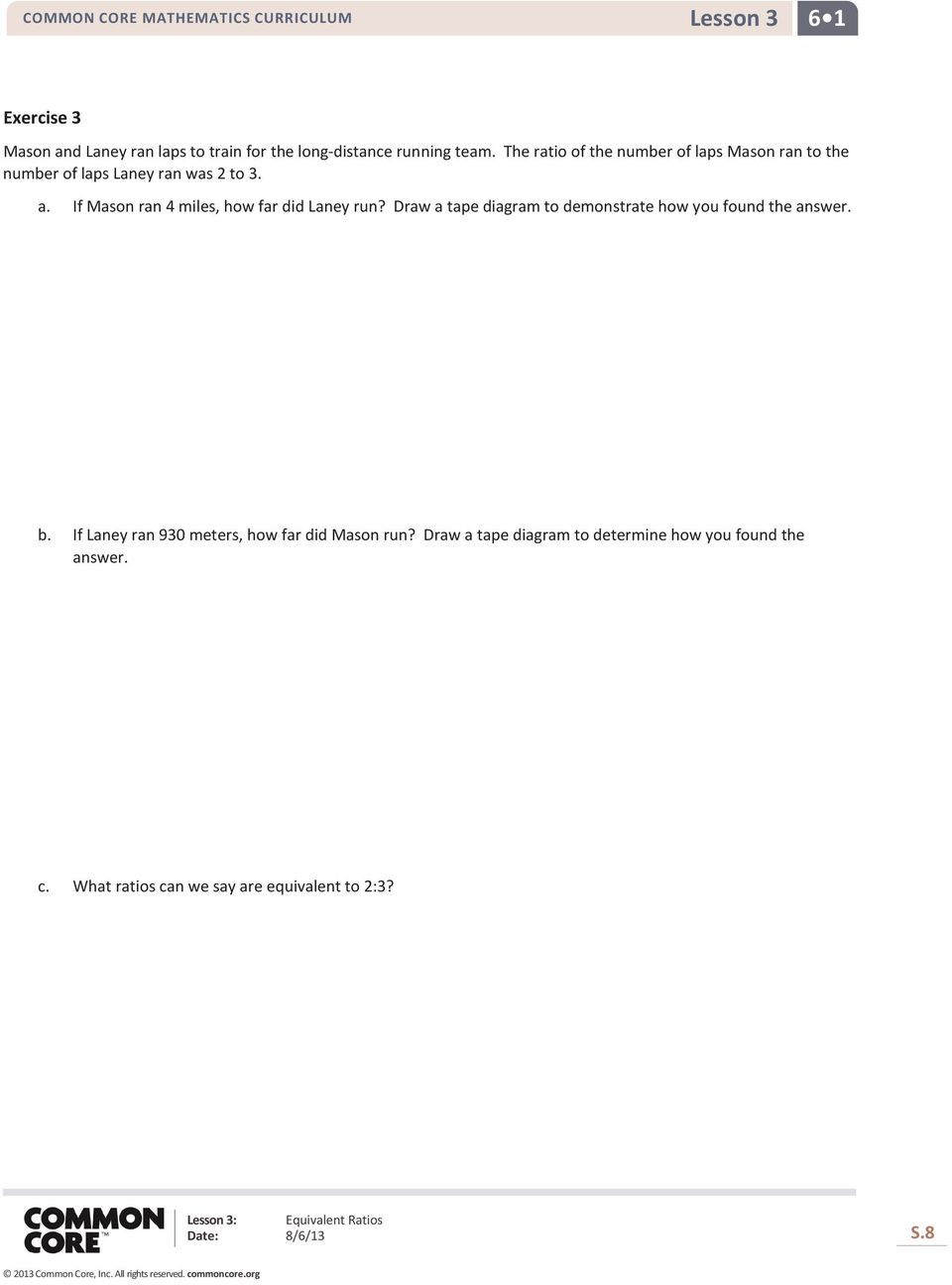
8 Lesson 3 Exercise 3 Mason and Laney ran laps to train for the long-distance running team. The ratio of the number of laps Mason ran to the number of laps Laney ran was 2 to 3. a. If Mason ran 4 miles, how far did Laney run? Draw a tape diagram to demonstrate how you found the answer. b. If Laney ran 930 meters, how far did Mason run? Draw a tape diagram to determine how you found the answer. c. What ratios can we say are equivalent to 2:3? Lesson 3: Equivalent Ratios Date: 8/6/13 S.8
9 Lesson 3 Exercise 4 Josie took a long multiple-choice, end-of-year vocabulary test. The ratio of the number of problems Josie got incorrect to the number of problems she got correct is 2:9. a. If Josie missed 8 questions, how many did she get right? Draw a tape diagram to demonstrate how you found the answer. b. If Josie missed 20 questions, how many did she get right? Draw a tape diagram to demonstrate how you found the answer. c. What ratios can we say are equivalent to 2:9? Lesson 3: Equivalent Ratios Date: 8/6/13 S.9

10 Lesson 3 d. Come up with another possible ratio of the number Josie got wrong to the number she got right. e. How did you find the numbers? f. Describe how to create equivalent ratios. Lesson 3: Equivalent Ratios Date: 8/6/13 S.10

11 Lesson 3 Lesson Summary Two ratios A: B and C: D are equivalent ratios if there is a positive number, c, such that C = ca and D = cb. Ratios are equivalent if there is a positive number that can be multiplied by both quantities in one ratio to equal the corresponding quantities in the second ratio. Problem Set 1. Write two ratios that are equivalent to 1:1. 2. Write two ratios that are equivalent to 3: a. The ratio of the width of the rectangle to the height of the rectangle is to. b. If each square in the grid has a side length of 8 mm, what is the length and width of the rectangle? 4. For a project in their health class, Jasmine and Brenda recorded the amount of milk they drank every day. Jasmine drank 2 pints of milk each day, and Brenda drank 3 pints of milk each day. a. Write a ratio of number of pints of milk Jasmine drank to number of pints of milk Brenda drank each day. b. Represent this scenario with tape diagrams. c. If one pint of milk is equivalent to 2 cups of milk, how many cups of milk did Jasmine and Brenda each drink? How do you know? d. Write a ratio of number of cups of milk Jasmine drank to number of cups of milk Brenda drank. e. Are the two ratios you determined equivalent? Explain why or why not. Lesson 3: Date: Equivalent Ratios 8/6/13 S.11

12 Lesson 4 Lesson 4: Equivalent Ratios Classwork Example 1 The morning announcements said that two out of every seven 6 th graders in the school have an overdue library book. Jasmine said, That would mean 24 of us have overdue books! Grace argued, No way. That is way too high. How can you determine who is right? Exercise 1 Decide whether or not each of the following pairs of ratios is equivalent. If the ratios are not equivalent, find a ratio that is equivalent to the first ratio. If the ratios are equivalent, identify the positive number, c, that could be used to multiply each number of the first ratio by in order to get the numbers for the second ratio : 11 and 42 : 88 Yes, the value, c, is: No, an equivalent ratio would be: 2. 0 : 5 and 0 : 20 Yes, the value, c, is: No, an equivalent ratio would be: Lesson 4: Equivalent Ratios Date: 8/2/13 S.12

13 Lesson 4 Exercise 2 In a bag of mixed walnuts and cashews, the ratio of number of walnuts to number of cashews is 5:6. Determine the amount of walnuts that are in the bag if there are 54 cashews. Use a tape diagram to support your work. Justify your answer by showing that the new ratio you created of number of walnuts to number of cashews is equivalent to 5:6. Lesson 4: Equivalent Ratios Date: 8/2/13 S.13

14 Lesson 4 Lesson Summary Recall the description: Two ratios A: B and C: D are equivalent ratios if there is a positive number, c, such that C = ca and D = cb. Ratios are equivalent if there is a positive number that can be multiplied by both quantities in one ratio to equal the corresponding quantities in the second ratio. This description can be used to determine whether two ratios are equivalent. Problem Set 1. Use diagrams or the description of equivalent ratios to show that the ratios 2:3, 4:6, and 8:12 are equivalent. 2. Prove that 3:8 is equivalent to 12:32. a. Use diagrams to support your answer. b. Use the description of equivalent ratios to support your answer. 3. The ratio of Isabella s money to Shane s money is 3:11. If Isabella has $33, how much money do Shane and Isabella have together? Use diagrams to illustrate your answer. Lesson 4: Date: Equivalent Ratios 8/2/13 S.14

15 Lesson 5 Lesson 5: Solving Problems by Finding Equivalent Ratios Classwork Example 1 A County Superintendent of Highways is interested in the numbers of different types of vehicles that regularly travel within his county. In the month of August, a total of 192 registrations were purchased for passenger cars and pickup trucks at the local Department of Motor Vehicles (DMV). The DMV reported that in the month of August, for every 5 passenger cars registered, there were 7 pickup trucks registered. How many of each type of vehicle were registered in the county in the month of August? a. Using the information in the problem, write four ratios and describe the meaning of each. b. Make a tape-diagram that represents the quantities in the ratios that you wrote. c. How many equal-sized parts does the tape diagram consist of? d. What total quantity does the tape diagram represent? Lesson 5: Solving Problems by Finding Equivalent Ratios Date: 8/6/13 S.15

16 Lesson 5 e. What value does each individual part of the tape diagram represent? f. How many of each type of vehicle were registered in August? Example 2 The Superintendent of Highways is further interested in the numbers of commercial vehicles that frequently use the county s highways. He obtains information from the Department of Motor Vehicles for the month of September and finds that for every 14 non-commercial vehicles, there were 5 commercial vehicles. If there were 108 more noncommercial vehicles than commercial vehicles, how many of each type of vehicle frequently use the county s highways during the month of September? Lesson 5: Solving Problems by Finding Equivalent Ratios Date: 8/6/13 S.16

17 Lesson 5 Exercises 1. The ratio of the number of people who own a smartphone to the number of people who own a flip phone is 4:3. If 500 more people own a smartphone than a flip phone, how many people own each type of phone? 2. Sammy and David were selling water bottles to raise money for new football uniforms. Sammy sold 5 water bottles for every 3 water bottles David sold. Together they sold 160 water bottles. How many did each boy sell? Lesson 5: Solving Problems by Finding Equivalent Ratios Date: 8/6/13 S.17

18 Lesson 5 3. Ms. Johnson and Ms. Siple were folding report cards to send home to parents. The ratio of the number of report cards Ms. Johnson folded to the number of report cards Ms. Siple folded is 2:3. At the end of the day, Ms. Johnson and Ms. Siple folded a total of 300 report cards. How many did each person fold? 4. At a country concert, the ratio of the number of boys to the number of girls is 2:7. If there are 250 more girls than boys, how many boys are at the concert? Lesson 5: Solving Problems by Finding Equivalent Ratios Date: 8/6/13 S.18

19 Lesson 5 Problem Set 1. Last summer, at Camp Okey-Fun-Okey, the ratio of the number of boy campers to the number of girl campers was 8:7. If there were a total of 195 campers, how many boy campers were there? How many girl campers? 2. The student to faculty ratio at a small college is 17:3. The total of students and faculty is 740. How many faculty members are there at the college? How many students? 3. The Speedy Fast Ski Resort has started to keep track of the number of skiers and snowboarders who bought season passes. The ratio of the number of skiers who bought season passes to the number of snowboarders who bought season passes is 1:2. If 1250 more snowboarders bought season passes than skiers, how many snowboarders and how many skiers bought season passes? 4. The ratio of the number of adults to the number of students at the prom has to be 1:10. Last year there were 477 more students than adults at the prom. If the school is expecting the same attendance this year, how many adults have to attend the prom? Lesson 5: Solving Problems by Finding Equivalent Ratios Date: 8/6/13 S.19

20 Lesson 6 Lesson 6: Solving Problems by Finding Equivalent Ratios Classwork Exercise 1 1. The Business Direct Hotel caters to people who travel for different types of business trips. On Saturday night there is not a lot of business travel, so the ratio of the number of occupied rooms to the number of unoccupied rooms is 2:5. However, on Sunday night the ratio of the number of occupied rooms to the number of unoccupied rooms is 6:1 due to the number of business people attending a large conference in the area. If the Business Direct Hotel has 432 occupied rooms on Sunday night, how many unoccupied rooms does it have on Saturday night? Exercises Peter is trying to work out by completing sit-ups and push-ups in order to gain muscle mass. Originally, Peter was completing five sit-ups for every three push-ups, but then he injured his shoulder. After the injury, Peter completed the same amount of exercises as he did before his injury, but completed seven sit-ups for every one push-up. During a training session after his injury, Peter completed eight push-ups. How many push-ups was Peter completing before his injury? Lesson 6: Solving Problems by Finding Equivalent Ratios Date: 8/6/13 S.20

21 Lesson 6 3. Tom and Rob are brothers who like to make bets about the outcomes of different contests between them. Before the last bet, the ratio of the amount of Tom s money to the amount of Rob s money was 4:7. Rob lost the latest competition, and now the ratio of the amount of Tom s money to the amount of Rob s money is 8:3. If Rob had $280 before the last competition, how much does Rob have now that he lost the bet? 4. A sporting goods store ordered new bikes and scooters. For every 3 bikes ordered, 4 scooters were ordered. However, bikes were way more popular than scooters, so the store changed its next order. The new ratio of the number of bikes ordered to the number of scooters ordered was 5:2. If the same amount of sporting equipment was ordered in both orders and 64 scooters were ordered originally, how many bikes were ordered as part of the new order? 5. At the beginning of 6th grade, the ratio of the number of advanced math students to the number of regular math students was 3:8. However, after taking placement tests, students were moved around changing the ratio of the number of advanced math students to the number of regular math students to 4:7. How many students started in regular math and advanced math if there were 92 students in advanced math after the placement tests? Lesson 6: Solving Problems by Finding Equivalent Ratios Date: 8/6/13 S.21
22 Lesson 6 6. During first semester, the ratio of the number of students in art class to the number of students in gym class was 2:7. However, the art classes were really small, and the gym classes were large, so the principal changed students classes for second semester. In second semester, the ratio of the number of students in art class to the number of students in gym class was 5:4. If 75 students were in art class second semester, how many were in art class and gym class first semester? 7. Jeanette wants to save money, but she has not been good at it in the past. The ratio of the amount of money in Jeanette s savings account to the amount of money in her checking account was 1:6. Because Jeanette is trying to get better at saving money, she moves some money out of her checking account and into her savings account. Now, the ratio of the amount of money in her savings account to the amount of money in her checking account is 4:3. If Jeanette had $936 in her checking account before moving money, how much money does Jeanette have in each account after moving money? Lesson 6: Solving Problems by Finding Equivalent Ratios Date: 8/6/13 S.22
23 Lesson 6 Lesson Summary When solving problems in which a ratio between two quantities changes, it is helpful to draw a before tape diagram and an after tape diagram. Problem Set 1. Shelley compared the number of oak trees to the number of maple trees as part of a study about hardwood trees in a woodlot. She counted 9 maple trees to every 5 oak trees. Later in the year there was a bug problem and many trees died. New trees were planted to make sure there were the same number of trees as before the bug problem. The new ratio of the number of maple trees to the number of oak trees is 3:11. After planting new trees, there were 132 oak trees. How many more maple trees were in the woodlot before the bug problem than after the bug problem? Explain. 2. The school band is comprised of middle school students and high school students, but it always has the same maximum capacity. Last year the ratio of the number of middle school students to the number of high school students was 1:8. However, this year the ratio of the number of middle school students to the number of high school students changed to 2:7. If there are 18 middle school students in the band this year, how many fewer high school students are in the band this year compared to last year? Explain. Lesson 6: Solving Problems by Finding Equivalent Ratios Date: 8/6/13 S.23
24 Lesson 7 Lesson 7: Associated Ratios and the Value of a Ratio Classwork Example 1 Which of the following correctly models that the number of red gumballs is 5 the number of white gumballs? 3 a. Red White b. Red White c. Red White d. Red White Example 2 The duration of two films are modeled below. Film A Film B a. The ratio of the length of Film A to the length of Film B is :. b. The length of Film A is of the length of Film B. c. The length of Film B is of the length of Film A. Lesson 7: Date: Associated Ratios and the Value of a Ratio 8/6/13 S.24
25 Lesson 7 Exercise 1 Sammy and Kaden went fishing using live shrimp as bait. Sammy brought 8 more shrimp than Kaden brought. When they combined their shrimp they had 32 shrimp altogether. a. How many shrimp did each boy bring? b. What is the ratio of the number of shrimp Sammy brought to the number of shrimp Kaden brought? c. Express the number of shrimp Sammy brought as a fraction of the number of shrimp Kaden brought. d. What is the ratio of the number of shrimp Sammy brought to the total number of shrimp? e. What fraction of the total shrimp did Sammy bring? Lesson 7: Associated Ratios and the Value of a Ratio Date: 8/6/13 S.25
26 Lesson 7 Exercise 2 A food company that produces peanut butter decides to try out a new version of its peanut butter that is extra crunchy, using twice the number of peanut chunks as normal. The company hosts a sampling of its new product at grocery stores and finds that 5 out of every 9 customers prefer the new extra crunchy version. a. Let s make a list of ratios that might be relevant for this situation. i. The ratio of number preferring new extra crunchy to total number surveyed is. ii. The ratio of number preferring regular crunchy to the total number surveyed is. iii. The ratio of number preferring regular crunchy to number preferring new extra crunchy is. iv. The ratio of number preferring new extra crunchy to number preferring regular crunchy is. b. Let s use the value of each ratio to make multiplicative comparisons for each of the ratios we described here. i. The number preferring new extra crunchy is of the total number surveyed. ii. The number preferring regular crunchy is of the total number surveyed. iii. The number preferring regular crunchy is of those preferring new extra crunchy. iv. The number preferring new extra crunchy is of those preferring regular crunchy. c. If the company normally sells a total of 90,000 containers of regular crunchy peanut butter, how many containers of new extra crunchy peanut butter should it produce, and how many containers of regular crunchy peanut butter should it produce? What would be helpful in solving this problem? Does one of our comparison statements above help us? Lesson 7: Date: Associated Ratios and the Value of a Ratio 8/6/13 S.26
27 Lesson 7 Try these next scenarios: d. If the company decides to produce 2,000 containers of regular crunchy peanut butter, how many containers of new extra crunchy peanut butter would it produce? e. If the company decides to produce 10,000 containers of new extra crunchy peanut butter, how many containers of regular crunchy peanut butter would it produce? f. If the company decides to only produce 3,000 containers of new extra crunchy peanut butter, how many containers of regular crunchy peanut butter would it produce? Lesson 7: Associated Ratios and the Value of a Ratio Date: 8/6/13 S.27
28 Lesson 7 Lesson Summary For a ratio A: B, we are often interested in the associated ratio B: A. Further, if A and B can both be measured in the same unit, we are often interested in the associated ratios A: (A + B) and B: (A + B). For example, if Tom caught 3 fish and Kyle caught 5 fish, we can say: The ratio of the number of fish Tom caught to the number of fish Kyle caught is 3: 5. The ratio of the number of fish Kyle caught to the number of fish Tom caught is 5: 3. The ratio of the number of fish Tom caught to the total number of fish the two boys caught is 3: 8. The ratio of the number of fish Kyle caught to the total number of fish the two boys caught is 5: 8. For the ratio A: B, where B 0, the value of the ratio is the quotient A B. For example: For the ratio 6: 8, the value of the ratio is 6 8 or 3 4. Problem Set 1. Maritza is baking cookies to bring to school and share with her friends on her birthday. The recipe requires 3 eggs for every 2 cups of sugar. To have enough cookies for all of her friends, Maritza determined she would need 12 eggs. If her mom bought 6 cups of sugar, does Maritza have enough sugar to make the cookies? Why or why not? 2. Hamza bought 8 gallons of brown paint in order to paint his kitchen and dining room. Unfortunately, when Hamza started painting, he thought the paint was too dark for his house, so he wanted to make it lighter. The store manager would not let Hamza return the paint but did inform him that if he used 1 of a gallon of white paint mixed 4 with 2 gallons of brown paint, he would get the shade of brown he desired. If Hamza decided to take this approach, how many gallons of white paint would Hamza have to buy to fix his problem? Lesson 7: Associated Ratios and the Value of a Ratio Date: 8/6/13 S.28
29 Lesson 8 Lesson 8: Equivalent Ratios Defined Through the Value of a Ratio Classwork Exercise 1 Circle any equivalent ratios from the list below. Ratio: 1:2 Ratio: 5:10 Ratio: 6:16 Ratio: 12:32 Find the value of the following ratios, leaving your answer as a fraction, but re-write the fraction using the largest possible unit. Ratio: 1:2 Value of the Ratio: Ratio: 5:10 Value of the Ratio: Ratio: 6:16 Value of the Ratio: Ratio: 12:32 Value of the Ratio: What do you notice about the value of the equivalent ratios? Exercise 2 Here is a theorem: If two ratios are equivalent, then they have the same value. Can you provide any counter-examples to the theorem above? Lesson 8: Equivalent Ratios Defined Through the Value of a Ratio Date: 8/6/13 S.29
30 Lesson 8 Exercise 3 Taivon is training for a duathlon, which is a race that consists of running and cycling. The cycling leg is longer than the running leg of the race, so while Taivon trains, he rides his bike more than he runs. During training, Taivon runs 4 miles for every 14 miles he rides his bike. a. Identify the ratio associated with this problem and find its value. Use the value of each ratio to solve the following. b. When Taivon completed all of his training for the duathlon, the ratio of total number of miles he ran to total number of miles he cycled was 80:280. Is this possible according to Taivon s training schedule? Explain why or why not. c. In one training session Taivon ran 4 miles and cycled 7 miles. Did this training session represent an equivalent ratio of the distance he ran to the distance he cycled? Explain why or why not. Lesson 8: Equivalent Ratios Defined Through the Value of a Ratio Date: 8/6/13 S.30
31 Lesson 8 Lesson Summary The value of the ratio A: B is the quotient A B. If two ratios are equivalent, they have the same value. Problem Set 1. The ratio of the number of shaded sections to the number of unshaded sections is 4 to 2. What is the value of the ratio of the number of shaded pieces to the number of unshaded pieces? 2. Use the value of the ratio to determine which ratio(s) is equivalent to 7:15. a. 21:45 b. 14:45 c. 3:5 d. 63: Sean was at batting practice. He swung 25 times but only hit the ball 15 times. a. Describe and write more than one ratio related to this situation. b. For each ratio you created, use the value of the ratio to express one quantity as a fraction of the other quantity. c. Make up a word problem that a student can solve using one of the ratios and its value. 4. Your middle school has 900 students. 1 of the students bring their lunch instead of buying lunch at school. What is 3 the value of the ratio of the number of students who do bring their lunch to the number of students who do not? Lesson 8: Equivalent Ratios Defined Through the Value of a Ratio Date: 8/6/13 S.31
32 Lesson 9 Lesson 9: Tables of Equivalent Ratios Classwork Example 1 To make Paper Mache, the art teacher mixes water and flour. For every two cups of water, she needs to mix in three cups of flour to make the paste. Find equivalent ratios for the ratio relationship 2 cups of water to 3 cups of flour. Represent the equivalent ratios in the table below: Cups of Water Cups of Flour Lesson 9: Tables of Equivalent Ratios Date: 8/6/13 S.32
33 Lesson 9 Example 2 Javier has a new job designing websites. He is paid at a rate of $700 for every 3 pages of web content that he builds. Create a ratio table to show the total amount of money Javier has earned in ratio to the number of pages he has built. Total Pages Built Total Money Earned Javier is saving up to purchase a used car that costs $4,300. How many web pages will Javier need to build before he can pay for the car? Lesson 9: Tables of Equivalent Ratios Date: 8/6/13 S.33
34 Lesson 9 Exercise 1 Spraying plants with cornmeal juice is a natural way to prevent fungal growth on the plants. It is made by soaking cornmeal in water, using two cups of cornmeal for every nine gallons of water. Complete the ratio table to answer the questions that follow. Cups of Cornmeal Gallons of Water a. How many cups of cornmeal should be added to 45 gallons of water? b. Paul has only 8 cups of cornmeal. How many gallons of water should he add if he wants to make as much cornmeal juice as he can? c. What can you say about the values of the ratios in the table? Lesson 9: Tables of Equivalent Ratios Date: 8/6/13 S.34
35 Lesson 9 Exercise 2 James is setting up a fish tank. He is buying a breed of goldfish that typically grows to be 12 inches long. It is recommended that there be 1 gallon of water for every inch of fish length in the tank. What is the recommended ratio of gallons of water per fully-grown goldfish in the tank? Complete the ratio table to help answer the following questions: Number of Fish Gallons of Water a. What size tank (in gallons) is needed for James to have 5 full-grown goldfish? b. How many fully-grown goldfish can go in a 40-gallon tank? c. What can you say about the values of the ratios in the table? Lesson 9: Tables of Equivalent Ratios Date: 8/6/13 S.35
36 Lesson 9 Lesson Summary A ratio table is a table of pairs of numbers that form equivalent ratios. Problem Set Assume each of the following represents a table of equivalent ratios. Fill in the missing values. Then choose one of the tables and create a real-world context for the ratios shown in the table Lesson 9: Tables of Equivalent Ratios Date: 8/6/13 S.36
37 Lesson 10 Lesson 10: The Structure of Ratio Tables: Additive and Multiplicative Classwork Exploratory Challenge Imagine that you are making a fruit salad. For every quart of blueberries you add, you would like to put in 3 quarts of strawberries. Create 3 ratio tables that show the amounts of blueberries and strawberries you would use if you needed to make fruit salad for greater numbers of people. Table 1 should contain amounts where you have added fewer than 10 quarts of blueberries to the salad. Table 2 should contain amounts of blueberries between 10 and 50 quarts. Table 3 should contain amounts of blueberries greater than 100 quarts. Quarts of Blueberries Table 1 Quarts of Strawberries Quarts of Blueberries Table 2 Quarts of Strawberries Quarts of Blueberries Table 3 Quarts of Strawberries Lesson 10: The Structure of Ratio Tables Additive and Multiplicative Date: 8/6/13 S.37
38 Lesson 10 a. Describe any patterns you see in the tables. Be specific in your descriptions. b. How are the amounts of blueberries and strawberries related to each other? c. How are the values in the blueberries column related to each other? d. How are the values in the strawberries column related to each other? Lesson 10: The Structure of Ratio Tables Additive and Multiplicative Date: 8/6/13 S.38
39 Lesson 10 e. If we know we want to add 7 quarts of blueberries to the fruit salad in Table 1, how can we use the table to help us determine how many strawberries to add? f. If we know we used 70 quarts of blueberries to make our salad, how can we use a ratio table to find out how many quarts of strawberries were used? Lesson 10: The Structure of Ratio Tables Additive and Multiplicative Date: 8/6/13 S.39
40 Lesson 10 Exercise 1 The following tables were made incorrectly. Find the mistake that was made, create the correct ratio table, and state the ratio that was used to make the correct ratio table. a. Hours Pay in dollars Hours Pay in dollars Ratio b. Blue Yellow Blue Yellow Ratio Lesson 10: Date: The Structure of Ratio Tables Additive and Multiplicative 8/6/13 S.40
41 Lesson 10 Lesson Summary Ratio tables are constructed in a special way. Each pair of values in the table will be equivalent to the same ratio. You can use repeated addition or multiplication to create a ratio table. There is a constant value that we can multiply the values in the first column by to get the values in the second column. red white 3 x x x x4 84 If you add a certain number to each entry in one column, you may not be able to add that same number to the entries in the other column and keep the same ratio. Instead, the numbers you add to the entries must be related to the ratio used to make the table. However, if you multiply the entries in one column by a certain number, you can multiply the entries in the other column by the same number, and the ratio remains. Lesson 10: The Structure of Ratio Tables Additive and Multiplicative Date: 8/6/13 S.41
42 Lesson 10 Problem Set 1. a. Create a ratio table for making lemonade with a lemon juice-to-water ratio of 1:3. Show how much lemon juice would be needed if you use 36 cups of water to make lemonade. b. How is the value of the ratio used to create the table? 2. Ryan made a table to show how much blue and red he mixed to get the shade of purple he will use to paint the room. He wants to use the table to help him make larger and smaller batches of purple paint. blue red a. What ratio was used to create this table? Support your answer. b. How are the values in each row related to each other? c. How are the values in each column related to each other? Lesson 10: The Structure of Ratio Tables Additive and Multiplicative Date: 8/6/13 S.42
43 Lesson 11 Lesson 11: Comparing Ratios Using Ratio Tables Classwork Example 1 Create four equivalent ratios (2 by scaling up and 2 by scaling down) using the ratio 30 to 80. Write a ratio to describe the relationship shown in the table. Hours Number of Pizzas Sold Exercise 1 The following tables show how many words each person can text in a given amount of time. Compare the rates of texting for each person using the ratio table. Michaela Minutes Words Jenna Minutes Words Maria Minutes Words Lesson 11: Comparing Ratios Using Ratio Tables Date: 8/6/13 S.43
44 Lesson 11 Complete the table so that it shows Max has a texting rate of 55 words per minute. Max Minutes Words Exercise 2: Making Juice (Comparing Juice to Water) a. The tables below show the comparison of the amount of water to the amount of juice concentrate (JC) in grape juice made by three different people. Whose juice has the greatest water-to-juice concentrate ratio, and whose juice would taste strongest? Be sure to justify your answer. Laredo s Juice Franca s Juice Milton s Juice Water JC Total Water JC Total Water JC Total Put the juices in order from the juice containing the most water to the juice containing the least water. Explain how you used the values in the table to determine the order. What ratio was used to create each table? Laredo Franca Milton Lesson 11: Date: Comparing Ratios Using Ratio Tables 8/6/13 S.44
45 Lesson 11 Explain how the ratio could help you compare the juices. b. The next day, each of the three people made juice again, but this time they were making apple juice. Whose juice has the greatest water-to-juice concentrate ratio, and whose juice would taste the strongest? Be sure to justify your answer. Laredo s Juice Franca s Juice Milton s Juice Water JC Total Water JC Total Water JC Total Put the juices in order from the strongest apple taste to the weakest apple taste. Explain how you used the values in the table to determine the order. What ratio was used to create each table? Laredo Franca Milton Lesson 11: Date: Comparing Ratios Using Ratio Tables 8/6/13 S.45
46 Lesson 11 Explain how the ratio could help you compare the juices. How was this problem different than the grape juice questions? c. Max and Sheila are making orange juice. Max has mixed 15 cups of water with 4 cups of juice concentrate. Sheila has made her juice by mixing 8 cups water with 3 cups of water. Compare the ratios of juice concentrate to water using ratio tables. State which beverage has a higher juice concentrate-to-water ratio. d. Victor is making recipes for smoothies. His first recipe calls for 2 cups of strawberries and 7 cups of other ingredients. His second recipe says that 3 cups of strawberries are combined with 9 cups of other ingredients. Which smoothie recipe has more strawberries compared to other ingredients? Use ratio tables to justify your answer. Lesson 11: Comparing Ratios Using Ratio Tables Date: 8/6/13 S.46
47 Lesson 11 Lesson Summary Ratio tables can be used to compare two ratios. Look for equal amounts in a row or column to compare the second amount associated with it You can also extend the values of the tables in order to get comparable amounts. Another method would be to compare the values of the ratios. Write the values of the ratios as fractions and then use your knowledge of fractions to compare the ratios. When ratios are given in words, students can create a table of equivalent ratios in order to compare the ratios. 12:35 compared to 8:20 Quantity Quantity Quantity Quantity Problem Set 1. Sarah and Eva were swimming. Use the ratio tables below to determine who the faster swimmer is. Sarah Time (min) Distance (meters) Eva Time (min) Distance (meters) Explain the method that you used to determine your answer. 2. A 120 lb. person would weigh about 20 lb. on the moon. A 150 lb. person would weigh 28 lb. on Io, a moon of Jupiter. Use ratio tables to determine which moon would make a person weigh the most. Lesson 11: Comparing Ratios Using Ratio Tables Date: 8/6/13 S.47
48 Lesson 12 Lesson 12: From Ratio Tables to Double Number Line Diagrams Classwork Exercise 2 The amount of sugary beverages Americans consume is a leading health concern. For a given brand of cola, a 12-ounce serving of cola contains about 40 grams of sugar. Complete the ratio table, using the given ratio to find equivalent ratios. Cola (ounces) 12 Sugar (grams) 40 Exercise 3 A 1-liter bottle of cola contains approximately 34 fluid ounces. How many grams of sugar would be in a 1-liter bottle of the cola? Explain and show how to arrive at the solution. Exercise 4 A school cafeteria has a restriction on the amount of sugary drinks available to students. Drinks may not have more than 25 grams of sugar. Based on this restriction, what is the largest size cola (in ounces) the cafeteria can offer to students? Lesson 12: From Ratio Tables to Double Number Line Diagrams Date: 8/6/13 S Common Core, Inc. ALL rights reserved. commoncore.org
49 Lesson 12 Exercise 5 Shontelle solves three math problems in four minutes. a. Use this information to complete the table below. Number of Questions Number of Minutes b. Shontelle has soccer practice on Thursday evening. She has a half hour before practice to work on her math homework and to talk to her friends. She has 20 math skill-work questions for homework, and she wants to complete them before talking with her friends. How many minutes will Shontelle have left after completing her math homework to talk to her friends? Use a double number line diagram to support your answer, and show all work. Lesson 12: From Ratio Tables to Double Number Line Diagrams Date: 8/6/13 S Common Core, Inc. ALL rights reserved. commoncore.org
50 Lesson 12 Lesson Summary Double Number Line Diagram: a tool used for understanding the equivalence of two related numbers. It is called double because each mark on the line has two numbers matched to it. The top row of numbers describes the whole represented by the line in one way, and the bottom row describes the whole represented by the line in another way. Because the whole line is the same, it is possible to see the equivalences between the rows of numbers at any point on the line. Problem Set 1. While shopping, Kyla found a dress that she would really like, but it costs $52.25 more than she has. Kyla charges $5.50 an hour for babysitting. She wants to figure out how many hours she must babysit to earn $52.25 to buy the dress. Use a double number line to support your answer. 2. Frank has been driving at a constant speed for 3 hours, during which time he traveled 195 miles. Frank would like to know how long it will take him to complete the remaining 455 miles, assuming he maintains the same constant speed. Help Frank determine how long the remainder of the trip will take. Include a table or diagram to support your answer. Lesson 12: From Ratio Tables to Double Number Line Diagrams Date: 8/6/13 S.50
51 Lesson 13 Lesson 13: From Ratio Tables to Equations Using the Value of a Ratio Classwork Exercise 1 Jorge is mixing a special shade of orange paint. He mixed 1 gallon of red paint with 3 gallons of yellow paint. Based on this ratio, which of the following statements are true? 3 of a 4-gallon mix would be yellow paint. 4 Every 1 gallon of yellow paint requires 1 gallon of red paint. 3 Every 1 gallon of red paint requires 3 gallons of yellow paint. There is 1 gallon of red paint in a 4-gallon mix of orange paint. There are 2 gallons of yellow paint in an 8-gallon mix of orange paint. Use the space below to determine if each statement is true or false. Lesson 13: From Ratio Tables to Equations Using the Value of a Ratio Date: 8/6/13 S.51
52 Lesson 13 Exercise 2 Based on the information on red and yellow paint given in the warm up, complete the table below. Red Paint (R) Yellow Paint (Y) Relationship 3 3 = = Exercise 3 Blue (B) Red (R) Relationship Lesson 13: Date: From Ratio Tables to Equations Using the Value of a Ratio 8/6/13 S.52
53 Lesson 13 a. Using the same relationship of red to blue from above, create a table that models the relationship of the three colors blue, red, and purple (total) paint. Let B represent the number of gallons of blue paint, let R represent the number of gallons of red paint, and let T represent the total number of gallons of (purple) paint. Then write an equation that also models this relationship and answer the questions. Blue (B) Red (R) Total Paint (T) Equation: Value of the ratio of Total Paint to Blue Paint: How is the value of the ratio related to the equation? b. During a particular U.S. Air Force training exercise, the ratio of the number of men to the number of women was 6:1. Use the ratio table provided below to create at least two equations that model the relationship between the number of men and the number of women participating in this training exercise. Women (W) Men (M) Equations: If 200 women participated in the training exercise, use one of your equations to calculate the number of men who participated. Lesson 13: From Ratio Tables to Equations Using the Value of a Ratio Date: 8/6/13 S.53
54 Lesson 13 c. Malia is on a road trip. During the first five minutes of Malia s trip, she sees 18 cars and 6 trucks. Complete the ratio table using this comparison. Let T represent the number of trucks she sees, and let C represent the number of cars she sees. Trucks (T) 1 3 Cars (C) What is the value of the ratio of the number of cars to the number of trucks? What equation would model the relationship between cars and trucks? 60 At the end of the trip, Malia had counted 1,254 trucks. How many cars did she see? d. Kevin is training to run a half-marathon. His training program recommends that he run for 5 minutes and walk for 1 minute. Let R represent the number of minutes running, and let W represent the number of minutes walking. Minutes running (R) Minutes walking (W) What is the value of the ratio of the number of minutes walking to the number of minutes running? What equation could you use to calculate the minutes spent walking if you know the minutes spent running? Lesson 13: From Ratio Tables to Equations Using the Value of a Ratio Date: 8/6/13 S.54
55 Lesson 13 Lesson Summary The value of a ratio can be determined using a ratio table. This value can be used to write an equation that also represents the ratio. Example: The multiplication table can be a valuable resource to use in seeing ratios. Different rows can be used to find equivalent ratios. Problem Set A cookie recipe calls for 1 cup of white sugar and 3 cups of brown sugar. Make a table showing the comparison of the amount of white sugar to the amount of brown sugar. White Sugar (W) Brown Sugar (B) 1. Write the value of the ratio of the amount of white sugar to the amount of brown sugar. 2. Write an equation that shows the relationship of the amount of white sugar to the amount of brown sugar. 3. Explain how the value of the ratio can be seen in the table. 4. Explain how the value of the ratio can be seen in the equation. Lesson 13: Date: From Ratio Tables to Equations Using the Value of a Ratio 8/6/13 S.55
56 Lesson 13 Using the same recipe, compare the amount of white sugar to the amount of total sugars used in the recipe. Make a table showing the comparison of the amount of white sugar to the amount of total sugar. White Sugar (W) Total Sugar (T) 5. Write the value of the ratio of the amount of total sugar to the amount of white sugar. 6. Write an equation that shows the relationship of total sugar to white sugar. Lesson 13: Date: From Ratio Tables to Equations Using the Value of a Ratio 8/6/13 S.56
57 Lesson 14 Lesson 14: From Ratio Tables, Equations, and Double Number Line Diagrams to Plots on the Coordinate Plane Classwork Kelli is traveling by train with her soccer team from Yonkers, NY to Morgantown, WV for a tournament. The distance between Yonkers and Morgantown is 400 miles. The total trip will take 8 hours. The train schedule is provided below: Leaving Yonkers, New York Destination Allentown, PA Carlisle, PA Berkeley Springs, WV Morgantown, WV Distance 100 miles 200 miles 300 miles 400 miles Leaving Morgantown, WV Destination Berkeley Springs, WV Carlisle, PA Allentown, PA Yonkers, NY Distance 100 miles 200 miles 300 miles 400 miles Exercise 1 Create a table to show the time it will take Kelli and her team to travel from Yonkers to each town listed in the schedule assuming that the ratio of the amount of time traveled to the distance traveled is the same for each city. Then, extend the table to include the cumulative time it will take to reach each destination on the ride home. Hours Miles Lesson 14: Date: 2013 Common Core, Inc. All rights reserv ed. commoncore.org S.57
58 Lesson 14 Exercise 2 Create a double number line diagram to show the time it will take Kelli and her team to travel from Yonkers to each town listed in the schedule. Then, extend the double number line diagram to include the cumulative time it will take to reach each destination on the ride home. Represent the ratio of the distance traveled on the round trip to the amount of time taken with an equation. Using the information from the double number line diagram, how many miles would be traveled in one hour? How do you know? Example 1 Dinner service starts once the train is 250 miles away from Yonkers. What is the minimum time the team will have to wait before they can have their meal? Hours Miles Ordered Pairs Lesson 14: Date: 2013 Common Core, Inc. All rights reserv ed. commoncore.org From Ratio Tables, Equations, and Double Number Line Diagrams to Plots on the Coordinate Plane 8/5/13 S.58
59 Lesson 14 Lesson Summary A ratio table, equation, or double number line diagram can be used to create ordered pairs. These ordered pairs can then be graphed on a coordinate plane as a representation of the ratio. Example: Equation: yy = 3xx xx yy Ordered Pairs (xx, yy) (0, 0) (1, 3) (2, 6) (3, 9) Problem Set 1. Complete the table of values to find the following: Find the number of cups of sugar needed if for each pie Karrie makes, she has to use 3 cups of sugar. Pies Cups of sugar Lesson 14: Date: 2013 Common Core, Inc. All rights reserv ed. commoncore.org From Ratio Tables, Equations, and Double Number Line Diagrams to Plots on the Coordinate Plane 8/5/13 S.59
60 Lesson 14 Use a graph to represent the relationship: Create a double number line diagram to show the relationship: Lesson 14: Date: 2013 Common Core, Inc. All rights reserv ed. commoncore.org From Ratio Tables, Equations, and Double Number Line Diagrams to Plots on the Coordinate Plane 8/5/13 S.60
61 Lesson Write a story context that would be represented by the ratio 1:4. Complete a table of values for this equation and graph. Lesson 14: Date: 2013 Common Core, Inc. All rights reserv ed. commoncore.org From Ratio Tables, Equations, and Double Number Line Diagrams to Plots on the Coordinate Plane 8/5/13 S.61
62 Lesson 15 Lesson 15: A Synthesis of Representations of Equivalent Ratio Collections Classwork Exploratory Challenge At the end of this morning s news segment, the local television station highlighted area pets that need to be adopted. The station posted a specific website on the screen for viewers to find more information on the pets shown and the adoption process. The station producer checked the website two hours after the end of the broadcast and saw that the website had 24 views. One hour after that, the website had 36 views. Exercise 1 Create a table to determine how many views the website probably had one hour after the end of the broadcast based on how many views it had two and three hours after the end of the broadcast. Using this relationship, predict how many views the website will have 4, 5, and 6 hours after the end of the broadcast. Exercise 2 What is the constant number, c, that makes these ratios equivalent? Using an equation, represent the relationship between the number of views (v) the website received and the number of hours (h) after this morning's news broadcast. Lesson 15: A Synthesis of Representations of Equivalent Ratio Collections Date: 8/5/13 S.62
63 Lesson 15 Exercise 3 Use the table created in Exercise 1 to identify sets of ordered pairs that can be graphed. Exercise 4 Use the ordered pairs you created to depict the relationship between hours and number of views on a coordinate plane. Label your axes and create a title for the graph. Do the points you plotted lie on a line? If so, draw the line through the points. Lesson 15: A Synthesis of Representations of Equivalent Ratio Collections Date: 8/5/13 S Common Core, Inc. Some rights reserved. commoncore.org
64 Lesson 15 Exercise 5 Predict how many views the website will have after twelve hours. Use at least two representations (e.g., tape diagram, table, double number line diagram) to justify your answer. Lesson 15: A Synthesis of Representations of Equivalent Ratio Collections Date: 8/5/13 S.64
65 Lesson 15 Exercise 6 Also on the news broadcast, a chef from a local Italian restaurant demonstrated how he makes fresh pasta daily for his restaurant. The recipe for his pasta is below: 3 eggs, beaten 1 teaspoon salt 2 cups all-purpose flour 2 tablespoons water 2 tablespoons vegetable oil Determine the ratio of tablespoons of water to number of eggs. Provided the information in the table below, complete the table to determine ordered pairs. Use the ordered pairs to graph the relationship of the number of tablespoons of water to the number of eggs. Tablespoons of Water 2 Number of Eggs What would you have to do to the graph in order to find how many eggs would be needed if the recipe was larger and called for 16 tablespoons of water? Demonstrate on your graph. How many eggs would be needed if the recipe called for 16 tablespoons of water? Lesson 15: A Synthesis of Representations of Equivalent Ratio Collections Date: 8/5/13 S.65
66 Lesson 15 Exercise 7 Determine how many tablespoons of water will be needed if the chef is making a large batch of pasta and the recipe increases to 36 eggs. Support your reasoning using at least one diagram you find applies best to the situation, and explain why that tool is the best to use. Lesson 15: A Synthesis of Representations of Equivalent Ratio Collections Date: 8/5/13 S.66
67 Lesson 15 Lesson Summary There are several ways that we can represent the same collection of equivalent ratios. These include ratio tables, tape diagrams, double number line diagrams, equations, and graphs on coordinate planes. Problem Set 1. The producer of the news station posted an article about the high school s football championship ceremony on a new website. The website had 500 views after four hours. Create a table to show how many views the website would have had after the first, second, and third hours after posting, if the website receives views at the same rate. How many views would the website receive after 5 hours? 2. Write an equation that represents the relationship from question 1. Do you see any connections between the equations you wrote and the ratio of the number of views to the number of hours? 3. Use the table in question 1 to make a list of ordered pairs that you could plot on a coordinate plane. 4. Graph the ordered pairs on a coordinate plane. Label your axes and create a title for the graph. Connect the ordered pairs. 5. Use multiple tools to predict how many views the website would have after 12 hours. Lesson 15: Date: A Synthesis of Representations of Equivalent Ratio Collections 8/5/13 S.67
68 Lesson 16 Lesson 16: From Ratios to Rates Ratios can be transformed to rates and unit rates. Classwork Example 1: Introduction to Rates and Unit Rates Diet cola was on sale last week; it cost $10 for every 4 packs of diet cola. a. How much do 2 packs of diet cola cost? b. How much does 1 pack of diet cola cost? Exploratory Challenge 1. Teagan went to Gamer Realm to buy new video games. Gamer Realm was having a sale: $65 for 4 video games. He bought 3 games for himself and one game for his friend, Diego, but Teagan does not know how much Diego owes him for the one game. What is the unit price of the video games? What is the rate unit? Lesson 16: From Ratios to Rates Date: 8/6/13 S.68
69 Lesson Four football fans took turns driving the distance from New York to Oklahoma to see a big game. Each driver set the cruise control during his leg of the trip, enabling him to travel at a constant speed. The men changed drivers each time they stopped for gas and recorded their driving times and distances in the table below. Fan Distance (miles) Time (hours) Andre Matteo Janaye Greyson Use the given data to answer the following questions. a. What two quantities are being compared? b. What is the ratio of the two quantities for Andre s car? What is the associated rate? Andre s Ratio: Andre s Rate: c. Answer the same two questions in part (b) for the other three drivers. Matteo s Ratio: Matteo s Rate: Janaye s Ratio: Janaye s Rate: Greyson s Ratio: Greyson s Rate: d. For each driver, circle the unit rate and put a box around the rate unit. Lesson 16: From Ratios to Rates Date: 8/6/13 S.69
70 Lesson A publishing company is looking for new employees to type novels that will soon be published. The publishing company wants to find someone who can type at least 45 words per minute. Dominique discovered she can type at a constant rate of 704 words in 16 minutes. Does Dominique type at a fast enough rate to qualify for the job? Explain why or why not. Lesson 16: From Ratios to Rates Date: 8/6/13 S.70
71 Lesson 16 Lesson Summary A ratio of two quantities, such as 5 miles per 2 hours, can be written as another quantity called a rate. The numerical part of the rate is called the unit rate and is simply the value of the ratio, in this case 2.5. This means that in 1 hour, the car travels 2.5 miles. The unit for the rate is miles/hour, read miles per hour. Problem Set The Scott family is trying to save as much money as possible. One way to cut back on the money they spend is by finding deals while grocery shopping; however, the Scott family needs help determining which stores have the better deals. 1. At Grocery Mart, strawberries cost $2.99 for 2lbs., and at Baldwin Hills Market strawberries are $3.99 for 3 lbs. a. What is the unit price of strawberries at each grocery store? If necessary, round to the nearest penny. b. If the Scott family wanted to save money, where should they go to buy strawberries? Why? 2. Potatoes are on sale at both Grocery Mart and Baldwin Hills Market. At Grocery Mart, a 5 lb. bag of potatoes cost $2.85, and at Baldwin Hills Market a 7 lb. bag of potatoes costs $4.20. Which store offers the best deal on potatoes? How do you know? How much better is the deal? Lesson 16: From Ratios to Rates Date: 8/6/13 S.71
72 Lesson 17 Lesson 17: From Rates to Ratios Given a rate, you can calculate the unit rate and associated ratios. Recognize that all ratios associated to a given rate are equivalent because they have the same value. Classwork Example 1 Write each ratio as a rate. a. The ratio of miles to hours is 434 to 7. b. The ratio of laps to minutes is 5 to 4. Example 2 a. Complete the model below using the ratio from Example 1, part (b). Ratio Unit Rate Rate laps/minute Lesson 17: From Rates to Ratios Date: 8/5/13 S.72
73 Lesson 17 b. Complete the model below now using the rate listed below. Ratio Unit Rate Rate 6 ft/sec Examples Dave can clean pools at a constant rate of 3 5 pools/hour. a. What is the ratio of pools to hours? b. How many pools can Dave clean in 10 hours? c. How long does it take Dave to clean 15 pools? Lesson 17: From Rates to Ratios Date: 8/5/13 S.73
74 Lesson Emeline can type at a constant rate of 1 4 pages/minute. a. What is the ratio of pages to minutes? b. Emeline has to type a 5-page article but only has 18 minutes until she reaches the deadline. Does Emeline have enough time to type the article? Why or why not? c. Emeline has to type a 7-page article. How much time will it take her? 5. Xavier can swim at a constant speed of 5 3 meters/second. a. What is the ratio of meters to seconds? b. Xavier is trying to qualify for the National Swim Meet. To qualify, he must complete a 100 meter race in 55 seconds. Will Xavier be able to qualify? Why or why not? c. Xavier is also attempting to qualify for the same meet in the 200 meter event. To qualify, Xavier would have to complete the race in 130 seconds. Will Xavier be able to qualify in this race? Why or why not? Lesson 17: From Rates to Ratios Date: 8/5/13 S.74
75 Lesson The corner store sells apples at a rate of 1.25 dollars per apple. a. What is the ratio of dollars to apples? b. Akia is only able to spend $10 on apples. How many apples can she buy? c. Christian has $6 in his wallet and wants to spend it on apples. How many apples can Christian buy? Lesson 17: From Rates to Ratios Date: 8/5/13 S.75
76 Lesson 17 Lesson Summary A rate of 2 3 gal/min corresponds to the unit rate of 2 and also corresponds to the ratio 2: 3. 3 All ratios associated to a given rate are equivalent because they have the same value. Problem Set 1. Once a commercial plane reaches the desired altitude, the pilot often travels at a cruising speed. On average, the cruising speed is 570 miles/hour. If a plane travels at a cruising speed for 7 hours, how far does the plane travel while cruising at this speed? 2. Denver, Colorado often experiences snowstorms resulting in multiple inches of accumulated snow. During the last snow storm, the snow accumulated at 4 inch/hour. If the snow continues at this rate for 10 hours, how much snow 5 will accumulate? Lesson 17: From Rates to Ratios Date: 8/5/13 S.76
77 Lesson 18 Lesson 18: Finding a Rate by Dividing Two Quantities Classwork Mathematical Modeling Exercises 1. At Fun Burger, the Burger Master can make hamburgers at a rate of 4 burgers/minute. In order to address the heavy volume of customers, he needs to continue at this rate for 30 minutes. If he continues to make hamburgers at this pace, how many hamburgers will the Burger Master make in 30 minutes? 2. Chandra is an editor at the New York Gazette. Her job is to read over each article before it is printed in the newspaper. If Chandra can read 10 words/second, how many words can she read in 60 seconds? Lesson 18: Finding a Rate by Dividing Two Quantities Date: 8/5/13 S.77
78 Lesson 18 Exercises Use the table below to write down your work and answers for the stations Lesson 18: Finding a Rate by Dividing Two Quantities Date: 8/5/13 S.78
79 Lesson 18 Lesson Summary We can convert measurement units using rates. The information can be used to further interpret the problem. Here is an example: 5 gal 5 gal (10 min) = 10 min min 1 min = 50 gal. Problem Set 1. Enguun earns $17 per hour tutoring student-athletes at Brooklyn University. a. If Enguun tutored for 12 hours this month, how much money did she earn this month? b. If Enguun tutored for 19.5 hours last month, how much did she earn last month? 2. The Piney Creek Swim Club is preparing for the opening day of the summer season. The pool holds 22,410 gallons of water, and water is being pumped in at 540 gallons per hour. The swim club has their first practice in 42 hours; will the pool be full in time? Explain your answer. Lesson 18: Finding a Rate by Dividing Two Quantities Date: 8/5/13 S.79
80 Lesson 19 Lesson 19: Comparison Shopping Unit Price and Related Measurement Conversions Analyze tables, graphs, and equations in order to compare rates. Classwork Example 1: Creating Tables from Equations 1. The ratio of cups of blue paint to cups of red paint is 1: 2, which means for every cup of blue paint, there are two cups of red paint. In this case, the equation would be red = 2 blue or r = 2b, where b represents the amount of blue paint and r represents the amount of red paint. Make a table of values. 2. Ms. Siple is a librarian who really enjoys reading. She can read 3 of a book in one day. This relationship can be 4 represented by the equation days = 3 4 books, which can be written as d = 3 b, where b is the number of books 4 and d is the number of days. Lesson 19: Date: 2013 Common Core, Inc. All rights reserv ed. commoncore.org Comparison Shopping Unit Price and Related Measurement Conversions 8/5/13 S.80
81 Lesson 19 Exercises Bryan and ShaNiece are both training for a bike race and want to compare who rides his or her bike at a faster rate. Both bikers use apps on their phones to record the time and distance of their bike rides. Bryan s app keeps track of his route on a table, and ShaNiece s app presents the information on a graph. The information is shown below. Bryan: ShaNiece: Hours Miles a. At what rate does each biker travel? Explain how you arrived at your answer.. b. ShaNiece wants to win the bike race. Make a new graph to show the speed ShaNiece would have to ride her bike in order to beat Bryan Common Core, Inc. Some rights reserved. commoncore.org Lesson 19: Comparison Shopping Unit Price and Related Measurement Conversions Date: 8/5/13 S.81
82 Lesson Braylen and Tyce both work at a movie store and are paid by the hour. The manager told the boys they both earn the same amount of money per hour, but Braylen and Tyce did not agree. They each kept track of how much money they earned in order to determine if the manager was correct. Their data is shown below. Braylen: m = 10.50h where h is the number of hours worked and m is the amount of money Braylen was paid Tyce: Hours Money a. How much did each person earn in one hour? b. Was the manager correct? Why or why not? Lesson 19: Date: 2013 Common Core, Inc. All rights reserv ed. commoncore.org Comparison Shopping Unit Price and Related Measurement Conversions 8/5/13 S.82
83 Lesson Claire and Kate are entering a cup stacking contest. Both girls have the same strategy: stack the cups at a constant rate so that they do not slow down at the end of the race. While practicing, they keep track of their progress, which is shown below. Claire: Kate: c = 4t where t = time in seconds and c = the number of stacked cups a. At what rate does each girl stack her cups during the practice sessions? b. Kate notices that she is not stacking her cups fast enough. What would Kate s equation look like if she wanted to stack cups faster than Claire? Lesson 19: Date: 2013 Common Core, Inc. All rights reserv ed. commoncore.org Comparison Shopping Unit Price and Related Measurement Conversions 8/5/13 S.83
84 Lesson 19 Lesson Summary When comparing rates and ratios, it is best to find the unit rate. Comparing unit rates can happen across tables, graphs, and equations. Problem Set 1. Victor was having a hard time deciding on which new vehicle he should buy. He decided to make the final decision based on the gas efficiency of each car. A car that is more gas efficient gets more miles per gallon of gas. When he asked the manager at each car dealership for the gas mileage data, he received two different representations, which are shown below. Vehicle 1: Legend Gallons of Gas Miles Vehicle 2: Supreme a. If Victor based his decision only on gas efficiency, which car should he buy? Provide support for your answer. b. After comparing the Legend and the Supreme, Victor saw an advertisement for a third vehicle, the Lunar. The manager said that the Lunar can travel about 289 miles on a tank of gas. If the gas tank can hold 17 gallons of gas, is the Lunar Victor s best option? Why or why not? Lesson 19: Date: 2013 Common Core, Inc. All rights reserv ed. commoncore.org Comparison Shopping Unit Price and Related Measurement Conversions 8/5/13 S.84
85 Lesson 20 Lesson 20: Comparison Shopping Unit Price and Related Measurement Conversions An activity will be completed in order to gain confidence in comparing rates on tables, graphs, and equations. Classwork Example 1: Notes from Exit Ticket Take notes from the discussion in the space provided below. Notes: Exploratory Challenge 1. Mallory is on a budget and wants to determine which cereal is a better buy. A 10-ounce box of cereal costs $2.79 and a 13-ounce box of the same cereal costs $3.99. a. Which box of cereal should Mallory buy? b. What is the difference between the two unit prices? Lesson 20: Date: 2013 Common Core, Inc. All rights reserv ed. commoncore.org Comparison Shopping Unit Price and Related Measurement Conversions 8/6/13 S.85
86 Lesson Vivian wants to buy some watermelon. Kingston s Market has 10-pound watermelons for $3.90, but the Farmer s Market has 12-pound watermelons for $4.44. a. Which Market has the best price for watermelon? b. What is the difference between the two unit prices? 3. Mitch needs to purchase soft drinks for a staff party. He is trying to figure out if it is cheaper to buy the 12-pack of soda or the 20-pack of soda. The 12-pack of soda costs $3.99 and a 20-pack of soda costs $5.48. a. Which pack should Mitch choose? b. What is the difference between the costs of one can of soda between the two packs? 4. Mr. Steiner needs to purchase 60 AA batteries. A nearby store sells a 20-pack of AA batteries for $12.49 and a 12- pack of the same batteries for $7.20. a. Would it be less expensive for Mr. Steiner to purchase the batteries in 20-packs or 12-packs? b. What is the difference between the costs of one battery? Lesson 20: Date: 2013 Common Core, Inc. All rights reserv ed. commoncore.org Comparison Shopping Unit Price and Related Measurement Conversions 8/6/13 S.86
87 Lesson The table below shows the amount of calories Mike burns as he runs. Miles Run Calories Burned ,440 Fill in the missing part of the table. 6. Emilio wants to buy a new motorcycle. He wants to compare the gas efficiency for each motorcycle before he makes a purchase. The dealerships presented the data below. Sports Bike: Gallons Miles ,150 Leisure Bike: Which motorcycle is more gas efficient and by how much? Lesson 20: Date: 2013 Common Core, Inc. All rights reserv ed. commoncore.org Comparison Shopping Unit Price and Related Measurement Conversions 8/6/13 S.87
88 Lesson Milton Middle School is planning to purchase a new copy machine. The principal has narrowed the choice to two models: SuperFast Deluxe and Quick Copies. He plans to purchase the machine that copies at the fastest rate. Use the information below to determine which copier the principal should choose. SuperFast Deluxe: Quick Copies: c = 1.5t where t represents time in seconds and c represents the number of copies 8. Elijah and Sean are participating in a walk-a-thon. Each student wants to calculate how much money he would make from his sponsors at different points of the walk-a-thon. Use the information in the tables below to determine which student would earn more money if they both walked the same distance? How much more money would that student earn per mile? Elijah s Sponsor Plan: Miles Walked Money Earned in Dollars Sean s Sponsor Plan: Miles Walked Money Earned in Dollars Lesson 20: Date: 2013 Common Core, Inc. All rights reserv ed. commoncore.org Comparison Shopping Unit Price and Related Measurement Conversions 8/6/13 S.88
89 Lesson Gerson is going to buy a new computer for his new job and also to download movies. He has to decide between two different computers. How many more kilobytes does the faster computer download in one second? Choice 1: The rate of download is represented by the equation: k = 153t, where t is time in seconds and k is the number of kilobytes. Choice 2: The rate of download is represented by the equation: k = 150t, where t is time in seconds and k is the number of kilobytes. 10. Zyearaye is trying to decide which security system company he will make more money working for. Use the graphs below that show Zyearaye s potential commission rate to determine which company will pay Zyearaye more commission. How much more commission would Zyearaye earn by choosing the company with the better rate? Superior Security: Top Notch Security: Lesson 20: Date: 2013 Common Core, Inc. All rights reserv ed. commoncore.org Comparison Shopping Unit Price and Related Measurement Conversions 8/6/13 S.89
90 Lesson Emilia and Miranda are sisters and their mother just signed them up for a new cell phone plan because they send too many text messages. Using the information below, determine which sister sends the most text messages. How many more text messages does this sister send per week? Emilia: Weeks Text Messages 1,200 2,400 3,600 4,800 Miranda: m = 410w, where w represents the number of weeks and m represents the number of text messages. Lesson 20: Date: 2013 Common Core, Inc. All rights reserv ed. commoncore.org Comparison Shopping Unit Price and Related Measurement Conversions 8/6/13 S.90
91 Lesson 20 Lesson Summary Unit Rate can be located in tables, graphs, and equations. Table the unit rate is the value of the first quantity when the second quantity is 1. Graphs the unit rate is the value of r at the point (1, r). Equation the unit rate is the constant number in the equation. For example, the unit rate in r = 3b is 3. Problem Set The table below shows the amount of money Gabe earns working at a Coffee Shop. Hours Worked Money Earned How much does Gabe earn per hour? 2. Jordan is another employee at the same coffee shop. He has worked there longer than Gabe and earns $3 more per hour than Gabe. Complete the table below to show how much Jordan earns. Hours Worked Money Earned 3. Serena is the manager of the coffee shop. The amount of money she earns is represented by the equation: m = 21h, where h is the number of hours Serena works and m is the amount of money she earns. How much more money does Serena make an hour than Gabe? Explain your thinking. 4. After another month of work, Jordan received a promotion and became a manager. He now earns the same amount as Serena. How much more does he earn per hour now that he is a manager than before his promotion? Explain your thinking. Lesson 20: Date: 2013 Common Core, Inc. All rights reserv ed. commoncore.org Comparison Shopping Unit Price and Related Measurement Conversions 8/6/13 S.91
92 Lesson 21 Lesson 21: Getting the Job Done Speed, Work, and Measurement Units Conversion tables contain ratios that can be used to convert units of length, weight or capacity. You must multiply the given number by the ratio that compares the two units. Classwork Exercise 1 Identify the ratios that are associated with conversions between feet, inches, and yards. 12 inches = foot; the ratio of inches to feet is. 1 foot = inches; the ratio of feet to inches is. 3 feet = yard; the ratio of feet to yards is. 1 yard = feet; the ratio of yards to feet is. Exercise 2 Work with your partner to find out how many feet are in 48 inches. Make a ratio table that compares feet and inches. Use the conversion rate of 12 inches per foot, or 1 foot per inch. 12 Lesson 21: Date: Getting the Job Done Speed, Work, and Measurement Units 8/6/13 S.92
93 Lesson 21 Exercise 3 How many grams are in 6 kilograms? Again, make a record of your work before using the calculator. The rate would be 1,000 grams per kg. The unit rate would be 1,000. Example 1 How many cups are in 5 quarts? As always, make a record of your work before using the calculator. Lesson 21: Getting the Job Done Speed, Work, and Measurement Units Date: 8/6/13 S.93
94 Lesson 21 Example 2 How many quarts are in 10 cups? Lesson 21: Getting the Job Done Speed, Work, and Measurement Units Date: 8/6/13 S.94
95 Lesson 21 U.S. Customary Length Conversion Inch (in.) Foot (ft.) Yard (yd.) Mile (mi.) 1 in. = 1 12 ft. 1 ft. = 12 in. 1 yd. = 3 ft. 1 yd. = 36 in. 1 mi. = 1760 yd. 1 mi. = 5280 ft. Metric Length Centimeter (cm) Meter (m) Kilometer (km) Conversion 1 cm = 10 mm 1 m = 100 cm 1 m = 1000 mm 1 km = 1000 m U.S. Customary Weight Pound (lb.) Ton (T.) Conversion 1 lb. = 16 oz. 1 T. = 2000 lb. Metric Capacity Liter (L) Kiloliter Conversion 1 L = 1000 ml 1 kl = 1000 L U.S. Customary Capacity Conversion Cup (c.) 1 c. = 8 fluid ounces Pint (pt.) 1 pt. = 2 c. Quart (qt.) 1 qt. = 4 c. 1 qt. = 2 pt. 1 qt. = 32 fluid ounces Gallon (gal.) 1 gal. = 4 qt. 1 gal. = 8 pt. 1 gal. = 16 c. 1 gal. = 128 fluid ounces Metric Mass Gram (g) Kilogram (kg) Conversion 1 g = 1000 mg 1 kg = 1000 g Lesson 21: Getting the Job Done Speed, Work, and Measurement Units Date: 8/6/13 S.95
96 Lesson 21 Lesson Summary Conversion tables contain ratios that can be used to convert units of length, weight, or capacity. You must multiply the given number by the ratio that compares the two units. Problem Set 1. 7 ft. = in yd. = ft m = cm 4. 5 km = m oz. = lb mi. = ft mi. = yd fl. oz. = c. 9. 1,500 ml = l g = mg 11. Beau buys a 3 pound bag of trail mix for a hike. He wants to make one-ounce bags for his friends with whom he is hiking. How many one-ounce bags can he make? 12. The maximum weight for a truck on the New York State Thruway is 40 tons. How many pounds is this? 13. Claudia s skis are 150 centimeters long. How many meters is this? 14. Claudia s skis are 150 centimeters long. How many millimeters is this? 15. Write your own problem and solve it. Be ready to share the question tomorrow. Lesson 21: Date: Getting the Job Done Speed, Work, and Measurement Units 8/6/13 S.96
97 Lesson 22 Lesson 22: Getting the Job Done Speed, Work, and Measurement Units If something is moving at a constant rate of speed for a certain amount of time, it is possible to find how far it went by multiplying those two values. In mathematical language, we say Distance = Rate Time Classwork Exercise 1 Walker: Substitute the walkers distance and time into the equation and solve for the rate of speed. Distance = Rate Time d = r t Hint: Consider the units that you want to end up with If you want to end up with the rate (feet/second) then divide the distance (feet) by time (seconds). Runner: Substitute the runner s time and distance into the equation to find their rate of speed. Distance = Rate Time d = r t Lesson 22: Getting the Job Done Speed, Work, and Measurement Units Date: 8/6/13 S.97
98 Lesson 22 Exercise 2 Part 1: Chris Johnson ran the 40 yard dash in 4.24 seconds. What is the rate of speed? Round any answer to the nearest hundredth of a second. Distance = Rate Time d = r t Part 2: In Lesson 21, we converted units of measure using unit rates. If the runner could keep up this speed at a constant rate, how many yards would he run in an hour? This problem can be solved by breaking it down into two steps. Work with a partner, and make a record of your calculations. a. How many yards would he run in one minute? b. How many yards would he run in one hour? We completed that problem in two separate steps, but it is possible to complete this same problem in one step. We can multiply the yards per second by the seconds per minute, then by the minutes per hour. yards second 60 seconds minute 60 minutes hour = yards in one hour Cross out any units that are in both the numerator and denominator in the expression because these cancel out each other. Part 3: How many miles did the runner travel in that hour? Round your response to the nearest tenth. Cross out any units that are in both the numerator and denominator in the expression because they cancel out. Lesson 22: Getting the Job Done Speed, Work, and Measurement Units Date: 8/6/13 S Common Core, Inc. ALl rights reserved. commoncore.org
99 Lesson 22 Examples 1 2: Road Trip Example 1 I drove my car on cruise control at 65 miles per hour for 3 hours without stopping. How far did I go? d = r t d = miles hour hours Cross out any units that are in both the numerator and denominator in the expression because they cancel out. d = miles Example 2 On the road trip, the speed limit changed to 50 miles per hour in a construction zone. Traffic moved along at a constant rate (50 mph), and it took me 15 minutes (0.25 hours) to get through the zone. What was the distance of the construction zone? (Round your response to the nearest hundredth of a mile). d = r t d = miles hour hours Lesson 22: Getting the Job Done Speed, Work, and Measurement Units Date: 8/6/13 S.99
100 Lesson 22 Lesson Summary Distance, rate, and time are related by the formula d = r t. Knowing any two of the values allows the calculation of the third. Problem Set 1. If Adam s plane traveled at a constant speed of 375 miles per hour for six hours, how far did the plane travel? 2. A Salt March Harvest Mouse ran a 360 centimeter straight course race in 9 seconds. How fast did it run? 3. Another Salt Marsh Harvest Mouse took 7 seconds to run a 350 centimeter race. How fast did it run? 4. A slow boat to China travels at a constant speed of miles per hour for 200 hours. How far was the voyage? 5. The Sopwith Camel was a British, First World War, single-seat, biplane fighter introduced on the Western Front in Traveling at its top speed of 110 mph in one direction for 2 1 hours how far did the plane travel? 2 6. A world class marathon runner can finish 26.2 miles in 2 hours. What is the rate of speed for the runner? 7. Banana slugs can move at 17 cm per minute. If a banana slug travels for 5 hours, how far will it travel? Lesson 22: Date: Getting the Job Done Speed, Work, and Measurement Units 8/6/13 S.100
101 Lesson 23 Lesson 23: Problem Solving Using Rates, Unit Rates, and Conversions If work is being done at a constant rate by one person at a different constant rate by another person, both rates can be converted to their unit rates then compared directly. Work can be jobs done in a certain time period, or even running or swimming rates, etc. Classwork Example 1: Fresh-Cut Grass Suppose that on a Saturday morning you can cut 3 lawns in 5 hours, and your friend can cut 5 lawns in 8 hours. Who is cutting lawns at a faster rate? 3 lawns lawns = 5 hours 1 hour 5 lawns lawns = 8 hours 1 hour Example 2: Restaurant Advertising menus hours = menus 1 hour menus hours = menus 1 hour Lesson 23: Problem Solving Using Rates, Unit Rates, and Conversions Date: 8/6/13 S.101
102 Lesson 23 Example 3: Survival of the Fittest feet feet = seconds 1 second feet feet = seconds 1 second Example 4: Flying Fingers = = Lesson 23: Problem Solving Using Rates, Unit Rates, and Conversions Date: 8/6/13 S.102
103 Lesson 23 Lesson Summary Constant rate problems always count or measure something happening per unit of time. The time is always in the denominator. Sometimes the units of time in the denominators of two rates are not the same. One must be converted to the other before calculating the unit rate of each. Dividing the numerator by the denominator calculates the unit rate; this number stays in the numerator. The number in the denominator of the equivalent fraction is always 1. Problem Set 1. Who walks at a faster rate: someone who walks 60 feet in 10 seconds or someone who walks 42 feet in 6 seconds? 2. Who walks at a faster rate: someone who walks 60 feet in 10 seconds or someone who takes 5 seconds to walk 25 feet? Review the lesson summary before answering! 3. Which parachute has a slower decent: a red parachute that falls 10 feet in 4 seconds or a blue parachute that falls 12 feet in 6 seconds? 4. During the winter of , Buffalo, New York received 22 inches of snow in 12 hours. Oswego, New York received 31 inches of snow over a 15 hour period. Which city had a heavier snowfall rate? Round your answers to the nearest hundredth. 5. A striped marlin can swim at a rate of 70 miles per hour. Is this a faster or slower rate than a sailfish, which takes 30 minutes to swim 40 miles? 6. One math student, John, can solve these 6 math problems in 20 minutes while another student, Juaquine, can solve them at a rate of 1 problem per 4 minutes. Who works faster? Lesson 23: Problem Solving Using Rates, Unit Rates, and Conversions Date: 8/6/13 S.103
104 Lesson 24 Lesson 24: Percent and Rates per 100 Classwork Exercise 1 Robb s Fruit Farm consists of 100 acres, on which three different types of apples grow. On 25 acres, the farm grows Empire apples. McIntosh apples grow on 30% of the farm. The remainder of the farm grows Fuji apples. Shade in the grid below to represent the portion of the farm each apple type occupies. Use a different color for each type of apple. Create a key to identify which color represents each type of apple. Color Key Empire Part-to-Whole Ratio McIntosh Fuji Exercise 2 The shaded portion of the grid below represents the portion of a granola bar remaining. What percent does each square of granola bar represent? What percent of the granola bar remains? What other ways can we represent this percent? Lesson 24: Percent and Rates per 100 Date: 8/6/13 S.104
105 Lesson 24 Exercise 3 a. What percent is being modeled in each picture? Write your answer as a decimal, fraction, and percent. Picture a Picture b Picture c b. What ratio is being modeled in each picture? c. How are the ratios and percentages related? Lesson 24: Percent and Rates per 100 Date: 8/6/13 S.105
106 Lesson 24 Exercise 4 Complete the table. Percentage Decimal Fraction Ratio Model 6% 6: % 600% 32% Lesson 24: Percent and Rates per 100 Date: 8/6/13 S.106
107 Lesson Exercise 5 Mr. Brown shares with the class that 70% of the students got an A on the English vocabulary quiz. If Mr. Brown has 100 students, create a model to show how many of the students passed. Lesson 24: Percent and Rates per 100 Date: 8/6/13 S.107
108 Lesson 24 What fraction of the students passed the class? How could we represent this amount using a decimal? How are the decimal, the fraction, and the percent all related? Exercise 6 Marty owns a lawn mowing service. He has 100 lawns to mow this week and three people to mow them. Use the grid to model what percentage of the work each employee will complete this weekend. Worker Percentage Fraction Decimal Sheila Marquis Luther Color over the name with the same color you used in the diagram. Lesson 24: Percent and Rates per 100 Date: 8/6/13 S.108
109 Lesson 24 Lesson Summary Percent means out of 100. Therefore, percents are fractions with a denominator of 100. We can create models of percents. One example would be to shade a grid. Each square in a grid represents 1% or Problem Set 1. Marissa just bought 100 acres of land. She wants to grow apples, peaches, and cherries on her land. Color the model to show how many acres she will use for each type of tree that she will grow. Fruit Percentage Fraction Decimal Apple Peach Cherry 2. After renovations on Kim s bedroom, only 30 percent of one wall is left without any décor. Shade the wall to represent the space that is left to decorate. a. What does each square represent? b. What percent has been decorated? Lesson 24: Percent and Rates per 100 Date: 8/6/13 S.109
110 Lesson 25 Lesson 25: A Fraction as a Percent Classwork Example 1 Sam says 50% of the vehicles are cars. Give three different reasons or models that prove or disprove Sam s statement. Models can include tape diagrams, 10 x 10 grids, double number lines, etc. How is the fraction of cars related to the percent? Use a model to prove that the fraction and percent are equivalent. What other fractions or decimals are equal to the same percent? Lesson 25: A Fraction as a Percent Date: 8/6/13 S.110
111 Lesson 25 Example 2 A survey was taken that asked participants whether or not they were happy with their job. An overall score was given. 300 of the participants were unhappy while 700 of the participants were happy with their job. Give a part-to-whole ratio for comparing happy participants to the whole. Then write a part-to-whole ratio of the unhappy participants to the whole. What percent were happy with their job, and what percent were unhappy with their job? Happy Unhappy Ratio Percent Ratio Percent Create a model to justify your answer. Exercise 1 Renita claims that a score of 80% is the same as the fraction 4. She drew the following picture in order to support her 5 claim. Is Renita correct? Why or why not? How could you change Renita s picture to make it easier for Renita to see why she is correct or incorrect? Lesson 25: A Fraction as a Percent Date: 8/6/13 S.111
112 Lesson 25 Exercise 2 Use the tape diagram to answer the following questions. 80% is what fraction of the whole quantity? 1 is what percent of the whole quantity? ` 5 50% is what fraction of the whole quantity? 1 is what percent of the whole quantity? Lesson 25: A Fraction as a Percent Date: 8/6/13 S.112
113 Lesson 25 Exercise 3 Maria completed 3 of her work day. Create a model that represents what percent of the workday Maria has worked. 4 What percent of her work day does she have left? How does your model prove that your answer is correct? Exercise 4 Matthew completed 5 of his work day. What decimal would also describe the portion of the workday he has finished? 8 How can you use the decimal to get the percent of the workday Matthew has completed? Lesson 25: A Fraction as a Percent Date: 8/6/13 S.113
114 Lesson 25 Exercise 5 Complete the conversions from fraction to decimal to percent. Fraction Decimal Percent % Exercise 6 Choose one of the rows from the conversion table in Exercise 5 and use models to prove your answers. (Models could include a grid, a tape diagram, a double number line, etc.) Lesson 25: Date: A Fraction as a Percent 8/6/13 S Common Core, Inc. ALl rights reserved. commoncore.org
115 Lesson 25 Lesson Summary Fractions, Decimals, and Percentages are all related. To change a fraction to a percent you can scale up or scale down so that 100 is in the denominator. Example: 9 20 = 9 x 5 20 x 5 = = 45% If this is not possible, you can change the fraction to a decimal and then convert to a percentage. Example: 5 = = 62.5 hundredths = 62.5% 8 Models, like tape diagrams and number lines, can also be used to model the relationships. The diagram shows that = 25%. Problem Set 1. Use the 10x10 grid to express the fraction 11 as a percent Use a tape diagram to relate the fraction 11 to a percent How are the diagrams related? 4. What decimal is also related to the fraction? 5. Which diagram is the most helpful for converting the fraction to a decimal? Explain why. Lesson 25: A Fraction as a Percent Date: 8/6/13 S.115
116 Lesson 26 Lesson 26: Percent of a Quantity Classwork Example 1 Five of the 25 girls on Alden Middle School s soccer team are 7 th -grade students. Find the percentage of 7 th graders on the team. Show two different ways of solving for the answer. One of the methods must include a diagram or picture model. Example 2 Of the 25 girls on the Alden Middle School soccer team, 40% also play on a travel team. How many of the girls on the middle school team also play on a travel team? Lesson 26: Percent of a Quantity Date: 8/6/13 S.116
117 Lesson 26 Example 3 The Alden Middle School girls soccer team won 80% of their games this season. If the team won 12 games, how many games did they play? Solve the question using at least two different methods. Exercises There are 60 animal exhibits at the local zoo. What percent of the zoo s exhibits does each animal class represent? Exhibits by Animal Class Number of Exhibits Percent of the Total Number of Exhibits Mammals 30 Reptiles & Amphibians 15 Fish & Insects 12 Birds 3 Lesson 26: Percent of a Quantity Date: 8/6/13 S.117
118 Lesson A sweater is regularly $32. It is 25% off the original price this week. a. Would the amount the shopper saved be considered the part, whole or percent? b. How much would a shopper save by buying the sweater this week? Show two methods for finding your answer. 3. A pair of jeans was 30% off the original price. The sale resulted in a $24 discount. a. Is the original price of the jeans considered the whole, part or percent? b. What was the original cost of the jeans before the sale? Show two methods for finding your answer. Lesson 26: Percent of a Quantity Date: 8/7/13 S.118
119 Lesson Purchasing a TV that is 20% off will save $180. a. Name the different parts with the words: PART, WHOLE, PERCENT. 20% off $180 Original Price b. What was the original price of the TV? Show two methods for finding your answer. Lesson 26: Percent of a Quantity Date: 8/7/13 S.119
120 Lesson 26 Lesson Summary Models and diagrams can be used to solve percent problems. Tape diagrams, grids, double number line diagrams, and others can be used in a similar way to using them with ratios to find the percent, the part or the whole. Problem Set 1. What is 15% of 60? Create a model to prove your answer. 2. If 40% of a number is 56, what was the original number? 3. In a grid that represents 800, one square represents. Use the grids below to represent 17% and 83% of % 83% 17% of 800 is. 83% of 800 is. Lesson 26: Date: Percent of a Quantity 8/6/13 S.120
121 Lesson 27 Lesson 27: Solving Percent Problems Classwork Example 1 Solve the following three problems. Write the words PERCENT, WHOLE, PART under each problem to show which piece you were solving for. of = of = out of = % How did your solving method differ with each problem? Lesson 27: Solving Percent Problems Date: 8/6/13 S.121
122 Lesson 27 Exercise 1 Use models, such as situation. grids, ratio tables, tape diagrams or double number line diagrams, to solve the following Priya is doing her back to school shopping. Calculate all of the missing values in the table below, rounding to the nearest penny, and calculate the total amount Priya will spend on her outfit after she received the indicated discounts. Shirt (25% discount) Pants (30% discount) Shoes (15% discount) Necklace (10% discount) Sweater (20% discount) Original Price $44 $20 Amount of Discount $15 $9 $7 What is the total cost of Priya s outfit? Lesson 27: Solving Percent Problems Date: 8/6/13 S.122
123 Lesson 27 Lesson Summary Percent problems include the part, whole and percent. When one of these values is missing, we can use tables, diagrams, and models to solve for the missing number. Problem Set 1. Mr. Yoshi has papers. He graded papers, and he had a student grade the rest. What percent of the papers did each person grade? 2. Mrs. Bennett has graded of her students papers. How many papers does she still need to finish? Lesson 27: Solving Percent Problems Date: 8/6/13 S.123
124 Lesson 28 Lesson 28: Solving Percent Problems Classwork Example 1 If an item is discounted 20%, the sale price is what percent of the original price? If the original price of the item is $400, how much is the dollar amount of the discount? How much is the sale price? Lesson 28: Solving Percent Problems Date: 8/6/13 S.124
125 Lesson 28 Exercise 1 The following items were bought on sale. Complete the missing information in the table. Item Original Price Sale Price Amount of Discount Percent Saved Television $800 20% Sneakers $80 25% Percent Paid Video Games $54 90% MP3 player $ % Book $ % Snack Bar $1.70 $0.30 Lesson 28: Date: Solving Percent Problems 8/6/13 S.125
126 Lesson 28 Lesson Summary Percent problems include the part, whole, and percent. When one of these values is missing, we can use tables, diagrams, and models to solve for the missing number. Problem Set 1. The Sparkling House Cleaning Company has cleaned 28 houses this week. If this number represents 40% of the total number of houses they are contracted to clean, how many total houses will the company clean by the end of the week? 2. Joshua delivered 30 hives to the local fruit farm. If the farmer has paid to use 5% of the total number of Joshua s hives, how many hives does Joshua have in all? Lesson 28: Solving Percent Problems Date: 8/6/13 S.126
127 Lesson 29 Lesson 29: Solving Percent Problems Classwork Exploratory Challenge 1 Claim: To find 10% of a number all you need to do is move the decimal to the left once. Use at least one model to solve each problem (e.g., tape diagram, table, double number line diagram, grid). a. Make a prediction. Do you think the claim is true or false? Explain why. b. Determine 10% of 300? c. Find 10% of 80? d. Determine 10% of 64? e. Find 10% of 5? f. 10% of is 48. g. 10% of is 6. Lesson 29: Solving Percent Problems Date: 8/6/13 S.127
128 Lesson 29 h. Gary read 34 pages of a 340 pages book. What percent did he read? i. Micah read 16 pages of his book. If this is 10% of the book, how many pages are in the book? j. Using the solutions to the problems above, what conclusions can you make about the claim? Exploratory Challenge 2 Claim: If an item is already on sale and then there is another discount taken off the new price, this is the same as saving the sum of the two discounts from the original price. Use at least one model to solve each problem (e.g., tape diagram, table, double number line diagram, grid). a. Make a prediction. Do you think the claim is true or false? Explain. b. Sam purchased 3 games for $140 after a discount of 30%. What was the original price Lesson 29: Solving Percent Problems Date: 8/6/13 S.128
129 Lesson 29 c. If Sam had used a 20% off coupon and opened a frequent shopped discount membership to save 10%, would the games still have a total of $140? d. Do you agree with the claim? Explain why or why not. Create a new example to help support your claim. Lesson 29: Solving Percent Problems Date: 8/6/13 S.129
130 Lesson 29 Lesson Summary Percent problems have three parts: whole, part, percent. Percentage problems can be solved using models such as ratio tables, tape diagrams, double number line diagrams, and grids. Problem Set 1. Henry has 15 lawns mowed out of a total of 60 lawns. What percent of the lawns does Henry still have to mow? 2. Marissa got an 85% on her math quiz. She had 34 questions right. How many questions were on the quiz? 3. Lucas read 30% of his book containing 480 pages. What page is he going to read next? Lesson 29: Date: Solving Percent Problems 8/6/13 S.130
Keystone National Middle School Math Level 8 Placement Exam
 Keystone National Middle School Math Level 8 Placement Exam 1) A cookie recipe calls for the following ingredients: 2) In the quadrilateral below, find the measurement in degrees for x? 1 ¼ cups flour
Lesson 19: Comparison Shopping Unit Price and Related Measurement Conversions
 Comparison Shopping Unit Price and Related Measurement Conversions Student Outcomes Students solve problems by analyzing different unit rates given in tables, equations, and graphs. Materials Matching
Summer Math Packet. For Students Entering Grade 5 $3.98. Student s Name 63 9 = Review and Practice of Fairfield Math Objectives and CMT Objectives
 Summer Math Packet 63 9 = Green Yellow Green Orange Orange Yellow $3.98 1 Green A B C D Red 8 1 2 3 4 5 Student s Name June 2013 Review and Practice of Fairfield Math Objectives and CMT Objectives 1 Summer
Understanding Ratios Grade Five
 Ohio Standards Connection: Number, Number Sense and Operations Standard Benchmark B Use models and pictures to relate concepts of ratio, proportion and percent. Indicator 1 Use models and visual representation
4. What could be the rule for the pattern in the table? n 1 2 3 4 5 Rule 3 5 7 9 11
 5 th Grade Practice Test Objective 1.1 1. John has two fewer marbles than Kay. If Kay has marbles, how many marbles does John have? 2 2 2 2 2. What is if + 17 = 26? 43 19 11 9 3. ll the cakes at the bake
Ratios and Proportional Relationships: Lessons 1-6
 Unit 7-1 Lesson 1-6 Ratios and Proportional Relationships: Lessons 1-6 Name Date Classwork Book Math 7: Mr. Sanford Lessons 1-6: Proportional Relationship Lesson 1-1 Lesson 1: An Experience in Relationships
Unit 2 Number and Operations Fractions: Multiplying and Dividing Fractions
 Unit Number and Operations Fractions: Multiplying and Dividing Fractions Introduction In this unit, students will divide whole numbers and interpret the answer as a fraction instead of with a remainder.
Practicing for the. TerraNova. Success on Standardized Tests for TerraNova Grade 2 3. McGraw-Hill School Division
 Practicing for the TerraNova Success on Standardized Tests for TerraNova Grade 2 3 How can this booklet help? A note to families In the booklet you hold now, there is a practice version of the TerraNova.
More Multi Step Problems. Miscellaneous Themes
 More Multi Step Problems Miscellaneous Themes Jelly beans cost $2.00 for 4 packages. There were 25 students. How much money will be needed so that each student can get an equal amount of jellybeans? How
Fraction Problems. Figure 1: Five Rectangular Plots of Land
 Fraction Problems 1. Anna says that the dark blocks pictured below can t represent 1 because there are 6 dark blocks and 6 is more than 1 but 1 is supposed to be less than 1. What must Anna learn about
Basic Pre Algebra Intervention Program
 Basic Pre Algebra Intervention Program This 9 lesson Intervention Plan is designed to provide extra practice lessons and activities for students in Pre Algebra. The skills covered are basics that must
4 th Grade Summer Mathematics Review #1. Name: 1. How many sides does each polygon have? 2. What is the rule for this function machine?
 . How many sides does each polygon have? th Grade Summer Mathematics Review #. What is the rule for this function machine? A. Pentagon B. Nonagon C. Octagon D. Quadrilateral. List all of the factors of
EXTRA ACTIVITy pages
 EXTRA FUN ACTIVITIES This booklet contains extra activity pages for the student as well as the tests. See the next page for information about the activity pages. Go to page 7 to find the Alpha tests. EXTRA
0.1 Dividing Fractions
 0.. DIVIDING FRACTIONS Excerpt from: Mathematics for Elementary Teachers, First Edition, by Sybilla Beckmann. Copyright c 00, by Addison-Wesley 0. Dividing Fractions In this section, we will discuss the
Assessment For The California Mathematics Standards Grade 3
 Introduction: Summary of Goals GRADE THREE By the end of grade three, students deepen their understanding of place value and their understanding of and skill with addition, subtraction, multiplication,
CAHSEE Algebra Cluster #4: Statistics, Data Analysis, an Probability Name: Cluster #4 Review
 CAHSEE Algebra Cluster #4: Statistics, Data Analysis, an Probability Name: Cluster #4 Review 1. The number of classic book Nanette sells in her 2. Which scatterplot shows a positive correlation? bookshop
Key Stage 2 Mathematics SATs Practice Papers
 Key Stage 2 Mathematics SATs Practice Papers Levels 3-5 Set 1 www.online-maths-tutor.com Visit www.online-maths-tutor.com for Printable Resources Video Tutorials Online Classes You are free to copy and
Math and FUNDRAISING. Ex. 73, p. 111 1.3 0. 7
 Standards Preparation Connect 2.7 KEY VOCABULARY leading digit compatible numbers For an interactive example of multiplying decimals go to classzone.com. Multiplying and Dividing Decimals Gr. 5 NS 2.1
Comparing Prices and Finding the Best Buy
 Objectives In this lesson you will: find the cost of buying goods in quantity compare costs for different size containers of the same item Comparative Shopping Comparing prices is one way to use your money
Probability, Statistics, & Data Analysis (PSD) Numbers: Concepts & Properties (NCP) 400 600
 Name ACT Prep PSD/NCP Probability, Statistics, & Data Analysis (PSD) Numbers: Concepts & Properties (NCP) 400 600 Table of Contents: PSD 40: Calculate the missing data value, given the average and all
[This page is designed for duplication as Transparency #1.]
![[This page is designed for duplication as Transparency #1.]](/thumbs/40/20768432.jpg "[This page is designed for duplication as Transparency #1.]") [This page is designed for duplication as Transparency #1.] The following problems require you to add or subtract fractions. Remember, the denominators (bottom numbers) must be the same, and they don t
[This page is designed for duplication as Transparency #1.] The following problems require you to add or subtract fractions. Remember, the denominators (bottom numbers) must be the same, and they don t
4 Mathematics Curriculum
 New York State Common Core 4 Mathematics Curriculum G R A D E GRADE 4 MODULE 1 Topic F Addition and Subtraction Word Problems 4.OA.3, 4.NBT.1, 4.NBT.2, 4.NBT.4 Focus Standard: 4.OA.3 Solve multistep word
OA3-10 Patterns in Addition Tables
 OA3-10 Patterns in Addition Tables Pages 60 63 Standards: 3.OA.D.9 Goals: Students will identify and describe various patterns in addition tables. Prior Knowledge Required: Can add two numbers within 20
Story Problems With Remainders
 Mastery Drill 8 8 Story Problems With Remainders What we do with the remainder after working a division story problem depends on the story. Three hungry boys divided ten pieces of pizza equally among themselves.
Lesson 16: From Ratios to Rates
 Student Outcomes Students recognize that they can associate a ratio of two quantities, such as the ratio of miles per hour is 5:2, to another quantity called the rate. Given a ratio, students precisely
Benchmark Test 4 (Chapters 1 12)
 Benchmark Test (Chapters 1 1) Read each question. Fill in the correct answer. 1. What are all of the ways in which the figure can be classified? A quadrilateral, parallelogram B quadrilateral, parallelogram,
10-4-10 Year 9 mathematics: holiday revision. 2 How many nines are there in fifty-four?
 DAY 1 Mental questions 1 Multiply seven by seven. 49 2 How many nines are there in fifty-four? 54 9 = 6 6 3 What number should you add to negative three to get the answer five? 8 4 Add two point five to
Progressions for the Common Core State Standards in Mathematics (draft)
 Progressions for the Common Core State Standards in Mathematics (draft) c The Common Core Standards Writing Team 26 December 2011 1 6-7, Ratios and Proportional Relationships Overview The study of ratios
Fraction Models Grade Three
 Ohio Standards Connection Number, Number Sense and Operations Benchmark C Represent commonly used fractions and mixed numbers using words and physical models. Indicator 5 Represent fractions and mixed
Fractional Part of a Set
 Addition and Subtraction Basic Facts... Subtraction Basic Facts... Order in Addition...7 Adding Three Numbers...8 Inverses: Addition and Subtraction... Problem Solving: Two-Step Problems... 0 Multiplication
Factors and. Multiples? Greatest Common Factor COMMON CORE. Least Common Multiple COMMON CORE
 Factors and 2 MODULE Multiples? ESSENTIAL QUESTION How can you use greatest common factors and least common multiples to solve real-world problems? LESSON 2.1 Greatest Common Factor LESSON 2.2 Least Common
MATH Student Book. 5th Grade Unit 7
 MATH Student Book th Grade Unit Unit FRACTION OPERATIONS MATH 0 FRACTION OPERATIONS Introduction. Like Denominators... Adding and Subtracting Fractions Adding and Subtracting Mixed Numbers 0 Estimating
Seventh Grade Project Based Lessons Teacher Materials. Summer Dreamers
 Seventh Grade Project Based Lessons Teacher Materials Summer Dreamers BUYING A CAR Begin Project during WEEK 1 By the end of this project each student should have real world knowledge of what is required
4. Write a mixed number and an improper fraction for the picture below.
 5.5.1 Name Grade 5: Fractions 1. Write the fraction for the shaded part. 2. Write the equivalent fraction. 3. Circle the number equal to 1. A) 9 B) 7 C) 4 D) 7 8 7 0 1 4. Write a mixed number and an improper
Seventh Grade Project Based Lessons Teacher Materials. Summer Dreamers 2013
 Seventh Grade Project Based Lessons Teacher Materials Summer Dreamers 2013 BUYING A CAR Begin Project during WEEK 1 By the end of this project each student should have real world knowledge of what is required
GRADE 6 MATHEMATICS CORE 1 VIRGINIA STANDARDS OF LEARNING. Spring 2006 Released Test. Property of the Virginia Department of Education
 VIRGINIA STANDARDS OF LEARNING Spring 2006 Released Test GRADE 6 MATHEMATICS CORE 1 Property of the Virginia Department of Education 2006 by the Commonwealth of Virginia, Department of Education, P.O.
GRADE 6 MATH: RATIOS AND PROPORTIONAL RELATIONSHIPS
 GRADE 6 MATH: RATIOS AND PROPORTIONAL RELATIONSHIPS UNIT OVERVIEW This 4-5 week unit focuses on developing an understanding of ratio concepts and using ratio reasoning to solve problems. TASK DETAILS Task
Math. Fraction Word Problems. Answers. Name: Solve each problem. Write your answer as a mixed number (if possible).
 1) Robin needed 3 2 3 feet of thread to finish a pillow she was making. If she has 2 times as much thread as she needs, what is the length of the thread she has? 2) A single box of thumb tacks weighed
Capacity. Assessment Management
 Capacity Objective To review units of capacity. www.everydaymathonline.com epresentations etoolkit Algorithms Practice EM Facts Workshop Game Family Letters Assessment Management Common Core State Standards
2. A? can be used to name part of a whole. 5. 16 6. 7 7. 5 8. 9
 Vocabulary Choose the best term from the box. denominator equivalent fractions fraction numerator 1. The number below the fraction bar is called? and the number above the fraction bar is called the?. 3
Parentheses in Number Sentences
 Parentheses in Number Sentences Objective To review the use of parentheses. www.everydaymathonline.com epresentations etoolkit Algorithms Practice EM Facts Workshop Game Family Letters Assessment Management
Fraction Basics. 1. Identify the numerator and denominator of a
 . Fraction Basics. OBJECTIVES 1. Identify the numerator and denominator of a fraction. Use fractions to name parts of a whole. Identify proper fractions. Write improper fractions as mixed numbers. Write
Level 2 Student Book Revised Edition
 Level 2 Student Book Revised Edition by David Quine The Cornerstone Curriculum Project is the family ministry of David and Shirley Quine. We are dedicated to providing the best quality products at a reasonable
Using Proportions to Solve Percent Problems I
 RP7-1 Using Proportions to Solve Percent Problems I Pages 46 48 Standards: 7.RP.A. Goals: Students will write equivalent statements for proportions by keeping track of the part and the whole, and by solving
DIAGNOSTIC EVALUATION
 Servicio de Inspección Educativa Hezkuntzako Ikuskapen Zerbitzua 2 0 1 1 / 1 2 DIAGNOSTIC EVALUATION 4th YEAR of PRIMARY EDUCATION ENGLISH LITERACY Name / surname(s):... School:... Group:... City / Town:.
Fun ways to group students
 Fun ways to group students Tips for dividing into groups. Picture Cards: Hand out cards with images on such as strawberries, blueberries, blackberries and other such groups of things. Then get them to
Copyright 2008 [SingaporeMath.com Inc.]. All rights reserved.
![Copyright 2008 [SingaporeMath.com Inc.]. All rights reserved.](/thumbs/40/21422510.jpg "Copyright 2008 [SingaporeMath.com Inc.]. All rights reserved.") Assessment Test for Singapore Primary Mathematics 2B Standards Edition This test covers material taught in Primary Mathematics 2B Standards Edition (http://www.singaporemath.com/) 1. Fill in the blanks
Assessment Test for Singapore Primary Mathematics 2B Standards Edition This test covers material taught in Primary Mathematics 2B Standards Edition (http://www.singaporemath.com/) 1. Fill in the blanks
Mathematics Pacing Resource Document 5.AT.2 Standard: 5.AT.2: Teacher Background Information:
 Standard: : Solve real-world problems involving addition and subtraction of fractions referring to the same whole, including cases of unlike denominators (e.g., by using visual fraction models and equations
Statistics and Probability
 Statistics and Probability TABLE OF CONTENTS 1 Posing Questions and Gathering Data. 2 2 Representing Data. 7 3 Interpreting and Evaluating Data 13 4 Exploring Probability..17 5 Games of Chance 20 6 Ideas
Algebra EOC Practice Test #4
 Class: Date: Algebra EOC Practice Test #4 Multiple Choice Identify the choice that best completes the statement or answers the question. 1. For f(x) = 3x + 4, find f(2) and find x such that f(x) = 17.
Kangourou Italia - British Institutes Gara del 2 marzo 2010 Categoria Joey Per studenti della classe quinta della Scuola Primaria
 Testi_Kang_10ENG.qxp 8-01-2010 22:38 Pagina 5 Kangourou Italia - British Institutes Gara del 2 marzo 2010 Categoria Per studenti della classe quinta della Scuola Primaria Choose the correct alternative
Multiplying Fractions by Whole Numbers
 Multiplying Fractions by Whole Numbers Objective To apply and extend previous understandings of multiplication to multiply a fraction by a whole number. www.everydaymathonline.com epresentations etoolkit
Math Questions & Answers
 What five coins add up to a nickel? five pennies (1 + 1 + 1 + 1 + 1 = 5) Which is longest: a foot, a yard or an inch? a yard (3 feet = 1 yard; 12 inches = 1 foot) What do you call the answer to a multiplication
Bake Cookies Day (Dec. 18) Meeting (Multiple Topics)
 Bake Cookies Day (Dec. 18) Meeting (Multiple Topics) Topic This meeting s problems cover a variety of topics. However, there is a heavy emphasis on proportional reasoning. Materials Needed Copies of the
Interpreting Graphs. Interpreting a Bar Graph
 1.1 Interpreting Graphs Before You compared quantities. Now You ll use graphs to analyze data. Why? So you can make conclusions about data, as in Example 1. KEY VOCABULARY bar graph, p. 3 data, p. 3 frequency
Grade 6 FCAT 2.0 Mathematics Sample Questions
 Grade FCAT. Mathematics Sample Questions The intent of these sample test materials is to orient teachers and students to the types of questions on FCAT. tests. By using these materials, students will become
Fractions. Chapter 3. 3.1 Understanding fractions
 Chapter Fractions This chapter will show you how to find equivalent fractions and write a fraction in its simplest form put fractions in order of size find a fraction of a quantity use improper fractions
Grade 8 Classroom Assessments Based on State Standards (CABS)
 Grade 8 Classroom Assessments Based on State Standards (CABS) A. Mathematical Processes and E. Statistics and Probability (From the WKCE-CRT Mathematics Assessment Framework, Beginning of Grade 10) A.
3a Order the words to make questions. b Check your answers. c Practise saying the questions.
 3 Home sweet home Language focus there is / there are Jane is looking for a new flat. Look at her list of things in the area and complete the sentences with there s, there isn t, there are or there aren
Benchmark Test : Grade 6 Math. Class/Grade. Benchmark: MA.6.A.3.1
 Benchmark Test : Grade Math Name ClassGrade Date Benchmark: MA..A.. Judith has x math problems to do for homework. Harry has times as many problems to do as Judith. Janessa has more math problems to do
NS6-50 Dividing Whole Numbers by Unit Fractions Pages 16 17
 NS6-0 Dividing Whole Numbers by Unit Fractions Pages 6 STANDARDS 6.NS.A. Goals Students will divide whole numbers by unit fractions. Vocabulary division fraction unit fraction whole number PRIOR KNOWLEDGE
Lesson 1: Posing Statistical Questions
 Student Outcomes Students distinguish between statistical questions and those that are not statistical. Students formulate a statistical question and explain what data could be collected to answer the
Measurement. Customary Units of Measure
 Chapter 7 Measurement There are two main systems for measuring distance, weight, and liquid capacity. The United States and parts of the former British Empire use customary, or standard, units of measure.
4. 32 cookies were divided among some children. Each child got 4 cookies. How many children were there?
 Assessment Test for Singapore Primary Mathematics 2B U.S. Edition This test covers material taught in Primary Mathematics 2B, U.S. Edition (http://www.singaporemath.com/) 1. Fill in the blanks with the
FRACTIONS: A CONCEPTUAL APPROACH
 FRACTIONS: A CONCEPTUAL APPROACH A Singapore Math Topical Presentation Grades -6 Dr. Suchint Sarangarm Three distinct meanings of fractions Part of a Whole: the fraction indicates that a whole has been
Summer Math Exercises. For students who are entering. Pre-Calculus
 Summer Math Eercises For students who are entering Pre-Calculus It has been discovered that idle students lose learning over the summer months. To help you succeed net fall and perhaps to help you learn
Tom had 5 toy cars. His dad gave him 3 more toy cars. How many toy cars did Tom have in all?
 How many and in all? How many more than? How many are left? Tom had 5 toy cars. His dad gave him 3 more toy cars. How many toy cars did Tom have in all? 7 birds were in a tree. 2 more birds flew to the
Algebra 1 End-of-Course Exam Practice Test with Solutions
 Algebra 1 End-of-Course Exam Practice Test with Solutions For Multiple Choice Items, circle the correct response. For Fill-in Response Items, write your answer in the box provided, placing one digit in
MMLA Student Test/MathAssessments.MSCenters.Org. MMLA Mathematics Assessment Items
 Page 1 of 42 MMLA Mathematics Assessment Items Name: Date: Multiple Choice Questions Select the one best answer for each question. 1. Which of the following sets of numbers are all of the factors of 24?
Multistep Word Problems
 Solutions are at the end of this file. Use after Delta Lesson 15 Multistep Word Problems The Student Text includes some fairly simple two step word problems. Some students may be ready for more challenging
Direct Variation. COMPUTERS Use the graph at the right that shows the output of a color printer.
 9-5 Direct Variation MAIN IDEA Use direct variation to solve problems. New Vocabular direct variation constant of variation Math nline glencoe.com Etra Eamples Personal Tutor Self-Check Quiz CMPUTERS Use
Greatest Common Factor
 SKILL 10 Name Greatest Common Factor Date The greatest common factor (GCF) of two or more numbers is the greatest number that is a factor of each number. One way to find the greatest common factor is to
Assessment For The California Mathematics Standards Grade 6
 Introduction: Summary of Goals GRADE SIX By the end of grade six, students have mastered the four arithmetic operations with whole numbers, positive fractions, positive decimals, and positive and negative
20(-1) - (-4) (-5) 10)
 Pre-Algebra Final Exam Review Name Write the whole number in words. 1) 9,300,695 1) Add. 2) 58,142 30,645 + 5,300,621 2) Round the whole number to the given place. 3) 49,815,425 to the nearest million
Sixth Grade Problem Solving Tasks Weekly Enrichments Teacher Materials. Summer Dreamers 2013
 Sixth Grade Problem Solving Tasks Weekly Enrichments Teacher Materials Summer Dreamers 2013 SOLVING MATH PROBLEMS KEY QUESTIONS WEEK 1 By the end of this lesson, students should be able to answer these
Two-Way Tables. Lesson 16. Main Idea. New Vocabulary two-way table relative frequency
 Lesson 16 Main Idea Construct and interpret two-way tables. New Vocabulary two-way table relative frequency Math Online glencoe.com Two-Way Tables SCHOOL The data from a survey of 50 students is shown
Unit 6 Homework Key. Lesson 6.1. Graph the following linear equations using slope-intercept form. 1. 2 1 2. 3 4 3. 5 4. 2 1 5. 3 2 6. 5 7. 2 8. 1 9.
 Lesson 6.1 Unit 6 Homework Key Graph the following linear equations using slope-intercept form. 1. 21 2. 34 3. 5 4. 21 5. 32 6. 5 7. 2 8. 1 9. 4 1 10. 22 11. 34 12. 45 13. 426 14. 639 15. 36 16. 2312 17.
Eleven Plus Mathematics Practice paper. Multiple Choice
 Eleven Plus Mathematics Practice paper Multiple Choice Instructions and Handy Hints This test contains 30 questions. You have 30 minutes to complete the paper, so you should spend an average of 1 minute
It s time to have some fun!
 WAKE UP YOUR BRAINS It s time to have some fun! We have put together some great ways to have fun working with math, reviewing math skills, and exploring math in the world all around you! OUR goal is for
Lesson 20: Comparison Shopping Unit Price and Related Measurement Conversions
 : Comparison Shopping Unit Price and Related Student Outcomes Students solve problems by analyzing different unit rates given in words, tables, equations, and graphs. Classwork An activity will be completed
Washington State K 8 Mathematics Standards April 2008
 Washington State K 8 Mathematics Standards Data Analysis, Statistics, and Probability Strand In kindergarten through grade 5, students learn a variety of ways to display data, and they interpret data to
Getting together. Present simple 1. New Year in Vietnam. Reading: Everybody s birthday. Word focus: Special occasions
 2 A Present simple 1 B Present simple: questions C Communication strategies Showing interest D Interaction Are you a people person? Getting together Present simple 1 Word focus: Special occasions 1 Work
Grocery Store Games. Activities to make shopping trips fun and educational for the kids. Pearson Education, Inc. All Rights Reserved.
 Grocery Store Games Activities to make shopping trips fun and educational for the kids. Food BINGO Directions: Bring the Food BINGO game with you to the store to keep your kids distracted and entertained
Kangourou Italia - British Institutes Gara del 2 marzo 2010 Categoria Wallaby Per studenti della classe terza della Scuola Secondaria di Primo Grado
 Testi_Kang_10ENG.qxp 8-01-2010 22:38 Pagina 10 Kangourou Italia - British Institutes Gara del 2 marzo 2010 Categoria Per studenti della classe terza della Scuola Secondaria di Primo Grado Choose the correct
Grade 5 Math Practice Test
 Grade 5 Math Practice Test 2013 2014 For further information, contact: Louisiana Department of Education s Help Desk 1-877-453-2721 Ask LDOE? http://www.louisianabelieves.com/resources/contact-us This
Discovering Math: Number Concepts Teacher s Guide
 Teacher s Guide Grade Level: 3 5 Curriculum Focus: Mathematics Lesson Duration: Three class periods Program Description Discovering Math: Number Concepts From prime and composite numbers to fractions and
NMC Sample Problems: Grade 5
 NMC Sample Problems: Grade 5 1. What is the value of 5 6 3 4 + 2 3 1 2? 1 3 (a) (b) (c) (d) 1 5 1 4 4 4 12 12 2. What is the value of 23, 456 + 15, 743 3, 894 expressed to the nearest thousand? (a) 34,
CAPS. Mathematics. Grade 2. Practice Book. Practice Book. Practice. Book. Book. Book. Book. Book. Book. Book. Book. Book. Book. Book. Book.
 Mathematics Grade 2 Name: CAPS Worksheet 1: Puzzle problems 1. Work out these puzzles with a partner. Make sure that each line for each puzzle adds up to the same number. a. b. 2 3 Each line must add up
Grade 3. SWA Classroom Presentation Pre Lesson Plan. Background for Teachers:
 Grade 3 SWA Classroom Presentation Pre Lesson Plan Objectives: 1) Students will understand the need to protect natural resources. 2.) Students will gain an understanding of the environmental benefits of
PERCENT PROBLEMS USING DIAGRAMS 5.1.1 and 5.1.2
 PERCENT PROBLEMS USING DIAGRAMS 5.1.1 and 5.1.2 A variety of percent problems described in words involve the relationship between the percent, the part and the whole. When this is represented using a number
Fractions in Grade 1
 Fractions in Grade 1 Understanding of fractions and fractional fluency has been a major concern and hindrance to our students conceptual knowledge of fractions and the relationships among them. This unit
GRAPHS/TABLES. (line plots, bar graphs pictographs, line graphs)
 GRAPHS/TABLES (line plots, bar graphs pictographs, line graphs) Standard: 3.D.1.2 Represent data using tables and graphs (e.g., line plots, bar graphs, pictographs, and line graphs). Concept Skill: Graphs
MATH COMPUTATION. Part 1. TIME : 15 Minutes
 MATH COMPUTATION Part 1 TIME : 15 Minutes This is a practice test - the results are not valid for certificate requirements. A calculator may not be used for this test. MATH COMPUTATION 1. 182 7 = A. 20
Customary Length, Weight, and Capacity
 15 CHAPTER Lesson 15.1 Customary Length, Weight, and Capacity Measuring Length Measure each object to the nearest inch. 1. The crayon is about inches long. 2. 3. The toothbrush is about The rope is about
Lesson 21. Circles. Objectives
 Student Name: Date: Contact Person Name: Phone Number: Lesson 1 Circles Objectives Understand the concepts of radius and diameter Determine the circumference of a circle, given the diameter or radius Determine
The Distributive Property
 The Distributive Property Objectives To recognize the general patterns used to write the distributive property; and to mentally compute products using distributive strategies. www.everydaymathonline.com
Numeracy Practice Test Year 5
 Numeracy Practice Test Year 5 Practice Test 1 Student Details First Name Last Name Today s date is: Test Instructions You have 50 minutes to complete this test. You are NOT allowed to use a calculator.
2nd Grade Language Arts Practice Test
 2nd Grade Language Arts Practice Name: Instructions: Copyright 2000-2002 Measured Progress, All Rights Reserved : 1. Which word in the paragraph below is used too much? My music teacher is nice. He plays
Veterans Upward Bound Algebra I Concepts - Honors
 Veterans Upward Bound Algebra I Concepts - Honors Brenda Meery Kaitlyn Spong Say Thanks to the Authors Click http://www.ck12.org/saythanks (No sign in required) www.ck12.org Chapter 6. Factoring CHAPTER
How To Be Active
 Be Active Your Way A Guide for Adults Based on the 2008 Physical Activity Guidelines for Americans Be Active, Healthy, and Happy! Be Active Your Way A Guide for Adults Wondering about how much activity