
Discovering Math: Number Concepts Teacher s Guide
|
|
|
- Bernadette Hardy
- 9 years ago
- Views:
Transcription
1 Teacher s Guide Grade Level: 3 5 Curriculum Focus: Mathematics Lesson Duration: Three class periods Program Description Discovering Math: Number Concepts From prime and composite numbers to fractions and decimals to number models, introduce elementary students to more advanced properties and concepts of numbers. Lesson Plan Student Objectives Describe and apply basic number theory concepts (recognize and use prime and composite numbers, factors, multiples, numbers, and divisibility). Demonstrate the ability to convert basic fractions to percents and decimals, to the nearest 10 and 10 th. Identify odd and even numbers. Explain the basic meaning of place value. Explain the relative magnitude and relationships among whole numbers, fractions, decimals, and mixed numbers. Use models, such as a number line, to identify, order, and compare numbers. Materials Discovering Math: Number Concepts video Number Grid (see below) Number Grid Direction Sheet (see below) Yellow highlighter Red pencil or crayon Prime, composite, factors, and multiples chart Picture Cards (see below) 10 playing cards
2 Teacher s Guide 2 Playing Cards Chart (see below) Number fact sheet (see below) Number Chart (see below) Strip of paper (6 x 2 ) for number line Procedures Prime and Composite Numbers, Factors and Multiples, and Even and Odd Numbers 1. Display the terms prime number and composite number. Discuss these number concepts with the class. Prime numbers have only two factors, 1 and the number (e.g., 7). Composite numbers have more than two factors (e.g., 12). Ask students to give examples or give them numbers to classify as prime or composite. 2. Display the words factor and multiple. Discuss these number concepts with the class. Factors are the numbers multiplied together to get a given number (e.g., 3 and 5 are factors of 15). Multiples are products of a given number and any other number (e.g., a multiple of 3 is 9). Ask students to give examples or give them numbers to identify the factors or multiples. 3. Students can work in pairs or independently, depending on ability level. Give them a copy of the Number Grid and Number Grid Direction Sheet. Review the directions. Identify prime numbers with highlighter. Identify odd numbers by circling in red. Choose ten composite numbers and identify four factors of each. Choose five prime numbers and identify two multiples of each. 4. When students have completed the assignment ask them study the chart to see if they can identify any patterns (e.g., look for odd and even numbers in connection with prime and composite). Have students share their thoughts and ideas with the class. Fractions, Decimals, and Percents 1. Display the Picture Cards or distribute a copy to each student. Ask students what percent of the cards are letters and display the fraction ( 4 10 ). Model how to convert a fraction to a decimal and ask students how to write this fraction as a decimal ( 4 10 = 0.4). Model how to write a decimal as a percent and ask students how to write this decimal as a percent (40%). Continue modeling these conversions until the students understand the process. Possible questions: What fraction of the cards are *? What fraction of the cards are M? What fraction of the cards are and?

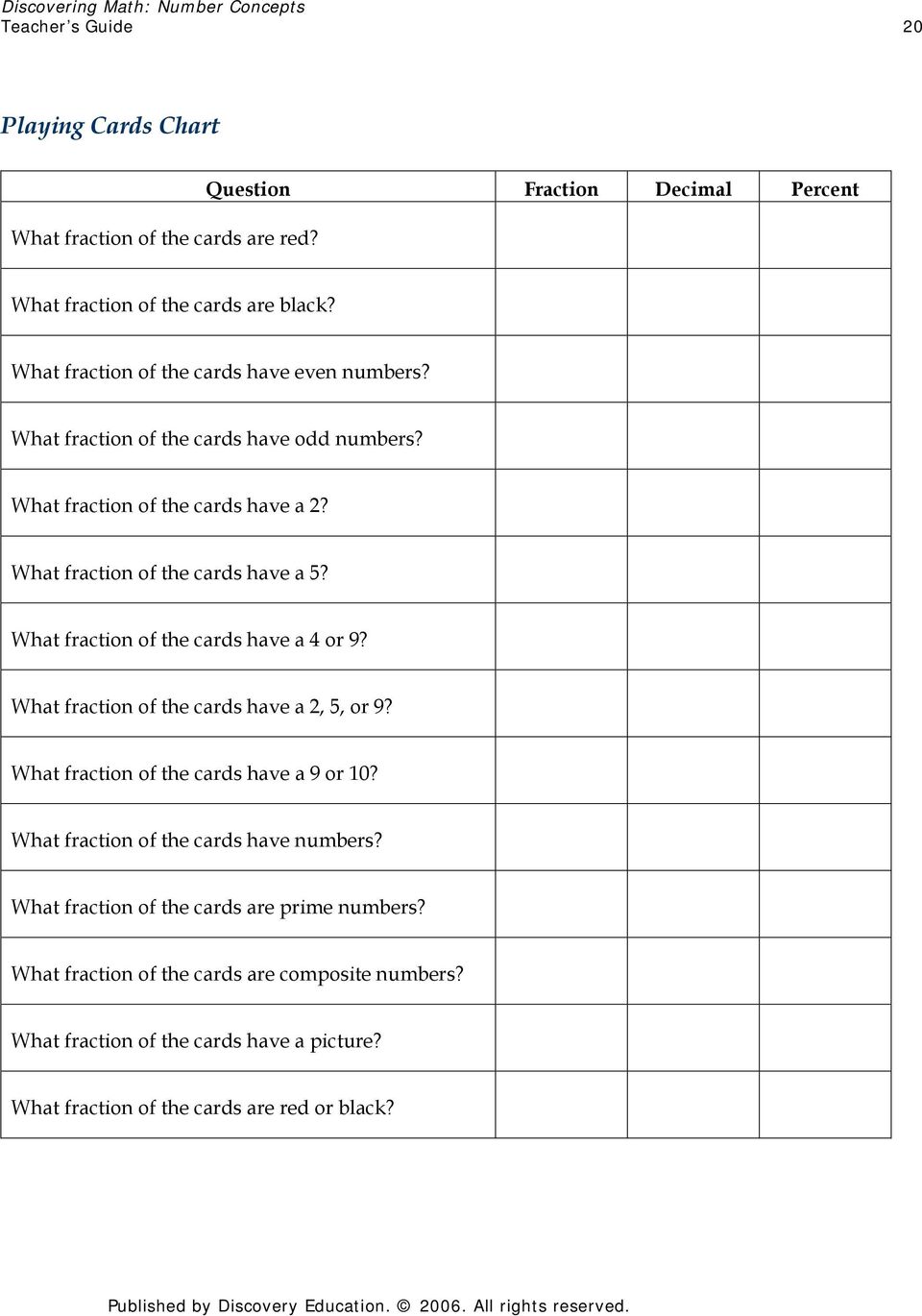
3 Teacher s Guide 3 2. Have students work in pairs. Distribute sets of ten playing cards (each set should contain five red cards, numbers 2, 4, 7, 9, and a jack and five black cards, numbers 2, 5, 7, 9, and 10) and a Playing Cards Chart to each pair. Review the directions with students (read the question in the question column and identify the fraction, decimal, and percent that answers the question) and have them complete the chart. If any teams finish before the others, have them create their own questions to challenge each other. When teams complete the activity, have them share their work and explain how they converted fractions, decimals, and percents. Extension Have students work with a set of 20 cards and identify fractions of the whole set and convert to decimals and percents. Place Value, Fractions, Decimals, Whole Numbers, and Mixed Numbers 1. Display the following numbers: 2, Ask students to classify them as whole numbers, fractions, decimals, or mixed numbers. Discuss the classification of each and have students share their ideas with the class. Ask them to give examples of other whole numbers, fractions, decimals, and mixed numbers. Model how to determine the smallest number by using place value, size of fraction, or decimal and ask students to order the numbers from least to greatest. Have them share their ideas and elicit responses. The numbers should be ordered in the following way: 1 4, 3.45, 7 1 2, 2, Distribute a Number Fact Sheet and Number Chart to each student. Tell them to identify each number as a whole number, fraction, decimal, or mixed number and record it in the correct place on the chart. Have students compare their work with a partner to check if their answers are correct. 3. Divide students into pairs and distribute a strip of paper to each. Tell students they will be creating a number line, ordering the numbers from the Number Fact Sheet from greatest to least. Depending upon ability levels, students may need a template or model of a number line as a guide. Have each pair share their number line and explain how they decided the position of each number.
4 Teacher s Guide 4 Assessment Use the following three-point rubric to evaluate students work during this lesson. 3 points: Students produced complete charts and number line, including all the requested information; clearly demonstrated the ability identify prime, composite, even, and odd numbers; clearly demonstrated the ability to convert between fractions, decimals, and percents to the nearest 5 and 20 th ; and clearly demonstrated the ability to identify whole numbers, fractions, decimals, and mixed numbers and order the numbers on a number line. 2 points: Students produced adequate charts and number line, including most of the requested information; satisfactorily demonstrated the ability identify prime, composite, even, and odd numbers; satisfactorily demonstrated the ability to convert between fractions, decimals, and percents to the nearest 10 and 10 th ; and satisfactorily demonstrated the ability to identify whole numbers, fractions, decimals, and mixed numbers and order the numbers on a number line. 1 point: Students produced incomplete charts and number line with little or none of the requested information; did not demonstrate the ability identify prime, composite, even, and odd numbers; did not demonstrate the ability to convert between fractions, decimals, and percents; and did not demonstrate the ability to identify whole numbers, fractions, decimals, and mixed numbers or order the numbers on a number line. Vocabulary composite number Definition: any number with more than two factors Context: 12 is a composite number because it has more than two factors. The factors of 12 are 1, 2, 3, 4, 6, and 12. decimal Definition: a number with one or more digits to the right of the decimal point Context: The student wrote the decimal 4.8. even number Definition: any number that can be divided into two equal groups and ends with the digits 0, 2, 4, 6, 8, or 0 Context: The numbers 12, 20, 34, 56, and 68 are even numbers because they can be divided into two equal groups and they end in the digits 0, 2, 4, 6, or 8. factor Definition: numbers that are multiplied together to get a given product Context: Two factors or 24 are 4 and 6 because 4 x 6 = 24.

5 Teacher s Guide 5 fraction Definition: a number that names a part of a whole or part of a group Context: 3 10 of the people were girls because there were 10 people and 3 of them were girls. mixed number Definition: an amount given as a whole number and a fraction Context: The recipe called for cups of flour is a mixed number because it has a whole number, 2, and a fraction, 1 2. multiple Definition: the product of a given whole number and another whole number Context: Two multiples of 4 are 12 and 20 because 4 x5 = 20 and 4 x 3 = 12. odd number Definition: any number that cannot be divided equally into two groups and ends in the digit 1, 3, 5, 7, or 9 Context: The numbers 15, 31, 43, 57, and 89 are odd numbers because they cannot be divided equally into two groups and they end in the digits 1, 3, 5, 7, or 9. percent Definition: the ratio or comparison of a number to 100 Context: There were 100 apples in the basket and 34 were eaten, so 34 percent of the apples were eaten. place value Definition: determines the value of a digit in a number, based on the location of the digit Context: The students used the place value of the numbers to determine the value of each number. They were able to order the numbers from least to greatest once the place values were determined. prime number Definition: a number that has only two factors, 1 and itself Context: The number 23 is a prime number because it has only two factors, 1 and 23. whole number Definition: a number that represents a whole amount Context: The number 12, 14, 65, and 84 are whole numbers because they refer to whole amounts.
6 Teacher s Guide 6 Academic Standards Mid-continent Research for Education and Learning (McREL) McREL s Content Knowledge: A Compendium of Standards and Benchmarks for K 12 Education addresses 14 content areas. To view the standards and benchmarks, visit This lesson plan addresses the following benchmarks: Understands basic number theory concepts. Understands equivalent forms of basic percents, fractions, and decimals, and when one form of a number might be more useful than another. Understands the basic difference between odd and even numbers. Understands the basic meaning of place value. Uses models to identify, order, and compare numbers. National Council of Teachers of Mathematics (NCTM) The National Council of Teachers of Mathematics (NCTM) has developed national standards to provide guidelines for teaching mathematics. To view the standards online, go to This lesson plan addresses the following standards: Understand the place-value structure of the base-ten number system and be able to represent and compare whole numbers and decimals. Develop understanding of fractions as parts of unit wholes, as parts of a collection, as locations on number lines, and as divisions of whole numbers. Explore numbers less than 0 by extending the number line and through familiar applications. Describe classes of numbers according to characteristics such as the nature of their factors. Use representations to model and interpret physical, social, and mathematical phenomena. Recognize and use connections among mathematical ideas.
7 Teacher s Guide 7 Support Materials Develop custom worksheets, educational puzzles, online quizzes, and more with the free teaching tools offered on the Discoveryschool.com Web site. Create and print support materials, or save them to a Custom Classroom account for future use. To learn more, visit DVD Content This program is available in an interactive DVD format. The following information and activities are specific to the DVD version. How to Use the DVD The DVD starting screen has the following options: Play Video This plays the video from start to finish. There are no programmed stops, except by using a remote control. With a computer, depending on the particular software player, a pause button is included with the other video controls. Video Index Here the video is divided into chapters indicated by title. Each chapter is then divided into four sections indicated by video thumbnail icons; brief descriptions are noted for each section. To play a particular segment, press Enter on the remote for TV playback; on a computer, click once to highlight a thumbnail and read the accompanying text description and click again to start the video. Quiz Each chapter has four interactive quiz questions correlated to each of the chapter s four sections. Standards Link Selecting this option displays a single screen that lists the national academic standards the video addresses. Teacher Resources This screen gives the technical support number and Web site address. Video Index I. Prime and Composite Numbers (7 min.) Prime and Composite Numbers: Introduction Prime and composite numbers are defined and modeled. Prime numbers have only two factors, and composite numbers have more than two factors. Example 1: Composite Numbers A composite number can be divided evenly by numbers other than itself and one. A soccer team is used to define and model composite numbers.

8 Teacher s Guide 8 Example 2: Prime Numbers A prime number cannot be divided evenly by any numbers other than itself and one. An air show is used to define and model prime numbers. Example 3: Prime and Composite Numbers Rows and columns of squares are called a rectangular array. Any number that can be formed by more than one rectangular array is a composite number. II. III. Factors and Multiples (8 min.) Factors and Multiples: Introduction Baseball is used to introduce factors numbers multiplied to get a given number and multiples the product of a number and any whole number greater than zero. Example 1: Multiples of Whole Numbers A multiple of a number is the product of that number and any other whole number other than zero. Boxes of caps are used to model multiples. Example 2: Factors and Composite Numbers A composite number is any number with more than two factors. Rows of seats in a baseball stadium are used to model factors and composite numbers. Example 3: Odd and Even Numbers Even numbers can be divided evenly by 2 and have a 0, 2, 4, 6, or 8 in the ones place. Odd numbers cannot be divided evenly by 2 and have a 1, 3, 5, 7, or 9 in the ones place. Baseball teams are used to model even and odd numbers. Fractions and Decimals (8 min.) Fractions and Decimals: Introduction Fractions and decimals are numbers less than one that describe part of a whole or parts of a group. Fractions have numerators and denominators. The first place after the decimal point is the tens place. Example 1: Quarters and Halves Groups of flamingos are used to model fractions. The numerator represents the part of the whole, and the denominator represents the total number in the whole group. Example 2: Fractions and Decimals Writing fractions and decimals is modeled with bowling scores. Fractions with a denominator of 10 can be rewritten as a decimal. The first place to right of the decimal is the tens place. Example 3: Fractions, Decimals, and Percents Fractions and decimals show the value of money. The two places after the decimal point are the tens and hundreds places. Rewrite a fraction with a denominator of 100 as a percent by writing the numerator with a percent sign.

9 Teacher s Guide 9 IV. Odd and Even Numbers (6 min.) Odd and Even Numbers: Introduction There are examples of even and odd numbers in nature. An even number can be divided evenly by two. An odd number cannot be divided evenly by two. Example 1: Even Numbers Dancers are used to model even numbers. Even numbers can be divided into pairs. Even numbers have a 0, 2, 4, 6, or 8 in the ones place. Example 2: Odd Numbers Animals are used to model odd numbers. Odd numbers cannot be divided evenly into two groups. Odd numbers have a 1, 3, 5, 7, or 9 in the ones place. Example 3: Even and Odd Numbers The numbers in a bowling alley are used to model the sums of number sentences with even and odd numbers. (odd + odd = even; even + even = even; odd + even = odd) V. Place Value (6 min.) Place Value: Introduction Flowers are used to explore place value. The ones, tens, and hundreds places are explained and modeled. Example 1: Place Value to the Thousands Stadium seats are used to model ones, tens, hundreds, and thousands. There are 10 tens in 100 and 10 one hundreds in 1,000. Example 2: Place Value Greater Than Thousands Numbers in the hundreds, thousands, ten thousands, hundred thousands, and millions are used to record populations. The more place values a number has, the larger the number. Example 3: Decimal Place Value Decimals are used when writing money amounts. One dime is 0.1 of a dollar and one penny is 0.01 of a dollar. VI. Relationships Among Numbers (8 min.) Relationships Among Numbers: Introduction Different types of numbers are used every day. Numbers are infinite. We use whole numbers, fractions, and decimals. Example 1: Whole Numbers, Fractions, and Mixed Numbers Snow is measured in inches, and the depth is usually recorded as a mixed number, which has a whole number and a fraction. Comparing whole numbers, fractions, and mixed numbers is explained and modeled. Example 2: Decimals Prices in a grocery store are used to model and compare decimals. Numbers to the left of the decimal represent whole numbers. Numbers to the right of the decimal represent less than one whole.
10 Teacher s Guide 10 Example 3: Relationships Among Numbers Expressed Differently A football field is used to show how to label, compare, and convert between fractions and decimals. Fractions and decimals are numbers between whole numbers. VII. Number Models (9 min.) Number Models: Introduction Fishermen s crab pots are used to explore number models, or ways to represent numbers and their relationships. Example 1: A Model for Time Scientists look at ice cores to study the past. An ice core is used as a number line, a type of number model, to compare periods of time, temperature, and rain or snowfall. Example 2: Modeling Units and Multiples Sets of bowls are used as number models to represent numbers by units and multiples of the units. Example 3: Graphing Numbers Researchers use graphs to record and analyze data on carbon dioxide levels in the atmosphere. A graph shows the relationships between numbers and allows people to analyze data visually. Quiz I. Prime and Composite Numbers 1. Identify the prime number. A. 6 B. 11 C. 21 D. 24 Answer: B 2. Identify the composite number. A. 7 B. 11 C. 18 D. 23 Answer: C

11 Teacher s Guide A prime number can be divided evenly by itself and. A. 0 B. 1 C. 2 D. 10 Answer: B 4. Which number has more than one rectangular array? A. 3 B. 11 C. 17 D. 20 Answer: D II. Factors and Multiples 1. Identify two factors of the number 15. A. 1 and 7 B. 3 and 5 C. 2 and 15 D. 10 and 5 Answer: B 2. Han has four boxes of hats. Each box holds eight hats. How many hats does Han have in all? A. 4 B. 12 C. 32 D. 48 Answer: C 3. How many groups of 6 are in 18? A. 3 B. 4 C. 5 D. 6 Answer: A
12 Teacher s Guide Joan needs an even number of players for her new game. Which number of players could she choose? A. 11 B. 16 C. 21 D. 29 Answer: B III. Fractions and Decimals 1. Mark has seven marbles. Four of the marbles are red. What fraction of Mark s marbles are red? A. 3 4 B. 7 4 C. 4 7 D. 3 7 Answer: C 2. Sue cuts her cookie into four equal pieces. She eats one piece of the cookie. What fraction of Sue s cookie is left? A. 4 2 B. 3 4 C. 2 6 D. 1 4 Answer: B 3. Collin knocked down 4 out of the 10 bowling pins. What decimal represents the number of pins Collin knocked down? A. 4.0 B C. 0.4 D. 4.4 Answer: C
13 Teacher s Guide What percent of a dollar is two dimes? A. 2% B. 20% 2 C. 100 D. 200% Answer: B IV. Odd and Even Numbers 1. Which object represents an odd number? A. a 4 leaf clover B. an ant with 6 legs C. a tree with 13 branches D. a butterfly with 2 symmetrical wings Answer: C 2. Identify the even number. A. 332 B. 413 C. 447 D. 523 Answer: A 3. What is the remainder when 7 is divided into two groups? A. 0 B. 1 C. 2 D. 3 Answer: B 4. Which number sentence will always equal an odd sum? A. odd + odd B. even + odd C. even + even D. even + even +even Answer: B
14 Teacher s Guide 14 V. Place Value 1. What digit is in the tens place? 563 A. 0 B. 3 C. 5 D. 6 Answer: D 2. In what place value is the digit 9 in the number 9,354? A. ones B. tens C. hundreds D. thousands Answer: D 3. What digit is in the ten-thousands place? 287,951 A. 2 B. 5 C. 8 D. 9 Answer: C 4. Nick has one dollar bill, three dimes, and two pennies. How much money does Nick have? A. $1.20 B. $1.23 C. $1.30 D. $1.32 Answer: D

15 Teacher s Guide 15 VI. Relationships Among Numbers 1. Four friends measured how deep the snow was at their houses and recorded the data in a chart. Who had the deepest snow? A. Rob B. Tom C. Lara D. Margaret Name Lara Snow inches Answer: C Rob inches Tom inches Margaret inches 2. Joe is shopping for lunch. He sees the following prices at the deli. Turkey $5.99 Ham $6.99 Salami.$3.99 Cheese.$5.50 Joe wants to buy the least expensive item. What should Joe buy? A. ham B. cheese C. salami D. turkey Answer: C A. < B. = C. > D. + Answer: C

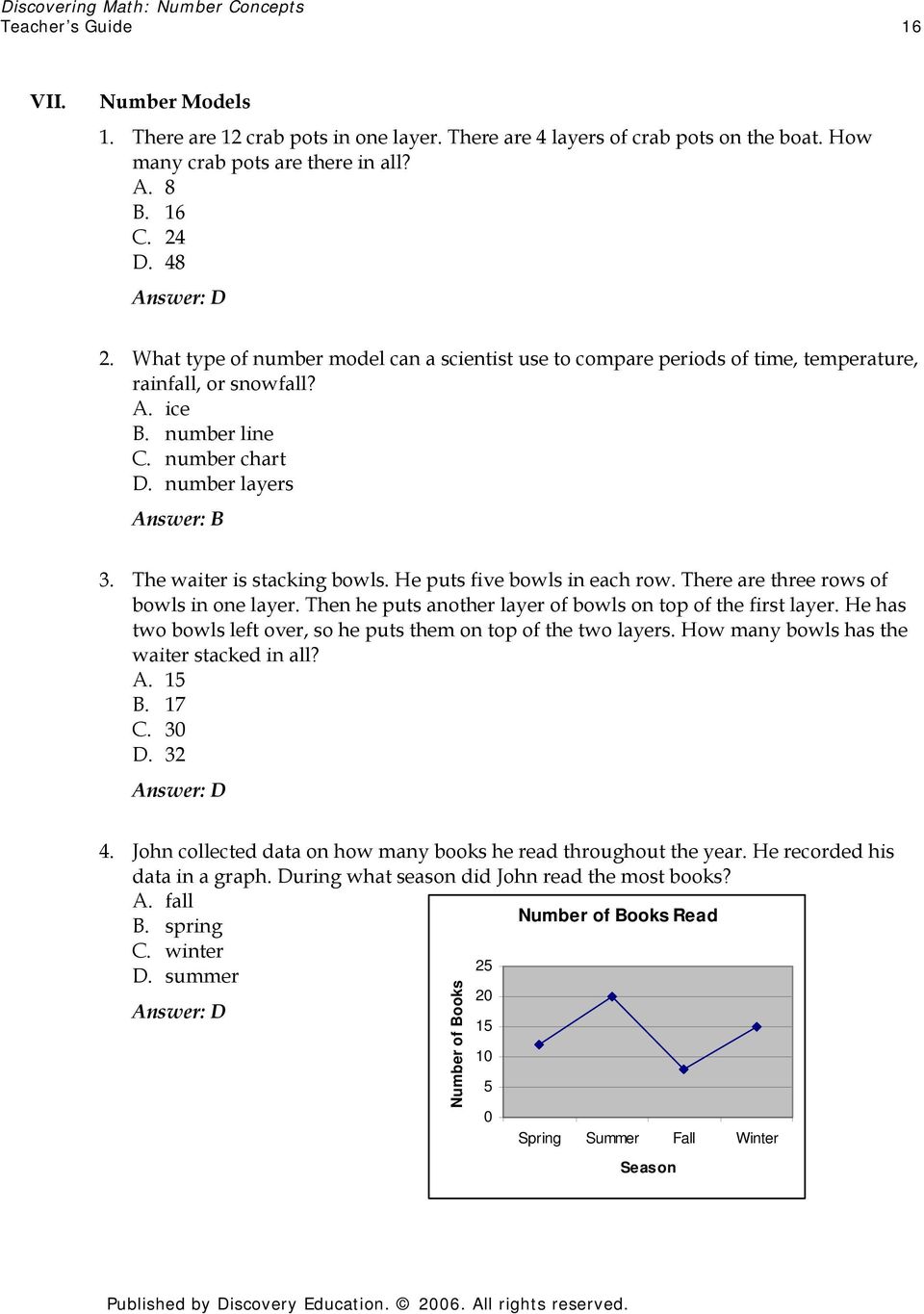
16 Teacher s Guide 16 VII. Number Models 1. There are 12 crab pots in one layer. There are 4 layers of crab pots on the boat. How many crab pots are there in all? A. 8 B. 16 C. 24 D. 48 Answer: D 2. What type of number model can a scientist use to compare periods of time, temperature, rainfall, or snowfall? A. ice B. number line C. number chart D. number layers Answer: B 3. The waiter is stacking bowls. He puts five bowls in each row. There are three rows of bowls in one layer. Then he puts another layer of bowls on top of the first layer. He has two bowls left over, so he puts them on top of the two layers. How many bowls has the waiter stacked in all? A. 15 B. 17 C. 30 D. 32 Answer: D 4. John collected data on how many books he read throughout the year. He recorded his data in a graph. During what season did John read the most books? A. fall Number of Books Read B. spring C. winter 25 D. summer Answer: D Number of Books Spring Summer Fall Winter Season
17 Teacher s Guide 17 Number Grid

18 Teacher s Guide 18 Number Grid Direction Sheet 1. Highlight every prime number on the grid with your highlighter. 2. Circle the odd numbers on the grid with your red crayon or pencil. 3. Choose ten composite numbers from the grid and write them in the chart. Identify four factors of each composite number and write them in the chart. Composite Number Four Factors 4. Choose five prime numbers from the grid and write them in the chart. Identify two multiples of each prime number and write them in the chart. Prime Number Two Multiples

19 Teacher s Guide 19 Picture Cards * T M M * M

20 Teacher s Guide 20 Playing Cards Chart What fraction of the cards are red? Question Fraction Decimal Percent What fraction of the cards are black? What fraction of the cards have even numbers? What fraction of the cards have odd numbers? What fraction of the cards have a 2? What fraction of the cards have a 5? What fraction of the cards have a 4 or 9? What fraction of the cards have a 2, 5, or 9? What fraction of the cards have a 9 or 10? What fraction of the cards have numbers? What fraction of the cards are prime numbers? What fraction of the cards are composite numbers? What fraction of the cards have a picture? What fraction of the cards are red or black?
21 Teacher s Guide 21 Number Fact Sheet Directions Identify the numbers in the following sentences. Classify them as whole numbers, fractions, decimals, or mixed numbers and record them on the Number Chart. Then order the numbers from least to greatest and create a number line, placing them in the correct order. There are 24 students in Miss Smith s class. Add cups of flour to the recipe. 6.4 of the money will go to charity. 3 4 of the pizza was eaten. Sam has 45 books on the bookshelf. Jill built 1 2 of the model car on Saturday. Harry is working 8.4 hours on Monday. The girls decided to buy 5 lollipops for a treat. The teacher let the students stay at recess for 10 extra minutes. There are 540 students in the 4 th grade. Justin made jars of homemade jelly. There are 60 minutes in an hour. There are 15 minutes in 1 4 of an hour. There are 52 weeks in 1 year. Frank drew a line 14.7 inches long. The perimeter around the yard is feet. Sally bought pounds of hamburgers for her party. The little girl weighed 22.5 pounds.
22 Teacher s Guide 22 Number Chart Whole Numbers Fractions Decimals Mixed Numbers
Discovering Math: Data and Graphs Teacher s Guide
 Teacher s Guide Grade Level: K 2 Curriculum Focus: Mathematics Lesson Duration: Two class periods Program Description Discovering Math: Data and Graphs From simple graphs to sampling to determining what
Discovering Math: Prediction and Probability Teacher s Guide
 Teacher s Guide Grade Level: K 2 Curriculum Focus: Mathematics Lesson Duration: Two class periods Program Description Discovering Math: Prediction and Probability From likelihood to frequency to prediction,
Discovering Math: Using and Collecting Data Teacher s Guide
 Teacher s Guide Grade Level: 3-5 Curriculum Focus: Mathematics Lesson Duration: Four class periods Program Description Discovering Math: Using and Collecting Data From data points and determining spread
Discovering Math: Exploring Geometry Teacher s Guide
 Teacher s Guide Grade Level: 6 8 Curriculum Focus: Mathematics Lesson Duration: Three class periods Program Description Discovering Math: Exploring Geometry From methods of geometric construction and threedimensional
Animal Colors and Shapes Teacher s Guide
 Teacher s Guide Grade Level: K 2 Curriculum Focus: Math, Science Lesson Duration: 1 2 class periods Program Description Animals come in all colors, shapes, and sizes. Learn about the shapes animals have
PAYCHEX, INC. BASIC BUSINESS MATH TRAINING MODULE
 PAYCHEX, INC. BASIC BUSINESS MATH TRAINING MODULE 1 Property of Paychex, Inc. Basic Business Math Table of Contents Overview...3 Objectives...3 Calculator...4 Basic Calculations...6 Order of Operation...9
Unit 1 Number Sense. In this unit, students will study repeating decimals, percents, fractions, decimals, and proportions.
 Unit 1 Number Sense In this unit, students will study repeating decimals, percents, fractions, decimals, and proportions. BLM Three Types of Percent Problems (p L-34) is a summary BLM for the material
Minnesota Comprehensive Assessments-Series III
 Name Minnesota Comprehensive Assessments-Series III Mathematics Item Sampler Grade 3 ITEM SAMPLERS ARE NOT SECURE TEST MATERIALS. THIS ITEM SAMPLER TEST BOOK MAY BE COPIED OR DUPLICATE State of Minnesota
Planning Guide. Grade 6 Factors and Multiples. Number Specific Outcome 3
 Mathematics Planning Guide Grade 6 Factors and Multiples Number Specific Outcome 3 This Planning Guide can be accessed online at: http://www.learnalberta.ca/content/mepg6/html/pg6_factorsmultiples/index.html
Introduce Decimals with an Art Project Criteria Charts, Rubrics, Standards By Susan Ferdman
 Introduce Decimals with an Art Project Criteria Charts, Rubrics, Standards By Susan Ferdman hundredths tenths ones tens Decimal Art An Introduction to Decimals Directions: Part 1: Coloring Have children
Heat and Temperature: Teacher s Guide
 Heat and Temperature: Teacher s Guide Grade Level: 6-8 Curriculum Focus: Physical Science Lesson Duration: Two class periods Program Description Humans have always been feverish about temperature. But
Math Questions & Answers
 What five coins add up to a nickel? five pennies (1 + 1 + 1 + 1 + 1 = 5) Which is longest: a foot, a yard or an inch? a yard (3 feet = 1 yard; 12 inches = 1 foot) What do you call the answer to a multiplication
Elements of Physics Motion, Force, and Gravity Teacher s Guide
 Teacher s Guide Grade Level: 9 12 Curriculum Focus: Physical Science Lesson Duration: Three class periods Program Description Examine Isaac Newton's laws of motion, the four fundamental forces of the universe,
Fraction Models Grade Three
 Ohio Standards Connection Number, Number Sense and Operations Benchmark C Represent commonly used fractions and mixed numbers using words and physical models. Indicator 5 Represent fractions and mixed
MMLA Student Test/MathAssessments.MSCenters.Org. MMLA Mathematics Assessment Items
 Page 1 of 42 MMLA Mathematics Assessment Items Name: Date: Multiple Choice Questions Select the one best answer for each question. 1. Which of the following sets of numbers are all of the factors of 24?
Grade 2 Level. Math Common Core Sampler Test
 Grade 2 Level Math Common Core Sampler Test Everyone we come in contact with is scrambling to get their hands on example questions for this grade level. This test sampler is put together to give you an
Grade 4 - Module 5: Fraction Equivalence, Ordering, and Operations
 Grade 4 - Module 5: Fraction Equivalence, Ordering, and Operations Benchmark (standard or reference point by which something is measured) Common denominator (when two or more fractions have the same denominator)
4. What could be the rule for the pattern in the table? n 1 2 3 4 5 Rule 3 5 7 9 11
 5 th Grade Practice Test Objective 1.1 1. John has two fewer marbles than Kay. If Kay has marbles, how many marbles does John have? 2 2 2 2 2. What is if + 17 = 26? 43 19 11 9 3. ll the cakes at the bake
Grade 7 & 8 Math Circles October 19, 2011 Prime Numbers
 1 University of Waterloo Faculty of Mathematics Centre for Education in Mathematics and Computing Grade 7 & 8 Math Circles October 19, 2011 Prime Numbers Factors Definition: A factor of a number is a whole
Comparing and Ordering Fractions
 Comparing and Ordering Fractions Objectives To review equivalent fractions; and to provide experience with comparing and ordering fractions. www.everydaymathonline.com epresentations etoolkit Algorithms
Reading and Writing Small Numbers
 Reading Writing Small Numbers Objective To read write small numbers in stard exped notations wwweverydaymathonlinecom epresentations etoolkit Algorithms Practice EM Facts Workshop Game Family Letters Assessment
Counting Money and Making Change Grade Two
 Ohio Standards Connection Number, Number Sense and Operations Benchmark D Determine the value of a collection of coins and dollar bills. Indicator 4 Represent and write the value of money using the sign
4. Write a mixed number and an improper fraction for the picture below.
 5.5.1 Name Grade 5: Fractions 1. Write the fraction for the shaded part. 2. Write the equivalent fraction. 3. Circle the number equal to 1. A) 9 B) 7 C) 4 D) 7 8 7 0 1 4. Write a mixed number and an improper
EXTRA ACTIVITy pages
 EXTRA FUN ACTIVITIES This booklet contains extra activity pages for the student as well as the tests. See the next page for information about the activity pages. Go to page 7 to find the Alpha tests. EXTRA
Lesson 1: Fractions, Decimals and Percents
 Lesson 1: Fractions, Decimals and Percents Selected Content Standards Benchmarks Addressed: N-2-H Demonstrating that a number can be expressed in many forms, and selecting an appropriate form for a given
Greatest Common Factor
 SKILL 10 Name Greatest Common Factor Date The greatest common factor (GCF) of two or more numbers is the greatest number that is a factor of each number. One way to find the greatest common factor is to
Addition of Multidigit Numbers
 Addition of Multidigit Numbers Objectives To review the partial-sums algorithm used to solve multidigit addition problems; and to introduce a column-addition method similar to the traditional addition
BPS Math Year at a Glance (Adapted from A Story Of Units Curriculum Maps in Mathematics K-5) 1
 Grade 4 Key Areas of Focus for Grades 3-5: Multiplication and division of whole numbers and fractions-concepts, skills and problem solving Expected Fluency: Add and subtract within 1,000,000 Module M1:
Fractions. Chapter 3. 3.1 Understanding fractions
 Chapter Fractions This chapter will show you how to find equivalent fractions and write a fraction in its simplest form put fractions in order of size find a fraction of a quantity use improper fractions
NS6-50 Dividing Whole Numbers by Unit Fractions Pages 16 17
 NS6-0 Dividing Whole Numbers by Unit Fractions Pages 6 STANDARDS 6.NS.A. Goals Students will divide whole numbers by unit fractions. Vocabulary division fraction unit fraction whole number PRIOR KNOWLEDGE
The Lattice Method of Multiplication
 The Lattice Method of Multiplication Objective To review and provide practice with the lattice method for multiplication of whole numbers and decimals. www.everydaymathonline.com epresentations etoolkit
Mental Math Grade 3 MM 3-3 MM 3-1. Count by tens. What comes next? 1. Start at 30... (40) 1. Write the number that is 5 tens and 2 ones.
 MM 3-1 Count by tens. What comes next? 1. Start at 30... (40) 2. Start at 60... (70) 3. Start at 20... (30) 4. What is 40 + 30 = (70) 5. What is 30 + 60 = (90) 6. What are the next 3 numbers? 2, 4, 6,
Science Investigations: Investigating Astronomy Teacher s Guide
 Teacher s Guide Grade Level: 6 12 Curriculum Focus: Astronomy/Space Duration: 7 segments; 66 minutes Program Description This library of videos contains seven segments on celestial bodies and related science.
Objective To introduce the concept of square roots and the use of the square-root key on a calculator. Assessment Management
 Unsquaring Numbers Objective To introduce the concept of square roots and the use of the square-root key on a calculator. www.everydaymathonline.com epresentations etoolkit Algorithms Practice EM Facts
Simplifying Improper Fractions Poster
 Simplifying Improper Fractions Poster Congratulations on your purchase of this Really Good Stuff Simplifying Improper Fractions Poster a reference tool showing students how to change improper fractions
Factor Trees. Objective To provide experiences with finding the greatest common factor and the least common multiple of two numbers.
 Factor Trees Objective To provide experiences with finding the greatest common factor and the least common multiple of two numbers. www.everydaymathonline.com epresentations etoolkit Algorithms Practice
Everyday Mathematics CCSS EDITION CCSS EDITION. Content Strand: Number and Numeration
 CCSS EDITION Overview of -6 Grade-Level Goals CCSS EDITION Content Strand: Number and Numeration Program Goal: Understand the Meanings, Uses, and Representations of Numbers Content Thread: Rote Counting
Everyday Mathematics GOALS
 Copyright Wright Group/McGraw-Hill GOALS The following tables list the Grade-Level Goals organized by Content Strand and Program Goal. Content Strand: NUMBER AND NUMERATION Program Goal: Understand the
The Distributive Property
 The Distributive Property Objectives To recognize the general patterns used to write the distributive property; and to mentally compute products using distributive strategies. www.everydaymathonline.com
Review: Comparing Fractions Objectives To review the use of equivalent fractions
 Review: Comparing Fractions Objectives To review the use of equivalent fractions in comparisons. www.everydaymathonline.com epresentations etoolkit Algorithms Practice EM Facts Workshop Game Family Letters
Progress Check 6. Objective To assess students progress on mathematical content through the end of Unit 6. Looking Back: Cumulative Assessment
 Progress Check 6 Objective To assess students progress on mathematical content through the end of Unit 6. Looking Back: Cumulative Assessment The Mid-Year Assessment in the Assessment Handbook is a written
Fractions Packet. Contents
 Fractions Packet Contents Intro to Fractions.. page Reducing Fractions.. page Ordering Fractions page Multiplication and Division of Fractions page Addition and Subtraction of Fractions.. page Answer Keys..
Models for Dividing Fractions Grade Six
 Ohio Standards Connection Number, Number Sense and Operations Benchmark H Use and analyze the steps in standard and nonstandard algorithms for computing with fractions, decimals and integers. Indicator
2016 Practice Test Grade 53
 English Mathematics Language Arts 2016 Practice Test Grade 53 Session 1 Directions: Today, you will take Session 1 of the Grade 35 Mathematics Test. You will not be able to use a calculator in this session.
Math Journal HMH Mega Math. itools Number
 Lesson 1.1 Algebra Number Patterns CC.3.OA.9 Identify arithmetic patterns (including patterns in the addition table or multiplication table), and explain them using properties of operations. Identify and
Grade 7/8 Math Circles Fall 2012 Factors and Primes
 1 University of Waterloo Faculty of Mathematics Centre for Education in Mathematics and Computing Grade 7/8 Math Circles Fall 2012 Factors and Primes Factors Definition: A factor of a number is a whole
Scope and Sequence KA KB 1A 1B 2A 2B 3A 3B 4A 4B 5A 5B 6A 6B
 Scope and Sequence Earlybird Kindergarten, Standards Edition Primary Mathematics, Standards Edition Copyright 2008 [SingaporeMath.com Inc.] The check mark indicates where the topic is first introduced
This lesson introduces students to decimals.
 NATIONAL MATH + SCIENCE INITIATIVE Elementary Math Introduction to Decimals LEVEL Grade Five OBJECTIVES Students will compare fractions to decimals. explore and build decimal models. MATERIALS AND RESOURCES
Planning Guide. Grade 6 Improper Fractions and Mixed Numbers. Number Specific Outcome 4
 Mathematics Planning Guide Grade 6 Improper Fractions and Mixed Numbers Number Specific Outcome 4 This Planning Guide can be accessed online at: http://www.learnalberta.ca/content/mepg6/html/pg6_improperfractionsmixednumbers/index.html
Baseball Multiplication Objective To practice multiplication facts.
 Baseball Multiplication Objective To practice multiplication facts. www.everydaymathonline.com epresentations etoolkit Algorithms Practice EM Facts Workshop Game Family Letters Assessment Management Common
Understanding Ratios Grade Five
 Ohio Standards Connection: Number, Number Sense and Operations Standard Benchmark B Use models and pictures to relate concepts of ratio, proportion and percent. Indicator 1 Use models and visual representation
Minnesota Academic Standards
 A Correlation of to the Minnesota Academic Standards Grades K-6 G/M-204 Introduction This document demonstrates the high degree of success students will achieve when using Scott Foresman Addison Wesley
Bar Graphs with Intervals Grade Three
 Bar Graphs with Intervals Grade Three Ohio Standards Connection Data Analysis and Probability Benchmark D Read, interpret and construct graphs in which icons represent more than a single unit or intervals
Unit 11 Fractions and decimals
 Unit 11 Fractions and decimals Five daily lessons Year 4 Spring term (Key objectives in bold) Unit Objectives Year 4 Use fraction notation. Recognise simple fractions that are Page several parts of a whole;
Welcome to Harcourt Mega Math: The Number Games
 Welcome to Harcourt Mega Math: The Number Games Harcourt Mega Math In The Number Games, students take on a math challenge in a lively insect stadium. Introduced by our host Penny and a number of sporting
Unit 2 Number and Operations Fractions: Multiplying and Dividing Fractions
 Unit Number and Operations Fractions: Multiplying and Dividing Fractions Introduction In this unit, students will divide whole numbers and interpret the answer as a fraction instead of with a remainder.
NMC Sample Problems: Grade 5
 NMC Sample Problems: Grade 5 1. What is the value of 5 6 3 4 + 2 3 1 2? 1 3 (a) (b) (c) (d) 1 5 1 4 4 4 12 12 2. What is the value of 23, 456 + 15, 743 3, 894 expressed to the nearest thousand? (a) 34,
TEKS TAKS 2010 STAAR RELEASED ITEM STAAR MODIFIED RELEASED ITEM
 7 th Grade Math TAKS-STAAR-STAAR-M Comparison Spacing has been deleted and graphics minimized to fit table. (1) Number, operation, and quantitative reasoning. The student represents and uses numbers in
Math and FUNDRAISING. Ex. 73, p. 111 1.3 0. 7
 Standards Preparation Connect 2.7 KEY VOCABULARY leading digit compatible numbers For an interactive example of multiplying decimals go to classzone.com. Multiplying and Dividing Decimals Gr. 5 NS 2.1
1 st Grade Math Do-Anytime Activities
 1 st Grade Have your child help create a number line (0-15) outside with sidewalk chalk. Call out a number and have your child jump on that number. Make up directions such as Hop to the number that is
Possible Stage Two Mathematics Test Topics
 Possible Stage Two Mathematics Test Topics The Stage Two Mathematics Test questions are designed to be answerable by a good problem-solver with a strong mathematics background. It is based mainly on material
FRACTIONS. The student will be able to: Essential Fraction Vocabulary
 FRACTIONS The student will be able to:. Perform basic operations with common fractions: addition, subtraction, multiplication, and division. Common fractions, such as /, /, and /, are used on the GED Test
Great Books: Tales of Edgar Allan Poe Teacher s Guide
 Teacher s Guide Grade Level: 9-12 Curriculum Focus: Literature Lesson Duration: 1 2 class periods Program Description Explore the psychology of terror in some of Poe s most-haunting tales. Interwoven through
Practice Test 3 for MCT2 is developed and published by the Mississippi Department of Education. Copyright 2009 by Mississippi Department of
 Practice Test 3 for MCT2 is developed and published by the Mississippi Department of Education. Copyright 2009 by Mississippi Department of Education. All rights reserved. No part of this publication may
Decimals and Percentages
 Decimals and Percentages Specimen Worksheets for Selected Aspects Paul Harling b recognise the number relationship between coordinates in the first quadrant of related points Key Stage 2 (AT2) on a line
Parts and Wholes. In a tangram. 2 small triangles (S) cover a medium triangle (M) 2 small triangles (S) cover a square (SQ)
 Parts and Wholes. L P S SQ M In a tangram small triangles (S) cover a medium triangle (M) small triangles (S) cover a square (SQ) L S small triangles (S) cover a parallelogram (P) small triangles (S) cover
Progressing toward the standard
 Report Card Language: The student can add and subtract fluently within 20. CCSS: 2.OA.2 Fluently add and subtract within 20 using mental strategies, by end of grade, know from memory all sums of two one-digit
MATHS ACTIVITIES FOR REGISTRATION TIME
 MATHS ACTIVITIES FOR REGISTRATION TIME At the beginning of the year, pair children as partners. You could match different ability children for support. Target Number Write a target number on the board.
Assessment For The California Mathematics Standards Grade 2
 Introduction: Summary of Goals GRADE TWO By the end of grade two, students understand place value and number relationships in addition and subtraction and they use simple concepts of multiplication. They
Understand numbers, ways of representing numbers, relationships among numbers, and number systems
 Equivalent Fractions and Comparing Fractions: Are You My Equal? Brief Overview: This four day lesson plan will explore the mathematical concept of identifying equivalent fractions and using this knowledge
Fraction Problems. Figure 1: Five Rectangular Plots of Land
 Fraction Problems 1. Anna says that the dark blocks pictured below can t represent 1 because there are 6 dark blocks and 6 is more than 1 but 1 is supposed to be less than 1. What must Anna learn about
by Teresa Evans Copyright 2010 Teresa Evans. All rights reserved. Permission is given for the making of copies for use
 by Teresa Evans Copyright 2010 Teresa Evans. All rights reserved. Permission is given for the making of copies for use in the home or classroom of the purchaser only. Looking for More Math Fun? Making
5th Grade Unit 1: Whole Number and Decimal Fraction Place Value to the One Thousandths (4 Weeks)
 5th Grade Unit : Whole Number and Decimal Fraction Place Value to the One Thousandths (4 Weeks) Stage Desired Results Established Goals Unit Description Students continue to extend and apply their understanding
Volume of Pyramids and Cones
 Volume of Pyramids and Cones Objective To provide experiences with investigating the relationships between the volumes of geometric solids. www.everydaymathonline.com epresentations etoolkit Algorithms
Charlesworth School Year Group Maths Targets
 Charlesworth School Year Group Maths Targets Year One Maths Target Sheet Key Statement KS1 Maths Targets (Expected) These skills must be secure to move beyond expected. I can compare, describe and solve
Practicing for the. TerraNova. Success on Standardized Tests for TerraNova Grade 2 3. McGraw-Hill School Division
 Practicing for the TerraNova Success on Standardized Tests for TerraNova Grade 2 3 How can this booklet help? A note to families In the booklet you hold now, there is a practice version of the TerraNova.
Autumn - 12 Weeks. Spring 11 Weeks. Summer 12 Weeks. Not As We Know It Limited 2014
 A Year 5 Mathematician Planning of coverage and resources. Autumn - 12 Weeks Spring 11 Weeks Summer 12 Weeks TARGETS NHM YR 5 Collins 5 Abacus 5 Abacus 6 LA Prior Step NHM 4 CPM 4 Ginn 4 Number, place
Great Books: Freud s Interpretation of Dreams Teacher s Guide
 Teacher s Guide Grade Level: 9-12 Curriculum Focus: Human Body Lesson Duration: One class period Program Description Using a unique series of dream sequence reenactments based on Freud's revolutionary
4 th Grade Summer Mathematics Review #1. Name: 1. How many sides does each polygon have? 2. What is the rule for this function machine?
 . How many sides does each polygon have? th Grade Summer Mathematics Review #. What is the rule for this function machine? A. Pentagon B. Nonagon C. Octagon D. Quadrilateral. List all of the factors of
Unit 13 Handling data. Year 4. Five daily lessons. Autumn term. Unit Objectives. Link Objectives
 Unit 13 Handling data Five daily lessons Year 4 Autumn term (Key objectives in bold) Unit Objectives Year 4 Solve a problem by collecting quickly, organising, Pages 114-117 representing and interpreting
Sixth Grade Problem Solving Tasks Weekly Enrichments Teacher Materials. Summer Dreamers 2013
 Sixth Grade Problem Solving Tasks Weekly Enrichments Teacher Materials Summer Dreamers 2013 SOLVING MATH PROBLEMS KEY QUESTIONS WEEK 1 By the end of this lesson, students should be able to answer these
Calculator Practice: Computation with Fractions
 Calculator Practice: Computation with Fractions Objectives To provide practice adding fractions with unlike denominators and using a calculator to solve fraction problems. www.everydaymathonline.com epresentations
Multiplying Decimals Word Problems 5th Grade
 Decimals Word 5th Grade Free PDF ebook Download: Decimals Word 5th Grade Download or Read Online ebook multiplying decimals word problems 5th grade in PDF Format From The Best User Guide Database Adding
Grade 4 Mathematics Practice Test
 Grade 4 Mathematics Practice Test 2013 2014 For further information, contact: Louisiana Department of Education s Help Desk 1-877-453-2721 Ask LDOE? http://www.louisianabelieves.com/resources/contact-us
Grade 6 Math. Oak Meadow. Coursebook. Oak Meadow, Inc. Post Office Box 1346 Brattleboro, Vermont 05302-1346 oakmeadow.
 Grade 6 Math Oak Meadow Coursebook Oak Meadow, Inc. Post Office Box 1346 Brattleboro, Vermont 05302-1346 oakmeadow.com Item #b064010 Grade 6 Contents Introduction... ix Lessons... Lesson 1... 1 Multiplication
7 th Grade Integer Arithmetic 7-Day Unit Plan by Brian M. Fischer Lackawanna Middle/High School
 7 th Grade Integer Arithmetic 7-Day Unit Plan by Brian M. Fischer Lackawanna Middle/High School Page 1 of 20 Table of Contents Unit Objectives........ 3 NCTM Standards.... 3 NYS Standards....3 Resources
Subtracting Mixed Numbers
 Subtracting Mixed Numbers Objective To develop subtraction concepts related to mixed numbers. www.everydaymathonline.com epresentations etoolkit Algorithms Practice EM Facts Workshop Game Family Letters
Mathematics Scope and Sequence, K-8
 Standard 1: Number and Operation Goal 1.1: Understands and uses numbers (number sense) Mathematics Scope and Sequence, K-8 Grade Counting Read, Write, Order, Compare Place Value Money Number Theory K Count
Objective To guide the development and use of a rule for generating equivalent fractions. Family Letters. Assessment Management
 Equivalent Fractions Objective To guide the development and use of a rule for generating equivalent fractions. www.everydaymathonline.com epresentations etoolkit Algorithms Practice EM Facts Workshop Game
Multiplying Fractions by Whole Numbers
 Multiplying Fractions by Whole Numbers Objective To apply and extend previous understandings of multiplication to multiply a fraction by a whole number. www.everydaymathonline.com epresentations etoolkit
Objectives To review making ballpark estimates; and to review the counting-up and trade-first subtraction algorithms. materials. materials.
 Objectives To review making ballpark estimates; and to review the counting-up and trade-first subtraction algorithms. Teaching the Lesson materials Key Activities Children make ballpark estimates for -digit
Assessment For The California Mathematics Standards Grade 3
 Introduction: Summary of Goals GRADE THREE By the end of grade three, students deepen their understanding of place value and their understanding of and skill with addition, subtraction, multiplication,
The gas can has a capacity of 4.17 gallons and weighs 3.4 pounds.
 hundred million$ ten------ million$ million$ 00,000,000 0,000,000,000,000 00,000 0,000,000 00 0 0 0 0 0 0 0 0 0 Session 26 Decimal Fractions Explain the meaning of the values stated in the following sentence.
Grade 5 Mathematics Curriculum Guideline Scott Foresman - Addison Wesley 2008. Chapter 1: Place, Value, Adding, and Subtracting
 Grade 5 Math Pacing Guide Page 1 of 9 Grade 5 Mathematics Curriculum Guideline Scott Foresman - Addison Wesley 2008 Test Preparation Timeline Recommendation: September - November Chapters 1-5 December
Comparing Fractions Objective To provide practice ordering sets of fractions.
 Comparing Fractions Objective To provide practice ordering sets of fractions. www.everydaymathonline.com epresentations etoolkit Algorithms Practice EM Facts Workshop Game Family Letters Assessment Management
Summer Math Packet. For Students Entering Grade 5 $3.98. Student s Name 63 9 = Review and Practice of Fairfield Math Objectives and CMT Objectives
 Summer Math Packet 63 9 = Green Yellow Green Orange Orange Yellow $3.98 1 Green A B C D Red 8 1 2 3 4 5 Student s Name June 2013 Review and Practice of Fairfield Math Objectives and CMT Objectives 1 Summer
Paper 1. Calculator not allowed. Mathematics test. First name. Last name. School. Remember KEY STAGE 3 TIER 5 7
 Ma KEY STAGE 3 Mathematics test TIER 5 7 Paper 1 Calculator not allowed First name Last name School 2009 Remember The test is 1 hour long. You must not use a calculator for any question in this test. You
Quarter One: August-October
 Quarter One: August-October (Chapters 1 3, 5-6, 10) August - December Quarterly Addition facts with sums through 20 General Math Content 1. Write sums through 20. 1. Choose and enter the appropriate answer.
CBA Fractions Student Sheet 1
 Student Sheet 1 1. If 3 people share 12 cookies equally, how many cookies does each person get? 2. Four people want to share 5 cakes equally. Show how much each person gets. Student Sheet 2 1. The candy
Fourth Grade Math Standards and "I Can Statements"
 Fourth Grade Math Standards and "I Can Statements" Standard - CC.4.OA.1 Interpret a multiplication equation as a comparison, e.g., interpret 35 = 5 x 7 as a statement that 35 is 5 times as many as 7 and