
Purchase Order Processing new features. Order entry Generate list of suggested purchases Print the negotiation reports Amend a suggested order
|
|
|
- Gilbert Farmer
- 9 years ago
- Views:
Transcription
1 Sage 200 Accounts v2009 is supplied with a new help system. The new help system is complemented by a comprehensive search facility across all of the accounting modules. We have provided this Sage 200 v5.1 Purchase Order Processing PDF for your reference only. All of this information and all new features are described in the help system. Purchase Order Processing new features Back to back sales orders v2009 help topic Document numbering Order entry Generate list of suggested purchases Print the negotiation reports Amend a suggested order

2 200 Manufacturing Forecasting Purchase Order Processing Guide

3 Sage (UK) Limited Copyright Statement Sage (UK) Limited, All rights reserved. If this documentation includes advice or information relating to any matter other than using Sage software, such advice or information is provided for information purposes only. While Sage takes responsible steps to ensure the accuracy and completeness of such information, it can only be general in nature. You should therefore take appropriate steps to ensure it is correct and relevant to your circumstances. You should also consider taking professional advice when appropriate, for example to ensure that the results obtained from using the software comply with statutory requirements. No part of this documentation may be copied, photocopied, reproduced, translated, microfilmed, or otherwise duplicated on any medium without prior written consent of Sage (UK) Limited, publisher of this work. Use of the software described in this documentation is subject to Sage (UK) Limited's Licence Agreement enclosed with, or displayed by, that software. Sage, the Sage logo, and other Sage logos and brands are either registered trademarks or trademarks of Sage (UK) Limited, or its holding company, The Sage Group PLC. All other marks are trademarks or registered trademarks of their respective owners. Sage (UK) Limited North Park Newcastle-upon-Tyne NE13 9AA Issue Date: 21/03/2008 Pbn No: 13599

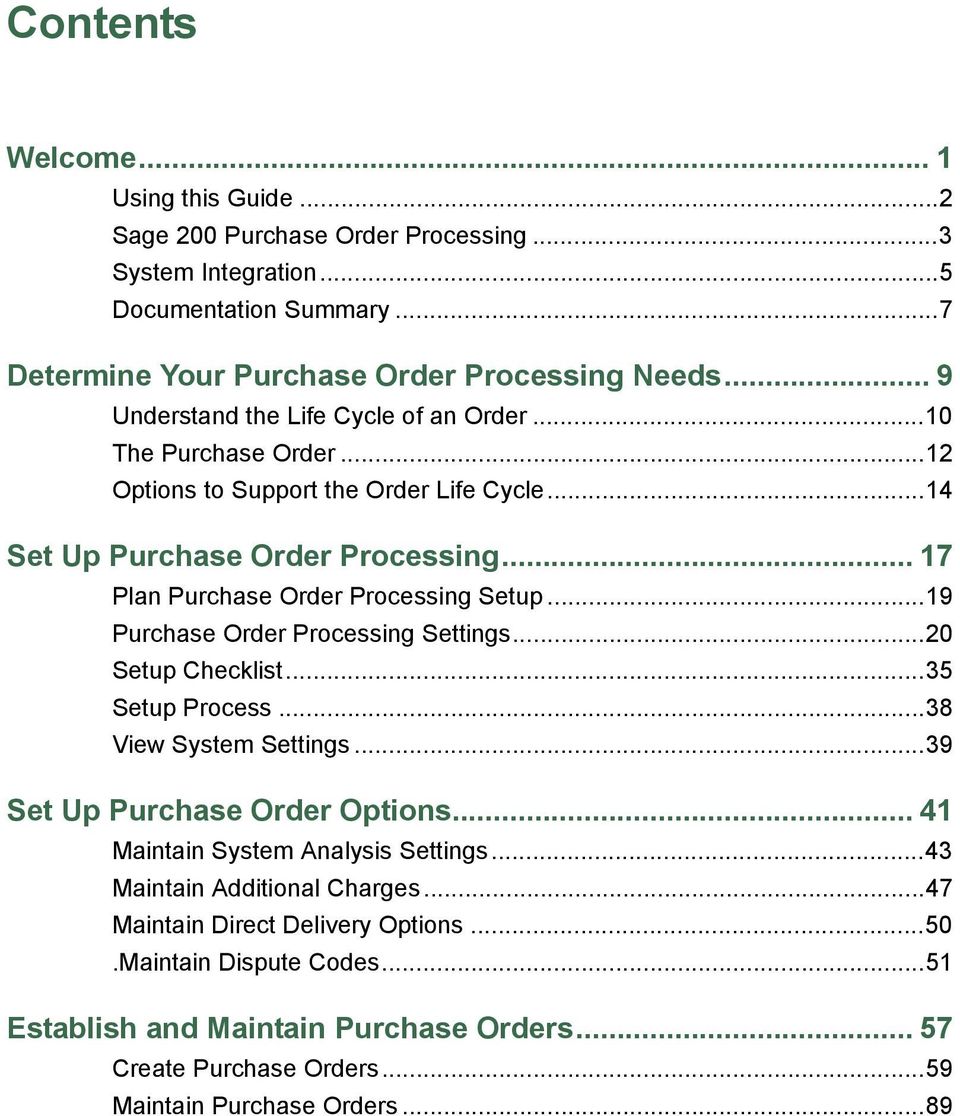
4 Contents Welcome... 1 Using this Guide...2 Sage 200 Purchase Order Processing...3 System Integration...5 Documentation Summary...7 Determine Your Purchase Order Processing Needs... 9 Understand the Life Cycle of an Order...10 The Purchase Order...12 Options to Support the Order Life Cycle...14 Set Up Purchase Order Processing Plan Purchase Order Processing Setup...19 Purchase Order Processing Settings...20 Setup Checklist...35 Setup Process...38 View System Settings...39 Set Up Purchase Order Options Maintain System Analysis Settings...43 Maintain Additional Charges...47 Maintain Direct Delivery Options...50.Maintain Dispute Codes...51 Establish and Maintain Purchase Orders Create Purchase Orders...59 Maintain Purchase Orders...89
5 Sage 200 Purchase Order Processing Process Purchase Orders Manage Goods Received Record Invoices Manage Disputed Invoices Process Transaction Invoice Record Stock Returns Create a Purchase Return Maintain Purchase Returns Manage Purchase Despatch Manage Credit Notes Manage Disputed Credit Notes Monitor Purchase Orders and Returns View Purchase Order Information Prepare Purchase Order Reports Periodic Maintenance Activities Housekeeping Activities Glossary of Accounting Terms Appendix: Import Information Import Overview...262

6 1 Welcome In this chapter: Using this guide System overview Welcome to the Sage 200 Purchase Order Processing module and to the Sage 200 Purchase Order Processing User Guide. System integration Documentation summary Sage 200 is a.net accounting system which offers a complete solution to meet your business needs. The Purchase Order Processing module is one of three Commercials modules within the Sage 200. There are also four Financials modules, and an Accounting System Manager module. Each module has its own User Guide.
7 Using this Guide The Sage 200 Help system and User Guide provide information on how to use the Sales Ledger. You can access Help for each module from the menu bar. You can also press 'F1'on the keyboard to display help topics for the screen you are currently working in. We hope you will find the documentation comprehensive. If you want to us with your comments, please the Sage 200 Documentation Team at and mark the subject line as 'Sage 200 v5'. Process-oriented approach This User Guide describes processes you will go through when setting up your Purchase Order Processing module, such as setting up the system to control how orders will be processed, generating purchase orders and recording goods as received. Where the processes comprise of more than one activity, a snapshot of activities is provided in the coloured side panel on the first page of all chapters. Where it does not, a snapshot of the topics included in the chapter is provided. Conventions References to other sections in this User Guide, or to other guides are given in italics. References to on-screen items are enclosed in single quotation marks. For example, on the 'Contacts' tab click 'Save'. Navigation to an online window is illustrated by the name(s) you need to choose separated by a symbol >. For example, Choose Enquiries > View Item Balances, means choose the 'Enquiries' option and then the 'View Item Balances' option. Where there are prerequisites to performing activities, these are indicated graphically using the symbol so you can easily identify them. For detailed information on the operation of Sage 200, see the Sage 200 Operations documentation.
8 Chapter 1 Welcome Sage 200 Purchase Order Processing This module is designed to facilitate the management of the purchase order process from generating purchase orders through to recording purchase invoices. Furthermore, if dealing with rejected goods, recording the return and despatch of goods back to your supplier through to recording associated credit notes. All this information can then be monitored to determine the status of orders or returns with your suppliers. Purchase Order Processing brings together your supplier information and the goods/services you purchase in order to efficiently generate purchase orders. Sage 200 supports the traceability of goods not only within the purchase order process but also the sales order process through the application of batch and serial numbers. The Stock Control module is used to enable batch and serial numbered items and governs the behaviour of stock items within the system. For more information, see your Sage 200 Stock Control documentation. Note: Sales order items maintained in the Sales Order Processing module are not subject to purchase order processing. For more information see your Sage 200 Sales Order Processing documentation. Using the Purchase Order Processing module you can: Record a purchase order. This is done on an individual basis for a single purchase request. Generate purchase orders based on a list of stock items suggested by the system. The system suggests the items for purchase based on stock levels and sales orders associated with them. Set up the preferences for direct delivery of stock items so that items can be delivered directly to a customer based on a sales order they raised or to a customer, supplier or other location not related to an initial sales order. Set orders over a specified value to require authorisation. Put an order or return on hold. This is effectively an internal warning to signify there is a problem but it does not stop further processing of the order or return. Print purchase orders and copies of these documents (if you require) for internal use. Record invoices against orders and credits notes against returns. Those with discrepancies can be marked as disputed. A stop is put on disputed invoices or credit notes, they cannot be processed further until the dispute is removed or they can be written off. 3
9 Sage 200 Purchase Order Processing With the support of Transaction you can send purchase orders and receive purchase invoices from suppliers using . Note: The Purchase Order Processing module can deal with multiple currencies and this is described within the context of the activities. The following diagram illustrates the processing areas of the Purchase Order Processing module. System Set Up Purchase order default settings System analysis codes Additional charge types Direct delivery preferences Dispute codes Establish and Maintain Purchase Orders Record individual orders Generate several orders Authorise orders Print/ orders Maintain orders Maintain order status Cancel orders Write off incomplete orders Periodic System Maintenance Manage cost variances Accrue order values Archive orders and returns Delete orders and returns Process Purchase Orders Record goods/services as received Record invoices Manage disputed invoices Return Supplier Goods Record return Record goods as despatched Enter the credit note Monitor Purchase Orders View order details View orders for a stock item View returns View cancelled orders Some of the processing areas are optional. Their use depends on how you want the system to process orders and even the type of order you are dealing with. 4
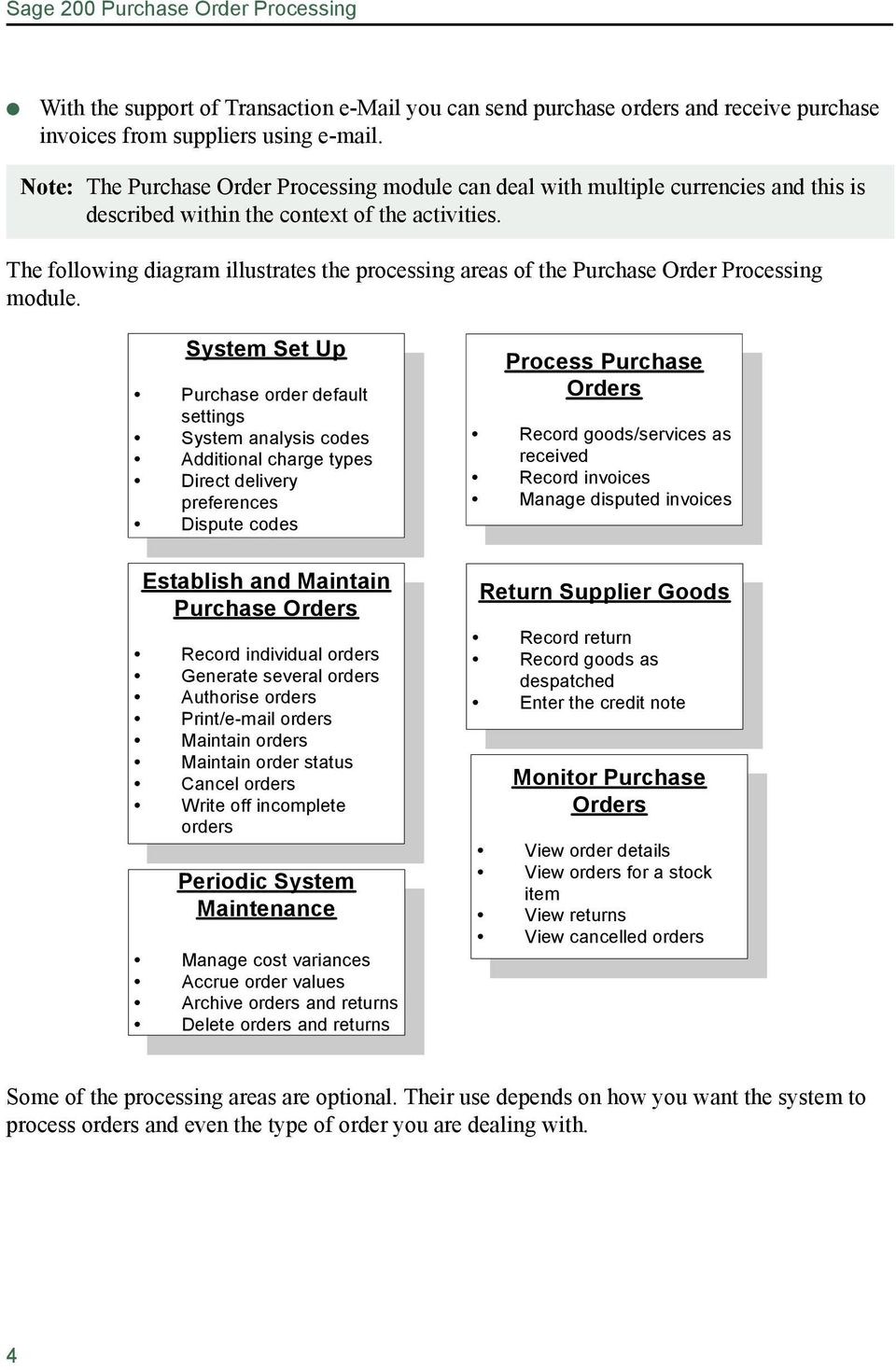
10 Chapter 1 Welcome System Integration The Purchase Order Processing is designed to integrate with other Sage 200 modules in the following way. Cash Book Sales Order Processing Sales Ledger information retrieval information retrieval Stock Control optional Nominal Ledger information retrieval Purchase Order Processing 5
11 Sage 200 Purchase Order Processing Integrate with Stock Control Nominal Ledger Sales Order Processing Purchase Ledger Integrate how To determine stock level information and notify the need to order stock. Changes stock levels as goods are recorded as received or despatched if dealing with returns. Posts the cost of purchases in order to establish the profit and loss figures for your organisation. To determine the items needed to be purchased in order to fulfil sales orders. Access supplier records to obtain supplier information to efficiently generate purchase orders. Use Purchase Ledger analysis codes to perform analysis within Purchase Order Processing. Benefits of integration The main benefit of using an integrated system is that you only need to enter information once in one module, and it is used in the relevant areas. Sage 200 automatically handles common data, ensuring the appropriate information is directed to the relevant modules. This saves time and reduces the risk of error by removing the need to re-enter information. Control of purchase order processing records You can control your purchase order processing records through the definition and application of settings at three levels within Sage 200: global, module and order. Global level settings defined using the Accounting System Manager and Nominal Ledger can be applied to all modules throughout Sage 200. Module level settings affect purchase orders although you can override some module level settings at purchase order level. 6
12 Chapter 1 Welcome Documentation Summary The following information provides a summary of the remaining sections in this documentation. Determine Your Purchase Order Processing Needs An introduction into what is involved in purchase ordering, and describes the issues you should consider before attempting to set up and use Purchase Order Processing. See Determine Your Purchase Order Processing Needs on page 9. Set Up Purchase Order Processing The setup process requires you to select the system settings that customise the Purchase Order Processing module to meet your company's needs. See Set Up Purchase Order Processing on page 17. Set Up Purchase Order Options There are a number of options that can be employed to support the purchase order process. Each option is explained covering analysis codes, additional charge types, direct delivery and dispute codes. Instructions on how to setup each option are also provided. See Set Up Purchase Order Options on page 41. Establish and Maintain Purchase Orders Explains the methods you can use to create purchase orders. This is followed by an explanation of how to amend an order, put an order on hold and even cancel an order. Other activities include how to authorise orders for those using order authorisation and how to generate order acknowledgements or orders for those using Transaction . See Establish and Maintain Purchase Orders on page 57. Process Purchase Orders Describes how to record goods as received or services as being satisfactorily carried out. It also explains how these records can be amended if errors are found. 7
13 Sage 200 Purchase Order Processing Details on how to process supplier invoices is provided. Included is the management of disputed invoices, which covers resolving, deleting or writing off these records. See Process Purchase Orders on page 111. Record Returns The activities required to return goods to your suppliers are very similar to those used to process purchase orders. The aim is to return goods to your suppliers that you do not want replaced or repaired. This covers preparing the purchase return, recording the despatch of the goods and finally recording receipt of the credit note in respect of the returned goods. Note: If you want the goods replaced or repaired, use the Stock Control module to manage the return. See Record Stock Returns on page 155. Monitor Purchase Orders and Returns Describes the various ways you can find and analyse purchase information. This includes screen enquiries and the preparation of purchase order reports. See Monitor Purchase Orders and Returns on page 199. Periodic Maintenance Activities This process covers the housekeeping activities needed to maintain the Purchase Order Processing module. Certain activities are required to maintain the nominal values for purchase costs within the Nominal Ledger. See Periodic Maintenance Activities on page 215. Glossary of Accounting Terms This includes frequently used Sage 200 accounting terms and their meanings. See Glossary of Accounting Terms on page
14 2 Determine Your Purchase Order Processing Needs This section provides an introduction into what is involved in purchase ordering and the issues you should consider before attempting to set up and use Purchase Order Processing. In this chapter: The order life cycle The purchase order Supporting options: Analysis codes Additional charges Direct delivery preferences Dispute codes

15 Understand the Life Cycle of an Order Orders placed with your suppliers are contractual agreements between you, the customer and the supplier about delivering products or providing a service on time and at an agreed price. Strong order management allows you to maintain order visibility throughout the life cycle of an order from demand creation to supply fulfilment. 1. Create orders 2. Authorise orders 3. Produce documentation 4. Confirm goods received 5. Record invoices 6. Monitor order progress 7. Return goods 1. Record orders you want your supplier to fulfil. There are two methods to choose from. You can: Record purchase requests on an individual basis. Use the semi-automated method, which generates a list of items due to be ordered based on the stock level set for stock items and any outstanding sales orders. From the generated list you can then select those you want to create orders for.
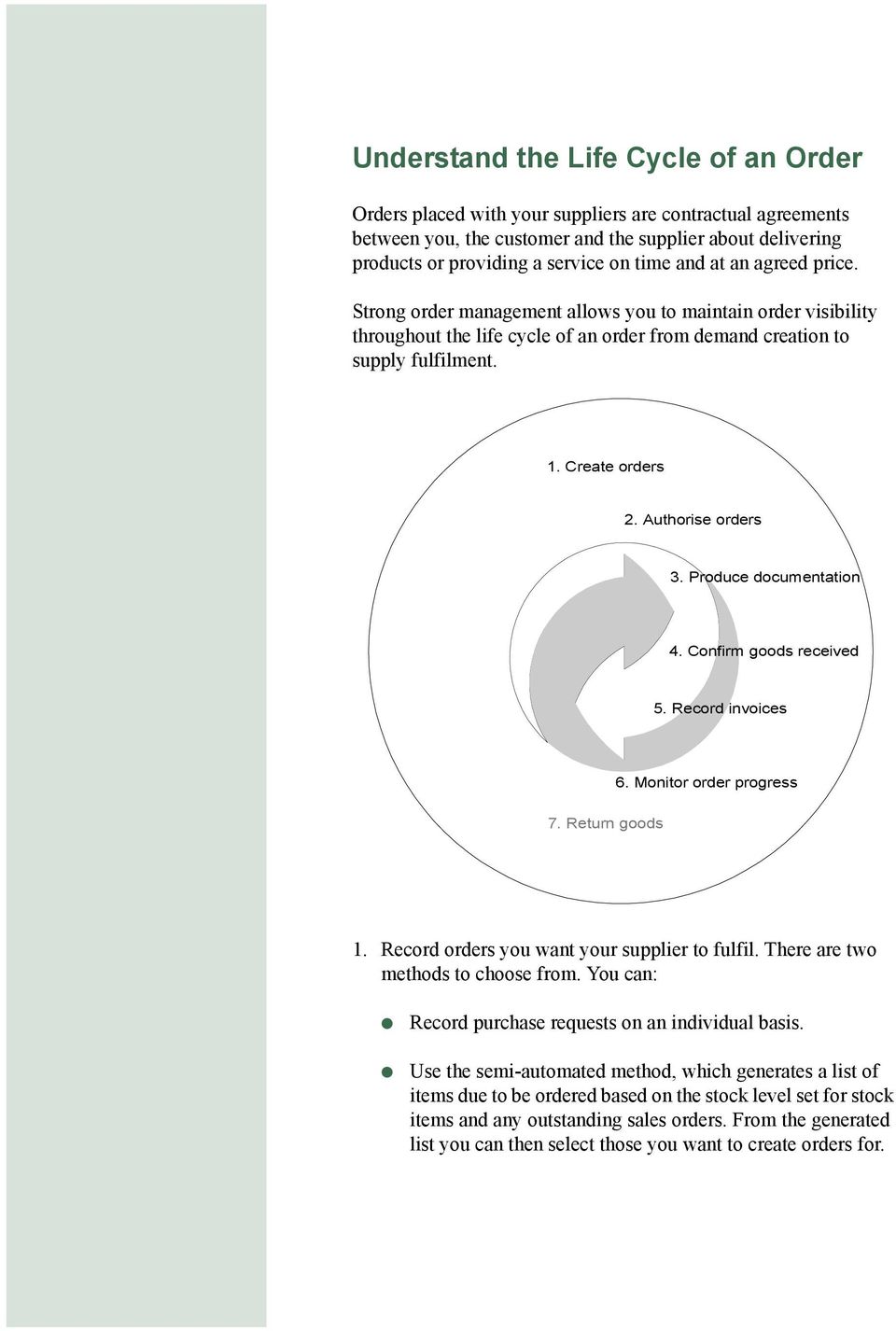
16 Chapter 2 Determine Your Purchase Order Processing Needs 2. Order authorisation is optional. An order can be automatically flagged for authorisation if it exceeds a certain value. 3. Produce order documentation. You can print orders or you can produce electronic orders to be sent via using Transaction . Copy purchase orders can also be printed for office use if required. 4. Record delivery of goods, where the goods received are matched to the purchase order. You can also include recording services that have been satisfactorily completed. 5. Record invoices. You can match the invoice to the purchase order or the record of goods received. Those with discrepancies can be marked as disputed provided you set the system to use disputed invoice processing. This stops the invoice being processed further until the dispute is removed or the disputed value can be written off. 6. Interrogating your purchase order processing system is important at all stages of the order life cycle to monitor order progress. 7. Sometimes goods are returned, and dealing with returns is another stage in the order life cycle. The goods are recorded as returned and then despatched. On receipt of the supplier's credit note the information is matched against the goods returned record. Depending on how you set up your system you may not need to complete all of these stages; for example, order authorisation. 11

17 Sage 200 Purchase Order Processing The Purchase Order Purchase orders are essentially assembled using supplier details and the goods and services you buy. Order header contains supplier details HEADER Supplier Name, *************************************** detail contains goods and services, and addtional charges, if incurred: DETAIL text line stock item line Please supply 20 Filter Coffee X.XX per coffee maker Supplier details Supplier details are managed in the header section of the purchase order. These details include information such as the supplier's name, address and terms of business. You can change the details in the order header to match those that you want displayed using the Sage Report Designer. For more information see your Sage Report Designer User s Guide. During order entry the system calls on and displays the address stored for the supplier. This address is specified in the supplier's record held in the Purchase Ledger. Goods, services and charges The detail section of the purchase order comprises lines. These order lines itemise the goods and services requested including any additional charges incurred and are categorised by line type. The line types cover: 12

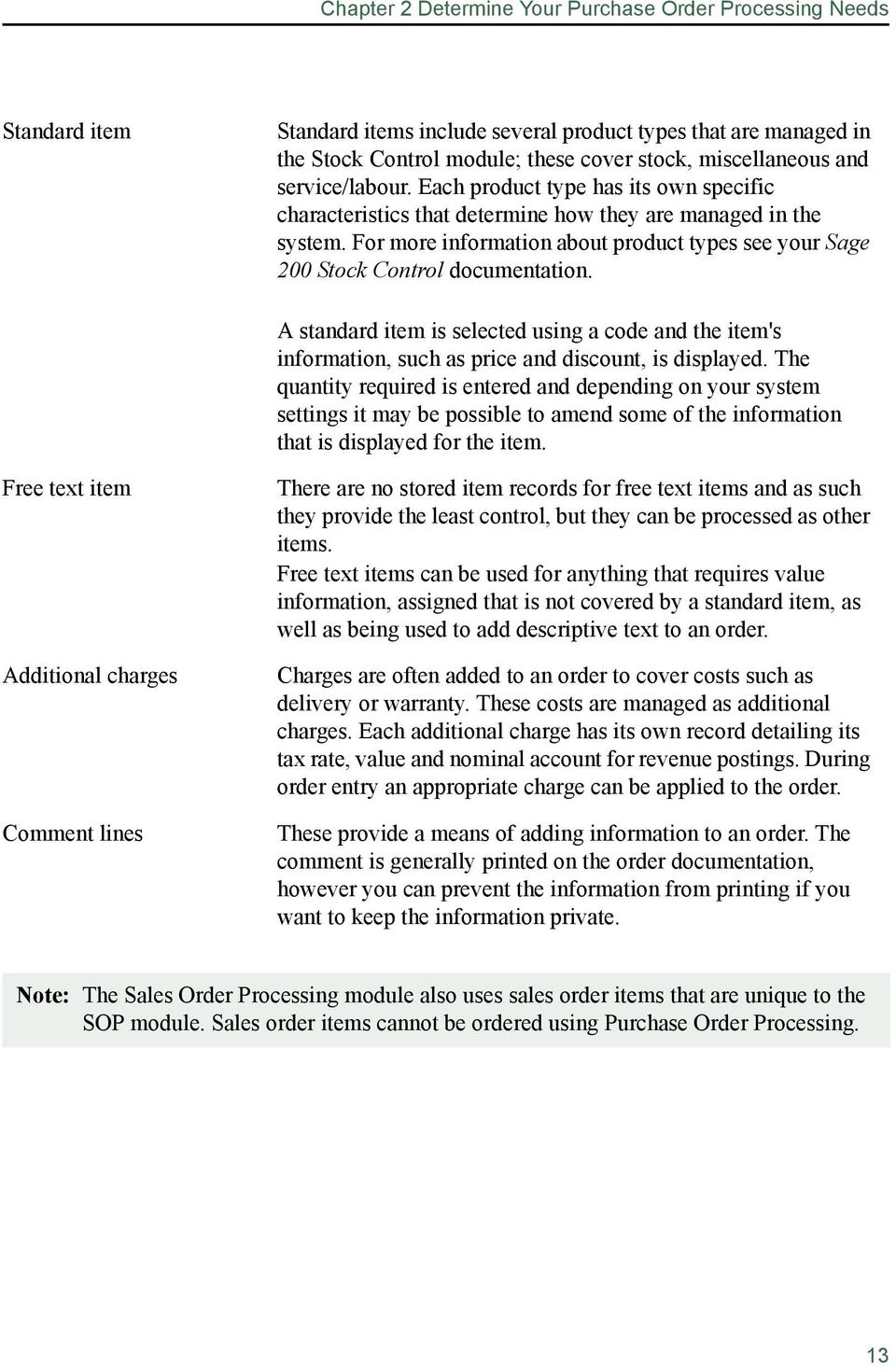
18 Chapter 2 Determine Your Purchase Order Processing Needs Standard item Standard items include several product types that are managed in the Stock Control module; these cover stock, miscellaneous and service/labour. Each product type has its own specific characteristics that determine how they are managed in the system. For more information about product types see your Sage 200 Stock Control documentation. A standard item is selected using a code and the item's information, such as price and discount, is displayed. The quantity required is entered and depending on your system settings it may be possible to amend some of the information that is displayed for the item. Free text item Additional charges Comment lines There are no stored item records for free text items and as such they provide the least control, but they can be processed as other items. Free text items can be used for anything that requires value information, assigned that is not covered by a standard item, as well as being used to add descriptive text to an order. Charges are often added to an order to cover costs such as delivery or warranty. These costs are managed as additional charges. Each additional charge has its own record detailing its tax rate, value and nominal account for revenue postings. During order entry an appropriate charge can be applied to the order. These provide a means of adding information to an order. The comment is generally printed on the order documentation, however you can prevent the information from printing if you want to keep the information private. Note: The Sales Order Processing module also uses sales order items that are unique to the SOP module. Sales order items cannot be ordered using Purchase Order Processing. 13
19 Sage 200 Purchase Order Processing Options to Support the Order Life Cycle There are many settings you can switch on or off to change the way the system works. The settings that govern documentation numbering and printing, order entry and processing and are described in a separate chapter. For more information see Set Up Purchase Order Processing on page 17. In addition to the system settings the following options can be established to provide additional support to the order process where required. Analysis codes Analysis codes are routinely applied to purchase orders. They are small pieces of text that provide additional detail to a purchase order to indicate information such as, the person preparing the order, the person that has requested the goods or the region the goods are purchased from. During order entry, up to six analysis codes can be applied to an order. To help in the consistent application of these codes, settings for analysis codes are established. The correct application of these codes maximises the speed and consistency for delivering management reports for purchases. To establish and maintain analysis codes see Maintain System Analysis Settings on page 43. Additional charges Orders can incur additional charges, such as carriage and insurance. To speed up the process of creating orders and to ensure consistency of use when applying such charges, a list of additional charges can be maintained. To establish and maintain additional charges see.maintain Dispute Codes on page 51. Direct delivery options It is often more efficient and convenient to deliver an order directly to a specified address rather than it being received by the warehouse first, only to be sent back out to the recipient. These options enable and control which recipient addresses can be selected when creating a new order line. The direct delivery options now available, enable stock to be: 14
20 Chapter 2 Determine Your Purchase Order Processing Needs Delivered directly to the customer based on a sales order they have raised. Delivered to a customer, supplier or other location that is not related to an initial sales order. For more information about specifying the direct delivery options see Manual orders for direct delivery on page 22. Dispute codes Purchase Order Processing provides the means of recording an invoice with known discrepancies and marking it as disputed. This is possible provided you use disputed invoice processing. For more information see Disputed invoices on page 30. To mark an invoice as disputed you need to establish dispute codes. As the invoice is recorded you can assign the appropriate code to indicate why it is in dispute such as price dispute or waiting proof of delivery. To establish and maintain dispute codes see.maintain Dispute Codes on page 51. Note: If you use disputed invoices you can also record and mark credit notes as disputed. 15

21 Sage 200 Purchase Order Processing 16
22 3 Set Up Purchase Order Processing The setup process requires you to select the system settings that customise the Purchase Order Processing module to meet your company's needs. Activities: Plan setup Use setup checklist Set up the POP module View POP settings Note: There is a view only version of the settings window incase you need to contact Sage Support and provide details of the Purchase Order Processing settings. You can open this window when working in other areas of the program.
23 Before you begin... You must have: Determined your purchase order processing needs. For more information see Chapter 2, Determine Your Purchase Order Processing Needs. Set your Sage 200 defaults, using the Accounting System Manager module. For more information see your Sage 200 Accounting System Manager User Guide. Created your nominal accounts and specified your default nominal accounts in the Nominal Ledger. For more information see your Sage 200 Nominal Ledger User Guide. Set up your Purchase Ledger and created your supplier accounts. For more information see your Sage 200 Purchase Ledger User Guide. Set up the Stock Control module and entered stock items. For more information see your Sage 200 Stock Control documentation. Note: You must have suitable security privileges to perform these activities. See your system administrator for more information. Remember... Use your help system. For more information on using the help system, see your Sage 200 Operations documentation.
24 Chapter 3 Set Up Purchase Order Processing Plan Purchase Order Processing Setup The setup process builds on and complements the settings within the Accounting System Manager. The aim of the process is to tailor the system to your company's needs and enable the efficient generation of purchase orders. By doing so it saves you and other users time when using the system on a day to day basis. You will need to consider the following types of questions: Do I want to use purchase order numbers automatically generated by the system? Do I want to amend nominal codes and analysis codes during order entry? Do I want to store cancelled order information for future purchase analysis? Do I want a copy of all purchase orders for office use? Considering your needs/requirements from the program, read through the settings you can apply within the Purchase Order Processing module and plan the setup process. Use the Setup Checklist on page 35 to note down your requirements and refer to it as you complete the setup process. Then select the settings you want using the online window. Note: You will be able to change some settings after you start using the Purchase Order Processing module, but changing the settings will only be applicable to new data. Setting changes should only be made when no one is using the module. 19
25 Sage 200 Purchase Order Processing Purchase Order Processing Settings Purchase Order Processing settings are maintained in one window. The settings are logically grouped into sections using window tabs: 'Document Numbering', 'Order Entry', 'Default Accounts', 'Order Processing' and 'Printing'. If you are using the Manufacturing module, another tab, Order Generation is also displayed. To access the window choose POP Utilities > System Set Up > POP Settings. Document numbering The following settings govern how numbers are applied to your orders, returns and goods received records. Orders and returns These settings cover the unique reference applied to both orders and returns. You can either assign the numbers manually or have them automatically generated by the system. 20
26 Chapter 3 Set Up Purchase Order Processing If you decide to assign order and return numbers manually, as you may already have a referencing system for orders that you want to retain, it is best to plan your coding structure. This helps establish a procedure for assigning new numbers when you start to record orders. Manually applied order numbers can consist of alphanumeric characters. Note: If you choose to assign order numbers manually, you cannot automate the generation of purchase orders. For more information see Generate purchase orders on page 59. The automatic generation of order numbers is quick and accurate and removes the need for you to create your own reference system. If you want the system to generate order and return numbers, activate this setting and specify the next order number and next return number the system must use. Subsequent order and return numbers are assigned in sequential order. Note: Order and return numbers provide traceability of purchase documentation. The number is applied as a reference to all records generated for a particular order or return. Goods received numbers These settings govern goods received processing as well as goods despatched processing when dealing with returns. Next goods received number This setting covers the unique reference number associated with a purchase order as a result of goods received. A Goods Received Note (GRN) is also applied to the record of goods despatched to your supplier when dealing with purchase returns. GRNs are automatically generated by the system. You must specify the next GRN the system must use. Subsequent numbers are assigned in sequential order. Display outstanding order quantities during goods received entry This setting controls the display of outstanding order quantities when confirming goods as received or when confirming goods as despatched when dealing with returns. The outstanding quantities represent those required to complete the order or return which is particularly relevant when dealing with part orders or despatches. With this option selected, the system displays the quantity of outstanding goods automatically. If you do not want these quantities to be visible during the goods received process, switch this setting off. 21
27 Sage 200 Purchase Order Processing Order entry These settings govern information that is displayed and available for change when recording a purchase order or return. Manual orders for direct delivery Select the 'Allow order entry for goods to be delivered direct from the supplier' check box to set up the Purchase Order Processing system for direct delivery. The 'Recipient addresses' options become available for you to select from. Choose a single or multiple selection of options from the 'Customer address', 'Supplier address' or 'Free text entry' check boxes. This controls the type of address options available when you select direct delivery at the point of creating or amending an order item line. Important Note: Selecting the 'Free text entry' option provides the flexibility to enter any suitable address for the delivery lines. Please only select this option with full consideration of its usage. 22
28 Chapter 3 Set Up Purchase Order Processing If you want to ensure that normal sales orders and 'direct delivery' sales orders are printed separately, select the 'Generate separate purchase orders for direct delivery sales orders' check box. Order line entry These settings control whether changes can be made to individual order lines during order entry. The order lines are the goods and services you want to purchase from your suppliers. Allow amendment of analysis codes Analysis codes are small pieces of text that provide additional detail to a purchase order to indicate information such as, the person preparing the order, the person who has requested the order or the region the goods are purchased from. They are applied to orders in accordance with the analysis code settings. For more information see Maintain System Analysis Settings on page 43. The analysis codes are assigned to the order as a whole as well as the individual items (goods and services) added to the order; with individual items using the same codes assigned to the order. This setting provides a means of amending the analysis code for individual items. This means the analysis codes for the whole order can differ from those applied for individual items. You might want to do this if you want to analyse purchase using different analysis codes to breakdown your purchases. To allow the amendment of analysis codes, enable this setting. Allow amendment of nominal codes When entering purchase orders, the system automatically displays an appropriate nominal account for each stock item requested within the order. The nominal account(s) are used to post the profit and loss values for the purchase order. The system is set so that the displayed nominal accounts cannot be changed when entering a purchase order. You can remove this restriction, however this will require the selection of the correct nominal accounts when recording purchase orders. To allow the amendment of nominal codes, enable this setting. Note: If the system is set to prevent the amendment of nominal codes during order entry, postings for additional charges may be sent to the suspense account. This occurs when an additional charge not from the established list of charges is applied to an order. No record for the charge exists, values are keyed in during order entry. In this instance the nominal code selection box is blank and inactive, therefore postings are made to the suspense account. 23
29 Sage 200 Purchase Order Processing Order placed by During order entry a reference is applied to the order to indicate the person responsible for the order. This can be keyed in during order entry, and is particularly suitable where the person entering the order is not the person who took the order. However, if the person responsible for the order records the order themselves, you can set the system to use the user's ID from their log on name. This removes the need to record who is placing the order during order entry. Order authorisation Purchase order authorisation is optional. It provides an additional level of control that can be set for orders over a specified value. Orders above the specified value are automatically marked for authorisation. This does not stop the order from being processed, which means goods can be recorded as received or an invoice can be entered for an order; but you cannot print the purchase order until the order is authorised. If you are using Transaction to submit orders to your suppliers, an electronic copy of the order can only be prepared once the order has been authorised. For more information see Authorise purchase orders on page 101. To use authorisation, select the 'Orders require authorisation before processing' check box. Then enter the order value (in base currency) required for authorisation in the 'Authorisation not required for order less than' box. Note: Purchase returns are not subject to order authorisation. 24
30 Chapter 3 Set Up Purchase Order Processing Default accounts The following settings govern the nominal accounts you want the system to use to post your profit and loss and balance sheet values. Stock nominal account This setting is concerned with how you want to analyse your purchases, from the balance sheet nominal postings made for stock assets. You can analyse purchases by suppliers to determine whom you have bought from, or by item type to find out what you have sold. To analyse purchases by item; you need to select the 'Stock item stock account' option. In this case your stock postings are directed to the nominal account specified on the stock item. However, analysing by item is more flexible and you can produce a detailed analysis of your purchases if you are using cost centre breakdown. If you are using cost centre breakdown you can direct the postings to those stock nominal accounts set up by cost centres and 25
31 Sage 200 Purchase Order Processing departments. The system takes the account reference section of the nominal code as specified for the stock item, and then uses the cost centre and department codes set on the supplier's account. To use cost centre breakdown for your stock postings, select the 'Use same cost centre and department as supplier account' check box. To analyse purchases by supplier; select the 'Supplier account' option. In this case your stock postings are directed to the nominal account as specified on the supplier's record stored in the Purchase Ledger. Note: The use and application of cost centres and departments governs the degree of workable analysis. Cost centres and departments are defined in the Nominal Ledger. For more information see your Sage 200 Nominal Ledger User Guide. Nominal account for standard cost variances This option is only relevant if you are using the standard costing method for any of your stock items. When you use standard costing, the cost of the item is specified on the item record stored in the Stock Control module. When the actual buying price of the item differs from the specified cost price, cost variances can occur. The cost variances occur in your Balance Sheet on the asset of stock nominal account and also in your Profit and Loss Statement on the cost of sales nominal account. To resolve the discrepancies you can use the 'Standard Cost Variances' activity to post values to the Nominal Ledger to correct the anomalies. For more information see Manage standard cost variances on page 219. Before you can do this, you must specify the nominal account you want the system to post the cost variances to. To do this, select the required nominal account in the 'Variances' box. The nominal account is then used to post your standard cost variances. It is not possible to select an alternative nominal account when the 'Standard Cost Variances' activity is performed. If you are using cost centre breakdown, you have the option of analysing your standard cost variances by cost centre and departments. To do this enable the 'Analyse balance sheet postings by cost centre and department' option. 26
32 Chapter 3 Set Up Purchase Order Processing Order processing These settings govern how orders are processed, by introducing additional stages into the order processing cycle. They also provide a means of storing information specifically to do with cancelled orders. Record receipts prior to invoicing for These settings control whether service/labour and free text items are required to undergo goods received processing. Such item types are not usually subject to the conventional process of goods received expected for physical stock items. For more information about item types see Goods, services and charges on page 12. The system is already set so that such item types are required to undergo goods received processing. This means invoices can be checked not just against an order but to see if the requested service/labour has been received. If this information is not available when the invoice 27
33 Sage 200 Purchase Order Processing is recorded; you can take the risk and accept the invoice, or you can mark the invoice as disputed, provided you choose to use disputed invoice processing. See Disputed invoices on page 30. If you do decide to switch off these settings, orders for such items are not required to undergo goods received processing. As a result there will be no indication to determine whether the goods have been received or not during invoice entry. If you switch the settings on, you can also choose to include the amounts for these items when considering purchase order and return accruals. If you include the amounts then these are added to the 'Value to be Accrued' column in the 'Purchase Order and Return Accruals' window. For more information, see Post purchase order accruals on page 217. Update stock cost prices Choose from the following options to specify if the stock cost prices can be updated when you enter an invoice or when you receive the goods. Invoice is recorded The purchase order line is automatically configured to update cost prices on invoice entry. Goods are received Select this option to enable the 'Update process when goods are received' check box on new order lines so you can update cost prices on goods received. The process itself, will create a confirmed balance for the goods using the cost price from the purchase order line. For more information see Add the required goods and services to the order (standard item) on page 73. You can also specify a nominal code in the 'Differences' drop-down list to account for any anomalies between the order price and the invoice price. Use order exchange rate when updating prices Select this option to use the order exchange rate when prices are updated as part of goods receipt. Use system exchange rate when updating prices Select this option to use the system exchange rate (based on the goods receipt date), when prices are updated as part of goods receipt. 28
34 Chapter 3 Set Up Purchase Order Processing During the invoice matching process, if the exchange rate at receipt differs to the exchange rate at invoice, a discrepancy will be made to the currency adjustment nominal code and added to the nominal analysis items against the purchase invoice. Match invoice and credit notes to This setting determines what an invoice or credit note is matched against as it is recorded into the system. There are two options to choose from: 'GRNs, orders & returns' This is a three-way match where the invoice is matched to the goods that have been received, which in turn matches the invoice to the purchase order. Or in the case of a credit note, where the credit details are matched to the goods that have been despatched to the supplier, which in turn matches them to the purchase return. When dealing with an invoice, the goods received details are displayed for purchase order item types stock and miscellaneous. Goods received details for item types service/labour and free text are only displayed if such items are set to be marked as received prior to being invoiced (see Record receipts prior to invoicing for on page 27). The record of goods received are then matched to the order. When dealing with a credit note, the details of goods despatched to your supplier are only displayed for item types stock and miscellaneous. Item types service/labour or free text items are not marked as despatched when dealing with a return. Such items cannot be matched to the credit note using a three-way match. To switch on the matching process you want to use during invoice entry, select the appropriate setting. Note: The setting can only be changed when there are no outstanding orders or returns. 'Orders & returns'. This is a two-way match where the invoice is matched directly against the purchase order. All purchase order items regardless of type (stock, miscellaneous, service/labour and free text) are displayed during invoice entry to be matched to the order. When dealing with a credit note, all items regardless of type are displayed during credit note entry to be matched to the purchase return. For more information about item types see Goods, services and charges on page
35 Sage 200 Purchase Order Processing Disputed invoices This setting provides a means of controlling purchase invoices where irregularities are found, such as price discrepancies. A disputed invoice can be recorded against the order; the invoice is put on stop, which means no update to the Purchase Ledger or Nominal Ledger occurs. Disputed invoices are eventually resolved by either deleting them, accepting them or recording a supplier credit note against them. A disputed invoice can also be written off. For more information see Manage Disputed Invoices on page 139. If you do not activate this setting, such invoices can still be recorded. However the invoices are not controlled by the system and the Purchase Ledger and Nominal Ledger are both updated with the invoice values. By doing so you accept irregularities occur and resolve these issues by other means. Alternatively, you can put these invoices to one side and resolve them outside the system. Note: If you use disputed invoices, you can also record and manage disputed credit notes. Cancelled orders You can use this setting to save a history of cancelled orders as well as cancelled purchase returns. By doing so you can analyse cancelled purchase orders and returns. With this setting selected, all orders or returns that are cancelled are marked as complete during the cancellation and the information is stored. This includes the header information covering the supplier contact details and the order/return line details, which cover the goods requested/ returned. If you remove items from an order or return, or reduce the original quantity, you also have the option to save the cancelled details. If you do not activate this setting, the order/return header information is stored but not the order/ return lines. Note: If you switch this setting off after storing cancelled orders, you will need to confirm that you want to change the setting. Once you confirm this, the system will remove the stored history of cancelled orders/returns. 30
36 Chapter 3 Set Up Purchase Order Processing Printing These settings provide a means to generate a copy of all purchase orders as well as generate your Intrastat Declarations (formerly known as an SSD), if you are required to do so. Document printing This 'Automatically print copy orders' setting provides a means of obtaining copies of your purchase orders intended for office use. If you enable this setting, copies are sent to print automatically for orders that are not 'on hold'. If you are using order authorisation, a copy of the order is sent to print when the order is authorised. If you are not using order authorisation, a copy of the order is sent to print once you save an order whether it is a new order or an amended order. Copy orders are sent to print in accordance with your print setup. 31
37 Sage 200 Purchase Order Processing Intrastat declarations These settings are only applicable if the Accounting System Manager is enabled to produce an Intrastat Declaration (formerly known as an SSD). For more information see your Sage 200 Accounting System Manager User Guide. Generate Intrastat entries for purchase orders Sage 200 allows you to generate an Irish or a UK Intrastat Declaration. To generate intrastat entries for purchase orders, select this setting. Then select the terms of delivery and nature of transaction code. If you generate an Irish declaration, you also need to select a code for the mode of transport. These codes must be applied in accordance with either the HM Revenue and Customs or Irish Revenue Commissioners rules depending on the declaration you want to generate. The codes that you enter here act as default settings. You can change codes on individual order lines when you maintain intrastat entries. Default terms of delivery The codes include: 'EXW' (ex-works); 'FCA' (franco carrier); 'FAS' (free alongside ship); 'FOB' (free on board); 'CFR' (cost & freight (C&F)); 'CIF' (cost, insurance, freight); 'CPT' (carriage paid to); 'CIP' (carriage and insurance paid to); 'DAF' (delivered at frontier); 'DES' (delivery ex-ship); 'DEQ' (delivered ex-quay); 'DDU' (delivered, duty unpaid); 'DDP' (delivered, duty paid); XXX (any other terms). Default nature of transaction code (NOTC) A code that identifies the transaction type being declared on the declaration; for example, purchases, acquisitions, goods sent for processing or repair, or free of charge goods. The code for HM Revenue and Customs will be one of: 10, 16, 17, 18, 20, 30, 40, 50, 60, 70, 80, 90. The code for the Irish Revenue Commissioners will be one of: 1, 2, 3, 4, 5, 6, 7, 9. Irish Intrastats only: Default mode of transport code (MOT) An additional drop-down list will be displayed if your 'Regional Settings' on your PC are set to 'English (Ireland)'. The codes are required for an Irish Intrastat declaration and include; 1 (Sea), 2 (Rail), 3 (Road), 4 (Air), 5 (Post), 7 (Fixed Transport Installation), 8 (Inland Waterway) and 9 (Own Propulsion). 32
38 Chapter 3 Set Up Purchase Order Processing UK users only: Include entries based on... You can control when the intrastat entries are generated. Select whether you want the entries to be based on the receipt/return date or whether they are based on the invoice date. Include terms of delivery on intrastat entry Select this check box if you have or think that you will exceed the threshold limits set by HMRC or the Revenue Commissioners. Once over that limit, the terms of delivery must be included on the intrastat reports. Include statistical value on intrastat entry (Irish Intrastats only) If the Company Settings in the Accounting System Manager module is set to English (Ireland)', this additional check box is displayed. Select this check box to print the statistical value on the intrastat entry, 33
39 Sage 200 Purchase Order Processing Order Generation If you use the Manufacturing application, it is possibel to generate orders from the Materials Requirements Planning (MRP) area of your Manufacturing software. Purchase Order generation options Select how you want to generate orders in Sage 200. You can either choose: Use Generate Orders. This will create orders via the Generate Orders option within the POP module. Use MRP. This will create orders via the MRP functionality in your Manufacturing application. Use Both. This will allow you to create orders from POP and manufacturing. 34
40 Chapter 3 Set Up Purchase Order Processing Setup Checklist Document numbering Orders and returns Automatically generate order and return numbers Next order number:... Next return number:... Goods received numbers Next goods received number:... Display outstanding order quantities during goods received entry Order entry Order line entry Allow amendment of: Analysis codes Nominal codes Order placed by Use the user's log on name as the order placer Order authorisation Orders require authorisation before processing Authorisation not required for orders less than:... 35
41 Sage 200 Purchase Order Processing Default accounts Stock nominal account Use same nominal code as: Supplier account Stock item stock account Use same cost centre and department as supplier account Nominal account for standard cost variances Variances:... Analyse balance sheet postings by cost centre and department Order processing Order lines to be marked as received prior to invoicing Text order lines Service/Labour order lines Match invoices and credit notes to Orders and returns GRNs, orders and returns Disputed invoices Use disputed invoice processing Cancelled orders Record details of cancelled orders for future analysis 36
42 Chapter 3 Set Up Purchase Order Processing Printing Document printing Automatically print copy orders Intrastat declarations Generate Intrastat entries for purchase orders Default terms of delivery:... Default nature of transaction code (NOTC):... Default mode of transport:... (Irish Intrastat only) 37
43 Sage 200 Purchase Order Processing Setup Process Choose POP Utilities > System Set Up > POP Settings. Use the window to activate or specify each setting according to your needs. Use the Setup Checklist on page 35 to keep a copy of the settings you choose. 38
44 Chapter 3 Set Up Purchase Order Processing View System Settings This is a view only version of your system settings. You cannot edit any of the settings from this window. You will typically use this option if you need to provide details of your system settings to the support team whilst you are working in a different window. Access the window Choose Settings > View POP Settings. Click 'Close' to exit from the window. 39
45 Sage 200 Purchase Order Processing 40
46 4 Set Up Purchase Order Options There are a number of options that can be employed to support the purchase order process. Each option is explained covering analysis codes, additional charge types, direct delivery and dispute codes. Instructions on how to set up each option are also provided. Activities: Maintain analysis settings Maintain additional charges Set up direct delivery options Maintain dispute codes
47 Before you begin... You must have: Determined what your purchase order processing needs are. For more information see Chapter 2, Determine Your Purchase Order Processing Needs. Set your Sage 200 defaults, using the Accounting System Manager module. For more information see your Sage 200 Accounting System Manager User Guide. Created your nominal accounts and specified your default nominal accounts in the Nominal Ledger. For more information see your Sage 200 Nominal Ledger User Guide. Note: You must have suitable security privileges to perform these activities. See your system administrator for more information. Remember... Use your help system. For more information on using the help system, see your Sage 200 Operations documentation.
48 Chapter 4 Set Up Purchase Order Options Maintain System Analysis Settings In order to maximise the speed and consistency of management reports required for purchase analysis, analysis codes are used routinely on purchase orders. To avoid the need to enter analysis codes on all orders and all order lines and to ensure they are applied consistently, you can establish default settings for analysis codes. When applying analysis codes the 'Order Entry' windows display labelled boxes. The labelled boxes provide prompts for you to select analysis codes when recording an order. The system is already provided with default labels. You can rename these labels to make them more meaningful for your organisation. The maximum number you can specify is six labels. You can control the behaviour of each labelled box when it is displayed during order entry. What information is displayed. This can be either an analysis code used on the supplier account or you can specify text you want the system to display. You can also set the box so that it is blank on display. What changes can be made. A box can be set so that it is possible to amend the information it displays during order entry. A box can also be set so that no information is required during order entry, which means the box can be left blank. Note: Amendment of analysis codes during order entry is only possible if your system is set to allow this. For more information see Manual orders for direct delivery on page 22. Analysis codes applied to an order can also be used to update the history file of the purchased stock item in the Stock Control module. You can select three codes to do this by specifying a position for the code. The selected position places the analysis codes in context with the information held in the stock item history. To maintain analysis codes You can establish default settings for up to six analysis codes. This activity explains how to set up their use and application of analysis codes during order entry. This also covers how to switch off their use and application. Note: Changing the settings for an analysis code will effect orders subsequently created but not existing orders. Choose POP Maintenance > Analysis Codes. 43
49 Sage 200 Purchase Order Processing Note: The current settings for each analysis code are displayed. Select the analysis code from those displayed and click 'Edit'. The 'Edit Analysis Code' window is displayed. 44
50 Chapter 4 Set Up Purchase Order Options Specify if the analysis code is to be used during order entry by selecting the 'Use analysis code for purchase orders' check box. Note: To stop the use of the code during order entry, clear the 'Use analysis code for purchase orders' check box. Specify what you want displayed during order entry for the box label and box contents using the 'Analysis code details' settings. Select the source of the analysis code. This can be either from the supplier account or an analysis code specifically established for Purchase Order Processing. If the source of the analysis code is POP, enter the text for the box label in the 'Analysis code label' box. Then enter the text for the box contents in the 'Default value' box. You can leave both blank. If the source of the analysis code is the supplier, select the required label using the 'Analysis code label' drop-down. Then enter the text for the box contents in the 'Default value' box. Note: If you intend to set the analysis code so that it cannot be left blank during order entry, you must enter a default value. Specify the controls for the analysis code using the 'Options on purchase order' settings. To ensure an analysis code is stored for an order, clear the 'Left blank' check box. To do this, you must have specified a default value detailed earlier in this activity. The default value can be amended provided your system is set to allow the amendment of the analysis codes during order entry. Note: The need to specify a default value minimises error messages displayed during order entry. To make it possible to store an order with a blank analysis code, select the 'Left blank' check box. To allow the amendment of the analysis codes for each order line during order entry, select the 'Amended for each order line' check box. Note: Amendment of analysis codes during order entry is only possible if your system is set to allow this. For more information see Allow amendment of analysis codes on page
51 Sage 200 Purchase Order Processing Specify if the analysis code entered during order entry is required to update the stock item history, using the 'Item history' options. To update the stock item history, select the 'Include analysis code in item history' check box. Specify the position the analysis code should use by choosing from 1, 2 or 3 from the 'Store at position' drop-down list. Note: You can only choose three analysis codes to update the stock item history and you can only link one purchase order processing analysis code to a stock history analysis code position. Click 'OK'. The window closes and you return to the 'Analysis Codes' window where the revised settings are displayed. 46
52 Chapter 4 Set Up Purchase Order Options Maintain Additional Charges Orders can incur additional charges, such as carriage and insurance. To speed up the process of creating orders and to ensure consistency of use when applying such charges, a list of additional charges can be maintained. A charge type consists of: A unique code. A name that can be used to describe the charge you are working with. The cost of the charge (excluding tax) specified in your base currency. A tax rate. A default nominal account used to post the cost values to the Nominal Ledger. The values specified for the charge are displayed during order entry. With the exception of the charge code, they can then be accepted or amended as you record the order. Create an additional charge Choose POP Maintenance > Additional Charges. Click 'Add'. The 'Add New Additional Charge' window is displayed. 47
53 Sage 200 Purchase Order Processing Enter a code and name for the additional charge. Note: Each additional charge has its own unique code. The code is limited to 20 characters. An additional charge may also have its own name, which is limited to 60 characters. Codes and names can contain numbers and letters. Select the tax rate for the additional charge. This can be overridden during order entry. Enter the cost of the additional charge (excluding tax) by entering a value in base currency. This can be overridden during order entry. Select the default cost nominal code using the drop-down. Note: Once selected, the default nominal account can only be amended during order entry provided the system has been set to allow this. For more information see Manual orders for direct delivery on page 22. Click 'OK' to save the information. 48
54 Chapter 4 Set Up Purchase Order Options Amend an additional charge You can amend any aspect of the additional charge except the code. Amending additional charge types has no impact on outstanding orders. To amend an additional charge Choose POP Maintenance > Additional Charges. The 'Additional Charge' window is displayed. Select the additional charge that you want to amend and click 'Edit'. The current settings for the charge are displayed. Make the required changes. Click Close. Delete an additional charge Deleting additional charge types has no impact on outstanding orders. To delete an additional charge Choose POP Maintenance > Additional Charges. The 'Additional Charge' window is displayed. Select the additional charge that you want to remove, and click 'Delete'. Confirm that you want to delete the selected chare, by clicking OK. Click 'Close'. 49
55 Sage 200 Purchase Order Processing Maintain Direct Delivery Options When entering a purchase order in Sage 200 Purchase Order Processing, you can specify which warehouse the goods are to be delivered to. When printing a purchase order, the delivery address is taken from the warehouse address. The purchase order line also offers the additional facility 'For delivery direct from supplier'. If you select this option, you can specify the address the goods should be delivered to by selecting either a customer or supplier address or alternatively manually entering an address for a different location using the free text option. It is this address that appears on the purchase order. Set up direct delivery options Choose POP Utilities > System Set Up > POP Settings. Select the Order Entry tab and refer to Order entry on page 22 for detailed information about each of the direct delivery options. For more overview information and procedures associated with order fulfilment, of which direct delivery is just one element, please see the Sage 200 Stock Control documentation. 50
56 Chapter 4 Set Up Purchase Order Options.Maintain Dispute Codes Dispute codes are only applicable if you intend to use disputed invoice processing. For more information see Disputed invoices on page 30. Note: If you use disputed invoice processing, you can also record and mark credit notes as disputed. You can establish a dispute code for each reason you would want to dispute an invoice, such as waiting on proof of delivery or a price dispute. Each dispute code has a reference code and description, so that when the code is applied to the invoice it is clear why the invoice is being disputed. As the code is assigned to the invoice, you can add further comments to explain in more detail why the invoice is disputed. While an invoice is marked as disputed, it is on stop. While on stop, postings are not made to the the Purchase Ledger or Nominal Ledger to account for such invoices. Disputed invoices can be resolved by either deleting them, accepting them or recording a supplier credit note against them. A disputed invoice can also be written off provided you enable this option on the dispute code. For more information see Manage Disputed Invoices on page 139. Note: A disputed credit note can be resolved by either accepting the discrepancies, deleting the credit note or writing the credit note off. 51
57 Sage 200 Purchase Order Processing Create a disputed code Choose POP Maintenance > Disputed Invoice Codes. Note: Current dispute codes are displayed. Click 'Add'. The 'Add Dispute Code' window is displayed. Enter the unique code. Enter the name to describe the type of dispute. 52
58 Chapter 4 Set Up Purchase Order Options Note: Each dispute code has its own unique code. The code is limited to 20 characters. A dispute code may also have its own name, which is limited to 60 characters. Codes and names can contain numbers and letters. To allow disputed values to be written off, select the 'Allow invoice and credit discrepancies to be written off' option. Click 'OK'. Amend dispute details You can amend the name assigned to the dispute code and the option to allow disputed values to be written off. You cannot amend the dispute code. Choose POP Maintenance > Disputed Invoice Codes. The 'Dispute Invoice Codes' window is displayed. Select the code from the displayed list. Click 'Edit'. The code settings are displayed. Make any changes as required. Click 'OK'. 53
59 Sage 200 Purchase Order Processing Delete a dispute code You cannot delete a dispute code if it is currently in use (assigned to an invoice). A prompt is displayed if you try to delete a code that is in use. Choose POP Maintenance > Disputed Invoice Codes. The 'Dispute Invoice Codes' window is displayed. Select the code from the displayed list. Click 'Delete' and confirm intent to proceed when prompted. 54
60 Chapter 4 Set Up Purchase Order Options 55
61 Sage 200 Purchase Order Processing 56
62 5 Establish and Maintain Purchase Orders Explains the methods you can use to create purchase orders. This is followed by an explanation of how to amend an order, put an order on hold and even cancel an order. Other activities include how to authorise orders for those using order authorisation and how to generate order acknowledgements or orders for those using Transaction . Activities: Generate orders Create an order Copy an order Amend an order Amend order status Authorise orders Maintain supplier prices Import supplier prices Print/ purchase orders Cancel an order Write off an incomplete Order
63 Before you begin... You must have: Set your purchase order processing defaults. For more information see Chapter 3, Set Up Purchase Order Processing and Chapter 4, Set Up Purchase Order Options. Set up Transaction , if you intend to submit orders to your suppliers via . For more information see your Sage 200 Accounting System Manager User Guide. Also enabled supplier accounts accordingly. For more information see your Sage 200 Purchase Ledger User Guide. Defined your suppliers in the Purchase Ledger and your stock items in the Stock Control System if you intend to maintain your supplier prices within the Purchase Order Processing module. For more information see your Sage 200 Purchase Ledger documentation and your Sage 200 Stock Control documentation. Note: You must have suitable security privileges to perform these activities. See your system administrator for more information. Remember... Use your help system. For more information on using the help system, see your Sage 200 Operations documentation. Note: The screen shots of windows used to illustrate the activities are a representative sample of those within Sage 200. System settings do influence the overall appearance of windows.
64 Chapter 5 Establish and Maintain Purchase Orders Create Purchase Orders Purchase orders are a contractual agreement between you and the supplier for the provision of goods and services for a price. There are a number of ways to create purchase orders. You can: Generate purchase orders: a quick and effective way of generating several purchase orders at the same time. It is a semi-automated activity where the system prepares a suggested order list. The suggested list is based on the goods assigned with the item type stock, which are maintained in the Stock Control module. It does not generate orders for item types service/ labour or miscellaneous, or sales order items that are maintained in the Sales Order Processing module. Note: To generate orders Purchase Order Processing must be set up to automatically assign order numbers to purchase orders. For more information see Orders and returns on page 20. Enter an order from new: involves several tasks requiring you to enter order details, which include supplier, delivery and invoicing information. Adding the goods or services required to the order in the form of order lines. Completing order confirmation, where the order totals are displayed and checked before the order is finally saved. Copy an existing purchase order: the order details are copied, excluding order number and dates. The copied information can then be amended before completing order confirmation. Once orders have been created, provided they are not on hold or require authorisation, they are ready for print. Alternatively they can be generated electronically and sent by if your system uses Transaction . Generate purchase orders You can generate several purchase orders at the same time provided your system is set to assign purchase order numbers, automatically. This is a semi-automated activity where the system prepares a suggested order list. The suggested list is based on the goods assigned the item type stock, which are maintained in the Stock Control module. Note: This activity does not generate orders for item types service/labour or miscellaneous items, batch numbered items set to be sold from a single batch, or items assembled using a bill of materials. Sales order items that are maintained in the Sales Order Processing module are also excluded. 59
65 Sage 200 Purchase Order Processing Generating purchase orders involves the following activities: Generate list of suggested purchases View suggested orders Print the 'negotiation reports', (optional) Generate confirmed orders Add items to the suggested orders, where applicable Amend suggested orders Orders can only be suggested for those stock items that have been assigned a preferred supplier in the Stock Control module and these items must have a re-order level specified. For more information about preferred suppliers and stock levels see your Sage 200 Stock Control documentation. Provided this is the case, the suggested order list is generated based on the following rules: The re-order levels set for stock items are checked. Items that have fallen below the re-order level are suggested for order. The suggested quantity is based on the usual order quantity specified for the item or the difference between the current stock level and the re-order level set for the item. However if there is stock that is required to fulfill a SOP order, this is also taken into consideration. For example: A stock item has 5 free stock, a re-order level of 100. A SOP order is set 'From supplier via stock' requesting 20 units (using 5 from stock). When the purchase order is generated, the suggested 'Qty to purchase' amount will be 115. If you are using multiple locations to store your stock items, the suggested list indicates the items that require purchase by warehouse location. If you are using the 'From supplier via stock' (back-to-back option) or 'From supplier direct to customer', a sales order line and any quantities you require for stock, will be used to generate the purchase order. For more information see the Sage 200 Stock Control documentation. and Sage 200 Sales Order Processing documentation.. The list of suggested orders can be checked and amended before purchase orders are finally generated. While working with the list of suggested orders, you can produce two 'negotiation 60
66 Chapter 5 Establish and Maintain Purchase Orders reports' to help you concentrate on gaining the best value from your suppliers. The first report lists suppliers for an item. The second report lists items provided by a supplier. Using the first report you can decide who to call. Using the second report you can determine the different items they could supply and at what price. When amending suggested orders you can: Amend the suggested order quantity. The total order quantities are recalculated for you. Amend the item price. The item price initially displayed is the last price paid for the item. Select another supplier for the item, however there are a few points to consider. If you select a supplier that is not a nominated supplier for the item, a warning is displayed. This will not stop you from assigning that supplier to the suggested order and the order will still be generated. If the supplier you select is on hold, a warning is displayed. You can continue to assign the supplier but you will not be able to confirm or generate the purchase order for the item. Put purchase requirements on hold that are intended to satisfy sales orders. Those suggested orders you intend to purchase are marked as confirmed. When you generate orders, the confirmed items are converted to purchase orders. Suggested items that are not converted into an order (unconfirmed items) remain stored, so that the next time you return to generate orders the items are displayed again. Each time you access generate orders you must update the suggested list. As soon as you confirm an item as requiring purchase, you cannot update the suggested list until the confirmed order is generated. Note: If the supplier of the item is 'on hold', the suggested order is not converted to a purchase order. The item remains in the suggested order list. The order is not generated unless the supplier account is taken off hold or you assign a different supplier for the item. You can also amend the 'Generate Orders' list by removing items. For more information see To generate purchase orders on page
67 Sage 200 Purchase Order Processing To generate the purchase orders the system uses several pieces of information taken from the defaults set for the: Stock item in the Stock Control module: the 'nominal code' and 'delivery address'. Purchase Order Processing: the 'analysis codes' and 'order placed by'. Supplier record in the Purchase Ledger: the 'supplier address'. If you are dealing with a foreign currency supplier, the exchange rate used is based on the currency set for the supplier and the rate for the currency specified in the Accounting System Manager. The defaults cannot be changed as you generate purchase orders. This information can only be changed once the orders are generated. For more information see Amend a purchase order on page 89. In addition to generating the purchase orders the system also: Flags orders for authorisation, provided your system is set to do this. For more information see Order authorisation on page 24. Links purchase orders to sales orders. As the goods are received they are automatically allocated to the appropriate sales order line ready for despatch. This is only applicable if you are using the 'From supplier via stock' (back-to-back option) or 'From supplier direct to customer'. For more information see the Sage 200 Sales Order Processing documentation. and Sage 200 Stock Control documentation.. Updates the supplier information to indicate orders are outstanding. For more information see View purchase orders on page 202. Updates the stock information to indicate orders are outstanding. Generates a report. Generates copy orders for internal use, provided the system is set to do this. For more information see Document printing on page 31. The documents are sent to print in accordance with the print setup. 62
68 Chapter 5 Establish and Maintain Purchase Orders To generate purchase orders Choose Purchase Orders > Generate Orders. Suggested items, pending order confirmation from the previous session, are displayed. 63
69 Sage 200 Purchase Order Processing Generate list of suggested purchases To refresh the displayed list click 'Update Order List'. Enter the date for promised sales orders and then click 'OK'. If necessary, select the 'Include Unfulfilled SOP Demands' check box. This lists sales orders that are not linked to purchase orders. These orders are those that still require the stock to be delivered to the warehouse and recorded in Sage 200. View a suggested order On the 'Generate Purchase Orders' window select the item you are interested in from those displayed and click 'View Details'. The 'Shortfalls for Item' window is displayed. 64
70 Chapter 5 Establish and Maintain Purchase Orders Use the 'Sales Orders' tab to view details of customer orders. To view full details of the sales order, click 'View Order'. This is applicable if you have selected to link to sales orders in Sage 200 Sales Order Processing using the 'From supplier via stock' (back-to-back) or 'From supplier direct to customer' order fulfilment methods. Use the 'Stock Levels' tab to view details of order quantities required to replenish stock levels at a warehouse. Click 'OK' to close the 'Shortfalls for Items' window and return to the 'Generate Purchase Orders' window. Note: The order details may be attributed to several warehouses if you are using multiple locations. Print the negotiation reports To include an item in the negotiation reports: On the 'Generate Purchase Orders' window, select an item from the suggested orders and click 'View Details'. The 'Shortfalls for Items' window is displayed. 65
71 Sage 200 Purchase Order Processing Click the 'Negotiate' drop-down on the item and select 'Yes'. If you are using multiple locations, item quantities are shown by warehouse location in the 'negotiate report'. To include an item quantity for a warehouse, set the 'Negotiate' column to 'Yes' for the warehouse. Click 'OK'. The 'Shortfalls for Items' window closes and you return to the 'Generate Purchase Order' window. Continue to select items to be included in the reports. Click 'Print' to generate the 'Item for Negotiation' report and the 'Suppliers to Contact' report. Note: The reports can be printed at any time before you generate the purchase orders. Amend a suggested order On the 'Generate Purchase Order' window, select the item you are interested in from those displayed and click 'View Details'. The 'Shortfalls for Items' window is displayed. To change the supplier of the item click the 'A/C Ref' column and select the required supplier from the drop-down list. To change the item price, enter the new price in the 'Unit Price' column (expressed in the supplier's currency). If you are dealing with a foreign currency supplier, the total item price is converted to base currency and shown as the 'Confirmed Value' on the 'Generate Purchase Order' window. To change the 'Qty Required' at a warehouse, select the warehouse from those displayed. To reduce the order quantity attributed to stock levels, select the 'Stock Levels' tab and enter the revised amount in the 'Qty to purchase for stock' box (expressed in the item's stock unit). To reduce the order quantity attributed to a customer order, select the 'Sales Orders' tab. Click the 'Purchase?' column and change the status to 'Hold' or 'Reject' from the drop-down list. Note: Sales orders placed on hold are displayed the next time you generate purchase orders, whereas rejected orders are not. When sales orders are rejected, the system adjusts the fulfilment type on the sales order so that the goods are supplied from stock in the warehouse. 66
72 Chapter 5 Establish and Maintain Purchase Orders To indicate you have finished working on the order requirement click the 'Negotiate' column and select 'No' from the drop-down list. To mark a warehouse order quantity for purchase, click the 'Confirm' column and select 'Yes' from the drop-down list. Click 'OK'. Add item to suggested list You can only add an item if the item has a preferred supplier set for it in the Stock Control module. On the 'Generate Purchase Orders' window, click 'Add Item'. Select the stock item using the 'Add Stock Item' window and click 'OK'. The 'Add Stock Item' window closes and you return to the 'Generate Purchase Orders' window. Click 'View Details'. The 'Shortfalls for Item' window is displayed. To indicate you are dealing with the order requirement, click the 'Negotiate' column and select 'Yes' from the drop-down list. To change the supplier of the item, click the 'A/C Ref' column and select the required supplier. To change the item price, enter the new price in the 'Unit Price' column (expressed in the supplier's currency). Click the 'Stock Levels' tab and enter the required amount in the 'Qty to purchase for stock' box. To indicate you have finished working on the order requirement click the 'Negotiate' column and select 'No' from the drop-down list. 67
73 Sage 200 Purchase Order Processing To mark a warehouse order quantity for purchase click the 'Confirmed' column and select 'Yes' from the drop-down list. Click 'OK'. Delete item on suggested list You can only delete an item if the item does not have linked sales orders. On the 'Generate Purchase Orders' window, select the stock item(s) you want to remove from the order list and click 'Delete Item(s)'.The 'Confirm Item Deletion' prompt appears. To delete the item(s) you have selected, click 'Yes'. The item is removed. You can return item(s) by running the 'Update Orders List' using the list generated date. Generate confirmed orders On the 'Generate Purchase Orders' window, check that the orders you intend to convert have a confirmed quantity displayed. Click 'Generate Orders'. The system generates the orders and the confirmed items are removed from the displayed list. Note: Where several items are required from a supplier, the system consolidates those items to create a single order for the supplier. Where quantities are to be delivered direct to the sales order delivery address, the system displays these as separate order lines each displaying the associated customer delivery address. Record an order This activity involves preparing a single purchase order for a supplier to record your purchase requirements for goods and services. This covers: Specifying the supplier details and your order details. The supplier details cover the terms and conditions of the order. Your order details include the date you expect the goods to be delivered and the address you want them delivered to. If you are using multiple locations, the delivery address is governed by the item types used to specify the required goods or services. Standard items will use the warehouse address they are linked to or a direct delivery address you specify and a free text item will use your company address. For more information about direct delivery see Add the required goods 68
74 Chapter 5 Establish and Maintain Purchase Orders and services to the order (standard item) on page 73. An item's delivery address is not displayed during order entry and cannot be overridden. The purchase order can detail more than one delivery address. The delivery address for each item is printed in the sequence they are specified. To prevent the same delivery address appearing more than once on the printed purchase order, add items to the order and group them by warehouse (address). If you are not using multiple locations your company address specified in the Accounting System Manager is displayed as the suggested address, this can be overridden for the order if required. Adding the required goods and services to the order together with any additional charges, that may be incurred. The goods and services are added to the purchase order using either stock items recorded in the Stock Control module covering types: 'stock', 'miscellaneous' and 'labour/services'. Or you can use free text items, when there is no stock item record of the goods or services established. You can apply additional charges to cover costs such as insurance or delivery. You can also apply comment lines to add information to the order. Comment lines are generally printed on the order documentation, however you can prevent the comment from printing if you want to keep the information private. Confirming the order, where the order totals are displayed and checked before finally saving the order. To help in generating the order the system calls on and displays several pieces of information used for the order details. The information is displayed once the supplier is selected, it may be possible to amend the information as you prepare the order: 'Supplier address': from the supplier record, this cannot be amended. 'Exchange rate': can be amended when dealing with a foreign currency supplier. The rate is based on the currency specified for the supplier and the exchange rate for that currency taken from the Accounting System Manager. 'Early settlement discount': from the supplier record. 'Order placed by': depending on the system setup; your user name is displayed based on your user id log on name, if not the display is empty. 69
75 Sage 200 Purchase Order Processing 'Analysis codes': from system settings within Purchase Order Processing. Note: Amending analysis codes is dependent on your system setting (see Allow amendment of analysis codes on page 23) and the individual settings for each analysis code (see Maintain System Analysis Settings on page 43). As you add the goods, services and charges to the order, the system calls on and displays the information stored for these items, such as the buying unit, tax rate and nominal codes. The displayed information can be amended as you record the order, however amending the nominal codes is only possible if your system is set to allow this. On saving the purchase order, the order number is assigned to it if your system is set to assign these numbers automatically. If not, you will be requested to assign the order number manually. If your system is set to print copy orders, then the documents are sent to print in accordance with your print setup. As you record a purchase order warnings may be displayed. If the quantity requested causes the stock level to exceed the maximum specified for the item at the warehouse, a warning is displayed. This does not stop you from recording the order. If you select a supplier that is on hold, you are requested to select another. You cannot create purchase orders for suppliers on hold. However, if the supplier account is put on hold whilst you are recording the order, a warning is displayed. The order is stored but placed on hold. Note: If an order is put on hold, you cannot print the order until the on hold status is removed. For more information see Amend the status of a purchase order on page 95. There are two ways to create a purchase order, you can: Copy an existing order (does not copy order number or dates) and then amend the information to suit. For more information see Copy an order on page 87. Create an order from new, using the default values specified during the setup process. 70
76 Chapter 5 Establish and Maintain Purchase Orders To create an order from new Choose Purchase Orders > Enter New Order. Enter the order details Select the supplier from the 'Account selection' section on the 'Order Details' tab. If you are using multiple locations to store your stock items, select the warehouse to deliver the goods to from the 'By default supply to' drop-down list. The warehouse is then displayed as the suggested delivery location for each standard item added to the order. Note: Once a stock item is added to the order, you cannot change the selected default warehouse on the 'Order Details' tab. Accept or amend the order 'Document date' (the default is today's date). Enter the requested delivery date or leave it blank. 71
77 Sage 200 Purchase Order Processing Note: The delivery date is displayed as the suggested date for the goods/services added to the order. The suggested date on the items can be amended. Enter a supplier reference number, if applicable. If you are dealing with a foreign currency supplier, accept or amend the displayed exchange rate. 72
78 Chapter 5 Establish and Maintain Purchase Orders Add the required goods and services to the order (standard item) On the 'Order Details' tab, click 'Add Items'. The 'Create New Order Item Line' window is displayed. Select the item using the 'Code' or 'Name' drop-downs. The details of the item are displayed. If the system is set to use multiple locations, accept the default warehouse displayed for the item or change to another warehouse stored in the system using the drop-down list. This is the location you want the goods or services delivered to. If this particular item line needs to be delivered directly from the supplier to a specific address, select the 'For delivery direct from supplier' check box. This will activate the 'Direct Delivery Address' button at the bottom of the window. It also activates the 'Address' drop-down list alongside. Using the 'Address' drop-down list, you can select any address that has been entered and saved on the order. You can also select 'Direct Delivery Address' from the drop-down list. Click 'Direct Delivery Address' to specify either a customer or supplier address or to type in the address required using free text entry. The address sources are available for selection in accordance with the parameters specified in POP Utilities > System Set Up > POP Settings > Order Entry tab. For more information see Manual orders for direct delivery on page
79 Sage 200 Purchase Order Processing From the 'Direct Delivery Address' window, select from the following sources: Customer account Supplier account Free text Select the customer account required for delivery and the customer delivery addresses appear listed in the window below. Select the delivery address required for the order line and click 'Set as Delivery Address'. The delivery address list is taken from SOP Maintenance > Customer Delivery Addresses. Note: The full address details can be checked by selecting the description and clicking 'View'. The address details cannot be amended from this screen and must be added or amended in the Sales Order Processing module. Select the supplier account required for delivery and the main address appears in the delivery address list. To view the full details of the address, select the description and click 'View'. From the 'View Delivery Address' window, there is the further option to view the 'Supplier s Details', although these cannot be amended from there. If there is any requirement for a different supplier address, the address must be amended either on the supplier s record because the change is permanent or the 'Free text' address option should be used. Enter the postal name and full address details into the address boxes provided. 74
80 Chapter 5 Establish and Maintain Purchase Orders Click 'Set as Delivery Address' to set the delivery address, or 'Set as Default Delivery Address' to set as the default delivery address. You can change the description of the item, which is printed on the order, as you require. To do this, select the 'Amend item line description' check box and enter the revised description in the displayed box. If you have selected the 'Allow prices to be updated when goods are received' option in the Order Processing > POP settings, the 'Update process when goods are received' check box appears on the 'Create new order line' window. Note: If the check box does not appear on the window or is available but not selected, stock cost prices can only be updated when an invoice is recorded. When the 'Update process when goods are received' check box is selected, the system creates a confirmed balance for the goods using the cost price from the purchase order line. The invoice matching process then checks the purchase order line involved. It will not adjust the stock balances, but will compare the unit price on the order against the unit price on the receipt line. If the prices do not match, the system adjusts the nominal ledger analysis on the purchase invoice to account for the discrepancy. You can change the supplier's part reference or leave it blank. If you are adding a stock item purchased in multiple units, accept the displayed 'Buying unit' and 'Buying price unit' or select another unit of measure using the drop-down lists. Note: If you are adding a stock item that is not purchased in multiple units you cannot change the measures displayed. Enter the quantity of goods required (greater than zero up to five decimal places). Enter the unit price for the item (greater than zero up to five decimal places). Note: The last price paid for the item is displayed and can be amended. 75
81 Sage 200 Purchase Order Processing If you have negotiated a discount, enter the values. To record the discount as a percentage, enter the value in the 'Unit discount %' box (greater than zero up to two decimal places). To record the discount as a fixed amount, enter the value in the 'Unit discount box' (greater then zero up to five decimal places). Note: The discounted amount cannot exceed the unit buying price. If landed costs are in use for the item's product group, specify the type of landed costs to use for the item. Not Applicable: Select this if landed costs are not applicable to the stock item. Percentage Based: Select this to add a percentage of the item cost to cover landed costs. You must also enter the percentage in the 'Landed costs value' box. Value Based: If the item does not use multiple units of measure, select this to add a value to the item cost to cover landed costs. You must also enter the value in the 'Landed costs value' box. Note: This is not usable if multiple units of measure are enabled. The appropriate tax rate for the combination of supplier and item is displayed. Using the drop-down list you can select another tax rate for the item. If you are using Project Accounting, the 'Project analysis' tab is displayed. If you use project analysis when you run company reports, select a 'Project code' and 'Project item' from the drop-down lists. The default nominal account for cost is displayed. This is used to post the value of the stock. The nominal account is taken from the stock item record (the default stock nominal code). If the system setup allows amendment of nominal codes, then check the nominal account displayed and amend the code if required by selecting another code from the drop-down list. Specify the required delivery date. The requested date is taken from the date entered on the 'Order Details' tab; accept or amend the displayed date. To request order quantities for various delivery dates, click 'Multiple Dates'. The 'Multiple Dates' window is displayed. 76
82 Chapter 5 Establish and Maintain Purchase Orders Enter the required delivery dates and quantities and click 'OK'. If the system setup allows the amendment of analysis codes on order lines, amend the analysis codes if required. To do this click 'Analysis Codes'. The 'Analysis Code' window is displayed. Amend the displayed codes and click 'OK'. Click 'Save' on the 'Create New Order Item Line' window to add the stock item to the order. 77
83 Sage 200 Purchase Order Processing Add the required goods and services to the order (free text items) On the 'Order Details' tab click 'Add Items'. The 'Create New Order Item Line' window is displayed. Select 'Free text item' from the 'Line type' options. The 'Free Text Item Order Item Line' window is displayed. 78
84 Chapter 5 Establish and Maintain Purchase Orders Enter a description of the goods/services you want to purchase in the 'Item line description' box. Note: To instruct your supplier to deliver the goods or services to a location other than your company address, enter the required delivery address in the 'Item line description'. Enter the order quantity (greater than zero up to five decimal places). Enter the buying price unit (the measure the item is purchased in, such as metre, box, case). Enter the unit price (greater than zero up to five decimal places). If you have negotiated an order discount, enter the values. To record the discount as a percentage, enter the value in the 'Unit discount %' box (greater than zero up to two decimal places). 79
85 Sage 200 Purchase Order Processing To record the discount as a fixed amount, enter the value in the 'Unit discount' box (greater then zero up to five decimal places). Note: The discounted amount cannot exceed the unit price. Accept or amend the displayed tax rate. If you are using Project Accounting, the 'Project analysis' tab is displayed. If necessary, select a 'Project code' and 'Project item'. The default nominal account for cost is displayed. This is used to post the value of the stock. The nominal account is taken from the supplier's account. If the setup allows amendment of nominal codes, then check the nominal account displayed and amend the code if required by selecting another code from the drop-down list. Specify the required delivery dates. The requested date is taken from the order details. Accept or amend the displayed date. To request order quantities for various delivery dates, click 'Multiple Dates'. The 'Multiple Delivery Dates' window is displayed. Enter the required delivery dates and quantities and click 'OK'. If the system setup allows the amendment of analysis codes on order lines, amend the analysis codes if required. To do this click 'Analysis Codes'. The 'Analysis Codes' window is displayed. Amend the displayed codes and click 'OK'. 80
86 Chapter 5 Establish and Maintain Purchase Orders Click 'Save' on the 'Create New Order Item Line' window to add the item to the order. Add a charge to the order You can add new charges or select from the list of established charges defined during purchase order processing setup (see Maintain System Analysis Settings on page 43). Note: If you add a new charge to the order, the new charge is not added to the established list of additional charges. On the 'Order Details' tab, click 'Add Items'. The 'Create New Order Item Line' window is displayed. Select 'Additional charge' from the 'Line type' options. The 'Additional Charge Order Item Line' window is displayed. 81
87 Sage 200 Purchase Order Processing To add an established additional charge, select the charge using the 'Charge code' drop-down list. The charge details are displayed. To enter a new additional charge, leave the 'Charge code' blank and enter a description of the charge in the 'Charge name' box. Enter or amend the tax rate using the drop-down list. Enter or amend the net value of the charge in the currency of the order (greater than zero up to two decimal places). If you are using Project Accounting, the 'Project analysis' tab is displayed. If necessary, select a 'Project code' and 'Project item'. Specify the nominal code for cost. If you have added an established additional charge, the default nominal account for cost is displayed. This is used to post the value of the stock. The nominal account is taken from the additional charge record. If the system setup allows amendment of nominal codes, then check the nominal account displayed and amend the code if required by selecting another code from the drop-down list. If you have entered a new additional charge select the required nominal account using the 'Cost' drop-down list. This is only possible if the system is set to allow the amendment of nominal codes. If not, the cost values are posted to the suspense account. Click 'Save' to add the additional charge to the order. 82
88 Chapter 5 Establish and Maintain Purchase Orders Add a comment to the order On the 'Order Details' tab click 'Add Items'. The 'Create New Order Item Line' window is displayed. Select 'Comment line' from the 'Line type' options. The 'Comment Order Item Line' window is displayed. Enter the comment in the 'Item line description' box. Clear the 'Show on supplier documents' check box if you want the comment to appear online to warehouse staff, but you do not want the comment to appear on the order issued to the supplier. Click 'Save' to add the comment to the order. 83
89 Sage 200 Purchase Order Processing Enter the delivery and invoicing details Select the 'Delivery & Invoicing' tab. Multiple location users: the 'Delivery address' details cannot be amended. The delivery address and country code are linked to the item types added to the order. Standard items use the address and country code specified for the warehouse. Free text items use the company information stored in the Accounting System Manager. A delivery address and country code are only displayed when the ordered items are associated with the one delivery address. The displayed tax code is from the supplier's account. Non multiple location users: the displayed delivery address and country code are those specified for your company details in the Accounting System Manager. The displayed tax code is from the supplier's account and cannot be amended. To redirect the goods to a different location, enter the required delivery address. Accept the displayed 'Country code' or select another that is relevant to the delivery address. 84
90 Chapter 5 Establish and Maintain Purchase Orders Accept or amend the displayed early settlement discount values. Enter the order discount percentage. You cannot amend the displayed discount order value. Accept or enter the name of the person responsible for the order in the 'Order taken by' section. Accept or amend the analysis codes. Amending analysis codes is only possible if your system is set to allow this. For more information see Maintain System Analysis Settings on page 43. Finish the order Select the 'Order Details' tab. If you want to view the quantities of the items (items received and invoiced) on the order, rather than their 'Unit prices', 'Discount %' and 'Net value', select the 'Show quantities' option. Alternate between the options as required. If you have added more than one item to the order, you can change their print sequence using the 'Move Up' and 'Move Down' buttons. To edit an item, select the item from the displayed list, click 'Edit Item' and make the required changes. To delete an item, select the item from the displayed list and click 'Delete Item'. 85
91 Sage 200 Purchase Order Processing Confirm the order Click 'Save' on the 'Enter New Order' window. The 'Purchase Order Confirmation' window is displayed. Note: Several values are displayed in the 'Purchase Order Confirmation' window. If your system is set to generate order numbers, the order number is not applied until you click 'OK'. 'TBA' indicates this status. Otherwise, the 'Order no' box is blank. The supplier reference is displayed if you specified one during order entry. Otherwise, the supplier reference is blank. All other values are derived from the order you have just entered and cannot be amended. If your system is set accept manual order numbers, enter the order number in the 'Supplier Order no' box. This must be a unique number. Accept or enter a supplier reference. Check the confirmation values and click 'OK' to store the order. 86
92 Chapter 5 Establish and Maintain Purchase Orders Copy an order To create an order you can copy an existing order (does not copy order number or dates) and then amend the information to suit. Once you save the order the order number is applied, this is done automatically or manually depending on your system settings. You can copy an order and apply a different supplier to the copied order to mix and match order requirements with different suppliers. Where the order currency and currency used by the supplier do not match, a price warning is displayed. You can choose to copy the prices or create the order with blank prices. To copy an order Choose Purchase Orders > Enter New Order. Click 'Copy Order'. The 'Copy Order' window is displayed. 87
93 Sage 200 Purchase Order Processing Specify the order number you want to copy or click 'Find' to search for the order you want to copy. To apply a different supplier to the copied order, use the drop-down lists to select the required supplier. Note: If you select a supplier that is 'on hold', a warning is displayed and you must select another supplier for the order. If you have exceeded your credit limit with that supplier, a warning is displayed but you can continue. To copy the prices and line discounts as well as the order line items and quantities select the 'Copy order line price and discounts' check box. This is particularly relevant if you have selected a different supplier for the order. Click 'OK'. The order details are displayed. Amend the copied details as required. You can change the existing details as well as add or remove items from the order. For more information see Record an order on page 68. Confirm the order. This saves the order information and applies the order number. For more information see Confirm the order on page
94 Chapter 5 Establish and Maintain Purchase Orders Maintain Purchase Orders There are various maintenance activities you can perform to keep your purchase records up to date. These activities range from amending order details, putting orders on hold through to writing off incomplete orders. Amend a purchase order Amending an order can involve changes to the order details, such as delivery address and analysis codes as well as the goods and services requested. What can be amended depends on how complete the order is. It is not possible to amend the order number and the supplier can only be amended if there are no goods or services specified for the order. Goods or services (item lines) can be added to an order provided the order is not marked as completed. Item lines can be removed from an order provided the goods or services have not been received or invoiced even in part. Amending existing order lines (the goods or services) depends on how far the order line has been processed in terms of goods received and whether it has been invoiced. If the order line is: Not invoiced or received: you have the biggest scope for amendment as you can amend all details. Not invoiced but is part received: you can amend all details except the warehouse (multiple locations users only) and the unit buying price. Not invoiced and fully received: restrictions are applied as you cannot amend the warehouse (multiple location users only), quantity or delivery date. Part invoiced and part received: most details cannot be amended, those that can are the quantity, delivery date and analysis codes (if your system is set to allow the amendment of analysis codes). Fully invoiced and not received or part received: you can only amend the dates for a standard item line. Once a standard item line is marked as fully received/part invoiced it cannot be amended. Similarly, once a text item line is marked as fully invoiced it can no longer be amended. As a rule, once an order line has been invoiced in full or part you cannot change the price details for the item. 89
95 Sage 200 Purchase Order Processing If you try to amend order details that can no longer be changed warnings are displayed to explain why. Where order quantities and prices are amended the system recalculates the goods value and tax value accordingly. An increase in order quantity can cause the stock level for the goods to exceed its maximum level. The system checks the effect of the increase and warns you if the limit will be exceeded. You can then choose to continue or amend the order quantity. A decrease in order quantity can effect your customer orders if there is a link established between the purchase order and sales orders as a result of back to back order preferences when generating purchase orders (see Generate purchase orders on page 59). The linked sales order quantities cannot be reduced. To resolve the imbalance you must choose which sales orders you cannot supply. The link between the purchase order and selected sales orders is removed. You can then choose to make the removed sales order(s) available for order generation. Provided the system is set to save cancelled order lines any decrease in order quantities can be stored. If your system is set to print copy orders then the documents are sent to print in accordance with the print setup once the orders are saved. For more information see Document printing on page
96 Chapter 5 Establish and Maintain Purchase Orders To amend an order Choose Purchase Orders > Amend Order. Use the 'Select orders' options or click 'Show All Orders' to display all orders. Select the order from those displayed, and click 'Amend Order'. The order is displayed. Amend order details Select the 'Order Details' tab or/and 'Delivery & Invoicing' tab and make the required changes to the values displayed. Amend requested goods/services (standard items) Orders marked as complete, order lines that are fully received and part invoiced and those that have been fully invoiced cannot be amended. Order lines that have been received or invoiced in either full or part cannot be deleted from an order. 91
97 Sage 200 Purchase Order Processing Select the 'Order Details' tab. To add goods/services to the order, select the required order line type and enter the order line details. For more information see Add the required goods and services to the order (standard item) on page 73. If you are adding a stock item purchased in multiple units, accept the displayed 'Buying unit' and 'Buying price unit' or select another unit of measure using the drop-down lists. Note: If you are adding a stock item that is not purchased in multiple units you cannot change the measures displayed. Enter the quantity of goods required (greater than zero up to five decimal places). Enter the unit price for the item (greater than zero up to five decimal places). To amend an item, select the item from those displayed and click 'Edit Item'. The item details are displayed. If you reduced the order quantity and there are linked sales orders, the 'Remove Linked Sales Orders' window is displayed. 92
98 Chapter 5 Establish and Maintain Purchase Orders To remove a linked sales order line, select the order line and then select the 'To Remove' check box. Confirm the need to re-submit the sales order for order generation when prompted. Note: To view details of a linked sales order, select the sales order and click 'View Order'. Click 'OK'. The 'Remove Linked Sales Orders' window closes and you are returned to the purchase order. To amend the landed costs on an item, you can amend the 'Landed costs type' or the 'Landed costs value'. Note: You cannot change the 'Landed costs type' to 'Value Based' if multiple items are in use. Click 'Save' to store the amended details. To remove goods or services from the order, select the item from those displayed and click 'Delete Item'. If your system is set to save cancelled orders, confirm the need to store the removed order line in the history file as prompted. Amend requested goods/services (free text items) Orders marked as complete, order lines that are fully received and part invoiced and those that have been fully invoiced cannot be amended. Order lines that have been received or invoiced in either full or part cannot be deleted from an order. Select the 'Order Details' tab. To add goods/services to the order, select the required order line type and enter the order line details. For more information see Add the required goods and services to the order (free text items) on page 78. To amend an item, select the item from those displayed and click 'Edit Item'. The item details are displayed. Click 'Save' to store the amended details. To remove goods or services from the order, select the item from those displayed and click 'Delete Item'. If your system is set to save cancelled orders, confirm the need to store the removed order line in the history file as prompted. 93
99 Sage 200 Purchase Order Processing Amend order charges (order lines) Charges can only be amended or removed from an order provided they have not been invoiced. Select the 'Order Details' tab. To add a charge to the order, click 'Add Items' and select 'Additional charge' from the 'Line type' options. Enter the charge details. For more information see Add a charge to the order on page 81. To amend an order charge, select the charge from those displayed and click 'Edit Item'. The item details are displayed. Amend the displayed values then click 'Save'. To remove an order charge, select the charge from the items displayed, click 'Delete Item' and confirm intent to continue when prompted. Amend order comments (order lines) Select the 'Order Details' tab. To add a comment to the order, click Add Items and select 'Comment line' from the 'Line type' options. Enter the comment details. For more information see Add a comment to the order on page 83. To amend order comments, select the comment from those displayed and click 'Edit Item'. The comment details are displayed. Amend the information displayed then click 'Save'. To remove order comments, select the comment from those displayed, click 'Delete Item' and confirm intent to continue when prompted. Finish the order Select the 'Order Details' tab. To change the print sequence of items, select an item line and click 'Move Up' and/or 'Move Down'. To delete an item, select the item from the displayed list and click 'Delete'. 94
100 Chapter 5 Establish and Maintain Purchase Orders Confirm the order Click 'Save' and confirm the order details when prompted. For more information see Confirm the order on page 86. Amend the status of a purchase order From time to time you may need to suspend a purchase order until a query is answered or a problem solved. This is achieved by changing the status of the order. The status of a purchase order can be either: 'Live'. The order has been generated and in the process of being fulfilled. This covers orders pending authorisation and those that have been partially received. 'On hold'. The order has been placed on hold and this could be due to a variety of supplier issues. 'Complete'. The order has been fully satisfied and the invoice has been received and successfully matched to the order. Includes those orders that have been cancelled. Note: You cannot amend the status of an order that is complete. 95
101 Sage 200 Purchase Order Processing To amend the status of an order Choose Purchase Orders > Amend Order Status. Use the 'Selection criteria' to find the order you are interested in or click 'Show All Orders'. If you are using Project Accounting, select a project from the 'Project Code' drop-down list. 'Show All Orders' displays live orders and those on hold, not completed orders. Select the order from those displayed. To view the order click 'View Order'. To apply the required order status. Click 'On Hold' to suspend the order. You have the opportunity to put the supplier's account on hold. Accept or reject the need to do this as prompted. Click 'Off Hold' to remove the stop on the order. Click 'Cancel Order' to end the order. If the order is attributed to a sales order, when prompted choose to submit the sales order requirements for order generation or not. 96
102 Chapter 5 Establish and Maintain Purchase Orders Note: You cannot cancel an order that is part/fully received or part/fully invoiced. Maintain supplier prices This activity allows you to maintain your supplier prices. You can add or delete supply details for a stock item or change the conditions already specified for an existing supplier. Note: You can update stock item prices for a single supplier by importing the prices for the supplier. See Import supplier prices on page 99. To maintain supplier prices Choose Purchase Orders > Supplier Stock Items, and select a supplier 'A/C ref:'. To add a stock item, click 'Add', and choose a 'Stock Item Code'. To edit a stock item, select the item and click 'Edit'. 97
103 Sage 200 Purchase Order Processing Enter or amend the information for the item. This may include: 'Supplier stock code', 'Lead time', 'Usual order quantity', 'Minimum order quantity', 'Supplier list price', 'List price expiry' or 'Price source' which may be 'Last Buying Price' or 'List Price'. Amend the 'Landed costs' settings, if required. To save the changes, click 'OK'. To cancel the changes, click 'Cancel'. To delete a stock item, select the item and click 'Remove'. Note: You cannot remove an item if there are outstanding orders from the supplier for the item. Confirm that you want to delete the item. The link between the supplier and the item are removed. 98
104 Chapter 5 Establish and Maintain Purchase Orders Import supplier prices You can update prices for stock items for a single supplier by importing these from an import file which is prepared using a suitable ASCII format. Sage 200 can import data in CSV or XML file formats. For more information, see Appendix A, Import Information. You can validate the import file before committing the data to the Purchase Order Processing module or you can proceed with the import once the file has been prepared. To do this there are two options available during the import activity. The 'Validate supplier prices only' option checks the import file is correctly prepared. It checks the database identifiers are specified correctly and the data is compatible with existing data in your system's database. If invalid records are found, a report is generated detailing why the records have failed. The 'Validate and import supplier prices' option checks the import file is correctly prepared as previously described, and then creates the new records from the valid data. Invalid records are removed during the validation process. A report is generated detailing successful records and those that have failed. To import supplier prices Choose POP Utilities > Import > Import Supplier Prices. To check the import file, select the 'Validate supplier prices only' and click 'OK'. Check for errors in the log that is generated. 99
105 Sage 200 Purchase Order Processing To import supplier prices, select the 'Validate and import supplier prices' option and click 'OK'. To create a stock item supplier when the stock code being imported has no associated supplier code, select the 'Create stock item suppliers during import routine using a stock item code' check box. If you leave the check box blank, you are unable to import prices for any stock code without an associated supplier. The details of these records appear in the system's error log. Select the supplier account for which you are importing stock item prices. The prices are linked to the stock supplier records using the supplier account reference and supplier part number. Note: When records are successfully matched, the system updates the list price and associated dates. If a supplier part reference exists, but does not find a match, Sage 200 attempts to match the item using any supplied stock code. If there is a match with the stock code, the import proceeds, but a warning is added to the import report. Click 'OK'. Specify the import file name and file type then click 'OK'. Note: If failures have occurred, see the generated report, investigate further and re-enter the price details. 100
106 Chapter 5 Establish and Maintain Purchase Orders Authorise purchase orders This activity is only applicable if your system is set to mark new orders for authorisation. To check the setup, go to POP utilities > System Set Up > POP Settings window, move to the 'Order Entry' tab and view the 'Order authorisation' settings. All orders requiring authorisation are initially displayed, from those listed you can then select orders to be authorised. The total value of orders pending authorisation is displayed and this value is recalculated as you authorise orders. Before authorising an order, you can view and check the details of the order. Once the order is authorised it can be printed, or an electronic copy can be generated and sent via to your supplier if you are using Transaction . For more information see Print or purchase orders on page 103. To authorise an order Choose Order Processing > Authorise Orders. Note: All orders pending authorisation are displayed. To view the details of an order before authorisation, select the order and click 'View Order'. Use 'Find' to narrow down the search for an order if you require. 101
107 Sage 200 Purchase Order Processing Select the check box to the left of the order line to authorise the order. Continue to select the check box for each order you want to authorise. Click 'Save'. 102
108 Chapter 5 Establish and Maintain Purchase Orders Print or purchase orders This activity produces the purchase order documentation. Purchase orders can be printed. If you are using Transaction , orders can also be sent electronically to suppliers provided their account record is also enabled to send orders using Transaction . The documentation output is determined using the supplier account records. A printed order is generated for a supplier if their account record is not enabled for Transaction . An electronic order is generated for a supplier if their account record is enabled for Transaction . The electronic order is generated in XML format and placed in Transaction ready to be sent to your supplier. The address for purchase orders as specified on the supplier account is applied to the order. The applied address can be amended while the order is stored in Transaction . If your system is enabled for order authorisation, order documentation cannot be produced for orders that are 'on hold' or those that are unauthorised. Note: If your system is set to print copies of these documents then the copies are automatically sent to print for orders that are not 'on hold'. If you are using order authorisation a copy of the order is sent to print when the order is authorised. If you are not using order authorisation a copy of the new or amended order is sent to print once you save an order. Order documentation can be produced using a number of options. You can select all documents pending print, amended documents pending print, documents for a particular supplier or for a single order. To segregate those documents that have been printed and those pending print, the system marks the orders accordingly. If you select either the 'all', 'amended' or 'by supplier' option, the system only prints those orders pending print provided they are neither on hold or unauthorised. The single order option, provides a means to reprint the documentation, provided the order is authorised and is not 'on hold'. 103
109 Sage 200 Purchase Order Processing To print orders Choose Order Processing > Print Orders. Select the type of document production required. Purchase orders can be printed and/or sent electronically using Transaction . Select the order(s) for print using the on-screen options (remember that you can use the single order to reprint). The order(s) associated with the selection criteria specified appear in the list below the options. Note: Depending on the print option you choose, the window displays additional boxes used to select the range of orders for print. If you select 'All orders for a supplier', the window displays additional boxes. Select the supplier using the 'A/C ref', 'Short name' and 'Postcode' boxes. If you select 'Single order', the window displays additional selection criteria. Select the order using the 'Order no' drop-down or use 'Find' to search for the order. 104
110 Chapter 5 Establish and Maintain Purchase Orders To print orders individually, select an order and click 'Print'. Alternatively, click 'Print All' which selects all the orders on the list and prints the full list. To select all but a few orders, click 'Select All', then deselect the orders you do not require using CTRL + right-click on your mouse. Note: Orders placed 'on hold' or 'unauthorised' within the print range are not printed. A list of these documents is not produced. Printing Order Labels The stock that you receive from your suppliers, may already have their own stickers on each item, batch, crate etc. However, the information may not be adequate for your business. It is possible to produce your own labels for your stock items. The Print Labels option allows you to produce your own labels for the stock you receive from your suppliers. You can produce these labels for any stock item listed on a goods received note. To print an order label Choose Order Processing > Print Labels. 105
111 Sage 200 Purchase Order Processing Use the 'Selection options' drop-down list to select the GRN. You can select to view goods received lines by GRN number, purchase order, supplier, supplier GRN references, stock item or date range. The 'Selection criteria' changes depending on the selection criteria that has been selected. Enter the 'Selection criteria' details. You can change the amount of item lines shown on screen: By default the 'Show unprinted lines' option is selected. Select 'Show all lines' to view all item lines, even those that have already been printed. Select 'Show printed lines' to display those item lines that have already been printed as a label. If the stock item has been marked as 'Label Not Required' when setting up a new stock item, the stock item will not be displayed. Select the 'Include label not required items' to show all stock items on the Goods Recieved Notes. Click Display. The stock items from each goods received note are displayed on screen. If the GRN uses traceable items, click on the Traceable Items button to view the GRN's traceable item details. Select the stock item (or stock items) from the list and click Print. Depending on your printer output settings, your labels will be printed. 106
112 Chapter 5 Establish and Maintain Purchase Orders Cancel a purchase order Provided an order has not been received or invoiced either in full or part it can be cancelled, regardless of whether the order is 'on hold' or not. Cancelling an order changes the status of the order from 'live' to 'complete'. If you have set the system to save cancelled orders, the order information is automatically stored. If you are not saving cancelled orders, the header information containing the supplier details is stored, but the order lines detailing the goods and services requested are removed from the system. If the purchase order is attributed to a sales order, a warning is displayed due to the use of the 'From supplier via stock' or 'From supplier direct to customer' order fulfilment methods when generating purchase orders. You can cancel the order and choose to submit the sales order requirements again for use when generating purchase orders. 107
113 Sage 200 Purchase Order Processing To cancel a purchase order Choose Purchase Orders > Amend Order Status. Use the 'Selection criteria' to find the order you are interested in or click 'Show All Orders'. 'Show All Orders' displays live orders and those 'on hold', not completed orders. Select the order that you want to cancel. Click 'Cancel Order' and confirm intent to proceed when prompted. 108
114 Chapter 5 Establish and Maintain Purchase Orders Write off an incomplete purchase order A purchase order is incomplete when there are deliveries outstanding or items pending invoice associated with it. From time to time you may need to close such orders when it is evident the outstanding items are no longer expected. You can write off a single purchase order or all purchase orders up to a certain date. An order can still be written off if it is marked as 'on hold'. You cannot write off a purchase order when: There is a disputed invoice associated with the order. The disputed invoice must be resolved. For more information see Manage Disputed Invoices on page 139. There is a sales order linked to the order. The sales order must be cancelled using the Sales Order Processing module. Writing off an incomplete purchase order results in: The status of the order changing from live to complete. For goods pending delivery, the outstanding purchase quantity is deleted. If your system is set to save cancelled orders, the order information is automatically stored. For goods pending invoice, nominal adjustments are made to account for the difference between the actual stock received (asset of stock) and that invoiced. The nominal postings can be analysed by cost centre and department if you are using cost centre breakdown. 109
115 Sage 200 Purchase Order Processing To write off incomplete purchase orders Choose POP Maintenance > Write Off Incomplete Orders. Select the range of orders for write off. To write off a single order, select the 'Single order' option and use the drop-down list to search for the order. To write off orders by a date, select the 'All orders up to a date' option and enter the date into the displayed date box. Accept or amend the displayed nominal account used to post the write off values to. Enter some additional text for the nominal posting (optional). To generate nominal postings using cost centre breakdown, select the 'Analyse postings by cost centre and department' check box (optional). If you have selected orders up to a certain date, ensure each order displayed is appropriate for write off. Click 'Write Off Orders'. 110
116 6 Process Purchase Orders This section describes how to record goods as received or services as being satisfactorily carried out. It also explains how these records can be amended if errors are found. Details on how to process supplier invoices are provided. Included is the management of disputed invoices, which covers resolving, deleting or writing off these records. Activities: Confirm goods/ services received Amend confirmed goods/services received Record an invoice Process invoices Manage disputed invoices
117 Before you begin... You must have: Created purchase orders. For more information see Chapter 5, Establish and Maintain Purchase Orders. Set up Transaction , if you intend to submit orders to your suppliers via . For more information see your Sage 200 Accounting System Manager User Guide. Also enabled supplier accounts accordingly. For more information see your Sage 200 Purchase Ledger User Guide. Note: You must have suitable security privileges to perform these activities. See your system administrator for more information. Remember... Use your help system. For more information on using the help system, see your Sage 200 Operations documentation. Note: The window screen shots used in the documentation to illustrate the activities are a representative sample of those within Sage 200. System settings do influence the overall appearance of windows.
118 Chapter 6 Process Purchase Orders Manage Goods Received This process records the delivery of goods, or the satisfactory completion of services in respect of outstanding purchase orders. The receipt of goods and services are managed separately. Confirm goods received This activity records the receipt of purchased goods of an item type 'stock' or 'miscellaneous'. You can also use this activity to record goods that have been applied to the purchase order as a free text item, provided your system is set to do this. See Record receipts prior to invoicing for on page 27. You can record goods as received against orders marked for authorisation or on hold. Such orders are displayed indicating their current status. However, you cannot record goods as received for a supplier account that is on hold. The received goods are matched to the purchase order and the quantities received are recorded. To do this the supplier is selected and the items that are on order for that supplier are displayed. Where the quantity of goods received differs from that ordered, issues do arise. If the quantity of goods received exceeds the order quantity, for example you ordered 10 and received 12, then the extra quantity can be recorded. However, you cannot record different items to those requested in the order; for example, if you order 10 coffee makers and receive the 10 coffee makers plus 5 tea makers, the tea makers cannot be recorded. To deal with such items, you can either amend the order then record the goods as received, or add the additional items into stock using the Stock Control module. Note: The quantity of goods expected from the supplier is only displayed during goods received if your system is set to do this. For more information see Display outstanding order quantities during goods received entry on page 21. Where the goods have been purchased to satisfy a sales order as a result of the 'From supplier via stock' or 'From supplier direct to customer' fulfilment option being used, a link exists between the purchase order and the sales order. Please note the following when dealing with such orders. The received goods are automatically allocated to the linked sales order. Where the quantity of goods received is lower than the purchase quantity, the system checks if the goods are required to satisfy more than one sales order. If so, you are prompted to allocate the quantity received between the sales orders. 113
119 Sage 200 Purchase Order Processing Generally, goods are recorded into the warehouse that is specified on the original order. You can record goods into a warehouse that differs from that displayed for the item, provided the item is not linked to a sales order. If you are using multiple locations you can record goods into several warehouses during this activity or into one warehouse. To assist in recording goods into one warehouse, you can specify a default warehouse. Recording goods as received results in: A Goods Received Number (GRN) assigned to all items that have been confirmed as received. Goods are allocated to sales orders, if the goods have been purchased to satisfy such orders. An increase in the stock level for each item received. The order line is updated to indicate the item has been received. Where the quantity received exceeds the expected quantity the additional amount is added to the purchase order. A stored movement history, provided your system is set to store this information. For each item recorded as received the quantity on order from the supplier is reduced. The prices are updated if the 'Allow prices to be updated when goods are received' options have been selected in the POP settings. Record batch/serial numbered items in (goods received) Additional rules apply when dealing with batch/serial numbered items. Depending on how the system is set, batch/serial numbers are either recorded during goods in or following goods in. For more information see your Sage 200 Stock Control documentation. The numbers are manually recorded for each item. If you are dealing with serial numbered items, provided the first number entered is numeric, it is possible to generate subsequent serial numbers quickly to record the items into stock. This can be done by the system which increments the first serial number avoiding any serial numbers already existing in your system. As you record batch/serial numbers, the system checks for duplicate numbers and displays warnings when a duplicate number is found. Duplicate numbers can only be recorded if the item is set to allow duplicates. If a duplicate batch number is found, you have the option to add the quantity to the existing batch. 114
120 Chapter 6 Process Purchase Orders When batch/serial numbers are not required during goods in, the system automatically marks the items as 'unassigned'. Unassigned items cannot be issued or despatched but they can be allocated by processes from Stock Control or Sales Order Processing or recorded as returned to supplier. Assigning numbers is performed as a separate activity using the Stock Control module. For more information see your Sage 200 Stock Control documentation. The same rules apply to batch/serial numbered items during goods received if the items have been purchased to satisfy linked sales orders. An additional rule is applied when dealing with a batch numbered item. If the item is set to sell from a single batch and the batch quantity cannot satisfy the required sales order quantity, the linked sales order is placed on hold. Once the linked sales orders have been satisfied, the quantity is then used to resolve pre receipts for the item. Pre receipts are a result of over allocating an item. Where the item is not required for a sales order or to resolve a pre receipt, the item's free stock level is increased. To confirm goods received Confirming goods as received can be carried out by several people at the same time, provided they are not recording goods received for the same supplier. Choose Order Processing > Goods Received/Despatched > Confirm Goods Received. Select a supplier account from the drop-down list. 115
121 Sage 200 Purchase Order Processing Any outstanding orders for the account are displayed. Enter the supplier's delivery reference. Accept or amend the displayed goods received date. Enter a narrative (optional). Select whether to show the internal stock code or the supplier stock code for the items on order. If you want to identify any direct delivery goods that may have been delivered to the Warehouse in error, select the 'Display order lines marked for direct delivery' check box. The additional order lines intended for direct delivery cannot be amended here. By default a label will be generated for the listed goods. Clear the 'Print labels' check box to prevent the labels from being printed. If you want to record an invoice during the receipt of goods, select the 'Record Invoice' check box. For more information on recording invoices, see Record Invoices on page 130. Find an order in the list using the 'Find' button to search for an order. Use 'View Order' to display the purchase order details. If you are using multiple locations, click the 'Warehouse' column for an order and select the required warehouse and bin location to receive goods into. You can create a new bin if required by clicking 'New Bin.' Select the items you want to receive. 116
122 Chapter 6 Process Purchase Orders The quantity received values are blank automatically. You can fully receive goods automatically or you can fully or part receive goods manually. Icons to the left of the 'Order No' indicate whether the items can be received automatically or not, and also, whether they have already been received. Items highlighted in yellow are traceable items. Can be auto received. Select the check box of the items that you want to receive goods for or click 'Select All' to select all check boxes for orders that can be automatically received. Click 'Receive Selected' to automatically receive all selected items. The full outstanding quantity for the selected items is received. Note: You can part receive outstanding items by entering the quantity manually into the 'Qty Received' column. Clicking 'Receive Selected' will receive only the entered quantity for those items. If you are using traceability, and an item is set to capture serial/batch numbers manually then you must enter the receipt quantity manually. Cannot be auto received. Enter the quantity (expressed in the buying unit for the item) into the 'Qty Received' column. The order quantity has already been received. To save and allocate automatically, click 'Save and Allocate'. To save and allocate manually, click 'Save'. If items are set to record batch or serial numbers during goods in, and you are receiving a quantity of batch or serial numbered items, assign the batch or serial numbers. 117
123 Sage 200 Purchase Order Processing Enter the batch/serial number and additional information, if applicable for each item. Batch item only: enter the batch quantity expressed in the item's buying unit. Click 'OK'. If there are sales orders linked to the item and the quantity received is less than that expected another window is displayed for you to allocate the received quantity to the sales orders. 118
124 Chapter 6 Process Purchase Orders Note: The 'Qty Outstanding' column represents the amount of goods the customer is still expecting. It does not take into account goods on order or goods stored in the warehouse. Select a linked sales order from those displayed and enter the quantity (expressed in the buying unit of the item) you want to allocate to the order in the 'New Allocation' column. The 'From Receipt' value is updated for you. Continue to select linked sales orders and allocate the quantity received. Click 'OK'. The 'Linked Sales Order Allocation' window closes and you return to the confirm goods received window. 119
125 Sage 200 Purchase Order Processing Confirm direct delivery goods received Purchase Order Processing orders are not automatically marked as received if they use 'For delivery direct from supplier'. In most cases, you will not know the goods have been received at the delivery address. It is therefore standard practice to make the assumption that the goods have arrived unless you are notified otherwise. The 'Confirm Direct Delivery Goods Received' window allows you to mark purchase orders using a direct delivery address as 'received'. Note: Once direct delivery goods have been confirmed as received no amendments can be made to the order. To confirm direct delivery services received Select POP > Order Processing > Goods Received/Despatched >Confirm Direct Delivery Goods Received. From the 'Documents dated before' date box, select a date. All documents dated before this date are listed in accordance with the filter you choose. 120
126 Chapter 6 Process Purchase Orders From the 'Filter by' drop-down list, choose the type of order and complete any other details required. For example, if you selected 'Single purchase order' from the 'Filter by' drop-down list, you would be required to select the order number from the 'Order no' drop-down list. Using the date and filter, Sage 200 displays a list of all the undelivered orders set up to use direct delivery. If you select the 'All Orders' filter, the 'Select Orders' window appears from which you can select the orders you want to confirm as received. When you click 'OK', you are returned back to the 'Confirm Direct Delivery Goods Received' window where your selected order lines appear. If you want to view an order line in more detail, from the 'Confirm Direct Delivery Goods Received' window, select the order line and click 'View Order'. The 'View Order' window is displayed. If you only want to despatch a few of the lines appearing in the 'Confirm Direct Delivery Goods Received' window, click 'Set Receipt Quantities to Zero'. This sets the 'quantity despatched' to zero for all lines so you can type in quantity values against those lines that you want to confirm. Once you have selected the line(s) that need to be marked as received, click 'Save'. 121
127 Sage 200 Purchase Order Processing Traceable Items It is possible to use direct delivery with traceable numbers. However, when a traceable item is delivered to an address, you may not always know the serial or batch number. The Sage 200 system deals with this by creating traceable numbers for the quantity required using the temporary traceable number in the following format: Direct + PO Number/Sequential number for the temporary traceable line, if there is more than one. If you know the number, you can use the 'Amend Batch/Serial Number Details' option within the Sage 200 Stock Control module to enter the actual number. Note: In this instance the system ignores the stock item setting 'Batch and serial numbers must be recorded when goods are received'. For more information about traceable items see the Sage 200 Stock Control documentation. 122
128 Chapter 6 Process Purchase Orders Confirm services received This activity is used to confirm a service has been carried out successfully. To do this your system must be set so that goods receipt is required for item type service/labour. You can also use this activity to record services that have been applied to the purchase order as a free text item, provided your system is set to do this. For more information see Record receipts prior to invoicing for on page 27. You can record services as received against orders marked for authorisation or on hold. Such orders are displayed indicating their current status. However, you cannot record services as received for a supplier account that is on hold. The received services are matched to the purchase order and the quantity received is recorded. To do this, the supplier is selected and the services that are on order for that supplier are displayed. Note: The quantity expected from the supplier is only displayed if your system is set to do this. For more information see Display outstanding order quantities during goods received entry on page 21. Recording services as received, results in: A Goods Received Number (GRN) assigned to all items that have been confirmed as received. For each item recorded as received, the quantity on order from the supplier is reduced. The order line is updated to indicate the item has been received. Saved and a stored movement history, if your system is set to keep a movement history. 123
129 Sage 200 Purchase Order Processing To confirm services received Confirm services received can be carried out by several people at the same time provided they are not recording services received for the same supplier. Choose Order Processing > Services/Free Text Received > Confirm Services/Text Items Received. Select the supplier of the service using the drop-downs. Enter the supplier's delivery reference. Accept or amend the displayed goods received date. Enter a narrative (optional). Select the item from those displayed. Note: Use 'Find' to search for an item in the displayed list and use 'View Order' to display full details of the purchase order. 124
130 Chapter 6 Process Purchase Orders Enter the quantity into the 'Qty Received' column (a value greater than zero expressed in the buying unit for the item). Continue to select and confirm the displayed items. Click 'Save'. Amend record of goods received This activity is about changing the quantity of goods previously recorded as received for a stock item. The quantity can be either increased or decreased, providing that the goods: Have not been invoiced. Invoiced goods are not displayed for amendment. Are not direct delivery goods that have been confirmed as received. Note: If you are using multiple locations and want to change the warehouse recorded to store the received goods, use the Stock Control module. Changing the quantity received affects the item's stock level and possibly the allocations recorded for the item. To determine the impact, the system checks the purchase details recorded for the item. Dealing with an increase in quantity When you increase the quantity received and the system finds the item is required to satisfy one or more sales orders, the following scenarios can occur. The item is required to satisfy one sales order: if the increased quantity is equal to the outstanding sales order quantity, then the additional items are automatically allocated to the sales order. If the additional quantity exceeds the outstanding sales order quantity, items are allocated to the sales order and the excess items are marked for stock. The item is required to satisfy more than one sales order: if the increased quantity does not meet the outstanding sales order quantity, then you are prompted to allocate this increased quantity to the linked sales orders. Where the item is not linked to a sales order the quantity is simply changed and the stock levels increased. 125
131 Sage 200 Purchase Order Processing If you are dealing with a batch/serial numbered item, please read the following additional information: You may need to assign the serial or batch numbers depending your Stock Control settings. For more information see Record batch/serial numbered items in (goods received) on page 114. An increase in quantity will be used to resolve pre receipts once any linked sales orders have been satisfied. Any remaining quantity increases the item's free stock level. If any items on the receipt record have been allocated, then the record cannot be amended. Dealing with a decrease in quantity You cannot decrease the quantity received if the system finds: Any items on the receipt record have been despatched or issued. If you are dealing with a batch/serial numbered item, you cannot amend the record if any of the goods on the receipt record have been allocated. The decrease would cause the item's stock level to become negative, unless the item is set to allow negative stock levels. Batch/serial numbered items do not allow negative stock in this instance regardless of the negative stock level setting. If the items have been purchased to satisfy more than one sales order, you are prompted to decrease the quantity allocated to these orders. You cannot increase the allocated quantity in favour of a particular order. If, when reducing the quantity received for a batch/serial numbered item, the batch/serial numbers have been recorded for the item during goods in, you are required to select the erroneous serial or batch numbers to be removed from the 'goods in' record. If the 'goods in' record has unassigned numbers, there is no need to do this; the receipt amount can only be reduced up to the amount of unassigned numbers recorded in stock. Amending goods received results in: An adjustment to the allocation of items to sales orders, if the goods have been purchased to satisfy sales orders. A change in stock levels. 126
132 Chapter 6 Process Purchase Orders Saved and a stored movement history, if your system is set to keep a movement history. To amend goods received There are a number of options you can use to search for the goods you are interested in. You can search by, order number, supplier reference, internal reference or by supplier account. Choose Order Processing > Goods Received/Despatched > Amend Goods Received. Search for the item you are interested in using the 'Select items to amend' options. Select the item from the displayed list. Note: To view full detail of the purchase order, click 'View Order'. Enter the revised amount in the 'Qty Received' column (expressed in the buying unit for the item). Batch/serial numbered items: only if batch/serial numbers recorded for the item during goods in. Reducing quantity: select the serial or batch numbers to be removed. 127
133 Sage 200 Purchase Order Processing If the batch/serial numbers have not been assigned to the item during goods in you can only reduce the receipt amount up to the amount of unassigned numbers recorded in stock. Increasing quantity: Click 'Add New', enter the batch/serial number details and then click 'OK'. Batch item only: in the 'New Quantity' column, enter the batch quantity expressed in the item's buying unit. Depending on your system settings and allocations linked to the item, several warnings may be displayed. Follow the displayed instructions when prompted. Click 'Save'. Amend record of services received This activity is about changing the record of a received service to indicate whether it has been carried out successfully or not. This is achieved by changing the quantity received, which can be either increased or decreased provided the service has not been invoiced. To amend services received There are a number of options you can use to search for the item you are interested in. You can search by: order number, supplier reference, internal reference or by supplier account. Choose Order Processing > Services/Free Text Received > Amend Services/Text Items Received. 128
134 Chapter 6 Process Purchase Orders Search for the item you are interested in, using the 'Select items to amend' options. Select the item from the displayed list. Note: To view full detail of the purchase order click 'View Order'. Enter the revised amount in the 'Qty Received' column (expressed in the buying unit for the item). Click 'Save'. 129
135 Sage 200 Purchase Order Processing Record Invoices This activity records the receipt of a supplier invoice. The invoice details are entered manually and the invoice lines are then matched to outstanding purchase order lines. Invoices received via Transaction are processed separately. For more information see Process Transaction Invoice on page 150. An invoice can be matched to several purchase orders where applicable. Depending on your system settings (see Match invoice and credit notes to on page 29) this is achieved using a: Two-way match: the invoice is matched directly to the purchase order. Three-way match: the invoice is matched to the goods that have been received, which in turn matches the invoice to the purchase order. Note: Where a purchase order uses service/labour items or free text items, these items can only be recorded as invoiced using a three way match provided your system is set to mark such items as received prior to invoicing. If not such items can only be recorded as invoiced using the two-way match. For more information see Record receipts prior to invoicing for on page 27. Steps involved to record an invoice Recording an invoice involves: Selecting the supplier: all items on order from that supplier are displayed by order number, regardless of order status (unauthorised or on hold). This includes all item types and any free text items specified within a purchase order. Note: You cannot record an invoice for a supplier if the supplier's account is on hold. Checking the invoice has not already been recorded: this is an optional activity but it is particularly useful to prevent recording an invoice twice. By entering an invoice reference and date, the system checks for an existing record by matching this criteria. A warning is displayed if an existing record is found. Entering invoice values: covering goods value and tax value, which represent the total invoice value. This is optional. It is intended to provide an additional control when entering invoice values. The system checks the total goods value and tax value match the cumulative values of the goods confirmed as invoiced. 130
136 Chapter 6 Process Purchase Orders Marking the goods and/or services as invoiced: this is achieved by selecting the item and accepting or amending the expected invoice quantity or item price, which are derived from the purchase order. If you are using a three-way match, you have the option to select a delivery for the item and mark it for invoice, this also marks the associated item for invoice. Once the invoice details are saved, the Purchase Ledger 'Enter Purchase Invoice' window is displayed. You can use this to amend the tax values and take care of any rounding discrepancies. You cannot amend the exchange rate at this point. If the Purchase Ledger is enabled for invoice authorisation, the invoice is marked for authorisation. For more information see your Sage 200 Purchase Ledger User Guide. Note: Prices and invoice values are displayed in the supplier's currency. Managing discrepancies Discrepancies between the invoice and the purchase order or goods received record can occur. As you record an invoice, discrepancies are highlighted. In certain cases the discrepancies may prevent you from recording the invoice. If you have set your system to use disputed invoice processing (see Disputed invoices on page 30), then you have the added flexibility to record such invoices and mark them as disputed. While the invoice is marked as disputed no update to other modules is made. This means there will be no evidence of the invoice being received in either the Purchase Ledger or Nominal Ledger. Update only occurs once the disputed invoice is resolved. For more information see Manage Disputed Invoices on page 139. When dealing with: A price difference (increase or decrease), you can enter the invoice buying price and accept the discrepancy or mark the invoice as disputed (provided your system is set to process disputed invoices). A quantity lower than the expected purchase quantity, indicating some or all of the goods or services have not been received, a warning is displayed. You can continue to submit the invoice. Note: Three-way match only (invoice matched to the GRN): if you accept an invoice and you have not yet received the goods from your supplier, when the items are received the system will automatically mark the GRN as credited. 131
137 Sage 200 Purchase Order Processing An invoice quantity that exceeds the expected quantity, you can enter the invoice quantity and accept the discrepancy or mark the invoice as disputed (provided your system is set to process disputed invoices). Note: If you are using a three-way match, the increased invoice quantity cannot exceed the quantity delivered for the item. Invoiced goods not specified in the purchase order, then the purchase order must be amended before the invoice can be matched successfully. Expected effects of recording an invoice Provided an invoice is not marked as disputed, recording it as received results in an update to: The invoiced quantities on the purchase order. The supplier record to indicate the need to make payment. The Nominal Ledger. The balance sheet nominal accounts for creditor control and tax control are both updated. Postings are also made to a third nominal account to account for stock. The nominal account updated depends on the item type used to specify the goods or services in the original purchase order. For item types stock and miscellaneous the default nominal code setup on the item is used. For service/labour items or goods/services specified using free text items in the purchase order, the default nominal account setup on the supplier's account is used. However, if you amend the displayed default nominal account then the posting is made to the nominal account selected as the invoice is entered. The tax file. The buying price of each item, which is marked as invoiced. 132
138 Chapter 6 Process Purchase Orders Record an invoice two-way match The two-way match process, is the process where a supplier invoice is matched to the purchase order to determine if it should be paid or queried before any payment is made. You can record the receipt of the supplier invoice and then, if discrepancies are found, you can record the invoice details and mark it as disputed, (provided your system is set to use disputed invoice processing). For more information see Disputed invoices on page 30. While the invoice is disputed it can be amended. Once an invoice is accepted and posted, it cannot be amended in the Purchase Order Processing. However, you may be able to reverse the transaction in the Purchase Ledger. For more information see your Sage 200 Purchase Ledger User Guide. Recording an invoice as received can be carried out by several people at the same time provided they are not entering invoices for the same supplier. To record an invoice using a two-way match When recording an invoice using a two-way match, work in the 'Select order items to match to invoice' section of the window. Choose Order Processing > Record Purchase Invoices. 133
139 Sage 200 Purchase Order Processing Note: Use 'Find' to search for an item in the displayed list and use 'View Order' to display full details of a purchase order during this activity. Select the supplier. Accept or amend the displayed invoice date. If you are dealing with a foreign currency supplier, accept or amend the displayed exchange rate. The system displays the exchange rate for the supplier's currency specified in the exchange rate table. Check if the invoice has already been recorded (optional). To do this, enter the invoice due date and reference and click 'Check'. If the invoice date and reference are not unique a warning is displayed. Enter the invoice goods and tax values expressed to 2 decimal places (optional). Select the item from those displayed in the 'Select order items to match to invoice' section of the window. To mark the item for invoice, select the check box located to the left of the item. Accept or amend the invoice quantity displayed in the 'Qty to be Invoiced' column. Accept or amend the unit price displayed in the 'Discounted Unit Price' column. Continue to select and confirm items by quantity and price. Before you save the invoice check the information. If you are using disputed invoice processing and you want to put the invoice on hold mark it as disputed. For more information see Mark invoice as disputed on page 138. To accept and post the invoice click 'Post Invoice' and the 'Enter Purchase Invoice' window appears. This is populated with the values you have entered. Use the 'Enter Purchase Invoice' window to amend tax values and take care of rounding discrepancies where required. The exchange rate cannot be amended. If the invoice is flagged for authorisation, you can remove the flag provided the invoice value has not exceeded the authorisation limit. 134
140 Chapter 6 Process Purchase Orders Record an invoice three-way match A three-way match is the process of recording a supplier invoice where the invoice is matched to goods that have been received, which in turn matches the invoice to the purchase order. This determines if the invoice should be paid or queried before payment is made. If discrepancies are found, you can record the invoice details and mark it as disputed, (provided your system is set to use disputed invoice processing). For more information see Disputed invoices on page 30. While the invoice is disputed it can be amended. Once an invoice is accepted and posted, it cannot be amended in the Purchase Order Processing. However you may be able to reverse the transaction in the Purchase Ledger. For more information see your Sage 200 Purchase Ledger User Guide. Recording an invoice as received can be carried out by several people at the same time provided they are not entering invoices for the same supplier. Note: Where a purchase order uses service/labour items or free text items, these items can only be recorded as invoiced using a three-way match provided your system is set to mark such items as received prior to invoicing. If not, such items can only be recorded as invoiced using the two-way match. For more information see Record receipts prior to invoicing for on page 27. To record an invoice using a three-way match When recording an invoice using a three-way match, work in both the 'Select order items to match to invoice' section of the window as well as the 'GRNs for order item' section. Choose Order Processing > Record Purchase Invoices. 135
141 Sage 200 Purchase Order Processing Note: Use 'Find' to search for an item in the displayed list and use 'View Order' to display full details of a purchase order. Select the supplier using the drop-down lists. Accept or amend the displayed invoice date. If you are dealing with a foreign currency supplier, accept or amend the displayed 'Exchange rate'. The system displays the exchange rate for the supplier's currency specified in the exchange rate table. Check if the invoice has already been recorded (optional). To do this, enter the invoice due date and reference then click 'Check'. If the invoice date and reference are not unique, a warning is displayed. Enter the invoice goods and tax values expressed to two decimal places (optional). Select the item from those displayed in the 'Select order items to match invoice' section of the window. 136
142 Chapter 6 Process Purchase Orders To mark the item for invoice, select the check box located to the left of its order number. Accept or amend the invoice quantity displayed in the 'Qty to be Invoiced' column. Accept or amend the unit price displayed in the 'Discounted Unit Price' column. Match the associated deliveries to the item by selecting a delivery from those displayed in the 'GRNs for order item section' of the window and select the check box located to the left of the delivery. Then accept or amend the quantity displayed in the 'Qty to be Invoiced' column. Continue to match deliveries to the item. Continue to select and mark items and associated deliveries for invoice. Note: The total GRN quantity (quantity delivered) for an item cannot exceed the order item quantity. Before you save the invoice, check the information. If you are using disputed invoice processing and you want to put the invoice on hold, mark it as disputed. For more information see Mark invoice as disputed on page 138. To accept and post the invoice click 'Post Invoice'. The 'Enter Purchase Invoice' window appears. The window is populated with the values you have entered. Use the 'Enter Purchase Invoice' window to amend tax values and take care of rounding discrepancies where required. The exchange rate cannot be amended. If the invoice is flagged for authorisation, you can remove the flag provided the invoice value has not exceeded the authorisation limit. 137
143 Sage 200 Purchase Order Processing Mark invoice as disputed Note: An invoice can only be marked as disputed provided your system is set to use disputed invoice processing. For more information see Disputed invoices on page 30. This activity can be used to record an invoice where discrepancies have been found. While the invoice is marked as disputed, postings for the invoice are not made to other modules. This means there will be no evidence of the invoice being received in either the Purchase Ledger or Nominal Ledger. Update only occurs once the dispute is resolved. For more information see Manage Disputed Invoices on page 139. An invoice can be amended while it is marked as disputed. To mark an invoice as disputed On the purchase order invoice record click 'Dispute Invoice'. The 'Dispute Detail' window is displayed. Select the dispute from the 'Code' drop-down list. Enter further comments in the 'Dispute comment' box (optional). Click 'OK'. The item is marked as disputed and you return to the purchase order invoice record. 138
144 Chapter 6 Process Purchase Orders Manage Disputed Invoices Note: This is only relevant if your system is set to process disputed invoices. For more information see Disputed invoices on page 30. This is only relevant if your system is set to process disputed invoices. For more information see Disputed invoices on page 30. Disputed invoices occur when discrepancies are found with the invoice details you receive from your suppliers. While marked as disputed, an invoice is suspended and postings are not made to other modules. This means there will be no evidence of the invoice being received in either the Purchase Ledger or Nominal Ledger. There are a number of actions you can take while the invoice is marked as disputed: Amend the invoice: to match further items to the invoice. Once the amendment has been made, the invoice can remain disputed or it can be accepted and posted. Accept the invoice: the invoice is no longer disputed and the relevant postings are made to the integrated modules. Resolve with a credit note: the credit note details are entered to satisfy the disputed invoice and associated order items. The invoice is no longer disputed and the relevant postings are made to the integrated modules. Delete the invoice: this removes all trace of the invoice. No postings are made. Write off the invoice: the value of the disputed invoice is posted to the Purchase Ledger and Nominal Ledger. Accept a disputed invoice Accepting a disputed invoice results in the invoice no longer being marked as disputed and the relevant postings are made to the integrated modules. If you intend to accept a disputed invoice where goods are pending delivery and you use a three-way match (invoice matched to the GRN), when the items are delivered the system automatically records the unmatched invoice quantity to that received for the order line. Once the invoice details are saved the 'Purchase Ledger Invoice' window is displayed. You can use this to amend tax values and take care of rounding discrepancies where required. The exchange rate cannot be amended. If the Purchase Ledger is enabled for invoice authorisation, 139
145 Sage 200 Purchase Order Processing the invoice is marked for authorisation. For more information see your Sage 200 Purchase Ledger User Guide. You cannot accept a disputed invoice if the supplier's account is 'on hold'. To accept a disputed invoice Choose Order Processing > Disputed Invoices. Note: All invoices currently marked as disputed are displayed. Use Dispute Detail to view additional information about the disputed invoice. Select the disputed invoice from those displayed. Click 'Accept & Post'. The 'Enter Purchase Invoice' window is displayed. The window is populated with the values recorded for the invoice. Use the 'Enter Purchase Invoice' window to amend tax values and take care of rounding discrepancies where required. The exchange rate cannot be amended. If the invoice is flagged for authorisation, you can remove the flag provided the invoice value has not exceeded the authorisation limit. 140
146 Chapter 6 Process Purchase Orders Amend a disputed invoice While the invoice is marked as disputed, it can be amended to add further items to it. You can also amend the quantity of matched items but you cannot unmatch previously matched items. Once the amendment has been made to the invoice you can choose to keep the invoice as disputed or accept and post it. If you decide to accept and post the invoice, the 'Enter Purchase Invoice' window is displayed when you save the amended details. You can use this to amend tax values and take care of rounding discrepancies where required. The exchange rate cannot be amended. If the Purchase Ledger is enabled for invoice authorisation, the invoice is marked for authorisation. For more information see your Sage 200 Purchase Ledger User Guide. You cannot accept a disputed invoice if the supplier's account is on hold. To amend a disputed invoice Choose Order Processing > Disputed Invoices. Note: All invoices currently marked as disputed are displayed. Use 'Dispute Detail' to view additional information about the disputed invoice. Select the disputed invoice from those displayed. Click 'Edit Matched Invoice'. The 'Record Purchase Order' window is displayed. 141
147 Sage 200 Purchase Order Processing Amend the displayed details according to your preferred method. To match the invoice to the purchase order see Record an invoice two-way match on page 133. To match the invoice to deliveries and purchase orders see Mark invoice as disputed on page 138. To post the amended details, click 'Accept and Post' on the record purchase invoice record. The 'Enter Purchase Invoice' window is displayed. This window is populated with the recorded invoice values. Use the 'Enter Purchase Invoice' window to amend tax values and take care of rounding discrepancies where required. The exchange rate cannot be amended. If the invoice is flagged for authorisation, you can remove the flag provided the invoice value has not exceeded the authorisation limit. 142
148 Chapter 6 Process Purchase Orders Resolve with a credit note Credit note details are entered to satisfy a disputed invoice and associated order items. A credit note can be used to resolve a single invoice. Should your supplier issue you with a credit note to resolve the dispute on two or more invoices, you must enter the credit note in sections to resolve the disputed invoices as required. This will result in the credit note appearing as several smaller transactions in the Purchase Ledger. Note: This activity is intended to deal with a credit note that can be used to resolve an invoice exactly by matching the order lines and assigning the credit note. It is not intended to deal with a blanket credit note that is issued in settlement of several disputes where the credit note value cannot be related to particular order lines. If you are dealing with a blanket credit note, we recommend that you accept and post the disputed invoices in Purchase Order Processing and then record the credit note in the Purchase Ledger. If the credit note is intended to resolve a single invoice; before entering the details of a credit note you can check whether the credit note has already been recorded. By entering the credit note reference and date, the system checks for an existing record by matching this criteria. A warning is displayed if an existing record is found. Credit amounts are entered for price and quantity. You can enter amounts that are less than the invoiced amounts, but you cannot exceed the invoice values. If you are dealing with a credit note that exceeds the invoice values, enter credit values to match the invoice values in this module, then record the additional amount using credit note entry in the Purchase Ledger. Once the credit amounts are saved the 'Enter Purchase Credit Note' window is displayed. You can use this to amend the tax values and take care of any rounding discrepancies. Then the 'Enter Purchase Credit Note' window is displayed. You can use this to amend the tax values and take care of any rounding discrepancies. The exchange rate cannot be amended. The invoice is no longer disputed and the relevant postings are made to the integrated modules. Once the details have been posted, neither the credit note or invoice can be amended in the Purchase Order Processing. However, you may be able to reverse the transaction in the Purchase Ledger. For more information see your Sage 200 Purchase Ledger User Guide. 143
149 Sage 200 Purchase Order Processing To resolve a disputed invoice with a credit note Choose Order Processing > Disputed Invoices. Note: All invoices currently marked as disputed are displayed. Use 'Dispute Detail' to view additional information about the disputed invoice. Select the disputed invoice from those displayed. Click 'Resolve with Credit'. The 'Resolve Disputed Invoice with Credit Note' window is displayed. 144
150 Chapter 6 Process Purchase Orders Note: All items marked for the disputed invoice are displayed. If items were not matched during invoice entry; you must amend the disputed invoice, marking items for invoice, before you can resolve the invoice with a credit note. Use 'Find' to search for an item in the displayed list and use 'View Order' to display full details of a purchase order during this activity. Check if the credit note has already been recorded (optional). To do this, enter the credit note date and reference and click 'Check'. If the credit note date and reference are not unique, a warning is displayed. Select the item to be resolved and click 'Enter Credit Amounts'. The 'Enter Credit Amounts' window is displayed. 145
151 Sage 200 Purchase Order Processing Enter the credit amounts for quantity in the 'Quantity credited' box. Enter the credit amounts for price in the 'Disc. unit price credited' box. Check the overall values displayed before saving the information. Click 'OK' to save the information. You return to the 'Resolve Disputed Invoice with Credit Note' window. The 'Credit Value' column displays the entered value. Continue to select items and apportion the credit value accordingly. To post the details, click 'Post Credit Note' on the 'Resolve Disputed Invoice with Credit Note' window. The 'Enter Purchase Credit Note' window is displayed. This is populated with the values you have entered. Use the 'Enter Purchase Credit Note' window to amend tax values and take care of rounding discrepancies where required. The exchange rate cannot be amended. The 'Enter Purchase Credit Note' window is displayed. This is populated with the values recorded for the invoice. Use the 'Enter Purchase Credit Note' window to amend tax values and take care of rounding discrepancies where required. The exchange rate cannot be amended. If the invoice is flagged for authorisation, you can remove the flag provided the invoice value has not exceeded the authorisation limit. 146
152 Chapter 6 Process Purchase Orders Delete a disputed invoice A disputed invoice can be deleted even if the supplier's account is 'on hold'. The invoice is removed from the system. Postings to integrated modules are not made. To delete a disputed invoice Choose Order Processing > Disputed Invoices. Note: All invoices currently marked as disputed are displayed. Use 'Dispute Detail' to view additional information about the disputed invoice. Select the disputed invoice from those displayed and click 'Delete Invoice'. Confirm intent to proceed when prompted. Write off a disputed invoice Disputed invoices that do not meet the following criteria are not displayed for write off and therefore cannot be written off: 147
153 Sage 200 Purchase Order Processing The dispute code applied to the invoice must be set to allow values to be written off (see.maintain Dispute Codes on page 51). The purchased items must not be linked to a sales order. Writing off a disputed invoice results in: The cost price for each stock item on the invoice being updated using the price on the order line. Disputed invoice values being posted to the Purchase Ledger. Nominal entries for the discrepancies between the order value (quantity x price) and the invoice values (quantity x price) being posted to the Nominal Ledger. The relevant order lines being updated with the values from the disputed invoice. 148
154 Chapter 6 Process Purchase Orders To write off a disputed invoice Choose POP Maintenance > Write Off Disputed Invoices. Note: Use 'Dispute Detail' to view additional information about the disputed invoice. Enter a date to select the range of disputed invoices you are interested in. All eligible invoices for write off within the date range are displayed and are prepared for write off. Select the nominal account to post the write off values to. Enter a narrative for the nominal postings (optional). If you are using cost centre breakdown, select the 'Analyse postings by cost centre and department' check box (optional). To prevent a disputed invoice from being written off, clear the check box to the left of the invoice. Click 'Write Off Invoices'. 149
155 Sage 200 Purchase Order Processing Process Transaction Invoice This activity is applicable if you are using Transaction to send and receive purchase order documentation via . For more information see your Sage 200 Accounting System Manager User Guide. The format and completeness of invoices collected from Transaction is the same as if the invoice details had been manually recorded into Purchase Order Processing. This is achieved in Transaction when the invoice lines are validated and matched to outstanding purchase order lines. This creates a link between invoice lines and order lines. All Transaction invoices moved into Purchase Order Processing are subject to further processing. To process invoices further you can: Accept an invoice, this saves the invoice and generates the relevant postings to the integrated modules. Match invoice lines to goods received, provided your system is set for three-way matching of invoices. For more information see Match invoice and credit notes to on page 29. Delete an invoice. Accept a Transaction invoice Use this activity to save the invoice. The purchase order, stock records and purchase ledger records are updated and nominal ledger entries are generated. Once the invoice details are saved the 'Enter Purchase Invoice' window is displayed. You can use this to amend the tax values and take care of any rounding discrepancies. The exchange rate cannot be amended. If the Purchase Ledger is enabled for invoice authorisation, the invoice is marked for authorisation. For more information see your Sage 200 Purchase Ledger User Guide. To accept a Transaction invoice Choose Order Processing > Process Transaction Invoices. 150
156 Chapter 6 Process Purchase Orders Select to view 'All Transaction purchase invoices' or purchase invoices for a 'Single supplier'. Select the Transaction invoice from those displayed. Click 'Accept Invoice'. The 'Enter Purchase Invoice' window is displayed. The window is populated with the recorded invoice values. Use the window to amend tax values and take care of rounding discrepancies where required. The exchange rate cannot be amended. If the invoice is flagged for authorisation, you can remove the flag (provided the invoice value has not exceeded the authorisation limit). 151
157 Sage 200 Purchase Order Processing Match a Transaction invoice to goods received note This is only applicable if your system is set to perform a three-way match for purchase invoices. An invoice is matched to the goods that have been received, which in turn matches the invoice to the purchase order. You can also amend the invoice details during the activity. Note: Where a purchase order uses service/labour items or free text items, these items can only be recorded as invoiced using a three-way match provided your system is set to mark such items as received prior to invoicing. If not, such items can only be recorded as invoiced using the two-way match. For more information see Record receipts prior to invoicing for on page 27 Once the invoice has been matched it can be posted. This saves the invoice details. The purchase order, stock records and purchase ledger records are updated and nominal ledger entries are generated. Alternatively, you can choose to save the information but prevent updates to the integrated modules if further processing of the invoice is required. To match Transaction invoice to a goods received note Choose Order Processing > Process Transaction Invoices. 152
158 Chapter 6 Process Purchase Orders Select to view 'All Transaction purchase invoices' or purchase invoices for a 'Single supplier'. Click 'Match to GRNs'. The 'Purchase Invoice Record' window is displayed, populated with the invoice details. Note: Use 'Find' to search for an item in the displayed list and use 'View Order' to display full details of a purchase order during this activity. Select the item from those displayed in the 'Select order items to match to invoice' section of the window. To mark the item for invoice, select the check box located to the left of the item. Match the associated deliveries to the item by selecting a delivery from those displayed in the 'GRNs for order item section' of the window and select the check box, located to the left of the delivery. Then accept or amend the quantity displayed in the 'Qty to be Invoiced' column. Continue to match deliveries to the item. Continue to select and mark items and associated deliveries for invoice. Note: The total GRN quantity (quantity delivered) for an item cannot exceed the order item quantity. Before you save the invoice check the information. To save the information but prevent the generation of postings click 'Close'. If you are using disputed invoice processing and you want to put the invoice on hold mark it as disputed. For more information see Mark invoice as disputed on page 138. To accept and post the invoice click 'Post Invoice' and the 'Purchase Ledger Invoice Entry' window appear. This is populated with the values you have entered. Use the 'Purchase Ledger Invoice Entry' window to amend tax values and take care of rounding discrepancies where required. The exchange rate cannot be amended. If the invoice is flagged for authorisation, you can remove the flag provided the invoice value has not exceeded the authorisation limit. 153
159 Sage 200 Purchase Order Processing Delete a Transaction invoice Use this activity to remove the Transaction invoice from Purchase Order Purchasing. The link to the matched order lines is also removed. This allows the order lines to be rematched. Deleting a Transaction invoice in Sage 200 does not delete the source held in Transaction . To delete a Transaction invoice Choose Order Processing > Process Transaction Invoices. Select to view 'All Transaction purchase invoices' or purchase invoices for a 'Single supplier'. Select the invoice from those displayed. Click 'Delete Invoice' and confirm intent to proceed when prompted. 154
160 7 Record Stock Returns The activities required to return goods to your suppliers are very similar to those used to process purchase orders. The aim is to return goods to your suppliers that you do not want replaced or repaired. This covers preparing the purchase return, recording the despatch of the goods and finally recording receipt of the credit note in respect of the returned goods. Note: If you want the goods replaced or repaired, use the Stock Control module to manage the return. Activities: Enter a purchase return Amend a purchase return Amend return status Cancel a return Write off an incomplete return Despatch goods Amend returned goods Record a credit note Manage disputed credit notes
161 Before you begin... You must have: Set your purchase order processing defaults. For more information see Chapter 3, Set Up Purchase Order Processing and Chapter 4, Set Up Purchase Order Options. Note: You must have suitable security privileges to perform these activities. See your system administrator for more information. Remember... Use your help system. For more information on using the help system, see your Sage 200 Operations documentation. Note: The screen shots of windows used to illustrate the activities are a representative sample of those within Sage 200 System settings do influence the overall appearance of windows.
162 Chapter 7 Record Stock Returns Create a Purchase Return Purchase returns detail the goods you intend to return to a supplier, usually because the goods are unsatisfactory. There is one method for returning purchased goods involving several tasks. These involve you: Entering return details (covering supplier, delivery and credit information). Adding the goods you are returning in the form of return lines. Completing return confirmation (where the return totals are displayed and checked) before the return is finally saved. Enter a purchase return This activity is used to record the return of stock items to a supplier that you do not want replaced. To return goods to a supplier that you want replaced or repaired, record the return using the Stock Control module. Returning goods to a supplier involves the preparation of a purchase return. Even if the supplier's account is 'on hold' you can still prepare the return. Purchase returns are very similar to purchase orders and their preparation involves: Specifying the supplier details, including the terms and conditions of the original purchase order. If you are using multiple locations to store your goods, you must select the warehouse where the goods are stored and are to be despatched from. Note: No match between the purchase return and the original purchase order is made. Adding the goods to be returned to the purchase return with any charges you want to recover. The goods are added to the return using item types stock, miscellaneous and service/labour. You can also add free text items, where there is no stock item record for the goods. Note: Item types service/labour and free text items are not subject to goods despatch (confirm goods despatched). You can apply additional charges to cover costs such as insurance or delivery. You can also apply comment lines to add information to the return for internal use. 157
163 Sage 200 Purchase Order Processing Confirming the purchase return when the return is saved. To help in generating the return, the system calls on and displays several pieces of information used for the return details. This information is displayed once the supplier is selected and it may be possible to amend the information as you prepare the return. 'Supplier address': This is taken from the supplier record and cannot be amended. 'Country code': This is taken from the supplier record. 'Exchange rate': This can be amended when dealing with a foreign currency supplier. The rate is based on the currency specified for the supplier and the exchange rate for that currency taken from the Accounting System Manager. 'Early settlement discount': This is taken from the supplier record. 'Returned by': Depending on the setup, the user's name is displayed based on the users ID log on name. If this has not been set up, the display will not display any information. 'Analysis codes': This is taken from 'System Settings' within Purchase Order Processing. Note: Amending analysis codes is dependent on your system setting (see Allow amendment of analysis codes on page 23) and the individual settings for each analysis code (see Maintain System Analysis Settings on page 43). As you record the goods you intend to return, and add any charges you want to recover, the system calls on and displays the information stored for these items such as the buying unit, tax rate and nominal codes. The displayed information can be amended as you record the return; however, amending the nominal codes is only possible if your system is set to allow this. On saving the purchase return, the return number is assigned to it if you system is set to assign these numbers automatically. If not you will be requested to assign the return number manually yourself. Note: There are no documents to be printed for returns. However, using Report Designer you can create reports or stationery layouts to send to your suppliers. Purchase returns are not subject to authorisation. 158
164 Chapter 7 Record Stock Returns To record a purchase return Choose Purchase Returns > Enter New Purchase Return. Enter the return details Select the supplier using the drop-down lists on the 'Return Details' tab. If you are using multiple locations to store your stock items, select the warehouse you want the goods despatched from using the 'By default return from' drop-down list. The warehouse is then displayed as the suggested despatch location for each standard stock item added to the return. Note: Once a stock item is added to the return, you cannot change the selected default warehouse on the 'Return Details' tab. Accept or amend the 'Document date' (the default is today's date). Enter the despatch date or leave it blank. 159
165 Sage 200 Purchase Order Processing Enter a supplier reference, if applicable. If you are dealing with a foreign currency supplier, accept or amend the displayed exchange rate. Add the goods you intend to return (standard item) On the 'Return Details' tab, click 'Add Item'. The 'Create New Return Item Line' window is displayed. Select the product item. The details of the item are displayed. If the system is set to use multiple locations, accept the default warehouse displayed for the item or change to another warehouse stored in the system using the 'Warehouse' drop-down list. This is the warehouse you intend to despatch the goods from. Note: Selecting a warehouse for a service/labour item is not essential. Such items are associated with a warehouse address but are not subject to despatch (confirm goods returned). You can change the description of the item if you want. To do this select the 'Amend item line description' check box and enter the revised description in the displayed box. 160
166 Chapter 7 Record Stock Returns You can change the supplier's part reference or leave it blank. If you are adding a stock item purchased in multiple units, accept the displayed buying unit and buying price unit or select another unit of measure using the drop-downs. Note: If you are adding a stock item that is not purchased in multiple units you cannot change the measures displayed. Enter the quantity of goods to be returned (greater than zero up to five decimal places). Enter the unit price for the item (greater than zero up to five decimal places). Note: The last price paid for the item is displayed and can be amended. If the order had qualified for a discount, enter the values as either a percentage or fixed amount. To enter the discount as a percentage, enter the value in the 'Unit discount %' box (greater than zero up to two decimal places). To enter the discounts as a fixed amount, enter the value in the 'Unit discount' box (greater then zero up to five decimal places). Note: The discounted amount cannot exceed the unit buying price. If landed costs were used when the order was placed, enter the 'Landed costs type' and 'Landed costs value' so that the return can take account of this. The appropriate tax rate for the combination of supplier and item is displayed. You can amend the tax rate used for the item using the drop-down list. If you are using Project Accounting, the 'Project analysis' tab is displayed. If you use project analysis when you run company reports, select a 'Project code' and 'Project item' from the drop-down lists. The default nominal account for cost is displayed. This is used to post the value of the stock. The nominal account is taken from the stock item record (the default stock nominal code). If the system setup allows amendment of nominal codes, then check the nominal account displayed, and amend the code displayed if required by selecting another from the drop-down list. Accept or amend the return date. 161
167 Sage 200 Purchase Order Processing If the system setup allows the amendment of analysis codes on return lines, amend the analysis codes, if you want. To do this click 'Analysis Codes'. The 'Analysis Codes' window is displayed. Amend the displayed codes and click 'OK'. Click 'Save' to add the stock item to the return. Add the goods you intend to return (free text items) On the 'Return Details' tab, click 'Add Item'. The 'Create New Return Item Line' window is displayed. Select 'Free text item' from the 'Line type' options. 162
168 Chapter 7 Record Stock Returns Enter a description of the goods you want to return in the 'Item line description' box. Enter the quantity of goods you want to return (greater than zero up to five decimal places). Enter the buying price unit (the measure the item is purchased in, such as metre, box, case). Enter the unit price (greater than zero up to five decimal places). If you had negotiated a discount for the original order, enter the values. To enter the discount as a percentage, enter the value in the 'Unit discount %' box (greater than zero up to two decimal places). To enter the discounts as a fixed amount enter the value in the 'Unit discount' box (greater then zero up to five decimal places). Note: The discounted amount cannot exceed the unit price. 163
169 Sage 200 Purchase Order Processing Accept or amend the displayed tax rate. If you are using Project Accounting, the 'Project analysis' tab is displayed. If you use project analysis when you run company reports, select a 'Project code' and 'Project item' from the drop-down lists. The default nominal account for cost is displayed. This is used to post the value of the returned stock. The nominal account is taken from the supplier's account. If the setup allows amendment of nominal codes, then check the nominal account displayed and amend the code if required by selecting another from the drop-down. If the system setup allows the amendment of analysis codes on return lines, amend the analysis codes required. To do this click 'Analysis Codes'. The 'Analysis Codes' window is displayed. Amend the displayed codes and click 'OK'. Click 'Save' to add the item to the return. 164
170 Chapter 7 Record Stock Returns Add a charge to the return You can add new charges or select from the list of established charges defined during purchase order processing setup (see Maintain Additional Charges on page 47). Note: A new charge added to the return is not added to the established list of additional charges. On the 'Return Details' tab click 'Add Item'. The 'Create New Return Item Line' window is displayed. Select 'Additional charge' from the 'Line type' options. To add an established additional charge, select the charge using the 'Charge code' drop-down. The charge details are displayed. To enter a new additional charge, leave the 'Charge code' blank and enter a description of the charge in the 'Charge name' box. Enter or amend the tax rate using the drop-down list. Enter or amend the net value of the charge in the currency of the return (greater than zero up to two decimal places). 165
171 Sage 200 Purchase Order Processing If you are using Project Accounting, the 'Project analysis' tab is displayed. If you use project analysis when you run company reports, select a 'Project code' and 'Project item' from the drop-down lists. Specify the nominal code for cost. If you have added an established additional charge, the default nominal account for cost is displayed. This is used to post the value of the stock. The nominal account is taken from the additional charge record. If the system setup allows amendment of nominal codes, then check the nominal account displayed and amend the code if required by selecting another from the drop-down list. If you have entered a new additional charge, select the required nominal account using the cost drop-down. This is only possible if the system is set to allow the amendment of nominal codes. If not, the cost values are posted to the suspense account. Click 'Save' to add the additional charge to the return. Add a comment to the return On the 'Return Details' tab click 'Add Item'. The 'Create New Return Item Line' window is displayed. Select 'Comment line' from the 'Line type' options. Enter descriptive text to be used as the description for the line. Click 'Save' to add the comment to the return. 166
172 Chapter 7 Record Stock Returns Note: There are no documents to be printed for returns. However, using Report Designer you can create reports or stationery layouts to send to your suppliers. If there are comments on the return that you do not want your supplier to see, clear the 'Show on supplier documents' check box to stop them from printing. The comment appears online to the warehouse staff, but not on the supplier documents. Enter the return and credit details Select the 'Return & Credit' tab. If the return address is different to the supplier's address, enter the address you are returning the goods to (including contact information) in the 'Return to address' boxes. Note: The displayed tax code is from the supplier's account and cannot be amended. Accept or amend the supplier's country code using the drop-down list. Accept or amend the displayed early settlement values. Enter the order discount percentage. You cannot amend the displayed discount order value. 167
173 Sage 200 Purchase Order Processing Accept or enter the name of the person responsible for returning the goods in the 'Returned by' box. Accept or amend the analysis codes. Amending analysis codes is only possible if your system is set to allow this. Finish the purchase return Select the 'Return Details' tab. To change the print sequence of items, select an item line and click 'Move Up' and/or 'Move Down'. To edit an item, select the item from the displayed list, click 'Edit Item' and make the required changes. To delete an item, select the item from the displayed list and click 'Delete Item'. Confirm the purchase return Click 'Save'. The 'Purchase Order Confirmation' window is displayed. 168
174 Chapter 7 Record Stock Returns Note: Several values are displayed in the 'Confirmation' window. If your system is set to generate return numbers, the return number is not applied until you click 'OK'. 'TBA' indicates this status. Otherwise the 'Order number' box is blank. The 'Supplier order number' is displayed if you specified one during return entry. Otherwise the 'Supplier order number', is blank. All other values are derived from the return you have just entered and cannot be amended. If your system is set to accept manual return numbers, enter the return number in the 'Order no' box. This must be a unique number. Accept or enter a 'Supplier order no'. The reference can contain numbers and letters. Check the confirmation values and click 'OK' to store the return. Print the purchase return Purchase returns can be printed if the system is enabled for return authorisation and the returns have been authorised, are not 'on hold' and have not been previously printed. Order documentation can be produced using a number of options. You initially select your display criteria. You can list, all unprinted returns, all printed returns, all returns that have been amended since they were last printed, or display all returns regardless of their print status. With the returns displayed in the list below, you can then select which of these you want to print using the Select returns options. Select all the returns, all returns for a specific supplier or choose a single return. To segregate those documents that have been printed and those pending print, the system marks the returns accordingly. If you select either the 'all', or 'for a supplier' option, the system only prints those returns pending print provided they are neither 'on hold' or 'unauthorised'. The 'single return' option, provides a means to reprint the documentation, provided the return is authorised and is not 'on hold'. 169
175 Sage 200 Purchase Order Processing To print returns Choose Order Processing > Print Returns. Select the type of document production required. Purchase returns can be printed and/or sent electronically using Transaction . Select the return(s) for print using the on-screen options (remember that you can use the single return to reprint). The return(s) associated with the selection criteria specified appear in the list below the options. Note: Depending on the print option you choose, the window displays additional boxes used to select the range of returns for print. If you select 'All returns for a supplier', the window displays additional boxes. Select the supplier using the 'A/C ref', 'Short name' and 'Postcode' boxes. If you select 'Single return', the window displays additional selection criteria. Select the order using the 'Return no' drop-down or use 'Find' to search for the order. 170
176 Chapter 7 Record Stock Returns To print returns individually, select a return in the list and click 'Print'. Alternatively, click 'Print All' which selects all the returns on the list and prints the full list. To select all but a few orders, click 'Select All', then deselect the returns you do not require using CTRL + right-click on your mouse. Note: Returns placed 'on hold' or 'unauthorised' within the print range are not printed. A list of these documents is not produced. 171
177 Sage 200 Purchase Order Processing Maintain Purchase Returns There are various maintenance activities you can perform to keep your purchase returns up to date. These activities range from amending return details through to writing off incomplete returns. Amend a purchase return Amending a purchase return can involve changes to the return details such as return address and analysis codes as well as the goods that have been recorded for return. What can be amended depends on how complete the return is. It is not possible to amend the return number, and the supplier can only be amended if there are no goods specified for the return. Additional return item lines representing goods or services that are no longer required can be added to a return provided the return is not marked as completed. Return item lines can be removed from a return provided they have not been despatched or credited even in part. Amending individual return lines depends on how far the return has been processed in terms of goods despatched and whether it has been credited. If the return line is: Not despatched or credited: you have the biggest scope for amendment, as you can amend all details. Not credited but are part despatched: you can amend all details except the warehouse (multiple location users only) and the unit buying price. Not credited and fully despatched: restrictions are applied as you cannot amend the warehouse (multiple location users only), quantity or return date. Part credited and part despatched: most details cannot be amended, those that can are the quantity, return date and analysis codes (only if your system is set to allow the amendment of analysis codes). Fully credited and not despatched or part despatched: you can only amend the return date for a standard item line. Once a standard item line is marked as fully despatched/part credited, it cannot be amended. Whereas, once a text item line is marked as fully credited it can no longer be amended. As a rule, once a return line has been credited in full or part you cannot change the price details for the item. 172
178 Chapter 7 Record Stock Returns If you try to amend return details that can no longer be changed, warnings are displayed to explain why the details cannot be changed. Where quantities and prices are amended the system recalculates the goods value and tax value accordingly. Provided the system is set to save cancelled orders, a decrease in quantity returned can be stored as a cancellation record. To amend a purchase return Choose Purchase Returns > Amend Purchase Return. To search for the return, use the 'Select returns' options or click 'Show All Returns'. Select the return from those displayed and click 'Amend Return'. The return is displayed. 173
179 Sage 200 Purchase Order Processing Amend the return details Select the 'Return Details' tab and/or 'Return & Credit' tab and make the required changed to the values displayed. Note: If you intend to add return lines to indicate further goods to be returned or apply an additional charge or enter a comment, see the activities detailed within Enter a purchase return on page 157. Amend the details of the returning goods (return item lines) You cannot amend a return marked as complete, return lines that are fully despatched and part credited and those that have been fully credited. Return lines that have been despatched or credited either in full or part cannot be deleted from an order. Select the 'Return Details' tab. To amend an item, select the item from those displayed and click 'Edit Item'. The item details are displayed. Amend the displayed values and then click 'Save'. To remove goods from the return, select the item from those displayed and click 'Delete Item'. If your system is set to save cancelled orders, confirm the need to store the removed return line in the history file when prompted. Amend the return charges (return item lines) Charges can only be amended or removed from a return provided they have not been credited. Select the 'Return Details' tab. To add a charge to the return, select 'Add Items' and select 'Additional charge' from the 'Line type' options. Enter the charge details. For more information see Add a charge to the return on page 165. To amend a charge, select the charge from those displayed and click 'Edit Item'. The item details are displayed. Amend the displayed values then click 'Save'. To remove a charge, select the charge from the items displayed, click 'Delete Item' and confirm intent to continue when prompted. 174
180 Chapter 7 Record Stock Returns Amend the return comments (return item lines) Select the 'Return Details' tab. To add a comment to the return, select 'Add Items' and select 'Comment line' from the 'Line type' options. Enter the comment details. For more information see Add a comment to the return on page 166. To amend a comment, select the item from those displayed and click 'Edit Item'. The comment details are displayed. Amend the information displayed then click 'Save'. To remove a comment, select the item from those displayed, click 'Delete Item' and confirm intent to continue when prompted. Finish the return Select the 'Return Details' tab. To change the print sequence of items, select an item line and click 'Move Up' or 'Move Down'. To delete an item, select the item from the displayed list and click 'Delete Item'. Confirm the return Click 'Save' and confirm the return details when prompted. For more information see Confirm the purchase return on page 168. Amend the status of a purchase return From time to time you may need to suspend a purchase return until a query is answered or a problem solved. This is achieved by changing the status of the return. The status of a purchase return can be either: 'Live'. The return has been generated and the goods or services are pending credit. 'On hold'. The return has been placed on hold and this could be due to a variety of supplier issues. 'Complete'. The return has been fully despatched and the credit has been received and successfully matched to the return. Includes those returns that have been cancelled. 175
181 Sage 200 Purchase Order Processing Note: You cannot amend the status of a purchase return that is complete. To amend the status of a purchase return Choose Purchase Returns > Amend Purchase Return Status. To find the return, use the 'Selection criteria' options or click 'Show All Orders'. 'Show All Returns' displays live returns and those on hold, not completed returns. If you are using Project Accounting, select a project from the 'Project Code' drop-down list. Select the return from those displayed. To view the return click 'View Return'. To apply the required status: Click 'On Hold' to suspend the return and confirm your intent to proceed when prompted. Note: You have the opportunity to put the supplier's account on hold. Accept or reject the need to do this as prompted. 176
182 Chapter 7 Record Stock Returns Click 'Off Hold' to remove the stop on the return. Click 'Cancel Return' to end the return. Note: You cannot cancel a return that is part or fully despatched or part or fully credited. Cancel a purchase return Provided a purchase return has not been despatched or credited either in full or part it can be cancelled, regardless of whether the return is on hold or not. Cancelling a purchase return changes the status of the return from live to complete. If you have set the system to save cancelled orders, the return information is automatically stored. If you are not saving cancelled orders, the header information containing the supplier details is stored, but the item lines detailing the goods returned to the supplier are removed from the system. To cancel a purchase return Choose Purchase Returns > Amend Purchase Return Status. 177
183 Sage 200 Purchase Order Processing To find the return, use the 'Selection criteria' options or click 'Show All Returns'. 'Show All Returns' displays live returns and those on hold, not completed returns. Select the return that you want to cancel. Click 'Cancel Return' and confirm intent to proceed when prompted. Write off an incomplete purchase return A purchase return is incomplete when goods are waiting to be despatched to your supplier or items have not been credited. From time to time you may need to close such returns. You can write off a single purchase return or all purchase returns up to a certain date. A return can be written off if it is on hold but not when there is a disputed credit note associated with it. To resolve a disputed credit note see Manage Disputed Credit Notes on page 194. Writing off an incomplete purchase return results in: The status of the return changes from live to complete. For goods pending despatch, the outstanding quantity is deleted. If your system is set to save cancelled orders, the return information is automatically stored. For goods pending credit, nominal adjustments are made to account for the difference between the actual stock despatched (asset of stock) and that credited. The nominal postings can be analysed by cost centre and department if you are using cost centre breakdown. 178
184 Chapter 7 Record Stock Returns To write off incomplete purchase returns Choose POP Maintenance > Write Off Incomplete Returns. Select the range of returns for write off. To write off a single return, select the 'Single return' option and use the drop-down to search for the return. To write off returns by date, select the 'All returns up to a date' option and enter the date into the displayed date box. Accept or amend the displayed nominal account used to post the write off values to. Enter a narrative for the nominal posting (optional). To generate nominal postings using cost centre breakdown, select the 'Analyse postings by cost centre and department' check box (optional). If you have selected returns up to a certain date, ensure each return displayed is appropriate to be written off. To stop the return from being written off, clear the check box to the left of the return. Click 'Write Off Returns'. 179
185 Sage 200 Purchase Order Processing Manage Purchase Despatch This process records the return of goods to your suppliers. It also provides a means of changing the despatch record if required. Confirm goods as despatched This activity records the despatch of goods to your supplier that have been recorded for a purchase return. This activity is only applicable for goods using item type stock or miscellaneous. You cannot record item type services/labour or free text items as despatched within Purchase Order Processing. Goods can be despatched when the purchase returns are on hold. Such returns are displayed indicating their current status. You can also record goods as returned even if the supplier account is on hold. A warning is displayed but you can continue. The goods to be despatched are matched to the purchase return and the quantity to be returned is recorded. To do this, select the supplier. The items recorded in the purchase return that are pending despatch are displayed for the supplier. The despatch quantity you enter may prompt warnings to be displayed. This will occur if: The despatch quantity exceeds the outstanding quantity to be returned. This is not allowed and you must reduce the despatch quantity to complete the activity. The despatch quantity will cause the stock level for the item to become negative. The warning may vary depending on whether the item is set to allow negative stock levels. If the item is set to allow negative stock, you can continue to complete the activity. If the item is not set to allow negative stock levels, you must reduce the despatch quantity accordingly. Batch/serial numbered items do not allow negative stock in this instance, regardless of the negative stock level setting. Note: The quantity of goods to be despatched is only displayed if your system is set to do this. For more information see Display outstanding order quantities during goods received entry on page 21. If you are using multiple locations, you can view items pending despatch for a supplier at all warehouses or for a specific warehouse. Normally goods are despatched from the item location specified on the purchase return. However, this can be changed to another location used to store the item. A check between the location selected for despatch and that on the return is made when the despatch is saved. If a difference is found, a warning is displayed but you can continue. 180
186 Chapter 7 Record Stock Returns If you are dealing with a batch/serial numbered item, you must specify which items have been returned. If the batch/serial number has been recorded for an item, you can select the batch/ serial number to be returned. If not, the item is selected from those marked unassigned. It is possible that a batch/serial numbered item that is displayed as available during the activity can be allocated or issued by other Sage 200 processes. As you select items, the system checks if this has occurred, and if so, the item is displayed in red. In this case, you will need to select another numbered item from the displayed list. Recording goods as returned results in: A Goods Received Number (GRN) assigned to all items that have been confirmed as returned. A decrease in the stock level for each item returned. The return line is updated to indicate the item has been returned. A stored movement history, provided your system is set to store this information. 181
187 Sage 200 Purchase Order Processing To record goods as despatched Confirming goods as returned can be carried out by several people at the same time provided they are not recording goods for return to the same supplier. Choose Order Processing > Goods Received/Despatched > Confirm Goods Despatched. Select the supplier of the goods using the drop-down lists. Enter the supplier's reference. Accept or amend the displayed date. Enter a narrative (optional). Multiple location users only: to display outstanding items at a specific location, select the warehouse using the 'Warehouse' drop-down list. Select the item from those displayed. 182
188 Chapter 7 Record Stock Returns Note: Use 'Find' to search for an item in the displayed list and use 'View Return' to display full details of the purchase return. Enter the quantity returned (expressed in the buying unit for the item) into the 'Qty Despatched' column. Multiple location users only: to despatch the item from a different location to that displayed for the item click the 'Warehouse' column and select the required warehouse and bin location. Batch/serial numbered item: select the batch/serial numbers to be returned from those displayed for the item and then click 'OK'. Click 'Amend Batch/Serial' to display the batch/ serial numbered items which can then be amended. Continue to select and confirm goods for despatch from the displayed list. Click 'Save'. Amend goods despatched This activity is about changing the quantity of goods previously recorded as despatched to your supplier. This is only possible provided a credit has not been recorded for the goods, as credited goods are not displayed for amendment. The quantity can be either increased or decreased. However, an increase in quantity cannot exceed the outstanding amount pending despatch for the purchase return. If you are dealing with a batch/serial numbered item the recorded batch/serial numbers are amended to match the quantity returned. This involves selecting or clearing the returned items by batch/serial number. Amending goods returned results in: A change in stock levels. A movement history stored, provided your system is set to store this information. 183
189 Sage 200 Purchase Order Processing To amend goods despatched There are a number of options you can use to search for the goods you are interested in. You can search by return number, supplier reference, internal reference or by supplier account. Choose Order Processing > Goods Received/Despatched > Amend Goods Despatched. Search for the item you are interested in using the 'Select items to amend' options and click 'Display'. Select the item from the displayed list. Note: To view full details of the purchase return click 'View Return'. Enter the revised amount in the 'Qty Despatched' column, expressed in the buying unit for the item. Batch/serial numbered item: select or clear the check box to select or clear the displayed batch/serial numbers and click 'OK'. Click 'Amend Batch/Serial' to display the batch/serial numbered items which can then be amended. 184
190 Chapter 7 Record Stock Returns During this activity other processes can access the displayed batch/serial numbered items. When you select an item, the system checks if this has occurred; and if so, the item is displayed in red. If this is the case, you will need to select another numbered item from the displayed list. Click 'Save'. 185
191 Sage 200 Purchase Order Processing Manage Credit Notes This activity records the receipt of a credit note from your supplier and matches those details to the relevant purchase return. A credit note can be matched to several purchase returns where applicable. Depending on your system settings (see Match invoice and credit notes to on page 29), this is achieved using: A two-way match: the credit note is matched directly to the purchase return. A three-way match: the credit note is matched to the goods that have been despatched to your supplier, which in turn matches the credit note to the purchase return. Note: As service/labour items and free text items are not subject to despatch you can only perform a two-way match for such items. Recording a credit note involves: Selecting the supplier: all items that have been recorded for return to that supplier are displayed by return number, regardless of whether the return is on hold. Note: You cannot record a credit note for a supplier if the supplier's account is on hold. Checking the credit note has not already been recorded: this is an optional activity but it is particularly useful to prevent recording a credit note twice. By entering the credit note reference and date the system checks for an existing record by matching this criteria. A warning is displayed if an existing record is found. Entering credit values: covering goods value and tax value, which represent the total credit note value. This is optional. It is intended to provide an additional control when entering credit note values. The system checks the total goods value and tax value match the cumulative values of the goods confirmed as credited. Marking the goods and/or services as credited: this is achieved by selecting the item and accepting or amending the expected credit quantity or item price, which are derived from the purchase return. If you are using a three-way match, you have the option to select a despatch for the item and mark it as credited, this also marks the associated item as credited (item types stock and miscellaneous only). Once the credit note details are saved the 'Enter Purchase Credit Note' window is displayed. You can use this to amend the tax values, nominal accounts and take care of any rounding discrepancies. The exception is the exchange rate, which cannot be amended. For more information see your Sage 200 Purchase Ledger User Guide. 186
192 Chapter 7 Record Stock Returns Note: Price and credit values are displayed in the supplier's currency. Discrepancies between the credit note and the purchase return or even the record of goods despatched to your supplier can occur. As you record a credit note, discrepancies are highlighted. In certain cases the discrepancies may prevent you from recording the credit note. If you have set your system to use disputed invoice processing (see Disputed invoices on page 30), then you have the added flexibility to record such credit notes and mark them as disputed. While the credit note is marked as disputed no update to other modules is made. This means there will be no evidence of the credit note being received in either the Purchase Ledger or Nominal Ledger. Update only occurs once the credit note dispute is resolved. For more information see Manage Disputed Credit Notes on page 194. When dealing with: A price difference (increase or decrease), you can enter the buying price specified on the credit note and accept the discrepancy or mark the credit note as disputed (provided your system is set to process disputed credit notes). A quantity lower than the return quantity, this may indicate some or all of the goods have not been returned to your supplier, a warning is displayed but you can continue to submit the credit note. Note: Three-way match only (credit note matched to the GRN): if you accept a credit note and you have not yet returned the goods to your supplier, when the items are despatched the system will automatically mark the GRN as credited. A credit note quantity that exceeds the despatched quantity, you can enter the credit quantity and accept the discrepancy or mark the credit note as disputed provided your system is set to process disputed credit notes. Note: If you are using a three-way match, the total credited GRN quantity cannot exceed the item's credited quantity. Credited goods or services not specified in the purchase return, then the purchase return must be amended before the credit note can be matched successfully. 187
193 Sage 200 Purchase Order Processing Provided a credit note is not marked as disputed, recording it as received results in an update to: The credited quantities on the purchase return. The supplier record to indicate a credit note has been received. The Nominal Ledger. The balance sheet nominal accounts for creditor control and tax control are both updated. Postings are also made to a third nominal account. The nominal account updated depends on the item type used to specify the goods or services in the original purchase return. For item types, 'stock' and 'miscellaneous', the default nominal code set up on the item is used. For service/labour items or goods/services specified using free text items in the purchase return, the default nominal account set up on the supplier's account is used. However, if you amend the displayed default nominal account then the posting is made to the nominal account selected as the credit note is entered. The tax file. Record a credit note two-way match The process of recording a supplier credit note where the credit note is matched to the purchase return to determine if it should be accepted or queried. If discrepancies are found you can record the credit note details and mark it as disputed, (provided your system is set to process disputed credit notes). For more information see Disputed invoices on page 30. Unlike disputed invoices, there is a limit to what you can do with a disputed credit note. You can accept or post a disputed credit note or delete it. You cannot amend a credit note even when it is marked as disputed. For more information see your Sage 200 Purchase Ledger User Guide. Recording a credit note as received can be carried out by several people at the same time provided they are not recording credit notes for the same supplier. Note: As service/labour items and free text items are not subject to despatch, you can only perform a two-way match for such items. 188
194 Chapter 7 Record Stock Returns To record a credit note using a two-way match When recording a credit note using a two-way match, work in the 'Select return items to match to credit note' section of the purchase order credit note record. Choose Order Processing > Record Purchase Credit Notes. Note: Use 'Find' to search for an item in the displayed list and use 'View Return' to display full details of a purchase return during this activity. Select the supplier using the drop-down lists. Accept or amend the displayed credit note date. If you are dealing with a foreign currency supplier, accept or amend the displayed exchange rate. The system displays the exchange rate for the supplier's currency specified in the exchange rate table. Check if the credit note has already been recorded (optional). To do this, enter the credit note reference and click 'Check'. If the credit note date and reference are not unique a warning is displayed. 189
195 Sage 200 Purchase Order Processing Enter the credit note goods and tax values expressed to two decimal places (optional). Select the item from those displayed in the 'Select return items to match to credit note' section of the window. To mark the item as credited, select the check box located to the left of the item's return number. Accept or amend the credit quantity displayed in the 'Qty to be Credited' column. Accept or amend the unit price displayed in the 'Discounted Unit Price' column. Continue to select and confirm items by quantity and price. Before you save the credit note check the information. If you are using disputed credit note processing and you want to put the credit note on hold, mark it as disputed (see Mark credit note as disputed on page 192). To accept and post the credit note click 'Post Credit Note' and the 'Enter Purchase Credit Note' window appears. The window is populated with the values you have entered. Use the 'Enter Purchase Credit Note' window to amend tax values, nominal accounts where required. You cannot amend the exchange rate. Record a credit note using a three-way match The process of recording a supplier credit note where the credit note is matched to goods that have been despatched to the supplier, which in turn matches the credit note to the purchase return. This determines if the credit note should be accepted or queried. If discrepancies are found, you can record the credit note details and mark it as disputed, (provided your system is set to process disputed credit notes). For more information see Disputed invoices on page 30. Unlike disputed invoices, there is a limit to what you can do with a disputed credit note. You can accept or post a disputed credit note or delete it. You cannot amend a credit note even when it is marked as disputed. It may be possible to reverse a posted credit note in the Purchase Ledger. For more information see your Sage 200 Purchase Ledger User Guide. Recording a credit note as received can be carried out by several people at the same time provided they are not recording credit notes for the same supplier. Note: As service/labour items and free text items are not subject to despatch, you can only perform a two-way match for such items. 190
196 Chapter 7 Record Stock Returns To record a credit note using a three-way match When recording a credit note using a three-way match, work in both the 'Select return items to match to credit note' section of the purchase order credit note record as well as the 'GRNs for return item' section. Choose Order Processing > Record Purchase Credit Notes. Note: Use 'Find' to search for an item in the displayed list and use 'View Return' to display full details of a purchase return during this activity. Select the supplier using the drop-down lists. Accept or amend the displayed credit note date. If you are dealing with a foreign currency supplier, accept or amend the displayed exchange rate. The system displays the exchange rate for the supplier's currency specified in the exchange rate table. 191
197 Sage 200 Purchase Order Processing Check if the credit note has already been recorded (optional). To do this, enter the credit note reference and click 'Check'. If the credit note date and reference are not unique a warning is displayed. Enter the credit note goods and tax values, expressed to two decimal places (optional). Select the item from those displayed in the 'Select return items to match to credit note' section of the window. To mark the item as credited, select the check box located to the left of the item. Accept or amend the credited quantity displayed in the 'Qty to be Credited' column. Accept or amend the unit price displayed in the 'Discounted Unit Price' column. Match the associated despatches to the item by selecting a despatch from those displayed in the GRNs for return item section of the window and select the check box located to the left of the despatch. Then accept or amend the quantity displayed in the 'Qty to be Credited' column. Continue to match despatches to the item. Continue to select and mark items and associated despatches as credited. Note: The total GRN quantity (quantity despatched) for an item cannot exceed the return item quantity. Before you save the credit note, check the information. If you are using disputed credit note processing and you want to put the credit note on hold mark it as disputed. For more information see Mark credit note as disputed on page 192. To accept and post the credit note click 'Post Credit Note' and the 'Enter Purchase Credit Note' window appears. The window is populated with the values you have entered. Use the 'Enter Purchase Credit Note' window to amend tax values and nominal accounts where required. You cannot amend the exchange rate. Mark credit note as disputed A credit note can only be marked as disputed provided your system is set to process disputed credit notes. For more information see Disputed invoices on page 30. This activity can be used to record a credit note where discrepancies have been found. While the credit note is marked as disputed postings for the credit note are not made to other modules. 192
198 Chapter 7 Record Stock Returns This means there will be no evidence of the credit note being received in either the Purchase Ledger or Nominal Ledger. Update only occurs once the credit note dispute is resolved. See Manage Disputed Credit Notes on page 194. Note: Disputed credit notes cannot be amended. To mark a credit note as disputed On the credit note record click 'Dispute Credit Note'. The 'Dispute Detail' window is displayed. Select the dispute code from the drop-down list. Enter further comments in the 'Dispute comment' box (optional). Click 'OK'. The item is marked as disputed and you return to the credit note record. 193
199 Sage 200 Purchase Order Processing Manage Disputed Credit Notes This is only relevant is your system is setup to process disputed credit notes. For more information see Disputed invoices on page 30. Disputed credit notes occur when discrepancies are found with the credit note details you receive from your suppliers. While marked as disputed, a credit note is suspended and postings are not made to other modules. This means there will be no evidence of the credit note being received in either the Purchase Ledger or Nominal Ledger. Unlike disputed invoices there is a limit to what you can do with a disputed credit note. You can: Accept the credit note: the credit note is no longer disputed and the relevant postings are made to the integrated modules. Delete the credit note: this removes all trace of the credit note. Postings are not made. Write off a disputed credit note: where the value of the disputed credit note is posted to the Purchase Ledger and Nominal Ledger. Note: A disputed credit note cannot be amended. Accept a disputed credit note Accepting a disputed credit note, results in the credit note no longer being marked as disputed and the relevant postings are made to the integrated modules. A credit note can be accepted even when the supplier's account is on hold. If you intend to accept a disputed credit note and you have not yet returned the goods to your supplier and you use a three-way match (credit note matched to the GRN); when the items are despatched, the system automatically marks the GRN as credited. Once the credit note details are saved, the 'Enter Purchase Credit Note' window is displayed. You can use this to amend the tax values, nominal accounts and take care of any rounding discrepancies. The exception is the exchange rate, which cannot be amended. For more information see your Sage 200 Purchase Ledger User Guide. 194
200 Chapter 7 Record Stock Returns To accept a disputed credit note Choose Order Processing > Disputed Credit Notes. Note: All credit notes currently marked as disputed are displayed. Use Dispute Detail to view additional information about the disputed credit note. Select the disputed credit note from those displayed. Click 'Accept & Post'. The 'Enter Purchase Credit Note' window is displayed. The window is populated with the recorded credit note values. Use the 'Enter Purchase Credit Note' window to amend tax values and nominal accounts where required. You cannot amend the exchange rate. 195
201 Sage 200 Purchase Order Processing Delete a disputed credit note A disputed credit note can be deleted even if the supplier's account is on hold. The credit note is removed from the system. Postings to integrated modules are not made. To delete a disputed credit note Choose Order Processing > Disputed Credit Notes. Note: All credit notes currently marked as disputed are displayed. Use 'Dispute Detail' to view additional information about the disputed credit note. Select the disputed credit note from those displayed and click 'Delete'. Confirm intend to proceed when prompted. 196
202 Chapter 7 Record Stock Returns Write off disputed credit note To write of a disputed credit note the dispute code applied to the invoice must be set to allow values to be written off (see.maintain Dispute Codes on page 51). Writing of a disputed credit note results in: The cost price for each stock item on the credit note is updated using the price on the return line. Disputed credit note values are posted to the Purchase Ledger. Nominal entries for the discrepancies between the return value (quantity x price) and the credit note values (quantity x price) are posted to the Nominal Ledger. The relevant return lines are updated with the values from the disputed credit note. To write off a disputed credit note Choose POP Maintenance > Write Off Disputed Credit Notes. 197
203 Sage 200 Purchase Order Processing Enter a date to select the range of disputed credit notes you are interested in. All eligible credit notes for write off within the date range are displayed and are prepared for write off. Select the nominal account to post the written off values to. Enter a narrative for the nominal postings (optional). If you are using cost centre breakdown, select the 'Analyse postings by cost centre and department' check box (optional). To prevent a disputed credit note from being written off, clear the check box to the left of the credit note. Click 'Write Off Credit Notes'. 198
204 8 Monitor Purchase Orders and Returns This section describes the various ways you can find and analyse purchase information. This includes screen enquiries and the preparation of purchase order reports. Activities: View purchase orders View purchase returns Prepare reports
205 Before you begin... You must have: As a minimum created purchase orders. For more information see Chapter 5, Establish and Maintain Purchase Orders. However, to gain maximum benefit from your reports you need a variety of information recorded on the system covering goods received and invoice details. Note: You must have suitable security privileges to perform these activities. See your system administrator for more information. Remember... Use your help system. For more information on using the help system, see your Sage 200 Operations documentation. Note: The screen shots of windows used to illustrate the activities are a representative sample of those within Sage 200. System settings do influence the overall appearance of windows.
206 Chapter 8 Monitor Purchase Orders and Returns View Purchase Order Information Purchase order information can be viewed in detail. Depending on how complete the order is you can view details of: The goods and/or services requested. Any goods or services (order lines) cancelled for the order, provided the system is maintaining a history of cancelled orders. For more information see Cancelled orders on page 30. Goods received against each order line. Matched invoice details for each order line. 201
207 Sage 200 Purchase Order Processing View purchase orders All purchase orders whether live, complete or archived can be displayed. There are a number of ways you can select the orders you are interested in. You can search for an order based on: Number, this could be the order number, invoice number or goods received number. Supplier or supplier reference number. Date. Note: Invoice, delivery and linked sales orders line details cannot be viewed for archived orders. Choose Enquiries > View Purchase Order. Select the purchase order to view Select the relevant tab to view either current or archived orders. Search for an order using the 'Select orders' options or click 'Show All Orders'. 202
208 Chapter 8 Monitor Purchase Orders and Returns Select the purchase order from the list and click 'View Order'. View cancelled order lines Click 'Cancelled Order Lines' to view the cancelled order lines linked to the purchase order. Note: You can only view the order line details (goods and service) of cancelled orders if your system is set to store cancelled orders. For more information see Cancelled orders on page 30. View item details Select the item that you want to view and click 'View Item'. The appropriate line details are displayed. 203
209 Sage 200 Purchase Order Processing If the line type is standard or free text, you can also view the analysis codes, invoice and delivery details by clicking the appropriate button. If the item is required to satisfy a customer order, you can view a summary of the linked sales order. From the summary details you can choose to view full details for the sales order. Note: Invoice, delivery and linked sales order details are applicable for current orders not archived orders. If the line type is an additional charge type, you can also view the invoice details associated with the charge by clicking 'Invoices'. Note: When viewing invoice or delivery details for an item, you can also choose to print the information displayed. If the item is batch/serial numbered, you can view the item's receipt and invoice history. This covers details such as the batch/serial numbers and, if applicable, the sell by and use by dates. 204
210 Chapter 8 Monitor Purchase Orders and Returns View purchase orders for stock items This view provides a means of identifying purchase information (orders and returns) related to a particular stock item, provided the stock item type is stock, miscellaneous or service/labour. This information covers the current and historical (archived) information. Once the item is selected, the purchase orders and returns associated with the item are displayed and the status of each one is indicated. From that list you can select the order or return you are interested in and view it in detail. Provided your system is set to store a history of cancelled orders, you can view orders and returns with cancelled goods or services (cancelled order/return lines). To view purchase orders for a stock item Choose Enquiries > View Purchase Orders for Stock Item. Select the item. 205
211 Sage 200 Purchase Order Processing Select the relevant tab to view either current or archived orders. To view orders with goods or services that have been cancelled select the 'Display only orders with cancelled order lines' check box. The list is updated accordingly. Select the order or return you are interested in from those displayed. Click 'View'. View purchase return All purchase returns whether live, complete or archived can be displayed. There are a number of ways you can select those returns you are interested in. You can search the list to find a return by: Number, this could be the return number or goods return number (GRN). Supplier or supplier reference number. Date. Note: Credit and despatch details for individual return lines cannot be viewed for archived returns. 206
212 Chapter 8 Monitor Purchase Orders and Returns To view a purchase return Choose Enquiries > View Purchase Return. Select the purchase return to view Select the relevant tab to view either current or archived returns. Search for the return using the 'Select returns' options or click 'Show All Returns'. Select the return from the list and click 'View Return'. 207
213 Sage 200 Purchase Order Processing View cancelled return lines Click 'Cancelled Return Lines' to view the cancelled return lines linked to the purchase order. Note: You can only view the return line details (goods and services) of cancelled returns if your system is set to store cancelled order lines. For more information see Cancelled orders on page
214 Chapter 8 Monitor Purchase Orders and Returns View item details Select the item that you want to view and click 'View Item'. The appropriate line details are displayed. If the line type is standard or free text you can also view the analysis codes, credits and despatch details by clicking the appropriate button. Note: Credit and despatch details are applicable for current returns not archived returns. If the return line was using direct delivery, you can view the direct delivery address by clicking 'Direct Delivery Address'. If the line type is an additional charge type, you can also view the credit details associated with the charge by clicking 'Credits'. Note: When viewing credit or despatch details for an item, you can also choose to print the information displayed. If the item is batch/serial numbered, you can view the item's despatch history. This covers details such as the batch/serial numbers and, if applicable, the sell by and use by dates. 209
215 Sage 200 Purchase Order Processing Prepare Purchase Order Reports The following reports are accessed from the Reports menu. Additional documentation such as purchase orders and the purchase order 'negotiation reports' are generated from windows within the relevant area of the system. Other reports are automatically generated when the system completes certain processes such as generating purchase orders. Processing A group of reports to help you track the current orders and returns as well as identify stock items that need to be ordered. Orders Status: lists outstanding orders, their current status, the date each order was placed and whether the order has been received or invoiced. Not Fully Received: lists the orders and items that you are still waiting to receive from your suppliers. Fully Received Not Fully Invoiced: lists orders that have been fully received but have not been invoiced. Purchase Orders Not Printed: lists purchase orders that have not yet been printed. Items Requiring Ordering: helps you determine the items you need to purchase from your suppliers. The report is based on the stock levels set for stock items (type stock). Where an item has fallen below the re-order level it is listed in the report. The report includes the quantity required for each listed item. The required quantity is based on the usual order quantity specified for the item or the difference between the current stock level and the re-order level set for the item. The report displays the greater of the two. For more information about stock levels see your Sage 200 Operations documentation. If you are using multiple locations, the report groups the information by warehouse indicating the location used to store the item. Back to Back Orders Required: helps you determine the purchase orders you need to place with your suppliers in order to meet customer orders. This report is only relevant if you are using the 'From supplier via stock' fulfilment method. The report lists stock items detailing their code, name and stock unit of measure. Included are the sale order details. This information covers the customer's name, account reference, the date the order has been promised and the quantity required. Also included is the date the customer order was recorded in Sales Order Processing and the associated sales order number. 210
216 Chapter 8 Monitor Purchase Orders and Returns Orders Receipts Pending: lists purchase order lines for which the goods have not yet been received. Orders Invoices Pending: lists purchase order goods received for which an invoice has not been received. Returns Status: lists outstanding returns, their current status, the date each return was recorded and whether the return has been despatched or credited. Not Fully Despatched: lists purchase returns that have not yet been despatched. Fully Despatched Not Fully Credited: lists returns that have been returned to your supplier but you have not yet received credit for the goods. Returns Not Despatched. Return Credit Notes Pending: lists purchase returns for which a credit note has not yet been received. Status reports A group of reports to help you monitor orders and returns in more detail. These reports provide specific information on the goods that have been delivered and those that have been returned to your suppliers. Invoicing and credit details are also provided. Orders and Returns: there are two reports, a detailed report and a summary report. The summary report lists orders and returns providing details of the order/return number, date, the status of the order/return, the requested delivery date and order/return value. The detailed report provides the same information as the summary report and includes details of the items purchased/returned. This information covers the item code, the total quantity ordered/returned and its value. For an order, the report also displays the quantity that is on order with the supplier. You can prepare the reports to list orders and returns, orders only or returns only. Both the 'Detailed' and 'Summary' reports group the information by supplier, displaying the suppliers reference, name and currency. Invoices and Credit Notes: provides details of invoices and credit notes recorded in Purchase Order Processing. Invoices and credit notes are listed in numerical order together with the associated item details. This information covers the item code, description, quantity, unit of 211
217 Sage 200 Purchase Order Processing measure, value, user name, and the order or return the invoice/credit note is associated with. The report also indicates whether the invoice/credit note is marked as disputed. The report groups the information by supplier, displaying the supplier's reference, name and currency. Receipts and Despatches: provides details of receipts and despatches associated with purchase orders and returns recorded in Purchase Order Processing. Details include the order/return number, the item code and description, the quantity and the name of the person who recorded the receipt/return. If you are using multiple locations, the report also details the locations used to store the goods (warehouse and bin). The report groups the information by supplier, displaying the supplier's reference, name and currency. Disputed Invoices and Credit Notes: lists disputed invoices and credit notes recorded in Purchase Order Processing. The disputed supplier documents are listed in numerical order indicating the dispute comments, dispute code and dispute description used. Details of the invoice/credit note are also displayed. This information covers the document date, item code and description, the quantity and unit of measure, the value and the order or return the document is associated with. The report also displays the name of the person who recorded the order/return. The report groups the information by supplier, displaying the supplier's reference, name and currency. Cancelled Order Lines: this report is only relevant if your system is set to store cancelled order lines. For more information see Cancelled orders on page 30. The report details the order lines that have been cancelled for purchase orders. Cancelled order lines are listed by item code. The cancellation details cover the date the order line was cancelled, the quantity cancelled, the buying unit, the associated order number and the person who cancelled the order. If you have cancelled purchase returns, the report can be used to view the associated cancelled return lines. The report groups the information by supplier, displaying the supplier's reference, name and currency. Deliveries: lists purchase order items that have been received. Items are grouped with the relevant purchase order. The associated delivery details cover the goods received number (GRN), delivery date, quantity delivered and the person who recorded the goods in. The invoice status is also provided to indicate whether the goods have been invoiced either in full or in part. POP Items for negotiation: lists any stock items on your purchase orders that you have flagged for a possible discount. This allows you to discuss costs with your suppliers supplier. 212
218 Chapter 8 Monitor Purchase Orders and Returns Batch/serial items Receipts and Despatches with Batch/Serial Items. Archived There are several reports you can prepare to identify the details of orders and returns that have been archived. Purchase Orders and Returns (Archived). Purchase Orders and Returns (Archived) Summary. Invoices and Credit Notes (Archived). Purchase Orders Cancelled Lines (Archived). Maintenance Additional Charges: lists existing additional charges. Details cover the charge's code, name, tax rate, value and the nominal code used to post values to the Nominal Ledger. 213
219 Sage 200 Purchase Order Processing 214
220 9 Periodic Maintenance Activities This section covers the housekeeping activities needed to maintain the Purchase Order Processing module. Certain activities are required to maintain the nominal values for purchase costs within the Nominal Ledger. Details on how to prepare your Intrastat report (SSD) for EC VAT purposes are provided. Activities: Post accrued receipts Manage cost variances Archive purchase orders and returns Delete archived purchase orders and returns
221 Before you begin... You must have: Processed orders and returns. For more information see Chapter 6, Process Purchase Orders. Note: You must have suitable security privileges to perform these activities. See your system administrator for more information. Remember... Use your help system. For more information on using the help system, see your Sage 200 Operations documentation.
222 Chapter 9 Periodic Maintenance Activities Housekeeping Activities The following activities can be used to ensure records are up to date and to optimise the processing speed of the module. Post purchase order accruals This activity is optional. It is used to account for the value of goods, text, services or labour items that have been received but have not yet been invoiced. It also accounts if these are returned and waiting credit. Using accruals will give you a more accurate financial picture. As items are received or returned their value is updated to the balance sheet nominal account, asset of stock. To provide a true and fair account of your profits, the asset needs to be balanced with the expense of the goods. This is achieved by postings made to the accrued receipts nominal account. Accrued orders generate a positive value to account for the anticipated expense and returns generate a negative value. To ensure the expense is not accounted for twice, when items are eventually invoiced/credited, the accrued expense is reversed out of the Balance Sheet. This is done automatically for you. To do this, as you record the accrued expense, you must enter a reversal date for the system to use. Note: If the order is still pending invoice when the accrual is reversed, the values are made available for accrual. In the first instance, accruals are posted to the posting file for the Nominal Ledger. They can only be applied to nominal accounts from within the Nominal Ledger. For more information see your Sage 200 Nominal Ledger User Guide. Before posting the accruals to the Nominal Ledger, you can generate a report, which displays the accrued values. 217
223 Sage 200 Purchase Order Processing To post purchase order accruals Choose POP Maintenance > Order and Return Accruals. Enter the 'Accrual nominal posting details'. Accept or amend the displayed date. Enter a narrative to be applied to the postings (optional). Enter the 'Reversal nominal posting details'. Accept or amend the displayed reversal date for the accrual. Enter a narrative for the reversed postings (optional). To view the accrual details before posting the values, click 'Print'. Click 'Post Accruals'. 218
224 Chapter 9 Periodic Maintenance Activities Manage standard cost variances This activity is only relevant if you are using the standard costing method for any of your stock items established in the Stock Control module. When using standard costing, the cost of the item is specified on the item stored in the Stock Control module. Discrepancies occur when the actual buying price of the item differs from the specified cost price. The cost variances occur in your Balance Sheet on the asset of stock nominal account and also in your Profit and Loss Statement on the cost of sales nominal account. The following diagram illustrates this. Stock item standard cost price 10 Balance Sheet Buy 11 Asset of stock 11 Creditors 11 Balance Sheet Profit and Loss Sell 15 Asset of stock 10 Debtors 15 Leaves a cost variance of 1 Revenue 15 Cost of sales 10 Note: The cost price is used when goods are sold, not the buying price As the item is not meeting its target cost this figure is inaccurate Discrepancies can also occur between the figures in your 'Stock Valuation' report and those on the Balance Sheet for asset of stock. This is a result of the 'Stock Valuation' report using the standard cost price set for the item, whereas the actual buying price is used for the asset of stock postings when the item is purchased. Cost variances need to be dealt with periodically so that your financial statements are accurate. This means making Nominal Ledger adjustments that can either be done manually or the system can generate the adjustments for you. You can deal with cost variances on an individual item basis, all items or by product group (a product group can have several items linked to it, (see your Stock Control module for more information). Once the item or product group is selected the cost variances are displayed. You 219
225 Sage 200 Purchase Order Processing can then print the 'Stock Cost Variance' report, which details the variances and the date the item's variances were last reset. Cost variances are stored by the system; this is a cumulative value. The value must be reset to prevent making future adjustments, for the costs that have already been dealt with. If you decide to make manual adjustments then you should select the option to reset the value to zero. If you decide to use the system to generate the adjustments, then the value is automatically reset for you. Managing your cost variances results in: The standard cost variance values for the processed items are set to zero. The date stored indicating the last processing date is updated. Nominal adjustments are made if you specify the need for nominal postings. To manage standard cost variances To complete this activity, the nominal account for standard cost variance must be specified in the module settings. For more information see Nominal account for standard cost variances on page 26. Choose POP Maintenance > Standard Cost Variances. 220
226 Chapter 9 Periodic Maintenance Activities Select the range of items you want to manage using the 'Select stock items' options. The cost variance values are displayed. Note: If you select 'All stock items', the list is filtered to display only those items using the standard cost method. However, it is possible to select an item by error that does not use standard costing when using the single item or product group options. If this does occur a prompt is displayed. To generate the 'Stock Cost Variance' report click 'Print'. 221
227 Sage 200 Purchase Order Processing Click 'Reset Variances'. The 'Reset Standard Cost Variances' window is displayed. Use the displayed window to control what you want to do. To reset cost variances only, clear the 'Post adjustments to the Nominal Ledger' check box, and then click 'OK'. To reset the cost variances and generate nominal adjustments, select the 'Post adjustments to the Nominal Ledger' check box. Accept or amend the displayed date and enter a narrative for the nominal posting and click 'OK'. 222
228 Chapter 9 Periodic Maintenance Activities For more information see your Sage 200 Accounting System Manager User Guide. 223
229 Sage 200 Purchase Order Processing Archive purchase orders and returns Use this activity to move completed or cancelled purchase orders/returns into archive. The system prevents you from moving live orders/returns into the archive accidentally. While the orders/returns are stored in archive, they can be viewed and printed. For more information see View Purchase Order Information on page 201. Once orders and returns are placed in archive, they can then be deleted from the system. For more information see Delete archived purchase orders and returns on page 225. To archive purchase orders and returns Choose POP Utilities > File Maintenance > Archive POP Orders and Returns. Specify the age range of the orders and returns to be moved to archive in the 'date up to' box. Click 'OK'. A message is displayed when the archive is complete. 224
230 Chapter 9 Periodic Maintenance Activities Delete archived purchase orders and returns From time to time you need to delete orders and returns from archive to improve the processing speed of the Purchase Order Processing module. Depending on your file space, you may need to perform this activity annually, quarterly or even on a monthly basis. The archived orders and returns are selected for deletion by entering a date range. To delete archived purchase orders and returns Choose POP Utilities > File Maintenance > Purge Archived POP Orders and Returns. Specify the age range of archived transactions to be removed in the 'date up to' box. Click 'OK'. 225
231 Sage 200 Purchase Order Processing 226
232 10 Glossary of Accounting Terms In this chapter: Glossary Defines frequently used accounting terms and their meanings.
233 Remember the Sage 200 help system also contains glossaries. A Account Account Balance Account Code Account Name Account Number Account Type The generic term for a set of information relating to a supplier, customer, bank or nominal account record. The total value of money outstanding on an account at any one time. The account code is made from three parts: the account number, the Cost Centre (CC), and the Department (Dep). The account name associated with a nominal account code, as set up when you enter a new account. This will be displayed on certain windows by the system when you select a nominal account. The unique identifier that relates to a specific account. This can constitute numerical or alphabetic characters or a combination. There are three types of account: automatic allocation, balance forward and open item. Selecting an account type determines how the transactions on the account are processed and stored.
234 Chapter 10 Glossary of Accounting Terms Accounting Equation Accounting Period Status Accounting Periods Accounting System Manager Accounts Payable Accounts Receivable Accruals Accumulated Profit Account Actual Cost Additional Charges The equation at the heart of double entry book-keeping, which states that the liabilities of a business subtracted from its assets equals its capital. It is the reason a Balance Sheet exists. The accounting periods set up within the Accounting System Manager can have a 'Closed', 'Open' or 'Future' status. This accounting period status determines whether the Nominal Ledger can receive postings into the period. The divisions of the financial year, usually 12 or 13. The periods of time used by the business to process accounting entries when producing certain reports, such as the Profit and Loss and the Balance Sheet. See Open Accounting Periods. The Sage 200 Accounting System Manager module allows you to set up common controls for applications across modules. See Purchase Ledger. See Sales Ledger. The process of matching expenditure or income to the accounting period in which it was incurred rather than paid; for instance, a rent cheque or utility charges. This nominal account is where the Year End process puts the sum of the Debit-YTD and Credit-YTD figures from the Profit and Loss accounts before setting them to zero. On the 'Year End' report, the Account/CC/DP and Name is shown and the final debit or credit amount calculated by the process. The price paid for an individual item as it is invoiced in Purchase Order Processing and used to calculate the cost of stock. Only applicable for batch/serial numbered items. Extra charges placed on an order, such as carriage and insurance. 229
235 Sage 200 Purchase Order Processing Adjustment Period Aged Creditors Aged Debtors Aged Creditors Report Aged Debtors Report Ageing Date Allocation Date Allocation Allocation Status Analysis Codes Appropriation Accounts A period opened after the Nominal Ledger year end has been run, to enter transactions to adjust the previous year's figures. When the adjustment period is closed, the transactions in this period are included in the opening balance for the current year. Aged Creditors are creditors to whom the business has owed money for a defined period of time. Aged Debtors are debtors who have owed money to the business for a defined period of time. The Aged Creditors report analyses amounts owed to suppliers according to the length of time those amounts have remained unpaid. The Aged Debtors report analyses amounts owed by customers according to the length of time those amounts have remained unpaid. This is the date applied within the ageing reports. These reports provide details on the trader's account transactions for a specific ageing date. This is the date a transaction is allocated. You enter the allocation date when you enter the transaction. The process by which payments are matched against purchase invoices and receipts against sales invoices raised. See Transaction Status. Analysis codes are used toindicate common sales or purchase accounts. Assigning an analysis code to a sales or purchase account allows you to group transactions for payment or for reporting purposes. These show how net profit is distributed between partners in a partnership or between share holders and reserve funds in a company. 230
236 Chapter 10 Glossary of Accounting Terms Assets Attachments Auditor Authorised Share Capital Automatic Allocation The resources of a business; items it owns and uses, or amounts owed to it. Examples of assets are property, stock, cash and money held in the bank. Any type of file (graphic, text, spreadsheet) associated with an account. A person qualified to inspect, correct and verify business accounts. The total value of shares that the company could issue, as distinct from the called up and paid up share capital. Automatic allocation is a type of accounting that combines the features of open item accounting with an automated allocation routine, which is activated at month end. During the month end process, any payments are allocated to invoices on the basis of the oldest outstanding invoices being allocated first. If an invoice is in query, then it is ignored. B Back to Back Order Bad Debt Balance Balance Forward Accounting Settings that trigger the generation of purchase orders to satisfy sales orders when using the 'From supplier via stock' fulfilment method. A debtor who is not expected to discharge his debt. Bad debts must be written off and hence reduce profit. The total amount of money outstanding on an account at any one time. Balance forward accounting is a type of accounting where all transaction details remain on the ledger in full until the period end routine is run. During the month end procedure all transactions (except those in query which are dealt with separately) are cleared from the file and only a brought forward balance is displayed for the new month. Each period's total creditors balance is carried forward as a single balance figure. The number of balances carried forward depends upon the number of months aged debts you specify for the Purchase Ledger. 231
237 Sage 200 Purchase Order Processing When transactions, such as receipts, are posted for a previous month's transaction, they are allocated by month number, so that the appropriate balance is reduced at the month end. The advantage of this type of accounting is its economical use of disk space, which if short on your computer, may influence your choice of accounting method. Balance forward accounting cannot be used for foreign currency accounts. Balance Ledgers Balance Sheet Bank Account Type Bank Charges Bank Payment Bank Receipt Base Currency Base Unit A routine that ensures all data stored for a Sage 200 module is intact and has not become corrupted in any way. A report that details the various assets and liabilities of a business at a point in time, usually the end of an accounting period. A Balance Sheet must always balance; debits must always equal the credits. Bank accounts may be deposit or current. Deposit accounts are for holding monies longer term, when transactions are not made as regularly as they are for current accounts. Standing orders and direct debits cannot be set up on deposit accounts. If trading in foreign currency, you may incur charges as a result of the conversion to the bank account's currency. You may enter these in the Sales/ Purchase Ledger and Cash Book transaction entry routines. These charges are then posted to a bank charges account (profit and loss) within the Nominal Ledger. A transaction posted that reflects the payment for goods or services. A transaction posted that reflects the receipt of money for goods or services. The currency normally used by the Sage 200 user's company to carry out business transactions. Used to determine the ratios that are applied to calculate the quantitative relationships between an item's units of measure. 232
238 Chapter 10 Glossary of Accounting Terms Batch Numbered Item Batch Processing Bill of Materials (BOM) Bin BOM Budget Buying Price Unit Buying Unit A standard stock item assigned batch numbers, enabling a group of stock items to be traced from purchase through to sales. A method of accumulating and processing transactions together in a batch. A stock assembly and process costing system, which provides facilities to specify the structure of finished items in terms of sub-assemblies and components. Secondary location point where a stock item is stored. The bin is the default secondary location provided with Sage 200 when using multiple locations. See Bill of Materials. An estimate of expected income or expenditure for expected activities over a specified period of time. The measure in which a purchased item is priced. The measure an item is bought in, such as metre, litre, case. C Call Called Up Share Capital Capital Capital Employed When shares are issued only part of their cost is usually paid at the time of application and allotment. A call is a demand by the company for part or all of the outstanding sums to be paid. The face value of shares for which payment has been called, although not necessarily made. Amounts owed by a business to its owners, being the amounts injected in cash by the owners, together with any movement in the value of the business not made up by further cash injections or withdrawals. Capital generally defined as the money invested in the business. Shareholder's capital employed refers to share capital and reserves only, whereas total capital employed includes long term loans. 233
239 Sage 200 Purchase Order Processing Capital Expenditure Capital Gain Capital Gains Tax Capitalisation Cash Book Money spent on the acquisition of an asset, such as premises, motor vehicles, plant or machinery that are used within the business over a period of years. Profit made on selling an asset for more than its original purchase price. Tax paid on the capital gain (profit) made on selling an asset for more than its original purchase price. The accounting process by which expenditures of the business relating to more than one accounting period are created as assets, so that they can be released to the Profit and Loss report in instalments over the accounting periods to which they relate. A book used to record details of cash moving in and out of the bank accounts. The Cash Book module lets you post cash transactions to nominal bank accounts and appropriate revenue and expense accounts. Cash Flow Cash Flow Forecast Cash Payment A measure of the liquidity of a business that concentrates on cash in and out rather than accounting profits and losses. Profitable businesses can fail if customers pay more slowly than the business pays its suppliers, and so cash flow, as well as profitability, should always be measured. A forecast of the liquidity or cash in and out of a business. A transaction posted that reflects the payment for goods or a service where there has either been no invoice (for example, buying petrol for a car where the money is handed over immediately the goods have been received), or the invoice is paid as soon as it is received thereby removing the need to post an invoice through the ledger. Instead of the money being paid directly out of the bank, the money is paid out of either the petty cash account or till account. 234
240 Chapter 10 Glossary of Accounting Terms Cash Receipt Chart of Accounts Closed Accounting Period Closing Balance Commercials Modules Contra Entry A transaction posted that reflects the receipt of money for goods or a service where there has been no invoice (for example, selling goods over the counter, the money is handed over immediately the goods have been received) or the invoice is paid when it is received thereby removing the need to post it through the ledger. Instead of the money being paid directly into the bank the money is paid into either the petty cash or into the till account. A list of all the categories a business uses to analyse income, expenditure, assets, liabilities and capital, together with the way such categories are assigned to the Balance Sheet or Profit and Loss financial statements. The 'Closed' status means that the Nominal Ledger is not able to receive transactions from specific source modules for the accounting period that has been closed. The balance of an account at the end, or close, of an accounting period. Commercials modules within Sage 200 comprise the Stock Control and Sales and Purchase Order Processing modules. An adjustment made to balance transactions in one ledger with another. For example, outstanding purchase ledger transactions may be balanced against outstanding sales ledger transactions where you sell to and buy from the same company. For example, you have sold goods to XYZ of the value of 200. You have bought goods from XYZ to the value of 100. Overall they owe you 100 (i.e. what they owe you less what you owe them). A contra entry matches up the 100 you owe them against 100 they owe you. Control Accounts Accounts to which single balances analysed elsewhere in the accounting system are posted. Often the balances are posted from other ledgers. For example, the debtors control account records the amount of sales recorded in Sage 200. It is reduced by receipts from customers as they are posted into the system. 235
241 Sage 200 Purchase Order Processing Consolidation Cost Analysis Cost Centre (CC) Cost of Sales Cost Plus Cost Variance Country Codes Credit Credit Control Credit Limit Creditors The process of combining the Nominal Ledger information for a set of different companies, where one is the main company and the other(s) subsidiaries. A review and evaluation of costs. A segment of an organisation for which costs are required to be collected and formally reported on separately; for example, a company division such as sales or production. The direct costs incurred as a result of making sales. For a retail company, this may mean the cost of purchasing goods, net of carriage and purchasing discounts, less the movement in the value of the stock. For a manufacturing company, it may mean the cost of producing the goods sold. A job charged as the value of materials and labour uplifted by a percentage. The difference between the actual cost paid for an item and the declared standard cost specified on the stock item. EC countries each have a specific code to identify accounts that belong to that country. These have implications for VAT processing. The VAT implications of trading in EC countries are described in the Sage 200 Accounting System Manager User Guide. One side of the double entry process, representing negative figures on the Balance Sheet (reductions in assets; increases in liabilities and capital), and income on the Profit and Loss financial statements. The process of monitoring and reporting on accounts where money is owed to the business. The amount an account is allowed to owe at any one time. Third parties to whom money is owed by the business. 236
242 Chapter 10 Glossary of Accounting Terms Criteria CSV Current Account Balance Currency Adjustments Current Asset Current Liability Current Postings Current Transactions Customer and Supplier Analysis Codes Allow you to narrow down the amount of data displayed on a Sage 200 report. When you request a report within Sage 200, you will often be presented with the 'Criteria' window if it is relevant to the report. You can accept the default criteria, which will usually select all possible records, or you can select the output for the report by entering selections. The criteria offered will depend on each report. Comma Separated Value file format. Sage 200 can import and export data in the CSV file format. The total value of money outstanding on an account at that time. A gain or loss which emerges as a result of the difference in exchange rates between the time an invoice was issued on foreign currency accounts and payment was made. An asset which can be easily realised. It can also be termed a liquid asset; for example, money in the bank or in petty cash, debtors or stock. A current liability is a debt owed by the company; for example, creditors, accruals or an overdraft that will be cleared in the short term. These are postings that are waiting in the Nominal Ledger current postings file, ready to be updated to the accounts in the 'Update Waiting Postings' routine. These postings have a transaction date earlier than the current Nominal Ledger period end date. These are the transactions that have not yet been removed from the account by closing the period. The length of time these remain on the account depends on the 'Keep transactions for' setting in the modules 'Ledger Settings'. Codes used to group transactions on sales and purchase accounts according to a defined common attribute which can subsequently be used as report selection criteria. 237
243 Sage 200 Purchase Order Processing D Data File Day Book Debit Debtors Debtors Control Default Values Deferred Postings Delivery Note Department (DP) Synonymous with company in Sage 200. A Sage 200 data file is a Sage 200 company. A book that lists all the transactions in the order that they arise. There is a day book for different types of transactions, for example, a sales day book and a purchase day book. One side of the double entry process, representing positive figures on the Balance Sheet (increases in assets; reductions in liabilities and capital), and expenditure on the Profit and Loss financial statement. Third parties from whom money is owed to the business. This is the balance sheet account to which postings are made when transactions are added to the Sales Ledger. For example, when you post an invoice, the total value of the invoices is debited to the debtors control account, while the sales analysis account is credited with the net goods value and the VAT output account is credited with the VAT amount. Settings that are used for all accounts unless specifically overridden at account level. Postings whose transaction date is after the current Nominal Ledger period end date. These are stored in the deferred postings file and will not be updated into the ledger during the 'Update Waiting Postings' routines, as current postings are. Closing the period moves postings from the deferred file to the current one when their transaction date becomes earlier than the new period end date. Sent to the customer with goods to show what should be on the order. The recipient will normally sign to prove the order has been fulfilled. The document is retained in case of any future dispute. A subdivision of a cost centre where costs are required to be collected and reported on separately; for example, a sales area or a manufacturing depot. 238
244 Chapter 10 Glossary of Accounting Terms Direct Debit Direct Delivery Direct Expenses A recurring bank transaction. The first and last payment amounts may differ from the regular payment. They may be subject to VAT and the frequency of payment may be weekly, monthly, quarterly or some other specified period. As with standing orders, the necessary payment or receipt transactions are automatically posted using either a daily or monthly routine. The ability to deliver goods directly to the customer based on the sales orders they raised, or deliver to a customer, supplier or other location not related to an initial sales order. Those expenses that are incurred in the actual manufacture and sale of the product or the sale and provision of the service (the expenses incurred by the business actually trading). For example, the wages of machine operators, the power to run the machines, the wages and commission of sales staff, the cost of advertising and any sales promotions. Discount Dispute Codes Distributable Profits Dividend The amount by which a bill is reduced. Discounts can be given for a variety of reasons: buying in bulk, spending large amounts, being a preferred customer or settlement discount. Codes used to mark purchase invoices as disputed. In company accounts these are the sums that are available for dividends to shareholders. While based on the net profit, they may be increased by undistributed profits from the previous year or reduced by the need to retain some for the reserves. The amount paid out per share. Usually described as a percentage of the face value (the original price) of one share. So a 10% dividend on a 1.00 share would be 10p. 239
245 Sage 200 Purchase Order Processing Double Entry Drawings Due Date A system of book-keeping in which every transaction of a business is entered as a debit in one account and as a credit in another. As every transaction must have an equal or zero effect on both sides of the accounting equation, every positive amount entered (debit) must be mirrored by a negative amount or amounts (credit). Cash or goods taken from the business for the owners personal use. Drawings only apply to sole traders and partnerships. Drawings do not count as an expense in the Profit and Loss financial statement and must be included in the 'financed by' section of the Balance Sheet. The date by which an invoice should be paid. This is used for the Aged Creditors or Aged Debtors reports. E EC Country Equity Euro Currency in Transition Exchange Differences Expenses A country that is in the EC trading area, identified by its country code. These countries are required to follow specific trading procedures. The VAT implications of trading in EC countries are described in the Sage 200 Accounting System Manager User Guide. The money invested in a business to get it started, together with any subsequent cash investments net of withdrawals (the interest of ordinary shareholders in a company). This is a currency which has joined the euro but is in a period of transition. During a transitional period both the euro and the country's currency may be used to trade simultaneously. When trading in foreign currencies, changes in exchange rates may affect the profit and loss on a transaction. These exchange differences are posted to the Nominal Ledger 'Exchange Differences' account. Expenses are those items that the company buys which do not go to actually create that company's product or service. For example, stationery, petrol, promotional goods. 240
246 Chapter 10 Glossary of Accounting Terms F Factor House Factored Pricing A third party company that collects a supplier's debts on their behalf. Allows one stock line to be bought, sold and held in stock varying units. For example, aluminium wire could be bought in 2000m lengths, sold in lengths of 100m, 200m and 300m but may be held in stock in 1000m coils. Factored pricing allows you to convert the buying and selling prices from one unit to another, where required. FIFO Finance Charges Financials Modules Fixed Assets Fixed Price Foreign Currency Free of Charge Issue Free Stock FIFO, or First In First Out, is an assumption that enables the cost of stock to be calculated. When sales are made the items sold are assumed to be the earliest purchased, so the cost of items in stock always reflect the most recent purchases. Charges are applied to customers who fail to pay within the time agreed. The charges may escalate depending on the length of time bills are unpaid. Financials modules within Sage 200 comprise Sales, Purchase and Nominal Ledgers and the Cash Book. Assets which the business intends to retain for the coming year rather than convert into cash. Typical fixed assets include property, office equipment and motor vehicles. The cost of the job is decided up front and is not based on what it has actually cost to complete the job. Any currency other than base currency, in which an account operates. Currency processing implications are described in the Sage 200 Accounting System Manager User Guide. Issuing stock to customers where no charge is made for the goods. The amount of unallocated stock available at a given place, where place can be a location, warehouse or warehouses. 241
247 Sage 200 Purchase Order Processing Free Text Item Full Order Entry Future Accounting Period Items that have not been defined in the Stock or Sales Order Processing module, and which may have lengthy descriptive text to be included in a quotation, pro forma invoice or order. Orders for account customers in Sage 200 Sales Order Processing system. Goods ordered in this way are despatched from the warehouse with a despatch note, and an invoice for payment is generated separately. Such orders may be subject to discount. Some payments may be received and entered at the same time as the order. Periods marked with a 'Future' status cannot receive any postings. Any transactions posted onto the Nominal Ledger with a date in the future are deferred until the period is opened. G General Ledger Goods Received Number (GRN) Goodwill Group Accounts Gross Gross Margin Gross Profit See Nominal Ledger. The Goods Received Number, also known as GRN, is assigned to a record when goods or services are confirmed as received. It is also applied to a record when goods are returned to a supplier during the Confirmed Goods Returned activity. An intangible asset of a business reflecting its commercial reputation and customer connections. These are used to group Nominal Ledger accounts for reporting purposes only. The amount before any deductions are made. A measure of the profitability of a business by which the gross profit is divided by the sales. It is usually expressed as a percentage. The difference between total revenue from sales and the total cost of purchases or materials, with an adjustment for stock. 242
248 Chapter 10 Glossary of Accounting Terms H Held Journal Entry Historical transactions Honorarium Journal entries that have not yet been completed are called held. They are stored in a special file until such time as they are completed, when the postings within each journal entry will be moved either to the current or deferred postings files depending on their posting date. Entries may be held for several reasons; for example, the entered postings do not balance and further investigation is required, or authorisation is required from another user. These are transactions that have been transferred to the historical transactions file which is controlled by settings within each module. A voluntary fee paid for a service that is usually free. I Intangible Assets Internal Issue Intrastat Inventory Management Invoicing Assets, especially fixed assets, can be considered as tangible and intangible; tangible assets are physical entities, whereas intangible assets are conceptual. Intangible assets include copyrights, patents, goodwill. They are saleable but do not contain any intrinsic productive value. Issuing stock items requested by an internal department. Supplementary Statistical Declarations (SSDs) are necessary for VAT registered businesses with a value of despatches of goods to other EC countries or of arrivals of goods from other countries exceeding a threshold. The process of managing your stock control. The process of billing for payment. 243
249 Sage 200 Purchase Order Processing J Job Costing Journal Journal Entries A cost accounting system, which allocates costs to specific jobs. A record that holds one or more transactions for posting. Synonymous with batch in batch processing. Double entry transactions that can only be entered directly in the Nominal Ledger module. These can be corrections to postings from the other ledgers or additional transactions that do not relate to the other ledgers. L Landed Costs Ledger Date Ledgers Liabilities Liquid Asset The costs incurred in shipping and handling products can be calculated separately from the product costs and logged to a separate Nominal Ledger account. If you choose to do this in Sage 200 you can maintain and track your shipping, handling and any importation costs independently. This dictates the end of the current period being processed. The principal book in which the transactions of a business are recorded. The details of customers and their transactions are recorded in the Sales Ledger; purchasers and their transactions are recorded in the Purchase Ledger. All ledgers are amalgamated in the Nominal Ledger by the posting of balances from the individual ledgers. The Nominal Ledger also receives postings from the Cash Book and directly from journal entries for all other accounting transactions. Amounts owed by a business to third parties including suppliers, banks, tax authorities and employees. See Current Asset. 244
250 Chapter 10 Glossary of Accounting Terms M Margin Mark-up Memo Memorandum Accounts Module The purchase and sale of a goods item may be shown as Cost Price + Profit = Selling Price. The profit when expressed as a fraction or percentage of the selling price is known as the margin. The purchase and sale of a goods item may be shown as Cost Price+Profit=Selling Price. The percentage added to the cost price to provide a profit is known as the mark-up. Free format text entered against a specific account. Whenever you are posting transactions to the Nominal Ledger using the journal entry facilities, the total of all postings in the batch needs to balance to ensure accurate double-entry book-keeping. However, any value associated with a memorandum account does not affect either the debit or credit total of the journal. This enables you to analyse values in more than one way without affecting the balance of accounts or the ledger as a whole. A term which denotes features based in and around an area of accounting. For example, sales are described and contained within the Sage 200 Sales Ledger module. Month End A specific processing routine available for each Sage 200 Financials module. Multiple Locations Multiple Units Used when stock is stored in several different places; for example, warehouses and bins. Used when stock is bought, stored and sold in different measures; for example, cases and bottles. 245
251 Sage 200 Purchase Order Processing N Net Net Book Value Net Profit Net Realisable Value Net Worth Nominal Account Nominal Ledger Non-productive Non-trading Non Traceable Item The amount that remains after all deductions have been made. The original value of the asset less any depreciation charged to date. This is calculated as gross profit less expenses. The amount that would be received for the immediate sale of stock, after accounting for any costs associated directly with the sale. The value of a business as represented by subtracting its liabilities from its assets. An account within the Nominal Ledger used to collect costs or revenue for inclusion on the Profit and Loss and/or Balance Sheet financial statements. This ledger is updated by most of the transactions posted in all ledgers. It is the core of the accounting process. The balances on all of the nominal accounts make up the Trial Balance and therefore the Profit and Loss and the Balance Sheet financial statements. The job is not invoiced to anyone. The cost is recorded for the company's own reference only. This refers to nominal accounts and transactions that do not relate to the Sales or Purchase accounts. Any stock item not set to use batch/serial numbers and therefore cannot be traced from purchase through to sales. 246
252 Chapter 10 Glossary of Accounting Terms O On Hold Flag An indicator that an account is in a query status for some reason. This prevents certain processing against this account until the flag is cleared. Open Accounting Periods Sage 200 now enables the system to have up to 20 accounting periods open at the same time. This status allows the Nominal Ledger to receive transactions from the source modules chosen. If more than one period is open at the same time, Sage 200 uses the date of the transaction to determine which open period will receive the posting. Opening Balances Open Item Accounting The balance of an account when it is initially opened, or the balance carried over from the previous accounting period (the closing balance). Open item accounting is probably one of the most widely used methods for computerised accounts. It enables all outstanding transactions to remain visible on the account record, until such time as they are allocated and removed when the period is closed. Transactions, such as invoices, paid when payments are posted to the ledger, can be specifically allocated to the individual transaction to which they relate. Provided the whole outstanding transaction is allocated in this way, the Month End routine removes it, freeing disk space for new transactions. The details of the transactions however, remain on file until month end. All outstanding amounts, whether they are part allocated payments, disputed transactions or unpaid or part-paid invoices, remain on the ledger from one month to another, showing full details, until such time as they are fully allocated, and have exceeded the time limit denoted in the ledger setting 'Keep transactions for'. For more information see your Sales Ledger documentation and Purchase Ledger documentation. Operating Profit This is calculated from gross profit, less the expenses incurred in trade. It will be the same as the net profit unless the business has other income from investments or expenditure on loan interest. These items are not considered in calculating the operating profit. 247
253 Sage 200 Purchase Order Processing Operating Currency Order Acknowledgement Order Line Order Processing Overdraft Overheads Overtrading Although the Nominal ledger only operates in your base currency, the trading accounts and bank accounts can operate in other currencies, as long as these are set up in your currency table in the Accounting System Manager. The currency each account uses is called their operating currency. Raised once an order has been received to confirm with the customer that you are able to fulfil the order. An order acknowledgement will show the items along with confirmation of prices. The requested goods or services in an order, covering standard items, free text items, additional charges and comments. Activities based around administrating orders and seeing them through to shipment or production. A bank facility that allows customers credit with the bank so that the customer can use money that they do not currently have available. Business expenses, such as rent, that are not attributable directly to any department or product and can therefore be assigned only arbitrarily. Engaging in more activities than can be properly financed by the company. This can often lead to bankruptcy and liquidation. P Paid Up Share Capital Payment Method Payment Terms That share capital for which all payments have been called up and made. Used to define the payment types and capture payment values made at the point of sale within Sales Order Processing. These are the number of days agreed with a customer or supplier before an invoice must be paid. 248
254 Chapter 10 Glossary of Accounting Terms Pending Transactions Period Transactions that have not yet been posted to the ledgers. If a transaction is on hold (has an on hold flag entered against it) it remains pending until it is released for payment. The accounting period associated with a transaction. This is usually a calendar month within a year. Period End Routines Specific processing routines required for each Sage 200 module, such as the 'Month End' routine. Phantom Item Picking List POP Posting Posting Accounts Posting Date An item created from a bill of materials (BOM). They are finished items that you would not sell to your customers or keep in stock. They are typically used to segment large BOMs and to assist in planning how to build a finished item. A list that can be printed to support the sales order despatch process. The list details the stock items and where they are stored. See Purchase Order Processing. The processing of an accounting transaction. These are the only types of account to which a posting may be made which is reflected in the trial balance and other financial statements. This includes all the accounts of the profit and loss and balance sheet. This is the date you post a transaction to the ledger or to the posting file. For example, if a transaction is posted to the waiting or pending posting file on one date and then updated to the ledger on another date, it is the first date which is classed as the posting date. Generally this is the same as the allocation date but if you give transactions an allocation date that is different from the system or today's date (for example, allocate the transactions retrospectively or put an account on hold), the posting date is the system date when the transaction is physically posted and so will be later than the allocation date. 249
255 Sage 200 Purchase Order Processing Prepayments Pre Receipt Price Band Price Book Primary Location Product Group Profit Profit and Loss on Exchange Profit and Loss Financial Statement The process of deferring expenditure and income to the accounting period in which it is incurred. This usually involves setting up an asset on the Balance Sheet for bills paid in advance, and then releasing that asset by instalments to the accounting periods in which the service is actually provided. Specific to batch/serial numbered items that are set to permit negative stock levels, allowing the item to be allocated when there is insufficient stock available. A pre receipt is, in effect, a shortfall for the item that is satisfied when more stock is recorded into Sage 200. A way of offering different sales prices on items to different groups of customers. You define the price bands and then specify which customers belong to each band. A part of the Sage 200 Sales Order Processing module which allows extensive flexibility and control over prices and discounts. Primary location point where a stock item is stored. The warehouse is the default primary location provided with Sage 200 when using multiple locations. A group of stock items of similar type and processing requirement. The excess of revenues over outlays and expenses in a business. See Currency Adjustments. A report that categorises the income and expenditure of a business over an accounting period. The profit (or loss) of a business is its income less its expenditure; profit is analysed, along with gross profit (sales less the cost of those sales) and net profit (all income less all expenditure, before and after tax has been deducted). 250
256 Chapter 10 Glossary of Accounting Terms Pro Forma Invoice Provision for Bad Debt Purchase Credit Notes Purchase Discounts Purchase Invoices Purchase Ledger Purchase Order Processing Purchase Payments A request for payment before a service has been carried out. Most commonly used for new customers or those who are potential bad debtors. An amount put by for those debts which may not be paid. It appears as an expense on the Profit and Loss financial statement and is deducted from the debtors control account. These are issued by suppliers in order to cancel purchase invoices either in full or in part. They are normally issued when goods or services are faulty or when the purchase invoice was incorrect. Purchase discounts may be given for a variety of reasons: buying in bulk, spending large amounts, being a preferred customer or settlement discount. These are issued by suppliers as a request for payment in respect of the supply of goods or services. The Purchase Ledger keeps track of all invoices, credit notes and discounts sent to you by suppliers. It can be quickly referred to if you want to find the current status of any of the supplier accounts. The total balance outstanding should equal the balance of the creditors control account in the Nominal Ledger. The administrative functions based around processing purchase orders. Purchase orders are documents that state the quantity, description and price of goods and services ordered, agreed terms of payment, discounts, delivery and all other agreements pertinent to the purchase and its supply. The Sage 200 Purchase Order Processing module is where you can manage and track your purchase orders. Payments made to suppliers in respect of invoices for the goods and/or services supplied. 251
257 Sage 200 Purchase Order Processing Q Quick Ratio Quotation The liquid or quick ratio is current assets less stock to current liabilities. A statement of the current market price of a security or commodity. R Rapid Order Entry Ratio Analysis Reconciliation Recurring Journals Report Category Reserves A fast track method of order entry in Sage 200 Sales Order Processing system. Orders are quickly keyed into the system using default prices and discounts for the customer, which you can change if you have the appropriate user permissions to allow you to do this. Technique for analysis of the business by comparing selected figures from the accounts. The process of agreeing accounting entries from one source, with entries from another source. The most usual reconciliation is a bank reconciliation, which matches transactions posted against a bank account with the statement received from the bank. Journals set up once in the Nominal Ledger, which run automatically each financial period thereafter, according to the financial period specifications which have been set for the journal. For final accounts production, this is used in conjunction with the category. A single character code determines whether the account is a profit and loss item (P) or a balance sheet item (B). Movements in the value of a business not made up directly from cash injections and withdrawals. Principally, they reflect the net profit or loss of a business, together with any unrealised changes in the value of its assets. 252
258 Chapter 10 Glossary of Accounting Terms Retention Retrospective Aged Creditors/ Debtors Reports Returns Revaluation Reverse Transaction An amount of money retained by a customer for a specified period of time after a service has been provided, to ensure that if anything should subsequently go wrong then it will be rectified. The Retrospective Aged Creditors and Debtors reports show outstanding balances on each account, aged over the periods specified, compared with a specific ageing date. Goods returned to the business by a customer, or by the business to a supplier. A calculation to find the current base currency value of a transaction carried out in a different currency. This calculation produces different results at different times because of fluctuating exchange rates. A method of removing a transaction to correct an error so that your accounting records show the changes that you have made. S Sale or Return Sales Credit Notes Sales Discounts Goods supplied on the understanding that if not sold on (by the customer/retailer) they may be returned without charge. Such transactions are best not recorded in the accounts, until the actual sales figures are known. These are issued to customers in order to cancel sales invoices either in full or in part. They are normally issued when goods or services are faulty or when the sales invoice was incorrect. Sales discounts may be allowed for a variety of reasons; for example, buying in bulk, spending large amounts, being a preferred customer or settlement discount. 253
259 Sage 200 Purchase Order Processing Sales Ledger Sales Order Invoice Sales Order Item Sales Order Processing The Sales Ledger keeps track of all invoices, credit notes and discounts sent to customers and all receipts received from customers. It can be quickly referred to if you want to find the status of any of the customer accounts. The total balance outstanding should equal the balance of the debtors control account in the Nominal Ledger. VAT invoice sent to the customer, usually after goods have been dispatched. It lists the items received, including quantity, prices and any discounts. A simple type of stock item, created and maintained in the Sales Order Processing module. There is no concept of stock quantity or stock level control associated with these items, and it is not possible to allocate these items. The administrative functions based around processing sales orders. Sales orders are documents that state the quantity, description and price of goods and services ordered, agreed terms of payment, discounts, delivery and all other agreements pertinent to the sale and its supply. The Sage 200 Sales Order Processing module is where you can manage and track your sales orders. Sales Receipts Secondary Location Serial Numbered Item Settings Shortfall These are made when invoices are paid off by the recipient of the goods or services. Secondary location point where a stock item is stored. The bin is the default secondary location provided with Sage 200 when using multiple locations. A standard stock item assigned serial numbers enabling single stock items to be traced from purchase through to sales. Settings that control the way your Sage 200 modules operate. An item's stock level that falls below zero. This can occur when the item permits negative stock levels, allowing the item to be deployed when there is insufficient stock available. 254
260 Chapter 10 Glossary of Accounting Terms SOP Source Modules Standard Item Stock See Sales Order Processing. The Sales Ledger, Purchase Ledger, Cash Book and Stock modules are all referred to as source modules because they are a source for the transactions accepted by the Nominal Ledger. Stock, miscellaneous, or labour or service item, used to specify goods or services required on an order. The total goods or raw materials held by a business for the purpose of resale. Stock is valued in the balance sheet at the lower of cost or net realisable value. The Sage 200 Stock Control module is where you record stock details and track stock levels. Stock Unit Subcontractor Supplementary Statistical Declarations Surcharge Suspense Account The unit of measure used to count the quantity of an item in stock. An individual who works on a job but is not employed directly by the company. There are two types of subcontractor: those who hold a certificate entitling them to handle their own income tax, and those who do not. Those with a certificate would not be set up on the company's payroll but would invoice the company direct and normally appear as a supplier in the Purchase Ledger. Those without a certificate would have their income tax deducted at source via the company's PAYE scheme. In both cases the cost of employing a subcontractor is charged directly to the job. See Intrastat. The opposite of discount, resulting in an increase in order value. The nominal account automatically updated when an invalid account is specified for a transaction. It is also used when you are unsure what to do with a value. The suspense account can be used as a holding account until you decide what to do with the value. The balance on the suspense account should ultimately be zero. 255
261 Sage 200 Purchase Order Processing T Tax Time and Materials Traceable Item Trade Counter Entry Trade-ins Tax, normally referred to as Value Added Tax in the UK or Irish VAT in the Republic of Ireland, may be applied to sales and purchase transactions in certain circumstances. These circumstances are described in the Sage 200 Accounting System Manager User Guide. The cost of the job is the value of materials and labour attributed to the job. A batch/serial numbered item enabling stock items to be traced from purchase through to sales. Simple order entry in Sage 200 Sales Order Processing system. This is associated with over the counter sales. The customer picks the goods, pays immediately and you then ship the product. An asset part-exchanged for another asset. This involves a sale and a purchase. The asset being sold has a net book value at the time of sale. If the selling price is more or less than this value, a profit or loss on sale is accounted for in the Profit and Loss financial statement. The selling price of the asset being disposed of is offset against the asset being acquired, the difference being paid to the supplier of the new asset. Trading Account Transaction Transaction Analysis Codes Transaction Compares sales, stock used, and direct expenses to find the profit or loss made by simply buying and selling. A record of an exchange between one party and another, normally between your company and another company, usually a customer or a supplier. Codes used to group items for reporting analysis. A mechanism for sending and receiving order documentation using to support the order process in Sales Order Processing and Purchase Order Processing. 256
262 Chapter 10 Glossary of Accounting Terms Trial Balance Triangulation A list of all the nominal accounts at a given time, together with their net balances, shown as either a debit or a credit balance. The double entry book-keeping system, if completed correctly, requires that the total of all debits equals the total of all credits. The balances should always be equal. If you are using a foreign bank account but the payment or receipt currency is different to both the bank currency and your base currency, triangulation has to take place, via your base currency, to determine the exchange rate to be used for the transaction. The rate from each currency to the base currency is amalgamated to produce an overall conversion rate that is then used to convert the transaction amount. When a transaction involves a transitional euro currency (a currency that has agreed to move to the euro but has, for example, three years grace to phase out the country s own currency) the conversion must always be via the euro. The rate from each currency to the euro will be amalgamated to produce an overall conversion rate that is then used to convert the transaction amount. Turnover (1.) The total sales figures for a company for a set period. (2.) The rate at which stock is sold and replaced. U Unique Reference Number (URN) Unit of Measure Unit Price The unique reference number assigned to a complete transaction to assist in tracing the progress of the transaction through Sage 200. This number is 12 digits long and comprises of: 3 digits for the user number, 2 digits for the source module in which the transaction was created, and a 7 digit sequential reference number. The quantity in which a stock item is measured for purchase, sale or storage. The price paid per unit of item purchased, or charged per unit of item sold. 257
263 Sage 200 Purchase Order Processing Unpresented Cheques Unquoted Investments Cheques paid out, which are passing through the bank clearing system, but have not yet been presented to the bank where the account is maintained. Investments not dealt in on a recognised stock exchange. V Valuation VAT VAT Invoice VAT Outputs and Inputs VAT Receipt VAT Registration Number VAT Return VAT Tax Point Formal assessment of worth, for example, valuation of property. Value Added Tax is applied to sales and purchase transactions in certain circumstances. These circumstances are described in the Sage 200 Accounting System Manager User Guide. An invoice issued by a supplier registered for VAT showing the supplier's VAT registration number, the date of issue and the tax point. The HM Revenue and Customs department requires all businesses registered for VAT to account to them for all amounts of VAT charged on invoices (outputs) net of amounts incurred on purchase invoices (inputs). A receipt showing the amount of VAT as a separate item, together with the issuer's VAT registration number. All businesses registered for VAT are given a registration number. This number must be printed on all invoices. The form on which input and output VAT is declared to HM Revenue and Customs or your local tax authority. The date on which VAT eligible sales are completed. 258
264 Chapter 10 Glossary of Accounting Terms W Waiting Postings Warehouse Working Capital Write Off Transactions that have not yet been posted to the Nominal Ledger. These can be updated using the Nominal Ledger 'Update Waiting Postings' routine. Primary location point where a stock item is stored. The warehouse is the default primary location provided with Sage 200 when using multiple locations. The excess of current assets less current liabilities. (1.) To cancel a bad debt or obsolete asset from accounts. (2.) To consider a transaction as a loss or set off (a loss) against revenues. (3.) To depreciate an asset by periodic charges. (4.) To charge a specified amount against gross profits as depreciation of an asset. X XML Extensible Markup Language file format. Sage 200 can import and export data in the XML file format. Y Yield The annual income provided by an investment. Z Zero Rated Denoting goods on which the buyer pays no VAT (tax) although the seller can claim back any VAT (tax) paid. 259
265 Sage 200 Purchase Order Processing 260
266 A Appendix: Import Information In this appendix: Import supplier prices The information in this section builds on the import activity that can be used to move information into the Purchase Order Processing module. Important Note:You can find the most up-to-date information about all the Sage 200 import templates in the Import Information User Guide, available on your Sage 200 installation CD.
267 Import Overview The following information details the specific database identifiers required to import prices into the Purchase Order Processing module, as well as the file formats compatible with the import process. For information about how prices are imported see Import supplier prices on page 99. Import file format You must prepare the import file in ASCII format. You can use: Comma Separated Value (CSV), using a text editor. If you use CSV format to import information, you must include a file header defining the fields (identifiers) you intend to import. Each new record must start on a new line and each value must be separated from the next by a comma. You can build your own file using the identifiers defined below to prepare the import file. Extensible Markup Language (XML) using an XML editor. If you use XML format to import information, each value must be separated from the next using tags <FIELD NAME> to define and start the identifier and </FIELD> to define and close the identifier, with the import entry defined between. For example: <FIELD NAME="STOCK ITEM CODE">1</FIELD>. Note: You can amend the import layout using Sage Report Designer. For more information, see the Sage Report Designer tool. You can also amend the layout using any text-based editor.
268 Appendix A: Import Information Import file identifiers - supplier prices The import file is split into the file header, which is one line, and record lines of which there may be one or many. File header One header line is required. You would enter the following header line in the file: "SupplierStockCode", "ListPrice", "ListPriceExpiryDate", "PricingSource", "StockItemCode". You can import as many price records as you want, although not all columns require an entry. The first four columns are compulsory; stock item code is optional. Record lines You can have any number of record lines, depending on the number of items you want to create. The following illustrates the file layout required to create stock item records. SupplierStock Code ListPrice ListPriceExpiry Date PricingSource StockItemCode H1/ /10/ IR/HINGE /07/ IR/NAIL/ROUND/2x40 You would enter: "SupplierStockCode", "ListPrice", "ListPriceExpiryDate", "PricingSource", "StockItemCode". "H1/2345", "0.70", "10/10/2006", "1", "IR/HINGE" " ", "0.62", "07/07/2006", "1", "IR/NAIL/ROUND/2x40" 263
269 Sage 200 Purchase Order Processing Identifiers summary In summary, you can use the following identifiers for the header line and the record lines in the import file. Notes: 1. The header line identifiers must be exactly as shown in the previous example ('Supplier StockCode',' ListPrice', 'ListPriceExpiryDate', 'PricingSource' and 'StockItemCode'). 2. The record line identifiers are whatever you have defined for the supplier stock code, list price, list price expiry date, pricing source and stock item code in the system. 3. All text identifiers must be enclosed in quotation marks. Identifier Format Description and Comments Required? SupplierStockCode Text 35 chars The supplier stock code. Compulsory ListPrice Number 2.0 The stock item list price. Compulsory ListPriceExpiryDate Text 8 chars The stock item list price expiry date. PricingSource Number 2.0 Indicates the source for pricing if the list price has expired. This will be: 0 = Last buying price 1 = List price Compulsory Compulsory StockItemCode Text 35 chars The stock code. Optional 264
270 Index A Accepting a disputed credit note 194 a disputed invoice 139 Accruals recording 217 Adding a charge to a return 165 a charge to an order 81 a comment to a return 166 a comment to an order 83 an item to a suggested order 67 goods to a return , 160, 162 goods/services to an order 69 70, 73, 78 Additional Charge 14, 47 adding to an order 81 amending 49 amending order line 94 creating 47 deleting 49 line type 13 Address direct delivery sources 74 Allow Amendment of Analysis Codes 23 Allow Amendment of Nominal Codes 23 Amending a disputed invoice 141 additional charge 49 analysis code settings 43 comment lines 94 dispute codes 53 goods despatched 183 goods ordered 91, 93 goods received 125 order charges 94 order details 91 order lines 91, 93 purchase order 89 purchase order status 95 purchase return 172 purchase return status 175 return charges 174 return comments 175 return details 174 return lines 174 services received 128 Analysis Code Settings 14, 43 Archive delete archived orders and returns 225 orders and returns 224 viewing archived orders and returns 202, 206 Authorising purchase orders 101 C Cancelled Orders 30 Cancelling a purchase return 177 an order 107 Comment adding to an order 83 amending line type 94 line type 13 Confirming direct delivery goods received 120 goods as despatched 180 goods received 113 purchase order 86 purchase return 168 services received 123 Copying a Purchase Order 87 Cost Variances 219 nominal settings 26 reporting 221
271 Sage 200 Purchase Order Processing Creating additional charge 47 dispute codes 52 purchase order 68 purchase return 157 stock items (import) 99 Credit Note Processing 186 disputed credit notes 194 entering 186 three-way match 190 two-way match 188 D Default Nominal Accounts standard cost variances 26 stock nominal account 25 Deleting additional charge 49 archived orders and returns 225 charge line 94 comment line 94 dispute codes 54 disputed credit note 196 disputed invoice 147 order line 93 purchase order 107 purchase return 177 Delivery Address 68 Despatching goods to your supplier 180 Direct Delivery address sources 74 maintain options 51 recording goods received 120 selecting on order lines 73 set up 14, 22 traceable items 122 Dispute Codes 15, 51 amending 53 creating 52 deleting 54 Disputed Credit Note Processing 194 accept a disputed credit note 194 deleting a disputed credit note 196 marking a credit note as disputed 192 write off a disputed credit note 197 Disputed Invoice Processing 139 accept a disputed invoice 139 amending a disputed invoice 141 deleting a disputed invoice 147 marking invoice as disputed 138 resolve with a credit note 143 setting 30 write off a disputed invoice 147 E Entering credit notes 186 goods received 113 invoices 130 purchase return 157 services received 123 F Free Text Item adding (order line) 78 amending (order line) 93 deleting (order line) 93 line type 13 From Supplier Via Stock back-to-back option 60 Fulfilment Type adjustment 66 G Generating purchase orders 59
272 Index Goods Despatched amending 183 recording 180 Goods Received Processing amending 125 number 21 recording goods in 113 GRN 21 I Importing stock items 99 supplier prices 99 Integrating with Nominal Ledger 6 Purchase Ledger 6 Sales Order Processing 6 Stock Control 6 Intrastat Declaration setting 32 Introducing Purchase Order Processing 3 Invoice Processing 130 disputed invoices 139 three-way match 130, 135 Transaction 150 two-way match 130, 133 Items for Negotiation Report 60, 65 L Labels 105 Landed Costs 76 M Maintaining supplier prices 97 Marking credit notes as disputed 192 invoices as disputed 138 Match Invoices and Credit Note to 29 Miscellaneous Item Type 13 N Negotiation Reports 60, 65 Next Goods Received Number 21 Nominal Account for Standard Cost Variances 26 O On Hold order 95 purchase return 175 Order and Return Numbers 20 confirm order 86 confirm return 168 Order Authorisation 24 Order Generation 34 Order Line adding direct delivery 73 Order Placed By 24 Order/Return Line Types additional charge 13 comment 13 free text 13 standard 13 P Post accruals 217 credit notes 186 invoices 130 standard cost variances 219 Printing labels 105 purchase orders 103 Transaction order 103
273 Sage 200 Purchase Order Processing Purchase Order amending 89 archiving 224 authorisation 101 cancelling 107 copying 87 delivery address 68 details 12 generating 59 life cycle 10 print copies 31 printing 103 status 95 viewing 203 viewing for stock items 205 viewing information writing off an incomplete order 109 Purchase Return amending 172 archiving 224 cancelling 177 put on hold 175 recording 157 status 175 viewing 206, 208 writing off an incomplete return 178 R Record Receipts Prior to Invoicing 27 Recording accruals 217 credit notes 186 credit notes as disputed 192 direct delivery goods received 120 goods as returned 180 goods received 113 invoices 130 invoices as disputed 138 purchase order 68 purchase return 157 services received 123 Reporting accruals 218 archive reports 213 batch/serial item reports 213 cost variances 221 maintenance reports 213 negotiation reports 65 processing reports 210 status reports 211 Resolving a disputed invoice with a credit note 143 S Service/Labour Item Type 13 Services Received Processing 123 amending 128 Setting Up allowing analysis codes to be amended 23 allowing nominal codes to be amended 23 analysis code settings 43 automatically generated order and return numbers 20 cancelled order history 30 direct delivery 14, 22, 50 display outstanding order quantities during goods received entry 21 disputed invoice processing 30 goods received number 21 invoice match (two-way or threeway) 29 nominal account for standard cost variances 26 order authorisation 24 order placed by 24 receipts prior to invoicing 27 stock nominal account 25 to automatically print copy orders 31
274 Index to generate intrastat entries for purchase orders 32 Setting Up Purchase Order Processing checklist 35 planning 19 Setting up Purchase Order Processing process 38 Setup Checklist 35 Setup Process 38 SSD setting 32 Standard Cost Variances managing 219 nominal settings 26 Standard Item adding (order line) 73 amending (order line) 91 deleting (order line) 93 line type 13 Stock Item importing 99 Stock Item Types 13 miscellaneous 13 service/labour 13 stock 13 Stock Nominal Account for purchase analysis 25 Stopping a purchase return 175 an order 95 Supplier Prices 97, 99 Suppliers to Contact Report 60, 65 System Integration 5 System Settings view 39 T Traceable Items 59 amending despatch 183 amending goods received 126 despatch 180 recording goods received 114 using direct delivery 122 Transaction accept invoice 150 delete invoice 154 generate electronic order 103 match to goods received 152 process invoices 150 U,V View system settings 39 View Order from supplier via stock 65 Viewing archived orders 202 archived returns 206 cancelled order lines 203 cancelled return lines 208 purchase orders 202 purchase orders for stock items 205 purchase returns 206 W Writing Off a disputed credit note 197 a disputed invoice 147 incomplete purchase order 109 incomplete purchase return 178
275 Sage 200 Purchase Order Processing
Sales Order Processing new features
 Sage 200 Accounts v2009 is supplied with a new help system. The new help system is complemented by a comprehensive search facility across all of the accounting modules. We have provided this Sage 200 v5.1
Sage 200 Business Intelligence Cubes and Reports
 Sage 200 Business Intelligence Cubes and Reports Sage (UK) Limited Copyright Statement Sage (UK) Limited, 2014. All rights reserved If this documentation includes advice or information relating to any
Copyright statement. Sage (UK) Limited, 2011. All rights reserved.
 New Features Guide Sage 200 v2011 Copyright statement Sage (UK) Limited, 2011. All rights reserved. If this documentation includes advice or information relating to any matter other than using Sage software,
Sage 200 Web Time & Expenses Guide
 Sage 200 Web Time & Expenses Guide Sage (UK) Limited Copyright Statement Sage (UK) Limited, 2006. All rights reserved If this documentation includes advice or information relating to any matter other than
Integrated Accounting, CRM and ERP System for Mac OS X, Windows, Linux, ios, Android and AIX
 Integrated Accounting, CRM and ERP System for Mac OS X, Windows, Linux, ios, Android and AIX Purchase Order Contract Register Program version: 7.2 140321 2014 HansaWorld Ireland Limited, Dublin, Ireland
Sage 200 CRM 2015 Implementation Guide
 Sage 200 CRM 2015 Implementation Guide Copyright statement Sage (UK) Limited and Sage Hibernia Limited, 2015. All rights reserved. If this documentation includes advice or information relating to any matter
Sage 200 v4.10 What s New At a Glance
 Sage Business Partner: IDL Systems Limited Sage 200 v4.10 What s New At a Glance Tel: 0845 092 0926 Email: [email protected] Web: www.idlsystems.co.uk Introducing the Sage 200 Platform The Sage 200
// Mamut Business Software. Complete CRM, Sales Management and Web Solutions
 // Mamut Business Software Complete CRM, Sales Management and Web Solutions Produced and distributed by: Mamut Software Ltd. a Visma company. 90 Long Acre Covent Garden London WC2E 9RZ Tel: 020 7153 0900
Version 7.40 Customer Upgrade Guide. Sage ERP MAS 500
 Version 7.40 Customer Upgrade Guide Sage ERP MAS 500 2005-2011 Sage Software, Inc. All rights reserved. Sage, the Sage logos, and the Sage product and service names mentioned herein are registered trademarks
Data Sheet Plus Pack for Sage 200
 Data Sheet Plus Pack for Sage 200 A collection of 75+ addons for Sage 200 Over 75 individual addons to enhance Sage 200 Control Panel allows easy configuration Includes stock code aliasing functionality
Pegasus CIS (03.00.50) Guide to Prompt Payment Discount
 Pegasus CIS (03.00.50) Guide to Prompt Payment Discount Guide to Prompt Payment Discount Version 1.0 Pegasus CIS (3.00.50) Copyright Pegasus Software, 2015 Manual published by: Pegasus Software Orion House
Sage 50 to Sage 200 Migration Guide. Not just small business. All business. www.sageallbusiness.co.uk
 Sage 50 to Sage 200 Migration Guide Not just small business. All business. www.sageallbusiness.co.uk Introduction This document is intended to be an additional, complimentary guide to the Sage 200 Upgrade
ProStix Smartstore Training Manual - Accounts Payable. 2014 Sterland Computing
 ProStix Smartstore Training Manual - Accounts Payable Contents 3 Table of Contents Accounts Payable 4 1 Introduction to... Accounts Payable 4 2 Accounts Payable... Terminology 6 3 PreRequisites... 9 4
Data Sheet Starter Pack for Sage 200
 Data Sheet Starter Pack for Sage 200. 10 of our most popular addons free of charge Speed up order processing and information retrieval Create new stock items and customers on the fly Improved purchase
Sage 50 Accounts Construction Industry Scheme (CIS)
 Sage 50 Accounts Construction Industry Scheme (CIS) Copyright statement Sage (UK) Limited, 2012. All rights reserved We have written this guide to help you to use the software it relates to. We hope it
Westpac WinTrade User Guide Import Letters of Credit Westpac Banking Corporation ABN 33 007 457 141 incorporated in Australia (New Zealand division).
 Westpac WinTrade User Guide Import Letters of Credit Westpac Banking Corporation ABN 33 007 457 141 incorporated in Australia (New Zealand division). Westpac Banking Corporation 2008 This document is copyright
How To Use Hansaworld Enterprise
 HansaWorld Enterprise Integrated Accounting, CRM and ERP System for Macintosh, Windows, Linux, PocketPC 2003 and AIX Stock Module Program version: 5.1 2006-10-20 2006 HansaWorld Ireland Limited, Dublin,
AR Part 1: An Introduction to Accounts Receivable
 AR Part 1: An Introduction to Accounts Receivable Table of Contents 1. Overview... 3 2. Searching for a Customer... 4 3. Transactions... 6 4. Raising a sales invoice... 7 5. Completing a Transaction...
Microsoft Dynamics GP. Inventory Control
 Microsoft Dynamics GP Inventory Control Copyright Copyright 2010 Microsoft. All rights reserved. Limitation of liability This document is provided as-is. Information and views expressed in this document,
Getting Started 7. The Customer Ledger 19
 Contents Contents 1 Getting Started 7 Introduction 8 Starting Sage 50 9 Sage 50 Desktop Views 10 Settings 11 Company Preferences 1 Currency & the Euro 15 Customer & Supplier Defaults 16 Finance Rates 18
Microsoft Dynamics GP. Purchase Order Enhancements
 Microsoft Dynamics GP Purchase Order Enhancements Copyright Copyright 2007 Microsoft Corporation. All rights reserved. Complying with all applicable copyright laws is the responsibility of the user. Without
Microsoft Dynamics GP. Invoicing
 Microsoft Dynamics GP Invoicing Copyright Copyright 2007 Microsoft Corporation. All rights reserved. Complying with all applicable copyright laws is the responsibility of the user. Without limiting the
Introduction to Mamut Point of Sale
 // Mamut Point of Sale Introduction to Mamut Point of Sale Contents News in Mamut Point of Sale version 3.5... 2 Mamut Point of Sale... 3 Definitions of words and expressions used in the program... 7 Getting
INTERNATIONAL TRADE FLOW DIAGRAMS
 The structure of Incoterms (Copyright INCOTERMS) : Group E Departure Main Carriage Unpaid Group C : Main Carriage Paid Arrival : EXW Ex Works (... named place) FCA Free Carrier (... named place) FAS Free
Accounts Production Installation Guide
 Accounts Production Installation Guide Copyright statement Sage (UK) Limited and Sage Hibernia Limited, 2014. All rights reserved. If this documentation includes advice or information relating to any matter
Supply Chain Finance WinFinance
 Supply Chain Finance WinFinance Customer User Guide Westpac Banking Corporation 2009 This document is copyright protected. Apart from any fair dealing for the purpose of private study, research criticism
Sage 200 v5.10 What s New At a Glance
 Introducing Sage 200 v5.10 Sage 200 v5.10 What s New At a Glance Sage 200 v5.10 sees the release of a number of new features including support for Microsoft Vista (Business and Ultimate Edition) and Microsoft
TheFinancialEdge. Configuration Guide for Accounts Receivable
 TheFinancialEdge Configuration Guide for Accounts Receivable 101711 2011 Blackbaud, Inc. This publication, or any part thereof, may not be reproduced or transmitted in any form or by any means, electronic,
Microsoft Dynamics GP. Field Service Service Call Management
 Microsoft Dynamics GP Field Service Service Call Management Copyright Copyright 2011 Microsoft. All rights reserved. Limitation of liability This document is provided as-is. Information and views expressed
Solar Eclipse Accounts Payable. Release 8.7.2
 Solar Eclipse Accounts Payable Release 8.7.2 Legal Notices 2011 Epicor Software Corporation. All rights reserved. Unauthorized reproduction is a violation of applicable laws. Epicor and the Epicor logo
Introduction to Client Online. Factoring Guide
 Introduction to Client Online Factoring Guide Contents Introduction 3 Preparing for Go live 3 If you have any questions 4 Logging In 5 Welcome Screen 6 Navigation 7 Navigation continued 8 Viewing Your
INCOTERMS 2000 EX WORKS (EXW)
 INCOTERMS 2000 The purpose of Incoterms 2000 is to provide a set of international rules for the interpretation of the most commonly used trade terms in foreign trade. Thus, the uncertainties of different
Microsoft Dynamics GP. Payables Management
 Microsoft Dynamics GP Payables Management Copyright Copyright 2010 Microsoft. All rights reserved. Limitation of liability This document is provided as-is. Information and views expressed in this document,
Introductory Guide Web Purchase Orders for Sage 200
 Introductory Guide Web Purchase Orders for Sage 200 Create POs in Sage 200 via a web interface Multiple concurrent users entering POs into Sage 200 in real time Powerful account/stock search View and print
Managing your finances with Sage 50 Accounts Professional
 Detailed features of Sage 50 Accounts Professional Online (Software as a Service (Saas)) Managing your finances with Sage 50 Accounts Professional Manage all your VAT tasks in one place With our new VAT
for Sage 100 ERP Purchase Order Overview Document
 for Sage 100 ERP Purchase Order Document 2012 Sage Software, Inc. All rights reserved. Sage Software, Sage Software logos, and the Sage Software product and service names mentioned herein are registered
How to: Account for Settlement Discount VAT Rule Changes from 1 st of April 2015
 How to: Account for Settlement Discount VAT Rule Changes from 1 st of April 2015 Users of Merlin who offer Settlement Discount to their Customers, or are given Settlement Discount by their Suppliers, will
A feature-rich web-based workshop system
 A feature-rich web-based workshop system Driving Business Performance Contents 3 Databases and information 4 Workshop management 5 Parts management 6 Tyre sales module 7 Accounting 8 CRM & reporting 8
Microsoft Dynamics GP. Project Accounting Cost Management Guide
 Microsoft Dynamics GP Project Accounting Cost Management Guide Copyright Copyright 2008 Microsoft Corporation. All rights reserved. Complying with all applicable copyright laws is the responsibility of
Oracle Process Manufacturing PhysicalInventory
 Oracle Process Manufacturing PhysicalInventory Release11.0 PartNo.A69853-01 Oracle Process Manufacturing Physical Inventory Part No. A69853-01 Copyright 1999, Oracle Corporation. All rights reserved. Primary
Excel Integrated Reporting
 Excel Integrated Reporting Copyright statement Sage (UK) Limited, 2012. All rights reserved We have written this guide to help you to use the software it relates to. We hope it will be read by and helpful
INCOTERMS 2010 INTERNATIONAL COMMERCIAL TERMS
 INCOTERMS 2010 INTERNATIONAL COMMERCIAL TERMS (CONTRACT OF SALE) Incoterms Key elements of international contracts of sale. They tell the parties what to do with respect to carriage of the goods from buyer
FINACS INVENTORY Page 1 of 9 INVENTORY TABLE OF CONTENTS. 1. Stock Movement...2 2. Physical Stock Adjustment...7. (Compiled for FINACS v 2.12.
 FINACS INVENTORY Page 1 of 9 INVENTORY TABLE OF CONTENTS 1. Stock Movement...2 2. Physical Stock Adjustment...7 (Compiled for FINACS v 2.12.002) FINACS INVENTORY Page 2 of 9 1. Stock Movement Inventory
Sage CRM 7.3 Release Preview
 Sage CRM 7.3 Release Preview Introduction This Release Preview provides information about new Sage CRM 7.3 features, and enhancements to existing features. We ve included a description of each feature,
Release 392. Exact Globe Inventory
 Release 392 Exact Globe Inventory release 392 Exact Globe Inventory EXACT GLOBE INVENTORY The information provided in this manual is intended for internal use by or within the organization of the customer
Sage 200 Business Intelligence Datasheet
 Sage 200 Datasheet provides you with full business wide analytics to enable you to make fast, informed desicions, complete with management dashboards. It helps you to embrace strategic planning for business
Reference Manual Agresso Accounts Payable
 Reference Manual Agresso Accounts Payable Contents Project background...1 Why Agresso?...1 Viewing Supplier Details...2 Scanning Invoices...5 Load Invoices...5 Invoice Registration...7 Overview...7 Purchase
NEWSTAR Training Guide. Banking, Consolidations and Tax Systems
 NEWSTAR Training Guide Banking, Consolidations and Tax Systems Document A11 / A12 / A19-0.1 November 2005 NEWSTAR Training Guide: Banking, Consolidations and Tax Systems 2005 Constellation HomeBuilder
Manufacturing & Production Control Software
 Manufacturing & Production Control Software Cadlay MRP is an application developed through years of experience in the manufacturing and production industry. The extensive functionality has been designed
What s new in Sage Evolution Version 6.81
 What s new in Sage Evolution Version 6.81 Sage Sage s continuous investment in research and development ensures that you are kept up-to-date with the latest and most cutting-edge business management software.
Integrated Accounting, CRM and ERP System for Mac OS X, Windows, Linux, PocketPC 2003 and AIX
 Integrated Accounting, CRM and ERP System for Mac OS X, Windows, Linux, PocketPC 2003 and AIX Business Alerts Module Program version: 6.4 130124 2013 HansaWorld Ireland Limited, Dublin, Ireland Preface
The power to transform your business
 The power to transform your business Optimus 2020 continues to be the number one choice for litho and packaging printers worldwide. What is the secret of our longevity? Constant research and forward thinking
Accounting & Finance. Guidebook
 Accounting & Finance Guidebook January 2012 TABLE OF CONTENTS Table of Contents... 2 Preface... 6 Getting Started... 8 Accounting... 10 Accounting Welcome... 10 Sales Quotes... 11 New Sales Quote... 11
Welcome to ComputerEase 10.0
 Welcome to ComputerEase 10.0 This manual is designed to walk you through basic functions by ComputerEase Software, Inc. This manual will be a useful tool as you explore ComputerEase. If you have upgraded
E-Invoicing Supplier Manual
 E-Invoicing Supplier Manual Version: 1.0 2 E-Invoicing Supplier Manual Table of Contents 1 Introduction 3 1.1 About This... Manual 3 1.2 Getting Started... 3 2 Understanding E-Invoicing 4 2.1 Overview...
MODULE 1: SALES ORDER MANAGEMENT. Module Overview
 MODULE 1: SALES ORDER MANAGEMENT Module Overview For companies to survive, they must keep customers satisfied. Therefore, a quick and accurate response to inquiries, such as the price of a product or the
Microsoft Dynamics GP. Field Service - Service Call Management
 Microsoft Dynamics GP Field Service - Service Call Management Copyright Copyright 2008 Microsoft Corporation. All rights reserved. Complying with all applicable copyright laws is the responsibility of
Sage 200 Business Intelligence Datasheet
 Sage 200 Business Intelligence Datasheet Business Intelligence comes as standard as part of the Sage 200 Suite giving you a unified and integrated view of all your data, with complete management dashboards,
020112 2008 Blackbaud, Inc. This publication, or any part thereof, may not be reproduced or transmitted in any form or by any means, electronic, or
 Point of Sale Guide 020112 2008 Blackbaud, Inc. This publication, or any part thereof, may not be reproduced or transmitted in any form or by any means, electronic, or mechanical, including photocopying,
TheFinancialEdge. Configuration Guide for Accounts Payable
 TheFinancialEdge Configuration Guide for Accounts Payable 102312 2012 Blackbaud, Inc. This publication, or any part thereof, may not be reproduced or transmitted in any form or by any means, electronic,
Microsoft Dynamics GP. Project Accounting Cost Management Guide
 Microsoft Dynamics GP Project Accounting Cost Management Guide Copyright Copyright 2010 Microsoft. All rights reserved. Limitation of liability This document is provided as-is. Information and views expressed
Sage 200 Business Intelligence Datasheet
 Sage 200 Business Intelligence Datasheet Business Intelligence comes as standard as part of the Sage 200 Suite giving you a unified and integrated view of important data, with complete management dashboards,
Epicor 9 Accounts Receivable Course 9.05.600
 Epicor 9 Accounts Receivable Course 9.05.600 Disclaimer Copyright 2010 by Epicor Software Corporation. All rights reserved. Printed in the United States of America. No part of this publication may be reproduced
BackOffice 7.3 Bet a Release Notes BackOffice 7.3 Release Notes Accounts Receivable New Features Open Issues
 ebackoffice 7.3 Beta Release Release Notes Notes Accounts Receivable New Features 2 Credit Memo 2 AR Netting 2 Customer 3 Dunning Letters 3 Non-AR Cash Receipts 4 Settlement 4 Terms 5 Write-off Receivable
Microsoft Dynamics GP. Project Accounting Accounting Control Guide
 Microsoft Dynamics GP Project Accounting Accounting Control Guide Copyright Copyright 2007 Microsoft Corporation. All rights reserved. Complying with all applicable copyright laws is the responsibility
Sage 200 v2011 Issues Fixed Service Pack 7
 Sage 200 v2011 Issues Fixed Service Pack 7 09/02/2015 Sage (UK) Limited, 2015 Page 1 of 37 10/02/2015 Sage (UK) Limited, 2015 Page 2 of 37 Table of Contents Early Settlement Discount Legislation Update...
Year End Check List OJECT CHECKLIST
 Year End Check List OJECT CHECKLIST Project Name: Academy Year End 2011/2012 Item Notes/Corrective Action WGA Report Save the WGA attachment to a location of your choice Report Writer & CFR > Report Definitions
TheFinancialEdge. Records Guide for Fixed Assets
 TheFinancialEdge Records Guide for Fixed Assets 101811 2011 Blackbaud, Inc. This publication, or any part thereof, may not be reproduced or transmitted in any form or by any means, electronic, or mechanical,
Oracle Utilities Work and Asset Management
 Oracle Utilities Work and Asset Management User Guide Release 2.1.0 E61870-01 May 2015 Oracle Utilities Work and Asset Management User Guide Release 2.1.0 E61870-01 May 2015 Documentation build: 4.30.2015
AFN-SchoolStoreManagerGuide-032703
 032703 2003 Blackbaud, Inc. This publication, or any part thereof, may not be reproduced or transmitted in any form or by any means, electronic, or mechanical, including photocopying, recording, storage
Solar Eclipse Accounts Receivable. Release 8.7.2
 Solar Eclipse Accounts Receivable Release 8.7.2 Legal Notices 2011 Epicor Software Corporation. All rights reserved. Unauthorized reproduction is a violation of applicable laws. Epicor and the Epicor logo
Microsoft Small Business Financials. Small Business Center Integration
 Microsoft Small Business Financials Small Business Center Integration Copyright Copyright 2005 Microsoft Corporation. All rights reserved. Complying with all applicable copyright laws is the responsibility
Issues Resolved in Sage 200 2015
 Issues Resolved in Sage 200 2015 18/05/2015 Sage (UK) Limited, 2015 Page 1 of 6 Issues Resolved in Sage 200 2015 About this document This document contains additional information for people upgrading to
Sage Cloud Connector Getting Started Guide. January 2014
 Sage Cloud Connector Getting Started Guide January 2014 This is a publication of Sage Software, Inc. Copyright 2014 Sage Software, Inc. All rights reserved. Sage, the Sage logos, and the Sage product and
Getting started with Sage Accounts The online retailers guide
 Getting started with Sage Accounts The online retailers guide Contents Overview... 3 Which Sage Accounts package to use?... 3 Configuring Sage Accounts... 5 Nominal Codes... 5 Departments... 7 Bank Accounts...
Property Manager V7.0 User Guide
 Property Manager V7.0 User Guide www.propertymanageronline.com Contents 1. Overview of Property Manager 2. Quick Start 3. Property Details 4. Tenants 5. Landlord Accounts 6. Letting Agent Accounts 7. Property
INVENTORY MANAGEMENT
 [email protected] [email protected] Phone: 084 4 8585 4587 INVENTORY MANAGEMENT PLATINUM VERSION USER GUIDE Version 1.4 1 Table of Contents 1. INTRODUCTION... 4 2. HOW TO USE... 9 2.1. Manage Suppliers...
7.0 Self Service Guide
 7.0 Self Service Guide Copyright 2010 Sage Technologies Limited, publisher of this work. All rights reserved. No part of this documentation may be copied, photocopied, reproduced, translated, microfilmed,
Infusion Business Software Update 8.200
 Infusion Business Software Update 8.200 Administration The re-index process now has an option to complete all the Integrity checks for Customers, Suppliers, Products and Financials along with a History
Integrated Invoicing and Debt Management System for Mac OS X
 Integrated Invoicing and Debt Management System for Mac OS X Program version: 6.3 110401 2011 HansaWorld Ireland Limited, Dublin, Ireland Preface Standard Invoicing is a powerful invoicing and debt management
www.clearbooks.co.uk 1
 www.clearbooks.co.uk 1 Content Clear Books Demo 1. Customising your Dashboard 2. Setting up for the first time A) Details B) Toggle Features C) Reporting Periods D) Adding a new user E) Invoice Themes
Microsoft Dynamics GP. Payment Document Management
 Microsoft Dynamics GP Payment Document Management Copyright Copyright 2007 Microsoft Corporation. All rights reserved. Complying with all applicable copyright laws is the responsibility of the user. Without
Overview of Procure to Pay
 This segment from our 427+ page JD Edwards Accounts Payable manual is being made available as a sample of our training manuals. Please contact [email protected] if you have any JDE training needs,
CHAPTER 9: ACCOUNTS PAYABLE SETUP
 Chapter 9: Accounts Payable Setup CHAPTER 9: ACCOUNTS PAYABLE SETUP Objectives Introduction The objectives are: Create a payment schedule. Create terms of payment. Create a payment day. Set up a cash discount.
Distribution Training Guide. D110 Sales Order Management: Basic
 Distribution Training Guide D110 Sales Order Management: Basic Certification Course Prerequisites The combined D110 Sales Order Management certification course consists of a hands- on guide that will walk
PeopleSoft Enterprise Supply Chain Management 9.1 Common Information PeopleBook
 PeopleSoft Enterprise Supply Chain Management 9.1 Common Information PeopleBook November 2009 PeopleSoft Enterprise Supply Chain Management 9.1 Common Information PeopleBook SKU fscm91pbr0 Copyright 1992,
MODULE 4: PURCHASE ORDER MANAGEMENT
 MODULE 4: PURCHASE ORDER MANAGEMENT Module Overview Timely purchases that are made at the best price improve a company s inventory management, reduce costs, and have a direct effect on the company s ability
AdvAnced Business MAnAger The NexT GeNeraTioN of accounting software
 Advanced Business Manager The Next Generation of accounting software Overview Advanced Business Manager (ABM) has been designed and developed by accountants to create the next generation of accounting
Sage 50-200 upgrade datasheet
 Sage 50-200 upgrade datasheet We want to provide you with the software that works hardest for your business, however, company growth and development can put pressure on your software, leading to a system
Accounts Payable User Manual
 Accounts Payable User Manual Confidential Information This document contains proprietary and valuable, confidential trade secret information of APPX Software, Inc., Richmond, Virginia Notice of Authorship
Sage HRMS 2014 Sage HRMS Payroll Getting Started Guide. October 2013
 Sage HRMS 2014 Sage HRMS Payroll Getting Started Guide October 2013 This is a publication of Sage Software, Inc. Document version: October 18, 2013 Copyright 2013. Sage Software, Inc. All rights reserved.
Microsoft Dynamics GP. Project Accounting Billing Guide
 Microsoft Dynamics GP Project Accounting Billing Guide Copyright Copyright 2007 Microsoft Corporation. All rights reserved. Complying with all applicable copyright laws is the responsibility of the user.
Retail User Training. IT Retail, Inc. 2010. Inventory Training Retail 7
 Retail User Training IT Retail, Inc. 2010 Inventory Training Retail 7 RETAIL 7 User Training: Inventory Using RETAIL 7 ITRetail, Inc. RETAIL User Training TABLE OF CONTENTS Inventory MANAGE INVENTORY...
Business Portal for Microsoft Dynamics GP 2010. Project Time and Expense User s Guide
 Business Portal for Microsoft Dynamics GP 2010 Project Time and Expense User s Guide Copyright Copyright 2010 Microsoft. All rights reserved. Limitation of liability This document is provided as-is. Information
Microsoft Dynamics GP. Field Service - Contract Administration
 Microsoft Dynamics GP Field Service - Contract Administration Copyright Copyright 2008 Microsoft Corporation. All rights reserved. Complying with all applicable copyright laws is the responsibility of
How to Configure and Use MRP
 SAP Business One How-To Guide PUBLIC How to Configure and Use MRP Applicable Release: SAP Business One 8.8 All Countries English October 2009 Table of Contents Purpose... 3 The MRP Process in SAP Business
Getting Started with Mamut Online Desktop
 // Mamut Business Software Getting Started with Mamut Online Desktop Getting Started with Mamut Online Desktop Contents Welcome to Mamut Online Desktop... 3 Getting Started... 6 Status... 23 Contact...
Dues & Billing. Dues & Billing. I. Dues and Billing Overview. Welcome to Dues and Billing!
 Dues & Billing I. Dues and Billing Overview Welcome to Dues and Billing! This feature allows you to create batches of invoices and specify members as recipients. The current functionality allows you to
How To Connect Legrand Crm To Myob Exo
 Legrand CRM MYOB EXO Accounting link and transfer of Data Contents 1. Introduction 2. Adding New Accounts Option 3. Get Latest Financial Data Option 4. Updating Address Details Option 5. Viewing Transaction