
Introduction to Mamut Point of Sale
|
|
|
- Clement Sparks
- 10 years ago
- Views:
Transcription
1 // Mamut Point of Sale Introduction to Mamut Point of Sale

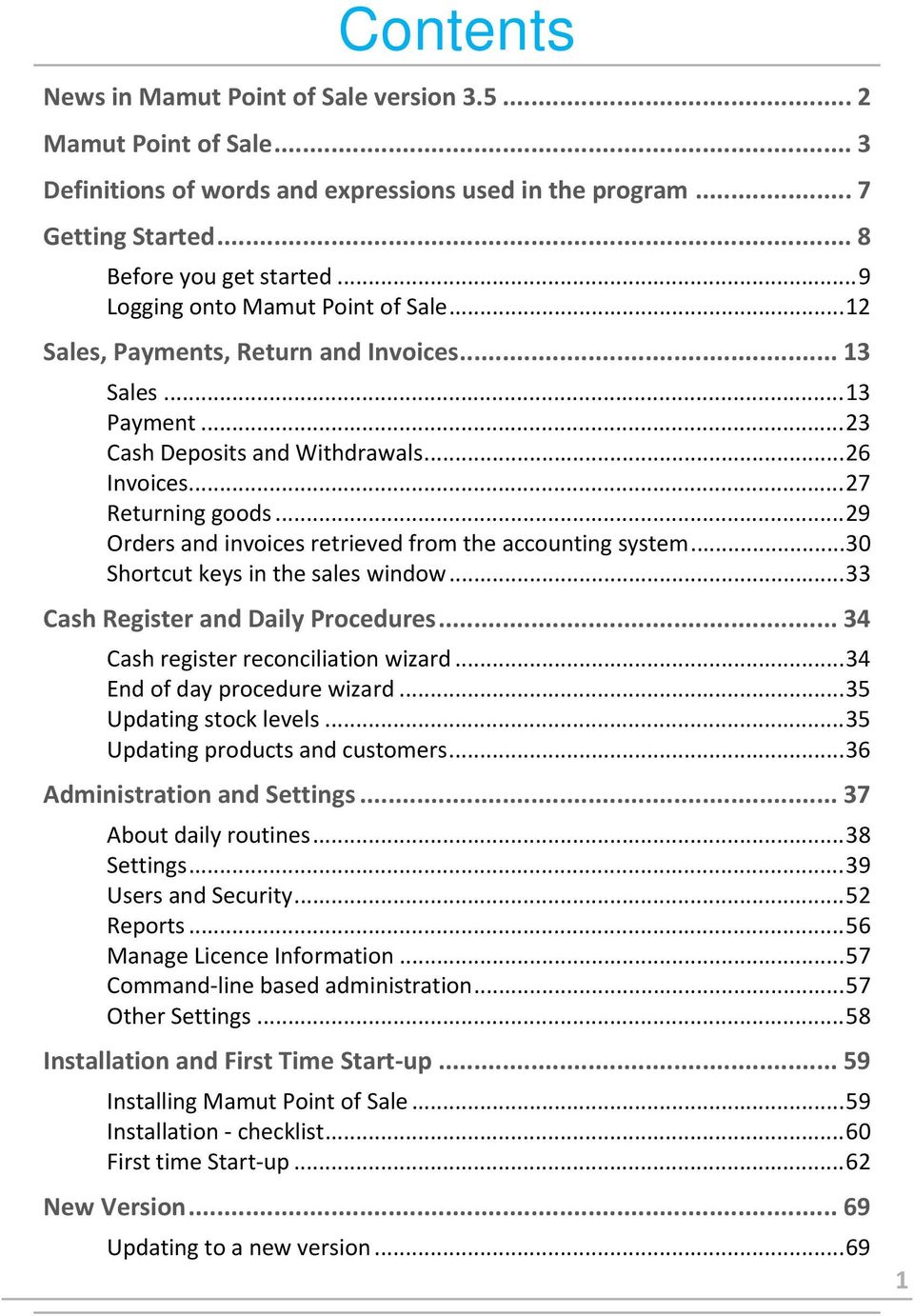
2 Contents News in Mamut Point of Sale version Mamut Point of Sale... 3 Definitions of words and expressions used in the program... 7 Getting Started... 8 Before you get started... 9 Logging onto Mamut Point of Sale Sales, Payments, Return and Invoices Sales Payment Cash Deposits and Withdrawals Invoices Returning goods Orders and invoices retrieved from the accounting system Shortcut keys in the sales window Cash Register and Daily Procedures Cash register reconciliation wizard End of day procedure wizard Updating stock levels Updating products and customers Administration and Settings About daily routines Settings Users and Security Reports Manage Licence Information Command line based administration Other Settings Installation and First Time Start up Installing Mamut Point of Sale Installation checklist First time Start up New Version Updating to a new version
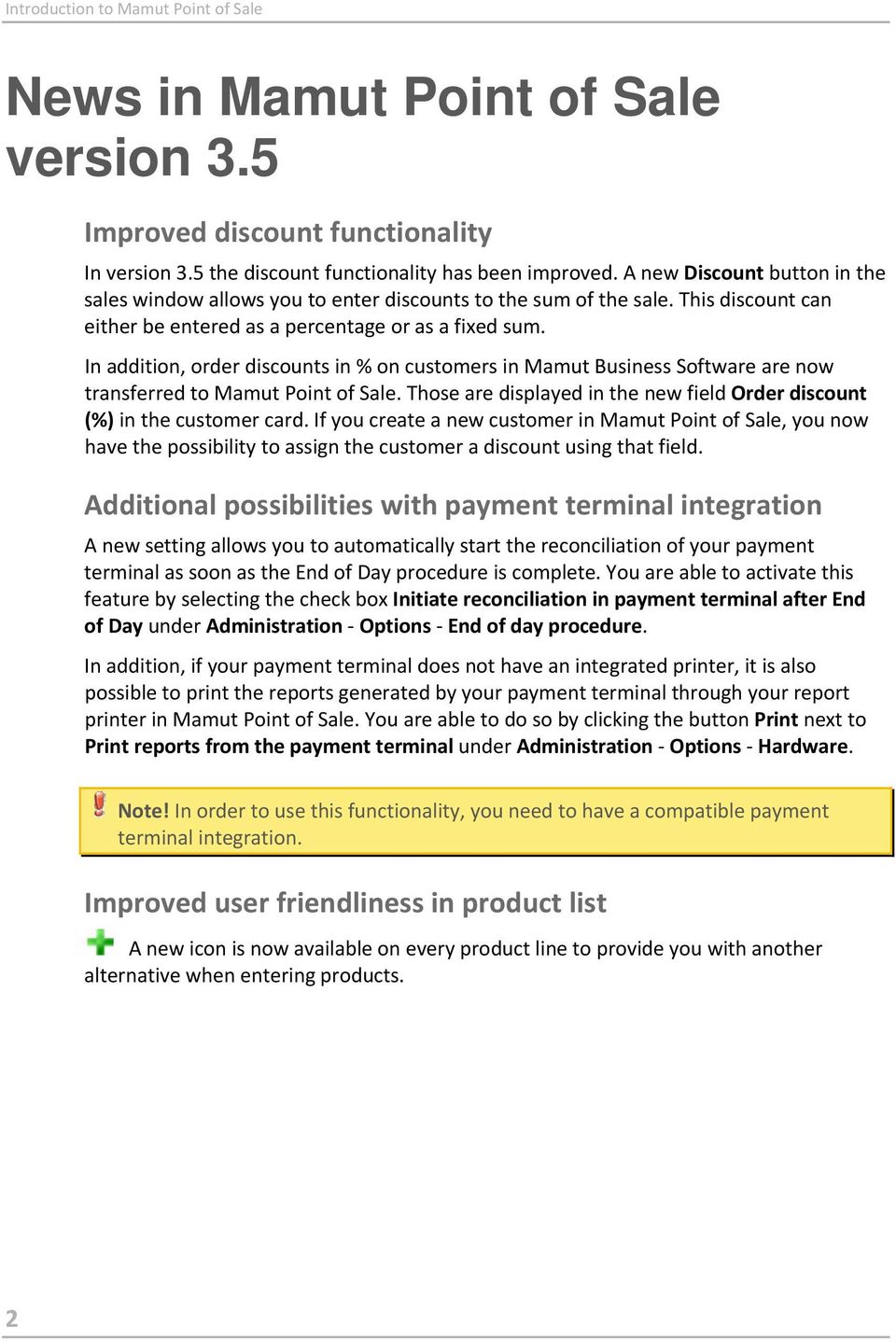
3 Introduction to Mamut Point of Sale News in Mamut Point of Sale version 3.5 Improved discount functionality In version 3.5 the discount functionality has been improved. A new Discount button in the sales window allows you to enter discounts to the sum of the sale. This discount can either be entered as a percentage or as a fixed sum. In addition, order discounts in % on customers in Mamut Business Software are now transferred to Mamut Point of Sale. Those are displayed in the new field Order discount (%) in the customer card. If you create a new customer in Mamut Point of Sale, you now have the possibility to assign the customer a discount using that field. Additional possibilities with payment terminal integration A new setting allows you to automatically start the reconciliation of your payment terminal as soon as the End of Day procedure is complete. You are able to activate this feature by selecting the check box Initiate reconciliation in payment terminal after End of Day under Administration Options End of day procedure. In addition, if your payment terminal does not have an integrated printer, it is also possible to print the reports generated by your payment terminal through your report printer in Mamut Point of Sale. You are able to do so by clicking the button Print next to Print reports from the payment terminal under Administration Options Hardware. Note! In order to use this functionality, you need to have a compatible payment terminal integration. Improved user friendliness in product list A new icon is now available on every product line to provide you with another alternative when entering products. 2
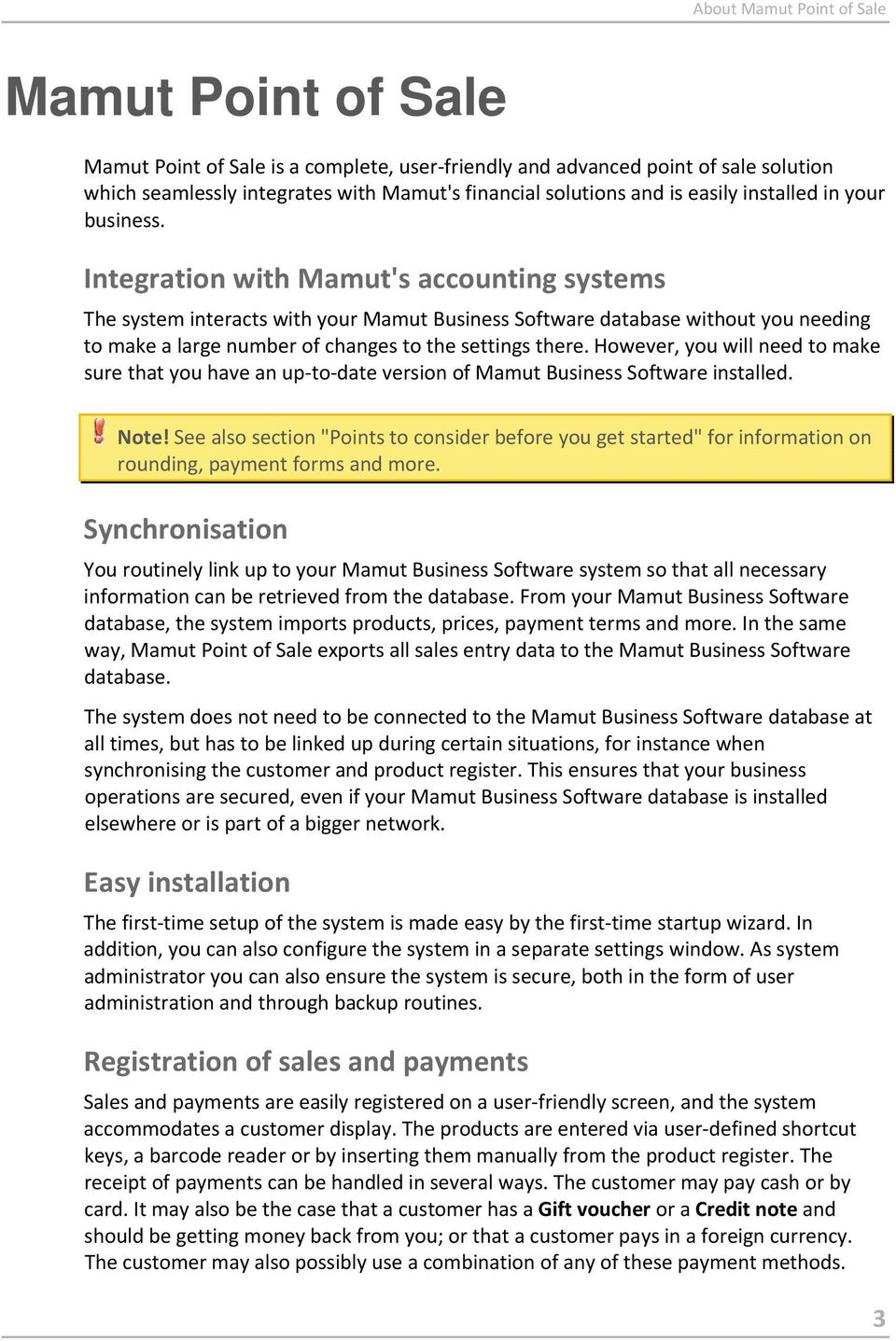
4 About Mamut Point of Sale Mamut Point of Sale Mamut Point of Sale is a complete, user friendly and advanced point of sale solution which seamlessly integrates with Mamut's financial solutions and is easily installed in your business. Integration with Mamut's accounting systems The system interacts with your Mamut Business Software database without you needing to make a large number of changes to the settings there. However, you will need to make sure that you have an up to date version of Mamut Business Software installed. Note! See also section "Points to consider before you get started" for information on rounding, payment forms and more. Synchronisation You routinely link up to your Mamut Business Software system so that all necessary information can be retrieved from the database. From your Mamut Business Software database, the system imports products, prices, payment terms and more. In the same way, Mamut Point of Sale exports all sales entry data to the Mamut Business Software database. The system does not need to be connected to the Mamut Business Software database at all times, but has to be linked up during certain situations, for instance when synchronising the customer and product register. This ensures that your business operations are secured, even if your Mamut Business Software database is installed elsewhere or is part of a bigger network. Easy installation The first time setup of the system is made easy by the first time startup wizard. In addition, you can also configure the system in a separate settings window. As system administrator you can also ensure the system is secure, both in the form of user administration and through backup routines. Registration of sales and payments Sales and payments are easily registered on a user friendly screen, and the system accommodates a customer display. The products are entered via user defined shortcut keys, a barcode reader or by inserting them manually from the product register. The receipt of payments can be handled in several ways. The customer may pay cash or by card. It may also be the case that a customer has a Gift voucher or a Credit note and should be getting money back from you; or that a customer pays in a foreign currency. The customer may also possibly use a combination of any of these payment methods. 3
5 Introduction to Mamut Point of Sale Park sales You are able to park a sale in case a customer is not able to pay after you registered all the products in point of sale. Afterwards, this sale can easily be retrieved, edited and paid. A list of parked sales provides you with detailed information about all registered parked sales. At the end of the day, when running the End of day procedure, all of the parked sales that have not been paid will be deleted. Returns You can register returned goods and print credit notes, pay out the amount in cash or directly to the credit card. Discounts You can give discounts and change the unit prices of products. When you register a sale for a certain customer and then create an invoice, that person's price, which is registered in your accounting system, will be applied. Detailed product information and stock levels You can view details about a product with information on e.g. VAT, weight, volume and cost price. You can also access accurate information on stock levels. If you have entered the same product several times, the product lines can be merged on the registration screen and on the receipt. Anonymous sales with maximum amount limit or sales registration for registered customers By default, sales are registered against an unknown customer, the Cash customer. You can specify a maximum amount limit for such anonymous sales so that the sale cannot be registered if the total amount due exceeds this limit. The customer register is regularly imported from your Mamut Business Software database, allowing you to register sales against already registered customers. This also allows you to see detailed customer information. Invoicing Regular cash register sales are usually registered without entering specific information about the customer and the sale will be transferred to the Mamut Business Software database at once. However, you can also register the sale to a specific customer, e.g. if you later would like to invoice the customer for the sale. Sales that are to be invoiced will be transferred to the order register in Mamut Business Software. Invoices set up in Mamut Point of Sale will only be created in Mamut Business Software during the End of Day procedures and the invoices must be printed from Mamut Business Software and not from Mamut Point of Sale. 4

6 About Mamut Point of Sale Creating new customer from the point of sale You can create new customers in Mamut Point of Sale. These are exported to Mamut Business Software, so that you can invoice from there. Withdrawals from/deposits into the cash register You can also make cash withdrawals and deposits from/to the cash drawer. The idea is that you can fill up or empty the cash drawer as needed, or reimburse expenses. Reconciliations There are two wizards for reconciling the till: The Cash register reconciliation counts the contents of the cash drawer for sales made since the previous Cash register reconciliation up to a user specified date/time. The End of day procedures transfer the sales to the accounting system and update the stock levels. Touch screen All functions connected to sales registration, with the exception of customer or product search, can be carried out with a touch screen. You can set up the system so that your products are categorised and allocated different shortcut keys on the screen. These shortcuts can also be grouped any way you like. You can also use the system with a regular screen, of course. Printers for receipts and reports You can connect receipt printers and even print out system reports from these, or you can select that reports should be printed on a separate printer. You can also print gift vouchers and credit notes directly from the system. Customised receipt printouts You can edit the receipt printouts so that they include information about VAT, the cash register operator's name or identification and user defined texts. Reports The systems offers a number of reports that can help you to get an overview of the turnovers for the different users, turnover distributed over the hours of the sales day(s) and sales that have not been settled as well as reports connected to the reconciliation routines. In the administration window you can view status information with key figures. User access You can manage the access for the different users so that you control who can run the End of day procedures or give discounts. Users are automatically logged off the system to offer you the best possible security. 5

7 Introduction to Mamut Point of Sale Training mode You can start the system in training mode in order to familiarise yourself with the program. In training mode all 'sales' are registered in an example database as well as the continuous use report (journal memory). Start the program in training mode via the Start menu in Windows. Under the Mamut Point of Sale program group, select Mamut Point of Sale Training Mode. DataTools The program uses tools for maintaining databases, called DataTools. The program is installed together with program files and can be started from there (MDataTools.exe). You can also start DataTools from the Start menu in Windows under the Mamut Point of Sale program group. System Requirements To see a full overview of the system requirements and recommendations, go to 6
8 Definitions of words and expressions used in the program Definitions of words and expressions used in the program Completed sale: This is a sale that has been paid for or an invoice was created. Counted sale: This is a sale that has been paid for and was included in a cash register reconciliation. Accounting system: Mamut Business Software contains a number of data that is routinely transferred to the point of sales. The program is referred to as the accounting system as opposed to Mamut Point of Sale, which has its own database on the point of sales. Super user: A super user is a user of the program, who has access to all functionality contained in the system. System administrator: A system administrator often has access to functions the ordinary user has not, such as backups, user administration and more. In Mamut Business Software, a user can be given a pre defined set of access rights called System administrator. This gives access to those functions the software suppliers assumes to be most relevant for a system administrator. PLU: PLU is a user defined number for a product that works in the same way as the EAN code, but does not follow its standards. End of day procedure/ End of Day: The end of day procedure is the term used in the program for the function that concludes a series of sales. The End of day procedure takes places at a chosen point in time. A sales entry must be included in a Cash register reconciliation in order to be included in the End of day procedure. Training mode: You can start the system in training mode if you want to practise using the program or are training staff. In the training mode everything is registered in an example database. To start the program in training mode, select Mamut Point of Sale Training Mode from the Windows Start menu. It will be obvious when you are entering the program in training mode. Continuous use/journal memory: Continuous use refers to all printouts, changes in price, till openings, and log ins/outs performed within the program. This information is stored within the system and can later be printed as a report. X Daily Report and Z Daily Report: Mamut Point of Sale includes a number of reports. The X Daily Report and Z Daily Report compile sales registrations during different periods. The Z Daily Report contains all sales entries registered between two End of Day procedures. The X Daily Report compiles entries made in the program since the last Z Daily Report. In the program's report module, the Z Daily Report is called End of Day Procedure (Z Daily Report) and is used when performing an End of Day procedure. 7

9 Introduction to Mamut Point of Sale Getting Started Installation and first time startup The installation is done step by step through a wizard and once completed will take you directly to another wizard for the first time startup. 8 Note! Mamut Point of Sale must be installed by a distributor. Settings Certain settings are required and you will be taken through a wizard the first time you start the program. Additionally, there are also a number of customisation options. Read more about this under "Settings". Sales registration This part will help you to get to know the main sales registration window. The window can be customised to display buttons for products that you sell a lot of. Read more about this under "Sales registration". Cash register reconciliation and End of day procedures The cash register reconciliation and End of day procedures should be quick and efficient. All users should know how to reconcile the cash register and maybe how to carry out the End of day procedures as well. By default the system is set up so that it assumes that these should be carried out in a single process, however, you can divide them in the settings, if you prefer. Read more about this under "About daily routines". Updating products and customers Mamut Point of Sale is based on the Product register in Mamut Business Software and the products are imported during the first time startup. Later, this function is used to import the product register and customer register from the accounting system (Mamut Business Software) in addition to updating the forms of payment. This function should be run routinely by clicking Administration Update Products and Customers. Read more about this under "Updating products and customers". Training mode You can start the system in training mode if you want to practise using the program or are training staff. In the training mode everything is registered in an example database. To start the program in training mode, select Mamut Point of Sale Training Mode from the Windows Start menu. It will be obvious when you are entering the program in training mode.

10 Getting Started Before you get started Mamut Business Software Version You require an up to date version of your Mamut Business Software program. Install the latest DVD you received or download the latest update from the web: You need to know the location where your Mamut Business Software database is installed so that you enter or confirm the right path to the database for connection to Mamut Point of Sale. Mamut Business Software must be installed and the first time startup wizard completed on the same computer as the one running Mamut Point of Sale. Afterwards, you are able to release one user licence through Help About Manage Licence Information Installed computers. Payment Terms In your Mamut Business Software database, you must register a Payment term with the description POS sales. You can register the payment term by clicking View Settings Company Properties register Payment terms. The form of payment must be Cash. Please make sure that the Available on the web box is not ticked. Under Advanced, select the option Post to Customer & Supplier Ledger. Note! Check that the box for Cash is not selected under the Advanced settings of the payment term. Rounding You must create a rounding product in Mamut Business Software and select this in the Mamut Point of Sale settings. The product must also be linked to the warehouse you are using for Mamut Point of Sale. If you select a rounding that differs from the standard (0.01) in the Payment Methods, the difference that occurs will be posted to an N/C in your balance sheet. To be able to carry out the correct rounding you need to select a rounding product. This product has to be set up in your accounting system and match the following requirements: The product has to be active: Select No in the Inactive field under the Miscellaneous tab. The product needs to be linked to the warehouse which is used with your point of sale system but must not update the stock: The box for Update stock under the Warehouse tab should not be ticked. The product has to be free of VAT: Select None in the VAT fields. The product needs to be linked to the N/C for rounding in your balance sheet: Select the correct account under the Settings tab. If you do not already have such a product set up in your accounting system you will need to create it there. Once you have done so, you can go to Administration Update Products and Customers in the point of sale system to import the new product, so that you can select it in under Administration Options End Of Day Procedure. 9

11 Introduction to Mamut Point of Sale Microsoft SQL Server The program uses an SQL database. If you do not have a 2005 or 2008 R2 version of the Microsoft SQL Server already, the installation wizard will install Microsoft SQL Server Express 2005, a free version. You need to be connected to the Internet in order for the download to be successful. 10 Note! If Mamut Point of Sale is not installed on the same computer as the SQL Server used by your Mamut Business Software installation, and the computer is included in a work group, you must activate the Guest Account on the computer running the Mamut Business Software installation and add it to the SQL Server as an administrator. Access You should give some thought as to who should have access to Mamut Point of Sale. Users must be registered in Mamut Business Software first. In the first instance, you should enter any 4 digit PIN code for yourself. You need to remember this PIN code when you start the program. For example, only the Super user has access to the End of day procedures. In the access settings you can determine who should be allowed to give discounts through the point of sale and who should be allowed to see the gross margin and create invoices. Read more about this under "User and security". Hardware Is the hardware ready for use? In the Settings window you enter the cash drawer, customer display, receipt printer and more. The system will then let you choose the receipt printer, which is installed on the machine by the point of sales, for example. Both the cash drawer and customer display are set up in the same way as a printer driver. Complete and updated system requirements and recommendations can be found here: Company Information on Receipt Printouts You can include company name, address or other information on the receipt printouts by clicking Administration Options Receipt. Enter the relevant information in the fields Text above product lines and Text below product lines and summary. Warehouse From which warehouse are you selling the goods? If you have more than one warehouse registered in Mamut Business Software you will need to select a warehouse during the installation process. Mamut Point of Sale is based on the product register in Mamut Business Software. The products are imported during the first time startup and routinely later on. Only products without a Serial number, Consignment or Expiry date can be

12 Getting Started transferred. The products will also need to be linked to the warehouse from which the products are being sold even if they are not stock items. Stock levels are updated during the End of day procedures. You can also configure the system to update the stock levels more often, manually, if you prefer. Read more about this in the section "Options, End of day procedure". Accounting Forms of payment for Cash, Bank card/credit card and possible gift vouchers need to be linked to N/Cs in the Chart of Accounts in Mamut Business Software. The system automatically suggests N/Cs, but if you require special N/Cs, these must be created in Mamut Business Software first. Routines for Cash Register Reconciliation Do you use a cash register that is shared by several users or does every user have his/her own cash drawer? If you operate with separate cash drawers and cash register reconciliation per user, you need to enter this before you start. Alternatively, in the settings for End of Day Procedure, you can select that End of Day always follows Cash register reconciliation so that once a cash register has been reconciled, this will automatically start End of Day procedure. You should also set up denominations that work best for the system you use for bank deposits, before the first Cash register reconciliation. Maybe you also need a denomination for Cash withdrawals and Cash deposits. Read more about this in the "Options" chapter. Shortcut Keys for Regularly Sold Products Which products would you like to be available via shortcut keys? Usually, you select the best selling products via the point of sales for this. You can define up to 16 products with shortcut keys in the registration window so that they register in just one click/hit of a button. The remaining products can be accessed via the Products button. Read more about this in the section "Options, Sales entry". In addition to the shortcut keys, there are a number of customisation choices in the Mamut Point of Sale options. We recommend that you familiarise yourself with these. Tip! You can also refer to the 'Installation checklist' section further on. 11
13 Introduction to Mamut Point of Sale Logging onto Mamut Point of Sale The Log on screen displays every time the system is started or after a user has logged out. None of the functions in the system will be available before you have logged on. The window is also used to exit the application. How to log on 1. Click the button with your user name. 2. Enter your PIN code. The PIN code consists of 4 digits. If you make a mistake you can click/press CLR to remove the entry, or Cancel. You will be logged in and the main sales registration window will be displayed. PIN code: If it is the first time a user logs into the system, or the first logging in after the PIN code was changed by the administrator, the PIN code needs to be entered. You will also need to repeat the PIN code before logging into the system. Read more about PIN codes in the section "PIN code in Mamut Point of Sale". Note! If you have forgotten your PIN code you will need to contact the system administrator, who can create a new PIN code. 12 Log out: Select Log out to log your user ID off the system. Exit: Clicking on Exit will close the entire Mamut Point of Sale. This button can be used for closing the program before you have logged in, or after you have logged out. This is the only way to exit the program.

14 Sales, Payment, Return and Invoices Sales, Payments, Return and Invoices Sales All processes connected to the registration of a sale are started from the same window. The window can be operated from the cash register either through a touch screen, with a regular keyboard or through a combination of the two. The registration window can be configured, e.g. by assigning shortcut keys. This is done in the Options, Sales entry window in the Administration area. The window can also be customised for every user under Administration Users and Security. Tip! You can activate the automatic logout feature if you wish to be logged out automatically from the system after every sales registration. This is a useful feature if you only rarely register sales and wish to prevent unauthorised people from accessing the data in your point of sale system. Read more in the section "Other Settings" below. The sales process consists of 3 main stages: Select customer and Enter products. These two processes can be completed in the order you wish. Receiving payment or Creating an invoice. Invoices need to be printed from Mamut Business Software later. Returned goods registration. This can be done at any stage of the process. In addition, sales can be parked and then retrieved. Read more in the section "Parking sales". More information about the sales registration can be found in the section "Registering a sale" below. Every registered sale in the point of sale system can have one of the following statuses: Complete. Counted, but not updated in the warehouse. Counted and Updated in the warehouse. This only applies for systems that include functionality for a separate stock update. Not counted, but updated in the warehouse. This only applies for systems that include functionality for a separate stock update. Included in End of Day. 13
15 Introduction to Mamut Point of Sale Registering a sale When registering a sale, you have several options with regards to product quantity, unit price, discounts etc (depending on your access rights). When you have entered the product/ s in the main sales registration window, click the product line you want to edit in order to open a product window. 14 Quantity To enter more than one of the same product you can either enter the number before you add the product or click on the sales line and change the quantity afterwards. If you are using shortcut keys, you can click on the quantity first or click on the shortcut key several times to change the quantity.
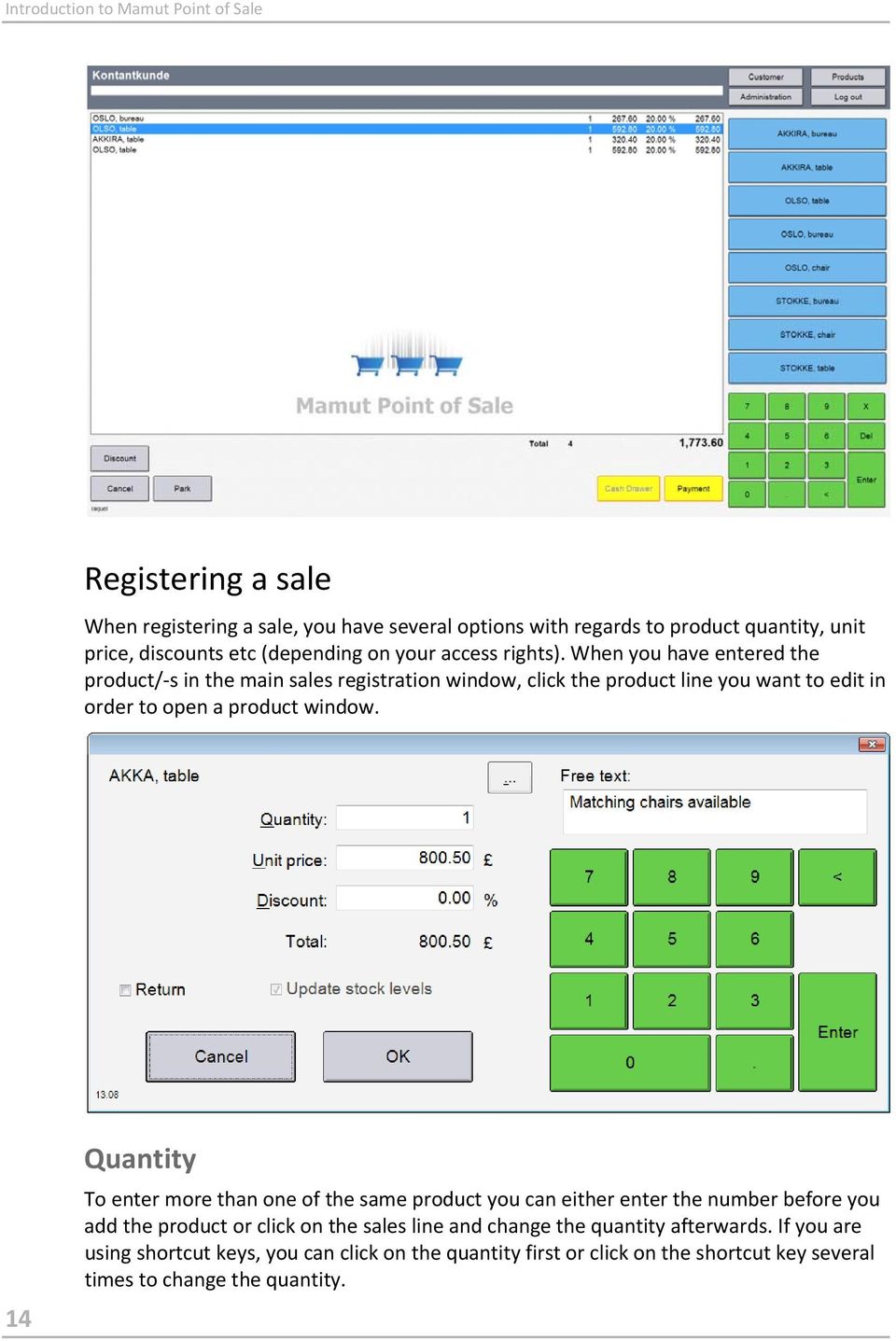
16 Sales, Payment, Return and Invoices Unit Price and Discount You can click/press on a sales line in the registration window to open a more detailed window. From this window you can change the quantity and, if your access allows this, also change the price or enter a discount. The system administrator decides who has access to this function via Administration Users and Security. Free Text By clicking a sales line you can also enter a descriptive text about the product in the Free Text field. The information you enter is displayed on the receipt beneath the product line. The text is synchronised with your Mamut Business Software system, where it can be found by opening the sales and invoicing register and clicking the Order line text button in the Product Lines tab. If you have selected to merge the product lines containing the same product, price and discount, the text will not be displayed in Mamut Business Software. Please note that you can retrieve more information about a product from this window by clicking on the three dotted button. Read more about this in the section "Product information" below. Example: Standard cash customer, cash payment 1. Click on/press or scan in the product/products the customer is purchasing. 2. Click on the Payment button. 3. Click on Cash. 4. Enter the amount the customer is paying in the Cash field. 5. Click on/press Receipt and return any change the customer may be due. 6. Click Close to complete the sale. The system is ready for a new sales registration. You can read more about receiving payment in the section "Receiving payment in the cash register" below. Tip! You can activate the automatic logout feature if you wish to be logged out automatically from the system after every sales registration. This is a useful feature if you only rarely register sales and wish to prevent unauthorised people from accessing the data in your point of sale system. Read more in the section "Other Settings" below. 15
17 Introduction to Mamut Point of Sale Entering goods All sales need to include at least one order line. For every product entered, an order line is created and showing in the main sales entry screen. You can enter goods in a number of different ways: Scanning the EAN code with a barcode reader. The product is entered into an order line with a quantity of 1. Enter the EAN/PLU on the number keyboard and press Enter. The order for searching the product register for the entered number is as follows: Product number, EAN number, Supplier's product number. The product is entered into an order line with a quantity of 1. Press/click the shortcut keys. One click on the shortcut key adds a new order line with a quantity of 1 of the selected product. The shortcut keys are set up under the settings Administration Options Sales Entry. Press/click the Products button. This will open the Select product window. When the user has highlighted a product and presses/clicks Select the product is entered as an order line and the user will be taken back to the main window. Regardless of which method you use to insert an order line, you will be able to specify the quantity in which the item will be sold. You can enter the quantity via the on screen number pad or the keyboard. If you enter a non existing product number, the product list opens so that you may find the product here. If you insert an item several times, you can choose to display the accumulated quantity on one order line, or if you wish to display all items as a separate order line. This setting can be found by clicking Administration Options Sales Entry. An order line can be edited after it has been inserted. This includes changes to the quantity, unit price and discount percentage. You can edit an order line by pressing/clicking on it, which will open a product window, where you can make the necessary changes. In the same window, you can also add a text about the item in the field Free text. The text will be displayed on the receipt beneath the product line. It is not possible to edit product names in Mamut Point of Sale. Read more about this in the section "Registering a sale" above. If you have entered a product by mistake, you can remove it by clicking on the Del key. You can cancel an entire sale by clicking on the Cancel button in the sales registration window. It is not possible to overwrite VAT codes for a product. 16

18 Sales, Payment, Return and Invoices Selecting a customer Press/click on the Customer button in the main window. This will open the Select Customer window, containing a list of customers. Note! All sales need to have a customer. A default customer is pre defined in the settings and will be used unless you enter a different one. You can select a customer at any stage of the sales registration, right up until you commence the payment process. How to select a customer You are able to select a customer by double clicking on the customer or by selecting the customer and then clicking Select. Once you have selected the corresponding customer, click Close to proceed entering a sale. How to search the list To search for a specific customer, type in a name or the start of the customer's name in the text search field. You are also able to use the parameter %, meaning includes, when searching for customer names. When using the parameter %, only the customers name including the entered criteria will be displayed in the list. For example, if you enter %r in the search field, only customer names containing an "r" will be displayed. How to sort the list By default the customer list is sorted by customer name. You are able to change how the list is sorted by clicking on one of the columns heading. The list will then be sorted by the selected heading. The sorting order can be ascending or descending, depending on if you click once or twice on the heading. Creating a new customer If your customer does not exist already, you can create a new customer by clicking New. More information Clicking/pressing the More information button will display detailed information about a customer. The fields here cannot be edited. From this window you are also able to retrieve orders and pay invoices from your accounting system. You are able to do so by clicking on the corresponding buttons. 17

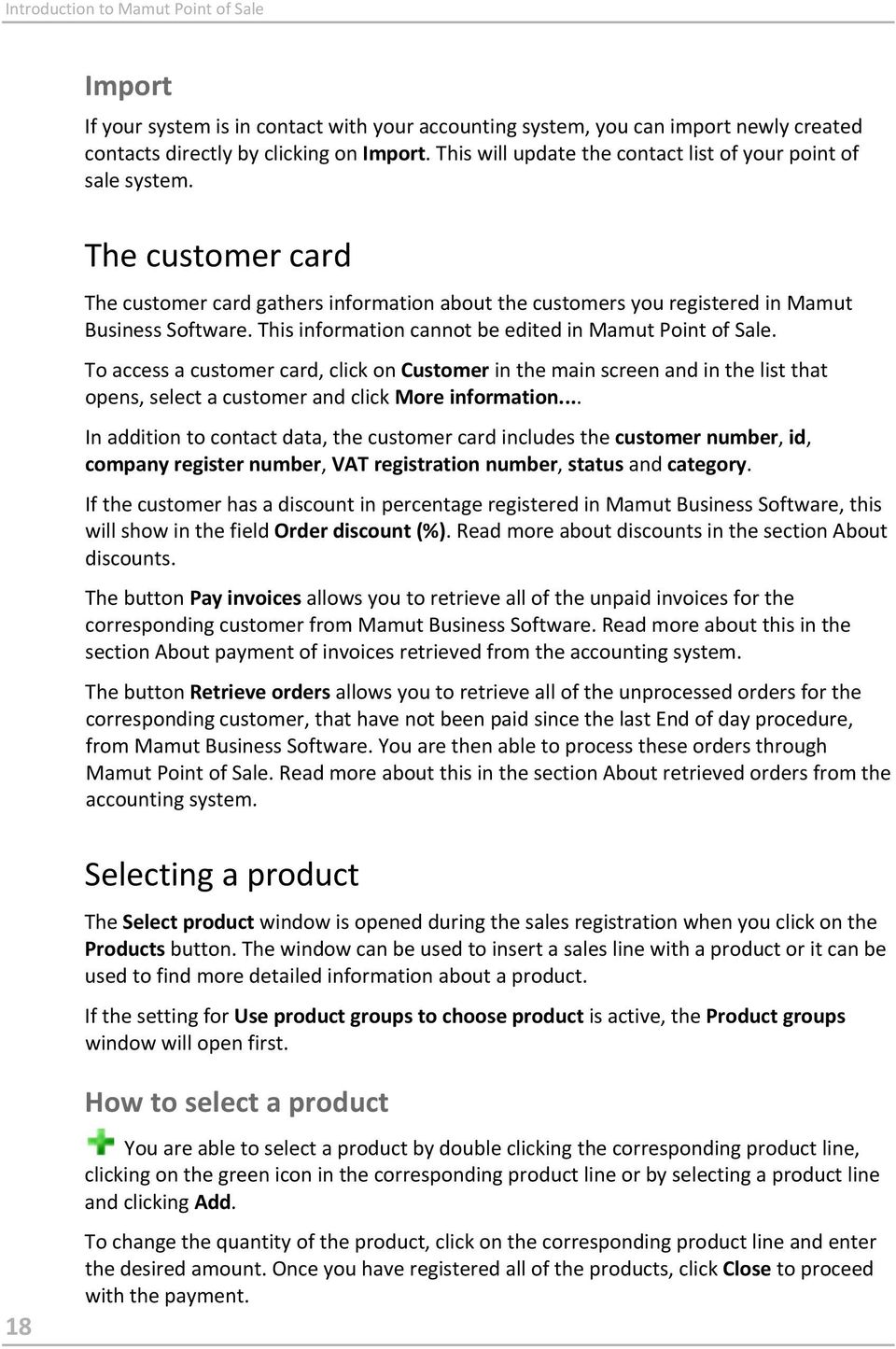
19 Introduction to Mamut Point of Sale Import If your system is in contact with your accounting system, you can import newly created contacts directly by clicking on Import. This will update the contact list of your point of sale system. The customer card The customer card gathers information about the customers you registered in Mamut Business Software. This information cannot be edited in Mamut Point of Sale. To access a customer card, click on Customer in the main screen and in the list that opens, select a customer and click More information... In addition to contact data, the customer card includes the customer number, id, company register number, VAT registration number, status and category. If the customer has a discount in percentage registered in Mamut Business Software, this will show in the field Order discount (%). Read more about discounts in the section About discounts. The button Pay invoices allows you to retrieve all of the unpaid invoices for the corresponding customer from Mamut Business Software. Read more about this in the section About payment of invoices retrieved from the accounting system. The button Retrieve orders allows you to retrieve all of the unprocessed orders for the corresponding customer, that have not been paid since the last End of day procedure, from Mamut Business Software. You are then able to process these orders through Mamut Point of Sale. Read more about this in the section About retrieved orders from the accounting system. Selecting a product The Select product window is opened during the sales registration when you click on the Products button. The window can be used to insert a sales line with a product or it can be used to find more detailed information about a product. If the setting for Use product groups to choose product is active, the Product groups window will open first. 18 How to select a product You are able to select a product by double clicking the corresponding product line, clicking on the green icon in the corresponding product line or by selecting a product line and clicking Add. To change the quantity of the product, click on the corresponding product line and enter the desired amount. Once you have registered all of the products, click Close to proceed with the payment.
20 Sales, Payment, Return and Invoices In addition, if you use product groups for selecting products, you are able to go back to the last level of product groups from the product list. This is done through the arrow button placed on the product list. How to search in the list You can search in the window by entering a keyword. You can also choose which column to search by, by clicking on the column heading. You are also able to use the parameter %, meaning includes, when searching for product names. When using the parameter %, only the product name including the entered criteria will be displayed in the list. For example, if you enter %r in the search field, only product names containing an "r" will be displayed. How to sort the list By default the product list is sorted by product name. You are able to change how the list is sorted by clicking on one of the column headings. The list will then be sorted by the selected heading. The sorting order can be ascending or descending, depending on if you click once or twice on the heading. More information If you would like more information about a product, you can highlight it in the list and click on More information. Import If your system is in contact with your accounting system you can import newly created products directly by clicking on Import. This will update the product list of your point of sale. Product information More detailed information about the product When you register a sale you can find more detailed product information from the Select product window. The information here is updated every time you update your products. Click on More information to see detailed product information. Stock levels The stock levels are not shown when you open the window but you can click on the Click to view stock window to retrieve the current levels directly from the accounting system. This requires that you have access to the machine where the accounting system is installed from your point of sales. You will then be given access to up to date information about the stock levels for the warehouse selected in the settings. If several locations are being used, you will be shown the total quantity still available. 19

21 Introduction to Mamut Point of Sale About discounts In Mamut Point of Sale you have the possibility to apply discounts to the sales you enter. Note! Be aware that in order to be able to apply discounts, you need to be provided with access to the functionality by the Super user. Access is provided by clicking Administration Users and Security and then double clicking the corresponding user. Types of discounts You are able to apply three different types of discounts to your sales: discount to a sales line, discount to the sum of the sale and default discount in % of order total for a customer. Discount to a sales line You are able to apply a discount to a sales line. This is done by selecting the sales line and manually entering a value in the Discount field. The value is a percentage and you are able to see the final product price next to Total. Alternatively, you can edit the product price directly in the Unit price field. You are able to combine this discount with a discount on the total sales sum and with order discounts in % on customers. Discount to the sum of the sale You are able to apply a discount to the sum of a sale. You can either apply a discount in percentage or a fixed sum. You do so by clicking on the Discount button in the main screen. In the window that opens you are able to register the discount in the field for percentage or for fixed sum. In the lower right corner of the main screen the sales sum before and after the discount, as well as the discount amount are displayed. Discount to the sale of the sum can be combined with additional discounts to sales lines. Default discount in % of order total for a customer Default discounts in % of order total for a customer are inherited from Mamut Business Software and cannot be edited in the customer card in Mamut Point of Sale. The percentage discount you have assigned to an specific customer is automatically deducted from the price of an order. This discount can manually be overwritten or deleted by clicking on the Discount button in the main screen. You are then able to edit the percentage or to enter a fixed sum. The total price and the final price with the discount are displayed in the lower right corner of the main screen. Discount to an specific customer can be combined with additional discounts on sales lines. 20
22 Sales, Payment, Return and Invoices This discount is registered in the Settings tab in the contact management register in Mamut Business Software which can be accessed by clicking View Contacts Contact Management. Click the Customer button and enter the Order discount in %. Reports The report Overview over price changes displays a list of products that have changed price during the sale and includes the ordinary and the new price. More information about reports in the section Reports in the Administration and Settings chapter. Processing discounts to the sum of the sale to Mamut Business Software When transferring your sales to Mamut Business Software, discounts on sum of the sale (both in percentage or fixed sum) are recalculated as percentage discount on each of the sales lines in the sale. This is because discounts to the sum of the sale do not exist in Mamut Business Software. Note that this recalculation might cause small discrepancies that will be posted as rounding product lines. For the same reason, when retrieving orders with discounts from Mamut Business Software, the discount will be displayed per sales line in Mamut Point of Sale and not to the sum of the sale. Parking sales You are able to park sales. This allows you to, for example, help other customers if one customer is not able to pay immediately after their products have been registered in the cash register. A detailed list of all parked sales is available under the button Parked. At the end of the day, when running the End of day procedure, all of the parked sales that have not been paid will be deleted. The possibility of parking sales is enabled by default. However, if you do not want to use this functionality, you can disable it by unselecting the check box Park sales in the Sales Entry tab Options. Note! This functionality is not available for orders or invoices retrieved from Mamut Business Software. 21
23 Introduction to Mamut Point of Sale How to park a sale 1. Register the product lines as a regular sale. 2. Click Park. The sale has now been parked and stored temporarily in the system. The window for entering sales is now cleared. How to retrieve and pay a parked sale 1. Click on Parked. 2. Double click on the corresponding sale in the window or click Select. 3. Add additional products, if desired. 4. Click on Payment and proceed as you would for a normal sale. The sale has now been completed. 22
24 Sales, Payment, Return and Invoices Payment When you have entered all the order lines you are ready to receive payment by clicking/pressing the Payment button to start the payment procedure. Note! The system checks whether the sale is above the limit set for cash customer sales. If the sale is above this amount and the sale is not registered toward a customer you will receive a message to make you aware of this. The customer will then have to be created. You will see the total amount and a button for every available payment form. Throughout the process you will see a field displaying the amount due, showing the difference between the total amount of payment received and the total outstanding amount for the current sale. You can freely split the payment between the various payment forms. When the total received exceeds the total for the sale, the field will become positive and you can print the Receipt to conclude the sale. You can choose whether the system should show a separate window for the amount of change due after the payment has been entered. This is done under Options, Sales entry. Prices Prices are imported together with other product information when you update the products from the accounting system. The system administrator decides whether a user should have access to changing prices and/or giving discounts during a sale under the Users and Security administration area. Tip! If you would like to give a discount on the total sales amount, you need to create a product for this. The final discount is thus given by entering that product and entering a unit price (negative) amounting to the amount of discount. Payment forms The payment forms available are defined under Administration Options Payment forms, where the payment forms for credit card, gift voucher and credit note are defined as well. Read more in the section "Options". 23
25 Introduction to Mamut Point of Sale Receiving payment in the cash register Tip! You can activate the automatic logout feature if you wish to be logged out automatically from the system after every sales registration. This is a useful feature if you only rarely register sales and wish to prevent unauthorised people from accessing the data in your point of sale system. Read more in the section Other Settings below. How to handle payments at the cash register 1. Register the sale. 2. Click/press on Payment. 3. Select the payment form. 4. Enter the amount. 5. Select Receipt. By default, a window showing the change due back to the customer displays and the receipt is printed. Tip! The receipt printout can be edited so that it displays a user defined text. This text can be defined under Administration Options Receipt. Read more about this in the Settings section. Receipt Copies You can at any time print a copy of a receipt printed via the system. Go to Administration Reports and select Receipt copy from the list of reports. Read more about printing receipt copies in the section Printing a receipt copy. About payment terminal integration Mamut Point of Sale supports full integration with payment terminals. Using an integration together with Mamut Point of Sale means that you do not need to carry out any manual operation on the payment terminal. Note! The Mamut Support Centre does not provide support for issues related to payment terminals. For these kinds of questions, you have to get in contact with your payment terminal provider. 24
26 Sales, Payment, Return and Invoices Requirements In order to use this functionality you need to have third party integration for your payment terminal. Contact your Mamut Point of Sale supplier for more information. Settings In order to start using this functionality, you need to apply certain settings in Mamut Point of Sale. Under Administration Options Hardware you need to select the check box Payment terminal connected and then select the corresponding payment terminal in the drop down list Connected payment terminal. Click the Settings button to define the correct settings for your terminal. In order to check that the payment terminal is connected and working properly, click Test. Additional possibilities with payment terminals You have the possibility to start the reconciliation of your payment terminal automatically after the End of day procedure is completed in Mamut Point of Sale. You enable this functionality by selecting the check box Initiate reconciliation in payment terminal after End of Day under Administration Options End of day procedure. In addition, if your payment terminal does not have an integrated printer, you are able to print the reports generated by your payment terminal through your report printer by clicking Print next to Print reports from the payment terminal under Administration Options Hardware. Printing a receipt copy You can print a copy of a receipt from a previously registered sale. How to print a receipt copy 1. Click Administration Reports and select the report Receipt copy. 2. Select Printer from the Medium drop down list. 3. Click Print. 4. Enter the Receipt ID and click OK. The receipt copy is now being printed. 25
27 Introduction to Mamut Point of Sale Cash Deposits and Withdrawals Cash deposits This is a function for registering the deposit of cash into the cash drawer. You use this function when depositing change into the cash drawer, for example. Registered deposits will show in the next End of day procedure. Cash withdrawals This is a function for registering the withdrawal of cash from the cash drawer. You use this function when removing notes from the cash drawer, for example. Registered withdrawals will show in the next End of day procedure. Registering cash deposits How to register a cash deposit into the cash drawer 1. Click on Administration. 2. Click on Cash Deposit. 3. Enter the Amount. 4. Enter the Currency, if needed. This field is only available if you have activated several currencies under Options, General. 5. Enter a description of the deposit in the Note field if you would like to give some information about the reason for this deposit. The withdrawal is registered under your user ID and will show in the next End of day procedure. 26
28 Sales, Payment, Return and Invoices Registering cash withdrawals How to register a cash withdrawal from the cash drawer 1. Click on Administration. 2. Click on Cash withdrawal. 3. Enter the Amount. 4. Select the Currency if required. This field will only be available of you have selected to use different currencies under Options, General. 5. Enter a reason for the withdrawal in the Note field if you want to give more information about the withdrawal. The withdrawal is registered under your user ID and will be included in the next End of day procedure. Tip! You can print the report List of cash withdrawals and/or deposits in order to get an overview of all cash withdrawals and deposits. Invoices If your settings permit this, you can create an invoice for a sale instead of receiving payment on the spot. This requires that the sale is registered to a customer other than the default cash customer. Note! The system administrator decides which users should be allowed to create invoices under the Users and Security administration area. An invoice is created with the values that have been entered for this payment form. Note! The invoice is not printed out but transferred to the accounting system the next time the End of day procedure is initiated or at the next stock level update. The system prints out a pro forma invoice that the customers can take with them right there and then. The invoice from the point of sale system can then be found as an unprocessed order in the accounting system and has to be processed and invoiced from there. You cannot use batch invoicing for Point of Sale sales when processing them in the accounting system, even if this has been selected. 27
29 Introduction to Mamut Point of Sale Creating an invoice In order to allow a customer to buy on credit and invoice them later, you need to select a customer when entering the sale. How to create an invoice 1. Select Customer in order to choose or browse for a customer. You can do so by selecting the Name column heading and then typing in the customer name in the search field. 2. Double click on a customer to include them in the sale. 3. Finish registering the sale. 4. Select Payment. 5. Select Invoice. This option will not be available if no customer was selected. 6. Select a Collection period and click OK. The invoice can be printed from the accounting system after the End of Day procedure or after Update stock levels. The delivery and invoicing of the order has to be processed in Mamut Business Software. Creating a new customer You can create a new customer from the point of sale. These will be transferred to the accounting system immediately so that you can invoice from there. How to create a new customer 1. Click on Customer in the sales registration window. 2. Select New customer. 3. Enter the customer information. The system requires that you at least enter a customer name. 4. Select OK. The customer is saved and transferred to the accounting system. Once the customer has been transferred you can register sales for this customer in Mamut Point of Sale. If your system is not connected to the accounting system, you will be notified of this in a pop up message. The customer will be created on a temporary basis, but you cannot register any sales until the customer has been transferred to the accounting system. If you create a customer in the accounting system they will be transferred to Mamut Point of Sale as part of the nest Update Products and Customers function. You can read more about this in the section 'About daily routines'. 28
30 Sales, Payment, Return and Invoices Returning goods If you have sufficient access rights, you can register return of goods. The system administrator chooses which users should have such access in the Users and Security settings. Goods are highlighted for return in the window to show details about a product line. You can access this window by clicking on a product line in the sales window or by clicking F8 in the sales window when a product line is selected. The warehouse will usually be updated with the number of returned goods. By making use of the F8 key you can select not to update the warehouse. This has to be done for every product line. Tip! It is also possible to click <X> <Number of returned goods> <Enter> and requires that you use the keyboard. This option may be appropriate if you do not want to update the warehouse. When customers return goods, you are able to pay them back in cash, though a credit note or directly to their credit card. Go to Administration Options Payment Methods to select the cash and card payment methods when returning goods. Read more in the section "Options, Payment methods". How to return goods 1. Register the product line as you would for a normal sales entry. 2. Click or press the product line. 3. Select the check box Return. 4. Click OK. 5. Click the Return button in the bottom right corner of the sales registration window. 6. Select the payment method in the window that opens. 7. Click Close. The customer will be reimbursed in the selected payment form. Tip! You can also return several product lines. 29
31 Introduction to Mamut Point of Sale Orders and invoices retrieved from the accounting system About retrieved orders from the accounting system You are able to retrieve orders from Mamut Business Software and process them in Mamut Point of Sale. In order to retrieve orders, the following criteria must be fulfilled: Mamut Point of Sale must have a connection with the Mamut Business Software database. The customer, as well as the products in the order, must exist in Mamut Point of Sale. All the products included in the order must be linked to the warehouse that the system is selling products from. The order cannot contain product bundles. The order must be registered in the same currency as the one in your company database. The retrieval is done through the Retrieve orders button placed in the corresponding customer window in Mamut Point of Sale. When clicking on this button the system will retrieve all of the unprocessed orders of the corresponding customer that has not been paid since the last End of day procedure. You are only able to work with one order at a time. Once you have selected an order, all the product lines included will be displayed on the screen as normal product lines. You have the possibility to edit the order, by adding other product lines or modifying, for example, the price. Note! In case the unprocessed order is altered in Mamut Business Software after the payment in Mamut Point of Sale and before you run the End of day procedure, a new order will be created and invoiced through the End of day procedure. The order in Mamut Business Software will remain as an unprocessed order. Users must be given access to this functionality through the User Settings window. 30
32 Sales, Payment, Return and Invoices Processing orders retrieved from the accounting system How to process orders retrieved from the accounting system 1. Click on the Customer button. 2. Click on the name of the customer you would like to process an order for. 3. Click More information. 4. Click Retrieve orders. 5. Choose the corresponding order and click Select. 6. If necessary, make changes to the order, such as changes in price or add additional product lines. 7. Click on Payment. 8. Select the payment form. 9. Enter the amount. 10. Select Receipt. The order has been paid. By default, a window showing the change is displayed and the receipt is printed. About payment of invoices retrieved from the accounting system You are able to retrieve invoices from Mamut Business Software into Mamut Point of Sale. Note that in order to retrieve invoices, Mamut Point of Sale must have a connection with the Mamut Business Software database. Note! It is not possible to pay invoices that are registered with a foreign currency. The retrieval is done through the Pay invoices button placed in the corresponding customer window in Mamut Point of Sale. When clicking on this button the system will retrieve all of the invoices of the corresponding customer that have not been paid. You are able to pay one invoice at a time. When selecting an invoice, it is not possible to alter it. Note that the order payment will not be handled as a Mamut Point of Sale sale, but as a money transaction. In Mamut Business Software the corresponding journal will be updated during the End of day procedure. Users must be given access to this functionality through the User Settings window. Through the Reports window you are able to generate a copy of the printed invoice. You are able to do so by clicking on the Paid invoice, copy of receipt report. In addition, the report Payment of invoices provides you with an overview of all of the invoices that have been retrieved from Mamut Business Software and paid in Mamut Point of Sale. 31
33 Introduction to Mamut Point of Sale Receiving payment for invoices retrieved from the accounting system How to process invoices retrieved from the accounting system 1. Click on the Customer button. 2. Click on the name of the customer you would like to process an order for. 3. Click More information. 4. Click Pay invoices. 5. Choose the corresponding invoice and click Select. 6. Click on Payment. 7. Select the payment form. 8. Enter the amount. 9. Select Receipt. The invoice has now been paid. By default, a window showing the change is displayed and the receipt is printed. 32
34 Sales, Payment, Return and Invoices Shortcut keys in the sales window Button Function Description F1 Help Opens the help file. F2 Payment/ Copy receipt/ Credit Note These shortcut keys correspond to a button in the Sales entry window that changes name and function depending on the sale: If there are no registered sales lines and the user has registered a sale since last logging on, the key is called Copy receipt and is used to print a receipt for the last completed sale. If the total for a sale is positive and sales lines have been registered, the key is called Payment and is used to initiate the payment procedure. If the sales total is negative, the key is called Credit Note and the returns window opens. F3 Cash drawer Opens the cash drawer if it is integrated. F4 Cancel Cancels the sale by removing the sale lines. If a registered customer was chosen, they will be removed from the sale and replaced with the default customer for cash sales. F5 Product list Opens the Select products window from where you can add products to a sale or look up more detailed product information. F6 Customer list Opens the Select customer window from which you can link a sale to a customer. F8 Change line Use to change the quantity or add a discount to a single sales line. You can also click on the sales line directly to open this edit window. F10 Log out Logs the user off the system and directs the system to the logon screen. If a sale had been started at the time of logging off, a message will pop up asking you whether you want to cancel the current sale and log off or not log off after all. F11 Administration Corresponds to the Administration button, which opens the Administration window where all administrative tasks are carried out. Only users with access to one or more of the administration functions can open this window. For other users the button will not be visible. If you have started a sale when clicking this button, a message will pop up asking you whether you wish to cancel the sale. You will need to either cancel the sale or complete it before you can open the administration window. Shift+F1 Shift+F2 Etc. Products Corresponds to the shortcut keys for products if these were assigned under Options Sales Entry. Shift + F1 adds the product from the first shortcut key. Find out more about the product shortcut keys in the section "Options, Sales entry". 33
35 Introduction to Mamut Point of Sale Cash Register and Daily Procedures Cash register reconciliation wizard How to reconcile the cash register 1. Click on Administration. 2. Click on Cash register reconciliation. The wizard will then open. 3. Click Next. 4. Enter the date and time for the sales to be included. By default the current point in time is selected. 5. Enter the Requested amount in register after reconciliation. Usually, a business will have a certain cash amount remain in the cash register as change for the following day. 6. Click Next. 7. Enter the amount from your cash register distributed across the various denominations. The denominations that will show depend on the settings defined under Options, Cash register reconciliation. 8. Check that the Amount counted matches your numbers. 9. Click on Next. 10. Check the summary. If you wish, you can print reports that show the distribution of the sales per sales person/payment form. 11. Select whether the system should continue directly to the End of day procedure wizard. This option will not be available if the settings for End of Day always follows Cash register reconciliation has been activated under Options, End Of Day Procedure. 12. Click Finish. The Cash register reconciliation has been registered and the End of day procedure will start up automatically (if the setting for this has been defined). 34
36 Cash Register and Daily Procedures End of day procedure wizard How to carry out an End of day procedure 1. Start the End of day procedure wizard and click Next. The End of day either starts directly or following a Cash register reconciliation, or it can be commenced via Administration, End of day procedure. This is controlled by the settings under Options, End of day procedure. 2. Choose which cash register reconciliation(s) should be included by selecting them from the list. 3. Click Next. The procedure is being checked. 4. Click Finish. The End of day procedure is complete. Updating stock levels How to update stock levels 1. Click on Administration. 2. Click on Update stock level. 3. Click Next in the information window that opens. (The window may have been removed from display in the wizard during a previous run). 4. Select the date and time for the sales to be included. By default, the current point of time is selected. 5. Click Next. 6. Check the transfer information and click Close to finish. The stock levels are updated. Note! The wizard is only available if it is turned on under Options, End of day procedure. The routine can be made available to specific users under Administration, Users and Security. 35
37 Introduction to Mamut Point of Sale Updating products and customers Mamut Point of Sale is based on the Product register of Mamut Business Software. The products are imported during the first time startup. After the first time startup this function is used to import the Product and Customer registers from Mamut Business Software and updates the forms of payments as well. This function should be used routinely. Only active products will be transferred. The program cannot handle the transfer of serial number or consignment products or products with a sell by date. The products will also need to be linked to the warehouse from which the point of sales sells products even if they are not stock items. Tip! It is possible to control the update of core data through commands, e.g. that an update takes place once a day. Command line based database administration requires a good knowledge of data. You can read more about command line based database administration in the help file. 36
38 Administration and Settings Administration and Settings Select the Administration button to go to Mamut Point of Sale administration area. Only users with access to one or more of the functions can open this window. Note! In the above paragraphs you can read more about cash transactions, accountancy tasks and synchronisation. Below you can read more about administrative tasks. Status The Status fields give an overview of the key figures since the last End of day procedure. 37
39 Introduction to Mamut Point of Sale About daily routines Cash register reconciliation At the cash register registration, the cash register contents are counted for sales that took place between the last reconciliation and a chosen point in time since then. The cash register reconciliation is started from the Administration area. If you have not activated the End of Day always follows Cash register reconciliation function under Options, End of day procedure you can carry out several cash register reconciliations for every End of day procedure. End of day procedure (Z Daily Report) End of day procedure is the function for closing a series of sales in a point of sales. The End of day procedure is undertaken at a certain point in time. In order for a sale to be included in the End of day procedure, it has to have been part of a Cash register reconciliation. The End of Day procedure is initiated from the Administration area or automatically after the completion of the Cash register reconciliation if this settings was activate under Options End of day procedure. Only Super users have access to this function. As part of this process, the stock levels will be updated in the accounting system. Following the End of day procedure orders are delivered and invoiced. This means that the End of day procedure cannot contain part completed sales orders, but all orders need to be completed. If a manual stock count has been done, the sales orders from that stock update will be deleted from the accounting system and a new sales order will be created, which includes all sales up to time of the current End of day procedure. To carry out the End of day procedure the system needs to be connected to the Mamut Business Software database. Note! The End of day procedure (Z Daily Report) contains information about all sales entries registered between two End of Day procedures. Updating stock levels This function forms part of the End of day procedure but you can also choose to open it and update your stock manually. The function is only available if you have selected the option Show 'Update stock levels' under Administration Options End of Day Procedure. 38
40 Administration and Settings Updating products and customers Mamut Point of Sale is based on the Product register in Mamut Business Software. The products are imported during the first time startup. This function can be used later on to import updated information from the Product and Contact register in the accounting system (Mamut Business Software) and will also update the payment forms. The function should be run routinely. Only active products will be transferred. You cannot transfer products with serial numbers, consignments or expiry dates. The products also have to be linked to the warehouse, which the point of sales is selling products from even if some of these products may not be stock items. Settings Options, General Server and Instance: This is entered during the first time startup. The field can be edited, should the database have moved. You must not change to a different database. System Database: The field displays the system database to which Mamut Point of Sale is connected. The value in the field cannot be changed. Tip! In Mamut Business Software you can identify the system database by clicking View Settings Other Settings Other Programs. 39
41 Introduction to Mamut Point of Sale Company database name: This is entered during the first time startup. The name cannot be changed. Mamut API: This field displays the Mamut Business Software version you are using. This information might be helpful when you are for example contacting support. Currency: Is retrieved from the selected company database. Currency description on receipt: Applies to the company's main currency. Enter GBP, for example. Warehouse for sales: This is entered during the first time startup. The field cannot be edited if there are sales that are not transferred and included on the End of day procedure. If you change the warehouse, the product list will update automatically afterwards. Customer for cash sales: This is entered automatically during the first time startup. You can change it by clicking on the Search icon, which will open the customer list. It is important that the customer selected does not have settings for batch invoicing or rounding activated in the contact card. Payment in foreign currencies allowed: You can use a foreign currency. If you activate this option, you can select the currency under denomination and for payment forms. Foreign currency: Here, you select the foreign currency. The currency has to be created in the accounting system. In this example, the foreign currency is EUR. Exchange rate: Enter the exchange rate for the foreign currency. Ratio <GBP> to <EUR> in exchange rate: For example, 1. Enters the number of units corresponding to the exchange rate from the above field. In the illustration below, the exchange rate is Currency symbol on receipt: Applies to foreign currency. Enter an example for the currency symbol. ($,,...), or similar. 40
42 Administration and Settings Options, Cash register reconciliation On the Cash Register Reconciliation tab you will find all settings pertaining to the reconciliation feature in Mamut Point of Sale. The settings are accessed by clicking Administration Options Cash Register Reconciliation. Standard amount in register after recon.: The amount entered here will be suggested as the amount to remain in the cash register after the Cash register reconciliation. The company has separate cash drawers and reconciliations for each user: This setting ensures that no more than one user can register sales against a cash drawer or under the same cash register reconciliation. If there are registered sales that are not included in a cash register reconciliation, no other user will be able to log on if this setting is activated. Thus, you need to undertake a new cash register reconciliation before a new user can enter any sales. Show 'Estimated balance' and 'Discrepancy' at Reconciliation: This is optional. Some users wish to see the estimated balance or discrepancy when the cash register is being reconciled, whereas others may prefer that the person undertaking the cash register reconciliation should not see the estimated amount of money to be found in the cash register. 41
43 Introduction to Mamut Point of Sale The Denomination Window Click New or Edit in order to create a new or edit an existing denomination. The system also has a number of pre defined denominations. Name: Enter a descriptive name of the denomination. Amount: A denomination can be something other than a monetary unit with set amounts. For example, if you accept payment with gift vouchers for varying amounts, you can create a denomination called "Gift voucher" and define Denomination value presents: Amount. Count: Select this alternative if you want to define the value of the denomination as a number. Factor: This option lets you define if the Count should be multiplied with a factor in order to calculate the total amount due. In the example image above, a denomination for a 20 note has been added. One note is worth 20 pounds. You cannot enter a number lower than 1. Currency: Here you can enter the company's currency or foreign currency, if one has been entered as Foreign currency under Administration Options General. How to add a denomination: 1. Go to Administration Options Cash register reconciliation. 2. Click New. 3. Enter a name, e.g Select Amount or Count and possibly a Factor. 5. Click OK. You can now start using the denomination. Tip! A number of businesses allow their employees to register Cash withdrawals against a receipt. To control these, you can register withdrawals as a denomination. This way the user will see withdrawals as a denomination during the cash register reconciliation, and can register the amounts on the receipts in a separate field for this. 42
44 Administration and Settings Options, Sales entry On the Sales Entry tab, you will find all settings relating to the sales entry process in Mamut Point of Sale. The settings can be accessed via Administration Options Sales Entry. Entry of the same product multiple times Merge product lines: Select which method you want to use for displaying sales of multiple units of the same product. For example, if you click twice on a shortcut key or bar code reader, the products will show on one line with a quantity of 2 if you have selected options Always or When products are registered after each other here. Product list Use product groups to choose product: When you click/press the Product button a window opens from which you can find the required product. Selecting this option will organise the products with buttons for product groups, the same way they are organised in your accounting system. If you do not select this setting, the product list opens instead. Use search function for product selection: Activates a search bar in the Select product window which can be used when registering sales. The search bar is active when the window is opened. 43
45 Introduction to Mamut Point of Sale Maximum sales total for anonymous sales Total amount: A number of businesses wish, or are required by law, to have a maximum limit for sales to anonymous customers. After this limit is reached, sales need to be allocated to a registered customer. This option lets you set the maximum sales amount. Selecting 0,00 will inactivate the function. Show in list with order lines Show prices including VAT: The setting lets you choose whether to display the prices in the sales window with or without VAT. Show column for unit prices: By default, the system displays a separate column for the unit price. You can turn this function off here. Decimals for quantity: If you sell products in less than full units you can specify the number of decimals here. VAT code: If you do not want to display the VAT code in the sales window you can select Not shown. Close sale Show window with 'Change' at completion of sale: Payment concludes the sale. By default, a separate window will show information regarding how much change the customer is due. This window has to be closed manually. You can select not to show it, in which case the system will take you directly to a new sale. The amount the customer is due is shown in the payment window, and in the customer display, if connected. Print credit note when returning goods: Credit notes can be printed automatically when handling a return. If the setting is active, you will also need to select an account to define where money owed to customers in the form of credit notes, should be posted. The account is retrieved from the control account in the accounting system. Park sales: Enables the possibility of parking a sale. After parking a sale, it can easily be retrieved and paid. This setting is activated by default. 44 Shortcut keys Here you can decide on up to 16 shortcut keys for sales entry. Click on a key to enter a product for the shortcut key. If you have longer product names you should shorten the name so that the text will fit on the shortcut key. The size of the keys in the Sales Entry window will vary according to how many shortcut keys you have assigned: If you have fewer than 5 shortcuts the keys will cover the width of four smallest keys (number pad) and each key will fit a maximum of 20 characters. If you have between 5 and 8 assigned shortcuts the key width will be that of two of the smallest keys and each key will fit a maximum of 10 characters. If you have between 9 and 16 assigned shortcuts the keys will have room for a maximum of 6 characters.
46 Administration and Settings How to add a shortcut key: 1. Click Administration Options Sales Entry. 2. Click on one of the blue rectangles to the right in the window. 3. In the Edit shortcut window, click link Click to select product. 4. Select a product from the list and click Select. 5. Click OK. The shortcut key will be added to the right of the main sales registration window. Options, Receipt The tab lets you define the settings for the content on your receipts. Product line display: Select the columns you want to include on the receipt. Display of summary items: If you are VAT liable you should show totals both including and excluding of VAT, and also show the distribution of the sales total over the different VAT codes. 45
47 Introduction to Mamut Point of Sale Standard text on receipt Text above product lines/text below product lines and summary: Enter the text that you would like displayed above and below the product lines on your receipts. Many use the receipt as a tool for informing customers about campaigns, opening hours or similar. It is not possible to format the text. Show co. reg. no.: Enter your company's registration number. This field is not mandatory. Show operator ID: Every user's ID is printed on the receipts. Activate this function by ticking the box. The ID for each user is selected under Administration Users and Security. Show cash desk ID: Select this option to include the name/id of the work station on the receipt. Show receipt number: This function is activated by default. Show customer name, address and co.reg.no when not a cash customer: If you register a sale for a specific customer, the system will print the customer information on the receipt. If you do not want this, you can turn off the function here. Note! Please beware that there are a number of legal requirements a receipt needs to fulfil. We recommend that you do not change the default settings here without ensuring that you are still complying with the regulations. Options, Payment methods The Payment methods are transferred from the accounting system during the first time startup and later as part of the Update Products and Customers feature. The payment method settings can be accessed by clicking Administration Options Payment Methods. 46 In Mamut Point of Sale, you can change, delete and create new payment forms. Forms of payments imported from Mamut Business Software cannot be edited in Mamut Point of Sale; they need to be edited in the accounting system and then imported by clicking Administration Update Products and Customers. The system handles credit card payments. The system registers the amount so that you can keep track of how much has been paid with the different payment methods at the cash register reconciliation/end of day procedure, so that they are allocated to the right account when the end of day procedure is posted in the accounting system. Cash as payment method for change and return: Use the drop down list to select which cash payment method you would like to use when giving change back to customers or when refunding the amount of a return. This list shows all of the payment methods that have cash as type of payment.
48 Administration and Settings Card as payment method for return: Select this check box if you wish to refund customers directly to their credit card when they are returning goods. This list shows all the payment methods that have card as type of payment. Print credit note as change when paying with credit note: Selecting this box will allow you to specify the remaining amount of the credit note in the receipt when a customer is paying with a credit note and not spending the entire amount of the credit note. Print gift voucher as change when paying with gift voucher: Selecting this box will allow you to specify the remaining amount of the gift voucher in the receipt when a customer is paying with a gift voucher and not spending the entire amount of the gift voucher. Payment Method Window Click the New button in order to create a new payment method or select an existing payment method from the list and then click Edit. Name: Enter the name of the payment method. Type: There are 4 different types of payment: Cash, Card, Gift Voucher and Credit note. In addition to type, you also need to enter the default value for the account number. There are separate control accounts in the accounting system with connected accounts for each of the four types. A payment form is also used for invoices, but this one cannot be edited. Currency: Select currency. The field is only active if you have selected to use several currencies in the General tab. Account number: The form of payment is linked to an account in the chart of accounts. Rounding to closest: For all payment methods, the amount will by default be rounded to the nearest penny (0,01). This applies even if you are using a different rounding figure in Company settings for Contact management in the accounting system. You need to create a rounding product in your accounting system. Read more about this in the section "Options, End of day procedure". Show at sales completion: All payment forms are shown in the window for the completion of a sale, unless they have not been selected for Show at sales completion. You can also edit this field for payment forms you imported from the accounting system. Image: You can link images to the payment forms. These images will show in the payment window. If you would like to add your own images you can save them in the Images folder in the program folder where the system is installed. 47
49 Introduction to Mamut Point of Sale Options, End of day procedure Department on End of Day journal entry If you are using departments in your accounting system you can select here which of these the End of day procedure will be posted to. The journal is a summary journal and can only belong to one department. Cash register no. If you are using Mamut Point of Sale in a multi user environment, the cash register no. drop down list helps you to identify the different cash registers, for example, when running the End of day procedure. The number you select here will be displayed in your accounting system both in the Details column of the Journal list as well as in the description field of the corresponding entry. For example, if you select cash register no. 3, the description field of the entry will start by PC3. You are allowed to have up to 5 cash registers in one multi user environment. The cash register number selected here is also displayed in the Manage Licence Information window. Note! You need to restart Mamut Point of Sale for the change to take effect. Merge product lines The setting defines whether the product lines will be merged during transfer to the accounting system. 48
50 Administration and Settings End of Day always follows Cash register reconciliation Selecting this box will start the End of day procedure automatically after the Cash register reconciliation is complete, and it will not be possible to carry out the Cash register reconciliation without also initiating the End of day procedure. You cannot activate this function if you have selected that The company has separate cash drawers and reconciliations for each user under Administration Options Cash Register Reconciliation. Show 'Update stock levels' in Administration The stock levels are updated as part of the End of day procedure. If you would like to update the stock levels manually, you can activate this possibility here. You will then be given an option in the Administration window allowing you to update the stock levels manually. N/C for reconciliation discrepancies The account selected for posting discrepancies is displayed in the drop down list. You cannot edit the account from this window but will need to do so in Mamut Business Software. You can then use the Update products and customers function if you need to update these. N/C for posting bank deposits The account selected for bank deposits is displayed in the drop down list. You cannot edit the account from this window but will need to do so in Mamut Business Software. You can then use the Update products and customers function if you need to update these. Initiate reconciliation in payment terminal after End of Day If you select this box, the reconciliation of your payment terminal will automatically start right after the End of Day procedure is finished in Mamut Point of Sale. This means that you do not need to perform any manual operation to reconcile your payment terminal. Note that in order to use this functionality, you need a compatible payment terminal. Rounding product on order If you select a rounding different from the standard rounding (0.01) in the Payment methods, the difference will be posted to an account in your accounting system. In order to carry out a correct rounding you will need to select a rounding product, to which the differences can be posted. This product must be registered in the product register in Mamut Business Software and the following requirements must be fulfilled: 49
51 Introduction to Mamut Point of Sale The product must be active: Select No in the Inactive field under the Miscellaneous tab. The product must be linked to the warehouse used by Mamut Point of Sale, but should not update stock levels: The box for Update stock in the Warehouse tab must be un ticked. The product must be free of VAT: Select None in the VAT fields. The product must be linked to the account for rounding in Accounting: Select the correct account from the Settings tab. If you do not already have such a product in your accounting system, you must first create it. After that you can select Administration Update Products and Customers in the point of sales system, to import the product into Mamut Point of Sale. Options, Hardware Here you will find all settings for the hardware you have integrated with Mamut Point of Sale. Note! Some of the functions are not available for all versions of the program. Cash drawer connected: Select this setting if the program opens a cash drawer when concluding a sales entry. Connected printer: The drop down list will show a list of the printers installed on your computer. Click the Test button in order to test the connection to the selected printer. 50
52 Administration and Settings Code sequence: Enter the code for opening the cash drawer here. Refer to the specifications for your cash drawer for further information. Receipt printer: The drop down list will show a list of the printers installed on your computer. If your system does not contain support for receipt printers, or no printer is specified, all receipts will be printed on A4 paper on a regular printer. Click the Test button in order to test the connection to the selected printer. Report printer: The drop down list will show a list of the printers installed on your computer. Click the Test button in order to test the connection to the selected printer. Payment terminal connected: Select this check box in case you wish to use a payment terminal in connection to your cash register. Note! In order to use this functionality you need to have a third party integration for your payment terminal. You need to get in contact with your Mamut Point of Sale supplier in order to find out which payment terminals are supported. Connected payment terminal: The drop down list will display a list of all of the payment terminals that are connected. Click the Test button in order to test the connection to the selected payment terminal. Click on the Settings button to enter further details. Settings: By clicking this button you are able to define the corresponding settings. Select the values that apply for your payment terminal. You are able to check if the connection is working by clicking on Detect. Print reports from the payment terminal: By clicking on Print you are able to print all reports generated by your payment terminal through the printer you selected as your report printer. Customer display connected: Select this option if you are using a customer display with your point of sale. The customer display can be selected in the same way as a printer from the drop down list Connected printer (below) if it has been installed correctly. Connected printer: The drop down list displays the installed device. Click the Test button in order to test the connection and display the software name and version number. Default text in customer display: If you have successfully connected a customer display, you can enter two lines of text that will be displayed in the display. 51
53 Introduction to Mamut Point of Sale Users and Security Mamut Point of Sale allows user access based on pre defined positions, which can be customised to a certain degree. A user is allocated a position and through this is given access to a set of functions. The settings are accessed by clicking Administration Users and Security. Get users from accounting system: Click this button to open a list of users registered in Mamut Business Software who have not been transferred to Mamut Point of Sale. You can import these and allocate them positions so that they will be given access to Mamut Point of Sale. Edit: Select the user in the list and click on the Edit button to open the User settings window. Position No access: No access to Mamut Point of Sale. Sales person: The user can register sales. Sales person, expanded: The user can register sales, perform cash withdrawals and deposits, cash register reconciliations, import products and customers and update stock levels. Super user: Same access as for Sales person, expanded plus access to the End of day procedure, users/security, options and reports. 52
54 Administration and Settings Note! By default, users are created without access, so the Super user will need to define positions before the users can log onto the system. It will not be possible to close the window if none of the users has been made Super user. Access Show margin: Applies to sales registrations. Price change: Gives the user access to changing the unit price at sales entry. Give discounts: Gives the user access to adding discount percentages at sales entry. Create invoices: Gives the user access to creating invoices in Mamut Point of Sale, that can be printed from the accounting system later. Pay invoices from the accounting system: Gives the user access to pay invoices retrieved from the accounting system. Retrieve orders from the accounting system: Gives the user access to retrieve orders from the accounting system, edit them and pay them. Return of goods: Gives the user the possibility to offer the customer the alternative to return goods and pay them back in the selected payment form. Profile Location of numeric keyboard: Here, you can customise the screen for left and righthanded users so that the numeric keypad is either placed to the left or the right of the screen. ID on receipt: The text you enter here will show on sales receipts that user has entered if you selected that the seller's ID should show under Administration Options Receipt Show operator ID. Reset PIN Here, you allocate a new PIN code to users, who need a new one. A random code will be created, which you will have to note down and pass on to the affected user. The Super user will always need to do this for a new user as well as for users, who are being given to the cash register. Read more about PIN codes in Mamut Point of Sale in the section "PINcode in Mamut Point of Sale" below. Mamut Online Backup: Mamut Online Backup allows you to perform secure and efficient backup and to distribute your files safely in an easy, user friendly way! Mamut Online Backup is easy to use and encrypted backups are taken continuously while the user is connected to the Internet. The service does not replace your backups from within the program, but can help you to store the backup copy you are taking through the program's own function for this in a secure manner. Find out more about this service at 53
55 Introduction to Mamut Point of Sale PIN code in Mamut Point of Sale The first time a user is given access to Mamut Point of Sale, a random PIN code is generated to be used as a one off. The Super user needs to pass this on to the user. The first time a user logs on after the Super user has given him/her access or reset the PIN, the recipient needs to change the PIN code. If the user is not a Super user and enters the wrong PIN code three times in a row, the text field will show a message to Contact Super user and the field for entering the PINcode will be blocked. The user will then need to get a Super user to log on and reset the PIN code before this user can attempt logging on again. The user needs to click on Cancel. If the user is a Super user and enters the wrong PIN code three times in a row, the text field will show the message Enter Mamut password. The user will then have to enter his/her password for their Mamut Business Software via the keypad. If it is correct, the user will be logged on. After that, a new PIN code needs to be entered. Note! The setting for the company has separate cash drawers and reconciliations for each user can lead to a user not being able to log on. This setting ensures that no more than one user can register sales against a cash drawer or under the same cash register reconciliation. If there are registered sales that are not included in a cash register reconciliation, no other user will be able to log on if this setting is activated. Thus, you need to undertake a new cash register reconciliation before a new user can enter any sales. Taking a backup copy This functionality takes a backup copy of your database or restores a previously taken backup on your machine. How to take a backup 1. Start Mamut Data Tools in the Mamut Point of Sale program group via the Windows Start menu. 2. Log on with your PIN code. 3. Select Backup. 4. Click Finish. A backup with the default description is created in the pre selected location. The pre selected location will be the location you saved the last backup to. 54 Tip! Start yourself on a set routing of backup taking and remember to note down where you have saved your backup.
56 Administration and Settings Note! The DataTools application contains its own help files. Press [F1] or click the help button in DataTools. Restoring the system from a backup copy In order to start the restoration of a backup you have to be the system administrator in the accounting system. The restoration is being handled by a wizard. All users have to be logged off for the restoration to work. How to restore a backup 1. Start the Mamut Data Tools from the Windows Start menu. 2. Log on with your PIN code. 3. Select Restore and click on Next. 4. Find the location where the current backup file is saved. The system will find the most recent backup copy for you. 5. Enter the Password if required, and click on Next. 6. Check the information you are shown and click Next. 7. Read the warning and indicate that you have read it. Click Finish. The system is restored to how it was when the backup was taken. Note! The DataTools application contains its own help files. Press [F1] or click the help button in DataTools. 55
57 Introduction to Mamut Point of Sale Reports You find the reports in the Administration area. You need to be a Super user in order to have access to the reports; the system administrator can define access rights under Users and Security. It is recommended that you find out which reports are available. Highlight a report to see a brief outline its content. You can choose whether to send a report directly to print or whether to preview it on your screen in the Medium drop down list at the bottom of the report window. The reports are configures in such a way that they can be printed on a receipt printer. It is not possible to set up user defined reports. How to print a report How to print a report 1. In the main screen, click Administration Reports In the Reports window, select a report and choose if you want to print to Printer or Preview. 3. Click Print. Please note that, depending on which report you choose to print, you will be able to define different parameters for the report, for example: date intervals, End of Day ID, Receipt ID, etc. The report will now be printed to the medium specified in the Medium drop down list.
58 Administration and Settings Manage Licence Information The Manage Licence Information window, which you can access via the Administration window, allows you to administrate the cash registers connected to your Mamut Business Software installation. It provides you with an overview of all of the cash registers within your network and includes information such as name, cash register number and status of the cash registers. The cash register number is the one selected in the corresponding drop down list in the End of day procedure tab in Options. Through the Manage Licence Information window you are able to set a cash register as active or inactive. You can do so by selecting or deselecting the Active check box next to the corresponding cash register. Note! You are able to switch cash registers and set them as active/inactive a limited amount of times. Command line based administration DataTools: DataTools contains functionality for the administration of databases based on an SQL server. Examples of included functionality are backups, backup restorations, check and repair of the database, connecting to and disconnecting from a database and viewing database information. The program is installed together with program files and can be started from there (MDataTools.exe). You can start DataTools from the Windows Start menu under the Mamut Point of Sale program group. DataTools can be used as a separate program or started from within other Mamut applications. To support this, DataTools can also be started based on command lines. The program is installed automatically during the installation of a Mamut installation that works with DataTools. Automated synchronisation of core data with the accounting system: In Mamut Point of Sale you can additionally set up the automated synchronisation of different core data. The function is called POSSYNC.EXE and can be found in the Mamut Point of Sale program folder. This function can be set up to automatically synchronise core data with the Mamut database. The registers that can be synchronised are the following: Currency ( f) Users ( u) Products ( p) Customers ( c) Payment terms ( m) All of the above mentioned ( a) 57
59 Introduction to Mamut Point of Sale Tip! You can see the commands that are available for this function by opening Windows Command Prompt, browsing to the program folder and typing in <POSSYNC?> Note! The DataTools application contains its own help files. Press [F1] or click the help button in DataTools. Other Settings Automatic Logout By activating the automatic logout feature, you can set up the system to log you out automatically when completing a sale. This is a useful feature if you only rarely register sales and wish to prevent unauthorised people from accessing the data in your point of sale system. How to activate automatic logout 1. Find the location of the Mamut Point of Sale folder. The location will depend on your Windows version: Windows XP : C:\Documents and Settings\All Users\Public Mamut. Windows Vista and Windows 7 : C:\Users\Public\Public Mamut. 2. Within the Mamut Point of Sale folder, right click the file settings.config and open it with Notepad. 3. Change the line <add key="autologoff" value="false" /> to <add key="autologoff" value="true" /> 4. Save and close the file. 5. Restart Mamut Point of Sale in order to execute the change. You will now be logged out automatically the next time you complete a sales registration. 58
60 Installation and First Time Start up Installation and First Time Start-up Installing Mamut Point of Sale The installation of Mamut Point of Sale is handled through a wizard. You need to accept the user agreement and choose where you want to install the program. A shortcut to the program will be created in the Window Start menu. Note! Mamut Point of Sale must be installed by a distributor. The program uses a SQL database. If you do not already have SQL Server 2005 or 2008 R2 version installed, the installation wizard will install a free version of Microsoft SQL Server Express You will need to be connected to the Internet in order for the download to be successful. Note! If Mamut Point of Sale is not installed on the same computer as the SQL Server used by your Mamut Business Software installation and the computer is included in a work group you must activate the Guest Account on the computer running the Mamut Business Software installation and add it to the SQL Server as an administrator. Please note that the download may take some time. 59
61 Introduction to Mamut Point of Sale Installation checklist You can use this list before and during the installation to make sure that everything is carried out properly. Preparations before the installation Description More information Done 1 Does the hardware fulfil the system requirements? 2 Is Windows XP SP2 installed? (only for Windows XP users) Download and install from Microsoft Microsoft em/ 3 Install the driver for the hardware Wasp Technologies J2 Retail Solutions Mamut Business Software Description More information Done 4 Create payment forms for cash register sales Before you get started in this document 5 Create and check rounding product Before you get started in this document 6 Download updated licence for Mamut Business Software 7 Do you need to create new users? Create new users in Mamut Business Software Mamut Point of Sale Description More information Done Install Mamut Point of Sale Start Mamut Point of Sale and complete the first time startup wizard. Enter the rounding product under Options, End of day procedure Installation of Mamut Point of Sale in this document First time startup in this document Options, End of day procedure in this document 60
62 Installation and First Time Start up If you have a test database installed or would like to remove an installation to start from scratch, you can do the following: How to remove a Mamut Point of Sale database Tip! If you prefer, you can use the.bat file instead there, the below commands are pre entered. 1. Close all occurrences of Mamut Point of Sale. 2. Download the file Remember where you are storing the file. 3. Un zip resetpos.exe from the.zip file you downloaded. 4. In Windows, select Start Run, write 'cmd' and click OK. 5. In the window opening, navigate to the folder where you have stored the resetpos.exe. 6. Type in resetpos 'server=(local)\mamut;integrated security=sspi;database=mamutpos;' If you have run the program in Training modus you also need to type in: resetpos 'server=(local)\mamut;integrated security=sspi;database=mamutpostest;' 7. Start Mamut Point of Sale. The program will now start with the first time startup wizard. Note! The commands above require that Mamut Point of Sale is installed locally on the same machine that you're running resetpos from. 61
63 Introduction to Mamut Point of Sale First time Start up Introduction You can start the program via the Windows Start menu. The first time you start up the program a wizard helps you to create the most important settings that the system requires in order to function properly. This wizard is initiated every time the system starts up and will appear until you have completed the entire process, i.e. if you click Cancel at any stage of the wizard, it will re open the next time you start up the program. During the course of the wizard you will be asked to enter information such as which users will have access to the point of sale system. These need to be created in the accounting system first, if this had not been done already. You will also enter accounts for posting cash or card payments, and potentially payments by gift voucher. Therefore, it is recommended to think about this before starting the wizard. Tip! When starting the program for the first time, the company name and address are imported from Mamut Business Software to Mamut Point of Sale and stored in the field Text above product lines in the settings: Administration Options Receipt. Connect Mamut Point of Sale to the accounting system Enter the name of the server where the accounting system's database is located. By default the program will search your local machine. 62
64 Installation and First Time Start up Please enter an Instance name. Using an instance is optional but by default the program will look for a MAMUT instance. Once you have entered the server and instance, click on Connect. The program will now try to connect to the server and retrieve a list of system databases. The system database will be displayed in the list in the lower half of the window. Select one of the system databases and click Continue. Select company database Many users have several company databases installed in their accounting system. If this applies to you, you need to select which company database the point of sale system should be linked to. You will not be able to progress forward with the wizard before you have made this selection. 63
65 Introduction to Mamut Point of Sale User information The user name and password you enter have to be the same as the ones you are using for the accounting system. The PIN code has to consist of 4 digits and will be your personal code. You need to remember this code and you may want to write it down or save it in a secure place. You will be set up as a Super user in the point of sales system. At a later stage of the wizard, you can allocate access rights to other users that are registered in the accounting system. When you click Next the system will import the core data from the accounting system. This operation may take some time. If there is no customer named Cash customer already, one will be created automatically. This will be the default customer in the point of sales system if the customer's name is not know or registered. User access Here, you select which users will be given access to the point of sale system. Only users, who already exist in the accounting system, are available for selection. 64 Access for several users.click Edit if you would like to manage access for the different users that are being displayed. Your own user identity will now be displayed as a Super user. To avoid you being 'locked out' of the system, this cannot be changed. By default, all other users will not have been given access, but this is something you can change. The system contains pre defined positions, which you can select from the drop down list. You can click on Details to see which access rights are allocated to the various positions. Please note that this is merely an information window. The functions that are marked in the list are those open for the position; they cannot be edited.
66 Installation and First Time Start up However, you can change some details per user. Under Access you will see some check boxes where you can e.g. decide whether a user should be able to carry out a Price change or Create invoices. PIN code The first time a user is given access, a random PIN code for one off use is calculated. You need to give this code to the user; note it down and pass it on to the user. Tip! The Super user can also manage the user access rights from the settings inside the system later on. Options Warehouse for sales If you operate several warehouses it is important that you enter the correct warehouse here. The wizard will let you choose from the warehouse or warehouses that are registered in your accounting system. Customer for cash sales Cash sales can be registered without knowing the customer's name. The system will have automatically created a customer, called Cash customer, if one did not exist already. This customer will be suggested as the regular cash customer and will, if nothing else has been entered, become the default customer for all cash sales in the point of sales system. If required, you can also enter a different customer by clicking on the Search button. 65
67 Introduction to Mamut Point of Sale Starting cash balance Here, you enter the balance for the cash register content. Remember that this balance will need to match the amount posted in the accounting system. Hardware settings Here, you are able to set the settings for the hardware that is to be used with the point of sales system. Note! Certain functions may not be available for all versions of the program. Receipt printer The drop down menu will show a list of printers that are installed on the PC. If the system does not contain support for a receipt printer, or if no printer is selected, all receipts will be printed on A4 paper on a regular printer. Report printer The drop down menu will show a list of all printers installed on the PC. Customer display connected Tick this box if you are using a customer display with your point of sale. The customer display will be available for selection as a printer (driver) in the drop down list if it has been installed correctly. 66 Cash drawer connected Setting for how the system should handle the cash drawer at the close of a sale. Select the appropriate driver routine.
68 Installation and First Time Start up Code sequence to open cash drawer Here, you enter the code required for opening the cash drawer. See the specification for your cash drawer for further information. Payment methods You will be able to receive payments in your point of sales in different ways. Each of these payment methods needs to be connected to the accounting system in that they have an account set up in the Chart of accounts, which has to be entered here. The system will suggest accounts, but you can overwrite these in this window. If you are not using Gift vouchers, you can let this field remain un checked. You can start using or edit these accounts under Options later. If you have an accounting system with invoicing functionality, the payment method for invoicing will be automatically retrieved from the system. 67
69 Introduction to Mamut Point of Sale Confirm settings Before the wizard for the first time startup is done you will be given an overview of the settings you have made. You need to confirm these by clicking Next. Note! If you click Cancel now you will have to follow the wizard from step 1 again later. If you complete the wizard it will not open up again later. You will then be able to make changes to the settings in the Settings window. Finally, you finish the wizard. You will then automatically be logged into the point of sales system. You can select to Open window for other settings if you would like to go through the other settings at once. Note! It is recommended that you select Open window for other settings, so that you can go through the remainder of the settings at once. You should at least enter a product for rounding on orders under the End of day procedure tab. This product has to be created in the accounting system. Find out more about this under Options, End of day procedure. Otherwise the start window in the system will be the window for sales registration. 68
70 New Version At regular intervals, Mamut launches updates for Mamut Point of Sale. We recommend that our customers update to the most recent version. When updates have been made available, you will receive information about how to proceed as well as what is new in the program. Note! It is recommended that updates of Mamut Point of Sale are installed by a distributor. Requirements for updating In order to update Mamut Point of Sale, you need: Minimum Mamut Business Software version 15.0 (both local program files and database). A valid licence for Mamut Point of Sale. You should make sure that your computer conforms to the current system requirements before installing. This information is available on the Internet: Please keep in mind that the update procedure may take some time. Updating to a new version In order to update to a new version, you first need to download the update files, run the installation wizard and then run the update wizard. How to update to a new version 1. Download the update files. 2. Start the installation wizard by double clicking on the file Setup.exe you downloaded. 3. Follow the instructions in the installation wizard until you complete it. 4. Start the update wizard by double clicking on the Mamut Point of Sale icon or the MBSPOS.exe file. 5. Click Next to run the wizard. 6. Select your user from the drop down list and enter your PIN code. 7. Complete the wizard. The update is complete. You can now start using the program. 69
71 Founded in 1994, Mamut (OSE MAMUT ) is a leading European provider of complete, integrated software solutions and internet services for SME s. Mamut offers complete and user-friendly solutions at the best value for money, integrating CRM, sales force, logistics, accounting, e-commerce, domains, , web hosting and security. More than 400,000 European customers simplify their daily business with solutions from Mamut. Further information about Mamut and the company s products can be found at Mamut Software LTD, 90 Long Acre, Covent Garden, London, WC2E 9RZ, United Kingdom Phone: [email protected] Copyright 2012 Mamut. All rights reserved. Right reserved to change the product, terms, conditions and service option without notice. Mamut and the Mamut logo are registered trademarks for Mamut. All other trademarks are registered trademarks of their respective companies.
February 2010 Version 6.1
 HansaWorld University Point Of Sales (POS) Training Material HansaWorld Ltd. February 2010 Version 6.1 Table Of Contents INTRODUCTION...5 What is Point Of Sales?...5 THE 4 DIFFERENT WAYS OF USING POS...6
// Mamut Business Software. Complete CRM, Sales Management and Web Solutions
 // Mamut Business Software Complete CRM, Sales Management and Web Solutions Produced and distributed by: Mamut Software Ltd. a Visma company. 90 Long Acre Covent Garden London WC2E 9RZ Tel: 020 7153 0900
Getting Started with POS. Omni POS Getting Started Manual. switched on accounting
 Omni POS Getting Started Manual switched on accounting i i Getting Started with Omni POS Table Of Contents Overview...1 Setting up POS...2 Initial Steps...2 Tellers...2 POS Clearing Account...3 Printing...4
Accounting Startup in Mamut Business Software. Content
 ACCOUNTING STARTUP IN MAMUT BUSINESS SOFTWARE Accounting Startup in Mamut Business Software Content 1 WELCOME... 4 2 THE TOOLBAR EXPLAINED... 5 3 GETTING STARTED... 6 3.1 Navigating... 6 3.2 Accounting
AccuPOS to MAS90/200 Integration Guide
 AccuPOS to MAS90/200 Integration Guide Part I - MAS90 Company Setup In order to use AccuPOS Point of Sale and have it integrate with MAS90/200 for inventory and accounting purposes, we ask that you setup
How to do the End of Day
 Summary: How to do the End of Day This article is a guideline to using the End of Day Wizard. The End of Day Wizard is designed to guide you through the steps needed to balance the Register(s) and verify
Omni Getting Started Manual. switched on accounting
 Omni Getting Started Manual switched on accounting Omni Getting Started Table of Contents Install & Register... 3 Install and Register... 3 Omni Programs... 3 Users... 4 Creating Companies... 5 Create
Mamut Knowledge Series. Accounting Expensing Product Costs in Mamut Enterprise E5
 Mamut Knowledge Series ing Expensing Product Costs in Mamut Enterprise E5 I Expensing Product Costs in Mamut Enterprise E5 Contents Introduction... 3 Settings... 4 Company Settings for stock management...
Chapter 28. Poi nt of Sale But. FrontDesk v4.1.25. Point of Sale Menus. Voiding Invoices. Redeeming Gift Certificates. Revised on: 06/10/2009
 Chapter 28 Point of Sale FrontDesk v4.1.25 Point of Sale Poi nt of Sale But tons Point of Sale Menus Opening and Closing Register Drawers Making a Sale Voiding Invoices Reprinting Receipts Selling Gift
Quick Start Guide. Microinvest Warehouse Pro Light Restaurant
 Quick Start Guide Warehouse Pro Light Restaurant 2013 I. Application Installation During the initial installation of the product, the application gets to know the computer system, on which it shall work
Point of Sale Setting up Point of Sale User Guide (POS)
 Point of Sale Setting up Point of Sale User Guide (POS) Page 1 of 11 Table of Contents Setting up Point of Sale for the first time... 4 Point of Sale Activation... 4 Point of Sale Security Settings...
Getting Started 7. The Customer Ledger 19
 Contents Contents 1 Getting Started 7 Introduction 8 Starting Sage 50 9 Sage 50 Desktop Views 10 Settings 11 Company Preferences 1 Currency & the Euro 15 Customer & Supplier Defaults 16 Finance Rates 18
WELCOME TO REVEL SYSTEMS RETAIL SERVICE... 5 STARTING YOUR WORK... 6. Logging In to Your POS... 7. Refreshing the POS Settings...
 Retail Service User Guide. Page 2 of 81 Table of Contents WELCOME TO REVEL SYSTEMS RETAIL SERVICE... 5 STARTING YOUR WORK... 6 Logging In to Your POS... 7 Refreshing the POS Settings... 8 Clocking In and
Year End made easy with Mamut
 // Mamut Business Software Year End made easy with Mamut Year End made easy with Mamut Contents Introduction... 3 Year End... 3 Period End... 4 Year End in Mamut Business Software... 5 Can I enter accounts
Contents. Hardware Configuration... 27 Uninstalling Shortcuts Black...29
 Contents Getting Started...1 Check your Computer meets the Minimum Requirements... 1 Ensure your Computer is Running in Normal Sized Fonts... 7 Ensure your Regional Settings are Correct... 9 Reboot your
WINDOWS INVENTORY General Procedures Guide
 WINDOWS INVENTORY General Procedures Guide All Rights Reserved by Banyon Data Systems, Inc. 101 W Burnsville Parkway Burnsville, Minnesota 55337 (800) 229-1130 www.banyon.com README FIRST Software Installation
How To Connect Legrand Crm To Myob Exo
 Legrand CRM MYOB EXO Accounting link and transfer of Data Contents 1. Introduction 2. Adding New Accounts Option 3. Get Latest Financial Data Option 4. Updating Address Details Option 5. Viewing Transaction
ACCOUNT RECEIVABLES TABLE OF CONTENTS
 ACCOUNT RECEIVABLES TABLE OF CONTENTS 1. SETUP CUSTOMER...2 2. CUSTOMER LISTING...6 3. CUSTOMER INVOICE...7 4. CUSTOMER INVOICE LISTING...12 5. ENTER CREDITS / REFUNDS...14 6. CUSTOMER CREDITS LISTING...20
ONE POS USER MANUAL Copy Right One Touch Ltd, 1992-2014 All Rights Reserved John Mackay Page 1 23/05/2014
 ONE POS USER MANUAL John Mackay Page 1 23/05/2014 Contents 01 - Front Cover 02 - Contents 03 - Introduction 04 - System Setup 08 - Till Mode 09 - Basic Usage (completing a sale) 10 - Printing Receipts
[ Learning Outcomes ] [ Learning Objectives ]
![[ Learning Outcomes ] [ Learning Objectives ]](/thumbs/27/9494072.jpg "[ Learning Outcomes ] [ Learning Objectives ]") S A G E P A S T E L P A R T N E R V 1 2 P o i n t o f S a l e [ Point of Sale ] [ Learning Outcomes ] In this module, you are going to explore the Sage Pastel V12 Point of Sale add-on module. You will
S A G E P A S T E L P A R T N E R V 1 2 P o i n t o f S a l e [ Point of Sale ] [ Learning Outcomes ] In this module, you are going to explore the Sage Pastel V12 Point of Sale add-on module. You will
Integrated Accounting System for Mac OS X and Windows
 Integrated Accounting System for Mac OS X and Windows Program version: 6.2 110111 2011 HansaWorld Ireland Limited, Dublin, Ireland Preface Books by HansaWorld is a powerful accounting system for the Mac
Partner. Sage Pastel. Accounting. Installation Guide
 Sage Pastel Accounting Partner Installation Guide Sage Pastel: +27 11 304 3000 Sage Pastel Intl: +27 11 304 3400 www.pastel.co.za www.sagepastel.com [email protected] [email protected] Sage Pastel Accounting
EPOS Manual. Version 5.0.54. Produced by: Merlin Software Ltd B.B.I.C. Innovation Way BARNSLEY, S75 1JL
 EPOS Manual Version 5.0.54 Produced by: Merlin Software Ltd B.B.I.C. Innovation Way BARNSLEY, S75 1JL Telephone: (01226) 321213 Fax: (01226) 321284 Web: http://www.merlinsoft.co.uk E-Mail: [email protected]
How To Use Standard Pos On A Pc Or Macbook Powerbook 2.5.2.2 (Powerbook 2)
 Integrated Point of Sales System for Mac OS X Program version: 6.3.22 110401 2012 HansaWorld Ireland Limited, Dublin, Ireland Preface Standard POS is a powerful point of sales system for small shops and
Page 1 of 38 www.experttraining.in Youtube.com/ViralJadhav [email protected] +91 9558821174
 Page 1 of 38 www.experttraining.in Youtube.com/ViralJadhav [email protected] +91 9558821174 Don t just learn Data Entry in Tally.. Learn Complete Accounting and Taxation System with Industry Experts.
Wings 2013 Accounting Lite Manual
 Wings 2013 Accounting Lite Manual January 2013 Wings Infonet Ltd, Hyderabad, India No part of this manual can be reproduced in any manner whatsoever or translated in any manner without the written permission
Stock Control. Tutorial Guide API PRO. Open.7
 Tutorial Guide API PRO Stock Control Open.7 Module 2.4, the Stock control system, is one of the API PRO basic modules. The system handles spare parts on stock (stock items), stock levels and purchase needs
AgExpert Analyst 2014
 AgExpert Analyst 2014 Meet the next generation of accounting software You work hard to make your operation successful. That means using the best, most up-to-date accounting software you can find. And that
Inventek Point of Sale 7.0. Quick Start. Sigma Software Solutions, Inc. Manual
 Inventek Point of Sale 7.0 Quick Start Sigma Software Solutions, Inc. Manual Inventek POS Quick Start Login Procedure You are now ready to begin using the Inventek Point of Sale program. To open the software,
INTRODUCTION SAHAJ ACCOUNTING
 INTRODUCTION Welcome to SAHAJ ACCOUNTING software, not just accounting, complete business solutions. Whether you plan to manage your personal accounts or the finances of your business, you can use SAHAJ
ONE POS User Manual. A brief hand guide for ONE ERP POS SYSTEM MYIT SOLUTION. Latest update on: 03/09/12
 ONE POS User Manual A brief hand guide for ONE ERP POS SYSTEM MYIT SOLUTION Latest update on: 03/09/12 TABLE OF CONTENTS CHAPTER 1 - SETTINGS Database Setup... 3 Printer Configuration... 5 Cash Drawer
Click the Entries tab to enter transactions that originated at the bank.
 Reconciling Bank Statements If this is the first time you have reconciled a bank statement for this company, you must prepare your bank accounts. See Chapter 4, Setting Up Bank Services, in the Tax and
Including Accounts Receivable, Budget Planning and Equipment Register. Revision History... 2. New and Updated Functionality in FMS 6.146...
 FMS 6.146 Including Accounts Receivable, Budget Planning and Equipment Register Contents Revision History... 2 New and Updated Functionality in FMS 6.146... 2 Enhancements in FMS 6.146... 2 Resizing of
USER MANNUAL. Version 1.9.6
 USER MANNUAL Version 1.9.6 Table of Contents 1. About this Document...3 2. Manuscript Composition...4 3. Getting Started...4 3.1 KASB Direct Login...4 3.1.1 To log on to KASB Direct...5 3.1.2 Server not
Integrated Invoicing and Debt Management System for Mac OS X
 Integrated Invoicing and Debt Management System for Mac OS X Program version: 6.3 110401 2011 HansaWorld Ireland Limited, Dublin, Ireland Preface Standard Invoicing is a powerful invoicing and debt management
Point of Sale 2015 Enterprise. Installation Guide
 Point of Sale 2015 Enterprise Installation Guide Contents About this guide 3 System Requirements - Microsoft SQL Server 2008 R2 Express 3 System Requirements - POS Enterprise 2015 (Administrator) 3 System
Integrated Accounting System for Mac OS X
 Integrated Accounting System for Mac OS X Program version: 6.3 110401 2011 HansaWorld Ireland Limited, Dublin, Ireland Preface Standard Accounts is a powerful accounting system for Mac OS X. Text in square
Optional Fields (Document and Document Lines)... 32 Setting Up Sales Taxes (VAT)... 33 Setting up Tax Definitions (Government Bodies)...
 1 P a g e Contents INSTALLING PALLADIUM ACCOUNTING SOFTWARE... 10 Installing palladium on a Single Computer... 10 Installing Palladium on a workstation... 11 Server Setup... 11 Client Setup... 11 Installing
User Manual. CashFootprint Retail Point-of-Sale, Professional Edition. Copyright 2011-2013, LotHill Solutions, LLC. All rights reserved.
 CashFootprint Retail Point-of-Sale, Professional Edition User Manual Copyright 2011-2013, LotHill Solutions, LLC. All rights reserved. LotHill Solutions, LLC 8616 Kell Ave. S. Minneapolis, MN 55437 Toll:
Getting Started with Mamut Online Desktop
 // Mamut Business Software Getting Started with Mamut Online Desktop Getting Started with Mamut Online Desktop Contents Welcome to Mamut Online Desktop... 3 Getting Started... 6 Status... 23 Contact...
Point of Sale Procedures. Quick Reference
 Point of Sale Procedures Quick Reference Hard Copy Not Controlled Controlled Copy Available On-line Table of Contents How To Charge to Charge Accounts... 1 Closing an Open Check... 2 Creating a Recipe...
Accounting & Finance. Guidebook
 Accounting & Finance Guidebook January 2012 TABLE OF CONTENTS Table of Contents... 2 Preface... 6 Getting Started... 8 Accounting... 10 Accounting Welcome... 10 Sales Quotes... 11 New Sales Quote... 11
POS:201. Essential Managers Guide to Menumate Point of Sale
 POS:201 Essential Managers Guide to Menumate Point of Sale Contents Setting up staff... 3 Time Clock... 5 Setting up Discounts & Surcharges... 6 The Basics... 6 More Options... 7 Auto Times... 8 Happy
Contents PAYMENTS...1 PAYMENT TABLES...67
 Payments Guide 062212 2012 Blackbaud, Inc. This publication, or any part thereof, may not be reproduced or transmitted in any form or by any means, electronic, or mechanical, including photocopying, recording,
Request for Credit in Accounts Payable
 App Number: 010045 Request for Credit in Accounts Payable Last Updated 21 st January 2014 Powered by: AppsForGreentree.com 2014 1 Table of Contents Features... 3 Detailed Features... 3 Important Notes...
Microsoft Dynamics GP. Field Service Service Call Management
 Microsoft Dynamics GP Field Service Service Call Management Copyright Copyright 2011 Microsoft. All rights reserved. Limitation of liability This document is provided as-is. Information and views expressed
1 P a g e. User Guide. 0845 456 3103 support.keytime.co.uk
 1 P a g e User Guide 2 P a g e Contents Introduction to Client Manager... 4 Configuring Client Manager... 4 Register your Software... 4 Manage Software Updates... 5 Maintain Staff Grades and Charge-out
FUNCTIONALITY POINT OF SALE (POS) operational excellence
 operational excellence Point of Sale Included in Ostendo is a comprehensive Point of Sale system that includes: Multi-Site Point of Sale Locations Raising Retail Orders with Pickup or Delivery options
01646 601992 (Office Hours) 07699 731616 (Pager) Contents
 BACK OFFICE MANUAL Contents Introduction... 3 Adding New Sales Items To The EPOS System... 6 To Create A New Product Category... 6 Adding A New PLU... 7 Product Options... 8 Product Modifiers... 9 EPOS
Getting started with Sage Accounts The online retailers guide
 Getting started with Sage Accounts The online retailers guide Contents Overview... 3 Which Sage Accounts package to use?... 3 Configuring Sage Accounts... 5 Nominal Codes... 5 Departments... 7 Bank Accounts...
Point of Sale Setting up Stock Items User Guide
 Point of Sale Setting up Stock Items User Guide Page 1 of 28 Table of Contents Stock File... 3 Create Stock Categories... 3 Create a New Stock Item... 4 Add Stock to a New Shop Location... 5 Enter Stock
OFBIZ POS USER MANUAL
 OFBIZ POS USER MANUAL Version 9.11 Release Date 2009-11-01 Apache OFBiz (http://ofbiz.apache.org) is a trademark of The Apache Software Foundation Page 1/24 OFBIZ POS USER MANUAL Version 9.11 Release Date
The POS system can track sales by various payment methods like cash, checks, credit cards, coupons, and gift certificates.
 Point-Of-Sale Overview You can use the Point-of-Sale module (POS) to create Cash Receipts, Invoices, and receive A/R Payments. In addition, you can create returns for Receipts and Invoices. The POS system
What s new in Sage Evolution Version 6.81
 What s new in Sage Evolution Version 6.81 Sage Sage s continuous investment in research and development ensures that you are kept up-to-date with the latest and most cutting-edge business management software.
Retail User Training. IT Retail, Inc. 2010. Inventory Training Retail 7
 Retail User Training IT Retail, Inc. 2010 Inventory Training Retail 7 RETAIL 7 User Training: Inventory Using RETAIL 7 ITRetail, Inc. RETAIL User Training TABLE OF CONTENTS Inventory MANAGE INVENTORY...
Accounting. Getting Started Guide
 Accounting Getting Started Guide Sage 50 Canadian Edition Getting Started Guide Getting Started...1 Setting Up Your Company...3 Setting Up Customers and Suppliers...8 Setting Up Items... 10 Essential Tasks...
Step 3. Clear Withdrawals, Data Entry Errors, and Bank Errors
 Reconciling Bank Statements If this is the first time you have reconciled a bank statement for this company, you must prepare your bank accounts. See Chapter 4, Setting Up Bank Services, for the procedure.
Juris User Guide. Version 2.7. 2015 LexisNexis. All rights reserved.
 Juris User Guide Version 2.7 2015 LexisNexis. All rights reserved. Copyright and Trademark LexisNexis, Lexis, and the Knowledge Burst logo are registered trademarks of Reed Elsevier Properties Inc., used
Kaspersky Password Manager USER GUIDE
 Kaspersky Password Manager USER GUIDE Dear User! Thank you for choosing our product. We hope that this documentation helps you in your work and provides answers you may need. Any type of reproduction or
Microinvest Warehouse Pro Light Restaurant is designed to work in tandem with Microinvest Warehouse Pro which provides all back office functions.
 Important to know! Microinvest Warehouse Pro Light Restaurant is designed to work in tandem with Microinvest Warehouse Pro which provides all back office functions. When you start up the restaurant module
Install the System Manager, following instructions in Chapter 3 of the System Manager Administrator Guide.
 Before You Begin Install the System Manager, following instructions in Chapter 3 of the System Manager Administrator Guide. During installation, select Bank Services as a component to install. Activate
Business Management Online
 Business Management Online Version: 27102012 http://bmo.my User Guide Version 27102012 page 1 of 93 Table of Contents Summary 1 Business Management Online (BMO)...6 2 Starting BMO Quotation...10 3 Starting
Managing Point of Sale Sessions
 11 For the most part, Point of Sale is very similar to Order Entry, except that you can perform cash transactions and quick sales in Point of Sale, most often using Cash Sales as your customer rather than
Sage 200 v5.10 What s New At a Glance
 Introducing Sage 200 v5.10 Sage 200 v5.10 What s New At a Glance Sage 200 v5.10 sees the release of a number of new features including support for Microsoft Vista (Business and Ultimate Edition) and Microsoft
Create a New Stock Item. Click Stock on top bar of buttons on main screen. To enter a new stock item onto the system click New.
 Chapter 6 Stock 139 140 Create a New Stock Item Click Stock on top bar of buttons on main screen. Stock Section To enter a new stock item onto the system click New. This will open the Stock Wizard. New
AR Part 1: An Introduction to Accounts Receivable
 AR Part 1: An Introduction to Accounts Receivable Table of Contents 1. Overview... 3 2. Searching for a Customer... 4 3. Transactions... 6 4. Raising a sales invoice... 7 5. Completing a Transaction...
User Manual Web DataLink for Sage Line 50. Version 1.0.1
 User Manual Web DataLink for Sage Line 50 Version 1.0.1 Table of Contents About this manual...3 Customer support...3 Purpose of the software...3 Installation...6 Settings and Configuration...7 Sage Details...7
Sales Order Processing new features
 Sage 200 Accounts v2009 is supplied with a new help system. The new help system is complemented by a comprehensive search facility across all of the accounting modules. We have provided this Sage 200 v5.1
Business Software Solutions. Business Plus Accounting Touch POS Quick Start Guide
 Business Software Solutions Business Plus Accounting Touch POS Quick Start Guide Contents Initial System Startup... 3 Defining Employees... 4 Creating Your Sales Menu... 5 Adding Product Information to
How To Use Microsoft Gpa On Microsoft Powerbook 2.5.2.2 (Windows) On A Microsoft P2.1 (Windows 2.2) On An Uniden Computer (Windows 1.5) On Micro
 Microsoft Dynamics GP Analytical Accounting Copyright Copyright 2011 Microsoft. All rights reserved. Limitation of liability This document is provided as-is. Information and views expressed in this document,
Microsoft Dynamics GP. Project Accounting Cost Management Guide
 Microsoft Dynamics GP Project Accounting Cost Management Guide Copyright Copyright 2010 Microsoft. All rights reserved. Limitation of liability This document is provided as-is. Information and views expressed
Harcourts Sales and Trust Accounting User Manual June 2008
 Harcourts Sales and Trust Accounting User Manual June 2008 Table of Contents Harcourts Sales and Trust Accounting Manual Overview...1 Glossary of Terms and Acronyms...2 Help Desk Information...2 Trust
Chapter A5: Creating client files and attaching bank accounts
 Chapter A5: Creating client files and attaching bank accounts This chapter is aimed at BankLink Administrators It covers the set up of your BankLink Practice clients. A BankLink Practice user needs BankLink
Introduction to Client Online. Factoring Guide
 Introduction to Client Online Factoring Guide Contents Introduction 3 Preparing for Go live 3 If you have any questions 4 Logging In 5 Welcome Screen 6 Navigation 7 Navigation continued 8 Viewing Your
PayPal Integration Guide
 PayPal Integration Guide Table of Contents PayPal Integration Overview 2 Sage Accounts Setup 3 Obtaining API credentials from PayPal 4 Installing Tradebox Finance Manager 5 Creating a connection to PayPal
Sage One Accounting Benefits and Frequently Asked Questions
 Sage One Accounting Benefits and Frequently Asked Questions Sage One Accounting Benefits No installations Simply log in and start working. You waste no time on installations. No upgrades You will automatically
Electronic Financial Return
 Table of Contents The following manual is applicaple to events which began prior to December 19th 2014 Electronic Financial Return User Guide EC 20206 (06/13) EC 20206 1 Electronic Financial Return User
Maitre D Back Office User Manual
 Maitre D Back Office User Manual Maitre D software serves you better Page 1 of 135 The Maitre'D Back Office Start-up Guide is intended primarily for restaurant owners and managers, but is equally suited
Customers can use debit cards for order payment. However, the implementation is significantly different for U.S. and Canadian shops.
 D Customers can use debit cards for order payment. However, the implementation is significantly different for U.S. and Canadian shops. in U.S. Shops In the United States, you can enter debit transactions
Point-of-Sale software for Hospitality. www.posnet.nl. Bars. Catering & Food Delivery. Sport, Wellness. Restaurants
 Point-of-Sale software for Hospitality Restaurants Chinese Restaurants Catering & Food Delivery Bars Sport, Wellness www.posnet.nl is a registered trademark by Benelux. All text is this manual is copyrighted
Vision Report Setup. 3. If you want to set up the report to go to the default printer instead, click the Clear Printer & Paper Setup button.
 Vision Report Setup Printer & Paper Setup 1. In Vision, go to Maintenance and then Report Setup. Click onto List at the top Toolbar and Select the report you want to customise. If you are not sure which
MODULE 2: SMARTLIST, REPORTS AND INQUIRIES
 MODULE 2: SMARTLIST, REPORTS AND INQUIRIES Module Overview SmartLists are used to access accounting data. Information, such as customer and vendor records can be accessed from key tables. The SmartList
ExpressShipper UK User Guide
 ExpressShipper Quick User Guide ExpressShipper Section 0 Page 1 of 63 Section 1: Structure of the User Guide In this section This section contains the following topics: Topic See Page What is the purpose
Navigating within QuickBooks
 Navigating within QuickBooks The simplest way to navigate within QuickBooks is to work from the home page. Looking at the home page, you will notice the most common functions within QuickBooks are represented
Instruction manual. testo easyheat Configuration and Analysis software
 Instruction manual testo easyheat Configuration and Analysis software en 2 General Information General Information This documentation includes important information about the features and application of
ERPLY Accounting user guide
 ERPLY Accounting user guide [email protected] Last changed: 20.10.2013 Table of Contents 1. GENERAL... 4 1.1. THE LAYOUT OF ERPLY ACCOUNTING... 4 1.2. KEY COMBINATIONS... 4 1.3. MAIN PAGE AND
INVENTORY MANAGEMENT. TechStorm. http://www.gotechstorm.com/howto/inventorymanagement.pdf
 INVENTORY MANAGEMENT TechStorm http://www.gotechstorm.com/howto/inventorymanagement.pdf Inventory Management Table Of Contents Add Inventory Items In Tablet... 3 Transaction Flow for Adding Inventory in
Mamut Business Software. Additional Products and Enterprise Extensions. Mamut Client Manager
 Mamut Business Software Additional Products and Enterprise Extensions Mamut Client Manager Table of Contents Additional Products and Enterprise Extensions... 3 Access to Additional Products and Enterprise
System Overview. ComputerlinkPOS. Software. The Point of Sale specialists exceeding expectations every time. www.computerlink.com.
 www.computerlink.com.au System Overview ComputerlinkPOS Software The Point of Sale specialists exceeding expectations every time Point of Sale Specialists Computerlink Pty Ltd Contents About the Company
BPA Touch Screen POS End Of Day
 BPA Touch Screen POS End Of Day TABLE OF CONTENTS Summary... 3 Procedures... 3 Daily Sales Report... 4 Closing the Cash Drawer... 5 Changing the Cash Drawer Number... 5 Closing the Drawer... 6 Posting
Moneyspire Help Manual. 2015 Moneyspire Inc. All rights reserved.
 Moneyspire Help Manual 2015 Moneyspire Inc. All rights reserved. Getting Started Getting started with Moneyspire is easy. When you first start the program, you will be greeted with the welcome screen.
FrontDesk Installation And Configuration
 Chapter 2 FrontDesk Installation And Configuration FrontDesk v4.1.25 FrontDesk Software Install Online Software Activation Installing State Related Databases Setting up a Workstation Internet Transfer
Introduction. Epos tills capture the sales information to ensure you make better decisions
 EPOS FEATURES TILLS Introduction Epos tills capture the sales information to ensure you make better decisions Openxpos stock system has two till versions depending on the product range and serving method
Terex Management System (TMS)
 Terex Management System (TMS) TMS ecommerce Version 2.1 User Manual Electronic Spare Parts Catalog and Ordering Platform Terex Compact (Schaeff) Terex Fuchs Table of Contents Course Overview... 1 Overview
TCS Payment Processing Interface 1.0
 TCS Payment Processing Interface 1.0 Purpose: Integrate Shift 4 payment card processing into TCS Reservations. Setup: To configure TCS reservations for use with Shift 4 UTG. First install the Shift4 UTG
Synergy POS. Straightforward, easy to use business software for New Zealand retailers
 Synergy POS Straightforward, easy to use business software for New Zealand retailers Most regular functions available from the simple quick menu screen Increase turnover Have the tools to improve profitability
CHAPTER 6: SALES ORDERS
 Chapter 6: Sales Orders CHAPTER 6: SALES ORDERS Objectives Introduction The objectives are: Review the various forms and list pages for working with sales orders. Determine and apply different sales order
Regit Point-of-Sale. for Windows. Quick Start Guide
 Regit Point-of-Sale for Windows Quick Start Guide Microcomputer Point-of-Sale Systems Since 1984 Regit Point-of-Sale System Overview Regit Point-of-Sale for Windows transforms a PC into a powerful point-of-sale
NEXTGEN TRAINING TRANSACTIONS. I. Vendor Maintenance. Purchase Order Entry. Invoice Entry. Cash Disbursements. V. Journal Entry Cash Receipts
 TRANSACTIONS I. Vendor Maintenance II. Purchase Order Entry III. Invoice Entry NEXTGEN TRAINING IV. Cash Disbursements V. Journal Entry Cash Receipts Janet Cowart VI. VII. Queries/Reports Bank Statement
Bank Reconciliation: Improvements for the Shelby v5 Spring 2006 Release
 Bank Reconciliation: Improvements for the Shelby v5 Spring 2006 Release After loading the spring 2006 release, you will notice a few major improvements to the Bank Reconciliation module that will assist