
Human Resources Employee Tracking System (HRETS)
|
|
|
- Verity Stafford
- 9 years ago
- Views:
Transcription
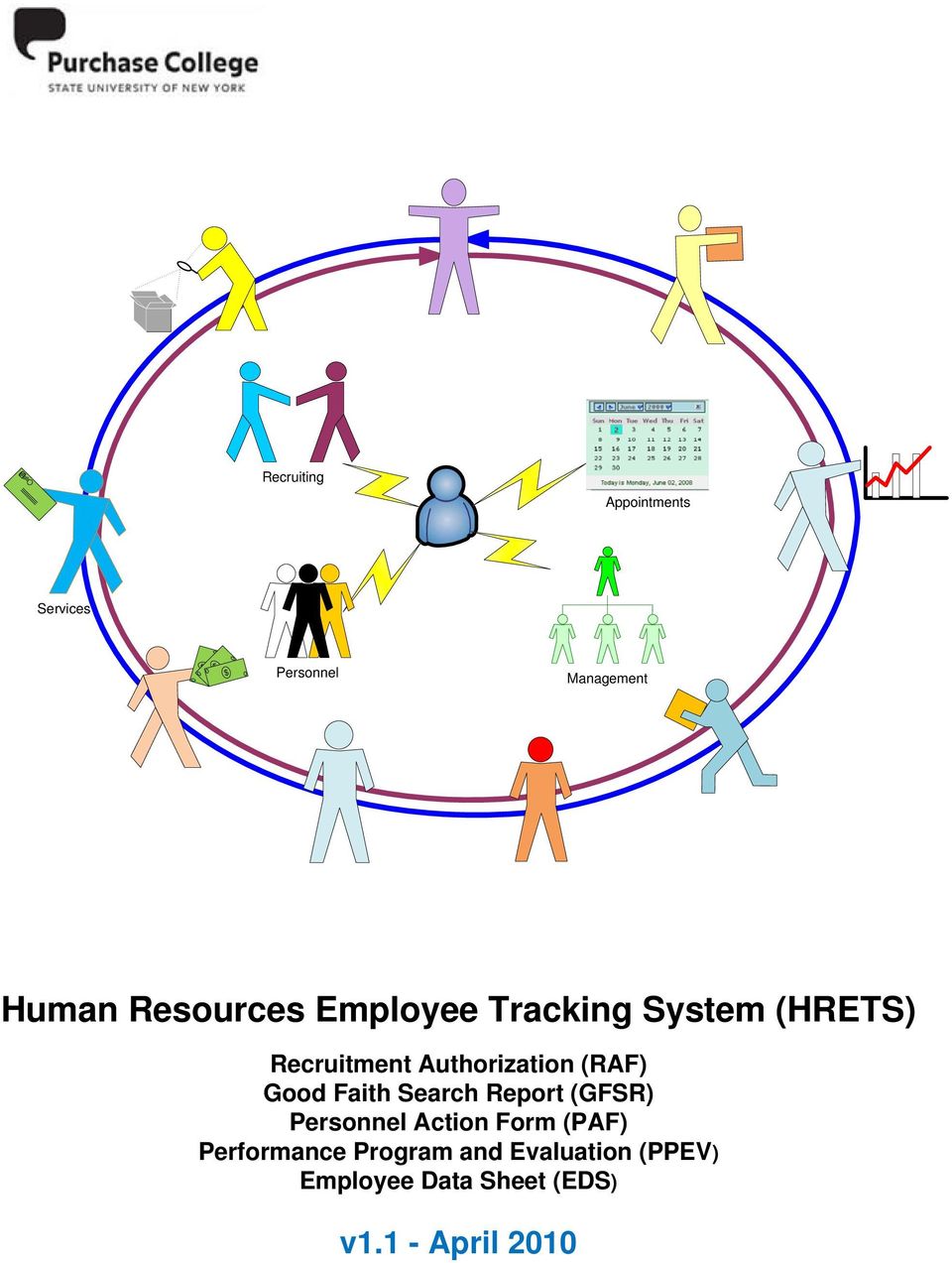
1 Recruiting Appointments Services $ $ $ Personnel Management Human Resources Employee Tracking System (HRETS) Recruitment Authorization (RAF) Good Faith Search Report (GFSR) Personnel Action Form (PAF) Performance Program and Evaluation (PPEV) Employee Data Sheet (EDS) v1.1 - April 2010
2 Version /21/2010 2

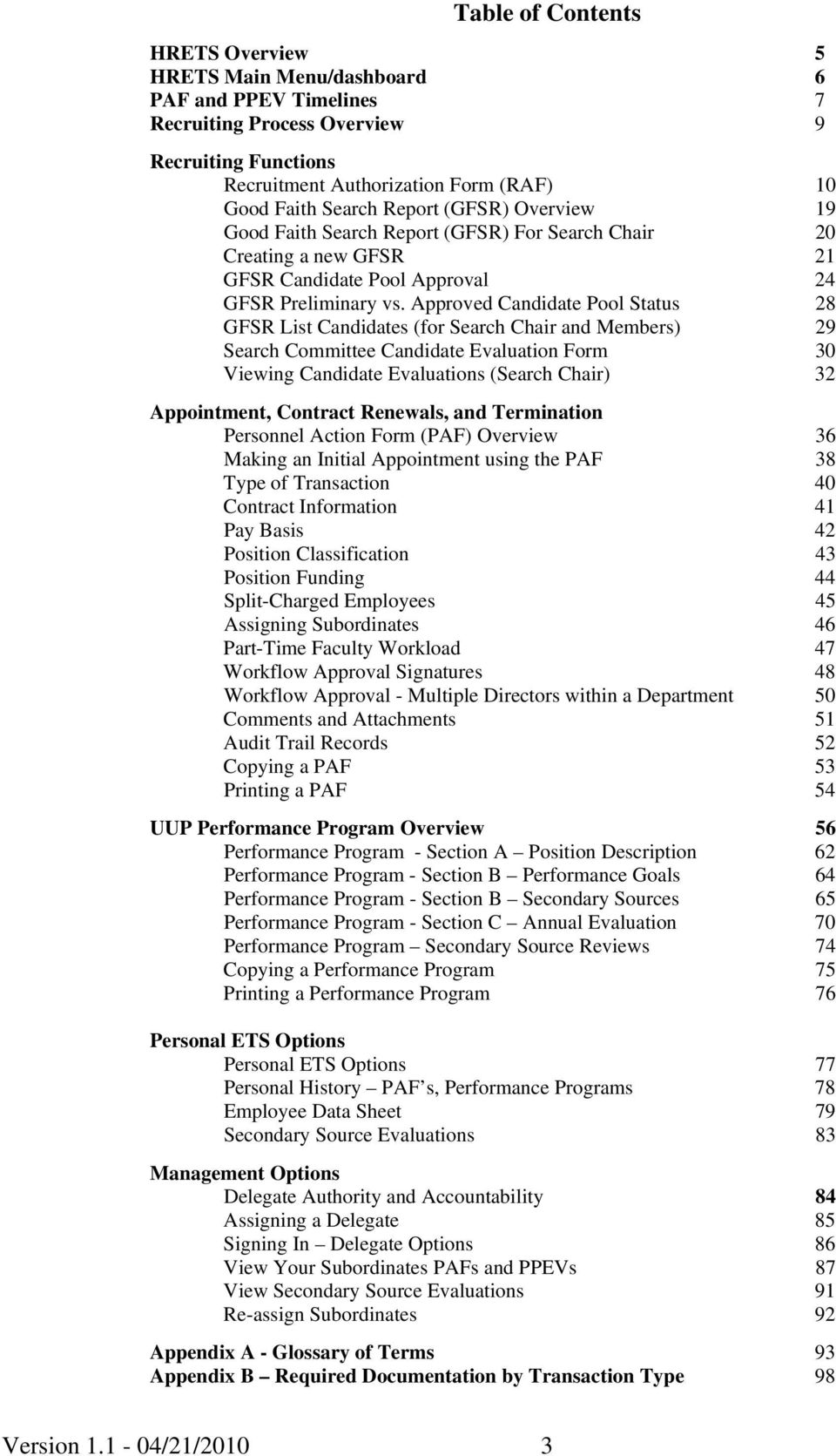
3 Table of Contents HRETS Overview 5 HRETS Main Menu/dashboard 6 PAF and PPEV Timelines 7 Recruiting Process Overview 9 Recruiting Functions Recruitment Authorization Form (RAF) 10 Good Faith Search Report (GFSR) Overview 19 Good Faith Search Report (GFSR) For Search Chair 20 Creating a new GFSR 21 GFSR Candidate Pool Approval 24 GFSR Preliminary vs. Approved Candidate Pool Status 28 GFSR List Candidates (for Search Chair and Members) 29 Search Committee Candidate Evaluation Form 30 Viewing Candidate Evaluations (Search Chair) 32 Appointment, Contract Renewals, and Termination Personnel Action Form (PAF) Overview 36 Making an Initial Appointment using the PAF 38 Type of Transaction 40 Contract Information 41 Pay Basis 42 Position Classification 43 Position Funding 44 Split-Charged Employees 45 Assigning Subordinates 46 Part-Time Faculty Workload 47 Workflow Approval Signatures 48 Workflow Approval - Multiple Directors within a Department 50 Comments and Attachments 51 Audit Trail Records 52 Copying a PAF 53 Printing a PAF 54 UUP Performance Program Overview 56 Performance Program - Section A Position Description 62 Performance Program - Section B Performance Goals 64 Performance Program - Section B Secondary Sources 65 Performance Program - Section C Annual Evaluation 70 Performance Program Secondary Source Reviews 74 Copying a Performance Program 75 Printing a Performance Program 76 Personal ETS Options Personal ETS Options 77 Personal History PAF s, Performance Programs 78 Employee Data Sheet 79 Secondary Source Evaluations 83 Management Options Delegate Authority and Accountability 84 Assigning a Delegate 85 Signing In Delegate Options 86 View Your Subordinates PAFs and PPEVs 87 View Secondary Source Evaluations 91 Re-assign Subordinates 92 Appendix A - Glossary of Terms 93 Appendix B Required Documentation by Transaction Type 98 Version /21/2010 3
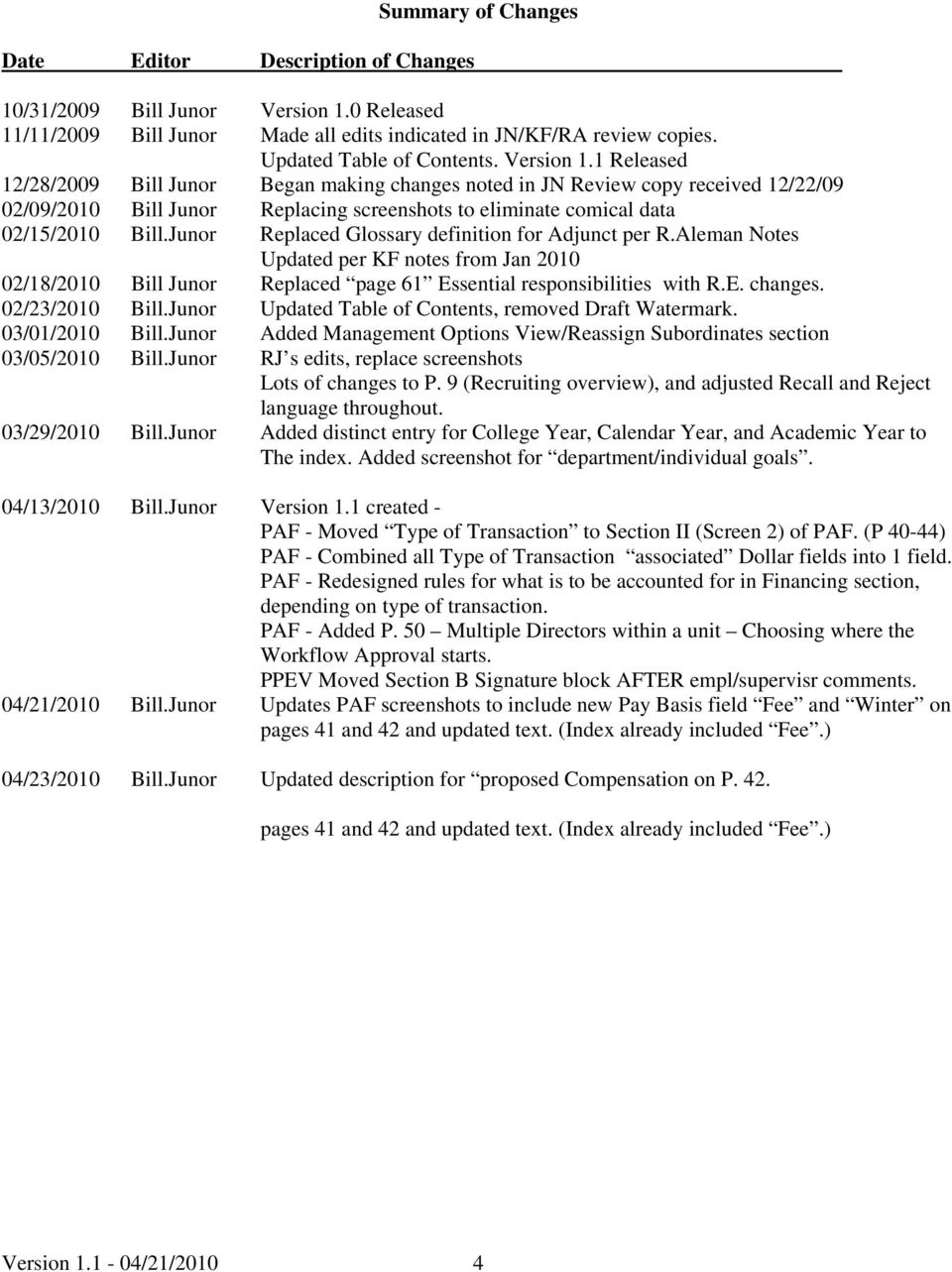
4 Date Editor Description of Changes Summary of Changes 10/31/2009 Bill Junor Version 1.0 Released 11/11/2009 Bill Junor Made all edits indicated in JN/KF/RA review copies. Updated Table of Contents. Version 1.1 Released 12/28/2009 Bill Junor Began making changes noted in JN Review copy received 12/22/09 02/09/2010 Bill Junor Replacing screenshots to eliminate comical data 02/15/2010 Bill.Junor Replaced Glossary definition for Adjunct per R.Aleman Notes Updated per KF notes from Jan /18/2010 Bill Junor Replaced page 61 Essential responsibilities with R.E. changes. 02/23/2010 Bill.Junor Updated Table of Contents, removed Draft Watermark. 03/01/2010 Bill.Junor Added Management Options View/Reassign Subordinates section 03/05/2010 Bill.Junor RJ s edits, replace screenshots Lots of changes to P. 9 (Recruiting overview), and adjusted Recall and Reject language throughout. 03/29/2010 Bill.Junor Added distinct entry for College Year, Calendar Year, and Academic Year to The index. Added screenshot for department/individual goals. 04/13/2010 Bill.Junor Version 1.1 created - PAF - Moved Type of Transaction to Section II (Screen 2) of PAF. (P 40-44) PAF - Combined all Type of Transaction associated Dollar fields into 1 field. PAF - Redesigned rules for what is to be accounted for in Financing section, depending on type of transaction. PAF - Added P. 50 Multiple Directors within a unit Choosing where the Workflow Approval starts. PPEV Moved Section B Signature block AFTER empl/supervisr comments. 04/21/2010 Bill.Junor Updates PAF screenshots to include new Pay Basis field Fee and Winter on pages 41 and 42 and updated text. (Index already included Fee.) 04/23/2010 Bill.Junor Updated description for proposed Compensation on P. 42. pages 41 and 42 and updated text. (Index already included Fee.) Version /21/2010 4
5 Version /21/2010 5

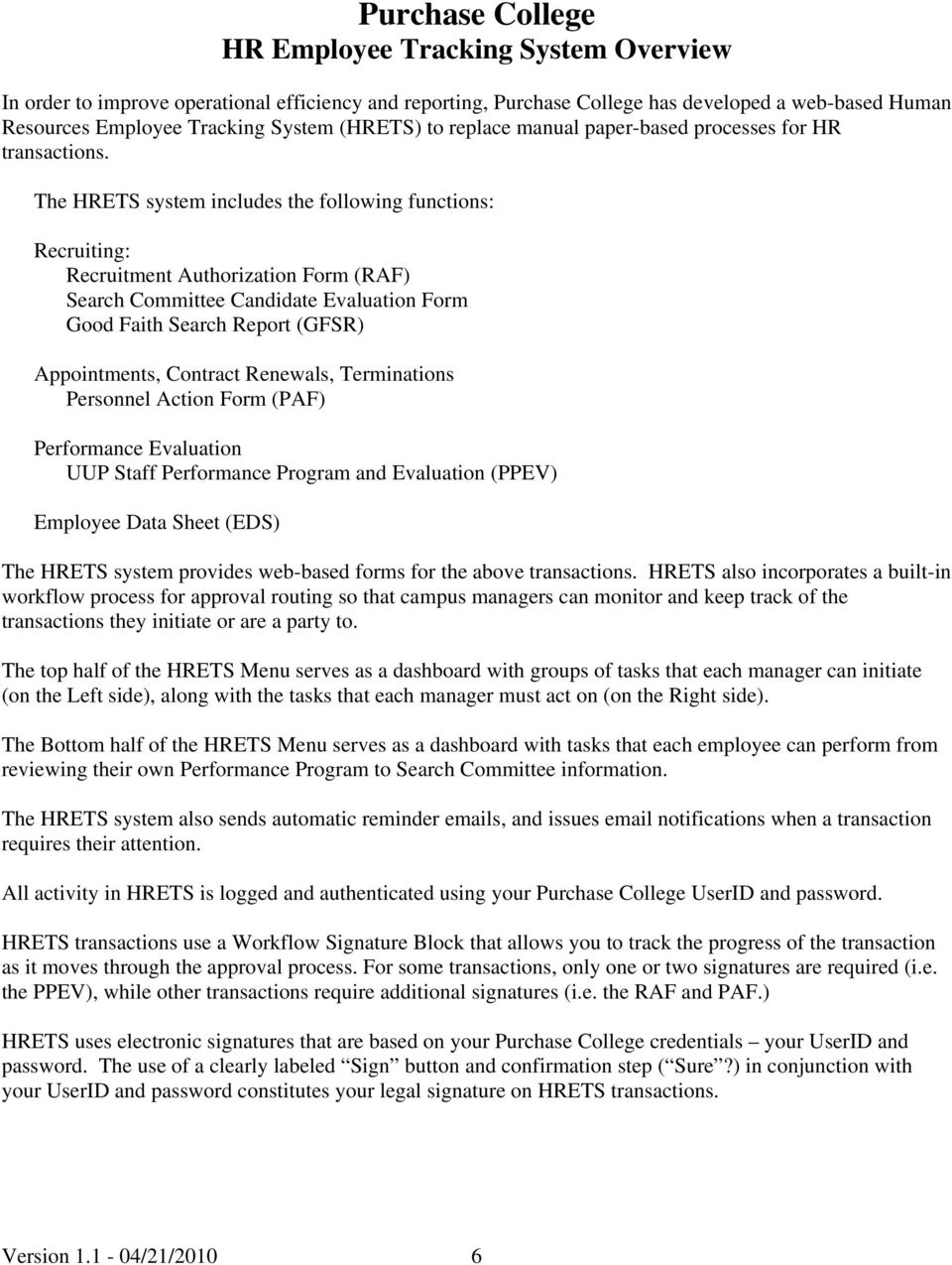
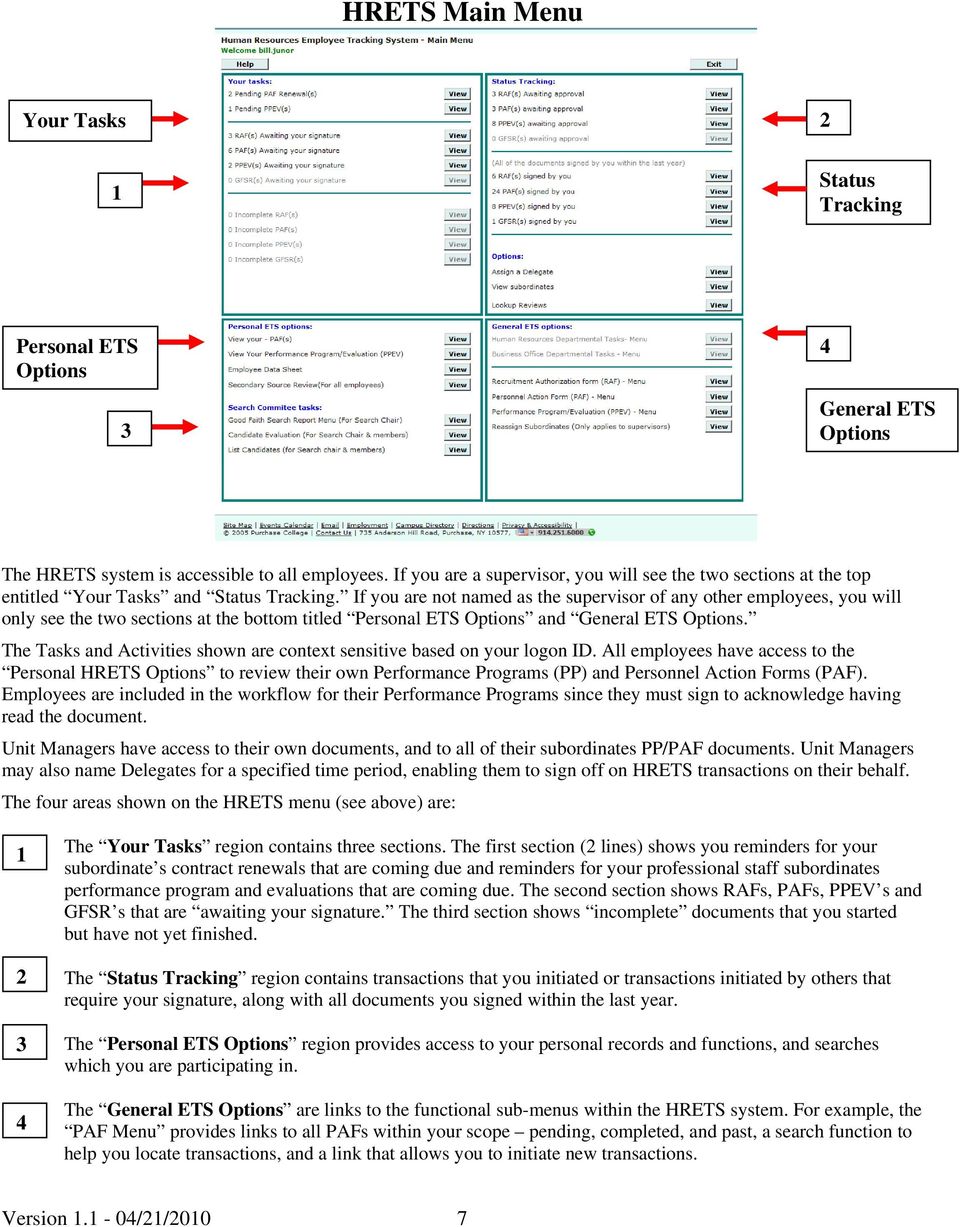
6 Purchase College HR Employee Tracking System Overview In order to improve operational efficiency and reporting, Purchase College has developed a web-based Human Resources Employee Tracking System (HRETS) to replace manual paper-based processes for HR transactions. The HRETS system includes the following functions: Recruiting: Recruitment Authorization Form (RAF) Search Committee Candidate Evaluation Form Good Faith Search Report (GFSR) Appointments, Contract Renewals, Terminations Personnel Action Form (PAF) Performance Evaluation UUP Staff Performance Program and Evaluation (PPEV) Employee Data Sheet (EDS) The HRETS system provides web-based forms for the above transactions. HRETS also incorporates a built-in workflow process for approval routing so that campus managers can monitor and keep track of the transactions they initiate or are a party to. The top half of the HRETS Menu serves as a dashboard with groups of tasks that each manager can initiate (on the Left side), along with the tasks that each manager must act on (on the Right side). The Bottom half of the HRETS Menu serves as a dashboard with tasks that each employee can perform from reviewing their own Performance Program to Search Committee information. The HRETS system also sends automatic reminder s, and issues notifications when a transaction requires their attention. All activity in HRETS is logged and authenticated using your Purchase College UserID and password. HRETS transactions use a Workflow Signature Block that allows you to track the progress of the transaction as it moves through the approval process. For some transactions, only one or two signatures are required (i.e. the PPEV), while other transactions require additional signatures (i.e. the RAF and PAF.) HRETS uses electronic signatures that are based on your Purchase College credentials your UserID and password. The use of a clearly labeled Sign button and confirmation step ( Sure?) in conjunction with your UserID and password constitutes your legal signature on HRETS transactions. Version /21/2010 6
7 HRETS Main Menu Your Tasks 1 2 Status Tracking Personal ETS Options 3 4 General ETS Options The HRETS system is accessible to all employees. If you are a supervisor, you will see the two sections at the top entitled Your Tasks and Status Tracking. If you are not named as the supervisor of any other employees, you will only see the two sections at the bottom titled Personal ETS Options and General ETS Options. The Tasks and Activities shown are context sensitive based on your logon ID. All employees have access to the Personal HRETS Options to review their own Performance Programs (PP) and Personnel Action Forms (PAF). Employees are included in the workflow for their Performance Programs since they must sign to acknowledge having read the document. Unit Managers have access to their own documents, and to all of their subordinates PP/PAF documents. Unit Managers may also name Delegates for a specified time period, enabling them to sign off on HRETS transactions on their behalf. The four areas shown on the HRETS menu (see above) are: The Your Tasks region contains three sections. The first section (2 lines) shows you reminders for your subordinate s contract renewals that are coming due and reminders for your professional staff subordinates performance program and evaluations that are coming due. The second section shows RAFs, PAFs, PPEV s and GFSR s that are awaiting your signature. The third section shows incomplete documents that you started but have not yet finished. The Status Tracking region contains transactions that you initiated or transactions initiated by others that require your signature, along with all documents you signed within the last year. The Personal ETS Options region provides access to your personal records and functions, and searches which you are participating in. The General ETS Options are links to the functional sub-menus within the HRETS system. For example, the PAF Menu provides links to all PAFs within your scope pending, completed, and past, a search function to help you locate transactions, and a link that allows you to initiate new transactions. Version /21/2010 7
8 PAF Renewal and Performance Program/Evaluation Reminders Pending PAF Renewal and Performance Program Reminders For supervisors, two buttons on the main menu help to remind you when one of your UUP employees is due for a contract renewal, or when one of your professional staff is due for a Performance Program Evaluation. These reminders are triggered by the ending dates on the most recent completed PAFs and PPEVs. The Employee Notification Date (END) is the date the employee must be notified of renewal or non-renewal in accordance with their status as outlined in the table below. For UUP Staff, the HRETS system will alert you to the approaching end date for an employee s Contract, and requires immediate action on the supervisor s part. Contract Notification Timeline: Type Status Employee Notification of Renewal/Non-Renewal (minimum) Staff Up to first year of employment 3 Months (90 days) before PAF/Contract End Date Staff More than 1 but less than 2 years 6 Months (180 days) before PAF/Contract End Date Staff 2 or more years of Appointment 12 Months (365 days) before PAF/Contract End Date Staff At the end of 6 years continuous service 12 Months (365 days) before PAF/Contract End Date (Employee is eligible for Permanent appointment effective on 7 th anniversary) Staff Part-Time 45 Days prior to PAF/Contract end date Staff Temp Appointment No advance notice required Note: A supervisor s failure to maintain current contracts (PAF s) for atheir subordinates will lead to suspension of their priviledges. All employees are also contractually required to have an annual Performance Program and Evaluation (PPEV) but at this time failure to maintain current PPEVs will not lead to suspension of a supervisor s account. Version /21/2010 8

9 PAF Renewal and Performance Program/Evaluation Reminders Please note that these reminders are intended to ensure that no employees are out of contract. Supervisors are encouraged to strategically monitor all of their employee s notification timelines as outlined in the table on the preceding page. The HRETS System will remind you when an employee is less than 90 days away from being out of contract. For most employees, a renewal decision should have been made many months earlier - ahead of the Employee Notification Date shown in the table. By failing to notify the employee at that time, the supervisor has by default extended their contract (and its financial obligation) since the College is still required to give the amount of notice reflected in the table. Note that you can also view a summary of your employees PAF/Contracts and their PPEVs from the View Subordinates button in the Status Tracking section of the main menu. The PAF Contract must be COMPLETED and signed by all parties prior to the cutoff date or the cutoff will proceed. A PAF transaction that is still in process will not delay the cutoff date. Preparing and submitting a PAF into the workflow does not guarantee that it will be approved by all parties. It is important that you allow adequate time to allow the other signatories to this transaction to perform their necessary review and approval steps. Professional Staff Performance Programs / Evaluations (PPEV) For a PAF renewal, the system will also verify that there is a completed PPEV evaluation dated within the last 6 months. If there is no PPEV Evaluation within the last 180 days, a completed PAF/Contract is still considered incomplete and cutoff will proceed. Staff Performance Program / Evaluation (PPEV) Timeline: Type Status Performance Program due to HR Office Staff New Hire Within 45 Days of initial appointment/change in title Staff Any change to responsibilities As necessary Staff Change of Supervisor As necessary Staff Renewal or Continuing Annual Evaluation once per year (minimum) At this time, only the UUP Staff Evaluation process is incorporated into HRETS. The Faculty Evaluation process, CSEA, NYSCOPBA, and Council 82 evaluation processes are not included in HRETS at this time, but may be incorporated in future revisions. Version /21/2010 9

10 Recruiting New Employees Process Overview The process of recruiting a new employee is made up of several steps and approval checkpoints. The originating department completes a Recruitment Authorization Form (RAF) which is a request for permission to advertise to hire for a newly created position or to fill an existing position. The RAF is reviewed and signed by the Dean/Director, Officer, Budget Office, HR, Affirmative Action, and the President. Once the RAF is fully completed, signed, and approved, the position may be advertised. Advertising in specified locations should occur as noted in the approved RAF i.e. specific newspapers and websites. All advertisements should direct candidates to the PeopleAdmin (PA) hosted recruiting system that allows candidates to browse openings at the college and to submit applications and supporting materials electronically. There is an import/export between PeopleAdmin and HRETS that brings candidate data and attached documentation into HRETS. The import/export occurs each evening. If a candidate cannot submit their resume and application electronically through PeopleAdmin, individual names and materials can be added by the Search Committee Chair if a paper application is received via mail. Once the chair creates a Good Faith Search Report (GFSR) the search sommittee members can begin to review candidates using the List Candidates function in the lower left quadrant of the main menu. Search committee chairs and members are identified on the RAF. When the Chair creates the GFSR, they are associating the GFSR withy a specific RAF, which is in turn tied to a specific PeopleAdmin posting and pool of candidates. Once the chair creates the GFSR by identifying its RAF, committee members can begin reviewing candidates. Search Committee Members review applicant resumes and materials. The Chair of the Search Committee reviews the committee member s recommendations, and then indicates the selected candidates as Selected for Interview in the Good Faith Search Report (GFSR). Once the Search Chair believes they have received a sufficiently diverse pool of candidates, and wish to begin interviewing, the Good Faith Search Report must be approved by the AAO. At this stage, the Good Faith Search Report is signed by the Affirmative Action Officer (AAO) to indicate their approval of a sufficiently diverse candidate pool before any interviews occur. Once the GFSR is Approved by the AAO, the committee can schedule interviews. Additional candidates may continue to arrive via PeopleAdmin, and the committee is also free to interview additional candidates not originally indicated (or second choice candidates) as long as the initially indicated interviews either occur or are declined by the candidate. Each search committee member should fill out one Candidate Evaluation Form for each candidate interview, including one for each of the necessary interview rounds (telephone interviews and subsequent in-person interviews) in the process. The Search Chair can update the GFSR to mark additional candidates for interview, and to mark the candidate they intend to hire. Once the committee makes its recommendation, the updated GFSR is signed by the Search Chair, and then routed to their Officer and then on to the AAO for final approval. Note that a Personnel Action Form (PAF) is also required to make an appointment, and that the PAF requires approval by the Dean/Director, Officer, Budget, HR, and others as indicated in the signature block. Version /21/

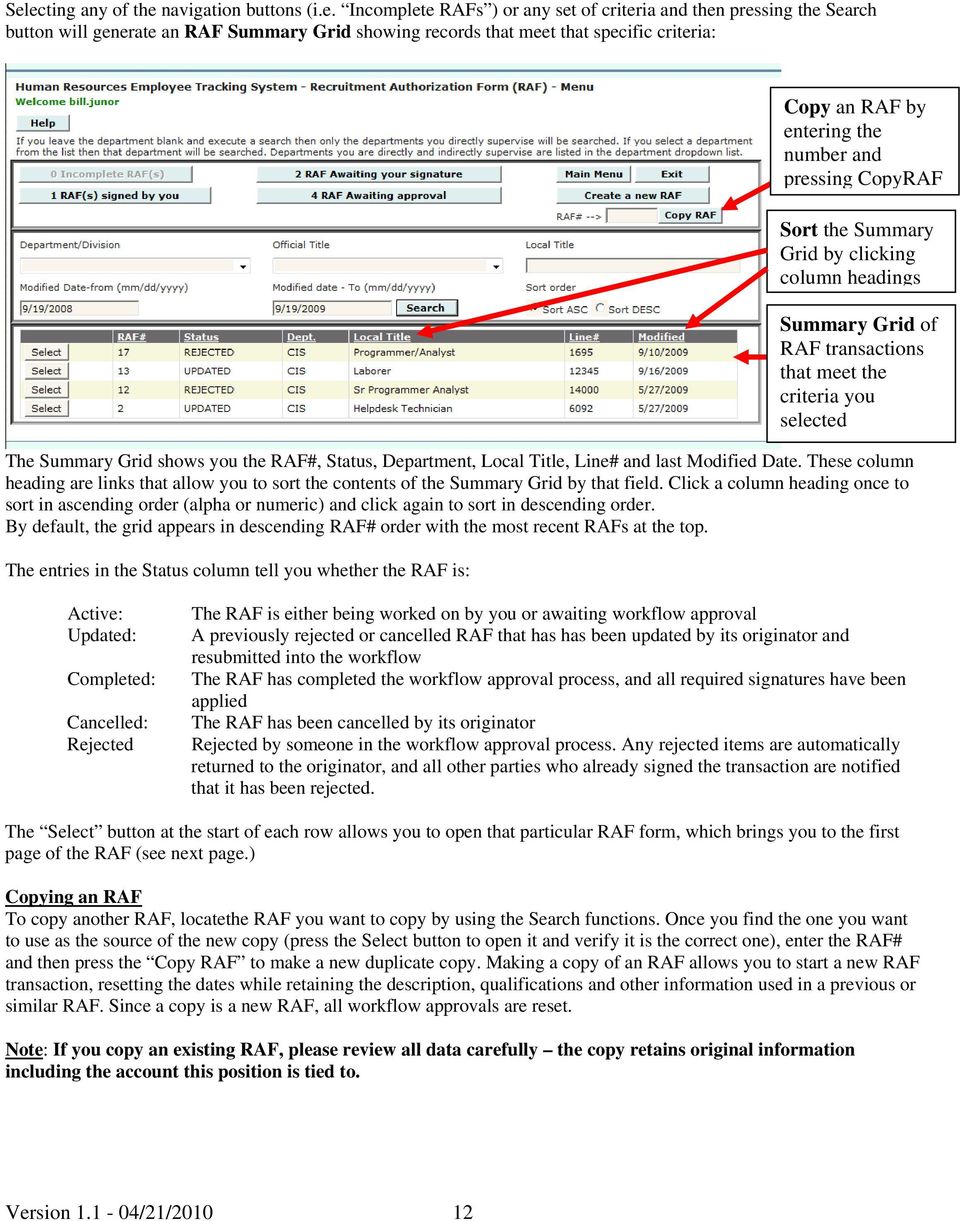
11 Recruitment Authorization Form The Recruitment Authorization Form (RAF) is used to approve the search process for a new or existing position. It defines the position title, salary, requirements, advertising language and locations, and the account that the position will be charged to. Depending on the unit, there may be up to eight approval signatures in the workflow block required to complete the RAF. Once the RAF is completed, the search committee may proceed with advertising, reviewing applicants, conducting interviews, and proposing the most qualified candidate(s). From the HRETS Main Menu, follow the link to the Recruitment Authorization Form sub-menu: Navigation Buttons To make a new copy of an existing RAF, Enter the RAF# you want to make a ciopy of, and press CopyRAF Search Functions Navigation Buttons at the top will bring you a list of RAFs that are Incomplete or Awaiting Your Signature, RAFs Signed by You, and RAFs you submitted which are Awaiting Approval from others. The Main Menu button returns you to the HRETS Main Menu, the Exit Button exits the HRETS system, and the Create a new RAF button allows you to create a new RAF from scratch. To copy an existing RAF, locate the one you want to make a copy of using the search functions (open it and make sure it s the one you want), then enter the unique RAF# and press the Copy RAF button. Search RAFs by Date/Department/Division There are two rows of buttons with a variety of criteria fields and a Search button to group and browse RAFs, or to select RAFs by date range. Select the criteria you want and press Search to get a list. The Department/Division droplist is context-sensitive, and will allow you to choose organizational units within your scope. For example, the Provost can narrow the scope to A+D, The Library, or any other unit that reports to him/her, and will show all RAFs for that particular unit. The Official Title droplist shows all of the official titles available within your Department/Division so you can filter out all RAFs for that particular title. The Local Title field allows you to type in a local title, and will attempt to find all RAFs within your scope that used that local title. The Modified Date From and To fields allow you to specify a date range, that will show a list of RAFs issued within that date range. By default these fields are set to show the past 12 months. Version /21/

12 Selecting any of the navigation buttons (i.e. Incomplete RAFs ) or any set of criteria and then pressing the Search button will generate an RAF Summary Grid showing records that meet that specific criteria: The Summary Grid shows you the RAF#, Status, Department, Local Title, Line# and last Modified Date. These column heading are links that allow you to sort the contents of the Summary Grid by that field. Click a column heading once to sort in ascending order (alpha or numeric) and click again to sort in descending order. By default, the grid appears in descending RAF# order with the most recent RAFs at the top. The entries in the Status column tell you whether the RAF is: Copy an RAF by entering the number and pressing CopyRAF Sort the Summary Grid by clicking column headings Summary Grid of RAF transactions that meet the criteria you selected Active: Updated: Completed: Cancelled: Rejected The RAF is either being worked on by you or awaiting workflow approval A previously rejected or cancelled RAF that has has been updated by its originator and resubmitted into the workflow The RAF has completed the workflow approval process, and all required signatures have been applied The RAF has been cancelled by its originator Rejected by someone in the workflow approval process. Any rejected items are automatically returned to the originator, and all other parties who already signed the transaction are notified that it has been rejected. The Select button at the start of each row allows you to open that particular RAF form, which brings you to the first page of the RAF (see next page.) Copying an RAF To copy another RAF, locatethe RAF you want to copy by using the Search functions. Once you find the one you want to use as the source of the new copy (press the Select button to open it and verify it is the correct one), enter the RAF# and then press the Copy RAF to make a new duplicate copy. Making a copy of an RAF allows you to start a new RAF transaction, resetting the dates while retaining the description, qualifications and other information used in a previous or similar RAF. Since a copy is a new RAF, all workflow approvals are reset. Note: If you copy an existing RAF, please review all data carefully the copy retains original information including the account this position is tied to. Version /21/
13 The RAF (Page 1) The top of the page shows the Status, RAF#, and Title (SUNY/Local). There are also three buttons that allow you to Cancel the RAF form, Re-activate a (cancelled) RAF form, or to Make a copy of this RAF. Section 1 Position Information: This section is used to define the basic criteria for the Recruitment Authorization Form. The first row asks you to identify whether it is a new position you are seeking to fill, a reclassification, or an existing position to be re-filled. If it is an existing position, you must identify the previous positions salary, title, etc., and identify the previous incumbent by their UserID (Lastname.Firstname). Once you choose New/Existing/Reclassification radio button, you MUST press the Save button before filling out the remainder of section 1. Your choice in this field determines which fields are required in the rest of section 1. You have to identify a Minimum Salary and a Maximum Salary (both numbers can be the same if the salary is fixed and there is no range.) You must also identify which account(s) this salary will be charged against. Section 2 Account Information If the cost of this position is to be split across multiple accounts, you must indicate what percentage of the salary is to come from each account, and they must total 100% of the salary to be paid. Multiple accounts and their percentages are shown in the table at the middle of the screen. Section 1 Position Information Choose New Position Existing Position or Reclassification and then press Save Section 2 Account Information Section 3 Recruitment Plan Section 3 Recruitment Plan: is used to identify the Scope of Recruitment as being Local, Regional, or National. If the scope is less than national, you must explain in the text box below. There is another text box for Sources of Recruitment this is where you list the places and publications you plan to advertise/recruit for this position. The buttons at the bottom of the RAF screens allow you to print the SUNY Professional Announcement, the entire RAF, or advance to a subsequent page (there are three pages in an RAF.) Once Page 1 of the RAF is completed and saved, the Print Preview Professional Announcement button lights up (becomes available.) Version /21/

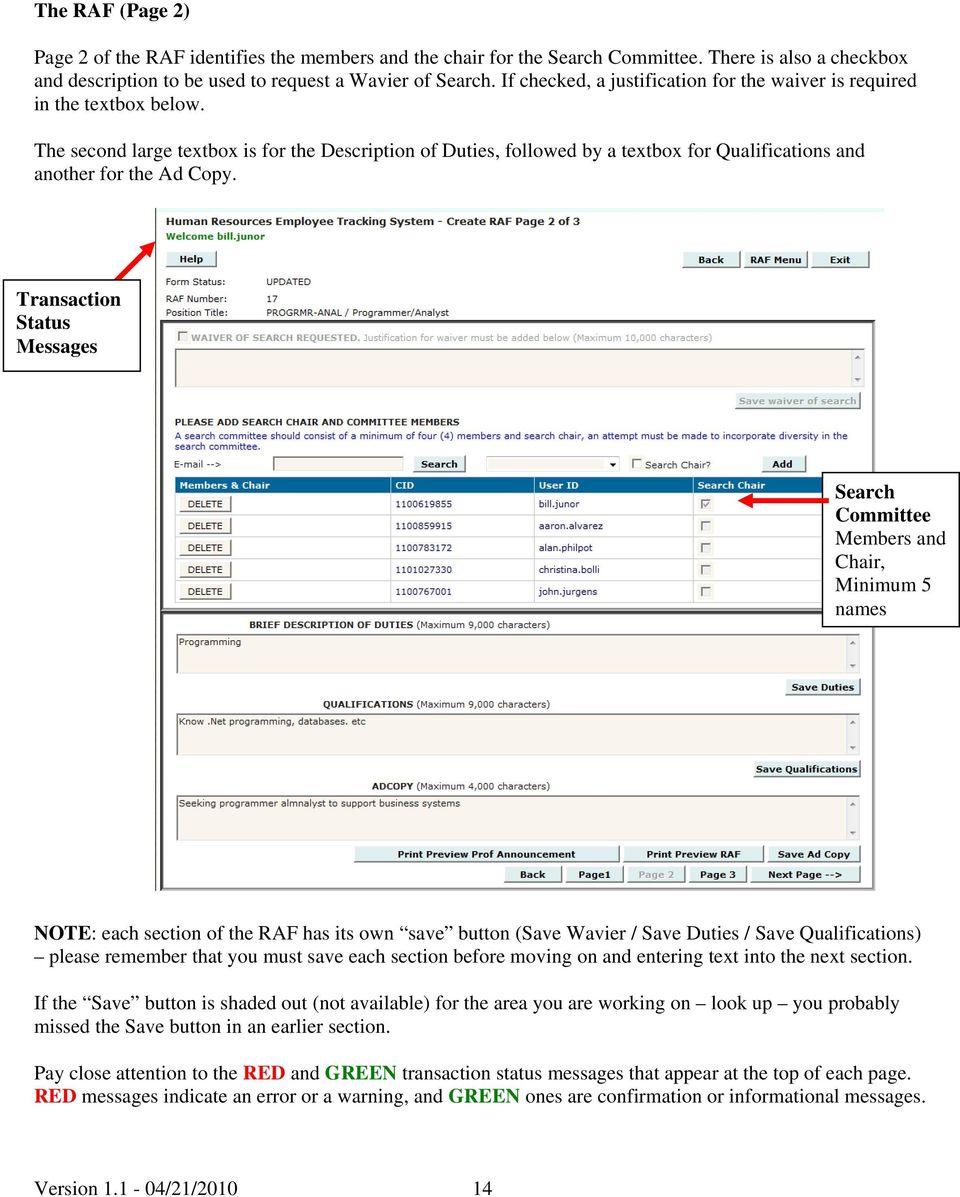
14 The RAF (Page 2) Page 2 of the RAF identifies the members and the chair for the Search Committee. There is also a checkbox and description to be used to request a Wavier of Search. If checked, a justification for the waiver is required in the textbox below. The second large textbox is for the Description of Duties, followed by a textbox for Qualifications and another for the Ad Copy. Transaction Status Messages Search Committee Members and Chair, Minimum 5 names NOTE: each section of the RAF has its own save button (Save Wavier / Save Duties / Save Qualifications) please remember that you must save each section before moving on and entering text into the next section. If the Save button is shaded out (not available) for the area you are working on look up you probably missed the Save button in an earlier section. Pay close attention to the RED and GREEN transaction status messages that appear at the top of each page. RED messages indicate an error or a warning, and GREEN ones are confirmation or informational messages. Version /21/
15 The RAF (Page 3) Page 3 of the RAF includes the Special Note section (pre-populated with a standard statement) that is used in the SUNY Professional Vacancy Announcement. Page 3 of the RAF also includes the Workflow Signature Approvals section. Below the signature block is a section for comments optional comments can be added by any of the parties to this workflow; and Recall/Rejection comments that must be entered if one of the signers rejects or recalls the transaction. At the bottom of the screen is a grid showing any documents that have been attached to the RAF by the originator or by any of the workflow signatories. Special Note Workflow Signature Block Comments press select to view entire comment in box above Attached files with additional information are shown in this area Version /21/

16 Signature Approval Workflow Block The middle of Page 3 of the RAF is the Signature Approval Workflow section. This section tracks this transaction through all of its approval steps, ending with the President s signature. For HRETS purposes, the authenticated UserID pressing Sign constitutes an electronic signature approving this transaction. A signature approval can be retracted using the Recall button if necessary. For each step in the workflow approval, the Title is shown in the leftmost column (i.e. Director/Dean ). The Workflow title is followed by a status showing either: A green check mark A yellow question mark Indicates the transaction has been signed (approved) by this individual Indicates the transaction is awaiting review/approval/rejection by this signer Signatory Shows the UserID (First.Last) of the individual currently associated with the Workflow Title Date the date which the document was signed by each signatory. Three buttons labeled Sign, Reject and Recall are available to each party in the workflow. The example above is waiting to be signed by the Director/Dean (indicated by the yellow question mark). Note that while each signer can choose to Sign or Reject the RAF, the recall option is only available to you AFTER the document has been signed. The Director/Dean can choose to Recall the document they submitted for the next signature (it then comes off the VP s dashboard and Task list until it is re-signed by the Director). Note: Once anyone in the workflow has signed the document, it is locked to further editing on their part as others in the workflow review and approve the transaction. If the Dean/Director needs to make a change after signing the transaction however minor they can Recall the transaction - removing approval signatures then Reject the transaction and re-activate it to unlock it (after signing, it is locked to changes.) Once it is reactivated, the Dean/Director can make the changes and re-submit the revised document to the workflow approval process. The Recall Option notifies the parties that have already signed the document via that it has been recalled. Any of the parties in the workflow approval process can recall the transaction at any point sending it back to the person who issued the recall. Version /21/

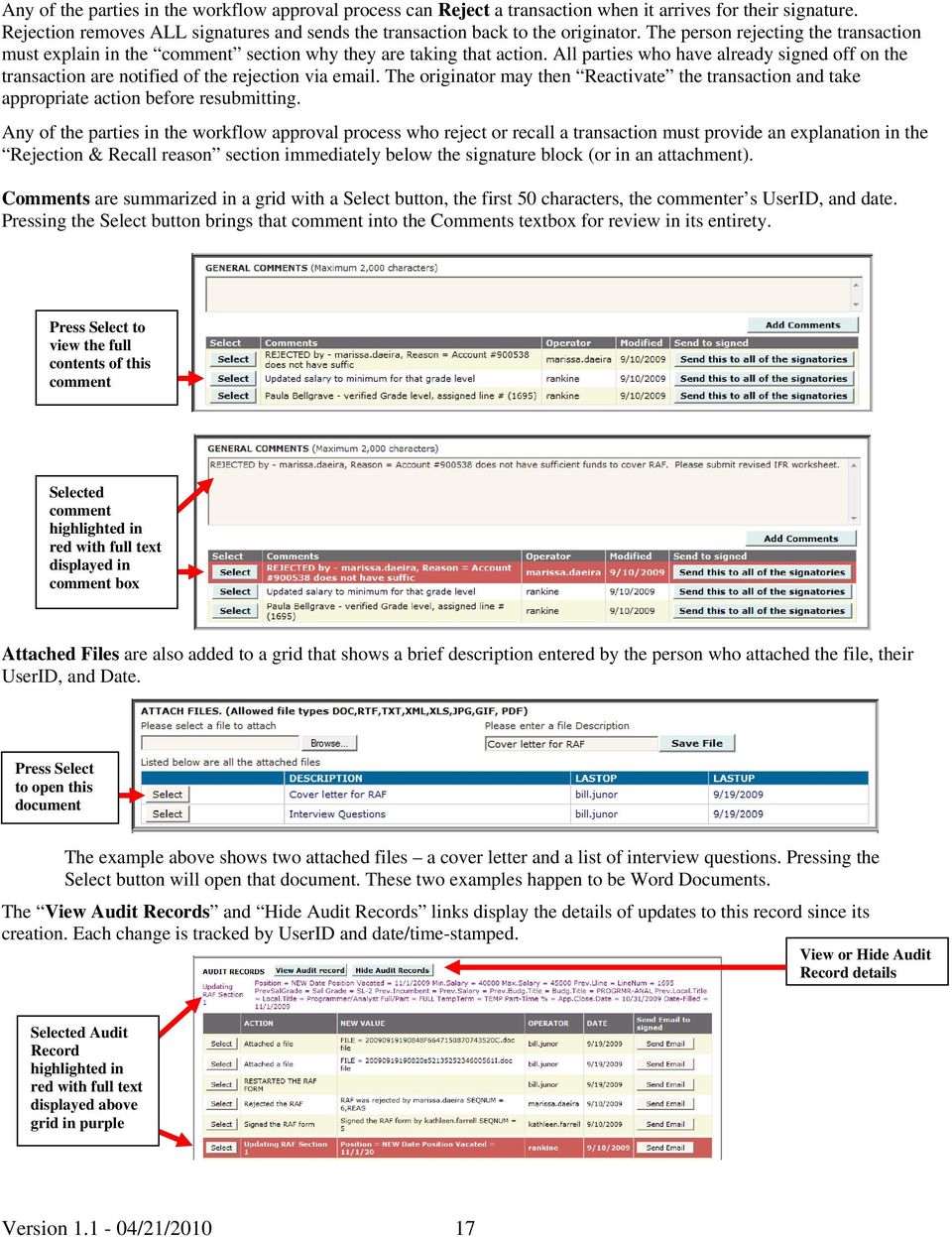
17 Any of the parties in the workflow approval process can Reject a transaction when it arrives for their signature. Rejection removes ALL signatures and sends the transaction back to the originator. The person rejecting the transaction must explain in the comment section why they are taking that action. All parties who have already signed off on the transaction are notified of the rejection via . The originator may then Reactivate the transaction and take appropriate action before resubmitting. Any of the parties in the workflow approval process who reject or recall a transaction must provide an explanation in the Rejection & Recall reason section immediately below the signature block (or in an attachment). Comments are summarized in a grid with a Select button, the first 50 characters, the commenter s UserID, and date. Pressing the Select button brings that comment into the Comments textbox for review in its entirety. Press Select to view the full contents of this comment Selected comment highlighted in red with full text displayed in comment box Attached Files are also added to a grid that shows a brief description entered by the person who attached the file, their UserID, and Date. Press Select to open this document The example above shows two attached files a cover letter and a list of interview questions. Pressing the Select button will open that document. These two examples happen to be Word Documents. The View Audit Records and Hide Audit Records links display the details of updates to this record since its creation. Each change is tracked by UserID and date/time-stamped. View or Hide Audit Record details Selected Audit Record highlighted in red with full text displayed above grid in purple Version /21/
18 The Print Professional Announcement link on the bottom of RAF Page 1 displays the standard SUNY form so that you can print it: Version /21/

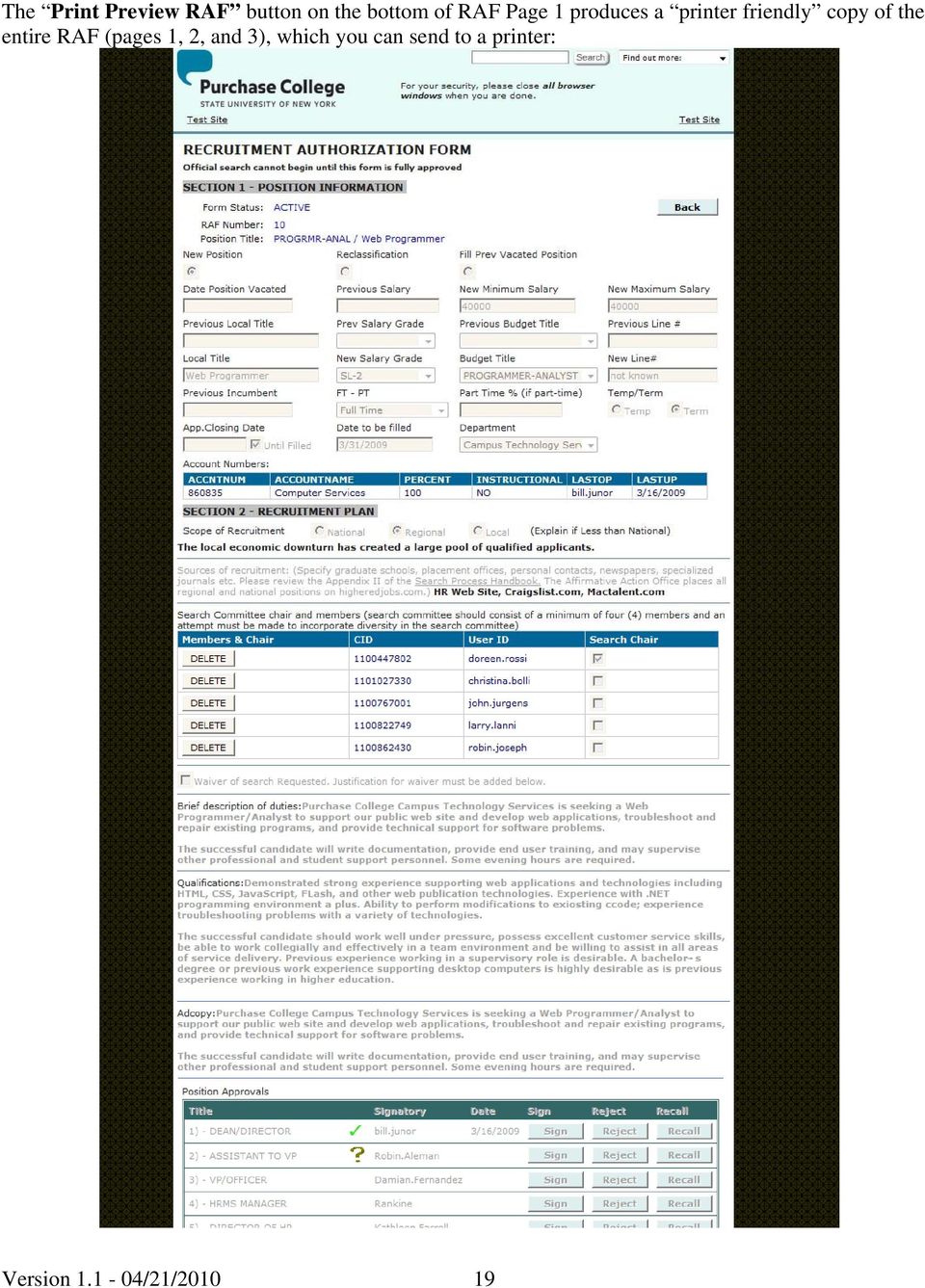
19 The Print Preview RAF button on the bottom of RAF Page 1 produces a printer friendly copy of the entire RAF (pages 1, 2, and 3), which you can send to a printer: Version /21/
20 Good Faith Search Report (GFSR) Overview Once a Recruitment Authorization Form (RAF) is completed and approved in HRETS, the job description, qualifications and requisite documents are automatically uploaded and advertised in People Admin each evening. People Admin is a commercially hosted service that serves as Purchase College s job vacancy and on-line application website ( Prospective employees can apply for the vacancies listed by completing an on-line application and attaching requisite documents. Candidate materials are automatically exported from People Admin into HRETS each evening. Alternatively, candidates can be manually added to the GFSR but only as a last resort. Search Committee members named in the RAF can review candidate applications and materials by clicking the List Candidates function under Search Committee tasks on the main menu. Completion of the GFSR There are two steps to completing the GFSR: Step 1 Preliminary GFSR A) Review and Rank Candidates After the Search Chair creates a GFSR by associating it with a particular RAF, candidate materials are now available to search committee members for review. Search Committee members individually review the materials, rank the candidates and determine which ones will be selected for an interview. B) Selection of Candidates for an Interview - Candidates are either selected for a telephone or an inperson interview (Please review the Search Process Handbook for information on conducting telephone and in-person interviews) C) Chair of Search Committee marks selected candidates as Selected for Interview in HRETS - The Chair of the search committee reviews the committee s selections and marks the candidates as Selected for Interview in the Preliminary GFSR section of HRETS D) Chair of Search Committee electronically signs GFSR which is submitted to the AAO for review. E) AAO reviews Preliminary GFSR to ensure the pool of candidates is suitably diverse - If the pool is sufficiently diverse the AAO will endorse the GFSR and the committee can proceed with interviews. Step 2: Interviews INTERVIEWS CAN ONLY BE CONDUCTED AFTER THE AAO SIGNS THE PRELIMINARY GFSR AND IT BECOMES AN APPROVED GFSR. At that time the Search Chiar can attempt to schedule interviews for the candidates noted as Intend to Interview. Reviewing new candidate material received in HRETS - Additional candidate materials may continue to arrive and will automatically be added to the GFSR until the posted closing date. The Search Committee should review and rank new candidate materials using the same process utilized for the initial candidates. The search committee may also interview additional candidates not originally selected (second choice candidates or other candidates from the original pool) as long as the initial interviews occurred, are pending, or are declined by the first choice candidates. Candidate Evaluation Forms (CEF) for Interviewed Candidates Each search committee member is required to complete one CEF for each candidate interview (telephone and in-person). Selection of Candidate/s for Position Once the search committee selects a candidate/s for the position, the Chair of the Search Committee marks the selected candidate/s, signs Section 2 of the GFSR and submits the GFSR to the AAO a second time for a final review and approval of the entire search process. Completion of the PAF Once the AAO approves the fional GFSR the hiring manager can then create a PAF appointing the candidate to the position. The final GFSR is identified on the PAF. Each GFSR can be used to make one and only one PAF appointment. Once the GFSR is linked to a PAF, it cannot be used for any other PAF. Version /21/

21 Good Faith Search Report (GFSR) Preliminary GFSR - Search Chair Process To start a GFSR, follow the Good Faith Search Report Menu (for Search Chair) link that appears in the Search Committee Tasks section of the Main Menu The GFSR Menu appears: Shortcuts Create a brand new GFSR Search criteria To work on an EXISTING GFSR, you can Search by Department/Division. Title, or Date. You can also use the Shortcuts ( Awaiting your Signature or Awaiting Approval ) on the right hand side. Any of these options will get you a summary list of existing GFSR forms. To create a new GFSR, use the Create a New GFSR link on the right. The following example shows the list of searches (only 2 in this case) that are in Progress where the person who logged in is the Chair of the Search Committee. For each Search shown in the summary list: 1. The first column contains a Select button to open that GFSR 2. The second column shows the unique system-generated GFSR# assigned to this report 3. The third column shows the unique RAF# for this GFSR report 4. The fourth column shows the position Title 5. The fifth column shows the Search Started date (the date the preliminary GFSR was created) 6. The sixth column shows the Candidate Pool for the GFSR as either Preliminary or Approved. Preliminary status is indicated while the GFSR is in progress but the AAO has not yet approved the candidate pool. Approved status is indicated after the AAO has determined the candidate pool is sufficiently diverse and signed the GFSR in Section IV to indicate that interviews may proceed. A status of Final is indicated once the committee has conducted its interviews and made a recommendation to the hiring manager, and the AAO has reviewed and approved the entire process and signed the GFSR in Section VII (see P. 28) 7. The last column shows the overall GFSR transaction Status as either Active, Cancelled, Updated (reactivated after a cancellation), or Failed (the search process took place and did not result in a recommendation for hire.) Version /21/
22 Creating a New GFSR When you create a new GFSR, the system populates the droplist with the RAFs where you are named as Search Chair (RAF specifies the members/chair of the committee). A GFSR must be tied back to an RAF authorizing the search (and it must be a fully approved completed RAF). Section-I: Select the completed RAF for which this GFSR applies: Select the RAF from the droplist and press Get RAF to populate Section 1 of form. Note that this droplist will only contain COMPLETED RAFs where you are listed as the Search Chair, and where no GFSR yet exists. The HRETS system will only allow one Good Faith Search Report (GFSR) per fully executed and approved Recruitment Authorization Form (RAF). The drop list in the middle of the screen (see below) includes all completed (all workflow signatures present) RAF forms where your name is included as the Search Committee Chair. If you choose a RAF for which a GFSR has already been filed, you will get the following error message: Error message: GFSR already exists for the RAF you selected Select the RAF that you are reporting on from this droplist. In this case, the GFSR has already been filed for RAF #37. Since the GFSR is the transaction that specifies which candidate is to be offered the position, someone has likely already been appointed. To proceed, choose the correct RAF from the droplist. Once you have selected the completed and approved RAF, the fields in the remainder of Section I and Section II are populated (Line#, title, department, etc.) using the information provided on the original RAF. Check the date that the position became available, the date that the search began, the FTE%, and the New/Existing position indicator then press Save. Version /21/
23 Creating a New GFSR (Continued) Section-III: Candidate Info. Press the Refresh List button to pull in candidates who submitted their materials online through the PeopleAdmin recruiting system: Select a Candidate from the Summary grid to display their detailed information. Candidate Summary as you pull in PeopleAdmin records or add them yourself, each candidate shows as a line in the candidate Summary Candidates who submit documents through PeopleAdmin or via may have attached documents. To view the documents for a particular candidate, or to update any of the information for a particular candidate, press the Select button in front of their name. The Candidate Detail information screen is presented: 2 Update Candidate s info and then press Update Candidate button to save the changes you made. 1 Select the individual you want to examine.. and 2 their detail information and any attachments show above This Candidate has 2 documents attached choose one you want to see from the Attached Files droplist and press View button. 1 Attach additional Candidate documents by uploading the files/descriptions here via the Browse and Save buttons. Version /21/
24 Creating a New GFSR (Continued) Manually Adding Candidates All applicants should be strongly encouraged to use the PeopleAdmin (PA) recruiting system to apply. The PA system captures a great deal of demographic information. PA is the source used for reporting on recruiting activities and all advertising should refer candidates directly to the PA site. However, if the Search Chair has no choice but to manually add a candidate (i.e. a paper resume is handed to them, and the person refuses to or is unable to fill out the PA online application for any reason), then the search chair can use the GFSR Add Candidate button to enter the candidate. Candidates who are manually added through the GFSR will NOT be exported to PeopleAdmin, and therefore will not be included in any recruiting reports the college produces, so you should STRONGLY encourage all applicants to apply through the PeopleAdmin system. To manually add a candidate: 1. Open the GFSR and go to Section III (page 2 of 6) 2. Press the Add Candidate button to open the Candidate Information section (if not shown) 3. Enter the candidate s name and other information, add attachments, etc Press the Add Candidate button Version /21/
25 Creating a New GFSR (Continued) GFSR Section IV - Candidate Pool Approval Page 3 of the GFSR Contains Section IV - the Candidate Pool Approval workflow signature block. Section IV: Candidate Pool Approval Signatures. Section V: Comments Search Chair Signature AAO signs to indicate approval of candidate pool View existing or create new comments here Section V: previous Comments - press Select to view in the space above Send a comment to all signatories Once the search chair believes the candidate pool is sufficiently diverse, the Chair signs the GFSR on page 3 and the form is submitted to the Affirmative Action Officer (AAO) for her/his signature. Once the AAO signs page 3 of the GFSR approving the candidate pool, the committee can begin the interview process. Section V: Comments Section V of the GFSR contains any comments that have been made on the GFSR (including mandatory Recall or Reject comments). Comments are accumulated in a data grid on the bottom of page 3 of the GFSR. Any party to the transaction can add comments for any reason. If a party to the transaction wants to Recall or Reject the transaction, they must enter an explanatory comment. To view previous comments, press the select button for that comment at the left side of the screen, and the comment will be displayed in its entirety in the area above. After viewing a previous comment, you can use the clear comment button to clear the contents (they are not erased, just cleared from view) so that you can add a new comment. To add a new comment, type your new comment in and press the Add Comment button. You can use the Send to all signatories button to send a comment to all the individuals who have signed the transaction. Version /21/
26 Creating a New GFSR (Continued) Page 4 of the GFSR Contains Section VI the Search Report which details the position responsibilities and the search procedures used. Position 1 Description (automatically copied here from RAF) Describe 3 special procedures used to attract women and minority candidates Describe general search procedures here 2 Describe 4 selection criteria here If selected candidate does not meet minimum 5 qualifications, explain here The Job Description is automatically copied from the RAF Description of Duties and cannot be edited or adjusted. Describe the general search procedures used. For Example: Search Committee advertised in XYZ and conducted telephone and in-person interviews of selected candidates. Describe any special procedures used to recruit women and minority candidates. Describe the criteria used for final candidate selection. If the selected candidate does not meet the minimum qualifications stated in the RAF, please describe your reasons for selecting this candidate. Version /21/
27 Creating a New GFSR (Continued) Page 5 of the GFSR is a continuation of the Search Report (Section VI). List the 1 members of the search committee here. List the 2 locations where your advertisement appeared here Describe 3 responses to your advertisement here. Version /21/
28 Creating a New GFSR (Continued) Page 6 of the GFSR is Final Approval Workflow Signature Block (Section VII). Once the committee has concluded the interview process and is ready to recommend a candidate, the Search Chair signs Section VII on page 6, and submits the final report to their sector officer and to the AAO for final review and approval of the entire search process. Once all the signatures have been applied, a PAF can be issued and tied back to this approved GFSR. The Comments section is repeated at the bottom of P. 6 of the GFSR (it also appears at the bottom of P. 3 of the GFSR on the page where the Candidate Pool Approval signatures appear. See page 25 of this guide for a description of the comments section.) Version /21/
29 GFSR Candidate Pool Status When you create a new GFSR and associate it with a completed RAF, and add the Intend to Interview for each candidate, the GFSR has a Preliminary status. It remains Preliminary until the AAO reviews the candidate pool and the committee s Intend to Interview recommendations. Once the Affirmative Action Officer (AAO) signs the Preliminary GFSR document, the GFSR takes on an Approved Candidate Pool status. Candidate Poll Status is Preliminary or Approved When a GFSR has an Approved Candidate Pool status, additional candidates may continue to arrive from PeopleAdmin, and can also be added manually. The Search Chair can update candidate information and attach additional candidate materials as they are received. Committee members and the chair can review candidates and file Candidate Evaluation Forms. The final disposition of a GFSR can be one of three results: 1. A completed search with a recommendation to hire, signed by the Chair, AAO, and Officer, and accompanied by a PAF to make that appointment. 2. A Cancelled Search 3. A Failed search where no suitable candidate was identified. If you need to re-open a Search, you should speak to the Affirmative Action Officer. If a completed search is submitted through the workflow and rejected by the Sector Officer or by the AAO, it can be reactivated by the Chair for further action, if appropriate. Depending on the cause of the rejection (which should be briefly explained in the required Rejection Reason) the chair can take appropriate action. Version /21/
30 List Candidates for Search Chairs and Members After the Search Chair has created the GFSR associating the searcgh with an RAF, the search committee members can review candidate materials through HRETS. Candidate Materials include cover letters, resumes, and other documents submitted. From the HRETS Main Menu, Search Chairs and members select the List Candidates button in the lower left quadrant under Search Committee Tasks : The Select a Job Title screen appears. The Droplist contains all the Searches where you are listed as the Chair or as a Member of the Search Committee: Choose a Job Title from the drop list and then press the List Candidates button to see the candidates for that position: Create a new Evaluation Attached Files List of Candidates If there are attached files (resumes, cover letters, etc) the Files(#) button will light up, and the Chair or Member can press that button to view the attached documents. The number shown indicates the number of files that are attached in the example shown above, the first two candidates each have 2 files attached. Version /21/
31 Creating a Candidate Evaluation Form (CEV) The chair and members of a Search Committee fill out a Candidate Evaluation Form (CEV) for each candidate as they interview them. The Chair of the Search Committee reviews these forms when constructing the Good Faith Search Report. The link to the Candidate Evaluation Form is in the Search Committee Tasks section of the main menu: Choosing the Candidate Evaluation link brings you to the following screen 2) Search for or review existing CEF s you filled out by date range 1) Create a new candidate evaluation form If you want to look at an existing evaluation you wrote (you can only see your own), enter the date or range when it was created. To create a new one, use the Create Candidate Evaluation link on the right. The example below shows the data grid of candidate evaluations (only 1 in this case): Zoom in on this candidate To sort, choose ascending or descending, and then click a column heading The data grid can be sorted by clicking the column headings. Select a candidate to view this evaluation. Version /21/
32 Candidate Evaluation Form (continued) For the following example, we clicked the Create Candidate Evaluation button to create a new evaluation. 1) Select the Search you want to review candidates for 2) Press the List Candidates button 3) Select the Candidates you want to evaluate from the droplist 5) Write a brief evaluation in the text box 6) Choose Definitely Recommend, Recommend, or Do Not, Recommend and then press Save 7) Sign the evaluation 4) View Candidate documents if you want to (resume, etc) 8) Attach additional documents if you want to The screen populates the Select the Job title to get a list of candidates drop-list based on the RAF / Search Committees that name you as a member. 1 In the example above, I chose the Helpdesk Technician RAF, and then clicked on 2 to get a list of the applicants for that job. I then chose a Candidate to review. 3 The system fills in the Department and the Position Title automatically. List Candidates Once you have reviewed the documents and written your brief evaluation, sign the document. Once the document is signed, the review is locked to further editing. You may attach additional materials, but you cannot change the interviewer comments or the recommendation fields after you have signed the document. Version /21/
33 Viewing the Candidate Evaluation Forms Search Chair View When the Search Chair looks at the GFSR, they can see the committee member s Candidate Evaluations. From the main menu, choose Good Faith Search Report (for Search Chair) and open that GFSR Go to Page 2 Select one of the candidates Individual Candidate Details are shown.. 1) Search Chair can set the Intend to Interview, Interviewed and the Intend to Hire fields for each candidate along with the Reasons comments Candidate Evaluations from ALL reviewers can be viewed here 2) After entering intent and comments, Search Chair must press Update Candidate button to save their changes 3) Search Chair can view attached documents or attach additional documents as needed Version /21/
34 Viewing the Candidate Evaluation Forms Search Committee Chair The Search Chair can also see the committee member s Candidate Evaluations through the List Candidates (for Search Chair & Members) function on the main menu. Select the search committee you are chairing from the drop list Choose List Candidates Candidate List appears: Press the List Candidates button Once the candidate List appears, pressing the Files(#) or the Evaluations (#) button zooms in on that candidates evaluations or attachments: Pressing the Files(2) button shows the 2 attached files in the grid above Press Select to view this Attachment Pressing the Evaluations(3) button shows the 3 evaluations submitted in the grid above Press Select to view this Candidate Evaluation Version /21/
35 Viewing the Candidate Evaluation Forms (continued) After selecting the Evaluations(#) button and selecting a specific evaluation to view, that evaluation is shown: Pressing Select button displays the contents of this evaluation in this area Note that the committee members evaluations of candidates are only visible to themselves and to the Chair and the Affirmative Action Officer. Committee Members cannot see each other s evaluations. The Chair and the AAO see all candidate evaluations. Search Committee members can submit multiple evaluations for the same candidate. If the search process includes a round of telephone interviews and two rounds of in-person interviews, then there will be three CEVs. Once the committee members complete and sign an evaluation, it cannot be changed. Version /21/
36 Viewing the Candidate Attachments If any of the evaluations contain attachments, the Files (#) button for that candidate will be lit up. The number in parenthesis indicates the total number of attached files in all of that candidates evaluations. Pressing the Files (#) button for any of the candidates will display the List of Files for Candidate grid with one row for each attachment showing who attached it and its description. 2) the list of files for Candidate grid appears, containing one row per attachment 1) press the Files(#) button to see the attachments 3) Pressing Select button will open this attachment Note that attached files have system generated names for security purposes. Version /21/
37 Personnel Action Form (PAF) Overview The Personnel Action Form (PAF) is the form used to make an appointment, a renewal, or any change to any position at the College. The PAF contains: The individual s personal information (name, address, SSN, etc.) Details about the position appointed to (title, grade, dept, Account#, supervisor, etc.) Information about the type of appointment/transaction, and its duration (if applicable) Information about part-time faculty workload (courses or other assignments) The PAF has six screens, and requires a series of approval signatures depending on the nature of the transaction. Managers can track the progress of PAFs through the approval process using the Status Tracking functions for PAFs that appear on the HRETS Main Menu. The HRETS Main Menu also provides managers with reminders of pending contract renewals in the Your Tasks section of the main menu. PAFs are used for the following types of transactions: 1. Initial Appointments A PAF is used to make initial appointments for all college employees regardless of their negotiating unit (UUP, MC, CSEA, NYSCOBPA, PEF, Council 82.) 2. Contract Renewals A PAF is used to initiate contract renewals 3. Terminations A PAF is used to terminate appointments for all college employees regardless of their negotiating unit (UUP, MC, CSEA, NYSCOBPA, PEF, Council 82.) 4. Leaves of Absence A PAF is used to initiate Leaves of Absence and returns from leave 5. Promotions/Salary A PAF is used for all promotions and salary increases 6. Reassignments A PAF is used to transfer employees from one unit to another, or from one supervisor to another. 7. Extra Service 8. Also Receives 9. or any change of employment status. Version /21/
38 Personnel Action Form (PAF) (continued) The HRETS Main menu includes several ways you can retrieve information on your PAFs: PAFs due within 90 days PAFs you need to approve PAFs you started but did not finish PAFs you initiated that are awaiting approval by others PAFs you signed within the last year (initiated by you or by others) Link to PAF Menu All of these links take you to the PAF Menu (below) with the transactions meeting those criteria shown in a grid below the PAF menu functions. The Example shows the four PAFs that were signed within the last year. The PAF menu functions include the same 6 criteria that appear on the main menu, along with a Date Search function and a Copy function. PAF Menu Functions Back to Main Menu Individual PAFs that meet selected criteria Additional PAF search and sorting options Version /21/
39 Making an Initial appointment using a Personnel Action Form (PAF): Upon completion of the recruiting process (RAF, Waiver, GFSR), the hiring manager or their delegate will fill out a Personnel Action Form (PAF) for the selected candidate. To create a New PAF, choose the PAF Menu from the main screen under General ETS Options, then choose the Create New PAF link on the PAF Menu: You will be presented with the New Employee / Existing Employee choice: Choose New or Existing and press Go For New you must enter their SSN or CID, For Existing you must enter their name or Sometimes people work elsewhere in the college before coming to your unit, and their SSN is the connection to their other records if they do exist. Version /21/
40 Filling Out a New PAF for a New Employee When the SSN or CID is entered on the previous screen and the user presses Create PAF, the system looks up the SSN and determines if it is a new SSN (does not already exist in HRETS system). It then creates a Campus Identifier (CID) which is shown at the top. Confirmation Messages For New Records, a CID is automatically assigned Type of transaction and name always shown here this is a (New Hire) Fill in all of Section 1, then SAVE Section 1 Employee Information: This section contains the demographic information for the employee. Fill in name, date of birth, address, gender, ethnicity, and visa information in Section 1 and press the Save button at the lower right. The following fields are REQUIRED in Section-1: First Name Last Name Address City State Zip Code Home Phone # Retired from NYS Service Gender Ethnicity Country of Origin Veteran Employed by Other State Agency Marital Status Education Visa Information Once you enter the information and press Save for Section-1, you will receive a confirmation message at the top of the screen that the record has been created or updated. Version /21/
41 PAF-Page-2, Section 2: Type of Transaction: New / Renewal / Permanent / Promotion Transaction Type Options End-Of-Service Transaction Options and date Identify GFSR or RAF for initial appointment Leave Status and Leave Pay Transaction Options You must identify the type of transaction for this PAF in Section-6 by choosing an option from one of the following Transaction Types: 1. An Appointment type of transaction (the Red box shown above) 2. <OR> A Leave type transaction (the Blue box shown above) 3. <OR> An End of Service type transaction (the Orange box shown above) 1) If this is an Appointment transaction, choose New/Renewal/Re-Hire/Continuing/Promotion/or one of the other options within the Appointment Type group. Note that some of the Transaction Type options require specific dollar amounts - for example, if you choose Continuing/Promotion you have to provide the Dollar amount of the salary increase that is to accompany the promotion. The same is true for Extra Service, Increase/Decrease Encumbrance, and Other. The dollar amount for the transaction type is in section 4, Funding. Please be sure to check the completion messages at the top of the screen. You MUST enter Result of Search Yes/No/Waived in all cases. If this is a New Appointment, you must also choose one of the Approved GFSRs or an approved waived RAFs from the drop-list. Once you choose the GFSR/RAF that resulted in this appointment, press the Link button to finalize the tie between the search process and this appointment. Each Approved GFSR/RAF may only be used for one PAF appointment. The GFSR Report # or RAF # will be shown in the field to the right. 2) If this is a Leave transaction, choose Sabbatical/LOA/Medical or Return. For all options except Return, you must also choose a Leave Pay Status. If you choose the Partial Pay option, you must enter the total amount they are to be paid for the duration of the Leave in the funding section. 3) If this is an End of Service transaction, choose Retirement/Non-Renewal/Resignation/Termination, and then enter the final date of service in the End of Service Effective Date field. If you want the employee to retain their account, check the box labeled Keep privileges until and choose a date. Please note that your reporting officer must approve the use of college system for people who no longer work here. Unless there is explicit approval of continued priviledges for a specific period, access will be terminated. Version /21/
42 PAF-Page-2, Section 3: Contract Information Fill in the effective dates, the Proposed Compensation or Encumbrance for this Transaction, and the pay basis in Section-3. Note that the Proposed Compensation or Encumbrance is subject to approval, and if it is an increase, it must be within the salary range specified in the RAF for this position. The proposed compensation will be reviewed by the Budget Office for funding availability, and by HR for consistency with the recruiting salary range, title, Grade Level, and responsibilities for the position. If Budget or HR needs to make any changes to the proposed compensation, they will add explanatory comments (and/or documents) to the PAF and notify the originator. Existing Salary (if any) Proposed Compensation or total Encumbrance for this transaction Obligation Hourly pay rate Existing Salary For employees who are already here, this field will show the existing salary (if any.) Adjuncts and Hourly employees Existing salary is shown as Zero. Proposed Compensation or Encumbrance for this Transaction is the proposed amount of compensation the employee will receive for this transaction if it is approved. For a New Hire of a salaried employee, leave the Existing Salary field blank and enter the amount of the proposed salary into the Proposed Compensation or Encumbrance for this Transaction field. For Hourly employees, enter the total amount to be encumbered in the Proposed Compensation field, and enter their hourly rate in the Pay Basis section. For Adjunct Faculty, leave Existing Salary blank, and enter the amount they will be paid for their classes (etc.) into the Proposed Compensation field. \ For Contract renewal or Continuing PAFs, the employees existing salary will appear in the Existing Salary field, and you should leave the Proposed Compensation or Encumbrance for this Transaction field blank. For Contract renewal or Continuing PAFs, the financing section will ask that you account for the full amount of the existing salary and will ignore the proposed compensation field. For Promotion or Continuing/Promotion PAF s, the system will display the current existing salary in the field labeled Current Salary and you should enter the amount of the proposed salary increase - or zero - in the Proposed Compensation or Encumbrance for this transaction field. The system will calculate and display the new salary if this transaction is approved. For Promotion or Continuing/Promotion the funding section will ask that you account for the full amount of the existing salary plus the proposed compensation. All other transaction types are considered one-time amounts since they do not change the employee s base salary: o o o o o o o o Annual Obligation for Faculty on Multi-Year Contracts Extra Service Also Receives Other (administrative changes i.e. change of address, supervisor, etc) Increase Encumbrance Decrease Encumbrance Hourly Encumbrance Leave with Partial Pay (not Full Pay or Half Pay) For these transactions, enter the amount the employee is to receive into the Proposed Compensation field. The Funding section will ask that you account for that Proposed Compensation portion (and not for the existing salary + proposed compensation.) The system will calculate and display the New Salary as appropriate. Version /21/
43 PAF-Page-2, Section 3: Pay Basis: Obligations: Calendar Year: Academic Year: College Year: 12-month appointments (Staff) 10-month appointments (Faculty) Appointment less than 12 months (Staff) Obligation For Hourly employees, enter the Hourly rate here For Hourly employees, enter the total amount to be encumbered here Pay Basis codes and Hourly pay rate Pay-Basis This section determines which administrative payroll the employee will fall under. Appointments for the Calendar Year should be Annual (26 Payrolls). Appointments for the Academic Year should be Bi-Weekly (21 Payrolls). Pay-Basis Spring/summer/fall/winter only are used for Adjunct faculty appointments. Pay-Basis Contracted Period Only is used for staff appointments. Pay-Basis Fee is for lump sum payments for faculty or staff. If you choose Hourly you must also enter a dollar amount in the Per-Hour field. Note that you must also enter a total amount to be encumbered in the Proposed Compensation or Encumberance for this transaction field in Section 3 shown on Page 41 (previous page.) Version /21/
44 PAF-Page-2, Section 4: Position Classification In Section 4 you choose a Position Classification. You must choose one option within each of the three boxes. A) Faculty/Staff: Is this appointment for Faculty/Staff/CSEA/Management-Confidential? B) Term/Temp a. Term: an appointment for a specified period of not more than 3 years. b. Temp (Temporary Service): a temporary appointment for appointments where service is to be parttime, voluntary, or for a period of one year or less, and can be terminated at any time. C) Full-Time or Part-Time (and Percentage if Part time) Below the boxes there are 6 additional fields you must complete for Section 3: D) Grade Level After you select Faculty/Staff/Classified/MC, choose a Grade Level for the appointment from the droplist. State Employee Grade Level code (i.e. SL1 through SL4) a 3 or four digit code for the state HR system that is associated with a particular Budget Title for the position and a specific salary range. E) Official Title - After choosing the Grade Level droplist, the Official Title droplist will contain only those titles available within that grade level - choose one of the titles from the Drop-List. This field is the Official SUNY Job title. F) Local Title Type in the local Campus Title. If the Local Title is the same as the Official SUNY Title, put in the Official SUNY Title. G) Supervisor Enter the supervisor s name (Last.first format or Partial), then press the search button and choose the correct supervisor from the list. The employee list contains all college employees. While the Supervisor is normally in the same department as the employee, they do not need to be in the same department. For Supervisor s Role, enter the supervisor s Role (Assistant Director, etc) these generic titles are used in the workflow signatures. H) Employee s Department: Choose the Department the employee will work for from this droplist. If an employee works in more than one area of the college, choose their primary department or their home department. NOTE: The Department you choose here determines the name of the Dean/Director whose name will appear first in the Workflow Signature Block. Version /21/
45 PAF-Page-3, Section 5: Funding Section 5 of the PAF is where you identify the account(s) that the salary and/or proposed compensation or encumbrance for this transaction will be paid from. 1) Line# or New 2) PSR or TS 3) Save 6) Instructional Yes/No 4) choose an account # from this drop list 7) Press Save to add this account to account table 5) Percentage of salary from this account % 1) Enter the employee s (or previous incumbent s) 4 or 5-digit Payroll Line Number or New if it is a new employee (not replacing a previous incumbent). Human Resources will assign new line numbers. 2) Choose either PSR (Personal Service Regular) or TS (Temporary Service) as the funding source from the account you are about to identify as the source of funding. Please note that you must verify that there is sufficient PSR or TS allocation available within that account to process the transaction. 3) Press the Save button to save the Line# and funding type. 4) Choose account # from the droplist of accounts/account-titles. All college accounts are contained in this droplist since salaries are sometimes funded from multiple accounts. If you know the account number, you can type it in and the list will advance to that point. Please exercise care in choosing the account numbers. If the account you choose is managed by someone else, verify that you have their approval or the transaction is likely to be rejected. 5) If all funding is to come from one account, enter 100% in the Account Percentage% field. 6) Select Instructional Yes/No to identify whether this portion of the salary is for Instructional services. 7) Press Save to write all of the information in Section 5: Funding to the database. 8) The Salary/Compensation column shows the actual dollar amount (based on %) from this account. Note: For Promotion or Continuing/Promotion the funding section asks you to account for the full amount of the existing salary plus the proposed compensation. All other transaction types that require a specific dollar amount are considered one-time amounts since they do not change the employee s base salary (Extra Service, Also Receives, Increase Encumbrance, Decrease Encumbrance, Hourly Encumbrance, Leave with Partial % Pay). For these transaction types, enter the non-recurring amount the employee is to receive into the Proposed Compensation or Encumbrance field. Section 5 will only ask that you account for that non-recurring portion (and not for the existing salary + non-recurring portion.) Version /21/ ) The Salary/Compensation column shows the actual dollar amount (based on percentage) to be allocated from this account.
46 PAF-Page-3, Section 5: Funding Split-Charged Employees An individual s salary can be funded from multiple accounts. An individual can also serve in both an administrative and an instructional capacity and yet receive all of their pay from a single account. These are referred to as split-charged employees. A salary funded from multiple accounts may be due to funding availability, or it may be due to their having both an instructional and a non-instructional role. You can choose any combination of accounts/roles, using the Add button to add them to the Account Table shown at the bottom of Section 4. Please note that the final percentages must add up to 100% of their overall salary. This message summarizes the total percentages allocated and remaining. This number must add up to 100% before this section can be saved. Account table showing multiple accounts for a splitcharged employee Percentage of total salary from each account For each portion of total salary, indicate whether it is for Instructional or Non- Instructional purposes Employees with both Instructional and Non-Instructional responsibilities If a particular employee has both instructional and non-instructional roles, those roles should be reflected in a split-charged percentage even if 100% of the salary comes from only one account as shown on the previous page (split-charged by Purpose.) Version /21/
47 PAF-Page-3, Section 5: Subordinates 2) Select Subordinate from drop list 3) Select supervisor title and Department; 1) Locate Subordinate to be assigned by any portion of their name, then press Search 4) Add Selected Subordinate to list below 5) This employee s Assigned Subordinates 7) Re-Assign checked subordinate(s) to new Supervisor named here Assigning Subordinates If a supervisor has subordinates reporting to them, you can name those subordinates in Section 5 of the PAF. To assign a subordinate, (1) enter their name (First, Last, or partial) into the (2) Search Subordinates field and press the Search Button. This step gathers all the IDs that Start with the name or partial name you enter in the Search box. (3) The new Subordinate s actual full name should then appear in the Select a Subordinate Drop-List. Choose their name from the list. Choose the type of Supervisory relationship in the Supervisor Title field, select the Employee s Department, and press the (4) Add (selected subordinate) button to add them to the (5) Assigned Subordinates grid below. Re-Assign Subordinates Re-assigning Subordinates is something that can only be done by their current supervisor (or by HR.) 6) Check off Subordinate(s) to be reassigned IMPORTANT NOTE: HR must review and approve all subordinate re-assignments before they actually take effect. When the supervisor reassigns a subordinate, changes to the previous supervisor and employee s records are shown immediately - but the new supervisor will not have access to the subordinate s records (performance programs, PAFs) until the re-assignment is reviewed and approved by HR. (6) Click in the Selected checkbox to select 1 or more (you can reassign en masse) subordinate(s) to be reassigned to a different supervisor. (7) Enter the (First, Last, or partial) name into the Search for a Supervisor ( ) field and press the Search Button. This step gathers records that match the criteria you entered, and puts matching names in the New Supervisor drop list when you press the Search button. Choose the new supervisor s name from the New Supervisor drop list; add their Title and Department, and then press the Reassign a subordinate button. Once HR reviews and approves the supervisor change, all parties (previous supervisor, new supervisor, and employee) are notified via that the change has been made. Version /21/
48 PAF-Page-4, Section 7: Part-Time Faculty Workload For all part-time faculty (and for staff who teach courses) you must identify all of the courses that they will be teaching for the period covered by this PAF appointment. 1. Select the semester for the course 2. Choose the course from the resulting Drop-List underneath the Course# or Other Category 3. Once you have chosen a course number, the system retrieves course credit and other related information. 4. You can adjust the Contact HRS/Week if necessary (i.e. for a team-taught course) 5. You can adjust the Credits if necessary (i.e. for a team-taught course) 6. Press the Add button 7. If the course(s) are special (independent study, etc.), enter the Equivalent to: credits for the spring and/or fall semesters. Note that these Equivalent to values are cumulative of all courses shown in the grid above. 8. If the course(s) are an Ensemble, a Production, or some other arrangement ( Administrative Duties or Special Project for a faculty member), use the Description field to explain the circumstances. You can also enter overall comments about non-course-related assignment in the text box at the bottom of this section that one text box covers the explanations for all non-teaching assignments. Once the course(s) are added, they appear in the grid, and each row/course has a Select button to bring the details into focus so they can be adjusted. Version /21/
49 PAF-Page-5, Section 8: Workflow Approval Block Section 8 of the PAF is the Workflow/Signature Approval block. Depending on your sector and the type of transaction, up to eight signature approvals are required for a PAF. The workflow is determined by the Department you choose in Section-3 (Rank and Title.) Depending on which college sector your unit appears within, and depending on the type of transaction, the list of signatures required to complete the workflow will be different. The Dean/Director/Chair of the College Department is the first approval signature required. The College Officer is the next signature required. If the Department is within Academic Affairs (as CTS is), the Provost s budget Manager (Robin Aleman) must review and approve the transaction before it goes to the Provost. Following the College Officer s approval, the transaction passes through the President s office ( approval in substance ), and is then routed to the Budget Office and the Controller who verify that funds are available and encumbered to support this transaction, and the transaction is appropriate and in accord with College poilcy. Following Budget Office approval, the HRMS Manager (Paula Rankine) and the HR director (Kathleen Farrell) must verify rank, title, and other information. Signatures In the example above, the green checkmark indicates the form has been signed by the Dean/Director. The question mark indicates that the form is awaiting the Assistant to VPs signature. To Sign the document, the named individual or their delegate has to log in and press the Sign button. The system will verify (the Sign button will change to Sure? ) before recording the signature date and forwarding the transaction to the next person in the workflow. Once it is signed by that individual, the question mark is replaced with a green check mark and both the Sign and Reject buttons become inactive, and the Recall button becomes active. Version /21/
50 PAF-Page-5, Section 8: Workflow Approval Block Signatures In the example below, the document has been signed, indicated by the green check mark. The Assistant to the VP, the next stop in the workflow, now has the question mark indicating that it is awaiting their approval, and this transaction will now show in their Your Tasks section when she looks at her main menu. Sign the transaction to confirm your approval. Reject, and Recall signature options. If you reject or recall a transaction, you MUST enter a reason in the Reject/Recall Comment area After signing it, both the Sign and Reject buttons become inactive, and the Recall button becomes active. Any party to the transaction can reject or recall the transaction for a wide variety of reasons, including insufficient funding, a candidate who changes their mind, or other appropriate reason. IMPORTANT NOTE: Once each person in the workflow signs the document, they can no longer edit the document. If the originator needs to make a change it after signing it, recall it, reject it, reactivate it, and then make the changes and resubmit it to the workflow. Part of the purpose of the Section 8 Workflow Approval Block is so that you can see where the transaction is in the process, and monitor its progress. Documents that you signed and submitted for further approval appear in the Status Tracking section of the menu so that you can monitor them. Reject or Recall a Transaction Rejecting a transaction removes all signatures that were previously applied, and sends the document back to the originator. All parties who have already signed the transaction are also notified by that it has been rejected. Recalling a transaction removes all signature approvals back to the person who issues the Recall. All parties who have already signed the transaction are also notified by . If you reject or recall the transaction, you MUST enter a reject/recall comment. This comment should be a brief but clear statement as to why you are recalling or rejecting the transaction. Reject/Recall comments are saved as part of the official record. Version /21/
51 PAF-Page-5, Section 8: Workflow Approval Block Multiple Directors Many College units have multiple reporting layers where a Director reports to another Director rather than reporting to a college Officer. When an originator creates an HRETS transaction and generates the Workflow Approval block and the system detects more than one individual in that unit with a title of Director, the system will prompt the originator to choose which of the Directors the Workflow should start with. The workflow will start with that director and climb the supervisory chain from that point up to the appropriate college Officer. For example, when the system advancesd to Page 5 of this transaction and tries to determine who is the Director of the department CTS, a message is generated and the choice is presented: Choose the Director you want the Workflow to start with. Message indicating Multiple Director titles have been found within this department Pressing the Select button for Jonathan Cook will start the Workflow Approval Block with his signature, followed by his supervisor (Pascal Longchamp), and then by his supervisor (Bill Junor), etc. on up to the Officer: Version /21/
52 PAF-Page-5, Section 9: Comments; and Section 10: Attached Files Comment area After typing your comment, press Add Comments Saved Comment Grid Save Attached Document Section 9: Comments Attached Document Grid Anyone in the Workflow can place comments in the record. Comments can be up to 2000 characters. You can comment on a transaction even after it has been signed by others up the workflow. Type in your comments (or cut-n-paste) into the Comments box, then press the Add Comments button. The comments will be added to the Saved Comment Grid. If it is longer than 2,000 characters (about ½ of a single spaced page,) you should include an attachment, and a comment directing people to the attached document. To view comments, press the Select button next to the comment you want to read. That will highlight that row and bring the comment back up into the Comment Area text box. Section 10 Attached Files Anyone in the workflow can attach documentation to the transaction at any time, even after they have signed the transaction and can no longer change it. The Browse button opens a dialog box for you to locate the file you wish to upload. Note that you are limited to a fixed set of standard document types (Word, Text, PDFs, etc.) For security purposes, files are automatically renamed with a unique ID as they are added to the system. Please note that attachments are made to the transaction, not to the person. In other words, the Resume attached in the example above is attached to this PAF. If you want a Resume attached to the Performance Program as well, you must attach that separately to the Performance Program. Once you have located the file you want to attach to this transaction, enter a short File Description that will be shown in the Attached Document Grid. To Open an attachment, press the Select button next to that attachment. If you have the software necessary to open that document type, you will get an Open File Dialog confirmation box. Version /21/
53 PAF-Page-5, Section 11: Audit Records Down near the bottom of the page, there is a View Audit Records button that you can press to see a detailed history of this transaction. That button retrieves a history of detailed changes to this transaction. Each audit record consists of an action that summarizes the type of activity ( Signed the PAF Form ; Recalled the PAF ; etc.) along with the data in that record. Audit Detail Records For new records that the system has added (for example, the Added a Course shown above) the audit record contains the new data that was entered. For Updated records (shown below) the Audit Record shows the values that you changed or added. Everything you do in the system is tracked and attributed to you, and can be viewed by HR Staff. Version /21/
54 PAF- Copying a PAF Since an individual employee typically receives multiple PAFs during the course of their employment at the college, HRETS includes the ability to copy a PAF for that individual. You can also use this option in cases where a new employee s PAF is similar to an existing PAF but if you do this you must be careful to edit ALL of the information in the PAF to accurately reflect the new appointment. USE THIS OPTION WITH CAUTION. When you Copy a PAF, all the demographic and appointment information (grade level, title, account information, etc.) is copied forward to the new version. The Effective Date for the new PAF is set to the current date (and the ending date is set to the current-date +1 year). These dates are merely a default and can be changed as necessary. Part-time faculty workload is not copied forward (and must be re-entered), and the workflow signatures are removed. In addition, audit records for the new copy will be reset and initiated with a single new audit record stating that PAF Copied from ## where ## is the old PAF you copied the information from. There are two ways to make a copy: 1) At the top of section 1 of the PAF (page 1) there is a Make a Copy of this PAF button. This is the recommended method since it encourages you to look at the PAF you are about to make a copy of. Audit Detail Records 2) On the PAF menu you can enter the PAF# that you want to copy from and press the Copy button 3) New Copies show up here 2) Press the Copy PAF button 1) Find the PAF you want to copy from, enter its PAF# After you copy it the new PAF will show up under the incomplete PAF button. Version /21/
55 PAF- Printing a PAF All HRETS records will be permanently stored in the system, and can be retrieved at any time. Once a PAF (or any HRETS transaction) is signed, approved, and completed, it is locked to further editing. HRETS also allows you to make a printed hard copy of the record for your files if desired. To print a PAF, Open the PAF to Section 1, Page 1, and press the Print Preview button. The Print Preview button appears at the top of every page, and it produces a copy of the entire PAF (not just the page you are currently viewing) in a printer-friendly format. Print Preview Button The Print Preview button will display a complete copy of the PAF in a printer-friendly format in your browser. Use the browser s File/Print menu option to send it to a printer. Press File Then press Print Version /21/
56 Print Preview Result: Back button to return to your application Use your Browser s File/Print function to send this preview to a printer. Press the Back button to return to your application. Version /21/
57 UUP Performance Program & Evaluation (PPEV) Overview The HRETS Performance Program application is for Professional Staff only the Faculty Review process is a separate procedure that has not yet been incorporated into HRETS. See the Faculty Handbook for a complete description of the Faculty Review Process. Performance Program (Sections A &B) Every staff member is required to have a Performance Program. A Performance Program sets the duties, responsibilities, and objectives for the employee. As per the Agreement between the State of New York and the United University Professions ( ) Appendix A-28 V(2)(a) The immediate supervisor of a new professional employee shall consult with such new employee concerning a performance program and the system of evaluation within the first month of initial appointment. The performance program shall be established within 15 working days from the date of consultation. (Complete within 45 days of hire) Establishing a Performance Program: Preliminary discussion between the employee and supervisor regarding duties and responsibilities. Identify the secondary sources and their functional relationship to the employee. Secondary sources may include individuals, offices and agencies. They may be consulted as part of the evaluation process. Supervisor creates the Performance Program (based on discussion) and sends copy to the employee. The supervisor has final authority in determining what will be included in the program. Both supervisor and employee sign the Performance Program. The employee signature only indicates that they have read the document. The employee may attach a statement within 10 days if he/she objects to any part of the program. Ultimately the supervisor has the final authority in determining the Performance Program. Please contact Human Resources if the staff member refuses to sign. A copy of the signed Performance Program will be placed in the employee s official personnel file in Human Resources An employee should receive a new Performance Program every year. If responsibilities don t change the Performance Program must be updated to reflect the new effective dates of the program and goals. Programs must be updated any time there is a change in duties, responsibilities, or supervisor. Therefore, the dates of the performance program do not need to match the employee s contract dates. The Performance Program will be the basis for the evaluation of the employee. Evaluation (Section C) Evaluation is a continuing process carried out on a daily basis. Formal evaluation should be the annual expression of this ongoing process. The basis for requiring periodic evaluations of professional employees is contained in Article XII of the Policies of the Board of Trustees, under Title C, 4(a) which states: Each professional employee in the Professional Services Negotiating Unit shall have his or her performance evaluated by the employee s immediate supervisor formally, in writing, once each year during the term of appointment and as changing conditions warrant, except where the employee is serving a final year in the University following notice of non renewal. Such evaluation shall be based on a performance program determined by the immediate supervisor after consultation with the employee, a copy of which shall be given to the employee. Specific provisions relating to the college s policy for performance evaluation for professional employees are contained in the Agreement between the State of New York and the United University Professions. This can be found in Appendix A-28 of the Agreement. Version /21/
58 UUP Performance Program & Evaluation (PPEV) Overview (continued) Purposes of Evaluation The Agreement identifies the following as purposes of evaluation: 1. Provide the President with consultation in renewal or non-renewal of a professional s appointment; 2. Provide the President with consultation in decisions on promotions and discretionary salary increases; 3. Provide a base for performance improvement; 4. Serve as a guide to reevaluate job functions; 5. Provide a basis for career growth. Conducting an Evaluation (BOT Policies Article XII Title C 5 & Appendix A-28 of the Agreement): 1) The supervisor and the employee meet to discuss: duties and responsibilities, supervisory relationships, functional relationships, goals (immediate and long term), and the criteria for evaluating the employee s achievement of objectives. 1. The supervisor drafts an evaluation rating the employee s performance based on Section A - Job Description, and then rates and makes comments on the performance of each goal listed in Section B - Performance Goals. The employee may also draft a self-evaluation (optional). 2. The following Criteria for the Evaluation and Promotion of Professional Employees should be considered where appropriate: (a) Effectiveness in Performance success in carrying out assigned duties and responsibilities (b) Master of Specialization as demonstrated by degrees, licenses, honors (c) Professional Ability as demonstrated by invention or innovation in professional, scientific, administrative, or technical areas; (d) Effectiveness in University Service as demonstrated by such things as successful committee work, participation in local campus and University governance, and involvement in campus-related student or community activities (e) Continuing growth as demonstrated by such things as continuing education, participation in professional organizations, enrollment in training programs, research, improved job performance and increased job duties and responsibilities. 3. As part of the evaluation the supervisor will consult with the secondary sources listed on the Performance Program to solicit written feedback regarding the employee s performance. 4. Areas of commendable performance as well as any areas in need of improvement should be indicated on the evaluation. A final rating is indicated for overall performance. The supervisor recommends renewal, permanent appointment, or non-renewal (if applicable). (This recommendation is subject to review and approval by the remaining chain of command.) The supervisor has the option of adding additional page(s) of narrative if they d like. 5. The supervisor meets with the employee to share their perspective on the employee s performance. 6. The supervisor finalizes the evaluation document to reflect the employee s performance, as discussed in the meeting. The supervisor signs the final evaluation and sends it to the employee for signature. 7. The employee signs the form. The employee may make comments in the employee comments section of the evaluation form. The employee s signature indicates that they have received and discussed the evaluation not agreement or disagreement with the document. If the employee objects to the evaluation they must notify the immediate supervisor, the Chair of the Committee on Professional Evaluation, and the college president or designee within ten (10) working days. 8. After the supervisor and employee both sign the evaluation, new Performance Goals are developed for the upcoming year as outlined in the Performance Program development section above. The newly established performance program is attached and forwarded to Human Resources to be placed in the employee s file. Version /21/
59 Performance Program Menu To create a new Performance Program, or to work on an existing Performance Program, go to the Performance Program Menu. You can get to the Performance Program Menu from the main HRETS Menu through either the 1) Pending Performance Programs button, 2) the Status Tracking Button for Performance Programs, or through the 3) Performance Program Menu Link: 1) One pending Performance Program / Evaluation 2) Status Tracking Performance Program button shows three PPEVs in process 3) There are Six PPEVs you signed within the last year 4) Performance Program Menu Link All of these links take you to the Performance Program\Evaluation Menu. After choosing 3) above ( PPEVs you signed within the last year ), the PPEV menu shows a grid with records that meet those criteria (see below.) After choosing 3) above, the PPEV menu appears, showing the six PPEVs you signed within the last year From the main menu, if you chose the PPEV Menu (shown in callout box #4 above), you will advance to the PPEV menu with no resulting records in the grid. Version /21/ PPEV Menu default selection option buttons
60 Searching for Performance Programs From the PPEV Menu, there are a variety of ways to view the programs you are interested in. You can Search performance programs by department, by individual employee, or by date range. You can also use the buttons to search for only those Performance Programs that are Incomplete, Pending (need your signature), Expired, or those which are Awaiting Approval. In the example below, the user searched by the default date range (one year back from the current date). Entering any of the search criteria or pressing a category button produces a grid showing the PPEVs that meet the criteria (in this case, a single program.) Searched by Date Range Resulting list of Performance Programs shown in this grid In this example below, a Department has been selected from the Department drop list. If your management scope includes more than one department, they appear in the drop list in alphabetical order. 2) Sort by clicking column heading links 1) Choose Sort order ascending or descending then click a column heading You can change the order of the records being displayed by: 1) choose ascending or descending order 2) click one of the column headings. Version /21/
61 Performance Program Menu (continued) When a new employee is initially appointed to a position at the college, their supervisor must meet with them within the first month of their appointment and create the perfrormance program within 15 days of that meeting. The initial 1 st year Performance Program consists of two parts: Section A a general description of the position and responsibilities, and Section B Goals for the period covered by this Performance Program. At the end of the first year, a third component is added Section C an evaluation of performance over the period. The Performance Program summary grid (see screen shot above) shows a Status button for each section of the performance program. The status buttons shown in the Status Section A, B and C columns of the grid tell you whether that particular section is Active, Updated, or Completed, or is ready for you to Create. A status of Active indicates the section has been created but has not yet been signed by either party A status of Updated indicates the transaction was reactivated after being cancelled A status of Completed indicates the section has been completed and has been signed by both parties A status of Create indicates the section does not yet exist, but previous sections are completed Each section is created and stored separately, and logically linked into a complete Performance Program and Evaluation (if applicable). Each of the three sections contains a workflow signature block, and will be marked as Completed once all necessary signatures are applied (in the case of the Performance Program, the Employee and Supervisor are the only required signatures.) A performance Program Section (either section A, B or C) with a Status button showing Active is under construction, and is being worked on by a supervisor. Once all of the required information has been entered for that section, and the workflow signatures are applied, it is marked as Completed. If you create a new Performance Program and you finish Section A, you can advance to (and create) Section B by clicking the Next buttons at the bottom of the screen, -OR- you can return to the Performance Program menu above at any time and use the Create status button to create the next section of the Performance Program. Version /21/
62 HRETS Performance Program/Evaluation Essential Responsibilities and Goals The UUP Performance Program/Evaluation contains three sections: Section A Duties and Responsibilities; Section B Goals; and Section C End of Year Evaluation. Section A, includes both an overview (Item II General Description of Duties and responsibilities) and detailed description of an employee s job duties and responsibilities (Item III Job Functions). In Item III you will need to provide a clearly written position description which communicates the scope and nature of the job responsibilities to the employee. It is used as a starting point in the early development of an employee s performance goals (objectives), which are listed under Section B (IV) Goals. When the performance goals are developed, the position description is reviewed and edited, if necessary, to reflect any major changes in job responsibilities. UUP Performance Program Section A II) General Description of Duties and Responsibilities - A brief description of the position should be included and should be no more than 4-5 sentences. It should be the same or very similar to the position description outlined in the Professional Vacancy Announcement and/or ad copy. III) Job Functions A) Essential Responsibilities -The Essential Job responsibilities are an expansion of the general duties and responsibilities described in Section A (II). In this section, the general description should be supplemented by a more detailed description. The detailed description should include the fundamental duties and critical functions required to perform the job. What makes the job function essential? A job function may be considered essential when: the performance of the functions is the reason that the job exists, the number of employees available to perform the function is limited, it requires specialized skills, the function requires a large percentage of time and failure to perform the functions may have serious consequences. Please adhere to the following guidelines for writing the essential responsibilities: Each major duty performed should be listed individually. Be as descriptive as possible and use action verbs (e.g. trains, operates, supervises, etc) that best describes the work performed. If using verbs such as assists or phrases such as is responsible for explain how and to what degree the individual assists others or is responsible for completion of the task(s). Describe the level of supervision received, i.e. closely supervised or expected to act independently and give examples of procedures/policies followed. Provide examples of the level of authority and the decisions the individual is expected to make. Describe who is supervised by this position. B. Secondary Responsibilities are routine duties that must be performed concurrently with the essential responsibilities. The job does not exist solely to perform these ancillary functions. UUP Performance Program Section B IV) Goals (Division/Department, Individual and Professional Development) - While the performance may remain the same or similar over time, the performance goals should change annually to reflect the specific goals and focus for the upcoming year. When writing goals, remember that goals should be: Detailed and focused, Measurable and quantifiable, Results oriented, Practical and achievable. Time regulated Version /21/
63 Performance Program Section A: Position Description Page 1 Section A-I shows the basic identifying information for this position the employee s name, department, official (SUNY) title, local title, SL level, and appointment dates. Section I: Identifying Information - Employee Name, Position Title, SLlevel, Department, Supervisor, and appointment Dates, etc. Section II: general description of duties and responsibilities Section IIIA: Essential Responsibilities Section IIIB: Secondary Responsibilities Section A-II is a text box for the General Description of Duties and Responsibilities. This text box can contain up to 6,500 characters (about 2 pages of text.) Section A-III-A describes Essential Responsibilities, and Section A-III-B describes Secondary Responsibilities again as text boxes containing up to 6,500 characters. Note : each section has its own Save button, and you must save the previous section before continuing on to the next section. At the bottom of the screen there are links to the Next Page (page 2 of Section A) along with links to Section B and Section C, and a link to Print Section A. The Print link gives you a printer-friendly format showing all of the text appearing in each scrolling text box. Version /21/
64 Performance Program Section A: Position Description - Page 2 Section-A Page 2 shows the Workflow Signature block (Section A-VI Signatures). As with the existing paper form, the employee must (digitally) sign the form to acknowledge having read the document. Their signature does not necessarily constitute agreement or endorsement of the Performance Program it only indicates that they have read the document. If an employee does not agree with their Performance Program, they have 10 days to issue a rebuttal (they can use the employee comments in section VIII or issue a rebuttal in writing). The supervisor may consider the employees comments and revise the Performance Program accordingly, but it is up to the supervisor s discretion whether or not to adjust the Performance Program. After ten days, with or without the employee s signature, and with or without the incorporation of any suggested changes, the Performance Program is considered to be in effect. Employees and/or their Supervisors can enter comments in Section VII, and any comments are retained as part of the performance program. Following the individual s signature, there is a spot for the Supervisor s signature. The employee and Supervisor are the only two signatures required on a performance program. Performance Program Workflow Signatures Select existing comment to display in Notes text box above. Attached Documents appear here, Select to open Add new comments here. Attach a new Documents here View Audit Trail of changes to this PP transaction Attached Files Supervisors and employees may include any relevant documentation with the performance program as Attached Files. Since the Essential and Secondary responsibilities fields are limited to 6,500 characters (about 2 pages of text), a supervisor can enter a See attached notation if additional space is needed, and then attach any relevant documentation. Version /21/
65 Performance Program Section B: Performance Goals, Contract Dates, Secondary Sources P. 1 of 4 Every professional employee must have a current Performance Program. Section B-I contains the identifying information the employee s name, local title, budget title, supervisor, along with the date of their appointment to their current budget title and the date of their initial appointment within the SUNY system. Section II: Performance Program Start and End Dates Section B-II defines the period of time for which this Performance Program remains in effect. The Performance Program period may or may not match the contract period (which is identified on the PAF). Employees with a Continuing (Permanent) appointment must still have a current Performance Program, and must still receive an evaluation of their performance each year. Version /21/
66 Secondary Sources: Section B-III of the performance program asks that you identify Secondary Sources as appropriate. A secondary source should be someone who has a substantive working relationship with the employee and who can provide the supervisor with meaningful feedback regarding the employee s performance. For example, a team member on a major project, someone who works closely with the employee as a result of cross-departmental functions, or a person who supervises a portion of the employee s work. Functional Relationship (to Employee) Indicate how the secondary source interacts with the employee (i.e. peer, secondary supervisor, etc.) To add a Secondary Source enter all or part of the name in the Name Search field (1) and press the Search button, then choose the name you want from the Secondary Sources droplist (2), enter a Relationship, and press the Add button (3). They will be added to the Secondary Sources list. If a supervisor wants to use a secondary source that is not a college employee, then the supervisor has to collect that review outside of the HRETS system ( , letter, etc.) If that letter is not confidential, the supervisor can include the letter as an attachment. If the letter is confidential, it should NOT be attached because attachments cannot be marked confidential and the employee will see the attachment. In that case the supervisor should forward the letter to HR outside of the HRETS system. Secondary Sources must be consulted for contributing reviews during the employee s annual evaluation. If a secondary source has left the college, the Supervisor can remove that name from this section. A minimum of three secondary source reviews should be obtained during the evaluation process. Section III: Secondary Sources 1) Name search field 2 3. Enter First.Last or use search - and then press Add to add names to Secondary Sources grid. List of secondary sources Section IV: Identify Departmental and Individual Goals here. Version /21/
67 Division/Department and Individual Goals Section B-IV: Division/Department and Individual Goals. This section is designed to clarify how the goals of the individual employee contribute to the goals of the department, the division, and ultimately to the college. In any position there are a number of activities in which to be engaged; therefore, it is important for the supervisor and employee to set priorities for the year and decide which activities are likely to make the most significant contribution to the institutional priorities. This section is not intended to be a listing of all of the activities or responsibilities of the individual. Rather, it is to be focused, indicating the top priorities for the year. The Goals field is 10,000 characters (about 4-5 pages of text) but please keep in mind that this is intended for brief highlights. Additional detailed descriptive documents can be attached to the Performance Program in the Attached Documents section of the Performance Program (Section B-X, page 4 of 4 see page 67). The supervisor should review and revise or draft new goals for the upcoming performance program effective period. The employee may also draft goals, and if the supervisor agrees, the employee-drafted goals may be included in the Performance Program. The supervisor and employee should meet to discuss and finalize the goals, the timetable for completion, and measures of success, with the supervisor making appropriate edits to the Performance Goals as a result of this discussion. The employee and supervisor sign the final Performance Goals to acknowledge that this document will serve as a basis for the employee s end-of-year Evaluation. The employee signature indicates only that they have read the document. The employee may indicate disagreement/concerns and the reasons for concern in the employee comments section of the Performance Goals. Version /21/
68 Performance Program Section B: Performance Goals Page 2 of 4 Professional Development Goals (minimum of 1) This section addresses one of the evaluation criteria listed in the Policies, Continuing Growth. Examples of continuing growth include such things as continuing education, participation in professional organizations, enrollment in training programs, research, improved job performance, and increased duties and responsibilities. Each employee should have at least one (1) professional development activity listed in his/her performance program. Professional development may be geared toward improving an area in need of improvement from a previous evaluation or related to an employee s new responsibilities or future career goals. College Community Service Activity (minimum of 1) This section addresses one of the evaluation criteria in the Policies, Effectiveness in University Service. Examples include such things as successful committee work, participation in local campus and university governance, involvement in campus-related or university related student or community activities. Each employee should have at least one (1) college community service activity listed in his/her performance program. Obviously some activities require a long-term commitment, some are one-time events, and some involve a few hours, and some require many hours. The supervisor and employee will discuss the employee s level of involvement in college community service activities, taking into consideration the workload demands of the employee s job. Version /21/
69 Performance Program Section B - Review Checklist Page 3 of 4 Page 3 of Performance Program Section B, item V) Performance Program Review - provides a checkbox to indicate that the program has been reviewed and/or updated. If the supervisor checks the revisions have been made check box, they also have to enter a date. The supervisor and employee should meet to discuss and finalize the goals, the timetable for completion, and measures of success, with the supervisor making appropriate edits to the Performance Goals. VI) Checklist for Supervisor This section is a reminder to the supervisor of the steps recommended for an effective Performance Program and evaluation. The supervisor MUST check all of the check boxes to indicate that they have carefully reviewed and/or completed these steps. Version /21/
70 Performance Program Section B Page 4 of 4 Page 4 of Performance Program Section B contains an area for both Supervisor and Employee Comments, the Workflow Approval for the PPEV (Employee and Supervisor), the Attached Files section, and the Audit Entries section. Supervisors and employees may choose to enter brief comments about the Performance Program definition and negotiation process if they wish. These comments can be up to 7,000 characters (about 2 full pages) if necessary. Supervisor and Employee comments are both optional. Supervisor Comments are not intended to be a review or Evaluation (that goes into Section C End of Year Evaluation see next page.) Signatures Both the Supervisor and the Employee must sign the Workflow Signature block to Complete Section B of the performance program. The employee signature indicates only that they have read the document. The employee may indicate disagreement/concerns and the reasons for concern in the employee comments section. Version /21/
71 Performance Program Section C End of Year Evaluation - Page 1 of 4 Upon initial appointment, an employee should receive (and sign) a Performance Program document consisting of Section A (Position description and responsibilities) and Section B (Goals for the period). At the end of each subsequent year, an End of Year Evaluation should be completed, followed by the issuance of a new or revised Performance Program for the coming year. Performance Programs may be updated more frequently if appropriate. Section C begins with I) Identifying Information, which is pre-filled with the data that was entered when Section A was created. Section II includes the five criteria from the UUP contract on which professional employees are evaluated. These five criteria as defined in the UUP/NYS contract are: 1. Effectiveness in Performance 2. Master of Specialization 3. Professional Ability 4. Effectiveness in University Service 5. Continuous Growth UUP Criteria 1: Effectiveness in Performance UUP Criteria 1: Effectiveness in Performance characteristics UUP Criteria 2: Mastery of Specialization These criteria are sub-divided into characteristics, and are rated on a scale from Unsatisfactory to Excellent. Version /21/
72 Performance Program Section C End of Year Evaluation - Page 2 of 4 Each of the rating criteria is described with a sentence from the BOT Policies and the UUP Contract, and any subcategories have a descriptive sentence as well. Choose the appropriate ratings and press the Save button in the lower right corner of the screen. Version /21/
73 Performance Program Section C End of Year Evaluation - Page 3 of 4 Section C-III is where the supervisor enters their evaluation of the employee s progress on the goals established at the beginning of the year when the Performance Program was originally issued. There is a progress report text box for each of the three goals Department/Individual Goals; Professional Development Goals; and Community Service Activities. Each progress report text box is preceded by a statement of the goals that appeared in Section B of the original program. Original Performance Goal Section C-III-A: Supervisor s evaluation of employee progress on Department/Individual goals identified at start of performance Program period Original Performance Goal Section C-III-A: Supervisor s evaluation of employee progress on Professional Development goals identified at start of performance Program period Original Performance Goal Section C-III-A: Supervisor s evaluation of employee progress on Community Service goals identified at start of performance Program period Each of the Supervisor s evaluation of employee progress fields is 10,000 characters (about 4 pages of text). You can copy and paste from Word documents, but special characters (bulleted lists, quotes, etc.) may not translate well, so you should review the contents carefully. If your text is being distorted, paste into Notepad or other no-frills text editor as an intermediate step before copying and pasting into these fields. Alternatively, you can also attach the evaluative text as a word document in the Attached Files area (Section X) and put a See attached entry into these fields. Note that like all web applications, HRETS has a 30-minute inactivity timeout, so crafting lengthy statements on this screen is not advisable. Pressing any button is recognized as Activity but when you are writing an important document it is all too easy to be distracted by a phone call or by looking something up, and the system will time you out and you will lose the work you have done since you last pressed the Save button. Version /21/
74 Performance Program Section C End of Year Evaluation - Page 4 of 4 Section C-IV contains the Overall Rating of the employee s performance, and you can choose either Satisfactory or Unsatisfactory. overall Performance rating Dean/Director s recommendation Employee s General Comments area Supervisor s General Comments area Workflow Signatures block Attached Files area Section C-V contains the Supervisor Recommendation for renewal, non-renewal, permanency, or no action. Check the appropriate radio button, then press Save. Note that if the employee is due for a Contract Renewal, non-renewal, or Permanent Appointment, you must also complete a separate PAF transaction to accompany this evaluation. Section C-VI provides an area for the employee s constructive comments on the evaluation, and for the supervisor s constructive comments. Section C-VII is where the employee and the supervisor sign the document. Section C-VIII is where files or additional materials can be attached to this performance program. Section C-IX provides an area for those reviewing the transaction (and for HR) to enter administrative tracking notes about the performance program. These processing notes are not part of the evaluation, and are accumulated in a grid where they can be seen by anyone looking at this transaction s history. Version /21/
75 Secondary Source Reviews The individuals named as secondary sources in an employee s performance program will be notified by when it is time to do the evaluation. Secondary Sources that are external to the college can also be contacted by or telephone. If you are contacting external secondary sources, you must explain the process, including the ability for them to make their letter(s) confidential. Since external sources may not have a Purchase College userid, they will not be able to submit the review letter through HRETS, so a hard copy should be mailed to the requesting supervisor so that the supervisor can scan the document into the review as an arttachment. As per the agreement between UUP-NYS: When a statement is solicited pursuant to Article 31.2(a) such statemtne shall be made available to that employee according to the respondant s reply to the following : 1. May the candidate read this recommendation? Yes / No 2. May the candidate read this recommendation in all identification as to its source is deleted? Yes / No If the respondant does not reply to the above, or if the respondent s reply is negative, the statement shall not be available to the employee. To see the employees for whom you will be asked to write secondary source reviews, follow the link from the main menu: Select the Secondary Source Review link From the menu (below) you can create a new Secondary Source Review, look at (and edit) the Incomplete Review(s) you started but have not yet finished, or search for all reviews you have written by date range. Work on Incomplete Review(s) that you started Create a new Secondary Source Review Search for previous Secondary Source Reviews you wrote for others by date Select to view this Review Search for previous Secondary Source Reviews others wrote about you by date range Version /21/
76 Copy a Performance Program Once the employee and supervisor have reviewed, discussed, and signed the evaluation, the cycle should begin again a new performance program should be issued for the coming year. A new PPEV could be revised in content or merely updated with new dates. In issuing a new performance program, the supervisor and employee should review the job responsibilities and goals, and both must sign the new performance program. You can start a new performance program from scratch or you can begin by Copying a previous performance program. If you copy a previous performance program the new copy will include only Section A (job Description) and Section B (Goals.) Existing signatures on the old program will be removed as will any attachments or other items that may have been specific to the previous performance program. To Copy a Performance Program, go to the Performance Program Menu: 1) Search Criteria Here 3) enter the Program Number you want to copy, and press Create A copy 2) Locate the Performance program you want to make a new copy of. Performance Program number 1) Locate the program you want to copy you can search by specific employee, department, date, etc. and then press Search. Previous programs matching the search criteria you provide will be listed in the grid at the bottom of the screen. 2) Locate the program you want to copy - You can open and review the contents of any of the programs shown in the grid using the buttons shown in the Section A or Section B columns. Make note of the Performance Program Number (shown in the Perfnum column on the left) the unique numeric identifier assigned to each performance program. 3) Enter the Performance Program Number of the program you want to copy forward into the PProg# field and press the Create a Copy button. (see callout box 3 above.) You can change the name of the employee to whom the program applies - if you hire someone new to replace someone who has left, it is often easier to copy a description. If you copy a PPEV, you must review all contents carefully. Version /21/
77 Printing a Performance Program/Evaluation To print a PPEV, open the PPEV and press the Print Preview button: The print preview button produces a printable copy of that section of the PPEV in your browser window. Print date Then use your Browser window Toolbar s File/Print options to send the document to a printer. 1) Press File 2) choose Print Version /21/
78 Personal ETS Options The Personal ETS Options section of the HRETS Main Menu gives each employee access to their own personal records, to transactions needed if serving on a Search Committee, and to the Secondary Source transaction. The specific functions that every employee has access to are: o o o o Their individual PAFs (Read Only) Their individual Performance Program(s) (which they must sign after the supervisor signs) Employee Data Sheet (annual updates to demographic and emergency contact information) Access to Secondary Source Reviews they have written and to non-confidential Secondary Source reviews others have written about them. (Confidential Secondary Source reviews can only be seen by their author, the supervisor conducting the evaluation, and HR.) If the employee is serving on a search committee, or chairing a search committee they have access to the Search Committee functions for those specific searches in the Search Committee Tasks section. o Search Committee chairs can create the GFSR tied to an approved RAF o Search Committee chairs and members can submit Candidate Evaluations o Search Committee chairs and members can review candidate materials Version /21/
79 Personal ETS Options View your Performance Program/Evaluations Each UUP Professional Staff employee may view their own Performance Program/Evaluation(s) at any time. UUP Faculty members do not have PPEV s (See the Faculty Handbook for a complete description of the Faculty Review Process.) Each year s performance program must also be signed by the employee to acknowledge having read the document. To view your own Performance Program/Evaluation, choose View Your PPEV(s) from the main menu under the Personal ETS Options Section: View Your PPEV(s) You will advance to a screen showing a list of your past and current PPEV s, ordered by expiration date. Locate the PPEV that you wish to view, and press the Section-A, Section-B, or Section-C buttons to view that record. Locate the PPEV you want to look at and select Section- A, B, or C and press the button in the Status column The button labels shown in the Status Section A, B and C columns of the grid tell you whether that particular section is Active, Updated, or Completed. A status of Active indicates the section has been created but has not yet been signed by either party A status of Completed indicates the section has been completed and has been signed by both parties Each section is created and stored separately, and logically linked into a complete Performance Program and Evaluation. Each of the three sections contains a workflow signature block, and will be marked as Completed once the Employee and Supervisor signatures are applied. A performance Program Section (either section A, B or C) with a Status button showing Active is under construction, and is being worked on by a supervisor. Once all of the required information has been entered for that section, and the workflow signatures are applied, it is marked as Completed. Version /21/
80 Employee Data Sheet New employees are asked to complete the Employee Data Sheet containing demographic, education, and emergency contact information. Thereafter, employees are asked to review and update the information annually. The information provided is only visible to HR and to the individual employee. It is not visible to supervisors or managers. Choosing the Employee Data Sheet from the Personal ETS Options on the main menu brings you to the first page of the Employee Data Sheet: Note that only the Campus Identifier (CID) is shown, Your SSN will not be displayed. If you believe there is an error in your SSN, please contact Human Resources directly. A CID is assigned to each employee, and cannot be changed by the employee. If your CID is not shown correctly (it is also printed on your More Card ID), please contact HR. Version /21/
81 Employee Data Sheet Page 1 (continued) The first time you visit the Employee Data Sheet application, you have to fill in your name, address, emergency contact, college degree if applicable, etc. On all future visits, the information you originally entered will be displayed and you can make updates or additions as necessary. Employees may change any of the other fields that appear, pressing the they complete each section. button as Section 1: Demographic information: Choose your department from the droplist. Fill in your name, address, and contact information. Please note that if you are not a veteran, you should choose Not Veteran from the droplist. If you are not disabled, choose Not Disabled Section 2: Educational Degrees and Professional Licenses: Once you have entered one or more degrees/licenses, they will be shown in grids at the bottom of each section. Pressing the Select button at the start of each grid row brings that record up so that it can be updated if necessary. To add a new degree or license, fill in the fields and press the or button, and the record will be added to the Grid. The Degree# (last column of the grid) is a system-assigned number. Copies of Degrees or Certificates should be attached as PDFs or images on the Attached Files section (see Page 2 of the Employee Data Sheet.) When you complete the first three sections, use the Next Page button (4) to advance to Page 2 4. Version /21/
82 Employee Data Sheet P.2 Emergency Contact, Certification, Attachments, Comments Emergency Contact Information: The second page of the Employee Data sheet shows the Emergency Contact information. The Emergency Contact Information shown here is synchronized with the Emergency Contact Information shown on the web Self-Service Emergency Contact Information application for faculty and staff. (see ) Annual Certification History Grid Certification Page 2 of the Employee Data Sheet provides a space for you to certify that the information you have entered is accurate. Check the I Certify checkbox (1), and then press the button (2.) Each employee should review and revise their Employee Data Sheet annually. Dates that you certified your Employee Data Sheet are accumulated in a grid (see callout box #3 above.) Human Resources will process the data after each employee certifies. The History Grid will also show the dates that HR processed the records. Version /21/
83 Employee Data Sheet P.2 (continued) Emergency Contact, Certification, Attachments, Comments Attached Files The attached files section allows you to attach additional documentation to the Data Sheet. You can attach files that are JPG or GIF (two popular image formats) along with XLS (excel spreadsheets), DOC/RTF/TXT (MS Word) or PDF (Adobe Acrobat) format. There is no limit in file size. Files are automatically re-named and indexed when they are uploaded. When you press the Select button next to an attached file (1), it opens in a separate window(2) Comments: You can use the Comments section to offer additional information as necessary. Comments are also accumulated in a grid, and pressing the Select button will highlight that comment in yellow and bring it up in the display window for viewing: Version /21/
84 Secondary Source Reviews If you are due to write a Secondary Source review for another employees current performance program, the button on the Secondary Source menu will be labeled waiting to be written : Pressing the Create New Secondary Source Review button brings you to the main screen where you can select the individual that you want to write the review for. The top area of the screen allows you to either create new reviews or to create additional reviews for employees where your name appears as a secondary source. You can write a secondary source review at any time for the employee s current performance program. However, once the Section C evaluation is signed and marked Completed no additional reviews can be added to that PPEV. 1) Reviews needed or all PPEVs where you are listed as 2 nd Source 2) After choosing needed or Second reviews, choose the person you want to review from this droplist 3) Is this Review Confidential? (Yes/No) 4) Evaluation Text 5) Save 6) Signature block 7) Attached Files (if needed) Version /21/
85 Management Options - Delegates - Overview Many college officials have assistants that prepare documents for them to sign. In addition, people take vacations, leaves, and sick days, and everyone periodically needs to delegate work they normally do to other individuals. This allows the important work of the unit to continue even if one or two people are out. In the event that an individual will be out of work for a period of time (vacation, sick leave, etc.) they can assign a delegate to temporarily take their place. Assigning a delegate is a critical decision since the delegate you select will act on your behalf, and will have your authority while you are not available. You must carefully select an individual that you trust with this responsibility because they will be acting as you. Delegates receive automatic notifications that are sent to you as well. For these reasons, the HRETS system includes a mechanism that allows anyone to assign a delegate to act on their behalf. Delegates can be any other college employee, and delegates are assigned for a Delegates are assigned for specific periods of time by the person assigning the delegate. Delegates can be assigned with or without signature authority the ability to sign HR transactions on your behalf. There are two Options when assigning a delegate: 1) Assigning Delegate Authority with Allow To Sign privileges; this enables the Delegate to perform almost all HRETS tasks assigned to you. A Delegate with Signing authority can view, create, update RAF, PAF, and Performance Programs. Delegates are not allowed to fill out Candidate evaluations on your behalf, or to file Good Faith Search Reports on your behalf, or to reassign subordinates on your behalf. 2) Assigning Delegate Authority WITHOUT Allow To Sign privileges; If you grant someone Delegate Authority without signing privileges, they can view and update RAF/PAF/PP, but they cannot Sign them. You can be assigned to act as a Delegate for 1 or more people. You may assign multiple individuals to act as a delegate on your behalf. Delegate privileges can be updated or removed at any time by the grantor. Every action in the HRETS system is tracked for audit purposes. If you make a change in HRETS as a delegate, both IDs (Delegator and Delegate) are recorded with that change. Assigning a Delegate To assign a Delegate, use the link in the Status Tracking section of the HRETS main Menu (top right quadrant) Press the magic button to assign a Delegate to act on your behalf. Version /21/
86 Management Options - Assigning a Delegate The Delegate Selection Menu appears: 1) enter the name (or partial) of the person you want to act as your delegate 2) Press the Search button to locate matches Enter the First.LastName of the person you want to allow to act as a delegate on your behalf, press Search After you enter their name (or partial) and press Search, open the Pick a Delegate droplist and choose tht person from the list: Grant this Delegate the ability to Sign RAF/PAF/PP on your behalf Default Date Range for Delegate Authority is one week adjust as necessary Open the droplist and click on the name you want.. You can adjust the Delegate Authority date range to be as long as is appropriate. The following example shows three delegates assigned, with different date ranges and different privileges: If you make an error on the date range or the signature authority, delete the assignment and re-create it. As you can see from the middle two delegate assignments above, you can assign the same person different privileges for different time periods. Version /21/
87 Signing in Delegate Options If your ID has been assigned Delegate Authority for one or more other people, when you sign in you will be asked to identify the role in which you will be acting for the session are you entering HRETS to do something on behalf of yourself? Or on behalf of someone who granted you Delegate Authority? Select the individual for which you are you are Acting as a Delegate this session Or Proceed as yourself (not acting as a Delegate this session) If you press the Proceed as yourself button, you will advance to the main HRETS menu, and you will get the regular Welcome Firstname.Lastname message at the top of the menu. If you press one of the Delegate Authority buttons, you will proceed to the main HRETS menu and you will see a Welcome Last.First, you are working on behalf of DelegateLast.DelegateFirst message: Status Message notes you are Acting as a Delegate this session IMPORTANT NOTE: Every action in the HRETS system is tracked for audit purposes. If you make a change in HRETS as a delegate, both IDs (Delegator and Delegate) record that change. Version /21/
88 Management Options - Viewing Your Subordinates If you have one or more direct or indirect subordinates you can use the View Subordinates function on the dashboard to view their PAF and PPEV records and histories. View your direct Subordinates or any employees within your scope That brings up the View Subordinates Submenu where you can choose to view either just the employees directly supervised by you, or direct and indirect subordinates - your entire scope. You can also specify a date range for the records you want: Version /21/
89 Management Options - Viewing Your Subordinates The following screen shows my direct reports records for the last 6 months: Number of PAFs and PPEVs for each individual The numbers on each PAF or PPEV button indicate how many PAFs or PPEVs are on file for that individual. Press the PAF or PPEV button to see those records. In the example shown below, I pressed the PAF (3) button next to Doreen s name, and it displays the three PAF records on file for her on the right hand side. Doreen s PAF s for the selected timeframe appear here Press Select to zoom into this record Version /21/
90 Management Options - Viewing Your Subordinates PPEVs The following screen shows my direct reports PPEVs for the last 6 months: For PPEV s the status of each section is shown Version /21/
91 Management Options - Viewing Direct and Indirect Subordinates When you view your entire scope you will see all the employees who report directly to you and anyone who reports to them. Each person s Supervisor is shown in the left column. While the PAF and PPEV buttons do not show the number of records here, it works the same way press the button and the PAF or PPEV records appear on the right-hand side. Note that this list will include all current and previous employees who have records for the specified date range. Version /21/
92 Management Options - Lookup Secondary Source Reviews for your Subordinates When a professional staff member is due for their annual evaluation the system will solicit evaluations from those named as Secondary Sources in Section-B of the employee s performance Program. Secondary Sources can contribute as many notes as they want and you can see those notes by date range in the Lookup Reviews link on the main menu. Lookup Reviews for your subordinates by date range Select a date range Select to View This Secondary Source Evaluation Confidential Secondary Source Evaluations can be seen by the supervisor, but cannot be seen by the employee Secondary Source Evaluations will automatically associate themselves with the Performance Program in effect at the time they are written. Secondary Source Evaluations are also visible in Section B of the Performance Program (see P. 63.) If a Secondary Source has not submitted the evaluation after the automatic reminder the reviewing supervisor can send them a reminder to submit their evaluation using the checkbox shown on P. 63 to remind them. Version /21/
93 Management Options - Reassign Subordinates When an employee is being reassigned to another supervisor, their new supervisor, their previous supervisor, or HR can do the re-assignment. Note that the change must be reviewed and approved by HR before the new supervisor receives access to the employees records. When a change of supervisor is made the system will notify all parties of the reassignment - the employee, previous supervisor, new supervisor. From Main Menu When you click View the Re-assign Subordinates screen appears and shows you all of your direct subordinates: Search for the new subordinate to be assigned to you and request they be added Select one or more of your existing subordinates to be reassigned to a new supervisor by checking off the boxes Identify the new superisor for the existing subordinates you selected above to be reassigned to Once the reassignment request is made HR will have to review and approve the reassignment. Once HR staff does that an is automatically sent notifying all parties. Version /21/
94 Appendix A: HRETS Glossary of Terms Academic Year Adjunct Also Receives Awaiting Approval Awaiting Your Signature Application Closing Date Buying Back a Course Calendar Year Cancelled: Candidate Evaluation Forms Classified Employee College Year Completed: Continuing (Fac) Contingent appointment Contracted period only In Section 2 of the PAF, obligation Academic Year refers to an appointment for 10-month faculty (Full-time Faculty) Adjuncts are part-time academic employees usually appointed initially to temporary appointments in which they serve at the pleasure of the appointing authority. Adjuncts may be appointed to term appointments as well as such term appointments are required following the completion of six consecutive semesters. Usually adjuncts are appointed to teach one or two courses per semester and they are usually paid on a biweekly basis. Also Receives Compensation should be used for an employee when the work to be performed by the employee is; 1) less than one year, 2) substantially different and in addition to an individual s professional work obligation, and 3) performed during an employee s normal work shift. For an assignment that is expected to be greater than one year, contact Human Resources to review the assignment. Additionally, Also Receives compensation may not be used for employees who are paid on an hourly, fixed rate or biweekly basis. As with Extra Service, employees may only earn up to twenty percent (20%) of their base annual salary within the calendar or academic year as appropriate. RAF, GFSR, PAF, PPEV or other transactions that require signatures, and which are Awaiting Approval by others listed in the workflow signature block. These transactions are incomplete (not signed and approved). RAF, GFSR, PAF, PPEV or other transactions that require signatures, and which are Awaiting Your Signature before moving on to others listed in the workflow signature block. These transactions are incomplete (not signed and approved). This is the date shown on the RAF and in the advertisements for the position at which point no further applications for the position will be accepted. Note that the PeopleAdmin online posting for this position will no longer be visible after this date. Buying Back a Course refers to the practice of alleviating a full-time faculty member of a portion of their full time workload. One course can be bought back for 12.5% of their salary This is accomplished through a PAF with a transaction type of Other with Reduced FTE to 87.5% (or equivalent) in the adjacent comment area. In Section 2 of the PAF, obligation Calendar Year refers to 12-month staff appointments Cancelled is a transaction status that indicates that the transaction was cancelled by its originator. The HRETS forms used by members of the search committee to record their assessment of each interviewed candidate. Employees in the following bargaining units CSEA, NYSCOPBA, Council 82, & PEF. In Section 2 of the PAF, obligation College Year is an appointment less than 12 months for a Staff member. Transaction status that indicates all signatures required in the workflow Signature Block have been applied.. is a PAF transaction type for someone who was already hired (for example) at an Assistant Professor level on a tenure track, and who has now been reviewed and approved for tenure. (Classified Service only) An appointment, transfer, reinstatement made to a temporarily vacant position. Appointees must be otherwise eligible for appointment (meeting all merit and fitness requirements) the same as permanent employees to positions in the competitive, noncompetitive and labor classes. Used in Section 2 of the PAF in determining pay basis. Defined period of appointment with start and end dates that are not the normal employment dates associated with the Fall, Spring, or Summer semester. Generally the period would be for a shorter time than the actual semester or may cross 2 semesters (mid semester to mid semester). Version /21/
95 Contract Effective Date Contract End Date Delegate Date to be filled Department Extra Service Grade Level Incomplete Instructional Lecturer New Hire / Continuing Obligation Originator The date the employee begins working at the campus. This date may or may not be the same as the payroll effective date. It represents the date the employee s obligation for the appointment begins. The anticipated end date of an employee s Contract. A person you name for a specific period of time that will have the priviledge of acting on your behalf in the HRETS System. Assigning Delegate Authority with Allow To Sign privileges enables the Delegate to perform almost all HRETS tasks assigned to you. A Delegate with Signing authority can view, create, update RAF, PAF, and Performance Programs. Delegates are not allowed to fill out Candidate evaluations on your behalf, or to file Good Faith Search Reports on your behalf, or to reassign subordinates on your behalf. The Date to be filled is used on the Recruitment Authorization Form (RAF) to indicate the length of time for a search to remain open. For as long as the search is open the search committee must consider resumes/applications received. The data can be months in advance for some recruiting processes (RAF, GFSR, PAF, PPEV) This is the Department the transaction is associated with. If an employee works in more than one area of the college, choose their primary department. On the PAF, the Department you choose determines the name of the Dean/Director whose name will appear first in the Workflow Signature Block. There is a great deal of variation and no fixed definition of what constitutes a department at Purchase. Some departments consist of a single individual, and some contain many people. For HR transactions, the first signature in the workflow is the Dean/Director of the administrative unit in which the transaction occurs. Extra Service should only be used for an employee when the work to be performed by the employee is; 1) performed entirely outside an employee s normal work day/shift, and 2) substantially different from an individual s professional work obligation as defined by the employee s performance program, and 3) must not interfere with the employee s regular responsibilities. Additionally, SUNY Policy states that compensation for Extra Service is not to exceed an amount equal to twenty (20) percent of an employee s base annual salary in a fiscal (calendar) year beginning July 1 or academic year beginning September 1, as appropriate. State Employee Grade Level (i.e. SL1 through SL6) is a 3 or four digit code for the state HR system that is associated with a particular Budget Title for the position and a specific salary range. RAF, GFSR, PAF or PPEV or other transactions that require signatures, and which are incomplete (not signed and approved). Appears on the PAF in Section 4 (Funding) once for each account that any portion of the employee s salary is charged to. This yes/no indicator shows whether that portion of their salary is for instructional or administrative purposes. A non-tenure track faculty member. New Hire / Continuing is the PAF transaction type for new faculty hires with tenure. Deans and other senior academic positions are often offered appointments with tenure. Obligation appears on the PAF and determines the type of timeframe for the appointment. Calendar Year is for 12-month staff appointments; Academic Year is for 10-month faculty appointments (Full-time Faculty); and College Year is an appointment less than 12 months for a Staff member. There are also codes for individual semesters Spring, Summer, and Fall for adjunct faculty. The person who created the transaction. Version /21/
96 Pay-Basis PeopleAdmin Probation Provisional Position Classification Probationary appointment Appears on the PAF and determines how the employee in the position will be paid (ie annually, calendar, bi-weekly, hourly,etc). Appointments for the Calendar Year should be Annual (26 Payrolls), and Appointments for the Academic Year should be Bi-Weekly (21 Payrolls). Annual Pay Basis Codes: Pay Basis Annual (ANN) - Used for employees with a 12 month obligation paid over 26 payroll periods. Pay Basis Calendar (CAL) - Used for Faculty members with a 10 month obligation who are paid over a 12 month period (26 payroll periods) Pay Basis 21 Pay (21P) Used for Faculty members with a 10 month obligation that are paid over a 10 month period (21 payroll periods). Payment is suspended for five payroll periods and restored at the beginning of the academic year on Payroll Period 11. Pay Basis Calendar Year Full (CYF) Used for professional employees with a 10 month obligation who are paid over a 12 month period (26 payroll periods) Pay Basis College Year Partial (CYP) Used for professional employees with a 10 month obligation who are paid over a 10 month period (21 payroll periods). Payment is suspended for five payroll periods and restored at the beginning of the academic year on Payroll Period 11. Non-annual Pay Basis Codes: Pay Basis Biweekly (BIW) Used for unclassified service employees whose obligation is expected to be temporary. Pay Basis Hourly (HRY) Used for any employee who is paid based on the amount of hours during a specified period. Pay Basis FEE- (Fee) Used for employees who are paid a specific amount for service that is rendered. Must be used for all employees who are working in a specific extra service position. PeopleAdmin is a third party web-based system that employment candidates use to fill out the application for employment, answer qualifying questions, and submit their resumes and cover letters. PeopleAdmin data is exported to HRETS each day, and Purchase College Search Committees retrieve candidate resumes and materials through HRETS. Probation appears on the PAF in the Rank and Title section (3) and is intended for use when an employee holding a professional title in a position eligible for permanent appointment is moved or promoted to a different title. Provisional appears on the PAF in the Rank and Title section (3) and is for appointments in bargaining units like CSEA that use lists of eligible candidates when there is no preferred list of at least 3 eligible candidates. Appears on the PAF (aka Rank and Title ) as section 3 - and determines the type of professional appointment for example, Probation is intended for use when an employee holding a professional title in a position eligible for permanent appointment is moved or promoted to a different title.; Provisional is for appointments in bargaining units like CSEA that use lists of eligible candidates when there is no preferred list of at least 3 eligible candidates; Continuing means tenured for a faculty member; Permanent means tenured for a staff position; Contingent (Permanent) is for appointments to a temporarily vacant position for classified employees; Administrative is for appointments where the employee serves at the pleasure of the appointing authority (the President) and is for titles that are excluded from collective bargaining units (Management Confidential MC positions); Term appointments are for a specified period of 3 years or less expiring at the end of that period unless terminated earlier because of resignation, retirement or termination. Temp is for appointments where the employee where service is to be part-time, voluntary, or for a period of one year or less, and can be terminated at any time. (for Professional Staff) An appointment for a period of one year which must be granted to a professional employee holding a professional title in which permanent appointment may be granted when the employee is appointed to a different professional title in which permanent Version /21/
97 appointment may be granted. Probationary appointment can be terminated at any time in accordance with Board of Trustees Policies. Probationary period (for Classified Service) A period of time that is intended to provide an opportunity to evaluate an employee on knowledge, skills and abilities not evaluated by other parts of the selection process. Permanent and contingent appointments, reinstatements, promotions and transfers require satisfactory completion of a probationary term which includes a minimum and maximum period of probation. Probation begins on the date of such appointment. Probation continues until satisfactory completion of at least the minimum period and may require satisfactory completion of the maximum period of probation. Probationary period will depend on the bargaining unit and if it s an initial appointment or promotion. Provisional appointment (Classified Service only) A non-permanent appointment pending examination and permanent appointment to a competitive class position. A provisional appointment generally will be allowed in the absence of an eligible list with the names of three or more candidates willing to accept appointment to a position. PSR (Personal Service Regular) PSR is a funding allocation type. PSR is used for a primary distribution that is funded using Personal Service Regular (PSR) funds. PSR positions must be paid on an annual pay basis (ANN, CAL, 21P, CYF). PSR positions are for continuing appointments. Reclassification Reclassification refers to a change in Grade Level or title. Recruitment Authorization Form A request for permission to advertise to hire a new or replacement employee. The Recruitment Authorization Form (RAF) is used to approve the search process for a new or existing position. It defines the position title, salary, requirements, advertising language and locations, and the account that the position will be charged to. The RAF is reviewed and signed by the Units Dean/Director, their sector Officer, the Budget Office, HR, Affirmative Action, and in the President. Re-Hire Renewal Notification Date Salary Grade Sector Selected Candidate (PAF) indicates the person has been on Payroll previously. The date a term employee must be notified that their appointment is not being renewed. In the event a term appointment is not going to be renewed upon expiration, the chief administrative officer or the chief administrative officer s representative will notify the employee in writing not less than: A) Forty-five calendar days prior to the end of a part-time service term appointment; B) Three months prior to the end of a term expiring at the end of an appointee s first year of uninterrupted service within the University; C) Six months prior to end of term expiring after 1 year but not more than 2 years of uninterrupted service. D) Twelve months prior to the expiration of a term after two or more years of uninterrupted service within the University See Grade Level Sector refers to the areas of the college managed by a Vice President or College Officer. There are currently six sectors (officer s title) Academic Affairs (Provost); Admissions and Enrollment Management (VPAEM); Student Affairs (VPSAF); External Affairs (VPEAD); Finance (CFO); and Operations (COO). Search Chairs and hiring managers are only authorized to make conditional (tentative, pending approval) offers to the Selected Candidate. From the point at which the search committee picks one (or more) Selected Candidate(s) through the subsequent approval process to the issuance of the actual appointment letter from the President s office at the very end of the PAF process, they are referred to as the Selected Candidate(s). The President s letter is the legal contract, and it represents the point of formal approval where the Selected Candidate sheds their pending status to become a new employee. Version /21/
98 Split-Charged Employees Split-Purpose Employees Summary Grid Supervisor Supervisor s Role Term/Temp Appointment Temp Temp Service (TS) Term Transaction Types (PAF) Transaction Status: (ALL) Updated: Rejected Within the last year An employee where portions of their salary comes from more than one account. There can be many different reasons including (but not limited to) limited funding in one account, employees with responsibilities to multiple departments, agreements between units to share funding for some purpose, employees with both staff and teaching responsibilities, etc. An employee whose service is separated by administrative versus instructional responsibilities. A Summary Grid appears at the bottom of the RAF, GFSR, PAF, and PPEV menus once you select a category link (i.e. Awaiting Approval ) or you enter a date range and press the search button. The Summary Grid shows one row for each transaction that matches the criteria you entered, and shows key information about that transaction along with a Select button used to zoom in on that particular transaction. The column headings in the summary grid are links that allow you to re-sort the contents of the Summary Grid click the column heading once to sort that field into ascending order, click again to reverse the order. (PAF) This is the supervisor (name) that this employee reports to.while the Supervisor is normally in the same department as the employee, it is not a requirement. (PAF) This is the supervisor s Role within their department (Assistant Director, etc) Appears on the PAF in the Rank and Title section. (see below) and is for appointments where service is to be part-time, voluntary, or for a period of one year or less, and can be terminated at any time. Temp appointments can be emergency replacement employees who are not hired as the result of a search, or short-term one-time hires with a fixed starting and ending dates. Temp Service is a funding allocation type. TS positions are typically short-term or temporary in nature and is paid on a non-annual pay basis (BIW, HRY, FEE). An appointment for a specified period of 3 years or less expiring at the end of that period unless terminated earlier because of resignation, retirement or termination. Other: is for changes to a Local Title, Account#, Supervisor. Other is NOT to be used for changes to Grade Level, Position Title, Salary, or Contract Period. Active is a transaction status that indicates that the transaction is either being worked on by you, or is awaiting workflow approval Updated is a transaction status that indicates that the transaction has been updated by the originator (which may be you). A previously rejected or cancelled transaction that has been updated by its originator and resubmitted into the workflow is shown as Updated. Rejected is a transaction status that indicates that the transaction has been rejected by someone in the workflow approval process. All signatures are removed from a rejected transaction, and it is returned to the originator. The originator may re-activate a rejected transaction and update it before submitting it back into the workflow. Appears on Main menu these buttons take you to a list of all the transactions you signed (as originator or as an approver) within the last year (not related to date ranges for the transaction.) Version /21/
99 Appendix B: Required Documentation by Transaction Type Documents marked with an asterisk (*) can be downloaded from the HR website. Documents required to be completed by the employee must be returned to the department administrator. Once the administrator receives the documents, they must be scanned and attached to the PAF in HRETS APPOINTMENT Required Documents for processing various types of transactions New Hires *Employment Eligibility Verification Form (I-9) (with required support documents) *W-4 Form *Employment Application (Downloaded from HR Website) *Employee Data Sheet Resume or CV (REQUIRED for all professional positions - faculty and staff) *Certificate of Exemption from Withholding (Form IT-2104-E) (optional) *Direct Deposit Form for NYS Employees (with voided personal check) (optional) New Hires/ *Employment Eligibility Verification Form (I-9) (with required support documents) *W-4 Form *Employment Application (Downloaded from HR Website) *Employee Data Sheet Resume or CV (REQUIRED for all professional positions - faculty and staff) *Certificate of Exemption from Withholding (Form IT-2104-E) (optional) *Direct Deposit Form for NYS Employees (with voided personal check) (optional) Continuing (Faculty only) * Updated Employee Data Sheet Updated Resume or CV Contract renewal VP's Letter of Recommendation Dean's/Director Letter of Recommendation Direct supervisor's Letter of Recommendation *Evaluation Form *Performance Program Previous Performance Program Resume Support Letters of Recommendation (minimum of three) Continuing/ Promotion *Request for Promotion *Request for Salary Increase *Current and next-most recent Performance Program Organizational Chart Letter of Justification Internal transfer Letter of Justification Version /21/
100 Appendix B (Continued): Required Documentation by Transaction Type Documents marked with an asterisk (*) can be downloaded from the HR website. Documents required to be completed by the employee must be returned to the department administrator. Once the administrator receives the documents, they must be scanned and attached to the PAF in HRETS Permanent (Staff only) VP's Letter of Recommendation Dean's/Director Letter of recommendation Direct supervisor's Letter of recommendation *Evaluation Form *Performance Program Previous Performance Program Resume Support Letters of Recommendation (minimum of five) Promotion *Request for Promotion *Request for Salary Increase *Current and next-most recent Performance Program Organizational Chart Letter of Justification Extra Service Also Receives *Letter of Justification *UP-8 (UUP) or UP-6 (M/C) *Letter of Justification Annual Obligation for faculty on Multi-year contracts Increase Encumbrance (used only for Hourly paid employees) Decrease Encumbrance (used only for Hourly paid employees) Letter of Justification Letter of justification Salary Increase *Request for Salary Increase * Performance Program Organizational Chart Letter of Justification LEAVES SABBATICAL 1) Official request addressed to the Campus President no later than six (6) months in advance of the requested date which the sabbatical is to begin. 2) Statement outlining the program to be followed while on sabbatical 3) Detailed report to be submitted upon return from sabbatical leave (Please refer to the UUP Agreement Article 23, section 23.6 and the Policies of the BOT Article XIII, Title E for details on Sabbatical policy) Version /21/
101 Appendix B (Continued): Required Documentation by Transaction Type Documents marked with an asterisk (*) can be downloaded from the HR website. Documents required to be completed by the employee must be returned to the department administrator. Once the administrator receives the documents, they must be scanned and attached to the PAF in HRETS Leave of Absence: Please refer to the following sections in the UUP agreement and Policies of the BOT for definitions and details on other types of Leaves of Absence (UUP Agreement Article 23, sections 23.2 (Vacation Leave), 23.5 (Holiday Leave), 23.7 (Other Leaves), 23.7b (Leaves of Absence for Professional Employees) and the Policies of the BOT Article XIII, Leaves of Absence for Employees in the Professional Service, Titles A, B, D, F and H) MEDICAL, SICK or DISABILITY LEAVE 1) Letter addressed to Campus President reqesting leave 2) Medical evidence from the employee's physician which substantiates request (Please refer to UUP Agreement Article 23, sections 23.4 (Sick Leave), 23.8 (Disability Leave) and the Policies of the BOT Article XIII, Title C and G for further detail) RETURN FROM LEAVE Sick and Disability Leave - Medical Documentation and a letter addressed to Campus President that supports employees return to full work status END OF SERVICE Retirement Letter of Intent to Resign and Retire Non-renewal Prior to submitting a non-renewl request for UUP employees, employees must be provided with an official notification of non-renewal in accordance with the following terms of the UUP contract and Policies of BOT Number of days notice required to give a UUP employee Term Appointment o o o o o 45 calendar days prior to the end of a P/T term appointment 3 months prior to end of a term expiring at the end of an appointee's first year of uninterrupted service within university but not later than March 31 for terms ending June, July or August 6 months prior to the end of a term expiring after the completion of one, but not more than two years of an appointee's uninterrupted service within the university, but not later that December 15 for academic year employees 6 months prior to the expiration of a term for titles listed in Appendix B(1) and B(2) 12 months prior to the expiration of a term after two or more years of interrupted service Version /21/
102 Appendix B (Continued): Required Documentation by Transaction Type Documents marked with an asterisk (*) can be downloaded from the HR website. Documents required to be completed by the employee must be returned to the department administrator. Once the administrator receives the documents, they must be scanned and attached to the PAF in HRETS Temporary Appointment Maybe terminated at any time Probationary Appointment Maybe terminated at any time in accordance with the Policies of the BOT Article XI, Title C, section 5, or Title D, section Resignation - UUP Employees - 30 days prior notice is required, Letter of Resignation must be submitted in writing Classified - Not applicable Termination - New CSEA, PEF, NYSCOBA and Council 82 employees can be terminated at anytime during their 12 month probation. Version /21/
Click a topic in the Table of Contents to jump to a topic and use Ctrl + Home to return to this page.
 Table of Contents Click a topic in the Table of Contents to jump to a topic and use Ctrl + Home to return to this page. RECRUITING WORKFLOW... 1 CREATE JOB OPENING... 2 TEMPORARY JOB OPENING... 2 POSITION
Recruiter s Resource Guide
 Recruiter s Resource Guide First Edition 1.29.2015 Contents Section One Recruiting... 3 Accessing Team Georgia Careers... 4 My Setup Preferences... 5 Creating a Requisition... 6 Approving a Requisition...
ISU s Classification and Hiring System Creating a Posting Managing Applicants Hiring Process
 ISU s Classification and Hiring System PeopleAdmin 7 User Manual Creating a Posting Managing Applicants Hiring Process PeopleAdmin Manual Table of Contents PeopleAdmin 7 Basics What s New with PeopleAdmin
PALM BEACH STATE COLLEGE APPLICANT TRACKING SYSTEM HIRING ADMINISTRATOR S GUIDE
 PALM BEACH STATE COLLEGE APPLICANT TRACKING SYSTEM HIRING ADMINISTRATOR S GUIDE TABLE OF CONTENTS INTRODUCTION... 1 GETTING STARTED... 2 CREATING A POSITION VACANCY REQUEST... 3... 3 Attaching Documents...
Create a requisition for a job
 Create a requisition for a job This quick guide describes the key steps in creating a requisition for a new job posting and creating teams. Other resources for hiring administrators are available at http://www.uvic.ca/hr/services/home/hiring/index.php
HIRING PROCESS GUIDE. Including Instructions for PeopleAdmin
 HIRING PROCESS GUIDE Including Instructions for PeopleAdmin Updated: November 3, 2015 TABLE OF CONTENTS INTRODUCTION... 6 GLOSSARY... 6 CHRONOLOGICAL CHECKLIST... 6 DETAILED INSTRUCTIONS... 6 APPROVING
For use with Position Manager Version 10.0. Hiring Manager Portal
 Hiring Manager Reference Manual For use with Position Manager Version 10.0 Hiring Manager Portal Updated March 1, 2007 Table of Contents Overview of the Position Manager Applicant Tracking System. 3 Applicant
NEOGOV OHC Users Guide City of Madison. A step-by-step manual for users of the On-Line Hiring Center
 NEOGOV OHC Users Guide City of Madison A step-by-step manual for users of the On-Line Hiring Center Human Resources 7/15/2015 Contents Introduction... 2 The On-Line Hiring Center (OHC)... 2 Setting up
Applicant Tracking System Job Aids. Prepared by:
 Applicant Tracking System Job Aids Prepared by: Contents System Navigation and My Setup Information for Users... 1 Creating Requisitions... 4 Duplicating Requisitions... 6 Requesting an Approval... 7 Viewing
HR Partner Services. Cornerstone. Applicant Tracking System User Guide
 HR Partner Services Cornerstone Applicant Tracking System User Guide Table of Contents USER- Logging into Cornerstone ATS... 2 Creating a Requisition for Posting... 3 General section... 3 Job Ad... 7 Applicant
Managing Submissions via ExpressO: A Guide for Law Review Editors
 : A Guide for Law Review Editors Table of Contents List of Figures... 3 Welcome to ExpressO... 4 Contacting bepress Consulting Services... 4 Accessing ExpressO... 5 Editorial Privileges... 5 Editor Tools:
Procedure Guide: Daily Use Cyber Recruiter 6.6 December 2007
 Procedure Guide: Daily Use Cyber Recruiter 6.6 December 2007 Visibility Software Procedure Guide: Daily Use Page 1 of 17 Table of Contents PURPOSE...3 FLOW CHART...4 REQUISITION POSTING PROCEDURE (R)...5
SIMULATIONiQ Counseling Student Training Guide
 Education Management Solutions, LLC 436 Creamery Way, Suite 300 Exton, PA 19341 Phone: 877.EMS.5050 / (877) 367.5050 www.simulationiq.com SIMULATIONiQ Counseling Student Training Guide Contents Login...
End User Training Guide
 End User Training Guide October 2013 2005-2013 ExpenseWire LLC. All rights reserved. 1 expensewire.com Use of this user documentation is subject to the terms and conditions of the applicable End- User
Payco, Inc. Evolution and Employee Portal. Payco Services, Inc.., 2013. 1 Home
 Payco, Inc. Evolution and Employee Portal Payco Services, Inc.., 2013 1 Table of Contents Payco Services, Inc.., 2013 Table of Contents Installing Evolution... 4 Commonly Used Buttons... 5 Employee Information...
TABLE OF CONTENTS ACCESSING THE SYSTEM (CERIDIAN RECRUITING SOLUTIONS)... 2 LOGGING INTO CERIDIAN RECRUITING SOLUTIONS... 3
 TABLE OF CONTENTS ACCESSING THE SYSTEM (CERIDIAN RECRUITING SOLUTIONS)... 2 LOGGING INTO CERIDIAN RECRUITING SOLUTIONS... 3 NAVIGATING CRS HOME PAGE... 5 MAIN FEATURES... 6 CREATING A JOB... 7 HOW TO VIEW
eopf Release E Administrator Training Manual
 eopf Release E Administrator Training Manual i The United States Office Of Personnel Management eopf Administrator Training Manual for eopf v5 eopf Version 4.1, July 2007, March 2008, March 2009; eopf
Student Employment Website User Guide for Off-Campus Employers
 Student Employment Website User Guide for Off-Campus Employers Student Employment University Hall 255 2197 South University Boulevard Denver, Colorado 80208 Ph: 303.871.6792 Fax: 303.871.2341 Email: [email protected]
Welcome to JobAps 2.0
 Welcome to JobAps 2.0 Online Requisition and Referral List System Presented by Hillsborough County Civil Service Board Table of Contents Contents Logging In...3 Home Page > My Home & My Profile Sub-Tabs...4
Performance Management System Reference Guide Administrators
 Performance Management System Reference Guide Administrators Administration 8 Manage Company Information... 8 Navigation... 8 Company Data... 8 Company Logo... 8 Password Settings... 8 Review Settings...
e-recruitment Guide Job Requisition
 e-recruitment Guide Job Requisition 1 Contents Page 3 Page 4 Page 5-15 Page 5-6 Page 6-7 Page 8 Page 9-11 Page 12-14 Page 15 Page 16 Page 17 Page 18 Page 19 Page 20 Page 21 22 The Job Requisition Process
STAFF HIRING PROCESS ******************************************* Posting a Position
 Hiring Manager creates a job posting on-line. STAFF HIRING PROCESS ******************************************* Posting a Position 1. From the www.cmich.edu webpage, select CentralLink in the upper right
S T Payment A primer for short-term consultants (STCs) and shortterm temporaries (STTs)
 A primer for short-term consultants (STCs) and shortterm temporaries (STTs) Contents Overview of the Payment Request Form for... 2 What is the Payment Request Form?... 2 What are the benefits of using
UTRGV PeopleAdmin Applicant Tracking System
 UTRGV PeopleAdmin Applicant Tracking System Quick Links: How do I access PeopleAdmin? How do I navigate through PeopleAdmin? How do I login to PeopleAdmin? How do I perform as a Search Committee Member
OHIO DEPARTMENT OF EDUCATION Connected Ohio Records for Educators (CORE) My Educator Profile User Manual
 OHIO DEPARTMENT OF EDUCATION Connected Ohio Records for Educators (CORE) My Educator Profile User Manual CON N E C T E D O H I O R E C O R D S F O R E D U C A T O R S My Educator Profile User Manual September
Creating a New Position in UB Jobs. Instruction Manual. University Human Resources. 120 Crofts Hall, North Campus 645-JOBS (5627) ubjobs@buffalo.
 Creating a New Position in UB Jobs The University at Buffalo Instruction Manual University Human Resources 120 Crofts Hall, North Campus 645-JOBS (5627) [email protected] Submitting an Action Creating
Table of Contents INTRODUCTION... 2 HOME PAGE... 3. Announcements... 7. Personalize & Change Password... 8. Reminders... 10 SERVICE CATALOG...
 Table of Contents INTRODUCTION... 2 HOME PAGE... 3 Announcements... 7 Personalize & Change Password... 8 Reminders... 10 SERVICE CATALOG... 12 Raising a Service Request... 12 Edit the Service Request...
FAQs for Recruiters. Contents:
 FAQs for Recruiters Contents: Page 2 Introduction to e-recruitment Page 3 Technical Page 5 Job Requisition Page 9 Application Phase Page 12 Shortlisting, Interviewing & Appointing Page 15 elinks and Emails
User Manual for ADP Manager Self Service
 User Manual for ADP Manager Self Service 1 Introduction to Manager Self Service (MSS) University System of Georgia Training Manual In Manager Self Service (MSS), Employee related data may be entered, updated,
OPENHIRE recruiter and recruiting manager user guide
 OPENHIRE recruiter and recruiting manager user guide Table of Contents OpenHire Functionality Overview... 5 1.1 OpenHire Functionality Overview... 5 1.2 Using OpenHire... 5 1.2.1 Logging in and Getting
Online Employment System User Manual
 Troy University Online Employment System User Manual People Admin Version 7 Human Resources April 2014 Table of Contents Introduction... 2 User Types and Access... 2 Creating a User Account... 3 Homepage...
PeopleAdmin. Mott s Applicant Tracking System. Manager s Guide (Part-time Faculty) Mott Community College
 Mott Community College PeopleAdmin Mott s Applicant Tracking System Manager s Guide (Part-time Faculty) Created by: Staffing & Recruiting, Mott Human Resource Office 2011 Manager s Guide (Part Time Faculty)
FACULTY HIRING SYSTEM DEPARTMENTAL USER S GUIDE
 FACULTY HIRING SYSTEM DEPARTMENTAL USER S GUIDE University of North Texas Faculty, Librarians, and Research Faculty PeopleAdmin, Inc. 816 Congress Avenue Suite 1800 Austin, TX 78701 866-389-1245 TABLE
Normandale Community College Student Employment Website Employer User Guide Updated December 15, 2010
 EMPLOYER USER GUIDE Getting Started... 2 Request Log-In Permission... 3 Log In... 4 My Control Panel... 5 Post a New Job... 7 Review Student Applications... 12 Contact Applicants... 13 Hire a Student...
NORTH CAROLINA STATE UNIVERSITY ONLINE EMPLOYMENT SYSTEM HIRING MANAGER S AND USER S GUIDE FOR EPA & STAFF VACANCIES
 NORTH CAROLINA STATE UNIVERSITY ONLINE EMPLOYMENT SYSTEM HIRING MANAGER S AND USER S GUIDE FOR EPA & STAFF VACANCIES Human Resources 2711 Sullivan Drive Suite 201, Box 7210 Administrative Services Building
This document is intended to provide employers/recruiters with a basic overview and users guide of the Employer/Recruiter section of the job board.
 This document is intended to provide employers/recruiters with a basic overview and users guide of the Employer/Recruiter section of the job board. Contents CREATING YOUR EMPLOYER ACCOUNT... 2 ACCESSING
PeopleAdmin. Creating a Posting for HR Users
 PeopleAdmin Creating a Posting for HR Users Applicant Tracking This guide provides instructions on Creating a Posting utilized to post a vacant position. The position description serves as the basis for
FedConnect. Ready, Set, Go! Now includes highlights of FedConnect 2! Version 2
 FedConnect Ready, Set, Go! Now includes highlights of FedConnect 2! Version 2 New Features in FedConnect 2... 3 Using FedConnect Registering... 4 Signing In... 9 Navigating FedConnect... 12 Searching Public
REPORTING CENTRAL EXTERNAL USER GUIDE FEDERAL RESERVE SYSTEM
 REPORTING CENTRAL EXTERNAL USER GUIDE FEDERAL RESERVE SYSTEM February 2016 Version 3.1 Table of Contents I. Overview.... Page 3 II. Accessing and Logging Into Reporting Central..... Pages 4-5 III. Reporting
Dictionary Maintenance. Validation Tables. 1 Creating Clients. 2 Managing Clients. Client Skills. Placement Summary. 1 Creating Applicants
 Contents I Table of Contents Foreword 0 Part I Getting Started 4 1 Introduction to... StaffSoft 4 Logging In... 5 Setup Procedures... 6 2 Setup Utilites... 7 Recruiters... 8 System Setup... 10 Patch Info...
ACHieve Access 4.3 User Guide for Corporate Customers
 ACHieve Access 4.3 User Guide for Corporate Customers January 2015 Citizens Bank 1 February 2015 Table of Contents SECTION 1: OVERVIEW... 4 Chapter 1: Introduction... 5 How to Use This Manual... 5 Overview
Off-Campus Employer JobX Training Guide
 Off-Campus Employer JobX Training Guide Student Employment Services Training Topics: 1. Introduction 2. Login 3. Add a job 4. Edit a job 5. Review on-line applications 6. Send Hiring Correspondence to
Searching and Applying for Positions
 Searching and Applying for Positions The purpose of this procedure is to provide assistance in the process of searching and applying for open positions through the NEATS online recruitment system. Once
RECRUITMENT AND HIRING POLIGY - MWCC Full-time and Part-time Positions
 Division of Human Resources and Payroll/Affirmative Action RECRUITMENT AND HIRING POLIGY - MWCC Full-time and Part-time Positions Policy Statement: The Division of Human Resources and Payroll/Affirmative
End User Guide. Version 2.8.0
 End User Guide Version 8.0 Table of Contents About this Guide... 5 Using this Manual... 5 Audience... 5 RedCarpet Overview... 6 What is RedCarpet?... 6 Who Uses RedCarpet?... 6 How Do I Get Started?...
Jobs4Saints User Guide: How to Post a Position
 Jobs4Saints User Guide: How to Post a Position Jobs4Saints can be accessed from the following site: https://www.myinterfase.com/marymount/employer/ Below is the log-in screen for employers. Please log
Montgomery County Public Schools. Applicant Tracking System (ATS) User s Guide. Hiring Managers
 Montgomery County Public Schools Applicant Tracking System (ATS) User s Guide Hiring Managers Version 1.0 October 2009 TABLE OF CONTENTS Logging In... 3 My Requisitions... 4 Creating a Requisition...
Performance and Contract Management System Data Submission Guide
 This guide is a review of how to submit data into the Performance and Contract Management System (PCMS). Contents Logging in... 2 Performance Reporting - Accessing Contract Deliverables... 2 Deliverable
UCSD HireOnline Instructions (Hiring Manager):
 UCSD HireOnline Instructions (Hiring Manager): 1. Enter UCSD HireOnline a. Click on the link provided in the e-mail supplied by the Recruiter or Department HR (Approvals/Committee Members). b. Sign on
Federal Program Office (FPO) User Manual
 Federal Program Office (FPO) User Manual System Navigation NOAA Grants Online Program Management Office August 2015 Table of Contents Overview... 5 Accessing Grants Online... 5 Grants Online Navigation
peoplefluent APPLICANT TRACKING SYSTEM
 FIND AND VIEW A REQUISITION The ATS Home Screen shows a list of your requisitions in the workflow pane on the left. This screen shot shows all Open requisitions. Use the drop-down menu to choose a different
The United States Office Of Personnel Management eopf Human Resources Specialist Training Manual for eopf Version 4.0.
 The United States Office Of Personnel Management eopf Human Resources Specialist Training Manual for eopf Version 4.0. Copyright 1994-2007 by Northrop Grumman. All rights reserved. Northrop Grumman, the
Manager. User. Guide
 Meeting Manager Room7 User Guide Copyright 2008, NetSimplicity Software 8 th Edition, MRM 7.8 User Guide June 2008 Written for Meeting Room Manager 7.8 Written by Barry Shanko ActiveX, Internet Explorer,
SuccessFactors Onboarding Phase 1 Verification Team Reference Guide Last revised 12.8.15
 SuccessFactors Onboarding Phase 1 Verification Team Reference Guide Last revised 12.8.15 Table of Contents Overview... 2 The Onboarding Dashboard... 2 Locating the Hire in the Onboarding System... 5 Completing
Getting Started... 1. Is there any initial setup I should do in the online system?... 4. Owners vs. Collaborators... 4. Requisition Creation...
 Process Guide Table of Contents Getting Started... 1 I have a vacancy to fill. How do I do that?... 1 Is there any process / system specific language I should know?... 1 How do I log in?... 2 I ve never
M-F: 7:00AM 1:00AM ET (800)704-7237 7:00 AM 12:00AM ET
 Agent Guide LeadRouter Customer Service (800)704-7237 [email protected] M-F: 7:00AM 1:00AM ET Weekends: 7:00 AM 12:00AM ET Version 1.4 May 2012 Contents What is LeadRouter?... 4 The LeadRouter Approach...
PMP AWAR X E. User Support Manual V 1.2
 PMP AWAR X E User Support Manual V 1.2 04/09/2014 1 Contents 1 What Is a Requestor?... 3 2 Registration... 3 2.1 Registration Process... 3 2.2 Registering as a Delegate... 7 2.3 Email Verification... 11
BHW Program Portal for Site Points of Contact User Guide
 BHW Program Portal for Site Points of Contact User Guide Last Revised: June 6, 2015 1 Contents Part 1: Purpose of the BHW Program Portal for Site Points of Contact... 5 What is a Site Point of Contact?...
UCL HUMAN RESOURCES DIVISION. Online Recruitment System User Manual
 UCL HUMAN RESOURCES DIVISION Online Recruitment System User Manual HR Administrative Process Team Page 1 of 181 26 October 2009 CONTENTS Accessing the System...8 Requesting Access to the System... 8 Log
PeopleAdmin. Mott s Applicant Tracking System. Manager s Guide (Staff & FT Faculty) Mott Community College
 Mott Community College PeopleAdmin Mott s Applicant Tracking System Manager s Guide (Staff & FT Faculty) Created by: Staffing & Recruiting, Mott Human Resources Office 2011 Manager s Guide (Staff & FT
Ministry of Education User Guide for the School Facilities Inventory System Application
 Ministry of Education User Guide for the School Facilities Inventory System Application Version 3.0 November 2009 Table of Contents Purpose of this Guide... 1 Overview... 2 Connecting to the SFIS Application...
NMSU Online Staff Evaluation User Guide for https://evaluation.nmsu.edu/
 NMSU Online Staff Evaluation User Guide for https://evaluation.nmsu.edu/ This user guide provides instructions for using the Exempt Staff and Nonexempt Staff Evaluation Web Application, from now on also
Table of Contents INTRODUCTION... 2 HOME PAGE... 3. Announcements... 7 Personalize & Change Password... 8 Reminders... 9 SERVICE CATALOG...
 Table of Contents INTRODUCTION... 2 HOME PAGE... 3 Announcements... 7 Personalize & Change Password... 8 Reminders... 9 SERVICE CATALOG... 11 Raising a Service Request... 12 Edit the Service Request...
Taleo Enterprise. Taleo Scheduling Center Configuration Guide
 Taleo Enterprise Taleo Scheduling Center Feature Pack 12B April 26, 2012 Confidential Information and Notices Confidential Information The recipient of this document (hereafter referred to as "the recipient")
SAP Business Intelligence ( BI ) Financial and Budget Reporting. 2nd Edition. (Best Seller Over 1,000,000 copies sold)
 SAP Business Intelligence ( BI ) Financial and Budget Reporting 2nd Edition (Best Seller Over 1,000,000 copies sold) August 2009 Table of Contents Log In... 1 Initial Variable Screen... 4 Fund Center Hierarchy
Kenexa: The New Applicant Tracking System For Hiring Mangers
 Kenexa: The New Applicant Tracking System For Hiring Mangers PeopleAdmin (TechJobs) Transition Save applications if interviewing or hiring from TechJobs Move applicants to final status Notify Human Resources
Module 1 Getting Started
 Module 1 Getting Started Introduction Talent Connect Job Seeker User Guide The goal of the Pure Michigan Talent Connect website is to provide a centralized location for Employers and Job Seekers to connect.
Online Bill Payment & Presentment User Guide
 Table of Contents Alerts and Notifications... 4 Add an email Notification...4 Cancel an email Notification...5 Automatic Payments... 6 Add a Standard Automatic Payment Rule...6 Add an Automatic Payment
Supervisor Website Training Manual
 Supervisor Website Training Manual Welcome to Eastern Connecticut State University s Student Employment Website! Making the connection between student applicants and supervisors easier than ever. The On-Campus
SUCCESSFACTORS LEARNING USER OVERVIEW REFERENCE GUIDE
 SUCCESSFACTORS LEARNING USER OVERVIEW REFERENCE GUIDE SuccessFactors, Inc. 4401 Wilson Boulevard, Suite 400 Arlington, VA 22203 Tel: (703) 678-0000 www.successfactors.com Confidential and Proprietary For
Site Administrator Guide
 Site Administrator Guide Trademark Notice Blackboard, the Blackboard logos, and the unique trade dress of Blackboard are the trademarks, service marks, trade dress and logos of Blackboard, Inc. All other
Version 10.3. End User Help Files. GroupLink Corporation 2014 GroupLink Corporation. All rights reserved
 Version 10.3 End User Help Files GroupLink Corporation 2014 GroupLink Corporation. All rights reserved GroupLink and everything HelpDesk are registered trademarks of GroupLink Corporation. The information
Version 11.0.1. End User Help Files. GroupLink Corporation 2015 GroupLink Corporation. All rights reserved
 Version 11.0.1 End User Help Files GroupLink Corporation 2015 GroupLink Corporation. All rights reserved GroupLink and everything HelpDesk are registered trademarks of GroupLink Corporation. The information
How to use the Service Directory and send ereferrals and other Documents securely
 How to use the Service Directory and send ereferrals and other Documents securely User Guide 2012 This publication is protected by copyright, remains the property of DCA and is provided under specific
CONFIGURING ASCENTIS HR 3 ASCENTIS HR SECURITY 27 CREATING & MAINTAINING BENEFIT PLANS 41 SETTING UP LEAVE & ATTENDANCE POLICIES 71
 Table of Contents CONFIGURING ASCENTIS HR 3 DATA DEPENDENCIES 4 COMPANY INFORMATION 5 KEY TABLES IN SETUP MANAGER 9 REVIEW QUESTIONS: 25 ASCENTIS HR SECURITY 27 DEFINING ROLES 28 CREATING USERS 33 MAINTAINING
Applicant User Guide. SaskPolytech Recruiting and Onboarding System (SROS) Version 2.0 (January 2015) Human Resources
 Applicant User Guide SaskPolytech Recruiting and Onboarding System (SROS) Version 2.0 (January 2015) Human Resources Table of Contents 1. Get ready... 2 1.1 Need to know information... 3 2. Access the
Despatch Manager Online
 Despatch Manager Online Shipper User Training Guide July 2014 Version 1.2 Version 27/07/14 RMDMO Helpdesk 08456 047267 Contents Using the DMO Shipping System... 4 Where to Start... 4 The DMO Shipping System...
Position/Applicant Tracking Training Guide. One team, one goal... exceeding expectations together
 Position/Applicant Tracking Training Guide One team, one goal... exceeding expectations together Managing the Applicant Pool From the Employment Application Administration Main Menu, click on the Position/Applicant
Munis Self Service. Employee Self Service User Guide Version 9.3. For more information, visit www.tylertech.com.
 Munis Self Service Employee Self Service User Guide Version 9.3 For more information, visit www.tylertech.com. TABLE OF CONTENTS Employee Self Service... 4 Employee Self Service Users... 4 ESS Navigation...
URI Online Time Cards
 Some facts to know 1. Time cards are due to be approved by 12 noon on the last Friday of a pay period. Employees who have a job with scheduled weekend hours have until 10am on Monday to submit their Time
Colorado Medical Assistance Program Web Portal Dental Claims User Guide
 Colorado Medical Assistance Program Web Portal Dental Claims User Guide The Dental Claim Lookup screen (Figure 1) is the main screen from which to manage Dental claims. It consists of different sections
LANDESK Service Desk Manual Support Analyst Role
 LANDESK Service Desk Manual Support Analyst Role Version 1.5 Last Updated 3/23/2015 Table of Contents Overview (p. 1) Getting Started (p. 2) How to access Service Desk Recommended browsers Service Desk
Revised March 2015. Online Hiring Center Job Aid
 Revised March 2015 Online Hiring Center Job Aid Section Title Page(s) I. Recruitment Life Cycle Overview................... 1,2 System Roles............................... 3 II. Create a Requisition (OHC)......................
How To Use The Amtbro Portal
 Washington Headquarters Services Mass Transportation Benefit Program (MTBP) Web Application Agency Mass Transportation Benefit Program Reviewing Official (AMTBRO) User Guide May 2012 Version 1.7 Final
Employer Quick User Guideline
 The Hong Kong Institute of Education Employer Quick User Guideline URL: http://edjobplus.ied.edu.hk Step 1: Registration and Login Ed Job Plus 1. Select > Employer panel 2. Register a new account with
EXPRESSPATH PROVIDER PORTAL USER GUIDE AUGUST 2013
 EXPRESSPATH PROVIDER PORTAL USER GUIDE AUGUST 2013 2013-2020 Express Scripts, Inc. All rights reserved. No part of this publication may be reproduced or transmitted in any form or by any means, electronic
Lotus Notes Client Version 8.5 Reference Guide
 Lotus Notes Client Version 8.5 Reference Guide rev. 11/19/2009 1 Lotus Notes Client Version 8.5 Reference Guide Accessing the Lotus Notes Client From your desktop, double click the Lotus Notes icon. Logging
RightCrowd SureSite. Access Request - Workflow
 RightCrowd SureSite Access Request - Workflow Purpose and Scope This document details the Queensland University of Technology (QUT) SureSite workflow definition, which processes requests for Cardholders
I don t have a computer at home. Where can I apply for City of Charlotte jobs? Do I need to register and create a login to view job openings?
 Recruitment FAQ Below is a list of questions applicants frequently have during and after submitting an online application. This information will explain a variety of things including what to expect after