
Ministry of Education User Guide for the School Facilities Inventory System Application
|
|
|
- Gervais McDowell
- 10 years ago
- Views:
Transcription
1 Ministry of Education User Guide for the School Facilities Inventory System Application Version 3.0 November 2009

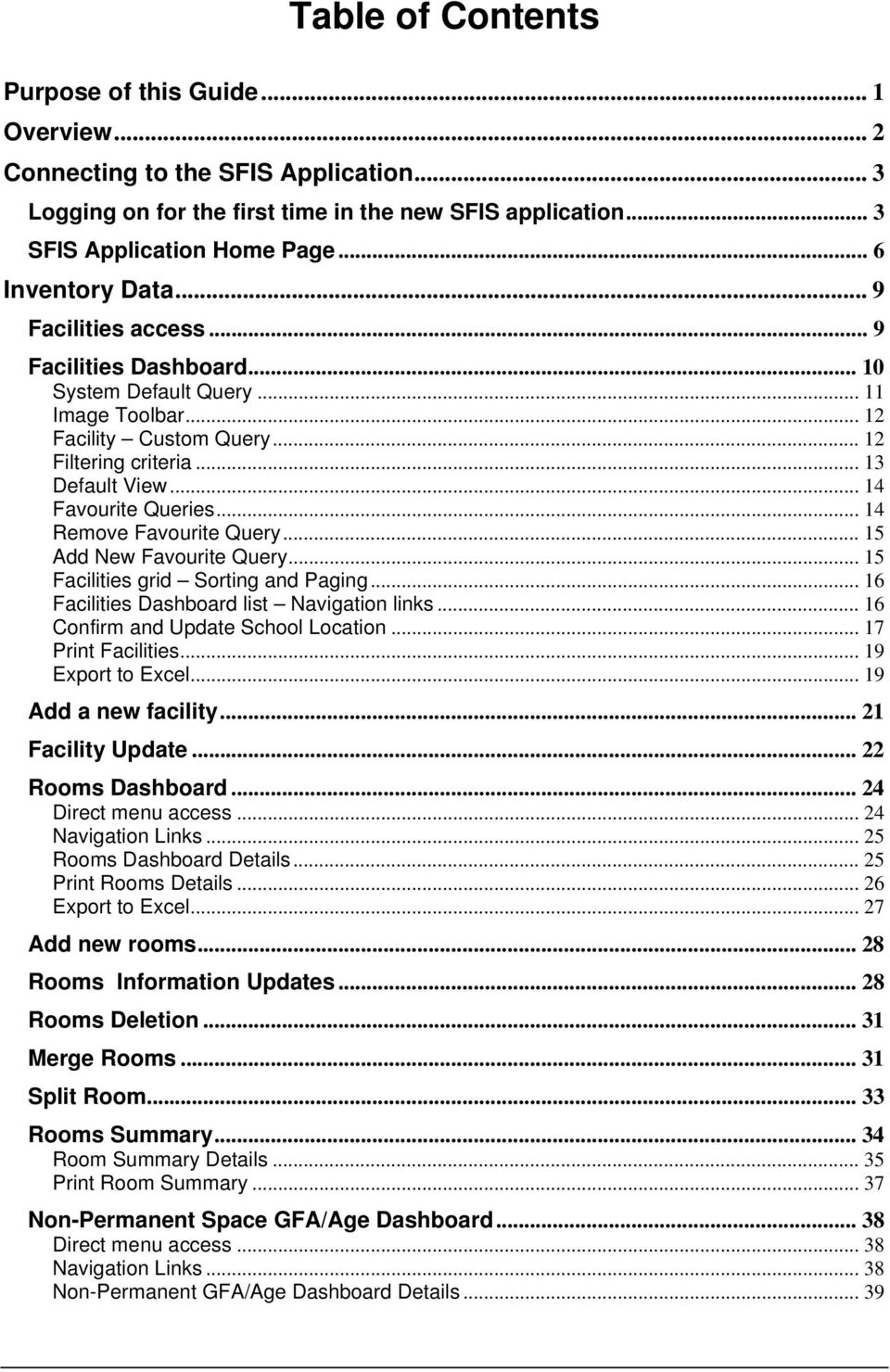
2 Table of Contents Purpose of this Guide... 1 Overview... 2 Connecting to the SFIS Application... 3 Logging on for the first time in the new SFIS application... 3 SFIS Application Home Page... 6 Inventory Data... 9 Facilities access... 9 Facilities Dashboard System Default Query Image Toolbar Facility Custom Query Filtering criteria Default View Favourite Queries Remove Favourite Query Add New Favourite Query Facilities grid Sorting and Paging Facilities Dashboard list Navigation links Confirm and Update School Location Print Facilities Export to Excel Add a new facility Facility Update Rooms Dashboard Direct menu access Navigation Links Rooms Dashboard Details Print Rooms Details Export to Excel Add new rooms Rooms Information Updates Rooms Deletion Merge Rooms Split Room Rooms Summary Room Summary Details Print Room Summary Non-Permanent Space GFA/Age Dashboard Direct menu access Navigation Links Non-Permanent GFA/Age Dashboard Details... 39
3 Export to Excel Print Non-Permanent Space Details Add non-permanent space data Non-Permanent Space Updates Non-Permanent Space Deletion Permanent Space GFA/Age Dashboard Direct menu access Navigation Links Permanent GFA/Age Dashboard Details Export to Excel Print Permanent Space Details Add permanent space data Permanent Space Updates Add Demolitions Permanent Space Deletion Accountability Data Enrolment Pressures Facilities Deemed Prohibitive to Repair Capital Transitional Adjustment New Pupil Places Definitions Inventory Information Board Data Facilities Data Permanent and Non-Permanent Space Room Data Space Type and Use Identifiers Capacity Loading Factors Elementary Capacity Loading Factors Secondary Using the System Scenarios and Tips Adding and Removing a Facility Adding Permanent Space to a Facility Removing Permanent Space Adding Non-Permanent Space Changes to Room Use in Permanent Space Annexes Disposition or Acquisition of Schools at No Charge... 68

4 This page is left intentionally blank.

5 Purpose of this Guide This guide has been developed as a resource to help you use the School Facilities Inventory System (SFIS) application. The objective of this guide is to provide all the information you need to access and use the system. It combines step-by-step instructions along with a comprehensive look at each of the functions. The actions are described and are followed by the respective screenshots to provide illustration from the application. You are strongly encouraged to read this guide in full, to ensure that you are aware of all aspects of the SFIS application. Note: It is possible that some of the screens you will see online may not be exactly as shown in this guide. Page 1 of 72
6 Overview The School Facilities Inventory System (SFIS) contains key information on the physical inventory of all school facilities in Ontario. The inventory information allows for the measurement of school capacity and utilization on a consistent basis across the province. The information is utilized, on an annual basis, to determine the: Grant for School Operations Grant for School Renewal Grant for New Pupil Places The purpose of this Instruction Guide is to provide step-by-step information on how to: access and update information in the system submit the information required under the Accountability Framework for the Pupil Accommodation Grant. SFIS User Guide v

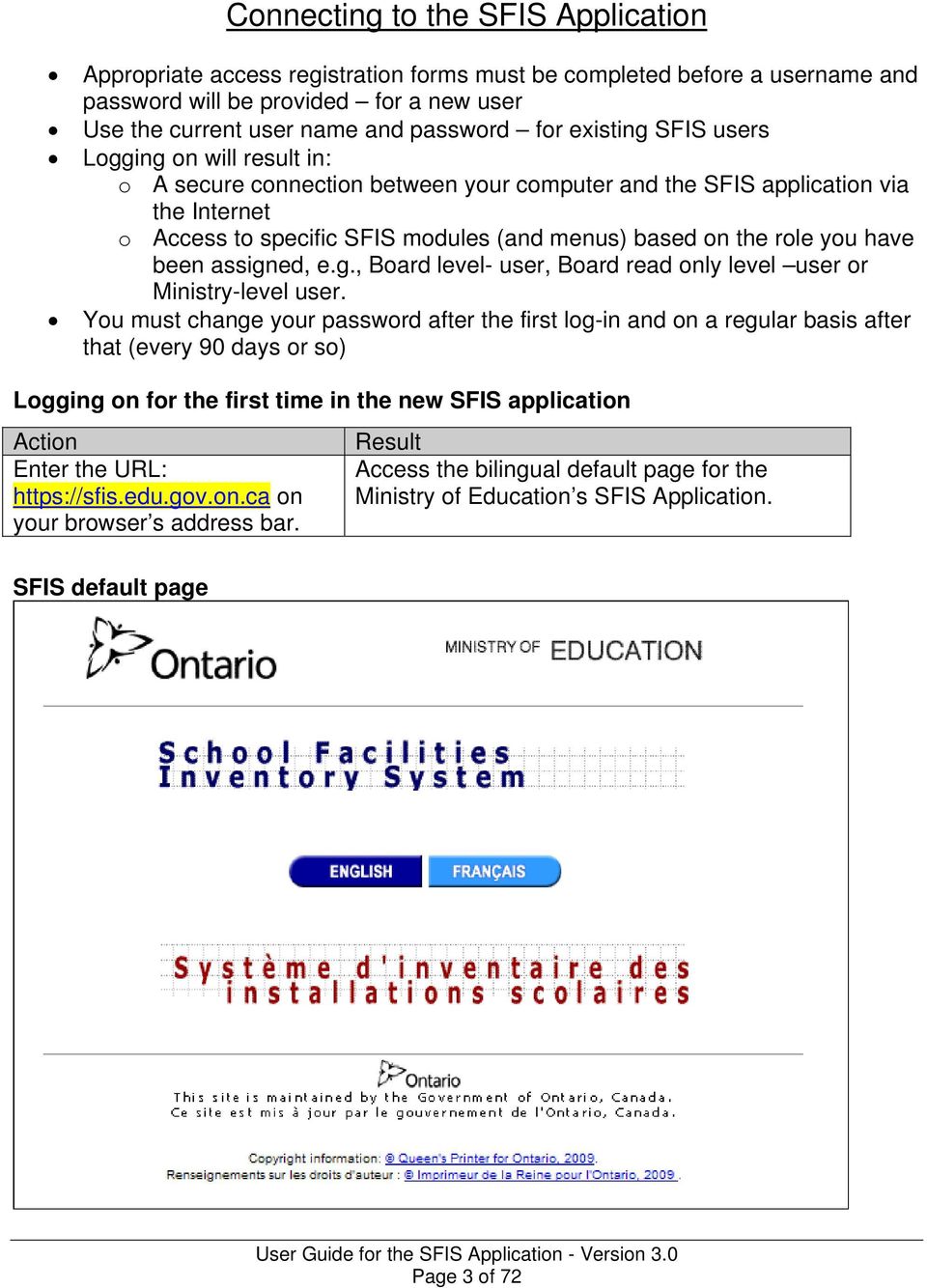
7 Connecting to the SFIS Application Appropriate access registration forms must be completed before a username and password will be provided for a new user Use the current user name and password for existing SFIS users Logging on will result in: o A secure connection between your computer and the SFIS application via the Internet o Access to specific SFIS modules (and menus) based on the role you have been assigned, e.g., Board level- user, Board read only level user or Ministry-level user. You must change your password after the first log-in and on a regular basis after that (every 90 days or so) Logging on for the first time in the new SFIS application Action Enter the URL: on your browser s address bar. SFIS default page Result Access the bilingual default page for the Ministry of Education s SFIS Application. Page 3 of 72
8 Action Bookmark this page or create a shortcut on your desktop for easier access in the future. Select English or Français Result The method for doing this depends on your browser and operating system. This will save you from having to type in the URL each time you want to access the SFIS. You will be taken to the SFIS System s log-in page. Log-in Screen Action Enter the user name and password provided to you (same as the current SFIS user name and password). Result You will be prompted to change your password during the first log on into the new SFIS system. NOTE: User name and Passwords are case sensitive. They expire during the first log in and must be changed. Click on Submit Click on Reset Click on Français to change working language to French. (if coming from English login from the Home page) Information in fields will be erased allowing you to start again. Page will be redisplayed in French. Page 4 of 72

9 Click on English to change working language to English. (if coming from Français login from the Home page) Page will be redisplayed in English. Change Password Screen You will need to change your password the very first time you log in. You will be required to do so after that on a regular basis (every 90 days). Action Enter the current password you are using for SFIS login. Enter your new password twice - once in the New Password field and once in the Confirm New Password field. Your password must: not be the same as your old password not be made up of your name or user name not contain accented characters like è, á, ô, Ç or É be at least 8 characters long contain an upper case letter contain an lower case letter contain a number Examples: Duckie41 or 77School Result You will see ********* in the password fields. If unsuccessful, make sure that you have included all the necessary components of the password. Page 5 of 72

10 Click on Submit. Click on Reset. You will be redirected to the SFIS application home page having access to the menus functions. Erase information in fields and start again. Logging on after the first time Action Enter the URL into your browser s address bar or access the shortcut or favourite/bookmark that you created. Result Access the Log-in screen. Enter your User Name and Password. Click on Submit. Click on Reset. Go to the SFIS System s English or French Application Home page and having access to the SFIS functionalities. Information in fields will be erased allowing you to start again. SFIS Application Home Page On the main page of the SFIS application, the User Name are displayed on the top left corner of the screen along with the remaining time of current user session. Every subsequent access to the system will reset the timer s count down timer of the current user session. The session timeout is 20 minutes, in other words if the user opens up the SFIS screen and does not perform any inactivity after 20 minutes he will be automatically logged off. Any trial to access the system after the 20 minutes inactivity time will result in a redirection to the SFIS default page and login screen. For the logging out of the system the user needs to click on the Logout link located on the right top corner of the each screen. Page 6 of 72

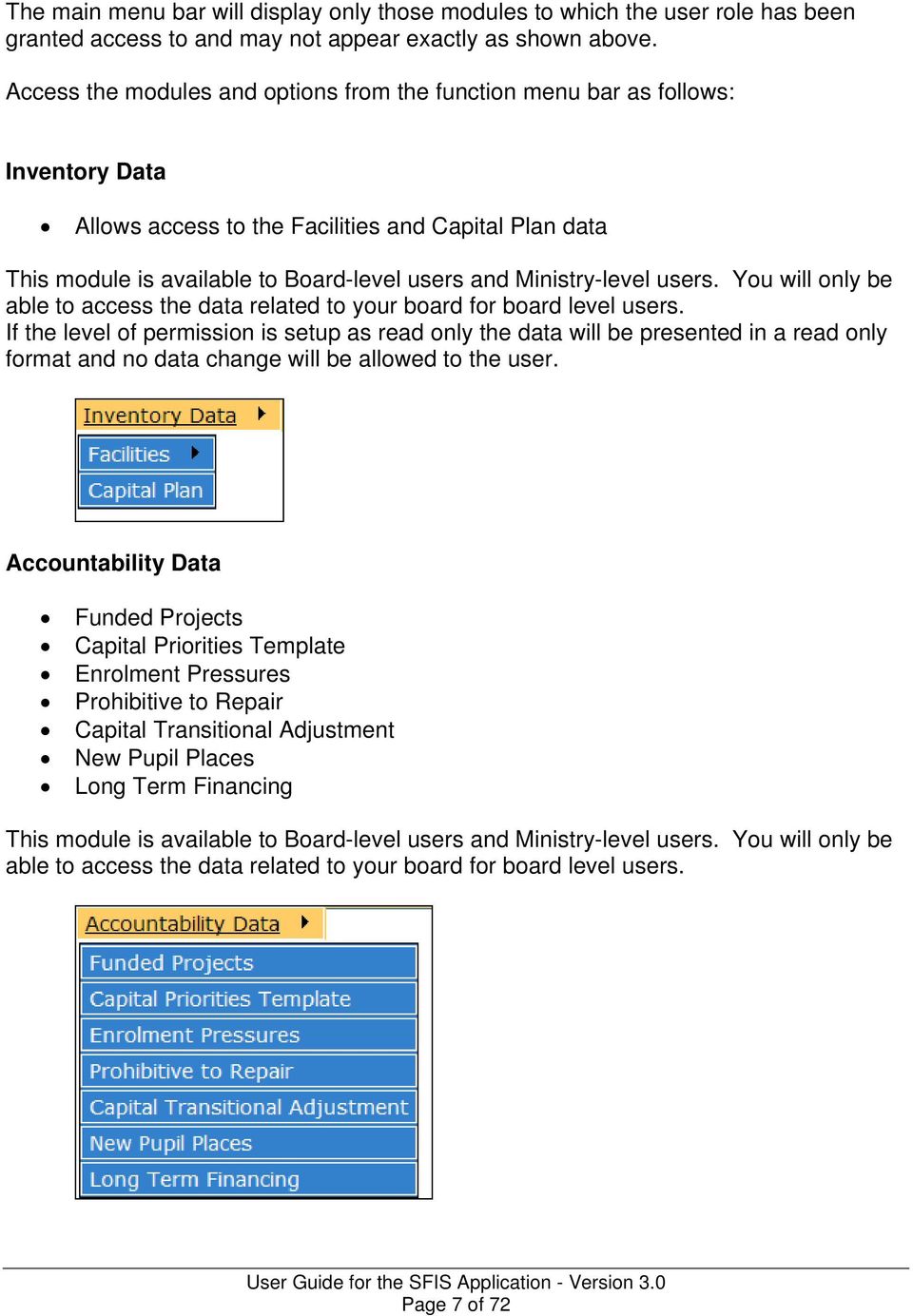
11 The main menu bar will display only those modules to which the user role has been granted access to and may not appear exactly as shown above. Access the modules and options from the function menu bar as follows: Inventory Data Allows access to the Facilities and Capital Plan data This module is available to Board-level users and Ministry-level users. You will only be able to access the data related to your board for board level users. If the level of permission is setup as read only the data will be presented in a read only format and no data change will be allowed to the user. Accountability Data Funded Projects Capital Priorities Template Enrolment Pressures Prohibitive to Repair Capital Transitional Adjustment New Pupil Places Long Term Financing This module is available to Board-level users and Ministry-level users. You will only be able to access the data related to your board for board level users. Page 7 of 72
12 Download Allows access to the SFIS historical Download section This module is available to all system users. Help Allows access to the SFIS instruction guide and online help Contains the contacts info for SFIS support, Capital Analysts and Financial Officers This module is available to all system users. Français / English Allows language changes (if English will appear Français, if language if French will appear English) This option is available to all system users. Change Year Available as part of the top up page The year selection should be confirmed by the button Change Year Allows access to the SFIS instruction guide and online help Instructions Action Point to a menu item on the function menu bar and then select an item from the Result The requested page will be opened. Page 8 of 72
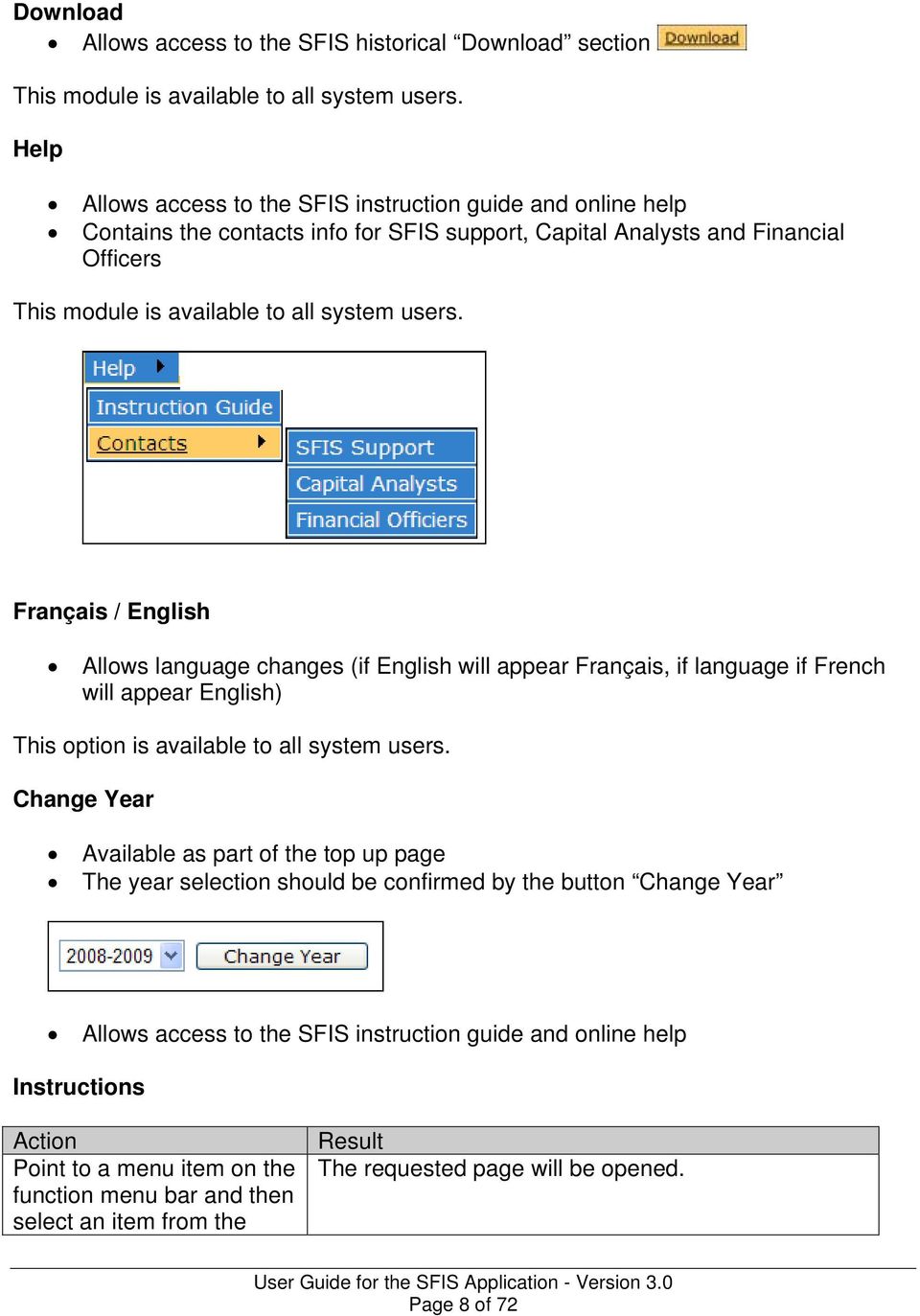
13 drop-down list Click on the Logout link located at the top right side of the screen to log out the user and close the current session. Logs out the user from the SFIS application and the system navigates to the SFIS home page. We strongly recommend the user to use this option every time when she/he finishes to work with the SFIS system. Inventory Data The Inventory Data module is available to the Board-level users and Ministry-level users. This module allows the users to perform the following tasks: Facilities access o Facilities Dashboard - Query and Filter Facilities o Create a new facility o Edit an existing facility o Create/update rooms for an existing facility o Views rooms summary o Add/update permanent space to a given facility o Add/update non-permanent space to a given facility o Export to Excel facilities data at different levels (including rooms/permanent and non-permanent space) Capital Plan access o All the current Capital Plan functions Facilities access To access this module, click on the Main menu item Inventory Data on the main menu and select Facilities sub-menu item. The Facilities module allows SFIS users to: o Query and Filter Facilities Facilities Dashboard o Create a new facility o Edit an existing facility Page 9 of 72

14 o Export to Excel facilities data with various search criteria and filtering applied Board-level users can only manage facilities of their own boards. The Ministry-Level users can access the facilities information for all the boards for all the regions in the province. Usual the ministry level users will not be allowed to change the board s facility information. As per board s request, the System administrator user will be allowed to alter the board s facility data. If the user logged in is a read-only user, the access will be granted at read only level (with no data modification allowed). Facilities Dashboard Facilities Dashboard is the default view for the Facilities module. It contains a series of the new enhancements compared to the previous system release: New searching and filtering capabilities based on a pre-established set of Facility related info (with applicable filtering values minimum/maximum range) Favourite views provide to the user the option to define up to 50 saved query results criteria Default Facility view allows the user to define a default facility view which will be automatically displayed when the user access the Facilities module Sorting and paging capabilities for the facility datasets elements allows the user to sort by facility grid columns and specify how many records she/he wants to view per page Export to Excel capabilities for the facility datasets at any point, with any search criteria or sorting applied (including the custom queries results, favourite searches or default view) The pre-established set of Facilities related info available for query and filtering are: Field Name System Default Query Mandatory SFIS# Yes Yes Name Yes Yes Address No No City Yes No Postal Code No No Panel Yes No Status Yes No Campus ID No No OTG (On The Ground capacity) Yes No Total GFA (m 2 ) Yes No GFA Over 20 Years Old (m 2 ) No No GFA Under 20 Years Old (m 2 ) No No Page 10 of 72

15 NPP (New Pupil Places) Yes No ADE (Average Daily Enrolment) Yes No Perm. RCM Units Yes No Non-Perm. GFA (m 2 ) Yes No OTG Enrolment pressure No No NPP Enrolment pressure No No Portable Units Yes No GFA Portable No No Portapak Units Yes No GFA Portapak Yes No Non-Perm. RCM Units Yes No GFA RCM No No Map Yes No The rest of this section describes the tasks and their respective steps that can be performed using this module. System Default Query When the user selects the Facilities sub-menu item from the Inventory Data main menu, the system will display the user s default view previously saved. If no default view has been already defined, a system default view will be displayed instead. The system default view contains all the facilities data elements from the above table, marked as System Default Query=Yes. Page 11 of 72

16 Image Toolbar An image toolbar will be presented on the left top corner screen of the Facilities Dashboard. This will allow navigation to various functions available within the Facilities Dashboard. Image Tool tip New Search My Favourite Queries Print Export to Excel Save as default view Remove default query Save as favourite view Add New Facility Action Allows the user to perform a new query for the Facilities by selecting from a pre-established set of data elements. Navigates to Facility Custom Query screen Allows the user to manage the previously saved favourites queries. Navigates to My Favourite Queries screen Opens up a new window with the current active (on the screen) facilities dataset in a printer friendly format. Allows the user to export to excel the current active (on the screen) facilities data set. Saves the current facilities views as a default one. Removes the previously saved default view. If no default view has been already defined, this will be invisible. Saves the current facilities views as a default one. Navigates to Save as favourite view screen. Allows the entitled users to add a new facility. Navigates to Add New Facility screen. This icon will be visible only to the users who have permission to create new facilities. Facility Custom Query Click on the image from the images toolbar in the Facilities Dashboard screen. You will be presented with the Facility Custom Query screen and asked to select the fields which will be part of your new custom query. This screen consists of two boxes, left side containing the fields you can select from and the right side the current selections. There are 2 fields SFIS# and Name which are mandatory for each new query selection and which already pre-populate the right box selection. Moving fields from one box into the other can be done by selecting the respective field and using the and buttons. Page 12 of 72

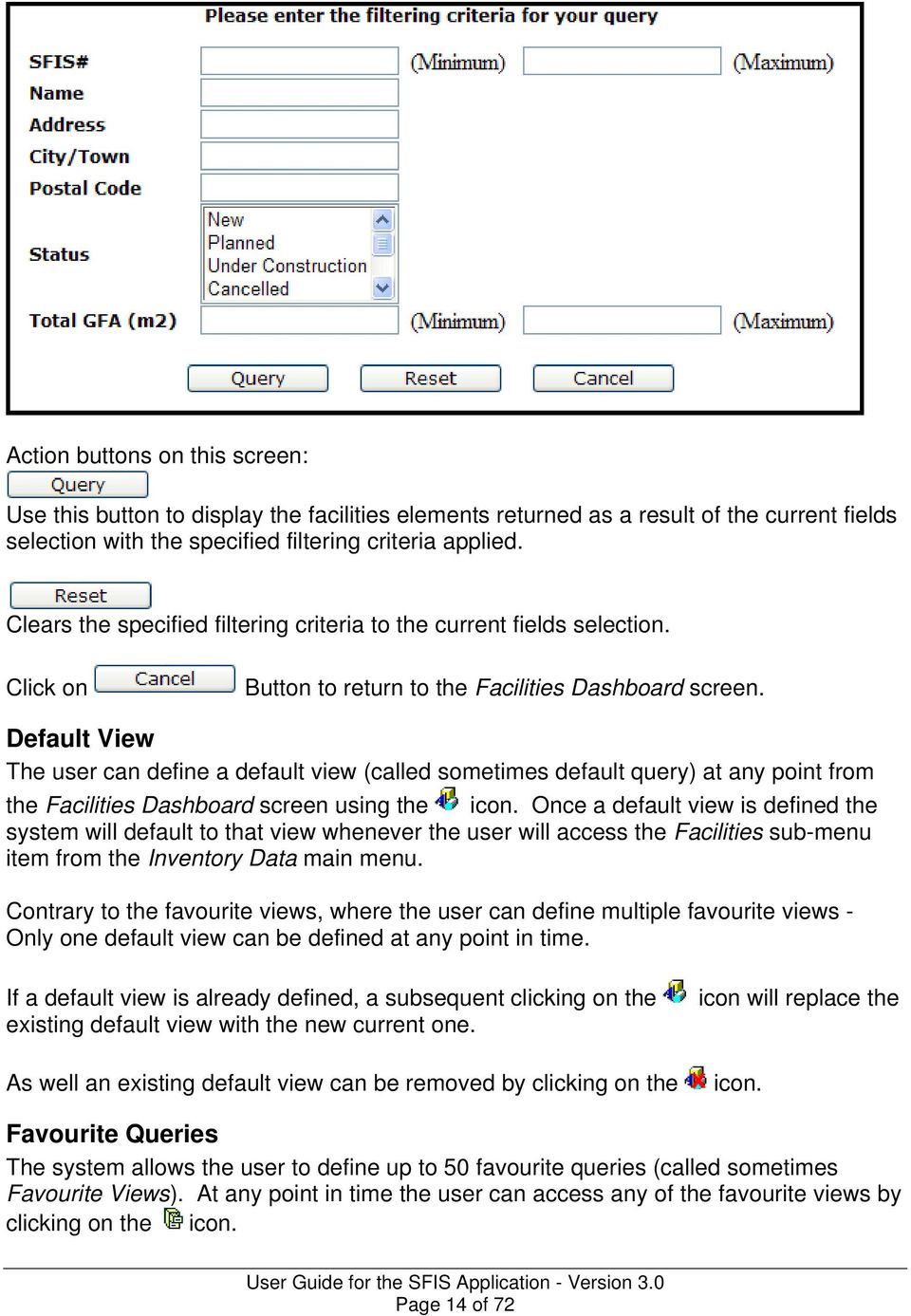
17 Moving the fields up and/or down in the selected list can be done using the and buttons. There are three action buttons on this screen: Use this button to display the facilities elements returned as a result of the current fields selection with no filtering criteria applied. Use this button to apply filter criteria to the current fields selection. Click on Button to return to the Facilities Dashboard screen. Filtering criteria Allows the user to specify criteria for a field/all fields/any combination of the current selection. For a field which is represented by a number, the criteria can be specified within a given range of numerical values (minimum and maximum range) For a field which is represented by an alpha character is enough to specify the few characters from the beginning and the system will match those starting with the criteria value(s). For fields represented by dropdown selection, the criteria could be specified as one or multiple values selection (keep CTRL key down for multiple selections). Page 13 of 72

18 Action buttons on this screen: Use this button to display the facilities elements returned as a result of the current fields selection with the specified filtering criteria applied. Clears the specified filtering criteria to the current fields selection. Click on Button to return to the Facilities Dashboard screen. Default View The user can define a default view (called sometimes default query) at any point from the Facilities Dashboard screen using the icon. Once a default view is defined the system will default to that view whenever the user will access the Facilities sub-menu item from the Inventory Data main menu. Contrary to the favourite views, where the user can define multiple favourite views - Only one default view can be defined at any point in time. If a default view is already defined, a subsequent clicking on the existing default view with the new current one. As well an existing default view can be removed by clicking on the icon will replace the icon. Favourite Queries The system allows the user to define up to 50 favourite queries (called sometimes Favourite Views). At any point in time the user can access any of the favourite views by clicking on the icon. Page 14 of 72
19 Initially when no favourite views have been defined, the system will display the message By clicking on the link, the system will navigate to the Facility Custom Query screen, where the user can start defining the parameters and criteria making up the future favourite query. If the user has already defined Favourite Queries, they will be displayed in the Favourite Queries list: By selecting the query name the user navigates to the details of the respective query. Click on button to cancel the request and return to the Facilities Dashboard. Remove Favourite Query If the user wants to remove a favourite query, she/he can do that by clicking on the icon in the Favourite Queries list for the respective entry. The system will ask a confirmation for the removal process Clicking on the button will proceed with then favourite query removal. The button will result in a cancellation of the removal request and the favourite query will continue to be available to the user. Add New Favourite Query From the Facilities Dashboard, click on the icon. The system will display the Add New Favourite Query screen Page 15 of 72

20 Input the name of the favourite query (give something which will remind you of what you intended this query to be used for) and click. The system will add the query to your query favourites list. Click on button to cancel the request and return to the Facilities Dashboard. Facilities grid Sorting and Paging The user has the option to sort the facilities lists at any point by clicking on the column header name. The fields that the user can sort by are distinctively marked in the list header with an underlined line and coloured differently. The sorting direction will flip between ascending and descending ones. In the bellow screen capture the blue fields are marked as having the sorting enabled The default sorting is a combination Facility Name and Panel, default sorting direction being ascending. The facilities list is presented to the user in a paged grid format, having the default page size setup to 220 records. If the user wishes, she/he can change this value by entering the new value in the textbox and clicking on the button. The system will refresh the facilities list with the grid page setup to the new value and the total number of pages will be recalculated. At any point the user can navigate to any page by clicking on the page number presented at the bottom of the grid (if multiple pages are in place, this depends on the total number of the facilities for a given board and the user s specified number of records per page). Facilities Dashboard list Navigation links From the Facilities Dashboard list of facilities the user has the options to navigate to other screens and access the respective functionalities. The list of facilities allows navigation to the following: Facility Update screen by clicking on the SFIS ID or Facility Name Page 16 of 72

21 Room Dashboard screen click on the OTG list field value Room Summary screen click on the NPP list field value Non-Permanent GFA/Age screen click on one of the following: o Portable Units o Portapak Units o Non-Perm. RCM Units o GFA Portable o GFA Portapak o GFA RCM Permanent GFA/Age screen click on Total GFA (m2) list field value Confirm and Update School Location This option becomes available in the case you have selected the Map field as part of your query (custom query/favourite query/default query). Automatically the Map field is included in the System Default Query definition. Using the address update button verify, update or change your schools location information. Boards are able to improve the geo-location of a school facility as reflected in a mapping environment via a link to the Ministry s internet mapping tool (IMS). Please note that if the button is blue in colour, than the school location has not been updated. However, if the has been updated. button is yellow in colour than the school location Step 1 Linking from the Facilities page to the Internet Mapping Browser (IMS) Clicking on the icon in the facilities page will automatically open another internet browser and link the user directly to a mapped location of where the facility is currently located as illustrated below: Page 17 of 72
22 Step 2 Confirm or Relocate School Location If the location of the school as detailed in a mapping environment appears correct, please click on and the location of the facility will remain as where it appears on the map. However, if the location appears incorrect click on the button and a school symbol will become available for placement of the facility in the proper location. Place the icon in the appropriate position on the map as illustrated below: Page 18 of 72
23 Once the school is moved and placed in the correct location, click on the button. The latitude/longitude coordinates will be recorded within the SFIS system which will inform the user via a pop-up window. The recorded coordinates will then be populated in the Ministry s GIS. Please note that additional tools are available in the menu of the IMS browser to provide functionality aimed at ensuring the school location is located properly. Print Facilities To print facilities list originated from either one: System Default view, User default view, one of the favourite view or custom query click on the icon. A new window will open with the facilities list in a printer friendly format. The user can print the facilities list in the printer friendly format by using the browser s print capabilities. Export to Excel To export to excel, click on the Dashboard screen. icon from the image toolbar in the Facilities The export to excel functions allow the current facilities dataset to be exported to excel (either System Default view, User default view, one of the favourite view or custom queries with any filtering criteria applied to them). Page 19 of 72
24 The user will have the option to open up in browser the facilities exported data or save it on the local computer: Click on button to open the facilities data in the Excel file format and print it using the native application. The facilities dataset can also be saved by clicking on the Button. Click on button to cancel the request. Page 20 of 72
25 Add a new facility This functionality is restricted only to the users with permission to add new facilities records. Click on the image from the images toolbar in the Facilities Dashboard. The requested page will be opened. The screen is divided into 2 tabs: Core Data and Facility Use. The Core Data tab contains the mandatory information for a facility, however the Facility Use screen should be reviewed as well and fill in the appropriate information as they are used in various statistics/reports. Input the details to create the new facility. All required fields should have the appropriate information entered (marked with an icon besides the field name). Core Data tab Facility Use tab OSYC User Guide v
26 Click on button. If there is an error with any of the entries, the application will display an error message and the focus will move to the field with the problem. Correct the problems(s) and again click on button. The facility gets added to the facility list and the screen will be refreshed and will show the Facility Update for the added facility. The save process will save the information from both tabs: Core Data and Facility Use. If you want to cancel the changes made and not to add the facility record, click on the button. This will navigate the screen to the Facilities Dashboard (default view if defined or System default view if no user default view has been already defined). button will clear the screen fields and remove any values entered by the user in the current view (prior of data being saved). Note: A new facility can be added as one of the following statuses: New Planned Under Construction Select the appropriate status according to the current facility stage. Once a facility record is created a board user cannot remove it. If any issues related to a created facility record, the board should contact the SFIS support team. After successfully creation of the facility record, the system will refresh the screen for the facility in the Facility Update view. Here the user can review the entered facility information and change something if necessary or can navigate to enter the OTG and Space related information (Facility Update screen and navigation options from there are explained in the bellow section) Facility Update An existing facility can be modified by clicking on the SFIS ID or Facility Name links in the Facilities list grid. The system will navigate to the Facility Update screen, where the user can make the appropriate changes to the facility. The information on the screen will be accessible according to the user role. The school board users will not be able to make changes to the facility status, only the System Administrators will be able to make changes to a facility status after the facility record has been created. Similar to Add New Facility, the information from the Facility Update screen is divided into 2 tabs: Core Data and Facility Use. Page 22 of 72
27 In addition we have on the top of the screen a dropdown for the school selection, where the user can select the new facility to view/update and click to navigate to the respective facility. An image toolbar Image Tool tip Rooms Dashboard Rooms Summary Non-Permanent GFA/Age Permanent GFA/Age to access various facilities sub-entities is available. Action Allows the user to access the functionalities available for the room details. Navigates to Rooms Dashboard screen. Allows access to the Permanent Space Room Summary and Non-Permanent Space Room Summary. Navigates the screen to the Rooms Summary. Allows user access to the Non-Permanent space information. Navigates the screen to the Non-Permanent GFA/Age. Allows user access to the Permanent space information. Navigates the screen to the Permanent GFA/Age. Core Data tab Page 23 of 72
28 Facility Use tab After making the changes, click on the button to save the required changes If you want to cancel the changes made click on the button. This will navigate the screen to the Facilities Dashboard (default view if defined or System default view if no user default view has been already defined). button will put back the screen fields to theirs initial values by removing any values entered by the user in the current view (prior of data being saved, after data is saved the previous values cannot be brought back). Rooms Dashboard To access this functionality the user has the option of direct menu access or navigation from others screen(s). Direct menu access If the user wishes to direct access the Rooms Dashboard functionalities and not going through Facilities Dashboard or others screens, the she/he can click on the submenuitem Rooms Dashboard from the Inventory Data Facility Page 24 of 72
29 As a result, the system will navigate to the Rooms Dashboard screen, where the user is presented with a School Selection dropdown option: After school selection and hit on selected school will be loaded. button the Rooms Dashboard data for the Navigation Links The user has the possibility to access the Rooms Dashboard function from the following others screens: Facility Dashboard list by clicking on the o OTG list field value o Perm RCM Units list field value Facility Update click on the icon Rooms Summary - click on the icon Non-Permanent GFA/Age - click on the icon Permanent GFA/Age - click on the icon From either one of the above entry points the Rooms Dashboard data for the current school will be loaded. Rooms Dashboard Details Regardless of the access entry point, the Rooms Dashboard screen will present the same set of information to the user. On the left top corner the user will have the option to change the school selection by selecting the appropriate school from the dropdown menu and clicking on the button. The appropriate Rooms Dashboard information for the selected school will be displayed on the screen. An image toolbar the user. to navigate to others screens is available to Page 25 of 72
30 Image Tool tip Facility Detail Rooms Summary Non-Permanent GFA/Age Permanent GFA/Age Print Export to Excel Export to Excel rooms detail for all facilities Action Allows the user to access the facility detail information. Navigates to Facility Update screen. Allows access to the Permanent Space Room Summary and Non-Permanent Space Room Summary. Navigates the screen to the Rooms Summary. Allows user access to the Non-Permanent space information. Navigates the screen to the Non-Permanent GFA/Age. Allows user access to the Permanent space information. Navigates the screen to the Permanent GFA/Age. Opens up a new window with the room details dataset for the facility in a printer friendly format. Allows the user to export to excel the room details dataset for the facility. Allows the user to export to excel the room details data for all the facilities within the board. Rooms Dashboard screen is presenting to the user the rooms details information in a grid format with various options available to the user, plus a top option to enter new room data: If the facility is a new one with no current rooms entered, then the screen will not have any room details data. Print Rooms Details To print rooms details list click on the icon. A new window will open with the rooms detail list in a printer friendly format. Further, the user can print the list in the printer friendly format by using the browser s print capabilities. Page 26 of 72
31 Export to Excel To export to excel data for a specific facility, click on the in the Rooms Dashboard screen. icon from the image toolbar Clicking on the icon will allow the user to export to Excel the room details data for all the facilities within the board. Regardless of the type of the export requested, the user interaction with the system will be the same. The user will have the option to open up in browser the exported data or save it on the local computer: Click on button to open the rooms data in the Excel file format and print it using the native application. Page 27 of 72
32 The rooms dataset can also be saved by clicking on the Button. Click on button to cancel the request. Add new rooms The entitled users will have the option to enter new rooms for the facility: The adding new room data detail is not available to the read only users. For adding new room data, the user needs to enter: Room number Space Type mandatory Current Use mandatory Comments Although Room number is optional information, we recommend to have it completed as this helps the board to keep an accurate inventory of theirs rooms info in SFIS. The Space Type field is the one which drives the loading capacity for the room and we have introduced the Loading field which dynamically changes according to the current selection of the Space Type. Click on button to save the new room data in the system. Click on screen empty. button to clear the data input and leave the Add New Room data Rooms Information Updates You can update the rooms information in the Rooms Dashboard screen by changing anything related to the: Room number Space Type mandatory Current Use mandatory Comments Page 28 of 72
33 The system allows to the user to perform single or multiple updates in one single step. You need to modify all the required data and then click on button only once and all your changes will be saved. Prior of updating the room data, the system will ask the user to confirm the update requests: Clicking on will update the current highlighted records(every time the user changes something into a field the respective row will be highlighted). will cancel the current update request (still the rows will remain highlighted). Screen with multiple update requests rows are highlighted: Page 29 of 72
34 Click on button will put back the screen fields to theirs initial values by removing any values entered by the user in the current view (prior of data being saved, after data is saved the previous values cannot be brought back). Prior of saving the data, when clicking on the series of data input validation. button, the system performs a Mandatory data input validation If not all the mandatory data are supplied (fields marked with icon), the system warns the user that mandatory field information is missing and moves the focus to the respective field. Data changed validation Prior of saving the data, the system checks if the data has been changed. If no changes were done to the data, the system will warn the user and will cancel the data saving request. A Nothing to save warning message will be displayed to the user in this scenario: To help the user visualize which would be the new loading when a Space Type field gets changed, we have introduced the Loading field which dynamically changes with the Space Type selection. Page 30 of 72
35 Only the entitled user will have the option to update the rooms information. This functionality will not be available to the read only users. Still the read only users will be able to see the rooms detail information, but they cannot alter the data. Rooms Deletion The entitled user has the option to delete a single or multiple room(s). In order to perform one or more rooms deletion, the respective rooms need to be selected by clicking on the checkbox. When you are ready with the room(s) selection for deletion, click on the button. If no room has been selected, the system will display an error message: The system will ask the user for a confirmation prior of proceeding with the deletion request: Click on Click on button to continue with the removal request. button to cancel the request. The room deletion functionality is not available to the read only users. Merge Rooms The entitled users have the option to merge two or more rooms into one single room. The rooms to be merged need to be selected by clicking on the checkbox. Page 31 of 72
36 If no room has been selected and the user clicks the display an error message: button, the system will If only one room has been selected and the user clicks the will display an error message: button, the system If the appropriated rooms have been selected, click on the button will present the user with the next screen where she/he can see once again the details of the rooms to be merged and enter the new merged into room information. Click on button to cancel the current Merge request and navigate back to the Rooms Dashboard screen. Enter for the new merged into room the following information: Room number Space Type mandatory Current Use mandatory Comments Although Room number is optional information, we recommend to have it completed as this helps the board to keep an accurate inventory of theirs rooms info in SFIS. Page 32 of 72
37 Click on button to save the new merged into room data in the system. Click on button to clear the new merged into data input and leave the Merge Into data screen empty. Split Room The entitled users have the option to split a room into multiple rooms. The room to be split needs to be selected by clicking on the checkbox. If no room has been selected and the user clicks the display an error message: button, the system will If the appropriated room has been selected, click on the button will present the user with the next screen where she/he can see once again the detail of the room to be split and specify the numbers of rooms the selected one is going to be split into: You need to select the number of rooms the current room is going to be split into system defaults to 2. Click on button to cancel the current Split request and navigate back to the Rooms Dashboard screen. Click on the button will present the user with the next screen where she/he can review the room detail to be split and enter the new rooms information. Page 33 of 72
38 For each of the new rooms the current one needs to be split into, enter the following information: Room number Space Type mandatory Current Use mandatory Comments Click on button to save the new rooms data in the system. The system will validate if all the mandatory data is provided(marked with icon) and if not, a warning error message is displayed to the user and the focus is moved to the field missing the data input. Click on screen empty. button to clear the new rooms data input and leave the Split Into data Click on button to cancel the current Split request and navigate back to the Rooms Dashboard screen. Rooms Summary The Rooms Summary screen can be accessed as a result of navigation from other screen where provided or direct menu access from the submenu-item Room Summary from the Inventory Data Facility submenu-item. Page 34 of 72
39 As a result of the above selection, the system will navigate to the Room Summary screen, where the user is presented with a School Selection dropdown option: After school selection and hit on selected school will be loaded. button the Room Summary data for the As well the user has the option to access the Room Summary function from the following others screens: Facility Update click on the icon Rooms Dasboard - click on the icon From either one of the above entry points the Room Summary data for the current school will be loaded. Room Summary Details Regardless of the access entry point, the Rooms Dashboard screen will present the same set of information to the user. On the left top corner the user will have the option to change the school selection by selecting the appropriate school from the dropdown menu and clicking on the button. The appropriate Room Summary information for the selected school will be displayed on the screen. An image toolbar at this point. to navigate to others screens is available to the user Page 35 of 72
40 Image Tool tip Facility Detail Rooms Dashboard Non-Permanent GFA/Age Permanent GFA/Age Print Action Allows the user to access the facility detail information. Navigates to Facility Update screen. Allows the user to access the functionalities available for the room details. Navigates to Rooms Dashboard screen. Allows user access to the Non-Permanent space information. Navigates the screen to the Non-Permanent GFA/Age. Allows user access to the Permanent space information. Navigates the screen to the Permanent GFA/Age. Opens up a new window with the room summary data for the facility in a printer friendly format. Room Summary function present to the user the Permanent Space Room Summary details and where applicable the Non-Permanent Space Room Summary details. The user can change the year she/he wants to view the data for by using the dropdown selection for years and can select if the displayed data should reflect the OTG or NPP. Click on the button will confirm the current year selection(s) and the screen is reloaded to the data according to the new years selection. Page 36 of 72
41 The system defaults to the current school year for OTG data in the left side of the screen and the current school year for NPP data in the right side of the screen. If any non-permanent space data is found in the system for the selected year(s), this will be displayed as well. This screen is accessible to all user types: Board-level user and Ministry-level user, including read only users. Print Room Summary To print room summary details list click on the icon. A new window will open with the room summary data in a printer friendly format. Further, the user can print the list in the printer friendly format by using the browser s print capabilities. Page 37 of 72
42 Non-Permanent Space GFA/Age Dashboard To access this functionality the user has the option of direct menu access or navigation from others screen(s). Direct menu access If the user wishes to direct access the Non-Permanent Space Dashboard functionalities and not going through Facilities Dashboard or others screens, the she/he can click on the submenu-item Non-Permanent GFA/Age from the Inventory Data Facility. As a result, the system will navigate to the Non-Permanent GFA/Age Dashboard screen, where the user is presented with a School Selection dropdown option: After school selection and hit on button the Non-Permanent GFA/Age Dashboard data for the selected school will be loaded. Navigation Links The user has the possibility to access the Non-Permanent GFA/Age Dashboard function from the following others screens: Facility Dashboard list by clicking on one of the following list of fields values: o Portable Units o Portapak Units o Non-Perm. RCM Units o GFA Portable o GFA Portapak o GFA RCM Facility Update click on the icon Rooms Summary - click on the icon OSYC User Guide v
43 Rooms Dashboard - click on the icon Permanent GFA/Age - click on the icon From either one of the above entry points the Non-Permanent GFA/Age Dashboard data for the current school will be loaded. Non-Permanent GFA/Age Dashboard Details Regardless of the access entry point, the Non-Permanent GFA/Age Dashboard screen will present the same set of information to the user. On the left top corner the user will have the option to change the school selection by selecting the appropriate school from the dropdown menu and clicking on the button. The appropriate Non-Permanent GFA/Age information for the selected school will be displayed on the screen. An image toolbar Image Tool tip Facility Detail Print Export to Excel Export to Excel non-permanent space for all facilities Export to Excel non-permanent space for all boards Permanent GFA/Age to navigate to others screens is available to the user. Action Allows the user to access the facility detail information. Navigates to Facility Update screen. Opens up a new window with the non-permanent space dataset for the facility in a printer friendly format. Allows the user to export to excel the non-permanent space details dataset for the facility. Allows the user to export to excel the non-permanent space details dataset for all the facilities within the board. Allows the user to export to excel the non-permanent space details dataset for all the facilities for all the boards. Functionality available only to the Ministry-Level user. Allows user access to the Permanent space information. Navigates the screen to the Permanent GFA/Age. Non-Permanent GFA/Age Dashboard screen is presenting to the user the non permanent space details information in a grid format with various options available to the user, plus a top option to enter new space data. Page 39 of 72
44 Export to Excel To export to Excel the Non-Permanent Space data for the current facility, click on the icon from the image toolbar in the Non-Permanent Space Dashboard screen. Clicking on the icon will allow the user to export to Excel the Non-Permanent Space data for all the facilities within the board. The Ministry-Level user has the option to export to Excel the Non-Permanent Space data for all the facilities for all boards by clicking on the icon. Regardless of the type of the export requested, the user interaction with the system will be the same. The user will have the option to open up in browser the exported data or save it on the local computer: Click on button to open the Non-Permanent Space data in the Excel file format and print it using the native application. The Non-Permanent Space dataset can also be saved by clicking on the Button. Click on button to cancel the request. Print Non-Permanent Space Details To print the Non-Permanent Space details list click on the icon. A new window will open with the Non-Permanent Space detail list in a printer friendly format. Page 40 of 72
45 Further, the user can print the list in the printer friendly format by using the browser s print capabilities. Add non-permanent space data The entitled users will have the option to enter new portables, portapak or RCM nonpermanent units for the facility: The addition of the non-permanent space data detail is not available to the read only users. For adding new room data, the user needs to provide: Type - mandatory, by selecting one of the: o Portable o Portapak o RCM Non-permanent Number of Units mandatory, system defaults to 1 Year - mandatory GFA m 2 mandatory Number (unit serial number) Current Use mandatory Comments Although Number (unit serial number) is optional information, we recommend to have it completed as this helps the board to keep an accurate inventory in SFIS. Click on button to save the new portable, portapak or RCM non-permanent data in the system. Prior of saving the data the system will verify that all the mandatory information has been provided. If anything missing is found, a warning message will be displayed to the user and the focus will point to the field missing the data. Page 41 of 72
46 As well the system will validate if the GFA is greater than the Number of Units*70. If not, an error message GFA must be at least 70 (or 70* Number of Units) will be displayed and the user will be prompted to correct the data: Click on button to clear the data input and leave the Add Non-Permanent Space data screen empty. Non-Permanent Space Updates You can update the Non-Permanent Space information in the Non-Permanent Space Dashboard screen by changing anything related to the: Serial number(number field in the list) Number of Units mandatory, system defaults to 1 Year - mandatory GFA m 2 mandatory Number (unit serial number) Current Use mandatory Comments The system allows to the user to perform single or multiple updates in one single step. You need to modify all the required data and then click on button only once and all your changes will be saved. Prior of updating the non-permanent space data, the system will ask the user to confirm the update requests: Page 42 of 72
47 Clicking on will update the current highlighted records(every time the user changes something into a field the respective row will be highlighted). will cancel the current update request (still the rows will remain highlighted). Screen with multiple update requests rows are highlighted: Click on button will put back the screen fields to theirs initial values by removing any values entered by the user in the current view (prior of data being saved, after data is saved the previous values cannot be brought back). Prior of saving the data, when clicking on the series of data input validation. button, the system performs a Mandatory data input validation If not all the mandatory data are supplied (fields marked with icon), the system warns the user that mandatory field information is missing and moves the focus to the respective field. Data changed validation Prior of saving the data, the system checks if the data has been changed. If no changes were done to the data, the system will warn the user and will cancel the data saving request. A Nothing to save warning message will be displayed to the user in this scenario: Page 43 of 72
48 Only the entitled users will have the option to update the Non-Permanent Space information. This functionality will not be available to the read only users. Still the read only users will be able to see all the Non-Permanent Space detail information, but they cannot alter the data. Non-Permanent Space Deletion The entitled user has the option to delete a single or multiple non-permanent space record(s). In order to perform one or more deletion, the respective record(s) need to be selected by clicking on the checkbox. When you are ready with the selection, click on the button. If no record has been selected, the system will display an error message: The system will ask the user for a confirmation prior of proceeding with the deletion request: Click on Click on button to continue with the removal request. button to cancel the request. The Non-Permanent Space deletion functionality is not available to the read only users. Permanent Space GFA/Age Dashboard To access this functionality the user has the option of direct menu access or navigation from others screen(s). Page 44 of 72
49 Direct menu access If the user wishes to direct access the Permanent Space Dashboard functionalities and not going through Facilities Dashboard or others screens, the she/he can click on the submenu-item Permanent GFA/Age from the Inventory Data Facility. As a result, the system will navigate to the Permanent GFA/Age Dashboard screen, where the user is presented with a School Selection dropdown option: After school selection and hit on button the Permanent GFA/Age Dashboard data for the selected school will be loaded. Navigation Links The user has the possibility to access the Permanent GFA/Age Dashboard function from the following others screens: Facility Dashboard list by clicking on the Total GFA (m2) list field value Facility Update click on the icon Rooms Summary - click on the icon Rooms Dashboard - click on the icon Non-Permanent GFA/Age - click on the icon From either one of the above entry points the Permanent GFA/Age Dashboard data for the current school will be loaded. Permanent GFA/Age Dashboard Details Regardless of the access entry point, the Permanent GFA/Age Dashboard screen will present the same set of information to the user. On the left top corner the user will have the option to change the school selection by selecting the appropriate school from the dropdown menu and clicking on the Page 45 of 72
50 button. The appropriate Permanent GFA/Age information for the selected school will be displayed on the screen. An image toolbar user. Image Tool tip Facility Detail Print Export to Excel Export to Excel non-permanent space for all facilities Export to Excel non-permanent space for all boards Non-Permanent GFA/Age to navigate to others screens is available to the Action Allows the user to access the facility detail information. Navigates to Facility Update screen. Opens up a new window with the permanent space dataset for the facility in a printer friendly format. Allows the user to export to excel the permanent space details dataset for the facility. Allows the user to export to excel the permanent space details dataset for all the facilities within the board. Allows the user to export to excel the permanent space details dataset for all the facilities for all the boards. Functionality available only to the Ministry-Level user. Allows user access to the Non-Permanent space information. Navigates the screen to the Non-Permanent GFA/Age. Permanent GFA/Age Dashboard screen is presenting to the user the non permanent space details information in a grid format with various options available to the user, plus a top option to enter new space data. Export to Excel To export to Excel the Permanent Space data for the current facility, click on the from the image toolbar in the Permanent Space Dashboard screen. icon Clicking on the icon will allow the user to export to Excel the Permanent Space data for all the facilities within the board. The Ministry-Level user has the option to export to Excel the Permanent Space data for all the facilities for all boards by clicking on the icon. Regardless of the type of the export requested, the user interaction with the system will be the same. Page 46 of 72
51 The user will have the option to open up in browser the exported data or save it on the local computer: Click on button to open the Permanent Space data in the Excel file format and print it using the native application. The Permanent Space dataset can also be saved by clicking on the Button. Click on button to cancel the request. Print Permanent Space Details To print the Permanent Space details list click on the icon. A new window will open with the Permanent Space detail list in a printer friendly format. Further, the user can print the list in the printer friendly format by using the browser s print capabilities. Add permanent space data The entitled users will have the option to enter new permanent space records in the system for a given facility. Page 47 of 72
52 The addition of the permanent space data detail is not available to the read only users. For adding new permanent space data, the user needs to provide: Year Built mandatory GFA m 2 mandatory Type - mandatory, by selecting one of the: o Original o Addition Comments Click on button to save the new data. Prior of saving the data the system will verify that all the mandatory information has been provided. If anything missing is found, a warning message will be displayed to the user and the focus will point to the field missing the data. Click on button to clear the data input and leave the Add Permanent Space data screen empty. Permanent Space Updates You can update the Permanent Space information in the Permanent Space Dashboard screen by changing anything related to the: Year Built - mandatory GFA m 2 mandatory Comments The system allows you to perform single or multiple updates in one single step. Page 48 of 72
53 You need to modify all the required data and then click on and all your changes will be saved. button only once highlighted records(every time the user changes something into a field the respective row will be highlighted). will cancel the current update request (still the rows will remain highlighted). Screen with multiple update requests rows are highlighted: Click on button will put back the screen fields to theirs initial values by removing any values entered by the user in the current view (prior of data being saved, after data is saved the previous values cannot be brought back). Prior of saving the data, when clicking on the series of data input validation. button, the system performs a Mandatory data input validation If not all the mandatory data are supplied (fields marked with icon), the system warns the user that mandatory field information is missing and moves the focus to the respective field. Data changed validation Prior of saving the data, the system checks if the data has been changed. If no changes were done to the data, the system will warn the user and will cancel the data saving request. A Nothing to save warning message will be displayed to the user in this scenario: Demolition GFA validation The system will validate if the Demolition type records have the updated GFA amounts entered as negative numbers. Page 49 of 72
54 If the user changes the GFA amount for a Demolition record and enters a positive number the system will display an Invalid Data message Note: If the GFA field needs to be updated for a Demolition type record, then the new amount needs to be entered as negative value. Initially, when the Demolition record is created (detailed bellow), the amount for GFA is entered as a positive number. The system translates it into a negative one and further updates to this amount need to be done as negative values. Only the entitled users will have the option to update the Permanent Space information. This functionality will not be available to the read only users. Still the read only users will be able to see all the Permanent Space detail information, but they cannot alter the data. Add Demolitions You can have the option to add a new Demolition record attached to an existing original or addition space record. When the user creates a new Demolition record is mandatory to specify which original or addition space the Demolition is attached to. For adding new demolition, you need to provide: Year mandatory GFA m 2 mandatory Space Reference (this will be the original or addition space the new Demolition is going to be attached to) - mandatory Comments The GFA is required to be entered as a positive number. When saving the Demolition record by clicking on the button, the system translates the positive amount into a negative one. All the fields marked with prior of saving the data. icon are mandatory and the system checks for theirs input Page 50 of 72
55 Once the Demolition record is saved, it will become visible in the Permanent Space Dashboard list. Click on screen empty. button to clear the data input and leave the Add Demolition data Permanent Space Deletion The entitled user has the option to delete a single or multiple permanent space record(s). In order to perform one or more deletion, the respective record(s) need to be selected by clicking on the checkbox. When you are ready with the selection, click on the button. If no record has been selected, the system will display an error message: The system will ask the user for a confirmation prior of proceeding with the deletion request: Click on Click on button to continue with the removal request. button to cancel the request. The Permanent Space deletion functionality is not available to the read only users. Page 51 of 72
56 Accountability Data The Accountability Data module is available to the Board-level users and Ministry-level users. This module allows the users to perform the following tasks: Funded projects access o All the current Funded projects functionality Enrolment Pressures Prohibitive to Repair Capital Transitional Adjustment New Pupil Places Long Term Financing access o All the current Long Term Financing functionality Enrolment Pressures Enrolment Pressures allows the user to view the permanent (NPP) capacity resulting from enrolment pressures funding. This screen can be accessed directly by clicking on the submenu-item Enrolment Pressures from the Accountability Data. Page 52 of 72
57 Note: Not all the boards have been qualified for the enrolment pressures funding, in that case a No data found message will be displayed. Facilities Deemed Prohibitive to Repair This screen can be accessed directly by clicking on the submenu-item Prohibitive to repair from the Accountability Data. Note: The board which were not qualified will be presented with a No data found message. Capital Transitional Adjustment This screen can be accessed directly by clicking on the submenu-item Capital Transitional Adjustment from the Accountability Data. Page 53 of 72
58 Note: The board which were not qualified will be presented with a No data found message. New Pupil Places This function displays the New Pupil Places (NPP) data for a board and given school year. It can be accessed directly by clicking on the submenu-item New Pupil Places under the Accountability Data main menu item. Page 54 of 72
59 The list displays the NPP for the board and school year separate per elementary and secondary panels. Page 55 of 72
60 Inventory Information Definitions The following information describes the different types of data collected in the SFIS. The inventory information is divided into four general categories: Board Data Facilities Data Permanent and Non-Permanent Gross Floor Area (GFA) Room Data Board Data Board Data includes key information regarding the school board and a contact person for the system. DSB Number: district school board number Board ID: 6-digit Ministry of Education identifier for the school board Name: district school board legal name Address: full address of the school board head office, including street number, street name, town/city, and postal code Telephone Number Fax Number Chair: name of the Chair of the school board Director: name of the Director of Education Website: address of the school board website SFIS contact: name of contact person responsible for keeping information up-todate in the system, including telephone number, fax number, and address Facilities Data Facilities Data includes information on all facilities owned, shared, leased, or rented by a school board Facility Name: name by which the facility is known Facility Type: if the facility is a school, identifies whether it is an elementary school or a secondary school. If the facility is not a school (e.g. administrative facility, maintenance facility, warehouse facility), the type should be identified as "other". Status: indicates if the school is open, closed, planned, under construction, or new (if the school is "new", construction has been completed; however no indication has been received by the Ministry from the board to change the status to "open". ADE: the Average Daily Enrolment (ADE) for the facility as reported in Appendix C of the board's most recent Financial Report (Estimates, Revised Estimates, or Financial Statements) Page 56 of 72
61 Grades Served: if the facility is a school, identifies the grades for which instruction is offered (e.g. JK-6, JK-8, 7-8, 9-12) BSID Number: if the facility is a school, Ministry of Education identification number assigned to the school program SFIS Number: unique identification number assigned to each facility by the Ministry of Education Note: Generally, there will be a single unique SFIS Number for each MIDENT Number. However, it is possible for there to be situations where there are 2 or more SFIS Numbers for a single MIDENT Number. This would occur in situations where a school has two separate campuses (e.g. an annex located some distance from the main school; or two components of a twinned school). There should be no situations where a single SFIS Number would have 2 or more MIDENT Numbers. Board Facility Number: refers to the school board's identification number for the facility, if applicable, for board reference purposes only Address: full address of the facility, including street number, street name, town/city, and postal code Ownership Status of Facility: identifies whether the board has exclusive ownership, joint ownership, is a lessor or lessee; or is a lessor of a facility for a care and treatment program as described in Section 19 of the General Legislative Grant Regulations Gross Floor Area (GFA) of Permanent Facility: GFA of permanent space, in square metres, of the owned facility. If the facility is shared, leased, or rented, GFA, in square metres, occupied by the board GFA of Non-Permanent Facility: GFA of non-permanent space, in square metres, of the owned facility. If the facility is shared, leased, or rented, GFA, in square metres, occupied by the board Total GFA of Facility: sum of GFA of permanent and non-permanent space. Size of Facility Site: area, in hectares, of the total site, and the portion owned/used by the board if the site is shared, or rented Uses of Facility: All the purposes for which the facility is currently used, categorized as: o elementary programs o secondary programs o adult day school programs o continuing education programs o outdoor education programs o administrative uses o maintenance or transportation facility o warehouse o leased to other parties o residential or commercial property o partially vacant o vacant Page 57 of 72
62 Permanent and Non-Permanent Space Type: The types of building components fall into two categories: Permanent and Non-Permanent. Each type has several sub-categories. Permanent space types include the original structure, additions and permanent relocatable classroom modules as identified by the Ministry in its review of RCMs, the results of which were released in March, Non-Permanent components include portables, portapaks and non-permanent RCMs. Year Built/Manufactured: o Permanent Space: the year in which the facility or portion being reported was first constructed. Where a building has been acquired and converted to instructional purposes through a major renovation, the year reported should be the year in which the new facility was opened for instructional o purposes. Non-Permanent Space: the year the portable, portapak or RCM was manufactured Gross Floor Area (m 2 ): number of square metres in the portion of the facility being reported. The GFA of the permanent components of the facility are divided into space that is over twenty years of age and space that is under twenty years of age (NOTE: This calculation is done automatically by the SFIS - the board does not need to make this apportionment manually) Comments: comments section available to provide supplementary information that a school board considers relevant to the facility Room Data Room Number: refers to the specific room number in the school facility being reported, and is provided for the school board's cross-referencing purposes Space Type: Refers to the space identifiers listed in the following section - Space Type and Use Identifiers. The purpose is to identify rooms based on generic physical attributes rather than on current use (e.g., a space is physically the same whether being used for regular instruction or special education purposes). An approach that may be taken, is to ask the question: "If the school is vacant without any program occupying it, what would I consider the space to be?" Current Use: Refers to the current use of the space. It is intended to primarily flag major differences in current use outside of original intended use. Boards are not expected to complete a detailed usage study on whether a Grade 3 or Grade 5 class occupies a specific room. The number of instructional classes and the program configuration will be extracted by the Ministry from data reported via the September Report. In a non-rotary setting, where students come to an instructional space for dedicated purposes from a regular classroom, please identify the activity for which the space used. For example, indicate "French" or "Computers" rather than "Classroom". Page 58 of 72
63 Comments: Comment section available to provide supplementary information. Space Type and Use Identifiers The following list represents the various categories and sub-categories of space type and use that form part of the Inventory: Art Room Child Care Classroom Computer Room ESL French General Purpose Room Kindergarten Library Resource Centre Lunch Room Music (Instrumental) Music (Vocal) Portable Portapak Relocatable Classroom Module (RCM) - Permanent Relocatable Classroom Module (RCM) - Non-Permanent Remedial Withdrawal Resource Room Science Room Seminar Room Special Education (self-contained) Staff Work Room/Lounge The following spaces represent the more traditional technical studies and vocational facilities found in secondary schools (includes attached classrooms and ancillary spaces): Automobile Service Automobile Shop Bake Shop Building Construction Cosmetology Drafting Room Electricity or Electronics Family Studies Food Services Hairdressing Industrial Arts Landscape and Gardening Page 59 of 72
64 Machine Shop Paint Shop Refrigeration, HVAC, Plumbing Restaurant Cooking and Service Sheet Metal Short Order Cooking Small Engine Repair Trowel Trades Upholstery Welding Shop The following spaces represent the broad-based technology instructional facilities being constructed in newer secondary schools. These facilities are based more on an integrated technology program with multiple workstations throughout the facility: Communications Technology Construction Technology Design Technology Manufacturing Technology Services Technology Transportation Technology The following spaces represent the commercial facilities found in secondary schools : Bookkeeping and Accounting Room Business Machine Room Commercial Practice Laboratory Commercial Room Computer Studies Keyboarding Marketing and Merchandizing Office Practice Room Secretarial Laboratory Typewriting Room The following spaces represent the various science laboratory facilities found in secondary schools: Agricultural Biology Chemistry General Physics The following spaces represent creative arts facilities found in both elementary and secondary schools: Page 60 of 72
65 Graphic/visual Arts Theatre/dramatic Arts The following spaces represent ancillary facilities found in both elementary and secondary schools: Auditorium Cafetorium Chapel Exercise Room Gymnasium Gymnasium Multiple Lecture Room Swimming Pool Cafeteria: A full food preparation facility with seating. The kitchen is equipped for the service of hot meals to the entire student population and includes food preparation, servery, dishwashing, cold storage, waste disposal, food vending areas, services, and staff dining facilities. Note: The area of certain spaces may in some cases determine the room count and categorization to be applied, e.g., open-concept classrooms. The categorization identifies instructional space types with similar physical attributes. For example, a space with an area less than 38 m 2 (400 sq. ft.) would be considered a "seminar room". A space with an area between 38 m 2 and 64 m 2 (400 sq. ft. and 700 sq. ft.) would be considered a "resource room" for special education or resource withdrawal. A space with an area between 64 m 2 and 78 m 2 (700 sq. ft. and 850 sq. ft.) would be considered a "classroom", regardless of whether it is being used for regular instruction or for other purposes. Capacity Loading Factors Elementary For purposes of determining the capacity of elementary schools (Junior Kindergarten to Grade 8), the capacity of the following types of spaces are: Art Room Deemed to be 23 (elementary) space configured similar to classroom program can be delivered in regular classroom setting Auditorium Deemed to be Zero (elementary) typically, pupils vacate classrooms to use the Auditorium; the vacated classrooms are not filled Classroom space configured for general instructional use Cafeteria/Cafetorium space not used for instructional purposes Page 61 of 72
66 Commercial Room space configured similar to classroom program can be delivered in regular classroom setting Change Rooms space not used for instructional purposes Computer Room space configured similar to classroom program can be delivered in regular classroom setting computers are available for students in most classrooms or in Library Resource Centres Child Care Centres reflects government policy decision not to include space used as child care centers prior to January 1, 1998 in the calculation of a school's capacity Family Studies Room space configured similar to classroom program has changed so that content is delivered as part of regular classroom programming General Purpose Room/Gymnasium/Exercise Room typically, pupils vacate classrooms to use the gymnasium. The vacated classrooms are not filled French Room space configured similar to classroom program can be delivered in regular classroom setting Guidance space not used for instructional purposes Laboratory/Science Room (Physics, Chemistry and Biology) space configured similar to classroom specialized space required for only a portion of the instructional time typically students who take most of their classes in these rooms move to the classroom vacated by students who are making use of the specialized space Library Resource Centre typically, pupils vacate classrooms to use the Library Resource Centre; the vacated classrooms are not filled Lunch Room space configured similar to classroom typically boards will use this space to accommodate enrolment pressures before adding a portable to the school Health Unit space not used for instructional purposes Music Room (Vocal) space configured similar to classroom Music Room (Instrumental) specialized space often shared by several Page 62 of 72
67 program can be delivered in regular classroom setting schools typically, pupils vacate classrooms for programming in this room; the vacated classrooms are not filled Relocatable Unit - Permanent space configured for general instructional use units which are connected and integrated with the main school building; constructed of non-combustible materials such as steel frame of pre-cast concrete; and are either on full perimeter foundations or built on engineered concrete piers. Portable/Portapak temporary accommodation Relocatable Unit - Non-Permanent Stages units which do not meet the criteria established for permanent units typically, pupils vacate classrooms when programming (Theatre Arts, Instrumental Music) is delivered on stages; the vacated classrooms are not filled Deemed to be 20 (elementary) Kindergarten deemed capacity reflects the maximum average class size for Kindergarten Technical/Vocational/Design Technology Room significant renovation costs required to convert space for classroom use specialized space often shared by several schools typically, pupils vacate classrooms for programming in this room; the vacated classrooms are not filled NOTE: Special Education rooms are deemed to have a capacity of 9; General Instructional Space having an area ranging from approximately 38 m 2 to approximately 64 m 2 (400 to approximately 700 square feet) are deemed to have a capacity of 12; Special Purpose Rooms of less than 38 m 2 (400 square feet) are deemed to have a capacity of 0. Capacity Loading Factors Secondary For purposes of determining the capacity of secondary schools (Grade 9 to OAC), the capacity of the following types of spaces are: Page 63 of 72
68 Art Room Deemed to be 21 (secondary) space may be scheduled for use for instructional purposes throughout the day in a rotary setting Auditorium Deemed to be Zero (secondary) provides space for student assemblies during the school day Broad-based Technology/Technological Education Room space may be scheduled for instructional purposes throughout the day in a rotary setting Cafeteria/Cafetorium space not used for instructional purposes Classroom space configured for general instructional purposes Change Rooms space not used for instructional purposes Commercial Practice Lab/Room space may be scheduled for use for instructional purposes throughout the day in a rotary setting Child Care Centres reflects government policy decision not to include space used as child care centers prior to January 1, 1998 in the calculation of a school's capacity Computer Studies Room space may be scheduled for instructional purposes throughout the day in a rotary setting Guidance space not used for instructional purposes Family Studies Room space may be scheduled for instructional purposes throughout the day in a rotary setting Gymnasium (1st gymnasium space only)/exercise Room provides space for student assemblies or athletic competitions during the school day Gymnasium (excluding 1st gymnasium space) space may be scheduled for instructional purposes throughout the day in a rotary setting Health Unit space not used for instructional purposes Laboratory/Science Room (Physics, Chemistry Library Resource Centre Page 64 of 72
69 and Biology) space may be scheduled for instructional purposes throughout the day in a rotary setting typically used for research or study purposes by students working independently or in groups and not directly supervised by a teacher Lecture Room space may be scheduled for instructional purposes throughout the day in a rotary setting for standard sized classes even though Lecture Rooms typically have more than 22 seats, it is impractical to schedule large groups on a consistent basis Lunch Room space not used for instructional purposes Music Room (Instrumental and Vocal) space may be scheduled for instructional purposes throughout the day in a rotary setting Portable/Portapak temporary accommodation Relocatable Unit - Permanent space configured for general instructional use units which are connected and integrated with the main school building; constructed of non-combustible materials such as steel frame of pre-cast concrete; and are either on full perimeter foundations or built on engineered concrete piers. Relocatable Unit - Non-Permanent units which do not meet the criteria established for permanent units Theatre Arts space may be scheduled for instructional purposes throughout the day in a rotary setting NOTE: Special Education rooms are deemed to have a capacity of 9; General Instructional Space having an area ranging from approximately 38m 2 to 64m 2 (400 to approximately 700 square feet) are deemed to have a capacity of 12; Special Purpose Rooms of less than 38 m 2 (400 square feet) are deemed to have a capacity of 0. Page 65 of 72
70 Using the System Scenarios and Tips Adding and Removing a Facility Boards may acquire new facilities through lease or by dividing an existing facility between the two panels (for example, one facility includes grades 7 & 8 on the elementary panel and grades 9 to OAC on the secondary panel). This requires adding a facility record to the board's inventory. See Add a new facility section for details instruction on how to add a new facility. Please note that if the board acquires new facilities from coterminous boards, the Ministry must be provided with supporting documentation indicating the change of ownership. The means by which a board may acquire a facility from a coterminous boards are: inter-board transfers; acquisition at no cost; and acquisition at fair market value Once the Ministry has been notified, the school facility record will be transferred from the disposing board's inventory to the acquiring board's (if appropriate). Similarly, if a board is disposing of a school, the board is required to forward supporting documentation including the transfer of title to the Ministry. The Ministry will adjust the board's inventory as appropriate upon receipt of the transfer of title. For detailed information regarding dispositions, see the section Disposition or Acquisition of Schools at No Charge. If a board constructs a new facility or if a board acquires a facility by any of the means listed above and constructs additional space on the site to accommodate its programs, the board is required to notifying the Ministry of the change in ownership of the facility. Please contact the Ministry as soon as possible to advise of the change in ownership in order to ensure that the SFIS is updated in time for the next financial reporting cycle. Adding Permanent Space to a Facility The addition of new permanent space to a facility requires an update to the inventory information in the SFIS. All updates to permanent space are done through the Room Dashboard and the Permanent Space GFA/Age Dashboard. Removing Permanent Space If a board demolishes any part of the permanent space (additions, the original building or permanent relocatable classroom modules), these changes require updates in the Page 66 of 72
71 SFIS. All updates to the permanent space must be done through the Permanent Space GFA/Age Dashboard, where step-by-step instructions are provided. Adding Non-Permanent Space If a board adds a portable, a portapak or a non-permanent relocatable classroom module (RCM) to a facility, these changes require updates in the SFIS. Updating nonpermanent space should be done through the Non-Permanent GFA/Age Dashboard. Changes to Room Use in Permanent Space The SFIS records information on all rooms used for instructional purposes and calculates capacity loadings. Any changes in use for those rooms in the permanent facility must be made in the Room Dashboard. Modifications to the permanent facility that do not add or remove permanent gross floor area do not require an adjustment to the Permanent Space GFA/Age Dashboard All facilities must have room detail information entered and any records that do not include this must be updated. Please note that any changes to room use in the non-permanent facility must be made in the Non-Permanent GFA/Age Dashboard. Page 67 of 72
72 Annexes Disposition or Acquisition of Schools at No Charge The capacity of surplus schools offered at no charge to co-terminous school boards and the Ontario Realty Corporation (ORC) by December 31 of each year and closed before the beginning of the following academic year will be removed from the board's inventory of schools in the calculation of Pupil Accommodation Grants for the following academic year. To effect this change, the Ministry of Education requires a copy of the letter sent to coterminous boards and the ORC clearly indicating that the school is being offered at no charge. Written responses to such offers from coterminous boards should be requested, but are not essential. If a board does not respond within the 90 day period specified in Ontario Regulation 444/98, the offering board may interpret this to be a refusal of the property. A written response from the ORC, however, is required for all offers. If the ORC has not formally responded within 90 days, boards are to notify the Business Services Branch of the Ministry of Education for appropriate follow-up action. If a board accepts a school from another board at no cost, it is to notify the Business Services Branch of the Ministry in writing. The facility that was acquired will be included in the board's inventory in the calculation of Pupil Accommodation Grants for the following academic year. Beginning in , boards that acquired a facility that has been offered at no cost by another board under the requirements of Ontario Regulation 444/98 will have the lesser of the enrolment and the capacity of the facility recognized as the capacity of the facility in the calculation of Grants for New Pupil Places provided that the certain criteria have been met. Page 68 of 72
Strategic Asset Tracking System User Guide
 Strategic Asset Tracking System User Guide Contents 1 Overview 2 Web Application 2.1 Logging In 2.2 Navigation 2.3 Assets 2.3.1 Favorites 2.3.3 Purchasing 2.3.4 User Fields 2.3.5 History 2.3.6 Import Data
ICP Data Entry Module Training document. HHC Data Entry Module Training Document
 HHC Data Entry Module Training Document Contents 1. Introduction... 4 1.1 About this Guide... 4 1.2 Scope... 4 2. Step for testing HHC Data Entry Module.. Error! Bookmark not defined. STEP 1 : ICP HHC
Payco, Inc. Evolution and Employee Portal. Payco Services, Inc.., 2013. 1 Home
 Payco, Inc. Evolution and Employee Portal Payco Services, Inc.., 2013 1 Table of Contents Payco Services, Inc.., 2013 Table of Contents Installing Evolution... 4 Commonly Used Buttons... 5 Employee Information...
NYS OCFS CMS Manual CHAPTER 1...1-1 CHAPTER 2...2-1 CHAPTER 3...3-1 CHAPTER 4...4-1. Contract Management System
 NYS OCFS CMS Manual C O N T E N T S CHAPTER 1...1-1 Chapter 1: Introduction to the Contract Management System...1-2 Using the Contract Management System... 1-2 Accessing the Contract Management System...
Employee Training Center (ETC) Registrant Manual
 Employee Training Center (ETC) Registrant Manual Employee Training Center [email protected] 657-278-2064 Supported by the office of Administration / Finance IT Page 1 of 28 Table of
User Manual for Web. Help Desk Authority 9.0
 User Manual for Web Help Desk Authority 9.0 2011ScriptLogic Corporation ALL RIGHTS RESERVED. ScriptLogic, the ScriptLogic logo and Point,Click,Done! are trademarks and registered trademarks of ScriptLogic
Business Manager Company Administrator s Guide Peoples Bank Customer Support 800.584.8859
 Peoples Bank Business Manager Company Administrator s Guide Peoples Bank Customer Support 800.584.8859 Revised 08/2012 Table of Contents About Business Manager... 4 Overview... 4 Access Business Manager...
JOOMLA 2.5 MANUAL WEBSITEDESIGN.CO.ZA
 JOOMLA 2.5 MANUAL WEBSITEDESIGN.CO.ZA All information presented in the document has been acquired from http://docs.joomla.org to assist you with your website 1 JOOMLA 2.5 MANUAL WEBSITEDESIGN.CO.ZA BACK
Recruiter s Resource Guide
 Recruiter s Resource Guide First Edition 1.29.2015 Contents Section One Recruiting... 3 Accessing Team Georgia Careers... 4 My Setup Preferences... 5 Creating a Requisition... 6 Approving a Requisition...
System Administration and Log Management
 CHAPTER 6 System Overview System Administration and Log Management Users must have sufficient access rights, or permission levels, to perform any operations on network elements (the devices, such as routers,
AdventNet ManageEngine SupportCenter Plus :: User Guide. Table Of Contents INTRODUCTION... 3 REQUEST... 4. Creating a New Request...
 Table Of Contents INTRODUCTION... 3 REQUEST... 4 Creating a New Request... 5 Quick Create...5 Contact Details...5 Classifying Request Category...5 Prioritizing Request...6 Describe Request...6 Add Attachments
Netigate User Guide. Setup... 2. Introduction... 5. Questions... 6. Text box... 7. Text area... 9. Radio buttons...10. Radio buttons Weighted...
 Netigate User Guide Setup... 2 Introduction... 5 Questions... 6 Text box... 7 Text area... 9 Radio buttons...10 Radio buttons Weighted...12 Check box...13 Drop-down...15 Matrix...17 Matrix Weighted...18
Council of Ontario Universities. COFO Online Reporting System. User Manual
 Council of Ontario Universities COFO Online Reporting System User Manual Updated September 2014 Page 1 Updated September 2014 Page 2 Table of Contents 1. Security... 5 Security Roles Defined in the Application...
Administrator Instructions for Link2CDMS Contractor Document Management System
 Table of Contents Administrator Instructions for Link2CDMS Contractor Document Management System Getting Started... 2 Viewing Your Approvals Dashboard... 2 Specifying Contractor Approval Status... 7 Adding
Document Services Online Customer Guide
 Document Services Online Customer Guide Logging in... 3 Registering an Account... 3 Navigating DSO... 4 Basic Orders... 5 Getting Started... 5 Attaching Files & Print Options... 7 Advanced Print Options
Table of Contents. Introduction... 3. Logging into ETO... 4. ETO HMIS Homepage Description... 9. ETO HMIS Homepage Tabs... 13
 HMIS User Manual Table of Contents Introduction... 3 Logging into ETO... 4 ETO HMIS Homepage Description... 9 ETO HMIS Homepage Tabs... 13 Working with a Client... 25 Updating Client Demographics... 27
GP REPORTS VIEWER USER GUIDE
 GP Reports Viewer Dynamics GP Reporting Made Easy GP REPORTS VIEWER USER GUIDE For Dynamics GP Version 2015 (Build 5) Dynamics GP Version 2013 (Build 14) Dynamics GP Version 2010 (Build 65) Last updated
PowerSchool Parent Portal User Guide. PowerSchool 7.x Student Information System
 PowerSchool 7.x Student Information System Released December 2011 Document Owner: Documentation Services This edition applies to Release 7.1 of the [product name] software and to all subsequent releases
User Guide and Tutorial Central Stores Online Ordering System. Central Stores Financial Services Western Washington University
 User Guide and Tutorial Central Stores Online Ordering System Central Stores Financial Services Western Washington University TABLE OF CONTENTS 1. Introduction... Page 3 2. Finding and Logging into Central
91.527 - Human Computer Interaction Final Project Tutorial. Hardware Inventory Management System (HIMS) By M. Michael Nourai
 91.527 - Human Computer Interaction Final Project Tutorial Hardware Inventory Management System (HIMS) By Table of Contents Introduction... 3 Running HIMS... 3 Successful Login to HIMS... 4 HIMS Main Screen...
ACHieve Access 4.3 User Guide for Corporate Customers
 ACHieve Access 4.3 User Guide for Corporate Customers January 2015 Citizens Bank 1 February 2015 Table of Contents SECTION 1: OVERVIEW... 4 Chapter 1: Introduction... 5 How to Use This Manual... 5 Overview
REGISTER OF COMPANIES, ENTERPRISES AND BUSINESS
 RWANDA BUSINESS REGISTRY PROJECT REGISTER OF COMPANIES, ENTERPRISES AND BUSINESS NAMES USER MANUAL Online user Version: 1.0 March 9 th 2010 NORWAY REGISTERS DEVELOPMENT AS TABLE OF CONTENTS 1 INTRODUCTION...
Table of Contents. Welcome... 2. Login... 3. Password Assistance... 4. Self Registration... 5. Secure Mail... 7. Compose... 8. Drafts...
 Table of Contents Welcome... 2 Login... 3 Password Assistance... 4 Self Registration... 5 Secure Mail... 7 Compose... 8 Drafts... 10 Outbox... 11 Sent Items... 12 View Package Details... 12 File Manager...
Applicant Tracking System Job Aids. Prepared by:
 Applicant Tracking System Job Aids Prepared by: Contents System Navigation and My Setup Information for Users... 1 Creating Requisitions... 4 Duplicating Requisitions... 6 Requesting an Approval... 7 Viewing
DarwiNet Client Level
 DarwiNet Client Level Table Of Contents Welcome to the Help area for your online payroll system.... 1 Getting Started... 3 Welcome to the Help area for your online payroll system.... 3 Logging In... 4
New Mexico State University. AiM 8.X Basic AiM
 New Mexico State University AiM 8.X Basic AiM January 22, 2015 Confidential Business Information This documentation is proprietary information of New Mexico State University (NMSU) and is not to be copied,
AT&T Voice DNA User Guide
 AT&T Voice DNA User Guide Page 1 Table of Contents GET STARTED... 4 Log In... 5 About the User Dashboard... 9 Manage Personal Profile... 15 Manage Messages... 17 View and Use Call Logs... 22 Search the
Getting Started with Mamut Online Desktop
 // Mamut Business Software Getting Started with Mamut Online Desktop Getting Started with Mamut Online Desktop Contents Welcome to Mamut Online Desktop... 3 Getting Started... 6 Status... 23 Contact...
Chapter 2: Clients, charts of accounts, and bank accounts
 Chapter 2: Clients, charts of accounts, and bank accounts Most operations in BankLink Practice are client specific. These include all work on coding transactions, reporting, and maintaining chart of accounts
Table of Contents INTRODUCTION...2 HOME PAGE...3. Announcements... 6 Personalize... 7 Reminders... 9 Recent Items... 11 SERVICE CATALOG...
 Table of Contents INTRODUCTION...2 HOME PAGE...3 Announcements... 6 Personalize... 7 Reminders... 9 Recent Items... 11 SERVICE CATALOG...12 REQUEST...14 Request List View... 15 Creating a New Incident...
CORE K-Nect Web Portal
 CORE K-Nect Web Portal Training October 2015 KIOSK Information Systems www.kiosk.com October 2015 Table of Contents Table of Contents 1 Getting Started 2 Logging In 2 Your Account Settings 3 My Profile
Table of Contents 1. Contents...1
 Table of Contents 1. Contents...1 1.1 Introduction/Getting Started...1 1.1.1 Creating an Account...1 1.1.2 Logging In...2 1.1.3 Forgotten Password...2 1.1.4 Creating a New Project...3 1.2 My Projects...3
COLLABORATION NAVIGATING CMiC
 Reference Guide covers the following items: How to login Launching applications and their typical action buttons Querying & filtering log views Export log views to Excel User Profile Update info / Change
Custom Reporting System User Guide
 Citibank Custom Reporting System User Guide April 2012 Version 8.1.1 Transaction Services Citibank Custom Reporting System User Guide Table of Contents Table of Contents User Guide Overview...2 Subscribe
Cre-X-Mice Database. User guide
 Cre-X-Mice Database User guide Table of Contents Table of Figure... ii Introduction... 1 Searching the Database... 1 Quick Search Mode... 1 Advanced Search... 1 Viewing Search Results... 2 Registration...
TriCore Secure Web Email Gateway User Guide 1
 TriCore Secure Web Email Gateway User Guide This document provides information about TriCore Secure Web Email Gateway. This document is for users who are authorized to send and receive encrypted email
Integrated Accounting System for Mac OS X and Windows
 Integrated Accounting System for Mac OS X and Windows Program version: 6.2 110111 2011 HansaWorld Ireland Limited, Dublin, Ireland Preface Books by HansaWorld is a powerful accounting system for the Mac
How To Use Senior Systems Cloud Services
 Senior Systems Cloud Services In this guide... Senior Systems Cloud Services 1 Cloud Services User Guide 2 Working In Your Cloud Environment 3 Cloud Profile Management Tool 6 How To Save Files 8 How To
Decision Support AITS University Administration. Web Intelligence Rich Client 4.1 User Guide
 Decision Support AITS University Administration Web Intelligence Rich Client 4.1 User Guide 2 P age Web Intelligence 4.1 User Guide Web Intelligence 4.1 User Guide Contents Getting Started in Web Intelligence
User Guide Manufacturer
 User Guide Manufacturer Page 1 of 18 Document control Change control table: Version Description Release date Reason for change Reviewer 2.6 Manufacturer User Guide 2.6.1 Manufacturer User Guide 2.7 Manufacturer
Table of Contents INTRODUCTION... 2 HOME PAGE... 3. Announcements... 7 Personalize & Change Password... 8 Reminders... 9 SERVICE CATALOG...
 Table of Contents INTRODUCTION... 2 HOME PAGE... 3 Announcements... 7 Personalize & Change Password... 8 Reminders... 9 SERVICE CATALOG... 11 Raising a Service Request... 12 Edit the Service Request...
Funeral Home Software Instruction Manual
 Funeral Home Software Instruction Manual TELESCAN, LLC Introduction INTRODUCTION 1 INSTALLATION & SETUP 2 ACCESSING THE APPLICATION 3 CREATING FUNERAL HOME ACCOUNTS 3 CREATING USERS 4 ENTERING FUNERAL
What s New in Version 10 Details for Web Essentials
 What s New in Version 10 Details for Web Essentials TABLE OF CONTENTS Overview... 3 Dashboard Module... 3 General Changes... 3 New Proposal... 3 Create Proposal in Word... 5 Create New Proposal in Excel...
Corporate Telephony Toolbar User Guide
 Corporate Telephony Toolbar User Guide 1 Table of Contents 1 Introduction...6 1.1 About Corporate Telephony Toolbar... 6 1.2 About This Guide... 6 1.3 Accessing The Toolbar... 6 1.4 First Time Login...
For further support information, refer to the Help Resources appendix. To comment on the documentation, send an email to [email protected].
 Technical Support and Product Information tk20.com Tk20 Corporate Headquarters 10801 MoPac Expressway, Suite 740, Austin, Texas 78759 USA Tel: 512-401-2000 For further support information, refer to the
ENTERPRISE DATA WAREHOUSE PRODUCT PERFORMANCE REPORTS USER GUIDE EXTERNAL. Version: 1.0
 ENTERPRISE DATA WAREHOUSE PRODUCT PERFORMANCE REPORTS USER GUIDE EXTERNAL Version: 1.0 September 2004 Table of Contents 1.0 OVERVIEW...1 1.1 Product Performance Overview... 1 1.2 Enterprise Data Warehouse
Campus Solutions Self Service: Student Quick Reference Guide
 Campus Solutions Self Service: Student Table of Contents Introduction to Step Sheets... 4 Getting Started in CUNYfirst... 5 Activate My CUNYfirst Account... 6 Log into My CUNYfirst Account... 10 Sign Out
Intellect Platform - Tables and Templates Basic Document Management System - A101
 Intellect Platform - Tables and Templates Basic Document Management System - A101 Interneer, Inc. 4/12/2010 Created by Erika Keresztyen 2 Tables and Templates - A101 - Basic Document Management System
Personal Training. Chapter 27. FrontDesk v4.1.25. PT Specific Program Options. Contract Templates. Set Member s Secure Check In Password
 Chapter 27 Personal Training FrontDesk v4.1.25 PT Specific Program Options Empl oyees Contract Templates Personal Training Window in Contract Wizard Contract Manager / Personal Training Information Clear
HDAccess Administrators User Manual. Help Desk Authority 9.0
 HDAccess Administrators User Manual Help Desk Authority 9.0 2011ScriptLogic Corporation ALL RIGHTS RESERVED. ScriptLogic, the ScriptLogic logo and Point,Click,Done! are trademarks and registered trademarks
Student Manager s Guide to the Talent Management System
 Department of Human Resources 50 Student Manager s Guide to the Talent Management System 1 Table of Contents Topic Page SYSTEM INTRODUCTION... 3 GETTING STARTED... 4 NAVIGATION WITHIN THE TALENT MANAGEMENT
Release Two. For School Boards and School Authorities. November 2005 (Version 1.1)
 MINISTRY OF EDUCATION Information Management Branch Ontario School Information System (OnSIS) User Guide: FIRST TIME USERS Release Two For School Boards and School Authorities November 2005 (Version 1.1)
Baylor Secure Messaging. For Non-Baylor Users
 Baylor Secure Messaging For Non-Baylor Users TABLE OF CONTENTS SECTION ONE: GETTING STARTED...4 Receiving a Secure Message for the First Time...4 Password Configuration...5 Logging into Baylor Secure Messaging...7
Alpha e-pay v2 Merchant User Manual (v1.9)
 Alpha e-pay v2 Merchant User Manual (v1.9) Overview NOTE: Alpha e-pay, Alpha Bank s e-commerce solution, is currently using the DeltaPAY e- commerce platform. Therefore, Alpha e-pay and DeltaPAY are used
MyTax Illinois Help. General use information... 5. Access and logon information... 12
 MyTax Illinois Help General use information... 5 Install Adobe Reader... 5 Enable Pop-ups in My Browser... 5 Determine Your Current Browser... 6 Change Browser Font Size... 6 Browsers that You Can Use...
Charter Business Phone. Online Control Panel Getting Started Guide. Document Version 1.0
 Charter Business Phone Online Control Panel Getting Started Guide Document Version 1.0 Table of Contents 1 About This Guide...4 2 Overview...5 2.1 Online Control Panel and Call Manager... 5 3 Manual and
Center for Educational Performance and Information (CEPI) Student Data System (SDS)
 Center for Educational Performance and Information (CEPI) Student Data System (SDS) Training Manual Questions? Contact: 517.335.0505 E-mail: [email protected] Table of Contents MODULE 1 STUDENT DATA SYSTEM
Welcome to PowerClaim Net Services!
 Welcome to PowerClaim Net Services! PowerClaim Net Services provides a convenient means to manage your claims over the internet and provides detailed reporting services. You can access PowerClaim Net Services
How To Log On To The Help Desk On Manageengine Service Desk Plus On Pc Or Mac Or Macbook Or Ipad (For Pc Or Ipa) On Pc/ Mac Or Ipo (For Mac) On A Pc Or Pc Or Mp
 Service Desk Plus: User Guide Introduction ManageEngine ServiceDesk Plus is comprehensive help desk and asset management software that provides help desk agents and IT managers, an integrated console to
Results CRM 2012 User Manual
 Results CRM 2012 User Manual A Guide to Using Results CRM Standard, Results CRM Plus, & Results CRM Business Suite Table of Contents Installation Instructions... 1 Single User & Evaluation Installation
Strategic Information Reporting Initiative (SIRI) User Guide for Student Dashboard
 Strategic Information Reporting Initiative (SIRI) User Guide for Student Dashboard Table of Contents I. Signing into SIRI... 3 A. Logging on... 3 B. Accessing SIRI off campus... 4 C. Questions... 4 II.
Resource Online User Guide JUNE 2013
 Resource Online User Guide JUNE 2013 CHASE PAYMENTECH SOLUTIONS MAKES NO WARRANTY OF ANY KIND, EITHER EXPRESSED OR IMPLIED, WITH REGARD TO THIS MATERIAL, INCLUDING, BUT NOT LIMITED TO, THE IMPLIED WARRANTIES
DIRECT MESSAGING END USER GUIDE ALABAMA ONE HEALTH RECORD. Unify Data Management Platform 2012/2013 Software Build 5.15
 DIRECT MESSAGING END USER GUIDE ALABAMA ONE HEALTH RECORD Unify Data Management Platform 2012/2013 Software Build 5.15 April 2015 Proprietary and Confidential Property of Truven Health Analytics Inc.
eopf Release E Administrator Training Manual
 eopf Release E Administrator Training Manual i The United States Office Of Personnel Management eopf Administrator Training Manual for eopf v5 eopf Version 4.1, July 2007, March 2008, March 2009; eopf
HMIS Client Services User Guide
 HMIS Client Services User Guide Washington State HMIS AES Adaptive Enterprise Solutions unlocking the dawn of better results for your organization 2009 AdSystech, Inc. This document is not to be photocopied
... Asbru Web Content Management System. Getting Started. Easily & Inexpensively Create, Publish & Manage Your Websites
 Asbru Ltd Asbru Ltd wwwasbrusoftcom info@asbrusoftcom Asbru Web Content Easily & Inexpensively Create, Publish & Manage Your Websites 31 March 2015 Copyright 2015 Asbru Ltd Version 92 1 Table of Contents
Manufacturing Representative SSL VDM Login User s Guide
 June 12 2008 Ver. 1.5 KEMET Corporation Manufacturing Representative SSL VDM Login User s Guide This document is a guide to assist a Manufacturing Representative (MFG REP) to connect and login to the SSL
INVESTOR360º CLIENT USER GUIDE
 INVESTOR360º CLIENT USER GUIDE TABLE OF CONTENTS 1. About Investor360 3 1.1 What does Investor360 provide? 3 1.2 Security 3 2. Logging in to Investor360 4 3. Welcome to Investor360 7 4. Navigating in Investor360
Infoview XIR3. User Guide. 1 of 20
 Infoview XIR3 User Guide 1 of 20 1. WHAT IS INFOVIEW?...3 2. LOGGING IN TO INFOVIEW...4 3. NAVIGATING THE INFOVIEW ENVIRONMENT...5 3.1. Home Page... 5 3.2. The Header Panel... 5 3.3. Workspace Panel...
Online School Payments (OSP) User Guide
 Online School Payments (OSP) User Guide November, 2013 OSP User Guide Table of Contents Overview...3 Site Information...3 Login to Portal...4 Activity Setup...6 OSP Activity Setup Form...6 Add Activity...7
User's Guide. Product Version: 2.5.0 Publication Date: 7/25/2011
 User's Guide Product Version: 2.5.0 Publication Date: 7/25/2011 Copyright 2009-2011, LINOMA SOFTWARE LINOMA SOFTWARE is a division of LINOMA GROUP, Inc. Contents GoAnywhere Services Welcome 6 Getting Started
Last Updated on 11/06/2008. www.jobprotech.com
 Last Updated on 11/06/2008 www.jobprotech.com Copyright JobPro Technology, 2008 How to Use this Guide This manual is designed as a reference for JobPro customers. It is not intended to be a replacement
ETS. Major Field Tests. Proctor Administrator Manual
 ETS Major Field Tests Proctor Administrator Manual Updated: December 2010 Table of Contents Contents 1.0 WELCOME... 1 1.1 INTRODUCTION... 1 1.2 SYSTEM REQUIREMENTS AND SETTING-UP STUDENT WORKSTATIONS...
STEPfwd Quick Start Guide
 CERT/Software Engineering Institute June 2016 http://www.sei.cmu.edu Table of Contents Welcome to STEPfwd! 3 Becoming a Registered User of STEPfwd 4 Learning the Home Page Layout 5 Understanding My View
HELPDESK SYSTEM (HDS) USER MANUAL
 HELPDESK SYSTEM (HDS) USER MANUAL Release No.: 2.0 prepared by OMESTI Berhad. TABLE OF CONTENTS 1.0 HOW TO ACCESS THE HELPDESK SYSTEM (HDS)... 1 2.0 HOW TO REGISTER NEW USER... 2 3.0 HOW TO RECOVER PASSWORD...
Unemployment Insurance Data Validation Operations Guide
 Unemployment Insurance Data Validation Operations Guide ETA Operations Guide 411 U.S. Department of Labor Employment and Training Administration Office of Unemployment Insurance TABLE OF CONTENTS Chapter
OSP User Guide. 1 P a g e
 Online School Payments (OSP) User Guide February, 2014 OSP User Guide Table of Contents Overview...3 Site Information...3 Login to Portal...4 Activity Setup...6 OSP Activity Setup Form...6 Add Activity...7
MYEDUCATION BC MIDDLE SCHOOL TEACHER GUIDE BOOK
 MYEDUCATION BC MIDDLE SCHOOL TEACHER GUIDE BOOK Janzen, Barry GREATER VICTORIA SCHOOL DISTRICT 61 [Company address] Middle School Teacher MyEducation BC Basics Guide Book Contents: 1. Logging On and Change
user guide This user guide can be used as a whole manual, or sections, depending on the user s access permissions to AgendaOnline.
 user guide This user guide can be used as a whole manual, or sections, depending on the user s access permissions to AgendaOnline. home page...3 General Features... 3 Other Features... 4 navigating agendas...5
First Financial Bank Online Banking Quick Reference. February, 2013
 February, 2013 PURPOSE... 2 SUPPORT... 2 ACCESSING ONLINE BANKING... 2 Getting to the Online Banking Site... 2 Requesting Enrollment in Online Banking... 2 Logging in for the First Time... 2 Registering
Fairfield University Using Xythos for File Sharing
 Fairfield University Using Xythos for File Sharing Version 7.0 Table of Contents I: Manage your Department Folder...2 Your Department Folder... 2 II: Sharing Folders and Files Inside of Fairfield U...3
NYC Common Online Charter School Application
 NYC Common Online Charter School Application Admin Guide In this guide, you will find information about the following features: How to log in How to view or export basic data 1. Application index How to
Using the SimNet Course Manager
 Using the SimNet Course Manager Using the SimNet Course Manager Contents Overview...3 Requirements...3 Navigation...3 Action Menus...3 Sorting Lists...4 Expanding and Collapsing Sections...4 Instructor
Acclipse Document Manager
 Acclipse Document Manager Administration Guide Edition 22.11.2010 Acclipse NZ Ltd Acclipse Pty Ltd PO Box 2869 PO Box 690 Level 3, 10 Oxford Tce Suite 15/40 Montclair Avenue Christchurch, New Zealand Glen
SuccessFactors Onboarding Phase 1 Verification Team Reference Guide Last revised 12.8.15
 SuccessFactors Onboarding Phase 1 Verification Team Reference Guide Last revised 12.8.15 Table of Contents Overview... 2 The Onboarding Dashboard... 2 Locating the Hire in the Onboarding System... 5 Completing
HIMS. Human Resources Command Identity Management System
 HIMS Human Resources Command Identity Management System 1 HIMS HUMAN RESOURCES COMMAND IDENTITY MANAGEMENT SYSTEM Identity Management System (IMS)... 5 IMS Landing Page... 5 Adding a New User... 6 UIC
User Manual for National Transplant Procurement Management (NTPM) TOP team user Web Application
 User Manual for National Transplant Procurement Management (NTPM) TOP team user Web Application Tel: 03-2694 2704/2705, 03-2615 6576 E-mail:[email protected] Website: https://www.macr.org.my/entpm/ Table
EzyScript User Manual
 Version 1.4 Z Option 417 Oakbend Suite 200 Lewisville, Texas 75067 www.zoption.com (877) 653-7215 (972) 315-8800 fax: (972) 315-8804 EzyScript User Manual SAP Transaction Scripting & Table Querying Tool
ithenticate User Manual
 ithenticate User Manual Updated November 20, 2009 Contents Introduction 4 New Users 4 Logging In 4 Resetting Your Password 5 Changing Your Password or Username 6 The ithenticate Account Homepage 7 Main
Desktop Fax. Administration and Fax Management User Guide
 Desktop Fax Administration and Fax Management User Guide Table of Contents Welcome to Desktop Fax... 0 Desktop Fax Management... 0 Login to Desktop Fax... 1 Navigation... 1 Getting Started with Desktop
Lab 2: MS ACCESS Tables
 Lab 2: MS ACCESS Tables Summary Introduction to Tables and How to Build a New Database Creating Tables in Datasheet View and Design View Working with Data on Sorting and Filtering 1. Introduction Creating
SLA Online User Guide
 SLA Online User Guide Contents SLA Online User Guide 2 Logging in 2 Home 2 Things to do 2 Upcoming events/calendar 3 News features 3 Services 3 Shopping Basket 3 Appointment/Visit Bookings 4 Quote Requests
People Manager. User Guide. Click HERE to log in BUSINESS SYSTEMS TEAM. Contact us: [email protected] http://www.essex.ac.uk/staff/hr_organiser/
 People Manager User Guide BUSINESS SYSTEMS TEAM Click HERE to log in Contact us: [email protected] http://www.essex.ac.uk/staff/hr_organiser/ 1 P a g e Contents Introduction... 2 Navigating People Manager...
End User Training Guide
 End User Training Guide October 2013 2005-2013 ExpenseWire LLC. All rights reserved. 1 expensewire.com Use of this user documentation is subject to the terms and conditions of the applicable End- User
Finance Reporting. Millennium FAST. User Guide Version 4.0. Memorial University of Newfoundland. September 2013
 Millennium FAST Finance Reporting Memorial University of Newfoundland September 2013 User Guide Version 4.0 FAST Finance User Guide Page i Contents Introducing FAST Finance Reporting 4.0... 2 What is FAST
my.scouting Tools Training-Home Trend Chart Training Summary Report
 my.scouting Tools Training-Home my.scouting Tools is best experienced using the latest version of Google Chrome or Mozilla Firefox. Also works with the latest version of Safari, and Internet Explorer (v11).