
Dynamic Learning Maps Essential Elements English Language Arts. Version 2 Comparison Document
|
|
|
- Annabel Quinn
- 9 years ago
- Views:
Transcription
1 Dynamic Learning Maps Essential Elements English Language Arts Version 2 Comparison Document

2 COMMON CORE ESSENTIAL ELEMENTS AND ACHIEVEMENT DESCRIPTORS FOR KINDERGARTEN Kindergarten English Language Arts Standards: Reading (Literature) CCSS Grade-Level Standards Original Essential Element Revised Essential Element RL.K.1 With prompting and support, ask and answer questions about key details in a text. RL.K.2 With prompting and support, retell familiar stories, including key details. RL.K.3 With prompting and support, identify characters, settings, and major events in a story. RL.K.4 Ask and answer questions about unknown words in a text. RL.K.5 Recognize common types of texts (e.g., storybooks, poems). RL.K.6 With prompting and support, name the author and illustrator of a story and define the role of each in telling the story. RL.K.7 With prompting and support, describe the relationship between illustrations and the story in which they appear (e.g., what moment in a story an illustration depicts). Key Ideas and Details EE.RL.K.1 With guidance and support, identify details in familiar stories. EE.RL.K.2 With guidance and support, identify major events in familiar stories. EE.RL.K.3 With guidance and support, identify characters and settings in a familiar story. Craft and Structure EE.RL.K.4 With guidance and support, ask about an unknown word in a text. EE.RL.K.5 With guidance and support, recognize familiar texts (e.g., storybooks, poems). EE.RL.K.6 With guidance and support, distinguish between words and illustrations in a story. Integration of Knowledge and Ideas EE.RL.K.7 With guidance and support, match illustrations with the story. EE.RL.K.4 With guidance and support, indicate when an unknown word is used in a text. EE.RL.K.7 With guidance and support, identify illustrations or objects/tactual information that go with a familiar story. RL.K.8 (Not applicable to literature) EE.RL.K.8 (Not applicable to literature) EE.RL.K.8 (Not applicable to literature) RL.K.9 With prompting and support, compare and contrast the adventures and experiences of characters in familiar stories. EE.RL.K.9 With guidance and support, identify the adventures or experiences of a character in a familiar story. 2

3 CCSS Grade-Level Standards Original Essential Element Revised Essential Element RL.K.10 Actively engage in group reading activities with purpose and understanding. Range of Reading and Level of Text Complexity EE.RL.K.10 **This Literature Essential Element references all elements above. EE.RL.K.10 With guidance and support, actively engage in shared reading. 3

4 Kindergarten English Language Arts Standards: Reading (Informational Text) CCSS Grade-Level Standards Common Core Essential Elements Proposed EE RI.K.1 With prompting and support, ask and answer questions about key details in a text. RI.K.2 With prompting and support, identify the main topic and retell key details of a text. RI.K.3 With prompting and support, describe the connection between two individuals, events, ideas, or pieces of information in a text. RI.K.4 With prompting and support, ask and answer questions about unknown words in a text. RI.K.5 Identify the front cover, back cover, and title page of a book. RI.K.6 Name the author and illustrator of a text and define the role of each in presenting the ideas or information in a text. RI.K.7 With prompting and support, describe the relationship between illustrations and the text in which they appear (e.g., what person, place, thing, or idea in the text an illustration depicts). RI.K.8 With prompting and support, identify the reasons an author gives to support points in a text. RI.K.9 With prompting and support, identify basic similarities in and differences between two texts on the same topic (e.g., in illustrations, descriptions, or procedures). Key Ideas and Details EE.RI.K.1 With guidance and support, identify a detail in a familiar text. EE.RI.K.2 With guidance and support, identify the topic of a familiar text. EE.RI.K.3 With guidance and support, identify individuals, events, or ideas in a familiar informational text. Craft and Structure EE.RI.K.4 With guidance and support, ask about an unknown word in a text. EE.RI.K.5 With guidance and support, identify parts of a book. EE.RI.K.6 With guidance and support, distinguish between print and illustrations in an informational text. Integration of Knowledge and Ideas EE.RI.K.7 With guidance and supports, match illustrations to an informational text. EE.RI.K.8 With guidance and support, identify points the author makes in an informational text. EE.RI.K.9 With guidance and support, match similar parts of two texts on the same topic. EE.RI.K.3 With guidance and support, identify individuals, events, or details in a familiar informational text. EE.RI.K.4 With guidance and support, indicate when an unknown word is used in a text. EE.RI.K.5 With guidance and support, identify the front cover of a book. EE.RI.K.6 With guidance and support, distinguish between words and illustrations in an informational text. EE.RI.K.7 With guidance and support, identify illustrations or objects/tactual information that go with a familiar text. EE.RI.K.9 With guidance and support, match similar parts of two familiar texts on the same topic. 4
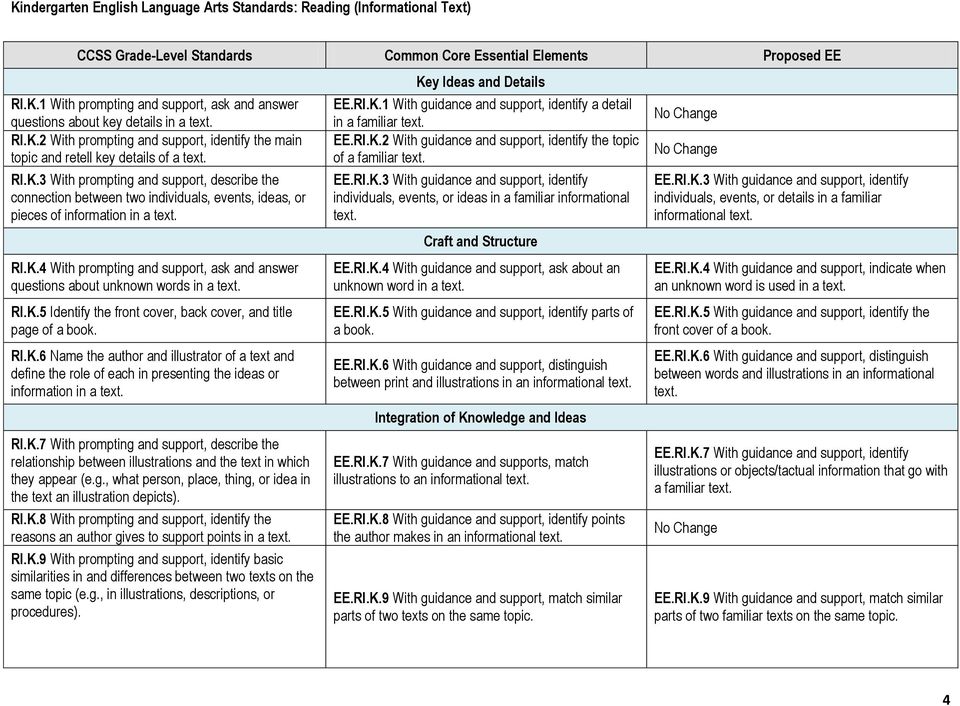
5 RI.K.10 Actively engage in group reading activities with purpose and understanding. Range of Reading and Level of Text Complexity EE.RI.K.10 **This Literature Essential Element references all elements above. EE.RI.K.10 With guidance and support, actively engage in shared reading of informational text. 5
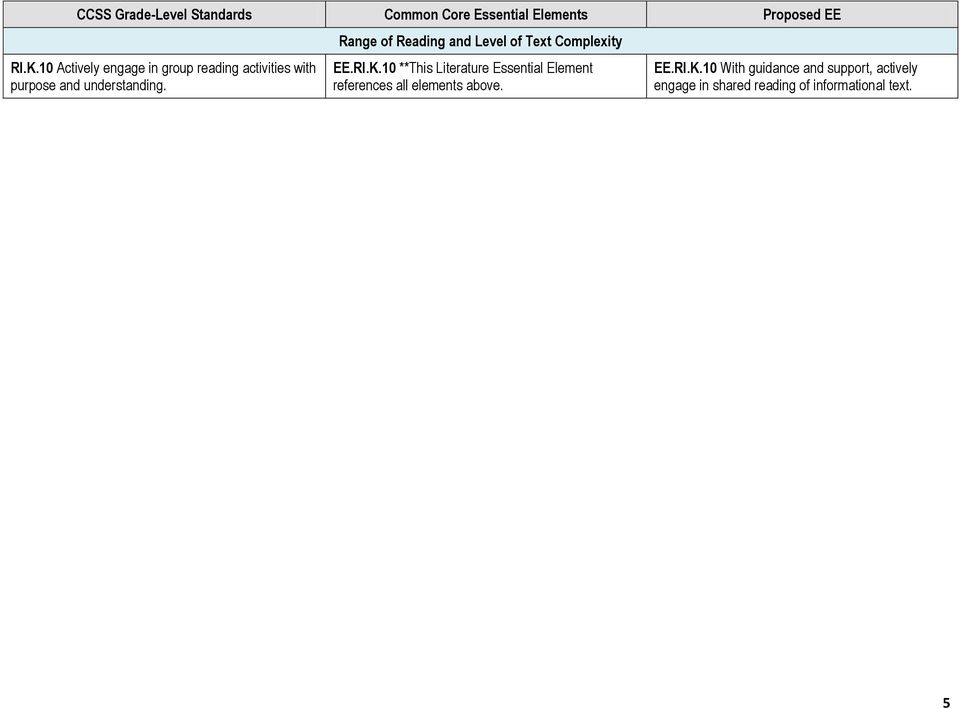
6 Kindergarten English Language Arts Standards: Reading (Foundational Skills) CCSS Grade-Level Standards Common Core Essential Elements Proposed EE RF.K.1 Demonstrate understanding of the organization and basic features of print. a. Follow words from left to right, top to bottom, and page by page. b. Recognize that spoken words are represented in written language by specific sequences of letters. c. Understand that words are separated by spaces in print. d. Recognize and name all upper- and lowercase letters of the alphabet. Print Concepts EE.RF.K.1 With guidance and support, demonstrate an emerging understanding of the organization and basic features of print. a. With guidance and support during shared reading, turn pages one page at a time from beginning to end. b. N/A c. N/A d. With guidance and support, recognize first letter of own name in print. EE.RF.K.1 Demonstrate emerging understanding of the organization of print. a. With guidance and support during shared reading, demonstrate understanding that books are read one page at a time from beginning to end. b. c. d. DELETE RF.K.2 Demonstrate understanding of spoken words, syllables, and sounds (phonemes). a. Recognize and produce rhyming words. b. Count, pronounce, blend, and segment syllables in spoken words. c. Blend and segment onsets and rimes of single-syllable spoken words. d. Isolate and pronounce the initial, medial vowel, and final sounds (phonemes) in three-phoneme (consonant-vowelconsonant, or CVC) words.* (This does not include CVCs ending with /l/, /r/, or /x/.) e. Add or substitute individual sounds (phonemes) in simple, one-syllable words to make new words. Phonological Awareness EE.RF.K.2 With guidance and support, demonstrate an emerging understanding of spoken words, syllables, and sounds (phonemes). a. With guidance and support, recognize rhyming words. b. With guidance and support, recognize the number of words in a spoken message. c. With guidance and support, identify singlesyllable spoken words with the same onset (beginning sound) as a familiar word. d. N/A e. N/A EE.RF.K.2 Demonstrate emerging understanding of spoken words, syllables, and sounds (phonemes). a. b. c. d. e. 6
7 RF.K.3 Know and apply grade-level phonics and word analysis skills in decoding words. a. Demonstrate basic knowledge of one-to-one letter-sound correspondences by producing the primary or many of the most frequent sound for each consonant. b. Associate the long and short sounds with common spellings (graphemes) for the five major vowels. c. Read common high-frequency words by sight (e.g., the, of, to, you, she, my, is, are, do, does). d. Distinguish between similarly spelled words by identifying the sounds of the letters that differ. Phonics and Word Recognition EE.RF.K.3 With guidance and support, apply letter name and letter-sound knowledge when decoding words during shared activities. a. With guidance and support, recognize sound of first letter in own name. b. N/A c. With guidance and support, recognize common signs and/or symbols in the environment. d. N/A EE.RF.K.3 Demonstrate emerging awareness of print. a. With guidance and support, recognize first letter of own name in print. b. c. With guidance and support, recognize environmental print. d. RF.K.4 Read emergent-reader texts with purpose and understanding. Fluency EE.RF.K.4 Engage in independent exploration of books. EE.RF.K.4 Engage in purposeful shared reading of familiar text. 7

8 Kindergarten English Language Arts Standards: Writing CCSS Grade-Level Standards Common Core Essential Elements Proposed EE W.K.1 Use a combination of drawing, dictating, and 1. writing to compose opinion pieces in which they tell a reader the topic or the name of the book they are writing about and state an opinion or preference about the topic or book (e.g., My favorite book is...). Text Types and Purposes EE.W.K.1 With guidance and support, select a topic or book and use drawing, dictating, or writing to state an opinion about it. EE.W.K.1 With guidance and support, select a familiar book and use drawing, dictating, or writing to state an opinion about it. W.K.2 Use a combination of drawing, dictating, and writing to compose informative/explanatory texts in which they name what they are writing about and supply some information about the topic. W.K.3 Use a combination of drawing, dictating, and writing to narrate a single event or several loosely linked events, tell about the events in the order in which they occurred, and provide a reaction to what happened. W.K.4 (Begins in grade 3) W.K.5 With guidance and support from adults, respond to questions and suggestions from peers and add details to strengthen writing as needed. W.K.6 With guidance and support from adults, explore a variety of digital tools to produce and publish writing, including in collaboration with peers. W.K.7 Participate in shared research and writing projects (e.g., explore a number of books by a favorite author and express opinions about them). EE.W.K.2 With guidance and support, select a topic and use drawing, dictating, or writing to share information about the topic. EE.W.K.3 With guidance and support, select an event and use drawing, dictating, or writing to narrate information about it. Production and Distribution of Writing EE.W.K.4 (Begins in grade 3) EE.W.K.5 (Begins in grade 1) EE.W.K.6 With guidance and support from adults, explore a variety of digital tools to produce writing. Research to Build and Present Knowledge EE.W.K.7 With guidance and support, participate in shared research and writing projects. EE.W.K.2 With guidance and support, select a familiar topic and use drawing, dictating, or writing to share information about the topic. EE.W.K.3 With guidance and support, select an event and use drawing, dictating, or writing and share information about it. EE.W.K.6 With guidance and support from adults, explore a variety of digital tools to produce individual or group writing. 8

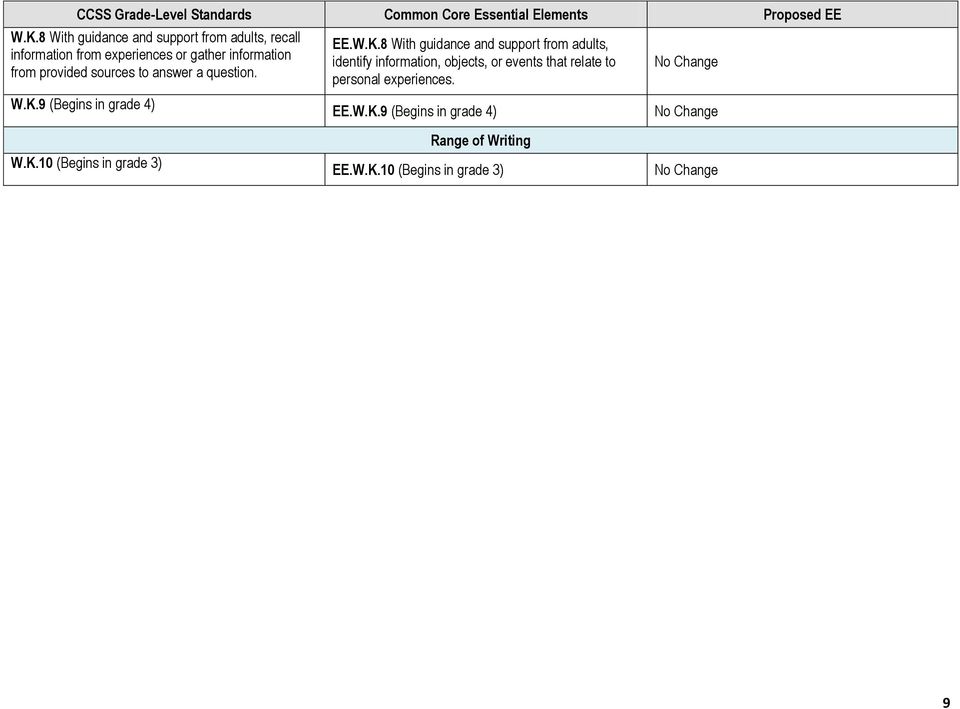
9 W.K.8 With guidance and support from adults, recall information from experiences or gather information from provided sources to answer a question. W.K.9 (Begins in grade 4) EE.W.K.8 With guidance and support from adults, identify information, objects, or events that relate to personal experiences. EE.W.K.9 (Begins in grade 4) W.K.10 (Begins in grade 3) Range of Writing EE.W.K.10 (Begins in grade 3) 9
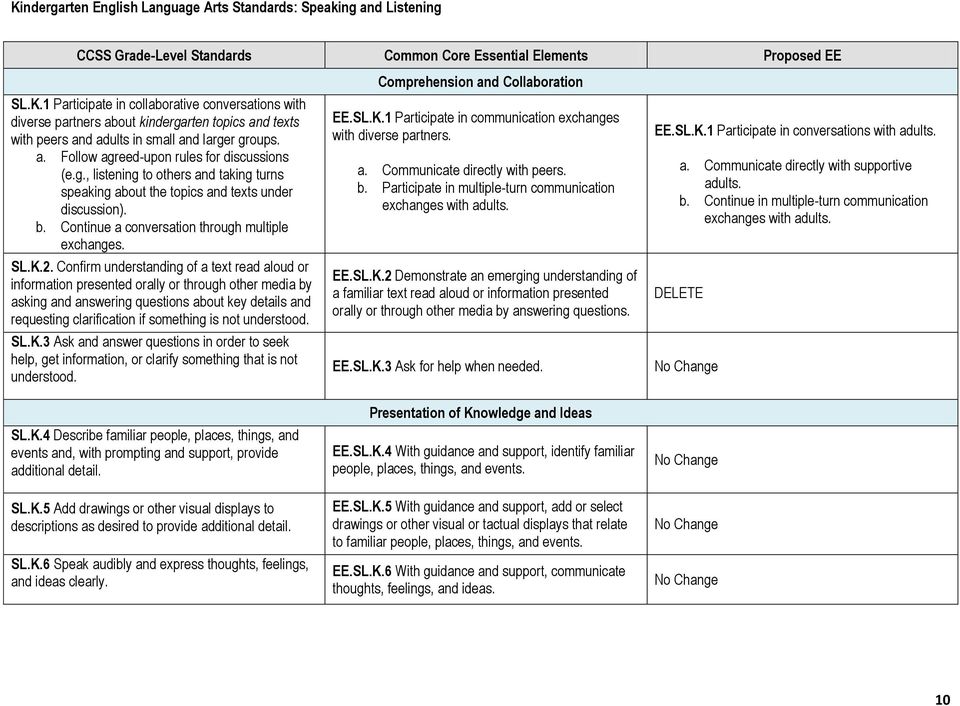
10 Kindergarten English Language Arts Standards: Speaking and Listening CCSS Grade-Level Standards Common Core Essential Elements Proposed EE SL.K.1 Participate in collaborative conversations with diverse partners about kindergarten topics and texts with peers and adults in small and larger groups. a. Follow agreed-upon rules for discussions (e.g., listening to others and taking turns speaking about the topics and texts under discussion). b. Continue a conversation through multiple exchanges. SL.K.2. Confirm understanding of a text read aloud or information presented orally or through other media by asking and answering questions about key details and requesting clarification if something is not understood. SL.K.3 Ask and answer questions in order to seek help, get information, or clarify something that is not understood. SL.K.4 Describe familiar people, places, things, and events and, with prompting and support, provide additional detail. SL.K.5 Add drawings or other visual displays to descriptions as desired to provide additional detail. SL.K.6 Speak audibly and express thoughts, feelings, and ideas clearly. Comprehension and Collaboration EE.SL.K.1 Participate in communication exchanges with diverse partners. a. Communicate directly with peers. b. Participate in multiple-turn communication exchanges with adults. EE.SL.K.2 Demonstrate an emerging understanding of a familiar text read aloud or information presented orally or through other media by answering questions. EE.SL.K.3 Ask for help when needed. Presentation of Knowledge and Ideas EE.SL.K.4 With guidance and support, identify familiar people, places, things, and events. EE.SL.K.5 With guidance and support, add or select drawings or other visual or tactual displays that relate to familiar people, places, things, and events. EE.SL.K.6 With guidance and support, communicate thoughts, feelings, and ideas. EE.SL.K.1 Participate in conversations with adults. a. Communicate directly with supportive adults. b. Continue in multiple-turn communication exchanges with adults. DELETE 10
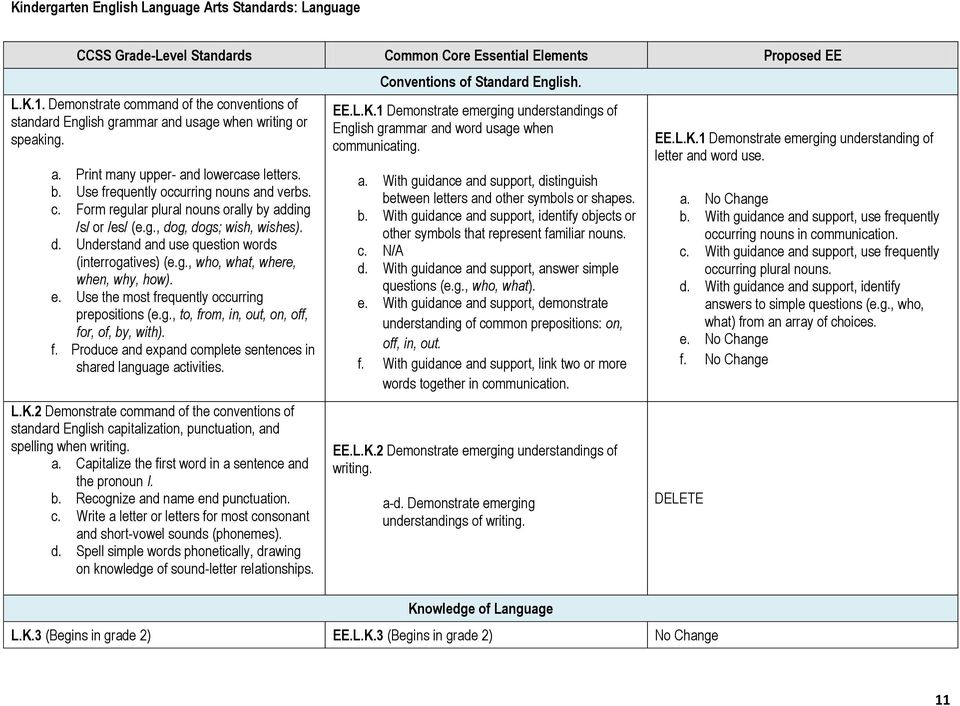
11 Kindergarten English Language Arts Standards: Language CCSS Grade-Level Standards Common Core Essential Elements Proposed EE L.K.1. Demonstrate command of the conventions of standard English grammar and usage when writing or speaking. a. Print many upper- and lowercase letters. b. Use frequently occurring nouns and verbs. c. Form regular plural nouns orally by adding /s/ or /es/ (e.g., dog, dogs; wish, wishes). d. Understand and use question words (interrogatives) (e.g., who, what, where, when, why, how). e. Use the most frequently occurring prepositions (e.g., to, from, in, out, on, off, for, of, by, with). f. Produce and expand complete sentences in shared language activities. L.K.2 Demonstrate command of the conventions of standard English capitalization, punctuation, and spelling when writing. a. Capitalize the first word in a sentence and the pronoun I. b. Recognize and name end punctuation. c. Write a letter or letters for most consonant and short-vowel sounds (phonemes). d. Spell simple words phonetically, drawing on knowledge of sound-letter relationships. Conventions of Standard English. EE.L.K.1 Demonstrate emerging understandings of English grammar and word usage when communicating. a. With guidance and support, distinguish between letters and other symbols or shapes. b. With guidance and support, identify objects or other symbols that represent familiar nouns. c. N/A d. With guidance and support, answer simple questions (e.g., who, what). e. With guidance and support, demonstrate understanding of common prepositions: on, off, in, out. f. With guidance and support, link two or more words together in communication. EE.L.K.2 Demonstrate emerging understandings of writing. a-d. Demonstrate emerging understandings of writing. Knowledge of Language EE.L.K.1 Demonstrate emerging understanding of letter and word use. a. b. With guidance and support, use frequently occurring nouns in communication. c. With guidance and support, use frequently occurring plural nouns. d. With guidance and support, identify answers to simple questions (e.g., who, what) from an array of choices. e. f. DELETE L.K.3 (Begins in grade 2) EE.L.K.3 (Begins in grade 2) 11
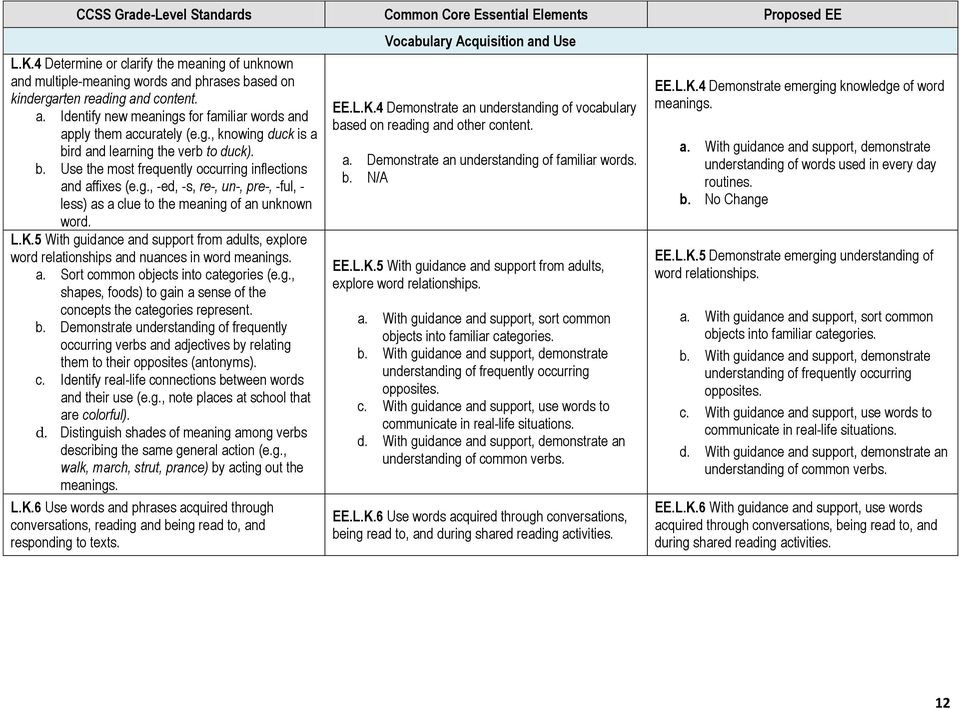
12 L.K.4 Determine or clarify the meaning of unknown and multiple-meaning words and phrases based on kindergarten reading and content. a. Identify new meanings for familiar words and apply them accurately (e.g., knowing duck is a bird and learning the verb to duck). b. Use the most frequently occurring inflections and affixes (e.g., -ed, -s, re-, un-, pre-, -ful, - less) as a clue to the meaning of an unknown word. L.K.5 With guidance and support from adults, explore word relationships and nuances in word meanings. a. Sort common objects into categories (e.g., shapes, foods) to gain a sense of the concepts the categories represent. b. Demonstrate understanding of frequently occurring verbs and adjectives by relating them to their opposites (antonyms). c. Identify real-life connections between words and their use (e.g., note places at school that are colorful). d. Distinguish shades of meaning among verbs describing the same general action (e.g., walk, march, strut, prance) by acting out the meanings. L.K.6 Use words and phrases acquired through conversations, reading and being read to, and responding to texts. Vocabulary Acquisition and Use EE.L.K.4 Demonstrate an understanding of vocabulary based on reading and other content. a. Demonstrate an understanding of familiar words. b. N/A EE.L.K.5 With guidance and support from adults, explore word relationships. a. With guidance and support, sort common objects into familiar categories. b. With guidance and support, demonstrate understanding of frequently occurring opposites. c. With guidance and support, use words to communicate in real-life situations. d. With guidance and support, demonstrate an understanding of common verbs. EE.L.K.6 Use words acquired through conversations, being read to, and during shared reading activities. EE.L.K.4 Demonstrate emerging knowledge of word meanings. a. With guidance and support, demonstrate understanding of words used in every day routines. b. EE.L.K.5 Demonstrate emerging understanding of word relationships. a. With guidance and support, sort common objects into familiar categories. b. With guidance and support, demonstrate understanding of frequently occurring opposites. c. With guidance and support, use words to communicate in real-life situations. d. With guidance and support, demonstrate an understanding of common verbs. EE.L.K.6 With guidance and support, use words acquired through conversations, being read to, and during shared reading activities. 12
13 COMMON CORE ESSENTIAL ELEMENTS AND ACHIEVEMENT DESCRIPTORS FOR FIRST GRADE First Grade English Language Arts Standards: Reading (Literature) CCSS Grade-Level Standards Common Core Essential Elements Proposed EE RL.1.1. Ask and answer questions about key details in a text. RL.1.2 Retell stories, including key details, and demonstrate understanding of their central message or lesson. RL.1.3 Describe characters, settings, and major events in a story, using key details. RL.1.4 Identify words and phrases in stories or poems that suggest feelings or appeal to the senses. RL.1.5 Explain major differences between books that tell stories and books that give information, drawing on a wide reading of a range of text types. RL.1.6 Identify who is telling the story at various points in a text. RL.1.7 Use illustrations and details in a story to describe its characters, setting, or events. Key Ideas and Details EE.RL.1.1 Identify details in familiar stories. EE.RL.1.2 Retell details from a familiar story. EE.RL.1.3 Identify characters and settings in a familiar story. Craft and Structure EE.RL.1.4 Identify sensory or feeling words in a familiar story. EE.RL.1.5 Classify reading materials into storybooks and informational books. EE.RL.1.6 Identify a speaker in a familiar story. Integration of Knowledge and Ideas EE.RL.1.7 Identify details or illustrations that describe the characters or events in a familiar story. EE.RL.1.2 With guidance and support, recount major events in familiar stories. EE.RL.1.4 With guidance and support, identify sensory or feeling words in a familiar story. EE.RL.1.5 With guidance and support, identify a text as telling a story. EE.RL.1.6 With guidance and support, identify a speaker within a familiar story. EE.RL.1.7 Identify illustrations or objects/tactual information that go with a familiar story. RL.1.8 (Not applicable to literature) EE.RL.1.8 (Not applicable to literature) RL.1.9 Compare and contrast the adventures and experiences of characters in stories. EE.RL.1.9 Identify the adventures or experiences of characters in a familiar story. Range of Reading and Level of Text Complexity EE.RL.1.9 With guidance and support identify adventures or experiences of characters in a story as same or different. 13

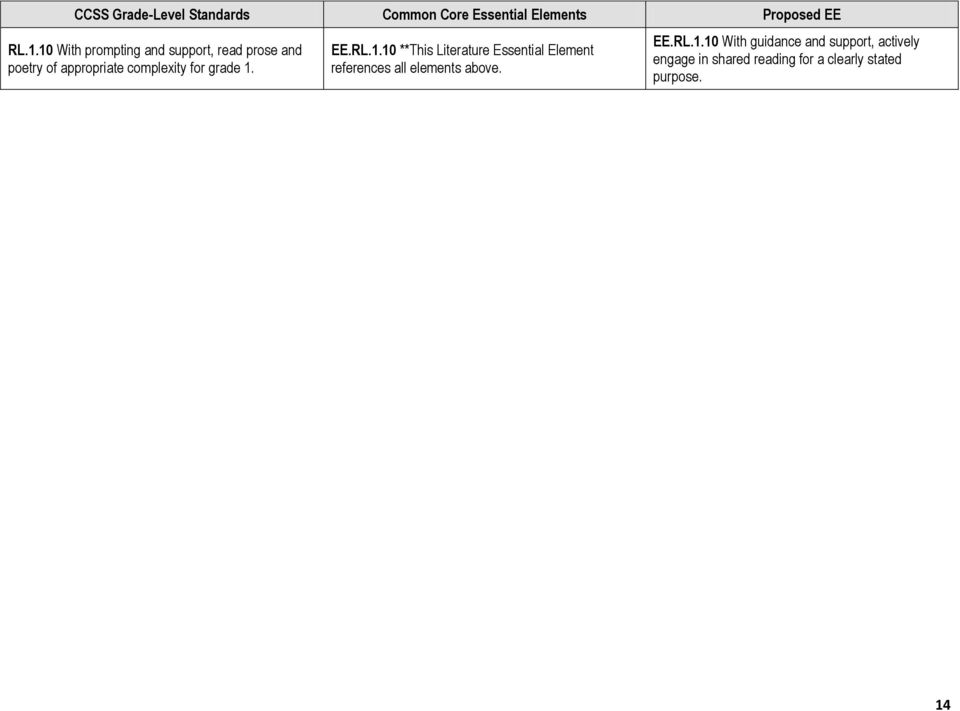
14 RL.1.10 With prompting and support, read prose and poetry of appropriate complexity for grade 1. EE.RL.1.10 **This Literature Essential Element references all elements above. EE.RL.1.10 With guidance and support, actively engage in shared reading for a clearly stated purpose. 14
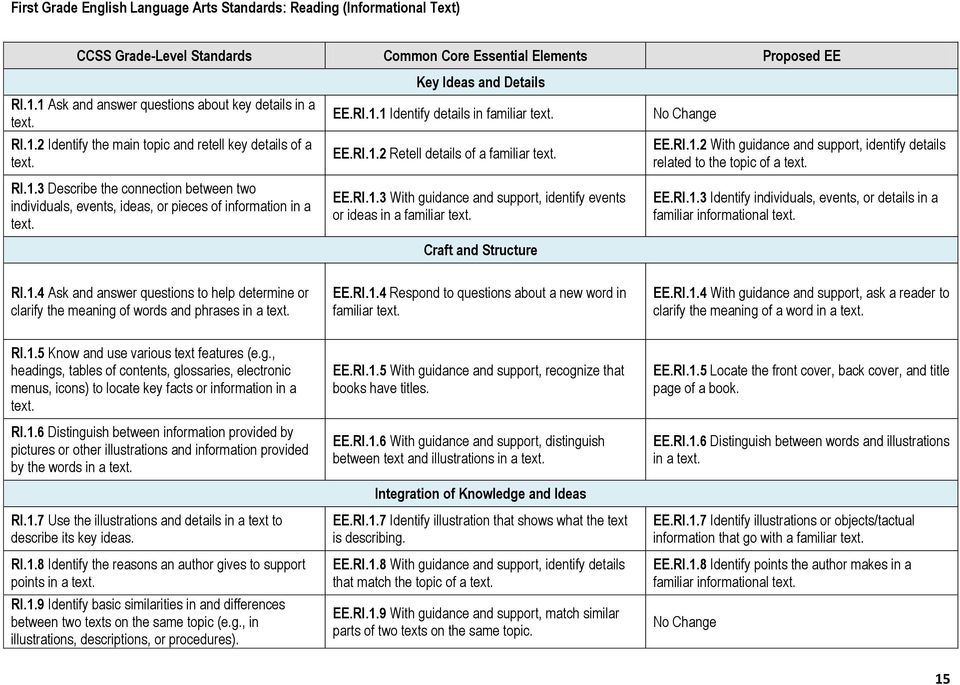
15 First Grade English Language Arts Standards: Reading (Informational Text) CCSS Grade-Level Standards Common Core Essential Elements Proposed EE RI.1.1 Ask and answer questions about key details in a text. RI.1.2 Identify the main topic and retell key details of a text. RI.1.3 Describe the connection between two individuals, events, ideas, or pieces of information in a text. Key Ideas and Details EE.RI.1.1 Identify details in familiar text. EE.RI.1.2 Retell details of a familiar text. EE.RI.1.3 With guidance and support, identify events or ideas in a familiar text. Craft and Structure EE.RI.1.2 With guidance and support, identify details related to the topic of a text. EE.RI.1.3 Identify individuals, events, or details in a familiar informational text. RI.1.4 Ask and answer questions to help determine or clarify the meaning of words and phrases in a text. EE.RI.1.4 Respond to questions about a new word in familiar text. EE.RI.1.4 With guidance and support, ask a reader to clarify the meaning of a word in a text. RI.1.5 Know and use various text features (e.g., headings, tables of contents, glossaries, electronic menus, icons) to locate key facts or information in a text. RI.1.6 Distinguish between information provided by pictures or other illustrations and information provided by the words in a text. RI.1.7 Use the illustrations and details in a text to describe its key ideas. RI.1.8 Identify the reasons an author gives to support points in a text. RI.1.9 Identify basic similarities in and differences between two texts on the same topic (e.g., in illustrations, descriptions, or procedures). EE.RI.1.5 With guidance and support, recognize that books have titles. EE.RI.1.6 With guidance and support, distinguish between text and illustrations in a text. Integration of Knowledge and Ideas EE.RI.1.7 Identify illustration that shows what the text is describing. EE.RI.1.8 With guidance and support, identify details that match the topic of a text. EE.RI.1.9 With guidance and support, match similar parts of two texts on the same topic. EE.RI.1.5 Locate the front cover, back cover, and title page of a book. EE.RI.1.6 Distinguish between words and illustrations in a text. EE.RI.1.7 Identify illustrations or objects/tactual information that go with a familiar text. EE.RI.1.8 Identify points the author makes in a familiar informational text. 15
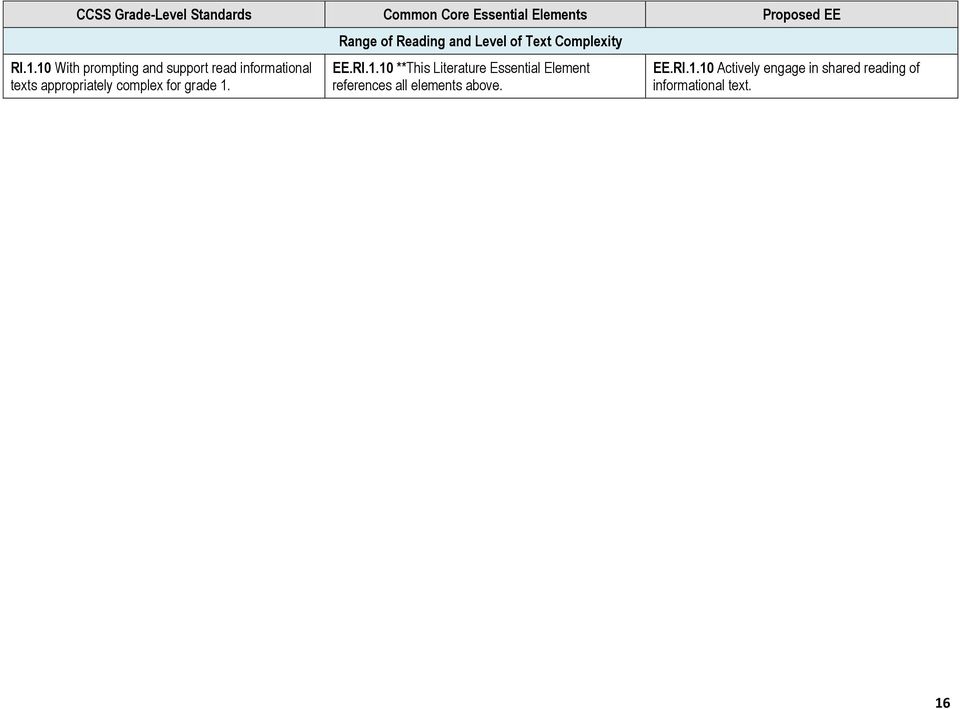
16 RI.1.10 With prompting and support read informational texts appropriately complex for grade 1. Range of Reading and Level of Text Complexity EE.RI.1.10 **This Literature Essential Element references all elements above. EE.RI.1.10 Actively engage in shared reading of informational text. 16
17 First Grade English Language Arts Standards: Reading (Foundational Skills) CCSS Grade-Level Standards Common Core Essential Elements Proposed EE RF.1.1 Demonstrate understanding of the organization and basic features of print. a. Recognize the distinguishing features of a sentence (e.g., first word, capitalization, ending punctuation). RF.1.2 Demonstrate understanding of spoken words, syllables, and sounds (phonemes). a. Distinguish long from short vowel sounds in spoken single-syllable words. b. Orally produce single-syllable words by blending sounds (phonemes), including consonant blends. c. Isolate and pronounce initial, medial vowel, and final sounds (phonemes) in spoken singlesyllable words. d. Segment spoken single-syllable words into their complete sequence of individual sounds (phonemes). Print Concepts EE.RF.1.1 Demonstrate an understanding of the organization and basic features of print. a. Interact with books one page at a time from beginning to end. b. Follow print from left to right. c. Follow print from top to bottom. Phonological Awareness EE.RF.1.2 Demonstrate understanding of spoken words, syllables, and sounds (phonemes). a. Identify spoken rhyming words. b. With guidance and support, indicate the number of syllables in a spoken word. c. Identify a single syllable spoken word with the same onset (beginning sound) as a familiar word. d. Match orally presented segmented phonemes to pictures that are labeled orally first by an adult. Phonics and Word Recognition EE.RF.1.1 Demonstrate emerging understanding of the organization of print. a. Demonstrate understanding of the organization and basic features of print (e.g., left-to-right, top-to-bottom orientation of print, one-to-one correspondence between written and spoken word), b. DELETE c. DELETE EE.RF.1.2 Demonstrate emerging understanding of spoken words, syllables, and sounds (phonemes). a. Recognize rhyming words. b. With guidance and support, match orally presented segmented phonemes (e.g., C-A- T) to pictures or words illustrating the corresponding word. c. d. With guidance and support, substitute individual sounds (phonemes) in simple, one-syllable words to make new words. 17

18 RF.1.3 Know and apply grade-level phonics and word analysis skills in decoding words. a. Know the spelling-sound correspondences for common consonant digraphs. b. Decode regularly spelled one-syllable words. c. Know final -e and common vowel team conventions for representing long vowel sounds. d. Use knowledge that every syllable must have a vowel sound to determine the number of syllables in a printed word. e. Decode two-syllable words following basic patterns by breaking the words into syllables. f. Read words with inflectional endings. g. Recognize and read grade-appropriate irregularly spelled words. RF.1.4 Read with sufficient accuracy and fluency to support comprehension. a. Read on-level text with purpose and understanding. b. Read on-level text orally with accuracy, appropriate rate, and expression on successive readings. c. Use context to confirm or self-correct word recognition and understanding, rereading as necessary. EE.RF.1.3 Apply letter name and letter-sound knowledge when decoding words during shared activities. a. Identify words that begin with a singleconsonant phoneme that is spoken by an adult. b. N/A c. N/A d. N/A e. N/A f. N/A g. N/A Fluency EE.RF.1.4 Engage in sustained independent study of books (e.g., studies a book one page at a time). a. Independently engage in exploring a book or navigating pages in a multimedia book. b. Sustain attention to a variety of reading materials reflecting a variety of text genre. c. N/A EE.RF.1.3 Demonstrate emerging letter and word identification skills. a. Identify upper case letters of the alphabet. b. With guidance and support, recognize familiar words that are used in every day routines. c. d. e. f. g. EE.RF.1.4 Begin to attend to words in print. a. Engage in sustained, independent study of books. b. Participate in shared reading of a variety of reading materials reflecting a variety of text genre. c. 18

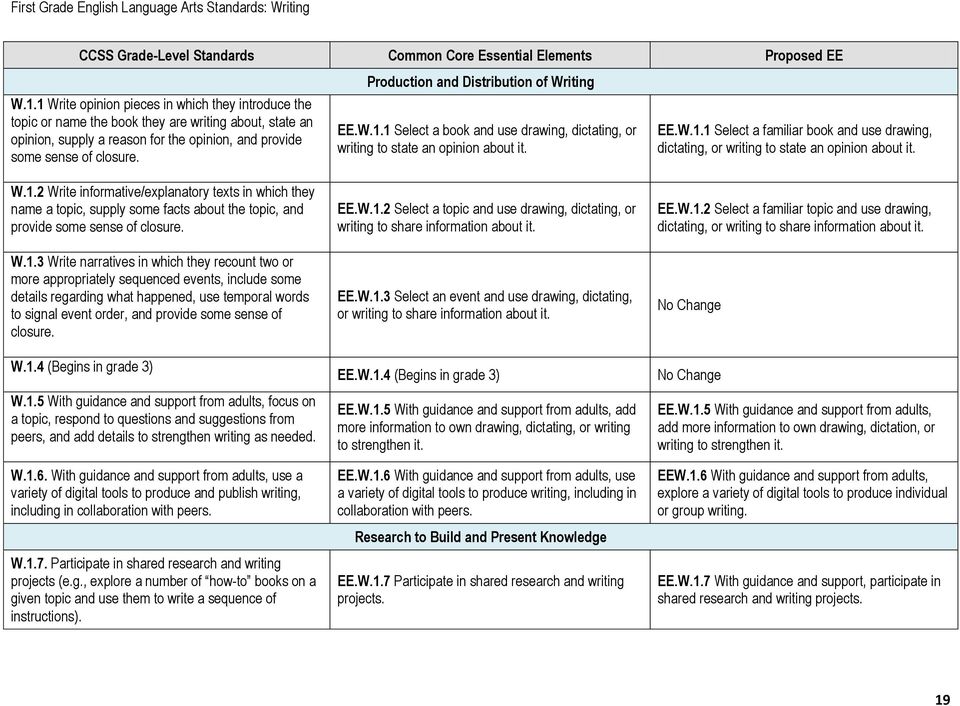
19 First Grade English Language Arts Standards: Writing CCSS Grade-Level Standards Common Core Essential Elements Proposed EE W.1.1 Write opinion pieces in which they introduce the topic or name the book they are writing about, state an opinion, supply a reason for the opinion, and provide some sense of closure. Production and Distribution of Writing EE.W.1.1 Select a book and use drawing, dictating, or writing to state an opinion about it. EE.W.1.1 Select a familiar book and use drawing, dictating, or writing to state an opinion about it. W.1.2 Write informative/explanatory texts in which they name a topic, supply some facts about the topic, and provide some sense of closure. W.1.3 Write narratives in which they recount two or more appropriately sequenced events, include some details regarding what happened, use temporal words to signal event order, and provide some sense of closure. W.1.4 (Begins in grade 3) W.1.5 With guidance and support from adults, focus on a topic, respond to questions and suggestions from peers, and add details to strengthen writing as needed. W.1.6. With guidance and support from adults, use a variety of digital tools to produce and publish writing, including in collaboration with peers. W.1.7. Participate in shared research and writing projects (e.g., explore a number of how-to books on a given topic and use them to write a sequence of instructions). EE.W.1.2 Select a topic and use drawing, dictating, or writing to share information about it. EE.W.1.3 Select an event and use drawing, dictating, or writing to share information about it. EE.W.1.4 (Begins in grade 3) EE.W.1.5 With guidance and support from adults, add more information to own drawing, dictating, or writing to strengthen it. EE.W.1.6 With guidance and support from adults, use a variety of digital tools to produce writing, including in collaboration with peers. Research to Build and Present Knowledge EE.W.1.7 Participate in shared research and writing projects. EE.W.1.2 Select a familiar topic and use drawing, dictating, or writing to share information about it. EE.W.1.5 With guidance and support from adults, add more information to own drawing, dictation, or writing to strengthen it. EEW.1.6 With guidance and support from adults, explore a variety of digital tools to produce individual or group writing. EE.W.1.7 With guidance and support, participate in shared research and writing projects. 19
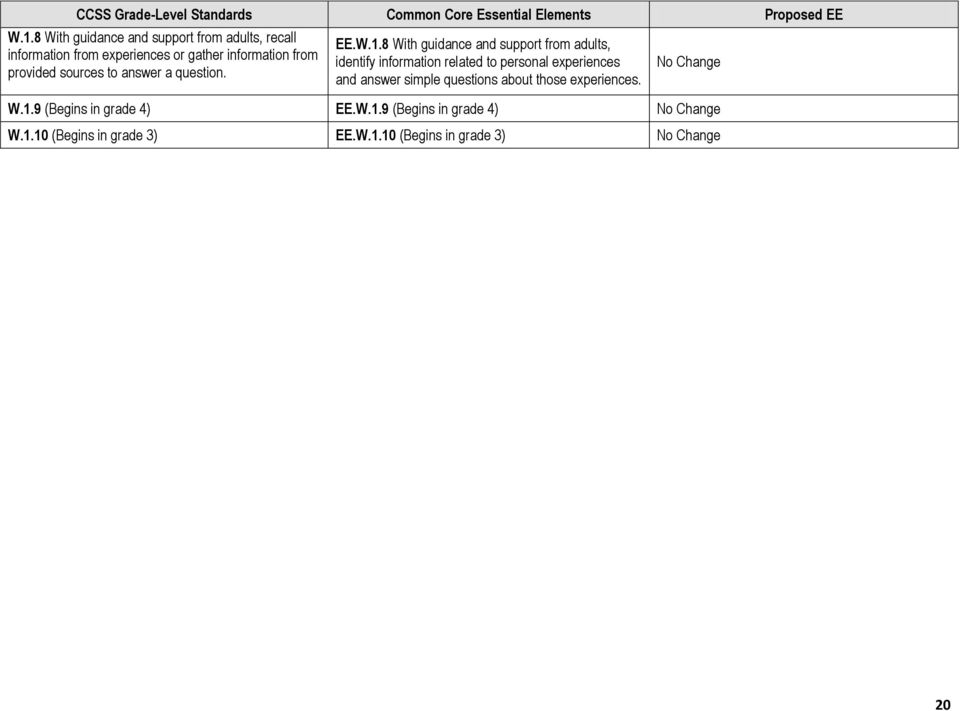
20 W.1.8 With guidance and support from adults, recall information from experiences or gather information from provided sources to answer a question. EE.W.1.8 With guidance and support from adults, identify information related to personal experiences and answer simple questions about those experiences. W.1.9 (Begins in grade 4) EE.W.1.9 (Begins in grade 4) W.1.10 (Begins in grade 3) EE.W.1.10 (Begins in grade 3) 20
21 First Grade English Language Arts Standards: Speaking and Listening CCSS Grade-Level Standards Common Core Essential Elements Proposed EE SL.1.1 Participate in collaborative conversations with diverse partners about grade 1 topics and texts with peers and adults in small and larger groups. a. Follow agreed-upon rules for discussions (e.g., listening to others with care, speaking one at a time about the topics and texts under discussion). b. Build on others talk in conversations by responding to the comments of others through multiple exchanges. c. Ask questions to clear up any confusion about the topics and texts under discussion. SL.1.2 Ask and answer questions about key details in a text read aloud or information presented orally or through other media. SL.1.3 Ask and answer questions about what a speaker says in order to gather additional information or clarify something that is not understood. SL.1.4 Describe people, places, things, and events with relevant details, expressing ideas and feelings clearly. SL.1.5 Add drawings or other visual displays to descriptions when appropriate to clarify ideas, thoughts, and feelings. SL.1.6 Produce complete sentences when appropriate to task and situation. Comprehension and Collaboration. EE.SL.1.1 Participate in conversations with peers and adults. a. Engage in multiple- turn exchanges with peers. b. Build on comments or topics initiated by an adult. c. Uses one or two words to ask questions related to personally relevant topics. EE.SL.1.2 During shared reading activities, answer questions about details presented orally or through other media. EE.SL.1.3 Ask for help when needed. Presentation of Knowledge and Ideas EE.SL.1.4 With guidance and support, identify familiar people, places, things, and events. EE.SL.1.5 Communicate own thoughts, feelings, or ideas. EE.SL.1.6 With guidance and support, provide more information to clarify ideas, thoughts, and feelings. EE.SL.1.1 Participate in conversations with adults. a. Engage in multiple-turn exchanges with supportive adults. b. c. EE.SL.1.3 Communicate confusion or lack of understanding ("I don't know."). EE.SL.1.4 Identify familiar people, places, things, and events. EE.SL.1.5 Add or select drawings or other visual or tactual displays that relate to familiar people, places, things, and events. 21
22 22
23 First Grade English Language Arts Standards: Language CCSS Grade-Level Standards Common Core Essential Elements Proposed EE L.1.1 Demonstrate command of the conventions of standard English grammar and usage when writing or speaking. a. Print all upper- and lowercase letters. b. Use common, proper, and possessive nouns. c. Use singular and plural nouns with matching verbs in basic sentences (e.g., He hops; We hop). d. Use personal, possessive, and indefinite pronouns (e.g., I, me, my; they, them, their; anyone, everything). e. Use verbs to convey a sense of past, present, and future (e.g., Yesterday I walked home; Today I walk home; Tomorrow I will walk home). f. Use frequently occurring adjectives. g. Use frequently occurring conjunctions (e.g., g. and, but, or, so, because). h. Use determiners (e.g., articles, h. demonstratives). i. Use frequently occurring prepositions (e.g., i. during, beyond, toward). j. Produce and expand complete simple and compound declarative, interrogative, imperative, and exclamatory sentences in response to prompts. Conventions of Standard English EE.L.1.1 Demonstrate emerging understandings of standard English usage when communicating. a. Write letters from own name. b. With guidance and support, use familiar nouns (e.g., own name, Mom, dog) in isolation. c. With guidance and support, produce noun + verb or verb + noun combinations. d. With guidance and support, use familiar personal pronouns (e.g., I, me, and you). e. With guidance and support, use familiar present tense verbs. f. With guidance and support, use familiar frequently occurring adjectives. (e.g., big, hot). g. N/A h. N/A i. With guidance and support, use frequently occurring prepositions: in, out, on, off. j. With guidance and support, use simple question words (interrogatives) (e.g., who, what). EE.L.1.1 Demonstrate emerging understanding of letter and word use. a. b. Use frequently occurring nouns in communication. c. Use frequently occurring plural nouns in communication. d. e. Use familiar present tense verbs. f. g. h. i. With guidance and support, use common prepositions: on, off, in, out. j. 23
24 L.1.2 Demonstrate command of the conventions of standard English capitalization, punctuation, and spelling when writing. a. Capitalize dates and names of people. b. Use end punctuation for sentences. c. Use commas in dates and to separate single words in a series. d. Use conventional spelling for words with common spelling patterns and for frequently occurring irregular words. e. Spell untaught words phonetically, drawing on phonemic awareness and spelling conventions. EE.L.1.2 Demonstrate emerging understandings of the use of conventions of standard English during communication. a. Locate first letter in own name when presented with name. b. N/A c. N/A d. With guidance and support, recognize that letters are used to create words. e. N/A EE.L.1.2 Demonstrate emerging understanding of conventions of standard English. a. DELETE b. With guidance and support during shared writing, put a period at the end of a sentence. c. d. With guidance and support, use letters to create words. e. With guidance and support during shared writing, identify the letters that represent sounds needed to spell words. Knowledge of Language L.1.3 (Begins in grade 2) EE.L.1.3 (Begins in grade 2) L.1.4 Determine or clarify the meaning of unknown and multiple-meaning words and phrases based on grade 1 reading and content, choosing flexibly from an array of strategies. a. Use sentence-level context as a clue to the meaning of a word or phrase. b. Use frequently occurring affixes as a clue to the meaning of a word. c. Identify frequently occurring root words (e.g., look) and their inflectional forms (e.g., looks, looked, looking). Vocabulary Acquisition and Use EE.L.1.4 a. With guidance and support, demonstrate understanding of the meaning of newly acquired vocabulary. b. N/A c. N/A EE.L.1.4 Demonstrate emerging knowledge of word meanings. a. Demonstrate understanding of words used in every day routines. b. c. 24
25 L.1.5 With guidance and support from adults, demonstrate understanding of word relationships and nuances in word meanings. a. Sort words into categories (e.g., colors, clothing) to gain a sense of the concepts the categories represent. b. Define words by category and by one or more key attributes (e.g., a duck is a bird that swims; a tiger is a large cat with stripes). c. Identify real-life connections between words and their use (e.g., note places at home that are cozy). d. Distinguish shades of meaning among verbs differing in manner (e.g., look, peek, glance, stare, glare, scowl) and adjectives differing in intensity (e.g., large, gigantic) by defining or choosing them or by acting out the meanings. L.1.6 Use words and phrases acquired through conversations, reading and being read to, and responding to texts, including using frequently occurring conjunctions to signal simple relationships (e.g., because). EE.L.1.5 With guidance and support from adults, demonstrate emerging understandings of word relationships. a. With guidance and support from adults, sort common objects into familiar categories. b. With guidance and support from adults, identify attributes of familiar words. c. With guidance and support from adults, demonstrate understanding of words by identifying real-life connections between words and their use. d. N/A EE.L.1.6 N/A EE.L.1.5 Demonstrate emerging understanding of word relationships. a. With guidance and support, sort common objects into familiar categories. b. With guidance and support, identify attributes of familiar words. c. With guidance and support, demonstrate understanding of words by identifying reallife connections between words and their use. d. EE.L.1.6 With guidance and support, use words acquired through conversations, being read to, and during shared reading activities. 25
26 COMMON CORE ESSENTIAL ELEMENTS AND ACHIEVEMENT DESCRIPTORS FOR SECOND GRADE Second Grade English Language Arts Standards: Reading (Literature) CCSS Grade-Level Standards Common Core Essential Elements Proposed EE RL.2.1 Ask and answer such questions as who, what, where, when, why, and how to demonstrate understanding of key details in a text. RL.2.2 Recount stories, including fables and folktales from diverse cultures, and determine their central message, lesson, or moral. RL.2.3 Describe how characters in a story respond to major events and challenges. RL.2.4 Describe how words and phrases (e.g., regular beats, alliteration, rhymes, repeated lines) supply rhythm and meaning in a story, poem, or song. RL.2.5 Describe the overall structure of a story, including describing how the beginning introduces the story and the ending concludes the action. RL.2.6 Acknowledge differences in the points of view of characters, including by speaking in a different voice for each character when reading dialogue aloud. RL.2.7 Use information gained from the illustrations and words in a print or digital text to demonstrate understanding of its characters, setting, or plot. Key Ideas and Details EE.RL.2.1 Answer who and where questions to demonstrate understanding of details in a familiar text. EE.RL.2.2 Retell familiar stories from diverse cultures, including two or more elements from different parts of the story. EE.RL.2.3 Identify the actions and feelings of the characters in a familiar story. Craft and Structure EE.RL.2.4 Identify rhyming words or repeated phrases in a familiar story, poem, or song. EE.RL.2.5 Determine the beginning and ending of a story. EE.RL.2.6 Identify the speakers in a dialogue. Integration of Knowledge and Ideas EE.RL.2.7 Use illustrations in print or digital text to identify characters and settings. EE.RL.2.2 Using details from the text, recount events from familiar stories from diverse cultures. EE.RL.2.3 Identify the actions of the characters in a story. EE.RL.2.4 Use rhyming or repetition to identify words that meaningfully complete a familiar story, poem, or song. EE.RL.2.5 Determine the beginning and ending of a familiar story with a logical order. RL.2.8 (Not applicable to literature) EE.RL.2.8 (Not applicable to literature) RL.2.9 Compare and contrast two or more versions of the same story (e.g., Cinderella stories) by different authors or from different cultures. EE.RL.2.9 Identify similarities in two versions of the same story. EE.RL.2.7 Identify illustrations or objects/tactual information in print or digital text that depict characters. EE.RL.2.9 Identify two books that are different versions of the same story (e.g., Cinderella stories). 26
27 RL.2.10 By the end of the year, read and comprehend literature, including stories and poetry, in the grades 2 3 text complexity band proficiently, with scaffolding as needed at the high end of the range. Range of Reading and Level of Text Complexity EE.RL.2.10 **This Literature Essential Element references all elements above. EE.RL.2.10 Actively engage in shared reading of stories and poetry for clearly stated purposes. 27
28 Second Grade English Language Arts Standards: Reading (Informational Text) CCSS Grade-Level Standards Common Core Essential Elements Proposed EE RI.2.1 Ask and answer such questions as who, what, where, when, why, and how to demonstrate understanding of key details in a text. RI.2.2 Identify the main topic of a multi-paragraph text as well as the focus of specific paragraphs within the text. RI.2.3 Describe the connection between a series of historical events, scientific ideas or concepts, or steps in technical procedures in a text. RI.2.4 Determine the meaning of words and phrases in a text relevant to a grade 2 topic or subject area. RI.2.5 Know and use various text features (e.g., captions, bold print, subheadings, glossaries, indexes, electronic menus, icons) to locate key facts or information in a text efficiently. RI.2.6 Identify the main purpose of a text, including what the author wants to answer, explain, or describe. RI.2.7 Explain how specific images (e.g., a diagram showing how a machine works) contribute to and clarify a text. RI.2.8 Describe how reasons support specific points the author makes in a text. RI.2.9 Compare and contrast the most important points presented by two texts on the same topic. Key Ideas and Details EE.RI.2.1 Answer who and what questions to demonstrate understanding of details in a familiar text. EE.RI.2.2 Identify the topic of the text. EE.RI.2.3 Sequence at least two steps in a procedure or ideas/incidents in an event. Craft and Structure EE.RI.2.4 Identify words related to a topic of a text. EE.RI.2.5 Locate facts or information in a familiar text. EE.RI.2.6 Identify purpose of a text. Integration of Knowledge and Ideas EE.RI.2.7 Demonstrate understanding of how images relate to a familiar informational text. EE.RI.2.8 N/A (See EE.RI.2.1). EE.RI.2.9 Identify a common element between two texts. EE.RI.2.3 Identify individuals, events, or details in an informational text. EE.RI.2.5 Identify details in informational text or its illustrations EE.RI.2.6 Identify the role of the author and the illustrator. EE.RI.2.7 Identify illustrations or objects/tactual information that go with a text. EE.RI.2.8 Identify points the author makes in an informational text. EE.RI.2.9 Match similar parts of two texts on the same topic. 28
29 RI.2.10 By the end of year, read and comprehend informational texts, including history/social studies, science, and technical texts, in the grades 2 3 text complexity band proficiently, with scaffolding as needed at the high end of the range. Range of Reading and Level of Text Complexity EE.RI.2.10 **This Informational Text Essential Element references all elements above. EE.RI.2.10 Actively engage in shared reading of informational text including history/ss, science, and technical texts. 29
30 Second Grade English Language Arts Standards: Reading (Foundational Skills) CCSS Grade-Level Standards Common Core Essential Elements Proposed EE RF.2.3 Know and apply grade-level phonics and word analysis skills in decoding words. a. Distinguish long and short vowels when reading regularly spelled one-syllable words. b. Know spelling-sound correspondences for additional common vowel teams. c. Decode regularly spelled two-syllable words with long vowels. d. Decode words with common prefixes and suffixes. e. Identify words with inconsistent but common spelling-sound correspondences. f. Recognize and read grade-appropriate irregularly spelled words. RF.2.4 Read with sufficient accuracy and fluency to support comprehension. a. Read on-level text with purpose and understanding. b. Read on-level text orally with accuracy, appropriate rate, and expression on successive readings. c. Use context to confirm or self-correct word recognition and understanding, rereading as necessary. Phonics and Word Recognition. EE.RF.2.3 a-c. Apply letter-sound and word analysis skills in decoding words. In context, identify 18 or more lettersound associations. d-e. Identify the beginning sound of familiar words beginning with a single consonant sound. f. Recognize 10 or more written words. Fluency EE.RF.2.4 Read a shared-reading selection. EE.RF.2.3 Demonstrate emerging use of lettersound knowledge to read words. a. Identify the lower case letters of the alphabet. b. Identify letter sound correspondence for single consonants. c. DELETE d. DELETE e. DELETE f. EE.RF.2.4 Begin to attend to words in print. a. Read familiar text comprised of known words. b. N/A c. N/A 30
31 Second Grade English Language Arts Standards: Writing CCSS Grade-Level Standards Common Core Essential Elements Proposed EE W.2.1 Write opinion pieces in which they introduce the topic or book they are writing about, state an opinion, supply reasons that support the opinion, use linking words (e.g., because, and, also) to connect opinion and reasons, and provide a concluding statement or section. W.2.2 Write informative/explanatory texts in which they introduce a topic, use facts and definitions to develop points, and provide a concluding statement or section. W.2.3 Write narratives in which they recount a wellelaborated event or short sequence of events, include details to describe actions, thoughts, and feelings, use temporal words to signal event order, and provide a sense of closure. Research to Build and Present Knowledge EE.W.2.1 Select a book and write, draw, or dictate to state an opinion about it and one reason to support the opinion. EE.W.2.2 Select a topic and use drawing, dictating, or writing to compose a message with one fact about the topic. EE.W.2.3 Select an event or personal experience and use drawing, writing, or dictating to compose a message about it. Production and Distribution of Writing EE.W.2.1 Select a book and write, draw, or dictate to state an opinion about it. W.2.4 (Begins in grade 3) EE.W.2.4 (Begins in grade 3) W.2.5 With guidance and support from adults and peers, focus on a topic and strengthen writing as needed by revising and editing. W.2.6 With guidance and support from adults, use a variety of digital tools to produce and publish writing, including in collaboration with peers. W.2.7 Participate in shared research and writing projects (e.g., read a number of books on a single topic to produce a report; record science observations). W.2.8 Recall information from experiences or gather information from provided sources to answer a question. EE.W.2.5 With guidance and support from adults and peers, add more information to own drawing, dictating, or writing to strengthen the message. EE.W.2.6 With guidance and support from adults and peers, use technology (including assistive technologies) to produce and publish writing. EE.W.2.7 Participate in shared writing projects - communicate a message to add information. Research to Build and Present Knowledge EE.W.2.8 Identify information related to personal experiences and answer simple questions about those experiences. EE.W.2.5 With guidance and support from adults and peers, add more information to own drawing, dictation, or writing to strengthen the message. EE.W.2.7 Participate in shared research and writing projects. 31
32 W.2.9 (Begins in grade 4) EE.W.2.9 (Begins in grade 4) Range of Writing W.2.10 (Begins in grade 3) EE.W.2.10 (Begins in grade 3) 32
33 Second Grade English Language Arts Standards: Speaking and Listening CCSS Grade-Level Standards Common Core Essential Elements Proposed EE SL.2.1 Participate in collaborative conversations with diverse partners about grade 2 topics and texts with peers and adults in small and larger groups. a. Follow agreed-upon rules for discussions (e.g., gaining the floor in respectful ways, listening to others with care, speaking one at a time about the topics and texts under discussion). b. Build on others talk in conversations by linking their comments to the remarks of others. c. c. Ask for clarification and further explanation as needed about the topics and texts under discussion. SL.2.2 Recount or describe key ideas or details from a text read aloud or information presented orally or through other media. SL.2.3 Ask and answer questions about what a speaker says in order to clarify comprehension, gather additional information, or deepen understanding of a topic or issue. SL.2.4 Tell a story or recount an experience with appropriate facts and relevant, descriptive details, speaking audibly in coherent sentences. SL.2.5 Create audio recordings of stories or poems; add drawings or other visual displays to stories or recounts of experiences when appropriate to clarify ideas, thoughts, and feelings. Comprehension and Collaboration EE.SL.2.1 Participate in conversations with peers and adults in small groups. a. Engage in multiple- turn exchanges with peers and adults in small groups. b. Build on comments or topics initiated by adults and peers. c. Ask questions related to a prescribed topic or text. EE.SL.2.2 Ask and answer questions about key details from a text read aloud or information presented orally or through other media. EE.SL.2.3 Answer questions about what a speaker says. Presentation of Knowledge and Ideas. EE.SL.2.4 Identify a photograph or object that reflects a personal experience and tell one detail about it. EE.SL.2.5 Select a visual, audio, or tactual representation to depict an experience, thoughts, or feelings. EE.SL.2.1 Participate in conversations with adults and peers. a. Engage in multiple-turn exchanges with peers with support from an adult. b. c. EE.SL.2.2 During shared reading activities, ask and answer questions about details presented orally or through other media. EE.SL.2.3 Answer questions about the details provided by the speaker. EE.SL.2.5 Select visual, audio, or tactual representations to depict a personal experience. 33
34 SL.2.6. Produce complete sentences when appropriate to task and situation in order to provide requested detail or clarification. EE.SL.2.6 Communicate to provide clarification. EE.SL.2.6 Combine words when communicating to provide clarification. 34
35 Second Grade English Language Arts Standards: Language CCSS Grade-Level Standards Common Core Essential Elements Proposed EE L.2.1 Demonstrate command of the conventions of standard English grammar and usage when writing or speaking. Conventions of Standard English a. Use collective nouns (e.g., group). b. Form and use frequently occurring irregular plural nouns (e.g., feet, children, teeth, mice, fish). c. Use reflexive pronouns (e.g., myself, ourselves). d. Form and use the past tense of frequently d. occurring irregular verbs (e.g., sat, hid, told). e. Use adjectives and adverbs, and choose e. between them depending on what is to be modified. f. f. Produce, expand, and rearrange complete simple and compound sentences (e.g., The boy watched the movie; The little boy watched the movie; The action movie was watched by the little boy). EE.L.2.1 Communicate to convey information. a-f. Produce all letters. a-b. Use frequently occurring nouns (e.g., mom, dad, boy, girl). c. Use frequently occurring pronouns to refer to self and others (e.g., we, they, him, her, them). d. Use frequently occurring verbs. e. Use frequently occurring adjectives. f. Link two or more words together in communication. EE.L.2.1 Demonstrate understanding of letter and word use. a. Produce all upper case letters. b. Use common nouns (e.g., mom, dad, boy, girl) in communication. c. d. e. f. Combine two or more words together in communication. 35
36 L.2.2 Demonstrate command of the conventions of standard English capitalization, punctuation, and spelling when writing. a. Capitalize holidays, product names, and geographic names. b. Use commas in greetings and closings of letters. c. Use an apostrophe to form contractions and frequently occurring possessives. d. Generalize learned spelling patterns when writing words (e.g., cage badge; boy boil). e. Consult reference materials, including beginning dictionaries, as needed to check and correct spellings. EE.L.2.2 Use conventions of spelling when communicating. a. Capitalize the first letter of familiar names. b. N/A c. N/A d. Identify printed rhyming words with the same spelling pattern. e. Consult print in the environment to support reading and spelling. Knowledge of Language EE.L.2.2 Demonstrate emerging understanding of conventions of standard English. a. With guidance and support, capitalize the first letter of familiar names. b. c. d. e. L.2.3. Use knowledge of language and its conventions when writing, speaking, reading, or listening. a. Compare formal and informal uses of English. EE.L.2.3 Use informal language when communicating. Vocabulary Acquisition and Use EE.L.2.3 Use language to achieve desired outcomes when communicating. a. Use symbolic language when communicating. 36
37 L.2.4 Determine or clarify the meaning of unknown and multiple-meaning words and phrases based on grade 2 reading and content, choosing flexibly from an array of strategies. a. Use sentence-level context as a clue to the meaning of a word or phrase. b. Determine the meaning of the new word formed when a known prefix is added to a known word (e.g., happy/unhappy, tell/retell). c. Use a known root word as a clue to the meaning of an unknown word with the same root (e.g., addition, additional). d. Use knowledge of the meaning of individual words to predict the meaning of compound words (e.g., birdhouse, lighthouse, housefly; bookshelf, notebook, bookmark). e. Use glossaries and beginning dictionaries, both print and digital, to determine or clarify the meaning of words and phrases. L.2.5 Demonstrate understanding of word relationships and nuances in word meanings. a. Identify real-life connections between words and their use (e.g., describe foods that are spicy or juicy). b. Distinguish shades of meaning among closely related verbs (e.g., toss, throw, hurl) and closely related adjectives (e.g., thin, slender, skinny, scrawny). L.2.6. Use words and phrases acquired through conversations, reading and being read to, and responding to texts, including using adjectives and adverbs to describe (e.g., When other kids are happy that makes me happy). EE.L.2.4 Demonstrate knowledge of new vocabulary drawn from reading and content areas. a-b. Use newly acquired vocabulary. c. Sort words into familiar categories. d. NOT APPLICABLE e. Ask about an unknown word. EE.L.2.5 Demonstrate understanding of word relationships. a. Identify real-life connections between words and their use (e.g., happy: I am happy. ). b. Identify the function of common nouns. EE.L.2.6 Use adjectives and adverbs from texts that have been read. EE.L.2.4 Demonstrate knowledge of word meanings. a. Demonstrate knowledge of new vocabulary drawn from reading and content areas. b. DELETE c. DELETE d. Identify the words comprising compound words. e. DELETE EE.L.2.5 Demonstrate understanding of word relationships and use. a. b. Demonstrate understanding of the meaning of common verbs. EE.L.2.6 Use words acquired through conversations, being read to, and during shared reading activities. 37
38 38
39 Common Core Essential Elements and Achievement Descriptors for Third Grade Third Grade English Language Arts Standards: Reading (Literature) CCSS Grade-Level Standards Common Core Essential Elements Proposed EE RL.3.1 Ask and answer questions to demonstrate understanding of a text, referring explicitly to the text as the basis for the answers. RL.3.2 Recount stories, including fables, folktales, and myths from diverse cultures; determine the central message, lesson, or moral and explain how it is conveyed through key details in the text. RL.3.3 Describe characters in a story (e.g., their traits, motivations, or feelings) and explain how their actions contribute to the sequence of events. RL.3.4 Determine the meaning of words and phrases as they are used in a text, distinguishing literal from non-literal language. RL.3.5 Refer to parts of stories, dramas, and poems when writing or speaking about a text, using terms such as chapter, scene, and stanza; describe how each successive part builds on earlier sections. RL.3.6 Distinguish their own point of view from that of the narrator or those of the characters. RL.3.7 Explain how specific aspects of a text s illustrations contribute to what is conveyed by the words in a story (e.g., create mood, emphasize aspects of a character or setting). Key Ideas and Details EE.RL.3.1 Answer questions to demonstrate understanding of text. EE.RL.3.2 Retell stories, including fables, folktales, and myths from diverse cultures including details from the text. EE.RL.3.3 Identify the traits, motivations, or feelings of characters in a story. Craft and Structure. EE.RL.3.4 Determine whether something described in the text could be true. EE.RL.3.5 Determine the beginning, middle, and end of a story. EE.RL.3.6 Identify personal point of view about a character or the narrator. Integration of Knowledge and Ideas EE.RL.3.7 Identify parts of illustrations that depict a particular mood, setting, or character. RL.3.8 (Not applicable to literature) EE.RL.3.8 (Not applicable to literature) EE.RL.3.1 Answer who and what questions to demonstrate understanding of details in a text. EE.RL.3.2 Using details from the text, recount events in stories from diverse cultures. EE.RL.3.3 Identify the feelings of characters in a story. EE.RL.3.4 Determine words and phrases that complete literal sentences in a text. EE.RL.3.5 Determine the beginning, middle, and end of a familiar story with a logical order. EE.RL.3.6 Identify personal point of view about a text. EE.RL.3.7 Identify parts of illustrations or tactual information that depict a particular setting, or event. 39
40 RL.3.9 Compare and contrast the themes, settings, and plots of stories written by the same author about the same or similar characters (e.g., in books from a series). RL.3.10 By the end of the year, read and comprehend literature, including stories, dramas, and poetry, at the high end of the grades 2 3 text complexity band independently and proficiently. EE.RL.3.9 Identify similarities in the settings of two stories by the same author. Range of Reading and Level of Text Complexity EE.RL.3.10 **This Literature Essential Element references all elements above. EE.RL.3.9 Identify common elements in two stories in a series. EE.RL.3.10 Demonstrate understanding while actively engaged in shared reading of stories, dramas, and poetry. 40
41 Third Grade English Language Arts Standards: Reading (Informational Text) CCSS Grade-Level Standards Common Core Essential Elements Proposed EE RI.3.1 Ask and answer questions to demonstrate understanding of a text, referring explicitly to the text as the basis for the answers. RI.3.2 Determine the main idea of a text; recount the key details and explain how they support the main idea. RI.3.3 Describe the relationship between a series of historical events, scientific ideas or concepts, or steps in technical procedures in a text, using language that pertains to time, sequence, and cause/effect. RI.3.4 Determine the meaning of general academic and domain-specific words and phrases in a text relevant to a grade 3 topics or subject area. RI.3.5 Use text features and search tools (e.g., key words, sidebars, hyperlinks) to locate information relevant to a given topic efficiently. RI.3.6 Distinguish their own point of view from that of the author of a text. RI.3.7 Use information gained from illustrations (e.g., maps, photographs) and the words in a text to demonstrate understanding of the text (e.g., where, when, why, and how key events occur). RI.3.8 Describe the logical connection between particular sentences and paragraphs in a text (e.g., comparison, cause/effect, first/second/third in a sequence). Key Ideas and Details EE.RI.3.1 Answer questions related to a familiar text. EE.RI.3.2 Identify a detail of a text. EE.RI.3.3 List the progression of a series of events. Craft and Structure EE.RI.3.4 Determine the meaning of vocabulary related to a familiar text. EE.RI.3.5 Identify text features and search tools. EE.RI.3.6 Identify a personal point of view about a text. Integration of Knowledge and Ideas EE.RI.3.7 Demonstrate an understanding of text by connecting a visual element. EE.RI.3.8 N/A (See EE.RI.3.3). EE.RI.3.1 Answer who and what questions to demonstrate understanding of details in a text. EE.RI.3.2 Identify details in a text. EE.RI.3.3 Order two events from a text as first and next. EE.RI.3.4 Determine words and phrases that complete literal sentences in a text. EE.RI.3.5 With guidance and support, use text features including headings and key words to locate information in a text. EE.RI.3.6 Identify personal point of view about a text. EE.RI.3.7 Use information gained from visual elements and words in the text to answer explicit who and what questions. EE.RI.3.8 Identify two related points the author makes in an informational text. 41
42 RI.3.9 Compare and contrast the most important points and key details presented in two texts on the same topic. RI.3.10 By the end of the year, read and comprehends informational texts, including history/social studies, science, and technical texts, at the high end of the grades 2 3 text complexity band independently and proficiently. EE.RI.3.9 Identify similarities of two resources on the same topic. Range of Reading and Level of Text Complexity EE.RI.3.10 **This Informational Text Essential Element references all elements above. EE.RI.3.9 Identify similarities between two texts on the same topic. EE.RI.3.10 Demonstrate understanding of text while actively engaged in shared reading of history/social studies, science, and technical texts. 42
43 Third Grade English Language Arts Standards: Reading (Foundational Skills) CCSS Grade-Level Standards Common Core Essential Elements Proposed EE RF.3.3 Know and apply grade-level phonics and word analysis skills in decoding words. a. Identify and know the meaning of the most common prefixes and derivational suffixes. b. Decode words with common Latin suffixes. c. Decode multi-syllable words. d. Read grade-appropriate irregularly spelled words. RF.3.4 Read with sufficient accuracy and fluency to support comprehension. a. Read on-level text with purpose and understanding. b. Read on-level prose and poetry orally with accuracy, appropriate rate, and expression on successive readings c. Use context to confirm or self-correct word recognition and understanding, rereading as necessary. Fluency EE.RF.3.3 Apply letter- sound skills in decoding consonant sounds of familiar one-syllable words. a. In context, demonstrate basic knowledge of letter-sound correspondences. b. With models and supports, decode singlesyllable words with common spelling patterns (consonant-vowel- consonant [CVC] or highfrequency rhymes). c. N/A d. Recognize 40 or more written words. EE.RF.3.4 Read text comprised of familiar words to support comprehension. a. Read familiar text with purpose and understanding. b. N/A c. Use context to determine missing words in familiar texts. EE.RF.3.3 Use letter-sound knowledge to read words. a. b. With models and supports, decode singlesyllable words with common spelling patterns (consonant-vowel-consonant [CVC] or high-frequency rimes). c. d. EE.RF.3.4 Read words in text. a. Read familiar text comprised of known words. b. c. 43
44 Third Grade English Language Arts Standards: Writing 1 CCSS Grade-Level Standards Common Core Essential Elements Proposed EE W.3.1 Write opinion pieces on topics or texts, supporting a point of view with reasons. a. Introduce the topic or text they are writing about, state an opinion, and create an organizational structure that lists reasons. b. Provide reasons that support the opinion. c. Use linking words and phrases (e.g., because, therefore, since, for example) to connect opinion and reasons. d. Provide a concluding statement or section. W.3.2 Write informative/explanatory texts to examine a topic and convey ideas and information clearly. a. Introduce a topic and group related information together; include illustrations when useful to aiding comprehension. b. Develop the topic with facts, definitions, and details. c. Use linking words and phrases (e.g., also, another, and, more, but) to connect ideas within categories of information. d. Provide a concluding statement or section. EE.W.3.1 EE.W.3.2 Text Types and Purposes a-b. Select a text and write to state an opinion about it and one reason to support the opinion. c. N/A d. N/A a-b. Select a topic and write about it including one fact or detail. c. N/A d. N/A EE.W.3.1 Write opinions about topics or text. a. Select a text and write an opinion about it. b. Write one reason to support an opinion about a text. c. d. EE.W.3.2 Write to share information supported by details. a. Select a topic and write about it including one fact or detail. b. DELETE c. d. 1 Throughout, writing can include standard writing instruments, computers, or alternate writing tools. 44
45 W.3.3 Write narratives to develop real or imagined experiences or events using effective technique, descriptive details, and clear event sequences. a. Establish a situation and introduce a narrator and/or characters; organize an event sequence that unfolds naturally. b. Use dialogue and descriptions of actions, thoughts, and feelings to develop experiences and events or show the response of characters to situations. c. Use temporal words and phrases to signal event order. d. Provide a sense of closure. W.3.4 With guidance and support from adults, produce writing in which the development and organization are appropriate to task and purpose. (Grade-specific expectations for writing types are defined in standards 1 3 above.) W.3.5 With guidance and support from peers and adults, develop and strengthen writing as needed by planning, revising, and editing. (Editing for conventions should demonstrate command of Language standards 1 3 up to and including grade 3 on pages 28 and 29.) W.3.6 With guidance and support from adults, use technology to produce and publish writing (using keyboarding skills) as well as to interact and collaborate with others. W.3.7. Conduct short research projects that build knowledge about a topic. W.3.8 Recall information from experiences or gather information from print and digital sources; take brief notes on sources and sort evidence into provided categories. EE.W.3.3 a. Select an event or personal experience and write one thing about it. b. N/A c. N/A d. N/A Production and Distribution of Writing EE.W.3.4 With guidance and support, produce writing that expresses more than one idea. EE.W.3.5 With guidance and support from adults and peers, revise own writing by adding more information. EE.W.3.6 With guidance and support from adults, use technology to produce writing while interacting and collaborating with others. Research to Build and Present Knowledge EE.W.3.7 Gather information about a topic for a group research project. EE.W.3.8 Sort information into two provided categories and write information learned about them. EE.W.3.3 Write about events or personal experiences. a. Select an event or personal experience and write about it including the names of people involved. b. c. d. EE.W.3.7 Identify information about a topic for a research project. EE.W.3.8 Sort information on a topic or personal experience into two provided categories and write about each one. 45
46 W.3.9 (Begins in grade 4) EE.W.3.9 (Begins in grade 4) W.3.10 Write routinely over extended time frames (time for research, reflection, and revision) and shorter time frames (a single sitting or a day or two) for a range of discipline-specific tasks, purposes, and audiences. EE.W.3.10 Write routinely for a variety of tasks, purposes, and audiences. 46
47 Third Grade English Language Arts Standards: Speaking and Listening CCSS Grade-Level Standards Common Core Essential Elements Proposed EE SL.3.1 Engage effectively in a range of collaborative discussions (one-on-one, in groups, and teacher- led) with diverse partners on grade 3 topics and texts, building on others ideas and expressing their own clearly. a. Come to discussions prepared, having read or studied required material; explicitly draw on that preparation and other information known about the topic to explore ideas under discussion. b. Follow agreed-upon rules for discussions (e.g., gaining the floor in respectful ways, listening to others with care, speaking one at a time about the topics and texts under discussion). c. Ask questions to check understanding of information presented, stay on topic, and link their comments to the remarks of others. d. Explain their own ideas and understanding in light of the discussion. SL.3.2 Determine the main ideas and supporting details of a text read aloud or information presented in diverse media and formats, including visually, quantitatively, and orally. SL.3.3 Ask and answer questions about information from a speaker, offering appropriate elaboration and detail. Comprehension and Collaboration EE.SL.3.1 Participate in collaborative opportunities. a. Engage in collaborative interactions about texts. b. Listen to others ideas before responding. c. Ask questions that link to ideas of others. d. Express ideas clearly. EE.SL.3.2 Ask and answer questions about details from a text read aloud or information presented orally or through other media. EE.SL.3.3 Ask or answer questions about what a speaker says. Presentation of Knowledge and Ideas EE.SL.3.1 Engage in collaborative discussions. a. b. c. Indicate confusion or lack of understanding about information presented. d. EE.SL.3.2 Identify details in a text read aloud or information presented orally or through other media. EE.SL.3.3 Ask or answer questions about the details provided by the speaker. 47
48 SL.3.4 Report on a topic or text, tell a story, or recount an experience with appropriate facts and relevant, descriptive details, speaking clearly at an understandable pace. SL.3.5 Create engaging audio recordings of stories or poems that demonstrate fluid reading at an understandable pace; add visual displays when appropriate to emphasize or enhance certain facts or details. EE.SL.3.4 Recount a personal experience including details. EE.SL.3.5 Create a multimedia presentation of a story or poem. EE.SL.3.4 Recount a personal experience, story, or topic including details. EE.SL.3.5 Create audio recordings and visual/tactile displays to enhance a story or poem. SL.3.6 Speak in complete sentences when appropriate to task and situation in order to provide requested detail or clarification. EE.SL.3.6 Combine words for effective communication to clarify thoughts, feelings, and ideas. EE.SL.3.6 Combine words for effective communication to clarify thoughts, feelings, and ideas in various contexts. 48
49 Third Grade English Language Arts Standards: Language CCSS Grade-Level Standards Common Core Essential Elements Proposed EE L.3.1 Demonstrate command of the conventions of standard English grammar and usage when writing or speaking. a. Explain the function of nouns, pronouns, verbs, adjectives, and adverbs in general and their functions in particular sentences. b. Form and use regular and irregular plural nouns. c. Use abstract nouns (e.g., childhood). d. Form and use regular and irregular verbs. e. Form and use the simple (e.g., I walked; I walk; I will walk) verb tenses. f. Ensure subject-verb and pronoun-antecedent agreement.* g. Form and use comparative and superlative adjectives and adverbs, and choose between them depending on what is to be modified. h. Use coordinating and subordinating conjunctions. i. Produce simple, compound, and complex sentences. Conventions of Standard English EE.L.3.1 Demonstrate standard English grammar and usage when communicating. a. Uses noun + verb, noun + adjective, and subject + verb + object combinations in communication. b. Use plural nouns. c. N/A d. Use present and past tense verbs. e. N/A f. N/A g. N/A h. Produce utterances using three or more words. i. Ask simple questions. EE.L.3.1 Demonstrate standard English grammar and usage when communicating. a. b. Use regular plural nouns in communication. c. d. e. f. g. Use common adjectives. h. DELETE (see EE.L.3.1.a) i. Ask simple questions. 49
50 L.3.2 Demonstrate command of the conventions of standard English capitalization, punctuation, and spelling when writing. a. Capitalize appropriate words in titles. b. Use commas in addresses. c. Use commas and quotation marks in dialogue. d. Form and use possessives. e. Use conventional spelling for high-frequency and other studied words and for adding suffixes to base words (e.g., sitting, smiled, cries, happiness). f. Use spelling patterns and generalizations (e.g., word families, position-based spellings, syllable patterns, ending rules, meaningful word parts) in writing words. g. Consult reference materials, including beginning dictionaries, as needed to check and correct spellings. EE.L.3.2 Apply conventions of standard English including capitalization and spelling. a. Capitalize the first letter of a familiar place. b. NOT APPLICABLE c. N/A d. N/A e. Spell common high-frequency words accurately. f. Use spelling patterns in familiar words with common spelling patterns to spell words with the same spelling pattern. g. Consult print in the environment to support reading and spelling. Knowledge of Language EE.L.3.2 Demonstrate understanding of conventions of standard English. a. Capitalize the first letter of familiar names. b. During shared writing, indicate the need to add a period at the end of a sentence. c. d. e. Use resources as needed to spell common high-frequency words accurately. f. Use spelling patterns in familiar words with common spelling patterns to spell words with the same spelling pattern. g. Consult print in the environment to support reading and spelling. L.3.3. Use knowledge of language and its conventions when writing, speaking, reading, or listening. a. Choose words and phrases for effect.* b. Recognize and observe differences between the conventions of spoken and written standard English. EE.L.3.3 Use language to achieve desired outcomes when communicating. a. Use language to make simple requests. b. Use language to comment or share information. EE.L.3.3 Use language to achieve desired outcomes when communicating. a. Use language to make simple requests, comment, or share information. b. DELETE 50
51 L.3.4 Determine or clarify the meaning of unknown and multiple-meaning word and phrases based on grade 3 reading and content, choosing flexibly from a range of strategies. a. Use sentence-level context as a clue to the meaning of a word or phrase. b. Determine the meaning of the new word formed when a known affix is added to a known word (e.g., agreeable/disagreeable, comfortable/uncomfortable, care/careless, heat/preheat). c. Use a known root word as a clue to the meaning of an unknown word with the same root (e.g., company, companion). d. Use glossaries or beginning dictionaries, both print and digital, to determine or clarify the precise meaning of key words and phrases. L.3.5 Demonstrate understanding of word relationships and nuances in word meanings. a. Distinguish the literal and nonliteral meanings of words and phrases in context (e.g., take steps). b. Identify real-life connections between words and their use (e.g., describe people who are friendly or helpful). c. Distinguish shades of meaning among related words that describe states of mind or degrees of certainty (e.g., knew, believed, suspected, heard, wondered). Vocabulary Acquisition and Use EE.L.3.4 Demonstrate knowledge of new vocabulary drawn from reading and content areas. a. N/A b. Identify the temporal meaning of words when common affixes (-ing, ed) are added to common verbs. c. N/A d. N/A EE.L.3.5 Demonstrate understanding of word relationships. a. N/A b. Identify real-life connections between words and their use (e.g., happy: I am happy. ). c. Identify words that describe personal emotional states. EE.L.3.4 Demonstrate knowledge of word meanings. a. With guidance and support, use sentence level context to determine what word is missing from a sentence read aloud by an adult. b. With guidance and support, identify the temporal meaning of words when common affixes (-ing, -ed) are added to common verbs. c. d. EE.L.3.5 Demonstrate understanding of word relationships and use. a. Determine the literal meaning of words and phrases in context. b. c. 51
52 L.3.6 Acquire and use accurately grade-appropriate conversational, general academic and domain-specific words and phrases, including those that signal spatial and temporal relationships (e.g., After dinner that night we went looking for them). EE.L.3.6 Demonstrate understanding of words that signal spatial and temporal relationships (e.g., behind, under, after, soon, next, later). EE.L.3.6 Use spatial and temporal relationship words (e.g., behind, under, after, soon, next, later) acquired through conversations, being read to, and during shared reading activities. 52
53 COMMON CORE ESSENTIAL ELEMENTS AND ACHIEVEMENT DESCRIPTORS FOR FOURTH GRADE Fourth Grade English Language Arts Standards: Reading (Literature) CCSS Grade-Level Standards Common Core Essential Elements Proposed EE RL.4.1 Refer to details and examples in a text when explaining what the text says explicitly and when drawing inferences from the text. RL.4.2 Determine a theme of a story, drama, or poem from details in the text; summarize the text. RL.4.3 Describe in depth a character, setting, or event in a story or drama, drawing on specific detail in the text (e.g., a character s thoughts, words, or actions). RL.4.4 Determine the meaning of words and phrases as they are used in a text, including those that allude to significant characters found in mythology (e.g., Herculean). RL.4.5 Explain major differences between poems, drama, and prose, and refer to the structural elements of poems (e.g., verse, rhythm, meter) and drama (e.g., casts of characters, settings, descriptions, dialogue, stage directions) when writing or speaking about a text. RL.4.6 Compare and contrast the point of view from which different stories are narrated, including the difference between first- and third-person narrations. RL.4.7. Make connections between the text of a story or drama and a visual or oral presentation of the text, identifying where each version reflects specific descriptions and directions in the text. Key Ideas and Details EE.RL.4.1 Use details from the text to recount what the text says. EE.RL.4.2 Determine the main idea of a text. EE.RL.4.3 Use details from text to describe a character in a story. Craft and Structure EE.RL.4.4 Determine meaning of words in context. EE.RL.4.5 Recognize a text as a story or poem. EE.RL.4.6 Identify the narrator of a story. Integration of Knowledge and Ideas EE.RL.4.7 Make connections between text and visual or oral presentations. EE.RL.4.2 Identify the theme or central idea of a familiar story, drama or poem. EE.RL.4.3 Use details from the text to describe characters in the story. EE.RL.4.4 Determine the meaning of words in a text. EE.RL.4.5 Identify elements that are characteristic of stories. EE.RL.4.7 Make connections between the text representation of a story and a visual, tactual, or oral version of a story RL.4.8 (Not applicable to literature) EE.RL.4.8 (Not applicable to literature) 53
54 RL.4.9 Compare and contrast the treatment of similar themes and topics (e.g., opposition of good and evil) and patterns of events (e.g., the quest) in stories, myths, and traditional literature from different cultures. RL.4.10 By the end of the year, read and comprehend literature, including stories, dramas, and poetry, in the grades 4 5 text complexity band proficiently, with scaffolding as needed at the high end of the range. EE.RL.4.9 Compare and contrast two stories, myths, or texts from different cultures. Range of Reading and Level of Text Complexity EE.RL.4.10 **This Literature Essential Element references all elements above. EE.RL.4.9 Compare characters, settings or events in stories, myths or texts from different cultures. EE.RL.4.10 Demonstrate understanding of text while actively engaging in shared reading of stories, dramas, and poetry. 54
55 Fourth Grade English Language Arts Standards: Reading (Informational Text) CCSS Grade-Level Standards Common Core Essential Elements Proposed EE Key Ideas and Details RI.4.1 Refer to details and examples in a text when explaining what the text says explicitly and when drawing inferences from the text. RI.4.2 Determine the main idea of a text and explain how it is supported by key details; summarize the text. RI.4.3 Explain events, procedures, ideas, or concepts in a historical, scientific, or technical text, including what happened and why, based on specific information in the text. RI.4.4 Determine the meaning of general academic and domain-specific words or phrases in a text relevant to a grade 4 topic or subject area. RI.4.5 Describe the overall structure (e.g., chronology, comparison, cause/effect, problem/solution) of events, ideas, concepts, or information in a text or part of a text. RI.4.6 Compare and contrast a firsthand and secondhand account of the same event or topic; describe the differences in focus and the information provided. RI.4.7 Interpret information presented visually, orally, or quantitatively (e.g., in charts, graphs, diagrams, time lines, animations, or interactive elements on Web pages) and explain how the information contributes to an understanding of the text in which it appears. RI.4.8 Explain how an author uses reasons and evidence to support particular points in a text. EE.RI.4.1 Use details from the text to recount what the text says. EE.RI.4.2 Determine a main idea of a text. EE.RI.4.3 Use details from text to describe what happened. Craft and Structure EE.RI.4.4 Determine meaning of words in context. EE.RI.4.5 Identify the chronological structure of a text (first, then, next). EE.RI.4.6 Identify a firsthand account of an event. Integration of Knowledge and Ideas EE.RI.4.7 Interpret information presented visually and orally. EE.RI.4.8 Identify the author s point. EE.RI.4.1 Identify explicit details in an informational text. EE.RI.4.2 Identify the main idea of a text when it is explicitly stated. EE.RI.4.3 Identify an explicit detail that is related to an individual, event, or idea in a historical, scientific, or technical text. EE.RI.4.4 Determine meaning of words in text. EE.RI.4.5 Identify elements that are characteristic of informational texts. EE.RI.4.6 Compare own experience with a written account of the experience. EE.RI.4.7 Answer questions about information presented visually, orally, or quantitatively. EE.RI.4.8 Identify one or more reasons supporting a specific point in an informational text. 55
56 RI.4.9 Integrate information from two texts on the same topic in order to write or speak about the subject knowledgeably. RI.4.10 By the end of year, read and comprehend informational texts, including history/social studies, science, and technical texts, in the grades 4 5 text complexity band proficiently, with scaffolding as needed at the high end of the range. EE.RI.4.9 Identify similarities of two resources on the same topic. Range of Reading and Level of Text Complexity EE.RI.4.10 **This Informational Text Essential Element references all elements above. EE.RI.4.9 Compare details presented in two texts on the same topic. EE.RI.4.10 Demonstrate understanding of text while actively engaged in shared reading of history/social studies, science, and technical texts. 56
57 Fourth Grade English Language Arts Standards: Reading (Foundational Skills) CCSS Grade-Level Standards Common Core Essential Elements Proposed EE RF.4.3 Know and apply grade-level phonics and word analysis skills in decoding words. Fluency EE.RF.4.3 Know and apply phonics and word analysis skills in decoding words. EE.RF.4.3 Use letter-sound knowledge to read words. a. Use combined knowledge of all lettersound correspondences, syllabication patterns, and morphology (e.g., roots and affixes) to read accurately unfamiliar multisyllabic words in context and out of context. RF.4.4 Read with sufficient accuracy and fluency to support comprehension. a. Read on-level text with purpose and understanding. b. Read on-level prose and poetry orally with accuracy, appropriate rate, and expression on successive readings. c. Use context to confirm or self-correct word recognition and understanding, rereading as necessary. a. Apply letter-sound knowledge to use first letter plus context to identify unfamiliar words. b. Decode single- syllable words with common spelling patterns (consonant-vowel- consonant [CVC] or high- frequency rhymes). EE.RF.4.4 Read text comprised of familiar words with accuracy and understanding. a. b. Decode single-syllable words with common spelling patterns (consonant-vowel-consonant [CVC] or high-frequency rimes). EE.RF.4.4 Read words in text. a. Read text comprised of familiar words with accuracy and understanding. b. N/A c. Use letter knowledge and context to support word recognition when reading. 57
58 Fourth Grade English Language Arts Standards: Writing CCSS Grade-Level Standards Common Core Essential Elements Proposed EE W.4.1 Write opinion pieces on topics or texts, supporting a point of view with reasons and information. Text Types and Purposes a. Introduce a topic or text clearly, state an opinion, and create an organizational structure in which related ideas are grouped to support the writer s purpose. b. Provide reasons that are supported by facts and details. c. Link opinion and reasons using words and phrases (e.g., for instance, in order to, in addition). d. Provide a concluding statement or section related to the opinion presented. W.4.2 Write informative/explanatory texts to examine a topic and convey ideas and information clearly. a. Introduce a topic clearly and group related information in paragraphs and sections; include formatting (e.g., headings), illustrations, and multimedia when useful to aiding comprehension. b. Develop the topic with facts, definitions, concrete details, quotations, or other information and examples related to the topic. c. Link ideas within categories of information using words and phrases (e.g., another, for example, also, because). d. Use precise language and domain-specific vocabulary to inform about or explain the topic. e. Provide a concluding statement or section related to the information or explanation presented. EE.W.4.1 Write an opinion about a topic or text and reasons to support the opinion. a. Select a topic or text and write an opinion about it. b-c. List reasons to support the opinion. d. N/A EE.W.4.2 Write to convey ideas and information clearly. a. Select a topic and related visual, tactual, or multimedia information. b. List words that describe an event or personal experience to use when writing about it. c. N/A d. N/A e. N/A EE.W.4.1 Write opinions about topics or text. a. b. c. N/A d. EE.W.4.2 Write to share information supported by details. a. Select a topic and write about it including related visual, tactual, or multimedia information as appropriate. b. List words, facts, or details related to the topic. c. d. e. 58
59 W.4.3 Write narratives to develop real or imagined experiences or events using effective technique, descriptive details, and clear event sequences. a. Orient the reader by establishing a situation and introducing a narrator and/or characters; organize an event sequence that unfolds naturally. b. Use dialogue and description to develop experiences and events or show the responses of characters to situations. c. Use a variety of transitional words and phrases to manage the sequence of events. d. Use concrete words and phrases and sensory details to convey experiences and events precisely. e. Provide a conclusion that follows from the narrated experiences or events. EE.W.4.3 Select an event or personal experience and write about it. a. Write about two events in sequence related to a personal experience. b. List words that describe an event or personal experience to use when writing about it. c. N/A d. N/A e. N/A Production and Distribution of Writing EE.W.4.3 Write about events or personal experiences. a. Write about a personal experience including two events in sequence. b. List words that describe an event or personal experience to use when writing about it. c. d. e. W.4.4. Produce clear and coherent writing in which the development and organization are appropriate to task, purpose, and audience. (Grade-specific expectations for writing types are defined in standards 1 3 above.) W.4.5. With guidance and support from peers and adults, develop and strengthen writing as needed by planning, revising, and editing. W.4.6 With some guidance and support from adults, use technology, including the Internet, to produce and publish writing as well as to interact and collaborate with others; demonstrate sufficient command of keyboarding skills to type a minimum of one page in a single sitting. W.4.7. Conduct short research projects that build knowledge through investigation of different aspects of a topic. EE.W.4.4 Produce writing that expresses more than one idea with a logical organization. EE.W.4.5 With guidance and support from adults and peers, plan by brainstorming and revise own writing by adding more information. EE.W.4.6 With guidance and support from adults, use technology, including the Internet, to produce writing while interacting and collaborating with others. Research to Build and Present Knowledge EE.W.4.7 Gather information about a topic from two or more sources for a group research project. EE.W.4.4 Produce writing that expresses more than one idea. EE.W.4.5 With guidance and support from adults and peers, plan before writing and revise own writing by adding more information. EE.W.4.7 Gather information about a topic from two or more sources for a research project. 59
60 W.4.8 Recall relevant information from experiences or gather relevant information from print and digital sources; take notes and categorize information, and provide a list of sources. W.4.9 Draw evidence from literary or informational texts to support analysis, reflection, and research. a. Apply grade 4 Reading standards to literature (e.g., Describe in depth a character, setting, or event in a story or drama, drawing on specific details in the text [e.g., a character s thoughts, words, or actions]. ). b. Apply grade 4 Reading standards to informational texts (e.g., Explain how an author uses reasons and evidence to support particular points in a text ). W.4.10 Write routinely over extended time frames (time for research, reflection, and revision) and shorter time frames (a single sitting or a day or two) for a range of discipline-specific tasks, purposes, and audiences. EE.W.4.8 Recall information from personal experiences and sort into provided categories. EE.W.4.9 Recall information from literary and informational text to support writing. a. Apply Essential Elements of Grade 4 Reading Standards to literature (e.g., Use details from text to describe a character in a story. ). b. Apply Essential Elements of Grade 4 Reading Standards to informational text (e.g., Use details from the text to recount what the text says. ). EE.W.4.10 Write routinely for a variety of tasks, purposes, and audiences. EE.W.4.8 Recall and sort information from personal experiences or a topic into given categories. EE.W.4.9 Recall information from literary and informational text to support writing. a. b. Apply Essential Elements of Grade 4 Reading Standards to informational texts (e.g., "Use reasons and evidence supporting point in an informational text."). 60
61 Fourth Grade English Language Arts Standards: Speaking and Listening CCSS Grade-Level Standards Common Core Essential Elements Proposed EE SL.4.1 Engage effectively in a range of collaborative discussions (one-on-one, in groups, and teacher- led) with diverse partners on grade 4 topics and texts, building on others ideas and expressing their own clearly. a. Come to discussions prepared, having read or studied required material; explicitly draw on that preparation and other information known about the topic to explore ideas under discussion. b. Follow agreed-upon rules for discussions and carry out assigned roles. c. Pose and respond to specific questions to clarify or follow up on information, and make comments that contribute to the discussion and link to the remarks of others. d. Review the key ideas expressed and explain their own ideas and understanding in light of the discussion. SL.4.2 Paraphrase portions of a text read aloud or information presented in diverse media and formats, including visually, quantitatively, and orally. SL.4.3 Identify the reasons and evidence a speaker provides to support particular points. SL.4.4 Report on a topic or text, tell a story, or recount an experience with appropriate facts and relevant, descriptive details, speaking clearly at an understandable pace. Comprehension and Collaboration EE.SL.4.1 Participate in communicative exchanges to communicate directly with peers in multi-turn exchanges. a. Contribute ideas from prior knowledge and experience during discussions about text. b. Take turns in discussions with others. c. Ask and answer questions about information presented by others. d. Identify the key ideas of the discussion. EE.SL.4.2 Identify the main idea of a text presented through diverse media. EE.SL.4.3 Identify a point that the speaker makes. Presentation of Knowledge and Ideas EE.SL.4.4 Tell a story about a personal experience with supporting details. EE.SL.4.1 Engage in collaborative discussions. a. Contribute ideas from prior knowledge of a text during discussions about the same text. b. With guidance and support, carry out assigned role in a discussion. c. Answer specific questions related to information in a discussion. d. Identify the key ideas in a discussion. EE.SL.4.2 Ask and answer questions about details from a text read aloud or information presented orally or through other media. EE.SL.4.4 Retell a story or personal experience or recount a topic with supporting details. 61
62 SL.4.5 Create engaging audio recordings of stories or poems that demonstrate fluid reading at an understandable pace; add visual displays when appropriate to emphasize or enhance certain facts or details. SL.4.6 Speak in complete sentences when appropriate to task and situation in order to provide requested detail or clarification. EE.SL.4.5 Add audio recordings or visuals to a presentation about a personally relevant topic. EE.SL.4.6 Differentiate between communication partners and contexts that call for formal and informal communication. 62
63 Fourth Grade English Language Arts Standards: Language CCSS Grade-Level Standards Common Core Essential Elements Proposed EE L.4.1 Demonstrate command of the conventions of standard English grammar and usage when writing or speaking. a. Use relative pronouns (who, whose, whom, which, that) and relative adverbs (where, when, why). b. Form and use the progressive (e.g., I was walking; I am walking; I will be walking) verb tenses. c. Use modal auxiliaries (e.g., can, may, must) to convey various conditions. d. Order adjectives within sentences according to conventional patterns (e.g., a small red bag rather than a red small bag). e. Form and use prepositional phrases. f. Produce complete sentences, recognizing and correcting inappropriate fragments and run-ons.* g. Correctly use frequently confused words (e.g., to, too, two; there, their).* L.4.2 Demonstrate command of the conventions of standard English capitalization, punctuation, and spelling when writing. a. Use correct capitalization. b. Use commas and quotation marks to mark direct speech and quotations from a text. c. Use a comma before a coordinating conjunction in a compound sentence. d. Spell grade-appropriate words correctly, consulting references as needed. Conventions of Standard English EE.L.4.1 Demonstrate standard English grammar and usage when communicating. a. Use possessive pronouns. b. NOT APPLICABLE c. N/A d. Use comparative and superlative adjectives to describe people or objects. e. Use common prepositions (e.g., to, from, in, out, on, off, by, with). f. Communicate using grammatically complete utterances. EE.L.4.2 Demonstrate capitalization, end punctuation, and spelling when communicating. a. Capitalize the first word in a sentence. b. N/A c. N/A d. Spell words phonetically, drawing on knowledge of letter-sound relationships, and/or common spelling patterns. EE.L.4.1 Demonstrate standard English grammar and usage when communicating. a. b. Combine common nouns with verbs, nouns, or pronouns in communication. c. d. e. f. Combine three or more words in communication. EE.L.4.2 Demonstrate understanding of conventions of standard English. a. b. c. d. 63
64 L.4.3 Use knowledge of language and its conventions when writing, speaking, reading, or listening. a. Choose words and phrases to convey ideas precisely.* b. Choose punctuation for effect.* c. Differentiate between contexts that call for formal English (e.g., presenting ideas) and situations where informal discourse is appropriate (e.g., small-group discussion). L.4.4 Determine or clarify the meaning of unknown and multiple-meaning words and phrases based on grade 4 reading and content, choosing flexibly from a range of strategies. a. Use context (e.g., definitions, examples, or restatements in text) as a clue to the meaning of a word or phrase. b. Use common, grade-appropriate Greek and Latin affixes and roots as clues to the meaning of a word (e.g., telegraph, photograph, autograph). c. Consult reference materials (e.g., dictionaries, glossaries, thesauruses), both print and digital, to find the pronunciation and determine or clarify the precise meaning of key words and phrases. EE.L.4.3 Use language to convey meaning when writing or communicating. a. Use language to express emotion. b. N/A c. Communicate effectively with peers and adults. Vocabulary Acquisition and Use EE.L.4.4 Demonstrate knowledge of new vocabulary drawn from reading and content areas. a. Use context as a clue to guide selection of a word that completes a sentence read aloud by an adult. b. Use frequently occurring root words (e.g., talk) and the words that result when word endings are added (e.g., talked, talking, talks). c. N/A EE.L.4.3 Use language to achieve desired outcomes when communicating. a. b. c. EE.L.4.4 Demonstrate knowledge of word meanings. a. Use sentence level context to determine what word is missing from a sentence read aloud by an adult. b. c. 64
65 L.4.5 Demonstrate understanding of figurative language, word relationships, and nuances in word meanings. a. Explain the meaning of simple similes and metaphors (e.g., as pretty as a picture) in context. b. Recognize and explain the meaning of common idioms, adages, and proverbs. c. Demonstrate understanding of words by relating them to their opposites (antonyms) and to words with similar but not identical meanings (synonyms). L.4.6. Acquire and use accurately grade-appropriate general academic and domain-specific words and phrases, including those that signal precise actions, emotions, or states of being (e.g., quizzed, whined, stammered) and that are basic to a particular topic (e.g., wildlife, conservation, and endangered when discussing animal preservation). EE.L.4.5 Demonstrate understanding of word relationships. a. N/A b. Use common idioms (e.g., no way, not a chance, you bet). c. Demonstrate understanding of opposites. EE.L.4.6 Use domain-specific words. EE.L.4.5 Demonstrate understanding of word relationships and use. a. b. c. EE.L.4.6 Use words acquired through conversations, being read to, and during shared reading activities including domain-specific words. 65
66 Common Core Essential Elements and Achievement Descriptors for Fifth Grade Fifth Grade English Language Arts Standards: Reading (Literature) CCSS Grade-Level Standards Common Core Essential Elements Proposed EE RL.5.1 Quote accurately from a text when explaining what the text says explicitly and when drawing inferences from the text. RL.5.2 Determine a theme of a story, drama, or poem from details in the text, including how characters in a story or drama respond to challenges or how the speaker in a poem reflects upon a topic; summarize the text. RL.5.3 Compare and contrast two or more characters, settings, or events in a story or drama, drawing on specific details in the text (e.g., how characters interact). RL.5.4 Determine the meaning of words and phrases as they are used in a text, including figurative language such as metaphors and similes. RL.5.5 Explain how a series of chapters, scenes, or stanzas fits together to provide the overall structure of a particular story, drama, or poem. Key Ideas and Details EE.RL.5.1 Identify words in the text to answer a question about explicit information. EE.RL.5.2 Identify the central idea or theme of a familiar story, drama or poem. EE.RL.5.3 Compare and contrast two characters in a familiar story. Craft and Structure EE.RL.5.4 After listening to or reading a familiar text, determine the meanings of words and phrases. EE.RL.5.5 Identify the beginning, middle, and end of a poem, drama, or story with a clear sequential structure. EE.RL.5.2 Identify the central idea or theme of a story, drama or poem. EE.RL.5.3 Compare two characters in a familiar story. EE.RL.5.4 Determine the intended meaning of multimeaning words in a text. EE.RL.5.5 Identify story element that undergoes change from beginning to end. RL.5.6 Describe how a narrator s or speaker s point of view influences how events are described. RL.5.7 Analyze how visual and multimedia elements contribute to the meaning, tone, or beauty of a text (e.g., graphic novel, multimedia presentation of fiction, folktale, myth, poem). EE.RL.5.6 Determine the point of view of the narrator. Integration of Knowledge and Ideas EE.RL.5.7 Identify illustrations and multimedia elements that add to understanding of a text. EE.RL.5.7 Identify illustrations, tactual or multimedia elements that add to understanding of a text. 66
67 RL.5.8 (Not applicable to literature) EE.RL.5.8 (Not applicable to literature) RL.5.9 Compare and contrast stories in the same genre (e.g., mysteries and adventure stories) on their approaches to similar themes and topics. RL.5.10 By the end of the year, read and comprehend literature, including stories, dramas, and poetry, at the high end of the grades 4 5 text complexity band independently and proficiently. EE.RL.5.9 Compare two stories with similar topics. Range of Reading and Level of Text Complexity EE.RL.5.10 **This Literature Essential Element references all elements above. EE.RL.5.9 Compare stories, myths, or texts with similar topics or themes. EE.RL.5.10 Demonstrate understanding of text while engaged in individual or group reading of stories, dramas, and poems. 67
68 Fifth Grade English Language Arts Standards: Reading (Informational Text) CCSS Grade-Level Standards Common Core Essential Elements Proposed EE RI.5.1 Quote accurately from a text when explaining what the text says explicitly and when drawing inferences from the text. RI.5.2 Determine two or more main ideas of a text and explain how they are supported by key details; summarize the text. RI.5.3 Explain the relationships or interactions between two or more individuals, events, ideas, or concepts in a historical, scientific, or technical text based on specific information in the text. RI.5.4 Determine the meaning of general academic and domain-specific words and phrases in a text relevant to a grade 5 topic or subject area. RI.5.5 Compare and contrast the overall structure (e.g., chronology, comparison, cause/effect, problem/solution) of events, ideas, concepts, or information in two or more texts. RI.5.6 Analyze multiple accounts of the same event or topic, noting important similarities and differences in the point of view they represent. RI.5.7 Draw on information from multiple print or digital sources, demonstrating the ability to locate an answer to a question quickly or to solve a problem efficiently. Key Ideas and Details EE.RI.5.1 Select words or phrases from the text to support inferences. EE.RI.5.2 When given text, identify the main ideas that are supported by the key details. EE.RI.5.3 Make connections between two individuals or events/actions in a text. Craft and Structure EE.RI.5.4 After listening to or reading a text, determine the meanings of domain-specific words and phrases. EE.RI.5.5 Identify the beginning, middle, and end of a text with a clear sequential structure. EE.RI.5.6 Given two pieces of information on the same event or topic, note what is the same. Integration of Knowledge and Ideas EE.RI.5.7 Use print or digital sources for information to answer a question. EE.RI.5.1 Identify words in the text to answer a question about explicit information. EE.RI.5.2 Identify the main idea of a text when it is not explicitly stated. EE.RI.5.3 Compare two individuals, events, or ideas in a text. EE.RI.5.4 Determine the meanings of domainspecific words and phrases. EE.RI.5.5 Determine if a text tells about events, gives directions, or provides information on a topic. EE.RI.5.6 Compare two books on the same topic. EE.RI.5.7 Locate information in print or digital sources. 68
69 RI.5.8 Explain how an author uses reasons and evidence to support particular points in a text, identifying which reasons and evidence support which point(s). RI.5.9 Integrate information from several texts on the same topic in order to write or speak about the subject knowledgeably. RI.5.10 By the end of the year, read and comprehend informational texts, including history/social studies, science, and technical texts, at the high end of the grades 4 5 text complexity band independently and proficiently. EE.RI.5.8 Identify the evidence or reasons the author uses to support points in text. EE.RI.5.9 Collect information from two or more texts on the same topic to share information about a subject. Range of Reading and Level of Text Complexity EE.RI.5.10 **This Informational Text Essential Element references all elements above. EE.RI.5.8 Identify the relationship between a specific point and supporting reasons in an informational text. EE.RI.5.9 Compare and contrast details gained from two texts on the same topic. EE.RI.5.10 Demonstrate understanding of text while actively engaged in shared reading of history/social studies, science, and technical texts. 69
70 Fifth Grade English Language Arts Standards: Reading (Foundational Skills) CCSS Grade-Level Standards Common Core Essential Elements Proposed EE RF.5.3 Know and apply grade-level phonics and word analysis skills in decoding words. a. Use combined knowledge of all letter-sound correspondences, syllabication patterns, and morphology (e.g., roots and affixes) to read accurately unfamiliar multisyllabic words in context and out of context. RF.5.4 Read with sufficient accuracy and fluency to support comprehension. a. Read on-level text with purpose and understanding. b. Read on-level prose and poetry orally with accuracy, appropriate rate, and expression on successive readings. c. Use context to confirm or self-correct word recognition and understanding, rereading as necessary. Phonics and Word Recognition EE.RF.5.3 Know and apply phonics and word analysis skills in decoding words. a. Decode two-syllable words. b. Read more than 20 common high-frequency words. Fluency EE.RF.5.4 Read text comprised of familiar words with accuracy and understanding. EE.RF.5.3 Use letter-sound knowledge to read words. a. Read common sight words and decode single syllable words. b. DELETE EE.RF.5.4 Read words in text. a. Read text comprised of familiar words with accuracy and understanding. b. N/A c. Use context to confirm or self-correct word recognition when reading. 70
71 Fifth Grade English Language Arts Standards: Writing CCSS Grade-Level Standards Common Core Essential Elements Proposed EE W.5.1 Write opinion pieces on topics or texts, supporting a point of view with reasons and information. a. Introduce a topic or text clearly, state an opinion, and create an organizational structure in which ideas are logically grouped to support the writer s purpose. b. Provide logically ordered reasons that are supported by facts and details. c. Link opinion and reasons using words, phrases, and clauses (e.g., consequently, specifically). d. Provide a concluding statement or section related to the opinion presented. W.5.2 Write informative/explanatory texts to examine a topic and convey ideas and information clearly. a. Introduce a topic clearly, provide a general observation and focus, and group related information logically; include formatting (e.g., headings), illustrations, and multimedia when useful to aiding comprehension. b. Develop the topic with facts, definitions, concrete details, quotations, or other information and examples related to the topic. c. Link ideas within and across categories of information using words, phrases, and clauses (e.g., in contrast, especially). d. Use precise language and domain-specific vocabulary to inform about or explain the topic. e. Provide a concluding statement or section related to the information or explanation presented. EE.W.5.1 Write an opinion about a topic or text and reasons to support the opinion. a. Introduce a topic or text and state an opinion about it. b. Provide reasons to support the opinion. c. N/A d. N/A EE.W.5.2 Write to convey ideas and information clearly. a. Introduce a topic and organize illustrations or other multimedia related to it. b. Provide facts, details, or other information related to the topic. c. N/A d. N/A e. N/A EE.W.5.1 Write opinions about topics or text. a. b. c. d. EE.W.5.2 Write to share information supported by details. a. Introduce a topic and write to convey information about it including visual, tactual, or multimedia information as appropriate. b. c. d. e. 71
72 W.5.3 Write narratives to develop real or imagined experiences or events using effective technique, descriptive details, and clear event sequences. a. Orient the reader by establishing a situation and introducing a narrator and/or characters; organize an event sequence that unfolds naturally. b. Use narrative techniques, such as dialogue, description, and pacing, to develop experiences and events or show the responses of characters to situations. c. Use a variety of transitional words, phrases, and clauses to manage the sequence of events. d. Use concrete words and phrases and sensory details to convey experiences and events precisely. e. Provide a conclusion that follows from the narrated experiences or events. W.5.4. Produce clear and coherent writing in which the development and organization are appropriate to task, purpose, and audience. (Grade-specific expectations for writing types are defined in standards 1 3 above.) W.5.5. With guidance and support from peers and adults, develop and strengthen writing as needed by planning, revising, editing, rewriting, or trying a new approach. W.5.6 With some guidance and support from adults, use technology, including the Internet, to produce and publish writing as well as to interact and collaborate with others; demonstrate sufficient command of keyboarding skills to type a minimum of two pages in a single sitting. EE.W.5.3 Select an event or personal experience and write about it. a-b. Introduce the experience or situation, and follow with three or more events in sequence. c. N/A d. N/A e. N/A Production and Distribution of Writing EE.W.5.4 Produce writing that is appropriate to task, purpose, and audience. EE.W.5.5 With guidance and support from peers and adults, plan by brainstorming and revise own writing by adding more information. EE.W.5.6 With guidance and support from adults, use technology, including the Internet, to produce writing while interacting and collaborating with others. Research to Build and Present Knowledge EE.W.5.3 Write about events or personal experiences. a. Write about an experience or event including three or more events in sequence. b. DELETE c. d. e. EE.W.5.4 Produce writing that is appropriate for an explicitly stated task or purpose. EE.W.5.5 With guidance and support from adults and peers, plan before writing and revise own writing by adding more information. 72
73 W.5.7 Conduct short research projects that use several sources to build knowledge through investigation of different aspects of a topic. W.5.8. Recall relevant information from experiences or gather relevant information from print and digital sources; summarize or paraphrase information in notes and finished work, and provide a list of sources. W.5.9 Draw evidence from literary or informational texts to support analysis, reflection, and research. a. Apply grade 5 Reading standards to literature (e.g., Compare and contrast two or more characters, settings, or events in a story or a drama, drawing on specific details in the text [e.g., how characters interact] ). b. Apply grade 5 Reading standards to informational texts (e.g., Explain how an author uses reasons and evidence to support particular points in a text, identifying which reasons and evidence support which point[s] ). W.5.10 Write routinely over extended time frames (time for research, reflection, and revision) and shorter time frames (a single sitting or a day or two) for a range of discipline-specific tasks, purposes, and audiences. EE.W.5.7 Conduct short research projects using two or more sources. EE.W.5.8 Recall information from personal experiences or gather relevant information from print and digital sources to include in writing. EE.W.5.9 Use information from literary and informational text to support writing. a. Apply Essential Elements of Grade 5 Reading Standards to literature (e.g., Compare and contrast two characters in the story. ). b. Apply Essential Elements of Grade 5 Reading Standards to informational text (e.g., Identify evidence the author uses. ). Range of Writing EE.W.5.10 Write routinely for a variety of tasks, purposes, and audiences. EE.W.5.8 Gather and sort relevant information on a topic from print or digital sources into given categories. EE.W.5.9 Use information from literary and informational text to support writing. a. b. Apply Essential Elements of Grade 5 Reading Standards to informational texts (e.g., "Use specific reasons and evidence for supporting specific points in an informational text."). 73
74 Fifth Grade English Language Arts Standards: Speaking and Listening CCSS Grade-Level Standards Common Core Essential Elements Proposed EE SL.5.1 Engage effectively in a range of collaborative discussions (one-on-one, in groups, and teacher- led) with diverse partners on grade 5 topics and texts, building on others ideas and expressing their own clearly. a. Come to discussions prepared, having read or studied required material; explicitly draw on that preparation and other information known about the topic to explore ideas under discussion. b. Follow agreed-upon rules for discussions and carry out assigned roles. c. Pose and respond to specific questions by making comments that contribute to the discussion and elaborate on the remarks of others. d. Review the key ideas expressed and draw conclusions in light of information and knowledge gained from the discussions. SL.5.2 Summarize a written text read aloud or information presented in diverse media and formats, including visually, quantitatively, and orally. SL.5.3 Summarize the points a speaker makes and explain how each claim is supported by reasons and evidence. Comprehension and Collaboration EE.SL.5.1 Participate in collaborative discussions. a. Prepare for discussions. b. Engage in discussions to share information on the topic. c. Communicate directly with peers in multi-turn exchanges. d. Ask and answer questions of adult or peer communication partners to identify key issues of the discussion. EE.SL.5.2 Identify the main idea and supporting details of a text presented through diverse media. EE.SL.5.3 Identify the main point a speaker makes. Presentation of Knowledge and Ideas EE.SL.5.1 Engage in collaborative discussions. a. Come to discussion prepared to share information. b. Carry out assigned role in a discussion. c. Ask questions related to information in a discussion. d. d. Make comments that contribute to the discussion and link to the remarks of others. EE.SL.5.2 Identify the explicitly stated main idea of a text presented orally or through other media. EE.SL.5.3 Identify the reasons and evidence supporting a specific point. 74
75 Presentation of Knowledge and Ideas SL.5.4. Report on a topic or text or present an opinion, sequencing ideas logically and using appropriate facts and relevant, descriptive details to support main ideas or themes; speak clearly at an understandable pace. SL.5.5 Include multimedia components (e.g., graphics, sound) and visual displays in presentations when appropriate to enhance the development of main ideas or themes. SL.5.6. Adapt speech to a variety of contexts and tasks, using formal English when appropriate to task and situation. EE.SL.5.4 Create a simple report or presentation about a curriculum-based topic. EE.SL.5.5 Select or create an audio recording, images, photographs, or other visuals/tactual displays to enhance a report or presentation. EE.SL.5.6 Use formal and informal language. EE.SL.5.4 Report on a familiar topic or text or present an opinion including related facts. EE.SL.5.5 Select or create audio recordings and visual/tactile displays to enhance a presentation. EE.SL.5.6 Differentiate between contexts that require formal and informal communication. 75
76 Fifth Grade English Language Arts Standards: Language CCSS Grade-Level Standards Common Core Essential Elements Proposed EE Conventions of Standard English L.5.1 Demonstrate command of the conventions of standard English grammar and usage when writing or speaking. a. Explain the function of conjunctions, prepositions, and interjections in general and their function in particular sentences. b. Form and use the perfect (e.g., I had walked; I have walked; I will have walked) verb tenses. c. Use verb tense to convey various times, sequences, states, and conditions. d. Recognize and correct inappropriate shifts in verb tense.* e. Use correlative conjunctions (e.g., either/or, neither/nor). L.5.2 Demonstrate command of the conventions of standard English capitalization, punctuation, and spelling when writing. a. Use punctuation to separate items in a series.* b. Use a comma to separate an introductory element from the rest of the sentence. c. Use a comma to set off the words yes and no (e.g., Yes, thank you), to set off a tag question from the rest of the sentence (e.g., It s true, isn t it?), and to indicate direct address (e.g., Is that you, Steve?). d. Use underlining, quotation marks, or italics to indicate titles of works. e. Spell grade-appropriate words correctly, consulting references as needed. EE.L.5.1 Demonstrate standard English grammar and usage when communicating. a. Use singular and plural nouns with matching verbs (e.g., Sam eats, dogs eat). b. N/A c. N/A d. (See EEL.5.1.a.) e. Use frequently occurring conjunctions: and, but, or, for, because. EE.L.5.2 Use conventions of standard English. a. Capitalize names and the first word in a sentence. b. Use a period to mark the end of a sentence. c. N/A d. N/A e. Spell untaught word phonetically, drawing on letter-sound relationships and common spelling patterns. EE.L.5.1 Demonstrate standard English grammar and usage when communicating. a. DELETE b. Form and use the past tense of frequently occurring irregular verbs (e.g., went, sat, ate, told). c. d. e. EE.L.5.2 Demonstrate understanding of conventions of standard English. a. DELETE b. DELETE c. d. e. e. 76
77 L.5.3 Use knowledge of language and its conventions when writing, speaking, reading, or listening. a. Choose words and phrases for effect.* b. Recognize and observe differences between the conventions of spoken and written standard English. Knowledge of Language EE.L.5.3 Use language to achieve desired meaning when communicating. a. (No EE listed) b. N/A EE.L.5.3 Use language to achieve desired meaning when communicating. a. Communicate using complete sentences when asked. b. L.5.4 Determine or clarify the meaning of unknown and multiple-meaning words and phrases based on grade 5 reading and content, choosing flexibly from a range of strategies. a. Use context (e.g., cause/effect relationships and comparisons in text) as a clue to the meaning of a word or phrase. b. Use common, grade-appropriate Greek and Latin affixes and roots as clues to the meaning of a word (e.g., photograph, photosynthesis). c. Consult reference materials (e.g., dictionaries, glossaries, thesauruses), both print and digital, to find the pronunciation and determine or clarify the precise meaning of key words and phrases. Vocabulary Acquisition and Use EE.L.5.4 Determine or clarify the meaning of vocabulary drawn from reading and content areas. a. Use context as a clue to determine the meaning of words. b. Identify the temporal meaning of words when common affixes (-ing, -ed, -s, -es) are added to common nouns and verbs. c. N/A EE.L.5.4 Demonstrate knowledge of word meanings. a. Use sentence level context to determine which word is missing from a content area text. b. Use frequently occurring root words (e.g., talk) and the words that result when word endings are added (e.g., talked, talking, talks). c. 77
78 L.5.5 Demonstrate understanding of figurative language, word relationships, and nuances in word meanings. a. Interpret figurative language, including similes and metaphors, in context. b. Recognize and explain the meaning of common idioms, adages, and proverbs. c. Use the relationship between particular words (e.g., synonyms, antonyms, homographs) to better understand each of the words. L.5.6 Acquire and use accurately grade-appropriate general academic and domain-specific words and phrases, including those that signal contrast, addition, and other logical relationships (e.g., however, although, nevertheless, similarly, moreover, in addition). EE.L.5.5 Demonstrate understanding of word relationships. a. Use simple, common idioms (e.g., You bet!, It s a deal., We re cool.). b. N/A c. N/A EE.L.5.6 Use domain-specific words (e.g., if, then, next). EE.L.5.5 Demonstrate understanding of word relationship and use. a. b. c. Demonstrate understanding of words that have similar meanings. EE.L.5.6 Use words acquired through conversations, being read to, and during shared reading activities including domain-specific words. 78
79 COMMON CORE ESSENTIAL ELEMENTS AND ACHIEVEMENT DESCRIPTORS FOR SIXTH GRADE Sixth Grade English Language Arts Standards: Reading (Literature) CCSS Grade-Level Standards Common Core Essential Elements Proposed EE Key Ideas and Details RL.6.1 Cite textual evidence to support analysis of what the text says explicitly as well as inferences drawn from the text. RL.6.2 Determine a theme or central idea of a text and how it is conveyed through particular details; provide a summary of the text distinct from personal opinions or judgments. RL.6.3 Describe how a particular story s or drama s plot unfolds in a series of episodes as well as how the characters respond or change as the plot moves toward a resolution. RL.6.4 Determine the meaning of words and phrases as they are used in a text, including figurative and connotative meanings; analyze the impact of a specific word choice on meaning and tone. RL.6.5 Analyze how a particular sentence, chapter, scene, or stanza fits into the overall structure of a text and contributes to the development of the theme, setting, or plot. RL.6.6 Explain how an author develops the point of view of the narrator or speaker in a text. EE.RL.6.1 Determine what a text says explicitly as well as what simple inferences should be drawn. EE.RL.6.2 Determine the theme or central idea of a familiar story and identify details that relate to it. EE.RL.6.3 Identify the episodes or significant events in a story or drama. Craft and Structure EE.RL.6.4 Determine the meaning of simple idioms and figures of speech as they are used in a text. EE.RL.6.5 Determine how a sentence, paragraph, scene, or stanza fits into the overall structure of the text. EE.RL.6.6 Use an example from a text to describe the point of view of the narrator. EE.RL.6.1 Analyze the text to determine what it says explicitly and what inferences must be drawn. EE.RL.6.2 Identify details in a text that are related to the theme or central idea. EE.RL.6.3 Can identify how a character responds to a challenge in a story. EE.RL.6.4 Determine how word choice changes the meaning in a text. EE.RL.6.5 Determine the structure of a text (e.g., story, poem, or drama) EE.RL.6.6 Identify words or phrases in the text that describe or show what the narrator or speaker is thinking or feeling. 79
80 RL.6.7 Compare and contrast the experience of reading a story, drama, or poem to listening to or viewing an audio, video, or live version of the text, including contrasting what they see and hear when reading the text to what they perceive when they listen or watch. Integration of Knowledge and Ideas EE.RL.6.7 Compare a text version of a story, drama, or poem with an audio, video, or live version of the text. RL.6.8 (Not applicable to literature) EE.RL.6.8 (Not applicable to literature) RL.6.9 Compare and contrast texts in different forms or genres (e.g., stories and poems; historical novels and fantasy stories) in terms of their approaches to similar themes and topics. RL.6.10 By the end of the year, read and comprehend literature, including stories, dramas, and poems, in the grades 6 8 text complexity band proficiently, with scaffolding as needed at the high end of the range. EE.RL.6.9 (See EE.RL.6.7). Range of Reading and Level of Text Complexity EE.RL.6.10 **This Literature Essential Element references all elements above. EE.RL.6.7 Compare the experience of reading or listening to a written story, drama or poem with the experience of watching video or live performance of the same text. EE.RL.6.9 Compare and contrast stories, myths, or texts with similar topics or themes. EE.RL.6.10 Demonstrate understanding of text while actively reading or listening to stories, dramas, or poetry. 80
81 Sixth Grade English Language Arts Standards: Reading (Informational Text) CCSS Grade-Level Standards Common Core Essential Elements Proposed EE RI.6.1 Cite textual evidence to support analysis of what the text says explicitly as well as inferences drawn from the text. RI.6.2 Determine a central idea of a text and how it is conveyed through particular details; provide a summary of the text distinct from personal opinions or judgments. RI.6.3 Analyze in detail how a key individual, event, or idea is introduced, illustrated, and elaborated in a text (e.g., through examples or anecdotes). RI.6.4 Determine the meaning of words and phrases as they are used in a text, including figurative, connotative, and technical meanings. RI.6.5 Analyze how a particular sentence, paragraph, chapter, or section fits into the overall structure of a text and contributes to the development of the ideas. RI.6.6 Determine an author s point of view or purpose in a text and explain how it is conveyed in the text. RI.6.7 Integrate information presented in different media or formats (e.g., visually, quantitatively) as well as in words to develop a coherent understanding of a topic or issue. RI.6.8 Trace and evaluate the argument and specific claims in a text, distinguishing claims that are supported by reasons and evidence from claims that are not. Key Ideas and Details EE.RI.6.1 Analyze a text to determine what it says explicitly as well as what inferences should be drawn. EE.RI.6.2 Determine the central idea of a short passage and details or facts related to it. EE.RI.6.3 Identify the progression of a key individual, event, or idea throughout an informational text. Craft and Structure EE.RI.6.4 Determine the meaning of simple idioms and figures of speech as they are used in a text. EE.RI.6.5 Describe how an element of the text fits into the overall structure of the text. EE.RI.6.6 Use an example from text to describe the author s purpose or point of view. Integration of Knowledge and Ideas EE.RI.6.7 Integrate information from different media and formats of texts. EE.RI.6.8 Distinguish claims in a text supported by reason. EE.RI.6.2 Determine the main idea of a passage and details or facts related to it. EE.RI.6.3 Identify a detail that elaborates upon individuals, events, or ideas introduced in a text. EE.RI.6.4 Determine how word choice changes the meaning of a text. EE.RI.6.5 Determine how the title fits the structure of the text. EE.RI.6.6 Identify words or phrases in the text that describe or show the author s point of view. EE.RI.6.7 Find similarities in information presented in different media or formats as well as in text. EE.RI.6.8 Distinguish claims in a text supported by reason. 81
82 RI.6.9 Compare and contrast one author s presentation of events with that of another (e.g., a memoir written by and a biography on the same person). RI.6.10 By the end of the year, read and comprehend literary nonfiction in the grades 6 8 text complexity band proficiently, with scaffolding as needed at the high end of the range. EE.RI.6.9 (See EE.RI.6.7). Range of Reading and Level of Text Complexity EE.RI.6.10 **This Informational Text Essential Element references all elements above. EE.RI.6.9 Compare and contrast how two texts describe the same event. EE.RI.6.10 Demonstrate understanding while actively reading or listening to literary nonfiction. 82
83 Sixth Grade English Language Arts Standards: Writing CCSS Grade-Level Standards Common Core Essential Elements Proposed EE W.6.1 Write arguments to support claims with clear reasons and relevant evidence. Text Types and Purposes a. Introduce claim(s) and organize the reasons and evidence clearly. b. Support claim(s) with clear reasons and relevant evidence, using credible sources and demonstrating an understanding of the topic or text. c. Use words, phrases, and clauses to clarify the relationships among claim(s) and reasons. d. Establish and maintain a formal style. e. Provide a concluding statement or section that follows from the argument presented. EE.W.6.1 a-b. With guidance and support, write a claim and support it with reasons. c. N/A d. N/A e. N/A EE.W.6.1 Write claims about topics or text. a. Write a claim about a topic or text. b. Write one or more reasons to support a claim about a topic or text. c. d. e. 83
84 W.6.2 Write informative/explanatory texts to examine a topic and convey ideas, concepts, and information through the selection, organization, and analysis of relevant content. a. Introduce a topic; organize ideas, concepts, and information, using strategies such as definition, classification, comparison/contrast, and cause/effect; include formatting (e.g., headings), graphics (e.g., charts, tables), and multimedia when useful to aiding comprehension. b. Develop the topic with relevant facts, definitions, concrete details, quotations, or other information and examples. c. Use appropriate transitions to clarify the relationships among ideas and concepts. d. Use precise language and domain-specific vocabulary to inform about or explain the topic. e. Establish and maintain a formal style. f. Provide a concluding statement or section that follows from the information or explanation presented. EE.W.6.2 a-b. Write to convey ideas and information including facts, details, and other information. c. N/A d. N/A e. N/A f. N/A EE.W.6.2 Write to share information supported by details. a. Introduce a topic and write to convey ideas and information about it including visual, tactual, or multimedia information as appropriate. b. Provide facts, details, or other information related to the topic. c. d. e. f. 84
85 W.6.3 Write narratives to develop real or imagined experiences or events using effective technique, relevant descriptive details, and well-structured event sequences. a. Engage and orient the reader by establishing a context and introducing a narrator and/or characters; organize an event sequence that unfolds naturally and logically. b. Use narrative techniques, such as dialogue, pacing, and description, to develop experiences, events, and/or characters. c. Use a variety of transition words, phrases, and clauses to convey sequence and signal shifts from one time frame or setting to another. a- d. Use precise words and phrases, relevant descriptive details, and sensory language to convey experiences and events. e. Provide a conclusion that follows from the narrated experiences or events. W.6.4 Produce clear and coherent writing in which the development, organization, and style are appropriate to task, purpose, and audience. (Grade-specific expectations for writing types are defined in standards 1 3 above.) W.6.5 With some guidance and support from peers and adults, develop and strengthen writing as needed by planning, revising, editing, rewriting, or trying a new approach. W.6.6 Use technology, including the Internet, to produce and publish writing as well as to interact and collaborate with others; demonstrate sufficient command of keyboarding skills to type a minimum of three pages in a single sitting. EE.W.6.3 Select an event or personal experience and write about it. a-b. Introduce the experience or situation, at least one character, and two or more events in sequence. c. N/A d. N/A e. N/A Production and Distribution of Writing EE.W.6.4 Produce writing that is appropriate for the task, purpose, or audience. EE.W.6.5 With guidance and support from adults and peers, plan by brainstorming and revise own writing by adding more information. EE.W.6.6 Use technology, including the Internet, to produce writing while interacting and collaborating with others. Research to Build and Present Knowledge EE.W.6.3 Write about events or personal experiences. a. Write a narrative about a real or imagined experience introducing the experience and including two or more events. b.??? c. Use words that establish the time frame. d. Use words that convey specific details about the experience or event. e. EE.W.6.5 With guidance and support from adults and peers, plan before writing and revise own writing by adding more information. 85
86 W.6.7 Conduct short research projects to answer a question, drawing on several sources and refocusing the inquiry when appropriate. W.6.8 Gather relevant information from multiple print and digital sources; assess the credibility of each source; and quote or paraphrase the data and conclusions of others while avoiding plagiarism and providing basic bibliographic information for sources. W.6.9 Draw evidence from literary or informational texts to support analysis, reflection, and research. a. Apply grade 6 Reading standards to literature (e.g., Compare and contrast texts in different forms or genres [e.g., stories and poems; historical novels and fantasy stories] in terms of their approaches to similar themes and topics ). b. Apply grade 6 Reading standards to literary nonfiction (e.g., Trace and evaluate the argument and specific claims in a text, distinguishing claims that are supported by reasons and evidence from claims that are not ). W.6.10 Write routinely over extended time frames (time for research, reflection, and revision) and shorter time frames (a single sitting or a day or two) for a range of discipline-specific tasks, purposes, and audiences. EE.W.6.7 Conduct research to answer a question based on two or more sources of information. EE.W.6.8 Identify quotes from print or digital sources that provide information about a topic. EE.W.6.9 Use information from literary and informational text to support writing. a. Apply Essential Elements of Grade 6 Reading Standards to literature (e.g., Compare a text version of a story, drama, or poem with an audio, video, or live version of the text. ). b. Apply Essential Elements of Grade 6 Reading Standards to informational text (e.g., Distinguish claims in a text supported by reason. ). Not Provided EE W.6.7 Conduct short research projects to answer a question. EE.W.6.8 Gather information from multiple print and digital sources that relates to a given topic. EE.W.6.9 Use information from literary and informational text to support writing. a. b. Apply Essential Elements of Grade 6 Reading Standards to informational texts (e.g., "Can produce an argument by logically organizing the claims and the supporting reasons and evidence."). EE.W.6.10 Write routinely for a variety of tasks, purposes, and audiences. 86
87 Sixth Grade English Language Arts Standards: Speaking and Listening CCSS Grade-Level Standards Common Core Essential Elements Proposed EE SL.6.1 Engage effectively in a range of collaborative discussions (one-on-one, in groups, and teacher-led) with diverse partners on grade 6 topics, texts, and issues, building on others ideas and expressing their own clearly. a. Come to discussions prepared, having read or studied required material; explicitly draw on that preparation by referring to evidence on the topic, text, or issue to probe and reflect on ideas under discussion. b. Follow rules for collegial discussions, set specific goals and deadlines, and define individual roles as needed. c. Pose and respond to specific questions with elaboration and detail by making comments that contribute to the topic, text, or issue under discussion. d. Review the key ideas expressed and demonstrate understanding of multiple perspectives through reflection and paraphrasing. SL.6.2 Interpret information presented in diverse media and formats (e.g., visually, quantitatively, orally) and explain how it contributes to a topic, text, or issue under study. SL.6.3 Delineate a speaker s argument and specific claims, distinguishing claims that are supported by reasons and evidence from claims that are not. Comprehension and Collaboration EE.SL.6.1 Participate in collaborative discussions. a. Prepare for discussion through prior study. b. With guidance and support from adults and peers, follow simple, agreed-upon rules for discussions and contribute information. c. Ask and answer questions specific to the topic, text, or issue under discussion. d. Restate key ideas expressed in the discussion. EE.SL.6.2 Identify information presented in graphical, oral, visual, or multimodal formats that relates to a topic or text. EE.SL.6.3 Identify points the speaker makes to support an argument or claim. EE.SL.6.1 Engage in collaborative discussions. a. Come to discussions prepared to share information. b. c. d. EE.SL.6.2 Identify information presented in diverse media and formats (e.g., visually, quantitatively, orally) that relates to a topic, text, or issue under study. EE.SL.6.3 Identify the reasons and evidence supporting the claims made by the speaker. 87
88 SL.6.4 Present claims and findings, sequencing ideas logically and using pertinent descriptions, facts, and details to accentuate main ideas or themes; use appropriate eye contact, adequate volume, and clear pronunciation. SL.6.5 Include multimedia components (e.g., graphics, images, music, sound) and visual displays in presentations to clarify information. SL.6.6 Adapt speech to a variety of contexts and tasks, demonstrating command of formal English when indicated or appropriate. Presentation of Knowledge and Ideas EE.SL.6.4 Present findings including descriptions, facts, or details related to a topic. EE.SL.6.5. Select an auditory, visual, or tactual display to clarify the information in presentations. EE.SL.6.6 Use formal and informal language as appropriate to the communication partner and situation. EE.SL.6.4 Present findings on a topic including descriptions, facts, or details. EE.SL.6.6 Use formal and informal language as appropriate to the communication partner. 88
89 Sixth Grade English Language Arts Standards: Language CCSS Grade-Level Standards Common Core Essential Elements Proposed EE L.6.1 Demonstrate command of the conventions of standard English grammar and usage when writing or speaking. Conventions of Standard English a. Ensure that pronouns are in the proper case (subjective, objective, possessive). b. Use intensive pronouns (e.g., myself, ourselves). c. Recognize and correct inappropriate shifts in pronoun number and person.* d. Recognize and correct vague pronouns (i.e., ones with unclear or ambiguous antecedents).* e. Recognize variations from standard English in their own and others writing and speaking, and identify and use strategies to improve expression in conventional language.* L.6.2 Demonstrate command of the conventions of standard English capitalization, punctuation, and spelling when writing. a. Use punctuation (commas, parentheses, dashes) to set off nonrestrictive/parenthetical elements.* b. Spell correctly. L.6.3 Use knowledge of language and its conventions when writing, speaking, reading, or listening. a. Vary sentence patterns for meaning, reader/ listener interest, and style.* b. Maintain consistency in style and tone.* EE.L.6.1 Demonstrate standard English grammar and usage when communicating. a. Use personal pronouns (e.g., he, she, they) correctly. b. N/A c. N/A d. N/A e. N/A EE.L.6.2 Demonstrate understanding of conventions of standard English when writing. a. Use question marks at the end of written questions. b. Spell untaught words phonetically, drawing on letter-sound relationships and common spelling patterns. Knowledge of Language EE.L.6.3 Use language to achieve desired meaning in communication. a. Vary use of language when the listener or reader does not understand the initial attempt. b. N/A EE.L.6.1 Demonstrate standard English grammar and usage when communicating. a. b. Use indefinite pronouns. c. d. e. EE.L.6.2 Demonstrate understanding of conventions of standard English. a. b. EE.L.6.3 Use language to achieve desired outcomes when communicating. a. b. 89
90 L.6.4 Determine or clarify the meaning of unknown and multiple-meaning words and phrases based on grade 6 reading and content, choosing flexibly from a range of strategies. Vocabulary Acquisition and Use a. Use context (e.g., the overall meaning of a sentence or paragraph; a word s position or function in a sentence) as a clue to the meaning of a word or phrase. b. Use common, grade-appropriate Greek or Latin affixes and roots as clues to the meaning of a word (e.g., audience, auditory, audible). c. Consult reference materials (e.g., dictionaries, glossaries, thesauruses), both print and digital, to find the pronunciation of a word or determine or clarify its precise meaning or its part of speech. d. Verify the preliminary determination of the meaning of a word or phrase (e.g., by checking the inferred meaning in context or in a dictionary). L.6.5 Demonstrate understanding of figurative language, word relationships, and nuances in word meanings. a. Interpret figures of speech (e.g., personification) in context. b. Use the relationship between particular words (e.g., cause/effect, part/whole, item/category) to better understand each of the words. c. Distinguish among the connotations (associations) of words with similar denotations (definitions) (e.g., stingy, scrimping, economical, unwasteful, thrifty). EE.L.6.4 Demonstrate knowledge of vocabulary drawn from reading and content areas. a. Use context to identify which word in an array of content-related words is missing from a sentence. b. N/A c. Seek clarification and meaning support when unfamiliar words are encountered while reading or communicating d. N/A EE.L.6.5 Demonstrate word relationships. a. Interpret similes (e.g., The man was as big as a tree.). b. NOT APPLICABLE c. N/A EE.L.6.4 Demonstrate knowledge of word meanings. a. Use context to determine which word is missing from a content area text. b. Use frequently occurring root words (e.g., like) and the words that result when affixes are added (e.g., liked, disliked, liking). c. d. EE.L.6.5 Demonstrate understanding of word relationships and use. a. Identify the meaning of simple similes (e.g., The man was as big as a tree.). b. Demonstrate understanding of words by identifying other words with similar and different meanings. c. 90
91 L.6.6 Acquire and use accurately grade-appropriate general academic and domain-specific words and phrases; gather vocabulary knowledge when considering a word or phrase important to comprehension or expression. EE.L.6.6 Use general academic and domain-specific words and phrases. EE.L.6.6 Use general academic and domain-specific words and phrases across contexts. 91
92 COMMON CORE ESSENTIAL ELEMENTS AND ACHIEVEMENT DESCRIPTORS FOR SEVENTH GRADE Seventh Grade English Language Arts Standards: Reading (Literature) CCSS Grade-Level Standards Common Core Essential Elements Proposed EE Key Ideas and Details RL.7.1 Cite several pieces of textual evidence to support analysis of what the text says explicitly as well as inferences drawn from the text. RL.7.2 Determine a theme or central idea of a text and analyze its development over the course of the text; provide an objective summary of the text. RL.7.3 Analyze how particular elements of a story or drama interact (e.g., how setting shapes the characters or plot). RL.7.4 Determine the meaning of words and phrases as they are used in a text, including figurative and connotative meanings; analyze the impact of rhymes and other repetitions of sounds (e.g., alliteration) on a specific verse or stanza of a poem or section of a story or drama. RL.7.5 Analyze how a drama s or poem s form or structure (e.g., soliloquy, sonnet) contributes to its meaning. RL.7.6 Analyze how an author develops and contrasts the points of view of different characters or narrators in a text. EE.RL.7.1 Cite text to draw inferences from stories and poems. EE.RL.7.2 Determine the theme or central idea of a text and identify the details that relate to it. EE.RL.7.3 Recognize the relationship of two story elements. Craft and Structure EE.RL.7.4 Use rhyme and other repetitions of words or sounds (e.g., alliteration) to support understanding of a poem or a section of a story or drama. EE.RL.7.5 Determine how poetry form and structure contributes to its meaning. EE.RL.7.6 Identify how a character s point of view is the same or different from another character. EE.RL.7.1 Analyze text to identify where information is explicitly stated and where inferences must be drawn. EE.RL.7.2 Identify events in a text that are related to the theme or central idea. EE.RL.7.3 Determine how two or more story elements are related. EE.RL.7.4 Determine the meaning of simple idioms and figures of speech as they are used in a text. EE.RL.7.5 Compare the structure of two or more texts (e.g., stories, poems, or dramas). EE.RL.7.6 Compare the points of view of two or more characters or narrators in a text. 92
93 RL.7.7 Compare and contrast a written story, drama, or poem to its audio, filmed, staged, or multimedia version, analyzing the effects of techniques unique to each medium (e.g., lighting, sound, color, or camera focus and angles in a film). Integration of Knowledge and Ideas EE.RL.7.7 Compare a video version of a story, poem, or drama to a text-based version of the same story, poem, or drama. RL.7.8 (Not applicable to literature) EE.RL.7.8 (Not applicable to literature) RL.7.9 Compare and contrast a fictional portrayal of a time, place, or character and a historical account of the same period as a means of understanding how authors of fiction use or alter history. RL.7.10 By the end of the year, read and comprehend literature, including stories, dramas, and poems, in the grades 6 8 text complexity band proficiently, with scaffolding as needed at the high end of the range. EE.RL.7.9 Recognize the difference between fictional characters and nonfictional characters. Range of Reading and Level of Text Complexity EE.RL.7.10 **This Essential Element references all elements above. EE.RL.7.7 Compare a text version of a story, drama, or poem with an audio, video, or live version of the same text. EE.RL.7.9 Compare a fictional time, place, or character in one text with the same time, place, or character portrayed in a historical account. EE.RL.7.10 Demonstrate understanding of text while actively engaged in reading or listening to stories, dramas, and poetry. 93
94 Seventh Grade English Language Arts Standards: Reading (Informational Text) CCSS Grade-Level Standards Common Core Essential Elements Proposed EE Key Ideas and Details RI.7.1 Cite several pieces of textual evidence to support analysis of what the text says explicitly as well as inferences drawn from the text. RI.7.2 Determine two or more central ideas in a text and analyze their development over the course of the text; provide an objective summary of the text. RI.7.3 Analyze the interactions between individuals, events, and ideas in a text (e.g., how ideas influence individuals or events, or how individuals influence ideas or events). RI.7.4 Determine the meaning of words and phrases as they are used in a text, including figurative, connotative, and technical meanings; analyze the impact of a specific word choice on meaning and tone. RI.7.5 Analyze the structure an author uses to organize a text, including how the major sections contribute to the whole and to the development of the ideas. RI.7.6 Determine an author s point of view or purpose in a text and analyze how the author distinguishes his or her position from that of others. RI.7.7 Compare and contrast a text to an audio, video, or multimedia version of the text, analyzing each medium s portrayal of the subject (e.g., how the delivery of a speech affects the impact of the words). EE.RI.7.1 Cite text to draw inferences from informational text. EE.RI.7.2 Determine two central ideas that progress throughout the text. EE.RI.7.3 Identify interactions between individuals, events, or ideas in text. Craft and Structure EE.RI.7.4 Determine the meaning of words and phrases as they are used in an informational text. EE.RI.7.5 Determine how headings, key words, and key phrases relate to the topic of a text. EE.RI.7.6 Determine author s point of view and compare to own point of view. Integration of Knowledge and Ideas EE.RI.7.7 Compare the experience of reading a text to listening or watching a video of the same text. EE.RI.7.1 Analyze text to identify where information is explicitly stated and where inferences must be drawn. EE.RI.7.2 Determine two or more central ideas in a text. EE.RI.7.3 Determine how two individuals, events or ideas in a text are related. EE.RI.7.4 Determine how words or phrases are used to persuade or inform a text. EE.RI.7.5 Determine how a fact, step, or event fits into the overall structure of the text. EE.RI.7.6 Determine an author s purpose or point of view. EE.RI.7.7 Compare a text to an audio, video or multimedia version of the same text. 94
95 RI.7.8 Trace and evaluate the argument and specific claims in a text, assessing whether the reasoning is sound and the evidence is relevant and sufficient to support the claims. RI.7.9 Analyze how two or more authors writing about the same topic shape their presentations of key information by emphasizing different evidence or advancing different interpretations of facts. RI.7.10 By the end of the year, read and comprehend literary nonfiction in the grades 6 8 text complexity band proficiently, with scaffolding as needed at the high end of the range. EE.RI.7.8 Delineate the specific claims for text. EE.RI.7.9 Compare information provided by authors of two different texts on the same topic. Range of Reading and Level of Text Complexity EE.RI.7.10 **This Essential Element references all elements above. EE.RI.7.8 Determine how a claim or reason fits into the overall structure of an informational text. EE.RI.7.9 Compare and contrast how different texts on the same topic present the details. EE.RI.7.10 Demonstrate understanding while actively reading or listening to literary nonfiction. 95
96 Seventh Grade English Language Arts Standards: Writing CCSS Grade-Level Standards Common Core Essential Elements Proposed EE W.7.1 Write arguments to support claims with clear reasons and relevant evidence. Text Types and Purposes a. Introduce claim(s), acknowledge alternate or opposing claims, and organize the reasons and evidence logically. b. Support claim(s) with logical reasoning and relevant evidence, using accurate, credible sources and demonstrating an understanding of the topic or text. c. Use words, phrases, and clauses to create cohesion and clarify the relationships among claim(s), reasons, and evidence. d. Establish and maintain a formal style. e. Provide a concluding statement or section that follows from and supports the argument presented. EE.W.7.1 a-b. Write a claim and support it with reasons or other relevant evidence. c. N/A d. N/A e. N/A EE.W.7.1 Write claims about topics or texts. a. Introduce a topic or text and write one claim about it. b. Write one or more reasons to support a claim about a topic or text. c. d. e. 96
97 W.7.2 Write informative/explanatory texts to examine a topic and convey ideas, concepts, and information through the selection, organization, and analysis of relevant content. a. Introduce a topic clearly, previewing what is to follow; organize ideas, concepts, and information, using strategies such as definition, classification, comparison/contrast, and cause/ effect; include formatting (e.g., headings), graphics (e.g., charts, tables), and multimedia when useful to aiding comprehension. b. Develop the topic with relevant facts, definitions, concrete details, quotations, or other information and examples. c. Use appropriate transitions to create cohesion and clarify the relationships among ideas and concepts. d. Use precise language and domain-specific vocabulary to inform about or explain the topic. e. Establish and maintain a formal style. f. Provide a concluding statement or section that follows from and supports the information or explanation presented. EE.W.7.2 a-b. Write to convey ideas and information including facts, details, and other information as well as graphics and multimedia as needed. c. N/A d. Use domain-specific vocabulary when writing about a topic. e. N/A f. N/A EE.W.7.2 Write to share information supported by details. a. Introduce a topic and write to convey ideas and information about it including visual, tactual, or multimedia information as appropriate. b. Provide facts, details, or other information related to the topic. c. d. Select domain-specific vocabulary to use in writing about the topic. e. f. 97
98 W.7.3 Write narratives to develop real or imagined experiences or events using effective technique, relevant descriptive details, and well-structured event sequences. a. Engage and orient the reader by establishing a context and point of view and introducing a narrator and/or characters; organize an event sequence that unfolds naturally and logically. a-b. b. Use narrative techniques, such as dialogue, pacing, and description, to develop experiences, events, and/or characters. c. Use a variety of transition words, phrases, and EE clauses to convey sequence and signal shifts from one time frame or setting to another. d. Use precise words and phrases, relevant EE descriptive details, and sensory language to capture the action and convey experiences and events. e. Provide a conclusion that follows from and reflects on the narrated experiences or events. W.7.4 Produce clear and coherent writing in which the development, organization, and style are appropriate to task, purpose, and audience. (Grade-specific expectations for writing types are defined in standards 1 3 above.) W.7.5 With some guidance and support from peers and adults, develop and strengthen writing as needed by planning, revising, editing, rewriting, or trying a new approach, focusing on how well purpose and audience have been addressed. W.7.6 Use technology, including the Internet, to produce and publish writing and link to and cite sources as well as to interact and collaborate with others, including linking to and citing sources. EE.W.7.3 Select an event or personal experience and write about it. a-b. Introduce the experience or situation, at least one character, and two or more events in sequence. c. NOT APPLICABLE d. NOT APPLICABLE e. N/A Production and Distribution of Writing EE.W.7.4 Produce writing that is appropriate for the task, purpose, or audience. EE.W.7.5 With guidance and support from adults and peers, plan by brainstorming and revise own writing by adding more information. EE.W.7.6 Use technology, including the Internet, to produce writing to interact and collaborate with others. EE.W.7.3 Write about events or personal experiences. a. Write a narrative about a real or imagined experience introducing the experience, at least one character, and two or more events. b. DELETE c. Use temporal words (e.g., first, then, next) to signal order. d. Use words that describe feelings of people or characters in the narrative. e. EE.W.7.5 With guidance and support from adults and peers, plan before writing and revise own writing by adding more information. 98
99 W.7.7 Conduct short research projects to answer a question, drawing on several sources and generating additional related, focused questions for further research and investigation. W.7.8 Gather relevant information from multiple print and digital sources, using search terms effectively; assess the credibility and accuracy of each source; and quote or paraphrase the data and conclusions of others while avoiding plagiarism and following a standard format for citation. W.7.9 Draw evidence from literary or informational texts to support analysis, reflection, and research. a. Apply grade 7 Reading standards to literature (e.g., Compare and contrast a fictional portrayal of a time, place, or character and a historical account of the same period as a means of understanding how authors of fiction use or alter history ). b. Apply grade 7 Reading standards to literary nonfiction (e.g. Trace and evaluate the argument and specific claims in a text, assessing whether the reasoning is sound and the evidence is relevant and sufficient to support the claims ). W.7.10 Write routinely over extended time frames (time for research, reflection, and revision) and shorter time frames (a single sitting or a day or two) for a range of discipline-specific tasks, purposes, and audiences. Research to Build and Present Knowledge EE.W.7.7 Conduct research to answer a question based on multiple sources of information. EE.W.7.8 Select quotes from multiple print or digital sources that provides important information about a topic. EE.W.7.9 Use information from literary and informational text to support writing. a. Apply Essential Elements of Grade 7 Reading Standards to literature (e.g., Recognize the difference between fictional characters and nonfictional characters. ). b. b. Apply Essential Elements of Grade 7 Reading Standards to informational text (e.g., Delineate the specific claims in a text. ). Range of Writing EE.W.7.10 Write routinely for a variety of tasks, purposes, and audiences. EE.W.7.8 Identify quotes providing relevant information about a topic from multiple print or digital sources. EE.W.7.9 Use information from literary and informational text to support writing. a. Apply Essential Elements of Grade 7 Reading Standards to literature (e.g., Recognize the difference between fictional characters and nonfictional characters. ). b. Apply Essential Elements of Grade 7 Reading Standards to informational texts (e.g., "Use relevant and sufficient evidence for supporting the claims and argument."). 99
100 Seventh Grade English Language Arts Standards: Speaking and Listening CCSS Grade-Level Standards Common Core Essential Elements Proposed EE SL.7.1 Engage effectively in a range of collaborative discussions (one-on-one, in groups, and teacher- led) with diverse partners on grade 7 topics, texts, and issues, building on others ideas and expressing their own clearly. a. Come to discussions prepared, having read or researched material under study; explicitly draw on that preparation by referring to evidence on the topic, text, or issue to probe and reflect on ideas under discussion. b. Follow rules for collegial discussions, track progress toward specific goals and deadlines, and define individual roles as needed. c. Pose questions that elicit elaboration and respond to others questions and comments with relevant observations and ideas that bring the discussion back on topic as needed. d. Acknowledge new information expressed by others and, when warranted, modify their own views. SL.7.2. Analyze the main ideas and supporting details presented in diverse media and formats (e.g., visually, quantitatively, orally) and explain how the ideas clarify a topic, text, or issue under study. SL.7.3 Delineate a speaker s argument and specific claims, evaluating the soundness of the reasoning and the relevance and sufficiency of the evidence. Comprehension and Collaboration EE.SL.7.1 Engage in a range of collaborative discussions. a. Come to discussions prepared to share information. b. With guidance and support from adults and peers, follow simple, agreed-upon rules for discussions and carry out assigned roles. c. Remain on the topic of the discussion when asking or answering questions or making other contributions. d. Accept when others involved in the discussion agree or disagree with own perspective. EE.SL.7.2 Identify the main idea of information presented in graphical, oral, visual, or multimodal formats that relate to a topic, text, or issue under study. EE.SL.7.3 Determine whether the claims made by a speaker are fact or opinion. Presentation of Knowledge and Ideas EE.SL.7.1 Engage in collaborative discussions. a. b. c. Remain on the topic of the discussion when answering questions or making other contributions to a discussion. d. Acknowledge new information expressed by others in a discussion. EE.SL.7.2 Identify details related to the main idea of a text presented orally or through other media. 100
101 SL.7.4 Present claims and findings, emphasizing salient points in a focused, coherent manner with pertinent descriptions, facts, details, and examples; use appropriate eye contact, adequate volume, and clear pronunciation. SL.7.5 Include multimedia components and visual displays in presentations to clarify claims and findings and emphasize salient points. EE.SL.7.4 Present findings including descriptions, facts, or details related to a main idea or theme. EE.SL.7.5 Select or create an audio recording, images, photographs, or other visual/tactual displays to emphasize points in presentations. EE.SL.7.4 Present findings on a topic including relevant descriptions, facts, or details. EE.SL.7.5 Select or create audio recordings and visual/tactile displays to emphasize specific points in a presentation. SL.7.6 Adapt speech to a variety of contexts and tasks, demonstrating command of formal English when indicated or appropriate. EE.SL.7.6 Communicate precisely (i.e., provide complete information) or efficiently (i.e., telegraphic communication) as required by the context, task, and communication partner. 101
102 Seventh Grade English Language Arts Standards: Language CCSS Grade-Level Standards Common Core Essential Elements Proposed EE L.7.1 Demonstrate command of the conventions of standard English grammar and usage when writing or speaking. a. Explain the function of phrases and clauses in general and their function in specific sentences. b. Choose among simple, compound, complex, and compound-complex sentences to signal differing relationships among ideas. c. Place phrases and clauses within a sentence, recognizing and correcting misplaced and dangling modifiers.* L.7.2 Demonstrate command of the conventions of standard English capitalization, punctuation, and spelling when writing. a. Use a comma to separate coordinate adjectives (e.g., It was a fascinating, enjoyable movie but not He wore an old[,] green shirt). b. Spell correctly. Conventions of Standard English EE.L.7.1 Demonstrate standard English grammar and usage when writing or communicating. a. Produce simple complete sentences when writing or communicating. b. N/A c. N/A EE.L.7.2 Demonstrate understanding of conventions of standard English when writing. a. Use end punctuation when writing a sentence or question. b. Spell words phonetically, drawing on knowledge of letter-sound relationships and/or common spelling patterns. EE.L.7.1 Demonstrate standard English grammar and usage when communicating. a. DELETE b. Produce complete simple sentences when writing or communicating. c. EE.L.7.2 Demonstrate understanding of conventions of standard English. a. b. L.7.3 Use knowledge of language and its conventions when writing, speaking, reading, or listening. a. Choose language that expresses ideas precisely and concisely, recognizing and eliminating wordiness and redundancy.* Knowledge of Language EE.L.7.3 Use language to achieve desired meaning when writing or communicating. a. Use precise language as required to achieve desired meaning. EE.L.7.3 Use language to achieve desired outcomes when communicating. a. 102
103 L.7.4 Determine or clarify the meaning of unknown and multiple-meaning words and phrases based on grade 7 reading and content, choosing flexibly from a range of strategies. Vocabulary Acquisition and Use a. Use context (e.g., the overall meaning of a sentence or paragraph; a word s position or function in a sentence) as a clue to the meaning of a word or phrase. b. Use common, grade-appropriate Greek or Latin affixes and roots as clues to the meaning of a word (e.g., belligerent, bellicose, rebel). c. Consult general and specialized reference materials (e.g., dictionaries, glossaries, thesauruses), both print and digital, to find the pronunciation of a word or determine or clarify its precise meaning or its part of speech. d. Verify the preliminary determination of the meaning of a word or phrase (e.g., by checking the inferred meaning in context or in a dictionary). L.7.5 Demonstrate understanding of figurative language, word relationships, and nuances in word meanings. a. Interpret figures of speech (e.g., literary, biblical, and mythological allusions) in context. b. Use the relationship between particular words (e.g., synonym/antonym, analogy) to better understand each of the words. c. Distinguish among the connotations (associations) of words with similar denotations (definitions) (e.g., refined, respectful, polite, diplomatic, condescending). EE.L.7.4 Demonstrate knowledge of new vocabulary drawn from reading and content areas. a. Use context to identify which word in an array of content related words is missing from a sentence. b. N/A c. Seek clarification and meaning support when unfamiliar words are encountered while reading or communicating. d. N/A EE.L.7.5 Demonstrate an understanding of word relationships. a. Demonstrate understanding of synonyms and antonyms. b. N/A c. N/A EE.L.7.4 Demonstrate knowledge of word meanings. a. Use context to determine which word is missing from a content area text. b. Use frequently occurring root words (e.g., like) and the words that result when affixes are added (e.g., liked, disliked, liking). c. d. EE.L.7.5 Demonstrate understanding of word relationships and use. a. Identify the literal and nonliteral meanings of words in context. b. Demonstrate understanding of synonyms and antonyms. c. 103
104 L.7.6. Acquire and use accurately grade-appropriate general academic and domain-specific words and phrases; gather vocabulary knowledge when considering a word or phrase important to comprehension or expression. EE.L.7.6 Use general academic and domain-specific words and phrases. EE.L.7.6 Use general academic and domain-specific words and phrases across contexts. 104
105 COMMON CORE ESSENTIAL ELEMENTS AND ACHIEVEMENT DESCRIPTORS FOR EIGHTH GRADE Eighth Grade English Language Arts Standards: Reading (Literature) CCSS Grade-Level Standards Common Core Essential Elements Proposed EE RL.8.1 Cite the textual evidence that most strongly supports an analysis of what the text says explicitly as well as inferences drawn from the text. RL.8.2 Determine a theme or central idea of a text and analyze its development over the course of the text, including its relationship to the characters, setting, and plot; provide an objective summary of the text. RL.8.3 Analyze how particular lines of dialogue or incidents in a story or drama propel the action, reveal aspects of a character, or provoke a decision. RL.8.4 Determine the meaning of words and phrases as they are used in a text, including figurative and connotative meanings; analyze the impact of specific word choices on meaning and tone, including analogies or allusions to other texts. RL.8.5 Compare and contrast the structure of two or more texts and analyze how the differing structure of each text contributes to its meaning and style. RL.8.6 Analyze how differences in the points of view of the characters and the audience or reader (e.g., created through the use of dramatic irony) create such effects as suspense or humor. Key Ideas and Details EE.RL.8.1 Cite text to support inferences from stories and poems. EE.RL.8.2 Provide a summary of a familiar text. EE.RL.8.3 Identify which incidents in a story or drama lead to subsequent action. Craft and Structure EE.RL.8.4 Determine meanings of words and phrases in literature including figurative language. EE.RL.8.5 Compare and contrast the structure of two or more texts. EE.RL.8.6 Determine the difference in the points of view of a character and the audience or reader in a text with suspense or humor. EERL.8.2 Recount an event related to the theme or central idea, including details about character and setting. EERL.8.4 Determine connotative meanings of words and phrases in a text. EE.RL.8.5 Compare and contrast the structure of two or more texts (e.g., stories, poems, dramas). RL.8.7 Analyze the extent to which a filmed or live production of a story or drama stays faithful to or departs from the text or script, evaluating the choices made by the director or actors. Integration of Knowledge and Ideas EE.RL.8.7 Compare and contrast a scene from a filmed or live production of a story or drama to the text or script. EE.RL.8.7 Compare and contrast a text version of a story, drama, or poem with an audio, video, or live version of the same text. 105
106 RL.8.8 (Not applicable to literature) RL.8.8 (Not applicable to literature) RL.8.9 Analyze how a modern work of fiction draws on themes, patterns of events, or character types from myths, traditional stories, or religious works such as the Bible, including describing how the material is rendered new. EE.RL.8.9 Compare and contrast themes, patterns of events, or characters across two or more stories or dramas. Range of Reading and Level of Text Complexity RL.8.10 By the end of the year, read and comprehend literature, including stories, dramas, and poems, at the high end of grades 6 8 text complexity band independently and proficiently. EE.RL.8.10 **This Essential Element references all elements above. EE.RL.8.10 Demonstrate understanding of text while actively engaged in reading or listening to stories, dramas, and poetry. 106
107 Eighth Grade English Language Arts Standards: Reading (Informational Text) CCSS Grade-Level Standards Common Core Essential Elements Proposed EE RI.8.1 Cite the textual evidence that most strongly supports an analysis of what the text says explicitly as well as inferences drawn from the text. Key Ideas and Details EE.RI.8.1 Cite text to support inferences from informational text. RI.8.2 Determine a central idea of a text and analyze its development over the course of the text, including its relationship to supporting ideas; provide an objective summary of the text. RI.8.3 Analyze how a text makes connections among and distinctions between individuals, ideas, or events (e.g., through comparisons, analogies, or categories). RI.8.4 Determine the meaning of words and phrases as they are used in a text, including figurative, connotative, and technical meanings; analyze the impact of specific word choices on meaning and tone, including analogies or allusions to other texts. EE.RI.8.2 Provide a summary of a familiar informational text. EE.RI.8.3 Make connections between key individuals or events in a text. Craft and Structure EE.RI.8.4 Determine meanings of words and phrases in informational text including figurative language. EE.RI.8.3 Recount events in the order they were presented in the text. EE.RI.8.4 Determine connotative meanings of words and phrases in a text. RI.8.5 Analyze in detail the structure of a specific paragraph in a text, including the role of particular sentences in developing and refining a key concept. RI.8.6 Determine an author s point of view or purpose in a text and analyze how the author acknowledges and responds to conflicting evidence or viewpoints. RI.8.7 Evaluate the advantages and disadvantages of using different mediums (e.g., print or digital text, video, multimedia) to present a particular topic or idea. EE.RI.8.5 Determine the role of sentences in a paragraph (e.g., topic sentence, supporting details, and examples). EE.RI.8.6 Determine an author s purpose or point of view. Integration of Knowledge and Ideas EE.RI.8.7 Select medium based on the advantages and disadvantages of using print, digital text, video, or multimedia to present a topic or idea. EE.RI.8.5 Locate the topic sentence and supporting details in a paragraph. EE.RI.8.6 Determine an author s purpose or point of view and identify examples from text to that describe or support it. EE.RI.8.7 Determine whether a topic is best presented as audio, video, multimedia, or text. 107
108 RI.8.8 Delineate and evaluate the argument and specific claims in a text, assessing whether the reasoning is sound and the evidence is relevant and sufficient; recognize when irrelevant evidence is introduced. RI.8.9 Analyze a case in which two or more texts provide conflicting information on the same topic and identify where the texts disagree on matters of fact or interpretation. EE.RI.8.8 Determine whether claims in a text are fact or opinion. EE.RI.8.9 Compare and contrast the key information in two different texts on the same topic. Range of Reading and Level of Text Complexity EE.RI.8.8 Determine the argument made by an author in an informational text. EE.RI.8.9 Identify where two different texts on the same topic differ in their interpretation of the details. RI.8.10 By the end of the year, read and comprehend literary nonfiction at the high end of the grades 6 8 text complexity band independently and proficiently. EE.RI.8.10 **This Essential Element references all elements above. EE.RI.8.10 Demonstrate understanding while actively reading or listening to literary nonfiction. 108
109 Eighth Grade English Language Arts Standards: Writing CCSS Grade-Level Standards Common Core Essential Elements Proposed EE W.8.1 Write arguments to support claims with clear reasons and relevant evidence. Text Types and Purposes a. Introduce claim(s), acknowledge and distinguish the claim(s) from alternate or opposing claims, and organize the reasons and evidence logically. b. Support claim(s) with logical reasoning and relevant evidence, using accurate, credible sources and demonstrating an understanding of the topic or text. c. Use words, phrases, and clauses to create cohesion and clarify the relationships among claim(s), counterclaims, reasons, and evidence. d. Establish and maintain a formal style. e. Provide a concluding statement or section that follows from and supports the argument presented. EEW.8.1 a-b. Write an argument to support claims with one clear reason or piece of evidence. c. N/A d. N/A e. N/A EE.W.8.1 Write claims about topics or texts. a. Introduce the claim and provide reasons or pieces of evidence to support it. b. Write reasons to support a claim about a topic or text. c. d. e. 109
110 W.8.2 Write informative/explanatory texts to examine a topic and convey ideas, concepts, and information through the selection, organization, and analysis of relevant content. a. Introduce a topic clearly, previewing what is to follow; organize ideas, concepts, and information into broader categories; include formatting (e.g., headings), graphics (e.g., charts, tables), and multimedia when useful to aiding comprehension. b. Develop the topic with relevant, well-chosen facts, definitions, concrete details, quotations, or other information and examples. c. Use appropriate and varied transitions to create cohesion and clarify the relationships among ideas and concepts. d. Use precise language and domain-specific vocabulary to inform about or explain the topic. e. Establish and maintain a formal style. f. Provide a concluding statement or section that follows from and supports the information or explanation presented. EE.W.8.2 a-b. Write to convey ideas and information clearly including facts, details, and other information as well as graphics and multimedia as needed. c. N/A d. N/A e. N/A f. N/A EE.W.8.2 Write to share information supported by details. a. Introduce a topic clearly and write to convey ideas and information about it including visual, tactual, or multimedia information as appropriate. b. Write one or more facts or details related to the topic. c. Write complete thoughts as appropriate. d. Use domain specific vocabulary related to the topic. e. f. Provide a closing. 110
111 W.8.3 Write narratives to develop real or imagined experiences or events using effective technique, relevant descriptive details, and well-structured event sequences. a. Engage and orient the reader by establishing a context and point of view and introducing a narrator and/or characters; organize an event sequence that unfolds naturally and logically. b. Use narrative techniques, such as dialogue, pacing, description, and reflection, to develop experiences, events, and/or characters. c. Use a variety of transition words, phrases, and clauses to convey sequence, signal shifts from one time frame or setting to another, and show the relationships among experiences and events. a- d. Use precise words and phrases, relevant descriptive details, and sensory language to capture the action and convey experiences and events. e. Provide a conclusion that follows from and reflects on the narrated experiences or events. W.8.4 Produce clear and coherent writing in which the development, organization, and style are appropriate to task, purpose, and audience. W.8.5 With some guidance and support from peers and adults, develop and strengthen writing as needed by planning, revising, editing, rewriting, or trying a new approach, focusing on how well purpose and audience have been addressed. W.8.6 Use technology, including the Internet, to produce and publish writing and present the relationships between information and ideas efficiently as well as to interact and collaborate with others. EE.W.8.3 Select an event or personal experience and write about it. a-b. Introduce the experience or situation, at least one character, and two or more events in sequence. c. N/A d. N/A e. N/A Production and Distribution of Writing EE.W.8.4 Produce writing that is appropriate for the task, purpose, or audience. EE.W.8.5 With guidance and support from adults and peers, plan by brainstorming and revise own writing by adding more information. EE.W.8.6 Use technology, including the Internet, to produce writing to interact and collaborate with others. EE.W.8.3 Write about events or personal experiences. a. Write a narrative about a real or imagined experience introducing the experience, at least one character, and two or more events. b. DELETE c. Use temporal words (e.g., first, then, next) to signal order. d. Use words that describe the feelings of characters or provide other sensory information about the setting, experiences, or events. e. Provide a closing. EE.W.8.5 With guidance and support from adults and peers, plan before writing and revise own writing by adding more information. 111
112 W.8.7 Conduct short research projects to answer a question (including a self-generated question), drawing on several sources and generating additional related, focused questions that allow for multiple avenues of exploration. W.8.8 Gather relevant information from multiple print and digital sources, using search terms effectively; assess the credibility and accuracy of each source; and quote or paraphrase the data and conclusions of others while avoiding plagiarism and following a standard format for citation. W.8.9 Draw evidence from literary or informational texts to support analysis, reflection, and research. a. Apply grade 8 Reading standards to literature (e.g., Analyze how a modern work of fiction draws on themes, patterns of events, or character types from myths, traditional stories, or religious works such as the Bible, including describing how the material is rendered new ). b. Apply grade 8 Reading standards to literary nonfiction (e.g., Delineate and evaluate the argument and specific claims in a text, assessing whether the reasoning is sound and the evidence is relevant and sufficient; recognize when irrelevant evidence is introduced ). W.8.10 Write routinely over extended time frames (time for research, reflection, and revision) and shorter time frames (a single sitting or a day or two) for a range of discipline-specific tasks, purposes, and audiences. Research to Build and Present Knowledge EE.W.8.7 Conduct short research projects to answer and pose questions based on one source of information. EE.W.8.8 Select quotes from multiple print or digital sources that provide important information about a topic. EE.W.8.9 Use information from literary and informational text to support writing. a. Apply Essential Elements of Grade 8 Reading Standards to literature (e.g., Compare and contrast themes, patterns of events, or characters across two or more stories or dramas. ). b. Apply Essential Elements of Grade 8 Reading Standards to informational text (e.g., Determine whether claims in a text are fact or opinion. ). EE.W.8.10 Write routinely for a variety of tasks, purposes, and audiences. EE.W.8.8 Select quotes providing relevant information about a topic from multiple print or digital sources. EE.W.8.9 Use information from literary and informational text to support writing. a. b. Apply Essential Elements of Grade 8 Reading Standards to informational texts (e.g., Use relevant and sufficient evidence for supporting the claims and argument. ). 112
113 Eighth Grade English Language Arts Standards: Speaking and Listening CCSS Grade-Level Standards Common Core Essential Elements Proposed EE SL.8.1 Engage effectively in a range of collaborative discussions (one-on-one, in groups, and teacher- led) with diverse partners on grade 8 topics, texts, and issues, building on others ideas and expressing their own clearly. a. Come to discussions prepared, having read or researched material under study; explicitly draw on that preparation by referring to evidence on the topic, text, or issue to probe and reflect on ideas under discussion. b. Follow rules for collegial discussions and decision-making, track progress toward specific goals and deadlines, and define individual roles as needed. c. Pose questions that connect the ideas of several speakers and respond to others questions and comments with relevant evidence, observations, and ideas. d. Acknowledge new information expressed by others, and, when warranted, qualify or justify their own views in light of the evidence presented. SL.8.2 Analyze the purpose of information presented in diverse media and formats (e.g., visually, quantitatively, orally) and evaluate the motives (e.g., social, commercial, political) behind its presentation. SL.8.3 Delineate a speaker s argument and specific claims, evaluating the soundness of the reasoning and relevance and sufficiency of the evidence and identifying when irrelevant evidence is introduced. Comprehension and Collaboration EE.SL.8.1 Listen and communicate with a variety of partners in order to discuss issues regarding the content. a. Come to discussions prepared to share information previously studied. b. Follow simple rules and carry out assigned roles during discussions. c-d. Respond to others questions and comments by answering questions regarding content. EE.SL.8.2 Describe the purpose of information presented in graphical, oral, visual, or multimodal formats. EE.SL.8.3 Determine whether claims in an oral presentation are fact or opinion. Presentation of Knowledge and Ideas EE.SL.8.1 Engage in collaborative discussions. a. b. c. Remain on the topic of the discussion when asking or answering questions or making other contributions to a discussion. d. d. Acknowledge new information expressed by others in a discussion and relate it to own ideas. EE.SL.8.2 Determine the purpose of information presented in graphical, oral, visual, or multimodal formats. EE.SL.8.3 Determine the argument made by a speaker on a topic. 113
114 SL.8.4 Present claims and findings, emphasizing salient points in a focused, coherent manner with relevant evidence, sound valid reasoning, and wellchosen details; use appropriate eye contact, adequate volume, and clear pronunciation. SL.8.5 Integrate multimedia and visual displays into presentations to clarify information, strengthen claims and evidence, and add interest. EE.SL.8.4 Present findings including relevant details. EE.SL.8.5 Integrate multimedia and visual information into presentations. EE.SL.8.4 Present descriptions, facts, or details supporting specific points made on a topic. EE.SL.8.5 Include multimedia and visual information into presentations. SL.8.6 Adapt speech to a variety of contexts and tasks, demonstrating command of formal English when indicated or appropriate. EE.SL.8.6 Adapt communication to a variety of contexts and tasks using complete sentences when indicated or appropriate. EE.SL.8.6 Use complete sentences when communicating with others. 114
115 Eighth Grade English Language Arts Standards: Language CCSS Grade-Level Standards Common Core Essential Elements Proposed EE L.8.1 Demonstrate command of the conventions of standard English grammar and usage when writing or speaking. a. Explain the function of verbals (gerunds, participles, infinitives) in general and their function in particular sentences. b. Form and use verbs in the active and passive voice. c. Form and use verbs in the indicative, imperative, interrogative, conditional, and subjunctive mood. d. Recognize and correct inappropriate shifts in verb voice and mood.* L.8.2 Demonstrate command of the conventions of standard English capitalization, punctuation, and spelling when writing. a. Use punctuation (comma, ellipsis, dash) to indicate a pause or break. b. Use an ellipsis to indicate an omission. c. Spell correctly. Conventions of Standard English EE.L.8.1 Demonstrate conventions of standard English grammar when writing or communicating. a. N/A b. Form and use the simple verb tenses (e.g., I walked, I walk, I will walk). c. N/A d. Use appropriate verbs to match nouns. EE.L.8.2 Demonstrate understanding of conventions of standard English when writing. a. Use end punctuation and capitalization when writing a sentence or question. b. N/A c. Spell words phonetically, drawing on knowledge of letter-sound relationships and/or common spelling patterns. Knowledge of Language EE.L.8.1 Demonstrate standard English grammar and usage when communicating. a. b. c. Use appropriate verbs to match nouns. d. DELETE EE.L.8.2 Demonstrate understanding of conventions of standard English. a. b. c. 115
116 L.8.3 Use knowledge of language and its conventions when writing, speaking, reading, or listening. a. Use verbs in the active and passive voice and in the conditional and subjunctive mood to achieve particular effects (e.g., emphasizing the actor or the action; expressing uncertainty or describing a state contrary to fact). W.8.4 Determine or clarify the meaning of unknown and multiple-meaning words or phrases based on grade 8 reading and content, choosing flexibly from a range of strategies. EE.L.8.3 Use knowledge of language and its conventions when writing, speaking, reading, or listening. a. Use to-be verbs (am, are, is, was, were, be, become, became) accurately when writing and communicating. Vocabulary Acquisition and Use EE.L.8.3 Use language to achieve desired outcomes when communicating. a. a. Use context (e.g., the overall meaning of a sentence or paragraph; a word s position or function in a sentence) as a clue to the meaning of a word or phrase. b. Use common, grade-appropriate Greek or Latin affixes and roots as clues to the meaning of a word (e.g., precede, recede, secede). c. Consult general and specialized reference materials (e.g., dictionaries, glossaries, thesauruses), both print and digital, to find the pronunciation of a word or determine or clarify its precise meaning or its part of speech. d. Verify the preliminary determination of the meaning of a word or phrase (e.g., by checking the inferred meaning in context or in a dictionary). EE.L.8.4 Demonstrate knowledge of new vocabulary drawn from reading and content areas. a. Use context to identify which word in an array of content related words is missing from a sentence. b. N/A c. Seek clarification and meaning support when unfamiliar words are encountered while reading or communicating. d. N/A EE.L.8.4 Demonstrate knowledge of word meanings. a. Use context to determine which word is missing from a content area text. b. Use frequently occurring root words (e.g., like) and the words that result when affixes are added (e.g., liked, disliked, liking). c. d. 116
117 L.8.5 Demonstrate understanding of figurative language, word relationships, and nuances in word meanings. a. Interpret figures of speech (e.g. verbal irony, puns) in context. b. Use the relationship between particular words to better understand each of the words. c. Distinguish among the connotations (associations) of words with similar denotations (definitions) (e.g., bullheaded, willful, firm, persistent, resolute). L.8.6 Acquire and use accurately grade-appropriate general academic and domain-specific words and phrases; gather vocabulary knowledge when considering a word or phrase important to comprehension or expression. EE.L.8.5 Demonstrate an understanding of word relationships. a. Demonstrate understanding of the use of multiple meaning words. b. Use knowledge of common words to understand the meaning of compound and complex words in which they appear (e.g., birdhouse, household). c. Use descriptive words to add meaning when writing and communicating. EE.L.8.6 Acquire and use general academic and domain-specific words and phrases. EE.L.8.5 Demonstrate understanding of word relationships and use. a. b. c. EE.L.8.6 Use general academic and domain-specific words and phrases across contexts. 117
118 Common Core Essential Elements and Achievement Descriptors for Ninth-Tenth Grade Ninth-Tenth Grade English Language Arts Standards: Reading (Literature) CCSS Grade-Level Standards Common Core Essential Elements Proposed EE RL Cite strong and thorough textual evidence to support analysis of what the text says explicitly as well as inferences drawn from the text. RL Determine a theme or central idea of a text and analyze in detail its development over the course of the text, including how it emerges and is shaped and refined by specific details; provide an objective summary of the text. RL Analyze how complex characters (e.g., those with multiple or conflicting motivations) develop over the course of a text, interact with other characters, and advance the plot or develop the theme. RL Determine the meaning of words and phrases as they are used in the text, including figurative and connotative meanings; analyze the cumulative impact of specific word choices on meaning and tone (e.g., how the language evokes a sense of time and place; how it sets a formal or informal tone). RL Analyze how an author s choices concerning how to structure a text, order events within it (e.g., parallel plots), and manipulate time (e.g., pacing, flashbacks) create such effects as mystery, tension, or surprise. RL Analyze a particular point of view or cultural experience reflected in a work of literature from outside the United States, drawing on a wide reading of world literature. Key Ideas and Details EE.RL Determine which citations demonstrate what the text says explicitly as well as inferences drawn from the text. EE.RL Determine the central idea of the text and select details that relate to it; recount the text. EE.RL Describe interactions between characters. Craft and Structure EE.RL Determine the meaning of words and phrases as they are used in a text, including common analogies and figures of speech. EE.RL Determine the sequence of events in a story or drama. EE.RL Connect the experiences of characters in a story or drama from outside of the U.S. with personal experience. EE.RL Recount events related to the theme or central idea, including details about character and setting. EE.RL Determine how characters change or develop over the course of a text. EE.RL Determine the meaning of words and phrases as they are used in a text, including idioms, analogies, and figures of speech. EE.RL Identify where a text deviates from a chronological presentation of events. EE.RL Determine a point of view or cultural experience in a work of literature from outside the United States and compare it with own point of view or experience. 118
119 Integration of Knowledge and Ideas RL Analyze the representation of a subject or a key scene in two different artistic mediums, including what is emphasized or absent in each treatment (e.g., Auden s Musée des Beaux Arts and Breughel s Landscape with the Fall of Icarus). EE.RL Compare the representation of a subject or topic in two different artistic mediums (e.g., poetry and illustration). RL (Not applicable to literature) EE.RL (Not applicable to literature) RL Analyze how an author draws on and transforms source material in a specific work (e.g., how Shakespeare treats a theme or topic from Ovid or the Bible or how a later author draws on a play by Shakespeare). EE.RL Identify when an author references one text to another text. EE.RL Identify when an author draws upon or references a different text. RL By the end of grade 9, read and comprehend literature, including stories, dramas, and poems, in the grades 9 10 text complexity band proficiently, with scaffolding as needed at the high end of the range. By the end of grade 10, read and comprehend literature, including stories, dramas, and poems, at the high end of the grades 9 10 text complexity band independently and proficiently. Range of Reading and Level of Text Complexity EE.RL **This Essential Element references all elements above. EE.RL Demonstrate understanding of a text while actively engaged in reading or listening to stories, dramas, or poems. 119
120 Ninth-Tenth Grade English Language Arts Standards: Reading (Informational Text) CCSS Grade-Level Standards Common Core Essential Elements Proposed EE RI Cite strong and thorough textual evidence to support analysis of what the text says explicitly as well as inferences drawn from the text. RI Determine a central idea of a text and analyze its development over the course of the text, including how it emerges and is shaped and refined by specific details; provide an objective summary of the text. RI Analyze how the author unfolds an analysis or series of ideas or events, including the order in which the points are made, how they are introduced and developed, and the connections that are drawn between them. RI Determine the meaning of words and phrases as they are used in a text, including figurative, connotative, and technical meanings; analyze the cumulative impact of specific word choices on meaning and tone (e.g., how the language of a court opinion differs from that of a newspaper). RI Analyze in detail how an author s ideas or claims are developed and refined by particular sentences, paragraphs, or larger portions of a text (e.g., a section or chapter). RI Determine an author s point of view or purpose in a text and analyze how an author uses rhetoric to advance that point of view or purpose. Key Ideas and Details EE.RI Determine which citations demonstrate what the text says explicitly as well as inferentially. EE.RI Determine the central idea of the text and select details to support it. EE.RI Determine connections drawn between ideas or events in informational text. Craft and Structure EE.RI Determine meanings of words and phrases in informational text including figurative language. EE.RI Determine which sentences in a text support the claims of the author. EE.RI Determine an author s purpose or point of view. EE.RI Determine logical connections between individuals, ideas, or events in a text. EE.RI Determine the meaning of words and phrases as they are used in text, including common idioms, analogies, and figures of speech. EE.RI Locate sentences that support an author s central idea or claim. EE.RI Determine author s point of view and compare with own point of view. 120
121 RI Analyze various accounts of a subject told in different mediums (e.g., a person s life story in both print and multimedia), determining which details are emphasized in each account. RI Delineate and evaluate the argument and specific claims in a text, assessing whether the reasoning is valid and the evidence is relevant and sufficient; identify false statements and fallacious reasoning. RI Analyze seminal U.S. documents of historical and literary significance (e.g., Washington s Farewell Address, the Gettysburg Address, Roosevelt s Four Freedoms speech, King s Letter from Birmingham Jail ), including how they address related themes and concepts. RI By the end of grade 9, read and comprehend literary nonfiction in the grades 9 10 text complexity band proficiently, with scaffolding as needed at the high end of the range. By the end of grade 10, read and comprehend literary nonfiction at the high end of the grades 9 10 text complexity band independently and proficiently. Integration of Knowledge and Ideas EE.RI Compare a selection of informational text about a person with another medium. EE.RI Delineate statements that support an argument. EE.RI Make connections between U.S. documents of historical and literary significance based on related themes and concepts. Range of Reading and Level of Text Complexity EE.RI **This Literature Essential Element references all elements above. EE.RI Analyze two accounts of a subject told in different mediums to determine how they are the same and different. EE.RI Determine how the specific claims support the argument made in an informational text. EE.RI Determine the arguments of different texts on the same topic. EE.RI Demonstrate understanding while actively engaged in reading or listening to literary non-fiction. 121
122 Ninth-Tenth Grade English Language Arts Standards: Writing CCSS Grade-Level Standards Common Core Essential Elements Proposed EE W Write arguments to support claims in an analysis of substantive topics or texts, using valid reasoning and relevant and sufficient evidence. Text Types and Purposes a. Introduce precise claim(s), distinguish the claim(s) from alternate or opposing claims, and create an organization that establishes clear relationships among claim(s), counterclaims, reasons, and evidence. b. Develop claim(s) and counterclaims fairly, supplying evidence for each while pointing out the strengths and limitations of both in a manner that anticipates the audience s knowledge level and concerns. c. Use words, phrases, and clauses to link the major sections of the text, create cohesion, and clarify the relationships between claim(s) and reasons, between reasons and evidence, and between claim(s) and counterclaims. d. Establish and maintain a formal style and objective tone while attending to the norms and conventions of the discipline in which they are writing. e. Provide a concluding statement or section that follows from and supports the argument presented. EE.W a. Write about a personal opinion and give more than one reason supporting and rejecting the claim. b. N/A c. N/A d. N/A EE.W Write claims about topics or texts. a. Introduce a topic or text and write one claim and one counterclaim about it. b. Write one counter-claim. c. d. e. 122
123 W Write informative/explanatory texts to examine and convey complex ideas, concepts, and information clearly and accurately through the effective selection, organization, and analysis of content. a. Introduce a topic; organize complex ideas, concepts, and information to make important connections and distinctions; include formatting (e.g., headings), graphics (e.g., figures, tables), and multimedia when useful to aiding comprehension. b. Develop the topic with well-chosen, relevant, and sufficient facts, extended definitions, concrete details, quotations, or other information and examples appropriate to the audience s knowledge of the topic. c. Use appropriate and varied transitions to link the major sections of the text, create cohesion, and clarify the relationships among complex ideas and concepts. d. Use precise language and domain-specific vocabulary to manage the complexity of the topic. e. Establish and maintain a formal style and objective tone while attending to the norms and conventions of the discipline in which they are writing. f. Provide a concluding statement or section that follows from and supports the information or explanation presented (e.g., articulating implications or the significance of the topic). EE.W a-b. Write to convey ideas and information using clear organization and including facts, details, and other information as well as graphics and multimedia as needed. c. N/A d. N/A e. N/A f. N/A EE.W Write to share information supported by details. a. Introduce a topic clearly and use a clear organization to write about it including visual, tactual, or multimedia information as appropriate. b. Develop the topic with facts or details. c. Use complete, simple sentences as appropriate. d. Use domain specific vocabulary when writing claims related to a topic of study or text. e. f. Providing a closing or concluding statement. 123
124 W Write narratives to develop real or imagined experiences or events using effective technique, wellchosen details, and well-structured event sequences. a. Engage and orient the reader by setting out a problem, situation, or observation, establishing one or multiple point(s) of view, and introducing a narrator and/or characters; create a smooth progression of experiences or events. b. Use narrative techniques, such as dialogue, pacing, description, reflection, and multiple plot lines, to develop experiences, events, and/or characters. c. Use a variety of techniques to sequence events so that they build on one another to create a coherent whole. d. Use precise words and phrases, telling details, and sensory language to convey a vivid picture of the experiences, events, setting, and/or characters. e. Provide a conclusion that follows from and reflects on what is experienced, observed, or resolved over the course of the narrative. W Produce clear and coherent writing in which the development, organization, and style are appropriate to task, purpose, and audience. (Gradespecific expectations for writing types are defined in standards 1 3 above.) W Develop and strengthen writing as needed by planning, revising, editing, rewriting, or trying a new approach, focusing on addressing what is most significant for a specific purpose and audience. EE.W Select an event or personal experience and write about it. a-b. Introduce an experience or situation, at least one character, and describe multiple events in sequence. c. N/A d. N/A e. N/A Production and Distribution of Writing EE.W Produce writing that is appropriate to a particular task, purpose, and audience. EE.W Develop writing by planning and revising own writing by adding more information. EE.W Write about events or personal experiences. a. Write a narrative about a problem, situation, or observation including at least one character, details, and clearly sequenced events. b. DELETE c. Organize the events in the narrative using temporal words to signal order as appropriate. d. Use descriptive words and phrases to convey a vivid picture of experiences, events, setting, or characters. e. Provide a closing. EE.W Produce writing that is appropriate for the task, purpose, and audience. EE.W Develop writing by planning and revising own writing. 124
125 W Use technology, including the Internet, to produce, publish, and update individual or shared writing products, taking advantage of technology s capacity to link to other information and to display information flexibly and dynamically. W Conduct short as well as more sustained research projects to answer a question (including a selfgenerated question) or solve a problem; narrow or broaden the inquiry when appropriate; synthesize multiple sources on the subject, demonstrating understanding of the subject under investigation. W Gather relevant information from multiple authoritative print and digital sources, using advanced searches effectively; assess the usefulness of each source in answering the research question; integrate information into the text selectively to maintain the flow of ideas, avoiding plagiarism and following a standard format for citation. W Draw evidence from literary or informational texts to support analysis, reflection, and research. a. Apply grades 9 10 Reading standards to literature (e.g., Analyze how an author draws on and transforms source material in a specific work [e.g., how Shakespeare treats a theme or topic from Ovid or the Bible or how a later author draws on a play by Shakespeare] ). b. Apply grades 9 10 Reading standards to literary nonfiction (e.g., Delineate and evaluate the argument and specific claims in a text, assessing whether the reasoning is valid and the evidence is relevant and sufficient; identify false statements and fallacious reasoning ). EE.W Use technology, including the Internet, to produce, publish, and update individual or shared writing products. Research to Build and Present Knowledge EE.W Conduct short research projects to answer questions posed by self and others using multiple sources of information. EE.W Select information from multiple sources and use the information to write answers to research questions. EE.W Use information from literary and informational text to support writing. a. Apply Essential Elements of Grade 9-10 Reading Standards to literature (e.g., Identify when an author has drawn upon or included references to another text. ). b. Apply Essential Elements of Grade 9-10 Reading Standards to informational text (e.g., Delineate statements that support an argument. ). Range of Writing EE.W Conduct research projects to answer questions posed by self and others using multiple sources of information. EE.W Write answers to research questions by selecting relevant information from multiple resources. EE.W Use information from literary and informational text to support writing. a. Apply Essential Elements of Grade 9-10 Reading Standards to literature (e.g., Identify when an author has drawn upon or included references to another text. ). b. Apply Essential Elements of Grade 9-10 Reading Standards to informational texts (e.g., "Use sound reasons for supporting the claims and argument."). 125
126 W Write routinely over extended time frames (time for research, reflection, and revision) and shorter time frames (a single sitting or a day or two) for a range of tasks, purposes, and audiences. EE.W Write routinely over time for a range of tasks, purposes, and audiences. 126
127 Ninth-Tenth Grade English Language Arts Standards: Speaking and Listening CCSS Grade-Level Standards Common Core Essential Elements Proposed EE SL Initiate and participate effectively in a range of collaborative discussions (one-on-one, in groups, and teacher-led) with diverse partners on grades 9 10 topics, texts, and issues, building on others ideas and expressing their own clearly and persuasively. Comprehension and Collaboration a. Come to discussions prepared, having read and researched material under study; explicitly draw on that preparation by referring to evidence from texts and other research on the topic or issue to stimulate a thoughtful, well-reasoned exchange of ideas. b. Work with peers to set rules for collegial discussions and decision-making (e.g., informal consensus, taking votes on key issues, presentation of alternate views), clear goals and deadlines, and individual roles as needed. c. Propel conversations by posing and responding to questions that relate the current discussion to broader themes or larger ideas; actively incorporate others into the discussion; and clarify, verify, or challenge ideas and conclusions. d. Respond thoughtfully to diverse perspectives, summarize points of agreement and disagreement, and, when warranted, qualify or justify their own views and understanding and make new connections in light of the evidence and reasoning presented. EE.SL Initiate and participate in collaborative discussions. a. Prepare for discussions by collecting information on the topic. b. Work with peers to set rules for discussions. c. Ask and answer questions during a discussion. d. Indicate agreement or disagreement with others during discussions. EE.SL Engage in collaborative discussions. a. b. Work with adults and peers to set rules for discussions. c. Relate the topic of discussion to broader themes or ideas. d. 127
128 SL Integrate multiple sources of information presented in diverse media or formats (e.g., visually, quantitatively, orally) evaluating the credibility and accuracy of each source. SL Evaluate a speaker s point of view, reasoning, and use of evidence and rhetoric, identifying any fallacious reasoning or exaggerated or distorted evidence. SL Present information, findings, and supporting evidence clearly, concisely, and logically such that listeners can follow the line of reasoning and the organization, development, substance, and style are appropriate to purpose, audience, and task. SL Make strategic use of digital media (e.g., textual, graphical, audio, visual, and interactive elements) in presentations to enhance understanding of findings, reasoning, and evidence and to add interest. SL Adapt speech to a variety of contexts and tasks, demonstrating command of formal English when indicated or appropriate. EE.SL Determine the credibility of information presented in diverse media or formats. EE.SL Determine whether a claim made by a speaker is credible (e.g., fact or opinion; supported or unsupported). Presentation of Knowledge and Ideas EE.SL Present information logically with an organization that is appropriate to the purpose, audience, and task. EE.SL Use digital media (e.g., textual, graphical, audio, visual, and interactive elements) in presentations to support understanding. EE.SL Adapt communication to a variety of contexts and tasks using complete sentences when indicated or appropriate. EE.SL Determine the speaker's point of view on a topic. EE.SL Present an argument on a topic with logically organized claims, reasons, and evidence. EE.SL Adapt communication to a variety of contexts and tasks. 128
129 Ninth-Tenth Grade English Language Arts Standards: Language CCSS Grade-Level Standards Common Core Essential Elements Proposed EE L Demonstrate command of the conventions of standard English grammar and usage when writing or speaking. a. Use parallel structure.* b. Use various types of phrases (noun, verb, adjectival, adverbial, participial, prepositional, absolute) and clauses (independent, dependent; noun, relative, adverbial) to convey specific meanings and add variety and interest to writing or presentations. L Demonstrate command of the conventions of standard English capitalization, punctuation, and spelling when writing. a. Use a semicolon (and perhaps a conjunctive adverb) to link two or more closely related independent clauses. b. Use a colon to introduce a list or quotation. c. Spell correctly. Conventions of Standard English EE.L Demonstrate knowledge of the conventions of standard English grammar and usage when writing or speaking. a. N/A b. Use a variety of parts of speech (nouns, verbs, pronouns, adjectives, and prepositions) in writing or communication to convey information. EEL Demonstrate understanding of use of conventions of standard English writing. a. Use correct punctuation when writing. b. N/A c. Spell most single-syllable words correctly and apply knowledge of word chunks in spelling longer words. EE.L Demonstrate standard English grammar and usage when communicating. a. b. EE.L Demonstrate understanding of conventions of standard English. a. Use a comma and conjunction to combine two simple sentences. b. c. L Apply knowledge of language to understand how language functions in different contexts, to make effective choices for meaning or style, and to comprehend more fully when reading or listening. a. Write and edit work so that it conforms to the guidelines in a style manual (e.g., MLA Handbook, Turabian s Manual for Writers) appropriate for the discipline and writing type. Knowledge of Language EE.L Use knowledge of language to achieve desired meaning when writing or communicating. a. Write and revise work so that it communicates clearly to the intended audience. EE.L Use language to achieve desired outcomes when communicating. a. Vary syntax when writing and communicating. 129
130 L Determine or clarify the meaning of unknown and multiple-meaning words and phrases based on grades 9 10 reading and content, choosing flexibly from a range of strategies. Vocabulary Acquisition and Use a. Use context (e.g., the overall meaning of a sentence, paragraph, or text; a word s position or function in a sentence) as a clue to the meaning of a word or phrase. b. Identify and correctly use patterns of word changes that indicate different meanings or parts of speech (e.g., analyze, analysis, analytical; advocate, advocacy). c. Consult general and specialized reference materials (e.g., dictionaries, glossaries, thesauruses), both print and digital, to find the pronunciation of a word or determine or clarify its precise meaning, its part of speech, or its etymology. d. Verify the preliminary determination of the meaning of a word or phrase (e.g., by checking the inferred meaning in context or in a dictionary). L Demonstrate understanding of figurative language, word relationships, and nuances in word meanings. a. Interpret figures of speech (e.g., euphemism, oxymoron) in context and analyze their role in the text. b. Analyze nuances in the meaning of words with similar denotations. EE.L Determine or clarify the meaning of unknown and multiple- meaning words. a. Use context to determine the meaning of unknown b. N/A c. Consult reference materials (dictionaries, online vocabulary supports) to clarify the meaning of unfamiliar words encountered when reading. d. See EEL c. above. EE.L Demonstrate understanding of multiple meaning of words and figurative language. a. Distinguish understanding of multiple meaning of words and figures of speech. b. N/A EE.L Demonstrate knowledge of word meanings. a. b. Identify and use root words and the words that result when affixes are added or removed. c. d. DELETE EE.L Demonstrate understanding of word relationships and use. a. Interpret common figures of speech. b. Determine the intended meaning of multiple meaning words. 130
131 L Acquire and use accurately general academic and domain-specific words and phrases, sufficient for reading, writing, speaking, and listening at the college and career readiness level; demonstrate independence in gathering vocabulary knowledge when considering a word or phrase important to comprehension or expression. EE.L Acquire and use general academic and domain-specific words and phrases. EE.L Use general academic and domainspecific words and phrases across contexts. 131
132 COMMON CORE ESSENTIAL ELEMENTS AND ACHIEVEMENT DESCRIPTORS FOR ELEVENTH-TWELFTH GRADE Eleventh-Twelfth Grade English Language Arts Standards: Reading (Literature) CCSS Grade-Level Standards Common Core Essential Elements Proposed EE RL Cite strong and thorough textual evidence to support analysis of what the text says explicitly as well as inferences drawn from the text, including determining where the text leaves matters uncertain. RL Determine two or more themes or central ideas of a text and analyze their development over the course of the text, including how they interact and build on one another to produce a complex account; provide an objective summary of the text. RL Analyze the impact of the author s choices regarding how to develop and relate elements of a story or drama (e.g., where a story is set, how the action is ordered, how the characters are introduced and developed). RL Determine the meaning of words and phrases as they are used in the text, including figurative and connotative meanings; analyze the impact of specific word choices on meaning and tone, including words with multiple meanings or language that is particularly fresh, engaging, or beautiful. (Include Shakespeare as well as other authors.) Key Ideas and Details EE.RL Cite textual evidence to determine where the text leaves matters uncertain. EE.RL Provide a summary of an unfamiliar text. EE.RL Explain how characters develop over the course of a story. Craft and Structure EE.RL Determine how words or phrases with multiple meanings have an impact on meaning or tone of a text. EE.RL Analyze a text to determine its meaning and cite textual evidence to support explicit and implicit understandings. EE.RL Recount the main events of the text which are related to the theme or central idea. EE.RL Determine how characters, the setting or events change over the course of the story or drama. EE.RL Determine how words or phrases in a text, including words with multiple meanings and figurative language, impacts the meaning. 132
133 RL Analyze how an author s choices concerning how to structure specific parts of a text (e.g., the choice of where to begin or end a story, the choice to provide a comedic or tragic resolution) contribute to its overall structure and meaning as well as its aesthetic impact. EE.RL Determine how the author s choice of where to end the story contributes to the meaning. RL Analyze a case in which grasping a point of view requires distinguishing what is directly stated in a text from what is really meant (e.g., satire, sarcasm, irony, or understatement). EE.RL Identify the intended meaning to match what an author wrote. EE.RL Determine the point of view when there is a difference between the author s actual language and intended meaning. RL Analyze multiple interpretations of a story, drama, or poem (e.g., recorded or live production of a play or recorded novel or poetry), evaluating how each version interprets the source text. (Include at least one play by Shakespeare and one play by an American dramatist.) Integration of Knowledge and Ideas EE.RL Compare two or more interpretations (e.g., recorded or live production of a play or recorded novel or poetry) of a story, drama, or poem. RL (Not applicable to literature) EE.RL (Not applicable to literature) RL Demonstrate knowledge of eighteenth-, nineteenth-, and early-twentieth-century foundational works of American literature, including how two or more texts from the same period treat similar themes or topics. RL By the end of grade 11, read and comprehend literature, including stories, dramas, and poems, in the grades 11 CCR text complexity band proficiently, with scaffolding as needed at the high end of the range. EE.RL Compare and contrast elements of American literature to other literary works, self, or one s world. (Compare themes, topics, locations, context, and point of view.). Range of Reading and Level of Text Complexity EE.RL **This Literature Essential Element references all elements above. EE.RL Demonstrate explicit understanding of recounted versions of foundational works of American literature. EE.RL Demonstrate understanding while actively engaged in reading or listening to stories, dramas, and poems. 133
134 134
135 Eleventh-Twelfth Grade English Language Arts Standards: Reading (Informational Text) CCSS Grade-Level Standards Common Core Essential Elements Proposed EE RI Cite strong and thorough textual evidence to support analysis of what the text says explicitly as well as inferences drawn from the text, including determining where the text leaves matters uncertain. RI Determine two or more central ideas of a text and analyze their development over the course of the text, including how they interact and build on one another to provide a complex analysis; provide an objective summary of the text. RI Analyze a complex set of ideas or sequence of events and explain how specific individuals, ideas, or events interact and develop over the course of the text. RI Determine the meaning of words and phrases as they are used in a text, including figurative, connotative, and technical meanings; analyze how an author uses and refines the meaning of a key term or terms over the course of a text (e.g., how Madison defines faction in Federalist No. 10). RI Analyze and evaluate the effectiveness of the structure an author uses in his or her exposition or argument, including whether the structure makes points clear, convincing, and engaging. RI Determine an author s point of view or purpose in a text in which the rhetoric is particularly effective, analyzing how style and content contribute to the power, persuasiveness, or beauty of the text. Key Ideas and Details EE.RI Cite textual evidence to determine where informational text leaves matters uncertain. EE.RI Provide a summary of an informational text. EE.RI Explain how specific events develop over the course of the text. Craft and Structure EE.RI Determine the meaning of words or phrases within an informational text. EE.RI Determine how the author s choice of where to make an argument contributes to the meaning. EE.RI Determine how the author s style affects the purpose of the text. Integration of Knowledge and Ideas EE.RI Analyze a text to determine its meaning and cite textual evidence to support explicit and implicit understanding. EE.RI Determine the central idea of a text; recount the text. EE.RI Determine how individuals, ideas, or events change over the course of the text. EE.RI Determine how words or phrases in a text, including words with multiple meanings and figurative language, impacts the meaning of the text. EE.RI Determine whether the structure of a text enhances an author s claim. EE.RI Determine author s point of view and compare and contrast it with own point of view. 135
136 RI Integrate and evaluate multiple sources of information presented in different media or formats (e.g., visually, quantitatively) as well as in words in order to address a question or solve a problem. RI Delineate and evaluate the reasoning in seminal U.S. texts, including the application of constitutional principles and use of legal reasoning (e.g., in U.S. Supreme Court majority opinions and dissents) and the premises, purposes, and arguments in works of public advocacy (e.g., The Federalist, presidential addresses). EE.RI Analyze information presented in different media on related topics to answer questions or solve problems. EE.RI Explain how U.S. texts inform citizens rights. EE.RI Determine whether the claims and reasoning enhance the author s argument in an informational text. RI Analyze seventeenth-, eighteenth-, and nineteenth-century foundational U.S. documents of historical and literary significance (including The Declaration of Independence, the Preamble to the Constitution, the Bill of Rights, and Lincoln s Second Inaugural Address) for their themes, purposes, and rhetorical features. RI By the end of grade 11, read and comprehend literary nonfiction in the grades 11 CCR text complexity band proficiently, with scaffolding as needed at the high end of the range. EE.RI Determine the purposes of foundational U. S. documents of historical significance. Range of Reading and Level of Text Complexity EE.RI **This Essential Element references all elements above. EE.RI Compare and contrast arguments made by two different texts on the same topic. EE.RI Demonstrate understanding while actively engaged in reading or listening to literary non-fiction. 136
137 Eleventh-Twelfth Grade English Language Arts Standards: Writing CCSS Grade-Level Standards Common Core Essential Elements Proposed EE W Write arguments to support claims in an analysis of substantive topics or texts, using valid reasoning and relevant and sufficient evidence. Text Types and Purposes a. Introduce precise, knowledgeable claim(s), establish the significance of the claim(s), distinguish the claim(s) from alternate or opposing claims, and create an organization that logically sequences claim(s), counterclaims, reasons, and evidence. b. Develop claim(s) and counterclaims fairly and thoroughly, supplying the most relevant evidence for each while pointing out the strengths and limitations of both in a manner that anticipates the audience s knowledge level, concerns, values, and possible biases. c. Use words, phrases, and clauses as well as varied syntax to link the major sections of the text, create cohesion, and clarify the relationships between claim(s) and reasons, between reasons and evidence, and between claim(s) and counterclaims. d. Establish and maintain a formal style and objective tone while attending to the norms and conventions of the discipline in which they are writing. e. Provide a concluding statement or section that follows from and supports the argument presented. EE.W a-b. Write to express an opinion with supporting information about a topic or text and a concluding statement. c. N/A d. N/A e. N/A EE.W Write arguments to support claims. a. Write an argument to support a claim that results from studying a topic or reading a text. b. Support claims with reasons and evidence drawn from text. c. d. e. 137
138 W Write informative/explanatory texts to examine and convey complex ideas, concepts, and information clearly and accurately through the effective selection, organization, and analysis of content. a. Introduce a topic; organize complex ideas, concepts, and information so that each new element builds on that which precedes it to create a unified whole; include formatting (e.g., headings), graphics (e.g., figures, tables), and multimedia when useful to aiding comprehension. b. Develop the topic thoroughly by selecting the most significant and relevant facts, extended definitions, concrete details, quotations, or other information and examples appropriate to the audience s knowledge of the topic. c. Use appropriate and varied transitions and syntax to link the major sections of the text, create cohesion, and clarify the relationships among complex ideas and concepts. d. Use precise language, domain-specific vocabulary, and techniques such as metaphor, simile, and analogy to manage the complexity of the topic. e. Establish and maintain a formal style and objective tone while attending to the norms and conventions of the discipline in which they are writing. f. Provide a concluding statement or section that follows from and supports the information or explanation presented (e.g., articulating implications or the significance of the topic). EE.W a-b. Write to convey ideas and information using clear organization and including facts, details, and other information as well as graphics and multimedia as needed. c. N/A d. N/A e. N/A f. N/A EE.W Write to share information supported by details. a. Introduce a topic clearly and write an informative or explanatory text that conveys ideas, concepts, and information including visual, tactual, or multimedia information as appropriate. b. Develop the topic with relevant facts, details, or quotes. c. Use complete, simple sentences, as well as compound and other complex sentences as appropriate. d. Use domain specific vocabulary when writing claims related to a topic of study or text. e. f. Provide a closing or concluding statement. 138
139 W Write narratives to develop real or imagined experiences or events using effective technique, wellchosen details, and well-structured event sequences. a. Engage and orient the reader by setting out a problem, situation, or observation and its significance, establishing one or multiple point(s) of view, and introducing a narrator and/or characters; create a smooth progression of experiences or events. b. Use narrative techniques, such as dialogue, pacing, description, reflection, and multiple plot lines, to develop experiences, events, and/or characters. c. Use a variety of techniques to sequence events so that they build on one another to create a coherent whole and build toward a particular tone and outcome (e.g., a sense of mystery, suspense, growth, or resolution). d. Use precise words and phrases, telling details, and sensory language to convey a vivid picture of the experiences, events, setting, and/or characters. e. Provide a conclusion that follows from and reflects on what is experienced, observed, or resolved over the course of the narrative. W Produce clear and coherent writing in which the development, organization, and style are appropriate to task, purpose, and audience. W Develop and strengthen writing as needed by planning, revising, editing, rewriting, or trying a new approach, focusing on addressing what is most significant for a specific purpose and audience. EE.W Select an event or personal experience and write about it. a-c. Introduce an experience or situation, at least one character, and describe multiple events in sequence. d. N/A e. N/A Production and Distribution of Writing EE.W Produce writing that is appropriate to a particular task, purpose, and audience. EE.W Develop and strengthen writing as needed by planning, revising, editing, and rewriting. EE.W Write about events or personal experiences. a. Write a narrative about a problem, situation, or observation including at least one character, details, and clearly sequenced events. b. DELETE c. Organize the events in the narrative using temporal words to signal order and add cohesion. d. Use descriptive words and phrases to convey a vivid picture of experiences, events, setting, or characters. e. Provide a closing. 139
140 W Use technology, including the Internet, to produce, publish, and update individual or shared writing products in response to ongoing feedback, including new arguments or information. EE.W Use technology, including the Internet, to produce, publish and update an individual or shared writing project. Research to Build and Present Knowledge W Conduct short as well as more sustained research projects to answer a question (including a self-generated question) or solve a problem; narrow or broaden the inquiry when appropriate; synthesize multiple sources on the subject, demonstrating understanding of the subject under investigation. W Gather relevant information from multiple authoritative print and digital sources, using advanced searches effectively; assess the strengths and limitations of each source in terms of the task, purpose, and audience; integrate information into the text selectively to maintain the flow of ideas, avoiding plagiarism and overreliance on any one source and following a standard format for citation. EE.W Conduct short research projects to answer questions posed by self and others using multiple sources of information. EE.W Select information from multiple sources and use the information to write answers to research questions. EE.W Conduct research projects to answer questions posed by self and others using multiple sources of information. EE.W Write answers to research questions by selecting relevant information from multiple resources. 140
141 W Draw evidence from literary or informational texts to support analysis, reflection, and research. a. Apply grades Reading standards to literature (e.g., Demonstrate knowledge of eighteenth-, nineteenth- and early-twentiethcentury foundational works of American literature, including how two or more texts from the same period treat similar themes or topics ). b. Apply grades Reading standards to literary nonfiction (e.g., Delineate and evaluate the reasoning in seminal U.S. texts, including the application of constitutional principles and use of legal reasoning [e.g., in U.S. Supreme Court Case majority opinions and dissents] and the premises, purposes, and arguments in works of public advocacy [e.g., The Federalist, presidential addresses] ). W Write routinely over extended time frames (time for research, reflection, and revision) and shorter time frames (a single sitting or a day or two) for a range of tasks, purposes, and audiences. EE.W Cite evidence from literary or informational texts. a. Apply Grades Essential Elements for Reading Standards to literature (e.g., Compare and contrast elements of American literature to other literary works, self, or one s world. [Compare themes, topics, locations, context, and point of view]. ). b. b. Apply Essential Elements of Grade Reading Standards to nonfictional or informational texts (e.g., Explain how U.S. texts inform citizens righ ts. ). EE.W Write routinely over extended time frames (time for research, reflection, and revision) for a range of tasks, purposes, and audiences. EE.W Cite evidence from literary or informational texts. a. Apply Grades Essential Elements for Reading Standards to literature (e.g., Compare and contrast elements of American literature to other literary works, self, or one s world. [Compare themes, topics, locations, context, and point of view]. ). b. Apply Grades Essential Elements for Reading Standards to informational texts (eg., "Compare and contrast reasoning and arguments used in one's work with those used in seminal U.S. texts."). 141
142 Eleventh-Twelfth Grade English Language Arts Standards: Speaking and Listening CCSS Grade-Level Standards Common Core Essential Elements Proposed EE SL Initiate and participate effectively in a range of collaborative discussions (one- on-one, in groups, and teacher-led) with diverse partners on grades topics, texts, and issues, building on others ideas and expressing their own clearly and persuasively. Comprehension and Collaboration a. Come to discussions prepared, having read and researched material under study; explicitly draw on that preparation by referring to evidence from texts and other research on the topic or issue to stimulate a thoughtful, well- reasoned exchange of ideas. b. Work with peers to promote civil, democratic discussions and decision- making, set clear goals and deadlines, and establish individual roles as needed. c. Propel conversations by posing and responding to questions that probe reasoning and evidence; ensure a hearing for a full range of positions on a topic or issue; clarify, verify, or challenge ideas and conclusions; and promote divergent and creative perspectives. d. Respond thoughtfully to diverse perspectives; synthesize comments, claims, and evidence made on all sides of an issue; resolve contradictions when possible; and determine what additional information or research is required to deepen the investigation or complete the task. EE.SL Initiate and participate in collaborative discussions. a. Prepare for discussions by collecting information on the topic. b. Work with peers to set rules, goals, and deadlines to promote democratic discussions. c. Ask and answer questions to verify or clarify own ideas and understandings during a discussion. d. Restate comments or claims made by others during a discussion. EE.SL Engage in collaborative discussions. a. b. Work with peers to set rules and goals for discussions. c. d. Respond to agreements and disagreements in a discussion. 142
143 SL Integrate multiple sources of information presented in diverse formats and media (e.g., visually, quantitatively, orally) in order to make informed decisions and solve problems, evaluating the credibility and accuracy of each source and noting any discrepancies among the data. SL Evaluate a speaker s point of view, reasoning, and use of evidence and rhetoric, assessing the stance, premises, links among ideas, word choice, points of emphasis, and tone used. EE.SL Determine the credibility and accuracy of information presented across diverse media or formats. EE.SL Determine whether the claims made by a speaker are credible (e.g., fact or opinion; supported or unsupported). EE.SL Determine whether the claims and reasoning enhance the speaker's argument on a topic. SL Present information, findings, and supporting evidence, conveying a clear and distinct perspective, such that listeners can follow the line of reasoning, alternative or opposing perspectives are addressed, and the organization, development, substance, and style are appropriate to purpose, audience, and a range of formal and informal tasks. SL Make strategic use of digital media (e.g., textual, graphical, audio, visual, and interactive elements) in presentations to enhance understanding of findings, reasoning, and evidence and to add interest. SL Adapt speech to a variety of contexts and tasks, demonstrating a command of formal English when indicated or appropriate. Presentation of Knowledge and Ideas EE.SL Present information and findings as well as alternative or opposing information, with an organization that is appropriate to the purpose, audience, and task. EE.SL Use digital media (e.g., textual, graphical, audio, visual, and interactive elements) in presentations to support understanding. EE.SL Adapt communication to a variety of contexts and tasks using complete sentences when indicated or appropriate. EE.SL Present an argument on a topic using an organization appropriate to the purpose, audience, and task. EE.SL Use digital media strategically (e.g., textual, graphical, audio, visual, and interactive elements) in presentations to support understanding and add interest. EE.SL Adapt communication to a variety of contexts and tasks. Eleventh-Twelfth Grade English Language Arts Standards: Language CCSS Grade-Level Standards Common Core Essential Elements Proposed EE Conventions of Standard English 143
144 L Demonstrate command of the conventions of standard English grammar and usage when writing or speaking. a. Apply the understanding that usage is a matter of convention, can change over time, and is sometimes contested. b. Resolve issues of complex or contested usage, consulting references (e.g., c. Merriam-Webster s Dictionary of English Usage, Garner s Modern American Usage) as needed. L Demonstrate command of the conventions of standard English capitalization, punctuation, and spelling when writing. a. Observe hyphenation conventions. b. Spell correctly. L Apply knowledge of language to understand how language functions in different contexts, to make effective choices for meaning or style, and to comprehend more fully when reading or listening. a. Vary syntax for effect, consulting references (e.g., Tufte s Artful Sentences) for guidance as needed; apply an understanding of syntax to the study of complex texts when reading. EE.L Demonstrate command of the conventions of standard English grammar and usage when writing or speaking. a. Apply understandings that conventions of English are required in some forms of communication (e.g., writing a letter to advocate for something) but not in others (e.g., writing an or a text message to a friend). b. Use appropriate resources to resolve issues involving grammar usage, punctuation, and spelling (e.g., end of sentence punctuation, commas, question marks, exclamation points, hyphenation, parentheses, and colons). EE.L Apply knowledge of conventions of English grammar to convey desired meaning in writing and communication. b. N/A Knowledge of Language EE.L Use knowledge of language to achieve desired meaning when writing or communicating. a. Vary sentence structure using a variety of simple and compound sentence structures. EE.L Demonstrate standard English grammar and usage when communicating. a. Use conventions of standard English when needed. b. Use digital, electronic, and other resources and tools to improve uses of language as needed. EE.L Demonstrate understanding of conventions of standard English. a. Demonstrate conventions of standard English including capitalization, ending punctuation, and spelling when writing. b. Spell most single-syllable words correctly and apply knowledge of word chunks in spelling longer words. EE.L Use language to achieve desired outcomes when communicating. a. 144
145 L Determine or clarify the meaning of unknown and multiple-meaning words and phrases based on grades reading and content, choosing flexibly from a range of strategies. Vocabulary Acquisition and Use a. Use context (e.g., the overall meaning of a sentence, paragraph, or text; a word s position or function in a sentence) as a clue to the meaning of a word or phrase. b. Identify and correctly use patterns of word changes that indicate different meanings or parts of speech (e.g., conceive, conception, conceivable). c. Consult general and specialized reference materials (e.g., dictionaries, glossaries, thesauruses), both print and digital, to find the pronunciation of a word or determine or clarify its precise meaning, its part of speech, its etymology, or its standard usage. d. Verify the preliminary determination of the meaning of a word or phrase (e.g., by checking the inferred meaning in context or in a dictionary). L Demonstrate understanding of figurative language, word relationships, and nuances in word meanings. a. Interpret figures of speech (e.g., hyperbole, paradox) in context and analyze their role in the text. b. Analyze nuances in the meaning of words with similar denotations. EE.L Demonstrate knowledge of the meaning of words and phrases drawn reading and academic content. a. Use context to determine the meaning of unknown words. b. N/A c. N/A d. Consult reference materials (dictionaries, online vocabulary supports) to clarify the meaning of unfamiliar words encountered when reading. EE.L Demonstrate understanding of figurative language and words relationships. a. Interpret simple figures of speech encountered while reading or listening. b. N/A EE.L Demonstrate knowledge of word meanings. a. b. Identify and use root words and the words that result when affixes are added or removed. c. d. d. EE.L Demonstrate understanding of word relationships and use. a. b. 145
146 L Acquire and use accurately general academic and domain-specific words and phrases, sufficient for reading, writing, speaking, and listening at the college and career readiness level; demonstrate independence in gathering vocabulary knowledge when considering a word or phrase important to comprehension or expression. EE.L Use academic and domain-specific words and phrases for communication appropriate for the student s educational plans and career goals. EE.L Use general academic and domainspecific words and phrases across contexts. 146
Kindergarten Common Core State Standards: English Language Arts
 Kindergarten Common Core State Standards: English Language Arts Reading: Foundational Print Concepts RF.K.1. Demonstrate understanding of the organization and basic features of print. o Follow words from
Houghton Mifflin Harcourt StoryTown Grade 1. correlated to the. Common Core State Standards Initiative English Language Arts (2010) Grade 1
 Houghton Mifflin Harcourt StoryTown Grade 1 correlated to the Common Core State Standards Initiative English Language Arts (2010) Grade 1 Reading: Literature Key Ideas and details RL.1.1 Ask and answer
CCSS English/Language Arts Standards Reading: Foundational Skills Kindergarten
 Reading: Foundational Skills Print Concepts CCSS.ELA-Literacy.RF.K.1 Demonstrate understanding of the organization and basic features of print. CCSS.ELA-Literacy.RF.K.1.A Follow words from left to right,
CCSS English/Language Arts Standards Reading: Foundational Skills First Grade
 CCSS.ELA-Literacy.RF.1.1 Demonstrate understanding of the organization and basic features of print. CCSS.ELA-Literacy.RF.1.1.A Recognize the distinguishing features of a sentence (e.g., first word, capitalization,
Strand: Reading Literature Topics Standard I can statements Vocabulary Key Ideas and Details
 Strand: Reading Literature Key Ideas and Craft and Structure Integration of Knowledge and Ideas RL.K.1. With prompting and support, ask and answer questions about key details in a text RL.K.2. With prompting
ELAGSEKRI7: With prompting and support, describe the relationship between illustrations and the text (how the illustrations support the text).
 READING LITERARY (RL) Key Ideas and Details ELAGSEKRL1: With prompting and support, ask and answer questions about key details in a text. ELAGSEKRL2: With prompting and support, retell familiar stories,
Support for Standards-Based Individualized Education Programs: English Language Arts K-12. Guidance for West Virginia Schools and Districts
 Support for Standards-Based Individualized Education Programs: English Language Arts K-12 Guidance for West Virginia Schools and Districts Office of Special Programs West Virginia Department of Education
Indiana Department of Education
 GRADE 1 READING Guiding Principle: Students read a wide range of fiction, nonfiction, classic, and contemporary works, to build an understanding of texts, of themselves, and of the cultures of the United
LAFS: Language Arts Florida Standards GRADE: K
 LAFS: Language Arts Florida Standards GRADE: K Strand: READING S FOR LITERATURE Cluster 1: Key Ideas and Details CODE LAFS.K.RL.1.1 LAFS.K.RL.1.2 LAFS.K.RL.1.3 With prompting and support, ask and answer
FSD Grade 2 READING. Ask and answer such questions as who, what, where, when, why, and how to demonstrate understanding of key details in a text.
 College and Career Readiness Anchor Standards for Reading Read closely to determine what the text says explicitly and to make logical inferences from it; cite specific textual evidence when writing or
First Grade in California Public Schools. and the Common Core State Standards
 A Look at First Grade in California Public Schools and the Common Core State Standards CURRICULUM FRAMEWORKS AND INSTRUCTIONAL RESOURCES DIVISION INSTRUCTION AND LEARNING SUPPORT BRANCH CALIFORNIA DEPARTMENT
Table of Contents. Introduction 12 Standard Organization 18. K-5 Reading 20 Enduring Understandings 20 Essential Questions 21
 Table of Contents Introduction 12 Standard Organization 18 K-5 Reading 20 Enduring Understandings 20 Essential Questions 21 Reading Literature (RL) 21 RL 1 21 RL 2 22 RL 3 22 RL 4 23 RL 5 23 RL 6 24 RL
Strand: Reading Literature Topics Standard I can statements Vocabulary Key Ideas and Details
 Strand: Reading Literature Key Ideas and Details Craft and Structure RL.3.1 Ask and answer questions to demonstrate understanding of a text, referring explicitly to the text as the basis for the answers.
Correlation to the Common Core State Standards for English Language Arts, Grade 3
 Correlation to the Common Core State Standards for English Language Arts, Grade 3 Journeys Grade 3 LESSON 1 LESSON 2 LESSON 3 LESSON 4 LESSON 5 1 Houghton Mifflin Harcourt Publishing Company. All rights
Grading Benchmarks FIRST GRADE. Trimester 4 3 2 1 1 st Student has achieved reading success at. Trimester 4 3 2 1 1st In above grade-level books, the
 READING 1.) Reads at grade level. 1 st Student has achieved reading success at Level 14-H or above. Student has achieved reading success at Level 10-F or 12-G. Student has achieved reading success at Level
Common Core State Standards for English Language Arts
 Kindergarten Reading Standards for Literature RL.K.1 RL.K.2 RL.K.3 RL.K.4 RL.K.5 RL.K.6 RL.K.7 RL.K.9 With prompting and support, ask and answer questions about key details in a text. With prompting and
Third Grade Language Arts Learning Targets - Common Core
 Third Grade Language Arts Learning Targets - Common Core Strand Standard Statement Learning Target Reading: 1 I can ask and answer questions, using the text for support, to show my understanding. RL 1-1
CURRICULUM PACING GUIDE GRADE/SUBJECT: /English. 1st Nine Weeks 1
 Approximately Alabama Course Of Study/Quality Core Standards. Ask and answer questions to demonstrate understanding of a text, referring explicitly to the text as the basis for the answers [RL.3.] (.)
Common Core Progress English Language Arts. Grade 3
 [ SADLIER Common Core Progress English Language Arts Aligned to the Florida [ GRADE 6 Next Generation Sunshine State (Common Core) Standards for English Language Arts Contents 2 Strand: Reading Standards
College and Career Readiness Skills
 The New Illinois Learning Standards for English Language Arts Incorporating the Common Core College and Career Readiness Skills CC.K-12.W.R.1 Text Types and Purposes: Write arguments to support claims
http://setup.clihome.com/cli.cmap.web/home/maps/viewmapmultipleyear.aspx?teach...
 Page 1 of 6 READING - 1st School Teacher Email Course# Grade Level Lettie Brown Elementary School VanDerVoorn, Lauri [email protected] LA1100 1 Show Icon August 2015 August 2014 Review of
Reading Standards for Literature
 Reading for Literature ELACC3RL1 Key Ideas and Details: Ask and answer questions to demonstrate understanding of a text, referring explicitly to the text as the basis for the answers. 11/5/2012 1 Reading
Common Core Progress English Language Arts
 [ SADLIER Common Core Progress English Language Arts Aligned to the [ Florida Next Generation GRADE 6 Sunshine State (Common Core) Standards for English Language Arts Contents 2 Strand: Reading Standards
LANGUAGE! 4 th Edition, Levels A C, correlated to the South Carolina College and Career Readiness Standards, Grades 3 5
 Page 1 of 57 Grade 3 Reading Literary Text Principles of Reading (P) Standard 1: Demonstrate understanding of the organization and basic features of print. Standard 2: Demonstrate understanding of spoken
Grade 1 LA. 1. 1. 1. 1. Subject Grade Strand Standard Benchmark. Florida K-12 Reading and Language Arts Standards 27
 Grade 1 LA. 1. 1. 1. 1 Subject Grade Strand Standard Benchmark Florida K-12 Reading and Language Arts Standards 27 Grade 1: Reading Process Concepts of Print Standard: The student demonstrates knowledge
Houghton Mifflin Harcourt Journeys Common Core 2014 and Earobics, Grade 3. correlated to the
 Houghton Mifflin Harcourt Journeys Common Core 2014 and Earobics, Grade 3 correlated to the Common Core State Standards English Language Arts Grade 3 RL.3.1 Reading Standards for Literature Key Ideas and
LANGUAGE ARTS 2016 17 K 12 SUBJECT BOOKLET
 LANGUAGE ARTS 2016 17 K 12 SUBJECT BOOKLET Gwinnett s curriculum for grades K 12 is called the Academic Knowledge and Skills (AKS). The AKS for each grade level spell out the essential things students
KINDGERGARTEN. Listen to a story for a particular reason
 KINDGERGARTEN READING FOUNDATIONAL SKILLS Print Concepts Follow words from left to right in a text Follow words from top to bottom in a text Know when to turn the page in a book Show spaces between words
Third Grade in California Public Schools. and the Common Core State Standards
 A Look at Third Grade in California Public Schools and the Common Core State Standards CURRICULUM FRAMEWORKS AND INSTRUCTIONAL RESOURCES DIVISION INSTRUCTION AND LEARNING SUPPORT BRANCH CALIFORNIA DEPARTMENT
Minnesota K-12 Academic Standards in Language Arts Curriculum and Assessment Alignment Form Rewards Intermediate Grades 4-6
 Minnesota K-12 Academic Standards in Language Arts Curriculum and Assessment Alignment Form Rewards Intermediate Grades 4-6 4 I. READING AND LITERATURE A. Word Recognition, Analysis, and Fluency The student
2e. Initial sounds isolate and pronounce in CVC (/c/ in cat) Onsets and rhymes in single
 Kindergarten Common Core ELA Foundational Skills Unit Timeline Trimester 1 Trimester 2 1a. Follow print left to right top to bottom page by page 1b. / 1c.Words recognize letters together in a specific
3rd Grade English Language Arts Georgia Standards of Excellence (ELAGSE)
 READING LITERARY (RL) Key Ideas and Details ELAGSE3RL1: Ask and answer questions to demonstrate understanding of a text, referring explicitly to the text as the basis for the answers. ELAGSE3RL2: Recount
3rd Grade Common Core State Standards Writing
 Text Types and Purposes Writing CCSS.ELA-Literacy.W.3.1 Write opinion pieces on topics or texts, supporting a point of view with reasons. CCSS.ELA-Literacy.W.3.1a Introduce the topic or text they are writing
Reading Timeline 2nd Nine Weeks
 Reading Timeline 2nd Nine Weeks Task Focus Standard Essential Questions 1 *Elements of Fables 2 *Story structure (beginning) *Characters, setting, plot 3 *Characters 4 *Story Structure (problem/solution)
Common Core State Standards for. English Language Arts & Literacy in History/Social Studies, Science, and Technical Subjects
 Common Core State Standards for English Language Arts & Literacy in History/Social Studies, Science, and Technical Subjects Table of Contents Introduction 3 Standards for English Language Arts & Literacy
Date Re-Assessed. Indicator. CCSS.ELA-Literacy.RF.5.3 Know and apply grade-level phonics and word analysis skills in decoding words.
 CCSS English/Language Arts Standards Reading: Foundational Skills Fifth Grade Retaught Reviewed Assessed Phonics and Word Recognition CCSS.ELA-Literacy.RF.5.3 Know and apply grade-level phonics and word
OCPS Curriculum, Instruction, Assessment Alignment
 OCPS Curriculum, Instruction, Assessment Alignment Subject Area: Grade: Strand 1: Standard 1: Reading and Language Arts Kindergarten Reading Process The student demonstrates knowledge of the concept of
Common Core Writing Rubrics, Kindergarten
 Common Core Writing Rubrics, Kindergarten The following writing rubrics for the Common Core were developed by the Elk Grove Unified School District in Elk Grove, California. There are rubrics for each
CORRELATION OF COMPREHENSION CLUBS TO THE COMMON CORE STATE STANDARDS INITIATIVE FOR ENGLISH LANGUAGE ARTS GRADES K-5
 CORRELATION OF COMPREHENSION CLUBS TO THE COMMON CORE STATE STANDARDS INITIATIVE FOR ENGLISH LANGUAGE ARTS GRADES K-5 Common Core State Standards Kindergarten Reading: Literature Key Ideas and Details
Ohio Early Learning and Development Standards Domain: Language and Literacy Development
 Ohio Early Learning and Development Standards Domain: Language and Literacy Development Strand: Listening and Speaking Topic: Receptive Language and Comprehension Infants Young Toddlers (Birth - 8 months)
Montessori Academy of Owasso
 Montessori Academy of Owasso 5 & 6 Year-Old Curriculum Academic Area: Language Arts Category: Reading: Literature Subcategory: Key Ideas and Details Element 1:With prompting and support, ask and answer
DRA2 Word Analysis. correlated to. Virginia Learning Standards Grade 1
 DRA2 Word Analysis correlated to Virginia Learning Standards Grade 1 Quickly identify and generate words that rhyme with given words. Quickly identify and generate words that begin with the same sound.
Strand: Reading Literature Topics Standard I can statements Vocabulary Key Ideas and Details
 Strand: Reading Literature Topics Standard I can statements Vocabulary Key Ideas and Details Craft and Structure RL.5.1 Quote accurately from a text when explaining what the text says explicitly and when
Writing Common Core KEY WORDS
 Writing Common Core KEY WORDS An educator's guide to words frequently used in the Common Core State Standards, organized by grade level in order to show the progression of writing Common Core vocabulary
CURRICULUM GUIDE TO THE ALABAMA COURSE OF STUDY: ENGLISH LANGUAGE ARTS K-12. DRAFT for Review. March 2013
 CURRICULUM GUIDE TO THE ALABAMA COURSE OF STUDY: ENGLISH LANGUAGE ARTS K-12 DRAFT for Review March 2013 We welcome your editorial comments. Please e-mail questions or comments about this DRAFT Curriculum
Our Solar System. What is out there in space? Theme
 Our Solar System Earth is one among many objects in the sky, which includes stars, the moon, the sun, and the International Space Station. We are only just beginning to explore and understand outer space
CCSS English/Language Arts "I Can" Standards Reading: Foundational Skills First Grade
 CCSS.ELA-Literacy.RF.1.1 I can show that I know how books can be read. Reading: Foundational Skills Print Concepts Re- CCSS.ELA-Literacy.RF.1.1.A I can find and point to the first word, the beginning capital
As Approved by State Board 4/2/09
 Improving students' ability to learn, communicate, and collaborate through literacy education As Approved by State Board 4/2/09 Nebraska Language Arts Standards As approved by State Board 4/2/09 Table
Reading for Success : A Novel Study for Stuart Little by E.B. White. Common Core Standards Grades 5, 6, 7
 Common Core Standards Copyright 2010. National Governors Association Center for Best Practices and Council of Chief State School Officers. All rights reserved. LESSON 1 2 3 4 5 6 7 8 9 Speaking and Listening:
Academic Standards for Reading, Writing, Speaking, and Listening
 Academic Standards for Reading, Writing, Speaking, and Listening Pre-K - 3 REVISED May 18, 2010 Pennsylvania Department of Education These standards are offered as a voluntary resource for Pennsylvania
Key Ideas and Details
 FIFTH GRADE READING LITERARY (RL) Key Ideas and Details ELAGSE5RL1: Quote accurately from a text when explaining what the text says explicitly and when drawing inferences from the text. ELAGSE5RL2: Determine
Grade 3 LA. 3. 1. 1. 1. Subject Grade Strand Standard Benchmark. Florida K-12 Reading and Language Arts Standards 55
 Grade 3 LA. 3. 1. 1. 1 Subject Grade Strand Standard Benchmark Florida K-12 Reading and Language Arts Standards 55 Grade 3: Reading Process Phonics/Word Analysis Standard: The student demonstrates knowledge
Common Core Standards Pacing Guide Fourth Grade English/Language Arts Pacing Guide 1 st Nine Weeks
 Common Core Standards Pacing Guide Fourth Grade English/Language Arts Pacing Guide 1 st Nine Weeks Key: Objectives in bold to be assessed after the current nine weeks Objectives in italics to be assessed
Grade Level: 2 nd Grade
 1. Read closely to determine what the text says explicitly and to make logical inferences from it; cite specific textual evidence when writing or speaking to support conclusions drawn from the text. RL.2.1.
Interpreting areading Scaled Scores for Instruction
 Interpreting areading Scaled Scores for Instruction Individual scaled scores do not have natural meaning associated to them. The descriptions below provide information for how each scaled score range should
SIXTH GRADE UNIT 1. Reading: Literature
 Reading: Literature Writing: Narrative RL.6.1 RL.6.2 RL.6.3 RL.6.4 RL.6.5 RL.6.6 RL.6.7 W.6.3 SIXTH GRADE UNIT 1 Key Ideas and Details Cite textual evidence to support analysis of what the text says explicitly
How To Understand And Understand A Text From A Grade 5 To Grade 5
 Strand: Reading Standards for Literature Grade: 3 Grade: 4 Grade: 5 Cluster 1: Key Ideas and Details LAFS.3.RL.1.1 Ask and answer questions to demonstrate understanding to a text, referring explicitly
Performance Indicators-Language Arts Reading and Writing 3 rd Grade
 Learning Standards 1 st Narrative Performance Indicators 2 nd Informational 3 rd Persuasive 4 th Response to Lit Possible Evidence Fluency, Vocabulary, and Comprehension Reads orally with Applies letter-sound
& Sample Lesson. Before Reading. Sight Word Review (1 minute)
 Planning Support & Sample Lesson TIP The Early Guided Reading Lesson Plan found on page 190 in the Appendix is a template you can use to plan your lessons. Each component of the lesson is described in
Massachusetts Tests for Educator Licensure
 Massachusetts Tests for Educator Licensure FIELD 90: FOUNDATIONS OF READING TEST OBJECTIVES Subarea Multiple-Choice Range of Objectives Approximate Test Weighting I. Foundations of Reading Development
Teacher's Guide to Meeting the Common Core State Standards* with Scott Foresman Reading Street 2008
 Implementing the Common Core State StandArds Teacher's Guide to Meeting the Common Core State Standards* with Scott Foresman Reading Street 2008 Table of Contents Grade 5 Introduction................................................
3rd Grade - ELA Writing
 3rd Grade - ELA Text Types and Purposes College & Career Readiness 1. Opinion Write arguments to support claims in an analysis of substantive topics or texts, using valid reasoning and relevant and sufficient
PICTURE DAY PERFECTION
 A Common Core State Standards Aligned Discussion & Activity Guide for PICTURE DAY PERFECTION Grades: K-2 ISBN: 978-1-4197-0844-9 Written by Deborah Diesen Illustrated by Dan Santat Published by Abrams
English Language Proficiency Standards: At A Glance February 19, 2014
 English Language Proficiency Standards: At A Glance February 19, 2014 These English Language Proficiency (ELP) Standards were collaboratively developed with CCSSO, West Ed, Stanford University Understanding
Adult General Education Standards and Curriculum Frameworks 2016-2017
 Adult General Education Standards and Curriculum Frameworks 2016-2017 Division of Career and Adult Education Florida Department of Education Rule 6A-6.0571 Effective July, 2016 Florida Department of Education
Words Their Way TM. Word Study in Action. Correlated to: North Carolina STANDARD COURSE OF STUDY Language Arts for Third Grade
 TM Word Study in Action Correlated to: North Carolina STANDARD COURSE OF STUDY Language Arts for Third Grade For More Information Contact Debbie Owens, Sales Representative 1-800-435-3499 Ext. 8092 www.pearsonlearning.com
Determine two or more main ideas of a text and use details from the text to support the answer
 Strand: Reading Nonfiction Topic (INCCR): Main Idea 5.RN.2.2 In addition to, in-depth inferences and applications that go beyond 3.5 In addition to score performance, in-depth inferences and applications
APPENDIX B CHECKLISTS
 APPENDIX B CHECKLISTS Kindergarten First Grade Second Grade Third Grade 69 70 Teacher Visit 1 By: Date / / Time - WG SG Visit 2 By: Date / / Time - WG SG Visit 3 By: Date / / Time - WG SG VISITS 1 2 3
READING KINDERGARTEN
 READING KINDERGARTEN Concepts about print Identify the front cover, back cover, and title page of a book. Follow words from left to right and from top to bottom on the printed page. Understand that printed
Year 1 reading expectations (New Curriculum) Year 1 writing expectations (New Curriculum)
 Year 1 reading expectations Year 1 writing expectations Responds speedily with the correct sound to graphemes (letters or groups of letters) for all 40+ phonemes, including, where applicable, alternative
How To Read With A Book
 Behaviors to Notice Teach Level A/B (Fountas and Pinnell) - DRA 1/2 - NYC ECLAS 2 Solving Words - Locates known word(s) in. Analyzes words from left to right, using knowledge of sound/letter relationships
CCSS English/Language Arts "I Can" Standards Reading: Foundational Skills Kindergarten
 CCSS.ELA-Literacy.RF.K.1 I can show that I know how books should be read. CCSS.ELA-Literacy.RF.K.1.A I can read the words in a book in the right order. CCSS.ELA-Literacy.RF.K.1.B I can understand that
Common Core State Standards English Language Arts. IEP Goals and Objectives Guidance: Basic Format
 Current Academic Achievement Common Core State Standards English Language Arts IEP Goals and Objectives Guidance: Basic Format Just as you have, address a deficit by stating what the student can do relative
Fifth Grade in California Public Schools. and the Common Core State Standards
 A Look at Fifth Grade in California Public Schools and the Common Core State Standards CURRICULUM FRAMEWORKS AND INSTRUCTIONAL RESOURCES DIVISION INSTRUCTION AND LEARNING SUPPORT BRANCH CALIFORNIA DEPARTMENT
California. www.heinemann.com Phone: 800.225.5800
 California Preschool Learning Foundations, Vol. 1 (Foundations in Language and Literacy) and The Continuum of Literacy Learning, Grades PreK 8: A Guide to Teaching by Gay Su Pinnell and Irene C. Fountas
Livingston Public Schools Scope and Sequence K 6 Grammar and Mechanics
 Grade and Unit Timeframe Grammar Mechanics K Unit 1 6 weeks Oral grammar naming words K Unit 2 6 weeks Oral grammar Capitalization of a Name action words K Unit 3 6 weeks Oral grammar sentences Sentence
Standards and progression point examples
 English Progressing towards Foundation Progression Point 0.5 At 0.5, a student progressing towards the standard at Foundation may, for example: explain the directionality of printed texts (ACELA1433 Concepts
Academic Standards for Reading, Writing, Speaking, and Listening June 1, 2009 FINAL Elementary Standards Grades 3-8
 Academic Standards for Reading, Writing, Speaking, and Listening June 1, 2009 FINAL Elementary Standards Grades 3-8 Pennsylvania Department of Education These standards are offered as a voluntary resource
Advice for Class Teachers. Moderating pupils reading at P 4 NC Level 1
 Advice for Class Teachers Moderating pupils reading at P 4 NC Level 1 Exemplars of writing at P Scales and into National Curriculum levels. The purpose of this document is to provide guidance for class
Child-speak Reading Level 1 APP AF1 AF2 AF3 AF4 AF5 AF6 AF7 Use a range of strategies, including accurate decoding text, to read for meaning
 Child-speak Reading Level 1 APP In some usually I can break down and blend consonant vowel consonant words e.g. cat (1c) I can recognise some familiar words in the I read. (1c) When aloud, I know the sentences
INTEGRATING THE COMMON CORE STANDARDS INTO INTERACTIVE, ONLINE EARLY LITERACY PROGRAMS
 INTEGRATING THE COMMON CORE STANDARDS INTO INTERACTIVE, ONLINE EARLY LITERACY PROGRAMS By Dr. Kay MacPhee President/Founder Ooka Island, Inc. 1 Integrating the Common Core Standards into Interactive, Online
Fourth Grade in California Public Schools. and the Common Core State Standards
 A Look at Fourth Grade in California Public Schools and the Common Core State Standards CURRICULUM FRAMEWORKS AND INSTRUCTIONAL RESOURCES DIVISION INSTRUCTION AND LEARNING SUPPORT BRANCH CALIFORNIA DEPARTMENT
New York State Common Core Social Studies Framework Grades K-8
 The State Education Department The University of the State of New York New York State Common Core Social Studies Framework Grades K-8 Revised December 2013 Social Studies Framework Grades K - 4 Grades
Create stories, songs, plays, and rhymes in play activities. Act out familiar stories, songs, rhymes, plays in play activities
 PRESCHOOL Language Arts Literacy Expectation 1 Children listen and respond to environmental sounds, directions, and conversations. NJCCC K-12 Standard 3.4 Listening Strand A: Active Listening Strand B:
Early Childhood Core Standards. Age Three to Five. Utah s School Readiness Standards. Companion document to the Utah State Office of Education
 Utah s School Readiness Standards Age Three to Five Companion document to the Utah State Office of Education Early Childhood Core Standards Early Childhood Core Standards Utah s EARLY CHILDHOOD CORE STANDARDS
Grade 4 Writing Curriculum Map
 Curriculum Map BOE Approval November 2013 CURRICULUM MAP WRITING GRADE 4 SEPTEMBER OCTOBER NOVEMBER DECEMBER JANUARY Creating a Buzz About : It s All About Me! Tell Me A Story Realistic Fiction Tell Me
ENGLISH LANGUAGE ARTS
 ENGLISH LANGUAGE ARTS INTRODUCTION Clear student learning outcomes and high learning standards in the program of studies are designed to prepare students for present and future language requirements. Changes
CRCT Content Descriptions based on the Georgia Performance Standards. Reading Grades 1-8
 CRCT Content Descriptions based on the Georgia Performance Standards Reading Grades 1-8 Kathy Cox State Superintendent of Schools June 2007 Criterion-Referenced Competency Tests (CRCT) Content Descriptions
Integrating the Common Core Standards into the Music Curriculum
 Place Photo Here, Otherwise Delete Box Integrating the Common Core Standards into the Music Curriculum Tom L. Foust January 24 th, 2013 Illinois Music Educators Conference Peoria, Illinois What is the
Reading IV Grade Level 4
 Reading IV Reading IV introduces students to a variety of topics to enrich their reading experience including: a review of consonant and vowel sounds using phonetic clues and diacritical marks to identify
Reading/Fluency Standards Based Annual Goals
 Reading/Fluency First grade (1.5.1) The student will establish letter-naming fluency at a rate of 40-plus letters per minute by the First grade (1.5.3) When given a first grade passage, the student will
A Consumer s Guide to Evaluating a Core Reading Program Grades K-3: A Critical Elements Analysis
 A Consumer s Guide to Evaluating a Core Reading Program Grades K-3: A Critical Elements Analysis National Center to Improve thetools of Educators Deborah C. Simmons, Ph. D. Edward J. Kame enui, Ph. D.
Miami Dade County Public Schools Division of Bilingual Education and World Languages First Grade Common Core Standards
 SL. Speaking and Listening Standards Comprehension and Collaboration Presentation of Knowledge and Ideas Comprehension and Collaboration SL.1.1 Participate in collaborative conversations with diverse partners
Reading Competencies
 Reading Competencies The Third Grade Reading Guarantee legislation within Senate Bill 21 requires reading competencies to be adopted by the State Board no later than January 31, 2014. Reading competencies
TEACHER PRACTICES RELATED TO KINDERGARTEN COMMON CORE STATE STANDARDS FOR ENGLISH LANGUAGE ARTS. Introduction
 TEACHER PRACTICES RELATED TO KINDERGARTEN COMMON CORE STATE STANDARDS FOR ENGLISH LANGUAGE ARTS Introduction The following teacher practices correlate with the Common Core English Language Arts Literacy
Ms Juliani -Syllabus Special Education-Language/ Writing
 Ms Juliani -Syllabus Special Education-Language/ Writing * As a teacher, I have high expectations for my students and believe that they need to be encouraged, nurtured, and rewarded for their efforts.
Pre K Kindergarten Students will be able to:
 Pre K Kindergarten Students will be able to: Handle book appropriately, holding right side up and turning pages one at a time. Recognize that English is written from left to right, top to bottom. Identify
Meeting the Standard in North Carolina
 KINDERGARTEN 1.02 Demonstrate understanding of the sounds of letters and understanding that words begin and end alike (onsets and rhymes). 1.03 Recognize and name upper and lower case letters of the alphabet.