
ENGLISH LANGUAGE ARTS
|
|
|
- Alicia Harrison
- 9 years ago
- Views:
Transcription
1 ENGLISH LANGUAGE ARTS INTRODUCTION Clear student learning outcomes and high learning standards in the program of studies are designed to prepare students for present and future language requirements. Changes in society and technology have affected, and will continue to affect, the ways in which people use language to think, to communicate and to learn. Students must be prepared to meet new literacy demands in Canada and the international community. The ability to use language effectively enhances student opportunities to experience personal satisfaction and to become responsible, contributing citizens and lifelong learners. The Importance of Language The Nature of Language Language is the basis of all communication and the primary instrument of thought. Composed of interrelated and rule-governed symbol systems, language is a social and uniquely human means of exploring and communicating meaning. As well as being a defining feature of culture, language is an unmistakable mark of personal identity and is essential for forming interpersonal relationships, extending experiences, reflecting on thought and action, and contributing to society. Language Acquisition and Development Language learning is an active process that begins at birth and continues throughout life. Children learn language as they use it to communicate their thoughts, feelings and experiences; establish relationships with family members and friends; and strive to make sense and order of their world. They may come to school speaking more than one language or learn another language in school. It is important to respect and build upon a child s first language. Experience in one language will benefit the learning of other languages. In their early years, children develop language informally. Long before they understand explicit language rules and conventions, children reproduce the language they hear, and use language to construct and to convey new meaning in unique ways. Later, language learning occurs in specific contexts for specific purposes, such as learning about a specific subject, participating in the community, and pursuing work and leisure activities. Language development is continuous and recursive throughout a student s life. Students enhance their language abilities by using what they know in new and more complex contexts and with increasing sophistication. They reflect on and use prior knowledge to extend and enhance their language and understanding. By learning and incorporating new language structures into their repertoire and using them in a variety of contexts, students develop language fluency and proficiency. Positive learning experiences enable students to leave school with a desire to continue to extend their knowledge, skills and interests. English Language Arts (K 9) /1
2 Language Learning: A Shared Responsibility Responsibility for language learning is shared by students, parents, teachers and the community. Students require ongoing opportunities to use language in its many forms. Opportunities to learn language occur first at home and are extended as children move into the larger community. Schools provide environments where students develop language knowledge, skills and strategies to achieve academic, personal and social goals. Language development is the responsibility of all teachers. For example, subject area teachers teach the specialized language and forms of each subject. English language arts teachers; however, have a special role because of their focus on language, its forms and functions. They help students develop and apply strategies for comprehending, composing and responding in a variety of situations. Thinking and Learning through Language Thinking, learning and language are interrelated. From Kindergarten to Grade 12, students use language to make sense of and bring order to their world. They use language to examine new experiences and knowledge in relation to their prior knowledge, experiences and beliefs. They make connections, anticipate possibilities, reflect upon ideas and determine courses of action. Language enables students to play an active role in various communities of learners within and beyond the classroom. As students speak, write and represent, they also listen to, read about and view the ideas and experiences of others. Critical and creative thinking and learning through language occur when students reflect, speculate, create, analyze and synthesize. In addition, language facilitates student development of metacognitive awareness; that is, it enables them to reflect on and control their own thinking and learning processes. Language helps students develop an awareness of the skills and strategies they need to complete learning tasks successfully and to communicate about themselves as learners. 2/ English Language Arts (K 9) (2000) English Language Arts The aim of English language arts is to enable each student to understand and appreciate language, and to use it confidently and competently in a variety of situations for communication, personal satisfaction and learning. Students become confident and competent users of all six language arts through many opportunities to listen and speak, read and write, and view and represent in a variety of combinations and relevant contexts. All the language arts are interrelated and interdependent; facility in one strengthens and supports the others. In the outcomes of the program of studies, the six language arts are integrated. Listening and Speaking Oral language is the foundation of literacy. Through listening and speaking, people communicate thoughts, feelings, experiences, information and opinions, and learn to understand themselves and others. Oral language carries a community s stories, values, beliefs and traditions. Listening and speaking enable students to explore ideas and concepts, as well as to understand and organize their experiences and knowledge. They use oral language to learn, solve problems and reach goals. To become discerning, lifelong learners, students at all grades need to develop fluency and confidence in their oral language abilities. They benefit from many opportunities to listen and speak both informally and formally for a variety of purposes. Reading and Writing Reading and writing are powerful means of communicating and learning. They enable students to extend their knowledge and use of language, increase their understanding of themselves and others, and experience enjoyment and personal satisfaction. Reading provides students with a means of accessing the ideas, views and experiences of others. By using effective reading skills and Alberta Learning, Alberta, Canada
3 strategies, students construct meaning and develop thoughtful and critical interpretations of a variety of texts. Writing enables students to explore, shape and clarify their thoughts, and to communicate them to others. By using effective writing strategies, they discover and refine ideas and compose and revise with increasing confidence and skill. Viewing and Representing Viewing and representing are integral parts of contemporary life. These skills allow students to understand the ways in which images and language may be used to convey ideas, values and beliefs. Viewing is an active process of attending to and comprehending such visual media as television, advertising images, films, diagrams, symbols, photographs, videos, drama, drawings, sculpture and paintings. Viewing enables students to acquire information and to appreciate the ideas and experiences of others. Many of the comprehension processes involved in reading, such as previewing, predicting and making inferences, may also be used in viewing. Representing enables students to communicate information and ideas through a variety of media, such as video presentations, posters, diagrams, charts, symbols, visual art, drama, mime and models. Texts In today s technological society, people access information and find enjoyment in print, as well as other language forms. For example, oral communication and visual media are becoming increasingly important. Often these forms are used in combination with one another and in conjunction with print. Therefore, texts refer not only to print but also to oral and visual forms that can be discussed, studied and analyzed. In addition, texts are affected and influenced by how they are transmitted, whether by computer, television, radio or book. Students need knowledge, skills and strategies in all six language arts to compose, comprehend and respond to such texts. Oral texts include storytelling, dialogues, speeches and conversations. Visual texts include pictures, diagrams, tableaux, mime and nonverbal communication. Combinations of oral, print or visual texts include videos, films, cartoons, drama and drum dancing. Organization of the Program of Studies Five general student outcomes serve as the foundation for the program of studies. General outcomes are broad statements identifying the knowledge, skills and attitudes that students are expected to demonstrate with increasing competence and confidence from Kindergarten to Grade 12. The general outcomes are interrelated and interdependent; each is to be achieved through a variety of listening, speaking, reading, writing, viewing and representing experiences. Students will listen, speak, read, write, view and represent to: explore thoughts, ideas, feelings and experiences comprehend and respond personally and critically to oral, print and other media texts manage ideas and information enhance the clarity and artistry of communication respect, support and collaborate with others. Each general learning outcome includes specific outcomes that students are to achieve by the end of each grade. Specific outcomes are categorized under headings within each of the five general outcomes. The specific outcomes state the knowledge, skills and attitudes that students are expected to demonstrate by the end of each grade. English Language Arts (K 9) /3
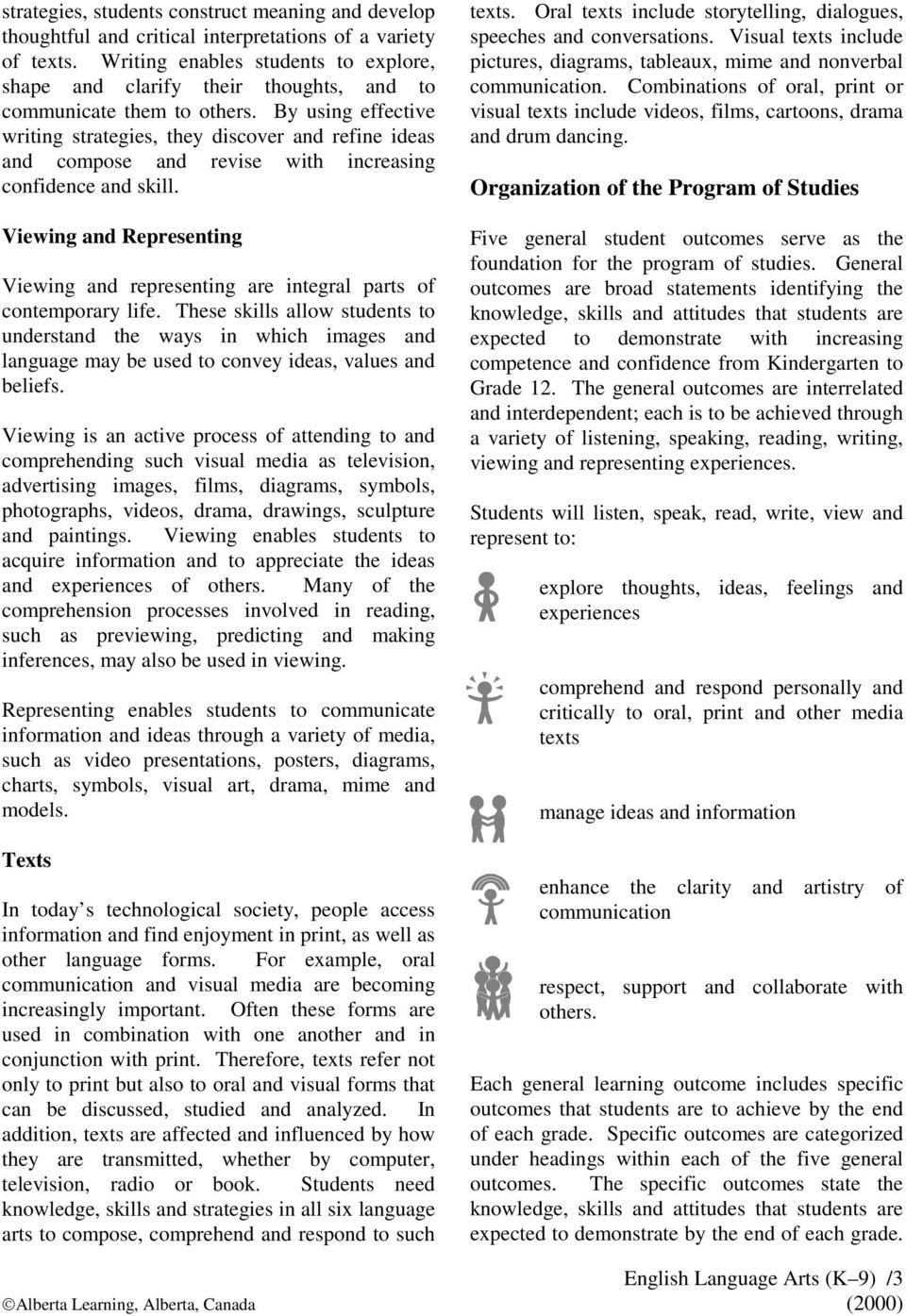
4 They are relevant for all students in a variety of learning environments and are cumulative across the grades. Students are expected to demonstrate the specific outcomes for their current grade while building on and maintaining their ability to demonstrate the specific outcomes for previous grades. It is intended that students engage in purposeful language activities that respect individual differences and emphasize the interrelated and mutually supportive nature of the general and specific outcomes. OUTCOMES FOR ENGLISH LANGUAGE ARTS The aim of English language arts is to enable each student to understand and appreciate language, and to use it confidently and competently in a variety of situations for communication, personal satisfaction and learning. General Outcome 3 Students will listen, speak, read, write, view and represent to manage ideas and information. 3.1 Plan and focus 3.2 Select and process 3.3 Organize, record and evaluate 3.4 Share and review General Outcome 4 Students will listen, speak, read, write, view and represent to enhance the clarity and artistry of communication. 4.1 Enhance and improve 4.2 Attend to conventions 4.3 Present and share General Outcome 5 Students will listen, speak, read, write, view and represent to respect, support and collaborate with others. 5.1 Respect others and strengthen community 5.2 Work within a group General Outcome 1 Students will listen, speak, read, write, view and represent to explore thoughts, ideas, feelings and experiences. 1.1 Discover and explore 1.2 Clarify and extend General Outcome 2 Students will listen, speak, read, write, view and represent to comprehend and respond personally and critically to oral, print and other media texts. 2.1 Use strategies and cues 2.2 Respond to texts 2.3 Understand forms, elements and techniques 2.4 Create original text 4/ English Language Arts (K 9) (2000) Alberta Learning, Alberta, Canada
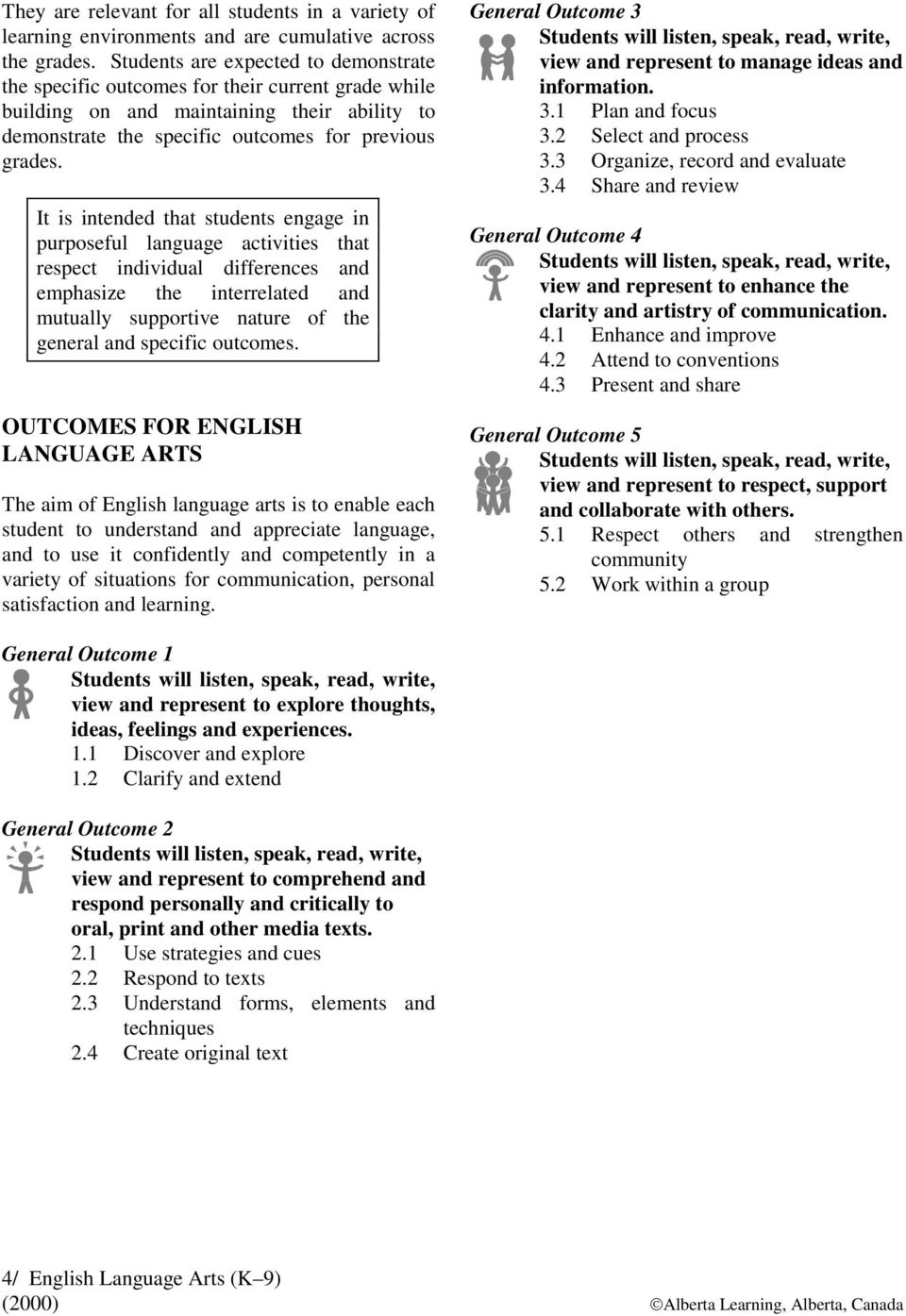
5 Guide to Reading the Program of Studies First digit indicates general outcome; second digit indicates subheading Subheading for cluster of specific outcomes Side headings for specific outcomes 2.4 Create Original Text Grade 3 Grade 4 Generate ideas x experiment with ways of generating and organizing ideas prior to creating oral, print and other media texts x use a variety of strategies for generating and organizing ideas and experiences in oral, print and other media texts Specific outcome statements expected by the end of each grade Elaborate on the expression of ideas x use sentence variety to link ideas and create impressions on familiar audiences Structure texts x experiment with a variety of story beginnings to choose ones that best introduce particular stories x add sufficient detail to oral, print and other media texts to tell about setting and character, and to sustain plot x select and use visuals that enhance meaning of oral, print and other media texts x produce oral, print and other media texts that follow a logical sequence, and demonstrate clear relationships between character and plot x produce narratives that describe experiences and reflect personal responses General outcome statement to comprehend and respond personally and critically to oral, print and other media texts. English Language Arts (K 9) /5

6 Experiment with language and forms Express preferences Express ideas and develop understanding Set goals 1.1 Discover and Explore General Outcome 1 Explore thoughts, ideas, feelings and experiences 1.2 Clarify and Extend Extend understanding Consider the ideas of others Combine ideas STUDENTS WILL LISTEN, SPEAK, READ, WRITE, VIEW AND REPRESENT. 6/ English Language Arts (K 9) General Outcome 1 (2000) Alberta Learning, Alberta, Canada
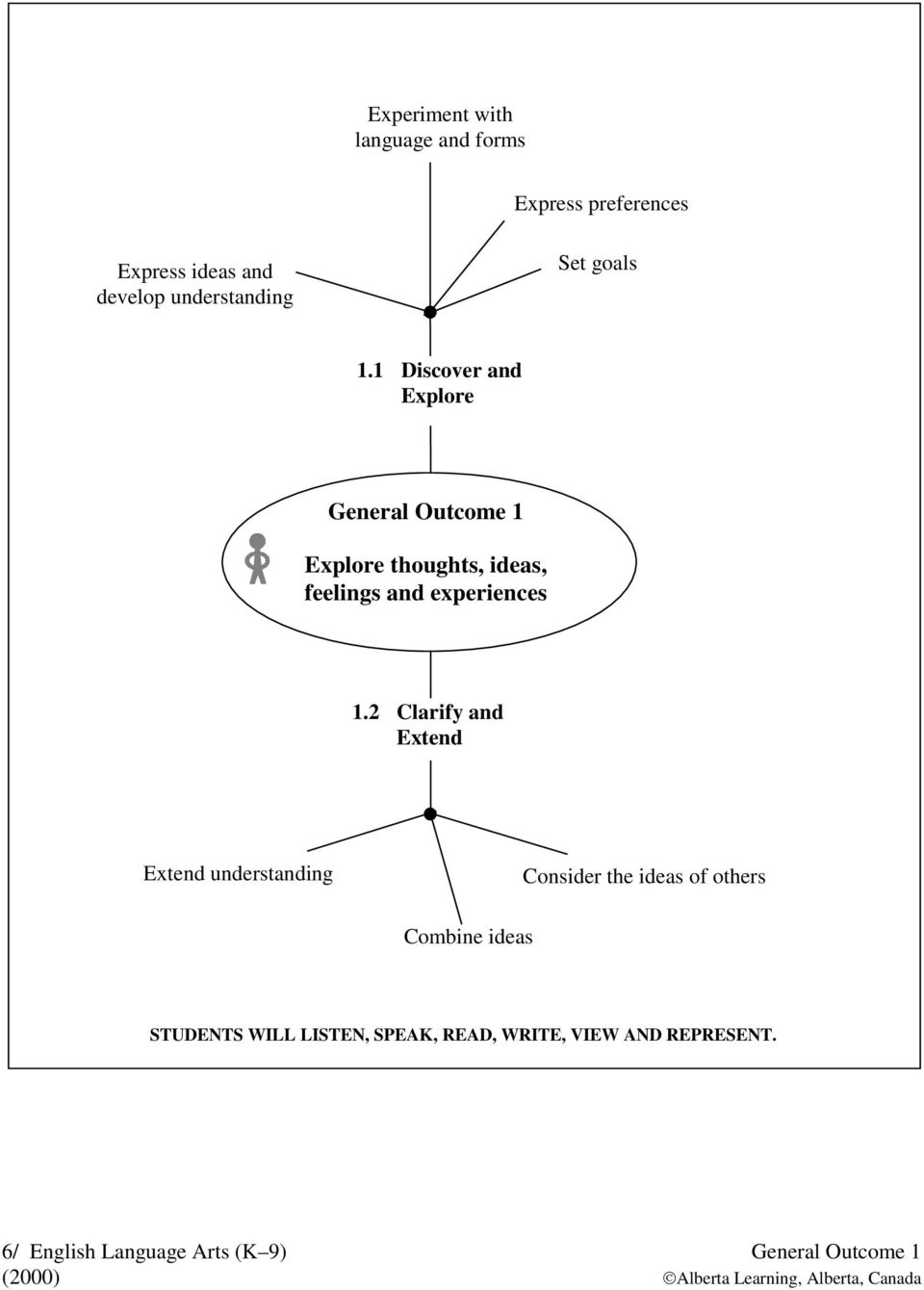
7 General Outcome 1 Students will listen, speak, read, write, view and represent to explore thoughts, ideas, feelings and experiences. Exploratory language enables students to organize and give meaning to experiences. Students use exploratory language to share thoughts, ideas and experiences, and to express and acknowledge emotions. Exploratory language enables students to discover and understand what they think and who they are. It also helps them reflect on themselves as language learners and language users. In addition, it helps them establish and maintain relationships. It is intended that students engage in purposeful language arts activities that respect individual differences and emphasize the interrelated and mutually supportive nature of the general and specific outcomes. Exploratory language is often oral. Through talk and conversation, students make observations, ask questions, hypothesize, make predictions and form opinions. Exploratory talk is often spontaneous. Sometimes students discover what they think at the point of utterance. Exploratory writing also helps students clarify their thinking. When students can see their ideas, thoughts, feelings and experiences in writing, they can reconsider, revise and elaborate on them in thoughtful ways. Representing is also used to explore ideas and interrelationships in diagrams, thought webs, charts and other visual media. Exploratory listening, reading and viewing enable students to gather and verify information, identify areas for further inquiry or research, and develop support for opinions. As students progress through the grades, they develop the ability to use exploratory language to achieve the other English language arts learning outcomes. For example, exploratory talk and writing enhance student comprehension by focusing their prior knowledge and experiences before reading, listening and viewing, and subsequently help them understand and manage information. Students use exploratory language when analyzing, evaluating and responding to texts, and when deciding how to use language more effectively. They use conversation to collaborate on projects and to develop a classroom community. General Outcome 1 English Language Arts (K 9) /7
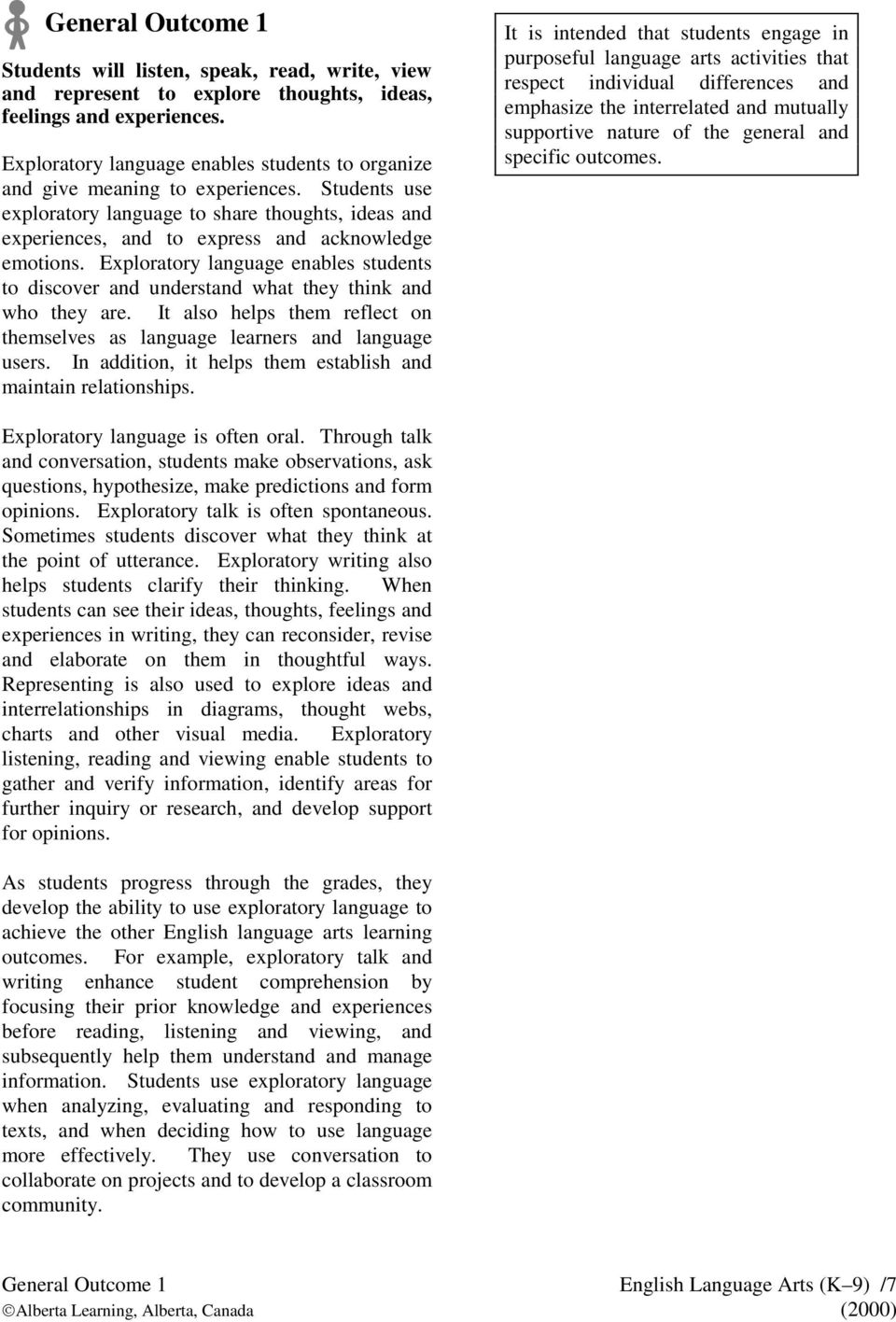
8 1.1 Discover and Explore Kindergarten Grade 1 Grade 2 Express ideas and develop understanding x share personal experiences prompted by oral, print and other media texts x talk about ideas, experiences and familiar events x share personal experiences that are clearly related to oral, print and other media texts x talk with others about something recently learned x make observations about activities, experiences with oral, print and other media texts x contribute relevant ideas and information from personal experiences to group language activities x talk about how new ideas and information have changed previous understanding x express or represent ideas and feelings resulting from activities or experiences with oral, print and other media texts Experiment with language and forms x talk and represent to explore, express and share stories, ideas and experiences x experiment with different ways of exploring and developing stories, ideas and experiences x use a variety of forms of oral, print and other media texts to organize and give meaning to experiences, ideas and information Express preferences x talk about favourite oral, print and other media texts x express preferences for a variety of oral, print and other media texts x explain why particular oral, print or other media texts are personal favourites Set goals x talk about own reading and writing experiences x choose to read and write for and with others x recognize and talk about developing abilities as readers, writers and illustrators to explore thoughts, ideas, feelings and experiences. 8/ English Language Arts (K 9) General Outcome 1 (2000) Alberta Learning, Alberta, Canada
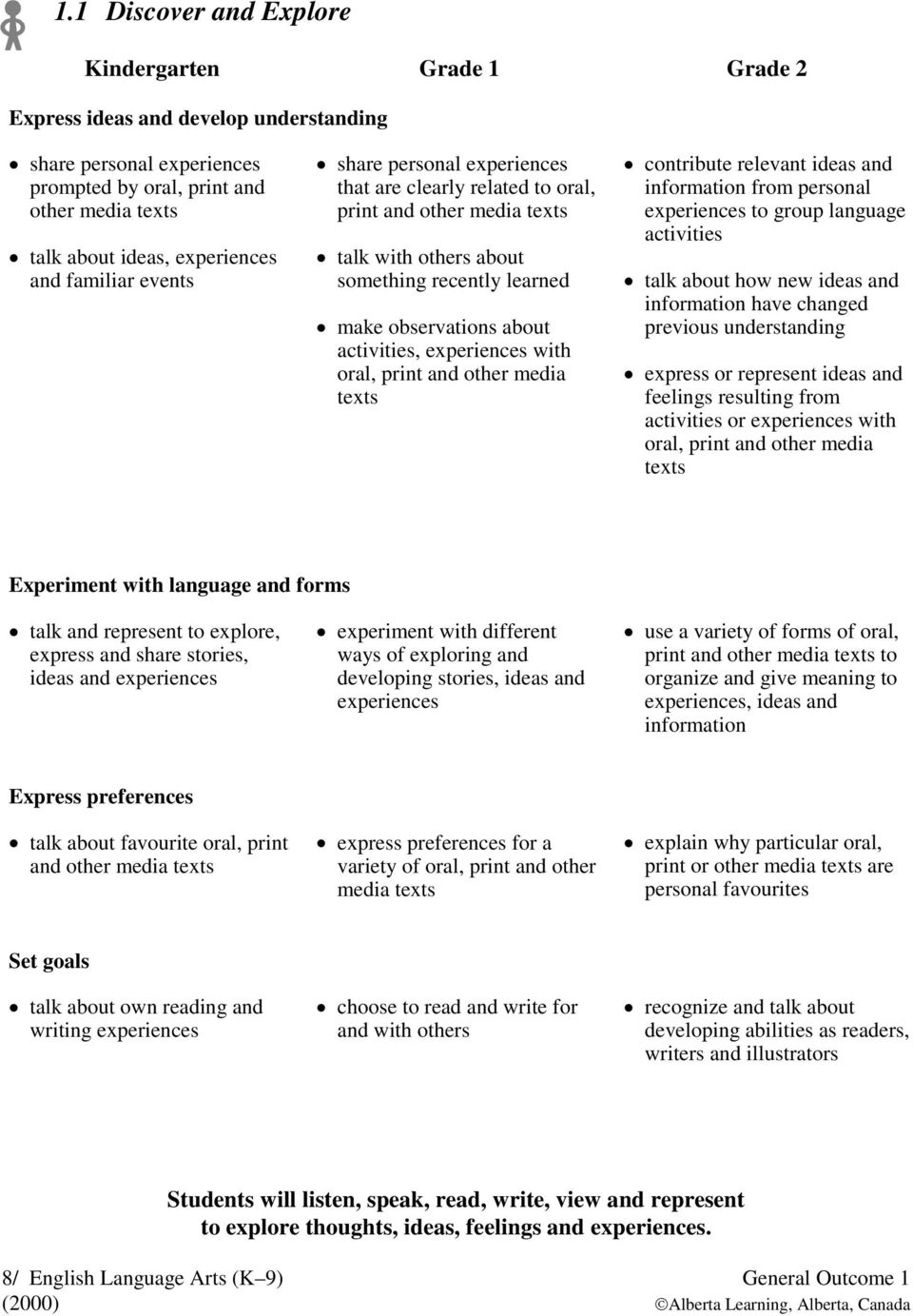
9 1.1 Discover and Explore Grade 3 Grade 4 Express ideas and develop understanding x connect prior knowledge and personal experiences with new ideas and information in oral, print and other media texts x explain understanding of new concepts in own words x explore ideas and feelings by asking questions, talking to others and referring to oral, print and other media texts x compare new ideas, information and experiences to prior knowledge and experiences x ask questions, paraphrase and discuss to explore ideas and understand new concepts x share personal responses to explore and develop understanding of oral, print and other media texts Experiment with language and forms x choose appropriate forms of oral, print and other media texts for communicating and sharing ideas with others x discuss and compare the ways similar topics are developed in different forms of oral, print and other media texts Express preferences x choose and share a variety of oral, print and other media texts in areas of particular interest x select preferred forms from a variety of oral, print and other media texts Set goals x discuss areas of personal accomplishment as readers, writers and illustrators x identify areas of personal accomplishment and areas for enhancement in language learning and use to explore thoughts, ideas, feelings and experiences. General Outcome 1 English Language Arts (K 9) /9
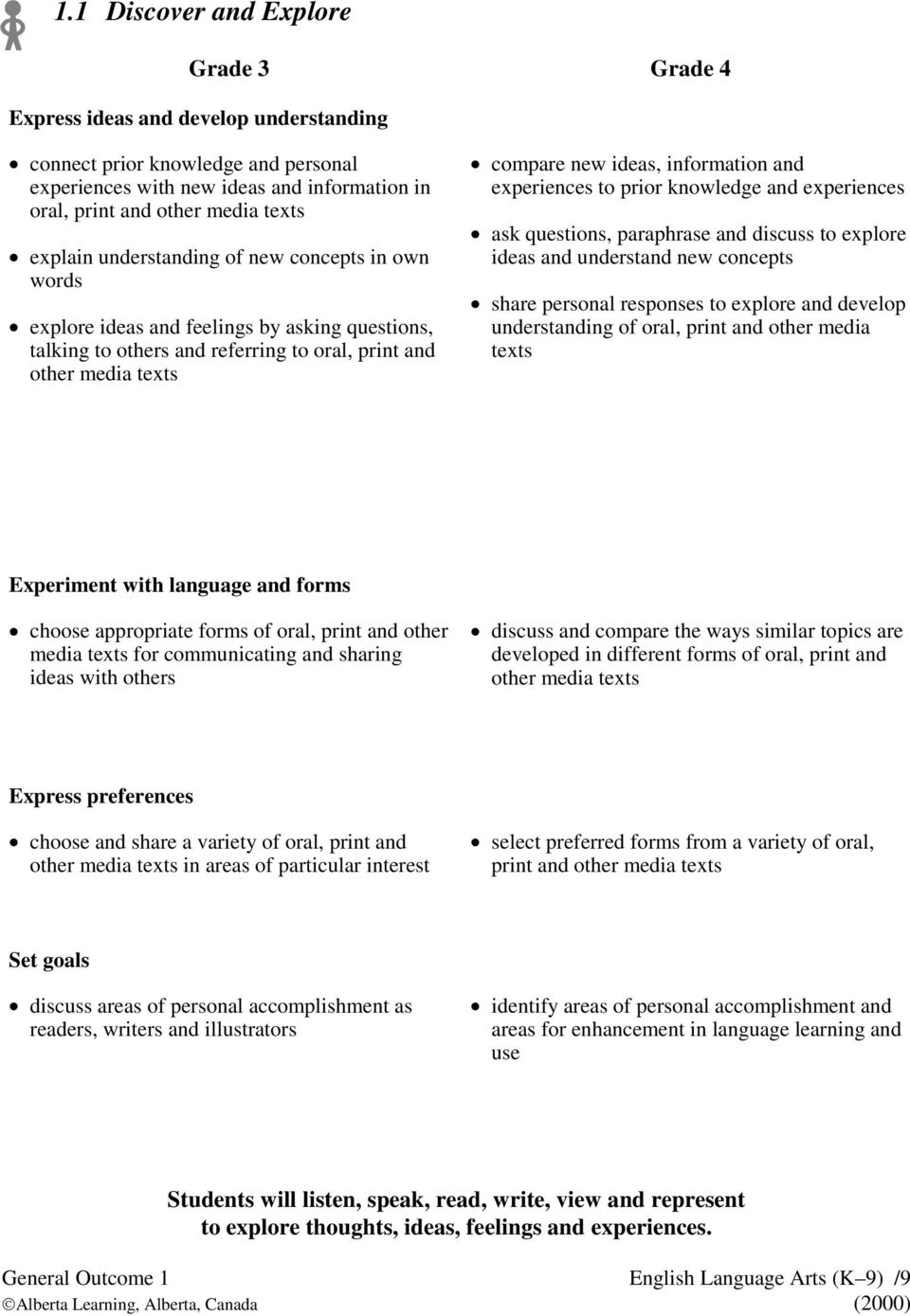
10 1.1 Discover and Explore Grade 5 Grade 6 Express ideas and develop understanding x use appropriate prior knowledge and experiences to make sense of new ideas and information x read, write, represent and talk to explore personal understandings of new ideas and information x use own experiences as a basis for exploring and expressing opinions and understanding x use prior experiences with oral, print and other media texts to choose new texts that meet learning needs and interests x read, write, represent and talk to explore and explain connections between prior knowledge and new information in oral, print and other media texts x engage in exploratory communication to share personal responses and develop own interpretations Experiment with language and forms x select from provided forms of oral, print and other media texts those that best organize ideas and information and develop understanding of topics x experiment with a variety of forms of oral, print and other media texts to discover those best suited for exploring, organizing and sharing ideas, information and experiences Express preferences x select and explain preferences for particular forms of oral, print and other media texts x assess a variety of oral, print and other media texts, and discuss preferences for particular forms Set goals x reflect on areas of personal accomplishment, and set personal goals to improve language learning and use x assess personal language use, and revise personal goals to enhance language learning and use to explore thoughts, ideas, feelings and experiences. 10/ English Language Arts (K 9) General Outcome 1 (2000) Alberta Learning, Alberta, Canada
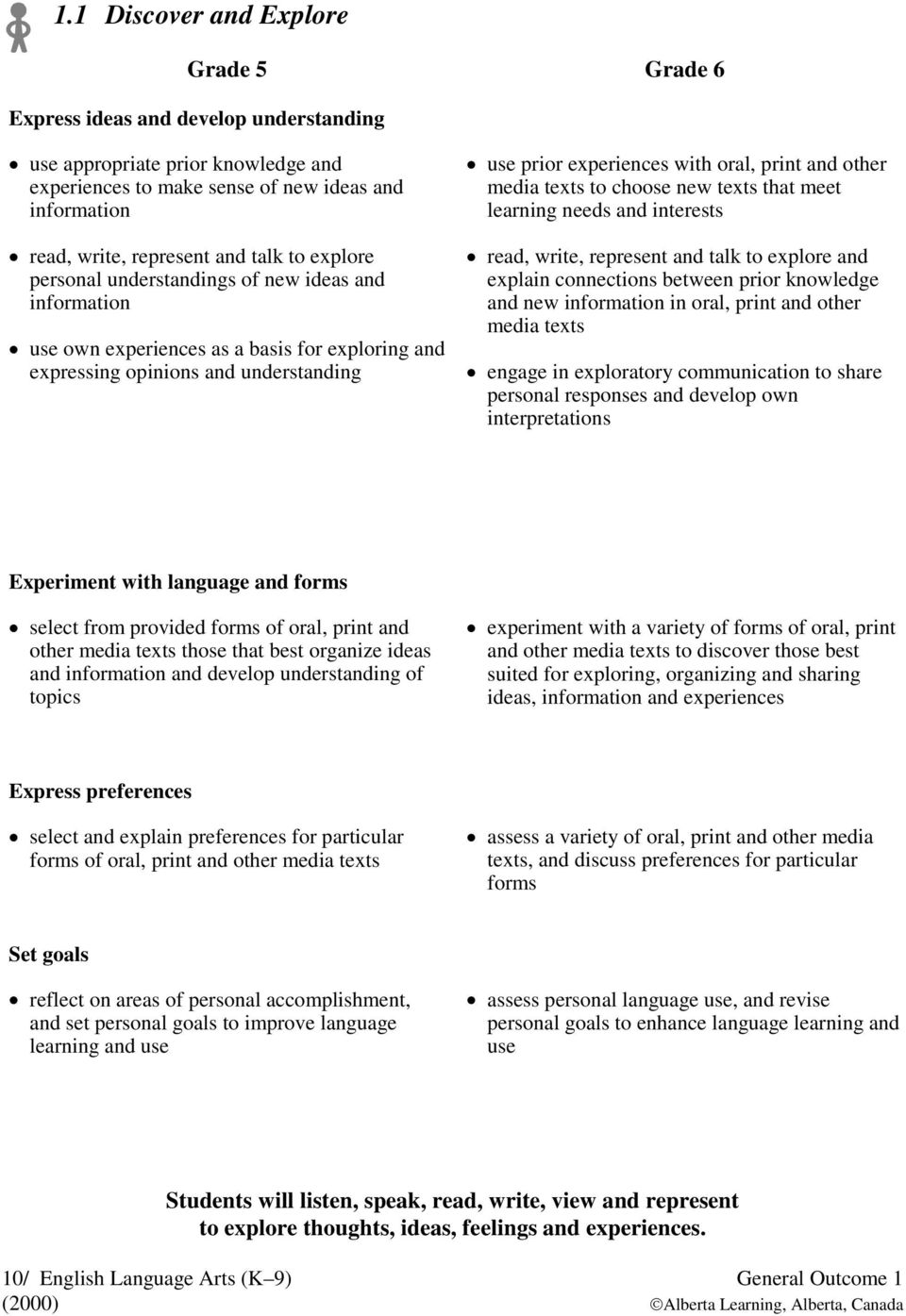
11 1.1 Discover and Explore Grade 7 Grade 8 Grade 9 Express ideas and develop understanding x extend understanding of ideas and information by finding and exploring oral, print and other media texts on related topics and themes x express personal understandings of ideas and information based on prior knowledge, experiences with others and a variety of oral, print and other media texts x reflect on own observations and experiences to understand and develop oral, print and other media texts Experiment with language and forms x revise understanding and expression of ideas by connecting new and prior knowledge and experiences x review, reread, discuss and reflect on oral, print and other media texts to explore, confirm or revise understanding x seek out and consider diverse ideas, opinions and experiences to develop and extend own ideas, opinions and experiences x talk with others and experience a variety of oral, print and other media texts to explore, develop and justify own opinions and points of view x explore and explain how interactions with others and with oral, print and other media texts affect personal understandings x extend understanding by taking different points of view when rereading and reflecting on oral, print and other media texts x discuss and respond to ways that content and forms of oral, print and other media texts interact to influence understanding Express preferences x explore and assess oral, print and other media texts recommended by others Set goals x use appropriate terminology to discuss developing abilities in personal language learning and use x discuss and respond to ways that forms of oral, print and other media texts enhance or constrain the development and communication of ideas, information and experiences x pursue personal interest in specific genres by particular writers, artists, storytellers and filmmakers x examine and reflect on own growth in effective use of language to revise and extend personal goals x develop and extend understanding by expressing and responding to ideas on the same topic, in a variety of forms of oral, print and other media texts x explain preferences for texts and genres by particular writers, artists, storytellers and filmmakers x reflect on own growth in language learning and use, by considering progress over time and the attainment of personal goals to explore thoughts, ideas, feelings and experiences. General Outcome 1 English Language Arts (K 9) /11
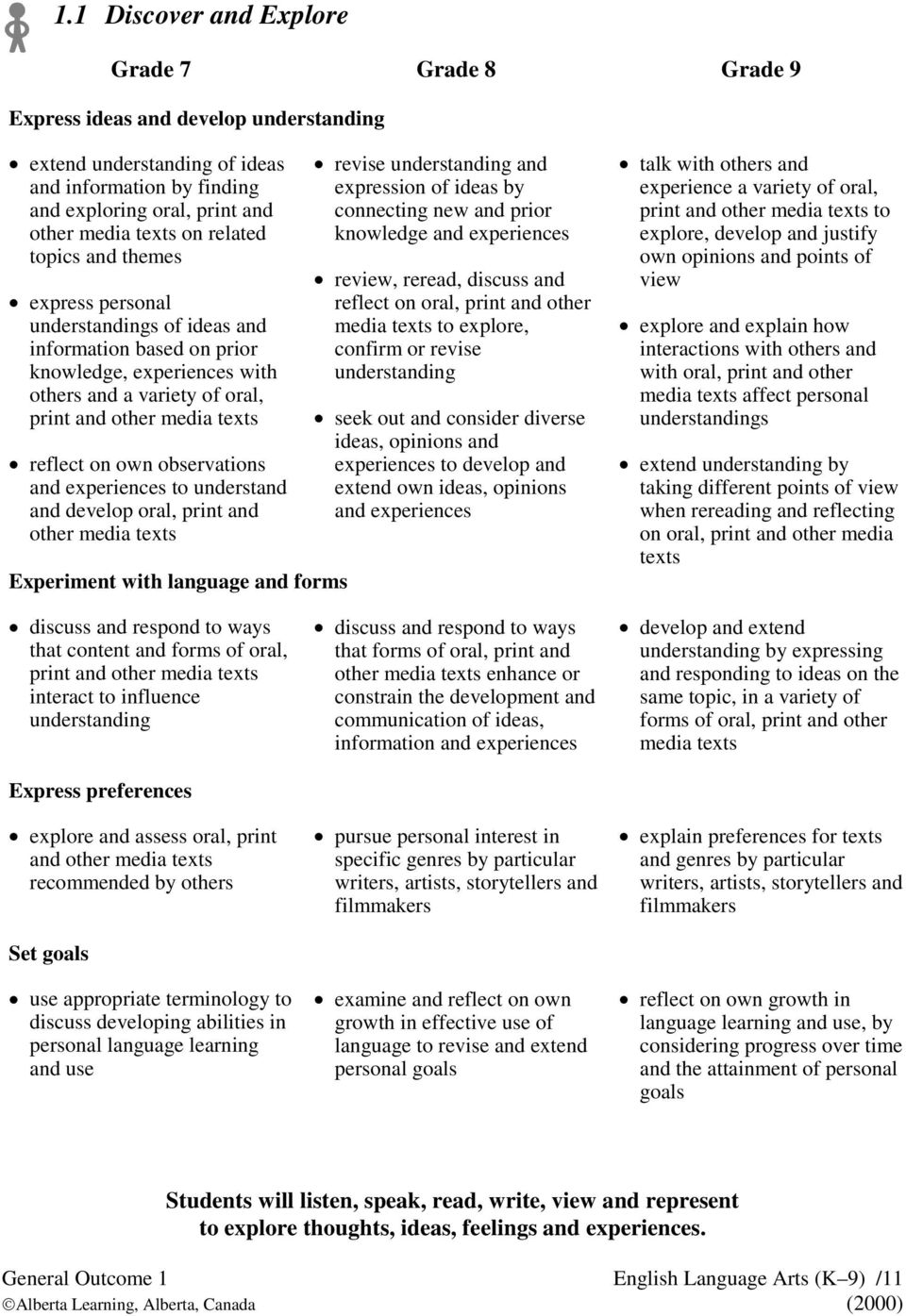
12 1.2 Clarify and Extend Kindergarten Grade 1 Grade 2 Consider the ideas of others x listen to experiences and feelings shared by others x listen and respond appropriately to experiences and feelings shared by others x connect own ideas and experiences with those shared by others Combine ideas x connect related ideas and information x group ideas and information into categories determined by an adult x record ideas and information in ways that make sense Extend understanding x express interest in new ideas and experiences x ask questions to get additional ideas and information on topics of interest x find more information about new ideas and topics to explore thoughts, ideas, feelings and experiences. 12/ English Language Arts (K 9) General Outcome 1 (2000) Alberta Learning, Alberta, Canada
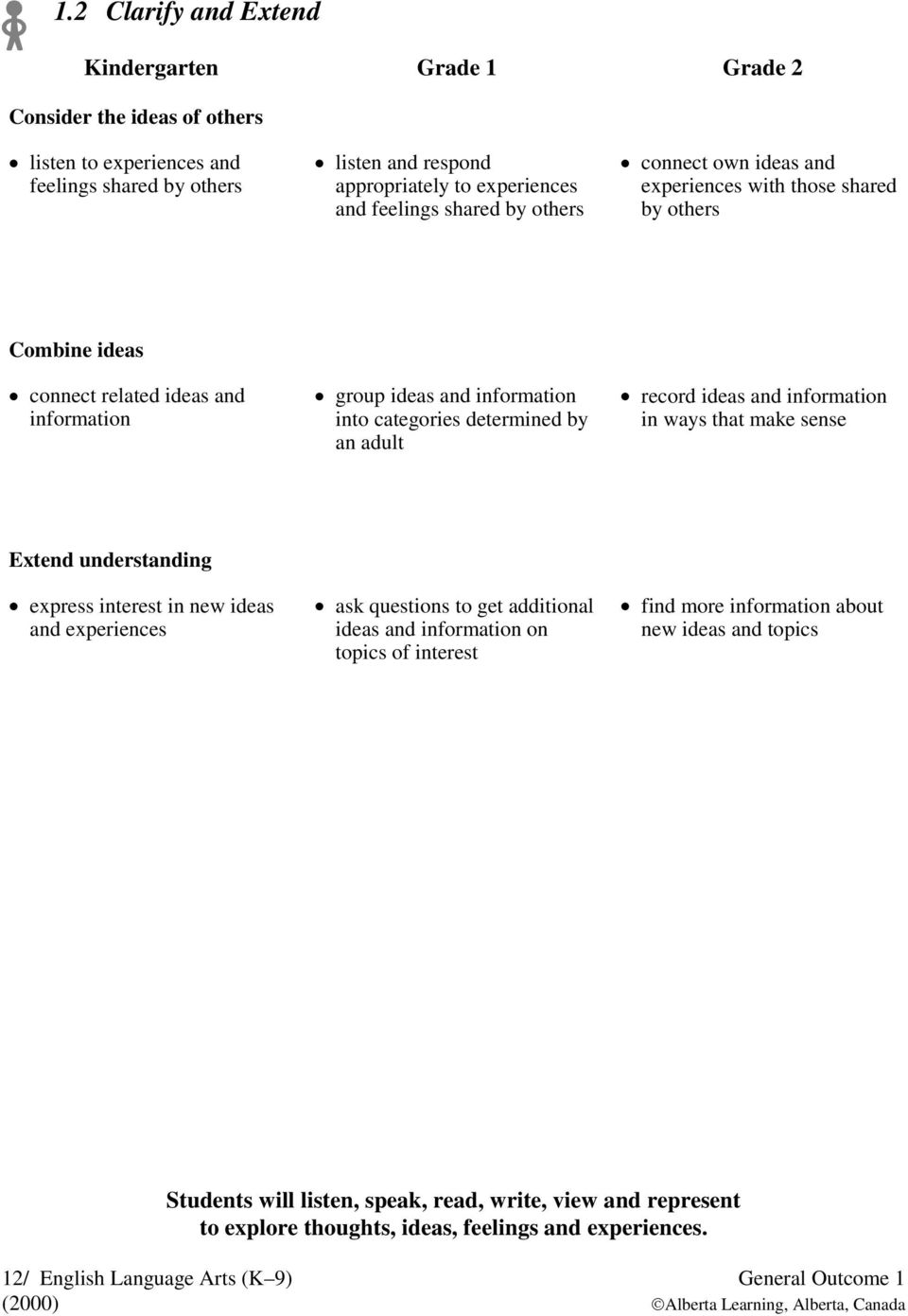
13 1.2 Clarify and Extend Consider the ideas of others Grade 3 Grade 4 x ask for the ideas and observations of others to explore and clarify personal understanding x identify other perspectives by exploring a variety of ideas, opinions, responses and oral, print and other media texts Combine ideas x experiment with arranging and recording ideas and information in a variety of ways x use talk, notes, personal writing and representing to record and reflect on ideas, information and experiences Extend understanding x ask questions to clarify information and ensure understanding x explore ways to find additional ideas and information to extend understanding to explore thoughts, ideas, feelings and experiences. General Outcome 1 English Language Arts (K 9) /13
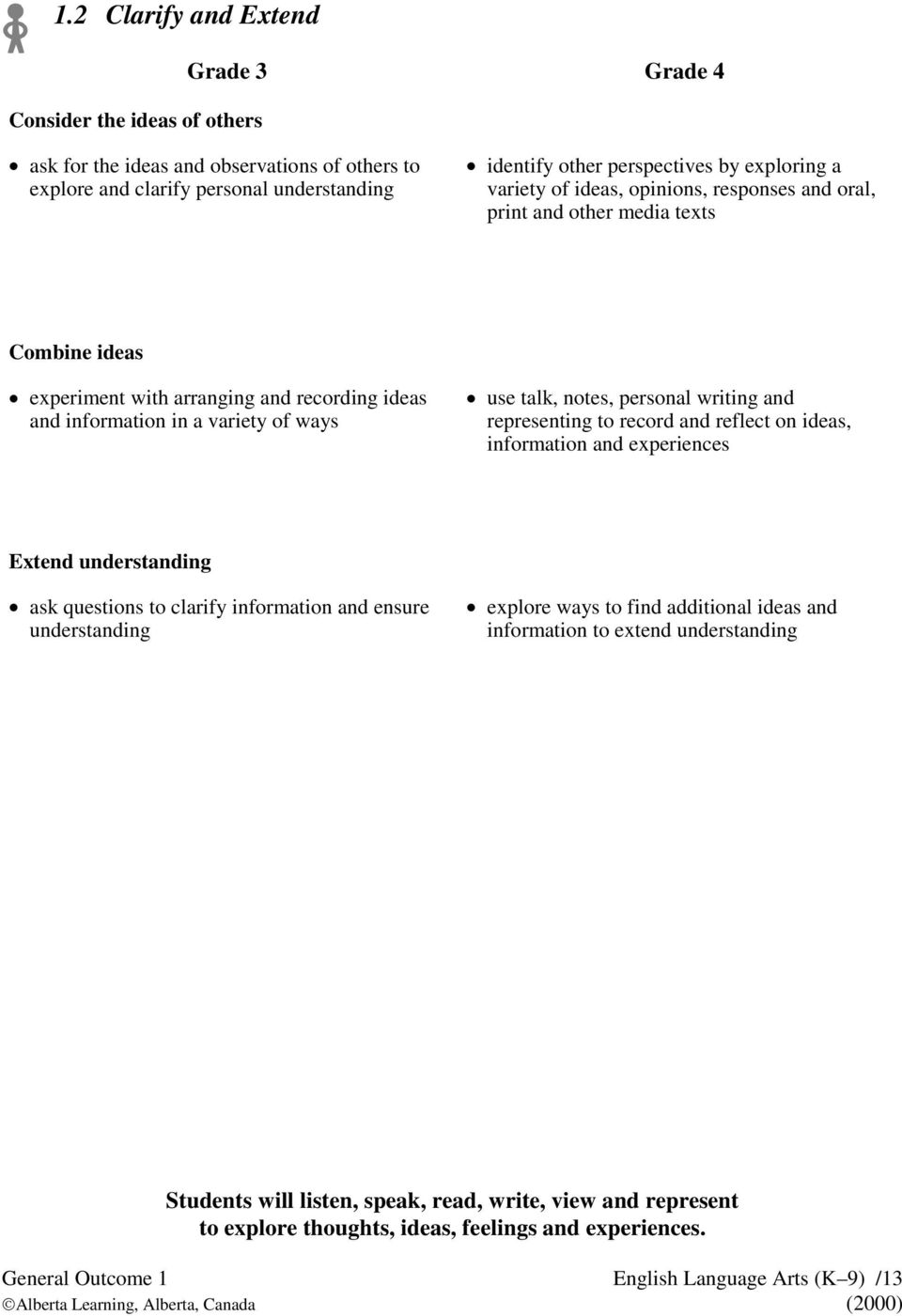
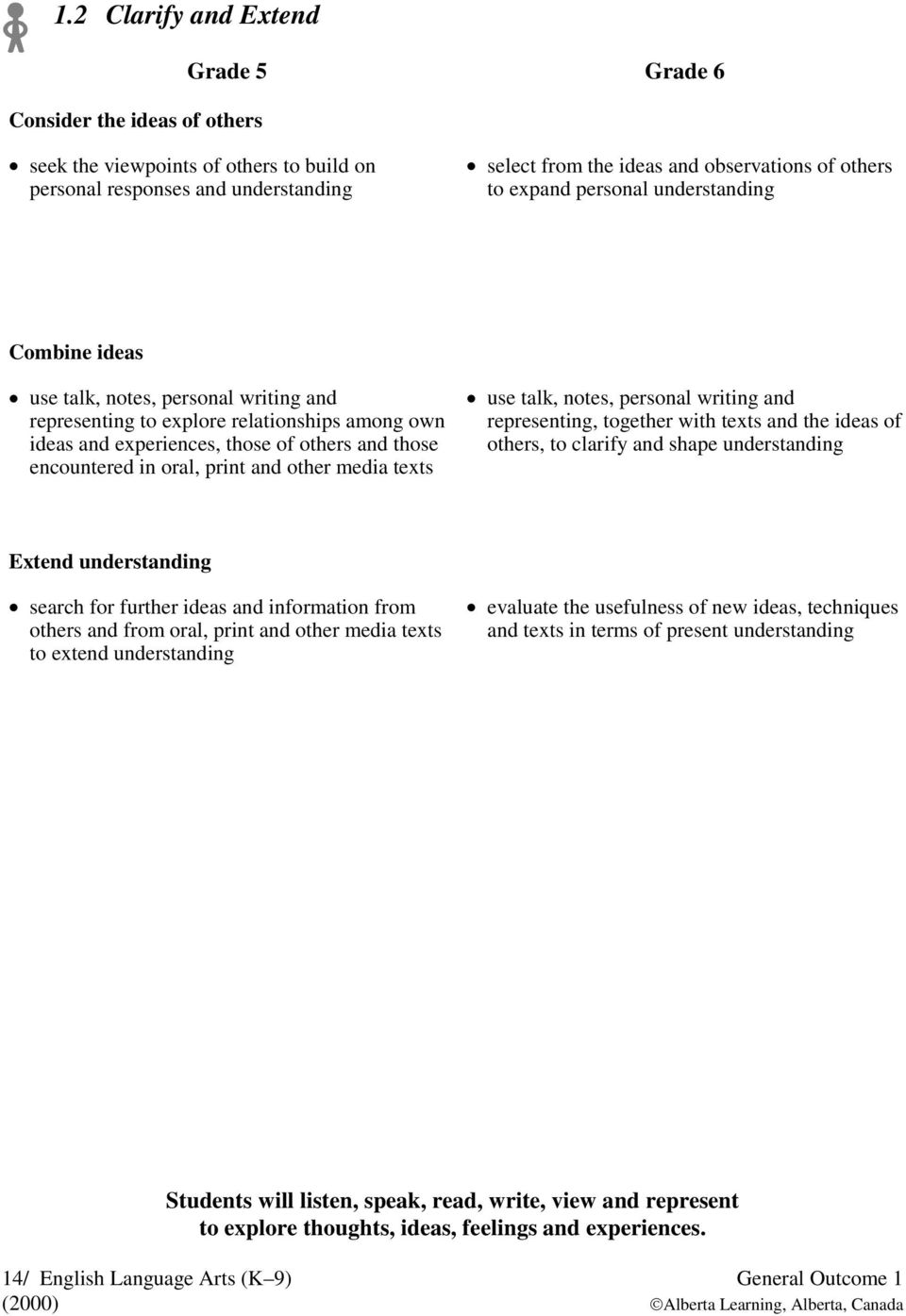
14 1.2 Clarify and Extend Consider the ideas of others Grade 5 Grade 6 x seek the viewpoints of others to build on personal responses and understanding x select from the ideas and observations of others to expand personal understanding Combine ideas x use talk, notes, personal writing and representing to explore relationships among own ideas and experiences, those of others and those encountered in oral, print and other media texts x use talk, notes, personal writing and representing, together with texts and the ideas of others, to clarify and shape understanding Extend understanding x search for further ideas and information from others and from oral, print and other media texts to extend understanding x evaluate the usefulness of new ideas, techniques and texts in terms of present understanding to explore thoughts, ideas, feelings and experiences. 14/ English Language Arts (K 9) General Outcome 1 (2000) Alberta Learning, Alberta, Canada
15 1.2 Clarify and Extend Grade 7 Grade 8 Grade 9 Consider the ideas of others x listen and respond constructively to alternative ideas or opinions Combine ideas x use talk, writing and representing to examine, clarify and assess understanding of ideas, information and experiences x acknowledge the value of the ideas and opinions of others in exploring and extending personal interpretations and perspectives x exchange ideas and opinions to clarify understanding and to broaden personal perspectives x integrate own perspectives and interpretations with new understandings developed through discussing and through experiencing a variety of oral, print and other media texts x examine and re-examine ideas, information and experiences from different points of view to find patterns and see relationships Extend understanding x talk with others to elaborate ideas, and ask specific questions to seek helpful feedback x reconsider and revise initial understandings and responses in light of new ideas, information and feedback from others x assess whether new information extends understanding by considering diverse opinions and exploring ambiguities to explore thoughts, ideas, feelings and experiences. General Outcome 1 English Language Arts (K 9) /15

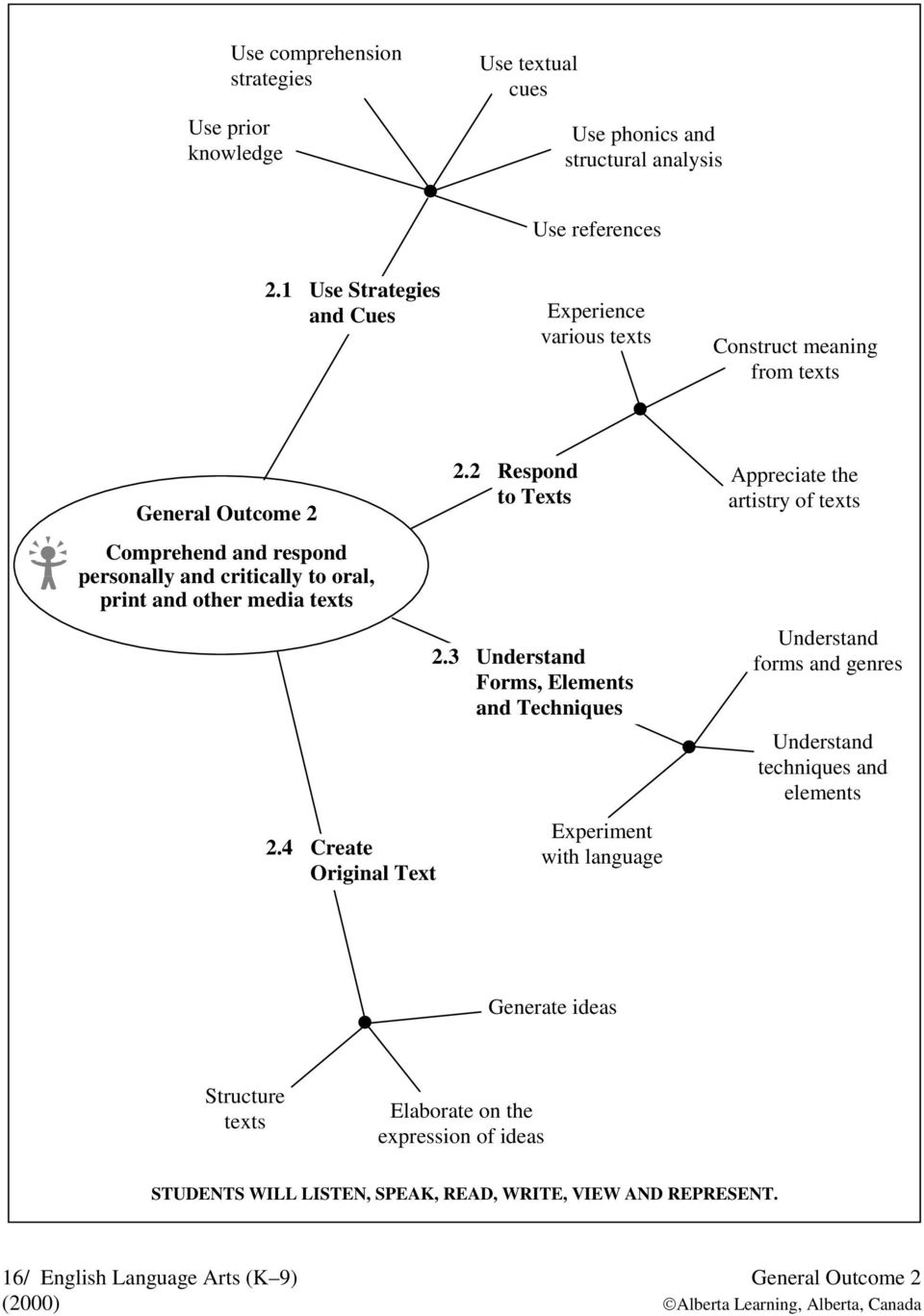
16 Use comprehension strategies Use prior knowledge Use textual cues Use phonics and structural analysis Use references 2.1 Use Strategies and Cues Experience various texts Construct meaning from texts General Outcome 2 Comprehend and respond personally and critically to oral, print and other media texts 2.4 Create Original Text 2.2 Respond to Texts 2.3 Understand Forms, Elements and Techniques Experiment with language Appreciate the artistry of texts Understand forms and genres Understand techniques and elements Generate ideas Structure texts Elaborate on the expression of ideas STUDENTS WILL LISTEN, SPEAK, READ, WRITE, VIEW AND REPRESENT. 16/ English Language Arts (K 9) General Outcome 2 (2000) Alberta Learning, Alberta, Canada
17 General Outcome 2 Students will listen, speak, read, write, view and represent to comprehend and respond personally and critically to oral, print and other media texts. Students use a variety of strategies and cueing systems as they interact with oral, print and other media texts. They preview, ask questions and set purposes. Students attend to the ideas being presented, make and confirm predictions and inferences, and monitor their understanding. As they interact with texts, students respond by reflecting, creating, analyzing, synthesizing and evaluating. Successful learners adapt these strategies as they construct meaning from a variety of oral, print and other media texts. It is intended that students engage in purposeful language arts activities that respect individual differences and emphasize the interrelated and mutually supportive nature of the general and specific outcomes. Making meaning of oral, print and other media texts is fundamental to English language arts. Through these texts, students experience a variety of situations, people and cultures, and learn about themselves. Oral, print and other media texts allow for multiple interpretations. Students can respond personally to texts, by relating them to their prior knowledge, to their feelings and experiences, and to other texts. Through personal response, students explore and form values and beliefs. They respond critically to texts, by making interpretations and evaluating ideas, forms and techniques. Students enhance their comprehension of and response to oral, print and other media texts through learning experiences in all the general outcomes. Exploratory talk and writing, for example, strengthen student understanding and evaluation of texts. Their appreciation of literary texts provides students with a range of topics and encourages them to experiment with a variety of forms in their own communication. Responding to oral, print and other media texts provides students with new insights. General Outcome 2 English Language Arts (K 9) /17
18 2.1 Use Strategies and Cues Kindergarten Grade 1 Grade 2 Use prior knowledge x connect oral language with print and pictures x understand that stories, information and personal experiences can be recorded in pictures and print and can be listened to, read or viewed x expect print and pictures to have meaning and to be related to each other in print and other media texts x understand that print and books are organized in predictable ways Use comprehension strategies x begin to use language prediction skills when stories are read aloud x ask questions and make comments during listening and reading activities x recall events and characters in familiar stories read aloud by others x read own first name, environmental print and symbols, words that have personal significance and some words in texts x use knowledge of how oral language is used in a variety of contexts to construct and confirm meaning x use previous experience and knowledge of oral language to make connections to the meaning of oral, print and other media texts x use knowledge of context, pictures, letters, words, sentences, predictable patterns and rhymes in a variety of oral, print and other media texts to construct and confirm meaning x use knowledge of print, pictures, book covers and title pages to construct and confirm meaning x use language prediction skills to identify unknown words within the context of a sentence x use a variety of strategies, such as making predictions, rereading and reading on x talk about print or other media texts previously read or viewed x identify the main idea or topic of simple narrative and expository texts (continued on page 22) x use knowledge of how oral and written language is used in a variety of contexts to construct and confirm meaning x connect personal experiences and knowledge of words, sentences and story patterns from previous reading experiences to construct and confirm meaning x use knowledge of the organizational structures of print and stories, such as book covers, titles, pictures and typical beginnings, to construct and confirm meaning x use knowledge of oral language to predict words when reading stories and poems x apply a variety of strategies, such as asking questions, making predictions, recognizing relationships among story elements and drawing conclusions x identify the main idea or topic and supporting details of simple narrative and expository texts (continued on page 22) to comprehend and respond personally and critically to oral, print and other media texts. 18/ English Language Arts (K 9) General Outcome 2 (2000) Alberta Learning, Alberta, Canada

19 2.1 Use Strategies and Cues Use prior knowledge Grade 3 Grade 4 x share ideas developed through interests, experiences and discussion that are related to new ideas and information x identify the different ways in which oral, print and other media texts, such as stories, textbooks, letters, pictionaries and junior dictionaries, are organized, and use them to construct and confirm meaning x use ideas and concepts, developed through personal interests, experiences and discussion, to understand new ideas and information x explain how the organizational structure of oral, print and other media texts can assist in constructing and confirming meaning Use comprehension strategies x use grammatical knowledge to predict words and sentence structures when reading narrative and expository materials x apply a variety of strategies, such as setting a purpose, confirming predictions, making inferences and drawing conclusions x identify the main idea or topic and supporting details in simple narrative and expository passages (continued on page 23) x preview sections of print texts to identify the general nature of the information and to set appropriate purpose and reading rate x comprehend new ideas and information by responding personally and discussing ideas with others x extend sight vocabulary to include words frequently used in other subject areas x monitor understanding by confirming or revising inferences and predictions based on information in text to comprehend and respond personally and critically to oral, print and other media texts. General Outcome 2 English Language Arts (K 9) /19

20 2.1 Use Strategies and Cues Use prior knowledge Grade 5 Grade 6 x describe ways that personal experiences and prior knowledge contribute to understanding new ideas and information x use knowledge of organizational structures, such as tables of contents, indices, topic sentences and headings, to locate information and to construct and confirm meaning x combine personal experiences and the knowledge and skills gained through previous experiences with oral, print and other media texts to understand new ideas and information x apply knowledge of organizational structures of oral, print and other media texts to assist with constructing and confirming meaning Use comprehension strategies x preview sections of print texts, and apply reading rate and strategies appropriate for the purpose, content and format of the texts x comprehend new ideas and information by responding personally, taking notes and discussing ideas with others x use the meanings of familiar words to predict the meanings of unfamiliar words in context x monitor understanding by comparing personal knowledge and experiences with information on the same topic from a variety of sources x identify, and explain in own words, the interrelationship of the main ideas and supporting details x preview the content and structure of subject area texts, and use this information to set a purpose, rate and strategy for reading x use definitions provided in context to identify the meanings of unfamiliar words x monitor understanding by evaluating new ideas and information in relation to known ideas and information to comprehend and respond personally and critically to oral, print and other media texts. 20/ English Language Arts (K 9) General Outcome 2 (2000) Alberta Learning, Alberta, Canada

21 2.1 Use Strategies and Cues Use prior knowledge Grade 7 Grade 8 Grade 9 x select and focus relevant ideas from personal experiences and prior knowledge to understand new ideas and information x use expectations and preferences developed during previous reading experiences to select and read new texts with purpose x use strategies to supplement and extend prior knowledge and experiences when interpreting new ideas and information x use knowledge of authors, forms and genres, developed during previous reading, to direct and extend reading experiences x discuss how interpretations of the same text might vary, according to the prior knowledge and experiences of various readers x use previous reading experiences, personal experiences and prior knowledge as a basis for reflecting on and interpreting ideas encountered in texts Use comprehension strategies x identify, connect, and summarize in own words, the main ideas from two or more sources on the same topic x use concept mapping and mental rehearsal to remember main ideas and relevant details x adjust reading rate and strategies to account for changes in structural features of texts and complexity of content x enhance understanding by paraphrasing main ideas and supporting details, and by rereading and discussing relevant passages x monitor understanding; skim, scan or read slowly and carefully, as appropriate, to enhance comprehension x take notes, make outlines and use such strategies as read, recite, review to comprehend and remember ideas and information x identify explicit and implicit ideas and information in texts; listen and respond to various interpretations of the same text x select appropriate reading rate and strategies for comprehending texts less closely connected to prior knowledge and personal experiences x preview complex texts as to their intent, content and structure, and use this information to set a purpose and select strategies for reading to comprehend and respond personally and critically to oral, print and other media texts. General Outcome 2 English Language Arts (K 9) /21
22 2.1 Use Strategies and Cues (continued) Kindergarten Grade 1 Grade 2 Use comprehension strategies (continued from page 18) (continued from page 18) x identify by sight some familiar words from favourite print texts x identify high frequency words by sight x read aloud with some fluency and accuracy, after rehearsal x self-correct when reading does not make sense, using cues such as pictures, context, phonics, grammatical awareness and background knowledge x identify by sight an increasing number of high frequency words and familiar words from favourite books x read aloud with fluency, accuracy and expression x figure out, predict and monitor the meaning of unfamiliar words to make sense of reading, using cues such as pictures, context, phonics, grammatical awareness and background knowledge Use textual cues x attend to print cues when stories are read aloud x begin to identify some individual words in texts that have been read aloud x preview book cover, pictures and location of text to assist with constructing and confirming meaning x use word boundaries, capital letters, periods, question marks and exclamation marks to assist with constructing and confirming meaning during oral and silent reading x preview book covers and titles; look for familiar words, phrases and story patterns to assist with constructing and confirming meaning x use predictable phrases and sentence patterns, and attend to capital letters, periods, question marks and exclamation marks to read accurately, fluently and with comprehension during oral and silent reading to comprehend and respond personally and critically to oral, print and other media texts. 22/ English Language Arts (K 9) General Outcome 2 (2000) Alberta Learning, Alberta, Canada
23 2.1 Use Strategies and Cues (continued) Grade 3 Grade 4 Use comprehension strategies (continued from page 19) x extend sight vocabulary to include predictable phrases and words related to language use x read silently with increasing confidence and accuracy x monitor and confirm meaning by rereading when necessary, and by applying knowledge of pragmatic, semantic, syntactic and graphophonic cueing systems Use textual cues x use headings, paragraphs, punctuation and quotation marks to assist with constructing and confirming meaning x attend to and use knowledge of capitalization, commas in a series, question marks, exclamation marks and quotation marks to read accurately, fluently and with comprehension during oral and silent reading x use text features, such as headings, subheadings and margin organizers, to enhance understanding of ideas and information x distinguish differences in the structural elements of texts, such as letters and storybooks, to access and comprehend ideas and information to comprehend and respond personally and critically to oral, print and other media texts. General Outcome 2 English Language Arts (K 9) /23
24 2.1 Use Strategies and Cues (continued) Grade 5 Grade 6 Use textual cues x use text features, such as maps, diagrams, special fonts and graphics, that highlight important concepts to enhance understanding of ideas and information x identify and use the structural elements of texts, such as letters, brochures, glossaries and encyclopedias, to access and comprehend ideas and information x use text features, such as charts, graphs and dictionaries, to enhance understanding of ideas and information x identify and use the structural elements of texts, such as magazines, newspapers, newscasts and news features, to access and comprehend ideas and information to comprehend and respond personally and critically to oral, print and other media texts. 24/ English Language Arts (K 9) General Outcome 2 (2000) Alberta Learning, Alberta, Canada
25 2.1 Use Strategies and Cues (continued) Grade 7 Grade 8 Grade 9 Use textual cues x identify and use visual and textual cues, such as numbers, bullets and words; for example, first/then/next, before/after, on the one hand/on the other hand and if/then, that signal organizational patterns in print and other media texts, to enhance understanding of ideas and information x identify and use, effectively and efficiently, structural features of textbooks, such as tables of contents and indices, to access ideas and information and to read with purpose x identify and use visual and textual cues in reference materials, such as catalogues, databases, web sites, thesauri and writers handbooks, to access information effectively and efficiently x identify and use structural features of a variety of oral, print and other media texts, such as newspapers, magazines, instruction booklets, advertisements and schedules, encountered in everyday life to access ideas and information and to read with purpose x use knowledge of visual and textual cues and structural features when skimming and scanning various print and other media texts to locate relevant information effectively and efficiently x analyze and discuss how the structural features of informational materials, such as textbooks, bibliographies, databases, catalogues, web sites, commercials and newscasts, enhance the effectiveness and efficiency of communication to comprehend and respond personally and critically to oral, print and other media texts. General Outcome 2 English Language Arts (K 9) /25
26 2.1 Use Strategies and Cues (continued) Kindergarten Grade 1 Grade 2 Use phonics and structural analysis x begin to make connections among sounds, letters, words, pictures and meaning x identify and generate rhyming words in oral language x hear and identify sounds in words x associate sounds with consonants that appear at the beginning of personally significant words Use references x recite the letters of the alphabet in order x copy scribed words and print texts to assist with writing x segment and blend sounds in words spoken or heard x use phonic knowledge and skills to read unfamiliar words in context x use analogy to generate and read phonically regular word families x associate sounds with letters and some letter clusters x use a displayed alphabet as an aid when writing x use personal word books, print texts and environmental print to assist with writing x name and match the upper and lower case forms of letters x apply phonic rules and generalizations to read unfamiliar words in context x apply knowledge of long and short vowel sounds to read unfamiliar words in context x use knowledge of word parts, contractions and compound words to read unfamiliar words in context x associate sounds with some vowel combinations, consonant blends and digraphs, and letter clusters to read unfamiliar words in context x put words in alphabetical order by first letter x use pictionaries and personal word books to confirm the spellings or locate the meanings of unfamiliar words in oral, print and other media texts to comprehend and respond personally and critically to oral, print and other media texts. 26/ English Language Arts (K 9) General Outcome 2 (2000) Alberta Learning, Alberta, Canada
27 2.1 Use Strategies and Cues (continued) Use phonics and structural analysis Grade 3 Grade 4 x apply phonic rules and generalizations competently and confidently to read unfamiliar words in context x apply word analysis strategies to segment words into parts or syllables, when reading unfamiliar words in context x associate sounds with an increasing number of vowel combinations, consonant blends and digraphs, and letter clusters to read unfamiliar words in context x identify and know the meaning of some frequently used prefixes and suffixes x apply knowledge of root words, compound words, syllabication, contractions and complex word families to read unfamiliar words in context x integrate knowledge of phonics and sight vocabulary with knowledge of language and context clues to read unfamiliar words in context Use references x put words in alphabetical order by first and second letter x use pictionaries, junior dictionaries and spell-check functions to confirm the spellings or locate the meanings of unfamiliar words in oral, print and other media texts x use alphabetical order by first and second letter to locate information in reference materials x use junior dictionaries, spell-check functions and electronic dictionaries to confirm the spellings or locate the meanings of unfamiliar words in oral, print and other media texts to comprehend and respond personally and critically to oral, print and other media texts. General Outcome 2 English Language Arts (K 9) /27
28 2.1 Use Strategies and Cues (continued) Use phonics and structural analysis Grade 5 Grade 6 x identify and know by sight the meaning of high frequency prefixes and suffixes to read unfamiliar, multisyllable words in context x integrate knowledge of phonics, sight vocabulary and structural analysis with knowledge of language and context clues to read unfamiliar words in context x use the meanings of prefixes and suffixes to predict the meanings of unfamiliar words in context x integrate and apply knowledge of phonics, sight vocabulary, language and context clues, and structural analysis to read unfamiliar words in texts of increasing length and complexity Use references x find words in dictionaries and glossaries to confirm the spellings or locate the meanings, by using knowledge of phonics and structural analysis, alphabetical order and guide words x choose the most appropriate reference to confirm the spellings or locate the meanings of unfamiliar words in oral, print and other media texts to comprehend and respond personally and critically to oral, print and other media texts. 28/ English Language Arts (K 9) General Outcome 2 (2000) Alberta Learning, Alberta, Canada
29 2.1 Use Strategies and Cues (continued) Grade 7 Grade 8 Grade 9 Use phonics and structural analysis x apply, flexibly, knowledge of phonics, sight vocabulary, structural analysis, language and context clues, depending on the purpose and rate of reading x choose and use strategies for word identification, vocabulary development and spelling that either build on specific strengths or address areas for improvement x apply and explain effective procedures for identifying and comprehending words in context; adjust procedures according to the purpose for reading and the complexity of the texts Use references x skim and scan reference materials to confirm the spellings or locate the meanings of unfamiliar words x use a thesaurus to extend vocabulary and locate appropriate words that express particular aspects of meaning x use reference materials, including a writer s handbook, to verify correct usage, address uncertainties and solve problems that arise to comprehend and respond personally and critically to oral, print and other media texts. General Outcome 2 English Language Arts (K 9) /29
30 2.2 Respond to Texts Kindergarten Grade 1 Grade 2 Experience various texts x participate in shared listening, reading and viewing experiences, using oral, print and other media texts from a variety of cultural traditions and genres, such as picture books, fairy tales, rhymes, stories, photographs, illustrations and video programs x listen and view attentively x identify favourite stories and books x participate in shared listening, reading and viewing experiences, using oral, print and other media texts from a variety of cultural traditions and genres, such as poems, storytelling by elders, pattern books, audiotapes, stories and cartoons x illustrate and enact stories, rhymes and songs x remember and retell familiar stories and rhymes x engage in a variety of shared and independent listening, reading and viewing experiences, using oral, print and other media texts from a variety of cultural traditions and genres, such as legends, video programs, puppet plays, songs, riddles and informational texts x identify favourite kinds of oral, print and other media texts x model own oral, print and other media texts on familiar forms x respond to mood established in a variety of oral, print and other media texts Construct meaning from texts x relate aspects of oral, print and other media texts to personal feelings and experiences x talk about and represent the actions of characters portrayed in oral, print and other media texts (continued on page 34) x relate aspects of stories and characters to personal feelings and experiences x retell interesting or important aspects of oral, print and other media texts (continued on page 34) x connect situations portrayed in oral, print and other media texts to personal and classroom experiences x retell the events portrayed in oral, print and other media texts in sequence (continued on page 34) to comprehend and respond personally and critically to oral, print and other media texts. 30/ English Language Arts (K 9) General Outcome 2 (2000) Alberta Learning, Alberta, Canada
31 2.2 Respond to Texts Experience various texts Grade 3 Grade 4 x choose a variety of oral, print and other media texts for shared and independent listening, reading and viewing experiences, using texts from a variety of cultural traditions and genres, such as nonfiction, chapter books, illustrated storybooks, drum dances, fables, CDROM programs and plays x tell or write about favourite parts of oral, print and other media texts x identify types of literature, such as humour, poetry, adventure and fairy tales, and describe favourites x connect own experiences with the experiences of individuals portrayed in oral, print and other media texts, using textual references x experience oral, print and other media texts from a variety of cultural traditions and genres, such as personal narratives, plays, novels, video programs, adventure stories, folk tales, informational texts, mysteries, poetry and CDROM programs x identify and discuss favourite authors, topics and kinds of oral, print and other media texts x discuss a variety of oral, print or other media texts by the same author, illustrator, storyteller or filmmaker x retell events of stories in another form or medium x make general evaluative statements about oral, print and other media texts Construct meaning from texts x connect portrayals of characters or situations in oral, print and other media texts to personal and classroom experiences x summarize the main idea of individual oral, print and other media texts (continued on page 35) x connect the thoughts and actions of characters portrayed in oral, print and other media texts to personal and classroom experiences x identify the main events in oral, print and other media texts; explain their causes, and describe how they influence subsequent events (continued on page 35) to comprehend and respond personally and critically to oral, print and other media texts. General Outcome 2 English Language Arts (K 9) /31
32 2.2 Respond to Texts Experience various texts Grade 5 Grade 6 x experience oral, print and other media texts from a variety of cultural traditions and genres, such as historical fiction, myths, biographies, poetry, news reports and guest speakers x express points of view about oral, print and other media texts x make connections between fictional texts and historical events x describe and discuss new places, times, characters and events encountered in oral, print and other media texts x write or represent the meaning of texts in different forms x experience oral, print and other media texts from a variety of cultural traditions and genres, such as autobiographies, travelogues, comics, short films, myths, legends and dramatic performances x explain own point of view about oral, print and other media texts x make connections between own life and characters and ideas in oral, print and other media texts x discuss common topics or themes in a variety of oral, print and other media texts x discuss the author s, illustrator s, storyteller s or filmmaker s intention or purpose Construct meaning from texts x compare characters and situations portrayed in oral, print and other media texts to those encountered in the classroom and community x describe characters qualities based on what they say and do and how they are described in oral, print and other media texts (continued on page 36) x observe and discuss aspects of human nature revealed in oral, print and other media texts, and relate them to those encountered in the community x summarize oral, print or other media texts, indicating the connections among events, characters and settings (continued on page 36) to comprehend and respond personally and critically to oral, print and other media texts. 32/ English Language Arts (K 9) General Outcome 2 (2000) Alberta Learning, Alberta, Canada
33 2.2 Respond to Texts Grade 7 Grade 8 Grade 9 Experience various texts x experience oral, print and other media texts from a variety of cultural traditions and genres, such as journals, nature programs, short stories, poetry, letters, CDROM programs, mysteries, historical fiction, drawings and prints x justify own point of view about oral, print and other media texts, using evidence from texts x organize interpretations of oral, print and other media texts around two or three key ideas x express interpretations of oral, print and other media texts in another form or genre x predict and discuss the consequences of events or characters actions, based on information in oral, print and other media texts Construct meaning from texts x compare the choices and behaviours of characters portrayed in oral, print and other media texts with those of self and others x analyze how plot develops; the connection between plot and subplot; and the interrelationship of plot, setting and characters (continued on page 37) x experience oral, print and other media texts from a variety of cultural traditions and genres, such as magazine articles, diaries, drama, poetry, Internet passages, fantasy, nonfiction, advertisements and photographs x write and represent narratives from other points of view x expect that there is more than one interpretation for oral, print and other media texts, and discuss other points of view x explain connections between own interpretation and information in texts, and infer how texts will influence others x make connections between biographical information about authors, illustrators, storytellers and filmmakers and their texts x interpret the choices and motives of characters portrayed in oral, print and other media texts, and examine how they relate to self and others x identify and describe characters attributes and motivations, using evidence from the text and personal experiences (continued on page 37) x experience oral, print and other media texts from a variety of cultural traditions and genres, such as essays, broadcast advertisements, novels, poetry, documentaries, films, electronic magazines and realistic fiction x identify and discuss how timeless themes are developed in a variety of oral, print and other media texts x consider historical context when developing own points of view or interpretations of oral, print and other media texts x compare and contrast own life situation with themes of oral, print and other media texts x express the themes of oral, print or other media texts in different forms or genres x consider peers interpretations of oral, print and other media texts, referring to the texts for supporting or contradicting evidence x analyze how the choices and motives of characters portrayed in oral, print and other media texts provide insight into those of self and others x identify and discuss theme and point of view in oral, print and other media texts (continued on page 37) to comprehend and respond personally and critically to oral, print and other media texts. General Outcome 2 English Language Arts (K 9) /33
34 2.2 Respond to Texts (continued) Kindergarten Grade 1 Grade 2 Construct meaning from texts (continued from page 30) (continued from page 30) (continued from page 30) x talk about experiences similar or related to those in oral, print and other media texts Appreciate the artistry of texts x experiment with sounds, words, word patterns, rhymes and rhythms x tell or represent the beginning, middle and end of stories x tell, represent or write about experiences similar or related to those in oral, print and other media texts x tell what was liked or disliked about oral, print and other media texts x identify how words can imitate sounds and create special effects x experiment with repetition, rhyme and rhythm to create effects in own oral, print and other media texts x suggest alternative endings for oral, print and other media texts x discuss, represent or write about interesting or important aspects of oral, print and other media texts x express thoughts or feelings related to the events and characters in oral, print and other media texts x identify and use words and sentences that have particular emotional effects x identify words in oral, print and other media texts that create clear pictures or impressions of sounds and sights to comprehend and respond personally and critically to oral, print and other media texts. 34/ English Language Arts (K 9) General Outcome 2 (2000) Alberta Learning, Alberta, Canada
35 2.2 Respond to Texts (continued) Construct meaning from texts Grade 3 Grade 4 (continued from page 31) (continued from page 31) x discuss, represent or write about ideas in oral, print and other media texts, and relate them to own ideas and experiences and to other texts x compare similar oral, print and other media texts and express preferences, using evidence from personal experiences and the texts x make inferences about a character s actions or feelings x develop own opinions based on ideas encountered in oral, print and other media texts x express preferences for one character over another Appreciate the artistry of texts x express feelings related to words, visuals and sound in oral, print and other media texts x identify how authors use comparisons, and explain how they create mental images x explain how onomatopoeia and alliteration are used to create mental images x explain how language and visuals work together to communicate meaning and enhance effect to comprehend and respond personally and critically to oral, print and other media texts. General Outcome 2 English Language Arts (K 9) /35
36 2.2 Respond to Texts (continued) Grade 5 Grade 6 Construct meaning from texts (continued from page 32) (continued from page 32) x describe and discuss the influence of setting on the characters and events x support own interpretations of oral, print and other media texts, using evidence from personal experiences and the texts x retell or represent stories from the points of view of different characters x identify or infer reasons for a character s actions or feelings x make judgements and inferences related to events, characters, setting and main ideas of oral, print and other media texts x comment on the credibility of characters and events in oral, print and other media texts, using evidence from personal experiences and the text Appreciate the artistry of texts x explain how simile and hyperbole are used to create mood and mental images x alter sentences and word choices to enhance meaning and to create mood and special effects x explain how metaphor, personification and synecdoche are used to create mood and mental images x experiment with sentence patterns, imagery and exaggeration to create mood and mental images x discuss how detail is used to enhance character, setting, action and mood in oral, print and other media texts to comprehend and respond personally and critically to oral, print and other media texts. 36/ English Language Arts (K 9) General Outcome 2 (2000) Alberta Learning, Alberta, Canada
37 2.2 Respond to Texts (continued) Grade 7 Grade 8 Grade 9 Construct meaning from texts (continued from page 33) (continued from page 33) (continued from page 33) x identify and explain conflict, and discuss how it develops and may be resolved x develop, clarify and defend own interpretation, based on evidence from the text with support from own experiences x discuss various ways characters are developed and the reasons for and plausibility of character change x compare two similar oral, print or other media texts by considering the characters, plot, conflicts and main ideas x discuss and explain various interpretations of the same oral, print or other media text x relate the themes, emotions and experiences portrayed in oral, print and other media texts to issues of personal interest or significance Appreciate the artistry of texts x discuss how techniques, such as colour, shape, composition, suspense, foreshadowing and flashback, are used to communicate meaning and enhance effects in oral, print and other media texts x identify and explain the usefulness, effectiveness and limitations of various forms of oral, print and other media texts x reflect on, revise and elaborate on initial impressions of oral, print and other media texts, through subsequent reading, listening and viewing activities x discuss how techniques, such as word choice, balance, camera angles, line and framing, communicate meaning and enhance effects in oral, print and other media texts x identify ways that characters can be developed, and discuss how character, plot and setting are interconnected and mutually supportive x identify and discuss how word choice and order, figurative language, plot, setting and character work together to create mood and tone x discuss how techniques, such as irony, symbolism, perspective and proportion, communicate meaning and enhance effect in oral, print and other media texts x discuss character development in terms of consistency of behaviour and plausibility of change x describe how theme, dominant impression and mood are developed and sustained through choices in language use and the interrelationship of plot, setting and character x identify features that define particular oral, print and other media texts; discuss differences in style and their effects on content and audience impression to comprehend and respond personally and critically to oral, print and other media texts. General Outcome 2 English Language Arts (K 9) /37
38 2.3 Understand Forms, Elements and Techniques Kindergarten Grade 1 Grade 2 Understand forms and genres x experience a variety of oral, print and other media texts x distinguish differences in the ways various oral, print and other media texts are organized x identify various forms of media texts x recognize that ideas and information can be expressed in a variety of oral, print and other media texts x identify and explain the use of various communication technologies Understand techniques and elements x develop a sense of story through reading, listening and viewing experiences x identify the main characters in a variety of oral, print and other media texts x know that stories have beginnings, middles and endings x tell what characters do or what happens to them in a variety of oral, print and other media texts x identify main characters, places and events in a variety of oral, print and other media texts x identify how pictures, illustrations and special fonts relate to and enhance print and other media texts Experiment with language x appreciate the sounds and rhythms of language in shared language experiences, such as nursery rhymes and personal songs x demonstrate interest in repetition, rhyme and rhythm in shared language experiences, such as action songs and word play x demonstrate interest in the sounds of words and word combinations in pattern books, poems, songs, and oral and visual presentations to comprehend and respond personally and critically to oral, print and other media texts. 38/ English Language Arts (K 9) General Outcome 2 (2000) Alberta Learning, Alberta, Canada
39 2.3 Understand Forms, Elements and Techniques Understand forms and genres Grade 3 Grade 4 x identify distinguishing features of a variety of oral, print and other media texts x discuss ways that visual images convey meaning in print and other media texts x describe and compare the main characteristics of a variety of oral, print and other media texts x identify various ways that information can be recorded and presented visually Understand techniques and elements x include events, setting and characters when summarizing or retelling oral, print or other media texts x describe the main characters in terms of who they are, their actions in the story and their relations with other characters x identify ways that messages are enhanced in oral, print and other media texts by the use of specific techniques x identify and explain connections among events, setting and main characters in oral, print and other media texts x identify the speaker or narrator of oral, print or other media texts x identify how specific techniques are used to affect viewer perceptions in media texts Experiment with language x recognize examples of repeated humour, sound and poetic effects that contribute to audience enjoyment x recognize how words and word combinations, such as word play, repetition and rhyme, influence or convey meaning to comprehend and respond personally and critically to oral, print and other media texts. General Outcome 2 English Language Arts (K 9) /39
40 2.3 Understand Forms, Elements and Techniques Understand forms and genres Grade 5 Grade 6 x identify and discuss similarities and differences among a variety of forms of oral, print and other media texts x identify the main characteristics of familiar media and media texts x identify key characteristics of a variety of forms or genres of oral, print and other media texts x discuss the differences between print and other media versions of the same text Understand techniques and elements x identify the main problem or conflict in oral, print and other media texts, and explain how it is resolved x identify and discuss the main character s point of view and motivation x identify examples of apt word choice and imagery that create particular effects x identify sections or elements in print or other media texts, such as shots in films or sections in magazines x discuss the connections among plot, setting and characters in oral, print and other media texts x identify first and third person narration, and discuss preferences with reference to familiar texts x explore techniques, such as visual imagery, sound, flashback and voice inflection, in oral, print and other media texts x identify strategies that presenters use in media texts to influence audiences Experiment with language x experiment with words and sentence patterns to create word pictures; identify how imagery and figurative language, such as simile and exaggeration, convey meaning x alter words, forms and sentence patterns to create new versions of texts for a variety of purposes; explain how imagery and figurative language, such as personification and alliteration, clarify and enhance meaning to comprehend and respond personally and critically to oral, print and other media texts. 40/ English Language Arts (K 9) General Outcome 2 (2000) Alberta Learning, Alberta, Canada
41 2.3 Understand Forms, Elements and Techniques Grade 7 Grade 8 Grade 9 Understand forms and genres x identify various forms and genres of oral, print and other media texts, and describe key characteristics of each x discuss how the choice of form or genre of oral, print and other media texts is appropriate to purpose and audience x explain the relationships between purposes and characteristics of various forms and genres of oral, print and other media texts x identify the characteristics of different types of media texts Understand techniques and elements x compare the usefulness of different types of media texts x evaluate the effectiveness of different types of media texts for presenting ideas and information x discuss connections among plot and subplot, main and supporting characters, main idea and theme in a variety of oral, print and other media texts x identify the narrator s perspective, and explain how it affects the overall meaning of a text x identify and explain how narrative hooks, foreshadowing, flashback, suspense and surprise endings contribute to the effectiveness of plot development x explain how sound and image work together to create effects in media texts Experiment with language x explore surprising and playful uses of language and visuals in popular culture, such as cartoons, animated films and limericks; explain ways in which imagery and figurative language, such as simile, convey meaning x distinguish theme from topic or main idea in oral, print and other media texts x identify and explain characters qualities and motivations, by considering their words and actions, their interactions with other characters and the author s or narrator s perspective x compare and contrast the different perspectives provided by first and third person narration x summarize the content of media texts, and discuss the choices made in planning and producing them x identify creative uses of language and visuals in popular culture, such as commercials, rock videos and magazines; explain how imagery and figurative language, such as hyperbole, create tone and mood x compare the development of character, plot and theme in two oral, print or other media texts x evaluate the effectiveness of oral, print and other media texts, considering the believability of plot and setting, the credibility of characters, and the development and resolution of conflict x compare a main character in one text to the main character in another text from a different era, genre or medium x identify ways that a change in narrator might affect the overall meaning of oral, print and other media texts x summarize the content of media texts, and suggest alternative treatments x analyze creative uses of language and visuals in popular culture, such as advertisements, electronic magazines and the Internet; recognize how imagery and figurative language, such as metaphor, create a dominant impression, mood and tone to comprehend and respond personally and critically to oral, print and other media texts. General Outcome 2 English Language Arts (K 9) /41
42 2.4 Create Original Text Generate ideas Kindergarten Grade 1 Grade 2 x contribute ideas and answer questions related to experiences and familiar oral, print and other media texts x generate and contribute ideas for individual or group oral, print and other media texts x use own and respond to others ideas to create oral, print and other media texts Elaborate on the expression of ideas x listen to and recite short poems, songs and rhymes; and engage in word play and action songs Structure texts x draw, record or tell about ideas and experiences x talk about and explain the meaning of own pictures and print x change, extend or complete rhymes, rhythms and sounds in pattern stories, poems, nursery rhymes and other oral, print and other media texts x write, represent and tell brief narratives about own ideas and experiences x recall and retell or represent favourite stories x add descriptive words to elaborate on ideas and create particular effects in oral, print and other media texts x create narratives that have beginnings, middles and ends; settings; and main characters that perform actions x use traditional story beginnings, patterns and stock characters in own oral, print and other media texts to comprehend and respond personally and critically to oral, print and other media texts. 42/ English Language Arts (K 9) General Outcome 2 (2000) Alberta Learning, Alberta, Canada
43 2.4 Create Original Text Generate ideas Grade 3 Grade 4 x experiment with ways of generating and organizing ideas prior to creating oral, print and other media texts x use a variety of strategies for generating and organizing ideas and experiences in oral, print and other media texts Elaborate on the expression of ideas x use sentence variety to link ideas and create impressions on familiar audiences x select and use visuals that enhance meaning of oral, print and other media texts Structure texts x experiment with a variety of story beginnings to choose ones that best introduce particular stories x add sufficient detail to oral, print and other media texts to tell about setting and character, and to sustain plot x produce oral, print and other media texts that follow a logical sequence, and demonstrate clear relationships between character and plot x produce narratives that describe experiences and reflect personal responses to comprehend and respond personally and critically to oral, print and other media texts. General Outcome 2 English Language Arts (K 9) /43
44 2.4 Create Original Text Generate ideas Grade 5 Grade 6 x use texts from listening, reading and viewing experiences as models for producing own oral, print and other media texts x choose life themes encountered in reading, listening and viewing activities, and in own experiences, for creating oral, print and other media texts Elaborate on the expression of ideas x experiment with modeled forms of oral, print and other media texts to suit particular audiences and purposes x use literary devices, such as imagery and figurative language, to create particular effects Structure texts x use structures encountered in texts to organize and present ideas in own oral, print and other media texts x use own experience as a starting point and source of information for fictional oral, print and other media texts x determine purpose and audience needs to choose forms, and organize ideas and details in oral, print and other media texts x express the same ideas in different forms and genres; compare and explain the effectiveness of each for audience and purpose to comprehend and respond personally and critically to oral, print and other media texts. 44/ English Language Arts (K 9) General Outcome 2 (2000) Alberta Learning, Alberta, Canada
45 2.4 Create Original Text Generate ideas Grade 7 Grade 8 Grade 9 x choose appropriate strategies for generating ideas and focusing topics for oral, print and other media texts x create oral, print and other media texts related to issues encountered in texts and in own life x generalize from own experience to create oral, print and other media texts on a theme Elaborate on the expression of ideas x use suspense, exaggeration, foreshadowing, dialogue and description to show rising action and develop conflict x retell oral, print and other media texts from different points of view x create oral, print and other media texts on common literary themes Structure texts x create oral, print and other media texts that are unified by point of view, carefully developed plot and endings consistent with previous events x create a variety of oral, print and other media texts to explore ideas related to particular topics or themes x create oral, print and other media texts with both main and minor characters x choose forms or genres of oral, print or other media texts for the particular affects they will have on audiences and purposes x create oral, print and other media texts that interrelate plot, setting and character, and reveal the significance of the action x create oral, print and other media texts that include main and minor characters, and show how the main character develops and changes as a result of the action and events to comprehend and respond personally and critically to oral, print and other media texts. General Outcome 2 English Language Arts (K 9) /45
46 Determine information needs Plan to gather information Focus attention 3.1 Plan and Focus General Outcome 3 Manage ideas and information 3.2 Select and Process Evaluate sources Use a variety of sources Access information 3.4 Share and Review 3.3 Organize, Record and Evaluate Organize information Review research process Share ideas and information Evaluate information Record information STUDENTS WILL LISTEN, SPEAK, READ, WRITE, VIEW AND REPRESENT. 46/ English Language Arts (K 9) General Outcome 3 (2000) Alberta Learning, Alberta, Canada
47 General Outcome 3 Students will listen, speak, read, write, view and represent to manage ideas and information. The ability to manage information is important in school, in the workplace, on the land, and for personal growth and satisfaction. Students learn to access and communicate information through language arts. Viewing and representing take on new importance in managing ideas and information; through these language arts, students learn to enhance the clarity and effectiveness of communication. Students learn to interpret and analyze texts, considering such factors as author, purpose, audience and source. They learn to define the need for information, ask questions, and gather and evaluate information. It is intended that students engage in purposeful language arts activities that respect individual differences and emphasize the interrelated and mutually supportive nature of the general and specific outcomes. Students enhance their ability to manage ideas and information in collaboration with others. For example, they benefit from opportunities to engage in exploratory language to focus their research and determine the kind and amount of information needed to accomplish their various purposes, both artistic and functional. Students communicate ideas and information more effectively when they select forms and conventions appropriate to specific purposes, content and audiences. The use of technology enhances student opportunities to access, create and communicate ideas and information. Skill in managing ideas and exchanging information helps students encourage, support and work with others. General Outcome 3 English Language Arts (K 9) /47
48 3.1 Plan and Focus Focus attention Kindergarten Grade 1 Grade 2 x attend to oral, print and other media texts on topics of interest x make statements about topics under discussion x explore and share own ideas on topics of discussion and study x connect information from oral, print and other media texts to topics of study x relate personal knowledge to ideas and information in oral, print and other media texts x ask questions to determine the main idea of oral, print and other media texts Determine information needs x ask questions to satisfy personal curiosity x ask and answer questions to satisfy information needs on a specific topic x ask questions to focus on particular aspects of topics for own investigations Plan to gather information x suggest ways to gather ideas and information x follow spoken directions for gathering ideas and information x recall and follow directions for accessing and gathering ideas and information to manage ideas and information. 48/ English Language Arts (K 9) General Outcome 3 (2000) Alberta Learning, Alberta, Canada
49 3.1 Plan and Focus Focus attention Grade 3 Grade 4 x use self-questioning to identify information needed to supplement personal knowledge on a topic x identify facts and opinions, main ideas and details in oral, print and other media texts x use organizational patterns of expository texts to understand ideas and information x focus topics appropriately for particular audiences Determine information needs x ask topic-appropriate questions to identify information needs x ask relevant questions, and respond to questions related to particular topics Plan to gather information x contribute ideas for developing a class plan to access and gather ideas and information x develop and follow a class plan for accessing and gathering ideas and information to manage ideas and information. General Outcome 3 English Language Arts (K 9) /49
50 3.1 Plan and Focus Focus attention Grade 5 Grade 6 x summarize important ideas in oral, print and other media texts and express opinions about them x combine personal knowledge of topics with understanding of audience needs to focus topics for investigation x distinguish among facts, supported inferences and opinions x use note-taking or representing to assist with understanding ideas and information, and focusing topics for investigation Determine information needs x identify categories of information related to particular topics, and ask questions related to each category x decide on and select the information needed to support a point of view Plan to gather information x develop and follow own plan for gathering and recording ideas and information x develop and follow own plan for accessing and gathering ideas and information, considering guidelines for time and length of investigation and presentation to manage ideas and information. 50/ English Language Arts (K 9) General Outcome 3 (2000) Alberta Learning, Alberta, Canada
51 3.1 Plan and Focus Focus attention Grade 7 Grade 8 Grade 9 x consider audience, purpose, point of view and form when focusing topics for investigation x use note-taking, outlining or representing to summarize important ideas and information in oral, print and other media texts Determine information needs x discuss the types and sources of information appropriate for topic, audience, form, purpose and point of view x experiment with several ways to focus a topic, and select a form appropriate to audience and purpose x identify and trace the development of arguments, opinions or points of view in oral, print and other media texts x select the most appropriate information sources for topic, audience, purpose and form x synthesize ideas and information from a variety of sources to develop own opinions, points of view and general impressions x assess adequacy, accuracy, detail and appropriateness of oral, print and other media texts to support or further develop arguments, opinions or points of view x select types and sources of information to achieve an effective balance between researched information and own ideas Plan to gather information x plan and organize data collection based on instructions, explanations and pre-established parameters x choose a plan to access, gather and record information, according to self-selected parameters x select information sources that will provide effective support, convincing argument or unique perspectives to manage ideas and information. General Outcome 3 English Language Arts (K 9) /51
52 3.2 Select and Process Kindergarten Grade 1 Grade 2 Use a variety of sources x seek information from a variety of sources, such as people at school, at home, in the community, picture books, photographs and videos x find information on a topic, using a variety of sources, such as picture books, concept books, people and field trips x find information on a topic, using a variety of sources, such as simple chapter books, multimedia resources, computers and elders in the community Access information x use illustrations, photographs, video programs, objects and auditory cues, to access information x use text features, such as illustrations, titles and opening shots in video programs, to access information x use questions to find specific information in oral, print and other media texts x understand that library materials are organized systematically x use text features, such as table of contents, key words, captions and hot links, to access information x use given categories and specific questions to find information in oral, print and other media texts x use the library organizational system to locate information Evaluate sources x ask questions to make sense of information x match information to research needs x recognize when information answers the questions asked to manage ideas and information. 52/ English Language Arts (K 9) General Outcome 3 (2000) Alberta Learning, Alberta, Canada
53 3.2 Select and Process Use a variety of sources Grade 3 Grade 4 x find information to answer research questions, using a variety of sources, such as children s magazines, CDROMs, plays, folk tales, songs, stories and the environment x locate information to answer research questions, using a variety of sources, such as maps, atlases, charts, dictionaries, school libraries, video programs, elders in the community and field trips Access information x use text features, such as titles, pictures, headings, labels, diagrams and dictionary guide words, to access information x locate answers to questions and extract appropriate and significant information from oral, print and other media texts x use a variety of tools, such as indices, legends, charts, glossaries, typographical features and dictionary guide words, to access information x identify information sources that inform, persuade or entertain, and use such sources appropriately x use card or electronic catalogues to locate information Evaluate sources x review information to determine its usefulness in answering research questions x recall important points, and make and revise predictions regarding upcoming information to manage ideas and information. General Outcome 3 English Language Arts (K 9) /53
54 3.2 Select and Process Use a variety of sources Grade 5 Grade 6 x locate information to answer research questions, using a variety of sources, such as newspapers, encyclopedias, CDROMs, a series by the same writer, scripts, diaries, autobiographies, interviews and oral traditions x locate information to answer research questions, using a variety of sources, such as printed texts, bulletin boards, biographies, art, music, community resource people, CDROMs and the Internet Access information x use a variety of tools, such as chapter headings, glossaries and encyclopedia guide words, to access information x skim, scan and listen for key words and phrases x use a variety of tools, such as bibliographies, thesauri, electronic searches and technology, to access information x skim, scan and read closely to gather information Evaluate sources x determine the usefulness and relevance of information for research purpose and focus, using pre-established criteria x evaluate the congruency between gathered information and research purpose and focus, using pre-established criteria to manage ideas and information. 54/ English Language Arts (K 9) General Outcome 3 (2000) Alberta Learning, Alberta, Canada
55 3.2 Select and Process Grade 7 Grade 8 Grade 9 Use a variety of sources x obtain information from a variety of sources, such as adults, peers, advertisements, magazines, lyrics, formal interviews, almanacs, broadcasts and videos, to explore research questions x obtain information from a variety of sources, such as artifacts, debates, forums, biographies, autobiographies, surveys, documentaries, films, CDROMs, charts and tables, when conducting research x obtain information reflecting multiple perspectives from a variety of sources, such as expository essays, graphs, diagrams, online catalogues, periodical indices, film libraries, electronic databases and the Internet, when conducting research Access information x use a variety of tools and text features, such as headings, subheadings, topic sentences, summaries, staging and pacing, and highlighting, to access information x distinguish between fact and opinion, and follow the development of argument and opinion x scan to locate specific information quickly; summarize and record information useful for research purposes x expand and use a variety of tools and text features, such as subtitles, margin notes, key words, electronic searches, previews, reviews, visual effects and sound effects, to access information x record key ideas and information from oral, print and other media texts, avoiding overuse of direct quotations x adjust rate of reading or viewing to suit purpose and density of information in print or other media texts x expand and use a variety of tools and text features, such as organizational patterns of texts, page layouts, font styles and sizes, colour and voiceovers, to access information x distinguish between primary and secondary sources, and determine the usefulness of each for research purposes x follow up on cited references to locate additional information Evaluate sources x use pre-established criteria to evaluate the usefulness of a variety of information sources in terms of their structure and purpose x develop and use criteria for evaluating the usefulness, currency and reliability of information for a particular research project x evaluate sources for currency, reliability and possible bias of information for a particular research project to manage ideas and information. General Outcome 3 English Language Arts (K 9) /55
56 3.3 Organize, Record and Evaluate Kindergarten Grade 1 Grade 2 Organize information x categorize objects and pictures according to visual similarities and differences x identify or categorize information according to sequence, or similarities and differences x list related ideas and information on a topic, and make statements to accompany pictures x categorize related ideas and information, using a variety of strategies, such as finding significant details and sequencing events in logical order x produce oral, print and other media texts with introductions, middles and conclusions Record information x represent and talk about ideas and information; dictate to a scribe x represent and explain key facts and ideas in own words x record key facts and ideas in own words; identify titles and authors of sources Evaluate information x share new learnings with others x recognize and use gathered information to communicate new learning x examine gathered information to decide what information to share or omit to manage ideas and information. 56/ English Language Arts (K 9) General Outcome 3 (2000) Alberta Learning, Alberta, Canada
57 3.3 Organize, Record and Evaluate Organize information Grade 3 Grade 4 x organize ideas and information, using a variety of strategies, such as clustering, categorizing and sequencing x draft ideas and information into short paragraphs, with topic and supporting sentences x organize ideas and information, using appropriate categories, chronological order, cause and effect, or posing and answering questions x record ideas and information that are on topic x organize oral, print and other media texts into sections that relate to and develop the topic Record information x record facts and ideas using a variety of strategies; list titles and authors of sources x list significant ideas and information from oral, print and other media texts x make notes of key words, phrases and images by subtopics; cite titles and authors of sources alphabetically x paraphrase information from oral, print and other media sources Evaluate information x determine if gathered information is sufficient to answer research questions x examine gathered information to identify if more information is required; review new understanding to manage ideas and information. General Outcome 3 English Language Arts (K 9) /57
58 3.3 Organize, Record and Evaluate Organize information Grade 5 Grade 6 x use clear organizational structures, such as chronological order, and cause and effect, to link ideas and information and to assist audience understanding x organize ideas and information to emphasize key points for the audience x add, delete or combine ideas to communicate more effectively x organize ideas and information using a variety of strategies and techniques, such as comparing and contrasting, and classifying and sorting according to subtopics and sequence x organize and develop ideas and information into oral, print or other media texts with introductions that interest audiences and state the topic, sections that develop the topic and conclusions Record information x record information in own words; cite titles and authors alphabetically, and provide publication dates of sources x combine ideas and information from several sources x record ideas and information in relevant categories, according to a research plan x make notes on a topic, combining information from more than one source; use reference sources appropriately x use outlines, thought webs and summaries to show the relationships among ideas and information and to clarify meaning x quote information from oral, print and other media sources Evaluate information x connect gathered information to prior knowledge to reach new conclusions x evaluate the appropriateness of information for a particular audience and purpose x recognize gaps in gathered information, and suggest additional information needed for a particular audience and purpose to manage ideas and information. 58/ English Language Arts (K 9) General Outcome 3 (2000) Alberta Learning, Alberta, Canada
59 3.3 Organize, Record and Evaluate Organize information Grade 7 Grade 8 Grade 9 x organize ideas and information by selecting or developing categories appropriate to a particular topic and purpose x produce oral, print and other media texts with well-developed and well-linked ideas and sections Record information x make notes, using headings and subheadings or graphic organizers appropriate to a topic; reference sources x reflect on ideas and information to form own opinions with evidence to support them x compare, contrast and combine ideas and information from several sources Evaluate information x assess if the amount and quality of gathered information is appropriate to purpose and audience; address information gaps x connect new information with prior knowledge to build new understanding x organize ideas and information creatively, as well as logically, to develop a comparison or chronology, or to show a cause effect relationship x organize ideas and information to establish an overall impression or point of view in oral, print and other media texts x make notes in point form, summarizing major ideas and supporting details; reference sources x discard information that is irrelevant for audience, purpose, form or point of view x use a consistent and approved format to give credit for quoted and paraphrased ideas and information x evaluate the relevance and importance of gathered information; address information gaps x incorporate new information with prior knowledge and experiences to develop new understanding x organize ideas and information by developing and selecting appropriate categories and organizational structures x balance all sections of oral, print and other media texts and ensure sentences, paragraphs and key ideas are linked throughout x develop coherence by relating all key ideas to the overall purpose of the oral, print or other media text x use own words to summarize and record information in a variety of forms; paraphrase and/or quote relevant facts and opinions; reference sources x select and record ideas and information that will support an opinion or point of view, appeal to the audience, and suit the tone and length of the chosen form of oral, print or other media text x choose specific vocabulary, and use conventions accurately and effectively to enhance credibility x evaluate usefulness, relevance and completeness of gathered information; address information gaps x reflect on new understanding and its value to self and others to manage ideas and information. General Outcome 3 English Language Arts (K 9) /59
60 3.4 Share and Review Kindergarten Grade 1 Grade 2 Share ideas and information x share ideas and information about topics of interest x share ideas and information from oral, print and other media texts with familiar audiences x answer questions directly related to texts x share, with familiar audiences, ideas and information on topics x clarify information by responding to questions Review research process x share information-gathering experiences x talk about informationgathering experiences by describing what was interesting, valuable or helpful x answer questions, such as What did I do that worked well? to reflect on research experiences to manage ideas and information. 60/ English Language Arts (K 9) General Outcome 3 (2000) Alberta Learning, Alberta, Canada
61 3.4 Share and Review Share ideas and information Grade 3 Grade 4 x organize and share ideas and information on topics to engage familiar audiences x use titles, headings and visuals to add interest and highlight important points of presentation x communicate ideas and information in a variety of oral, print and other media texts, such as short reports, talks and posters x select visuals, print and/or other media to add interest and to engage the audience Review research process x assess the research process, using pre-established criteria x identify strengths and areas for improvement in research process to manage ideas and information. General Outcome 3 English Language Arts (K 9) /61
62 3.4 Share and Review Share ideas and information Grade 5 Grade 6 x communicate ideas and information in a variety of oral, print and other media texts, such as illustrated reports, charts, graphic displays and travelogues x select visuals, print and/or other media to inform and engage the audience x communicate ideas and information in a variety of oral, print and other media texts, such as multiparagraph reports, question and answer formats and graphs x select appropriate visuals, print and/or other media to inform and engage the audience Review research process x assess personal research skills, using pre-established criteria x establish goals for enhancing research skills to manage ideas and information. 62/ English Language Arts (K 9) General Outcome 3 (2000) Alberta Learning, Alberta, Canada
63 3.4 Share and Review Grade 7 Grade 8 Grade 9 Share ideas and information x communicate ideas and information in a variety of oral, print and other media texts, such as reports, autobiographies, brochures and video presentations x use appropriate visual, print and/or other media effectively to inform and engage the audience Review research process x identify strengths and areas for improvement in personal research skills x communicate ideas and information in a variety of oral, print and other media texts, such as interviews, minilessons and documentaries x integrate appropriate visual, print and/or other media to inform and engage the audience x assess the research process, and consider alternative ways of achieving research goals x communicate ideas and information in a variety of oral, print and other media texts, such as media scripts, multimedia presentations, panel discussions and articles x integrate appropriate visual, print and/or other media to reinforce overall impression or point of view and engage the audience x reflect on the research process, identifying areas of strength and ways to improve further research activities to manage ideas and information. General Outcome 3 English Language Arts (K 9) /63
64 Appraise own and others work Revise and edit 4.1 Enhance and Improve Enhance artistry Enhance legibility Expand knowledge of language General Outcome 4 Enhance the clarity and artistry of communication 4.3 Present and Share 4.2 Attend to Conventions Attend to grammar and usage Attend to spelling Attend to capitalization and punctuation Present information Demonstrate attentive listening and viewing Use effective oral and visual communication Enhance presentation STUDENTS WILL LISTEN, SPEAK, READ, WRITE, VIEW AND REPRESENT. 64/ English Language Arts (K 9) General Outcome 4 (2000) Alberta Learning, Alberta, Canada
65 General Outcome 4 Students will listen, speak, read, write, view and represent to enhance the clarity and artistry of communication. Learning effective strategies for using language with precision, clarity and artistry is interrelated with learning in the other general outcomes. Students use exploratory language to discover and focus their communication (General Outcome 1). Oral, print and other media texts provide vicarious experiences and new perspectives that students use for speaking, writing and representing (General Outcome 2). Students locate, gather and organize data to communicate ideas and information (General Outcome 3). Creating and communicating with language enhance collaboration and build community (General Outcome 5). It is intended that students engage in purposeful language arts activities that respect individual differences and emphasize the interrelated and mutually supportive nature of the general and specific outcomes. As students use English language arts in a variety of contexts with instruction, encouragement and support, they revise and edit to clarify meaning, achieve purposes and affect audiences. In doing so, they apply the conventions of grammar, language usage, spelling, punctuation and capitalization. They develop an understanding of how language works and use the specialized vocabulary of English language arts. As well, they develop confidence and skill in sharing and responding to thoughts, ideas and experiences through informal and formal presentations. In school and in daily life, students are required to communicate ideas and information using well-organized, clear and precise language. They use artistic language to create, to express who they are and what they feel, and to share their experiences with others in a variety of oral, print and other media texts. General Outcome 4 English Language Arts (K 9) /65
66 4.1 Enhance and Improve Kindergarten Grade 1 Grade 2 Appraise own and others work x make statements related to the content of own and others pictures, stories or talk x ask or respond to questions or comments related to the content of own or others pictures, stories or talk x identify features that make own or peers oral, print or other media texts interesting or appealing Revise and edit x retell ideas to clarify meaning in response to questions or comments x rephrase by adding or deleting words, ideas or information to make better sense x check for obvious spelling errors and missing words x revise words and sentences to improve sequence or add missing information x check for capital letters, punctuation at the end of sentences and errors in spelling Enhance legibility x form recognizable letters by holding a pen or pencil in an appropriate and comfortable manner x explore the keyboard, using letters, numbers and the space bar x print letters legibly from left to right, using lines on a page as a guide x use appropriate spacing between letters in words and between words in sentences x explore and use the keyboard to produce text x print legibly and efficiently, forming letters of consistent size and shape, and spacing words appropriately x use margins and spacing appropriately x explore and use the keyboard to compose and revise text to enhance the clarity and artistry of communication. 66/ English Language Arts (K 9) General Outcome 4 (2000) Alberta Learning, Alberta, Canada
67 4.1 Enhance and Improve Appraise own and others work Grade 3 Grade 4 x share own oral, print and other media texts with others to identify strengths and ideas for improvement x identify the general impression and main idea communicated by own and peers oral, print and other media texts x use pre-established criteria to provide support and feedback to peers on their oral, print and other media texts Revise and edit x combine and rearrange existing information to accommodate new ideas and information x edit for complete and incomplete sentences x revise to ensure an understandable progression of ideas and information x identify and reduce fragments and run-on sentences x edit for subject verb agreement Enhance legibility x print legibly, and begin to learn proper alignment, shape and slant of cursive writing x space words and sentences consistently on a line and page x write legibly, using a style that demonstrates awareness of alignment, shape and slant x use special features of software when composing, formatting and revising texts x use keyboarding skills to compose, revise and print text x understand and use vocabulary associated with keyboarding and word processing to enhance the clarity and artistry of communication. General Outcome 4 English Language Arts (K 9) /67
68 4.1 Enhance and Improve Appraise own and others work Grade 5 Grade 6 x develop criteria for evaluating the effectiveness of oral, print and other media texts x use developed criteria to provide feedback to others and to revise own work x work collaboratively to revise and enhance oral, print and other media texts x ask for and evaluate the usefulness of feedback and assistance from peers Revise and edit x revise to add and organize details that support and clarify intended meaning x edit for appropriate use of statements, questions and exclamations x revise to provide focus, expand relevant ideas and eliminate unnecessary information x edit for appropriate verb tense and for correct pronoun references x use paragraph structures in expository and narrative texts Enhance legibility x write legibly, using a style that is consistent in alignment, shape and slant x apply word processing skills, and use publishing programs to organize information x write legibly and at a pace appropriate to context and purpose x experiment with a variety of software design elements, such as spacing, graphics, titles and headings, and font sizes and styles, to enhance the presentation of texts to enhance the clarity and artistry of communication. 68/ English Language Arts (K 9) General Outcome 4 (2000) Alberta Learning, Alberta, Canada
69 4.1 Enhance and Improve Grade 7 Grade 8 Grade 9 Appraise own and others work x identify particular content features that enhance the effectiveness of published oral, print and other media texts x incorporate particular content features of effective texts into own oral, print and other media texts Revise and edit x revise introductions, conclusions and the order of ideas and information to add coherence and clarify meaning x revise to eliminate unnecessary repetition of words and ideas x use paragraphs, appropriately, to organize narrative and expository texts Enhance legibility x choose and use printing, cursive writing or word processing, depending on the task, audience and purpose x identify how the format of documents enhances the presentation of content x share draft oral, print and other media texts in a way that will elicit useful feedback x evaluate how particular content features contribute to, or detract from, the overall effectiveness of own and others oral, print and other media texts; make and suggest revisions x revise by adding words and phrases that emphasize important ideas or create dominant impressions x revise to enhance sentence variety, word choice and appropriate tone x enhance the coherence and impact of documents, using electronic editing functions x use paragraph structures to demonstrate unity and coherence x vary handwriting style and pace, depending on the context, audience and purpose x choose an effective format for documents, depending on the content, audience and purpose x share sample treatments of a topic with peers, and ask for feedback on the relative effectiveness of each x work collaboratively to make appropriate revisions based on feedback provided by peers x revise to ensure effective introductions, consistent points of view, effective transitions between ideas and appropriate conclusions x revise to enhance effective transitions between ideas and maintain a consistent organizational pattern x revise to combine narration, description and exposition effectively x develop personal handwriting styles appropriate for a variety of purposes x identify and experiment with some principles of design that enhance the presentation of texts to enhance the clarity and artistry of communication. General Outcome 4 English Language Arts (K 9) /69
70 4.1 Enhance and Improve (continued) Kindergarten Grade 1 Grade 2 Expand knowledge of language x explore and experiment with new words and terms associated with topics of interest x experiment with rhymes and rhythms of language to learn new words x identify and use an increasing number of words and phrases related to personal interests and topics of study x experiment with letters, sounds, words and word patterns to learn new words x develop categories of words associated with experiences and topics of interest x use knowledge of word patterns, word combinations and parts of words to learn new words Enhance artistry x experiment with sounds, colours, print and pictures to express ideas and feelings x use words and pictures to add sensory detail in oral, print and other media texts x choose words, language patterns, illustrations or sounds to create a variety of effects in oral, print and other media texts to enhance the clarity and artistry of communication. 70/ English Language Arts (K 9) General Outcome 4 (2000) Alberta Learning, Alberta, Canada
71 4.1 Enhance and Improve (continued) Expand knowledge of language Grade 3 Grade 4 x explain relationships among words and concepts associated with topics of study x experiment with words and word meanings to produce a variety of effects x use an increasing variety of words to express and extend understanding of concepts related to personal interests and topics of study x recognize English words and expressions that come from other cultures or languages Enhance artistry x choose words, language patterns, illustrations or sounds to add detail and create desired effects in oral, print and other media texts x experiment with combining detail, voice-over, music and dialogue with sequence of events to enhance the clarity and artistry of communication. General Outcome 4 English Language Arts (K 9) /71
72 4.1 Enhance and Improve (continued) Expand knowledge of language Grade 5 Grade 6 x extend word choice through knowledge of synonyms, antonyms and homonyms and the use of a thesaurus x distinguish different meanings for the same word, depending on the context in which it is used x show the relationships among key words associated with topics of study, using a variety of strategies such as thought webs, outlines and lists x choose words that capture a particular aspect of meaning and that are appropriate for context, audience and purpose Enhance artistry x experiment with words, phrases, sentences and multimedia effects to enhance meaning and emphasis x experiment with several options, such as sentence structures, figurative language and multimedia effects, to choose the most appropriate way of communicating ideas or information to enhance the clarity and artistry of communication. 72/ English Language Arts (K 9) General Outcome 4 (2000) Alberta Learning, Alberta, Canada
73 4.1 Enhance and Improve (continued) Grade 7 Grade 8 Grade 9 Expand knowledge of language x identify differences between standard English and slang, colloquialism or jargon, and explain how these differences affect meaning x identify and explain figurative and metaphorical use of language in context Enhance artistry x experiment with figurative language, illustrations and video effects to create visual images, provide emphasis or express emotion x explore and explain ways that new words, phrases and manners of expression enter the language as a result of factors, such as popular culture, technology, other languages x infer the literal and figurative meaning of words in context, using idioms, analogies, metaphors and similes x experiment with figurative language, voice, sentence patterns, camera angle and music to create an impression or mood x distinguish between the denotative and connotative meaning of words, and discuss effectiveness for achieving purpose and affecting audience x explore the derivation and use of words, phrases and jargon, including variations in language, accent and dialect in Canadian communities and regions x experiment with the language and components of particular forms to communicate themes or represent the perspectives of a variety of people or characters to enhance the clarity and artistry of communication. General Outcome 4 English Language Arts (K 9) /73
74 4.2 Attend to Conventions Kindergarten Grade 1 Grade 2 Attend to grammar and usage x develop a sense of sentence x speak in complete statements, as appropriate x write simple statements, demonstrating awareness of capital letters and periods x write complete sentences, using capital letters and periods x use connecting words to join related ideas in a sentence x identify nouns and verbs, and use in own writing x identify adjectives and adverbs that add interest and detail to stories Attend to spelling x hear and identify dominant sounds in spoken words x demonstrate curiosity about visual features of letters and words with personal significance x connect letters with sounds in words x print own name, and copy environmental print and words with personal significance x use knowledge of consonant and short vowel sounds to spell phonically regular one syllable words in own writing x spell phonically irregular high frequency words in own writing x use phonic knowledge and skills and visual memory to attempt spelling of words needed for writing x know that words have conventionally accepted spellings x use phonic knowledge and skills and visual memory to spell words of more than one syllable, high frequency irregular words and regular plurals in own writing x use phonic knowledge and skills and visual memory to attempt spelling of unfamiliar words in own writing x use the conventional spelling of common words necessary for the efficient communication of ideas in writing to enhance the clarity and artistry of communication. 74/ English Language Arts (K 9) General Outcome 4 (2000) Alberta Learning, Alberta, Canada
75 4.2 Attend to Conventions Attend to grammar and usage Grade 3 Grade 4 x identify a variety of sentence types, and use in own writing x identify correct subject verb agreement, and use in own writing x use adjectives and adverbs to add interest and detail to own writing x identify simple and compound sentence structures, and use in own writing x identify correct noun pronoun agreement, and use in own writing x identify past, present and future action x distinguish between complete and incomplete sentences Attend to spelling x use phonic knowledge and skills and visual memory, systematically, to spell phonically regular, three-syllable words in own writing x identify generalizations that assist with the spelling of unfamiliar words, including irregular plurals in own writing x identify frequently misspelled words, and develop strategies for learning to spell them correctly in own writing x use phonic knowledge and skills and visual memory, systematically, to spell multisyllable words in own writing x identify and apply common spelling generalizations in own writing x apply strategies for identifying and learning to spell problem words in own writing to enhance the clarity and artistry of communication. General Outcome 4 English Language Arts (K 9) /75
76 4.2 Attend to Conventions Attend to grammar and usage Grade 5 Grade 6 x use words and phrases to modify and clarify ideas in own writing x use connecting words to link ideas in sentences and paragraphs x identify irregular verbs, and use in own writing x identify past, present and future verb tenses, and use in sentences x identify the use of coordinate and subordinate conjunctions to express ideas x use complex sentence structures and a variety of sentence types in own writing x identify comparative and superlative forms of adjectives, and use in own writing x identify past, present and future verb tenses, and use throughout a piece of writing Attend to spelling x use phonic knowledge and skills, visual memory, the meaning and function of words in context, and spelling generalizations to spell with accuracy in own writing x study and use the correct spelling of commonly misspelled words in own writing x know and consistently apply spelling conventions when editing and proofreading own writing x use a variety of resources and strategies to determine and learn the correct spelling of common exceptions to conventional spelling patterns x explain the importance of correct spellings for effective communication x edit for and correct commonly misspelled words in own writing, using spelling generalizations and the meaning and function of words in context to enhance the clarity and artistry of communication. 76/ English Language Arts (K 9) General Outcome 4 (2000) Alberta Learning, Alberta, Canada
77 4.2 Attend to Conventions Grade 7 Grade 8 Grade 9 Attend to grammar and usage x use a variety of subordinate clauses correctly and appropriately in own writing x use correct subject verb agreement in sentences with compound subjects x distinguish between formal and informal conventions of oral and written language, and use each appropriately, depending on the context, audience and purpose x identify and use common subjective and objective forms of pronouns, appropriately and correctly in own writing x use words and phrases to modify, clarify and enhance ideas and descriptions in own writing x use a variety of simple, compound and complex sentence structures to communicate effectively, and to make writing interesting x use correct pronoun antecedent agreement in own writing x use verb tenses consistently throughout a piece of writing x identify and use parallel structure in own writing x identify and use coordination, subordination and apposition to enhance communication x use a variety of strategies to make effective transitions between sentences and paragraphs in own writing Attend to spelling x use reference materials to confirm spellings and to solve spelling problems when editing and proofreading x extend spelling vocabulary to include words frequently used in literature, but infrequently used in oral and other media texts x apply specific and effective strategies for learning and remembering the correct spelling of words in own writing x develop a systematic and effective approach to studying and remembering the correct spelling of key words encountered in a variety of print and other media texts x use knowledge of spelling generalizations and how words are formed to spell technical terms and unfamiliar words in own writing x identify the use of spelling variants in print and other media texts, and discuss the effectiveness depending on audience and purpose x demonstrate the deliberate, conscientious and independent application of a variety of editing and proofreading strategies to confirm spellings in own writing x identify situations in which careful attention to correct spelling is especially important x identify and use variant spellings for particular effects, depending on audience, purpose, content and context to enhance the clarity and artistry of communication. General Outcome 4 English Language Arts (K 9) /77
78 4.2 Attend to Conventions (continued) Kindergarten Grade 1 Grade 2 Attend to capitalization and punctuation x recognize capital letters and periods in print texts x capitalize first letter of own name x capitalize the first letter of names and the pronoun I in own writing x identify periods, exclamation marks and question marks when reading, and use them to assist comprehension x use capital letters for proper nouns and at the beginning of sentences in own writing x use periods and question marks, appropriately, as end punctuation in own writing x use commas after greetings and closures in friendly letters and to separate words in a series in own writing x identify commas and apostrophes when reading, and use them to assist comprehension to enhance the clarity and artistry of communication. 78/ English Language Arts (K 9) General Outcome 4 (2000) Alberta Learning, Alberta, Canada
79 4.2 Attend to Conventions (continued) Grade 3 Grade 4 Attend to capitalization and punctuation x use capital letters appropriately in titles of books and stories x use exclamation marks, appropriately, as end punctuation in own writing x use apostrophes to form common contractions and to show possession in own writing x identify commas, end punctuation, apostrophes and quotation marks when reading, and use them to assist comprehension x use capitalization to designate organizations and to indicate the beginning of quotations in own writing x use commas after introductory words in sentences and when citing addresses in own writing x identify quotation marks in passages of dialogue, and use them to assist comprehension to enhance the clarity and artistry of communication. General Outcome 4 English Language Arts (K 9) /79
80 4.2 Attend to Conventions (continued) Grade 5 Grade 6 Attend to capitalization and punctuation x use capital letters, appropriately, in titles, headings and subheadings in own writing x use quotation marks and separate paragraphs to indicate passages of dialogue in own writing x recognize various uses of apostrophes, and use them appropriately in own writing x use colons before lists, to separate hours and minutes, and after formal salutations in own writing x identify parentheses and colons when reading, and use them to assist comprehension x identify ellipses that show words are omitted or sentences are incomplete when reading, and use them to assist comprehension to enhance the clarity and artistry of communication. 80/ English Language Arts (K 9) General Outcome 4 (2000) Alberta Learning, Alberta, Canada
81 4.2 Attend to Conventions (continued) Grade 7 Grade 8 Grade 9 Attend to capitalization and punctuation x use periods and commas with quotation marks that indicate direct speech in own writing x use commas to separate phrases and clauses in own writing x use quotation marks to identify information taken from secondary sources in own writing x use hyphens to break words at the end of lines, and to make a new word from two related words in own writing x identify semicolons, dashes and hyphens when reading, and use them to assist comprehension x use parentheses appropriately in own writing x use appropriate capitalization and punctuation for referencing oral, print and other media texts x use quotation marks to distinguish words being discussed in own writing x use dashes to show sentence breaks or interrupted speech, where appropriate in own writing x know that rules for punctuation can vary, and adjust punctuation use for effect in own writing to enhance the clarity and artistry of communication. General Outcome 4 English Language Arts (K 9) /81
82 4.3 Present and Share Kindergarten Grade 1 Grade 2 Present information x share ideas and information about own drawings and topics of personal interest x present ideas and information to a familiar audience, and respond to questions x present ideas and information by combining illustrations and written texts Enhance presentation x use drawings to illustrate ideas and information, and talk about them x add such details as labels, captions and pictures to oral, print and other media texts x clarify ideas and information presented in own oral, print and other media texts, by responding to questions and comments Use effective oral and visual communication x speak in a clear voice to share ideas and information x speak in a clear voice, with appropriate volume, to an audience x speak in a clear voice, with appropriate volume, at an understandable pace and with expression Demonstrate attentive listening and viewing x follow one- or two-step instructions x make comments that relate to the topic being discussed x ask questions to clarify information x be attentive and show interest during listening or viewing activities x ask relevant questions to clarify understanding and to have information explained x show enjoyment and appreciation during listening and viewing activities to enhance the clarity and artistry of communication. 82/ English Language Arts (K 9) General Outcome 4 (2000) Alberta Learning, Alberta, Canada
83 4.3 Present and Share Present information Grade 3 Grade 4 x present ideas and information on a topic, using a pre-established plan x present to peers ideas and information on a topic of interest, in a well-organized form Enhance presentation x use print and nonprint aids to illustrate ideas and information in oral, print and other media texts x add interest to presentations through the use of props, such as pictures, overheads and artifacts Use effective oral and visual communication x speak or present oral readings with fluency, rhythm, pace, and with appropriate intonation to emphasize key ideas x adjust volume, tone of voice and gestures appropriately, to suit a variety of social and classroom activities Demonstrate attentive listening and viewing x rephrase, restate and explain the meaning of oral and visual presentations x identify and set purposes for listening and viewing x connect own ideas, opinions and experiences to those communicated in oral and visual presentations x give constructive feedback, ask relevant questions, and express related opinions in response to oral and visual presentations to enhance the clarity and artistry of communication. General Outcome 4 English Language Arts (K 9) /83
84 4.3 Present and Share Present information Grade 5 Grade 6 x organize ideas and information in presentations to maintain a clear focus and engage the audience x use various styles and forms of presentations, depending on content, audience and purpose Enhance presentation x use effective openings and closings that attract and sustain reader or audience interest x emphasize key ideas and information to enhance audience understanding and enjoyment Use effective oral and visual communication x adjust volume, tone of voice and gestures to engage the audience; arrange presentation space to focus audience attention x demonstrate control of voice, pacing, gestures and facial expressions; arrange props and presentation space to enhance communication Demonstrate attentive listening and viewing x identify and interpret the purpose of verbal and nonverbal messages and the perspectives of the presenter x show respect for the presenter s opinions by listening politely and providing thoughtful feedback x identify the tone, mood and emotion conveyed in oral and visual presentations x respond to the emotional aspects of presentations by providing nonverbal encouragement and appreciative comments to enhance the clarity and artistry of communication. 84/ English Language Arts (K 9) General Outcome 4 (2000) Alberta Learning, Alberta, Canada
85 4.3 Present and Share Present information Grade 7 Grade 8 Grade 9 x present ideas and opinions confidently, but without dominating the discussion, during small group activities and short, whole class sessions Enhance presentation x clarify and support ideas or opinions with details, visuals or media techniques x plan and facilitate small group and short, whole class presentations to share information x present information to achieve a particular purpose and to appeal to interest and background knowledge of reader or audience x select, organize and present information to appeal to the interests and background knowledge of various readers or audiences x choose appropriate types of evidence and strategies to clarify ideas and information, and to convince various readers and audiences Use effective oral and visual communication x identify and use explicit techniques to arouse and maintain interest and to convince the audience x plan and shape presentations to achieve particular purposes or effects, and use feedback from rehearsals to make modifications x integrate a variety of media and display techniques, as appropriate, to enhance the appeal, accuracy and persuasiveness of presentations Demonstrate attentive listening and viewing x listen and view attentively to organize and classify information and to carry out multistep instructions x ask questions or make comments that elicit additional information; probe different aspects of ideas, and clarify understanding x anticipate the organizational pattern of presentations, and identify important ideas and supporting details x use appropriate verbal and nonverbal feedback to respond respectfully x follow the train of thought, and evaluate the credibility of the presenter and the evidence provided x provide feedback that encourages the presenter and audience to consider other ideas and additional information to enhance the clarity and artistry of communication. General Outcome 4 English Language Arts (K 9) /85
86 Appreciate diversity Relate texts to culture Celebrate accomplishments and events 5.1 Respect Others and Strengthen Community Use language to show respect General Outcome 5 Respect, support and collaborate with others 5.2 Work within a Group Evaluate group process Work in groups Cooperate with others STUDENTS WILL LISTEN, SPEAK, READ, WRITE, VIEW AND REPRESENT. 86/ English Language Arts (K 9) General Outcome 5 (2000) Alberta Learning, Alberta, Canada
87 General Outcome 5 Students will listen, speak, read, write, view and represent to respect, support and collaborate with others. Language is necessary for working together. Students learn collaboration skills by discussing in groups, by building on the ideas of others, and by planning and working together to meet common goals and strengthen community. In every classroom, students develop a sense of community. They learn to use language to offer assistance and to participate in and enrich their classroom community. In this way, students share perspectives and ideas, develop understanding and respect diversity. It is intended that students engage in purposeful language arts activities that respect individual differences and emphasize the interrelated and mutually supportive nature of the general and specific outcomes. Students learn that language is important for celebrating events of personal, social, community and national significance. In their language learning and use, they develop their knowledge of language forms and functions. As well, they come to know how language preserves and enriches culture. To celebrate their own use of language, students display their work, share with others, and delight both in their own and others use of the language arts. Throughout Kindergarten to Grade 9, students use language to celebrate significant community and national events. Students need opportunities to reflect on, appraise and celebrate their achievements and growth. General Outcome 5 English Language Arts (K 9) /87
88 5.1 Respect Others and Strengthen Community Kindergarten Grade 1 Grade 2 Appreciate diversity x explore personal experiences and family traditions related to oral, print and other media texts x share personal experiences and family traditions related to oral, print and other media texts x discuss the experiences and traditions of various communities portrayed in oral, print and other media texts x ask for and provide clarification and elaboration of stories and ideas Relate texts to culture x explore oral, print and other media texts from various communities x talk about other times, places and people after exploring oral, print and other media texts from various communities x discuss similarities and differences in settings, characters and events in oral, print and other media texts from various communities Celebrate accomplishments and events x share stories, using rhymes, rhythms, symbols, pictures and drama to celebrate individual and class accomplishments x share ideas and experiences through conversation, puppet plays, dramatic scenes and songs to celebrate individual and class accomplishments x participate in shared language experiences to acknowledge and celebrate individual and class accomplishments Use language to show respect x use appropriate words, phrases and statements with adults and peers when speaking and listening, sharing and taking turns x use appropriate words, phrases and sentences to ask questions, to seek and give assistance, and to take turns x adjust own language use according to the context, purpose and audience to respect, support and collaborate with others. 88/ English Language Arts (K 9) General Outcome 5 (2000) Alberta Learning, Alberta, Canada
89 5.1 Respect Others and Strengthen Community Appreciate diversity Grade 3 Grade 4 x describe similarities between experiences and traditions encountered in daily life and those portrayed in oral, print and other media texts x retell, paraphrase or explain ideas in oral, print and other media texts x describe similarities and differences between personal experiences and the experiences of people or characters from various cultures portrayed in oral, print and other media texts x appreciate that responses to some oral, print or other media texts may be different Relate texts to culture x identify and discuss similar ideas or topics within stories from oral, print and other media texts from various communities x identify and discuss main characters, plots, settings and illustrations in oral, print and other media texts from diverse cultures and communities Celebrate accomplishments and events x use appropriate language to acknowledge and celebrate individual and class accomplishments x use appropriate language to acknowledge special events and to honour accomplishments in and beyond the classroom Use language to show respect x demonstrate respect for the ideas, abilities and language use of others x identify and discuss differences in language use in a variety of school and community contexts to respect, support and collaborate with others. General Outcome 5 English Language Arts (K 9) /89
90 5.1 Respect Others and Strengthen Community Appreciate diversity Grade 5 Grade 6 x discuss personal understanding of the lives of people or characters in various communities, cultural traditions, places and times portrayed in oral, print and other media texts x compare own and others responses to ideas and experiences related to oral, print and other media texts x compare personal challenges and situations encountered in daily life with those experienced by people or characters in other times, places and cultures portrayed in oral, print and other media texts x share and discuss ideas and experiences that contribute to different responses to oral, print and other media texts Relate texts to culture x identify and discuss how qualities, such as courage, ambition and loyalty, are portrayed in oral, print and other media texts from diverse cultures and communities x identify ways in which oral, print and other media texts from diverse cultures and communities explore similar ideas Celebrate accomplishments and events x select and use language appropriate in tone and form to recognize and honour people and events x use appropriate language to participate in public events, occasions or traditions Use language to show respect x determine and use language appropriate to the context of specific situations x demonstrate respect by choosing appropriate language and tone in oral, print and other media texts to respect, support and collaborate with others. 90/ English Language Arts (K 9) General Outcome 5 (2000) Alberta Learning, Alberta, Canada
91 5.1 Respect Others and Strengthen Community Appreciate diversity Grade 7 Grade 8 Grade 9 x discuss how ideas, people, experiences and cultural traditions are portrayed in various oral, print and other media texts x explain how differing perspectives and unique reactions expand understanding Relate texts to culture x identify and discuss recurring themes in oral, print and other media texts from diverse cultures and communities x compare own with others understanding of people, cultural traditions and values portrayed in oral, print and other media texts x clarify and broaden perspectives and opinions, by examining the ideas of others x compare ways in which oral, print and other media texts reflect specific elements of cultures or periods in history x examine how personal experiences, cultural traditions and Canadian perspectives are presented in oral, print and other media texts x take responsibility for developing and sharing oral, print and other media texts and for responding respectfully to the texts of others x analyze how oral, print and other media texts reflect the traditions, beliefs and technologies of different cultures, communities or periods in history Celebrate accomplishments and events x select and use appropriate form and tone for specific audiences to celebrate special events and accomplishments x participate in organizing and celebrating special events, recognizing the appropriateness and significance of language arts x explore and experiment with various ways in which language arts are used across cultures, age groups and genders to honour and celebrate people and events Use language to show respect x demonstrate respect for diverse ideas, cultures and traditions portrayed in oral, print and other media texts x use inclusive language and actions that demonstrate respect for people of different races, cultures, genders, ages and abilities x create or use oral, print and other media texts in ways that are respectful of people, opinions, communities and cultures to respect, support and collaborate with others. General Outcome 5 English Language Arts (K 9) /91
92 5.2 Work within a Group Kindergarten Grade 1 Grade 2 Cooperate with others x participate in class and group activities x find ways to be helpful to others x work in partnerships and groups x help others and ask others for help x work in a variety of partnerships and group structures x identify ways that class members can help each other Work in groups x ask and answer questions to determine what the class knows about a topic x listen to the ideas of others x ask questions and contribute ideas related to class investigations on topics of interest x take turns sharing ideas and information x contribute relevant information and questions to extend group understanding of topics and tasks x stay on topic during class and group discussions Evaluate group process x respond to questions about personal contributions to group process x recognize personal contributions to group process x recognize own and others contributions to group process to respect, support and collaborate with others. 92/ English Language Arts (K 9) General Outcome 5 (2000) Alberta Learning, Alberta, Canada
93 5.2 Work within a Group Cooperate with others Grade 3 Grade 4 x work cooperatively with others in small groups on structured tasks x identify others who can provide assistance, and seek their help in specific situations x take responsibility for collaborating with others to achieve group goals x ask for and provide information and assistance, as appropriate, for completing individual and group tasks Work in groups x contribute ideas and information on topics to develop a common knowledge base in the group x ask others for their ideas, and express interest in their contributions x share personal knowledge of a topic to develop purposes for research or investigations and possible categories of questions x use brainstorming, summarizing and reporting to organize and carry out group projects Evaluate group process x assess the effectiveness of group process, using pre-established criteria x assess group process, using established criteria, and determine areas for improvement to respect, support and collaborate with others. General Outcome 5 English Language Arts (K 9) /93
94 5.2 Work within a Group Cooperate with others Grade 5 Grade 6 x accept and take responsibility for fulfilling own role as a group member x discuss and decide whether to work individually or collaboratively to achieve specific goals x assume a variety of roles, and share responsibilities as a group member x identify and participate in situations and projects in which group work enhances learning and results Work in groups x formulate questions to guide research or investigations, with attention to specific audiences and purposes x contribute ideas to help solve problems, and listen and respond constructively x contribute to group knowledge of topics to identify and focus information needs, sources and purposes for research or investigations x address specific problems in a group by specifying goals, devising alternative solutions and choosing the best alternative Evaluate group process x show appreciation for the contributions of others, and offer constructive feedback to group members x assess own contributions to group process, and set personal goals for working effectively with others to respect, support and collaborate with others. 94/ English Language Arts (K 9) General Outcome 5 (2000) Alberta Learning, Alberta, Canada
95 5.2 Work within a Group Cooperate with others Grade 7 Grade 8 Grade 9 x contribute collaboratively in group situations, by asking questions and building on the ideas of others x take responsibility for assuming a variety of roles in a group, depending on changing contexts and needs x propose ideas or advocate points of view that recognize the ideas of others and advance the thinking of the group x use opportunities as a group member to contribute to group goals and extend own learning x contribute to group efforts to reach consensus or conclusions, by engaging in dialogue to understand the ideas and viewpoints of others x discuss and choose ways to coordinate the abilities and interests of individual group members to achieve group goals Work in groups x contribute ideas, knowledge and questions to establish an information base for research or investigations x assist in setting and achieving group goals by inviting others to speak, suggesting alternatives, assigning tasks, sharing resources, following up on others ideas and listening to a variety of points of view Evaluate group process x evaluate group process and personal contributions according to pre-established criteria to determine strengths and areas for improvement x contribute ideas, knowledge and strategies to identify group information needs and sources x organize and complete tasks cooperatively by defining roles and responsibilities, negotiating to find the basis for agreement, setting objectives and time frames, and reviewing progress x evaluate the quality of own contributions to group process, and offer constructive feedback to others; propose suggestions for improvement x generate and access ideas in a group, and use a variety of methods to focus and clarify topics for research or investigations x share responsibility for the completion of team projects by establishing clear purpose and procedures for solving problems, monitoring progress and making modifications to meet stated objectives x establish and use criteria to evaluate group process and personal contributions; set goals and make plans for improvement to respect, support and collaborate with others. General Outcome 5 English Language Arts (K 9) /95
Minnesota K-12 Academic Standards in Language Arts Curriculum and Assessment Alignment Form Rewards Intermediate Grades 4-6
 Minnesota K-12 Academic Standards in Language Arts Curriculum and Assessment Alignment Form Rewards Intermediate Grades 4-6 4 I. READING AND LITERATURE A. Word Recognition, Analysis, and Fluency The student
Grade 1 LA. 1. 1. 1. 1. Subject Grade Strand Standard Benchmark. Florida K-12 Reading and Language Arts Standards 27
 Grade 1 LA. 1. 1. 1. 1 Subject Grade Strand Standard Benchmark Florida K-12 Reading and Language Arts Standards 27 Grade 1: Reading Process Concepts of Print Standard: The student demonstrates knowledge
Indiana Department of Education
 GRADE 1 READING Guiding Principle: Students read a wide range of fiction, nonfiction, classic, and contemporary works, to build an understanding of texts, of themselves, and of the cultures of the United
Modern foreign languages
 Modern foreign languages Programme of study for key stage 3 and attainment targets (This is an extract from The National Curriculum 2007) Crown copyright 2007 Qualifications and Curriculum Authority 2007
As Approved by State Board 4/2/09
 Improving students' ability to learn, communicate, and collaborate through literacy education As Approved by State Board 4/2/09 Nebraska Language Arts Standards As approved by State Board 4/2/09 Table
LANGUAGE! 4 th Edition, Levels A C, correlated to the South Carolina College and Career Readiness Standards, Grades 3 5
 Page 1 of 57 Grade 3 Reading Literary Text Principles of Reading (P) Standard 1: Demonstrate understanding of the organization and basic features of print. Standard 2: Demonstrate understanding of spoken
Words Their Way TM. Word Study in Action. Correlated to: North Carolina STANDARD COURSE OF STUDY Language Arts for Third Grade
 TM Word Study in Action Correlated to: North Carolina STANDARD COURSE OF STUDY Language Arts for Third Grade For More Information Contact Debbie Owens, Sales Representative 1-800-435-3499 Ext. 8092 www.pearsonlearning.com
How To Read With A Book
 Behaviors to Notice Teach Level A/B (Fountas and Pinnell) - DRA 1/2 - NYC ECLAS 2 Solving Words - Locates known word(s) in. Analyzes words from left to right, using knowledge of sound/letter relationships
Child-speak Reading Level 1 APP AF1 AF2 AF3 AF4 AF5 AF6 AF7 Use a range of strategies, including accurate decoding text, to read for meaning
 Child-speak Reading Level 1 APP In some usually I can break down and blend consonant vowel consonant words e.g. cat (1c) I can recognise some familiar words in the I read. (1c) When aloud, I know the sentences
Virginia English Standards of Learning Grade 8
 A Correlation of Prentice Hall Writing Coach 2012 To the Virginia English Standards of Learning A Correlation of, 2012, Introduction This document demonstrates how, 2012, meets the objectives of the. Correlation
Year 1 reading expectations (New Curriculum) Year 1 writing expectations (New Curriculum)
 Year 1 reading expectations Year 1 writing expectations Responds speedily with the correct sound to graphemes (letters or groups of letters) for all 40+ phonemes, including, where applicable, alternative
Advice for Class Teachers. Moderating pupils reading at P 4 NC Level 1
 Advice for Class Teachers Moderating pupils reading at P 4 NC Level 1 Exemplars of writing at P Scales and into National Curriculum levels. The purpose of this document is to provide guidance for class
Common Core Progress English Language Arts
 [ SADLIER Common Core Progress English Language Arts Aligned to the [ Florida Next Generation GRADE 6 Sunshine State (Common Core) Standards for English Language Arts Contents 2 Strand: Reading Standards
Language Arts Literacy Areas of Focus: Grade 5
 Language Arts Literacy : Grade 5 Mission: Learning to read, write, speak, listen, and view critically, strategically and creatively enables students to discover personal and shared meaning throughout their
Ms Juliani -Syllabus Special Education-Language/ Writing
 Ms Juliani -Syllabus Special Education-Language/ Writing * As a teacher, I have high expectations for my students and believe that they need to be encouraged, nurtured, and rewarded for their efforts.
READING SPECIALIST STANDARDS
 READING SPECIALIST STANDARDS Standard I. Standard II. Standard III. Standard IV. Components of Reading: The Reading Specialist applies knowledge of the interrelated components of reading across all developmental
Massachusetts Tests for Educator Licensure
 Massachusetts Tests for Educator Licensure FIELD 90: FOUNDATIONS OF READING TEST OBJECTIVES Subarea Multiple-Choice Range of Objectives Approximate Test Weighting I. Foundations of Reading Development
KINDGERGARTEN. Listen to a story for a particular reason
 KINDGERGARTEN READING FOUNDATIONAL SKILLS Print Concepts Follow words from left to right in a text Follow words from top to bottom in a text Know when to turn the page in a book Show spaces between words
Language Arts Literacy Areas of Focus: Grade 6
 Language Arts Literacy : Grade 6 Mission: Learning to read, write, speak, listen, and view critically, strategically and creatively enables students to discover personal and shared meaning throughout their
Grade 1 Overview ------------------------------------------------------------------------------------------------------------
 Grade 1 Overview ------------------------------------------------------------------------------------------------------------ What are the 6 themes we will be looking at during PYP? The framework, called
240Tutoring Reading Comprehension Study Material
 240Tutoring Reading Comprehension Study Material This information is a sample of the instructional content and practice questions found on the 240Tutoring PRAXIS II Middle School English Language Arts
Teacher's Guide to Meeting the Common Core State Standards* with Scott Foresman Reading Street 2008
 Implementing the Common Core State StandArds Teacher's Guide to Meeting the Common Core State Standards* with Scott Foresman Reading Street 2008 Table of Contents Grade 5 Introduction................................................
Grading Benchmarks FIRST GRADE. Trimester 4 3 2 1 1 st Student has achieved reading success at. Trimester 4 3 2 1 1st In above grade-level books, the
 READING 1.) Reads at grade level. 1 st Student has achieved reading success at Level 14-H or above. Student has achieved reading success at Level 10-F or 12-G. Student has achieved reading success at Level
Strand: Reading Literature Topics Standard I can statements Vocabulary Key Ideas and Details
 Strand: Reading Literature Key Ideas and Details Craft and Structure RL.3.1 Ask and answer questions to demonstrate understanding of a text, referring explicitly to the text as the basis for the answers.
ENGLISH AS AN ADDITIONAL LANGUAGE (EAL) COMPANION TO AusVELS
 ENGLISH AS AN ADDITIONAL LANGUAGE (EAL) COMPANION TO AusVELS For implementation in 2013 Contents English as an Additional Language... 3 Introduction... 3 Structure of the EAL Companion... 4 A Stages Lower
by Learning Area Achievement Objectives The New Zealand Curriculum Set of 8 charts
 The New Zealand Curriculum Achievement Objectives by Learning Area Set of 8 charts Published for the Ministry of Education by Learning Media Limited, Box 3293, Wellington, New Zealand. www.learningmedia.co.nz
Prentice Hall Literature Grade 8 2010 Correlated to: Kansas Reading Education Standards for Grade 8 (Grade 8)
 Standard 1: Reading EIGHTH GRADE Reading: The student reads and comprehends text across the curriculum. Benchmark 1: The student uses skills in alphabetics to construct meaning from text. No standards
Academic Standards for Reading, Writing, Speaking, and Listening June 1, 2009 FINAL Elementary Standards Grades 3-8
 Academic Standards for Reading, Writing, Speaking, and Listening June 1, 2009 FINAL Elementary Standards Grades 3-8 Pennsylvania Department of Education These standards are offered as a voluntary resource
From Our Classroom Strategy Library During Reading
 Concept Map Use this map to organize your thoughts and make connections to your topic. Write the main idea in the center, and add supporting ideas or related topics in each surrounding oval. Continue to
Using Leveled Text to Teach and Support Reading Strategies
 Using Leveled Text to Teach and Support Reading Strategies The text structures of leveled text support the teaching of strategies along a developmental continuum. As the levels increase, the demands on
Third Grade Language Arts Learning Targets - Common Core
 Third Grade Language Arts Learning Targets - Common Core Strand Standard Statement Learning Target Reading: 1 I can ask and answer questions, using the text for support, to show my understanding. RL 1-1
Strand: Reading Literature Topics Standard I can statements Vocabulary Key Ideas and Details
 Strand: Reading Literature Key Ideas and Craft and Structure Integration of Knowledge and Ideas RL.K.1. With prompting and support, ask and answer questions about key details in a text RL.K.2. With prompting
Alignment of the National Standards for Learning Languages with the Common Core State Standards
 Alignment of the National with the Common Core State Standards Performance Expectations The Common Core State Standards for English Language Arts (ELA) and Literacy in History/Social Studies, Science,
Background to the new Staffordshire Grids
 Background to the new Staffordshire Grids The removal of levels for most pupils in 2014-15 and all pupils in 2015-16, has posed a problem for schools in how to assess children s progress in the New National
Grade 3 Reading Comprehension Sample Selections and Items Test Information Document
 Grade 3 Reading Comprehension Sample Selections and Items Test Information Document Copyright 2005 by the North Carolina Department of Public Instruction This publication and the information contained
Table of Contents. Introduction 12 Standard Organization 18. K-5 Reading 20 Enduring Understandings 20 Essential Questions 21
 Table of Contents Introduction 12 Standard Organization 18 K-5 Reading 20 Enduring Understandings 20 Essential Questions 21 Reading Literature (RL) 21 RL 1 21 RL 2 22 RL 3 22 RL 4 23 RL 5 23 RL 6 24 RL
Strand: Reading Literature Topics Standard I can statements Vocabulary Key Ideas and Details
 Strand: Reading Literature Topics Standard I can statements Vocabulary Key Ideas and Details Craft and Structure RL.5.1 Quote accurately from a text when explaining what the text says explicitly and when
parent ROADMAP SUPPORTING YOUR CHILD IN GRADE FIVE ENGLISH LANGUAGE ARTS
 TM parent ROADMAP SUPPORTING YOUR CHILD IN GRADE FIVE ENGLISH LANGUAGE ARTS 5 America s schools are working to provide higher quality instruction than ever before. The way we taught students in the past
Third Grade in California Public Schools. and the Common Core State Standards
 A Look at Third Grade in California Public Schools and the Common Core State Standards CURRICULUM FRAMEWORKS AND INSTRUCTIONAL RESOURCES DIVISION INSTRUCTION AND LEARNING SUPPORT BRANCH CALIFORNIA DEPARTMENT
Focus: Reading Unit of Study: Fiction/Expository/Persuasive/Research/Media Literacy
 4 th Grade Reading and Writing TEKS 4th Nine Weeks Focus: Reading Unit of Study: Fiction/Expository/Persuasive/Research/Media Literacy Figure 19: Reading/Comprehension Skills. Students use a flexible range
Standards and progression point examples
 English Progressing towards Foundation Progression Point 0.5 At 0.5, a student progressing towards the standard at Foundation may, for example: explain the directionality of printed texts (ACELA1433 Concepts
Mansfield City Schools ELA Pacing Guide Grade 6 Reading
 ACQUISITION OF VOCABULARY AV 6.1 - Define the meaning of unknown words by using context clues and the author's use of definition, restatement and example. AV6.6 - Apply the knowledge of prefixes, suffixes
Common Core Progress English Language Arts. Grade 3
 [ SADLIER Common Core Progress English Language Arts Aligned to the Florida [ GRADE 6 Next Generation Sunshine State (Common Core) Standards for English Language Arts Contents 2 Strand: Reading Standards
Inspiration Standards Match: Virginia
 Inspiration Standards Match: Virginia Standards of Learning: English Language Arts Middle School Meeting curriculum standards is a major focus in education today. This document highlights the correlation
Reading K 10 Grade Level Expectations: A New Level of Specificity
 Reading K 10 Grade Level Expectations: A New Level of Specificity Washington State s Essential Academic Learning Requirements Introduction Contents Introduction................................... 1 Overview..................................
(by Level) Characteristics of Text. Students Names. Behaviours to Notice and Support
 Level E Level E books are generally longer than books at previous levels, either with more pages or more lines of text on a page. Some have sentences that carry over several pages and have a full range
& Sample Lesson. Before Reading. Sight Word Review (1 minute)
 Planning Support & Sample Lesson TIP The Early Guided Reading Lesson Plan found on page 190 in the Appendix is a template you can use to plan your lessons. Each component of the lesson is described in
APPENDIX B CHECKLISTS
 APPENDIX B CHECKLISTS Kindergarten First Grade Second Grade Third Grade 69 70 Teacher Visit 1 By: Date / / Time - WG SG Visit 2 By: Date / / Time - WG SG Visit 3 By: Date / / Time - WG SG VISITS 1 2 3
OCPS Curriculum, Instruction, Assessment Alignment
 OCPS Curriculum, Instruction, Assessment Alignment Subject Area: Grade: Strand 1: Standard 1: Reading and Language Arts Kindergarten Reading Process The student demonstrates knowledge of the concept of
CRCT Content Descriptions based on the Georgia Performance Standards. Reading Grades 1-8
 CRCT Content Descriptions based on the Georgia Performance Standards Reading Grades 1-8 Kathy Cox State Superintendent of Schools June 2007 Criterion-Referenced Competency Tests (CRCT) Content Descriptions
Reading Strategies by Level. Early Emergent Readers
 The charts below were created as a common language for teachers and students in the Wallingford Public Schools in kindergarten through eighth grade. The level of the chart selected for use in the classroom
Grade 3 LA. 3. 1. 1. 1. Subject Grade Strand Standard Benchmark. Florida K-12 Reading and Language Arts Standards 55
 Grade 3 LA. 3. 1. 1. 1 Subject Grade Strand Standard Benchmark Florida K-12 Reading and Language Arts Standards 55 Grade 3: Reading Process Phonics/Word Analysis Standard: The student demonstrates knowledge
Ministry of Education REVISED. The Ontario Curriculum Grades 1-8. Language
 Ministry of Education REVISED The Ontario Curriculum Grades 1-8 Language 2006 CONTENTS INTRODUCTION 3 The Importance of Literacy, Language, and the Language Curriculum................ 3 Principles Underlying
Shape of the Australian Curriculum: English. May 2009
 Shape of the Australian Curriculum: English May 2009 COPYRIGHT Commonwealth of Australia 2009 This work is copyright. You may download, display, print and reproduce this material in unaltered form only
GRADE 11 English Language Arts Standards Pacing Guide. 1 st Nine Weeks
 1 st Nine Weeks A. Verify meanings of words by the author s use of definition, restatement, example, comparison, contrast and cause and effect. B. Distinguish the relationship of word meanings between
Meeting the Standard in North Carolina
 KINDERGARTEN 1.02 Demonstrate understanding of the sounds of letters and understanding that words begin and end alike (onsets and rhymes). 1.03 Recognize and name upper and lower case letters of the alphabet.
TExES Texas Examinations of Educator Standards. Preparation Manual. 191 Generalist EC 6
 TExES Texas Examinations of Educator Standards Preparation Manual 191 Generalist EC 6 Copyright 2011 by Texas Education Agency (TEA). All rights reserved. The Texas Education Agency logo and TEA are registered
GRADE 4. Curriculum Package. (September 2010)
 GRADE 4 Curriculum Package (September 2010) For ease of reference, this Grade 4 Curriculum Package compiles all Prescribed Learning Outcomes and from within each subject-based Integrated Resource Package
READING KINDERGARTEN
 READING KINDERGARTEN Concepts about print Identify the front cover, back cover, and title page of a book. Follow words from left to right and from top to bottom on the printed page. Understand that printed
SIXTH GRADE UNIT 1. Reading: Literature
 Reading: Literature Writing: Narrative RL.6.1 RL.6.2 RL.6.3 RL.6.4 RL.6.5 RL.6.6 RL.6.7 W.6.3 SIXTH GRADE UNIT 1 Key Ideas and Details Cite textual evidence to support analysis of what the text says explicitly
Interpreting areading Scaled Scores for Instruction
 Interpreting areading Scaled Scores for Instruction Individual scaled scores do not have natural meaning associated to them. The descriptions below provide information for how each scaled score range should
Performance Indicators-Language Arts Reading and Writing 3 rd Grade
 Learning Standards 1 st Narrative Performance Indicators 2 nd Informational 3 rd Persuasive 4 th Response to Lit Possible Evidence Fluency, Vocabulary, and Comprehension Reads orally with Applies letter-sound
Table of Contents. What is STEP?... 3 The Purpose of STEP... 3 Initial Assessment Ongoing Assessment Background... 4
 Table of Contents Context for STEP What is STEP?... 3 The Purpose of STEP... 3 Initial Assessment Ongoing Assessment Background... 4 2005 Annual Report of the Auditor General of Ontario The ELL Policy
Academic Standards for Reading, Writing, Speaking, and Listening
 Academic Standards for Reading, Writing, Speaking, and Listening Pre-K - 3 REVISED May 18, 2010 Pennsylvania Department of Education These standards are offered as a voluntary resource for Pennsylvania
PENNSYLVANIA COMMON CORE STANDARDS English Language Arts Grades 9-12
 1.2 Reading Informational Text Students read, understand, and respond to informational text with emphasis on comprehension, making connections among ideas and between texts with focus on textual evidence.
CURRICULUM PACING GUIDE GRADE/SUBJECT: /English. 1st Nine Weeks 1
 Approximately Alabama Course Of Study/Quality Core Standards. Ask and answer questions to demonstrate understanding of a text, referring explicitly to the text as the basis for the answers [RL.3.] (.)
New Jersey Core Curriculum Content Standards: For Language Arts Literacy
 For STANDARD 3.1 (READING) ALL STUDENTS WILL UNDERSTAND AND APPLY THE KNOWLEDGE OF SOUNDS, LETTERS, AND WORDS IN WRITTEN ENGLISH TO BECOME INDEPENDENT AND FLUENT READERS AND WILL READ A VARIETY OF MATERIALS
Expository Reading and Writing By Grade Level
 Expository and Writing By Grade Level Kindergarten TEKS identify the topic of an informational text heard identify the topic and details in expository text heard or read, referring to the words and/or
Kindergarten Common Core State Standards: English Language Arts
 Kindergarten Common Core State Standards: English Language Arts Reading: Foundational Print Concepts RF.K.1. Demonstrate understanding of the organization and basic features of print. o Follow words from
Grade 4 Reading Comprehension Sample Selections and Items Test Information Document
 Grade 4 Reading Comprehension Sample Selections and Items Test Information Document Copyright 2005 by the North Carolina Department of Public Instruction This publication and the information contained
How To Write The English Language Learner Can Do Booklet
 WORLD-CLASS INSTRUCTIONAL DESIGN AND ASSESSMENT The English Language Learner CAN DO Booklet Grades 9-12 Includes: Performance Definitions CAN DO Descriptors For use in conjunction with the WIDA English
DRA2 Word Analysis. correlated to. Virginia Learning Standards Grade 1
 DRA2 Word Analysis correlated to Virginia Learning Standards Grade 1 Quickly identify and generate words that rhyme with given words. Quickly identify and generate words that begin with the same sound.
SOUTH SEATTLE COMMUNITY COLLEGE (General Education) COURSE OUTLINE Revision: (Don Bissonnette and Kris Lysaker) July 2009
 SOUTH SEATTLE COMMUNITY COLLEGE (General Education) COURSE OUTLINE Revision: (Don Bissonnette and Kris Lysaker) July 2009 DEPARTMENT: CURRICULLUM: COURSE TITLE: Basic and Transitional Studies English as
Create stories, songs, plays, and rhymes in play activities. Act out familiar stories, songs, rhymes, plays in play activities
 PRESCHOOL Language Arts Literacy Expectation 1 Children listen and respond to environmental sounds, directions, and conversations. NJCCC K-12 Standard 3.4 Listening Strand A: Active Listening Strand B:
Primary Curriculum 2014
 Primary Curriculum 2014 Suggested Key Objectives for Reading at Key Stages 1 and 2 www.primarycurriculum.me.uk Deriving the Key Objectives This booklet was based on the earlier booklet of Maths Key Objectives.
Test Blueprint. Grade 3 Reading. 2010 English Standards of Learning
 Test Blueprint Grade 3 Reading 2010 English Standards of Learning This revised test blueprint will be effective with the administration of the 2012-2013 English Standards of Learning (SOL) tests. Notice
Focus: Reading Unit of Study: Research & Media Literary; Informational Text; Biographies and Autobiographies
 3 rd Grade Reading and Writing TEKS 3 rd Nine Weeks Focus: Reading Unit of Study: Research & Media Literary; Informational Text; Biographies and Autobiographies Figure 19: Reading/Comprehension Skills.
FSD Grade 2 READING. Ask and answer such questions as who, what, where, when, why, and how to demonstrate understanding of key details in a text.
 College and Career Readiness Anchor Standards for Reading Read closely to determine what the text says explicitly and to make logical inferences from it; cite specific textual evidence when writing or
French Language and Culture. Curriculum Framework 2011 2012
 AP French Language and Culture Curriculum Framework 2011 2012 Contents (click on a topic to jump to that page) Introduction... 3 Structure of the Curriculum Framework...4 Learning Objectives and Achievement
Writing Emphasis by Grade Level Based on State Standards. K 5.1 Draw pictures and write words for specific reasons.
 Writing Emphasis by Grade Level Based on State Standards Grade K K 5.1 Draw pictures and write words for specific reasons. Grade 1 1.5.1 Write brief narratives describing an experience. Grade 2 2.5.2 Write
Support for Standards-Based Individualized Education Programs: English Language Arts K-12. Guidance for West Virginia Schools and Districts
 Support for Standards-Based Individualized Education Programs: English Language Arts K-12 Guidance for West Virginia Schools and Districts Office of Special Programs West Virginia Department of Education
Reading: The student reads and comprehends text across the curriculum.
 Curricular Standards for Reading Education Kansas L iterature Reading with Purpose Course 1 2007 STANDARDS Standard 1: Reading Reading: The student reads and comprehends text across the curriculum. Benchmark
Integrating the Common Core Standards into the Music Curriculum
 Place Photo Here, Otherwise Delete Box Integrating the Common Core Standards into the Music Curriculum Tom L. Foust January 24 th, 2013 Illinois Music Educators Conference Peoria, Illinois What is the
Date Re-Assessed. Indicator. CCSS.ELA-Literacy.RF.5.3 Know and apply grade-level phonics and word analysis skills in decoding words.
 CCSS English/Language Arts Standards Reading: Foundational Skills Fifth Grade Retaught Reviewed Assessed Phonics and Word Recognition CCSS.ELA-Literacy.RF.5.3 Know and apply grade-level phonics and word
Grade Level: 2 nd Grade
 1. Read closely to determine what the text says explicitly and to make logical inferences from it; cite specific textual evidence when writing or speaking to support conclusions drawn from the text. RL.2.1.
Unit: Fever, Fire and Fashion Term: Spring 1 Year: 5
 Unit: Fever, Fire and Fashion Term: Spring 1 Year: 5 English Fever, Fire and Fashion Unit Summary In this historical Unit pupils learn about everyday life in London during the 17 th Century. Frost fairs,
California. www.heinemann.com Phone: 800.225.5800
 California Preschool Learning Foundations, Vol. 1 (Foundations in Language and Literacy) and The Continuum of Literacy Learning, Grades PreK 8: A Guide to Teaching by Gay Su Pinnell and Irene C. Fountas
126CSR44Q TITLE 126 LEGISLATIVE RULE BOARD OF EDUCATION SERIES 44Q LIBRARY MEDIA CONTENT STANDARDS AND OBJECTIVES FOR WEST VIRGINIA SCHOOLS (2520.
 126CSR44Q TITLE 126 LEGISLATIVE RULE BOARD OF EDUCATION SERIES 44Q LIBRARY MEDIA CONTENT STANDARDS AND OBJECTIVES FOR WEST VIRGINIA SCHOOLS (2520.17) 126-44Q-1. General. 1.1. Scope. W. Va. 126CSR42, West
LiteracyPlanet & the Australian Curriculum: Pre-School
 LiteracyPlanet & the Australian Curriculum: Pre-School We look at learning differently. LiteracyPlanet & the Australian Curriculum Welcome to LiteracyPlanet & the Australian Curriculum. LiteracyPlanet
Reading Competencies
 Reading Competencies The Third Grade Reading Guarantee legislation within Senate Bill 21 requires reading competencies to be adopted by the State Board no later than January 31, 2014. Reading competencies
COMMUNICATION COMMUNITIES CULTURES COMPARISONS CONNECTIONS. STANDARDS FOR FOREIGN LANGUAGE LEARNING Preparing for the 21st Century
 COMMUNICATION COMMUNITIES CULTURES COMPARISONS CONNECTIONS STANDARDS FOR FOREIGN LANGUAGE LEARNING Preparing for the 21st Century Language and communication are at the heart of the human experience. The
Published on www.standards.dcsf.gov.uk/nationalstrategies
 Published on www.standards.dcsf.gov.uk/nationalstrategies 16-Dec-2010 Year 3 Narrative Unit 3 Adventure and mystery Adventure and mystery (4 weeks) This is the third in a block of four narrative units
5 th Grade Language Arts Curriculum Map 1 st Nine Weeks. Resources. Practices. Standards & Elements Essential Questions Assessments Best
 5 th Grade Language Arts Curriculum Map 1 st Nine Weeks Standards & Elements Essential Questions Assessments Best Practices Writing ELA5W1 a.selects a focus, and organizational structure, and a point of
Common Core Standards Pacing Guide Fourth Grade English/Language Arts Pacing Guide 1 st Nine Weeks
 Common Core Standards Pacing Guide Fourth Grade English/Language Arts Pacing Guide 1 st Nine Weeks Key: Objectives in bold to be assessed after the current nine weeks Objectives in italics to be assessed
PTE Academic Preparation Course Outline
 PTE Academic Preparation Course Outline August 2011 V2 Pearson Education Ltd 2011. No part of this publication may be reproduced without the prior permission of Pearson Education Ltd. Introduction The
McDougal Littell Bridges to Literature Level III. Alaska Reading and Writing Performance Standards Grade 8
 McDougal Littell Bridges to Literature Level III correlated to the Alaska Reading and Writing Performance Standards Grade 8 Reading Performance Standards (Grade Level Expectations) Grade 8 R3.1 Apply knowledge
Reading VIII Grade Level 8
 Reading VIII Reading VIII introduces students to a variety of topics to enrich their reading experience including: understanding common misspellings using prefixes, suffixes, root words, and forming compounds
Fifth Grade in California Public Schools. and the Common Core State Standards
 A Look at Fifth Grade in California Public Schools and the Common Core State Standards CURRICULUM FRAMEWORKS AND INSTRUCTIONAL RESOURCES DIVISION INSTRUCTION AND LEARNING SUPPORT BRANCH CALIFORNIA DEPARTMENT
AK + ASD Writing Grade Level Expectations For Grades 3-6
 Revised ASD June 2004 AK + ASD Writing For Grades 3-6 The first row of each table includes a heading that summarizes the performance standards, and the second row includes the complete performance standards.