
PICTURE DAY PERFECTION
|
|
|
- Logan Marshall
- 10 years ago
- Views:
Transcription
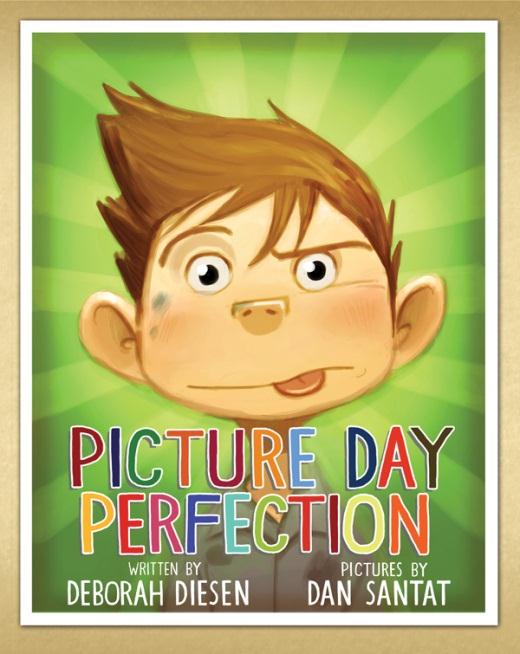
1 A Common Core State Standards Aligned Discussion & Activity Guide for PICTURE DAY PERFECTION Grades: K-2 ISBN: Written by Deborah Diesen Illustrated by Dan Santat Published by Abrams Books for Young Readers It s picture day, and the boy at the center of this charming picture book wants to make sure his picture is perfect. It seems as though everything s going wrong for him he has bedhead, a stained shirt, and a big scowl on his face. But when he goes up for his picture, he thinks about his terrible appearance, and he smiles because he secretly wants his picture to be the worst ever taken! But just as he smiles, the photo is snapped and his plan is ruined the photo looks great. Guide Created by Debbie Gonzales
2 2 Table of Contents Pre-Reading Discussion Questions... 3 Post Reading Discussion Questions... 4 Adjective Search Game... 7 Adjective Game Sheet... 8 The Months of the Year - A Sequencing Activity... 9 The Months of the Year Picture Perfection Photo A Craft Project Line Drawing Template Activity Answers Common Core State Standards Alignment: English Language Arts Standards» Reading: Literature English Language Arts Standards» Reading: Foundational Skills English Language Arts Standards» Writing English Language Arts Standards» Speaking & Listening Mathematics - Kindergarten» Counting & Cardinality Acknowledgements... 18



3 3 Pre-Reading Discussion Questions Study the front cover of Picture Day Perfection. o Describe what the boy in the illustration is doing. o Explain how the boy is feeling. How do you know? o Tell the story behind this illustration. Study the back cover of Picture Day Perfection. o Describe the collect of illustrations featured on the back cover. o Explain why the illustrations are framed with a white border. o Identify how the boy is feeling in each picture. o How do the series of illustrations make you feel? Consider the book s title Picture Day Perfection. o Define the word perfection. o What is a picture day? Explain what happens on such a day. o Guess what this story is going to be about. Predict what will happen. Meet the author Deborah Diesen. o How do authors tell stories? o Deborah not only writes picture books, she is the author of a blog titled Jumping the Candlestick. Her blog is filled with poems and interesting stories about authors who live in Michigan, Deborah s home state. Author Deborah Diesen Meet the illustrator Dad Santat. o Explain how illustrators tell stories. o What are some of the tools illustrators use to draw with? o Explain how a picture can tell a story. o Not only does Dan write and illustrate books for children, he was the creator of a television show for Disney. Click HERE to find out more about Dan. Illustrator Dan Santat

4 4 Post Reading Discussion Questions I planned for months. This was going to be the year of the perfect school picture. But some days, not everything goes according to plan. Define the word perfect. Describe the perfect day. Describe the perfect school picture. Tell what such a picture looks like. Explain the sort of planning that goes into having the perfect school picture. List details that need to be planned for on Picture Day. Identify who is telling this story. Whose story is this? Tell what this boy wants. Breakfast was Picture Day Pancakes, a family tradition. A tradition is a custom that celebrates something special, something to look forward to. This family celebrates Picture Day. Explain why this family looks forward to Picture Day. Tell why Picture Day is special to them, and to the boy. Explain how the boy feels about his bedhead. Tell who you know. Describe the sort of school picture he hopes to take. Describe his feelings about his favorite shirt being stained, wrinkled, and smelly. Tell how you would feel if your favorite shirt was in this kind of condition on the special day you d hoped to wear it. After that, the teacher had us all stand up and practice our Picture Day smiles. Turn to the spread featuring five kids standing in a row. Compare these kids. How are they same? Contrast these kids. Explain how they are different. Describe how the boy is feeling in this picture. Tell how you know. Explain how the boy got himself in trouble. Tell what he did and why he is wearing that particular expression. Think back on the series of events this boy has experienced since he stepped out of bed. Is his day going as perfectly as he had hoped? How do you know?
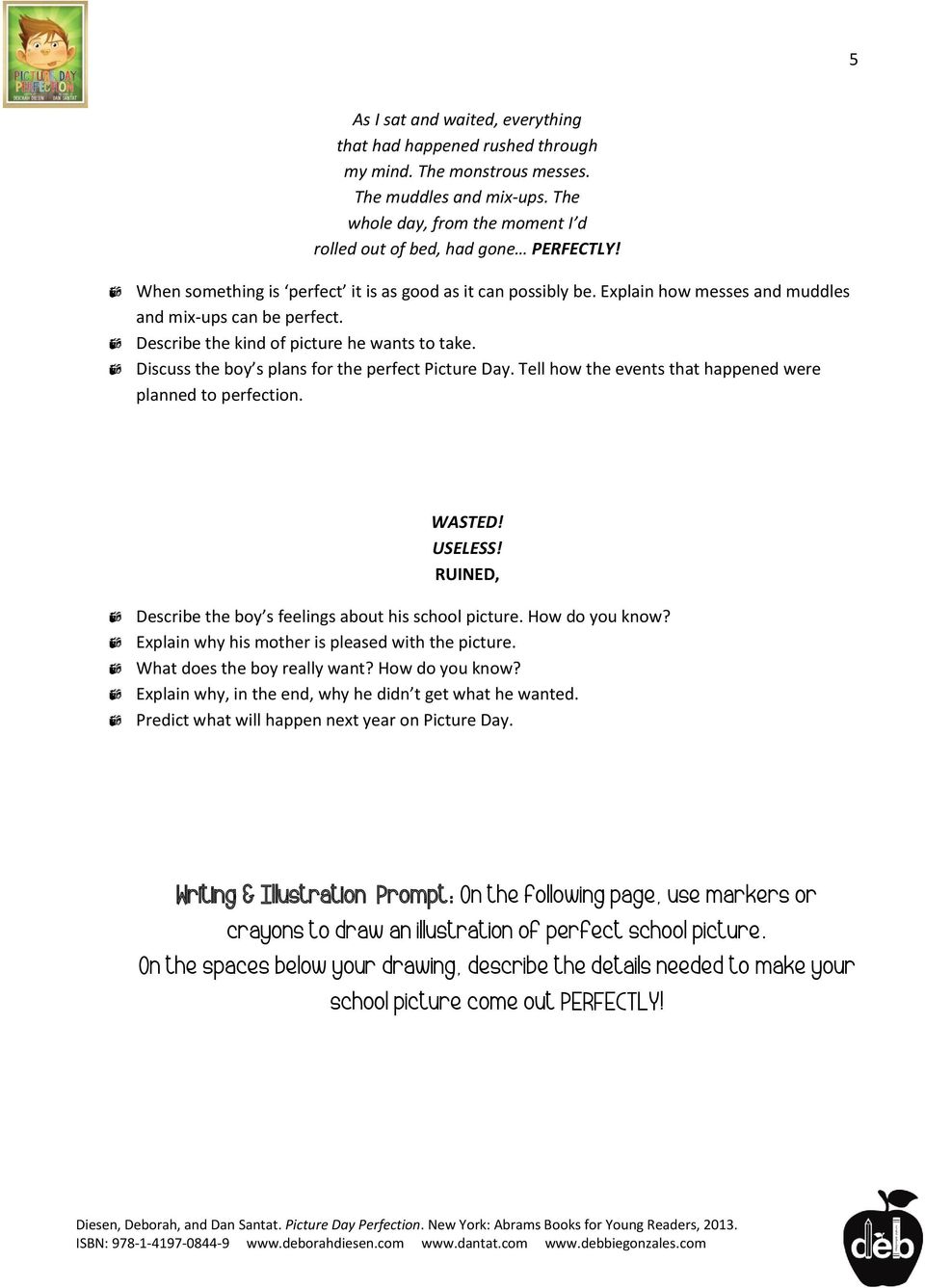
5 5 As I sat and waited, everything that had happened rushed through my mind. The monstrous messes. The muddles and mix-ups. The whole day, from the moment I d rolled out of bed, had gone PERFECTLY! When something is perfect it is as good as it can possibly be. Explain how messes and muddles and mix-ups can be perfect. Describe the kind of picture he wants to take. Discuss the boy s plans for the perfect Picture Day. Tell how the events that happened were planned to perfection. WASTED! USELESS! RUINED, Describe the boy s feelings about his school picture. How do you know? Explain why his mother is pleased with the picture. What does the boy really want? How do you know? Explain why, in the end, why he didn t get what he wanted. Predict what will happen next year on Picture Day. Writing & Illustration Prompt: On the following page, use markers or crayons to draw an illustration of perfect school picture. On the spaces below your drawing, describe the details needed to make your school picture come out PERFECTLY!
6 6

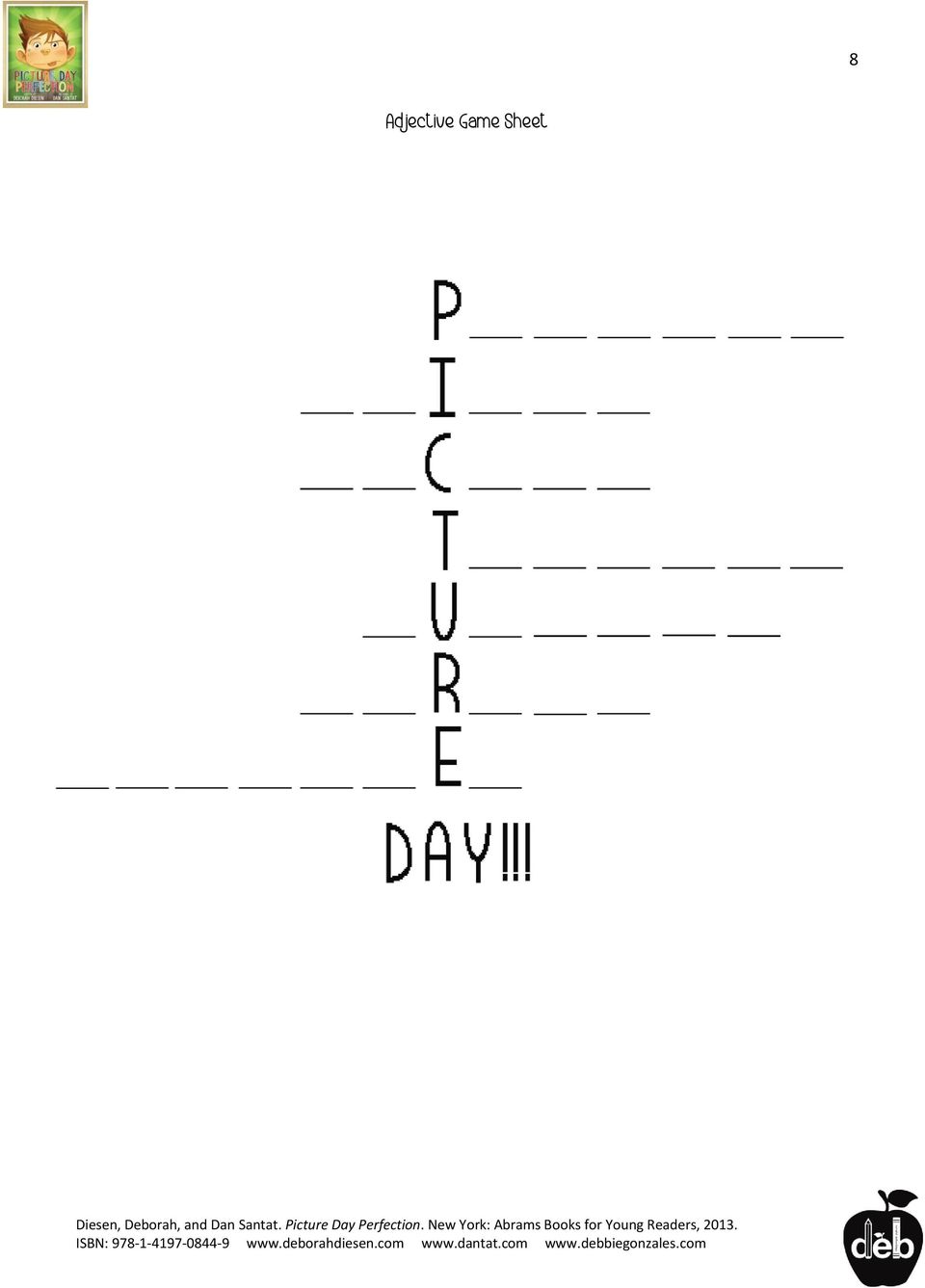
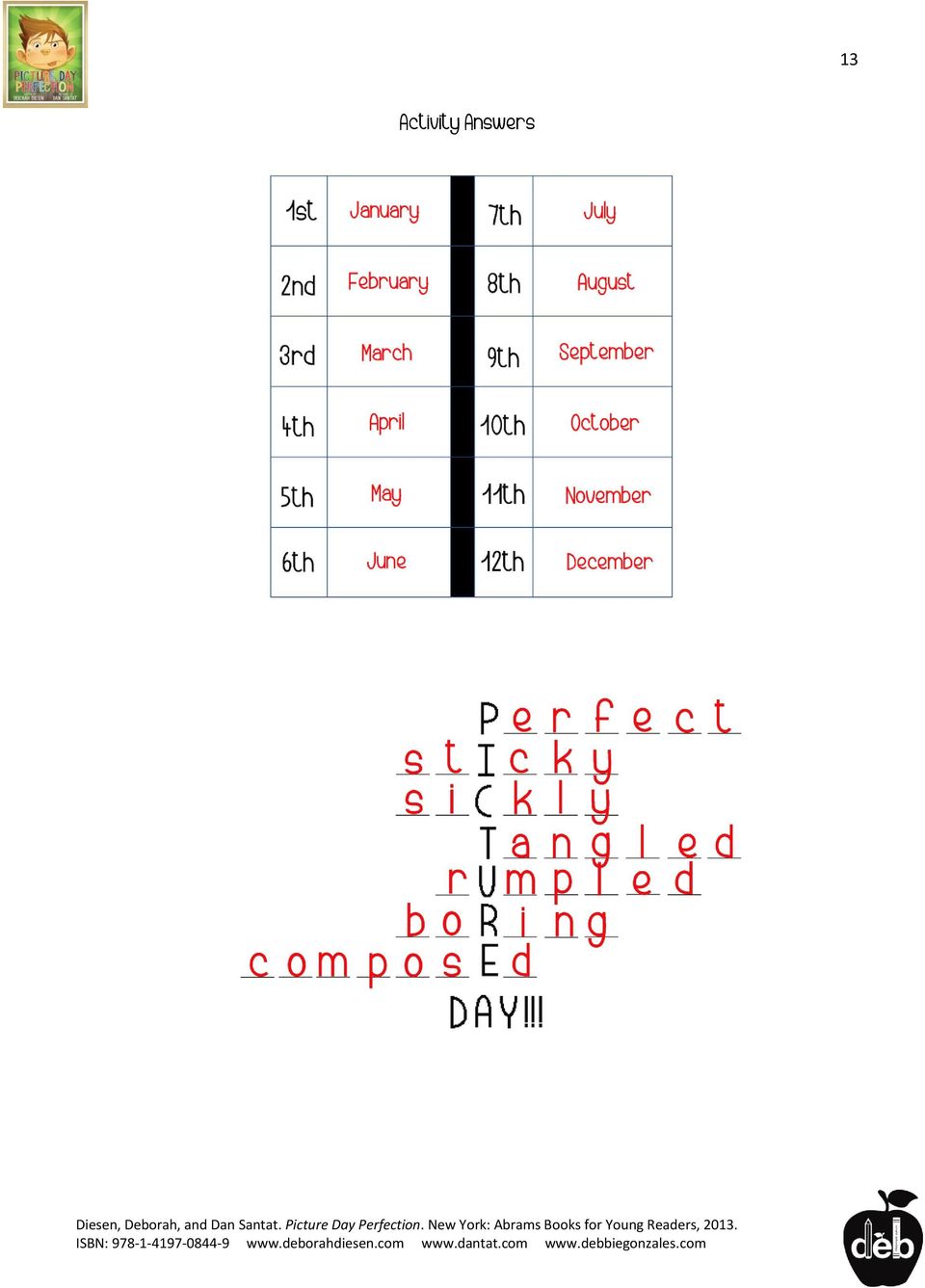
7 7 Adjective Search Game And that s when I heard a CLICK! In a flash, all my hard work Objective: To practice the identification and usage of adjectives when writing or speaking. Materials: Adjective Search Game sheet (Guide, pg. 8) Pencil Picture Day Perfection Activity Answers (Guide, pg. 13) Procedure: Print out the Adjective Search Game sheet. Explore the role of the adjective as a part of speech. Explain that an adjective is a describing word. In Picture Day Perfection, turn to the spread (one of the final spreads in the book) in which the word CLICK! is boldy printed above the boy s head. Study the text printed on the upper righthand corner. Read the list printed beneath the words In a flash, all my hard work closely. Point out that on the Adjective Game sheet, the spaces printed next to the word PICTURE, printed vertically, are to be filled with adjectives found in the text printed found on this spread. Each adjective will share one of the letters in the word PICTURE. Search through the text to discover the adjectives that complete the game. Write each letter of the adjective on the space provided. Check your work using the Answer Guide found on page 13.

8 8 Adjective Game Sheet
9 9 The Months of the Year - A Sequencing Activity I planned for months. This was going to be the year of the perfect school picture. Objective: To recognize the months of the year and align them in a sequential manner. Materials: Names of the Month worksheet (Guide, pg. 10) Pencil A 12 month calendar Activity Answers (Guide, pg. 13) Procedure: Print Names of the Month worksheet. Flip through the pages of your 12 month calendar. Note the names of the months listed on each page. On Names of the Month worksheet, note the space to the right of the block labeled 1 st. Point out in the calendar that the name of the first month of the year is called January. Instruct the child to write the word January in the space provided. Complete the worksheet in this manner. Check your work using the Answer Guide found on page 13.

10 10 The Months of the Year


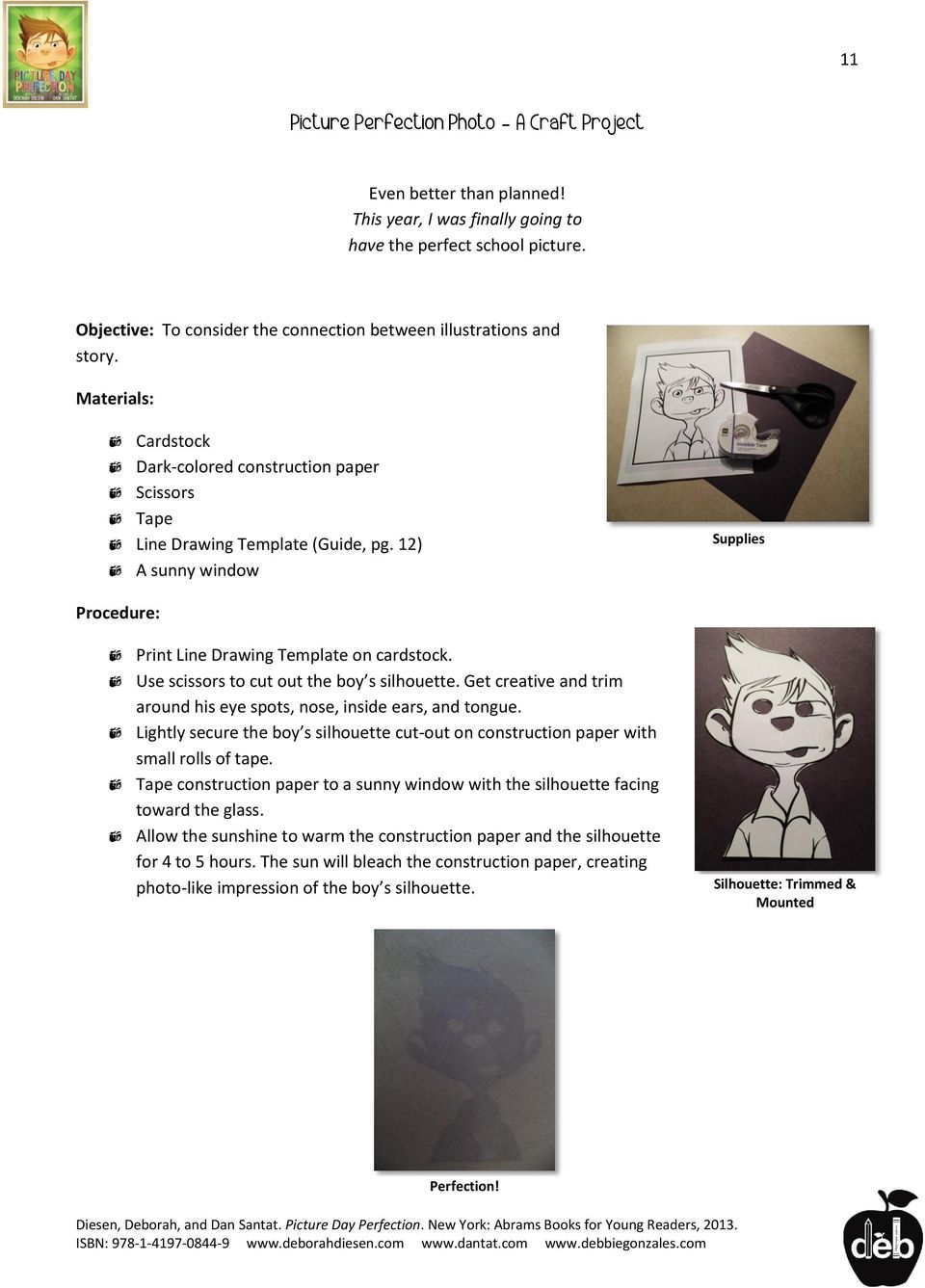
11 11 Picture Perfection Photo A Craft Project Even better than planned! This year, I was finally going to have the perfect school picture. Objective: To consider the connection between illustrations and story. Materials: Cardstock Dark-colored construction paper Scissors Tape Line Drawing Template (Guide, pg. 12) A sunny window Supplies Procedure: Print Line Drawing Template on cardstock. Use scissors to cut out the boy s silhouette. Get creative and trim around his eye spots, nose, inside ears, and tongue. Lightly secure the boy s silhouette cut-out on construction paper with small rolls of tape. Tape construction paper to a sunny window with the silhouette facing toward the glass. Allow the sunshine to warm the construction paper and the silhouette for 4 to 5 hours. The sun will bleach the construction paper, creating photo-like impression of the boy s silhouette. Silhouette: Trimmed & Mounted Perfection!

12 12 Line Drawing Template

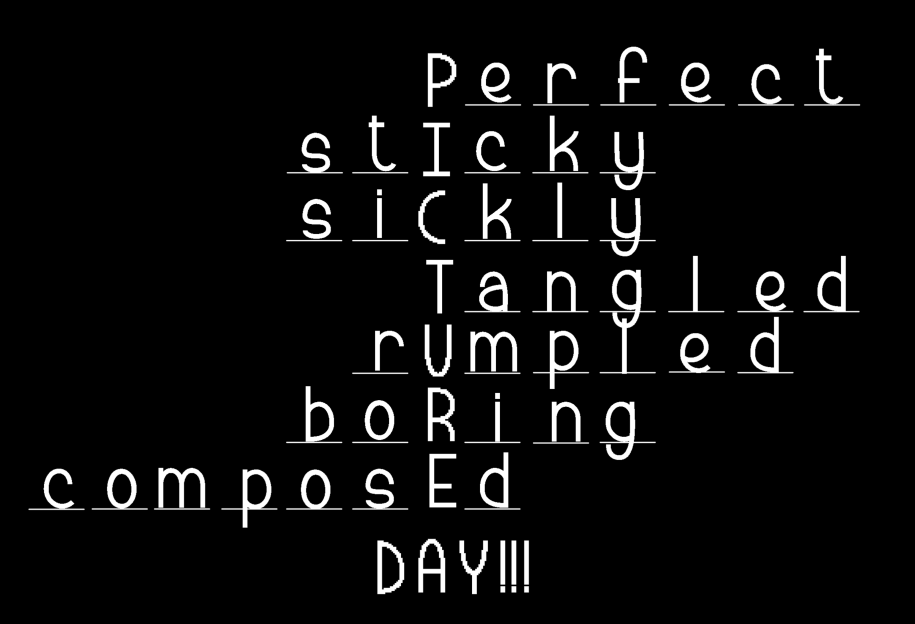
13 13 Activity Answers
14 Photo Craft Months of the Year Adjective Search Post-Reading Discussion Pre-reading Discussion 14 Common Core State Standards Alignment English Language Arts Standards» Reading: Literature Literacy.RL.K.1 With prompting and support, ask and answer questions about key details in a text. Literacy.RL.K.3 With prompting and support, identify characters, settings, and major events in a story. Literacy.RL.K.6 With prompting and support, name the author and illustrator of a story and define the role of each in telling the story. Literacy.RL.K.7 With prompting and support, describe the relationship between illustrations and the story in which they appear (e.g., what moment in a story an illustration depicts). Literacy.RL.K.10 Actively engage in group reading activities with purpose and understanding. Literacy.RL.1.1 Ask and answer questions about key details in a text. Literacy.RL.1.3 Describe characters, settings, and major events in a story, using key details. Literacy.RL.1.4 Identify words and phrases in stories or poems that suggest feelings or appeal to the senses. Literacy.RL.1.7 Use illustrations and details in a story to describe its characters, setting, or events. Literacy.RL.1.9 Compare and contrast the adventures and experiences of characters in stories. Literacy.RL.1.10 With prompting and support, read prose and poetry of appropriate complexity for grade 1. Literacy.RL.2.3 Describe how characters in a story respond to major events and challenges. Literacy.RL.2.7 Use information gained from the illustrations and words in a print or digital text to demonstrate understanding of its characters, setting, or plot.
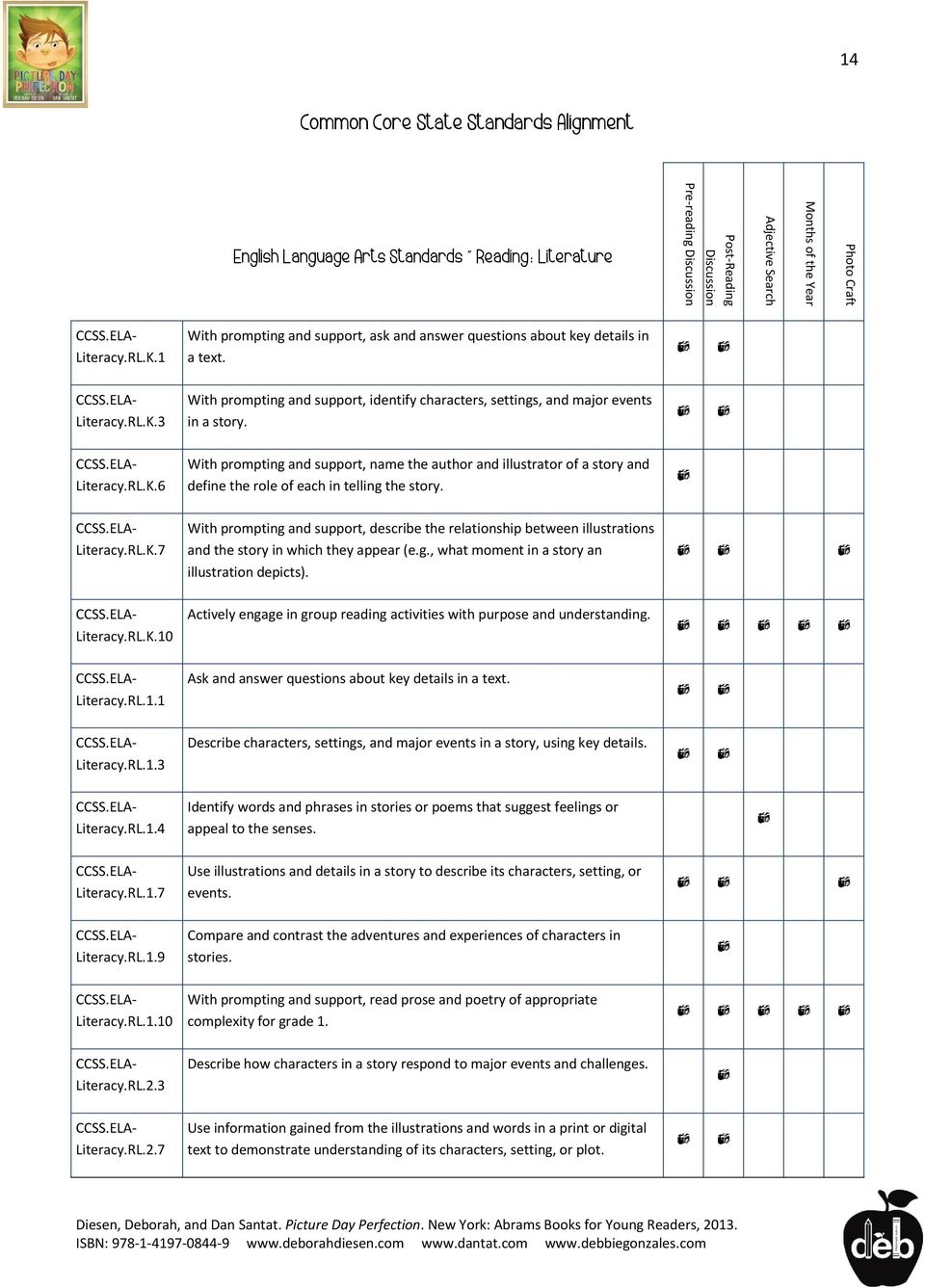
15 Photo Craft Months of the Year Adjective Search Post-Reading Discussion Pre-reading Discussion 15 English Language Arts Standards» Reading: Foundational Skills Literacy.RF.K.1 Demonstrate understanding of the organization and basic features of print. Literacy.RF.K.2 Demonstrate understanding of spoken words, syllables, and sounds (phonemes). Literacy.RF.K.3 Know and apply grade-level phonics and word analysis skills in decoding words. Literacy.RF.K.4 Read emergent-reader texts with purpose and understanding. Literacy.RF.1.1 Demonstrate understanding of the organization and basic features of print. Literacy.RF.1.2 Demonstrate understanding of spoken words, syllables, and sounds (phonemes). Literacy.RF.1.3 Know and apply grade-level phonics and word analysis skills in decoding words. Literacy.RF.1.4 Read with sufficient accuracy and fluency to support comprehension. Literacy.RF.2.3 Know and apply grade-level phonics and word analysis skills in decoding words. Literacy.RF.2.4 Read with sufficient accuracy and fluency to support comprehension.
16 Photo Craft Months of the Year Adjective Search Post-Reading Discussion Pre-reading Discussion 16 English Language Arts Standards» Writing Literacy.W.K.3 Use a combination of drawing, dictating, and writing to narrate a single event or several loosely linked events, tell about the events in the order in which they occurred, and provide a reaction to what happened. Literacy.W.K.5 With guidance and support from adults, respond to questions and suggestions from peers and add details to strengthen writing as needed. Literacy.W.1.3 Write narratives in which they recount two or more appropriately sequenced events, include some details regarding what happened, use temporal words to signal event order, and provide some sense of closure. Literacy.W.2.3 Write narratives in which they recount a well-elaborated event or short sequence of events, include details to describe actions, thoughts, and feelings, use temporal words to signal event order, and provide a sense of closure. English Language Arts Standards» Speaking & Listening Literacy.SL.K.1 Participate in collaborative conversations with diverse partners about kindergarten topics and texts with peers and adults in small and larger groups. Literacy.SL.K.2 Confirm understanding of a text read aloud or information presented orally or through other media by asking and answering questions about key details and requesting clarification if something is not understood. Literacy.SL.K.3 Ask and answer questions in order to seek help, get information, or clarify something that is not understood. Literacy.SL.K.4 Describe familiar people, places, things, and events and, with prompting and support, provide additional detail. Literacy.SL.K.5 Add drawings or other visual displays to descriptions as desired to provide additional detail.

17 Photo Craft Months of the Year Adjective Search Post-Reading Discussion Pre-reading Discussion 17 English Language Arts Standards» Speaking & Listening cont. Literacy.SL.K.6 Speak audibly and express thoughts, feelings, and ideas clearly. Literacy.SL.1.1 Participate in collaborative conversations with diverse partners about grade 1 topics and texts with peers and adults in small and larger groups. Literacy.SL.1.2 Ask and answer questions about key details in a text read aloud or information presented orally or through other media. Literacy.SL.1.4 Describe people, places, things, and events with relevant details, expressing ideas and feelings clearly. Literacy.SL.1.5 Add drawings or other visual displays to descriptions when appropriate to clarify ideas, thoughts, and feelings. Literacy.SL.1.6 Produce complete sentences when appropriate to task and situation. Literacy.SL.2.1 Participate in collaborative conversations with diverse partners about grade 2 topics and texts with peers and adults in small and larger groups. Literacy.SL.2.2 Recount or describe key ideas or details from a text read aloud or information presented orally or through other media. Literacy.SL.2.3 Ask and answer questions about what a speaker says in order to clarify comprehension, gather additional information, or deepen understanding of a topic or issue. Literacy.SL.2.6 Produce complete sentences when appropriate to task and situation in order to provide requested detail or clarification. Mathematics Kindergarten» Counting & Cardinality CCSS.Math.Content.K.CC.B.4 Understand the relationship between numbers and quantities; connect counting to cardinality.


18 18 Acknowledgements Written by Deborah Diesen Illustrated by Dad Santat Guide Created by Debbie Gonzales

Kindergarten Common Core State Standards: English Language Arts
 Kindergarten Common Core State Standards: English Language Arts Reading: Foundational Print Concepts RF.K.1. Demonstrate understanding of the organization and basic features of print. o Follow words from
Strand: Reading Literature Topics Standard I can statements Vocabulary Key Ideas and Details
 Strand: Reading Literature Key Ideas and Craft and Structure Integration of Knowledge and Ideas RL.K.1. With prompting and support, ask and answer questions about key details in a text RL.K.2. With prompting
CCSS English/Language Arts Standards Reading: Foundational Skills Kindergarten
 Reading: Foundational Skills Print Concepts CCSS.ELA-Literacy.RF.K.1 Demonstrate understanding of the organization and basic features of print. CCSS.ELA-Literacy.RF.K.1.A Follow words from left to right,
Houghton Mifflin Harcourt StoryTown Grade 1. correlated to the. Common Core State Standards Initiative English Language Arts (2010) Grade 1
 Houghton Mifflin Harcourt StoryTown Grade 1 correlated to the Common Core State Standards Initiative English Language Arts (2010) Grade 1 Reading: Literature Key Ideas and details RL.1.1 Ask and answer
Dynamic Learning Maps Essential Elements English Language Arts. Version 2 Comparison Document
 Dynamic Learning Maps Essential Elements English Language Arts Version 2 Comparison Document COMMON CORE ESSENTIAL ELEMENTS AND ACHIEVEMENT DESCRIPTORS FOR KINDERGARTEN Kindergarten English Language Arts
Reading Standards for Literature
 Reading for Literature ELACC3RL1 Key Ideas and Details: Ask and answer questions to demonstrate understanding of a text, referring explicitly to the text as the basis for the answers. 11/5/2012 1 Reading
CCSS English/Language Arts Standards Reading: Foundational Skills First Grade
 CCSS.ELA-Literacy.RF.1.1 Demonstrate understanding of the organization and basic features of print. CCSS.ELA-Literacy.RF.1.1.A Recognize the distinguishing features of a sentence (e.g., first word, capitalization,
LANGUAGE ARTS 2016 17 K 12 SUBJECT BOOKLET
 LANGUAGE ARTS 2016 17 K 12 SUBJECT BOOKLET Gwinnett s curriculum for grades K 12 is called the Academic Knowledge and Skills (AKS). The AKS for each grade level spell out the essential things students
Indiana Department of Education
 GRADE 1 READING Guiding Principle: Students read a wide range of fiction, nonfiction, classic, and contemporary works, to build an understanding of texts, of themselves, and of the cultures of the United
LANGUAGE! 4 th Edition, Levels A C, correlated to the South Carolina College and Career Readiness Standards, Grades 3 5
 Page 1 of 57 Grade 3 Reading Literary Text Principles of Reading (P) Standard 1: Demonstrate understanding of the organization and basic features of print. Standard 2: Demonstrate understanding of spoken
ELAGSEKRI7: With prompting and support, describe the relationship between illustrations and the text (how the illustrations support the text).
 READING LITERARY (RL) Key Ideas and Details ELAGSEKRL1: With prompting and support, ask and answer questions about key details in a text. ELAGSEKRL2: With prompting and support, retell familiar stories,
Strand: Reading Literature Topics Standard I can statements Vocabulary Key Ideas and Details
 Strand: Reading Literature Key Ideas and Details Craft and Structure RL.3.1 Ask and answer questions to demonstrate understanding of a text, referring explicitly to the text as the basis for the answers.
Common Core Progress English Language Arts. Grade 3
 [ SADLIER Common Core Progress English Language Arts Aligned to the Florida [ GRADE 6 Next Generation Sunshine State (Common Core) Standards for English Language Arts Contents 2 Strand: Reading Standards
Hank has a dream. Common Core Teaching Guide ABOUT THE BOOK INTRODUCTION. by Rebecca Dudley
 has a dream Common Core Teaching Guide ABOUT THE BOOK In this poetic tale, dreams that he can fly Come along for the ride as he re-creates the dream for his little friend How far will fly? What will he
FSD Grade 2 READING. Ask and answer such questions as who, what, where, when, why, and how to demonstrate understanding of key details in a text.
 College and Career Readiness Anchor Standards for Reading Read closely to determine what the text says explicitly and to make logical inferences from it; cite specific textual evidence when writing or
Grading Benchmarks FIRST GRADE. Trimester 4 3 2 1 1 st Student has achieved reading success at. Trimester 4 3 2 1 1st In above grade-level books, the
 READING 1.) Reads at grade level. 1 st Student has achieved reading success at Level 14-H or above. Student has achieved reading success at Level 10-F or 12-G. Student has achieved reading success at Level
Correlation to the Common Core State Standards for English Language Arts, Grade 3
 Correlation to the Common Core State Standards for English Language Arts, Grade 3 Journeys Grade 3 LESSON 1 LESSON 2 LESSON 3 LESSON 4 LESSON 5 1 Houghton Mifflin Harcourt Publishing Company. All rights
Literacy. Work Stations. Source: Diller, D.(2003) Literacy Work Stations, Making Centers Work
 Literacy Work Stations Source: Diller, D.(2003) Literacy Work Stations, Making Centers Work Kyrene Reading Instruction Focus: Improve student achievement through implementation of curriculum and adopted
Fun Learning Activities for Mentors and Tutors
 Fun Learning Activities for Mentors and Tutors Mentors can best support children s academic development by having fun learning activities prepared to engage in if the child needs a change in academic/tutoring
Advice for Class Teachers. Moderating pupils reading at P 4 NC Level 1
 Advice for Class Teachers Moderating pupils reading at P 4 NC Level 1 Exemplars of writing at P Scales and into National Curriculum levels. The purpose of this document is to provide guidance for class
OCPS Curriculum, Instruction, Assessment Alignment
 OCPS Curriculum, Instruction, Assessment Alignment Subject Area: Grade: Strand 1: Standard 1: Reading and Language Arts Kindergarten Reading Process The student demonstrates knowledge of the concept of
3rd Grade Reading Standard Exceeds (4) Secure (3) Developing (2) Beginning (1)
 3rd Grade Reading Standard Exceeds (4) Secure (3) Developing (2) Beginning (1) based on the Refer to details and examples in a text when explaining what the text says explicitly and when drawing inferences
Comprehension. Sentence Structure and Meaning C.001. Objective The student will identify key parts of the text.
 C.001 Sentence Structure and Meaning Sentence-Picture Match Objective The student will identify key parts of the text. Materials Pocket chart Picture cards Use picture cards from core reading program or
KINDGERGARTEN. Listen to a story for a particular reason
 KINDGERGARTEN READING FOUNDATIONAL SKILLS Print Concepts Follow words from left to right in a text Follow words from top to bottom in a text Know when to turn the page in a book Show spaces between words
Choral Reading Type: Strategy Literacy Skill: Reading Domain:
 Choral Reading Strategy Literacy Skill: Reading Fluency Grade Level Uses: K-20 Special Population: N/A; Need to modify the reading for ELL and Special Needs with accommodations Cognitive Process: Comprehension
Common Core State Standards Speaking and Listening
 Comprehension and Collaboration. Prepare for and participate effectively in a range of conversations and collaborations with diverse partners, building on others ideas and expressing their own clearly
Third Grade Language Arts Learning Targets - Common Core
 Third Grade Language Arts Learning Targets - Common Core Strand Standard Statement Learning Target Reading: 1 I can ask and answer questions, using the text for support, to show my understanding. RL 1-1
Common Core Progress English Language Arts
 [ SADLIER Common Core Progress English Language Arts Aligned to the [ Florida Next Generation GRADE 6 Sunshine State (Common Core) Standards for English Language Arts Contents 2 Strand: Reading Standards
Strand: Writing. Grade Level: 1 st Grade
 1. Write arguments to support claims in an analysis of substantive topics or texts, using valid reasoning and relevant and sufficient evidence. W.1.1. Write opinion pieces in which they introduce the topic
Common Core Writing Rubrics, Kindergarten
 Common Core Writing Rubrics, Kindergarten The following writing rubrics for the Common Core were developed by the Elk Grove Unified School District in Elk Grove, California. There are rubrics for each
English Language Proficiency Standards for Precalculus
 xxviii ENGLISH LANGUAGE PROFICIENCY STANDARDS FOR PRECALCULUS (M) use trigonometric identities such as reciprocal, quotient, Pythagorean, cofunctions, even/odd, and sum and difference identities for cosine
parent ROADMAP SUPPORTING YOUR CHILD IN GRADE FIVE ENGLISH LANGUAGE ARTS
 TM parent ROADMAP SUPPORTING YOUR CHILD IN GRADE FIVE ENGLISH LANGUAGE ARTS 5 America s schools are working to provide higher quality instruction than ever before. The way we taught students in the past
Penguin Facts. Standards for the 21st-Century Learner. Published on AASL Learning4Life Lesson Plan Database
 Published on AASL Learning4Life Lesson Plan Database Penguin Facts Created by: Neely Swygert Title/Role: Teacher Librarian Organization/School Name: Gadsden Elementary Location: South Carolina Grade Level:
Words Their Way TM. Word Study in Action. Correlated to: North Carolina STANDARD COURSE OF STUDY Language Arts for Third Grade
 TM Word Study in Action Correlated to: North Carolina STANDARD COURSE OF STUDY Language Arts for Third Grade For More Information Contact Debbie Owens, Sales Representative 1-800-435-3499 Ext. 8092 www.pearsonlearning.com
Support for Standards-Based Individualized Education Programs: English Language Arts K-12. Guidance for West Virginia Schools and Districts
 Support for Standards-Based Individualized Education Programs: English Language Arts K-12 Guidance for West Virginia Schools and Districts Office of Special Programs West Virginia Department of Education
Third Grade in California Public Schools. and the Common Core State Standards
 A Look at Third Grade in California Public Schools and the Common Core State Standards CURRICULUM FRAMEWORKS AND INSTRUCTIONAL RESOURCES DIVISION INSTRUCTION AND LEARNING SUPPORT BRANCH CALIFORNIA DEPARTMENT
INTEGRATING THE COMMON CORE STANDARDS INTO INTERACTIVE, ONLINE EARLY LITERACY PROGRAMS
 INTEGRATING THE COMMON CORE STANDARDS INTO INTERACTIVE, ONLINE EARLY LITERACY PROGRAMS By Dr. Kay MacPhee President/Founder Ooka Island, Inc. 1 Integrating the Common Core Standards into Interactive, Online
Grade Level: 2 nd Grade
 1. Read closely to determine what the text says explicitly and to make logical inferences from it; cite specific textual evidence when writing or speaking to support conclusions drawn from the text. RL.2.1.
How can we take care of our commons?
 Teacher s Guide Grade: K - 2 Lesson: How can we take care of our Commons? Number of Class Periods: 3 45-minute periods How can we take care of our commons? The Healthy Commons Lesson Set was co-created
Close Reading Read Aloud
 Text Title: We the Kids: A Preamble to The Constitution of the United States Author / Illustrator: David Catrow Publisher: Penguin Group (USA) Incorporated ISBN 13: 9780142402764 Learning Objectives: The
5th Grade MELD Lessons Aligned to CCSS 10 Days Start Smart
 5th Grade MELD Lessons Aligned to CCSS 10 Days Start Smart Overview Overview Collaboration across the curriculum is a required skill! On their way to becoming college prepared and career ready, students
Theme 9. THEME 9: Spring Is Here
 Theme 9 64 CHALLENGE ACTIVITIES FOR Spring Is Here 65 WEEK 1 THEME 9/Week 1 1. What Season Is It? Think of some ways you can tell what season it is. You will make a picture riddle about a season. Choosing
Second Grade Core Knowledge Addendum
 Sight Words Second Grade Core Knowledge Addendum Dolch Sight Words are naturally embedded in the Core Knowledge Program. They are taught throughout the program in a sequence of instruction, unlike previous
Form: Filled in table. Method: Peer assessment. Tool: Checklist. Form: Completed table. Method: Peer assessment. Tool: Checklist
 Lesson Plan English First Additional Language Grade 5 Content in context: Text from other Learning Area - Whether Los and ASs Learning Activities Details of Assessment Barriers to Learning LO 1 Listening
An Early Childhood Practitioner s Guide: Developmentally Appropriate Literacy Practices for Preschool-Age Children
 An Early Childhood Practitioner s Guide: Developmentally Appropriate Literacy Practices for Preschool-Age Children SUMMARY In her discussion of user-friendly and developmentally appropriate literacy strategies
CURRICULUM PACING GUIDE GRADE/SUBJECT: /English. 1st Nine Weeks 1
 Approximately Alabama Course Of Study/Quality Core Standards. Ask and answer questions to demonstrate understanding of a text, referring explicitly to the text as the basis for the answers [RL.3.] (.)
Table of Contents. Introduction 12 Standard Organization 18. K-5 Reading 20 Enduring Understandings 20 Essential Questions 21
 Table of Contents Introduction 12 Standard Organization 18 K-5 Reading 20 Enduring Understandings 20 Essential Questions 21 Reading Literature (RL) 21 RL 1 21 RL 2 22 RL 3 22 RL 4 23 RL 5 23 RL 6 24 RL
APPENDIX B CHECKLISTS
 APPENDIX B CHECKLISTS Kindergarten First Grade Second Grade Third Grade 69 70 Teacher Visit 1 By: Date / / Time - WG SG Visit 2 By: Date / / Time - WG SG Visit 3 By: Date / / Time - WG SG VISITS 1 2 3
3rd Grade Common Core State Standards Writing
 Text Types and Purposes Writing CCSS.ELA-Literacy.W.3.1 Write opinion pieces on topics or texts, supporting a point of view with reasons. CCSS.ELA-Literacy.W.3.1a Introduce the topic or text they are writing
Objective The student will read with proper phrasing, intonation, and expression in connected text.
 F.020 Connected Text Listen and Read The student will read with proper phrasing, intonation, and expression in connected text. Tape player Headphones Cassette tape Choose or make tapes of a book or passage
Create stories, songs, plays, and rhymes in play activities. Act out familiar stories, songs, rhymes, plays in play activities
 PRESCHOOL Language Arts Literacy Expectation 1 Children listen and respond to environmental sounds, directions, and conversations. NJCCC K-12 Standard 3.4 Listening Strand A: Active Listening Strand B:
Tools for Teachers t e a c h i n g c U r r i c u l u m f o r h o m e a n d t h e c l a s s r o o m
 Tools for Teachers t e a c h i n g c U r r i c u l u m f o r h o m e a n d t h e c l a s s r o o m One One You Adri s mama and papa share some of the wisdom they have gained through the years with their
Year 1 reading expectations (New Curriculum) Year 1 writing expectations (New Curriculum)
 Year 1 reading expectations Year 1 writing expectations Responds speedily with the correct sound to graphemes (letters or groups of letters) for all 40+ phonemes, including, where applicable, alternative
Common Core Writing Standards
 Correlation to the Series, Grades K 2 Common Core State Standards, 2010. National Governors Association Center for Best Practices and Council of Chief State School Officers. All rights reserved. College
PREPARE AHEAD OF TIME FOR CRAFTS
 1 Crafts Bible Story: Paul s Conversion Acts 1-3; 9:1-9 Bottom Line: If you want to know who God is, find out more about Jesus. Memory Verse: When you walk, nothing will slow you down. When you run, you
English Language Proficiency Standards: At A Glance February 19, 2014
 English Language Proficiency Standards: At A Glance February 19, 2014 These English Language Proficiency (ELP) Standards were collaboratively developed with CCSSO, West Ed, Stanford University Understanding
MStM Reading/Language Arts Curriculum Lesson Plan Template
 Grade Level: 6 th grade Standard 1: Students will use multiple strategies to read a variety of texts. Grade Level Objective: 1. A.6.1: compare/contrast the differences in fiction and non-fiction text.
Grade 4 Writing Curriculum Map
 Curriculum Map BOE Approval November 2013 CURRICULUM MAP WRITING GRADE 4 SEPTEMBER OCTOBER NOVEMBER DECEMBER JANUARY Creating a Buzz About : It s All About Me! Tell Me A Story Realistic Fiction Tell Me
Grade 1 LA. 1. 1. 1. 1. Subject Grade Strand Standard Benchmark. Florida K-12 Reading and Language Arts Standards 27
 Grade 1 LA. 1. 1. 1. 1 Subject Grade Strand Standard Benchmark Florida K-12 Reading and Language Arts Standards 27 Grade 1: Reading Process Concepts of Print Standard: The student demonstrates knowledge
Academic Standards for Reading, Writing, Speaking, and Listening
 Academic Standards for Reading, Writing, Speaking, and Listening Pre-K - 3 REVISED May 18, 2010 Pennsylvania Department of Education These standards are offered as a voluntary resource for Pennsylvania
January 2015. Dear Parents and Guardians,
 January 2015 Dear Parents and Guardians, The kindergarten progress report handbook that is attached was written to acquaint parents with the design and purpose of the kindergarten progress report. In addition,
LAFS: Language Arts Florida Standards GRADE: K
 LAFS: Language Arts Florida Standards GRADE: K Strand: READING S FOR LITERATURE Cluster 1: Key Ideas and Details CODE LAFS.K.RL.1.1 LAFS.K.RL.1.2 LAFS.K.RL.1.3 With prompting and support, ask and answer
Teacher's Guide to Meeting the Common Core State Standards* with Scott Foresman Reading Street 2008
 Implementing the Common Core State StandArds Teacher's Guide to Meeting the Common Core State Standards* with Scott Foresman Reading Street 2008 Table of Contents Grade 5 Introduction................................................
BUILDING YOUR CHILD S LISTENING, TALKING, READING AND WRITING SKILLS KINDERGARTEN TO SECOND GRADE
 BUILDING YOUR CHILD S LISTENING, TALKING, READING AND WRITING SKILLS KINDERGARTEN TO SECOND GRADE PURPOSE This resource was developed to provide information about children s typical development of skills
New York State Common Core Social Studies Framework Grades K-8
 The State Education Department The University of the State of New York New York State Common Core Social Studies Framework Grades K-8 Revised December 2013 Social Studies Framework Grades K - 4 Grades
California. www.heinemann.com Phone: 800.225.5800
 California Preschool Learning Foundations, Vol. 1 (Foundations in Language and Literacy) and The Continuum of Literacy Learning, Grades PreK 8: A Guide to Teaching by Gay Su Pinnell and Irene C. Fountas
Reading Comprehension: 1. "Click or Clunk?": A Student Comprehension Self-Check: Step 1: Tell students that they will be
 Research Based Interventions/Strategies The following interventions/strategies are broken into Reading Comprehension, Reading Fluency, Math Computation, and Math Reasoning. These are examples, not a list
Sing, Spell, Read & Write
 Sing, Spell, Read & Write Correlated to Head Start DOMAIN: LANGUAGE DEVELOPMENT Element: Listening & Understanding Demonstrates increasing ability to attend to and understand conversations, stories, songs,
Grade 8 English Language Arts 90 Reading and Responding, Lesson 9
 GRADE 8 English Language Arts Reading and Responding: Lesson 9 Read aloud to the students the material that is printed in boldface type inside the boxes. Information in regular type inside the boxes and
Crafting an Argument. Students need to know how to state facts and express their opinions. Organized, Well-Supported, Convincing
 Crafting an Argument Organized, Well-Supported, Convincing Students need to know how to state facts and express their opinions effectively so that they can positively contribute to classroom conversations
& Sample Lesson. Before Reading. Sight Word Review (1 minute)
 Planning Support & Sample Lesson TIP The Early Guided Reading Lesson Plan found on page 190 in the Appendix is a template you can use to plan your lessons. Each component of the lesson is described in
Common Core State Standards English Language Arts. IEP Goals and Objectives Guidance: Basic Format
 Current Academic Achievement Common Core State Standards English Language Arts IEP Goals and Objectives Guidance: Basic Format Just as you have, address a deficit by stating what the student can do relative
Literacy Learning in Preschool and Kindergarten
 Chapter 1 Literacy Learning in Preschool and Kindergarten Preschool and kindergarten are the most important grades! I say this to preschool, kindergarten, primary, middle school, junior high, and high
One Hen: How One Small Loan Made a Big Difference
 FEDERAL RESERVE BANKS OF ST. LOUIS AND PHILADELPHIA ECONOMIC EDUCATION : How One Small Loan Made a Big Difference By Katie Smith Milway / ISBN: 978-1-55453-028-1 Lesson Author Todd Zartman, Federal Reserve
Our Solar System. What is out there in space? Theme
 Our Solar System Earth is one among many objects in the sky, which includes stars, the moon, the sun, and the International Space Station. We are only just beginning to explore and understand outer space
There are many reasons why reading can be hard. This handout describes
 Understand the problems a child may be having with reading, and target what you can do to help! Look inside for practical, research-based information for parents and teachers about: Phonological and Phonemic
Unit 4 Module 1: Administering the Texas Middle School Fluency Assessment
 Unit 4 Module 1: Administering the Texas Middle School Fluency Assessment Section 1 Slide 1 Title Slide Welcome to the first module in the Diagnostic and Progress Monitoring Data unit, Administering the
First Grade Core Knowledge Addendum
 Sight Words First Grade Core Knowledge Addendum Dolch Sight Words are naturally embedded in the Core Knowledge Program. They are taught throughout the program in a sequence of instruction, unlike previous
Contents. A Word About This Guide... 3. Why Is It Important for My Child to Read?... 4. How Will My Child Learn to Read?... 4
 Contents A Word About This Guide............................... 3 Why Is It Important for My Child to Read?................ 4 How Will My Child Learn to Read?....................... 4 How Can I Help My
Big Ideas, Goals & Content for 4 th grade Data Collection & Analysis Unit
 Big Ideas, Goals & Content for 4 th grade Data Collection & Analysis Unit Big Ideas Graphs are a way of organizing data and they appear in newspapers, magazines, on the Internet and other places in everyday
2 Mathematics Curriculum
 New York State Common Core 2 Mathematics Curriculum GRADE GRADE 2 MODULE 3 Topic E: Model Numbers Within 1000 with Place Value Disks 2.NBT.A Focus Standard: 2.NBT.A Understand place value. Instructional
What ARE the Other Kids Doing? K-2 Meaningful Literacy Centers
 What ARE the Other Kids Doing? K-2 Meaningful Literacy Centers Kathy Bumgardner Literacy Specialist / Consultant National Consulting Author Macmillan McGraw Hill [email protected] Kathy Keane ELA Curriculum
Unit Map 2011-2012 Columbia University Teachers College Collaboration / Writing* / Kindergarten (Elementary School)
 Unit Map 2011-2012 Columbia University Teachers College Collaboration / Writing* / Kindergarten (Elementary School) June 21, 2011, 9:13AM Unit 01 Launching The Writing Workshop (Week 1, 4 Weeks) Unit Rationale
Reading Timeline 2nd Nine Weeks
 Reading Timeline 2nd Nine Weeks Task Focus Standard Essential Questions 1 *Elements of Fables 2 *Story structure (beginning) *Characters, setting, plot 3 *Characters 4 *Story Structure (problem/solution)
First Grade in California Public Schools. and the Common Core State Standards
 A Look at First Grade in California Public Schools and the Common Core State Standards CURRICULUM FRAMEWORKS AND INSTRUCTIONAL RESOURCES DIVISION INSTRUCTION AND LEARNING SUPPORT BRANCH CALIFORNIA DEPARTMENT
LiteracyPlanet & the Australian Curriculum: Pre-School
 LiteracyPlanet & the Australian Curriculum: Pre-School We look at learning differently. LiteracyPlanet & the Australian Curriculum Welcome to LiteracyPlanet & the Australian Curriculum. LiteracyPlanet
Date Re-Assessed. Indicator. CCSS.ELA-Literacy.RF.5.3 Know and apply grade-level phonics and word analysis skills in decoding words.
 CCSS English/Language Arts Standards Reading: Foundational Skills Fifth Grade Retaught Reviewed Assessed Phonics and Word Recognition CCSS.ELA-Literacy.RF.5.3 Know and apply grade-level phonics and word
Previous Letterland at Tweetsie Railroad Motivation and reward Letterland at Tweetsie Curriculum Guides
 Previous Letterland at Tweetsie Railroad Each May since 2007, children from all over North Carolina (and Texas and Georgia) have come to Letterland at Tweetsie Railroad, where we have transformed our theme
www.eslkidstuff.com Lesson Plans for ESL Kids Teachers
 Lesson: General: Time: Objectives: Structures: Target Vocab: 40 mins - 1 hour Talking about different members of the family "Who is this?" "How are you?" "I m fine thank you" "See you soon" father, mother,
Houghton Mifflin Harcourt Journeys Common Core 2014 and Earobics, Grade 3. correlated to the
 Houghton Mifflin Harcourt Journeys Common Core 2014 and Earobics, Grade 3 correlated to the Common Core State Standards English Language Arts Grade 3 RL.3.1 Reading Standards for Literature Key Ideas and
Bunny Money. Lesson Author. Standards and Benchmarks (see page 15) Lesson Description. Grade Level. Concepts. Objectives
 FEDERAL RESERVE BANKS OF ST. LOUIS, PHILADELPHIA, AND KANSAS CITY ECONOMIC EDUCATION By Rosemary Wells / ISBN: 978-0-14-056750-2 Lesson Author Michele Wulff, Federal Reserve Bank of Kansas City Standards
Title My Family Tree Theme All About Me and My Family Mr. N
 Objectives (Letter People & Common Core) Students will be able to Identify roles (student, family member, peer, consumer). (LP: SS) Understand that writing communicates thoughts. (LP: W) Write letters
Mendham Township School District Reading Curriculum Kindergarten
 Mendham Township School District Reading Curriculum Kindergarten Kindergarten Unit 1: We Are Readers Exploring the Exciting World of Books Reading Level Benchmark: Emergent Story Books & Shared Reading
Intended Use of the document: Teachers who are using standards based reporting in their classrooms.
 Standards Based Grading reports a student s ability to demonstrate mastery of a given standard. This Excel spread sheet is designed to support this method of assessing and reporting student learning. Purpose
Elementary Reading Lesson Plans Kindergarten Week 1, Day 1 - Monday, July 1 st 90 Minute Block
 Elementary Reading Lesson Plans Kindergarten Week 1, Day 1 - Monday, July 1 st 90 Minute Block Time Title Example/Description 20 Minutes Phonics: Isabel Beck Word Building Routine Word Building Sequence
BEFORE-DURING-AFTER (BDA)
 Curriculum & Instruction Resources Content Reading & Writing Resources: A teacher resource page providing strategies to improve reading comprehension in all content areas BEFORE-DURING-AFTER (BDA) Reading
Scenario 2: Assessment Practices. Subject Matter: Interactive Communication. Acquiring and Presenting Cultural Information.
 Task 1: Principles of Content-Specific and Developmentally Appropriate Pedagogy for Single Subject In Task 1: Principles of Content-Specific and Developmentally Appropriate Pedagogy includes four scenarios.
Early Childhood Core Standards. Age Three to Five. Utah s School Readiness Standards. Companion document to the Utah State Office of Education
 Utah s School Readiness Standards Age Three to Five Companion document to the Utah State Office of Education Early Childhood Core Standards Early Childhood Core Standards Utah s EARLY CHILDHOOD CORE STANDARDS
TRAINGING GUIDE. To Log in type the web address www.readinga-z.com into your browser. This will open the Reading A-Z home page.
 TRAINGING GUIDE Getting Started To Log in type the web address www.readinga-z.com into your browser. This will open the Reading A-Z home page. Click Members at top right hand corner of the screen. Type
FAQ about Reading Workshop
 FAQ about Reading Workshop My child is in Level M. What does that mean as far as a grade level that I can understand? Several different systems exist today for organizing reading levels. The one used in