
Performance Indicators-Language Arts Reading and Writing 3 rd Grade
|
|
|
- Elijah Norton
- 9 years ago
- Views:
Transcription
1 Learning Standards 1 st Narrative Performance Indicators 2 nd Informational 3 rd Persuasive 4 th Response to Lit Possible Evidence Fluency, Vocabulary, and Comprehension Reads orally with Applies letter-sound speed, accuracy, and knowledge to decode expression unknown words (ELA3R1) quickly and accurately. (ELA3R1 a) Reads familiar text with expression. (ELA3R1 b) Reads at least 95 words accurately per minute with 95% accuracy. (ELA3R1 c) Uses self-correction when subsequent reading indicates an earlier misreading within grade-level (ELA3R1 d) Applies lettersound knowledge to decode unknown words quickly and accurately. (ELA3R1 a) Reads familiar text with expression. (ELA3R1 b) Reads at least 105 words accurately per minute with 95% accuracy. (ELA3R1 c) Uses self-correction when subsequent reading indicates an earlier misreading within grade-level (ELA3R1 d) Applies letter-sound knowledge to decode unknown words quickly and accurately. (ELA3R1 a) Reads familiar text with expression. (ELA3R1 b) Reads at least 115 words accurately per minute with 95% accuracy. (ELA3R1 c) Uses self-correction when subsequent reading indicates an earlier misreading within grade-level (ELA3R1 d) Applies lettersound knowledge to decode unknown words quickly and accurately. (ELA3R1 a) Reads familiar text with expression. (ELA3R1 b) Reads at least 120 words accurately per minute with 95% accuracy. (ELA3R1 c) Uses self-correction when subsequent reading indicates an earlier misreading within grade-level (ELA3R1 d) *Fluency Rubric *BLT (IRI) Observations Reader s Theatre Running Records
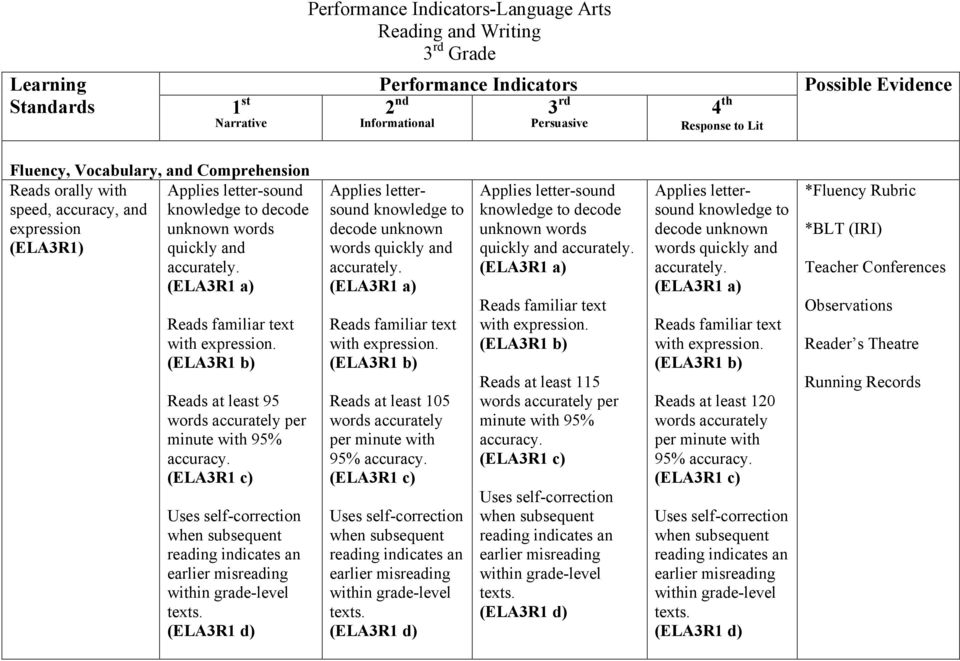
2 Acquires and uses grade level words to communicate effectively (ELA3R2) Reads literary and information texts and incorporates new words into oral and written language. (ELA3R2 a) Uses gradeappropriate words with multiple meanings. (ELA3R2 b) Recognizes and applies appropriate usage of homophones, homographs, antonyms, and synonyms. (ELA3R2 c) Identifies the meaning of common idioms and figurative phrases and incorporates them into oral and written language. (ELA3R2 d) Reads literary and information texts and incorporates new words into oral and written language. (ELA3R2 a) Uses gradeappropriate words with multiple meanings. (ELA3R2 b) Recognizes and applies appropriate usage of homophones, homographs, antonyms, and synonyms. (ELA3R2 c) Identifies the meaning of common idioms and figurative phrases and incorporates them into oral and written language. Reads literary and information texts and incorporates new words into oral and written language. (ELA3R2 a) Uses grade-appropriate words with multiple meanings. (ELA3R2 b) Recognizes and applies appropriate usage of homophones, homographs, antonyms, and synonyms. (ELA3R2 c) Identifies the meaning of common idioms and figurative phrases and incorporates them into oral and written language. (ELA3R2 d) Identifies the meaning of common idioms and figurative phrases and incorporates them into Reads literary and information texts and incorporates new words into oral and written language. (ELA3R2 a) Uses gradeappropriate words with multiple meanings. (ELA3R2 b) Recognizes and applies appropriate usage of homophones, homographs, antonyms, and synonyms. (ELA3R2 c) Identifies the meaning of common idioms and figurative phrases and incorporates them into oral and written language. s Correctly uses: Content Area Words CRCT terminology Cunningham Words Writing in Content Areas Prompt *Benchmarks DOL LA Quizzes
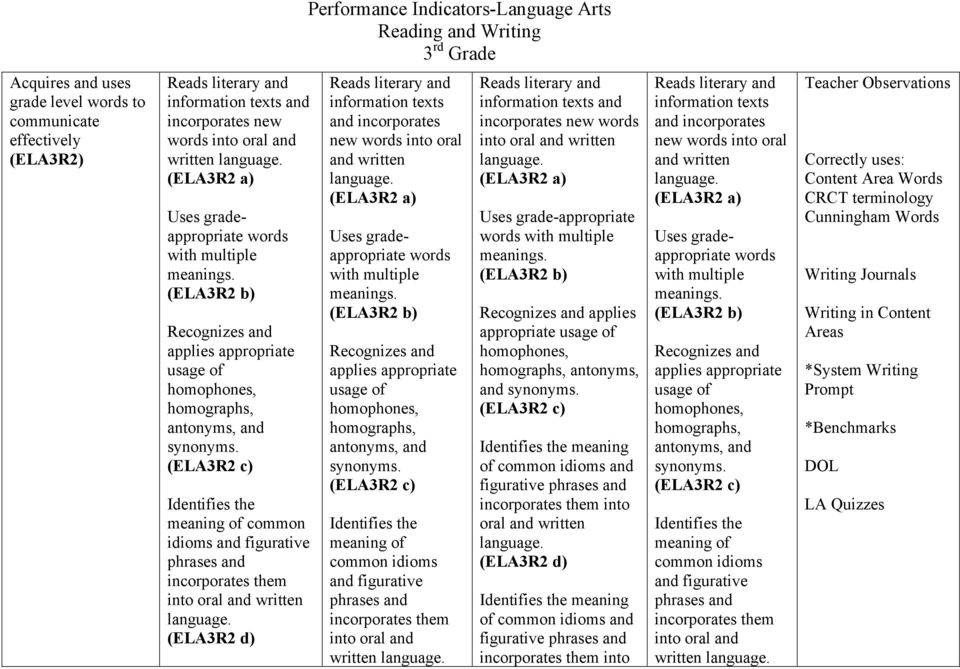
3 Uses a variety of strategies to gain meaning from grade level text (ELA3R3) meaning from common root words, common prefixes (e.g., un-, re-, dis-, in-), and common suffixes (e.g., -tion, - ous, -ly). (ELA3R2 e) Determines the meaning of unknown words on the basis of context. (ELA3R2 f) Makes predictions from text content. (ELA3R3 b) Generates questions to improve comprehension. (ELA3R3 c) Recognizes plot, setting, and character (ELA3R2 d) meaning from common root words, common prefixes (e.g., un-, re-, dis-, in-), and common suffixes (e.g., -tion, -ous, -ly). (ELA3R2 e) Determines the meaning of unknown words on the basis of context. (ELA3R2 f) Makes predictions from text content. (ELA3R3 b) Generates questions to improve comprehension. (ELA3R3 c) Distinguishes fact from opinion. (ELA3R3 d) oral and written language. (ELA3R2 d) meaning from common root words, common prefixes (e.g., un-, re-, dis-, in-), and common suffixes (e.g., -tion, - ous, -ly). (ELA3R2 e) Determines the meaning of unknown words on the basis of context. (ELA3R2 f) Makes predictions from text content. (ELA3R3 b) Generates questions to improve comprehension. (ELA3R3 c) Distinguishes fact from opinion. (ELA3R3 d). (ELA3R2 d) meaning from common root words, common prefixes (e.g., un-, re-, dis-, in-), and common suffixes (e.g., -tion, -ous, -ly). (ELA3R2 e) Determines the meaning of unknown words on the basis of context. (ELA3R2 f) Makes predictions from text content. (ELA3R3 b) Generates questions to improve comprehension. (ELA3R3 c) Distinguishes fact from opinion. (ELA3R3 d) Response Journals *BLT (IRI) *Reading Benchmark *Running Records Quizzes/Tests

4 within text, and compares and contrasts these elements between (ELA3R3 e) Makes judgments and inferences about setting, characters, and events and supports them with evidence from the text. (ELA3R3 f) Summarizes text content. (ELA3R3 g) Makes connections between texts and/or personal experiences. (ELA3R3 i) cause-and-effect relationships and draws conclusions. (ELA3R3 j) Performance Indicators-Language Arts Recognizes plot, setting, and character within text, and compares and contrasts these elements between (ELA3R3 e) Makes judgments and inferences about setting, characters, and events and supports them with evidence from the text. (ELA3R3 f) Summarizes text content. (ELA3R3 g) Interprets information from illustrations, diagrams, charts, graphs, and graphic organizers. (ELA3R3 h) Makes connections Recognizes plot, setting, and character within text, and compares and contrasts these elements between (ELA3R3 e) Makes judgments and inferences about setting, characters, and events and supports them with evidence from the text. (ELA3R3 f) Summarizes text content. (ELA3R3 g) Interprets information from illustrations, diagrams, charts, graphs, and graphic organizers. (ELA3R3 h) Makes connections between texts and/or personal experiences. (ELA3R3 i) Recognizes plot, setting, and character within text, and compares and contrasts these elements between (ELA3R3 e) Makes judgments and inferences about setting, characters, and events and supports them with evidence from the text. (ELA3R3 f) Summarizes text content. (ELA3R3 g) Interprets information from illustrations, diagrams, charts, graphs, and graphic organizers. (ELA3R3 h) Makes connections *Graphic Organizers from Learning- Focused Strategies that Work STAR AR AIMS Web Ticket Out the Door

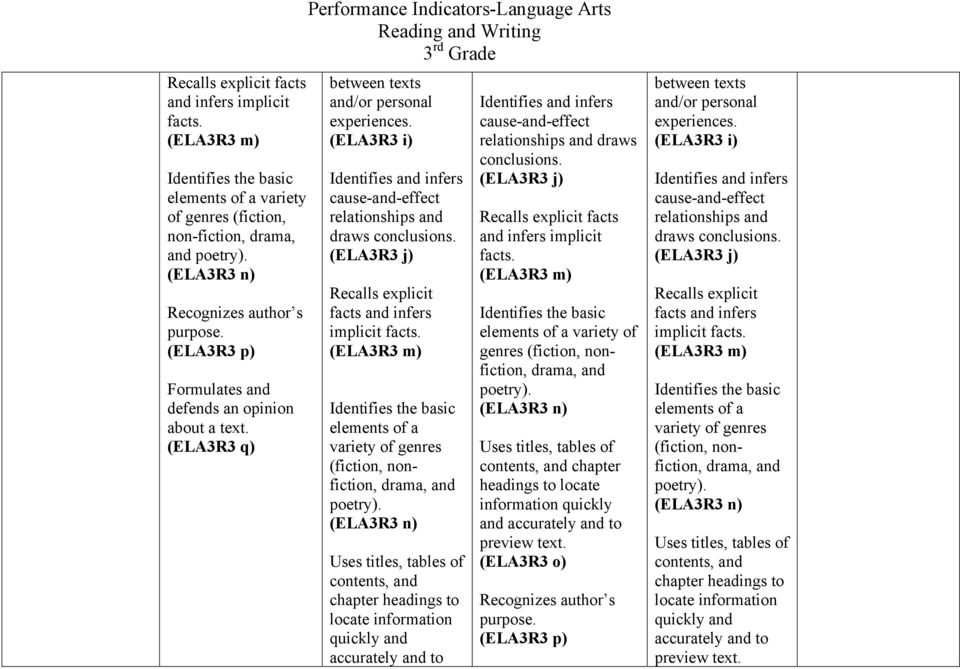
5 Recalls explicit facts and infers implicit facts. (ELA3R3 m) Identifies the basic elements of a variety of genres (fiction, non-fiction, drama, and poetry). (ELA3R3 n) Recognizes author s purpose. (ELA3R3 p) Formulates and defends an opinion about a text. (ELA3R3 q) Performance Indicators-Language Arts between texts and/or personal experiences. (ELA3R3 i) cause-and-effect relationships and draws conclusions. (ELA3R3 j) Recalls explicit facts and infers implicit facts. (ELA3R3 m) Identifies the basic elements of a variety of genres (fiction, nonfiction, drama, and poetry). (ELA3R3 n) Uses titles, tables of contents, and chapter headings to locate information quickly and accurately and to cause-and-effect relationships and draws conclusions. (ELA3R3 j) Recalls explicit facts and infers implicit facts. (ELA3R3 m) Identifies the basic elements of a variety of genres (fiction, nonfiction, drama, and poetry). (ELA3R3 n) Uses titles, tables of contents, and chapter headings to locate information quickly and accurately and to preview text. (ELA3R3 o) Recognizes author s purpose. (ELA3R3 p) between texts and/or personal experiences. (ELA3R3 i) cause-and-effect relationships and draws conclusions. (ELA3R3 j) Recalls explicit facts and infers implicit facts. (ELA3R3 m) Identifies the basic elements of a variety of genres (fiction, nonfiction, drama, and poetry). (ELA3R3 n) Uses titles, tables of contents, and chapter headings to locate information quickly and accurately and to preview text.
6 preview text. (ELA3R3 o) Recognizes author s purpose. (ELA3R3 p) Formulates and defends an opinion about a text. (ELA3R3 q) Applies dictionary, thesaurus, and glossary skills to determine word meanings. (ELA3R3 r) Formulates and defends an opinion about a text. (ELA3R3 q) Applies dictionary, thesaurus, and glossary skills to determine word meanings. (ELA3R3 r) (ELA3R3 o) Recognizes author s purpose. (ELA3R3 p) Formulates and defends an opinion about a text. (ELA3R3 q) Applies dictionary, thesaurus, and glossary skills to determine word meanings. (ELA3R3 r) Reads independently from different genres and sources (ELA3R3) Consistently reads at least 5 books or book equivalents from a variety of (ELA3R3a) Consistently reads at least 5 books or book equivalents from a variety of (ELA3R3a) Consistently reads at least 5 books or book equivalents from a variety of (ELA3R3a) Consistently reads at least 6 books or book equivalents from a variety of (ELA3R3a) *Reading Log AR Response Journals Writing and Conventions Demonstrates Pre-writes to generate competency using ideas. the writing process Pre-writes to generate ideas. Pre-writes to generate ideas. Pre-writes to generate ideas. Prompt

7 in a variety of genres (ELA3W1 m, n) Develops Ideas for writing (ELA3W1) Develops a rough draft. Rereads to revise. Edits to correct. Publishes by presenting an edited piece of writing to others. Generally consistent focus; some evidence of a purpose and point of view. (ELA3W1 a) Includes some relevant details and descriptions. (ELA3W1 i) Begins to develop main character(s) through action and dialogue. (ELA3W1 g) Sufficient information to tell a story. Develops a rough draft. Rereads to revise. Edits to correct. Publishes by presenting an edited piece of writing to others. Generally consistent focus; some evidence of a purpose and point of view. (ELA3W1 a) Includes some relevant examples, facts, anecdotes, and/or details. (ELA3W1 i) Some evidence of information from source materials. (ELA3W1 j) Sufficient information to Develops a rough draft. Rereads to revise. Edits to correct. Publishes by presenting an edited piece of writing to others. Generally consistent focus; some evidence of a purpose and point of view. (ELA3W1 a) Includes some relevant examples, facts, anecdotes, and/or details. (ELA3W1 i) States a clear position. (ELA3W1 l) Sufficient information to develop a point of view. (ELA3W1 c) Develops a rough draft. Rereads to revise. Edits to correct. Publishes by presenting an edited piece of writing to others. Generally consistent focus; some evidence of a purpose and point of view. (ELA3W1 a) Includes some relevant examples, facts, anecdotes, and/or details. (ELA3W1 i) Begins to formulate a position and connect the text to self, outside world, or another text. (ELA3W1 k) Graphic Organizers Prompt Graphic Organizers

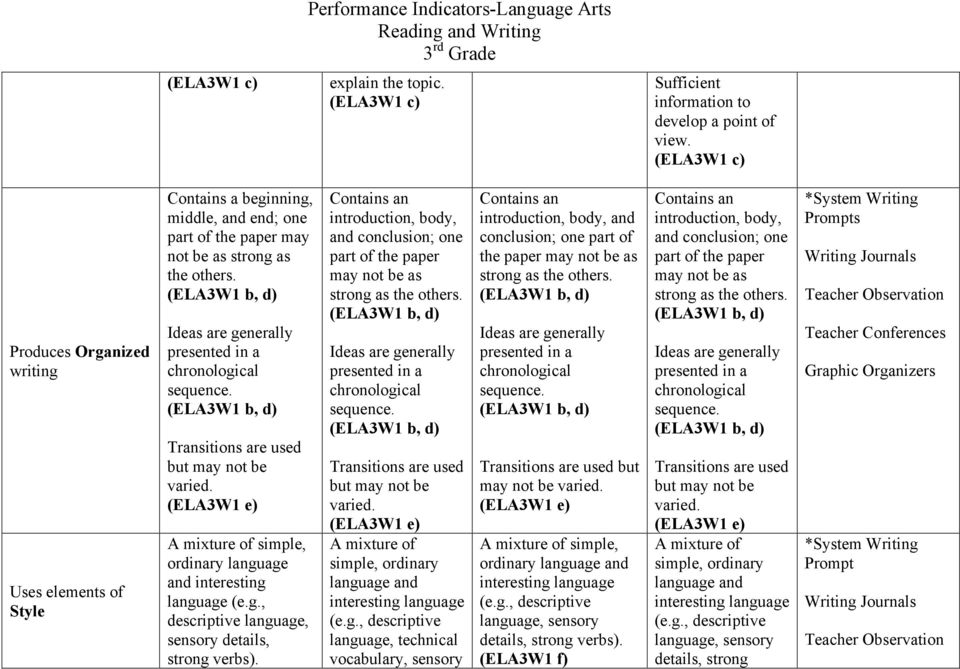
8 (ELA3W1 c) Performance Indicators-Language Arts explain the topic. (ELA3W1 c) Sufficient information to develop a point of view. (ELA3W1 c) Produces Organized writing Uses elements of Style Contains a beginning, middle, and end; one part of the paper may not be as strong as the others. Ideas are generally presented in a chronological sequence. Transitions are used but may not be varied. (ELA3W1 e) A mixture of simple, ordinary language and interesting language (e.g., descriptive language, sensory details, strong verbs). Contains an introduction, body, and conclusion; one part of the paper may not be as strong as the others. Ideas are generally presented in a chronological sequence. Transitions are used but may not be varied. (ELA3W1 e) A mixture of simple, ordinary language and interesting language (e.g., descriptive language, technical vocabulary, sensory Contains an introduction, body, and conclusion; one part of the paper may not be as strong as the others. Ideas are generally presented in a chronological sequence. Transitions are used but may not be varied. (ELA3W1 e) A mixture of simple, ordinary language and interesting language (e.g., descriptive language, sensory details, strong verbs). (ELA3W1 f) Contains an introduction, body, and conclusion; one part of the paper may not be as strong as the others. Ideas are generally presented in a chronological sequence. Transitions are used but may not be varied. (ELA3W1 e) A mixture of simple, ordinary language and interesting language (e.g., descriptive language, sensory details, strong Prompts Graphic Organizers Prompt
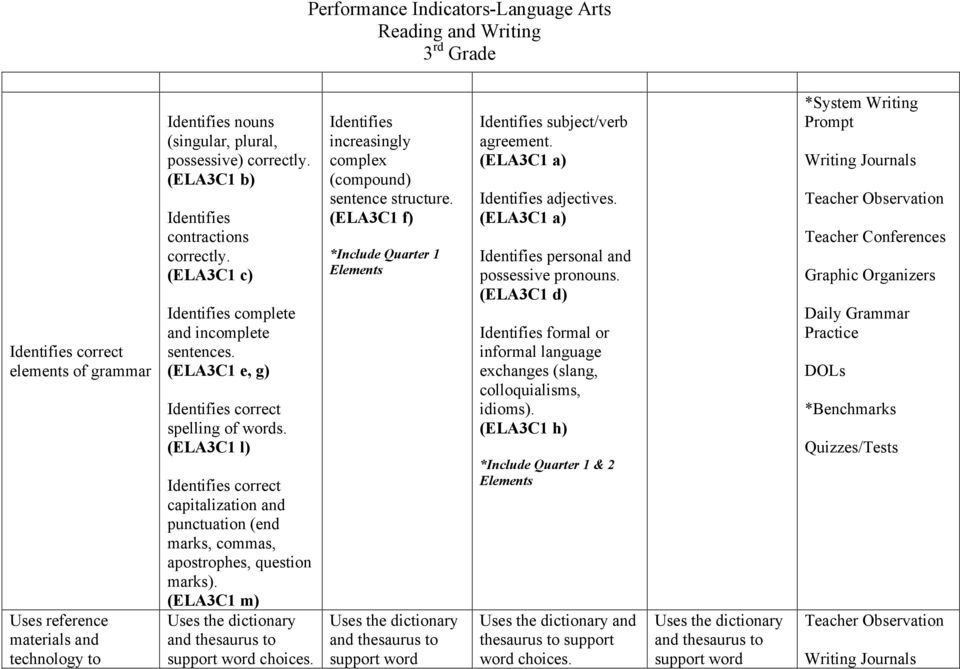
9 Uses appropriate conventions in Writing (ELA3C1) (ELA3W1 f) Some attention to the audience; some sense of the writer s voice. (ELA3W1 a) Uses nouns (singular, plural, possessive) correctly. (ELA3C1 b) Uses contractions correctly. (ELA3C1 c) Uses complete sentences. (ELA3C1 e, g) Uses correct spelling of words. (ELA3C1 l) Uses correct capitalization and punctuation (end marks, commas, apostrophes, question marks). (ELA3C1 m) details). (ELA3W1 f) Some attention to the audience; some sense of the writer s voice. (ELA3W1 a) Uses increasingly complex (compound) sentence structure. (ELA3C1 f) Uses the dictionary and thesaurus to support word choices. *Include Quarter 1 Elements Some attention to the audience; some sense of the writer s voice. (ELA3W1 a) Uses subject/verb agreement. (ELA3C1 a) Uses adjectives correctly. (ELA3C1 a) Uses personal and possessive pronouns correctly. (ELA3C1 d) Uses formal or informal language exchanges (slang, colloquialisms, idioms) appropriately. (ELA3C1 h) *Include Quarter 1 & 2 Elements verbs). (ELA3W1 f) Some attention to the audience; some sense of the writer s voice. (ELA3W1 a) Writes legibly in cursive, leaving space between letters in a word and between words in a sentence. (ELA3C1 n) *Include Quarter 1, 2 & 3 Elements Graphic Organizers Prompts s Graphic Organizers *Benchmarks Quizzes/Tests DOL Daily Grammar Practice

10 Identifies correct elements of grammar Uses reference materials and technology to Identifies nouns (singular, plural, possessive) correctly. (ELA3C1 b) Identifies contractions correctly. (ELA3C1 c) Identifies complete and incomplete sentences. (ELA3C1 e, g) Identifies correct spelling of words. (ELA3C1 l) Identifies correct capitalization and punctuation (end marks, commas, apostrophes, question marks). (ELA3C1 m) Uses the dictionary and thesaurus to support word choices. Identifies increasingly complex (compound) sentence structure. (ELA3C1 f) *Include Quarter 1 Elements Uses the dictionary and thesaurus to support word Identifies subject/verb agreement. (ELA3C1 a) Identifies adjectives. (ELA3C1 a) Identifies personal and possessive pronouns. (ELA3C1 d) Identifies formal or informal language exchanges (slang, colloquialisms, idioms). (ELA3C1 h) *Include Quarter 1 & 2 Elements Uses the dictionary and thesaurus to support word choices. Uses the dictionary and thesaurus to support word Prompt Graphic Organizers Daily Grammar Practice DOLs *Benchmarks Quizzes/Tests
11 support writing (ELA3C1) choices. Uses a variety of resources (encyclopedias, Internet, books) to research and share information on a topic. Uses a variety of resources (encyclopedias, Internet, books) to research and share information on a topic. choices. Uses a variety of resources (encyclopedias, Internet, books) to research and share information on a topic. Listening, Speaking and Viewing Adapts oral language to fit the situation by following the rules of conversation with peers and adults. (ELA3LSV1 a) Uses oral, visual, and auditory strategies to communicate (ELA3LSV1) Recalls, interprets, and summarizes information presented orally. (ELA3LSV1 b) Uses oral language for different purposes: to inform, persuade, or entertain. Adapts oral language to fit the situation by following the rules of conversation with peers and adults. (ELA3LSV1 a) Recalls, interprets, and summarizes information presented orally. (ELA3LSV1 b) Uses oral language for different purposes: to inform, Adapts oral language to fit the situation by following the rules of conversation with peers and adults. (ELA3LSV1 a) Recalls, interprets, and summarizes information presented orally. (ELA3LSV1 b) Uses oral language for different purposes: to inform, persuade, or entertain. (ELA3LSV1 c) Adapts oral language to fit the situation by following the rules of conversation with peers and adults. (ELA3LSV1 a) Recalls, interprets, and summarizes information presented orally. (ELA3LSV1 b) Uses oral language for different purposes: to inform,

12 (ELA3LSV1 c) Listens to and views a variety of media to acquire information. (ELA3LSV1 d) Performance Indicators-Language Arts persuade, or entertain. (ELA3LSV1 c) Listens to and views a variety of media to acquire information. (ELA3LSV1 d) Listens to and views a variety of media to acquire information. (ELA3LSV1 d) persuade, or entertain. (ELA3LSV1 c) Listens to and views a variety of media to acquire information. (ELA3LSV1 d)

Minnesota K-12 Academic Standards in Language Arts Curriculum and Assessment Alignment Form Rewards Intermediate Grades 4-6
 Minnesota K-12 Academic Standards in Language Arts Curriculum and Assessment Alignment Form Rewards Intermediate Grades 4-6 4 I. READING AND LITERATURE A. Word Recognition, Analysis, and Fluency The student
CRCT Content Descriptions based on the Georgia Performance Standards. Reading Grades 1-8
 CRCT Content Descriptions based on the Georgia Performance Standards Reading Grades 1-8 Kathy Cox State Superintendent of Schools June 2007 Criterion-Referenced Competency Tests (CRCT) Content Descriptions
McDougal Littell Bridges to Literature Level III. Alaska Reading and Writing Performance Standards Grade 8
 McDougal Littell Bridges to Literature Level III correlated to the Alaska Reading and Writing Performance Standards Grade 8 Reading Performance Standards (Grade Level Expectations) Grade 8 R3.1 Apply knowledge
Grade 3 LA. 3. 1. 1. 1. Subject Grade Strand Standard Benchmark. Florida K-12 Reading and Language Arts Standards 55
 Grade 3 LA. 3. 1. 1. 1 Subject Grade Strand Standard Benchmark Florida K-12 Reading and Language Arts Standards 55 Grade 3: Reading Process Phonics/Word Analysis Standard: The student demonstrates knowledge
Language Arts Literacy Areas of Focus: Grade 5
 Language Arts Literacy : Grade 5 Mission: Learning to read, write, speak, listen, and view critically, strategically and creatively enables students to discover personal and shared meaning throughout their
Academic Standards for Reading, Writing, Speaking, and Listening June 1, 2009 FINAL Elementary Standards Grades 3-8
 Academic Standards for Reading, Writing, Speaking, and Listening June 1, 2009 FINAL Elementary Standards Grades 3-8 Pennsylvania Department of Education These standards are offered as a voluntary resource
LANGUAGE! 4 th Edition, Levels A C, correlated to the South Carolina College and Career Readiness Standards, Grades 3 5
 Page 1 of 57 Grade 3 Reading Literary Text Principles of Reading (P) Standard 1: Demonstrate understanding of the organization and basic features of print. Standard 2: Demonstrate understanding of spoken
AK + ASD Writing Grade Level Expectations For Grades 3-6
 Revised ASD June 2004 AK + ASD Writing For Grades 3-6 The first row of each table includes a heading that summarizes the performance standards, and the second row includes the complete performance standards.
Common Core Progress English Language Arts
 [ SADLIER Common Core Progress English Language Arts Aligned to the [ Florida Next Generation GRADE 6 Sunshine State (Common Core) Standards for English Language Arts Contents 2 Strand: Reading Standards
Indiana Department of Education
 GRADE 1 READING Guiding Principle: Students read a wide range of fiction, nonfiction, classic, and contemporary works, to build an understanding of texts, of themselves, and of the cultures of the United
Focus: Reading Unit of Study: Research & Media Literary; Informational Text; Biographies and Autobiographies
 3 rd Grade Reading and Writing TEKS 3 rd Nine Weeks Focus: Reading Unit of Study: Research & Media Literary; Informational Text; Biographies and Autobiographies Figure 19: Reading/Comprehension Skills.
Ms Juliani -Syllabus Special Education-Language/ Writing
 Ms Juliani -Syllabus Special Education-Language/ Writing * As a teacher, I have high expectations for my students and believe that they need to be encouraged, nurtured, and rewarded for their efforts.
Grade 1 LA. 1. 1. 1. 1. Subject Grade Strand Standard Benchmark. Florida K-12 Reading and Language Arts Standards 27
 Grade 1 LA. 1. 1. 1. 1 Subject Grade Strand Standard Benchmark Florida K-12 Reading and Language Arts Standards 27 Grade 1: Reading Process Concepts of Print Standard: The student demonstrates knowledge
Academic Standards for Reading, Writing, Speaking, and Listening
 Academic Standards for Reading, Writing, Speaking, and Listening Pre-K - 3 REVISED May 18, 2010 Pennsylvania Department of Education These standards are offered as a voluntary resource for Pennsylvania
Language Arts Literacy Areas of Focus: Grade 6
 Language Arts Literacy : Grade 6 Mission: Learning to read, write, speak, listen, and view critically, strategically and creatively enables students to discover personal and shared meaning throughout their
5 th Grade Language Arts Curriculum Map 1 st Nine Weeks. Resources. Practices. Standards & Elements Essential Questions Assessments Best
 5 th Grade Language Arts Curriculum Map 1 st Nine Weeks Standards & Elements Essential Questions Assessments Best Practices Writing ELA5W1 a.selects a focus, and organizational structure, and a point of
Virginia English Standards of Learning Grade 8
 A Correlation of Prentice Hall Writing Coach 2012 To the Virginia English Standards of Learning A Correlation of, 2012, Introduction This document demonstrates how, 2012, meets the objectives of the. Correlation
10th Grade Language. Goal ISAT% Objective Description (with content limits) Vocabulary Words
 Standard 3: Writing Process 3.1: Prewrite 58-69% 10.LA.3.1.2 Generate a main idea or thesis appropriate to a type of writing. (753.02.b) Items may include a specified purpose, audience, and writing outline.
Strand: Reading Literature Topics Standard I can statements Vocabulary Key Ideas and Details
 Strand: Reading Literature Key Ideas and Details Craft and Structure RL.3.1 Ask and answer questions to demonstrate understanding of a text, referring explicitly to the text as the basis for the answers.
2nd Grade Teacher Rubrics
 2nd Grade Teacher Rubrics Quarter 1 2nd Grade Rubric SECOND GRADE FIRST NINE WEEKS LANGUAGE ARTS Quarter 1 READING 3 2 1 Applies knowledge of letter-sounds and spelling patterns to decode unfamiliar words
Words Their Way TM. Word Study in Action. Correlated to: North Carolina STANDARD COURSE OF STUDY Language Arts for Third Grade
 TM Word Study in Action Correlated to: North Carolina STANDARD COURSE OF STUDY Language Arts for Third Grade For More Information Contact Debbie Owens, Sales Representative 1-800-435-3499 Ext. 8092 www.pearsonlearning.com
Date Re-Assessed. Indicator. CCSS.ELA-Literacy.RF.5.3 Know and apply grade-level phonics and word analysis skills in decoding words.
 CCSS English/Language Arts Standards Reading: Foundational Skills Fifth Grade Retaught Reviewed Assessed Phonics and Word Recognition CCSS.ELA-Literacy.RF.5.3 Know and apply grade-level phonics and word
Focus: Reading Unit of Study: Fiction/Expository/Persuasive/Research/Media Literacy
 4 th Grade Reading and Writing TEKS 4th Nine Weeks Focus: Reading Unit of Study: Fiction/Expository/Persuasive/Research/Media Literacy Figure 19: Reading/Comprehension Skills. Students use a flexible range
Reading IV Grade Level 4
 Reading IV Reading IV introduces students to a variety of topics to enrich their reading experience including: a review of consonant and vowel sounds using phonetic clues and diacritical marks to identify
Strand: Reading Literature Topics Standard I can statements Vocabulary Key Ideas and Details
 Strand: Reading Literature Topics Standard I can statements Vocabulary Key Ideas and Details Craft and Structure RL.5.1 Quote accurately from a text when explaining what the text says explicitly and when
FSD Grade 2 READING. Ask and answer such questions as who, what, where, when, why, and how to demonstrate understanding of key details in a text.
 College and Career Readiness Anchor Standards for Reading Read closely to determine what the text says explicitly and to make logical inferences from it; cite specific textual evidence when writing or
This image cannot currently be displayed. Course Catalog. Language Arts 400. 2016 Glynlyon, Inc.
 This image cannot currently be displayed. Course Catalog Language Arts 400 2016 Glynlyon, Inc. Table of Contents COURSE OVERVIEW... 1 UNIT 1: READING AND WRITING... 3 UNIT 2: READING FOR MEANING... 3 UNIT
CURRICULUM PACING GUIDE GRADE/SUBJECT: /English. 1st Nine Weeks 1
 Approximately Alabama Course Of Study/Quality Core Standards. Ask and answer questions to demonstrate understanding of a text, referring explicitly to the text as the basis for the answers [RL.3.] (.)
This image cannot currently be displayed. Course Catalog. Language Arts 600. 2016 Glynlyon, Inc.
 This image cannot currently be displayed. Course Catalog Language Arts 600 2016 Glynlyon, Inc. Table of Contents COURSE OVERVIEW... 1 UNIT 1: ELEMENTS OF GRAMMAR... 3 UNIT 2: GRAMMAR USAGE... 3 UNIT 3:
Grade 4 Writing Curriculum Map
 Curriculum Map BOE Approval November 2013 CURRICULUM MAP WRITING GRADE 4 SEPTEMBER OCTOBER NOVEMBER DECEMBER JANUARY Creating a Buzz About : It s All About Me! Tell Me A Story Realistic Fiction Tell Me
Students will know Vocabulary: purpose details reasons phrases conclusion point of view persuasive evaluate
 Fourth Grade Writing : Text Types and Purposes Essential Questions: 1. How do writers select the genre of writing for a specific purpose and audience? 2. How do essential components of the writing process
KINDGERGARTEN. Listen to a story for a particular reason
 KINDGERGARTEN READING FOUNDATIONAL SKILLS Print Concepts Follow words from left to right in a text Follow words from top to bottom in a text Know when to turn the page in a book Show spaces between words
How To Read With A Book
 Behaviors to Notice Teach Level A/B (Fountas and Pinnell) - DRA 1/2 - NYC ECLAS 2 Solving Words - Locates known word(s) in. Analyzes words from left to right, using knowledge of sound/letter relationships
Key Ideas and Details
 FIFTH GRADE READING LITERARY (RL) Key Ideas and Details ELAGSE5RL1: Quote accurately from a text when explaining what the text says explicitly and when drawing inferences from the text. ELAGSE5RL2: Determine
Grading Benchmarks FIRST GRADE. Trimester 4 3 2 1 1 st Student has achieved reading success at. Trimester 4 3 2 1 1st In above grade-level books, the
 READING 1.) Reads at grade level. 1 st Student has achieved reading success at Level 14-H or above. Student has achieved reading success at Level 10-F or 12-G. Student has achieved reading success at Level
Common Core Progress English Language Arts. Grade 3
 [ SADLIER Common Core Progress English Language Arts Aligned to the Florida [ GRADE 6 Next Generation Sunshine State (Common Core) Standards for English Language Arts Contents 2 Strand: Reading Standards
Third Grade Language Arts Learning Targets - Common Core
 Third Grade Language Arts Learning Targets - Common Core Strand Standard Statement Learning Target Reading: 1 I can ask and answer questions, using the text for support, to show my understanding. RL 1-1
Houghton Mifflin Harcourt Journeys Common Core 2014 and Earobics, Grade 3. correlated to the
 Houghton Mifflin Harcourt Journeys Common Core 2014 and Earobics, Grade 3 correlated to the Common Core State Standards English Language Arts Grade 3 RL.3.1 Reading Standards for Literature Key Ideas and
Year 1 reading expectations (New Curriculum) Year 1 writing expectations (New Curriculum)
 Year 1 reading expectations Year 1 writing expectations Responds speedily with the correct sound to graphemes (letters or groups of letters) for all 40+ phonemes, including, where applicable, alternative
2016-2017 Curriculum Catalog
 2016-2017 Curriculum Catalog 2016 Glynlyon, Inc. Table of Contents LANGUAGE ARTS 600 COURSE OVERVIEW... 1 UNIT 1: ELEMENTS OF GRAMMAR... 3 UNIT 2: GRAMMAR USAGE... 3 UNIT 3: READING SKILLS... 4 UNIT 4:
MStM Reading/Language Arts Curriculum Lesson Plan Template
 Grade Level: 6 th grade Standard 1: Students will use multiple strategies to read a variety of texts. Grade Level Objective: 1. A.6.1: compare/contrast the differences in fiction and non-fiction text.
As Approved by State Board 4/2/09
 Improving students' ability to learn, communicate, and collaborate through literacy education As Approved by State Board 4/2/09 Nebraska Language Arts Standards As approved by State Board 4/2/09 Table
Alburnett Community Schools. Theme 1 Finding My Place/ Six Weeks. Phonics: Apply knowledge of letter/sound correspondence.
 3 rd Grade Reading District Curriculum Map Theme 1 Finding My Place/ Six Weeks Apply knowledge of letter/sound correspondence. Learnings or Understandings (ICC) Use a variety of strategies to develop and
Mansfield City Schools ELA Pacing Guide Grade 6 Reading
 ACQUISITION OF VOCABULARY AV 6.1 - Define the meaning of unknown words by using context clues and the author's use of definition, restatement and example. AV6.6 - Apply the knowledge of prefixes, suffixes
Determine two or more main ideas of a text and use details from the text to support the answer
 Strand: Reading Nonfiction Topic (INCCR): Main Idea 5.RN.2.2 In addition to, in-depth inferences and applications that go beyond 3.5 In addition to score performance, in-depth inferences and applications
Meeting the Standard in North Carolina
 KINDERGARTEN 1.02 Demonstrate understanding of the sounds of letters and understanding that words begin and end alike (onsets and rhymes). 1.03 Recognize and name upper and lower case letters of the alphabet.
Pre K Kindergarten Students will be able to:
 Pre K Kindergarten Students will be able to: Handle book appropriately, holding right side up and turning pages one at a time. Recognize that English is written from left to right, top to bottom. Identify
Grade 4 Reading Comprehension Sample Selections and Items Test Information Document
 Grade 4 Reading Comprehension Sample Selections and Items Test Information Document Copyright 2005 by the North Carolina Department of Public Instruction This publication and the information contained
2016-2017 Curriculum Catalog
 2016-2017 Curriculum Catalog 2016 Glynlyon, Inc. Table of Contents LANGUAGE ARTS 400 COURSE OVERVIEW... 1 UNIT 1: JESUS, OUR EXAMPLE... 3 UNIT 2: WORKING WITH INFORMATION... 3 UNIT 3: THE STORY OF OUR
Common Core Standards Pacing Guide Fourth Grade English/Language Arts Pacing Guide 1 st Nine Weeks
 Common Core Standards Pacing Guide Fourth Grade English/Language Arts Pacing Guide 1 st Nine Weeks Key: Objectives in bold to be assessed after the current nine weeks Objectives in italics to be assessed
Grade 3 Reading Assessment. Eligible Texas Essential Knowledge and Skills
 Grade 3 Reading Assessment Eligible Texas Essential Knowledge and Skills STAAR Grade 3 Reading Assessment Genres Assessed: Literary Informational Fiction (Readiness) Expository (Readiness) Literary Nonfiction
3rd Grade - ELA Writing
 3rd Grade - ELA Text Types and Purposes College & Career Readiness 1. Opinion Write arguments to support claims in an analysis of substantive topics or texts, using valid reasoning and relevant and sufficient
3rd Grade English Language Arts Georgia Standards of Excellence (ELAGSE)
 READING LITERARY (RL) Key Ideas and Details ELAGSE3RL1: Ask and answer questions to demonstrate understanding of a text, referring explicitly to the text as the basis for the answers. ELAGSE3RL2: Recount
Third Grade in California Public Schools. and the Common Core State Standards
 A Look at Third Grade in California Public Schools and the Common Core State Standards CURRICULUM FRAMEWORKS AND INSTRUCTIONAL RESOURCES DIVISION INSTRUCTION AND LEARNING SUPPORT BRANCH CALIFORNIA DEPARTMENT
Index. 344 Grammar and Language Workbook, Grade 8
 Index Index 343 Index A A, an (usage), 8, 123 A, an, the (articles), 8, 123 diagraming, 205 Abbreviations, correct use of, 18 19, 273 Abstract nouns, defined, 4, 63 Accept, except, 12, 227 Action verbs,
SIXTH GRADE UNIT 1. Reading: Literature
 Reading: Literature Writing: Narrative RL.6.1 RL.6.2 RL.6.3 RL.6.4 RL.6.5 RL.6.6 RL.6.7 W.6.3 SIXTH GRADE UNIT 1 Key Ideas and Details Cite textual evidence to support analysis of what the text says explicitly
Teacher's Guide to Meeting the Common Core State Standards* with Scott Foresman Reading Street 2008
 Implementing the Common Core State StandArds Teacher's Guide to Meeting the Common Core State Standards* with Scott Foresman Reading Street 2008 Table of Contents Grade 5 Introduction................................................
Reading for Success : A Novel Study for Stuart Little by E.B. White. Common Core Standards Grades 5, 6, 7
 Common Core Standards Copyright 2010. National Governors Association Center for Best Practices and Council of Chief State School Officers. All rights reserved. LESSON 1 2 3 4 5 6 7 8 9 Speaking and Listening:
Houghton Mifflin Harcourt StoryTown Grade 1. correlated to the. Common Core State Standards Initiative English Language Arts (2010) Grade 1
 Houghton Mifflin Harcourt StoryTown Grade 1 correlated to the Common Core State Standards Initiative English Language Arts (2010) Grade 1 Reading: Literature Key Ideas and details RL.1.1 Ask and answer
Grade 4 Writing Assessment. Eligible Texas Essential Knowledge and Skills
 Grade 4 Writing Assessment Eligible Texas Essential Knowledge and Skills STAAR Grade 4 Writing Assessment Reporting Category 1: Composition The student will demonstrate an ability to compose a variety
3rd Grade Reading Standard Exceeds (4) Secure (3) Developing (2) Beginning (1)
 3rd Grade Reading Standard Exceeds (4) Secure (3) Developing (2) Beginning (1) based on the Refer to details and examples in a text when explaining what the text says explicitly and when drawing inferences
How To Understand And Understand A Text From A Grade 5 To Grade 5
 Strand: Reading Standards for Literature Grade: 3 Grade: 4 Grade: 5 Cluster 1: Key Ideas and Details LAFS.3.RL.1.1 Ask and answer questions to demonstrate understanding to a text, referring explicitly
Correlation to the Common Core State Standards for English Language Arts, Grade 3
 Correlation to the Common Core State Standards for English Language Arts, Grade 3 Journeys Grade 3 LESSON 1 LESSON 2 LESSON 3 LESSON 4 LESSON 5 1 Houghton Mifflin Harcourt Publishing Company. All rights
FIFTH GRADE IMAGINE IT! BLUE BAND UNIT OVERVIEW UNIT 1: Heritage
 UNIT 1: Heritage Unit 1: Lesson 1 Writing a list Compound words Common/ proper nouns Paragraph structure Listen to directions Verbs/verb phrases Direct/indirect objects Unit 1: Lesson 2 Prefixes tele-
Contextual Understanding, Conceptual Understanding, Structural Understanding, and Tools and Resources
 Prentice Hall Writing and Grammar: Communication In Action 2004, Gold Level Ohio Academic Content Standards, Grade-Level Indicators, English Language Arts (Grade 9) Grade Nine Phonemic Awareness, Word
Test Blueprint. Grade 3 Reading. 2010 English Standards of Learning
 Test Blueprint Grade 3 Reading 2010 English Standards of Learning This revised test blueprint will be effective with the administration of the 2012-2013 English Standards of Learning (SOL) tests. Notice
Expository Reading and Writing By Grade Level
 Expository and Writing By Grade Level Kindergarten TEKS identify the topic of an informational text heard identify the topic and details in expository text heard or read, referring to the words and/or
ESL I English as a Second Language I Curriculum
 ESL I English as a Second Language I Curriculum ESL Curriculum alignment with NJ English Language Proficiency Standards (Incorporating NJCCCS and WIDA Standards) Revised November, 2011 The ESL program
GRADE 4. Curriculum Package. (September 2010)
 GRADE 4 Curriculum Package (September 2010) For ease of reference, this Grade 4 Curriculum Package compiles all Prescribed Learning Outcomes and from within each subject-based Integrated Resource Package
Fifth Grade in California Public Schools. and the Common Core State Standards
 A Look at Fifth Grade in California Public Schools and the Common Core State Standards CURRICULUM FRAMEWORKS AND INSTRUCTIONAL RESOURCES DIVISION INSTRUCTION AND LEARNING SUPPORT BRANCH CALIFORNIA DEPARTMENT
English Language Arts Standards of the Archdiocese of Detroit
 A Correlation of Pearson ilit 45, 2016 To the English Language Arts Standards of the Introduction This document demonstrates how meets English Language Arts Standards of the. Correlation references are
Reading Strategies by Level. Early Emergent Readers
 The charts below were created as a common language for teachers and students in the Wallingford Public Schools in kindergarten through eighth grade. The level of the chart selected for use in the classroom
Massachusetts Tests for Educator Licensure
 Massachusetts Tests for Educator Licensure FIELD 90: FOUNDATIONS OF READING TEST OBJECTIVES Subarea Multiple-Choice Range of Objectives Approximate Test Weighting I. Foundations of Reading Development
Key Information about the Reading Language Arts Program/Harcourt Brace Collections Fourth Grade
 Key Information about the Reading Language Arts Program/Harcourt Brace Collections Fourth Grade The Lakewood City Schools Language Arts Program is aligned with the Ohio Academic Content Standards, K 12
Evaluating the Elements of a Piece of Practical Writing The author of this friendly letter..
 Practical Writing Intermediate Level Scoring Rubric for a Friendly Letter (to be used upon completion of Lesson 4) Evaluating the Elements of a Piece of Practical Writing The author of this friendly letter..
Students will know Vocabulary: claims evidence reasons relevant accurate phrases/clauses credible source (inc. oral) formal style clarify
 Sixth Grade Writing : Text Types and Purposes Essential Questions: 1. How do writers select the genre of writing for a specific purpose and audience? 2. How do essential components of the writing process
ELAGSEKRI7: With prompting and support, describe the relationship between illustrations and the text (how the illustrations support the text).
 READING LITERARY (RL) Key Ideas and Details ELAGSEKRL1: With prompting and support, ask and answer questions about key details in a text. ELAGSEKRL2: With prompting and support, retell familiar stories,
Writing Common Core KEY WORDS
 Writing Common Core KEY WORDS An educator's guide to words frequently used in the Common Core State Standards, organized by grade level in order to show the progression of writing Common Core vocabulary
GRADE 11 English Language Arts Standards Pacing Guide. 1 st Nine Weeks
 1 st Nine Weeks A. Verify meanings of words by the author s use of definition, restatement, example, comparison, contrast and cause and effect. B. Distinguish the relationship of word meanings between
Kindergarten Common Core State Standards: English Language Arts
 Kindergarten Common Core State Standards: English Language Arts Reading: Foundational Print Concepts RF.K.1. Demonstrate understanding of the organization and basic features of print. o Follow words from
CCSS English/Language Arts Standards Reading: Foundational Skills First Grade
 CCSS.ELA-Literacy.RF.1.1 Demonstrate understanding of the organization and basic features of print. CCSS.ELA-Literacy.RF.1.1.A Recognize the distinguishing features of a sentence (e.g., first word, capitalization,
Grade 3 Reading Comprehension Sample Selections and Items Test Information Document
 Grade 3 Reading Comprehension Sample Selections and Items Test Information Document Copyright 2005 by the North Carolina Department of Public Instruction This publication and the information contained
Written Language Curriculum Planning Manual 3LIT3390
 Written Language Curriculum Planning Manual 3LIT3390 TABLE OF CONTENTS Language Usage Curriculum... 1 Language Usage I... 2 Language Usage II... 4 Language Usage III... 6 Language Usage IV... 8 Language
Reading VIII Grade Level 8
 Reading VIII Reading VIII introduces students to a variety of topics to enrich their reading experience including: understanding common misspellings using prefixes, suffixes, root words, and forming compounds
CST and CAHSEE Academic Vocabulary
 CST and CAHSEE Academic Vocabulary Grades K 12 Math and ELA This document references Academic Language used in the Released Test Questions from the 2008 posted CAHSEE Released Test Questions (RTQs) and
READING KINDERGARTEN
 READING KINDERGARTEN Concepts about print Identify the front cover, back cover, and title page of a book. Follow words from left to right and from top to bottom on the printed page. Understand that printed
Fourth Grade in California Public Schools. and the Common Core State Standards
 A Look at Fourth Grade in California Public Schools and the Common Core State Standards CURRICULUM FRAMEWORKS AND INSTRUCTIONAL RESOURCES DIVISION INSTRUCTION AND LEARNING SUPPORT BRANCH CALIFORNIA DEPARTMENT
Grades 6 8. correlated to the. Oregon English/Language Arts Grade-Level Standards. Grades 6 8
 Grades 6 8 correlated to the Oregon English/Language Arts Grade-Level Standards Grades 6 8 McDougal Littell Grade 6 correlated to the Oregon English/Language Arts Grade-level Standards Grade 6 READING
Livingston Public Schools Scope and Sequence K 6 Grammar and Mechanics
 Grade and Unit Timeframe Grammar Mechanics K Unit 1 6 weeks Oral grammar naming words K Unit 2 6 weeks Oral grammar Capitalization of a Name action words K Unit 3 6 weeks Oral grammar sentences Sentence
LANGUAGE ARTS 2016 17 K 12 SUBJECT BOOKLET
 LANGUAGE ARTS 2016 17 K 12 SUBJECT BOOKLET Gwinnett s curriculum for grades K 12 is called the Academic Knowledge and Skills (AKS). The AKS for each grade level spell out the essential things students
Inspiration Standards Match: Virginia
 Inspiration Standards Match: Virginia Standards of Learning: English Language Arts Middle School Meeting curriculum standards is a major focus in education today. This document highlights the correlation
Grade: 9 (1) Students will build a framework for high school level academic writing by understanding the what of language, including:
 Introduction: The following document is a draft of standards-designed, comprehensive Pacing Guide for high school English Grade 9. This document will evolve as feedback is accumulated. The Pacing Guide
Reading: The student reads and comprehends text across the curriculum.
 Curricular Standards for Reading Education Kansas L iterature Reading with Purpose Course 1 2007 STANDARDS Standard 1: Reading Reading: The student reads and comprehends text across the curriculum. Benchmark
BLANK GRAPHIC ORGANIZERS FOR FICTION SELECTIONS
 BLANK GRAPHIC ORGANIZERS FOR FICTION SELECTIONS TIME LINE OF A STORY Graphic Organizer 1 FICTION SELECTIONS VENN DIAGRAMS Graphic Organizer 2 FICTION SELECTIONS Graphic Organizer 3 FICTION SELECTIONS SENSORY
Dynamic Learning Maps Essential Elements English Language Arts. Version 2 Comparison Document
 Dynamic Learning Maps Essential Elements English Language Arts Version 2 Comparison Document COMMON CORE ESSENTIAL ELEMENTS AND ACHIEVEMENT DESCRIPTORS FOR KINDERGARTEN Kindergarten English Language Arts
Grade 5. Ontario Provincial Curriculum-based Expectations Guideline Walking with Miskwaadesi and Walking with A`nó:wara By Subject/Strand
 Ontario Provincial Curriculum-based Expectations Guideline Walking with Miskwaadesi and Walking with A`nó:wara By Subject/Strand Turtle Island Conservation Ontario Teachers Resource Bundle 1 The Arts 1.1
Online Resources to Help Students Review for the VPT-English
 This document is intended to help students review for the VPT-English Test. It should prove useful whether students use these resources before or after taking the VPT-English Practice Test. The document
Grade Genre Skills Lessons Mentor Texts and Resources 6 Grammar To Be Covered
 Grade Genre Skills Lessons Mentor Texts and Resources 6 Grammar To Be Covered 6 Personal Narrative Parts of speech (noun, adj, verb, adv) Complete sentence (subj. and verb) Capitalization Tense (identify)
Units of Study 9th Grade
 Units of Study 9th Grade First Semester Theme: The Journey Second Semester Theme: Choices The Big Ideas in English Language Arts that drive instruction: Independent thinkers construct meaning through language.