
Job Families Booklet. Human Resources. University of Surrey
|
|
|
- Tamsin Fitzgerald
- 9 years ago
- Views:
Transcription
1 Job Families Booklet Human Resources University of Surrey

2 Introduction Introduction to the Job Families Booklet Introduction Dear Colleagues Following the independent review of Higher Education Pay and Conditions by Sir Michael Bett, the University of Surrey has, as part of its Strategy, given a commitment to review the pay and grading structures for all staff. The University aims to replace the current complex system with one which is transparent, easy to understand, fair and equitable. This booklet sets out in detail the Job Families which will be implemented at the University of Surrey. It will be used by managers and HR staff to allocate or match individual jobs to a Job Family and level. This will support the introduction of the new Pay and Grading system. The Job Families are underpinned by the Hay job evaluation system which has been adapted for use in the Higher Education sector. This ensures that the relative weight of roles at each level is measured analytically and therefore meets the requirements for equal pay for work of equal value. This booklet draws on the initial collaborative work within other institutions, but has been revised by the University of Surrey following extensive internal consultation to ensure it meets our needs and reflects our culture. We have been working closely with all the campus trades unions, and will continue to do so as the new system evolves. The new approach acknowledges the different contributions that all our staff make in helping to deliver our Vision, and demonstrates how it may be possible to develop careers within or across the Job Families. We will also be able to compare ourselves with other institutions and local employers, so that we can recruit, retain and develop the best staff at Surrey. Therefore, I fully endorse the reform of our pay and grading arrangements using the Job Families set out in this booklet, and hope that it will receive your confidence and support. Job Families summarise the main features of roles which are similar in character and engaged in broadly similar work. There are four Job Families, which will cover the vast majority of jobs within the University. They are: Operational Services Research and Teaching Technical and Experimental Within each family there are between four and seven levels. At each level there is a description of the accountabilities, desired outcomes/achievements and the skills and competencies required by the jobholder. There will be key factors which differentiate one level from the next, and therefore Job Families can help define career and development paths. At the start of each section on the four families, there is an outline which provides a summary description of each level. The booklet then provides a detailed explanation of each level within each family. This is broken down into: required by the jobholder Professor John Turner Deputy Vice-Chancellor and Chair of the Job Evaluation Steering Group The descriptions within the Job Families booklet are designed to support the existing line management structures within individual Schools and Departments and not to supersede them
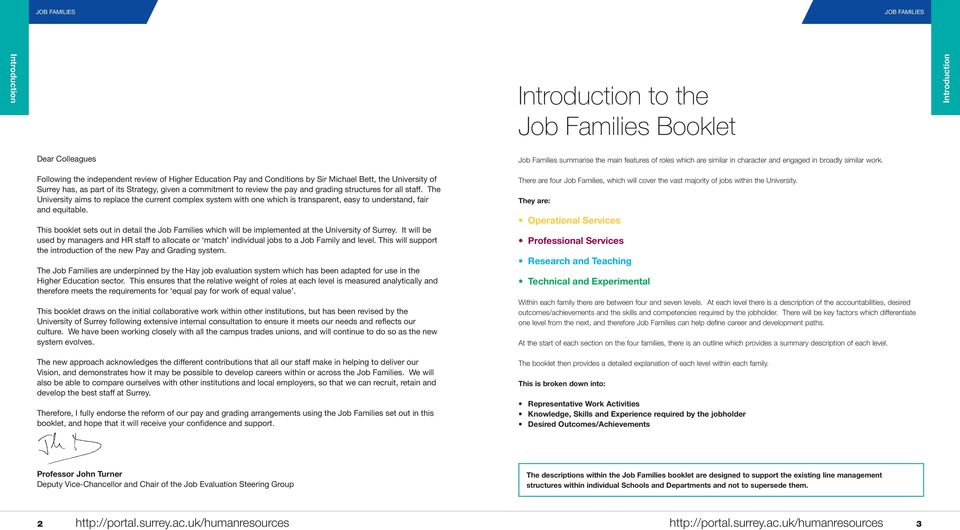
3 Introduction Job Matching Using the Job Families Booklet Introduction A Job Matching Panel comprising managers and HR staff will consider each job within the University. Panels will use an up-to-date job description or role profile (for Academic, Tutor and Research posts) in the new University of Surrey format. Where several individuals are in similar roles, a generic job description or role profile will be used. 7 The first element to be considered by the Job Matching Panel is in which of the four families the job fits. 6 Where a job could fall within more than one Job Family then a 'best fit'/majority approach will be taken. The Job Matching Panel will consider each summary description to determine which of the families most closely fits the job being considered. The Job Matching Panel will then consider in more detail which of the levels is felt to be most appropriate to the job, by reference to the detailed explanations in the booklet. In some cases, this will be a fairly straightforward confirmation; others will involve more discussion amongst panel members before a decision is reached. The decision and any relevant discussion for each individual job will be recorded on the Job Matching Rationale Form. In some instances a panel may be unable to accurately match a job to a Job Family and level. The job will then be referred to another panel, or be evaluated using the full HAY job evaluation methodology. Levels a b b a Operational Services Professional Services Research and Teaching Technical and Experimental Job Family NB Posts above Operational Services Level 4 and Technical and Experimental Level 5 will fall within the upper levels of the Family as they are likely to be managerial in nature

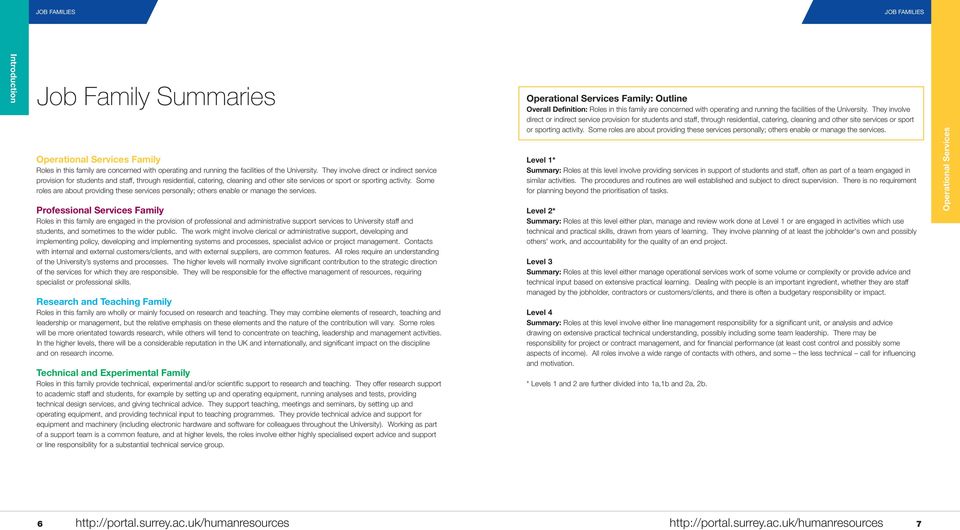
4 Introduction Job Family Summaries Operational Services Family Roles in this family are concerned with operating and running the facilities of the University. They involve direct or indirect service provision for students and staff, through residential, catering, cleaning and other site services or sport or sporting activity. Some roles are about providing these services personally; others enable or manage the services. Family Roles in this family are engaged in the provision of professional and administrative support services to University staff and students, and sometimes to the wider public. The work might involve clerical or administrative support, developing and implementing policy, developing and implementing systems and processes, specialist advice or project management. Contacts with internal and external customers/clients, and with external suppliers, are common features. All roles require an understanding of the University s systems and processes. The higher levels will normally involve significant contribution to the strategic direction of the services for which they are responsible. They will be responsible for the effective management of resources, requiring specialist or professional skills. Research and Teaching Family Roles in this family are wholly or mainly focused on research and teaching. They may combine elements of research, teaching and leadership or management, but the relative emphasis on these elements and the nature of the contribution will vary. Some roles will be more orientated towards research, while others will tend to concentrate on teaching, leadership and management activities. In the higher levels, there will be a considerable reputation in the UK and internationally, and significant impact on the discipline and on research income. Technical and Experimental Family Roles in this family provide technical, experimental and/or scientific support to research and teaching. They offer research support to academic staff and students, for example by setting up and operating equipment, running analyses and tests, providing technical design services, and giving technical advice. They support teaching, meetings and seminars, by setting up and operating equipment, and providing technical input to teaching programmes. They provide technical advice and support for equipment and machinery (including electronic hardware and software for colleagues throughout the University). Working as part of a support team is a common feature, and at higher levels, the roles involve either highly specialised expert advice and support or line responsibility for a substantial technical service group. Operational Services Family: Outline Overall Definition: Roles in this family are concerned with operating and running the facilities of the University. They involve direct or indirect service provision for students and staff, through residential, catering, cleaning and other site services or sport or sporting activity. Some roles are about providing these services personally; others enable or manage the services. Level 1* Summary: Roles at this level involve providing services in support of students and staff, often as part of a team engaged in similar activities. The procedures and routines are well established and subject to direct supervision. There is no requirement for planning beyond the prioritisation of tasks. Level 2* Summary: Roles at this level either plan, manage and review work done at Level 1 or are engaged in activities which use technical and practical skills, drawn from years of learning. They involve planning of at least the jobholder's own and possibly others' work, and accountability for the quality of an end project. Level 3 Summary: Roles at this level either manage operational services work of some volume or complexity or provide advice and technical input based on extensive practical learning. Dealing with people is an important ingredient, whether they are staff managed by the jobholder, contractors or customers/clients, and there is often a budgetary responsibility or impact. Level 4 Summary: Roles at this level involve either line management responsibility for a significant unit, or analysis and advice drawing on extensive practical technical understanding, possibly including some team leadership. There may be responsibility for project or contract management, and for financial performance (at least cost control and possibly some aspects of income). All roles involve a wide range of contacts with others, and some the less technical call for influencing and motivation. * Levels 1 and 2 are further divided into 1a,1b and 2a, 2b. Operational Services
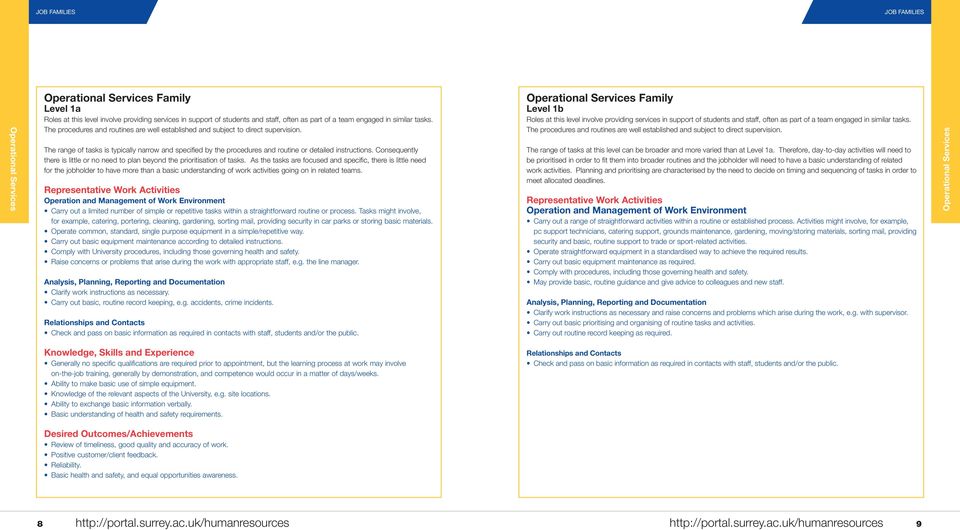
5 Operational Services Operational Services Family Level 1a Roles at this level involve providing services in support of students and staff, often as part of a team engaged in similar tasks. The procedures and routines are well established and subject to direct supervision. The range of tasks is typically narrow and specified by the procedures and routine or detailed instructions. Consequently there is little or no need to plan beyond the prioritisation of tasks. As the tasks are focused and specific, there is little need for the jobholder to have more than a basic understanding of work activities going on in related teams. Operation and Management of Work Environment Carry out a limited number of simple or repetitive tasks within a straightforward routine or process. Tasks might involve, for example, catering, portering, cleaning, gardening, sorting mail, providing security in car parks or storing basic materials. Operate common, standard, single purpose equipment in a simple/repetitive way. Carry out basic equipment maintenance according to detailed instructions. Comply with University procedures, including those governing health and safety. Raise concerns or problems that arise during the work with appropriate staff, e.g. the line manager. Analysis, Planning, Reporting and Documentation Clarify work instructions as necessary. Carry out basic, routine record keeping, e.g. accidents, crime incidents. Relationships and Contacts Check and pass on basic information as required in contacts with staff, students and/or the public. Operational Services Family Level 1b Roles at this level involve providing services in support of students and staff, often as part of a team engaged in similar tasks. The procedures and routines are well established and subject to direct supervision. The range of tasks at this level can be broader and more varied than at Level 1a. Therefore, day-to-day activities will need to be prioritised in order to fit them into broader routines and the jobholder will need to have a basic understanding of related work activities. Planning and prioritising are characterised by the need to decide on timing and sequencing of tasks in order to meet allocated deadlines. Operation and Management of Work Environment Carry out a range of straightforward activities within a routine or established process. Activities might involve, for example, pc support technicians, catering support, grounds maintenance, gardening, moving/storing materials, sorting mail, providing security and basic, routine support to trade or sport-related activities. Operate straightforward equipment in a standardised way to achieve the required results. Carry out basic equipment maintenance as required. Comply with procedures, including those governing health and safety. May provide basic, routine guidance and give advice to colleagues and new staff. Analysis, Planning, Reporting and Documentation Clarify work instructions as necessary and raise concerns and problems which arise during the work, e.g. with supervisor. Carry out basic prioritising and organising of routine tasks and activities. Carry out routine record keeping as required. Operational Services Generally no specific qualifications are required prior to appointment, but the learning process at work may involve on-the-job training, generally by demonstration, and competence would occur in a matter of days/weeks. Ability to make basic use of simple equipment. Knowledge of the relevant aspects of the University, e.g. site locations. Ability to exchange basic information verbally. Basic understanding of health and safety requirements. Relationships and Contacts Check and pass on basic information as required in contacts with staff, students and/or the public. Review of timeliness, good quality and accuracy of work. Positive customer/client feedback. Reliability. Basic health and safety, and equal opportunities awareness
6 Operational Services Operational Services Family Level 1b continued Generally no specific qualifications are required prior to appointment, but the learning process at work may involve short programmes, and certification of training. Posts with supervisory duties will require experience of up to a year. Processes and practices typically learned in a period of months. Knowledge of the relevant aspects of the University, e.g. site locations, staff names and jobs, regulations and practices. Ability to make basic use of equipment and exchange basic information verbally and, if required, in writing. Understanding of health and safety requirements. Review of timeliness, good quality and accuracy of work. Positive customer/client feedback. Reliability and flexibility around basic routines. Commitment and enthusiasm. Basic health and safety, and equal opportunities awareness. Operational Services Family Level 2a Roles at this level either plan, supervise and review work undertaken at Levels 1a and 1b or are engaged in activities which use technical and practical skills drawn from years of learning. They involve the day-to-day planning, organising and/or performance of a relatively narrow range of standardised and routine activities. Jobholders are skilled in, and have a full understanding of, the routine, procedures, systems and processes as they relate to the activities of the work area. Operation and Management of Work Environment Follow a clear brief supplied by others to carry out a narrow range of prescribed, skilled tasks, for example, maintenance tasks requiring a specific trade qualification or routine sports and fitness instruction, and assistance requiring an equivalent certificate/qualification. Activities might involve supervision in areas such as catering, security, maintenance or sport. Carry out equipment maintenance as required. Comply with procedures, including those governing health and safety. Provide basic, routine guidance and advice to colleagues and new staff. Coach others to help them acquire skills and experience. Ensure core requirements such as health and safety regulations are fully met. Operational Services Analysis, Planning, Reporting and Documentation Clarify work requirements with colleagues, manager(s) or customer(s) as needed. Assess the work circumstances, materials required etc to ensure the task can be done properly and decide how to go about it. Plan own work preparing for specific tasks and prioritising immediate requirements (e.g. for the day or week). Discuss and resolve any immediate problems with colleagues, manager(s) or customer(s). Maintain routine documentation and report basic information to managers where appropriate. Finance/Resource Management May occasionally involve responsibility for stock and equipment

7 Operational Services Operational Services Family Level 2a continued Either: Vocational qualifications plus at least one year s relevant work experience. Learning gained through work experience of up to two years. Will include short courses and other formal training. Ability to plan or schedule own work for days or weeks. Understanding of relevant legislation and quality standards. Ability to communicate clearly, answering questions and explaining requirements whilst responding to customers/clients, colleagues and contractors. Knowledge of the relevant aspects of the University, e.g. site locations, staff names and jobs, regulations and practices. Understanding of health and safety requirements. Review of timeliness, good quality, accuracy and reliability of services/individual work. Effective problem resolution. Positive customer/client feedback. Reliability and flexibility around basic routines. Commitment and enthusiasm. Basic health and safety, and equal opportunities awareness. Operational Services Family Level 2b Roles at this level either plan, supervise and review work undertaken at Levels 1a, 1b and 2a or are engaged in activities which use technical and practical skills drawn from years of learning. They involve the day-to-day planning, organising and performance of work; however, the range of activities might either be broader or the processes, equipment and systems may be more complex or specialised than at Levels 1a, 1b and 2a. The jobholder will have specialised skills in and a detailed understanding of all procedures, systems and processes within the work area and is therefore capable of dealing personally with more challenging, unusual or complex situations without the need to refer to a supervisor. The jobholder will also be accountable for the quality of an end product/project. Operation and Management of Work Environment Carry out and supervise a narrow range of prescribed, skilled tasks, for example, maintenance tasks requiring a specific trade qualification or routine sports and fitness instruction and assistance requiring an equivalent certificate/qualification, taking action to improve standards where needed. Carry out equipment maintenance as required. Comply with procedures, including those governing health and safety. Provide guidance and advice to colleagues and new staff. Coach others to help them acquire skills and experience. Ensure core requirements such as health and safety regulations are fully met. Analysis, Planning, Reporting and Documentation May involve undertaking or demonstrating the work tasks. Communicate requirements and any concerns to staff, and raise major problems (discipline, recruitment etc) with line management. Monitor and review the quality of work done. Put in place a schedule of activities or elements for straightforward processes to ensure that staff are clear about what is required of them (e.g. cleaning schedules, work rotas, weekly menus etc). Maintain documentation and report basic information to managers where appropriate. Operational Services Finance/Resource Management Maintain information on databases and other work records as required. May involve responsibility for stock and equipment

8 Operational Services Operational Services Family Level 2b continued Either: Vocational qualifications plus 18 months relevant work experience. Learning gained through work experience of up to three years. Will include short courses and other formal training. Ability to plan or schedule work for days and weeks. Understanding of relevant legislation and quality standards. Ability to communicate clearly, answering questions and explaining requirements whilst responding to customers/clients, colleagues and contractors. Ability to handle staff effectively to achieve results. Knowledge of the relevant aspects of the University, e.g. site locations, staff names and jobs, regulations and practices. Understanding of health and safety requirements. Review of timeliness, good quality, accuracy and reliability of services/individual work. Effectiveness of planning and prioritising. Effective problem resolution. Positive customer/client feedback. Effectiveness in dealing with staff. Reliability and flexibility around basic routines. Commitment and enthusiasm. Basic health and safety, and equal opportunities awareness. Operational Services Family Level 3 Roles at this level either manage operational services work of some volume or complexity or provide advice and technical input based on extensive practical learning. Dealing with people is an important ingredient, whether they are staff managed by the jobholder, contractors or customers/clients, and there is often budgetary responsibility or impact. Operation and Management of Work Environment Managerial Roles: Ensure staff are trained to required standards, monitor performance and take action to improve this where needed, communicating any requirements to staff. Non Managerial Roles: Analyse problems, diagnose solutions, and gain agreement to their implementation where appropriate. May assist in the development of new systems or procedures. Both Roles: Ensure core legal and health and safety requirements are met. Coach others to help them acquire skills and experience. Knowledge of University policies and processes. Analysis, Planning, Organising and Reporting Establish and review work requirements taking account of customer/client needs, University policies and available resources. Implement plans for a service type or area, which ensure that they can operate effectively. Plan own work for weeks and months ahead. Ability to solve a range of day-to-day problems without reference to others. Skills in planning and organising work and services. Operational Services Customer/Client Service Review customer/client satisfaction and build conclusions into future improvements, in discussion with more senior managers. Specify service requirements on behalf of the University or the customer/client, e.g. for a maintenance or improvement programme. Discuss and resolve problems or new requirements with customers/clients and colleagues

9 Operational Services Operational Services Family Level 3 continued Finance/Resources/People Management Monitor performance and take action to improve where needed, communicating any requirements to staff. Review performance against budget and highlight corrective actions needed. Contribute experience in addition to formal training over a period of years, or the equivalent through practical experience. For managerial roles, ability to motivate staff, tackling poor performance and encouraging good performance. Relationships and Contacts Provide advice to the University, colleagues and customers/clients based on in-depth knowledge of practices and procedures. Either: For operational specialist roles: HNC, A level, NVQ 3 or equivalent standard in the relevant specialist area, plus a minimum of three years' relevant work experience. Minimum of five to seven years' work experience in a relevant technical or scientific role. Plus: For operational specialist roles: comprehensive technical knowledge and experience in own scientific or technical specialism which will have been acquired over a number of years, including a basic understanding of relevant technical/scientific theory. For supervisory roles, ability to motivate staff, tackling poor performance and encouraging good performance. Experience of, and ability to understand, conceptualise and interpret, operational and service requirements. Well-developed analytical and problem-solving capability and ability to solve a range of day-to-day problems without reference to others. Well-developed communication skills. Well-developed understanding of regulations and procedures (including health and safety) and the implications of non-compliance on other users. Good planning, organising and prioritising skills. Operational Services Family Level 4 Roles at this level involve either line management responsibility for a significant unit or analysis and advice drawing on extensive practical technical understanding, possibly including some team leadership. There may be responsibility for a project or contract management, and for financial performance (at least cost control and possibly some aspects of income). All roles involve a wide range of contacts with others, and some the less technical call for influencing and motivation. Operation and Management of Work Environment Managerial Roles: Lead the operational management of a significant facility, service or support team, and clarify requirements, monitor progress and correct any problems of service or financial performance. Recruit, develop and motivate staff. Set and review new practices and procedures for the service or work areas. Non-Managerial Roles: Apply a full understanding of a specialist professional field to oversee relevant technical installations etc. Both Roles: Coach others in area of professional expertise. Ensure core legal and health and safety requirements are met. Analysis, Planning, Organising and Reporting Contribute to policy setting and establish plans for the service area. Contribute to policy development and improvement. Resolve short-term conflicts in priorities and ensure that long-term problems are raised with more senior management. Ensure agreed strategy, policies and business plans are implemented. Ensure the service or facility meets the requirements of the law and best practice. Plan own work and contribute to policy development. Draw on experience and expertise gained in formal learning to design practice solutions to problems. This may include specifying standards for internal services for service contracts. Lead a small team of staff permanently or in project activity. Operational Services Good quality of services/individual work. Effectiveness of planning. Effectiveness of problem resolution. Customer/client satisfaction. Where appropriate, effectiveness in dealing with staff, including staff feedback. Good quality of contribution to the service and its development. Understanding of relevant health and safety, and equal opportunities issues. Customer/Client Service Review customer/client satisfaction and build conclusions into future improvements. Finance/Resource Management Contribute to the annual planning process. Contribute as required to business/income development as well as managing the budget and securing quality

10 Operational Services Family Level 4 continued Operational Services Family Levels 5, 6 and 7 Operational Services Relationships and Contacts Work with customers/clients, other services and external agencies as appropriate to review and develop the service. Either: Degree, HND, NVQ 4 qualified in a relevant specialist subject and/or professional qualification and relevant formal training, plus a minimum of three years' practical experience in a similar or related role(s). Significant vocational experience (seven to ten years), demonstrating development through the acquisition of appropriate professional or specialist knowledge and involvement in a series of progressively more demanding relevant work/roles. Plus: Experience of planning and progressing work activities within general, professional guidelines or organisational policy, using initiative and independent judgement in their application. Thorough knowledge and understanding of the policy, practices and procedures relevant to the role which may include broader university/sector/external (e.g. commercial) awareness. Detailed operational knowledge of systems relevant to own field of work in terms of functionality and capability and/or detailed knowledge of own work area and products/services available. Capable of analysing and solving a wide range of practical problems with people, service performance and development using judgement. Clear understanding of the regulations and codes of practice set for the conduct and output of the roles. Knowledge of key internal and external contacts relevant to the work area. Proven analytical and problem-solving capability. Proven communication and interpersonal skills. Proven staff management and supervisory skills, where appropriate. Financial training sufficient to manage budgets, where appropriate. See Family Operational Services Financial and service performance for relevant area, including customer/client feedback. Contribution to income development if applicable. Good quality of advice and contribution to wider service group. Innovation in approach to developing the service. Staff feedback/climate. Understanding of relevant health and safety, and equal opportunities issues

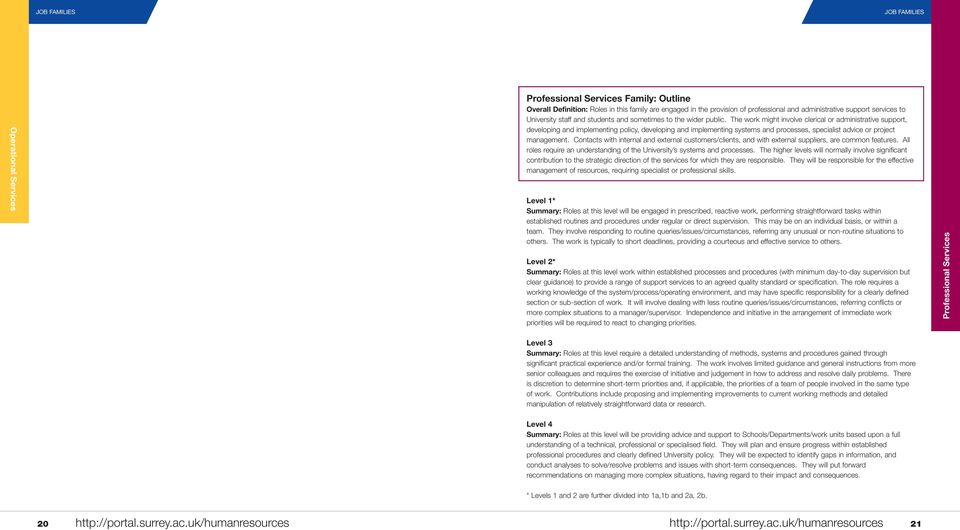
11 Operational Services Family: Outline Overall Definition: Roles in this family are engaged in the provision of professional and administrative support services to University staff and students and sometimes to the wider public. The work might involve clerical or administrative support, developing and implementing policy, developing and implementing systems and processes, specialist advice or project management. Contacts with internal and external customers/clients, and with external suppliers, are common features. All roles require an understanding of the University s systems and processes. The higher levels will normally involve significant contribution to the strategic direction of the services for which they are responsible. They will be responsible for the effective management of resources, requiring specialist or professional skills. Level 1* Summary: Roles at this level will be engaged in prescribed, reactive work, performing straightforward tasks within established routines and procedures under regular or direct supervision. This may be on an individual basis, or within a team. They involve responding to routine queries/issues/circumstances, referring any unusual or non-routine situations to others. The work is typically to short deadlines, providing a courteous and effective service to others. Level 2* Summary: Roles at this level work within established processes and procedures (with minimum day-to-day supervision but clear guidance) to provide a range of support services to an agreed quality standard or specification. The role requires a working knowledge of the system/process/operating environment, and may have specific responsibility for a clearly defined section or sub-section of work. It will involve dealing with less routine queries/issues/circumstances, referring conflicts or more complex situations to a manager/supervisor. Independence and initiative in the arrangement of immediate work priorities will be required to react to changing priorities. Level 3 Summary: Roles at this level require a detailed understanding of methods, systems and procedures gained through significant practical experience and/or formal training. The work involves limited guidance and general instructions from more senior colleagues and requires the exercise of initiative and judgement in how to address and resolve daily problems. There is discretion to determine short-term priorities and, if applicable, the priorities of a team of people involved in the same type of work. Contributions include proposing and implementing improvements to current working methods and detailed manipulation of relatively straightforward data or research. Level 4 Summary: Roles at this level will be providing advice and support to Schools/Departments/work units based upon a full understanding of a technical, professional or specialised field. They will plan and ensure progress within established professional procedures and clearly defined University policy. They will be expected to identify gaps in information, and conduct analyses to solve/resolve problems and issues with short-term consequences. They will put forward recommendations on managing more complex situations, having regard to their impact and consequences. * Levels 1 and 2 are further divided into 1a,1b and 2a, 2b
12 Family: Outline Continued Individuals will be responsible for planning and organising their own work or that of a team of colleagues, who may be involved in different types of work. There will be a need for liaison and the co-ordination of activities across a number of subsections of the School/Department/University. The work will involve encountering changing priorities and differing situations. Family Level 1a Roles at this level will be engaged in performing simple and often repetitive tasks under close supervision. They involve responding to simple queries and issues, and referring any unusual or non-routine situations to others. The work is typically to short deadlines, providing courteous and effective service to others. Level 5 Summary: Roles at this level will be held by experienced professionals responsible for providing proven specialist/technical expertise, and/or managing a diverse team and resources. Work will often involve interpreting or assessing customer/client needs, identifying trends, generating original ideas and testing innovative solutions where these are not obvious. Individuals will typically be accountable for the quality and professionalism of service delivery and are permitted some discretion, provided that activities are consistent with operational policies and precedents. There will be a requirement to plan and organise individual and/or team activity to integrate and co-ordinate work across different parts of the Department/ School/University. Level 6 Summary: Roles at this level will be professional specialists with a high level of expertise, exercising within their particular functional area a substantial degree of independent professional responsibility and discretion, working to broad parameters and policy guidance. Work will include significant professional expertise and/or experience to develop and implement revised or new administrative/technical/professional policies and processes. Individuals will typically be managers of functional areas or senior individual contributors tackling planning and operations over a timescale of a year(s). They will be expected to set quality and professional standards and manage service delivery, and will have a significant influence upon the structure and development of their area of activity. The work includes developing and implementing operational plans and contributing to the longer-term plans for the area to fit with broader functional and University strategy. Level 7 Summary: Roles at this level will be the most senior member of staff in their area of responsibility and will typically lead, direct and manage the interrelationship of a team of managers and/or highly qualified professionals across a major area of activity of strategic importance to the University. They will be ultimately responsible for developing and delivering the strategic plans for their area and will be accountable for ensuring that the University meets both internal and external requirements. Individuals will initiate and, through appropriate consultation and negotiations, establish policy changes to tackle major new issues and situations. Roles will review and address performance and make a significant impact upon longer-term direction, strategy and objectives, advising the senior management team where appropriate. They will influence and shape the available resources as appropriate to meet current and future needs of the University and will typically have a substantial impact on University direction, strategy and objectives. The range of tasks at this level is generally quite narrow and work follows quite a rigid routine. As a consequence, there is very little need for planning or organising work beyond minutes ahead, with the work effectively planned for the jobholder by others or the constraints of the procedures and work demands of the job. Analysis, Reporting and Documentation Carry out routine daily tasks such as typing-up work, photocopying papers according to a daily routine, shelving books, filing papers etc. Carry out routine prescribed record keeping, filing, data entry, logging and maintaining simple databases to ensure accurate records are maintained on a day-to-day basis. Run straightforward, automated or routine reports to support basic Department/School/work unit information procedures. Customer/Client Service and Support Receive and respond to everyday enquiries from/to customers, referring requests outside their knowledge base to the appropriate person/area, and to provide a timely and effective service to others in the provision of standard information. Provide simple routine support activities to contribute to the smooth operation of an office or work unit. Planning and Organising Make routine bookings according to clearly defined instructions, and be involved in the production of straightforward materials to assist in the effective organisation of external and internal activities. Arrange allocated activities within daily routine to ensure work is completed to time and/or an appropriate standard. Finance/Resource Management Follow established procedures to ensure adequate low value supplies/resources are available to meet work requirements. Relationships and Contacts Receive visitors and provide/request information from internal and external contacts in a courteous and correct manner, to promote a positive image of their Department/School/work unit to others. Continuous Improvement Work with manager and/or more experienced colleagues to develop abilities and competence through learning and/or exposure to a range of activities

13 Family Level 1a continued Learning gained through work experience of weeks (and up to three/four months). Some familiarity with Microsoft Office, , the Internet and databases. Numeracy and literacy. Accuracy and ability to prioritise immediate work tasks within a broader routine. Able to exchange basic information to convey facts to colleagues and customers/clients, both verbally and in writing. Where appropriate, knowledge of straightforward office equipment. Basic awareness of the activities of the work area. Work on time and to required standards. Courteous and effective exchange of basic information. Flexible approach to duties. Accuracy and reliability. Positive feedback from customers/clients. Willingness to learn. Ability to work effectively as part of a team. Basic health and safety, and equal opportunities awareness. Family Level 1b Roles at this level will be engaged in prescribed, reactive work, performing straightforward tasks within established routines and procedures under regular or direct supervision. This may be on an individual basis, or within a team. The role involves responding to routine queries/issues/circumstances, and referring any unusual or non-routine situations to others. The work is typically to short deadlines, providing courteous and effective service to others. Analysis, Reporting and Documentation Carry out routine daily tasks such as typing-up work, photocopying papers according to a daily routine, shelving books, filing papers etc. Reproduce or prepare clearly defined documents/presentations, typically following standard formats or templates, or following clear daily instructions. Carry out routine prescribed record keeping, filing, data entry, logging and maintaining simple databases to ensure accurate records are maintained on a day-to-day basis. Run straightforward, automated or routine reports to support basic Department/School/work unit information procedures. May provide basic, routine guidance and advice to colleagues and new staff. Customer/Client Service and Support Receive and respond to everyday enquiries from/to customers, referring requests outside their knowledge base to the appropriate person/area, to provide a timely and effective service to others in the provision of standard information. Provide simple administrative and/or support activities, to contribute to the smooth operation of an office or work unit. Planning and Organising Make routine arrangements and bookings, according to clearly defined instructions, and be involved in the preparation of straightforward materials to assist in the effective organisation of external and internal activities. Arrange allocated activities within daily routine to ensure work is completed to time and/or an appropriate standard. Finance/Resource Management Follow established procedures to ensure adequate low value supplies/resources are available to meet work requirements. Relationships and Contacts Receive visitors and provide/request information from internal and external contacts in a courteous and correct manner in order to promote a positive image of their Department/School/work unit to others. Continuous Improvement Suggest improvements to current working methods. Work with manager and/or more experienced colleagues to discover and develop abilities and competence through learning and/or exposure to a range of activities
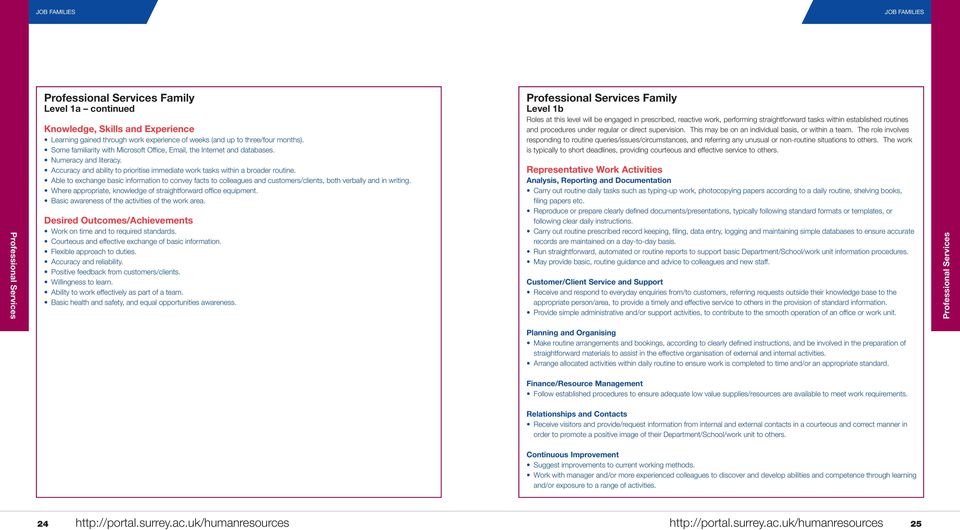
14 Family Level 1b continued Learning gained through work experience of months (and up to a year). May include short programmes and other formal training. Familiarity with Microsoft Office, , the Internet and databases. Numeracy and literacy, with potential for further study where appropriate. Accuracy and ability to prioritise tasks within a broader routine. Able to exchange basic information to convey facts to colleagues and customers/clients, both verbally and in writing. Where appropriate, knowledge of straightforward office equipment. Basic awareness of the activities of the University. Work on time and to required standards. Courteous and effective exchange of basic information. Flexible approach to duties. Positive attitude to work. Accuracy and reliability. Positive feedback from customers/clients. Willingness to learn. Ability to work effectively as part of a team. Basic health and safety, and equal opportunities awareness. Family Level 2a Roles at this level will work within established processes and procedures (with minimum day-to-day supervision, but with clear guidance) to provide specific support services to an agreed quality standard or within a clear specification or brief. The role requires a working knowledge of the system, processes and operating environment, and may have specific responsibility for a clearly defined section or sub-section of work. The role will involve dealing with routine queries/issues/circumstances, referring conflicts or more complex situations to a manager/supervisor. Some independence and initiative in the arrangement of immediate work priorities will be required to react to changing priorities. Analysis, Reporting and Documentation Create documents/presentations from a clear brief supplied by others, to support operational activities. Apply knowledge of office operating systems and processes to prepare standard and some non-standard documentation, possibly requiring the use of relevant computer-based procedures and standard software packages. Perform straightforward interpretation and analysis of data or calculations, presenting findings/results accurately and using IT packages where necessary to support effective reporting of information. Customer/Client Service and Support Receive and respond to enquiries from/to customers, judging when to pass them on and/or to involve others, to provide a courteous and effective service. Recognise/understand the impact of incidents arising and raise issues of concern where necessary to ensure appropriate resolution of customer/client enquiries/issues. Deliver a range of clerical and/or customer/client services in support of existing systems or processes to an agreed quality standard or specification to maximise service quality and continuity. May provide customer/client service support through the knowledge of services available and/or preparation of equipment to support customer/client learning. Planning and Organising Arrange and/or support internal and external activities/events, collating and recording relevant information/documentation as requested, to ensure activities/events are administered effectively. Arrange allocated activities within daily routine to ensure work is completed to time and/or an appropriate standard. Plan and prioritise own work activities on a daily and weekly basis, responding to manager/team/department/school/work unit requirements in addition to own responsibilities, to ensure operational efficiency. Finance/Resource Management Monitor small-scale resources/cash following established procedures to ensure adequate resources are available to meet work requirements

15 Family Level 2a continued Relationships and Contacts Receive visitors and provide/request information from internal and external contacts in a courteous and correct manner in order to promote a positive image of their Department/School/work unit to others. Guidance and supervision are readily available and shape the work environment. Continuous Improvement Suggest minor improvements in working methods. Work with manager and/or more experienced colleagues to develop abilities and competence through learning and/or exposure to a range of activities. Either: Vocational qualifications plus at least one year s relevant work experience. Learning gained through work experience of up to two years. Will include short courses and other formal training. Familiarity with Microsoft Office, , the Internet and databases. Numeracy and literacy, with potential for further study where appropriate. Accuracy and ability to prioritise tasks within a broader routine. Able to exchange basic information to convey facts to colleagues and customers/clients, both verbally and in writing. Where appropriate, knowledge of straightforward office equipment. Basic awareness of the activities of the School/Department/unit. Work on time and to required standards. Courteous and effective exchange of basic information. Flexible approach to duties. Positive attitude to work. Accuracy and reliability. Positive feedback from customers/clients. Willingness to learn. Ability to work effectively as part of a team. Basic health and safety, and equal opportunities awareness. Family Level 2b Roles at this level will work within established processes and procedures (with minimum day-to-day supervision) to provide a range of support services to an agreed quality standard or specification. The role requires a working knowledge of the system, processes and operating environment, and may have specific responsibility for leading in the provision of specialised administrative or processing services within a clearly defined section or sub-section of work. It will involve dealing with less routine queries/issues/circumstances, referring conflicts or more complex situations to a manager/supervisor. Independence and initiative in the arrangement of immediate work priorities will be required to react to changing priorities. Analysis, Reporting and Documentation Create documents/presentations from a clear brief supplied by others to support operational activities. Apply a good knowledge of office operating systems and processes to prepare standard and some non-standard documentation, possibly requiring the use and integration of a range of relevant computer-based procedures and standard software packages. Perform straightforward interpretation and analysis of data or calculations, presenting findings/results accurately, using IT packages where necessary to support effective reporting of information. Customer/Client Service and Support Receive and respond to enquiries from/to customers, including more complex queries, judging when to pass them on and/or to involve others in order to provide a courteous and effective service. Recognise/understand the impact of incidents arising and raise issues of concern where necessary to ensure appropriate resolution of customer/client enquiries/issues. Deliver a range of administrative and/or customer/client services in support of existing systems or processes to an agreed quality standard or specification to maximise service quality and continuity. May provide customer/client service support through the demonstration of services available and/or preparation of equipment to support customer/client learning. Planning and Organising Arrange and/or support internal and external activities/events, collating and recording relevant information/documentation as requested, to ensure activities/events are administered effectively. Arrange allocated activities within daily routine to ensure work is completed to time and/or an appropriate standard. Plan and prioritise own work activities, setting short-term targets, responding to manager/team/department/school/work unit requirements in addition to own responsibilities in order to ensure operational efficiency. Finance/Resource Management Monitor and take responsibility for small-scale resources/cash, following established procedures to ensure adequate resources are available to meet work requirements. May give supervision/guidance to more junior staff
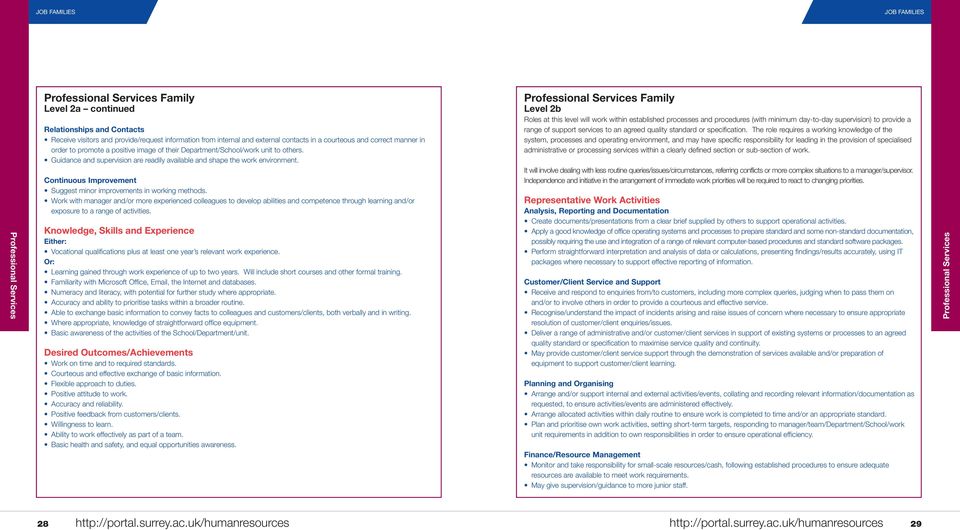
16 Family Level 2b continued Relationships and Contacts Receive visitors and provide/request information from internal and external contacts in a courteous and correct manner in order to promote a positive image of their Department/School/work unit to others. Guidance and supervision are available if required to provide input on unusual or one-off issues. Continuous Improvement Suggest improvements to current working methods. Work with manager and/or more experienced colleagues to discover and develop abilities and competence through learning and/or exposure to a range of activities. Work with customers/clients or colleagues to determine (within broad objectives) how services should be delivered. Either: Vocational qualifications plus 18 months relevant work experience. Learning gained through work experience of up to three years. Will include short courses and other formal training. Familiarity with Microsoft Office, , the Internet and databases. Numeracy and literacy, with potential for further study where appropriate. Accuracy and ability to prioritise tasks within a broader routine. Able to exchange basic information to convey facts to colleagues and customers/clients, both verbally and in writing. Where appropriate, knowledge of straightforward office equipment. Basic awareness of the activities of the University. Work on time and to required standards. Courteous and effective exchange of basic information. Flexible approach to duties. Positive attitude to work. Accuracy and reliability. Positive feedback from customers/clients. Willingness to learn. Ability to work effectively as part of a team. Basic health and safety, and equal opportunities awareness. Family Level 3 Roles at this level require detailed understanding of methods, systems, and procedures gained through significant practical experience and/or through formal training. The work involves limited guidance and general instructions from more senior colleagues and requires the exercise of initiative and judgement in how to address and resolve daily problems. There is discretion to determine short-term priorities and, if applicable, priorities of a team of people involved in the same type of work. Contributions include proposing and implementing improvements to current working methods and detailed manipulation of relatively straightforward data or research. Analysis, Reporting and Documentation Apply an understanding of a specialised, but established, University system to research, collate, organise and edit standard material for inclusion in reports/documents, and/or to answer related questions and queries. Perform more detailed manipulation, analysis and/or evaluation of specialised, but relatively straightforward information or data, highlighting and prioritising any issues for further investigation and preparing reports to support decision making, or perhaps informally via other means of communication such as meetings and . Circulate information/findings appropriately to ensure awareness of key issues/data. Customer/Client Service and Support Resolve issues/queries independently, provide advice on routine matters (at peer level) and recommend alternative sources/programmes of action if unable to assist, to ensure that an efficient day-to-day customer/client service is provided. Act as a filter for issues/problems referred to supervisor/manager, processing various aspects of supervisor s/manager s responsibilities where appropriate, to provide immediate support/problem resolution. Deliver a range of specialist service support tasks, advising and assisting customers/clients and colleagues on specific aspects to maximise service quality, efficiency and continuity. Monitor service objectives and standards within own area of work to maximise service quality and efficiency. Planning and Organising May organise internal and external activities/events, e.g. collating and presenting relevant information/documentation as requested, booking venues and speakers, co-ordinating diaries and ensuring activities/events are run efficiently. Plan and prioritise a support team s short and medium-term work activities in response to a manager s general instructions. Finance/Resource Management Deploy assigned resources towards defined objectives and within defined limits/devolved budget responsibility, to ensure operational and cost efficiency. Provide input into the resource planning process to ensure that finances are appropriately and efficiently monitored

17 Family Level 3 continued Family Level 3 continued Relationships and Contacts Liaison, communication and relationship building with other University Schools and Departments as well as outside bodies, to support/represent Department/School/work unit activities. May attend meetings as requested by manager, to support/represent Department/School/work unit activities. Management Either: Supervise staff, allocating and prioritising their work and monitoring individual progress and performance in line with this, to contribute to the achievement of Department/School/work unit objectives. Oversee the work of others (directly or indirectly) as the most experienced team member. Operate as an individual organising and planning own work activities, to contribute to the achievement of Department/School/work unit objectives and maintain and improve efficiency. May be recognised as the main point of contact for a particular process, system or procedure as the most experienced team member. Continuous Improvement Maintain and improve operational efficiency and quality of service of own area via input to procedures and the application of process improvements. Keep skills up-to-date and develop depth or breadth of knowledge in a particular area through learning from more senior/experienced colleagues, exposure to a range of activities and/or professional qualifications. Plus: Experience of working with relevant specialised equipment, software or procedures. Experience of working/responding independently and dealing with unforeseen problems and circumstances. Comprehensive knowledge of the work practices, processes and procedures relevant to the role. Operating knowledge of service/systems/processes in own area that is required to provide first line advice and guidance, typically of a more technical/specialised nature, to customers/clients. Clear understanding of the standards and regulations set for the conduct and output of the role. Working knowledge of the activities of other areas of the University relevant to School/Department/work unit. Proven written and verbal communication skills. Good quality, appropriate and timely advice in response to enquiries from customers/clients. Workload delivered within deadlines and to agreed standards. Proactive/resourceful. Ability to organise own and others' activities to meet objectives. Provide a high quality of customer/client service. Receptive to new ideas and approaches. Accurate with regard to financial and statistical information, and the written word. Effective delegation and performance monitoring, and good team motivation (where appropriate). Understanding of relevant health and safety, and equal opportunities issues. Either: HNC, A level, NVQ 3, HND level or equivalent with a minimum of three years' relevant experience. Broad vocational experience (minimum five years), acquired through a combination of job-related vocational training and considerable on-the-job experience, demonstrating development through involvement in a series of progressively more demanding relevant work/roles

18 Family Level 4 Roles at this level will be providing advice and support to Schools/Departments/work units based upon a full understanding of a technical, professional or specialised field. They will plan and ensure progress within established professional procedures and clearly defined University policy. They will be expected to identify gaps in information, and conduct analyses to solve/resolve problems and issues with short-term consequences. They will put forward recommendations on managing more complex situations, having regard to their impact and consequences. Individuals will be responsible for planning and organising their own work or that of a team of colleagues, who may be involved in different types of work. There will be a need for liaison and the co-ordination of activities across a number of subsections of a School/Department/University. The work will involve encountering changing priorities and differing situations. Analysis and Reporting Use a full understanding of a professional or specialist field, or apply one s overall responsibility for organising and applying the full range of University management and administrative processes in a School/Department/work unit. Carry out detailed analyses, help assess complex situations and problems and test solutions where they may not be obvious. Present results and put forward recommendations through the provision of advice, briefings, presentations or written reports, to facilitate the interpretation of specific issues/problems and support decision making. Identify gaps or shortfalls in information and search for sources of information to fill these. Monitor and maintain records/reports to meet both internal and external requirements. Customer/Client Service and Support Provide specialist/professional advice and recommendations within specific parameters/professional guidelines to support informed decision making. Design and/or deliver a variety of approaches or specialist services (e.g. training or promotional materials, specialist IT solutions) to maximise service quality, efficiency and continuity. Deliver own work/the work of a team to meet quality service standards. Planning and Organising May lead assigned School/Department/unit projects/project teams usually of a short-term nature, or contribute to larger University-wide projects as part of a project team, to support the achievement of project objectives. Develop and determine appropriate team or individual workflow and activity scheduling in order to meet targets and/or turnaround times. Contribute to organising short or medium-term developments or process changes in a School, Department or across the University by applying professional or specialist knowledge. Family Level 4 continued Finance/Resource Management Oversee resources and offer input into the resource planning process to ensure that finances are appropriately and efficiently managed. May have delegated responsibility for a budget(s). Relationships and Contacts Attend internal or external meetings to ensure that Department/School/work unit issues are appropriately represented and reported. May co-ordinate and communicate activities across the University. Management Either: Manage/supervise colleagues operating within a well-defined specialist or professional discipline or within a broad administrative team, and may be responsible for recruiting, monitoring and supporting the performance management and development of team members to ensure that individual contributions are maximised. Operate as an individual responsible for the organisation and/or operation of specialised practical/technical/vocational work, to meet School/Department/work unit objectives. Continuous Improvement: Identify and make recommendations for improvements (e.g. in policies and procedures) and contribute to the continuous operational improvement of their School/Department/work unit. Improve specialist/technical/professional/vocational capability and expertise through work experience and/or professional qualification. Either: Degree, HND, NVQ 4 qualified or equivalent in relevant subject/relevant formal training, plus a minimum of two years' experience in similar or related roles. Significant vocational experience (eight years), demonstrating development through involvement in a series of progressively more demanding relevant work/roles, and the acquisition of appropriate professional or specialist knowledge
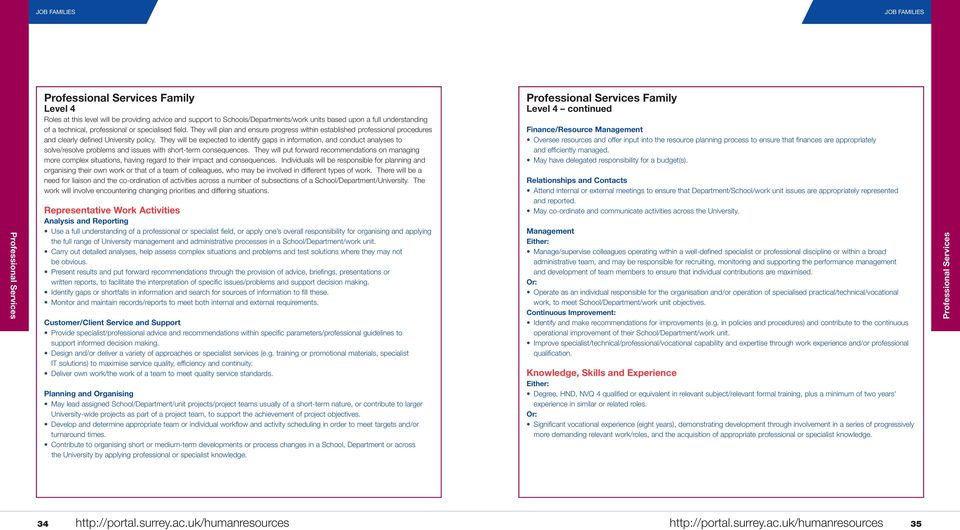
19 Family Level 4 continued Plus: Experience of planning and progressing work activities within general guidelines, using initiative and judgement without reference to seniors. Thorough knowledge and understanding of the work practices, processes and procedures relevant to the role, which may include broader sector/commercial awareness. Detailed operational knowledge of systems relevant to own field of work in terms of functionality and capability and/or detailed knowledge of own service area and products/services available. Clear understanding of the regulations and codes of practice set for the conduct and output of the role. Working knowledge of the work and activities of other areas of the University relevant to School/Department/work unit. May require knowledge of a network of contacts relevant to the work unit. Proven analytical and problem-solving capability. Proven communication and interpersonal skills. Where relevant: Proven supervisory skills coaching, motivation, and managing performance. Financial training relevant to the management and control of budgets which can be demonstrated through knowledge, skills or experience. Advice is timely, correct, complete and leads to valuable outcomes. Performance of own activities to agreed time and quality standards. Accuracy/attention to detail. Effective transfer of skills to others. Compliance with regulations and codes of practice for self and others. Contribute to new ideas and approaches. Understanding of relevant health and safety, and equal opportunities issues. Where relevant: Contribute to the team being appropriately skilled, managed and resourced. Workload of work area delivered within deadlines and to agreed standards. Effective development, management and motivation of staff. Family Level 5 Roles at this level will be held by experienced professionals responsible for providing proven specialist/technical expertise, and/or managing a diverse team and resources. Work will often involve interpreting or assessing customer/client needs, identifying trends, generating original ideas and testing innovative solutions where these are not obvious. Individuals will typically be accountable for the quality and professionalism of service delivery and are permitted some discretion, provided that activities are consistent with operational policies and precedents. There will be a requirement to plan and organise individual and/or team activity to integrate and co-ordinate work across different parts of the Department/School/University. Analysis and Reporting Advise on the analysis and interpretation of data, identify trends and test solutions, source additional related information where appropriate, and report on progress, to support the resolution of issues/problems. Manage, monitor and maintain records to meet both internal and external (e.g. legislative) requirements. Customer/Client Service and Support Apply specialist/technical/professional expertise and use judgement to make decisions where solutions are not obvious, to deliver professional services to meet the customer/client requirements. Generate original ideas and innovative solutions through the provision of specialist knowledge and advice as appropriate. Identify additional service requirements or service shortfalls and co-ordinate and/or design the delivery of innovative solutions to maximise service quality, efficiency and continuity. Ensure professional and quality service standards are maintained and applied within their area of activity. Planning and Organising Plan and organise individual or team activity with an appreciation of longer-term issues, ensuring plans complement and feed into the broader annual School/Department/work unit operational plans. Project manage activities to facilitate major service/operational changes with typically a Department/School/work unit impact. Finance/Resource Management Manage or monitor resources/budgets within allocated project/area where appropriate, to ensure maximum value is delivered for resources deployed. Contribute to resource and budget planning within own area. Take appropriate responsibility for the delivery of work to deadlines and agreed standards
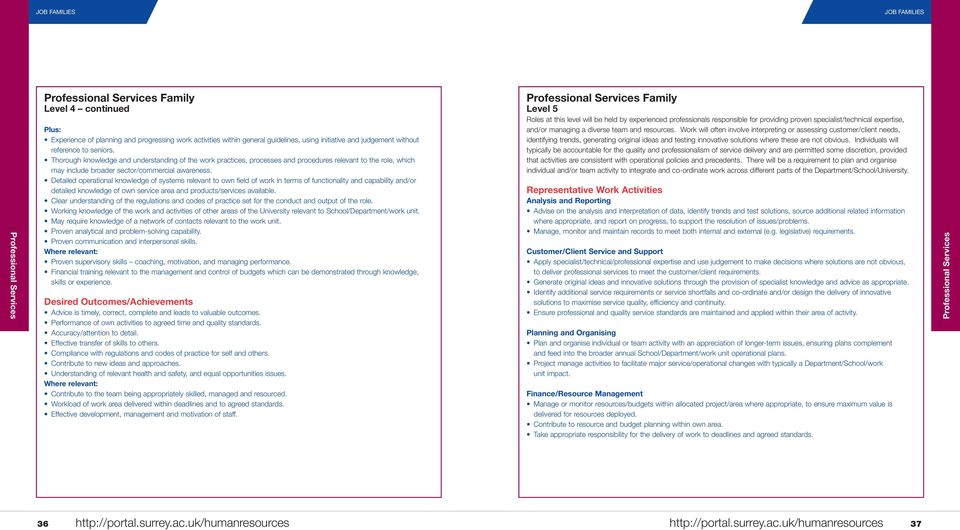
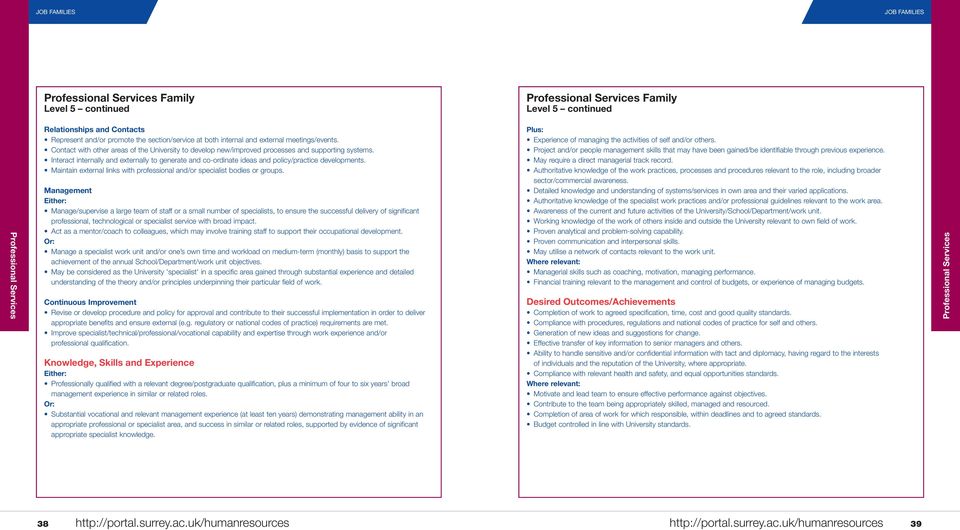
20 Family Level 5 continued Family Level 5 continued Relationships and Contacts Represent and/or promote the section/service at both internal and external meetings/events. Contact with other areas of the University to develop new/improved processes and supporting systems. Interact internally and externally to generate and co-ordinate ideas and policy/practice developments. Maintain external links with professional and/or specialist bodies or groups. Management Either: Manage/supervise a large team of staff or a small number of specialists, to ensure the successful delivery of significant professional, technological or specialist service with broad impact. Act as a mentor/coach to colleagues, which may involve training staff to support their occupational development. Manage a specialist work unit and/or one s own time and workload on medium-term (monthly) basis to support the achievement of the annual School/Department/work unit objectives. May be considered as the University 'specialist' in a specific area gained through substantial experience and detailed understanding of the theory and/or principles underpinning their particular field of work. Continuous Improvement Revise or develop procedure and policy for approval and contribute to their successful implementation in order to deliver appropriate benefits and ensure external (e.g. regulatory or national codes of practice) requirements are met. Improve specialist/technical/professional/vocational capability and expertise through work experience and/or professional qualification. Either: Professionally qualified with a relevant degree/postgraduate qualification, plus a minimum of four to six years' broad management experience in similar or related roles. Substantial vocational and relevant management experience (at least ten years) demonstrating management ability in an appropriate professional or specialist area, and success in similar or related roles, supported by evidence of significant appropriate specialist knowledge. Plus: Experience of managing the activities of self and/or others. Project and/or people management skills that may have been gained/be identifiable through previous experience. May require a direct managerial track record. Authoritative knowledge of the work practices, processes and procedures relevant to the role, including broader sector/commercial awareness. Detailed knowledge and understanding of systems/services in own area and their varied applications. Authoritative knowledge of the specialist work practices and/or professional guidelines relevant to the work area. Awareness of the current and future activities of the University/School/Department/work unit. Working knowledge of the work of others inside and outside the University relevant to own field of work. Proven analytical and problem-solving capability. Proven communication and interpersonal skills. May utilise a network of contacts relevant to the work unit. Where relevant: Managerial skills such as coaching, motivation, managing performance. Financial training relevant to the management and control of budgets, or experience of managing budgets. Completion of work to agreed specification, time, cost and good quality standards. Compliance with procedures, regulations and national codes of practice for self and others. Generation of new ideas and suggestions for change. Effective transfer of key information to senior managers and others. Ability to handle sensitive and/or confidential information with tact and diplomacy, having regard to the interests of individuals and the reputation of the University, where appropriate. Compliance with relevant health and safety, and equal opportunities standards. Where relevant: Motivate and lead team to ensure effective performance against objectives. Contribute to the team being appropriately skilled, managed and resourced. Completion of area of work for which responsible, within deadlines and to agreed standards. Budget controlled in line with University standards
21 Family Level 6 Roles at this level will be professional specialists with high level expertise, exercising within their particular functional area a substantial degree of independent professional responsibility and discretion, working to broad parameters and policy guidance. Work will include significant professional expertise and/or experience to develop and implement revised or new administrative/technical/professional policies and processes. Individuals will typically be managers of functional areas or senior individual contributors tackling planning and operations over a timescale of a year(s). They will be expected to set quality and professional standards and manage service delivery, and will have significant influence upon the structure and development of their area of activity. The work includes developing and implementing operational plans and contributing to the longer-term plans for the area to fit with broader functional and University strategy. Analysis, Reporting and Documentation Identify trends, strengths, weaknesses, opportunities and threats in a specialist area/area of responsibility that may have an impact on the University/School/Department/work unit, to enable appropriate and timely action to be taken. Customer/Client Service and Support Apply broad and/or deep knowledge and experience of work area or field of expertise to provide advice/guidance to others or to address significant problems or unresolved issues, some of which will be multidisciplinary in nature. Pre-empt customer/client needs/requests, identifying opportunities and facilitating change management. Evaluate existing service provision, keeping abreast of feedback and broader developments outside the University, to ensure appropriate developments and innovative solutions are proposed that consistently enhance and maximise service quality, efficiency and continuity. Answerable for the service delivery of an area of activity in respect of compliance with current and future School/Department/work unit objectives, service level agreements, regulations and national codes of practice. Family Level 6 continued Relationships and Contacts Interact, advise and/or influence at a senior level within the University. Network with fellow professionals in the wider community and represent and promote own work area/activity on internal and external platforms. Liaise with service users to establish and implement strategic service requirements and priorities. Management Either: Manage a large group of administrative/specialist/professional staff across a major University function, or lead a large operational department to ensure all relevant annual targets and goals are delivered within any allocated budgetary/resource constraints. Develop/improve the capability of staff within a work area, motivating and mentoring them to meet the current and future requirements of the School/Department/University better. Provide policy development and expert guidance to other professionals within a key strategic activity for the University, with significant internal/external impact on the University. Continuous Improvement Implement proposed changes to current work processes and develop and define proposals for changes in, and the formulation of, University/School/Department/work unit policy, to consistently improve quality and effectiveness of service provided and take account of legislative changes. Keep up-to-date with developments in own field and with University developments. Planning and Organising Shape strategic direction of own area of activity, planning and organising activities of others over many months, considering the implications now and in the longer term, to support School/Department/work unit objectives. Participate in the annual School/Department/work unit operational planning process, to support the School/Department/work unit strategic direction. Oversee a number of projects to ensure each project is managed and delivered to time and budget. Finance/Resource Management Utilise/manage allocated budget/resources effectively and flexibly and control all related expenditure to ensure delivery of targets/objectives within budget. Contribute to planning, delivery of service and financial statements within budgetary constraints. Either: Professionally qualified with a relevant degree/postgraduate qualification, plus a minimum of seven years' relevant managerial experience and leadership experience, or substantial experience and proven success in a strategically important specialist area. Extensive vocational and strategic management and leadership experience (twelve years or more) demonstrating professional development through involvement in a series of progressively more demanding and influential work/roles, backed by evidence of significant development of appropriate specialist knowledge
22 Family Level 6 continued Plus: Experience of managing and developing either: A significant team or number of teams containing experienced professionals; or A significant complex project/number of projects/activity with a significant strategic influence across a large organisation. Experience of working with and influencing senior management. Experience of managing and controlling budgets/resources/funding and an understanding of financial management procedures. Experience of developing innovative solutions and contributing to strategic planning. Highly developed knowledge of the principles, theory and practice of field of work, as well as an awareness of broader developments relevant to own area. Well-developed knowledge of systems/services for own area and across functions and how they relate to each other. Well-developed understanding of regulations and procedures and the implications of non-compliance. Strong interpersonal skills including the ability to motivate, negotiate, influence and build strong relationships. Delivery of targets/objectives to agreed specification, time, cost and good quality standards. Good quality of planning and link to strategy. Good quality and timeliness of advice and recommendations. Proposals for policy and procedure, which meet both internal and external requirements. Effective utilisation of finances and resources. Provide good quality advice, recommendations and outputs. Good feedback on effectiveness. Generation of new ideas and approaches. Good quality of innovative contribution. Compliance with relevant health and safety, and equal opportunities standards. Where relevant: Motivate and lead team to ensure effective performance against objectives. Development of team to meet individual and University requirements. Positive image/view of the team from others. Family Level 7 Roles at this level will be the most senior member of staff in their area of responsibility and will typically lead, direct and manage the interrelationship of a team of managers and/or highly qualified professionals across a major area of activity of strategic importance to the University. They will be ultimately responsible for developing and delivering the strategic plans for their area and will be accountable for ensuring that the University meets both internal and external requirements. Individuals will initiate and, through appropriate consultation and negotiations, establish policy changes to tackle major new issues and situations. Roles will review and address performance and make a significant impact upon longer-term direction, strategy and objectives, advising the senior management team where appropriate. They will influence and shape the available resources as appropriate to meet current and future needs of the University and will typically have a substantial impact on University direction, strategy and objectives. Analysis, Reporting and Documentation Lead a major University department, reviewing performance over time in their area of responsibility and compare it to best practice elsewhere, identifying areas for improvement in structure, practices, policies and technology. Customer/Client Service and Support Review customer/client needs now and in the future (i.e. over the next few years) and ensure services and activities are shaped to meet them. Ensure customer/client feedback and quality processes are in place for the area of responsibility. Planning and Organising Develop and lead the implementation of strategies and plans for a major functional area of the University, which supports and takes forward the University strategy. Contribute to debate on core University strategy and policy. Lead major projects and initiatives which have a significant resource and strategic impact. Finance/Resource Management Ensure financial plans are developed and that services operate effectively within budget. Explore ways of improving efficiency and effectiveness and promote improvements in value for money. Relationships and Contacts Work with senior colleagues from all areas of the University, with committees and external bodies, providing high level advice
23 Family Level 7 continued Family Level 7 continued Provide lead internal advice (on their significant area of University activity) for senior colleagues from all areas of the University, and to committees and external bodies, ensuring that broader strategic plans are co-ordinated with the specialist requirements of the work area. Represent the University externally in sector groups and in negotiations. Management Lead and manage staff in a major functional area or service grouping, developing them and maximising their performance. Continuous Improvement Maintain a continuous review of quality and of external benchmarks to promote the best possible service. Either: Professionally qualified with a relevant degree/postgraduate qualification, plus a minimum of ten years' relevant leadership experience, or substantial experience and proven success in a strategically important broad function/specialist area. Extensive vocational experience (fifteen years or more) demonstrating professional development and achievement in a series of progressively more demanding, influential and broad work roles, backed by evidence of deep and broad knowledge of the whole functional work area. Plus: Breadth of vision gained from extensive experience in field of expertise. Experience of developing innovative solutions and practical implementation for strategic change. Experience of managing and controlling substantial budget/resources/funding and an understanding of financial management procedures. Highly developed knowledge of the principles, theory and practice of a field of work, as well as an awareness of broader developments relevant to the University. Awareness of the likely effect of change in economic, social, legal and technological environment. Well-developed knowledge of systems/services for own area and across functions and how they relate to national and international developments. Well-developed understanding of regulations and procedures and the implications of non-compliance on other staff. National and international awareness and understanding of the activities, objectives and strategic direction of the University, both current and future. Strong interpersonal skills including motivating, negotiating, influencing and networking nationally and internationally. Delivery of targets/objectives to agreed specification, time, cost and high quality standards. High quality of planning and link to strategy. High quality and timeliness of advice and recommendations. Proposals for policy and procedure meet both internal and external requirements. Effective utilisation of finance and resources. High quality of advice and recommendations to the most senior University levels. Positive feedback on effectiveness. Generation of new ideas and approaches. High quality of innovative contribution. Leadership in health and safety, and equal opportunities matters. Where relevant: Motivate and lead team to ensure effective performance against objectives. Development of team to meet individual and University requirements. Positive image/view of team from others
24 Research and Teaching Family: Outline Overall Definition: Roles in this family are wholly or mainly focused on research and teaching. They may combine elements of research, teaching and leadership or management, but the relative emphasis on these elements and the nature of the contribution will vary. Some roles will be more orientated towards research, while others will tend to concentrate on teaching, leadership and management activities. In the higher levels, there will be a considerable reputation in the UK and internationally, and significant impact on the discipline and on research income. Level 3 Summary: Roles at this level are generally concerned either with assisting a research team or group by carrying out analyses and tests where the method and purpose are clear, or teaching within a clear and established programme. Level 4 Summary: Roles at this level may represent the early stages of an academic career before the individual progresses to Level 5 or a specific set of responsibilities within an established research or teaching programme. There may be a combination of research and teaching, with appropriate organising and managing in support of these activities and possibly some team leadership or a specific focus on research or teaching. Level 5 Summary: Roles at this level are held by individuals experienced in research and/or teaching, often after progression from Level 4. In some cases, their contribution spans research, teaching and leadership or management, although the relative importance of each of these strands will vary from role to role; in others, there remains a concentration on either research or teaching. The research has measurable outcomes and is reflected in growing reputation; the teaching design and delivery for all student levels reflects current thinking and may encompass innovative methods; the contribution to the department through leadership and management may be significant. Level 6 Summary: Roles at this level commonly reflect extensive professional experience, and may include substantial contributions in research, teaching and leadership or management. There may be a greater depth in one or two of these areas, reflecting a predominant focus on research, on teaching, or on leadership/management, though some roles offer an even spread between the three areas. Individuals will have a substantial reputation in their field, and make a significant impact on the institution and on their discipline. Roles which focus on research will involve an established international reputation and a clear record of impact shown for example in substantial and sustained research income. Level 7 Summary: Roles at this level reflect recognised leadership and sustained and substantial reputation in research and/or teaching in a major discipline. There will also be significant leadership responsibilities on behalf of the department and/or the University, and there will be a significant leadership or management contribution. There will be a high reputation internationally, based on an extensive track record of innovative research and/or teaching with a major influence on the discipline; and a significant impact shown for example in sustained influence on research income. Any teaching specialists at this level will have broadened and deepened their impact on teaching methods and systems through extensive and widely recognised research. Research & Teaching
25 Research & Teaching Research and Teaching Family Level 3 Roles at this level are generally concerned either with assisting a research team or group by carrying out analyses and tests where the method and purpose are clear, or with teaching within a clear and established programme. Research-focused Roles Acquire and interpret research data and results. Run analyses and tests using specified and agreed techniques and models. Prioritise tasks within agreed work schedule. Contribute to the development of techniques, models and methods. Advise other staff and students within area of expertise. Teaching-focused Roles Teach classes within an established programme. Review the skills of students. Supervise class activities, e.g. language lab or practical work. Administer and mark tests. Assist other teaching staff with examinations and preparations of programme materials. Administration Manage personal administrative tasks related to own work. Degree in subject relevant to research or teaching area. Practical experience of applying the skills and techniques. Expected to acquire PhD and/or teaching qualification, but neither is required at this level. Ability to analyse and communicate effectively. Ability to contribute to programme or method improvement. Development of research and teaching skills. Positive feedback from students and/or colleagues. Understanding of relevant health and safety, and equal opportunities issues. Research and Teaching Family Level 4 Roles at this level may represent the early stages of an academic career before the individual progresses to Level 5, or a specific set of responsibilities within an established research or teaching programme. There may be a combination of research and teaching, with appropriate organising and managing in support of these activities and possibly some team leadership or a specific focus on research or teaching. Research Develop and carry out a plan to open up an area of personal research and expertise, or contribute as a research team member to a broader programme. May contribute to writing bids for research grants. Provide guidance to other staff and both undergraduate and postgraduate students. Plan and carry out the work programme for own research contribution, using methodology and techniques appropriate to this type of research, for example: investigations leading to the discovery of new knowledge analysing and illuminating data, interpreting and bringing new insights through integration application of knowledge in practice out of which new intellectual understanding emerges In more research-focused roles, the following may take the place of teaching work: May work/collaborate on original research with colleagues from other institutions. Investigate models and approaches to test and develop them. Write up research findings for publication and dissemination. Work as part of a small research team, or research activities within a multidisciplinary team(s). As a researcher, may supervise more junior research staff and/or contribute to the work. Teaching Teach programmes and advise students within own subject area, predominantly through lectures and seminars for groups of undergraduates or postgraduates. May undertake direct supervision of undergraduate and/or postgraduate students as appropriate. Supervise practical work where it is part of the programme, and advise students on techniques. Plan and review own approach to teaching and contribute to the design or revision of programme units. Set and mark programme work and exams, and advise students on their progress. In more teaching-focused roles, the following may take the place of research work: Help to develop new teaching approaches and programme proposals, and contribute to curriculum development. Collect or create resources materials and demonstrate their use. Take responsibility beyond own students and programme work, e.g. for co-ordination of examinations. Research & Teaching
26 Research & Teaching Research and Teaching Family Level 4 continued Management and Administration Manage personal administrative tasks related to own work. To contribute to the effective management and administration of the School or work unit by performing duties allocated by the Head of School, for example library representative, year tutor or exchange programme co-ordinator etc. May be involved in committee membership at School level or in project teams. The ability to identify and organise resources. The ability to contribute to broader management processes. Research staff will normally have a PhD in many Schools, but may have the equivalent in professional qualifications and expertise in others. Those in teaching-led roles will normally have a postgraduate degree or equivalent professional experience, a teaching qualification and will normally be working towards membership of an appropriate professional and/or teaching body, i.e. membership of the Institute of Learning and Teaching in Higher Education. High level analytical capability. Ability to communicate complex information clearly; and to encourage commitment to learn in others. Ability to assess and organise resources. Ability to contribute to broader management and administrative processes. Plus: In more research-focused roles: Creative in approaches to relevant models, techniques and methods, and able to develop new ones under some supervision. In more teaching-focused roles: The ability to design programme materials and to plan and organise the delivery and assessment of taught programmes. Evidence of appropriate subject expertise, and that it is frequently updated, for example the production of publications and involvement in conference presentations. Evidence of contribution to design of research and/or teaching programmes. Developing personal expertise in research and teaching. Positive feedback from students and colleagues on good quality of research teaching and support. Good quality of co-ordination and management of activities. Contributing to increase the School income by reputation. Understanding of relevant health and safety, and equal opportunities issues. Research and Teaching Family Level 5 Roles at this level are held by individuals experienced in research and/or teaching, often after progression from Level 4. In some cases, their contribution spans research, teaching and leadership or management, although the relative importance of each of these strands will vary from role to role; in others, there remains a concentration on either research or teaching. The research has measurable outcomes and is reflected in growing reputation; the teaching design and delivery for all student levels reflects current thinking and may encompass innovative methods; the contribution to the department through leadership and management may be significant. Research Pursue research personally and/or as part of a team, and present the findings in publications and at conferences. Develop research proposals and funding bids, and win support for them. Plan the research to be undertaken, as a self-contained item, as part of a broader programme or as part of a multidisciplinary approach. Develop methodologies and techniques appropriate to the type of research being pursued. These could be among the following: investigations leading to the discovery of new knowledge analysing and illuminating data, interpreting and bringing new insights through integration application of knowledge in practice out of which new intellectual understanding emerges Provide expert advice to other staff and students. In more research-focused roles, the following may take the place of teaching work: Plan and deliver high quality research, project managing the research activity, supervising and taking responsibility for the research team. Attract research funding through bids and reputation. Explain and disseminate research findings through publication and conferences. Develop and engage in research methodologies that add to knowledge/understanding appropriate to the discipline. Research & Teaching
27 Research and Teaching Family Level 5 continued Research and Teaching Family Level 5 continued Research & Teaching Teaching Teach and examine programmes within own subject area and in specialism to relevant levels, i.e. undergraduate, Masters and higher research degree students, through lectures, seminars and personal supervision. Plan and review own teaching load and approach to teaching. Supervise practical work where it is part of the programme and advise students on techniques. Take responsibility for design of programme units and contribute generally to the development of teaching and teaching methods in the School. Coach and support tutorial groups developing their knowledge and their learning skills. Be responsible for setting and marking coursework for undergraduates and assignments for postgraduates, and advise students at appropriate study levels. Contribute to the enhancement of quality in teaching within the subject, School or faculty. Develop programme proposals and contribute to curriculum development. May act as internal and external examiner for postgraduate students. In more teaching-focused roles, the following may take the place of research work: Develop approaches to teaching and learning which are innovative for the institution and subject area and reflect developing practice elsewhere. Develop and advise others on learning and teaching tasks and methods. Management and Administration In addition to core administration for the individual s own work, take on specific initiating and co-ordinating roles, such as running the process of admissions, examinations, the RAE or teaching quality assessment. Monitor and ensure effective management of assets and budgets allocated as part of the role. May involve managerial responsibility for staff. May participate in University-wide projects or working groups, or be a member of a School board or committee. In addition to Level 4 requirements: A growing reputation in research or teaching within subject or service specialism. Track record of published research or successful development and delivery of teaching units. Ability to manage resources and an understanding of management processes. Skills in the management and motivation of staff (if appropriate). In research: Experience, achievement and growing reputation in the discipline, reflected in relevant national committee memberships, and/or involvement in national research events. Experience and demonstrated success in planning and building a team and delivering research results within the team or as part of a multidisciplinary approach. Occasionally this is wholly demonstrated on an individual basis. Experience of developing research methodologies and devising models, approaches, techniques, critiques and methods. In teaching: Teaching qualification, membership of ILT or equivalent. Experience and demonstrated success in developing methods and coaching colleagues. Skills in counselling and motivating students at appropriate levels. Experience, achievement and growing reputation in the discipline, reflected in relevant national committee memberships, and/or involvement in national educational events. Evidence of a good reputation in the subject. Evidence of research programme design. A high level of innovation and impact of research. Evidence of published research results. Evidence of contribution to teaching programme design and teaching good quality, through method development and coaching of others. Contribution to broader processes, e.g. programme development, assessment exercises, examinations and recruitment. Contribution to attracting research funding and/or bids for other financial support, or equivalent measure of impact. Evidence of coaching and management skills. Where appropriate, effective performance of the team led by this role. Contribution to effective analysis and management of resources. Compliance with relevant health and safety, and equal opportunities standards. Research & Teaching
28 Research & Teaching Research and Teaching Family Level 6 Roles at this level commonly reflect extensive professional experience, and may include substantial contributions in research, teaching and leadership or management. There may be a greater depth in one or two of these areas, reflecting a predominant focus on research, on teaching, or on leadership/management, though some roles offer an even spread between the three areas. Individuals will have a substantial reputation in their field, and make a significant impact on the institution and on their discipline. Roles which focus on research will involve an established international reputation and a clear record of impact shown for example in substantial and sustained research income. Research Plan and carry out research activities and programmes, as part of a specialist team or a multidisciplinary team. Develop methodologies and techniques appropriate to the type of research being pursued. These could be from the following: investigations leading to the discovery of new knowledge analysing and illuminating data, leading to the discovery of new knowledge application of knowledge in practice out of which new intellectual understanding emerges Publish results of research in articles and/or books that lead to an established reputation in the subject area. Sustain other research-related contributions through conference papers and presentations and/or consultancy projects and advice. Lead funding bids that develop and sustain research support for the specialist area. Provide expert advice to colleagues and students. Participate actively in the development of the Department/unit s research strategy. In more research-focused roles, the following may take the place of teaching work: Demonstrate and maintain research activity of high reputation in the UK and internationally in a major subject area. Lead research programmes and teams, setting up and managing the resources needed to deliver the plan. Lead major funding bids and research activity in an area of recognised excellence for the institution. Develop and engage in research methodologies that add to knowledge/understanding appropriate to the discipline. Teaching Develop, deliver and examine programmes or learning programmes for students at all levels. Plan and review own teaching load and approach to teaching. Design and supervise practical work where it is part of the programme, and advise students on techniques. Take responsibility for the design of programmes and for their quality, and promote the development and enhancement of teaching and teaching methods in the department, by bringing specialist knowledge into the learning environment. Supervise and advise students at appropriate levels. Act as external examiner for postgraduate students. Coach and support tutorial groups, developing their knowledge and learning skills. Coach and advise others on learning and teaching methods. Research and Teaching Family Level 6 continued In more teaching-focused roles, the following may take the place of research work: Lead the development of new approaches to teaching and learning. This may be underpinned by research and evaluation of teaching methods and systems. Contribute to the development of teaching and learning policy locally, and to debate nationally about policy, methods and practices through publication and conference activity and roles that advance quality in the discipline. Act as coach and role model for teaching methods locally through excellent practice and mentoring other less experienced teachers. Act in senior roles within the School or faculty to advance student academic development, e.g. Senior Tutor, Year Head, Co-ordinator of Programmes at undergraduate or postgraduate levels. Management and Leadership May lead the development of activities and manage significant processes in the running of the School/research group/teaching programme. Develop and manage staff and resources, in support of major research or teaching activities. Represent the University/faculty/School in the disciplinary community externally. Contribute significantly to the development and running of the School, for example in leading development activity on research or teaching assessment; leading the School in the admissions process, marketing and recruitment, QAA, pastoral care, supervising the exam process, etc. Contribute to the wider academic community and University by, for example, editing journals, refereeing papers, external examining and involvement in professional bodies. In addition to Level 5 requirements: Extensive research and teaching expertise normally supported by a relevant PhD and a teaching qualification. High level of analytical capability. Skill in counselling and motivating students at all levels. In research: Experience and achievement in chosen field, reflected in high reputation in the UK and internationally. Extensive experience and demonstrated success in planning and building a team and delivering research results. Ability to develop and devise new programmes, models, techniques and methods. In teaching: Teaching qualification, membership of ILT or equivalent, considerable subsequent experience. Ability to design and deliver learning programmes. Extensive experience and demonstrated success in developing methods and coaching. Research & Teaching
29 Research & Teaching Research and Teaching Family Level 6 continued In leadership/management: Skills in managing and motivating staff. Ability to provide effective leadership for groups and activities with substantial impact among peers in the UK and internationally. For research-led roles, proven ability to plan and lead the delivery of research programmes, to develop techniques and sources of funding. For teaching-led roles, proven skills in coaching and developing others in best practice techniques. Evidence of developing techniques, standards and methods, acting as a role model for best practice. Evidence of a substantial reputation in the UK and internationally for research or teaching, reflected in sustained output, level of innovation, impact on subject and recognition. Track record in the development of funding sources and attracting significant research and teaching funds. Contributing to the development of colleagues through coaching, acting as a mentor or otherwise leading development activities. Contribution to the department through broader processes, e.g. programme development, assessment exercises, examinations, recruitment, project or other initiatives. Performance as a team leader, based on positive team performance and feedback. Maintain and enhance specific professionalism by undergoing continuing professional development. Compliance with relevant health and safety, and equal opportunities standards. Research and Teaching Family Level 7 Roles at this level reflect recognised leadership and substantial and sustained reputation in research and/or teaching in a major discipline. There will also be significant leadership responsibilities on behalf of the department and/or the University, and there will be a significant leadership or management contribution. There will be a high reputation internationally, based on an extensive track record of innovative research and/or teaching with a major influence on the discipline; and a significant impact shown for example in sustained influence on research income. Any teaching specialists at this level will have broadened and deepened their impact on teaching methods and systems through extensive and widely recognised research. Research Plan and lead the implementation of research activities and programmes within a specialist or multidisciplinary team of outstanding quality and international repute in a major subject area. Manage the teams of people and other resources needed to deliver the research plan. Lead major funding bids, which develop and sustain research support for the specialist area and advance the reputation of the department and the University. Lead the process of acquiring, analysing and interpreting research data using techniques, models and methods selected, developed or devised for the purpose. Publish results in articles and/or books, which lead to a sustained reputation in the subject area. Sustain other research-related contributions through conference papers and presentations and/or consultancy projects and advice. Provide expert advice to colleagues and students. Participate actively in the development of the department/unit s research strategy. Teaching Oversee the development and review of teaching provision in the subject area for all students at all levels. Develop and review approaches to teaching that advance techniques and standards locally, contribute to local policy and serve as a contribution to broader debate. Develop and teach programmes or learning programmes for students at all levels, with responsibility for their design and quality. Plan and review own teaching load and approach to teaching, and coach others in doing the same. Design and supervise practical work where it is part of the programme, and advise students on techniques. Set and mark programme work and examinations, and supervise and advise students at all levels. Act as external examiner for postgraduate students. Coach and support tutorial groups, developing their knowledge and skills. Act as a coach and role model through excellent practice and mentoring colleagues. In more teaching-focused roles: Make a leading contribution to debate internationally about teaching and learning policy, methods and practices. Carry out and publish the results of research, through articles, books and conferences and/or work with national bodies on curriculum development and quality assurance, leading to and reflecting an acknowledged international reputation as an expert in teaching methods. Research & Teaching
30 Research & Teaching Research and Teaching Family Level 7 continued Leadership and Management May act as Head of School, taking lead responsibility for the appointment, development and management of all staff and for the handling of major processes, e.g. forward planning, financial management, admissions and the quality of teaching or research. Contribute to the running and strategic direction of the University through designated committee, representative or project activities. Manage responses to government consultations and policy, where appropriate, and act as lead University spokesperson with regard to the subject. Sit on national and international bodies; act as an advisor to government and in any other external advisory capacity. In addition to Level 6 requirements: Extensive, high level research and teaching expertise over many years, normally supported by relevant PhD and/or by extensive professional success and achievement. Extensive experience and capability to act as role model in the areas of research, teaching and management, as appropriate. Proven ability to lead and motivate experts and to manage money and other resources, possibly contributing to the running of the University. Extensive experience in leading the design of research, educational programmes, techniques and methods. Established and widely recognised excellence and reputation in the specialist subject area among peers nationally and internationally. Proven ability to plan and lead the delivery of research and/or teaching programmes, and to develop sources of funding and income. An excellent reputation among peers externally, internationally as well as in the UK. Consistent and sustained high quality, reputation, innovation and impact in published output. Sustained track record in attracting high levels of research/educational funding. Evidence of management capability, e.g. financial performance of areas under personal supervision, positive feedback from colleagues and other staff. Evidence of developing techniques and methods, acting as a role model for best practice. Contribution to the development and performance of colleagues through coaching, mentoring and peer support. Contribution to the department and the University through leading or contributing to broader committee processes and project activities. Maintain and enhance specific professionalism by undergoing continuing professional development. Leadership in health and safety, and equal opportunities matters Technical and Experimental Family: Outline Overall Definition: Roles in this family provide technical, experimental and/or scientific support to research and teaching. They offer research support to academic staff and students, for example by setting up and operating equipment, running analyses and tests, providing technical design services, and giving technical advice. They support teaching, meetings and seminars, by setting up and operating equipment, and providing technical input to teaching programmes. They provide technical advice and support for equipment and machinery (including electronic hardware and software for colleagues throughout the University). Working as part of a support team is a common feature, and at higher levels, the roles involve either highly specialised expert advice and support or line responsibility for a substantial technical service group. Level 1 * Summary: Roles at this level work as part of a team to provide scientific and/or technical support to staff, students and more senior colleagues working on straightforward tasks within well-established routines and procedures and under regular, direct supervision. Level 2 * Summary: Roles at this level require specific technical or practical skills and a well-developed working knowledge of technical or scientific practices and procedures acquired through on-the-job experience and/or vocational training. Work will involve the application of skills and knowledge to provide a range of technical support activities. Work activities will typically follow an established working pattern. Supervision is in the form of general guidance on routine work. Level 3 Summary: Roles at this level will display an in-depth knowledge of technical or scientific practices, methods and procedures gained through either experience and/or formal qualification and will deploy this knowledge to provide a range of technical support activities. Level 4 Summary: Roles at this level will have recognised technical expertise and may have supervisory responsibility for a technical service or team, where the primary focus will be on planning, overseeing and reviewing the work of the team and/or operating as individual technical advisers, supporting teaching, administrative or research activity through the provision of specialist support activity. Level 5 Summary: Roles at this level will have recognised technical or managerial expertise and will either have management responsibility for the delivery of a technical service or will operate as individual technical advisers supporting teaching or research activity through the provision of specialist activity. Whilst technically up-to-date, managers at this level will not necessarily be seen as experts in their field, whereas individual specialists definitely will. * Levels 1 and 2 are further divided into 1a,1b and 2a, 2b Technical & Experimental
31 Technical and Experimental Family Level 1a Roles at this level work as part of a team to provide scientific and/or technical support to staff, students and more senior colleagues working on simple and/or repetitive tasks with detailed instructions and under close supervision. The range of tasks performed is generally quite narrow and specific and involves little or no planning, as work instructions will specify what needs to be done, how it needs to be done and what equipment/machinery/tools to use. Maintenance and Management of Work Environment Operate common, standard, single purpose machinery/equipment in a simple or repetitive way. Carry out basic equipment maintenance according to detailed instructions. Clean and tidy the workshop/laboratory/work environment. Transport goods and equipment according to detailed instructions. Inform supervisor of stock levels for low value supplies/resources to ensure that they are available to meet work unit requirements. Adhere to basic health and safety procedures affecting self and others. Analysis, Reporting and Documentation May carry out routine record keeping, filing, data inputting, cataloguing, logging and maintenance of simple databases to ensure accurate records are maintained. Communicate problems or difficulties to a supervisor/manager. Technical and Experimental Family Level 1a continued Learning gained through on-the-job training and work experience of weeks to months. May include short courses and other formal training. Ability to gain basic knowledge about simple equipment and/or machinery. Basic understanding of health and safety regulations and procedures. Basic familiarity with standard office software packages. Basic numeracy and literacy, with potential for further study where appropriate. Accuracy and ability to follow instructions. Ability to exchange basic information verbally or in writing. Manual dexterity (in some roles). Work on time and to prescribed standards. Courteous and effective exchange of basic information. Flexible approach to duties and willingness to learn. Accuracy and reliability. Satisfaction of staff and/or students with the good quality of technical support provided. Responsiveness to training/education. Basic equal opportunities awareness. Planning and Organising Perform simple, often repetitive tasks to appropriate time and quality requirements, following simple oral and/or written instructions. Work to detailed instructions under direct supervision, with tasks and work priorities being allocated to jobholders by a supervisor/manager. Technical & Experimental Technical & Experimental
32 Technical and Experimental Family Level 1b Roles at this level work as part of a team to provide scientific and/or technical support to staff, students and more senior colleagues, working on routine activities within well-established procedures and under regular supervision. The range of tasks may be broader than at Level 1a and involve some planning of timing and sequencing in order to complete the range of activities specified for the day. This implies a broader understanding of the work objectives of the Department so that the timing and sequencing of tasks will support the work of others effectively. Maintenance and Management of Work Environment Operate straightforward machinery/equipment in a standardised way. Carry out basic equipment maintenance according to detailed instructions. Clean and tidy the workshop/laboratory/work environment. Transport goods and equipment according to instructions. Replenish stocks of consumables/stores of basic equipment etc, following routine stock control procedures, in order to meet work requirements. Adhere to basic health and safety procedures affecting self and others. Analysis, Reporting and Documentation Carry out routine record keeping, filing, data inputting, cataloguing, logging and maintenance of simple databases to ensure accurate records are maintained. Communicate problems or difficulties to a supervisor/manager. Receive visitors and provide/request basic information in a courteous and correct manner in order to promote a positive image of one s School/work unit. Technical and Experimental Family Level 1b continued Learning gained through work experience of up to a year. Will include short courses and other formal training. Basic knowledge about simple equipment and/or machinery. Basic understanding of health and safety regulations and procedures. Familiarity with standard office software packages. Numeracy and literacy, with potential for further study where appropriate. Ability to exchange basic information verbally or in writing. Manual dexterity (in some roles). Basic awareness of the activities of the work section, especially in respect of health and safety. Work on time and to prescribed standards. Courteous and effective exchange of basic information. Flexible approach to duties and willingness to learn. Accuracy and reliability. Satisfaction of staff and/or students with the good quality of technical support provided. Responsiveness to training/education. Basic equal opportunities awareness. Planning and Organising Perform routine activities to appropriate time and quality requirements, following oral and/or written instructions or routine guidelines. Work to well-established simple routines under regular supervision, with broad work priorities being allocated to jobholders by a supervisor/manager. Technical & Experimental Technical & Experimental
33 Technical and Experimental Family Level 2a Roles at this level require specific technical or practical skills and a well-developed working knowledge of technical or scientific practices and procedures acquired through on-the-job experience and/or vocational training. Work will involve the application of skills and knowledge to provide a focused range of technical support activities. Work activities will typically follow an established pattern, and clear procedures will be in place to provide guidance on a daily basis. Supervision is in the form of general guidance on routine work. Maintenance and Management of Work Environment Operate straightforward machinery/equipment in a standardised way. May be involved in the development, testing and construction of new equipment (including electronic equipment) and/or techniques. Monitor levels of stocks/stores of basic equipment and supplies and ensure that equipment, consumables and work areas are ready to use when required. Adhere to basic health and safety procedures affecting self and others. Analysis, Reporting and Documentation Prepare and carry out straightforward tests/experiments according to clear guidelines. Carry out basic interpretation of data/test results and present findings accordingly. Maintain accurate records. Receive visitors and provide/request basic information in a courteous and correct manner, to promote a positive image of one s School/work unit. Planning and Organising Carry out a range of tasks to time and quality requirements, following oral and/or written instructions or routine guidelines. Plan own daily work schedule, but refer to more senior colleagues for prioritising and scheduling of non-standard work necessary to meet work unit demands. Resolve routine work problems independently, referring more complex problems to senior colleagues. Technical and Experimental Family Level 2a continued Either: Vocational qualifications plus at least one year s relevant work experience. Learning gained through work experience of up to two years. Will include short courses and other formal training. Basic working knowledge of relevant systems, equipment, processes and procedures. Manual handling skills (in some roles). Appreciation of the standards for conduct and output of the role. Understanding of health and safety regulations and procedures. Good written and/or oral communication skills. Familiarity with standard office software packages. Good numeracy and literacy, with potential for further study where appropriate. Experience of undertaking a range of technical support activities. Work completed on time and to the required standard. Initiative/resourcefulness. Ability to interpret technical drawings in an appropriate manner. Effective work scheduling and prioritising of own work. Flexibility. Observance of health and safety regulations. Satisfaction of staff and/or students with the quality of technical support provided. Accuracy/precision. Ability to resolve standard and routine problems. Continuing development of technical skills and ability in own area. Responsiveness to training/education. Basic equal opportunities awareness. Technical & Experimental Management May occasionally provide guidance and support to junior colleagues through on-the-job training/coaching in own area, in the use of equipment and techniques. Assist students and/or staff in the preparation and use of equipment and techniques. Support student learning through the demonstration of equipment and techniques Technical & Experimental
34 Technical and Experimental Family Level 2b Roles at this level require a broad range of specific technical or practical skills and a well-developed working knowledge of technical or scientific practices and procedures acquired through on-the-job experience and/or vocational training. Work will involve the application of a broad range of skills and knowledge to provide a range of technical support activities. Work activities will vary and will not typically follow an established working pattern. Although supervision is available, the routine itself provides the framework within which the jobholder can operate independently. Maintenance and Management of Work Environment Operate straightforward machinery/equipment in a standardised way. May be responsible for the day-to-day and routine maintenance of a particular piece of straightforward equipment. Will typically be involved in the development, testing and construction of new equipment (including electronic equipment) and/or techniques. Monitor levels of stocks/stores of basic equipment and supplies, and ensure that equipment, consumables and work area are ready to use when required. Adhere to basic health and safety procedures affecting self and others. Analysis, Reporting and Documentation Prepare and carry out straightforward tests/experiments. Carry out basic interpretation of data/test results and present findings accordingly. Maintain accurate records and draft routine documentation. Receive visitors and provide/request information in a courteous and correct manner in order to promote a positive image of one s School/work unit. Planning and Organising Carry out a range of tasks to time and quality requirements whilst working within established routines or procedures, but with minimal direct supervision. Plan own work schedule to meet work unit demands, but refer to more senior colleagues for prioritising and scheduling of non-standard work. Resolve routine work problems independently, referring more complex problems to senior colleagues. Technical and Experimental Family Level 2b continued Either: Vocational qualifications plus 18 months relevant work experience. Learning gained through work experience of up to three years. Will include short courses and other formal training. Working knowledge of relevant systems, equipment, processes and procedures. Manual handling skills (in some roles). Appreciation of the standards for conduct and output of the role. Understanding of health and safety regulations and procedures. Good written and/or oral communication skills. Familiarity with standard office software packages. Good numeracy and literacy, with potential for further study where appropriate. Awareness of work priorities and those of colleagues. Experience of undertaking a range of technical support activities without constant guidance. Work completed on time and to the required standard. Initiative/resourcefulness. Good standard of written documentation. Ability to interpret technical drawings in an appropriate manner. Effective work scheduling and prioritising. Flexibility. Observance of health and safety regulations. Satisfaction of staff and/or students with the quality of technical support provided. Accuracy/precision. Ability to resolve routine problems. Continuing development of technical skills and ability in own area. Responsiveness to training/education. Basic equal opportunities awareness. Technical & Experimental Management May provide guidance and support to junior colleagues through on-the-job training/coaching in own area, in the use of equipment and techniques. Assist students and/or staff in the preparation and use of equipment and techniques, and advise on any specific aspects of work within own area. Support student learning through the development and demonstration of equipment and techniques Technical & Experimental
35 Technical and Experimental Family Level 3 Roles at this level will display an in-depth knowledge of technical or scientific practices, methods and procedures gained through either experience and/or formal qualification and will deploy this knowledge to provide a range of technical support activities. Maintenance and Management of Work Environment Utilise technical knowledge and experience in own area to conceptualise and interpret the requirements of the 'customer/client'. Contribute to the development of new or improved methods/techniques/equipment. Ensure that equipment/apparatus etc in own area is maintained, serviced and repaired as required. Ensure maintenance of current and future stock requirements of equipment and consumables for own work area (usually within pre-set limits). Advise on the pricing and purchasing of equipment/apparatus/software, following consultation with appropriate staff members. Monitor and maintain a safe working environment in accordance with health and safety procedures. Analysis, Reporting and Documentation Ensure accurate completion of documentation, records and reports. Carry out complex quantitative and qualitative analyses and contribute to the interpretation of the results. Set and monitor technical standards in own area of work. Diagnose and rectify faults/problems with equipment and procedures. Planning and Organising Carry out a range of specialist technical support tasks to time and quality standards. Plan and oversee the day-to-day technical running of a work area/laboratory/research project, allocating resources and providing technical supervision of junior technical staff and/or students in order to ensure work objectives are met. May be involved in the preparation of work rotas and activity scheduling in own work area for routine tasks. Adapt and refine work practices and procedures in own area. Technical and Experimental Family Level 3 continued Relationships and Contacts Communicate and liaise with the wider University as well as users of the University services and/or external consultants/suppliers (usually through clearly defined/routine liaison, e.g. regular suppliers/contractors). Career Development May start to develop depth or breadth of knowledge in a particular area of technical expertise and be recognised as a technical expert in this area. Either: Minimum of two A levels in relevant subject, or equivalent vocational qualifications (Higher National Certificate or Diploma, NVQ 3, Advanced City and Guilds), plus at least three years work experience, two of which must be in a relevant technical/scientific role. Minimum of five to seven years' work experience in a relevant technical or scientific role. Plus: Proven technical experience in own scientific or technical specialism, which has been acquired over a number of years, with a basic understanding of the technical/scientific theory. Requirement to understand, conceptualise and interpret the requirements of staff and students. Well-developed analytical and problem-solving capability. Well-developed communication skills to enable the identification and understanding of staff/student requirements to gain confidence in the solutions provided. Well-developed understanding of regulations and procedures, (including Home Office, health and safety) and the implications of non-compliance on other staff. Excellent technical problem-solving skills. Good planning and organising skills. Technical & Experimental Management Advise and assist staff and students in the development, design, preparation, construction, assembly, and application of equipment, the setting up of experiments and/or deployment of particular techniques. Demonstrate and show students, academic staff and junior technicians equipment and techniques in own area of expertise Technical & Experimental
36 Technical and Experimental Family Level 3 continued Completion of work to agreed specification, time, cost and good quality standards. Capability to organise own and others' activities to meet deadlines. Good time management. Help rarely needed on routine matters. Select the right approach. Compliance with health and safety/home Office regulations. Satisfaction of staff and/or students with the good quality of technical support provided. Technical problem resolution. Acceptance of advice and recommended solutions by staff and/or students. Good quality and timeliness of advice and recommendations. Effective transfer of skills and knowledge to junior colleagues, other staff and students. Independent. Proactive. Effective coaching and encouragement of others. Demonstrating the development of a specialist skill through an increase in the technical/scientific level of knowledge and experience, and operating at a level which is non-routine. Understanding of relevant equal opportunities issues. Work examples may include: Understanding and implementation of legislation, e.g. Home Office regulations, copyright law, radio frequency licensing, HSE etc. Setting up and advising on the technical requirements for advanced research work. Setting up and advising on the technical requirements of new software, which could be written specially or is available commercially. Discussing and evaluating issues of application and performance of various types of equipment. Giving instruction in the use of techniques/software within own area. Preparation of data sets for further analysis and later publication. Technical and Experimental Family Level 4 Roles at this level will have recognised technical expertise and may have supervisory responsibility for a technical service or team, where the primary focus will be on planning, overseeing and reviewing the work of the team and/or operating as individual technical advisers, supporting teaching, administrative or research activity through the provision of specialist support activity. Maintenance and Management of Work Environment Contribute by designing of apparatus/equipment or usage of specialist machines/equipment/software or the development of new techniques. May contribute to publications. Maintain stocks of equipment and consumables with pre-set level of expenditure. Ensure the security of buildings/plant/machinery in own area. Advise on future physical resource requirements within own area general/specific equipment, apparatus, space etc. Ensure compliance with legal, health and safety standards. Analysis, Reporting and Documentation Assist in the interpretation of results, providing quantitative and qualitative analysis, advising staff and students on the application, techniques and use of equipment. Act as a recognised source of technical expertise in own area of technical skill/expertise through the effective utilisation and application of substantial skill and experience. Act as an internal and external consultant, advising on the development and application of specialist techniques and/or procedures and the analysis and interpretation of results. Contribute to developments in policies/procedures/plans in own work area. Work with novel techniques and/or procedures. Generate original ideas and innovative solutions through the provision of specialist knowledge and advice as appropriate. Planning and Organising Responsible for the technical organisation and/or operation of advanced scientific/technical work requiring specialist skills, techniques and knowledge. Technical & Experimental Technical & Experimental
37 Technical and Experimental Family Level 4 continued Technical and Experimental Family Level 4 continued Management Responsible for the provision of a technical service through the day-to-day organisation and technical supervision of a small department, medium-sized work area/workshop/laboratory or a research section. Allocate work and responsibilities to junior members of staff. Ensure work is carried out and performed to the required standard, taking the necessary follow-up measures to ensure effective performance. May involve the supervision of non-technical staff. Contribute to the recruitment, training and development of own technical team. May be involved in staff development review process. Advise and assist staff and/or students on all aspects of technical support services, either personally or through delegation to appropriate team member. Plus: Recognised specialist knowledge in own scientific or technical specialism. Experience of planning and progressing technical/scientific work activities within general School guidelines. Thorough knowledge and understanding of the technical or scientific practices, procedures and products relevant to the role, including external (e.g. commercial) awareness. Proven communication and interpersonal skills. Well-developed understanding, through both qualifications and experiences, of scientific/technical theory. Well-developed verbal and written communication skills. Well-developed understanding of health and safety regulations and procedures. Proven staff management and supervisory skills, where appropriate. Financial training sufficient to manage budgets, where appropriate. Finance Management Under the direction of a senior staff member, monitor the budgets of the Department/work area/research area/grant, making sure they operate effectively within budget constraints and maintaining appropriate financial records, e.g. expenditure, purchasing, and equipment. Relationships and Contacts Liaise and communicate with other University Schools and Departments as well as outside bodies. Either: University degree, Higher National Diploma (HND), NVQ 4 or equivalent in a relevant subject and relevant formal training, plus a minimum of three years' work experience in a relevant technical/scientific role. Significant vocational experience (minimum of seven to ten years), demonstrating development through the acquisition of appropriate technical or scientific expertise and involvement in a series of more demanding work roles. Performance of tasks to agreed time, cost and good quality standards. Compliance with health and safety regulations. Satisfaction of staff and/or students with the good quality of technical support provided. Accuracy. Attention to detail. Receptive to new ideas and approaches. Organising ability. Effective delegation. Ability to focus on priority issues. Understanding of relevant equal opportunities issues. Technical & Experimental Technical & Experimental
38 Technical and Experimental Family Level 5 Roles at this level will have recognised technical or managerial expertise and will either have management responsibility for the delivery of a technical service or will operate as individual technical advisers supporting teaching or research activity through the provision of specialist activity. Whilst technically up-to-date, managers at this level will not necessarily be seen as experts in their field, whereas individual specialists definitely will. Maintenance and Management of Work Environment Make a significant contribution to the development of teaching and/or research, in the designing of apparatus/equipment or usage/application of specialist machines/equipment or the development of new techniques. Ensure the general maintenance/security of buildings, plant and equipment. Ensure a safe working environment is maintained. Liaise with the Head of School/Department on the legal, health and safety standards required, and put in place policies and procedures throughout the laboratories/workshops/work areas/research section to comply with such regulations. Make a major contribution to the development of policies and procedures to ensure that all legislative and University requirements are met within the laboratories/workshops and work areas. Keep abreast of technical developments relevant to own area of responsibility and provide ad hoc technical advice and support. Analysis and Problem Solving May have a scarce skill and be operating at a very high specialist level. Conceive new opportunities and approaches. Initiate and develop ideas/approaches and novel techniques. Promote and deliver innovative solutions. May pre-set research methodologies and findings at local/national level and contribute to publications. Technical and Experimental Family Level 5 continued Finance/Resource Management Work with the Head of School/Department/Division/Research Project responsible for budgeting and controlling the staffing establishment levels. Ensure the Department/work area operates effectively within any budget constraints, including grant management, and maintain accurate financial records. Manage the stock control/purchasing system, ensuring that University financial procedures are adhered to, liaising and negotiating with internal and external suppliers etc. Relationships and Contacts Ensure effective communication with staff at all levels. Contribute to the management of the School/Department as a whole through membership of the appropriate committee structure. Communicate and liaise with the whole of the University as well as regular contact with external bodies. Advise staff and students on all aspects of technical support service provision, either personally or through delegation to appropriate team member. Management Manage a large and/or complex Department/work area(s), accountable for the provision of a complete technical service. Lead and manage a technical team to deliver specific goals. Delegate work activities and responsibilities. Monitor performance and take appropriate corrective action to ensure performance standards are consistently met. Recruitment, training, appraisal and development of staff. Ensure the technical organisation structure and staffing levels are appropriate to meet Departmental requirements. Technical & Experimental Planning and Organising Determine priorities and allocate resources to meet planned objectives and requirements. Develop policies and procedures for technical support service activities in order to ensure the teaching and research of the School/Department are met, both now and in the future. Advise on the future requirements within the School/Department/Division (and/or grant holders) regarding general/specific equipment, apparatus, furniture and fittings, space etc Either: Higher National Diploma (HND), University degree, possibly with a professional qualification plus a minimum of four to six years' work experience in a relevant technical/scientific role backed by evidence of significant appropriate knowledge and research contribution. Substantial vocational and relevant management experience (at least ten years) in a relevant technical or scientific role Technical & Experimental
39 Technical and Experimental Family Level 5 continued Plus: If the role is management/supervisory, then experience in managing staff is essential. Experienced professional with substantial expertise in own scientific or technical specialism. Well-developed analytical and problem-solving capability. Ability to communicate clearly on technical issues to non-specialist and senior level audiences. Well-developed understanding of health and safety regulations and procedures. Excellent technical problem-solving skills (technical specialists may be one of few able to provide solutions in a specialised field operating at a high level of competency). High level planning and organisational skills. Ability to persuade, motivate and lead others. Well-developed understanding of funding and financial management procedures. Member of the appropriate professional body. Technical and Experimental Family Levels 6 and 7 See Family Completion of work to agreed specification, time, cost and good quality standards. Performance of team against objectives. Meet targets and deadlines. Effective leadership and development of potential in others. Effective use of resources. Development of team to meet individual and University needs. Capable of organising own and others activities to meet deadlines. Compliance with health and safety regulations. Satisfaction of staff and/or students with the good quality of technical support provided. Technical problem resolution. Acceptance of advice and recommendations. Effective transfer of skills and knowledge to junior colleagues, other staff and students. Generation of new ideas and approaches. Good quality of innovative contribution. Compliance with relevant equal opportunities standards. Technical & Experimental Technical & Experimental
40 Notes Notes Notes Notes
41 For further information please contact: Human Resources University of Surrey Guildford, Surrey, GU2 7XH, UK Tel: +44 (0) Fax: +44 (0) Alternative formats are available University of Surrey Printed September 2006
ADMINISTRATIVE AND PROFESSIONAL SERVICES FAMILY Level A
 ADMINISTRATIVE AND PROFESSIONAL SERVICES FAMILY Level A Roles at this level will be engaged in performing simple and often repetitive tasks and routines under close supervision. They involve responding
Community & Operational. Job Family
 Community & Operational Job Family Version 3.2: February 2006 1 Community & Operational Roles in this family are concerned with operating and running the facilities of the university. They involve direct
Administrative, Professional & Managerial Job Family
 Administrative, Professional & Managerial Job Family Version 1.0 Last amended: March 2011 Administrative, Professional & Managerial Job Family Outline Roles in this family are engaged in the provision
Technical Services Job Family THE UNIVERSITY OF NOTTINGHAM
 Technical Services Job Family Version 1.0 Last amended: March 2011 Technical Services Job Family THE UNIVERSITY OF NOTTINGHAM Performance at Work TECHNICAL SERVICES JOB FAMILY LEVEL 1 Jobs at this level
Job Level Descriptors Technical Services Staff
 Job Level Descriptors Technical Services Staff Published: 2006 1 Technical Services Grade 3 1 1.1 Job Summary 1 1.2 Representative Work Activities 1 1.3 Knowledge, Skills and Experience 1 1.4 Quality Indicators
GRADE DESCRIPTIONS GRADE TEN
 GRADE DESCRIPTIONS GRADE TEN Individuals have a substantial reputation in their field and make a significant impact on the institution and/or their discipline. They commonly have extensive experience with
Job Family Profiles. www.gla.ac.uk/services/humanresources/modernisation
 Job Family Profiles This is a working document and may be subject to amendment. Version 1 - July 2006 FOREWORD BY PRINCIPAL Dear Colleagues As you will be aware, the University has been working towards
Job Level Descriptors. Administrative and Professional Services Staff. Published: 2006
 Job Level Descriptors Administrative and Professional Services Staff Published: 2006 Contents 1 Administrative and Professional Services Grade 3 1 2 Administrative and Professional Services Grade 4 2 3
BSB40812 Certificate IV in Frontline Management
 BSB40812 Certificate IV in Frontline Management Course information and vocational outcomes This nationally accredited qualification reflects the role of individuals who take the first line of management
JOB DESCRIPTION Facilities Manager Soft Services. RESPONSIBLE FOR: Team Leaders and Contract Support staff
 JOB DESCRIPTION Facilities Manager Soft Services DIRECTORATE: Merlin Works DEPARTMENT: Facilities Management SALARY: 44,880 RESPONSIBLE TO: Head of Facilities Management RESPONSIBLE FOR: Team Leaders and
Customer Relationship Management (CRM) and Data Officer. Reference No: 0115 15. Grade:
 Job Title: Customer Relationship Management (CRM) and Data Officer Reference No: 0115 15 Reports to: Access to Higher Education Manager Grade: D Working Hours: 37 hours per week Faculty / Service: Marketing
Salary Range: Hours Per Week: 37 Flexi Monday to Friday Reference No: S136-15 Closing Date: 4.00pm on Friday 19 June 2015
 Job Title: Salary Range: Location: Department: Permanent / Temporary: Police Forensic Specialist 18,933 to 34,098 per annum (LC5-9) Progression arrangements apply Lancashire Constabulary Headquarters Scientific
ROLE PROFILE. Performance Consultant (Fixed Term) Assistant Director for Human Resources
 ROLE PROFILE Job Title Reports to Service area No. of staff responsible for Budget responsibility ( ) Performance Consultant (Fixed Term) Assistant Director for Human Resources HR 0 None Purpose of Job
Job Level Descriptors. Operational Services Staff. Published: 2006
 Job Level Descriptors Operational Services Staff Published: 2006 Contents 1 Operational Grade 1 1 1.1 Job Summary 1 1.2 Typical Work Activities 1 1.3 Knowledge, Skills and Experience 1 1.4 Quality Standards
SCHOOL SUPPORT STAFF ROLE PROFILES WITH NJC JES MODEL EVALUATIONS ADMINISTRATION AND MANAGEMENT ROLES
 SCHOOL SUPPORT STAFF ROLE PROFILES WITH NJC JES MODEL EVALUATIONS ADMINISTRATION AND MANAGEMENT ROLES Index Role Page Administration 1 1 Administration 2 3 Administration 3 5 Administration 4 7 Finance
POSITION DESCRIPTION, PERFORMANCE MEASURES AND TARGETS
 POSITION DESCRIPTION, PERFORMANCE MEASURES AND TARGETS Attachment 1 Position Title: Administration Assistant Responsible to: Office Manager Responsibility: Office Administration Current Incumbent: (Vacant)
Role Activity Grade 5 PAS Professional Officer
 Role Activity Grade 5 PAS Generic Post Job Title: Market Insight Officer Title: Reporting to: Head of Market Insight School/ External & Community Relations Department: Job Family: Professional and Administrative
UoD IT Job Description
 UoD IT Job Description Role: Projects Portfolio Manager HERA Grade: 8 Responsible to: Director of IT Accountable for: Day to day leadership of team members and assigned workload Key Relationships: Management
Employability Skills Summary
 s Summary Monday, 22 November 2010 10:55 AM Version 1.2 s Summary Page 2 Table of Contents BSB10107 Certificate I in Business... 3 BSB20107 Certificate II in Business... 4 BSB30107 Certificate III in Business...
JOB DESCRIPTION SENIOR SERVICE DESK TECHNICIAN DATE: JUNE 2015 JOB PURPOSE: Provision of customer focused ICT support on the IT Service Desk.
 JO DESCRIPTION POST TITLE: POST REF: REPORTS TO: SENIOR SERVICE DESK TECHNICIAN SDT3 Deputy IT Manager DATE: JUNE 2015 JO PURPOSE: Provision of customer focused ICT support on the IT Service Desk. KEY
Sheffield City Council. Role Profile Description
 Sheffield City Council Role Profile Description Date December 2007 Family Business Support Role profile Level Number BS 1.5 Purpose To provide support to one or more Council services. Role Accountability
JOB DESCRIPTION. Provide technical support and maintenance for college IT systems and key applications.
 JOB DESCRIPTION POST TITLE: IT SYSTEMS ENGINEER POST REF: 15/194 REPORTS TO: COMPUTING SUPPORT MANAGER DATE: JULY 2015 JOB PURPOSE: Provide technical support and maintenance for college IT systems and
JOB DESCRIPTION. Fundraising Administrator. Job Title. Report To Fundraising Manager Region All Grade 7 Band C. Experience Preferred
 Job Title Fundraising Administrator Report To Fundraising Manager Region All Grade 7 Band C Experience Preferred Demonstrable experience of working in a fundraising administration (or similar) role. Qualifications
Victorian Public Health Sector Classification System
 Victorian Public Health Sector Classification System A review and development of a new classification structure was proposed in the Health Services Union of Australia Administrative Offices Victorian Public
Job Description and Person Specification. Post Number: HCI.C24 JE Ref: JE028
 Job Description and Person Specification Job Title: Business Analyst Post Number: HCI.C24 JE Ref: JE028 Grade: PO1 (SCP 35 39) Other payments: Service: Progression: Hours per week: Accountable to: N/A
Job and Person Specification Approval. .../.../.../.../... Commissioner for Public Employment
 Title of Position Outpatient Receptionist Administrative Unit Royal Adelaide Hospital Classification Code: ASO-2 Division: Nursing, Anaesthesia, Allied Health & General Services Discipline Code: Branch:
Senior Manager Commercial Lending - Position Description
 Document Control Region: Role: Classification: Reports to: Present Incumbent: Prepared by: All Senior Manager Commercial Lending Full Time Chief Member Service Officer Vacant Human Resources Date approved/updated:
JOB CLASSIFICATION AND LINKED ADVANCEMENT PROCEDURE (MPF1157) SCHEDULE A PROFESSIONAL STAFF POSITION CLASSIFICATION STANDARDS
 JOB CLASSIFICATION AND LINKED ADVANCEMENT PROCEDURE (MPF1157) SCHEDULE A PROFESSIONAL STAFF POSITION CLASSIFICATION STANDARDS Each of the Professional Staff Position Classification Standards is divided
NATIONAL PROFILES FOR INFORMATION TECHNOLOGY. CONTENTS Profile Title AfC Banding Page
 NATIONAL PROFILES FOR INFORMATION TECHNOLOGY CONTENTS Profile Title AfC Banding Page IM&T/ Operator Telephony Operator IM&T Analyst/ Technician entry level IM&T Operator Team Leader/Telephony Operator
Informal enquiries may be made to Karen Broadbelt, tel +44 (0)113 343 4333, email [email protected] (Tuesday to Friday)
 Leeds University Business School Faculty HR Administrator (Maternity cover) We are looking to recruit a pro-active HR Administrator to join the Faculty HR Team. Providing support and guidance to managers
Science and Engineering Professional Framework
 Contents: Introduction... 2 Who is the professional framework for?... 2 Using the science and engineering professional framework... 2 Summary of the Science and Engineering Professional Framework... 3
NATIONAL PROFILES FOR PHARMACY CONTENTS
 NATIONAL PROFILES FOR PHARMACY CONTENTS Profile Title AfC Banding Page Pharmacy Support Worker 2 2 Pharmacy Support Worker Higher Level Pharmacy Technician 4 4 Pharmacy Technician Higher Level (Pharmacy
JOB DESCRIPTION: Senior Manager HR & Talent Management
 JOB DESCRIPTION: Senior Manager HR & Talent Management RESPONSIBLE TO: RESPONSIBLE FOR: Group Director The overall management and development of all aspects of HR and Talent Management for the company,
South Australia Police POSITION INFORMATION DOCUMENT
 South Australia Police POSITION INFORMATION DOCUMENT Stream : Administrative Services Career Group : Project and Policy Discipline : Procurement & Contract Management Services Branch Classification : ASO4
Lancashire Constabulary s Criminal Justice Department is seeking a Temporary CJ Administration Assistant to be based at Chorley Police Station.
 Job Title: Salary Range: Location: Department: Permanent / Temporary: Hours Per Week: Rota: Temporary CJ Administration Assistant 7,665 to 10,701 per annum (LC 2-5) based on full time equivalent 15,330
Leeds Beckett University Job Description
 Leeds Beckett University Job Description Ref: HRD292032A Faculty/Service Section Post Designation Corporate Services Human Resources HR Systems Analyst Grade 6 Post to which directly responsible Posts
Performance objectives
 Performance objectives are benchmarks of effective performance that describe the types of work activities students and affiliates will be involved in as trainee accountants. They also outline the values
JOB DESCRIPTION SYSTEMS DEVELOPMENT OFFICER - Grade 6
 JOB DESCRIPTION SYSTEMS DEVELOPMENT OFFICER - Grade 6 Title: Contract type: Systems Development Officer Fixed Term 12 Months Grade: Grade 6 Location: Reporting to: Carmarthen or Lampeter Campus Information
Department Technical Manager
 About The Job. Department of Automatic Control and Systems Engineering Faculty of Engineering Department Technical Manager Pursue the extraordinary Overview About the Faculty The Faculty of Engineering
ICT (INFORMATION AND COMMUNICATION TECHNOLOGY) HELP DESK SUPPORT OFFICER
 ICT (INFORMATION AND COMMUNICATION TECHNOLOGY) HELP DESK SUPPORT OFFICER The ICT Help Desk Support Officer is the first point of contact for all ICT Support and utilises their knowledge, training and skills
Position Description
 Position Description Position Title Human Resources Officer Position No 5023 Directorate Department Unit Appointment Type Chief Executive Officer Organisational Development Human Resources Permanent Full
Competency Based Recruitment and Selection
 Competency Based Recruitment and Selection A Handbook for Managers 2010 March 2010 v2 1 March 2010 v2 2 Table of Contents Introduction...4 1. What are competencies?...4 2. Why use competencies for recruitment
St Aloysius College ROLE PROFILE. College Principal
 St Aloysius College ROLE PROFILE Title Information Technology Support Officer Date of last review February 2014 Reports to Accountable to Incumbent Director of Finance (for practicality purposes this is
JOB DESCRIPTION. Service Desk Technician
 JOB DESCRIPTION Title: Contract type: Service Desk Technician Full Time, Fixed Term for 12 months Grade: Grade 4 Location: Reporting to: London Campus Head of Information Services MAIN PURPOSE OF JOB The
Case study 1. Security operations. Step 1: Identify core skills required for work. Step 2: Identify learner s core skill levels
 Model for LLN skills analysis Case study 1 Joe Smith (fictitious character) is about to commence training as a security guard in the CPP20207 Certificate II in Security Operations qualification. He is
KEY RESPONSIBILITIES:
 1. TITLE: FIELD MAINTENANCE MANAGER 2. CLASSIFICATION: SENIOR EXECUTIVE OFFICER (SEO) 3. DEPARTMENT: OPERATIONS 4. POSITION OBJECTIVES: 4.1. Objectives of Position: 4.1.1. To manage and provide direction
POSITION DESCRIPTION. Personal Assistant Service Manager/ Clinical Head Integrated Care Adult Mental Health Services
 POSITION DESCRIPTION Personal Assistant Service Manager/ Clinical Head Integrated Care Adult Mental Health Services Date Produced/Reviewed: August 2014 Position Holder's Name:... Position Holder's Signature:...
The post is based at Headquarters. Flexible working hours are required to meet the needs of the business.
 Facilities Service Desk Assistant Role Profile Grade: Scale 3 Reports to: Facilities Service Desk Administrator Role Code: 4 08 13 Location: Essex Police Headquarters Responsible for: No Staff Supervisory
JOB DESCRIPTION. Contract Management and Business Intelligence
 JOB DESCRIPTION DIRECTORATE: DEPARTMENT: JOB TITLE: Contract Management and Business Intelligence Business Intelligence Business Insight Manager BAND: 7 BASE: REPORTS TO: Various Business Intelligence
JOB PROFILE. Collaborate and work effectively with team members within the section and the rest of the Transformation Service.
 JOB PROFILE Job Title: Principal Commissioning Officer Consultant 3 Department: Corporate Resources Ref: DCC/14/0344 Section: Transformation Service Job Family: Transformation Job grade: 12 Purpose of
JOB DESCRIPTION. 1. JOB TITLE: Receptionist/Clerical Assistant. 4. DEPARTMENT: Chester Business School
 JOB DESCRIPTION 1. JOB TITLE: Receptionist/Clerical Assistant 2: HRMS REFERENCE NUMBER: HR14017 3. ROLE CODE: FINCA 4. DEPARTMENT: Chester Business School 5. ORGANISATION CHART: Head of Department Receptionist/
CORE SKILLS 1. INTRODUCTION INTRODUCTION
 . CORE SKILLS 1. INTRODUCTION INTRODUCTION This document sets out the skills which are required most often in roles throughout the British Council, called collectively core skills. They replace the generic
JOB DESCRIPTION. Principal Duties and Responsibilities
 JOB DESCRIPTION Job title: IS Service Desk Trainee Grade: Responsible to: IS Service Desk Team Leader Responsible for: None Liaises with: IS teams, Hanover Group colleagues, third party suppliers Role
Career Bands, Career Levels, Functions and Disciplines
 Career Bands, Career Levels, Functions and Disciplines General Overview This section provides job matching documentation used for this survey report. Career Band Summary Description for the Supervisory/Management
PRIMARY RESPONSIBILITIES. 1 Compliance with statutory obligations, application of Shire policies & procedures and achievement of Shire objectives.
 POSITION DESCRIPTION TRIM Number: E11/220 POSITION: HUMAN RESOURCE MANAGEMENT OFFICER The VALUES of The Shire Serpentine Jarrahdale Communication Accountability Trust Commitment to Service Honesty POSITION
Managerial Competencies (if any) (see attached Annex)
 RECRUITMENT PROFILE Profile: Human Resources Major Duties and Responsibilities 1. Responsible for the interpretation and application of the Staff Rules, regulations and procedures ensuring uniform application
Sub-section Content. 1 Formalities - Post title: Risk Consultant - Reports to: Head of Group Risk - Division: xxx - Location: xxx
 Sub-section Content 1 Formalities - Post title: Risk Consultant - Reports to: Head of Group Risk - Division: xxx - Location: xxx 2 Job Purpose - To support the implementation of an Enterprise Risk Management
Job Description. To participate in department shifts including early and late cover, night duties and weekends as required.
 Job Description Job Title: Location: Reporting to: Accountable to: Senior Biomedical Scientist Clinical Biochemistry, TDL North West London Deputy Head of Biochemistry Head of Biochemistry Job Summary:
BSB51915 Diploma of Leadership and Management. Release Number 1. Online Flexible Delivery
 BSB51915 Diploma of Leadership and Management Release Number 1 Online Flexible Delivery Course Guide Course BSB51915 Diploma of Leadership and Management Release Number & Currency 2 - Current Course Description
Cambridge Judge Business School Further particulars
 Cambridge Judge Business School Further particulars JOB TITLE: REPORTS TO: SENIOR MBA PROGRAMME COORDINATOR MBA PROGRAMME HEAD Background Established in 1990, Cambridge Judge Business School is a relatively
Job description. Merlin. Department. Main purpose of the role
 Job description Position: Regional Logistics Advisor Department: Logistics Responsible to: Head of Logistics Responsible for: Administrator, Intern, Technical Management of LogCos Works with: Field Logco
Estates and Facilities Management. Director of Estates and Facilities Management. Professional Services Job Level 7. Chief Financial Officer
 Post Details Last Updated: 19/05/2015 Faculty/Administrative/Service Department Estates and Facilities Management Job Title Job Family Responsible to Responsible for (Staff) Director of Estates and Facilities
SWAN HILL RURAL CITY COUNCIL POSITION DESCRIPTION
 Document ID Number: (Records use only) File Number: P (Records use only) SWAN HILL RURAL CITY COUNCIL POSITION DESCRIPTION TITLE: INFORMATION TECHNOLOGY ADMINISTRATION OFFICER AWARD: PARTS A & B SWAN HILL
Certificate III in Government PSP30112 Description
 Certificate III in Government PSP30112 Description This generalist qualification covers entry-level competencies for a career in the public sector, with a particular focus on meeting the ethical and legislative
BSB40507 Certificate IV in Business Administration
 BSB40507 Certificate IV in Business Administration Course information and vocational outcomes This nationally accredited qualification reflects the role of individuals who use well-developed administrative
XXX000YY Certificate IV in Government Security
 XXX000YY Certificate IV in Government Security XXX000YY Certificate IV in Government Security Description This qualification allows for the attainment of generalist competencies in Security and also specialist
2. To support the Management Team through the assessment of learners work and assist in moderation where required.
 Job Description Job Title: Lecturer Location: Sutton College Group: People s Directorate / Sutton College Post Number: S314655 Grade: Lect Mgt Spine 7 15 Department: Curriculum Responsible To: Assistant
Schools and Colleges Liaison Officer. Marketing and Communications
 BIRMINGHAM CITY UNIVERSITY Schools and Colleges Liaison Officer Marketing and Communications Reference: 102014-31 Location: Leyland House Salary: 29,559-32101 per annum A. JOB DESCRIPTION Birmingham City
Senior Project Manager (Web Content Management)
 Senior Project Manager (Web Content Management) IT Services Portfolio & Project Management Office Salary Grade 8-40,046 to 45,053 per annum Fixed term contract for 2 years (** see below for contract information)
Emerson Job Description Matrix
 S2 S3 S4 Job Family Support Support Support Job Level Grade Level Entry Grade 12 Intermediate Grade 13 Senior Grade 14 Aon Hewitt Job Characteristic Definitions and Descriptions Responsible for the delivery
BSBSMB412 Introduce cloud computing into business operations
 BSBSMB412 Introduce cloud computing into business operations Release: 2 BSBSMB412 Introduce cloud computing into business operations Modification History Release Release 2 Comments This version released
Position Descriptions include the current benchmark job description used by participants to facilitate job matching.
 Level Guides, Position Descriptions Introduction This section includes the following: Level Guides set forth the criteria (i.e., the experience, education, skills, duties/tasks, and supervision given/received)
Registered Nurse Southlands Person Specification and Competencies
 Competency Profile GROUP COMPETENCY CORE LEVEL OF COMPETENCY A B C D RESULT 1. Customer Focus CUSTOMER ORIENTATION 2. Taking Responsibility 3. Interpersonal Sensitivity 4. Teamwork ALL JOBS 5. Motivation
JOB DESCRIPTION. Salary: NHS Band 5 equivalent ( 21,388-27,901) Full Time (37.5 hrs) / 25 days + Bank holidays
 JOB DESCRIPTION Job Title: Registered Nurse Palliative Care Salary: NHS Band 5 equivalent ( 21,388-27,901) Reports to: Responsible to: Hours /Annual Leave: Base: Lead Nurse for Outreach Services Head of
IT Consultant Job Family
 JOB TITLE Promotion Criteria Position Overview Statement: Principal Duties and Responsibilities IT Consultant I (may be Support or Admin) Entry level little or no IT experience required; however, experience
January 2016. Brand and Campaigns Executive: Information for Candidates
 January 2016 Brand and Campaigns Executive: Information for Candidates Thank you for expressing interest in the role of Brand and Campaigns Executive. We have compiled this information pack to tell you
Emily House, Kensal Road, London W10 5BN
 JOB SCRIPTION Role: epartment: Location: Reporting to: Supervising: Fire Safety Officer Secretariat mily House, Kensal Road, London W10 5BN Health and Safety Manager No direct line management Grade: The
Central Services. Business Support Service JOB DESCRIPTION
 Central Services Business Support Service JOB DESCRIPTION POST: GRADE: Grade: Band 12 RESPONSIBLE TO: A Head of Business Support STAFF MANAGED: Team Leaders. In some instance, a Business Support Manager
BSB60407 Advanced Diploma of Management
 Descriptor This qualification reflects the role of individuals who have senior or managerial responsibilities. They may oversee the work of others or have specialised roles where they do not supervise
Chartered Engineer. Go back to www.iop.org to choose an alternative status. Write your professional review report
 Chartered Engineer Start your journey Chartered Engineers are characterised by their ability to develop appropriate solutions to engineering problems, using new or existing technologies, through innovation,
IPDS. Green Book Employees. An Integrated Performance Management, Pay and Grading System. Technical 2. Making West Midlands Safer. www.wmfs.
 An Integrated Performance Management, Pay and Grading System Technical 2 Making West Midlands Safer Prevention Protection Response www.wmfs.net Role Profile Role Title Technical 2 Role Ref T2 Overall Purpose
Job Description Payroll Service Specialist Band 7
 Job Description Payroll Service Specialist Band 7 Post: Payroll Shared Service Specialist Band: 7 Location: College Street, Belfast Reports to: Head of Payroll Service Responsible to: Assistant Director
INFORMATION TECHNOLOGY & MEDIA SERVICES
 INFORMATION TECHNOLOGY & MEDIA SERVICES Head of IT Operations Permanent, Full-time Grade SENIOR STAFF: Salary to be determined by the Vice Chancellor De Montfort University is home to more than 27,000
HR Manager (Interim)
 HR Manager (Interim) JOB DESCRIPTION Job Title: Salary: Hours: Accountable to: Responsible for: HR Manager 28,000-30,000 per year - tbc subject to negotiation according to experience 37 per week to be
Application Pack. ICT Support Assistant
 Application Pack ICT Support Assistant CONTENTS 1. Letter from our Chief Executive 2. Job Advert 3. Job Description 4. Person Specification 5. Guidance notes for completing your application Letter from
Senior Project Manager
 Senior Project Manager IT Services Portfolio & Project Management Office Salary Grade 8-40,046 to 45,053 per annum Open Ended Contract Ref: CSE00868 At Leicester we re going places. Ranked in the top-12
Selection criteria describe the qualifications, knowledge, skills, abilities and experience a person requires in order to do a job effectively.
 Addressing the Selection Criteria Hints and Tips What are selection criteria? Selection criteria describe the qualifications, knowledge, skills, abilities and experience a person requires in order to do
Human Resources. Session Objectives
 Human Resources Session Objectives To describe the human resource requirements of monitoring programmes, whether quality control or surveillance, for all levels of staff. To highlight the need for a broad
Closing date 8 July 2015
 Campaign number Q-10296 Closing date 8 July 2015 Job Description and Person Specification This job description lists the general tasks, functions and responsibilities of the role below, including the specifications
Job Description. Context. Scope. Job Title. Assistant Digital Fundraising Manager. Job Band SAME Job Reference UKO55432
 Job Description Job Title Assistant Digital Fundraising Manager Job Band SAME Job Reference UKO55432 Department Individual Giving Digital Fundraising Division Fundraising Location UK Office, London Duration
Job Description. Management Assistants, Team Administrators and Business Support Apprentice. Head of Integrated Governance
 Job Description Job Title: Reference No: Organisation: Department: Business Support Manager NHS Vale of York Clinical Commissioning Group Corporate and Governance Base: West Offices, Station Rise, York,
Rennie Grove Hospice Care Job description and person specification Registered charity 1140386
 Rennie Grove Hospice Care Job description and person specification Registered charity 1140386 Position: Clinical Nurse Specialist: Rennie Grove Band 7 Reports to: Locality Nurse Manager Direct reports: