
Virtual Matrix Display Controller
|
|
|
- Hilary Kerry Garrison
- 9 years ago
- Views:
Transcription
1 XX Virtual Matrix Display Controller Vicon Industries Inc. does not warrant that the functions contained in this equipment will meet your requirements or that the operation will be entirely error free or perform precisely as described in the documentation. This system has not been designed to be used in life-critical situations and must not be used for this purpose. Software Manual Copyright 2010 Vicon Industries Inc. All rights reserved. Product specifications subject to change without notice. ViconNet, Kollector, and I-ONYX and their logos are registered trademarks of Vicon Industries Inc. Vicon and its logo are registered trademarks of Vicon Industries Inc. Windows is a trademark of Microsoft Corp. VICON INDUSTRIES INC., 89 ARKAY DRIVE, HAUPPAUGE, NEW YORK TEL: CCTV (2288) FAX: CCTV (2288) TOLL FREE: Hour Technical Support: VICON ( ) UK: 44/(0) WEB: Vicon Part No Rev 410
2

3 Important Notice This Manual is delivered subject to the following conditions and restrictions: Φ This Manual contains proprietary information belonging to Vicon. Such information is supplied solely for the purpose of assisting explicitly and properly authorized users of the ViconNet Virtual Matrix system. Φ No part of its contents may be used for any other purpose, disclosed to any person or firm or reproduced by any means, electronic or mechanical, without the express prior written permission of Vicon. Φ The text and graphics are for the purpose of illustration and reference only. The specifications on which they are based are subject to change without notice. Φ The software described in this Manual is furnished under a license. The software may be used or copied only in accordance with the terms of that agreement. Φ Information in this Manual is subject to change without notice. Corporate and individual names and data used in examples herein are fictitious unless otherwise noted. Copyright 2010 Vicon Industries Inc. All rights reserved. ViconNet is a registered trademark of Vicon Industries Inc. Other company and brand products and service names are trademarks or registered trademarks of their respective holders. XX Rev 410 Virtual Matrix Display Controller 0BImportant Notice iii

4 About This Manual The Virtual Matrix Display Controller Software Manual is comprised of the following chapters: Φ Φ Φ Φ Φ Φ Φ Φ Φ Φ Chapter 1, Introducing ViconNet, introduces the main concepts and system architecture of the ViconNet system. Chapter 2, Getting to Know Your Virtual Matrix Display Controller (VMDC), describes the main Virtual Matrix Controller windows and their functionality. Chapter 3, Configuring your Virtual Matrix Display Controller, describes all available configuration functions in the Virtual Matrix Controller, including system setup and creating macros and schedules. Chapter 4, Viewing Live Video/Audio, describes the mandatory and optional tasks involved in viewing live video. Chapter 5, Recording Live Video/Audio, describes the manual and automatic processes for recording live video and audio. Chapter 6, Playing Back Recorded Video/Audio, describes the process for playing back recorded video and audio. Chapter 7, Managing Macros and Schedules, describes how to manage and work with macros and schedules in the Virtual Matrix Controller. Chapter 8, Generating Reports, describes how to generate different types of reports available in the ViconNet Virtual Matrix Controller. Appendix A, Running ViconNet as a Service, explains how to use ViconNet as a service configurator running on Windows, without the GUI. Appendix B, Shipping Instructions, provides the instructions for sending a unit to the factory. iv About This Manual XX Rev 410 Virtual Matrix Display Controller
5 Table of Contents CHAPTER 1, INTRODUCING VICONNET... 1 What Is ViconNet?... 2 What Is the Virtual Matrix Display Controller?... 2 Frequently Asked Questions... 3 UPS System Requirements... 5 System Architecture... 6 CHAPTER 2, GETTING TO KNOW YOUR VIRTUAL MATRIX DISPLAY CONTROLLER (VMDC)... 7 Logging In... 8 Main Window... 9 Main Window Toolbar Video and Recording Elements Other Controls Remote Monitors About Picture Quality and Refresh Mode Logging Out and Exiting Logging Out Exiting the Virtual Matrix CHAPTER 3, CONFIGURING YOUR VIRTUAL MATRIX DISPLAY CONTROLLER Accessing the Configuration Functions Registering Your System Modifying the System Configuration Configuring the Network Setup VMDC Configuration Configuring the Central Failure Notification (CFN) Display Configuring Site Authorization Configuring Auto Login Configuring Monitor Layout Configuring Text Settings Configuring Recording Sites Creating Macros Configuring Alarm Events Creating Schedules XX Rev 410 Virtual Matrix Display Controller Table of Contents v

6 Restoring and Backing Up System Settings Configuring an External Control Activating a Control Defining Device Groups and Group Sets Creating a Group Set Defining Site Maps and Map Sets Using the Language Translation Utility (LTU) Creating a Library File Implementing the Translation in the VMC Application Viewing the Settings Summary Display Settings CHAPTER 4, VIEWING LIVE VIDEO/AUDIO Overview Viewing and Listening Workflow Step 1: Selecting the Monitor Layout Step 2: Selecting Cameras Step 3: Controlling the Picture per Camera Step 4: Operating a PTZ Camera CHAPTER 5, RECORDING LIVE VIDEO/AUDIO Overview Recording Live Video/Audio (On-Demand) Alarm Recording CHAPTER 6, PLAYING BACK RECORDED VIDEO/AUDIO Overview Playback Workflow Step 1: Selecting the Monitor Display Location Step 2: Selecting Recorded Video/Audio Step 3: Selecting the Playback Start Time Step 4: Playing Back from a Selected Camera/Microphone Quick Playback CHAPTER 7, MANAGING MACROS AND SCHEDULES Creating Macros and Schedules Working with Macros vi Table of Contents XX Rev 410 Virtual Matrix Display Controller

7 CHAPTER 8, GENERATING REPORTS Overview Saving Logs Opening the Reports Window Generating Alarm History Reports Generating Audit Log Reports APPENDIX A, SHIPPING INSTRUCTIONS XX Rev 410 Virtual Matrix Display Controller Table of Contents vii
8 FCC Notice Note: Complies with Federal Communications Commission Rules & Regulations Part 15, Subpart B for a Class A digital device. WARNING This equipment generates and uses radio frequency energy and if not installed and used properly, that is, in strict accordance with the manufacturer s instruction, may cause interference to radio and television reception. It has been type tested and found to comply with the limits for a Class A computing device in accordance with the specification in subpart B of part 15 of the FCC rules, which are designed to provide reasonable protection against such interference in a commercial installation. However, there is no guarantee that interference will not occur in a particular installation. If this equipment does cause interference to radio and television reception, which can be determined by turning equipment off and on, the user is encouraged to try and correct the interference by one or more of the following measures: Reorient the receiving antenna. Relocate the equipment with respect to the receiver. Relocate the equipment away from the receiver. Plug the equipment into a different electrical outlet so that the equipment and receiver are on different branch circuits. If necessary, the user should consult the dealer or an experienced radio/television technician for additional suggestions. The user may find the following booklet prepared by the Federal Communications Commission helpful: Interference Handbook, Bulletin CIB-2 This booklet is available from the U.S. Government Printing Office, Superintendent of Documents, Mailstop SSOP, Washington, D.C , ISBN Warning: Power must be removed from this unit before removing circuit modules or cables. Caution: This unit contains circuit cards with integrated circuit devices that can be damaged by static discharge. Take all necessary precautions to prevent static discharge. viii FCC Notice XX Rev 410 Virtual Matrix Display Controller

9 Chapter 1 Introducing ViconNet This chapter introduces ViconNet and the Virtual Matrix Display Controller software application and includes the following sections: What Is ViconNet?, page 2, provides a brief overview of the ViconNet software. What Is the Virtual Matrix Display Controller?, page 2, describes overall functionality of the Virtual Matrix Display Controller. UPS System Requirements, page 5, outlines the main ViconNet system requirements. System Architecture, page 6, illustrates the system architecture. XX Rev 410 Virtual Matrix Display Controller Introducing ViconNet 1
10 What Is ViconNet? ViconNet is innovative open-platform video management software that allows integration with IP cameras, encoders and IP edge devices, including megapixel cameras. Third-party cameras and edge devices from numerous industry-leading manufacturers are compatible with ViconNet software. Additionally, the ViconNet interface has integrated Events Management, ViconNet VI video intelligence and SMS access control. ViconNet is a fully scalable secure network solution for Windows platform It allows viewing and recording of video from any camera anywhere on the network and integrates seamlessly with Vicon s line of Kollector DVRs and NVRs. ViconNet version 6 offers H.264 compression in addition to ViconNet s proprietary MPEG-4 optimized compression or JPEG compression. What Is the Virtual Matrix Display Controller? The Virtual Matrix Display Controller (VMDC) is a self-contained, matrix control solution for the ViconNet Video Management system, designed to provide users with the ability to direct network video to multiple monitor displays. The VMDC solution is comprised of both a matrix command/control center software interface and a hardware decoding component that enables the high-quality ViconNet remote network video streams to be displayed on multiple monitors in multiple locations. The design enables each operator to display any camera on any monitor connected to the network; control can be shared by multiple operators. Camera selection may be controlled via a dedicated keypad or by using the graphical user interface. This enhancement is specifically designed to support the typical environment of a command center which includes workstations and video walls. Typically, a VMDC would be installed in the command/control center for the video management system and provide both local control of monitors in the center and remote control of monitors located elsewhere in the facility, including monitor wall displays. Each VMDC can control up to 6 high-definition monitors. Control of additional monitors is as easy as connecting additional units to the network providing a scalable, costeffective management solution. 2 Introducing ViconNet XX Rev 410 Virtual Matrix Display Controller
11 Frequently Asked Questions The following set of questions and answers have been created to help customers get the most out of the potential of the Virtual Matrix Controller. Each question is a real-life situation answered by Vicon s outstanding technical support group. What is the Virtual Matrix Display Controller (VMDC)? The Virtual Matrix Display Controller is new product added to the Vicon product line. It is designed to simulate a traditional matrix crosspoint switcher and works together with the other Vicon products to allow displaying video on remote monitors. Is the VMDC a hardware or a software component? Both. Vicon offers and recommends buying a pre-installed Controller that was specifically designed for this purpose. It is offered to work with 2, 4 or 6 monitors. If you prefer to install the software on your own hardware, the VMDC can be purchased as software only and installed on a 3 rd party PC that meets the minimum requirements specified. Is VMDC dependent on a certain ViconNet software version? Yes, VMDC only works with systems running ViconNet version 4 and higher. If your system is running an earlier version, contact your sales representative for an upgrade quote. Will the system settings made on other components of the system apply to the VMDC? Yes, any system-wide setting you have configured on your system (groups, users, and so on) will apply also to the VMDC. Can a VMDC be used in the same system with PC-based viewing software such as VN-WS-SW/VN- NVR-SW/VN-VIEWER-16? Yes. As long as those systems are running ViconNet version 4 or higher, you can use both in the same system. The system Nucleus must be updated to latest version of software. Can a VMDC be a Nucleus for the system? No. VMDC must be connected to a Nucleus running on another unit (such as a Workstation) in order to operate. How many users can share a VMDC? If the users want to use the VMDC graphical user interface (GUI), then each operator must have his own system. If the user chooses to use CCTV keypads for controlling the VMDC, then four users (with four keypads) can share one VMDC. What is the maximum number of monitors each VMDC can control? There is no limitation to the number of monitors the VMDC can control, but there is a limitation to the number of concurrent video streams that a VMDC can handle (150 at a time). Can VMDC record video? XX Rev 410 Virtual Matrix Display Controller Introducing ViconNet 3

12 No. VMDC cannot serve as the video recorder in the system. The recording takes place in the DVR/NVR on the system. The VMDC can only record the displayed feed on its monitors and uses a different system s drive to do so. Can I run VMDC and ViconNet viewer software on the same PC? No. VMDC and ViconNet software can not run at the same time on the same system. If you choose to install both, you will have to shutdown one before running the other. Does VMDC require any special components? Yes. The VMDC requires a video decoder in order to transmit the video so that it can be displayed on the monitors. A PC-based decoder is an integral part of the VMDC. Do I need a network to use VMDC or is it self-contained like an analog matrix? Yes. The VMDC requires a network to connect to both the camera and the decoder. It can not run as a standalone unit like an analog matrix. Can I control both local and remote monitors? Yes. The VMDC can control any monitor on the network that is connected to a VMDC or KRX-3. Each monitor can be divided into 1, 4, 9, 16, 25, 36 or 64 segments (when using a KRX-3, this is limited to 4); there are a maximum of 150 video for each VMDC, regardless of how the monitors are segmented. Can I use HD monitors with the VMDC? Yes. The VMDC supports 1080P high definition 16 x 9 viewing. 4 Introducing ViconNet XX Rev 410 Virtual Matrix Display Controller

13 UPS System Requirements Vicon requires the use of Uninterruptible Power Supply (UPS) systems in the electrical power service. Failure to comply with this will void the unit warranty. Use the following minimum UPS requirements: Capacity: 1250 VA/750 W Input: Voltage: 220 VAC Voltage Range: ±30% (with a 4-step AVR) Frequency: Hz (auto detection) Output: Voltage: 115 VAC/ 230 VAC Voltage Reduction (bat. mode): ±10% NOTES: It is required that external devices (such as SAN/RAID units, backup drives or external DVD units) be connected to the power source via UPS when used with the ViconNet system. It is strongly recommended that the Virtual Matrix Display Controller s hard disks be formatted to the NTFS system format. When rack mounting any Virtual Matrix Display Controller configured in a rack-mounted PC, it is necessary to leave 1U (1.75 in./44.45 mm) of space between the units. XX Rev 410 Virtual Matrix Display Controller Introducing ViconNet 5

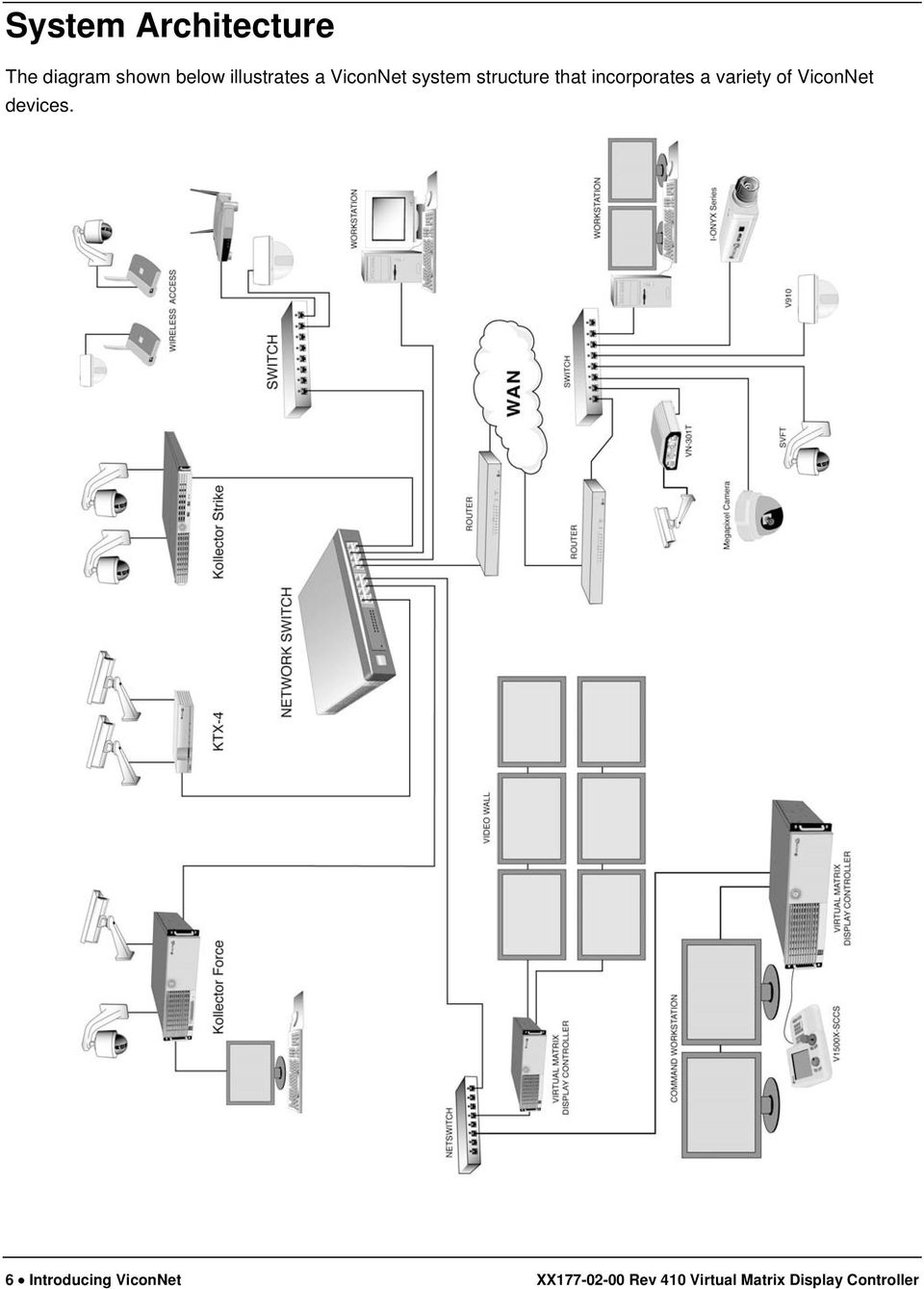
14 System Architecture The diagram shown below illustrates a ViconNet system structure that incorporates a variety of ViconNet devices. 6 Introducing ViconNet XX Rev 410 Virtual Matrix Display Controller
15 Chapter 2 Getting to Know Your Virtual Matrix Display Controller (VMDC) This chapter describes the Virtual Matrix Display Controller (VMDC) and familiarizes you with its components and functionality. This chapter contains the following sections: Logging In, page 8, describes how to log in to the Virtual Matrix Display Controller. Main Window, page 9, describes all the elements in the Virtual Matrix Display Controller Main window that provide access to the basic functions required to operate the system. Remote Monitor, page 31, describes the remote analog monitors used to display ViconNet live and recorded video. Logging Out and Exiting, page 34, describes how to log out without closing the VMDC and how to close the VMDC application and exit to the operating system. Note: The performance and number of cameras is subject to many variables. Refer to the datasheet for actual display capabilities. Note: Some of the screens shown in this manual may be slightly different in appearance than those that are on your screen. There should be no difference in content or functionality. XX Rev 410 Virtual Matrix Controller Getting to Know Your Virtual Matrix Display Controller (VMDC) 7

16 Logging In Logging in to the Virtual Matrix Display Controller is performed using your assigned user name and password. The allowed system operations are dependent on your assigned authorization rights (refer to Chapter 3, Configuring Your Virtual Matrix Display Controller, for additional details). The full functionality of the Virtual Matrix Display Controller system is available only after the system is registered. Before registration is performed, the system will function with limited functionality only. Refer to the Registering Your System section in Chapter 3, Configuring Your Virtual Matrix Display Controller for further information. A VMDC Administrator user can configure the system to automatically log in selected users. Then, each time the user starts the application, the VMDC Main window will be presented without having to enter a user name and password. Refer to the Configuring Auto Login section in Chapter 3, Configuring Your Virtual Matrix Display Controller. NOTES: Before you log in to the VMDC application, verify that the hardware components are properly installed and functional. To log in to the VMDC application: 1. At your Virtual Matrix Display Controller, double-click the ViconNet VMDC icon on your Windows desktop. NOTE: If you restart your site, the VMDC automatically starts up with the Login window open. 2. In the User Name field, enter your assigned user name. If you are an administrator entering for the first time, enter admin. If you are a guest, enter guest. 3. In the Password field, enter your assigned password. NOTES: If you are a guest, you do not need to enter a password. If you are an administrator entering the application for the first time, you do not need a password. After logging in as admin, it is recommended to assign yourself a password, as described in Chapter 3, Configuring Your Virtual Matrix Display Controller. 8 Getting to Know Your Virtual Matrix Display Controller (VMDC) XX Rev 410 Virtual Matrix Controller

17 4. Click. The VMDC Main window is displayed, as shown in the following section. NOTE: Pressing Exit from the Login window closes the application. Main Window After logging in to the Virtual Matrix Display Controller, the Main window is displayed, as shown on the following page, enabling you to: View and listen to live video and audio. Record live video and audio. Refer to the Configuring Recording Sites section in Chapter 3. Play back recorded video and audio. Create and manage macros and schedules. Control video images. Generate reports. Configure an external control device. Use system utilities. Each of the above tasks is described in detail in the subsequent chapters of this manual. NOTE: The allowed operations depend on each user's assigned site authorization. Refer to Chapter 3, Configuring Your Virtual Matrix Display Controller, for additional details about configuring site authorization. XX Rev 410 Virtual Matrix Controller Getting to Know Your Virtual Matrix Display Controller (VMDC) 9

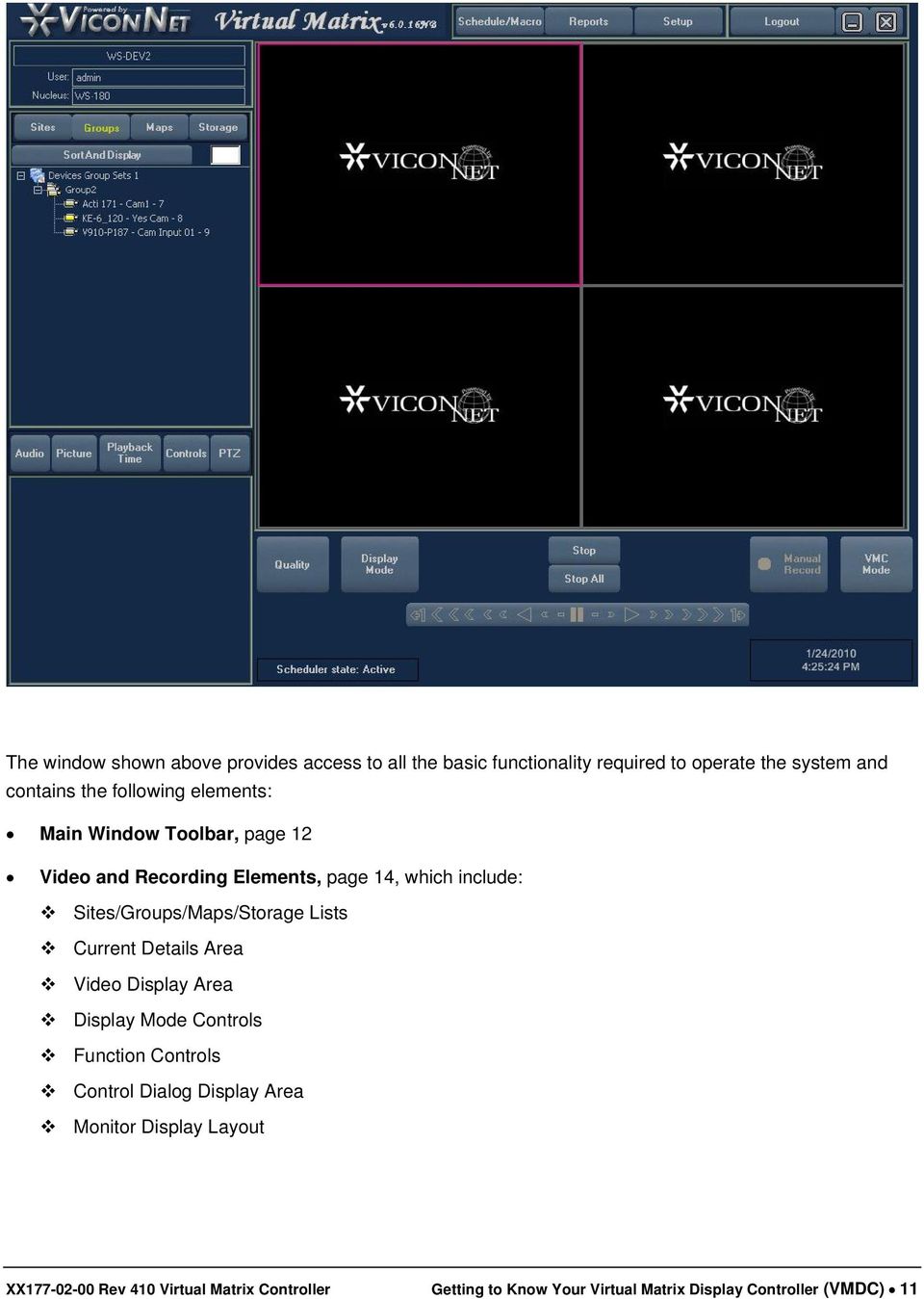
18 The following example illustrates the elements and options in the Virtual Matrix Display Controller Main window: Alternatively, the screen can be viewed in ViconNet mode by selecting the ViconNet Mode button. The screen will change to the following (the button changes to VMC Mode). 10 Getting to Know Your Virtual Matrix Display Controller (VMDC) XX Rev 410 Virtual Matrix Controller
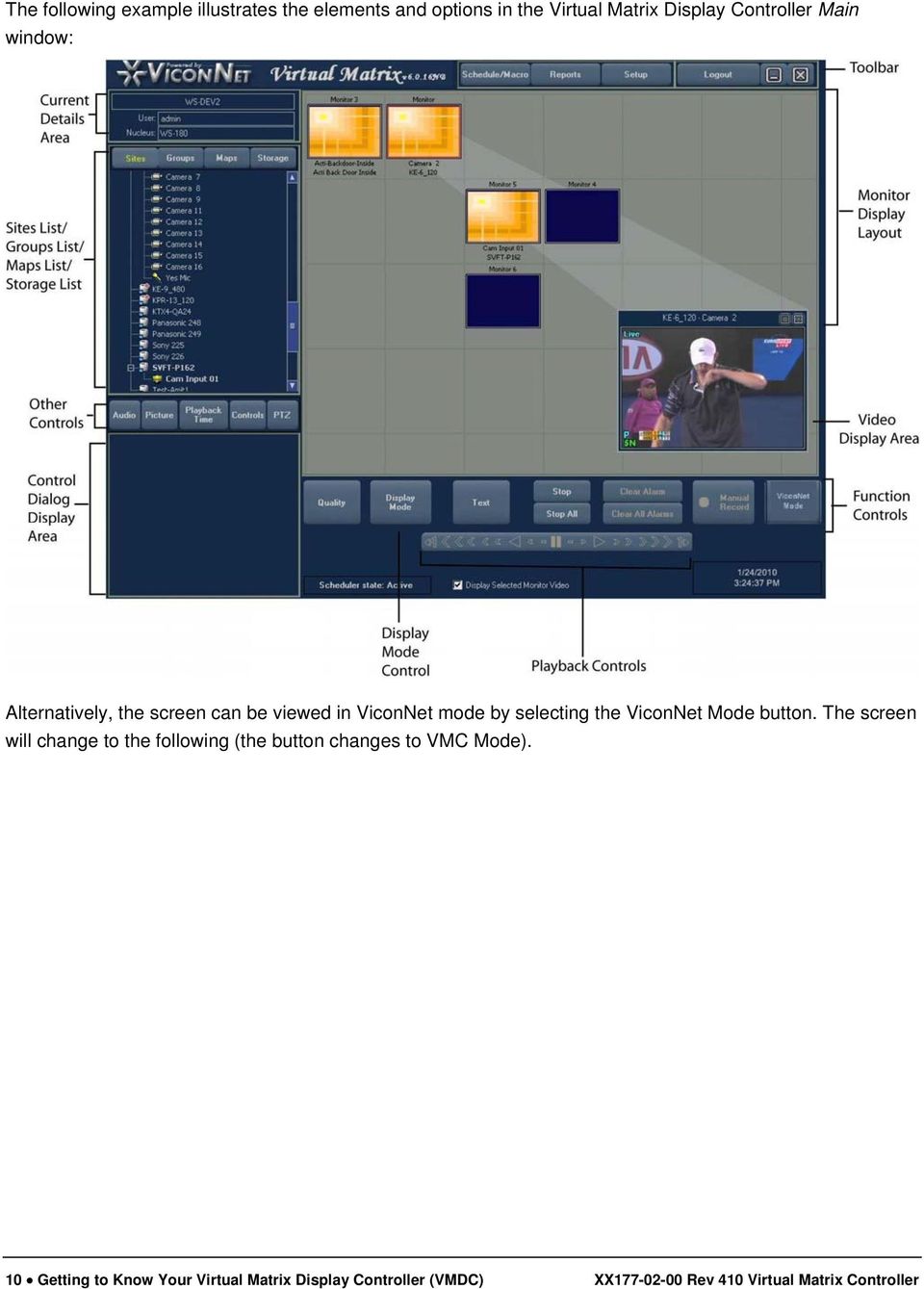
19 The window shown above provides access to all the basic functionality required to operate the system and contains the following elements: Main Window Toolbar, page 12 Video and Recording Elements, page 14, which include: Sites/Groups/Maps/Storage Lists Current Details Area Video Display Area Display Mode Controls Function Controls Control Dialog Display Area Monitor Display Layout XX Rev 410 Virtual Matrix Controller Getting to Know Your Virtual Matrix Display Controller (VMDC) 11
20 Other Controls, page 29, which include the following buttons: Audio Picture Controls Playback PTZ Main Window Toolbar The Virtual Matrix Display Controller Main window toolbar provides quick access to all the major functionality of the VMDC, as well as all configuration and report generation options. The VMDC Main window toolbar appears at the top of the window and contains six buttons, as follows: The following is a brief description of each toolbar button and its function: Button Description This option enables you to manage and work with macros that have been configured in the system. Macros are used for recording video and audio according to preconfigured schedules and preconfigured alarm events, as well as for performing sequence sessions. Refer to Chapter 3, Configuring Your Virtual Matrix Display Controller, and Chapter 7, Managing Macros and Schedules, for detailed configuration and management procedures. This option enables you to view and generate the following types of reports: Alarm History: Displays all the alarm events that have occurred in the system. Audit Log: Provides a basic log of operations performed in the system, which is useful for history and debugging purposes. Information is accumulated continuously. 8,000 record lines can be accumulated, and removed thereafter on a first-in-first-out basis. Refer to Chapter 8, Generating Reports, for detailed report generation procedures. 12 Getting to Know Your Virtual Matrix Display Controller (VMDC) XX Rev 410 Virtual Matrix Controller

21 Button Description Enables you to configure the Virtual Matrix Display Controller which includes: Registering your system. Modifying the system configuration, including configuring network setup. Other RS232/422/485 controls. Configuring automatic login. Configuring site authorization. Creating, editing, and deleting macros. Configuring alarm events. Creating and modifying schedules. Defining the VMDC Monitor Display Layout Restoring and backing up system settings from/to any network location. Defining via which site you perform recording from the Virtual Matrix Display Controller Defining text notification to be displayed on a remote monitor Language Translation Utility (LTU) Configuring the Central Failure Notification (CFN) display settings (CFNs are sent to specified sites to notify of errors that occur in the system.) Map Sets enables you to map your working environment in terms of where ViconNet systems are physically located on your premises. Display Settings allows you to select from a variety of resolutions, including wide screen Settings Summary provides a summary of all the settings configured in a specific site. Refer to Chapter 3, Configuring Your Virtual Matrix Display Controller, for detailed configuration procedures. This option enables you to log out without closing the Virtual Matrix Display Controller application. You can then log in as a different user. Minimize: Enables you to set the application to run in the background. Note About Auto Maximize: While the application is minimized, it is automatically maximized in the event of an alarm. Close: Enables you to close the application and redisplay the operating system. XX Rev 410 Virtual Matrix Controller Getting to Know Your Virtual Matrix Display Controller (VMDC) 13
22 Video and Recording Elements The VMDC enables you to view and record live video and audio and to play back recorded video and audio on remote monitors by selecting devices and displaying their contents, as required. You can view and record the contents of selected devices using the following video and recording elements: Current Details Area, page 14 Sites List, page 15 Site Maps, page 17 Groups List, page 18 Storage List, page 22 Video Display Area, page 24 Monitor Display Layout, page 26 Display Mode Controls, page 27 Function Controls, page 28 Control Dialog Display Area, page 29 Playback Controls, page 30 Remote Monitor, page 31 Current Details Area The Current Details area displays the name of the currently logged in user and the name of the master Nucleus: 14 Getting to Know Your Virtual Matrix Display Controller (VMDC) XX Rev 410 Virtual Matrix Controller
23 Sites List The VMDC Sites list is a hierarchical list that displays the current transmitters and devices in the system. This list can be navigated using standard tree expand and collapse functionality. Each storage location contains the devices that are available for viewing and recording live video and audio segments, and each transmitter and device list is correlated to a specific storage location. The following five device types can be configured to accommodate your individual and organizational requirements: Device Type Description Video or Camera Fixed camera or PTZ camera dome Audio Detector Relay Speaker Microphone Sensor Relay Speaker NOTES: The cameras that appear in the Sites list are automatically detected by the system during startup. If a camera is not physically connected to the system, it will not appear in the list. If the camera is disconnected after startup, a red X icon ( ) is displayed next to the relevant camera in the Sites list, and a blank screen appears in the Video Display area. Selecting a device starts that device's video/audio transmission and enables you to perform all viewing, listening and recording operations. XX Rev 410 Virtual Matrix Controller Getting to Know Your Virtual Matrix Display Controller (VMDC) 15
24 Using the Sites list, you can select or deselect cameras and microphones for viewing and recording, as follows: To view a camera or hear a microphone: Select a camera in the list or drag and drop it from the list to a monitor icon in the Monitor Display Layout. As an alternative, a camera can also be dropped directly onto the remote monitor. Right clicking the device will give you a Preview in the Video Display Area. The following occurs: The camera icon in the Sites/Maps/Groups list appears highlighted in yellow. The icon appears in the Monitor Display Layout. The live video transmission begins and is displayed on the remote monitor in the location selected in the Monitor Display Layout. If the Video Display area at the bottom of the Main window is turned on, the video from the selected camera is displayed therein. There is a spotlight from the monitor to the Video Display area. For instructions on how to turn the Main window video display on and off, refer to Chapter 4, Viewing Live Video/Audio. Note: All the cameras in a site can be viewed on a multiple display monitor by dragging the site to the selected monitor; select the monitor display mode from the Display Mode selection key. Select a microphone by clicking its icon in the list. The following occurs: The icon appears highlighted in yellow. The audio transmission begins. NOTES: If a camera is already recording (for example, if recording was started from the transmitter), the icon in the list will already appear in yellow). A video that was activated by a macro is indicated in the Monitor Display Layout by the icon. To reverse a selection: Select the device in the list again. The following occurs: The icon is not highlighted in the list (it is gray). The live video and audio transmission is stopped. The Video Display area and monitor display location are cleared, and the Monitor icon is cleared in the Monitor Display Layout. You can change the maximum number and location of the cameras you want to view/record on the remote monitor, as described in the Monitor Display Layout section, page 26, and the Display Mode Controls section, page 27. Refer to Chapter 4, Viewing Live Video/Audio, and Chapter 5, Recording Live Video/Audio, for detailed procedures using the Sites or Groups list. 16 Getting to Know Your Virtual Matrix Display Controller (VMDC) XX Rev 410 Virtual Matrix Controller
25 Site Map The ViconNet Site Map provides you with the ability to define the location of Kollector units, cameras and microphones on a map of the physical environment/premises. Maps can be grouped into map sets. The map set you are currently working on is called the working set. The Working Set site maps can be viewed by clicking on Site Map in the left hand panel of the Main window. The Site Map list can be navigated in the same way as the Site List. However, the devices in the Site Map list are organized by maps and map sets, not by site (meaning, by physical location of devices as opposed to by device name). You can define your maps and map sets by selecting Map Sets from the System Settings window. The image in the lower-left panel changes according to the object selected in the Site Map. Maps are loaded in to the system using the Add New Map utility. (For more details, refer to the Defining Site Maps and Map Sets section in Chapter 3, Configuring the ViconNet system.) Maps can be loaded from CD media or a USB drive. The picture can be dragged to the middle of the editing space and then expanded or navigated and so on, as described below. XX Rev 410 Virtual Matrix Controller Getting to Know Your Virtual Matrix Display Controller (VMDC) 17
26 The following options are available for working with the selected map in the Map Set: Button Description Enables you to navigate to the parent map. Enables you to navigate to other maps in the Map Set. Enables you to remove text labels from the map. Enables you to expand the picture. Enables you to return the map to its previous state (expansion). Enables you to maximize the map to fit the entire screen. Enables you to close the map image. The Site List tab is redisplayed in the left-hand panel. Devices (cameras, encoders, decoders and so on) can be added to a Site Map by dragging them directly to where they are located on the map of the physical location. To activate or deactivate a camera, click the camera icon on the map. If the camera icon is flashing, it is deactivated. If it is steady, it is active. NOTE: If there are two monitors connected to the VMDC, clicking Site Map in the Main window opens the map set (the Working Set) on the second monitor. For more details about Site Maps, see Chapter 3, Configuring the ViconNet System. Groups List The Virtual Matrix Display Controller Groups list displays the transmitters and devices (cameras and microphones) connected to your ViconNet system organized by logical groups and group sets. Each group can contain devices from multiple distinct transmitters and can be formed according to any criteria, such as: location, camera type, and so on. Like the Sites list, the Groups list is a hierarchical list, which can be navigated using standard tree expand and collapse functionality. A Group Set usually consists of various related groups of devices. For example, in a large company with several multi-storey buildings, there may be a Group Set for each building. In each Group Set (building) there could be a number of Groups, each one for a different floor. You can define your Groups and Group Sets by selecting Groups Sets from the System Settings window. NOTE: When defining device groups in the Devices Group Sets Management window, you can define one Group Set as the Working Set. This is the Group that will appear in the Groups list in the Main window. To view a different group set, you must change the working set in the Devices Group Sets Management window. Groups are loaded in to the system using the Add New Group utility. (For more details about defining groups and group sets, refer to the Defining Groups and Group Sets section in Chapter 3, Configuring Your Virtual Matrix Display Controller.) NOTE: The Groups list is only enabled after at least one group has been defined in the Devices Group Sets Management window. 18 Getting to Know Your Virtual Matrix Display Controller (VMDC) XX Rev 410 Virtual Matrix Controller
27 Using the Groups list, you can select or deselect cameras and microphones for viewing and recording, as follows: To view a camera or listen to a microphone: Select a camera in the list or drag and drop it from the list to a monitor icon in the Monitor Display Layout. The following occurs: The camera icon in the Sites/Groups list appears highlighted in yellow. The icon appears in the Monitor Display Layout. The live video transmission begins and is displayed on the remote monitor in the location selected in the Monitor Display Layout. If the Video Display area at the bottom of the Main window is turned on, the video from the selected camera is displayed therein. There is a spotlight from the monitor to the Video Display area. For instructions on how to turn the Main window video display on and off, refer to Chapter 4, Viewing Live Video/Audio. Select a microphone by clicking its icon in the list. The following occurs: The icon appears highlighted in yellow. The audio transmission begins. NOTES: If a camera is already recording (for example, if recording was started from the transmitter), the icon in the list will already appear in yellow). A video that was activated by a macro is indicated in the Monitor Display Layout by the icon. For details about the Monitor Display Layout, refer to the Monitor Display Layout section on page 26. XX Rev 410 Virtual Matrix Controller Getting to Know Your Virtual Matrix Display Controller (VMDC) 19
28 The following display options are available for working with the selected group in the group set: Button Description Opens a list with a selection of display modes. Select 1, 4, 9, 16, 25, 36 or 64 to enable you to view or record, on a remote monitor, up to 64 cameras simultaneously. Enables you to maximize the Video Display area to fit the entire screen. To restore the maximized screen to its previous size, click the corner. icon in the top right NOTE: This option only affects the video display in the Main window and does not influence the display on the remote monitor. To reverse a selection: Select the device in the list again. The following occurs: The icon is not highlighted in the list (it is gray). The live video and audio transmission is stopped. The Video Display area and monitor display location are cleared, and the Monitor icon is cleared in the Monitor Display Layout. You can change the maximum number and location of the cameras you want to view/record on the remote monitor, as described in the Monitor Display Layout section, page 26, and the Display Mode Controls section, page 26. Refer to Chapter 4, Viewing Live Video/Audio, and Chapter 5, Recording Live Video/Audio, for detailed procedures using the Sites or Groups list. In the Groups list, you can select to list the devices by name, secondary ID (as configured in the Groups Sets Management window) or both. To select which group details to display, click the button and select the required option from the radio buttons that appear at the top of the Groups list, as shown below. Name: Displays a list of the device names Name-ID: Displays a list of device names followed by the device s secondary ID ID: Displays a list of the device s secondary ID ID-Name: Displays a list of the device s secondary ID followed by the device s name 20 Getting to Know Your Virtual Matrix Display Controller (VMDC) XX Rev 410 Virtual Matrix Controller
29 The following five device types can be configured to accommodate your individual and organizational requirements: NOTE: Device Type Description Video or Camera Fixed camera or PTZ camera dome Audio Detector Relay Speaker Microphone Sensor Relay Speaker The cameras that appear in the Sites list are automatically detected by the system during startup. If a camera is not physically connected to the system, it will not appear in the list. If the camera is disconnected after startup, a red X icon ( ) is displayed next to the relevant camera in the Sites list, and a blank screen appears in the Video Display area. Selecting a device starts that device's video/audio transmission and enables you to perform all viewing, listening and recording operations. NOTE: A device can also be selected by entering its secondary ID in the text box at the top of the Groups list and clicking Go. Devices (cameras, servers, and so on) can be added to a group by dragging them directly to the list of devices in the Groups Editor window. For more details about groups, see Chapter 3, Configuring Your Virtual Matrix Display Controller. XX Rev 410 Virtual Matrix Controller Getting to Know Your Virtual Matrix Display Controller (VMDC) 21
30 Storage List The VMDC Storage list enables you to play back video on a remote monitor. A list of databases are displayed, meaning ViconNet sites on which recorded data has been stored. This list can be navigated using standard tree expand and collapse functionality. Each storage location contains the devices that are available for viewing and recording live video and audio segments. ` To playback a video or audio segment: 1. To select the database to be played back, select the database in the Storage list. Under each database there is a list of the transmitters connected to the system and under that the devices connected to the transmitter. 22 Getting to Know Your Virtual Matrix Display Controller (VMDC) XX Rev 410 Virtual Matrix Controller
31 2. Select a camera/microphone. When a camera is selected, calendar and time boxes are displayed. 3. Select the date and time of the segment to be played back from the calendar and time list. As an alternative to selecting the time/date, click either the Start Time to select the first video available or the End Time to select the last video available to change the time parameter for playback. Click button to begin playback of the video segment. When a camera is playing back, the camera name is emphasized in the Storage list. If there is no data in the database for the selected time, a message is displayed. XX Rev 410 Virtual Matrix Controller Getting to Know Your Virtual Matrix Display Controller (VMDC) 23
32 The playback icon is displayed in the selected location in the Monitor Display Layout and the video is displayed (paused) in the Video Display area and on the selected remote monitor. To activate Start Quick Playback From, right-click the live camera in the Monitor Display Layout (a camera which is currently recording) or right-click the camera in the Storage list. If a camera is off, or if it is not live, you can only select Start Quick Playback From by clicking the camera in one of the lists (Sites, Groups, Maps or Storage). Video Display Area The VMDC Video Display area is for viewing and recording live video and listening to audio and playing back recorded video and audio. You can view a single live video or recorded segment in the Video Display area, while multiple videos are playing/recording simultaneously on the connected remote monitors. This Display Area can be moved to any location on the screen. The Video Display can be turned on or off by checking or unchecking the. Alternatively, the display screen can be turned off by clicking the in the corner of the screen. You can display a camera's video in this area in one of the following ways: By selecting the camera from the Sites, Maps or Groups list (the camera is displayed in yellow). The video is automatically displayed in the Video Display area. By selecting the camera from the Monitor Display Layout. The video is automatically displayed in the Video Display area. By selecting to play back video from a specific camera in the Storage list. The following example shows live video transmission displayed in the Video Display area, with the names of the camera and of the transmitter located at the top of the video display. 24 Getting to Know Your Virtual Matrix Display Controller (VMDC) XX Rev 410 Virtual Matrix Controller
33 The selected camera then becomes the active monitor location (indicated by a red border), and its video and audio transmission is affected by the display mode controls (page 27), playback controls (page 30) and other controls (page 29). When a camera's video is displayed in the Video Display area, its related information is also displayed, such as the following: Live, Playback or Macro indications in the Monitor Display Layout, according to the function currently being performed. The camera and transmitter name The recording time and date during playback operations. If you want to enlarge the size of the image in the Video Display area, click in the corner. The selected image is maximized to fill the entire window. You can restore the display to its previous size by clicking. Right-clicking anywhere on a camera in the Sites list, Maps list or on a camera that is currently recording in the Monitor Display Layout displays the Start Quick Playback From option, as shown below. NOTE: To activate the video playback from a specific time, select the camera to be played back in the Storage list and select the date and time to playback. For more information about this option, refer to the Quick Playback section in either your Kollector or Workstation Software Manual. The Start Quick Playback From option enables you to play video back from that camera (in the Video Display area and on a remote monitor, according to its location in the Monitor Display Layout on the VMDC). For more details about how to perform Quick Playback, refer to Quick Playback in Chapter 6, Playing Back Recorded Video/Audio. XX Rev 410 Virtual Matrix Controller Getting to Know Your Virtual Matrix Display Controller (VMDC) 25
34 Monitor Display Layout The Virtual Matrix Display Controller Monitor Display Layout enables you to define and view the location that live and recorded video will be displayed on the connected remote monitors. The Monitor Display Layout consists of a grid on which you can view icons representing the various monitors that are connected to the VMDC. The location of the icons on the grid is determined according the configuration defined in the Layout Settings window. Refer to the Configuring Monitor Layout section in Chapter 3, Configuring Your Virtual Matrix Display Controller for more details on how to configure your monitor layout. The icons used to represent the monitor layout in the Main window Monitor Display Layout are as follows: Icon Description Represents a remote monitor in single display mode (a single video can be displayed on that monitor), with no active video. Represents a remote monitor in quad display mode (four videos can be displayed simultaneously on that monitor), with no active video. Similar icons depict 9, 16, 25, 36 or 64 display mode. Represents a communication problem with the monitor (meaning that there is no communication). Indicates that there is an active live video playing/recording in the related display location. Indicates that there is an active live video playing/recording in the related display location that has been triggered by a macro. Indicates that a video is being played back in the related display location. Indicates that video is being displayed by another (remote) VMDC unit 26 Getting to Know Your Virtual Matrix Display Controller (VMDC) XX Rev 410 Virtual Matrix Controller
35 Display Mode Control The VMDC Display Mode button ( ) enables you to toggle between a choice of display modes. If working with a KRX-3, single mode (a single video display location) and quad (2x2) are available. There is a choice of single mode (a single video display location, quad (2x2) nine (3x3), 16 (4x4), 25 (5x5), 36 (6x6) or 64 (8x8) mode on a remote monitor. You set the display mode per monitor. When the is selected, the text on the button turns yellow and a popup list of display modes appears. Click the Display Mode button again to close the list. The Full Screen display mode is available only when the screen is in Local Display Mode (ViconNet screen). In the Main window Monitor Display Layout, the display modes are represented by icons, for example and for single and quad modes, respectively; similar icons show 9, 16, 25, 36 and 64 modes. In multiple display modes, you can use all or only some of the locations to view, listen, record and play back video and audio on the remote monitors, as required. For example, if you want to record video from seven cameras using, you could select display mode 9 on the remote monitor and have two blank monitor display locations and seven active ones. If using the KRX-3, you would select quad display mode for two remote monitors and have one blank monitor display location and seven active ones. Refer to Chapter 6, Playing Back Recorded Video/Audio, for detailed procedures for recording video and audio. Select the VMDC display mode as follows: Button Description Opens a list with a selection of display modes. Select 1, 4, 9, 16, 25, 36 or 64 to enable you to view or record, on a remote monitor, up to 64 cameras simultaneously (only 1 and 4 are available with KRX-3). The display mode is depicted by icons on the Monitor Display Layout, for example or. Enables you to maximize the Video Display area to fit the entire screen. To restore the maximized screen to its previous size, click the corner. icon in the top right NOTE: This option only affects the video display in the Main window and does not influence the display on the remote monitor. XX Rev 410 Virtual Matrix Controller Getting to Know Your Virtual Matrix Display Controller (VMDC) 27
36 NOTES: Refer to Chapter 4, Viewing Live Video/Audio, Chapter 5, Recording Live Video/Audio, and Chapter 6, Playing Back Recorded Video/Audio, for additional details about selecting cameras and video display locations. Function Controls The VMDC function controls enable you to record or stop the live video and audio currently displayed on the remote monitors and in the Video Display area, as well as stop the macros currently running in the system, if required. Option Description Use Manual Record to record all video currently displayed in all the video display locations on the remote monitors and stores the recorded data into the predefined local storage location. To stop recording, click the Stop Record button. Refer to Chapter 5, Recording Live Video/Audio, for detailed recording procedures. Use Stop button to stop the transmission of the video currently displayed in the Video Display area or currently selected in the Monitor Display Layout if the Video Display area is turned off. To stop the transmission of all video currently displayed on the remote monitors and in the Main window Video Display area, click the Stop All button. To begin recording again, you must re-select the required cameras, as described in Chapter 5, Recording Live Video/Audio. When there is an alarm in the system, an alarm message is displayed on the remote monitor. The Clear Alarm button clears both the alarm message from the monitor and the symbol of the alarm from the monitor icon in the Main window. The Clear All Alarms button clears all alarm messages from all remote monitors and from all monitor icons. Use the Quality button to enable a pop up a list of quality values to manually override the live picture quality for the currently selected camera, as required (the Quality button text turns yellow). The qualities 1 to 8 are available for this purpose. Click the button again to close the list. For more details about picture quality, refer to the Remote Monitor section on page 31. This button opens the Text Control window, which enables you to enter text to be displayed directly on the middle of a remote monitor. For more details, see the Configuring Text Settings section in Chapter 3, Configuring Your Virtual Matrix Display Controller. When the screen is in displaying the VMDC GUI, this button displays. To change the screen to the ViconNet view, select this button. When the screen is in displaying the ViconNet view, this button displays. To change the screen to the VMDC GUI, select this button. 28 Getting to Know Your Virtual Matrix Display Controller (VMDC) XX Rev 410 Virtual Matrix Controller
37 Control Dialog Display Area The Control Dialog Display area changes and provides access to different functionality according to the currently selected control in the Other Controls area. For example, if you click the button, the Control Dialog Display area displays additional controls specific to controlling the picture. Refer to the Other Controls section, page 29, for additional details about the controls that affect this area. Other Controls The Other Controls area provides functions that affect one selected device at a time and are active only if a relevant device type is selected. As you select each of these controls, additional controls or information, relevant to the selected control, are displayed in the Control Dialog Display area. The Other Controls area provides the following functions: Function Description This button displays controls in the Control Dialog Display area for modifying the sound of the playback and live video images (change volume or mute). This button displays controls in the Control Dialog Display area for modifying the color, brightness, and contrast of the displayed video images. Changing the picture settings is irreversible (meaning that after the settings have been changed, the previous settings are lost, unless the user saved the previous settings as the default settings). NOTE: The last saved picture settings can only be restored by selecting Restore from the System Settings window, However, this restores ALL the last backed-up system settings. Refer to the Step 3: Controlling the Picture per Camera section in Chapter 4, Viewing Live Video/Audio, for additional details. The playback button is only active when the Storage list is displayed. This button enables you to select recorded video and audio segments for playback viewing and listening and to perform playback activities. When selected, the playback controls are displayed in the bottom-left corner of the Main window. Refer to the Playback Controls section below and Chapter 6, Playing Back Recorded Video/Audio, for additional details. This button displays buttons in the Control Dialog Display area by which system functions can be configured to operate via external device commands. This button is operational only when an external device (for example, a control) has been configured on your system. Refer to the Configuring an External Control section in Chapter 3, Configuring Your Virtual Matrix Display Controller, for additional details. This button enables you to display video from a PTZ camera in the Video Display area. This option also automatically displays a driver-specific interface for PTZ-enabled cameras in the Control Dialog Display area and on the screen. Refer to the Operating a PTZ Camera section in Chapter 4, Viewing Live Video/Audio, for additional details. XX Rev 410 Virtual Matrix Controller Getting to Know Your Virtual Matrix Display Controller (VMDC) 29
38 Playback Controls The Virtual Matrix Display Controller enables you to play back one or multiple recorded segments on the remote monitors and a single recorded segment in the Main window Video Display area. The playback controls are enabled when selected video is played back in the remote monitor and the Video Display area. Playback is started by clicking when a device is selected in the Storage list. The playback start time for the recorded segment(s) depends on the start time defined in the calendar (displayed in the Main window when Playback is selected) or on the time selected when the Start Quick Playback From option is selected (by right-clicking on a device in the Sites, Maps or Groups list or in the Monitor Display Layout. Refer to the Storage List section, page 22 and Chapter 6, Playing Back Recorded Video/Audio for additional details. You can then use the playback controls, to navigate the selected recorded segment during playback, as follows: Option Description Forward: Plays the recorded video and audio segment. This control also enables you to restart playback of a recorded video and audio segment that has been stopped automatically due to an alarm event. NOTE: Refer to Chapter 3, Configuring Your Virtual Matrix Display Controller, for additional details about configuring alarm events. Fast Forward: Fast-forwards the recorded segment at the following speeds (related to the normal speed): 1/4, 1/2, x2, x5, x10, x50, and x100. NOTE: Place the mouse cursor over a button to view its related fast forward speed. Backward: Rewinds the recorded video and audio segment. Fast Rewind: Fast rewinds the recorded segment at the following speeds (related to the normal speed): 1/4, 1/2, x2, x5, x10, x50, and x100. NOTE: Place the mouse cursor over a button to view its related fast rewind speed. Stop/Pause: Stops/pauses the current playback of the recorded segment. Prev: Displays the previous frame in the recorded segment. Next: Displays the next frame in the recorded segment. 30 Getting to Know Your Virtual Matrix Display Controller (VMDC) XX Rev 410 Virtual Matrix Controller
39 Remote Monitors Using the Virtual Matrix Display Controller, ViconNet live and recorded video displays on remote analog monitors and control simulates that of a crosspoint switcher, as in a command center. The Virtual Matrix allows you to take advantage of the analog monitor s size, quality and visibility. The remote monitors provide you with the ability to view multiple very large video displays from multiple viewers simultaneously. In order to translate the digital video from the network to analog (composite, VGA, S-Video), a decoder is required. The VMDC includes an integral PC-based decoder that can control up to 5 monitors; a version can be on a dedicated PC and control up to 6 monitors. Each monitor can then display up to 64 video streams. This decoder supports VGA and DVI/HDMI. The KRX-3 Decoder can be controlled by the Virtual Matrix Display Controller, with up to three monitors connected to each decoder; multiple KRX-3 Decoders can be used. There are two types of displays: analog (three BNC and two S-video connectors) and digital (two VGA). Only three connectors, in any combination (for example, two BNC and one VGA), can be configured simultaneously. When using third party megapixel cameras, the KRX-3 must be set for displaying their videos. When doing so, only 2 channels will be available in the KRX-3. About Picture Quality and Refresh Mode Each ViconNet video has a quality level and refresh mode configured (manually or automatically) at the time of it is recorded. The notation at the bottom-left of each remote monitor display location (meaning, for each camera) indicates the picture quality and the refresh mode of the image in the view. Picture Quality and Refresh Mode For example, indicates the quality 5 at the Normal refresh mode. These concepts are described in the Picture Quality and Monitor Refresh Modes sections below. NOTE: Whether or not the picture quality and refresh mode notation is displayed on the monitor is defined in the Text Settings window, as described in Chapter 3, Configuring Your Virtual Matrix Display Controller. XX Rev 410 Virtual Matrix Controller Getting to Know Your Virtual Matrix Display Controller (VMDC) 31
40 Picture Quality Picture quality (also known as resolution) refers to the compression level of the video images. The following qualities are available for recording purposes in ViconNet compression mode: Quality Type Properties CIF 2 CIF CIF HCIF Better picture quality, but slower data transmission. Less clear picture quality, but faster data transmission. The quality and refresh mode in which video was recorded is displayed during the first five seconds of playback. In the case that the camera is used at the source, the recorded video quality is determined according to priority setup. If the VMDC is the sole user of the camera, then quality is determined by the VMDC, manually or via a macro. For additional details, refer to the relevant sections in Chapter 3, Configuring Your Virtual Matrix Display Controller and Chapter 3, Configuring Your ViconNet System in your Kollector, IP Camera or Server software manual. When different recording options are requested concurrently, the recorded picture quality that applies is determined according to prioritization settings in the picture quality and FPS priority settings in the camera's source site. NOTE: For details on how to configure Auto Record, Pre/Post-Alarms and FPS priority settings, refer to your Kollector or Workstation software manual. The single mode is assigned the highest available resolution, while other modes are automatically assigned quality 5 on starting a camera. NOTE: From the VMDC, you can select single, quad, 9, 16, 25, 36 and 64 display modes. When the button in the Main window Function Controls area is selected, you can manually override the display mode-determined live picture quality for the currently selected camera using the popup. The qualities 1 to 8 are available for this purpose. The quality and refresh mode of the live video is displayed according to the settings in the Text Settings Configuration window. 32 Getting to Know Your Virtual Matrix Display Controller (VMDC) XX Rev 410 Virtual Matrix Controller
41 Monitor Refresh Mode The refresh mode refers to whether all the frame data (Full mode, represented by an F in the bottom-left of the camera view in the monitor) is displayed each time or only when changes occur in the frames (Normal mode, represented by an N in the bottom-left of the camera view) are displayed. The view image is automatically played back in the refresh mode in which it was recorded. For I-Onyx 9xx and third party cameras there is no N designation. The mode will either be F (full motion JPEG) or MPEG (H.264). XX Rev 410 Virtual Matrix Controller Getting to Know Your Virtual Matrix Display Controller (VMDC) 33
42 Logging Out and Exiting Logging Out Logging out is performed when you want to exit from the Virtual Matrix Display Controller but need the application to remain open, for example, to log in as a different user. To log out of the Virtual Matrix Display Controller: 1. Click in the Main window toolbar. The following message is displayed: 2. Click Yes. The VMDC Login window is redisplayed, as described in Logging In, page Getting to Know Your Virtual Matrix Display Controller (VMDC) XX Rev 410 Virtual Matrix Controller
43 Exiting the Virtual Matrix Display Controller Exiting is performed when you want to exit the ViconNet application. To close the Virtual Matrix Display Controller and exit to the operating system: 1. Click the Close button on the Main window toolbar. The following window is displayed: 2. Click Yes to exit (close) the application. - OR - 3. Click Logout in the Main Window Toolbar. The Login window is displayed. 4. Click Exit. XX Rev 410 Virtual Matrix Controller Getting to Know Your Virtual Matrix Display Controller (VMDC) 35
44 36 Getting to Know Your Virtual Matrix Display Controller (VMDC) XX Rev 410 Virtual Matrix Controller
45 Chapter 3 Configuring Your Virtual Matrix Display Controller This chapter describes all the configuration functions available in the ViconNet Virtual Matrix Display Controller and contains the following sections: Accessing the Configuration Functions, page 39, describes how to access the System Settings window, which enables you to start to perform configuration functions for a selected Virtual Matrix Display Controller. Registering your System, page 41, describes how to register your Virtual Matrix Display Controller. Modifying the System Configuration, page 43, describes how to modify all VMDC default system configurations, including network setup. VMDC Configuration, page 48, provides the options for the VMDC mode, depending on whether it will be used with a separate KRX-3 decoder, together with the PC-based decoder on the same PC or as a PC dedicated to the decoder only. Configuring the Central Failure Notification (CFN) Display, page 50, describes how to configure when Central Failure Notifications will be displayed and for how long. Configuring Site Authorization, page 54, describes how to define the system operations that can be accessed by each group of users. Configuring Auto Login, page 59, describes how to configure the system to automatically log in selected users. Configuring Monitor Layout, page 61, describes how to configure the layout of the connected monitors in the Monitor Display Layout in the Main Window and how alarms are to be displayed on the remote monitors. Configuring Text Settings, page 64, describes how to configure the various text options to be displayed on a remote monitor. Configuring Recording Sites, page 66, describes how to select the site on which to store recorded video. Creating Macros, page 67, describes how to create sets of instructions that cause the system to perform specific tasks in a specific order. (Information about scheduling of macros is provided in the Creating Schedules section, page 78.) Configuring Alarm Events, page 75, describes how to setup alarms so that at a specified time an alarm will activate a macro. XX Rev 410 Virtual Matrix Display Controller Configuring Your Virtual Matrix Display Controller 37
46 Creating Schedules, page 78, describes how to create schedules that instruct the system about when to run specific macros. Restoring and Backing Up System Settings, page 83, describes the Virtual Matrix Display Controller restore and backup features. Configuring an External Control, page 84, describes how to enable system operation via buttons on an external control box. Defining Device Groups and Group Sets, page 88, describes how to organize devices into defined groups and group sets. Defining Site Maps and Map Sets, page 93, describes how to receive notifications indicating that certain applications have failed, for example, macro, recording and database failures Using the LTU, page 102, describes how to set up and install a translation of all the user interface terminology for use by non-english speakers. Viewing the Settings Summary, page 106, describes how to view all the settings for a specified Virtual Matrix Display Controller in one place, without navigating through all the windows of that VMDC. Display Settings, page 107, describes how to change the screen resolution. Note: The VMDC using the decode monitor requires Windows 7 Ultimate operating system and specific PC requirements. Refer to the most recent datasheet. Note: Some of the screens shown in this manual may be slightly different in appearance than those that are on your screen. There should be no difference in content or functionality. 38 Configuring Your Virtual Matrix Display Controller XX Rev 410 Virtual Matrix Display Controller
47 Accessing the Configuration Functions The configuration functions are performed via the System Settings window applicable to a selected Virtual Matrix Display Controller. To access the System Settings window: 1. From the VMDC Main window, click. The Setup Site Selection window is displayed, showing a list of all currently connected Virtual Matrix Display Controllers: The local site always appears at the top of the list. 2. Select the VMDC site you want to configure setup and click. The System Settings window is displayed, as shown below. XX Rev 410 Virtual Matrix Display Controller Configuring Your Virtual Matrix Display Controller 39
48 NOTE: The Site Name and Site IP information are displayed automatically on this and subsequent windows. NOTE: There is a limit to the amount of time you can leave the setup screen open without working in it. Therefore it is important to save your settings each time you make a change. Before ViconNet will shutdown in this situation, the following warning screen will display. 40 Configuring Your Virtual Matrix Display Controller XX Rev 410 Virtual Matrix Display Controller
49 Registering Your System Before the registration procedure is performed, the system will not allow you to use remote monitors and you will have limited access to the System Settings, as shown below: NOTE: The registration procedure should be performed the first time the application is started, following installation. The application may also need to be re-registered if the application is installed on another system or the hard disk drive of your system is changed. The Main window will be displayed with the following logo at the top of the window: XX Rev 410 Virtual Matrix Display Controller Configuring Your Virtual Matrix Display Controller 41
50 To register your system: 1. In the VMDC application, navigate to the System Settings window, click Registration. The Registration window appears. 2. Fill in your company details. 3. Fill in your user name. 4. Make note of the two user codes that are on the ViconNet Registration screen. You will need these to complete registration. NOTE: Licensing is done through Vicon s website. On go to the link for ViconNet software registration and follow those instructions. Be sure to have the License ID and password that is on the label of the software CD jewel case. You will need these to register. Follow the prompts. 2. Enter the six license numbers generated from the registration process into the six License Number fields of the Registration window, and click. The application automatically restarts in order to implement the new registration and enable the functionality of your purchased application. 42 Configuring Your Virtual Matrix Display Controller XX Rev 410 Virtual Matrix Display Controller
51 Modifying the System Configuration The ViconNet system default configuration can be modified, depending on your requirements, as described in the following section: Configuring the Network Setup, below, describes how to configure the network setup for each computer in the system, including which computer is running the master Nucleus. Configuring the Network Setup The network setup parameters are configured individually for each computer in the ViconNet system. Network setup configuration is performed using the ViconNet application installed on each computer. When setting up a network, one of the sites must be assigned as a Nucleus, and the other sites in the network must know where this Nucleus is. Each site (either a transmitter, a Workstation or a VMDC) has the option to input which Nucleus it connects to. By creating an IP network, you will enable devices to connect to each other and to the master Nucleus that they share. This includes the ability to synchronize multiple devices with the Nucleus time or update all the time settings to another time zone. The backup Nucleus setup is configured only on the master Nucleus device. Since the VMDC cannot be a Nucleus, its network settings do not include backup Nucleus setup. However, the VMDC must be connected to a ViconNet Nucleus and therefore will be connected to any Backup Nucleus that takes control if the Master Nucleus crashes. A Backup (new Master) Nucleus is created by selecting Restore in the Settings window (as described on page 83) and by selecting to restore the BackupNucleus.vsb file. For more details about activating the Backup Nucleus in the case that the Master Nucleus ceases to function, see the Recovering the Nucleus section on page 44. NOTES: A Backup Nucleus is recommended, but not mandatory. The Nucleus and backup Nucleus must have fixed IP addresses. DHCP cannot be used on the site running the Nucleus. A message notifying the user that a Nucleus must be selected is displayed upon running the VMDC for the first time. A Virtual Matrix Display Controller cannot be the Nucleus and thus must be connected to at least one DVR or Workstation which is the Nucleus. XX Rev 410 Virtual Matrix Display Controller Configuring Your Virtual Matrix Display Controller 43
52 Configuring the Nucleus The Nucleus takes an active role in the ViconNet system, acting as a central station that connects all devices running the ViconNet application. The more devices connected to the system, the more resources the Nucleus requires. A backup Nucleus, which runs at all times, can also be configured as a safety mechanism for cases when the system does not operate due to a problem such as a power failure in the Nucleus. In a small network (fewer than five sites), the Nucleus and backup Nucleus (if it exists) can be on any of the Kollectors or Workstations, and a backup Nucleus should only be configured if deemed necessary. If the Nucleus is configured on a site and it is heavily loaded with recordings and transmissions, the Nucleus should be moved to a dedicated Kollector/Workstation. In a large network (more than five sites), it is strongly recommended that the Nucleus and backup Nucleus be run on dedicated workstations. NOTE: The backup Nucleus cannot be configured from the VMDC. Recovering the Nucleus In the case that the master Nucleus ceases to function, a new Nucleus must be set up. First, a ViconNet application (such as a Kollector or Workstation, but not a VMDC) must be installed on either a new computer or on a computer on which all previous versions of the ViconNet/VMDC application have been completely removed (uninstalled) and a new version has been installed. NOTE: The new ViconNet site that is to replace the failed Nucleus must have identical Network parameters to the Nucleus that failed, including the IP address, User and Group settings and so on. Using the Restore option in the Settings window (as described on page 83) in the new Nucleus, restore the settings from the dysfunctional master Nucleus by selecting the BackupNucleus.vsb file located on the site defined in the Network Settings of the original Nucleus as the Backup Nucleus. NOTES: The IP address entered as the Backup Nucleus IP address in the original Nucleus s Network Settings window points to the site on which the BackupNucleus.vsb file is saved. The BackupNucleus.vsb file is updated with the Master Nucleus s settings every time the Site Setup is opened or closed. The BackupNucleus.vsb is the same type of file as that created upon performing a Backup from the Settings window. It is important that the new Nucleus on which the BackupNucleus.vsb is to be restored is a new computer or a computer on which all previously-installed Vicon applications have been uninstalled in order to avoid conflicts between previous system settings and the settings from the BackupNucleus.vsb file. 44 Configuring Your Virtual Matrix Display Controller XX Rev 410 Virtual Matrix Display Controller
53 Configuring the Network This section explains how to configure your VMDC in your ViconNet network. Step 1: Setting the Nucleus IP and the VMDC Network Settings, page 45 Step 2: Testing the Network, page 47 Before beginning, ensure that all CAT5 cables to the transmitters and Workstations are connected to a hub or switch, and that they are properly wired on each end, per 568B (or 568A). It is important to not mix connection methods or connect or disconnect cables when the application is running. Step 1: Setting the Nucleus IP and the VMDC Network Settings In this step, you will configure the IP addresses of the sites in the network. 1. Go to the VMDC site whose Nucleus IP address you want to set, and from the VMDC Main window, click. The Setup Site Selection window is displayed, showing a list of all currently connected Virtual Matrix Display Controllers, as shown on page Select the VMDC for which you want to configure the network setup and click. The System Settings window is displayed, as shown on page 40. XX Rev 410 Virtual Matrix Display Controller Configuring Your Virtual Matrix Display Controller 45
54 3. Click. The Network Settings window is displayed. NOTE: The options in the IP Address Settings area, as well as the Change Time button, are disabled during remote setup and in a Workstation that is not an active Nucleus. 4. You can change the computer's name, if required, by clicking to open the Change Name window. After you have assigned a new name to the site, click. The application will reboot. 5. (Optional) To manually synchronize the local computer time with all sites connected to the Nucleus, select the Synchronize Time on the Network option (default=checked). NOTE: The system also automatically synchronizes the time every one minute. 6. (Optional) To synchronize the time with your local time settings, 6.1 Deselect the Synchronize Time on the Network option (if it is selected). 6.2 Click and update the time in the displayed Date/Time Properties window. This is useful if you move from one time zone to another. 6.3 Re-select the Synchronize Time on the Network option (if it was previously selected). The new time is synchronized on the other sites on the network. NOTE: If you are changing the time on the Nucleus, ignore steps 6.1 and Configuring Your Virtual Matrix Display Controller XX Rev 410 Virtual Matrix Display Controller
55 7 In the IP Address Settings area, select the Specify an IP address radio button, and set the Local IP address and the Subnet Mask. NOTE: The option Obtain an IP address automatically, in the IP Address Settings area, is only available for a DHCP server. 8 Click. The application will reboot. Step 2: Testing the Network In this step, you will carry out a number of operational tests to ensure that the network has been setup properly. 1. In the Main window, ensure that all VMDC sites appear in the Site List when they come online, and that you can select a camera from each site by clicking on it. 2. From the Main window, click. The Setup Site Selection window is displayed, showing a list of all currently connected Virtual Matrix Display Controllers: NOTE: Ensure that the Site Type column displays Virtual Matrix Control for all entries. 3. After defining the monitors, drag the required live video to them. 4. Repeat step 3 as required. XX Rev 410 Virtual Matrix Display Controller Configuring Your Virtual Matrix Display Controller 47
56 VMDC Configuration The VMDC requires a video decoder to display video on the remote monitors. The VMDC application can be configured in three different modes. Note: The VMDC with PC-based decode monitor requires Windows 7. To configure the VMDC mode: 1. From the VMDC Main window, click. The Setup Site Selection window is displayed, showing a list of all currently connected Virtual Matrix Display Controllers, as shown on page Select the required VMDC and click. The System Settings window is displayed, as shown on page Click on. The VMC Configuration screen will display. 4. Select the VMDC application mode as follows: Load the application as Virtual Matrix application only: Specifies that the site will be a Virtual Matrix user interface only. Load the application as Virtual Matrix application and decode monitor: Specifies the site will have the Virtual Matrix user interface as well as PC-based decoder. Load the application as Decode monitor only: Specifies the site will have PC-based decoder only, without the Virtual Matrix user interface. 48 Configuring Your Virtual Matrix Display Controller XX Rev 410 Virtual Matrix Display Controller
57 5. Enter the monitor details in the table: Monitor ID: Specifies the monitor name. Monitor's target: From the dropdown menu, choose Virtual Matrix for the local monitor, Maps to display one of the map sets on the monitor, RX monitor if this unit is selected to use PC-based decode monitor or None to not use this monitor. Resolution: Select the resolution of the monitor from the dropdown list. Font Size: Select form the dropdown list of Very Small, Small, Medium, Large or Very Large. Aspect Ratio: Check Maintain Aspect Ratio to maintain the resolution of the camera; to allow the display to fit the monitor, do not check this item. XX Rev 410 Virtual Matrix Display Controller Configuring Your Virtual Matrix Display Controller 49
58 Configuring the CFN (Central Failure Notification) Effects/Alarm Display The CFN mechanism enables Workstations and transmitter sites connected to the same Nucleus to receive notifications indicating that certain applications have failed, for example, macro, recording and database failures. When a failure occurs, a Central Failure Notifications window can be displayed in the sites selected in the CFN setup, containing information about the time the failure occurred, the site name, the site IP address, and a short description of the failure (the failure message). CFN increases the user's awareness of problems that could occur at unmanned remote sites. It sends error/warning notifications, via the network, to other sites that share the same Nucleus. The notifying site is the same one that handles the Nucleus. The CFN mechanism is available only for the site that handles the Nucleus. For details on how to use the CFN Mechanism, see the Kollector or Workstation Software Manual. The CFN configuration is only performed in the Nucleus. After the CFNs have been configured for your ViconNet network, each site selects whether or not to display the CFNs. This section describes how to configure when Central Failure Notifications will be displayed and for how long on any selected VMDC. Additionally, alarm display settings can be defined. To configure the display of Central Failure Notifications and Alarms: 1. From the VMDC Main window, click. The Setup Site Selection window is displayed, showing a list of all currently connected Virtual Matrix Display Controllers, as shown on page Select the required VMDC and click. The System Settings window is displayed, as shown on page Configuring Your Virtual Matrix Display Controller XX Rev 410 Virtual Matrix Display Controller
59 3. Click. The CFN/Alarm Effects window is displayed. 4. Select one of the CFN display options, as described below: Always display CFN dialog: Specifies that the Central Failure Notifications window be displayed continuously until it is closed manually by clicking OK. Display local failure notification for: Specifies the duration that the Central Failure Notifications window displays each time a CFN is sent. Don't display local notification: Specifies that CFNs relating to the local VMDC (meaning, the VMDC on which you are working) should not be displayed. The Central Failure Notifications window is displayed as shown below: XX Rev 410 Virtual Matrix Display Controller Configuring Your Virtual Matrix Display Controller 51
60 This window is accompanied by a sound (similar to the Alarm window). Selecting the Mute checkbox silences the alarm for this message; however, the next time the window is displayed, the alarm will sound. Checking the Disable sound checkbox disables the sound option completely, meaning that the alarm will not sound again. To see more details about the error, double-click it to open a window like the one shown here. NOTES: The local site in which the failure occurred receives the user notification even if it was not selected in the Nucleus CFN setup, unless Do Not Display Local Notification was selected in the CFN Display Settings window. 52 Configuring Your Virtual Matrix Display Controller XX Rev 410 Virtual Matrix Display Controller
61 5. A CFN message can be configured to activate a macro. Check the box to activate the macro and select the macro from the dropdown list. All CFN messages will run the same macro. Refer to Creating Macros on page Select one of the alarm display options, as described below: Always display alarm dialog: The Alarm window is displayed indefinitely, until you close it. The default position is in the bottom left-corner. Display alarm message for seconds: The Alarm window is displayed for the amount of time selected in the dropdown list box. Don t display alarms: The Alarm window is not displayed. Play Alarm Siren: Upon the occurrence of an alarm, a siren is sounded. XX Rev 410 Virtual Matrix Display Controller Configuring Your Virtual Matrix Display Controller 53
62 Configuring Site Authorization The Virtual Matrix Display Controller enables you to define the site authorization for each group of users that you have defined in the system. This consists of specifically defining which system operations can be accessed by each group. NOTE: Users and user groups cannot be defined on the Virtual Matrix Display Controller. For information on how to define users or user groups, see your Kollector or Workstation Software Manual. The system also provides the following two default groups: ViconNet Administrator: Users assigned to this group have authority to perform all system operations. ViconNet Guest: Users assigned to this group only have authority to log in, log out and exit the ViconNet application. Default values shown in entry fields may also be changed, if required. All other options are disabled. When configuring site authorization, each group is displayed in its own column along with a list of available system operations. This enables you to set site authorization for one or multiple groups by selecting the appropriate options in each column. To configure site authorization: 5. From the VMDC Main window, click. The Setup Site Selection window is displayed, showing a list of all currently connected Virtual Matrix Display Controllers, as shown on page Select the VMDC for which you want to configure site authorization and click. The System Settings window is displayed, as shown on page Configuring Your Virtual Matrix Display Controller XX Rev 410 Virtual Matrix Display Controller
63 7. Click. The Site Authorization window is displayed, as shown below. NOTES: When working in the VMDC, the Site Authorization window opens with all administrator functions checked. However, only those functions described in this manual as active are actually enabled. When working in the Site Authorization window, you can click Undo to restore the last saved settings, if required. The Site Authorization window contains the two default groups (Administrator and Guest) as well as all other groups currently defined in your system. The operations in the Administrator group cannot be modified, but you can modify the operations in the Guest group, if required. XX Rev 410 Virtual Matrix Display Controller Configuring Your Virtual Matrix Display Controller 55
64 8. Expand the branches in the Action list to view the categories, as required (see the example below). NOTE: The Live View action enables the users of an authorized group (see next step) unlimited access to the specified device. (The actual feasibility of the device use depends on the device's authorization for the relevant group.) 9. In the appropriate group column, define the system operations that you want authorized for that group by selecting ( ) or deselecting ( ) the appropriate categories, as required. NOTE: The Live View feature, as well as the Device Data Retrieval feature under the Playback branch, are authorized on a per device (camera and microphone) basis. 10. To copy the actions from this site and send them to another site, use the button. The following screen displays. 56 Configuring Your Virtual Matrix Display Controller XX Rev 410 Virtual Matrix Display Controller
65 Select the site to which the actions are to be exported and click Add; that site will appear in the list. Sites can be removed from this list by clicking Remove. 11. To copy the actions of one group to another group, use the button. Select the source of the actions to be duplicated. Select the destination group to be duplicated and click Add; that group will appear in the list. Groups can be removed from this list by clicking Remove. 12. To restore the last saved settings, click Undo. XX Rev 410 Virtual Matrix Display Controller Configuring Your Virtual Matrix Display Controller 57
66 13. Either: Click to save your changes and keep the Site Authorizations window open, enabling you to make further changes as required. OR Click to save your changes and exit the Site Authorizations window. - OR - Click to exit without saving. NOTES: If you click Cancel in the Site Authorization window before you click Save, a message is displayed, prompting you to save your changes. To edit the existing site authorization for a group, repeat the procedure above, select or deselect the options, as required, and then save your changes. IMPORTANT: When replacing the Nucleus of the system (by changing the Nucleus IP in the Network Settings window), you must first redefine all the users and groups in the new Nucleus. To do so: 1. Go to the site that is to be the new Nucleus and manually define all the users and groups. 2. In all the sites connected to the current Nucleus, change the Nucleus IP in the Network Settings window to the IP of the new Nucleus. In each site, the system will restart. Upon restart, the site will ask you if you want to run a conversion (to put all the current site authorizations into the new Nucleus). 3. Either: Click Yes users and groups with their relevant site authorizations from the existing Nucleus are saved in the new Nucleus, or, Click No sites don t accept new groups and old groups stay there. If the user tries to login as a user that exists locally but not on the Nucleus, permission to enter will not be given. In the local Site Authorization window, all the rows appear with red crosses. For other users to access the sites connected to the new Nucleus, follow the To configure site authorization procedure, as described on page 54, for each site. IMPORTANT: When joining a new Nucleus with either a Workstation or Kollector recorder, the new user obtains a group list from that Nucleus. This group list (on the new unit) will have no privileges (meaning that by default, all Actions are labeled with a red X). In order for the new user to obtain privileges in that group, a user must login to the Nucleus as an Administrator, locally or remotely, and enable the privileges (change the red Xs to green checks) for that unit. This procedure must be repeated on all units in the system where group privileges are required. When joining a new Nucleus with either a Workstation or Kollector recorder, the previously established group privileges will be disabled on that unit when the "Nucleus" designation is removed. To restore those privileges, the unit must disengage from the new Nucleus unit and re-establish itself as a standalone Nucleus. 58 Configuring Your Virtual Matrix Display Controller XX Rev 410 Virtual Matrix Display Controller
67 Configuring Auto Login Any user with appropriate access authorization can configure the system to automatically log in selected users. Afterwards, each time the application starts, the VMDC Main window will display without the need to enter a user name and password. (The regular Login procedure is described in the Logging In section in Chapter 2, Getting to Know Your Virtual Matrix Display Controller.) The user's Auto Login configuration can also be removed, as required. To configure a user for Auto Login: 14. From the VMDC Main window, click. The Setup Site Selection window is displayed, showing a list of all currently connected Virtual Matrix Display Controllers, as shown on page Select the VMDC for which you want to configure Auto Login and click. The System Settings window is displayed, as shown on page Click to display the Auto Login window. NOTE: If Auto Login has already been defined for the user name, the window fields will show the user name and 8 asterisks (********) in the Password field. 17. Select the Enable Auto Login checkbox to enable entering data to the window. XX Rev 410 Virtual Matrix Display Controller Configuring Your Virtual Matrix Display Controller 59
68 18. Enter the required user's user name and password in the applicable fields. (If you want to remove a user's Auto Login configuration, delete the displayed entries or unclick the checkbox.) 19. Click OK. The System Settings window is redisplayed. NOTE: If the entered user name and password combination is not defined in the system, an error message will be displayed. You should try the entries again. The specified users will now be able to access the system without a login procedure. NOTE: The Auto Login (or Auto Login removal) becomes operational only after the next restart of the application by the Administrator user. 60 Configuring Your Virtual Matrix Display Controller XX Rev 410 Virtual Matrix Display Controller
69 Configuring Monitor Layout Using the Virtual Matrix Display Controller together with a decoder, you can connect multiple remote monitors to your Virtual Matrix Display Controller in order to view high quality live and recorded video. The VMDC enables you to configure the parameters that determine the appearance of the Monitor Display Layout in the Main window and of the display layout on the actual remote monitors. Note: If configured as Decoder monitor mode only, no user interface is available and the unit is controlled by another VMDC. To configure the monitor layout: 1. From the VMDC Main window, click. The Setup Site Selection window is displayed, showing a list of all currently connected VMDCs as shown on page Select the VMDC for which you want to configure the monitor layout and click. The System Settings window is displayed, as shown on page Click. The Layout Settings window is displayed. XX Rev 410 Virtual Matrix Display Controller Configuring Your Virtual Matrix Display Controller 61
70 The top-right area (monitor layout) defines the display of monitors in the Main window. The functions in the bottom-right area of this window determine the display on the actual remote monitors/per monitor, with the exception of the Monitor Display Settings which define the entire monitor layout in the Main window. NOTE: You can select to either show or hide the gridlines in this window by clicking the Grid icon in the. Show/Hide Hidden Grid 4. Drag the monitors from the list on the left to the required location in the Monitor Layout (representing the Monitor Display Layout in the Main window). When you select a specific monitor, it appears with a red border and its related decoder will be emphasized in the list on the left-side of the window. Note: You can only display the number of monitors you have registered. If you try to drag more than the number of monitors you have registered an error message will display, as shown below. 5. Enter the Monitor Details, as follows: Controlled by local VMDC: The local controller running this software interfaces between the VMDC and all external entities, such as: the Nucleus, KRX-3 Decoders and Kollectors. Select/deselect this checkbox to define whether or not the selected monitor is controlled by the local VMDC. Allow Switch Over Running Macro: If this field is selected, when a remote monitor is playing/recording a video triggered by a macro, you are able to drag another camera to be displayed on that monitor, meaning that your selection will override the macro instruction. Secondary ID: Define the Secondary ID for the selected remote monitor. This is for use with a keypad and this must be a numeric ID. Monitor Name: Define the name of the selected remote monitor. 62 Configuring Your Virtual Matrix Display Controller XX Rev 410 Virtual Matrix Display Controller
71 NOTE: The new name will appear on the monitor layout on the right-side of the Layout Settings window. However, the original name will be displayed in the monitors list on the left-side of this window and in the macro editor. 6. Enter the Monitor Display Settings, as follows: Monitor Size: Select which size monitor icons to display in the Main window Monitor Display Layout (extra large, large, medium or small). Display Monitor Name: Define whether or not the monitor name should be displayed in the Main window. Display Monitor Secondary ID: Define whether or not the secondary ID should be displayed in the Main window. Show/Hide Grid: Define whether or not the gridlines should be shown by clicking the. 7. Enter the Macro Display Settings, as follows: Automatically select monitor for alarm: If this checkbox is not selected, monitors will not be selected automatically for displaying an alarm, even if you selected Automatically Select Monitors in the Macro window. If there is an alarm, and both this field and the Automatically Select Monitors field in the Macro window are selected, the system will randomly select a monitor to display the macro activated by an alarm. If the Automatically select monitor for alarm option is selected, the following two options are enabled: Allow Automatic Changes Of Active Monitor: If this field is selected and there are no monitors available for displaying an alarm, the current display on a remote monitor can be overridden, regardless of whether the current display was triggered manually or by a macro. If there are monitors available (meaning monitors that are connected and that are currently inactive), this field is ignored. Allow Automatic Switch To: Select whether a remote monitor with a single display (single mode) is allowed to automatically switch to multiple display mode when an alarm is sent to a remote monitor. When using a KRX-3, this is limited to Quad Mode; using a decode monitor provides a selection of quad, nine, sixteen, twenty five, thirty six or sixty four. NOTES: You can delete a monitor from the Monitor Layout by selecting the monitor in the list or in the Monitor Layout grid and clicking Delete. You can select to display the monitors anywhere in the Monitor Display Layout. If your selected Monitor Display Location is off the side or bottom of the grid, scrollbars will be displayed, enabling you to scroll to the location. XX Rev 410 Virtual Matrix Display Controller Configuring Your Virtual Matrix Display Controller 63
72 Configuring Text Settings The ViconNet VMDC enables you to define several types of information to be displayed as text in the center of a remote monitor display location. The Text Settings feature enables you to select which information is to be displayed and define the duration that each of these details is to be displayed, as follows: Device Details: Define whether or not the name of the Kollector and the camera name are displayed and for how long. Alarm: Defines whether or not the text Alarm is to be displayed on the monitor and for how long, indicating that an alarm has been triggered. Device Status: Defines whether or not the current status of the device is to be displayed and for how long, including picture quality, refresh mode (full or normal) and status of the site relative to this camera (primary or secondary). Playback: Defines whether or not playback details are to be displayed, including a timestamp. These details are displayed automatically for five seconds upon starting playback. Free Text: Defines the duration that free text entered into the Text Control window is to be displayed (if not cancelled manually by pressing Cancel in the Text Control window). To configure the text settings for displaying on a remote monitor: 1. From the VMDC Main window, click. The Setup Site Selection window is displayed, showing a list of all currently connected VMDCs, as shown on page Select the VMDC for which you want to configure the text settings and click. The System Settings window is displayed, as shown on page Click. The Text Settings window is displayed. 64 Configuring Your Virtual Matrix Display Controller XX Rev 410 Virtual Matrix Display Controller
73 4. For each information type, select the required parameters. 5. Click OK to save and close the window. NOTE: For the new text settings to take effect for a camera that is already active when the text settings are configured (recording live or playback), the camera must be stopped and restarted. XX Rev 410 Virtual Matrix Display Controller Configuring Your Virtual Matrix Display Controller 65
74 Configuring Recording Sites In order to record from the VMDC, you must configure the recording site, meaning the location of the database on which a video is to be stored. The VMDC can record video triggered by an alarm or by using the Manual Record button, but it must be stored on a remote site. The ViconNet Virtual Matrix Display Controller enables you to configure on which ViconNet recording site or Workstation your video recorded via the VMDC is to be stored. NOTE: When storing video to a remote site, that remote storage space must be taken into account when configuring your system. To configure recording sites: 1. From the VMDC Main window, click. The Setup Site Selection window is displayed, showing a list of all currently connected VMDCs, as shown on page Select the VMDC for which you want to select the recording site and click. The System Settings window is displayed, as shown on page Click. The Recording Sites window is displayed. 4. Select the site you want to record to from the dropdown list of connected ViconNet sites and Workstations. 5. Click OK. The Recording Sites window is closed. All video recorded on the VMDC from this point on will be stored on the selected site. 66 Configuring Your Virtual Matrix Display Controller XX Rev 410 Virtual Matrix Display Controller
75 Creating Macros The Virtual Matrix Display Controller enables you to create macros, which are sets of instructions that are made up of user-defined commands that the system executes either automatically or manually in the specific defined order. The commands in each macro give instructions to the system about which devices will perform specific tasks, for how long, and in what order. In addition, you can configure macros for each site independent of the other sites in the system, according to your requirements. For information about the scheduling of macros, refer to the Creating Schedules section, page 78. NOTE: Matrix Macros (macros to be displayed on analog outputs in the ViconNet system) cannot be created on the Virtual Matrix Display Controller. For more information about Matrix Macros, refer to your Kollector/Workstation Software manual. Creating macros consists of configuring various settings for each command in a macro, such as: Cameras and microphones to record/display. Send text. Duration of each command in the macro. Picture quality (resolution). Refresh (display) mode. Frames per second rate. Related cameras. Displaying alarm information. PTZ presets and auxiliaries. Monitor display mode (single or quad) and the specific monitor, if quad mode was selected After you create a macro, you can configure the system to activate the macro in the defined order by: A user-defined time schedule, as described in Creating Schedules, page 78 (automatic). Manual selection, as described in Chapter 7, Managing Macros and Schedules (manual). You can also modify or delete an existing macro, if required. (For more details, refer to the Notes after step 18 in To create a macro procedure, below.) To create a macro: 1. From the VMDC Main window, click. The Setup Site Selection window is displayed, showing a list of all currently connected Virtual Matrix Display Controllers, as shown on page Select the VMDC for which you want to configure a macro and click. The System Settings window is displayed, as shown on page 40. XX Rev 410 Virtual Matrix Display Controller Configuring Your Virtual Matrix Display Controller 67
76 3. Click. The Macro Editor window is displayed. NOTE: Initially, the list in the top portion of the Macro Editor window is empty. If macros have been defined previously, they will appear in the list. 68 Configuring Your Virtual Matrix Display Controller XX Rev 410 Virtual Matrix Display Controller
77 4. Click. The Macro Editor window changes and displays the Macro area in the middle of the window. This section of the window is where you define the sequence of commands for each macro. 5. In the Macro Name field, enter a logical name for the macro, for example, Front Entrance External Cameras or Emergency All Cameras Recording. NOTE: The User Name is displayed automatically according to your log in information. 6. (Optional) In the Macro Description field, enter a brief textual description of the macro. 7. Add the first command by selecting the required command type, as follows: Display: Only displays live video/audio from the selected camera/microphone. Record & Display: Simultaneously records and displays live video/audio from the selected camera/microphone. Display Text: Displays text on the monitor while the macro is active according to the duration that you define. Pause: Pauses all recording and displaying actions between operations. XX Rev 410 Virtual Matrix Display Controller Configuring Your Virtual Matrix Display Controller 69
78 NOTES: If you select the Record & Display option, then the selected device records and displays live video/audio simultaneously. If you select the other command types, then the macro runs in the sequence of commands that you define. Record operations are always on the storage site, but display operations are always local. As you select a command type, the bottom portion of the Macro Editor window changes and displays the settings relevant for the type of command that you selected. The steps that follow provide an example for the Record & Display settings: NOTE: All displayed settings for each command type are mandatory. Select the required transmitter in the list to view its available devices (yellow icon = active; gray icon = disabled). Then select the required device from the list. After selection, the device name is emphasized (bold). To add more devices, see step 15 below. Alternatively, you can click the button. The related cameras (the cameras that are linked to the alarm that was sent to the VMDC) will be displayed on the selected monitors. This is only relevant for alarm-triggered macros for which the alarm was configured at the source with related devices. 8. Select the required monitor or select the option. If you selected, then the Automatically Select monitor for alarm option in the Layout Settings window will randomly select an available monitor. If there is no available monitor, one of the 70 Configuring Your Virtual Matrix Display Controller XX Rev 410 Virtual Matrix Display Controller
79 current monitor displays will be overridden. If Rectangle And Mode fields can be configured. is not selected, then the 9. In the Duration field, use the up/down arrows to select the duration of the command (in HH:MM:SS format), -OR- Select the required time segment and type in the required value using the keyboard. NOTE: The Duration is set for the entire operation and not per device. 10. Configure the Quality (picture quality), Mode (refresh mode) and FPS (frames per second) settings for the selected device, as follows: Option Quality Description The picture quality that you select determines the resolution at which the video images are recorded when the macro is activated. Select the required picture quality from the range of one to eight, where: 1 = best picture quality, but slowest data transmission. 8 = least clear picture quality, but fastest data transmission. NOTE: When different recording options are requested concurrently, the recorded picture quality that applies is determined according to prioritization settings in the Picture Quality and FPS Priority window in the camera's source site. Mode FPS The refresh mode determines the rate that the frames are refreshed when the macro is activated. Select the required refresh mode, as follows: Normal: Records/displays only changes within the frames. Full: Records/displays full frames of the live video images. The FPS determines the rate at which the video segments are recorded. Select the required frames per second, as follows: Max: Sets the frames per second (FPS) rate to the maximum available from the system. Custom: Enables you to set a custom FPS rate (1-30 for NTSC or 1-25 for PAL). NOTE: When different recording options are requested concurrently, the recorded FPS that applies is determined according to prioritization, as configured in the Picture Quality and FPS Priority window in the camera s source site. NOTE: For additional details about picture quality and refresh mode in recording vs. playback, refer to the About Picture Quality and Refresh Mode section in Chapter 2, Getting to Know Your Virtual Matrix Display Controller. XX Rev 410 Virtual Matrix Display Controller Configuring Your Virtual Matrix Display Controller 71
80 11. Select/deselect Display Alarm Information, according to whether or not you want alarm information to be displayed on the remote monitor when the macro is active. NOTE: This field overrides the alarm display settings configured in the Text Settings window. 12. Configure the Preset settings for the selected device, as follows: Preset: The Preset dropdown list enables operation of a preset for the currently selected PTZ camera. The presets, representing fixed location-and-zoom points in the video display, must first be defined as described in Operating a PTZ Camera in Chapter 4, Viewing Live Video/Audio. Then, when a preset is selected (for example, preset1), the macro automatically focuses the camera on the view area indicated by the preset. 13. In the Rectangle and Mode field, select the display mode, single or quad when using the KRX-3 or up to 64 when using the decode monitor. Then select the specific rectangle within the monitor on which to display the video. Mode Selection Rectangle Location within Monitor Display 14. Click. The Macro Editor window displays the settings of the first command that you defined in the macro script area of the window. NOTE: The Add Device, Edit, and Delete options become enabled if the command is highlighted. 15. (Optional) To add another device to the same command, click the command; the button becomes active. The relevant settings are displayed in the bottom of the window. Select an additional device from the list and configure its settings, as described in steps 8 to Configuring Your Virtual Matrix Display Controller XX Rev 410 Virtual Matrix Display Controller
81 16. (Optional) To add a new command to the macro script area, select the required command type and configure the command settings, as described in steps 7 to 13. The following example shows one command that has been defined for the new macro, with two cameras selected. NOTES: The location of each new command is above the highlighted command. In order to add the command to the bottom, you must cancel the highlighting (by clicking once in the blank area of the macro script area) before clicking Apply. To edit a command line in the macro script area, select it and click Edit. Then modify the displayed settings and click Apply. To delete a command line from the macro script area, select it and click Delete. 17. When you have defined all the commands for the macro, click. The macro is saved and the System Settings window is redisplayed. If you open the Macro Editor window again (as described at the beginning of this procedure), you see the new macro name and description displayed at the top of the window. 18. To define additional macros, repeat steps 4 to 15, as required. XX Rev 410 Virtual Matrix Display Controller Configuring Your Virtual Matrix Display Controller 73
82 NOTES: To edit a macro in the list, select it and click Edit Macro. Then edit the macro settings, as described in the previous steps in this procedure. To delete a macro from the list, select it and click Delete Macro. If you change the macro name during editing, you are asked if you wish to create another macro in addition to the first one. (This is similar to the Save As option in other applications.) If the system reboots while a macro is running or due to run, on startup the macro is resumed from the place it stopped (if it is still within its defined time limits). 19. Click to close the Macro Editor window. All macros that you define(d) are available during alarm setup, as described in the following sections: Creating Schedules, page 78 (via the Scheduler Settings window). Manual selection, as described in Chapter 7, Managing Macros and Schedules (manual). 74 Configuring Your Virtual Matrix Display Controller XX Rev 410 Virtual Matrix Display Controller
83 Configuring Alarm Events An alarm event is an action or condition that is configured to trigger a physical alarm in the system when the action or condition occurs. NOTE: Setting Pre/Post alarms can only be performed in Kollectors; they are not available in the VMDC. For more information on how to use these functions, refer to your Kollector Software Manual. The ViconNet system enables you to configure alarm events by Defining Alarm Setup Links, which consists of linking a macro to a specific device and a specific alarm event. In this case, when the preconfigured alarm conditions are met, the system automatically runs the linked macro, which gives instructions to the system about which devices to activate, for how long, and so on. Alarms can be activated from various sources, including: VMD Video Motion Detection: Activity detected in a preconfigured area of the premises where activity is cause for concern. Serial Connection or Network Connection Message: Integrated module alarm notification. (This feature is for future use.) In order to activate a macro via an alarm, the source device must be linked in the system to the macro that will run when the alarm conditions are met. When an alarm is activated, a notification is sent to the local station, and the relevant macro linked to that alarm is executed. The VMDC enables you to define whether the alarm is on or off (meaning, whether alarms will be displayed on the VMDC), the alarm activity time and whether the alarm activates a macro. NOTE: A macro with unlimited duration cannot be activated by an alarm. The alarm setup instructs the system how to react in the case of an alarm event, which can include: Auto Maximize: If the application is minimized (refer to the Minimize button description in Chapter 2, Getting to Know Your Virtual Matrix Display Controller (VMDC)), it will be maximized automatically in the event of an alarm. Executing any linked macro: In this case, you can configure the alarm conditions that will cause the macro to run on the device if the alarm conditions are met during a specific time period. (Refer to Creating Macros, page 67, for additional details). To setup alarms: 1. From the VMDC Main window, click. The Setup Site Selection window is displayed, showing a list of all currently connected Virtual Matrix Display Controllers, as shown on page Select the VMDC for which you want to define alarm setup links and click. The System Settings window is displayed, as shown on page 40. XX Rev 410 Virtual Matrix Display Controller Configuring Your Virtual Matrix Display Controller 75
84 3. Click. The Alarm Setup window is displayed, where you define the specific time ranges (for example, during non-working hours on weekdays) in which an alarm will cause the system to activate the selected macro. 4. Define the time period in the Alarm Activity Time area, as follows: Option Active From/To Sun, Mon, Tue, Wed, Thu, Fri, Sat Description Select the start and end time for the time period (in HH:MM:SS format) by: Selecting the required time segment and then using the up/down arrows to scroll to the required value, -OR- Selecting the required time segment and using the keyboard to type in a numerical value. Select the days of the week for the time period. NOTE: The default is 7 days a week, 24 hours a day (from midnight to midnight). Up to three time-range-and-days definitions can be defined in the Alarm Activity Time area. 76 Configuring Your Virtual Matrix Display Controller XX Rev 410 Virtual Matrix Display Controller
85 The following example shows an alarm activity time scheduled: From 7:00 AM to 3:00 PM, on Monday to Friday, and From 12:00 AM to the following 12:00 AM (full 24 hours), on Saturday and Sunday From 11:59 PM on Wednesday to the following 7:00 AM (Thursday) 5. (Optional) From the list, select the macro to be activated by the system when the selected alarm conditions are met. 6. Click. To see a list of alarms that occurred, go to the Alarm History report, as described in Chapter 8, Reports. XX Rev 410 Virtual Matrix Display Controller Configuring Your Virtual Matrix Display Controller 77
86 Creating Schedules A schedule is a group of user-defined settings that cause the system to activate a selected macro during a specific time period and for a specific length of time. The Virtual Matrix Display Controller enables you to create multiple schedules, according to your requirements, which consists of selecting which macro to run on which days of the week, as well as a start time and end time for each day. Each schedule, using its defined macro, performs the respective commands on the configured camera and microphone inputs only during the time periods defined in the schedule. The transmitter remains idle during the non-scheduled times. During schedule configuration, you can also determine if the defined macro will run continuously during the selected time period or at specific intervals. This enables you to fine-tune your macro operations and may reduce unnecessary use of storage space in the storage location by recording data only during the scheduled time periods. You can also modify or delete an existing schedule, if required. To create a schedule: 1. Ensure that you have created the required macros, as described in Creating Macros, page From the VMDC Main window, click. The Setup Site Selection window is displayed, showing a list of all currently connected Virtual Matrix Display Controllers, as shown on page Select the VMDC for which you want to create a schedule and click. The System Settings window is displayed, as shown on page Configuring Your Virtual Matrix Display Controller XX Rev 410 Virtual Matrix Display Controller
87 4. Click. The Scheduler Settings window is displayed, showing the currently defined schedules in the system, if any. The Scheduler Settings window contains the following information about each schedule: Column Macro Name Sun, Mon, Tue, Wed, Thu, Fri, Sat Start Time End Time End Day Scheduler Type The defined macro name. Description The days of the week that the macro is scheduled to run. The time that the macro is scheduled to begin running. The time that the macro is scheduled to stop running. The day that the macro is scheduled to stop running. The defined run option, which determines if the macro will run continuously or only at specified intervals. XX Rev 410 Virtual Matrix Display Controller Configuring Your Virtual Matrix Display Controller 79
88 5. Click. The Scheduler Settings window is enabled. NOTE: When working in the Scheduler Settings window, you can click Undo to restore the last saved settings, if required. 6. From the Name dropdown list in the Macro area, select the macro for which you want to create a schedule. The defined macro description is displayed automatically in the Description field. 7. Select the days of the week that you want the macro to run using the Sunday - Saturday checkboxes. NOTE: Selecting days of the week refers only to the coming week. To select other future dates, select dates from the Specific Dates area, as described in step 9, below. 8. In the Active From and To fields, define the start and end time (in HH:MM:SS format) for the macro to run on each of the selected days, as follows: Select the required time segment and then use the up/down arrows to scroll to the required value, -OR- Select the required time segment and then use the keyboard to type in a numerical value. NOTE: If the Active From and To times are the same, the schedule will be for a 24-hour period. 9. To select a specific date for the macro to run, click in the Specific Dates area. A calendar is displayed. Select the date/s required by clicking in the calendar. 80 Configuring Your Virtual Matrix Display Controller XX Rev 410 Virtual Matrix Display Controller
89 NOTES: Specific dates selected can be deleted by highlighting the date in the list and clicking Remove date. If the date you select is in the past, a message requesting a future date is displayed. If a start day is selected, and a specific date, the macro will run on both the day selected in the Start Day area, and the date selected in the Specific Dates area. 10. In the Options area, select a run option for the macro, as follows: Option Run Continuously Launch Every Description This option causes the selected macro to run continuously, during the selected days and during the time period that you selected in the Active From and To fields. This option causes the selected macro to run at regular intervals, depending on the minute/hour value that you select from the dropdown list. NOTE: When an alarm event occurs, the execution of the alarm macro takes priority over the execution of the schedule macro. Run This option causes the selected macro to run a specified number of cycles (from 1 to 256) from the selected start time. NOTE: For scheduler to run now, ensure that Active From time is the current time or later. 11. Click. The new schedule is added to the list at the top of the window and the schedule setup area at the bottom of the window is disabled. After creating the schedule, the system activates the relevant macro automatically according to the schedule settings that you have defined. You can also activate the macro manually, if required, as described in Chapter 7, Managing Macros and Schedules. NOTES: To edit a schedule, select the schedule from the list in the Scheduler Settings window and click. Then, modify the displayed settings, as described in the procedure above, and click. To delete a schedule, select the schedule from the list in the Scheduler Settings window and click. XX Rev 410 Virtual Matrix Display Controller Configuring Your Virtual Matrix Display Controller 81
90 To disable all scheduler operations, click the Scheduler is enabled button and then click Yes in the displayed message. The button then toggles to Scheduler is disabled. If a scheduled macro was stopped using the Stop Macro option in the Schedule window, the Scheduler is enabled button (in the Scheduler Settings window) changes to Scheduler is suspended, and the scheduler switches to Disabled mode. Clicking the Scheduler is suspended button displays a message which provides the option to Enable the scheduler, Disable the scheduler or Cancel (meaning, stay in Suspended Mode). In Suspended mode, a message appears every five minutes asking if you want to enable the macro scheduler. If the user does not respond (click Yes or No) within 30 seconds of the message appearing, the macro scheduler is automatically enabled. If the system reboots while a macro is running or scheduled to run, on system startup, the macro resumes from the place it stopped (if it is still within its time limits). 82 Configuring Your Virtual Matrix Display Controller XX Rev 410 Virtual Matrix Display Controller
91 Restoring and Backing Up System Settings The VMDC automatically backs up all the system settings every time you close the application. In addition, you can also manually back up the system settings at any time, to any network location, or restore the settings to ones that were saved previously. To manually back up or restore system settings: 1. From the VMDC Main window, click. The Setup Site Selection window is displayed, showing a list of all currently connected Virtual Matrix Display Controllers, as shown on page Select the VMDC for which you want to back up or restore settings, and click. The System Settings window is displayed, as shown on page To back up settings, click. A standard file browser window is displayed. Navigate to the required backup location and click OK. It is highly recommended that you backup the settings to a CD, a floppy disk in the A:\ drive or a USB device, in case the hard drive fails. After you have saved the settings to the CD, floppy disk or USB device, label it with the name of the file and the date on which it was created. 4. To restore settings, click. A message is displayed warning you that if previous settings are restored, your current settings will be overwritten. 5. Click Yes to proceed. A standard file browser window is displayed. 6. Navigate to the backup file that you want to restore and click Open. The selected settings are restored and the VMDC system reboots. NOTE: Remember the backup location for restoration purposes. It is important to restore system settings on the same transmitter on which the backup was performed. XX Rev 410 Virtual Matrix Display Controller Configuring Your Virtual Matrix Display Controller 83
92 Configuring an External Control After the appropriate driver has been installed, the controls, including the keypad if it is being used, can be configured through the Controls & Events Drivers option in the System Settings window. To configure the control: 1. From the VMDC Main window, click. The Setup Site Selection window is displayed, showing a list of all currently connected Virtual Matrix Display Controllers, as shown on page Select the VMDC for which you want to configure a control and click. The System Settings window is displayed, as shown on page Click the button. The Controls and Events Drivers Settings window is displayed. 84 Configuring Your Virtual Matrix Display Controller XX Rev 410 Virtual Matrix Display Controller
93 NOTE: If the relevant drivers are not installed, the following message is displayed: Click Close and install the relevant drivers. 4. When the drivers are correctly installed, click the Add Control button to display a list of the pre-installed drivers in the Control Driver dropdown control. The types include: keypad, relays, host protocol (PLC), event and control panel. 5. From the Driver Name box, select the required driver. 6. Select the Internal COM Address with which to communicate with the device, the Port Number, and the Baud Rate. NOTES: Ensure the Internal COM Address is different for each control driver, or the following message appears: For PTZ Joystick, the Baud Rate must be Select/Deselect Auto start checkbox. If selected, the control is automatically activated on system startup. If not selected, the control must be activated manually in the Main window, as described in the Activating a Control section, below. 8. Certain drivers, for example Bookmark, require that the Network Information area be completed. If these fields are not grayed out, select Network Server or Network Client and enter the required information. When using PLC-TCP there are two drivers (.dll), one to serve as a TCP/IP Client (Client.dll) and the second to serve as a TCP/IP Server (Server.dll). The choice depends on the system sending the PLC commands. For the Client.dll, set the Server s IP address and the User Port; for the Server.dll, only the Port Number is defined. For PLC-COM, no setup is required. XX Rev 410 Virtual Matrix Display Controller Configuring Your Virtual Matrix Display Controller 85
94 9. Click Save to save the settings. 10. Click Close to exit the Controls & Events Drivers Settings window. NOTES: The Driver Name and Driver Version parameters are set automatically. To edit the configuration for a control driver, select the control in the list and click Edit Driver. The relevant fields in the Control Information area are enabled. To delete a control driver, select the control in the list and click Delete Driver. When working in the Control Settings window, you can click Undo to restore the last saved settings, if required. Activating a Control Controls such as keypad, relay and so on must be activated in order to function in the Virtual Matrix Display Controller. To activate a control: 1. In the Main window, click Controls. A list (tree) of all sites with controls configured is shown in the lower-left panel. To see the controls configured for a specific site, click on the site in the list. Site Control Drivers 11. Depending on the type of control, activate it as follows: 86 Configuring Your Virtual Matrix Display Controller XX Rev 410 Virtual Matrix Display Controller
95 Control Relay How to Activate Click on the control driver in the list. The following GUI is displayed in the lower-left panel. Navigate Between Activated Relays Show/Hide Relay GUI Select Relay Activation Duration Select Relay(s) to Activate Select Activate and the Activation time (duration of activation of relay in milliseconds). Select which relay to activate. Activated relays appear in the controls list with a yellow icon and bold text. Speaker Keypad NOTES: The Number of controls actually connected is the number of actual physical connections. If this number is 0, a relay cannot be activated. The Current State displays the name of the last relay activated. This will be available in future versions. Click on the keypad in the list. The keypad is activated and a GUI message appears in the lower-left panel that the control is on line. If there are no keypads physically connected (configured), the message in the GUI is: To deactivate the keypad, click on it in the control list again. XX Rev 410 Virtual Matrix Display Controller Configuring Your Virtual Matrix Display Controller 87
96 Defining Device Groups and Group Sets The Device Group feature enables you to group devices (cameras and microphones) according to your requirements, instead of the standard collection by transmitter, as displayed in the Sites list. A group can be formed according to any criteria, such as: location, camera type, and so on. Instead of trying to find a particular camera by transmitter name in the Sites list, Groups can be used in the Groups list and the devices status (activated/deactivated) can immediately be seen. If more than one grouping method is needed, Group Sets can be defined. Groups are added using Devices Group Sets Management. Creating a Group Set A Group set usually consists of various groups of devices. For example, in a large company with several multi-storey buildings, there may be a group set for each building. In each group set (building) there could be a number of groups, each one for a different floor. To create a group set: 1. From the System Settings window, select. The Devices Group Sets Management window appears. 88 Configuring Your Virtual Matrix Display Controller XX Rev 410 Virtual Matrix Display Controller
97 2. Click Add. The next blank line in the Devices Group Sets area becomes editable and the text New Devices Group Sets appears automatically as the name of the new group set. 3. Enter a name for the new group set and press Enter. XX Rev 410 Virtual Matrix Display Controller Configuring Your Virtual Matrix Display Controller 89
98 4. To configure which groups to put into a group set, double-click the group set name. The Groups Editor window appears with the name of the new (selected) group set at the top of the list in the upper-left panel. 5. Select the new group in the list in the top left and click Add new group. A group called New Group appears in the Group Set (in the list). You can edit the name of the group by either typing directly while it is still editable (indicated by blue highlight) or later by selecting it and clicking the Rename group button. 6. Navigate to and select the device you want to add to the group in the Devices list in the bottom-left corner of the window. Once the group is highlighted, and the name appears at the top of the window above the Group Set navigation list, drag the device to the list of devices on the right or select the device and click Add new device button. NOTE: Double-clicking the device name in the device list does not add it to the group. 90 Configuring Your Virtual Matrix Display Controller XX Rev 410 Virtual Matrix Display Controller
99 7. (Optional) For each device selected, enter a unique secondary ID (2 nd ID). This ID can be any number up to 3 digits. This number must be entered if you are going to use a VMDC keypad. NOTE: If you try to give two devices the same secondary ID, the conflicting lines are colored pink, as shown below: After a Group Set has been created as the working set, you can select to display either the device name or secondary ID or both Main window Groups list. Exiting the Groups Editor Window There are two ways to exit the Groups Editor window: To save your changes, click Save and Exit. To close the window without saving your changes, click Close. In this case, a confirmation message appears to verify that you do not want to save your changes. In both cases, the Groups Editor window is closed. XX Rev 410 Virtual Matrix Display Controller Configuring Your Virtual Matrix Display Controller 91
100 Editing a Group Set After a group set has been created, it can be edited as follows: The definition of the group set: The group set can be renamed, deleted or defined as the working set. The content of the group set: Groups and devices can be added to or deleted from the group set. To edit a group set: In the Devices Group Sets Management window, click Edit. The Groups Editor window appears. The group set can be edited as described above. To rename the group set, from the Devices Group Sets Management window, click Rename. Devices can be added to the group by selecting the device and dragging it to the list or by clicking Add new device. To remove a device from the group, highlight it in the list and click Remove device from group. To select which group set is to be displayed in the Main window, click. The name of the group set in the list is then automatically changed to add the suffix " Working Set". To see the working set in the Main Window, click the Groups tab. 92 Configuring Your Virtual Matrix Display Controller XX Rev 410 Virtual Matrix Display Controller
101 Defining Site Maps and Map Sets The Site Map feature allows you to define the location of ViconNet equipment (Kollectors, cameras, microphones and so on) on a map of their physical environment. A map can be a construction plan, building plan, plan of a room and so on. Instead of going to the Site List and trying to find a particular camera by name, a Site Map can be examined and the equipment's physical location and status (activated/ deactivated) can immediately be seen. Cameras can also be activated via the Site Map. If more than one map exists, map sets (groups of maps) can be defined. Maps are added using Map Sets Management. The map files should be.jpeg type files. The optimal map size is 980 x 735 pixels. Larger and smaller size maps can be used and will occupy more or less of the full screen. Maps larger than the screen can be scrolled around to view any specific area. Creating a Map Set A map set usually consists of various related maps. For example, in a large company with several multi-storey buildings, there may be a map set for each building. In each map set there could be a number of maps, such as one for each floor (that means, maps can be grouped into map sets according to your preference). NOTE: Before a map set can be created, ensure that the map images are copied into the system hard drive. To create a map set: 1. From the System Settings window, select. The Devices Group Sets Management window appears. XX Rev 410 Virtual Matrix Display Controller Configuring Your Virtual Matrix Display Controller 93
102 2. Click Add. The next blank line in the Map Sets area becomes editable and the text New Map Set appears automatically as the name of the new map set. 3. Enter the correct name for the new map set and press Enter. 94 Configuring Your Virtual Matrix Display Controller XX Rev 410 Virtual Matrix Display Controller
103 4. To configure which maps to put into a map set, double-click the map set name or click Edit to enter the Maps Editor screen. The Maps Editor window appears with the name of the new (selected) map set at the top of the list in the upper-left panel. 5. To add maps to the map set, click Add new map. The Maps Editor Browser window appears. XX Rev 410 Virtual Matrix Display Controller Configuring Your Virtual Matrix Display Controller 95
104 Maps added to the map set retain their original size and resolution. Double click the thumbnail of the map to move it up and down to make room to add a device in that location. 6. Browse to and select the map you want to add to the map set. Once the map is highlighted and the name appears in the File name box, click Open. NOTES: 1. Double-clicking the map name in the browser does not add it to the map set (as it does not know where to add it). 2. If the map is larger than the screen, it fills the entire screen in the editing space. To navigate to another part of the map, use the navigation map in the bottom right-hand corner of the editing space. A map can also be dragged directly from the list onto the displayed map (in the editing space), to create a sub-map. (For example, if you have a map of a whole floor, you may want to insert a map of only one room on that floor.) NOTE: If a map that is dragged onto another map has sub-maps, these sub-maps are also dragged onto the map set. 96 Configuring Your Virtual Matrix Display Controller XX Rev 410 Virtual Matrix Display Controller
105 Adding Sub-maps, Text Boxes and Devices After creating a map, you can add: Sub-maps: A sub-map is a map inside a higher-level map, for example a detailed map of one room might be a sub-map of a map of a whole floor. Text boxes: A text box allows you to write a textual comment wherever you want on the map. An example is shown on the following page. Devices: Devices that can be added to a map are cameras, microphones, sensors and servers. The devices should be added to maps according to their physical location. XX Rev 410 Virtual Matrix Display Controller Configuring Your Virtual Matrix Display Controller 97
106 To add sub-maps, text boxes and devices to a map: 1. To add a sub-map (a map inside a map), select the parent map and click Add new map. 2. From the Maps Editor Browser, drag the selected map onto the higher-level map in the Map Set list or onto the higher-level map in the editing space. The location of the sub-map can be moved as needed. NOTES: You can only access a sub-map via the Map Set list. You cannot add the same map twice in the same higher-level map, but you can drag it from the list into another map. You cannot add a higher-level map to its sub-map. Maps are not added recursively, meaning that parent maps must be added first. 3. To add a text box (a comment displayed on a map) to the displayed map, click Add text box. Edit the text in the text box as required and drag the text box to the required location on the map in the editing space. 98 Configuring Your Virtual Matrix Display Controller XX Rev 410 Virtual Matrix Display Controller
107 4. To add a device (camera, server, microphone, sensor) to the displayed map, drag the device from the Devices list in the left-hand panel into its required location onto the displayed map. An icon and a label are displayed on the map. NOTE: After you drag the device onto the map, the device and its label become two separate objects. If you move the device to another location on the map, the device icon and the label must be dragged separately. To activate a device, click the icon on the map. If the device is activated, the icon blinks. To deactivate the device, click the icon again. If the device is deactivated, the icon remains steady (not blinking). 5. Use the button to load an update a map without changing the devices already placed on a previous map. Exiting the Maps Editor Window There are two ways to exit the Maps Editor window: To save your changes, click Save and Exit. To close the window without saving your changes, click Close. In this case, a confirmation message appears to verify that you do not want to save your changes. In both cases, the Maps Editor window is closed. XX Rev 410 Virtual Matrix Display Controller Configuring Your Virtual Matrix Display Controller 99
108 CAUTION: The Maps Editor window times out after 20 minutes. If you are editing maps for an extended period of time, be sure to save your changes every few minutes. If you do not save within 20 minutes, when you click Save or Save & Exit, the following message appears: CAUTION cont d: Any editing that has been done since last saving will not be retained. Additionally, when clicking on the Site Map tab in the Main Window, the map set that has been selected as the Working Set (see next section) will not appear. If this occurs, terminate ViconNet by clicking on Exit to OS in the Setup menu and then start ViconNet again. Editing a Map Set After a map set has been created, it can be edited as follows: The definition of the map set: The map set can be renamed, deleted or defined as the working set. The content of the map set: Maps, sub-maps and devices can be added to or deleted from the map set. To edit a map set: In the Map Sets Management window, click Edit. The Maps Editor window appears. The content map set can be edited as described above. To rename the map set, from the Map Sets Management window, click Rename. To select which map set will be displayed in the Main window, click. The name of the map set in the list is then automatically changed to add the suffix " Working Set". To see the working set in the Main Window, click the Maps tab. 100 Configuring Your Virtual Matrix Display Controller XX Rev 410 Virtual Matrix Display Controller
109 Make a network global set: A map set that can be viewed by other ViconNet devices on a network is called the Network Global Set. This map set is created by the following steps: On the Nucleus device, create a map set using Maps Editor. In the Map Sets Management window, select this map set and click. This map set is the Network Global Set and is available to any ViconNet devices on the network. It can be viewed on this Nucleus by clicking in the Maps tab on the Main Window. To choose the Network Global Set to be the Site Map on another ViconNet device, go the Map Sets button in System Settings on that unit. The name of the map set (Network Global Set) that was created on the Nucleus will appear. Click on the Main Window. It can be viewed on this device by clicking in the Maps tab Deleting Sub-maps, Devices and Text Boxes in Maps Maps, sub-maps, text boxes or devices can be deleted individually or collectively from the Maps Editor window. To delete a device or a text box from a map, select the object and click Delete item. To delete a map, click (select) the map to be deleted in the list and click Delete map. A message appears asking you to confirm you want to delete the specific map. If the map to be deleted has sub-maps, text boxes or devices, they will also be deleted. Once the map is deleted, the previous map in list is selected. XX Rev 410 Virtual Matrix Display Controller Configuring Your Virtual Matrix Display Controller 101
110 Using the Language Translation Utility (LTU) The LTU enables the translation of the ViconNet user interface (for example, buttons, labels, messages, dialog boxes and so on) to any language. The utility imports all buttons, labels, messages and dialog boxes from the ViconNet application, enabling the translation of all terminology used in the user interface into the local or any other language as required. Creating a Library File To change the language of the user interface in a specific site in the ViconNet system, first a library file must be created. The library file contains a "database" of all the terms, their translations and a reference to the location of the term in the ViconNet system. To create a translation library file: 1. Open Windows Explorer and navigate to C:\ViconNet\VNVer\BinRelease and double-click LTU-VMW.exe. The LTU is opened and the empty translation window is displayed. 102 Configuring Your Virtual Matrix Display Controller XX Rev 410 Virtual Matrix Display Controller
111 6. Click or select Open from the File menu. The Open resources ViconNet window is displayed with the default path and current version (read-only) showing. 7. (Optional) To change the location where the translated file will be saved, open the browser by clicking on the arrow next to the path text box and browse to the required location. (For example, if you want to open a file from another version of the ViconNet application.) 8. If a library file already exists, browse to it in the Translated file text box and click Open. To create a new library, click. The LTU application window is displayed with a list of buttons, messages, and so on. Translated terms Select interface element group Selected text Translate selected text List of terms in system in selected element type User interface where text appears 9. (Optional) Select an interface element group from the options in the toolbar or from the Groups menu. All the terms which appear in that element group are displayed in the list in the left-hand panel. 10. Click on the row to be translated. The user interface where the selected term appears in the system is displayed in the lower right-hand panel and the selected term appears with a text box to translate it in the top right-hand panel. 11. Type the translation in the Translation text box in the top right-hand panel. XX Rev 410 Virtual Matrix Display Controller Configuring Your Virtual Matrix Display Controller 103
112 12. Repeat steps 8 to 10 above until all the terms required have been translated. The translations are saved automatically to the selected path. NOTE: As long as the LTU remains open, the individual translated terms are saved while you translate/navigate to other terms. 13. To save the library, click or select Save from the File menu. Enter filename of your choice and click OK. It is saved in default location. The following is a list of additional options in the LTU: Option Description Enables you to change font, font size and font style of the translated term. Enables navigation to the next term in the list of terms. You can also navigate to the next term by selecting Next in the Actions menu. Enables navigation to the previous term in the list of terms. You can also navigate to the previous next term by selecting Prev in the Actions menu. Enables you to search for a specific term that appears in the system (button text, label, message, and so on). You can also search for a term by selecting Find or Find in all groups in the Actions menu. Provides information about the LTU. Sort Show identical name You can sort the list of terms alphabetically by clicking the Original text column header or by selecting Sort by in the Actions menu. You can show other terms with identical name by selecting Show identical name in the Actions menu. Implementing the Translation in the VMDC Application Once one or more library files have been created and terms appearing in the user interface have been translated, the LTU feature in the ViconNet system enables a translation to be selected and implemented, To implement the translation in the ViconNet site: 1. From the VMDC Main window, click. The Setup Site Selection window is displayed, showing a list of all currently connected Virtual Matrix Display Controllers, as shown on page Select the VMDC for which you want to implement the translation and click. The System Settings window is displayed, as shown on page Configuring Your Virtual Matrix Display Controller XX Rev 410 Virtual Matrix Display Controller
113 15. Click the button. The LTU Settings window is displayed. 16. If an LTU library has already been created, highlight it and click OK. The translation is immediately implemented and all the translated terms appear in the site's user interface. Example: Original Text: Translated Text: If an LTU library has not been created, follow the procedure To create a translation library file procedure, page 102. NOTES: Terms that were not translated remain in the default language. To implement the translation on another site, the.ltu file must be saved on that site in../viconnet/vndata/settings. The file then appears in the LTU library list in the LTU Settings window and can be implemented as described in step 4 above. XX Rev 410 Virtual Matrix Display Controller Configuring Your Virtual Matrix Display Controller 105
114 Viewing the Settings Summary The Settings Summary window displays all the system settings for a specified site. This enables the user to view all the settings for a remote site without having to navigate through all the available windows for that site one-by-one (for example, macros, authorizations, schedules, and so on). To view the settings summary: 1. From the VMDC Main window, click. The Setup Site Selection window is displayed, showing a list of all currently connected Virtual Matrix Display Controllers, as shown on page Select the VMDC for which you want to view the settings summary and click. The System Settings window is displayed, as shown on page Click the button. The Settings Summary window is displayed. An example is shown below. 19. (Optional) Click Print to print the full list of settings for the selected site. 20. (Optional) Click Save to save the settings to a rich text file (.rtf). 106 Configuring Your Virtual Matrix Display Controller XX Rev 410 Virtual Matrix Display Controller
115 Display Settings The Display Settings window enables you to change the screen resolution of the application (not the remote monitor). To change the display settings: 1. From the VMDC Main window, click. The Setup Site Selection window is displayed, showing a list of all currently connected Virtual Matrix Display Controllers, as shown on page Select the VMDC for which you want to view the settings summary and click. The System Settings window is displayed, as shown on page Click the button. The Display Settings window is displayed. 6. Select the screen resolution required. The VMDC offers a variety of resolutions and supports wide screen monitors. NOTE: The VMDC application always opens with the resolution defined in the Display Settings window, regardless of the resolution settings defined for the PC on which the VMDC is running. 23. Click OK. XX Rev 410 Virtual Matrix Display Controller Configuring Your Virtual Matrix Display Controller 107
116 108 Configuring Your Virtual Matrix Display Controller XX Rev 410 Virtual Matrix Display Controller
117 Chapter 4 Viewing Live Video/Audio This chapter includes the following sections: Overview, page 110, provides an overview of the viewing and listening process, which also includes some optional tasks that can be performed, as required. Viewing and Listening Workflow, page 111, illustrates the main steps for viewing live video. Step 1: Selecting the Monitor Layout, page 112, describes how to select the required number of monitor display locations. Step 2: Selecting Cameras, page 113, describes how to select and control devices in order to view to their live video on your remote monitors. Step 3: Controlling the Picture per Camera, page 118, describes how to control the contrast and brightness of the live video display. Step 4: Operating a PTZ Camera, page 120, describes how to view video from a PTZ camera. XX Rev 410 Virtual Matrix Display Controller Viewing Live Video/Audio 109
118 Overview The ViconNet system enables you to monitor live video and audio using the cameras and microphones configured in the ViconNet system. The live video pictures and audio segments are sent by the transmitter via the ViconNet network to the relevant remote monitors. The cameras and microphones available for viewing live video and audio on remote monitors are configured during system setup. For details about configuring devices, refer to Chapter 3, Configuring the ViconNet System in your Kollector/Workstation software manuals. The Virtual Matrix software is a complementary application of ViconNet. In addition to video and audio monitoring, using the Virtual Matrix application together with ViconNet enables you to switch between live and recorded video on external remote monitors. In order to view live video, you must select the display mode (monitor display locations) in the VMDC that is sufficient for the number of cameras that you want to monitor. Then you can select the devices using the Sites or Groups list. NOTE: Audio from the VMDC is played through the Workstation itself and not via the remote monitor. When you have selected the required devices, you can select the picture quality, the refresh mode, and additional picture settings that determine how the live video is displayed on the connected remote monitors. Refer to the Remote Monitors section in Chapter 2, Getting to Know Your Virtual Matrix Display Controller (VMDC) for more details. The selections that you make also affect the data during recording and playing back operations, as described in Chapter 5, Recording Live Video/Audio, and Chapter 6, Playing Back Recorded Video/Audio. The VMDC also provides some optional functions that can be used when viewing and listening to live video and audio, for example, using a PTZ camera. 110 Viewing Live Video/Audio XX Rev 410 Virtual Matrix Display Controller
119 Viewing and Listening Workflow The following workflow illustrates how to view and listen to live video and audio using your Virtual Matrix Display Controller. Each step is described in the sections that follow. Step 1 Selecting the Monitor Layout Step 2 Selecting Cameras Step 3 Controlling the Picture per Camera Step 4 Operating a PTZ Camera NOTE: The workflow shown above is performed after you have already logged in to the VMDC, as described in Chapter 2, Getting to Know Your Virtual Matrix Display Controller. XX Rev 410 Virtual Matrix Display Controller Viewing Live Video/Audio 111
120 Step 1: Selecting the Monitor Layout Selecting the monitor layout enables you to determine the maximum number of monitor display locations in the Main window Monitor Display Layout for viewing live video at one time on the remote monitors connected to your Virtual Matrix Display Controller. The monitor layout configuration is displayed in the Monitor Display. For information on how to configure the monitor layout, see the Configuring the Monitor Layout section in Chapter 3, Configuring Your Virtual Matrix Display Controller. The display modes are provided to accommodate your viewing requirements, as described in the selection procedure, below. You can modify the display mode after beginning to view and listen to the live video and audio, if required. For example, if you determine that you want to view additional devices, you can select a display mode with more video display locations without affecting the video and audio that you are currently viewing and listening to. In addition, you can determine which camera is represented in each monitor display location, as described in Step 2: Selecting Cameras and Microphones, page 113. To select the monitor layout from the Main window: In the Main window, select the VMDC Display Mode button ( ) that enables you to toggle between a choice of display modes, as follows: Button Description Opens a list with a selection of display modes. Select 1, 4, 9, 16, 25, 36 or 64 to enable you to view or record, on a remote monitor, up to 64 cameras simultaneously (only 1 and 4 are available with KRX-3). The display mode is depicted by icons on the Monitor Display Layout, for example or. Enables you to maximize the Video Display area to fit the entire screen. To restore the maximized screen to its previous size, click the corner. icon in the top right NOTE: This option only affects the video display in the Main window and does not influence the display on the remote monitor. NOTE: In order to improve transmission speed, a quality of live images is set automatically for each display mode selection (for example, Quality 1 for the Single mode). For information about display mode quality, refer to the About Picture Quality and Refresh Mode section in Chapter 2, Getting to Know Your Virtual Matrix Display Controller. 112 Viewing Live Video/Audio XX Rev 410 Virtual Matrix Display Controller
121 Step 2: Selecting Cameras NOTE: Audio input (microphones) is available on all the Kollectors with version 5.6 and higher software. When you launch the VMDC, the Main window Video Display area and Monitor Display Layout are initially empty, as there is no automatic display of live video and audio. In order to view live video and audio in the Video Display area, you must first select the device (camera or microphone) that transmits the required data. When you select a device, the video is then streamed into the selected video display location in the remote monitor and into the Main window Video Display area. The audio is heard via the PC's speakers. NOTE: If a video is already active in the Video Display area when another camera is selected, the latest selected video overrides the currently displayed video, and it will be displayed in the Video Display area. The VMDC Sites/Maps/Groups lists enable you to select devices for viewing and listening to live video and audio by navigating through the list and selecting first the required transmitter or group and then the required devices. The available devices in the Sites/Maps/Groups lists are configured during system setup, as described in Chapter 3, Configuring the ViconNet System in the Kollector/Workstation Software Manual. Selecting a device from the list automatically begins the device operation (video and audio transmission) in the remote monitor, indicated in the selected video display location in the Monitor Display Layout in the Main window. As transmission begins, the appropriate controls for the specific type of device that you selected become active in the Control Dialog Display area, which enables you to modify the live video and audio, as described in the subsequent sections in this chapter. To select a device from the Sites/Maps/Groups List: 1. In the Main window, ensure that you have selected the appropriate display mode for the total number of devices that you want to view, as described in Step 1: Selecting the Monitor Layout, page Expand the required transmitter to display a list of the currently connected devices (cameras and microphones), as shown below: XX Rev 410 Virtual Matrix Display Controller Viewing Live Video/Audio 113
122 NOTES: The cameras that appear in the Sites/Maps/Groups list are automatically detected by the system during startup. If a camera is not physically connected to the system, it will not appear in the list. If the camera is disconnected after startup, it is removed from the list. If a camera is disconnected while it is active (meaning being displayed or recorded), a red X icon ( ) is displayed next to the relevant camera in the Sites/Groups list, and a blank screen appears in the Video Display area. The microphone nodes that are displayed will correspond with the detected microphones. Each site can have up to 16 cameras, microphones and detectors connected to it. 3. Select the required device from the Sites/ Maps/Groups list in one of the following ways. Right clicking the camera will Preview the video in the Video Display Area. In the Monitor Display Layout, select a video display location (indicated by the red border) and then select the required camera from the list. The live video transmission is displayed automatically in the selected location on the selected remote monitor, the (local) or (remote) icon is displayed in the Monitor Display Layout and the camera or microphone icon appears highlighted, as shown in the example on page 112. A microphone is selected by clicking its icon in the list. NOTES: If you select a video display location that is currently active: The live video and audio transmission for the new device that you select will override the current one. The relevant device is highlighted in the Site List. In addition, if no empty video display locations are available when you select a device, the video and audio transmission for the new device will override the next default video display location, starting with the location at the top left. -OR- Drag and drop a camera from the list onto the required video display location in the Monitor Display Layout. As you drag the camera, the mouse cursor changes to a camera icon, and then the live video transmission is displayed as you drop the camera into the required video display location and the (local) or (remote) icon is displayed in the Monitor Display Layout, as shown in the example on page 112. If using Decoder monitors mode on the same PC, a camera can also be dropped directly onto the remote monitor. NOTE: The number of devices that can be displayed at one time on the remote monitor is dependent on the number of video display locations in the currently selected display mode. Refer to Step 1: Selecting the Monitor Layout, page 112, for additional details about changing the display mode, if required. 114 Viewing Live Video/Audio XX Rev 410 Virtual Matrix Display Controller
123 Note: All the cameras in a site can be viewed on a multiple display monitor by dragging the site to the selected monitor; select the monitor display mode from the Display Mode selection key. The following example shows a live video transmission displayed in the Video Display area. The names of the camera and of the transmitter are located at the top of the Video Display area. The (local) or (remote) icon is displayed in the Monitor Display Layout and the selected video is displayed on the selected remote monitor. If another user is viewing video on one of the monitors you have displayed, the icon will display. If you right click this icon, you can view which user is using the monitor (Owner VMDC Info) and stop their display to replace it with yours. XX Rev 410 Virtual Matrix Display Controller Viewing Live Video/Audio 115
124 NOTE: To turn off the video display in the Main window, so that the video is only displayed on the remote monitor, uncheck the follows: and the Video Display area appears as NOTES: You can manually stop the transmission at any time by clicking either the selected video or all currently active video., which stop either The name of the currently logged in user and the master Nucleus are displayed in the Current Details area (upper left corner). When working in decoder monitor only mode, if you want to exit the application, move the mouse connected to the monitor and click the red X that appears in the right corner. Video display will stop and you can select to Restart PCRX, Exit PCRX, Local Virtual Matrix Control (load GUI) or Cancel. Note that if you switch to go to the local Virtual Matrix Control, upon restart control will revert to decoder monitor mode only. Remember that you can remotely setup the decode monitor mode only unit from another VMDC. 4. To display live video and audio from additional devices, repeat step 3, as required. TIP: To reverse a device selection, click the required device in the Sites/Groups list again. The live video and audio transmission for the deselected device is stopped. 116 Viewing Live Video/Audio XX Rev 410 Virtual Matrix Display Controller
125 5. Proceed to the relevant steps in this chapter to modify the live video and audio display that you have selected, such as the picture quality and refresh mode. Note About Picture Quality and Refresh Mode on the Remote Monitor: The view image quality is set automatically according to the selected display mode. The single mode is assigned the highest quality. By default, other modes are assigned quality 5. The view image is automatically refreshed according to the refresh mode in which it was recorded. For more information about image quality and refresh modes, refer to the Remote Monitor section in Chapter 2, Getting to Know Your Virtual Matrix Display Controller. Note About Listening to Audio: You can select a number of microphones for listening. However, selecting more than one microphone simultaneously may create noise distortion. XX Rev 410 Virtual Matrix Display Controller Viewing Live Video/Audio 117
126 Step 3: Controlling the Picture per Camera The VMDC enables you to control and change the settings of the current live pictures displayed on the remote monitors, such as the brightness and contrast. Any changes that you make to the picture settings affect the data that is currently being viewed or recorded on all connected Workstations and recorders displays, for the specific device selected. In addition, you can manually override the display mode-determined live picture quality for the currently selected camera using the buttons. Changing the picture settings is irreversible (meaning that after the settings have been changed, the previous settings are lost). NOTE: The last saved picture settings can only be restored by selecting Restore from the System Settings window. However, this restores ALL the last backed-up system settings. In addition, you can restore previous picture settings that you saved as default or the original system default by clicking the Load Default or Factory Default button. To control the picture brightness, contrast and color for a specific camera: 1. Select the required camera from the Sites/Maps/Groups list or in the Monitor Display Layout. 2. Click. The picture controls are displayed in the Control Dialog Display area. 3. Select the required picture settings. Either: Move the sliders to adjust the picture, as follows: Option Brightness Contrast Color Description Adjusts the light level on the monitor and in the Video Display area in the Main window. Adjusts the difference between the lightest and darkest areas on the monitor and in the Video Display area in the Main window. Adjusts the color intensity (amount of white contained in the basic colors) on the monitor and in the Video Display area in the Main window. For example, a fully saturated red would be pure red. The less saturated the color, the more pastel the appearance. - OR - Select Factory Default to load the original settings - OR Viewing Live Video/Audio XX Rev 410 Virtual Matrix Display Controller
127 Select Load Default to load the picture settings you last saved (by clicking Save as Default). 4. To save your changes, click Save as Default. To control the live picture quality: In order to improve transmission speed, the maximum quality of live images is set automatically according to the selected display mode, as follows: Display Mode Max Display Quality Single 1 Quad (two-by-two) matrix 5 The Single mode is assigned the highest available resolution, while Quad mode is assigned a lesser resolution, in proportion to its number of views. This is because smaller views generally do not benefit from higher resolutions and are equally legible in a lower resolution. When the and buttons in the Main window Function Controls area are enabled, you can manually override the display mode-determined live picture quality for the currently selected camera. The qualities 1 to 8 are available for this purpose. The quality and refresh mode of the Live video is displayed during the first five seconds following the manual Quality change. (For information about enabling the buttons, refer to the Configuring Manual Recording and Picture Quality section in Chapter 3, Configuring the ViconNet System in your Kollector/Workstation software manual.) XX Rev 410 Virtual Matrix Display Controller Viewing Live Video/Audio 119
128 Step 4: Operating a PTZ Camera The ViconNet system enables you to easily operate and control any PTZ camera configured in your system. See Configuring/Modifying PTZ Controls in Chapter 3. All PTZ functions are performed in the Main window and are available only for one selected PTZ camera at a time. The video from the selected PTZ camera is displayed in the Video Display area. The driver-specific interface for PTZ-enabled cameras is also displayed in the Control Dialog Display area and on the screen. To operate a PTZ camera: 1. Ensure that the PTZ camera has been configured in the system, as described in Chapter 3, Configuring Your Virtual Matrix Display Controller. 2. Select the required PTZ camera from the Sites/Groups list. Select a PTZ camera 3. Click the button. The live video from the selected camera is displayed on the remote monitor and in the Video Display area. The monitor display location is indicated in the Main window Monitor Display Layout by the icon. The yellow arrow directional markers and the the following steps. icon in the displayed image will be described in NOTE: These icons are only displayed on the Main window Video Display area and not on the remote monitor. 120 Viewing Live Video/Audio XX Rev 410 Virtual Matrix Display Controller
129 4. Use the PTZ controls in the video display location, as follows: Option Yellow Direction Arrows Optical Zoom Description These arrows serve only as direction markers. Clicking anywhere in the video display will cause the camera to move in that direction. If you move the mouse (while still holding down the mouse button), the camera will follow the mouse. When using the mouse, the speed of the camera movement is directly related to the distance of the mouse from the center of the picture. This means that the closer the mouse is to the center, the slower the camera movement, and the farther away from the center, the faster the camera movement. Click the plus (+) or minus (-) symbols of the icon with the mouse to zoom in or out from the center of the displayed video. 5. Click the icon at the center of the image. The following PTZ controls are displayed in the Control Dialog Display area. NOTE: This area may vary depending on the PTZ type. Option Description You can define the "preset" choices in the preset scroll list to represent fixed location-and-zoom points in the video display. Then, when a preset (for example, preset1) is clicked, the view automatically focuses on the associated view area. You can define (or reassign) a preset, as follows: Select the required preset from the scroll list. Move to the required specific area/zoom using the window navigation functions. Click to lock that preset to the current location/zoom. NOTE: Up to 99 presets (depending on the camera's model) may be defined. Presets can be selected either manually, as described above, or automatically, as part of a macro process. XX Rev 410 Virtual Matrix Display Controller Viewing Live Video/Audio 121
130 Option Description These options affect the ability to observe objects in the video display location in relation to one another (proximity) by controlling the amount of light entering behind the PTZ lens, as follows: Clicking displayed video. Clicking automatically adjusts the amount of light in the adds more light to the displayed video. Clicking reduces the amount of light in the displayed video. Sets the PTZ camera to automatically rotate around 360 while displaying the video. Stops uncontrolled directional movement of the video display in the case of a malfunction. Moves the PTZ camera lens to focus in and out (near and far). Auxiliary buttons for configuring internal PTZ settings, used in accordance with the PTZ camera operating manual instructions. (This applies only to Vicon PTZ cameras.) Determines the speed of the autopan. 122 Viewing Live Video/Audio XX Rev 410 Virtual Matrix Display Controller
131 Chapter 5 Recording Live Video/Audio This chapter includes the following sections: Overview, page 124, provides a general overview of the manual and automatic recording processes. Recording Live Video/Audio (On-Demand), page 125, describes how to manually record live video and audio without the use of configured macros and schedules. Alarm Recording, page 128, describes how to automatically record live video and audio in response to an alarm event. XX Rev 410 Virtual Matrix Display Controller Recording Live Video/Audio 123
132 Overview The VMDC enables you to perform recording operations using several types of recording modes to accommodate individual and organizational requirements, including: On-demand recording, which records inputs from selected cameras and microphones, and saves the data to a selected storage location. Automatic scheduled recording, which uses preconfigured macros to record specific cameras and microphones according to a preconfigured time schedule without user intervention. NOTE: Automatic scheduled recording cannot be implemented from the Virtual Matrix Display Controller. For instructions on how to setup automatic scheduled recording, refer to your Kollector/IP Camera/Encode/Decoder software manual. Alarm-only recording, which uses preconfigured macros to record specific cameras and microphones when an alarm event occurs in the system. All recording modes require you to pre-configure the recording settings, which include selecting which devices to record, the recording duration and quality, as well as the required macro and time schedule where relevant. Note that the VMDC cannot record on its local drive. The recording location must be setup on a remote location. For more details, refer to Chapter 3, Configuring Your Virtual Matrix Display Controller. Note About Picture Quality, Frames per Second (FPS) and Refresh Mode: The picture quality, FPS and refresh modes for recording purposes are set in the Automatic Recording, Macro Creation and Pre/Post-Alarm Configuration procedures. For additional details, refer to the relevant sections in your Kollector/IP Camera/ Encode/Decoder software manual. When different recording options are requested concurrently, the picture quality and FPS that applies is determined according to prioritization settings. For details, refer to the Picture Quality and FPS Priority section in your Kollector/IP Camera/Server software manual. When the and buttons in the Main window Function Controls area are enabled, you can manually override the recording picture quality for the currently selected camera, as required. The qualities 1 to 8 are available for this purpose. (For information about enabling the buttons, refer to the Configuring Manual Recording and Picture Quality section in your Kollector/IP Camera/Server software manual.) Recording operations can be performed at multiple devices at the same time. Recording operations can also be performed on specific cameras and microphones at the same time that you are viewing live video and audio from other selected cameras and microphones in the ViconNet system, as described in Chapter 4, Viewing Live Video/Audio 124 Recording Live Video/Audio XX Rev 410 Virtual Matrix Display Controller
133 Recording Live Video/Audio (On-Demand) The VMDC enables you to perform on-demand recording, which is a manual method for recording live video and audio, either locally or remotely, from one or multiple cameras and one microphone in the system. NOTE: Audio input (microphones) is available on all Kollectors with version 5.6 and higher software. Performing on-demand recording consists of: Selecting the cameras and microphones that you want to record. The selection of each camera and microphone automatically starts the live video and audio transmission and displays it in the selected video display locations on the remote monitor. Recording the live video and audio, which stores the data for playback purposes in a predefined storage location. For instructions on how to select the storage location, refer to the Recording Sites section in Chapter 3, Configuring Your Virtual Matrix Display Controller. Note About Picture Quality and Refresh Mode The VMDC enables you to control the quality (resolution) of the picture being recorded and to specify the refresh mode of the video display on the remote monitor. The picture quality that you select determines the resolution at which you record the images. The picture quality range is from 1 to 8, where: 1 = best picture quality, but slowest data transmission. 8 = least clear picture quality, but fastest data transmission. The selections between 1 and 8 provide varying degrees of image compression, resulting in varying degrees of system resources use and data transmission. The refresh mode determines whether you record the full frames for the live video or only the changes within the frames. NOTE: Both the picture quality (resolution) and the refresh mode affect the recording in all current monitor display locations simultaneously. XX Rev 410 Virtual Matrix Display Controller Recording Live Video/Audio 125
134 To record live video/audio (on-demand): 1. From the Sites/Groups list in the Main window, select the required transmitter/group. 2. Expand the branch of the required transmitter/group to display a list of currently connected cameras and microphones, as shown below: Transmitter Devices 3. Select the required camera or microphone that you want to record in one of the following ways: In the Monitor Display Layout, select a monitor display location (indicated by a red border), and then select a camera from the list. (A microphone is selected by clicking its list icon.) The live video and audio transmission is displayed automatically in the selected location on the remote monitor, the camera or microphone icon appears highlighted, and the Live Video the video display location in the Main window. icon is displayed in -OR- NOTE: If you select a monitor display location that is currently active, the live video and audio transmission for the last camera or microphone selected will override the current display. Drag and drop a camera from the list to the required video display location in the Monitor Display Layout. As you drag the camera, the mouse cursor changes to a camera icon. The live video and audio transmission is displayed on the remote monitor and in the Video Display area as you drop the camera into the required video display location, as shown in the example below. 126 Recording Live Video/Audio XX Rev 410 Virtual Matrix Display Controller
135 The following example shows three live cameras recording in the Monitor Display Layout. The name of the monitor is displayed above each monitor and the name of the transmitter and the active camera located under each monitor. In this example, the Video Display area is turned on. 4. To display live video and audio from additional cameras, repeat step 3, as required. TIP: To reverse a selection, click the required monitor display location and then the camera or microphone in the list again. The live video and audio transmission for the deselected camera or microphone is stopped. NOTE: You can change the picture quality and refresh mode settings for manual recording. 5. Click. The following occurs: Green light Red light The button changes to. The currently active cameras and microphones begin recording live video and audio simultaneously. The recorded data is loaded and stored into the predefined storage location. NOTE: When the storage location is full, older files are automatically emptied chronologically to make room for newer files. 6. To stop recording, click the button. It changes back to. The active cameras and microphones stop recording, but the live video and audio continues to be displayed. NOTE: Clicking turns off all cameras and microphones. XX Rev 410 Virtual Matrix Display Controller Recording Live Video/Audio 127
136 Alarm Recording The VMDC alarm recording capability enables you to configure the system to automatically record and/or display camera and microphone inputs when an alarm event occurs in the system by defining alarm setup links. NOTE: Pre/Post Alarms can only be configured by accessing the System Settings of a Kollector device, not for the Workstation or Virtual Matrix. Defining alarm setup links consists of first configuring macros in the system for the devices you want to activate when an alarm event occurs and then linking the macro to a specific alarm type. Each macro is made up of user-defined commands that instruct the system about which devices to activate, for how long, in what order, and so on. When you link the macro to an alarm type, you can also configure it so that the system will activate the macro only if the defined alarm conditions are met during a specific time period, for example, at night and on the weekends. NOTE: You cannot link an alarm to an unlimited duration macro. 128 Recording Live Video/Audio XX Rev 410 Virtual Matrix Display Controller
137 Chapter 6 Playing Back Recorded Video/Audio This chapter includes the following sections: Overview, page 130, provides a general overview of the playback process. Playback Workflow, page 131, illustrates the main steps for playing back recorded video and audio segments. Step 1: Selecting the Monitor Display Location, page 132, describes how to change the location where the recorded video is displayed on the monitor, if required. Step 2: Selecting Recorded Video/Audio, page 133, describes how to select the initial parameters for the recorded video and audio that you want to play back. Step 3: Selecting the Playback Start Time, page 136, describes how to select a specific point in a recorded video and audio segment at which playback will begin. Step 4: Playing Back from a Selected Camera/Microphone, page 138, describes how to play back recorded segments from one or all cameras and a selected microphone, and discusses the Quick Playback feature, which enables you to play back video from a camera/microphone that is currently recording, without interrupting the recording process. XX Rev 410 Virtual Matrix Display Controller Playing Back Recorded Video/Audio 129
138 Overview The ViconNet system enables you to select and play back recorded video and audio segments that have been stored in defined storage locations. You can play back data that has been recorded in your ViconNet system. In addition, you can play back data that was recorded manually or that was recorded automatically as a result of an alarm event or a preconfigured schedule. You can display and play back the selected segments simultaneously or individually on a remote monitor, as required. Picture quality (resolution) refers to the compression level of the video images. The quality of the recorded image is determined according to configuration settings, with eight degrees of quality that can be assigned. The following qualities are available for recording purposes in ViconNet compression mode: Quality Type Properties CIF 2 CIF CIF HCIF Better picture quality, but slower data transmission. Less clear picture quality, faster data transmission. The view image quality on the remote monitors and in the Video Display area is also a function of the selected display mode. The Single mode is automatically assigned the highest resolution available. In order to improve transmission speed, quad mode is automatically assigned a lower resolution. In general, smaller views do not benefit from higher resolutions, and are equally legible in a lower resolution.) The Virtual Matrix Display Controller also provides some optional functions that can be used when playing back recorded video and audio. 130 Playing Back Recorded Video/Audio XX Rev 410 Virtual Matrix Display Controller
139 Playback Workflow The following workflow illustrates how to play back recorded video and audio segments using the VMDC. Each step is described in the sections that follow. Step 1 Selecting the Main Window Monitor Display Location Step 2 Selecting Recorded Video/ Audio Step 3 Selecting the Playback Start Time Step 4 Playing Back from a Selected Camera/ Microphone NOTE: The workflow shown above is performed after you have already logged in to the VMDC, as described in Chapter 2, Getting to Know Your Virtual Matrix Display Controller. XX Rev 410 Virtual Matrix Display Controller Playing Back Recorded Video/Audio 131
140 Step 1: Selecting the Monitor Display Location The VMDC provides you with the option to select the monitor display location (meaning the video display location on a remote monitor) for each camera that you select in the Sites/Maps/Groups/Storage list, if required. When you select a camera, it is automatically assigned to the selected video display location on the remote monitor and represented in the Monitor Display Layout in the Main window. You can select the monitor display location by: Selecting an unused display location in the Monitor Display Layout. Overriding a used display location. Removing a camera from a display location and reassigning a different camera to that location. Any of these methods enable you to determine the exact monitor display location that each live or recorded segment will be displayed and available for playback. To select the Main window monitor display location: In the Main Window Monitor Display Layout, move the red border to the required monitor display location by clicking on the required location and then selecting the required camera from the list (after first deselecting the device). The selected camera name automatically appears under the selected monitor display location (as shown in the example on page 132), the first frame is shown and the monitor icon turns the orange color. NOTE: When using a VMDC with a KRX-3 Decoder, the number of cameras that can be viewed at one time is dependent on the number of KRX-3s and the number of monitor locations in the currently selected display mode (up to four display locations for each monitor, and up to three monitors for each KRX-3 Decoder). When using third party megapixel cameras, the number of channels that will be available in the KRX-3 is reduced to two. When using a decode monitor with the VMDC on the same PC, up to 5 monitors are available with up to 64 display mode. On a decode monitor only PC, up to 6 monitors are available for viewing up to 64 display mode. For actual number of cameras and performance, refer to the datasheet. 132 Playing Back Recorded Video/Audio XX Rev 410 Virtual Matrix Display Controller
141 Step 2: Selecting Recorded Video/Audio The next step for playing back recorded video and audio consists of selecting a: Storage source, which is a predefined storage location (for the VMDC, this is always on a remote site) that contains the contents of all recorded devices available for viewing and playing back recorded video and audio segments. The storage locations, transmitters, and devices in the system can be viewed in a hierarchical list in the Storage tab in the Main window. Each transmitter and device list is correlated to a specific storage location. Site, which is a transmitter or VN-NVR Workstation physically connected to the recording cameras and microphones. -OR- Archive, which is a previously defined database that contains specific recorded data from specific devices. Recorded camera or microphone, which is the device that has recorded the data that you want to view and play back. Cameras can be selected by using standard drag and drop functionality. (A microphone is selected by clicking its list icon.) When you select a camera or microphone for viewing and playback, a scan of the storage location is performed for that device's recorded data, which is then displayed. Note: Right clicking the camera icon will display a video preview of that camera in the Video Display Area. XX Rev 410 Virtual Matrix Display Controller Playing Back Recorded Video/Audio 133
142 To select recorded video/audio: 1. From the Main window, click Storage. The Storage list is displayed. 2. Expand the list to display a list of the system's available storage locations and archives, if any. 3. Expand the required storage location to display a list of the currently connected transmitters. Transmitters that have related recorded devices are displayed. 134 Playing Back Recorded Video/Audio XX Rev 410 Virtual Matrix Display Controller
143 4. Expand the required transmitter to display a list of currently recorded cameras and microphones, and/or expand the required archive to display its contents, as shown below: Storage Location AVDB (Storage Type) Contents Transmitter Recorded Devices Archive (Storage Type) Contents Devices with Archived Segments 5. From the Storage list, select the camera or microphone with the recorded segment(s) that you want to view or listen to. A calendar is displayed in the Control Dialog Display area (lower-left corner). XX Rev 410 Virtual Matrix Display Controller Playing Back Recorded Video/Audio 135
144 Step 3: Selecting the Playback Start Time The ViconNet system provides an option to select the playback start time of a recorded segment, which includes: Selecting the exact playback start point in the recorded segment, including hour, minute, and second, if required. Selecting how long ago to start playback. This option enables you to play back only the required portion of the recorded segment instead of having to play the entire segment. To select the playback start time: 1. Select the playback start time of the recorded segment by using the calendar and time controls in the bottom-left corner of the window, as shown above. The time and date are selected as follows: In the calendar, select the required start date. In the time field, select the required start time. As an alternative, select either the Start Time (to select the first video available) or the End Time (to select the last video available) to change the time parameter for playback. 2. Click button to begin playback of the video segment. When a camera is playing back, the camera name is emphasized in the Storage list. If there is recorded data available for the time and date selected, the playback icon is displayed in the monitor location selected in Step 1 (as described above) in the Monitor Display Layout, the starting point of the video is displayed on the monitor in the selected display location and in the Video Display area (if it is turned on) and playback controls are displayed under the Monitor Display Layout. If no data is available for the selected time, the following message is displayed: 136 Playing Back Recorded Video/Audio XX Rev 410 Virtual Matrix Display Controller
145 NOTE: To play back the video in a different location, not the currently selected monitor display location, you can drag the camera from the Storage list to the desired display location in the Monitor Display Layout. The calendar will be displayed, as described above. 3. If the playback controls are displayed, you can use them to start, stop, rewind and forward the video, as described in Chapter 2, Getting to Know Your Virtual Matrix Display Controller. Upon playback the following information is displayed: The names of the selected camera and of the transmitter appear at the top of the Video Display area. The name of the selected camera and the name of the transmitter appear under the playback icon in the Monitor Display Layout, as shown below: According to the configurations entered in the Configuring Text Settings window, the following details are displayed: The names of the selected camera/microphone and of the transmitter appear on the remote monitor. The Quality, Refresh mode and timestamp (meaning time of recording). NOTE: To select additional recorded cameras or a microphone, repeat the above procedure, as required. Each device you select is displayed on the remote monitor and is represented in the Monitor Display Layout by the playback icon, as described above. NOTES: The recorded devices that you select can be displayed simultaneously with live video and audio on the monitor. The button stops all the currently active videos. The button stops the currently selected video (indicated by a red border). XX Rev 410 Virtual Matrix Display Controller Playing Back Recorded Video/Audio 137
146 Step 4: Playing Back from a Selected Camera/Microphone The Virtual Matrix Display Controller enables you to view recorded video and audio segments on remote monitors and a single recorded segment in the Main window Video Display area. Viewing/listening to playback from several cameras/microphones simultaneously can be done by assigning cameras/microphones to specific monitor display locations and watching the remote monitor. During playback, the recorded segment(s) plays from the selected playback start time. You can also navigate through the recorded segment using standard playback controls such as fast forward and rewind. To play back from a selected camera/microphone: 1. In the Main window, select the monitor display location that contains the recorded segment that you want to play back. The red border indicates the currently selected monitor display location. 2. Click the Play Forward button. The selected recorded segment plays, and the camera source details change accordingly. 3. (Optional) Use the following buttons to navigate through the recorded segment(s) during playback, as required: Button Description Fast Forward: Fast-forwards the recorded segment at the following speeds (related to the normal speed): 1/4, 1/2, x2, x5, x10, x50, and x100. Backward: Rewinds the recorded video and audio segment. Fast Rewind: Fast rewinds the recorded segment at the following speeds (related to the normal speed): 1/4, 1/2, x2, x5, x10, x50, and x100. NOTE: Place the mouse cursor over a button to view its related fast forward speed. Stop/Pause: Stops/pauses the current playback of the recorded segment. Prev: Displays the previous frame in the recorded segment. Next: Displays the next frame in the recorded segment. 138 Playing Back Recorded Video/Audio XX Rev 410 Virtual Matrix Display Controller
147 Quick Playback The Start Quick Playback From option is available for quick playback of videos. The Start Quick Playback From option enables you to play back video from a camera that is currently recording, without interrupting the recording process. The playback overrides the currently displayed live video in the selected monitor display location. Start Quick Playback From can be selected by right-clicking the live camera in the Sites/Groups/ Maps/Storage list or by clicking the monitor display location where the camera is recording. NOTE: If you select Start Quick Playback From by clicking the monitor display location where the camera is recording, video will be played back on that monitor in that location instead of displaying the live video. Nevertheless, the camera will continue to record. For further details, see Chapter 2, Getting to Know Your Virtual Matrix Display Controller. To perform quick playback (Start Quick Playback From): 1. In the Main window, right-click in the required monitor display location. 2. Select Start Quick Playback From, and the number of seconds from the current moment from which you want to play back. For example, you can play back starting from what was recorded one minute ago. The playback is shown on the selected monitor in the selected video display location. During the playback, the regular Playback Controls (described on page 138) are available, enabling you, to fast forward the playback, rewind the playback and so on, exactly as if the camera was selected from the Storage list. If you have selected playback from a site in a different time zone, ViconNet will playback the video from the correct time. XX Rev 410 Virtual Matrix Display Controller Playing Back Recorded Video/Audio 139
148 If no recording is associated with the selected time (for example, the current recording started more recently than one minute ago, or the most updated video is 30 minutes old), the following warning is displayed. 3. To stop the quick playback, click the or button. OR Click the camera icon in the Storage list. OR Click the Stop button in the playback controls. NOTE: Playback can also be started from the Alarm History Report window, as described in Chapter 8, Generating Reports. 140 Playing Back Recorded Video/Audio XX Rev 410 Virtual Matrix Display Controller
149 Chapter 7 Managing Macros and Schedules This chapter describes how to manage and work with macros and schedules in the Virtual Matrix Display Controller and contains the following sections: Creating Macros and Schedules, page 142, provides a brief description of the process for creating macros and schedules. Working with Macros, page 142, describes how to manually start and stop macros that have been created in the system, as well as view macro details and status information. XX Rev 410 Virtual Matrix Display Controller Managing Macros and Schedules 141
150 Creating Macros and Schedules Macros are sets of user-defined commands that give instructions to the system about which tasks to perform at a specified time and in what order. After creating a macro, you can then create a schedule for the macro, which is a group of user-defined settings that cause the system to activate the specific macro during a specific time period. Detailed procedures for creating macros and for creating the schedules that can activate the macros are described in the Creating Macros and Creating Schedules sections of Chapter 3, Configuring Your Virtual Matrix Display Controller. Basic information about working with and managing the configured macros and schedules in your Virtual Matrix Display Controller is described in the following section. Working with Macros After creating macros in the Virtual Matrix Display Controller according to your requirements, you can use the ViconNet application to work with and manage the macros during system operation, as required, which includes: Viewing the current run status of all configured macros. Activating a macro to run immediately, independent of an alarm event or schedule. Stopping a macro that is currently running, if required. Stopping and/or restarting all macros that are currently running in the system due to the scheduler. Displaying or hiding the macro script, which contains all the macro commands and their settings. Refreshing the list of macros currently configured in the system. You can also edit and delete macros that are configured in the system, if required, as described in the Creating Macros section in Chapter 3, Configuring Your Virtual Matrix Display Controller. 142 Managing Macros and Schedules XX Rev 410 Virtual Matrix Display Controller
151 To work with macros: 1. From the VMDC Main window toolbar, select. The Scheduler/Macro Status window appears, displaying a list of all macros currently configured in the system. NOTE: The above example shows how the macro script is displayed in the bottom of the Scheduler/Macro Status window when you select the Show Macro option. The Macro Status window contains the following information about each macro: Column Description Macro Name Macro Description Status Activated by The defined macro name. The defined macro description, if any. The current run status of the macro (Running or Inactive). How the macro was activated (User, Alarm, or Scheduler). XX Rev 410 Virtual Matrix Display Controller Managing Macros and Schedules 143
152 2. Select the appropriate macro in the list and then select the required option, as follows: Option Runs the selected macro immediately. Description Runs the selected macro immediately and closes the Scheduler/Macro Status window. Stops the selected macro immediately. Stops all macros currently running in the system that are running independently or as a result of the scheduler. Resumes all stopped macros that had been running as a result of the scheduler before they were stopped. This option does not affect any macros that are configured to use the scheduler in the future, meaning they will be activated as configured. Displays/hides the macro script in the bottom of the window (as shown in the example on page 143). Updates the list of macros currently configured in the system. Exits the Scheduler/Macro Status window. 144 Managing Macros and Schedules XX Rev 410 Virtual Matrix Display Controller
153 Chapter 8 Generating Reports This chapter describes the various types of reports that can be generated using the Virtual Matrix Display Controller and contains the following sections: Overview, page 146, provides a brief description of the VMDC report generation capabilities, how to access the Reports window and a brief description of the option to save logs to files. Opening the Reports Window, page 148, describes how to open the Reports Window. Generating Alarm History Reports, page 149, describes how to generate reports that show information about each alarm that occurs in the system. Generating Audit Log Reports, page 152, provides basic log information for debugging and history purposes. XX Rev 410 Virtual Matrix Display Controller Generating Reports 145
154 Overview The Virtual Matrix Display Controller enables you to generate two types of reports, each of which contains a specific type of information, as follows: Alarm History Reports: Provide a list of alarms that occurred in the system, according to the selected criteria Audit Log Reports: Provide a list of all actions performed in the system, according to the selected criteria Each type of report can be used for analysis of system operations. In addition to easy access to specific information, you can sort and search through the report information, as required. Saving Logs In addition, each report tab provides the option to save the log files, enabling us to retrieve logs from IP and other products which do not have a hard drive (and therefore save their logs in the Nucleus), or remote sites which are connected to the same Nucleus, yet which are not physically reachable (such as a unit which is located in a closet, or where the USB is behind the unit and cannot be reached, and so on). This feature enables browsing and selection of a destination folder to save a log. 146 Generating Reports XX Rev 410 Virtual Matrix Display Controller
155 There are three saving options: Option Save logs from the following site only Save all the logs, stored on this site and belong to remote site Save all logs from the remote sites and the logs of this site Description Select to save the logs/reports from a site listed in the dropdown site list to a file. The sites listed in the dropdown list will be either the local site (the site selected in the Reports Site Selection window), or if you are in the Nucleus, the local site, and any IP products connected to the same Nucleus. When connected to a Nucleus (Workstation or Kollector), the IP products send updates of their logs to be stored on the Nucleus. This save option allows you to save the remote site logs that are stored on the Nucleus hard drive. This option will only be enabled in the Nucleus and only if IP products are connected. Saves all logs. NOTE: To save logs from an IP product, select the Nucleus in the Report Site Selection window, and select the relevant IP product from the dropdown list in the Save Logs window. The Save Software Logs option is available in all of the report windows. To save the log to a file: 1. Click Save Software Logs on the Site Report screen.. The Save Logs window is displayed. 2. Select the required save log option and browse to the site whose device status report you want to save. 3. Select the location to save the report file and click OK. If the logs are saved successfully, the following message is displayed. 4. Click Save. XX Rev 410 Virtual Matrix Display Controller Generating Reports 147
156 Opening the Reports Window For all the reports available, the relevant site must first be selected from the Reports Site Selection window. To open the Reports window: 1. From the VMDC Main window, click. The following dialog appears, displaying the currently connected Virtual Matrix Display Controllers: 2. Select the VMDC for which you want to generate a report and click. The Reports window is displayed with the page 149. option selected by default, as shown on 148 Generating Reports XX Rev 410 Virtual Matrix Display Controller
157 Generating Alarm History Reports The Alarm History report enables you to view all information related to each alarm that occurs in the system, including the alarm type and the date and time of occurrence. You can use filters to show a timed range of alarms, from/to either specified dates/times or the earliest/latest detected alarms in the database. In addition, you can select to playback video related to a specific alarm. NOTE: Refer also to the Alarm Window section in Chapter 2, Getting to Know Your Virtual Matrix Display Controller. To generate an alarm history report: 1. Display the Reports window for a selected site, as described on page Click. The Alarms History window is displayed. XX Rev 410 Virtual Matrix Display Controller Generating Reports 149
158 3. Specify the report content time frame: In the Start time area, either: Click the Specify time and date radio button and select a start date and start time from the dropdown lists. -OR- Click the First alarm radio button to list the alarms starting from earliest detected alarm in the database. In the End time area, either: Click the Specify time and date radio button and select an ending date and ending time from the dropdown lists. -OR- Click the Last alarm radio button to list the alarms up to and including the latest detected alarm in the database. -OR- Select the arrows to page through the alarms listed, as follows: Button Description Go to last page of alarm Jump back 1000 alarms Jump forward 1000 alarms Go to first page of alarms 4. Click the Refresh button. The following history information about each alarm event is displayed: Column Alarm source Description The name of the device on which the alarm event occurred. When you click the device's icon, the alarm history for that device is displayed. Alarm History for Camera 16 Alarm Type Local time NOTE: The checkbox is provided for your optional use, for example, to remind you which alarms you have already viewed. The type of alarm. Time zone translation to local time. 150 Generating Reports XX Rev 410 Virtual Matrix Display Controller
159 Column Remote time Site Name Number of Activations Description Time and date the alarm event occurred. The name of the site. Indicates the number of times an alarm has been activated on the specific device within a specific time period. Each time the alarm is activated, another alarm event line is added to the alarm history for that device (except in the case of a re-activation, as described below). When an alarm was activated and then re-activated within a very short period of time, the re-activation of the alarm is not displayed in the alarm history. The time interval that passes after an initial alarm, in which movement will not trigger a new alarm, but will cause an increment of +1 in the Number of Activations field, is defined in the Combine Alarms which occur within field in the Alarm window. In addition, the time of the first and last alarms in the period selected is displayed (read only) in the Alarm History Site Report window. NOTE: You can combine similar alarms that occur within a specified period of time as a single record by entering a time period in the Combine alarms which occur within (mm:ss) field. To playback video related to a specific alarm: In the list displayed in the Alarm History report, right-click the alarm for which you want to playback the video and select Playback or Live. The video is displayed on the currently selected remote monitor and in the Video Display area (if it is turned on). The corner of the Main window. button is displayed in the bottom-left To return to the Alarm History Report window, click the button. XX Rev 410 Virtual Matrix Display Controller Generating Reports 151
160 Generating Audit Log Reports The Audit Log report provides basic log of operations performed in the system, useful for history and debugging purposes. Information is accumulated continuously. 8,000 record lines can be accumulated, removed thereafter on a first-in-first-out basis. The table display can be updated using the Refresh button. To generate an audit log report: 5. Display the Reports window for a selected site, as described on page Click. The Audit Log window is displayed. 152 Generating Reports XX Rev 410 Virtual Matrix Display Controller
161 7. Search for events of interest using the Find panel: Enter a string to the input field. Specify whether the search should Match Whole Word and/or Match Case. Click Find. The Audit Log report contains the following information about each event that is found: Column Date/Time Command Description The date and time that the operation was performed. The name of the operation. 8. If required, you can click Save to save the result of your search in an HTML format. The Save Audit Log window, a typical Save As window is displayed. 9. Browse to the required location, enter the required file name and click Save. XX Rev 410 Virtual Matrix Display Controller Generating Reports 153
162 154 Generating Reports XX Rev 410 Virtual Matrix Display Controller
163 Appendix A Shipping Instructions Use the following procedure when returning a unit to the factory: 1. Call or write Vicon for a Return Authorization (R.A.) at one of the locations listed below. Record the name of the Vicon employee who issued the R.A. Vicon Industries Inc. 89 Arkay Drive Hauppauge, NY Phone: CCTV (2288); Toll-Free: ; Fax: CCTV (2288) For service or returns from countries in Europe, contact: Vicon Industries Ltd Brunel Way Fareham, PO15 5TX United Kingdom Phone: +44 (0) ; Fax: +44 (0) Attach a sheet of paper to the unit with the following information: Name and address of the company returning the unit Name of the Vicon employee who issued the R.A. R. A. number Brief description of the installation Complete description of the problem and circumstances under which it occurs Unit s original date of purchase, if still under warranty 3. Pack the unit carefully. Use the original shipping carton or its equivalent for maximum protection. 4. Mark the R.A. number on the outside of the carton on the shipping label. XX Rev 410 Virtual Matrix Controller Shipping Instructions Appendix A 155
164 156 Shipping Instructions XX Rev 410 Virtual Matrix Controller
165 Vicon Standard Equipment Warranty Vicon Industries Inc. (the Company ) warrants your equipment to be free from defects in material and workmanship under Normal Use from the date of original retail purchase for a period of three years, with the following exceptions: 1. VCRs, all models: Labor and video heads warranted for 120 days from date of original retail purchase. All other parts warranted for one year from date of original retail purchase. 2. Video monitor CRT (cathode ray tube) and LCD monitors, all models: One year from date of original retail purchase. 3. Uninterruptible Power Supplies: Two years from date of original retail purchase. 4. VDR-408 and VDR-416 Recorder Series: One year from date of original retail purchase. 5. V5616MUX: One year from date of original retail purchase. 6. S10-CH: 18 months from date of original retail purchase. 7. Normal Use excludes prolonged use of lens and pan-and-tilt motors, gear heads, and gears due to continuous use of autopan or tour modes of operation. Such continuous operation is outside the scope of this warranty. 8. Vicon Security Management Systems (SMS) All Models: All hardware is warranted for two years from date of original retail purchase. 9. Any product sold as special or not listed in Vicon s commercial price list: One year from date of original retail purchase. Date of retail purchase is the date original end-user takes possession of the equipment, or, at the sole discretion of the Company, the date the equipment first becomes operational by the original end-user. The sole remedy under this Warranty is that defective equipment be repaired or (at the Company s option) replaced, at Company repair centers, provided the equipment has been authorized for return by the Company, and the return shipment is prepaid in accordance with policy. The Company will not be obligated to repair or replace equipment showing abuse or damage, or to parts which in the judgment of the Company are not defective, or any equipment which may have been tampered with, altered, misused, or been subject to unauthorized repair. Software supplied either separately or in hardware is furnished on an As Is basis. Vicon does not warrant that such software shall be error (bug) free. Software support via telephone, if provided at no cost, may be discontinued at any time without notice at Vicon s sole discretion. Vicon reserves the right to make changes to its software in any of its products at any time and without notice. This Warranty is in lieu of all other conditions and warranties express or implied as to the Goods, including any warranty of merchantability or fitness and the remedy specified in this Warranty is in lieu of all other remedies available to the Purchaser. No one is authorized to assume any liability on behalf of the Company, or impose any obligations on it in connection with the sale of any Goods, other than that which is specified above. In no event will the Company be liable for indirect, special, incidental, consequential, or other damages, whether arising from interrupted equipment operation, loss of data, replacement of equipment or software, costs or repairs undertaken by the Purchaser, or other causes. This warranty applies to all sales made by the Company or its dealers and shall be governed by the laws of New York State without regard to its conflict of laws principles. This Warranty shall be enforceable against the Company only in the courts located in the State of New York. The form of this Warranty is effective August 1, THE TERMS OF THIS WARRANTY APPLY ONLY TO SALES MADE WHILE THIS WARRANTY IS IN EFFECT. THIS WARRANTY SHALL BE OF NO EFFECT IF AT THE TIME OF SALE A DIFFERENT WARRANTY IS POSTED ON THE COMPANY S WEBSITE, IN THAT EVENT, THE TERMS OF THE POSTED WARRANTY SHALL APPLY EXCLUSIVELY. Vicon Part Number: Rev 809 XX Rev 410 Virtual Matrix Controller Vicon Standard Equipment Warranty 155
166 Vicon Industries Inc. Corporate Headquarters 89 Arkay Drive Hauppauge, New York CCTV (2288)/ Fax: CCTV (2288) Vicon Europe Headquarters Brunel Way Fareham, PO15 5TX United Kingdom +44 (0) Fax: +44 (0) Vicon Germany Kornstieg 3 D Neumuenster Phone: +49 (0) Fax: +49 (0) Far East Office Unit 5, 17/F, Metropole Square 2 On Yiu Street, Shatin New Territories, Hong Kong (852) Fax: (852) Internet Address:
DATA/SPEC SHEET VIRTUAL MATRIX DISPLAY CONTROLLER VERSION 8
 DATA/SPEC SHEET VIRTUAL MATRIX DISPLAY CONTROLLER VERSION 8 V920 - PRODUCT DESCRIPTION Virtual Matrix Display Controller The Virtual Matrix Display Controller (VMDC) is a selfcontained, matrix control
Central Management System (CMS) USER MANUAL
 Central Management System (CMS) USER MANUAL LEGAL INFORMATION Reproduction, transfer, distribution or storage of part or all of the contents in this document in any form without the prior written permission
Web Server XX220-11-00. Configuration Guide
 Configuration Guide XX220-11-00 Web Server Vicon Industries Inc. Tel: 631-952-2288 Fax: 631-951-2288 Toll Free: 800-645-9116 24-Hour Technical Support: 800-34-VICON (800-348-4266) UK: 44/(0) 1489-566300
2015 Video Management Solution Guide
 2015 Video Management Solution Guide 631.952.2288 135 Fell Court, Hauppauge NY 11788 www.vicon-security.com Vicon is an experienced designer and manufacturer of video management software, high-performance
ViconNet/Software House C Cure Integration
 User Guide XX250-00-01 ViconNet/Software House C Cure Integration Vicon Industries Inc. Tel: 631-952-2288 Fax: 631-951-2288 Toll Free: 800-645-9116 24-Hour Technical Support: 800-34-VICON (800-348-4266)
ENR-2000 Series. User s Manual. For V4.00.02 Firmware 2014/01/29
 ENR-2000 Series User s Manual For V4.00.02 Firmware 2014/01/29 Legal Notice Disclaimer The information contained in this document is intended for general information purposes. ACTi Corporation shall not
Quick Start Guide NVR DS-7104NI-SL/W NVR. www.hikvision.com. First Choice For Security Professionals
 Quick Start Guide NVR DS-7104NI-SL/W NVR NOTE: For more detailed information, refer to the User s Manual on the CD-ROM. You must use your PC or MAC to access the files. www.hikvision.com Quick Start 1.
Ethernet Radio Configuration Guide
 Ethernet Radio Configuration Guide for Gateway, Endpoint, and Repeater Radio Units April 20, 2015 Customer Service 1-866-294-5847 Baseline Inc. www.baselinesystems.com Phone 208-323-1634 FAX 208-323-1834
How To Use The Workstation Program On A Pc Or Mac Or Macbook Or Macintosh (Aero) With A Computer Or Ipa (A2) With An Ipa Or Ipad (A3) With The Powerpoint 2.
 Mirasys NVR 6.1 User s Guide CONTENTS Contents... 2 Before you start... 3 Introduction... 6 Logging in... 9 User interface... 13 Navigator... 16 Cameras... 25 Video outputs... 41 Digital outputs... 46
Remote Client Program... 3. Web Client... 39
 Remote Client / Web Client USER MANUAL T Series Digital Video Recorder Remote Client Program... 3 Remote Client Program Installation... 4 Remote Client... 6 Main Window... 6 Site Registration... 7 Group
IPCam Client User Manual For X10 IP Camera models XX34A, XX36A, XX39A, XX40A
 IPCam Client User Manual For X10 IP Camera models XX34A, XX36A, XX39A, XX40A Contents 1. INSTALLATION... 3 2. SOFTWARE OPERATION... 5 2.1. Login... 5 2.2. For Multi-windows... 6 2.3. System Settings...
www.vicon-security.com
 Data/Spec Sheet 16-Channel Hybrid Digital Video Recorder Configured with ViconNet Video Management Software (VMS) Scalable from one to hundreds of recorders Support for HD video and Megapixel cameras Real-time
INTELLECT TM Software Package
 AxxonSoft INTELLECT TM Software Package Quick Start Guide Version 1.0.0 Moscow 2010 1 Contents CONTENTS... 2 1 INTRODUCTION... 3 1.1 Document purpose... 3 1.2 Purpose of the Intellect software package...
CS SoftDent Practice Management Software Installation Guide for Client/Server Configurations
 DE1005-15 CS SoftDent Practice Management Software Installation Guide for Client/Server Configurations Notice Carestream Health, Inc., 2012. No part of this publication may be reproduced, stored in a retrieval
CDVS-7000 Series Remote Software Users Guide
 CDVS-7000 Series Remote Software Users Guide Crest Electronics, Inc. Version 12.1005 Remote Surveillance Program The remote surveillance program enables users of the Crest 7000 series DVRs to connect remotely
ACS CLIENT SOFTWARE USER MANUAL
 ACS CLIENT SOFTWARE USER MANUAL 1 ACS USER GUIDE 1.1 System Requirement Recommended System Requirement OS CPU VGA RAM HDD WindowXP, Vista Pentium 4, 2Ghz 1024*768, 64MB 24bit color graphic card 1GB 20MB
CS SoftDent Practice Management Software Installation Guide for Client/Server Configurations
 DE1005-18 CS SoftDent Practice Management Software Installation Guide for Client/Server Configurations Notice Carestream Health, Inc., 2013. No part of this publication may be reproduced, stored in a retrieval
Chapter 4 Control Center
 Chapter 4 Control Center Control Center is a central monitoring station solution (CMS) that provides the CMS operator with these major features: Access to client DVRs (See Remote DVR) Access to remote
Central Management Software CV3-M1024
 Table of Contents Chapter 1. User Interface Overview...5 Chapter 2. Installation...6 2.1 Beginning Installation...6 2.2 Starting the CMS software...10 2.3 Starting it from the Start menu...10 2.4 Starting
Server Manual. For Administrators of Cameleon Version 4
 Server Manual For Administrators of Cameleon Version 4 Cameleon Version 4 Server Manual For Administrators of Cameleon Version 4 R4-07OCT04 Copyright 2004 360 Surveillance Inc. Camera Cameleon is a trademark
E-Map Application CHAPTER. The E-Map Editor
 CHAPTER 7 E-Map Application E-Map displays the monitoring area on an electronic map, by which the operator can easily locate the cameras, sensors and alarms triggered by motion or I/O devices. Topics discussed
IDIS Solution Suite. Backup Service. Software Manual. Powered by
 Solution Suite Software Manual Backup Service Powered by Before reading this manual This Operation Manual provides instructions for using Solution Suite, a network integration solution enabling remote
TL-PS310U Single USB 2.0 Port MFP and Storage Server
 TL-PS310U Single USB 2.0 Port MFP and Storage Server Rev: 2.0.0 1910010313 Contents Chapter 1 Introduction... 1 1.1 Product Overview...1 1.2 Network Management...1 1.3 Components and Features...1 1.4 Hardware
User Manual V1.0. Remote Software
 User Manual V1.0 Notice: The information in this manual was current when published. The manufacturer reserves the right to revise and improve its products. All specifications are therefore subject to change
ivms-4200 Intelligent Video Management System Quick Start Guide
 ivms-4200 Intelligent Video Management System Quick Start Guide Notices The information in this documentation is subject to change without notice and does not represent any commitment on behalf of HIKVISION.
LOREX CLIENT Remote Software 4.0
 LOREX CLIENT Remote Software 4.0 Instruction Manual English Version 2.0 MODEL: L20WD800 Series www.lorexcctv.com Copyright 2008 LOREX Technology Inc. Table of Contents Table of Contents Software Installation...
Diamond II v2.3 Service Pack 4 Installation Manual
 Diamond II v2.3 Service Pack 4 Installation Manual P/N 460987001B ISS 26APR11 Copyright Disclaimer Trademarks and patents Intended use Software license agreement FCC compliance Certification and compliance
NVMS-1200. User Manual
 NVMS-1200 User Manual Contents 1 Software Introduction... 1 1.1 Summary... 1 1.2 Install and Uninstall... 1 1.2.1 Install the Software... 1 2 Login Software... 3 2.1 Login... 3 2.2 Control Panel Instruction...
BlackHawk for MAC Software User Guide
 BlackHawk for MAC Software User Guide Products: BLK-DH2 Series and BLK-HD Series DVRs Please read this manual before using your software, and always follow the instructions for safety and proper use. Save
IDIS Solution Suite. Backup Service. Software Manual. Powered by
 Solution Suite Software Manual Backup Service Powered by Before reading this manual This Operation Manual provides instructions for using Solution Suite, a network integration solution enabling remote
Manual Client Management Software HDR50-CMS
 Manual Client Management Software HDR50-CMS HDR50-CMS (Client Management Software) A-1. Install HDR50-CMS for Windows PC HDR50-CMS is a program for communication between DVR and PC to control signal and
ivms-5200 Professional Web Manager User Manual
 ivms-5200 Professional Web Manager User Manual UD.6L0202D1651A01 Hikvision ivms-5200 Professional Web Manager User Manual This manual, as well as the software described in it, is furnished under license
AXIS Camera Station Quick Installation Guide
 AXIS Camera Station Quick Installation Guide Copyright Axis Communications AB April 2005 Rev. 3.5 Part Number 23997 1 Table of Contents Regulatory Information.................................. 3 AXIS Camera
Amcrest 960H DVR Quick Start Guide
 Amcrest 960H DVR Quick Start Guide Welcome Thank you for purchasing our Amcrest 960H DVR! This quick start guide will help you become familiar with our DVR in a very short time. Before installation and
Digital Sentry DS ControlPoint
 O P E R A T I O N Digital Sentry DS ControlPoint C3674M-I (5/11) 2 C3674M-I (5/11) C3674M-I (5/11) 3 Contents Description...........................................................................................................
1. Installing The Monitoring Software
 SD7000 Digital Microphone Monitor Software manual Table of Contents 1. Installing The Monitor Software 1.1 Setting Up Receivers For Monitoring 1.2 Running The Application 1.3 Shutdown 2. The Detail Monitoring
Network Video Recorder
 Network Video Recorder XC-4CH-NVR-1TB and XC-8CH-NVR-2TB Username: admin Password: 12345 Quick Operation Guide XC-4CH-NVR-1TB and XC-8CH-NVR-2TB quick guide TABLE OF CONTENTS NVR Pre-Installation... 2
DVR4C Remote Viewer Operation Manual Table of Contents EN 3 1. OVERVIEW...5 1.1 MINIMUM PC REQUIREMENTS...5 2. INSTALLING THE PROGRAM...
 DVR4x4RemoteViewer.book Page 3 Tuesday, February 15, 2005 9:19 AM DVR4C Remote Viewer Operation Manual Table of Contents EN 3 1. OVERVIEW...5 1.1 MINIMUM PC REQUIREMENTS...5 2. INSTALLING THE PROGRAM...5
1. Central Monitoring System Software
 1. Central Monitoring System Software 1-1. General information CMS program is an application with which users not only watch and control remote DVRs, but also receive video/audio data or alarm signals
How To Set Up Flir Cloud Client For Pc Or Mac Or Mac (For Pc Or Ipad) On A Pc Or Pc Or Mouse (For Mac) On An Iphone Or Ipa) On Pc Or Tv (For Ipa
 Instruction Manual FLIR Cloud Services Client Instruction Manual FLIR Cloud Services Client #LX400018; r. 2.0/14567/14568; en-us iii Table of contents 1 Setting up FLIR Cloud Client for PC or Mac...1
aseries DVR04/DVR08 DIGITAL VIDEO RECORDER Quick Operations Guide
 aseries DVR04/DVR08 DIGITAL VIDEO RECORDER Quick Operations Guide UD.7L0202B1365B01 Thank you for purchasing our product. If there is any question or request, please do not hesitate to contact dealer.
PROMISE ARRAY MANAGEMENT (PAM) for
 PROMISE ARRAY MANAGEMENT (PAM) for FastTrak SX4030, SX4060 and S150 SX4-M User Manual Version 1.1 PAM for FastTrak SX4030, SX4060 and S150 SX4-M User Manual Copyright 2004 Promise Technology, Inc. All
Clickfree Software User Guide
 Clickfree Software User Guide Last Revised: Nov 2, 2011 Clickfree_backup_software_user_guide_v1.0 Clickfree and the Clickfree logo are trademarks or registered trademarks of Storage Appliance Corporation.
User Guide USB 2.0 LAPTOP DOCKING STATION WITH VIDEO N2953
 USB 2.0 LAPTOP DOCKING STATION WITH VIDEO 410-1864-001B / ACP51US 1 YEAR LIMITED WARRANTY: We pride ourselves on the quality of our products. For complete warranty details and a list of our worldwide offices,
ivms-4200 Client Software Quick Start Guide V1.02
 ivms-4200 Client Software Quick Start Guide V1.02 Contents 1 Description... 2 1.1 Running Environment... 2 1.2 Surveillance System Architecture with an Performance of ivms-4200... 3 2 Starting ivms-4200...
Appendix A. CMS(Client Management Software)
 Appendix A. CMS(Client Management Software) A-1. Install CMS for Windows PC CMS is a program for communication between DVR and PC to control signal and video. Insert the enclosed CD, and go to CD-ROM Drive
How To Use A Pew V.V.V (Windows) V.A.1.1 (Windows 8) (Windows 7) (Powerpoint) (For Windows) (Win Xp) (V.A) (Amd)
 VIDEO VIEWER USER MANUAL Please read instructions thoroughly before operation and retain it for future reference. Video_viewer_V1.0 LEGAL INFORMATION Reproduction, transfer, distribution or storage of
SMS (Server Management Software) Digital Video Recorder. User s Manual
 SMS (Server Management Software) Digital Video Recorder User s Manual Contents 1 - Introduction 2 1.1 About this manual 2 1.2 Configuration 2 1.3 SMS Functions 2 1.4 Product Information 2 1.5 System Requirements
NetClient software user manual
 NetClient software user manual 1-1. General information Net Client is an application which provides users not only viewing and controling remote DVRs, but also receiving realtime event data or alarm signals
LabelWriter. Print Server. User Guide
 LabelWriter Print Server User Guide Copyright 2010 Sanford, L.P. All rights reserved. 08/10 No part of this document or the software may be reproduced or transmitted in any form or by any means or translated
Quick Start Guide. DVR DS-7200HWI-SH Series DVR. www.hikvision.com. First Choice For Security Professionals
 Quick Start Guide DVR DS-7300HWI-SH Series DVR DS-7200HWI-SH Series DVR NOTE: For more detailed information, refer to the User s Manual on the CD-ROM. You must use your PC or MAC to access the files. www.hikvision.com
Table of Contents. Chapter 5 Backed-up Video Playback & Exportation... 29 5.1 Playing back Backed-up Video... 29 5.2 Exporting Backed-up Video...
 inex Backup Table of Contents Chapter 1 Introduction... 1 1.1 System Diagram... 2 Backup Service Registered on Administration Service... 2 Backup Service Registered on Federation Service... 3 Chapter 2
ImagineWorldClient Client Management Software. User s Manual. (Revision-2)
 ImagineWorldClient Client Management Software User s Manual (Revision-2) (888) 379-2666 US Toll Free (905) 336-9665 Phone (905) 336-9662 Fax www.videotransmitters.com 1 Contents 1. CMS SOFTWARE FEATURES...4
1. Central Monitoring System Software
 1. Central Monitoring System Software 1-1. General information CMS program is an application with which users not only watch and control remote DVRs, but also receive video/audio data or alarm signals
About This Guide SolarEdge Configuration Tool Software Guide. About This Guide
 About This Guide 3 About This Guide This user guide is intended for Photovoltaic (PV) system owners, installers, technicians, maintainers, administrators and integrators who are authorized to configure
Multi-Site 4200. Remote Viewing Software. User Guide
 Multi-Site 4200 Remote Viewing Software User Guide Document 800-12064V1 Rev A 09/2012 User Guide Revisions Issue Date Revisions A 07/2012 New document. V1 Rev A 09/2012 Updated the description of the
3M Stats and Status Software for 3M Detection System Model 8900/9900. Administrator s Guide
 3M Stats and Status Software for 3M Detection System Model 8900/9900 Administrator s Guide Copyright 2009, 3M. All rights reserved. 3M Stats and Status Software for 3M Detection System Model 8900/9900
Stand Alone Type. Digital Video Recorder USER S MANUAL. (Real time recording 8 & 16 CH DVR) Revision Date : 2010. 6. 30.
 Stand Alone Type Digital Video Recorder USER S MANUAL (Real time recording 8 & 16 CH DVR) Revision Date : 2010. 6. 30. INDEX 1. Front Panel - - - - - - - - - - - - - - - - - - - - - - - - - - - - - - -
SMS (Server Management Software) Digital Video Recorder. User s Manual
 SMS (Server Management Software) Digital Video Recorder User s Manual 1 Table of Contents Chapter 1 Overview.....03 1.1 In This Manual..03 1.2 Overview 03 1.3 SMS Features...03 1.4 Product Information..03
Monitor Wall 4.0. Installation and Operating Manual
 Monitor Wall 4.0 en Installation and Operating Manual Monitor Wall 4.0 Table of Contents en 3 Table of Contents 1 Introduction 4 1.1 About this Manual 4 1.2 Conventions in this Manual 4 1.3 Minimum Installation
1. Central Monitoring System Software
 1. Central Monitoring System Software 1-1. General information CMS program is an application with which users not only watch and control remote DVRs, but also receive video/audio data or alarm signals
Time & Expense Entry WalkThrough
 PRACTICE CS Time & Expense Entry WalkThrough Version 2014.x.x TL 27573a (01/16/2015) Copyright Information Text copyright 2004-2015 by Thomson Reuters. All rights reserved. Video display images copyright
ViewPower. User s Manual. Management Software for Uninterruptible Power Supply Systems
 ViewPower User s Manual Management Software for Uninterruptible Power Supply Systems Table of Contents 1. ViewPower Overview... 2 1.1. Introduction...2 1.2. Structure...2 1.3. Applications...2 1.4. Features...2
CMS Pro. User`s Manual. Professional Central Monitoring Software. Full-featured Enterprise Class Surveillance Solution MADE IN KOREA
 Professional Central Monitoring Software CMS Pro Full-featured Enterprise Class Surveillance Solution User`s Manual MADE IN KOREA M11131CMSProDR This document contains preliminary information and is subject
Network Video Recorder Quick Operation Guide
 Network Video Recorder Quick Operation Guide UD.6L0202B1283A01 TABLE OF CONTENTS NVR Pre-Installation... 2 NVR Installation... 2 Hard Disk Installation... 2 Front Panel... 4 Rear Panel... 5 Specifications...
PowerVideo Plus. EverFocus Central Management Software. for Networked Video Devices Management. User s Manual
 EverFocus Central Management Software for Networked Video Devices Management User s Manual Copyright EverFocus Electronics Corp. Release Date: January, 2013 Copyright 2012 EverFocus Electronics Corp. All
Access to remote DVR from IE USER S MANUAL CONTENT
 Access to remote DVR from IE CONTENT... 2 Preface... 2 1. Introduction... 2 2. System requirement and executing environment... 2 2.1. Supported operating System:... 2 2.2. Hardware requirement (recommend):...
NDA-30141 ISSUE 1 STOCK # 200893. CallCenterWorX-Enterprise IMX MAT Quick Reference Guide MAY, 2000. NEC America, Inc.
 NDA-30141 ISSUE 1 STOCK # 200893 CallCenterWorX-Enterprise IMX MAT Quick Reference Guide MAY, 2000 NEC America, Inc. LIABILITY DISCLAIMER NEC America, Inc. reserves the right to change the specifications,
USB to VGA Adapter USB2VGAE2. Instruction Manual. USB 2.0 to VGA Multi Monitor External Video Adapter
 USB to VGA Adapter USB2VGAE2 Instruction Manual USB 2.0 to VGA Multi Monitor External Video Adapter *Please ensure that the driver installation is complete prior to the physical installation of the USB
Windows BitLocker Drive Encryption Step-by-Step Guide
 Windows BitLocker Drive Encryption Step-by-Step Guide Microsoft Corporation Published: September 2006 Abstract Microsoft Windows BitLocker Drive Encryption is a new hardware-enhanced feature in the Microsoft
RASplus (Remote Administration System)
 RASplus (Remote Administration System) Digital Video Recorder Software User Guide Document 900.0857 Rev 1.01 Revisions Issue Date Revisions 1.00 New document. 1.01 Minor changes. Rev 1.01 ii Document 900.0857
NVMS - 1000 USER MANUAL. Version 2.1.0
 NVMS - 1000 USER MANUAL Version 2.1.0 Contents 1 Software Introduction... 1 1.1 Summary... 1 1.2 Operation Environment... 1 1.3 Install and Uninstall... 2 1.3.1 Install the Software... 2 1.3.2 Uninstall
Addonics T E C H N O L O G I E S. NAS Adapter. Model: NASU2. 1.0 Key Features
 1.0 Key Features Addonics T E C H N O L O G I E S NAS Adapter Model: NASU2 User Manual Convert any USB 2.0 / 1.1 mass storage device into a Network Attached Storage device Great for adding Addonics Storage
Your Assistant Collaboration Module
 MITEL Your Assistant Collaboration Module User Guide Notice This guide is released by Mitel Networks Corporation and provides information necessary to use the Mitel Your Assistant Collaboration Module.
FB-500A User s Manual
 Megapixel Day & Night Fixed Box Network Camera FB-500A User s Manual Quality Service Group Product name: Network Camera (FB-500A Series) Release Date: 2011/7 Manual Revision: V1.0 Web site: Email: www.brickcom.com
1.3 MEGAPIXEL WIRELESS NETWORK CAMERA SERIES
 1.3 MEGAPIXEL WIRELESS NETWORK CAMERA SERIES ADVANCED NETWORK SETUP Please read instructions thoroughly before operation and retain it for future reference. n812_813_network_v1.3 IMPORTANT SAFEGUARD All
Power Monitoring Expert 7.2
 Power Monitoring Expert 7.2 PDF version of the Web Applications online help 7ENxx-00xx-00 07/2013 PDF version of the Web Applications online help Safety information Safety information Important information
Short Manual Intellect v.4.7.6 SP2 module Unipos Contents:
 Short Manual Intellect v.4.7.6 SP2 module Unipos Contents: 1. Software Installation... 2 2. Hardware Configuration... 12 3. System Dispatching... 14 3.1. Create dispatching objects... 14 3.2. Graphical
Allworx OfficeSafe Operations Guide Release 6.0
 Allworx OfficeSafe Operations Guide Release 6.0 No part of this publication may be reproduced, stored in a retrieval system, or transmitted, in any form or by any means, electronic, mechanical, photocopy,
HDMI or Component Standalone Capture Device 1080p
 HDMI or Component Standalone Capture Device 1080p USB2HDCAPS *actual product may vary from photos DE: Bedienungsanleitung - de.startech.com FR: Guide de l'utilisateur - fr.startech.com ES: Guía del usuario
idvr-pro Viewer Software for Mac User Manual ver 0.1
 idvr-pro Viewer Software for Mac User Manual ver 0.1 1 Contents 1. Introduction... Error! Bookmark not defined. 1.1 Summary... Error! Bookmark not defined. 2. Install... Error! Bookmark not defined. 2.1
Avigilon Control Center Web Client User Guide
 Avigilon Control Center Web Client User Guide Version: 4.12 Enterprise OLH-WEBCLIENT-E-E-Rev2 Copyright 2013 Avigilon. All rights reserved. The information presented is subject to change without notice.
Polycom RealPresence Desktop for Windows
 3.1 January 2014 3725-69930-002A Polycom RealPresence Desktop for Windows Trademark Information POLYCOM and the names and marks associated with Polycom's products are trademarks and/or service marks of
Lenovo IdeaCentre Q180 Series
 Machine type: 10087/3110 Lenovo IdeaCentre Q180 Series User Guide Version 1.0 2011.09 31500665 Important Safety Information Before using this manual, it is important that you read and understand all of
EM6230 e-camview HD outdoor IP camera
 EM6230 e-camview HD outdoor IP camera 2 ENGLISH EM6230 e-camview HD outdoor IP camera Table of contents 1.0 Introduction... 3 1.1 Packing contents... 3 1.2 Requirements to access the camera.... 3 1.3 Major
Universal Push2TV HD Adapter PTVU1000 Installation Guide
 Universal Push2TV HD Adapter PTVU1000 Installation Guide 2011 NETGEAR, Inc. All rights reserved. No part of this publication may be reproduced, transmitted, transcribed, stored in a retrieval system, or
CMS Client Software. Instruction
 CMS Client Software Instruction Version:1.0 CONTENTS 1 Introduction & operation of CMS Client software... 3 1.1 DVR Network Remote Client... 3 1.1.1 Login... 3 1.1.2 Introduction of main interface... 3
Getting Started. rp5800, rp5700 and rp3000 Models
 Getting Started rp5800, rp5700 and rp3000 Models Copyright 2011 Hewlett-Packard Development Company, L.P. The information contained herein is subject to change without notice. Microsoft, Windows, and Windows
Using MioNet. 2006 Senvid Inc. User Manual Version 1.07
 Using MioNet Copyright 2006 by Senvid, Inc. All rights reserved. 2445 Faber Place, Suite 200, Palo Alto, CA 94303 Voice: (650) 354-3613 Fax: (650) 354-8890 1 COPYRIGHT NOTICE No part of this publication
User`s Manual. CMS Pro. Professional Central Monitoring Software. Full-featured Enterprise Class Surveillance Solution
 Professional Central Monitoring Software CMS Pro Full-featured Enterprise Class Surveillance Solution User`s Manual This document contains preliminary information and is subject to change without notice.
Panopto Recording. Click the Panopto Recorder icon found on the Desktop. Click the Log in with Blackboard button. Page 1
 Panopto Recording The Panopto Recorder allows for a great deal of flexibility in how and what can be recorded. This guide will cover all aspects of recording with one computer (meaning all presentation
Quick Start Guide. Plug n Play NVR DS-7604NI-E1/4P DS-7608NI-E2/8P. www.hikvision.com/en/us
 Quick Start Guide Plug n Play NVR DS-7604NI-E1/4P DS-7608NI-E2/8P Note: For more information refer to the complete User Manual located on the CD-ROM OVERVIEW 1. Overview 2. Main Menu Layout 3. Formatting
Media Backup Storage Device. Operation Manual
 Media Backup Storage Device CGA-02540 - Black CGA-02541 - White Operation Manual 20061201 Page 1 of 23 CONGRATULATIONS on your purchase of a Polaroid media backup storage device. Please read carefully
DSG SoftPhone & USB Phone Series User Guide
 DSG SoftPhone & USB Phone Series User Guide Table of Contents Overview Before You Start Installation Step 1. Installing DSG SoftPhone Step 2. Installing USB Phone Step 3. System Check First Time Use Step
Legal Notes. Regarding Trademarks. Model supported by the KX printer driver. 2010 KYOCERA MITA Corporation
 Legal Notes Unauthorized reproduction of all or part of this guide is prohibited. The information in this guide is subject to change for improvement without notice. We cannot be held liable for any problems
DVS Net (Integration)
 DVS Net (Integration) Installation and User s Guide Ver 11.10.x Digital Video Security System Digital Video Recorder www.tuniss.com PLEASE CALL TUNISS COMPUTER AT: 650-401-6138 FOR ANY QUASTIONS REGARDING
ViviCam 25 Digital Camera User s Manual
 ViviCam 25 Digital Camera User s Manual 2010 Sakar International, Inc. All rights reserved. Windows and the Windows logo are registered trademarks of Microsoft Corporation. All other trademarks are the
IP Box Camera ACM-5711. Ver. 081016. Hardware User s Manual
 IP Box Camera ACM-5711 Ver. 081016 Hardware User s Manual 0 0 PRECAUTIONS 1. Read these instructions All the safety and operating instructions should be read before the product is operated. 2. Heed all
Quick Start Guide. Hybrid DVR DS-9000 Series Hybrid DVR DS-7600 Series Hybrid DVR. NVR DS-9600 Series NVR
 Quick Start Guide Hybrid DVR DS-9000 Series Hybrid DVR DS-7600 Series Hybrid DVR NVR DS-9600 Series NVR Analog DVR DS-9100 Series DS-8100 Series DS-7300 Series DS-7200 Series NOTE: For more detailed information,
Intelligent Power Protector User manual extension for Microsoft Virtual architectures: Hyper-V 6.0 Manager Hyper-V Server (R1&R2)
 Intelligent Power Protector User manual extension for Microsoft Virtual architectures: Hyper-V 6.0 Manager Hyper-V Server (R1&R2) Hyper-V Manager Hyper-V Server R1, R2 Intelligent Power Protector Main