
Your Assistant Collaboration Module
|
|
|
- Josephine Austin
- 10 years ago
- Views:
Transcription
1 MITEL Your Assistant Collaboration Module User Guide

2

3 Notice This guide is released by Mitel Networks Corporation and provides information necessary to use the Mitel Your Assistant Collaboration Module. The guide contents, which reflect current Mitel standards, are subject to revision or change without notice. Some features or applications mentioned may require a future release and are not available in this release. Future product features and applications are subject to availability and cost. Some features or applications may require additional hardware, software, or system administrator assistance. For sales, service, or technical support, contact your local authorized provider: Enter provider information above. If you do not know the contact information for your local provider, use the Strategic Partners & Resellers Mitel Partner Locator link at the top of the Mitel home page ( to find a location near you. If you have any questions or comments regarding this user guide or other technical documentation, contact the Technical Publications Department (USA) at: [email protected] Mitel is a registered trademark of Mitel Networks Corporation. All other trademarks mentioned in this document are the property of their respective owners, including Mitel Networks Corporation. All rights reserved Mitel Networks Corporation Personal use of this material is permitted. However, permission to reprint/republish this material for advertising or promotional purposes or for creating new collective works for resale or redistribution to servers or lists, or to reuse any copyrighted component of this work in other works must be obtained from Mitel Networks Corporation.

4

5 Contents Contents About YA Collaboration Module 1 About this User Guide System Requirements Host Presenter Participant Mitel Support Conferencing 5 Conference Properties Conference Interface Customizing the Interface Defining the Interface Appearance for All Attendees Managing Conferences from UC Advanced Starting an Ad-Hoc Conference from the Collab Menu Starting an Ad-Hoc Conference from the People Shutter Receiving a Conference Invitation from UC Advanced Setting Up or Starting a Custom Conference Using the YA Meetings Window Copying a Conference URL Removing a Conference Joining a Conference Managing Conferences from the YA Collaboration Module Web Page Accessing the YA Collaboration Module Web Page Starting an Ad-Hoc Conference Setting Up or Starting a Custom Conference Joining a Conference Viewing and Editing Conference Details Generating Conference Invitations Receiving Conference Invitations Leaving and Ending Conferences Leaving a Conference Ending a Conference User Status and Privileges Changing User Status Granting Privileges Attendee Flow Mitel Your Assistant Collaboration Module User Guide Issue 4.6, February 2009 Page iii
6 Contents Sharing How Sharing Works Bandwidth Requirements Sharing Multiple Objects Graphics and Frame Rate Optimization Sharing and Video Streams The Mitel Printer Manually Installing the Mitel Printer Manually Printing to the Mitel Printer Sharing a Document Sharing a PowerPoint Presentation Sharing a Region Sharing an Application Sharing a Web Browser Sharing a Desktop Sharing a Whiteboard Remote Control Requesting Remote Control Operating Remote Control Ending Remote Control Receiving a Remote Control Request Giving Remote Control to Another Attendee Working with Shared Objects How Shared Objects Appear and How to View Them For the Sharer For the Sharee Shared Objects Toolbar The Pointer Tool Annotations How to Enable Annotation How to Use the Annotation Tools Granting Annotation Rights The Recording Tool Configuring YA Collaboration Module for Recording Using the Recording Tool Playing Recordings Chat The Chat Window Starting and Stopping Chat Sessions Page iv Mitel Your Assistant Collaboration Module User Guide Issue 4.6, February 2009

7 Contents Videoconferencing Requirements and Setup Bandwidth Requirements Configuring Videoconferencing Starting a Videoconference The Video Pane Video Style Show Names Managing Video Streams Users List Video Icons Starting or Restarting Video Streams Pausing Video Streams Stopping Video Streams Using Advanced Video Controls Video Options and Preferences Camera Selection and Properties Image Resolution, Quality, and Frame Rate Changing All Video Streams The Video Priority Feature Videoconferencing Guidelines Improving Frame Rate Correcting Video Display Problems Appendix A: System Rating and Options 63 System Rating Options Dialog Box General Tab Sharing Tab Video Tab Video Out Tab Language & Locale Tab HotKeys Tab Notify Tab Appendix B: The Bandwidth Monitor 71 Mitel Your Assistant Collaboration Module User Guide Issue 4.6, February 2009 Page v
8

9 About YA Collaboration Module About YA Collaboration Module The Your Assistant (YA) Collaboration Module client is an online conferencing application that assists with real world business needs. It is designed to help you conduct online meetings and presentations, and to provide interactive support and training. The collaboration module delivers information, including user presence, documents, desktop views, annotation, chat, video data and all other conferencing information between users in real time. The YA Collaboration Module is designed to help you overcome physical barriers when presenting information to other users who are connected to the Internet. This guide is designed to help you manage your collaborations. About this User Guide The information in this guide applies to the following Mitel YA Collaboration Module versions: v4.6 (Microsoft Windows Vista -compatible, U.S. English only) 4.5. (Non-Vista-compatible, internationalized) This user guide assumes you are familiar with Microsoft Windows operating systems and Windows-based software applications. System Requirements The YA Collaboration Module required software and hardware depends upon the role you wish to take during conferences. Conference attendees belong to one of three groups - Hosts, Presenters, and Participants. Hosts, who create and lead conferences, require the most system resources. Presenters use the sharing features to lead presentations, and therefore have higher video requirements than the attendees, who view the conference. These roles are not fixed. You may choose to host, present or attend a conference, but you should be aware that the system requirements differ for each role. Computers used for all roles require the following: One of the following browsers: o Microsoft Internet Explorer v5.0 or later o Mozilla Firefox v1.5 or later o AOL Netscape v7.0 or later o Opera v8.5 or later URL, static IP address, or fully qualified domain name of the YA Collaboration server. Mitel Your Assistant Collaboration Module User Guide Issue 4.6, February 2009 Page 1

10 About YA Collaboration Module It is important to ensure that your computer has all the necessary components and security privileges before entering a conference session. The following requirements must be met: All the necessary service packs and drivers must be installed (applies to Presenters and Hosts only). Internet Explorer security settings are set to Medium (or more permissive), or the equivalent for other browsers. If the workstation sits behind a Proxy server (such as Microsoft ISA server), the proxy client must be installed on the workstation. NOTE The YA Web Collaboration Module is not supported on Windows 64-bit operating systems. Host Most of the work is executed on the Host and Presenter's computers, so it is important that these workstations have the most power. One of the most useful additions to a Host or Presenter workstation is an accelerated video card, which greatly improves the quality of videoconferencing and the sharing features. Hosts control conference options and content, although they may also simply attend and participate in conferences. Minimum requirements: Intel Pentium 4 / 1.4 GHz processor 256MB RAM 100 Mb Network card Valid TCP/IP address Microsoft Windows XP, Windows 2003, or Windows Vista Microsoft PowerPoint 97 and above for presentations (optional) Recommended: Pentium 4 / 2 GHz processor 512MB RAM 100 Mb Network card Video capture device for videoconferencing (USB or Apple FireWire Webcam recommended) Accelerated video card Valid TCP/IP address Microsoft Windows XP, Windows 2003, or Windows Vista Microsoft PowerPoint 97 and above for presentations (optional) Page 2 Mitel Your Assistant Collaboration Module User Guide Issue 4.6, February 2009

11 About YA Collaboration Module Presenter Presenters attend conferences and present materials in the conference, but do not control conference options. Minimum requirements: Pentium 4 / 1.4 GHz processor 256MB RAM 100 Mb Network card Valid TCP/IP address Microsoft Windows XP, Windows 2003, or Windows Vista Microsoft PowerPoint 97 and above for presentations (optional) Recommended: Pentium 4 / 2 GHz processor 512MB RAM 100 Mb Network card Video capture device for videoconferencing (USB or FireWire Webcam recommended) Accelerated video card Valid TCP/IP address Microsoft Windows XP, Windows 2003, or Windows Vista Microsoft PowerPoint 97 and above for presentations (optional) Participant Participants attend conferences but do not control the conference or its contents. Minimum requirements: Pentium 3 / 800 MHz processor 128 RAM 10/100 Mb Network card Valid TCP/IP address Microsoft Windows 95 SR2, 98, ME, NT4 (SP3), 2000, XP, 2003, or Vista Recommended: Pentium 4 / 1.4 GHz processor 512 RAM 100 Mb Network card Video capture device for videoconferencing (USB or FireWire Webcam recommended) Valid TCP/IP address Microsoft Windows XP or Windows Vista Mitel Support To contact support, visit our Web site at or send an message to [email protected]. Mitel Your Assistant Collaboration Module User Guide Issue 4.6, February 2009 Page 3
12

13 Conferencing A single conferencing server can host any number of conferences as long as there are sufficient resources available on the server. All conferences are stored on the server and the conference activity is relayed from the host computer to the server and all attendees. The following sections describe conferencing options. Conference Properties Conferences have the following properties: Topic: The topic of the conference is essentially its title. This is a user-defined property that is simply a label for the conference. Password Protection: Conferences may be protected by a password. If a conference is password protected, anybody wishing to join the conference must enter the password in order to join. Public vs. Private: Conferences can be either public or private. Public conferences are designed to be accessible to anyone who connects to the conference server, although they can be secured with a password if necessary. Private conferences require the attendee to know the conference ID or be invited in order to join the conference. Conference ID: Each conference has a code that uniquely identifies the conference to the server. The conference ID is normally a short randomly-generated code (X70, for example), but it may be defined by the conference creator. The conference ID is also useful to attendees, as it can be used to join the conference. Typically, the conference ID is seen only as part of a larger URL. For example, in the join conference link the conference ID is A7104, and the server is Mitel Your Assistant Collaboration Module User Guide Issue 4.6, February 2009 Page 5

14 Conference Interface There are four conference interface styles available: Layout Style 1 (default), Layout Style 2, Layout Style 3, and Webinar Layout. The conference interface is divided into four major areas. The figures below show where each area is located. 1 Videoconferencing pane: Contains live video from one or more of the conference attendees. See Videoconferencing on page 52 for more information. 2 Chat pane: Contains any active chat sessions between you and the other conference attendees. See Chat on page 49 for more information. 3 Users list: Shows all conference attendees and each attendee s user status (Host, Presenter, or Participant). 4 Shared objects pane: Displays shared documents and PowerPoint presentations. This pane may not be disabled. See Sharing on page 27 for more information Layout Style 1 (default layout) Layout Style 2 Layout Style 3 Webinar Layout Page 6 Mitel Your Assistant Collaboration Module User Guide Issue 4.6, February 2009
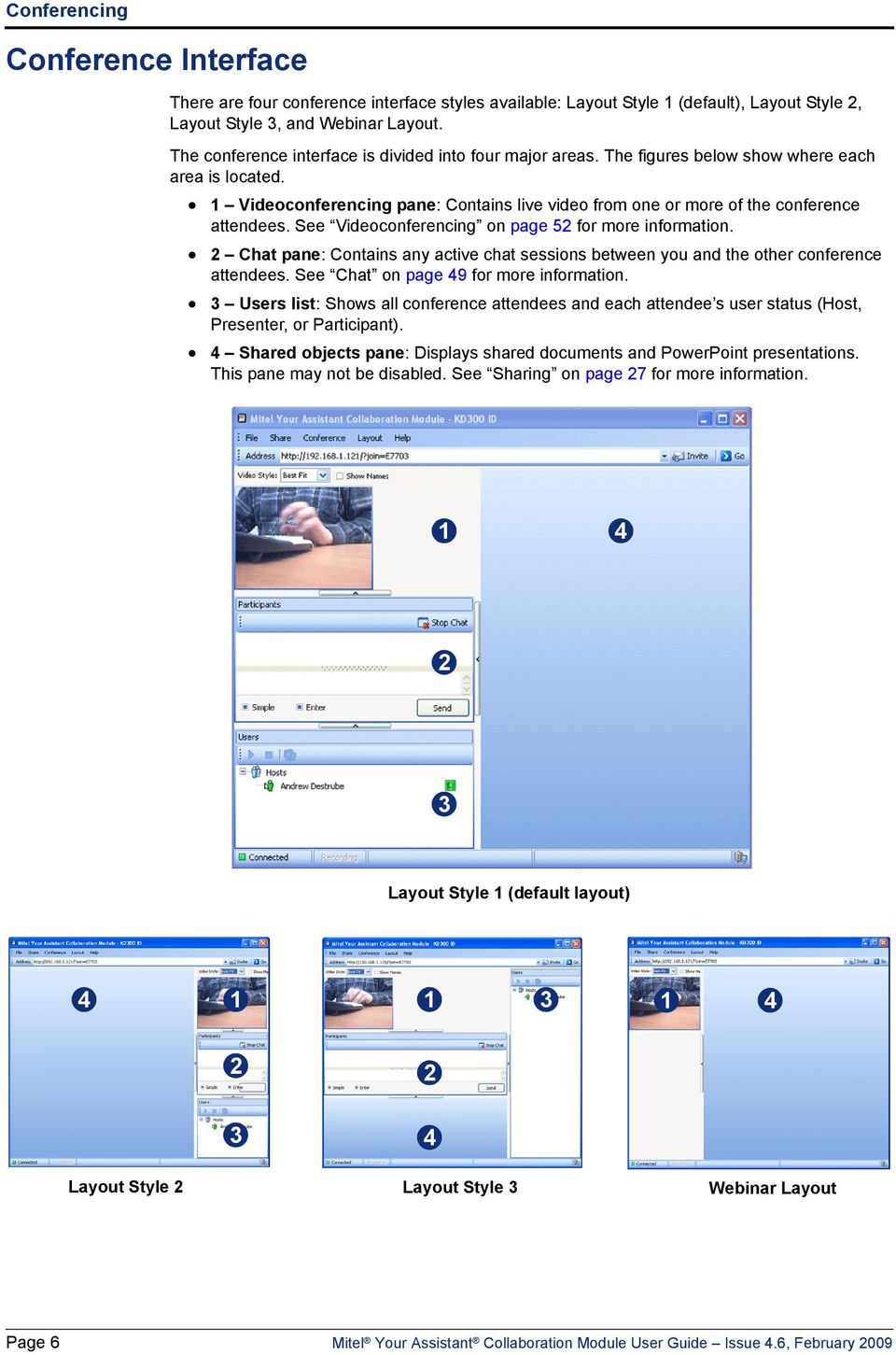
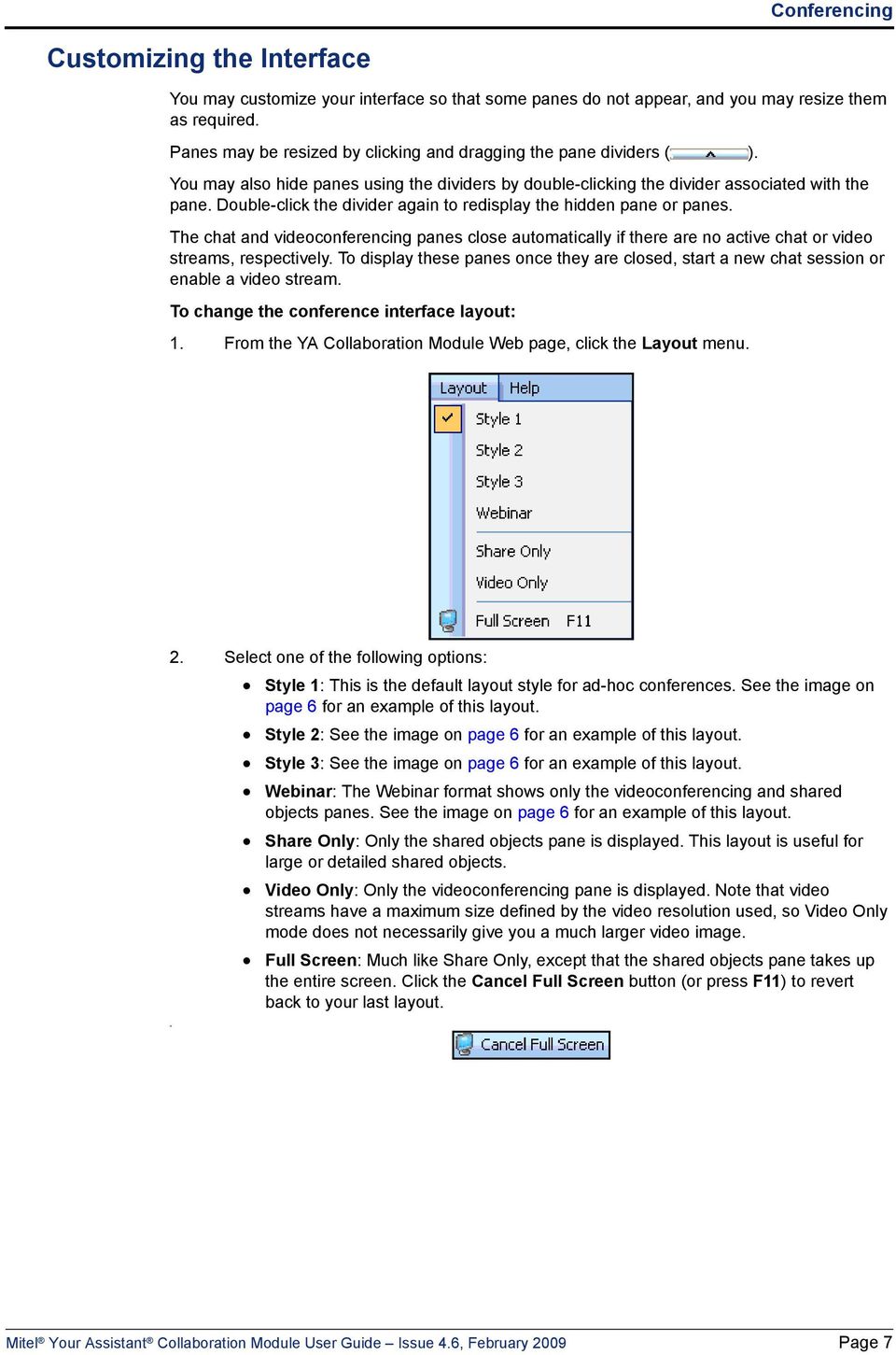
15 Customizing the Interface You may customize your interface so that some panes do not appear, and you may resize them as required. Panes may be resized by clicking and dragging the pane dividers ( ). You may also hide panes using the dividers by double-clicking the divider associated with the pane. Double-click the divider again to redisplay the hidden pane or panes. The chat and videoconferencing panes close automatically if there are no active chat or video streams, respectively. To display these panes once they are closed, start a new chat session or enable a video stream. To change the conference interface layout: 1. From the YA Collaboration Module Web page, click the Layout menu. 2. Select one of the following options: Style 1: This is the default layout style for ad-hoc conferences. See the image on page 6 for an example of this layout. Style 2: See the image on page 6 for an example of this layout. Style 3: See the image on page 6 for an example of this layout. Webinar: The Webinar format shows only the videoconferencing and shared objects panes. See the image on page 6 for an example of this layout. Share Only: Only the shared objects pane is displayed. This layout is useful for large or detailed shared objects. Video Only: Only the videoconferencing pane is displayed. Note that video streams have a maximum size defined by the video resolution used, so Video Only mode does not necessarily give you a much larger video image. Full Screen: Much like Share Only, except that the shared objects pane takes up the entire screen. Click the Cancel Full Screen button (or press F11) to revert back to your last layout. = Mitel Your Assistant Collaboration Module User Guide Issue 4.6, February 2009 Page 7
16 Defining the Interface Appearance for All Attendees If you have Host user status, you can determine the layout for all conference attendees. This is useful for Hosts who want to take advantage of the layout features to emphasize certain facets of their presentation, such as video or document/application sharing. There are a number of ways to apply your layout to all attendees: Use the Apply My Layout keyboard shortcut (default Ctrl+F10). Click the Conference menu and select Apply My Layout. If you have a shared document or presentation, click the Apply My Layout button on the sharing toolbar. The Follow My Layout feature is essentially a continuous Apply My Layout command. With Follow My Layout active, YA Collaboration Module applies your layout to other users every time you make a layout change. To toggle the Follow My Layout feature: Click the Conference menu and select Follow My Layout. Page 8 Mitel Your Assistant Collaboration Module User Guide Issue 4.6, February 2009


17 Managing Conferences from UC Advanced Mitel Unified Communicator (UC) Advanced provides access to the YA Collaboration Module. The options in the Mitel UC Advanced Collab menu allow you to create, customize, join, and remove conferences. You may also start a conference from the People shutter. Starting an Ad-Hoc Conference from the Collab Menu The fastest and easiest way to start a conference through Mitel YA is to use the Mitel UC Advanced Collab menu. To start a Web conference: 1. Click Collab Start a Web Conference Now. The Start Web Conference Now dialog box appears. 2. Type the conference topic or title into the Topic field. 3. Type a Password for the conference if you want to use one. The password field can be blank if you do not need the conference to be password protected. 4. Select the Public Web Conference option if you want to create a public conference. If you leave this field blank, you create a private conference. 5. Click Start and Join to begin the conference. When you begin the conference, the YA Collaboration Module opens and the conference begins with you as the Host and only conference member. You may invite additional attendees. Conferences created using the Start Web Conference Now dialog box begin with the following default conference options: Video: Active Chat: Active Layout Style: Style 1, with users list shown Public vs. Private: Private Topic: No title Mitel Your Assistant Collaboration Module User Guide Issue 4.6, February 2009 Page 9


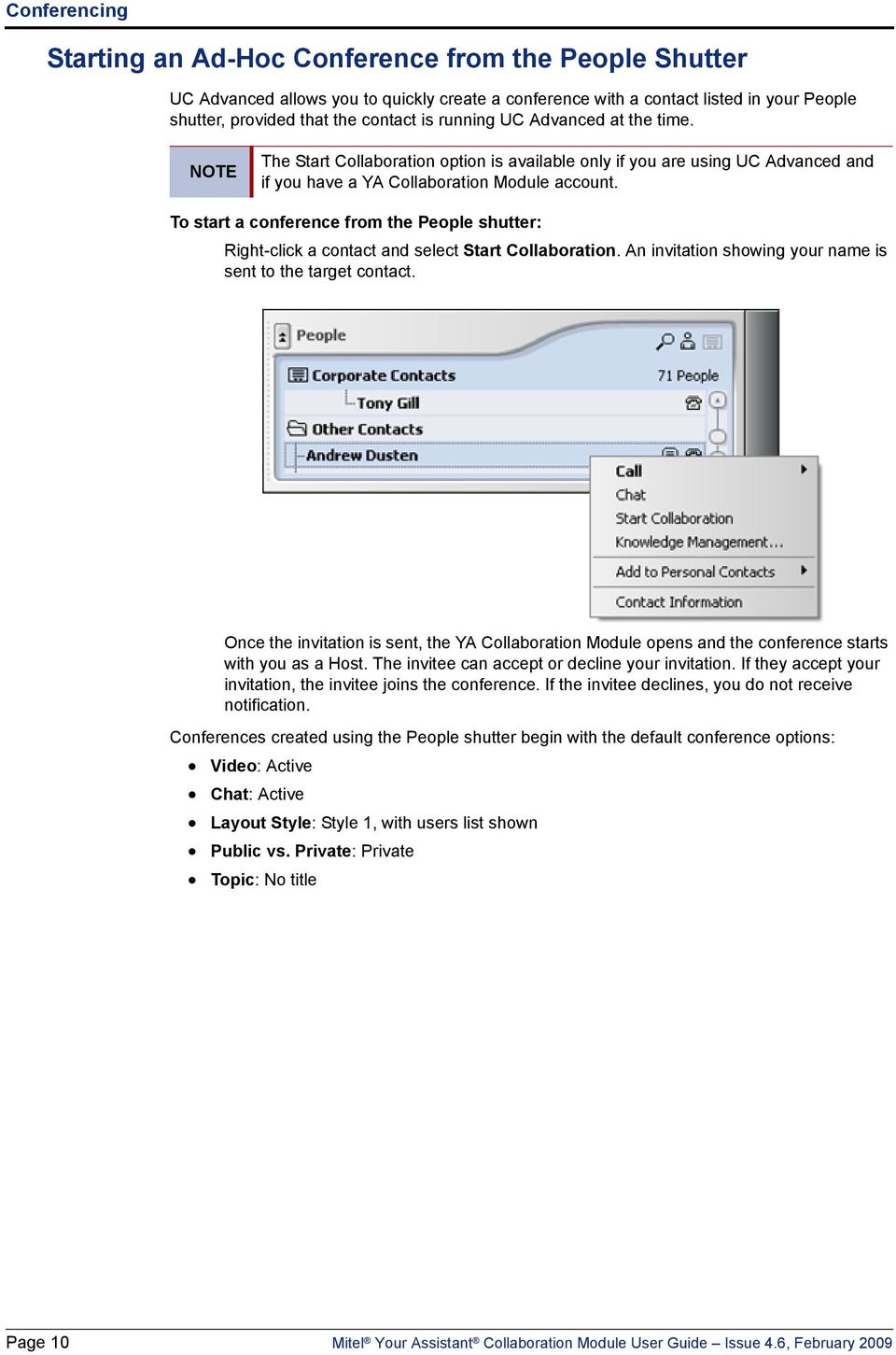
18 Starting an Ad-Hoc Conference from the People Shutter UC Advanced allows you to quickly create a conference with a contact listed in your People shutter, provided that the contact is running UC Advanced at the time. NOTE The Start Collaboration option is available only if you are using UC Advanced and if you have a YA Collaboration Module account. To start a conference from the People shutter: Right-click a contact and select Start Collaboration. An invitation showing your name is sent to the target contact. Once the invitation is sent, the YA Collaboration Module opens and the conference starts with you as a Host. The invitee can accept or decline your invitation. If they accept your invitation, the invitee joins the conference. If the invitee declines, you do not receive notification. Conferences created using the People shutter begin with the default conference options: Video: Active Chat: Active Layout Style: Style 1, with users list shown Public vs. Private: Private Topic: No title Page 10 Mitel Your Assistant Collaboration Module User Guide Issue 4.6, February 2009
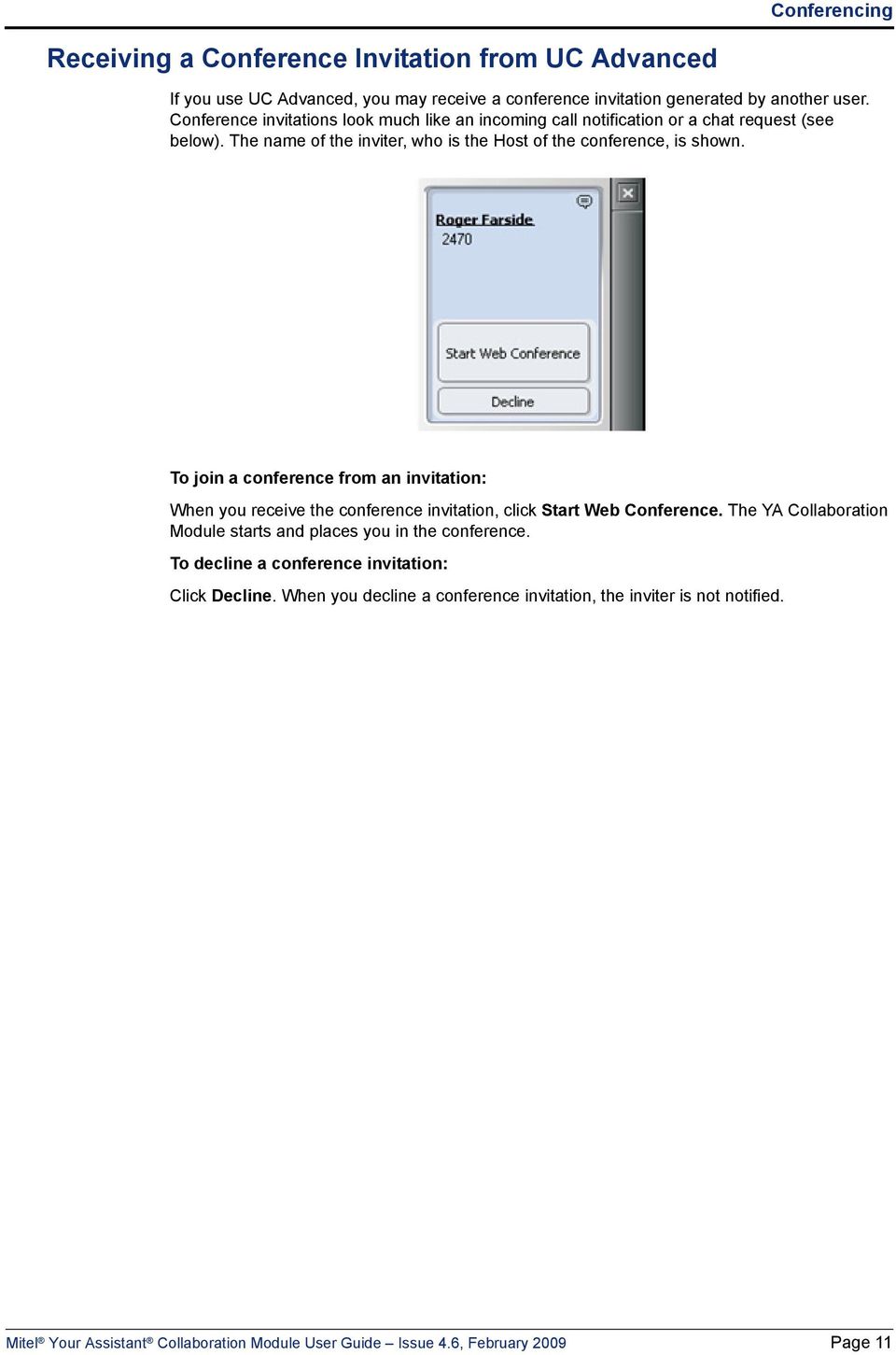
19 Receiving a Conference Invitation from UC Advanced If you use UC Advanced, you may receive a conference invitation generated by another user. Conference invitations look much like an incoming call notification or a chat request (see below). The name of the inviter, who is the Host of the conference, is shown. To join a conference from an invitation: When you receive the conference invitation, click Start Web Conference. The YA Collaboration Module starts and places you in the conference. To decline a conference invitation: Click Decline. When you decline a conference invitation, the inviter is not notified. Mitel Your Assistant Collaboration Module User Guide Issue 4.6, February 2009 Page 11
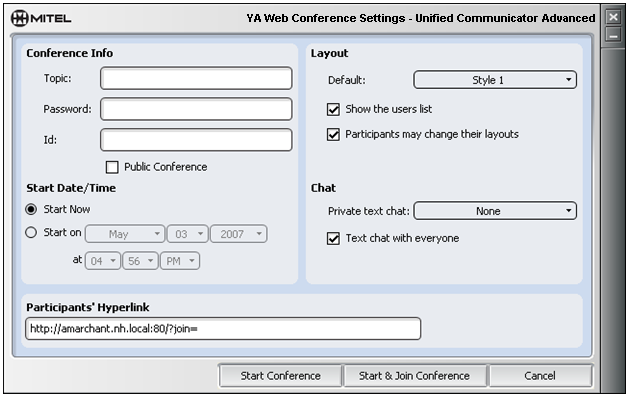
20 Setting Up or Starting a Custom Conference To set up a conference with customized options, including one that starts in the future, use the Customize a Web Conference option in the UC Advanced Collab menu. To set up or start a custom conference: 1. Click Collab Customize a Web Conference. The YA Web Conference Settings - Unified Communicator Advanced dialog box appears. 2. Complete the fields in the Conference Info area: Type the conference topic or title into the Topic field. Type a Password for the conference if you want to use one. The password field can be blank if you do not need the conference to be password protected. Type an ID for the conference. If you leave the ID field blank, the Collaboration Module automatically creates a conference ID for you. Every conference must have an ID. Participants use the conference ID to join the conference. Select the Public Web Conference option if you want to create a public conference. If you leave this field blank, you create a private conference. 3. Select one of the following for the Start Date/Time: By default the Start Now option is selected. If you want the conference to start immediately, use this option. If you want the conference to start at a future time, select Start on and then select the month, day, year, and time for the conference. Page 12 Mitel Your Assistant Collaboration Module User Guide Issue 4.6, February 2009

21 4. Select the Layout options for the conference: Conferencing Style: Select a layout style for the conference from the list box. All attendees start the conference using this layout. See User Status and Privileges on page 25 for the possible layout schemes. Show the users list: By default this option is selected and a list of conference participants is displayed. If you do not want the users list to be visible at conference startup, deselect this option. Participants may change their layouts: By default this option is selected and participants have the ability to change the layout style you select for the conference. If you do not want participants to have the ability to change the layout style you selected, deselect this option. 5. Select Chat options for the conference: Private text chat: Select whom you want to include in private text chats from the list box. Text chat with everyone: By default this option is selected and an all-attendee chat session begins automatically at the beginning of the conference. If you do not want to use an all-attendee chat session in your conference, deselect this option. 6. Do one of the following: Click Start & Join Conference to start the conference and join it as a Host. Click Start Conference to start the conference without joining. Or, click Start Conference to commit the scheduled conference to the server. The conference starts at the appointed time. Mitel Your Assistant Collaboration Module User Guide Issue 4.6, February 2009 Page 13

22 Using the YA Meetings Window The YA Meetings window, accessible through the Mitel UC Advanced main window, provides a list of public conferences on the YA Collaboration server. From the YA Meetings window, you may: Join public conferences. Remove conferences from the server. Copy meeting URLs. To access the YA Meetings window: Click the Collab menu and select View Web Conference Meeting. The YA Meetings window appears. This window displays conference details. Page 14 Mitel Your Assistant Collaboration Module User Guide Issue 4.6, February 2009
23 The following conference properties are shown: Conferencing Owner: The originator of this conference. The owner is also likely a conference attendee and Host, but this is not always the case. Topic: The topic or title of the conference. Meeting URL: The URL of the Web conference. Details: The icons in the details section provide more information about the conference. indicates that the conference is open; mouse over the icon to see how many attendees are in the conference. If this icon does not appear, the conference is scheduled but has not yet started. indicates that the conference is public (rather than private). Since only public conferences are visible for most users, it is likely that all conferences listed display this icon. indicates that the conference is password protected. indicates that videoconferencing is enabled. Copying a Conference URL You can copy a conference URL and enter it into your browser to join a conference and/or paste it into an invitation to other participants. To copy a conference URL: Right-click a conference and select Copy URL from the context menu. Removing a Conference If all conference attendees leave a conference without anyone ending it, the conference continues to exist on the server despite there being no members. Unused conferences waste server resources and add clutter to the conference list. You may remove unused conferences, effectively ending them, if you are the conference Owner. Be sure that the conference is no longer needed before removing it - after all, a conference with no members could mean that the attendees have taken a break, or have not yet joined. To remove a conference: Right-click a conference and select Remove from the context menu. Joining a Conference While you can join an open conference by entering its URL into your Web browser, there is a much easier way to join a listed conference: To join a conference: Do one of the following: Double-click a conference. Right-click a conference and select Join from the context menu. If you join a conference that is password protected, you are prompted to enter the password when the YA Collaboration Module opens. Mitel Your Assistant Collaboration Module User Guide Issue 4.6, February 2009 Page 15

24 Managing Conferences from the YA Collaboration Module Web Page The YA Collaboration Module Web page is created by the YA Collaboration server. You do not need to be connected to the internet to access the page; you do need to be able to access the YA Collaboration Module server using your browser. The YA Collaboration Module Web page provides a number of conference management features, including start, customize, join, and end conferences, or edit conference properties. Accessing the YA Collaboration Module Web Page You can access the YA Collaboration Module Web page by typing in the name or IP address of the YA Collaboration server into your Web browser. For example, in the image below, the user typed the server name (YA4) in the browser Address box to display the Web page. Users can also type in the IP address of the server. The YA Collaboration Module Web page displays all public conferences on the server and their details. The list of conferences is sorted by conference ID. If you log in to the YA Collaboration Module Web page, you have additional options and information. To log into the YA Collaboration Module Web page: 1. Type your User Name and Password in the appropriate fields. 2. Click Login. Page 16 Mitel Your Assistant Collaboration Module User Guide Issue 4.6, February 2009

25 Once you have logged in, the conference list changes to display the conferences you own, which includes all of the existing public and private conferences you have created. Click the Logout link in the top right corner of the page to return to the original list of all public conferences. Mitel Your Assistant Collaboration Module User Guide Issue 4.6, February 2009 Page 17
26 Starting an Ad-Hoc Conference The fastest and easiest way to start a conference through the YA Collaboration Module Web page is to use the Web Quick Conference box available when you are logged in. To start a Web Quick Conference: 1. Locate the Web Quick Conference area in the bottom left portion of the page. 2. Type the conference topic or title into the Topic field. 3. Type a Password for the conference if you want to use one. The password field can be blank if you do not need the conference to be password protected. 4. Select one of the following for Public: Yes: The conference is public. No: The conference is private. 5. Click Start Conference to begin the conference. When you begin the conference, the YA Collaboration Module opens and the conference begins with you as the Host and only conference member. You may invite additional attendees. Conferences created using the Web Quick Conference box begin with the default conference options: Video: Active Chat: Active Layout Style: Style 1, with users list shown Public vs. Private: Private Topic: No title Page 18 Mitel Your Assistant Collaboration Module User Guide Issue 4.6, February 2009
27 Setting Up or Starting a Custom Conference To set up a conference with customized options, or to set up a conference that starts in the future, use the Create Conference button that is available once you have logged in. To set up or start a custom conference: 1. Click Create New Conference. The Create New Conference page appears. 2. Type the conference topic or title into the Topic field. 3. Type a Password for the conference if you want to use one. The password field can be blank if you do not need the conference to be password protected. 4. Select one of the following for the When does the conference start?: By default the Start Now option is selected. If you want the conference to start immediately, use this option. If you want the conference to start at a future time, select Start on and then select the month, day, year, and time for the conference. Select Automatically open the scheduled conference X minutes before scheduled start (where X is the time that you specify) if you want to open the conference early for Hosts and Presenters only. The extra time before the conference starts gives the Host or Presenter time to prepare shared materials. Participants that attempt to join before the scheduled start time are denied. 5. Specify a value for the Conference Hyperlink. The value you enter here becomes the conference ID. The server uses the conference ID as a unique identifier for the conference, and attendees can use the ID to join the conference. NOTE If you leave the field blank, the server assigns a short, arbitrary ID to the conference (X70, for example). This ID is displayed in conference lists and may be used to join conferences. Mitel Your Assistant Collaboration Module User Guide Issue 4.6, February 2009 Page 19
28 6. Select Enable Video if you want to enable videoconferencing for the conference. Select an option for videoconferencing control. If you do not have videoconferencing set to start automatically, it may be started during the conference, provided that it is enabled. If you disable videoconferencing, it is not available at any time during the conference. See Videoconferencing on page 52 for more information. 7. Select or deselect Sharing. If you disable sharing, the Share menu is not available and the conference does not include any shared documents, PowerPoint presentations, applications, desktop space, whiteboards, or annotations. See Sharing on page 27 for more information on these features. 8. Select Chat options. The chat options allow you to choose whether a universal chat is enabled automatically at the start of the conference, or if you want a private chat session with select users. You may select both options; multiple chat sessions can be run at the same time. If you don t have chat automatically start at the beginning of the conference, chat sessions may be started during the conference, provided that sharing is enabled. See Chat on page 49 for more information. 9. Select Public or Private for the conference. By default, the conference is private. If you select public, the conference is visible to all users in the conference lists on the YA Collaboration Module Web page and YA Meetings window. 10. Select the Layout options for the conference: Select a layout style for the conference using the option buttons. from the list box. All attendees start the conference using this layout. See User Status and Privileges on page 25 for the possible layout schemes. By default the Allow participants to change their layout option is selected. If you do not want participants to have the ability to change the layout style you selected, deselect this option. 11. By default the Show the users list option is selected and a list of conference participants is displayed. If you do not want the users list to be visible at conference startup, deselect this option. See User Status and Privileges on page 25 for more information on what is meant by Presenter or Participant status. See Changing User Status on page 25 for more information. 12. Do one of the following: Click Start & Join to start the conference and join it as a Host. Click Start to start the conference without joining. Or, click Start to commit the scheduled conference to the server. The conference starts at the appointed time. Page 20 Mitel Your Assistant Collaboration Module User Guide Issue 4.6, February 2009
29 Joining a Conference You may join any conference listed on the Web page, or you can join a conference from a browser address bar. To join a conference from the Web page: 1. Click on the link associated with the conference to join the conference. The YA Collaboration Module starts. 2. If the conference is password protected, you are prompted to enter the password when YA Collaboration Module starts. If you are not logged in, the Join Conference box is shown at the bottom left of the Web page. You can join any conference (public or private) using this feature. 3. Enter the conference number (for example, A7104) into the Join Conference box, and click Join. The YA Collaboration Module starts. 4. If the conference is password protected, you are prompted to enter the password when YA Collaboration Module starts. If you know the name or IP of the YA Collaboration Module server and the conference ID of the conference you wish to join, you may join the conference from your Web browser without going to the YA Collaboration Module Web page or opening the Mitel YA. To join a conference from a browser address bar: Type the following string into your Web browser address bar: name or IP address>/?join=<conference ID> For example, if your server name is YA4, the IP is , and the conference ID is A7104, you could type either of the following in the Web browser address box: Mitel Your Assistant Collaboration Module User Guide Issue 4.6, February 2009 Page 21

30 Viewing and Editing Conference Details You may view and change the details for the conferences you created. To access the conference details, log into the Web page and click the Details link at the right side of the conference list. The conference details screen shows the conference topic, whether the conference is public or private, if it is possible to join the conference, and how many attendees it has. From the conference details page you can complete the tasks listed below. To view or change the conference password: 1. Click the Set Password link on the left side of the page. 2. The Password field appears. If the field is already filled, the conference is password protected and the contents of the field is the password. If the field is empty, the conference is not password protected. 3. Do one of the following: Enter a password in the field or change the existing password. Erase the existing password, or leave the field blank. 4. Click Save Password to save your changes. To change the public/private status of a conference: Click Make Private to change a public conference to private. Click Make Public to change a private conference to public. To open or close entry to a conference: Click Open Entry to permit new attendees entry into the conference. Click Close Entry to deny new attendees entry into the conference. To end a conference, click End Conference. NOTE You may end unused conferences from the Web site if you are the conference creator. Be sure that the conference is no longer needed before removing it - after all, a conference with no members could mean that the attendees have taken a break, or have not yet joined. Page 22 Mitel Your Assistant Collaboration Module User Guide Issue 4.6, February 2009
31 Generating Conference Invitations You may extend an invitation to potential conference attendees using messages automatically generated by YA Collaboration Module. To do this, you must join the conference yourself, which brings up the YA Collaboration Module interface. To send an invitation from the YA Collaboration Module interface: 1. Do one of the following to join the conference as a Host: Join the conference from the YA Meetings dialog box (see page 15). Join the conference from the YA Module Web page (see page 21). NOTE If you are not the host of the conference you can obtain Host user status. See User Status and Privileges on page 25 for more information. 2. From the YA Module interface, do one of the following: Click the Conference menu and select Invite. Click the Invite button ( ) in the upper right corner of the interface. Your default application opens and automatically generates a new message with default text in the message body. NOTE If, after clicking the Invite button, you find that the application that opens is not the one you want to use, you can change the default application through Internet Options. You must be logged on to your computer as an Administrator to do this. 1. Open Internet Explorer. 2. Click the Tools menu, and then select Internet Options. 3. Click the Programs tab 4. Select the appropriate client from the list box. 5. Click OK. 3. Modify the , if required, and add one or more addresses. If the conference is password protected, include the password in the invitation. 4. Click Send to send the message. Mitel Your Assistant Collaboration Module User Guide Issue 4.6, February 2009 Page 23
32 Receiving Conference Invitations Conference invitations are received just like other message. Click on the link in the invitation to open YA Collaboration Module and join the conference. Even if you receive an invitation, you still need to enter the correct password to join a password-protected conference. Leaving and Ending Conferences Leaving a conference and ending a conference have the same effect: you no longer participate in the conference. However, ending a conference also removes the conference from the server, meaning that the conference is over for all attendees, not just you. Any attendee can leave a conference at their convenience. Only users with Host status can end a conference. Leaving a Conference Leaving a conference removes you as an attendee and exits the YA Collaboration Module. All attendees have the ability to leave a conference. Whenever an attendee leaves a conference, all other attendees are notified with a pop-up and alert noise. These notifications may be customized or disabled; see Appendix A: System Rating and Options on page 63 for more information. \ Ending a Conference Ending a conference removes you as an attendee and exits the YA Collaboration Module, but it also removes the conference from the server, effectively ending the conference for all attendees. Once a conference is ended, no new attendees can join. To end a conference: Click the File menu and select End Conference. You may also end a conference you created without entering the conference. This may be done from the YA Collaboration Module Web page or from the YA Meetings List; see Conference Properties on page 5 for more details. Page 24 Mitel Your Assistant Collaboration Module User Guide Issue 4.6, February 2009

33 User Status and Privileges There are three types of users in a conference: Host: The Host has the highest permissions in a conference and is typically the conference moderator. Typically, only one conference attendee has Host status. Hosts can control the navigation of shared objects, create annotations, change their layout, and look ahead in the presentation. Hosts have access to all conference features and may control the conference entirely. Hosts can add or remove permissions from other attendees as required. Presenter: Presenters are attendees who can use the sharing features in a conference, allowing them to lead a presentation during the conference. Participant: Participants are attendees who can view activities in a conference. They can also participate in chat sessions and may be able to change personal options such as their workstation s interface layout. Changing User Status The Users List provides a list of all conference attendees, sorted by status. The Host can change an attendee s status from the user s list. Typically, the list appears at the bottom left corner of the interface, although it may appear somewhere else or not at all, depending on the conference options and layout. To change the status of participant from the Users list: 1. Right-click the user. 2. Select one of the following options: Make Participant: All attendees who join a conference are automatically assigned Participant status. Participants can only view the activities in a conference unless a Host grants the Participant additional privileges (see Granting Privileges on page 26). Make Presenter: Participants can be promoted to Presenters. Once promoted, a Presenter can share documents by using the sharing features. Make Host: This option makes an attendee a Host, which allows that attendee to change user status and grant privileges. Make >: The Make submenu provides options to change the user status as well as grant all privileges (see Granting Privileges on page 26). Using this submenu is simply a shortcut. If you do not use the submenu you first need to change the user status and then grant privileges individually. Mitel Your Assistant Collaboration Module User Guide Issue 4.6, February 2009 Page 25
34 Granting Privileges By default, only a Host or Presenter may navigate documents, control the presentation, add annotations, and change the conference layout. However, a Host may grant other conference attendees these privileges. To grant additional privileges from the Users list: 1. Right-click the user. 2. Select Privileges from the context menu. 3. Select the appropriate privileges: Give/Remove Control: Provides permissions to control a shared document or presentation and the ability to use the Apply My Layout and Follow My Layout features. When this option is enabled for an attendee, an arrow appears within the attendee s icon ( ) to indicate they can control the presentation. This option is best used when the Host wants another attendee to control the shared document. Give/Remove Look Ahead: Provides the ability to move between slides or pages without affecting other attendee in the conference. Note that attendee with control rights still have overall control over shared PowerPoint presentation and document navigation. Give/Remove Annotate: Provides the ability to create annotations. The Annotate button becomes visible for that attendee. See Annotations on page 43 for more details. Give/Remove Change Layout: Provides the ability to change the conference layout using the Layout menu. Without this privilege, attendees must view the conference using the layout selected by the Host. All attendees have this privilege by default unless the custom conference options specifically removed it. Page 26 Mitel Your Assistant Collaboration Module User Guide Issue 4.6, February 2009
35 Attendee Flow Unless the conference is closed to new attendees, attendees may join or leave the conference as they please. Even the owner may leave the conference without ending it; conferences do not end unless they are specifically configured to end. Whenever an attendee joins or leaves the conference, all other attendees are notified with a pop-up and alert noise. These notifications may be customized or disabled; see Notify Tab on page 70 for more information. You can leave a conference at any time by clicking the close button ( ) in the top right corner of the YA Collaboration Module, or by selecting Leave Conference from the File menu. See Correcting Video Display Problems on page 62 for more information. Sharing Sharing allows the Host or Presenter to add a document, PowerPoint presentation, application, desktop, or blank whiteboard to a conference. Shared objects are visible to all conference attendees. Depending on what is being shared, shared objects may be browsed, modified, navigated, and annotated during the conference. All sharing features are accessible from the Share menu. Mitel Your Assistant Collaboration Module User Guide Issue 4.6, February 2009 Page 27
36 How Sharing Works Shared documents, applications, presentations, browsers, and regions are not actually reproduced on the computers of the conference attendees. Rather, the shared area is sent to the Mitel Printer and converted into a vector graphic which is displayed to the other attendees. The advantages to this type of sharing are as follows: When sharing an application, only the Host or Presenter needs to have the application installed because the conference attendees are viewing a picture of the application rather than opening the application themselves. Those attendees with a slow connection to the server are able to keep up with those with fast connections because all attendees are navigating a vector image on their local computers instead of a document on a server. Bandwidth Requirements Shared document and presentation files are generally 500 KB to 4 MB per-presentation. Using the Mitel Printer, the entire file is sent to the server by the sharer, and then from the server to other attendees. Thereafter, only slide change commands are relayed via the server. Document and presentation sharing can be done on dial-up connections (56kbps or less). For sizing purposes, use 8 kbps for transmission and receiving (average PowerPoint presentation size divided into 1 hour). After the initial transmission, traffic is very low. Remote control, desktop and region sharing, application sharing, and browser sharing use up to 300 kbps for transmission and receiving while under load (user activity). Traffic is much less lumpy than document or presentation sharing, but there are long periods of no activity and no traffic. If you wish to know more about your bandwidth requirements during a conference, you can track your bandwidth use using the YA Collaboration Module bandwidth monitor. See Appendix B: The Bandwidth Monitor on page 71. Sharing Multiple Objects One of the big advantages of the YA Collaboration Module is that you can share multiple objects simultaneously. There is no special procedure for sharing multiple objects: once one object is shared, you may share additional objects using the same procedure. Shared regions, applications, and Web browsers appear in their own windows, which may be individually closed. Shared whiteboards, documents, and PowerPoint presentations appear in the YA Collaboration Module; when you have more than one of these objects, you may switch between them using the tabs at the bottom of the application (see below). Graphics and Frame Rate Optimization Depending on what you are sharing, your computer may experience delays while sharing objects. Delays become more likely as the area you share becomes larger (such as the entire desktop). If insufficient system resources or bandwidth prevent the YA Collaboration Module from meeting the quality and frame rate settings you choose, the YA Collaboration Module first sacrifice frame rate, then image quality, until the available resources can meet the reduced demands. To improve the performance of the sharing features, you can optimize the sharing parameters. Page 28 Mitel Your Assistant Collaboration Module User Guide Issue 4.6, February 2009
37 To optimize sharing parameters: 1. From the YA Collaboration Module Web page, click File, and then select Options. 2. In the Options window, select the Sharing tab. 3. Specify the quality of the shared documents and presentations. Options include: Low Quality Medium Quality High Quality 4. Specify the quality of shared desktops and applications. The sharing options allow you to define the quality of the vector graphics shared with the other users. Options include: Sharing Quality: Use the slider to specify the sharing quality. Choosing higher quality graphics makes the shared areas look better, but sacrifices the frame rate of the presentation and may lead to slowdowns. Sharing Frames Per Second: Use the slider to specify the sharing frames per second. A higher frame rate is better for demonstrating tasks and actions, but sacrifices quality of graphics. Use CAPTUREBLT: By default Use CAPTUREBLT is disabled which means that windows overlapping the shared region or application are not included in the shared image. What is shared is confined to the contents of the shared region, not what is layered on top of it. To include objects layered on top of the shared regions in your presentation, select Use CAPTUREBLT. Note that CAPTUREBLT is not supported by all video cards. Sharing and Video Streams Depending on what you are sharing, the YA Collaboration Module may need to free system resources to initiate the sharing process in a timely manner. Any video streams running when you begin sharing an object may be paused so that the YA Collaboration Module may devote more system resources to sharing. If this occurs, you are notified by a Paused (while sending) message overlaid on the paused video streams. The pause is temporary; the video streams start again after the other attendees receive the shared object. Mitel Your Assistant Collaboration Module User Guide Issue 4.6, February 2009 Page 29
38 The Mitel Printer The Mitel Printer is what YA Collaboration Module uses to print a shared document or presentation to the conference. It is what enables you to share the document or presentation without sharing the application. The Mitel Printer can also be used to print directly from the document s source application into the conferencing session; essentially, it can be used to access the Share Document or Share PowerPoint Presentation features from outside the YA Collaboration Module. This feature is ideal if you work in an application, like an accounting program for example, and only need to share a printed report with attendees in the conference. Note that the Mitel Printer does not print anything to a real printer; it prints to a conference. The Mitel Printer is installed automatically the first time you use the Share Document feature in YA Collaboration Module. When you share a file in a collaboration session, YA makes the Mitel Printer your default printer. When you exit the collaboration session, YA resets the default printer to its previous setting. Manually Installing the Mitel Printer The Mitel Printer is installed automatically the first time you share a document through the YA Collaboration Module. However, you may install it earlier if you wish to print documents directly to the Mitel Printer without going through the YA Collaboration Module interface. Regardless of the method used to install the Mitel Printer, you must have administrative access to the workstation in order to install it. To manually install the Mitel printer: 1. From the YA Collaboration Module Web page, click File, and then select Options. 2. Click the General tab. 3. Select the Share printed documents automatically option. Manually Printing to the Mitel Printer While the Mitel Printer is used automatically whenever you share a document using the Share menu, you may wish to print the document directly to the Mitel Printer from its native application. This is useful for sharing documents from an application that is already open, or sharing the document without saving it and without sharing the application. Accessing the Mitel Printer in this fashion has the same effect as using the Share menu. To manually print to the Mitel printer: 1. Switch to the desired application, and open the document or presentation if it is not already open. 2. From the YA Collaboration Module Web page, click File, and then select Print. 3. Select the Mitel Printer from the printer dialog box. Do not click the printer icon on the application toolbar because the default printer may not be the Mitel Printer. 4. Switch back to the Web conferencing client to view the printed output. Page 30 Mitel Your Assistant Collaboration Module User Guide Issue 4.6, February 2009
39 Sharing a Document The Share Document feature is used by the Host or Presenter to share a document with other attendees in the conference. Shared documents may be navigated and annotated, but they may not be modified; shared documents are shared as read-only images through the use of the Mitel Printer. Therefore, this feature is best used when an attendee wants to share a document that is already complete and requires no changes. Shared documents appear in the Shared Objects pane. Before you share a document you must ensure the application that created the document is installed on your computer. The Mitel Printer is also required for sharing documents, but it installs itself automatically upon sharing your first document (see The The Mitel Printer on page 30 for more information). Participants viewing the presentation do not need to have the application installed on their computer, nor do they require the Mitel Printer. If you want to collaborate on a document, you must share the application (like Word or Excel for example). Use the Share Application feature in this case (see page 34). To share a document: 1. From the YA Collaboration Module Web page, click Share, and then select Document. 2. Use the file browser to select the document you want to share. After you select the document, the application that created the document opens and automatically prints the selected document to the Mitel Printer. The output from the Mitel Printer is uploaded to the conference. The shared document is displayed in the shared objects pane; no new window is opened. The Share Document feature is designed to work with almost all Windows-based applications. However, if you encounter issues when sharing a document, consider printing the document from the application directly to the Mitel Printer using the application s Print feature. The printed output is sent directly to the conference and not to an actual printer. Only users with control or look ahead privileges can navigate a shared document; see User Status and Privileges on page 25 for information about granting privileges. You can navigate a shared document using the navigation controls that appear in the shared objects pane. To stop sharing a shared document, do one of the following: Click the Stop Sharing button ( ) located at the upper right corner of the application. Use the stop sharing keyboard shortcut (default: Ctrl+Shift+S). Mitel Your Assistant Collaboration Module User Guide Issue 4.6, February 2009 Page 31
40 Sharing a PowerPoint Presentation The Share PowerPoint Presentation feature allows a Host or Presenter to select any PowerPoint document and present it to attendees in a conference. To use this feature, the Host must have PowerPoint installed and have access to the PowerPoint document. Participants viewing the presentation do not need to have PowerPoint installed on their computer. Shared presentations appear in the Shared Objects pane. NOTE All animations within the PowerPoint document are converted to transition steps after the document is shared. To share a PowerPoint document: 1. From the YA Collaboration Module Web page, click Share, and then select PowerPoint Presentation. 2. Use the file browser to select the presentation you want to share. After you select the presentation, PowerPoint opens and automatically prints the selected presentation to the Mitel Printer. The output from the Mitel Printer is uploaded to the conference. The shared presentation is displayed in the shared object pane; no new window is opened. Only attendees with control or look ahead privileges can navigate a shared PowerPoint presentation; see User Status and Privileges on page 25 for more details on granting privileges. You can navigate a shared presentation using the navigation controls that appear in the shared objects pane. To stop sharing a PowerPoint presentation, do one of the following: Click the Stop Sharing button located at the upper right corner of the application ( ) Use the stop sharing keyboard shortcut (default: Ctrl+Shift+S). Page 32 Mitel Your Assistant Collaboration Module User Guide Issue 4.6, February 2009
41 Sharing a Region The Share Region feature is designed to allow the Presenter to display a section of the desktop to other attendees in the conference. This tool is an alternative to the desktop sharing tool, which shares the entire desktop. To use the Share Region feature: 1. From the YA Collaboration Module Web page, click Share, and then select Region. 2. A green-bordered Region window appears. Everything within the boundaries of the window is visible to the other conference attendees. 3. Click and drag the title bar to move the window so that it covers the area of the desktop you wish to share. The Region window is transparent: it is only a window boundary with no contents. The Region window remains on top of all other windows and applications. You can resize the Region window as required by clicking and dragging the corners of the window. The resize action is dynamic, so you can resize the window while attendees are actively viewing the shared region. You can also minimize or maximize the Region window if required. Click the minimize button ( ) to hide the window, or the maximize button ( ) to share the entire desktop. To stop sharing the region, do one of the following: Click the close button ( ). Click the Stop Sharing button in the top right corner of the Region window ( ). Use the stop sharing keyboard shortcut (default: Ctrl+Shift+S). Mitel Your Assistant Collaboration Module User Guide Issue 4.6, February 2009 Page 33
42 Sharing an Application As a Host or Presenter you can use the Share Application feature to share almost any application that has a user interface. When active, the Share Application feature places a border around the application and shares everything within the border. This feature is ideal for a variety of purposes including training and online technical support. To use the Share Application feature: 1. From the YA Collaboration Module Web page, click Share, and then select Application. The Share Application window appears. 2. To define the list of applications to choose from select one of the following: List only applications that are currently running List all applications 3. Select an application from the list and click Start Sharing. If the shared application is already running, the current instance is shared. If you have chosen an application that is not running, the application starts up and is then shared. Once the application is available, the YA Collaboration Module places a green window border around the shared application to indicate that it is shared. Shared applications appear as normal except that a Stop Sharing button is added to the upper right corner. The application (and its window border) may be moved and resized normally by dragging the title bar or borders of the application. Attempting to move or resize the green border directly has no effect. Move and resize the application, and the green border adjusts accordingly. You may minimize and maximize the application as normal. NOTE The Share Application feature shares child windows only if the child window is within the area of the application. Page 34 Mitel Your Assistant Collaboration Module User Guide Issue 4.6, February 2009
43 To stop sharing the application, do one of the following: Close the application. Conferencing To stop sharing the application but leave it open, click the Stop Sharing button at the top right of the application or use the stop sharing keyboard shortcut (default: Ctrl+Shift+S). The application is minimized and no longer shared, but does not close. Sharing a Web Browser Sharing a Web browser on the Host or Presenter's computer is a convenient way to display Web sites to attendees. Once enabled, the browser is launched and the entire region inside the browser window is displayed to all attendees in the conference. The mouse movements are synchronized in the view. To use the Share Web Browser feature: From the YA Collaboration Module Web page, click Share, and then select Web Browser. The YA Collaboration Module opens an instance of your default Web browser, and places a green border around it to indicate it is shared. NOTE You can share pop-up windows if the pop-up window is placed over the shared browser area. All browser contents within the green border are visible to other conference attendees. A shared browser appears as normal except that a Stop Sharing button ( ) is added to the upper right corner. The application (and its border) may be moved and resized as normal by dragging the title bar or borders of the browser. Attempting to move or resize the green border directly has no effect; move and resize the browser, and the green border adjusts accordingly. You may minimize and maximize the browser as normal. To stop sharing the browser, do one of the following: Close the browser. Click the Stop Sharing button in the top right corner of the browser ( ). Use the stop sharing keyboard shortcut (default: Ctrl+Shift+S). Mitel Your Assistant Collaboration Module User Guide Issue 4.6, February 2009 Page 35
44 Sharing a Desktop The Share Desktop feature allows the Host or Presenter to share their desktop with all attendees in the conference. This is much like the Share Region feature, except that the region is the entire desktop. To share the desktop: From the YA Collaboration Module Web page, click Share, and then select Desktop. A pop-up dialog box appears informing you that your desktop is being shared, and the YA Collaboration Module is minimized. You can redisplay the YA Collaboration Module at any time, but the YA Collaboration Module attempts to display the shared image in the Shared Objects pane. This causes an odd recursive sharing effect reminiscent of two mirrors reflecting each other; it looks unusual, but it does not harm the application or the conference. To stop sharing your desktop, do one of the following: Redisplay the YA Collaboration Module and click the Stop Sharing button at the top right corner of the Shared Objects pane. Use the stop sharing keyboard shortcut (default: Ctrl+Shift+S). The Collaboration Module displays the shared desktop in its actual size by default. This view size may not be appropriate for attendees who have their screen resolution set lower than the person sharing their desktop. To optimize the view of the shared desktop, participants viewing the desktop can alter the view on their own computers by clicking the Fit View option on the toolbar. After selecting the Fit View option, the desktop view can be adjusted so the desktop image is displayed to the attendee s preferences. The adjustment is made by moving the splitter bar to the left or right. Sharing a Whiteboard The Whiteboard feature is a scratch pad / drawing canvas for the conference session. When used in conjunction with the annotation tools, the Whiteboard feature can be an effective collaboration tool. To use the Whiteboard feature: From the YA Collaboration Module Web page, click Share, and then select Whiteboard. A blank, white canvas and the annotation toolbar appears in the Shared Objects pane. The canvas is visible to all attendees. The annotation toolbar contains drawing tools that allow you to create drawings and diagrams on the canvas; see How to Use the Annotation Tools on page 43 for more details. To stop sharing the whiteboard, do one of the following: Click the Stop Sharing button in the top right corner of the browser ( ). Use the stop sharing keyboard shortcut (default: Ctrl+Shift+S). Page 36 Mitel Your Assistant Collaboration Module User Guide Issue 4.6, February 2009
45 Remote Control The Remote Control feature allows you to control another attendee s shared desktop, or alternately, it allows another user to control your desktop. In this fashion, you may open, present, and edit files that reside on another attendee s workstation. Remote control must be requested, so attendees cannot simply take over another s workstation without permission. A Host may request remote control, which is the ability to control the desktop shared by another attendee. This allows the controlling attendee to run the presentation or demonstrate something using another attendee s desktop, applications, and files. Requesting Remote Control Only an attendee with Host rights can request remote control. To initiate a remote control request, do one of the following: Select the user in the users list and click the Remote Control button ( ). Right-click a user in the users list, select Remote Control, and then select Request Remote Control. A request for remote control is sent to the attendee. They may accept or decline. In addition, if the potential controllee has a Participant status, requesting remote control automatically promotes them to Presenter status. The promotion occurs because being controlled means that you must share your desktop, and the Participant status does not grant the right to use the sharing features. If the attendee accepts the request, you receive control of their shared desktop. If the attendee was not sharing their desktop when they accepted, the YA Collaboration Module begins to share their desktop now. Operating Remote Control How remote control appears and operates depends on whether you are the controller or the controllee. In either case, remote control does not give the controlling user exclusive control of the controlled workstation; the controllee can still use their keyboard and mouse normally. However, the controlling user has the same level of control using their keyboard and mouse. If both the controller and controllee provide input simultaneously, the controlled workstation attempts to satisfy both inputs at the same time, resulting in confusion. As the Controller: When you receive remote control of another attendee s desktop, the YA Collaboration Module shows the shared desktop in a window over the shared objects pane, as normal. However, when you mouse over the shared desktop, you are given control of it; clicking icons opens files and applications, typing edits text, etc. As the Controllee: When another user takes control of your desktop, the Collaboration Module is automatically minimized so that what is being shared is not simply another copy of the Collaboration Module. The name of the controller is visible in the top right corner of the screen. Mitel Your Assistant Collaboration Module User Guide Issue 4.6, February 2009 Page 37
46 Ending Remote Control Regardless whether you are the controller or the controlled party, you can stop the remote control session by using the stop remote control keyboard shortcut (default: Ctrl+Shift+R). Alternately, if you stop sharing the desktop, the remote control is also broken. To stop sharing the desktop to end remote control: 1. Maximize the YA Collaboration Module. Note that if you are the controlling party, this means you must maximize the controlled attendee s Collaboration Module (as your own is already maximized). 2. Click the Stop Sharing button on the toolbar to stop sharing your desktop. This stops sharing the controlled desktop and ends remote control. Receiving a Remote Control Request Any time during a conference, you may receive a Remote Control pop-up request from another attendee (see below). Click Yes to relinquish control of your shared desktop, or No if you wish to retain control. Giving Remote Control to Another Attendee If you wish to provide another attendee the ability to control or present materials on your desktop, you can give them remote control. This is useful if the user cannot request remote control themselves because they are not a Host. You must have Host status in order to give another attendee remote control. To give remote control to another attendee: 1. Share your desktop as normal. See Sharing a Desktop on page Right-click the attendee you want to take control in the users list and select Remote Control from the context menu. 3. From the submenu, select Give Remote Control. The selected attendee is granted remote control of your desktop. Remote control granted in this manner is ended in the usual manner. See Ending Remote Control above. Page 38 Mitel Your Assistant Collaboration Module User Guide Issue 4.6, February 2009
47 Working with Shared Objects Once an object is shared, the Host or Presenter may navigate, annotate, highlight, and otherwise control the presentation using tools provided by the YA Collaboration Module. Other attendees can change how they view the shared object, but, unless they have been given specific privileges, their part in the presentation of the shared object is simply that of the passive audience. How Shared Objects Appear and How to View Them Shared objects: documents, presentations, browsers, applications, desktops, and whiteboards appear differently for the conference attendee sharing the object (the sharer) and the audience (the sharees). For the Sharer For the sharer, shared documents, presentations, and whiteboards appear in the Shared Objects pane. Shared applications and browsers appear as normal in separate windows, although they have a green border to indicate that they are shared. Shared regions appear as a green window border with no contents. Shared desktops have no appearance; apart from a transient pop-up noting that your desktop is shared and the addition of a Stop Sharing button to the Shared Objects pane, the YA Collaboration Module and your other applications do not change. If you are sharing multiple objects, you may be able to see several simultaneously. Shared regions are visible unless minimized and shared desktops are always visible. Shared applications and browsers appear in their own windows, and are visible as long as they are not minimized or obscured by other windows. Only one shared object is visible in the Shared Objects pane at a time, so only one shared document, presentation, or whiteboard may be visible. If you have multiple shared documents, presentations, or whiteboards, use the tabs at the bottom of the Shared Objects pane to select which one you wish to view. Shared desktops also create a tab, but this is only to provide access to a Stop Sharing button. If you are sharing a document, presentation, or whiteboard at the same time other attendees are sharing objects, you must use the tabs at the bottom of the Shared Objects pane to select which object you wish to view. To avoid confusion over what each tab refers to, the name of the sharer appears beside each object name in the tabs. Mitel Your Assistant Collaboration Module User Guide Issue 4.6, February 2009 Page 39
48 For the Sharee Unless you are the attendee sharing the object, all shared objects appear in the Shared Object pane. Only one shared object is visible at a time; if there are multiple shared objects in the conference, use the tabs at the bottom of the Shared Objects pane to select the object you wish to view. Shared objects that are minimized or defocused by the sharer are not visible to the other attendees. For the audience, the Shared Objects pane go grey and display a message noting that the shared object is not available for the time being. Page 40 Mitel Your Assistant Collaboration Module User Guide Issue 4.6, February 2009
49 Shared Objects Toolbar Shared documents and presentations have a number of navigation and display controls provided by the YA Collaboration Module. All controls are accessible from the toolbar at the top of the Shared Objects pane, although which controls are visible depends on your user status and privileges. Navigation Controls: The Host and select attendees can navigate a shared document with multiple pages by using the navigation controls on the toolbar. This control is only available to a Participant if the Host has granted them Look Ahead or Control rights. Zoom: Users can enlarge sections of the document by using the zoom tool. Click the Zoom button ( ) and click on the document to zoom in. To zoom out or fit the document to the page, select the drop down menu to the right of the zoom icon and select an option. Full Screen: The Host or Presenter has the option to display shared objects in full screen mode. To enable full screen mode, click the Full Screen button on the toolbar. Tip: If you have Host or Presenter status, this display mode can be applied to all attendees in the conference by using the Apply My Layout option located under the Conference menu, or using the keyboard shortcut (default: Ctrl+F10). Pointer and Arrow tools: The Pointer ( ) and Arrow ( ) tools are your cursor options. The pointer option is useful as it can be seen by other attendees; see The Pointer Tool on page 42 for more information. The pointer tool is available only to attendees with Host or Presenter status. Annotate: The Annotation tool allows you to add annotations to the shared document or presentation. Click the Annotate button to reveal the Annotation toolbar; see Annotations on page 43 for more information. The annotation tool is only available to attendees with Annotation rights. Apply My Layout: This control allows you to force all other attendees to use your current interface layout: the position and size of your panes and windows. The effect is instantaneous the layout for all other conference attendees is changed to match yours when you click the Apply My Layout button. Nothing, however, prevents them from changing it back to their preferred layout. Only the attendees with control privileges (noted by the icon in the users list) can use this control. Auto Scroll: This is a useful feature that automatically scrolls around a shared document or presentation if you move the pointer tool to the edge of the visible area of the document. See The Pointer Tool on page 42. In this manner, Auto Scroll allows you to scroll through the document without using the scroll bars. Auto Scroll also automatically scrolls through a shared document controlled by another attendee. If they are using the pointer tool on an area of the document that is outside of your view, your Shared Objects pane scroll to that location. Auto scroll is enabled by default, but all attendees have the option of disabling it by clicking the Auto Scroll button. Fit In View: Click the Fit in View button to zoom the object in the Shared Objects pane so that one page or slide is entirely visible. All attendees have access to the Fit In View button. Mitel Your Assistant Collaboration Module User Guide Issue 4.6, February 2009 Page 41
50 Fit To Width: Click the Fit To Width button to zoom the object in the Shared Objects pane so that the whole width of the page or slide is visible. All attendees have access to the Fit To Width button. Actual Size: Click the Actual Size button to zoom the object in the Shared Objects pane so that it appears as actual size. All Attendees have access to the Actual Size button. Stop Sharing: Click the Stop Sharing button to stop sharing the shared object currently displayed in the Shared Objects pane. Only the attendee sharing the object and attendees with Host status can use this control. The Pointer Tool Normally, other conference attendees are unable to see your mouse pointer. The pointer tool is a pointer that is visible to the other users, so it can be used to direct their attention to a specific location on the shared document or whiteboard. When you enable the pointer, the pointer cursor appears underneath your regular mouse pointer, as if you were dragging it. Conference attendees can only see the new pointer. The pointer tool is available only to attendees with Host or Presenter status. Click the pointer icon ( ) to use the pointer tool. Click the arrow icon ( ) to turn it off. Page 42 Mitel Your Assistant Collaboration Module User Guide Issue 4.6, February 2009
51 Annotations The annotation tools provide a convenient way for attendees to draw or write a quick note in the conference. This feature works best with the Whiteboard feature but can also be used with other sharing features (annotating documents and presentations). By default, only the Host and Presenters have permissions to create annotations, but this permission can be granted to other attendees. The annotation tool works with the following sharing features: PowerPoint Documents Whiteboard How to Enable Annotation To enable the Annotation feature, click the Annotate button ( ). The annotation toolbar appears. How to Use the Annotation Tools Annotation cursor Highlighter Pencil Shapes Lines Add image The annotation tools are similar to drawing tools found in most graphics applications. Click the appropriate icon and add the desired element to the shared document or whiteboard. Annotation Cursor: Annotation elements, including freehand lines created with the pencil or highlighter, are vector objects. They can be moved by selecting and dragging them with the annotation cursor. Also, you can delete an annotation element by selecting it with the cursor and pressing the Delete key. Highlighter: A wide, translucent brush for highlighting. Pencil: A narrow, opaque brush for creating freehand lines and doodles. Annotation Tools Shapes: A selection of shapes. Click and drag to create the shape. Use the Tool window to select a fill color, if desired. Lines: A selection of lines and callouts. Click and drag to define the line. Add Image: Click this icon to add an image as a notation. Erase All: Erases all annotation elements. Erase All Tool Window Tool Window: Click this icon to access the Tool window. Users with annotation rights can change the properties of an annotation object through the options in the Tool window. See page 44 for instructions. Mitel Your Assistant Collaboration Module User Guide Issue 4.6, February 2009 Page 43
52 To modify an annotation element: 1. Click the Tool Window button. The Annotate Tool Window opens. 2. Adjust the properties in the window according to your needs: Select the annotation cursor and use it to select the annotation element to be modified. Use the Color, Fill Color, (line) Width, and Opacity options to format elements selected with the cursor. Use the empty field at the bottom of the window to compose text. 3. Click Paste Text to place it on the whiteboard or shared document. Granting Annotation Rights The Host can enable the annotation tools for other attendees in the conference. To grant annotation rights to an attendee: 1. Right-click the user from the users list. 2. Select Privileges from the context menu. 3. Select Give Annotate. When the annotation rights are given to an attendee, the Annotate button appears on that attendee s toolbar. By clicking the Annotate button, the attendee can access the annotation toolbar and create annotations as per the instructions above. Page 44 Mitel Your Assistant Collaboration Module User Guide Issue 4.6, February 2009
53 The Recording Tool You can use the Recording tool to record your presentation of shared objects. By default, the Recording tool creates a movie of a shared object in the conference, including any navigation or manipulation, and records the presence of the pointer tool. It does not record annotations. If multiple objects are shared in the conference, the Recording tool records the most recently shared object. However, using the Record Actual Desktop option, you may instead record an image of your desktop instead such recordings show annotations and the regular mouse pointer as you see them. You must have Host status to use the Recording tool. Configuring YA Collaboration Module for Recording If you are the user sharing objects and you wish to use the Recording tool, you must set the shared application loopback option. This option is found in the preferences. 1. Click the File menu and select Options. The Options dialog box opens. 2. Click the General tab. 3. Select the Always loopback shared applications option. 4. Click OK to confirm your changes. Mitel Your Assistant Collaboration Module User Guide Issue 4.6, February 2009 Page 45
54 Using the Recording Tool You can use the Recording tool to record your presentation of shared objects. To access the Recording tool: Click the Conference menu and select Record. The Recording tool appears. Note that the Recording tool is only available to attendees with Host status. Check that the finished file meets your needs before you begin recording. Change the following options as required: Output File Format: The format for the finished recording. FLV files are compatible with the YA Collaboration Module Flash Player. HTML files are compatible with Web browsers. WMV files are compatible with Windows Media Player. You may select from additional file format options by enabling the Show Other Windows Formats checkbox. Output Size: The image resolution of the finished recording. Frames/Sec: You may select the maximum frames per second of the recording using this option. Note that the recording may capture fewer frames than the desired rate depending on your system resources; frame rate is sacrificed for image quality if there are insufficient resources. Output File: The file name for the finished recording. Output Folder: The location for the finished recording. The default location for a recorded file is your desktop, but you can select a different location by clicking the file browser icon ( ). Windows Media Profile: The Windows Media Profile contains settings important to the Recording tool. This option cannot be changed. Page 46 Mitel Your Assistant Collaboration Module User Guide Issue 4.6, February 2009
55 Show Other Windows Formats: Enabling this option makes AVI output file formats available. Tick the checkbox to gain access to various new file formats, and select one using the Output File Format list as required. Record Actual Desktop: This option allows you to record your entire desktop, instead of just recording the shared object only. Enable this feature if you wish to see your annotations. Note that because making recordings using this feature records an image of the desktop, it is useful to make the shared objects as large as possible on the desktop using this mode. Maximize shared applications, and enable Full Screen mode for shared documents and presentations to get the most benefit from recording a full desktop. To make a recording: 1. Click the Record button ( ) to start your recording. 2. Click the Pause button ( ) to pause recording. Click Record again to continue. 3. Click the Stop button ( ) to finish your recording and save the recording file. Mitel Your Assistant Collaboration Module User Guide Issue 4.6, February 2009 Page 47
56 Playing Recordings Your recordings are saved when you click the Stop button ( ). Recordings are saved in the file format defined by the Output File Format option, named according to the Output File option, and are saved in the directory defined by the Output Folder option. To play the recording, simply find the saved file and double-click the file icon. The appropriate player (depends on the file format you selected) opens and the recording plays. If you have saved your recording as an FLV file, the YA Collaboration Module Flash Player opens when you double-click the file. The Flash Player begins playing your FLV file automatically. To access the play controls (play, pause, rewind, etc.), mouse over the minimized control panel ( ) in the upper left corner of the viewing area. The control panel expands so that you may access the controls. Close the Flash Player by clicking the close button ( ), or select Exit from the File menu. Page 48 Mitel Your Assistant Collaboration Module User Guide Issue 4.6, February 2009
57 Chat The Chat feature allows users to communicate with each other without using the telephone. The chat tool offers advanced text formatting capabilities such as displaying text in rich text format, displaying images, hyperlinks, and drawings you create on the fly. Users can copy and paste text and images from other applications directly into the chat window. The Chat Window When you start the YA Collaboration Module, the Chat window is already open in the left side of the application if the default layout is used. By default, a chat session with all users is opened whenever a collaboration session is started. To use chat effectively, you may need to expand your workspace. To expand your workspace, click and drag the separator, which appears above the area where you type. By default, the YA Collaboration Module opens with a simplified version of Text Chat. Click the Advanced option ( ) to access text chat formatting options. Mitel Your Assistant Collaboration Module User Guide Issue 4.6, February 2009 Page 49
58 To use Text Chat: 1. If you are working in Advanced mode, click the Text Chat tab and select the text formatting options you want (font, size, emphasis, color). If the Chat window is not wide enough, the formatting options are hidden. Click the More Buttons icon ( ) at the end of the toolbar to open a drop-down menu of formatting options. Tip: If you turn off Advanced mode after changing your formatting options, the YA Collaboration Module continues to use the new formatting for new messages that you compose. 2. Compose your message in the lower half of the window. You can also paste text, images, or links in your message. 3. Click Send to send the message to the other attendees. Page 50 Mitel Your Assistant Collaboration Module User Guide Issue 4.6, February 2009
59 Starting and Stopping Chat Sessions By default, whenever you open the YA Collaboration Module, a chat session to all users is automatically started. However, you may start additional simultaneous chat sessions with select users, and stop (close) chat sessions individually. If you stop all your chat sessions, the Chat window closes. If you have multiple chat sessions, you can switch between them using the tabs at the bottom of the chat window. Note that only a Host or Presenter can initiate a chat session. To start a chat session: 1. From the Collaboration Module, click the Share menu and select Chat. The Share Chat window appears. 2. Select one of the following chat options: Chat with all users Chat with hosts only Chat with hosts and presenters only Chat with specific users NOTE If you select Chat with specific users, you must select the users you wish to participate from the list in the lower half of the window. 3. Click Start Chat to start the new chat session. To stop a chat session: Click the Stop Chat button at the top right of the Chat window ( ). If you have multiple chat sessions open, only the active chat session is closed. If you close all the chat sessions, the Chat window closes. Mitel Your Assistant Collaboration Module User Guide Issue 4.6, February 2009 Page 51
60 Videoconferencing The Videoconferencing feature is a true client/server application where all video streams are routed through the conferencing server. The video stream from one attendee is sent to the conferencing server, and the server relays the video stream to all users in the conferencing session. Any user in a conference with a video camera can send video. For best performance, a USB 2.0 compatible camera connected to a USB 2.0 port is highly recommended. Requirements and Setup The following requirements apply only to the attendee or attendees transmitting video in the conference. Conference attendees that are viewing but not transmitting video do not need to install any special software or hardware. To transmit video, you must have the following: DirectX 9.0. Your system administrator can verify the version of DirectX on your computer by running the DXDIAG utility. A Webcam, camcorder, or conference room camera which interfaces with the DirectShow component of the DirectX suite. This includes any of the following options: o A USB camera attached to the USB port on the computer. o A FireWire camera attached to a FireWire port. o A camcorder attached to a video card that offers a certified WDM driver and applicable connector like an S-video input. o An external conference room camera attached to a video card with a certified WDM driver. For the best video quality, you should use a good quality Webcam or video camera. The quality of the image transmitted to users in a conference is affected by a Webcam's ability to capture good quality images. For best video image quality, Mitel recommends using the Logitech Quickcam Pro This Logitech Webcam model is USB 2.0 certified and produces one of the best quality images in the YA Collaboration Module. Note that if you are using a USB 2.0 camera and connect it to a USB 1.x port, the camera operates at USB 1.x speed resulting in less than optimal video quality. You can verify if your computer supports USB 2.0 by checking the Windows Device Manager. Bandwidth Requirements Video conferencing requires approximately 256 kbps for 320x240 resolution video at frames/second (H.263+ codec); and approximately 56 kbps for 176x144 resolution video at 1-5 fps. For sizing purposes, use 256 kbps for standard conferencing. This should allow 320x240, 6 fps, both transmitting and receiving (i.e., a good user experience). Traffic is normally sustained during a video conference. Note that the YA Collaboration Module is easily capable of boardroom quality video conferencing using industry standard Webcams. When set at full size, 640x480, 30 fps, allow for approximately kbps. IT administrators can limit this capability. NOTICE DSL and other asymmetric internet services may not offer full 256 kbps on the uplink; attendees that use video (i.e., that encode and transmit video to the Web conferencing server) must have full 256 kbps or better for a quality video conferencing experience. Page 52 Mitel Your Assistant Collaboration Module User Guide Issue 4.6, February 2009
61 Configuring Videoconferencing YA Collaboration Module has videoconferencing enabled by default. However, if videoconferencing is disabled for some reason, it may be re-enabled using the YA Collaboration Module options. The YA Collaboration Module uses your system default camera as the video capture device for videoconferencing. If you have multiple cameras connected to your PC and do not want to use the system default camera for videoconferencing, or if you have no system default despite having a camera, you may set the YA Collaboration Module to use a camera other than the system default. To configure videoconferencing: 1. Click the File menu and select Options. The Options dialog box appears. 2. Click the Video tab. 3. Select the Enable Video option. 4. Select a camera option from the Capture Device list. 5. Click OK to confirm your changes. Mitel Your Assistant Collaboration Module User Guide Issue 4.6, February 2009 Page 53
62 Starting a Videoconference Creating a videoconference is no different than creating any other type of conference. Simply create a conference as normal, and ensure that you do not disable the video option (video is enabled for all conferences by default). If you use one of the quick methods to create an ad-hoc conference, video is automatically enabled. If you have an active camera, videoconferencing starts by default when you start a conference. If the conference options specify that video should not start automatically at the beginning of the conference, then an attendee with Host status must manually activate it. Video can be enabled from the Conference menu or from the users list. Video streams may be enabled for all attendees under a group, or on an individual basis. The Video Pane The video pane contains the video for the conference, and is capable of handling multiple, simultaneous video streams. The location of the video pane on your interface depends on what interface layout you are using. Typically the video appears in the top left corner of the screen. The video pane is not visible if no video streams are playing, but it does appear automatically when video is active. The video pane contains the Video Style (see page 55) and Show Names (see page 56) options. Page 54 Mitel Your Assistant Collaboration Module User Guide Issue 4.6, February 2009
63 Video Style The Video Style option determines how the conference video streams are displayed. Right-click the Video Style box to access one of the following options: Best Fit: (default) multiple video streams are fitted into the display area. Tabs: only one video stream is displayed, although you may switch between multiple video streams using tabs. Floating: each video stream has its own independent window, which may be moved about and resized as required. While the Floating video style option places all video streams in separate floating windows, you may also float video streams individually, so that some streams are floating and the rest remain in the video pane. Mitel Your Assistant Collaboration Module User Guide Issue 4.6, February 2009 Page 55
64 Show Names The Show Names feature displays the name of conference attendee providing the video above their video stream. The default value is Disabled. Note that in Floating video style, the name of the attendee providing the video stream is shown at the top of the window regardless of this option. Managing Video Streams Only a Host may control video playback. Video may be started, paused, and stopped (closed), and these actions may be applied to all video, video from certain groups, or from individual users. Video Streams can be controlled from the users list, from the Conference menu, and from the video pane itself. Users List Video Icons The users list displays the status of each user s video stream using icons. The video icon to the right of the attendee can be green ( ), indicating that the attendee s video stream is displayed, or grayed out ( ), which indicates that the attendee s video stream is inactive. If the attendee has no video icon to the right of their name, the attendee does not have a video capture device and is unable to stream video. Starting or Restarting Video Streams Starting an attendee s video stream causes the video captured by their camera to appear in the video pane of all attendees. Each attendee s video stream may be started independently, but you may also start video for all members in a status group (Hosts, Presenters, or Participants), or enable all streams. To start all attendees video streams: Click the Conference menu and select Play All. To start a group s video streams: 1. Select the group in the users list. 2. Do one of the following: Click the Play button ( ). Right-click the group in the users list, and then select Play Video. To start an individual attendee s video stream: 1. Select the attendee in the users list. 2. Do one of the following: Click the Play button ( ). Right-click the attendee in the users list, and then select Play Video. Page 56 Mitel Your Assistant Collaboration Module User Guide Issue 4.6, February 2009
65 Pausing Video Streams Pausing a video stream is the same as pausing a movie - you get a freeze frame of whatever is displayed at the time. You may pause the streams individually by attendee, by status group (Hosts, Presenters, or Participants), or you may pause all video streams. To pause an individual attendee s video stream: 1. Select the attendee streaming the video in the users list. 2. Do one of the following: Click the Pause button ( ). Right-click the attendee streaming the video in the users list, and then select Pause Video. Right-click the video stream in the video pane (or the window if it is floating), and then select Pause. To pause the video streams from all users in a group: 1. Select the group in the users list. 2. Do one of the following: Click the Pause button ( ). Right-click the group in the users list, and then select Pause Video. To pause all video streams: Click the Conference menu and select Pause All. Stopping Video Streams Stopping an attendee s video stream causes it to disappear in the video pane of all attendees. Each attendee s video stream may be stopped independently, but you may also stop video for all members in a status group (Hosts, Presenters, or Participants), or stop all video streams. To stop an individual attendee s video stream: 1. Select the attendee streaming the video in the users list. 2. Do one of the following: Click the Stop button ( ). Right-click the attendee streaming the video in the users list, and then select Stop Video. If the video stream is floating or has its name shown (using the Show Names option), click the close button ( ) at the upper right of the stream. To stop the video streams from all users in a group: 1. Select the group in the users list. 2. Do one of the following: Click the Stop button ( ). Right-click the group in the users list, and then select Stop Video. To stop all video streams: Click the Conference menu and select Stop All. Mitel Your Assistant Collaboration Module User Guide Issue 4.6, February 2009 Page 57
66 Using Advanced Video Controls The YA Collaboration Module has optional advanced video controls that allow you to ignore video streams without stopping them for other attendees, stop transmitting your video stream to other users while continuing to watch it yourself, and videoconference with another attendee without third-party attendees seeing them. The advanced controls are not normally visible. Even after they become available, you must have Host status in order to use them. To access the advanced controls: 1. Click the File menu and select Options. The Options dialog box appears. 2. Select the General tab in the Options window. 3. Select the Show advanced user controls option. 4. Click OK to confirm your changes. The advanced controls appears at the top of the users list. The controls consist of the Show/ Stop Showing button ( / ) and the Watch/Stop Watching ( / ) button. To view your video stream without transmitting it: 1. Select yourself in the users list. Ensure that your video stream is playing. 2. Set the Watch option so that you are watching your own video stream (the Stop Watching button is visible). 3. Set the Show option so that you are not showing your video stream (the Show button is visible). Your video stream disappears from the screens of other attendees, but remains visible on yours. To close another attendee s video stream on your screen without closing it for other attendees: 1. Select an attendee from the users list. Ensure that their video stream is playing. 2. Set the Watch option so that you are not watching their stream (the Watch button is visible). You can hold a private videoconference with another attendee as part of a larger conference. Both you and the transmitting attendee can see their video stream, but no other attendees see it. Note that if it is active, your video stream is still visible to all attendees. To view another attendee s video stream without it being available to third-party attendees: 1. Select an attendee other than yourself in the users list. Ensure that their video stream is playing. 2. Set the Watch option so that you are watching their stream (the Stop Watching button is visible). 3. Set the Show option so that you are not showing their video stream (the Show button is visible). Their video stream disappears from all third-party attendees screens. Page 58 Mitel Your Assistant Collaboration Module User Guide Issue 4.6, February 2009
67 Video Options and Preferences Each video stream has options and preferences to customize their source, image quality, frame rate, and size. Most options are available only to attendees with Host status. Camera Selection and Properties You may choose the camera used to capture video for streaming, and change the camera properties using the camera software. Right-click a video stream, and select one of the following options from the context menu: Capture Device: determines the video camera used in the conference. Properties: opens the camera properties window. The content of this window is cameraspecific and is defined by the camera software rather than the YA Collaboration Module, but it is likely that it contains settings such as contrast and brightness levels. Image Resolution, Quality, and Frame Rate You may choose the maximum frame rate, image resolution, and image quality. Right-click a video stream, and select one of the following options from the context menu: Frames per Second: Determines the maximum FPS of the video feed. The higher the number the more bandwidth is used. Video Resolution: Controls the resolution of the video viewing area for that video stream. The choices are 160x120, 176x144, 320x240, 352x288, although note that larger view areas (above 320x240) are only available on faster computers (2 GHz CPU or faster). The default is 320x240. Choosing a new resolution forces the video stream to resize. Quality: Quality sets the image quality of the video output, giving you the option of having crisper video or using less bandwidth. The options are High, Medium and Low. High produces the best quality and uses the most bandwidth. Low quality is light on bandwidth but quality is sacrificed. If insufficient system resources or bandwidth prevent the YA Collaboration Module from meeting the quality and frame rate settings you choose, the Collaboration Module first sacrifices frame rate, then image quality, until the available resources can meet the reduced demands. Mitel Your Assistant Collaboration Module User Guide Issue 4.6, February 2009 Page 59
68 Changing All Video Streams You may change all video streams to a generic preset size and quality combinations, or change the resolution or frames per second individually. To change all video streams: 1. Click the Conference menu and select Change All Video To. A submenu appears, presenting a number of video options. 2. Select the following options to make all video streams uniform in appearance: Frames per second: Determines the FPS of the video feed. The higher the number the more bandwidth is used. (30 FPS is the default) o Good Video (320x240, 15 frames per second) o Fair Video (320x240, 6 frames per second) o Low Video (176x144, 3 frames per second) Screen Size: o 160 x 120 o 176 x 144 o 320 x 240 o 352 x 288 Quality: Sets the quality of the video output. The options are High, Medium, and Low. High produces the best quality and most bandwidth. Low is light on bandwidth but quality is sacrificed. Page 60 Mitel Your Assistant Collaboration Module User Guide Issue 4.6, February 2009
69 The Video Priority Feature The Video Priority feature allows you to override the default settings imposed by the YA Collaboration Module when the Video feature is enabled. Using this feature, you can increase the priority of assigning resources to the video stream, resulting in a better frame rate or image quality. The video priority setting is not designed for novices. Unless you have knowledge of the bandwidth between the conferencing server to each attendee in the conference and the capabilities of each attendee s computer, you should leave the video priority setting alone and allow the conferencing software to optimize the video settings automatically. To change the video priority setting: 1. Click the File menu and select Options. The Options dialog box appears. 2. Click the Video Out tab. 3. Enable the Video Priority feature by checking the checkbox. 4. Use the slider to define the Video Priority. The higher the priority, the more resources are devoted to the video streams, and the better your video quality is. 5. Click OK to confirm your changes. If your computer has a 2 GHz CPU, the Normal Position works well for you. If you have a faster PC, like a 3 GHz CPU computer, you can consider using a higher setting and this allows you to use the 640 x 480 video size setting at 10 or 15 FPS. In the event you experience video syncing issues, whether it results from a lack of bandwidth or insufficient computer processing resources, you can revert the settings back to Low and disable the Video Priority feature. This returns the YA Collaboration Module to its default state and allows it to adjust the video automatically. Mitel Your Assistant Collaboration Module User Guide Issue 4.6, February 2009 Page 61
70 Videoconferencing Guidelines To improve video quality, follow the recommendations below: Improving Frame Rate The most reliable way to improve frame rate is to reduce the quality of the video image. By reducing the image quality from high to medium, you can reduce the bandwidth usage by 50%. To reduce the image quality: 1. Right-click the image and select Quality from the context menu. 2. Select a lower quality setting. Another method to potentially improve the actual frame rate is to reduce the maximum frame rate. The default frame rate in a video conference session is 10 FPS (frames per second). Reduce the FPS from 10 to 8, 7 or even 5 FPS if needed. To reduce the FPS: 1. Right-click the video image. 2. Select Frames Per Second. 3. Select the desired FPS value. Correcting Video Display Problems Make sure that your camera s field of view is not obstructed. Then verify you are using the correct capture device, you have the correct DirectX version, and you are using the correct camera drivers. To verify your Capture Device selection: 1. Click the File menu, and select Options. The Options dialog appears. 2. Click the Video Device tab. 3. Ensure that the selected capture device is the appropriate camera. To verify your DirectX version: Check that you have version 9.0 of DirectX on your workstation. If you don't have the updated DirectX, you are not able to access your Webcam through the Collaboration Module, even though it appears on the Video tab of the File\Options dialog box. Your system administrator can determine which version of DirectX you are running using the DXDIAG utility. If you do not have access to the DXDIAG utility, you need to install DirectX. If you cannot launch a video stream, upgrading to the most recent version of DirectX will likely solve the problem. To verify your camera drivers: Make sure you have the latest drivers for the Webcam. Visit the manufacturer's Web site to obtain the latest drivers, if required. If your workstation has drivers for multiple cameras, uninstall the drivers for cameras that you no longer use as they may be the source of slowdowns. Page 62 Mitel Your Assistant Collaboration Module User Guide Issue 4.6, February 2009
71 Appendix A: System Rating and Options Appendix A: System Rating and Options The YA Collaboration Module is highly customizable; individual features may be enabled and disabled and their quality adjusted, and aspects of the interface may be altered to suit your needs. Customization options are accessed using the Options window. System Rating System Rating is useful in providing an idea of your workstation s performance. This allows you to make an educated decision on whether or not you wish to enable certain features or increase video or sharing quality. To view your system rating, mouse over the five-bar icon along the bottom of the YA Collaboration Module interface. A System Rating pop-up appears. Your workstation is rated one (worst) to five (best) bars. If your workstation rates five bars, you should be able to have high quality video and sharing without sacrificing much in the way of frame rate. Lower rated systems must compromise. A workstation rated at one bar or two bars will likely have a low frame rate while sharing regardless of the sharing quality. Options Dialog Box The settings in the Options dialog box allow the user to control features in their conferencing client and ultimately their conferencing session. The Options dialog box is accessible from the File menu. To access options, click the File menu, and then select Options. The Options dialog box contains the following tabs: General Tab on page 64 Sharing Tab on page 65 Video Tab on page 66 Video Out Tab on page 67 Language & Locale Tab on page 68 HotKeys Tab on page 69 Notify Tab on page 70 Mitel Your Assistant Collaboration Module User Guide Issue 4.6, February 2009 Page 63
72 Appendix A: System Rating and Options General Tab The General tab contains the Name and Settings areas: Name: By default, the Collaboration Module uses your Windows logon name as the visual identity in a conference. This option allows attendees to set their own screen names in the event their logon name is ambiguous. Settings: The options under the Settings menu allow you to expose some of the advanced features in the Collaboration Module. Settings options include: o o o Show tabs for shared applications: This option forces the Collaboration Module to display tabs at the bottom of the shared application. It is useful when sharing multiple applications. This option is enabled by default. Always loopback shared applications: This option causes your shared object to be looped back into the shared region space. It is required when using the recording feature while using a sharing feature. This option is disabled by default. Share printed documents automatically: When selected, documents sent to the Mitel Printer are automatically displayed in a document sharing window. Enabling this option also installs the Mitel Printer if it has not already been installed. This option is disabled by default. Page 64 Mitel Your Assistant Collaboration Module User Guide Issue 4.6, February 2009
73 Appendix A: System Rating and Options Sharing Tab The Sharing tab contains the Document and Desktop areas: Document: The document Sharing Quality affects the resolution of shared documents and PowerPoint presentations. A higher quality setting produces a crisper shared image of the document or presentation, but requires more resources to share. Desktop: The desktop quality settings affect shared desktops and applications. Desktop options include: o o o Sharing Quality: This slider sets the quality of image for a shared application or desktop. A higher quality setting produces a crisper image, but requires more resources. If there are insufficient system or server resources, the Collaboration Module sacrifices frame rate in order to attempt to maintain the image quality. Sharing Frames Per Second: This slider sets the maximum frames per second for shared desktops and applications. A higher frames per second maximum produces smoother editing and cursor movement, but requires more resources. If there are insufficient system or server resources, frame rate is the first thing to be sacrificed. Use CAPTUREBLT: CAPTUREBLT is an application program interface (API) designed to capture all screen changes, including mouse movement, in Windows. Enabling CAPTUREBLT improves the Share Desktop feature. However, not all video cards/ drivers support CAPTUREBLT. If your video driver is out date or if it does not support the CAPTUREBLT API, enabling this option causes problems. This option is disabled by default. If you use an older workstation and are unsure if your video drivers support the CAPTUREBLT API, contact your system administrator before enabling this option. Mitel Your Assistant Collaboration Module User Guide Issue 4.6, February 2009 Page 65
74 Appendix A: System Rating and Options Video Tab The Video tab contains the General and Device areas: General: The Enable Video option allows the user to use a Webcam or other approved cameras to transmit video for videoconferencing. This option is checked by default. Device: The capture device setting defines which video capture device the workstation uses to capture video for videoconferencing. By default, this is set to the Windows default capture device. Page 66 Mitel Your Assistant Collaboration Module User Guide Issue 4.6, February 2009
75 Appendix A: System Rating and Options Video Out Tab The Video Out tab contains the priority area. While there are two controls here (a checkbox and a slider), it is part of the same option; the checkbox enables the Priority slider. By increasing video priority, one can increase the priority of assigning resources to the video stream, resulting in a better frame rate or image quality. However, increasing video priority has the potential to reduce the performance of non-video aspects of the conference. See The Video Priority Feature on page 61 for more information. This option is disabled by default. It is recommended that this option be left disabled unless the consequences of increasing video priority are understood. Mitel Your Assistant Collaboration Module User Guide Issue 4.6, February 2009 Page 67
76 Appendix A: System Rating and Options Language & Locale Tab The Language & Locale tab contains the Language area, which contains the following options: Use Windows default language: When this option is selected, the YA Collaboration Module uses the Windows default language as the language for the Collaboration Module interface. This option is active by default. Language: If you choose not to use the Windows default language, select a language for the interface using the Language combo box. Page 68 Mitel Your Assistant Collaboration Module User Guide Issue 4.6, February 2009
77 Appendix A: System Rating and Options HotKeys Tab The HotKeys tab contains the HotKeys area, which contains the following options: Apply My Layout: Use this key command to apply your interface layout to all other attendees. Stop Sharing: Use this key combination to stop sharing an object you are currently sharing. If you are sharing multiple objects, the stop sharing command applies to the active shared object. Stop Remote Control: Use this key combination to end remote control. This hotkey is applicable regardless if you are the controller or the controllee. Mitel Your Assistant Collaboration Module User Guide Issue 4.6, February 2009 Page 69
78 Appendix A: System Rating and Options Notify Tab The Notify tab contains the Pop-ups and Sounds areas. Pop-ups: The pop-up options allow you to define when notification pop-ups appear. Sounds: The sound options allow you to define if notification sounds are played for certain events, and what sounds files are used. Sounds options include: o Play sound when a user joins: This feature plays a sound whenever an attendee joins a conference. You may customize the sound as desired by typing in a new file path into the text box, or using the file browser by clicking the Open button ( ). You may also play the sound file by clicking the Play button ( ). This feature is enabled by default. o Play sound when a user leaves: This feature plays a sound whenever an attendee leaves a conference. You may customize the sound as desired by typing in a new file path into the text box, or using the file browser by clicking the Open button ( ). You may also play the sound file by clicking the Play button ( ). This feature is enabled by default. o Play sound for chat messages: This feature plays a sound whenever a new message is added to an active chat session. You may customize the sound as desired by typing in a new file path into the text box, or using the file browser by clicking the Open button ( ). You may also play the sound file by clicking the Play button ( ). This feature is enabled by default. Page 70 Mitel Your Assistant Collaboration Module User Guide Issue 4.6, February 2009
79 Appendix B: The Bandwidth Monitor Appendix B: The Bandwidth Monitor The YA Collaboration Module includes a Bandwidth Monitor tool to aid you in tracking how much bandwidth your conference requires, and how each aspect of a conference affects your bandwidth requirement. To access the Bandwidth Monitor: 1. Start the YA Collaboration Module by joining or creating a conference. The conference does not need to have other attendees - you just need access to the YA Collaboration Module interface. 2. Click the Help menu and select Bandwidth Monitor. The Bandwidth Monitor appears. The Bandwidth Monitor displays a number of gauges that display bandwidth usage. All gauges measure usage in kilobytes per second. Total Usage: An instantaneous measure of the total bandwidth used by the YA Collaboration Module. Total Bandwidth Usage History: A graph of bandwidth usage over time. To select the maximum value of the graph s Y coordinate, select one of the radio button options above the graph. Video: Displays bandwidth devoted to your video stream, if you are displaying one. Audio: Displays bandwidth devoted to audio transmission. However, as audio transmissions are covered by Mitel UC Advanced rather than the YA Collaboration Module, this gauge does not have much to display. Document: Displays bandwidth devoted to sharing documents or presentations. Desktop: Displays bandwidth devoted to sharing your desktop, regions of your desktop, or applications. Peak Usage: A record of the peak bandwidth usage in each category. The values are reset each time you open the Bandwidth Monitor. Stay on Top: This option prevents the YA Collaboration Module from obscuring the Bandwidth Monitor when the Collaboration Module has focus. It does not prevent other applications from obscuring the Bandwidth Monitor, however. Close: Click this button to close the application. Mitel Your Assistant Collaboration Module User Guide Issue 4.6, February 2009 Page 71
80
81
82 Part No Issue 4.6, February 2009 A946/435:A
Getting Started with Microsoft Office Live Meeting. Published October 2007
 Getting Started with Microsoft Office Live Meeting Published October 2007 Information in this document, including URL and other Internet Web site references, is subject to change without notice. Unless
Getting Started with Microsoft Office Live Meeting. Published October 2007 Last Update: August 2009
 Getting Started with Microsoft Office Live Meeting Published October 2007 Last Update: August 2009 Information in this document, including URL and other Internet Web site references, is subject to change
WebEx Remote Access User s Guide
 About This Guide This guide introduces you to WebEx Remote Access and its features. This guide assumes that you have a user account for your Remote Access service. Note To obtain a user account, contact
Audio and Web Conferencing
 MITEL Audio and Web Conferencing User Guide Notice This User Guide is released by Mitel Networks Corporation as a guide for end users. It provides information necessary to use Audio and Web Conferencing.
Getting Started with Vision 6
 Getting Started with Vision 6 Version 6.9 Notice Copyright 1981-2009 Netop Business Solutions A/S. All Rights Reserved. Portions used under license from third parties. Please send any comments to: Netop
User Guide. Live Meeting. MailStreet Live Support: 866-461-0851
 User Guide Live Meeting Information in this document, including URL and other Internet Web site references, is subject to change without notice. Unless otherwise noted, the example companies, organizations,
Dell SonicWALL SRA 7.5 Secure Virtual Meeting and Secure Virtual Assist
 Dell SonicWALL SRA 7.5 Secure Virtual Meeting and Secure Virtual Assist Document Scope This document describes how to configure and use the Dell SonicWALL SRA Secure Virtual Meeting feature and the Dell
Introduction to Adobe Connect Video Conferencing System
 Introduction to Adobe Connect Video Conferencing System Adobe Connect is the Australian National University's web conferencing solution for staff and students. It has been integrated with the University's
Microsoft Office Communicator 2007 R2 Getting Started Guide. Published: December 2008
 Microsoft Office Communicator 2007 R2 Getting Started Guide Published: December 2008 Information in this document, including URL and other Internet Web site references, is subject to change without notice.
NDA-30141 ISSUE 1 STOCK # 200893. CallCenterWorX-Enterprise IMX MAT Quick Reference Guide MAY, 2000. NEC America, Inc.
 NDA-30141 ISSUE 1 STOCK # 200893 CallCenterWorX-Enterprise IMX MAT Quick Reference Guide MAY, 2000 NEC America, Inc. LIABILITY DISCLAIMER NEC America, Inc. reserves the right to change the specifications,
Setting up for Adobe Connect meetings
 Setting up for Adobe Connect meetings When preparing to lead a live lecture or meeting, you probably ensure that your meeting room and materials are ready before your participants arrive. You run through
Getting Started with WebEx Access Anywhere
 Getting Started with WebEx Access Anywhere This guide provides basic instructions to help you start using WebEx Access Anywhere quickly. This guide assumes that you have a user account on your meeting
Inter-Tel Web Conferencing and Remote Support
 MITEL Inter-Tel Web Conferencing and Remote Support User Guide Notice This user guide is released by Inter-Tel (Delaware), Incorporated as a guide for end users. It provides information necessary to use
What is My Teamwork? What s new in this release? MY TEAMWORK 5.0 QUICK START GUIDE
 MY TEAMWORK 5.0 QUICK START GUIDE What is My Teamwork? My Teamwork is a converged communications solution that combines presence-aware instant messaging with the ability to make phone calls, conference
Law Conferencing uses the Webinterpoint 8.2 web conferencing platform. This service is completely reservationless and available 24/7.
 Law Conferencing uses the Webinterpoint 8.2 web conferencing platform. This service is completely reservationless and available 24/7. This document contains detailed instructions on all features. Table
WebEx Meeting Center User's Guide
 WebEx Meeting Center User's Guide Table of Contents Accessing WebEx... 3 Choosing the scheduler that works for you... 6 About the Quick Scheduler Page... 6 About the Advanced Scheduler... 8 Editing a scheduled
Inter-Tel Audio and Web Conferencing
 MITEL Inter-Tel Audio and Web Conferencing User Guide NOTICE This Inter-Tel Audio and Web Conferencing User Guide is released by Inter-Tel, Inc. as a guide for end-users. It provides information necessary
Leading Adobe Connect meetings
 Leading Adobe Connect meetings You have created a meeting room, scheduled an online class or meeting, invited participants, and prepared the room for the day of class by testing your computer system and
Lync 2013 Quick Reference Lync Meetings. Join a Lync Meeting. Schedule a Lync Meeting. Do I need a PIN, work number or extension? Set meeting options
 Join a Lync Meeting 1. In the meeting request, click Join Lync Meeting or click Join Online in the meeting reminder. 2. On the Join Meeting Audio window, select one of the options: Use Lync (full audio
TeamViewer 7 Manual Remote Control
 TeamViewer 7 Manual Remote Control TeamViewer GmbH Kuhnbergstraße 16 D-73037 Göppingen teamviewer.com Table of Contents 1 About TeamViewer... 5 1.1 About the software... 5 1.2 About the manual... 5 2 Basics...
Blackboard Collaborate Classroom in Desire2Learn. Presenters
 Blackboard Collaborate Classroom in Desire2Learn Presenters Copyright 2014 Information Technology Services Kennesaw State University This document may be downloaded, printed, or copied, for educational
Imaging License Server User Guide
 IMAGING LICENSE SERVER USER GUIDE Imaging License Server User Guide PerkinElmer Viscount Centre II, University of Warwick Science Park, Millburn Hill Road, Coventry, CV4 7HS T +44 (0) 24 7669 2229 F +44
Lync 2013 - Online Meeting & Conference Call Guide
 Lync 2013 - Online Meeting & Conference Call Guide Alteva Hosted Lync Version:00 QUICK LINKS Schedule an Online Meeting Change Meeting Access and Presenter Options Join from a Computer with Lync Installed
Foot Locker Web Conferencing Service Guide
 Foot Locker Web Conferencing Service Guide For Assistance Call: 1-800-688-9137 Reservation Line: (800) 688-9137 1 WebEx Users Guide This guide provides tips and techniques that you can use to conduct effective
Personal Call Manager User Guide. BCM Business Communications Manager
 Personal Call Manager User Guide BCM Business Communications Manager Document Status: Standard Document Version: 04.01 Document Number: NN40010-104 Date: August 2008 Copyright Nortel Networks 2005 2008
WebEx. Remote Support. User s Guide
 WebEx Remote Support User s Guide Version 6.5 Copyright WebEx Communications, Inc. reserves the right to make changes in the information contained in this publication without prior notice. The reader should
WebEx Integration to Outlook. User Guide
 WebEx Integration to Outlook User Guide 072310 Copyright 1997 2010 Cisco and/or its affiliates. All rights reserved. WEBEX, CISCO, Cisco WebEx, the CISCO logo, and the Cisco WebEx logo are trademarks or
PopupProtect User Guide
 Having the power to block or allow popup and popunder advertising www.contentwatch.com 2004 All rights reserved. 2369 West Orton Circle, Salt Lake City, UT 84119 Table of Contents Welcome and Installation
Getting Started with WebEx Training Center
 Getting Started with WebEx Training Center About this guide This guide introduces you to Training Center and provides basic information about using its many features. For more information about using these
Spontania User Setup Guide
 Spontania User Setup Guide ClearOne 5225 Wiley Post Way Suite 500 Salt Lake City, UT 84116 Telephone 1.800.945.7730 1.801.975.7200 Spontania Support 1.801.974.3612 TechSales 1.800.705.2103 FAX 1.801.977.0087
PolyU Connect Email Service. Lync 2013. Setup and User Guide
 PolyU Connect Email Service Lync 2013 Setup and User Guide Version 1.0 Last Update: 27 January 2014 PolyU Connect: www.polyu.edu.hk/connect ITS HelpCentre Support: www.polyu.edu.hk/hots ITS HelpCentre
OCS Client Installation - Quick Start Guide. Web Conferencing & Secure Instant Messaging via Microsoft Office Communications Server 2007
 OCS Client Installation - Quick Start Guide Web Conferencing & Secure Instant Messaging via Microsoft Office Communications Server 2007 MailStreet Live Support: 866-461-0851 Document Revision: March, 2010
MS Live Communication Server managed by TELUS. Getting Started Guide. v. 1.0
 MS Live Communication Server managed by TELUS Getting Started Guide v. 1.0 Table of Contents Getting Connected...1 Managing Contacts...2 Searching for a Contact...2 Adding a Contact to Your Contacts List...2
Sharing Files and Whiteboards
 Your user role in a meeting determines your level of file sharing. The type of files you can share include documents, presentations, and videos. About Sharing Files, page 1 Changing Views in a File or
ORGANIZER QUICK REFERENCE GUIDE. Install GoToMeeting. Schedule a Meeting. Start a Scheduled Meeting. Start an Instant Meeting.
 GoToMeeting organizers on both personal and corporate plans can hold meetings with up to 25 attendees. Organizers must first create a GoToMeeting account and then download the GoToMeeting desktop application
AT&T Conferencing Add-in for Microsoft Outlook v10.5
 AT&T Conferencing Add-in for Microsoft Outlook v10.5 July 2014 2014 AT&T Intellectual Property. All rights reserved. AT&T, the AT&T logo and all other AT&T marks contained herein are trademarks of AT&T
What is Oracle Web Conferencing?
 Oracle Collaboration Suite Using Oracle Web Conferencing Release 2 (9.0.4.2.0) Part No. B12133-02 March 2004 Use this document to learn the basics of Oracle Web Conferencing. It is recommended that conference
Blackboard Collaborate
 Blackboar d Collaborat e V er s ion 12 Blackboard Collaborate Level 1: Overview North Dakota University System Advanced Learning Technologies Copyright Blackboard Collaborate 09012011All Rights Reserved.
Setting Up a One-Click Meeting
 Chapter 10 10 Setting Up a One-Click Meeting If you want to... get an overview of starting a One-Click Meeting from your WebEx service Web site specify settings for your One-Click Meeting install WebEx
LYNC 2010 USER GUIDE
 LYNC 2010 USER GUIDE D O C U M E N T R E V I S O N H I S T O R Y DOCUMENT REVISION HISTORY Version Date Description 1.0 6/25/2013 Introduction of the Lync 2010 to product line. 2 Lync 2010 User Guide 401
Imaging Computing Server User Guide
 Imaging Computing Server User Guide PerkinElmer, Viscount Centre II, University of Warwick Science Park, Millburn Hill Road, Coventry, CV4 7HS T +44 (0) 24 7669 2229 F +44 (0) 24 7669 0091 E [email protected]
TeamViewer 8 Manual Remote Control
 TeamViewer 8 Manual Remote Control Rev 8.1-12/2012 TeamViewer GmbH Kuhnbergstraße 16 D-73037 Göppingen www.teamviewer.com Table of Contents 1 About TeamViewer... 6 1.1 About the software... 6 1.2 About
Installing Lync. Configuring and Signing into Lync
 Microsoft Lync 2013 Contents Installing Lync... 1 Configuring and Signing into Lync... 1 Changing your Picture... 2 Adding and Managing Contacts... 2 Create and Manage Contact Groups... 3 Start an Instant
ShoreTel 13 Conferencing User Guide. Part Number 850-1234-01
 ShoreTel 13 Part Number 850-1234-01 Document and Software Copyrights Copyright 1998-2012 by ShoreTel Inc., Sunnyvale, California, USA. All rights reserved. Printed in the United States of America. Contents
Monitor Wall 4.0. Installation and Operating Manual
 Monitor Wall 4.0 en Installation and Operating Manual Monitor Wall 4.0 Table of Contents en 3 Table of Contents 1 Introduction 4 1.1 About this Manual 4 1.2 Conventions in this Manual 4 1.3 Minimum Installation
Lync Guide for Faculty and Staff
 Lync Guide for Faculty and Staff Prepared for the faculty and staff of the School of Engineering, University of Connecticut, by: Engineering Computing Services School of Engineering University of Connecticut
Frequently Asked Questions
 Frequently Asked Questions Minimum System Requirements What do I need to host or attend a meeting using Microsoft Windows? What do I need to host or attend a meeting using Mac OS? What do I need to host
Getting Started Guide for WebEx Hosts and Presenters. Scheduling a Meeting in Outlook
 Getting Started Guide for WebEx Hosts and Presenters Scheduling a Meeting in Outlook First, install the WebEx Productivity Tools. Then you can schedule your online Meeting using Outlook just like you schedule
AXIS Camera Station Quick Installation Guide
 AXIS Camera Station Quick Installation Guide Copyright Axis Communications AB April 2005 Rev. 3.5 Part Number 23997 1 Table of Contents Regulatory Information.................................. 3 AXIS Camera
QBalance.com. We make QuickBooks work for you. Call Toll-Free: (800) 216-0763. Congratulations! You are using the best accounting software available!
 QBalance.com We make QuickBooks work for you CPA Call Toll-Free: (800) 216-0763 Congratulations! You are using the best accounting software available! But: you may be one of the 75% of all QuickBooks installations
An Informational User Guide for: Web Conferencing
 Allows You to: Manage your audio conference online using easy point and click conference commands Show slide presentations and graphics to meeting participants Show your desktop to meeting participants
Installing the Microsoft Network Driver Interface
 Installing the Microsoft Network Driver Interface Overview This guide explains how to install the PictureTel Live200 Microsoft Network Driver Interface (NDIS) software you have downloaded from PictureTel's
TeamViewer 9 Manual Meeting
 TeamViewer 9 Manual Meeting Rev 9.2-07/2014 TeamViewer GmbH Jahnstraße 30 D-73037 Göppingen www.teamviewer.com Table of contents 1 About TeamViewer... 5 1.1 About the software... 5 1.2 About the manual...
Lync 2010 June 2012 Document S700
 Lync 2010 June 2012 Document S700 Contents Introduction to Lync 2010... 3 Instant Messaging and Presence Status... 3 Presence... 3 Contact Management... 3 Instant Messaging... 3 Conversation history...
Quick Start Guide. Web Conferencing & Secure Instant Messaging via Microsoft Office Communications Server 2007. Apptix Live Support: 866-428-0128
 Quick Start Guide Web Conferencing & Secure Instant Messaging via Microsoft Office Communications Server 2007 Apptix Live Support: 866-428-0128 Quick Start Guide / Introduction Page 2 of 6 Quick Start
Web Conferencing User Guide
 Fairpoint Business Fairpoint Business Web Conferencing User Guide Welcome to your Conference Service Welcome. Everything you need to know to begin using FairPoint Web Conferencing is contained in this
Welcome to Bridgit @ CSU The Software Used To Data Conference.
 Welcome to Bridgit @ CSU The Software Used To Data Conference. Overview SMART Bridgit software is a client/server application that lets you share programs and information with anyone, anywhere in the world.
TeamViewer 8 Manual Meeting
 TeamViewer 8 Manual Meeting Rev 8.1-12/2012 TeamViewer GmbH Kuhnbergstraße 16 D-73037 Göppingen www.teamviewer.com Table of contents 1 About TeamViewer... 5 1.1 About the software... 5 1.2 About the manual...
Information in this document, including URL and other Internet Web site references, is subject to change without notice. Unless otherwise noted, the
 Information in this document, including URL and other Internet Web site references, is subject to change without notice. Unless otherwise noted, the example companies, organizations, products, domain names,
Web Conferencing with Microsoft Lync TM. Quick Start Guide
 Web Conferencing with Microsoft Lync TM Quick Start Guide Web Conferencing with Microsoft Lync i Contents Participate in Online Meetings with Lync Web App... 1 Check Your Meeting Readiness... 1 Join the
Audio and Web Conferencing
 DATA SHEET MITEL Audio and Web Conferencing Simple, Cost-effective Audio and Web Conferencing Mitel Audio and Web Conferencing (AWC) is a simple, cost-effective and scalable audio and web conferencing
Integrated Accounting System for Mac OS X and Windows
 Integrated Accounting System for Mac OS X and Windows Program version: 6.2 110111 2011 HansaWorld Ireland Limited, Dublin, Ireland Preface Books by HansaWorld is a powerful accounting system for the Mac
VISUAL QUICK START GUIDE ADOBE CONNECT PRO 8
 VISUAL QUICK START GUIDE ADOBE CONNECT PRO 8 Getting started with Adobe Connect meetings Create and Access Your Meetings 1. Navigate to : https://brookdalecc.adobeconnect.com in your web browser. 2. Log
Changing Your Cameleon Server IP
 1.1 Overview Technical Note Cameleon requires that you have a static IP address defined for the server PC the Cameleon server application runs on. Even if the server PC has a static IP address, you may
StrikeRisk v6.0 IEC/EN 62305-2 Risk Management Software Getting Started
 StrikeRisk v6.0 IEC/EN 62305-2 Risk Management Software Getting Started Contents StrikeRisk v6.0 Introduction 1/1 1 Installing StrikeRisk System requirements Installing StrikeRisk Installation troubleshooting
MICROSOFT OFFICE OUTLOOK 2007 - LEVEL 1
 MICROSOFT OFFICE 2007 MICROSOFT OFFICE OUTLOOK 2007 - LEVEL 1 Exploring Outlook Getting Help Sending and Receiving Messages Using Outlook Messaging Features Working with Components and Office Organizing
TeamViewer 7 Manual Remote Control
 TeamViewer 7 Manual Remote Control TeamViewer GmbH Kuhnbergstraße 16 D-73037 Göppingen www.teamviewer.com Table of Contents 1 About TeamViewer... 5 1.1 About the software... 5 1.2 About the manual... 5
Presence & IM. Quick Reference Guide. Build your Contacts list. Getting started. What does your Presence status mean?
 Getting started Status Area: Update presence status, location, or add a message View Tabs: View your contacts, activity feed, conversation or phone Lync Options: View or edit Lync options Quick Reference
Upgrading from Call Center Reporting to Reporting for Contact Center. BCM Contact Center
 Upgrading from Call Center Reporting to Reporting for Contact Center BCM Contact Center Document Number: NN40010-400 Document Status: Standard Document Version: 02.00 Date: June 2006 Copyright Nortel Networks
Microsoft Office Communicator 2007 Getting Started Guide. Published: July 2007
 Microsoft Office Communicator 2007 Getting Started Guide Published: July 2007 Information in this document, including URL and other Internet Web site references, is subject to change without notice. Unless
ReadyConnect Web Meeting Premium Edition User Guide
 ReadyConnect Web Meeting Premium Edition User Guide This guide provides the basic information necessary to start a ReadyConnect Web Meeting session. Please review the requirements below to ensure you have
Trademark Notice. Copyright Notice
 User s Guide Trademark Notice LinQ, SMART Board, Sympodium, Notebook, Bridgit, smarttech and the SMART logo are trademarks or registered trademarks of SMART Technologies Inc. in the U.S. and/or other countries.
TeamViewer 10 Manual Remote Control
 TeamViewer 10 Manual Remote Control Rev 10.3-201506 TeamViewer GmbH Jahnstraße 30 D-73037 Göppingen www.teamviewer.com Table of contents 1 About TeamViewer 5 1.1 About the software 5 1.2 About the manual
Features Reference. About Unified Communication System. Before Using This Machine. Starting a Meeting. What You Can Do During the Meeting
 Features Reference About Unified Communication System Before Using This Machine Starting a Meeting What You Can Do During the Meeting Leaving a Meeting Managing Address Book Changing Network Configuration
TurboMeeting User Manual
 TurboMeeting User Manual Version Description Author Published Date 1.00 Initial release Scott Bullock 24.05.2012 1.01 Updated for production Scott Bullock 08.06.2012 release 1.02 Updated Audiobridge info
Danaos Platform Conferencing Quick Users Guide
 DANAOS Management Consultants Danaos Platform Conferencing Quick Users Guide Danaos Platform is the professional social network for the shipping industry Offering a Shipping Directory, Conferencing, Forums,
TeamViewer 9 Manual Remote Control
 TeamViewer 9 Manual Remote Control Rev 9.2-07/2014 TeamViewer GmbH Jahnstraße 30 D-73037 Göppingen www.teamviewer.com Table of Contents 1 About TeamViewer... 6 1.1 About the software... 6 1.2 About the
Microsoft Lync 2013 TRAINING GUIDE. University Of Central Florida Computer Services & Telecommunications
 Microsoft Lync 2013 TRAINING GUIDE University Of Central Florida Computer Services & Telecommunications Table of Contents Microsoft Lync 2013... 1 Lync 2013 Main Screen... 1 Lync Options... 2 General Options...2
Unified Communications Using Microsoft Office Live Meeting 2007
 Unified Communications Using Microsoft Office Live Meeting 2007 Text version of online course. Contents Unified Communications... 1 About Microsoft Office Live Meeting 2007... 3 Copyright Information...
Nortel Networks Call Center Reporting Set Up and Operation Guide
 Nortel Networks Call Center Reporting Set Up and Operation Guide www.nortelnetworks.com 2001 Nortel Networks P0919439 Issue 07 (24) Table of contents How to use this guide... 5 Introduction...5 How this
Wimba Pronto. Version 3.1. User Guide
 Wimba Pronto Version 3.1 User Guide Wimba Pronto 3.1 User Guide Welcome to Wimba Pronto 1 Top Wimba Pronto Features 1 What's New in Wimba Pronto? 3 Getting Started 4 Wimba Pronto System Requirements 4
Load Bulletin ADP, Inc. Dealer Services 1950 Hassell Road Hoffman Estates, IL 60169-6308
 Load Bulletin ADP, Inc. Dealer Services 1950 Hassell Road Hoffman Estates, IL 60169-6308 Make sure the media label contains this number: NP-ASP-AE1.0 ADP Network Phone ASP Assistant Enterprise Loading
Mikogo Web Conferencing & Remote Support. User Guide (Windows Version)
 Mikogo Web Conferencing & Remote Support User Guide (Windows Version) Table of Contents Register an Account... 3 Download the Software... 3 Start a Session... 4 Informing your Participants to Join the
Microsoft PowerPoint 2008
 Microsoft PowerPoint 2008 Starting PowerPoint... 2 Creating Slides in Your Presentation... 3 Beginning with the Title Slide... 3 Inserting a New Slide... 3 Slide Layouts... 3 Adding an Image to a Slide...
Cisco TelePresence Movi for Windows
 Cisco TelePresence Movi for Windows User Guide 14409.07 April 2011 Software version 4.2.0.10318 Contents Getting started 4 Signing in 4 Show video window 4 Making a call 4 Receiving a call 4 Pop-up toolbar
8x8 Virtual Room User Guide
 8x8 Version 1.0, July 2011 The Champion For Business Communications Table of Contents Introduction...3 System Requirements...4 8x8 Virtual Room...5 Virtual Office Online Login Procedure...5 Create a Virtual
SonicWALL SSL VPN 3.5: Virtual Assist
 SonicWALL SSL VPN 3.5: Virtual Assist Document Scope This document describes how to use the SonicWALL Virtual Assist add-on for SonicWALL SSL VPN security appliances. This document contains the following
ThinPoint Quick Start Guide
 ThinPoint Quick Start Guide 2 ThinPoint Quick Start Guide Table of Contents Part 1 Introduction 3 Part 2 ThinPoint Windows Host Installation 3 1 Compatibility... list 3 2 Pre-requisites... 3 3 Installation...
Web Conferencing Version 8.3 Troubleshooting Guide
 System Requirements General Requirements Web Conferencing Version 8.3 Troubleshooting Guide Listed below are the minimum requirements for participants accessing the web conferencing service. Systems which
ConferenceMe. Release notes. Software version 1.0(1.2) May 2009 D1446801
 ConferenceMe Release notes Software version 1.0(1.2) May 2009 D1446801 Introduction The TANDBERG ConferenceMe version 1.0 (1.2) is the first release of the new TANDBERG software endpoint. If you have a
Sharing Presentations, Documents, and Whiteboards
 Chapter 19 19 Sharing Presentations, Documents, and Whiteboards Your user role in an event determines your level of sharing. Whichever role you take, the following table describes the basic tasks associated
Citrix EdgeSight for Load Testing User s Guide. Citrx EdgeSight for Load Testing 2.7
 Citrix EdgeSight for Load Testing User s Guide Citrx EdgeSight for Load Testing 2.7 Copyright Use of the product documented in this guide is subject to your prior acceptance of the End User License Agreement.
Polycom Converged Management Application (CMA ) Desktop for Mac OS X. Help Book. Version 5.1.0
 Polycom Converged Management Application (CMA ) Desktop for Mac OS X Help Book Version 5.1.0 Copyright 2010 Polycom, Inc. Polycom and the Polycom logo are registered trademarks and Polycom CMA Desktop
intertrax Suite resource MGR Web
 intertrax Suite resource MGR Web Resource Management Installation Guide Version 4 2012 Copyright 2003-2012 by Salamander Technologies, Inc. Protected by US Patents 5,573,278; 5,596,652; 5,793,882; 6,761,312;
Allworx OfficeSafe Operations Guide Release 6.0
 Allworx OfficeSafe Operations Guide Release 6.0 No part of this publication may be reproduced, stored in a retrieval system, or transmitted, in any form or by any means, electronic, mechanical, photocopy,
SeeVogh Video Conferencing
 SeeVogh Video Conferencing SeeVogh runs on Windows, Mac OS X, and Linux. SeeVogh works best when using a network connection connected with a physical cable instead of a wireless network connection. The
TeamViewer 7 Manual Meeting
 TeamViewer 7 Manual Meeting TeamViewer GmbH Kuhnbergstraße 16 D-73037 Göppingen www.teamviewer.com Table of contents 1 About TeamViewer... 5 1.1 About the software... 5 1.2 About the manual... 5 2 Basics...
User Guide. Laplink Software, Inc. User Guide MN-LLE-EN-05 (REV. 2/2010) h t t p : / / w w w. l a p l i n k. c o m / h e l p
 1 Laplink Software, Inc. Customer Service/Technical Support: Web: http://www.laplink.com/help E-mail: [email protected] User Guide Laplink Software, Inc. 14335 NE 24th Street, Suite 201 Bellevue,
NetMeeting - User Guide
 NetMeeting - User Guide 1. To Host a Meeting 1. On the Call menu, click Host Meeting. 2. In Meeting Name, type the meeting name or leave it set to Personal Conference. 3. In Password, type the meeting