
Route Development Plan
|
|
|
- Samson Lawson
- 9 years ago
- Views:
Transcription
1 WSDOT Northwest Washington Division, Planning and Policy Office Route Development Plan State Route 99 North/Aurora Avenue North From the North end of the Battery Street Tunnel (Mile Post 32.44) to N. 145th Street (Mile Post 40.47) March 2003

2 Washington State Department of Transportation Northwest Washington Division, Planning and Policy Office 401 Second Avenue South, Suite 300 Seattle, WA Route Development Plan State Route 99 North North end of the Battery Street Tunnel to N. 145th Street, Seattle, WA MP to MP March 2003 Lorena Eng Regional Administrator
3

4 INTRODUCTION Purpose The Washington State Department of Transportation (WSDOT) has prepared this Route Development Plan (RDP) for the segment of State Route 99 North (Aurora Avenue N.) between the north end of the Battery Street Tunnel and North (N.) 145th Street in the city of Seattle, Washington (milepost to milepost 40.47). This RDP is a 25-year plan intended to assist WSDOT, the City of Seattle, and King County Metro in making informed decisions on future improvements to the State Route (SR) 99 North corridor. This RDP includes the analysis and recommendations of the SR 99 North Corridor Study. The purpose of the SR 99 North Corridor Study was to develop a set of improvement recommendations for the study corridor that is intended to help reduce accidents and improve mobility for corridor users. Study Background Yesterday State Route 99 (SR 99) North began as a rough wagon road, known as the R.F. Morrow Road when it opened in At first, the road simply ended at the King-Snohomish county line. The road was eventually extended as growth occurred in south Snohomish County. In the 1920s to 1932, Pacific Highway 1 was constructed along the Morrow Road alignment. Completion of the George Washington Memorial Bridge in 1932 (See Photo I-1) and the Aurora speedway through Woodland Park provided a fast link to downtown and functioned as this region s primary north-south highway. Photo I-1: Aurora Bridge (George Washington Memorial Bridge) circa 1932 Route Development Plan 1

5 Today Today, known as SR 99 North or Aurora Avenue North, the corridor is a significant regional route and a critical parallel north south arterial to Interstate-5 (I-5). The average annual daily traffic (AADT) on the corridor ranges from 38,800 to 84,700 dependent on location. The corridor carries local and regional bus service to downtown Seattle and is also a significant freight corridor. This corridor is also part of the Transit Priority Network in the City of Seattle s Comprehensive Plan as amended November 18, In its Six Year Transit Development Plan for 2002 to 2007, adopted September 2002, King County Metro has identified Aurora Avenue North as a candidate corridor for a future bus rapid transit investment. According to WSDOT accident data from 01/01/99 through 12/31/01, the SR 99 North study corridor is one of the more accident-prone roadways in the Puget Sound Region, as well as the state of Washington. The corridor exhibits an accident rate higher (and in some cases much higher) than the state average for urban principal arterial highways. The study corridor also experiences substantial congestion during peak commuting periods. Substantial growth in population and employment is projected to occur in North King County over the next 25 years. With the projected growth, congestion and accident rates are expected to increase. The expected increases in traffic congestion and accidents along the corridor can be mitigated, controlled, or avoided by implementing a variety of mobility and safety improvements along SR 99 North. In 2000, WSDOT s Planning and Policy Office, the City of Seattle, and King County Metro, with input from the City of Shoreline and the assistance of Entranco and Pacific Rim Resources (PRR), began a study of the SR 99 North corridor from the north end of the Battery Street Tunnel to N. 145th Street (See Figure I-1). The principal objectives of this study were to develop recommendations that will enhance corridor safety and keep people moving along the corridor. Study Development Process The SR 99 North Corridor Study was managed by WSDOT s Planning and Policy Office (formally the WSDOT Office of Urban Mobility) with the assistance of a consultant team consisting of Entranco, HDR, and PRR. The study was guided by the SR 99 North Corridor Study Joint Policy and Technical Steering Committee (Steering Committee), a Stakeholder Advisory Committee, community and business organizations, and interested members of the public. The Steering Committee was composed of transportation technical and policy experts from WSDOT, the City of Seattle, King County Metro, and the City of Shoreline. The Stakeholder Advisory Committee was composed of representatives from local community councils, business interests, and bicycle, pedestrian, and transit advocates. Route Development Plan 2
6 Figure I-1 SR 99 North Corridor Study Project Area 3

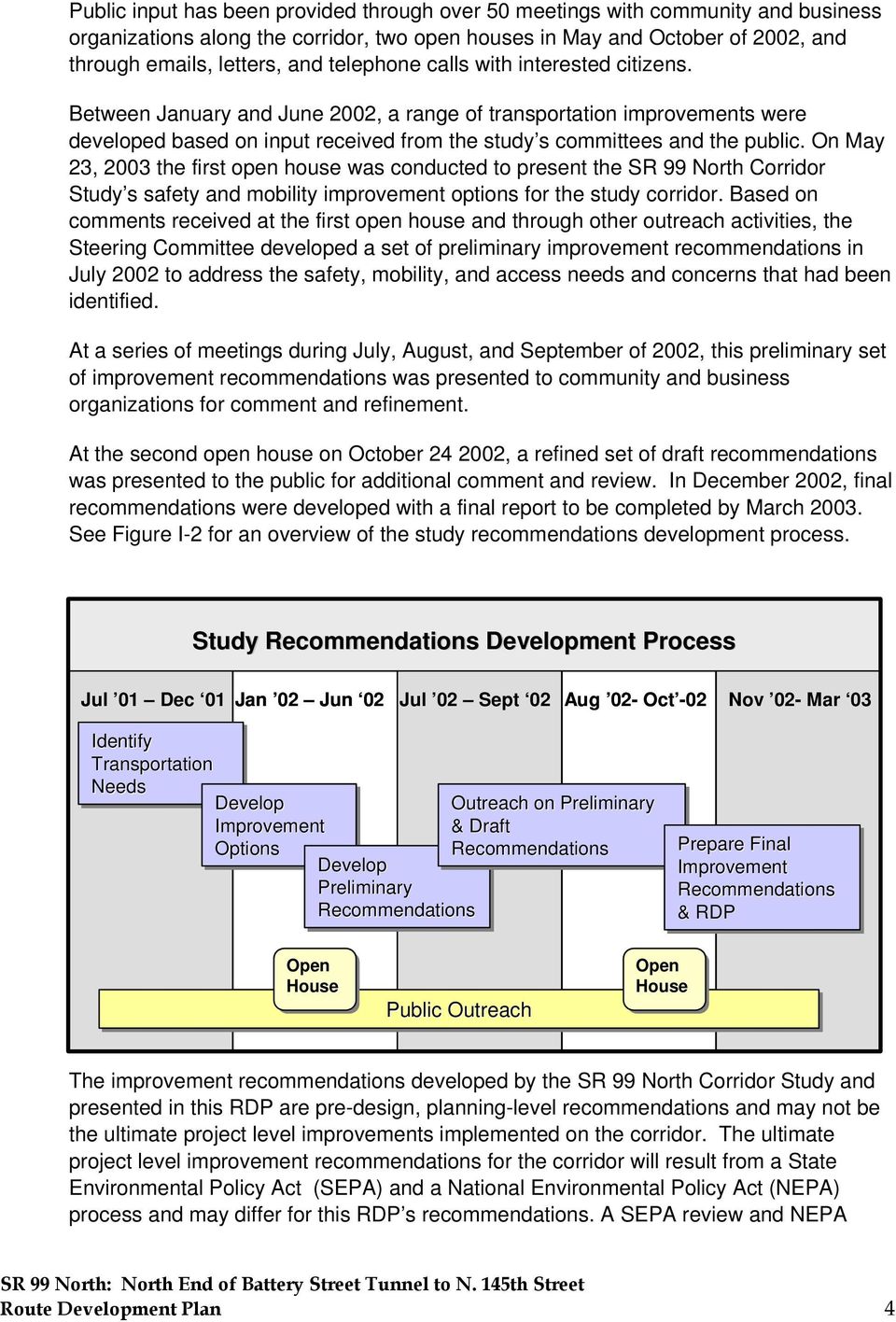
7 Public input has been provided through over 50 meetings with community and business organizations along the corridor, two open houses in May and October of 2002, and through s, letters, and telephone calls with interested citizens. Between January and June 2002, a range of transportation improvements were developed based on input received from the study s committees and the public. On May 23, 2003 the first open house was conducted to present the SR 99 North Corridor Study s safety and mobility improvement options for the study corridor. Based on comments received at the first open house and through other outreach activities, the Steering Committee developed a set of preliminary improvement recommendations in July 2002 to address the safety, mobility, and access needs and concerns that had been identified. At a series of meetings during July, August, and September of 2002, this preliminary set of improvement recommendations was presented to community and business organizations for comment and refinement. At the second open house on October , a refined set of draft recommendations was presented to the public for additional comment and review. In December 2002, final recommendations were developed with a final report to be completed by March See Figure I-2 for an overview of the study recommendations development process. Study Recommendations Development Process Jul 01 Dec 01 Jan 02 Jun 02 Jul 02 Sept 02 Aug 02- Oct -02 Nov 02- Mar 03 Identify Transportation Needs Develop Outreach on Preliminary Improvement & Draft Options Recommendations Develop Preliminary Recommendations Prepare Final Improvement Recommendations & RDP Open House Public Outreach Open House The improvement recommendations developed by the SR 99 North Corridor Study and presented in this RDP are pre-design, planning-level recommendations and may not be the ultimate project level improvements implemented on the corridor. The ultimate project level improvement recommendations for the corridor will result from a State Environmental Policy Act (SEPA) and a National Environmental Policy Act (NEPA) process and may differ for this RDP s recommendations. A SEPA review and NEPA Route Development Plan 4
8 review will occur before any decision is made to proceed to the design Plans, Specifications and Estimates (PS&E) stage of implementing the ultimate corridor project level improvement recommendations resulting from a SEPA and NEPA review. See Chapter 9: Environmental Inventory, for a further explanation of the environmental review processes required before implementation of a proposed improvement. Context Sensitive Design Context Sensitive Design (CSD) is an approach to transportation planning that considers the needs of the users, the neighboring communities, and the environment (both built and natural). It integrates projects into the context or setting in a sensitive manner through careful planning, consideration of different perspectives, and tailoring designs to particular project circumstances. The CSD uses a collaborative, interdisciplinary approach that includes early involvement of key stakeholders to ensure that transportation projects are not only moving safely and efficiently, but are also sensitive to potential impacts to the natural, social, and economic environment. The CSD requires an early and continuous commitment to public involvement, flexibility in exploring new solutions, and an openness to new ideas. Community members play an important role in identifying local and regional problems and solutions that may better meet and balance the needs of all stakeholders. Early public involvement can help reduce expensive and time-consuming rework later on and thus contributes to more efficient project development. The near- and long-term recommendations presented in this Route Development Plan are consistent with the CSD approach to transportation planning. As presented in Chapter 7: Public Outreach, public input was a critical component of the SR 99 North Corridor Study and was incorporated into every step of the study process from identifying transportation problems through developing the study s final recommendations. Key Findings The following is a summary of the SR 99 North Corridor Study s key findings. Mobility and Congestion The SR 99 North corridor is a principal urban arterial carrying a substantial volume of traffic in a north-south direction in the Seattle metropolitan region. SR 99 North is heavily congested during peak hours, with the majority of its signalized intersections within the study area operating at Level of Service D or worse. It is expected that sections of the Route Development Plan 5

9 study corridor will experience traffic growth by as much as 39 percent over the next 25 years. Accident and Safety Over 1,500 accidents occurred on the SR 99 North study corridor between 01/01/99 and 12/31/01 53 of these were disabling injuries and eight were fatalities. The SR 99 North study corridor includes a WSDOT designated high accident corridor (with the highest number of disabling accidents in Puget Sound), six high accident locations, and 12 pedestrian accident locations (see Figure 3-1). Most accidents on the study corridor involved rear-end collisions, sideswipes, vehicles hitting fixed objects (such as trees and utility poles), or vehicles colliding at right angles. Along several sections of the corridor, a high number of accidents involved pedestrians and bicyclists. Pedestrian Facilities Several areas along the northern half of the study corridor do not have sidewalks and either lack or have limited designated pedestrian crossing areas. The lack or limited availability of sidewalks and designated crossings make it difficult and potentially dangerous for pedestrians and other non-motorized corridor users to travel along and across SR 99 North. Photo I-2: Pedestrians walking on the shoulder near SR 99 North and N. 137th Street a section without sidewalks Signage Improvement Recommendations The public has expressed a variety of concerns regarding inadequate signage along SR 99 North. The primary signage concerns are: the need for better signs clarifying legal uses of the business access and transit lane (located on northbound SR 99 North from Route Development Plan 6

10 N. 115th Street to N. 145th Street); and improved signage on how to enter, exit, and cross SR 99 North. Security and Law Enforcement Several sections of SR 99 North experience a high level of criminal activity. The public has expressed concern about security while traveling on foot both along and across SR 99 North. In addition to criminal activity, other law enforcement problems along the corridor include speeding, driving under the influence of alcohol, and illegal use of the business access and transit lane as a general-purpose travel lane. All of these problems contribute to the corridor s high accident rate. Business Access Many merchants with businesses located along the SR 99 North corridor are concerned about the potential impacts of recommended congestion and safety improvements on access to their businesses. Route Development Plan 7

11 Route Development Plan 8

12 TABLE OF CONTENTS INTRODUCTION...1 Purpose...1 Study Background...1 Yesterday...1 Today...2 Study Development Process...2 Context Sensitive Design...5 Key Findings...5 Mobility and Congestion...5 Accident and Safety...6 Pedestrian Facilities...6 Signage Improvement Recommendations...6 Security and Law Enforcement...7 Business Access...7 CHAPTER 1 EXISTING CONDITIONS...9 Highway Location, Classification, and Function...9 Access Management Classifications...10 Overview...10 Applicable Classifications...10 Existing Median Treatment...11 Zoning...11 Lanes...13 Horizontal and Vertical Alignment...15 Intersections...16 Bridges...16 Aurora Bridge (George Washington Memorial Bridge)...16 Other Bridges...17 Non-Motorized Crossings and Facilities...18 Crossings...18 Sidewalks...18 Bicycle Facilities...18 Speed Limits...18 Right-of-Way Widths...19 Transit Service...19 Existing Transit Service Levels...19 Transit Stop Spacing...20 Operating Environment...20 Route Development Plan v

13 CHAPTER 2 TRAFFIC CONDITIONS...21 Historical & Existing Trends in Traffic Volumes...21 WSDOT Congestion Index...21 Level of Service...22 CHAPTER 3 ACCIDENTS AND SAFETY ISSUES...29 Accident History...29 South Focus Area...32 High Accident Corridor...33 High Accident Location...34 Pedestrian Accident Locations...34 Central Focus Area...34 High Accident Locations...35 Pedestrian Accident Locations...35 North Focus Area...36 High Accident Locations...36 Pedestrian Accident Locations...38 CHAPTER 4 DESIGN STANDARDS...39 Design Elements...40 Lane Widths...40 Horizontal and Vertical Alignment...40 Design Deviations and Context Sensitive Design...42 Design Deviations...42 Context Sensitive Design...43 CHAPTER 5 NEAR-TERM IMPROVEMENTS...45 Safety Improvement Recommendations...45 Congestion Improvement Recommendations...46 Security Improvement Recommendations...46 Law Enforcement Improvement Recommendations...47 Signage Improvement Recommendations...48 CHAPTER 6 LONG-TERM IMPROVEMENTS...49 Introduction...49 South Focus Area Battery Street Tunnel to N. 50th Street...50 Aloha Street to Dexter Way...51 Halladay Street Intersection...51 Raye Street Intersection...54 Aurora Bridge...62 N. 38th Street Vicinity...63 Central Focus Area N. 50th Street to N. 110th Street...68 Roadway Improvements...68 N. 50th Street N. 59th Street...73 N. 59th Street to N. 72nd Street...74 N. 72nd Street to N. 110th Street...74 Route Development Plan vi
14 North Focus Area: N. 110th Street to N. 145th Street...75 CHAPTER 7 PUBLIC OUTREACH...79 Introduction...79 Communication Strategies...79 Public Outreach Activities...79 Stakeholder Advisory Committee Meetings...80 Open House Meetings...80 Over 50 Meetings with Business and Community Organizations...81 Business Contacts...81 Newsletters...81 Media Outreach...81 Study Website...81 Public Involvement Database...82 Overview of Public Comments Received...82 Review of Neighborhood Plans...82 CHAPTER 8 CONSISTENCY WITH OTHER PLANS...83 Consistency with the Washington Transportation Plan and the State Highway System Plan...83 Consistency with Local Plans...83 Seattle s Comprehensive Plan Transportation Goals...86 PSRC s Comprehensive Plan...87 CHAPTER 9 ENVIRONMENTAL INVENTORY...91 Results of SR 99 North Environmental Inventory...91 Critical Areas...93 Potential Historic Resources...98 Parks/Section 4(f)...99 Noise/Vibration Hazardous Materials CHAPTER 10 FUNDING AND IMPLEMENTATION PLAN City of Seattle Funding King County Metro Funding State Funding GLOSSARY OF FREQUENTLY USED TERMS APPENDICES APPENDIX A ACCESS MANAGEMENT CLASSIFICATIONS Class Class Class APPENDIX B LEVEL OF SERVICE (LOS) DEFINITIONS FOR UNSIGNALIZED INTERSECTIONS APPENDIX C LEVEL OF SERVICE DEFINITIONS FOR SIGNALIZED INTERSECTIONS Route Development Plan vii

15 APPENDIX D TRAFFIC ANALYSIS ASSUMPTIONS AND METHODOLOGY Parking Utilization On-Street Parking Off-Street Parking APPENDIX E PUBLIC OUTREACH Public Outreach Activities Community Meetings Business Meetings Business Contacts Newspaper Display Paid Advertising Newsletters Postcards Published Articles Open Houses Stakeholder Advisory Committee Website APPENDIX F SURVEY OF PUBLIC COMMENTS RECEIVED South Focus Area (North End of the Battery Street Tunnel to N. 50th Street) Aurora Bridge (George Washington Memorial Bridge) Access Non-Motorized Other Safety Issues Transit Mobility Other Central Focus Area (N. 50th Street to N. 110th Street) Access Medians Non-Motorized Sidewalks Other Safety Issues Mobility Parking Transit Landscaping Other North Focus Area (N. 110th Street to N. 145th Street) Access Medians Transit Landscaping Non-Motorized Sidewalks Other Safety Issues Route Development Plan viii
16 Mobility Parking Other APPENDIX G SURVEY OF PUBLIC COMMENTS - NEIGHBORHOOD PLAN RECOMMENDATIONS LIST OF FIGURES I-1. SR 99 North Corridor Study Project Area...3 I-2. Study Recommendations Development Process Median Treatment Number of Lanes High Accident Areas Aloha St. to Dexter Way N. Proposed Future Cross Section Queen Anne Access Stage Queen Anne Access Stage Queen Anne Access Stage Queen Anne Access Stage Aurora Bridge Proposed Future Cross Section N. 38th Street Intersections N. 38th Street Access N. 39th Street to N. 50th Street Proposed Future Cross Section N. 50th Street to N. 59th Street Proposed Future Cross Section N. 59th Street to N. 72nd Street Proposed Future Cross Section N. 72nd Street to N. 110th Street Proposed Future Cross Section N. 110th Street to N. 145th Street Proposed Future Cross Section Environmental Review Process South Focus Area Critical Areas Central Focus Area Critical Areas North Focus Area Critical Areas...96 LIST OF TABLES 1-1. Access Management Classifications Lane Width and Function Signals on the SR 99 North Study Corridor Bridges Along the SR 99 North Study Corridor Existing Sidewalk Patterns Speeds Along the SR 99 North Study Corridor SR 99 North Study Corridor Right-of-Way SR 99 North Corridor Average Daily Traffic Volumes A.M. Peak-Hour Level of Service for the Unsignalized Segment South of Green Lake Way P.M. Peak-Hour Level of Service for Unsignalized Intersections South of Green Lake Way Summary of Signalized Intersection Level of Service Summary of Arterial Performance in the A.M. Peak Hour Summary of Arterial Performance in the P.M. Peak Hour Route Development Plan ix
17 3-1. High Accident Locations within the SR 99 North Study Corridor Pedestrian Accident Locations in the SR 99 North Study Corridor Accident Type within the High Accident Corridor Primary Contributing Cause of Accidents within the High Accident Corridor Design Standards for Urban State Highways Sight Distance on the SR 99 North Study Corridor Proposed Right-of-Way Widths SR 99 North South Focus Area Proposed Long-Term Improvements Central Focus Area Proposed Long-Term Improvements North Focus Area Proposed Long-Term Improvement Recommendation Consistency of the SR 99 North Corridor Study with the Highway System Plan (HSP) Consistency of the SR 99 North Recommendations with Local Plans D Year Traffic Growth Rates D-2. Critical Percentile Traffic E-1. SR 99 North Corridor Study Meetings with Community Organizations E-2. SR 99 North Corridor Study Meetings with Local Businesses E-3. Business Contacts E-4. Newspaper Advertising E-5. Newsletters E-6. Postcards E-7. Published Articles E-8. Stakeholder Advisory Committee Meetings G-1. Neighborhood Plan Recommendations LIST OF PHOTOS I-1. Aurora Bridge (George Washington Memorial Bridge) circa I-2. Pedestrians walking on shoulder near SR 99 North and N. 137th Street a section without sidewalks Traffic congestion near SR 99 North and N. 103rd Street BAT lane at SR 99 North and N. 117th Street The intersection of Halladay Street and SR 99 North Back up on SR 99 North southbound caused by accident at Raye Street and SR 99 North Aurora Bridge Deck The intersection of Bridge Way N. and N. 38th Street Pedestrians walking along shoulder near N. 137th Street and SR 99 North Participants at the May 2002 Open House Route Development Plan x

18 CHAPTER 1 EXISTING CONDITIONS Highway Location, Classification, and Function State Route 99 North (SR 99 North) is a major north-south corridor in the Puget Sound region. This Route Development Plan (RDP) covers the SR 99 North corridor from the north end of the Battery Street tunnel in downtown Seattle to N. 145th Street (SR 523), which borders the city of Shoreline (see Figure I-1). The SR 99 North corridor serves both local and regional trips. As one of the few continuous north-south facilities in Seattle, the vehicular traffic on SR 99 North is comprised of local and regional commuters as well as a significant volume of commercial and retail traffic. Often, when traffic accidents or incidents occur on Interstate 5 (I-5), SR 99 North serves as an alternate route for northbound and southbound vehicles. SR 99 North is a heavily used transit corridor. Currently, five bus routes use the study corridor. Bus Route 358 is a trunk route on SR 99 North and serves the entire length of the study corridor from Denny Way to N. 145th Street. This route is in the top five routes for annual ridership within the King County Metro system and has an average weekday daily ridership over 7,200. Four other bus routes travel along a portion of the corridor. SR 99 North is an important freight corridor. The southern half of the corridor is part of a T-1 1 freight route and the northern half of the corridor is part of a T-2 freight route. The T-1 freight route extends from SR 99 North and I-5 in south Seattle to Green Lake Way and moves 13,109,000 tons annually. The T-2 freight route extends from Green Lake Way to I-5 in Everett and moves 8,007,127 tons annually. The corridor is not a designated bicycle route; however, bicycles do use the facility. See page 17 for a further description of bicycle facilities. Pedestrians also use the corridor with the majority of use occurring north of Green Lake. This segment of SR 99 North is classified as a Highway of Statewide Significance and an Urban Principal Arterial by WSDOT; a Principal Arterial, Major Truck Route, and part of a Transit Priority Network by the City of Seattle; and is part of the National Highway System as designated by the Federal Highway Administration. 1. The Freight and Goods Transportation System (FGTS) is an inventory of freight movement by tonnage on Washington State highways, county roads, and city streets. Roadways that move 20,000 tons in 60 days or 100,000 tons per year are classified by the FGTS. Facilities that carry over 4 million tons annually are considered freight corridors of statewide significance. Routes are classified into 5 categories. T-1 routes move more than 10 million tons per year, T-2 routes move 4 million to 10 million tons per year, T-3 routes move 300,000 to 4 million tons per year, T-4 routes move 100,000 to 300,000 tons per year, and T-5 routes move 20,000 tons in 60 days. Sections of SR 99 fall into the T-1 and T-2 categories. Route Development Plan 9

19 Access Management Classifications Overview Access Management is the process of balancing the competing needs of traffic movement and property access. In simple terms, it is the process that provides access to land development while simultaneously preserving the flow of traffic on the surrounding system in terms of safety, capacity, and speed. Washington Administrative Codes (WAC) and , which implement Revised Code of Washington 47.50, set guidelines for access to state highways. The guidelines classify all non-limited access state highways into one of five classes. The classifications allow for different levels of access based on the type of traffic and function of the surrounding land uses. Applicable Classifications The SR 99 North study corridor currently has three different access management classification designations as shown in Table 1-1 and Figure 1-1. Appendix A provides a more detailed description of these classifications. Table 1-1 Access Management Classifications Class Location Mileposts (MP) Class 1 End Battery St. Tunnel to Thomas St. MP to MP Class 3 Thomas St. to N. 85th St. MP to MP Class 4 N. 85th St. to N. 145th St. MP to MP Class 1: Carry high speed and/or high volume traffic movements safely and efficiently, and provide for interstate, interregional, and intercity travel needs and some intracity travel needs. Typically distinguished by a highly controlled, limited number of public and private connections, restrictive medians with limited median openings on multilane facilities, and infrequent signals. Minimum intersection spacing of 1.0 mile, though 0.5 mile spacing may be permitted when no other reasonable alternative exists. The minimum private access spacing shall be 1,320 feet. Class 3: Carry moderate traffic volumes at moderate travel speeds for medium and short travel distances providing for intercity, intracity, and intercommunity travel needs. Highways in this class are typically distinguished by planned restrictive medians and minimum distances between public and private connections. Desired intersection spacing of 0.5 mile or more. The minimum private access spacing shall be 330 feet. Class 4: Same as Class 3 except this class is typically distinguished by existing or planned nonrestrictive medians. Restrictive medians may be used as operational conditions warrant mitigating turning, weaving, and crossing conflict. Minimum connection spacing standards should be applied if adjoining properties are redeveloped. Desired intersection spacing of 0.5 mile or more. The minimum private access spacing shall be 250 feet. Based on these classifications, the corridor was assessed to determine where the existing property access and intersection spacing does not meet the spacing standards Route Development Plan 10
20 (the minimum spacing standards). The majority of existing private accesses along the corridor do not provide the spacing requirements specified in the WAC. Existing Median Treatment The median treatment on SR 99 North ranges from a restrictive median barrier in the southern section to an open two-way left-turn lane in the northern section as shown in Figure 1-1. With the exception of the Aurora Bridge, SR 99 North from the southern project limits (MP 32.44) to N. 50th Street (MP 35.67) has a jersey type median barrier. From N. 50th Street to north of N. 63rd Street, the roadway is separated by paint stripes and curbing. From N. 63rd Street to N. 73rd Street jersey type median barrier is again present. North of N. 73rd Street, numerous at-grade intersections exist, which allow traffic to cross SR 99 North from east to west. From N. 73rd Street to N. 86th Street, median curbing and islands are present allowing traffic to cross at the signalized intersections only. North of N. 86th Street, a center two-way left-turn lane is present with median curbing at and around signalized intersections. This median treatment continues to the northern project limit at N. 145th Street. Zoning The current land use zoning along the SR 99 North corridor varies but is primarily commercial. The City of Seattle has zoned property adjacent to SR 99 North as Commercial 1, Commercial 2, Commercial 3, Neighborhood Commercial 3, Low rise 3, and Single-Family Residential. The adjacent land use south of Green Lake is a mix of both residential and commercial uses. North of Green Lake, the land use is primarily commercial with some areas of residential land use. Green Lake Park and Woodland Park are open space uses that directly abut the SR 99 North corridor. The vast majority of land adjacent to SR 99 North is fully developed. Very few vacant lots or undeveloped parcels are present. Route Development Plan 11

21 Figure 1-1 Median Treatments and Access Classifications Route Development Plan 3
22 Lanes SR 99 North study corridor has between two and four through lanes in each direction. The numbers of lanes vary based on geometric and on-street parking conflicts. Figure 1-2 details the areas that have two, three, and four lanes for the SR 99 North corridor. Table 1-2 details the typical widths for the corridor as well as the usage of the outside lane. The lane usage varies throughout the corridor including general-purpose lanes, turning lanes, parking, and business access and transit lane (BAT) uses. See Chapter 6: Long-Term Improvement Recommendations, for a description of proposed future lane widths with redevelopment. Table 1-2 Lane Width and Function Outside Lane Function Street Limits Typical Lane Widths Northbound Southbound Battery St Tunnel (MP 32.44) to Thomas St (MP 32.58) Thomas St (MP 32.58) to Aloha St (MP 33.03) Aloha St (MP 33.03) to the south end of the Aurora Bridge (MP 34.17) South end of the Aurora Bridge (MP 34.17) to the north end of the Aurora Bridge (MP 34.73) North end of the Aurora Bridge (MP 34.73) to N. 50 th St (MP 35.67) N. 50th St (MP 35.67) to N. 72nd St (MP 36.81) N. 72nd St (MP 36.81) to N. 110th St (MP 38.90) N. 110th St (MP 38.90) to N. 145th St (MP 40.47) All lanes 10 feet General Purpose General Purpose All lanes 10 feet Turn Lane General Purpose 10 feet Inside 13 feet Outside General Purpose General Purpose All lanes 9.5 feet General Purpose General Purpose 10 feet Inside 17 feet Outside 10 feet Inside 13 feet Outside 10 feet Inside 13 feet Outside 10 feet Inside 11 feet outside (NB) 12 feet outside (SB) General Purpose and Parking 1 General Purpose 2 General Purpose General Purpose and Parking 1 Business Access and Transit Lane General Purpose General Purpose and Parking 3 General Purpose 1. Parking restricted northbound during p.m. peak traffic hours. 2. Parking and turn lanes provided outside general purpose lanes 3. Parking restricted southbound during a.m. peak traffic hours Route Development Plan 13
23 Figure 1-2 Number of Lanes Route Development Plan 14
24 From the north end of the Battery Street Tunnel to Thomas Street, there are two through lanes in each direction. From Thomas Street to the north end of the Aurora Bridge, there are three lanes in each direction with one northbound merge lane from the north end of the Thomas Street to Aloha Street. From the north end of the Aurora Bridge to N. 50th Street, there are three lanes northbound and two lanes southbound. With the exception of the p.m. peak period, the northbound outside lane allows parking; so only two lanes are continuous in this section. From N. 50th Street to N. 72nd Street, three lanes are present in each direction. From N. 72nd Street to N. 110th Street, there are three lanes in each direction. The outside lanes in each direction allow parking except in the peak period to accommodate peak traffic volumes. There is currently an a.m. peak-period restriction from 6:00 a.m. 9:00 a.m. southbound and a p.m. peak-period restriction from 3:00 p.m. 7:00 p.m. northbound. From N. 110th Street to N. 145th Street, there are three lanes northbound and two lanes southbound. The northbound outside lane is restricted to business access, right-turning vehicles exiting SR 99 North, and transit. Horizontal and Vertical Alignment SR 99 North has a relatively straight alignment through the study area. South of the Aurora Bridge, SR 99 North has a series of horizontal curves and another series of horizontal curves occur north of the bridge around Green Lake. No vertical information was available, but the vertical alignment matches the rolling terrain of the area with no excessively steep grades. The existing horizontal alignment has geometric elements that do not meet WSDOT Design Manual standards. These substandard geometric elements include horizontal stopping sight distance, super elevation rate, and compound curvature radii ratio. The vertical alignment was not evaluated since no information was readily available. Please see Chapter 4: Design Standards, for a more detailed description of these elements and the deficiencies. Route Development Plan 15
25 Intersections Table 1-3 shows the intersections that have pedestrian or traffic signals on SR 99 North Table 1-3 Signals on the SR 99 North Study Corridor Intersection Green Lake Pedestrian Crossing/N. 68th St. Winona Ave. N. Pedestrian Signal Traffic Signal N. 77th St. Traffic Signal N. 80th St. Traffic Signal N. 83rd St./Green Lake Dr. N. Traffic Signal N. 85th St. Traffic Signal N. 90th St. Traffic Signal N. 100th St. Traffic Signal N. 105th St./Northgate Way Traffic Signal Washelli Cemetery/ Entrance Traffic Signal N. 115th St. Traffic Signal N. 117th St. (Home Depot) Traffic Signal N. 125th St. Traffic Signal N. 130th St. Traffic Signal N. 135th St. Traffic Signal Traffic Control N. 140th vicinity Amber Pedestrian Flash N. 145th St. (SR 523) Traffic Signal All of these traffic signals were synchronized by the City of Seattle in Bridges Aurora Bridge (George Washington Memorial Bridge) The Aurora Bridge (WSDOT bridge number 99/560) crosses the Lake Washington Ship Canal. The bridge was built in 1932 and is currently listed on the National Historic Register. It is a steel cantilever structure and is one of the tallest and longest spans in Seattle. Route Development Plan 16
26 Other Bridges In addition to the Aurora Bridge, thirteen other bridges are present along the SR 99 North corridor including several undercrossings, overcrossings, and pedestrian bridges. Table 1-4 presents the inventory from the WSDOT January 2002 bridge list including the Galer Street undercrossing, which is expected to be under construction by The pedestrian tunnel/undercrossing at N. 79th Street is closed and therefore is not listed in Table 1-4. Table 1-4 Bridges Along the SR 99 North Study Corridor Bridge Number Milepost Description 1 99/ Broad St. Overcrossing 99/ Mercer St. Overcrossing Galer St. Pedestrian Undercrossing 2 99/ Lynn St. Overcrossing 99/ Aurora Bridge (George Washington Memorial Bridge) 99/ N. 38th St. Overcrossing 99/ N. 41st St. Pedestrian Undercrossing 99/ N. 46th St. Overcrossing 99/ N. 50th St. Overcrossing 99/571P Woodland Park Pedestrian Undercrossing #1 99/572P Woodland Park Pedestrian Undercrossing #2 99/573P Woodland Park Pedestrian Undercrossing #3 99/ N. 63rd St. Overcrossing 99/ N. 102 nd St. Pedestrian Undercrossing 99/ N. 130 th St. Pedestrian Undercrossing 1 Crossing refers to whether SR 99 is crossing over or under another facility 2. Proposed pedestrian undercrossing to be constructed in near future Source: WSDOT Bridge List, January Route Development Plan 17
27 Non-Motorized Crossings and Facilities Crossings Non-motorized crossings are available at all of the signal and bridge locations along SR 99 North. These locations are listed in tables 1-3 and 1-4, respectively. Non-motorized crossings are also located at both ends of the Aurora Bridge. Sidewalks The sidewalks along the SR 99 North study corridor are inconsistent and in some areas non-existent. The widths of sidewalks as well as their continuity vary, especially in the northern part of the project. Existing sidewalk situations are described in Table 1-5. Table 1-5 Existing Sidewalk Patterns City Limits Sidewalk Situation Seattle North end of the Battery Street Tunnel to N. 72nd Sidewalk is largely continuous N. 72nd to N. 110th Sidewalk is largely continuous N. 110th to N. 145th Limited sidewalks only in front of recent development Bicycle Facilities SR 99 North is not a designated bicycle route; however, bicycles do use the facility. City of Seattle designated bicycle routes are available on streets parallel to SR 99 North throughout the corridor. Dexter Avenue N. has bicycle lanes from Denny Way to near the Fremont Bridge. Linden Avenue N. and Fremont Avenue N. are classified as arterial or residential streets that are commonly used by bicyclists. The Green Lake Trail also runs parallel to SR 99 North for a short distance. Please see the Seattle Bicycling Guide Map produced by the Seattle Transportation Department for further information. Speed Limits The posted speed limits along the project corridor range between 30 mph and 40 mph. Table 1-6 shows the current posted speed limits. Route Development Plan 18
28 Table 1-6 Speeds Along the SR 99 North Study Corridor Segment Milepost Speed Limit Average Operating Speed 1 Battery Street Tunnel to Winona Ave to mph 52 Winona Ave. to N. 85th St to mph 38 N. 85th St. to N. 115th St to mph 42 N. 115th St. to N. 145th St to mph 46 1 Data are from WSDOT Speed Study inventory. Right-of-Way Widths The existing right-of-way (ROW) along the SR 99 North study corridor varies from 90 to 108 feet. Table 1-7 shows the existing curb-to-curb widths and ROW for SR 99 North Section Table 1-7 SR 99 North Study Corridor Right-of-Way Existing Right-of-Way (in feet) Existing Curb to Curb (in feet) Aloha St to Halladay St N. Halladay St to N. 38 St N. 38 St to N. 50 St N. 50 St to N. 59 St N. 59 St to N. 72 St 106 varies 62 to 78 N. 72 St to N. 110 St 90 varies 71 to 74 N. 110th St to N. 145 St varies 90 to 108 varies 61 to 78 Transit Service Existing Transit Service Levels Between North 145 Street and downtown Seattle, SR 99 North is a major transit corridor. Transit service includes limited stop service (route 358), local service (routes 26, 16 and 5), as well as peak hour, directional express service (5 Express, 26 Express, 28 Route Development Plan 19
29 Express, and 358 Express). Service is particularly frequent between N. 38th Street and Denny Way. Transit Stop Spacing Along the entire corridor, approximately 24 stops occur on the 7.8-mile section, or one stop every mile. Stop spacing is tighter in some areas: between Denny Way and Halladay Street, bus stop spacing is 0.17 mile. North of N. 75th Street, bus stop spacing is 0.24 mile. Operating Environment As documented previously, on-street parking policies vary throughout the day. Several areas, particularly north of N. 75th Street, have peak-hour traffic parking restrictions in place. Parking is restricted during the peak hours along sections in the southbound direction in the morning and along sections in the northbound direction in the afternoon. When parking is restricted, buses operate and stop in the curb lane and do not have to merge in and out of general traffic. When on-street parking is allowed, bus stops operate as bus pullouts, with their inherent transit disadvantages, particularly the difficulty of pulling back into the traffic flow. Transit signal priority (TSP) equipment has been installed and activated in the study corridor. Route Development Plan 20
30 CHAPTER 2 TRAFFIC CONDITIONS The SR 99 North study corridor is highly traveled, especially during the a.m. and p.m. peak periods. These high peak period traffic volumes, combined with the large number of signalized intersections, result in poor traffic operations at many locations. Historical & Existing Trends in Traffic Volumes Traffic volumes have steadily increased along the study corridor, especially in the area south of the Aurora Bridge. Table 2-1 shows the 1996 and 2001 Average Daily Traffic (ADT) on the SR 99 North corridor at specific locations. Table 2-1 SR 99 North Corridor Average Daily Traffic Volumes Location ADT Values 1996 ADT Values 2001 Broad Street 75,100 83,200 Aurora Bridge 78,800 84,700 N. 85th Street 40,100 41,000 N. 105th St. 34,500 39,600 N. 145th St. 36,300 38,800 Source: City of Seattle Traffic Flow Data The entire corridor currently experiences noticeable to significant traffic delays during the a.m. and p.m. peak hours. With projected increases in traffic volumes from 26 to 39 percent in the next 30 years, the delays are expected to not only worsen in the peak hour but to spread across a larger peak period with an increase in the congestion of the off-peak period. WSDOT Congestion Index WSDOT has developed a congestion index to report the severity of traffic congestion over a 24-hour period. Index values under the new system range from 1 (little to no congestion) to 24 (theoretically congestion over the entire 24 hours in a day). This congestion indicator enables the comparison of each highway s daily traffic volume to one-hour capacity. Route Development Plan 21
31 According to Washington s Transportation Plan, the SR 99 North corridor qualifies as a congested highway both now and in the future. The Washington State Transportation Commission adopted thresholds to establish these congested highways. An urban highway such as the SR 99 North Corridor is considered congested when the index reaches a value of 10. The existing (2001) congestion index for the SR 99 North corridor from the north end of the Battery Street Tunnel to N. 145th Street is 10. The projected congestion index for the corridor in 2030 is 13 if no corridor improvements are implemented. Level of Service Overview of Traffic Characteristics The SR 99 North corridor consists of two distinct traffic areas. The area from the north end of the Battery Street Tunnel to Green Lake Way is an unsignalized section of the corridor. This section experiences the highest traffic volumes on the corridor with vehicles often traveling 10 to 20 mph over the posted 40 mph posted speed limit. This section has an access management classification of 1 and 3. The section from Green Lake Way to N. 145th Street is a signalized section with speed limits of 30 to 35 mph from Winona Ave N. to N. 115th Street and 40 mph north of N. 115th Street. This signalized corridor section has an access management classification of class 3 and 4. Descriptions of the access management classifications can be found in Chapter 1 of this study and in Appendix A. Unsignalized Level of Service South of Green Lake, the SR 99 North corridor was divided into four segments for purposes of the traffic analysis. These segments were determined based on changes in roadway characteristics, traffic volumes, and adjacent street access. Tables 2-2 and 2-3 show the level of service (LOS) analysis results for the four segments during both the a.m. and p.m. peak periods, respectively. The unsignalized section of the corridor from the north end of the Battery Street Tunnel to Green Lake Way is currently operating at a poor LOS based on the traffic densities of the segments. Further explanation of the LOS values can be found in Appendix B. The worst traffic congestion in this area occurs northbound during the p.m. peak hour and southbound during the a.m. peak hour, as shown in Table 2-3. Levels of Service (LOS) during these peak travel times include poor operation (LOS E) and failing operation (LOS F). By the year 2030, conditions for the southbound a.m. peak will have deteriorated to failing LOS values for three of the four segments. Conditions for the northbound direction in the a.m. peak will also worsen as shown in Table 2-2. Route Development Plan 22
32 Table 2-2 A.M. Peak-Hour Level of Service for the Unsignalized Segment South of Green Lake Way 2000 LOS 2030 No Build LOS Segment Northbound Southbound Northbound Southbound Valley Street to Raye Street C E D F Raye Street to Bridge Way N./ Fremont Way N. Bridge Way N./ Fremont Way N. to N. 46th Street C E D F C E C F N. 46th Street to Green Lake Way C C C D During the current p.m. peak hour, the SR 99 North corridor experiences high volumes of traffic in both the northbound and southbound directions. As shown in Table 2-3 below, the LOS values northbound and southbound will decline over the next 30 years. Table 2-3 P.M. Peak-Hour Level of Service for Unsignalized Intersections South of Green Lake Way 2000 LOS 2030 No Build LOS Segment Northbound Southbound Northbound Southbound Valley Street to Raye Street E D F E Raye Street to Bridge Way N. / Fremont Way N. Bridge Way N./ Fremont Way N. to N. 46th Street F D F E D D F E N. 46th Street to Green Lake Way C B D B Signalized Level of Service To assess current and future traffic operations for determining LOS at signalized intersections, each traffic signal along the study corridor was modeled using Synchro software. The model was calibrated to more accurately reflect the field conditions; as part of this calibration, the saturation flow rate was changed to 1,700 vehicles per hour per lane. For both the a.m. and p.m. peak hours, this analysis was performed using the current turning movements and intersection geometric conditions. Route Development Plan 23
33 Future traffic demand was estimated using current traffic and turning volumes and adjusting the volumes to reflect anticipated growth along the corridor (see Appendix C for a further description of how LOS was calculated for signalized intersections). Table 2-4 presents the a.m. and p.m. peak-hour intersection LOS values for both the year 2000 and the future no-build year As shown in Table 2-4, under current conditions many of the signalized intersections between Green Lake Way and N. 145th Street experience noticeable to significant travel delays as a result of congestion. Without improvements and with the expected growth over the next 30 years, most of the signalized intersections along the study corridor will be operating with significant travel delays and poor to failing LOS by Picture 2-1: Traffic congestion northbound near SR 99 North and N. 103rd Street Route Development Plan 24
34 Table 2-4 Summary of Signalized Intersection Level of Service Intersection of Aurora Ave N. & A.M. Peak Level of Service P.M. Peak Level of Service N. 68th Street A A A A Winona Ave N. B D B D N. 77th Street A B B C N. 80th Street C F D F N. 83rd Street A A A B N. 85th Street D F F F N. 90th Street A B A C N. 100th Street A B B E N. 105th Street D F E F N. 115th Street A A B E N. 117th Street A B A C N. 125th Street D F C F N. 130th Street C F D F N. 135th Street A B A C N. 145th Street D F D F Although some intersections shown in Table 2-4 appear to be operating well in 2030 (LOS A, B, or C), this does not mean that the corridor is operating well overall. The major intersections with high volumes of cross-street traffic (e.g., N. 85th Street) can have a lower intersection LOS (LOS D, E, or F). Traffic can back-up north and south bound at these major intersections. Traffic back-ups at the major intersection can reduce the volume of traffic able to reach the next minor intersection. The limited volumes of Route Development Plan 25
35 traffic able to reach the minor intersections from the heavily congested and backed up major intersections can create a misleading high LOS at the minor intersections. An example of this can be seen in Table 2-4 for the intersections of N. 80th Street, N. 83rd Street, and N. 85th Street. For the year 2030 the intersections of N. 80th Street and N. 85th Street in the a.m. and p.m. peak periods are LOS F. The intersection between these two is N. 83rd Street, which in the year 2030 is operating at a much higher level of service (A for the a.m. peak and B for the p.m. peak). Traffic is congested north and southbound on SR 99 North at the major intersections of N. 80th Street and N. 85th Street as a result of the high traffic volumes and signal timings, which must also accommodate a high volume of cross-street traffic. The N. 83rd Street intersection, which has a much lower volume of traffic able to reach it from the backed up N. 80th Street and N. 85th Street intersection as well as a lower volume of cross-street traffic, does not experience this level of congestion delay. The poor LOS at key intersections greatly affects the overall flow of traffic through the corridor, as is present in the arterial level of service summary in the next section. Signalized Arterial Level of Service By 2030, traffic volumes are projected to increase up to 39 percent for the a.m. peak hour and up to 26 percent for the p.m. peak hour. The resulting increase in congestion will cause a significant increase in signal delay and total travel time. The arterial performance of the corridor was obtained from the Synchro traffic simulation model of the signalized section of the corridor for the peak periods. An arterial level of service report was obtained from the Synchro models representing the existing and 2030 no-build cases for the a.m. and p.m. peak hours. The arterial LOS report provided the travel time, arterial speed, and arterial level of service for this section of the corridor. The arterial performance for the peak periods in the existing and the 2030 no-build cases is summarized in Table 2-5 for the a.m. peak hour and Table 2-6 for the p.m. peak hour. With projected growth, travel times through the signalized section of the corridor will experience significant increases. Table 2-5 shows that the travel time from N. 145th Street to N. 68th Street, in the southbound direction of the a.m. peak hour, will nearly double from 13 minutes to 25 minutes. The p.m. direction northbound also experiences a dramatic increase in travel time from 12 minutes to 26 minutes as shown in Table 2-6. Route Development Plan 26
36 Table 2-5 Summary of Arterial Performance in the A.M. Peak Hour Travel Time (min) Arterial Speed (mph) Arterial LOS Existing northbound C 2030 No-Build northbound D Existing southbound D 2030 No-Build southbound F Table 2-6 Summary of Arterial Performance in the P.M. Peak Hour Travel Time (min) Arterial Speed (mph) Arterial LOS Existing northbound D 2030 No-Build northbound 26 9 F Existing southbound D 2030 No-Build southbound F As is shown in the tables above, traffic volumes will have increased significantly by 2030 reducing the performance of SR 99 North for both the a.m. and p.m. peak hours in terms of LOS, arterial speed, and travel time. However, the resulting decrease in performance will not be limited to these peak hours of the day. Congestion will spread across a larger peak period of the day and even into the off-peak hours. Route Development Plan 27
37 Route Development Plan 28
38 CHAPTER 3 ACCIDENTS AND SAFETY ISSUES Accident History The following information is a summary of the accidents that have occurred between 01/01/99 and 12/31/01 along the SR 99 North study corridor. Between the north end of the Battery Street Tunnel and N. 145th Street, a total of 1,541 accidents occurred between January 1, 1999 and December 31, During this time period, eight fatalities and 53 disabling accidents were part of this total 1. The South Focus Area had five fatality accidents and 24 disabling accidents. The Central Focus Area had three fatality accidents and 15 disabling accidents. The North Focus Area had no fatality accidents and 14 disabling accidents. The Washington State Department of Transportation (WSDOT) has special designations for locations with a higher than average number of severe accidents and has a special designation for pedestrian accident locations. High Accident Locations (HALs) are spot locations less than a mile long that have experienced a higher than average rate of severe accidents during the previous two years. High Accident Corridors (HACs) deal with sections of state highways one or more miles long, which have a higher than average number of severe accidents over a continuous period of time. Pedestrian Accident Locations (PALs) are spot locations (0.10 mile or less) that have four or more accidents in a six-year period. Figure 3-1 shows the locations that have been designated HALs, HACs, and PALs on the study corridor. The SR 99 North study corridor has been divided into three study focus areas based on unique road design characteristics and adjacent land uses. The South Focus Area extends from the north end of the Battery Street Tunnel to N. 50th Street. The Central Focus Area extends from N. 50th Street to N. 110th Street. The North Focus Area extends from N. 110th Street to N. 145th Street. 1. Note: The information provided in this summary is a complete accident data set from 1999 to This information differs slightly from the accident information provide in SR 99 Corridor Study Fall 2002 newsletter. At the time of publication of the Fall 2002 newsletter, only partial data were available for Route Development Plan 29
39 Figure 3-1 High Accident Areas Route Development Plan 30
40 Based on WSDOT classifications for 2002, the study corridor has one HAC located in the South Focus Area from the north end of the Battery Street Tunnel (MP 32.50) to the vicinity of N. 50th Street (MP 36.00). Six HALs are located throughout the corridor, one in the South Focus Area, one in the Central Focus Area, and four in the North Focus Area. Table 3-1 lists the identified HALs. Table 3-1 High Accident Locations within the SR 99 North Study Corridor Begin MP End MP Streets South Focus Area North end of the Battery Street Tunnel to Denny Way ramps Central Focus Area South of N. 80th St. to south of N. 90th St. North Focus Area N. 115th St. to south of N. 125th St N. 125th St. Vicinity South of N. 127th St. to north of N. 137th St South of N. 140th St. to north of N. 145th St. The study identified 12 PALs located throughout the corridor. Table 3-2 lists the PALs and the focus area where they occur. As previously stated, eight fatality accidents occurred within the study corridor limits. Of the eight fatality accidents, four involved a vehicle hitting either a pedestrian (3) or bicyclist (1), two were vehicles hitting fixed objects while the driver was under the influence of alcohol, and two were rear-end accidents. Of the rear-end accidents, one was caused by following too close and the other was caused by the failure to yield the right-of-way. Two of the fatalities were at the N. 90th Street signal and involved a vehicle hitting either a pedestrian or bicyclist. Route Development Plan 31
41 Table 3-2 Pedestrian Accident Locations in the SR 99 North Study Corridor Begin MP End MP Streets South Focus Area Vicinity of Denny Way on-ramp to Harrison St Vicinity of Mercer St. to Valley St. Central Focus Area N. 80th St N. 88th St. to N. 90th St N. 93rd St. to N. 96th St N. 97th St. to N. 98th St N. 100th St. to N. 101st St N. 103rd St. to N. 105th St./Northgate Way North Focus Area N. 130th St. Vicinity N. 135th St. to N. 137th St South of N. 140th St. to North of N. 141st St North of N. 143rd St. to North of N. 145th St. A description of high accident areas and primary accident types and causes is described below by study focus area (South, Central, and North). South Focus Area Traffic typically travels at speeds exceeding the 40 mph posted speed limit by 10 to 20 mph. This fact, coupled with high traffic volumes and numerous right turns to and from intersecting side streets, lead to many of the accidents on the SR 99 North Study Corridor in the South Focus Area. These conditions contributed to the many rear-end and enter-at-angle/turning related accidents in the corridor. Just over 54% of the accidents in this focus area were rear-end (41%) or enter-at-angle/turning related (13%). During peak periods, major congestion hot spots at Raye Street and Halladay Street intersections in Queen Anne and Bridge Way exit ramp in Wallingford/Fremont produce significant back-ups and numerous accidents. Sixty accidents occurred in the vicinity of the Raye and Halladay Street intersections. These conditions are projected to get much worse over the next 15 years. Route Development Plan 32
42 The majority of the existing travel lanes in this area are narrow, especially on the Aurora Bridge (George Washington Memorial Bridge), contributing to sideswipe accidents and reducing traffic capacity. Just over 17% of the traffic accidents in the South Focus Area were sideswipe accidents, with 10% of those accidents occurring on the Aurora Bridge. The Aurora Bridge also lacks a center barrier to separate opposing traffic typically traveling at speeds exceeding the speed limit. The lack of a center barrier increases the risk for crossover/head-on traffic accidents. High Accident Corridor The South Focus Area included the third worst HAC in Washington State 2 and the only HAC in the study corridor. As noted previously, a HAC is a section of state highway one or more miles long, which has a higher than average number of severe accidents over a continuous period of time. The HAC is located from the north end of the Battery Street Tunnel (MP 32.50) to the vicinity of N. 50th Street (MP 36.00). See Figure 3-1. This HAC had a total of 426 accidents including 5 fatalities. There were 23 disabling and 64 evident-injury accidents with a total of 288 passenger injuries. A total of 94 of the accidents occurred in the 0.65-mile section of SR 99 North between the Raye/Halladay Street intersections (immediately south of the Aurora Bridge) and the north end of the Aurora Bridge. The primary accident categories and contributing causes are shown in tables 3-3 and 3-4. Table 3-3 Accident Type within the High Accident Corridor Accident Type Rear-end 185 Side-swipe 72 Fixed object 67 Entering-at-angle or turning related 60 Pedestrian or bicycle 11 Other Other includes parked cars, cross overs, rollovers, etc. Number 2. Based on a cost/mile/year from information developed by the Transportation Data Office. Route Development Plan 33
43 Table 3-4 Primary Contributing Cause of Accidents within the High Accident Corridor Primary Contributing Cause Failure to yield the right-of-way 72 Following too close 64 Inattention 60 Speeding 35 Under the influence of alcohol or drugs 25 Other 170 Number High Accident Location The South Focus Area has one HAL from the north end of the Battery Street Tunnel (MP 32.44) to Denny Way ramps (32.53) (see Table 3-1). A total of 58 accidents occurred along this section of SR 99 North. One fatality, two disabling, and 10 evident injury accidents occurred in this section. The primary types of accidents were rear-end (15), sideswipe (14), and fixed object accidents (23). The primary contributing causes were failure to yield (nine accidents), speeding (12 accidents), and following too close (six accidents). Alcohol was identified as the contributing cause in six of the accidents. Pedestrian Accident Locations The South Focus Area has two PALs as shown in Table 3-2 and Figure 3-1. One of the PALs begins in the vicinity of the Denny Way on-ramp (MP 32.54) and extends to Harrison Street (MP 32.65). From 1996 through 2001, a total of four pedestrian accidents occurred at this location including one fatality. Two of the accidents had evident injuries and one was disabling. No contributing circumstances were identified for the accidents. The other PAL begins in the vicinity of Mercer Street (MP 32.87) and extends to Valley Street (MP 32.97). A total of three accidents occurred in this area. Two of the accidents were disabling and one had a possible injury. No contributing circumstances were identified for the accidents. Central Focus Area High traffic volumes and speeding motorists especially between N. 38th Street and Green Lake Drive N., contribute to the many accidents that occur in the Central Focus Area. Between 1999 and 2001, 19 pedestrian accidents occurred in this area. The Route Development Plan 34
44 majority of travel lanes are narrow, contributing to accidents and reducing traffic capacity. Many accidents were associated with turning movements occurring either in or adjacent to the center-turn lane. High Accident Locations The Central Focus Area has one HAL from south of N. 80th Street to south of N. 90th Street. A total of 265 accidents occurred within this HAL. There were 184 individual person injuries in this section including two fatalities, seven disabling injuries, and 35 evident injury accidents. The majority of accident types involved entering-at-angle or turning vehicles (110 accidents). Within this accident total, 82 involved left-turning vehicles, 23 were enteringat-angle and five were right turning. The high number of accidents involving left turns is consistent with the left turns at signals throughout the section and the open/unrestricted median present from N. 86th to N. 90th Street. Pedestrian Accident Locations Six pedestrian accident locations (PALs) occurred in the Central Focus Area as shown in Table 3-2 and Figure 3-1. Many of the accidents were due to inattentive drivers turning their vehicle. The first PAL is at the intersection of N. 80th Street (MP 37.22). Two evident injury accidents occurred at this intersection. One accident cited failure to yield the right-ofway to a pedestrian as the contributing cause. Inattention was the contributing cause cited for the second accident. The second PAL is between N. 88th Street (MP 37.58) and N. 90th Street (MP 37.71). Nine accidents occurred in this area. The accidents included one fatality, two disabling injuries, eight evident injuries, and one possible injury. Failure to yield the right-of-way to a pedestrian was cited as the contributing cause in four of the accidents. Three accidents involved vehicles hitting a pedestrian while turning right. Two accidents involved vehicles hitting a pedestrian while turning left. The third PAL is between N. 93rd Street (MP 37.68) and N. 96th Street (MP 38.03). Five accidents occurred in this area: one disabling injury, two evident injuries, and two possible injuries. Inattention was cited as the contributing cause in two of the accidents. Two accidents involved vehicles hitting a pedestrian while turning right. The fourth PAL is between N. 97th Street (MP 38.08) and N. 98th Street (MP 38.15). Three accidents occurred in this area, two were evident injury accidents and one was a possible injury accident. No contributing circumstances were identified for the accidents. Route Development Plan 35
45 The fifth PAL is between N. 100th Street (MP 38.22) and N. 101st Street (MP 38.27). Six accidents occurred in this area: one fatality, one disabling injury, two evident injuries, and two possible injuries. Failure to yield the right-of-way to a pedestrian was cited as the contributing cause in four of the accidents. Three accidents involved vehicles hitting a pedestrian while turning left. One accident involved a vehicle hitting a pedestrian while turning right. The sixth PAL is between N. 103rd Street (MP 38.38) and N. 105th Street/Northgate Way (MP 38.47). Seven accidents occurred in this area: four evident injuries, one disabling injury, and two possible injuries. Inattention (one accident), failure to yield the right-of-way to a pedestrian (one accident), and running a red light (one accident) were cited as contributing causes. Three accidents involved vehicles hitting a pedestrian while turning right. North Focus Area The existing travel lanes in the North Focus Area are narrow, which contribute to accidents and reduce traffic capacity. Numerous sideswipe and angle accidents were associated with turning movements occurring either in or adjacent to the center-turn lane. Between 1999 and 2001, 18 pedestrian accidents occurred in this area. High Accident Locations Four of the high accident locations were located in the North Focus Area (Table 3-1). These four are described below. The primary types of accidents that occurred in these High Accident Locations (HALs) were (in no particular order) entering-at-angle or turning related, rear-end, and driveway related. N. 115th Street (MP 38.97) to South of N. 125th Street (MP 39.22) A total of 72 accidents occurred in this section from 1999 to There were 75 person injuries in this section including 16 evident injury accidents. The primary types of accidents were entering-at-angle or turning related accidents (23), rear-end (22), and driveway related (11). Failure to yield the right-of-way was the primary contributing cause and accounted for 28 of the accidents. The high number of accidents is consistent with roadway sections with an open/unrestricted median and a high number of access points. Route Development Plan 36
46 N. 125th Street Vicinity (MP to MP 39.51) A total of 77 accidents occurred at this HAL location. There were 61 person injuries in this section including three disabling and six evident injury accidents. The primary types of accidents included driveway related accidents (22), rear-end accidents (22), and entering-at-angle or turning related (12). Failure to yield the right-of-way was the primary contributing cause and accounted for 34 of the accidents. These accident trends are consistent with the high number of access points that are located south of N. 125th Street. South of N. 127th Street (MP 39.58) to North of N. 137th Street (MP 40.18) A total of 179 accidents occurred in this section of SR 99 North. There were 134 person injuries including four disabling and 16 evident-injury accidents. The primary accident types included driveway (42), entering-at-angle or turning related (49), rear-end (52), sideswipe (17), and pedestrian and bicycle accidents (12). The primary contributing causes included: failures to yield (68), inattention (21), following too close (20), running a red light (13). The primary accident types and contributing causes are consistent with areas that have a high number of access points, open un-restricted median, and traffic congestion. South of N. 140th Street (MP 40.21) to North of N. 145th Street (MP 40.59) The northern end of this HAL is outside of the study limits of this project. The accident data below only include accidents up to N. 145th Street (MP 40.47). A total of 140 accidents occurred in this section including five disabling injury and 12 evident injury accidents. There were 96 person injuries in this section. The primary accident types included rear-end (42), driveway related (39), and entering-at-angle or turning related (36). The major primary contributing causes were failures to yield the right-of-way (59), following too close (18), and inattention related (12). The primary accident types and contributing causes are consistent with areas that have a high number of access points, open/un-restricted median, and traffic congestion. Route Development Plan 37
47 Pedestrian Accident Locations Four of the pedestrian accident locations (PALs) occurred in the North Focus Area as shown in Table 3-2 and Figure 3-1. The contributing cause of the majority of these accidents was a driver s failure to yield right of way to a pedestrian. The first PAL is located in the vicinity of N. 130th Street (MP 39.71). Three accidents occurred at this location: one evident injury and two possible injuries. Failure to yield the right-of-way to a pedestrian was cited as the contributing cause in two of the accidents. Inattention was cited as the contributing cause in one of the accidents. Two accidents involved vehicles hitting a pedestrian while turning right. The second PAL is located between N. 135th Street (MP 39.97) and N. 137th Street (MP 40.09). Seven accidents occurred in this area: two disabling injuries, one evident injury, and four possible injuries. Failure to yield the right-of-way to a pedestrian was cited as the contributing cause in four of the accidents. Inattention was cited as the contributing cause in two of the accidents. Four accidents involved vehicles hitting a pedestrian while turning right. One accident involved a vehicle hitting a pedestrian while turning left. The third PAL begins south of N. 140th Street (MP 40.21) and ends north of N. 141st Street (MP 40.30). Six accidents occurred in this area: three disabling injuries, one evident injury, and two possible injuries. Inattention was cited as the contributing cause in one of the accidents. Failure to yield the right-of-way to a pedestrian was cited as the contributing cause in three of the accidents. The fourth PAL begins north of N. 143rd Street and ends north of N. 145th Street. Four accidents occurred in this area: one disabling injury, two evident injuries, and one possible injury. One accident involved a vehicle hitting a pedestrian while turning right. No contributing circumstances were identified for the accidents. NOTE: A complete and detailed set of accident data is available upon request from the WSDOT, Planning and Policy Office at (206) Route Development Plan 38
48 CHAPTER 4 DESIGN STANDARDS Design policy and criteria for state highway improvement projects are provided in the WSDOT Design Manual (latest revision at the time of this plan was dated September 2002). The Design Manual supplements the engineering analyses and judgment that must be applied to state highway projects and provides uniform procedures for documenting and implementing design decisions. When proposed designs meet the requirements contained in the Design Manual, little additional documentation is required. However, it is understood that there is a need for flexibility to adapt the design criteria in the Design Manual for particular situations. In these cases, when critical dimensions of a proposed design do not meet Design Manual criteria, additional documentation is required to record the decision-making process. This chapter of the SR 99 North Route Development Plan will identify the Design Manual criteria for the critical design elements on this corridor as well as the specific elements that are not appropriate for the long-term plan for this corridor because of its urban, highly developed nature. As a National Highway System (NHS) route, any improvements would need to be consistent with the full design level contained in Chapter 440 of the Design Manual or would require either approval of this Route Development Plan or a project level design deviation from the WSDOT Design Office. Chapter 440 of the Design Manual provides geometric design criteria based on the functional classification (principal arterial in this case), the type of access control (managed), and the setting (urban). Based on these criteria, the design classification of P-2 is the closest match for the section from the Battery Street Tunnel to N. 72nd Street and the design classification of P-6 is the closest match for the undivided section from N. 72nd Street to N. 145th Street. However, the design speed for the P-2 classification is 70 mph and the design speed for the P-6 classification is 60 mph. Since the design criteria for these classifications were developed for higher design speeds than are appropriate for this corridor, this Route Development Plan will establish criteria appropriate for the future development of the corridor. The design criteria for the P-2 and P-6 urban principal arterials are shown in Table 4-1. Route Development Plan 39
49 Table 4-1 Design Standards for Urban State Highways Minimum Design Standard for Classification Roadway Design Characteristic P-2 P-6 Design Hourly Volume: 701 vehicles per hour 701 vehicles per hour Access Control: Partial In Special Cases Separate Cross Traffic: Where Justified Where Justified Number of Traffic Lanes: 4 or 6 4 or 6 Lane Width: 12 feet 11 feet Left Shoulder Width: Variable 8 feet Right Shoulder Width: 10 feet 8 feet Median Width: 16 feet (4 lane) or 22 feet (6 lanes) 2 feet Parking Lanes: None 10 feet no parking if over 15,000 ADT Pavement Type: High High or Intermediate Right of Way Width: Width necessary for design elements 80 feet Structure Width: Full roadway width Full roadway width Design Elements Lane Widths The existing lane widths for the SR 99 North corridor are listed in Table 1-2. A majority of existing lanes do not meet the current design standards of 12 feet or 11 feet for P-2 and P-6 roadways, respectively. The proposed lane widths with redevelopment are shown in Chapter 6, Long-Term Improvements. Not all of the proposed lane widths will meet the Design Manual criteria and will require design deviations or the approval of this Route Development Plan. These lane widths were agreed upon to improve traffic safety and mobility without significantly impacting neighboring properties. Horizontal and Vertical Alignment Stopping Sight Distance The horizontal sight distance on the SR 99 North was evaluated at the horizontal curve locations in the corridor. Some sections of roadway near curves have sight distance limitations caused by roadside objects obstructing the ability of drivers to see around Route Development Plan 40
50 corners. Table 4-2 details the beginning and ending mileposts of the horizontal curves, the design speed of the roadway in the area, the available sight distance and corresponding speed to allow stopping, and the obstruction(s) that limits sight distance. Sight distance is checked by measuring the longest line of sight that allows a driver to see an object 0.5 foot tall in the middle of the lane. The corresponding speed is the speed that a driver could be traveling at and still come to a safe stop after seeing the object in the road. Table 4-2 Sight Distance on the SR 99 North Study Corridor Horizontal Curve Location Available Sight Distance and Design Corresponding Speed Speed (MPH) Northbound Southbound Obstruction(s) MP MP ~250 ft (~35 mph) ~250 ft (~35 mph) Median barrier and side slope/vegetation MP MP Meets Standard Meets Standard None MP MP Meets Standard Meets Standard None MP MP Meets Standard Meets Standard None MP MP Meets Standard ~275 ft (~37 mph) Median barrier MP MP ~215 ft( ~32 mph) ~305 ft (~40 mph) Median barrier and vegetation MP MP Meets Standard Meets Standard None MP MP ~155 ft (<25 mph) Meets Standard Median barrier and structures Sections of the corridor with limited sight distance would require substantial changes to the roadway s geometrics and alignment in order to meet WSDOT s design standards. Due to the built up environment of the corridor, these changes would require substantial impact to the adjacent land uses. Recognizing the built up nature of the corridor, limited sight distance improvements for corridor users can be provided by trimming vegetation limiting visibility of the roadway and providing additional law enforcement of posted speed limits. Although median barriers can reduce a user s ability to see small items on the roadway surface, median barriers allow clear visibility of stopped vehicles and other taller objects and are recommended to remain in place along the SR 99 North Corridor. Route Development Plan 41
51 No vertical alignment information was available at the time of this study; therefore the vertical stopping sight distance was not checked. An approved deviation would be required for any vertical curve not meeting the stopping sight distance standard at the time of construction of future projects. Superelevation No superelevation data were available at the time of this study. However, based on field visits, the existence of reverse curves in the alignment, and the location of the catch basins along the outside curb line, SR 99 North has a normal crown roadway section throughout the corridor. The adequacy of the superelevation could not be evaluated because the exact super elevation rate was not known, but it is likely that some of the curves would not meet the Design Manual criteria for existing curve superelevations. Any future project in the area of the horizontal curves would need to evaluate the existing superelevation and obtain a deviation for any curve not having the standard superelevation. Compound Curves A compound curve is the result of joining two simple curves in the same direction. Chapter 620 of the WSDOT Design Manual states that when compound curves are used; make the shorter radius two-thirds (1.5:1 ratio) of the longer radius. It also states that to make the total arc length of a compound curve not less than 500 feet. These criteria are intended to reduce the risk of an entering vehicle traveling too fast for a smaller curve directly after a larger curve. The curves on SR 99 North near Green Lake are compound and have a 1.8:1 ratio. This does not meet the design criteria; however, it is unlikely that changes would be made because of the impact to Green Lake Park and adjacent properties. Design Deviations and Context Sensitive Design Design Deviations WSDOT guidelines dictate that roadway characteristics (such as lane, median, and shoulder widths) that do not meet design standards should be upgraded so that they do meet standards. However, in certain situations, it may not be possible to perform these upgrades. For example, widening traffic lanes to design standards might be precluded by existing development or environmental constraints. Where it is not possible or practical to upgrade roadway elements to design standards, a Design Deviation approved by the WSDOT Headquarters will be required. The SR 99 North corridor was originally constructed in the 1920s and 1930s. Over the past 70 plus years, land adjacent to the highway has been significantly built up with some residential and a variety of commercial land uses some of the buildings date Route Development Plan 42
52 back to the original highway construction and before. It will not be practical to upgrade some of the design elements to meet the design criteria shown in Table 4-1 without significant impact to the properties and environment because of the constraints of the existing land use and development. This Route Development Plan s long-term improvement recommendations for future roadway design have taken into account the corridor s existing conditions and in some cases recommend design improvements that do not meet current design standards. Please see Chapter 6: Long-Term Improvements, for a description of proposed improvements. As a result of this study, long-term cross-sections have been developed for most of this corridor. Since some elements of the proposed cross sections (i.e. lane and shoulder widths) do not meet the design criteria identified in the WSDOT Design Manual, the approval of this RDP is required or a project level design deviation. Once the SR 99 North RDP is approved, any proposed deviations that are not addressed in this RDP would have to be documented at the time the project is developed and would require WSDOT approval of the design deviation. Context Sensitive Design As described in the Introduction, Context Sensitive Design (CSD) is an approach to transportation planning that considers the needs of the users, the neighboring communities, and the environment (both built and natural). It integrates projects into the context or setting in a sensitive manner through careful planning, consideration of different perspectives, and tailoring designs to particular project circumstances. Many of the RDP s recommendations and especially recommended design deviations are a direct result of the input received from the public through neighborhood plan recommendations, over 50 meetings with community organizations and businesses along the corridor, six Stakeholder Advisory Committee meetings, and two open houses (see Chapter 7: Public Outreach). Route Development Plan 43
53 Route Development Plan 44
54 CHAPTER 5 NEAR-TERM IMPROVEMENTS The improvements described in this chapter are recommended to the City of Seattle and King County Metro for implementation in the near future as warranted by safety and congestion needs. These recommendations were developed based on a review of neighborhood plans, the results of extensive public involvement, interagency cooperation, and technical analysis. State law RCW requires cities with a population over 22,500 to be responsible for traffic operation improvements such as traffic signals, left-turn restrictions, parking restrictions, and bus lane designations. Therefore, although SR 99 North is a state owned roadway, traffic operation improvements on SR 99 North are the responsibility of the City of Seattle. King County Metro is responsible for funding and operating bus service on SR 99 North. WSDOT is responsible for repaving SR 99 North and approving the City s channelization plans and traffic signal installations. Day to day traffic operations management is the responsibility of the City of Seattle. With an understanding the traffic operation improvements are the responsibility of the City of Seattle and transit improvements are the responsibility of King County, the following near-term improvements are recommended to promote a safer and more secure corridor, and support long-term mobility for corridor users. Safety Improvement Recommendations As presented in Chapter 3, Accidents and Safety Issues, the study corridor has a high number of vehicle and non-motorized traffic accidents. The majority of accidents involve rear-ends, sideswipes, vehicles colliding with fixed objects, or vehicles colliding at right angles. Several sections of the corridor also have a high number of accidents involving pedestrians and other non-motorized users. The following improvements are recommended to reduce accidents and improve safety on SR 99 North: Implement left-turn restrictions in high accident areas with a preponderance of left-turn related accidents In high accident areas with narrow lanes, consider parking removal in order to provide wider travel lanes Provide a safer place for pedestrians and other non-motorized users by improving crossings and adding sidewalks, curbs, and gutters in conjunction with private redevelopment to required City of Seattle development code width Route Development Plan 45
55 Provide intersection signal improvements to mitigate angle and turning accidents Where lacking, install bus shelters, lighting, and litter receptacles to make Aurora safer and cleaner for transit riders Encouraging additional law enforcement of posted speed limits, business access and transit (BAT) lane usage restrictions, and restriction of driving under the influence (see Law Enforcement Improvement Recommendations) Improve access management in developing areas by consolidating and evenly spacing driveways Congestion Improvement Recommendations As noted in Chapter 2: Traffic Conditions, traffic congestion levels on SR 99 North are high and are expected to get worse. In addition to increasing traffic volumes, corridor users have to maneuver through sections of northbound and southbound roadway that narrow from three to two travel lanes and squeeze traffic during peak periods of congestion. Both the increasing traffic volumes and the corridor sections operating with a reduced number of travel lanes during peak hours contribute to congestion and safety problems on SR 99 North. Traffic congestion on SR 99 North is a difficult, if not impossible, problem to solve. The SR 99 North study corridor is built up with many long-standing, established businesses. Since the existing built-up environment does not provide room to add significant new road capacity, the following improvements are recommended to ensure long-term mobility: Maximize the people moving capacity of the corridor northbound and southbound during peak periods of congestion As feasible, maintain and improve freight access and mobility along the corridor Continue traffic signal operational improvements Continue transit speed and reliability improvements to maximize the people carrying capacity of the corridor. Security Improvement Recommendations Several sections of SR 99 North experience criminal activity. The public has expressed concern about security when traveling on foot both along and across SR 99 North. Additional law enforcement, lighting and other security improvements are recommended along the corridor. Route Development Plan 46
56 Law Enforcement Improvement Recommendations Speeding, driving under the influence of alcohol, and illegal use of the Business Access and Transit Lane (BAT) lane as a travel lane by vehicles other than buses and rightturning vehicles, are law enforcement problems along the corridor that contribute to many of the accidents that are occurring. Additional law enforcement of speed limits, BAT lane restrictions, and alcohol consumption laws is recommended to reduce the number of accidents occurring on the corridor. Continuing support and promotion of the activities of the King County Traffic Safety Coalition (KCTSC) is recommended. The KCTSC is actively involved in a number of activities to reduce alcohol-related accidents on SR 99 North. The KCTSC encourages law enforcement agencies to conduct traffic safety emphasis patrols on days that are known to have high rates of serious, alcohol related accidents. The coalition plans to continue to provide education materials to establishments along SR 99 North that sell alcohol and work with these establishments as well as the Aurora Avenue Merchants Association, and other interest organizations to develop strategies that prevent clientele of liquor licensed establishments from becoming impaired drivers. Route Development Plan 47
57 Signage Improvement Recommendations The public has expressed a variety of concerns regarding inadequate signage along SR 99 North. Based on this input, the following recommendations from corridor users have been adopted as study recommendations: Improved BAT lane signage and pavement markings for the existing and any future BAT lanes. The signage should clearly state that the BAT lane is not for carpools and is only to be used by buses or vehicles accessing an intersection or an adjacent business s driveway. Picture 5-1: BAT lane at SR 99 North and N. 117th Street Improved signage directing corridor users on how to access and exit SR 99 North including identification of exits that provide east/west access across SR 99 North Improved signage cautioning drivers of slower moving merging or exiting vehicles. Route Development Plan 48
58 CHAPTER 6 LONG-TERM IMPROVEMENTS Introduction The improvements described in this chapter are recommended for implementation between 2006 and 2030 primarily in conjunction with private redevelopment of adjacent properties. As with the near-term improvement recommendations described in Chapter 5, the longterm improvement recommendations are also based on the results of extensive public involvement, interagency cooperation, and technical analysis. These improvements, when implemented, will enhance the function of the SR 99 North Corridor as a local and regional multi-modal transportation facility. Prior to developing the long-term recommendations, the SR 99 North Corridor Study Steering Committee reviewed neighborhood plans and worked with neighborhood groups, the business community, and the general public to evaluate a variety of improvement options. From this evaluation, the draft improvement recommendations were selected and then revised per comments from the aforementioned parties. The final recommendations presented here are the results of this process. With the exception of the Aurora Bridge (which would be a specific state and/or city initiated and sponsored project) all the long-term recommendations would take place over time in conjunction with private property redevelopment. As redevelopment occurs, curb lines and sidewalk edges would be set to the future cross-section location ultimately resulting in a new roadway width. The proposed future right-of-way widths that would be used to accomplish this are similar to the current right-of-way requirements used by the City of Seattle for new development (Table 6-1). The long-term improvement recommendations are presented by study focus area and include future typical cross-sections. As noted previously, the SR 99 North study corridor has been divided into three study focus areas. The South Focus Area extends from the north end of the Battery Street Tunnel to N. 50th Street. The Central Focus Area extends from N. 50th Street to N. 110th Street. The North Focus Area extends from N. 110th Street to N. 145th Street. The study corridor was divided into these three focus areas based on unique road design characteristics and adjacent land uses. Route Development Plan 49
59 Section Table 6-1 Proposed Right-of-Way Widths Existing Right-ofway Existing Curb to Curb Proposed Right-of-way Proposed Curb to Curb Aloha St to Halladay St 106 feet 78 feet 106 feet 78 feet N. Halladay St to N. 38 St 100 feet 57 feet 100 feet 70 feet N. 38 St to N. 50 St 106 feet 78 feet 106 feet 78 feet N. 50 St to N. 59 St 106 feet 62 feet 106 feet 74 feet N. 59 St to N. 72 St 106 feet 62 feet to 78 feet 106 feet TBD 1 N. 72 St to N. 110 St 90 feet 71 feet to 74 feet 100 feet 79 feet N. 110th St to N. 145 St 90 feet to 108 feet 61 feet to 78 feet 102 feet 81 feet 1 To be determined. Proposed curb to curb would depend on large-scale private redevelopment. (see page 71) South Focus Area Battery Street Tunnel to N. 50th Street Recommendations for the southern section focus on existing accident and traffic operation problems in three major areas: Raye and Halladay streets, the Aurora Bridge, and Bridge Way and N. 38th Street. The HAL and PAL located in the vicinity of Denny Way are expected to be addressed by the SR 99 Alaskan Way Viaduct and Seawall Project. The SR 99 Alaskan Way Viaduct and Seawall Project is currently underway and is evaluating options to improve mobility and safety on SR 99 North south of Mercer Street. Table 6-2 summarizes the long-term improvements proposed for the South Focus Area. Location Aloha St. to Dexter Way Halladay St. Raye St. Table 6-2 SR 99 North South Focus Area Proposed Long-Term Improvements Aurora Bridge N. 38th St. vicinity (including Bridge Way and Fremont Way) N. 39th St. to N. 50th St. Widen existing lanes Long-Term Improvements Amenity zone (sidewalk and planting strip) improvements Staged reconstruction of Raye and Halladay Street intersections and signalization of nearby intersections. Widen existing lanes, add median barrier, construct new pedestrian facilities Realign and add traffic signals to intersections between Fremont Way N. and Bridge Way N. including intersections with N. 38th St. and SR 99 North onand off-ramps. Add new acceleration and deceleration lane between N. 38th and 39th streets Route Development Plan 50
60 Aloha Street to Dexter Way In this predominantly controlled access section of the corridor, the only substantive change proposed for the existing cross-section is a wider amenity zone (sidewalk and planting strip). However, future high accident locations along this segment of the corridor may be improved if it is determined that roadway improvements would reduce accidents. These improvement upgrades could have right-of-way implications for adjacent properties. The estimated cost for the wider amenity zone along this 1.1-mile section of roadway is $7.1 million and the improvements are shown in Figure 6-1. The cost estimate is in 2002 dollars. Halladay Street Intersection Problems and Causes Access to and from the Queen Anne neighborhood through the Halladay Street intersection is problematic, especially in the p.m. peak period. Although the posted speed limit is 40 miles per hour, northbound SR 99 North traffic often travels in excess of 50 miles per hour approaching this intersection. Vehicles exiting SR 99 North slow and often queue in the outside through lane. This queuing takes place on a curved section of roadway, which limits sight distance. The combination of slow moving vehicles, limited sight distance with a horizontal curve, and approaching vehicles traveling at 40 miles per hour or faster creates a potentially hazardous situation. This situation has a high potential for rear-end accidents. Vehicles entering SR 99 North northbound from Halladay Street are also a concern. Currently, vehicles have no acceleration lane at the Halladay Street entrance to SR 99 North so vehicles must directly enter the outside through lane that immediately narrows to 9.5 feet in width. This movement is also on a curve and involves high-speed traffic. This presents a high potential for rear-end and entering-at-angle accidents associated with this movement. Picture 6-1: The intersection of Halladay Street and SR 99 North Route Development Plan 51
61 Figure 6-1 Aloha St to Dexter Way Proposed Future Cross Section Route Development Plan 52
62 Options Considered To address the accidents at Halladay Street, four alternatives were considered: converting the outside lane to a drop/add lane adding a new acceleration lane adding a new deceleration lane installing new signage Conversion of the Northbound Outside Lane to a Drop/Add Lane The option of converting the northbound outside lane to a drop/add lane was proposed to separate exiting and entering vehicles from the northbound through traffic. This alternative would require all through traffic to merge into the left two lanes south of the Halladay intersection and remain there until a midpoint on the Aurora Bridge. With the exception of the p.m. peak period, this would create a new choke point by requiring all through traffic to operate in two lanes instead of three. The queuing associated with this conversion would create the potential for more rear-end accidents on northbound SR 99 North. This option was removed from further consideration because of the adverse impacts it would have on traffic congestion and safety. Additional Northbound Acceleration Lane A second option was to add a northbound acceleration lane for vehicles accessing SR 99 North from Halladay Street. This modification would require additional right-of-way and necessitate constructing a new structure to connect to the Aurora Bridge. The additional right-of-way and new bridge structure are needed to provide adequate acceleration and taper distance for vehicles to merge into the outside through lane. The right-of-way required would have significant impacts on the Canlis Restaurant that has been identified as an historic building. Because of the right-of-way impacts and cost associated with a new structure, this option was not recommended. Additional Northbound Deceleration Lane A third option was to add a new deceleration lane for turning vehicles at Halladay Street. This option would allow vehicles turning at Halladay Street to be removed from the through traffic before slowing to exit. Another benefit of this option would be the increased distance between the Canlis restaurant driveway and the Halladay Street intersection. There would be right-of-way impacts associated with this alternative as additional width on the east side of SR 99 North is necessary to add a new lane and shift Halladay Street to the south. Route Development Plan 53
63 New Signage New road signs were also considered to address the problems in this area. Signs warning of slowing, exiting, or entering vehicles are possible, but would not likely have a dramatic impact on the accident or congestion problems in this area. This option was not considered solely sufficient to address the back-ups and accidents occurring at the Halladay exit. However, this option was considered complementary to other intersection and channelization improvement options and is included in the study s final recommendations (see Recommendations section below). Recommendation The final improvement recommendation for this area is to add a new outside deceleration lane approaching Halladay Street and to relocate Halladay Street to the south. See Figure 6-3. This combination of options is recommended; however, it would be a long-term solution as property redevelopment would likely be necessary to obtain the needed right-of-way. As part of this recommendation, new signs warning of slowing, exiting, or entering vehicles to the Queen Anne Drive/Halladay Street intersection are recommended. Raye Street Intersection Problems and Causes The southbound Raye Street exit has a tight turning radius that causes vehicles to slow in the outside through lane approaching the intersection. In addition to this constraint, the intersection of Queen Anne Drive/4th Avenue/Raye Street has vehicle queues that back up onto SR 99 North. During the p.m. peak period, these queued vehicles can take as long as 4.5 minutes to travel from the Aurora Bridge through this intersection. In this area, the intersection of Queen Anne Drive/4th Avenue/Raye Street currently operates at LOS F in both the a.m. and p.m. peak hours. The queued vehicles create a potential for rear-end accidents. The narrow lanes on the Aurora Bridge also create the potential for sideswipe accidents involving these queued vehicles. The traffic entering SR 99 North southbound from Raye Street is also problematic. There is no acceleration lane for these vehicles, so they must directly enter the traffic flow from a stop. Coupled with the high volumes and speeds on SR 99 North, this creates the potential for rear-end and entering-at-angle accidents. As noted in Chapter 3, a total of 94 accidents occurred in the 0.65-mile section of SR 99 between the Halladay and Raye Street intersections and the north end of the Aurora Bridge. Route Development Plan 54
64 Picture 6-2: Back up on SR 99 North southbound caused by accident at Raye Street and SR 99 North Options Considered Several options were considered to address the traffic congestion and safety issues in this area including: adding a southbound off-ramp converting the outside lane to a drop and add lane improving signing installing a new traffic signal rerouting traffic Similar to the Halladay Street proposal, converting the existing outside lane to a drop lane was not recommended because of the resulting queuing and accidents that would likely occur on SR 99 North Signing improvements were considered as a stand-alone recommendation, but would likely have little impact on the traffic operations or accident experience in this area. The size and location of signs on the Aurora Bridge is restricted; as signs can only be mounted on light poles and have to be small enough not to overload the poles during windy conditions. These limitations also reduce the effectiveness of this option. The other alternatives for the Raye street intersection were combined into a staged alternative for the final recommendation. Please see the recommendation section for a more detailed description of the staged recommendation. Route Development Plan 55
65 Recommendation The recommendation for the Raye Street intersection is a staged approach incorporating multiple options listed above. The main benefit of the staged approach is that it minimizes impacts to nearby residents for as long as possible, until further improvements are needed. There is no timetable set for implementing each stage, as a reevaluation of the area would be needed after every improvement to determine its effects. The stages presented could be modified in the future to address changes in traffic patterns or the effects previous improvements have on accidents and traffic congestion in the area. The four stages of the Raye Street recommendation are: Stage 1 (Figure 6-2): Stage 1 of the recommendation would be to improve the Queen Anne Drive/4th Avenue/Raye Street intersection. This intersection was identified as the contributing cause for much of the traffic congestion in the area and therefore would be the first hot spot to be improved. The recommendation is to add a traffic signal and reduce the number of approaches at the intersection. By closing some of the approaches to this seven-leg intersection, a traffic signal could be installed and improvements to traffic flow and queue reduction could be realized. The closed streets could still access this intersection through other routes. The City of Seattle has jurisdiction over this location and has agreed to take a detailed look at ways to implement these changes. Stage 2 (Figure 6-3): Stage 2 of the recommendation would include the Halladay Street recommendation, and would add a signal at the Halladay Street/6th Avenue intersection. The operation of this signal will be determined by the City of Seattle, but it will need to balance the 6th Avenue traffic volumes with the northbound SR 99 North existing volumes. Stage 3 (Figure 6-4): Stage 3 would reconstruct the Raye Street intersection with SR 99 North as well as add an acceleration/deceleration lane between the Raye Street on-ramp and the Dexter Way off-ramp. A new ramp would be constructed to allow vehicles to exit southbound SR 99 North at a greater speed, reducing the risk of rear-end accidents and improving traffic flow on SR 99 North. A new bridge, connected to the Aurora Bridge, would be built for this new off-ramp from SR 99 North. Work along Dexter Avenue North would include signalization of two intersections (with Dexter Way North and with 6th Avenue North) and some rechannelization between the intersections. The existing bicycle lane along Dexter Way would remain as it is today. Sixth Avenue N. would also be reconstructed between the Stage 2 work and the intersection with Dexter Avenue to improve the intersection alignment and to allow larger vehicles to use the intersection. Route Development Plan 56
66 Raye Raye St. St. Dexter Dexter Way Way N N Dexter Dexter Ave Ave N N New signal Dexter Dexter Ave Ave N Westlake Ave N Preliminary intersection improvement concept to be further studied by City. SR 99 (AURORA) Queen Queen Anne Anne Dr. Dr. Figure 6-2 Queen Anne Access Stage 1 Route Development Plan 57
67 Ave N Raye St. Figure 6-3 Queen Anne Access Stage 2 Route Development Plan 58 Dexter Dexter Way Way N N Dexter Dexter Ave Ave N N 6th 6th Ave Ave N Halladay Halladay St. St. Anne Anne Dr. Dr. Queen Queen Dexter Dexter Westlake Ave N
68 Raye St. Figure 6-4 Queen Anne Access Stage 3 Route Development Plan 59 New signal Dexter Dexter Ave Ave N N Realign roadway New signal Dexter Dexter Way Way N N 6th 6th Ave Ave N Halladay Halladay St. St. New acceleration and deceleration lane Match Stage 1 Work At-grade pedestrian crossing New retaining wall Match Stage 2 Work Match Stage 2 Work Existing bike lane to remain Anne Anne Dr. Dr. Queen Queen Dexter Dexter Ave N Westlake Ave N New southbound exit to Raye Street SR 99 (AURORA)
69 Stage 4 (Figure 6-5): Stage 4 of the recommendation would only be constructed as a last resort if the previous stages did not significantly improve traffic flow and reduce accidents in this area. This stage would remove the Raye Street off-ramp bridge constructed in Stage 3 (making Raye Street a one-way street onto SR 99 North southbound) and rerouting westbound Queen Anne traffic to the Dexter Way N. off-ramp. Queen Anne traffic would then travel on Dexter Avenue, 6th Avenue, and Queen Anne Drive to get to the Queen Anne Drive/4th Avenue/Raye Street intersection. Stage 4 would also modify the 5-legged intersection and signal built in Stage 1 to accommodate a one-way eastbound Raye Street. The traffic signal timing at the intersection of Halladay Street and Queen Anne Drive would need to be revised with the change in traffic patterns caused by the rerouting. The timing of this signal would be determined by the City of Seattle, but would need to balance the rerouted traffic volumes with the northbound SR 99 North exiting volumes. The projected 2030 a.m. and p.m. peak LOS for this location are B and D respectively. This new route is estimated to take 4.5 minutes to travel during the p.m. peak period and would continue to operate at this level up to year The 2030 LOS at the Queen Anne Drive/4th Avenue/Raye Street intersection would be F in both the a.m. and p.m. peak hours. This intersection will, however, would have significantly less queuing than the no-action option. Without the improvement, the p.m. peak traffic projections show traffic would be queued across the entire length of the Aurora Bridge. The details associated with all stages of this modification would need to be refined as they go forward as actual improvements. Specifics regarding signal operations, specific roadway geometrics, and pedestrian and bicycle facilities would be determined at that time. The estimated cost to construct all the improvements associated with Queen Anne access is $19.8 million. The largest cost is the construction of the new ramp at Raye Street. The cost estimate is in 2002 dollars. Route Development Plan 60
70 Raye St. Figure 6-5 Queen Anne Access Stage 4 Route Development Plan 61 Dexter Dexter Ave Ave N N Dexter Dexter Way Way N N Rerouted southbound traffic from Raye Street to use Dexter Way N off-ramp 6th 6th Ave Ave N Halladay Halladay St. St. New one-way roadway Match Stage 3 work Anne Anne Dr. Dr. Dexter Dexter Ave N Westlake Ave N SR 99 (AURORA) Queen Queen Match Stage 1 work Remove southbound ramp (see stage 3) at Raye Street and relocate to Dexter Way N off ramp Install new pedestrian facilities Match stage 3 work.
71 Aurora Bridge Problems and Causes The Aurora Bridge area has traffic congestion and is part of a High Accident Corridor (see Chapter 3: Accidents and Safety Issues). The existing Aurora Bridge has narrow lanes (9.5 feet), no median barrier, and no barrier separating the roadway and sidewalk. The lanes are so narrow that buses and other large vehicles sometimes straddle two lanes while traveling on the bridge. The combination of narrow lanes, lack of a median barrier, and driver actions (speeding, following too close, etc) creates a risk for sideswipe, rear-end and head-on traffic accidents. Over 80% of the accidents on the bridge are either sideswipe or rear-end accidents. The narrow lanes also reduce the traffic capacity of the roadway. Rear-end accidents also occur on the bridge due to congestion from the Raye Street intersection to the south and the N. 38th Street offramp to the north. Picture 6-3: Aurora Bridge Deck Options Considered Several options were considered to address the Aurora Bridge. The design of the existing bridge deck will not allow any additional weight loading. This limitation prohibits simply widening the lanes and sidewalks and adding barriers. An option that widened the lanes and removed the sidewalks was considered, but was not recommended because keeping a pedestrian facility was deemed necessary. A new bridge was estimated to cost approximately $200 million and was therefore excluded from further discussion as a part of this study. Recommendation The proposed bridge improvement (Figure 6-6) would widen the lanes from 9.5 feet to 11.5 feet for the curb and inside lane and 11 feet the middle lane. A median barrier would be added to the bridge and approaches, and would connect to the existing barriers at the N. 38th Street and the Halladay Street intersections. The proposed Route Development Plan 62
72 additional lane widths and median barrier would require relocating the sidewalks below the bridge deck. In addition, the sidewalks would be widened to 10 feet to provide for multiple users and non-motorized vehicles. The ramps connecting the existing and proposed sidewalks would meet ADA guidelines and strive to preserve bicycle and pedestrian access to neighborhoods on both the north and south ends of the Aurora Bridge. Additional safety and security measures, such as escape ladders and security cameras are also recommended. Security improvement details would be addressed in the design process. This bridge improvement recommendation is conceptual and still requires further engineering. The estimated cost to complete these improvements is $29 million. The cost estimate is in 2002 dollars. N. 38th Street Vicinity Problems and Causes Both Bridge Way N. and N. 38th Street have operational and access issues. Currently, the off-ramp intersections are unsignalized and have several conflicting movements. The northbound off-ramp onto Bridge Way N. often has traffic queues back onto the Aurora Bridge in the p.m. peak period. Access from this area to northbound SR 99 North is very problematic for large vehicles. Access to northbound SR 99 North in this area is via N. 38th Street; however, the tight turning radius restricts trucks and large vehicles from using this location. As a result, trucks detour onto Stone Way through the Green Lake Park and access northbound SR 99 North at Green Lake Way North. Picture 6-4: The intersection of Bridge Way N. and N. 38th Street This area of SR 99 North also has a 17-foot outside lane northbound with parking allowed except for the p.m. peak. When parked cars are present, vehicles especially large vehicles often merge from the narrowed curb lane into the center lane to avoid the parked vehicles. Route Development Plan 63
73 Figure 6-6 Aurora Bridge Future Cross Section Route Development Plan 64
74 Options Considered The N. 38th Street improvements encompass N. 38th Street, SR 99 North as well as Bridge Way N. and Fremont Way N. Two improvements are proposed for this area: intersection improvements and access improvements to SR 99 North. Other options that were considered included a new interchange at N. 38th Street, and access improvements at N. 39th and N. 40th streets. All of the options considered would maintain pedestrian access and existing transit priority. The new interchange was not recommended because it was prohibitively expensive. The access improvements at N. 39th and N. 40th streets were not recommended because of their potential for increasing traffic through residential neighborhoods with narrow lanes. Recommendation Signalization and/or channelization improvements are recommended to the SR 99 North on- and off-ramps on Bridge Way and Fremont Way and their intersections with N. 38th Street, as well as one block of N. 38th Street east of SR 99 North (see Figure 6-7) to improve access and reduce congestion. The City of Seattle has committed to the longterm signalization and channelization improvements at this location and will determine the specifics at a future date. The future improvements will maintain safe pedestrian crossings of Bridge Way, N. 38th Street, and Fremont Way, as well as transit priority and freight access. In order to improve freight access to northbound SR 99 North from the N. 38th Street area (Figure 6-8), the RDP recommends converting the block of the N. 38th Street immediately to the east of SR 99 North to one-way westbound with a no parking restriction. By restricting parking and converting the street to one-way, enough width would be provided to accommodate the turning movement requirements of large trucks and other large vehicles that would like to travel northbound onto SR 99 North from N. 38th Street area. This set of improvements is recommended for implementation in the near term. In conjunction with private redevelopment, additional freight access can be provided by adding a new acceleration and deceleration lane northbound between N. 38th and 39th streets (See Figure 6-8). The estimated cost for all of these improvements is $1.8 million. The cost estimate is in 2002 dollars. Route Development Plan 65
75 Options Considered The N. 38th Street improvements encompass N. 38th Street, SR 99 North as well as Bridge Way N. and Fremont Way N. Two improvements are proposed for this area: intersection improvements and access improvements to SR 99 North. Other options that were considered included a new interchange at N. 38th Street, and access improvements at N. 39th and N. 40th streets. All of the options considered would maintain pedestrian access and existing transit priority. The new interchange was not recommended because it was prohibitively expensive. The access improvements at N. 39th and N. 40th streets were not recommended because of their potential for increasing traffic through residential neighborhoods with narrow lanes. Recommendation Signalization and/or channelization improvements are recommended to the SR 99 North on- and off-ramps on Bridge Way and Fremont Way and their intersections with N. 38th Street, as well as one block of N. 38th Street east of SR 99 North (see Figure 6-7) to improve access and reduce congestion. The City of Seattle has committed to the longterm signalization and channelization improvements at this location and will determine the specifics at a future date. The future improvements will maintain safe pedestrian crossings of Bridge Way, N. 38th Street, and Fremont Way, as well as transit priority and freight access. In order to improve freight access to northbound SR 99 North from the N. 38th Street area (Figure 6-8), the RDP recommends converting the block of the N. 38th Street immediately to the east of SR 99 North to one-way westbound with a no parking restriction. By restricting parking and converting the street to one-way, enough width would be provided to accommodate the turning movement requirements of large trucks and other large vehicles that would like to travel northbound onto SR 99 North from N. 38th Street area. This set of improvements is recommended for implementation in the near term. In conjunction with private redevelopment, additional freight access can be provided by adding a new acceleration and deceleration lane northbound between N. 38th and 39th streets (See Figure 6-8). The estimated cost for all of these improvements is $1.8 million. The cost estimate is in 2002 dollars. Route Development Plan 65
76 Figure 6-7 N. 38th Street Intersections Route Development Plan 66
77 N 38TH ST NEW ACCELERATION AND DECELERATION LANE PARKING SR99 (AURORA) RESTRIPE ONE WAY STREET PROPOSED CHANNELIZATION PROPOSED SIDEWALKS, SHOULDERS, AND ISLANDS Scale in Feet N 39TH ST AM PEAK PERIOD BUSINESS ACCESS AND TRANSIT LANE** * The proposed concept would require further study before implementation and would be constructed in conjunction with private property redevelopment **Additional BAT lane hours could occur based on future congestion levels. Figure 6-8 N. 38th Steet Access Route Development Plan 67
78 N. 39th Street to N. 50th Street Roadway Improvements This segment of SR 99 North has a 17-foot outside lane northbound with parking allowed except for the p.m. peak. When parked cars are present, the through traffic must merge over to avoid them. From the N. 39th Street improvements to N. 50th Street, the total roadway width would remain unchanged, but lane widths would be adjusted to utilize the removed parking width (see Figure 6-9). The median width would increase from 5 feet to 6 feet, providing a slightly wider inside shoulder. The inside lanes would increase 2 feet, from 10 feet to 12 feet. The middle traveled lane would increase 1.5 feet in width, from 9.5 feet to 11 feet. The curb lane would decrease from 17 feet (including parking) to 13 feet. The existing sidewalk width of 6 feet would be widened to 10.5 feet along the entire focus area in conjunction with private redevelopment. The proposed 10.5 feet would include both a planter strip and sidewalk. The estimated cost for these improvements is $1.7 million. The cost estimate is in 2002 dollars. Central Focus Area N. 50th Street to N. 110th Street The Central Focus Area of the SR 99 North study corridor has existing operational and accident issues. The central area also has a high number of closely spaced driveways on SR 99 North. These access points, along with roadway sections with an unrestricted center median/two-way center-turn lane, result in a high percentage of turning related accidents. Of all accidents, 32 percent between 1999 and 2001 were turning or angle related. Roadway Improvements The Central Focus Area is broken into three segments, from N. 50th Street to N. 59th Street, N. 59th Street to N. 72nd Street, and N. 72nd Street to N. 110th Street (see Figures 6-10, 6-11, and 6-12). The roadway width between N. 50th and N. 59th streets would increase from 62 feet to 74 feet. The extra width would provide for increased lane widths and a center median with barrier. The existing lane widths of 10 to 10.5 feet would increase to 11 feet for interior lanes and 12 feet for the curb lane. The new center median would be 6 feet wide (a 2 foot barrier with 2 feet on shy distance on each side). A new 6-foot-wide center median would be added between N. 59th and N. 63rd streets and match into the existing 6-foot-wide median at N. 63rd Street. Route Development Plan 68
79 Figure 6-9 N. 39th Street to N. 50th Street Proposed Future Cross Section Route Development Plan 69
80 DESIRABLE MINIMUM AMENITY ZONE Figure 6-10 N. 50th Street to N. 59th Street Proposed Future Cross Section Route Development Plan 70
81 Figure 6-11 N. 59th Street to N. 72nd Street Proposed Future Cross Section Route Development Plan 71
82 Figure 6-12 N. 72nd Street to N. 110th Street Proposed Future Cross Section Route Development Plan 72
83 The N. 59th Street to N. 72nd Street and the N. 72nd Street to N. 110th Street segments are not expected to have any large-scale land use redevelopment. As a result, no modifications (except for median from N. 59th Street to N. 63rd Street) to this area are anticipated. Table 6-3 summarizes the long-term improvements proposed for the Central Focus Area. Table 6-3 Central Focus Area Proposed Long-Term Improvements Location Long-Term Improvements N. 50th St. N. 59th St. Widen existing lanes and add center median with barrier. N. 59th St. N. 63rd St. Add center median with barrier. N. 63rd St. N. 72nd St. No modifications are anticipated except in conjunction with large-scale private development. N. 72nd St. N. 110th St. No modifications are anticipated except in conjunction with large-scale private redevelopment. N. 50th Street N. 59th Street This segment of the study corridor is adjacent to Woodland Park. A raised median barrier, wider lanes, and a wider amenity zone are proposed for this segment. It is conceivable that the public right-of-way can be redeveloped to the proposed crosssection within a 20-year period. This will likely occur through publicly sponsored redevelopment projects. The proposed widening of travel lanes and the amenity zone Future high-accident locations along this segment of the corridor may be upgraded if it is determined that roadway improvements would address accidents. These improvement upgrades could have right-of-way implications for adjacent properties. The existing travel lanes are narrow and contribute to sideswipe accidents and reduced capacity. Although 12-foot travel lanes are preferred, 11-foot travel lanes are recommended. The curb lanes need to be wider than other travel lanes to provide for a shy distance between moving vehicles and the sidewalk, and to account for the need to accommodate buses and trucks. Buses and trucks, mirror to mirror, are wider than cars, and generally operate in the curb lane. Although 13-foot curb lanes are preferred, 12- foot curb lanes are recommended due to right-of-way constraints. Route Development Plan 73
84 A raised median is recommended to minimize the number and severity of accidents involving vehicles crossing over the centerline. The existing sidewalks in this segment are six feet wide. The proposed amenity zone (pedestrian sidewalk and planter strip) would be a desired minimum of 10.5 feet wide and would provide ample room for multiple users. Several pedestrian overpasses are located in this corridor segment. Additional study will be required to maintain overpass access and widen existing lanes and sidewalks. Improvements are recommended to be made in consultation with the City of Seattle Parks Department with the goal of maintaining pedestrian access through this section and a parallel bicycle facility in the vicinity. The estimated cost for these improvements is $7.2 million. The cost estimate is in 2002 dollars. N. 59th Street to N. 72nd Street This segment of the study corridor is adjacent to Green Lake Park and single-family residences. Large-scale redevelopment along this section of SR 99 North is not anticipated. Since the environment along this section of SR 99 North is not expected to redevelop in the next 30 years, a preferred cross-section to be constructed in conjunction with private redevelopment is not proposed for this section. The only substantive change recommended for this corridor segment is adding a center raised median from N. 59th Street to N. 63rd Street. If redevelopment does occur within the next 30 years, roadway cross-section improvements will be done in conjunction with private property redevelopment. The specific size and characteristics of the cross-section improvements will be determined based on the location and size of the redevelopment. The estimated cost for these improvements is $3.4 million. The cost estimate is in 2002 dollars. N. 72nd Street to N. 110th Street This segment of SR 99 North is adjacent to businesses. The built environment along this section of SR 99 North is fully developed. Because significant private property redevelopment along this section of SR 99 North is not expected in the next 30 years, most likely opportunities to modify the existing sidewalk and roadway widths to improve mobility and safety would be limited. Installation of a center-raised median is recommended (with a goal of providing an 11- foot wide center raised median where possible) along segments that experience a high Route Development Plan 74
85 number of left-turn related accidents and/or at driveway and street locations that experience significant traffic volume increases. If spot redevelopment does occur along this segment, changes to the abutting roadway and adjacent streetscape amenity zone will be determined based on the location and size of the property, and on-site specific characteristics (with a goal of providing 11-foot travel lanes where possible, in addition to the existing 12-foot curb lanes). At such spot locations, redevelopment would include the required building setback and sidewalk width, a streetscape amenity zone, and is desired to include curb relocation (where applicable), driveway consolidation, and additional roadway widening improvements where possible to accommodate u-turn access to businesses (taking into consideration proximity to transit stops.) North Focus Area: N. 110th Street to N. 145th Street The North Focus Area of SR 99 North is unique from the other areas. Northbound, there is a Business Access and Transit (BAT) lane between N. 115th and N. 145th streets. This lane serves transit vehicles and is used for access to and from adjacent businesses. It is also used for vehicles turning right at intersections. The majority of this area does not have continuous curb, gutter, and sidewalk. The sidewalk locations are intermittent and vary in width and setback location. Picture 6-5: Pedestrians walking along shoulder near N. 137th Street and SR 99 North It is conceivable that the public right-of-way can be redeveloped to the proposed crosssection within a 10- to 15-year period. This will likely occur through publicly sponsored redevelopment projects. Right-of-way is generally less constrained, and it should be possible to implement the preferred cross-section in the majority of areas with minimal right-of-way impacts. Route Development Plan 75
86 The existing travel lanes are narrow, contributing to sideswipe accidents and reduced capacity. The roadway width in this focus area would be increased from 64.5 feet to 81 feet (see Figure 6-13). Although 12-foot travel lanes are preferred, 11-foot travel lanes are recommended due to right-of-way constraints. Widening lanes to 11 feet can improve the performance of the roadway and will minimize right-of-way impacts. The curb lanes need to be wider than other travel lanes to provide for a shy distance between moving vehicles and the sidewalk, and accommodate buses and trucks. Buses and trucks are wider than cars, and generally operate in the curb lane. Therefore 13- foot curb lanes are recommended. The proposed long-term typical cross-section for this segment includes a raised median to control left turns with left-turn pockets between intersections, storage for vehicles waiting to turn left, and pedestrian refuges. The current center-turn lane area is typically 10 feet in width and is considered relatively narrow - with little or no shy distance between adjacent travel lanes in either direction. When the roadway is redeveloped, the raised median and the center lane need to be widened to 11 feet in width. Currently, intermittent curb and sidewalks exist southbound and northbound. The proposed cross-section includes an amenity zone (pedestrian sidewalk and planter strip) with a desired minimum of 10.5 feet wide (consistent with the City of Seattle Street Improvement Manual, Section 2-20) that would provide ample room for multiple users. Amenity zone width will vary due to existing structures and right-of-way constraints. A large portion of this segment of the corridor has multiple or undefined driveways/ access points. As noted in Chapter 3: Accident and Safety Issues, sections of roadway with a high number of access points can be a contributing factor for accidents. Therefore, driveway consolidation is recommended where logical, in conjunction with private redevelopment, to minimize accident potential. The estimated cost for these improvements is $37 million, and is in 2002 dollars. The long-term improvements proposed for the North Focus Area, N. 110th street to N. 145th Street, are presented in Table 6-4. Table 6-4 North Focus Area Proposed Long-Term Improvement Recommendation Widen existing lanes Add a southbound BAT lane Add a raised median with controlled access points Construct a continuous amenity zone on both sides of SR 99 North Improve pedestrian crossings Driveway consolidation at logical locations Route Development Plan 76
87 Figure 6-13 N. 110th Street to N. 145th Street Proposed Future Cross Section Route Development Plan 77
88 Route Development Plan 78
89 CHAPTER 7 PUBLIC OUTREACH Introduction This chapter provides an overview of the public outreach activities conducted as a part of the SR 99 North Corridor Study. Public input was a critical component of the study and was incorporated into every step of the study process from identifying transportation problems through developing the study s final recommendations. Over the course of the year and half study, public input has been received from six Stakeholder Advisory Committee meetings (composed of representatives from neighborhood councils and business owners along the corridor), two open houses, meetings with over 50 community organizations and businesses, and correspondence with dozens of interested citizens by phone, s, and letters. These outreach activities and the strategies and tools used to publicize these activities are described in more detail below. Communication Strategies To be effective, public outreach efforts were tailored to the needs and concerns of specific constituent groups in a manner conducive to their involvement. The strategies of the SR 99 North public involvement plan were to: Establish the project need in clear and concise terms Obtain public input by engaging in dialogue with the general public, neighborhood groups, business organizations, individual citizens, and elected officials Design customized communications and briefings for representatives of constituent groups so they could better inform their members Public Outreach Activities As noted previously, the SR 99 study engaged in a large number of public outreach activities in order to provide an open and ongoing opportunity for public input. Since the SR 99 North Corridor Study had a very limited public involvement budget, publicity for public outreach activities was conducted primarily through the Stakeholder Advisory Committee representatives, the study website, the City of Seattle Department of Neighborhoods, news releases, and publicizing outreach events through neighborhood newspapers. These activities are described in more detail below. Route Development Plan 79
90 Stakeholder Advisory Committee Meetings The Stakeholder Advisory Committee (SAC) was an important component of the SR 99 North Corridor Study. As noted previously, the SAC was composed of representatives from neighborhood councils and business organizations along the corridor as well as transit, pedestrian, and bicycle advocates. SAC members were important ears and eyes for their business s or organization s issues and concerns. SAC meetings were held at critical points in the SR 99 North Corridor Study from determining the corridor s primary safety and congestion problems to developing a draft set of recommendations to address the identified problems. The purpose of each meeting was to review and comment on study progress and discusses SAC members issues and concerns. Over the course of the study, the SR 99 study team met six times with a Stakeholder Advisory Committee (SAC). See Appendix E for a list of SAC members and specific dates of the meetings. Open House Meetings Open Houses were also an important component of the study s public outreach activities. Two open houses were held at the Phinney Ridge Lutheran Church in Seattle on May 9, 2002 and October 24, The purpose of the first Open House was to present and receive comments on the range of improvement options under consideration for the SR 99 study corridor. The purpose of the second Open House was to present and receive comments on the City s draft near term improvements and the study s long term improvement recommendations for the corridor. Publicity for the open houses was provided through the SAC, local newspapers, postcards, and study newsletters that were mailed to residents and businesses along the corridor. Over one hundred people from Seattle, Shoreline and points north of the City of Seattle attended the May 2002 meeting and over 150 people attended the October 2002 meeting. Photo 7-1 Participants in May 2002 Open House Route Development Plan 80
91 Over 50 Meetings with Business and Community Organizations The SR 99 North study team met with over 50 community and business organizations concerned about the SR 99 North study corridor. These meetings enabled the SR 99 North study team to better understand the specific needs and concerns of the individual organizations and businesses. The community and business organizations the study team met with included the following: Ballard Interbay Northend Manufacturing Industrial Council; King County Traffic Safety Coalition; Fremont Neighborhood Council; Uptown/Queen Anne Uptown Alliance; Aurora Avenue Merchant s Association; Broadview/Bitter Lake/Haller Lake Community Council; Aurora Licton Springs Planning Group; Weaving Wallingford, Greenwood/Phinney Community Council, Vulcan Northwest/City Investors, and the Seattle Pedestrian Advisory Board. See Appendix E, Table E-2 for a more detailed list of neighborhood and business organizations the SR 99 study team met with. Business Contacts Staff from the City of Seattle Department of Transportation made over 50 additional contacts with individual businesses along the study corridor to solicit opinions regarding the study s preliminary recommendations (See Appendix E, Table E-3 for a complete list of businesses contacted) Newsletters Three newsletters were distributed to inform the public of the study s purpose and progress. The first newsletter was sent to residents and businesses along the corridor. The second and third newsletters were sent to residents and businesses located in zip code areas adjacent to SR 99 North. These newsletters were available at the project open houses, provided in bulk to the Joint Steering Committee members for their targeted distribution, mailed in quantity to libraries serving residents living along the corridor, and mailed to business owners and residences adjacent to the study corridor. Media Outreach Information was provided through WSDOT on an ongoing basis to local media. News releases promoting open houses were sent to local print and broadcast media. For a more detailed description of media outreach activities see Appendix E, Table E-4. Study Website A study website was developed to provide the public with convenient access to updated project information 24 hours a day. The website was updated regularly and included Route Development Plan 81
92 down-loadable handouts and visuals for people unable to attend open houses. The SR 99 North website was linked to WSDOT's main project page and was designed to simplify complex technical information for the general public and media. It also provided contact information for people wanting more details about the study and desiring to share their comments and concerns regarding the study. Public Involvement Database A project database, listing parties interested in the project and recording all of the public comments received, was developed. Open House attendees and those who had requested to receive information about the project were included in the project database, as were representatives of community and civic organizations, and local media. The database was used to distribute newsletters, open house announcements and other information important to the project. It also was used to track public comments and questions. Overview of Public Comments Received Hundreds of public comments were received during the course of the study. The issues and concerns raised by representatives of neighborhood councils, businesses, and members of the general public varied widely and were sometimes contradictory. Three issues were frequently heard at public meetings: Provide safer areas for pedestrians and other non-motorized users Keep people moving on SR 99 North Provide access and parking to businesses along SR 99 North In addition to these issues, other issues frequently raised dealt with access to Queen Anne, safety on the Aurora Bridge, transit and transit lanes, median treatments, landscaping, and law enforcement. A more detailed survey of public comments received is provided in Appendix F, Table F-1. Review of Neighborhood Plans In addition to reviewing public comments received during study outreach activities, the study also reviewed the planning documents of neighborhood groups along the corridor. To the extent feasible, neighborhood recommendations were incorporated into the study s recommendations. See Appendix G, Table G-1 for a list of neighborhood plan recommendations considered. Route Development Plan 82
93 CHAPTER 8 CONSISTENCY WITH OTHER PLANS Consistency with the Washington Transportation Plan and the State Highway System Plan Washington s Transportation Plan (WTP) is the state s blueprint for developing transportation budgets and implementing programs that should be pursued in the coming years. The Washington State Transportation Commission adopted the most recent version of the WTP in February It contains an overview of the current conditions facing the statewide transportation system; an assessment of the state s transportation investment needs for the next 20 years, and a statewide policy for transportation. The state highway element of the WTP is known as the State Highway System Plan (HSP). The HSP clarifies the objectives of the state highway system and recommends actions that should be taken to meet those stated goals. All state highway needs for the next 20 years based on the adopted program objectives have been identified and listed in the HSP along with those improvement strategies which need to be taken to address the identified needs. A Route Development Plan is one of the primary means of refining those improvement strategies listed in the HSP for specific routes and/or route segments. Many of the current HSP strategies indicate that further study of the route is needed to identify the most appropriate action. The RDP is one mechanism for that further study to be completed. The SR 99 North RDP focuses on improving both safety and mobility along this segment of the corridor. Table 8-1 presents the HSP Objectives and Action Strategies that are applicable to this section of SR 99 North. While all improvement strategies have been identified for the SR 99 North corridor, it is important to note that state statute (RCW ) does not currently allow WSDOT to provide funding for safety improvements from the HSP Safety Program (I-2) within any city with a population in excess of 22,500. Consistency with Local Plans The limits of this portion of SR 99 North lie entirely within Seattle s city limits (from the north end of the Battery Street Tunnel to N. 145th Street). The study recommendations for the northernmost section of the study corridor have been coordinated with the City of Shoreline, since SR 99 North continues immediately northward from the study area into that jurisdiction. Route Development Plan 83
94 Table 8-1 Consistency of the SR 99 North Corridor Study with the Highway System Plan (HSP) Improvement Category Objective Applicable Action Strategies Proposed Improvements* Congestion Relief Reduce person and freight delay on WTP Corridors. Access Management within Developed Corridors Along corridors, which are fully developed, reduce the travel delay by utilizing access management techniques where appropriate. During redevelopment of property bordering SR 99 North, look to reduce the number of driveways directly accessing SR 99 North. Congested HSS Where adopted congestion thresholds are surpassed, make targeted transportation investments considering all transportation strategies. Maximize the people moving capacity of the corridor northbound and southbound during peak periods of congestion In conjunction with property redevelopment, increase existing narrow through lane widths (see roadway sections). Continue transit speed and reliability improvements Develop bicycle/pedestrian corridors where they support public transportation facilities and are viable commute corridors. Create a system of continuous sidewalks by filling in gaps in the existing sidewalk system. *All proposed improvements are explained in detail in Chapter 6 from page 6-2 to page 6-25.
95 Table 8-1 (continued) Consistency of the SR 99 North Corridor Study with the Highway System Plan (HSP) Improvement Category Objective Applicable Action Strategies Proposed Improvements* Safety Reduce and prevent deaths and the frequency and severity of disabling injuries, and reduce the societal costs of accidents. Eliminate high accident locations (HALs) on state highways through hazard mitigation. Implement left-turn restrictions at HALs with a preponderance of left-turn related accidents. Eliminate pedestrian accident locations (PALs) on state highways through hazard elimination. Provide for pedestrian crossing improvements at PALs with a preponderance of pedestrian crossing related accidents. Eliminate high accident corridors (HACs) using standards based highway safety solutions. Implement the following activities in the Halladay Street to North 38th Street section of the Battery Street to North 50th Street HAC to reduce accidents and congestion: Improve the operation of the southbound intersection of Raye Street and SR 99 North Improve the operation of the northbound intersection of Halladay Street and SR 99 North Provide traffic operation improvements to N. 38th St., Bridge Way N., and Fremont Way N. Signalize key intersections on N. 38th Street between Fremont Way and Bridge Way N. In conjunction with private redevelopment, provide a new acceleration and deceleration lane northbound from N. 38th Street to N. 39th Street Relocate the Aurora Bridge sidewalks beneath the bridge deck thereby providing space for wider lanes and the installation of a median barrier to separate opposing directions of travel. *All proposed improvements are explained in detail in Chapter 6 from page 6-2 to page 6-25.
96 The SR 99 Study s recommendations are consistent with the City of Seattle s Comprehensive Plan and the Puget Sound Regional Council s Metropolitan Transportation Plan. The applicable goals and policies of these two plans are described in more detail below. Seattle s Comprehensive Plan Transportation Goals The City of Seattle s Comprehensive Plan lists the following transportation goals (TG) in Toward a Sustainable Seattle. These goals are consistent with recommendations of this Route Development Plan: TG2 Reduce and/or mitigate air, water, and noise pollution from vehicles. TG3 Promote energy-efficient transportation. TG4 Meet the current and future mobility needs of residents, businesses, and visitors with a balanced transportation system. TG5 Provide a range of viable transportation alternatives, including transit, bicycling, and walking. TG8 Make the best use of the City's limited street capacity, identify key functions of streets, and seek to balance competing uses. TG9 Ensure adequate capacity on the street system for transit and other important uses. TG10 Support a shift towards transit, carpools and vanpools, bicycling, and walking. TG11 Support efficient freight and goods movement. TG17 Provide mobility and access by public transportation for the greatest number of people to the greatest number of services, jobs, educational opportunities, and other destinations. TG18 Increase transit ridership, and thereby reduce use of single-occupant vehicles to reduce environmental degradation and the societal costs associated with their use. TG19 Increase walking and bicycling. TG20 Create desirable, safe, convenient environments that are conducive to walking and bicycling. TG21 Preserve and improve commercial transportation mobility and access. Route Development Plan 86
97 TG22 Maintain Seattle as the hub for regional goods movement and as a gateway to national and international suppliers and markets. PSRC s Comprehensive Plan Puget Sound Regional Council (PSRC) is the Metropolitan Planning Organization (MPO) responsible for the planning activities of the four-county Puget Sound Region. The RDP s focus is on safety improvements and increased mobility. The long-range improvements proposed by the RDP for SR 99 North are in agreement with the policies and goals of both the City of Seattle s Comprehensive Plan (Toward a Sustainable Seattle) and the Puget Sound Regional Council s Metropolitan Transportation Plan document (Destination 2030). The PSRC s comprehensive plan, Destination 2030, has adopted a multi-county regional framework transportation policy. The following policies and goals of Destination 2030 are applicable to the SR 99 North Corridor Study recommendations: Transportation Policy RT-8 Develop a transportation system that emphasizes accessibility, includes a variety of mobility options, and enables the efficient movement of people, goods and freight, and information. Optimize and Manage the Use of Transportation Facilities and Services RT-8.1 Develop and maintain efficient, balanced, multimodal transportation systems that provide connections between urban centers and link centers with surrounding communities by: Offering a variety of options to single-occupant vehicle travel. Facilitating convenient connections and transfers between travel modes. Promoting transportation and land use improvements that support localized trip making between and within communities. Supporting the efficient movement of freight and goods. RT-8.3 Maintain and preserve the existing urban and rural transportation systems in a safe and usable state. RT-8.8 Support transportation system management activities, such as ramp metering, signalization improvements, and transit priority treatments, to achieve maximum efficiency of the current system without adding new infrastructure. Route Development Plan 87
98 Manage Travel Demand Addressing Traffic Congestion and Environmental Objectives RT-8.12 Support transportation system management programs, services, and facility enhancements that improve transit s ability to compete with single-occupant vehicle travel times. RT-8.14 Emphasize transportation investments that provide alternatives to singleoccupant vehicle travel to and within urban centers and along corridors connecting centers. RT-8.16 Support opportunities to use advanced transportation and information technologies that demonstrate support for regional growth and transportation strategies. Expand Transportation Capacity Offering Greater Mobility Options RT-8.29 Promote and support the development of arterial HOV lanes and other transit priority treatments in urban areas to facilitate reliable transit and HOV operations. RT-8.36 Transportation investments in major facilities and services should maximize transportation system continuity and be phased to support regional economic development and growth management objectives. RT-8.38 Support opportunities to redevelop the road system as multimodal public facilities which accommodate the needs of pedestrians, cyclists, transit, high-occupancy vehicles, automobiles, and trucks. The following matrix shows the consistency of the recommended near-term and longterm improvements within this Route Development Plan and the pertinent policies and goals of the affected local jurisdictions. The matrix uses the numerical headings as a reference to the actual text. Route Development Plan 88
99 PSRC s Destination 2030 Table 8-2 Consistency of the SR 99 North Recommendations with Local Plans SEATTLE S TOWARD A SUSTAINABLE SEATTLE As Applicable, Corridor Wide Proposed Improvements RT-8. 1,3 TG-8, 9, 11, 21,22 In high accident areas with significantly narrow lanes, consider parking removal to provide wider lanes RT-8. 3, 14 TG-5, 8,10,19, 20 Provide for pedestrian crossing improvements at locations with a preponderance of pedestrian crossing related accidents. RT-8. 1, 8, 12, 14, 16, 29, 39 36, 38 TG-2, 3,4, 5, 8, 9, 10, 11, 17, 18, 21, 22 Maximize the people moving capacity of the corridor northbound and southbound during peak periods of congestion In conjunction with property redevelopment, increase existing narrow through lane widths (see roadway sections). Continue transit speed and reliability improvements RT-8. 3, 12, 14 TG-4, 5, 8, 10, 17, 19, 20 Provide a safer place for pedestrians and other non-motorized users by improving crossings and adding or widening sidewalks, curbs, and gutters along the corridor as needed RT-8. 1, 3, 8, 12, 14, 29, 36, 38 TG- 3, 4, 5, 8, 10, 17, 18, 19, 20 Install bus shelters, lighting, and litter receptacles to make Aurora safer and cleaner for transit riders SOUTH (in conjunction with private redevelopment) RT-8. 1, 3, 36, 38 TG-2, 3, 8, 9, 11, 21, 22 Reduce accidents and congestion on SR 99 by providing traffic operation improvements to N. 38th St., Bridge Way N., and Fremont Way North RT-8. 1, 3, 36, 38 TG-5, 8, 11, 20, 21, 22 Reduce accidents and congestion on SR 99 North by relocating the Aurora Bridge sidewalks beneath the bridge deck thereby providing space for wider lanes and the installation of a median barrier to separate opposing directions of travel. RT-8. 1, 3, 36, 38 TG-11, 21, 22 Reduce accidents and congestion on SR 99 North by improving the operation of the southbound intersection of Raye Street and SR 99 North and the northbound intersection of Halladay Street and SR 99 North. CENTRAL (in conjunction with private redevelopment) RT-8. 1, 3, 36, 38 TG-3, 8 Implement left-turn restrictions in high accident areas with a preponderance of left-turn related accidents. RT-8. 1, 8, 36, 38 TG-2, 3, 8, 9, 11, 21, 22 Intersection phasing improvements to mitigate angle and turning accidents RT-8. 1,3, 36, 38 TG-3, 8, 11, 21, 22 Provide signal improvements at intersections with a significant number of turning related accidents. NORTH (in conjunction with roadway redevelopment) RT-8. 1, 3, 36, 38 TG-3, 8 Implement left-turn restrictions in high accident areas with a preponderance of left-turn related accidents. RT-8. 1, 8, 36, 38 TG- 3, 8, 11, 21, 22 Widening travel lanes to mitigate sideswipe accidents RT-8. 1,3, 36, 38 TG-3, 8, 11, 21, 22 Provide signal improvements at intersections with a significant number of turning related accidents.
100 Route Development Plan 90
101 CHAPTER 9 ENVIRONMENTAL INVENTORY The SR 99 North Corridor Study is a pre-design, planning-level study that does not require a State Environmental Policy Act (SEPA) review or a National Environmental Policy Act (NEPA) review. Planning-level studies are categorically exempt from SEPA under WAC (3), and are categorically excluded from NEPA under 23 CFR section (c)(1). Since this is a pre-design study, an inventory of environmentally sensitive areas along the corridor has been conducted and will be available as reference material for developing a SEPA or NEPA document. As presented in Figure 9-1, a SEPA review or a NEPA review will occur before any decision is made to proceed to the design Plans, Specifications, and Estimates (PS&E) stage of implementing the final corridor improvement recommendations. Future project development beyond this study s recommendations, including the environmental review, is dependent on the availability of transportation funding. The source of funding will determine who the co-lead agencies would be. If federal dollars are projected, then a NEPA environmental review process will be required. The Federal Highway Administration (FHWA) will be the federal lead agency and the Washington State Department of Transportation (WSDOT) will be the state lead agency. Depending on the presence and significance of probable adverse environmental impacts, an appropriate level of SEPA or NEPA environmental documentation will be chosen by the lead/co-lead agencies. The level of SEPA documentation selected will be based on state SEPA regulations (WAC ). The level of NEPA documentation, if required, if funding is provided through the Federal Transit Administration (FTA), will be determined by the FTA NEPA regulations (23 CFR 771). Depending on the level of SEPA or NEPA review, public scoping meeting(s) may be held. Results of the SR 99 North Environmental Inventory To complete the environmental inventory, maps, reports, and other information were collected from various state and local government agencies and reviewed. In addition, a field reconnaissance was conducted along the project area. A summary of the environmental review findings is presented below. Route Development Plan 91
102 Figure 9-1 Environmental Review Process The following is an overview of the environmental process required to move from a study recommendation to physical construction of an improvement. Pre-design Planning SR 99 North Corridor Study Recommendation(s) Environmental Inventory Route Development Plan Includes preliminary identification of environmental impacts Public Outreach Project Development Project Definition NEPA/SEPA classification made. Type of review determined. NEPA and/or SEPA Environmental Review Level of environmental review depends on project and level of potential adverse impacts Scoping and/or Public Comments Plans, Specifications, Estimates Phase Permits, Obtain Right-of-Way Construction Route Development Plan 92
103 Critical Areas Critical areas are shown in a series of maps prepared by the City of Seattle. Along SR 99 North, these maps identify locations of steep slopes, landslides, surface water, wildlife habitat, potential liquefaction, and landfills. No wetlands were identified on City critical areas mapping and none were observed during the drive through of the project area. Figures 9-2 through 9-4 show the critical areas mapped within each focus area. Steep Slopes Steep slopes predominate as SR 99 North traverses the eastern slopes of Queen Anne Hill. Mapped areas of steep slopes with a grade of 40 percent or greater occur along much of the west side of SR 99 North. Recent condominium development has occurred along the east side of SR 99 North on the steep slopes that continue eastward down the hill and on both sides of Dexter Avenue N. City critical areas maps show intermittent smaller locations of steep slopes (40 percent) north of the Aurora Bridge (George Washington Memorial Bridge) to N. 145th Street. Detailed geotechnical studies would be needed to examine the impacts of developing the project along a steep slope. Mitigation measures may be necessary to address stabilizing the adjacent slope, reducing erosion, and diverting increased stormwater runoff. Landslide Areas Known and potential landslides occur along SR 99 North within the project limits along the Queen Anne Hill segment where steep slopes occur. Recent landslide activity has affected SR 99 North in this area and extensive work has been accomplished to stabilize the landslides by improving drainage, grading, and retaining walls. Other potential landslide areas are shown on the Seattle critical areas mapping east of SR 99 North in the vicinity of Dexter Avenue N. Detailed geotechnical studies would be necessary to examine the impacts of developing the project along landslide areas. Mitigation measures may be necessary to address stabilizing the adjacent slope, reducing erosion, and diverting increased stormwater runoff. Route Development Plan 93
104 Figure 9-2 South Focus Area Critical Access Route Development Plan 94
105 Figure 9-3 Central Focus Area Critical Access Route Development Plan 95
106 Figure 9-4 North Focus Area Critical Access Route Development Plan 96
107 Surface Waters SR 99 North crosses the Lake Washington Ship Canal on the Aurora Bridge. SR 99 North also passes immediately west of Green Lake. Construction debris must be contained to prevent pollutants or hazards to navigation from entering the Lake Washington Ship Canal. A pollution management plan must be developed to control hazardous materials from construction equipment and materials from entering the Ship Canal, Green Lake, or the City stormwater system during construction. Stormwater treatment must be considered to control pollution runoff from the highway surface during regular use and to provide water quality treatment consistent with City of Seattle stormwater system requirements. Other nearby surface waters are farther from SR 99 North, including Bitter Lake and Haller Lake (see Figure 9-4). Within the project area, drainage is carried within a closed drainage system. The limited field observations did not note any locations where SR 99 North crossed streams and the Seattle critical areas maps did not show any crossings. Licton Springs is located about four blocks east of SR 99 North in Licton Springs Park at N. 97th Street and Ashworth Avenue N. Downstream of the park, Licton Springs flows south toward Green Lake in the city storm drainage system. Wetlands Although no wetlands were identified on City of Seattle critical areas maps and none were observed during the limited fieldwork, the potential exists for wetlands to occur on or below steep slopes along the Queen Anne Hill segment of the project corridor. A field investigation would be needed if future improvements may expand right-of-way in that area. If wetlands were discovered in areas affected by improvements, they must be mitigated according to federal, state, and City of Seattle requirements, including avoidance, minimization, and compensation. Wildlife Habitat Areas of wildlife habitat are designated on the Seattle critical areas maps along the undeveloped slopes of Queen Anne Hill, adjacent to SR 99 North through Woodland Park, and along Green Lake. Wildlife habitat is scarce along the SR 99 North corridor north of Green Lake. The presence of sensitive species within the project corridor must be investigated to prevent damage to threatened or endangered wildlife or wildlife habitat. Coordination with the National Marine Fisheries Service, U.S. Fish and Wildlife Service, the Washington State Department of Fish and Wildlife, and the Washington State Department of Natural Resources will be required for crossing the Ship Canal. Compliance with applicable parts of the Endangered Species Act (ESA) would be required. Route Development Plan 97
108 Potential Liquefaction Area An area of potential liquefaction is identified on the Seattle critical areas map at the southwest and south sides of Green Lake. Liquefaction may pose a risk to structures during earthquakes. Geotechnical studies would be necessary to determine the impacts of developing the project within liquefaction areas. Road structures would be constructed to city and state earthquake standards. Landfill Boundary The Seattle critical areas maps show 1000-foot buffers around known landfill locations. Such designated buffer areas may encompass methane-producing landfill sites. These areas would need to be investigated further if ground disturbance is included in future improvements. Methane migration could affect worker safety during excavations. Potential Historic Resources Contacts with the Washington State Office of Archaeology and Historic Preservation (OAHP) or other agencies were not part of this phase of the work. It is likely that indepth evaluations of potential historic resources and coordination with OAHP, the Seattle Landmarks Commission, and other agencies would be needed for future improvements along SR 99 North, especially those that require right-of-way acquisition. The following potential historic resources (over 50 years old) were identified primarily through the windshield survey: Canlis Restaurant Located at the south end of the Aurora Bridge, Canlis Restaurant is over 50 years old and was designed by well-known northwest architect Roland Terry. George Washington Memorial Bridge (Aurora Bridge) The bridge is a City of Seattle Landmark and is listed by WSDOT as an historic bridge. Any modifications of the bridge or its setting may require coordination through the Section 106 process of the National Historic Preservation Act. Pedestrian overpasses Overpasses at about N. 42nd Street and in Woodland Park (three) may need to be evaluated for their significance. Woodland Park fence Through Woodland Park, a concrete and iron fence lines SR 99 North behind the sidewalk. Bridges Several bridges (under crossings of SR 99 North) may need to be evaluated for their historic significance, including those at Mercer Street, N. 45th Street, and N. 50th Street. Route Development Plan 98
109 Arabian Theater The Arabian Theater was a neighborhood movie house in the 1950s. The building appears to be currently used by a religious foundation (St. Germain Foundation) and is located on the east side of SR 99 North at about N. 76th Street. Pedestrian underpass A pedestrian underpass is located near the Chubby and Tubby store at about N. 79th Street. It may need to be evaluated for historic significance. Commercial and residential buildings Numerous buildings are located along SR 99 North between the Battery Street Tunnel and the Green Lake area that may need to be evaluated for historical significance. The age (greater than 50 years) of many of these structures suggests the need to consider their historical significance. During the preliminary design phase, a data search and coordination with the OAHP and other agencies would be needed to determine if significant archaeological or historical resources have been identified in the area of potential effect of the improvements. A professional reconnaissance would be needed to identify if there are presently undetermined cultural resources. A determination of effect would be needed for any resources that are determined to be on or eligible for the National Register of Historic Places. These procedures are needed for disclosures of potential effects under the State Environmental Policy Act (SEPA) and, if there is federal involvement, with the National Environmental Policy Act (NEPA) and Section 106 of the National Historic Preservation Act. Adverse effects on historic (or cultural) resources will require a full 4(f) evaluation. Other impacts to cultural resources may need to be evaluated under Section 4(f). A more detailed discussion of Section 4(f) is provided in the following section. Evaluations to determine eligibility could be needed. A contingency plan would need to be developed to address any cultural resources discovered during construction. Parks/Section 4(f) The sections 4(f) process evaluates impacts when a project affects an historic site or a publicly owned park, recreation area, or wildlife or waterfowl refuge. Several public parks are found adjacent to or near SR 99 North within the project limits. These parks are publicly owned and accessible to the public, so they qualify as Section 4(f) resources. If federal funding is used, such properties cannot be used for transportation purposes unless the proposed preferred alternative is the only feasible and prudent alternative that exists; and all avoidance, minimization and mitigation measures have been taken. The properties that may require evaluation under Section 4 (f) include the historic resources listed in the previous section as well as the following parks and greenbelt: Southeast Queen Anne Greenbelt This greenbelt exists along portions of the steep eastern slope of Queen Anne Hill west of SR 99 North Route Development Plan 99
110 B.F. Day Playfield This playfield is located adjacent to B.F. Day School between Fremont and Linden avenues, two blocks west of SR 99 North between N. 40th Street and N. 41st Street. Woodland Park SR 99 North divides Woodland Park into upper and lower sections. Three pedestrian overpasses connect upper and lower Woodland Park. A concrete and iron fence lines both sides of SR 99 North through the park behind the sidewalks. Green Lake Park SR 99 North skirts the west side of Green Lake Park, which is north of and contiguous with lower Woodland Park. Many people, including those accessing Green Lake across SR 99 North from adjacent neighborhoods, use the trail around Green Lake. Bitter Lake Park The Bitter Lake playfield and community center are located about one block west of SR 99 North at N. 130th Street. It is probably far enough away from SR 99 North that it would not be affected by future improvements. Noise/Vibration Much of SR 99 North within the project limits is devoted to commercial uses and, as such, is not usually considered to be noise sensitive. Several potentially noise sensitive locations, however, were noted during the project drive through: King Television The King Television building is located near the south end of the project corridor on the east side of SR 99 North. It is possible that construction activities could generate noise or vibration that could affect activities at the television station. Daniel Bagley Elementary School The Bagley Elementary School is located south of N. 80th Street about one-half to one block east of SR 99 North Commercial buildings fronting on SR 99 North provide a buffer between the highway and the school. Evergreen-Washelli Cemetery SR 99 North divides the cemetery, which is located adjacent to SR 99 North between N. 110th Street and N. 115th Street on the east and between N. 110th and about N. 119th Street on the west side of SR 99 North. Noise from SR 99 North may affect burial activities at the cemetery and the tranquility of the setting. Residential areas Residential areas occur along SR 99 North within the project areas. Noise from construction activities may affect residents. Noise analysis may be needed to determine project impacts to sensitive noise receptors during construction and during routine highway use. Measures to reduce or contain construction noise should be considered. Based on the noise study outcome, permanent noise reduction structures may be required as part of the project. Route Development Plan 100
111 Hazardous Materials The following sites were identified as potentially having hazardous materials issues. Review of agency lists of known sites was not included in this phase of the work. Numerous other potential sites are likely to occur along the SR 99 North corridor within the project limits. An evaluation of sites should be included in planning for future improvements, especially where new right-of-way is needed. Measures for addressing any hazardous material during construction should be prepared. Auto repair shop An auto repair shop is located adjacent to the west side of SR 99 North south of the Aurora Bridge. The condition of the buildings suggests that auto repair and possibly gasoline services have been at the site for a long time. There is a potential for site contamination from automobile related pollutants. Service station A 1950s era gas station (currently an auto repair shop) is located on the west side of SR 99 North where SR 99 North curves toward Green Lake at about N. 65th Street. There is a potential for site contamination from automobile related pollutants. Route Development Plan 101
112 Route Development Plan 102
113 CHAPTER 10 FUNDING AND IMPLEMENTATION PLAN There are four main methods by which improvements on SR 99 North may be funded in the future. Those methods are as follows: City of Seattle Funding City of Seattle funding could be used for spot safety improvements. Because the City of Seattle has a population in excess of 22,500, they are by statute the lead agency for addressing operational and safety deficiencies within the corridor. The City does have some improvement money to move ahead with spot safety improvements to address the high accident locations identified in this Route Development Plan. They also intend to begin the phased approach for remedial actions to address the high accident corridor at the south end of the study area. King County Metro Funding King County Metro (Metro) could dedicate funding to the SR 99 North corridor for improvements that relate to transit use and reliability. Currently, Metro does intend to dedicate some funding to begin making the transit improvements outlined in this plan. State Funding Dedicated state funding for certain improvements is a possibility. However, it will be difficult to obtain state funding through WSDOT s normal project selection process. As most of the improvements highlighted in this plan are safety related, they are by state law the responsibility of the City of Seattle to address. Grant Funding Obtaining federal and/or state grants for proposed improvements on SR 99 North is another viable funding mechanism. Federal grants have already been awarded to various cities for proposed improvements within their portion of SR 99 North. On the federal side there are three possibilities for grant funding: the Surface Transportation Program grants, Congestion Management and Air Quality grants, and Federal Transit Authority grants. On the state side, the Transportation Improvement Board has a number of grant programs in which some of the SR 99 North improvements (particularly those related to safety and pedestrian mobility) could successfully compete for funds. Route Development Plan 103
114 Route Development Plan 104
115 GLOSSARY OF FREQUENTLY USED TERMS Access Management Access management is a term used to describe a series of actions aimed at balancing property access and safe traffic movement. The following is a description of some of the common tools used for access management: Sharing driveways between multiple users. Locating shared driveways at locations that minimize the potential for accidents. Locating left-turn lanes at predictable locations that minimize the potential for accidents. Some of the established benefits of access management include: Fewer auto accidents along with decreased severity for those that do occur. Increased safety for pedestrians and bicyclists. Reduced levels of congestion. Add/Drop Lanes A drop lane is an exit-only lane. An add lane is an entrance only or merge lane. Amenity Zone An amenity zone refers to an area designated for a sidewalk, planting strip, and any other amenities. BAT Lane A BAT lane, or a Business Access and Transit lane, refers to the outside lane of a roadway designated specifically for use by transit (buses) as well as vehicles entering or exiting an adjacent property or intersections. Route Development Plan 105
116 Cross-Section A graphic representation of the view across a roadway that depicts the location and dimensions of a roadway s lanes, sidewalks, and other design features. Medians Medians are raised structures in the center of the roadway that provide a safety buffer for traffic traveling in opposing directions. Depending on the median design, a median may provide a refuge for pedestrians crossing a street at mid-block or at an intersection location. Mitigate The term mitigate refers to making a condition less severe or intense. Non-motorized The term non-motorized refers to corridor users traveling along the corridor without the assistance of motorized transportation. Examples of non-motorized users are pedestrians, cyclists, wheel chair users, etc. Road Configuration The term road configuration refers to the location and dimensions of a roadway s lanes, sidewalks, and other design features. Transit The term transit refers to buses or forms of public transportation provided for multiple users. Route Development Plan 106
117 APPENDICES
118
119 APPENDIX A ACCESS MANAGEMENT CLASSIFICATIONS Class 1 These highways carry high speed and/or high volume traffic movements safely and efficiently, and provide for interstate, interregional, and intercity travel needs and some intracity travel needs. Highways in this class are typically distinguished by a highly controlled, limited number of public and private connections, restrictive medians with limited median openings on multilane facilities, and infrequent signals. Class 3 These highways carry moderate traffic volumes at moderate travel speeds for medium and short travel distances providing for intercity, intracity, and intercommunity travel needs. Highways in this class are typically distinguished by planned restrictive medians and minimum distances between public and private connections. Class 4 These highways carry moderate traffic volumes at moderate travel speeds for medium and short travel distances providing for intercity, intracity, and intercommunity travel needs. Highways in this class are typically distinguished by existing or planned restrictive medians. Restrictive medians may be used as operational conditions warrant mitigating turning, weaving, and crossing conflict. Minimum connection spacing standards should be applied if adjoining properties are redeveloped. Route Development Plan 109
120 Route Development Plan 110
121 APPENDIX B LEVEL OF SERVICE (LOS) DEFINITIONS FOR UNSIGNALIZED INTERSECTIONS Intersections in which the form of control is a stop-sign are also ranked with Level of Service values that correspond to the length of the delay. This approach however, is not limited to intersections in which all approaches are controlled by a stop-sign. It can also be applied to intersections of a major street and a minor street with a two-way stop sign control as is typical of the unsignalized section of Aurora. Capacity analysis for two-way stop-sign controlled intersections is based on the assumption that the minor street movements do not affect major street traffic, and that left-turns from the major streets to the minor streets are influenced only by opposing major street through flow. Therefore, the level of service calculated for two-way stop intersections is based on delay experienced by only the minor street movements and the major street left-turn movement. Table B-1 shows the level of service criteria for unsignalized intersections. Table B-1 Level of Service Criteria for Unsignalized Intersections Control Delay (d) 1 Level of Service d 10 A 10 < d 15 B 15 < d 25 C 25 < d 35 D 35 < d 50 E d > 50 F 2 1. Control delay is measured in seconds per vehicle. 2. For level of service F, when demand volume exceeds the capacity of the lane, extreme delays will be encountered with queuing that may cause severe congestion affecting other traffic movements in the intersection. This condition usually warrants improvements to the intersection. Source: Highway Capacity Manual, Transportation Research Board, As the table shows, the range of control delay associated with each level of service is different than those used for signalized intersections. Route Development Plan 111
122 Route Development Plan 112
123 APPENDIX C LEVEL OF SERVICE DEFINITIONS FOR SIGNALIZED INTERSECTIONS LOS A describes operations with low control delay, up to 10 seconds per vehicle. This LOS occurs when progression is extremely favorable and most vehicles arrive during the green phase. Most vehicles do not stop at all. Short cycle lengths may tend to contribute to low delay values. LOS B describes operations with control delay greater than 10 and up to 20 seconds per vehicle. This level generally occurs with good progression, short cycle lengths, or both. More vehicles stop than with LOS A, causing higher levels of delay. LOS C describes operations with control delay greater than 20 and up to 35 seconds per vehicle. These higher delays may result from only fair progression, longer cycle lengths, or both. Individual cycle failures may begin to appear at this level. Cycle failure occurs when a given green phase does not serve queued vehicles, and overflows occur. The number of vehicles stopping is significant at this level, though many still pass through the intersection without stopping. LOS D describes operations with control delay greater than 35 and up to 55 seconds per vehicle. At LOS D, the influence of congestion becomes more noticeable. Longer delays may result from some combination of unfavorable progression, long cycle lengths, or high vehicle to capacity (v/c) ratios. Many vehicles stop, and the proportion of vehicles not stopping declines. Individual cycle failures are noticeable. LOS E describes operations with control delay greater than 55 and up to 80 seconds per vehicle. These high delay values generally indicate poor progression, long cycle lengths, and high v/c ratios. Individual cycle failures are frequent. LOS F describes operations with control delay in excess of 80 seconds per vehicle. This level, considered unacceptable to most drivers, often occurs with over-saturation, that is, when arrival flow rates exceed the capacity of lane groups. It may also occur at high v/c ratios with many individual cycle failures. Poor progression and long cycle lengths may also contribute significantly to high delay levels. Route Development Plan 113
124 Route Development Plan 114
125 APPENDIX D TRAFFIC ANALYSIS ASSUMPTIONS AND METHODOLOGY For this project, the highest a.m. and p.m. peak-hour traffic volumes for each signalized intersection were used to analyze year 2030 traffic operation conditions. Adjustment to the base year (2000) traffic volumes to reflect a 30-year growth was based on the Puget Sound Regional Council s Traffic Model growth rates as shown below in Table D-1. Area Table D-1 30-Year Traffic Growth Rates 30-Year Traffic Growth Rate A.M. 39% P.M. 26% The growth rates were then applied to the model and the level of service (LOS) for the 2030 a.m. and p.m. peak hour traffic volumes, with no-build conditions, were evaluated. Synchro uses signal-timing inputs, proposed traffic volume data, and geometric data and determines the optimal cycle and phase length for those inputs. The optimal cycle length is determined based on the ability of the critical percentile traffic to clear. The critical percentile traffic varies based on the range of the cycle length as shown in Table D-2. Cycle Length Table D-2 Critical Percentile Traffic th th th (v/c >= 1) Critical Percentile Traffic The results of the Synchro modeling provided the LOS at each signalized intersection. The Highway Capacity Manual (HCM), 2000 update, states that signalized intersection LOS are defined in terms of control delay, which is a measure of driver Route Development Plan 115
126 discomfort, frustration, fuel consumption, and increased travel-time. Control delay includes initial deceleration delay, queue move-up time, stopped delay, and final acceleration delay. The calculation of delay for intersection movement is based on several variables, which include the quality of progression, the cycle length, the green ratio, and the volume to capacity ratio for the lane group in question. Levels of service as described in the HCM for signalized intersections are described in Appendix C. Parking Utilization On-Street Parking The primary effect of on street parking to intersection LOS is due to parking maneuvers. Only those maneuvers that occur within 250 feet of an intersection were considered. With each space being approximately 25 feet this allows for 10 spaces near each intersection. As a result of the type of businesses in the area, it was noted that parking is not used significantly in the a.m. peak period. The estimated duration of time spent parked on street during the p.m. peak period was 30 minutes. This resulted in 20 parking maneuvers per hour for all approaches where parking is allowed. Off-Street Parking The SR 99 North corridor contains a large number of businesses with their own offstreet parking. A study conducted by King County Metro observed the average lot volumes of each of these lots. These volumes are considered in the analysis of intersection LOS through mid-block maneuvers. Route Development Plan 116
127 APPENDIX E PUBLIC OUTREACH Public outreach was a critical component of the SR 99 North Corridor Study. Over 50 community and business meetings took place throughout the corridor study. Input from public outreach activities helped shape every step of the study from identifying corridor needs, to developing viable improvement options, to determining final improvement recommendations. The following is a detailed description of the public involvement activities and public comments received as a part of the SR 99 North Corridor Study. Public Outreach Activities Community Meetings Public outreach focused on neighboring communities located near the study area. Table E-1 presents a summary of community meetings the study team attended to make presentations regarding the SR 99 North Corridor Study. Business Meetings This SR 99 North Corridor Study encompasses hundreds of businesses. Recommendations in this study will ultimately affect many of these businesses. Therefore, an on-going dialogue took place with many businesses along the study area, including representation through the Aurora Avenue Merchants Association. Table E-2 presents a summary the meetings the SR 99 North Study Team held with local businesses. Business Contacts As noted in Chapter 7: Public Involvement, staff from the City of Seattle made over 50 additional contacts with individual businesses along the Study Area to solicit opinions regarding the study s preliminary recommendations. Table E-3 presents these contacts. Route Development Plan 117
128 Table E-1 SR 99 North Corridor Study Meetings with Community Organizations Date Meeting 7/17/01 King County Traffic Safety Coalition 2/6/02 Seattle Bicycle Advisory Board 11/19/01 Queen Anne/Magnolia Community Council 11/28/01 Queen Anne Community Council, Transportation Committee 12/6/02 Haller Lake Community Club 2/19/02 Green Lake North Community Club 2/20/02 Fremont Chamber of Commerce 3/6/02 SeaShore Technical Advisory Committee 3/28/02 Northwest Neighborhood Gathering/City of Seattle 4/10/02 Seattle Pedestrian Advisory Board 5/1/02 Queen Anne Community Council 7/22/02 Fremont Community Council 8/7/02 Wallingford Community Council 8/28/02 Queen Anne Community Council 9/11/02 Ballard District Council 9/14/02 Licton Springs Community Picnic 9/17/02 Greenwood Community Council 9/18/02 Licton Springs Community Council 9/25/02 Queen Anne/Uptown Alliance Transportation Committee 10/9/02 Seattle Pedestrian Advisory Board 10/16/02 Greater University, Fremont, and Wallingford Chambers 11/18/02 North District Council 11/19/02 King County Traffic Safety Coalition 12/4/02 Queen Anne Community Council 2/19/03 Northgate Chamber of Commerce Route Development Plan 118
129 Table E-2 SR 99 North Corridor Study Meetings with Local Businesses Date Businesses/ Organizations represented 11/13/01 Aurora Avenue Merchants Association (AAMA) 12/14/01 Seattle Chamber of Commerce 4/18/02 A.A.M.A. breakfast meeting 4/23/02 North Industrial Group 8/6/02 Blumenthal Uniforms and Equipment 8/8/02 D & D Brake Service and Rose Corner Florist 8/15/02 A.A.M.A, Seattle Fabrics, Acme Auto Electric, Precision Control, Aurora Family Restaurant, Traveling III Tavern, and Way West Motel 8/19/02 A.A.M.A., Taco Time, Stadium Coffee, Eyes Right, A.M./P.M., and others 8/22/02 A.A.M.A, Landowner (i.e., Rite Aide, etc.); Gourmet Latte and Aurora Donuts 8/26/02 AAMA, Appliance Service Station, Puetz Golf Range and Puetz Associations, Cochran, Inc., and Cars to Go 9/5/02 A.A.M.A., Crown Inn, Klose In Motel, Quiring Monuments, Inc., Northwest Metals and Salvage Services, and Quality Auto Glass 9/10/02 A.A.M.A. breakfast meeting 9/10/02 Hanson Storage 11/12/02 Al s Glass Route Development Plan 119
130 Table E-3 Business Contacts Made by the City of Seattle Aug. 15, 2002 Aug. 19, 2002 Date Business Aurora Flower Shop Aurora Motel Green Lake Motel Traveler's Tavern Aurora Store Sea Fair Inn Daimler Automobiles Speedy Auto Glass Aurora Veterinarian Motel Georgian Fraser's Auto Sun Hill Motel Emerald Inn Day & Nite Towing Seattle Fabrics Holiday Inn Express The Salvage Broker Town & Country Nissan Professional Collision Group/ Moores Body Shop Aurora Kitch and Bath Design Card Exchange Ideal Exercise Seattle Vacuum American Health Center Medical and Dental Clinic Webster Hobby Shop A&M Grocery JinMi Restaurant Emerald City Auto Sales Taco Time EZ Auto Body Kidd Valley Espresso Stadium Nelson Truck Equipment Parker Paint Route Development Plan 120
131 Table E-3 (continued) Business Contacts Made by the City of Seattle Aug. 21, 2002 Aug. 27, 2002 Date Business Tobacco Street Seattle Super Supplements Las Margaritas Hi Tech Erectors Aurora Plumbing America's Cash Express Game Player's Club Everyday Hair Fashion Episodes Bubble Tea Café Stereo Warehouse Cascade Frames Jim Honda Acura Subway Texaco 125th Street Grill Black Angus Motor Inn Les Schwab Tires Lincoln Towing Aurora Loans Newspaper Display Paid Advertising A limited number of local newspapers were used to purchase display advertising for promoting the two open houses. Because of budget limitations, advertising took place in the local neighborhood newspapers (see Table E-4). Route Development Plan 121
132 Table E-4 Newspaper Advertising Date April & October 2002 Issues April, May, and September 2002 Issues April 11 and April 25th Issues North Seattle Journal Northgate Journal Shoreline Journal University Journal Seattle Sun Paper Seattle Press (Note: WSDOT planned on advertising the 2nd Open House, but the publisher stopped printing the paper for the September/October issues) Newsletters The SR 99 North Corridor Study published three newsletters in order to communicate the progress of the Study to businesses, community members, and the public. Table E-5 presents a summary of each newsletter s purpose and distribution. Table E-5 Newsletters Edition Newsletter #1 Newsletter #2 Newsletter #3 Purpose Provide general information about the study Provide information on what needs to be done on the corridor Request public comments Overview of accident statistics Provide preliminary shortterm, interim, and long-term options/solutions Provide information on final draft preferred recommendations Overview of accident statistics Distribution Number Distribution Area Date ~1,200 Bulk mailing to businesses, one courier route from study area. 12 local libraries ~600 Open House #1 Local libraries Handout at community and business presentations 18,000+ Bulk mailing to same group sent Newsletter #1 Targeting mailing from study mailing list Distribution to 12 local libraries 11/01 Month of May and June /14/0 2 Route Development Plan 122
133 Postcards Postcards were used to invite the general public to attend the two open houses. Table E-6 describes the purpose of each postcard distributed. Table E-6 Postcards Edition Purpose Distribution Number Distribution Area Date Postcard #1 Postcard #2 Postcard #3 Advertise Open House #1 (March 20th) Change the date for Open House #1 Advertise new date for Open House #1 (May 9th) 15,000+ homes and businesses along the corridor. 15,000+ homes and businesses along the corridor. 15,000+ homes and businesses along the corridor. 1 courier route east and west of study area. 12 local libraries Mailing list 1 courier route east and west of study area. 12 local libraries Mailing list 1 courier route east and west of study area. 12 local libraries Mailing list 02/02 4/02 7/02 Published Articles The SR 99 North Corridor Study received media coverage from the major regional newspapers, the Seattle Times and Seattle Post-Intelligencer, and more extensive coverage from local/neighborhood newspapers and organization newsletters. See Table E-7 for a list of newspapers and newsletters that featured the SR 99 North Corridor Study. Route Development Plan 123
134 Table E-7 Published Articles Date Newspaper/ Newsletter Title June 1-30, 1998 The Jet City Maven Aurora Avenue: A Highway and a Community Divided By Matt Asher July 1999 August 1999 September 1999 January/February 2000 September/October 2001 Aurora Avenue Merchants Association News Aurora Avenue Merchants Association News Aurora Avenue Merchants Association News Aurora Avenue Merchants Association News Aurora Avenue Merchants Association News Traffic and Aurora Avenue (SR 99 North) What s Happening Around Our Area An editorial by Faye Garneau What s Happening SR 99 North Project Update SR 99 Study On Hold Report on WSDOT Planning Group for Aurora (Highway 99) October 25, 2001 Seattle Press Aurora Avenue Business Endangered by State Traffic Planning? By Tara Peattie November 2001 Seattle Neighborhood News Traffic Congestion and accidents Prompt New Study of Aurora Avenue North By Melissa Loomis November 2001 Aurora Avenue Merchants Association News Position Paper in Regard to North Aurora (SR 99 North) Planning Study Our Future is in Our Hands Route Development Plan 124
135 Table E-7 (continued) Date Newspaper/ Newsletter Title December 5, 2001 North Seattle Herald-Outlook State to Identify Possible Improvements for Aurora Avenue North Corridor By Russ Zabel January 2002 The North Seattle Sun Aurora Under the Microscope By Leah Weathersby January 2002 Aurora Avenue Merchants Association News WSDOT Open Houses President s Message Report on WSDOT Study of Aurora Avenue January 2002 The North Seattle Sun Aurora Under the Microscope By Leah Weathersby Spring 2002 February/March 2002 Phinney Ridge Review Aurora Avenue Merchants Association News Safety Makeover Under Consideration for Aurora Avenue By Craig Blackmon President s Message Future Meetings, Mark the Dates March 2002 The North Seattle Sun Aurora Study Focus on Safety April 1, 2002 Seattle Times What To Do about Aurora?, (editorial page) May 15, 2002 North Seattle Herald-Outlook Changes Proposed for SR 99 North By Sara Lorenzini Route Development Plan 125
136 Table E-7 (continued) Date Newspaper/ Newsletter Title July 2002 The Seattle Sun Bus-Only Lanes On Aurora? Bad Idea, page 2 and 3 Editorial by Faye Garneau July 4-10, 2002 The Stranger Aurora Merchants Fight Street Makeover By Amy Jenniges August 2002 Aurora Avenue Merchants Association News President s Message, page 1 SR 99 North Corridor Study August 10, 2002 Seattle Post-Intelligencer (P-I) Plan for Aurora Not Good for Business, (Soapbox/Editorial Section) By Faye Garneau September 2002 The North Seattle Sun Setting the Record Straight on Aurora Ave Traffic Study By Charlie Howard, Grace Crunican, and Rick Walsh October 2002 The North Seattle Sun Aurora Merchants Oppose Plans to Replace Parking With Driving Lanes By Leah Weathersby October 23, 2002 The Seattle Times New Dawn Coming for Aurora Avenue? Changes Eyed to cut Number of Accidents, (Editorial Section) By Susan Gilmore October 2002 The Seattle PI Improving Route 99 October 21, 2002 Seattle P-I Route 99 Study A Key to the Future of Busy Corridor, (Around the Sound section) November 13-19, 2002 The Seattle Weekly Roar on Aurora By George Howland, Jr. Route Development Plan 126
137 Open Houses The following is an overview of the format and location of the two SR 99 Corridor Study Open Houses. Open House #1: May 9, 2002, 5-7 pm Location: Phinney Ridge Lutheran Church Number of People: approx. 100 Format: Display boards presenting improvement options with staff available to answer questions and display boards Purpose: To present preliminary alternatives and solicit public input. Open House #2: October 24, 2002, 5-7 pm Location: Phinney Ridge Lutheran Church Number of People: approx. 150 Format: Display boards presenting draft improvement recommendations with staff available to answer questions and display boards Purpose: To present final draft alternative to the public. Stakeholder Advisory Committee The Stakeholder Advisory Committee consisted of representation from modal advocates, neighborhood groups, and businesses. This committee was pivotal in shaping the recommendations and influencing the decision-making process, which resulted in stronger proposed solutions. Table E-8 summarizes when this committee met: Route Development Plan 127
138 Meeting Date Table E-8 Stakeholder Advisory Committee Meetings Meeting Location/Time 8/27/01 Phinney Ridge Neighborhood Center / 7-9 pm 9/29/01 Phinney Ridge Neighborhood Center / 7-9 pm 11/5/01 Phinney Ridge Neighborhood Center / 7-9 pm 2/11/02 Phinney Ridge Neighborhood Center / 7-9 pm 4/23/02 Phinney Ridge Neighborhood Center / 7-9 pm 8/19/02 Phinney Ridge Lutheran Church/ 7-9 pm 11/19/02 Phinney Ridge Neighborhood Center/ 7-9 pm Members of the Stakeholder Advisory Committee Warren Aakervik, Jr., BINMIC Susie Burke, Friends of Fremont John Coney, Transportation Chair, Uptown/Queen Anne Uptown Alliance Faye Garneau, Aurora Avenue Merchants Association Mrs. Jo Dawson, Broadview/Bitter Lake/Haller Lake Community Council Ref Lindmark, Green Lake Community Council Jerry Owens, Aurora Licton Springs Planning Group Ron Sheck, Ph.D., Weaving Wallingford Marty Spiegel, Greenwood Neighborhood Council James Mueller, Vulcan Northwest/City Investors Paulette Gust, Pedestrian and Transit Advocate Barbara Van Defen, Seattle Bicycle Advisory Board Website A study website ( provided the public with valuable information regarding the study, including background, committees, preliminary recommendations, public involvement activities, and downloadable files such as open house boards, press releases, and other pertinent documents. Route Development Plan 128
139 APPENDIX F SURVEY OF PUBLIC COMMENTS RECEIVED Public involvement throughout the planning stages of this study resulted in hundreds of comments received at two open houses, the Stakeholder Advisory Committee meetings, Speaker s Bureau (presentations to neighborhood groups and businesses), letters, , and phone. The following is a survey of comments provided by the public as well as businesses and community organizations along the corridor during the course of the SR 99 North Corridor Study. These comments are organized by study focus area and improvement topic. Public comments were received at open houses, Stakeholder Advisory Committee meetings, business meetings, neighborhood/community meetings, as well as by , telephone, fax, and U.S. Mail. South Focus Area (North End of the Battery Street Tunnel to N. 50th Street) The following is a survey of comments provided by the public as well as businesses and community organizations for the South Focus Area. Aurora Bridge (George Washington Memorial Bridge) Provide wider sidewalks, preferably 8 to 10 feet wide. Safety concerns about existing pedestrian facility and a suggested pedestrian tunnel underneath the Aurora Bridge. Look at solutions regarding head-on collision risks. Add a narrow median barrier. Retrofit the bridge. Reduce bridge speed to 25 mph and provide better speed enforcement. Aurora Bridge improvements should be first priority. Create a conceptual plan for restructuring the Aurora Bridge to retain walkways, while widening traffic lanes on the bridge to accommodate larger transit vehicles, and providing a permanent divider between on-coming lanes. Route Development Plan 129
140 If keeping high sidewalks on the Aurora Bridge please provide ramps up to them at the four corners. Widen the bridge to 70 feet. Do not add sidewalks underneath deck - they would be a security and a crime risk. Keep current auto lane widths. Add middle barrier to prevent head-ons. Pedestrian tunnel under the bridge = no safety. Suspended bicycle/pedestrian paths below Aurora Bridge roadbed are safest and most efficient option. Access Modify side street access in the vicinity of N. 38th Street, including improvements for freight access. Add a northbound drop lane to Bridge Way N. Look at east/west bicycle access across Aurora (specifically at N. 38th, N. 40th, N. 46th streets). Improve northbound ramp connections to and from Aurora Avenue to N. 38th, N. 46th, and N. 50th Street interchanges. Improve access to Aurora Avenue southbound at N. 50th Street. Provide better east/west access at Aloha Street, Roy Street, and Denny Way of Dexter where impacted, which would widen the bicycle lane. Don t close the southbound exit onto Raye Street; convert the right curb into a merge/right-turn only lane north of Raye Street. Don t build new add/drop lane south of Halladay intersection northbound; instead convert curb lane to drop lane. The problem is the on-ramp length, off-ramp length, and blind entrances/exits, not the posted speed limit. Non-Motorized Look at improvements to make biking along Aurora more hospitable. Route Development Plan 130
141 Develop an exclusive bicycle crossing in the vicinity of N. 43rd Street. Do build an overpass at Galer; look at building the overpass across Aurora to complete the Interurban Trail connection. Build overpass further north in closer proximity to Aloha Inn. Look at continuous pedestrian walkways on both east and west sides of Aurora. Efforts should be made to accommodate additional vehicular traffic on northbound Dexter Avenue (due to southbound Aurora/exit at north Queen Anne detour). The existing bicycle lane has inadequate width for parked car doors and for the large number of cyclists (and associated passing). Improvements can include removal of curbside parking on the east side. A bicycle lane/path could run alongside, preferably following Interurban Trail route. Improve safety and convenience for pedestrians and bicyclists at Aurora Ave. N. crossings. Make bicycling on sidewalk safer across bridge. Develop an exclusive bicycle/pedestrian crossing on Aurora in the vicinity of N. 43rd Street. Other Safety Issues Concerned about safety by Canlis Restaurant. Don t want trees out of the clear zone. Provide better directional signage. Install transit stops on Aurora Avenue at Bridge Way N. Improve sight distance and merge lane geometrics at N. 50th Street. Look at clear zones and vehicle/pedestrian conflicts. Install traffic calming measures on residential streets that lead to the N. 38th, N. 46th and N. 50th Street intersections. Provide additional speed limit enforcement. Address safety concerns in the Halladay Street/Raye Street area. Route Development Plan 131
142 Provide better security for pedestrian undercrossings. Transit Add a bus stop in front of Aloha Inn. Install transit stops on Aurora Ave at Bridge Way N. Add bus lanes between N. 50th Street and the Aurora Avenue Bridge. Put in a southbound bus lane between N. 46th Street and the Aurora Bridge Consider bus rapid transit along the entire length of the corridor. Mobility Study Bridge Way N. to address auto, truck, and bicycle flow. Look at add/drop lane on Bridge Way at N. 38th/39th Streets and/or a transituse only lane. Redesign the southbound Freemont Avenue on-ramp to better connect to the Aurora Bridge. Concerned about northbound traffic overflow. Look at an add/drop lane at Raye Street. Other Make sure project improvements meet the American s with Disabilities Act (ADA) guidelines. Need signage marking the exit to Fremont. Need better signage for the N. 39th Street exit. Central Focus Area (N. 50th Street to N. 110th Street) The following is a survey of comments provided by the public as well as businesses and community organizations for the Central Focus Area. Route Development Plan 132
143 Access Space business driveway accesses at 50 feet. Eliminate driveways where possible, especially if there is access through a side street (i.e., PCC Market and Oak Tree). Add a southbound left-turn lane at Winona Avenue. Eliminate the left-turn at N. 77th Street. Create right-turn only lane at intersections close to N. 85th Street along with signage and/or barrier. Maintain on-street business parking. Eliminate all parking along Aurora/SR 99 North, especially when LOS falls below LOS C. Look at the current circulation problems related to Nesbitt Street because motorists cannot presently turn left onto it. Keep the current dedicated two-way left-turn lanes. Limit left-turn lanes along SR 99 North to existing signalized intersections and provide appropriate U-Turn designations. Look at pedestrian access all along Aurora. Reduce the amount of continuous, two-way, center-turn lanes on Aurora. This will enhance pedestrian safety. The current two-way left-turn lane along Aurora is critical to many small businesses. Identify priorities for limiting or consolidating access driveways along Aurora. Ramp the west side of the pedestrian bridge across Aurora at about N. 103rd Street. Access is important near N. 107th Street. Medians Additional medians will hurt businesses. Add low profile vegetation in medians. Keep center median open for turning vehicles. Route Development Plan 133
144 Too many road barriers destroy the look of the street. No medians. Medians are fine. Medians on SR 99 North encourage drivers to go into neighborhoods and go around the block. Non-Motorized Create key pedestrian street locations on Aurora between W. Green Lake Drive N. and N. 85th Street. Pedestrian crossing at N. 92nd Street is unnecessary. Consider installing a signalized pedestrian crossing at N. 92nd Street. Add a pedestrian underpass at N. 95th Street. Limit pedestrian crossings to one per five-block segment and, if possible, provide an underpass instead. Add a ramp to the west side of the existing pedestrian bridge at N. 103rd Street. Consider installing mid-block crosswalks and restricting access to selected side streets between N. 84th Street to N. 110th Street. Discourage bicycle use on Aurora. Bicycle facilities along SR 99 North should be minimal considering the proximity to the Interurban right-of-way and the speed of the traffic. A bicycle route should be established along Westlake to the Fremont Bridge and then north along Stone Way to Green Lake, under the SR 99 North underpass north of Woodland Park, up Linden Avenue to 85th Street, and along Interurban right-of-way from 85th to Colby Street in Everett. Speed limit signs in the Green Lake area should be moved so their relationship with the pedestrian crosswalk makes more sense. Please upgrade pedestrian crossing signal around N. 70th and SR 99 North to actually work when you push the button. N. 77th Street light is an important light for bicyclists. Consider a pedestrian bridge at N. 80th Street and Aurora. Route Development Plan 134
145 Aurora is not a bicycle street. Improve pedestrian safety features along the high accident locations. Require pedestrian right-of-way lighting. Please improve safety along Aurora. Please make it easier and more pleasant for people using the bus or walking. Sidewalks Add sidewalks to conform to the existing ones. Require developers to install at minimum ten-foot-wide sidewalks extending through the Aurora Avenue frontage of their property. Sidewalks are not used much even when good. Do not put trees in sidewalks. Install sidewalks, curbs, and gutters along the entire length of Aurora Avenue N. on both sides. Make sure sidewalk project improvements meet ADA requirements. Do not narrow existing sidewalks from their current width. Continuous, illuminated pedestrian facilities encourage a flow of lawful pedestrians and make crime suppression measures more practical. Ensure that the utility posts are not placed in the sidewalk right-of-way. Repair current sidewalks. Other Safety Issues Landscaping should be low-growing shrubbery. Support education and law enforcement activities that reduce alcohol consumption. Problem with drug dealers standing on the road barrier. Remove trees between N. 80th Street and N. 85th Street. Route Development Plan 135
146 Improve signage, lighting, increased vegetation, and place street furniture between 84th Street to 110th Street. Place benches, planters, and improve lighting at Winona Avenue. Provide better law enforcement. Don t focus on traffic calming; speeds should be maintained at 50 mph. Provide shelters, benches, lighting, curb ramps and wheelchair pads, litter receptacles, at N. 105th Street. Mobility Eliminate the following signals: N. 77th, Green Lake Way, Evergreen- Washelli, and Home Depot. Signal phasing improvements for side streets. Do not support bus-only lanes if converting it from a general-purpose lane. Concerned that getting across Aurora will take longer with improved northsouth Aurora corridor movement. Add protected left-turn signal phase at N. 90th Street. Add eastbound to northbound protected left-turn signal phase at the SR 99 North/Winona Avenue intersection. Improve traffic flow at the intersections of Aurora Avenue and Winona Ave N. Study and provide a protected left-turn phase off of Aurora Ave N. northbound at Winona Ave to allow a safe left-hand turn. N. 50th Street to N. 72nd Street doesn t need three lanes northbound. At the crosswalk between N. 68th Street and N. 70th Street, it defies all logic that speed limit increases north of it rather than south. Extend left-turn lanes at N. 85th Street. Add right-turn lanes, especially eastbound on N. 85th Street. Don t take away my left-turn lane along N. 88th Street. The time signal at 90th Street is too short for the volume of east-west traffic. Route Development Plan 136
147 Consider installing a signal that will allow only left turns in all directions at the traffic light on N. 90th Street. Need a stoplight at N. 95th Street at the metro bus stop. Too much traffic on SR 99 North Coordinate signalization on Aurora Avenue and intersecting arterials. Need dedicated HOV lanes at least in peak direction during peak commute times. Faster bus service attracts more riders. Parking Don t take away our on-street parking on Aurora many businesses won t be able to survive. Parking is fine but not for rush hour traffic. Concerned about losing parking during non-peak hours. Where possible, get added roadway space by removing parking. Let s remove as much parking as possible from Aurora and make them busonly lanes. Enforce all peak hour on-street no-parking zones. Transit Don t take away general traffic capacity for unneeded bus lanes. General traffic capacity should not be reduced on Aurora to give precedence to empty buses. Establish a primary transit corridor and stations using Aurora as a high capacity rapid transit corridor. No HOV lanes in the entire Green Lake Area. Landscaping Planting trees along the street will disrupt visibility for people and drivers. Big trees lift the sidewalks and create hazards for pedestrians, wheel chair users and baby carriages. Route Development Plan 137
148 We recommend low growing drought resistant shrubbery along Aurora. It does not seem prudent to plant trees in the median since the objective is to maximize the traffic lanes. Street trees have nothing to do with safety and inhibit business visibility. Do not put landscaped medians on Highway 99. Provide for large canopy trees in the center median planter strips. The visual impression of large trees slows vehicular speed. Plan and install thematic streetscape improvements (i.e., directional signage, low level lighting, vegetation, street furniture, and public art). Plant street trees at Aurora Avenue N. and Winona Avenue. Place benches, hanging flower baskets, planters, and decorative light posts at the intersection of Aurora Avenue N. and Winona Avenue N. Other Placement of street furniture should be at the discretion of property owners. Please do not dictate cookie-cutter modifications that will seriously disrupt the business access and visibility, increase traffic in adjacent neighborhoods, and destroy the balance between efficient travel corridor and successful business center that Aurora is today. Would like to see rail transportation parallel to Aurora. Need to serve the disabled and low-income resident and workers in the best way possible. Don t be afraid to enforce speed limits. Slower=safer and quieter. Actively enforce laws regarding speeding, lights, and reckless/aggressive driving during rush hour. North Focus Area (N. 110th Street to N. 145th Street) The following is a survey of comments provided by the public as well as businesses and community organizations for the North Focus Area. Route Development Plan 138
149 Access Space business accesses at 50 feet. Eliminate driveways where possible, especially if there is access through a side street. Look at work done in SeaTac, Des Moines limiting two-way left-turns, sidewalks, focusing business access. Look into the possibility of U-Turns in this section of SR 99 North. Keep the current dedicated two-way left-turn lanes. Limit left-turn lanes along SR 99 North to existing signalized intersections. Connect the Home Depot driveway to N. 115th Street. Provide access to Sam s Club parking lot from street to the north (near 135th). Medians Add low profile vegetation in medians. Keep center median open for turning vehicles. Center turn-lane is a real problem. Install median planting strips from N. 105th Street to N. 145th Street. Raise Jersey barrier where it exists by two feet so no one will want to climb over it. No new medians. They will hurt business - many won t be able to survive. Transit Improve speed and reliability of transit service. Transit should be high priority, in particular the transit lane from N. 85th Street to N. 145th Street. Don t take away our general traffic capacity for unneeded/empty bus lanes. If we get transit moving faster, more people will take it. The existing transit lane is the real accident problem. Route Development Plan 139
150 Landscaping Street trees have nothing to do with safety and inhibit business visibility. Concerned about trees in the median; attractive care of them is an issue. Too congested for the aesthetic gain. Plan for putting in underground wiring. Provide for street tree placement between sidewalks and curb. Non-Motorized Provide for street tree placement between sidewalks and curb to protect pedestrians. Install concrete curbs and curb ramps from N. 115th Street to N. 145th Street. Lengthen the pedestrian crossing times at N. 125th Street. The N. 130th Street overcrossing is not being used. Provide illuminated signage and shrubbery to direct pedestrians to identified crossings. Keep N. 130th Street pedestrian overpass; people use it! Add a pedestrian activated signal at N. 140th Street. Need pedestrian activated signals. Limit pedestrian crossings to one per five-block segment, and if possible, provide an underpass instead. Bicycle facilities along SR 99 North should be limited considering the proximity to the Interurban right-of-way and traffic speed. A bicycle route should be established along Westlake to the Fremont Bridge and then north along Stone Way to Green Lake under the SR 99 North underpass north of Woodland Park, up Linden Avenue to 85th Street, and along the Interurban right-of-way from 85th Street to Colby Street in Everett. Bicycles do not belong on Aurora at all. Remove ADA, pedestrian, and bicycle impediments on Aurora at or near N. 110th Street. Consider underpasses or overpasses at N. 130th Street, N. 140th, and/or N. 145th streets. Route Development Plan 140
151 Improve warning lighting and street striping at N. 145th Street. Pedestrian underpasses are unacceptable for safety reasons; this is an active drug/prostitution zone. Sidewalks Add sidewalks that conform to the existing ones. Bring walkways up to code. Establish sidewalk width guidelines with developers so there is width continuity between new sidewalks and old sidewalks. Correct sloping driveway aprons so that sidewalk users can maintain level ground. Install sidewalks, curbs, and gutters along the entire length of Aurora. Build out sidewalks as right-of way permits. Design and construct a primary network of concrete sidewalks to include curbs, curb ramps, and gutters and planting strips on both sides of Aurora Avenue from N. 105th Street to N. 145th Street. Put in proper drainage and pervious, continuous pedestrian walkways with a curb cement barrier for safety from traffic, especially north of N. 85th Street to N. 145th Street. Recommendations of in-fill sidewalks, beginning on the west side of Aurora between N. 130th Street and N. 145th Street. Other Safety Issues Support education and law enforcement activities that reduce alcohol consumption. Landscaping should be low-growing shrubbery. Consider installing low-pressure sodium lights to discourage prostitution. Consider motion sensor sprinkler systems and/or sporadically sprinklers to minimize criminal activity. Look at location of drinking establishments in relation to High Accident Locations. Route Development Plan 141
152 Improve signal phasing and turning movements. Provide more law enforcement. Don t focus on traffic calming; speeds should be maintained at 50 mph. Provide shelters, benches, lighting, curb ramps and wheelchair pads, litter receptacles at N. 115th Street, N. 130th Street, and N. 145th Street. At N. 115th, N. 125th, N. 130th, N. 132nd, N. 135th, N. 137th, N. 140th, and N. 145th streets add concrete curbs and curb ramps. On the west side of Aurora near Rite Aid along N. 125th St and N. 130th Street, newspaper boxes block view; can t see to merge. Make sure that curb lane railings can stop a bus. Mobility People depend on Aurora as a driving alternative to I-5; don t put more buses on it. Do not support bus-only lanes if converting them from general-purpose lanes. Convert one lane in each direction to BAT or HOV. The symbol for transit only lanes should be different from HOV lanes. Many look at the symbol and assume it means high occupancy vehicle. Change bus diamond lane to allow vehicles. Create more left-turn lanes to reduce rear-end accidents north of N. 125th Street. Put a left-turn lane between N. 125th Street and N. 127th Street to take care of the new Krispy Kreme and Jack-n-Box traffic and for accident reduction in area between N. 125th Street and N. 130th Street. Place a signal on the north side the N. 130th Street pedestrian overpass since the overpass obstructs the view of the signal to southbound traffic. Parking Is any consideration being given to creating parking garages along SR 99 North? Don t take away our on-street parking on Aurora. Route Development Plan 142
153 Maintain on-street business parking. Eliminate all parking along Aurora/SR 99 North, especially when service falls below LOS C. Other Allowance for some property-side landscaping only with cross-section redevelopment. Make sure improvements don t cause traffic to move onto residential streets. Concerned about this study paralleling the Shoreline Study. Consider raising the corridor and putting retail businesses underneath. Make sure project improvements meet the ADA guidelines. Need for logical redevelopment. Placement of street furniture should be at the discretion of property owners. NOTE: A complete database of all of the public comments received is available from the WSDOT Planning and Policy Office at (206) Route Development Plan 143
154 Route Development Plan 144
155 APPENDIX G SURVEY OF PUBLIC COMMENTS - NEIGHBORHOOD PLAN RECOMMENDATIONS As noted in Chapter 7: Public Involvement, neighborhood plans from neighborhoods adjacent to the corridor were reviewed and incorporated in to the study s recommendations as feasible. Table G-1, below presents the neighborhood plan recommendations reviewed as a component of the study. Route Development Plan 145
156 Table G-1 Neighborhood Plan Recommendations Issues Aurora Licton Springs BINMIC Broadview/ Bitterlake Fremont Green Lake Greenwood/ Phinney Ridge Queen Anne South Lake Union Wallingford Pedestrian/Bicycle Add/ improve sidewalks X X X Add ped./ bicycle underpasses/ overpasses X Add pedestrian refuge islands X Designate "key pedestrian streets" X X Add 2nd story pedestrian skybridges X Ramp west side of pedestrian bridge across Aurora Ave. N. at N. 103rd Street X Establish major "mid block" crosswalks and restrict access to selected side streets X Establish public process for prioritizing sidewalk construction and maintenance projects Designate "key bicycle streets" X X Install accessible ramp at east end of NE 117th St. overpass at I-5 X Pedestrian/Bicycle Improvements Develop exclusive bicycle/pedestrian crossing of Aurora X X X
157 Table G-1 (continued) Neighborhood Plan Recommendations Issues Aurora Licton Springs BINMIC Broadview/ Bitterlake Fremont Green Lake Greenwood/ Phinney Ridge Queen Anne South Lake Union Wallingford Designate Type III Green Streets X Connect Lake Washington Ship Canal Trail and Westlake Bicycle/pedestrian Trail X Transit Plan for local transit center X Improve transit speed and reliability X Study public right-of-way street system to develop a plan to provide multi-modal public access X Increase the number of bus stops Provide signal priority treatments for transit Create attractive linkages to future light rail Parking X X X Enforce parking restrictions Parking management X Maintain Parking X X X X
158 Table G-1 (continued) Neighborhood Plan Recommendations Issues Aurora Licton Springs BINMIC Broadview/ Bitterlake Fremont Green Lake Greenwood/ Phinney Ridge Queen Anne South Lake Union Wallingford Vegetation Improve streetscape X X Landscape asphalt medians X Plant trees X Place benches, flower baskets, planters, decorative light posts at certain areas X Access Provide more direct access from I-5 North Seattle Community College and the Maple Leaf Neighborhood X Improve on/off ramps X Improve freight access/ mobility X Consolidate driveways (business access) X Work with local community organizations to ensure local businesses are accessible by auto, bus, and bicycle X Maintain business access Eliminate Aurora Avenue access traffic from local residential streets Encourage alley access for new developments on Stone Way X X X
159 Table G-1 (continued) Neighborhood Plan Recommendations Issues Aurora Licton Springs BINMIC Broadview/ Bitter lake Fremont Green Lake Greenwood/ Phinney Ridge Queen Anne South Lake Union Wallingford Prepare a Stone Way corridor vehicle circulation plan along Green Lake Way/Stone Way corridor X Improve ramp connections to/from Aurora Avenue to interchanges with N. 38th Street, N. 46th Street, and N. 50th Street X Create emergency detour route around Aurora bridge (during bridge closure) X Improve access to limit cut through traffic X Add ramps connecting Highway 99 to I-5 at Spokane Street X Closure of selected intersections on Mercer St. between Aurora Ave. N and I-5 X Enhance existing access through signing on SR 99 X Support Mercer/Roy/Broad St. Corridor Connections X Seek Solutions to Mercer Street Congestion X Connect Gayler St. Steps Crossing X
160 Table G-1 (continued) Neighborhood Plan Recommendations Issues Aurora Licton Springs BINMIC Broadview/ Bitter lake Fremont Green Lake Greenwood/ Phinney Ridge Queen Anne South Lake Union Wallingford Signals Install longer pedestrian request only signals Modify pedestrian signal on Greenwood Ave. N. at N. 132nd St. X X Modify street configuration to improve traffic control Modify/improve channelization and traffic control at key Stone Way intersections X X Reduce waiting time at pedestrian light across Aurora Avenue and 68th Street Signal prioritization Install Signals at 4th/Roy and 4th/Aloha St. X X X Studies Develop task force to coordinate recommendations of Neighborhood Plans and WSDOT Urban Mobility Study of SR 99 X Support continued evaluation of best action for the Viaduct Support planned SR 519 improvements X X
161 Table G-1 (continued) Neighborhood Plan Recommendations Issues Aurora Licton Springs BINMIC Broadview/ Bitter lake Fremont Green Lake Greenwood/ Phinney Ridge Queen Anne South Lake Union Wallingford Conduct a transportation study for Aurora Avenue N. X Implement Regional transportation study X General Explore potential of developing urban village mixed-use core X Develop a specific style or theme along Aurora Avenue and address crime prevention issues within theme X Prior notice to all lock closures X Evaluate closing N. 35th Street between Evanston and Fremont to through traffic to make roadway into a plaza-like amenity Rename Aurora Avenue North (under bridge) to Troll Way N Support Fremont community discussions with WSDOT about Troll Park Space X X X
162 Table G-1 (continued) Neighborhood Plan Recommendations Issues Aurora Licton Springs BINMIC Broadview/ Bitter lake Fremont Green Lake Greenwood/ Phinney Ridge Queen Anne South Lake Union Wallingford Establish guidelines for awning and sign height and size, institute billboard ban, provide façade improvement incentives X Improve Transportation Safety and Mobility in residential areas X Improve sight distance and merging lane at 50th and Aurora 45th Street Improvements X Install traffic calming devices to reduce through traffic and decrease speeds X X
Stone Way N Rechannelization: Before and After Study. N 34th Street to N 50th Street
 City of Seattle Department of Transportation Stone Way N Rechannelization: Before and After Study N 34th Street to N 50th Street May, 2010 INTRODUCTION Population density in Seattle is increasing within
Accident Analysis of Sheridan Road between Isabella Street and South Boulevard
 Accident Analysis of Sheridan Road between Isabella Street and South Boulevard Prepared for TranSystems Corporation for the City of Evanston Submitted by Regina Webster & Associates, Inc. Date: 08/15/2008
9988 REDWOOD AVENUE PROJECT TRAFFIC IMPACT ANALYSIS. April 24, 2015
 9988 REDWOOD AVENUE PROJECT TRAFFIC IMPACT ANALYSIS April 24, 2015 Kunzman Associates, Inc. 9988 REDWOOD AVENUE PROJECT TRAFFIC IMPACT ANALYSIS April 24, 2015 Prepared by: Bryan Crawford Carl Ballard,
For more information, visit: rethinkingstreets.com
 For more information, visit: rethinkingstreets.com 37 Arterial Rehab Busy, multi-lane streets, often referred to as arterials, crisscross the landscape of our cities and suburbs. Alongside these wide thoroughfares,
3.1 Historical Considerations
 3. Recommended Scope of Bridge improvements 3.1 Historical Considerations In the fall of 2000, an outside consultant, Fraser Design, suggested that the existing 4 th St. Bridge is potentially eligible
Effect on structures. Uniform settlement - no concerns. Angular distortion - causes damage due to tensile strain
 Effect on structures Uniform settlement - no concerns Angular distortion - causes damage due to tensile strain 1/500 - safe limit for no cracking of buildings 1/150 - potential structural damage 36 37
TH 23 Access Management Study Richmond to Paynesville
 TH 23 Access Management Study Richmond to Paynesville Prepared For: Minnesota Department of Transportation District 8 Prepared By: Short Elliott Hendrickson Inc. July 2015 Table of Contents I. Introduction...
CAPACITY AND LEVEL-OF-SERVICE CONCEPTS
 CHAPTER 2 CAPACITY AND LEVEL-OF-SERVICE CONCEPTS CONTENTS I. INTRODUCTION...2-1 II. CAPACITY...2-2 III. DEMAND...2-2 IV. QUALITY AND LEVELS OF SERVICE...2-2 Service Flow Rates...2-3 Performance Measures...2-3
Appendix E Traffic Impact Analysis
 Appendix E Traffic Impact Analysis 2010 Facility Master Plan Factoria Recycling and Transfer Station November 2010 2010 Facility Master Plan Factoria Recycling and Transfer Station November 2010 Department
Technical Memorandum PERFORMANCE MEASURES. Prepared by:
 Technical Memorandum PERFORMANCE MEASURES Prepared by: March 2014 TABLE OF CONTENTS Executive Summary... 1 1. Introduction... 2 1.1 Performance Measures and the Public Sector... 2 1.2 National Focus: MAP
Transportation Management Plan Template
 DATE: TO: FROM: SUBJECT: Date Name Position Transportation Service Center Name Position Transportation Service Center Transportation Management Plan Job Number(s) Control Section(s) Route Details County
Goals & Objectives. Chapter 9. Transportation
 Goals & Objectives Chapter 9 Transportation Transportation MISSION STATEMENT: TO PROVIDE A TRANSPORTATION NETWORK CAPABLE OF MOVING PEOPLE AND GOODS EFFICIENTLY AND SAFELY. T he transportation system
14-97. 14-97.002 Definitions. For the purposes of this rule chapter the following definitions shall apply unless the context clearly shows otherwise:
 14-97 14-97.001 Purpose. This rule chapter sets forth an access control classification system and access management standards to implement the State Highway System Access Management Act of 1988. The implementation
Light Rail Transit in Phoenix
 4. Presentation and Discussion: Phoenix Light Rail Implementation Wulf Grote Planning and Development Director, Phoenix Valley Metro Light Rail Transit in Phoenix Broadway Citizen s Task Force February
MEMORANDUM. Robert Nichols, Acting Corridor Design Manager Northgate Link Extension
 MEMORANDUM DATE: September 23, 2014 TO: Robert Nichols, Acting Corridor Design Manager Northgate Link Extension FROM: SUBJECT: COPIES: Katherine Casseday, PE, PTOE, Casseday Consulting Tony Lo, PE, Parsons
Near Westside Neighborhood and University Avenue Corridor Transportation Study. Public Workshop #2. September 12 and 23, 2013
 Near Westside Neighborhood and University Avenue Corridor Transportation Study Public Workshop #2 September 12 and 23, 2013 Presentation Outline: Brief Review of Study Scope, Background, and Current Conditions
City of Kamloops Notre Dame Corridor Access Plan
 FINAL REPORT This report is prepared for the sole use of ICBC. No representations of any kind are made by Urban Systems Ltd. or its employees to any party with whom Urban Systems Ltd. does not have a contract.
Corridor Goals and Objectives
 Corridor Goals and Objectives This chapter presents the goals and objectives, developed by the Corridor Study Committee, that serve as the purpose and intent of the Corridor Plan. This plan covers a twenty
Lincoln Downtown Master Plan Update
 Lincoln Downtown Master Plan Update Table of Contents Executive Summary........................................... 1 Complete Streets Framework.................................... 3 Promenade Creating
The partnership has selected three intersections where enforcement, education, and engineering initiatives are being implemented to improve safety:
 Hamilton-Finn Suite 310 Tel. (403) 207-6000 Road Safety 3016 5th Avenue N.E. Fax. (403) 273-3440 Consultants Ltd. Calgary, Alberta dawatt.dawatt.com www.hamiltonfinn.ca January 19, 2005 Mr. Don Szarko,
TRAFFIC IMPACT ANALYSIS (TIA)
 GUIDELINES FOR TRAFFIC IMPACT ANALYSIS (TIA) FOR REZONING APPLICATIONS AND OTHER DEVELOPMENT APPROVALS REQUIRING TRANSPORTATION IMPACT ANALYSIS IN SUMTER COUNTY, FLORIDA July 17, 2007 PURPOSE AND APPLICABILITY
Alternatives to the Circ Project Prioritization Methodology Prepared for Circ Task Force July 28, 2011
 Alternatives to the Circ Project Prioritization Methodology Prepared for Circ Task Force July 28, 2011 CCRPC staff has developed a draft methodology described below and detailed in the attached pages for
KENTUCKY TRANSPORTATION CABINET. Department of Rural and Municipal Aid. Office of Local Programs
 KENTUCKY TRANSPORTATION CABINET Department of Rural and Municipal Aid Office of Local Programs Office of Local Programs Transportation Enhancements Safe Routes to School Congestion Mitigation and Air Quality
3 Tappan Zee Bridge Rehabilitation Options
 3 Tappan Zee Bridge Rehabilitation Options 3.1 Introduction This chapter describes possible options that rehabilitate and enhance the existing Tappan Zee Bridge. Four Rehabilitation Options have been developed:
ENGINEERING REPORT. College Street: Interstate 85 to Donahue Drive Traffic Signal System Feasibility Study Auburn, Alabama
 ENGINEERING REPORT College Street: Interstate 85 to Donahue Drive Traffic Signal System Feasibility Study Auburn, Alabama Prepared for: The City of Auburn Prepared by: 3644 Vann Road Suite 100 Birmingham,
Section 6 Traffic Analysis
 Section 6 Traffic Analysis Traffic Operations of the Preferred Network Alternative After the Preferred Network was identified and confirmed by local policy makers and area residents, detailed traffic analysis
ELMHURST SPEEDWAY A STUDY OF LAWBREAKING IN ELMHURST
 ELMHURST SPEEDWAY A STUDY OF LAWBREAKING IN ELMHURST INTRODUCTION TWENTY-THIRD AVENUE IS AN EAST-WEST FOUR-LANE ARTERIAL ROAD running through East Elmhurst, Queens. With two lanes of traffic in either
How To Understand The Traffic Patterns In Coronado
 CITY OF CORONADO ANNUAL TRAFFIC REPORT - 2010 PREPARED BY THE CITY OF CORONADO ENGINEERING AND PROJECT DEVELOPMENT DEPARTMENT TABLE OF CONTENTS SECTION PAGE EXECUTIVE SUMMARY i Quick Facts i Traffic Volume
DRAFT Freight Performance Measures
 DRAFT Freight Performance Measures The purpose of the Industrial Areas Freight Access Project is to conduct a focused and pragmatic technical evaluation to identify and assess current and future freight
REGIONAL NON-MOTORIZED TRANSPORTATION NETWORK
 Chapter 10 Bicycle and Pedestrian SAFETEA-LU legislation requires that non-motorized users be considered in the LRTP. The legislation allows for bicycle and pedestrian safety to be incorporated into the
1. REPORT CONTEXT Description of the development (include all of the following that are known at the time of the application):
 Transportation Assessment and Management Study Guidelines for Consultants INTRODUCTION This document is intended to provide guidelines for transportation consultants who produce Transportation reports
Surface Transportation Program (STP)
 Project Name: Project Sponsor: FEDERAL FUNDS PROJECT APPLICATION TRANSPORTATION IMPROVEMENT PROGRAM 2008-2013 SALT LAKE and OGDEN/ LAYTON URBAN AREAS Surface Transportation Program (STP) Urban Surface
2009-3. The Preservation of Local Truck Routes: A Primary Connection between Commerce and the Regional Freight Network
 2009-3 The Preservation of Local Truck Routes: A Primary Connection between Commerce and the Regional Freight Network July 2009 This Goods Movement Challenges and Opportunities Report was prepared jointly
Measuring the Street:
 Measuring the Street: New Metrics for 21st Century Streets 1 Measuring the Street: New Metrics for 21st Century Streets New York City s streets are constantly called on to the meet new and varied needs
TRANSPORTATION IMPACT ANALYSIS PROCEDURES MANUAL
 TRANSPORTATION IMPACT ANALYSIS PROCEDURES MANUAL INTRODUCTION The Town of Harrisburg is committed to establishing an interconnected, multimodal transportation system that increases mobility, safety, connectivity,
Executive Summary. Transportation Needs CHAPTER. Existing Conditions
 CHAPTER 1 Executive Summary The City of Forest Grove Transportation System Plan (TSP) was updated to keep it consistent with recent growth trends in the city and other transportation planning efforts in
Performance Measures for RIDOT s Traffic Management Center
 Performance Measures for RIDOT s Traffic Management Center Catherine Burns, EIT Transportation Engineer Sudhir Murthy, PE, PTOE President 5/2011 Presentation Outline RIDOT Performance Measures Public Outreach
CHAPTERTWO. Alternatives 2.1 ALTERNATIVES DEVELOPMENT PROCESS
 2. Section 2 TWO CHAPTERTWO 2.1 ALTERNATIVES DEVELOPMENT PROCESS This EIS has been prepared in compliance with the Council on Environmental Quality (CEQ) regulations for implementing NEPA (40 CFR 1500-1508).
Median Bus Lane Design in Vancouver, BC: The #98 B-Line
 Li 1 Median Bus Lane Design in Vancouver, BC: The #98 B-Line Simon Li, P.Eng. PTOE Acting Program Manager, Road and Bridge Projects TransLink (Greater Vancouver Transportation Authority) 1600 4720 Kingsway
Section ALTERNATIVES. 3. Alternatives
 Section 3 ALTERNATIVES 3. Alternatives 3.0 Alternatives The Springfield Rail Improvements Project Build Alternatives would utilize different routes. The No Build Alternative includes the continuation of
Where Do We Want to Go? How Can We Get There?
 Where Do We Want to Go? How Can We Get There? The BRTB has adopted nine goals, with supporting strategies, performance measures, and performance targets. Together, these goals, strategies, measures, and
Traffic Impact Study for the 3817-45 North Broadway Mixed-Use Development Chicago, Illinois. Prepared by
 Traffic Impact Study for the Chicago, Illinois repared by March 30, 2015 1. Introduction This report summarizes the methodologies, results and findings of a traffic impact study conducted by Kenig, Lindgren,
Examples of Transportation Plan Goals, Objectives and Performance Measures
 Examples of Transportation Plan Goals, Objectives and Performance Measures The next step in the Long Range Transportation Plan (LRTP) process is to develop goals, objectives, and performance measures.
Downtown Tampa Transportation Vision
 Downtown Tampa Transportation Vision Executive Summary August 1, 2006 Hillsborough County Metropolitan Planning Organization County Center, 18 th Floor Tampa, Florida 33602 813-272-5940 www.hillsboroughmpo.org
TABLE OF CONTENTS TABLES FIGURES
 TABLE OF CONTENTS Introduction...1 1. On-Site Stacking...2 2. Number of School Driveways...2 3. School Driveway Standards...3 3A. Driveway Spacing...3 3B. Driveway Location...4 3C. Driveway Lane Widths
8+ %!0"% 8+1!%"'$%,$"$
 8+ 8+ %!0"% The next step in developing recommendations for improvements to Grand Avenue was to identify, develop and evaluate alternatives to address the issues and needs identified in the previous chapter.
How To Improve Safety
 Collision Diagrams Collision diagrams are used to display and identify similar accident patterns. They provide information on the type and number of accidents; including conditions such as time of day,
TERMINAL 91 TRAFFIC MONITORING STUDY
 REVISED DRAFT TERMINAL 9 TRAFFIC MONITORING STUDY Prepared for: Port of Seattle Prepared by: 6544 NE 6st Street, Seattle, WA 985 ph: (26) 523-3939 fx: (26) 523-4949 NOVEMBER 22, 2 TABLE OF CONTENTS. INTRODUCTION...
Highway 138 Corridor Solutions Study Roseburg, Oregon. Technical Memorandum #4: Concept Development and Screening DRAFT
 Highway 138 Corridor Solutions Study Roseburg, Oregon Technical Memorandum #4: DRAFT Prepared for Oregon Department of Transportation, Region 3 3500 NW Stewart Parkway Roseburg, Oregon 97470 Prepared by
FHWA Colorado Division Control of Access to the Interstate and its Right-of-Way February 2005
 FHWA Colorado Division Control of Access to the Interstate and its Right-of-Way February 2005 Background: It is in the national interest to maintain the Interstate System to provide the highest level of
Ne w J e r s e y Tr a f f i c Co n g e s t i o n :
 Ne w J e r s e y Tr a f f i c Co n g e s t i o n : A Growing Crisis January 2008 Cover photo : Route 3, Passaic County introduction A rising tide of traffic congestion threatens to increase roadway gridlock,
North Avenue Corridor Study. Advisory Committee Meeting #5 June 11, 2014
 North Avenue Corridor Study Advisory Committee Meeting #5 June 11, 2014 Agenda Welcome and introductions Concept refinement and evaluation: Public meeting and web survey General cross-section concepts
0.0 Curb Radii Guidelines Version 1.0.2
 Background In early 2014, Transportation Services initiated a review of the Division's design guidelines and standards to move our organization in a direction consistent with the transportation departments
CONCEPTUAL REHABILITATION ALTERNATIVE
 Appendix D While federal law requires preservation/rehabilitation of historic bridges be considered, there is no standard procedure to determine when rehabilitation is appropriate and when replacement
Comment #1: Provide an interchange at Route 7 and Farm Market Road/White Gate Road. This was studied in the late 1990 s.
 Proposed Truck Climbing Lane Route 7 Westbound Between West Market Street and Route 9 UPC# 58599, Project # 6007-053-133, P101 Date of Meeting: August 24, 2010 Time: 6:00PM to 8:00PM Location: Rust Library
Soapstone Connector Feasibility Study
 Technical Report Soapstone Connector Feasibility Study Prepared by ATCS, plc., 2553 Dulles View Drive, Herndon, VA 20171, (703) 430-7500 www.atcsplc.com In association with: Michael Baker Corporation,
Chapter Forty-seven. RURAL TWO-LANE/MULTILANE STATE HIGHWAYS (New Construction/Reconstruction) BUREAU OF DESIGN AND ENVIRONMENT MANUAL
 Chapter Forty-seven RURAL TWO-LANE/MULTILANE STATE HIGHWAYS (New Construction/Reconstruction) BUREAU OF DESIGN AND ENVIRONMENT MANUAL Illinois RURAL TWO-LANE/MULTILANE STATE HIGHWAYS December 2009 2 Illinois
INDOT 2000-2025 Long Range Plan
 Chapter 9 INDOT 2000-2025 Long Range Plan Highway Needs Analysis Overview The statewide transportation planning process provides for the identification of highway needs through a comprehensive process
SECTION 6: TRANSPORTATION
 6.0 INTRODUCTION SECTION 6: TRANSPORTATION This section covers the design of the transportation system including but not limited to roadways, lanes, sidewalks and pathways located within road right of
Guidelines for the Preparation of Transportation Impact Studies 8 th Revision
 Guidelines for the Preparation of Transportation Impact Studies 8 th Revision Halifax Regional Municipality Traffic and Right of Way Transportation and Public Works P.O. Box 1749 Halifax, Nova Scotia B3J
Chapter VIII: Long-Term Outlook and the Financial Plan
 A. Long-Term Outlook Chapter VIII: Long-Term Outlook and the Financial Plan When examining the long-term outlook for transportation planning and programming over the foreseeable future, there are several
SAN DIEGO - A BICYCLE FRIENDLY CITY
 SAN DIEGO - A BICYCLE FRIENDLY CITY MANY OPPORTUNITIES FOR IMPROVEMENT SUMMARY The designated bicycle paths and lanes in the City of San Diego (City) are often substandard because of their location and
CHAPTER 5-CMPO TRANSPORTATION VISION PLANS (2035 & BEYOND)
 Regional Transportation Plan 2035 28 CHAPTER 5-CMPO TRANSPORTATION VISION PLANS (2035 & BEYOND) The Cache Transportation Vision Plan shows roadway, bicycle, transit and pedestrian projects that attempt
Pedestrian & Bicycle Plan
 RAMSEY COMMUNITIES COUNTYWIDE Pedestrian & Bicycle Plan PRIMER: LEGAL FRAMEWORK PRIMER: LEGAL FRAMEWORK Walking and Biking for All e 2 CHAPTER 2: Walking and Biking for All This page intentionally left
A Bicycle Accident Study Using GIS Mapping and Analysis
 A Bicycle Accident Study Using GIS Mapping and Analysis Petra Staats, Graduate Assistant, Transportation Policy Institute, Rutgers University, New Brunswick, NJ, USA [email protected] Summary Surveys
Topic 2 11/28/2012 Blocks & Street Network
 TOPIC 2 Blocks & Street Network Implementation Note: 1. Some recommendations are summarized in the tables herein. For complete recommendation language, please see the. 2. Recommendations referenced in
Transportation Impact Assessment Guidelines
 Transportation Impact Assessment Guidelines Preface The following TIA Guidelines have been developed jointly by the City s Planning and Growth Management and Public Works and Services departments in an
EPA Technical Assistance for Sustainable Communities Building Blocks
 EPA Technical Assistance for Sustainable Communities Technical Assistance Tool: Complete Streets Deerfield Beach, Florida February 16, 2012 To: CC: Amanda Martinez, City of Deerfield Beach Roger Millar,
Boston Traffic Management Center Activity Report for FY 2013 Real-time Traffic Signal Adjustments
 Boston Traffic Management Center Activity Report for FY 2013 Real-time Traffic Signal Adjustments The mission of the Traffic Management Center (TMC) within the Boston Transportation Department is to monitor,
 Walkable Communities Florida Department of Transportation State Safety Office Pedestrian and Bicycle Program April 1995 www.dot.state.fl.us/safety Twelve Steps for an Effective Program Page 1 Twelve Steps
BEST PRACTICES. Smart Transportation is a key concept for the Paoli Roadway Improvement Project.
 Smart Transportation Smart Transportation is a key concept for the Paoli Roadway Improvement Project. PennDOT s Smart Transportation Guidebook (2008) outlines a comprehensive approach to transportation
Proposed Service Design Guidelines
 Proposed Service Design Guidelines July 2015 I. Introduction During Phase II of the Reimagining CityBus project, feedback from public outreach and data analysis conducted during Phase I of the project
Mobility Management Plan Study of the Busch Boulevard Corridor
 Mobility Management Plan Study of the Busch Boulevard Corridor March 2000 Hillsborough County Metropolitan Planning Organization 601 E. Kennedy, 18th Floor Tampa, Florida 33602-5117 813/272-5940 FAX NO:
Downtown Louisville Two-Way Street Study
 Final Draft Report Downtown Louisville Two-Way Street Study Submitted to Downtown Development Corporation Submitted by ENTRAN, PLC Submitted October 2009 Table of Contents Introduction Study Purpose...1
Protected Bicycle Lanes in NYC
 Protected Bicycle Lanes in NYC New York City Department of Transportation Polly Trottenberg, Commissioner September 2014 NEW YORK CITY DEPARTMENT OF TRANSPORTATION 1 Overview Since 2007, the New York City
Surface Transportation Program (STP) Projects
 Toledo Metropolitan Area Council of Governments American Reinvestment and Recovery Act (Economic Stimulus Program) Application Packet for: Surface Transportation Program (STP) Projects APPLICATIONS DUE
1500 Hamilton Avenue Primrose Daycare Center Project
 15 Hamilton Avenue Primrose Daycare Center Project Traffic Impact Analysis Prepared for: Denise Duffy & Associates, Inc. January 16, 215 Hexagon Transportation Consultants, Inc. Hexagon Office: 111 W.
Transportation Policy and Design Strategies. Freight Intensive. Level of Freight Presence
 Appendix G Transportation Policy and Design Strategies CONTEXT SENSITIVE SOLUTIONS To address the need to describe freight systems which account for the population distress which may result, an analysis
Massachusetts Department of Transportation, Highway Division Ten Park Plaza, Boston, MA 02116-3973. A Guide on Traffic Analysis Tools
 Massachusetts Department of Transportation, Highway Division Ten Park Plaza, Boston, MA 02116-3973 A Guide on Traffic Tools Revised October 5, 2012 1. PURPOSE The Massachusetts Department of Transportation,
Is Encouraging More Bike Ridership On El Camino Real A Good Idea?
 Is Encouraging More Bike Ridership On El Camino Real A Good Idea? In the above illustration there is a shared right turn lane on southbound El Camino Real at the intersection with Santa Cruz Avenue. Turning
Florida Avenue Multimodal Transportation Study. June 19, 2013
 Florida Avenue Multimodal Transportation Study June 19, 2013 Today s Agenda Team & project introduction Project Timeline What you said Tools we use Mapped data and what clues it can provide Highlights
Executive Summary. Literature/Community Review. Traffic Flows and Projections. Final Report Truck Route System for Miami-Dade County CORRADINO
 Executive Summary The Miami-Dade County Metropolitan Planning Organization (MPO) has prepared a Truck Route System Plan for Miami-Dade County. The MPO and its consultants have worked closely with the MPO
HOW WILL PROGRESS BE MONITORED? POLICY AREA. 1. Implement the 2040 Growth Concept and local adopted land use and transportation plans
 PERFORMANCE MONITORING APPROACH OAR 660-044-0040(3)(e) directs Metro to identify performance measures and targets to monitor and guide implementation of the Climate Smart Strategy. The purpose of performance
REGIONAL TRANSPORTATION SAFETY INFORMATION MANAGEMENT SYSTEM (RTSIMS) Phase II UPWP Project: 600-0180-09 Task Order SA09-1 Goal
 REGIONAL TRANSPORTATION SAFETY INFORMATION MANAGEMENT SYSTEM (RTSIMS) Phase II UPWP Project: 600-0180-09 Task Order SA09-1 Goal The overall goal of the RTSIMS project is to develop an information management
Disputed Red Light Accidents: A Primer on Signal Control. Jon B. Landerville, MSME, PE Edward C. Fatzinger, MSME, PE Philip S.
 Disputed Red Light Accidents: A Primer on Signal Control Jon B. Landerville, MSME, PE Edward C. Fatzinger, MSME, PE Philip S. Wang, MSME Intersection Accident Statistics Intersection accidents occur on
AGENCY COORDINATION AND PUBLIC INVOLVEMENT
 5 AGENCY COORDINATION AND PUBLIC INVOLVEMENT 5.1 AGENCY COORDINATION As part of the planning process for the Oregon Avenue Final EA, DDOT conducted an agency coordination program. This coordination included
Addendum to the Arterial Transitway Corridors Study
 January 2013 1 Addendum to the Arterial Transitway Corridors Study The Arterial Transitway Corridors Study (ATCS) evaluated and prioritized arterial bus rapid transit (BRT) improvements to nine corridors
TRAFFIC IMPACT ANALYSIS HANDBOOK VOLUME I METHODOLOGIES & REQUIREMENTS
 TRAFFIC IMPACT ANALYSIS HANDBOOK VOLUME I METHODOLOGIES & REQUIREMENTS Downtown panoramic photo provided by 1stACT Silicon Valley (blank below this line) Volume I Methodologies and Requirements TABLE OF