
How To Improve Safety
|
|
|
- Randell Brown
- 5 years ago
- Views:
Transcription
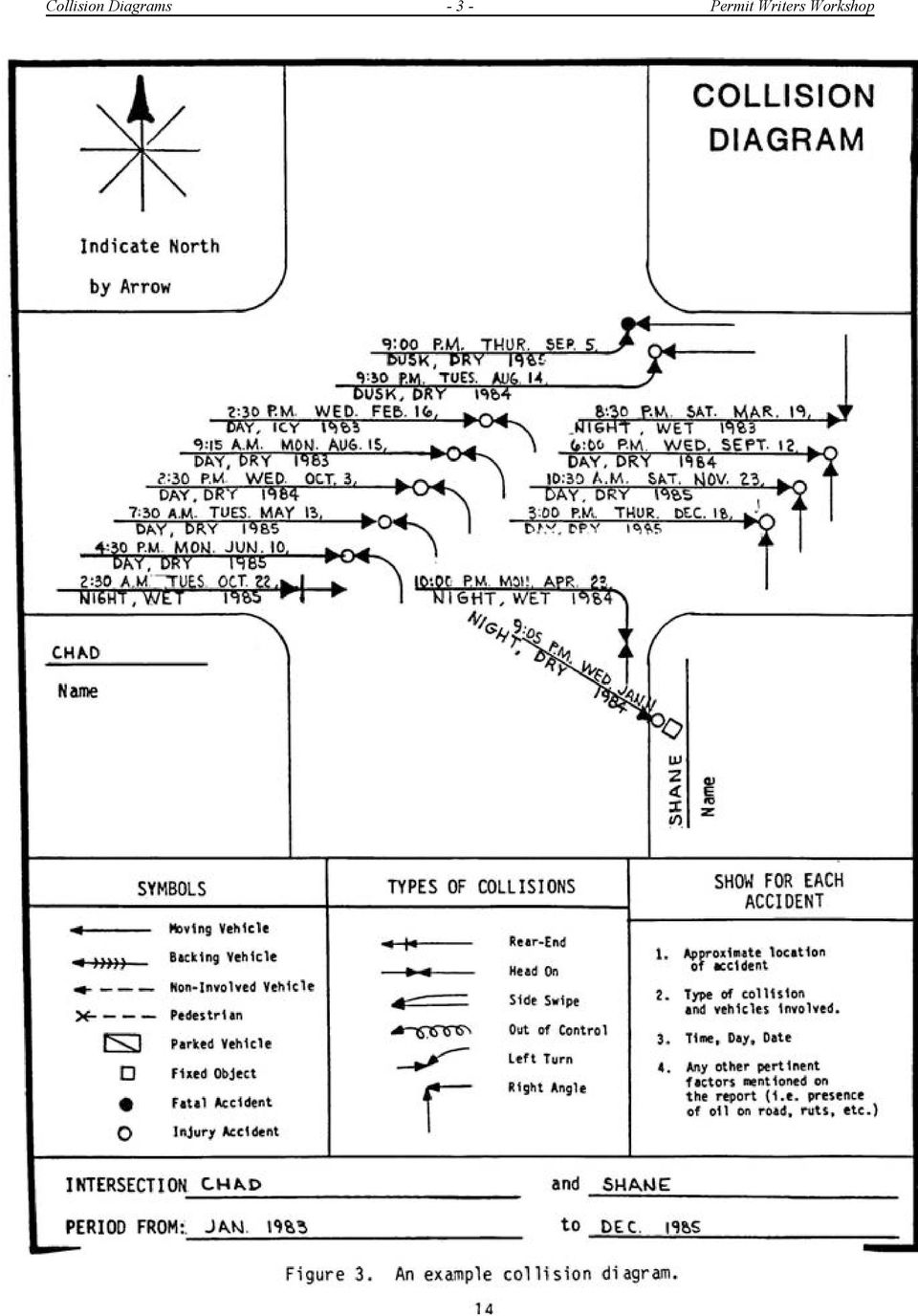
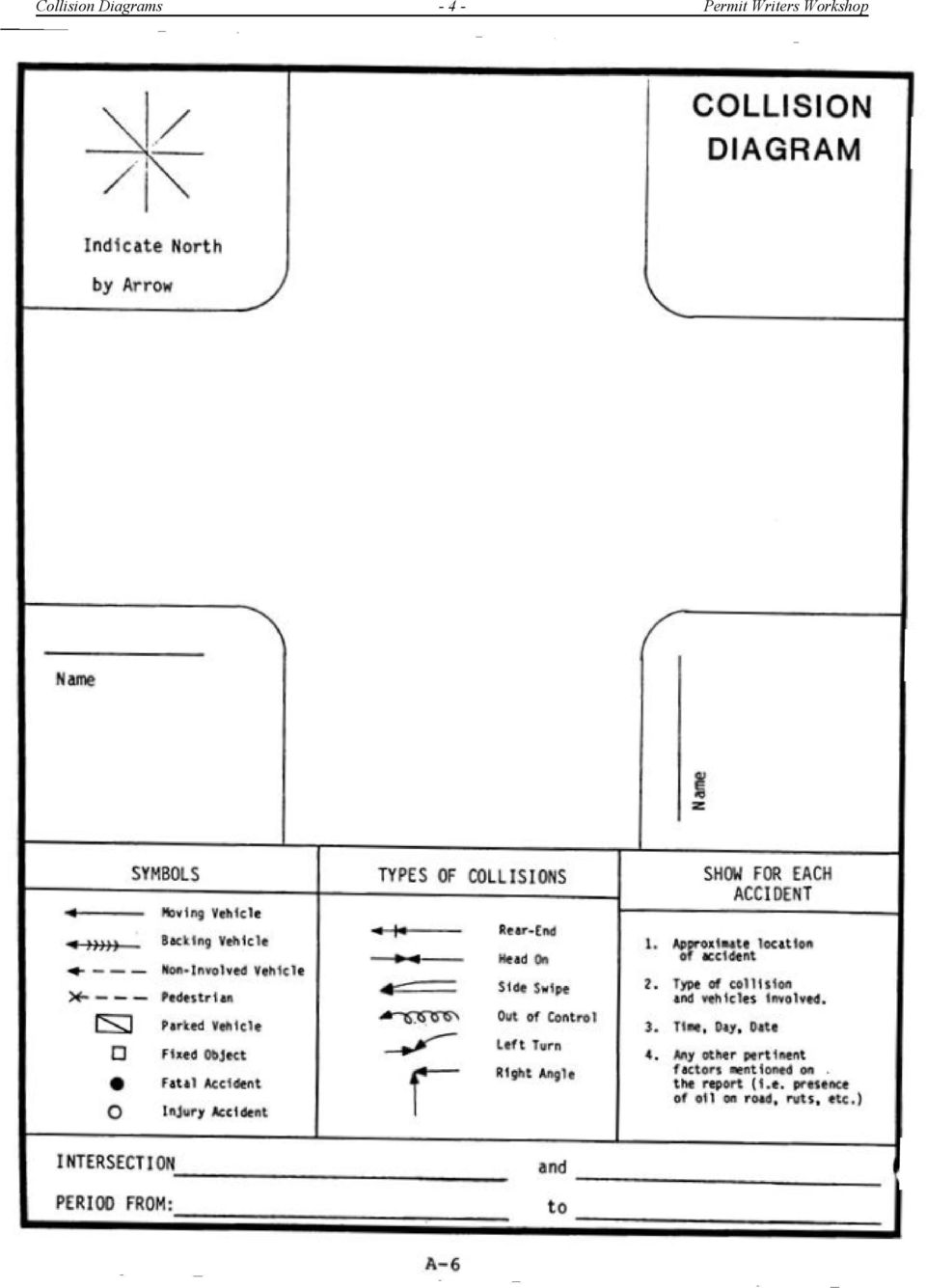
1 Collision Diagrams Collision diagrams are used to display and identify similar accident patterns. They provide information on the type and number of accidents; including conditions such as time of day, day of week, climatic conditions, pavement conditions, and other information critical to determining the causes of safety problems. Accident reports should be organized by year of occurrence and accident type for the analysis period. Accidents that occurred after significant changes in highway or local land use should not be included. A. Construction of Collision Diagram Sketch the location diagram for either an intersection or roadway section using a standard form, such as, shown on the following page. 1. The sketch need not be to scale. 2. Show the path of each vehicle involved in the accident with adequate room for information. 3. Place a north arrow for orientation and any other descriptive information: a. Location identification b. Period of analysis c. Label the roads 4. Sketch the path of each vehicle to show vehicle maneuver, type of collision and accident severity, and; a. Time of day b. Day of week c. Date d. Lighting condition e. Pavement condition f. Other important information, e.g., alcohol involvement

2 Collision Diagrams Permit Writers Workshop B. Symbols Symbols representing the nature of operation, vehicle or object involved and severity of the accident are adopted. These are shown in the example collision diagram on the following page. Symbols to represent types of collisions diagrams are also standardized. C. Accident Patterns Accident patterns seen on the collision diagram can often suggest possible accident problems. For example, a large number of angle accidents would imply the potential of a sight distance restriction. At the end of this set of notes is a set of Accident Pattern Tables which identify accident type, possible causes, possible studies to determine the problem, and possible countermeasures. Figures and Tables from Local Highway Safety Studies - User s Guide, USDOT-FHWA, 1986.

3 Collision Diagrams Permit Writers Workshop
4 Collision Diagrams Permit Writers Workshop
5 Collision Diagrams Permit Writers Workshop Table 1. Accident Pattern Tables Accident Type Possible Cause Possible Study Safety Enhancement Roadside features Determine sideslope Investigate recovery zone Provide traversable culvert and treatments Extend culverts Install/improve traffic barriers Flatten slopes and ditches Overturn Fixed Object Right-Angle Collisions at Unsignalized Intersections Right-Angle Collisions at Signalized Intersections Inadequate shoulder Determine shoulder dimensions and composition Check for shoulder drop-offs Check for potholes and rutting Relocate drainage facilities Upgrade shoulder surface Remove curbing/obstructions Widen lane/shoulder Pavement feature Eliminate edge drop-off Check for water ponding Improve Superelevation/crown Obstruction in or too close to Field observation to locate Delineation / reflectorize safety hardware roadway obstructions Remove/relocate obstacles Install breakaway features to light poles, sign posts, etc. Protect objects with guardrail Install crash cushions Inadequate lighting Check illumination Improve roadway lighting Inadequate pavement Review pavement Install reflectorized pavement lines/raised markers Inadequate signs, Review signs, delineators and delineators and guardrails guardrails Inadequate road design Slipper surface Restricted sight distance Check roadside shoulders and maintenance Check Superelevation Perform ball-bank study Check skid resistance Check for adequate drainage Field observation for sight obstructions Check roadway illumination Install reflectorized paint and/or reflectors on the fixed object Add special signing Upgrade barrier system Install warning signs/delineators Improve alignment/upgrade Proved proper Superelevation Provide wider lanes Provide adequate drainage Improve skid resistance Install warning signs (see MUTCD) Install stop signs (see MUTCD) Install yield signs (see MUTCD) Restrict parking near corners Remove sight obstructions Install signals (see MUTCD) Install/improve street lighting Channelize intersections Install signals (see MUTCD) Large total intersection Volume count on all approaches volume High approach speed Reduce speed limit on approaches if justified by spot speed study Install rumble strips Poor visibility of signals Inadequate signal timing Review existing signals and placement Field observation for sight obstructions Volume count on all approaches Review signal timing Install advanced warning devices (see MUTCD) Install visors Install back plates Reduce speed limit on approaches if justified by spot speed study Remove sight obstructions Add additional signal heads Install 12-in. signal lenses (see MUTCD) Improve location of signal heads Install overhead signals Adjust amber phase Provide all-red clearance phases Add multi-dial controller Install signal actuation Retime signals Provide progression through a set of signalized intersections

6 Collision Diagrams Permit Writers Workshop Table 1. Accident Pattern Tables Accident Type Possible Cause Possible Study Safety Enhancement Pedestrian crossing Review pedestrian signing and Install/improve signing or marking of pedestrian crosswalks crosswalk marking Driver not aware of Review signing Install/improve warning signs intersection Slippery surface Check skid resistance Check for adequate drainage Rear-End Collisions at Unsignalized Intersections Collisions at Railroad Crossings Night-Time Wet Pavement Collisions at driveways Large numbers of turning vehicles Perform turning count Perform volume count for through traffic Provide SLIPPERY WHEN WET signs Reduce speed limit on approaches if justified by spot speed study Provide adequate drainage Groove pavement Overlay pavement Prohibit turns Increase curb radii Create left- or right-turn lanes Restricted sight distance Review sight distance Install advance warning signs (see MUTCD) Remove sight obstructions Install train actuated signals (see MUTCD) Install gates (see MUTCD) Reduce grades Poor visibility Check roadway illumination Increase size of signs Inadequate pavement Review signing Review pavement Improve roadway lighting Install advance to supplement signs Install stop bars Install/improve pavement Rough crossing angle Check crossing surface Improve crossing surface Sharp angle crossing Check crossing angle Rebuild crossing with proper angle Improper pre-emption timing Review traffic signal timing Retime traffic signals of traffic signals, railroad Review railroad signal and gate Retime railroad signals and gates signals, or gates timing Poor visibility or lighting Check roadway illumination Install advance warning signs (see MUTCD) Remove sight obstructions Install train actuated signals (see MUTCD) Install gates (see MUTCD) Reduce grades Poor visibility or lighting Check roadway illumination Install/improve warning signs Install/improve delineation/ Install/improve street lighting Poor sign quality Review signing Upgrade signing Provide illuminated reflectorized signs Inadequate channelization or Review Install pavement delineation channelization/delineation Improve channelization/delineation Slippery pavement Check skid resistance Provide SLIPPERY WHEN WET signs Provide adequate drainage Groove existing pavement Overlay existing pavement Inadequate pavement Review pavement Install raised/reflectorized pavement Left-turning vehicles Perform turning count Install median divider Install two-way left-turn lanes Improperly located driveway Review driveway placement Regulate minimum spacing of driveways Regulate minimum corner clearance Move driveway to side street Install curbing to define driveway location Consolidate adjacent driveways Right-turning vehicles Perform turning counts Review parking Check driveway and lane width Check curb radii Restrict parking near driveways Increase the width of the driveway Increase curb radii Provide right-turn lanes Widen through lanes

7 Collision Diagrams Permit Writers Workshop Table 1. Accident Pattern Tables Accident Type Possible Cause Possible Study Safety Enhancement Large volume of through traffic Perform volume count for through traffic Move driveway to side street Construct a local service road Collisions with parked cars or cars being parked Sideswipe or head-on Run-off-road Pedestrian / bicycle Large volume of driveway traffic Restricted sight distance Inadequate road design Perform volume count for driveway traffic Perform gap study Field observation for sigh obstructions Review parking Check roadway illumination Check lane width Review angle parking Reroute through traffic Signalize driveway Provide acceleration and deceleration lanes Channelize driveway Restrict parking near driveway Install/improve street lighting Remove sign obstructions Change from angle to parallel parking Prohibit parking Widen lanes/shoulders Large parking turnovers Perform parking turnover study Prohibit parking Change from angle to parallel parking Create one-way streets Create off-street parking Improper pavement Review pavement Correct pavement Illegal parking Law observance study Enforcement Inadequate road design and/or maintenance Review lane width Check alignment Perform no passing study Check road surface for proper maintenance Perform necessary road surface repairs Sign and mark unsafe passing areas Provide roadside delineators Improve alignment/grade Provide wider lanes Provide passing lanes Inadequate shoulders Review road shoulders Improve shoulders Excessive vehicle speed Install median devices Inadequate pavement Review pavement Install/improve centerlines, lane lines and edgelines Install reflectorized markers Inadequate channelization Review channelization Install/improve channelization Install acceleration and deceleration lanes Provide turning bays Inadequate signing Review signing and placement Provide advance directions and warning signs Add illuminated name signs Slippery pavement / ponded water Roadway design inadequate for traffic conditions Check skid resistance Check for adequate drainage Check roadside shoulders and road maintenance Check Superelevation Perform ball-bank study Poor delineation Review pavement Review signs and placement Provide SLIPPERY WHEN WET signs Provide adequate drainage Groove existing pavement Overlay existing pavement Install/improve traffic barriers Close curb lane Flatten slopes/ditches Relocate islands Improve alignment/grade Provide proper Superelevation Provide escape ramp Widen lanes/shoulders Install roadside delineators Install advance warning signs Improve/install pavement Poor visibility Check roadway illumination Increase sign size Improve roadway lighting Improper channelization Review channelization Improve channelization Limited sight distance Check sight distance Remove sight obstructions Install/improve pedestrian crossing signs and Reroute pedestrian paths

8 Collision Diagrams Permit Writers Workshop Table 1. Accident Pattern Tables Accident Type Possible Cause Possible Study Safety Enhancement Inadequate protection Check existing protection Add pedestrian refuge islands Inadequate signals / signs Review signal/signs Install/upgrade signals/signs Inadequate signal phasing Review signal phasing Change timing of pedestrian phase Add pedestrian WALK phase Inadequate pavement Review pavement Supplement with signing Upgrade pavement Bridges Inadequate lighting Check roadway illumination Improve lighting Driver has inadequate warning of frequent midblock crossings Review existing parking Prohibit parking Install warning signs Install pedestrian barriers Lack of crossing opportunity Perform gap study Install traffic/pedestrian signals Install pedestrian crosswalk and signs Excessive vehicle speed Reduce speed limits Install proper warning signs Pedestrians/bicycles on roadway Long distance to nearest crosswalk Sidewalk to close to traveled way School crossing area Review existence of sidewalks Check distance and travel time to nearest crosswalk Review existing sidewalks Check pedestrian crossing time and available gaps Check school s safe route to and from school program Check school s crossing guard program Check school s student awareness program Eliminate roadside obstruction Install curb signs Install sidewalks Install bike lanes/paths Install pedestrian crosswalk Install pedestrian actuated signals Move sidewalk laterally away from roadway Establish safe route and awareness program Use school crossing guards Install crosswalks and traffic signals Alignment Check alignment Install advance warning signs Improve delineation/ Realign bridge/roadway Narrow roadway Visibility Review lane width Review signing Field observation for site obstruction Improve delineation/ Install signing/signals Widen structure Improve delineation/ Install advance warning signs Remove obstruction Vertical clearance Check clearance Improve delineation/ Install advance warning signs Provide height restrictor/warning device Rebuild structure/adjust roadway grade Slippery surface (wet/icy) Rough surface Inadequate barrier system Check skid resistance Check for adequate drainage Field observation and checks against established barrier standards Provide special signing Provide adequate drainage Improve skid resistance Resurface deck Rehabilitate joints Resurface deck Regrade approaches Improve delineation/ Remove hazardous curb Upgrade bridge rail Upgrade bridge approach rail connections Upgrade approach rail/terminals

9 Collision Diagrams Permit Writers Workshop

10 Collision Diagrams Permit Writers Workshop

11 Collision Diagrams Permit Writers Workshop

TREATMENTS FOR CRASHES ON RURAL TWO-LANE HIGHWAYS IN TEXAS
 TREATMENTS FOR CRASHES ON RURAL TWO-LANE HIGHWAYS IN TEXAS for Texas Department of Transportation by Texas Transportation Institute April 2002 Report 4048-2 Technical Report Documentation Page 1. Report
How To Design A Bicycle Path In California
 HIGHWAY DESIGN MANUAL 1000-1 CHAPTER 1000 BICYCLE TRANSPORTATION DESIGN Topic 1001 - Introduction Index 1001.1 Bicycle Transportation The needs of nonmotorized transportation are an essential part of all
ENGINEERING SOLUTIONS FOR DESIGNING YOUR SAFE ROUTES
 How to Get Started ENGINEERING SOLUTIONS FOR DESIGNING YOUR SAFE ROUTES Design Elements Selecting appropriate design treatments for school neighborhoods creates environments that address the needs of all
Surface Transportation Program (STP)
 Project Name: Project Sponsor: FEDERAL FUNDS PROJECT APPLICATION TRANSPORTATION IMPROVEMENT PROGRAM 2008-2013 SALT LAKE and OGDEN/ LAYTON URBAN AREAS Surface Transportation Program (STP) Urban Surface
ADA POST INSPECTION CHECKLIST. Job No. Route County Location
 ADA POST INSPECTION CHECKLIST Job No. Route County Location SIDEWALKS All sidewalks constructed within the project limits are ADA compliant. Sidewalks are 5 or greater in width. Exception, existing sidewalks
SECTION III-06 Surfacing Page 1 Revised 3/2/10. See the DESIGN GUIDELINES in Section I-06 for requirements for cross slope of the roadway.
 Page 1 Revised 3/2/10 See the DESIGN GUIDELINES in Section I-06 for requirements for cross slope of the roadway. For New/Reconstruction projects: The cross slope of the driving lanes range from 1.5% to
Table of Contents. Traffic Control Devices (Signs, Channelizing Devices, Lighting Devices, Pavement Markings) 2-7
 1 Table of Contents Introduction 2 Traffic Control Devices (Signs, Channelizing Devices, Lighting Devices, Pavement Markings) 2-7 Five Parts of a Traffic Control Zone 8 Buffer Space Guidance 9 Taper Length
 Walkable Communities Florida Department of Transportation State Safety Office Pedestrian and Bicycle Program April 1995 www.dot.state.fl.us/safety Twelve Steps for an Effective Program Page 1 Twelve Steps
CHAPTER 2B. REGULATORY SIGNS
 December 2000 Page 2B-1 CHAPTER 2B. REGULATORY SIGNS Section 2B.01 Application of Regulatory Signs Regulatory signs shall be used to inform road users of selected traffic laws or regulations and indicate
Chapter Forty-seven. RURAL TWO-LANE/MULTILANE STATE HIGHWAYS (New Construction/Reconstruction) BUREAU OF DESIGN AND ENVIRONMENT MANUAL
 Chapter Forty-seven RURAL TWO-LANE/MULTILANE STATE HIGHWAYS (New Construction/Reconstruction) BUREAU OF DESIGN AND ENVIRONMENT MANUAL Illinois RURAL TWO-LANE/MULTILANE STATE HIGHWAYS December 2009 2 Illinois
Delineation. Section 4 Longitudinal markings
 Delineation Section 4 Longitudinal markings The delineation guidelines have been developed to assist in designing and maintaining a quality delineation system. The guidelines are to comprise 19 sections
Accident Analysis of Sheridan Road between Isabella Street and South Boulevard
 Accident Analysis of Sheridan Road between Isabella Street and South Boulevard Prepared for TranSystems Corporation for the City of Evanston Submitted by Regina Webster & Associates, Inc. Date: 08/15/2008
SIGHT DISTANCE. Presented by Nazir Lalani P.E. Traffex Engineers Inc. [email protected] WHY IS SIGHT DISTANCE SO IMPORTANT?
 SIGHT DISTANCE Presented by Nazir Lalani P.E. Traffex Engineers Inc. [email protected] WHY IS SIGHT DISTANCE SO IMPORTANT? Drivers must be able to: Stop for objects in the roadway Stop for stationary
Revised January 2015. Bicycle Policy & Design Guidelines Maryland State Highway Administration
 Revised January 2015 Bicycle Policy & Design Guidelines Maryland State Highway Administration RECORD OF CHANGES TO THE MAY 2013 BICYCLE POLICY & DESIGN GUIDELINES Introduction The 2013 Bicycle Policy &
Designing Pedestrian Facilities for Accessibility. ADA Compliance Training. Local Programs Engineer FHWA NJ Division
 Keith et P. Skilton Local Programs Engineer FHWA NJ Division 840 Bear Tavern Road, Suite 310 West Trenton, NJ 08628 Phone: 609-637-4203 Fax: 609-538-4919 [email protected] Note: Pictures may depict
Crash Analysis. Identify/Prioritize. Gather Data. Analyze Crashes and Identify Improvements. Review Funding Options. Implement Improvements
 Crash Analysis Identify/Prioritize 1. Find high crash areas 2. Review citizen input 3. Access City/County Safety Improvement Candidate Locations Gather Data 1. Use DOT-provided crash analysis programs
TABLE OF CONTENTS TABLES FIGURES
 TABLE OF CONTENTS Introduction...1 1. On-Site Stacking...2 2. Number of School Driveways...2 3. School Driveway Standards...3 3A. Driveway Spacing...3 3B. Driveway Location...4 3C. Driveway Lane Widths
Guidelines. Motorcycle and Bicycle Work Zone Safety
 Guidelines on Motorcycle and Bicycle Work Zone Safety This document describes work zone conditions that can cause safety concerns for motorcyclists and bicyclists. The document offers recommended practices
INITIAL SITE INSPECTION OF MOTORCYCLE COLLISIONS WITH ROADSIDE OBJECTS IN NEW JERSEY
 INITIAL SITE INSPECTION OF MOTORCYCLE COLLISIONS WITH ROADSIDE OBJECTS IN NEW JERSEY Allison Daniello Ben Powell Nicholas Schaeffer Aaliyah McClinton Yusuf Mehta Rowan University United States Kimberly
Bicycle Safety Quiz Answers Parental Responsibilities
 Bicycle riding is a great way to get into shape and enjoy the outdoors. To remain safe on Illinois roads, it is important to follow the same traffic safety laws that govern vehicle drivers. No amount of
Goals & Objectives. Chapter 9. Transportation
 Goals & Objectives Chapter 9 Transportation Transportation MISSION STATEMENT: TO PROVIDE A TRANSPORTATION NETWORK CAPABLE OF MOVING PEOPLE AND GOODS EFFICIENTLY AND SAFELY. T he transportation system
TEST ON Driving Safely Among Bicyclists and Pedestrians
 TEST ON Driving Safely Among Bicyclists and Pedestrians Next you will take a 16 question test about driving safely among bicyclists and pedestrians. Please take out a sheet of paper to mark down and score
California Crossing Guard Training: Online Course Part 2
 California Crossing Guard Training: Online Course Part 2 Prepared by the Safe Routes to School Technical Assistance Resource Center The Safe Routes to School Technical Assistance Resource Center is a program
APPLICATION LAFAYETTE METROPOLITAN PLANNING ORGANIZATION (MPO) SURFACE TRANSPORTATION PROGRAM (STP) FUNDS TRANSPORTATION IMPROVEMENT PROGRAM (TIP)
 APPLICATION LAFAYETTE METROPOLITAN PLANNING ORGANIZATION (MPO) SURFACE TRANSPORTATION PROGRAM (STP) FUNDS TRANSPORTATION IMPROVEMENT PROGRAM (TIP) To be considered for STP funding, a proposed project must
Bicycle riding is a great way to get into shape
 Bicycle riding is a great way to get into shape and have fun. To remain safe on Illinois roads, it is important to follow the same traffic safety laws that govern vehicle drivers. No amount of bicycle
NASHVILLE BICYCLE LAW 3/18/09
 NASHVILLE BICYCLE LAW 3/18/09 12.60.010 Compliance with Title 12 provisions. It is unlawful for any person to do any act prohibited or fail to perform any act required by Title 12 of this code. (Prior
KENTUCKY TRANSPORTATION CABINET POLICY FOR FEDERALLY FUNDED PAVEMENT REHABILITATION AND PREVENTATIVE MAINTENANCE PROJECTS
 KENTUCKY TRANSPORTATION CABINET POLICY FOR FEDERALLY FUNDED PAVEMENT REHABILITATION AND PREVENTATIVE MAINTENANCE PROJECTS I. GENERAL The following policy shall apply when the intent of the project is to
CAPACITY AND LEVEL-OF-SERVICE CONCEPTS
 CHAPTER 2 CAPACITY AND LEVEL-OF-SERVICE CONCEPTS CONTENTS I. INTRODUCTION...2-1 II. CAPACITY...2-2 III. DEMAND...2-2 IV. QUALITY AND LEVELS OF SERVICE...2-2 Service Flow Rates...2-3 Performance Measures...2-3
These "rules of the road" are based on Texas Transportation Code statutes. Find the complete bicycle code at the bottom of the page
 Texas Bicycle Laws These "rules of the road" are based on Texas Transportation Code statutes. Find the complete bicycle code at the bottom of the page Bicyclists have the rights and duties of other vehicle
UNEP recommendations to KURA on Improving Safety and Reducing Congestion on UN Avenue (7 October 2009; revised 23 November 2009)
 UNEP recommendations to KURA on Improving Safety and Reducing Congestion on UN Avenue (7 October 2009; revised 23 November 2009) UN Avenue extends for 2 km between Limuru Road and Ruaka Road (Runda Roundabout).
Safety Evidence for Bicycling
 Photo: Boegh (Flickr) Cycling in Cities Research Program School of Population & Public Health The University of British Columbia Faculty of Health Sciences Simon Fraser University Driving near bicyclists
Right-In Right-Out Channelization
 Right-In Right-Out Channelization Discussion Paper No. 13 prepared for Oregon Department of Transportation Salem, Oregon by Ahmet Aksan, Research Assistant Robert Layton, Professor Transportation Research
CHAPTER 10 SCHOOL AREA PEDESTRIAN SAFETY
 STATE OF CALIFORNIA BUSINESS, TRANSPORTATION AND HOUSING DEPARTMENT OF TRANSPORTATION TRAFFIC MANUAL CHAPTER 10 AREA PEDESTRIAN SAFETY 10-00 - Introduction, General Provisions, Table of Contents and List
Stop The stop sign, a red octagon with white lettering, means come to a full stop and be sure the way is clear before proceeding.
 Tr a f f i c S i g n s 7 7. TRAFFIC SIGNS Many collisions and near crashes occur as a result of drivers who ignore or fail to respond appropriately to traffic signs. It is essential that the meaning of
Road Signs Recognition Quiz
 Road Signs Recognition Quiz Place your answer for each of the signs/pavement markings on the answer sheet. Ready to Roll? Here Comes Sign # 1... #1 A No right turn B Right turn only C Warning, no turn
WYDOT Quick Facts TRAFFIC SIGNALS
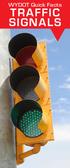 TRAFFIC SIGNALS WYDOT Quick Facts 2 Advantages of traffic signals WYDOT Quick Facts Traffic signals control vehicle and pedestrian traffic by assigning priorities to various traffic movements to influence
Alberta Guidelines for Upgrading Bridgerails and Approach Guardrail Transitions
 Alberta Guidelines for Upgrading Bridgerails and Approach Guardrail Transitions Raymond Yu Alberta Transportation Bob Ramsay UMA Engineering Ltd Clive Clarke Alberta Transportation Bill Kenny Alberta Transportation
PEDESTRIAN LAWS OF NORTH CAROLINA
 PEDESTRIAN LAWS OF NORTH CAROLINA Under North Carolina law, pedestrians have the right of way at all intersections and driveways. However, pedestrians must act responsibly, using pedestrian signals where
, standards covering a particular sign or group of signs. For use of educational plaques with symbol signs see section 2A-13.
 6. REGULATORY SIGNS 2B-1 Application of Regulatory Signs Regulatory signs inform highway users of traffic laws or regulations and indicate the applicability of legal requirements that would not otherwise
Walking and Working Surface Checklist:
 Walking and Working Surfaces Purpose: This information is presented to improve the level of safety in our operations, and to inform you that we will comply with the OSHA Standard 29 CFR 1910.23. Responsibility:
Accident Investigation Codes
 Accident Investigation Codes Accident Codes after 7/1/2000 1-Weather Conditions 1 Fog, Smog, Smoke 2 Sleet, Hail, Freezing Rain, Drizzle 3 Blowing Snow 4 Severe Crosswinds, Windy 5 Clear 6 Cloudy 7 Rain
City of Auburn Americans with Disabilities Act (ADA) Transition Plan for Curb Ramps, Sidewalks, and Pedestrian Signals ADA TRANSITION PLAN
 Americans with Disabilities Act (ADA) Transition Plan for Curb Ramps, Sidewalks, and Pedestrian Signals ADA TRANSITION PLAN December 21, 2009 Public Works Department 171 N. Ross Street, Suite 200 Auburn,
CHART OF MOVING VIOLATIONS
 CHART OF MOVING VIOLATIONS The following chart lists the moving violations that are designated by the Texas Department of Public Safety pursuant to statutory authority. The violations listed are subject
GEOMETRIC DESIGN CIVL 3161
 GEOMETRIC DESIGN CIVL 3161 Reading Assignment: p. 45-72 (4 th ed.) p.45-75 (previous ed.) in Mannering textbook. Geometric design of highway facilities deals with the proportion of physical elements of
6: LANE POSITIONS, TURNING, & PASSING
 6: LANE POSITIONS, TURNING, & PASSING BASIC LANE POSITIONS Traffic law says that slower vehicles should stay to the right. But where exactly should bicycles ride? Here are some basics. Never Ride Against
APPENDIX C INLETS. The application and types of storm drainage inlets are presented in detail in this Appendix.
 Storm Drainage 13-C-1 APPENDIX C INLETS 1.0 Introduction The application and types of storm drainage inlets are presented in detail in this Appendix. 2.0 Inlet Locations Inlets are required at locations
A Guide to School Area Safety February 2009. Oregon Department of Transportation
 A Guide to School Area Safety February 2009 A Guide to School Area Safety February 2009 a publication of the OREGON DEPARTMENT OF TRANSPORTATION TRAFFIC ENGINEERING & OPERATIONS SECTION AND TRAFFIC SAFETY
ILLINOIS STATUTES REGARDING BICYCLES Updated March 2009
 ILLINOIS STATUTES REGARDING BICYCLES Updated March 2009 ILLINOIS VEHICLE CODE 625 ILCS 5/ "Every person riding a bicycle upon a highway shall be granted all of the rights and shall be subject to all of
Temporary Traffic Control for Building and Maintaining Single and Multi-Lane Roundabouts
 Purpose and Background Temporary Traffic Control for Building and Maintaining Single and Multi-Lane Roundabouts Although roundabouts have recently gained popularity and use in the United States, minimal
PREVENTABILITY OF MOTOR VEHICLE COLLISIONS
 PREVENTABILITY OF MOTOR VEHICLE COLLISIONS Management and fleet supervisors should establish standards for defensive driving in any type of fleet safety program. The overall performance of the drivers
a U.S. Department of Transportation National Highway Traffic Safety Administration Computer Accident Typing for Bicyclist Accidents Coder's Handbook
 a U.S. Department of Transportation National Highway Traffic Safety Administration Computer Accident Typing for Bicyclist Accidents Coder's Handbook INTRODUCTION This Coder's Handbook is part of a package
Table of Contents (Continued) 13-5.01 Warrants... 13-5(1) 13-5.02 Median Barrier Types... 13-5(1)
 December 2003 ROADSIDE SAFETY 13(i) Chapter Thirteen ROADSIDE SAFETY Table of Contents Section Page 13-1.0 DEFINITIONS... 13-1(1) 13-2.0 CLEAR ZONES... 13-2(1) 13-2.01 Background... 13-2(1) 13-2.02 Application...
KENTUCKY TRANSPORTATION CABINET. Department of Rural and Municipal Aid. Office of Local Programs
 KENTUCKY TRANSPORTATION CABINET Department of Rural and Municipal Aid Office of Local Programs Office of Local Programs Transportation Enhancements Safe Routes to School Congestion Mitigation and Air Quality
FLORIDA BICYCLE LAW ENFORCEMENT GUIDE
 FLORIDA BICYCLE LAW ENFORCEMENT GUIDE A review of Florida s bicycle traffic laws to help with warnings, citations and crash reports July 2007 All citations are to the 2007 Florida Statutes Bicycles are
TRAFFIC ACCIDENT STUDY GUIDE 2010
 TRAFFIC ACCIDENT STUDY GUIDE 2010 SECTION SEVEN This study guide is designed to provide the law enforcement Explorer with basic principles. The guide is not all inclusive, and does not delineate specific
PART I TRAFFIC VIOLATIONS
 PART I TRAFFIC VIOLATIONS A. MOTOR VEHICLE STATUTES N.J.S.A. 39:3-4 Driving or parking unregistered motor vehicle 39:3-9a Failure to notify change in name $22 39:3-9a Failure to endorse license $42 39:3-10
COURTING YOUR BICYCLE AND PEDESTRIAN FACILITIES... FROM A FORENSIC ENGINEERING AND PLANNING PERSPECTIVE
 COURTING YOUR BICYCLE AND PEDESTRIAN FACILITIES... FROM A FORENSIC ENGINEERING AND PLANNING PERSPECTIVE 1 PRESENTED BY: J.M. TEAGUE ENGINEERING, PLLC 2 OBJECTIVES 1. What is Transportation Forensic Engineering
Road Rehabilitation and Reconstruction Using AutoCAD Civil 3D
 Road Rehabilitation and Reconstruction Using AutoCAD Civil 3D Contents Introduction... 3 Introduction to Corridor Targets... 3 Surface Targets... 4 Width and Offset Targets... 5 Elevation or Slope Targets...
A Guide to Safe Bicycling in Hawai i
 A Guide to Safe Bicycling in Hawai i Sharing the Road: A Guide to Safe Bicycling in Hawai i What Motorists & Bicyclists Should Know Everyone has the right to be safe on Hawai i s roads. Law of the Splintered
SAFE CYCLING GUIDE. 7th Edition
 SAFE CYCLING GUIDE 7th Edition BEFORE SETTING OUT A Check tire pressure B Check that the chain does not slip C Check the brakes D Check lights and reflectors: 1 A WELL-MAINTAINED BICYCLE is key 3 4 5 Adjust
Bicycle Safety Enforcement Action Guidelines
 Introduction Bicycle Safety Enforcement Action Guidelines People ride bicycles for many different reasons: fitness, recreation, or for transportation. Regardless of the reason for riding, bicyclists young
LIMITED SCOPE CONCEPT DEVELOPMENT REPORT
 LIMITED SCOPE CONCEPT DEVELOPMENT REPORT Route 33 Resurfacing Project Eastbound: Milepost 24.2 to Milepost 28.9 Westbound: Milepost 24.3 to Milepost 28.9 Manalapan & Freehold Townships, Monmouth County
ASSET MANAGEMENT GUIDE FOR PROJECT DESIGN FORMAT
 ASSET MANAGEMENT GUIDE FOR PROJECT DESIGN FORMAT 1. BACKGROUND There has been an increasing awareness of design features, which produce poor whole-of-life costs. These poor whole-of-life costs manifest
Sign Installation Guide
 United States Department of Agriculture Forest Service Technology & Development Program 7100 Engineering July 2003 0371-2812-MTDC In cooperation with United States Department of Transportation Federal
Safety Engineering Policy Memorandum
 Safety Engineering Policy Memorandum SAFETY 2-13 Automated Traffic Law Enforcement Systems: Red Light Running (RLR) Camera Enforcement Systems and Automated Railroad Grade Crossing (RGC) Enforcement Systems
ANNOTATED CODE OF MARYLAND TRANSPORTATION Bicycle Related Definitions and Laws
 ANNOTATED CODE OF MARYLAND TRANSPORTATION Bicycle Related Definitions and Laws TITLE 8 HIGHWAYS Subtitle 1 Definitions; General Provisions 8-101 Definitions (a) In general. In this title the following
BICYCLE AND IN-LINE SKATE LAWS ROAD SHARING RESPONSIBILITIES OF BICYCLISTS AND MOTORISTS, REQUIRED EQUIPMENT AND PARENTAL RESPONSIBILITY
 BICYCLE AND IN-LINE SKATE LAWS ROAD SHARING RESPONSIBILITIES OF BICYCLISTS AND MOTORISTS, REQUIRED EQUIPMENT AND PARENTAL RESPONSIBILITY The statutes in this material have been generated from the database
Reference Guide to Work Zone Traffic Control Texas Engineering Extension Service (TEEX)
 Reference Guide to Work Zone Traffic Control Texas Engineering Extension Service (TEEX) Infrastructure Training & Safety Institute (ITSI) Material in this guide is largely extracted from the March, 2006
Atlanta, Georgia Road Test
 1. When driving your car Into traffic from a parked position, you should: A. Sound your horn and pull Into the other lane. B. Signal and proceed when safe. C. Signal other traffic and pull directly into
PEDESTRIAN SAFETY AND LAWS IN PENNSYLVANIA
 PEDESTRIAN SAFETY AND LAWS IN PENNSYLVANIA Gary N. Modi, P.E., Chief Safety Management Division Bureau of Highway Safety & Traffic Engineering & Christopher A. Drda, P.E., Chief Consultant Agreement Section
Chapter 4 DEFENSIVE DRIVING
 Chapter 4 DEFENSIVE DRIVING Chapter 4 Table of Contents Chapter 4 DEFENSIVE DRIVING... 4-1 DEFENSIVE DRIVING... 4-3 Positioning The Bus... 4-3 When Making a Turn at an Intersection... 4-3 Making the perfect
Transportation Infrastructure Asset Management
 2015 NW Region TTAP& BIA Symposium Transportation Infrastructure Asset Management March, 2015 Happy Longfellow, PE [email protected] (206) 394-3649 ASSET MANAGEMENT OVERVIEW What? Why? How? Inventory
SEMINOLE PRATT WHITNEY ROAD & NORTHLAKE BLVD. FREQUENTLY ASKED QUESTIONS
 UPDATED: 01/31/14 SEMINOLE PRATT WHITNEY ROAD & NORTHLAKE BLVD. FREQUENTLY ASKED QUESTIONS Q. 1. What are the County s plans for Seminole Pratt Whitney Road between SR 80 (Southern Blvd) and the Bee Line
Principles of Road and Traffic Engineering Designs for Mixed Traffic Flow with a Numerous Motorcycles
 Principles of Road and Traffic Engineering Designs for Mixed Traffic Flow with a Numerous Motorcycles Dr. Ming-Heng Wang Assistant Professor, Department of Transportation Technology and Management, Kainan
ROAD SAFETY GUIDELINES FOR TAH ROAD INFRASTRUCTURE SAFETY MANAGEMENT
 I. GENERAL ROAD SAFETY GUIDELINES FOR TAH ROAD INFRASTRUCTURE SAFETY MANAGEMENT ANNEX III B i. The setting up and implementing of appropriate management procedures is an essential tool for improving the
Assessing Paved Trails for Compliance with Standards and Best Practices
 Assessing Paved Trails for Compliance with Standards and Best Practices Session Presenters: Kristin Maravilla, Planner/Designer Masters in Landscape Architecture (UC Berkeley) Masters in City and Regional
BIKE AND PEDESTRIAN CRASH SURVERY
 This survey includes questions regarding biking activity, accidents, and injuries, as well as the answer options provided by the Nashville MPO. Introduction 1. Have you ridden a bicycle within the past
Walking Route the assigned or authorized route a pupil walks to arrive at school or at the designated bus stop.
 BUSINESS NON-INSTRUCTION OPERATION 3541 TRANSPORTATION I. GENERAL It is the goal of the Board of Education to establish for the public schools an appropriate transportation system one which will enable
Signs, Pavement Markings, and Work Zones. Signs, Pavement Markings, and Work Zones
 Signs, Pavement 3 Signs, Pavement 77 3 Signs, Pavement This chapter includes information on highway signs that are intended to guide and inform you while you are driving. It includes information on the
Summary of Bicycle Ordinances Tulsa Metropolitan Region. Passing requirement. Use of permanent seat
 May 2009 Updated 10/2011 Summary of Bicycle Ordinances Tulsa Metropolitan Region Mandatory Sidepath Two Abreast Bicycles considered vehicles Passing requirement Use of permanent seat Ride as far to the
LOCATION AND DESIGN DIVISION
 VIRGINIA DEPARTMENT OF TRANSPORTATION LOCATION AND DESIGN DIVISION INSTRUCTIONAL AND INFORMATIONAL MEMORANDUM GENERAL SUBJECT: DESIGN EXCEPTIONS / WAIVERS SPECIFIC SUBJECT: DESIGN EXCEPTION REQUEST FORM
Tennessee Traffic Laws Relating to Bicycles A HANDBOOK FOR MOTORISTS & BICYCLISTS
 Tennessee Traffic Laws Relating to Bicycles A HANDBOOK FOR MOTORISTS & BICYCLISTS About the Knoxville Regional Bicycle Program The Knoxville Regional Transportation Planning Organization (TPO) coordinates
BEST PRACTICES. Smart Transportation is a key concept for the Paoli Roadway Improvement Project.
 Smart Transportation Smart Transportation is a key concept for the Paoli Roadway Improvement Project. PennDOT s Smart Transportation Guidebook (2008) outlines a comprehensive approach to transportation
Exhibit A Scope of Work
 Exhibit A Scope of Work The agreement for S.P. 3116-142 (T.H. 169-Cross Range Expressway) includes final design plans for a 1.55 mile length of a 2 lane to 4 lane expansion project located 0.66 miles SW
SAFE CYCLING GUIDE. 6th Edition
 SAFE CYCLING GUIDE 6th Edition BEFORE SETTING OUT A WELL-MAINTAINED BICYCLE is key A Check tire pressure B Check that the chain does not slip C Check the brakes D Check lights and reflectors: 3 4 1 5 2
De Beers Canada Inc. OP 050 SLIPS, TRIPS, FALLS AND PEDESTRIAN SAFETY - SURFACE
 1. Purpose And Scope To establish safe procedures for pedestrians travelling on sites, in plants, on roads in offices or the general area of the workplace. 2. Responsibilities Responsible Person All Personnel
Pedestrian & Bicycle Roadway Design Safe, Smart and Defendable
 Pedestrian & Bicycle Roadway Design Safe, Smart and Defendable Josh DeBruyn Bicycle and Pedestrian Coord. Michigan Dept. of Transportation Ronald W. Emery Transportation Division Dept. of Attorney General
The partnership has selected three intersections where enforcement, education, and engineering initiatives are being implemented to improve safety:
 Hamilton-Finn Suite 310 Tel. (403) 207-6000 Road Safety 3016 5th Avenue N.E. Fax. (403) 273-3440 Consultants Ltd. Calgary, Alberta dawatt.dawatt.com www.hamiltonfinn.ca January 19, 2005 Mr. Don Szarko,
APPENDIX A Dallas-Fort Worth Region Transportation System Management Strategies and Projects
 APPENDIX A Transportation System Management Strategies and Projects Transportation System Transportation System Management Projects Management Strategies Traffic Signalization and Control New Signal Installation
Safe Driving Rules & Regulations
 Chapter 4 58 60 61 61 62 62 64 65 Speed Control Passing Keeping to the Right Yielding the Right-of-Way Pedestrians in a Crosswalk Intersections Entering Highways, Parkways and Turnpikes Leaving Highways,
- FREE! - The Official San Francisco BIKE GUIDE. 1st Edition
 - FREE! - The Official San Francisco BIKE GUIDE 1st Edition SF BIKE LAWS SAN FRANCISCO BICYCLISTS MUST: Yield to People Walking Whether they re in a crosswalk or not, ALWAYS yield to people walking. Stop
How To Know The Laws Of A Bike Ride In California
 The Rules Of The Road For Colorado Cyclists Your Rights and Responsibilities as a Colorado Cyclist Crawford Weiss, LLC Phone (303) 741-0249 www.denversaccidentlawyer.com 2015 The Rules Of The Road For
CHAPTER 11: PEDESTRIAN SIGNS AND SIGNALS
 CHAPTER 11: PEDESTRIAN SIGNS AND SIGNALS Traffic signs and signals should be useful for all pedestrians. It is essential to provide signals that are phased and timed to allow senior citizens, children,
Topic 2 11/28/2012 Blocks & Street Network
 TOPIC 2 Blocks & Street Network Implementation Note: 1. Some recommendations are summarized in the tables herein. For complete recommendation language, please see the. 2. Recommendations referenced in
Access Management Manual
 Access Management Manual July 2011 2011 by Texas Department of Transportation (512) 302-2453 all rights reserved Manual Notice 2011-1 From: Manual: Mark A Marek, P.E. Access Management Manual Effective