
Five 5. Rational Expressions and Equations C H A P T E R
|
|
|
- Brianne Green
- 10 years ago
- Views:
Transcription
1 Five C H A P T E R Rational Epressions and Equations. Rational Epressions and Functions. Multiplication and Division of Rational Epressions. Addition and Subtraction of Rational Epressions.4 Comple Fractions. Rational Equations.6 Applications of Rational Equations.7 Division of Polynomials Chapter Summary I n this chapter, we will eamine rational epressions, which are fractions whose numerator and denominator are polynomials. We will learn to simplify rational epressions and how to add, subtract, multiply, and divide two rational epressions. Rational epressions have many applications, such as determining the maimum load that a wooden beam can support, finding the illumination from a light source, and solving work rate problems. Study Strategy Test Taking To be successful in a math class, as well as understanding the material, you must be a good test taker. In this chapter, we will discuss the test-taking skills necessary for success in a math class.
2 Chapter Rational Epressions and Equations. Rational Epressions and Functions Objectives Evaluate rational epressions. Find the values for which a rational epression is undefined. Simplify rational epressions to lowest terms. 4 Identify factors in the numerator and denominator that are opposites. Evaluate rational functions. 6 Find the domain of rational functions. 44 A rational epression is a quotient of two polynomials, such as. The 6 denominator of a rational epression must not be zero, as division by zero is undefined. A major difference between rational epressions and linear or quadratic epressions is that a rational epression has one or more variables in the denominator. Evaluating Rational Epressions Objective Evaluate rational epressions. We can evaluate a rational epression for a particular value of the variable just as we evaluated polynomials. We substitute the value for the variable in the epression and then simplify. When simplifying, we evaluate the numerator and denominator separately, and then simplify the resulting fraction. Classroom Eample Evaluate the rational epression 8 4 for 6. Answer: 4 Quick Check Evaluate the rational 6 epression 7 4 for. EXAMPLE Evaluate the rational epression We begin by substituting 4 for Substitute 4 for. for 4. Simplify each term in the numerator and denominator. Note: 4 6. Simplify the numerator and denominator. Simplify. 0 8 Finding Values for Which a Rational Epression Is Undefined Objective Find values for which a rational epression is undefined. Rational epressions are undefined for values of the variable that cause the denominator to equal 0, as division by 0 is undefined. In general, to find the values for which a rational epression is undefined, we set the denominator equal to 0, ignoring the numerator, and solve the resulting equation.

3 . Rational Epressions and Functions Classroom Eample Find the values for which the rational 49 epression is 4 undefined. Answer: 6, 9 Quick Check Find the values for 6 which is 9 8 EXAMPLE Find the values for which the rational epression is undefined. We begin by setting the denominator,, equal to 0 and then we solve for. 0 Set the denominator equal to 0. Add to both sides of the equation. Divide both sides by. 8 The epression is undefined for. undefined. 9 Quick Check Find the values for 4 7 which is 0 undefined., 7 EXAMPLE 9 Find the values for which is undefined. 40 We begin by setting the denominator 40 equal to 0, ignoring the numerator. Notice that the resulting equation is quadratic and can be solved by factoring Set the denominator equal to 0. Factor or 8 0 Set each factor equal to 0. or 8 Solve. 9 The epression is undefined when or Simplifying Rational Epressions to Lowest Terms Objective Simplify rational epressions to lowest terms. Rational epressions are often referred to as algebraic fractions. As with numerical fractions, we will learn to simplify rational epressions to lowest terms. In later sections, we will learn to add, subtract, multiply, and divide rational epressions. We simplified a numerical fraction to lowest terms by dividing out factors that were 0 common to the numerator and denominator. For eample, consider the fraction 84. To simplify this fraction, we could begin by factoring the numerator and denominator # # # # # 7 The numerator and denominator have common factors of and, which are divided out to simplify the fraction to lowest terms. # # # # # 7 # 7 or 4

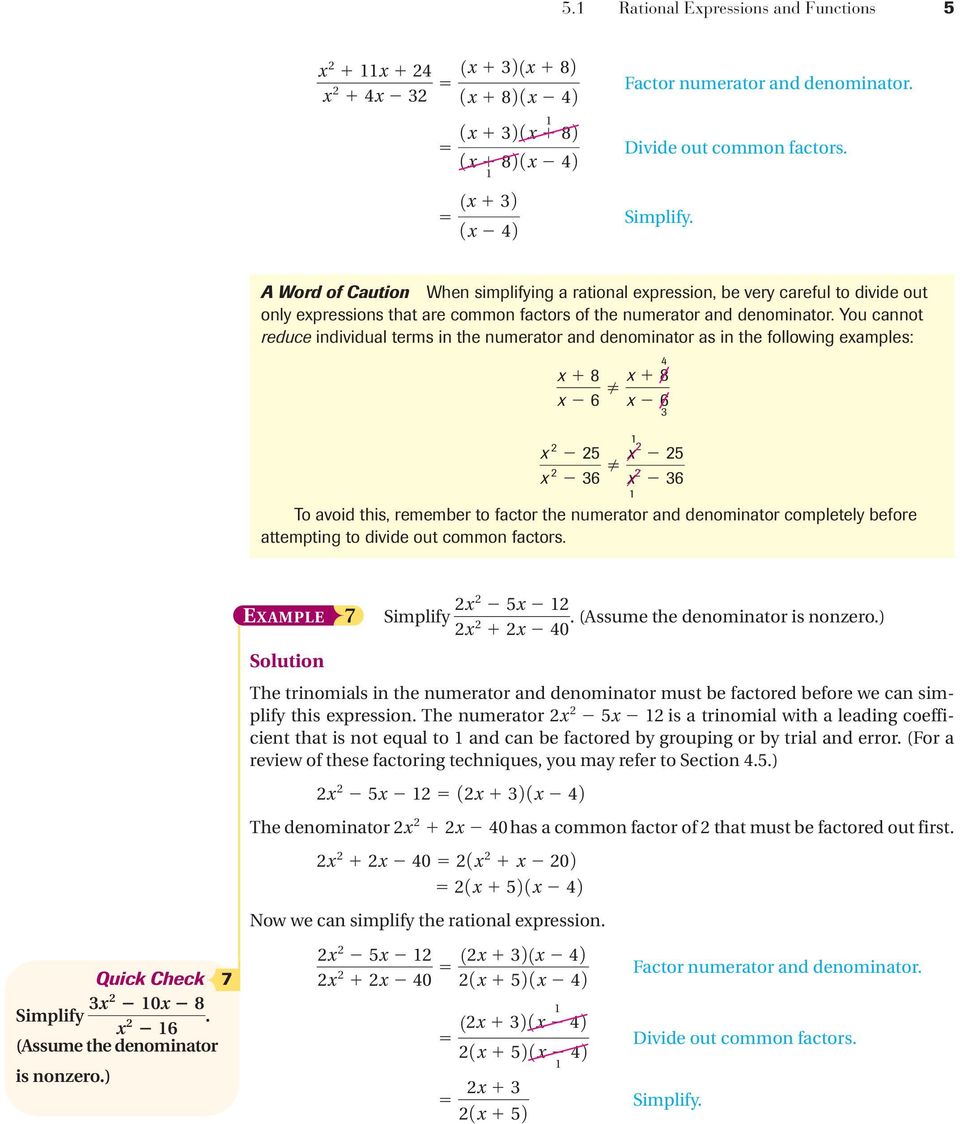
4 4 Chapter Rational Epressions and Equations Simplifying Rational Epressions To simplify a rational epression to lowest terms, we first factor the numerator and denominator completely. Then we divide out common factors in the numerator and denominator. If P, Q, and R are polynomials, Q 0, and R 0, then PR QR P Q. Classroom Eample Simplify the rational epression 6 8. Answer: 4 7 EXAMPLE 4 4 Simplify the rational epression (Assume 0. ) 6. 7 This rational epression has a numerator and denominator that are monomials. In this case, we can simplify the epression using the properties of eponents developed in Chapter 4. Quick Check 4 Simplify the rational 8 6 epression 8. (Assume u 0. ) Divide out the common factor. Divide numerator and denominator by 4. EXAMPLE 4 6 Simplify (Assume the denominator is nonzero.) 6 4. In this eample the numerator and denominator have already been factored. Notice that they share the common factors 4 and 6. Quick Check Simplify ( )( )( ) ( )( )( ). (Assume the denominator is nonzero.) Quick Check 6 8 Simplify 4. (Assume the denominator is nonzero.) Divide out common factors. Simplify. Notice that both factors were divided out of the numerator. Be careful to note that the numerator is equal to in such a situation. A Word of Caution If each factor in the numerator of a rational epression is divided out when simplifying the epression, be sure to write a in the numerator. EXAMPLE 6 4 Simplify (Assume the denominator is nonzero.) 4. The trinomials in the numerator and denominator must be factored before we can simplify this epression. (For a review of factoring techniques, you may refer to Sections 4.4 through 4.7.) 9

5 . Rational Epressions and Functions Factor numerator and denominator. Divide out common factors. Simplify. A Word of Caution When simplifying a rational epression, be very careful to divide out only epressions that are common factors of the numerator and denominator. You cannot reduce individual terms in the numerator and denominator as in the following eamples: To avoid this, remember to factor the numerator and denominator completely before attempting to divide out common factors. Quick Check Simplify. 6 (Assume the denominator is nonzero.) 4 EXAMPLE 7 Simplify (Assume the denominator is nonzero.) 40. The trinomials in the numerator and denominator must be factored before we can simplify this epression. The numerator is a trinomial with a leading coefficient that is not equal to and can be factored by grouping or by trial and error. (For a review of these factoring techniques, you may refer to Section 4..) 4 The denominator 40 has a common factor of that must be factored out first Now we can simplify the rational epression Factor numerator and denominator. Divide out common factors. Simplify.
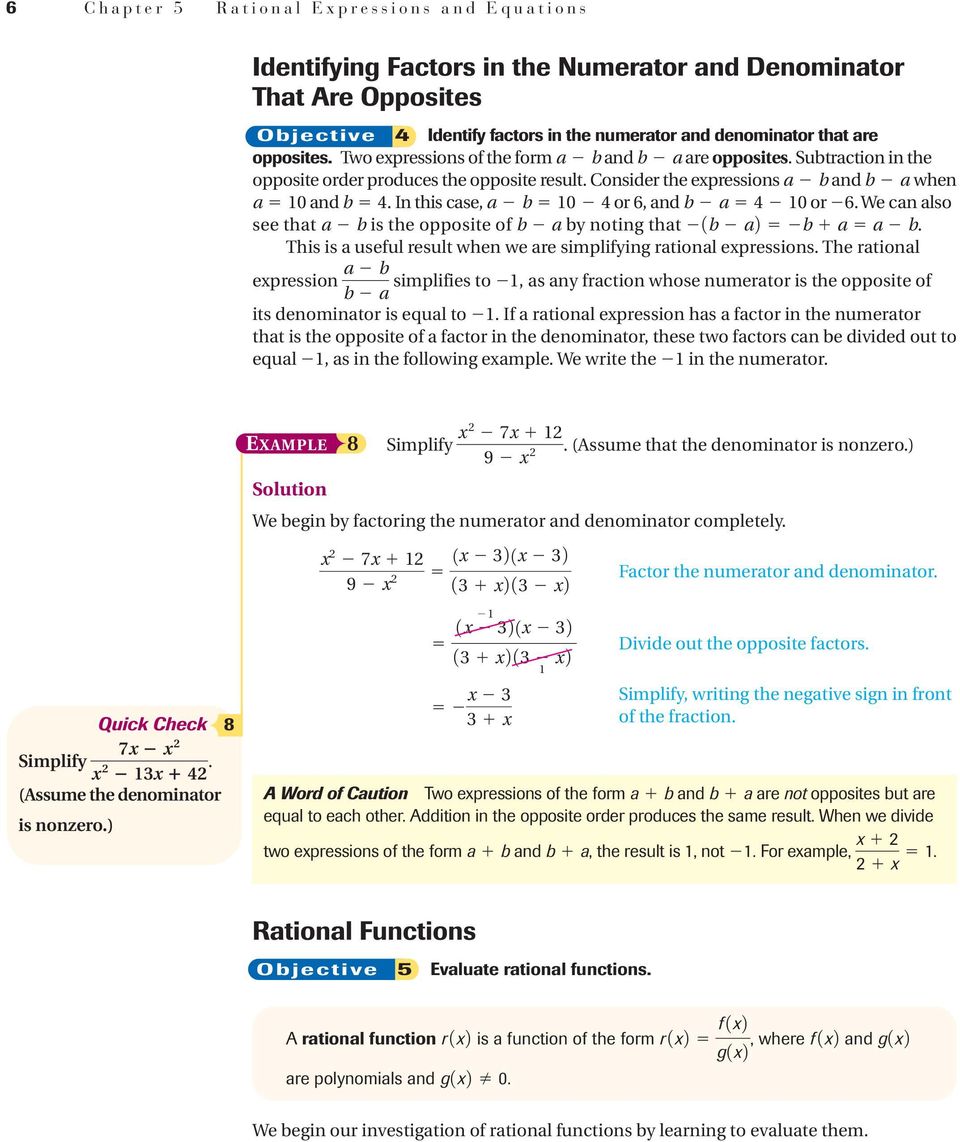
6 6 Chapter Rational Epressions and Equations Identifying Factors in the Numerator and Denominator That Are Opposites Objective 4 Identify factors in the numerator and denominator that are opposites. Two epressions of the form a b and b a are opposites. Subtraction in the opposite order produces the opposite result. Consider the epressions a b and b a when a 0 and b 4. In this case, a b 0 4 or 6, and b a 4 0 or 6. We can also see that a b is the opposite of b a by noting that b a b a a b. This is a useful result when we are simplifying rational epressions. The rational a b epression simplifies to, as any fraction whose numerator is the opposite of b a its denominator is equal to. If a rational epression has a factor in the numerator that is the opposite of a factor in the denominator, these two factors can be divided out to equal, as in the following eample. We write the in the numerator. Classroom Eample Simplify 0. 6 Answer: EXAMPLE 8 7 Simplify. (Assume that the denominator is nonzero.) 9 We begin by factoring the numerator and denominator completely. 7 9 Factor the numerator and denominator. Divide out the opposite factors. Simplify, writing the negative sign in front of the fraction. Quick Check 8 7 Simplify 4. (Assume the denominator A Word of Caution Two epressions of the form a b and b a are not opposites but are is nonzero.) equal to each other. Addition in the opposite order produces the same result. When we divide 6 two epressions of the form a b and b a, the result is, not. For eample,. Rational Functions Objective Evaluate rational functions. A rational function r is a function of the form r f where f and g g, are polynomials and g 0. We begin our investigation of rational functions by learning to evaluate them.
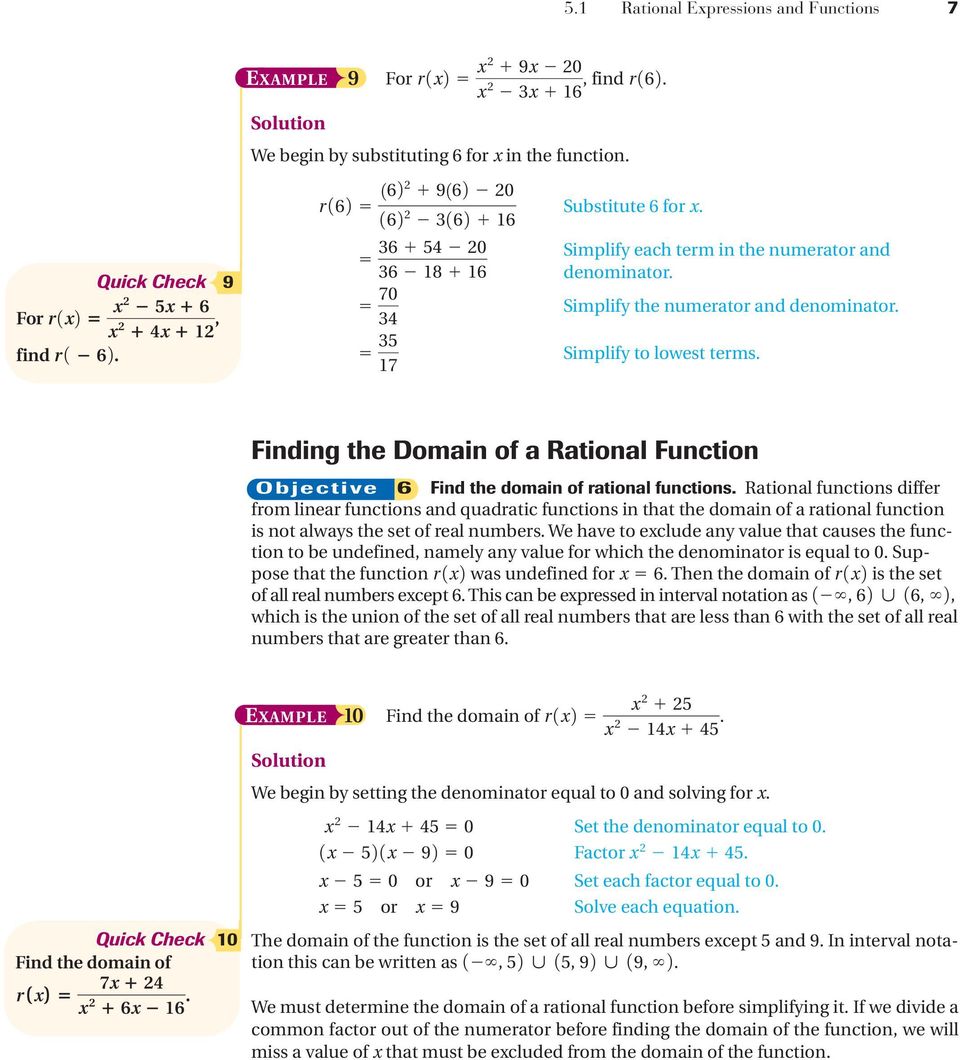
7 . Rational Epressions and Functions 7 Classroom Eample For r find r 4. 4, Answer: 4 Quick Check 9 For r 6 4, find r 6. EXAMPLE 9 For r 9 0 find r 6. 6, We begin by substituting 6 for in the function. r Substitute 6 for. Simplify each term in the numerator and denominator. Simplify the numerator and denominator. Simplify to lowest terms. Finding the Domain of a Rational Function Objective 6 Find the domain of rational functions. Rational functions differ from linear functions and quadratic functions in that the domain of a rational function is not always the set of real numbers. We have to eclude any value that causes the function to be undefined, namely any value for which the denominator is equal to 0. Suppose that the function r was undefined for 6. Then the domain of r is the set of all real numbers ecept 6. This can be epressed in interval notation as `, 6 c 6, `, which is the union of the set of all real numbers that are less than 6 with the set of all real numbers that are greater than 6. Classroom Eample Find the domain of r Answer: All real numbers ecept and 7. Quick Check 0 Find the domain of 7 4 r () 6 6. All real numbers ecept 8 and. EXAMPLE 0 Find the domain of r 4 4. We begin by setting the denominator equal to 0 and solving for Set the denominator equal to 0. Factor or 9 0 Set each factor equal to 0. or 9 Solve each equation. The domain of the function is the set of all real numbers ecept and 9. In interval notation this can be written as `, c, 9 c 9, `. We must determine the domain of a rational function before simplifying it. If we divide a common factor out of the numerator before finding the domain of the function, we will miss a value of that must be ecluded from the domain of the function.
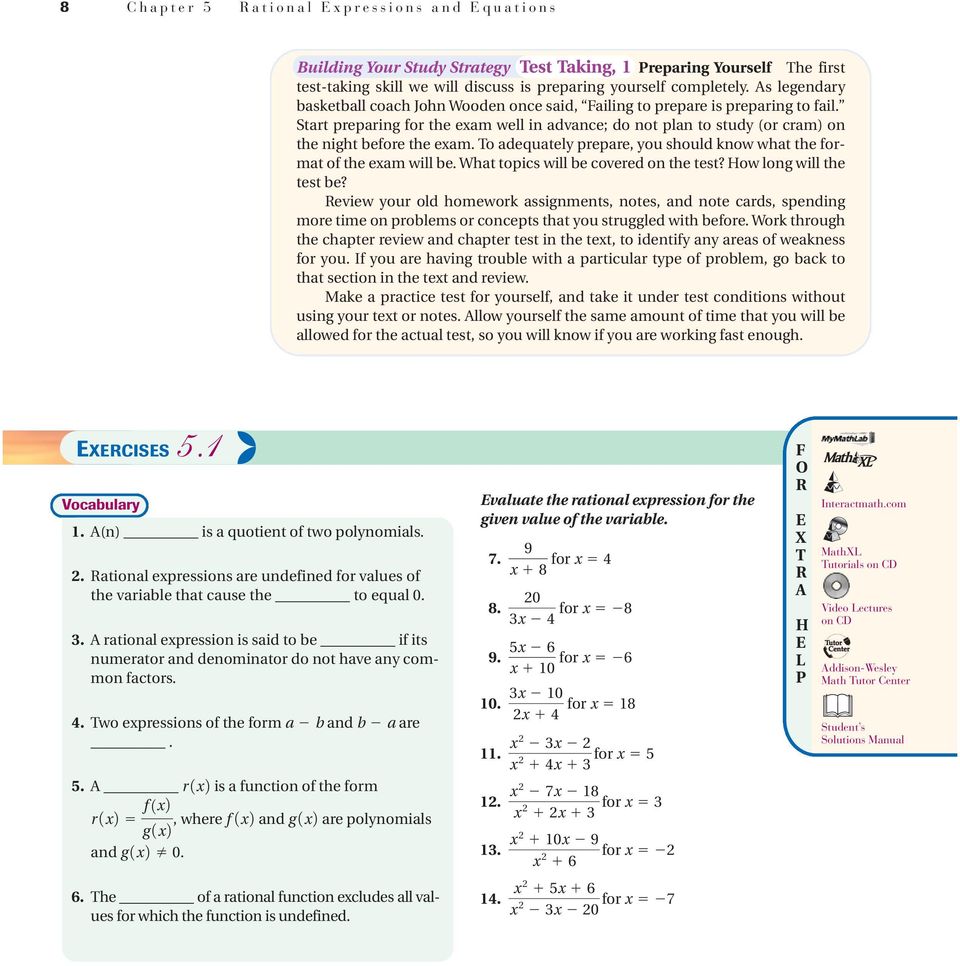
8 8 Chapter Rational Epressions and Equations Building Your Study Strategy Test Taking, Preparing Yourself The first test-taking skill we will discuss is preparing yourself completely. As legendary basketball coach John Wooden once said, Failing to prepare is preparing to fail. Start preparing for the eam well in advance; do not plan to study (or cram) on the night before the eam. To adequately prepare, you should know what the format of the eam will be. What topics will be covered on the test? How long will the test be? Review your old homework assignments, notes, and note cards, spending more time on problems or concepts that you struggled with before. Work through the chapter review and chapter test in the tet, to identify any areas of weakness for you. If you are having trouble with a particular type of problem, go back to that section in the tet and review. Make a practice test for yourself, and take it under test conditions without using your tet or notes. Allow yourself the same amount of time that you will be allowed for the actual test, so you will know if you are working fast enough. EXERCISES. Vocabulary. A(n) is a quotient of two polynomials. rational epression. Rational epressions are undefined for values of the variable that cause the to equal 0. denominator. A rational epression is said to be if its numerator and denominator do not have any common factors. simplified to lowest terms 4. Two epressions of the form a b and b a are. opposites. A r is a function of the form r f where f and g are polynomials g, and g 0. rational function 6. The of a rational function ecludes all values for which the function is undefined. domain Evaluate the rational epression for the given value of the variable for for for for 8 4. for for for for 7 0 F O R E X T R A H E L P Interactmath.com MathXL Tutorials on CD Video Lectures on CD Addison-Wesley Math Tutor Center Student s s Manual
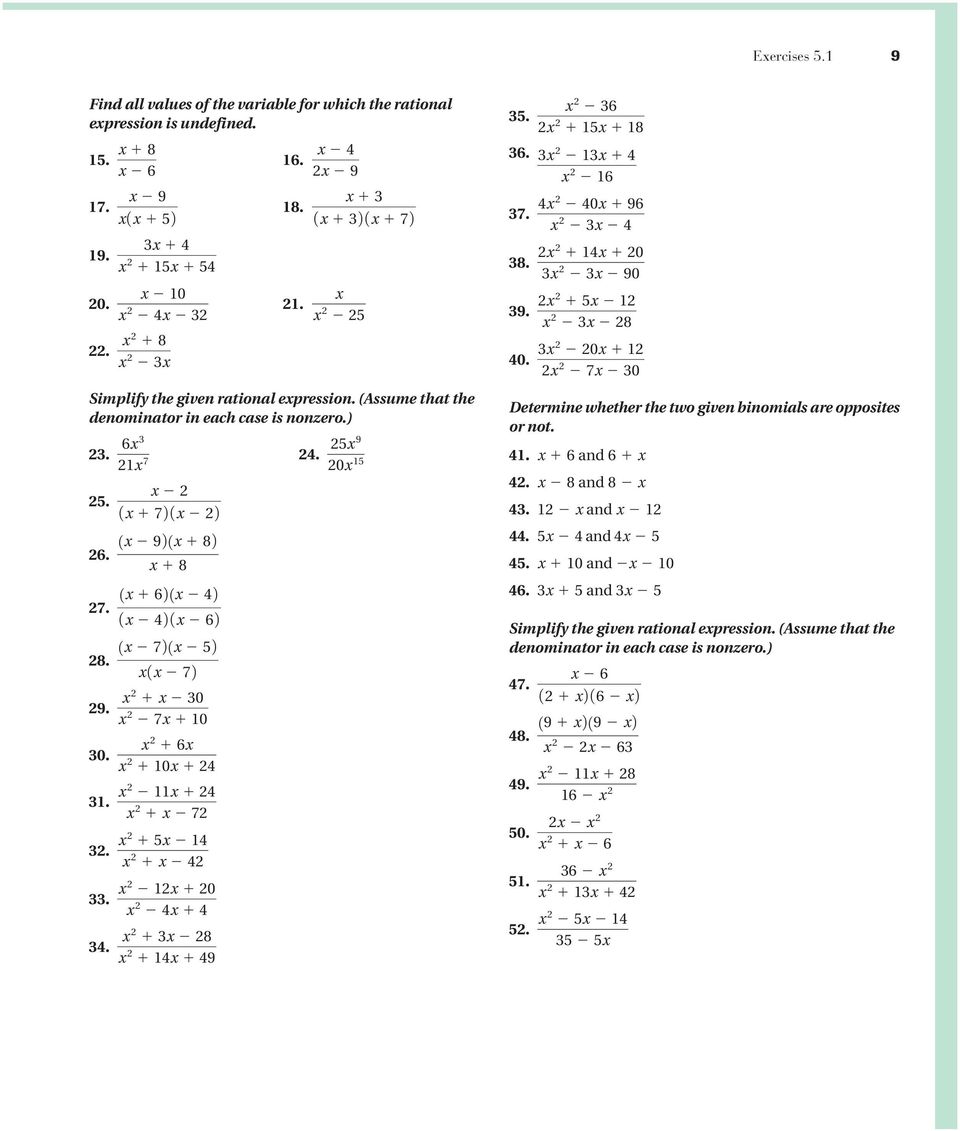
9 Eercises. 9 Find all values of the variable for which the rational epression is undefined , , , Simplify the given rational epression. (Assume that the denominator in each case is nonzero.) , , 4 6, Determine whether the two given binomials are opposites or not and 6 Not opposites 4. 8 and 8 Opposites 4. and Opposites and 4 Not opposites 4. 0 and 0 Opposites 46. and Not opposites Simplify the given rational epression. (Assume that the denominator in each case is nonzero.)
10 0 Chapter Rational Epressions and Equations Evaluate the given rational function r r 4 Undefined 0 4, r r 8 9, Find the domain of the given rational function r r 6 0, 4 4, r 8 8, r 0 6 r 9 4 r r r 48 4 r Identify the given function as a linear function, a quadratic function, or a rational function. 6. f 8 6 Quadratic 66. f Linear 67. f Rational 68. f 6 Rational f Linear 4 6 r r 7 r r 4 4, r 0, 6 8, 9, 9,, 7, 70. f Quadratic 4 CE Use the given graph of a rational function r() to determine the following y 6 8 a) Find r y a) Find r. 4 b) Find all values such that r a) Find r. 6 y 6 b) Find all values such that r. b) Find all values such that r 0. 0, Eercises marked with CE are Community Eercises, as described in the preface.

11 Eercises. CE a) Find r y b) Find all values such that r 0., Writing in Mathematics Answer in complete sentences. 7. Eplain how to find the values for which a rational epression is undefined. Answers will vary Is the rational epression undefined for the value? Eplain your answer. Yes; answers will vary 77. Eplain how to determine if two factors are opposites. Use eamples to illustrate your eplanation. Answers will vary 78. s Manual * Write a solutions manual page for the following problem: Find the values for which the rational epression 8 6 is undefined. 79. Newsletter * Write a newsletter that eplains how to simplify a rational epression. *See Appendi B for details and sample answers.

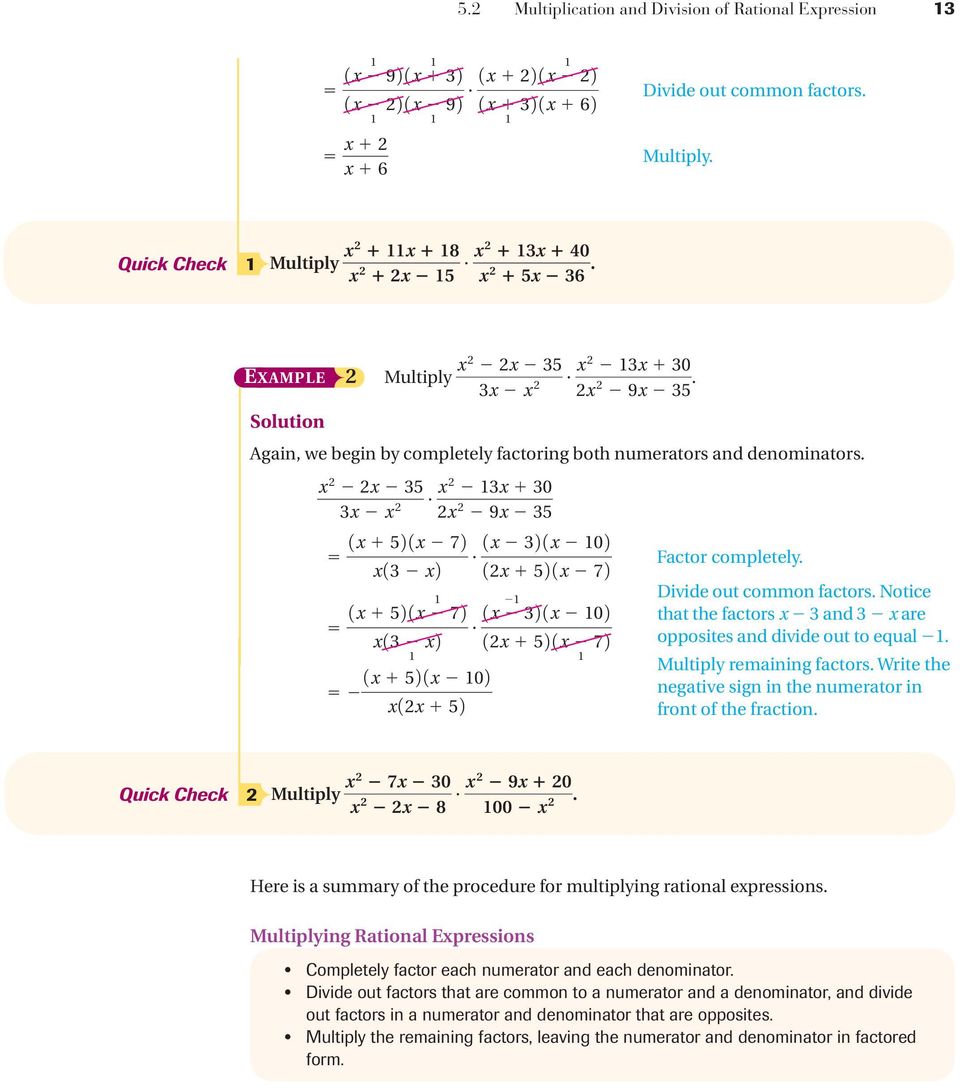
12 Chapter Rational Epressions and Equations. Multiplication and Division of Rational Epressions Objectives Multiply two rational epressions. Multiply two rational functions. Divide a rational epression by another rational epression. 4 Divide a rational function by another rational function. Multiplying Rational Epressions Objective Multiply two rational epressions. In this section, we will learn how to multiply and divide rational epressions. Multiplying rational epressions is similar to multiplying numerical fractions. Suppose that we needed to multiply # Before multiplying, we can divide out factors common to one of the numerators and one of the denominators. For eample, the first numerator (4) and the second denominator (0) have a common factor of that can be divided out of each. The second numerator () and the first denominator (9) have a common factor of that can be divided out as well. 4 # 9 0 # # # # 7 # # # 7 # 4 # # # 7 # Factor each numerator and denominator. Divide out common factors. Multiply remaining factors. Multiplying Rational Epressions A # C B D AC BD B 0 and D 0 To multiply two rational epressions, we will begin by factoring each numerator and denominator completely. After dividing out factors common to a numerator and a denominator, we will epress the product of the two rational epressions as a single rational epression, leaving the numerator and denominator in factored form. Classroom Eample Multiply 6 # Answer: EXAMPLE Multiply # We begin by factoring each numerator and denominator. Then we proceed to divide out common factors. 6 7 # # 9 6 Factor numerators and denominators completely.
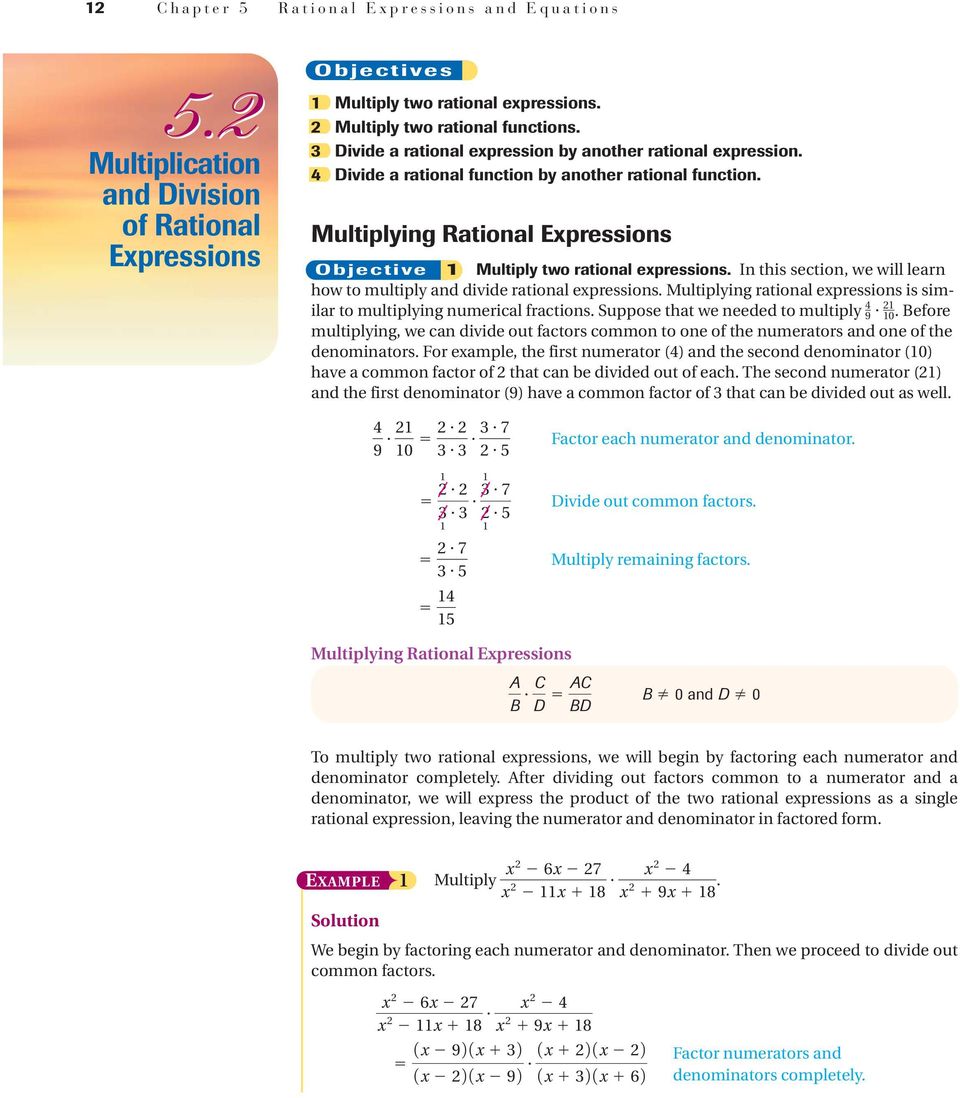
13 . Multiplication and Division of Rational Epression # 6 Divide out common factors. Multiply. Quick Check 8 Multiply # EXAMPLE Multiply Again, we begin by completely factoring both numerators and denominators. # # # # 0 Factor completely. Divide out common factors. Notice that the factors and are opposites and divide out to equal. Multiply remaining factors. Write the negative sign in the numerator in front of the fraction. Quick Check 7 0 Multiply # Here is a summary of the procedure for multiplying rational epressions. Multiplying Rational Epressions Completely factor each numerator and each denominator. Divide out factors that are common to a numerator and a denominator, and divide out factors in a numerator and denominator that are opposites. Multiply the remaining factors, leaving the numerator and denominator in factored form.
14 4 Chapter Rational Epressions and Equations Multiplying Rational Functions Objective Multiply two rational functions. Classroom Eample For f and 6 g 0, find f # g. Answer: 7 6 EXAMPLE For and g 6 6 f 4, find f # g We replace f and g by their formulas and proceed to multiply. f # g 4 # # # Replace f () and g() with their formulas. Factor completely. Divide out common factors. Multiply remaining factors. Quick Check 8 For and g () 0 f (), find f () # g () Dividing a Rational Epression by Another Rational Epression Objective Divide a rational epression by another rational epression. Dividing a rational epression by another rational epression is similar to dividing a numerical fraction by another numerical fraction. We replace the divisor, which is the rational epression we are dividing by, by its reciprocal and then multiply. Replacing the divisor by its reciprocal is also called inverting the divisor. Dividing Rational Epressions A B 4 C D A # D B C B 0, C 0, and D 0 Classroom Eample Divide Answer: EXAMPLE 4 Divide We begin by inverting the divisor and multiplying. In this eample we must factor each numerator and denominator completely # 0 Invert the divisor and multiply.
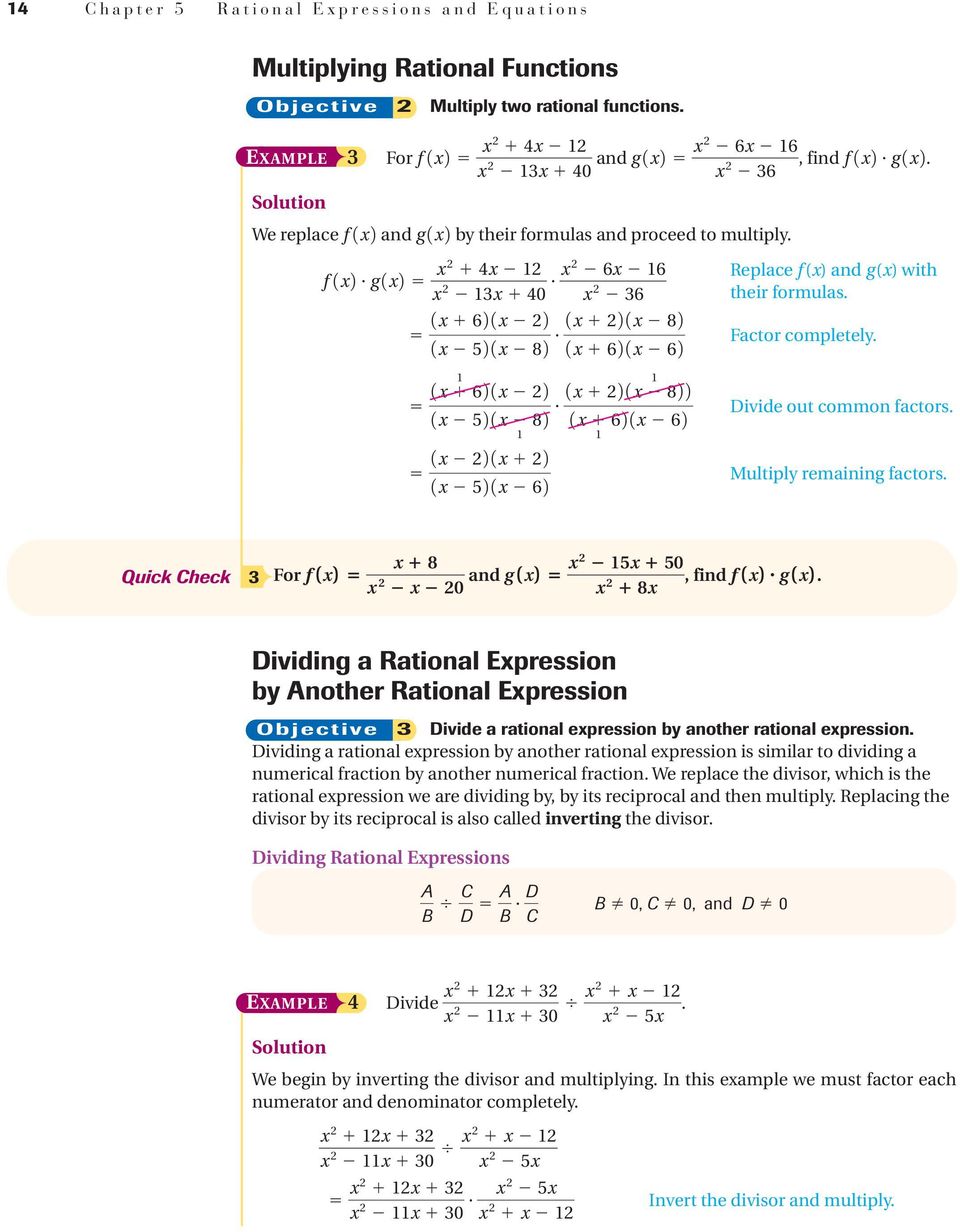
15 . Multiplication and Division of Rational Epression 4 8 # 6 4 Factor completely. 4 8 # Divide out common factors. Multiply remaining factors. Quick Check 4 49 Divide EXAMPLE Divide We rewrite the problem as a multiplication problem by inverting the divisor. We then factor each numerator and denominator completely before dividing out common factors. (You may want to factor at the same time you invert the divisor.) # # # Invert the divisor and multiply. Factor completely. Divide out common factors. Note that and are opposites. Multiply remaining factors. Quick Check 4 Divide

16 6 Chapter Rational Epressions and Equations Here is a summary of the procedure for dividing rational epressions. Dividing Rational Epressions Invert the divisor and change the operation from division to multiplication. Completely factor each numerator and each denominator. Divide out factors that are common to a numerator and a denominator, and divide out factors in a numerator and denominator that are opposites. Multiply the remaining factors, leaving the numerator and denominator in factored form. Dividing a Rational Function by Another Rational Function Objective 4 Divide a rational function by another rational function. Classroom Eample For f 9 8 and 4 g 9, find f 4 g. Answer: 6 For 4 f () and g() 7 8, find f () 4 g(). 7 Quick Check 6 EXAMPLE 6 For f 4 and g 8, find f 4 g. Replace f and g by their formulas and divide. Treat g as a rational function with a denominator of. We can see that its reciprocal is 8. f 4 g # 8 # # Replace f () and g() by their formulas. Invert the divisor and multiply. Factor completely. Divide out common factors. Multiply remaining factors. Building Your Study Strategy Test Taking, A Good Night s Sleep Get a good night s sleep on the night before the eam. Tired students do not think as well as students who are rested. Some studies suggest that good-quality sleep on the two nights prior to an eam can have a positive effect on test scores. Also be sure to eat properly before an eam. Hungry students can be distracted during an eam.
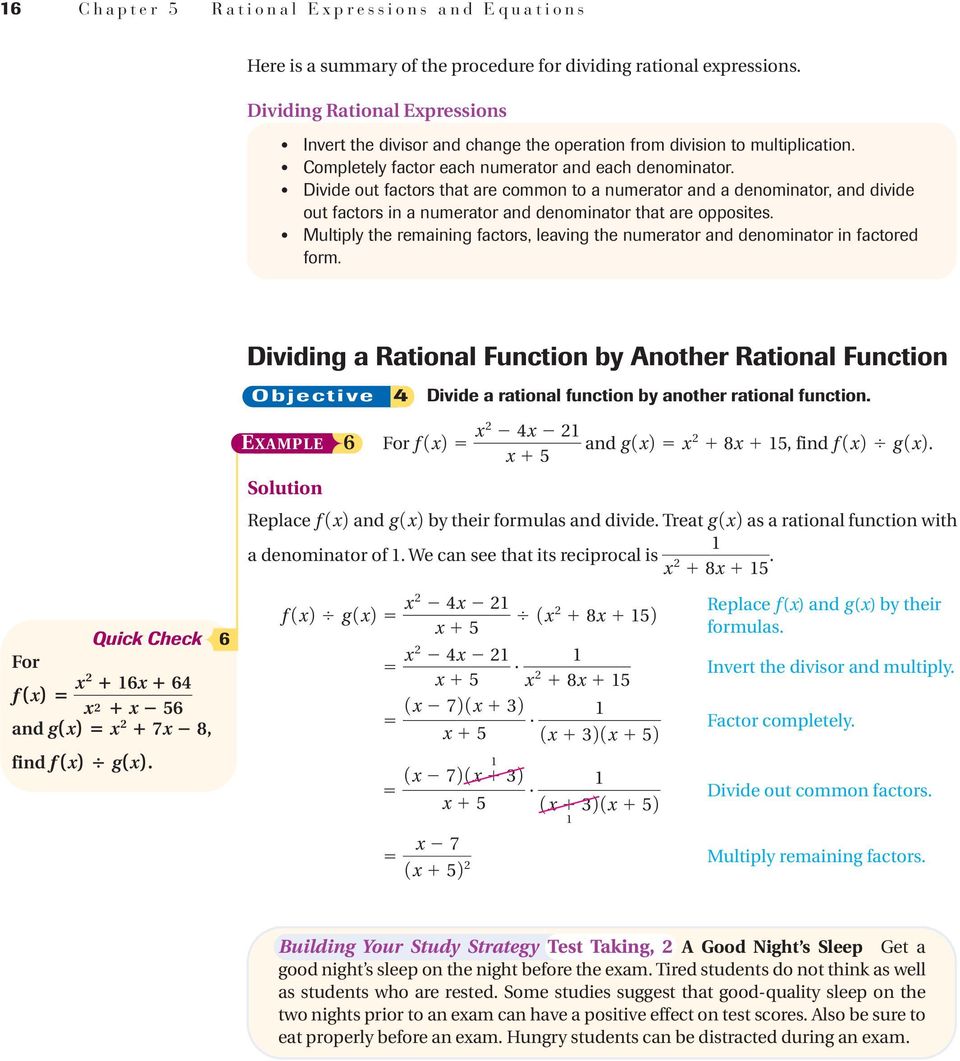
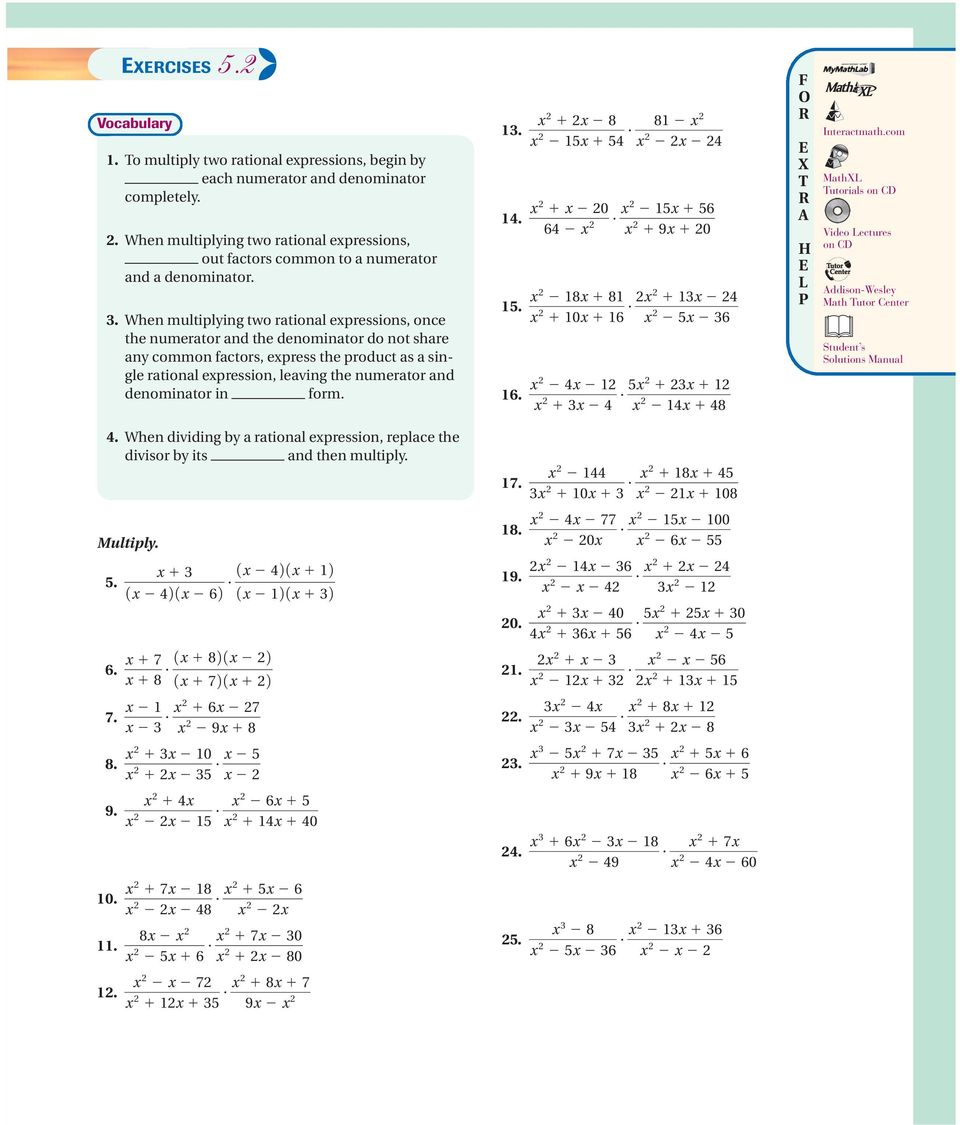
17 EXERCISES. Vocabulary. To multiply two rational epressions, begin by each numerator and denominator completely. factoring. When multiplying two rational epressions, out factors common to a numerator and a denominator. divide. When multiplying two rational epressions, once the numerator and the denominator do not share any common factors, epress the product as a single rational epression, leaving the numerator and denominator in form. factored 4. When dividing by a rational epression, replace the divisor by its and then multiply. reciprocal Multiply # # # # 4 # # # # # # # # # # # 6 4 # # # 00 6 # 4 9 # 6 6 # F O R E X T R A H E L P Interactmath.com MathXL Tutorials on CD Video Lectures on CD Addison-Wesley Math Tutor Center Student s s Manual
18 8 Chapter Rational Epressions and Equations CE For the given functions f() and g(), find f()? g() f 4 g 7 8, g 66 f 6, 6 Find the missing numerator and denominator #? 4? # # # f 7 4, g 7 f 0, g f 6 7 6, f , #? 7? #? 4 77? #? 8? g g Divide Eercises marked with CE are Community Eercises, as described in the preface.

19 Eercises For the given functions f() and g(), find f() 4 g() g 6 f, f 4 g 6 0, f , f 80 0, 8 6 f 6, g 9 8 g 6 60 g Find the missing numerator and denominator g 00 f , ?? ?? ? 7? Writing in Mathematics 6 9 4?? Answer in complete sentences. 7. Eplain the similarities between dividing numerical fractions and dividing rational epressions. Are there any differences? Answers will vary 74. Eplain why the restrictions B 0, C 0, and D 0 are necessary when dividing A B 4 D. C Answers will vary 7. s Manual * Write a solutions manual page for the following problem: 6 7 Divide Newsletter * Write a newsletter that eplains how to multiply two rational epressions. *See Appendi B for details and sample answers.

20 0 Chapter Rational Epressions and Equations. Addition and Subtraction of Rational Epressions Objectives Add rational epressions with the same denominator. Subtract rational epressions with the same denominator. Add or subtract rational epressions with opposite denominators. 4 Find the least common denominator (LCD) of two or more rational epressions. Add or subtract rational epressions with unlike denominators. Now that we have learned how to multiply and divide rational epressions, we move on to addition and subtraction. We know from our work with numerical fractions that two fractions must have the same denominator before we can add or subtract them. The same holds true for rational epressions. We will begin with rational epressions that already have the same denominator. Adding Rational Epressions with the Same Denominator Objective Add rational epressions with the same denominator. To add fractions that have the same denominator, we add the numerators and place the result over the common denominator. We will follow the same procedure when adding two rational epressions. Of course, we should check that our result is in simplest terms. Adding Rational Epressions with the Same Denominator A C B C A B C C 0 Classroom Eample Add Add 0 Answer: 4 8 Quick Check 7. EXAMPLE Add 9 7. These two fractions have the same denominator, so we add the two numerators and place the result over the common denominator Add numerators, placing the sum over the common denominator. 6 Simplify the numerator. The numerator and denominator do not have any common factors, so this is our final result. A common error is to attempt to divide a common factor out of 6 in the numerator and in the denominator, but the number is a term of the denominator and not a factor.

21 . Addition and Subtraction of Rational Epressions EXAMPLE Add The two denominators are the same, so we may add Add numerators. Combine like terms. Factor numerator and denominator and divide out the common factor. Simplify. Quick Check Add EXAMPLE Add The denominators are the same, so we add the numerators and then simplify Add numerators. Combine like terms. Factor numerator and denominator and divide out the common factor. Simplify. Quick Check Add
22 Chapter Rational Epressions and Equations Subtracting Rational Epressions with the Same Denominator Objective Subtract rational epressions with the same denominator. Subtracting two rational epressions with the same denominator is just like adding them, ecept that we subtract the two numerators rather than adding them. Subtracting Rational Epressions with the Same Denominator A C B C A B C C 0 Classroom Eample Subtract Answer: 6 Quick Check 4 Subtract EXAMPLE 4 Subtract The two denominators are the same, so we may subtract these two rational epressions. When the numerator of the second fraction has more than one term we must remember that we are subtracting the whole numerator and not just the first term. When we subtract the numerators and place the difference over the common denominator, it is a good idea to write each numerator in a set of parentheses. This will remind us to subtract each term in the second numerator Subtract numerators. Distribute. Combine like terms. Factor numerator and divide out the common factor. Simplify. Notice that the denominator 4 was also a factor of the numerator, leaving a denominator of. EXAMPLE Subtract The denominators are the same, so we can subtract these two rational epressions Subtract numerators.
23 . Addition and Subtraction of Rational Epressions Change the sign of each term in the second set of parentheses by distributing. Combine like terms. Factor numerator and denominator and divide out the common factor. The results from the fact that 6 and 6 are opposites. Simplify. Quick Check 6 4 Subtract 8. 7 A Word of Caution When subtracting a rational epression whose numerator contains more than one term, be sure to subtract the entire numerator and not just the first term. One way to remember this is by placing the numerators inside sets of parentheses. Adding or Subtracting Rational Epressions with Opposite Denominators Objective Add or subtract rational epressions with opposite denominators. 0 Consider the epression Are the two denominators the same? No, but. they are opposites. We can rewrite the denominator as its opposite if we also rewrite the operation (addition) as its opposite (subtraction). In other words, we can 0 0 rewrite the epression as Once the denominators are the. same, we can subtract the numerators. Classroom Eample Subtract Answer: EXAMPLE 6 Add The two denominators are opposites, so we may change the second denominator to by changing the operation from addition to subtraction Rewrite the second denominator as by changing the operation from addition to subtraction.
24 4 Chapter Rational Epressions and Equations Add Quick Check Subtract the numerators. Factor the numerator and denominator and divide out the common factor. Simplify. Subtract Quick Check 7 6. EXAMPLE 7 Subtract These two denominators are opposites, so we begin by rewriting the second rational epression in such a way that the two rational epressions have the same denominator Rewrite the second denominator as 9 by changing the operation from subtraction to addition. Add the numerators. Combine like terms. Factor the numerator and divide out the common factor. Simplify. The Least Common Denominator of Two or More Rational Epressions Objective 4 Find the least common denominator (LCD) of two or more rational epressions. If two numerical fractions do not have the same denominator, we cannot add or subtract the fractions until we rewrite them as equivalent fractions with a common denominator. The same holds true for rational epressions with unlike denominators. We will begin by learning how to find the least common denominator (LCD) for two or more rational epressions. Finding the LCD of Two Rational Epressions Begin by completely factoring each denominator, and then identify each epression that is a factor of one or both denominators. The LCD is equal to the product of these factors.
25 . Addition and Subtraction of Rational Epressions If an epression is a repeated factor of one or more of the denominators, then we repeat it as a factor in the LCD as well. The eponent used for this factor is equal to the greatest power that the factor is raised to in any one denominator. Classroom Eample Find the 4 LCD of and 6 0. Answer: 8 7 EXAMPLE 8 Find the LCD of and 0a b a. We begin with the coefficients 0 and. The smallest number that both divide into evenly is 60. Moving on to variable factors in the denominator, we see that the variables a and b are factors of one or both denominators. Note that the variable a is raised to the fifth power in the second denominator, so the LCD must contain a factor of a. The LCD is 60a b. Quick Check 8 7 Find the LCD of and 4 6 y y. y Quick Check 9 Find the LCD of and EXAMPLE 9 Find the LCD of and 6. 0 We begin by factoring each denominator The factors in the denominators are 6,, and 6. Since no epression is repeated as a factor in any one denominator, the LCD is Find the LCD of and 6 6 Quick Check EXAMPLE 0 Find the LCD of 9 4 Again, we begin by factoring each denominator The two epressions that are factors are 7 and ; the factor is repeated twice in the second denominator. So the LCD must have as a factor twice as well. The LCD is 7 or 7. and
26 6 Chapter Rational Epressions and Equations Classroom Eample Add 7 6. Answer: 0 6 Add Quick Check Adding or Subtracting Rational Epressions with Unlike Denominators Objective Add or subtract rational epressions with the same denominators. To add or subtract two rational epressions that do not have the same denominator, we begin by finding the LCD. We then convert each rational epression to an equivalent rational epression that has the LCD as its denominator. We can then add or subtract as we did in the previous section. As always, we should attempt to simplify the resulting rational epression. EXAMPLE Add The two denominators are not the same, so we begin by finding the LCD for these two rational epressions. Each denominator has a single factor, and the LCD is the product of these two denominators. The LCD is 4 6. We will multiply by 4 6 to write it as an equivalent fraction whose denominator is the LCD. We need to 6 4 multiply by to write it as an equivalent fraction whose denominator is 6 4 the LCD # # A Word of Caution When adding two rational epressions, we cannot simply add the two numerators together and place their sum over the sum of the two denominators Multiply to rewrite each epression as an equivalent rational epression that has the LCD as its denominator. Distribute in each numerator, but do not distribute in the denominators. Add the numerators, writing the sum over the common denominator. Combine like terms. Factor the numerator. Since the numerator and denominator do not have any common factors, this rational epression cannot be simplified any further. We must first find a common denominator and rewrite each rational epression as an equivalent epression whose denominator is equal to the common denominator.
27 . Addition and Subtraction of Rational Epressions 7 When adding or subtracting rational epressions, leave the denominator in factored form. After we simplify the numerator, we factor the numerator if possible and check the denominator for common factors that can be divided out. EXAMPLE Add In this eample we must factor each denominator to find the LCD # # Factor each denominator. The LCD is 4 6. Multiply to rewrite each epression as an equivalent rational epression that has the LCD as its denominator. Distribute in each numerator. Add the numerators, writing the sum over the LCD. Combine like terms. Factor the numerator and divide out the common factor. 8 Simplify. 4 6 There is another method for creating two equivalent rational epressions that have the same denominators. In this eample, once the two denominators had been factored, we had the epression Notice that the first denominator is missing the factor 6 that appears in the second denominator, so we can multiply the numerator and denominator of the first rational epression by 6. In a similar fashion, the second denominator is missing the factor 4 that appears in the first denominator, so we can multiply the numerator and denominator of the second rational epression by # # 4 6 4
28 8 Chapter Rational Epressions and Equations At this point, both rational epressions share the same denominator, 4 6, so we may proceed with the addition problem. Quick Check Add Classroom Eample Subtract Answer: 4 EXAMPLE Subtract We begin by factoring each denominator to find the LCD. We must be careful that we subtract the entire second numerator, not just the first term. In other words, the subtraction must change the sign of each term in the second numerator before we combine like terms. Using parentheses around the two numerators before starting to subtract them will help with this # # Factor each denominator. The LCD is 8 8. Multiply to rewrite each epression as an equivalent rational epression that has the LCD as its denominator. Distribute in each numerator. Subtract the numerators, writing the difference over the LCD. Distribute. Combine like terms Factor the numerator and divide out the common factor. Simplify. Quick Check Subtract 7 0.
29 . Addition and Subtraction of Rational Epressions 9 EXAMPLE 4 Add Notice that the first numerator contains a binomial. We must be careful when multiplying to create equivalent rational epressions with the same denominator. We begin by factoring each denominator to find the LCD # # Factor each denominator. The LCD is 6. Multiply to rewrite each epression as an equivalent rational epression with the LCD as its denominator. Distribute in each numerator. Add the numerators, writing the sum over the LCD. Combine like terms. Factor the numerator and divide out the common factor. Simplify. Quick Check 4 Add Building Your Study Strategy Test Taking, Write Down Important Information. As soon as you receive your test, write down any formulas, rules, or procedures that will help you during the eam, such as a table or formula that you use to solve a particular type of word problem. Once you have written these down, you can refer to them as you work through the test. Write it down on the test while it is still fresh in your memory. That way, when you reach the appropriate problem on the test, you will not need to worry about not being able to remember the table or formula. By writing all of this information on your test, you will eliminate memorization difficulties that arise when taking a test. However, if you do not understand the material or how to use what you have written down, then you will struggle on the test. There is no substitute for understanding what you are doing.
30 EXERCISES. Vocabulary. To add fractions that have the same denominator, we add the and place the result over the common denominator. numerators. To subtract fractions that have the same denominator, we the numerators and place the result over the common denominator. subtract. When subtracting a rational epression whose numerator contains more than one term, subtract the entire numerator and not just the. first term 4. When adding two rational epressions with opposite denominators, we can replace the second denominator with its opposite by changing the addition to. subtraction. The of two rational epressions is an epression that is a product of all the factors of the two denominators. LCD 6. To add two rational epressions that have unlike denominators, we begin by converting each rational epression to a(n) rational epression that has the LCD as its denominator. equivalent Add Subtract Add or subtract F O R E X T R A H E L P 0 0 Interactmath.com MathXL Tutorials on CD Video Lectures on CD Addison-Wesley Math Tutor Center Student s s Manual
31 Eercise. CE Find the missing numerator Find the LCD of the given rational epressions , 6 0, , 4 4, 6 0 4? , , , , 7 7 8? 4 9 Add or subtract ? 6 0 4? Eercises marked with CE are Community Eercises, as described in the preface.
32 Chapter Rational Epressions and Equations For the given rational functions f() and g(), find f() g() For the given rational functions f() and g(), find f() g() f f 7 9 f, g , g , g 9 f, g f 4 6, g f 8, g Mied Practice, 8 98 Add or subtract f 7, g f 8 80, g a 7 0a 7 a
33 Eercise Writing in Mathematics Answer in complete sentences. 99. Eplain how to determine that two rational epressions have opposite denominators. Answers will vary. 00. Here is a student s solution to a problem on an eam. Describe the student s error, and provide the correct solution. Assuming that the problem was worth 0 points, how many points would you give to the student for his solution? Eplain your reasoning. 7 6 # # 6 6 Answers will vary. 0. s Manual * Write a solutions manual page for the following problem: Subtract s Manual * Write a solutions manual page for the following problem: 6 Add Newsletter * Write a newsletter that eplains how to add two rational epressions with the same denominator. 04. Newsletter * Write a newsletter that eplains how to subtract two rational epressions with unlike denominators. *See Appendi B for details and sample answers.
34 4 Chapter Rational Epressions and Equations.4 Comple Fractions Objectives Simplify comple numerical fractions. Simplify comple fractions containing variables. Comple Fractions A comple fraction is a fraction or rational epression containing one or more fractions in its numerator or denominator. Here are some eamples Objective Simplify comple numerical fractions. To simplify a comple fraction, we must rewrite it in such a way that its numerator and denominator do not contain fractions. This can be done by finding the LCD of all fractions within the comple fraction and then multiplying the numerator and denominator by this LCD. This will clear the fractions within the comple fraction. We finish by simplifying the resulting rational epression, if possible. We begin with a comple fraction made up of numerical fractions. Classroom Eample Simplify the 7 4 comple fraction. 6 Answer: 47 0 EXAMPLE 6 Simplify the comple fraction. 4 The LCD of the three denominators (6,, and 4) is, so we begin by multiplying the comple fraction by. Notice that when we multiply by, we are really multiplying by, which does not change the value of the original epression. 6 # # # 6 4 # # 4 Multiply the numerator and denominator by the LCD. Distribute and divide out common factors.
35 .4 Comple Fractions Multiply. Simplify the numerator and denominator. There is another method for simplifying comple fractions. We can rewrite the numerator as a single fraction by adding 6, which would equal 6. We can also rewrite the denominator as a single fraction by adding 4, 7 equal. Once the numerator and denominator are single fractions, we can rewrite problem which would and simplify from there. This method produces the same result, # as a division Quick Check Simplify the comple fraction In most of the remaining eamples we will use the LCD method, as the technique is similar to the technique used to solve rational equations in the net section. Simplifying Comple Fractions Containing Variables Objective Simplify comple fractions containing variables. Classroom Eample Simplify 9 6. Answer: EXAMPLE Simplify. The LCD for the two simple fractions with denominators and is, so we will begin by multiplying the comple fraction by. # Multiply the numerator and denominator by the LCD.
36 6 Chapter Rational Epressions and Equations # # # # Distribute and divide out common factors, clearing the fractions. Quick Check 49 7 Simplify 7 7. Multiply. Factor the numerator and denominator and divide out the common factor. Simplify. Once we have cleared the fractions, resulting in a rational epression such as, then we simplify the rational epression by factoring and dividing out common factors. EXAMPLE Simplify We begin by multiplying the numerator and denominator by the LCD of all denominators. In this case the LCD is # Multiply the numerator and denominator by the LCD. 8 9 Simplify 8. 9 Quick Check # # # # 6 Distribute and divide out common factors. Multiply. Factor the numerator and denominator and divide out the common factor. Simplify.
37 .4 Comple Fractions 7 Classroom Eample Simplify Answer: 6 Simplify 6 4 Quick Check EXAMPLE 4 Simplify The LCD for the four simple fractions is # # 6 # 6 # Multiply the numerator and denominator by the LCD Distribute and divide out common factors, clearing the fractions. Multiply. Distribute. Combine like terms. Factor the denominator and divide out the common factor. Simplify. Classroom Eample Simplify Answer: 9 6 EXAMPLE Simplify In this case it will be easier to rewrite the comple fraction as a division problem rather than multiplying the numerator and denominator by the LCD. This is a wise idea when we have a comple fraction with a single rational epression in its numerator and a single
38 8 Chapter Rational Epressions and Equations rational epression in its denominator. We have used this method when dividing rational epressions. Simplify 4 7 Quick Check # # # Rewrite as a division problem. Invert the divisor and multiply. Factor each numerator and denominator. Divide out common factors. Simplify. Building Your Study Strategy Test Taking, 4 Read the Test In the same way you would begin to solve a word problem, you should begin to take a test by briefly reading through it. This will give you an idea of how many problems you have to solve, how many word problems there are, and roughly how much time you can devote to each problem. It is a good idea to establish a schedule, such as I need to be done with problems by the time half of the class period is over. This way you will know whether you need to speed up during the second half of the eam or if you have plenty of time. EXERCISES.4 Vocabulary. A(n) is a fraction or rational epression containing one or more fractions in its numerator or denominator. comple fraction. To simplify a comple fraction, multiply the numerator and denominator by the of all fractions within the comple fraction. LCD Simplify the comple fraction F O R E X T R A H E L P Interactmath.com MathXL Tutorials on CD Video Lectures on CD Addison-Wesley Math Tutor Center Student s s Manual
39 Eercises Mied Practice, 4 Simplify the given rational epression, using the techniques developed in Sections. through
40 40 Chapter Rational Epressions and Equations CE # # # Writing in Mathematics Answer in complete sentences.. Eplain what a comple fraction is. Compare and contrast comple fractions and the rational epressions found in Section.. Answers will vary 6. One method for simplifying comple fractions is to rewrite the comple fraction as one rational epression divided by another rational epression. When is this method the most efficient way to simplify a comple fraction? Answers will vary 7. s Manual * Write a solutions manual page for the following problem: 9 6 Simplify Newsletter * Write a newsletter that eplains how to simplify comple fractions. *See Appendi B for details and sample answers. Eercises marked with CE are Community Eercises, as described in the preface.
41 . Rational Equations 4. Objectives Solve rational equations. Solve literal equations.. Rational Equations Solving Rational Equations Objective Solve rational equations. In this section, we learn how to solve rational equations, which are equations containing at least one rational epression. The main goal is to rewrite the equation as an equivalent equation that does not contain a rational epression. We then solve the equation using methods developed in earlier chapters. In Chapter, we learned how to solve an equation containing fractions such as the equation We began by finding the LCD of all fractions, and then multiplied both sides of the equation by that LCD to clear the equation of fractions. We will employ the same technique in this section. There is a major difference, though, when solving equations containing a variable in a denominator. Occasionally we will find a solution that causes one of the rational epressions in the equation to be undefined. If a denominator of a rational epression is equal to 0 when the value of a solution is substituted for the variable, then that solution must be omitted from the answer set and is called an etraneous solution. We must check each solution that we find to make sure that it is not an etraneous solution. Here is a summary of the method for solving rational equations: Solving Rational Equations. Find the LCD of all denominators in the equation.. Multiply both sides of the equation by the LCD to clear the equation of fractions.. Solve the resulting equation. 4. Check for etraneous solutions. Classroom Eample Solve 7 0 Answer: 86 EXAMPLE Solve 9 7. We begin by finding the LCD of these three fractions, which is. Now we multiply both sides of the equation by the LCD to clear the equation of fractions. Once this has been done, we can solve the resulting equation. 9 7 a 9 b # # # 7 Multiply both sides of the equation by the LCD. Distribute and divide out common factors Multiply. The resulting equation is linear.
42 4 Chapter Rational Epressions and Equations 08 9 Subtract 8 to collect all variable terms on one side of the equation. Divide both sides by 9. Check: Quick Check 8 Solve Substitute for. 7 9 Simplify the fraction The LCD of these fractions is Write each fraction with a common denominator of Add. 7 Since does not make any rational epression in the original equation undefined, this value is a solution. The solution set is 6. When checking whether a solution is an etraneous solution, we need only determine whether the solution causes the LCD to equal 0. If the LCD is equal to 0 for this solution, then one or more rational epressions are undefined and the solution is an etraneous solution. Also, if the LCD is equal to 0, then we have multiplied both sides of the equation by 0. The multiplication property of equality says we can multiply both sides of an equation by any nonzero number without affecting the equality of both sides. In the previous eample, the only solution that could possibly be an etraneous solution is 0, because that is the only value of for which the LCD is equal to 0. Classroom Eample Solve 9 Answer:, 6 EXAMPLE Solve The LCD in this eample is. The LCD is equal to 0 only if 0. If we find that 0 is a solution, then we must omit that solution as an etraneous solution Quick Check Solve 4 4, 86. # a 6 7 b # 0 # # 6 # or # 0 Multiply each side of the equation by the LCD,. Distribute and divide out common factors. Multiply. The resulting equation is quadratic. Factor. Set each factor equal to 0 and solve. You may verify that neither solution causes the LCD to equal 0. The solution set is 9, 6.
43 . Rational Equations 4 A Word of Caution When solving a rational equation, the use of the LCD is completely different than when we are adding or subtracting rational epressions. We use the LCD to clear the denominators of the rational epressions when solving a rational equation. When adding or subtracting rational epressions, we rewrite each epression as an equivalent epression whose denominator is the LCD. Classroom Eample Solve Answer: [ EXAMPLE Solve 4 4. The LCD is 4, so we will begin to solve this equation by multiplying both sides of the equation by 4. The LCD is 4. Multiply both sides by the LCD. Distribute and divide out common factors. Multiply. The resulting equation is linear. Combine like terms. Subtract. Add 7. Divide both sides by. The LCD is equal to 0 when 4, and two rational epressions in the original equation are undefined when 4. Check: a 4 b 4 # # Solve Quick Check 4 7. Classroom Eample Solve 6 8. Answer: 6 [ 4 Substitute 4 for Simplify each numerator and denominator So, although 4 is a solution to the equation obtained once the fractions have been cleared, it is not a solution to the original equation. This solution is an etraneous solution and since there are no other solutions, this equation has no solution. Recall that we write the solution set as [ when there is no solution. EXAMPLE 4 Solve 4 4. We begin by factoring the denominators to find the LCD. 4 4
44 44 Chapter Rational Epressions and Equations 4 4 # or # The LCD is ( + )( + )( 4). 4 Multiply by the LCD. Divide out common factors. Multiply remaining factors. Multiply. Collect all terms on the left side. The resulting equation is quadratic. Factor. Set each factor equal to 0 and solve. The solution is an etraneous solution as it makes the LCD equal to 0. It is left to the reader to verify that the solution checks. The solution set for this equation is 6. Quick Check 4 8 Solve Classroom Eample Solve Answer: 86 EXAMPLE 8 # Solve a 8 b 8 # # 8 8 The LCD is 8. Multiply by the LCD. # Distribute and divide out common factors Multiply remaining factors. Distribute.
45 . Rational Equations or Combine like terms. Collect all terms on the left side. The resulting equation is quadratic. Factor. Set each factor equal to 0 and solve. The solution is an etraneous solution as it makes the LCD equal to 0. It is left to the reader to verify that the solution checks. The solution set for this equation is 6. Quick Check Solve Classroom Eample Solve the literal equation for. 6 y 7 0 Answer: 0y 7y 60 Literal Equations Objective Solve literal equations. Recall that a literal equation is an equation containing two or more variables, and we solve the equation for one of the variables by isolating that variable on one side of the equation. In this section, we will learn how to solve literal equations containing one or more rational epressions. EXAMPLE 6 Solve the literal equation for. y 4 We begin by multiplying by the LCD 4y to clear the equation of fractions. y 4 4 y # 4y a y b 4y # 4 Multiply by the LCD, 4y. Distribute and divide out common factors. Multiply remaining factors. Notice that there are two terms that contain the variable we are solving for. We need to collect both of these terms on the same side of the equation and then factor out of those terms. This will allow us to divide and isolate. 8y 0 y 8y y 0 4y # y 4 y # 4 8y 0 y 8y y 0 8y y 0 y 0 y 0 Subtract 0 to collect all terms with on the right side of the equation. Factor out the common factor. Divide both sides by y 0 to isolate.
46 46 Chapter Rational Epressions and Equations Quick Check 6 Solve the literal equation 4 for. y z 4yz y z Quick Check 7 Solve the literal equation for. y y 4 y 8y y 0 8y y 0 Simplify. Rewrite with the variable we are solving for on the left side of the equation. As in Chapter, we will rewrite our solution so that the variable we are solving for is on the left side. EXAMPLE 7 Solve the literal equation for y. y b We begin by multiplying both sides of the equation by the LCD, which is b y. b y b b y by b b y b b b b y b b y y b y a b b # y b y # b y # b b y b y b y b by y b b y b b b Multiply both sides by the LCD. Distribute and divide out common factors. Multiply remaining factors. Distribute. Subtract and b so only the terms containing y are on the right side. Factor out the common factor y. Divide both sides by b to isolate y. Rewrite with y on the left side. Building Your Study Strategy Test Taking, Check Point Values Not all problems on a test are assigned the same point value. Identify which problems are worth more points than others. It is important not to be in a position of having to rush through the problems that have higher point values because you didn t notice that they were worth more until you got to them at the end of the test.
47 47 EXERCISES. Chapter Rational Epressions and Equations Vocabulary. A(n) is an equation containing at least one rational epression. rational equation. To solve a rational equation, begin by multiplying both sides of the equation by the of the denominators in the equation. LCD. A(n) of a rational equation is a solution that causes one or more of the rational epressions in the equation to be undefined. etraneous solution 4. A(n) equation is an equation containing two or more variables. literal Solve Rational Equa- F O R , 66 7, E X T R A H E L P Interactmath.com MathXL Tutorials on CD Video Lectures on CD Addison-Wesley Math Tutor Center Student s s Manual. e f e 8 f e f , , [ , 86 4, 76. 6, [ , [ , 46 8, , 6 4, 6 4 6
48 48 Chapter Rational Epressions and Equations CE , ,6. If is a solution to the equation 6 4? 0 4, a) Find the constant in the missing numerator. 6 b) Find the other solution to the equation If is a solution to the equation 4? 4, a) Find the constant in the missing numerator. b) Find the other solution to the equation. Solve for the specified variable.. W A for L L A L W 6, 46 6, [, 66, h A for b b 7. y for 8. y 4 for 9. for r r y 4r 60. for b a b 6. for c a b c 6. a for b b c d 6. a b for b a b 64. for R R R R 6. n n n for n # n 66. p for n n b A h n n b c b Writing in Mathematics y y 4 y 4y r a a ab b a ad c d b a a R R R R R n n nn n pn p Answer in complete sentences. 67. Eplain how to determine whether a solution is an etraneous solution. Answers will vary 68. We use the LCD when we add two rational epressions, as well as when we solve a rational equation. Eplain how the LCD is used differently for these two types of problems. Answers will vary 69. s Manual * Write a solutions manual page for the following problem: Solve Newsletter * Write a newsletter that eplains how to solve rational equations. *See Appendi B for details and sample answers. Eercises marked with CE are Community Eercises, as described in the preface.
49 .6 Applications of Rational Equations 49.6 Applications of Rational Equations Objectives Solve applied problems involving the reciprocal of a number. Solve applied work rate problems. Solve applied uniform motion problems. 4 Solve variation problems. In this section, we will look at applied problems requiring the use of rational equations to solve them. We begin with problems involving reciprocals. Solving Applied Problems Involving the Reciprocal of a Number Objective Solve applied problems involving the reciprocal of a number. Classroom Eample The sum of the reciprocal of a number and 6 is 4. Find the number. Answer: 0 EXAMPLE The sum of the reciprocal of a number and 4 is. Find the number. There is only one unknown in this problem, and we will let represent it. Unknown Number: The reciprocal of this number can be written as. We are told that the sum of this reciprocal and is, which leads to the equation # a 4 b # # # 4 4 # The LCD is. Multiply both sides by the LCD. Distribute and divide out common factors. Quick Check The sum of the reciprocal of a number and is. Find the number. 0 4 Multiply remaining factors. The resulting equation is linear. Subtract. The unknown number is. The reader should verify that 4. EXAMPLE One positive number is five larger than another positive number. If the reciprocal of the smaller number is added to eight times the reciprocal of the larger number, the sum is equal to. Find the two numbers.
50 0 Chapter Rational Epressions and Equations In this problem there are two unknown numbers. If we let represent the smaller number, then we can write the larger number as. Unknowns Smaller Number: Larger Number: Since the unknown numbers are both positive, we must omit any solutions for which either the smaller number or larger number are not positive. The reciprocal of the smaller number is and eight times the reciprocal of the larger number is 8 # 8 or This leads to the equation 8.. Quick Check One positive number is 0 less than another positive number. If seven times the reciprocal of the smaller number is added to si times the reciprocal of the larger number, the sum is equal to. Find the two numbers. 0 and 0 8 a 8 b # # # 8 # or Smaller Number: Larger Number: 0 The LCD is. Multiply both sides by the LCD. Distribute and divide out common factors. Multiply remaining factors. Distribute. The resulting equation is quadratic. Combine like terms. Collect all terms on the right side of the equation. Factor. Set each factor equal to 0 and solve. Since we were told that the numbers must be positive, we can omit the solution. We now return to the table of unknowns to find the two numbers. The two numbers are and 0. The reader should verify that 8 # 0. Work Rate Problems Objective Solve applied work rate problems. Now we turn our attention to problems known as work rate problems. These problems usually involve two or more people or objects working together to perform a job, such as Kathy and Leah painting
51 .6 Applications of Rational Equations a room together or two copy machines processing an eam. In general, the equation we will be solving corresponds to the following: Portion of the job completed by person # Portion of the job completed by person # (Completed job) To determine the portion of the job completed by each person, we must know the rate at which the person works. If it takes Kathy hours to paint a room, how much of the room could she paint in one hour? She could paint of the room in hour, and this is her working rate. In general, the work rate for a person is equal to the reciprocal of the time it takes for that person to complete the whole job. If we multiply the work rate for a person by the amount of time that person has been working, then this tells us the portion of the job that the person has completed. Classroom Eample One pipe can fill a tank in 8 hours, while a smaller pipe takes hours to fill the same tank. How long would it take the two pipes, working together, to fill the tank? Answer: 4 9 hours EXAMPLE Working alone, Kathy can paint a room in hours. Leah can paint the same room in only hours. How long would it take the two of them to paint the room if they work together? A good approach to any work rate problem is to start with the following table and fill in the information. Time to complete Portion of the Person the job alone Work rate Time Working Job Completed Person # Person # Since we know it would take Kathy hours to paint the room, her work rate is room per hour. Similarly, Leah s work rate is room per hour. The unknown in this problem is the amount of time they will be working together, which we will represent by the variable t. Finally, to determine the portion of the job completed by each person, we multiply the person s work rate by the time they have been working. Time to complete Portion of the Person the job alone Work rate Time Working Job Completed Kathy hours t Leah hours t t t To find the equation we need to solve, we add the portion of the room painted by Kathy to the portion of the room painted by Leah and set this sum equal to. The equation for this problem is t t.
52 Chapter Rational Epressions and Equations Quick Check Marco s new printer, working alone, can print a complete set of brochures in minutes. His old printer can print the set of brochures in 40 minutes. How long would it take the two printers to print the set of brochures if they work together? 0 0 minutes t t a t t b # # t # t # t t 8t The LCD is. Multiply both sides by the LCD. Distribute and divide out common factors. Multiply remaining factors. Combine like terms. t or 7 Divide both sides by It would take them 7 8 hours to paint the room if they worked together. To convert the 7 answer to hours and minutes we multiply of an hour by 60 minutes per hour, which is 8 minutes. It would take them approimately one hour and minutes. The check of this solution is left to the reader. Classroom Eample Ruben, working alone, takes hours longer than Patty to paint a room. If they work together they can paint a room in hours. How long does it take Ruben to paint a room if he is working alone? Answer: 6 hours EXAMPLE 4 Two drainpipes, working together, can drain a pool in hours. Working alone, it would take the smaller pipe 8 hours longer than it would take the larger pipe to drain the pool. How long would it take the smaller pipe alone to drain the pool? In this eample we know the amount of time it would take the pipes to drain the pool if they were working together, but we do not know how long it would take each pipe working alone. If we let t represent the time, in hours, that it takes the larger pipe to drain the pool, then the smaller pipe takes t 8 hours to drain the pool. We will begin with a table. Time to Complete Portion of the the Job Alone Work Rate Time Working Job Completed Smaller pipe t 8 hours hours t 8 Larger pipe t hours hours t t 8 t When we add the portion of the pool drained by the smaller pipe in hours to the portion of the pool drained by the larger pipe, the sum will equal. The equation is t 8 t.
53 .6 Applications of Rational Equations t 8 t tt 8 # a t 8 t b tt 8 # tt 8 # tt 8 # tt 8 # t 8 t t t 8 tt 8 t t 4 t 8t 6t 4 t 8t t 6 or t 4 0 t t 4 0 t 6t 4 The LCD is tt 8. Multiply both sides by the LCD. Distribute and divide out common factors. Multiply remaining factors. Multiply. The resulting equation is quadratic. Combine like terms. Collect all terms on the right side of the equation. Factor. Set each factor equal to 0 and solve. Quick Check 4 Two drainpipes, working together, can drain a tank in 4 hours. Working alone, it would take the smaller pipe 6 hours longer than it would take the larger pipe to drain the tank. How long would it take the smaller pipe alone to drain the tank? hours Since the time spent by each pipe must be positive, we may immediately omit the solution t 6. The reader may check the solution t 4 by verifying that We now use t 4 to find the amount of time it would take the smaller pipe to drain the pool. Since t 8 represents the amount of time it would take for the smaller pipe to drain the pool, it would take the smaller pipe 4 8 or hours to drain the pool. Uniform Motion Problems Objective Solve applied uniform motion problems. We now turn our attention to uniform motion problems. Recall that if an object is moving at a constant rate of speed for a certain amount of time, then the distance traveled by the object is equal to the product of its rate of speed and the length of time it traveled. The formula we used earlier in the tet is rate # time distance or r # t d. If we solve this formula for the time traveled, we have time distance rate or t d r Classroom Eample Rodney drove 7 miles at a certain speed before increasing his speed by 8 miles per hour. He drove another miles at this new speed. If it took Rodney hours to cover this distance, what was his speed during the first part of his trip? Answer: 60 mph EXAMPLE Drake drove 0 miles, one way, to make a sales call. His second sales call was miles away from the first sales call, and he drove 0 miles per hour faster than he did on his way to his first sales call. If the driving time was hour for the entire trip, find Drake s driving speed on the way to his second sales call. We know that the distance traveled to the first sales call is 0 miles, and the distance traveled to the second sales call is miles. Drake s speed on the way to the second sales call was 0 miles per hour faster than it was on the way to the first sales call. We will let r represent his rate of speed on the way to the first sales call, and we can represent his rate of speed on the way to the second sales call as r 0. To find an epression for the time spent on each part of the trip, we divide the distance by the rate.
54 4 Chapter Rational Epressions and Equations We can summarize this information in a table: To First Sales Call To Second Sales Call Distance (d) Rate (r) Time (t) 0 miles miles r r 0 0 r r 0 The equation we need to solve comes from the fact that the driving time on the way to the first sales call plus the driving time on the way to the second sales call is equal to hour. If we add the time spent on the way to the first sales call a 0 to the time spent r b on the way the second sales call a this will be equal to. The equation we need r 0 b, 0 to solve is r r 0. Quick Check Liana drove 40 miles to pick up a friend and then returned home. On the way home, she drove 0 miles per hour faster than she did on her way to pick up her friend. If the total driving time for the trip was 7 hours for the entire trip, find Liana s driving speed on the way home. 80 mph r r 0 # 0 r r 0 # a 0 r r 0 b r r 0 # r r 0 r 0 r r 0 # r r 0 # r 0 0r 0 r r r 0 0r 00 r r 0r 6r 00 r 0r 0 r r 00 0 r 60r r 60 or r The LCD is r r 0. Multiply both sides by the LCD. Distribute and divide out common factors. Multiply remaining factors. Multiply. Combine like terms. Collect all terms on the right side of the equation by subtracting 6r and 00. Factor. Set each factor equal to 0 and solve. We omit the solution r, as Drake s speed cannot be negative. The epression for Drake s driving speed on the way to the second sales call is r 0, so his speed on the way to the second sales call was 60 0 or 70 miles per hour. The reader can check the solution by verifying that EXAMPLE 6 Stephanie took her kayak to the Kaweah River, which flows downstream at a rate of kilometers per hour. She paddled km upstream, and then paddled downstream to her starting point. If this round-trip took a total of 4 hours, find the speed that Stephanie can paddle in still water. We will let r represent the speed that Stephanie can paddle in still water. Since the current of the river is kilometers per hour, Stephanie s kayak travels at a speed of r kilometers per hour when she is paddling upstream. This is because the current is pushing against the kayak. Stephanie travels at a speed of r kilometers per hour when she is paddling downstream, as the current is flowing in the same direction as the kayak. The
55 .6 Applications of Rational Equations equation we will solve includes the time spent paddling upstream and downstream. To find epressions in terms of r for the time spent in each direction, we divide the distance ( km) by the rate of speed. Here is a table containing the relevant information. Upstream Downstream Distance Rate Time km km r r r r We are told that the time needed to make the round-trip is 4 hours. In other words, the time spent paddling upstream plus the time spent paddling downstream is equal to 4 hours, or r r 4. Quick Check 6 Jacob took his canoe to a river that flows downstream at a rate of miles per hour. He paddled 4 miles downstream, and then returned back to the camp he started from. If the round-trip took him 7 hours, find the speed that Jacob can paddle in still water. 7 mph The LCD is r r. Multiply both sides by the LCD. Distribute and divide out common factors. Multiply remaining factors. Multiply. Combine like terms. Collect all terms on the right side of the equation by subtracting 0r Factor out the common factor. Factor. r or r 8 Set each variable factor equal to 0 and solve. We omit the negative solution, as the speed of the kayak in still water must be positive. Stephanie s kayak travels at a speed of 8 kilometers per hour in still water. The reader can check this solution by verifying that Variation r r 4 r r # a r r b r r # 4 r r # r r r r r r # 4 r r 4r r r 0 r 0 4r 6 0r 4r 6 0 4r 0r 6 0 r r 8 0 r r 8 Objective 4 Solve applied variation problems. In the remaining eamples, we will investigate the concept of variation between two or more quantities. Two quantities are said to vary directly if an increase in one quantity produces a proportional increase in the other quantity, and a decrease in one quantity produces a proportional decrease in the other quantity. For eample, suppose that you have a part-time job that pays by
56 6 Chapter Rational Epressions and Equations the hour. The hours you work in a week and the amount of money you earn (before taes) vary directly. As the hours you work increase, the amount of money you earn increases by the same factor. If there is a decrease in the number of hours you work, the amount of money that you earn decreases by the same factor. Direct Variation If a quantity y varies directly as a quantity, then the two quantities are related by the equation y k where k is called the constant of variation. For eample, if you are paid $ per hour at your part-time job, then the amount of money you earn (y) and the number of hours you work () are related by the equation y. The value of k in this situation is, and it tells us that each time increases by hour, y increases by $. EXAMPLE 7 y varies directly as. If y 4 when 9, find y when 7. We begin by finding k. Using y 4 when 9, we can use the equation 4 k # 9 to find k. 4 k # 9 Substitute 4 for y and 9 for into y k. 6 k Divide both sides by 9. Now we use this value of k to find y when 7. y 6 # 7 Substitute 6 for k and 7 for into y k. y 0 Multiply. Classroom Eample The cost for a group to attend a baseball game varies directly as the number of people in the group. If a group of 6 people can attend a baseball game for $6.7, how much will it cost a group of 0 people to attend? Answer: $77 EXAMPLE 8 The distance a train travels varies directly as the time it is traveling. If a train can travel 99 miles in 7 hours, how far can it travel in hours? The first step in a variation problem is to find k. We will let y represent the distance traveled and represent the time. To find the variation constant, we will substitute the related information (99 miles in 7 hours) into the equation for direct variation. 99 k # 7 7 k Substitute 99 for y and 7 for into y k. Divide both sides by 7. Now we will use this variation constant to find the distance traveled in hours. y 7 # y 684 The train travels 684 miles in hours. Substitute 7 for k and for into y k. Multiply. Quick Check 7 The tuition a college student pays varies directly as the number of units the student is taking. If a student pays $70 to take units in a semester, how much would a student pay to take units? $76
57 .6 Applications of Rational Equations 7 In some cases, an increase in one quantity produces a decrease in another quantity. In this case we say that the quantities vary inversely. For eample, suppose that you and some of your friends are going to buy a birthday gift for someone, splitting the cost equally. As the number of people who are contributing increases, the cost for each person decreases. The cost for each person varies inversely as the number of people contributing. Inverse Variation If a quantity y varies inversely as a quantity, then the two quantities are related by the equation y k where k is the constant of variation. EXAMPLE 9 y varies inversely as. If y 4 when, find y when 8. We begin by finding k. 4 k Substitute 4 for y and for into y k. 0 k Multiply both sides by. Now we use this value of k to find y when 8. y 0 8 y Substitute 0 for k and 8 for into y k. Divide. Classroom Eample The time required to build a brick wall varies inversely as the number of people working. If it takes 8 people 0 hours to build a wall, how long will it take people? Answer: hours EXAMPLE 0 The time required to drive from Cincinnati to Cleveland varies inversely as the average speed of the car. If it takes 4 hours to make the drive at 60 miles per hour, how long would it take to make the drive at 80 miles per hour? Again, we begin by finding k. We will let y represent the time required to drive from Cincinnati to Cleveland and represent the average speed of the car. To find k, we will substitute the related information (4 hours to make the trip at 60 miles per hour) into the equation for inverse variation. 4 k 60 Substitute 4 for y and 60 for into y k. 40 k Multiply both sides by 60. Now we will use this variation constant to find the time required to drive from Cincinnati to Cleveland at 80 miles per hour.
58 8 Chapter Rational Epressions and Equations y y Substitute 40 for k and 80 for into y k. Divide. It would take hours to drive from Cincinnati to Cleveland at 80 miles per hour. Quick Check 8 The time required to complete a cycling race varies inversely as the average speed of the cyclist. If it takes minutes to complete the race at an average speed of 40 kilometers per hour, how long would it take to complete the race at an average speed of 0 kilometers per hour? 0 minutes Often a quantity varies depending on two or more variables. A quantity y is said to vary jointly as two quantities and z if it varies directly as the product of these two quantities. The equation in such a case is y kz. EXAMPLE y varies jointly as and the square of z. If y 800 when 9 and z, find y when and z 0. Quick Check 9 y varies jointly as and the square root of z.if y 600 when 40 and z 6, find y when 00 and z. We begin by finding k, using the equation Substitute 800 for y, 9 for, and for z into y kz. 800 k # Simplify. 8 k Divide both sides by. Now we use this value of k to find y when and 800 k # 9 # y kz Substitute 8 for k, for, and 0 for z into y kz. y,000 Simplify. y 8 # # 0 z Building Your Study Strategy Test Taking, 6 Easy Problems First? When taking a test, work on the easiest problems first, saving the more difficult problems for later. One benefit to this approach is that you will gain confidence as you progress through the test, so you are confident when you attempt to solve a difficult problem. Students who struggle on a problem on the test will lose confidence, and this may cause them to miss later problems that they know how to do. Also, if you complete the easier problems quickly first, you will save time to work on the few difficult problems. One eception to this practice is to begin the test by first attempting the most difficult type of problem for you. For eample, if a particular type of word problem has been difficult for you to solve throughout your preparation for the eam, you may want to focus on how to solve that type of problem just before arriving for the test. With the solution of this type of problem committed to your short-term memory, your best opportunity for success comes at the beginning of the test prior to solving any other problems.
59 EXERCISES.6 Vocabulary. The of a number is. reciprocal. The of a person is the amount of work he or she does in one unit of time. work rate. If an object is moving at a constant rate of speed for a certain amount of time, then the length of time it traveled is equal to the distance traveled by the object by its rate of speed. divided 4. If a canoe can travel at a rate of r miles per hour in still water and a river s current is c miles per hour, then the rate of speed that the canoe travels at while moving upstream is given by the epression. r c. Two quantities are said to if an increase in one quantity produces a proportional increase in the other quantity. vary directly 6. Two quantities are said to if an increase in one quantity produces a proportional decrease in the other quantity. vary inversely 7. The sum of the reciprocal of a number and is Find the number The sum of the reciprocal of a number and 6 is Find the number The sum of times the reciprocal of a number and is Find the number The sum of 7 times the reciprocal of a number and 4 4 is. Find the number.. The difference of the reciprocal of a number and 8 is Find the number The difference of the reciprocal of a number and 4 is 7. Find the number.. One positive number is four larger than another positive number. If three times the reciprocal of the smaller number is added to two times the reciprocal of the larger number, the sum is equal to. Find the two numbers. 4, One positive number is si less than another positive number. If eight times the reciprocal of the smaller number is added to si times the reciprocal of the larger number, the sum is equal to. Find the two numbers., 8. One positive number is four less than another positive number. If the reciprocal of the smaller number is added to five times the reciprocal of the larger number, the sum is equal to 4. Find the two numbers. 8, 6. One positive number is four larger than another positive number. If five times the reciprocal of the smaller number is added to three times the reciprocal of the larger number, the sum is equal to 7. Find the two numbers. 6, 0 7. One copy machine can run off a set of copies in 0 minutes. A newer machine can do the same job in 0 minutes. How long would it take the two machines, working together, to make all of the necessary copies? minutes 8. Dylan can mow a lawn in 0 minutes, while Alycia takes 4 minutes to mow the same lawn. If Dylan and Alycia work together, using two lawn mowers, how long would it take them to mow the lawn? 8 minutes 9. Dianne can completely weed her vegetable garden in 7 minutes. Her friend Gabby can do the same task in 90 minutes. If they worked together, how long would it take Dianne and Gabby to weed the vegetable garden? 40 0 minutes 0. One hose can fill a 40,000-gallon swimming pool in 6 hours. A hose from the neighbor s house can fill a swimming pool of that size in 0 hours. If the two hoses run at the same time, how long would they take to fill the swimming pool? hours. Anita can paint a room in hours. Barbara can do the same job in hours, while it would take Carol 4 hours to paint the entire room. If the three friends work together, how long would it take them to paint an entire room? hour F O R E X T R A H E L P Interactmath.com MathXL Tutorials on CD Video Lectures on CD Addison-Wesley Math Tutor Center Student s s Manual
60 60 Chapter Rational Epressions and Equations. A company has printed out 000 surveys to put in preaddressed envelopes and mail out. Bill can fill all of the envelopes in 8 hours, Terrell can do the job in 0 hours, and Jerry would take hours to do the job. If all three work together, how long will it take them to stuff the 000 envelopes? 7 hours. Two drainpipes, working together, can drain a pool in 0 hours. Working alone, it would take the smaller pipe hours longer than it would take the larger pipe to drain the pool. How long would it take the smaller pipe alone to drain the pool? 0 hours 4. Jacqui and Jill, working together, can paint the interior of a house in 6 hours. If Jill were working alone, it would take her hours longer than it would take Jacqui to paint the interior of a house. How long would it take Jacqui to paint the interior of a house by herself? 0 hours. An electrician and his assistant can wire a house in 4 hours. If they worked alone, it would take the assistant 6 hours longer than the electrician to wire the house. How long would it take the assistant to wire the house? hours 6. Wayne and Ed can clean an entire building in hours. Wayne can clean the entire building by himself in hours less time than Ed can. How long would it take Wayne to clean the building by himself? hours 7. Two pipes, working together, can drain a tank in 6 minutes. The smaller pipe, working alone, would take times as long as the larger pipe to drain the tank. How long would it take the smaller pipe, working alone, to drain the tank? 4 minutes 8. Carolyn and Laura can muck out their stable in 9 minutes. Working alone, it would take Laura three times as long as it would take Carolyn to muck out the stable. How long would it take Laura, working alone, to muck out the stable? 6 minutes 9. A college has two printers available to print out class rosters for the first day of classes. The older printer takes 0 hours longer than the newer printer to print out a complete set of class rosters, so the dean of registration decides to use the newer printer. After hours the newer printer breaks down, so the dean must switch to the older printer. It takes the older printer an additional 8 hours to complete the job. How long would it have taken the older printer to print out a complete set of class rosters? 6 hours 0. A bricklayer s apprentice takes 0 hours longer than the bricklayer to make a fireplace. The apprentice worked alone on a fireplace for hours, after which the bricklayer began to help. It took more hours for the pair to finish the fireplace. How long would it take the apprentice to make a fireplace on his own? 4 hours. Ross is training for a triathlon. He rides his bicycle at a speed that is 0 miles per hour faster than his running speed. If Ross can cycle 70 miles in the same amount of time that it takes him to run miles, what is Ross s running speed? 8 mph. Ariel rides her bicycle at a speed that is 0 miles per hour faster than the speed that Sharon rides her bicycle. Ariel can ride 7 miles in the same amount of time that it takes for Sharon to ride 0 miles. How fast does Ariel ride her bicycle? 0 mph. Jared is training to run a marathon. Today he ran 4 miles in hours. After running the first 8 miles at a certain speed, he increased his speed by miles per hour for the remaining 6 miles. Find the speed at which Jared ran the last 6 miles. 9 mph 4. Cecilia drove 9 miles home from college to spend the weekend with her family. After the first 0 miles, she increased her driving speed by miles per hour. If it took Cecilia hours to get home, find her speed for the first 0 miles of the trip. 60 mph. A salmon is swimming in a river that is flowing downstream at a speed of 8 kilometers per hour. The salmon can swim 8 kilometers upstream in the same time that it would take to swim kilometers downstream. What is the speed of the salmon in still water? 40 km/hr
61 Eercises Janet is swimming in a river that flows downstream at a speed of 0. meters per second. It takes her the same amount of time to swim 00 meters upstream as it does to swim 00 meters downstream. Find Janet s swimming speed (in meters per second) in still water. m/sec 7. An airplane flies 00 miles with a 40 mile per hour tailwind, and then flies 00 miles back into the 40 mile per hour wind. If the time for the round-trip was 4 hours, find the speed of the airplane in calm air. 60 mph 8. Selma is kayaking in a river that flows downstream at a rate of mile per hour. Selma paddles 9 miles downstream and then turns around and paddles 0 miles upstream, and the trip takes 4 hours. a) How fast can Selma paddle in still water? mph b) Selma is now mile upstream of her starting point. How many minutes will it take her to paddle back to her starting point? 0 minutes 9. y varies directly as. If y 4 when 9, find y when y varies directly as. If y 9 when 7, find y when y varies directly as. If y 40 when, find y when y varies directly as. If y 48 when 84, find y when y varies inversely as. If y when 4, find y when y varies inversely as. If y 0 when 4, find y when y varies inversely as. If y 0 when 9, find y 9 when y varies inversely as. If y 0 when 4, find y 4 when y varies directly as the square of. If y 7 when, find y when y varies inversely as the square of. If y 0 when 8, find y when y varies jointly as and z. If y 60 when 6 and z 7, find y when and z y varies directly as and inversely as z. If y 8 when and z 8, find y when and z. 44. Stuart s gross pay varies directly as the number of hours he works. In a week that he worked 4 hours, his gross pay was $8. What would Stuart s gross pay be if he worked 6 hours? $87. The height that a ball bounces varies directly as the height it is dropped from. If a ball dropped from a height of 48 inches bounces 0 inches, how high would the ball bounce if it were dropped from a height of 7 inches? 0 inches. Ohm s law. In a circuit the electric current (in amperes) varies directly as the voltage. If the current is 8 amperes when the voltage is 4 volts, find the current when the voltage is 9 volts. amperes 4. Hooke s law. The distance that a hanging object stretches a spring varies directly as the mass of the object. If a -kilogram weight stretches a spring by centimeters, how far would a -kilogram weight stretch the spring? 4 cm. The amount of money that each person must contribute to buy a retirement gift for a coworker varies inversely as the number of people contributing. If 6 people would each have to contribute $, how much would each person have to contribute if there were 4 people? $0 6. The maimum load that a wooden beam can support varies inversely as its length. If a beam that is 6 feet long can support 900 pounds, what is the maimum load that can be supported by a beam that is 8 feet long? 67 pounds 7. In a circuit the electric current (in amperes) varies inversely as the resistance (in ohms). If the current is 0 amperes when the resistance is ohms, find the current when the resistance is ohms. 8 amperes 8. Boyle s law. The volume of a gas varies inversely as the pressure upon it. The volume of a gas is 8 cubic centimeters when it is under a pressure of 0 kilograms per square centimeter. Find the volume when the pressure is reduced to 40 kilograms per square centimeter. 60 cubic cm
62 6 Chapter Rational Epressions and Equations 9. The illumination of an object varies inversely as the square of its distance from the source of light. If a light source provides an illumination of 6 footcandles at a distance of 8 feet, find the illumination at a distance of 4 feet. (One foot-candle is the amount of illumination produced by a standard candle at a distance of one foot.) 4 foot-candles 60. The illumination of an object varies inversely as the square of its distance from the source of light. If a light source provides an illumination of 7 footcandles at a distance of 6 feet, find the illumination at a distance of 0 feet. foot-candles CE Writing in Mathematics Answer in complete sentences. 6. Write a work rate word problem that can be solved by the equation t 6 0 t. Eplain how you created your problem. Answers will vary 6. Write a uniform motion word problem that can be solved by the equation r 4 r 4. Eplain how you created your problem. Answers will vary 6. s Manual * Write a solutions manual page for the following problem: James drives 0 miles to his job each day. Due to a rainstorm on his trip home, he had to drive miles per hour slower than he drove on his way to work, and it took him hour longer to get home than it did to get to work. How fast was James driving on his way home? 64. Newsletter * Write a newsletter that eplains how to solve work rate problems. *See Appendi B for details and sample answers. Eercises marked with CE are Community Eercises, as described in the preface.
63 .7 Division of Polynomials 6.7 Division of Polynomials Objectives Divide a monomial by a monomial. Divide a polynomial by a monomial. Divide a polynomial by a polynomial using long division. 4 Use placeholders when dividing a polynomial by a polynomial. A rational epression is a quotient of two polynomials. In this section, we will eplore another method for simplifying a quotient of two polynomials by using division. This technique is particularly useful when the numerator and denominator do not contain common factors. Dividing Monomials by Monomials Objective Divide a monomial by a monomial. We will begin by reviewing 4 how to divide a monomial by another monomial, such as or 0a b 4 6ab. Dividing a Monomial by a Monomial To divide a monomial by another monomial, we divide the coefficients first. Then we X divide the variables using the quotient rule m X m n, assuming that no variable in n the denominator is equal to 0. Classroom Eample Divide 6 y 9 (Assume,y 0. ) 4 y. Answer: 9 0 y 6 EXAMPLE 0 8 Divide (Assume 0. ). 0 8 Divide coefficients. Subtract eponents for Simplify the eponent. 0 8 We can check our quotients by using multiplication. If then we know that # 4, 4 should be equal to 0 8. Check: # Our quotient of 4 checks. Multiply coefficients. Keep the base, add the eponents. Simplify the eponent. Quick Check 4 0 Divide (Assume 0. )
64 64 Chapter Rational Epressions and Equations 7 y 6 EXAMPLE Divide (Assume,y 0. ) 4y. 6 Quick Check 6 8 y Divide (Assume 4 y.,y u 0. ) 4 y When there is more than one variable, as in this eample, we divide the coefficients and then divide the variables one at a time. 7 y 6 4y y Divide coefficients, subtract eponents. Rewrite without y as a factor. y 0 Dividing Polynomials by Monomials Objective Divide a polynomial by a monomial. Now we move on to dividing a polynomial by a monomial, such as 0 0. Dividing a Polynomial by a Monomial To divide a polynomial by a monomial, divide each term of the polynomial by the monomial Classroom Eample Divide EXAMPLE Divide (Assume 6 0. ) Answer: We will divide each term in the numerator by Divide each term in the numerator by Divide If 8 0, then 48 0 should equal We can use this to check our work. Quick Check Divide. 6 Check: # 8 4 # 0 4 # 40 4 Our quotient of 8 0 checks. Distribute. Multiply.
65 .7 Division of Polynomials 6 EXAMPLE Divide.(Assume 0. ) Quick Check 4 Divide (Assume u 0. ) 6 4 In this eample we will divide each term in the numerator by Divide each term in the numerator by. Divide. Dividing a Polynomial by a Polynomial (Long Division) Objective Divide a polynomial by another polynomial using long division. To divide a polynomial by another polynomial containing at least two terms, we use a procedure similar to long division. Before outlining this procedure, let s review some of the terms associated with long division. Divisor q6 Quotient Dividend 4 48 Suppose that we were asked to divide. The polynomial in the numerator is 8 the dividend and the polynomial in the denominator is the divisor. We may rewrite this division as 8q We must be sure to write both the divisor and the dividend in descending order. (The term with the highest degree goes first, then the term with the net highest degree, and so on.) We perform the division using the following steps. Division by a Polynomial. Divide the term in the dividend with the highest degree by the term in the divisor with the highest degree. Add this result to the quotient.. Multiply the monomial obtained in step by the divisor, writing the result underneath the dividend. (Align like terms vertically.). Subtract the product obtained in step from the dividend. (Recall that to subtract a polynomial from another polynomial, we change the signs of its terms and then combine like terms.) 4. Repeat steps with the result of step as the new dividend. Keep repeating this procedure until the degree of the new dividend is less than the degree of the divisor.
66 66 Chapter Rational Epressions and Equations Classroom Eample Divide 4. 6 Answer: EXAMPLE Divide We begin by writing 8q We divide the term in the dividend with the highest degree by the term in the divisor with the highest degree (). Since, we will write in the quotient and multiply by the divisor 8, writing this product underneath the dividend. 8q Multiply 8. To subtract, we may change the signs of the second polynomial and then combine like terms. 8q 4 48 Change the signs and combine like terms. 8 T 6 48 We now begin the process again by dividing 6 by, which equals 6. Multiply 6 by 8 and subtract. 6 8q T Multiply 6 by 8. Subtract the product. Divide Quick Check 4. 7 The remainder of 0 tells us that we are through, since its degree is less than the degree of the divisor 8. The epression written above the division bo 6 is the quotient We can check our work by multiplying the quotient 6 by the divisor 8, which should equal the dividend Check: Our division checks; the quotient is 6. In the previous eample, the remainder of 0 also tells us that 8 divides into 4 48 evenly, so 8 is a factor of The quotient, 6, is also a factor of 4 48.
67 .7 Division of Polynomials 67 In the net eample, we will learn how to write a quotient when there is a nonzero remainder. EXAMPLE 6 Divide by 4. Divide 9 7 Quick Check 6. 7 Since the divisor and dividend are already written in descending order, we may begin to divide. 9 4q 4 T Multiply by 4 and subtract. Multiply 9 by 4 and subtract. The remainder is. After the quotient, we write a fraction with the remainder in the numerator and the divisor in the denominator. Since the remainder is negative, we subtract this fraction from the quotient. If the remainder had been positive, we would have added this fraction to the quotient Classroom Eample Divide Answer: Divide Quick Check EXAMPLE 7 Divide 6 by 4. Since the divisor and dividend are already written in descending order, we may begin to divide. 7 4q6 6 8 T 8 4 Multiply by 4 and subtract. Multiply 7 by 4 and subtract. The remainder is 4. We write the quotient, and add a fraction with the remainder in the numerator and the divisor in the denominator
68 68 Chapter Rational Epressions and Equations Using Placeholders When Dividing a Polynomial by a Polynomial Objective 4 Use placeholders when dividing a polynomial by a polynomial. Suppose that we wanted to divide 9 8 by 6. Notice that the dividend is missing an term. When this is the case we add the term 0 as a placeholder. We add placeholders to dividends that are missing terms of a particular degree. Classroom Eample Divide 7 0. Answer: Quick Check Divide EXAMPLE 8 Divide The degree of the dividend is, and each degree lower than must be represented in the dividend. We will add the term 0 as a placeholder. The divisor does not have any missing terms q T T T Multiply by 6 and subtract. Multiply 6 by 6 and subtract. Multiply 7 by 6 and subtract Building Your Study Strategy Test Taking, 7 Review Your Test Try to leave yourself enough time to review the test at the end of the test period. Check for careless errors, which can cost you a significant number of points. Also be sure that your answers make sense within the contet of the problem. For eample, if the question asks how tall a person is and your answer is 68 feet tall, then chances are that something has gone astray. Check for problems, or parts of problems, that you may have skipped and left blank. There is no worse feeling in a math class than getting a test back and realizing that you simply forgot to do one or more of the problems. Take all of the allotted time to review your test. There is no reward for turning in a test early, and the longer that you spend on the test, the more likely it is that you will find a mistake or a problem where you can gain points. Keep in mind that a majority of the students who turn in tests early do so because they were not prepared for the test and cannot do several of the problems.
69 EXERCISES.7 Vocabulary. To divide a monomial by another monomial, divide the coefficients first and then divide the variables by the eponents of like bases. subtracting. To divide a polynomial by a monomial, divide each of the polynomial by the monomial. term. If one polynomial divides evenly into another polynomial, with no remainder, then the first polynomial is said to be a(n) of the second polynomial. factor 4. are added to dividends that are missing terms of a particular degree. Placeholders Divide y 6 4 y 6 y 0. y 4 y 4 6y Find the missing monomial. 7.?? ? 6? 8 Divide y 6 7 y y 4 y 4 a 8 b 6 8a b 4 0a b a b 4 y 9y a 6 b 9a b b Find the missing dividend or divisor ? ? 4.? ? Divide using long division F O R E X T R A H E L P Interactmath.com MathXL Tutorials on CD Video Lectures on CD Addison-Wesley Math Tutor Center Student s s Manual
70 70 Chapter Rational Epressions and Equations Find the missing dividend or divisor ? ? CE ? ? 8 9. Is a factor of 4? Yes 60. Is a factor of 9? No 6. Is 7 a factor of 6 6? No 6. Is 8 a factor of 4 7 6? Yes Mied Practice, 6 80 Divide Eercises marked with CE are Community Eercises, as described in the preface.
71 Eercises a 9 b 0 c 6ab c y 4 z y z 4 a 8 b yz Writing in Mathematics Answer in complete sentences. 8. Eplain the use of placeholders when dividing a polynomial by another polynomial. Answers will vary 8. s Manual * Write a solutions manual page for the following problem: Divide Newsletter * Write a newsletter that eplains how to divide a polynomial by another polynomial using long division. *See Appendi B for details and sample answers.
72 Chapter Summary Section. Topic Chapter Review Eercises Evaluating Rational Epressions 4 Finding Values for Which a Rational Epression Is Undefined 6 Simplifying Rational Epressions to Lowest Terms 7 0 Evaluating Rational Functions Finding the Domain of a Rational Function 4 Section. Topic Chapter Review Eercises Multiplying Two Rational Epressions 8 Multiplying Two Rational Functions 9 0 Dividing a Rational Epression by Another Rational Epression 4 Dividing a Rational Function by Another Rational Function 6 Section. Topic Chapter Review Eercises Adding or Subtracting Rational Epressions with the same Denominator 7 9 Adding or Subtracting Rational Epressions with Opposite Denominators 0 Adding or Subtracting Rational Epressions with Unlike Denominators 7 Adding or Subtracting Rational Functions 8 9 Section.4 Topic Chapter Review Eercises Simplifying Comple Numerical Fractions 40 4 Section. Topic Chapter Review Eercises Solving Rational Equations 44 Solving Literal Equations 4 Section.6 Topic Chapter Review Eercises Solving Applied Problems Involving Rational Equations 64 Section.7 Topic Chapter Review Eercises Dividing Polynomials 6 7 Summary of Chapter Study Strategies Attending class each day and doing all of your homework does not guarantee a good grade when taking an eam. Through careful preparation and the adoption of the test-taking strategies introduced in this chapter, you can maimize your grade on a math eam. Here is a summary of the points that have been introduced. Make the most of your time before the eam. Write down important facts as soon as you get your test. Briefly read through the test. Begin by solving the easier problems first. Review your test as thoroughly as possible before turning it in. 7
73 Chapter Review Evaluate the rational epression for the given value of the variable. [.] 9. for for for for 8 4 Find all values for which the rational epression is undefined. [.] ,4 8 Simplify the given rational epression. (Assume that all denominators are nonzero.) [.] Evaluate the given rational function. [.].. r 4,r 7 6 Find the domain of the given rational function. [.]. 4. r 9 r 6 0,9,6 Multiply. [.] r ,r 6 8 # Worked-out solutions to Review Eercises marked with can be found on page AN # # # For the given functions f () and g(), find f () # g(). [.] f 0 99,g 6 0 Divide. [.] For the given functions f () and g(), find f () 4 g(). [.]. f 8 6,g Add or subtract. [.] f 8, g f 6 9 4,g
74 74 Chapter Rational Epressions and Equations For the given rational functions f () and g(), find f () g(). [.] 8. For the given rational functions f () and g(), find f () g(). [.] 9. Simplify the comple fraction. [.4] f 4 7 f ,g ,g Solve. [.] , ,6 Solve for the specified variable. [.] b. for h h A A h b. y for 4. for r r y 4r ,66 06, y y 4 y r The sum of the reciprocal of a number and is 4. Find the number. [.6] 6 6. One positive number is more than another positive number. If four times the reciprocal of the smaller number is added to si times the reciprocal of the larger number, the sum is equal to. Find the two numbers. [.6] 6,8
75 Chapter Review 7 7. Jerry can mow a lawn in 40 minutes, while George takes 0 minutes to mow the same lawn. If Jerry and George work together, using two lawn mowers, how long would it take them to mow the lawn? [.6] 9 min 8. Two pipes, working together, can fill a tank in 0 hours. Working alone, it would take the smaller pipe hours longer than it would take the larger pipe to fill the tank. How long would it take the smaller pipe alone to fill the tank? [.6] 0 hr 9. Margaret had to make a 0-mile drive to Atlanta. After driving the first 0 miles, she increased her speed by 0 miles per hour. If the drive took her eactly hours, find the speed at which she was driving for the first 0 miles. [.6] mph 60. Sarah is kayaking in a river that is flowing downstream at a speed of miles per hour. Sarah paddled 4 miles upstream, then turned around and paddled 8 miles downstream. This took Sarah a total of hours. What is the speed that Sarah can paddle in still water? [.6] 6 mph 6. The number of calories in a glass of soda varies directly as the amount of soda. If a -ounce serving of soda has 80 calories, how many calories are there in an 8-ounce glass of soda? [.6] 0 calories 6. The distance required for a car to stop after applying the brakes varies directly as the square of the speed of the car. If it takes feet for a car traveling at 0 miles per hour to stop, how far would it take for a car traveling 80 miles per hour to come to a stop? [.6] 0 ft 6. The maimum load that a wooden beam can support varies inversely as its length. If a beam that is 8 feet long can support 7 pounds, what is the maimum load that can be supported by a beam that is 0 feet long? [.6] 80 lb 64. The illumination of an object varies inversely as the square of its distance from the source of light. If a light source provides an illumination of 0 footcandles at a distance of 0 feet, find the illumination at a distance of feet. [.6] 0 foot-candles Divide. [.7]
76 Chapter Test Evaluate the rational epression for the given value of the variable. 8. for Find all values for which the rational epression is undefined. 4., 8 40 Simplify the given rational epression. (Assume that all denominators are nonzero.). Evaluate the rational function. 4. r 6 0,r 4 4 Multiply # Divide. 6. For the given functions f () and g(), find f () 7. f 4,g Add or subtract g() # For the given rational functions f () and g(), find f () g().. Simplify the comple fraction.. Solve. 4.. Solve for the specified variable. 6. 4y for y y 8 y Two pipes, working together, can fill a tank in 60 minutes. Working alone, it would take the smaller pipe 90 minutes longer than it would take the larger pipe to fill the tank. How long would it take the smaller pipe alone to fill the tank? 80 min 8. Preparing for a race, Lance rode his bicycle miles. After the first 8 miles, he increased his speed by miles per hour. If the ride took him eactly hour, find the speed at which he was riding for the first 8 miles. 0 mph Divide. 9. f ,g , For Etra Help Test solutions are found on the enclosed CD. 76
77 Mathematicians in History 77 Mathematicians in History John Nash J ohn Nash is an American mathematician whose research has greatly affected mathematics and economics, as well as many other fields. When Nash was applying to graduate school at Princeton, one of his math professors said simply, This man is a genius. Write a one-page summary (OR make a poster) of the life of John Nash and his accomplishments. Interesting issues: Where and when was John Nash born? Describe Nash s childhood, as well as his life as a college student. What mental illness struck Nash in the late 90 s? Nash was an influential figure in the field of game theory. What is game theory? In 994, Nash won the Nobel Prize for Economics. Eactly what did Nash win the prize for? One of Nash s nicknames is The Phantom of Fine Hall. Why was this nickname chosen for him? What color sneakers did Nash wear? Sylvia Nasar wrote a biography of Nash s life, which was made into an Academy Award winning movie. What was the title of the book and movie? What actor played John Nash in the movie?
78 Stretch Your Thinking Chapter The weight W of an object varies inversely as the square of the distance d from the center of the Earth. At sea level (978 miles from the center of the Earth) a person weighs 0 pounds. The formula used to compute the weight of this person at different distances from the center of the Earth is W,7,67,600. d a) Use the given formula to calculate the weight of this person at different distances from the center of the Earth. Round to the nearest tenth of a pound. Distance from center of Earth Weight On top of the world s miles 0.0 pounds tallest building, Taipei 0 (Taipei, Taiwan) On top of the world s miles 0.0 pounds tallest structure, KVLY-TV mast (Mayville, ND) In an airplane miles 49. pounds In the space station miles 4. pounds Halfway to the moon,406 miles 0. pounds Halfway to Mars 4,9,78 miles 0.0 pounds b) What do you notice about the weight of the person as the distance from the center of the Earth increases? The weight of the person decreases as the distance from the center of the Earth increases. c) What do you think is the reason for what you ve observed in b)? The Earth s gravitational pull on the person is not as strong as the distance from the center of the Earth increases. d) As accurately as possible, plot these points on an ais system in which the horizontal ais represents the distance and the vertical ais represents the weight. Do the points support your observations from b)? Plotting the points supports the fact that weight decreases as the distance from the center of the Earth increases. e) How far from the center of the Earth would this 0-pound person have to travel to weigh 00 pounds? Approimately 487 miles. f) How far from the center of the Earth would this 0-pound person have to travel to weigh 7 pounds? Approimately 66 miles. g) How far from the center of the Earth would this 0-pound person have to travel to weigh 0 pounds? The weight will never be equal to 0, but it rounds to 0.0 for all distances of 7,88 miles or greater. 78
SECTION P.5 Factoring Polynomials
 BLITMCPB.QXP.0599_48-74 /0/0 0:4 AM Page 48 48 Chapter P Prerequisites: Fundamental Concepts of Algebra Technology Eercises Critical Thinking Eercises 98. The common cold is caused by a rhinovirus. The
SUNY ECC. ACCUPLACER Preparation Workshop. Algebra Skills
 SUNY ECC ACCUPLACER Preparation Workshop Algebra Skills Gail A. Butler Ph.D. Evaluating Algebraic Epressions Substitute the value (#) in place of the letter (variable). Follow order of operations!!! E)
Answers to Basic Algebra Review
 Answers to Basic Algebra Review 1. -1.1 Follow the sign rules when adding and subtracting: If the numbers have the same sign, add them together and keep the sign. If the numbers have different signs, subtract
Equations Involving Fractions
 . Equations Involving Fractions. OBJECTIVES. Determine the ecluded values for the variables of an algebraic fraction. Solve a fractional equation. Solve a proportion for an unknown NOTE The resulting equation
Review of Intermediate Algebra Content
 Review of Intermediate Algebra Content Table of Contents Page Factoring GCF and Trinomials of the Form + b + c... Factoring Trinomials of the Form a + b + c... Factoring Perfect Square Trinomials... 6
POLYNOMIAL FUNCTIONS
 POLYNOMIAL FUNCTIONS Polynomial Division.. 314 The Rational Zero Test.....317 Descarte s Rule of Signs... 319 The Remainder Theorem.....31 Finding all Zeros of a Polynomial Function.......33 Writing a
Simplification Problems to Prepare for Calculus
 Simplification Problems to Prepare for Calculus In calculus, you will encounter some long epressions that will require strong factoring skills. This section is designed to help you develop those skills.
Multiplying and Dividing Algebraic Fractions
 . Multiplying and Dividing Algebraic Fractions. OBJECTIVES. Write the product of two algebraic fractions in simplest form. Write the quotient of two algebraic fractions in simplest form. Simplify a comple
Solutions of Linear Equations in One Variable
 2. Solutions of Linear Equations in One Variable 2. OBJECTIVES. Identify a linear equation 2. Combine like terms to solve an equation We begin this chapter by considering one of the most important tools
Polynomial and Synthetic Division. Long Division of Polynomials. Example 1. 6x 2 7x 2 x 2) 19x 2 16x 4 6x3 12x 2 7x 2 16x 7x 2 14x. 2x 4.
 _.qd /7/5 9: AM Page 5 Section.. Polynomial and Synthetic Division 5 Polynomial and Synthetic Division What you should learn Use long division to divide polynomials by other polynomials. Use synthetic
Section 5.0A Factoring Part 1
 Section 5.0A Factoring Part 1 I. Work Together A. Multiply the following binomials into trinomials. (Write the final result in descending order, i.e., a + b + c ). ( 7)( + 5) ( + 7)( + ) ( + 7)( + 5) (
Vocabulary Words and Definitions for Algebra
 Name: Period: Vocabulary Words and s for Algebra Absolute Value Additive Inverse Algebraic Expression Ascending Order Associative Property Axis of Symmetry Base Binomial Coefficient Combine Like Terms
A.3. Polynomials and Factoring. Polynomials. What you should learn. Definition of a Polynomial in x. Why you should learn it
 Appendi A.3 Polynomials and Factoring A23 A.3 Polynomials and Factoring What you should learn Write polynomials in standard form. Add,subtract,and multiply polynomials. Use special products to multiply
SECTION 0.6: POLYNOMIAL, RATIONAL, AND ALGEBRAIC EXPRESSIONS
 (Section 0.6: Polynomial, Rational, and Algebraic Expressions) 0.6.1 SECTION 0.6: POLYNOMIAL, RATIONAL, AND ALGEBRAIC EXPRESSIONS LEARNING OBJECTIVES Be able to identify polynomial, rational, and algebraic
Copy in your notebook: Add an example of each term with the symbols used in algebra 2 if there are any.
 Algebra 2 - Chapter Prerequisites Vocabulary Copy in your notebook: Add an example of each term with the symbols used in algebra 2 if there are any. P1 p. 1 1. counting(natural) numbers - {1,2,3,4,...}
Pre-Calculus II Factoring and Operations on Polynomials
 Factoring... 1 Polynomials...1 Addition of Polynomials... 1 Subtraction of Polynomials...1 Multiplication of Polynomials... Multiplying a monomial by a monomial... Multiplying a monomial by a polynomial...
6.3. section. Building Up the Denominator. To convert the fraction 2 3 factor 21 as 21 3 7. Because 2 3
 0 (6-18) Chapter 6 Rational Epressions GETTING MORE INVOLVED 7. Discussion. Evaluate each epression. a) One-half of 1 b) One-third of c) One-half of d) One-half of 1 a) b) c) d) 8 7. Eploration. Let R
Math 0980 Chapter Objectives. Chapter 1: Introduction to Algebra: The Integers.
 Math 0980 Chapter Objectives Chapter 1: Introduction to Algebra: The Integers. 1. Identify the place value of a digit. 2. Write a number in words or digits. 3. Write positive and negative numbers used
The majority of college students hold credit cards. According to the Nellie May
 CHAPTER 6 Factoring Polynomials 6.1 The Greatest Common Factor and Factoring by Grouping 6. Factoring Trinomials of the Form b c 6.3 Factoring Trinomials of the Form a b c and Perfect Square Trinomials
Algebraic expressions are a combination of numbers and variables. Here are examples of some basic algebraic expressions.
 Page 1 of 13 Review of Linear Expressions and Equations Skills involving linear equations can be divided into the following groups: Simplifying algebraic expressions. Linear expressions. Solving linear
9.3 OPERATIONS WITH RADICALS
 9. Operations with Radicals (9 1) 87 9. OPERATIONS WITH RADICALS In this section Adding and Subtracting Radicals Multiplying Radicals Conjugates In this section we will use the ideas of Section 9.1 in
1.3 Algebraic Expressions
 1.3 Algebraic Expressions A polynomial is an expression of the form: a n x n + a n 1 x n 1 +... + a 2 x 2 + a 1 x + a 0 The numbers a 1, a 2,..., a n are called coefficients. Each of the separate parts,
Integrating algebraic fractions
 Integrating algebraic fractions Sometimes the integral of an algebraic fraction can be found by first epressing the algebraic fraction as the sum of its partial fractions. In this unit we will illustrate
Unit 6: Polynomials. 1 Polynomial Functions and End Behavior. 2 Polynomials and Linear Factors. 3 Dividing Polynomials
 Date Period Unit 6: Polynomials DAY TOPIC 1 Polynomial Functions and End Behavior Polynomials and Linear Factors 3 Dividing Polynomials 4 Synthetic Division and the Remainder Theorem 5 Solving Polynomial
Polynomial Degree and Finite Differences
 CONDENSED LESSON 7.1 Polynomial Degree and Finite Differences In this lesson you will learn the terminology associated with polynomials use the finite differences method to determine the degree of a polynomial
Chapter 3 Section 6 Lesson Polynomials
 Chapter Section 6 Lesson Polynomials Introduction This lesson introduces polynomials and like terms. As we learned earlier, a monomial is a constant, a variable, or the product of constants and variables.
Alum Rock Elementary Union School District Algebra I Study Guide for Benchmark III
 Alum Rock Elementary Union School District Algebra I Study Guide for Benchmark III Name Date Adding and Subtracting Polynomials Algebra Standard 10.0 A polynomial is a sum of one ore more monomials. Polynomial
Polynomials and Factoring
 7.6 Polynomials and Factoring Basic Terminology A term, or monomial, is defined to be a number, a variable, or a product of numbers and variables. A polynomial is a term or a finite sum or difference of
This is a square root. The number under the radical is 9. (An asterisk * means multiply.)
 Page of Review of Radical Expressions and Equations Skills involving radicals can be divided into the following groups: Evaluate square roots or higher order roots. Simplify radical expressions. Rationalize
2.3. Finding polynomial functions. An Introduction:
 2.3. Finding polynomial functions. An Introduction: As is usually the case when learning a new concept in mathematics, the new concept is the reverse of the previous one. Remember how you first learned
A Quick Algebra Review
 1. Simplifying Epressions. Solving Equations 3. Problem Solving 4. Inequalities 5. Absolute Values 6. Linear Equations 7. Systems of Equations 8. Laws of Eponents 9. Quadratics 10. Rationals 11. Radicals
CAHSEE on Target UC Davis, School and University Partnerships
 UC Davis, School and University Partnerships CAHSEE on Target Mathematics Curriculum Published by The University of California, Davis, School/University Partnerships Program 006 Director Sarah R. Martinez,
3.1. RATIONAL EXPRESSIONS
 3.1. RATIONAL EXPRESSIONS RATIONAL NUMBERS In previous courses you have learned how to operate (do addition, subtraction, multiplication, and division) on rational numbers (fractions). Rational numbers
2-5 Rational Functions
 -5 Rational Functions Find the domain of each function and the equations of the vertical or horizontal asymptotes, if any 1 f () = The function is undefined at the real zeros of the denominator b() = 4
NSM100 Introduction to Algebra Chapter 5 Notes Factoring
 Section 5.1 Greatest Common Factor (GCF) and Factoring by Grouping Greatest Common Factor for a polynomial is the largest monomial that divides (is a factor of) each term of the polynomial. GCF is the
HIBBING COMMUNITY COLLEGE COURSE OUTLINE
 HIBBING COMMUNITY COLLEGE COURSE OUTLINE COURSE NUMBER & TITLE: - Beginning Algebra CREDITS: 4 (Lec 4 / Lab 0) PREREQUISITES: MATH 0920: Fundamental Mathematics with a grade of C or better, Placement Exam,
Zero and Negative Exponents and Scientific Notation. a a n a m n. Now, suppose that we allow m to equal n. We then have. a am m a 0 (1) a m
 0. E a m p l e 666SECTION 0. OBJECTIVES. Define the zero eponent. Simplif epressions with negative eponents. Write a number in scientific notation. Solve an application of scientific notation We must have
The numerical values that you find are called the solutions of the equation.
 Appendi F: Solving Equations The goal of solving equations When you are trying to solve an equation like: = 4, you are trying to determine all of the numerical values of that you could plug into that equation.
Math Review. for the Quantitative Reasoning Measure of the GRE revised General Test
 Math Review for the Quantitative Reasoning Measure of the GRE revised General Test www.ets.org Overview This Math Review will familiarize you with the mathematical skills and concepts that are important
Examples of Tasks from CCSS Edition Course 3, Unit 5
 Examples of Tasks from CCSS Edition Course 3, Unit 5 Getting Started The tasks below are selected with the intent of presenting key ideas and skills. Not every answer is complete, so that teachers can
Brunswick High School has reinstated a summer math curriculum for students Algebra 1, Geometry, and Algebra 2 for the 2014-2015 school year.
 Brunswick High School has reinstated a summer math curriculum for students Algebra 1, Geometry, and Algebra 2 for the 2014-2015 school year. Goal The goal of the summer math program is to help students
Simplifying Algebraic Fractions
 5. Simplifying Algebraic Fractions 5. OBJECTIVES. Find the GCF for two monomials and simplify a fraction 2. Find the GCF for two polynomials and simplify a fraction Much of our work with algebraic fractions
MTH 092 College Algebra Essex County College Division of Mathematics Sample Review Questions 1 Created January 17, 2006
 MTH 092 College Algebra Essex County College Division of Mathematics Sample Review Questions Created January 7, 2006 Math 092, Elementary Algebra, covers the mathematical content listed below. In order
6706_PM10SB_C4_CO_pp192-193.qxd 5/8/09 9:53 AM Page 192 192 NEL
 92 NEL Chapter 4 Factoring Algebraic Epressions GOALS You will be able to Determine the greatest common factor in an algebraic epression and use it to write the epression as a product Recognize different
Algebra 2 PreAP. Name Period
 Algebra 2 PreAP Name Period IMPORTANT INSTRUCTIONS FOR STUDENTS!!! We understand that students come to Algebra II with different strengths and needs. For this reason, students have options for completing
SIMPLIFYING ALGEBRAIC FRACTIONS
 Tallahassee Community College 5 SIMPLIFYING ALGEBRAIC FRACTIONS In arithmetic, you learned that a fraction is in simplest form if the Greatest Common Factor (GCF) of the numerator and the denominator is
10.1. Solving Quadratic Equations. Investigation: Rocket Science CONDENSED
 CONDENSED L E S S O N 10.1 Solving Quadratic Equations In this lesson you will look at quadratic functions that model projectile motion use tables and graphs to approimate solutions to quadratic equations
Math 115 Self-Assessment Test is designed to assist you to determine how ready you are to take Math 115 (Pre-Calculus) at UNBC.
 Math/Stats Math 115 Self-Assessment Test is designed to assist you to determine how ready you are to take Math 115 (Pre-Calculus) at UNBC. Contents 1. About Math 115. How to take the Self Assessment Test.
Math 25 Activity 6: Factoring Advanced
 Instructor! Math 25 Activity 6: Factoring Advanced Last week we looked at greatest common factors and the basics of factoring out the GCF. In this second activity, we will discuss factoring more difficult
Negative Integral Exponents. If x is nonzero, the reciprocal of x is written as 1 x. For example, the reciprocal of 23 is written as 2
 4 (4-) Chapter 4 Polynomials and Eponents P( r) 0 ( r) dollars. Which law of eponents can be used to simplify the last epression? Simplify it. P( r) 7. CD rollover. Ronnie invested P dollars in a -year
EAP/GWL Rev. 1/2011 Page 1 of 5. Factoring a polynomial is the process of writing it as the product of two or more polynomial factors.
 EAP/GWL Rev. 1/2011 Page 1 of 5 Factoring a polynomial is the process of writing it as the product of two or more polynomial factors. Example: Set the factors of a polynomial equation (as opposed to an
Florida Math 0028. Correlation of the ALEKS course Florida Math 0028 to the Florida Mathematics Competencies - Upper
 Florida Math 0028 Correlation of the ALEKS course Florida Math 0028 to the Florida Mathematics Competencies - Upper Exponents & Polynomials MDECU1: Applies the order of operations to evaluate algebraic
Greatest Common Factor (GCF) Factoring
 Section 4 4: Greatest Common Factor (GCF) Factoring The last chapter introduced the distributive process. The distributive process takes a product of a monomial and a polynomial and changes the multiplication
Math Common Core Sampler Test
 High School Algebra Core Curriculum Math Test Math Common Core Sampler Test Our High School Algebra sampler covers the twenty most common questions that we see targeted for this level. For complete tests
Section A-3 Polynomials: Factoring APPLICATIONS. A-22 Appendix A A BASIC ALGEBRA REVIEW
 A- Appendi A A BASIC ALGEBRA REVIEW C In Problems 53 56, perform the indicated operations and simplify. 53. ( ) 3 ( ) 3( ) 4 54. ( ) 3 ( ) 3( ) 7 55. 3{[ ( )] ( )( 3)} 56. {( 3)( ) [3 ( )]} 57. Show by
Determinants can be used to solve a linear system of equations using Cramer s Rule.
 2.6.2 Cramer s Rule Determinants can be used to solve a linear system of equations using Cramer s Rule. Cramer s Rule for Two Equations in Two Variables Given the system This system has the unique solution
Lesson 9.1 Solving Quadratic Equations
 Lesson 9.1 Solving Quadratic Equations 1. Sketch the graph of a quadratic equation with a. One -intercept and all nonnegative y-values. b. The verte in the third quadrant and no -intercepts. c. The verte
MATH 60 NOTEBOOK CERTIFICATIONS
 MATH 60 NOTEBOOK CERTIFICATIONS Chapter #1: Integers and Real Numbers 1.1a 1.1b 1.2 1.3 1.4 1.8 Chapter #2: Algebraic Expressions, Linear Equations, and Applications 2.1a 2.1b 2.1c 2.2 2.3a 2.3b 2.4 2.5
Fractions and Linear Equations
 Fractions and Linear Equations Fraction Operations While you can perform operations on fractions using the calculator, for this worksheet you must perform the operations by hand. You must show all steps
Rational Expressions - Complex Fractions
 7. Rational Epressions - Comple Fractions Objective: Simplify comple fractions by multiplying each term by the least common denominator. Comple fractions have fractions in either the numerator, or denominator,
ACCUPLACER. Testing & Study Guide. Prepared by the Admissions Office Staff and General Education Faculty Draft: January 2011
 ACCUPLACER Testing & Study Guide Prepared by the Admissions Office Staff and General Education Faculty Draft: January 2011 Thank you to Johnston Community College staff for giving permission to revise
LAKE ELSINORE UNIFIED SCHOOL DISTRICT
 LAKE ELSINORE UNIFIED SCHOOL DISTRICT Title: PLATO Algebra 1-Semester 2 Grade Level: 10-12 Department: Mathematics Credit: 5 Prerequisite: Letter grade of F and/or N/C in Algebra 1, Semester 2 Course Description:
ACCUPLACER Arithmetic & Elementary Algebra Study Guide
 ACCUPLACER Arithmetic & Elementary Algebra Study Guide Acknowledgments We would like to thank Aims Community College for allowing us to use their ACCUPLACER Study Guides as well as Aims Community College
CPM Educational Program
 CPM Educational Program A California, Non-Profit Corporation Chris Mikles, National Director (888) 808-4276 e-mail: mikles @cpm.org CPM Courses and Their Core Threads Each course is built around a few
FACTORING ax 2 bx c WITH a 1
 296 (6 20) Chapter 6 Factoring 6.4 FACTORING a 2 b c WITH a 1 In this section The ac Method Trial and Error Factoring Completely In Section 6.3 we factored trinomials with a leading coefficient of 1. In
Systems of Equations Involving Circles and Lines
 Name: Systems of Equations Involving Circles and Lines Date: In this lesson, we will be solving two new types of Systems of Equations. Systems of Equations Involving a Circle and a Line Solving a system
MATH 21. College Algebra 1 Lecture Notes
 MATH 21 College Algebra 1 Lecture Notes MATH 21 3.6 Factoring Review College Algebra 1 Factoring and Foiling 1. (a + b) 2 = a 2 + 2ab + b 2. 2. (a b) 2 = a 2 2ab + b 2. 3. (a + b)(a b) = a 2 b 2. 4. (a
Mathematics 31 Pre-calculus and Limits
 Mathematics 31 Pre-calculus and Limits Overview After completing this section, students will be epected to have acquired reliability and fluency in the algebraic skills of factoring, operations with radicals
Solving Equations by the Multiplication Property
 2.2 Solving Equations by the Multiplication Property 2.2 OBJECTIVES 1. Determine whether a given number is a solution for an equation 2. Use the multiplication property to solve equations. Find the mean
Negative Integer Exponents
 7.7 Negative Integer Exponents 7.7 OBJECTIVES. Define the zero exponent 2. Use the definition of a negative exponent to simplify an expression 3. Use the properties of exponents to simplify expressions
STRAND: ALGEBRA Unit 3 Solving Equations
 CMM Subject Support Strand: ALGEBRA Unit Solving Equations: Tet STRAND: ALGEBRA Unit Solving Equations TEXT Contents Section. Algebraic Fractions. Algebraic Fractions and Quadratic Equations. Algebraic
Algebra Practice Problems for Precalculus and Calculus
 Algebra Practice Problems for Precalculus and Calculus Solve the following equations for the unknown x: 1. 5 = 7x 16 2. 2x 3 = 5 x 3. 4. 1 2 (x 3) + x = 17 + 3(4 x) 5 x = 2 x 3 Multiply the indicated polynomials
Name Intro to Algebra 2. Unit 1: Polynomials and Factoring
 Name Intro to Algebra 2 Unit 1: Polynomials and Factoring Date Page Topic Homework 9/3 2 Polynomial Vocabulary No Homework 9/4 x In Class assignment None 9/5 3 Adding and Subtracting Polynomials Pg. 332
Big Bend Community College. Beginning Algebra MPC 095. Lab Notebook
 Big Bend Community College Beginning Algebra MPC 095 Lab Notebook Beginning Algebra Lab Notebook by Tyler Wallace is licensed under a Creative Commons Attribution 3.0 Unported License. Permissions beyond
3. Solve the equation containing only one variable for that variable.
 Question : How do you solve a system of linear equations? There are two basic strategies for solving a system of two linear equations and two variables. In each strategy, one of the variables is eliminated
1.2 Linear Equations and Rational Equations
 Linear Equations and Rational Equations Section Notes Page In this section, you will learn how to solve various linear and rational equations A linear equation will have an variable raised to a power of
Mathematics More Visual Using Algebra Tiles
 www.cpm.org Chris Mikles CPM Educational Program A California Non-profit Corporation 33 Noonan Drive Sacramento, CA 958 (888) 808-76 fa: (08) 777-8605 email: [email protected] An Eemplary Mathematics Program
Definition 8.1 Two inequalities are equivalent if they have the same solution set. Add or Subtract the same value on both sides of the inequality.
 8 Inequalities Concepts: Equivalent Inequalities Linear and Nonlinear Inequalities Absolute Value Inequalities (Sections 4.6 and 1.1) 8.1 Equivalent Inequalities Definition 8.1 Two inequalities are equivalent
Summer Math Exercises. For students who are entering. Pre-Calculus
 Summer Math Eercises For students who are entering Pre-Calculus It has been discovered that idle students lose learning over the summer months. To help you succeed net fall and perhaps to help you learn
Algebra 1 If you are okay with that placement then you have no further action to take Algebra 1 Portion of the Math Placement Test
 Dear Parents, Based on the results of the High School Placement Test (HSPT), your child should forecast to take Algebra 1 this fall. If you are okay with that placement then you have no further action
2.3 Solving Equations Containing Fractions and Decimals
 2. Solving Equations Containing Fractions and Decimals Objectives In this section, you will learn to: To successfully complete this section, you need to understand: Solve equations containing fractions
MATH 095, College Prep Mathematics: Unit Coverage Pre-algebra topics (arithmetic skills) offered through BSE (Basic Skills Education)
 MATH 095, College Prep Mathematics: Unit Coverage Pre-algebra topics (arithmetic skills) offered through BSE (Basic Skills Education) Accurately add, subtract, multiply, and divide whole numbers, integers,
A positive exponent means repeated multiplication. A negative exponent means the opposite of repeated multiplication, which is repeated
 Eponents Dealing with positive and negative eponents and simplifying epressions dealing with them is simply a matter of remembering what the definition of an eponent is. division. A positive eponent means
COLLEGE ALGEBRA. Paul Dawkins
 COLLEGE ALGEBRA Paul Dawkins Table of Contents Preface... iii Outline... iv Preliminaries... Introduction... Integer Exponents... Rational Exponents... 9 Real Exponents...5 Radicals...6 Polynomials...5
expression is written horizontally. The Last terms ((2)( 4)) because they are the last terms of the two polynomials. This is called the FOIL method.
 A polynomial of degree n (in one variable, with real coefficients) is an expression of the form: a n x n + a n 1 x n 1 + a n 2 x n 2 + + a 2 x 2 + a 1 x + a 0 where a n, a n 1, a n 2, a 2, a 1, a 0 are
Solving Rational Equations
 Lesson M Lesson : Student Outcomes Students solve rational equations, monitoring for the creation of extraneous solutions. Lesson Notes In the preceding lessons, students learned to add, subtract, multiply,
3.2 The Factor Theorem and The Remainder Theorem
 3. The Factor Theorem and The Remainder Theorem 57 3. The Factor Theorem and The Remainder Theorem Suppose we wish to find the zeros of f(x) = x 3 + 4x 5x 4. Setting f(x) = 0 results in the polynomial
Polynomials and Factoring. Unit Lesson Plan
 Polynomials and Factoring Unit Lesson Plan By: David Harris University of North Carolina Chapel Hill Math 410 Dr. Thomas, M D. 2 Abstract This paper will discuss, and give, lesson plans for all the topics
MATH-0910 Review Concepts (Haugen)
 Unit 1 Whole Numbers and Fractions MATH-0910 Review Concepts (Haugen) Exam 1 Sections 1.5, 1.6, 1.7, 1.8, 2.1, 2.2, 2.3, 2.4, and 2.5 Dividing Whole Numbers Equivalent ways of expressing division: a b,
Algebra 1 Course Title
 Algebra 1 Course Title Course- wide 1. What patterns and methods are being used? Course- wide 1. Students will be adept at solving and graphing linear and quadratic equations 2. Students will be adept
Wentzville School District Algebra 1: Unit 8 Stage 1 Desired Results
 Wentzville School District Algebra 1: Unit 8 Stage 1 Desired Results Unit Title: Quadratic Expressions & Equations Course: Algebra I Unit 8 - Quadratic Expressions & Equations Brief Summary of Unit: At
Progress Check 6. Objective To assess students progress on mathematical content through the end of Unit 6. Looking Back: Cumulative Assessment
 Progress Check 6 Objective To assess students progress on mathematical content through the end of Unit 6. Looking Back: Cumulative Assessment The Mid-Year Assessment in the Assessment Handbook is a written
HFCC Math Lab Arithmetic - 4. Addition, Subtraction, Multiplication and Division of Mixed Numbers
 HFCC Math Lab Arithmetic - Addition, Subtraction, Multiplication and Division of Mixed Numbers Part I: Addition and Subtraction of Mixed Numbers There are two ways of adding and subtracting mixed numbers.
Mathematics Online Instructional Materials Correlation to the 2009 Algebra I Standards of Learning and Curriculum Framework
 Provider York County School Division Course Syllabus URL http://yorkcountyschools.org/virtuallearning/coursecatalog.aspx Course Title Algebra I AB Last Updated 2010 - A.1 The student will represent verbal
MULTIPLICATION AND DIVISION OF REAL NUMBERS In this section we will complete the study of the four basic operations with real numbers.
 1.4 Multiplication and (1-25) 25 In this section Multiplication of Real Numbers Division by Zero helpful hint The product of two numbers with like signs is positive, but the product of three numbers with
Students Currently in Algebra 2 Maine East Math Placement Exam Review Problems
 Students Currently in Algebra Maine East Math Placement Eam Review Problems The actual placement eam has 100 questions 3 hours. The placement eam is free response students must solve questions and write
MATH 90 CHAPTER 1 Name:.
 MATH 90 CHAPTER 1 Name:. 1.1 Introduction to Algebra Need To Know What are Algebraic Expressions? Translating Expressions Equations What is Algebra? They say the only thing that stays the same is change.
Algebra I Vocabulary Cards
 Algebra I Vocabulary Cards Table of Contents Expressions and Operations Natural Numbers Whole Numbers Integers Rational Numbers Irrational Numbers Real Numbers Absolute Value Order of Operations Expression