
How information systems are transforming business. Globalization opportunities. Introduction to Information Management IIM, NCKU
|
|
|
- Thomasina Pierce
- 9 years ago
- Views:
Transcription
1 Introduction to Information Management IIM, NCKU Define complementary assets and explain how they ensure that information systems provide genuine value to an organization. Describe the different academic disciplines used to study information systems and explain how each contributes to our understanding of them. Based on Chapter 1 of Laudon and Laudon (2010). Management Information Systems: Managing the Digital Firm (11th edition), Pearson/PrenticeHall Explain what is meant by a sociotechnical systems perspective by Prentice Hall by Prentice Hall Understanding the effects of information systems on business and their relationship to globalization. Explain why information systems are so essential in business today. Define an information system and describe its management, organization, and technology components. How information systems are transforming business Increase in wireless technology use, Web sites Shifts in media and advertising New federal security and accounting laws Globalization opportunities Internet has drastically reduced costs of operating on global scale Presents both challenges and opportunities by Prentice Hall by Prentice Hall

2 Information Technology Capital Investment Growing interdependence between ability to use information technology and ability to implement corporate strategies and achieve corporate goals Business firms invest heavily in information systems to achieve six strategic business objectives: Information technology investment, defined as hardware, software, and communications equipment, grew from 32% to 51% between 1980 and Source: Based on data in U.S. Department of Commerce, Bureau of Economic Analysis, National Income and Product Accounts, Figure by Prentice Hall Operational excellence New products, services, and business models Customer and supplier intimacy Improved decision making Competitive advantage Survival by Prentice Hall In the emerging, fully digital firm Significant business relationships are digitally enabled and mediated Core business processes are accomplished through digital networks Key corporate assets are managed digitally Digital firms offer greater flexibility in organization and management Time shifting, space shifting Operational excellence: Improvement of efficiency to attain higher profitability Information systems, technology an important tool in achieving greater efficiency and productivity Wal-Mart s RetailLink system links suppliers to stores for superior replenishment system by Prentice Hall by Prentice Hall
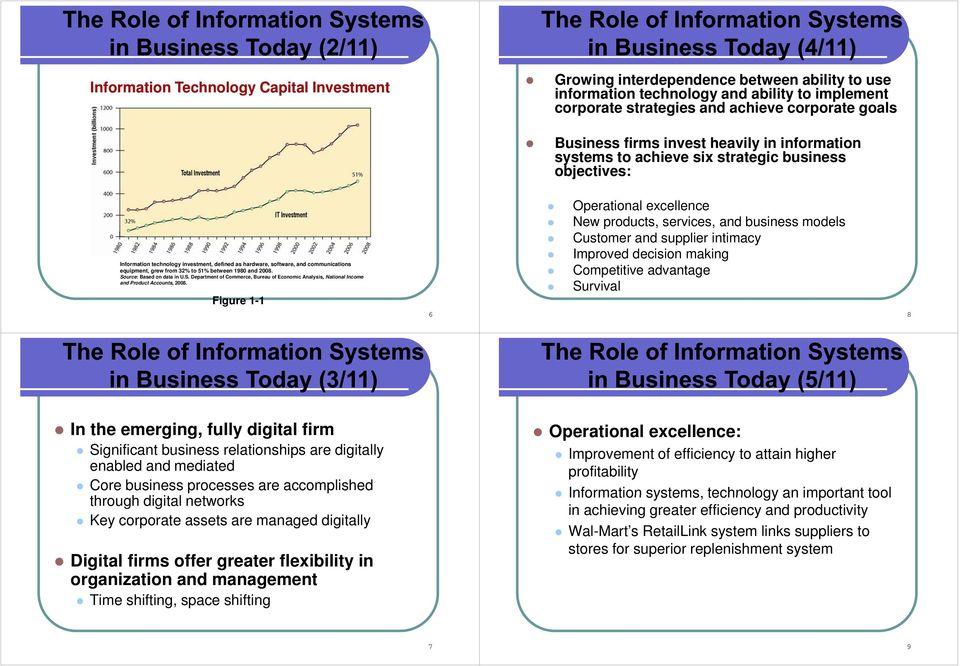
3 New products, services, and business models: Business model: describes how company produces, delivers, and sells product or service to create wealth Information systems and technology a major enabling tool for new products, services, business models Examples: Apple s ipod, itunes, and iphone, Netflix s Internet-based DVD rentals by Prentice Hall Improved decision making Without accurate information: Managers must use forecasts, best guesses, luck Leads to: Overproduction, underproduction of goods and services Misallocation of resources Poor response times Poor outcomes raise costs, lose customers Example: Verizon s Web-based digital dashboard to provide managers with real-time data on customer complaints, network performance, line outages, etc by Prentice Hall Customer and supplier intimacy: Serving customers well leads to customers returning, which raises revenues and profits Example: High-end hotels that use computers to track customer preferences and use to monitor and customize environment Intimacy with suppliers allows them to provide vital inputs, which lowers costs Example: J.C.Penney s information system which links sales records to contract manufacturer by Prentice Hall Competitive advantage Delivering better performance Charging less for superior products Responding to customers and suppliers in real time Example: Toyota and TPS (Toyota Production System) enjoy a considerable advantage over competitors information systems are critical to the implementation of TPS by Prentice Hall

4 Survival Information technologies as necessity of business May be: Industry-level changes, e.g. Citibank s introduction of ATMs Governmental regulations requiring recordkeeping Examples: Toxic Substances Control Act, Sarbanes-Oxley Act Information system: Set of interrelated components Collect, process, store, and distribute information Support decision making, coordination, and control Information vs. data Data are streams of raw facts Information is data shaped into meaningful form by Prentice Hall by Prentice Hall The Interdependence Between Organizations and Information Technology Data and Information In contemporary systems there is a growing interdependence between a firm s information systems and its business capabilities. Changes in strategy, rules, and business processes increasingly require changes in hardware, software, databases, and telecommunications. Often, what the organization would like to do depends on what its systems will permit it to do. Figure by Prentice Hall Raw data from a supermarket checkout counter can be processed and organized to produce meaningful information, such as the total unit sales of dish detergent or the total sales revenue from dish detergent for a specific store or sales territory. Figure by Prentice Hall

5 Information system: Three activities produce information organizations need Input: Captures raw data from organization or external environment Processing: Converts raw data into meaningful form Output: Transfers processed information to people or activities that use it by Prentice Hall Functions of an Information System An information system contains information about an organization and its surrounding environment. Three basic activities input, processing, and output produce the information organizations need. Feedback is output returned to appropriate people or activities in the organization to evaluate and refine the input. Environmental actors, such as customers, suppliers, competitors, stockholders, and regulatory agencies, interact with the organization and its information systems. Figure by Prentice Hall Information Systems Are More Than Computers Feedback: Output returned to appropriate members of organization to help evaluate or correct input stage Computer/Computer program vs. information system Computers and software are technical foundation and tools, similar to the material and tools used to build a house by Prentice Hall Using information systems effectively requires an understanding of the organization, management, and information technology shaping the systems. An information system creates value for the firm as an organizational and management solution to challenges posed by the environment. Figure by Prentice Hall

6 Organizational dimension of information systems Hierarchy of authority, responsibility Senior management Middle management Operational management Knowledge workers Data workers Production or service workers Organizational dimension of information systems (cont.) Separation of business functions Sales and marketing Human resources Finance and accounting Manufacturing and production Unique business processes Unique business culture Organizational politics by Prentice Hall by Prentice Hall Levels in a Firm Business organizations are hierarchies consisting of three principal levels: senior management, middle management, and operational management. Information systems serve each of these levels. Scientists and knowledge workers often work with middle management. Figure by Prentice Hall Management dimension of information systems Managers set organizational strategy for responding to business challenges In addition, managers must act creatively: Creation of new products and services Occasionally re-creating the organization by Prentice Hall

7 Technology dimension of information systems Computer hardware and software Data management ttechnology Networking and telecommunications technology Networks, the Internet, intranets and extranets, World Wide Web IT infrastructure: provides platform that system is built on Business information value chain Raw data acquired and transformed through stages that add value to that information Value of information system determined in part by extent to which it leads to better decisions, greater efficiency, and higher profits Business perspective: Calls attention to organizational and managerial nature of information systems by Prentice Hall by Prentice Hall The Business Information Value Chain Business perspective on information systems: Information system is instrument for creating value Investments in information technology will result in superior returns: Productivity increases Revenue increases Superior long-term strategic positioning by Prentice Hall From a business perspective, information systems are part of a series of value-adding activities for acquiring, transforming, and distributing information that managers can use to improve decision making, enhance organizational performance, and, ultimately, increase firm profitability. Figure by Prentice Hall

8 Variation in Returns on Information Technology Investment Complementary assets: Assets required to derive value from a primary investment Firms supporting technology investments with investment in complementary assets receive superior returns E.g.: invest in technology and the people to make it work properly Although, on average, investments in information technology produce returns far above those returned by other investments, there is considerable variation across firms. Figure by Prentice Hall by Prentice Hall Investing in information technology does not guarantee good returns Considerable variation in the returns firms receive from systems investments Factors: Adopting the right business model Investing in complementary assets (organizational and management capital) Complementary assets include: Organizational investments, e.g. Appropriate business model Efficient business processes Managerial investments, t e.g. Incentives for management innovation Teamwork and collaborative work environments Social investments, e.g. The Internet and telecommunications infrastructure Technology standards by Prentice Hall by Prentice Hall

9 Contemporary Approaches to Information Systems Management Information Systems Combines computer science, management science, operations research and practical orientation with behavioral issues Four main actors Suppliers of hardware and software Business firms Managers and employees Firm s environment (legal, social, cultural context) The study of information systems deals with issues and insights contributed from technical and behavioral disciplines. Figure by Prentice Hall by Prentice Hall Technical approach Emphasizes mathematically based models Computer science, management science, operations research Behavioral approach Behavioral issues (strategic business integration, implementation, etc.) Psychology, economics, sociology Approach of this book: Sociotechnical view Optimal organizational performance achieved by jointly optimizing both social and technical systems used in production Helps avoid purely technological approach by Prentice Hall by Prentice Hall

10 A Sociotechnical Perspective on Information Systems In a sociotechnical perspective, the performance of a system is optimized when both the technology and the organization mutually adjust to one another until a satisfactory fit is obtained. Figure by Prentice Hall

Chapter. 1.1 2007 by Prentice Hall
 Chapter 1 Business Information Systems in Your Career 1.1 2007 by Prentice Hall STUDENT LEARNING OBJECTIVES How are information systems transforming business and what is their relationship to globalization?
1. Global E Business and Collaboration. Lecture 2 TIM 50 Autumn 2012
 1. Global E Business and Collaboration Lecture 2 TIM 50 Autumn 2012 Objective of the Learning The Major Feature of Business Systems Performance of Business Organization Levels of Business management The
Management Information Systems. Learning Objectives
 Learning Objectives Understanding the effects of information systems on business and their relationship to globalization. Explain why information systems are so essential in business today. Define an information
Business Information Systems in Your Career
 Chapter 1 Business Information Systems in Your Career 1.1 2007 by Prentice Hall OBJECTIVES Explain why information systems are so essential in business today. Define an information system from both a technical
Management Information Systems
 Management Information Systems Information Systems, Global Business and E-business Lecturer: Richard Boateng, PhD. Lecturer in Information Systems, University of Ghana Business School Executive Director,
Information Systems and Networks
 Information Systems and Networks by Samuel Rota Bulò Department of Management Università Ca' Foscari Venezia Objectives Introduction to computer networks and information systems for companies with emphasis
Foundation of Information Systems
 Foundation of Information Systems Reading: Laudon & Laudon chapter 1 Additional Reading: Brien & Marakas chapter 1 COMP 5131 1 Outline Information Systems Definition, Role Functions of Information Systems
Information systems: foundations of e-business Volume 1
 Information systems: foundations of e-business Volume 1 R. Shipsey CO1108 2010 Undergraduate study in Computing and related programmes This is an extract from a subject guide for an undergraduate course
Introduction to Management Information Systems
 IntroductiontoManagementInformationSystems Summary 1. Explain why information systems are so essential in business today. Information systems are a foundation for conducting business today. In many industries,
Management Information Systems
 Management Information Systems Dr Mohammad Yamin PhD(ANU) Professor Department of Management Information Systems Email: [email protected] Mobile: 0502109000 Experience: Teaching & Research Prof Mohammad
Chapter 1 Managing the Digital Firm. 1.1 The Role of Information Systems in Business Today
 Chapter 1 Managing the Digital Firm Computers are changing every aspect of our lives from entertainment to shopping, from the work we do and where we do it, to how we communicate with friends and relatives.
INSIDE COVER - BLANK
 INSIDE COVER - BLANK INSTITUTE OF CERTIFIED PUBLIC ACCOUNTANTS OF RWANDA Level 2 L2.2 INFORMATION SYSTEMS First Edition 2012 This study manual has been fully revised and updated in accordance with the
Global E-Business: How Businesses Use Information Systems
 Introduction to Information Management IIM, NCKU Learning Objectives (2/2) Global E-Business: How Businesses Use Information Systems Explain the difference between e-business, e- commerce, and e-government.
Text Book: Laudon & Laudon, Essentials of Business Information Systems, 7 th Edition, Pearson (Prentice Hall), 2007
 Text Book: Laudon & Laudon, Essentials of Business Information Systems, 7 th Edition, Pearson (Prentice Hall), 2007 Multiple Choice Questions Chapter 1 Business Information Systems in Your Career 1. One
Alexander Nikov. 3. Information Systems and Organisational Issues. Learning Objectives. Verizon or AT&T: Which Company Has the Best Digital Strategy?
 INFO 1500 Introduction to IT Fundamentals Learning Objectives 3. Information Systems and Organisational Issues 1. Identify and describe important features of organizations that managers need to know about
E-Business: Use of Information Systems
 E-Business: Use of Information Systems Reading: Laudon & Laudon chapter 2 Additional Reading: Brien & Marakas chapter 1 COMP 5131 1 Outline Components of Business Business Process Managing Business and
Achieving Competitive Advantage with Information Systems
 Chapter 3 Achieving Competitive Advantage with Information Systems 3.1 Copyright 2011 Pearson Education, Inc. STUDENT LEARNING OBJECTIVES How does Porter s competitive forces model help companies develop
Fundamentals of Information Systems, Seventh Edition
 Chapter 1 An Introduction to Information Systems in Organizations 1 Principles and Learning Objectives The value of information is directly linked to how it helps decision makers achieve the organization
Information Systems: Definitions and Components
 Information Systems: Definitions and Components What Is an Information System? Information system has been defined in terms of two perspectives: one relating to its function; the other relating to its
INFO1400. 1. What are business processes? How are they related to information systems?
 Chapter 2 INFO1400 Review Questions 1. What are business processes? How are they related to information systems? Define business processes and describe the role they play in organizations. A business process
The Role of Different Types of Information Systems In Business Organizations : A Review
 The Role of Different Types of Information Systems In Business Organizations : A Review Yaser Hasan Al-Mamary 1*, Alina Shamsuddin 2,and Nor Aziati 3 1, 2, 3 Universiti Tun Hussein Onn Malaysia, Faculty
Introduction to Information Management IIM, NCKU. Enterprise Systems
 Introduction to Information Management IIM, NCKU Enterprise Systems Aka enterprise resource planning (ERP) systems Suite of integrated software modules and a common central database Collects data from
Information Systems for Business Operations
 Information Systems for Business Operations MBA 8125 Week 1 Sources: Laudon & Laudon (2006) Straub (2002) Stacie Petter 2005 1 Outline Why Study IT? Information Systems Basics e-commerce Management Challenges
Fundamentals of Information Systems, Fifth Edition. Chapter 1 An Introduction to Information Systems in Organizations
 Fundamentals of Information Systems, Fifth Edition Chapter 1 An Introduction to Information Systems in Organizations 1 Principles and Learning Objectives The value of information is directly linked to
Chapter. Developing Business / IT Strategies. Copyright 2008, The McGraw-Hill Companies, Inc. All rights reserved.
 Chapter 6 Developing Business / IT Strategies McGraw-Hill/Irwin Copyright 2008, The McGraw-Hill Companies, Inc. All rights reserved. 2-2 Learning Objectives Discuss the role of planning in the business
Information Systems, Organizations, and Strategy
 Information Systems, Organizations, and Strategy VIDEO CASES Chapter 3 Case 1: National Basketball Association: Competing on Global Delivery with Akamai OS Streaming Case 2: IT and Geo-Mapping Help a Small
E-Business: How Businesses Use Information Systems
 Chapter 2 E-Business: How Businesses Use Information Systems 2.1 2007 by Prentice Hall Business Processes and Information Systems Business processes: Workflows of material, information, knowledge Sets
IS 3630 Modern Information Systems: MCQ simple banking
 1) A collection of raw facts is called a. Output b. Information c. Bits d. Data 2) Which of the following are key corporate assets a. intellectual property, core competencies, and financial and human assets
The Importance of Integrative Components in the Field of e-business and Information Systems
 Jelica Trninić Jovica Đurković The Importance of Integrative Components in the Field of e-business and Information Systems Article Info:, Vol. 3 (2008), No. 1, pp. 023-028 Received 12 Januar 2008 Accepted
IT FOR BUSINESS AND FINANCE. BUSINESS PROCESSES and INFORMATION SYSTEMS
 IT FOR BUSINESS AND FINANCE BUSINESS PROCESSES and INFORMATION SYSTEMS SYSTEM (definition) A group of interacting, interrelated, or interdependent elements forming a complex whole presenting the following
Global E-Business and Collaboration
 Chapter 2 Global E-Business and Collaboration 2.1 Copyright 2011 Pearson Education, Inc. STUDENT LEARNING OBJECTIVES What are the major features of a business that are important for understanding the role
Building Successful Information Systems a Key for Successful Organization
 Building Successful Information Systems a Key for Successful Organization Doina ROŞCA University of Craiova [email protected] Logica BĂNICĂ University of Piteşti [email protected] Mirela SÎRBU
How To Understand The Business Benefits Of Technology
 Information Systems and Networks by Samuel Rota Bulò Department of Management Università Ca' Foscari Venezia Lesson 3 Information Systems, Organizations and Strategy Case study Verizon vs AT&T Verizon
Save from: www.uotiq.org/dep-cs. University of Technology Computer Science Department. 4 th Class Management Information Systems (MIS)
 Save from: www.uotiq.org/dep-cs University of Technology Computer Science Department 4 th Class Management Information Systems (MIS) استاذ المادة: د.علياء عبداالله Reference book: "Management Information
Understanding the Business Value of Systems and Managing Change
 Chapter 9 Understanding the Business Value of Systems and 9.1 2006 by Prentice Hall OBJECTIVES Evaluate models for understanding the business value of information systems Analyze the principal causes of
MANAGEMENT INFORMATION SYSTEMS
 MANAGEMENT INFORMATION SYSTEMS STUDY GUIDE PROGRAMME : MBA Year 1 CREDIT POINTS : 20 points NOTIONAL LEARNING : 200 hours over 1 semester TUTOR SUPPORT : [email protected] Copyright 2011 MANAGEMENT COLLEGE
Introduction to Information System
 Introduction to Information System Information Systems The Role of Information Systems in a Business Data versus Information Information Systems Definition Computer-Based Information System Business Information
An Overview of Organizational Behavior
 CHAPTER 1 An Overview of Organizational Behavior MULTIPLE CHOICE QUESTIONS Ans: D Page: 3 Group Ans: A Page: 3 Group Page: 4 AACSB: Communication Analytic skills Group Page: 4-5 Group 1. No matter how
Achieving Competitive Advantage with Information Systems. Lecture Note 003 TIM50, 2012 Autumn
 Achieving Competitive Advantage with Information Systems Lecture Note 003 TIM50, 2012 Autumn Announcements 1. HW # 1 due Next Thursday paper or electronic submission(web page) 2. Business Paper Preferences,
INFO1400. Define an organization and compare the technical definition of organizations with the behavioral definition.
 Chapter 3 INFO1400 Review Questions 1. Which features of organizations do managers need to know about to build and use information systems successfully? What is the impact of information systems on organizations?
Executive MBA. Course Descriptions FIRST PERIOD PRE-PROGRAM: FINANCIAL ACCOUNTING ONLINE TOOLS WORKSHOP MANAGERIAL SKILLS WORKSHOPS
 Executive MBA Course Descriptions PRE-PROGRAM: FINANCIAL ACCOUNTING The main objective of the pre-program in financial accounting is to provide students with a foundation in basic accounting concepts.
Baldrige Core Values and Concepts Customer-Driven Excellence Visionary Leadership
 Baldrige Core Values and Concepts These beliefs and behaviors are embedded in high-performing organizations. They are the foundation for integrating key performance and operational requirements within
Competitive Advantage with Information Systems
 Competitive Advantage with Information Systems Reading: Laudon & Laudon chapter 3 Additional Reading: Brien & Marakas chapter 2 COMP 5131 1 Outline Competitive Advantage with Information Systems Porter
Organizational Renewal: The Challenge of Change. Chapter 2
 Organizational Renewal: The Challenge of Change Chapter 2 Objectives Recognize the factors contributing to the accelerating rate of change Identify the ways an organization uses renewing processes to adapt
RELATIONSHIP BETWEEN THE USE OF MANAGEMENT INFORMATION SYSTEMS AND EMPLOYEE JOB PERFORMANCE: EVIDENCE FROM KENINDIA ASSURANCE COMPANY LIMITED
 RELATIONSHIP BETWEEN THE USE OF MANAGEMENT INFORMATION SYSTEMS AND EMPLOYEE JOB PERFORMANCE: EVIDENCE FROM KENINDIA ASSURANCE COMPANY LIMITED Owino Phyllis Osodo Beatrice Jemaiyo The Catholic University
IJMIE Volume 2, Issue 8 ISSN: 2249-0558
 MANAGEMENT INFORMATION SYSTEM Prof. Nirmal Kumar Sharma* ABSTRACT The business application of Management Information System has expanded significantly over the years. Technology advances have increased
Global E-business and Collaboration
 Global E-business and Collaboration Content Define and describe business processes and their relationship to information systems. Evaluate the role played by systems serving the various levels of management
Session 13 Enterprise Systems Copyright 2005 Thomas Malone
 15.561 Information Technology Essentials Session 13 Enterprise Systems Copyright 2005 Thomas Malone Outline Overview of major IT applications Examples of enterprise systems Enterprise Resource Planning
E-Commerce: Digital Markets, Digital Goods
 Introduction to Information Management IIM, NCKU E-Commerce: Digital Markets, Digital Goods Based on Chapter 10 of Laudon and Laudon (2010). Management Information Systems: Managing the Digital Firm (11th
Best Practices: Customer Relationship Management By Ian Gordon
 I M P R O V I N G T H E P R A C T I C E O F M A N A G E M E NT Best Practices: Customer Relationship Management By Ian Gordon Reprint # 9B02TF08 IVEY MANAGEMENT SERVICES NOVEMBER/DECEMBER 2002 COPYRIGHT
M.C.A. (SEM III) PAPER VI MANAGEMENT INFORMATION SYSTEM
 o M.C.A. (SEM III) PAPER VI MANAGEMENT INFORMATION SYSTEM UNIVERSITY OF MUMBAI Dr. Rajan Welukar Vice Chancellor, University of Mumbai, Fort, Mumbai-400032. Dr. Dhaneshwar Harichandan Professor-cum-Director,
Information Systems in the Enterprise
 Chapter 2 Information Systems in the Enterprise 2.1 2006 by Prentice Hall OBJECTIVES Evaluate the role played by the major types of systems in a business and their relationship to each other Describe the
Roadmap for Service Excellence
 15.778 Summer 2004 Management of Supply Networks for Products and Services: Concepts, Design, and Delivery Roadmap for Service Excellence G. Bitran S. Gurumurthi 15.778 Management of Supply Networks for
Information systems for management ดร. สล ล บ ญพราหมณ 2558
 1 Information systems for management ดร. สล ล บ ญพราหมณ 2558 2...ความสว สด ของข าพเจ าจะเก ดข นได ก ด วยบ านเม องของเราม ความเจร ญม นคงเป นปกต ส ข ความเจร ญม นคงท งน นจะส าเร จ ผลเป นจร งไปได ก ด วยท กคนท
Achieving Operational Excellence and Customer Intimacy: Enterprise Applications
 Chapter 9 Achieving Operational Excellence and Customer Intimacy: Enterprise Applications 9.1 2007 by Prentice Hall LEARNING OBJECTIVES Demonstrate how enterprise systems achieve operational excellence
Achieving Operational Excellence and Customer Intimacy: Enterprise Applications
 Chapter 8 Achieving Operational Excellence and Customer Intimacy: Enterprise Applications 8.1 2007 by Prentice Hall STUDENT OBJECTIVES How enterprise systems achieve operational excellence by integrating
Improving Customer Satisfaction to Accelerate Your Business Results
 Improving Customer Satisfaction to Accelerate Your Business Results Adrian Posteraro Managing Director Agenda About Presenter Why Customer Satisfaction (CSAT) Benefits of CSAT How to Implement a CSAT Process
Course 103402 MIS. Information Systems, Organizations and Strategies
 Oman College of Management and Technology Course 103402 MIS Topic 2 Information Systems, Organizations and Strategies CS/MIS Department Organizations and Information Systems Information technology and
Case Study 2. Q1: Small businesses and start up companies are most likely to adopt cloud-based CRM
 Tisha Smith Smith 1 MIS 220-02 October 21, 2014 Case Study 2 Q1: Small businesses and start up companies are most likely to adopt cloud-based CRM software services. Companies such as, Salesforce.com the
Course: ITM 125.C2 Course Title: Essentials of Business Information Systems Spring C2 2012
 Course: ITM 125.C2 Course Title: Essentials of Business Information Spring C2 2012 John Moreno Adjunct Professor Ageno School of Business GOLDEN GATE UNIVERSITY Contact Information Email: [email protected]
Introduction to E-Commerce
 Introduction to E-Commerce 1/12/2016 What is E-commerce? Buying and selling of products or services over electronic systems such as the Internet and other computer networks Online purchase of goods or
Supply Chains: From Inside-Out to Outside-In
 Supply Chains: From Inside-Out to Outside-In Table of Contents Big Data and the Supply Chains of the Process Industries The Inter-Enterprise System of Record Inside-Out vs. Outside-In Supply Chain How
ROCKHURST)UNIVERSITY) HELZBERG)SCHOOL)OF)MANAGEMENT) MASTER S)IN)BUSINESS)ADMINISTRATION)) PROGRAM)REVISION) 2011)
 ROCKHURST)UNIVERSITY) HELZBERG)SCHOOL)OF)MANAGEMENT) MASTER S)IN)BUSINESS)ADMINISTRATION)) PROGRAM)REVISION) 2011) ) The revised part-time evening Master s in Business Administration (MBA) program will
Quality Systems Frameworks. SE 350 Software Process & Product Quality 1
 Quality Systems Frameworks 1 What is a Quality System? An organization uses quality systems to control and improve the effectiveness of the processes used to deliver a quality product or service A Quality
Lecture-2-The Strategic Role of Information Systems
 Lecture-2-The Strategic Role of Information Systems Thepul Ginige 1 LEARNING OBJECTIVES Analyze roles of 6 types of information systems Describe types of information systems Analyze relationships between
Republic Polytechnic School of Information and Communications Technology C352 Management Information Systems. Module Curriculum
 Republic Polytechnic School of Information and Communications C352 Management Information Systems Module Curriculum This document addresses the content related abilities, with reference to the module.
Management Accounting and Decision-Making
 Management Accounting 15 Management Accounting and Decision-Making Management accounting writers tend to present management accounting as a loosely connected set of decision making tools. Although the
CURRICULUM INFORMATION BABSON MBA TWO-YEAR PROGRAM
 CURRICULUM INFORMATION BABSON MBA TWO-YEAR PROGRAM MODULE I (8 credits) Entrepreneurial Thought and Action: Creating and Scaling Effective Businesses Module 1 sets the stage for Babson s focus on entrepreneurial
STUDY ON MANAGEMENT INFORMATION SYSTEM, ITS COMPONENTS AND IMPLEMENTATION PROCESS
 STUDY ON MANAGEMENT INFORMATION SYSTEM, ITS COMPONENTS AND IMPLEMENTATION PROCESS Ms. Supriya Mahajan 1, Mr. Vansh Raheja 2 1 M.Phil Research Scholar, Department of Management, Lovely Professional University,
Information Systems and Business Strategy. Chapter 3 (9E) Ch 3 & Questions
 Information Systems and Business Strategy Chapter 3 (9E) 10/7/2007 Laudon & Laudon 1 Ch 3 & Questions 1. What are information systems? Explain the nature and interaction of technology, people, and organizational
Enhancing Decision Making
 Enhancing Decision Making Content Describe the different types of decisions and how the decision-making process works. Explain how information systems support the activities of managers and management
Information Systems as Support to Corporate Management
 Florida Veljanoska, Majlinda Axhiu Information Systems as Support to Corporate Management Article Info:, Vol. 8 (2013), No. 4, pp. 003-009 Received 12 July 2013 Accepted 25 September 2013 UDC 005.21:334.72.021;
John Moreno Senior Adjunct Professor Ageno School of Business GOLDEN GATE UNIVERSITY
 Course: ITM 125.C1 Course Title: Management Information Systems Fall 2012 John Moreno Senior Adjunct Professor Ageno School of Business GOLDEN GATE UNIVERSITY Contact Information Email: [email protected]
EXECUTIVE MASTER IN. Increasing corporate value in today s complex digital world through reputation management and communication with stakeholders.
 EXECUTIVE MASTER IN CORPORATE COMMUNICATION Increasing corporate value in today s complex digital world through reputation management and communication with stakeholders. COURSE DESCRIPTION At a Glance
Introduction Management Information Systems CS334 Midterm Exam 12/12/2003 A
 Introduction Management Information Systems CS334 Midterm Exam 12/12/2003 A Name: Surname : Number: 1.) Which information flows are the advantages of using the Internet as the infrastructure for electronic
Getting Started with Lean Process Management
 Getting Started with Lean Process Management Hi-Tec Exchange Conference San Francisco July 25, 2011 Missions To team with Organizational Leaders, Managers, & Employees to focus on customers & improve competitiveness,
OPTIMIZING BUSINESS INTELLIGENCE SOLUTION FOR BANIKING IN ALBANIA
 OPTIMIZING BUSINESS INTELLIGENCE SOLUTION FOR BANIKING IN ALBANIA Blerta Moçka 1, Gudar Beqiraj 2, Daniel Leka 3 1 Head of Department of Information Technology, Faculty of Business and Technology, Kristal
INFORMATION TECHNOLOGY AS A FACTOR OF CREATING AND DEVELOPING OF COMPETITIVE ADVANTAGES OF BUSINESSES
 BERISHA (NAMANI) Mihane & KONXHELI (RADONIQI) Drita - Information technology as a factor of creating and developing of competitive advantages of businesses INFORMATION TECHNOLOGY AS A FACTOR OF CREATING
Learning Objectives: Quick answer key: Question # Multiple Choice True/False
 0 Learning Objectives: 11.1 Describe the advantages and disadvantages of the most common forms of business ownership. 11.2 Identify the stakeholders of a business and describe why they are important. 11.3
Diploma in IT Syllabus IT Service Management
 Rationale: Services Management, and indeed management at all levels in the Information Technology industry, requires a specific set of competencies. The management competencies include skills required
Transaction Processing, Functional Applications & Integration
 Chapter 9 Transaction Processing, Functional Applications & Integration Information Technology For Management 6 th Edition Turban, Leidner, McLean, Wetherbe Based on lecture slides by L. Beaubien, Providence
Course Description Bachelor in Management Information Systems
 Course Description Bachelor in Management Information Systems 1605215 Principles of Management Information Systems (3 credit hours) Introducing the essentials of Management Information Systems (MIS), providing
Corporate Performance Management Framework
 Version 1.0 Copyright 2004 Answerport, Inc. Table of Contents Table of Contents... 2 Conceptual Overview... 3 Conceptual Overview Diagram... 4 The Foundation... 4 Analytic Presentation Layer... 5 Reports...
CHAPTER 12: INFORMATION SYSTEMS IN BUSINESS
 CHAPTER 12: INFORMATION SYSTEMS IN BUSINESS Multiple Choice: 1. A computer system performs all of the following basic functions EXCEPT: A. output. B. input. C. acquisition. D. processing. Answer: C Reference:
MS/Supply Chain Management Courses
 September 2014 MS/Supply Chain Management Courses Summer Foundations Courses ACCT 560 Introduction to Financial Accounting In this course, we will study the three fundamental financial accounting issues,
801134 - SISINF - Information Systems
 Coordinating unit: Teaching unit: Academic year: Degree: ECTS credits: 2014 801 - EUNCET - Euncet University Business School 801 - EUNCET - Euncet University Business School BACHELOR'S DEGREE IN BUSINESS
Community Development and Training Centre Semester 2 2006 IT 245 Management Information Systems
 Chapter 5 Electronic Commerce System Community Development and Training Centre Semester 2 2006 IT 245 Management Information Systems Electronic Commerce: Electronic commerce encompasses the entire online
MBA 6001, Organizational Research and Theory Course Syllabus. Course Description. Prerequisites. Course Textbook. Course Learning Objectives.
 MBA 6001, Organizational Research and Theory Course Syllabus Course Description Examination of organizational theory and managerial concepts of human behavior in organizations. Topics include theoretical
WORKGROUP-LEVEL OVERVIEW. Learning Objectives Upon completion of this session, you will be able to:
 WORKGROUP-LEVEL OVERVIEW Performance Scorecards provide an organized, proven method of defining key business outcomes and data, and should be an integral part of your planning process. Included with this
Management Information Systems. B08. Interorganizational and Global Information Systems
 Management Information Systems Management Information Systems B08. Interorganizational and Global Information Systems Code: 166137-01+02 Course: Management Information Systems Period: Spring 2013 Professor:
Managing Organizational Performance: Linking the Balanced Scorecard to a Process Improvement Technique Abstract: Introduction:
 Managing Organizational Performance: Linking the Balanced Scorecard to a Process Improvement Technique William K. Hoehn, Ph.D. Raytheon Systems Company Tucson, Arizona Abstract: Numerous researchers have
E-commerce. business. technology. society. Kenneth C. Laudon Carol Guercio Traver. Third Edition. Copyright 2007 Pearson Education, Inc.
 Copyright 2007 Pearson Education, Inc. Slide 12-1 E-commerce business. technology. society. Third Edition Kenneth C. Laudon Carol Guercio Traver Copyright 2007 Pearson Education, Inc. Slide 12-2 Chapter