
MBA 6001, Organizational Research and Theory Course Syllabus. Course Description. Prerequisites. Course Textbook. Course Learning Objectives.
|
|
|
- Stuart Fleming
- 10 years ago
- Views:
Transcription
1 MBA 6001, Organizational Research and Theory Course Syllabus Course Description Examination of organizational theory and managerial concepts of human behavior in organizations. Topics include theoretical and practical application of motivation, leadership, power, and reward systems. Provides a balanced view of the structural and human sides of organization design. Prerequisites None Course Textbook Jones, G. (2010). Organizational theory, design, and change (6th ed.). Upper Saddle River, NJ: Prentice Hall. Course Learning Objectives Upon completion of this course, students should be able to: 1. Examine organizational foundations and integrate concepts of organizational theory, design, and change to evaluate and promote organizational effectiveness within diverse environments. 2. Distinguish among organizational stakeholders and describe strategies used to create and maintain an ethical organization utilizing authority, agency theory, and legal models within a culturally sound framework. 3. Classify the organizational environment and utilize resource dependency theory and transaction cost theory to explain why stakeholders select different types of linkage mechanism to manage competitive interdependencies. 4. Discriminate among organizational design models and prevailing theory surrounding mechanistic and organic organizational structures. 5. Compare and contrast organizational authority and control structures and apply concepts of differentiation to describe an organization s hierarchy and bureaucratic structure and impact on specialization and coordination among subgroups. 6. Explain organizational culture and describe how socialization tactics are used to create norms and values among members and to create socially responsible organizations. 7. Analyze and evaluate organizational design and strategy within the global operations environment and differentiate strategy implementation by organizational level and environmental influences. 8. Describe organizational theories related to organizational design, competency, and technology and differentiate among change theories and organizational life cycle models. 9. Integrate various theories and models to analyze organizational decision making, knowledge management, innovation, and factors impacting organizational learning. 10. Differentiate among conflict, power, and political models and describe sources of organizational power and conflict resolution strategies. Credits Upon completion of this course, the students will earn three (3) hours of college credit. MBA 6001, Organizational Research and Theory 1
2 Course Structure 1. Unit Learning Objectives: Each unit contains Unit Learning Objectives that specify the measurable skills and knowledge students should gain upon completion of the unit. 2. Written Lectures: Each unit contains a Written Lecture, which discusses lesson material. 3. Reading Assignments: Each unit contains Reading Assignments from one or more chapters from the textbook. Chapter presentations are provided in each unit study guide as Supplemental Reading to aid students their course of study. 4. Learning Activities (Non-Graded): These non-graded Learning Activities are provided to aid students in their course of study. 5. Key Terms: Key Terms are intended to guide students in their course of study. Students should pay particular attention to Key Terms as they represent important concepts within the unit material and reading. 6. Unit Assessments: This course contains eight Unit Assessments, one to be completed at the end of each unit. 7. Article Critique: Students are required to submit for grading an Article Critique in Unit III. Details and instructions regarding this assignment can be found below. 8. Research Paper: Students are required to submit for grading a Research Paper in Unit VIII. Details and instructions regarding this assignment can be found below. a. Students are also required to submit a Research Paper Outline in Unit IV. This assignment should be e- mailed to your professor for Unit IV. The outline you submit in Unit IV is a non-graded assignment. The purpose of this outline is to insure that you have selected a topic relevant to class and to begin early guidance is the paper development process. 9. Ask the Professor: This communication forum provides you with an opportunity to ask your professor general or course content related questions. 10. Student Break Room: This communication forum allows for casual conversation with your classmates. Article Critique This assignment requires that you review an article from one of the journals listed below* that relates to a topic of interest in organizational theory. A strategy for selecting an article is to look at the table of contents in your textbook and place key words into CSU s Online Library search engine. The article should not be more than five years old. Select an article that has sufficient content that you can write a review of two pages in length. A sample Article Critique can be found below. List of journals: Academy of Management Review Administrative Science Quarterly Business and Society in Review Business Finance Decision Sciences Financial Management Forbes Magazine Harvard Business Review Healthcare Financial Management Industrial and Labor Relations Review Journal of Accountancy Journal of Applied Economics and Policy Journal of Applied Psychology Journal of Business Ethics Journal of Finance Journal of Financial Statement Analysis Journal of Management Studies Personnel Today Public Administration Quarterly * Other journals may be considered with the approval of your professor. MBA 6001, Organizational Research and Theory 2

3 Outline your article in the following manner and adhere to the APA guidelines: A brief introduction of the article. A statement of the problem. A description of procedures. Flaws in the procedural design. Analysis of the data. Limited and justifiable conclusions. A sample Article Critique can be found below. This sample should be used as a guide for an Article Critique and NOT as a reference for APA. Sample Article Critique (by Jo Ann Jolley)* This is a descriptive study of the perception of service delivery in the public sector compared to that in the private sector. The design of this study is not complex, and it reports fairly simple statistical data. As in most descriptive research, it does not attempt to answer the question why, but lays a foundation for future research of that question. *Used by permission of Ms. Jolley Statement of the Research Problem The researchers state that while there is a widespread assumption that service delivery in the private sector is superior to that in the public sector a 1991 study by Miller and Miller found generally favorable assessments for most local government services (Poister and Henry, 1994, p. 157). Poister and Henry s (1994) study was designed to examine Georgia residents assessment of the quality of local public and private sector services. The survey responses were reviewed to determine how the assessment of the quality of public services compared with that of private sector services. In addition, perceptions of the public were compared with those of recent consumers. Poister and Henry (1994) provide an adequate literature review on service quality, including several studies on quality in the public sector. The scope of their study was limited to Georgia residents. They did not provide precise meanings of significant words, but this is probably not unusual in descriptive research. Their definition of this research question was adequate. Description of the Research Procedure The researchers provided information on their method of collecting data. It was sufficient to allow evaluation of their method and permit duplication of their study. The mention of a computer assisted telephone interviewing system (Poister and Henry, 1994, p. 156) was somewhat unclear. Was the system only used to select respondents and assign them sets of questions or was the interview actually conducted by the computer? Even with standardized responses the possibility of interviewer bias exists through inflection and prompts. This would not be a factor if a computer conducted the interview. Flaws in Procedural Design The researchers did discuss the difficulty of attempting to parallel public and private services. While agreeing that direct comparisons in many types of services were impossible, they attempted to compensate for this by soliciting ratings across broad slates of public and private services. Poister and Henry (1994) discussed the wide variation in quality ratings of both sectors. They emphasized that their findings should only be viewed in an overall context and not as a direct comparison of any one service. Analysis of Data As previously mentioned, the sample characteristics of the Georgia study favorably compared to the population characteristics. Results paralleling the Miller and Miller (1992) findings tend to support the reliability of the Georgia study. The findings of the ratings of recent users versus those of the public are also supported by the studies of Katz et al. (1975). A minimum of information is given on the statistical findings. The mean, standard deviation, and significance are given in an easy to read table and provide the basic necessities for evaluation. Limited and Justifiable Conclusions Poister and Henry (1994) posed their central question as: How does the public s assessment of the quality of specific public services compare with that of private sector services? (p. 156). The specific conclusion of this study is that MBA 6001, Organizational Research and Theory 3
4 Georgia residents exhibited no particular tendency to rate the quality of local public services as better or worse than other services provided by businesses in their local communities (p. 158). This study supports only this specific conclusion. To submit your completed Article Critique upload it through the view/complete link under the Article Critique link located in Unit III. Do not your paper directly to your professor. By using the Article Critique link, your university record will automatically be updated to indicate you have submitted your paper and the paper will be provided to your professor for grading. Instructions for submitting your assignment can be found under the Article Critique link in Unit III. Research Paper Outline An outline of your proposed research paper should be ed to your professor for Unit IV. The outline you submit in Unit IV is a non-graded assignment. Your outline must have a clear topic sentence, thesis, and outline of your intended paper. The purpose of this outline is to insure that you have selected a topic relevant to class and to begin early guidance in the paper development process. Your professor may approve, amend, or decline your outline pending resolution of problems. It is therefore recommended that you do not write your Research Paper until you have received professor's approval. Research Paper This activity requires you to write a Research Paper on a subject of your choice within Organizational Research and Theory. Format The Research Paper must be at least 10 pages in length, not including the cover page and references. CSU requires that students use the APA format in writing course papers. Therefore, the APA rules for formatting, quoting, paraphrasing, citing, and listing of sources are to be followed. Your paper must contain at least five professional references and may include internet sources, books, and professional journals or resources related to the profession. Example topics include: 1. Environments shape organizations. In turn, organizations also shape the environments in which they interact. Organizations, in part, also choose which environments they enter and exit, choose which coalitions are most desirable, and determine the contexts in which they function. Write a paper that draws from the professional literature to address these issues and explains how organizations relate strategically to their environments. 2. All organizations must secure a continuing supply of resources from their environments. The initial mix of resources mobilized when an organization is created is critical as these resources constitute a structural pattern that tends to persist and is imprinted on organizational members. Develop a paper that addresses these issues; explains how all organizations compete for resources, which describes the consequences and costs of obtaining resources; and how resource attainment varies with the type of organization and environment, as well as with the organization s stage of development. 3. Organizations utilize lateral relationships as legitimate avenues of information, and influence flows constitute the new generation of organizational forms. Write a paper that explains the number of different lateral structural arrangements in use in organizations, excluding project teams, matrix structures, organic systems, and professional organizations. 4. A topic you select with the consent of your professor. To submit your completed Research Paper upload it through the view/complete link under the Research Paper link located in Unit VIII. Do not your paper directly to your professor. By using the Research Paper link, your university record will automatically be updated to indicate you have submitted your paper and the paper will be provided to your professor for grading. Instructions for submitting your assignment can be found under the Research Paper link in Unit VIII. MBA 6001, Organizational Research and Theory 4
5 APA Guidelines CSU requires that students use the APA style for papers and projects. Therefore, the APA rules for formatting, quoting, paraphrasing, citing, and listing of sources are to be followed. A document titled APA Guidelines Summary is available for you to download from the APA Guide Link, found in the Learning Resources area of the mycsu Student Portal. It may also be accessed from the Student Resources link on the Course Menu. This document provides links to several internet sites that provide comprehensive information on APA formatting, including examples and sample papers. CSU Grading Rubric for Papers/Projects The course papers will be graded based on the CSU Grading Rubric for all types of papers. In addition, all papers will be submitted for electronic evaluation to rule out plagiarism. Course projects will contain project specific grading criteria defined in the project directions. To view the rubric, click the Academic Policies link on the Course Menu, or by accessing the CSU Grading Rubric link, found in the Learning Resources area of the mycsu Student Portal. Communication Forums These are non-graded discussion forums that allow you to communicate with your professor and other students. Participation in these discussion forums is encouraged, but not required. You can access these forums with the buttons in the Course Menu. Instructions for subscribing/unsubscribing to these forums are provided below. Once you have completed Unit VIII, you MUST unsubscribe from the forum; otherwise, you will continue to receive updates from the forum. You will not be able to unsubscribe after your course end date. Click here for instructions on how to subscribe/unsubscribe and post to the Communication Forums. Ask the Professor This communication forum provides you with an opportunity to ask your professor general or course content questions. Questions may focus on Blackboard locations of online course components, textbook or course content elaboration, additional guidance on assessment requirements, or general advice from other students. Questions that are specific in nature, such as inquiries regarding assessment/assignment grades or personal accommodation requests, are NOT to be posted on this forum. If you have questions, comments, or concerns of a nonpublic nature, please feel free to your professor. Responses to your post will be addressed or ed by the professor within 48 hours. Before posting, please ensure that you have read all relevant course documentation, including the syllabus, assessment/assignment instructions, faculty feedback, and other important information. Student Break Room This communication forum allows for casual conversation with your classmates. Communication on this forum should always maintain a standard of appropriateness and respect for your fellow classmates. This forum should NOT be used to share assessment answers. Grading Unit Assessments 6.5%) = 52% Article Critique = 24% Research Paper = 24% Total = 100% Course Schedule/Checklist (PLEASE PRINT) The following pages contain a printable Course Schedule to assist you through this course. By following this schedule, you will be assured that you will complete the course within the time allotted. MBA 6001, Organizational Research and Theory 5
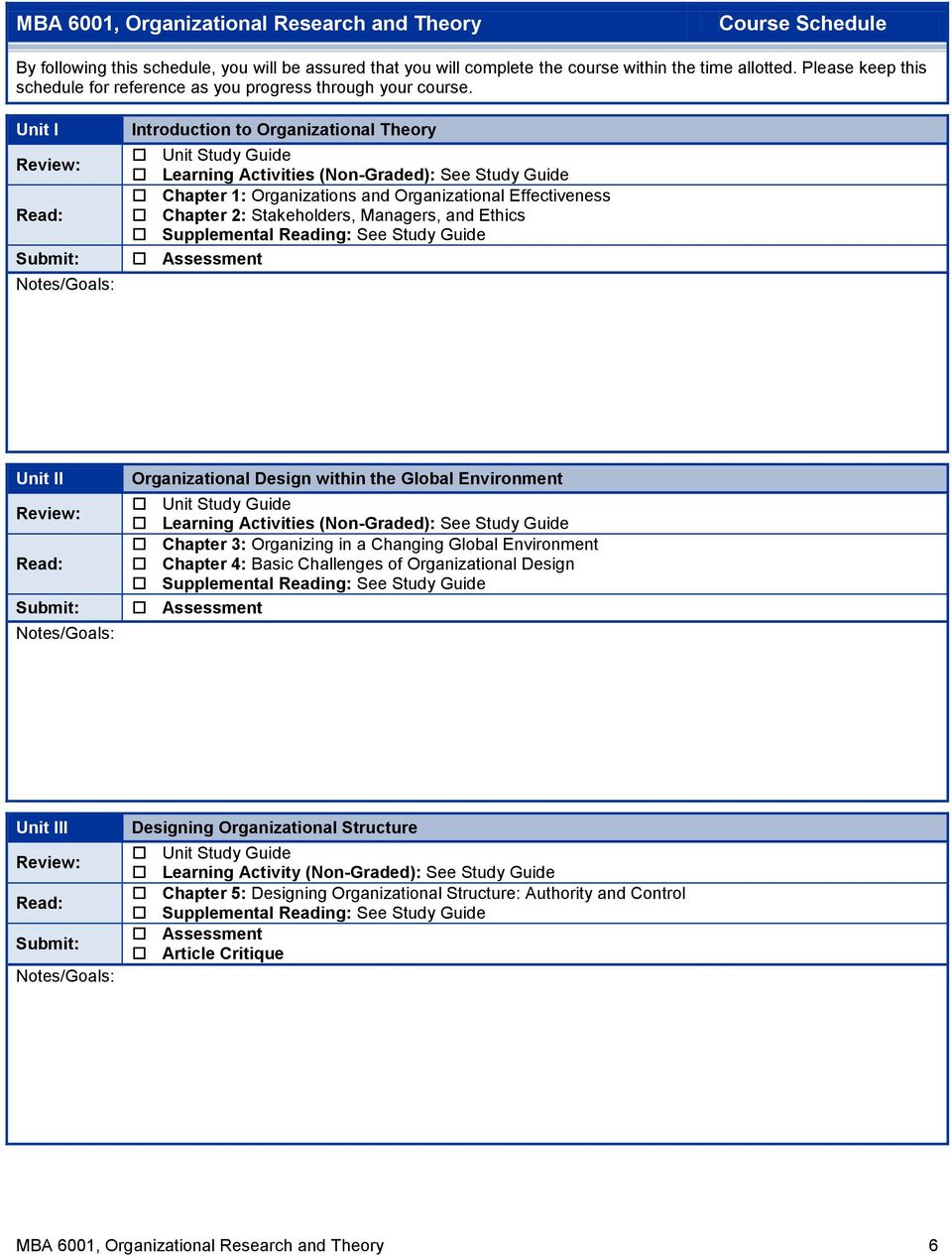
6 MBA 6001, Organizational Research and Theory Course Schedule By following this schedule, you will be assured that you will complete the course within the time allotted. Please keep this schedule for reference as you progress through your course. Unit I Introduction to Organizational Theory Unit Study Guide Learning Activities (Non-Graded): See Study Guide Chapter 1: Organizations and Organizational Effectiveness Chapter 2: Stakeholders, Managers, and Ethics Supplemental Reading: See Study Guide Assessment Unit II Organizational Design within the Global Environment Unit Study Guide Learning Activities (Non-Graded): See Study Guide Chapter 3: Organizing in a Changing Global Environment Chapter 4: Basic Challenges of Organizational Design Supplemental Reading: See Study Guide Assessment Unit III Designing Organizational Structure Unit Study Guide Learning Activity (Non-Graded): See Study Guide Chapter 5: Designing Organizational Structure: Authority and Control Supplemental Reading: See Study Guide Assessment Article Critique MBA 6001, Organizational Research and Theory 6
7 MBA 6001, Organizational Research and Theory Course Schedule Unit IV Organizational Specialization, Coordination, and Management of Culture Unit Study Guide Learning Activities (Non-Graded): See Study Guide Chapter 6: Designing Organizational Structure: Specialization and Coordination Chapter 7: Creating and Managing Organizational Culture Supplemental Reading: See Study Guide Assessment Research Paper Outline Unit V Organizational Design in Changing Global Environments Unit Study Guide Learning Activities (Non-Graded): See Study Guide Chapter 8: Organizational Design and Strategy in a Changing Global Environment Chapter 9: Organizational Design, Competences, and Technology Supplemental Reading: See Study Guide Assessment Unit VI Organizational Change and Stages of Transformation Unit Study Guide Learning Activities (Non-Graded): See Study Guide Chapter 10: Types and Forms of Organizational Change Chapter 11: Organizational Transformations: Birth, Growth, Decline, and Death Supplemental Reading: See Study Guide Assessment MBA 6001, Organizational Research and Theory 7

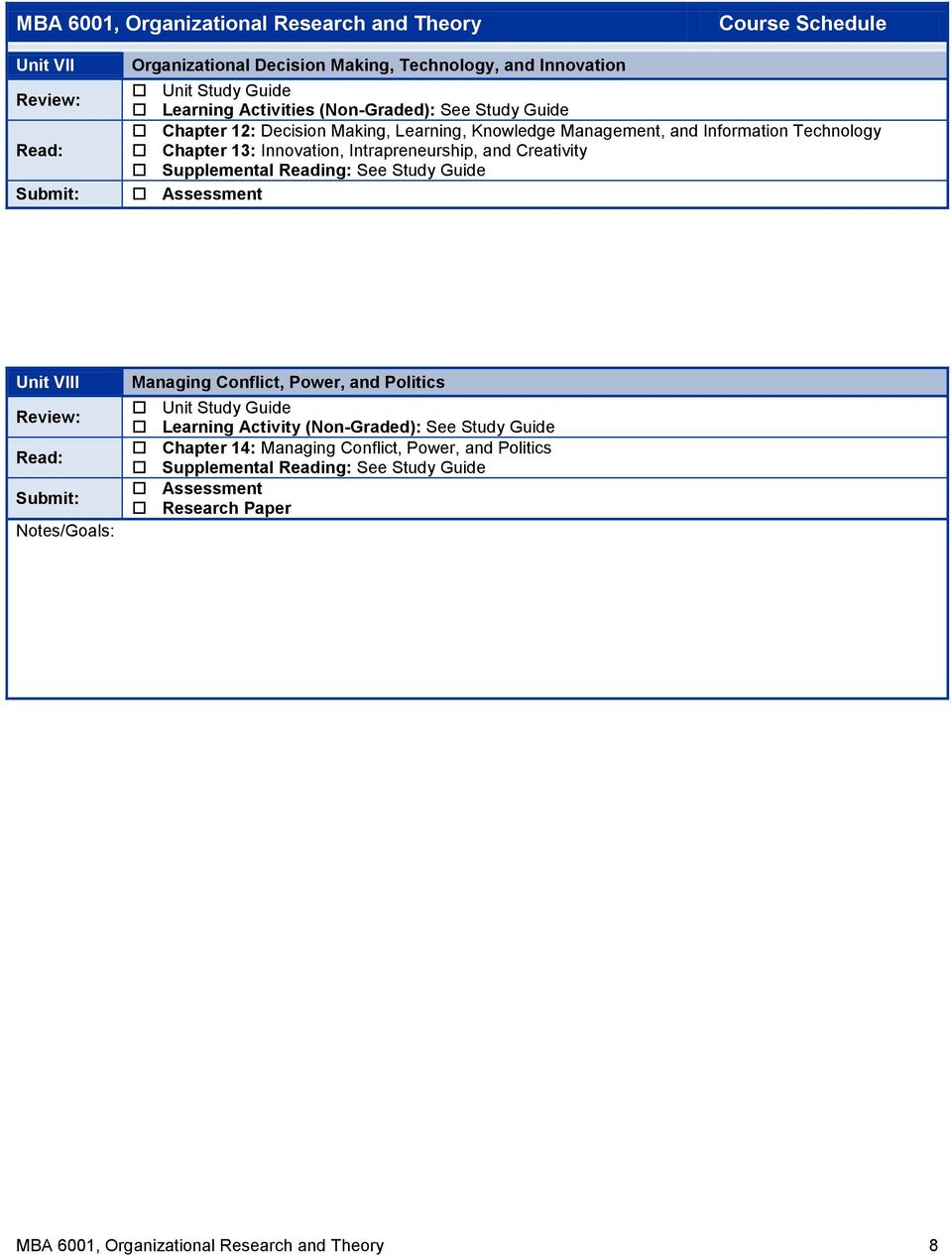
8 MBA 6001, Organizational Research and Theory Course Schedule Unit VII Organizational Decision Making, Technology, and Innovation Unit Study Guide Learning Activities (Non-Graded): See Study Guide Chapter 12: Decision Making, Learning, Knowledge Management, and Information Technology Chapter 13: Innovation, Intrapreneurship, and Creativity Supplemental Reading: See Study Guide Assessment Unit VIII Managing Conflict, Power, and Politics Unit Study Guide Learning Activity (Non-Graded): See Study Guide Chapter 14: Managing Conflict, Power, and Politics Supplemental Reading: See Study Guide Assessment Research Paper MBA 6001, Organizational Research and Theory 8
PSY 4680, Industrial Organizational Psychology Course Syllabus. Course Description. Prerequisites. Course Textbook. Course Learning Objectives
 PSY 4680, Industrial Organizational Psychology Course Syllabus Course Description Provides an analytical understanding of industrial/organization (I/O) psychology, one of the major applied areas of psychology.
MBA 6931, Project Management Strategy and Tactics Course Syllabus. Course Description. Prerequisites. Course Textbook. Course Learning Objectives
 MBA 6931, Project Management Strategy and Tactics Course Syllabus Course Description Introduction to the methodologies and technologies that will assist project managers coordinate projects from inception
Goetsch, D. L. (2010). Construction safety and the OSHA standards. Upper Saddle River, NJ: Prentice Hall.
 BOS 3401, Construction Safety Course Syllabus Course Description Exploration of the OSHA regulations and related safety practices governing the construction industry. Provides an analysis of the high incident/accident
MBA 5401, Management Information Systems Course Syllabus. Course Description. Prerequisites. Course Textbook. Course Learning Objectives.
 MBA 5401, Management Information Systems Course Syllabus Course Description Theory and practice of management information systems including information requirements analysis, design methodology, and system
MBA 6301, Business Ethics Course Syllabus. Course Description. Prerequisites. Course Textbook. Course Learning Objectives. Credits.
 MBA 6301, Business Ethics Course Syllabus Course Description Explores the role of individual, business, and government activities related to ethically responsible commerce and socially beneficial business
MBA 6081, Corporate Finance Course Syllabus. Course Description. Course Textbook. Course Learning Outcomes. Credits.
 Course Syllabus Course Description Introduction to standard techniques and recent advances in a practical and intuitive way. Although a strong background in financial management is not required, a rudimentary
Malhotra, N. K. (2010). Marketing research: An applied orientation (6th ed.). Upper Saddle River, NJ: Prentice Hall.
 Course Syllabus Course Description Introduction to the marketing research process. Exploration of the many ways that marketing researchers gather information and utilize technology and the Internet in
Spiro, R. L., Rich, G. A., & Stanton, W. J. (2008). Management of a sales force (12th ed.). New York, NY: McGraw-Hill/Irwin.
 Course Syllabus Course Description A comprehensive, practical approach to sales management. Emphasis is placed on managing strategic account relationships, team development, diversity in the work force,
Reid, R. D., Bojanic, D. C. (2010). Hospitality marketing management (5th ed.). Hoboken, NJ: John Wiley & Sons, Inc.
 BHM 4680, Marketing for Hospitality and Tourism Course Syllabus Course Description Study of marketing as one of the most exciting and complex functions of a hospitality and tourism manager. Combines knowledge
BCJ 4601, Criminal Justice Current Topics Course Syllabus. Course Description. Prerequisites. Course Textbook. Course Learning Objectives
 BCJ 4601, Criminal Justice Current Topics Course Syllabus Course Description A study of major aspects of the criminal justice system and providing an assessment of current issues such as globalization
Aronson, E., Wilson, T. D., & Akert, R. M. (2010). Social psychology (7th ed.). Upper Saddle River, NJ: Prentice Hall.
 Course Syllabus Course Description Study of the social factors influencing individual behavior. Examines the constructs of socialization, social influence and conformity, social interaction, decision making,
BBA 4326, Procurement and Contract Management Course Syllabus. Course Description. Prerequisites. Course Textbook. Course Learning Objectives.
 BBA 4326, Procurement and Contract Management Course Syllabus Course Description Investigates contracts as a means for individuals and businesses to sell and otherwise transfer property, services, and
Shelly, G. B., & Campbell, J. T. (2012). Web design: Introductory (4th ed.). Boston, MA: Course Technology.
 ITC 4310, Web Design and Development Course Syllabus Course Description Presents Web design principles and techniques coupled with practical experience in the design and creation of Web sites. Includes
Dorfman, M. S. (2008). Introduction to risk management and insurance (9th ed.). Upper Saddle River, NJ: Prentice Hall.
 BBA 4226, Risk Management Course Syllabus Course Description A study of problem solving from managerial, consumer, and societal perspectives. Emphasizes both the business managerial aspects of risk management
Pozgar, G. (2012). Legal aspects of health care administration (11th ed.). Sudbury, MA: Jones & Bartlett.
 MHA 5101, Legal Foundations of Health Care Course Syllabus Course Description This course provides an analysis of the legal aspects of health care delivery and the impact on health care institutions. Students
Kotler, P., & Keller, K. L. (2012). Marketing management (14th ed.). Upper Saddle River, NJ: Prentice Hall.
 MBA 5501, Advanced Marketing Course Syllabus Course Description An overview of advanced topics in marketing planning, strategy, analysis, and control. Emphasis on consumer needs and analysis, market position,
DBA 9101, Comprehensive Exam Course Syllabus. Course Description. Course Textbook. Course Learning Outcomes. Credits.
 DBA 9101, Comprehensive Exam Course Syllabus Course Description Establishes that a doctoral candidate has acquired the essential knowledge and skills covered in each of the courses, not including dissertation
Pedersen, P. M., Parks, J. B., Quarterman, J., & Thibault, L. (2011). Contemporary sport management (4th ed.). Champaign, IL: Human Kinetics.
 Course Syllabus Course Description Principles of efficient management and leadership concepts as applicable to the sport industry. Focuses on principles and techniques of management relating to programs,
BBA 3210, Business Law Course Syllabus. Course Description. Course Textbook. Course Learning Outcomes. Credits. Course Structure
 Course Syllabus Course Description To excel in business today, business managers must understand and adapt to three major disciplines: law, ethics, and business legal organizations. Students will gain
Shelly, G. B., & Campbell, J. T. (2012). Web design: Introductory (4th ed.). Boston, MA: Course Technology.
 ITC 4310, Web Design and Development Course Syllabus Course Description Presents Web design principles and techniques coupled with practical experience in the design and creation of Web sites. Includes
MAR 4625, Direct Marketing Course Syllabus. Course Description. Course Textbook. Course Learning Outcomes. Credits.
 MAR 4625, Direct Marketing Course Syllabus Course Description An overview of direct marketing with an emphasis on database marketing, customer relationship marketing, and response-driven marketing. Provides
Study of current trends in human resource training and development with application to diverse organization environments and labor practices.
 MHR 6551, Training and Development Course Syllabus Course Description Study of current trends in human resource training and development with application to diverse organization environments and labor
MBA 5101, Strategic Management and Business Policy Course Syllabus. Course Description. Course Material(s) Course Learning Outcomes.
 MBA 5101, Strategic Management and Business Policy Course Syllabus Course Description Strategic Management and Business Policy presents an integrative analysis and case studies on the process of developing
MSE 6201, Homeland Security Course Syllabus. Course Description. Course Textbook. Course Learning Outcomes. Credits.
 MSE 6201, Homeland Security Course Syllabus Course Description Comprehensive examination of homeland security, terrorism, domestic security, emergency preparedness, and border and transportation security.
Worrell, W. A., & Vesilind, P. A. (2012). Solid waste engineering (2nd ed.). Stamford, CT: Cengage Learning.
 MEE 5901, Advanced Solid Waste Management Course Syllabus Course Description Opportunity to study the growing and increasingly intricate problems of controlling and processing the refuse created by urban
Horine, G. (2009). Absolute beginner's guide to project management (2nd ed.). Indianapolis, IN: Que Publishing.
 BBA 2926, Introduction to Project Management Course Syllabus Course Description This course explores the history and development of project management and general aspects of project management as presented
Course Description Course Textbook Course Learning Outcomes Credits Course Structure Unit Learning Outcomes: Unit Lesson: Reading Assignments:
 BSL 4000, Managing Diversity in Organizations Course Syllabus Course Description Presentation of the personal and organizational implications of increasing workforce diversity. Exploration of the complex
BBA 3201, Principles of Marketing Course Syllabus. Course Description. Course Textbook. Course Learning Outcomes. Credits.
 BBA 3201, Principles of Marketing Course Syllabus Course Description Introduction to the functions of marketing, building on the influence of social, economic, ethical, legal, and technological forces
Guffey, M. E., & Loewy, D. (2015). Business communication: Process and product (8th ed.). Stamford, CT: Cengage Learning.
 CM 1010, Business Communication Course Syllabus Course Description Teaches the skills necessary for effective business communication such as writing business memos and reports. Also highlights techniques
HY 1010, Western Civilization I Course Syllabus. Course Description. Course Textbook. Course Learning Outcomes. Credits.
 Course Syllabus Course Description Explores the history of Western Civilization, examining developments in Western thought and culture from the earliest recorded civilizations to the 18th century. Course
BOS 3525, Legal Aspects of Safety and Health Course Syllabus. Course Description. Course Material(s) Course Learning Outcomes.
 BOS 3525, Legal Aspects of Safety and Health Course Syllabus Course Description Legal Aspects of Safety and Health contains a comprehensive study of the Occupational Safety and Health (OSH) Act and the
Moini, J. (2013). Focus on pharmacology: Essentials for health professionals (2nd ed.). Upper Saddle River, NJ: Prentice Hall.
 HTH 1305, Pharmacology Course Syllabus Course Description This course will provide the general principles and concepts of pharmacology. The course will explore the indications, dosages/strengths, dosage
HY 1120, American History II Course Syllabus. Course Description. Course Material(s) Course Learning Outcomes. Credits.
 HY 1120, American History II Course Syllabus Course Description American History II explores the social, political, and economic history of the United States from the advent of the Gilded Age to the early
2.2 Assess the effectiveness of different selection tools. 2.3 Identify different types of employee training
 INTER AMERICAN UNIVERSITY OF PUERTO RICO METROPOLITAN CAMPUS ECONOMIC AND ADMINISTRATIVE SCIENCES DIVISION MBA PROGRAM SYLLABUS INTERNET COURSE I. GENERAL INFORMATION Course Title: ORGANIZATIONAL THEORY
AMBERTON UNIVERSITY e-course SYLLABUS
 MGT5193.E1 Negotiation Skills for Managers SUMMER 2016 PROFESSOR INFORMATION: Name: Dr. Kimanya Ards Phone Number: 972-279-6511 ext. 159 Email Address: [email protected] AMBERTON UNIVERSITY e-course SYLLABUS
ROGER WILLIAMS UNIVERSITY COURSE SYLLABUS
 ROGER WILLIAMS UNIVERSITY COURSE SYLLABUS Master s Program in Public Administration Master of Science in Leadership PA/LEAD 503 Information and Data Analysis (3 credits) Course Instructors: Dr. Michael
MASTER SYLLABUS. COURSE NO., HOURS AND TITLE: FSM 360-3 Human Resource Management
 MASTER SYLLABUS COURSE NO., HOURS AND TITLE: FSM 360-3 Human Resource Management I. FSM MISSION STATEMENT: Fire Science Management is a broad based fire management educational program designed to augment
WILLIAM PATERSON UNIVERSITY COLLEGE OF SCIENCE AND HEALTH DEPARTMENT OF NURSING COURSE SYLLABUS
 WILLIAM PATERSON UNIVERSITY COLLEGE OF SCIENCE AND HEALTH DEPARTMENT OF NURSING COURSE SYLLABUS 1. TITLE OF COURSE AND COURSE NUMBER: Clinical Teaching Strategies NUR 706 3 credits 2. DEPARTMENT AND SECRETARY/ES
School of Security & Global Studies Criminal Justice CMRJ201 Criminal Justice Administration 3 Credit Hours 8 Week Course
 School of Security & Global Studies Criminal Justice CMRJ201 Criminal Justice Administration 3 Credit Hours 8 Week Course Instructor Information Course Description Course Scope Course Objectives Course
THE UNIVERSITY OF TENNESSEE AT MARTIN DEPARTMENT OF EDUCATIONAL STUDIES COUN 730 CAREER COUNSELING COURSE SYLLABUS SPRING 2010
 THE UNIVERSITY OF TENNESSEE AT MARTIN DEPARTMENT OF EDUCATIONAL STUDIES COUN 730 CAREER COUNSELING COURSE SYLLABUS SPRING 2010 Instructor: E-Mail: Dr. David Dietrich [email protected] I. COURSE TITLE AND
BUS 373 ORGANIZATIONAL BEHAVIOR Syllabus Fall 2015
 BUS 373 ORGANIZATIONAL BEHAVIOR Syllabus Fall 2015 Instructor: Office Telephone: Email Address Course Meets: Hope Weninger (402)873-4267 (leave message) [email protected] Fall Term 1 Online via Blackboard
Salem Community College
 Salem Community College Course Title: Business and Occupational Writing Course Code: ENG122 Lecture Hours: 3 Lab Hours: 0 Credits: 3 Course Description: ENG 122 is designed to help students improve their
Kent State University Graduate Programs Office: Professional MBA Leadership & Organizational Change (MIS 64160)
 Kent State University Graduate Programs Office: Professional MBA Leadership & Organizational Change (MIS 64160) August-December, 2013 Course Leadership & Organizational Change course (3 credit hour) is
The University of South Dakota. School of Education. Division of Educational Leadership. EDAD 701 Introduction to Educational Administration 3 credits
 The University of South Dakota School of Education Division of Educational Leadership EDAD 701 Introduction to Educational Administration 3 credits Fall 2016 Instructor: Kris Reed, Ph.D. Office: Delzell
Course Title: ARE 6148 - Curriculum in Teaching Art (Web) Term: Fall 2014 Credits: 3
 Course Title: ARE 6148 - Curriculum in Teaching Art (Web) Term: Fall 2014 Credits: 3 Faculty Contact Information Name: Dr. Craig Roland, Dr. Jodi Kushins, Dr. Terry Barrett Email: [email protected];
Instructional Design for Career and Technical Education TECH 3181/5181 (330:181g) Syllabus MEET YOUR INSTRUCTOR
 of 5 Instructional Design for Career and Technical Education TECH 3181/5181 (330:181g) Syllabus MEET YOUR INSTRUCTOR Ali Kashef, Professor in Technology Management & Manufacturing area and Coordinator
AMBERTON UNIVERSITY e-course SYLLABUS
 MGT6152.E1 PROJECT EXECUTION & CLOSING FALL 2015 AMBERTON UNIVERSITY e-course SYLLABUS PROFESSOR INFORMATION: Name: Ron C. Darnell, MBA, PMP, PMI-ACP, CSM Phone Number: 972/279-6511 ext. 152 Email Address:
NURSING 3580 TRANSCULTURAL COMMUNICATION. Elaine Hummel, MSN, RN, APRN,BC, FNP Office Phone: (706) 864-1938 E-mail: ehummel@northgeorgia.
 NURSING 3580 TRANSCULTURAL COMMUNICATION Elaine Hummel, MSN, RN, APRN,BC, FNP Office Phone: (706) 864-1938 E-mail: [email protected] Revised June 2012 Department of Nursing BSN Nursing Program Course
Undergraduate Psychology Major Learning Goals and Outcomes i
 Undergraduate Psychology Major Learning Goals and Outcomes i Goal 1: Knowledge Base of Psychology Demonstrate familiarity with the major concepts, theoretical perspectives, empirical findings, and historical
Robert Wood Johnson University Hospital Jersey Shore University Medical Center
 Rutgers, The State University of New Jersey The Bloustein School of Planning and Public Policy Department of Urban Studies and Community Health Undergraduate Program in Public Health 10:501:230:01 Syllabus
How To Pass A Psychology Course
 Careers in Psychology PSY2023 Course Syllabus Instructor: John Rahael Office: Building 41 Phone: Cellular (954)-263-5646 Email: [email protected] Office Hours: TBA and By Appointment Course Description:
1. Course Prefix and Number: PET 6256 Credit Hours: 3. 3. Regular Instructor(s): Robert Mertzman PED 215 [email protected].
 COLLEGE OF EDUCATION GRADUATE DEPARTMENTAL COURSE SYLLABUS The following are the required elements of a Departmental Syllabus in the College of Education. This syllabus should be representative of EVERY
MGMT 360 (Hybrid) Organizational Theory
 Columbia College Online Campus P a g e 1 MGMT 360 (Hybrid) Organizational Theory Early Fall Session 15/11 August 17 October 10, 2015 Course Description Examination of the foundations, theories, models,
PHOENIX COLLEGE ONLINE. SBS220 Internet Marketing for Small Business
 PHOENIX COLLEGE ONLINE SBS220 Internet Marketing for Small Business Instructor Information Instructor: Telephone: E-mail: Availability: Doula Zaharopoulos 602-285-7209 M-F Mountain Time [email protected]
AMBERTON UNIVERSITY e-course SYLLABUS
 MGT4495.E1 Project Management Foundations WINTER 2016 AMBERTON UNIVERSITY e-course SYLLABUS PROFESSOR INFORMATION: Name: Jim Stafford Phone Number: 972-279-6511 ext. 211 Email Address: [email protected]
Psychology Course # PSYC300 Course Name: Research Methods in Psychology Credit Hours: 3 Length of Course: 8 Weeks Prerequisite(s):
 Psychology Course # PSYC300 Course Name: Methods in Psychology Credit Hours: 3 Length of Course: 8 Weeks Prerequisite(s): Instructor Information Course Description Course Scope Course Objectives Course
UNIVERSITY OF LA VERNE School Counselor Preparation Program
 UNIVERSITY OF LA VERNE School Counselor Preparation Program Instructor: Janet Trotter, M.Ed., M.S. Assistant Professor Email: [email protected] (preferred) Voicemail: 909.593.3511 x 5435 Education 549
St. Thomas University. BUS 323 Human Resource Management. Spring 2015. Room 210 FFC
 St. Thomas University BUS 323 Human Resource Management Room 210 FFC Course Description: A survey course covering modern human resource management practices, including: human resource management in dynamic,
Online Course Syllabus BA452 Management of Human Resources. Important Notes:
 Online Course Syllabus BA452 Management of Human Resources Course Description Prerequisites Course Outcomes Course Materials Grading Criteria Assignments Important Notes: This document provides an overview
Course Description Course Textbook Course Learning Outcomes Credits Course Structure Unit Learning Outcomes: Unit Lessons: Reading Assignments:
 BOS 3640, Interactions of Hazardous Materials Course Syllabus Course Description A systematic analysis of how hazardous materials escalate an incident or emergency event. Examination of the basic fundamental
California University of Pennsylvania Guidelines for New Course Proposals University Course Syllabus Approved: 2/4/13. Department of Psychology
 California University of Pennsylvania Guidelines for New Course Proposals University Course Syllabus Approved: 2/4/13 Department of Psychology A. Protocol Course Name: Statistics and Research Methods in
PPD 513: LEGAL ISSUES IN HEALTH CARE DELIVERY 2 Units Fall 2015, Section 51291R Mondays 6:30pm 8:20pm Location: VKC 211
 PPD 513: LEGAL ISSUES IN HEALTH CARE DELIVERY 2 Units Fall 2015, Section 51291R Mondays 6:30pm 8:20pm Location: VKC 211 Instructor: Ralph Oyaga, Esq., MBA Office Hours: By Appointment Contact Info: (661)
PSYC 414 COGNITIVE PSYCHOLOGY
 Instructor Information Course Syllabus Instructor: Email: Virtual Office Hours: Dr. Brent M. King [email protected] Office Hours subject to quarterly change. Please check Announcements for current times.
COURSE SYLLABUS TOUR 603 SPORT AND EVENT TOURISM PLANNING AND IMPACTS
 Note: Course content may be changed, term to term, without notice. The information below is provided as a guide for course selection and is not binding in any form, and should not be used to purchase course
MSCJ 501 DEA Current Issues and Future Directions in Criminal Justice
 Columbia College Online Campus P a g e 1 MSCJ 501 DEA Current Issues and Future Directions in Criminal Justice March 2015 Session 14-M54 Monday, March 23 - Saturday, May 16, 2015 Course Description Textbooks
UNIVERSITY OF LA VERNE COLLEGE OF LAW NEGOTIATION DAY CLASS CRN 1250. Spring 2015 Syllabus
 UNIVERSITY OF LA VERNE COLLEGE OF LAW NEGOTIATION DAY CLASS CRN 1250 Spring 2015 Syllabus PROFESSOR: Susan Nauss Exon CREDIT HOURS: Two Credit Hours DAYS & TIMES: Tuesdays, 9:30 11:30 a.m. ROOM: 206 I.
COURSE DELIVERY METHOD
 Public Safety Management Degree Program Syllabus for Community Risk Reduction for the Fire and Emergency Services UST 427, 3 Credit Hour Course, Spring Term 2014 PROFESSOR Bernard W. Becker, III, MS, EFO,
Together We Shape the Future through Excellence in Teaching, Scholarship, and Leadership.
 INSTRUCTOR: OFFICE NUMBER: PHONE: EMAIL: OFFICE HOURS: CLASS MEETING TIME/LOCATION: Course Number: SPED 303 Course Title: Behavior Management in Special Education COLLEGE OF EDUCATION CONCEPTUAL FRAMEWORK
PSYCH 3510: Introduction to Clinical Psychology Fall 2013 MWF 2:00pm-2:50pm Geology 108
 PSYCH 3510: Introduction to Clinical Psychology Fall 2013 MWF 2:00pm-2:50pm Geology 108 Instructor: Alex R. Dopp, M.A. Email: [email protected] Office: Psychology Building 221 Office hours: by appointment
SYLLABUS FOR COU525 Multicultural Counseling (Online Version) Fall 2015
 SYLLABUS FOR COU525 Multicultural Counseling (Online Version) Fall 2015 CONTACT INFORMATION Dr. Catherine Mueller-Bell MA, LPC, PhD Associate Professor of Counseling Phone: (616) 222-1455 Email address:
Lincoln University COURSE SYLLABUS
 Lincoln University COURSE SYLLABUS Course Title: Business Communication Course Number: English 93 Semester: Summer 2015 Class meetings: Tuesdays and Thursdays, 9:00-11:45 Credit: 3 Units Lecture hours:
ORGANIZATIONAL COMMUNICATION SYLLABUS SUMMER 2012
 ORGANIZATIONAL COMMUNICATION SYLLABUS SUMMER 2012 Instructor Ms. Shari V. N. Hodgson, Ph.D., ABD Location Virtual/Office Hours Hamilton Holt Communication Building 107 W. Fairbanks Ave., Tuesday and Thursday,
Summer 2015 Social Psychology Psy 265
 Summer 2015 Social Psychology Psy 265 Nancy Karlin, Ph.D. [email protected] Purpose: Social psychology is the scientific field that seeks to understand the nature and causes of individual behavior
OTTAWA ONLINE MAT-26043 College Geometry
 OTTAWA ONLINE MAT-26043 College Geometry Course Description College Geometry gradually introduces the student of mathematics to formal proof using geometric properties. The course explores problem solving
Philadelphia University Faculty of Nursing First Semester, 2009/2010. Course Syllabus. Course code: 940413
 Philadelphia University Faculty of Nursing First Semester, 2009/2010 Course Syllabus Course Title: Nursing Leadership and Management (Theory) Course Level: Fourth year level Lecture Time: Thursday 10am-12pm
GEORGIA REGENTS UNIVERSITY COLLEGE OF EDUCATION DEPARTMENT OF KINESIOLOGY AND HEALH SCIENCE
 GEORGIA REGENTS UNIVERSITY COLLEGE OF EDUCATION DEPARTMENT OF KINESIOLOGY AND HEALH SCIENCE KNHS 6950 Fall 2014 Physical Activity Instruction of Older Adults (Online only; 3 credit hours) COURSE DESCRIPTION
For computer access, the NEU library can be used 7 days a week: http://www.lib.neu.edu/ Required Textbook(s)/Materials
 1 PJM 5900 Foundations of Project Management (Virtual classroom) Winter 2016 CPS Quarter, 12-week term (crn 20523 Section 5) January 11, 2016 April 2, 2016 Contact Information Instructor: Cathy Walton
School of Management MGMT315 Management Communications 3 Credit Hours 8 weeks Prerequisite(s): None
 School of Management MGMT315 Management Communications 3 Credit Hours 8 weeks Prerequisite(s): None Instructor Information Course Description Course Scope Course Objectives Course Delivery Method Course
MISSISSIPPI STATE UNIVERSITY COLLEGE OF EDUCATION. DEPARTMENT of LEADERSHIP & FOUNDATIONS COURSE SYLLABUS. Human Resources Administration
 MISSISSIPPI STATE UNIVERSITY COLLEGE OF EDUCATION DEPARTMENT of LEADERSHIP & FOUNDATIONS COURSE SYLLABUS Course Prefix and Number: CCL 8153 Course Title: Credit hours: Type of course: Catalog description:
School of Business and Nonprofit Management Course Syllabus
 School of Business and Nonprofit Management Course Syllabus Course: SBNM 5121 - Advanced Cost Accounting Academic Year: 2014/15 Semester/Quad: Spring Quad B Credit Hours: 2 Prerequisites: SBNM 5120 - Cost
TEXTBOOK. American Psychological Association. (2010). Publication manual of the American Psychological Association (6th ed.). Washington, DC: Author.
 PROFESSIONAL COUNSELING PROGRAM Middle Tennessee State University 1301 East Main Street Murfreesboro, TN 37132 http://www.mtsu.edu/edu_leadership/professional_counseling/ COUN 6230 LEGAL AND ETHICS ISSUES